A Humanitarian Crisis: Gujarat Genocide 2002 – A Humanitarian Needs Assessment Report
Item
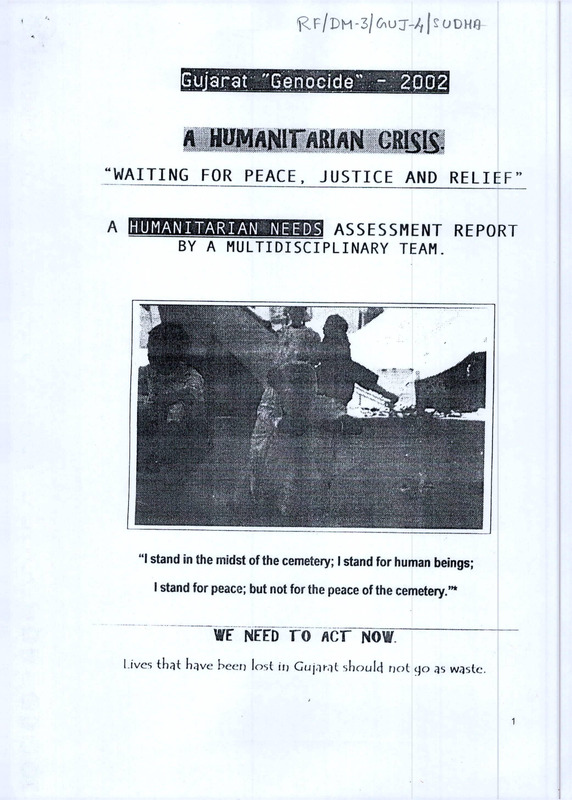
- Title
- A Humanitarian Crisis: Gujarat Genocide 2002 – A Humanitarian Needs Assessment Report
- extracted text
-
1
9
•L-
OWWWBRIMilBBB
“WAITING FOR PEACE, JUSTICE AND RELIEF”
A
HUMANITARIAN NEEDS ASSESSMENT REPORT
BY A MULTIDISCIPLINARY TEAM.
BL
WK®®
<7*^ Pll
■
'•■ '■
".
.
■
■
'
.
•
■■
vS
'J
few
•’
'j
-•
“I stand in the midst of the cemetery; I stand for human beings;
I stand for peace; but not for the peace of the cemetery.”*
WE NEED TO ACT NOW
Lives that have been lost in Guj<mt should not 90 3s w^ste.
1
Introduction:
The upogrom'^ and “genocide”2 in Gujarat has been unprecedented in independent India. As you read
this, over a hundred and fifty thousand people are struggling to survive in inhumane conditions in over
crowded 'camps’ in Gujarat Rendered homeless and turned into ‘refugees’ in one's own land, these
Internally Displaced People live under insecure conditions. Unending violence, constant terror, official
apathy and uncertainty makes their future fragile. WE NEED TO ACT NOW.
The riots have already claimed many lives (800 according to government and over 2000 according to
independent estimates and newspaper reports that quotes an independent mission by the British
Government). It has left over one hundred and fifty thousand Internally Displaced People living in inhumane
relief camps. Field reports indicate for the urgent need to step up humanitarian efforts.
While ordinary people and concerned individuals and organisations have put admirable efforts, the situation
of the people living In insecure and deplorable camp-situations is worsening with each passing day. The
failure of the State machinery and the conspicuous absence of international relief agencies (who played a
dominant and visible role in less than an year ago, in the very same state of Gujarat after the earthquake)
have all added to worsen the situation. According to newspaper reports and the camp Inmates, the
government Is considering to close down relief camps on May 31 The extreme right wing affiliates of the
ruling political party (the main accused for instigating the mass murder) has asked for the closure of the
camps.
There have been many efforts to assess the damage and understand the situation. These assessments,
carried out mainly during the initial days, were to facilitate relief. There have also been assessments and
fact-finding missions to understand human rights violations mainly to highlight security concerns.
Seven weeks since the beginning of the riots, when the future of the riot-affected and Internally displaced
people looks uncertain, Oxfam India3 and Bangalore Initiative for Peace and Relief facilitated a mission
to assess the humanitarian needs and capacities of the affected people. A multidisciplinary team of leading
professionals from various fields undertook this mission.
The objectives of the mission:
•
•
•
To assess the needs- immediate, medium and long term needs to reassure and rebuild the
community and contribute to the recovery process at the safety, health, livelihood and other
support sectors.
To assess the ongoing efforts to respond to the crisis and the existing capacities.
To develop time bound and specific interventions to support the recovery process.
Man^ez)" °f9an'S8d massacre (Oxfo^ Dictionary) fQuote on the cover page is adapted from a work by Gabriel Garcia
2 Genocide = Deliberate extermination of a people or nation (Oxford Dictionary)
3 Oxfam India is a national voluntary organization, with tremendous experience in timely response to humanitarian situations during
natural disasters (such as earthquakes, floods) and human made disasters (such as war, violence conflicts and riots) The
organisation functions from the resource mobilised primarily from India An Oxfam India team (already working in the earthquakeaffected areas for the last 14 months), along with leading mental health professionals, development agencies a-e already working
on the psychosocial issues. Efforts are being put to step up the intervention.
4 Bangalore Initiative for Peace and Relief (BIPR). a coalition of civic organisations, humanitarian and development agencies
concerned individuals from different walks of life and others. BIPR is facilitating support for the "genocide" affected in Gujarat
2
(Note: This is NOT a fact-finding / fault finding mission. The purpose is to facilitate humanitarian
intervention that will help to make life better in camps and save lives. It is purely a humanitarian mission.)
Background:
The casualties of the "extra-ordinary violence" that started on February 27th, 2002 (and still continuing) are
many fold. The urgent and survival needs of people in the pogrom-affected areas include security, shelter
food, medical care and means for livelihood. The unimaginable and continuing trauma has left
psychological wounds deeper and many a scars.
Has the systematic killing, burning and sadistic violation of human lives, dignity and living environments
shaken the conscience of our society? The continuing humanitarian crisis in the riots-affected areas is a
stark reminder. The situation is aggravated by the failure of governance and the utter inability of the state to
o^ersSS? W^NEEDToSNOWinhUmanesilualions’ needsuPPortfrom
The mission assessed the following key Issues / sectors:
•
•
•
•
•
•
Health
o Public health -Water, sanitation and care for the displaced in "camp-situations"
o Medical needs in relief camps and long term medical needs like post-burn care
o Psychosocial needs
Livelihood issues
Socio legal issues - state responsibility / compensation / insurance
Shelter
Any other humanitarian issues
Long term security/ confidence building measures in Gujarat and elsewhere.
The mission and methodology:
The team conducted a short but extensive field visits to the affected areas between April 19** and 23rd.
During visit to the camps, team hold extensive discussions with the affected people, local administrators
CBOs and other people’s movements; NGOs and international agencies working in the region; teachers'
human nghts groups; government officials, media, and others.
The team members from the public health, medical and shelter sectors put extra efforts to assess the
situation in relief camps and understand the Implications. Summer already being in place, the possibilities of
camp-situation" diseases like water-borne diseases, communicable diseases, special health needs of
women, long term medical interventions etc were looked into. Internationally accepted scientific methods
and quality of life indicators and epidemic indicators were also used to assess the situation.
Extra efforts wore put to balance the exposure by visiting the camps Inhabited from people from
different religious Identities.
The multi disciplinary team:
•
Prof. R. Srinivasa Murthy, Bangalore. He is a mental health expert, with experience in
psychosocial issues of disasters.
3
(He was the chief editor of the “Wor/d Health Report- 200r (WHO). At present he works at
National Institute of Mental Health and Neuro Sciences, Bangalore. He joined in his individual
capacity and NOT representing any institutions.)
•
Dr. Thelma Narayan, Bangalore. She is an epidemiologist and public health policy activist
and Director of the Community Health Cell, Bangalore.
•
Prof. Babu Mathew, Bangalore. He is a legal academic and is associated with the people's
movements.
(He is the registrar of the National Law School of India, University, Bangalore. Rejoined in his
individual capacity and NOT representing any institutions.)
•
David Selvaraj, Bangalore. He is a sociologist with experience in development and reconciliation
issues. He is the director of Vistar, Bangalore.
•
Kishore Saint, Udaipur. He is a Gandhian social worker who has worked on development,
livelihood and peace issues. He is associated with Seva Mandir, Udaipur.
•
Dr. Unnikrishnan PV, Bangalore. He is a medical doctor specialised in disaster management and
humanitarian action. He is the co-ordinator for Emergencies & Humanitarian Action, Oxfam India.
(G. Sriramappa (director Oxfam India, Bangalore), Gabriel Britto (Director, Development Resource Centro,
Mumbai) and Subhashls Badra (a mental health professional co-ordinating Oxfam India's psychosocial
intervention in Gujarat’s earthquake-hit areas also joined the team during the visits}.
Time-line:
April 19th (Friday): Tho loam starts tho mission at Ahrnodabad. (Some loam mombors joined lator).
Interactions with NGOs, media people etc.
April 20th (Saturday): (1) Briefing for the team by NGOs and other civil society representatives (2) Visit to
a cross soction of relief camps In Alimedabnd (3) Discussions willi communities, community loaders, NGOs.
April 21•, (Sunday): (1) Visit to a cross section of relief camps and interactions with the 'camp-inmates’(2)
Discussions with the International NGOs, Media and others (3) Briefing for the team by NGOs and other civil
society representatives (4) discussion with local government officials
April 22nd (Monday): (1) Visit to a cross section of relief camps outside Ahmedabad (2) Discussions with
the International NGOs, Media and others (3) Briefing for the team by NGOs and other civil society
representatives.
April 22nd (Tuesday): (1) Visit to a cross section of rolief camps outside Ahmedabad (2) Discussions with
the International NGOs, Media and others (3) Briefing for tho loam by NGOs and other civil society
representatives. Team leaves Ahmedabad (some team members left early).
April 23rd to 27h: Discussions, report writing, clarifications and printing.
nkpril 28,h (Sunday): The report being launched at Banqalore and simultaneously through the Internet
4
Executive Summary:
Key observations, conclusions and recommendations:
GENERAL:
During the past few years, the people of Gujarat have faced several major difficulties and disasters
such as drought, cyclone, and earthquake and communal disturbances. The cycle and the
frequency of these catastrophes have left the people, especially the poor, marginalised and
unorganised sector in an extremely vulnerable situation. The process of recovery has been difficult,
if not impossible.
The “pogrom" and “genocide" in Gujarat has been unprecedented in independent India. As you read this,
over a hundred and fifty thousand people are struggling to survive in inhumane conditions in over-crowded
'camps’ in Gujarat. Rendered homeless and turned into 'refugees’in one's own land, these Internally
Displaced People live under insecure conditions. Unending violence, constant terror, official apathy and
uncertainty makes their future fragile. WE NEED TO ACT NOW.
The riots have already claimed many Ilves (800 according to government and over 2000 according to
independent estimates and newspaper reports that quotes an independent mission by the British
Government). It has left over one hundred and fifty thousand Internally Displaced People living in inhumane
relief camps. Field reports indicate for the urgent need to step up humanitarian efforts.
The over crowded camps present a very complicated scenario. The level of attention and care is not
enough. The inhumane conditions in which the camp-inmates live are getting worsened with each passing
day. The fallout of the carnage is across all the sections of the community. However, the impact on children
and women call for extra care. Despite unending violence, the resilience of the people in the camps (of both
the communities) is appreciable. However, if efforts are not put the situation will deteriorate.
While every aspect of human life needs special and humane care, the following sectors present a challengean urgent need that calls for response on a war footing.
The most important need is stoppage of all violonco and hostilities and peace. This alone will help to create
an environment that Is crucial for any intervention. What ever is required to ensure this at the community,
social, political level needs to be done to achieve this.
PUBLIC HEALTH: (Food, nutrition, Hygiene, health, water, sanitation and shelter):
‘Relief camps' present an inhumane
living scenario. While, the efforts put by
the existing (skeletal) medical team
needs to be appreciated, it needs to be
pointed out that the health needs in the
camps are much more than what can be
handled by the existing small team who
has been working without any breaks.
The camps are an ideal ground for
opidemics and with each passing day It is
reaching an explosive situations. There
have already been reports of measles
____________________
5
and water borne diseases. 1 here is no adequate provision of food and nutrients in the camps. The
sanitation and public health needs are almost nil. Water supply is not adequate.
While almost all of the inmates expressed that they are not willing to return to their places of origin because
of the continuing violence and sense of insecurity that prevails, the only option at this stage is step up the
public health, food, nutrition, water, sanitation and medical needs in the camp sites itself. The camps should
NOT be dismantled right now. Health needs of women are not adequately addressed. The absence of
adequate toilets and others are worsening their miseries.
Urgent efforts needs to be put to ensure basic sanitation, adequate supply of clean water, survival food
needs, medical care, step up health facilities to take care of the special needs of women.
The following universally accepted UN standards should be used as the indicator:
Clean Water:
Minimum Survival allocation- 7 litres / per person I per day
Minimum maintenance allocation-15-20 litres / per person / per day
Food:
Minimum food energy requirement for a
Population totally dependant on food aid
Appropriate shelter:
2,100 kcal / per person/day
Minimum shelter area
- 3.5 sq. m I per person
Minimum total site area - 30.0 sq m / per person
The five public health emergencies in camp-situations (namely Measles, Diarrhoeal Diseases, Acute
Respiratory Infections, Malaria, Malnutrition) if unattended will lead to explosive situation and human
casualties. Government must make efforts to respond and prevent epidemic outbreaks.
PSYCHO-SOCIAL CARE:
The team saw a number of patients complaining of ill-defined symptomatic complaints as well as people
complaining of sloop disturbance. On enquiry they reported toolings of sleeplessness, irritability and
toaifulnoss. Hie doctors reported that in the earlier part of the stay people had more of anxiety symptoms in
(ho form of gabrath. t hey also reported that these symptoms estimated to be about 25-30%. Currently the
doctors have not received any special training to work with this group of people and they are providing care
on an OP basis only. The records maintained are on individual visits slips and no case records for
continuous care is available except for patients of antenatal care. On enquiry they reported that there is
need for record system as well as for training in psychosocial care.
One of the community volunteers
loportod that depression is very common
and people express this in the form of
irritability, insomnia, worrying, crying, and
fear of the future.
Efforts need to be put urgently to
respond to the psychosocial fallout of the
riots. A community-based approach
needs be adopted and all existing
resources (material and human) from all
sources such as the government medical
colleges, NGOs and others need to be
6
used. Interactions with the community leaders showed that there is an urgent need to develop a clear plan
for the future. The sense of uncertainty and insecurity is worsening the mental health of the camp inmates. The psychosocial support is a need of the total population of Gujarat and not just the people in the camps,
because the lives of most of the people in Gujarat have been disrupted and affected. This should be the
basis of intervention.
The psychosocial interventions not only are important to decrease the distress of the affected population
living in camps but also important in returning the community to a healthy trusted community as was the
case before the riots by giving importance to emotional life of the people. You would be decreasing the
feelings of anger, hostility, and destruction that are very common in such situations. Such a recognition will
decrease reaction as a way to responding to the problem.
LIVELIHOOD ISSUES:
Any effort to evolve livelihood programmes will go a long way in improving their general situation. This will
help the healing process as well. While doing this the concerns, opinions and capacities of the community
should be taken Into consideration.
The interventions should have the scope for continuity from the relief to the rehabilitation phase. It calls for a
ong-term vision. The proposed interventions while addressing the practical needs of person should also
lead to influencing the power relations. The proposed interventions should simultaneously address the need
for emotional healing and economic survival. The proposed interventions should ensure a positive bias
towards women - the most affected. The proposed interventions must ensure 'community' value added
dimensions to the economic enterprise. There Is a need to give the affected people special preference in
and eVen in co^l^actua, ,ab°ur work. Efforts must be put to integrate them and to oppose
JUSTICE, SOCIO LEGAL ISSUESAND COMPENSATION:
The killing and human suffering is an assault on humanity. It is permanent black spot on modern India.
Needless to say, the perpetuators should be brought to book. While any punishment for the perpetuators will
never help to bring back the Ilves that have boon lost and the damaged social fabric, it will help as a
deterrent force. This becomes more important in an emotionally sensitive and communally charged context
Since the characteristics of this genocide are unprecedented in the history of India, it is important to look at
the global experience of responding to those who have committed crimes against humanity. Of late, efforts
at the international level while yielding mixed results have started giving clear directions for future. It yielded
mixed results The ongoing trial of Yugoslav warlords (in the Hague), Rwandan Holocaust (in Africa) and
cruel fcTbe left!
^7^ R°U9e ^Cambodia^ haV0 ind,cated that to0 cr’mes against humanity is too
There is a need to make the process of filing claims and its judicious disposal simple. The survivors and the
10 ms. Tarruly members should be given enough time to file First Information Reports and other legal
formalities. The survivors, most of them children and women, are going through a terrible trauma that may
take more time to be in a state of mind to act normal.
Justiee is essential for the reconciliation process. Socio legal intervention should be an essential component
of the healing process. It should contribute and not complicate recovery and rehabilitation process.
7
PEACE, RECONCILIATION AND OTHER HUMANITARIAN ISSUES:
The lack of a disaster management policy and lack of humanitarian preparedness programmes resulted in”
knee-jerk reactions. The situation calls for a long-term vision and commitment The lessons learnt in Gujarat
are a stark reminder of today’s India and the level of intolerance (on religious and other lines) that is
reaching epidemic proportions. The fear expressed by people from other parts of India, reiterates the need
to take up humanitarian preparedness as a priority. Peace, reconciliation, justice and compensation issues
should find a priority for civil society not just in Gujarat but elsewhere as well. Gujarat is a costly warning
signal that should not be ignored. While there is a definite need to amplify the efforts, any such work should
be placed only in the larger context of the ongoing development and social process. Ensuring synergy
between different constituencies is a must. This calls for better understanding, planning and response.
Further, this calls for a long-term commitment from all those who believe in humanity.
WE MUST ACT NOW.
WE MUST ALSO ENSURE THAT THE LIVES LOST IN GUJARAT SHOULD NOT GO AS WASTE.
%
8
Gujarat- Important observations:
During the past few years, the people of Gujarat have faced several major difficulties and disasters
such as drought, cyclone, earthquake and communal disturbances. The cycle and the frequency of
these catastrophes have left the people (especially the poor, marginalised and unorganised sector)
in an extremely vulnerable situation. The process of recovery has been difficult, if not impossible.
Gujarat has one of the highest per capita incomes in India and contributes significantly to the
national GDP. It is moving strongly in the direction of globalisation and privatisation.
The state has experienced a number of communal tensions and riots in the past The very major
ones being during partition, in 1969, 1993-93. Anti reservation riots were also very severe in the
mid-eighties.
Very complex political processes have been operating here. During the past 15 years and
particularly after the early 1990s, following the notorious Rath yatra (that claimed hundreds of lives)
there has been a significant social polarisation with low intensity social conflict between religions
and caste groupings. This runs alongside cooption, caste collaboration and sanskritisation. Social
movements, such as of that dalits, are reportedly weak or no longer existing.
In the recent past, there has been a systematic, planned effort at mobilising people along
communal and sectarian lines. There is evidence from fact-finding teams and news reports of a
meticulously planned approach, targeting the Muslim community in particular. Modern technology
and electro chemicals were abused in the violence that is going on since it started on February 27,
2002. This is one of the first times that women and children have been systematically targeted and
brutally treated on a large scale and in public.
There has been a complete violation of human rights on numerous occasions - loss of life, bodily
harm, loss of property and livelihood.
While thousands of individuals and their families have suffered and continue to live In uncertainty
and fear in inhumane relief camps, provision of basic facilities is still a far cry despite the fact that
Ahmedabad is one of the richest cities.
It is an entire community that has been systematically targeted with an overt effort at breaking them
emotionally, economically and attacking their cultural and religious symbols and way of life. These
assaults, on the basics of humanity, cannot be justified or tolerated by any human being.
There is evidence of apathy and poor functioning of the sections of the state machinery through its
institutions such as the bureaucracy and police by denying people (and in particular the poor and
marginalized) their right to life, liberty, security and livelihood. Political interference and cooption of
several institutions is an unhealthy and dangerous trend and needs to be tackled as a national
issue as well.
it is a challenge for the humanity in general and citizens of India in particular to clearly counter
these political forces and their inhumane processes. Therefore, any short-term immediate
9
humanitarian action needs to be supported by broader and longer-term action at a national and
macro level, particularly focussed on political processes that support democracy secularism and - social justice.
State and central governments have to perform their constitutionally mandated responsibilities or
face the consequences at all levels. Our commitments made through agreements signed under
various international treaties also need to be honoured. All humanitarian interventions have also to
be located within the context that this is a situation of social conflict, in which the state is taking a
particular partisan and sectarian position. This makes it very different to a natural disaster. This is
also a reason why financial and human resources and international assistance is not easily
available. Organisations and individuals who do speak up or get involved are also being made
subject to personal threat and intimidation of a serious nature.
During visits to two Muslim and one Hindu camp, we found that a large number of affected people
we met were migrants from Karnataka (Gulbarga district), Andhra and other states. They were
largely unorganised low-income families doing repairs, small tailoring, beedi rolling, etc.
South and central Gujarat is the most affected by the violence. Seven weeks since the beginning of
the hostilities, there are reportedly about 112 camps in Ahmedabad with over 100,000 people and
about 50-60,000 people in camps in rural areas. An additional 30,000 are homeless and sheltered
by relatives and friends.
Reports indicate that there are directions to close down the camps by 31st May 2002. However, the
sense of insecurity and the continuing violence will make the return of the camp inmates to their
hometowns. Since their houses and possessions are destroyed and burnt, and the continued
threats of repetition of the violence if they go back is complicating the process. There are no known
efforts at relocation and rehabilitation elsewhere. This uncertainty is causing a lot of anxiety and
tension to the people. Some of the older persons have lived through two or three rounds of riots
and rebuilding of lives and have a feeling of hopelessness.
10
A 28-year-old mother of 3 hailing from Gulbarga, now
in Shah Alam Camp, lost 8 members of her family
——————
including her husband and 12-year-old daughter.
Her son Javed (around 7 years) is recovering from
bums to the face and one whole arm. She also has
to look after a young 2-year-old daughter. Her
experiences of having her house and family burnt of
being misguided by the police, of seeing police firing
into the fleeing crowd, of being chased by mobs have
left her traumatized and depressed. In another
family also in Shah Alam Camp, grand parents are
looking after their 1 % year old grandson, after both
his parents and other relatives were burnt to death.
He is very afraid of strangers and always in tears.
The older couple also look after a mentally ___________________ _______ _
challenged child and 3 other children.
eJitenf?nPlta
an<l Xe
“le '"d'vldu31 reli9'“"s communities (This is more
It is made
NCOS ThlSl? ?U9th'oca2com21un,,y efforts- They were not established by the government or
NGOs. They are situated in dargahs, mosques, graveyards, and on vacant land.
JnnrdmSn5 '"J TVe ~.a c°alition of NGOs has 1,66,1 active fr°m the initial days. They are
coord nafing activities of a limited number of NGOs who have come forward despite the
Sr hl^S WaTJn9Su:They haVe improved ,he (lua,ity of humanitarian relief by ensuring potable
ater helpmg with setting up. toilets, identifying and supporting community volunteers (some of
diem known as Aman Pathiks), providing nutrition supplementation to young children and pregnant
and h
TS Sertak,n9 some health Gaining eg., for diarrhoea, organising educational
Sr?' 7 .^Vltief for ch,ldren- eta. However, all camps are not covered. Much also depends on
the organisational capacity of camp managers.
The government provides doctors to some of the camps. In the initial phase, all Muslim
government doctors were reported to serve in affected areas. Now, Hindu doctors too provide
medical care. The Chnstian Medical Colleges from Vellore and Ludhiana sent volunteer doctors in
rotation dunng the first few weeks. In Shah Alam Camp, with about 12,000 persons (one of the
ab°Ut 1000 0Ut patients were seen per day initially -has now come down to
about 6-6-7,00 per day.
11
i
■GUJARAT BURNS IN COMMUNAL FRENZY
(An update)
The communal carnage following the partition of India that stained the history of
independent India with blood found many of its victims in long-distance trains that criss
cross this subcontinent After almost 56 years, the smouldering embers of that
communal flare up, stoked by more recent provocations and growing mistrust and
intolerance, burst into a flashpoint in yet another train attack in the western Indian state
of Gujarat, one of the most literate and prosperous in the country. The immediate
provocation for the bloody violence that claimed many lives (800 according to the
government, and over 2000 according to independent estimates) in Gujarat was an
attack on a train carrying religious activists returning from Ayodhya, a legendary town
where Hindu fundamentalists want to build a temple on the ruins of an ancient mosque
they had razed down in 1992.
Last round of bloodletting in the name of religion happened in the wake of demolition of
the 16,h century mosque, Babri Mazjid, built by a nobleman from the court of Babur,
India's first Moghal emperor, in the birthplace of Ram, the warrior-king deity of the
Hindus. The momentum generated by the build-up, the campaign and the triumph of the
mosque demolition propelled the Hindu nationalist Bharatiya Janata Party (“Indian
People’s Party" - BJP) to power. A heady win for a party that had been marginalised for
decades when the Congress party ruled for most of the years. Two terms of rule,
totalling four years and continuing, heading a coalition, has diluted the religious fervour
of the BJP. That is bad news for the hardline nationalist party workers and supporters,
broadly called the ‘Sangh Parivar'. After BJPs lacklustre performance in a series of
recent state elections, this brotherhood brought the temple issue once again to the
forefront, challenging the government, sending volunteers to Ayodhya, threatening to
defy court orders to keep the status quo there.
For days before the ill-fated Sabarmati express pulled out of Faizabad, the twin-city of
Ayodhya, Muslim communities living along the railway line were subjected to abuse and
beatings from Vishwa Hindu Parishad (Global Hindu Federation - VHP) activists
travelling to Ayodhya (Frontline, Mar 16-19, 2002). In Uttar Pradesh, where Ayodhya is
located, reportedly there were clashes on railway platforms, harassment of Muslim train
passengers and retaliatory stoning of railway coaches carrying the activists called the
Kar Sevaks (ibid). On February 27, the Kar Sevaks of the Sabarmati Express had an
altercation with a tea stall owner on the platform of Godhra railway station, after some of
the activists refused to pay for their tea. What followed was a full-scale attack on the
coaches carrying the Kar Sevaks (ibid).
Somebody pulled the chain, and a group of Muslims gathered at the platform hurled
bottles of petrol into one of the coaches, killing 58 people in the locked coaches; 40 of
the dead were women and children as abled-bodied men managed to escape (Time,
March 11, 2002). Facts emerging at preliminary investigations suggest that plans had
been made in advance for the attack (Frontline, March-16-19, 2002).
Hell broke loose the following day, February 28, when the VHP called a ‘bandh’ (market
closure) to protest against the Godhra killings. Rumours flew thick fast - that Muslims
had abducted teenage girls or slaughtered cows, objects of Hindu’s worship- fanning
the blood lust of rampaging mobs, just as they did during the 1947 riots (Time, March 11,
12
............
I
2002). Mobs fanned out through Muslim neighbourhoods of Gujarat, led by local
politicians and their rabble-rousers, burning families in their houses demolishing
mosques, raping wives and daughters (ibid). The police turned a blind-eye (Outlook
March 11, 2002).
The central government, led by the BJP coalition of Atal Behari Vajpayee, considered
the moderate face of the party, did not send the Army - an usual practice when the
police fail - to control the riots for several hours (Time, March 11, 2002). Shoot-at-sight
orders to control the mobs were issued only two days later. The mobs in Ahmedabad
and other towns targeted Muslim homes and establishments with precision, looting
burning, and killing. The official death toll was 80 for the first day, but independent
estimates put the figure at over 200. The government clamped curfew on 26 cities and
towns including Ahmedabad, Baroda, Rajkot and Surat. The riot spread to small towns
and rural areas, including areas dominated by tribal people, so far non-partisans in
recurring communal riots. (Outlook, March 11, 2002) By the weekend more than 300
people were killed, mostly Muslims (Time, March 11, 2002).
Stones reported by the end of the first day of riot were disturbing. For instance, after
frantic phone calls to the local police stations and to officials since 9am on February 28
even a VIP like former Congress MP Eshan Jaffri could get no effective police
protecbon. As the mob began closing in, Jaffri fired from a pistol in self defence but the
attackers gained control and dragged him out and with his family and killed them. A
police picket of only four constables, led by an inspector, stood and watched A total of
(OuUook March^^^OO?)6 predOminantly labour class housin9 colony where he lived
It was almost as though the mobs were operating to a plan, breaking open shops
business establishments and even small vends of Muslims. Plume of smokes rose from
innumerable parts of the City. Even the state capital Gandhi Nagar, which is not a riotprone area was caught in the frenzy. The mob entered a government office complex
and torched the office of the Waqf Board that looks after the affairs of Muslim religious
institutions (Outlook, March 11, 2002). The attacks were done with surgical precision on
uslim establishments and households, evidently with an element of planning and
possibly with the collusion of the administration. The acts of aggression, including rape
suggest"09 Wh°le families’ were often aimed terrorising people, media reports
The police inactivity was a repeat of other riots including the one at Mumbai in 1993
after the Babn Mazjid demolition. The State Reserve Police sat idle, awaiting orders
sensitive areas had inadequate police cover, senior police officials refused to act on
specific information of rioting; and the Chief Minister Narendra Modi, a hardline activist of
the Sangh Parivar, said he was happy with the police action and that they could not be
expected to be everywhere (Outlook, March 11, 2002.) In 1984, when erstwhile Prime
Mmister Indira Gandhi was assassinated by her Sikh bodyguards outside her home at
the height of insurgency in Punjab, Sikhs were targeted for similar attacks in Delhi and
the police did not act (Frontline, March 16-19, 2002).
The scale of violence was not the worst India has seen, but the significance of the riot
■ that is still continuing after a month is unmistakable and ominous - the attack on
Muslims by mobs egged on by Hindu hardliners had the support or the State
government. Reports suggest that educated, middle-class people took part in arson in
13
j
pities, many of them taking the loot in their private cars, a luxury in India. Sound bites in
the media suggest that even children in early teens were part of the attacking mobs,
justifying their acts as a measure of punishment meted out to the Muslims for what they
called their wrong acts. It seems many people actually believed that the train burning
incident in Godhra was a sufficient provocation to initiate a full-scale attack on Muslims
as a community. The Sangh Parivar definitely gave such an explanation. Rashtriya
Swayamsevak Sangh (RSS), the oldest one of the most influential elements of the
Sangh Parivar, called the violence a natural reaction’ to the Godhra killings. The central
government refused to dismiss the controversial chief minister Modi, despite pressure
from all quarters including his coalition partners.
"The National Human Rights Commission has related in chilling details how Chief
Minister Modi and key members of his government and party interfered at every turn with
the proper administration of the state, to demoralise its officers, to shield criminals,
arsonists, rapists and murderers, to deliberately give marauding VHP and Bajrang Dal
mobs a free hand in destruction, and to replace honest, upstanding, and idealistic
members of the police and administration who refused to do so with others more pliant,
communally tainted or simply spineless” (Jha, Prem Shankar, The Dance of Shiva
Outlook, April 15, 2002)
The incidents in Gujarat raise concern about the role of the State in abetting crime on
communal lines and about the growing insecurity among minority groups. Earlier the
Sangh Parivar in Gujarat targeted several chapels and community prayer halls of
Christians, especially tribal convert for attack. Gujarat has proven to be a fertile breeding
ground for the Sangh Parivar and its indoctrination. Text books have been rewritten,
giving history lessons a Hindu nationalist and anti-Muslim slant. (Sambrani, Shreekant,
Gujarat’s Burning Train: India’s Inferno? Economic and Political Weekly, April 6, 2002)
The hate campaign did its job. Anti-Muslim sentiments had been building up in Gujarat
long before the Ayodhya movement. Prior to 1990, before BJP coming to national
prominence, communal riots were almost an annual feature in Gujarat (ibid). Post 9/11,
with widespread concern about Muslim fundamentalism and terrorism worldwide, the
simmering negative feelings needed a just spark to explode.
Eight weeks since the beginning of the hostilities, Gujarat continues to bum. It has
already claimed many lives (800 according to government and over 2000 according to
independent estimates). It has left over 150,000 Internally Displaced People living in
insecure conditions and in inhumane relief camps Unending violence, constant terror,
official apathy and uncertainty make their future fragile.
14
Medical and Public Health Components
•
In Camps, patients stand in long lines waiting attention. They stood while the doctor took the
history. There was no privacy or screening. Women would find it difficult to share about
reproductive tract ailments in such a situation. It is also not conducive for counseling that is what
most people need. There was no table for patients to lie down for the clinical examination. Patients
are referred to the civil hospital or the Municipal Hospital for investigations and treatment. About
26 deliveries are reported to have occurred in this period and there are several antenatal and
postnatal mothers. Lack of privacy would make their examination and care difficult. It was reported
by women that a number of abortions I miscarriages had occurred during the period. The
pregnancy outcome needs to be studied.
•
The burden of Post-Traumatic stress was evident - as people the team spoke to frequently broke
down and had long pauses in their conversation.
•
People reported fever with rash that could be measles. (Measles outbreak ahs already been
reported in some camps).
•
Several of the women and children we saw were very pale and looked anaemic.
•
Pharmaceutical samples have been donated and some pharmacies give free medicines on
prescriptions up to a certain amount. Government has also supplied drugs. A makeshift store for
drugs is maintained without systematic arrangement of drugs and labeling of boxes. For instance,
in one camp, anti-TB drug boxes were discovered accidentally a couple of days earlier. This
suggests that anti-TB treatment is not being given in the clinic. In a population of 12,000, a number
of TB patients are expected. It is also known that in conditions of stress, displacement and in
overcrowded camp conditions TB rates go up and the medical care system needs to be alert to
this. Untreated sputum positive pulmonary TB can spread in camp conditions. In the Juhapura
camp, medical work was done in a tent.
•
In Shah Alam Camp, people had 2 meals a day between 1 and 2 pm in the afternoon and at night.
Children and pregnant / lactating women need more frequent meals, more vegetables / eggs / fruit
and some nutrition supplements. In the smaller camps we visited in Juhapura things were better.
•
Shah Alam Camp had 14 toilets for 12,000 people that are very inadequate. People reported
difficulty in managing small children. Many went out to relatives and friends to wash clothes and
for bathing.
•
There were a lot of flies. This could spell disaster in an overcrowded camp.
•
Children were drinking water from the stagnant water ponds that looked fairly greenish.
•
Provision of adequate quantity of water of potable quality and better sanitation is required.
•
Not everyone had buckets and mugs. Many, particularly children had very long nails dogged with
dirt. People had lost everything - nail cutters / scissors. All this can potentially lead to water and
food borne diseases.
•
Despite the many difficulties, there was a very positive atmosphere among people. Children in
large groups were attending some educational activities. We met 4 young men who were
community volunteers - ‘aman pathiks" - who paid particular attention to families with greater
problems. Many philanthropic individuals and NGOs provided material assistance to families.
Recommendations
General
Given that negative political processes leading to almost an "ethnic cleansing’ or genocide is the root
cause of the current situation, it is critical that we join a macro socio-political response at a national
level This is clearly not a local or state issue or one that will naturally subside. It therefore needs a
broad based, larger response that is inclusive working with the majority and minority communities and
resisting fundamentalisms of any kind.
A health intervention with victims and affected communities is a political statement with health seen as
a basic human right, an entitlement and an issue of social justice. This only reiterates our mandate
deriving from the Constitution of India (1950), the National Health Policy (1983), the Alma Ata
Declaration of Health for All using Primary Health Care (1978) and the global Peoples Health Charter
(2000). Public health is also widely recognised to be a state responsibility and pressure needs to be
put on the government (state and central) to be accountable.
Rather than a purely biomedical approach, a community based approach is recommended that builds
on community and peoples capacity and does not create dependency. Medical care services are part
of this community health approach.
Specific
•
There is need for better documentation both quantitative and qualitative. Medical records will be
evidence for compensation and insurance claims. There needs to be a systematic approach with
patient-retained and centre-based records. Simple analysis will provide epidemiological information
regarding any disease outbreaks, or it will indicate a high prevalence of a problem that warran s
intervention. Disaggregated data recording and analysis by age I sex I place I sub-group would
help. A person may be designated for managing and analysing data systems. The initial survey o
about 3000 people done by the Citizens Initiative will provide a baseline.
•
Injuries and burns are specific and major problems. Adequate post-burn care is required to prevent
fibrosis and contractures. Post-trauma counseling is required. (We understand that there are
initiatives to this effect by the Citizen’s Initiative, CMAI (Gujarat Branch), Oxfam India and
Actionaid. However, more needs to be done).
•
Regular chlorination of water and provision of adequate quantity of water will help greatly. The
Directorate of Health should be responsible and provide the necessary material. Water testing kits
should also be provided in camps.
•
Sanitation to be improved. Larger number of toilets and solid waste disposal and management
systems to be developed.
2
.
Iron, folic acid and Vitaman-A supplementation to children, pregnant and lactating m^ers to b
given regularly. Supplies may be obtained from the Reproductive and Child Health Programm
(RCH). De-worming (antihelminthics) to be used judiciously.
.
Women's Health must get priority - especially treatment for Reproductive Tract infections HIV
testing to be done where required with pre and post-test counseling. Women who have been raped
or molested will need special counseling with their families. In displaced populate HIV rates are
known to go up. This needs to be prevented by provision of social support and education.
.
Children also need special attention, play therapy, art and music therapy, educational activities.
«
TB treatment to be systematised with record keeping and good follow-up.
Revised National TB Programme (RNTCP) can be obtained.
•
Communicable Diseases common in camps situations are water related diseases, respiratory tract
infections, measles (all children should receive the continue immunizations), vector borne diseases
(which may occur as the rainy and mosquito season approaches. Control of mosquitoes and flies
needs to be done with support of municipal authorities. Health educaflon of ^ie community at
personal and group level can be done through the community volunteers, ‘Aman Pathiks .
.
An essential drug list can be used for the Pharmacy - which can be made knowr> to donorsi and
treating physicians. LOCOST could develop this. There are existing lists also. WHO criteria ot
Support from the
essential drug list should be used.
•
Examination table, chairs for the patients, movable screens and patient records can be provided
through government I NGOs.
•
Over medication to be avoided particularly of antibiotics, sedatives, etc. Tapering of medication to
be done.
•
Training of health workers in common diseases, counseling skills and communication skills can be
done with the support of health NGOs in Gujarat.
•
Life skill education with adolescent youth can be initiated.
3
April 21 2002
PSYCHOSOCIAL NEEDS OF POPULATION DISPLACED BY THE RIOTS IN
GUJARAT.
R.Srinivasa Murthy
Professor of Psychiatry,
NIMHANS, BANGALORE.
BACKGROUND:
The population affected by the riots in the recent Gujarat events have special
psychosocial needs from the following 3 aspects of their life experience.
Firstly, any form of displacement of people from their normal habitat and social
relationships increase their need for emotional support;
Secondly, the events that the involved population has witnessed in terms of violence,
arson, riot, destruction, death and in some cases personal injury to self and family
members are traumatic to all people who have either been part of it or been witness to the
same. All of people of Gujarat have several emotional needs to overcome the experience
of psychological trauma; and
Thirdly, people living in camps and temporary shelters have (heir lives disrupted in
terms of their personal routines, work, family life , uncertainly about the future and
community support. This also results in greater amount of emotional needs and require
psychosocial support.
From all the evidence available, the need for psychosocial support, in similar
circumstances is universal and the emotional needs of people should be seen as
a normal reaction to an abnormal situation.
World Health Report 2001 recognised this group as being very important and
has the following things to us:
**Conflicfs inclutliiig wars and civil strife, and disasters affect a lar^e number ofpeople
and result in mental problems. It is estimated that globally about 50 million people are
refugees or are internally displaced. In addition, millions are affected by natural
disasters including earthquakes, floods, typhoons, hurricanes and similar large-scale
calamities (IFRC 2000). Such situations take a heavy toll on the mental health of the
people involved, most of whom live in developing countries, where capacity to take care
of these problems is extremely limited. Between a third and half of all the affected
persons suffer from mental distress. The most frequent diagnosis made is posttraumatic stress disorder (PTSD), often along with depressive or anxiety disorders, hi
addition, most individuals report psychological symptoms that do not amount to
disorders. PTSD arises after a stressful event of an exceptionally threatening or
catastrophic nature and is characterized by intrusive memories, avoidance of
1
circumstances associated with the stressor, sleep disturbances, irritability and anger
lack of concentration and excessive vigilance. The point prevalence of PTSD in thei
general population, according to GBD in 2000, is 0.37%. Studies of disasters have also
shown a high rate of mental disorders. A recent study from China found a high rate of
psychological symptoms and a poor quality of life among earthquake survivors. The
study also showed that post-disaster support was effective in the improvement ofwellbemg (Wang et al. 2000)”.
J
Against this background, the interventions to decrease the psychosocial distress and
long-term effects have been well established. It is very important to note that most of the
psychosocial interventions can be carried out by the existing community even in the most
disturbed situation. These resources are
1. Individuals
2. Family members
3, Community level workers/volunteers
4. Community Leaders
5. Health workers
6. Primary care medical officers
7. School teachers
8. Relief and rehabilitation workers.
All of these people will be able to provide additional psychosocial support by
understanding the normal nature of the exposure to abnormal situation. The five simple
principles they have to remember are:-
• No one who experiences the event or witness the event
is untouched by the event.
• Disaster results in two types of trauma, individual and
collective.
• I hese stress and grief reactions are normal response
to an abnormal situation.
• Many emotional reaction of disaster survivors stem
from problems of living caused by the disaster.
• Survivors respond to active interest and concern,
• Support systems are crucial for recovery.
___________________________
2
The assessment of the needs of the population in the city of Ahmedabad was carried
out by the following measures:-
1. By talking to the primary care doctors who are working and
providing medical care to these affected population to know how
much of the medical problems they are seeing are related to the
events and how they are providing this help.
2. Talking to the population themselves to understand their emotional
state
3. Interactions with community level helpers both governmental and
NGOs
4. Interaction with community leaders and,
5. Interaction with the NGO leaders who are providing relief and
rehabilitation.
Each one of these groups were asked about :
1. What they felt were the different aspects that needed to be addressed
to as part of relief and rehabilitation?
2. What were the psychosocial needs that they perceive is being
important at this stage of the relief and rehabilitation?
i 3. What were the methods they were using to meet these needs?
4. What were the barriers that they experience in providing this help?
5. What would be the training needs to empower them to provide
psychosocial care as part of their undergoing activities?
6. What type of a specialist support they require to deliver psychosocial
care?
OBSERVATIONS:
I.Talking to the primary care doctors who are working and providing
medical care to these affected population to know how much of the
medical problems they are seeing are related to the events and how they
are providing this help.
The visits were to the Saha-e-.Alem camp as well as Bopanagar camp. The setting of
the medical care in the first camp consists of 7-8 doctors, a pharmacy, injection, dressing
3
section, small lab. The facility was fully utilised by the people and large number of
people with many health problems were coming. I was impressed to sec the number of
people with diabetes, hypertension, asthma coming for care. During the period of my visit
I saw a number of patients complaining of ill defined symptomatic complaints as well as
people complaining of sleep disturbance. On enquiry they reported feelings of...,
sleeplessness, irritability and fearfulness. The doctors reported that in the earlier part of
the stay people had more of anxiety symptoms in the form of gabarth. They also reported
that these symptoms estimated to be about 25-30%. Currently the doctors have not
icccivcd any special training to work with this group of pcOople and they are providing
care on an OP basis only. The records maintained are on individual visits slips and no
case records for continuous care is available except for patients of antenatal care. On
enquiry they reported that there is need for record system as well as for training in
psychosocial care.
One ol the volunteers was working reported that depression is very common and
people express this in the form of irritability, insomnia, worrying, crying, and fear of the
lutuic. All the health people said they do not ask the people about the needs again and
again as they tear this would remind them of the events. They also said that the method
they use on is to divert the mind of the people. Only 2 medicines that were available arc 1) antidepressant and anti-anxiety drug. Most of the medicines are given for 3 days only
and there is no way of knowing whether the person prescribed came for follow up,
repeats medicines as well as review.
I
2. Talking to the population themselves to understand their
emotional state
An example of the type of problems is that of Mr. A. Khan. He had to run from the
house and was a victim of teargas attack. While running he fell down and hurt himself
and he also reported that he was beaten by the RAF people and he was robbed also of the
gold and other things. He had a scalp injury and their was a lol oldelay in getting help
He said very beautifully .."I don't know hat to do....where to go... 1 keep thinking and
wishing for peace ..I will not go back to the area..,,! will not go back there even if I have
to stay on the footpath.. ..the police is with them.. .no one will I cannot sleep. I feel
anxious of the time, I avoid company, I cannot mix with people, I do not enjoy food. And
he said that about 40 people f rom his area are there in the camp and all of them are in a
similar situation. He wish for peace in the city, so that he can go back. H e also said "I
have never had this type of mental stress in all my life of over 50 years. I have lost
confidence in the system. " Further he added that "I have not lived like this before. In the
camp 1 am lying on the floor, I have to stand in line for food, for everything. I do not
even have money for any personal needs". On enquiry what would help him, he said "iff
can go back to people I feel better and concluded saying that please give us back our
house and work with that everything become alright."
The other example is of S. Ali, about n55 years. He had injuries of hand and leg by
hitting by police. He said he was called out to the house, taken out in a vehicle. He was
left the house without even his chappals. He said his son was also taken and kept in the
4
police station for about 4 hours. Next day he returned home and they were attacked by all
the four sides. Their house was burnt and he could not run as he was injured. He said, "I
cannot sleep for more than 2-3 hours. I do not have mental peace".
Another person said I worry and fear everyone. I listen to people and feel helpless. I keep
thinking what I have done, is it wrong to be Muslim?
One of the persons said fear will not go, what they have seen will remain with them.
Children who were seen their parents killed or injured say that "I will take revenge",
3. Interactions with community level helpers both governmental and
NGOs
The group amanpathik are working with about 50 families for providing help and
support. They reported that the people in the camp want to talk about their experiences
again and again. Whatever we start they come back to the same questions of what
happened. We tried to divert their mind but they want to relate what has happened to
them. All of them say at night many people will keep awake or keep walking up and
down. They also reported that at times when talking to them they develop this feelings of
helplessness and start crying themselves. However, they reported that they like the
people they are going and visiting them and who are showing interest in their basic needs
as well as their emotions.
4. Interaction with community leaders
Interaction with community leaders showed that there is urgent need for clear
plans for future. In addition they also felt that the support for improving the living
facilities and receive greater attention. When told that there is a plan to support
educational camps they expressed satisfaction as children needs this activity urgently.
5. Interaction with the NGO leaders who are providing relief and
rehabilitation.
The NGOs are all working with their own resources and trying to provide care to
the best of their capacity. They reported that the camps were supported by the community
leaders initially with their own resources. The work of the citizens initiative has been
very grateful. Some of them expressed that there is need to try and dismantle the camps
as soon a s possible as with the progress of summer all problems of dehydration, health
problems could be occur. It was also pointed that there is need for improving the
nutritional status. He was also pointed out that there is need for education of the medical
staff in the care of bums, injuries, diabetes, hypertension, TB, reproduction infections and
emotional problems. Another need is to support livelihood activities as soon as possible.
The urgent need to develop a rehabilitation plan and make it known to the people was
also expressed by the NGO leaders.
5
RESPONSE TO QUESTIONS:
What they felt were the different aspects that needed to be addressed to
as part of relief and rehabilitation?
As part of the relief and rehabilitation the affected population and those
providing help all recognises that the basic needs as well as the
psychological needs is the priority at this point of time. There is greater
urgency for clarifying the place where they would live for both Hindus and
Muslims as everything to be depend on this.
What were the psychosocial needs that they perceive is being important
at this stage of the relief and rehabilitation?
The psychosocial problems they are having are at 4 levels :
1. Symptoms of anxiety, sadness
2. Fear from violence
3. Uncertainty about the future
4. Problems of living in a camp
I
What were the methods they were using to meet these needs?
Currently most of them are coping with this with their own resources as well
as by going to the doctors for medical help. Some of the agencies like Action
Aid, Oxfam and Citizens initiative have initiated psychosocial interventions.
But these are not adequate at this point of time.
What were the barriers that they experience in providing this help?
The major barrier is the lack of basic training in care of the psychosocial
problems to persons working with the affected population. In addition there
are no specialist services to support the field level workers and doctors.
6
What would be the training needs to empower them to provide
psychosocial care as part of their undergoing activities?
All the group recognised that there is an urgent need for focused short
training for all of these groups and a continuous method of referral support
for their work.
What type of a specialist support they require to deliver psychosocial
care?
Specialist support is essential for three purposes.
1. Training for the field doctors and health workers
2. Periodic review of the work done by the field level staff and guidance
3. Referral support for more severe and difficult patients.
It would be very good if a system can be developed on these lines, so that
every one knows who will be visiting the camps on which day as well as
where they will refer difficult patients. It is likely that the specialists will
have to visit camps, as many members of the population are reluctant to
leave the camp out of fear.
RECOMMENDATIONS:
The psychosocial support is a need of the total population of Gujarat not only those in
the camps, because the lives of most of the people in Gujarat have been disrupted and
affected. This should be the basis of intervention.
1. The psychosocial interventions not only are important to decrease the distress of the
affected population living in camps but also important in returning the community to
a healthy trusted community as was the case before the riots by giving importance to
emotional life of the people. You would be decreasing the feelings of anger, hostility,
and destruction that are very common in such situations. Such a recognition will
decrease reaction as a way to responding to the problem .
A National Survey of Stress Reactions after the September 11, 2001,
Terrorist attacks. People who are not present at a traumatic event may be experience
stress reactions. We assessed the immediate mental health effects o9f the terrorist attacks
on September 11, 2002. Using random-digit dialing three to five days after September 11,
we interviewed a nationally representative sample of 560 U.S. adults about their reactions
to the terrorist attacks and their perceptions of their children’s reactions.
Results: Forty-four percent of the adults reported one or more substantial symptoms of
stress, 90 percent had one or more symptoms to at least some degree. Respondents
throughout the country reported stress symptoms. They coped by talking with others (98
percent), turning to religion (90 percent), participating in group activities (60 percent) and
making donations (36 percent). Eighty-four percent of parents reported that they or other
7
‘CO
07538
j O
hat
Oc>2_
loV
o'5
.
r<’
adults in the household had talked to their children about the attacks for an hour or more;
34 percent restricted their children's television viewing. Thirty-five percent of children
had one or more stress symptoms, and 47 percent were worried about their own safety or
the safety of loved ones.
Conclusions: After the September 11 terrorist attacks, Americans across the country,
including children, had substantial symptoms of stress. Even clinicians who practice in
regions that are far from the recent attacks should be prepared to assist people with
trauma-related symptoms of stress. (N Engl J Med 2001; 345: 1507-12).
2. All the population living in the affected areas should be provided positive information
about SELF-CARE. This can go towards preventing psychosocial problems.
Posttraumatic stress and change in lifestyle among the Hanshin-Awaji Earthquake
Victims.In 1995, Japan's Hanshin-Awaji area was severely damaged by a major
earthquake. Lifestyle factors, sometimes associated with physical health and mortality,
have also been known to be associated with mental health status. This report examines
the relationship between the subsequent change in lifestyle and the psychological stress
induced by the earthquake. An investigation was made of 108 male inhabitants of Awaji
island as to their individual lifestyle before and after the great earthquake, any
posttraumatic stress disorder (PTSD) symptoms, and their demographic variables.
Results: The mean PTSD score was higher in the worse lifestyle group than in the
no/better lifestyle change group. Category B or D of PTSD scores were higher in the
worse lifestyle group than in the no/better lifestyle change group. The percentage of
subjects who lived in temporary public housing was higher in the worse lifestyle group
than in the no/better lifestyle change group.
Conclusions: Worse change in lifestyle might be associated with high PTSD score in
victims of Hanshin-Awaji earthquake.
Eight Health Practice Index
1.
2.
3.
4.
5.
6.
7.
8.
Cigarette smoking (not smoking cigarettes)
Consuming alcohol (not consuming alcohol every day)
Eating breakfast (eating breakfast every day)
Sleeping hours (sleeping 7 to 8 hr. per night)
Working hours per day (working less than 9 hours per day)
Physical exercise (exercising atleast once a week)
Nutritional balance (eating nutritionally)
Perceived mental stress (keeping mental stress levels moderate)
Note: The health practices recommended by Morimoto et al. are given in parentheses.
8
3. All the people who are providing care should be provided with the essential
information that the WHO has identified as being relevant to such situation
(Appendix I).
What can be done?
•
Create opportunities for people to talk and share experiences in
supportive groups. This is often done best in familiar surroundings such as
religious places, schools or community centers.
•
Provide accurate and practical information especially concerning the
larger recovery efforts. Special attention to the needs of relief applicants is
necessary as relating to the rules and regulations of the relief
organizations during the crisis can be overwhelming.
•
Give particular consideration to the needs of special groups such as
children, those who have been most intensely exposed or had a history of
previous events (exposure to trauma), rescue workers, and people with
pre existing mental health conditions.
•
Children and adolescents will need the support of their caregivers. This
support should reflect accurate concerns, and diminish any words or
actions that would increase the child or adolescent's anxiety. Caregivers
should offer reassurance as to their presence and availability during this
time. Exposure to television, movies or print matter that offers too graphic
depictions of the destruction or victims should be limited.
.
A percentage of people, as high as 30%, who experience the most direct
exposure to the events may go on to develop more serious mental health
concerns and should be referred for services if they develop persistent
issues.
4. Training programme should be provided to all the categories enumerated earlier and
this should be done within their work situation utilising the ongoing experience of
these individuals and should be done on a priority basis. Such a training is possible
with the material that has been prepared by Action Aid, Oxfam India and other
- organisations in collaboration with National Institute of Mental Health & Neuro
Sciences.
A System of support to each one of these people following the initial training in terms
of atleast once a week contact to understand their experiences, support the activity
9
that they are taking and also to supplement additional specialised services to those
who need such services.
6. In the overall monitoring and evaluation system of surveillance of the emotional state
of the individuals, families and community needs to be included.
It is recognised that the psychosocial needs of the riot affected population is an important
need. This need is urgent as part of the relief and rehabilitation process. The need can be
fulfilled by empowering the various community actors to include psychosocial care
along with their other activities and it is possible to achieve this within the resources
available .
OUTCOME
The above measures would go a long way in
a) Decreasing the distress of the population living in affected areas
b) Increase their confidence to address the challenges of rebuilding their li ves
c) It would increase community cohesion
d) It will turn the feelings of hostility into constructive activities, and lastly
e) It could lead to the long-term harmony between communities and enrich the
quality of life of the society.
CONCLUSION:
The observation of the feelings of insecurity, fear of the future and fear for the security
were seen in people in Gujarat and those living in both the Hindu as well as the Muslim
camps. There is no doubt from the above observations that there is need for psychosocial
support. The care can be organised utilising the community resources.
10
October,2001.
APPENDIX-I:
WHO.GENEVA
How to address psychosocial reactions to catastrophe?
Terrorist attacks, situations of armed conflict and all forms of catastrophe
tax our abilities to cope, understand and respond. They also have a major impact
on the affected person's health and psychosocial functioning. Over the years,
there has been a significant amount of interest in the issues of psychosocial
responses to these types of events which has taught us a great deal. Importantly,
we should acknowledge that most people, whether directly exposed to the event,
or a remote observer, are affected by such a tragedy.
What we know.
We have learned:
• Intense emotional reactions in the face of these events are expected and
normal.
•
There is a trajectory of responses over time most often starting early and
subsiding within weeks and months. But for some people, the onset of
responses may be delayed. In others, the reactions may become long
term leading to considerable disability.
•
Responses will be highly individual in nature, often quite intense and
sometimes conflictual. The vast majority of reactions are in the normal
range and the intensity will diminish for most people over time without the
need for professional help. Support from family and friends is critical For
some, however, the degree of exposure may lead to more serious and
prolonged reactions.
•
The range of feelings experienced may be quite broad. People may
describe intense feelings of sadness followed by anger. Others may
experience fearfulness and hypervigilance to the environment among
numerous other reactions .
•
There may be temporary disruptions in normal coping mechanisms for
many people and some may go on to develop problems with sleep,
nightmares, concentration, intrusive thoughts and a preoccupation with
11
reliving the events. These reactions are generally short lived but if they
persist, professional consultation should be sought.
What can be done?
•
Create opportunities for people to talk and share experiences in
supportive groups. This is often done best in familiar surroundings such as
religious places, schools or community centers.
•
Provide accurate and practical information especially concerning the
larger recovery efforts. Special attention to the needs of relief applicants is
necessary as relating to the rules and regulations of the relief
organizations during the crisis can be overwhelming.
•
Give particular consideration to the needs of special groups such as
children, those who have been most intensely exposed or had a history of
previous events (exposure to trauma), rescue workers, and people with
pre existing mental health conditions.
•
Children and adolescents will need the support of their caregivers. This
support should reflect accurate concerns, and diminish any words or
actions that would increase the child or adolescent’s anxiety. Caregivers
should offer reassurance as to their presence and availability during this
time. Exposure to television, movies or print matter that offers too graphic
depictions of the destruction or victims should be limited.
•
A percentage of people, as high as 30%, who experience the most direct
exposure to the events may go on to develop more serious mental health
concerns and should be referred for services if they develop persistent
issues.
Overwhelming feelings are to be expected and can stress individuals,
communities and nations. There are many actions that can be taken at the level
of governments, international NGOs and local groups to appropriately and
effectively support victims of such a catastrophe. WHO can provide technical
assistance through its network of regional and country offices, several of which
have a developed programme to assist in emergency action and disaster
12
Exploring livelihood possibilities
(Humanitarian needs assessment of the survivors of the Gujarat Carnage - 2002)
I. Context
The Gujarat carnage 2002 - A report to the nation categorically states, in the
conclusion, that the events in Gujarat do not constitute a communal riot. In fact the
members of the independent fact finding mission categorically state that it was a state
sponsored, ‘one sided violence against Muslims tantamount to a deliberate programme’.
In fact the European Union, commenting on the situation in Gujarat have gone on record
(IE 22n April) drawing parallels with apartheid and Nazi Germany. The point one is
trying to establish is that we aro faced with a disaster that is manmade and of a
mammoth proportion. Between 1987 and 1991, over a hundred major riots have taken
place in Gujarat, triggered by political rivalry, religious processions, love affairs between
Hindu girls and Muslim boys etc., but not of this magnitude and virulence. Countless
reports have already established the obvious connivance of the political machinery and
spineless behaviour of the bureaucracy but for the purposes of this report, I only wish
to highlight that we do not have any policy, strategy or programme in the country
that can comprehensively respond to this situation It is in this context that we
present our suggestions.
II. Scope and Limitation
The lack of a comprehensive needs assessment was articulated by several in Gujarat,
particularly the members of the ‘Citizens initiative'. While several independent fact
finding reports have been filed and found to be very useful, a needs assessment was felt
to be an urgent need. Given the urgency and gravity of the situation we (the team
representing the Bangalore Citizen’s Initiative for Peace and Relief) confined our visits to
three camps and several interviews both with victims and representatives of the
Ahmedabad Citizen’s Initiatives The focus of the report is to look at possible
livelihood interventions for those in the camps, beginning at the level of relief but
hopefully extending the same to rehabilitation.
In this brief report I will make reference to the estimated damage and material loss
(secondary source) and reference to provocative literature put out by the VHP. This is
being included with the intention of establishing the design adopted by the perpetrators
to destabilize the Muslim community, striking at their economic base.
III. An Assessment of the damage.
The Collateral damage as a result of the camage as raco/xJed by English and Gujarati
press includes
Rs. 3,000 crore due to close down of shops, industries and commerce.
x
1,000 crore in Surat due to damage to textile mills, handloom mills
> More than Rs 10 crore due to burning down of 60 Opei Astras parked outside GM
Motors Unit at Halol.
- More than Rs. 2 crores at the Lucky Film studio nearby
1
> Rs. 4 crore due to burnt Honda City and Accord fleet of cars at Landmark Honda
Showroom at Thaltej, Gandhinagar.
> Rs. 600 crore loss to hotel industry at Ahmedabad.
At least 20,000 workers in Hotel industry rendered jobless and many mission.
> Rs 500 crore due to burnt down hotels and restaurants in Bhavnagar, Ahmedabad,
etc.
> 20,000 two-wheelers and 4,000 cars were burnt.
> Thousands of crores due to arson of thousands of houses, buildings.
> The Gujarat State Road Transport Corporation estimated a loss of Rs. 12,50 crore
and Transport companies have lost business of Rs. 70 crore.
The Gujarat chambers of Commerce and Industry put the losses at Rs. 2,000 crores.
About 20 masjids and dargahs have been razed to the ground in Ahmedabad alone.
The Archaeological Survey of India and Indian History Congress said that places of
considerable historical and cultural importance have been damaged and destroyed.
According to police sources, in the State, more than 240 dargahs and more than 180
masjids were destroyed. More than 25 madrassas were destroyed. More than 20
temples, and more than 20 Churches were destroyed.
IV. English translation of the VHP leaflet
[VHP leaflet, Jai Shri Ram]
Wake up! Arise! Think! Enforce!
Save the country! Save the religion!
Economic boycott is the only solution! The anti-national elements use the money earned
from the Hindus to destroy us!
They buy arms! They molest our sisters and daughters! The way to break the backbone
of these elements non-cooperation movement
Let us resolve
1.
2.
3.
4.
From now on I will not buy anything from a Muslim shopkeep!
I will not sell anything from my shop to such elements!
Neither shall I use the hotels of these anti-nationals, nor their garages!
I shall give my vehicles only to Hindu garages! From a needle to gold, I shall not
buy anything made my Muslims, neither shall we sell them things made by us!
5 boycott whole-heartedly films in which Muslim hero-heroines act! Throw out films
produced by anti-nationals!
6. never work in offices of Muslims! Do not hire them!
7 do not let them buy offices in our business premises, nor sell or rent out houses
to them in our housing societies, colonies or communities.
8. I shall certainly vote, but only for him who will protect the Hindu nation.
9 I shall be alert to ensure that our sisters-daughters do not fall into the 'love-trap'
of Muslim boys at school-college-workshops.
10.1 shall not receive any education or training from a Muslim teacher.
Such strict economic boycott will throttle these elements! It will break their backbone!
Then it will be difficult for them to live in any comer of this country. Friends, begin this
2
economic boycott from today! Then no Muslim will raise his head before us! Did you
read this leaflet? Then make ten photocopies of it, and distribute it to our brothers. The
curse of Hanumanji [be] on him who does not implement this, and distribute it to others!
The curse of Ramchandraji also be on him! Jai Srhiram!
A true Hindu patriot!
The above material and interviews suggest that the majority of the affected people are
clearly the working class and those in the service sectors. Their limited equipment and
infrastructure has been destroyed and the very real threat perception reduces every
possibility of returning to their original places of work and living.
V. Proposals for livelihood interventions
V.l. Preamble
Recognizing the gravity and urgency of the situation we propose the following for
consideration by the Citizens Initiatives In various parts of the country and
concerned parties in the international community. Our proposals are directed to the
livelihood needs of the affected people In attempting to address this we have employed
a rights perspective. It is in the framework of the constitution and the right of the victims
as citizens that we make this exploration.
V.2. Principles
We have based our proposals on the following principles:
a 1 ho proposed interventions should huvu thu scope for continuity from the relief to
the rehabilitation phase.
b The proposed interventions should be based on the existing capacities and skills
of the affected communities.
c. The proposed interventions while addressing the practical needs of person
should also lead to influencing the power relations.
d. The proposed interventions should simultaneously address the need for
emotional healing and economic survival.
e. The proposed interventions should ensure a bias towards women - the most
affected.
f. The proposed interventions must ensure ‘community’ value added dimensions to
the economic enterprise.
V.3. Possible interventions
An immediate response and primarily directed as a therapeutic intervention would be to
extend the initiatives that have already been taken up by NGOs eg. making paper bags.
The forward integration design which has a community value added dimension would
be as follows:
Paper bag
handle or grip
I
Scope for employment
screen printing
I
scope for employment & public education
3
An extension of the above would be to initiate and sustain livelihood interventions as a
collective enterprise and primarily meeting community needs
Some examples could be:
• Production of soap, phenoyl.
• Production of supplementary meal for children.
From a rights perspective we would strongly subscribe to livelihood as a fundamental
human right. Practically we propose the following;
• Realistic assessment of displacement; persons, communities, loss of property and
other infrastructure.
• Make a strong claim to the state for compensation as people’s right.
• Demand recruitment in government jobs and
• Demand for contractual labour etc, be given to the affected people.
Simultaneously and it is of utmost importance and urgency that a detailed study be
commissioned, leading to the establishment of a viable economic enterprise. This
enterprise should draw on resources and collaborate with the industry, financial
institutions and the state.
Collaborative economic enterprise aimed at
rehabilitating the victims.
For the success of any enterprise the component of skills development and capacity
building is very crucial. Given the present context where several within the camps have
not been able to complete their schooling and fear returning to schools, a
comprehensive educational programme with a component of occupation skills
development could be explained.
V.4. Collaborations / Partners
The Bangalore citizen’s initiative for relief and peace is a community of concerned
citizens representing institutions /organisations and / or operating in their individual
capacities. This community has over the years been responding to several issues in the
country, including the earthquake in Gujarat. We believe collectives of this nature should
be promoted for the future of civil society initiatives in the country.
Our proposal is that the Bangalore citizen's initiative collaborates primarily with the
Ahmadabad citizen’s initiatives that have a similar profile and have been consistently
involved in providing support and succor to the victims. In fact bulk of them have led the
earthquake relief initiatives as well.
VI. Conclusion
4
As we were repeatedly advised, the carnage at Ahemadabad is not a problem of Gujarat
alone it is a national problem and deserves that kind of attention and support. No stone
should be left unturned in our collective effort as concerned citizens to:
• Sustain our demand that justice is done and the perpetrators of the crimes are
brought to the book.
• Immediately and in different ways sustain the citizens initiatives, in support of the
victims in Gujarat.
• Lastly, consistently and systematically we need to evolve a programme — one which
will challenge fascist tendencies and actions and simultaneously set out a counter
cultural agenda.
David Selvaraj
5
i
».
QUJARAr 2002=
b
The “pogrom” and “genocide” in Gujarat has been
unprecedented in independent India. As you read
this, over a hundred and fifty thousand people are
struggling to survive in inhumane conditions in
over-crowded “camps” in Gujarat. Rendered homeless
and turned into ‘refugees’ in one's own/land, these
Internally Displaced People live under insecure
conditions. Unending violence, constant terror,
official apathy and uncertainty makes their future
fragi1e-
WE NEED TO flCF NOW.
Lives that have been lost in Gujarat shoul4 not go as waste.
FACILITATED BY:
Oxfam India
&
Bangalore Initiative for Peace and Relief
Yes, I want to promote peace and harmony and assist the survivors of violence
I wish to contnbute to Oxfam India (please tick)
o Rs. 1000/o Rs. 500/
oRs. 250/-
oRs. 100/-
o Rs:
(Any other amount)
Please send your contribution by Cheque/DD favouring “Oxfam India-Bangalore Initiative for peaco and religf to;
Director, Oxfam India, Vljayasree,
A Main , off Bellary road, Hobbal, Bangalore-24: (Email:
oxfamindia@vsnl com): Phone: (011) 619 1962/1979 Contact Chennai 044- 620 9183; Bangalore (080) 363 2964,
363 3274
You may also make your donations through your Visa or MasterCard (Sorry, we are not in a position to accept any
other card at this moment)
Credit Card No mil mil mu mu Card typo:
Expiry:
Name (Mr /Mrs ZMs/Dr
Address:
City:
Pin.
Ph:
Fax.
Authorisation (for our office use only]
R
Signature
State.
Email:..
Occupation:
Date of Birth
___________________________________________
Oxfam India is a fogisleied society under the Societies Registration Act of 1860. No S/9644 dated 1978 and under Foreign Contrfcuboo (Regulation)
’ • Act of 1976 with the Registration No 231660203 All donations to Oxfam India are eligible for tax relief under section 80G of Income Tax Act.
15
- Media
 RF_DM-3_GUJ-4_SUDHA.pdf
Position: 850 (32 views)