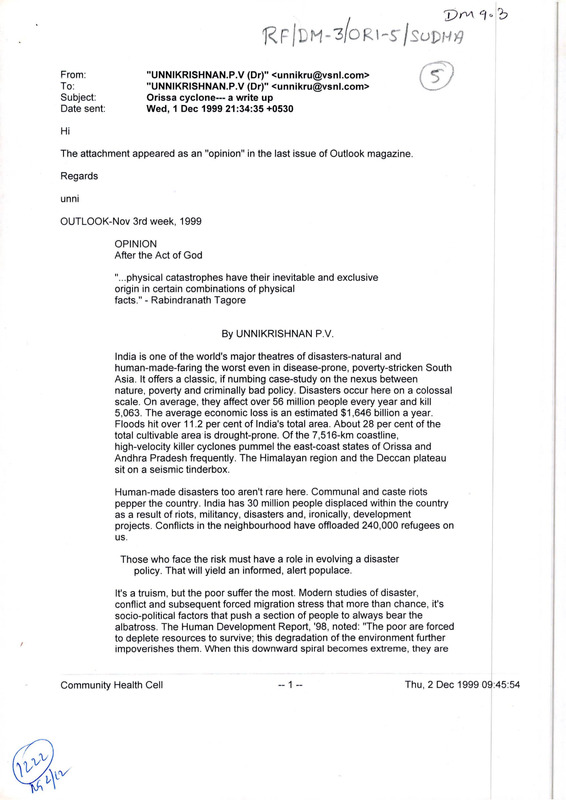
Article published in Outlook 3/11/1999 but sent as an email with his “Opinion” by Unnikrishnan P.V”
Item
- Title
- Article published in Outlook 3/11/1999 but sent as an email with his “Opinion” by Unnikrishnan P.V”
- extracted text
-
rb
I
'RF|DM-^|oR'-s|s<JpH>9
From:
To:
Subject:
Date sent:
"UNNIKRISHNAN.P.V (Dr)" <unnikru@vsnl.com>
"UNNIKRISHNAN.P.V (Dr)" <unnikru@vsnl.com>
Orissa cyclone— a write up
Wed, 1 Dec 1999 21:34:35 +0530
Hi
The attachment appeared as an "opinion” in the last issue of Outlook magazine.
Regards
unni
OUTLOOK-Nov 3rd week, 1999
OPINION
After the Act of God
"...physical catastrophes have their inevitable and exclusive
origin in certain combinations of physical
facts." - Rabindranath Tagore
By UNNIKRISHNAN P.V.
India is one of the world's major theatres of disasters-natural and
human-made-faring the worst even in disease-prone, poverty-stricken South
Asia. It offers a classic, if numbing case-study on the nexus between
nature, poverty and criminally bad policy. Disasters occur here on a colossal
scale. On average, they affect over 56 million people every year and kill
5,063. The average economic loss is an estimated $1,646 billion a year.
Floods hit over 11.2 per cent of India's total area. About 28 per cent of the
total cultivable area is drought-prone. Of the 7,516-km coastline,
high-velocity killer cyclones pummel the east-coast states of Orissa and
Andhra Pradesh frequently. The Himalayan region and the Deccan plateau
sit on a seismic tinderbox.
Human-made disasters too aren't rare here. Communal and caste riots
pepper the country. India has 30 million people displaced within the country
as a result of riots, militancy, disasters and, ironically, development
projects. Conflicts in the neighbourhood have offloaded 240,000 refugees on
us.
Those who face the risk must have a role in evolving a disaster
policy. That will yield an informed, alert populace.
!
It's a truism, but the poor suffer the most. Modern studies of disaster,
conflict and subsequent forced migration stress that more than chance, it's
socio-political factors that push a section of people to always bear the
albatross. The Human Development Report, '98, noted: "The poor are forced
to deplete resources to survive; this degradation of the environment further
impoverishes them. When this downward spiral becomes extreme, they are
Community Health Cell
_ 1 „
Thu, 2 Dec 1999 09:45:54
forced to move to ecologically fragile lands." Half of the world's poorest-over
500 million-live on marginal lands, drought-smacked uplands, flood-prone
deltas and right at the edge of storm-subject seas.
The government's duty to respond scientifically has been observed more in
the breach. The UN's International Decade for Natural Disasters Reduction
did spawn some efforts. Like, a multi-crore plan to install modern radar along
the east coast to predict and track cyclones. Such initiative often fails to
reach its full potential as India still has no comprehensive disaster
management policy.
The key agency for such emergencies is the agriculture ministry's Natural
Disaster Management Division. The alacrity and extent of its response is
often dictated by the media and the state's clout and ability to put pressure.
A Delhi-centric bureaucracy is also inevitably infected with a "going by the
book" attitude. It calculates losses in terms of cropland and cattle, often
ignoring the loss of life-sustaining systems such as commons, mangroves
or fishing fields.
Human-made disasters like riots and refugee crises are handled by the
home ministry. Often, 'law and order' concerns outweigh humanitarian ones.
The psycho-social impact, a worldwide concern since the 70s, has yet to
find a place in the official lexicon here.
It's not enough to wonder despairingly why relief operations often miss the
target. The crux is, no amount of relief can automatically console a
traumatised human being. It takes psychological and social interventions.
Again, the 'Contingency Action Plan for Natural Calamities', the
government's blueprint, is reactive in essence. It emphasises relief, not
reduction. This flies in the face of global trends, marked by a radical shift
towards preparedness. The evolution of opinion here is still flawed and full of
gaps. The obvious ones:
Absence of an informed debate/policy at all levels;
Absence of focused documentation, social action research and
capacity-building programmes;
Lack of coordination within government and between government and
civil society;
Lack of attention from the media, legislators, policy-makers.
The objective of any disaster policy should be to shift relief and rehabilitation
to a development mode, involving the affected communities as stakeholders.
A multi-sectoral approach, involving the government, NCOS, academics,
media and the affected communities, is slowly gaining currency in some
parts of India.
Preparedness is most effective when built into the process of local-level
development planning and implementation. This way, in the long run,
disaster mitigation can be effected at minimal cost. Simply put, it calls for
carefully-planned road and rail tracks that do not block drainage, flood-proof
bridges, community buildings, quake-proof housing etc. The expenditure
would, over time, more than compensate itself in human and material terms.
Community Health Cell
„2-
Thu, 2 Dec 1999 09:45:55
Understanding the inter-linkages of disasters is crucial. An ethnic clash and
forced migration may lead to an epidemic. Drought can lead to prolonged
malnutrition, especially among children. Cross-studies must have an
inclusive approach. Those who face the risk must have a role in the evolution
of policy. It must be based on their experiences and needs, rather than be
thrust top down. For community preparedness to be in place, people must
have access to information on disaster-prone areas, industries and activities
in their habitat. The National Human Rights Commission can monitor to
what extent the rights of affected people (and disaster-prone communities)
are protected by government and ngo interventions.
An overall development policy incorporating disaster response entails drastic
changes in several related policies. Insurance and welfare schemes have to
be sensitive to felt needs and include vulnerable sections, like fisherfolk in
cyclone-prone areas. A 'disaster risk audit' is highly recommended. Open
disaster-impact studies should be mandatory before mega-projects are
commissioned.
In India, community-based institutions have always played a pivotal role in
rescue/relief activities. The challenge is to acknowledge and channelise
such initiatives. Local "rapid rescue and response forces" involving
community, panchayat, government and military personnel are in vogue in
some cyclone-prone Andhra villages.
An effective early warning system, supported by a communications strategy
through radio, TV and other media has to be developed. Fisherfolk in areas
of Andhra Pradesh have begun to go to sea with radio and other systems.
An enlightened population can preclude both panic responses and passive
acceptance. As India hurtles from disaster to mega-disaster, the key
challenge is to empower the vulnerable. First, it must be recognised that
humanitarian assistance is a right of the affected communities, not an act of
charity.
(Dr Unnikrishnan P.V., an expert on
health/humanitarian issues, is
currently Oxfam National Fellow: Emergencies.)
© Copyright Outlook 1999 AB10, SJ Enclave, New Delhi - INDIA
Welcome to Outlook Online, India's Most Exciting Newsmagazine
Community Health Cell
-3-
Thu, 2 Dec 1999 09:45:55
- Media
 RF_DM-3_ORI-5_SUDHA.pdf
Position: 808 (34 views)