Documents of Habitat International Coalition provided by Kirtee Shah, includes correspondence to the then CM of Maharashtra Sharad Pawar in relation to the earthquake in 1993
Item
- Title
- Documents of Habitat International Coalition provided by Kirtee Shah, includes correspondence to the then CM of Maharashtra Sharad Pawar in relation to the earthquake in 1993
- extracted text
-
IJ
HABITAT
INTERNATIONAL
COALITION
Dalal Building. Behind Capri Hotel, Relief Roed. AHMEDABAD-380 001.
Tel : 352841-352842
51/A. 6th Floor, Thakorebaug Flat Annexe, Navrangpura, AHMEDABAD-380 009.
Tel. : 468883
H 1C/FCI/ 1/ 1093
23 October
1993
Shri Sharad Pawar
Chief Minister
Government of Maharashtra
Mantra 1aya
Bombay 400 020
Dear
Sir,
natural
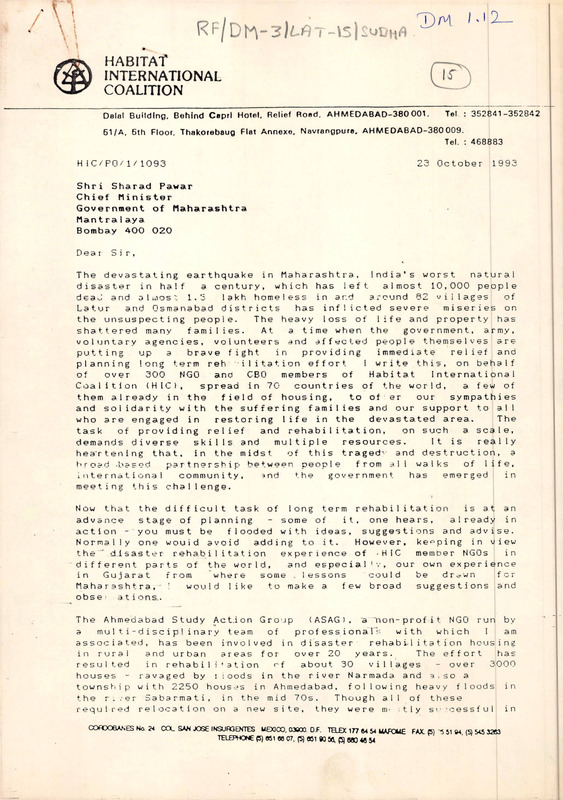
The devastating earthquake in Maharashtra, India's worst
al most 10,000 people
disaster in half
a century, which has left
a
of
around 92 villages
dead and almost 1.5
lakh homeless in ar.d
miseries on
has inflicted severe
Latur
and Osmanabad
□smanabad districts
the unsuspecting people,
The heavy loss of life and property has
government, army,
At
a time when the
shattered many
f a m i 1 i es .
voluntary agencies, vo1unteers and affected people themselves are
immediate
relief and
providing
putting
up
a
brave fight
in
planning long term reh
ilitation effort
I write this, on behalf
reh
Habitat
International
of
over
300
NGO
and
CBO
members
of
a. few of
Coalition (HIC),
spread in 70
countries of the world,
our
sympathies
to of er
them already in the
field of housing,
and solidarity with the suffering families and our support to al 1
The
devastated area,
who are engaged in
restoring life in the
sea
1e,
on such
a
task
of providing relief
and rehabilitation,
r
ea
1 1y
is
I t
demands diverse
skills and
multiple
resources,
and
destruction,
a
hea'rtenlng that, in the midst
of this tragedy
ail
walks
o
of
f
life,
f
rom
partnership
between
people
broad abased
government
emerged
in
has
international
community,
and
the
meeting this chai 1e n g e.
Now that the difficult task of long term rehabilitation
is at a n
a 1 ready i n
- some of
it, one hears,
advance
stage o f planning
ac 11 on - you mus t be
flooded with ideas, suggestions and ad v i| s e.
i n Oiew
Normal 1 y one would avoid
adding to it.
However, keeping in
member NGOs
in
the" .d.l s as te r rehabi I itation
experience of
HIC
and espec i a 1 Iv, our own experience
different parts of the world,
be
drown
for
some . lessons
could
in
Gujarat
f rom
from
where
suggestions
and
to
make
a
few
broad
w o u. 1 d like
Maharashtra,- '
obs e
a t i o n s..
The Ahmedabad Study Act.ion Group
(ASAG), a ’non-profit NGO run by
prof
essionaTs
with
which
I
am
a
multi-disciplinary team
of
associated, has been involved in d
disaster
i s as t e r
rehabilitation housing
years.
The effort
has
in rural
over 20
and ur ban
areas for
villages
- over
31000
r e s u1 ted
i n rehabi 1 i 4ation
about 30
f
hous es - r a v a g ed by t iood s i n the river N a r mad a and a i s o a
t owns hi p with 2250 houses i n A h med a bad, following heavy f 1ood s i n
the r i .• e r Saba rma t i, i n the mid 70s.
Though al I1 o f these
f e q u1 red relocation on a new site, they were m' t ly sv • c e s s f u 1 i n
CORDO8AKES Ho. 24 COL SA* JOSE IHSUR3ENTES MEXICO. 03000. OF. TRFY m M 54 MAFOME FAX. P) '-5 51 SH, (5) 545 3263
TELEPHONE (5) «1 68 07, (5) «1 K 56. (5) 690 M
*
2
terms
of
client
acceptance,
cost
ef f ic i ency
and
peopIe
participation.
Our last experience, howev e r, meant to resettle a
village of about
160 families,
af f ec ted by expansion of
IPCL
plant near Baroda and industrial pollution to a
site just three
kms from the originalI village, has been a total failure.
A newly
built
160
good qua Ii ty
houses
with attendant services and
common i ty
faciIi ties, at a cost of
Rs. 50 lakh, is lying vacant
for over seven years.
Not a single family has moved to the new 1y
bu i 1t Dhanora village.
And
the well
built houses
and
the
services remain unut iI i s ed.
It
is
this mixture of
good and unsuccess f uI
exper iences
in
disaster rehab i1 i tati on
tha t prompts us to make the fol low
i
ng
broad observations,
They
are also based on
1nf ormat ion and
feedback gained by
some o f
our
co 1 1 eagues who visited
the
disaster affected villages recent 1y.
1.0
A majority of
the bui1d i ngs that have co 1 1apsed due
to
earthquake were built
by the villagers themsel
-- Ives.
If the
no t -bui4d thorn using their own
users did not
hands or skilled/
labour,
unskilled
almost
always
they
control 1ed
the
construction process
process..
They were user control led structures
in the sense
that they were not built by contractors, real
or
estate developers
public
housing
pub
1ic
agencies;
were
not
designed by architects
or engineers ; and not supervised by
qua 1 i f i ed
superv isors.
Though
the
structures have
col lapsed, the skills to build
and
get
built
what is needed
is
still intact^
In evolving rehabiIitation strategy and
organ i sat iona1
arrangement
for
implementing
schemes
especially housing this particular fact must be borne i n
mind.
2,0
The collapse
a rt
th! structures
13 no sufficient
reason to
suspect - and thereby reject - this ability of common people
and local craftsmen :
: especially when they themselves, under
the shock
of tragedy and disaster,
»
have started doubting
their own traditional s k i 1 Is,
wisdom and appropriateness of
the structures they had bu i1t.
The buildings have collapsed
because they were not built to w i ths tand
the forces that the
earthquake generated.
And they were not buiIt to withstand
those forces
because
as
experts
say
the
region was
seismological not active for centuries.
Even
scientif
ical ly
evolved building code had certified
the region to be a safe
zone.
Therefore, it is useful to remember - and more
useful
to
i et the
I oca 1 people know - that
let
local
the
bu
iId
i
ngs
have
col 1apsed not because they did
not know how to build them
but
oecause
because the earth changed
its
behav i our.
Experts
believe that
if Bombay
were to exper ience similar
shocks
even professionally designed
structures may not be able to
stand.
Now,
however,
people
could
build
resistance houses with little guidance from ’hose ear thquake
whj^ know.
3
3.0
The same logic
applies to building materials.
Some of the
eng i nee r s
and structural
engineers, including
Shri Laurie
Baker,
who visited the partially and fully ravaged villages
are of the view that the damage is not so much due to use of
local
materials
(stone,
in
particular)
but
because
of
cons truet i on
methods
and
techniques;
not
the
material
itself, but the
method of its
use.
This is necessary
to
verify and understand
because summary rejection of
a local
material,
wh ich
which
is
plentiful
and
easily
accessible
to
people,
both in form of rubb1e
of the collapsed structures
and f rom norma 1 commercial supply sources, not only has cost
i mp1 icat ions
could
(which
be
absorbed
through
external
i ntervent ions
in this extra ordinary emergency) but also i n
emergence
of
a
cu1tur e
of
rejection
and
a
psyche
of
alienation that
may cost the local people
- especially the
disadvantaged groups and over 1,00,000 skilled craftsmen
in
building trade
- dearly
in the
Iong
long run.
If
people are
asked
or
encouraged
to
discard
locally
available
and
relatively inexpensive
building material like
stone, which
they have used in construction for centuries, i t wou 1 d prove
to be a major handicap, a permanent disability.
It
I t imay take
away
peop1e’s
f reedom
to
build.
So
that
this
is
not
misunderstood
as
advocating
use
of
stone
as
principal
material
walling
in
new
constructions despite
the
new
reality of recent earthquake,
let it be clarified that
one
is only cautioning against summary rejection (something that
couId eas iIy
happen) without deeper and dependable analysis
of
nature of
collapse
and behaviour
The
of structures.
point
is
also that
it
may
be
possible to
evolve
evoljve
safe
building designs, capable of
withstanding future earthquake
chocks, without
summarily throwing out the
local
’ oca 1 materials
and techniques.
4.0
The
t r oub1e with
most disaster
rehabilitation
efforts is
that re 1 i ef and rehabilitation get confused
and intermixed,
Re lief
i mmed i a te and
is temporary,
immediate
oriented primarily
to
giving
and dispensing.
It is,
by definition, short, term,
Not expected to
continue or last long.
Rehabilitation, on
the other hand, by
very nature,
nature, is a long term
thing
th i ng as it
involves creating new,
hope f uI 1y better and longer
hopefully
lasting
Ionger
construction/housing
than the one
it is meant
to Ireplace.
The
difficulty, however, is
that a culture
of Emergency*
gets 1oaded
on the decision
making and therefore
both the
* process? and the product suffer. — It is not withouft reason
that
end-product
of many
disaster
housing rehabilitation
efforts
are disasterous themselves,
The underlying problem
is
the 'emergency
culture’,
‘ hasty-decis ions' , and
total
‘negation of processes’.
The real tragedy is that suffering
community’s temporary disablement and handicap get enIarged
'
i
4
permanent
and
projected
as
some
sort
of
extended,
their
legitimate
disabilities which also
lead to denial of
rehab iI i tat i on
i n the
role, involvement
and participation
in
and reconstruction processes.
5.0
key
you,
Pawar
Saab, as
the
It
is
this tendency
that
tells
The experience of years _
decision maker, must fight.
instant
not
h
i
ng
____ like
immediate.
us
that
there___ is.
takes
time
RehabiIitat ion
always
rehabiIi tat ion.
it
involves
or does because
what one says
irrespective of
investment,
relatively
heavy
asset
creation,
long
term
I ittle
infrastructure
where
new
organisational
c reat Ing
and
a
number
of
unrelated
actors
before, bringing
ex iBted
new
together,
and
often
inventing
to
perform
agenc i es
be done overnight?
And
if one
al 1 this
Can
so 1ut ions.
up creating?
It w i I I
tries
to do that, what will one end
of
nor get
the
maximum out
assets,
create good
ne i ther
i nv es tment, nor solve problems.
It is useful to remember, Sir, that a number of new v iI 1 ages
but Id ing
that
you
intend
and
thousands
of
new
houses
shortest
span
of
time,
took
immediately, hastily and in the
come
up.
However
efficient
to
decades,
if not centuries,
nature of
your
technology, you
the
you
are
or whatever
manner.
Idea
here
is not to say
cannot capsule time in that
and
decades
to
rebuild
the
years
that
one should
allow
Uhat
is
suggested,
however,
is
that
is
houses and villages,
produced over-ni ght.
Both
planning—and
they
cannot
be
And that must be given.
building need time.
settlements overnight, you will not
If you try building new
In fact, the
of
the
legit imate processes,
have time for any
and
justification
to
provide
the
rationale
t
‘emergency' will
This
bypass
and
even
reject
those
processes.
scuttIe,
skip,
for the villages to be
relocated on new
is especially true
experience
shows,
finding
30
-40
new v i1 1 age
sites.
As
to
are
topographically
proper,
acceptable
sites,
which
d
i
sI
ocat
i
on
minimum
socio-economic
residents,
involve
land), have
atleast a
away from
the farm
(cannot
be far
is
easily
accessible
and
re I i abIe
source of drinking water,
of
service
and
social
terms of
creation
is economic
in
the
is one
thing that
(tha t
infrastructure, is
not easy
be
These
sites
cannot
taught ) .
Sardar Sarovar Project has
even
found
and
accepted
found overnight.
And
if they are
the end users under pressure of
with a contrived consent of
disfunctionaI
or
be
either
‘emergency’they
might
run
.
A
or
expensive
in
the
long
unacceptable or non-viable
homes
tead
plot
on
the
earlier
number of evaluation
studies
rural poor
landless, homeless
distribution
scheme for the
I nd ira
recent
Needs
Programme)
and
more
(under the Minimum
new I y
Awas Yojana have identified many deserted, unoccup i ed
built settlements.
1
5
equaI Iy
p1ann ing is
v i1 I ages, site
re1 ocat ion of
For the
in
size
of
land
plots
the
difference
H ow will
impor tant.
in
one?
old
village
be
accommodated
the
new
and houses i n an
?
How
be
given
equal
size
plots,
equal
size
houses?
Ui11
all
in
the
heav i1y
factor,
which reflected
so
heavily
i
is
the
cast
to
be
v
iI
I
age
,
in
the
existing
pattern
ne i ghbourhood
lots
be
Ui I 1
casts
be lumped together?
<
U i 1 1 all
hand 1ed ?
Will
Har
i
Jan
and
drawn for allotment
of plots and houses?
a 1 1otment
U i 1 I Hi ndu and
waIls, courtyards?
caste-Hindus share common walls,
long
earthquake
Muslim live side-by-side?
Has the 40 second
and
traditions
pr e jud ices,
eliminated
age
old
oreiudices,
customs,
Will
and neutralized long standing hostilities?
preferences
even such
you impose
Will
things?
to these
people agree
is
that
if you
The
point
on peopIe?
sens 11 ive dec is ions
new
plann i ng
i
n
answer
these
questions
ignore
to
problems and new
cettlements, they will end up having social
be done
instantly and
And if
everything is to
tens ions.
f i hd i ng
where is the time for consulting people,
ov « might,
feeding
them in
of the above questions and
answers to some
the design/p1anning process?
construction,
workmanship,
design,
The
qua 1 i ty
in
the
first
casualty.
No one
will be
materials and details
disaster
victims
reasonable
the
ever
thinks
of
giving
And
the
emergency/|has te
case.
quality
houses
in
any
quali ty.
justifies
poor
to and
syndrome lends credibility
of
the
some
see.
Aren't
The
results are
everywhere to
time
normal
houses built under rehabilitation schemes, even
Indira Awas Yojana houses, insult to people?
planning
and
laying
of
to
The
same
thing
may
happen
,
construction
of
community
buildings
infrastructure services,
and other facilities.
to
are going to cost Rs. 300
If new houses and settlements
to
ask is :
is it possible
500 crore, a
good question to
short
large sum of
money in
a
such a
Invest purposefully
it
deliver
good
results?
Can
period of aT few months?
to cause or justify delay.
J_t
All this is not an argument
irrational
and
impractica
l
haste,
against
is
an argument
is
_.that the task of creating new sett 1ements
The point. Sir,
evolving
new
consultation,
planning,
for
demands
time
and
construction^
solutions. preparing peopl e to participate
efficiency-you could
By
And all this
is process oriented.
You
couId
the
time
schedule,
compress, to
extent,
an
you
cannot
somewhat
too.
But
possibly
compress processes
so,
If you do so,
the results will
eliminate them altogether,
be questionable.
6
6.0
The real question then is : is there time for the processes?
Aren’t they shelterless? So
Aren’t peopIe out in the open?
are
kept in the culture of
long as the affected people
encouraged to
incapacitated
and
he IpIessness, made to feel
so.
Natural
disasters,
be dependent, they would remain
to
them
usually
create
those
res
ponse
and our
erner gene ies
cultures.
Not
only
the
and
env ironments
dependency
governments
but
even
charity
the
of
political compulsions
to their
peop1e also contribute
orientation of
common
observe affected peop1e's
making.
However,
Howev
e r, if
we rea l Iy
that once the shock of death
behaviour, iitt would be found
and destruction has blunted a bit, they waste little time in
That is the human I aw,
trying to put pieces together again.
putting
1life
if e
above death,
The principal
of
survival;
construction over destruction.; to go on with the game.
victims1 behaviour
It
is this pos i t i v e aspect of disaster
to neglect,
rehabilitation
planners
tend
pattern that most
mainly)
an
option
(environmental,
even negate.
Given
encouragement, support and strength, most disaster victims
will put together a make-shift shelter for thorns elves; or in
in labour
outsiders
iders‘’ marginal help
ex t reme cases, with an outs
money.
In
That neither takes much time nor
and mater ia I.
the
rural
,
situations, especially in
both urban and rural
ac
t
i
v
ated
,
practices
and
mutual
help
networks
get
self-help
s
ituat
i
on
.
almost
spontaneously,
in
a
disaster
more easily,
explored
to
buy
the
minimum
time
Shouldn’t this phenomena be
required for the processes listed earlier?
Whether the disaster victims will
agree to wait or not, for
a 'reasonable' period, not endlessly, will depend largely on
meaningfully he/she
how the processes
are unfolded; on how
future
habitat and
gets
involved
in
planning his/her
livelihood; how he/she is shown long term benefits of proper
and pull on in
planning; and how he/she is helped to adjust
depend
on
whether
his
also
the
interim.
It will
anxious
to
restore
government,
benefactors,
in
form of
eager
to undo the
normalcy,
and the voluntary agencies,
to
faith, are able
harm, all well-intentioned and in good
resist temptation to do everything yesterday and desist from
building a culture of over-dependence.
Most importantly, it
will depend on the level of help, kind of arrangements and
amount of investments that
get made for
the transitional,
interim phase.
Though many people may not agree with my assertion, this is
on the
mainly a matter of attitude
; of disaster victims,
the
one hand, and of those engaged
in helping
them, on
other.
Relatively friendly climate (waiting will be
I
7
c1i mate reg i ons ) ,
Europe or
similarly harsh
i mpossi b i e in
s oc i a 1 relations and accommodating nature are also conduc i v e
even
make-shi f tL
on
little
1 onger
in
to
pulling
uncomfor tab 1e. living environment.
more
through some
willing
to go
They
will be
mo r e than
they
suffer af teraI 1,
chosen them
to
hardship God has
and
more patience
would
say
if
in
return for
little
better
s i tes,
they
are
offered
more
suitable
waiting,
f unct i on i ng
des i gned
houses
and
communities,
better
of
quality structures
and
better means
services,
better
even in
an
I i v e1 i hood.
People’s innate
w i sdom,
ear n i ng
wii 1 help them to opt
for a *wai ting’
emergency like this,
opt ion.
7.0
Besides buying time for designing, planning and consultation
it is of crucial importance to think through various aspects
of organisational
arrangements for
planning and
execut i ng
get
works.
This
is
where
things go
wrong,
objectives
diluted, distort ions set i n, processes get circumvented, and
outcome
suf fers.
There
are
many ways
of
doing things,
be to
give a
shape
to the
However,
the better
way will
has
spontaneous 1y
spontaneously
evolved
par tnersh i p
that
unstructured
government ,
non-governmental
agencies,
between
the
disaster victims.
All are needed in this
profess i ona1s and
its resources - money, land and,
tas k : The government with
whe rev e r
necessary,
its
organisational
machinery.
NGOs
(def i ned in a
broader sense to include
voluntary agencies,
bus i ness and industry and others motivated to contribute and
he Ip)
'
with
their
motivation,
ability
to
reach
people,
educate
and organise them to become active partners, evolve
a Iter nat i ves
and
to
act
as
watch-dog
against
possible
deviations and leakages.
Socially conscious
professionals
to think
through and offer
new and safe,
yet inexpensive,
structural
solutions;
house
designs
commensurate
with
living habits and
life style; layouts
people's
in harmony
with
their social relations,
traditions and culture.
And
victims themselves to articulate
the disaster
their needs,
contribute their skills
and labour and motivated
enough to
conver t this dis rupt ion into an
opportunity; this 1iabiIity
i n to an as set.
The
government* s role in this opera t i on shou1d be pr i mar i 1 y
one
of
4 f ac i1 i ta to r' ,
not
‘doer*.
11
shouId
create
cond i t ions
o t he r
for
pa rtners
to
p1 ay _ their
roles
ef fect i ve1y
and
e xped i t i ous1y .
Both
the
organisational
s t ructtre
and operational
ar rangements s houId
refJ ect the
o f ■ f’ a c . 1 Station* and
philosophy and culture
■ enabl ement'
Decentralisation
should be the
key theme of
the operation
and
the partners men t i oned
above should be
assigned roles
commensurate with their principal strengths.
0
the organisati
oil fa,
Bdnlsati°nal design
<■
changes, th© nature of
a|so change.
ing at the task
the task
Stasa the
t?e
e°vernn>ent
in a centralised
as
a
way,
bu iIder, the
e r i ng8 '■ 30000 house
target
will I ook
s I
The material
time-required.
required. everything
and manpower need,
will
respons1b iI i ty
fimmense.
But if
for raising the I ook
the
concerned family,
structure i® left
the
J target
fami Iy.
with
th©
will become
I t
may
one house for
sound
really is,
one
But
The question simp!istic.
that is
what it
conceiving an
15 one of attitude.
/
appropriate
-- >
of
organisational design.And also
As this I otter
has become
afraid you may
very long
ong
- so Ilong
that I
neverthget
to read
king about other
’
am
i t ful|y -- II
am
other
Yet
avoiding
one
that
in passing,
pas sing, is
must be r
seeing rehabi
compartmentsJ
but
as
--iIitation not inmen t i oned,
but
of
an
separate
Package.
Integration Part
overal1
aspects of it.
T“°n’
’ deve11 opmen t'
coordination
■ i_
.
’
*
convergence are
1 rnvestment
•®ar thquakie h
al I
h*
A Ss nec®ssitated
in the area,
a
is
fi eating around is
mass
i ve
The kind Of i nv es tmen t
figure
that
avaiIabIe for
ing that
such v i
i1- I1 someth
But that 7 ’
becomes
-J norma 1 1y
made.
How to
'
*aAor
!he
d Uas Ur
i r“ ”
- f
'
take
it
t0
optimise I
j to be
the
disaster victims —
benefits for
and
how
this area
ictims
and
KehabiIitatir°n,
area
is th©
as
we
real
chai
Ienge.
know,
‘Deuelopmen t1
is
static,
is dynamic.
statusquo i s t.
And that must be
the
goaI.
3. 0
Tet another
—
aspect
which
with what
has
; mentioning
could
rreappear survived.
- - dering
y Oay> hQu J ‘h.
..rth,Uak.
s truc tur•’es which aga in, almo.t a„
any
day,
are
strengthen
the
>tand
„g
ls
also
t<]
O
•
small
jin v e stmen t
is
now
H owe ver,
examined.
could
save
a
if
ri
it
does
not get save
int a
ma_SSive
one
later.
Prog ramme
of relief
integrated
in
and
the current
until it :i s
--rehabi
1
\
tation
<
t
too late.
there,
The strategy th
’
t1 may n®ver
of r
-happen
encouraging,
must be one
their own bu iidings
and enabling
strengthen
tructures.
solutions,
and
r
■“d"ethi‘nnspsuttr*i pttu“t“i onaI
ona’
t
strueturaI
f inancial
ass istance
right, 4 non-burden i n8' direction^
■ • u purpose,’
for
y h81p raoving
in the
0
The
r ea 1 cha 1 1
enge before
<•-_
not to a 1 1 ow
You and the
State Government
this
rehabilitation
one
is
more sad
story.
The
. — i effort to
degenerate
pti r as e s hou1d n'
into
nvestment, to
use a
f_
t go down the
drain,
familiar
be
poorly
N ew
constructed,
Uages
shouldn*
t
almost anemic,
s tructures.
They must hav
rows of straight line
The built
e- quality
X 1 ty ,, si.
trength and character,
env i ronment
al I1 Maharasht
°
strength and
•• * ra
v i 1 1 ages have
a
special
a
character,
Only if that
That mus t
is lost,
the
destruct!
n
°t
be
lost,
won a ba 111 e.
ve earthquake
would have
uiti
b° Change‘
1
Ii
i
9
And
there is
no r e a s o..
lot
that t u
happen.
Resources,
ski i Is, experiences and unde(standing
of what to do and what
not
to do
exist,
M uch
will dupend
on what
attitude the
government takes and how ima gina f i v e and creative it rema
i t
i ns
in facing this chai Ienge.
I i
If
n • • •? d be
whoe v e r you
With kind
Yours
I would
suggest.
be
only
to
discuss
regards.
s incerel
11
I
Kirt»o
Shah
Pres ident-H IC
cc
: Chief Secretary
C j vei nment o f Ma harasht
H IC,
rra :
Mex i
.)
t «><j
11 j p p y
this and
meet with you,
rela tad matters.
to
or
Habitat International Coalition (H IC )
Presidential Election
Manila, Philippines
20 September,
1993
Acceptance Speech
by
Kirtee Shah, Ahmedabad Study Action Group (ASAG),
Mr. Pres ident
Members of the Board,
Members of H IC
India
and
1.0
It is with utmost humility,
sincerity and with a deep sense
of responsibility that
I stand before ’you, the Members of
Habitat International Coalition present here
in Manila and
those who are not with us today,
today, to accept HIC Presidency so
generously conferred upon me by you all.
Considering that I
am a relatively new face to some of you at HIC, but for your
willingness
to
repose faith
in
promise
rather
than
performance and in potential
rather than achievement, , I am
1
aware, you wouldn't have chosen me to carry this honourous
responsibility.
I am grateful to you for your act of faith
and goodwill
and promise
to do all
within my capacity to
serve HIC and be worthy of your trust and confidence.
2.0
a world
In the decade and a half of
i^s existence HIC, as
coalition of
human settlements NGOs,
has estab Ii shed
credibility as
an organisation
committed to empowering the
or
improve their
poor
peopIe
people especially the
people ~to
pioneer
i ng role
housing and living conditions and played a
of
the
rights
as an international pressure group in defence
of the homeless.
Through concerted and energetic efforts of
its members,
members, associates and partners, over the years, HIC
has also emerged as a potent instrument of advocacy action,
at
the national
and global
level,
on behalf
of
the
the world and as an effective
d isadvantaged homeless of
spokesperson of the NGO community and what they stand for :
a bottom up, people centered, equity biased and environment
paradigm.
Credit
for
these
friendly
‘development'
goes
to
those
pioneers
who
visioned
noteworthy achievements
those
member
organisations
organ
i sat i ons and
this
initiative
and
indeed
our
privilege
for
it.
It
is
individuals who worked
vision,
commitment
ith
the
pioneering
that some of those w
and ability for selfless hard work are here with us in this
leaders and
grateful to the founders,
Ue are
room today,
buiIt this
present,
for having
pas t. c*.nd
member s
o f IH IC,
of
from which we could d ream
organisationi to a level
scaling greater heights a nd ex ploring deeper depths.
1
2
3.0
In the last
few days we have resolved to chart a new course
for HIC,. evolve a new culture of relationship among members
and partners and put in practice a new operational
style.
In the coming months we shall
collectively work on the
guidelines for that action and evolve an Agenda for Change.
I have no intention to subvert or hijack that legitimate and
consultation*
highly desirable process of
consultation,
dialogue and
search for a
I ternat i v e.s.
However,
based on what 1I
alternatives.
have
last
understood from what our colleagues have said in the
to
interpret from my
few days here and have been able
to mo
limited exposure to HIC and
its working, it appears
that HIC’s Agenda for Change may constitute new explorations
and thrusts in the following priority areas :
3. 1
the nature and
Developing
a deeper understanding of
the home less,
needs of HIC’s principal constituencies
the inadequately sheltered, the NGOs, and the CBOs.
Creating multiple platforms, linkages and opportunities
to develop that understanding; and
Spelling out a fresh mandate emerging from it.
3.2
at relevant levels : not
Devedoping greater visibility
the
forums
but also at
only
in the
international
national and sub-national levels;
Developing greater accessibility to the decision making
structures at all levels;
Developing greater reach to the constituencies; and
Evolving a decentra 1ised,
3.3
part ic i patory action agenda.
Seeking
new
partners
and
developing
partnershi ps in HIC’s advocacy rolo
diverse
Search for the new partners could be based on a wider
NGO world
to include a broader cross
definition of
section of "change" actors in the civic society.
The diverse partnership could mean :
o
Working simultaneously
and synergetically
at the
g rass roots , local, nationaI , reg i onaI and gIobaI
levels;
o
jointly and in active
partnership with
Working
other
social
movements
i
epy i ronment,
human
women* s rights, etc;
rights, consumer protection,
and
3
o
Working
to
evo 1 ve
alternative
strategies,
structures, processes and solution models
*
to weaken grip
reg i mes
it
to prevent misdirected development
of
the traditional
control
to protect rights of the citizens, especially
the vulnerable sections, and
*
3.4
to educate and influence
Developing a wider perspective
o
She I ter provision for the poor
to be seen as
integral part of poverty alleviation strategy;
o
She I ter
issues
to be addressed in
of
f unc t ionaI Iy
ef f icient
contex t
equitious cities
the
and
w ider
more
Developing a new orientation towards rural settlements
Finding
human
more resources
: organisational, monetary and
Developing power : Constitutional as well as
derived from the constituency solidarity; and
that
Developing an
appropriate organisational
structure :
commensurate with NGO culture and ethos and suited to
HIC’s multiple roles
3.5
Generating a new dynamism for the NGO movement
o
establishing role of NGOs as a ■ des irabIe"
By
peopIe,
dev e1 opment
:
with
with
par tner
in
gov e r nmen ts, with other development actors
o
•space"
in _the formal
By creat ing
machinery for effective role playing
sys terns and
o
By strengthening NGO work at the grass
other relevant levels
roots and
o
By multiplying
o
By
capacity
building
services
efficiently
institutional change
their number
to provide
:
no t on 1 y
but
also to
influence
4
and intra-sectoral
o
By setting
up inter
and
and networks,
o
Zj
directing
resource
d i rect i ng
By
development budgets and
sources for NGO action.
I inkages
from the national
f- •
1 ow
"international development
These are
neither comprehensive nor mandatory.
This list is
thoughts
on
this
day of
organxsatxona1
day
random They are not meant to preempt
s ome
a process, only
transition,
tentative directional indicator.
4.0
5.0
mandated and
All of
us want a newly constituted, freshly in Fr Joe’s
a HIC
that,
imaginatively structured H IC
dream
dreams
and
an organ i sat i on
to
words,
is a place
,
space to
fly,
flexibility
to
operate,
providing freedom to
to collaborate
act,
encouragement
motivation to t-_
i nnovate,
cake
take risks for the causes we
and share, and even freedom to pressed
that they want a more
Members here have ex
champi on.
the
bureaucratic
HIC. In
I ess
t cans parent, more open and
and
working
purposefully
together,
coming years working
C
h s. ? ’• ace.
sys tematleal Iy we sha I I endeavour to make U precondition to
necessary
i
s
a
dreams
Because d ream i ng
to change
soc ieties ahead, to conceive changes and
mov i ng
And the NGOs, as we all
orders, structures and directions,
know, are in that business.
loaded,
recognise that our dreams are
however» mus t
We,
couldn
’
t
be
left
that they
They carry a burden i n the sense
into
reali
ty.
t ransI ated
must
be
a 1 one and
as
dreams
welfare,
hope
in realisation of
ot
those dreams 1 i es
Becaus e
are work i ng : the oppressed,
and future of those for whom we
the slum dweiler, the landless
the disadvantaged, the poor,
and the marginalised woman.
farmer, the evicted villager,
It is
think of it,
it. they
they are
are not even our dreams,
Come to
the i r dreams that we are dreaming.
we have taken upon
the tasks
It
needs no s t ressi ng that
and complex,
difficult
are i nd eed
to address
ourselv es
the formidable
to
empower
the
poor,
While we, the NGOs, want
var i ous
working
in
forces,
and
structures
societal
them
make
and
keep
to
are cons p i r i ng
comb i nat i ons,
to a
their
rights
fighting for
powerI ess.
While we are
and
a
the
one
hand,
reasonable shelter the market forces, on
___
_______
and
the
builder
corrupt official s
nexus between politicians
systematically
and openly snatching
maf ia, on the other, are
•illegal
’ squatters to be given secure
We
want
them away,
To a many that appears to threaten
and legal I and titles,
-;■> old institution of private property but
the age
not only
Ue
the delicately balanced market mechanism,
distorting
poor»
j
obs
for
the
adequately
paying
are demand i ng
evict!on of the self
and
pro tec 11 on against harassment
I
1
I
5
employed entrepreneur and supports
for the i r
enterprises,
The elitist concepts of
"city beautiful,"
the forces
let
loose by
structural adjustment
prog rammes,
modernisation
ideologies
and
development
mod eIs
and
i ns t i tut i onaI
insensivities and rigidities are doing exactly the opposite,
Ue want the environment to be saved for our children.
The
power of both capital and
technology is at work, over time,
to damage it.
Ue must
realise that our work, our ambition
and rour convictions demand swimming against the current. The
tasks we> have taken upon ourselves are demanding,
demanding.
And we
have
to contend with
formidable adversaries
:
often
governments, almost always market forces and occasionally
the
thrust and
the direction of
the development process
itself.
Can we fight
this
formidable battle just with
dreams alone?
Especially when we are few
in number, small
in size,
highly
restricted in our access
to f i nanc iaI,
manpower
techno Iog i caI
and
technological
resources
and operate under
severe constraints :
including an
identity where we are
known not as what we are but what we are not : the Non
Governmental Organisations; the NGOs.
6.0
Though
it may sound
paradoxical,
we will have to be
r ® I 1 s t;i c in dealing with our dreams,
As the tasks we have
taken upon ourselves to address are formidable, we will have
to organise ourselves
systematically and marshall
our
limited resources optimally and skillfully.
Even
skillfully,
if we do
not like those words we will have to ‘perform
’, we will have
perform",
to
* de liver"
and,
in doing
so,
we will
have to be
‘efficient".
Our
commitment to ‘processes’ cannot make us
obii v ious to results..
Ue can*t afford to look upon them as
mutua11y exclusive.
7.0
The history of
development tell s us
that we are woefully
short in imagination in building proper inst i tut ions.
It is
predom i nan11y
the institutional
crisis
that accounts for
distortions in development.
Ue at HIC have realised
that
the instrument that we have created
to
work
together
and
to
achieve goals is less than perfect,
It
is
indeed
fortunate
that we have
recognised its
limitations in
time and are
in
po i sed to work on its restructuring.
8.0
In
reshaping and reorganising HIC, among other
things, we
will have
to build on our assets and strengths,
The firpt
realisat ion, however,
r,
wilj^have
to be
that the poor,
our
cli ents, are not as poor as the world thinks them
to
be.
If
the |poor
-were really as poor as they are perceived to be,
they would probably
be dead long
time ago.
The very fact
The
that they are surviving in a
in
a
hostile
an
O
<
environment. and meetlflg
most of their
—
needs, however i nadequateI y» means
have more than what we think
that they
they have.
11 is r-cc^ssary to
discover
their
h idden
res ouroes,
untapped
talents,
unrecognised strengths
and unchannIed
energies.
Even we,
IB
6
the NGOs ,
do not seem to know enough about the coping
cultural ,
Xi.n!.. of th. poor,
ohloh .r. bl. I., ..I,
if
physical, psychological, social and spiritual in nature,
of
ou^strategy
of empowerment
is built on understanding
mpowe rmen t
those mechanisms and recognition of
^ose resources and
strengths, we may
may not
not appear
so hopelessly
resource I ess.
appear so
I
to
Though the challenges we face are daunting it is helpful
push
for
opportunate
time
to
i
recognise that
this is an
The
change.
The world
going through major changes.
worId is
it
is
Though
power block equation has altered decisively,
the
premature to pass
judgement on the unfolding scenario,
trends
are
indicating
that the democratic form of
current trends are indicating
the
is gaining
gaining
fresh ground
in many part of
governance is
to
rethink
The
if not
world.
The governments
governments seem inclined,
their
development
models,
atleast
open to
to admitting
admitti
©nt i re Iy
in them.
A wider
partnership in deveIopaent is yet. a
A
wider
f I aws
inclined to try
distant dream but the state machinery seemsrevolution, in a
The information
exper iments.
out small
consolidation of
contributing
to
way,
is
non-visible
actors on the
Relatively
new
procesess.
• empower 1 ng ’
government
and
non-government
development scene, in form
while
still
learning
complexities
of
international agencies,
are
exerting
pressure
to
create
space
development dynamics
for
the NGO
NGO*’s
and the civic society’s participation in
- environment, consumer,
New social movements
deQeIopment•
are
slowly
but surely
gaining in
rights
are
slowly
human
gender,
the bottom spurred by
i
the
suffering
people
at
And
s treng th.
movements are
and supported by social
poli tical processes
society
’
s wealth and
in
their share
beginning
tto demand
of
this
is
at
an
embryonic
much
Admitted Iy
resources.
strategies
it is
in making plans and evolving
stage.
But,
signs
and
‘
positive
’
i
take note of these hopeful
helpful to
trends.
presentation by doing what I
should have
10.0 Let me end this
express my thanks to those without
done in the first place
goodw1 I I and support I won't be standing
whose wish, help,
First of al I I
am thankful to all HIC members,
here today,
for giving me this opportunity to serve
including the Board,
its work
work and
and progress,
progress.
It is a
to
its
HIC and contribute
greater
privilege
of
HIC
and
indeed
a
L
privilege to be part 1 must also express my grateful t*.
—"
thanks
to be its President, and especially its remarkable Secretary
to ACHR. its members
this
and
trusting me
thereby
at
for
nominating I - must
also thank my colleagues
co! eagues in AS
for
their
demanding job.
and many
other NGO
friendsAn*n ‘ndla
j
friends
Ahmedabad
I must thank my
and
encouragement,
constant support
who
have s 11 ent Iy
mother,
wife and children
f ami Iy
and nog I oct 7or years•
absence
prolonged
suf fared my
long timei active
must thank Dav inder Lamba,• a I
Las 11y, I
this contest
mak1 ng
for
of
H IC
and wel1-wisher
membe r
9.0
7
respectable, friendly and principled.
Time and again I have
felt “ and
I still feel that Davinder would have made a
better President.
He knows HIC a
lot more and a lot better
than I do.
He cares for this organisation.
And he seems to
have both heart and stomach for it.
Though he has chosen to
withdraw from the contest,
I hope he will play an active
role in strengthening HIC.
11.0 Finally,
let me conclude this by assuring you:
(a)
that I look upon the office of HIC's president not as a
position of
power, privilege and authority but as a
mandate to give and serve;
(b)
that in d i scharge of
my duty as HIC President,
the
operative pronoun will
be ‘we’
and not ’I1
because
that
therein
in
form
of
‘collectivism 1
and
* tog® the moss 1
lies HIC’s strength and future; and
(c )
that I
shall remain
in this position only till
I am
creatively useful to HIC, till I am able to contribute
to i ts
progress and growth,
and till all of
you, who
have pIaced me in this position with so much trust want
me to be there,
Official length of
tenure has little
meaning.
Your
approval
of me and my conduct will
long I
stay in the position.
In that
determine how
acceptance
speech is also a resignation
sense
this
letter.
It is a symbolic indication that in the newly
structured HIC you will not be saddled with what you do
including the President.
not want
Thank you for your trust and the opportunity to serve HIC.
HIC counts on your energy, your support and your commitment.
fhank you all.
rra : 61093
-
I
I
Habitat International Coalition (H 1 C )
Presidential Election
Manila, Philippines
28 September, 1993
Acceptance Speech
by
Kirtee Shah, Ahmedabad Study Action Group (ASAG),
I nd ia
Mr. Pres ident
Members of the Board, and
Members of HIC
1.0
2.0
sincerity and with a deep sense
11 is with utmost humility,
of responsibility that
I
stand
before you, the Members of
tha t
Habitat International
Coalition present here
in Manila and
those who are not with us today, to accept HIC Presidency so
Considering that I
generously conferred uponi me by you al I•
am a relatively new face
f-- to some of you at HIC, but for your
repose faith
in promise rather
than
willi ngness
to
in
potential
rather
than
achievement,
I am
performance and
have
chosen
me
to
carry
this
honourous
aware, you wouldn’t have chosen i
II am
responsibility.,
am grateful
grateful to
to you for your act of faith
and
promise
to
do
within my capacity to
and goodwill
and promise
to do all
all
trust
and confidence.
serve HIC and be worthy of your
its ex istence HIC, as a world
In the decade and a half of
has es tabIi shed
human settlements NGOs,
coali t ion of
an organisation committed to empowering the
credibl lity as
improve their
especially the poor
people to
people pioneering
role
conditions
and
played
a
housing and living
of
the
rights
.
~ r z group
Z“ ‘
defence
as an international pressure
Through concerted and energetic efforts of
of the homeless,
partners, over the years, HIC
HIC
its members, associates and
instrument
of
advocacy
action,
has also emerged as a potent
level,
on behalf of
the
at
the national
and global
the
world
and
as
an
effective
disadvantaged homeless of
spokesperson of; the NGO community and what they stand for :
centered, equity biased and environment
a bottom up, people
1
Credit for
these
paradigm.
friendly
‘development’
pioneers
who
visioned
those
goes
to
noteworthy achievements
organisations
and
member
those
this
initiative
and
indeed
our
privilege
—
it
is
for
it.
individuals who worked
that' ‘“Some of those w ith the pioneering vision, commitment
are here with us in this
and ability- for selfless hard work
leaders and
Ue are grateful to the founders,
room today,
present,
for hav
having
ing built this
pas t and
member s
o f HIC,
I
from which we could dream
of
level
organisat ioni to a
sealling greater heights and exploring deeper depths.
2
3.0
In the last
few days we have resolved to chart a new course
for HIC, evolve a new culture of relationship among members
and partners and put in practice a new operational
style.
In
the coming months we shall
collectively work on
the
guidelines for that action and evolve an Agenda for Change.
I have no Intention to subvert or hijack that legitimate and
highly
desirable process of
consultation,
dialogue and
search for alternatives.
However,
based on what I
have
However,
understood from what our colleagues have said in the
last
few days here and have been able
to
interpret from my
limited exposure to HIC and
its working, it appears
to me
that HIC's Agenda for Change may constitute new explorations
and thrusts in the following priority areas
3. 1
the nature and
Developing a deeper understanding of
the home l ess,
needs of HIC's principal constituencies
the inadequately sheltered , the NGOs, and the CBOs.
Creating multiple platforms, linkages and opportunities
to develop that understanding; and
SpeI Ii ng out a fresh mandate emerging from it.
3.2
Deve4oping greater visibility
at relevant levels : not
only
in the
international
forums but also at
the
national and sub-national levels;
Developing greater access i b iIi ty to the decision making
structures at all levels;
Developing greater reach to the constituencies; and
Evolving a decentra Ii sed,
3. 3
part ic i patory action agenda.
Seeking
new
partners
and
developing
par tnersh i ps In HIC’s advocacy rolo
d i verse
Search for the
new partners could be based on a wider
definition of
NGO world
to include a broader cross
section of "change" actors in the civic society.
The diverse partnership could mean :
o
Working simultaneously
and synergetically at the
g rass roots , I oca I, na t i onaI, regionaI and gIobaI
levels;
o
Working
jointly and in active partnership with
other
social
movements
s
epv i ronment,
human
rights, consumer protection,
women*s rights, etc;
and
3
o
strategies,
evo I ve
a 1ternat ive
Working
to
s true tures, processes and solution models
to
weaken grip
reg iroes
ft
to prevent misdirected development
«
to protect rights of the citizens,
th© vulnerable sections, and
to educate and
3.4
of
ft
the traditional
controI
espec ia I Iy
inf Iuence
Developing a wider perspective
o
for the poor
to be seen
as an
She I ter prov is i on
integral part of poverty alleviation strategy;
o
issues
to
be
addressed
in
She 1 ter
of
functionally
ef f icient
contex t
equitious cities
Developing a new orientation towards rural
Finding
human
more resources
:
organisational.
the
and
wider
more
set 11ements
monetary and
Developing power : Constitutional as well as
derived from the constituency solidarity; and
that
Developing an
appropriate organisational
structure :
commensurate with NGO
culture and ethos and
suited to
HIC’s multiple roles
3.5
Generating a new dynamism for
the NGO movement
o
establishing role
of
NGOs as
a
"des i rabIe"
By
partner
in
deveIopment
people,
with
:
with
gov e rnments, with other development actors
o
By
creating
■ space"
i n the
forma I
machinery for effective role playing
o
By strengthening NGO
work at the grass
other relevant levels
o
By multiplying
o
By
capacity
building
services
efficiently
institutional change
systems and
roots and
their number
:
not
only
to
prov ide
but
also
to
i nfIuence
4
o
By setting
up inter
and
and networks,
o
By
directingI
and intra-sectoral
resource
development budgets and
sources for NGO action.
flow from the national
international development
list is
is neither
neither comprenensiv
comprehensive« nor mandatory.
thoughts on this
They are not meant
tentative directional indicator.
This
s ome
4.0
5.0
I inkages
ar®
mandated and
A I 1 of
us want a new 1y cons t i tut ed, freshly in Ft Joe's
a
Hiu
that,
H IC
imaginatively structured H 1C
organisation
words,
is a place
to dream dreams and an ■ ,
space to
fly, flexibility to operate,
providing freedom to
to
collaborate
mot i vat i on to ac t, encouragement
i nnovate,
risks for the causes we
and share, and even freedom to take
pressed
that they want a more
Members here have ex
champ i on.
the
bureaucratic
HIC. In
less
transparent, more open and
and
working
purposefully
together,
com ing
years working
p
•
ace
.
sctsli a ;
sys tematleal Iy we shall endeavour to make
precondition
to
is a necessary
dreaming dreams
Because
to change
conceive changes and
to
societies ahead,
mov i ng
as
we all
And
the
NGOs,
orders, structures and diiect ions,
know, are in that business.
1oaded.
our dreams are
recognise that
however, mus t
Ue,
I ef t
they
cou
1
dn*
t
be
that
They carry a burden i n the sense
into
reaIi
ty.
t rans1 ated
be
a I one and m u st
as
dr earns
we
1
fare,
hope
those d reams 1i es
i n rea! isat ion of
Because
for
whom
we are working : the oppressed,
and future of those
the slum dweIler, the landless
the d isadvantaged, the poor,
and the marginalised woman.
farmer, the evicted villager,
It is
not even our dreams.
Come to think of it, they are
their dreams that we are dreaming.
the tasks we have taken upon
It needs no s tress ing that
and complex,
are indeed difficult
to address
ourse1v es
the formidable
While we, the NGOs, want to empower the poor,
var i ous
in
working
and
forces,
s true tures
societal
them
keep
make
and
to
are conspiring
comb i nat i ons,
to a
the
i
r
rights
fighting for
power less.
While we are
and
a
the
one
hand,
reasonable shelter the market forces, on
and
the
bui
1
der
nexus between politicians, corrupt officials
systematically and openly snatching
maf ia, on the other, are t.
secure
We want 'illegal' squat ters to be given
them away,
to
threaten
that
appears
To a many
and legal I and titles.
of private proper ty but
i
old
institution
the
age
not only
We
the udelicately balanced market mechanism, poor,
distorting
jobs
for
the
pay
i
ng
adequate!y
demand ing
are
ev ic11 on of the sei f’
and
protect Lon against harassment
1
5
employed entrepreneur and supports
for their enterprises,
The elitist concepts of
"city beautiful,"
the forces
1et
loose by
structural adjustment
programmes,
modern i sat i on
1deo(ogles
and
development
models
and
instituti onaI
1 nsens1v1t i es and rigidities are doing exactly the opposite.
Ue want the environment to be saved for our children.
The
power of both capital and
technology is at work, over time,
to damage it.
Ue must
realise that our work, our ambition
and our convictions demand swimming against the current. The
tasks we have taken upon ourselves are demanding.
And we
have
to contend with
formidable adversaries
:
often
governments, almost always market
forces and occasionally
the
thrust and
the direction of
the development process
Itself.
Can we fight
this
formidable battl e just with
dreams alone?
Espec iaI Iy when we are few
in number, smalI
in size,
highly
restricted in our access
to f i nanc ia i,
manpower
and
technological
resources and operate under
severe constraints :
including an
ident i ty where we are
known not as
what we are but what we are not : the Non
Governmental Organisations ; the NGOs.
6.0
Though
it
may sound
paradox 1 caI,
we will have to be
realistic in dealing with our dreams.
As the tasks we have
taken upon ourselves to address are formidable,
we will have
to organise ourselves
systematically and marshaI I
our
limited resources optimally and ski I Ifully.
Even
if we do
not like those words we will have to * perform* » we will have
to
‘deliver*
in doing
and,
so,
we will
have
to be
‘efficient*.
Our
commitment to * processes• cannot make us
obIi v ious to results.,
Ue can* t afford to look upon them as
mutually exclusive.
7.0
The history of
development tell s us
that we rare woeful Iy
short in imagination in building proper institutions.
1-- .
It is
predom
inan11y
predominantly
the institutional
crisis
that accounts for
distortions in development,
W e at HIC have realised
that
the instrument that we have c reated to work together and to
achieve goals is
i s less than perfect,
It is indeed fortunate
that we have
recognised its
I imi tat ions in time and are
poised to work on its restructuring.
8.0
1n
reshaping and reorganising HIC,
H IC, among other
things, we
wil 1 have
to build on our assets and strengths.
The first
realisation, howev e r,
will have
to be
that the poor, our
cli en ts, are not as poor as the world thinks them
to be. J f
the |poor
-were really as poor 'as^ they
are perceived to be.
they would probablyj be dead long
time ago.
The very fact
that they are surviving in a hos tile <
Environment
and meeting
most of their
needs, however i nadequate1y, means
that they
have more than what we think they have.
I t is n c^ssrary to
d iscover
the i r
hidden
resources,
untapped
talents,
unrecognised strengths
and unchannIed
energi es.
Even we,
6
know enough about the coping
the NGOs ,
do not seem to
which are biological,
cultural,
mechanism of the poor :
If
social
and
spiritual
in
nature,
physical, psychological,
of
is built on understanding
our strategy of
c' empowerment
of
those resources and
those mechanisms and recogni t ion
hopelessly resource I ess.
strengths, we may not appear so I
9.0
are daunting it is helpful to
Though the challenges we face
this is an opportunats time
to push for
that
recognise
that
this is
an
The
The
world
is
going
through
major
changes,
change.
worId is
Though
it is
altered
power block equation has u.
---- decisively.
scenario,
the
—,
judgement on the unfolding
premature to pass
form
of
trends
are indicating
that the democratic
current
I
of
is
gaining fresh ground
in many part of
. ®
gov e r nance
The
governments seem inclined,
if not
to rethink
world.
entirely their development models, atleast open to admitting
in development
is • yet
’u * wiaSr p.ptn...hlp Inhipd...
1.
distant dream but the state machinery seems inclined
to try
£----rev
oIut
i
on
,
in a
out small
experiments.
The information
exper
imen ts.
consolidation
of
non-visible way,
contributing
to
is
actors
on
the
__
____
•empowering1
procesess..
Relatively
new
procesess
government and non-government
t
.
development scene, in form of tb--------international agencies, while
while still
still learning complexities of
development dynamics are exerting pressure to create space
civic society's
participation in
for
the NGO
NGO*’s
and th©
movements
environment,
consumer,
New social
deVeI opment•
gender,
human
rights
are
slowly
but
surely
gaining
in
rights
are
slowly
human
strength.
And
the
suffering
people
at
the
bottom
spurred
by
i
the
suffering
people
at
And
political processes and supported
movements are
by social
and
P
to demand
their
share
in
society s wealth
i
n
their
share
beginning
at
an
embryonic
Admittedly much of this
is
resources.
strategies it is
making
plans
and
evolving
in
stage.
But,
igns
and ‘positive’
sf
take note of these hopeful
helpful to
trends.
• j what I
should have
presentation by doing
10.0 Let me end this
---f
thanks
to
those
without
my C..
done in the first place ; express
and
support
I
won
’
t
be
standing
goodw iI I
whose wish, help,
am thankful to all HIC members,
First
of al I I
here today,
including the Board, for giving me this opportunity to serve
It is a
its work and progress.
to
HIC and contribute
indeed
a
greater
privilege
privilege to be part of HIC and
thanks
to be its President.
I must also express my grateful
Secretary
especially
its
remarkable
to ACHR, its members and
for
th i s
thereby
trusting - me
for
nominating and
also thank my colleagues in ASAG at
demanding job.
I must
other
NGO
friends
in India for the i r
Ahmedabad and many
I must thank my
And
constant support and encouragement.
i
mother,
wife and children - who have silently
family
years.
absence
and
neglect
*or
my
prolonged
suffered
i active
Davinder
Lamba,
a
long
time
must thank
Las 11y , I
of
HIC for making
this contes t
and
well~wisher
member
>•
7
respectable, friendly and principled,
T ime and again I have
felt - and
I still feel
that Davinder would have
made a
better President.
He knows HIC a
lot more and a lot better
than I do.
He cares for this organisation,
And he seems to
have both heart and stomach for it.
Though he has chosen to
withdraw from
the contest,
I hope he will play
an active
role in strengthening HIC.
11.0 Final Iy,
let me conclude this by assuring you:
(a)
that I look upon the office of HIC's president not as a
position of
power, privilege and authority but as a
mandate to give and serve;
(b)
that in discharge of
my duty as HIC President,
the
operative pronoun will
be ‘we'
and
not * I*
because
therein
in
that
form
of
'collectivism*
and
* togetherness *
I i es HIC’s strength and future; and
(c >
that I
shall remain
in this position only till
I am
creatively useful to HIC, till I am able to contribute
to i ts
progress and growth,
and till all of you, who
have placed me i n this position with so much trust want
me to be
there.
Official 1 eng th of
tenure has Ii tt1e
meaning,
Your approval
of me and my conduct will
determine how
long I
stay in the position.
In that
sense
this
acceptance speech is also a resignation
It is a symbolic indication that in the newly
letter.
structured HIC you will not be saddled with what you do
not want
including the President.
Thank you for your trust and the opportunity to serve HIC.
HIC counts on your energy, your support and your commitment.
* hank you ail.
r ra:61093
- Media
 RF_DM-3_LAT-15_SUDHA.pdf
Position: 1896 (10 views)