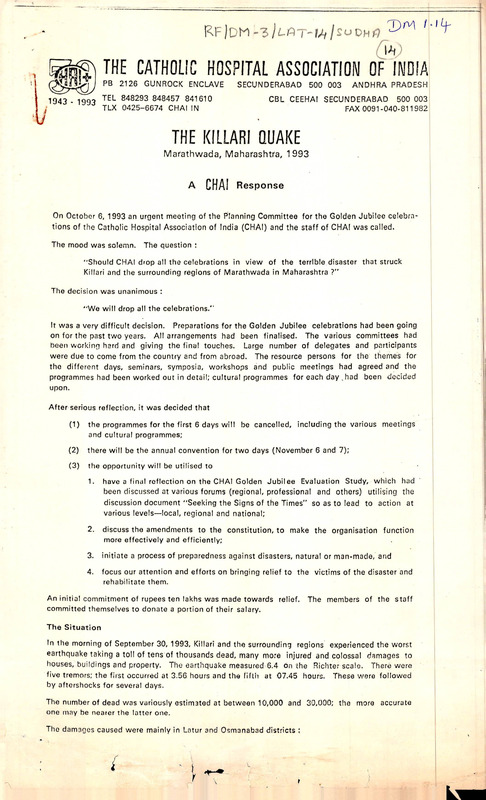
The Killari Quake – Marathwada, Maharashtra 1993 A CHAI Response
Item
- Title
- The Killari Quake – Marathwada, Maharashtra 1993 A CHAI Response
- extracted text
-
2)^ i . I L^(W)
THE CATHOLIC HOSPITAL ASSOCIATION OF INDIA
PB 2126 GUNROCK ENCLAVE
V
1943 - 1993 TEL 848293 848457 841610
TLX 0425-6674 CHAI IN
500 003
SECUNDERABAD
ANDHRA PRADESH
CBL CEEHAI SECUNDERABAD 500 003
FAX 0091-040-811982
THE KILLARI QUAKE
Marathwada, Maharashtra, 1993
A
CHAI Response
On October 6, 1993 an urgent meeting of the Planning Committee for the Golden Jubilee celebra
tions of the Catholic Hospital Association of India (CHAI) and the staff of CHAI was called.
The mood was solemn.
The question :
"Should CHAI drop all the celebrations in view of the terrible disaster that struck
Killari and the surrounding regions of Marathwada in Maharashtra ?"
The decision was unanimous :
"We will drop all the celebrations.'1
It was a very difficult decision. Preparations for the Golden Jubilee celebrations had been going
on for the past two years. All arrangements had been finalised. The various committees had
been working hard and giving the final touches. Large number of delegates and participants
were due to come from the country and from abroad. The resource persons for the themes for
the different days, seminars, symposia, workshops and public meetings had agreed and the
programmes had been worked out in detail; cultural programmes for each day .had been decided
upon.
After serious reflection, it was decided that
(1)
the programmes for the first 6 days will be cancelled, including the various meetings
and cultural programmes;
(2)
there will be the annual convention for two days (November 6 and 7);
(3)
the opportunity will be utilised to
1.
have a final reflection on the CHAI Golden Jubilee Evaluation Study, which had
been discussed at various forums (regional, professional and others) utilising the
discussion document "Seeking the Signs of the Times” so as to lead to action at
various levels—local, regional and national;
2.
discuss the amendments to the constitution, to make the organisation function
more effectively and efficiently;
3.
initiate a process of preparedness against disasters, natural or man-made, and
4.
focus our attention and efforts on bringing relief to the victims of the disaster and
rehabilitate them.
An initial commitment of rupees ten lakhs was made towards relief,
committed themselves to donate a portion of their salary.
The members of the staff
The Situation
In the morning of September 30, 1993, Killari and the surrounding regions experienced the worst
earthquake taking a toll of tens of thousands dead, many more injured and colossal damages to
houses, buildings and property. The earthquake measured 6.4 on the Richter scale. There were
five tremors; the first occurred at 3.56 hours and the filth at 07.45 hours. These were followed
by aftershocks for several days.
The number of dead was variously estimated at between 10,000 and 30,000; the more accurate
one may be nearer the latter one.
The damages caused were mainly in Latur and Osmanabad districts :
44 villages in Latur and 32 villages in Osmanabad were severely affected.
The loss of lives and damages were unusually high.
Causes :
1.
The densely populated area
2.
Unsuitable house construction
3.
The nature of the soil
4.
The disaster ocurred in the early hours of the morning.
The response
There was massive response from everywhere—local, national and international, in kind- human
resources and money. The Government of Maharashtra swung promptly into action; so also
various voluntary organisations. There was an unprecedented and growing groundswell of
humanitarian aid of every description.
Food, water, clothing, disposal of dead bodies, safety of
property, temporary shelters, electricity and other needs wero attended to. Health and medical
care received attention. The armed forces were requested to help in the relief and rescue opera
tion. They did an excellent job.
The response though massive, was still inadequate.
More help was called for.
CHAI team
CHAI responded to the call. They were assisted in this by the Sanghi group of Industries. The CHAI
team with volunteers from the Andhra Pradesh Conference of Religious India, Andhra Pradesh
Bishop's Conference, Forum of Religious for Justice and Peace and CHAI member institutions set
up a relief camp at Nandurga village on October 10, 1993. It was called the CHAI-SANGHI
Earthquake Relief Camp.
Priorities for the CHAI relief team
4
Provide medical and health care.
2.
Help in the psychological, social and spiritual needs.
3.
Attend to hygiene and sanitation.
4.
Mobilise relief materials for villages that needed them.
5.
Plan for long term rehabilitation.
The Camp
The relief camp was set up at Nandurga village, 50 Km away from Latur.
operates in the villages around within a radius of upto 10 Km.
The team functions and
Initially life in the relief camp was difficult. Incessant rains gave sleepless nights. There was
ankle deep water inside; the black cotton soil was slushy. Things improved in a couple of days.
More volunteers arrived. Medicins Sans Frontieres, a Natherlands based organisation provided
basic medicine kits and tents(3) for the team.
Government also provided 2 tents. There were,
additionally, three tin sheds for kitchen and other purposes. One additional subcentre was open
ed in Sarani to serve Sarani and Lotta.
Organisational ' set-up
Two teams have been set up to co-ordinate the relief operation.
Core team at Hyderabad
The following organisations besides others are represented in the core team at Hyderabad (names
of representatives given) :
•
The Catholic Hospital Association of India : Fr John Vattamattom, svd
•
Sanghi group of Industries
*
Andhra Pradesh Conference of Religious India : Fr Bosco sj and Bro Thomas Aquinas
•
Andhra Pradesh Bishops Conference :
•
Forum of Religious for Justice and Peace : Bro Varghese Thekanath, SG
Mr Girish
1
Fr Francis Thumma
/
1
I
The core team is responsible for mobilisation of resources, co-ordination and irnplernentatlon of
the programmes
Action team at the site
The action team has two co-ordinators :
Administrative co-ordinator : Fr Joy Kochupura : Responsible for liaising with thej core team,
of -materials and general administration of
government, voluntary organisations, procurement c.
*
the camp.
♦
Field co-ordinator :
Bro Varghese T : Responsible for relief and rehabilitation in the field and
personnel management.
The two co, ordinators will consult each other before arriving at major decisions.
Fr Amal Raj sj along with the co-ordinators and members of the core team will periodically eva
luate the relief organisations.
Medical Care
A large number of people have been availing of medical care provided by CHAI team. As soon
the medical tent was put up, a throng of patients queued up. The medical work was organised into
1.
an outpatient department at
Nandurga and later at Sarani, about 15 Km away from Nan-
durga, and
2.
mobile clinics and health extension programmes in
Hasalgartt
Sankaral/i
Ja^gaonwadi
Sarani
Lotta
Limbada
Tanda
Ma^grul
Harggoan.
The number of patients attended to by the doctors averaged 400. There were fractures of limbs,
spine and pelvis. Many had infected wounds. There were many patients with diarrhoea,
scabies, cough, cold and fever. They were all attended to by our teams. Our teams had doctors,
nurses, social workers and other volunteers, who were drawn from different parts. The doctors
were specialists (orthopaedic surgeon, paediatrician, gynaecologist) and generalists, depen i g
on the perceived needs in the field. The nurses were well qualified and experienced. Spec
mention must be made of the human resource contributions from St. John's Medical College an
Hospital, St. Martha's Hospital and St. Philomena's Hospital, Bangalore, the Community Health
Cell, Bangalore, Scholastics from the Papal Seminary, De Nobili College and SVD Seminary, Pune
and the St. Theresa's and Vijay Marie Hospitals, Hyderabad beside many others.
Patients requiring immediate surgery or hospitalisation were referred to
District Hospital, Latur
Vivekananda Hospital, Latur and
St. Theresa's Hospital, Hyderabad
The team doctors followed up the patients ensuring that thay received the required treatment.
There was excellent co-operation. The Maharashtra Health Minister visited our medical relief
camp. He appreciated our work and entrusted the curative medical care to our team. In addition
to curative care, attention is given to the preventive and promotive aspects as also community
health. Health education programmes are conducted with the use of audio-visual aids, street
plays, role plays and songs. Local resources are being mobilised for health education.
The district medical officer has requested our team to co-operate with the anti-malarial program
me.
We have been assigned 8 villages for the antimalarial programme.
Psychological needs
Ti.v.
The people of the affected areas; are striken with deep grief, as part of the Post Trauma Stress
Syndrome. Our social work team has been reaching out toithe families in our efforts to rehabili
rapport has been built up.
tate them. As a result of personal interaction with the people, a good
i
4
(
I
4
II
I
HlllllIlL!
JLL
Illi
The team has been able to help in improving the psychology and attitude of the people. The
team is in the process of organising people at different levels-^school children, women, youth,
men.
Hygiene and sanitation
The villages had been shifted to temporary settlements provided by the Government. Hygiene
and sanitation were lacking. A subteam of the CHAI team was formed to look into the area of
hygiene and sanitation. The team has done very good job in providing proper drainage system,
constructing platforms for washing clothes, protecting water supply sources and the environment.
The people are also educated in hygiene and sanitation.
Material relief
Though the news is that materials are pouring in, the reality is that the basic minimum needs are
not met in the case of many people. These paaple have lost everything. A lot more of relief
materials are needed. They must reach the needy. The team has provided food materials wher
ever there was acute shortage. The core team at Hyderabad mobilised necessary materials. They
have been distributed in Sarani, Lotta, Sankrala and Wadi. Rice, dal, wheat flour, oil, masala
and potato have been supplied. Other materials included clothes, blankets, blackboards, benches
and educational materials.
Survey
Our survey team has completed the survey of six villages and collected pertinent
and data.
information
Situation after one month
The situation continues to be grim. The people who have lost everything have to be rehabilitated,
besides continuing relief. Agriculture consists mainly of cash crops. The production of food
grains is not much. It will take atleast a month to harvest. Until then, scarcity of food will be
experienced. Once the crops are harvested, some of the basic needs will be met. Until then,
supplementary food and other relief have to be continued.
Housing is an area which has to be taken up seriously and quickly. Arguments on design and
materials can cause delay. Life for the villagers will be tough till these houses are constructed
and occupied. It is understood that many voluntary organisations have come up with projects to
construct between 8 and 9 thousand houses.
But the number of houses which have been
damaged wholly or partly is estimated to be 1.23 lakhs. Massive reconstruction has to be taken
up by the Government and voluntary agencies.
Future plans of CHA!
•
Relief to be continued, to the extent required.
*
Provide curative, preventive and promotive care.
Concentrate on the psychological, social and spiritual rehabilitation, bringing the people back
to the normal stream of life, using appropriate strategies.
identify potential loaders and train them to continue the activities.
organise women, children and youth as also cultural and recreational programmes.
Collaboration with other agencies
The CHAI team has been happy to collaborate with Government and Voluntary agencies.
representative of the team was
The
attending the weekly co-ordinating district.level meetings
convened by the District authorities. The District and State authorities have appreciated the
work done by the CHAI team and requested CHA! to continue the good work. BHEL and ICRISAT
made use of the infrastructure and contacts of CHA! for distribution of relief packages of house
hold utensils, clothes and chickpea seeds. Other voluntary agencies donated drugs for use by
CHAI team in their medical work. Two doctors from Banaras Hindu University worked with CHA!
team.
The collaboration with the Sanghi group of Industries has been wonderful and fruitful.
Conclusion
The magnitude of the disaster and its impact on the people in the affected area are yet to be fully
assesed. There is need to continue the efforts on more scientific and humane linesz in the coming
weeks and months, keeping in mind the long term needs and problems dHhe affected.
Credits : Reports of Dr. Mani Kalliath (CHD),
Bro. Varghese Theckanath (Field Co-ordinator)
and Fr. Joy Kochupara (Administrative Co-ordinator).
K
- Media
 RF_DM-3_LAT-14_SUDHA.pdf
Position: 2242 (8 views)