Reminiscences of a Volunteer by Mr. Soumya Kumar
Item
- Title
- Reminiscences of a Volunteer by Mr. Soumya Kumar
- extracted text
-
KF
Y3 |suW
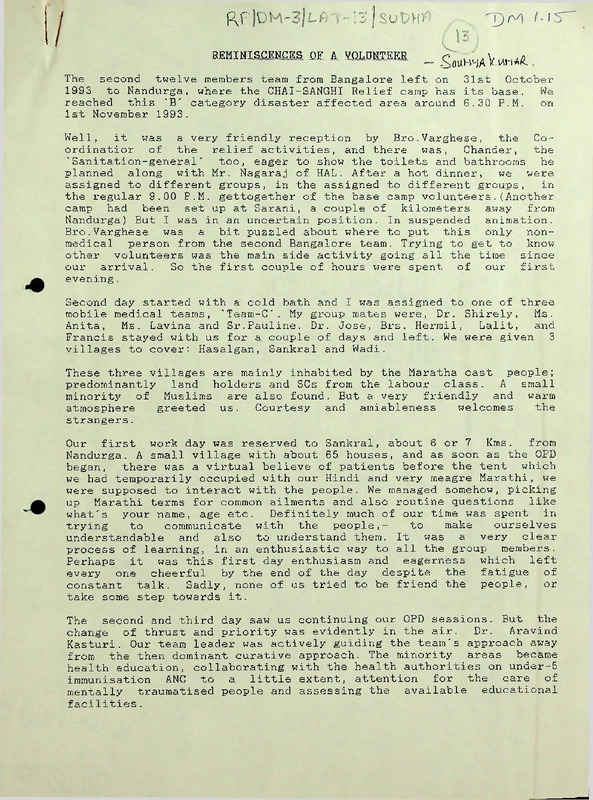
REMINISCENCES OF A VOLUNTEER
SouH^/A V umIL.
The second twelve members team from Bangalore left on 31st October
1993 to Nandurga, where the CHAI-SANGHI Relief camp has its base. We
reached this 'B' category disaster affected area around 6.30 P.M. on
1st November 1993.
Well,
it was a very friendly reception by Bro.Varghese, the Coordinatior of the relief activities, and there was, Chander, the
'Sanitation-general' too, eager to show the toilets and bathrooms he
planned along with Mr. Nagaraj of HAL. After a hot dinner, we were
assigned to different groups, in the assigned to different groups,
in
the regular 9.00 P.M. gettogether of the base camp volunteers.(Another
camp had been set up at Sarani, a couple of kilometers away from
Nandurga) But I was in an uncertain position. In suspended animation.
Bro.Varghese was a bit puzzled about where to put this only non
medical person from the second Bangalore team. Trying to get to know
other volunteers was the main side activity going all the time since
our arrival.
So the first couple of hours were spent of our first
evening.
Second day started with a cold bath and I was assigned to one of three
mobile medical teams, 'Tearn-C'. My group mates were, Dr. Shirely, Ms.
Anita, Ms. Lavina and Sr.Pauline. Dr. Jose, Brs. Herrnil, Lalit, and
Francis stayed with us for a couple of days and left. We were given 3
villages to cover: Hasalgan, Sankrai and Wadi.
These three villages are mainly inhabited by the Maratha cast people;
predominantly land holders and SCs from the labour class. A small
minority of Muslims are also found. But a very friendly and warm
atmosphere
greeted us. Courtesy and amiableness
welcomes
the
strangers.
Our first work day was reserved to Sankrai, about 6 or 7 Kms. from
Nandurga. A small village with about 65 houses, and as soon as the OPD
began, there was a virtual believe of patients before the tent which
we had temporarily occupied with our Hindi and very meagre Marathi, we
were supposed to interact with the people. We managed somehow, picking
up Marathi terms for common ailments and also routine questions like
what's your name, age etc. Definitely much of our time was spent in
trying
to
communicate with the people,to
make
ourselves
understandable and also to understand them. It was a very clear
process of learning, in an enthusiastic way to all the group members.
Perhaps it was this first day enthusiasm and eagerness which left
every one cheerful by the end of the day despite the fatigue of
constant talk. Sadly, none of us tried to be friend the people, or
take some step towards it.
The second and third day saw us continuing our OPD sessions. But the
change of thrust and priority was evidently in the air. Dr. Aravind
Kasturi. Our team leader was actively guiding the team's approach away
from the then dominant curative approach. The minority areas became
health education, collaborating with the health authorities on under-5
immunisation ANC to a little extent, attention for the care of
mentally traumatised people and assessing the available educational
facilities.
So began the house to house under-5 immunisation survey, at Hasalgan,
wtih four of us involved in it-Dr.Jose, Ms.Lavina, Ms.Anita and
myself. With an ebullient spirit, we decided to conduct health check
up for under-5 children also, along with collecting information on
immunisation status. The fervour was definitely confined to the first
day itself. After about eight hours of work, we were able to cover
just 30 children, and the village had more than 400 families] Survey
became just an exercise of collecting data on immunisation status.
Sadly, atleast two other organisations had conducted surveys, (one on
DDT coverage, other not known) and people were vocally unhappy about
us asking the same questions, despite our best of efforts to explain
the purpose of survey. I was scolded by a girl about 10-12 years age
for asking what she called as useless questions again and again.
Language was the main problem. Our Hindi and broken Marathi forced us
to use ten words at the place of one. It left us dry and in the fag
end, every member of our team felt bored, too bored. Members joined
our group and left. But the survey seemed not to end. One good thing,
perhaps, of this too much of talk with the people was that we became
close, together. Especially in the villages of Sankrai and Wadi, where
we were able to spend more time than at the big settlement Hasalgan.
People enjoyed correcting our Marathi and smile alound. Girl children
and their mothers were very insistent that their girl child should get
out to Bangalore. And unless specifially asked girl children were not
mentioned at all while giving data.
Week or so after, every one of us was happy. We were able to cover
each and every house, draw the maps of each village. And we were able
to provide some basic data about the educational facilities available
like,- infrastructure, attendance status, the urgent needs etc. Since
schools were focus of distribution of relief materials- including full
packets of 'Uncle chips' everyday, in a predictable manner, attendance
of children to schools especially of girl children above 10-12 years
range had shot up. We could find unused UK or USA manufactured soaps
kept in houses for its fragrence and heard about the distribution of
Johnson & Johnson baby lotion too. People knew not what to do with the
latter. As Dr.Aravind narrated, a villager wanted to know whether to
take J&J lotion with water or just plainly]
And then came the big news. We had pre-supposed that measles
inoculation have been given on the thigh. But in a frustrating way, it
was on the shoulders] All our data went into awry. We ended up
providing only general information about the immunaisation status.
Immunisation sessions along with ANC were planned. The idea was that
volunteers should act as facilitators and motivators and leave the
actual work of immunising to the health authorities. There was stiff
resistance from the local ANMs. They were simply not ready to consider
the issue seriously because, all of a sudden they could not demand
vaccination supplies for children numbering more than a 100 in each
village. The idea of issuing immunisation cards was also not well
received.
It was only the DHO who was interested. Inspite of giving
prior information about the approximate number of vaccines needed,
only a few were brought. Added to this, most of the children had left
to their grandparents' on account of Diwali. Perhaps one of the
mistakes we made was that we had not taken the local health volunteers
into confidence before starting our programme.
The whole experience was f rust-rating. We were not ready to pull
ourselves and compile the data we had collected. Yet we did it for we
were returning. Last minute work was done and the files were
submitted.
On
12th November 1993, we had
our funniest
and
horrifying
experiences. Around 7 P.M. there was mild tremour, which lasted for
5/6 seconds. There was much excitement and feeling of achievement in
every one of the Bangalore team, for a couple of seconds. It was only
when we heard the sharp cries of children and women, saw the fearful
faces of men we realised our folly. People were scared to death. Two
aged persons died out of shock at the Nandurga Village. And they were
expecting another Sept-30 on that night. Most of the villagers spent a
sleepless night, like us, the volunteers. We visited the villages in
which we worked and talked to them. There were no damages. But fear
was thick.
And then the
penultimate day gave a couple of poignant hours to us.
We wanted to visit the villages, say good bye and return back in an
hour or so. It became a whold day trip. Breaking the common rule of
not preparing any sweets on Diwali day, a couple of persons from
Sankrai wanted us to join them in lunch. We had to choose one. A
sumptuous one. And then at Wadi our evening tiffin. Everyone gathered
to
say good bye to us. A touching experience.
The
people,
policeman,the children...
On 14th November 1993 the second Bangalore team, now consisting of
seven members left Nandurga to Bangalore with both sadness and
happiness we moved. Bidding good bye to Bro.Varghese, Bro. Sunil, and
our driver Maqbool we took the bus to Sholapur from Ornerga.
With the grisly memories of still stinking Killari and Mangrol, the
tearful faces of people of Nandurga, Wadi, Sankrai and Hasalgan, the
sweet memories of the hospitality of Bro.Varghese, all the new friends
whom we met, and the sweetest tea offered by the sweet villagers,"the
Hyderabad-Bangalore team" returned back.
So, the disaster. The relief. The experience. I returned with a much
more assured heart that the caste and religious barriers are our own
creations. With a new understanding that when we treat others as
humanbeings, not as categories of people like villagers or city
dwellers, and when we are sincere in our efforts definitely our work
will pay. Perhaps the greatest service one can do to one's society is
to be true to oneself, causing no harm to any one and try to change
oneself.
What else? Ahj the indelible scene of a solitary reddish rose blooming
in all its beauty amidst the reeky ruins and rubbles of Mangrolheralding a new life for every one of us.
- Media
 RF_DM-3_LAT-13_SUDH.pdf
Position: 1896 (10 views)