People’s Right to Information
Item
- Title
- People’s Right to Information
- extracted text
-
fM e s
mo- £2 .
$>
l>c-
lci§r
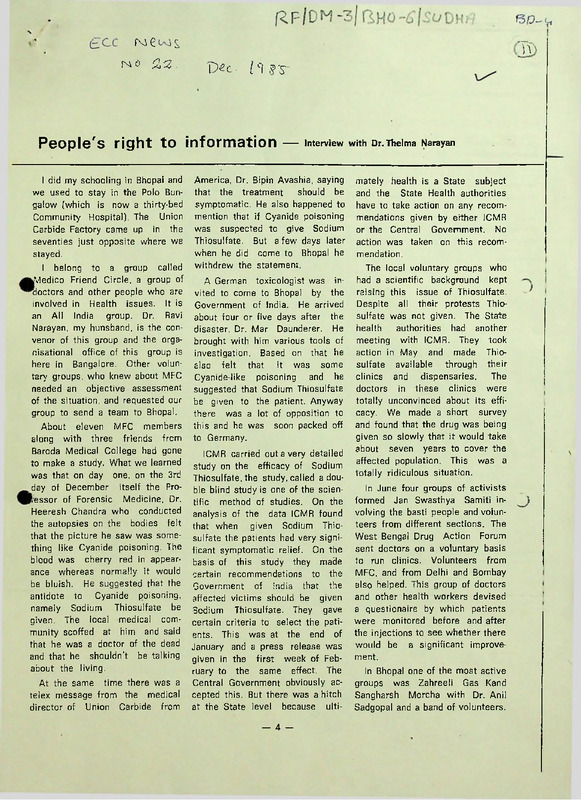
People's right to information --- Interview with Dr. Thelma Narayan
I did my schooling in Bhopal and
we used to stay in the Polo Bun
galow (which is now a thirty-bed
Community Hospital). The Union
Carbide Factory came up in the
seventies just opposite where we
stayed.
I belong to a group called
^Medico Friend Circle, a group of
doctors and other people who are
involved in Health issues. It is
an All India group. Dr. Ravi
Narayan, my hunsband, is the con
venor of this group and the orga
nisational office of this group is
here in Bangalore. Other volun
tary groups, who knew about MFC
needed an objective assessment
of the situation, and requested our
group to send a team to Bhopal.
About eleven MFC members
along with three friends from
Baroda Medical College had gone
to make a study. What we learned
was that on day one, on the 3rd
day of December itself the Pro
cessor of Forensic Medicine, Dr.
Heeresh Chandra who conducted
the autopsies on the bodies felt
that the picture he saw was some
thing like Cyanide poisoning. The
blood was cherry red in appear
ance whereas normally it would
be bluish. He suggested that the
antidote to Cyanide poisoning,
namely Sodium Thiosulfate be
given. The local medical com
munity scoffed at him and said
that he was a doctor of the dead
and that he shouldn't be talking
about the living.
At the same time there was a
telex message from the medical
director of Union Carbide from
America, Dr. Bipin Avashia, saying
that the treatment
should be
symptomatic. He also happened to
mention that if Cyanide poisoning
was suspected to give Sodium
Thiosulfate. But a few days later
when he did come to Bhopal he
withdrew the statement.
A German toxicologist was in
vited to come to Bhopal by the
Government of India. He arrived
about four or five days after the
disaster, Dr. Mar Daunderer. He
brought with him various tools of
investigation. Based on that he
also felt that it was some
Cyanide-like poisoning and he
suggested that Sodium Thiosulfate
be given to the patient. Anyway
there was a lot of opposition to
this and he was soon packed off
to Germany.
ICMR carried out a very detailed
study on the efficacy of Sodium
Thiosulfate, the study, called a dou
ble blind study is one of the scien
tific method of studies. On the
analysis of the data ICMR found
that when given Sodium Thio
sulfate the patients had very signi
ficant symptomatic relief. On the
basis of this study they made
certain recommendations to the
Government of India that the
affected victims should be given
Sodium Thiosulfate. They gave
certain criteria to select the pati
ents. This was at the end of
January and a press release was
given in the first week of Feb
ruary to the same effect. The
Central Government obviously ac
cepted this. But there was a hitch
at the State level because ulti
— 4 —
mately health is a State subject
and the State Health authorities
have to take action on any recom
mendations given by either ICMR
or the Central Government. No
action was taken on this recom
mendation.
The local voluntary groups who
had a scientific background kept
raising this issue of Thiosulfate.
Despite all their protests Thio
sulfate was not given. The State
health
authorities had another
meeting with ICMR. They took
action in May and made Thio
sulfate available through their
clinics and dispensaries.
The
doctors in these clinics were
totally unconvinced about its effi
cacy. We made a short survey
and found that the drug was being
given so slowly that it would take
about seven years to cover the
affected population. This was a
totally ridiculous situation.
In June four groups of activists
formed Jan Swasthya Samiti in
volving the basti people and volun
teers from different sections. The
West Bengal Drug Action Forum
sent doctors on a voluntary basis
to run clinics. Volunteers from
MFC, and from Delhi and Bombay
also helped. This group of doctors
and other health workers devised
a questionaire by which patients
were monitored before and after
the injections to see whether there
would be a significant improve
ment.
In Bhopal one of the most active
groups was Zahreeli Gas Kand
Sangharsh Morcha with Dr. Anil
Sadgopal and a band of volunteers.
Bhopal
It took one year for the
news to reach the Press !
|
Other groups working included
the Nagrik Rahat Aur Punarvas
Samiti, a trade Union relief front
from Bombay and the Union Car
bide Workers Union. In June they
formed the Jan Swasthya Samiti.
The Jan Swasthya Samiti formed
Jan Swasthya Kendra and set up
their clinic on a field outside the
inner gate of Union Carbide. They
London, Nov. 10 (UNI): Lethal started giving the patients Sodium
cyanide gas, of the kind used in
cnemicai weapons, was responsible Thiosulfate. For three weeks their
for the killing of about 2.500 people clinic ran very well. On one parti
in the Bhopal disaster last Decem cular day the patients had pyro
ber. the ‘Observer’ newspaper here genic reactions which could have
quoted Indian scientists as saying. been due to some adulterant in
This conclusion, which contra the injection. This was notified to
dicts earlier reports that the deaths
were caused by the methyl isocyan the health authorities. In fact
ate (MIC), was based on hundreds these patients were taken to the
of post-mortem reports, the paper Government hospital and were
saicL
treated and all of them came
It said Indian scientists believec home the next day. But the local
that many of those still siifferir health authorities made a big fuss
from long-term injuries caused'
about this and said that the injec
the disaster had been wrongly t
tions were not being given in a
ated.
scientific way. The injection was
The scientists’-conclusions.
given
by doctors and all the ICMR
tained in ^ confidential report
“devastating" for the Unio»
criteria were being followed.
Cyanide
leaked
in Bhopal?
i
i
I
’
bide as the company had
maintained that the temper
the MIC tank did not r
enough to produce cyan*
Tb^c «ne”’'^id
They have been raising various
issues of Bhopal. They formed
Basti committees, mobilised the
people and discussed issues; did
spot surveys as to how many
people had actually received the
initial fund relief and found that it
had reached only a small proportion
of the affected population. They con
ducted a dhama because of a lack
of response to their demands even
for relief; rehabilitation and rations.
A protest demonstration was
organised outside the Madhya
Pradesh Secretariat. On the day
before the demonstration the
police carried out preventive ar
rests and arrested all the doctors
and health workers who were
associated with the Kendra. The
Kendra was not involved with orga
nising the protest demonstration.
But all these doctors were arrested
in the middle of the night and
were not given any reasons as to
why they had been arrested. They
were not allowed to leave the room
at all for 18 hours. When the de-’
— 5 —
monstration was over the next day
the doctors were released. But the
Government refused to give Thio
sulfate to them and so they were
not able to restart the Kendra.
One of the doctors from Bombay
along with two patients went
through the lawyers collective to
the Supreme Court to file a writ
petition saying that their treat
ment had been interrupted and
that the State Government did not
allow voluntary agencies to con
duct this clinic. The Supreme
Court gave a judgement that the
M.P. Government should allow
restarting the clinic and should
not
interfere
with voluntary
groups. The same doctor filed an
other petition saying that though
ICMR had suggested Thiosulfate
in January it had still not been
given to the patients. The Sup
reme Court passed another judge
ment that the M.P. Government
should put up a plan to cover the
entire affected population by a
certain date.
It is a fact that Union Carbide
played a big role in Bhopal. Most
of the big shots in Bhopal had a
relative working in UC. a lot of
senior doctors in the Gandhi
Medical College are medical advi
sors to UC. UC also sponsored
most of the medical symposia and
conferences held in the Gandhi
Medical College. Besides, the
financial funding, a special ward
was attached to the Gandhi Medi
cal College where bureaucrats and
others are treated.
The budget of the Research and
Bhopal
Development Division in Bhopal
was far greater than the budget of
the UC factory itself and what
research was going on there is
unknown. People say that the
data of the research was not
analysed in India. That in itself
is suspicious, then why did the
Government of India allow it?
|Vhy did they not make conditions
that India
should know what
exactly was going on?
When such a massive tragedy
occurred in India, it is the right of
the Indian people to know what
exactly happened. There has been
secrecy even from the beginning.
Nobody was even divulging what
gases leaked. Union Carbide said
it was a type of tear gas. Four
months later it became evident
that it was a mixture of gases and
Hydrogen Cyanide was one of the
gases produced. In the UC Fac
tory manual, an equation was
given stating that one of the
breakdown products of MIC at a
given temperature is Hydrogen
Cyanide. This secrecy is some
thing that has to be questioned
— secrecy on the part of the
multinationals as well as the
Government of India for not ques
tioning them.
■
The Central Pollution Board re
port said that on the second or
third day after the accident they
found Hydrogen
Cyanide still
emanating from the tank. (It was
obviously discovered then; but
was divulged only in June). People
have the right to information
about something that affects their
health.
A comparison I would like to
make is the difference in the
response of the Government and
everybody including the media, to
the Kanishka episode. It was a
tragedy where 329 innocent people
lost their lives. Definitely action
had to be taken but the amount
of money that was spent is
phenomenal. Then you think of
Bhopal where according to official
estimates 2,000 people have died
(the unofficial record is 8,000
people). They are not even inter
ested in finding out the exact
figures. In Bhopal it was some
unknown, uncared for basti dwel
lers. In Kanishka it was the
upper class.
Interview with
R. Radhakrishnan
We call the Bhopal industrial
tragedy a genocide. We have gone
through the old records of Union
Carbide and the activities they
have done in connection with the
establishment of UC and the
Research that was going on there
and we have come to the conclu
sion that it was a planned geno
cide. All safety measures were
in disorder and they did not repair.
Kerala Shastra Sahithya Parishad
(People’s Science Movement) has
arranged 1,000 classes in Kerala
to educate people about Bhopal.
KSSP called for the boycott of UC
products.
We also organised a
Slum Youth
mass signature campaign involv
Orientation
ing one lakh people and submitted
Forty young people from nine a memorandum to the Prime Mini
different slums — tinkers, painters, ster. UC was an eye-opener and
students, waiters, cleaners, dho we see that multi-nationals are
bis, masons and stone breakers blood-sucking vampires.
were here for a week-end orienta
tion programme. Apart from talks
In 1947 we got political libera
and discussions, the other ways tion. For economic liberation we
of learning were photo-language, have to get economic sovereignty
political/revolutionary songs, and and the first step to achieve it is
simulation games, street plays, to boycott all the products of the
poster-making.
multi-nationals. We call for a
The participants presented skits boycott of the Union Carbide pro
on ‘power game in the society and ducts, Eveready battery and torch.
the inability of the poor to get Bhopal is completing one year on
employment, harrassment and rela 2nd December. We call for the
ted problems,’ ‘Denial of basic observance of two-minute silence
rights to the poor in Government on 2nd December, 1985. With the
schools
and Government hos help of all other people's Science
pitals,’ ‘Unemployment, low wages, Movements in this country KSSP
inadequate housing, alcohol’ etc. will arrange protest meetings in
They also composed songs and State capitals exhorting the boy
prepared posters.
cott call.
— 6 —
- Media
 RF_DM-3_BHO-6_SUDHA.pdf
Position: 2242 (8 views)