Summary of Need for Communication Strategy on Health Issues Following the Bhopal Gas Tragedy
Item
- Title
- Summary of Need for Communication Strategy on Health Issues Following the Bhopal Gas Tragedy
- extracted text
-
326 V Main 1 Block
Koramangala
Bangalore 560 034
20 APRIL
1905
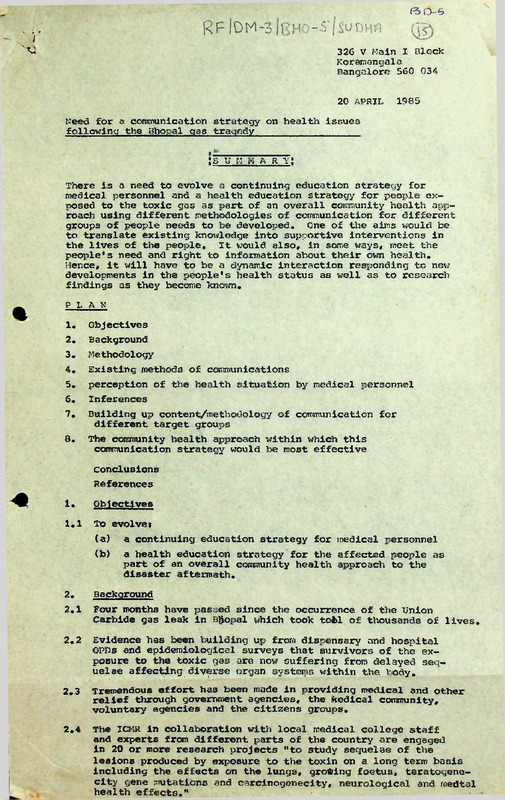
Need for a communication strategy on health issues
following the Bhopal gas tragedy_____________ _____
}S U M a A R Y{
There is a need to evolve a continuing education strategy for
medical personnel and a health education strategy for people ex
posed to the toxic gas as part of an overall community health app
roach using different methodologies of communication for different
groups of people needs to be developed. One of the aims would be
to translate existing knowledge into supportive interventions in
the lives of the people. It would also, in some ways, meet the
people’s need and right to information about their own health.
Hence, it will have to be a dynamic Interaction responding to new
developments in the people's health status as well as to research
findings as they become known.
PLAN
1.
2.
Objectives
Background
3.
Methodology
4.
Existing methods of corramunications
5.
perception of the health situation by medical personnel
6.
Inferences
7.
Building up content/methodology of communication for
different target groups
The community health ajiproach within which this
communication strategy would be most effective
8.
Conclusions
References
1.
Objectives
1.1 To evolve*
2.
(a)
a continuing education strategy for medical personnel
(b)
a health education strategy for the affected people as
part of an overall community health approach to the
disaster aftermath.
Background
2.1 Four months have passed since the occurrence of the Union
Carbide gas leak in Bhopal which took to2>l of thousands of lives
2.2 Evidence has been building up from dispensary and hospital
OPDs and epidemiological surveys that survivors of the ex
posure to the toxic gas are now suffering from delayed seq
uelae affecting diverse organ systems within the, body.
2.3 Tremendous effort has been made in providing medical and other
relief through government agencies, the fcedical community,
voluntary agencies and the citizens groups.
2.4 The ICMR in collaboration with local medical college staff
and experts from different parts of the country are engaged
in 20 or more research projects "to study sequelae of the
lesions produced by exposure to the toxin on a long term basis
including the effects on the lungs, growing foetus, teratogenecity gene mutations and carcinogenecity, neurological and roedtsl
health effects,"
2.5. There have already been positive outcomes of this research
effort which can benefit/roodify therapy of the affected people
vix.,
2.6
(a)
Therapeutic efficacy of sodium thiosulfate
administration in a significant proportion
of victims. This has resulted from clinical toxicological studies and a double blind
study using thio-sulfate backed up by blood
gas analysis and thiocyanate excretion in
the urine.
(b)
preliminary observations on mental health
status and recommendations by the icmr
team of psychiatrists.
Voluntary effort too has contributed to medical cares
(a) making public the rationale of using thiosulfate
and organizing people to demand that its use be
implemented on a mass scale (Horcha, Saheli, mfc)
(b)
(c)
highlighting and making public the risk to the
foetus and advocating preventive contraception till
detoxification is over (mfc):
highlighting gynaecological problems of women which
have been so far ignored (rnfc) :
(d)
highlighting functional disability (mfc) and
implementing occupational rehabilitation (AGAPE/
Union Carbide employees Association)
(€)
highlighting the need for and implementing respira
tory physiotherapy (Union Research Group):
(f)
training community health volunteers (SEWA & BRWS)
2.7
Impact of both the above efforts (2.5 & 2.6), however, have
been able to reach only a small segment of the affected
population.
2.8
A major lacunae in all the above efforts is the absence of
adequate communication of methcds/results between medical
personnel, between government and voluntary sector, between
all the above and the affected people. At the field level,
this results in ignorance, confusion, controversy and anarchy
reducing the efficacy of the medical interventions.
2.9
Of course this is only one of the factors responsible for the
prevailing medical anarchy. Some of the other are:-
(a)
(b)
(c)
(d)
lack of coordination of medical relief effort;
research projects though passing through a coordi
nation committee function like vertical programmes;
lack of objectivity/opennessiin discussing issues:
e.g.t thiosulfate;
the strong opposition to the above could make one
believe that there are more powerful issues at stake
than just the therapeutic efficacy of thiosulfate
vested interests:
(e)
personality clashes;
(f)
ambition - utilizing the research opportunity for
career advancement;
a purely drug centred approach, which is reflective
of one’s medical education;
(g)
(h)
working in Isolation - not seeing the need for a
multi-disciplinary approach at tackling this health
disaster. Purely medical/technical intervention
can never touch the solution to tills problem.
(j)
resides medical personnel, sociologists, anthropo
logists, physiotherapists, nutritionists, rehabi
litation experts, communication experts, journa
lists need to work along with citizens groups, religious
groups, social workers and representatives of the
people thernselves;
Absence of a community health approach at field/
service level;
medical hierarchy;
(k)
over secrecy.
(i)
2.10 In this paper we shall confine ourselves to the
communication strategy.
3.
3.1
Methodology
During the second half of March 1985, a sixteen member team
of the medico friend circle carried out an epidemiological
survey of the gas affected people.
3.2
A 10% sample of families of the most affected JP Hagar and, a
control from Annanagar were studied.
3.3
The study included the following;
(a) a morbidity survey with detailed history taking
and physical examination;
(b)
hemoglobin estimation and lung function tests;
(c)
3.4
a study of the people's perceptions of existing
health facilities.
We also interviewed*
(a)
affected people in the bastis;
(b)
doctors/para-medics manning government dispensaries
polyclinics, community health centres and hospitals;
(c)
staff and post-graduate students of Gandhi Medical
College;
(d)
private practitioners working in the basti area
and elsewhere in Bhopal;
(e)
voluntary agencies providing relief/rehabilitation;
(f)
Citizens groups working with and for the
affected peoples and
decision makers in the government and voluntary
sectors.
4. Existing methods of communication
(g)
4.1 within the medical congnunity these included
Symposia on clinical aspects of disaster
aftermath held at Gandhi Medical College
open to staff/students/lMA/doctors club
members etc., held at bi-monthly or monthly
intervals.
Some observations
4.1.1
(a) attendance by private practitioners was low
especially by those working in the affected
areas;
(b) They were mainly exercises in one way communi
cation between Gandhi Medical College staff
and the audience (reflecting inedical hierarchy)
(c) lack of open dialogue/sharing of experiences/
objectivity
(d) mat one of the symposia attended (on lung
function) attended by our team an anti
thiosulfate lobby dominated the proceeding
with an obviously biased approach.
4.1.2
- 4 Newspaper (media) reportine4-seemed to be tne only other
source of technical/medical information.
some observations
(a)
the infrequent ICMR/voluntary agency press releases
are not reported in full and often not accurately;
(b)
media coverage tended to favour the strong
local medical lobby and hence gave baised
information;
(c)
they covered the sensational aspects, blowing
it our of proportion.
4.2
Between different voluntary/citizens groups
4.2.1
Informal flow of communication through group discussions,
meeting and even collaborating in action takes place.
4.2.2
Here also because of ideological and personality reasons
scree groups were alienated from each other and worked in
isolation.
4.3
Between voluntary groups and government services
4.3.1
There is a big communication gap here and lack of coordination
4.3.2
This has resulted in mutual suspicion, questioning of each
others motives, working at cross purposes, even negating the
work done by the other.
It sometimes has also resulted in duplication of scarce
resources: eg., clinics run by a voluntary group and the
government were almost opposite each other.
Breakthrough in therapeutic lines of treatment do not reach
the peoples eg., most doctors manning peripheral clinics
(both government and voluntary) were totally ignorant about
thiosulfate, its rationale, availability, efficacy etc.,
while it was being studied and given in a community based
gis hospital just a stone’s throw away.
4.3.3
4.3.4
4.4
4.4.1
Between the people and the medical services
Medical services both government and voluntary are strongly
clinic based-being distribution centres for a variety of
drugs which are available in plenty.
4.4.2
Even basic health education was not being attempted leave
alone education responding to this particular health dis
aster situation.
4.4;3
Only citizens groups were taking health issues to the bastis,
discussing them with the people and if necessary, organizing
the people to get adequate medical attention.
4.4.4
These attempts were looked at with suspicion and fear by
the medical establishment, rather than seeing them as
positive steps to let the fruits of their own endeavours
reach the people,
5.
5.1
Perception of the health situation of gas affected people by
medical personnel
In the absence of effective communication of study findings/
recommendations to the treating medical personriel there is
ignorance about the clinical presentation/pathology resulting from
toxic gas exposure. Hence there are misinterpretations of
symptoms resulting in incorrect diagnosis and therapy.
5.2
Fatigability resulting from tissue anoxia produced by an in
creased "cyanogen Fool" in the body is being labelled as *
"lasiness* and "wanting to make the best use of the aid pouring
in*.
5.3
Respiratory
symptoms due to lung damage (fibrosis) are being
5
- 5 diagnosed as TB (without proper investigations) as these slums
are supposed to be endemic for TB.
5*4
5.5
6
6,1
6,2
6,3
6.4
6,5
Cenuing psychic entities like depression, anxiety etc., are being
seen as •‘ccmpensationa malingering” when there is adequate evidence
that in such disaster situations the experience is stressful
enough to produce major psychological changes,
These judgecjental/unscientific attitudes towards the affected
people/by some sections of medical personnel are seen both in
the government and voluntary sectors,
Inferences * general
From the above observations it was felt that a multipronged approach
should be evolved for effective communication of medical health
Issues relating to the gas affected victims for different cate
gories of people,
The content of the communication could be decided by a body re
presenting as many groups as possible.
This would have to be a dynamic process responding to new deve
lopments in the people’s health status and to research findings
as they become known,
All known existing methodiologies of consnunication/heelth education
should he used: eg., group discussions, audiovisuals, slide shows,
posters, demonstrations, posters, pamphlets, mass media etc.
Different groups of people (target groups!) should be kept in minds
(a)
the affected people
(b)
Service providers:
—government health sector radical personnel?
—staff/students of Gandhi Medical College?
—voluntary agency workers/citizen groups
(c)
(d)
Decision makers in government - Centre and state
Media
7.
Methodology ofa communication strategy
7,1
Methodology
7.1,1
7,1.2
Regular newsletters giving rain research findings, current
understanding of the clinical presentation/pathology, thera
peutic guidelines and their rationale should be posted out to
individual medical practitioners on a mass mailing system.
Meetings/discussions at convenient times of doctors/
medical personnel actually working in affected bastis should
be organized at regular intervals to share/get an up
date on the situation.
7.1,3
If possible clinical conferences for this group emphasis
ing the more common presentations rather than the rare
should be organized,
7.1.4
Specific care should he taken to involve personnel
working in the voluntary/private sector,
It is necessary to build on the and make use of resources
of thedifferent groups working there, eg:
(a) Technical informaticn/guidelines: ICMR/Medical
Collgege staff
(b) Organising/implementing program: MP Government
Public Health service
(c) Organization of people:
Citizens Group
Communicating with the people
which have a
Community base
and credibility.
Zahreeli Gas Kand Sangarsh Horcha/Nagarik Funarvas
Aur Rahat Saraiti
7.1.5
(d)
Respirator physiotherapy/
Kutrition supplementation
:
Union Research
Group
'
(e)
(£)
(g)
- 6 Trained Comnmnity Health
Workers
Demystifying health issues
producing communication
aids
Occupational rehabilitation
: SEWA-Bhopal through
Bengal Rural Welfare
Society
$ Eklavya
: Church group
These are given only for example; many more groups may be involved.
7.1.6 The most crucial element is a-dynamic* creative people-oriented
approach. Too much formalisation should be avoided as this often
keeps vital knowledge away from people and may be counterproductive
7.1.7 The above caution is particularly true at the stage of communi
cation with the people.
(a)
open group meetings in different parts of the
bastis need to be held;
(b)
(c)
(d)
Health messages need to be adequately demystified;
(e)
Audio-visuals would help;
All groups with community base should be enlisted
so that there is some consensus on health messages
given to people and confusion is avoided.
Health messages have to be built on the life s£yle
cf the people and their particular socio-economic
situation for it to have any meaning. Hence* close
interaction and learning from the people is essential
This is particularly relevant in the present situation
since the disaster aftermath has led to a socio
economic crisis in the life of the victims apart
from the health effects.
7.2
Building up content of communication for medicals personnel
7.2.1 Only broad areas of content are outlined here. Details have to
be worked out locally with the help of specialists of concerned
departments and medical personnel from the field. Some of the
areas are:
7.2.2 Therapeutic efficacy of sodium thiosulfate giving
(a) ICMR guidelines;
(b)
Scientific rationale for this IJne of treatment
7.2.3 Diagnostic flow charts and therapeutic guidelines regularly to
tackle various specific problems* eg: jaundice; pregnant women
with fati$ability/lung complications etc.
7.2.4 Findings and recommendations of ICMR study team of psychiatrists*
to help make diagnosis* avoid mis-diagnosis and play a more conselling role.
7.2.5 Risk to the unborn fetus. Need for preventive contraception till
detoxification is over. Copper T and oral contraceptives to be
avoided because of status of women’s health.
7.2.6 Need for good under five care
7.2.7 Nutrition supplementation
(a) Because of ill health and poor wage earning
capacity* there is a role for supplementation
particularly for under fives and pregnant and
lactating women;
(b) bow cost food mixes made out of locally available
cereals* pulses and jaggery can be used;
(c)
Preparation of these mixes could become and income
generating prject for women.
7.2.8 On lung problems
(a)
Refreshers on diagnostic skills in this area as
this covers a large proportion of cases;
(b)
(c)
'Therapeutic guidelines;
Repiratory physiotherapy (breathing exercises)
and yoga
Advice to people with lung damage to avoid
smoking and if possible dust and fumes.
(d)
7.2.9
For eyes
(a)
(b)
. *
' 1
appropriate advice
occupational rehabilitation because though
there may be no structural damages, patients
complain of blurring of vision, watering and
reness of eye.
7.2.10 For jaundice
(a) awareness regarding higher incidence;
(b)
(c)
diagnostic aids and therapeutic guidelines;
use of disposable or adequately sterilised
syringes and needles
7.2.11 Rehabilitation
Diagnosing end referring the handicapped
for appropriate rehabilitation
7.2.12 Drug utilization
Caution against overdrugging particularly steroids
and anti-biotics, their side effects and rationale
for use.
(a)
3.3.
7.3.1
7.3.2
Building up content of communication for affected people
Here again broad areas have been outlined. Local initiative
is needed to work put details, demystify jargon and use
appropriate media/methodologies .
Details about thiosulfate - selection criteria, possible
effects, side effects, dose, method of administration, precautions
7.3.3. Possible risk to the newborn
7.3.4
For couples who were sterilised and have lost all their
children, possibilities of recgnalisation when, where, how
7,3.5
For mothers with suppression of lactation, details about
supplementary feeding. What to give, how to give, when to
give etc.
7.3.6
Breathing exercises for those who have difficulty in breathing.
7.3.7
For those with white patches on the eye: to contact the eye
department, Hamidla Hospital as surgery may be beneficial.
7.3.8
In case of jaundice: need to report to the dispensary hospital
to find out what type of jaundice it is. Details about the
different types of jaundice, and what precautions aro to be taken.
7.3.9
Caution about over-drugging especially during pregnancy.
7.3.10 Meed to keep health record safely.
8.
Community Health Approach
8.1
A basic community health approach would be necessary within
which this communication strategy would be most effective.
This could include the following:
8.2
Organizing local basti health committees and encouraging local
leadership. Caution should be taken to see that all caste/
class/religious groups are represented/encouraged to participate
actively as very often these committees can be dominated
*•
- 8 -
8.3
8.4
powerful and vocal who may try to maintain status qu6 •
Training community health volunteers
Strengthening mother and child health services. The entire
exposed MCH population can be considered ’at risk’ and provided.
the best possible services, via:
(a)
good ante/intra and post-natal care;
(b)
f
under five services with road to health cards,
iirrnunization, curative care and health education
for mothers particularly regarding nutrition;
nutrition supplementation would help them fight the
pathology and regain as much normalcy as possible;
balwadis and day care centres.
(c)
(d)
The ICPS Scheme itself could be implemented intensively in
this area.
8.5
Health education
8.6
Rehabilitation services to be stressed as the disaster has
resulted in some irreparable physical and even mental damage
(a)
Assessment of work and wage earning capacity to be
carried out and suitable/acceptable occupational
rehabilitation provided for those affected;
(b)
Respiratory physiotherapy;
(c)
Keen watch to be kept for possible congenital
abnormalities which will need rehabilitation;
8.7
Enlisting the support of. existing groups within society who
play a counselling role eg., religious; teacher© to support a
mental health strategy. Hectors too> to be sensitized on this
issue.
8.8
A referral system from health worker, dispensary, polyclinic
to hospital to be functioning with the larger institutions/
seniors playing an actively supportive role.to the smaller/
more junior.
8.9
Active coordination of all health effort for greater effectivity;
8.10
Follow up morbidity surveys making data/information available
to medical community/public.
C 0 N C L U & I 0 K S
1.
One of the basic rights of people, that for information regard
ing their own health status and factors affecting it need to
be urgently met.
2.
This right to know is usually/ a casualty in the present
scientific social and health system - this has only been high
lighted by the dramatic nature of the Bhopal gas disaster.
3.
For scientific, research and medical interventions to have any
meaningful impact in the lives of the affected people, they have
to be sensitive to the needs of the people in this particular
circumstances.
4.
There is an urgent need to translate existing knowledge research
findings into supportive interventions in the lives of people,
5.
A coenunication strategy would be one of the inputs in this process.
6.
This woul& have to build on the various resources in the people,
the voluntary and citizens groups working there and the army of
government healv, personnel working in and for the affected people.
_
* ..9
- 9-
"7.
We believe that this is possible in the present situation
of Bhopal if a bold, imaginative and open attitude is fostered
by the decision makers.
8.
We also believe that this will not be easy in the present
situation of Bhopal since the same apathy, vested interests,
status quo factors which obstruct action in f favour of the
disadvantaged in our society operate in Bhopal.
9.
We have one hope that people are gradually becoming more aware
of their own rights? they will demand these rights and also an
accountability from people in responsible positions.
10.
The strategy we have outlined is one of the many strategies
necessary to support this process.
n~ETT'K'ir H-fr-c-’r-g
1.
ICMP, The Bhopal disaster — current status (The first ninedays )
and programme of research
2.
ICMR, ProjecCization of ICMR supported research
3.
ICMR, Health effects of exposure to toxic gas at Bhopal,
An up date on ICMR sponsored researches, 10 March 1985
4.
ICMR, Medical research problems in Bhopal (V Samalingaswami)
5.
ICMR, Pathology and clinical toxicology of the Bhopal disaster
(S Sriramachari)
6.
ICMR, Medical Research on Bhopal Gas Tragedy, Press Release,
31 Jan 1985
7.
ICMR, ibid, 12 Feb 1965
8.
ICMR, ibid, 27 Feb 1985
9.
ICMR, Thiosulfate therapy in MIC exposed. Minutes of meeting
at ICMR, 14 Feb 1985
10.
ICMR, Guidelines for treatment of Bhopal gas iritis victims,
press release, 4 Apr 1985
11.
mfc Medical Relief and Research in Bhopal- the realities and
recommendations
12.
mfc Approacne document of a project to evolve a strategy of
medical relief and rehabilitation which best meets the people’s
medico social needs and expectations.
13,
Rani Bang, Effects of the Bhopal disaster on the women's health
an epidemic of gynaecological disases, reports I & II
14.
Praful Bidwai, Bhopal's unending tragedy, Times of India
25-27 March 1985
15.
mfc bulletin No. 112, April 1985 Medical Research in Bhopalare we forgetting the people ?
16.
Disaster at Buffalo Creek (Special Section), Am J Psychiatry,
133? 3, March 1976.
- Media
 RF_DM-3_BHO-5_SUDHA.pdf
Position: 1896 (10 views)