Bhopal – A Testimonial to the Impact of Technological Disasters
Item
- Title
- Bhopal – A Testimonial to the Impact of Technological Disasters
- extracted text
-
ft D-l I
RP/DM-z/bhO-s/so DHfl
* - Te-t^?9PX Z2 Z«- Plpact of Technological Disasters
Pi. The Irra Narayan*
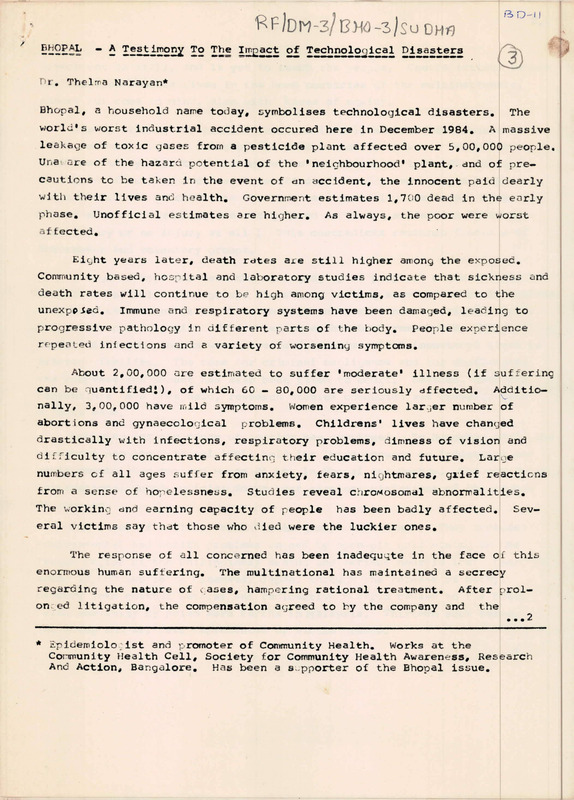
Bhopal, a household name today, symbolises technological disasters.
world1s worst industrial accident occured here in December 1984.
The
A massive
leakage of toxic gases from a pesticide plant affected over 5,00,000 people.
Una are of the hazard potential of the 1 neighbourhood• plant, and of pre
cautions to be taken in the event of an accident, the innocent paid dearly
with their lives and health. Government estimates 1,700 dead in the early
phase. Unofficial estimates are higher.
affected.
As always, the poor were worst
Eight years later, death rates axe still higher among the exposed.
Community based, hospital and laboratory studies indicate that sickness and
death rates will continue to be high among victims, as compared to the
unexppied. Immune and respiratory systems have been damaged, leading to
progressive pathology in different parts of the body. People experience
repeated infections and a variety of worsening symptoms.
About 2,00,000 are estimated to suffer •moderate1 illness (if suffering
can be quantified*), of which 60 — 80,000 are seriously affected. Additio
nally, 3,00,000 have mild symptoms. Women experience larger number of
abortions and gynaecological problems. Childrens' lives have changed
drastically with infections, respiratory problems, dimness of vision and
difficulty to concentrate affecting their education and future. Large
numbers of all ages suffer from anxiety, fears, nightmares, grief reactions
from a sense of hopelessness.
Studies reveal chroMosomal abnormalities.
The working and earning capacity of people
has been badly affected.
Sev
eral victims say that those who died were the luckier ones.
The response of all concerned has been inadequate in the face of this
enormous human suffering.
The multinational has maintained a secrecy
regarding the nature of <ases, hampering rational treatment. After prolon ed litigation, the comoensation agreed to by the company and the
... 2
* Epldemlolo;1st and promoter of Community Health. Works at the
Community Health Cell, Society for Community Health Awareness, Research
And Action, Bangalore. Has been a supporter of the Bhopal issue.
L
3e
Industrial and environmental hazards were considered by the Tribunal,
not as unavoidable, but as an organised violation of the fundamental rights
of humanity to 11 f<', health and access to justice. The Tribunal as well
as other groups have underscored the right to information and the need for
in^cpendant medical assessment of injuries resulting from industrial
hazards. Peoples organisations, movements and their networks are of
crucial importance. So too the need for persistent efforts towards justice
that -ay
take even decades.
included peoples*
peoples1 sanctions
Other suggestions Included
through bovcott
boycott of consumer products,
products. disin
against offending parties, thrnunh
vestment etc.
while there is yet a long road ahead in the cause of justice for the
victims of BhO] al, the lessons that have been paid for dearly, need to be
learnt and remembered, Bhopal is not just a freak accident, but is
industrial hazards,
representative of many less dramatic instances of
That this is a cause of serious ill-health needs wider recognition and
action to be evolved at local, national and international levels.
References
1. Permanent Peoples Tribunal, 1992
Findings and Judgements: Third Session on Industrial and Environmental
Hazards and Human Rights.
19-24 October, Bhopal — Bombay (India)
India Secretariat, PPT, K-14, (F.F) Green Park Extension
New Delhi 110 016.
- Media
 RF_DM-3_BHO-3_SUDHA.pdf
Position: 2079 (9 views)