Handwritten and typed reflections by Dr. Ravi Narayan on his Bangladesh experience
Item
- Title
- Handwritten and typed reflections by Dr. Ravi Narayan on his Bangladesh experience
- extracted text
-
R FID M - \ I £ p Vi C B) - 71 su V H ft
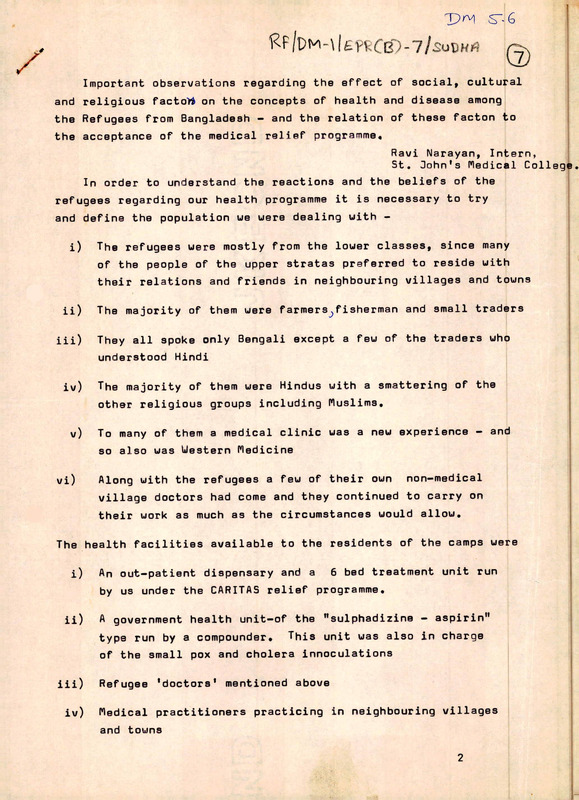
Important observations regarding the effect of social, cultural
and religious factor on the concepts of health and disease among
the Refugees from Bangladesh — and the relation of these facton to
the acceptance of the medical relief programme.
Ravi Narayan, Intern,
St. John’s Medical College.
In order to understand the reactions and the beliefs of the
refugees regarding our health programme it is necessary to try
and define the population we were dealing with -
i)
The refugees were mostly from the lower classes, since many
of the people of the upper stratas preferred to reside with
their relations and friends in neighbouring villages and towns
ii)
The majority of them were farmers^fisherman and small traders
iii)
They all spoke only Bengali except a few of the traders who
understood Hindi
iv)
The majority of them were Hindus with a smattering of the
other religious groups including Muslims.
v)
To many of them a medical clinic was a new experience - and
so also was Western Medicine
Vi)
Along with the refugees a few of their own non-medical
village doctors had come and they continued to carry on
their work as much as the circumstances would allow.
The health facilities available to the residents of the camps were
i)
An out-patient dispensary and a 6 bed treatment unit run
by us under the CARITAS relief programme.
ii)
A government health unit-of the ’’sulphadizine - aspirin”
type run by a compounder^ This unit was also in charge
of the small pox and cholera innoculations
iii)
Refugee ’doctors’ mentioned above
iv)
Medical practitioners practicing in neighbouring villages
and towns
2
-3
During the course of our work we were faced with many problems
where we discovered that for a solution to be obtained a proper
understanding of the social traditions of the people of Bangladesh
would be necessary* Many of these belief we found were common
to the rural populations in our own country. Here are a few of
them and how eE we attempted to over come them.
1.
We were often requested by some of the refugees to give
them an injection for their complaints.
They offered us
comparitively large fees and most of them held the view
that a single injection was the best cure. This built
in
faith of the efficacy of an injection over oral
treatment is found in most rural populations.
2.
Often it was very difficult to make the patients understand
that oral drugs were to be taken regularly and as many
times a day as prescribed.
The following were common
reactions
i)
As soon as symptoms disappeared they stopped treatment or
ii)
If they felt better they took the entire 2-3 days
dosage at one go believing that a stronger dose would
have a quicker effect. One can imagine the possible
dangers of such a procedure and therefore we madd it
a rule in our dispensary to give drugs for a maximum
of 2 days at a time.
3*
This was not always effective
We were often requested in the initial week of our work
to send one of our sisters to attend to a delivery case in
the huts. Our sisters found this a rather trying experience
because of the unhygienic conditions and the shortage of
space.
No amount of verbal
persuasion could convince the
women to come for their deliveries to our treatment room
since the presence of male doctors made it taboo. We thought
up a motivation factors which proved successful. One of our
sisters was able to bring one of the women to our clinic
for a check-up and to our luck she was found to be in labour
.3
3
and delivered a few hours later. When the woman left out dispensary
that evening she took back with her 2 dresses for her little child ,
a few nappies
powder.
and bibs, a bottle of vitamin drops
and some milk
The news soon spread and from the next day we had a regular
stream of women coming for their deliveries and walking out with
their gift parcels. Thanks to a steady flow of aid in the form of
clothes we were able to maintain this motivation.
4.
The concepts of disease in the traditional school are often
contrary to those of modern medicine e.g* The belief is that in
an attack of diarrhoea or dyssentery a patient loses bad water
from his system and if he drinks fluid at this time he will only
increase the output of fluids and so fluid intake is cut down.
We had great difficulty in explaining our concept and often the
patient only ate up the salt we gave in packets but never the
required quantity of fluid which we d advised, making handling of
such cases rather difficult.
5*
Another belief was that a child with rash should never be
shown to a doctor. This explained the fact that we did not
see as many cases of measles
as we ought to have but saw a
number of cases of bronchopneumonia preceded by a
history of rash*
Practices with regard to Infant feeding were also causing
6,
problems
i)
Children in East Bengal are breastfed to a very late age
upto 3 years or more.
When a mother has children of say
3, 2, 1 years which is often the case the elder ones
feed more often and vigorously and the younger ones are
deprived of their ownly source of nutrition thus resulting
in malnutrition in the infants..
ii)
®ften when we gave milk powder to be mixed with water
regularly and given to the infants-we found on health
visiting that large part of the milk was drunk by the
adult male - members of the family-since in the East
Bengal tradition the wage-earners of the family is
first fed and the women and children eat the left over.
i
1.
Belefs regarding auspicious times of entering and leaving
the dispensary, quite common in most parts of India, did not
interfere with our work# Except in one case when a women was
brought in with prolonged labour due to hand prolapse and
when we advised transfer to the nearest district hospital,
her relatives insisted her on taking her back to the hut and
then starting the journey to hospital again since the belief
is that if a patient is asked to leave a hospital and go to
another with being given any treatment then the doctor has given
up hope and i>e., a bad omen.
The above observations helped us to understand the people
we were working with and in any such situation this is becoming
a very important factor. Dr. John Seaman in his paper in the
Lancet (ii) (1972) P866 echoes this need when he lists the
follow®^ as the first lesson learnt from the Bangladesh experience
^e says much more detailed information should be available about
Ou.'V’
the nature of the society involved and that/ignorance of the
society and attitudes of the poor people was a problem felt
by all doctors in the camps.
i
Position: 3106 (4 views)