A Refugee Story
Item
- Title
- A Refugee Story
- extracted text
-
'
■
K>
'•<
'
'
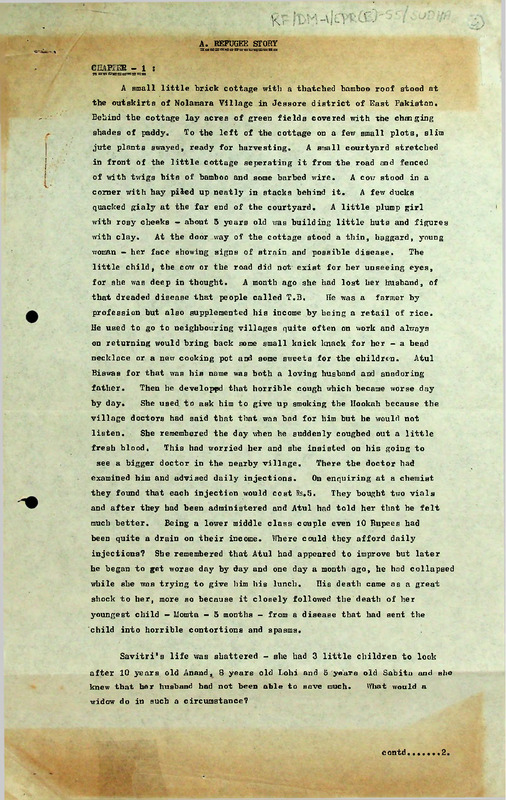
A. REFUGEE STORY
SS D MS5 «■»ts S3SS E3CS — = «= =3
CHAPTER - 1 :
« =rzx2?5E=:E=ss=:iS2s
A small little brick cottage with a thatched bamboo roof stood at
the outskirts of Nolamara Village in Jessore district of East Pakistan.
Behind the cottage lay acres of green fields covered with the changing
shades of paddy.
To the left of the cottage on a few small plots, slim
jute plants swayed, ready for harvesting.
A small courtyard stretched
in front of the little cottage separating it from the road and fenced
of with twigs bite of bamboo and some barbed wire.
A cow stood in a
corner with hay piled up neatly in stacks behind it.
A few ducks
quacked gialy at the far end of the courtyard.
A little plump girl
with rosy cheeks - about 5 years old was building little huts and figures
At the door.way of the cottage stood a thin, haggard, young
with clay.
woman - her face showing signs of strain and possible disease.
The
little child, the cow or the road did not exist for her unseeing eyes,
for she was deep in thought.
A month ago she had lost her husband, of
He was a
that dreaded disease that people called T.B.
farmer by
profession but also supplemented his income by being a retail of rice.
He used to go to neighbouring villages quite often on work and always
on returning would bring back some small knick knack for her - a bead
necklace or a new cooking pot and some sweets for the children.
Atul
Biswas for that was his name was both a loving husband and anadoring
father.
Then he developed that horrible cough which became worse day
by day.
She used to ask him to give up smoking the Hookah because the
village doctors had said that that was bad for him but he would not
listen.
She remembered the day when he suddenly coughed out a little
fresh blood.
This had worried her and she insisted on his going to
see a bigger doctor in the nearby village.
There the doctor had
examined him and advised daily injections.
On enquiring at a chemist
they found that each injection would cost Rs.5.
They bought two vials
and after they had been administered and Atul had told her that he felt
much better.
Being a lower middle class couple even 10 Rupees had
been quite a drain on their income.
injections?
Where could they afford daily
She remembered that Atul had appeared to improve but later
he began to get worse day by day and one day a month ago, he had collapsed
while she was trying to give him his lunch.
His death came as a great
shock to her, more so because it closely followed the death of her
youngest child - Momta - 5 months - from a disease that had sent the
child into horrible contortions and spasms.
Savitri’s life was shattered - she had 3 little children to look
after 10 years old Anand, 8 years old Lohi and 5 years old Sabita and she
knew that her husband had not been able to save much.
What would a
widow do in such a circumstance?
contd
2
page -2A month had passed and with the help of the nieghbours and
with her brother’s wife she had managed to reorganise the household
a bit and start her work for la* childrens sake.
zest was missing.
But the previous
She used to suddenly feel very tired and was not
able to concentrate on her work - whether it was cleaning rice,
cooking or washing clothes.
What was more a week after her husbands
death she had begun to cough and though the sputum was always whitesh
she had the urking suspicion that she may have contracted the disease
from her husband.
^er thoughts were suddenly disturbed by the sound of pattering
feet and she looked up to see Anand and Lokhi come running in panting
It was only 10’0 clock and school never gave over so early.
heavily.
She wondered what had happened.
Anand was the first to reach her and in his excited shrill
voice told her about the strange men in uniform they had seen near
the market place and about the shouting and yelling and running of
people.
Their school teacher had asked them to rush home immediately.
On the way they had passed their uncle’s house and every one there
seemed to be collecting things and getting ready to leave on some
journey.
By the time, Anand had finished his story - She heard the
sound of heavy footsteps and turned to the roadside to sc
her brother come
"There was no time to lose", he said, "since
running towards the house.
the army had begun looting the village and everyone was heading for the
woods".
They were lucky since the houses were on the outskirts of the
village but soon the army was bound to reach there.
Asking her to
collect as much as they could he hade them run into the woods to the
east of the village and hide till he joined them.
back towards his house.
know what to do.
Then he rushed
Savitri was so surprised that she did not
But he had said that there was no time, so she rushed
into the house — got out the only two large cooking pots they had,
hurriedly put some of the food grains they had into them.
She asked
Anand to collect all their clothes in a sack and Lokhi was asked to
take the lamp and little bottle of oil.
Sabita watched all this
activity with great excitement but was unaware of the seriousness of
the situation.
Within about fifteen minutes four figures - a women
and three little children could be seen making their way towards the
woods.
Once sagely within the boundaries of the forest they stopped
to take a few breaths - and began to ask the other women what had
happened.
Some of them who had been in the middle of the village and
had fled as soon as the trouble began told about the killing of
peopleand that the army was burning down their huts and taking the
corrugated metal roofs.
Some said here had been arguement with the
men folk before the trouble started-something about harbouring Mukti
bouj volunteers or something.
contd.••.••.3.
- a
-
The little group waited-nervouer and tense Minutes grew into hours and
it was only in the evening that some of the men-folk reached the woods.
They
talked about the looting and wanton destruction of their homes and how
anyone offering resistance was shot at once.
littered with bodies of wounded people.
taken away in trucks by the army.
the beginning.
The roads in the villages were
Many women had been rounded up and
One thing was clear - this raid was just
They were bound to return tomorrow,
There was only one thing
to do and that was to begin a journey into neighbouring India which was
about 42 miles away.
The villagers had heard about some trouble and even
about an exodus a few day ago and now they too were being forced to become
part of it.
It was 10 p.m. by the time the people had gathered in the woods
some had returned to their homes only to find smoke and ruin — destruction
and desolation.
They retrieved a few more articles from the ruins and came
back with a few bullock carts.
All the dead had been collected near the market square, while the
sounded but alive had been brought some how on makeshift stretches of
bamboo orcarried in bullock carts.
There was no time to loose.
With their
hurricane lanterns all lighted the group of about 500 villagers began their
long journey.
There was complete silence except for the occassional
cry of a child or a clang of a metal pot againt as other.
sadness grief and despair.
A silence of
500 peace loving villagers had become refugges.
The march had begun.
CHAPTER
II.
es c:s5sssb:s8sb5S8=»
Anand walked a little ahead with Lokhi while Savithri followed
on a bullock cart with Sabita.
Iler brother had insisted that she should
travel on a cart since she was ill.
Her cough was becoming worse.
She had
noticed this even earlier that exertion only increased her symptoms.
was full of questions.
every one ko silent?
her look so grim?
Where were they going?
Why at night?
Sabita
Why was
Why did uncle who used to always laugh and play with
But she was in no mood to answer any of these question.
The bullock cart jogged along over the muddy roads. - A small caravan of
carts and groups of walking humanity.
edge of another forest.
It was noon when they reached the
The group settled down for some rest - everyone
was tried and the silence still prevailed.
No one was in a mood to start
a fire or cook so they had to eat puffed rice and Bengal gram.
Some had
managed to bring a few vegetable which they now munched raw.
When the organge glow of twilight spread over the grey skies, the
group rresumed their journey.
The whole day had passed slowly but they had
to be patient since they new movement during the day time., was bound to
be noticed by some of the army units which were raiding the neighbouring
villages.
Three days and three nights the march continued. The bullock carts
had to be abandoned near the river-side and small country crafts manned by
courageous young boatmen ferried the marchers to the opposite banks.
Here
Contd........... 4.
4
and there they saw desolate uninhabited villages with smoke rising from the
Jute crops had been burnt by spraying them with special
smouldering ruins*
oils*
Few bloated bodies lay floating idly on the riverside*
Little groups of people could be seen coming from other directions
as the Indian border was nearing*
No one dared to travel by the roads since
the Pakistan army would srely be stationed there.
Through Jute field and
wading through paddy fields they made their way*
Silently but expectantly,
till they were sure they were within the Indian Border.
It was so difficult
to make out since the fields on the India side just merged into the fields
on the Pakistani side.
On entering Bongaon the first Indian village the marchers were supr
surprised to see a small board welcoming them and directing, them to a border
reception Office.
Having a sigh of relief many of them reached the office.
large Q was already there waiting to be processed.
simple*
A
The proceedure was imeple
The refugees were given Typhoid, Cholera innoculations and small pox
vaccinations.
Then a border slip was handed over to the head of the family
with the number of members written on it.
Government Office at Bongaon Camp.
They were then directed to the
It was a long wait sometimes upto 5 days
but soon all were given shelter in makeshift, bamboo huts or tents.
whole place was packed with refugees.
The
Savitri lay on a small mat which
Anand had been able to get after talking to as ochre robed monk who had been
busy with the arrangements for the refugee. IBmakrishna Mission was the naae
of the voluntary organisation that had taken on the task of feeding and
helping this mass of humanity.
Anand used to stand in line and get some food
daily at their centre which he shared with his mother and two sisters.
hardly ate anything.
Savitri
She was very tired and her cough had become unbearable.
A day after arrival she too had brought out blood in the sputum.
She was
convinced that she had become the victim of that dreaded disease that had killed
her husband.
For Anand and the two little girls seeing their Mother so ill was
frightening but waht could they do.
Anand tried to ask his uncle to help but
now everyone was thinking only about his own family and its survival, Who had
time for a dying widow and her 3 little children.
One day while talking to some other refugees Anand was asked to take
his mother to Barasat.
"There, "the camps were less crowded and medical aid
was easily available.
Anand was yet too young to understand the seriousness
of hie mother’s illness but one thing he knew she must be shown to a doctor
soon.
Next day he somehow managed to take his mother andtwo sisters with
their two large metal pots and a sack which were the KK only material possessions
they pXXMaOKK
possessed to the Bongaon Railway station.
With great difficulty
they managed to get some place to sit in one of the compartments of the
electric train.
To the children the ride was interesting but so Savitri life
had become painful and dreary.
The pain in the left side of the chest which
had begun two weeks ago was becoming unbearable.
At Barasat most of the refugees got out and Anand looked around to find
Contd..*5.
page —5—
where he was tog).
On enquiry he found that their journey had not ended.
He was told that he would have to walk 4 miles to Neelganj village where
a new camp had been opened for the refugees.
Savitri was at her wit’s end.
She had no energy left to walk even 100 yers.
4 miles was out of question.
But ^nand and Lokhi coached her and they began the journey.
Every 15 miles
Savitri sat down to rest and catch her breath.
The journey was very tiring
and too strenous.for her.
Poor Subita had got tired of walking of walking -
but who would carry her ?
Both Lokhi and j^nand were carrying the pots and
the sack and mother looked too ill.
The journey took them the whole day and at dusk a small board by the
edge of a narrow canal announced the fact that they had reached Neelganj.
Savitri was too exhausted and she hust sat down by the side of the board,
to tired to talk or walk any further.
the entrace.
The night was passed steeping at
They still had little puffed rice wkich they finished.
Four
little figures lay crouched in a corner under a dirty saree with a starry
sky for their roof and hard clay soil for a bed.
In deep slumber they soon forgot
their travails and their suffering.
CHAPTER
3:
ss =xssstzx=tss=zs
Five days had passed since their arrival at Neelganj.
Anand had been
lucky enough to meet a volunteer called Neemai wearing a uniform who was very
helpful.
Seeing the condition of their mother - only parent and security
of three little children - he had taken pity on them and had immeidaately
alloted them some space in one of the huts.
5 feet by 8 feet was all they
got but that was more than enough - better than the open fields and the
open sky.
Neemai had also arranged for a mat for Savitri and had hastened
the processing of the ration card for the family.
What would have taken
about 6 — 8 days due to Government red tape was done in a matter of a day
and Anand had managed to collect their rations on the 3rd day after arrival.
What worried him however was the thought that the had not been able to
lie asked Neemai about it and was directed to a small
contact a doctor.
hut marked Govt. Health Unit.
On enquiry he was told that unless he
would bring the patient there, no medicines co Id be given.
He tried to
expalin that his mother was not in position to even get up and sit down —
but it had no effect on the doctor - he has just rude and brusque and
repeated the rule.
As they were returning after collecting vegetables, Lokhi and Anand
saw a lady in white and a young man wearing glasses walking among the huts,
with a cane basket full of something.
Here and there they stopped to talk
to some people.
They entered their hust and knelt beside them to give them
some medicines.
They must be doctors Anand thought, and asking Lokhi to
hold the vegetable he ran towards them to investigate.
He asked some people
standing near the hut, where the two had entered and was told that they
were doctors
camps.
from a nearby college and had volunteered to serve in the
Nothing more was known of them - because they spoke a language that
was quite different from their Bengali - only a few words sounded family but
they managed with signs and had been giving medicines to the sick and the
contd.....6.
suffering.
page -6Anand waited till they came out and requested them to come and
see his mother.
The smile on the face of that lady was so warm that he
took an instant liking to her.
The doctor had a grey tube with a
knob dangling round his neck.
Tie was tall were glasses and as he held
silver
Anand*s hand,Anand felt happy for something told him that, here werr people
who would help them.
The smile on her face and the warm firm grip of the
doctor conveyed all this to him and even more.
Soon the doctor and the sister were crouching on the mat in their
hut and examing their mother.
The doctor examined her chest with the grey
tube while the sister took a thermometer and placed it in the patiet’s mouth.
Three little pairs of eyes watched the whole proceeding with great interest.
Ten minutes later the two of them discussed the case and the doctor gave
Anand some medicines to give to his mother.
white sweet powder in a small packet.
He also gave some biscuits and a
They promissed to come and see her
daily.
As they left the hut Anand felt happy, for the first time in many
days.
Uis mother was going to get well soma, he felt.
The young doctor
After three days Savitri
visited tlieir hut regularly along with the nurse.
began to sit up but she was ttill too weak to attend to her householed
duties.
Anand knew that he had to bear the responsibility and so began,
budy days for them.
He had to bring the wood-fire twice a day, collect
the rations and the vegetables, collect milk and bread which some other
kind looking, friendly volunteers were distributing ffom anotherhut, look
after his sisters.
Too much for a little boy of ten - but he bad no
other choice.
A few days later the young doctor brought another colleque of his.
This one was shorter and had a stricking moustache.
He too examined
Savitri and after discussi n both of them asked Anand to bring bis mother
to their hospital which was about 50 yars away.
They arranged with Anand’s
neighbours to help to bring the woman the next morning:.
Next morning when the medical team arrival in Neelganj, Anand was
waiting eagerly at the door of their dispensary.
As soon as he saw them
he rushed to bis hut and within a few minutes brought his mother to the
dispensary with the help of the neighbours.
She stayed there the whole
day and was given intraveeus fluids and other things to eat.
him or givem him a words of cheer.
security.
Days passed.
All talk to
After many days Anand felt a sense of
Anand brought his mother daily to the hospital
for about 4 days and he was happy to see tier look much better.
4 days the doctor began to visit her in the huts inself.
After
Daily one of
them came to give her an injection - They always brought her something to
eat and Savitri too felt a sense of hope and joy.
Within two weeks Savitri
felt much better and was able to supervise the work done by her friends in
that dispensary, Every one smiled tt him — and often gave him biscuits or
something nice for them to eat.
His little sistdr Sabita soon found that
that she too was always welcome.
Lokhi however always stayed with her
mother and so she did not get as much attention as Anand and Sabita.
contd
7-
page -7One day Anand was called aside by the doctor-who had seen his mother
on the 1st day and after a long friendly talk he was asked to come daily
to the dispensary and help them with the work.
The doctor spoke to him in
broken Bengali but he understood everything.
He agreed and from the next
day, (about 3 weeks after meeting these people).
Anand became the ward boy
Every mornig he used to help sweep
of the Caritas Dispensary at Neelganj.
out the dispensary, fetch water from the nearby pump, wash instruments and help
A very nice
collect cards and give out biscuits aid glucose in packets*
lady wearing a sari who was working ig the hospital used to give him all sorts
of odd jobs to do and he enjoyed himself.
He was g good pupil and within a
few days he did so much that even outsiders, who occasionally dropped into
the hospital were surprised to see a little boy working so diligently with the
medical team.
Every morning this sister used to cook hot dishes for his
mother and send it on a small plate four times day.
She would also send a
large glass of milk and of course biscuits and orange juice.
gave him lots to eat which he shared with his sisters.
very kind.
She also
The doctors were
They arranged for his mother to be shifted to the hut next to
their dispensary.
So close in fact that as Anand worked in the hospital
he knew that his mother was resting just on the other side of a bamboo mat
that constituted the wall of the hut.
and warm blankets for his mother.
The doctors gave them clothes, towels
One day they even brought a bed made of mats
stuffed with hay which one of the doctors had made with his own hands.
Another
day one of the doctors and the nurse came tolheir new hut and helped them clean
out the hut throw away all their junk and replaced it with new items which they
had brought for them.
The sister also gave sponge baths to their mother and
later taught the two little girls how to give their mother a bath.
passed and the three children were very happy and secure.
become a second home to them.
The days
The dispensary had
They walked in and out at will.
One day one
of the doctors stayed back in the agternoon and taught Anand the alphabets while
Sabita sat beside him drawing - Strange little figures on a piece of papers.
It was on this day that Anand confided to the doctor that he too would like to
be a doctor when he grew up.
A few days later the doctor called Anand and told that they would soon
be leaving for their home which was hundred of miles away.
®e told Anand
that he should not worry and that all the new doctors who would come to the
Disoensary in the months to come would look after them with the same interest that
the three children had got so used to.
Anand bade them farewell with tears in his eyes as they left the hut aftet
bidding Savitri goodbye.
For a widow and her three little children the St.Johns
Medical College team at Neelganj, had meant love, hope and a future.
The team
too was satisfied for if they could bring cheer into tfte hearts of even one of
the families among the millions they knew their task had been well done.
=0=0=0=0=0=0=
Position: 2779 (5 views)