Rescue, Relief and Rehabilitation
Item
- Title
- Rescue, Relief and Rehabilitation
- extracted text
-
I DM=2
B IsuvniG
13
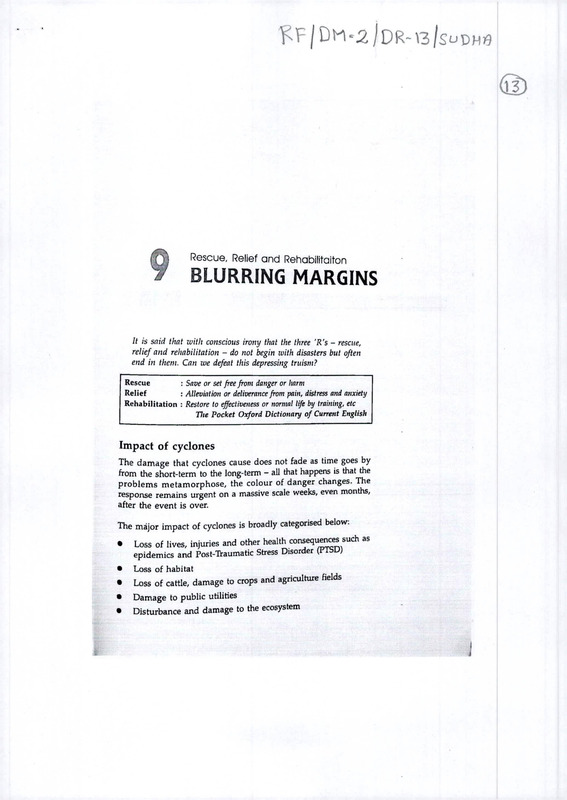
Rescue, Relief and Rehabilitaiton
BLURRING MARGINS
It is said that zuith conscious irony that the three 'R's - rescue,
relief and rehabilitation - do not begin zuith disasters but often
end in them. Can zue defeat this depressing truism?
Rescue
: Save or set free from danger or harm
Relief
: Alleviation or deliverance from pain, distress and anxiety
Rehabilitation : Restore to effectiveness or normal life by training, etc
The Pocket Oxford Dictionary of Current English
Impact of cyclones
The damage that cyclones cause does not fade as time goes by
from the short-term to the long-term - all that happens is that the
problems metamorphose, the colour of danger changes. The
response remains urgent on a massive scale weeks, even months,
after the event is over.
The major impact of cyclones is broadly categorised below.
*
•
Loss of lives, injuries and other health consequences such as
epidemics and Post-Traumatic Stress Disorder (PTSD)
•
•
Loss of habitat
Loss of cattle, damage to crops and agriculture fields
•
•
Damage to public utilities
Disturbance and damage to the ecosystem
122 Cyclones in Andhra Pradesh
Loss of lives...
Stonn surges
often kill seven
times more
people than
severe but storm
surge-free
cyclones
Most lives are lost during a cyclone on account of floods and the
devastating storm surges that often accompany cyclones. In
severe cyclonic storms with storm surges, more than 90 per cent
of the fatalities occur from drowning, either during the incoming
water phase or during the (usually more devastating) out-surges.
In severe cyclonic storms without storm surges, the deaths are
more or less evenly divided between drowning and the collapse
of buildings.
Storm surges, or mini-tsunamis, are essentially huge amounts of
water sucked up by the low pressure at the eye and then
propelled forwards and outwards by the driving winds on the
outwalls. Storm surge height (up to seven metres) and length (up
to 50 km) depends on the tides, the rate of water runoff from the
land, onshore winds, and the coastal configuration. They cause
the most havoc when they are receding. On an average, storm
surges kill seven times more people and damage three times
more crops than severe but storm surge-free cyclones (Winchester,
Peter, 1992).
For instance in the November 1977 cyclone that hit the KrishnaGuntur-Prakasam-West and East Godavari districts in Andhra
Pradesh, storm surges rose to as much as 9-20 ft, were 80 km
long and 24 km deep, and shot up the death toll to over 8,000,
one of the highest figures ever recorded.
Injury, health impact
One important aspect that requires attention in the aftermath of
cyclones is the injuries and other health impacts on the affected
populace. The most common debilitations are waterborne
diseases such as diarrhoea, dysentery, typhoid, viral hepatitis;
respiratory diseases such as pneumonia and whooping cough,
and other diseases such as chicken pox, measles, gastroenteritis,
cholera, conjunctivitis and fever. Of late, experts have pointed out
that the affected people may suffer from long-term PostTraumatic Stress Disorder (PTSD), characterised by a high
incidence of divorce, alcoholism and suicide. 1
1 Sharma, VK and Singh, R, Psychosocial Consequences of Disasters: Case Study
of the 1996 AP Cyclone, paper presented at the National Workshop on
Psychosocial Consequences of Disasters, NIMHANS, Bangalore, 1997
Rescue, Relief and Rehabilitation 123
Loss of habitat
Despite being the one state in the country that has suffered, Despite having
continues to suffer, and presumably will suffer the maximum
historically
number of cyclones, in the matter of safe shelter during cyclones,
suffered the
AP is well behind the national average. More people in the state
live in kutcha houses vulnerable to collapse during floods and maximum
number of
cyclones than in any other.
cyclones in the
This dismaying fact was more pronounced in the 1970s. A country, Andhra
National Sample Survey (NSS) done between October 1971 and Pradesh has
September 1972 found that out of the 34,319 houses taken up for more people
construction in the state, as many as 16,249 were kutcha buildings, living in kutcha
each costing on an average of a pathetic Rs 329. In the Eighth houses than any
Plan, the Andhra Pradesh Housing Board was actually allotted other Indian
only Rs 229.1 million out of the actual provision of Rs 318.5 state
million - and of that amount, it went ahead and spent no more
than Rs 194.6 million.
There is a case for tire argument that better-designed pucca houses
are an essential component of cyclone disaster mitigation. But the
path to disaster obviation is strewn with social ironies. After the
devastating 1977 cyclone, major cyclone-proof housing activities
were undertaken with some sincerity. But instead of turning into
a great leveller, pucca houses became a status symbol, even in
pockets of poverty. In any case, it was also realised that as a
disaster mitigation effort, housing can play only a limited role.
Other factors such as storm and flood patterns, location of the
house, and the occupant's options to relocate at times of
emergency also define the "disaster vulnerability" of a household.
In the November 1996 cyclone, struck by a storm surge 9-20 feet
high that penetrated 15 miles inland, many victims were trapped
inside their "safe" homes. Some who moved to the terraces of
their houses were safe only for a short while. The sheer force of
the water lifted the thatched huts and floated, spun and upended
with the tide. Roofs broke apart and families were scattered some consigned to treetops, a great many drowned and
"missing". Some of the "cement-and-concrete" pucca houses also
crumbled, the walls shattering, and collapsing. Those who had
taken shelter in pucca buildings like schools drowned when the
water entered the buildings and trapped them inside.
124 Cyclones in Andhra Pradesh
Socioeconomic factors obviously play a major role in defining the
vulnerability of the people to a cyclone. The most vulnerable
households share a few characteristics:
The most vulnerable households are often located in lowlying, flood-prone land, usually village peripheries
•
Most of the poor and vulnerable households have/had the
least remunerative employment and the least assets
They are economically marginalised; they have the least
employment opportunities; and they have the least resources to
sell, including their own labour. Their health status is poor.
Only an understanding of the entire impact range - climatic and
otherwise - that people are likely to be exposed to can help
evolve holistic risk-reduction strategies (Winchester, 1992).
Other losses
The response to
a cyclone is
through a
confused ad-hoc
mechanism that
creates a
communications
chaos between
satellite imagery
and remote
sensing at one
end and the
dissemination
machinery at
the other
Other major disaster tolls include loss of cattle, crops, and
damage to agriculture fields and public utilities such as railway
lines, roads, transport, power lines, communication systems and
public buildings. In further aggravation, bad design of roads and
railway lines, that does not take into account the natural drainage
pattern of the land, exacerbates the flood situation by blocking
receding floodwaters. The capturing and conversion of wetlands
for construction and agriculture also amplifies the vulnerability
and delicate balance of the land, as mangrove forests in the
wetland act as barriers against cyclonic storms.
Response: ad hoc mechanisms
The various phases of a disaster response mechanism comprise of
early warning, evacuation, rescue, relief, rehabilitation and
development. In the absence of a comprehensive policy to deal
with disasters and development, the response to cyclones has
been that of the grinding of an ad hoc mechanism.
Early warning: With the advent of satelUte imageries and remote
sensing, cyclone forecasting has become more sophisticated and
Rescue, Relief and Rehabilitation
accurate.2 However, the dissemination of any warning whatsoever
percolates down to the essential block level rather late.
The problem lies in the inadequacy of communication networks
at the local offices. Even if the communication were to reach the
block offices in time, the absence of vehicles makes it difficult for
officials to propagate this information and organise evacuation in
the case of an emergency. Especially when the vulnerable villages
are located in far-flung, inaccessible villages or on islets or deltas,
the dissemination of timely information becomes crucial - and is
clearly inadequate.
Evacuation: Forecasting plays a crucial role in facilitating
evacuation. Just before the 1983 cyclone hit the AP coast, 50,000
people were successfully evacuated because of early warning and,
yes, political will. Regarded as a costly and difficult method of
saving lives, evacuation often becomes inevitable.
Documentation proves that socioeconomic and psychological
factors prevailing at the point of impact tend to hamper
evacuation. People refuse to leave their homes and fields even
when a cyclone is about to hit. Officials are often reluctant to take
the initiative to evacuate fearing the consequences that go with
that costly chimera, the false alarm. Sometimes, the prodigious
haste that accompanies evacuation also raises human rights
issues, as people may have to be induced or even forced to
evacuate in the face of a clear danger (Winchester, Peter, 1992).
Rescue and relief: This is the "sandwich" phase which usually
lasts for two to four weeks. It is marked by a strong presence of
the armed forces, various government agencies, NGOs, and other
voluntary groups. The situation is decidedly volatile, with many
actors with varied interests "paradropping" into the disaster site.
"Band-Aid" relief, which does not take into account the long-term
and actual needs of the affected population, is a common
phenomenon, and an increasingly common complaint. Often, the
commendable philanthropic outpouring that follows in the wake
of disasters is out of tune with the ground reality.
2 Singh, Arun Kumar, Remote Sensing and Disaster Forecasting: The Indian
Experience, paper in India Disasters Report : Towards a Policy Initiative, Oxford
University Press (2000).
125
126 Cyclones in Andhra Pradesh
Hie heightened
role of
politicians made
it difficult for
officials to
arrive at any
kind of
conclusions and
enumerations
Politician-bureaucrat skirmishes intrude into the realm and
process of relief. "The heightened role of politicians made it
difficult for officials to arrive at any kind of conclusions and
enumerations." J
Rehabilitation and development: Rehabilitation, the process
through which the affected communities are returned to
normalcy, is a long-term slog. Rehabilitation should ideally
include restoring life sustenance systems as well as rebuilding the
social fabric of the affected communities. A community-based
rehabilitation should ideally comprise an integrated programme
that takes into account the health, education and the special
needs of women and children. It should address the needs of
farmers, agriculture labourers, and artisans with special focus on
marginalised and vulnerable groups.
In the case of AP, the state government as well as donor agencies
have pumped in huge amounts of money to rehabilitate the
cyclone-affected people. In the ongoing scheme of things the
specified amount of money that would enable the affected people
to purchase the tools of their trade or to undertake their own
restoring activity is provided along with money for rebuilding
their houses. Numerous factors, including political considerations,
define the ex-gratia payments extended to the affected people. In
the 1996 cyclone, the maximum ex-gratia payment given was Rs
100,000, which, by any accounts, is less and adequate.
The norms related to the amount of compensation to various
categories of the affected were formalised by the Government of
India in 1986. The same norms are being followed today with
suitable modifications. To rehabilitate those affected by the 1996
AP cyclone, for instance, the government formulated a scheme to
give 50 per cent matching grant to voluntary organisations that
came forward to construct houses.
Changing modes of response
Relief is defined as an attempt undertaken by humanitarian or
political activists to alleviate the pain and distress of the people
3 Reddy AVS and Sastry KR, The Politics of Disaster: Public Pressure and State
Response to Cyclone Relief in Andhra Pradesh in Disaster Management, Vol 4
Number 3, 1992
Rescue, Reliefand Rehabilitation
127
affected, especially in a crisis situation. Oxfam views emergency
relief as part of a range of humanitarian responses to poverty and
suffering which support the people's capacity to take greater
control over the forces that affect their lives.4 A crisis may be
defined at a point at which radical change becomes necessary when the status quo has become clearly unsustainable. Not all
crises give rise to emergencies; and change is by no means
always negative.
For people or societies that are already vulnerable, even a small
shift in their situation may give rise to a crisis that outstrips their
capacity to cope - in other words, a disaster or emergency. Crisis
does not refer, therefore, only to an unexpected catastrophe, but
also to the culmination of a slow build-up of political, economic
or environmental factors. The combination of these factors with a
sudden event, such as an earthquake or a major accident, can The traditional
prove overwhelming.
view, now
dispensed with
Traditionally, sociologists and development and charity workers in most nations,
viewed emergencies as temporary interruptions in the process of of emergencies
development. Especially since poor people are virtually under like disasters is
constant crises and any emergency amplifies their vulnerability,
that they are
the response to emergency should ideally be to lessen the
temporary
underlying vulnerability, ensuring that humanitarian relief efforts
interruptions in
systematically address the root causes of the crises.
the far larger
Drawing up categorisations such as "natural" or "humanmade and inexorable
disaster" is of little help in predicting the impact of a crisis, or process of
the longer-term implications of a disaster, or of relief efforts. The development
conventional division of programmes into categories of "relief",
"rehabilitation" and "development" is proving to be more and
more unrealistic and unhelpful - particularly so because such
divisions do not reflect ground-level realities.
It is those governments which integrate relief, rehabilitation and
development, rather than dividing them into components of an
imagined evolutionary process, that have been most successful in
alleviating hunger, observe noted economist Jean Dreze and
Nobel laureate Amartya Sen.
4 The Oxfam Handbook of Development and Relief an Oxfam publication,
Oxford, 1995
128 Cyclones in Andhra Pradesh
Any dividing line between the relief, rehabilitation and
reconstruction phases is necessarily imprecise, especially when an
emergency has been protracted over months, years - or even
decades. Rehabilitation and reconstruction are areas where relief
and development become inseparable from each other. Specific
rehabilitation methods should also reduce the vulnerability of the
community to similar emergencies in future.
Relief work should be held to development standards.
Rehabilitation process should also focus on social and economic
interventions as well as on improvements in material conditions.
Both relief and development should be more concerned with
increasing local capacities and reducing vulnerabilities than with
providing goods, services or technical assistance.
In fact, goods, services, etc, should be provided only insofar as
they support sustainable development by increasing local
capacities and reducing vulnerabilities. Development work should
be concerned with long-term sustainability. Thus, every
development programme and project should anticipate and be
designed to prevent or mitigate disasters. They should identify
and address the vulnerabilities of the people with whom they
work, and ensure that these are reduced over time.
Though the urgency of human need compels swift action and
thorough assessment and planning, it may be impeded by
constraints of many kinds. However, it is precisely because social
structures and cultural traditions and economic and political
systems are weakened by emergencies that individuals are made
more vulnerable to damage by ill-conceived interventions.
In the case of disasters in India, the state and civil society have
responded swiftly and comprehensively with rescue and relief
operation. But the government continues to view rescue and
relief work as the responsibility of its revenue department. And
public support is not factored into it. This is consistent with the
overall perspective of the administration in viewing people as
passive recipients of government largesse. As with welfare and
development programmes, people have no participatory role in
defining and implementing rescue and relief operations.
Rescue, Relief and Rehabilitation
Providing legitimate space for people to play a meaningful role
would significantly improve post-disaster recovery initiatives.
Relief is no substitute to people-oriented action.
Rehabilitation is often hampered by two reasons. First, there is
the inability to programme relief as a development opportunity,
which is why such initiatives lack actions that would regain
sustainable livelihoods. Second, the Indian public views the
provision of relief as a collective responsibility but considers
rehabilitation and development as the responsibilities of the
government alone. Often enough, however, the government action
falls far short of expectations and actual needs.
Worldwide, as governments shift focus away from social sector
interventions, civil society faces a challenging task in addressing
the issue of long-term rehabilitation and development. Civil
society's role is no more limited to feeding, clothing, and housing
the people affected by disaster, but has expanded to include the
empowerment of the most vulnerable.
129
- Media
 RF_DM-2_DR-13_SUDHA.pdf
Position: 2780 (5 views)