Why adopt URS Tools and Instruments
Item
- Title
- Why adopt URS Tools and Instruments
- extracted text
-
'
^1-
I
t * ••
..
i" Communication
■
*j I, L
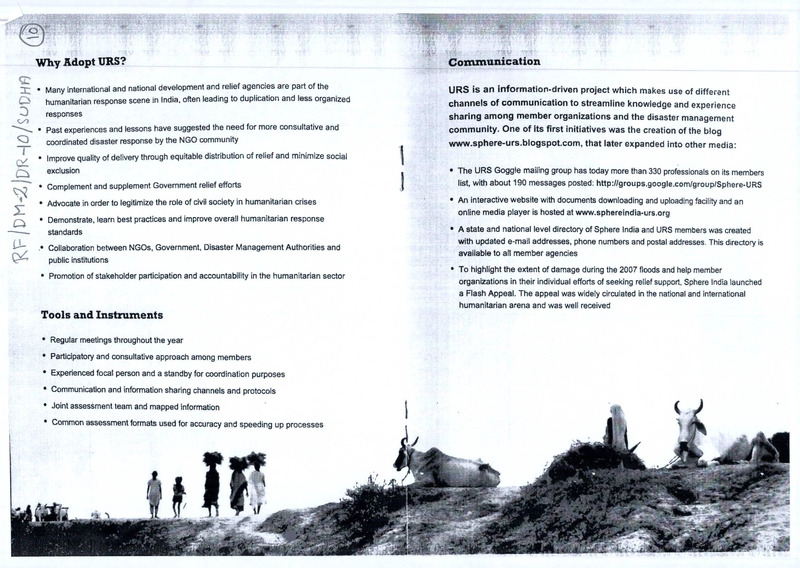
Why Adopt URS?
O'
-y • Many international and national development and relief agencies are part of the
o
3
URS is an information-driven project which makes use of different
humanitarian response scene in India, often leading to duplication and less organized
channels of communication to streamline knowledge and experience
responses
sharing among member organizations and the disaster management
• Past experiences and lessons have suggested the need for more consultative and
coordinated disaster response by the NGO community
community. One of its first initiatives was the creation of the blog
www.sphere-urs.blogspot.com, that later expanded into other media:
■ Improve quality of delivery through equitable distribution of relief and minimize social
exclusion
• The URS Goggle mailing group has today more than 330 professionals on its members
list, with about 190 messages posted: http://groups.google.com/group/Sphere-URS
• Complement and supplement Government relief efforts
r
• Advocate in order to legitimize the role of civil society in humanitarian crises
a
• Demonstrate, learn best practices and improve overall humanitarian response
LL
• An interactive website with documents downloading and uploading facility and an
online media player is hosted at www.sphereindia-urs.org
• A state and national level directory of Sphere India and URS members was created
with updated e-mail addresses, phone numbers and postal addresses. This directory is
available to all member agencies
standards
.• Collaboration between NGOs, Government, Disaster Management Authorities and
public institutions
• To highlight the extent of damage during the 2007 floods and help member
organizations in their individual efforts of seeking relief support, Sphere India launched
a Flash Appeal. The appeal was widely circulated in the national and international
humanitarian arena and was well received
• Promotion of stakeholder participation and accountability in the humanitarian sector
Tools and Instruments
• Regular meetings throughout the year
• Participatory and consultative approach among members
• Experienced focal person and a standby for coordination purposes
• Communication and information sharing channels and protocols
• Joint assessment team and mapped information
‘7
------_.
1
-
.
Or
*7^
to
.
Re,iJwsCKim>masJ Ma)
(D
Bi
t|
S a
O
o
3
3
V—4
8I
o’ w
"S2 ?
8
Sa
thH
o s ?
o
sI 3
<i
af S'
5
M
> o
ft!
3
tn
tn
J« a
y
CD
£ o
w tn a
CD
Q CD
<D 2 o
3S' I
5 o
I
w
o
tn
tn •O
aro ®w
So o
O W4
t-J CD o
§(V 9
tn '?
►—
rt>
H'
♦a tr
<Q
3 ro
oS
S<n
£
CD ®
H
CD
ft),
t-
-<
Q
o
g 3 _
% *2.
& O
6
S’ £• °
2 tr
3 3 I
ro
o
o
KJ
2co cu3
a
CD
“
3
i
-■
tn
p
CD lt
ta,
p
Bo 2, 2°
CD
k{
§
2 ft>
o u
y- £
co w
o
3
- Media
 RF_DM-2_DR-10_SUDHA.pdf
Position: 3490 (3 views)