PUBLIC HEALTH FOR COMMUNITY CARE
Item
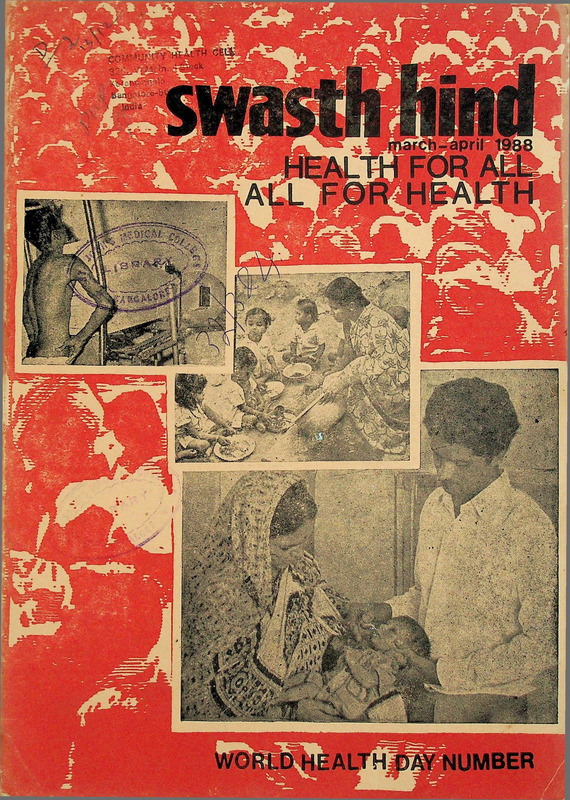
- Title
- PUBLIC HEALTH FOR COMMUNITY CARE
- extracted text
-
UMB
In this Issue
swasth hind
March-April 1988
Phalguna-Vaisakha
Vol. XXXII, Nos. 3 & 4
Saka 1909-1910
World Health Day-1988
The seventh of April each year is celebrated as
World Health Day, because it marks the date in
1948 when the Constitution of the World Health
Organization came into force.
Ever since 1950, a theme related to international
public health has been chosen for World Health
Day, with an appropriate slogan.
This year's World Health Day, 7 April, is also
who’s 40th birthday. It is also the 40th year of
India's Independence. India like the who is in a mood
to derive the lessons for the future from the achieve
ments—and setbacks—of the past. A year that will
also mark the 10th anniversary of the historic
Declaration of Alma-Ata offers a golden opportunity
to highlight the need for equity and justice in heal
th, to re-state the aims embodied in the goal of
Health for all by the year 2000 agreed by all who’s
member countries, and to emphasise cnee more that
Health for all will be attained not by high-tech hos
pitals but by primary health care and the community’s
involvement in its own health.
This is why Swasth Hind devotes this issue to
the slogan chosen for World Health Day 1988—
Health for all—all for health.
Page
Public health for community care
Kum. Saroj Khaparde
65
Health in India : Forty years’ achievements
since Independence
Dr. Harcharan Singh and Dr. A. K.Kundu
66
Building a healthy life: Maternal and child
health
Christiane Viedma
73
Insects, communicable diseases and health—
Role of government, society and individual
Dr. P. K. Rajagopalan
78
India : Health progress at a glance
Dr. (Smt.) D. Lahiri.
82
Health for all—All for Health—A Primary Health
Care Approach
84
Dr (Smt) V. K. Bhasin
Community participation in the control of
vector borne diseases—a national experience •
N. L. Kalra and Dr.M.V.V.L.
Narasimham
3
The challenges we face
C. R. Krishnamurthy
Leadership development for achieving health
for all by 2000 A.D.
Prof. Somnath Roy
Whither health education !
Dr. K. S. Sanjivi and Dr. K. Venkateswara Rao
Behavioural Sciences for public health and
medical care
88
92
94
98
100
Dr. K. R. Sastry
Voluntary associations in health care
102
Alok Mukhopadhyay
All for health—a must for health for all- an
experience
Dr. Sanjiv Kumar and Dr. G.V.S. Murthy
104
SUBSCRIPTION RATES
Single Copy.
Annual
.
.
.50 Paise
Rs. 6.00
....
(Postage Free)
Articles on health topics arc invited for publication in this
Journal.
State Health Directorates are requested to send in reports of
their activities for publication.
This Issue—Re. 1.00
The contents of this Journal are freely reproducible. Due
acknowledgement is requested.
editor
N. G. Srivastava
Sr. SUB-EDITOR
M. L. Mehta
The opinions expressed by the contributors are not neces
sarily those of the Government of India
COVER DESIGN
B. S. Nagi
SWASTH HIND reserves the right to edit the articles sent
for publication
PUBLIC HEALTH FOR
COMMUNITY CARE
Kumari Saroj Khaparde
Primary health care relies heavily on community involvement and participation in
the planning, implementation and evaluation of services in the first place; and in
the establishment, support and maintenance of services, to enable people to be
come both the major activists in and the main beneficiaries of primary health care.
urative medicine is only a part of medicine and
C
not the whole of it. So is preventive medicine
with all that goes with it—sanitation, hygiene, pre
vention, nutrition, genetics and behaviour. Neither
of these two branches of medicine nor the variety of
sub-specialities within each of them can stand alone.
It is only when they are joined together and by en
suring the developments in one proceed synchronously
with those of the other, can wc ever hope to bring a
degree of social, economic, educational and political
advancement.
In India, the Joseph Bhore Health Survey and
Development Committee in 1946 made a heroic effort
to bring together curative and preventive medicine,
and to provide comprehensive health care to people.
Giving a pride of place to preventive work at com
munity level, the Committee proposed a health system
linking primary health care at community levels to
secondary, district, provincial and Central levels of
the health system, ensuring the availability of increa
singly sophisticated preventive and curative services.
The Committee went to the extent of proposing that
the future doctor should be a “social physician”. and
that he should place prevention of disease in the
forefront of his programme and should so continue
“remedial and preventive” measures as to confer the
maximum benefit on the community. Their, recom
mendations laid the foundation for the beginning of
the modern health planning including public health in
India.
The efforts at the international scene continued to
provide a package of health services to the people
although these moves were motivated by economic
rather than ideological compulsions.
March-April 1988
The most recent effort however, was the Inter
national Conference on Primary Health Care held in
Alma-Ata in 1978- The Conference recognised that
health care, as delivered., was fragmented and was
inadequate to meet the health of the people, especial
ly of the large majority lying in the rural areas and
of the urban slums, who have little or no access to
any form of health care, and this is despite the un
precedented advances of the West. The conference
recommended to bring to the people a package of
services consisting of at least the eight essential ele
ments of primary health care. The package of ser
vices would include education concerning prevailing
health problems and the methods of preventing and
controlling them; prevention and control of locally
endemic diseases and immunization against major in
fectious diseases, promotion of food safety and pro
per nutrition; adequate supply of safe water and basic
sanitation, maternal and child health care, including
family planning; and appropriate treatment of com
mon diseases and injuries and essential drugs.
Primary health care relies heavily on community
involvement and participation in the planning, imple
mentation and evaluation of services in the first place;
in the establishment, support and maintenance of ser
vices, to enable people to become both the major
activists in and the main beneficiaries of primary
health care.
Primary health care represents in its radical depar
ture from conventional health care, an enormous
challenge to medical schools for training health pro
fessionals. Indeed, whether or not primary health
care will succeed depends largely on how well train
ing institutions will face up to the challenge.
Contd. On Page 97
65
HEALTH IN INDIA
Forty Years’ Achievements
since Independence
Dr Harcharan Singh
AND
Dr A. K. Kun du
The successive increase in the Plan allocations in every subsequent Five Year Plan indi
cates strong political will to improve health of our people.
These efforts, since Inde
pendence have led to an improved health status of the population in general.
became Independent in
1947 and adopted the new con
cept of ‘Welfare State’ with the
cherished goal of improvement of
the quality of life of its people.
Without the development of health
of the people, this dream shall re*
main unfulfilled.
ndia
I
(ii) Mortality profile—Crude death
rate was 27.4 and infant mortality
rate around 146 per 1000 livebirths
and life expectancy at birth was
around 32 years. Infective and para
sitic diseases accounted for more
than 25% of deaths in India.
(iii) Morbidity profile—(a) Infec
Health situation
tive and Parasitic 'diseases like
The health situation in India at malaria, kala-azar, smallpox, mea
the time of Independence may be sles/ poliomyelitis,
enteric-fever,
described under the following pro diarrhoea, dysentery, cholera, tuber
files :
culosis etc. were responsible for
(i) Demographic profile —India 60% of hospital admissions, (b)
was confronted with a population of Malnutrition—Protein energy mal
around 346 million with crude birth nutrition among under-fives, nutri
rate of 39.9 per 1000 population and tional anaemia among women of
annual population growth rate of reproductive age-group and pre
1.25 %. Large proportion of popula school children, Vitamin ‘A’ defici
tion was ‘Young’ under 15 years and ency, endemic goitre were some of
low proportion of people living the major public health problems in
beyond middle age.
this field, (c) Non-oommunicable
66
diseases—Ischaemic heart disease,
hypertension, diabetes, mental dise
ases, accidents, drug addiction, some
occupational diseases and environ
mental pollution were also posing
problem in some social groups.
(iv) Health facilities—Doctor po
pulation ratio after Independence
was around 1:6000. Similarly, there
were shortage of paramedical wor
kers.
Health care delivery was
curative oriented and though more
than 80% of the population was liv
ing in villages, more than 80%
health care facilities were distribut
ed in urban areas only.
As soon as the country became
Independent in 1947, Ministries of
Health were established at the Centre
and in the States. The post of
Director General, Indian Medical
Swasth Hind
Services and of Public Health Com
missioner were integrated in the
post of Director General of Health
Services at the Central level; the
same practice was followed at the
State levels also.
The Government was immediate
ly confronted with the burden of
improving health of the people. The
‘Health Survey and Development
Committee’ popularly known as the
Bhore Committee had earlier been
appointed by the British Govern
ment in India in 1943 to survey the
then existing position regarding the
health conditions and health organi
zation in the country and to make
recommendations for the future deve
lopment. The Committee submitted
in 1946 the famous report which
runs into four volumes and this be
came the basis for most of the plan
ning and measures adopted by the
National Government.
The concept of the delivery of
curative and preventive health care
services to rural population through
the primary health centres and
major changes in medical education
including three-month training in
preventive and social medicine were
ushered in from the Bhore Com
mittee recommendationsJn the meantime in 1948, India
joined WHO as a member State and
Employees State Insurance (ESI)
Act was passed. The Constituent
Assembly adopted the Constitution
of India on 26 November, 1949.
Article 246 of the Constitution co
vers all health subjects. These have
been enumerated in the Seventh
Schedule under three lists—-Union
list, Concurrent list and the State list
and thus the Constitution defined
clearly the role of central and the
state Governments in the field of
medical and health care delivery to
the people of India.
March-April 1988
In 1947, India had limited medical colleges. Today, there are 106 medical colleges
with a few premier institutions where facilities for super-specialities also exist.
To encourage research and deve
lopment, the Indian Research Fund
Association was reconstituted as the
Indian Council of Medical Research.
In 1950, as soon as the Constitu
tion of India came into force, the
Planning Commission was set up
which started drafting country’s
First Five Year Plan wherein Health
Planning was an integral part of
overall socio-economic developmen
tal planning for the whole country.
The broad objectives of the health
programmes during the successive
Five Year Plans Have been:—•
Control/eradication of major
communicable diseases;
•
Strengthening of the basic health
services through establishment
of health infrastructure in rural
areas with supportive and refer
ral services in the urban areas;
•
Population control;
•
Development of health
power resources;
S
Reorientation of medical edu
cation and research;
man
Control of
diseases;
non-communicable
Development of
the Indian
Systems of
Medicine
and
Homoeopathy.
1.
Control of Communicable
Diseases
(i) Malaria—In 1950, this was
India’s number one public health
problem. According to the esti
mates in 1952-53, about 200 million
people were living in endemic areas,
75 million cases were occurring
annually with eight lakh deaths
directly due to Malaria. In 1953,
the National Malaria Control Pro
gramme was launched and by 1958,
the incidence came down to two
million cases. The National Malaria
Eradication Programme was started
from 1958 but due to various admi
nistrative, operational and technical
reasons, resurgence took place in
mid-sixties. As a result, modified
plan of operation for effective con
trol of malaria was introduced in
1977. The incidence of the disease
67
came down from 6.4 million cases
in 1976 to 1.7 million cases (P fal
ciparum cases 0-6 million) in 1986
with 232 deaths. At present,, it
is a Centrally-sponsored Scheme
with 50 : 50 sharing basis between
the Central and State Governments.
An independent expert committee
had made an in-depth evaluation of
this programme and submitted its
report to the Government in Octo
ber, 1985 and the Government is
working on the remedies of the pro
blems identified.
(ii) Leprosy—It was estimated
that there are about four million
leprosy cases in the country; of
which 20% are infectious, 25%
have some sort of deformity and
20% of the total cases are children.
The National Leprosy Control Pro
Thanks^to the Universal] Programme of Immunization, the maternal and infant
gramme was launched in 1954-55
mortality rates have been brought down considerably.
as a Centrally-aided scheme; now Presently, it is a Centrally-spon
cation measures. Besides providing
it is a 100% Centrally-sponsored sored Scheme with 50 : 50 sharing
eye care facility at every level start
Scheme and known as the National basis and operated in urban areas
ing from the PHCs, every year more
Leprosy Eradication Programme. only. Three pilot projects are in than one million cataract operations'
So far, the Programme has already progress to develop a suitable stra are being performed throughout the
identified 3.3 million cases and 3.04 tegy for control of filaria in the rural country.
million cases were brought under areas.
(v) Tuberculosis—It is estimated
treatment.
Seventy-six districts
(iv)
Blindness
—
It
was
estimated
that there are about 9 to 10 million
with a case-load of 10 and above
per 1000 population are targetted to that about 45 million people are cases of Pulmonary Tuberculosis in
be brought under multi-drug treat suffering from visual impairment and India; of which 2 to 2.5 million are
ment including development of in oyer nine million are completely bacillary cases at any point of time.
frastructure and massive health edu blind which include about five mil The National Tuberculosis Control
cation activities to create awareness lion who can be cured by surgery. Programme is a Centrally-sponsored
among people during the ' Seventh Starting from initiation of Trachoma Scheme on 50 : 50 sharing basis in
Plan period. The programme * has Control Pilot Project in 1956, the respect of equipments including Xbeen recently evaluated and the re Government has launched a 100% ray machines and TB drugs. The
port is under study of the Govern Centrally-sponsored scheme of the programme strategy is to detect ac
National Programme for Control of tive TB cases in early stage by spu
ment.
Blindness in 1976 with the objective tum examination in the peripheral
(iii) Filaria—It is estimated that of reducing blindness in the country health centres and their treatment
about 236 million people are living from 1.4% to 0.3% by 2000 A-D. -through an organised district TB
in endemic areas and 18 million To achieve this aim, the programme Control programme evolved in 1962.
people are harbouring parasites in is providing immediate relief to the Every year,
through this pro*
their blood and 14 million are hav needy by camp approach and by gramme, 1-3 million to 1.4 million
ing disease manifestations.
The establishing permanent eye care faci cases are being diagnosed. The
National
Filaria
Control Pro lities with graded expertise at diffe programme has recently introduced
gramme was launched during 1955. rent levels coupled with health edu short course Chemotherapy Drug
68
Swasth Hind/
Regimen to reduce the duration of
treatment from 12/18 months to
about 6/8 months.
' (vi) Smallpox—Fight against this
killer disease started as the National
Smallpox Eradication Programme in
1962. Later, WHO began a cam
paign in 1967 to bring down the in
cidence to zero and finally the di
sease was eradicated from India in
April, 1977.
Table—I
Achievements under Minimum Needs Programme
Name of
mfrastructure
1
Sub-centres
Primary Health
Centres
Community
Health Centres
No. as on 7th plan
1985—86
1986—87 No as
1987—88
1-4-1985
Target --------------------- —----------- ■ ■■ On j-4-87________
(Add I.)
Target Achi- Target AchiTargets
cvements
evements
2
3
4
5
6
7
8
9
84588
10796
54883
12390
6122
1455
7891
1770
8766
1554
8670
1651
101149
14217
9233
2274
725
1553
298
233
278
272
1230
257
(vii) Plague—This was another
dreaded disease with 23,191 deaths
only during 1948 just after Indepen
dence. However, since 1968 not a
single case of human plague was
recorded in the country.
duced in the Fifth Five Year Plan gery, Paediatrics, Gynaecology and
were directed towards the objective Obstetrics—for every one lakh po
of providing minimum health care pulation. The Table 1 shows tar
facilities integrated with family plan gets and achievements under the
ning services and nutritional im Minimum Needs Programme till toprovements besides attempting to date.
(viii) Other Communicable Dise correct the prevailing regional im
It is expected that 100% sub
ases—Guineaworm which was ende balances. To achieve these basic centres and Primary Health Centres
mic in Karnataka, Gujarat, Madhya objectives, the concept of Minimum and 50% Community Health Cen
Pradesh, Maharashtra, Andhra Pra Needs Programme was evolved, tres required in the country will be
desh, Rajasthan and Tamil Nadu, is under which efforts are being made ready by 1990.
expected to be eradicated by 1990. to strengthen and augment health
Though more attention has been
care infrastructural facilities in rural
For control of sexually transmit areas including hilly and tribal ter given for development of rural
ted diseases and diarrhoeal diseases rains through adoption of adequate health infrastructure but in recent
including cholera efforts are gradual population norms.
Further re years the urban population has been
ly being strengthened. As compared
structuring and re-orientation of growing at a very high rate creat
to early fifties the morbidity and
these programmes was aimed at in ing serious health problems. The
mortality have greatly reduced to
the Seventh Five Year Plan in the existing urban health services are
day.
context of the nation’s accepted under pressure, services in the slum
Recently, the world is threaten long-term goal of “Health For All areas being most vulnerable and
ed with another dreaded disease call by 2000 AD”. During the Seventh inadequate. There are multiple
ed AIDS (Acquired Immuno Defi Plan more emphasis has been given agencies providing health services
ciency Syndrome). Keeping in view for qualitative improvement of the in urban areas, but poor co-ordina
the recent problems associated with infrastructure created alongwith the tion among them results in duplica
this disease, adequate measures are training of various categories of tion and inefficiency of services.
being taken to prevent the spread manpower needed for staffing these During the Seventh Plan in conso
units- As per existing population nance with the guidelines provided
of this infection in the country.
norm there will be a sub-centre for in the National Health Policy, the
2. Strengthening of Health Services
every 5000 population (3000 popu following measures are to be
in Rural and Urban areas
lation for tribal and difficult terrain taken:—
High priority has been assigned areas), a Primary Health Centre,
(i) Taking into account the bed
for promotion of health care services with two observation beds for every position in hospitals run by various
in the rural areas right from the 30,000 population (20,000 popula agencies in urban areas further
inception of planning process in the tion for tribal and difficult terrain strengthening will be done keeping
country though during the initial areas) and a Community Health in view the objective of one bed for
Centre with 30 Indoor beds and four 1000 pouplation. Hospital beds are
period it was a little urban-orientcd
basic specialities of Medicine—Sur to be distributed rationally so as
The policies and programmes intro-
March- April 1988
69
Post-Graduate Medical Sciences at
Lucknow, Indira Gandhi Institute of
Medical Sciences at Patna, etc.
These institutions are equipped with
sophisticated equipments and highly
trained staff so as to support to the
organised referral system in the
health care delivery system.
3.
Maternal and child health services ensure that £ omen
may carry their pregnancy to full term without risk.
to provide adequate support to pri
mary health care services. Further
besides providing primary health
carp to urban population the urban
health service organisation has also
to provide back-up support to rural
health organisations through referral
system and
specialist
services.
Therefore, the district hospitals are
to be provided with facilities of im
portant specialities for this purpose.
have to be made to certify the re
gional imbalances through streng
thening of specialised institutions
and super-specialities in areas where
serious deficiencies exist.
Premier institutions
After Independence, many pre
mier institutions like the All India
Institute of Medical Sciences, New
Delhi; Post-Graduate Institute of
Medical Education and Research.
(ii) Considering that the facilities Chandigarh; Christian Medical Col
for specialised services in the coun lege, Vellore; etc. have been deve
try are limited and not available in loped and many more are coming
all regions in equal measures, efforts up like Sanjay Gandhi Institute of
70
Population Control
The most crucial problem facing
the nation today is the galloping
population which doubled during
the last 30 years and is expected to
double once again over the next 40
years if birth rates do not decline
rapidly. Just after Independence.
the Government of India realised
this and adopted family planning
programme in 1952.
The pro
gramme has gone through several
stages in its evolution and received
greater emphasis in successive FiveYear "Plans which is evident from
the fact that Plan outlay of Rs. 0.1
crore in First Five-Year Plan has
been raised to Rs. 3256 crores dur
ing the Seventh Five Year Plan. The
very rapid decline in birth rate is
possible only if substantially more
and more couples can be made to
restrict family size by using one or
the other method of family plan
ning. Experiences all over show that
acceptance of family planning me
thods is closely associated with the
level of infant mortality, socio
economic standards and status of
women.
Strengthening maternal
and child health services and mea
sures to improve status of women
would greatly help the reduction in
the rate of population growth. MCH
services have been included in the
Family Planning Programme which
has been renamed as the Family
Welfare Programme and included in
the 20-Point programme of the Go
vernment of India and made essen-
Swasth Hind
(tally an integral part of the over
all socio-economic development pro
grammes in the country. It is now
being delivered to the people as
package ot Family Welfare Pro
gramme integrated with nutrition
and general health care services.
This is also keeping close coordina
tion with other developmental pro
grammes like education, poverty
alleviation programmes, housing.
water supply and sanitation pro
grammes etc.
Impact of the Programme
(i) Couples Protected- -The per
centage of couples effectively protec
ted increased to 37.4% as on 1
April, 1987 from 22*2% in 1979-80.
(ii) Births averted—Since the in
ception of the programme up to the
end of 1984-85 about 68.21 million
(estimated) births have been averted
and further it is estimated that a
total of 115.01 million births will be
eventually averted up to 2011-12
AD by which time the goal of Net
Reproduction Rate of Unity is
target ted.
(iii) Fertility levels—The birth
rate has declined from 41.2 in 1961 71 to 32.7 in 1985.
(iv) Growth rate—In spite of
steep fall in crude death rate from
27.4 in 1941-51 to 11.7 in 1985
the decadal growth rate which had
steadily increased from 13.31% in
1941-51 to 24.80% in 1961-71. has
been steadied around 21%.
(v) Infant mortality rate —This is
a sensitive index of the impact of Fa
mily Welfare Programme which has
been brought down from 146 during
early fifties to 95 in 1985 and this
was possible due to improved MCH
care including immunization pro
gramme to mothers and children
particularly infants through Univer
sal Immunization Programme.
March-April 1988
Tuberculosis eats into vitals of a nation. The National Tuberculosis Control Pro
gramme is a Centrally-sponsored Scheme on 50 : 50 sharing basis regarding equip
ments including X-ray machines and T. B. drugs.
The National Leprosy Eradication Programme has identified 3.3 million cases
and lias brought 3.04 million cases under treatment.
4.
Health Manpower Development
In 1947, when the country achiev
ed Independence, the Government
of India was confronted with the
problem of shortage of both medical
and paramedical workers. Gradual
ly, through successive five year plans
emphasis has been given on training
work and providing more medical
and paramedical personnel to meet
the country’s needs.
Today we
have—
In the field of medical research,
though Indian Research Fund As
sociation was established in 1911,
there was very limited scope of
medical research. After Indepen
dence, this institution was re-named
as the Indian Council of Medical
Research (ICMR) and besides some
other Central and State institutions
the major part of the health and me
dical including family planning re
search activities are being carried
out by ICMR through its various
permanent institutions spread all
over the country and through various
medical col leges/organizations.
Doctors (Allopathic) 2,97,228 (1984)
1,70,880 (1984)
Nurses
9,598 (1985)
Dental Surgeons •
11,455
Health Visitors
64,494 (1984)
Pharmacists
ANMS/ilcallh Wor
Today, the major thrust of re
95,615 (1986)
kers (F)
search is directed to the area of de
(7) Health Workers (M) 84,122 (1986)
(8) Health Guides
• 3,95,572 (1987 March) livery of primary health care, com
municable diseases control, contra
(9) Trained Birth Atten
dants
•
• 5,15,691 (1986)
ceptive technology/fertility control
(1)
(2)
(3)
(4)
(5)
(6)
gramme, Cancer Control Pro
gramme, programmes dealing with
prevention and treatment of acci
dents, blood banking and also pilot
projects for developing strategies for
control of rheumatic heart disease,
diabetes, mental and dental health.
7. Indian System of Medicine
Homoeopathy
and
In British India, Indian System of
Medicine and Homoeopathy were
not given any recognition but from
the Fifth Five Year Plan onwards
popularization and development of
Ayurveda, Unani, Siddha, Yoga,
Naturopathy as well as Homoeo
pathy is continuing and emphasis is
given on undergraduate and post
graduate training in the subjects,
standardization of drugs and re
search.
During the Seventh Plan more and to some extent in the field of
The Table 2 shows the allo
emphasis has been given in deve non-communicable diseases. The cations in Health and Family
lopment of health manpower.
concept of domiciliary treatment Welfare Programmes starting from
5. Re-orientation of Medical Edu with biweekly regimen in tubercu the First Five Year Plan to the
losis control programme, multi-drug Seventh Five year Plan:
cation and Research
In 1947, the country had limited
Table 2
number of medical colleges and
Outlays/Expcnditurc from First Five-Year Plan to Seventh Five Year Plan
today it has reached to 106 medical
(Rs. in crores)
colleges with quite a few premier
Family
Period
Health Welfare
institutions.
....
In order to bring about a change 1st Five Year Plan (1951-56) Actuals
65-2
0-1
in curative oriented time-old me JInd Five Year Plan (1956-61) Actuals
140-8
2-2
225-9
dical education, re-orientation of Hird Five Year Plan (1961-66) Actuals •
24-9
335-5
278-0
medical education, a Centrally- IVth Five Year Plan (1969-74) Actuals •
760-8
491-8
sponsored scheme was introduced Vth Five Year Plan (1974-79) Actuals
Vlth Five Year Plan (1980-85) Outlays •
1821-1
1010-0
in the Sixth Five Year Plan with
Vllth Five Year Plan (1985-90) Outlays
3392-89
3256-26
the objectives
of (i) introducing
community bias in the training of treatment in leprosy eradication pro
The successive increase in the
under-graduate medical students gramme, phage-typing of cholera Plan allocations in every subsequent
environmental control and Five Year Plan indicates strong
with emphasis on preventive and vibrio,
promotive services; (ii) orientation genetic control of mosquitoes and political will to improve health of
of the role of medical colleges, so concept of integrated approach of our people. These efforts, since In
that they become an integral part malaria control in NMEP, are some dependence, have led to an improv
of the health care system and do of the important outcome of bio ed health status of the population in
not continue to function in isola medical research in our country.
general as revealed by indicators
tion; (iii) orientation of all faculty
like improvement in life expectancy
6. Control
of Non-communicable
members to ensure that hospital
at birth from 41.2 years in 1951 to
Diseases
based and disease-oriented training
54.4 in 1980, aijd decline in infant
After Independence, the country mortality rate from 146 per thou
is progressively replaced by com
was
confronted with problems of sand livebirths in 1951-61 to 95 in
munity-based and health-oriented
major
communicable diseases; hence
training for providing comprehen
1985 and crude death rate from 27.4
no
attention
was paid to non-com
sive primary health care; and (iv)
per 1000 population to 11.7 in 1985
the development of effective referral municable diseases control.
and the country is progressing to
linkages between PHCs, District
Today, the country has launched wards achieving the goal of “Health
Hospitals and Medical Colleges.
the National Goitre Control Pro For All by 2000 AD”.
<
72
Swastli Hind
BUILDING A HEALTHY LIFE
Maternal and Child Health
Christiane Viedma
Global progress has been achieved on all fronts of family health: there has been a decline in in
fant mortality, a reduction in the percentage of low birthweight babies, an extension of immuniza
tion coverage, an increase in family planning programmes, and an improvement in the nutritional
status of children, not least through the use of oral rehydration. There is one black spot: the
health of mothers. Besides WHO and the Govt, of India, women themselves are in the forefront
of the great movement to help the human race towards Health for All.
he health of mothers is inex
tricably bound up with the health
of their children which, to a large
extent, underlies the development
of society as a whole. From the
moment it was established in 1948.
WHO has devoted an important
part of its efforts to maternal
and child health. These efforts have
borne fruit, for mortality in children
under five has fallen from a world
wide rate of 271 deaths per thousand
live births in 1950 to 109 in 1986.
T
Abundant research, both in sci
entific fields and in the delivery of
health services, has proved
that
primary health care based on the
involvement of the people and the
community, and on intersectoral
activities, provides an ideal setting
for maternal and child health care.
In Costa Rica, for example, 46%
of the drop in infant mortality not
ed between 1972 and 1980 can be
attributed to primary health care
technology and programmes, and es
pecially to family planning; yet the
overall cost has been no more than
17% of the national budget for
health. In many other instances,
primary health care has led to mark
ed improvements in the health of
women and children even though
there has been no change in the
economic situation.
At the instigation of WHO, family
planning is increasingly seen as a
powerful means of protecting health,
and indeed it has achieved spectacu
lar advances in the last 20 years.
March-April 1988
While only a few countries in the
world had programmes under way in
the early 1960s, 120 governments are
today giving their direct or indirect
support to such programmes.
Member States are increasingly
tending to base their health' policies
on the risk approach, that is, identi
fication of the most vulnerable
groups, which are given absolute
priority in programmes —- as ad
vocated by WHO. Appropriate tech
nology is welcomed, and countries
are also seeking to ensure that more
specialized interventions, such as
essential obstetrical care—caesarian
sections and blood transfusions —
which may be needed at the’ local
level, are included in primary-health
care.
.
73
ah
Nutrition
NATIONAL IMMUNIZATION SCHEDULE
More than 9 million children die
Based on the recommendations of the National Coordination Com
every year in the Third World be mittee on Immunization, the Government of India has revised the minimum
fore reaching their first birthday.
age for DPT, OPV and BCG vaccinations in the national immunization
They are caught in a vicious circle,
schedule. The revised schedule is given below for ready reference:
in which malnutrition and infectious
diseases combine to erode their
health.
THE SCHEDULE
WHO advocates a number of
measures, especially growth moni
Beneficiaries
toring based on the use of a growth
chart, which can be incorporated
into primary health care and which Infants
•
make it possible to detect malnutri
tion well before the first clinical
signs appear.
•
Age
Vaccine
No. of Route of
Doses Administration
-6 weeks to
9 months
[DPT
Polio .
[BCG
3
3
1*
Intra-muscular
Oral
Intra-dermal
9 to 12
months
Measles
1
Subcutaneous
With the decline of breast-feed
♦For institutional deliveries. BCG should be given at Birth.
ing, the only complete form of nutri
tion for infants up to four to six Children
f DPT
16 to 24
1**
Intra-muscular
months
months, WHO has launched an im
[ Polio
!♦♦
Oral
portant promotion campaign, one
♦♦Booster dose.
aspect of which is the “International
fDT
Intra-muscular
It
Code of Marketing of Breast-milk
5 to 6 years
2
Subcutaneous
[ Typhoid
Substitutes”, adopted by the World
|
Health Assembly in 1981. Breast
( Tetanus toxoid
Intra-muscular
10 yrs.
|
feeding has been increasing in the
[Typhoid
Subcutaneous
industrialized countries since the
(Tetanus toxoid
Intra-muscular
1970s, and WHO is trying to en
16 yrs.
[ Typhoid
Subcutaneous
courage this trend, especially in the
burgeoning cities of the developing Pregnant Women
Tetanus toxoid
It
Intra-muscular
16 to 36
countries.
t2 doses, if not vaccinated previously.
Weaning, through the introduction
of foods prepared from ingredients
of the family diet, which should be
reasonably priced, highly nutritional,
and both clean and easy to eat, has
a considerable influence on the
child's health and on its nutritional
development. Here again, WHO
is encouraging research and educa
tional campaigns.
This nutritional policy is part and
parcel of the health measures which
encompass primary health care, im
munization and the control of diar-
74
NOTE : —Interval between 2 doses should not be less than one month.
Minor coughs, colds and mild fever are not a contra-indication to vaccination.
rhoeal diseases, and have led to a
regression in the most serious forms
of malnutrition — particularly pro
tein-calorie malnutrition (wasting) —
in the last 15 years. Today these
serious forms persist only in a few
countries of Africa and Asia.
But another danger, hitherto es
sentially observed in the developed
countries, is now beginning to ap
pear in the developing countries as
well : this is the malnutrition of ex
cess that comes from overeating and
results in obesity and cardiovascu
lar diseases. WHO is carrying out a
programme of research into this
aspect of malnutrition through its
Regional Office for Europe.
Swasth Hind
-All the indications are that
WHO's global programme to control
diarrhoeal diseases is well on its
way to achieving the goals that have
been set for 1989’’
This is the prediction of the pro
gramme’s Director, Dr Michael Merson. Set up in 1978 to combat the
high level of mortality among
children under five caused by the
high incidence of serious diarrhoeal
diseases, this programme is 'based
on oral rehydration using a mixture
of different salts coupled with con
tinued normal feeding during acute
attacks of diarrhoea. More than 100
countries, which together account for
about 95% of the children under
five in the developing countries, have
now launched national programmes
in the framework of their primary
health care. Overall mortality has
regressed by 40-50% in Egypt, Hon
duras, the Philiopines and Thailand.
In 1985, about 270 million pac
kets of oral rehydration salts were
prepared by different manufac
turers — twice as many as in 1983
and five limes as many as in 1982.
Although UNICEF — an important
partner with WHO in the control
of diarrhoeal diseases — remains
the principal external supplier, more
than 40 countries had begun their
own production by the end of 1985,
and today more than half the pac
kets that are distributed have been
produced in the developing coun
tries.
The objectives of the WHO Glo
bal Programme for 1989:
— 80% of children with diarrhoea
will have access to oral rchydration;
— 50% of children will receive
effective treatment;
Marcli-April 1988
Breast milk best for infants. It is the complete form
of nutrition for infants up to 4 to 6 months.
— 1 million to 1.5 million child
deaths from diarrhoea will be
avoided every year.
Speeding up immunization
Measles kills one child every 15
seconds. Diphtheria is fatal in 1015% of cases. Tetanus kills 800 000
newborn babies a year. Every year
50 million children develop whoop
(CHEB Photo}
ing cough and 600 000 die. There
are 275 000 cases a year of poliomyelitis, the leading cause of disa
blement in the developing countries.
Tuberculosis claims up to 10 mil
lion victims.
To counter the menace of these
six diseases, which not only take
a heavy toll of human lives but
75
also seriously undermine the already
precarious nutritional status of
cluldren in the Third World, WHO
? established an expanded programme
• on Immunization in 1974, with the
•’ultimate aim of making immuniza
tion available to all the world’s chil. dren by 1990.
• >.^ast August, the Director-General
of WHO, Dr Halfdan Mahler, said
. that more than 50% of children have
. received three doses of DPT or
\\polio immunization and can now
•-be considered to be protected
against diphtheria, tetanus, and
i-Whooping cough or poliomyelitis, as
.compared with only 5% ten years
.’ ’ago. Two-thirds of all infants have
< received at least one dose of these
vaccines.
Progress is such that it is esti
mated that the programme is now
•w preventing more than one million
'deaths from measles, neonatal te<’taijus and whooping cough
and
saving more than 175,000 victims
-from''contracting polio in the deve
loping world every year.
Dr Ralph Henderson, Director
of the Expanded Programme on Im
munization, warns: “We must not
/rest on our laurels, for we are
-*;pnly half-way to our goal.” Pro
grammes must therefore be accele^rdted- during the coming three years
through social motivation and im
proved management of immunization Services.
” Healthy youth: our best resource
, Young people between the ages
joif 10 and 24 — they make up 30%
.of the world’s population — are not
so much exposed to disease as to
health problems which are the re
sult of behaviour characteristic of
this age group. It is therefore es
sential’that they should be informed
76
of the health risks they may be
running, and that health services
should be adapted to meet their par
ticular needs.
WHO has included the health of
adolescents in its Eighth General
Programme of Work (1990-1995) and
is conducting a number of activities
in collaboration with governments,
with professional groupings,. and
with nongovernmental organizations
which include the young among their
members, in the framework of its
family health programme. These
activities include the prevention of
psychosocial disorders, such as drug
addiction, alcoholism, tobacco de
pendence and accidents, and there
is special emphasis on reproductive
health.
Both in the developing countries
and in the big cities of the industria
lized countries, repeated pregnancies
at short intervals and a very early
age are not uncommon and pose a
threat to the health of young
mothers and their children. They
very often mean an end to the
women’s education and a setback
to their social development. The
young must be able to plan their
families in the light of their future
careers; consequently they must
have access to information and ser
vices which meet their needs.
The elderly
By the end of this century, there
will be 580 million people aged 60
and over, as compared with 370
million in the 1970s. Those over
75 run a high risk of disease and
severely disabling conditions, which
often become chronic. Most of the
elderly also suffer from loneliness.
These problems inevitably increase
the demands placed on the medical
and social services and often mean
that institutional care is needed.
At the World Assembly on Aging
organized by the United Nations in
1982, it emerged clearly that the
health of the elderly was part of the
mandate of WHO. An international
programme of research into the
health of the elderly has therefore
been established within the Organi
zation and is being conducted under
the responsibility of the WHO Re
gional Office for Europe.
Objectives
This programme is built on the
principle that it is possible to re
main healthy even at an advanced
age, and has the following objec
tives :
— understanding the process
aging;
of
— control of disorders related to
aging;
— promoting the active integration
of the elderly in society;
— providing guidance for research
so that optimum use is made of
resources and the results of re
search are harnessed to the
real needs of the elderly.
Towards safe motherhood
She was 30 and had never heard
of family planning clinics. Preg
nant for the sixth time, she hardly
dared to tell her husband, who work
ed hard to support his family of
seven. And so she went to an abor
tionist.
She haemorrhaged for three days,
and then had terrible abdominal
pains. Her husband took her to
hospital, where they diagnosed an
incomplete abortion*, two days
later, she was back home. She began
Swasth Hind
to have pains again, but said noth
ing because she was afraid of losing
her job. Then came fever and vomit
ing, and she had to be admitted to
intensive care. But it was too late.
Five days later she was dead.
There may be 200,000 women
who die like this every year in deve
loping countries as a result of illegal
abortion, one of the five major cau
ses of maternal mortality. Some
500,000 women die each year from
causes relating to pregnancy or
childbirth, but only 6000 of these
deaths occur in the industrialized
countries. In many parts of Africa,
women have a one in 14 chance of
dying from pregnancy or childbirth.
The risk is one in 18 in southern
Asia, but only one in 4000 or even
one in 10,000 in the industrialized
countries.
WHO has identified four major
areas of health care to ensure that
women may carry their pregnancy to
full term without risk:
— good nutrition and health care
for girls and women;
— family planning as part of pri
mary health care;
— prenatal care and skilled assis
tance in childbirth;
— access to essential obstetric care
in emergencies.
But women's health cannot really
be expected to improve until there
. is collaboration from other sectors
so that women have the opportunity
to make a free and informed choice.
For every dollar spent on health
care, 10 cents spent on biomedical re
search and 10 cents spent on opera
tional research, a
further dollar
needs to be spent on information
and education, and yet another on
the creation of employment to gene
rate incomes—Courtesy: WHO.
March-April 1988
WORLD HEALTH DAY, 1988
Dr H. Mahler
Director-General of the World Health Organization
Forty years have elapsed since men and women of goodwill and fore
sight laid the foundations of the World Health Organization.
For the first time in history there would be a truly global cooperative
enterprise to protect and promote human health. Health which is rightly
defined in the WHO Constitution as not merely the absence of disease or
infirmity but as a state of complete physical, mental and social well-being.
Remarkable progress had been made in science, technology and medi
cine. This was consolidated in the course of the first 30 years of WHO’s
existence. Sufficient know-how and expertise became available to ensure
health care for all the inhabitants of our planet.
There is however a wide gulf between the health “haves’’ and the health
“have nots’’. We unfortunately are still not equals in health on our space
ship earth. For instance:
Nearly 1,000 million people are trapped in the vicious circle of poverty,
malnutrition, disease and despair that saps their energy, reduces their work
capacity and limits their ability to plan for the future.
Average life expectancy fluctuates between over 70 in some countries
to barely 50 in others.
In most developing countries, from nearly 100 to more than 200 out of
1,000 infants born alive die during their first year, although industrialized
countries have succeeded in bringing this rate down to between 10 and 20,
and even less.
Women in most poor countries have a 200 times greater risk of dying
during pregnancy and delivery than women in a rich country.
It became a matter of equity and social justice to make health progress
available to all people through new approaches, new strategies and better
management of available resources.
Within WHO, 166 Member States are now unanimously committed to
Health for All: a strategy firmly anchored on four basic pillars:
*
Technology — not necessarily sophisticated but APPROPRIATE
technology and by appropriate I mean not only scientifically sound
but socially acceptable and economically affordable.
*
Political will to improve health so as to enable people to lead
economically productive and socially rewarding lives.
*
Health sector cooperation with other key dcvlopment areas such as
education, agriculture, industry and information.
*
Last, but by no means least, community and- individual participa
tion in the quest for better health : All for Health by the Year
2000.
The AlmarAta Declaration on primary health care, now 10 years old,
clearly mapped the road we are firmly engaged in. It is along this road
that we should go forward, all of us, men and women everywhere who are
not only the objects of development but are in fact the very subjects of
that development and quite particularly of health development.
Men and women active in education, agriculture, industry, information
and so many other different walks of life recognizing the mutually bene
ficial effects of development, in harmony with the protection and promotion
of good health.
People everywhere, including top level political and spiritual leaders,
from north and south, east and west, recognizing beyond all their differences
that health is good for all people and essential for human progress. That
there is both economic value and social justice in health. Surely we must
all recognise that health is not everything, but that there is nothing with
out health. In the interest of the human race there must be Health for
All and All for Health.
INSECTS, COMMUNICABLE
DISEASES AND HEALTH
Role of Government, Society
and individual
Dr P. K. Rajagopalan
belong to Phylum arthropoda (with three pairs of
segmented legs) and as a group
pose great challenge to health and
wellbeing of mankind. They com
pete with man for food and shelter
and in this process cause consider
able loss not only by damaging
ci ops and property but also by
transmitting many diseases. Though
an accurate estimate of the damage
is rather difficult it can be con
clusively stated that the impact of
insect on human health is colossal.
Insects causing annoyance, blood
loss, allergy, injury or destroying
property are commonly termed as
“Pests”. Insects which transmit
pathogens (disease causing organ
ism) from one host to another in
cluding man and in which a part
of life cycle of the pathogen may
be completed are termed “Vectors”.
Some of the pests and vectors im
portant from, the health point of
view are listed in Table.
nsects
There is all-out war against
such creatures as serve, un
wittingly, as vectors of dis
ease. Mostly these are in
sects: the mosquitoes that
transmit malaria, filaria and
Japanese Encephalitis; the
housefly that spreads gastro
intestinal infections like dy
senteries,infantile diarrhoea,
typhoid and many other pa
rasitic diseases.
Signal advances have been
made in finding ever newer
chemicals to fight both in
sects and parasites, and to
overcome
the resistance
which such creatures invaria
bly
develop.
Continued
efforts both governmental
and people’s participation
can safeguard human commu
nities from the scourge of
vectorborne diseases.
78
I
Communicable diseases are the
illnesses caused by specific infec
tious agents arising through trans
mission of that agent from a reser
voir to a susceptible host, either di
rectly from infected person or indi
rectly
through an
intermediate
host (American Public Health As
sociation 1960). The mechanisms
bv which an infectious agent is
transported from reservoir to sus
ceptible host are (a) by direct or
indirect contact (b) through food
and
water (c) through air and
(d) through a vector.. The num
ber of communicable diseases and
the insects causing health problem
are so large that it is "not possible to
deal with all of them in this paper.
Mosquitoes and Houseflies
Amongst the long list of insects
posing threat to human health,
mosquitoes and houseflies attract
the major attention because of the
striking mortality
and morbidity
caused by the diseases associated
with them. Mosquitoes in India are
directly responsible for transmitting
diseases like malaria, filaria, Japa
nese encephalitis, dengue fever, chikungunya fever, West Nile fever, etc.
In addition, Culex mosquitoes are
also found capable of transmitting
other pathogens like leprosy bacilli
and hepatitis virus under experi
mental conditions. It was estimated
that 304 million people are exposed
Swasth Hind
to risk of infection of filariasis and
38 million people arc actually
suffering from the disease (Sharma
et al. 1983). Similarly, incidence of
malaria (only reported and confir
med cases) in recent years shows
a plateau around two million
cases. In addition periodic out*
breaks of Dengue, Chikungunya
and ' Japanese encephalitis cause
mortality and morbidity for another
million. Thus all told approximate*
ly at least 40 million people suffer
in India due to mosquito-borne di
seases. Houseflies, on the other
hand, help in causing many gastro
intestinal infections by mechanical
ly transmitting the disease organisms
and millions of people particularly
children die due to gastrointestinal
infections every year in India.
Thus the mosquito and housefly
carried diseases
alone constitute
bulk of the communicable diseases
thereby posing greatest challenge to
human health and comfort. These
insects proliferate mainly due to
the gross
environmental changes
brought about by man and the in
vasion by these insects have been
so extensive that they have be-.
come a part of everyday human
life. The common factor responsible
for their enormous increase is
breakdown of sanitary services
due to negligence of the govern
ment, civic bodies and of the peo
ple. The reproductive potential of
these insects in general is so high
that earlier attempts to control these
insects without considering the eco
logy and behaviour had ended in
failure. The initial success achieved
after the introduction of DDT was
dampened by the enormity of the
problem created by the mismanage
ment of the environment*
The common housefly has been
a nuisance to man since time im
memorial though their number in
March-April 1988
creased in recent time. They breed Role of Government in Insect
in close association with the man
Control
in human and animal waste. They
Thus it is evident that (he chan
are the potential vectors of several
ges in the environment brought
enteric infections such as dysenteries,
about by man have facilitated the
infantile diarrhoea, typhoid, food
proliferation of mosquitoes and
poisoning, cholera, worm infection,
houseflies. The process of develop
poliomyelitis and certain skin di
ment and industrialisation which
seases. They constantly come in
was supposed to improve the liv
contact with the filth and food
thereby carry the pathogens from ing conditions of human beings are
grossly defeated by the unisectoone place to other. Thus their sur
rial planning and improper imple
vival and capabilities of transmit
mentation of the projects. Such
ting diseases are directly linked
unplanned and uncoordinated acti
with solid waste disposal.
vity had resulted in innumerable
Mosquitoes, on the other hand,
slums and the breakdown of sani
are the most important single group
tary services. The waste and wa
of insects in terms of public health
ter disposal system were neither
importance. Their survival depends
planned nor implemented and the
on water availability and waste
towns and cities have now become
water disposal. The mosquito resideal breeding grounds for mosqui
posible for transmitting bancroftoes and houseflies. The agencies
tian filariasis—Culex quinquejasciamainly responsible for prolifera
tus—breeds in stagnant and pollu
tion of these insects are Municipa
ted water bodies in urban areas.
lities, Public Works Department
Highly polluted water rich in orga
nic matter is the ideal environment and Town and Country Planning
Department. While negligence on
for this species. In urban areas they
were found breeding profusely in the part of these departments have
resulted in insanitary conditions,
cesspits,, soakagepits, open septic
no attempt was made to reverse this
tanks, stagnant drains, etc. hi ur
trend because the major responsi
ban areas, malaria transmitting
bility for mosquito control is under
mosquito Anopheles stephensi bre
two programmes, the National Ma
eds in clean water. The main breed
laria
Eradication
Programme
ing habitats are man-made and they
(NMEP) and the National Filaria
are cisterns, overhead tanks and
sis Control Programme (NFCP).
wells.
The scientists of the Indian Coun
Similarly, mosquitoes respon
cil of Medical Research had clear
sible for Dengue fever (udeite?
Pondicherry,
aegypti) also prefer to breed in ly demonstrated in
Kheda, Haridwar etc. by Integra
clean water. The main breeding
ted Vector Control technology that
habitats are artificial water collec
mosquitoes
can be controlled in a
tions such as discarded containrs,
cost-effective
manner and with mi
flower vases, cement tanks, tyre
dumps, coconut shells, ornamental nimal use of insecticides. The tech
tanks, etc. On the other hand in some nology aims at prevention of mos
semi-urban areas. Anopheles culici- quito breeding through environ
facies and Cluex tritaeniorhynchus mental improvement. However, any
transmitting malaria and Japanese new technology/innovation given by
encephalitis respectively breed in research institutions is not readily
rain water pools.
accepted because of the reluctance
19
standing water, move it ple will continue to suffer from the
on the part of bureaucrats and tech if it is
(drain
or
fill);
if it is moving water, vector-borne diseases while the
nocrats to change any established/
routine procedures. The personnel compress it (reduce surface area); if different departments will be shift
of large organizations jealously it is hidden water, expose it (make ing the responsibility from one to
guard their traditional perquisites it accessible to control and inspec other.
and privileges; except in exchange tion)” Knipe (1953). Instead of tak
Role of People
for something as good or better. ing preventive measures new plans
The pepole in India are equally
They rationalize their positions by with huge capital outlays are prepar
responsible
for the insanitary con
assuring themselves that what is ed to tackle the situation and the
ditions
creating
mosquito and
good for them is best for the or enthusiasm of the public as well
housefly
breeding.
The
indiscrimi
ganization. The personnel of bu as Government wanes after some
reaucracies are not simply carriers time. Mosquito control does not nate dumping of garbage into drains
has
caused the proliferation
of their organizational culture; they need any sophisticated technology
of
filariasis
vector.
While
nor
any
new
department.
If
the
are also psychological entities
the
sense
of
personal
hygiene
is ex
needing ego-gratification. They do sanitation is perfect, i.e.; proper
cellent
in
average
Indian
his
civic
not want to recognize that mos disposal of solid and liquid waste
quito control is basically a sanita neither the mosquito nor the house sense is intolerable specially in
tion and water management pro fly would proliferate. Sanitation is urban areas. People in the urban
blem, the responsibility for which the responsibility of the local areas are accustomed to get every
lies with civic bodies, Public Works bodies and should ideally be car thing done by the governmental
Departments and Town and Coun ried out by the Public Health En agency and not prepared to do
try Planning Department- The inte gineers. Whereas in our country, anything beneficial for the commu
rests of the departments responsi this function is being done by the nity. This is because people in the
ble for construction work are sustain physicians. The real problem is urban areas are heterogenous hav
ed till construction is over. They masked by all sort of imaginary ing migrated from various places
are least bothered about the after problems. A famous malariologist and their social interaction is
effect of such construction. In urban Dr. T. Ramachandra Rao who was limited. Since they migrated from
for introduction of different places a sense of belong
areas, drains are constructed by responsible
spending huge amount of money DDT in India after a life-time ex ing to a particular place and the
where water hardly flows and perience in vector control stated concern for the particular place is
also missing.
mosquitoes continue to occur. One “There does not appear to be any
However, lack of people’s parti
cannot justify such
wastage of technical or economic problem in
money and no one in the govern achieving a good degree of control. cipation is mainly due to the fact
ment system can be held responsi Urban areas are most suited for that the programme does not take
ble. The statement made by Le- environmental improvement. What into consideration people’s priority
Prince (1916) is apt to describe was lacking was the will to under at the time of designing of pro
the government’s contribution to take the programme and a certain gramme. Having designed the pro
mosquito-breeding
and we quote amount of spoon-feeding of the gramme various departments ex
“For the most' part, man-made foci local administrations by the cen pect that the people should tow
of mosquito breeding can be attri tral and state governments had their line which can by no means
buted to the negligence and care taken away the initiative of the be called ‘people’s participation’.
lessness of construction engineers”. local bodies.” This is the right What is expected from the indivi
Therefore if one wants to control time for handing over the respon duals of the community to lessen
mosquito, one have to control the sibility and authority of sanitation the mosquito and housefly menace
control to local are:
engineers first. However, how to and mosquito
control the engineers will depend bodies which also include the peo
1. Refrain from throwing solid
on the degree of political will. The ples’ representatives. Since the peo
waste into the drainage sys
methodology of control is simple ple pay tax to local bodies some
tem which would block the
and can be summarised “If it is amount of accountability can be
drain and create mosquitogenic
water, clean it (remove obstruction); ensured. Unless this is done peo
condition.
80
Swasth Hind
TABLE
Some important insects and the diseases they transmit
Insect
Disease
Causative agent
Housefly
(Musca domestica)
Typhoid
Cholera
Dysentery
Dysentery
Amoebic Dysentery
Leprosy
Tuberculosis
Salmonella typhosa
Vibrio cholarac
Shigella dysentriae
Escherichia coli
Entamoeba histolytica
Mycobacterium leprae
Mycobacterium tuberculac
Lice
Louse borne typhus
Relapsing fever
Rickettsia prowazekii
Spirochete
Bancroft ian Filariasis
West Nile fever
Japanese encephalitis
Wuchcreria bancrofti
West Nile fever virus
Virus
Manson ia
Brugian Filariasis
Brugia malayaii
Anopheles
Malaria
Plasmodium
Aedes
Dengue fever
Chikungunya
Virus
Virus
Sand flies
Kala-azar
Sand fly fever
Bartonellosis or Oraya fever
Leish mania
Virus
Bartonella bacilliformis
Culicoides
Filariasis
Mansonella
Mango flies (Chrysops)
Loaiasis
Loa loa
Flea
Plague
Murine typhus
Yersinia pestis
Rickettsia typhi
Mosquitoes
Cukx
1
2. People keeping cattle should
not dispose of solid waste
material into-drain but dispose
of as per civil regulations.
3. Construction of any kind of
structure over the drain which
will hamper cleaning and
maintenance of drain should
be avoided.
4. Screening/hermetical sealing of
septic tanks and unused wells
should be done
by house
owner.
7. Seek advise from the local
bodies regarding
drainage
outlets prior to construction
of house and should strictly
follow the regulation.
8. If they own a low-lying plot
accumulating water, it should
be filled up to a level so
that water accumulation does
not occur.
9. Cooperate
with the
local
bodies and extend all help to
serve people.
5. Individuals should check for
container
breeding in and
around the house and empty
them at least once a week.
10. If there is any water body
or any other breeding habi
tat
creating health hazard,
the local authorities should be
informed.
6. They should not dig any pit
which may form . permanent
breeding source for mosqui
toes.
Our experience in Pondicherry
clearly shows that given proper edu
cation
people's
participation is
not' difficult to
attain. However.
March-April 1988
if the local bodies fail to recipro
cate the people may get frustrated
and cease to participate. For exam- «
pic if people complain about some
unhygienic condition
government
should take it up in the right spirit
and rectify the deficiencies as early
as possible, but if the government
fails to do so people would stop
complaining. Similarly, if garbage
is • not removed daily from pub
lic dustbins people would revert
back to the old practice of dump
ing them here and there. The local
bodies are apathetic generally to
such demands from public and
there is no accountability. Thus the
first and foremost thing to be done
is to reduce the number of orga
nizations responsible for mosquito
control to a single authority at the
local level so that there can be
some accountability.
©
81
INDIA: HEALTH PROGRESS AT A GLANCE
Dr (Smt) D. Lahiri
Oeing a signatory to the Alma-Ata declaration of providing health for all by 2000 A.D., the Government of
U India has launched a number of programmes to attain this goal of health for all and a net reproduction rate of
unity by 2000 A.D. Emphasis has been on providing comprehensive primary health care services and family welfare
services to the masses specially those who are living in the rural areas. Preventive and Promotive aspects of health
services arc being continuously augmented. Special emphasis has been on maternal and child health care in general
and for reducing infant mortality in particular by providing immunization against the six common childhood
diseases--Diphtheria, Tetanus, Poliomyelitis, Tuberculosis, Measles and Whooping Cough--all preventable
diseases. The Universal Immunization Programme has been launched in a number of districts with the aim to cover
all the districts in the country by 1989-90. The programme is expected to further reduce infant mortality which
is 96 per thousand livebirths at present. National programmes to further reduce incidence of malaria,
g litre, T.B., prevention of blindness etc. have been in progress. Special inputs have been provided to improve the
health care and family welfare services. .Population norms have been relaxed fcr providing sub-centre and
primary health centre for a tribal population. Similarly, to benefit the scheduled castes attempts are being made
to locate health and family welfare units in or the areas adjacent to the locality inhabited by scheduled castes.
The expectation of life at birth is more than 58 years (in 1986) and death rate has declined to 11 • 1 per thousand
as a consequence of better health services now available to the community. Facilities for earlier diagnosis and
treatmeat of the killer diseases like cancer arc also being provided throughout the country. The figures given below
indicate the progress made towards better health during 40 years of Independence.
1951
1961
1971
1981
1985
1986
361-09
439-24
548-16'
685-19
752-01
776-34
39-9
41-7
36-9
33-9
32-7
32-4f
27-4
22-8
14-9
12-5
11-8
H-lf
(c) Life Expectancy at Birth (in years) •
(i) Male ......
(ii) Female ......
32-45
31-66
41-89
40-55
46-40
44-70
54-1*
54-7*
N.A.
N.A.
58-1
59-1
(d) Infant Mortality Rate (per 1000 live births)
146
146
129
HO
97
61840
1-7®
2694
6515
80084
1-8^)
3094 "
9406
151129
2-7@
3858
9087
268712
3’9(fi>
6804
16751
306966
4-1@
7474
. 25584
7748
25870
3-2
5-7
6-5
8-3
8:7
8-8
725
4631
5112
5740
7284
12269**
.......
28489
51405
82946
90317
V. Effective Couple Protection (percentage)
X
VI. Immunizations Status
(% achievement of targets fixed)
T.T. (for pregnant women)
.
.
.
.
T.T. (for school children)
10 years .......
16 years ........
10-4
22-8
32-1
34-9
89-5
51-7
80-6
85-3
‘72-3
90-3
57-9
123-8
90-53
86-10
108-1
93-9
81-81
HI-8
78-6
• 6/- 8
75-8
85-4
I. Population
(i) Population in millions
....
(a) Birth rate (per 1000 population)
(b) Death rate (per 1000 population)
•
.
96f
11. Health and FAV.
(i) Registered Medical Practitioners (Numbers) •
(ii) No. of Hospitals
......
(•ii) No. of Dispensaries •
•
•
•
(iv) Beds (all types) i.e.» Hospitals, Dispensaries,
PHCs, Clinics etc. per 10,000 population
III. Primary Health Centres
IV* Sub-Centres
.....
D.P.T. (Children below 3 years) •
Polio (Infants) .......
B.C.G. (Infants)..................................................
DT (new school entrants 5—6 years) •
NOTE; .;980 ** Includes PHC’s and sibsidiaries centres, @ per, 10,000 population. -{-Provisional
Population figures for 1985 and 1986 are projected figures. The 1MR was 146 between 1951 and 1961
Source : Hand Book of Health Information of India—1987 (in press).
82
Swasth Hind
HEALTH FOR ALL-ALL FOR HEALTH
A Primary Health Care Approach
Dr (Smt) V. K. Bhasin
Health for All by 2000 A.D. is a lofty goal and a1 challenge. It is possible to reach this goal by
re-ordering priorities and full utilization of present and potential resources. The challenge is in
creating health consciousness through health education among people and make them understand
that health is more a result of personal efforts than any other factor. And that is individual parti
cipation by each and every person.
ealth for All—All for
Health
means giving people a positive
sense of health so that they can
make full use of their physical,
mental, and emotional capacities.
This is well understood in India
by the planners, administrators and
programme
implementers.
The
theme highlights the goal of
‘Health for All by the Year 2000’
on the one band and emphasises
the fact that we all have indivi
dual and collective responsibilities
for maintaining health
through
healthy lifestyle, personal hygi
ene and maintenance of healthy
H
84
clean environment and the judici
ous use of appropriate health tech
nologies locally available.
India is celebrating the 40
years of its Independence. And
Health for All by the year 2000
is the goal to which we are fully
committed. The theme for the
Day is significant for us to inform
and educate people about their roles
and responsibilities in the achieve
ment-of this goal.
There are about
13 years to
achieve the goal of Health
for
All by 2000 AD. India being a
signatory to the Alma Ata declara
tion is committed to achieve the
goal by that time. The country
witnessed significant progress in
health and family welfare work
since Independence in its march
towards the goal of health for all.
Healthy life style
Almost everyone who is born
comes into this world endowed
with nature's most generous gifts
for survival, growth and adaptibility.
Healthy living begins at home.
What doe$ the family eat and
Swasth Hind
.<
II
I
d
I
drink? What rules of hygiene do
they observe? What do they do in
times of illness?. How safe is the
home? .These must form the con
cerns of every family and no efforts
must be spared to make the home
a healthier and safer place to live
in.
personal hygiene. (2) environmental
sanitation, (3) safe drinking water,
(4) healthy habits for safety, (5)
balanced diet, (6) immunization,
(7) small family, (8) maternal and
child health, (9) healthy youth and
their role.
The health -of an individual, a
family, a community and a nation
depends for the most part on fac
tors within the purview of the in
dividuals and the community. Per
sonal responsibility covers a wide
area in the promotion of healthy
life style. Individually, one can
take steps to improve his/her
health by taking balanced food;
using safe drinking water and pro
tecting it from contamination;' re
gular exercise; practising personal
hygiene and keep the house, sur
roundings and place of work clean.
Maternal and child health
,
Community on its part can create
facilities for better upbringing of
children and youth; take steps to
prevent and control communicable
diseases; arrange for facilities for
holding sports events and regular
exercise; encourage the use of lo
cally available inexpensive nutrious
foods; change the social norms of
smoking and drinking, and thus
promote healthy living.
Commu
nity can also organise health ser
vices and can ensure full utilization
of the available health services.
The role of the Government will
become much more pointed for the
development of health of the peo
ple, if the people themselves are
conscious'and alive to their res
ponsibilities for maintaining and
promoting health, and prevention
of communicable diseases. The
active participation of the people
individually and as a community
in health programmes is a must for
ensuring healthful living.
Some of the basic points
for
promoting healthy living are: (1)
March-April 1988
In spite of expansion of the
health infrastructure and educa
tional programmes in the country,
the knowledge about health and
nutrition education and child rear
ing practices continues to be quite
low; particularly in rural areas.
Mothers and children together
form a very vulnerable group in
society. Though pregnancy and
child birth are physiological pheno
menon, women have to undergo
stress and strain and as such need
special care. Chidhood is the
growing period and hence, chil
dren need special care. The mater
nal and child health services are
provided as a part of total health
care to the community through the
existing infrastructure in rural and
urban areas. The health infrastruc
ture is gradually being expanded to
reach the population as close to
their doorsteps as possible. As
child-survival is a key factor con
tributing to promotion of Planned
Parenthood. Ministry of Health
and Family Welfare, Government
of India have sponsored in a big
way the immunization schemes
against nutritional anaemia among
mothers and children and prophy
laxis against blindness due to Vita
min ‘A’ deficiency.
The immunization services < are
provided through existing health
care delivery system and there is
no separate cadre of field workers.
The services are available in hospi
tals, dispensaries and MCH Clinics
in the urban areas and the Primary
Health Centres (PHCs) and Sub
Centres in the rural areas.
The
health workers also organize out
reach sessions in the sub-centres
and villages which are not within
easy reach of the health centres.
The immunization services are be
ing intensified more rapidly to
meet the
objective of universal
coverage of all eligible infants and
pregnant mothers. In the 7th plan
period, it is planned to cover 82
million infants with 3 doses each
of DPT and Polio vaccines and
one dose each of BCG and
measles. Measles vaccine has been
introduced in the programme in
1985-86. It is planned to immuni
ze over 50
million infants with
measles immunization by
1990.
More than 93 million expectant
mothers are likely to receive pro
tection against tetanus by TT vac
cination services as part of the
ante-natal care.
The universal immunization pro
gramme launched in
November,
1985, is operating in 92 districts.
Additional 90 districts have been
taken up in 1987-88. Our aim is
to cover all the districts in the
country by 1988-90. The universal
immunization programme is ex
pected to further
reduce infant
mortality which is 95 per thousand
live births at present.
Primary health care approach
We have adopted the primary
healtli care approach that 'seeks
to provide universal, comprehensive
health care services relevant to the
actual needs and priorities of the
community. The health and family
welfare services are being provided to the people through the length and
breadth of the community via 12,314
primary health centres; 89,815 sub
centres; 1.85 lakh
multi-purpose
workers of which about one lakh
are females; 3.9 lakh trained health
guides and 5.45 lakh trained dais.
85
I
Healthy youth our best resource
Young people between the ages
of 10 and 24 are not so much ex
posed to disease as to health pro
blems which are the result of beha
viour characteristic of this age group.
They constitute a substantial and
growing proportion of our popula
tion. Despite the over-all progress
in various fields, the majority of
young people lack access to educa
tion, employment opportunities and
health care.
WHO’s fortieth anniversary selected as
the World’s first ‘NO-TOBACCO DAY’
Wednesday, 7 April, 1988, the day marking the fortieth anniversary
of the World Health Organization, will also be celebrated as the world’s
first no-tobacco day.
This follows a resolution adopted in May 1987 by the Fortieth
World Health Assembly aimed at curbing tobacco-related disease, the most
preventable cause of death and suffering world-wide. The resolution, des
cribed by one of the delegates who sponsored it as a “moral appeal”, is
Young people is our best resource addressed to the mass media, manufacturers and vendors of tobacco as
to promote healthly living and can well as to governments. “There is nothing in the text of regulatory nature”.
.
contribute significantly to improve the delegate emphasized.
the quality of life of our people. Their
participation in matters of develop- To mark WHO’s anniversary:
*ment of personality, health, creative
— The world’s print and electronic media are asked to “voluntarily*’ refuse
activities, social services and other
advertisements, if not indefinitely, then at least for one day.
developmental and welfare activities
— Manufacturers of tobacco, and advertisers, are asked to “refrain volun
is of utmost importance.
Schemes
tarily from all publicity in all countries, especially in developing coun
like National Services Scheme (NSS)
tries
”.
and Nehru Yuvak Kendras are
aimed at building up our young — Vendors are asked to “refrain voluntarily from selling all tobacco that:
people towards voluntarly dedicat
day”.
ing to the cause of social and econo
— Governments are asked to “encourage the population, by all appropriate
mic development of the country.
means, to desist from smoking and using tobacco iii all other forms”—a
reference to the growing addiction to smokeless tobacco.
Healthy mind, healthy body
These countries sponsored the resolution: Algeria, Australia, Belgium,
If health is more than the mere
Canada,
Iraq, Jordan, Kuwait, Lebanon, Oman, Qatar, Sudan, Sweden and
absence of disease, then mental
the
United
States of America.
health is more than simply the ab
sence of mental disease.
Mental
a/id physical health are inexorably
linked—sickness and disability can
upset the delicate balance of the
mind just as mental illness can lization in the country has given rise
Many health problems have their
affect physical health.
It follows, to mental and emotional problems
roots
in various aspects of commu
therefore, that if we can improve our especially among our young people.
nity
life
and cannot be influenced by
bodies through health care and They are likely to suffer from drug
medical
or
health intervention alone.
healthy behaviour, this will have a addiction, alcoholism, neurosis delin
Safe
and
potable
water is not avai
salutary effect on our minds. _ If quency and other behavioural pro
lable
to
the
majority
of our popula
we learn to cultivate a more positive blems.
tion.
Many
of
the
water borne
approach to the stress and crises of
To tackle these problems there is diseases are preventable but the im
daily life, this in turn will protect
and enhance our physical health a need to improve mental health portance of the use of pure and safe
education of our people and also to water as well as personal hygiene
and our bodies.
strengthen the facilities for the treat are not properly appreciated. En
Distortion and disruption of our ment of mental and other health vironmental sanitation is very poor,
traditional social system in the wake problems, rehabilitation centres and particularly in rural areas and in
urban slums.
of rapid urbanization and industria counselling services.
86
Swasth Hind
About 80 per cent of al! diseases
in the developing world are Jinked
to unsafe water.
These diseases
include cholera, typhoid, dysentery.
diarrhoea, guincawonn. infective
hepatitis, etc.
People (hemselves
should take (he responsibility for the
supply of safe drinking water to the
community by protecting the water
supply to the area.
The best
method to make water potable is to
boil it or purify by using chemical
disinfectants like bleaching powder.
The community should be educated
about the importance of proper
maintenance of water resources,
simple means of purification of water
and the use of safe water. Obser
vation of personal hygiene should
be emphasised.
Sanitary latrines and uninals are
of high priority for healthy living.
Diseases like diarrhoea, dysentery,
typhoid, cholera, polio, jaundice
(infective hepatitis) and worm in
festation can be controlled if our
surroundings are healthy and clean.
This can only be achieved if we all
get interested in healthy living and
take a lead in improving our own
lot.
Safety against accidents
Accidents at home are due to a
variety of causes.
The most fre
quent causes are burns and accidents
involving children.
Accidents in
homes, factories and farms as well as
road accidents each year are respon
sible for much morbidity and mor
tality.
These can be prevented
with a little extra care on the pan
of adults in the family. Persons in
old age are also more prone to acci
dents.
Falls are very frequent in
old age due to failing eyesight and
poor mobility on account of pain in
the joints. Women, while prepar
March-April 1988
ing the food, and young children
unaware of the danger, arc especial
ly at risk. It is, therefore, essential
to keep the children away from the
kitchen.
All objects which can
harm children should be kept out
of reach. Some measures are also
necessary to prevent falls, burns,
fractures, etc.
Good food and proper nutrition
Nutritional deficiency stares of
varying degrees in regard to protcincalore malnutrition. Vitamin A and
iodine deficiency and nutritional
anaemia are prevalent in a wide sec
tion of population.
Nutritional
deficiency states are particularly
noticeable among pregnant and
nursing mothers, and in infants and
children.
The underlying causes of all these
forms of malnutrition are closely
linked to home and family beha
viour, though an ever present milieu
of social, cultural and economic fac
tors frequently make it very difficult
to change nutrition-related home be
haviours including faulty feeding
practices.
Healthy people are less likely to
become victims of disease than those
already weakened by malnutrition.
Therefore, first key to good health
is better nutrition.
Governmental efforts
Our Government is committed io
achieve the goal of health for all
by 2000 A.D.
In this context,
the primary health care approach
has been given priority in the pre
sent health policy.
The emphasis
is control and prevention of com
municable diseases, nutritional pro
blems, treatment of common ail
ments and injuries and supply of
esseniial drugs.
It also lays stress
on environmental sanitation, provi
sion of safe water, maternal and
child health including family plan
ning. immunization programmes.
and supply of esseniial drugs.
The importance of preventive
measures and health education has
been recognised bv our Government.
These are being promoted through
all ongoing health programmes. A
wide range of media are being utili
zed to disseminate useful health
knowledge and information. Radio
which reaches 80 per cent of our
population is being utilized for edu
cation programmes. All local com
munication channels, leaders, exten
sion workers and teachers are also
involved in promotional aspects of
different programmes.
Our objective is to see that the
vast masses of the people, including
those in far-flung areas understand
the concept of better health, and
know the importance of safe water
and of maintenance of clean environ
ment and of their own health.
Health messages have, therefore, to
percolate down to every segment of
people through all media channels
available so that people change their
way of living and keeping health
becomes a habit.
Health for All by 2000 A.D. is
a lofty goal and a challenge. It is
possible to reach this goal by re
ordering priorities and full utiliza
tion of present and potential resour
ces.
The challenge is in creating
health consciousness, through health
education among people and make
them understand that health is more
a result of personal efforts than any
other factor. And that is individual'
participation by . each and every
person.
•
87
Community participation in the
control of vector borne diseases
A national experience
N. L. Kalra
AND
Dr M. V. V. L. Narasimham
Vector-borne diseases continue to take a heavy toll of human life and health despite many
disease control programmes. But no disease control programme can succeed unless commu
nity accepts these programmes as their own programmes and not that of the government only.
ector borne diseases continue to
V
take a heavy toll of human life
and health in spite of many disease
control programmes. The AlmaAta Conference in 1978 took stock
of failures and inequalities in health
care and the costly and sometimes
inappropriate services provided un
der the different control strategies
for vector borne diseases. Very often
these strategies also ignored the so
cial and economic origins of ill hea
lth- The deliberations brought out
that Government’s effort alone in
future will no longer be sufficient
unless communities involved them
selves actively for their own protec
tion. To meet these challenges, the
Conference recommended Primary
Health Care approach which would
place more value on equity and jus
tice in the use of existing resources
and self-reliance in individual and
community participation.
To develop greater community and
individual participation in the control
of vector-borne diseases the WHO
Expert Committee (Seventh report of
the WHO Expert Committee on
88
vector biology and Control—WHO
Technical Report Series, 688, 1983.)
envisaged community participation
as “a process whereby individuals,
families and communities are involv
ed from the beginning in planning
and implementation of the vector
control programme as well as of local
vector control activities so as to en
sure that the programme and its
activities meet the local needs and
priorities become shaped around
people’s life styles and patterns and
promote community self reliance
with respect to development’’.
In this article an attempt has been
made to highlight the magnitude of
vector borne diseases in India and
the degree of success achieved for
their control through Primary health
care approach with community parti
cipation.
Magnitude of vector borne diseases
in India
The important vector borne dis
eases in India are malaria, filariasis,
dengue/dengue haemorrhagic fever
(D/DHF), leishmaniasis (Kala-azar),
Japanese Encephalitis (JE) and gui
neaworm.
Malaria.—Malaria has been recog
nised as a major public health pro
blem; The annual incidence of mal
aria at the time of independence was
estimated at 75 million cases with
0.8 million deaths. In other words,
every fifth person used to get mala
ria during the course of year and
mortality rate was one per cent of
the total cases. During the epidemic
year, the mortality and morbidity
were nearly double. Presently, 93
per cent of the population (of 776
million) is at risk of malaria as per
1987 data.
Filariasis.—As per current esti
mate, nearly 342 million people are
exposed to the risk of Bancroftian
filariasis; of these 251 million people
live in rural areas and 91 million
in urban areas. About 24 million
people are estimated to be harbour
ing microfilaria and 18 million people
suffer from different clinical mani
festations of the disease.
Dengue I Dengue Haemorrhagic Fe
ver.—India is endemic for classical
dengue- The vector species is main
ly confined to large towns/cities
Swasth Hind
and is widespread in Indo-Gangetic
plains, north-western plains, eastern
coastal areas and river valleys. India
recorded a series of outbreaks be
ginning in 1956 and the latest occu
rred in Maharashtra in 1986.
Japanese Encephalitis.—Prior to
1970, cases of Japanese encephali
tis (JE) were recorded from 'South
India’, however, since 1973, large
scale outbreaks of JE began to occur
in northern and north-eastern part
of the country and 3000 to 4000 cas
es were annually reported in 1986.
During 1986, three districts in Uttar
Pradesh were affected recording 1773
cases with 616 deaths.
Guineaworm.—Guineaworm
is
endemic in six States in India. An
nually about 30,000 cases are report
ed yearly and a population of about •
6 million is at risk of infection.
Current Vector Borne Diseases
Control Programme (VBDC)
There are three national disease
control programmes in India, name
ly National Malaria Eradication
Programme, National Filaria Con
trol Programme . and Guineaworm
Control Programme. For other vec
tor-borne diseases, there are no na
tional programmes but the Dte. of
NMEP is given the responsibility
for monitoring of these diseases and
advise control measures to the State
Governments and local bodies.
1. National Malaria Eradication
Programme
(a) Rural malaria: In India,
NMEP was implemented through a
unipurpose organisation in 1958 and
by 1965 a total of 0.1 million
cases were recorded with no deaths.
Thereafter the country experienced
a resurgence of malaria, with a re
cord cases of 6.4 million in 1976.
Since 1977, the Modified Plan of
Operation was launched through
Primary Health Care as per natio
nal directive to undertake compre
hensive health care services includ-
(CHEB Photo)
Malaria is a major public health problem. Presently,t93 per cent of the population
(of 776J million) is at risk of malaria as per 1987 data. Photo shows a blood slide
being taken from a fever case.
ing disease control activities. The
important operational component of
the new strategy included—
(i) Decentralisation of epidemio
logical surveillance activities at
PHC along with laboratory
services under Multipurpose
Scheme (MPW).
(ii) Spraying of insecticides in
areas with 2 API and above,
with provision of limited sp
ray in areas with API less
than 2. (API = Number of
confirmed Malaria cases in
1000 Population in an year).
population on nominal hono
rarium basis. It was envisaged
to provide both preventive
and curative services for
minor ailments and for pro
moting public participation
in health programmes.
(iv) Health Education material is
displayed at prominent places
in villages, dispensaries, post
offices/ schools and other pub' lie places. Health Education
efforts are being promoted
through television, radio, postal
stationery, wall posters, photo
graphs, cinema slides and
feature films.
(iii) Active community participa
tion • through Drug Distribu
(b) Urban Malaria: Urban mala
tion Centres (DDCs) and Fever ria scheme was launched in 1971. It
Treatment
Depots (FTDs) is now operative in 127 towns
managed by school teachers/ spread over 17 States
and two
village heads, health workers. Union territories.
Main thrust
farmers on voluntary basis. for malaria control in urban areas
It was further augmented by included—
appointment of Village Health
(i) Recurring antilarval measures
Guides drawn from within the
on weekly basis and
communities for every 1000
March-April 1988
89
COMMUNITY HEALTH Ctu.
328, V Main' I Block >
Kpranuaqata
(ii) Seeking community participa
tion in proper management of
water storage practices in do
mestic/peridomestic situation
to prevent breeding of vector
mosquitoes.
As a result of implementation of
Modified Plan of Operation, mala
ria positive cases declined from
6,467,215 in 1976 to 1,733,855 in
1986 and the total P. falciparum
<Pf) cases for the same period from
153,713 to 600,228 indicating a re
duction of 73*2 per cent in total
cases and 20.4 per cent in P.f cases.
(ii) Active case search twice a year
and management of cases with
\ drugs/dressing of ulcers.
(iii) Vector control with temephos
and
(iv) Community Health Education.
The programme brought down
cases of guineaworm from 39,782 in
1984 to 23,070 in 1986.
Community Response to V.B.D.C.
Programmes
Despite the fact the VBDC Pro
its environments. Sometimes prob
lems are allowed to persist
(e.g.
grass farms, sullage lakes, etc.) for
some personal monetary benefits*
Under these conditions Government
efforts for control of diseases cannot
succeed unless the individuals, fami
lies and the community at large be
come active partners rather than
passive spectators on sustained
basis.
“People’s Health in People’s hand”—
measures for enhancing community
participation
grammes have been meticulously
planned and executed but the re
sults are not forthcoming to the tar
It has increasingly become clear
geted levels. Number of committees
In urban areas 72 towns (65.4 per appointed by the Government have that no disease control programme
cent) showed decline but metropoli reviewed the situation and have re can succeed, unless the community
tan cities showed increased incid peatedly found that while part of accepted these programmes as their
own programme and not that of the
ence.
the failure could be attributed to Government only. Therefore, it is
technical, financial and administrat
2. National Filaria Control Pro ive constraints, but the major obst not only essential for'the control
organization to understand the needs,
gramme
acle has been the lack of “commu attitudes, convictions and response
National Filaria Control Progra nity participation”.
of the communities but should also
It has been the frustrating experie offer simple, culturally appropriate
mme was launched in 1955. At pre
sent 40 million population is being nce of the disease control organi and economically feasible strate
protected through 199 control units* zations that the tasks which require gies for vector control. To achieve
The anti-filarial measures include— domiciliary visits, or treatment of the above objectives the. following
houses with insecticidal spray or suggestions could profitably be
(i) Recurrent antilarval measures checking of breeding containers pursued:
on weekly basis.
indoors have to face high refusal
rate
at the hands of the commun (1) Health Education
(ii) Anti-parasitic measures using
ity. These refusals may be due to
Health Education in the present
DEC through night clinics.
many reasons, i'.e., fear of theft, context amounts to throwing the
(iii) Seeking community participa orthodox attitudes towards killing
idea to the public through the media
tion with, emphasis on build-up of mosquitoes, inconvenient timings
of T.V., radio, film shows, exhibi
of healthy environment by of visits by field staff for example
tions, wall posters, cinema slides and
proper disposal of domestic in tribal areas, spoiling of furniture
by publishing do’s and don’ts thro
sullage.
and other articles due to residual ugh newspapers, like annual rituals,spray, fear of harm to some cottage during the transmission season/mos
These measures where in opera
industries, viz., silkworm, loosing quito abundance. This may lead to
tion over five years, have resulted faith in the efficiency of DDT in
the acceptance of the idea but not
in marked reduction in microfilaria
control of pests as evinced by incr necessarily their participation. The
rates.
eased population of bed bugs and community participation requires
Health
3. Guineaworm Eradication Pro scores of other reasons. In urban highly skilful approach.
setting, where most of the breeding educators must first learn culturally
gramme
potential is man-made is largely regulated behaviour of the commu
A country wide Guineaworm Era contributed due to lack of intersec nity, their beliefs, and traditional ap
dication Programme was launched toral coordination between various proach to the health problems* New
in 1982. Strategy adopted included— developmental agencies, and casual health packages technologies offered
attitude of communities particularly should be simple, should fit into
(i) Provision of safe drinking those belonging to lower socio-eco their culture, cost effective; have so
water supply.
nomic groups towards health and cial and psychological support and
90
Swasth Hind
should be equally satisfying and
must not conflict with the old re
medies. Such an approach will go
a long way in removing the suspi
cions of the community on the one
hand and help in knowing the needs
of the community on the other, so
that
programme’s efforts can be
tailored in such a manner where
the community can take active inte
rest and fully participate(2) Inter-sectoral Coordination
“Source reduction” which is the
simple important method of vector
control, stipulate cooperation and
coordination of various developmen
tal agencies. For achieving cohe
sive inter-sectoral co-ordination,
there is a need for forming functio
nal administrative and technical co
mmittees. The task of such com
mittees is not only to find remedial
or corrective actions of the existing
problems (short term actions) but
also to draw development plans in
such a manner that these do not ge
nerate mosquitogenic conditions or
modify the environment to the ad
vantage of the community. This
calls for continuous monitoring of
the existing problem as well as new
projects by the joint technical com
mittee comprising of engineers and
public health experts and members
of community for whom the projects
are being formulated.
to secure entry into the houses for
insecticidal spray. In metropolitan
cities there exist additional measures
under Municipal Corporation Act
for the control of breeding of mos
quitoes of malaria and filaria.
(4) Health fairs
Face-to-face education is much
superior to television and media
appeals. The above approach has
been successfully tested in Singapore
where the Health Ministry’s training
and health education department or
ganised health fairs. Fair features
included tests of height and weight,
blood pressure, blood sugar, carbon
monoxide and lung capacity tests
for smoker and breast self-examina
tion teaching for women. Such fairs
can be organised by the department
of health and family welfare in con
sultation with community leaders
and supported by welfare organiza-
tions. This results in increased he
alth consciousness and greater know
ledge about what makes a healthy
way of life.
Public sector/multinational com
panies engaged in manufacture of
insecticides for use under public
health programmes can take active
part in such health fairs. These com
panies spend huge sums on sales
promotion programme. Instead of
spending money on sales promotion
these companies
should suitably
draw health education programme
with active support of social scien
tists for the rural masses to accept
insecticidal spray as advocated by
the programme managers. The im
proved insecticidal coverage of the
houses will not only help in achiev
ing the desired targets of disease
control programme, but will also
generate
more demand for their
products.
<
STATEMENT ABOUT OWNERSHIP AND OTHER PARTICULARS ABOUT
NEWSPAPER SWASTH HIND TO BE PUBLISHED IN THE FIRST ISSUE
EVERY YEAR AFTER LAST DAY OF FEBRUARY
FORM IV
1.
2.
3.
Place of Publication
Periodicity of its publication
Printer’s Name
Nationality
Address
(See Rule 8)
New Delhi
Monthly
Manager
Indian
Government of India press, Coimbatore
(Tamil Nadu)
(3) Legislation
For the success of any public he
4. Publisher’s Name
Dr. (Smt) V.K. Bhasin
alth programme, health education
Nationality
Indian
Address
has limitations in overcoming pub
Director.
Central Health Education Bureau,
lic apathy and ignorance and to elicit
Directorate General of Health Services,
public cooperation, legislative mea
Kotla Marg,New Delhi-110002
5.
Editor
’
s
Name
sures, therefore, achieve significance
Nationality
Shri N.G. Srivastava
in implementation of the programme
Address
Indian
not only during emergencies but also
Central Health Education Bureau.
the punitive clauses create the much
Directorate General of Health Services
Kotla Marg. New Delhi-110002
desired fear psychosis to keep the
6. Name and address of individuals
who
own
the
newspaper
and
partners
environment neat and clean to desir
Nil
or shareholders holding more than
able limits. There exist legislative
one per cent of the total capital
provisions under the Epidemic Dis
I, Dr. (Smt) V.K. Bhasin, hereby declare that the particulars given above are true to
eases Act, dealing with elimination the best of my knowledge and belief.
of potential breeding places within
New Delhi
Dr. (Smt) V.K. Bhasin, Director.
23 Feb. 1988
specified time and manner and also
March-April 1988
91
THE CHALLENGES WE FACE
■.C. R. Krishnamurthy
The challenges in public health are both qualitative and quantitative.
Quantitatively,
we must in the next 13 years create, organise, and set in motion health services that will
double the coverage of what has been reached today. The qualitative challenge is even more
daunting and reflects the changes in social and economic terms; in terms of ecology,
and patterns of morbidity and mortality.
We have to search for new approaches.
HE mission and purpose of change. Leadership is
the link
social philosophy is not to between thought and action. It is
explain the world but to trans a catalyst. The function of leader
form it. The world consists of ship is to steadily increase the
nature and society. Man is a so awareness of the people and to
cial being with independence and enlist their unexhaustible energy
creativity.
Independence means and creativity to the maximum in
that man extricates himself from the implementation of a social phi
the shackles of the world and do losophy.
minates it. Creativity means that
The challenges in public health
man transforms the world with full are both qualitative and quantita
aim and proposes and creates new tive
Quantitatively we must in
things.
Independence and creati the next 13 years create, organize
vity for transforming nature and so and set in motion health services
ciety are the essential features of that will literally double the cover
man’s existence and activity. In age of what we have been able to
dependent consciousness and crea reach today. The qualitative chal
tive ability belong only to man. lenge is even more daunting and
Ibey are social products. Man is is a reflection of the changes in
not born with them but acquires social and economic terms; in terms
them in social relations
through of ecology and in terms of the
the practical struggle of transform patterns of morbidity and morta
ing nature and society. As inde lity. The health system must deal
pendent consciousness and creative with a population which is geo
ability developed by the preced graphically and eventually becom
ing generations are transferred to ing more urbanized and in which
new generations through educa the ratio of the elderly is increas
tion, we call them social products. ing. We have, necessarily, to search
As an independent being is a so for new approaches.
We must
cial product, it cannot be won initiate a process of
profound
individually. It is only when peo change in the health system and
ple fight with concerted efforts col its relation with the social, politi
lectively can they defend their in cal and economic environment. The
dividual independence which can current approaches and trends are
be' preserved through the struggle sure guarantees for disaster with in
for public interests, not for indi calculable repercussions.
vidual interests.
It is' unavoidable that health
The objective is to change the system be organised in accordance
world. People are the instruments with the principles and values for
and motive force to achieve the Health for All and Primary Health
T
92
Care (PHQ, equity, social justice,
universal coverage, participation
and efficiency.
Extreme poverty
and disparties in access to health
care services among different so
cial groups must be reduced.
Health services must be oriented
to permit each individual to live a
socially and economically produc
tivity life. The need for community
participation extends to involve
ment of the community in decision
making and control of activities.
Efficiency demands that we halt the
waste in health systems—estimated
at rough 50-60 per cent. This
waste involves uncoordinated and
duplicate services offered by diffe
rent institutions and systems, orga
nisational deficiencies, use of inap
propriate technologies, idleness of
costly equipment etc. There is also
inefficiency in recruitment and ma
nagement and personnel with ab
solute feudal attitudes which gene
rate underground resistance or
open confrontation.
There must
be revision of the way health is
integrated in social—economic de
velopment and health must change
its image of a ‘non-productive
sector*.
Thus, this qualitative and quan
titative challenge we face requires
mobilization of political will. It re
quires the search for the opportu
nities and ways to deliver a clean,
precise message in a spirit of col
laboration, to all political and so
Swasth Hind
cial sectors.
The message is that
health is the concern of everyone
for everyone; that health is not
the last wagon but in fact the lo
comotive for human energy which
drives on the tract of development.
Challenge before leaders
The challenge of redefining and
modernizing health system cannot
be met without leaders at all levels
who will promote and cultivate
the search for social and human
excellence. The efficacy and effi
ciency of socio-economic policies,
particularly those pertaining to
health are determined by the ca
pabilities of those charged with the
conception and execution of those
policies. Leadership has many fa
cets. It includes the patient and
persistent struggle to form coali
tions
within and among institu
tions and sectors. It includes the
challenge of orchestrating personal
agendas and interests in search of
a different vision and of the com
mon good.
It encompasses the
need to express,
define and re
iterate new concepts and values
ana to revive others that have
been forgotten. It requires cou
rage to stand firm against obsolete
views and obscure practices.
It
requires understanding of the in
ter-disciplinary character of health
and of the political processes and
their repercussions for health. Lea
dership goes beyond accepting a
mandate and beginning to carry it
out. It is the indispensable basis
for the search for excellence. And
without this continuing search for
excellence the perspectives for the
health sector are discussed.
More important than all these
is the need for leadership to bring
about social coherence and solida
rity. Wc might become aware of
different and better avenues, be
willing to change direction, achieve
new heights of personal and instutional efficiency and produce the
best local,
national and interna
tional leadership; but if we fail to
act together in a spirit of social
coherence and solidarity, we will
have made little headway beyond
manipulating resources in a hit-ormiss fashion or on a casc-by-case
basis.
The human race unleashes ever
more spectacular scientific and tech
nological pyrotechnics, almost on a
daily basis. Meanwhile, humanity's
ethical evolution, of which solidarity
forms a part, leaves much to be
desired. The lack of solidarity lakes
many forms.
Humanistic Values
Rejection of humanistic values
and lack of unity bring about con
flicts and impede human advance
ment. Nonetheless, the broad con
sensus that physical and mental
health is beneficial and the right
of every human being—together
with the widely accepted fact
that illness/disease knows no front
ier, race or ideology, shows that
health can increasingly become the
catalyst’ for the solidarity among
people, which we all seek.
Consider three different vignettes
or scenes. In a village, a man digs
a hole for burying an infant—one
of more than 2,00,000 infants who
die annually from completely pre
ventable causes.
This sad, grim
scene provides a searing commen
tary on poverty and ignorance and
is a tragedy that offers a profound
challenge. In another scene health
workers hold a dharna
seeking
higher salaries and fringe benefits.
This is a glimpse of the conse
quences of economic and financial
crisis and of the failures in health
systems operation and leadership.
In the third scene we find health
professionals in the private sector
in urban setting virtually rushing
from one job to another rarely car
rying out any of these functions
with the degree of professionalism
their patients deserve and which
their self-respect demands. They
are in a constant struggle to main
tain a modicum of dignity in an ur
ban environment super-saturated
with health professionals and spe
cialities that neither the population
nor the institutions can ever afford.
What can be done about this poor
use and unequal
distribution of
valuable resources. This is another
challenge which the health field
must face in the years and decades
to come.
These familiar vignettes remind
us of the challenge we face daily:
how to avoid the tendency to (intellectualize) and distance ourselves
from what is a day-in and day-out
better fight for life for health, and
for social justice. If we do not ad
dress the practical goal of chang
ing and improving the better reali
ties that many of our people live,
then we are part of the problem,
not of the solution.—Based on the
observations of the author during
the workshop on Leadership De
velopment for achieving Health for
All by 2000 AD at the National
Institute of Health and Family
Welfare in New Delhi and Dr Car
lyle Guerra de Macedo’s article
*The Challenges Ahead” published
in ‘‘World Health”, October, 1987.
FIRST WORLD DAY ON AIDS
The first ‘World Day on AIDS’ wifi be 1 December, 1988, said Dr Halfdan Mahler, Director-General of W.H.O. The WHO is to
organise the first World Day on AIDS to promote information and education in the global struggle against AIDS. The ‘World Day’
reflects the endorsement by Ministers of Health from 114 nations and hundreds of top public health experts at a World AIDS Summit of a
‘London Declaration’ making 1988 a Year of Communication and Cooperation abuut AIDS. Ths Summit of 26-28 January 1988 was
jointly organized by the Government of U. K. and (he W.H.O. Global programme on AIDS.
March-April 1988
93
Leadership Development for Achieving
Health For All By 2000 A.D.
Prof. Somnath Roy
N 1977, a momentous decision
was taken al the World Health
Assembly for achieving a social
health target for attainment by all
the people of the world by the year
2000 A.D. of a level of health
that will permit them to lead a so
cially and economically
produc
tive life. In September, 1978, in
the International Conference on
Primary Health Care, jointly orga
nised by the WHO and UNICEF
at Alma-Ata, USSR, the World
Health Assembly decision was fully
endorsed and the following declara
tion was made:
I
“Health, which is a slate of
complete physical, menial and so
cial well-being, and not merely
the absence of disease or infirmity,
is a fundamental human right and
that the attainment of highest pos
sible level of health is a most im
portant social goal whose realisa
tion requires the action of many
other social and economic sectors
in addition to health sector'*.
The primary health (P.H.) care has
been defined as “essential health
care based on practical, scientifi
cally sound and socially acceptable
methods and technology made uni
versally accessible to
individuals
and families in the community
through their full participation and
at a cost that the community and
country can afford to maintain at
every stage of their development
in, the spirit of self-reliance and
self-determination ”. The essential
components of P.H. Care are:
94
1. Education of the people
about prevailing health prob
lems and methods of prevent
ing and controlling them.
2. Promotion of food supply and
proper nutrition.
3. Adequate supply of safe wa
ter and basic sanitation.
4. Maternal and child health
care and family planning.
5. Immunization against major
infectious diseases.
6. Prevention and control of lo, cally endemic diseases.
7. Appropriate treatment of com«• mon diseases and injuries.
8. Provision of essential drugs.
people to manage the'r own health,
and to enhance the ability of the
people to achieve their own goals.
HFA Leadership Development Ini
tiative of WHO
Following the Alma-Ata decla
ration in 1978, almost all the
countries have framed policies, for
mulated strategies and initiated
actions for achieving the
FIFA
goals. However, there has been
a growing realisation that great
gaps exist, between
the policy
laid down and strategies drawn
out, and the actions required to
implement these. Recognizing the
need to narrow the existing gap,
a new initiative called
“Health
for AIL Leadership Development”
has been launched by the DirectorGeneral of WHO in January, 1985.
For successful
implementation
of the various components of P.H.
Care the following supportive acti
vities are to be organised:
1. Community involvement and Aim and Concern of the Initiative
participation.
The main aim of this initiative
is
to develop a critical mass of
2. Intra- and inter-sectoral co-or
people
throughout the world who
dination.
should
be able to assume leader
3. Development of effective re
ship
in
HFA/2000 A.D. movement
ferral support.
within
their own countries and
4. Development and mobiliza
internationally.
tion of resources.
5. Involvement of managerial
The initiative is concerned with
processes.
triggering and sustaining actions
6. Medical and health services for:
research including innovative
(a) More rapid progress towards
approaches.
HFA goals.
7. Development and application
(b) The leaders to fully under
of apropriate technology.
stand the processes involved;
8. Health manpower develop
(c) The leaders to pursue the
ment.
value of the process and to
The ultimate goal of the HFA
develop qualities and abili
movement is to better stimulate the
ties to lead the process.
Swasth Hind
(cl) Narrowing
the policy
tion.
the gap between
and implementa
Objectives
The principal
initiative are:-
objectives of the
(a) to improve the understanding
of those who influence health
development about the con
cepts of HFA policy and
strategy;
(b) to enhance their ability to
influence and
develop the
policies and strategies;
(c) to strengthen their
capacity
to identify, analyse and re
solve critical issues for imple
mentation of HFA strategies;
(d) to enhance their ability to
direct and guide actions for
facilitating implementation;
(e) to enhance WHO's capacity
to support development and
implementation of HFA stra
tegy at all levels.
Scope and1 key Issues
It is well to remember that the
ultimate goal of HFA is to stimulate
the people to manage their own
health and to enhance their ability
to achieve their own goals. The
scope of the initiative would be:
(a) to promote awareness and to
develop interest in critical questions
and issues concerning HFA goals;
(b) to develop approaches or seeking
answers: (c) to stimulate commit
ment and to convert intellectual com
mitment to, emotional commitment
and
to
translate
commitment
into actions for achieving the HFA
goals.
The emphasis should be
on development of commitment of
leaders rather than their self-image.
(d) Promoting
inter-sectoral co be able to recognise health impli
operation
cations of policies and program
mes of other sectors and be able to
(c) Mobilising commitment
It has further suggested several argue and convince the need for
ways of stimulating the leadership promoting .intersectoral collabora
for discussion on key issues, and tion and coordination.
these approaches for learning are:
(a) Open discussions
(b) Simulation exercises
(c) Case studies
(d) Role plays
(e) Problem solving exercises
(f) Using trigger films.
Focus of the Initiative
While the first urgent step will
be to influence and strengthen the
existing leadership, there is a need
to encourage and support prepara
tion of future generation of health
leaders.
The principal target
groups for HFA leadership are:
(iii) Using information for deci
sion making and creating change—
One should be able to use infor
mation to create a climate for
change, and
to
help
decision
making concerning priority issues.
(iv) Mobilising commitment—One
should be able to motivate others
and help them to convert the intel
lectual commitment to emotional
commitment, and to sustain such
commitment
and
translate this
into action.
(v) Initiate the leadership deve
lopment—One should be able to
(a) national policy/decision makers set in motion development of leader
and senior managers from ship and thereby orienting natio
health efforts towards health
health and health related sec nal
and development by mobilising the
tors:
(b) potential leaders in the coun critical mass of leaden. at all levels,
tries including political leaders; committed to the values inherent
in HFA movement.
(c) members of health professions;
2. Identifying individuals and ins
(d) the WHO staff especially
titutions that would be able
W-H.O. programme coordi
to provide support'
nator and representatives and
senior programme managers.
(a) Such institutions will include:
Approaches
1. Identifying critical issues in
the implementation of national
HFA strategies.
The following five priority areas
may serve as entry points for ini
tiating discussions and development
of HFA leadership:
(i) Developing and maintaining
health policy and strategy based on
HFA
principles—One needs to
The WHO Task Force has identi understand health as an important
fied five key issues, for HFA deve component of overall development
and be able to recognise the gaps
lopment1 and these are:
or weaknesses in national HFA
(a) Initiating leadership
(b) Clear understanding of the policy or strategy and be able to
react in filling these gaps.
policy and strategy
(i) those concerned with HFA
leadership development;
(ii) those which train key people
such as national and central
training institutes, administra
tive staff colleges, etc.
(iii) those who run courses in
development studies, commu
nity health and administra
tion.
(b) Individuals who may provide
support include:
(i) those who provide examples
of appropriate leadership for
HFA;
(ii) those skilled in the process of
mobilising the people to work
together and in drawing out
(ii) Promoting intersectoral di
(c) Using information in decision
their inner resources;
mensions of health—Onex should
making
March-April 1988
95
7. Networking and follow-up
A number of activities are being
(iii) such people as are important
supports:
components of critical mass organised by the governments and
are being supported by the WHO
of HFA leadership.
(a) In order to support initial acti
and other agencies for promoting vities, it will be necessary to develop
Selected institutions might con
leadership development and which a network of three types of people:
duct training programmes as a
are likely to lessen the gaps between
back-up by these country level
(i) enlightened and skilled people
HFA policy, strategy and imple
activities. These leaders, potential
providing guidance and sup
mentation.
It will be important
leaders and other resource persons
port
in Ministries of Health
to identify the ways in which these
work together for implementing
and
other
sectors;
and many other activities may be
HFA strategy.
They
develop
(ii)
people
in
institutions compe
supported and encouraged for pro
leadership skill by doing.
tent
to
provide
support;
moting HFA values and primary
(iii)
selected
WHO
personnel who
3. Starting with the people who health care approach.
already
function
as enablers
are presently working in leader
5. Preparing potential leaders:
and
facilitators.
ship positions.
(a) It will be important to iden
(b) People from each of these
(a) The Task Force will be tify methods of supporting young
groups
are facilitating the HFA
concerned directly with stimulating professionals who show leadership
processes
within their own setting.
and supporting activities to enable potential.
The
initial
members of support net
the current health leaders to exer
(b) Strengthening existing insti work are to be carefully selected
cise leadership and to promote
tutions which aie reorienting their on the basis of their ability to moti
leadership at other levels in their
programmes towards HFA and thus vate others and to guide their natio
own countries.
encouraging the development of a nal health processes towards HFA.
(b) The approach will be people new breed of public health profes They should be supported by a
oriented and will encourage deve sionals whose perspective should be Core Group of resource people who
lopment of skills in critical, mass of broad and multi-disciplinary and are skilled in the processes of human
people, and the strategically placed oriented towards health and deve resources development.
leaders will be mobilised.
lopment.
Expected Outcome of Leadership
(c) New generation of HFA lea
6. Developing resource materials: Development Initiative
ders would be identified and their
(a) Appropriate resource and in
Such initiative will help in the
leadership potentials are to be
formation material should be pre following manner:
developed.
pared with the object of stimulating
(a) It will further clarify the con
(d) Enlightened and skilled people not only discussion but also action
•in the Ministry of Health and other and thus promoting leadership deve cept and processes enshrining the
sectors are providing inspiration lopment.
Such materials will HFA policy and strategy to the
and guidance, and such people faci emphasise active experience and existing and aspiring health leaders.
(b) It will help to the fullest pos
litate HFA processes within their problem-solving.
sible
development in the potentials
own setting.
They may act
(b) The approaches and methods
as models of primary health care should consistently emphasise active of these leaders in converting ideas
approach.
learning related to actual problem, into actions and converting obsta
(i) such people may be brought and should focus on participants res cles into opportunities.
together exchanging ideas and ponsibility for their cwn learning.
(c) It would encourage and sti
discussing their
experiences
mulate
them to take actions for
(c) Resource packages should
and difficulties. This process
closing
the
gaps between what is
be so designed that they could be
will help in deepening their
said
about
HFA
and what is done.
modified and adapted for use in a
understanding of HFA.
variety of HFA leadership develop
(d) It will enable the existing
(ii) such meetings and proper ment activities.
national leaders learn from others
follow-up activities will help
(d) Guidelines are to be deve and support each other.
in turning the participants
(e) The short-term outcomes of
loped to help the
organisers
themselves into facilitators."
to conduct programmes which in such initiative will be:
4. Linking. with existing and volve full participation and lead to
(i) preparation of a set of re
planned activities which lead to development of self-reliance and
packages and guidelines for
commitment.
HFA leadership development'.
triggering dialogue, stimulat-
96
Swasth Hind
mulating progress towards HFA
Evaluation and Follow-up
by
nurturing people’s actual and
1. The follow-up activities after
potential
capacities for leadership
the initial steps will provide some
and
bringing
together different
indications of their effectiveness.
individuals
and
groups around a
2. After learning from initial
(ii) it will support network of experiences, it will be important to common theme.
individuals and institutions at rapidly disseminate information for
These people will work together,
country level together with the appropriate adoption and application
encourage and support a more rapid
members of the WHO.
at different levels.
translation of ideas into action and
3. There should be an appropriate each of these individuals has many
(iii) it will help in establishing
linkages with a variety of mechanism for consultation involv links and avenues for action.
existing activities and pro ing existing leaders, people from
grammes working towards appropriate institutions and selected
This initiative will complement
WHO personnel who will enable and where possible enhance and sup
HFA goals.
adoption of an approach of ‘Learn port these many activities
and
(iv) to develop a plan of action to ing by doing’
which reflects the programmes and a concerted drive
ensure mobilisation of sup principles of primary health care.
to maximise efforts from all quarters
port for nurturing and sus Perspective
and close the gaps between what is
taining the process of leader
The HFA
leadership initiative said about HFA and what is done
ship development.
has the aim of facilitating and sti for achieving its goals.
<
ing actions and promoting
leadership development at all
levels; these may be tested out
and modified appropriately.
(Contd. From Pag3 65) j
In the first instance, primary health care places the
individual at the centre of the health scene. While
he is the main beneficiary, he is also the major acti
vist deciding what form of health care is appropriate
to him and his community, planning and helping to
instal services, supporting and maintaining them, and
finally, using them judiciously.
Secondly,
health
care is only a part of the individual's needs, though
an important part of it. He must, in addition, take
such measures as to ensure his social, economic, edu
cational and cultural advancement. In this much
larger context, the health worker must now play an ex
panded role, often as a resource to the individual who
is the major activist.
The Government of India, after a detailed study of
the recommendations of the various committees for
mulated the National Health Policy in 1983.
The
National Health Policy echoes the views of the AlmaAta Declaration regarding primary health care.
The health worker in the context of primary health
care without” abandoning his technical role has to
play a much larger role in people’s social and eco
nomic wellbeing; show them the way, generate the
will and the capacity to work and participate, and
sustain their morale.
The health worker must ac
quire different attitudes and skills, skills of the social
worker, educator, friend, guide and philosopher.
This poses a challenge unparallel to the schools of
public health when we consider that health workers
of all disciplines must acquire some, if not all of
these new skills, here and now. Right from the grass
root level workers like the community health workers
M'areli-April 1988
to the top functionaries who are more technically
skilled, highly qualified, specialist and senior health
system administrators need training to perform their
roles effectively under the primary health care system.
Just as preventive health personnel require cura
tive skills to perform primary health care functions,
so do curative health personnel require preventive and
promotive care skills; without such training they can
not be expected to assume primary" health care leader
ship roles.
But, the training of health teams cannot begin with
out the training of teachers.
Fundamental here is
the recognition that the role of the teachers is not
so much of a fount of knowledge, but more impor
tantly, of a facilitator of learning: for the student is
the one that learns and the teacher can only facilitate
the learning process- Besides, the teacher needs to
recognise that his role and that of his institution are
to educate health teams for health systems. For this
purpose, it is important to be aware of the national
strategy for health for all under the National Health
Policy and the role and function that the students
will perform after bis training.
The new training programmes to provide thaining
for primary health care must be based on appropriate
research.
While such research should direct pro
grammes, research itself must have been done in rea
listic field situations drawn from an understanding of
community needs/demands, including present and
prospective roles of health personnel.—From an ad
dress on the celebration of the Foundation Day of the
All-lndia Institute of Hygiene and Public Health,
Calcutta, on 30 December, 1987.
•
97
Whither Health Education !
Dr K. S. Sanjivi
Dr K. Venkateswara Rao
halth education encompasses
all the matters the citizen should
know in order to maintain his own
and his neighbours health.
The
objective of the endeavour should
be to obtain the co-operation and
participation of every
individual
man, woman or child.
Health
Education is essentially a process
that enables people to find out their
health needs and match them with
suitable behaviour. Health Educa
tion should aim at the attainment of
positive health through all the five
levels of prevention, viz, Health
promotion, specific protection, early
diagnosis and prompt treatment,
disability limitation and rehabilita
tion.
H
dry, poultry keeping, cottage indus
tries etc. The suggestion has been
made that the health agency should
itself undertake education on all
these matters.
In fact, it has
been done in a few centres.
We
do not agree with this. Non-formal
education or functional literacy to
remove ignorance should be the
only proj’ect undertaken by the
health agency.
In almost all cases where health
education is in practice there is no
systematic follow up to ascertain
the effect of the health education.
Health education should not become
a theoretical, vertical and target ori
ented programme.
It must deve
lop side by side as an integral com
ponent of on-going health activi
ties. It should be the key and
essence of primary health care acti
vities.
It is our conviction that nonformal education should be a compo
nent if not a predecessor of health
education.
We have undertaken
this task in several villages.
A
monograph has been prepared for
this purpose.
About 800 words in
Tamil have been listed in alphabeti
cal order.
About half of these
arc well understood even by the
most illiterate person.
However
a few' of these words may still re
quire elaborate explanations.
For
example ‘Amma’ (mother).
Al
though the word itself is most uni
versal in meaning, the functions of
the mother as the most dependable
paia-medical worker are spelt out.
The other words, with which the
average illiterate citizen is not fami
liar, are explained in detail. Par
ticular attention is given to words
on which ideas for health mainte
nance can be pegged.
Education on health should really
be integrated with general education
and proj’ects on total rural develop
ment. The latter will include topics
like kitchen gardens, animal husban
The Need
Who is in need of health educa
tion and who should give it? Taking
the second question first we insist
that every
educated person who
A good communication, compo
nent is essential for successful health
education. Such a communication
should be a two-way process.
98
knows should consider it his duly
io impart the knowledge to his less
fortunate neighbours.
No country
in the world, least of all a country
with a large population and small
resources can afford to employ, ins
titutionally trained health cducators/social workers.
While such
graduates or diplomates in these
subjects should certainly be availa
ble to provide the necessary guid
ance and leadership, maximum
work must come through the ordinaiy literate citizen.
Schools and colleges dealing with
health education and schools of
social work should not think that
health education is only their do
main.
Certainly they have a role
to play in developing the art and
science of health education. They
should concentrate on imparting
the necessary skills to the different
programme personnel.
They can
also provide suitable training modu
les for training- different categories
of health workers.
They can also
conduct research into the health
behaviour in a time dimension and
assess the efficacy of the various on
going communication programmes.
Throughout their work doctors,
nurses, health workers in different
programmes have to deal with peo
ple. They should get into the habit
of providing health information and
utilise every, opportunity for health
education without any special or
deliberate overt effort.
By and
large people in medical profession
are in the habit of not communicat
ing properly. They will give health
instructions but not with a touch
and intimacy and involvement.
We have insisted elsewhere that
it is totally wrong to offer incen
tives to people for taking action for
their own welfare, such as accept
Swasth Hind
ing contraceptive procedures or
donating blood.
It is wrong to
oft’er incentives and disincentives to
adult parents for acting in their own
interests.
Social workers, in our
broad definition, must find a few
minutes needed to talk to die people.
The students in the higher secon
dary classes and in colleges should
receive basic information on health
matters and convey the same to the
masses.
Using the National Ser
vice Scheme volunteers to build
toads is not the proper use of intelli
gent, educated manpower.
It is
not the road to health.
Now who is in need of health edu
cation?
Every one from the
senior-most functionary to the thieeyear old child in the most remote
village; only the content of health
education will vary.
Health Education is required for
all ages, both sexes, all classes of
people (rich or poor), literate or
illiterate and in all parts of the
world. Even in advanced countries
health education becomes impor
tant in changing conditions of life as
new vistas of knowledge are be
coming available every day. Health
Education is a continuous process.
People having the responsibility
to govern the country, politicians
and bureaucrats, must know enough
about the health needs of the coun
try in order to spend the health
rupee properly.
Even doctors
require education on health apart
from the clinical knowledge they
acquire in the medical colleges.
Now we should go further and
ask when, where and how,youth
should be told the facts. The ans
wer is simple. The warning should
be continuous, clear, constant and
through
every media, including
individual contact.
March-April 1988
Crime and violence depicted as
part of a feature programme on the
TV have been reported upon several
times in medical literature as having
an adverse effect on children prone
to violence.
While films also have
a similar effect it is impossible to
keep children away from sitting in
front of the ‘idiot box’.
It is essential part of health edu
cation to let the people know basic
points with regard to serious disea
ses. Taking again the symptom of
cough for a case study, the lay per
son should know that he cannot ig
nore a persistent cough of more
than two weeks duration especially
if accompanied by fever, blood in
the sputum etc.
Informal method
The informal, person to person
method of health education has
been found to be very successful in
our Project Area.
In our project
the Lay First Aiders functioning for
every 1000 population are having a
good rapport with the community
being local residents.
They are
able to harness their personal con
tact for providing not only valuable
health information to the Higher
category health workers but also
provide the much needed informal
health education on matters of breast
feeding, growth monitoring, im
munization, nutrition supplementa
tion and oral rehydration.
These
category of workers receive only
four weeks training in the basics of
health care and health education.
Regarding taking personal prophylatic measures, by the community
no elaboration is required as every
literate person must be aware of
these.
As regards immunization
the field staff of the public health
departments are today highly in
efficient and casual in that they do
not lake the necessary steps of deli
vering all the doses that are requir
ed to confer immunity.
Official
returns should report on children
protected rather than injections
given.
Most of the parents do not
know why a particular injection or
a drop in the mouth is being admi
nistered. There are several instan
ces where children received more
than double the normally required
doses.
In a disease like tuberculosis or
leprosy where the drugs have to be
taken for several months this failure
to educate the patient often results
in the patient becoming a “defaul
ter”.
Defaulting results not only
in failure to effect a cure in the
patient but also in considerable risk
(o the patient’s contacts.
How
ever the patient is not always to
blame. The Government/the Insti
tution providing the treatment run
ning out of supply of drugs pro
duces a loss of credibility in the
patient who fails to turn up for sub
sequent attendance.
Finally health education will en
tail letting the citizens know all that
they should to preserve their own
individual and their community’s
health. Community health includes
general literacy as already men
tioned, the other points discussed
earlier and a number of other to
pics. These will be food producall ages, housing, accidents, vio
lence and even war; the organi
sation of health maintenance sys
tem.
Many seminars and conferences,
workshops and symposia have been
held all over India to highlight the
role of health education.
These
meetings are not followed by con
crete actions.
It is high time that
we get up to some practical work
and stop talking rhetoric.
•
99
Behavioural Sciences for
Public Health and Medical Care
Dr K. R. Sastry
vaccine is in
effective unless people are im
munized.
Cancer detection is im
possible unless people cooperate.
Leprosy and Tuberculosis can be
successfully treated but for the pro
blem of drop-outs. AIDS can be
prevented only if we can change
the sexual behaviour patterns of
people. These and other such state
ments clearly demonstrate the role
of behavioural sciences in the field
of public health and medical care.
Sociology, psychology and anthro:
pology, which directly deal with
human behaviour have contributed
a great deal to public health and
medical care in exploring the social
origins of the disease, in promoting
appropriate educational service deli
very systems and in obtaining maxi
mum participation of the commu
nity for resolving
the problems.
Behavioural research is of great rele
vance to health care, in all the three
vital aspects, namely, cause, treat
ment and prevention.
oliomyelitis
P
The causal factors
Social epidemiology is emerg
ing as
field of great promise
in understanding disease patterns
and their distribution in populations.
For example, cancer of the cervix
is found to be more frequent in
populations where early marriage
and child-bearing is a social norm.
This practice is also related to high
infant, child and maternal morta
lity and high birth rate.
Anthro
pological studies have documented
that female infanticide is practised
in many communities where a strin
gent ‘dowry system’ is prevalent.
Malnutrition is not entirely due
100
to poverty.
Many socio-cultural
factors influence the type of food
people eat and practices of cooking
and sharing of food which influence
the nutritional levels of the popu
lation. , Women and children, in
particular, are adversely influenced
by social customs related to food.
Margaret Clark (1959) has report
ed that among
certain Mexican
Americans diseases are classified by
perceived causation: diseases
of
“hot and cold” imbalances, disea
ses of dislocation of internal organs.
diseases of magical origin and disea
ses of emotional origin.
Diet res
trictions during pregnancy and post
partum phase is a common practice.
Parallel examples can be given from
our own society. Therefore, efforts.
to curb malnutrition cannot suc
ceed unless these socio-cultural
factors are tackled.
Iswaran (1968) has found in his
study of a South Indian village that
the whole community responds to
the person who is sick, defines the
nature of his illness and prescribes
appropriate mode of treatment.
The village medical culture defines
diseases as multi-causal.
Some
diseases are considered divinely
ordered’ but in a mild form, others
‘divinely ordered’ but in a severe
form.
Some diseases are attribut
ed to immediate physical causes,
others to magic and sorcery and
some are classified as epidemics.
The nature of treatment varies- ac
cordingly.
For smallpox which
was considered to be due to the
wrath of a goddess, the prescribed
treatment was to propitiate the
goddess Dyamawa, offer rituals
and gifts of oil and ghee.
For
measles the prescribed treatment is
to smear the patient with red earth,
expose him to hot sun and give him
a bath in the evening. For leprosy
three courses of treatment are pres
cribed : worship a snake, get bitten
by a cobra or worship the Sun God.
Mathews (1979) reports from
his study of some villages in Tamil
Nadu that
traditional healers
(Chembadawars) specialising in the
treatment of child diseases are even
preferred by villagers. They use a
combination of Ayurvedic, Unani
and Siddha medicines together with
spiritual methods of healing. Iswa
ran (1968) reports that treatments
prescribed by the community vary
with the nature of the disease,
usually displaying a fusion of moral,
religious and physical approaches.
At the same time, all the three levels
of treatment are pursued.
Physi
cal symptoms are noted, but’ they
are considered inadequate for diag
nosis.
When physical symptoms
denote cholera, smallpox etc, the
villagers attribute them to gods and
immediately take the precaution of
piopitiating them.
They consult
the astrologer, and then seek the
services of a local native specialist
and later, approach native specia
lists outside the village.
This is
followed by visit to local registered
practitioners. Visit to the hospital
in the nearby urban centres is the
last resort. Of course, when all
else fail, they turn their faith to
where they began—the gods.
These are. only a few excerpts
from studies to show the importance
of understanding the socio-cultural
factors in promoting health
pro
grammes.
Swasth Hind
bing revealed that this was due to
guidelines for immunizing people
several
socio-cultural
and
domestic
against
bad rumours.
All these
Sometimes the existing practices
factors
relating
to
decision-making
examples
explain
the
role
and im
serve many social goals and there
and
delayed
action.
portance
of
behavioural
research
in
fore they cannot be easily changed.
health
promotion.
Further,
new
In
an
experiment
of
’
depot
hol
Hassan (1967) reports from his
study of some villages in Uttar der' systems for distribution of found diseases like AIDS also call
for a good amount of behavioural
Pradesh that open air defecation in condom in rural areas conducted
research.
by
the
same
institution
in
the
six
cidentally meets some social needs.
He says that women go to fields ties, it was found that residents Prevention
Finally prevention of illness ' is
for defecation mostly in groups. of a village went to a far-off village
Going in groups serves many pur to collect their requirements of con more a matter of changing the
poses like saving the fear of attack, * doms, avoiding the depot holders habits and customs of individuals
affording time off from the routine in their own village. This interest than controlling environmental con
domestic work and freedom to con- * ing phenomenon when investiga ditions or immunizing populations.
verse in the absence of elders, etc. • ted, revealed that the villagers did The emphasis of public health
Especially for younger daughters- • so-as they did not want their friends rather than legislation is giving
in-law this gives an opportunity to ■ •to. know about the frequency of way to greater reliance on volun
Consequen
their sexual activity. This indica tary participation.
share their problems of living with
their mothers-in-law.
Often issues tes that non-personal channels of tly, ways and means of obtaining
wider community
participation
left incomplete are continued the .distribution are preferred.
have to be found.
This requires
next day.
These important social * Treatment
goals encourage the habit of open
In the treatment of leprosy and adequate knowledge of behavioural
Also, the initial empha
air defecation.
tuberculosis,
which are diseases sciences.
sis
of
public
health on establishing
associated
with enormous social
Fertility and mortality
and
providing
services is found
In the field of population we have •stigma, the problem of drop-outs inadequate. With
many
such
Beseveral studies documenting socio 4 is tod common and acute.
services
in
operation
the
problem
cultural basis for fertility, behaviour •havidur research is of utmost im is becoming one of greater utili
or mortality
behaviour.
Orent portance in- tackling this problem. sation. The public must be moti
(1975) found cultural factors as the In an experiment at Gandhigram, vated to make use of such ser
most important factors determining '•several approaches were used to vices.
The
services must now
the infant mortality levels of the reduce drop-outs from the leprosy
develop
techniques
of
reaching
Kaba in South Eastern Ethiopia. and tuberculosis control program people based on sound principles
In some recent case studies in Tamil me. • Finally,, the family-centred
of behavioural sciences and suc
Nadu we have found female infan ‘ approach, where the spouse and
cessfully demonstrated techniques.
ticide is a major factor in deter- . children of the patient were educaFuture
prospects
mining fertility levels in sonic caste vtfed;. and requested to co-operate,
As the acute communicable disea
-proved
most
successful
in
reducing
groups.
The high cost of dowry
Behaviour ses have been brought under con
and subsequent economic support • the rate-bf dropouts.
^research
which
revealed
the
poten trol, there has been a correspond
to be given to the girl’s family even
ing increase in importance of chro
tial,
of.
loveties
between
the
patient
after marriage seem to sustain this
Social
and his/her spouse • and children nic degenerative diseases.
practice.
On the other hand we
factors are much more important
:
,
h$|j>ed
persuade.the
patient
to
con
have also found that among- the
tinue taking treatment..
for these latter diseases in etiology,
veilala
gounders, another' ’caste
treatment and prevention.
Speci
In
..
one
.
instance,
antagonistic
group in Tamil Nadu, there is a
fic infectious agents are being re
rumours
hampered
the
family
plan
strong motivation for fewer children
placed by social and psychological
largely arising out of the motivation ning programme in a village. Im
‘processes' as ‘causes’ of disease,
to avoid further splitting of the mediately social scientists got busy
while changes in one’s way of life
studying
the
rumours.
An
epide
landholding and economic competi
have become a crucial factor in
miological
approach
to
rumour
tion for status among equals.
phenomena helped to identify the the treatment of these chronic ill
A number of studies done by the
hpst, environmental and agent fac nesses. Also technological chan
Gandhigram Institute of Rural
tors, in the origin and spread of ges have produced new public
Health and Family Welfare have
rumours’..
With this knowledge health problems such as radiation,
shown that a large proportion of
the social scientists evolved effec air pollution, occupational disea
non-adopters report having more
tive methods for controlling the ses and even accidents in the conchildren than they desired.
Prorumour epidemic and suggested
(Contd. on3rd cover)
Social hurdles
March-April 1988
101
Voluntary Associations
in Health Care
Alok Mukhopadhyay
India, the health sector has a
long tradition of voluntaryism.
For centuries, th 2 traditional healer
family in a tribal society has taken
care of the health needs of their
community voluntarily. In modem
times. Christian missionaries pio
neered the tradition of running chari
table dispensaries and hospitals.
Gurudev Tagore went much further
in his effort by evolving health care
service for the Santhal villages
around Shantiniketan, which includ
ed the refreshing concepts of coope
ra tisation, low-cost curative services,
etc. Gandhiji throughout his life
propagated naturopathy, better sani
tation. simple and wholesome food
through the constructive organisa
tions that his followers set up
throughout the country. Another
milestone in voluntaryism was Dr.
Kotnis and his team of health pro
fessionals’ brave input in the Chinese
liberation struggle.
n
I
During the colonial period, a Wes
tern curative-oriented health service,
primarily to meet the needs of the
colonisers, was set up. This sendee
* completely overlooked the strong
foundation of the Indian systems of
health care as detailed in Charak
Samhita and supplemented by the
Susrut Samhita, which always looked
at health care holistically. Unfortu
nately, even after Independence, this
trend was not radically altered in
the Government health plan.
From the mid-sixties onwards, the
Western curative model of health
care went through a lot of question
ing in the development circles all
over the world. Out of this process
grew various models of community
102
health programmes in voluntary sec
tor, which emphasised more on the
decentralised curative service in
which the health workers played a
significant role and more importance
was placed on preventive aspects
including health education. A lot of
more effort was made to involve the
community in their own health care.
Unfortunately, this trend of thought
somehow missed the important role
of traditional systems of medicine,
particularly involvement of tradi
tional health practitioners in health
care delivery. There were several
innovative experiments of this new
approach in many parts of the coun
try. Organisations like Voluntary
Health Association of India played
an important role in promoting these'
relevant ideas among health groups
in all parts of this country. They
also provided support in terms of
training, production of relevant
health education materials, etc. This
development significantly influenced
the Government’s approach to pri
mary health care in the future years.
Existing voluntary health services
can be njainly dividea under follow
ing categories:
Specialised
programmes
community
health
These groups are primarily run
ning decentralised, low-cost, com
munity health programmes. In these
efforts, stress is on training of local
level village health workers, doing
preventive work, health education
and on community involvement.
Many of them go a little beyond
health by running income generation
programmes for the poorer commu
nity so that they can meet their
basic nutritional needs.
Good examples of this approach
are the health programmes run by
the Society for Comprehensive
Health Projects at Jamkhed. Maha
rashtra, Ashish Gram Rachna Trust
at Pachod, Maharashtra, RUHSA
Campus and Child in Need Institute
in West Bengal. These programmes
have done innovative work in various
aspects of primary health work
which is worth replicating.
One of the main problems of
these programmes is that they are
run around charismatic individuals.
Also, the funding input involved in
these programmes sometimes may
not be replicable by others and es
pecially the government. Scientific
assessment of the impact 1 of some
of these programmes is also not
easy because thorough base-line
datas are not available.
Integrated development programmes
In these programmes, health is a
part of the overall development acti
vity. Consequently, their trust in
health care may not be as systematic
or as effective as the previous group
but the overal long-term effect of
their work in health and develop
ment is very significant.
The Self Employed Women’s
Association, Ahmedabad, Social
Work Research Centre, Tillonia,
Gram Vikas, Berhampur (Orissa)
and the Maharogi Sewa Samiti,
Maharashtra are some of the good
examples of programmes under*this
category.
Health Care for special groups of
people
This includes education, rehabi
litation, care of handicapped people
like spastics, mentally retarded and
treatment and care of leprosy pati
ents etc. These specialised agencies
are doing pioneering services keep
ing in view the fact that hardly
any government infrastructure exist
in this sector of health care.
Swasth Hind
Viklang Kendra in Allahabad,
Spastic Society Centres in New
Delhi, Calcutta and Bombay, Maharogi Sewa Samiti are some of the
good examples of health care for
special groups of people. Some
organisations like the Family Plan
ning Association of India take on
specialised family planning activity.
Despite the remarkable voluntary
effort all over the country and rea
sonable National Health Policy for
mulated at the government level
during the mid-seventies, the state
of India’s Health needs much im
provement. There is an extraordi
nary difference between the health
status of the people of States of
Kerala and Punjab on the one hand
and the people of Uttar Pradesh
and Bihar on the other. (For
Health Statistics sec pages 66-72
& 82).
Obviously, there are some funda
mental problems in the health care
delivery system. In a very general
way some of the basic causes of
this situation can be identified as
follows:
4. The
present
government
health plan model has not
been built on the existing
strengths of traditional health
care system.
5. There is a need for greater
effort for improving the sani
tation and safe drinking water
supply situation, which is the
major cause of ailment in
this country.
6. Primary education is not
spread throughout the coun
try adequately and even in
the areas where it has spread,
it has failed to build a ra
tional and scientific attitude
among the people. The drug
companies and other vested
interests have propped up
“pill, injection and tonic”
oriented
health
attitude
among the majority of the
people.
7. There has not been any effec
tive inter-sectoral coordina
tion within and outside the
health sector. Consequently,
there have been too many
vital gaps, overlapping and
confusion.
1. There has been little or no
In the given situation, what can
participation of the people in
health care, particularly in the be the most relevant role of volun
tary health organisations?
government sector.
2. Although there has been some
restructuring of the colonial
health system after Indepen
dence, it has not been radi
cally altered to meet the needs
of the rural communities.
3. The gross disparity of health
budget between big city-based
hospitals and the rural pri
mary health care needs to be
reviewed. Also, for the last
few Five Year Plans, bud
getary allocation to the health
sector has gone through sub
stantial reduction.
March-April 1988
(a) It is of primary importance to
build up a health movement
in the country. Creating po
pular pressure at the grass
root level for better utilisa
tion of existing government
health facilities and at the
policy level to restructure the
health plan and for reorienta
tion of the health budget are
vital.
interests by promoting a kind
of health care which gene
rates most benefit for them.
(c) Remote areas where the gov
ernment health system does
not exist can be reached by
voluntary agencies with pri
mary health care. It is to be
noted that voluntary agencies
do not replace government
health centres. Very often
one finds a successful volun
tary health effort almost next
door to government infra
structure. After all. it is the
Government health system
which can eventually make a
significant impact through
out the country, therefore,
the main thrust has to be to
create popular pressure so
that the government system
works and to supplement
where essential but not to
replace it.
(d) Voluntary agencies can play
an important part in trying
out pioneering ideas and to
bridge some of the gaps that
exist in the government health
system.
(e) The voluntary sector has to
play an important role for
helping the handicapped.
(f) The voluntary sector can take
initiative in strengthening
roots of traditional medicine.
In a country where almost half
the population live below the pover
ty line, the goal of Health for All
by the year 2000 is a mirage. It
can only be achieved if social, eco
nomic and political structure of this
society undergoes some drastic
change.
(b) To develop a rational and
What role voluntary organisations
scientific attitude for health
care among the people so that can play in this process of change
they do not succumb to the needs to be debated, discussed and
<
publicity campaign of vested resolved.
103
All for health:
a must for
Health For All
—An experience
Dr Sanjiv Kumar
Dr G. V. S. Murthy
? T has become very clear that
A health personnel alone cannot
do much for the health of the peo
ple and , significant improvement in
health cannot be achieved unless
the community level organizations
and the individuals themselves are
actively involved. Because of this
» realisation, more and more empha
sis is being laid on community parti
cipation at the national and inter
national level. All the national
health programmes have thus in
cluded community participation as
an essential component However,
the medical curriculum still does not
include the topic of community par
ticipation in any subject in any
major way. There is urgent need
to give due importance to this
aspect in the curriculum of medical
students and to expose them to these
activities during their field posting.
This will enable them to effectively
utilise the knowledge gained about
community participation when they
work in the community as doctors.
The health related activities can
be approached, using the following
steps, in a logical fashion:
1. Identify the formal and nonformal leaders and groups
in the community.
2. Assess the potential of these
individuals and groups for
health related activities.
3. Identify the main health pro
blems of the community. .
4. Discuss the problems with
them and take their views on
how they can help in taking
appropriate action for these •
problems.
104
The author v.ith a group of children in (be field practice area.
• 5. Harness, the immense poten
tial of youth and - women's
organizations, especially in
maternal and child health* re
lated activities.
- 6. Identify the schools in the
area and discuss with' the
headmaster and other school
teachers, as to what activities
could receive their support.
7. Involve all the groups in
whatever help they can. render.
Strategy in action
This strategy was carried out at
two primary health centres—Dayalpur and Chhainsa in Haryana. This
is part of the intensive field practice
area of the Centre for Community
Medicine of the All India Institute
of Medical Sciences, New .Delhi.
At Dayalpur, some active-: nonformal leaders aud members of
the village panchayai, constituted a
group, to carry out various health
related activities. At Chhainsa, the
Youth
Service
Organization
(Yuva Seva Sanghatan), a non-po'litical,. socially aware and motivated
group of the educated youth of the
village, was identified^ Weekly meet
ings were held with them to iden-
tify the health related activities and
the role that they could play in
these activities. The following acti
vities were held:
1. Well baby shows'. Special well
baby clinics: Four such special
shows were held at Chhainsa
and ten at Dayalpur to promote im
munization
growth
monitoring,
knowledge of mothers about preven
tion and home treatment of diar
rhoea and other common ailments
of children and personal hygiene.
These were called ‘Bal melas by the
villagers. The arrangements were
made by the youth and the local
leaders.
2. Celebration of World Health
Days, 1986 and 1987: At Chhainsa
Primary Health Centre (PHC) ex
hibitions were held on these days to
impart health education to the vil
lagers on maternal and child health,
personal hygiene and common health
ailments. The youth played an im
portant role in raising finances
and explaining the exhibits to the
villagers.
3. Training of the youth in first
aid and basic Community health :
The course involved teaching of
Swasth Hind
basics of community health to 19 [courtesy CHEB) and a well baby
volunteers from Chhainsa and 20 show were organised in 1986. The ex
from Dayalpur. Pre- and post eva hibits were manned and explained
luation of the course showed a by the youth and the mother volun
significant strengthening of their teers, trained by the PHC health
knowledge. The youth managed the staff.
exhibitions on health.
These were some of the activities
4. Training of women volunteers in which the local population active
in maternal and child health care ly contributed towards promotion
and first aid: At village Dayalpur, • of health of the community. There
12 mothers were given training cannot be a standard or uniform
and it was expected that these method for community involvement
women would act as catalysts for on a national scale. Local consi
change in the community.
derations would determine the rule
5. Activities at the schools: At that the communitv may have to
village Chhainsa, an essay competi play in the health infrastructure.
tion and health exhibition were or However, the doctor as the team
ganised at two primary, two middle leader, has to play a positive »*ole
and one high school. A basic course in identifying the community re
in community health and first aid sources, and in involving the various
was conducted for the teachers. At organizations existing in that place.
the Dayalpur girls high school, a He has to initiate the process, which
poster competition on personal hy would then culminate in a strong
giene and nutrition was arranged bond between the health function
and a declamation contest for the aries and the community. With only
years
left in
reaching
boys and girls high schools was 12
organised with the nelp of school 2000 A.D., the WHO has once again
teachers and panchayat members. focussed attention on community
Routine health education, medical involvement, by deciding that
check up and immunization at all ‘Health for All — All for Health’
the 30 schools in the area, was would be the theme of 1988, with
organised with the help of local out which the goal of Health for
All by 2000 A.D. cannot be
organisations.
achieved.,
O
6. Immunization : The
youth
volunteers and the local leaders
were actively involved in improving (Contd. from Page 101)
the immunization coverage of chil trol and prevention of which social
dren, which reached above 90 per factors are very important.
cent in both the PHC’s
REFERENCES
7. Tracing Tuberculosis defaulter Clark, M. Health in the Mexican American
culture. University of California Pkss.
cases : Some members of the HariBerkcly and Los
Angeles, 1959. Pf
jan mohalla at village Dayalpur,
162-217.
came forward to help in converting Foster M. Traditional culture and the intpac
of technological change. Harper and
the
defaulters
of tuberculosis,
Row, publishers, Nvw York 1962, pp
undergoing treatment at the PHC.
64-149.
The names of the defaulters were Hassan K.A. The cultural Frontier oj Health
in a village in India. Manuktalas Bombay.
given to them and a doctor accom
1967, pp. 63-142.
panied the elders of the mohalla,
Iswaran K. Shivapur—A South Indian village.
and convinced the patients to resu
Rontvdgc and K...gan Paul L d Loi.doa
(1968) pp. 89-126.
me treatment. Thus out of seven
Mathews.
C.M.E., Health and culture in a
defaulters, five had restarted regular
S
uth
Indian village. Sterling Publishers.
treatment.
New DJhi. 1979, pp. 96-180.
8. Health education day: At vil Paul D.B. Health. Culture and Community—
Case Studies of Public 1 Reactions to
lage Dayalpur, on the birthday of late
Health
Programmes, Russ .11 S..g„
Foundation, N..w York, 1955.
prime minister of India, Mrs. Indira
Gandhi (19 October), an exhi Suchman ,A.E. Sociology and the field ofPublic
Health. Russell Sage Foundation, New
bition on maternal and child health
York. 1963
Authors of the Month
Kum- Saroj Khapardc
Union Minister ci State for Health &
Family Welfare
New Delhi.
Dr Harcharan Singh
Adviser (Health)
and
Dr A. K. Kundu
Dy. Adviser (Health)
Planning Commission
New Delhi-11U001
Christiane Viedma
C/o W.H.O.,
New Delhi-110002
Dr P. K. Rajagopalan
Director
vector Control Research Centre
Medical Complex, Indira Nagar
Pondicherry-605006
Dr (Smt) D. Lahiri
Director
Central Bureau of Health intelligence
(DGHS), Nirman Bhawan
New Delhi-110011
Dr (Sint) V. K. B hasin
Director
Central Health Education Bureau
Kotla Road,
New Delhi-110002.
Shri N. L. Kalra
Chief Coordinating Officer
and
Dr M.V.V.L, Narasimham
Director
National Malaria Eradication Programme
22 Shamnath Marg
Delhi-110054.
Shri C. R. Krishnamurthy
Health For All Officer
Regional
Office tor South East Asia
World Health Organization,
New Delhi-110002
Prof. Somnath Roy
Director
National Institute of Health & Family
Welfare
New Mehrauli Road, Munirka
New Delhi-110067.
Dr K. S- Sanjivi
Director
and
Dr K. Venkateswara Rao
Joint Director
Voluntary Health Services
M. A. Chidambaram Institute of Com
munity Health
Madras-600113.
Dr K. R. Sastry
Chief
Population Research Centre
The Gandhigram
institute
of Rural
Health & Family Welfare Trust,
P. O- Ambathurai R. S. Anna District624309 Tamil Nadu.
Shri Alok Mukhopadhyay
Executive Director
Voluntary Health Association of India
40 Institutional Area,
New Delhi-110016.
Dr Sanjiv Kumar
Lecturer
University College of Medical Sciences.
New Delhi.
Dr G.VJS. Murthy
Senior Resident
Centre for Community Medicine
All MS. New Delhi 110029.
Position: 108 (163 views)