HEALTH IS EVERYONE'S BUSINESS
Item
- Title
- HEALTH IS EVERYONE'S BUSINESS
- extracted text
-
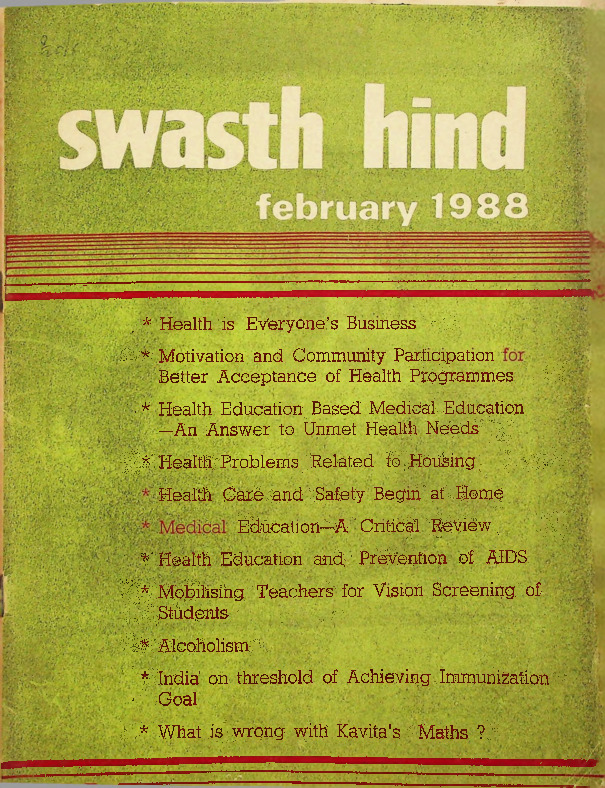
„ * Health ’is Everyone.’s Business ‘ p<’^. > >.
gm Motivation and Community Participation
Better Acceptance of Health Pte^rammes'
*
99
*
‘■* Health Education^Based Medidaf Education
—An Answer to {Jnmet HeaRji Ne'qd^ ||| ■
JSHealtETroblems /Related^Hfbtifeing / ’|.' \V
d
*
Health pai^^nd VBaf/aty BepuJ^ §tH$'om^
fiSicatioh-1-A" Cntib^ ^Vfdw i
|||
' ^'Health Education and'PrWdfthon of AIDS
^f/Mofeilisihg ’Teaeher^ for Vision Screening'" of
^/^St&dents'' 3<
v)?1
'
^AAteohohsm/',
‘
1 ^^3ndiak on threshold of Achieving...Immunisation*7
<;Goa!
J7
* 'What j^yvTQng vyith Kayjta’s $ Maths ?J7
In (his Issue
Page
swasthhiitd
Magha-phalguna
Saka 1909
February 1988
Vol. XXXII, No. 2
• . .
\
OBJECTIVES
Health is everyone's business
33
Motivation.and community participation
for better acceptance of health pro
grammes
—Dr (Smt.) V.K.- ■ Bhasin & Dr. K.S. Sinha
36
Health education based medical.
'education—an answer to unmet health
needs * ’ . •
—Dr S.C. Gupta
39
Health problems related to housing
Swaslh Hind ' (Healthy India) is a- monthly—-journal *—Dr AJG
*
,Mukherjee•...
published by Yhe Central. Health Education Bureau^ Health care and safety begin at home
Directorate General of Health Services, Ministry' of'
-Medical,education—a .critical review .
Health and” Family Welfare, Government of India, —Dr Ajay K. Sood & Prof.. V.P. Sood
New Delhi. Some of its important objectives and aims !
Health education apd prevention of AIDS
are to: .•
/c
a
t’JOr’ \Smt.y NrA.±Arath:
-
43
46
49
51
53
REPORT and’ interpret the policies, plans.'.' pro-/'Mobilising teachers for vision screening
I cz’iH’aVfuevementsdii
• ”1 of
' i the
c: til
1 Mimslry
rii k w-;of;stiracnts• .
* “■ •
grammes-aiWUnion'
Gupta
of Health and Family/Welfare.; /.-'•• \
J/-- . ...
- ._
* »» t
i..
..• • ••/.. j.
.. . J J
^-Alcoholism—begms .vfitli wheels but ends
56
ACT as a medium of exchange of information on uffj
*. n
’ y *
health ^activities’of the’Central and State Health’*I '
v\
rj,
r- .
.?
• Whaf is-wrohg'witlrKnvitlras Maths?
Organizations.
,
..
.
{
58’
FOCUS attention on the major public health j India bn threshold of achieving immunization
61
problems in India and to report on the latest trend’s 1 goal
in public health.?.
•
' National Conference oni-continuing ’
. • /.
.'
*
62
; education of health personnel in
, , -.•'■ ■/. ’■
KEEP, in .touch with health and welfare workers and j health education
Dr (Snit.y V.K. Bhasin. Dr (sint.) S.V. Dkamii
agencies in India and abroad/..&
K.L. Batra
■, ' ; ’
REPORT on important seminars, .conferences, dis
cussions, etc., on health topics.
•SUBSCM^
RATES
i
Editorial arid Business Offices
Central Health Education Bureau.
(Directorate General of Health Services)
Kotla Marg, New Delhi-110 002
COVER DESIGN
Single Copy.'Annual
I
I
■'
> ......I.
SO Paise
•
Rs. 6.00
. <•
(Posfug^ Free).
» *■ M... »
■ -t »
■
;s'/ * '•
......................... . .
Articles on health topics af-c.;dv it cd for publics lion
*
in this
Journal :■
■ '' ’
‘
State Health.Directorates arc requested.to send in reports of
their activYtiies^foC’publication.
EDITOR
.>•
Sr. SUB-EDITOR
*
. N/G. Srivaslava
sfi I J f
M. L. Mehta
i ■;
»
:
•
•
r
■
I
The c<.n<cr>(s of this Journal arc freely reproducible.
acknowledgement is requested.,
/••
••
•
.>•
'
k
.
Due
The. opinions expressed by the contributors ate not neces
sarily those of the Govfeiunwnt of |nd«
*
SWASTH HIND, reserves the right to edit • be article
*
(or publnjatipn
• ’ *
* . ’
sent
HEALTH TS EVERYONE’S BUSINESS
Food, clothing, shelter and good health care are basic requirements for humans to survive and lead a productive life
*
Improvement of living conditions and quality of life together with good health services contribute to good health.
Achievement of good health is a social goal. Economic development is necessary to achieve social goals. At the same
time, social development is necessary to achieve economic goals. The purpose of both social and economic development
is to achieve a health status that would enable people to lead a socially and economically productive life, based on cul
tural values that prevail in different societies. Such a health status cannot be achieved by the health sector alone.
Other social and economic sectors such as education, agriculture, animal husbandry, housing, water, public works,
communications and industry have a bearing on health development. Hence there is a need for constant consultation
between major social and economic sectorsuto ensure development and to promote health as a part of it.
February 1988
33
well accepted that basic thing without health”. Health de
human requirements include velopment is therefore essential for
adequate food, shelter, clothes social and economic development,
and health care. These basic ele and the means for attaining them
ments are essential for survival are intimately linked. For this
and make for happy and healthy reason, actions to improve the
living. Hl health, on the other health and socio-economic situa
hand, has an adverse effect on the tion should be regarded as mutual
individual as well as an indirect ly supportive rather than competi
effect on their families, communities tive, requiring the active support
and country. There are many fac and full participation of all.
tors contributing to good or illhealth. These include heredity,
personal behaviour, environmental Intersectoral Coordination
conditions and accessibility to health
Member Countries of WHO are
services. Improvement in health
status can be brought about through now accelerating the process of
improvement of the living condi health development through the
tions and quality of life. In fact, strategy of Primary Health Care.
economic development is necessary Inherent to the PHC approach is
to achieve most social goals and the recognition that health cannot
social development v is necessary to be attained by the health sector
alone. In developing countries in
achieve most economic goals.
particular, economic development,
anti-poverty measures, food pro
Indeed social factors are the real
driving force behind development. duction, water, sanitation, housing,
The purpose of development is to environmental protection and edu
permit people to lead economically cation all contribute to health de
productive and socially satisfying velopment. Activities of the health
sector therefore must be coordinat
lives. Social satisfaction and eco
ed at national, intermediate and
nomic productivity will be inter
preted in widely different ways ac community levels with such social
and economic
sectors.
Thus,
cording to the social and cultural
health
activities
should
be
under
values prevailing in each society.
taken concurrently with measures
Everywhere people themselves rea
for improvement of nutrition parti
lize that their motivation in striv
cularly in mothers and children;
ing to increase their earnings is not
increase in production and employ
greater wealth for its own sake but
ment, a more equitable distribution
the social improvements that in
of income, and protection and im
creased purchasing power can bring
provement of the environment.
to them and their children, such as
better food and housing, better edu
cation, better leisure opportunities, Mutual Consultation
and, perhaps most important of all,
better health. For only when they
.No sector involved in ’ socio
have an acceptable level of health economic development can function
can individuals, families and com properly in isolation. Activities in
munities enjoy the other benefits one impinge on the goals of ano
of life. It has been said “Health ther; hence the need for constant
is not everything, but there is no consultation between the major so
t is
I
34
cial and economic sectors to ensure
coordinated development and to
promote health as part of it. Pri
mary health care, too-, requires the
support of other sectors; these sec
tors can also serve as entry points
for the development and implemen
tation of primary health care.
Agriculture
The agricultural sector is parti
cularly important in most countries.
It can ensure that production of
food for family consumption be
comes an integral part of agricul
tural policy and that food actually
reaches those who produce it,
which, in some countries, may re
quire changes in the pattern of
land tenure.
Also1, nutritional
status can be improved through
programmes in agriculture and
home economics geared to meeting
priority family and community
needs.
Women’s Role
It is particularly important to
ensure that women enjoy the bene
fits of development as well as men.
In most developing countries the
majority of women in rural areas
are engaged simultaneously in agri
culture, household
management
and the care of infants and chil
dren. They need appropriate tech
nology to lighten their workload
and increase their work producti
vity. They also require knowledge
about nutrition which they can
apply with the resources available, *
in particular concerning the proper .
feeding of children and their own
nutrition during pregnancy and lac
tation.
Swasth Hind •
Similar policies in support of
health are needed in other sectors.
Water for household use is as im
portant as water for cattle, irriga
tion, energy and industry. Plenti
ful supplies of clean water help to
decrease mortality and morbidity,
In particular among infants and chil
dren, as well as making life easier
for women. Countrywide plans are
required to bring urban and rural
water supplies within easy reach of
the majority in the shortest possible
time. The safe disposal of wastes
and excreta also has a significant
impact on health.
Water supply and sanitation
The health sector can promote
investments in water . supply and
sanitation, but as a rule major invest
ments come from other sectors. In
rural areas in particular, the com
munity may well be active in these
fields as part of primary health
care. Education in the proper use
and maintenance of water and sani
tary facilities is important.
Housing that is properly adapted
to local climatic and environmental
conditions has a positive effect on
x health. Houses, like animal shelters
and food storage facilities, need to
be protected not only against the
elements but also against disease
*
carrying insects and rodents. All
these structures, and particularly
kitchens and sanitary facilities,
should be easy to clean. Here too,
education is important for ensuring
the proper maintenance of houses
and the areas surrounding them.
Certain aspects of public works
and communications are of strategic
importance to primary health care,
February 1988
particularly for dispersed popula
tions. Feeder roads not only con
nect the farmer to the market but
also make it easier for people to
reach villages, bringing new ideas
together with the supplies needed
for health and other sectors. Twoway radio communication, where
this can be afforded, puts isolated
areas in contact with more centrally
located administrative levels, at the
same time serving as a vehicle for
learning!
Information and education of health
The educational sector also has an
important part to play in the deve
lopment and functioning of primary
health care. Community education
helps people to understand their
health problems find possible solu
tions to them and determine the cost
of different alternatives. Instructive
literature can be developed, and dis
tributed through the educational sys
tem. Associations of parents and
teachers can assume certain respon
sibilities for primary health care acti
vities within schools and the com
munity^ such as sanitation program
mes, food-for-health campaigns or
courses on nutrition and first aid.
The mass media can play a sup
portive educational role by provid
ing valid information, on health and
ways of attaining it and by depicting
the benefits to be derived from im
proved health practices within pri
mary health care. For example,
they could support a sound pharma
ceutical policy by helping to create
public awareness that a number of
drugs with generic names are just
as good as advertised products with
brand names. They could also help
to popularize primary health care
by . disseminating authentic news
about it in different communities.
An intersectoral approach
Many agricultural and industrial
activities can have side effects that
are detrimental to health. To men
tion a few, irrigation schemes and
artificial lakes can create the right
conditions for the breeding of mos
quitoes that transmit malaria, indu
strialization can lead to the pollu
tion of air and water with toxic che
micals and the accompanying ur
banization can provoke psychosocial
problems. It is, therefore, wise to
incorporate preventive measures in
industrial and agricultural projects
which pose particular health hazards.
Such measures can be included in
irrigation schemes and man-made
lakes, safety precautions can be
taken to reduce industrial accidents
and pollution, potential carriers of
diseases can be identified wherever
there- are large population move
ments, and special attention can be
given to protecting the physical and
mental health of migrant workers.
There is a proper place for primary
health care in most of these activi
ties.
In addition, the industrial sector
can support primary health care by
establishing industries related to
health, in particular for essential
foods and drugs. Local small-scale
industries are also important, be
cause they create employment and
thereby improve the local eco
nomic base and earning power.
Thus there is hardly any section
that is not directly or indirectly re
lated to health. Health, truly, is
everyone’s business.
—Courtesy WHO 0
35
MOTIVATION
AND COMMUNITY PARTICIPATION FOR
BETTER ACCEPTANCE OF
HEALTH PROGRAMMES
Dr (Smt) V.K. Bhasin
Dr K.S. Sinha
Motivation and community participation must be ensured for successful implementation
of any health programme. Health education cannot yield rich dividends unless it empha
sises motivation and community participation. All the training programmes in health
education must focus on various components of motivation and community participation.
his paper attempts to highlight
T
the importance of motivation
and community participation for bet
ter acceptance of health programmes
by the people. It is important that
for better delivery of health care ser
vices to the people, all our health
professionals should be trained in
process and techniques of motiva
tion and community participation.
The need of the day is to integrate
these concepts in the training pro
grammes in health education. Once
the health professionals are trained
in these techniques they should be
able to motivate the people to accept
all health programmes and avail of
the services offered.
Mere availing of the services are
not enough, rather they should make
demand for basic and primary health
services. It is significant to know
that people on their own do not
make demand, unless it becomes
their felt need. To make the avail
36
able services as their felt need, the
health professionals have to make
efforts to convert their unconscious
needs into siib-conscious ones and
thereafter into conscious needs or felt
needs. The model given below clear
ly indicates how the unconscious
needs are converted into conscious
needs.
STIMULUS RESPONSES
For this we require stimulus to be
provided to the people. Stimulus
may be in the form of knowing the
facts from the people about health.
By and large people give least
importance to health and they rare
ly talk about health. Therefore,
it is essential that the health profes
sionals should have talking points
on certain health problems. Bas
ed on the talking
points, they
should give health talks and after
the talks they must be good listners, too. After listening, the
health professionals relate the
points with the day-to-day activi
ties.. so that they become felt-needs
of the people. If a felt need is
generated, it motivates the people
to make demand for the services.
The model given below clearly in
dicates how momentum is generated
in a community.
Talking
points----------- Health
professionals— ----- Talk------------Listen—.
--------- Observe-----—Thi nk-------- -— M o ti vate--------Action/Demand Chain reaction/
multiplier effect.
For instance one plus one be
comes eleven. A motivated per
son can motivate many others re
sulting in the adoption of a pro
gramme.
It is not enough to generate de
mand through motivation for ac
tion (it is dealt with elsewhere in
this paper); but it is also essential
that the interest generated should
Swasth Hind
Motivation for cooperation:
be sustained for community parti
cipation. For sustaining the interest
it is of paramount importance that
the people should own the pro
gramme. Once the programme is
owned it is necessary that the
opinion leaders make public com
mitments in the presence of the
followers, so that they adopt or
adapt health programmes in totality
and make its best use. It is then
that we can achieve the goal of
Health for AU by 2000 AD,
through motivation and community
participation.
February 1988
Once the change-agent understands the community profile of the people, she/he
can seek their cooperation by motivating them.
However, for achieving Health
for All by 2000 A.D., the health
professionals
must
understand
clearly that the success of any
health programme depends consi
derably upon the participation of
the community in the programme.
In other words community should
be involved in planning, implemen
tation and evaluation of health
programmes to be launched for a
particular community. It is a well
known fact that our community
gives no attention or minimal at
tention to our health problems in
comparison to agriculture educa
tion, employment etc. Therefore,
it is essential for our health profes
sionals to give maximum, impor
tance to health education through
motivating the people for commu
nity participation. To make the
health as a valued asset to the
community it is essential that our
health professionals should be pre
pared to use various techniques to
motivate people for community
participation. Generally speaking,
most of our health professionals,
such as, health workers, health
37
supervisors and health/extension
educators have their own percep
tion about community participation,
health education and motivation.
The pre-requisite condition, there
fore, is that all our health profes
sionals must understand the con
cepts in the same way and adapt
them as per their requirements.
To make our health professionals
more effective, it is essential that
these concepts should form an in
tegral part of our training pro
grammes in health education.
Desired Changes
In this context it may be said
that there are hundreds of defini
tion of health education in relation
to motivation and community par
ticipation. From operational point
of view it may be defined as a
process of bringing about a change
from undesirable health practices
to desirable
health
practices
through a change in knowledge,
belief and behaviour of the people
by adopting the methods of de
education (re-learning). This in
volves keeping people to help them
selves. This change can take place
only when we are in a position to
know “why do people behave the
way they behave”. This has a mo
tivational linkage. The role of the
change-agent or health professional,
therefore, is to know and apply
the principles of motivation and
community participation.
Motivation deals with the inner
urge of the people and in this con
text the health professionals must
be trained to arouse the inner urge
of the people. Motive deals with
or comprises of people’s needs,
wants, desires, hopes and aspira
tions on the one hand and removal
of fears, worries and apprehen
sions on the other. Health profes
38
sionals will have to work as change
agents for which following jobs are
to be completed:
In case, where non-acceptance is
due to negative motives, simply
adding information regarding the
positive factors alone will not pro
(a) Community diagnosis.
duce desired results. The exten
(b) Educational Diagnosis of sion worker must probe into depth
of the problems identified.
beyond the reasons of resistance
offered
by the community. He/
■(c) Identification of local opinion
leaders and their leadership She must learn in depth the reasons
which actually cause non-acceppattern.
tance and manipulate their thinking
(d) Finding out channels of com
through various techniques in fa
munication both modern
vour of healthful living. Disse
and traditional.
mination of information is essential
(e) Listing of available resources to get desired results.
in terms of (i) men. (ii)
We have already discussed sali
money, (iii) material, and
(iv) means.
ent features of motivation in the
context of operational health edu
(f) Available resources may fur
ther
be classified
into cation on strategy for better accep
internal and external re tance of health programmes which
should be integrated in training
sources.
programme for various health pro
Once the change-agent under
fessionals/workers. However, there
stands the community profile of
is no denying the fact that motiva
the people, he will be in a position
tion is pre-requisite condition for
to have their co-operation by moti
community participation, neverthe
vating them. Motivated behaviour
less, we must also highlight the sa
starts with a need which has a goal
lient features of community partici
and the goal is accomplished
pation.
through active striving. At the
same time, people have different Salient features of community par
motives which are inter-related. ticipation
Some motives drive one towards
As explained elsewhere in this
certain specific goals while other paper that our health workers have
motives drive him to avoid certain their own concept of community
goals. Most of the goals are learnt participation. It is, therefore, es
and are subjective. Therefore, sential. that we should evolve a
while understanding the motivation working or operational definition
for health he should also try to of community participation based
identify both (i) negative and posi on our experiences of working with
tive motives related to healthful the people in rural, and urban area
living, (ii) the goals through which and slums.
these motives are fulfilled, (iii) the
When we use the word “partici
strength of striving towards these
pation
” we must see whether action
goals that exist, (iv) the relative
is
involved
on the part of the com
strength of positive and negative
munity
or
people.
If action is not
motives and whether the non-accep
involved,
we
cannot
call it partici
tance is due to the absence of posi
tive motive or due to the presence pation in the true sense of the
of strong negative motives.
(Continued on page 45)
Swasth Hind
Health Education Based Medical Education
—An Answer to the Unmet Health Needs
Dr S.C. Gupta
If the existing 80 per cent of the total unmet health need of the present society is to be
met, medical colleges will have to prepare their products to perform their role both as
health educators and supervisors for the educational activities predominantly meant for the
mothers and the children by the health team under various settings.
A
thoughtful observer of medi
cal education will be troubled
by the regularity with which the
whole medical education system is
isolated from the health services
system of the country concerned. In
many countries these schools and
faculties are ivory towers, where
students are prepared for some illdefined international “academic”
standards and for the dimly per
ceived future requirement of the
twentyfirst century, while the pres
sing needs of the society of today
and tomorrow are often ignored.
These facts show that if the health
service system of most of the coun
tries is failing to meet the felt-needs
of the majority of the people includ
ing vulnerable group of population,
the criticism can be levelled at ins*’ titutions responsible for training
health, personnel. In general terms,
with some exceptions, medical edu
cation has not been sufficiently con
cerned with relevance with the need
to prepare graduates for the special
health needs of the community they
are to serve. It is said that health
profession which could act as a
powerful instrument of social change,
February 1988
has been turned into a formidable
instrument that constitutes a threat
to basic human values such as dig
nity, equality, liberty and security.
Furthermore, health manpower
plans, when they exist, do not al
ways serve as a basis for formu
lating educational objectives leading
to a definition of the content of
the teaching/learning process. Fre
quently, there is also lack of com
munication between the producers
of health manpower in the train
ing of agencies
and the use of
such manpower and the service
agencies. Therefore the former can
not positively assess the relevance
of training to the job requirement
of the latter. In certain parts of
the wo rid, medical education is also
making a valuable effort to pro
duce doctors who are able and ready
to meet community health needs, to
restore the balance between the ge
neral and specialized medical care
and to direct (he medical profes
sional from its one-sided disease
orientation to health orientation.
The goal of medical education
relates to the performance of our
students (graduates). If we do not
select the ideal students and build
the ideal curriculum, whatever our
ideals may be, and dissociate our
selves from the health care system
of our society, we will be dooming
ourselves to failure. For, we will
be disregarding one of the three in
puts in my view, the major one into
the performance of doctor physi
cian.
Medical
education is a social
phenomenon in the sense that its
character as well as the kind of
doctor it produces is shaped by the
socio-cultural characteristics, of the
host, agent, and environment, i.e.,
of the students, the teaching insti
tutions and the health care delivery
system.
v
We are much more familiar with
the completely opposite model, the
doctor as God’s representative on
earth if not the deity himself with
the power of life and death. Here,
the doctor is in total control apply
ing his clinical brilliance and the
weapons of medicine to save the
life and restore tlie health of the
passive, grateful, patient with a com
plaint.
39
World Health Situation: As per
WHO (1977:9), despite every effort
and a health expenditure of material
and human resources the health
situation today is grave. The pre
sent trends are developing into, a
major crisis which must be faced at
once to avert costly reactions and
grasp present opportunities. The
following section reviews some of
the achievements improving the
health situations and points to the
majort needs that still persist.
(a) Mother and child health: Des
pite tremendous strides in medicine
and technology, the health status of
the majority of the mother and
children in disadvantaged areas of
most countries of the world remains
low. In the developing countries,
within each 10 second one child is
dying, owing to preventable diseases.
In sheer numbers, mothers and
children comprise approximately
70% of the population of the de
veloping world and are the major
consumers of health services. They
are also a “vulnerable” or special
risk group. Global observations
show that maternal deaths range
from 4 to 295 per 100,000. In the
developing countries, the primary
concern of health department still
has to be the reduction of maternal
and child health problems. The
seriousness of the problem is shown
by the high morbidity and morta
lity rates that exist in the rural and
peri-urban population that still cons
titute 80-85 per cent of the popula
tion of the world where around 750
million people are still suffering
from absolute poverty. Although
morbidity and mortality show a
downward trend, problems such as
malnutrition among the children,
communicable diseases, parasitic in
festations and others continue to
lake a heavy toll of people’s lives,
40
especially those of infants, children
and other vulnerable groups in the
disadvantaged areas. The low health
status of the mother and children
has not only manifested itself in
terms of morbidity and mortality
but has also affected human develop
ment and capacities of individuals
to develop their potentialities and
lead, a productive life.
(b) Communicable diseases: Tu
berculosis is still one of the major
public healtli problems in almost all
countries (Park, 1979:343). There
is no single country which has suc
ceeded in reaching . the point of
control, i.e. “less than 1 per cent
tuberculin positivity among child
ren in the age group 0-14 years”. A
case of smallpox occurred in Bir
mingham (U.K.), in August 1978,
after a lapse of 5 years. In most
of Asian, African and European
countries, cholera has become ende
mic with occasional epidemic exacer
bations. Although plague has dec
lined significantly during 20th cen
tury, it continues to exist in ‘"Natural
foci” outside man in many coun
tries, viz.. Central Asia, Africa,
South America, etc, and, according
to WHO. there has been little net
improvement in the operational and
epidemiological situation about ma
laria. In India, there are about) two
million cases of tuberculosis, 14 mil
lion cases of filariasis, two million
cases of malaria, 3.2 million cases
of leprosy. Acute respiratory infec
tions and diarrhoea are rampant and
are the major killers during pre
school years.
in the developing countries. There
are good reasons for attributing
these quite largely to improved
diagnostic procedures but it may also
be indicative of a real increase in
their incidence. Assessment of
mortality of the extent of morbidity
from alcoholism is a difficult task,
owing to lack of records.
The health aspects of traffic ac
cidents are of world-wide concern.
More than 10 million people are
injured on the world’s roads each
year: there arc 2,50,000 deaths
and the incidence of accidents is
constantly increasing. The world
wide trends in smoking-related mor
tality and morbidity are alarming.
(d) Health care delivery: A
country like India, despite its vari
ous national health programmes in
term of health manpower develop
ment, increase in the budgetary pro
vision for health care, has failed to
improve quality of health care to
its people in any appreciable way
(Neki 1980:11). Infant mortality
rate of 117 per 1000 live births is
10 times higher, the maternal mor
tality rate of 3 per 1000 is at least
15 times higher and pre-school mor
tality is at least 20 times higher
than in most developed countries.
Malnutrition is widespread with at
least one million having Kwashior
kor and an equal number blinds
from vitamin A deficiency.
As substantiated by Grcwal
(1985:14), health services which
should aim at improving the health
status of the community are not do
ing so to the degree desired. WHO
(1977:25-35)
also state that health ac
(c) Non-communicable diseases:
cess
of
large
segments of the world's
Recent studies have demonstrated
population
to
health is limited or
that chronic diseases such as cardio
non-existent.
In
other areas these
vascular diseases, cancer and certain
liver and kidney diseases are be services have often operated in an
coming more commonly recognised isolated manner, neglecting other
Swaslh Hind
factors contributing to human well
being such as education, communi
cation. agriculture, social organiza
tion, community motivation and in
volvement. One reason being the
approach adopted has been largely
promotive of highly sophisticated
and centrally located medical and
even when not so. has frequently
been unrelated, to local realities.
science of medicine, its benefits had
not been accepted by the people.
The above fact is a testimony to
the experiences of Salmi (1980:35)
that in spite of the large production
of health manpower, 80% of the
population receive very little health
care. He emphasises that to achieve
the objective of Primary Health
Care by the year 2000. we would
have to increase our manpower,
organizational machinery, and tech
nology by at least three times.
The Conference on Primary
Health Care at Alma-Ata in 1978,
reaffirmed the importance of esta
blishing and further developing in
each country a comprehensive Na
tional Health System of which Pri
mary Health Care is an integral
part, and the Government and many
non-go vein men t organizations in
India are making efforts to achieve
this objective (Grewal 1985:1). But
still a lot needs to be done to achieve
responsible health status of the com
munity.
Role of Health Education
schools/colleges need to be oriented
towards producing graduates and not
disease graduate, who would consi
der medicine to be a service and
mission rather than a competitive
business, who would serve and edu
cate above all the low income
groups, who needed their services
more, who would be trained in a
teamwork and a spirit of co-opera
tion to prepare them for group edu
cation, practice around a health cen
tre who would practice preventive
medicine majoring health education
and, who would become interested
in health and not only in diseases.
The World Health Assembly con
sidering the report of the Alma- The first task
Ata Conference on Primary Health
The first task, and one of the most
Care has reaffirmed that the main
social target of governments and of important today before health edu
WHO in the developing decades cation is the promotion of health.
should be the attainment by the citi Since health cannot be taken for
zens of the world of a health level granted, it must be maintained and
that will permit them to lead a soci promoted through incessant activi
ally and economically productive ties in which the physician/medical
life by the year 2000 A.D. On the officer has a greater role to share
other hand there are copious refe than any of the other health worker.
rences which show that the said He is the real team leader and hence
goal can never be attained without is expected to play a more expanded
an. active and continuing participa and critical role in strengthening
tion of the community in maintain the health education activities in
ing its health by its own efforts, ac the population to which he/she is
tion and realization that its health responsible. As a team leader he/
she should know in most of the
In India, nearly, 70% of the doc lies in its own hands.
countries health sciences and tech
tors are involved in general prac
Keeping in view the above stated nology have come to a point, where
tice. Besides, there
are 500.000 horrifying facts about the health their contribution to the further
practitioners of indigenous systems situations throughout the world, it improvement of health standard can
is quite apparent that in the develop
of medicine, many of whom, are ins ing countries like India, health edu make a real, impact only if the
people themselves become full part
titutionally qualified. As observed cation has to play a much more ners in health protection and promo
by Gupta (1984:106), preventive as expanded and critical role in.attain tion.
ing a level of health for every citi
pects and health education receive zen that will permit him to lead a
However, unfortunately in the
scant support from these practi socially and economically produc existing medical education an em
tioners because these aspects of tive life. As cited by Belchiors phasis is mostly on the students to
while reviewing the level learn the skill and techniques in
health care are at present not as (1977:85),
of health in England and Wales therapeutic treatment of patients
remunerated as relief of systems.
back to the eighteenth century, con under various settings, their train
cluded, that in order of importance ing in health education as evident
The findings of Kathuji (1985: the major contribution to improve from WHO (1977:62), has been too
England and meagre to permit achievements to
111), show that the doctors practic ment in health in
Wales were certain modification of match the expectation with any
ing modern medicine are more busi behaviour and changes in the. envi lasting effect. Their existing train
ness minded than the practitioners ronment and it is to these same in ing in most of the countries, does
of old systems of medicine. Today, fluences that we must look particu not equip them to practice health
larly for further advances.
education in their clinical as well
despite prolonged contract with
as preventive fields.
It is appropriate to consider the
scientific medicine in India, and the
unmet health need of the society as
There is no second opinion that
benefits having been in some cases a challenge for medical education. unless, the individual himself knows
brought, to the doorstep, the com For nothing can be accomplished, of damaging life factors and has an
mon man remains dissatisfied, even if we do not incorporate health edu understanding of a positive way of
cation in the undergraduate medical
disillusioned. In brief, despite tre curriculum and give it a place of life, the physician and medical care
service. cannot protect his health.
mendous efforts and advance in the prime importance. The medical There is also a great need to give the
February 1988
41
the above cited approach as cited sised that keeping in view the exist
by Dhillon et al (1979:6), severe ing world health situations and their
malnutrition has been minimized future trends, economic constraints
from 50 to 17 per cent within a mini and state of socio-economic deve
mum period of 6 months care, espe lopment, especially in the develop
cially through nutrition education. ing world, the only feasible alterna
The medical under-graduate students tive and permanent solution to the
are also sensitized to this methodo problem at large is that if the exis
logy right from their 1st day in the ting 80% of the total unmet health
department.
During first year, needs, of the existing society is to
around 30 hours have been allotted be met, medical colleges have to
to the study of behavioural sciences, prepare their products to perform
especially sociology, anthropology their role both as health educators
and social psychology in relation to and supervisors for the educational
health and diseases.
The under activities predominantly meant for
standing of these disciplines include the mothers and children by the
the acquisition of experience in deal health team under various settings.
ing with the culture, social and eco
nomic factors that impinge on com
munity health care.
The detailed REFERENCES
understanding of above disciplines
1. Belchiors M. (1977),
“The Im
pact. of III Health and Diseases on
not only help the students to under
Society
with
Special
Reference
to
stand the community and/or society,
Brazil,” in W.H.O. (ed.) Health
its structure, its functions, adoption
Need of Society: A challenge for
of new innovation in community
Medical Education. Geneva: WHO.
study settings and also widen the stu
2. Dhillon, H. et. al, (1979), “Reach
dents understanding of different facts
ing the child in Need” Health
of human behaviour, which reflect
and Population
perspectives and
Issues 2 (1) pp-5-25.
the
individual
response
to
health
and
(1) The family folder. (2)
The
All these steps undoub
3. Grewal, H.N.S. (1985), “Compre
master register, and (3) the Desk diseases.
hensive Health Care-Methodology.”
help the students in facilitating
Diary. Under this scheme there is tedly
Paper presented at N.I.H. & F.W.,
their
training
and
understanding
the
New Delhi.
one medical officer for 5,000 popu philosophy of health education.
lation and under him there are two
4- Gupta, S.C. (1984), “Contribution
of Health Education to the Promo
multipurpose health workers., one
During the 2nd year, two families
tion of Breast-feeding Practices”,
male and one female. The main are allotted to each student where
Health
and Population—Perspec
points of entry to this methodology he has to work for at least 32 hours
tives and Issues Vol. 7, No. 2, ppare:
during his 2nd professional year.
106-114.
The same experiences are again re
5. Kathuji, M.N. (1985), “Science and
(i) Know the community, (ii) Keep peated in a more scientific and
Humanity in Medical
Practice:
Lack of People’s Faith” Santhokha
in touch with the family by regular meaningful way during the 4th pro
Durlabh Ji Memorial Hospital
home visits—reach the unreached, fessional year.
During this resi
Journal Vol. IX, No. 1 pp: (i-iii).
(iii) Identify present health needs, dential training every student has to
6. Mahler, H. (1982), “Inaugural
(iv) Anticipate the health need, spend at least 15 days in rural health
Session” of the Xlth International
(v) Plan intervention to meet these training centres under Re-orientaConference on Health Education,
needs, and (vi) Evaluations of the tion of Medical Education Scheme.
in Leo Baric (cd.), A new Ecologi
success of these interventions.
cal Perspective in Health; Educa
The above situation provides enough
tion, Geneva. W.H.O.
opportunities to the undergraduate
7. Mahler. H. (1983). “New Policies
to become familiar with rural com
for Health Education in Primary
As cited by Grewal (1979:11), munity, its health needs and felt
Health Care”. Report of 36 World
under this Scheme it is expected that needs. At this stage, every student
Health Assembly.
appropriately -trained medical team has to work out the health needs
8. Neki J.S. (1980). “Primary Health
leader will be able to deliver Com of every 16 families allotted to him /
Care and General Practices as Comprehensive Health Care to each her and recommend and implement
nonent of Primary Health Care”,
family with the help of other para suitable intervention for achieving
The Indian Journal Medical Edu
cation, Vol XIX. No. 11 pp(i-iii).
medical staff.
From the above the same with the help of internal
Consemethodology as shown by Dhillon and external resources.
9. Park. I.E. (1979). Textbook of Pre
ventive and Social Medicine. Jabal
et al (1979:5) it has been synthesis auently. students on completion of
pur, Messers Banarsidas Bhanot.
ed that it is only through frequent the course have at least a basic
10. Salmi, Ashok (1980), “Evaluation
and regular contact between the understanding of rural community
of Medical Education for Primary
workers and community any given health needs, skill of transferring the
Health Care”. The Indian Journal
public health education approach health need into felt-need with the
of Medical Education. Vol. XIX,
will be in a position to change the help of local resources and have ulti
No. 1, pp- 35-40.
community health attitudes towards mately enough capabilities to meet
11.
W.H.O- (1977), Health Needs .of
positive life-style and have requisite the changing health needs of the soci
Society: A Challenge for Medical
degree of health awareness. Through ety. From the above data, it is synthe
Education, Geneva: WHO.
medical teaching faculty a better
understanding of the basic necessity
of broad and intensive health edu
cation. Instead of making people
more and more dependent on pro
fessional medical contacts, the
medical professional must support
the will and the knowledge to
increase self-care in each society. If
the said medical contacts are un
avoidable. that must be availed of
for percolating the message of health
education in a meaningful fashion
as is evident from CIVIC Developed
Comprehensive Health care Metho
dology, as pointed out by Dhillon
et el (1979:1-5) Dcptt. of Commu
nity Medicine has
developed
a Comprehensive Health Care Ser
vices Scheme for its Block Popula
tion attached to the Christian Medi
cal College, Ludhiana.
Under
this scheme through family folders
complete record of family health
profile is available.
As cited by
Grewal (1979:1-5), there are three
main tools of this methodology.
42
Swasth Hind
HEALTH PROBLEMS RELATED TO
HOUSING
Dr A.K. Mukherjee
A healthful residential environment is one in which “the family can develop and flourish
physically, mentally and socially”. The residential environment should be considered as
one of the several environmental health problems associated with planning and develop
ment and having economic and social aspects.
is basic and indispensiblc need for man. Most coun
tries of the world have felt the over
crowded housing and the resultant
unhealthy environment is a serious
threat to physical and mental health
of the population and their social
well-being.
To cite an instance,
over half the diseases of metropoli
tan areas could be eliminated
through proper understanding of
the factors affecting the health of the
community and sound environmen
tal planning of housing.
ousing
H
‘HOUSING’
includes, in the
modem concept, not only the physi
cal structure providing shelter but
also the immediate surroundings
and the related community services
and facilities. The first report of
•the WHO Expert Committee on the
Public Health Aspects of Housing
has defined housing as ‘the physi
cal structure that man uses for shel
ter and the environs of that struc
ture including all necessary services,
facilities, equipment and devices
needed or desired for the physical
and mental health and social well
being of the family and the indi
vidual. The report also points out
that the immediate surroundings of
residential buildings should be in
cluded in housing environment.
These are also referred to as neigh
bourhood or micro-district.
Thus,
a healthful residential environment
is one in which “THE FAMILY
CAN DEVELOP AND FLOURISH
PHYSICALLY, MENTALLY AND
SOCIALLY”. The residential en
February 1988
vironment should not be considered
as an isolated subject but as one of
the several environmental health
problems associated with planning
and development and having econo
mic and social aspects.
nities including health care, school
and recreation is not only relatively
less for the poor but also varies from
place to place.
The visible symptoms of this shel
ter problem are overcrowding dila
pidated housing stock, severe shor
tage of rental accommodation, rapid
increase in the prices of land and
houses even in smaller cities and
the pervasive spread of slums and
squatter settlements without any
basic facility.
The country at present is facing a
housing shortage.
Over the sixth
five-year plan period, the require
ments of dwelling units for the addi
tional population were estimated at
4.5 million in the urban areas and 8
million in rural areas.
This was
over and above the housing shortage
Planning Commission has estima
estimated by the National Buildings ted that about 33 million people are
Organisation at 5.6 million units in living in slums al present. Rough
the urban areas and 18 million units ly, 20% of urban population lives
in the rural areas.
Considering in slums.
the quality of existing housing in
Fortunately, it is being increasing
urban areas about 86% of the
housing stock is pucca, 24.7% semi- ly realised that adequate housing
pucca, and the balance unservice and a healthy and hygienic environ
able kutcha housing.
In rural ment are not only the pre-requisites
and harmonious
areas, kutcha and semi-pucca houses for a balanced
are commonly seen.
More than growth of economy but they also in
80% of house-holds in major cities, crease the productivity of the people,
reside in small one-room dwellings. raise their morale and standard of
Due to tremendous over-crowding living.
resulting from urbanisation and in
Poor housing and poor health
dustrialisation, about 5 persons live
in one-room house.
The Central have long been associated, thus,
Public Health and Environmental leading many experts to consider
Engineering Organisation had re housing as a public health problem.
ported in 1980 that 82% only of The incidence of tuberculosis and
urban households received safe drin other respiratory infections like com
king water.
Of urban households, mon cold, influenza, diphtheria,
only 27% have sanitation facilities, bronchitis.
measles, whooping
only 30% of rural population have cough etc, bear a close relationship
safe water supply and 2% have to the degree of crowding .in dwel
basic sanitation
facilities.
The lings.
Other diseases like scabies,
availability of these and other ame impetigo, ringworm, leprosy, rickets,
43
plague, rat-bile fever, infections
jaundice and home accidents are far
more prevalent in areas of poverty,
congestion and unhealthy housing.
Rats, rodents and arthropods like
houseflies, mosquitoes, fleas and
bugs also abound where housing
conditions are poor and these trans
mit several diseases.
Morbidity
and mortality have been observed
to be high where the housing condi
tions are substandard. There can
also be psycho-social effects like
neurosis and benavioural disorders,
particularly because of islolation of
people living in cities.
There is
also a high incidence of major cri
mes, delinquency and fires in slum
areas.
Basic principles
The basic principles of healthful
housing evolved by CEA Winslow
covered four major areas of con
cern:
(1) fundamental
physiological
needs.
(2) Psychological needs.
(3) protection against contagion
(4) protection against accidents.
WHO Expert Committee, in its
first report has outlined similar
principles covering 4 levels of plan
ning:
Every community needs' small
parks, play grounds etc. for child
ren to play, for adult’§ recreation,
for mental stimulation and relaxation
and for other community activities
which aid the total health of the
individual and family.
The environmental engineers and
planners with their knowledge of en
vironmental problems affecting com
munity health have a vital role to
play in the field of housing activities.
In collaboration with public works
departments, planning departments
city and regional authorities and
health department, they may be able
to have a positive influence on plans
relating to water-supply, sewerage
and drainage systems, overcoming
run-off and flooding hazards of sur
face water etc.
A number of water-related disea
*ses are transmitted by biological
agents.
Chemical pollutants in
water may affect man’s health direc
tly and also indirectly by accumula
ting in aquatic life (e.g. fish) used
as human food.
A daily supply of 150-200 litres
of water per head is generally con
sidered adequate.
For public health, an adequate,
safe potable water supply is essen
tial.
The lack of adequate water
of
premature pressure in the municipal distribu
tion system can cause inconvenience
of disease, illness as well as serious health hazards
due to contamination in the system
of efficiency of by back-siphonage.
(1) prevention
death:
(2) prevention
and injury;
(3) attainment
living;
(4) provision of comfort.
Planning for healthful housing
should include:
AH metropolitan cities should
have a water-carried sewerage sys
tem with provision for suitable
treatment.
The domestic solid
wastes disposal is also a factor to
be given serious attention to.
(1) Provision of space for light,
air and recreation;
(2) Provision of adequate water Removal of hazards and nuisance
supply and proper sewerage,
Patterns for dwellings especially
drainage and solid waste dis
those on highways and main streets
posal facilities;
should be so designed as to minimise
(3) Freedom from accident hazard; accidental injury and deaths. Pro
(4) Clean air;
grammes need to be developed for
(5) Freedom from unnecessary overcoming existing hazards in
substandard dwellings in view of
noice and disturbance;
their structural deficiencies. Acci
(6) Insect, rodent and nuisance dent hazards for children in residen
control; and
tial streets also merits serious atten
(7) A land use Plan.
tion.
44
Existing air pollution problems
should be taken up by State Pollu
tion Control Boards for suitable
action for minimising pollution and
or shifting either industries/habitants. . New habitat should be loca
ted in such places as are free from
industrial odours, gases, dust and
fumes.
Exposure to high level of noise
leads to auditory fatigue and even
deafness.
There are other nonauditory effects such as annoyance,
interference with speech, impair
ment of efficiency and physiological
changes such as rise in blood pres
sure, visual disturbance and sleep
disturbance.
Thus, noises from
industries, railroads, motor traffic
and other sources are all potential
health hazards for housing. Correc
tive measures need to be taken in
areas where disturbance is of serious
character. For new housing pro
grammes, these aspects as also in
sects and rodents control need to be
considered seriously.
Based on the principles of hazard
free housing as indicated by the
WHO Expert Committee Report on
Public Health Aspects of Housing,
minimum standards need to be adop
ted. In the USSR, the mass hous
ing, programmes are carried out in
accordance with All-Union Building
Standards and Regulations which
are revised periodically.
These
provide that noise levels of dwelling
houses should not exceed 35 deci
bels between 8 AM to 10 PM and
30 decibels at night (10 AM to 8
AM).
New code ordinances and
enforcement procedures may have
to be developed as also a clearing
house for a more effective enforce
ment.
Code-enforcement can prevent the
deterioration of housing facilities
because of unapproved or sub
standard remodelling.
Corrective Measures
Four basic types of housing are
commonly seen : —
(1) Areas which are essentially
satisfactory and will require pro
tective action only.
Swasth Hind
(2) Rehabilitation: Repairing, re
(2) Areas which show incipient
blight or which are subject to ad modelling, renovating or supplemen
verse conditions beyond their bor ting basically sound dwellings and
ders.
These areas need protective their environment.
and corrective action.
(3) Redevelopment: Demolition
of individual or groups of structures
(3) Sub-standard areas which are
and planned re-use of individual
basically sound enough to be
premises.
brought to an acceptable standard
by a comprehensive approach to Health Education
their problems.
The enthusiasm and interest of
(4) Areas which are unsuitable for key persons in each neighbourhood
continued use and cannot be eleva should be aroused for identification
ted to an acceptable standard econo and correction of existing health
mically because of poor qualities of hazards due -to improper housing,
dwellings and environmental condi civic organisations, groups of citi
tions. These areas require redeve zens or parents, clubs etc. should
lopment.
be educated and exposed to the
Three types of approaches may be possible environmental problems in
considered: —
the community.
Planners should
also
be
in
close
contact
with Health
(1) Conservation: Retaining and
Department
and
other
government
protection of all satisfactory ele
ments of the dwellings and their en bodies which are responsible for
provision of public facilities.
In
vironment;
Detroit Metropolitan Area, the
Governor’s office formed a so-called
task force comprised of representa
tives of all interested groups, which
alongwith officials from, the various
organisations worked together under
the leadership of the Chief Engi
neer of Environmental Health Divi
sion of the Health Department.
Mass Education should include
production of numerous simple-wor
ded, well-illustrated pamphlets, bro
chures and bulletins related to pro
blems of rubbish disposal, rodent
control, building maintenance, gar
dening etc. which can encourage a
person to improve the home and
surroundings.
Inclusion of envi
ronmental studies in School Syllabi,
public recognition of individual or
group efforts, institution of awards
may help generate enthusiasm for
improvement of residential environ
ment.
@
Motivation and community participation—from page 38
term. For example, the job of a
health educator in a particular si
tuation may be to motivate people
to give blood for testing (to
see whether -a person is suffering
from malaria or noil. If people
come forward on their own for
blood testing that is in their own
interest, we can say that action has
been taken on the part of the peo
ple. In this case, there is no deny
ing the fact that people have taken
action but the question is when did
they come to give blood? Thus.
action without taking into consi
deration the time factor has no
meaning. Therefore, desired action
on the part of the people within
the fixed time is an essential ele
ment in community participation.
Another important factor in com
munity participation is whether
after the initiation of the project or
February 1988
programme “the community strives
for greater self understanding and
achieves greater cohesion and ca
pacity to act in respect of its pro
blems”, i.e., health problems. For
instance let us take the case of
community participation in Fa
mily Welfare Programme. If the
health educator health worker/
health supervisor
responsible for
the programme in a village is able
to work as a change agent, and
proves successful in satisfying the
sterilized^cases, who in turn narrate
their success to their friends, result
ing in significant increase in num
ber of cases, we can say that people
have participated in the pro
gramme.
It is also important to know the
decision making process to find out
whether there was actual com
munity
participation.
People
should be helped to help them
selves in taking appropriate deci
sions. In other words, if the com
munity is able to take appropriate
decisions frequently and act upon
them, we might say that one of the
factors in community participation
has been empirical for its effec
tiveness.
For successful community parti
cipation. it is vital that the com
munity is helped and encouraged
in such a way that it “adopts a
given idea, plan services or techni
ques”. For instance, if health per
sonnel are able to convince the
community that DPT and other
immunizations are important for
controlling diseases of children,
who in turn adopts this idea and
gets the children immunized regu
larly, we can say that we have been
able to achieve community parti
cipation as far as immunization is
concerned.
<
45
HEALTH CARE AND SAFETY BEGIN
AT HOME
The quality of one's life is greatly influenced by one's home environment. A healthy home re
quires careful consideration of existing environmental conditions and health hazards: proper site
selection, quality of physical structure, living space, ventilation, domestic animals, prevention of
domestic accidents, safe disposal of excreta and refuse, clean water and food, good personal hy.
giene, and proper nutrition. In addition, government support is needed in the areas of policy set
ting, legislation, and provision of services and infrastucture. WHO assists the governments of the
Member Countries in their efforts to improve the home environment. In the South-East Asia Re
gion alone, WHO provides assistance to oyer 100 on-going projects in support of various aspects
of a healthy and safe home environment.
n an average, two-thirds of a
person’s life is spent in his or her
home evironment. The home will,
therefore, influence and determine
the quality of one’s life more than
anything else. Not surprisingly, 8090% of all diseases and illnesses in
the developing world can be direc
tly connected to deficiencies and
shortcomings of the home environ
ment: poor structure, overciowding,
humidity, inadequate sanitation, lack
of cleanliness, presence of domestic
animals, poor ventilation,
unsafe
cooking facilities, etc.
O
Magnitude of the problem
— Over 1 billion people in the
world today live in sub-stan
dard homes. This figure has
remained more or less un
changed for the last 15 years.
46
— Around JOO million people
in the world today do not
live in structures but in the
streets, under bridges, in se
wers, in abandoned cars, or
otherwise in the open.
• - During the past 10 years
around 350 million people in
the world migrated fiom rural
areas to the cities thereby
compounding the already se
vere problem of overcrowd
ing in the urban fringe areas.
- - Around 600 million new
homes will be needed, glo
bally, until the end of the cen
tury.
How can a problem of such mag
nitude be tackled? Usually lack of
funds is mentioned as the prime
cause for all housing problems. The
answer, however, does not only lie
in the provision of funds. A healthy
home does not have to be expen
sive. A simple home built with some
thought and with consideration of
the prevailing environmental hazards
may turn out to be healthier and
more suitable than a costly structure.
Points for consideration
1.
The Site
To select the proper site for a
home requires some thought. The
place should allow rain water or
waste water to drain away from the
house and not. towards it. The site
should be at least 100 meters from
a refuse dump, stagnant water bod
ies and other places where disease
vectors and stray animals may live.
It is also important to consider the
Swasth Hind
general direction of the winds. Od
ours, dust, smoke or litter, blown
off a refuse site present a great nui
sance around the home and may
cause health, problems.
2.
Quality of the Physical Structure
A. building—even the simplest
structure—should be
constructed
properly and of the right type of
building material. Leaking roofs,
cracked walls and earthen floors can
result in dampness and provide a
haven for insects and rodents. Crack
ed walls provide excellent nesting
and breeding places for arthropode
vectors. Earthen floors may also
house disease—causing organisms
(e.g., hookworm).
Furthermore, the house should be
laid out in a way that proper venti
lation is easily possible. One should
also consider using solar energy,
where possible.
3.
Living Space
A healthy home does not have to
be very big, but it should provide
enough living space for all occu
pants. Overcrowding leads to increa
sed rates of disease transmission—in
particular air-borne and contact dis
eases—and to a higher accident rate.
It may also lead to stress situations,
tension and conflicts.
4.
Ventilation
Good ventilation of a house is ess
ential. It not only helps to keep the
place dry but also helps in keeping
it free of smoke and other gases.
Traditional use of biomass fuels for
cooking and heating in badly venti
lated structures may result in a high
concentration of carbon monoxide,
formaldehyde and other gases. Levels
exceeding MAC values (30 ppm for
February 1988
carbon monoxide, 2 ppm for formal
dehyde) by 200 to 300% can be
found in poorly ventilated places.'
Smoke can cause severe irritation
of the respiratory tract and eyes.
Infants, young children, old people.
people with respiratory problems and
smokers are particularly at risk.
5.
Domestic Animals
Animals (pigs, . dogs, chickens,
goats etc.) should not share the
living quarters with people. They
should be kept separately and at a
safe distance. If domestic animals
are allowed into the house they will
not only carry dirt and excreta in
side, they may also spread diseases
like hydatideosis, rabies, anthrax and
a variety of helmintic infections.
6.
“natural process”, which “people can
manage themselves”. Unfortunately,
it is also a matter of many misunder
stood facts and considerable super
stition.
All excreta are potential sources
of causative organisms for a variety
of enteric infections. Indiscriminate
defaecation should therefore be avoi
ded and one should consider the
following very carefully.
- Every home
latrine.
Excreta should not contami
nate ground water, surface
water and the surrounding
land (the distance from the
house, spring, well, or river
should be at least 20 meters).
— There should be no odour
molestations or unsightly con
ditions.
Accidents at Home
Accidents at home are due to a
variety of causes. The most frequent
ones, however, are burns and acci
dents involving children.
Burns are either caused by people
falling into the fire or on hot stoves
or by spills of hot oil, hot food or
boiling water. Women, while pre
paring the food, and young children,
unaware of the danger, are especi
ally at risk. It is therefore essential
to keep the children away from the
cooking area. Also all objects which
can harm children should be kept
safely out of reach: sharp objects
(e.g., knives, tools), matches, chemi
cals (e.g., insecticides, rat poison)
dangerous liquids (e.g., acid, kero
sene. paint thinner) and medicines.
7.
Safe Disposal of Excreta
Defaecation and the disposal of
excreta is generally regarded as a
should have a
— Excreta should not be acces
sible to flies or animals.
— Fresh excreta should not be
handled.
— The latrine should be safe but
inexpensive to construct, ope
rate and maintain.
8.
Proper Refuse Disposal
Every household produces refuse.
Although rates for the generation of
refuse vary, one can assume that in
the developing world a person pro
duces between 0.5 and 0.7 kilogram
per day. The refuse which is not
properly disposed off (e.g., at collec
tion points, in pits, at landfill sites)
will not only pollute the area around
the home, but will also provide
breeding places for disease vectors.
47
4
9.
Safe Water
Water is used at home for drink
ing, preparation of food, washing/
bathing and cleaning (utensils, clo
thes, etc.). Water should be drawn
from a safe source. If possible, from
a spring or protected well. Water
from a river can usually be regard
ed as contaminated, in particular
if people are living along its banks.
Water from stagnant water bodies—
e.g.. ponds
-is
*
usually highly con
taminated and should be avoided if
possible. Rain water is an important
source, but its quality will greatly
depend on the collection and storage
system used.
. A safe water source, however, is
not enough. Even the cleanest water
will get contaminated if collected in
a dirty bucket. Cleanliness is there
fore most essential.
10.
Keeping Food and Water Clean
Most enteric infections enter the
body through food and water. Clean
liness with regard to both is there
fore essential. Persons who prepare
food should wash their hands often
and keep the cooking utensils clean.
Food items and water should be
stored in cool places and where flies
do not have access. Food which is
left open to flies is, in practical
terms, covered with excreta. Rod
ents, ants, cockroaches, etc. will not
only destroy food but also conta
minate it.
11.
Personal Hygiene
Unhygienic habits and lack of
cleanliness are the causes of a large
variety of diseases. Water, soap and
brushes are simple, inexpensive but
very effective devices to maintain
cleanliness.
48
12.
Proper Nutrition
Under normal circumstances, a
large proportion of the food con
sumed is prepared at home. Know
ledge about the nutritional value of
various food items, the possibility
of substituting certain foods and
modes of safe preparation are there
fore essential. This is particularly
important if food is being prepared
for children.
Additional Requirements
Although the main responsibility
for healthy conditions in the home
rest with the family, it has become
increasingly difficult for aft indivi
dual or family to deal with all pro
blems of the home environment and
maintain healthy living conditions.
A healthy and safe home environ
ment is, therefore, very much a mat
ter of government support, policy
and legislation. The main areas
where such support is needed are as
follows:
— formulation of clear
and housing policies:
health
— provision of community heal
th personnel, who operate on
the first level of primary heal
th care (home level);
— provision of health education
in all aspects of primary heal
th care;
— provision of health services at
community level;
organization of support ser
vices for- water supply, ex
creta and refuse disposal:
provision of legislation, stand
ards and codes for buildings
and building materials;
— promotion and development
of housing schemes, build
ing societies, etc.
— provision of infrastructure
(site drainage, roads, commu
nity services).
How WHO contributes?
WHO directs all support for a
healthier home environment to the
governments of Member Countries.
This is done through a variety of
programmes, the most significant one
being “Promotion of Environmental
Health” with the following compo
nents:
— Community Water Supply and
Sanitation.
— Environmental
Health in
Rural and Urban Develop
ment and Housing.
— Control of Environmental
Health Hazards.
— Food Safety.
Other programmes include:
— Public Information and Edu
cation for Health.
— Nutrition.
— Oral Health.
— Accident Prevention.
— Maternal and Child Health,
including Family Planning.
In the 11 countries of the South
East Asia Region there are well over
100 ongoing projects in direct or
indirect support of a healthier home
environment. There are 24 projects
under “Promotion of Environmental
Health’" alone in addition to six
intercountry or regional projects pro
viding services of experts, supplies
and equipment, seminars, workshops,
training courses, fellowships, tech
nical literature and information
material—Courtesy: WHO
€
Swasth Hind
MEDICAL EDUCATION
—A Critical Review
Dr Ajay K. Sood
Prof. V.P. Sood
All the faculty of medical colleges should do exercises to develop a multi-disciplinary,
problem-oriented, practical teaching and training approach, which could be more relevant
than the present one, which very often alienates the young doctors from their own culture
and communities.
octors in India, have a trained
D
incapacity to work in rural areas,
the reason being the development of
a health manpower system on the
pattern imported from the West with
out local adaptation by the health
planners. Masses in the rural areas
remain largely dependent on the
local practitioners, many of whom
are not even registered and practise
allopathic medicine in gross viola
tion of the basic principles of pres
cription writing. Whenever, the mas
ses in rural areas approach the Gov
ernmental health system for service,
they are faced with non-availability,
time wastage, socio-cultural gap in
communication, and inadequate spe
cialist care. The doctor is a pivot
around which the entire health team
functions for delivery of the services
in the rural areas through the health
February 1988
centres. The training of doctors thus
deserves greater attention of the
planners of medical education.
The existing pattern of training the
doctors
On the one hand, the planners
wish to impart the latest in the field
of medicine to these young doctors
during training, and on the other,
expect them to serve in the rural
areas later on, where even the basic
facilities are not adequate. After his
training in the big institution with
latest equipments and medicines,
when this young doctor is placed at
the point of his utilisation in the
rural set-up, he finds the skills he has
acquired, inadequate and irrelevant
to meet the local challenges. He thus
exhibits the so called “Escape-ten
dency”, either shuns service in the
rural area, or merely neglects every
th ings, when forced to stay in the
rural set-up.
Throughout five-and-a-half year
period of his training, a student hard
ly gets 2-3 months exposure of
rural area, that, too, many situations
are confined to a few visits to the
training centre attached to the medi
cal college. It is a big surprise, how
it is expected that by forcing interns
to stay in rural health centre for
2-3 months, where they usually
confine themselves to the outdoor
patients departments they can get the
desired rural orientation.
The departments of preventive and
social medicine of the medical coll
ege are given the responsibility of
49
this “Herculean task
** —rural orien
tation of doctors. In most of the sit
uations, the departments do not have
full administrative control over the
health centres adopted for training.
Dual administration of the state
health services and of the medical
college, make these training centres
the responsibility of none. When the
interns come to the health cen
tres, the medical officers happily
handover the work in OPDs and
wards to these young doctors. So, for
practical purposes, the 2-3 months
period they spend in rural area mere
ly make them shun the rural set-up
for future, from the type of their
experiences. The other faculty of the
medical college hardly participate
in the process of rural-orientation.
They quickly wash hands off their
responsibilities, by merely criticising
the discipline of PSM and highlight
ing its inability to bring out the
desired change.
History of development of the exist
ing pattern of training
Two key decisions of the Govern
ment of India affected the develop
ment of health services after Inde
pendence. Firstly to develop the sys
tem within the existing political set
up and secondly, to have a rural
based health services system. To
make these services available free
of cost, the entire cost of training
of doctors was met by government
sector. The erstwhile medical officers
of the army were called to plan the
system, they themselves were train
ed in the West and were not aware
of the local needs and cultural
milieu. Hence, we had wrong plan
ning from the very beginning and
the planners developed the training
of doctors on the imported pattern
of the West without its local adap
50
tation. During his training in the big
institutions, the young doctors, iden
tify themselves with the highly sop
histicated hospital-based system and
look down upon the facilities avai
lable in rural areas. They look for
opportunities abroad and those who
fail in doing so, settle in urban
areas.
Where have we gone wrong?
The training of the health person
nel need to be based on the local
needs. The knowledge of the local
health problems, health needs and
factors influencing the health status
of the population is essential if we
wish to plan for the training of
health manpower relevant in local
context. The available technology
and skills should then be modified
to fit into the socio-cultural set up
of the country to achieve the desi
red objectives. These critical factors
were not given due weightage by
our medical education planners.
With 108 medical colleges pro
ducing nearly 12,000 allopathic
doctors every year. 8,000 of whom
go in for specialisation, we, in
India, are investing nearly 2.4 bil
lion rupees every year on the train
ing of these doctors. Nearly twothirds of these settle down in urban
areas and the rest who are forced
for rural service find a wide gap in
their skills and challenges in the
rural set-up and are unable to de
liver the goods.
His training in the medical col
lege makes him a specialist, who can
diagnose and treat ailments only if
sophisticated equipments are made
available to him, whereas in a
health centre he is expected to ex
ercise his skills as an administra
tor, as a ream leader and as an
organiser and manager to institute
preventive, promotive and curative
measures to improve health status
of nearly one lakh rural population
within limited resources.
What can be done?
The Indian Medical Council of
India has recommended a rural post
ing of undergraduates for 4-6 weeks
and of interns for 6 months. But,
in most of the medical colleges, the
period of rural posting of interns is
reduced’ to 3 months, due to resis
tance both from the clinical faculty
and the students themselves. Can
the desired rural orientation be made
by merely posting interns and stu
dents to rural areas? Is it the res
ponsibility of the discipline of Pre
ventive and Social Medicine alone?
What should be the commitments of
the other faculties in the medical
college in shaping the future doctor
in the national context? All these
queries must be seriously consider
ed and suitable interventions be
made in the existing system of medi
cal manpower training. The produc
tion of the right type of ‘doctor’
should be the responsibility of the
entire factulty of medical college.
The clinical faculty, which very
often controls the decision making
process, must pay a visit to rural
areas, reorient themselves to the
needs of the masses, and then sit
together and
discuss to reframe
the teaching pattern. Drastic chan
ges are needed and these can fit
into the existing set up. The need
is to realise the commitments to
wards the masses. AU the faculty
of medical colleges should do ex
ercises to develop a multi-discipli
nary, problem-oriented, practical
teaching and training approach,
which could be more relevant than
the present one, which very often
alienates the young doctors from
their own culture and communities. •
Swasth Hind
HEALTH EDUCATION
AND PREVENTION OF AIDS
Dr (Smt) N.A. Nath
The AIDS pandemic poses serious questions for public health experts. Health admini
strators and medical professionals realise that health education is the most important tool
to curb the spread of AIDS.
Ct T 1 ealth is neither a commodity
ings on AIDS in our country, the
A JL to be purchased, nor a service to health education and communication
be given; it is a process of knowing, strategy cannot be developed. Based
living, participating and being”, » on the pattern of diseases as avail
says the country’s national health able from other countries, the fol
policy. It clearly enunciates that lowing steps for creating awareness
one of the aspect of health is and for education of high-risk
“Knowing”. Various aspects of a group have been evolved.
disease, mainly its prevention, are L Health Advocacy
to be made known to the people,
so that they can take timely action
It was felt that scientific infor
to prevent disease and thus remain mation on AIDS should be made
healthy. Whenever a new disease or known to administrators, medical
a new disease syndrome threatens and health professionals to enable
to strike, it becomes obligatory on them to take necessary action in
the part of health professionals to prevention of AIDS. Some of the
create awarness amongst general groups identified are:
public regarding all possible modes
of preventing it. It also becomes
1.1 A dm intstrators
obligatory to educate the high-risk
group or the target group so that — Of health, department
they alter their behaviour and succe — Education department
ed in preventing the infection. If — Information and Broadcasting
Social Welfare Board
a disease can be prevented by an
alteration in behaviour, then the — Defence
achievement of this altered beha — Tourism Department
viour enables its incidence in the — Border Security Force (BSF).
Police Department, Jails etc.
community to be reduced. To alter
behaviour, where it causes disease. — Voluntary Organisations.
is the aim of health education.
1.2 Medical Professionals
Indiscriminate sex or sexual aber
ration is one of the most important — Tn Government service both at
urban and rural health set-up,
modes of transmission of Human
medical colleges, medical officers
Immunodeficiency Virus (HIV) call
manning blood banks. STD Cli
ed the AIDS virus. As the world
nics and laboratory service.
is facing ATOS pondemic, each
affected country is evolving its — In private practice including
own methodology for creating public
blood bank incharges, sexolo^
awareness. In India, so far. the
gists etc.
methods adopted have been to
transmit the scientific knowledge II. Orientation of Health Staff
available on AIDS to the general
public through mass media. In the — Nursing personnel
absence of any epidemiological find — EPT workers
February 1988
— Malaria Surveillance Worker spe
cially those who make blood
slides.
— Laboratory technicians
— Blood Bank technicians
— Other category of health staff.
HI. Information to Genera! Public
— Youth organisations
— College students and students at
higher secondary level.
— Teachers
— Industrial workers
—- Hotel staff
— Reform home inmates
IV. Health Education of High Risk
Groups’
— Homosexual, heterosexual men
— Prostitutes and call girls
— Drug addicts
- Professional blood donors and
blood recipients.
V. Patient Counselling and Reha
bilitation of
patients having
AIDS related complex (ARC)
or full blown AIDS disease:
Health administrators and medical
professionals realise and accept that
health education is the most impor
tant tool available in our hand to
curb the spread of AIDS. However,
they realise that objective of health
education will be based on subjec
tive attitude and sex behaviour of
the target population group. They
also realise that health education
methodology will be based on test
ing of various methods which can
create a positive impact on the
51
people. However, some of the pro
blems need to be resolved and ques
tions answered, before any method
can be tried out. Some of the pro
blems visualised and questions rais
ed are:
— What are the criteria for defin
ing high-risk group or target
group for education? As the epidemological data on AIDS for
India is not available, how can
the target group be defined?
— There are very few studies, if
any. on sexual behaviour of
different population groups. Most
of the information on homose
xuals or heterosexuals are based
on assumptions.
— What are the sexual norms? And
who decides these norms? Ob
viously, the responsibility lies
with individual society. But
where polygamy has religious
sanction, where endogamy and
sexual promiscuity are over
looked or have societarian sanc
tion, what sexual norms can be
adopted and advised?
—. Health education for those highrisk groups who have sexual
aberration, will be more akin to
moral education for adults and
sex education for youths. If
that be so, who would educate
this group—health staff or social
workers?
— Are our people receptive to
moral and sex education? And
as a corollary, are our health or
social workers capable of edu
cating on these sensitive topics?
If yes, then what are the para
meters? What method and ap
proach has to be tried out?
— What percentage of drug ad
dicts use syringes for injecting
drugs? And who are the drug
addicts? Are they coolies? Or
emotionally displaced youths?
— Do we have information on the
Indian emigrants coming to
India on vacation from coun
tries already infested with AIDS?
What form of screening and
educational policy will be adopt
ed for them? There are hundreds
of Indian labourers who visit
home from the country of their
work. They could be the poten
tial carriers of the AIDS virus.
52
AIDS
Answering the Vital Questions
AIDS is an incurable disease. Prevalent worldwide, though it is more
common in some countries than others. It proves fatal, though everyone.
who is infected with the AIDS virus does not develop AIDS. The virus
is caught by blood or semen from an infected person getting inside your
body. People can be infectious even if they look and feel completely
well.
(X
Who is most at risk?
A.
Men who have sex with other men.
People who have sex with prostitutes.
People who have sex with many other people.
Drug misusers who share injection needles.
People who receive blood transfusion in countries where blood is
not checked for the AIDS infection.
People who receive injections with infected needles.
The sexual partners of the above groups.
Q. If you have sex, how can you stay safe from AIDS?
A. The fewer people you have sex with, the less chance you have cf
meeting someone infected with the AIDS virus. So cut out sexual
relationship and avoid prostitutes. It is better to keep relationship
only with your spouse or with one partner. If you have sex with
someone other than your usual partner, make sure, that a condom
(Nirodh) is used to cut other sexually transmitted disease. Remember,
if you become infected, you can pass the virus on to your usual
sexual partner on your return home.
<?. // you need blood, medical or dental treatment involving injections,
can you catch the AIDS virus?
A.
In some countries, blood for transfusions is not checked for the
AIDS infection. Hence in places where infection rates are high,
do not have blood from a local donor if you can avoid it.
If you take medical or dental treatment from, the Government run
hospital, dispensary or primary health centre, you can be sure that
the equipment are properly sterilised and there is no risk of getting
AIDS infection. Also, if you take treatment from a qualified medi
cal practitioner or a qualified dental surgeon—you can be sure that
their equipments are properly sterilised.
If you read this, share your knowledge of prevention of AIDS infec
tion with others so that more people can learn how to avoid AIDS
infection.
And lastly, what would be the
optimum approach for health edu
cation? People and professionals
have been enquiring whether we are
not overplaying! Some also feel
that we are underplaying. None of
these questions is easy to answer,
and therefore whatever method of
education is adopted, it has to be
watched. modified changed and re
constituted. One thing is certain that
if the general public is not alerted.
and if the disease spreads and takes
its toll, it will be too late to do
anything. Any approach tried for
the first time has to meet the criti
cism, invite comments and discus
sions. But, that should not create
hurdle in carrying out the task,
which the administrators and health
professionals have started. Any
new venture, scientific or otherwise.
attracts the Press and other media.
Articles on AIDS started to appear
from September 1985 in the Indian
magazines. May be even earlier
than that. Although the outreach
of these magazines may be limited,
but the final responsibility to con
vey authentic information on AIDS
lies with the health professionals. •
Swasth Hind
MOBILISING TEACHERS FOR
VISION SCREENING OF STUDENTS
Smt. C-K. Mann
Dr U.C. Gupta
IP ahul was very sad. He did not
*-^go loplav during recess time.
Earlier, his teacher had remarked
that he was inattentive in the class
and is disturbing the boy next to
him besides copying from his note
book. He fell insulted. He was
not able lo explain to the teacher
that he could not read what was
written on the blackboard from a
distance. Probably, he was not given
the opportunity to explain his in
ability to copy from the blackboard.
Rahul's teacher sent a complaint
lo his parents that he was weak in
his studies and often he did not do
his home-work. Rahul’s mother
was also very angry- She was not
able to understand why her son was
weak in the class. Whenever she
would ask him to do the homework.
February 1988
he would complain of headache.
The mother often thought it was
an excuse. But, none bothered to
know the real cause.
There are such examples of
children’s behaviour when they are
found to be weak in their scho
lastic performance.
Neither the
teacher nor the parents ever tried
to find out the real cause. In both
the cases, as quoted above, the chil
dren were having problems with
vision. Rahul was not able to see
properly what was written on the
blackboard and that is why he was
trying to copy from a boy sitting
next to him. The teacher failed to
observe the real problem of Rahul.
Evidently, the fault was not of the
teacher. She was not oriented to
observe the health defects and de
viations among the children.
The anxiety of Rahul’s mother
about his poor performance in the
class was genuine. Any parent
would be concerned. But both the
parents and teacher failed to under
stand the real cause of the headache
which was misunderstood as a lame
excuse by him.
In a public school, to have the
students top in the board examina
tion, its Principal arranged for a
special class for the weak students
to remove their shortcomings. Sur
prisingly, on a routine eye examina
tion, it was observed that most of
the students of this special class
were suffering from myopia which
was responsible for their disinterest
in the classroom teaching. Had the
teacher been able to identify these
defects earlier, no extra inputs were
required by the principal.
53
blindness
pro
tent educational institution prevention of
Such undetected conditions affect
itself can extend help in this gramme:—
the studies of the students and can
sphere?
lead to acute and chronic conditions
1. Assessment of the knowledge
in the latter life. The developing
of teachers with regard to eye
3. To overcome wide gap bet
countries with their meager re
care practices and factors lead
ween manpower available and
sources can ill-afford such health
ing to blindness.
required; to what extent teach
conditions. Half a million children
ers who offer tremendous man
2. Teachers’ Orientation Pro
go to the eye specialist or to a hos
power potential, can be mobi
gramme to provide up-to-date
pital when the damage is done and
lized?
scientific information related
nothing can be done to restore the
to
prevention of eye health
4.
Early
detection
of
any
visual
eyesight. In India alone, about 30problems
and desirable eye
deviation
will
not
only
save
40 thousand children become blind
care practices.
from further deterioration,
annually. The total number of blind
eventually, leading to chronic
3. Orientation of teachers to ob
population is around 9 million.
and acute conditions but will
serve eye defects and pro
About two-thirds of this blindness
help in early protection and
blems.
is preventible if appropiiate and
early restoration of eyesight.
timely action is initiated. The con
4. Training of teachers in con
5. Since ignorance due to illite
tributory factors are:—
ducting
vision
screening,
racy, traditional beliefs and
through demonstration.
1. High level of illiteracy and
cultural practices account for
5. Vision screening of students
resultant ignorane of measures
undesirable eyecare practices
by the teachers.
for eye care.
and thus leading to high in
6.
Referral of students having
2. Superstitions, traditional be
cidence of blindness; how far
defective vision or other eye
liefs and cultural undesira
the educated class particularly
problems to ophthalmologist.
ble eye care practices.
those who are the provider of
education are aware of the
7. Eye examination by the oph
3. Lack of comprehensive plann
importance of eyecare and
thalmologist to determine vi
ing to combat the problem.
factors leading to blindness.
sual equity and other eye pro
4. Dearth of needed resources in
blems among the referred stu
terms of manpower, logistics,
dents.
sophisticated equipments and Objectives
8.
Intimation to parents about
other infrastructure.
1. To develop a strategy for
the
identified defects or devia
5. Inadequate use of mass media
mobilizing teachers for pre
tion
found among the students
communication for the educa
vention of blindness so as to
for getting early treatment.
tion of the community to
fill the gap between the man
9. Feedback to the teachers about
create awarness and public
power required and available
the treatment offered by the
acceptance of Government
for this programme.
programmes.
family doctor.
2. To assess the knowledge of
10. Involvement of teachers for
6. Absence of community parti
teachers with regard to eye
cipation to seek preventive in
follow up to ensure (1) regu
care and practices desirable
tervention, early detection and
lar use of glasses if prescrib
for
the
prevention
of
blind
treatment to restore the eye
ed, and (2) regularity in treat
ness.
sight.
ment prescribed in case of
infections of the eye, (3) re
3. To orient teachers by provid
gularity in die intake of Vita
ing scientific knowledge about
In view of the importance of the
min A rich food.
eyecare and preventive mea
protection of vision and magnitude
sures related to blindness con
of the eye problems and consider
11. Involvement of teachers in
trol.
ing the factors identified for the
providing eye health education
aggravation of these problems a
to the students and the parents
4. To seek active involvement of
study was undertaken to demons
so that they are able to take
teachers in conduction of ac
trate how teachers can be mobilised
appropriate preventive mea
tual vision screening for early
in the vision screening among the
sures.
identification of eye defects
school students. The selection of the
and deviations with a view
study was based on the following
to referring the students with Selection of School
issues: —
defective vision for early treat
In India, two types of school sys
ment.
tems
are common—Government
1. Prevention is definitely better
5. To determine the scope of run schools, which generally cater
than curei as it saves enormous
the role of teachers in eye to lower socio-economic strata of
resources required to be in
health education of the stu society, and the “Public Schools,”
vested in institutional care and
dents and the parents.
run by the private organisations or
sophisticated equipment need
individuals that cater to middle and
ed for treatment and rehabili
Strategy for mobilizing teachers
higher income group communities.
tation.
This project was undertaken in one
The following strategy was work of the public schools because a num
2. Education is the main medium
of prevention. To what ex ed out for involving teachers in the ber of studies have already been
54
Swasth Hind
undertaken in the government-run
schools. The main hunch in the
selection of the school was to deter
mine the extent and type of eye
problems among the children of the
so-called educated families. The
selected school has 2,200 students
having classes from third grade to
twelfth standard with a teacher
strength of about 100. The socio
economic status of the community
can be termed as higher middle and
higher level.
Assessment of teacher’s knowledge
A proforma was developed . to
assess the knowledge of teachers re
garding the importance of eyes and
vision: types of common diseases of
eyes: factors responsible for eye
problems particulary the night
blindness; food rich in Vitamin A
and desirable eyecare practices.
This proforma was administered to
50 teachers who were selected at
random basis. The analysis of the
responses received indicate that
even though a majority of teachers
particularly the ones with science
background had good knowledge
about these eye health problems,
most of them
*
were not aware of the
preventive measures. Many of them
knew about the sources of food
rich in Vitamin A. but very few
knew that lack of Vitamin A causes
night-blindness. Majority of them
never observed the children for vi
sion defects as they considered it
the duty of parents to take the child
for vision examination to the oph
thalmologist in case a child com
plains of vision problem.
Teacher’s Orientation Training Pro
gramme:—
One-day teacher’s Orientation train
ing was organised on the (1) impor
tance of care of eyes and prevention
of blindness among the students.
(2) structure of eye and common eye
health problems. (3) teachers’ obser
vation of the eve problems among
the students and their role in the
prevention of blindness. (4) demon
stration of vision screening with the
help of Snellen’s Eye Chart. This
orientation training was attended by
about 95 teachers out of 100. who
showed keen interest by taking
active part in discussions and rais
ing a variety of Questions.
The
thrust of the whole orientation was
on clarification of certain emeries
and issues seeking un-fo-dafe infor
mation. The information provided
February 1988
was supplemented by (1) folder on
the “Role of teachers in the pre
vention of blindness”, (2) Folder
on guidelines for vision screening,
(3) Poster on golden rules for eye
care, and (4) Posters on healthy pra
ctices for eyecare.
Visions Screening of students by tea
chers.
In view of the high percentage of
children with vision defects, every
one seemed to be concerned. It aro
used tremendous interest among the
teachers for the eyecare of children.
Everyone seemed to be curious to
know the causes of it and what pre
ventive or remedial measures could
be undertaken. Hence, it was tho
ught that a School Health Advisory
Committee may be set up to evolve
an educational programme for the
students, teachers and parents. The
Advisory Committee’s members in
cluded Principal of the school as the
chairperson and the School Social
Worker as the Convenor. The other
members included three teacher re
presentatives, School Medical Offi
cer, Senior Opthomologist and three
student representatives. The Advi
sory Committee members held dis
cussions to identify the factors which
could be responsible for this high
magnitude of the problem.
On the day of vision screening of
the students, teachers were again
given instructions for conducting sc
reening test. They were explained
five important aspects essential for
proper screening. (1) Snellen’s Eye
Chart should be placed on the wall
of classroom at the eye level of the
student, (2) no glare should fall on
the chart so that the students do not
have to strain the eye due to glare,
(3) screening test should not be con
ducted1 in the presence of . all the stu
dents so as to avoid cheating by the
rest of the students, (4) covering one
eye by the cup of the palm of the
hand, (5) making the student stand
Table—Number of Students screened and
at a distance of 6 metres from the found with vision defects.
chart.
Nos. with
Nos.
The students were made to stand Classes
Vision defects
Screened
in the queue outside the classroom.
They were sent inside the classroom
351
.137 (38.9%)
HI
for vision screening, one by one.
337
61 (17.8%)
IV
Teacher with the help of a senior
68 (20.0%)
340
student recorded the information and V
85 (33.2%)
256
VI
referred the students with vision pro
54 (25.0%)
blem to the opththalmologist. The
216
VII
student with vision defect and any
-53 (31.92%)
VIII
166
other eye problem was examined by
40 (32.7%)
IX
122
the specialist, who further referred
28 (27%)
104
X
him to the parents indicating his
95
23 (24.2%)
XI
specific problem so that parents can
27 (23.6%)
144
XII
take him to family eye specialist.
Tn this way, 2101 students out of
However, following factors seem
2,200 were examined by the teachers
in only 10 days. The findings show ed to be responsible: —
ed that about 27.4 per cent of
1. Early stress on the child for sc
children were suffering from vision
hool education. There is a trend
defects which in most of the cases
to admit the child in the school
remained undetected.
at a very tender age of two and
a half to three years. By this
Had these children continued to be
time, even his eye muscles have
left undetected, it would have fur
not grown to full.
ther deteriorated their eyesight lead
ing to blindness? It was also observ
2. Early start in reading and writ
ed that in one hour, one teacher can
ing. Majority of parents expect
screen the vision of about 30 stu
their children to begin reading
dents thus only 2 minutes were re
and writing at the early age. The
quired for each child. This also
competence
and performance of
generated lot of interest and enthu
the school is judged by the abi
siasm in the teachers about the im
lity of child for reading and writ
portance of the care of the eye he
ing at the age of two-and-a-half
alth. Thereafter the teachers orga
to three years.
nised eye health education classes for
(Continued on Page No. 57)
the students and the parents.
55
ALCOHOLISM
Begins with “Cheers” But Ends Up in Health Problems
K. Balan
The increasing drink-drug habit among the youth is of a national concern. When they do
it in private, it attracts nobody. But, when it erupts as a volcano of health problems at
a later stage that will erode the nation’s wealth because such a health calamity among
the youth is unbearable, indeed.
I ’ he recent findings of an unoffi*•cial survey that 25 per cent of
the youth in Kerala drinks alcohol
is not alarming or surprising beca
use it seems to be only a tip in the
iceberg considering the illicit liquor
trade and private-habit of drinking
among the younger people. At the
all-India level the findings of such
a study may be more as the drinking
habit has increased considerably in
recent times, according to authorita
tive sources.
But, astonishingly, the recent re
ports of a study conducted by the
prominent Soviet Psycotherapist, Mr.
Vladimir E. Rozhdin, who had de
voted more than 30 years to the
study and treatment of alcoholism
in Soviet Union, raises an alarm for
drinking youth everywhere. The
book based on his study and titled
as “We ar& men” says even a small
amount of alcohol can do irrepairable harm to young men, who take
to drink at an early age. The phyciological formation of the male or
ganism is completed only at the age
of 25 and alcohol consumption by
adolescents leads to extremely “un
desirable” shifts in their nervous en
docrine and urogenital systems.
Now the findings will reveal how
the health potential of the youth of
the nation can be eroded if they are
habitual drinkers. They have to avoid
drinking alcohol to avoid future
physiological complications in them
and also to prevent alcohol related
health problems in the country.
56
As early as 1979, resolutions pass
ed by the World Health Assembly of
WHO recognised that problems re
lating to alcohol rank among the
World’s major public health pro
blems. Since then the consumption
of alcohol has increased considerably.
its quality deteriorated with more
and more adulteration and the he
alth problems multiplied, particular
ly in the third world.
The increasing drink-drug habit
among the young and tender popu
lation is a national concern for a
country like India. When they do it
in private of campus, it attracts no
body, but when it erupts as a vol
cano of health problems at a later
stage that will erode the nation’s
wealth because such a health cala
mity among the youth is unbearable
to any developing country.
In the third world, where the maj
ority people take shelter under a
small income to live a half-starved
life, and who always live in the
vicious circle of poverty, drink
ing costs heavily to the indivi
dual, the family and the nation. The)'
are increasingly becoming victims of
illicit trade, sub-standard or adulte
rated products and are forced to
spend a good part of their income
for alcohol. The result is suffering
to the other family members. So
much so, it leads to undernourish
ment and socio-economic problems
of the family and ultimately increase
the national burden. The habit of
drinking among the elders of the
family comes down to the children
also in course of time.
Drinking, they say, seriously aff
ects the human system including
heart. Drinking leads to cirrhosis.
In Australia, it was found that about
50 per cent of psychiatric problems
are due to drinking. In the third
world in general, and in India in
particular where these are alarming
rates of mental disorder and social
problems, much headway has not
been made to find out the; amount
of damage done by alcohol among
the drinking population. Studies
both in the developed and develop
ing countries attribute the reasons
for majority of the road accidents
in the third world as drinking
alchol.
In drinking families, particularly
where parents are heavy drinkers,
there exist multi-faceted behavioural
and social problems which affect the
shaping of the attitude and outlook
of the children in the family. Thus
most of the. younger people in the
drinking circle are facing serious
challenges of ill-health sooner or
later.
Another important concern is that
heavy drinking habit among the
highly placed people whose occupa
tion is directly or indirectly connec
ted with the life of the people like
civil servants, surgeons, physicians,
drivers and such other professions,
will have its influence, overtly or
covertly, on the decision they take
or work they do affecting others.
Swasth Hind
tries like Canada, Costa Rica,
Mexico, the UK, Sweden and
As the misconception of many is,
Poll and.
alcohol is not a remedy for the high
(g)
Introducing an alternate to drink
degree of depression and anxiety Lessons
ing, i.e., less harmful drinks.
among the people, particularly youn
The following lessons from the de (h) Reducing idleness among the
ger people. It has to be treated in
medically. Research findings have veloped countries may be helpful to
young with increased educational
confirmed that heavy drinking us in achieving better results in this
and employment opportunities,
women will have children with cer regard and preventing misuse of al
sports, games and other recrea
tain abnormalities such as congeni cohol to create health problems.
tional and library facilities.
tal abnormalities, growth retardation
(i)
Strict punishment for adulteration
or functional abnormalities detect (a) General parental control.
and sale of sub-standard pro
able through neurological examina (b) Rigid rules of Government.
ducts.
tion. This will serve as an eye ope (c) Limit the supply and reduce the
(j)
Health education and publicity on
ner to the people in the third world
demand.
alcohol-related problems.
and to the new entrants to drinking.
(d) Reduce the hazardous chemicals
and substances and publish the Health education
Considering the serious problems
approved formula of the items
created by drinking drivers, several
Health education involving all
sold.
countries like Finland, Greece, the
sections of the people, health edu
Netherlands, Norway, Yugoslavia, (e) Fight illicit liquor trade and adul cation material in school and college
teration on,- war footing.
etc., have prohibited drinking before
curriculum, parental control at home
and during driving. If the third (f) Research on the health prob and strict campus control in hostels
world countries can follow this and
and colleges, celebration of National
lems of liquor.
enforce rigid punishment such as
Anti-Drink Day, publicity through
(g)
Education
and
publicity.
permanent cancellation of driving
TV, Radio and the Press and dis
licence, a lot of problems related to
It may not be possible to ban play of posters and exhibition of.
this can be solved without much di
drinking
completely at this advanced films on the subject are some other
fficulty.
stage. Even if a strict prohibition means to reach the end aimed at.
is introduced at this stage, that will Positive results in this direction are
Lack of family control
lead to illicit trade, black-marketing necessary to achieve the goal of He
<
of alcohol, lawlessness and other alth for All by 2000 AD.
What is more disturbing is that problems. In the USA such a ban
most of the youth do not know from 1920 to 1933 has proved un
what to drink and why to drink and worthy and prohibition was lifted.
(Continued from Page No. 55)
they drink often what is given on But this should not mean that the
3. Heavy load of studies. Our pub
as is where is condition. They are same should happen in other coun
lic schools are loading the stu
led to drinking due to various social tries also. There are several Gulf
dents heavily with variety of sub
and family problems. Absence of countries where prohibition is a
jects even from the primary clas
strict control at home also some success.
ses. Lot of emphasis is laid on
times takes children to drinking
the academic studies in the sc
habit. They do not know the seri
So the best way in the present cir
hool as well as in the home in
ous health problems involved in cumstances is to have effective con
the form of home work.
drinking. Educative material pub trol which may be done on the basis
lished on health problems of alcohol, of the following:
Increased viewing of T.V. and
is probably not reaching out to this (a) Fully licensing the trade: restrict 4. video.
Public schools draw child
segment of population effectively.
ing licences, reducing total pro
ren from affluent families. Each
duction gradually.
home has a T.V. and majority
In developed countries serious con
out of them have videos. There
sequences of alcohol addiction have (b) Products manufactured with app
seems to exist a craze for these
roved formula will be allowed to
already been brought to light after
two and generally children are
be sold.
years of study and
research
glued
to them whenever they
and on this basis the World Health (c) Restricted time for sales in app
have time.
Organization have already provided
roved retail shops.
necessary guidelines to the develop (d) Ban on sale of drinks to teen 5. Ignorance about the appropriate
ing countries of the world. In the
distance to be maintained bet
agers and those under-25, parti
developed countries, rigid rules and
ween the T.V. and the viewers.
cularly school and college stu
intensive health education are the
Tn most of the homes, it has been
dents and. others of similar age.
two wheels swiftly moving towards
observed that children sit very
(e)
Complete
ban
on
drinking
before
the minimization of the incidence
close to T.V. sets while watchand during driving with stringent
of drinking among the youth. In
ing.
punishments
like
cancellation
of
the third world, absence of any spe
driving licence permanently.
These factors demanded for a com
cific research in the area has result
ed in the merger of alcohol-related (f) Complete ban on all advertise prehensive educational programme
ments as has been done in coun- for students, teachers and parents. <
health problems with other diseases.
Not a remedy for depression
February 1988
And there is need to fight this me
nace before it becomes uncontroll
able.
57
What is Wrong with Kavita’s Maths?
Dr R.L. Bulani
choose to check her copy first. tables. A sense of guilt and shame
Now that the worst had happened. prevented her from talking it over
in order to avoid further consequen to anyone. But the maths episode
ces of the teacher’s wrath, Kavita had helped her accomplish in a
managed the mumble, “Madam, I moment what she had been unable
could not read the board properly.” to do for months.
4a2b x 3a3b3 x 5a4b2
Now the teacher know that there was
nothing wrong with Kavita’s maths,
The teacher thought the best
After a few minutes, the teacher but something was wrong with her course would be to first send Kavita
to Mr. Mehra in the school dispen
went towards Kayita’s seat. Kavita eyes.
sary to have her eyes checked up.
was one of the best students of the
Vague feeling
In the dispensary there was a white
class. The teacher was sure that
Kavita’s eyesight had been dete chart on which were written several
her answers would be right. The
teacher thought that after her note riorating for a few years now. In rows of letters of the alphabet.
book has been checked, Kavita could the beginning she did not know, but The topmost row had only one letter,
check a few other notebooks. for at least two years she had been which was very large. As one went
Kavita’s answer to the first sum be vaguely aware of it. She generally down the chart, the number of let
gan all right with 60, but, what a sat in the front row, and could there ters in each row increased, and their
terrible surprise it was for the teac fore read the board. Once in a while, size decreased. Kavita was made
her to find that the powers were all when there was some difficulty, she to stand quite far away from the
wrong: a’b' instead of a9b,:. “Kavita, had learnt by experience that she chart and asked to read it from
what is this? The very first sum is could see more clearly by squeez above downwards, with one eye at a
wrong. Can’t you even add?” shou ing her eyelids a little. But on that time. She could make out only a
ted the enraged teacher. Kavita was fateful Wednesday, she was sitting hazy ‘E’ at the top. She reflexly
not surprised at the teacher’s out in the third row, and hence the squeezed her eyes, and suddenly she
burst because although she was hop squeezing trick had not worked. could read the next line also—‘T’
ing her answer would be right, she Kavita had thought several times and ‘B’. But Mr. Mehra told her not
know all along that it was wrong. that she should tell her teachers or to do that. He gave her a note for
She had not been able to read those her parents about the weakness of her parents saying that her vision
and that her
little-little ‘powers’ from the board. her eyes. But she had not been in both eyes was
How could she gel the answer right able to gatiter enough courage for eyes should be examined thoroughly
when she had got the question it. She had a vague feeling that the for a prescription for glasses. Kavita
wrong? What Kavita was not pre problem was somehow connected didn’t like the idea of glasses at all,
pared for was that the teacher would with her fussiness about eating vege but she just asked Mr. Mehra what
was a Wednesday which started
like any other day at school.
In class VII, the teacher wrote a
few sums for the class on the
blackboard. The first sum was:
t
I
58
Swastli Hind
~ meant. He told her that she read
the chart from a distance of 6
metres.
The ‘E’ that she could
read can normally be read from a
distance up to 60 metres. Since she
could read from a distance of 6
metres only the ‘E’ which can nor
mally be read from 60 metres, her
vision was A . She thanked Mr.
Mehra and came back to the class
with a heavy heart.
QU
Structural defect
At home, when Kavita’s parents
saw the note from school, they were
visibly sad.
They confirmed her
fears when at mealtimes they grum
bled about her not eating green vege
tables in spite of her eyes having
gone weak.
They took her to a
doctor for an eye check-up. The
doctor confirmed that her eyes were
weak, and she needed glasses. She
would have to make three visits to
the clinic to get a prescription for
glasses, she was told. The repea
ted visits to the doctor gave Kavita
and her parents a chance to get
closer to the doctor. And luckily,
on the third visit, when he gave them
the prescription, Kavita was his
last patient. Since there was no
other patient waiting, Kavita’s father
asked the doctor a question which
had been bothering everyone at
home. “Doctor, is it possible that her
eyes have grown weak because of
some vitamin deficiency?” he asked.
The doctor replied, “Possibly not.
The defect in Kavita’s eyes is a
purely structural one.” He picked
up a piece of paper, took out a pen
from his pocket, and drew the follo
wing picture (Figure 1).
He continued, “Normally distant
objects form a sort of picture, called
an image, at just the right place in
February 1988
the eye as shown in this picture.
This is made possible because the
length of the eyeball and the capa
city of the eye to bend rays of light
are well matched.
But in case of
Kavita. and many other people, the
eyeball is a little too long, as in this
picture”.
And, he drew another
picture as shown in Figure 2.
He continued, “The result is that
the image is formed a few milli
meters in front of the sensitive layer
59
of the eyeball, the retina. Now. in
a structure, which is about 2.5cm
long, a few millimetres of error is
relatively minor—in fact, the sur
prising thing is why such errors
don't occur more often. What glas
ses do in such erratic eyes is to
bend the rays of light in such a way
that the image is formed exactly on
the retina, as in this picture.” And.
he drew yet another picture (Figure
3, Page 59).
bably they will grow worse. That
is not her fault or because or her
studying. That is likely to happen
anyway till she is about twenty.
That is so because while she is grow
ing, her eyeballs are also growing.
Since the eyeballs are changing in
size, her eyesight can change, and
usally it changes for the worse. But
you need not worry about it. Just
get her eyes checked once a year.
so that if she needs a change of glas
ses, it can be done.”
While he was drawing the above
picture, Kavita's fater said. “But we
have heard so aften on the radio and Enough light
TV that vitamins are essential for
Although the doctor told them not
good vision.” The doctor shook his to worry, this was something they
head and said, “It doesn’t seem likely didn’t exactly feel easy about. “Oh,
that a vitamin deficiency or any why did it have to happen to Kavita!
other nutritional deficiency can cause thought Kavita’s father, and asked
elongation of the eyeball like this. the doctor, “Is there anything at all
The reason why this feeling about which could have prevented this from
vitamin deficiency is so common is happening to Kavita?” The doctor
because vitamin A, plenty of which replied quite confidently, “I don’t
is found in carrots, is important for think so.
It is in-built in her
normal eye function.
In case of genes. If her eyes had to grow this
vitamin A deficiency, one of the first way, nobody could have prevented
symptoms is night blindness, or in it. But all the same, it is better to
ability to see clearly at night. Later take good care of the eyes. She
on, there might even be ulceration, should have done it, and if she
and finally blindness. But the sort hasn’t, she should do it now’’.
of short-sightedness which Kavita Kavita asked. “Uncle, how should I
has is not due to any vitamin defi care for my eyes?” The doctor said,
ciency.”
“I’m sure you have heard that you
should study only in sufficient light.
The light should come from the left
Kavita and her father were satis and slightly behind you so that while
fied by this reply.
Kavita was you write, your hand does not cast a
particularly relieved of her feeling shadow on the area which you are
of guilt. Her father then asked the watching. Keep the book or copy
doctor, “Kavita studies a lot. Can at a distance of 25 to 30 cm from
she continue doing so? Or, will it the eyes.
Wash your eyes with
make her eyes worse?” The doctor water at least thrice a day, and wipe
replied, “Glasses will not affect them with a clean unused towel.”
Kavita’s achievements in any way. “These are things which are impor
She can study as much as she likes. tant for everyone, no matter whether
But I must warn you not to be up the eyes are weak or normal” he
set if her eyes grow worse—pro added.
60
Kavita’s father could notice traces
of hurry and irritation in the doc
tors voice now. But he felt com
pelled to ask at least one more ques
tion. He said, “I am sorry doctor,
we are troubling you too much.
Now, this is my last question: is
it possible for Kavita to get rid of
her glasses?” The doctor said, “For
all practical purposes—No. People
might tell you some medicines.
even simple things like walking
barefoot on the grass every morning.
and many such folk remedies as
sure prescriptions for getting rid of
glasses. But as far as I know, none
of these works. Contact lenses do
give one an appearance of being
without glasses, but do not cure the
basic defect in the eyes. Moreover,
contact lenses are not advisable at
her age. There is an operation which
has come to us from Russia, and
has just been started in India, which
is as near a cure as one can get. But
even that is not done at this age.
When she is grown up, and wants
to get married, we will see”, he said
with a smile, patting Kavita on her
head. And as an afterthought, he
added. “Kavita, take my advice.
Get married only to a boy who likes
your studious looks, glasses and all.
O.K.” On that note, they thanked
the doctor and bade good bye to
him.
In a few days, Kavita got her
glasses and suddenly realised how
clearly things could be seen. She
had got so used to seeing things
hazy. A wonderful new world had
opened up for her. She could once
again play properly because the ball
or the shuttle cock was so clear.
And, of course, she made no more
silly mistake in Maths even if she
was sitting on the last bench.
1
Swasth Hind
as on ensuring the supply. And it
is the demand side which still lags
behind.
India on threshold of
achieving immunization goal
mid-course review of India’s
immunization effort, the largest
anywhere, suggests a cautious opti
mism.
A
A great surge is undoubtedly
underway towards the goal of im
munizing all infants and pregnant
women by 1990.
But there is
equally no doubt that only the most
rigorous local planning and program
me management can raise immuni
zation levels in the regions which
still lag behind.
The stakes are high. In the early
1980s,
vaccine-preventable disea
ses were estimated to be claiming
the lives of 1 million children an
nually.
Results are reinforcing the strategy
adopted in 1985 when the Prime
Minister committed the nation to
universal immunization as a ‘living
memorial’ to the memory of the late
Indira Gandhi.
An Expanded Programme of Im
munization was already in opera
tion in all of India's 420 districts.
Within that structure, the plan was
to work district by district to
‘deepen’
immunization coverage
from an average of below 30% to
80% or more.
In 1986, this plan went into action
in 92 of the 420 districts.
The
coverage achieved so far is 63% for
TB and polio, 68% for DPT, and
40% for measles.
These figures
compare with a national average ol
33% for TB, 30% for polio. 35%
for DPT. and 9% for measles.
February 1988
In other words, coverage has been
roughly doubled (and for measles
quadrupled) in these 92 districts,
with almost a quarter of India’s
population, which have been tackl
ed to date.
In 1987, the programme has moved
into another 90 districts to reach a
total of 10 million infants and 11
million pregnant women. Maintain
ing the new- level of immunization
in the original 92 districts, while
extending it to 90 more, is an en
ormous undertaking involving the
coaxing of a vast and complicated
system into
co-ordinated action
across a subcontinent divers in lan
guage and culture, climate and ter
rain.
Overall, the achievement on the
supply side of the immunization
equation—vaccine production, refri
gerated distribution, and the train
ing of health workers, administra
tors and engineers—has to be judg
ed as remarkable.’
In 1986, for example, 4,800 doc
tors. 72.000 paramedics, and 30,000
other community workers were train
ed to help in the effort.
Secreta
ries of all state health departments
and key people in each state admi
nistration are now being trained
every year in immunization.
In every district, the plan is to
mobilize all possible communica
tions resources to
raise public
knowledge of, and demand for, the
full vaccination of all infants.
Members of parliament and reli
gious leaders, association of health
professionals and businessmen, panchayat members and community
elders, school teachers and child
careworkers, sports personalities and
the folk media, women’s groups and
youth organizations, are all now
beginning to support the health ser
vices in promoting the immunization
message.
So far, for example, 500,000 Indian
primary-school teachers have been
oriented on infant
immunization
and printed materials have been dis
tributed widely through primary
schools.
Radio and television are reaching
tens of millions with the immuniza
tion message.
And an estimated
100 million people are seeing adver
tisements for immunization in over
12,700 cinemas.
In other words, the capacity for
information and support which
India has built up in recent years is
now being mobilized to achieve a
great social objective—the saving of
a million children’s lives each year
by universal immunization.
If that goal can be achieved and
sustained, then the immunization
effort of the late 1980s may also
have pioneered a path for progress
against the many other major
But reaching and sustaining a problems of health and nutrition
nation-wide immunization coverage . which still confront the nation’s
of 80% or more will depend just children.—From unicef feature,
as much on creating the demand U. N. Newsletter, 26 Dec., 1987. *
61
health ’ education is
recognised as one of the import
*
ant elements necessary to accelerate
India’s
march
towards health
status.
Health education is also
the first and the foremost element
of primary health care.
T
oday,
FtTTTr~~TTTl~.
j,
-r,
,
®**
'*"■see
’
hblfh educmioi
-W4W??# &-• <? Z ?;W
CLNif(ALHeALTH EDUCATKW BUREAU . - .
The Government of India is a
signatory to Alma-Ata
Declara
tion and has also signed a health
charter with
the World Health
Organization . for achieving the
goal of “Health for All by 2000
AD”. Indeed, the goal is only 13
years away.
It is to achieve this goal, health
functionaries at different levels are
involved in carrying out health
Dr Mahendra Dutta, {Deputy Director General (Planning), Directorate General
<»! Health Services (Third from left) inagu rating the National Conference.
National Conference on Continuing Education
of Health Personnel in Health Education
Dr (Smt) V.K. Bhasin Dr (Smtj S.V. Dharan K.L. Batra
education activities.
But. these
functionaries need continued train
ing to carry out their jobs effec
tively
and to meet the changing
needs of the community.
Keeping
this in view the Central Health
Education Bureau organised the
National Conference on continuing
Education of Health personnel in
Health Education from 22nd to
24th September 1987.
The ob
jectives of this conference were to
review the educational contents in
the job responsibilities, .the train
ing needs in health education and
to evolve a strategy for continuing
education in health education for
health personnel at the peripheral
level viz, trained dais, health guides,
health workers, health assistants and
block extension educators to enable
them to work efficiently and effec
tively for achieving the goal of
“Health for AH by 2000 AD”.
Gandhigram
Institute of Rural
Health and Family Welfare Trust.
Tamil Nadu; Regional Health and
Family Welfare Training Centres:
Rural
Health Training Centres;
Planning Commission:
and State
Health "Education Bureaux.
Six
resource persons from the Central
Health Education Bureau and
other organisations guided the
participants in their deliberations.
Dr B. Popovic, W.H.O. Re
presentative
in India actively
contributed throughout the
con
ference and helped arriving at
meaningful decisions.
Importance of continuing education
The inauguaral address of Dr
G. K. Vishwakarma.
Director
General of Health Services, who
could not attend, was read out by Dr
Smt, Rami Chhabra, Adviser (MMC), Ministry of Health and Family Welfare
who “shared her views”. Dr Indira Bhargava, Deputy Commissioner (MCH)
(left) chaired a plenary session during the Conference.
Thirty delegates attended the
conference.
They were drawn
from
State
Health Directorates:
National Institute of Health and
Family Welfare.
New Delhi; All
India Institute of Hygiene and
Public
Health,
Calcutta; the
62
S was th Hind
Mahendra Dutta, Deputy Director
General (Planning).
The address
had drawn attention to the vital
importance of continuing education
in bridging die gap between the
present performance and optimum
performance of all health personnel.
Earlier, in her welcome address,
Dr (Smt) V. K. Bhaisin, Director,
CHEB traced the history of efforts
for better health from the reign of
Emperor Ashoka (third Century
B.C.) to the present-day endeavours.
The objectives and methodolo
gy of the conference were presen
ted by Dr (Smt) S. V. Dharan, Co
Director of the Conference.
Tn his address. Dr. G. A. Clugston.
Regional
Adviser
(Nutrition)
S.E.A.R.O., W.H.O. said that health
education is the life and blood of
all health programmes.
Shri K. L. Batra, Conference
Coordinator. proposed the vote
of thanks.
Inter-sectoral coordination
The first plenary
session was
chaired
by
Dr B.
Popovic,
W.H.O. Representative in India. Dr
M. D. Saigal, former Director
General of Health Services and
W.H.O. Consultant delivering a
key-note address on the “Role of
Health Education for achieving
Health for All by 2000 AD” empha
sised the need for inter-sectoral
coordination in continuing health
education efforts.
The second plenary session was
chaired by Dr. (Smt) S. K. Sandhu.
Regional Director of Health Ser
vices,
Chandigarh.
Dr J. S.
Chauhan, Professor of Health Edu
cation, Gandhigram Institute of
Rural Health & Family Welfare
Trust, in his talk reviewed the
job responsibilities of health per
sonnel and suggested modifica
tions in the training curriculum.
The third plenary session was
chaired by Dr.
Indira Bhargava.
Deputy
Commissioner
(MCH).
Smt. Rami Chhabra, Adviser
(MMC), Ministry of Health &
Family Welfare, shared her views
with the delegates' on the need for
integration of Health and Family
February 1988
Special Secretary, Ministry of Health and Family Welfare
(second from right) delivering the valedictory address at the National Conference.
Welfare activities. She cited the
instance of success of ICDS pro
gramme which is a shining exam
ple of inter-sectoral coordination.
Th»s session was followed by live
ly discussion.
In the fourth plenary session under
the chairmanship of Dr. (Smt)
Ira Ray. Additional. Director Gene
ral (Medical), the objectives of the
conference were reviewed.
Valu
able suggestions were given by Dr
B. Popovic Dr M. D. Saigal, Dr
B. S. Sehgal and Dr (Smt) S. K.
Sandhu.
The salient points made
by the speakers were considered
and the amended objectives were
read out by Director, CHEB. and
unanimously adopted.
The participants then met sepa
rately in two groups and selected
their chairmen and rapporteurs and
with the aid of resource persons
had detailed discussions which con
tinued on the second day of the
conference.
Motivation
The reports were presented in a
plenary session chaired by Dr
A. K. Mukherjee, Additional Direc
tor
General- (Public
Health).
He said that the people on whom
primary health care approach de
pended were not very well trained.
Motivation
was also
lacking
among health and medical person
nel. =he said.
Dr Mukherjee
A group discussion in progress.
stressed on (he utilization of folk
media like Kirtan songs to com
municate effectively with people
on health matters.
The nex:t plenary session on
administrative, financial and tech
nical support for continuing edu
cation programme was chaired by
Dr Som
Nath Roy, Director.
National Institute of Health &
Family Welfare. New Delhi.
Dr
Roy enlisted
nine points that
could form the basis for formulat
ing recommendations on adminis
trative. financial and technical sup
port for continuing education pro
gramme. Dr B. S. Sehgal stress
ed the role of supervisors, and the
value of maintaining a reference
libraiy.
An opinion questionnaire special
ly prepared for the conference by
Dr Popovic was administered to
the delegates on the last day to elict
their opinion regarding different as
pects of continuing education in
health education.
This was ana
lysed and feedback provided im
mediately.
Evaluation of the conference was
carried out with the help of specially
designed and pretested proforma
prepared by the Evaluation Com
mittee for the conference. Responses
showed that the delegates found the
theme of the conference to be of
vital importance in the present con
text.
Recommendations
The major recommendations of
the conference were presented by
Dr. (Smt) S. K. Sandhu on be
half
of the participants
during
the valedictory session that in
clude:—
• Training programme under con
tinuing
education should be
64
task-oriented for skill develop
ment with maximum involve
ment of the participants in teach
ing-learning activities for ail
categories of health functiona
ries.
• Talking points related to various
health problems existing in the
community may be provided to
the health guides for carrying
out health education activities
in the community.
•Adequate financial resources
are essential for organising and
implementing continuing educa
tion.
•Inter-State exchange of experi
ences among the faculty of
training institutions, state health
education bureaux and the key
trainers at the district level
should be provided for.
Health education
Shri P. K. Umashankar, Special
Secretary (Health). Ministry of
Health & Family Welfare, while
delivering the valedictory address
said that health education should be
taken up seriously with clear objec
tives. There were adequate num
ber of health personnel in the coun
try. who are either not convinced
about their educational task or not
able to undertake the same, he
said.
Their training programmes need
to be evaluated so that the short
comings are identified and removed.
Health educators should be good
communicators, he said.
If health educators are to change
the health behaviour of the com
munity, they need to develop com
munication skills among themselves
for spreading the messages scientifi
cally and effectively, Shri Uma
shankar concluded. •
Authors of the Mouth
Dr A. K. Mukherjee
Additional Director General
of Health Services
Nirman Bhavan
New Delhi-110011
Dr R. L. Bijlani
Associate Professor of Physiology
All-lndia Institute of Medical Sciences
Ansari Nagar
New Delhi-110029
Dr Ajay K. Sood
l.ccturer
and
Prof. V. P. Sood
Dept, of Social and Preventive Medicine
Primary Health Unit
Dighal. Rohtak-124107
Haryana
Dr Jayashree Ramakrishna
Asso. Prof. & Head
Dept, of Health Education
National Institute of Mental
Health and Neuro Sciences
Bangalore-560029
Karnataka
Dr S. C. Gupta
Reader
Deptt. of Community Medicine
Christian Medical College
Ludhiana-141008
Punjab
K. Balan
Puthiyadath Tazha Kuniyal House
Chokli 670672 Via Tellicherry
Cannanore Distt.
Kerala
Dr (Smt) V. K. Bhasin
Director
Dr (Smt) N. A. Nath
Deputy Assistant Director General (Trg.)
Dr (Smt) S. V. Dharan.
Deputy Assistant Director General (H.E.)
Smt. C. K- Mann
Deputy
Assistant
(S.H.E.)
Director
General
Dr K. S* Sinha
Deputy Assistant Director General (N.M.)
and
K. L. Batra
Health Education Officer
Central Health Education Bureau
Kotla Road
New Delhi-110002
Swasth Hind
I IwOliiS
Concepts of Health Behaviour Research, SEARO
Regional Health Papers No. 13, New Delhi : Re<• gional Office lor South East Asia, World Health
{; Organization, 1986, pp. 78.
s health promotion strategies receive more atten
tion,
health researchers are finding health
to be an important research issue.
The South East Asian Regional Office of the World
Health Organization, and Dr. Soon Young Yoon
shbuld be commended for bringing various reports and
studies on this topic into a cohesive, readable docun>bnt.
{{this book views health behaviour research (HBR) as
a'jpart of health system research which is needed to
complement all primary health care components-; It
outlines the concept of health behaviour, defines the
sdfepe and direction of HBR in the South East Asia
Blegioii; It is meant for wide distribution among field
xf&kers, policy makers and health administrators (p.5).
IfThe book is divided into six chapters: Background,
lieailh Behaviour Research in the context ol HFA,
(Jurrent Trends, Examples, Methodologies and Approa
ches, and Conculsions. The introductory chapter briefly
outlines the chronological development of the recogni
tion of the need for HBR in WHO.
many
A
behaviour
■'The second chapter begins with a defining health
behaviour research as being '* ‘concerned with finding
o'ut what people know, believe, think and feel about
health, and how much cognitive and effective (sic) basis
afe related to what they do” (p.U). The bio-psycholo
gical model ol health is adopted, stud}' is focussed on
“the origins and causes of human behaviour in relation
ship to changes affecting health (p. II). The scope
/reiterates the concern for studying human behaviour in
relation to the whole social system.
?The goals of HBR include: (1) promotion of parti
cipatory health development; (2) demystification of
knowledge and provision of the means by which deci
sion makers can anticipate, predict and influence
behaviour in order to promote positive health beha
viour; (3) development of an indigenous conceptual
framework and methodologies appropriate to the needs
cjf the developing countries, and (4) strengthening the
Use of research in national planning (p. 13, 15).
j-The third chapter, considers recent developments
which influence the conceptualisation of HBR, such as
tjie notion of culture, particularly the separation of the
dominant professional health cultures and lay .health
cultures. Behaviour models adopted, should keep in
mind the multiple therapy strategies utilised in most
developing countries, and encourage family self-care
and cure. In terms of community participation, it should
be noted that factions are a rule in most communities.
and local elites, “manipulate village politics" (p. 23.)
Attention should be paid to identifying existing tradi
tional organization instead of imposing alien structures.
More research is needed on translating pilot projects
into national programmes i.e. going to scale.
lhe longest chapter ol the book, Examples, shows
how medical and social science researchers can app
roach priority problems of the region. Apt, well written.
examples include selt-care/life style, MCH and family
planning, nutrition, malaria, water supply and sanita
tion, leprosy control, dengue haemorrhagic fever, com
munity participation, health education, traditional
medicine, and non-communicable disease. I shall only
touch on two of these examples—community parti
cipation and health education.
In community participation, the importance of the
attitude of planners is mentioned
but this is not
followed up. To me, this is one lacuna of this useful
book. I find it strange that issues in planning, admini
stration and management are not considered even
though this book is aimed at policy makers and admi
nistrators. Perhaps, this book illustrates the fact that
despite the recognition of the need for studying these
aspects, eventually it is the “recipients” who are
studied. To me, another crucial aspect of study would
be the interaction between the community and the
health care providers.
In the health education section, the emphasis is
rightly on people’s own perspectives and decision
making processes which determine behavioural out
come (p.33). Thus, HBR should be a part of all health
education programmes. 1 am glad to note that health
promoting attitudes, beliefs and practices are included
in this section, and the popular, spurious division
between health education and health promotion is not
made. Mention is made of the need of HBR for
evaluating health education programmes. This is true.
but also simplistic in that HBR is needed throughout
the planning process for which evaluation is only a
part. Moreover, I am suprised that much importance
is given to KAP survey, albeit KAP is to combine
participatory and qualitative research. Reliance on
KAP has caused enough damage to health education re
search, so it should not be further supported in this
forum. A salient topic, the use of HBR in planning.
is subsumed in this as an important issue in its own
right; it should have received adequate separate cover
age.
Similarly, methodologies and approaches are covered
in a cursory manner: it would have been interesting to
discuss this in detail with appropriate examples, so
that the reader could appreciate the differences in
various methods and be able to choose methods app
ropriate to the problem. Another area which need
HBR and which has been identified as one of the
goals, the use of research in national planning, is neg
lected. What kind of research is needed to determine
the reasons for non-use of HBR? This should be
worked out before carrying out further HBR which
would suffer from the same fate as present research.
On the whole, this book is valuable for both medical
and social scientists. It brings attention to priority
research areas and raises salient research questions.
well thought out examples make interesting reading.
The book should stimulate appropriate HBR which is
essential for well designed health education pro
grammes.—Courtesy SEARB Bulletin.
—-Dr Jayashree Ramakrisna
Regd. No. R-N. 4504/57
Read
swasth hind
AROGYA
(A Hindi illustrated monthly)
SPECIAL NUMBERS—1987
January
Anti-Leprosy Day Number
March-April Immunization: A Chance for
Every Child
June
Environmental and Health 1987:
Year of the Homeless
August-Sept. 40 years of Independence and
Health
NovemberNehru on Health
Children’s Day Number
For
^Healthful living
♦Information on health programmes
♦New developments in the field of health
♦Health news from India and abroad
Each issue
a herald of hesdth
SWASTH HIND
Gives you £ perspective on
India’s Plans and Programmes
in the field of Public Health
Send your order along with the cost by M.O./Postal Order to:
The Director
Central Health Education Bureau
Kotla Marg
New Delhi-110 002.
Subscription rates
Annual
: Rs.
6.00
Single copy
: Re.
0.50
{Postage free)
You can also become a regular subscriber for Swasth Hind.
SUBSCRIPTION RATES
Annual Subscription
: Rs. 6.00
Single copy
: Re. 0.50
(Postage free)
Please send your order with money in advance to:
The Director
Central Health Education Bureau
Kotla Marg, New Delhi-110 002.
ISSUED by the central health education bureau (directorate general of health services), kotla marg,
new DELHI-110 002 AND PRINTED by the MANAGER, GOVERNMENT OF INDIA PRESS, COIMBATORE’641 019.
Position: 124 (146 views)