ORAL HEALTH IN INDIA PRESENT STATUS & FUTURE STRATEGY TO COMBAT THE PROBLEM
Item
- Title
- ORAL HEALTH IN INDIA PRESENT STATUS & FUTURE STRATEGY TO COMBAT THE PROBLEM
- extracted text
-
ISSN. 0586=1179-----------
In this issue
swasth hind
Phalguna-Valsakha
Saka 1915-16
March-April 1994
Vol. XXXVIII, Nos. 3—4
<WORLD HEALTH DAY—1994
Page
Oral health In India: Present status & future
strategy to combat the problem
Dr L.K. Gandhi
61
Oral Health: An overview
Dr A.V. Punekar
Dr G.V. Jpg
Dr A.K. Urmil
64
Oral health problems in Defence personnel—
Present status and strategy to control
Maj. Gen; R.K. Khanna
66
Oral diseases such as dental caries and
periodontal diseases arc among the most wide
spread diseases in the world. They affect all popu
lations to varying degrees.
Towards a better oral health future
69
Oral diseases: prevention is better than cure
71
Oral health for all through alternative oral health
care system
74
Dental caries prevalence in India was as low as
37 per cent in 1940s with 1.5 permanent decayed
teeth per child on an average. Presently, the pre
valence rate of dental caries is above 80 per cent
with five decayed teeth per child (on an average at
the age of 16 years). Child population in India
constitute about 40 per cent of total popu
lation. This means that of the 338 million child
population, 270 million children are suffering from
dental caries.
World Health Day—1994:
M.S. Dhillon
75
Oral health is concerned with functional
efficiency of not only the teeth and supporting
structures but also for the surrounding parts of the
oral cavity and of the various structures related to
mastication and the maxillo-facial complex.
The problem of oral health thus is acute.
Achievement of Oral Health for All by 2000 AD
entirely depends on the people’s awareness about
oral health problems and their prevention and also
on improved infrastructure to provide‘better oral
health care services through adequate number'of
trained manpower.
Keeping in view the enormity of the proble’m,
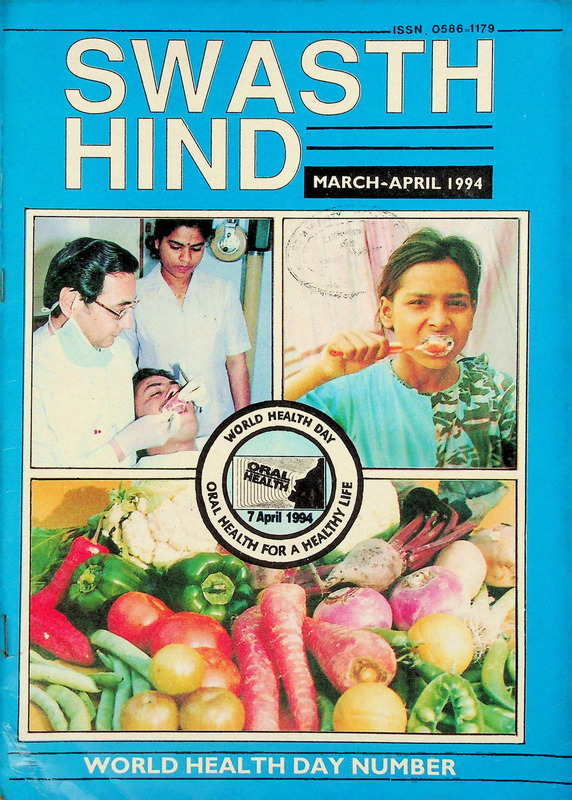
Swasth Hind devotes this issue to the theme of the
World Health Day, 7 April 1994:
ORAL HEALTH FOR A HEALTHY LIFE
Edited by
Assisted by
Cover Design by
M. L. Mehta
M. S. Dhillon
G. B. L. Srivastava
K.S. Shemar
Madan Mohan
Backgrounder -
Soft tissue diseases of the mouth
Dr P.K. Banerji
82
Oral health: dental caries
Lt. Col. Jasdeep Singh
84
Nutrition for dental health
Dr T.S. Reddy
86
Oral health education
Dr Sanjiv Kumar Bhasin
89
Workshop on
preparedness
IEC
strategy
on
disaster
Book Review
91
III
Cover
Articles on health topics are invited for publication in this
Journal.
State Health Directorates are requested to send in reports of
their activities for publication.
The contents of this Journal are freely reproducible.
Due acknowledgement is requested.
The opinions expressed by the contributors are not necessarily
those of the Government of India.
SWASTH HIND, reserves the right to edit the articles sent
for publications.
Editorial and Business Offices
Central Health Education Bureau
(Directorate General of Health Services)
Kotla Marg, New Delhi-110 002
Subscription Rates
This Issue
....
Single Copy
.
...
Annual
....
(Postage Free)
Re. 1.00
50 Paise
Rs. 6.00
ORAL HEALTH IN INDIA
Present status & future strategy
to combat the problem
Dr L.K. Gandhi
While the Oral health is deteriorating in India, the oral health care has continued to be mod
elled on the Western High-tech model. Most people have no access to adequate, affordable
and acceptable oral health care services. This is due to faulty needs assessment and planning
of services. The Western treatment oriented approach is inappropriate and irrelevant for the
Indian situation where the population level is high and resource level low, says the
author.
HILE there is no reliable data
The number of dental personnel
available on oral health
in the country has also steadily
W
situation in India, various sporadic
risen since the 1950 s when the
studies suggest a rising level of den
tal disease in India. The situation
is perhaps similar to that in most
developing countries in the Asia
Pacific Region. The two most pre
valent oral health problems in
India are dental caries and perio
dontal disease. These are follow
ed by malocclusion and oral
cancers.
The dental caries has increased
significantly since the 1940-1950’s.
In 1940-50, dental caries levels were
reported to be 40-50 percent with an
average DMFT of 1.5. In.l980’s,
the point prevalence had risen to
80-90 percent with a point pre
valence of 5 in urban and 4 in rural
areas at the age of 16 years.
The periodontal disease levels
have remained increasingly high
over the years and approach 90-100
percent for some population
groups. Moreover, about 40-50
percent of children have malocclu
sion and about 40% of all cancers
reported in India are oral cancers.
M ARCH-APRIL1994
Dental Council of India (DCI)
reported a dentist: population ratio
of 1 : 80,000. In the 1990’s the
ratio has become more favourable
1 :43,000. However, most dental
surgeons and other dental person
nel are clustered in towns and cities
in the urban areas and the ratios for
rural remote areas remain quite
unfavourable. According to some
studies, there is one dentist for up to
half million people in the rural
areas. In fact, 80% of the dentists
live in urban areas whereas 80% of
the population lives in the rural
areas.
India is a signatory to the Alma
Ata declaration 1978, which defines
Health for All by 2000 AD as the
ultimate goal and which is by now
familiar to all of us in various parts
of the globe. Surprisingly how
ever, while the Indian Government
is fully seized with the formulation
of a national health policy, an
action plan for restructuring oral
health care and a national oral
health policy has not yet been
devised. Little attention has been
given by the health planners to
plan oral health services and care
to meet the goal of providing
optimum oral health care to all by
2000 AD. The reasons are many
but the prime reason is the rela
tively low priority accorded to oral
health in the country and the other
pressing health problems like
population expansion and wides
pread communicable diseases
which attract the attention of both
the Government and the masses.
Against this background, there
have been efforts from the pro
fessional groups and concerned
professionals to urge the Govern
ment to take timely steps to control
the widespread dental diseases in
the country, especially in view of
limited and diminishing allocated
resources available to tackle it In
1984-85, the profession’s concern
was evidenced in the form of a
National Workshop at Bombay to
plan strategies and plans to achieve
Oral Heath for All by 2000 AD.
The Government has recently
shown recognition of the problem
and invited the Indian Dental
Association in 1989-90 to prepare a
61
draft proposal for a national oral
health policy. More recently, the
Dental Council of India has also
responded to the Government’s
invitation to help plan oral health
care. The draft proposals from
these various efforts have one thing
in common. They all recognise
the fallacy of continuing with a
treatment based, high tech app
roach to oral health care in India in
view of the fact that this approach
has shown to be expensive and of
limited value in controlling and
preventing disease even in the wes
tern countries. An alternative
strategy which encourages self care,
prevention and health promotion
needs to be developed, based on the
changing concepts of the need in
relation to WHO’s Primary Health
Care Approach.
Several recommendations, based
on the preventive and promotive
model of health care have been
made to the Government and are
under consideration but the oral
health policy is as yet far from
being finalised and implemented.
Existing oral health services
The existing oral health care is
based on the conventional, high
tech. Western model of treatment
based philosophy.
The dental services are provided
free of cost to everybody who
demands these in hospitals and
health centres. These generally
include extractions and emergency
care, simple fillings, prophylaxis,
etc., but do not include prosthetic
and orthodontic services. The
resources arc woefully inadequate
to be able to cater to the large popu
lation in need and the services arc
utilised only selectively.
Dental Manpower
There is a prevailing myth that
numerical increases in dental man
power will bring down dental
disease and improve oral health.
This philosophy leads to demands
for increases in dental manpower
without considering its long term
62
implications. What will happen
when supply outstrips demand? It
may start leading to unnecessary
and over-treatment and an unethi
cal, keen, cut-throat professional
competition. Moreover, where is
the evidence that increase in num
bers will automatically distribute
the manpower equally and in
places such as slums, rural and
remote areas where the need is the
greatest? We are very much aware
that till date most of them have
been absorbed in major towns
and cities.
Availability of Manpower—Dental
Surgeons
From the data available today
there are 17,154 Dental Surgeons in
the country. These include 14,204
registered Part A and 2,950 regis
tered in Part B. The estimated
population is 850 Million which
gives the ratio to 1 :43,000.
Non-Professional Manpower
More emphasis on Dental
Health Education has to be given
through the Teachers Training Pro
gramme. This would have to be
further elaborated.
There is continuing enthusiasm
about the increase in the number of
dental workers, but in the absence
of proper goals of service and
inadequate funds, what this would
lead to is not very clear.
There is little evidence available
all over the world, that mere
numerical increases in the dental
manpower have significantly con
tributed to improvement in oral
health. And yet, large improve
ments in Oral Health have been
reported from the industrialised
countries.
Barmes and Tala (WHO, 1987)
have firmly reinforced that
"the continuing reduction of dis
ease levels is due mainly to preven
tive action taken by the individuals
and communities rather than to
increased availability of dental
manpower."
This does not, of course, mean
that dental manpower is adequate
or unnecessary. In fact, it tries to
focus on the inappropriate, highly
clinical, restorative training that is
imparted to the dental person
nel. What it means is that the
roles of the dental professionals
have to expand beyond their nor
mal clinical duties, to widen their
horizon
and prepare them in
assisting communities in their own
health care, based on prevention
and health promotion. The den
tal manpower in the 21st century
would be much closer to and work
with the people shedding their
obsession with disease and treat
ment of its consequences.
Conclusions
In India, Oral Health is showing
signs of deteriorating in a vast
majority of people due to increased
consumption of sugar and its pro
ducts and improved socio-econo
mic conditions. While the Oral
Health is deteriorating in India, the
Oral Health care has continued to
be modelled on the Western Hightech model. Most people have no
access to adequate, affordable and
acceptable oral health care ser
vices. This is mainly due to faulty
needs assessment and planning
of services.
The Western treatment oriented
approach is inappropriate and
irrelevant for the Indian situation
where the population level is high
and resource are low.
There is thus urgent need to for
mulate a National Oral Health
Policy which deserves immediate
attention of the Government.
The Oral Health care in India
should be modelled on a preventive
and health promotion approach on
the lines of the Primary Health
Care Approach.
Swasth Hind
The following recommendations
are therefore made to draw the
attention of the Health Planners
in India:
1.
A careful, thorough Situation
Analysis which includes
needs assessment is the
first step towards planning
Oral Health Care in India.
This will help make avail
able the data required for
planning. The Situation
Analysis must include
community participation,
to help people before their
own needs arise, on the
basis of informed decisions
made through discussions
with the profession.
The Situation Analysis
must consider the socio
economic conditions and
aspirations of the people.
2.
Set up an empowered Com
mittee of Professionals,
Administrators and Politi
cians so that effective
strategies can be planned
and actually implemented
based on the Situation
Analysis, both at the Cen
tral and State Levels.
This will help establish.
forecast and monitor Oral
Health needs and deter
mine the nature of services
provided from time to
time.
The emphasis in plan
ning should be based on
NEEDS of the community
rather than on DEMANDS
from influential groups.
March—Aprili 994
Message from DR HIROSHI NAKAJIMA
DIRECTOR-GENERAL OF W.H.O.,
on the occasion of World Health Day 1994
Oral health has made remarkable progress in most developed
countries as a result of prevention programmes which stress the
optimum use of fluorides, oral hygiene and the adoption of healthy
eating habits.
However, the situation is beginning to deteriorate in many
developing countries, where oral diseases are on the increase and
treatment costs are spiralling. Yet oral diseases are not an inevit
able corollary of development. We have the means to prevent this
health and economic disaster: we have to ensure that these means
are implemented for all citizens everywhere.
Action is urgently needed. In the countries that have achieved
sustained improvements, health policies need to be adjusted, staff
have to be trained to deal with the new situation and appropriate ser
vices set up. In particular, care for the elderly should be
strengthened to prevent the oral health problems linked with
age. At the same time, prevention among children and adolescents
must continue.
In the countries where the situation is deteriorating, this trend
must be checked by launching effective prevention campaigns. We
must ensure that the adoption of new life-styles and new eating
habits does not lead to an increase in dental caries in populations
that have always had healthy teeth. We must find ways of incor
porating and encouraging traditional methods of oral hygiene which
have proved their efficacy, and which are inexpensive and
culturally acceptable.
Health, well-being and self-confidence are all boosted by a
healthy and well-cared-for mouth, which facilitates communication
and human relations.
In devoting World Health Day 1994 to oral health, the World Health
Organization is endeavouring to mobilize Member States, the health
professions and the general public, so that greater attention is paid to
this important aspect of public health. Education and the participa
tion of everyone are the keys to progress in oral health, without which
there can be no health for all.
Let us unite our efforts so that the successes already achieved in
the field of oral health can benefit everyone.
63
ORAL HEALTH:
An Overview
DR A. V. PUNEKAR
Dr G. v. jog
Dr A. K. urmil
high proportion of people all
over the world suffer from a
A
variety of oral diseases. Although
not an important cause of mor
tality, these may have sometimes
serious repercussions upon the
general health of the people suffer
ing from such diseases. Oral
health, a natural component of per
sonal hygiene, somehow still
remains neglected within many
population groups/families. Based
on information collected by the
World Health Organisation over a
period of two decades or so, two
distinct trends are observed in the
world—one towards better oral
health and personal, hygiene par
ticularly in industrialized countries
and the other towards a deteriora
tion of oral health in non-industrialized/developing countries due
to lack of oral health promotional
activities. In
countries
like
Sweden, Holland and USA some
dental schools have been closed
during the past 15 years or so due to
a marked reduction in the number
of dentists required, while in many
developing countries, there is still a
gross deficiency in trained man
power required in this field. Non
allocation of enough financial
rcsource-mainly incriminated for
this situation—is due to financial
constraints.
Oral diseases: Present scenario
Dental caries and periodontal
diseases are mainly responsible for
most of the oral health pro
blems. Other diseases include
infcctions/infestations
due
to
various pathogenic agents (bac
teria. viruses, fungi, etc); nutritional
64
Achievement of Oral Health for All by 2000 A.D.
entirely depends upon the people’s awareness
about oral health problems and their prevention,
and also upon improved infrastructure to provide
better oral health care services through adequate
number of trained manpower. All health per
sonnel, besides dentists need to be trained in pre
vention of dental caries, periodontal disease and
oral cancer. It is hightime that we launch a
separate National Programme on Oral Health
making full use of International Collaborative
Oral Health Development Programme already
going on, feels the author.
and metabolic diseases (angular
cheilosis, scurvy, dental fluorosis
etc,); diseases of digestive system
(pre-cancerous lesions); oral can
cers, oral sub-mucous fibrosis
caused due to certain habits (betel
chewing, tobacco chewing, smok
ing, etc.); developmental defects of
dental hard tissues; intrinsic stain
ing of teeth among infants and
children as a side effect of tet
racycline therapy; enamel attrition
(loss of tooth substance due to mas
ticating activity see in persons who
eat very hard and coarse foods/
food with hard particles); abrasion
(loss of tooth substance usually due
to improper tooth brushing, use of
clay, charcoal, etc.); erosion (loss of
tooth substance due to chemical
dissolution, e.g. among workers in
factories where acid acidogenic
compounds are used); traumatic
conditions including fractures of
teeth and jaws, extrinsic staining of
teeth due to various colouring
agents
including
medicines,
tobacco betel, etc., and various
dento-facial anomalies including
hereditary, developmental and
acquired malocclusion or mal
alignment of teeth.
Oral diseases of major concern
Dental caries is a bacterial dis
ease of dental hard tissue which
begins with demineralisation of
outer enamel surface and if not
arrested or treated, the dissolution
of enamel continues into dentine
and pulp with increasing cavitation
and loss of tooth substance. It is
often associated with abcess forma
tion due to secondary infec
tion. Toothache is the common
symptom of this condition. Main
methods suggested for its preven
tion include use of fluorides—
systemically (e.g. use of fluoridated
SWASTH HIND
watcr/salt/fluoride
tablets)
or
locally (e.g. use of fluoridated
toothpaste, fluoride mouth rinses.
etc.).
Periodontal diseases include a
group of inflammatory and
degenerative conditions of soft and
bony tissue supporting the teeth.
These conditions are caused by
those bacteria which are normal
inhabitants of the oral cavity,
under certain conditions. Plaque
formation is an important sign
which leads to gingivitis (inflam
mation of gums which usually
bleed following tooth brushing).
The affected tooth may become
loose and eventually get detached.
Periodontal abcess and periodon
titis are other complications. To
prevent periodontal disease, it is,
therefore, important that a regular
and constant removal of plaque is
carried out mainly by the indi
vidual although professional treat
ment may be required at times.
Proper health education on oral
hygiene is also important example
use of tooth brush in a properway/
chew sticks in a correct way.
As regards precancerous con
ditions (white patch or leucoplakia
on mucous surface, other dispigm'entations, submucous fibrosis
with inability to tolerate spicy food,
stiffness of cheeks/lip, disap
pearance or rough papillary
appearance of tongue, difficulty in
stretching the tongue beyond lips
or in opening the mouth, a chronic
painless ulcer), their early diag
nosis is the most important from
the prognosis point of view.
Symptom free beginning of such a
condition prevents the patient from
seeking early treatment. Periodic
check-up of the mouth, therefore, is
the only solution for early detection
of this condition.
March-April! 994
Dental Health Scenerio India
Bhore Committee (1945) and
Mudaliar Committee (1961) strong
ly advocated expansion of dental
health services in our coun
try. Special attention was paid
during the Fourth Five Year Plan
on their expansion to preserve and
promote the dental health of the
people. The important plans
included provision of dental clinic
at district hospital level and
establishment of school dental
clinics. There were only four den
tal colleges conferring BDS degree
during 1950-51. Their number
increased to 43 during 1988-89 with
total admission capacity of 1664
students. However, the dentist
population ratio of one dentist per
80,000 population during 1988, still
remains
far
from
satisfac
tory.- During 1972, nearly 90% of
our population was found afflicted
with periodontal diseases and over
60% from dental caries. Over 30%
of cancer deaths were attributable
to oral cancer. These conditions
still remain a major cause of our
concern even today. For example.
it is felt that enough attention has
still not been paid to dental health
care of children. Over 90% of our
children suffer from inflammed
gums (gingivitis) which is found
associated with hard calcified
deposits on teeth (tartar/calculus)
requiring removal by dentist/
dental hygienist In many cases
untreated gingivitis progresses to
periodontitis, a chronic destructive
disease of tissues, commonly called
pyorrhoea which causes looseness/
early loss of teeth. A large num
ber also suffers from time to time
from acute infections of gums (necrotising gingivitis) causing painful
ulceration and foul odour. 50%
school children have been- found
suffering from dental caries (tooth
decay) in urban areas. Malocclu
sion or irregular alignment of teeth
is another problem quite common
among them. There is thus a dire
need that besides regular dental
check up under school health pro
gramme, the topic of dental health
care should also be included in the
school curriculum.
Future strategy for improving oral
health
An Expert Committee in 1989
recommended that “Oral health
should be considered as one aspect
of the overall health and welfare of
a society”. Oral health, therefore,
needs to be incorporated into
general health programmes. The
integrated approach has been
regarded more beneficial. For
example periodontal disease due to
poor oral hygiene is related to
general body cleanliness, therefore
its inclusion in the teaching of per
sonal hygiene by parents, teachers
and primary health workers will go
a long way in promoting self care
for better overall health status.
References:—
I.
WHO; Periodontal Disease: Report of an
Expert Committee on Dental Health; TRS
No. 207, 1961.
2.
WHO; Dental Education; Report of an
Expert Committee on Dental Health; TRS
No. 244. 1962.
3.
WHO; Dental Health
Education:
Report of an Expert Committee: TRS No.
449, 1970.
4.
WHO; The Etiology and Prevention of
Dental Caries: Report ofa WHO Scientific
Group: TRS No. 494. 1972.
5.
Punekar AV & Jog GV; Some Facts About
Oral Health; Maharashtra Herald dt. 05
Feb 1993. p 3.
6.
WHO; World Health (Special Issue on
Dental Health), June 1981.
7.
Aubrey Sheiham: Integrating Dental
Care with General Health Care; World
Health, Oct 1988, pp. 28-29.
A
65
Oral Health Problems in
Defence Personnel
—Present Status and
Strategy to Control
Maj. Genl R. K. Khanna
Army Dental Corps pro
vides dental services for
the Army, Navy and Air
Force, in the form of a
highly organised and
well-knit dental care sys
tem not only for the ser
vice personnel and their
families but also ex-serviccmen of the three ser
vices and their depen
dents and for personnel
of Assam Rifles, Border
Roads organisation and
the Coast Guards both in
peace and war. Profes
sional facilities to para
military forces like BSF
and CRPF are also ex
tended in field areas.
66
HE Army Dental Corps was
founded in February 1941 with
grant of commission to eight
Indian Dental Surgeons. In
dependent mobile dental units with
portable equipment were raised
and sent to many theatres of war,
viz.. Middle East, Burma and
Ceylon. Ever since the pattern
has repeated itself specially in the
Indo-Chinese conflict of 1962 and
Indo-Pak flare ups in 1965 and
1971. Officers and men have also
carried out assignments in Korea,
Congo, Muscat and Oman, Indo
China, Gaza, Zambia, Bhutan, Sri
Lanka and Maldives as part of UN
forces. Welfare dental teams visit
Nepal periodically for benefit of exservicemen Gurkhas. From time
to time camps are organised in
remote areas like Ladakh. Naga
land, Manipur and Mizoram to
render free treatment to civil
population.
T
Today the corps consists of 385
officers, 340 Dental Hygienists. 320
Dental Operation Room Assistants
and 113 Dental Technicians. The
officers and ancillary staff is
devoted to total oral health care of
the Armed Forces personnel and
entitled categories.
ORAL HEALTH PROBLEMS
The oral cavity in the principal
pathway through which the body is
exposed to external environ
ment The teeth, the gums sup
porting the teeth and other oral
tissues are subject to certain dis
eases. The most prevalent dental
diseases are Dental Caries and
Periodontal disease.
Dental Caries : Dental Caries is a
progressive disease affecting dental
enamel and dentin and is prevalent
in almost every decalcification of
the tooth structure caused by acids
produced as a result of fermenta
tion of carbohydrates in the food by
the bacteria present in dental pla
ques. This decalcification process
starts in the pits and fissures on the
tooth surface and or other areas
where food debris accumulate and
cannot be cleaned easily. In addi
tion, a different kind of bacteria act
on the organic component of the
teeth resulting in destruction of
tooth substance and cavity for
mation.
Swasth Hind
Periodontal disease : Periodontal
disease is another important dis
ease of structures surrounding the
teeth viz., the gums, periodontal
ligament, and bones which support
the teeth and provides the ancho
rage. The bacterial plaque which
accumulates around the teeth
undergoes calcification and forms
tartar deposits which favours
growth of bacteria. This results in
inflammation of gum tissues. If
left untreated, the condition in
volves deeper tissues resulting in
bone loss and mobility of teeth.
The oral disease problems in
India are no different from other
world populations. Incidence of
dental caries and gum diseases in
the Armed Forces is however lower
than that observed in civil popula
tion but still it is sufficiently high to
warrant prevention and con
trol. The dental diseases are res
ponsible for tooth loss, if treatment
is not carried out in time.
I
Replacement of Missing Teeth : To
preserve oral structures and
improve masticatory efficiency.
early replacement of missing teeth
is carried out. Dental laboratory
facilities required for fabrication of
artificial dentures are available in
peace as well as in field dental
establishments.
Role of Army Dental Corps
The corps provides comprehen
sive dental care to the three ser-
Message from DR UTON M. RAFEI
Regional Director, W.H.O.
South-East Asia Region
on the occasion of
WORLD HEALTH DAY 1994
Of all the diseases prevalent in the world, oral diseases are
perhaps the most widespread. No population is free from caries
and periodontal diseases. And yet, there are perhaps no other
diseases which are so preventable through regular oral hygiene,
optimal use of fluorides and proper nutrition.
While significant progress has been achieved in oral health in
most developed countries following sustained prevention program
mes, the situation in some developing countries is causing concern
as oral diseases are showing an increasing trend. While some dis
eases like oral cancer kill, people with AIDS, tuberculosis, syphilis.
leprosy and herpes also have oral problems and conditions that
require care.
Most Member Countries of WHO's South-East Asia Region are
fortunate that only moderate to low* levels of dental problems are
found in children as compared to children in some developed coun
tries. What is needed urgently, therefore, is to ensure that this situa
tion is further improved through appropriate preventive programmes
launched with and sustained through community support.
As the WHO Director-General. Dr Hiroshi Nakajima, has said; “we
must ensure that the adoption of new lifestyles and new eating habits
does not lead to an increase in dental caries in populations that
always had healthy teeth. We must find ways of incorporating and
encouraging traditional methods of oral hygiene which have proved
their efficacy, and which are inexpensive and culturally
acceptable".
It is hoped that this, year's World Health Day theme will help to
mobilize efforts in strengthening oral health and thereby ensuring a
healthy life for all.
A
Denial Inspection under Progress
March—April1994
vices, be he a soldier in high
altitude or plains of the country, be
he an airman serving in the highest
airfield in the world or an aspiring
astronaut, be he a sailor in an air
craft carrier or submarine. Dental
treatment offered is of a high stan
dard comparable with the most
modern facilities available any
where. Mobile
dental
teams
deliver dental treatment at the
doorsteps of the operationally com
mitted troops whether in the plains
of Punjab or on the dizzy and
67
freezing heights of Siachcn. Thus
the Corps endeavours to fulfil its
commitment to keep the armed for
ces officers and men dentally fit at
all times. As an added respon
sibility dental health care is pro
vided to families and dependents of
serving population and also exservicemen and their families.
STRATEGY
To achieve the above aims, the
following steps are taken :
(a) Propagation of the prin
ciples of dental health
amongst troops by lectures,
demonstrations and by
organising dental health
weeks and thereby arous
ing dental consciousness
and encouraging the prac
tice of preventive den
tistry.
(b)
Carrying
out
regular
annual dental examina
tion of all personnel and
allot treatment priorities.
(c) Rendering specialist treat
ment when require^.
Regular and periodic dental
check ups and graded selection for
treatment depending on the
severity of condition has been the
back-bone of dental health in the
Armed Forces. This is further
augmented by a system of pro
phylactic and interceptive treat
ment designed to reduce the
incidence and severity of dental
disorders. For this purpose a ratio
of one dental officer and one dental
hygienist per 4000 troops has
been authorised.
The teeth in the oral cavity have
many functions. Apart from the
masticatory function, teeth help in
speech and aesthetics. After loss
of teeth these functions are
impaired. Periodic annual dental
inspections enable early recogni
tion of oral and dental diseases and
68
Orthodontic Treatment with Straight Wire Appliance
Patient Undergoing Periodontal Surgery
prompt treatment saves the patient
from many health hazards. By
critical observation and careful
questioning the dental officer is
also able to recognize nutritional
deficiencies and diseases of
metabolism. He plays an impor
tant role in early detection and
treatment of oral cancer and precancerous conditions of the
mouth.
Dental Health Education
Dental Health Education is
regularly imparted to troops with
the help of visual aids, and
demonstrations. Knowledge on
prevention of dental diseases is
given in simple language to person
nel at the time of annual dental
examination and also when they
report for treatment. As both
dental caries as well as periodontal
diseases—are caused by bacterial
plaques on teeth, lot of stress is laid
on the importance of proper and
adequate tooth brushing, mouth
rinsing followed by other oral
hygiene procedures. In dental
health education, effort in impart
ing education is not lacking but at
times the level of understanding
seems wanting especially among
the recruits. There is a need for
better and result oriented approach
to educate this category for better
motivation. Younger age group is
more prone to dental diseases
mainly due to lack of dental con
sciousness before recruitment into
Armed Forces.
(Contd. on Page 73)
SWASTH HIND
TOWARDS A BETTER
ORAL HEALTH FUTURE
he enormous change in oral health in indus
countries is
T
cess stories of this
trialized
□
□
one of the major health suc
century:
from a situation where every child had experien
ced toothache, most adults of 30 had nearly every
tooth affected by caries and many had no
teeth at all;
to a situation where whole groups of children are
totally free of oral disease, some adults of over 30
have no caries and no fillings, and where people
now expect to be able to keep their teeth till the
end of their life.
Even the association of dentistry with pain and fre
quent repair is changing to one where oral care is seen
as a preventive service that maintains health and con
tributes to good looks and quality of life.
Compare your memories of sitting in an upright
chair—the dentist standing bent over you—the
painful extractions—the vibrating, noisy, slow
drill—with:
Lying relaxed in a comfortable patient chairbed—the dentist seated behind your head—a
concerned and effective assistant—the high
speed drill—the ultra sonic scaler—modem drug
therapy and pain control—diagnosis assisted by
effective technology,—almost invisible fillings—
more realistic teeth replacements—implants that
nearly reproduce the real tooth or teeth. Now
computer assisted design of crowns and bridges,
and laser surgery techniques are being added to
the scene.
Wc must salute—engineers, researchers, manufac
turers, pharmacologists, dentists and their teachers
for their ingenuity and dedication in applying skills
and knowledge to create this better experience of
oral care.
In spite of the dramatic change however, there is still
need for repair and replacement treatment—a recent
report from the United States of America, showed that
at age 40, people may have as many as 30 tooth sur
faces that have been affected by decay and 40% of peo
ple aged over 65 have no teeth at all. Furthermore,
underprivileged groups—the handicapped, the poor,
ethnic minorities—suffer more oral diseases than the
rest of the population....
How has this come about? What has happened in the
industrialized countries?
How do these success stories match with experiences in
developing countries?
Community water fluoridation was the first major
factor in the dramatic reduction of caries, in those
countries which implemented the measure. Other
measures such as salt and milk fluoridation have had
similar effects. Now. the almost universal use of
fluoridated toothpastes throughout life is showing
similar good results. It is a fact that oral hygiene is
seen as a natural part of total body cleanliness and that
people desire a fresh and healthy mouth and good
smelling breath.
In these countries we find a more varied pic
ture. Fortunately in many countries oral health is
still very good—people don’t get many decaying teeth.
may be only 5 or 6 in their whole lifetime; and even in
old age they keep their teeth. However in some of
these countries oral diseases are increasing: these
increases are related to the rapid changes in dietary
habits, particularly on migration to large cities. Pain
and loss of teeth are much more common. In these
communities, in addition to the common oral pro
blems of dental caries and gum diseases, there are
other serious oral diseases that threaten people’s lives
and welfare.
Adoption of fluoridated toothpastes and regular oral
hygiene are part of life-style changes propagated by
industry through advertising on television, radio,
cinema and in magazines. In this way the industry has
been a very powerful force reinforcing dentists’ preven
tive-messages for oral health.
While prevention has boomed, care techniques have
also changed beyond recognition!
March—AprilI 994
2—l/DGHS/ND/94
□
Oral cancer is one of the mpst common cancers in
the Indian sub-continent. It is also a cancer with
a high mortality when undetected at a very
early stage.
69
LI
1.1
2.
The AIDS epidemic has resulted in many patients
suffering from oral fungal infections, destructive
oral ulcers and untreatable oral cancers: most will
not receive even simple palliative care.
Demonstration of the new techniques for basic.
health-promoting, economically feasible oral
treatment to the public, administrators and oral
care personnel.
3.
Preparation of learning materials—posters.
videos, computer-assisted learning packages.
manuals, guides to support these changes.
Only people who live in major cities can get reason
able treatment for oral problems. Most rural and
many poor urban communities have almost no access
io even basic emergency care and relief of pain. For
loo many people dentistry is still “pain and pay”.
In some countries, the demand for care has
increased so much that governments arc trying to
establish dental schools and in this way provide oral
care services to more of the population. However,
there arc rarely enough teachers or funds to support
this type of development: and for almost all com
munities these resources are needed for solving other
problems. Further, traditional dentistry uses equip
ment that depends on electricity and clean, pres
surized water—services not available to most com
munities in developing countries. So the services that
result from such investments do not in fact provide
better treatment for the vast majority of the public.
And focusing on providing treatment without a strong
preventive programme will never solve the major pro
blems. as has been experienced by industrialized
countries.
However, a total rethink of oral care possibilities is
now in progress. Community preventive methods.
new techniques of training—new design of equip
ment—basic sets of instruments—new modern
materials—are being combined to bring health—
promoting oral care to even the poorest commu
nity.
The Role of WHO
WHO's programme is focusing on 6 areas:
1.
70
gains already made thus allowing the world to
suffer another dental caries pandemic.
Cancrum oris, a destructive type of gangrene, des
troys the faces and jaws of thousands of under
nourished and ill children and babies in countries
where there is famine, mainly in Africa. For
most of these children there is no care and no
hope.
Ensuring that essential preventive activities arc
maintained—so that we don’t throw away the
4. Preparation of well designed technology for the
new care—basic materials instruments and
drugs.
5.
Building a support network to assist com
munities to care for and repair children maimed
by destructive diseases like noma: at the same
time leading a campaign, based on improved
nutrition and basic child care, to prevent such
illnesses.
6.
Bringing about a radical change in education of
oral health care professionals.
Where should oral health be at the end of the
Century?
Governments and communities should have
recognized the need to develop and maintain preven
tive programmes for oral diseases—and communities
will take responsibility for these activities.
All communities should be able to afford and
manage basic health promoting oral care so that adult
teeth will be retained throughout life.
Early care should be available for oral cancer
patients everywhere as well as for those suffering from
other disfiguring, maiming oral diseases.
Changes in the training of oral health care person
nel should ensure that dentists evolve into the role of
oral physicians, providing guidance on life-style and
hygiene, as part of maintaining health in general and
oral health in particular. They should provide spe
cial care for the full range of oral problems.
Oral health for life should be getting very close to a
reality for all.
Swastii Hind
ORAL DISEASES :
Prevention is better than cure
Oral diseases such as caries and
periodontal disease (infections of the
gums and of the tooth support tissues)
arc among the most widespread dis
eases in the world. They affect all
populations to varying degrees.
Dental caries in the world :
a situation of contrasts
he index for measuring the extent to which a
Tpopulation in
is affected by caries is the mean
DMFT, which
a group of individuals counts the
average number of teeth that arc Decayed, Missing
(on account of caries) and Filled. It is a simple,
rapid and universally applicable measurement that
has been widely used for several decades.
Wc have drawn up a scale for severity of involvc-ment at various key ages : 12, 35-44, 65 and over.
WHO has compiled a world map of caries at age
12. In 1969 the overall picture showed sharp con
trasts : the DMFT was very high, high or at least
moderate (between 2.7 and 4.4) in the industrialized
countries, whereas it was generally very low, low and
occasionally
moderate
in
the
developing
countries.
Over the next two decades there was a downward
movement and sometimes a spectacular fall in the
prevalence of caries in virtually all the
industrialized countries.
In the developing countries the general trend is for
caries prevalence to increase, except where prevention
programmes have been set up.
Every year since 1980 the WHO Oral Health Unit
has calculated the mean global DMFT at age 12,
weighted for population. The resulting graphs dis
play the trends in dental caries in the industrialized
countries, in the developing countries and for man
kind as a whole.
At age 12 the 5 level scale varies from 0.0 to 6.6 or
more: a DMFT between 0.0 and 1.1 is considered
very low, a figure of 6.6 or more is very high, while a
moderate DMFT is between 2.7 and 4.4 decayed.
Any country undertaking an analysis of its oral
health situation can compare the results with WHO’s
worldwide objective : by the year 2000 no more than
three decayed, missing and filled teeth at age 12. By
repeating the analysis al regular intervals (WHO
recommends an evaluation every five years) it is
possible to monitor the trend in caries prevalence, to
estimate the needs for care and prevention and to
adjust personnel training and services accor
dingly. It should be pointed out that the simplified
oral health survey method developed by WHO is reli
able. very inexpensive, can be used anywhere and
provides comparable data both in the richest coun
tries and in the poorest.
WHO’s Oral Health Unit provides technical sup
port for epidemiological surveys and processes coun
try data free of charge on request.
The trend in the mean since 1980 justifies
measured optimism for the next 10 years, although
the situation is still delicate in as much as a small
increase in very highly populated countries is all that
is needed to take the mean above 3.
The information collected is stored in the Global
Oral Data Bank (GODB) system in the catalogue of
United Nations data banks, whereby it is possible to
follow the worldwide trend. Every year since 1969.
What is the explanation for the spectacular drop in
caries prevalence in some countries? How can it be
prevented from rising again? How can the worsen
ing of the situation in other countries be halted?
March—April1994
71
The reply to these three questions is one and the
same: prevention, more prevention and still more
prevention.
In the industrialized countries the promotion of
oral hygiene, the widespread use of fluoride toothpas
tes, the introduction of fluoride into drinking-water
or salt in some countries, advice on nutrition (no
sweets between meals, etc.) are the factors behind an
unprecedented public health success story!
Wherever community prevention programmes are
set up, caries stop advancing. For example, this has
happened in Bulgaria, French Polynesia and
Thailand. Apart from the fluoridation of water, salt
and milk, which requires more advanced technology
and supervised central administration, all the
methods of oral hygiene make use of simple techni
ques, cost little and are perfectly suited to implemen
tation at primary health care level.
As a result of the progress made in the last 25
years, the developing countries now have the
knowledge and means of prevention that will enable
them to avoid the problems the industrialized coun
tries have had to face, and indeed still are facing, at a
very high price!
In most industrialized countries the oral health
services still absorb between 5% and 11% of the
national health budget.
There is no reason at all to continue devoting sub
stantial resources to treating a condition that can be
prevented by simple, varied and inexpensive
measures. But there needs to be the political will to
give priority to prevention.
What about the “periodontal diseases”?
by a joint working group from WHO and the FDI
(International Dental Federation).
This index records the periodontal diseases in
terms of four clinical signs:
1.
Bleeding from the gum
2.
Presence of calcules
3.
Presence of shallow periodontal pockets
4. Presence of deep periodontal pockets.
A “periodontal pocket” is considered to be present
when the gum, under the effect of inflammation and/
or infection, retracts, forms a pocket and no longer
adheres to the tooth. The ligaments become
impaired and the tooth becomes increasingly
loose.
To measure periodontal status, the mouth is
divided into six parts or sextants. A specially
designed probe is used to test the condition (1, 2, 3 or
4) of the gum around the tooth selected as the index
tooth for each sextant
Towards the end of the 1960s most dental
epidemiologists shared the view that periodontal dis
eases, unlike caries, were more common in the
developing countries than in the industrialized coun
tries. However, the available data were very
fragmentary and difficult or impossible to compare
since there were no fewer than five different indices
in common use. This plethora of methods was com
pounded by the difficulty of collecting data from
adults, a problem that is less serious in the case of
caries, where the key age is 12 years.
If several clinical signs are present simultaneously,
the most severe is selected.
With the definition of a periodontal index which
very quickly achieved wide international acceptance,
the epidemiology of periodontal diseases has made
great strides. The CPITN (Community Periodontal
Index of Treatment Needs) was proposed by a WHO
scientific group and recommended in the early 1980s
The data show that the percentage of people who
have deep pockets and the mean number of sextants
per person also displaying deep pockets are low to
very low. This means that the severe forms of
periodontal disease, those requiring complicated sur
gery, are far from common.
72
WHO has compiled data on over 100 surveys car
ried out in the age group 35-44 years. These data
should be treated with caution, since very few of
them provide a national estimate. Nevertheless,
they are of great interest because they consistently
show a similar pattern of frequency and severity of
involvement which challenges some generally accep
ted ideas about the distribution and the etiological
process of periodontal disease.
Swasth Hind
Moreover, there seems to be no difference in fre
quency between industrialized countries and
developing countries for the severe forms of periodon
tal disease.
On the other hand, the initial forms (bleeding and
calculus) are much more prevalent in the
developing countries.
In the light of these data it may be stated that
generalized periodontal destruction is rare in 40-yearold adults. Some people show some signs of such
destruction, but only a limited part of their dentition
is affected. It seems that the initial forms (bleeding
and calculus) do not1 necessarily lead on to the
advanced stages of the disease, except in certain
minority groups.
How can these diseases be prevented?
After a few days of careful cleaning of the teeth, the
bleeding stops in the vast majority of cases and the
inflammation, the cause of much discomfort, also
regresses.
Points to remember
No population is free from oral diseases such
as caries and periodontal diseases, which are
among the world's most widespread.
The methods and techniques of prevention are
widely known: hygiene, optimal use of
fluorides, nutritional advice. Wherever these
methods
are
practised,
success
is
guaranteed.
Whether caries or periodontal disease is the
problem, regular brushing or other cleaning of
the teeth is the first requirement for good
oral health.
There are various possible prevention policies:
hygiene for the most common and least serious
forms; development of products that act against the
destructive types of periodontitis. A whole field of
research to protect the risk groups is opening
up.
(Contd. from Page 68)
Today all major types of
specialist equipment is avail able to
cater for oral surgery, prostheses,
pcriodentics,
orthodontia. To
meet the growing demands for
advanced technical training of
officers, postgraduate courses lead
ing to MDS are conducted at
Armed Forces Medical College
(AFMC) Pune. Officers are also
sent on study leave to encourage
young dental officers to specialise.
Moreover, to attract dental sur
geons with postgraduate qualifi
cations, direct permanent com
mission is offered to these can
didates. During hostilities against
China and Pakistan, services of
these specialists proved invaluable
in successfully managing war
casualties involving facial and jaw
bone injuries including recon
struction.
Courses of instructions and
training for para-dental ancillary
staff arc also conducted at AFMC
Pune and larger establishments of
the Army, Navy and Airforce to
March—April 1994
augment the dental officer task
force.
Modernisation of Dental
Equipment
Dental treatment delivery has
become highly equipment and
material oriented. Technological
advancement in the past two
decades has reduced tooth mor
tality to a very large extent
Armed Forces Dental Services are
in the forefront of the modernisa
tion programme of the dental
equipment which is ongoing and
continuous process. This objec
tive is being achieved with the
understanding and generous con
tributions of the administrative
authorities. Today state-of-the art
armamentarian specific to all dis
ciplines of dentistry is available in
all the larger dental establish
ments.
RESEARCH
An outstanding activity of the
Army Dental Corps is in the field of
dental research. There are nu
merous clinically oriented projects
which have helped improve the
treatment modalities and reduce
chairside working time.
The Army Dental Corps has
evolved itself into the present form
of a well established, smoothly
functioning efficient service based
on modem progressive scientific
and technological principles. An
organised comprehensive and con
tinuous scheme of dental cover has
thus become available to the ser
vice personnel throughout their
service and even after retire
ment From simple extractions
and fillings in the early days, the
scope of dental treatment has en
larged to encompass recon
structive surgery, crown and bridge
work of high precision, implanto
logy, periodontal surgery and
orthodontic treatment which is of a
high standard. This has only
been possible by periodic review of
requirements of manpower and
equipment and critical analysis of
statistical data to make an
endeavour for complete control
over dental diseases in the Armed
Forces. Our fond hope is to
achieve Dental health for all in the
services by 2000 AD.
73
ORAL HEALTH FOR ALL THROUGH
ALTERNATIVE ORAL HEALTH CARE
SYSTEMS
HE prevention and control of dental caries in
industrialized countries have been due mainly to
T
use of fluorides in many different ways and to the
widespread
habits.
adoption
of effective oral
hygiene
In spite of these successes the disease is not con
quered in all communities. It might still be called a
neglected epidemic in under-privileged and lowincome groups.
There arc many high risk populations in
the USA:
□
97% of the homeless need oral care, black
children have 65% more untreated decay
than the average citizen, low income 91%
and American Natives 265%.
□
more than 50% of the housebound elderly
have not seen a dentist for 10 years.
Traditional systems for oral care are based on
various combinations of public salaried services and
private practice. The public services are usually res
ponsible for prevention, care of school children and
disadvantaged groups; and private practitioners pro
vide a wide range of treatment to the general
public. All these systems are oriented in such a way
that the dentist provides most of the care.
In the USA:
□
□
84% of 17 year olds have had tooth decay
and an average of 11 tooth surfaces are
damaged.
people aged 40 to 44 have an average of 30
tooth surfaces affected by decay.
□ 41% of people aged 65 or over have no teeth
at all.
In developing countries, the level of dental caries
was rarely as high as in industrialized countries and,
in some, successful preventive activities have been
implemented. However, in many there is still the
threat of increasing caries related to changing diet
and lifestyles.
74
Common oral diseases in
developing countries
The burden of demand for treatment only of
severe caries or periodontal disease can be “gestimated”. In about one third of these popu
lations, about 1350 million people will require
pain relief treatment (extractions) 3 times in
their lives. About two-thirds or 2400 million
people will need 5 or more extractions.
However, in many communities these systems do
not meet even the basic needs of the public. Most
public services have only very low coverage; com
munities in low-income rural and urban areas cannot
afford private oral care. Further, developing coun
tries cannot afford to establish, staff and run educa
tion facilities for dentists; or hope to provide
adequate employment opportunities for dentists
trained abroad.
In all countries economic restraints, changes in
demand for oral health care, political pressures to
extend services to under-privileged groups, concern
about quality, costs and effectiveness of care demand
that alternative ways of organising oral health and
care are examined and implemented.
Cost and lack of access for under-privileged
and low-income groups constrain all oral health
care systems.
What actions can be taken to combat this
neglect, break.down the barriers of cost and improve
access to oral health and care ? Alternative oral care
systems need to be developed so that a maximum
number of people can have access to and can afford
oral health and care.
Several recent advances give great scope for the
transformation of the delivery and quality of oral
care.
These are:
□ new educational technplogies that make
learning—both knowledge and skills—simpler
and faster for all types of personnel;
(Contd. on Page 79)
Swasth Hind
BACKGROUNDER
World Health Day—7 April 1994
“ORAL HEALTH FOR A HEALTHY LIFE”
M.S. DHILLON
The seventh of April each year is
observed as the World Health Day,
since it marks the date in 1948 when
member countries had ratified the
constitution of the World Health
Organization (W.H.O.) to bring it into
force. Ever since 1950, a theme
related to international public health
has been chosen for the World Health
Day, with an appropriate slogan.
The prevalence of oral diseases the world over has
prompted health authorities to focus attention on this
universal problem. Concerned with the urgent need
for action in promoting sound oral health and preven
tion of dental caries and periodontal diseases, World
Health Organisation (W.H.O.) has included oral
health as a specific programme under health protec
tion and promotion. It has now dedicated the World
Health Day-1994 to oral health and the slogan selected
for the Day is “Oral Health for a Healthy Life.”
The Objective of the Day
The objective is to mobilise the dental profession
the world over to celebrate a year of Oral Health
interlinked with the World Health Day—7 April,
1994.
The governments and communities should be
able to recognise the need to develop and maintain
preventive programmes for oral diseases by the end of
this century and the responsibility for implementing
these activities should be that of the communities.
All communities should be able to afford and
manage basic health promoting oral care so that adult
teeth are retained throughout life.
March—AprilI 994
Early care should be available for oral cancer
patients everywhere as well as for those suffering from
other disfiguring, maiming oral diseases.
Oral health care personnel should ensure that
dentists evolve into the role of oral physicians, provid
ing guidance on lifestyle and hygiene, as part of main
taining health in general and oral health in
particular. They should be able to provide special
care for all oral problems.
By the year 2000, oral health for life should get
very close to a reality for All.
Magnitude of the Problem
Oral diseases such as dental caries and periodon
tal diseases (infections of the gums and of the tooth
supporting tissues) are among the most widespread
diseases in the world. They affect all populations to
varying degrees.
Since 1980 the WHO Oral Health Unit has
calculated the mean global DM FT (Decayed, Missing
and Filled Teeth) at the age of 12 years, weighted for
population. The trend of DMFT in developed coun
tries was between 4.5 and 6.5 in 1980 (cosidcred to be
high); it has come down to between 2.7 and 4.4 in 1991
(a moderate level). Similarly, the DMFT for all coun
tries is just below 3 (a low level).
This shows that there are positive signs for dec
reasing trend in dental caries prevalence in the
world. But the situation is still delicate in
developing countries.
Oral Health and Developing Countries
Developing countries are today in the grip of oral
diseases. The increase in incidence is related to the
rapid change in dietary habits. Use of tobacco in
various forms is one of the factors in increasing the
incidence of oral cancer. In addition to the common
problems of dental caries and periodontal diseases,
75
there are other oral diseases that threaten people’s lives
and welfare. Oral cancer is the most common cancer
in the Indian Sub-Continent which is associated with a
high mortality disability.
Treatment for oral problems is only available in
major cities. Most rural and many poor urban com
munities have almost no access to even basic
emergency oral care. For too many people dentistry
is still “Pain and pay."
This year's theme is specially significant with
regard to India, since the consciousness about oral
health in our people, in general, is very low. The
incidence of oral diseases is very high in all age-groups
and particularly among children. The problem of
dental caries has been on the increase during the last
four decades both in terms of prevalence and
severity. The index for measuring the extent to which
a population is affected by caries is the mean DMFT,
which in a group of individuals counts the average
number of teeth that are Decayed, Missing (on account
of caries) and Filled. It is simple, .rapid and univer
sally applicable measurement that has been widely
used for several decades.
Dental caries prevalence in India was as low as 37
percent in 1940s with 1.5 permanent decayed teeth per
child on an average. Presently, the prevalence rate of
dental caries is above 80 percent with five decayed
teeth per child (on an average at the age of 16
years). Child population in India constitute about
40% of total population. This means that of the 338
million child population, 270 million children are
suffering from dental caries.
What is Oral Health?
Oral health is concerned with functional
efficiency of not only the teeth and supporting struc
tures but also for the surrounding parts of oral cavity*
and of the various structures related to mastication
and the maxillo-facial complex. The mouth is most
versatile of human organs. The food needed by the
body for life processes enters through it The first
stage of digestion (mastication and grinding of food)
is in the oral cavity by the tongue and teeth, the taste
buds help in tasting the food and the salivary secre
tion is added in the mouth. The articulation of
speech, our main means of communication, comes
from it Its size and shape, especially the contours
of the lips, strongly affect one's personal appearan
ce. Thus it is clear that the mouth and its principal
components—the teeth, the tongue and the gums
should receive the best of care. What is required is
that good dental health habits be established in early
life and be consistently maintained. It is a fact that
76
oral and general health are inseparable since oral
disease may be a manifestation of or an aggravating
factor in some more widespread systemic disor
ders. Hence improving oral health is much more
significant for safeguarding general health.
Oral Health—Targets for 2000 A.D.
World Health Organization has formulated oral
health objectives in the context of Health for All by
the year 2000, after reviewing the available informa
tion considering the time available and the realities
of achieving changes in the oral health status of
populations. The targets thus indentified are :
Age
(in years)
5-6
12
18
35-44
65+
Targets
50% should be free from dental
caries.
Three or fewer decayed, missing or
filled teeth.
85% should retain all their teeth.
50% reduction in number of persons
with no teeth (75% with 20 teeth).
25% reduction in number of persons
with no teeth (50% with 20 teeth)
Dental Health Care in India
The dentist-population ratio in India is
1 :43,000. Majority of these professionals arc located
in the urban areas, whereas majority of our people
reside in rural areas and urban slums. The majority
of our rural people are illitrate, economically back
ward and ignorant about the simple rules of dental
and general hygiene. Despite the increase in the
number of Dental Colleges in India, it has not been
possible to narrow the gap in the Dentist-Population
ratio during the last 20 years. Moreover, mere
increase in the number of dentists in an area may not
be able to bring down the prevalence and severity of
dental diseases. It is only with the implementation
of organised ’preventive measures and educational
intervention strategies that there could be reduction
in dental caries and other dental problems.
Another problem regarding dental care in India
is that such a care is at the lowest of the priorities for
our people. Early symptoms of oral diseases arc
often unnoticed since these are considered to be of
low significance. The chronic, recurrent, irrevers
ible, cumulative and general prevalence of oral dis
eases have contributed to the wrong belief that oral
problems are inevitable and are not preventable.
Swasth Hind
Oral Health Problems Prevalent in India
The three most important oral diseases prevalent
in India are:
3.
1. Dental caries, 2. Periodontal Diseases, and
Oral Cancer.
1. Dental Caries
The prevalence of dental caries has shown an
alarming increase in India during the last four
decades. And the problem has become acute in
view of the shortage of dental care services, especially
in rural India.
Dental caries are the result of decay of teeth that
destroys the hard tissues of the teeth and may cause
pain, infection, disfigurement and other pro
blems. It results from interaction between three
factors—bacteria, diet and host susceptibility. For
mation of dental plaque is followed by production of
acid by the bacteria through fermentation of ingested
carbohydrates, especially sugar. The damage to the
tooth requires treatment by a doctor/dentist.
FACTORS THAT MAY LEAD TO DENTAL CAR
IES: The most important factor in causation of den
tal caries is sucrose. Sweets are favourites of Indian
people. No festival is complete without sweets since
these are considered auspicious and are exchanged
on celebrations and on festive occasions. Drinks
with lot of sugar such as shikvanji (made with lemon,
sugar and water), Sharbat, milk, etc. are widely
drunk. Candies, chewing gums, cough lozenges also
have a deleterious effect on the teeth. A decrease in
salivary secretions due to increased intake of tablets
like propranalol and diazepam increases the hazard
of caries.
Very low level of fluoride in drinking water may
also cause dental caries. A fluoride level of 0.7 to 1.2
PPM is required in drinking water for prevention of
dental caries. On the other hand, higher concen
trations of fluoride in drinking water lead to develop
ment of dental and skeletal fluorosis.
2. Periodontal Diseases
The term periodontal diseases refers to any dis
ease peculiar to the periodontium or the parts thereof
and covers advanced gum disease affecting gums and
support jawbone. The most common diseases of
this kind are gingivitis or inflammation of the gums.
periodontitis, and periodontosis. The two latter con
ditions are commonly called pyorrhoea.
In gingivitis the gums are red, swollen, and ten
der and bleed easily. The cause is usually poor
mouth hygiene habits which permit calculus (tar)
and food particles to accumulate on the teeth and
irritate the surrounding soft tissues. If gingivitis is
not corrected, it may develop into periodontitis. In
MARCH—APRIL1994
this condition the gums become badly inflamed and
lender and they draw away from the neck of the teeth
forming pockets which become inflamed. As the
condition becomes worse, the bone supporting the
teeth is destroyed and the teeth become loose. Un
less this condition is treated and checked in time by
the dentist, the teeth eventually fall.
Adults sometimes may also be affected by
another type of periodontal disease called periodon
tosis. In this condition, even though the mouth is
kept clean the bone supporting the teeth slowly was
tes away. The nutritional imbalance seems to
associated with such a disorder.
CLINICAL SIGNS OF PERIODONTAL DIS
EASES: There are four clinical signs of perio
dontal diseases:
1. Bleeding from the gum, 2. Presence of
calculus (tar), 3. Presence of shallow periodontal
pockets, and 4. Presence of deep periodontal
pockets.
A ‘Periodontal pocket’ is considered to be pre
sent when the inflamed gum retracts and tooth
becomes increasingly loose.
Prevention
Diseases
from
Dental
* Use of sweets
discouraged.
Caries
and
and
candies
Periodontal
should
be
* Follow and promote the oral hygiene practices
(such as rinsing of mouth with plain water after each
meal and regular brushing of teeth particularly
before going to bed at night and after rising in
the morning).
* It is better to use paste in preference to powder
with the tooth brush. Those who cannot afford
tooth brush can use ‘datum’ (chow-stick).
* Massage gums and teeth with your finger.
* Get your teeth checked periodically for early
detection and treatment of dental disorders.
* Calculus (tartar) be got removed only by a
dental hygienist.
* Fluoridation of public water supplies in con
centrations between 0.7 to 1.2 PPM fluoride reduces
dental caries by 50-65 percent.
* Where drinking water has a very high fluoride
content, defluoridation should be carried out to bring
the fluoride content to the desired level.
3. Oral Cancer
Oral cancer is the most common cancer in India.
and the cancer of the tongue, mouth and pharynx arc
the commonest cancers among oral health pro
blems. The National Cancer Registry Project data
77
show that in many parts of the country oral cancer
has the largest incidence amounting to 38% of the
total cancers. The specific cause or causes of cancer
are not known. But oral cancer may be related to
chronic irritation from decayed teeth, imperfectly fit
ting dental appliances, chronic infections, continuous
exposure to toxic substances such as tobacco (smok
ing, chewing, reverse smoking), betel chewing etc.
In India, it is estimated that at present 70% of
men and 20% of women use tobacco in one form or
the other. Of these, percentage of women tobacco
users varies rather considerably in different parts of
the country.
USE OF TOBACCO IN INDIA : Tobacco is com
monly used in the form of smoking; and also
by chewing and rubbing in the oral cavity
(smokeless).
Tobacco is used in different ways i.e., cigarettes,
bidis; hooka; Chillum; clay pipe; chutta, dhumti
being local made cheroot and bidis.
Smokeless tobacco used in India is in the form
of pan or betel quid with tobacco: tobacco and lime;
snuff and Nass; tobacco Mishri; Gudakha (pan
masalas); tooth paste containing tobacco, etc.
There is strong evidence about the fact that
tobacco use in different ways is possibly responsible
for oral cancer. It has also been observed that the
earlier the individual starts using tobacco, the more
are his/her chances of getting oral cancer.
Moreover, tobacco usage
beyond oral cancer.
has ramifications
TOBACCO IS ADDICTIVE: Tobacco use in any
form is addictive and habit forming. Tobacco con
tains nicotine and it has proved to be one of the
powerful habit forming substance in scientific
investigations.
MISCONCEPTIONS : There are certain miscon
ceptions. wrong beliefs and myths in the com
munities on use of tobacco, for example:
Prevention of Oral Cancer
* Do not use tobacco in any form (smoking,
chewing or rubbing.)
* Betel leaf and nuts should not be used.
* Irritation from sharp teeth, broken teeth, illfitting dentures, etc, should be brought to the notice
of a dentist and got treated.
* Periodical screening should be done for early
detection of oral cancer.
NOMA—A little known Public Health Problem
On the eve of the World Health Day—1994, the
World Health Organization (W.H.O.) has made a
solemn appeal to everyone—doctors, public health
leaders at all levels, public and private sectors, jour
nalists to support the international programme for
Noma control in all possible ways.
WHAT ACTUALLY IS NOMA? Noma is an illness
which gradually destroys whole areas of the face,
attacking the young ones particularly the
malnourished children. It starts as ulcer in the
mouth and spreads on to the cheeks, chin, palate,
nose and virtually whole of the oral cavity and sur
rounding tissues often leaving a gaping hole in the
face, eating away the bones of the eye socket and the
jaw. At this stage of the disease death is usually
because of septicaemia. Those who survive live with
facial mutilation, speech defects and chewing
difficulties.
The disease attacks children, under six years of
age, with a peak incidence of 3 and 4 years of
age. Weaning period is regarded as more vulnerable
to infection.
The disease attacks more on malnourished
children and in most of the cases it is followed by
infection (parasitic disease, most commonly measles/
scarlet fever/chickenpox and occasionally, malarial
attack). The nutritional deficiencies observed are
protein deficiencies, iron deficiency, anaemia and
vitamin deficiencies.
2. Hooka is considered safe because smoke is
filtered through water. It is not so because carbon
monoxide is not absorbed in water.
PREVENTION AND CONTROL: It is possible to
prevent, cure, treat and repair the sequelae of
NOMA. The -repair is lengthy, difficult and painful
process and is so expensive that a very few can afford
it. Hence there is an urgent need for each country to
set up a “NOMA control programme”, giving priority
to its early detection and treatment
3. Tobacco and tobacco products are used as
medicine in many parts of our country. People
chew tobacco for relief of toothache; smoke cigarettes
or bidis to get relief from gastric problems. People
may not be aware of the fact that tobacco use in any
form is addictive and habit forming and lead to dif
ferent forms of cancers in the body.
Bad Breath: Another Common Problem
Unpleasant breath, known as halitosis, is as a
result of disease in the mouth, neglect of general oral
hygiene or it may also be due to some infection of the
nose, throat lungs or it may originate in the
stomach.
1. Many people believe that bidi is less harmful
to Cigarette smoking. It is a wrong belief since bidi
smoking is more harmful than cigarette smoking.
78
SWASTH HIND
In case the mouth is healthy and clean, the teeth
being in good condition and bad breath still persists
one should consult a physician. Indigestion, lung
cancer, lung infections, diabetes, and other con
ditions may cause unpleasant breath. Only a physi
cian can manage such ailments.
Mouthwashes, as are being advertised, can do
nothing more than camouflage an unpleasant breath
for a limited period. The only sure remedy is to find
and remove the underlying cause. It is apparent
that if the cause is elsewhere than in the mouth, no
mouthwash can be expected to do anything. Clean
and safe drinking water is just as effective for rinsing
the mouth to clear it of loose food particles or solu
ble substances.
Remember
* Not to use teeth for opening Soda Water
Bottlcs/Brcaking Nuts, etc.
* Dental diseases are painless initially.
wait for the pain to come.
Do not
*Signs of periodontal diseases are bleeding from
the gums, oozing pus, foul smell from the mouth,
teeth drifting and loose teeth. This is also known as
pyorrhoea. Do not wait for them to come and over
take you. You may loose your teeth too early.
* Any patch inside the mouth is a danger signal
of prc-cancerous lesion/leukoplakia and oral sub
mucous fibrosis and these may be caused by arecanut chewing.
Hence regular dental check up is very impor
tant. In case of any problem proper medical/dental
checkup and guidance should be sought imme
diately.
Some more Information on Oral Health
* Healthy teeth are those when every tooth in
the jaw is clean and strong and is supported by solid
or healthy bones and healthy gums and the tooth is
free from decay or cavity.
* Milk teeth or temporary teeth in children arc
designed by nature to assist in chewing food, con
tribute to the development of the face and
expression.
* Brush your teeth regularly with a soft tooth
brush. Those who cannot afford a brush especially
the rural people, can clean their teeth with a
Damn.
* Plaque is the causative agent for both dental
caries and periodontal diseases. Remove it by
brushing the teeth, and cleaning the tongue.
* Thorough brushing/cleaning is much more
important. Your tip of the tongue taken round the
teeth should give you a clean and fresh feeling after
brushing/cleaning.
* Do not eat sweets too often. You should not
eat or drink anything sweet for more than three times
in a day—twice with the meals and once in between
meals. Clean and rinse your mouth after each
meal.
* Tobacco used in any form may cause oral can
cer, tobacco contains cancer-causing chemicals and
.is addictive and habit forming. Hence you should
not start the use of tobacco in any form.
* Avoid quacks and the magic cures being
stipulated by these people.
* Take green leafy vegetables daily.
* Take citrus fruits.
(Contd. from Page 74) simplified and logical design of oral clinics
that improve the workplace and substantially
reduce capital costs of equipment and need
for maintenance;
better materials that are easier and simpler
to use.
Using these technological advances 3 types of
care can be defined:
rather simple, very cost effective,
moderate level technology that is rather
expensive, and
high technology, often extremely expensive.
A rational, health promoting and affordable mix
of care must be planned and implemented in
all countries.
March—Aprili 994
First level care includes:
Prophylaxis, removal of calculus,.application of
sealants, restoration of single surface caries
cavities.
As a consequence of improving oral health in
most industrialized countries the need for moderately
complex care is decreasing. With further emphasis
on prevention, need and demand for first level inter
ventions will increase slightly; while the need for
high technology care will probably increase for
several decades due to the desire to preserve natural
teeth and the increasing numbers of elderly people,
who have some natural teeth.
79
First level, mainly non-interventive care will con
tinue to be the major need in most developing coun
tries. This type of care can now be provided by
specially trained health centre personnel, rather than
by the traditional dentist or auxiliary worker.
In those developing countries where caries is
increasing, a rising demand for moderate technology
care will continue over the next few decades.
A rather small need for high technology care—
mainly related to repair of trauma and reconstruction
after severe pathology—will remain and will even
tually increase.
Moderately complex care includes multiple sur
face restorations, removal prostheses and
extractions.
Complex oral care includes precision pro
sthetics, implants orthodontics, complex surgery
and oral medicine.
In all countries prevention and control care can
minimize the need for intervention.
In any society, high technology can only be
afforded in limited amounts. It must be of
good quality and appropriate.
ALTERNATIVE SYSTEMS IN
INDUSTRIALIZED COUNTRIES
Increasing access to basic oral care
First level, mainly non-invasive interventions
have been prepared and are being tested as part of
the work of community health clinics for minority
groups and low-income inner city and rural com
munities. The elderly and groups with special needs
would also benefit from out-reach activities from
such clinics which would provide health education
and promotion coordinated with health-check pro
grammes by multidisciplinary personnel. As effec
tive, simple and acceptable care reduces the referral
needs for the moderate and high technology type of
care, oral care costs could be reduced by this
approach to a level that can be sustained by
most communities.
Some locations are experimenting with different
relationships between oral care professionals, e.g.
hygienists working independently in offices, in
patient’s homes and in institutions. Greater access
is the main aim of such outreach activities.
80
Financing oral care
Some of the different approaches being used to
finance oral care are quality control guidelines, fixed
fee agreements, capitation schemes, health main
tenance organizations, and rewarding increased pre
ventive care.
Using information about the duration of accept
able care procedures, quality control guidelines arc
being prepared that indicate the average number of
years each type of rare should last. If a care pro
cedure does not last the specified time, the clinician
is then obliged to give re-treatment free of
charge. Such guidelines are aimed at reducing
unnecessary treatment which causes progressive des
truction of tooth substance and higher costs of
oral care.
In some countries, for most procedures, dentists
can only charge fixed fees that arc agreed between the
health authorities and the professionals. They can
only exceed those fees for special treatment and after
a review of the diagnosis and proposed pro
cedure. In countries using this system costs of oral
care are not rising and in some they arc
decreasing.
Capitation schemes pay the dentist a fixed sum for
each person enroled as a patient in their dental
clinic. For this fixed annual fee a dentist contracts
(o maintain the oral healh of all the enrolled
patients. However, patients must undertake to
attend for checkups on a regular basis, or they lose
their rights and have to pay for the treatment they
need to restore their oral health. It seems likely that
costs will be reduced by this type of programme.
Health maintenance organizations (HMO) contract
with a group of oral care professionals to provide
care to a group of communities or individuals, at
agreed fees. HMOs are usually organized and
managed by companies that specialize in health
insurance. This has proved an effective way to limit
the costs of providing comprehensive oral care.
In one country a project to encourage preventive
care gives dental care managers a financial reward if
disease levels do not increase in the patients in their
catchment area.
ALTERNATIVE
APPROACHES
DEVELOPING COUNTRIES
IN
Whereas the various systems being tried in
industrialized countries can be of universal
relevance, the developing countries have special pro
blems in actually providing care.
Although most care needed is of the first level,
minimally invasive type—dentists usually provide all
types of care. The most common moderate level
care given is extraction and frequently dentists resist
the training and use of other types of personnel for
this and even less invasive tasks. There are also
situations where teeth with rather minor caries pro
blems are extracted because that is the only treatment
available, due to lack of supply of filling
materials. In rural areas it is clear that, because of
Swasth Hind
lack of oral care personnel of any type, most carious
or infected teeth are not treated in time. Rather the
disease progresses, causing intermittent pain that is
endured by the sufferer and managed by avoiding
use of the affected area of the mouth. Only when
extreme pain or severe infection develops is an
attempt made to find treatment. This is often pro
vided by a general health worker or a traditional
healer in private practice. This treatment may be
extremely costly when counted in terms of loss of ear
nings. production lost travel costs and fees that may
be as high as those charged by dentists. Delaying
treatment until there is severe infection causes a high
rate of debilitating and even life threatening con
ditions in such communities.
The approach that seems likely to provide an
effective alternative solution is called Atraumatic
Restorative Technique (ART) combined with com
munity participation in local oral care organi
zation. ART has the potential to revolutionize the
type of care that can be given in the community. It
is based on using dental hand instruments and glass
ionomer, a rather recently developed dental filling
material. The technique does not need electricity or
clean piped water as do traditional dental drills and
equipment. As glass ionomer sticks very well to
tooth tissues, the carious teeth do not need to be cut
and shaped with a dental drill as is needed when
amalgam is used. This means that small caries
cavities can be treated using hand instruments to
scrape out and remove the diseased parts of teeth,
and then cavities can be filled with glass ionomer
which is also capable of having a preventive
effect.
For this approach to be successful, it needs to be
part of a community organization that provides both
prevention and disease contol care. Members of the
community need to feel responsible for the good
functioning and success of the service. Otherwise,
people will continue to demand care only when they
have pain and by that time the caries lesions will be
loo large to be adequately treated with this techni
que. The aim is to avoid having to use more
traditional types of care which arc invasive and
too costly.
March—April1994
Community participation
Alternative oral care systems based on collabora
tion with and participation of members of the com
munity have the potential to change the way oral
health and care services function. The community
can participate through:
involving people in prevention and promoting
“self care”. When people realize that
toothache is not an inevitable part of life, the
responsibility for active reduction of the need
for moderate level interventive treatment acts as
a catalyst for change;
organizing regular community campaigns to
examine people's mouths to identify early
lesions while still small enough to treat
with ART;
participating in decision making about needs
and priorities for oral care;
training members of the community to provide
low level care;
use of locally constructed equipment;
devising and managing the financing arrange
ments for oral care.
Associated with this and other approaches are
training systems which focus on optimal ergonometric principles. A set of manuals for learning these
procedures and a set of well designed, low cost equip
ment for both learning and care are available from
WHO and UNICEF.
It is important to realize that the use of
approaches such as ART and the new type of equip
ment and training technology is not being promoted
only for developing countries. The ART methodo
logy has potential for quality care at any level of
development of society. The ergonometric approach
to deliver services no matter which system is used
was pioneered in Japan based on performance
logic. It has now been used and adapted over many
years in several dental schools, notably in San Fran
cisco and Maryland, USA, Otago. New Zealand and
Vancouver, Canada.
There really is a great potential to extend health
promoting oral care to larger numbers of under-served
communities around the world.
81
SOFT TISSUE DISEASES
OF THE MOUTH
Dr P. K. Banerji
A knowledge of the soft tissue diseases of the mouth is very impor
tant. These diseases can be broadly classified as those affecting the
Gingiva (gums), mucosa of the mouth (cheek) and the tongue. The author
says that frequent dental check-up, at least once in six months, is very
important and an early preventive and prophylactic treatment will go a long
way in keeping a healthy mouth.
OUTH is considered to be the
M‘gate way’ to infec
tion. Diseases of the mouth are
mirror to the various diseases and
general health of human body. It
is said that an astute dental surgeon
can help in the initial diagnosis of
many a systemic diseases in their
early stages itself by a thorough
examination of the oral cavity.
The need of the day is to increase
the general awareness regarding
the importance of regular Oro Den
tal Check up not only for the
ailments of the teeth but also of the
soft tissues of the mouth namely
the Gingiva (Gums), tongue and
the mucosal membrane of the oral
cavity. The importance of soft
tissues of the mouth can be
appreciated by a small example
that in the present days the most
dreaded
diseases
‘AIDS’
is
manifested orally in the form of
H.I.V. Gingivitis, H.I.V. periodon
titis, and Candidial infection in the
early stages of the disease.
A knowledge of the soft tissue
diseases of the mouth is impor
tant. One can broadly classify the
soft tissue diseases of the mouth as
those affecting the :
1. Gingiva (Gums)
2. Mucosa of the mouth (Cheek)
3. Tongue
82
1. The Gingiva : This is defined
as that portion of the oral mucosa
that surrounds the necks of the
teeth and covers the alveolar
bone. The most common diseases
of the gingiva are:
1. Inflammation of the Gingiva
..... .....Acute or Chronic
2. Gingival Enlargement
Gingival diseases are the com
monest of all the soft tissue
diseases of the mouth that affect a
vast majority of the Indian
population. Gingivitis—which is
inflammation of the gums is caused
by deposition of food debris th’at
are degraded by Microbes of the
mouth and thereby causing inflam
mation of the gums. If this condi
tion is not treated early, it pro
gresses to involve the surrounding
tissues and the bone of the tooth
supporting it, leading to a condi
tion called ‘Periodontitis’ (PYOR
RHOEA) which occurs in 90% of
the Indian population leading to
loose mobile tooth. The old adage
that ‘prevention is better than cure’
holds true for this and if the people
are more careful about their oral
hygiene and brush their teeth in
proper scientific manner before
going to bed and in the morning
the incidence of this disease can
be reduced.
If chronic irritation is left
unchecked it may cause enlarge
ment of the gums. The other
causes for gum enlargement are
Vit C deficiency (Scurvy), poor oral
hygiene especially in epileptic
patients on dilantin therapy and
also in mentally and physically
retarded children.
The common complaints of the
patients suffering from gingivitis
are swollen and spongy gums
which bleed on slight touch, and
foul breath. The treatment of
gingivitis is aimed at removing the
cause of irritation which is in the
form of hard calculus deposits in
and around the tooth structure. It
is apt to point out and dispel the
wrong notion that Scaling (Remov
ing of tartat and dirt) of teeth will
lead to loose teeth—which is a
wrong concept among many
Indian patients.
The other common disease of the
soft tissue, common in Indians, is
Oral Sub-Mucous-fibrosis. As the
name suggests it leads to excessive
formation of fibrous bands in the
submucosal layer of the oral
mucosa which manifests as dif
ficulty in opening of the mouth,
loss of elasticity of the cheek and
difficulty in the movement of the
tongue. The main cause of this
Swasth Hind
disease is due to chronic irritation
caused to the oral mucosa by the
excessive use of chillies, pan
masala, catachu and Betel nut
chewing which is very prevalent in
our country.
Candidial
Infection
(Oral
Thrush) is another common condi
tion which can occur in a new bom
baby also. This is caused by a
fungal infection (Candida Albi
cans) and occurs as a white patch,
curdy over the tongue. It can also
occur in patients on heavy anti
biotic therapy without supportive
nutritional support and in some
AIDS cases. There are certain
lesions of the oral cavity which are
considered to be pre-cancerous in
nature and should be promptly
treated.
Lichen Planus is one such con
dition. It is seen in patients more
prone to stress among mal
nourished people. It presents as a
white, shiny, lacy pattern on the
cheek mucosa.
Leukoplakia is another common
disease which occurs in the oral
cavity. It also presents as a
whitish patch on the soft tissues of
oral cheek mucosa. Unlike can
didial infection, these white pat
ches cannot be wiped off.
Oral manifestation of systemic
diseases like Syphillis, Tuber
culosis, Scurvy, A.I.D.S., Leukae
mia, Anaemias, show definite
positive findings as oral diseases
and an early diagnosis of these dis
eases are sometimes made by clini
cal examination of the mouth.
Koplics Spot as in measles is an
example of this. Certain hor
monal disturbances also cause
swelling of gums as in the case of
puberty and pregnancy in fe
males.
Apthous Ulcer, a very common
form of mouth ulcers, occurs due to
malnutrition and stress con
ditions. Traumatic Ulcers are
ulcers that occur in the mouth due
to sharp teeth, ill-fitting dentures,
etc.
Acute Ulcerative gingivitis is com
monly seen in patients who are
undernourished and presents itself
in the mouth as multiple, painful
ulcers. It was commonly seen in
soldiers during World War II and is
also called as Trench Mouth and
needs prompt attention.
It is therefore, advised that fre
quent dental check-up at least once
in six months is very important and
an early preventive, prophylactic
treatment will go a long way in
keeping a healthy mouth.
Keep smiling—Visit your
dentist every six months.
CHANGING PATTERNS IN ORAL HEALTH CARE
The proportion of the population
taking advantage of oral health
care services varies from country to
country but in only a few might it
be considered optimum. Total
coverage is an unrealistic goal, but
steps should be taken to ensure that
all those who need oral health care
can receive it. It is envisaged that,
in industrialized countries, future
oral health personnel will need to
have a broad education in allied
health sciences of which oral healh
will be a fully integrated part. In
those developing countries where
caries is increasing, and in those
where the prevalence is still low, a
strategy of primary health care
should be adopted concentrating
on low-technology procedures for
the majority of oral health ser
vices. However, eventually, simi
lar structural patterns are likely to
prevail in both developing and
highly industrialized countries as
indicated in the diagrams oppo
site.
March—aprilI 994
Prevention/
industrialized countries
Moderate
techr.o'ogy
Prevention/
sclt-care/ _____ I______
a. Changes in distribution of
tasks in oral health care from
past to present in highly
Industrialized countries
CW
technology
Kgh
technology
1
____________
d. Typical distribution of tasks
in oral health care in developing
countries prior to similar effects
as for (a), (b) and (c)
Prevention/
self-care/
low
technology
b. Distribution of tasks in oral
health care in highly
Industrialized countries
e. Eventual future distribution of
tasks in oral health care in all
countries
83
ORAL HEALTH: DENTAL CARIES
Lt. Col Jasdeep Singh
Dental caries is a disease which causes a progressive disintegration of the
inorganic and organic structures of the teeth. The disease starts on the sur
face and unless checked progressively involves the enamel; dentin and
deeper vital structures of the dental pulp.
iseases of the teeth and their
D
investing tissues constitute the
major problems in dental public
health. Dental caries is perhaps
the most prevalent disease to which
man is subjected.
Dental caries start early in life
and many children experience it
before entering the school. The
importance of the disease is further
highlighted since it is irreversible
and does not heal by itself or
through medication unless tho
rough surgical intervention by den
tal surgeon is undertaken.
Aetiology
Dental caries is a disease which
causes a progressive disintegration
of the inorganic and organic struc
tures of the teeth. The disease
starts on the tooth surface and
unless
checked
progressively
involves the enamel, dentin and
deeper vital structures of the
dental pulp.
The generally accepted theory of
the cause of dental caries is that of
decalcification and proteolysis,
which result in the destruction of
tooth structure. There are three
essential factors which must be pre
sent for dental caries to occur.
84
The absence of any one of these
elements interferes with, the initia
tion of the disease thus providing
protection against dental caries.
tuterine life, i.e., after birth, mostly
during the first eight years of
life.
(b) Fermentable dietary carbo
hydrates
After understanding various
aetiological factors and mecha
nism of development of dental car
ies, we can prevent it by adopting
following simple measures.
(c) Presence of Micro-organism
in the mouth which are cap
able of carbohydrate degra
dation.
(i) Adopt the principle of oral
health by keeping the mouth
and teeth clean.
(a) Susceptible Tooth structure.
Prevention of Dental caries
The knowledge of the role that
diet and nutrition play in relation
to dental and oral health is by no
means complete. The deciduous
dentition starts to develop as early
as the third or fourth month in
utero. By birth, the child's 20
deciduous teeth and perhaps the
first permanent molars are in the
process of development and de
calcification. During this period
the developing foetus is dependent
on his mother for the minerals
needed for tooth development
Completion of calcification of the
of the crowns of the deciduous
teeth and calcification of perma
nent teeth occurs during pos-
(ii) Make it a habit to brush
teeth after every meal; and
when brushing is not pos
sible to rinse the mouth tho
roughly with water.
(iii) Discourage the habit of eat
ing in between meals.
(iv) Reduce intake of easily fer
mentable dietary carbohy
drates such as refined
starch, sucrose (sugar) and
glucose.
(v) Discourage intake of chewy
and stickly carbohydrates
such as toffee, chocolate
bars, caramel, chicky and
allied eatables.
Swasth Hind
(vi) Encourage
ingestion of
water borne fluoride (when
available) during the years
of tooth development to
make the enamel harder and
resistant to acid decalcifica
tion; or by the topical (local)
application of fluoride com
pound to teeth shortly after
they erupt
DRINK-THE-DRUG
CANCER
(vii) Do not neglect to take early
and adequate treatment of
focus of infections in the
mouth and throat par
ticularly tonsils.
(viii) Since calcification of teeth
starts before birth; intake of
dietary calcium and its sup
plement with vitamin D dur
PLAN
TO
ing pregnancy provides
good start for the new born
through reduced risk of den
tal caries.
In case of any dental problem.
Dental Surgeon should be con
sulted at the earliest since negli
gence can result in loss of tooth
which would always be a perma
nent in nature.
TREAT
MOUTH
Doctors are investigating a new way of treating oral cancers. Patients drink a
light sensitive drug that concentrates in tumour tissue and is then activated by lower
power laser light.
Normally, lasers are used in combination with injected tumour-killing drugs but
these cause long-lasting sensitivity to light and put patients at risk of sunburn. The
new idea of using an orally administered drug-aminolaevulinic acid (ALA)-means light
sensitivity wears off after 24 hours.
Prof. Stephen Bown, professor of laser medicine and surgery at London's
University College Medical School, says the use of injected drugs and lasers to carry
out what is known as photodynamic therapy (PDT) has already proved effective
against superficial cancers but the treatment of three patients with incurable advanced
mouth cancers was the first time lasers had “switched-on" a drug that is
swallowed.
Prof. Bown commented: “Future studies will see whether we can make the
treatment accurate enough to destroy all tumour tissue. If so, we see it as a promis
ing new treatment for pre-malignant conditions of the mouth and early oral cancers,
and for superficial cancers in other parts of the body such as the colon, oesophagus
and bladder. PDT has immense potential for treating small tumours without
surgery.”
Surgeon Mr William Grant says: “The new drug seems to be concentrated in
rapidly dividing cells, which may make it useful fo tumour destruction with minimal
jnjury to surrounding tissues.”
—Medical News from Britain
March—Aprili 994
85
NUTRITION FOR
DENTAL HEALTH
DR T. S. REDDY
OOR dentition, whether due to
P loss of teeth, dental decay or illfitting dentures, makes the eating
uncomfortable. This results in an
aversion to many kinds of foods
which may in turn lead to some
kind of nutritional deficiency. On
the other hand, dietary habits pro
foundly influence the health of
teeth and gums. Fortunately,
most of the dental diseases can be
prevented and a good dental health
can be maintained simply by pro
per oral hygiene and proper nut
rition. Though a balanced diet is
essential for maintaining the
overall health, it is important to
know as to what are the nutrients
the deficiency of which leads to
dental problems, who are more
vulnerable to such problems and
what are the good sources of the
required nutrients. Moreover, the
deficiency of any nutrient may not
always manifest in a physically vis
ible symptom but if there is no
deficiency, one may have more
stronger and healthier teeth which
is conducive to overall better
health. In matters of social life
and marital relations too, good
looking teeth and gums, a clean
mouth and a fresh breath are of
paramount importance. Thus an
awareness of the nutritional
requirements of teeth and gums is
very important for everybody.
Vitamin C
Vitamin C appears to be neces
sary for the proper calcification of
bones and teeth. It is essential to
maintain the normal state of the
intercellular substance (mucopro-
86
Though a balanced diet is essential for main
taining the overall health, yet it is important to
know as to what are the nutrients the deficiency
of which leads to dental problems, who are
more vulnerable to such problems and what are
the good sources of the required nut
rients. The deficiency of any nutrient may not
always manifest in a physically visible symptom,
but if there is no deficiency, one may have more
stronger and healthy teeth which are conducive
to overall health.
tein and collagen) in different
tissues including bones, teeth and
skin. Deficiency of vitamin C
increases fragility of capillaries
causing haemorrhages under the
skin. The gums show erosion of
mucous membranes at their
margins and due to the increased
fragility of capillaries, there is fre
quent bleeding. The deficiency of
this vitamin increases suscep
tibility to infections. The defi
ciency also leads to malformation
of bones and teeth. A decrease in
the density of teeth, the loss of new
dentine formation, the tissue
becoming spongy, porous and brit
tle are other manifestations of
vitamin C deficiency.
A normal person requires about
50 mg. of ascorbic acid per day.
Elderly people living alone,
smokers and alcoholics are at the
risk of vitamin C deficien
cy. Stress, fatigue and illness also
cause this deficiency. This vitamin
is not stored in the body and hence
it has to be taken in regularly.
Though many of our foods contain
good quantities of this vitamin, it is
lost due to cooking, storage,
exposure of the foods to air, wash
ing, peeling and drying of vegetables/fruits etc. People who do
not consume vegetables and fruits
and restrict their diet to only
cereals, pulses and dairy products
may be prone to the deficiency of
vitamin C.
The green leafy vegetables are
the cheap but very rich sources of
this vitamin. The pulses are poor
in this vitamin but the sprouted
pulses contain it and most of our
commonly available vegetables
also contain it. As this vitamin is
destroyed in cooking, it is desirable
to consume some of the vegetables
in the form of salads, for example,
tomato, cabbage and . coriander
etc. Amla is the abundant source
of vitamin C, but among other
S WASTE HIND
fruits, perhaps guava is the
cheapest and best source of this
vitamin. Citrus are well known as
good sources of this vitamin, but
most of our Indian fruits also con
tain this in varying quan
tities. Some other good sources
among the fruits are Sitaphal, pine
apple, musk melon and ripe
mango. Banana is a high calorie
fruit with vitamin C, available
throughout the year, delicious and
comparitively cheap.
Vitamin D
Vitamin D favours Calcium
absorption from intestine. The
rate of active transport of calcium
across the intestinal wall is increa
sed by vitamin D. It promotes the
absorption of phosphate if there is
increased absorption of Calcium.
It indirectly increases the resorp
tion df Calcium from fully calcified
bone and thus helps in the
calcification of the new bone.
This vitamin maintains equilib
rium between bone calcium and
blood calcium. On the whole this
vitamin causes increased absorp
tion, longer retention and better
utilization of Calcium and Phos
phorus in the body. Vitamin D
helps in the normal development of
teeth and in the case of deficiency,
the formation of teeth becomes
defective and leads to the develop
ment of dental caries. A fall of
Calcium and Phosphorous levels
in blood also occurs in the case of
vitamin D deficiency.
The daily requirement is about
2.5 micrograms for adults and
about 10 micrograms for children
and adolescents. Common foods
of vegetable origin do not contain
this vitamin. In our country, the
diet of most of the people is
vegetarian and for them the main
dietary sources are milk, butter and
other dairy products. Another
important Indian dietary source is
eggs. The abundant sources are
fish and their liver oils. This
Marc h—April 1994
vitamin, unlike vitamin C, is resis
tent to heat/cooking and is stored
in the body. In our country, for
many people, dietary sources are
not sufficient to meet the vitamin D
requirement,
particularly
the
children and elderly.
The cheapest and the best way to
obtain this vitamin is by exposing
the body to sunlight The body
utilizes Ultra Violet rays of sunlight
and 7-dehydro cholestorol in the
body to make this vitamin.
Hence, it is desirable to be exposed
to the sunlight regularly, par
ticularly in the case of growing
children. The Indian practice of
applying oil to the body and expose
it to sunlight is very good in this
regard. Air pollution in our cities
filter the UV rays of sunlight and
thus reduce the synthesis of this
vitamin in the body. Very dark
skin can also filter most of the UV
rays of sunlight To prevent the
deficiency caused due to the con
sumption of vegetarian food, the
foods like milk and dalda which
are being fortified with this vitamin
may be regularly used.
Vitamin A
The enamel of teeth is almost all
a mineralized substance but
originates from the same embryo
nic tissue that develops to form
skin, the linings of body cavities
and the cornea of eye all of which
are dependent on vitamin A for
normal development and main
tenance. Thus vitamin A is very
important during early tooth
development. It is also necessary
to keep the epithelial tissues in the
body intact. Vitamin A is essen
tial for skeletal growth and it is
anti-infective by protecting body
from microbes. Thus it has a role
in dental/oral health.
The daily requirement of this
vitamin is 3000 micrograms. Ac
cording to a WHO report, in Asia,
the estimated overall average
availability of vitamin A is less
than that required by the popula
tion and the lack of availability of
sufficient quantity of vitamin A is
exacerbated by any tendency to
withhold vegetables from children
for cultural or other reasons. The
pregnant women are likely to suffer
from marked decrease in their
blood levels of this vitamin. In
our country, the cereal based
vegetarians who do not consume
sufficient quantities of milk and
other dairy products and vegetables
may make themselves prone to
vitamin A deficiency. The chroni
cally sick, the malnourished and
the impoverished infants and
children are at a high risk of
this deficiency.
Vegetable sources do not supply
this vitamin directly, they contain
the substances known as carotenes
which are converted into vitamin A
in the body. The carotenes are not
completely absorbed and less
efficiently converted to vitamin
A Since this vitamin is fat solu
ble, depending on the fat content of
the diet, its absorption has been
reported to vary from 25—50 per
cent When ghee is made from
butter by methods used in our
country homes, about a quarter of
this vitamin content is lost
Further prolonged heating of ghee
in open pan leads to further
loss. Normally, under Indian
conditions, 50 percent of vitamin A
is lost during storage and cook
ing.
The easiest and cheapest way of
ensuring sufficient supply of
vitamin A to the body is to increase
the intake of green leafy vege
tables. In general, the more
greener the leafy vegetables are, the
higher
the
carotene
con
tent. About 50 grams of the com
mon leafy vegetables a day would
be sufficient for an adult or a
child. But in case of infants,
87
young children, sick or malnou
rished children of all ages who can
not properly digest the fibrous leafy
vegetables, it is desirable to supply
the vitamin A directly from , foods
like butter and eggs. In addition
to leafy vegetables, tomatoes, car
rots and yellow pumpkin are also
good sources. Among the fruits,
the yellow coloured ones like
mango, orange and papaya are
some of the best sources of vitamin
A Foods fortified with this
vitamin (like milk and dalda) are
also good sources of dietary
vitamin A.
Calcium
The bones and teeth are made up
primarily of calcium salts and
hence calcium is an important
building material of bones and
teeth. The recommended daily
requirement of calcium is 500 mg.
for adults, 600— 700 mg. for adoles
cents and One gram for children,
pregnant and lactating women.
Children need relatively more
calcium than do adults to meet the
needs of the growing body. Ex
pectant and nursing mothers also
need higher amounts of calcium
and if their diet is deficient of this
mineral, it would be drawn from
their bones and this might adver
sely affect the health of their bones
and teeth.
Those who do not consume dairy
products and restrict their energy
intake and consume few vegetables
are likely to be at the risk of
calcium deficiency, particularly
when the staple food is rice.
Moreover, a part of the calcium in a
cereal based diet is apt to be
unavoidable due to the presence of
phytin which interfers with the
absorption of calcium. Similarly,
a part of the calcium present in
some leafy vegetables like spinach
and amaranth and oil seed cakes
like gingelly may not be available
due to its association with oxalic
acid. The continuous use of cer
tain medicines has . an adverse
affect on the absorption or utiliza
tion of calcium, for example,
antacids and laxatives reduce the
88
calcium, absorption while corticos- •
teroids (anti-inflammatory) cause
poor utilization of calcium.
Calcium is abundantly found in
milk, cheese and green leafy
vegetables. The protein of milk
called caseinogen is a very rich
source of. calcium and hence milk
and cheese are very valuable for
growing children. Though all
green leafy vegetables are very good
sources of calcium, Amaranth,
Curry leaves, Turnip greens,
Colocasia leaves, drumstick leaves
and cauliflower greens are very rich
in calcium. Pulses also contain
good quantities of calcium, par
ticularly rich sources are Soya
bean, .Rajmah and Bengal gram.
All other vegetables also contain
some quantity of calcium. All
nuts and oil seeds are generally
good sources of calcium, but the
richest among them is gingelly
seeds. Perhaps on the quantity of
calcium per gram basis, gingelly is
the richest source of calcium
among our commonly known
foods (1450 mg./100 g.). Among
other nuts/oil seeds, comparatively
cheap but good sources are dry
coconuts and mustard seeds.
Compared with leafy vegetables,
pulses and nuts; fruits are not
abundant sources of calcium,
though generally all of them con
tain this mineral. However, some
commonly available good sources
among fruits are lemon, nimbu,
musambi, ripe tomato and wood
apple. Among other foods, Jaggery
and eggs also contain considerable
quantities of calcium. All cereals
contain small quantities of calcium
but Ragi is exceptionally rich
source - of calcium. Drinking
water also contributes calcium to
the body to some extent.
Phosphorous
For dental health, Phosphorous
is another important mineral
because the utilization of calcium
is closely related to that of
phosphorous because most of the
calcium is deppsited in the body
cither in the bones and teeth as
calcium phosphate. The daily
requirement of this mineral is
about one gram or more. As all
the cereals, pulses, nuts and oil
seeds are rich sources of phos
phorous and the deficiency of this
mineral is rarely encountered in
Indian diets. However, the elderly
people who consume very nutrient
poor diets and alcoholics are at the
risk of this deficiency.
Fluorine
Fluorine is an essential mineral
for the formation of dental
enamel. It significantly reduces
the early carious lesions and has an
effect on bacteria in dental pla
que. Fluorine is present in water
and food in trace quantities. A
quantity of 0.5—0.8 mg/1 in water is
considered safe in our country. If
the drinking water contains below
0.5 mg./l, it results in dental car
ies. Normally an average adult
consumes one mg. of fluoride daily
from drinking water. Now a days
fluoride tooth pastes are available
and thus fluoride deficiency can be
easily prevented even if the water
contains less amounts of this
mineral.
References
1.
Dewan AP. “Food for Health”. 1991.
AC. Specialist Publishers Private
2.
Gopalan C, B.V. Rama Sastri and S.C.
Bal asubra mania n. 1984. “Nutritive
value of Indian Foods” National
Institute of Nutrition (ICMR),
Hyderabad.
3.
Gordon M Wardlaw and Paul M Insel.
1990. “perspectives in Nutrition”
Times
Mirror/Mosby
college
Publishing, St. Louis.
4.
Gupta C.C. and Kusum Gupta. 1989.
“Nutrition,
Facts
and
Figures” Jaypee Bros. New Delhi.
5.
Indira Gopalan and N. Mohan Ram.
1992. *TFruits”. National Institute
of Nutrition (ICMR), Hyderabad.
6.
Srilakshmt, B.V. Rama Sastri and
V. Ramadas Murthy; 1973. “Food
and Health”. National Institute of
Nutrition (ICMR), Hyderabad.
7.
WHO Technical Report Series No. 797.
“Diet, Nutrition and the Prevention
of Chronic Diseases”. W.H.O. 1990.
Geneva.
Ltd. East Of Kailash, New Delhi.
SWASTH HIND
ORAL
HEALTH
EDUCATION
Dr Sanjiv Kumar Bhasin
RAL health problems though
Oconcern primarily with dental Health education for oral dis
caries and periodontal diseases but
also include in its spectrum other
diseases like oral cancers, diseases
of oral mucosa, defects of dental
hard tissues and dentefacial
anomalies. While the emphasis
throughout the world shifts to lay
ing down of specific goals to
achieve high levels of oral health
care, the foundation of the whole
process remains health education.
As with diseases affecting general
health, and particularly so with dis
eases pertaining to oral health,
health education assumes para
mount importance since majority
of oral diseases are essentially pre
ventable and not life threatening.
Health education regarding oral
diseases can be effective only when
complete, accurate and scien
tifically valid messages are given to
the community. Health educa
tion messages in some of the com
mon oral diseases are discussed
briefly.
Dental Caries
Health education has tremen
dous potential to bring down the
incidence of dental caries as it
is largely preventable. Health
education related to prevention of
dental caries should include:—
(a) Information regarding bene
fits of fluorides for teeth.
March—AprilI 994
eases can be carried out by
dentists, physicians, para
medicals, school teachers,
etc., in many situations and
settings, e.g., at hospitals,
health centres, MCH clinics,
anganwadis, schools, work
places and in the community at
places like panchayatghar,
meeting places and places of
worship, etc.
(b) Allaying
unsubstantiated
fears about the safety/efficacy of
use of fluorides.
(c) Information
about
risks
associated with consumption of
certain foods like sugars, ferment
able carbohydrates and acidic
foods specially in children.
(d) Foods that contain ferment
able carbohydrates, sugars and
acidic foods.
(e) Avoiding use of sugary foods
as rewards specially in schools.
(f) Safe and acceptable substi
tutes for foods that are cariogenic.
(g) Importance of daily cleaning
of teeth and use of fluoride
toothpastes.
Periodontal diseases
In periodontal diseases the oral
health education pertains mainly
to keep mouth free of long term pla
que formation by either removing it
or disrupting it before it matures.
Thus health education is aimed
primarily at maintenance of good
oral hygiene. Health education
should address issues as:—
(a) Importance of cleaning teeth
and gums by using toothbrushes,
traditional chewsticks, etc.
(b) Avoid excessive use of ab
rasive materials, e.g. baking soda.
salt and certain commercial teeth
cleaning materials.
(c) Appropriate way of using
tooth brushes and traditional
chewsticks and the need to
regularly change them after their
use for a certain period of time.
(d) Use of dental floss for effective
cleaning of space between teeth.
(e) Use of fluoride toothpastes if
dental caries is also present
alongwith periodontal disease.
Oral cancer
Health education should aim
at:—
(a) Encouragement and reinfor
cement to give up harmful habits
that may lead to diseases of oral
cancers, e.g. smoking, betal-tobacco
chewing, etc.
(b) Informing people about early
warning signs of oral cancers and
importance to seek- consultation,
e.g., if there is (i) any burning sen
sation (ii) prickly or numb area (iii)
white, grey or red patch (iv) a sore
that does not heal after 2 weeks in
the mouth or presence of enlarged
and tender glands under ears.
(c) Removal of local irritants (e.g.
excessive amounts of calculus, illfitting prosthesis, etc.)
(d) Importance of early diagnosis
and treatment of oral cancer.
Trauma and fractures
Health education is aimed at:—
(a) Teaching and making public
aware of methods of self protection.
89
e.g., use of helmets, mouth guards,
safety belts and seat belts.
(b) Informing
people
about
potential hazards in their environ
ment, e.g., avoiding dust and fumes
and direct trauma at work places.
(c) Information regarding play
time accidents, domestic accidents
and sports accidents.
(d) Teaching and making public
aware about existing legislations to
prevent traffic accidents, etc.
For other diseases like oral
manifestations due to nutritional
deficiencies, e.g.. Protein Energy
Malnutrition (PEM) and Vitamin
deficiencies, the health education
messages are normally included in
the most primary health care pro
grammes, e.g„ encouraging breast
feeding and proper weaning, im
provement of individual’s nut
ritional status and provision of safe
water supply, etc.
Health education for oral dis
eases can be carried out by dentists,
physicians, paramedicals, school
teachers, etc. in many situations
and settings e.g. at hospitals, health
centres, MCH clinics, anganwadis,
schools, workplaces and in the
community at places like panchayatghar, meeting places and
places of worship, etc.
It could include a whole spec
trum of activities like use of mass
communications, e.g., posters,
pamphlets, booklets, magazines,
newspapers, slides, films, radio,
television and videos, etc. It may
be given on a one to one com
munication or in groups e.g. in
schools, anganwadis and balwadi
sessions.
An effective use of oral health
education will go a long way in
improving oral health and help in
achieving specific long term objec
tives of high oral health care.
SOCIAL SCIENCE RESEARCH METHODS COURSE
The Central Health Education
Bureau had organised the Social
Science Research Methods Course
for Health Professionals from 7
February 1994 to 4 March 1994.
The objective of this Course was to
prepare the social scientists work
ing in the field of health to unders
tand the concept of social science
research; and to apply the concepts
in conducting research in their
job situations.
Twelve participants who atten
ded the course were drawn from
90
medical colleges health and family
planning training Centre, State
Health Education Bureaus, Direc
tor of Health Services and non
governmental organisations. The
Course curriculum was based on
social • behavioural
research
methodology,
and
statistical
methodologies with 23 theoretical
sessions and 25 groupwork
sessions. The Director, Central
Health Education Bureau, Dr V. S.
Singhal inaugurated the course.
—Medical News from Britain
Obituary
Shri S. K. Bhagat
passes away
Shri S. K. Bhagat, former
Technical Officer (Exhibition)
in the Central Health Educa
tion Bureau expired on 1st
March, 1994. He had re
tired from active service on
the previous day. i.e., 28th
February, 1994 on attaining
the age of superannuation.
Shri Bhagat had joined
CHEB in September 1977 as
Technical Officer (Exhibi
tion), a post which he held to
the last.
Earlier, he had served the
Directorate of Advertising
and Visual Publicity.
Shri Bhagat had arranged
a number of exhibitions for
CHEB—the prominent of
these ranged from those set
up at Pragati Maidan. Teen
Murti, Tihar Jail (New Delhi)
and Amethi (U.P.). He had
also set up exhibitions on
World Health Day, No To
bacco Day, Anti-leprosy Day,
World Diabetes Day, etc.
every year.
CHEB joins his family mem
bers to mourn his sudden
demise.
May his soul rest in
peace I
Swasth Hind
Workshop on IEC strategy on Disaster preparedness
HE Central Health Education
Bureau, Directorate General of
T
Health Services had organised a
three-day Workshop on Informa
tion, Education and Communica
tion (IEC) Strategy for Disaster
Preparedness and Management
from 3-5 March, 1994 at its pre
mises in New Delhi.
The objective of the Workshop
was to prepare an IEC Strategy pac
kage on reducing the impact of
natural disaster on the com
munity.
With a view to prepare the com
munity and the grass-root level
community health workers, the
Workshop developed an Illustrated
guide to be used by the community
health worker for health education
of the people on disaster prepared
ness and management.
Inaugurating the Workshop, Dr.
A. K. Mukherjee, Director General
of Health Services, said that in the
wake of the Latur tragedy in
Maharashtra, there could be no two
views about the inevitability of
such natural disasters.
Dr. Mukherjee said that though
“one cannot prevent natural disas
ters altogether but one can cer
tainly take measures to reduce the
frequency and the extent of damage
caused by such disasters by raising
the level of preparedness of the
community and the adminis
MARCH-APRIL1994
tration”. The
address
of
Dr. Mukherjee was read out on his
behalf by Dr. P. C. Rai, Officer on
Special
Duty,
Directorate
General of Health Services, as he
could not attend the workshop
because of an emergent business.
Realising the aftermath of
natural disasters, the Govt, of India
has set up a National Advisory
Council on the International
Decade for Natural Disaster
Reduction (IDNDR). The task of
which was to give specific thrust to
the disaster reduction components
in the sectoral development pro
gramme of the Five Year Plan, Dr.
Mukherjee said.
He said, “the present scheme of
financing the relief expenditure
arising out of the natural calamities
came into force from 1 April,
1990. Under this scheme, a
Calamity Relief Fund has been
constituted for each State. Of this
75 per cent is contributed by the
Central Govt, and the balance by
the State Govts.”
Dr. N. K. Shah, WHO Represen
tative in India said that the IEC
could activate the system of the dis
trict and community level in the
disaster preparedness plan and
that the module should be with the
people who have to use them.
Dr. B. K. Verma, Director
(Emergency
Medical
Relief),
Directorate General of Health Ser
vices said that “unlike the USA, in
our country, in the event of disas
ters, community level help was
always readily available.” But, the
concept of health worker at the
grass-root level keeping in view
what the community expected need
to be strengthened. It is here the
IEC Strategy has to be developed to
prepare the community level health
workers to help the people at the
time of disasters.
Earlier, Dr. Narendra Bihari,
Additional Director General of
Health Services, lighted the lamp.
Dr. V. S. Singhal, Director, Cen
tral Health Education Bureau, in
his address of welcome said that
natural disasters do occur. “We
cannot do much to prevent
them. But, we can prepare our
selves and the community to meet
or mitigate the sufferings caused by
the natural disasters.”
Dr. S. K. Satija CMO (M&T),
CHEB spoke on IEC Strategy on
the preparedness and management
of all the Natural Disasters.
91
GLOBAL GOALS FOR THE YEAR 2000
In 1979 the World Health Assembly adopted a
resolution calling for the attainment of‘Health for All’
by the year 2000. With this in mind, the WHO Oral
Health Unit, in conjunction with the Federation Dentaire Internationale (FDI), recommended the
establishment of specific oral health goals. On the
way to the ultimate aim of complete oral health for all,
with optimal function of teeth, jaws and associated
structures, these goals propose attainable levels that
represent appreciable strides towards the final
target The six goals are:
AFRO
AMRO
Age
Goal
05-06
12
18
35-44
50% caries free
DMFTZ 3
85% retain all their teeth
50% reduction in number ofpersons with no
teeth (75% with 20 teeth)
25% reduction in number ofpersons with no
teeth (50% with 20 teeth).
65 +
2000
A new set of global goals for the year 2010 are being
developed. They will be of two types:
(a) Further improved health status.
(b) Promotion of conditions which enable com
munities to apply, fully, preventive capa
bilities.
EMRO
EURO
SEARO
WPRO
GLOBAL
The WHO World Health Assembly, May 1981,
recognized as the first global indicator of oral health
status, an average of not more than 3 Decayed, Miss
ing, Filled permanent Teeth at the age of 12 by the year
2000. The diagram below shows the weighted mean
DM FT for each WHO region in 1993 in relation to
that objective.
Authors of the month
Dr L. K. Gandhi
Dental Advisor
Delhi Dental Centre
C-56 South Extn-II
NEW DELHI-110 049
Dr A. K. Punekar
Dr J. V. Jog and Dr A. K. Urmil
Jog Clinic
C-l/2 Kubera Park
Kondhwa Road
PUNE-40
Maj. Gen. R. K. Khanna
Add). Director General
Dental Services
Medical Directorate (DGMS-6)
92
Adjutant General's Branch
Army Headquarters *L* Block
DHQ P. O, NEW DELHI-110001
M. S. Dhillon
HET. Gr I (English)
Central Health Education Bureau
Kotla Road
NEW DELHI-110 002
Dr P.K. Banerji
Head
Dental Deptt.
Dr RMX. Hospital
NEW DELHI-110 001.
Lt Col. Jasdeep Singh
Commanding Office*-
Station Health Organization
HQ 21 Corps
C/o 56 APO
NEW DELHI
Dr T. S. Reddy
Health Education Officer
Central Health Education Bureau
Kotla Road, NEW DELHI-110002
Dr Sanjiv Kumar Bhasin
Lecturer
Deptt of PSM
UCMS & GTB Hospital
Shahdara
DELHI-110095
Swasth Hind
diseases need a combination of measures. Accord
ing to WHO estimates, there are about two million
cases of dracunculiasis worldwide.
W.H.O.
Issues
Drinking-Water
Guidelines for the 1990s
Guidelines for Drinking-water Quality, Volume
I: Recommendations (available in English; French
and Spanish in preparation). Sw. fr. 46.-/in develop
ing countries Sw. fr. 32.20. A copy of the book can
be ordered from WHO, Distribution and Sales,
Telephone (4122) 791 24 76, Fax (4122) 788 04 01.
The World Health Organization (WHO) has
issued the most comprehensive set ever of drinkingwater guidelines, designed to ensure a greater degree
of public health protection.
The first volume of WHO’s once-a-decade
publication GUIDELINES FOR DRINKINGWATER QUALITY* serves as a benchmark for set
ting national standards. Volume 2—-Health Criteria
and Other Supporting Information, and Volume 3—
Surveillance and Control of Community Supplies
will be published in 1994. In the course of the pre
paration of the current edition, assessments of the
health risks of 128 chemical contaminants were car
ried out by oyer 200 experts from some 40 developed
and developing countries. The previous edition of
the Guidelines, published in 1984, examined only
38 chemicals.
Dr Wilfried Kreisel, Executive Director respon
sible, for Environmental Health and Chemical Safety
at WHO headquarters, explains: “Safeguarding
drinking-water supplies is a major health respon
sibility. .We hope that all Governments will find a
use for the new Guidelines, cither in setting drinkingwater standards or updating and expanding
existing ones”.
The new Guidelines place the greatest emphasis
on the microbiological quality of drinkingwater. Lack of adequate and safe water supply are
together the most serious factors contributing to mor
bidity and mortality in developing countries. “The
diseases associated with water are heavily concen
trated in, the developing world”, comments Dr
Kreisel. “They hit hardest the poorer urban and
rural households of the poorer countries. Nearly
half of the population in developing countries suffer
from health problems directly linked to insufficient
or contaminated water”.
Diseases resulting from the ingestion of
pathogens in contaminated water have the greatest
public health impact worldwide. The current global
cholera pandemic can only be resolved through the
introduction of safe drinking-water supplies and
appropriate levels of hygiene. Diarrhoeal diseases
are among the leading causes of morbidity and mor
tality among children under five years of age—
1,600,000,000 cases with 3,200,000 deaths per
year. These diseases are usually caused by water
borne pathogens such as Salmonella, E. coli, Shigella,
and enteroviruses.
Dracunculiasis (Guinea-worm disease) is the
only water-borne disease that can be eradicated by
the provision of safe drinking-water alone. Other
The health risks due to toxic chemicals in
drinking-water differ from those caused by mic
robiological contaminants. There arc very rarely
any acute effects. For the most part, adverse effects
surface after prolonged period of exposure: lead is
known to cause mental retardation and disorders of
the nervous system; increased exposure -j arsenic
creates and increased risk of skin cancer; crippling
fluorosis occurs in areas where drinking-w; .or con
tains excessive concentrations of fluoride. Among
suspect chemicals evaluated in the Guid- lines arc:
chlorinated alkanes, ethylenes and benzenes,
aromatic
hydrocarbons,
pesticides,
inorganic
chemicals, disinfectants and disinfectant byproducts.
Among other important issues, the Guidelines
address the hazards of lead in
r. Lead ■
general toxicant that accumulates ; . the skeleton.
is toxic both to the central and peripheral nervous
systems. Infants, children up to six years of age, and
pregnant women are most susceptible to the
chemical. Lead is present in tap-water primarily
from household plumbing systems containing lead in
pipes, solder, fittings, or the sendee connections to
homes. Over a period of time, depending on the
extent of corrosion of the pipes, the presence of lead
in water may contribute to serious health pro
blems. Having examined the latest information
available WHO concluded that the guideline value
for lead should be tightened. Thus, the Guidelines
give the figure of 0.01 milligram per litre as compared
to 0.05 in the 1984 edition.
“It can be expected that not all Water
Authorities, even in developed countries, will be able
to
meet the
guideline value
immediately.
Meanwhile, all other recommended measures to
reduce .the total exposure to lead should be
implemented”, stressed Dr Stanislaw Tarkowski,
Director of the Division of Environment and Health
at WHO Regional Office for Europe in Copenhagen,
whose Division played a leading role in the work on
the new edition of the Guidelines.
The new Guidelines stress protection of water
supplies from microbial contamination and call for
vigorous disinfection of drinking-water. The des
truction of? microbial pathogens is essential, and
almost universally involves the use of chlorine.
Although it does its job perfectly, chlorine stands
accused of reacting with water constituents and creat
ing new compounds with potentially harmful long
term health effects. In 1991, the WHO International
Agency for Research on Cancer (IARC) published an
evaluation of the carcinogenic risks to humans of
chlorinated drinking-water. Its main conclusion
was that there was inadequate evidence for the car
cinogenic properties of chlorinated drinking-water.
“The risks to health from disinfectants and their
by-products are extremely small in comparison to the
risks associated with inadequate disinfection”, points
out Dr Hend Galal Gorchev, scientist with WHO’s
Programme on Chemical Safely. “Disinfection
should not be compromised in a misguided attempt
to control such by-products ”.
ISSUED BY THE CENTRAL HEALTH EDUCATION BUREAU (DIRECTORATE GENERAL OF HEALTH SERVICES), KOTLA MARG.
NEW DELHI-110 002 AND PRINTED BY THE MANAGER, GOVERNMENT OF INDIA PRESS, COIMBATORE-641 019.
VW'
SWASTH HIND
No. D—(C) 359 '
Regd. No. R.N. 4594/57 “
Position: 119 (150 views)