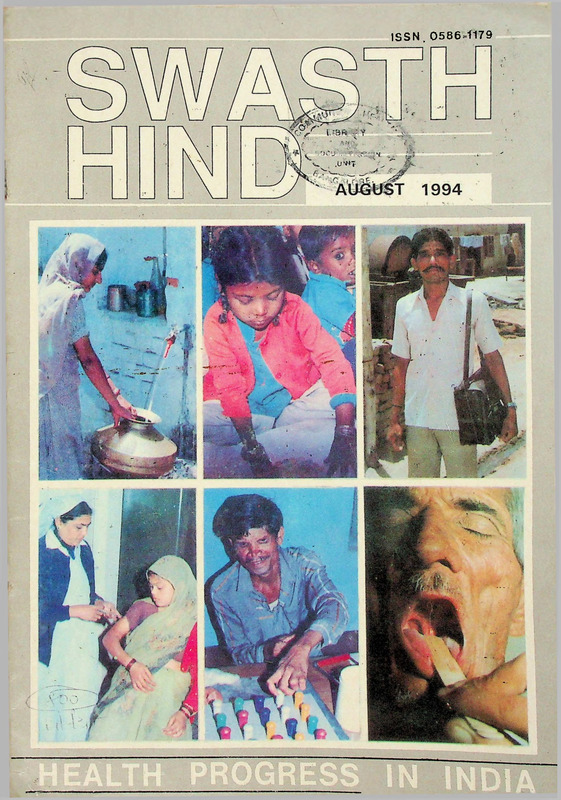
HEALTH PROGRESS-1993-94
Item
- Title
- HEALTH PROGRESS-1993-94
- extracted text
-
ISSN, O586=fi79
In this issue
Page
swasth hind
August 1994
Vol. XXXVIII. No. 8
Sravana-Bhadra
Saka 1916
OBJECTIVES
Swasth Hind (Healthy India) is a monthly
journal published by the Central Health
Education Bureau, Directorate General of
Health Services, Ministry of Health and
Family Welfare, Government of India, New
Delhi. Some of its important objectives
and aims are to:
Health Progress—1993-94
M.S. Dayal
173
National Health Programmes
177
Prevention of Adulteration of Food and
Drugs
187
National Family Welfare Programme
190
Maternal and Child Health Programme
192
Rural Health Services
199
Advice to the mother of a. child with
diarrhoea
201
Elimination of Neo-nata! Tetanus will save
1 million newborns annually
203
One Earth, One Familv
Back
Inside
cover
REPORT
and interpret the policies,
plans, programmes and achievements of
the Union Ministry of Health and
Family Welfare.
ACT as a medium of exchange of infor
Editorial and Business Offices
Central Health Education Bureau
mation on health activities of the Central
and State Health Organisations.
(Directorate General of Health Services)
FOCUS attention on the major public
Kotla Marg, New Delhi-110 002
health problems in India and to report
on the latest trends in public health.
KEEP in touch with health and welfare
workers
abroad.
and
in
agencies
India
and
State Health Directorates are requested to send in reports of their
activities for publication.
The contents of this Journal are freely reproducible.
nowledgement is requested.
REPORT on important seminars, con
ferences,
topics.
Articles on health topics are invited for publication in this
Journal.
discussions,
etc.
Cover Design
health
The opinions expressed by the contributors are nor necessarily those of
the Government of India.
SWASTH HIND reserves the right to edit the articles sent in for
publication.
M. L. Mehta
M. S. Dhillon
Edited by
Assisted by
on
Due ack
.
<
G. B. L. Srivastava
K.S. Shemar
Madan Mohan
SUBSCRIPTION
RATES
Single Copy
....
50 Paise
Annual
.
Rs. 6.00
.
(Postage Free)
.
.
1
HEALTH PROGRESS
-1993-94
M.S. DAYAL
Secretary (Health)
Ministry of Health & Family Welfare
The public expenditure in the health sector both Centre and States put together has been a little over
1.5% of GDP. The WHO had recommended that public health care expenditure should gross at least
5% of GDP if equity and universal coverage are to be realised. The plan outlay for the central health
sector in 1993-94 is Rs. 483.30 crore which is a marginal increase against the previous year’s outlay of
Rs. 447 crore.
HE health problems being
faced by us are highly com
plex and challenging. While we
are still struggling to meet the
health hazards of communicable
diseases like leprosy, TB and
malaria, we also have to now cope
with the challenge of post tran
sitional diseases like cardio
vascular and cancer. On top of all
these, we have to reckon with the
horrendous implications of AIDS.
The complexity of the health pro
blems is further aggravated by
widespread poverty leading to
malnutrition, unhygienic sanita
tion, illiteracy and ignorance; these
negative forces are reinforced by
the rate at which our large popula
tion is growing.
T
While the health problems are
indeed complex and daunting, the
importance of the state of health of
our people can scarcely be over
emphasised. As a matter of fact,
the ultimate objective of all socio
economic development is to bring
about a meaningful and sustained
improvement in the well-being and
welfare of the people and there is
no better index of the well being of
a people than the state of their
health.
AUGUST 1994
The public expenditure in the
health sector both Centre and
States put together has been a little
over 1.5% of GDP. The WHO had
recommended that public health
care expenditure should gross at
least 5% of GDP if equity and
universal coverage are to be
realised. The plan outlay for the
central health sector in 1993-94 is
Rs. 483.30 crore which is a marginal
increase against the previous year's
outlay of Rs. 447 crore.
National AIDS Control Program
me : Realising the gravity of
epidemiological situation of HIV
prevailing in the country, the
Government of India has launched
a comprehensive scheme at an
estimated cost of Rs. 220 to Rs.
222.6 crore during the 8th plan with
assistance from the World Bank to
the tune of US S 84 million and
another US S 1.5 million from
WHO. The World Bank loan
became effective from September,
1992.
c
With the objective to arrest the
HIV/AIDS infections in the coun
try and to reduce the future mor
bidity, mortality and infection of
AIDS, the Ministry of Health and
Family Welfare has set up a
National AIDS Control Organisa
tion as a separate wing to effectively
implement and closely monitor the
various components of the Pro
gramme. The National AIDS
control Programme envisages the
planning, counselling, implement
ing and monitoring of the various
activities of the Project, carry out
an intensive public awareness and
community support campaign
through mass media and sustained
dissemination’ of information and
health education about HIV and
AIDS, upgradation of the blood
banking capabilities in the public
sector and expansion of HIV
screening of all blood used for
transfusing and blood-products in
the country, strengthening of the
institutional capabilities at the
State/UT level for monitoring of
HIV and AIDS epidemic planning
and programming interventions to
control such epidemic and stren
gthening the clinical services and
case management activities in STD
centres.
National Sexually Transmitted Dis
ease Control Programme (STD):
Recognising STD as one of the
major factors for transmission
173
of HIV infection, the National STD
Control Programme has merged
with the National AIDS Control
Programme. There are 5 Re
gional STD teaching, training and
research centres at Delhi, Madras,
Nagpur, Hyderabad and Calcutta
for undertaking various training
programmes. During the year a
number of medical officers have
been trained. It is proposed to
take
effective
activities
to
strengthen the clinical services and
case management activities in STD
centres in 97 medical colleges
(including 5 Regional STD Cen
tres) and 275 District level STD
clinics.
Blood Safety Programme: A
scheme on prevention of infection
and strengthening of Blood Bank
ing System in the country has been
under implementation since 1989
under which State Governments
were provided assistance for setting
up to testing facilities including
HIV in the Blood Banks, stren
gthening and modernisation of
State managed blood banks and
development of manpower and
rational use of blood.
Under the Blood Safety Pro
gramme, it is proposed to upgrade
all the 608 State managed blood
banks in the country. During
1992-93, assistance has been given
for modernising 90 blood banks
under the World Bank assisted
National AIDS Control Pro
gramme, while 138 blood banks
were upgraded till March, 1992.
The remaining 380 blood banks are
proposed to be taken up for
upgradation in a phased manner
during the 8th Plan period. Dur
ing the year 1993-94, 100 blood
banks are being upgraded. 10
Training institutions have been
operationalised at regional level for
training of Doctors and tech
nicians working in the blood
banks. The rules under the Drugs
and Cosmetics Act have been made
more stringent providing for man
datory testing of blood for blood
transmissible diseases including
HIV and the approval of licence by
174
the licence approving authorities
has been made compulsory. It
also provides that the whole
human blood and components
shall conform to standards as pres
cribed under the Indian Pharma
copoeia.
National Malaria Eradication Pro
gramme : The organised public
health programme to control
malaria was launched in India in
the year 1953. The number of
confirmed malaria cases increased
during 1976 which necessitated
renewed vigorous anti-malarial
activities and modification in the
existing
strategies. With
the
implementation of the Modified
Plan of Operation (MPO) which
was based on a two-tier stratifica
tion, the total malaria cases dec
reased from 6.47 million in 1976 to
2.18 million cases in 1984.
However, since then the malaria
situation in the country has
remained more or less static (con
tained) around two million cases
a year.
The NMEP is category II Cen
trally Sponsored Schepie on 50:50
sharing basis between the Centre
and the’ State. The budget provi
sion and estimated expenditure
under the 50% central share which
is in the form of drugs and insec
ticides during 1993-94 is to the tune
of Rs. 11000 lakh.
In view of the persistent trans
mission of malaria in the seven
North-Eastern States which are
almost inhabited by tribal popula
tion, a plan to provide 100% central
assistance for the control of
malaria is being worked out The
Urban Malaria Scheme came into
effect in 1971' with the objective to
control malaria by reducing the
vector population in the urban
areas through recurrent Anti-larval
measures. The Scheme was sanc
tioned in 181 towns distributed in
18 States and 2 Union Territo
ries. It has so far been implemen
ted in 128 towns.
National Filaria Control Program
me: Filariasis is a major public
health problem in many States of
the country and about 396 million
people are estimated to be living in
175 known endemic districts of
which about 109 million are in
urban areas. The National Filaria
Control Programme which was
launched in 1955, provides for
delimitation of the problem in
hitherto unsurveyed areas, control
in urban areas through recurrent
antilarval measures and antiparasitic measures. There are 206 con
trol units and 195 clinics giving
treatment with Diethylcarbamizine
to clinical cases and microfilaria
carriers.
Kala Azar: Kai a Azar is a serious
public health problem in Bihar and
West Bengal. About 30 districts of
Bihar and 9 districts of West Bengal
are affected by Kala Azar. The
increasing trend of the disease is
evident from the fact that the total
number of cases which were 17806
with 72 deaths in 1986, rose to a
total of 77101 cases with 1419
deaths in 1992. However, this
trend has been arrested in 1993
with total number of 26752 cases
with 439 deaths reported till July
1993.
Assistance in terms of cash as
well as kind has been provided dur
ing the last three years. In 199293, about Rs. 20 crore worth of
assistance in kind has been given to
Bihar and West Bengal. Material
assistance included the insec
ticides, DDT and the imported
drug Pentamidine Isthionate.
Japanese Encephalitis: This dis
ease is caused by a minute virus
and manifests as high fever, con
vulsions, stiffness of the neck and
coma etc. The death rate due to
the disease is very high and those
who survive do so with various
degrees of neurological com
plications. Of late this disease has
become a major public health pro
blem and has been reported for 24
States/UTs. As against 4071 cases
with 1530 deaths in 1991,2432 cases
with 888 deaths in 1992, cases
reported till September 1993 were
189 with 126 deaths.
Swasth Hind
National Programmefor Control of
Blindness: The approach under the
NPCB consists of intensive health
education for eye care through the
mass media and extension educa
tion methods; extension of oph
thalmic services in the rural areas
through mobile units and eye
camps and establishment of per
manent infrastructure for eye
health care as an integral part of
general health services.
It has been estimated that there is
an annual incidence of 2 million
cataract induced blindness in the
country. At the rate of 1.5 million
cataract operations annually, we
are adding to the backlog rather
than reducing it. In order to
strengthen the Programme and to
reduce the backlog of blindness, it
has been decided to establish Dis
trict Blindness Control Societies
(DBCSs) under the Chairmanship
of the District Collector. So far
267 DBCSs have been formed. A
sum of Rs. 6 crore at the rate of Rs. 3
lakh each has already been
released to 200 of these DBCSs to
make them financially and opera
tionally autonomous. Under the
Programme, the equipments and
vehicles are also provided to Dis
trict Mobile Units and Primary
Health Centres. The NPCB is
being assisted by the Royal Danish
Government The Phase-II of the
assistance spans the period 1989-96
and so far a sum of Rs. 3.86 crore
has been reimbursed by the
DANIDA to NPCB on the basis of
actual expenditure incurred by the
various State Governments on
stipulated components of NPCB.
The World Bank has been
approached for Rs. 554 crore assis
tance for an intensive blindness
control programme in the seven
States of Tamil Nadu, Andhra
Pradesh, Maharashtra, M.P., U.P.,
Rajasthan and Orissa. One of the
strategies of the project is the for
mation of District Blindness Con
trol Societies in all districts of the
Project States and to make them
financially and operationally auto
nomous. Dedicated eye care infra
structure is proposed to be created
and strengthened in the District
Hospitals and selected sub-divi
sional Hospitals. Medical colleges
are also proposed to be upgraded
with the modem ophthalmic
equipment and provision of specia-
AUGUST 1994
Jised training to the faculty mem
bers to perform IOL surgery.
National Iodine Deficiency Disor
ders Control Programme: Iodine is
one of the essential elements for
human growth and develop
ment. The spectrum of Iodine
Deficiency Disorders affects each
and every stage of life from foetus
to adult. It is estimated that in
India alone, more than 54.3 million
people are suffering from endemic
Goitre and about 8.8 million from
different grades of mental/motor
handicaps. The surveys conduc
ted indicate that out of 235 districts
surveyed. IDD is a major public
health problem in 193 dis
tricts. Goitre is not restricted only
to the Himalayan belt of India but
also widely prevalent in the plain,
plateau, riverine areas and near the
sea coast.
The achievement of the pro
gramme so far has been that 23
States/UTs have completely ban
ned the use of salt other than
Iodised salt while another 6 States
have banned partially in the
endemic areas only. The Chief
Ministers of remaining States have
been requested to urgently issue
notification banning the use of salt
other than iodised salt. Testing
kits for on the spot qualitative test
ing have been developed in
collaboration with UNICEF and
they were distributed to all the Dis
trict Health Officers in endemic
States for regular monitoring. 23
States/UTs have set up Iodine
Deficiency Disorder Control Cells
to ensure effective implementation
of the Programme. It has been
proposed to set up the monitoring
labs in the States of Arunachal
Pradesh, Assam, Gujarat, Hima
chal Pradesh, Karnataka, Madhya
Pradesh, Maharashtra, Sikkim,
U.P. and West Bengal. A tentative
allocation of Rs. 75,000/- per lab has
been provided for this purpose.
National Cancer Control Pro
gramme: The Government of India
started the Cancer Control Pro
gramme in a limited form during
the year 1975-76 when central assis
tance at the rate of Rs. 2.5 lakh was
provided to institutions for pur
chase of Cobalt Therapy Units for
treatment of cancer patients. This
Scheme continued during the 6th
and 7th Plan period with the
increase of rate of assistance to Rs.
12.00 lakh. At the same time, ten
major institutions were recognised
as Regional Cancer Centres which
received financial assistance from
the Government
During the 8th Plan, emphasis,
has been laid on prevention, early
detection of cancer and augmenta
tion of treatment facilities in the
country. The new scheme envi
sages projects at district level for
preventive health education, early
detection and pain relief mea
sures. Under the scheme, finan
cial assistance of Rs. 15.00 lakh is
provided to the concerned State
Government for each district pro
ject selected under the scheme with
a provision of Rs. 10.00 lakh per
year for each district for the
remaining four years of the project
period. During the years 1990-91
to 1992-93, 17 district projects have
been undertaken in Gujarat, Kar
nataka, Madhya Pradesh, Kerala,
Orissa, Punjab, Tamil Nadu and
West Bengal. Financial assis
tance upto Rs. 1 crore (in phases) is
provided to the State Government
for development of Oncology
Wings in the medical colleges/
hospitals and for purchase of
equipments which includes Cobalt
Unit. So far financial assistance
has been provided for development
of Oncology Wings in 16 Medical
Colleges/Hospitals in the coun
try. Financial assistance upto Rs.
5.00 lakh is also provided to the
registered voluntary organisations
for the purpose of undertaking
health education and early detec
tion activities in cancer. So far 15
voluntary organisations have been
provided the assistance under the
scheme.
National Mental Health Program
me: The National Mental Health
Programme was launched by the
Ministry with a view to ensure
availability of mental health care
services for all specially the com
munity at risk and under-privileged
section of the population. 11
institutions have been identified
for training of health workers
under the programme. This train
ing will consist of basic knowledge
on mental health to the Primary
Health Care physicians and para
medical personnel. During 199394, Rs. 18 lakh have been allocated
for this programme.
175
National Leprosy Eradication Pro
gramme: India ranks foremost
among the countries saddled with
the burden of leprosy suf
ferers. Out of 2.7 million cases of
leprosy in the world, 1.3 million arc
estimated to be found in India
(1993). At the time of the launch
ing of National Leprosy Eradica
tion Programme in 1983, the
disease was highly prevalent in the
States/UTs of Tamil Nadu, Andhra
Pradesh,
Lakshadweep,
Pon
dicherry, West Bengal, Maha
rashtra, Karnataka, Bihar, Naga
land, Sikkim, Andaman & Nico
bar. Now the problem of leprosy
has been reduced in many of
these States.
The National Leprosy Eradica
tion Programme was started in
1983 with the objective to arrest
transmission of disease by the year
2000 A.D. The programme pro
vides for the provision of domi
ciliary multi-drug treatment cove
rage in 135 districts having pro
blem of 5 or more cases per 1000
population and introduction of
MDT services through existing
general health care services in the
low endemic districts. Currently
about 60% of leprosy patients are
getting the benefit of MDT in the
country. Available information
indicates that MDT is well accep
ted by the patiens, the tolerance is
good and side effects are mini
mum. There is marked reduction
of over 90% in the prevalence rate
in the 40 districts which have com
pleted MDT of 5 years or
more. MDT coverage has been
expanded to all the 201 endemic
districts which includes 135 dis
tricts on vertical pattern and 66 on
modified pattern. During the 8th
Plan, it is proposed to provide
MDT coverage to all the districts
with endemicity of 2 to 4.9 per 1000
population on Modified Pattern
and MDT services will also be
extended through primary health
care in other low endemic dis
tricts.
176
A comprehensive proposal for
financial assistance ol Rs. 302 crore
has been agreed to by the World
Bank in order to spread MDT in
the uncovered areas and to further
intensify efforts for reduction of
Leprosy. World Bank assistance
would also be utilised for streng
thening the monitoring informa
tion system and to embark on
deformity care and rehabilitation
programme.
National T.B.
Control Pro
gramme: Tuberculosis continues to
be a major public health problem
in the country with an estimated
1.5% of the population suffering
from Radiologically active Tuber
culosis and with about l/4th of the
cases being sputum positive or
infectious. It is estimated that
there are 5 lakh deaths annually on
account of this disease while
a similar number of persons
achieve cure.
A joint evaluation of the TB Pro
gramme by the Government of
India, WHO and SIDA revealed
that it was necessary to shift the
emphasis from monitoring, detec
tion and treatment to monitoring of
the number of cases cured, to bring
TB
effectively
under
con
trol. Case holding and monitor
ing for cure is beset with difficulties
on account of need to follow-up
patients for a long period of 18
months in the case of conventional
therapy and 6 to 8 months in the
case of short course chemothe
rapy. Often patients tend to stop
taking drugs when the symptoms of
the disease disappear initially.
In order to reduce the burden of
disease in a medium term perspec
tive, it is estimated that about 10
lakh sputum positive cases need to
be treated and cured each year.
The cost of drugs alone for ensuring
such coverage would amount to Rs.
150 crore per year. Added to this
would be the cost of strengthening
the organisational structure in the
Centre, State and districts for
introducing effective supervised
administration of drugs. Although
the central Plan outlay has been
enhanced to a level of Rs. 35 crore
in 1993-94 from Rs. 28 crore in
1992-93, it is not considered practic
able to avail further enhanced
outlays without external assis
tance. A project proposal has,
therefore, been made for obtaining
World Bank financial assistance
based on short-term course chemo
therapy for sputum positive cases
while the non-infectious cases con
tinues to be on cheaper conven
tional therapy.
Indian Systems of Medicine: A lot
of concern has been expressed
about over exploitation of Medi
cinal Plans as a result of which rare
species are facing extinction.
Ministry took initiative in calling a
meeting which was presided over
by Deputy Minister of Health
wherein Secretary, Environment
and representatives of CSIR and
ICMR participated. A Task Force
has been constituted for promo
tion, development and appropriate
exploitation of medicinal plants
under the Chairmanship of Sec
retary, Ministry of Environment.
International
Health: Govern
ment of India is assisting the
Government of Nepal to establish
the BP Koirala Institute of Medical
Sciences in Dharan. The Post
graduate training requirements of
Nepalese MBBS students year-wise
and discipline wise has been
worked out. 7 Nepalese students
are being imparted training in
Indian institutions in the current
year itself.
The Department of Health has
been performing the agency role
for the Ministry of External Affairs
in connection with the establish
ment of Indira Gandhi Memorial
Hospital at Male.
A Protocol was signed with the
Government of Russia on 16th Sep
tember, 1993 at St Petersburg in
which 13 areas were identified for
mutual cooperation.
—Excerpts from the Introduction to
the Annual Report ofthe Ministry of
Health and Family Welfare for
1993-94.
Swasth Hind
NATIONAL HEALTH
PROGRAMMES
The Centre takes concerted measures to combat communicable,
non-communicable and other major diseases. For this purpose,
several National Health Programmes are directly run by the Minis
try which can have a bearing in the reduction of mortality and mor
bidity and also have a salutary effect on efforts to improve the
quality of life of the common man. These programmes also rein
force the delivery of primary, secondary and tertiary health care
throughout the country. Here we detail the progress made in the
conduct of these programmes during-the year 1993-94.
National Malaria Eradication Programme
Control Strategy: Case detection
and prompt treatment are empha
sised so as to reduce the parasite
load in the community. Blood
slides are collected through Active
and Passive Agencies and pre
sumptive treatment is given. All
positive cases are given appropriate
radical treatment.
Selective and judicious insec
ticidal spray is done in areas regis
tering an API of 2 and above in the
preceding three years. In other
areas, focul spray and surveillance
are carried out During 1993-94
about 160 million people were pro
jected for being covered by spray
ing.
In urban areas, anti-larval
measures are in the form of
recurrent weekly larvicing with
chemicals including Temephos,
Fenthion,
MLO,
Parisgreen.
Source reduction as well as other
bio-environmental measures are
being applied wherever feasible to
control the breeding of mosquito
vectors.
AUGUST 1994
2—8/DGHS/ND/94
Malariogenic stratification to
prioritize endemic areas into high,
medium and low risk areas is being
undertaken. This exercise has
been completed first in Karnataka,
and has been in operation since
1991. During 1993-94, revised
strategies based on stratification
have been launched in Maha
rashtra, Gujarat and Rajasthan.
Health Education to awaken the
community and seek their active
involvement and cooperation in
dealing with disease control is
being undertaken.
Budget: The NMEP is a category
II Centrally Sponsored Scheme on
50:50 sharing basis between the
Centre and the States. The budget
provision and estimated expendi
ture under the 50% central share
which is in the form of drugs and
insecticides is given below.
BUDGET AND EXPENDITURE
Year
Budget Provisions
1985-86
1986-87
1987-88
1988-89
1989-90
1990-91
1991-92
1992-93
1993-94
8868.00
8500.00
8200.00
8300.00
8900.00
8200.00
8960.00 (final)
9700.00
11000.00
Actual Estimated Expendi
ture (Rs. in lakh)
8856.91
7815.14
8456.98
8750.00
8862.17
7660.45
8793.04
9800.14
177
Tribal Areas: In view of the per
sistent transmission of malaria, in
the seven North-Eastern States
which are almost entirely inhabited
by tribal population, a plan to pro
vide 100% Central assistance for the
control of malaria is being
worked out.
As about 30% of the total malaria
cases and about 50% of the P.
falciparum cases are reported from
the tribal areas of the country, com
prising about 44.5 million populatioh of Andhra Pradesh, Madhya
Pradesh, Gujarat. Maharashtra.
Bihar. Rajasthan and Orissa, a pro
posal to provide 100% assistance
for the control of malaria in these
areas is being initiated for posing to
the World Bank in due course
for funding.
Control of Malaria in Urban
Areas: The Urban Malaria Scheme
(UMS) came into effect in 1971
with the objective to control
malaria by reducing the vector pop
ulation in the urban areas through
recurrent anti-larval measures.
Though the scheme was sanctioned
in 181 towns distributed in 18 States
and 2 Union Territories, it has so
far been implemented in 128
towns. About two lakh cases of
Malaria were recorded in 120 towns
in 1992. It is observed that 120
towns from where comparative
data was available, 62 showed a
decrease while 58 showed an
increase in malaria cases in 1992 as
compared to 1991. The metro
politan cities of Delhi, Calcutta,
Bombay and Madras recorded
12331,17893,11879 and 48447 cases
of malaria respectively during 1992
compared to 8491, 13354, 5334 and
66,937 during 1991.
Kala-Azar
In view of the growing problem,
planned control measures were
initiated to contain Kala-Azar.
178
Until 1990-91 the assistance for the
Kala-Azar Control was being pro
vided by the Govt, of India out of
the National Malaria Eradication
Programme budget provision.
However, specific funds to the
tune of Rs. 4.06 crore were made
available during 1990-91 for the
control of Kala-Azar. Since then,
the Govt of India has con
siderably enhanced the inputs to
Rs. 15.38 crore in 1990-91.
During 1992-93, Rs. 20.00 crore
were provided against the Annual
Plan
outlay of Rs.
15.00
crore. For 1993-94 a provision of
Rs. 20.00 crore has been approved
in the Annual Plan
Strategy
for
Control: The
strategy for Kala-Azar control
broadly includes 3 major acti
vities :
(i)
Interruption of transmis
sion for reducing vector
population by undertaking
indoor residual insecticidal
spray twice annually;
of cash as well as kind has been
provided during the last three
years. In 1992-93, about Rs. 20
crore worth of assistance in kind
has been given to Bihar and West
Bengal. Material
assistance
included the insecticides DDT
and the imported drug Pen
tamidine Isethionate.
In addition, UNICEF assis
tance of Rs. 15.95 lakh has been
provided in 1990-91 for informa
tion, education and communica
tion activities and orientation of
medical professionals.
National Filaria Control
Programme
The National Filaria Control
Programme was launched in
1955. Under the Programme the
following activities are under
taken:
(i)
Delimitation of the pro
blem in hitherto unsur
veyed areas; and
(ii) Early diagnosis and com
plete treatment of KalaAzar cases; and
(ii) Control in urban areas
through recurrent antilarval measures and antiparasitic measures.
(iii) Health Education for com
munity awareness.
There are 206 control units and
195 clinics giving treatment with
Diethylcarbamizine to clinical
cases and microfilaria carriers.
In view of the financial con
straints, Govt of India provides
the total costs on medicines and
insecticides for Kala-Azar in
Bihar. To
ensure
optimum
utilisation of available resources,
district action plans are prepared
under which exclusive infrastruc
ture is deployed for the Kala-Azar
activities. Material and equip
ment with strict supervision is pro
vided. Monitoring
and
con
current and consecutive evalua
tion is regularly carried out.
Assistance Provided by the Govern
ment of India: Assistance in terms
Japanese Encephalitis
This disease is spread by mos
quitoes which usually breed in
rice fields and swampy and
marshy areas.
Strategies for Control: Major
activities to control Japanese
Encephalitis include :
(i)
Care of the patients;
(ii)
Development of a safe and
standard indigenous vac
cine;
SWASTH HIND
(iii)
Sentinel
including
veillance
cases;
(iv)
Studies to identify the high
risk groups by measuring
the blood level of anti
bodies; and
(v)
Epidemiological monitoring
of the disease for effective
implementation of preven
tion and control stra
tegies.
surveillance
clinical,
sur
of
suspected
National Leprosy Eradi
cation Programme
(c) Introduction of MDT ser
vices
through
existing
general health care services
in the low endemic dis
tricts. Treatment
with
combination
of
drugs
include treatment with 3
drug
viz.
Rifam
picin. Clofazimine
and
Dapsone. Education
of
the patients and the com
munity about the curability
of disease and their socio
economic rehabilitation are
other two key components
of the control strategy.
(a) Provision of domiciliary
multi-drug
treatment
coverage in 135 districts
having problem of 5 or
more cases per 1000 popu
lation, by specially trained
staff in leprosy;
Infrastructure: Over the years,
a vast infrastructure of leprosy
workers has been developed in the
country, specially trained for pro
viding leprosy services. In the
endemic rural areas, these services
fan out from Leprosy Control
Units (one for 0.4 to 0.5 million
population) while its urban coun
terpart called Urban Leprosy Cen
tre caters to a population of about
30 to 40 thousand. Temporary
hospitalization ward having 20
bed capacity has been established,
at least one in each endemic dis
trict to render hospitalization ser
vices. Under the Programme, 49
Leprosy Training Centres are
engaged in providing training to
various categories of health
workers in leprosy. Following
infrastructure exists at the end of
March, 1993. Leprosy Control
Unit-758, Urban Leprosy Centre900, Survey Education and Treat
ment Centre-6097, Temporary
Hospitalization Ward-291, District
Leprosy Unit-285, Leprosy Train
ing Centre-49, Reconstructive Sur
gery Unit-75, Leprosy Rehabili
tation and Promotion Unit-13,
Sample Survey cum Assessment
Unit-39.
(b) Shifting of 66 endemic dis
tricts on Modified MDT
pattern to regular vertical
pattern; and
Infrastructure thus created has
been predominantly established
by the State in the endemic dis
tricts. In
the
district
with
Problem : The disease is widely
spread all over the country. The
prevalence rate of leprosy exists
above 5 per 1000 population in 201
districts out of 468 districts of the
country. About 15% of the lep
rosy sufferers are children below
14 years of age. The proportion
of infectious cases varies from 15
to 20% and equal number of
patients suffer from deformities.
Programme
Objectives: The
Government of India launched
National Leprosy Eradication
Programme in 1983 with the
objective to arrest the transmission
of the disease by 2000 AD. It is a
100%
Centrally
Sponsored
Programme.
Strategies: The adopted stra
tegy
under
the
programme
involves :
AUGUST 1994
endemicity of less than 5/1000
population, the general health
care
provide
the
services.
However, there are still gaps in the
66 endemic districts due to finan
cial constraints. To extend the
benefit of MDT to over 7 million
patients living in these 66 districts.
Government of India sanctioned a
modified MDT approach in these
districts from January, 1991. This
modified approach include the
involvement of PHC in the
delivery of services to leprosy
patients. Now all these 66 dis
tricts are proposed to be covered
on regular vertical pattern of
MDT scheme, 18 such districts
have already been sanctioned ver
tical MDT scheme.
Achievements: Currently about
60% of leprosy patients are getting
the benefit of Multi Drug Therapy
in the country. Available infor
mation indicates that MDT is well
accepted by the patients, the
tolerance is good and side effects
are minimum. There is marked
reduction of over 90% in the pre
valence rate in the 40 districts
which have completed MDT of 5
years or more. MDT coverage
has been expanded to all the 201
endemic districts which includes
135 districts on vertical pattern
and 66 on modified pattern.
Target & Achievement in 199293: During the year 1992-93
against the target of 289600 for
new case detection and treatment,
a total of 547686 new cases have
been detected out of which 541078
cases have been put under
treatment
The target for cases discharged
was 573900 during 1992-93 against
which 1052823 cases have been
discharged.
The objectives of target allo
cated for 1993-94 consists of
265200 cases for detection and
treatment and 525300 for case dis
charge. The expenditure of 199293 was Rs. 3338 lakh and for
1993-94 the BE allocated is Rs.
3380 lakh.
179
YEAR-WISE PERFORMANCE OF TARGETS DURING SEVENTH PLAN ARE INDICATED BELOW
(Figures in Lakh)
1985-86
1986-87
1987-88
Case Treatment
Case Detection
Year
Case Discharge
Target
Achievement
Target
Achievement
Target
Achievement
3.82
4.77
3.82
4.56
3.75
4.46
4.20
4.20
5.08
5.19
4.20
4.90
4.30
5.07
4.20
4.99
4.65
4.62
5.03
5.75
5.94
6.55
6.01
6.69
23.72
4.74
25.57
8.81
27.98
5.10
5.41
6.12
5.74
8.26
10.53
1988-89
1989-90
Total
’7th Plan)
1990-91
3.90
3.50
4.75
4.67
3.90
3.50
19.62
3.69
24.46
4.82
1991-92
1992-93
3.35
2.89
5.13
5.48
19.62
3.69
3.35
2.89
9.85
The target allotted for 1993-94 is 2.65 lakh cases for detection and treatment and
5.25 lakh cases for discharge.
8th Plan : During the 8th Plan
it is proposed to provide MDT
coverage to all the districts with
endemicity' of 2 to 4.9 per 1000
population on modified pattern
and MDT services will also be
extended through Primary Health
Care in other low endemic
districts.
World Bank Assistance: To
spread the MDT coverage to
uncovered areas and to further
intensify the efforts, the Govern
ment have sent a comprehensive
proposal to World Bank for finan
cial assistance of Rs. 302 crore
which has been agreed by
them. In the proposed World
Bank Project, it is envisaged to
provide the leprosy services with
separate workers in the 66 remain
ing endemic districts. The 77
moderately
endemic
districts
would be taken up for introducing
the Modified MDT Program
me. MDT will also be extended
in the endemic pockets of all low
endemic districts on modified pat
tern. The monitoring informa
tion system would be strengthened
180
and a foundation laid to embark
on deformity care and rehabilita
tion programme.
National T.B.
Programme
Control
Tuberculosis continues to be a
major public health problem in
the country with an estimated 1.5%
of the population suffering from
Radiologically active Tuberculosis
and with about 1/4th of the cases
being Sputum positive or infec
tious. It is estimated that there
are 5 lakh deaths annually on
account of this disease, while a
similar number of persons achieve
cure. This is balanced by an
addition of one million Sputum
positive cases annually.
District TB Centres have been
established in 390 out of 459 dis
tricts in the country for supervis
ing the programme of TB Control
in these districts. These are
meant to provide necessary sup
port to Primary Health Centres
and other peripheral institutions
engaged in TB Control in terms of
drugs, consumable, training and
supervision. They are also res
ponsible for monitoring pro
gress. At the State level, State TB
Control Officers working under
the Directors of Health Services
are responsible for coordination of
efforts and they in turn are sup
ported at the Central level by a
Cell in the Directorate General of
Health Services which looks after
the TB Control. This cell has
been upgraded in 1993-94 and is
headed now by a Deputy Director
General. TB training and de
monstration centres have been
established in many States to
undertake basic training of medi
cal and para-medical person
nel. The National TB Institute
carries out training of all district
level functionaries.
Although, around 47,000 beds
are available for treatment of
seriously sick TB patients, the
emphasis in TB control, however,
has now been shifted to ambu
latory treatment; and conventional
therapy lasting about 18 months is
SWASTH HIND
being gradually replaced by sho;t
course chemotherapy, (for the
sputum positive cases) which lasts
only 6 to 8 months.
The Conventional Therapy is
based on treatment with INH and
Thiacetazone while short course
chemotherapy consists of an
intensive multi-drug phase involv
ing Rifampicin, Pyrazinamide,
Ethambutol and INH generally
lasting 2 to 3 months followed by
a maintenance phase of INH/
Rifampicin lasting 4 to 5 mon
ths. While acute symptoms of
disease generally disappear within
a month of start of multi-drug
therapy, more time is required to
achieve 2 non-infectious or
sputum negative status and the
full course of 6 months or so is
important from the point of ensur
ing complete cure with avoidance
of the possibility of relapse.
Anti-TB drugs for free treatment
are being supplied to the TB
clinics run by the State Govern
ments through a Centrally Spon
sored Scheme with 50% of the cost
being borne . by the Central
Government and 50% by the
States. 100%
grants-in-aid
is
given for supply of materials,
equipments and drugs for the pro
gramme in Union Territories, as
well as in the case of grants to cer
tain voluntary bodies.
Often patients tend to stop tak
ing drugs when the symptoms of
the disease disappear initially.
This may be on account of work
and social pressures, ignorance or
inability/unwilligness to complete
the full course of treatment. The
drugs alone would cost around Rs.
1500 per patient in case of short
course chemotherapy. Non-avai
lability of drugs in peripheral
health institutions would also lead
to stoppage of treatment. In
other countries of the world
emphasis is being laid on supervi
sion of drug administration in the
2 month intensive phase of short
course chemotherapy.
AUGUST 1994
3—8/DGHS/ND/94
A project proposal has been
made for obtaining World Bank
Assistance for TB Control Project
based on short course chemo
therapy for sputum positive cases
while the non-infectious cases
continue to be on cheaper conven
tional therapy. Pilot Projects
based on this new strategy are pro
posed to be implemented in 5
States namely, Bihar, Gujarat,
Himachal Pradesh, Kerala and
West Bengal and 6 metropolitan
cities,
Bombay,
Calcutta,
Hyderabad, Madras, Bangalore
and Delhi in order to test and
obtain experience with the pro
posed new strategy. This is being
initially done with SIDA assistan
ce. It is proposed to extend
coverage of these Pilot Projects
after gaining further experience
and building of the necessary
expertise. The proposed Pilot
Project has been initiated in 3
cities viz. Gujarat, Delhi and
Bombay.
So far the stress in the National
TB Control Programme has been
on detection and since this has not
helped significantly in the reduc
tion of the disease, the new project
has, therefore, a revised strategy.
However, during 1992-93, there
were 15.39 lakh new TB cases
detected against a target of 17.50
lakh. In the current year (199394) about 3.63 lakh cases have
been detected against the annual
target of 18 lakh till July,
1993. The budget allocation for
1993-94 has been raised to Rs. 35
crore from Rs. 28 crore in 1992-93.
The amount allocated in the
budget is mostly used for the pro
curement, of drugs.
National Programme for
Control of Blindness
The National Programme for
Control
of
Blindness
was
launched in the year 1976 as a
100% centrally sponsored pro
gramme. The approach under
the NPCB, consists of intensive
health education for eye care
through the mass media and
extension education methods;
extension of ophthalmic services
in the rural areas through mobile
units and eye camps and esta
blishment of permanent infras
tructure for eye health care as an
integral part of general health
services.
The budgetary allocations for
NPCB have been as follows :
Year
Rs. in crore
1991-92
9.70
1992-93
20.00
1993-94
25.00
The infrastructure developed so
far and the targets for the same for
the year 1993-94 are as follows:
Target for
1993-94
Regional Institu
tes of Ophthal
mology
10
Upgradation
of
Medical Colleges
60
8
Upgradation
of
Distt Hospitals
402
21
EstL of DBCS
267
200
Central
Units
76
Mobile
Development of
Distt.
Mobile
Units
Upgradation
PHCs
162
27
of
4096 413
The State Governments have do
send proposals in respect of
these items.
As a result of the programme
the number of cataract operations
has gone up from a level of 5.5
lakh cataract operations in 198182 to 1.6 million operations in the
year 1992-93. The target for the
year 1993-94 is 24.30 lakh
cataract operations.
Voluntary Organisations have
played a very significant role in
this programme. They have been
181
active in providing Eye Health
Education, Preventive, Rehabilita
tive and Surgical Services for Con
trol of Blindness.
The Need to Step up the Program
me: .The NPCB-WHO Survey
(1986-89) has shown that there is a
backlog of 22 million blind eyes or
12 million cases of blindness. Out
of this 80.1% is on account of
cataract.
It has also been estimated that
there is an annual incidence of 2
million cataract induced blindness
in the country. At the rate of 1.5
million cataract operations an
nually we are adding to the backlog
rather than reducing it. As such
the programme needs to be
strengthened considerably if we
have to reduce the backlog of
blindness.
Steps Taken: It has been
decided to establish District Blind
ness Control Societies (DBCSs)
under the Charimanship of the
District Collector. The structure
of the DBCS is:
Chairman
Members
: District Collector
: Chief Medical Offi
cer
District Ophthalmic
Surgeon
District Education
Officer
Nominated members (from NGOs,
Private Sector)
Member Secretary
District Blindness
Coordinator
So far, 267 DBCSs have been for
med. A sum of Rs. 6 crore @ Rs. 3
lakh each has already been
released to 200 of these DBCSs to
make
them
financially and
operationally autonomous. The
first Orientation Workshop for Dis
trict Collectors was held in Delhi to
orient the District Collectors in the
functioning of DBCSs. Steps
have also been initiated to train the
District Blindness Control Coor
dinators to enable them to effec
tively run the DBCSs.
182
The purchase of equipment and
vehicles meant for the District
Mobile Units and Primary Health
Centres is now being done cen
trally and the assignment is also
being done accordingly. 85 vehi
cles were procured and distributed
centrally for the various Mobile
Eye Care Units in the coun
try. Simultaneously the process of
central procurement and distribu
tion of Ophthalmic Equipment has
also been taken on hand.
Danish Assistance forNPCB: The
National Programme for Control
of Blindness is being assisted by the
Roypl Danish Government The
Phase-II of the assistance spans the
period 1989-96. So far a sum of
Rs. 3.86 crore has been reimbursed
by DANIDA to NPCB on the basis
of actual expenditure incurred by
the various State Goverments on
stipulated components of NPCB.
DANIDA had also taken up 5 Pilot
Districts for implementation of
NPCB through the formation of
District Blindness Control So
cieties in each of three dis
tricts. The performance in cata
ract surgery has gone up by 2 to
300% with the formation of DBCSs
in these pilot districts. En
couraged with this success and on
the basis of the recommendations
of the Mid-Term Review Report
DANIDA has now taken up the
entire state of Karnataka for
replication of the model for Con
trol of Blindness developed in the 5
Pilot Districts.
World Bank Project for Control of
Blindness: The World Bank has
been approached for a Rs. 550 crore
assistance for a intensive Blindness
Control Programme in the Seven
States of Tamil Nadu, Andhra
Pradesh, Maharashtra, Madhya
Pradesh, Uttar Pradesh, Rajasthan
and Orissa. As per the NPCBWHO Survey (1986-89) these seven
States have the highest prevalence
of blindness after the State of
Jammu & Kashmir. One of the
strategies of the Project is the for
mation of District Blindness Con
trol Societies in all districts of the
project States and to make them
financially
and
operationally
autonomous. Dedicated Eye Care
infrastructure is proposed to be
created and strengthened in the
District Hospitals and selected subdivisional
hospitals. Medical
Colleges are also proposed to be
upgraded with
the
modem
ophthalmic equipment and provi
sion of specialized training to the
faculty members to perform IOL
Surgery. Ophthalmic Staff is pro
posed to be trained under the pro
gramme to provide quality Eye
Care Services. The project en
visages the involvement of NGOs
and the use of modem monitoring
systems to keep stock of the
performance.
National Iodine Defi
ciency Disorders Con
trol Programme
Iodine is one of the essential
elements for human growth and
development. Due to various fac
tors there has been iodine deple
tion of the soil, as a result of which
an average balanced diet and water
does not take care of the total daily
iodine requirement of 150 mic
rograms. Earlier only goitre was
associated with Iodine deficien
cy. It is now well established that
goitre is only “a tip of the iceberg”
of the manifestations of Iodine
Deficiency Disorders (IDD). The
spectrum of Iodine Deficiency Dis
orders affects each and every stage
of life from foetus to adult.
The National Iodine Deficiency
Control Programme (NIDDCP) is
the new name given to the erstwhile
National Goitre Control Program
me. The title has been changed in
view of the wide spectrum of Iodine
Deficiency Disorders like mental
and physical retardation, deafmutis, cretinism, high rate of abor
tion etc., and the Government’s
commitment to overcome all other
Iodine Deficiency Disorders apart
from Goitre through Universal
Iodisation of Salt
Swasth Hind
Achievements: The
achieve
ments made under the Programme
from its inception to date are as
under:
(i) 641
private
manufacturers
have been licensed by the
Salt Commissioner, out of
which nearly 532 units have
commenced production so
far;
(ii) Annual
production
of
iodised salt has been raised
from 5.0 lakh Mt in 1985-86
to 26.0 lakh Mt in 1991-92
and in 1992-93, the produc
tion was 28.34 lakh Mt.
This is expected to be further
raised to 50.00 lakh MT in
near future;
(iii) 23 States/UTs have com
pletely banned the use of salt
other than Iodised Salt while
another 6 States have banned
partially in the endemic
areas only;
(iv) Testing Kits for on the spot
qualitative testing have been
developed in collaboration
with UNICEF and they were
distributed to all the District
Health Officers in endemic
Stage for regular monito
ring;
(v) 23 Stales/UTs have set up
Iodine Deficiency Disorder
Control Cell to ensure effec
tive implementation of the
Programme:
(vi) To intensify IDD activities, a
project has been finalised
with UNICEF assistance for
intensive IDD monitoring in
4 States viz. Uttar Pradesh.
Madhya Pradesh. Himachal
Pradesh and Assam;
(vii) A National Reference Lab
for monitoring of IDD has
been set up at the Bio
chemistry
Division
of
National Institute of Com
municable Diseases, Delhi
for training both medical
and para-medical personnel
and monitoring salt and
urinary iodine:
AUGUST 1994
(viii) An evaluation of Salt Iodisa
tion Programme was also
carried out in some dis
tricts. The results of evalua
tion have shown that the
prevalence of goitre has
declined from 41.2% to 31.8%
in Hamirpur and from
49.53% to 16.9 in Buldhana;
(ix) It has also been proposed to
set up the monitoring labs in
the States of Arunachal
Pradesh, Assam, Gujarat,
Himachal Pradesh, Kar
nataka, Madhya Pradesh,
Maharashtra, Sikkim, U.P.
and West Bengal. A tenta
tive allocation of Rs. 75,000/per lab. has been provided
for this purpose:
(x) GOI-UNICEF Project 199395 has been approved in 13
selected endemic States for
the extensive monitoring and
IEC activities of NIDDCP.
The activities are to be
strengthened in 106 selected
districts of the 13 States
including North Eastern
region;
Review: After a review of the
Programme in 1991 the Chief
Ministers of remaining Stales were
advised to urgently issue Notifica
tion banning the sale of salt other
than iodised salt. The Stale
Governments have been advised to
include iodised salt as a noncompulsory item under Public Dis
tribution System.
The Salt Commissioner has been
advised to take action to instal
iodisation plants in consuming
areas in States/UTs and to improve
packaging of iodised salt to prevent
iodine losses during transit.
Information, Education and Com
munication: To intensify the IEC
activities, a communication pac
kage by way of video films, posters/
danglers and Radio/T.V. has been
finalised with UNICEF.
VIII Plan Proposals: Il is pro
posed to strengthen IDD Monitor
ing and. to achieve the goal of
Universal Iodisation of Salt IDD
monitoring will be carried out at
the district level both through
regular checking of iodised salt as
well as urinary iodine excretion.
With this, it is also proposed to
bringdown the incidence of IDD to
below 10% level by 2000 A.D.
Problems: Surveys in the re
maining districts, ban notification
in the remaining States and setting
up of Control Cell in some States
are yet to be completed.
National Sexually Trans
mitted Disease Control
Programme (S.T.D.)
S.T.D. was introduced as a
National Control Programme dur
ing the second Five Year Plan by
the Government of India. The
programme was then primarily a
Centrally Aided Scheme concerned
mainly with (i) establishing S.T.D.
clinics throughout the country; (ii)
supply of drugs to the earlier exist
ing and newly established clinics;
and (iii) conducting orientation
training courses in S.T.D. for the
inservice medical and para
medical personnel.
The scheme was converted into a
Centrally Sponsored Scheme dur
ing the fourth five year plan and the
Central Government assistance
was limited to (i) giving grant-inaid to States for establishing new
S.T.D. clinics and (ii) supplying of
drugs (Benzathine Benzyl Pencillin) to the S.T.D. clinics.
The scheme was again reviewed
and during sixth and seventh five
year plan it was decided to
establish five Regional S.T.D.
Teaching, Training and Research
centres at Delhi, Madras, Nagpur.
Hyderabad and Calcutta.
Recognising S.T.D. as one of the
major factors for transmission of
HIV infection the programme has
been merged with the AIDS Con
trol Programme. The existing
1'83
components of (he programme
viz. Teaching. Training. Research
and Epidemiology, however have
been retained outside the World
Bank assisted activities of the
National AIDS Control Program
me. Under the National S.T.D.
Control Programme following
achievements have been made:
As on July 1993 the Regional
S.T.D. centres have trained as
many as 98 medical officers and
112 para-medical personnel like
Laboratory Technicians. Nurses.
Health Educators and Social
Workers etc.
About 56 medical colleges, hos
pitals. laboratorics/public health
laboratories had participated in the
inter laboratory evaluation pro
gramme of VDRL test being con
ducted by the Regional STD
reference laboratory at Madras and
Hyderabad.
The Crash programme for the
training of Medical Officers work
ing in Primary Health Centres in
Tamil Nadu, Andhra Pradesh.
Maharashtra. West Bengal and
Delhi at the 5 Regional S.T.D.
Training Centres was launched and
under this 274 Medical Officers
were trained.
S.T.D. Planning Workshops for
the State Programme Officers of
STD. AIDS and Epidemiologist of
various States were held at Delhi.
Madras and Bhubaneshwar.
S.T.D. Treatment Workshop was
held at Delhi on 6-7 July. 1993 to
develop standard treatment guide
lines for Sexually Transmitted Dis
eases and STD syndrome.
The Project seeks to take up
activities to strengthen the clinical
services and case management
activities in STD centres in 97
medical colleges (including 5
Regional S.T.D. Centres and 275
District level STD clinics).
Blood Safety Programme: A
Scheme of Prevention of Infection
184
and Strengthening of Blood Bank
ing System in the country has been
under implementation since 1989
under which State Governments
were provided assistance for setting
up of testing facilities inclu
ding HIV in the Blood Banks.
Strengthening and modernisation
of State managed Blood Banks and
development of manpower and
Rational Use of Blood.
A Programme for the Prevention
and Control of AIDS has been
currently under implementation
since 1992. One of the major com
ponents of this Programme is
Blood Safety and Rational Use
of Blood.
Modernisation of Blood Banks:
Under this Programme it is pro
posed to upgrade all the 608 State
managed Blood Banks in the coun
try with provision of equipments
and recurring assistance of con
sumables in a phased man
ner. During 1992-93 assistance
has been given for modernising 90
Blood Banks under the World
Banks assisted National AIDS
Control Programme, while 138
Blood Banks were upgraded till
March 1992. The remaining 380
Blood Banks are proposed to be
taken up for upgradation in a
phased manner during the 8th plan
period. During the year 1993-94,
100 Blood Banks are being
upgraded.
Training and Manpower Develop
ment: 10 Training Institutions
have been operationalised at
Regional level for training of Doc
tors and Technicians working in
the Blood Banks. Institutional
facilities have already been up
graded. Doctors and Technicians
have been imparted Training in
blood banking technology, through
short term orientation course.
Training modules for training of
various categories of personnel
working for the blood banks are
being prepared and modular train
ing will be introduced shortly.
Legal Frame Work: Schedule
FXII-B provides the necessary legal
frame work as per Drugs and Cos
metics Act The Rules have been
made more stringent providing for
mandatory testing of blood for
blood transmissible diseases in
cluding HIV. Approval of license
by the Central license approving
authorities has been made com
pulsory. It also provides that the
whole human blood and com
ponents shall confirm to standards
as prescribed under the Indian
Pharmacopia.
Promoting Rational Use of Blood:
It is proposed to establish 30 Com
ponent Separation Centres in
Blood Banks handling more than
10.000 units of blood per annum in
phases. Six centres were iden
tified during 1992-93 and 9 more
Centres have been identified for
component laboratory during 199394. The remaining centres shall
be taken during 1994-95.
National AIDS
Programme
Control
HIV infection in the country has
been reported from as many as 23
States/UTs and of these Maha
rashtra. Tamil Nadu. Manipur have
reported the highest incidence of
the disease. In the Maharashtra
and Tamil Nadu, the pattern of
HIV infection is that of SubSaharan type i.e., through sexual
transmission and in the North Eas
tern State, the pattern of HIV infec
tion follows the course similar to
South European and Thailand i.e.,
through drug abuse.
As per the epidemiological re
ports available as many as
18,98,670 persons have been scre
ened for HIV of which 13,254 have
been found to be sero-positive as
on 30-09-93. The sero-positivity
rate per 1000 among the samples
screened is 698 and the total num
ber of full blown AIDS cases repor
ted from different States is 459.
The reported prevalence of infec
tion represents a fraction of actual
morbidity and this amounts to just
Swasth Hind
(he probial tip of ice-bcrg of the
whole problem. According to the
estimates made, the number of
infected persons by the end of 199092 was about 1 million and the total
full blown AIDS cases to be some
where between 5.000 to 10.000.
Realising^ the gravity of epi
demiological situation of HIV pre
vailing in the country, the Govern
ment of India has launched a com
prehensive scheme at an estimated
cost of Rs. 220 to Rs. 222.6 crore
during the 8th Plan with assistance
from the World Bank to the tune of
USS 84 million and another USS
1.5 million from WHO. The
World Bank loan became effective
from 21-9-1992.
Ministry of Health & Family
Welfare has set up a National AIDS
Control Organisation as a separate
wing to implement and closely
monitor the various components of
the programme as documented in
the Staff Apraisal Report of IDA
(World Bank). The overall objec
tive of the project is to arrest the
HIV/AIDS infections in the coun
try with a view to reducing the
future morbidity, mortality and
infection of AIDS.
The project consists
following components:
of the
Strengthening
Programme
Management Capabilities: National
AIDS Control Organisation is
primarily involved in planning
consulting, implementing and
monitoring the various activities
under the project through the
AIDS Control Cell at the State/UT
level. The programme is being
implemented as a Centrally Spon
sored Scheme through all the State/
Union Territories who have given
letter of Undertaking to implement
the programme. During 1992-93
grants aggregating Rs. 11.55 crore
have been released to the State/
UTs. During 1993-94 first instal
ment of 25% of the total grant
proposed for the current year has
been released.
Strengthening of IEC: Since there
is no cure for AIDS as of now. the
AUGUST 1994
4—8/DGHS/ND/94
project seeks to carry out an inten
sive public awareness and com
munity support campaign through
mass media and sustained dis
semination of information and
health education about HIV and
AIDS to all level and categories of
personnel. For launching media
campaign at a large scale through
out the Country, a proposal has
been finalised on the selection of
an Advertising Agency. Limited
media campaign has already been
launched with the help of DAVP at
an approximate cost of Rs. 54
lakh.
Prevention
of
Transmission
Through Blood and Blood Pro
ducts: The Project seeks to upgrade
the blood banking capabilities in
the Public Sector and expansion of
HIV screening of all blood used for
transfusion and blood-products in
the country. During 1992-93 fin
ancial assistance has been given for
modernising 90 blood banks.
During the year 1993-94 another
100 blood banks are being moder
nised under the scheme to moder
nise all the 608 blood banks in
Public Sector.
Strengthening Clinical Manage
ment Capabilities: The project seeks
to strengthen the institutional
capabilities at the State/UT level
for monitoring the development of
HIV and AIDS epidemic and plan
ning and programming interven
tions to control such epidemic.
180 Zonal Blood Testing Centres
(inclusive of 62 Surveillance Cen
tres) have been set up where blood
testing facilities for HIV are avai
lable. Linkages have been pro
vided throughout the country. In
addition to this, 9 HIV reference
centres have also been set up. An
exhaustive plan has been drawn to
train medical officers down the dis
trict and taluk levels in diagnostic
skill and clinical management of
HIV/AIDS Cases. So far about
425 medical officers have been
trained: and
Controlling S.T.D.: One of the pre
dominant mode of transmission of
HIV infection is through sexual
contact. The project seeks to take
up activities to strengthen the clini
cal services and case management
activities in STD Centres in 9S
medical colleges and 275 District
level STD Clinics.
National Cancer Control
Programme
In India it is estimated that there
are 1.5 to 2 million cancer patient at
any given point of time with about
0.6 million new cases coming every
year. The Government of India
started the Cancer Control Pro
gramme in a limited form during
the year 1975-76 when Central
assistance (&Rs. 2.5 lakh was pro
vided to institutions for purchase of
Cobalt Therapy Units for treatment
of cancer patients. This scheme
continued during the 6th and 7th
Plan Period with the increase of
rate of assistance to Rs. 12.00
lakh. At the same time ten major
institutions were recognised as
Regional Cancer Centres which
receive financial assistance from
the Government.
New Schemes Under National Can
cer Control Programme: During the
8th Plan, emphasis is on preven
tion, early detection of cancer and
augmentation of treatment faci
lities in the country. The follow
ing new schemes have been initi
ated starting from the year 1990-91.
Scheme for District Project: The
scheme envisages projects at dis
trict level for preventive health
education, early detection and pain
relief
measures. Under
the
scheme financial assistance of Rs.
15.00 lakh is provided to the con
cerned State Government for each
district project selected under the
scheme with a provision of Rs.
10.00 lakh per year for each district
for the remaining four years of the
project period. The project is lin
ked with a Regional Cancer Centre
or an institution having reasonably
good facilities for treatment of can
cer patients. During the years
1990-91 to 1992-93, 17 district pro
jects have been undertaken in
185
Gujarat, Karnataka. Madhya Pra
desh. Kerala, Orissa. Punjab. Tamil
Nadu and West Bengal.
Development of Oncology Wings in
Medical
Colleges/Hospitals: This
scheme has been initiated to fill up
geographical gaps in the availabi
lity of cancer treatment facilities in
the country. According to the
scheme, financial assistance upto
Rs. One crore (in phases) is pro
vided to the concerned State Govt.
for purchase of equipments which
includes one Cobalt Unit. The
civil works and manpower arc to be
provided by the concerned State
Govt/Institution. So far financial
assistance has been provided for
development of Oncology Wings in
sixteen medical colleges/hospitals
in the country.
Scheme for Financial Assistance to
Voluntary Organisations: Under the
scheme, financial assistance upto
Rs. 5.00 lakh is provided to the
registered voluntary organisations
recommended by the State Govern
ment for the purpose of undertak
ing health education and early
detection activities in cancer. So
far assistance has been provided to
fifteen voluntary organisations
under the scheme.
Utilisation of Funds by the State
Governments: It has been observed
that in a number of cases, there is a
long time-gap between release of
the amount by this Ministry and
utilisation of the same by the con
cerned State Govt. At times State
Govts, provide the amount or part
thereof to the concerned Medical
Colleges/Hospitals after a con
siderable time. This hampers the
effective implementation of the
programme.
Government of India intends to
strengthen the Programme further
during the coming years. The
schemes for grant-in-aid to Re
gional Cancer Centres and for
financial assistance for cobalt
therapy units have been con
tinued. The rate of financial
assistance for cobalt therapy units
which was increased to Rs. 20.00
lakh, has further been increased to
Rs. 50.00 lakh per unit w.e.f. 20th
January,
1993. Other
radio
therapy equipments like Brachy
therapy and Linear Accelerator
have also been brought under the
ambit of the scheme. A sum of Rs.
19.00 crore was spent on the Pro
gramme during the year 1992-93 as
against the total allocation of Rs.
19.34 crore during the entire
seventh five year plan. A sum.of
Rs. 20.00 crore has been earmarked
for the National Cancer Control
Programme
in
the
current
year.
Drug Patches Help Prevent Premature Births
Drug-releasing skin patches similar to those used by heart patients and people trying
to wean themselves off cigarettes could now have a role in preventing premature births,
according to researchers.
A team from King’s College Hospital School of Medicine in London, has found that
applying the patches to the abdomens of women in premature labour rapidly stopped their
contractions. The patches contain the glyceryl trinitrate (GTN) drug that has long been
used to relieve chest pains. In this case, it relaxes the womb muscles and improves blood
flow to the womb.
Over a period of three months, the patch was used on 13 women who were at high
risk of imminent delivery and in preterm labour. A single patch delivering lOmg of GTN
was applied to the abdomen and this treatment was continued until the contractions com
pletely subsided, which was usually achieved within 24-48 hours. As a result, the pregnan
cies were prolonged by an average of 28 days.
King’s College team member Dr. Christoph Lees, reporting the development to The
Lancet medical magazine, commented: “GTN patches appear to be a safe, well tolerated
and non-invasive method of suppressing uterine contractions in preterm labour.”
—Medical News From Britain
186
SWASTE HIND
Prevention of Adulteration of
Food and Drugs
The Prevention of Food Adultera
tion Act, 1954: Food is a basic need
for survival. It is, therefore, im
perative to ensure that whatever we
consume is pure and wholesome.
With this objective, the Prevention
of Food Adulteration Act, was
enacted in 1954. The aims en
visaged under this Act are:
(i) To ensure quality food to the consumers;
(ii) To protect the Consumers
from fraud and deception;
and
(iii) To encourage fair trade
practices.
The Act, which came into effect
from 1st June, 1955, has been
amended thrice in 1964, 1976 and
1986 for plugging the loopholes
and for making the punishments
more stringent and empowering
the Consumer and Voluntary
Organisations to take samples.
Constitutional Status and Enforce
ment of the Act
The subject of Prevention of
Food Adulteration is in the con
current
list
of
the
Con
stitution. However, in general, the
enforcement of the Act is done by
the State/U.T. Governments. The
Central Government primarily
plays an advisory role in its
implementation besides carrying
out various statutory functions/
duties assigned, to it under the
various provisions of the Act.
Main Functions of the Central
Government
The Central Committee for Food
Standards (a statutory committee
constituted by the Central Govern
ment under the Act) is responsible
for considering* amendments to
various provisions of the Act, Rules
and
Standards. The
Central
Government conducts examina
tion for the chemists for their
appointment as Public Analyst
under the Act. It approves the
State Prevention of Food Adultera
tion Rules under the Act and is also
AUGUST 1994
Adulteration of food and drugs can cause serious damage to
human life. This anti-social menace is sought to be countered by
making the legal provisions more stringent and deterrent, even
entailing life imprisonment for adulterations causing grevious
hurt and danger to human life. This malpractice is also being
tackled through effective health education measures. The drug
de-addiction centres are being strengthened to provide treatment
facilities for the drug abuse problem and drug dependence
disorders.
required to examine and approve
the labels for infant food. The
Central Government evaluate and
monitor the working of the PFA
Act in the States/UTs by collecting
periodical reports and visits and
collects analytical data from Food
Laboratories for Standardisation
purpose. It also arranges training
programmes for various function
aries under the Act and creates con
sumer awareness through workshops/seminars etc. The Central
Government ensures the quality of
food imported into the country un
der the Act and also deals with mat
ters relating to international agen
cies namely CODEX/FAO/WHO.
Central Food Laboratories
Four Central Food Laboratories
have been established/specified
under the Act, which work as
Appellate Laboratories for the pur
pose of samples lifted by Food
Inspectors of States/UTs. and
Local Bodies. The two laborator
ies viz (i) Food Research and Stan
dardisation Laboratory, Ghaziabad and (ii) Central Food Labora
tory, Calcutta are under the
Administrative control of the
Directorate General of Health Ser
vices and the other two, viz. (iii)
Central Food Laboratory, Pune
and (iv) Central Food Laboratory,
Mysore are under the Administra
tive control of Government of
Maharashtra and Council of
Industrial and Scientific Research,
Government of India respec
tively.
State Food Laboratories
There are 78 Food Laboratories
under the Administrative control of
State/UT
Governments
Local Bodies
Steps Taken
Programme
to
Improve
and
the
During the year, steps have been
taken to strengthen the PFA set
up. 48 training programmes were
conducted by the Hq. PFA division
in collaboration with various
Institutions/Organisations under
which more than 500 different
types of officials/functionaries
under the Act were imparted train
ing, 11 examinations were conduc
ted in which 225 chemists qualified
to hold the post of Public Analyst
under the Act. Consumer Educa
tion Programmes were organised
involving Voluntary Organisations
for exposing them to the Pro
gramme of Food Safety and
Quality.
The Central Council of Health
and Family Welfare which met in
July, 1993 recommend. 1 inter-alia
that the State Governments should
take appropriate measures to up
date and simplify procedures for
licensing, augment enforcement
machinery and laboratory facilities
and give emphasis to sampling and
analyses of commonly used food
commodities.
187
Centrally Sponsored Scheme
The Ministry has launched a
Centrally Sponsored Scheme for
providing funds to the Stale
Governments for purchase of
equipments for strengthening their
Food Laboratories, during the
Eighth Five Year Plan. The finan
cial assistance is in the form of a
one time grant. Under this
scheme, an amount of Rs. 151 lakh
was given to 17 States/UTs during
1990-93. During the year 1993-94.
Central assistance amounting to
Rs. 50 lakh was provided to Anda
man and Nicobar Islands. Jammu
& Kashmir. Maharashtra. Pon
dicherry and Rajasthan.
Central Drug Standard
Organisation
Control
Quality control of imported
drugs, introduction of new drugs in
the country and framing of the
Rules under the Drugs and Cos
metic Act arc some of the impor
tant activities of the Central Drug
Standard Control Organisation
(CD SCO). However, the State
Governments are responsible for
issuing licenses for manufacture
and marketing and monitoring the
quality of drugs and cosmetics in
the country. The State Licensing
authorities are the enforcement
agency for the Drugs and Cos
metics Act in their respective
States.
Functions of the Central Drug Stan
dard Control Organisation
The statutory control over the
import of drugs is exercised
through the port and airport offices
188
of the CDSCO located at Bombay,
Nhavashava. Madras. Calcutta.
Cochin and New Delhi. Close co
ordination is maintained with the
State Drug Control Authorities so
as to maintain a uniform standard
of inspection and enforcement of
the Drug rules, by the offices
located in Bombay, Madras. Cal
cutta and Ghaziabad besides subzonal offices at Lucknow and
Patna.
Permission for trial of new drugs
is given after due examination of
all technical material and related
pharmacological literature. The
clinical trials are evaluated before
granting marketing approval to a
new drug.
Import of 19 new drugs and 23
new drug formulations were allow
ed during the period April to Sep
tember. 1993.
The Central Drugs Laboratory at
Calcutta tests samples of imported
drugs and also functions as the
appellate laboratory under the
Drugs and Cosmetics Act and
Government Analyst for 21 States/
UTs. Similar function is carried
for 8 States/UTs by the Central
Indian Pharmacopoeia Laboratory
at Ghaziabad and the Biological
Laboratory and Animal House.
Madras tests drug samples drawn
from the Southern Zone. Another
Central Drug Laboratory was
inaugurated at Bombay and it will
be in a position to test 5000 samples
per year when fully functional.
Regional laboratories are also
being established at Guwahati.
Chandigarh
and
Hyderabad.
They would be in a position to
analyse 3000 samples each year.
Rs. 85 lakh were allotted to
Haryana. Punjab. Kerala, M.P.,
J. & K.. Maharashtra. Karnataka
and Tamil Nadu for strengthening
their State Drug Testing Labora
tories during 1992-93.
A Statutory Drug Technical
Advisory Board advises the Central
and State Governments on techni
cal matters arising out of the
administration of the Drugs and
Cosmetics Act.
During the period April to Sep
tember. 1993. 93 amendments were
issued and 140 monographs were
finalised. In order to provide for a
more effective mechanism to en
sure the quality of blood products,
the Central Government has as
sumed concurrent licensing powers
for Blood Banks. I.V. Fluids. Sera
and Vaccines. Standards of Con
doms have also been revised as per
the specifications of the WHO.
keeping in view its importance in
controlling sexually transmitted
diseases and AIDS.
Seventyone additional posts
have been sanctioned for streng
thening the CDSCO. Recruit
ment action is at hand. This will
enable the CDSCO to have two
additional sub-zonal offices at
Ahmedabad and Hyderabad.
Drug De-addiction Programme
Ministry of Health and Fatnily
Welfare is basically responsible for
providing treatment facilities in
cluding preventive health and after
care service in the field of drug
addiction.
SWASTH HIND
For coordination of functioning
of various Ministrics/Deptts.. some
high powered committees have
been set-up including a Cabinet
sub-Committee and High Level
Committee consisting inter-alia of
some members of Parliament.
The Govt, of India have set-up
De-addiction Centres in Central
Govt.
Institutes/Hospitals
at
AIIMS, New Delhi. P.G.I., Chan
digarh. JIPMER. Pondicherry
Lady Hardinge Medical College
and Hospital. New Delhi and Dr.
R.M.L. Hospital. New Delhi.
In addition. Centres with the
assistance of UNDCP have also
been developed at Deen Dayal
Upadhyay Hospital. New Delhi.
AIIMS. KEM Hospital. Bombay
and Institute of Post Graduate
Medical Education and Res
earch. Calcutta.
The above Institutes, besides
providing treatment services also
provide training of Medical/Paramedical personnel prepare Health
Education Material, and render
Community Outreach Services.
Steps Initiated to Develop the Pro
gramme in States
During 1992-93. a new strategy
was developed to strengthen the
infrastructural facilities in the
States by way of providing them
assistance to establish Drug-Deaddiction Centres in the identified
Medical Colleges/District Level
Hospitals. A vast trained man
power of doctors is being developed
who will serve at the peripheral
level after obtaining the training on
basic techniques of de-toxification
from the identified training Insti
tutes. So far 27 Centres have been
established in various Medical
Collegcs/Distt.
Level
Hos
pitals. About 500 doctors have
been trained under the Scheme in
20 courses conducted so far. The
training of para-medicals has also
been undertaken at some Institutes
which will be further streng
thened.
Special Measure for North Eas
tern States
Keeping in view the acute pro
blem of drug abuse in North Eas
tern States, particularly in Manipur
and Nagaland, additional assis
tance in terms of equipment,
vehicles and for construction of
buildings is being provided to these
States. Special arrangements have
been made to train the Medical/
Para-medical personnel of North
Eastern States.
ACHIEVEMENTS OF THE FAMILY WELFARE PROGRAMMES
Parameter
SI.
No.
1951-61
1981
1991
29.0
SRS 92
10.0
SRS 92
3.8
SRS 90
7.9’0
SRS 92
1.
Birth Rate
41.7
37.2
2.
Death Rate
22.8
15.0
3.
Total Fertility Rate
5.97
4.5
4.
Infant Mortality Rate
(per 1000 live births)
146.0
110.0
5.
Couple Protection Rate
(percent)
10.4
(1970-71)
22.8
43.4
31-3-93
6.
Cumulative Number of
Births Averted
(in million)
0.4
43.4
155.0
31-3-93
August 1994
189
NATIONAL FAMILY WELFARE
PROGRAMME
The National Family Welfare Programme was launched in India in 1951 with the objective of
reducing the birth rate to the extent necessary to stabilise the population at a level consistent
with the requirement of the national economy. In keeping with the democratic traditions of
the country, the Family Welfare Programme seeks to promote responsible and planned
parenthood through voluntary and free choice of family planning methods, best suited to
individual acceptors. People’s participation is sought through local self-government including
voluntary organisations and opinion leaders at different levels. Imaginative use of mass media
and interpersonal communication is made for highlighting the benefits of small family norm and
removal of socio-cultural barriers for adoption of family limitation programmes.
HE long-term demographic
goals, as laid down in the
National Health Policy (1983), is to
achieve a Net Reproductive Rate of
Unity (NRR-1) by the year 2000
A.D. This corresponds to achiev
ing a birth rate of 21 per thousand,
death rate of 9 per thousand and
natural population growth rate of
1.2%. The National Health Policy
also envisages reducing infant mor
tality rate to below 60 per thousand
live births by the turn of the
century.
The Seventh Plan Document
visualised that the goal of reaching
NRR-1 may be achievable only in
the period 2006-2011 A.D.
Keeping in view the present
levels of achievement, it has been
stated in the Eighth Five Year Plan
Document that NRR-1 would now
be achievable only in the period
2011-16 A.D. The goals to be
achieved by the end of the Eighth
Plan under the Family Welfare Pro
gramme are :
T
Indicator
Goal to be achieved
by end of Eighth
Plan
(a) Crude Birth
Rate
(per
1000 popu
lation)
(b) Infant Mor
tality Rate
(per
1000
live births)
(c) Couple Pro
tection Rate
26.0
190
70.0
56%
The Sample Registration System
for 1992 brings out the marked
inter-State variation points to the
need for differential strategies and
greater efforts on the part of States,
which have recorded Infant Mor
tality Rates and live birth rates
significantly above the national
average.
Policy Initiatives
Action Plan: To impart dyna
mism to the Family Welfare Pro
gramme, a result-oriented Action
Plan has been evolved by the
Ministry of Health and Family
Welfare in close consultation with
the States/UTs. It was unani
mously endorsed in the conference
on Health Ministers held at New
Delhi on 6-7 January, 1992. The
Action Plan highlights the need for
evolving a national consensus in
support of the Family Welfare Pro
gramme and to obtain the willing
participation of all sections of the
society. Its key features include,
(i) improving the quality and out
reach of family welfare services; (ii)
differential strategy for special
focus on 90 poor performing dis
tricts (birth rate of 39 per thousand
population and above as per 1981
census); (iii) developing a mecha
nism to make available funds to
States/UTs on the basis of reduc
tion of actual birth rate; (iv)
increasing the coverage of younger
age couples through vigorous pro
motion of spacing methods; (v)
introducing new contraceptives
and improving the quality of con
traceptives;
(vi)
strengthening
family welfare schemes in urban
areas, especially in slum pockets;
(vii) revitalising training activities
of medical/para medical personnel
with emphasis on motivational and
counselling aspects; (viii) sustain
ing the good work done under the
Universal
Immunisation
Pro
gramme and strengthening of other
interventions for Maternal and
Child Health Care; (ix) re-orientation of information, education
and communication efforts to
focus on the quality of life issues
and
inter-personal
com
munications; (x) involving volun
tary and non-governmental or
ganisations in a big way to promote
active community participation in
the Programme; (xi) gearing up of
the implementation machinery in
the States/UTs; and (xii) evolving
high level inter-sectoral coordina
tion mechanism at the national,
State and district levels, etc. All
the States/Union Territories have
Swasth Hind
been requested to operationalise
the different components of the
Action Plan. The progress of
implementation is being periodi
cally reviewed by the Depart
ment.
Constitution of NDC Committee on
Population: It was stated in the
National Health Policy (1983) that
in view of the vital importance of
securing a balanced growth of pop
ulation. it is necessary to enunciate.
separately, a National Population
Policy. A National Population
Policy has yet to-be evolved. The
National Development Council
(NDC) in its meeting held on 2324th December, 1991 gave broad
approval to the strategies calling
for demonstrating strong political
will, evolving a national consensus
in support of the population con
trol programme, sustained ad
ministrative efforts and adopting
population stabilisation measures
based on a holistic and multi
sectoral approach. In pursuance
of the decisions taken in the NDC.
a Committee of the NDC on Pop
ulation was constituted by the
Planning Commission under the
Chairmanship of Chief Minister.
Kerala in February. 1992. The
Committee was. inter alia entrusted
with the task of recommending
appropriate formulations for a
National Population Policy, iden
tifying effective intervention stra
tegies, both at macro and micro
levels, on a holistic and multi
sectoral basis and suggesting
mechanisms for securing commit
ment and support of leadership of
all denominations and at all levels.
for a National Population Policy
and the implementation of the pop
ulation control programme. The
report of the Committee was
endorsed by the NDC in its meet
ing on 18th September, 1993.
August 1994
National Population Policy: A
group of experts has been set up
under the Chairmanship of Dr.
M.S. Swaminathan to prepare a
draft of the National Population
Policy. The group has met twice
on 14th August and 23rd and 24th
October, 1993.
Prescription of Policies through
Legislation, Rules and Regulations:
(i) Introduction of the Pre-Natal
Diagnostic Techniques (Regulation
and Prevention of Misuse), Bill,
1991: With a view to curbing the
abhorrent practice of misuse of pre
natal diagnostic techniques, for
determination of the sex of the
foetus leading to female foeticide, a
Draft Bill entitled ‘Pre-natal
Diagnostic Techniques’ (Regula
tion and Prevention of Misuse)
Bill, 1991 had been introduced in
the Lok Sabha on 12-9-1991. It
was subsequently referred to a Joint
Committee under the Chairper
sonship of Smt. D’K. Thara Devi
Siddhartha, ex-Minister of State for
Health and Family Welfare. The
Committee has submitted its report
during the Winter Session of the
Parliament in December, 1992.
The Bill, as reported by the Joint
Committee, could not be taken up
for consideration and will now be
taken up in the Winter Session.
Introduction of the Constitution
(Seventy-ninth Amendment) Bill,
1992: With a view to demonstrating
strong political will and commit
ment for population control, the
Constitution
(Seventy-ninth
Amendment) Bill, 1992 has been
introduced in the Rajya Sabha on
22-12-1992. The Bill stipulates
amendment of the Directive Prin
ciples of State Policy to provide that
the State shall endeavour to pro
mote population control; and
inclusion in the Fundamental
Duties, a duty to promote and
adopt the small family norm by the
citizens. It is also proposed that a
person shall be disqualified for
being chosen and for being a Mem
ber of either House of the Parlia
ment or either House of the
Legislature of a State, if he has
more than two children. These
amendments will, however, have
prospective effect and will not
apply to any person who has more
than two children on the date of
commencement of the proposed
amendment or within a period of
one year of such commen
cement. The Bill could not be
taken up for consideration in the
last Session.
Action on the Constitution (Seventy
Third Amendment) Act: The Con
stitution (73rd Amendment) Act,
1992 has come into force with effect
from 24-4-93. The Constitutional
amendment stipulates constitution
of panchayats at the village, inter
mediate and district levels. Under
Articles 243 (G) of the Constitution,
State Legislatures may endow the
panchayats with powers and
authority in respect of the subjects
shown in the Eleventh Schedule to
the Constitution, which include
family welfare as well as related
subjects like women and child
development health and sanita
tion, social welfare, education and
maintenance of community as
sets.
A suggestive list of activities con
nected with family welfare that
could be entrusted to the pan
chayats at various levels has been
drawn up in consultation with the
State Health Secretaries in a meet
ing held on 3rd September,
1993.
191
MATERNAL AND CHILD
HEALTH
PROGRAMME
Care of mothers and children occupies a paramount place in our health services delivery sys
tem. This is reflected from the fact that 9 out of the 17 goals listed in the National Health
Policy (1983) relate to maternal and child health.
S part of the overall strategy
for reduction of infant morta
lity to below 60 per thousand live
births; child mortality to below 10
per thousand; child population
and maternal mortality to below
200 per 100.000 live births by 2000
AD. following specific programmes
have been under implementation
in the country as 100% Centrally
sponsored family welfare schemes:
A
(i)
Universal Immunization
Programme (UIP) for con
trol of vaccine preventable
diseases namely, diphthe
ria, pertussis,
tetanus,
childhood
tuberculosis.
poliomyelitis and mea
sles.
(ii) Oral Rehydration Therapy
(ORT) Programme for con
trol of deaths due to dehyd
ration caused by diarr
hoea. It is estimated that
about one million children
die of diarrhoea every year
and most of these deaths
can be prevented if dehyd
ration is checked in time.
(iii)
Prophylaxis
Schemes
against nutritional anae
mia
among
pregnant
women and against blind
ness due to Vitamin A
deficiency among children
of under 3 years of age.
The impact of the above inter
ventions is becoming perceptible in
the declining trends of disease
incidence and Infant Mortality
Rate. The Universal Immunisa
tion Programme started in 1985-86,
192
has particularly succeeded in
establishing a system of contact
between the beneficiaries—mo
thers and children—and the
paramedical workers—the ANMs
located at the Sub-Centres.
The access established under the
immunization programme is now
being utilised to extend and inten
sify other services related to mater
nal and child health under the
Child Survival and Safe Mother
hood (CSSM) Programme which
was launched in the year 199293. The programme, being imple
mented with the financial assis
tance of World Bank and UNICEF
with an overall approved outlay of
Rs. 1.125.51 crore over a seven year
period (1992-93 to 1997-98), has the
following components :
(i)
Sustaining and strengthen
ing the ongoing Immuni
zation, Oral Rehydration
Therapy (ORT) and Pro
phylaxis Schemes;
(ii) Improving maternal care
at the community level by
providing an enhanced
reporting fee of Rs. 10.00
per case to the Traditional
Birth Attendants (TBAs)
and disposable delivery
kits to pregnant women;
(iii) Expanding in a phased
manner, the programme
for control of Acute Res
piratory Infections (ARI)
for children below 5 years
of age;
(iv) Improving newborn care;
and
(v)
Setting up, in a phased
manner, a network of sub
district level First Referral
Units (FRUs) for improv
ing emergency obstetric
care in the States of Assam,
Bihar. Madhya Pradesh,
Orissa, Rajasthan and
Uttar Pradesh.
The UIP. ORT, Prophylaxis
Schemes of IFA and Vitamin A
administration to pregnant women
and children respectively, and Dais
Training, etc. are ongoing activities
in all districts. Additional inter
ventions relating to ARI control
(alongwith training/retraining of
medical and paramedical staff)
and setting up of First Referral
Units in the six States, will be
expanded in a phased man
ner. For convenience, these have
been termed as “Child Survival”
and “Safe Motherhood” com
ponents respectively.
Achievements
Immunization
Universal Immunization Pro
gramme (UIP) declared as one of
the Technology Missions in 1986,
was launched in 1985 as part of the
overall national strategy to bring
down infant and maternal mor
tality in the country by providing
immunization to all infants against
six vaccine preventable diseases
and pregnant women against
tetanus. Towards this, additional
inputs in the form of cold chain
equipment, vaccines, training of
medical and paramedical staff and
Swasth Hind
IEC material, etc. were provided to
all the paramedical staff and IEC
material, etc, were provided to all
the districts, in a phased man
ner. Beginning with 31 districts in
1985-86, the programme was ex
panded to all districts by 1989-90.
Under the UIP, about 25 million
infants are to be vaccinated every
year before they are one year old
with three doses of DPT vaccine
(Diphtheria, Pertussis and Tetanu's), three doses of polio vaccine
(orally administered) and one dose
each of the measles and BCG vac
cines. About 27 million pregnant
women are also to be administered
two doses of tetanus toxoid (TT) as
prevention against tetanus to them
and to their newborn.
At the beginning of the Pro
gramme in
1985-86, vaccine
coverage levels ranged between
29% for BCG and 41% for DPT.
By the end of March 1993, coverage
levels have improved significantly
and was above 85% for all vaccines
for infants. Coverage of pregnant
women with 2 doses was 79%. The
year-wise and antigen-wise achi
evement during 1985-86 to 1992-93
is shown in Table II.
table n
YEAR-WISE AND ANTIGEN-WISE ACHIEVEMENT
DURING 1985-86 TO 1992-93
KM?
DPT
OPV
BCG
MSL
77TP09
1985-86
1986-87
1987-88
1988-89
1989-90
1990-91
1991-92
1992-93
41.12
56.55
72.23
79.61
82.93
100.72*
90.89
90.19
35.66
48.41
60.46
74.83
8230
101.54*
9126
90.81
28.84
52.19
70.70
7929
89.04
102.99*
92.83
94.41
134
16.17
44.06
55.17
6932
90.85
84.99
85.75
39.85
4527
56.48
65.15
58.83
79.70
77.57
79.40
Note:
*
Measles vaccine was introduced in the programme from 1985-86.
Over 100% figures due to inclusion of children over one year age under
immunisation.
State wise details of 1992-93 given in the Appendix I at the end of this
chapter.
DISTRICTS UNDER CSSM
CHILD SURVIVAL
1993-94
1992-93
NEW
AUGUST 1994
1994-95
CUMULATIVE
193
Considerable efforts have gone
into developing a reliable sur
veillance system. The immediate
reporting of cases of neonatal
tetanus and poliomyelitis has been
made mandatory. Nil reporting
by hospitals and health facilities
has been introduced to confirm
that cases are not being missed due
to incomplete reports. Active sur
veillance for suspect cases of
poliomyelitis and neonatal tetanus
has started. Line lists of cases of
poliomyelitis and neonatal tetanus
are maintained and cases of
poliomyelitis are followed up 60
days after the onset of paralysis to
confirm diagnosis. The decline in
the reported disease incidence,
under this background, is en
couraging.
Reported incidence of vaccine
preventable diseases in India are
shown in Table III.
In ten States/UTs (Haryana,
Himachal Pradesh, Karnataka,
Kerala, Maharashtra, Punjab,
Tamil Nadu, Chandigarh, Goa and
Pondicherry) which account for
more than 252 million population,
the reduction has been far more
pronounced. These States/UTs
may achieve the objective of
neonatal tetanus elimination and
poliomyelitis eradication before
1995 and 2000 AD. respectively—
the global, targets set by the World
Health Organisation.
On the other hand, despite a
comparatively weak surveillance
system, the four Sates of Bihar,
M.P., Rajasthan and U.P. accoun
ted for nearly 40% of total cases of
poliomyelitis and 74% case of
neonatal tetanus in 1992.
Availability of Vaccines used for
Immunization
The average annual requirement
of different vaccines used under the
Programme and its availability in
the country is shown in Table IV.
194
TABLE m
REPORTED INCIDENCE OF VACCINE PREVENTABLE DISEASES : INDIA
Year
Dip
Ar
Tet
1980
1981
1982
1983
1984
1985
1986
1987
1988
1989
1990
1991
1992
39231
26315
17191
13776
17058
15686
9426
12952
17146
9790
8425
12550
8115
320109
359288
279635
211282
189148
184368
167225
163786
145469
137374
113016
73520
119854
43837
39175
39955
32870
29965
37647
30994
31844
24343
17763
14043
15036
11268
NNT
M
Mea
Total
11849
11114
9313
11241
6626
19051
38090
26302
24727
23250
22584
20169
28264
24257
13866
10408
6028
9440
124036
197129
146196
129639
190881
160216
155076
247519
157800
162560
87446
79655
92185
546264
659997
509279
412294
450302
420501
382890
484365
380864
352467
242651
198030
247488
Tet—includes cases in adults. Cases of NNT also included, upto 1987.
TABLE IV
AVAILABILITY OF VACCINES USED FOR IMMUNIZATION
(Million doses)
A CAPACTTIES
DPT
OPV
BCG
TT
MEASLES
CRI Kasauli
PII. Coonoor
BCG. Gundi
HBPCL, Bombay
SVI, Patwad nagar
SII. Pune
BE. Hyderabad
Radicura Pharma
Bibcol
23.00
1630
—
5.00
—
114.00
24.00
—
—
—
—
—
315b
—
—
—
120.00
100.00
__
—
35.00
—
—
—
—
—
30.00
11.00
—
12.00
2.00
150.00
24.00
—
—
—
—
—
—
70.00
—
—
—
TOTAL CAPACITY
18230
25730
35.00
229.00
70.00
82.00
B: REQUIREMENT
120.00
15530
50.60
119.00
50.00
35.00
The country is self-sufficient in
all vaccines except for Oral Polio
Vaccine which is only being blen
ded from imported concentrate by
HBPCL, Bombay and Radicura
Pharma, Delhi. The third firm,
namely BIBCOL, an Undertaking
of the Department of Biotechno
logy, is yet to start the blending.
When the Programme was initi
ated in 1985, the entire quantity of
measles vaccines required was
imported but today this vaccine is
being indigenously produced at the
DT
25.00
11.00
—
6.00
40.00
—
—
Serum Institute of India and spare
capacity of measles vaccine is now
available. The indigenous capa*
city of BCG is being enhanced to
500 lakh doses.
Cold Chain for the Vaccines
The Cold Chain System for the
storage, distribution and transpor
tation of the vaccines consists of
113 Walk in Cold Rooms and 10
Walk in Freezer Rooms at the
regional level; Icelined Ref
rigerators and Deep Freezers at the
District level and a twin set of ILR
Swasth Hind
Freezer at the PHC level. From
the PHCs, the vaccines are taken in
vaccine carriers as no storage is
envisaged at the Sub-Centre level.
The above basic cold chain sys
tem is supported by (a) Cold boxes
for transportation of vaccines from
the regional storage points to the
districts and from the districts to
the PHCs; (b) Sterilization equip
ment for the PHCs and Sub
Centres; and (c) Needles and
syringes every year calculated on
the basis of estimated benefici
aries.
Overall supplies made to the
State/UTs since the inception of the
programme till September, 1993 in
respect of major items are given in
Table V.
TABLE V
CUMULATIVE SUPPLIES TILL SEPT. 1993
ITEM
3041
653
1755
16184
16196
17916
22582
191360
173515
15235
163646
130327
179046
ILR-240 Ltr.
ILR-300 Ltr.
Chest Freezer-300 Ltr.
Chest Freezer-140 Ltr
Chest Refrigerator-140 Ltr.
Cold Box-22 Ltr.
Cold Box-5 Ltr.
Vaccine Carriers
Vaccine Day Carriers
Autoclaves
Sterilizing Drums
Steam Sterilizer Pressure Cookers (DR.)
Stove Kerosene
DISTRICTS UNDER CSSM
SAFE MOTHERHOOD
1992-93
1993-94
1994-95
NEW ■ CUMULATIVE
AUGUST 1994
195
Maintenance
Equipment
of
Cold
Chain
Till 31-3-1991. the maintenance
of cold chain equipment was under
contract between UNICEF and
commercial agencies. With effect
from 1-4-1991 all the States/UTs
have taken over the responsibility
of maintenance of cold chain
equipment. In January 1992. the
States were requested to review the
existing arrangement for main
tenance of cold chain equipment
with a view to identify the strengths
and weaknesses of the existing sys
tem and take remedial action in
this regard.
and HER Training Centre. Mad
ras. During the year 1993 (upto
Oct. 1993) 52 trainees have been
trained in Refrigerator Repair
Training Course. 78 trainees have
been trained in WIC Repair Train
ing Course and 42 have been
trained in Voltage Stabiliser Repair
Training Course.
Quality of Cold Chain
To assist the States to formulate
Action Plans for maintenance of
cold chain, workshops are being
held in States jointly by Ministry of
Health & Family Welfare and
UNICEF. So far (upto Sept. ’93).
workshops have been held in the
Slates of U.P.. Bihar. West Bengal.
Assam. Gujarat. Rajasthan. Kerala.
Punjab. Haryana. H.P.. Tamil
Nadu. M.P.. Maharashtra. Orissa.
and Andhra Pradesh.
Statutory testing of vaccines is
done by the National Quality Con
trol Laboratory at Kasauli. The
protocols of all vaccines are scru
tinized before use and are released
only after declared standard by this
laboratory. In addition, samples
of OPV are picked up from various
levels of storage . and sent to
designated laboratories for potency
testing to ensure effectiveness of the
Cold Chain System. Earlier there
were only three testing laboratories.
i.e. CRI. Kasauli: NICD. Delhi and
Enterovirus
Research
Centre.
Bombay. Seven new additional
laboratories have been set up for
OPV testing.
In addition. Govt, of India have
also been organising Trainings for
Refrigeration Mechanics at the
State Health Transport Organisa
tion.
Pune:
HER
Division.
SHTEMO. Guwahati. HER Unit.
Hyderabad. T.B. Hospital. Bhopal
The test results for the last seven
years indicate steady improvement
in the efficacy of the cold chain sys
tem in keeping vaccines safe. In
1987 about 40% of the field samples
failed. At present the failure rate
is only about 7 per cent:
POTENCY TEST REPORTS OF FIELD SAMPLES OF OPV
Year
1987
1988
1989
1990
1991
1992
1993
(upto July ’93)
196
Sample Tested Samples Satisfactory % age Samples
Satisfactory
1290
2196
5423
8148
9208
13936
8748
790
1454
4580
7550
8354
12287
8148
61%
66%
84%
93%
91%
88%
93%
Oral Rehydration Therapy for
Diarrhoea
Control
among
Children
The Oral Rehydration Therapy
Programme was started in 1986-87
in a phased manner. The main
objective of the programme is to
prevent
diarrhoea-associated
deaths in children due to dehydra
tion. The training programmes and
health education material high
light the rational management of
diarrhoea in children, including
increased intake of home available
fluids, breastfeeding and continued
feeding of the child. ORS is prom
oted as the first line of treatment
and rational use of intravenous
fluids and antibiotics are recom
mended. Preventive measures to
reduce disease incidence by
measles immunization, exclusive
breastfeeding, health and hygiene
practices, safe water supply and
improved
sanitation
are
supported.
Diarrhoea still remains one of
the leading causes of death among
children under 5 years. However, as
a result of activities under the Pro
gramme, positive achievements
have been noted. These include the
increasing community awareness
about ORT and weeding out of
anti-diarrhoeal drugs from govern
ment health facilities. Many large
hospitals have recorded fall in case
fatality rates, indoor admission
rates and duration of stay of
inpatients.
Diarrhoea Treatment and Train
ing Units (DTTUs) have been set
up in 55 medical colleges and
another 20 such units are being set
up in the current year, 1993-94. The
network of the DTTUs is being
extended to the district hospitals
under the Child Survival and Safe
Motherhood (CSSM) progra'mme
and. during 1992-93, paediatricians
from 99 district hospitals have been
trained.
Swasth Hind
ORS supplies are being orga
nised by the Govt, of India Cen
trally and 2.25 crore packets were
procured and supplied to the States
and UTs during 1992-93. For 199394. provision has been made for
supply of 3.47 crore packets. In the
CSSM districts, ORS is being sup
plied as a part of the Sub-Centre
kits.
standard consists of a logo, a pac
ket design and instructions (written
and graphic) for use on ORS
packets.
In order to make ORS packets
widely available. States have been
advised for marketing of ORS pac
kets through the Public Distribu
tion System.
The Programme emphasises
rational use of drugs for the
management of diarrhoea. Antidiarrhoeal drugs have no place in
the treatment of diarrhoea; while
antibiotics are recommended only
for
specific
indications
like
Cholera and Dysentery. States have
been advised to delete antidiarrhoeal drugs from their pro
curement lists.
A National Standard for ORS
packets has been developed. The
A’ Committee of Experts in the
Office of Drug Controller, India
has recommended banning the sale
of
paediatric
anti-diarrhoeal.
Action to ban these formulations is
now being taken by the Drug Con
troller, India.
Inter-personal communication
for promotion of ORT through
mother’s meeting was started in
1990-91. During 1992-93 an amount
of Rs. 231.31 lakh was released to
the States fo’r this activity and the
States have reported to have
trained 11.06 lakh mothers in home
management of diarrhoea. An
allocation of Rs. 232.90 lakh has
been made during 1993-94 for
the States.
UNIVERSAL IMMUNIZATION PROGRAMME
TETANUS FOR PREGNANT WOMEN
August 1994
197
Prophylaxis Schemes
Anaemia Prevention and Control
among Pregnant Women: Anaemia.
which accounted for 19% of the
maternal deaths in the country in
1990 is one of the leading causes of
maternal mortality and is an aggra
vating factor in haemorrhage, tox
aemia and sepsis. Although ad
ministration of IFA tablets to preg
nant and lactating women was star
ted in the 4th Plan period, its effec
tive coverage remained due to
resource constraints, around 30 per
cent of the total eligible target
group. The CSSM programme.
therefore, has prioritised pregnant
women for IFA Administration.
During 1992-93. 158.61 lakh (58.9%)
pregnant women were provided
with the recommended dosage of
IFA tablets.
Prevention and Control of Vitamin
A Deficiency among Children:
Vitamin A deficiency, which can
lead to blindness, has been widely
prevalent in the country, especially
among the pre-school children.
Therefore, a National Programme
for Prevention of Blindness due to
Vit A deficiency was launched in
the 4th Plan period. The Pro
gramme sought to administer sixmonthly doses of concentrated Vit
A to the children between 1 to 5
years of age. However, due to
resource constraints, the coverage
with Vit. A so far has been app
roximately 30% of children of 1 to 5
years of age.
The CSSM programme priorities
administration of Vit. A to all
children in the age group of 9 mon
ths to 3 years of age. as this age
group is considered to be most
vulnerable. The first dose of Vit. A
(1 lakh international units) is to be
administered at nine months of age
alongwith
measles
vaccine.
followed by another dose along
with the booster dose of DPT/OPV
vaccine. During 1992-93. 106.07
198
lakh (43.7%) infants were adminis
tered the measles-linked dose while
the DPT/OPV booster linked dose
was administered to 56.48 lakh
(28.7%) children in the age group of
1-2 years.
Essentia! Maternal Care: Dais
Training. Their Reporting Fees
and Disposable Delivery Kits for
the Pregnant Women
The SRS data for 1990 indicates
that the proportion of deliveries
attended by untrained hands is still
very high, particularly in the rural
area’s of States of Assam, Bihar.
M.P.. Orissa. Rajasthan and U.P.
The CSSM Programme, therefore.
accords a high priority to speeding
up the training of Traditional Birth
Attendants (Dais) in all States/UTs.
particularly in the above men
tioned States. The reporting fee to
the Dais has also been enhanced
from Rs. 3.00 per case to Rs. 10.00
per case under the CSSM pro
gramme. The programme has also
made a provision for cash assis
tance to the States/UTs for supply
of disposable delivery kits to the
pregnant women.
The cash assistance provided to
the States for the above activities
was to the tune of Rs. 550 lakh in
1992-93. During 1993-94, the cash
assistance has been earmarked at
Rs. 650 lakh.
During 1992-93. the States have
reported to have trained 9.382 Dais.
The target for 1993-94 is to train
another 31.100 Dais.
Acute
Respiratory
(Pneumonia) Control
Infections
Pheumonia is another leading
cause of deaths of infants and
young children in India, account
ing for 20% of the under five deaths.
The ARI control strategy was
developed during the period 1989
and implemented in 24 districts on
a pilot basis during 1991. The Pro
gramme includes training of peri
pheral level health workers on
recognition of pneumonia and
treatment with contrimoxazole. An
evaluation carried out in two dis
tricts in 1991 found that the trained
health workers were able to correc
tly diagnose and treat pneumonia.
Contrimoxazole availability at
Sub-Centre level was also ade
quate.
The rationl treatment of ARI and
prevention of deaths due to
pneumonia is now an integral part
of CSSM and the health workers
are being imparted practical skills
training in ARI management. Con
trimoxazole is being supplied to the
health workers through the CSSM
drug kit. Communications will
focus, on recognition of symptoms
and referral, and will be channelled
through mothers meetings, inter
personal communication with
ANMs and other sectors such as
ICDS.
Training Under CSSM
The CSSM training, to be expan
ded in a phased manner, beginning
with 51 districts in 1992-93, has two
objectives : (i) to retrain the medi
cal and para-medical workers for
the continuing activites, viz.
immunization, ORT, prophylaxis
schemes and (ii) to impart skill
based training to the medical and
para-medical personnel for pneu
monia control activities and essen
tial new born care. Thus, the
training for the programme mana
gers. medical officers and the para
medical staff has been integrated to
include the entire range of mater
nal and child health care inter
ventions.
Upto September
1993,
24
regional
training/orientation
workshops for State Core Mem
bers have been organised in which
(Contd. on Page 204)
SWASTE HIND
RURAL HEALTH SERVICES
Health Infrastructure in rural areas is of prime importance for realisation of the objectives set
forth in the National Health Policy and for attaining the goal of “HEALTH FOR ALL BY THE
YEAR 2000 A.D.” Co-ordinated efforts are being made under various Rural Health Program
mes to provide effective and efficient services to the people in the rural areas.
UMEROUS programmes and
schemes are being implemen
ted under the Minimum Needs
Programme to provide Primary
Health Care relevant to the actual
needs of the community in the
rural areas. The status of esta
blishment of the Sub-Centres.
PHCs and Community Health
Centres under the Minimum Needs
Programme, is detailed here :
N
Sub-Centres: A Sub-Centre is
established on the basis of one
Centre for every 5.000 population
in plain areas and for 3,000 popula
tion in hilly and tribal areas. Till
the end of the 7th Plan. 1.30.336
Sub-Centres. were functioning
while their number rose to 1.31.471
by the end of September, 1993
against the estimated requirement
of 1.38 lakh Sub-Centres for the
Seventh Plan. Due to non-avail
ability of funds for opening new
Sub-Centres the targets were not
allotted to the States/UTs during
the years 1990-91. 1991-92. 1992-93
and 1993-94.
Primary
Health
Centres:
Primary Health Centres are es
tablished on the basis of one PHC
for every 30,000 population in the
plain areas and for every 20,000
population in hilly, tribal and
backward
areas. Number
of
PHCs functioning in the country
was 18.981 by the end of 7th Plan
(1.4.90) which rose to 21.024 PHCs
by the end of September. 1993.
Community
Health
Centres
(CHCs): Rural
hospitals
with
specialist facilities established by
August 1994
upgrading PHCs have 30 beds to
cover a population of 80.000-1.20
lakh. By the end of 7th Plan
(1.4.90) the number of CHCs
functioning was 1.911 which rose to
2.293 CHCs by the end of June.
1993. The CHCs act as referral
Centres for four PHCs in a
Block.
capacity of 2,758 that are function
ing in the country. These training
schools are utilised for giving con
tinuing education for Female
Health Assistants (LHV) besides
providing basic training pro
gramme of six months duration.
Auxilliary Nurse Mid-wives (Female
Health Worker) Training Pro
gramme
The village Health Guide
Scheme was initially started as
Community
Health
Workers
Scheme on 2nd October, 1977 in
all States except Tamil Nadu. J &
K.
Kerala
and
Arunachal
Pradesh. The
Scheme
was
renamed as Village Health Guide
Scheme in 1981. when it was made
100% Centrally sponsored scheme
under F.W. Programme. Accord
ing to the scheme the village com
munity selects a volunteer as
VHG. who after training acts as a
link between the community and
the Governmental Health System.
He/She mainly provides health
education, and creates awareness
on MCH & F.W. Services. He/
She has to keep track of com
municable diseases and treat
minor ailments and provide first
aid to the patients.
Each Sub-Centre is manned by
one Male Health Worker and one
Female -Health Worker (Auxilliary
Nurse Midwife). In order to train
the required number of ANMs in
the rural areas, there are 462 ANM
Training Schools functioning in the
country with an annual admission
capacity of 19,290. The duration
of the training is 18 months. It is
proposed to utilise these training
institutions for providing continu
ing education programmes for
ANMs on a variety of subjects.
besides providing the basic train
ing programme of 18 months
duration.
Female
Health
Assistant
Training Programme (LHV)
One Female Health Assistant
has to supervise the work of six
Sub-Centres in the rural areas.
She provides technical guidance
and supervision to the ANMs who
are working in rural areas. The
senior ANMs are trained for six
months to take up the post of LHV.
which is a promotional post. 44
training schools with an admission
Village Health Guide Scheme
4.15 lakh VHGs have been
trained till now. Each trainee is
imparted 3 months training at the
PHC level during which period
he/she is paid a stipend of Rs. 200
per month. During training, a
VHG is also provided kit contain
ing common articles of use and
medicines and a manual. At pre
sent 3.24,727 VHGs are on the role
of State Governments/UTs. Each
199
VHG is paid an honorarium of
Rs. 50 per month.
Appendix I
PROGRESS OF EXPENDITURE
Multi-Purpose Worker (Male)
As per the norms, each Sub
Centre is required to be manned
by a trained Female Health
Worker (ANM) and a trained
Male Health Worker known as
Multi-Purpose Worker (Male).
The Govt, of India had initiated a
scheme of training and thereby
converting
the
uni-purpose
workers under various program
mes to multi-purpose worker in
1978. This training was con
tinued
till
1990. However.
because of the shortage of MPW’s
(Male) at Sub-Centre level, a
scheme of basic training for MPW
(Male) was initiated during the 7th
Plan period. Under this Scheme.
the 10th Pass candidates are selec
ted and trained for one year before
they are inducted into the
service.
The basic training of MPW
(Male) has been initiated by open
ing 44 such schools in various
States. Against the sanctioned
strength of 50 schools, out of
which 40 schools are functioning
at present. As these schools were
found to be inadequate to meet
the requirements of training of
MPW’s (Male), this training was
also initiated in 36 HFWTCs.
Additional staff was sanctioned
for training of MPW’s (Male)
in HFWTCs.
Orientation Training of Medical and
Para-Medical Personnel
This is a Centrally sponsored
scheme under the Family Welfare
Programme. It was started with the
objective to train Medical and
Para-Medical Personnel working at
PHCs and Sub-Centres. . Each
category is placed to be imparted
training in the same institution.
where they had their basic training.
The duration of the training is
two weeks.
Pattern of Assistance: The finan
cial assistance admissible under
the scheme is in the form of 100%
non-recurring grant towards a
200
Year
Allocation
Anticipated
expenditure
(Rs. in Lakh)
1985-86
1986-87
1987-88
1988-89
1989-90
1990-91
1991-92
1992-93
Nil
50.00
150.00
100.00
50.00
50.00
83.00
80.00
hostel for 20 trainers alongwith lec
ture and demonstration room,
kitchen articles, taining equipment
and aids. The recurring grant is
admissible on 50:50 sharing basis
between the Govt, of India and the
State Governments and the com
ponents covered under this are:
rent for hostel (till the building is
constructed), contingency, con
sumable training material: addi
tional teaching staff for hostel and
clasX rooms of the HFWTCs and
stipend for the trainees. For
HFWTCs, which’ have been
Nil
Nil
67.37
43.74
50.00
49.90
7800
39.96
augmented under the scheme of
orientation training of medical and
para-medical personnel only sti
pend is admissible to trainees.
Regarding UTs, as they do not have
enough training facilities available
with them, they will seek the assis
tance of adjoining States to train
their personnel.
Progress:
The Scheme' is in
operation in the States of Andhra
Pradesh. Assam, Bihar, Gujarat,
Haryana,
Himachal
Pradesh,
Jammu & Kashmir, Karnataka,
Appendix II
FUNDING PATTERN OF HFWTCs
Non-recurring
1.
2.
Vehicles (one bus, one mini bus and one
jeep or two mini buses and one jeep) and
equipments
including
duplicating
machine, projector, typewriter and
furniture.
Construction
Rs. 1.36.500.00 (old expenditure as no
training centre has been sanctioned
after 1975).
Cost of 20,350—20.450 sq. ft. plinth
area as per the blue print of Govern
ment of India.
Recurring (per annum)
3.
4.
5.
6.
7.
Pay & allowances, etc. of the staff (as
per pattern).
Contingencies including purchase of
educational materials, books for library.
periodicals, postage, telephone charges.
electricity and water charges, printing
and stationery and other items.
Cost of petrol and maintenance of
vehicles at the rate of Rs. 12.000/- and Rs.
9.000/- (for petrol & diesel drive
vehicles respectively).
Rent for training centre and hostel for
trainees in case G6vt. accommodation is
not available.
Payment to Guest Faculty
Rs. 8.5 lakh at present (approx.)
Rs. 6,000.00 (per annum)
Rs. 36.000.00 per annum. (Revised from
time to time).
Rs 18.000.00 per annum
Rs. 1,500.00 per annum
(Contd. on page 202)
Swasth Hind
ADVICE TO THE MOTHER OF
A CHILD WITH DIARRHOEA
HE cooperation of the mother
is important
to
prevent
diarrhoea-associated deaths. She is
the one who is looking after the
child, who even if hospitalised, will
largely be cared for by her. Lack of
information on the part of the
mother can put the life of the child
at risk. Appropriate management
of diarrhoea is not complete if the
mother has not been counselled
about the home available fluids,
ORS, continued feeding and when
to seek immediate help.
T
While the accessibility of ORS
has improved and ORS packets are
available in all health facilities and
also through outreach sites in the
villages, it is also important that the
mothers and other health care pro
viders arc aware about the quan
tities of ORS to be given to prevent
diarrhoea-associated dehydration.
A child under 6 months of age
needs approximately 50 ml (quarter
glass); 7-12 months—50 to 100 ml
(quarter to half glass) and above 12
months-100 to 200 ml (half to one
glass) of ORS or home available
fluids for each stool loss to
prevent dehydration.
About 100 ml of ORS solution
per kg body weight are required to
be given in the first 4 hours if the
child has any signs of dehydration
such as increased thirst, restless
ness. irritability, decreased skin
turgor, dry mouth and tongue, no
tears and sunken eyes. If the child
is thristy and wants to drink, more
solution should be given.
Most fluids that a child normally
takes and are usually prepared with
salt should be promoted such as
salted rice water, dal ka pani, salted
lassi or soups. These fluids should
AUGUST 1994
be prepared in the usual way and
since they are safe when given to
healthy children, it is not likely that
a child with diarrhoea will get too
much salt. Plain water should
always be recommended as a home
available fluid although it contains
no salt. However, soft drinks,
sweetened
fruit
juices
and
sweetened tea should not be used as
they are potentially dangerous due
to their high osmotic activity which
can aggravate dehydration and
cause hypernatraemia.
In majority of the cases,
diarrhoea is self limiting and the
children will recover in a few days
if they are given adequate fluids
and food. Some children, however,
will need medical care and others
may have to be hospitalized and
the mother must be able to
recognize the signs when to seek
immediate help. Cases of dysentery
(blood in the stools), for example,
require to be treated with anti
biotics. Children who are floppy or
IMPORTANT INFORMATION FOR THE MOTHER
•
Increase intake of fluids-ORS or HAF
•
How to prepare an ORS solution
•
Continue feeding the normal diet
•
Recognize signs when to seek help
In addition to fluids, food is also
important to prevent dehydration,
other complications and malnutri
tion. The child’s diet should be
what is appropriate for the age and
to which the child is accustomed. If
the child is undernourished, advice
can be given on improving the diet
by simple measures such as giving
food of thicker consistency (for
infants), preparing milk based
cereals and addition of small
amounts of oil. Food prepared with
salt should be encouraged. As the
child may have a poor appetite,
food should be given frequently
about 6 times a day. If the child is
taking animal milk, this should be
given in the normal amount and be
undiluted. Breastfeeding should
continue if the child is on
breastmilk.
unable to drink have severe dehyd
ration and need to be given
intravenous
fluids.
Severely
malnourished children have high
case fatality rates and are at a
higher risk of persistent diarrhoea.
These children need careful
management. Some children may
have other infections such as
penumonia. Children who get
diarrhoea following an episode of
measles may have a more severe ill
ness and vitamin A deficiency. The
mothers must be encouraged to
bring the child for medical chec
kup if the condition of the child has
deteriorated or if she is worried or
anxious. She must be able to
recognize the danger signs when to
201
Diarrhoea causes dehydration through the
excessive loss of water and salt (sodium chloride) in
liquid stools. Dehydration can be prevented by
replacing these losses as they occur by giving suffi
cient amounts of fluids and food (with salt).
Water is rapidly absorbed even during diarrhoea.
In contrast, salt is absorbed only when food
molecules are also present in the intestines and are
also being absorbed. The ability to absorb food
molecules remains normal during diarrhoea.
ORS solution provides water, glucose and salt,
plus other electrolytes, in a single solution. Home
therapy works in the same way by using fluids and
food available at home.
seek medical care. The
include the following:
signs
• Blood in the stools
• Many watery stools, repeated
vomiting
• Unable to drink and refusal of
breastfeeds
• Floppy, difficult to wake.
unconscious
• Increased respiratory rate or
chest indrawing
• Diarrhoea within 6 weeks of
measles.
—CSSM Review, Oct, 1993
FACTS ABOUT EYE DONATION
1.
2.
3.
4.
5.
6.
Almost anyone of any age can pledge to donate
eyes after death. This can be‘done even if the
donor wears glasses, has cataract or has
undergone eye surgery successfully. All that is
neaded is a clear, healthy cornea.
The eyes have to be removed within six hours of
death. So the nearest Eye Bank or Eye Collec
tion Centre must be informed immediately.
The Eye Bank itself will rush a doctor to donor’s
home. There is no charge to the family.
Eye removal takes only 10-15 minutes and
leaves no scar for disfigurement of the face.
Your donation gives sight to two blind persons.
One blind person is given one eye.
The eyes of the deceased can be donated
whether he has pledged the eye or not. The law
provides that one is authorised to the donations
of the eyes of a deceased relatives if he or she
(Contd. from Page 200)
Kerala. Madhya Pradesh. Maha
rashtra. Manipur. Meghalaya,
Orissa, Punjab, Tamil Nadu, UP
and West Bengal.
Progress of expenditure: The 7th
Plan allocation for the Scheme was
Rs. 1.000 lakh. The details of alloca
tion releases made and anticipated
expenditure is as stated in
Appendix I.
During 1993-94. Rs. 80 lakh has
been allocated for this Scheme.
Health and Family Welfare Training
Centres (HFWTCs)
Health and Family Welfare
Training Centres are established in
(he country with the objective of
giving in-service training to health
202
had never said anything against eye
donation.
7. On reaching the eye bank eyes are examined,
treated (processed) and used for cornea
transplant operation within 7 hours.
8. The donated corneas are transplanted with to
patients eyes who are on waiting list in accor
dance with the priority base on guidelines to
avoid malpractices.
9. The recipient of cornea will always remain
annonymous but the family should be satisfied
knowing that the eyes have been used to res
tore vision to two blind persons.
10. The eyes can be pledged to. an Eye Bank and
can be actually donated to the nearest Eye Bank
at the time of death.
11. The donated eyes are never bought or sold. The
eye donation is never refused.
personnel in the rural health sector.
These training centres are set up
with 100% financial assistance
from the Central Government
There are 47 HFWTCs in the coun
try at present.
The category of health personnel
given
in-service
training at
HFWTC and the period of training
is as below:
Medical Officer
2 weeks
Health Assistants
(Male & Female)
2 Weeks
Health Workers
2 weeks
Block Extension
Educators
2 weeks
Key Trainers
of ANM School
2 weeks
In addition to the above training,
the HFWTCs take up in-service
training under Various vertical
National Programmes as well.
From 1982, HFWTCs are giving
basic training to MPW’s (M)
also.
Funding Pattern of HFWTCs: The
HFWTCs are funded under 100%
Central assistance from the Family
Welfare Budget. The different com
ponents which are funded are as
shown in Appendix II.
The recurring costs of one
HFWTC comes to Rs. 9.5 lakh
approximately.
SWASTH HIND
Elimination of Neonatal Tetanus will save
1 million newborns annually
HE number of infants dying each year from tetanus
in the first three weeks of life has been cut in half
since 1980 and is now estimated at 500.000 worldwide.
In addition, over 30.000 deaths of women from the
same cause are being prevented each year.
T
This achievement, outlined in a report on elimina
tion of neonatal tetanus and control of measles, EB 93/
21. prepared for the WHO Executive Board meeting
currently in Geneva, is mainly the result of the effec
tive immunization of women with tetanus toxoid vac
cine before or during their pregnancy.
Immunization at this stage provides long-term pro
tection against tetanus for the mother, but. critically.
also protects her newborn child during the early weeks
of life. It is during this period that tetanus spores.
implanted in the infant’s umbilical cord as a result of
unhygienic birth practices, can lead to the disease.
Poor birth hygiene and harmful traditional practices
pose an ever-present threat both to mothers and
infants.
“The initiative to eliminate neonatal tetanus will
ensure better protection of the mother and the. child,
and. by its emphasis on training birth attendants, will
also lead to safer childbirth”, says Dr Ralph Hender
son. Assistant Director-General of the World
Health Organization.
In 1989. the World Health Assembly committed
WHO to achieving the elimination of the disease by
1995, which in many countries accounted for up to 25%
of all infant deaths in the early 1980s. Elimination is
defined as less than one case of tetanus for every 1000
births occurring in each administrative district
throughout the world.
In a statement adopted in January 1994, WHO’s
Executive Board encourages Member States to
demonstrate the political will and provide the resour
ces for neonatal tetanus elimination. Priority support
should be given to countries accounting for 80% of the
estimated global neonatal tetanus cases: Bangladesh.
China. Ethiopia. India; Indonesia. Kenya, Nepal.
Nigeria. Pakistan, Somalia, Sudan, Uganda, Viet Nam,
Zaire.
“With two years to go. we are facing the most
dangerous stretch of the road with warning signs Com
placency Ahead. We simply must focus on the situa
tion in the 14 countries responsible for 80% of all cases
worldwide”, stressed Dr Henrik Zoffmann, Acting
Director of WHO’s Expanded Programme on
Immunization (EPI).
August 1994
In 1980. fewer than 5% of women in developing
countries had received the recommended course of at
least two vaccinations against tetanus, a figure that by
1993 had risen to 43% in spite of the steady increase in
the total population.
As public health workers extend immunization pro
grammes to reach the most needy populations—in
cluding the poor, the least educated, those living in
remote, areas, overcrowded and unhygienic condi
tions—the opportunity is taken to educate mothers
and birth attendants on how to conduct hygienic
births. Improved hygiene during and after delivery
makes for a safer childbirth both for mothers and
infants.
Cases of neonatal tetanus do not occur evenly
throughout the world. WHO estimates that only 25
countries have more than five case of tetanus per 1000
births. Within a country, cases tend to occur in clusters,
in areas with poor birth hygiene and harmful
traditional practices. It is true to say that neonatal
tetanus affects mostly the poorest of the poor in coun
tries in greatest need.
Public health workers use clusters of the disease as
the basis for an effective control strategy. Detecting
cases helps to determine areas with low immunization
levels and poor birth hygiene. This approach yields
better results than blanket countrywide immunization
of all women of childbearing age. whatever the risk of
contracting the disease.
The progress achieved is promising but there is still
much to be done. Reliable supplies of potent vaccine,
sterile syringes and needles are needed to enable affec
ted countries to conduct regional immunization days
backed up by health education campaigns. These
needs are vital. Without their provision, not only will
the 1995 target of neonatal tetanus elimination be
missed, but the potential of safer childbirth and the
possible 25% cut in infant mortality will also be
unnecessarily delayed.
“Tetanus is but one among many problems
associated with childbirth which threaten the lives of
mothers and their newborns”, says Dr Henderson.
“Eliminating this one problem will not solve them all.
But tetanus is a warning beacon. Wherever it occurs, it
demonstrates abject failure of the health system. So
eliminating this disease automatically requires health
workers to recognize and respond to the problems
which have generated it, ensuring that all mothers
have access to the basics of good maternal care.
Tetanus elimination does indeed provide a powerful
strategy for improving maternal care more
generally;” .
— W.H.O.
203
ANTIBIOTIC HOPE FOR CANCER SUFFERERS
Doctors at University College London (UCL) have
found that once they have used antibiotics to eliminate
the bacterium causing stomach cancer, the tumours
also disappear. As a result thousands of stomach can
cer sufferers could soon be successfully treated.
The first person treated in this way was Mr Stephen
Hope, a betting shop manager from Warrington in
Northern England, who was diagnosed as suffering
from a lymphoma of the stomach two years ago. On
theadvice of Dr Peter Isaacson, of UCL. he was treated
with the antibiotics at Warrington hospital and a
month later the cancer had gone.
So far. Dr Isaacson’s team has treated only stomach
lymphomas, which represent about 600 of the 12,000
stomach cancers diagnosed in Britain each year.
(Contd. from Page 198)
511 DIO/DHOs. Principals of
HFWTCs and other medical
officers have been trained. Train
ing of para-medical workers in the
51 districts taken up in 1992-93
(Phase I) has already been com
pleted. while training of Medical
Officers and para-medical workers
is in progress.
An integrated training module
on management of diarrhoea. ARI
and newbom care for the clinicians
has also been developed.
First Referral Units (FRUs) for
Emergency Obstetric Care
Selected rural health facilities,
with a sanctioned post of a
gynaecologist and an operation
theatre, are being upgraded by pro
viding essential equipment and
204
Five other patients have been treated, all of them
successfully. Dr Andrew Wotherspoon. of UCL. said
that the team had been “gratified rather than sur
prised” that the treatment had worked. He continued:
“Over the past two or three years, a fair bit of evidence
had been building up for a link between this type of
cancer and a bacterium called Helicobacter pylori. We
thought it made sense to eliminate the bacterium and
sec what would happen to the tumour”.
Dr Isaacson’s team uses a cocktail of common
antibiotics and two weeks treatment is enough to kill
the bacterium.
skill
based
training.
where
required. About 6 to 12 such
FRUs (for 300.000 to 500.000 pop
ulation) are expected to be es
tablished in each district and will
be in addition to the district hos
pital. Easier accessibility to ade
quate medical care is essential for
an effective referral system and for
promoting timely and early referral
under the CSSM. Since the
CSSM outlays are limited, in this
regard, the States of Uttar Pradesh.
Madhya
Pradesh,
Rajasthan.
Bihar, Orissa and Assam, other
States are to mobilise their own
resources for upgrading health
facilities for providing emergency
obstetric care and medical treat
ment of maternal complications.
Medical News from Britain
assistance to the States/UTs has
been calculated at Rs. 100.73
crore. This consists of Rs. 26.54
crore as cash assistance and Rs.
74.18
crore
ce. The
as
kind
kind
assistan
assistance
com
prised of vaccines, cold chain
equipment, iron and folic acid
tablets, Vit. “A” solution. Oral
Rehydration Salt (ORS) packets for
all districts and medicine kits for
the 51 districts.
For the year 1993-94, the pro-4
gramme has been provided with an
outlay of Rs. 125.00 crore.
Out of
this outlay the cash and kind assis
tance earmarked for the States/UTs
has been estimated at Rs. 123.93
Assistance to States in 1992-93 &
1993-94
Crore.
During the year 1992-93, the
estimated cash and commodity
Rs.
This will consist of Rs.
27.80 crore as cash assistance and
95.00
crote
as
kind
assistance.
SWASTH HIND
One Earth, One Family
On the occasion of World Environment Day, following is the message from
Elizabeth Dowdeswell, United Nations Under-Secretary-General and
Executive Director, UNEP
HE global village. The new
world order. The peace divi
dend. These are all buzzwords of
the 90s that reflected an optimistic
outlook for the dawning of the next
century. Each idea represents a
sense that finally we had reached a
point in time when we could pro
gress from the dysfunction caused
by the lack of understanding of the
simple idea that we are one
family.
T
Unfortunately, it has become
obvious that the corner turned did
not lead to a smooth road where
racism, nationalism and a plethora
of insular attitudes take a backseat.
In fact, it seems that we have
entered a period where many of the
demons of the Cold War era—
whether economic, environmental
or social-are looming still like an
ominous cloud on the horizon.
This foreboding sense has
become all the more apparent by
the numerous reports of the past
year outlining the global security
problems we face as due to environ
mental and development woes. At
the Earth Summit two years ago
there was a lot of talk about a
doomsday if action was not taken.
And, if anything, some of those
scenarios seem all the more
imminent.
Indeed we know the problems.
And, in fact, we know some of the
solutions. It is only a matter of
political will if we are to imple
ment them.
Politics aside, there is a more
basic approach each individual
can take. We must recognize our
responsibilities to the planet. What
this means is quite simple: We are
one earth and one family. This con
cept is the theme of this year’s World
Environment Day: One Earth,
One Family.
The family is the backbone of
any society and it should provide
the necessary moral foundation
that we build on. But families all
over the world are under heavy
stress. Disease, war, poverty, crime
and drugs arc tearing the fibers that
bind families and subsequently
societies together. So it is vital that
all of use no matter what age or
gender help make the family a
refuge from these problems.
If each individual can embrace
that concept half the battle is won.
As human beings we are a unique.
Unfortunately that uniqueness has
often proven more of a handicap. If
we can embrace a collective sense
of spirit in the name of the human
family, the shortsightedness of the
past will be put in perspective as a
necessary learning curve.
Working at the United Nations, it
is a bit easier for thousands of our
employees to appreciate the con
cept of the human family. That’s
because everyday we are in contact
with people of all creeds, colour
and religions.
But what about the herder in
Mongolia, the farmer in Africa, the
fisherman in the South Pacific, the
hunter in the Arctic, the civil ser
vant in Europe or the financier on
Wall Street. How do these people
transcend what is in some cases an
isolated existence or in others an all
encompassing occupation.
One way is to break things down
to basics. Think about the water we
drink, the energy we use and the
food we eat. All are finite resources
and the way we use one of them
affect the life of someone on the
other side of the planet in our
global village. In a very practical
manner everyone from adolescent
to octogenarians can take action.
Reducing water and energy con
sumption or volunteering in
community-based
organizations
are others.
—U.N. Newsletter
ISSUED BY THE CENTRAL HEALTH EDUCATION BUREAU (DIRECTORATE GENERAL OF HEALTH SERVICES), KOTLA MARG.
NEW DELHI-110 002 AND PRINTED BY THE MANAGER, GOVERNMENT OF INDIA PRESS. COIMBATORE-641 019.
SWASTH HIND
No. D -(C) 359
Regd. No. R.N. 4504/57
•‘4
Position: 86 (209 views)