HEALTH IMPLICATIONS OF DISASTER IN INDIA
Item
- Title
- HEALTH IMPLICATIONS OF DISASTER IN INDIA
- extracted text
-
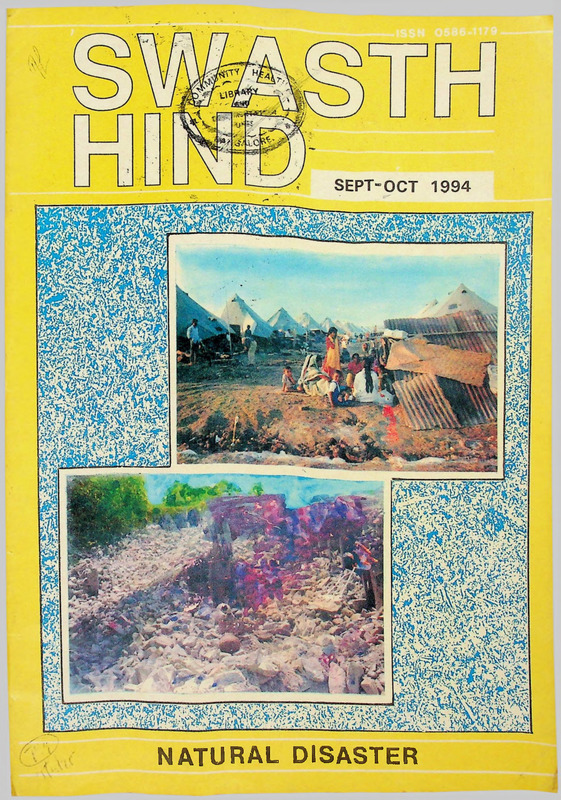
NATURAL DISASTER
In this issue
swasth hind
Sept.—Oct. 1994
Vol. XXXVIII. No. 9-10
Asvina—Kartika
Saka 1916
OBJECTIVES
Swasth Hind (Healthy India) is a monthly journal
published by the Central Health Education Bureau.
Directorate General of Health Services. Ministry of
Health and Family Welfare. Government of India.
New Delhi. Some of its important objectives and
aims arc to:
REPORT and interpret the policies, plans, pro
grammes and achievements of the Union Ministry
of Health and Family Welfare.
ACT as a medium of exchange of information on
health activities of the Central and State
Health Organisations.
FOCUS attention on the major public health pro
blems in India and to report on the latest trends in
public health.
KEEP in touch with health and welfare workers
and agencies in India and abroad.
REPORT on important seminars, conferences,
discussions, etc. on health topics.
Page
Health implications of disaster in India
Dr A.K. Khera
Dr R.S. Sharm a
Dr K.K. Dana & Dr B.K. Verma
India's preparation for disaster reduction: An
overview
Dr S.K. Ganguli
Dr (Col) A.C. Urmil
Prof (Col) P.K. Dutta
Disasters: Some considerations
Dr PA. Somaiya
Dr A.S. Sansuddi
Dr (Lt-Col) LB. Sareen
Disaster: Its implications on psycho-socio-cultural
factors vis-a-vis health of the people.
Dr (Col) A.C. Urmil
Dr YA Ketkar
Dr P.M. Durgawale
Disaster at the airports—what should be done?
Dr Anil Kumar & ML. Mehta
Disaster relief: Role of medical students and
interns
Dr YA. Ketkar
Dr A.C. Urmil & Dr R.V. Kakade
Population growth and disasters
Dr Samir Ben Yahmed
Earthquake activity in Latur-Osmanabad area
Noise pollution: a hazard
Dr (Smt) Manju Gupta
Manju Mehta
Environment and development
Kamal Nath
Health care focus in South-East Asia on underserved populations
— W.H.O. Regional Director's Report
Whither research on medicinal plants?
Dr (Smt) G.V. Satyavati
W.H.O. Report on infant and young child nutrition:
global problems and promising developments
Education for reduction of natural disasters and
their impact
Dr P.V. Prakasa Rao
Health and F.W. in Parliament
205
208
210
213
217
220
222
224
225
226
228
229
231
233
236
Editorial and Business Offices
Articles on health topics are invited for publication in this
Journal.
Central Health Education Bureau
(Directorate General of Health Services)
Kotla Marg, New Delhi-110 002
State Health Directorates are requested to send in reports of
their activities for publication
The contents of this Journal are freely reproducible.
Due acknowledgement is requested.
The opinions expressed by the contributors are not necessarily
those of the Government of India.
SWASTH HIND reserves the right to edit the articles sent
in for publication.
Edited by
M. L. Mehta
M. S. Dhillon
Assisted by
G. B. L. Srivastava
K. S. Shemar
Cover Design by
Madan Mohan
SUBSCRIPTION RATES
Single Copy
Annual
This issue
....
.
.
.
.
....
(Postage Free)
50 Paise
Rs. 6.00
Re. 1.00
Health implications of disaster in
India
Dr. A. K. Khera Dr R. S. Sharma
Dr K. K. Datta Dr B. K. Verma
Disasters cause impact on the overall health of the people besides interfering in the overall
development of the community. It is also felt that it is not possible to persue our long-term
strategies for Health For all without paying attention to the increasing problem of
disasters.
HE health effects of disaster can
The broadly classified into three
categories: (1) Direct health pro
blems in the form of injuries and
deaths. (2) Indirect health pro
blems in the form of increased
transmission of various com
municable diseases which are
mainly due to disrupted water sup
ply. disrupted sewerage system and
altered living conditions following
disaster. (3) Managerial health
problems due to strain on already
disrupted infrastructure and dis
ruption of existing national health
programmes causing managerial
problems to health managers at dif
ferent levels. Consequently the
effects of various types of disasters
on health can be seen as shown in
Table-I.
on three factors. These factors are
(1) Housing type, i.e., dry stone
buildings
or wood
framing
buildings (2) The time of day at
which earthquake occurs (3) The
population density.
The ratio of dead to injured after
earthquake has been found to be
1:3. The same findings were
observed in Osmanabad district of
Maharashtra but in Latin district
the ratio was 1:1. The ratio of
dead to injured decreases as the
distance from
the epicentre
increases.
Deaths and Injuries
Following earthquake, some age
groups are more affected as com
pared to others. During Maha
rashtra earthquake it was observed
that children in the age group 0 to
15 and elderly above 60 years were
maximally affected.
Deaths and injuries are a com
mon feature during sudden onset of
natural disasters like earthquake
and flash floods. During earth
quake the mortality is found to be
more than 10 per cent of the affec
ted population. In Maharashtra
earthquake of 1993, the mortality
rate village-wise was found to vary
from 2 to 20 per cent depending on
their location from the epicen
tre. The death toll depends mostly
Regarding the injuries seen dur
ing the earthquake of Maharashtra,
it was found that 10 to!5 per cent of
injured persons needed admission
to hospital and out of the admitted
patients 86.5 per cent were above 15
years of age and 63.8 per cent were
males. The
common
major
injuries were in the form of fracture
of tibia, fibula, radius, ulna and
skull bone. The spinal and pelvic
injuries constituted eight per cent
Sept.-Oct. 1994
of the total injuries which require
tertiary level care.
The major demand for health
services occur within the first 24 to
48 hours. In 1993. Maharashtra
earthquake, 85 per cent admissions
took place during the first 48 hours
and from fourth day onwards
admissions
fell
dramatically.
Regarding the surgical heed of the
affected people it was found that
most of the operations were con
ducted during the first five days of
earthquake. During a disaster,
patients may appear in two waves,
the first consisting of casualties
from the immediate area around
the medical facility and second of
referrals as relief operation in more
distant areas become organised.
During flash floods and sea sur
ges many deaths take place but
leave relatively few severely
injured. Deaths result mainly
from drowning and are common
among the weakest members of the
population. In 1977 Cyclone in
Andhra Pradesh, 10,000 people
were killed in an affected popula
tion of 700,000, but left only 177
orthopaedic cases.
During slow flooding a slight
increase in deaths from snake-bites
has been found. Tn July 93 flood
205
Table*!: Health effects of various natural disasters
Effect
Earthquake Cyclones
Flash floods Flood
Deaths
Injuries
Food Scarcity
Pop. Movement
Many
Many
Rare
Rare
Many
Few
Common
Rare
Comm. Dis. Risk
Potential risk following all disasters
in Himachal Pradesh, Indora sub
division in Kangra district reported
increase in number of snake-bite
cases.
High winds also cause relatively
few deaths and injuries.
Communicable Diseases
Disaster of any kind increases
the potential for communicable
disease transmission. It has been
observed that water and food borne
disease transmission potential
increases two weeks after the disas
ter which is mainly caused by fae
cal contamination of water and
food. The various other factors
contributing to water and food
borne diseases outbreak are
endemic level of the disease, pop
ulation density, population dis
placement and failure to maintain
or restore normal public health
programmes in the immediate post
disaster
period. Following
Maharashtra
earthquake.
the
cholera positivity in stool samples.
received
at
Public
Health
Laboratory Latur. increased to
seven percent as compared to pre
vious months when it was two to
three per cent.
After four weeks of sudden onset
of a natural disaster, an increase in
206
Few
moderate
Rare
Rare
vector borne diseases may occur in
some areas due to disruption of the
vector control efforts, washing
away of residual insecticides from
buildings, increased number of
mosquito breeding sites and more
human
vector
contact. The
malaria
situation
following
Maharashtra earthquake 1995
showed 'the slides positivity rate of
four to eight per cent. p. falciparum
percentage rate of 23 to 50 per cent
and Gametocyte percentage of 37
to 60 per cent in different affected
areas. This is an indicator of
Malaria potential in the area
following a disaster of this
kind. The entomological survey
of the area during the post earth
quake period showed 29 per cent
water bodies to be positive for
Anopheline breeding and none of
the 53 domestic water containers
examined showed Aedes breeding.
This is further corroborated by the
available surveillance data where
no unusual increase in fever cases
Drought
Few
Few
Common
Common
Rare
Rare
Common
Common
and clinical cases of Dengue fever
rs seen.
The other communicable dis
eases of importance during the post
disaster period are various house
fly borne diseases like con
junctivitis, pyodermas, enteric
infections and some rodent borne
ectoparasite
infections. These
disease are related to population
movement and particularly when
people are housed in temporary
camps. In
these
temporary
shelters garbage disposal, food
hygiene, potable water supply and
drainage system poses a pro
blem. One of the notable obser
vations made during the post
earthquake period was increase in
the number of dog bites following
the shifting of human population
to resettlement camps. Table III
mentions the list of diseases to be
monitored when people are put
in camps.
Table II: Mortality in various natural disasters during 1993
Disaster
Floods in Bihar. 1993
Floods in Himachal Pradesh. 1993
Floods in Haryana, 1993
Earthquake in Maharashtra. 1993
Pop. affected Deaths
22,60.000
25,01,300
14,57,942
1,79,867
33
44
46
8991
Swasth Hind
Tabic III: Disease to be monitored in camps following disaster
Main Cause
Disease
Diarrhoeal diseases
Measles
Respiratory Infections
Malaria
Meningococcal Meningitis
Tuberculosis
Helminths infestation
Scabies
Conjunctivitis
Pyodermas
Anaemia
Xerophthalmia
Malnutrition
Tetanus
Water and food contamination
Overcrowding
Overcrowding, poor housing lack of cloth
ing and blankets.
More breeding sites, more human vector
contact
Overcrowding
Overcrowding
Overcrowding, poor sanitation
Overcrowding, poor body hygiene
Improper garbage disposal
Increased fly breeding
Malaria, hookworm infestation, shortage
and poor assimilation of Iron and folate
Acute
infections
in
malnourished
Children
Acute infections, shortage of food
Injuries in an unvaccinated population.
poor obstetrical practises.
Phychiatric problems
Previously it was thought that
psychiatric problems are not acute
public health problems in disaster
but now these problems are seen to
be quite common following disas
ter of sudden onset.
During 1993 Maharashtra earth
quake. a community based psy
chiatric survey showed that there
was one case with this problem in
eight families visited and majority
of them were suffering from major
depression (33.6 per cent) and post
traumatic stress reaction (39.4 per
cent).
Food scarcity and associated nut
ritional problems are common dur
ing drought disaster. It has been
observed that people with bor
derline malnutrition and vitamin
deficiency get affected early
following drought situations.
References
1. PAHO. Emergency health management
after natural disaster. Pan American Health
organisation. New York. 1981.
2. A report of public health team's visit to
earthquake affected areas ofMaharashtra dur
ing October 93. National Institute of Com
municable Diseases, Delhi
3.
Shimla response to Disaster ■
NTCD convened a meeting of experts in
Shimla in June 94 to prepare *National
Action Plan* for preparedness and response
to disaster.
Food and Nutritional problems
4. A report ofrapid health assessment offloods
in Bihar (1993)
Food shortages immediately
after disaster may arise in two
ways. This may be due to food
stock destruction or disruption of
distribution system. Flood disas
ter often damages house hold food
stocks and crops, disrupt distribu
tion and cause local shortages.
5. A report of rapid health assessment of
floods in HP. (1993)
Generalised
food shortages
severe enough to cause nutritional
problems do not occur after
earthquakes.
6. A report of rapid health assessment of
floods in Haryana (1993)
Acknowledgement
The authors are thankful to Director of
Health Services of Maharashtra, Bihar.
Himachal Pradesh and Haryana for giving the
opportunity to carry out the rapid health assess
ment of disaster situations. Also thanks are
due to Dr T. Verghese. DDG. DGHS. New
Delhi.
“I do not want my house to be walled in from all sides and my windows to be stuffed. I want the
cultures of all lands to be blown about my house as freely as possible. But J refuse to be blown
off my feet by any, I refuse to live in other people’s houses as an interpoler, a beggar,
or a slave.
MAHATMA GANDHI
Young India dated 1st June, 1921
Sept.—Oct. 1994
207
India’s Preparation for
Disaster Reduction :
An Overview
Dr S. K. Ganguli
Dr (Col) A. C. Urmil
Prof (Cod P. K. Dutta
The country will have to pay more attention towards public awareness and
preparedness in respect of people residing in known disaster prone
areas. Special training is required to, medical, paramedical, voluntary
workers in relief and rescue work.
isaster by definition involves
disruption of human ecology
which cannot be absorbed by the
adjustment capacity of the .affected
community within its own resour
ces1. According
to
their
genesis, disasters fall into two
broad groups, viz (a) Natural disas
ters consequent to the fury of
nature and (b) man-made disasters
which may be intentional or nonintcntional
(accidental)3.
Although a determined human
effort can. totally, to a great extent
prevent man-made disasters, the
same does not hold good in respect
of natural disasters which have a
growing concern, of mankind all
over the world particularly during
the last three decades or so. There
is a growing awareness also that
though it may not be possible to
prevent natural disasters but these
can be certainly tackled effectively
through adequate preparedness to
mitigate the loss of human life and
property. It. is against this back
ground that on 11 December 1989
the United Nations General
Assembly proclaimed 1990s as the
D
208
International Decade for Natural
Disaster Reduction (IDNDR),
beginning from 1st January 1990, to
initiate a concerted global effort to
reduce the destructive impact of
natural disasters which alone dur
ing the past two decades killed an
estimated three million people3.
storms leading to land slides
and
strong cold
waves.
Besides
this,
the
entire'
Northern part from Hindukush to Eastern Himalayas,
lies in earthquake prone belt of
violent Subterranian volcanic
activity.
India is supposed to demarcate
the disaster prone areas and work
out the details, of their increasing
impact in terms of loss of life,
physical damage and effect on
economic
developments. The
country is supposed to apply the
scientific and technological pro
gress to disaster mitigation3.
2. Indo-Gangetic Plains : Heavy
rains during monsoon make
these plains. vulnerable to
floods.
4. The
Western
Desert: A
drought prone area.
India’s Proneness to Natural Disas
ters
5. Coastal Areas : They are prone
to sea erosion, cyclones and
tidal waves4.
On the basis of geographic and
climatic considerations, India can
be divided into 5 zones according
to its disaster proneness to natural
disasters as jinder:—
1. Northern Mountain Region
including foot hills: This
region is prone to strong snow
3. Deccan Plateau : A drought
prone area.
The disaster proneness varies
widely from State to State. In 1990
alone, floods and cyclones claimed
1422 human lives in India;
damaged about two million houses
effecting 57.2 million people in 197
districts of 19 States/UTs : The
crop area affected was 4.5
million hectares5.
Swasth Hind
Some of the worst natural disas
ters in India in the recent past.
whose memory is still fresh in our
mind, include (i) Tropical cyclone
on Andhra Pradesh Coast in 1977
which claimed more than 10.000
deaths and again an severe cyclone
causing vast devastation during
1989. (ii) Earthquake in Koyna
Nagar, Maharashtra (1967) Kinnaurand Lahaul Spiti in Himachal
(1975). Bihar (1988), Garwhal Hills
(1991) and Latur. Maharashtra
(1993). The last one claimed a
death toll of over 12.000 and many
more injured.
India is located in the South-East
Asia Region ofWHO which ranked
fourth amongst the most disaster
prone regions in the world.
Progress in
Disasters
Tackling
Natural
The progress made in tackling
disasters since India’s indepen
dence reveals some important
achievements:—
1. India became member of the
World Meteorological organi
sation on 23 March 1950.
2. Launching a National Flood
Control Organisation in 1954.
3. Setting up Rastriya Bar Ayog in
1976.
4. Setting up of Brahmaputra
Board in 1981.
The main activities since launch
ing of National Flood Control Pro
gramme (1954) include—construc
tion of embankments and drainage
channels, town protection schemes,
raising the level of flood prone
villages, completion of reservoir
projects, flood forecasting and
warning for different river basins.
Indian Meteorological Depart
ments (IMD) also plays a key role
in forewarning the disasters. It
has
five
centres
(Calcutta,
Bhubaneshwar, Vishakhapatnam.
Sept.—Oct. 1994
Madras and Bombay) for detection
and tracing of Cyclone Storms and
Satellite Imagery facilities and
cyclone warning Radars provided
to various Cyclone Warning Cen
tres. In addition, it has 31 Special
Observation Posts set up along East
Coast of India. For all ships, out
at sea warnings are issued six times
a day.
Insrt Disaster Warning System
(DWS) receivers have been in
stalled during the first phase of 100
stations, primarily in the coastal
areas of Tamil Nadu and Andhra
Pradesh. This has been proved
highly reliable form of com
munication system for cyclonic
warnings during Chirale cyclone
(1989) and Machalipatnam cyclone
in
1990®. The
Snow
and
Avalanche Study Establishment
(SASE) in Manali (H.P.) has been
issuing warning to the people about
avalanches 24 to 48 hours in
advance.
For tracking any disaster, every'
State has a full fledge Secretariat
Wing under Relief Commissioner/
Secretary for proper co-ordination
at district level. In case of need.
•the
State
Government
can
approach the Centre for help in res
pect of finance, manpower and
material. At the Centre, the
Ministry of Agriculture is the nodel
ministry for coordination of all
activities during any natural disas
ter. Since health is an important
part of disaster management, in the
Directorate General of Health Ser
vices under Ministry of Health,
there is a Special Wing called the
Emergency Medical Relief Wing
which co-ordinates all activities
relating to health. At the district
level, the Collector forms a small
committee which assesses the
degree of devastation and organises
rescue and relief work and informs
the State Government Relief
Secretary/Commissioner
Works
directly
under
Chief
Sec
retary. The State Govt, officials/
Ministers concerned visit the
affected areas to oversee relief
operations and release funds
required. Later.
the
Central
Teams including the members and
officials from Health Ministry also
visit the area to assess the
magnitude of the problem and
recommend
central
assistan
ce. The United Nations has a spe
cial
body
called
UNDRO
(Office of the United Nations Dis
aster Relief coordinator) which can
always be approached for extra
help
whenever
needed. The
WHO and UNDP and other volun
tary Organisations help in all
major disasters.
Areas of Special Concern During
IDNDR
During IDNDR. the country will
have to pay more attention towards
public awareness and prepared
ness in respect of people residing in
known disaster prone areas. Spe
cial training is required to medical.
paramedical, voluntary workers in
relief and rescue work.
References
1.
2.
3.
4.
5.
6.
Verma B K. The Disaster Profile ofIndia,
Disaster Management (A Report on
Workshop held at Nagpur on 14-18 Oct
1986. sponsored by the WHO) DGHS
Ministry of Health & FW. 1st Edn.
1987. pp 8-19.
Urmil AC and Sandhu Ms. Disasters—
An Increasing Awareness, CHEB, Swasth
Hind. Vol XXXIV. No. 7 Jul. 90 pp 160162.
United Nations International Decade for
National Disaster Reduction. CHEB
Swasth Hind Vol XXXV, No. 3-4 MarApr 91, p 80.
Mandal HS, Natural Disasters, Disaster
Management (A Report DGHS, Minis
try of Health & FW. 1st Edn. 1987 pp
30-33).
Pant MC. Natural Disaster Reduc
tion. Swasth Hind Vol XXXV, No 3-4;
Mar-Apr 91. pp 65-69
Gopaia Rao W. India National Satellite
(INSAT) Disaster Warning System,
Swasth Hind Vol XXXV. No. 3-4 MarApr 91, pp 81-82.
209
DISASTERS:
Some Considerations
Dr P. A. S O'Maiya, Dr A. S. Sansuddi
Dr (Lt. Col.) I. B. Sarf.en
Any disaster is an emergency situation and the health sector alone cannot tackle it in
isolation. It must harmonize its efforts with the local community, civil defence, army, police,
fire-brigade and with various governmental/non-governmental bodies including voluntary
organisations such as Red Cross.
HERE is no doubt that remak
T
able progress has been achie
ved not only in the field of science
and technology but in all spheres of
human activity particularly during
the current century. But unfor
tunately the same progress has also
been exploited to produce agents of
mass destruction such as nuclear.
chemical and biological weapons.
capable of Wiping out all the
achivements made so far within a
matter of minutes. This is an
addition to the already growing
concern about.the various forms of
natural disasters which have been
showing an increasing trend in the
various regions of the world. Num
ber wise, in 1988 alone, there were
74 major floods, 5 cyclones, 17
earthquakes, 18 droughts and 162
major accidents, the world over.
During the period 1960 to 1989, our
own country experienced a total*of
191 disaster events of various types
resulting into 1,51,179 killed.
2.11.535 injured and 174.28.72.678
affected. The increasing trend of
natural disasters is the main reason
for declaring 1990 as the Inter
national Decade for Natural Disas
ter Reduction (IDNDR) by the
United Nations and the World
Health Organisation in selecting
210
the theme “Should Disaster Strike:
Be prepared” for the World Health
Day during 1991. which aimed at
arousing public awareness toward?
impact of disasters on human life
and health and to initiate approp
riate actions at various levels
through prior preparedness to
reduce their effect
Disasters : some basic facts
According to WHO. a disaster
is—“Any occurrence that causes
damage, economic disruption, loss
of human life and deterioration in
health and the health services on a
scale sufficient to Warrant an
extraordinary response from out
side the affected community or
area.” As per this definition, a dis
aster strikes almost everyday in
some part of the world.
All disasters can be broadly
classified into two major categories
A. Natural disasters such as earth
quakes, floods, droughts, cyclones,
volcanic eruptions, etc., and B.
Man-made disasters which may
be^-(a) intentional (unconven
tional warfare, civil strife, etc.,) or
(b) Non-intentional (industrial
accidents, e.g., Bhopal Gas Tragedy.
Chernobyl Nuclear plant Disaster,
etc.). Man-made intentional dis
asters are totally preventable pro
vided there is will, while the
non-intentional ones (mainly due
to human neglect) are Preventable
to a great extent According to
latest concept, a new ecological
dimension has been added to the
difinition of disaster which now
covers conditions like oil spills, air,
water and soil pollution, deser
tification. the greenhouse effect
and environmental degradation.
refugees besides nuclear, chemical
and . biological
catastrophes.
These are all man-made and
require a determined, concerted
efforts to prevent them.
Various phases of disasters have
been described although all disas
ter prone areas pass through three
main phases—1. Predisaster phase,
2. impact phase and 3. oost-disaster phase (rescue, relief, reha
bilitation). According to beha
vioural and psychological respon
ses to natural disasters, five phases
have been mentioned—1. impact
phase: Fear sets in and the victim
attempts to cope by running away,
rescuing others or just giving up,
2. phase of heroism: Efforts are
Swasth Hind
made to survive and recover pro
perly. a time of great altruism and
self-worth as well as over-work
associated with irritability and
exhaustion. 3. Honeymoon phase:
Good outcomes are anticipated:
cxpcrcinccs arc shared and hope
and elation prevail. 4. Phase of
disillusionment:
Disappointment
follows when aid docs not arrive in
time and some people are regarded
more fortunate than others. Dep
ression commonly occurs and
5. Phase of reorganization: People
rebuild their lives and realize that
they must depend on themselves
for recovery: the failure to do this.
leads to bitterness and animosity.
In case of man-made disasters, four
phases have been described ac
cording to victims’ response—
I. impact phase The vicitim ex
periences fear. 2. interaction phase:
The victim feels conflict over being
victimized. 3. phase of acceptan
ce: The victim yields to and
imitates the perpetrator in order to
survive and avoid injury and pain
and 4. phase of acquiescence: The
victim surrenders in order to sur
vive and to avoid injury but feels
importence.
humiliation.
rage
and guilt.
Unlike man-made disasters,
most of the natural disasters occur
in certain disaster-prone areas, e.g.,
Bangladesh is a known disaster
prone area for floods (Which occur
as regular annual events) and
cyclones. The flood in 1988. the
worst in living memory, claimed
lives of 1500 people and damaged
more than 50 per cent of district
hospitals while the killer cyclone of
1970 took 200.000 lives, drowned
millions of livestock, damaged 85
per cent of housing and destroyed
most of the fishing fleet The terri
ble famine of 1943 killed nearly two
Sept.—Oct. 1994
million people during the Bengal
famine. Although, science still
cannot make accurate short term
predictions of the time, size and site
of seismic disturbances, most
earthquakes occur in areas recog
nized as prone to them. The
Tangshau earthquake in China
during 1976. left a quarter of a
million dead and partially wiped
out a major industrial city.
The calamity brought about by a
disaster depends upon its nature
and magnitude. Some disasters
are predictable qualitatively if not
quantitatively. Their consequen
ces can be put into two broad
categories, namely—A. Human
suffering due to lack of shelter, e.g..
injury, disability and death, and
B. Monetary loss due to loss of pro
perty (individual or public). The
health effects of natural disaster
can also be categorised into “short
term” and “long term” effects.
“short term” effects include deaths,
injuries, food and water scarcity,
population movements, lack of
shelter and psychological disorders
such as anxiety, depression and
post-disaster syndrome (temporary
confusion, disorientation), “long
term” effects include physical dis
abilities, outbreaks of epidemics
due to contamination of water sup
ply, improper disposal of excreta,
and over-crowding in camps.
During famines, prolonged mal
nutrition predisposes to gastro
enteritis. measles and respiratory
group of infections which become
leading causes of death. Disasters
also disrupt the ongoing control
programmes in that area, Mass
casualties during disaster, also pose
a major problem of providing pro
mpt and efficient treatment besides
problem of burial/cremation of
corpses and disposal of car-
cascs. All these problems need to
be tackled on war footing.
All disasters produce floods of
refugees and may become har
bingers of epidemics. According
to U.S. data, between 1900 and
1988. some 47 million people
worldwide became homeless due to
natural disasters. Nearly 8 million
refugees, nowlive in the misery and
squalor of camps and settlements,
depending
almost
enti
rely on food aid. Mortality rate
among these refugees, especially
during acute phase of displace
ment, are exceptionally high upto
60 times the expected rates and so
are the Psychological disorders
such as depression, anxiety and in
extreme cases even suicides. Un
like man-made disasters, the prior
experience/knowledge in respect of
natural disasters is a plus point in
our disaster preparedness. Al
though, it is virtually impossible to
prevent most disasters, the WHO’s
main concern is in reducing their
adverse impact on human health
through- preparedness for each
phases of operation, i.e.. relief.
rehabilitation
and
reconstruc
tion. Since it is feared that with
continuing deterioration of the
environment, including deforesta
tion and misuse of land, the fre
quency of disasters such as flood
and drought, will increase in the
coming decade.
Action to prcvent/rcduce the conse
quences
Any disaster is an emergency
situation and the health sector
alone cannot tackle it in isola
tion. It must harmonize its efforts
with the local community, civil,
defence, army, police, fire brigade
and. with various governmental/
211
non-governmental bodies includ
ing voluntary organisations such as
Red Cross. It also calls for train
ing of “emergency” medical per
sonnel in providing immediate
care (first aid), triage, casualty
evacuation, emergency treatment
in hospital, psychological assis
tance to community. Provision of
medication as well as safe water.
shelter and sanitation.
Preventive measures should aim
at reducing the physical impact of
disasters and must include legis
lations in respect of urban plan
ning and public works which
determine where not to construct or
locate key facilities. Preparedness
should also involve training of
local community to deal with a
large number of injured per
sons. Teachers and school child
ren should be particularly involved
and trained in first aid. life saving
resuscitative measures and preven
tion of health hazards of disasters
in disaster prone areas. Special
(raining courses should be arran
ged for all health personnel and
other members of the commu
nity. Lecturcs/practicals on disas
ter preparedness should be incor
porated in the educational curri
culum of all health professionals.
The country should provide welleducated disaster specialists for
training/guidance purposes.
In flood prone areas, the houses
must be constructed on a higher
platform: people should be taught
swimming and first aid in case of
drowning. During monsoons.. the
rise in river water level should be
regularly monitored to the popula
tion at risk. Flood resistant seeds
of crops are being developed which
can be planted and harvested
before the onset of floods. To pre
vent pollution of drinking water.
these areas should be installed with
tubewells on sufficiently raised
ground. The other measures in
21-2
clude dredging of rivers, improve
ment of flood warning systems.
construction of embankments.
shifting of food warehouses to
higher lands and modernisation of
country boats. In earthquake
prone areas, particular attention
must he paid to construction
material used and location of the
house which could be made earth
quake proof. Famine prone areas
should take special note of various
early warning indicators such as
low rainfall, dwindling food reser
ves. soaring market prices, etc.
Food relief must be provided in
four ways as recommended by the
WHO. i.e.. delivery of dry food to
people (usually families): mass
feeding with prepared (cooked)
food to everyone usually in camp
setting, supplementary feeding to
vulnerable groups (under five, pre
gnant and lactating women, old
people) and therapeutic feeding.
Arrangements should be kept
ready in advance to procure food
aid from other countries when
required and for its proper storage.
distribution and delivery. Procure
ment can be based on rule of
thumbs to provide an absolute
minimum of 1900 Kcal per person
per day.
Based on previous experience,
preventive measures and plan for
preparedness should also be
worked out in respect of other
categories
of natural
disas
ters. The only ideal method of
preventing the man-made inten
tional disasters is to build up a
strong world opinion to destroy/
stop manufacturing and stockpill
ing of all. non-convention al warfare
agents and not to exploit scientific
and technological advancement to
develop newer ones. As regards
man-made un-intentional disas
ters. rapid action is required to pre
pare the international chemical
safety cards in respect of all the
chemicals in use today. Uptill
now. only a tiny fraction of the
50,000 or so chemicals in everyday
use. has so far been subjected to
thorough and detailed studies of
their effects on health.
During the current international
Dacade for Natural Disaster
Reduction, the WHO has orga
nised three inter-regional meetings
on disaster preparedness for health
planners since 1983. In 1989, the
subject was again discussed in
South-East Asia Regional Commit
tee. Based on its recommen
dations. the WHO initiated a series
of steps to strengthen efforts of
member States in disaster pre
paredness activities. However. Dr
Hiroshi Nakajima. the DitectorGeneral of WHO has rightly said
that “International Solidarity and
Cooperation are essential for
reducing the adverse effects of dis
asters”. Let us hope that the
message which he conveyed during
1991 on the WHO Day and which
still holds good, succeeds in draw
ing attention to the need for disas
ter preparedness and leads to
concrete steps to initiate action for
effectively reducing the impact of
disasters on human life and
health.
References
1.
WHO : Literature published on WHO
Day theme. “Should Disaster Strike: Be
prepared", during 1991.
2.
WHO: Coping with Natural Disas
ter: The Role of Local Health Personnel
and the Community. WHO Geneva.
1989.
3.
Urmil AC and Sandhu MS (1990) Disas
ters: An increasing awareness. Swasth
Hind, July 1990.
4.
Govt, of India, Ministry of Health
(1987). Disaster Management (A Report
on a Workshop held at Nagpur on 14-18
Oct. 1986).
5.
Comprehensive Text Book of Psychiatry
edited by I. Kaplan et al. vol II. 3th Edn.
1989: publisher Williams and Wilkins.
Baltimore. Maryland. USA
Swasth Hind
DISASTER: Its implications
on psycho-socio-cultural factors
vis-a-vis Health of the people
Dr (Col.) A. C. Urmtl,
Dr Y. A. Ketkar & Dr P. M. Durgawale
All disasters precipitate psycho-physiological stresses in the form of emotions of fear, horror,
panic and even terror. Panic is not a common reaction and is seen in respect of people crow
ded within an enclosed space such as auditorium, cinema hall, etc., when the disaster
strikes. Social disruptions depending upon the nature and severity of a disaster include loss of
shelter, loss/break-up of family, loss of source of income, mass movement to safer places,
break-up of communication and transport services, shortage of food, water and clothing and
overall degradation of the environment.
ISASTERS have been responsi
D ble for wiping out many
advanced civilizations of the world
since the dawn of history. Natural
disasters have been mainly respon
sible for such catastrophes since
most of them were unpredictable in
the past and some of them, e.g.
earthquakes, volcanic eruptions,
still remain so in spite of so much
progress in the relevant field of
science and technology. During
the ongoing International Decade
for Natural Disaster Reduction
(IDNDR). the main aim is to
reduce their impact on psychosocio-cultural factors which also
adversely reflect upon the health of
the affected people and are root
causes for increased morbidity and
mortality among them. This con
cern is fully justified because of our
inability to prevent their occur
rence, unpredictability in respect of
many disasters regarding time and
place of their occurrence and inten
sity and also because of their pre
sent rising trend. The concern
about their impact on human lives
Sept—Oct. 1994
2—10 DGHS/ND/94
is further substantiated by the fact
that during the period 1947—1980.
tropical cyclones were responsible
for 499,000. earthquakes for
450,000, floods for 194,000, thun
derstorms and tornadoes for 29,000.
snow storms for 10,000, volcanoes
for 9000 and landslides for 5000
deaths (all figures upto nearest
thousand). One can imagine about
the extent of morbidity, injuries
and disabilities which would also
have been considerably high. All
disasters thus pose an emergency
situation calling for immediate life
saving operations, subjecting the
existing health services to unexpec
ted extra workload and stress. It is
feared that the continuing dete
rioration of the environment
including deforestation and misuse
of land, is further going to
aggravate the ecological imbalance
and promote the frequency of
natural disasters such as floods and
droughts in future.
Reasons For Psycho-Socio-Cultural
Disruptions
These disruptions are attribut
able to damage a disaster causes
due to its physical impact resulting
into loss of life, loss of property and
breakdown of essential public ser
vices. The damages caused by
some major natural disasters are
summerized as under—
Earthquake: It may cause a large
number of deaths and injuries
mainly bacause of sudden house
collapses. People
residing in
houses built with stones and bricks
but not conforming to the Building
Code, are more vulnerable than
those residing in houses construc
ted with lighter material such as
wood, bamboos and mud. The
worst affected populations include
those residing in densely populated
areas closer to the epicentre of the
earthquake. Casualties are more
during night time when most of the
people
remain
inside
their
houses. Earthquakes on ocean
bed also give rise to a dangerous
phenomenon
called Tsunami
(maremoto) generating a several
meters high sea wave which
crashes down on the coasts and
213
sometimes engulfs people who
have fled towards the beaches.
Volcanic eruption: It results in
high mortality due to mudslides
and glowing clouds. Besides this.
a large number of cases of injuries.
burns and suffocations also occur.
Water and plants get contami
nated. Sometimes eruptions arc
preceded or accompanied by
earthquakes.
Wind storms (Cyclone. Hurri
cane. Tornado): They by them
selves cause relatively few deaths
and injuries unless accompanied
by floods, tidal waves and sea sur
ges. Coastal areas are more
exposed to such risk. The com
bined effect of rain and wind may
cause
houses
to
collapse.
Dangerous objects lifted and car
ried by the wind may cause
injuries, fractures, cuts and brui
ses. Cyclones pose special risk
due to fallen high voltage cables
which may cause electrocution.
short circuits and fires.
Floods: Among all natural disas
ters. floods are regarded as most
damaging in terms of human lives
and property. They are an annual
feature in respect of major rivers
and their tributaries during mon
soon season. Populations living
on alluvial plains liable to flooding
are worst affected. Mortality is
high in case of sudden flooding
mainly due to drowning. Besides
fractures, injuries and bruises,
cases of accidental hypothermia
also occur during cold weather
conditions. Deaths due to bites by
poisonous snakes and insects are
also common.
E. Droughts: A combination of
several factors are responsible for
droughts, e.g.. a reduction in rain
fall. reduction in vegetation, ero
sion of soil and surface evapo
ration. In rural communities,
economic factors (type of agricul
ture) and socio-cultural factors
(nomadism, semi-nomadism, mig
ration towards town, etc.) affect
the health and survival of the
families. Famines and deser
tification are their most fearsome
consequences. Famines are the
root cause of severe nutritional
deficiency disorders such as
Protein-Energy
Malnutrition
(marasmus. Kwashiorkor) •. and
vitamin deficiency—particularly
vitamin A deficiency leading to
xerophthalmia and child blind
ness. Such malnourished people
remain at high risk ofvarious infec
tions due to poor body resistance
resulting into the vicious cycle of
‘‘malnutrition -> infection —> mal
nutrition”. Measles, respiratory
infections and diarrhoeal diseases
complicated by dehydration bring
about a high increase in infant
mortality. Drought affected popu
lations who migrate and tem
porarily settle down on the out
skirts of cities and towns face the
problem of poor hygiene and
sanitation and overcrowding which
further exposes them to a higher
risk of endemic communicable dis
eases of that area, like diarrhoeas,
tuberculosis, parasitic diseases and
malaria. The following Table
sums up the effects and health
impacts due to some major natural
disasters—
Effect
Drought
Earthquake
High wind
(without flood
ings)
Tidal waves/
flash flood
Flood
Deaths
Moderate
Many
Few
Many
Few
Severe injuries requiring
extensive care
Moderate
Over-whelming
Moderate
Few
Few
Food scarcity
Common
Rare (may occur due to factors
other than food shortage)
Rare
Common
Common
Major population move
ments
Common
Rare (may occur in heavily
damaged urban areas)
Rare
Common
Common
I Jndcmutrition/Famine
Common
Occasional
Rare
Occasional
Moderate
Increased risk of com
municable diseases
Potential risk following all major natural disasters (Probability rising with overcrowding and deteriorating
sanitation)
(Adapted from PAHO Scientific Publication 438. “Health Services Management following Natural Disaster”, PAHO, 1983)
Psychological Impacts
All disasters expose the affected
population to sudden and severe
stress (better called as dis
tress). According to Selye. who
formulated the. General Adapta
tion Syndrome (GAS): the body
has to pass through three stages in
such a damaging situation— .
1. The Alarm Reaction due to
lack of prior exposure to such
experience.
214
2. Stage of Resistance during
which the body succeeds through
physio logical/psychological
ad
justments to counteract and adopt
against the stressful situation,
3. Stage of Exhaustion mainly
due to body's limited ability to cope
up with the stress and may finally
lead to death.
All disasters (natural or man
made)
precipitate
psycho
physiological stresses in the form of
emotions of fear, horror, j5anic and
even terror. Panic is not a com
mon reaction and is seen in respect
of people crowded within an
enclosed
space
(auditorium,
cinema hall etc.) when the disas
ter strikes. The consequences of
such stresses are mainly respon
sible for sustaining of injuries and
loss of life. The ‘high risk’
category includes those with pre
vious history of psychiatric
SWASTH HIND
disorder, lack of social/family sup
port, lower socio-economic status,
increased age and impaired per
ception. Times Beach' Study in
USA showed that the principal vic
tims of long term effects of the dis
asters included the younger; poorer
and less educated people and those
with broken family likely to be
separated
or
already
divor
ced. This study and other studies
also reveal that disasters are chiefly
responsible for aggravating the psy
chiatric symptoms which the affec
ted people already had earlier and
do not seem to cause the develop
ment of new psychiatric symptoms
except in cases of Post Traumatic
Stress Disorders (PTSD) which
fewer than 25% of disaster victims
seem to experience. Another study
carried out soon after Ml -St
Helens Volcanic disaster revealed
that the exposed subjects had
6 common symptoms—apprehen
sive expectation, vigilance and
scanning, motor tension, auto
nomic hyperactivity, insomnia and
thoughts of death. They however
had a low occurrence of guilt,
intrusive thoughts, numbing of
responsiveness and avoidant be
haviour. Most of them felt, they
could make effective contributions
to mitigate the sufferings even
though they could do nothing to
control the disaster. These studies.
highlighting low rate of psychiatric
morbidity among disaster victims
with no previous history of psy
chiatric disorders, provide a proof
of human beings’ resilience to such
stressful situations. In the literature.
brought out in 1991 on WHO Day
theme “Should Disaster Strike: Be
Prepared”, it has been specifically
mentioned that the notion that the
disasters bring out the worst in
human behaviour (e.g..) looting and
other forms of selfish behaviour) is
also false. On the contrary, they
bring out the best in people and
strengthen their solidarity to face
the situation. However, a few
exceptions may be found where
under persistent psychological
stress and a feeling of extreme des
peration because of loss of one’s
status, property, near and dear ones
and loss/change of employment, a
person may increase the use of
alcohol, tobacco and other drugs
and under extreme depression may
even resort to suicide. Studies
Sept.-Oct. 1994
reveal that the factors that seem to
contribute most to suicide are a
feeling of separation and social
isolation. Recent study carried
out by PRO-LIFE among earth
quake affected area of Latur
(Maharashtra), reveals that 64%
adult population of two affected
villages had suicidal tendencies.
Socio-Cultural Impacts
Depending upon the nature and
severity of a disaster, social disrup
tions of various types occur such as
loss of shelter, loss/break up of
family, loss of source of income,
mass movement to safer places,
break up of communication and
transport facilities, shortage of
food, water and clothing and
overall degradation of the environ
ment. a Natural disasters produce
■floods of refugees whose number is
consistently on increase. Accord
ing to UN High Commissioner For
Refugees (HCR), nearly 15 million
refugees were there at the begin
ning of 1990s but this has been only
regarded as the tip of an iceberg
since in Africa alone, 35 million
now live outside their country of
origin.
Such disruptions prove consider
able hindrance during rescue
operations and during post-disaster relief and rehabilitation
activities. Social, cultural and
religious activities get • disrupted.
reflecting upon cancellation/postponement of fairs and festivals and
also various functions at family
level, e.g., celebration of marriage,
birth and wedding anniversaries.
etc.. Such disruptions also lead to
some psychological trauma to the
affected people depending upon
their personality.
Besides the above mentioned
psycho-social factors, the impact of
a disaster is also influenced by
religious factors. To quote one
example, many orthodox com
munities in developing countries
still believe that disasters are due to
divine anger and according to our.
own Indian mythology, the earth
rests on the head of a giant
elephant and whenever it shakes its
head, an earthquake occurs. Such
convictions on the one hand
become an obstacle in seeking
people’s participation in disaster
preparedness and in facing it
boldly but on the other hand may
also help certain other populations
to cope with the situation effec
tively. For example, according to
recent study carried out by PRO
LIFE in earthquake affected peo
ple of Latur, profound belief in
destiny, God’s will, the afterlife,
power of prayer and past deeds
helped them considerably in cop
ing with the situation. It is in this
field, it is felt that religious leaders
can play a key role in restoring
people’s faith in God and in
rebuilding their future. Indirectly
it will help people in restoring/
maintaining their psychological
(mental) health.
Impact On
services
health
and
health
All disasters impose an emer
gent extra burden on the existing
health services in the form of:—
1. Mass Casualties: The accep
ted principle of Triage is followed
and first priority is given to life sav
ing emergencies such as haemorr
hages. cardio-vascular failures,
respiratory distress, state of shock,
skull injuries, bums, fractures dis
locations. sprains, wounds, expo
sure to cold, drownings, electro
cutions, poisonings and bites from
venomous snakes. The greatest
need for emergency care is usually
required during first 48 hours
following a natural disaster.
2. An abnormal increase in the
incidence of communicable dis
eases such as—A. Water and food
borne
diseases
(diarrhoeas.
cholera, viral hepatitis, enteric
fever, poliomyelitis and leptosirosis) B. Vector Borne Diseases
(malaria. Japanese encephalitis.
Dengue fever) C. Diseases trans
mitted from person to person
(acute
respiratory
infections.
meningitis, measles, whooping
cough, diphtheria, shigellosis, skin
infections like scabies) D. Wound
complications e.g. tetanus and E.
Dog bites.
Besides these, the other activities
in which health services get
inyolved include—provision of
safe drinking water, temporary
shelter with proper and adequate
sanitary facilities, proper disposal
of human excreta and other com
munity wastes, proper disposal of
215
dead bodies and carcases, preven
tion and control of vector borne
and other communicable diseases
including immunisation.
The risk of outbreak of an
epidemic also increases con
siderably due to following 4
reasons—1. Increased population
density resulting into overcrowding
and closer human contact 2. In
creased population movement
resulting into introduction of com
municable diseases into previously
unaffected areas or introduction of
susceptible population into ende
mic areas 3. Disruption of pre
existing sanitary services and
potable water supply resulting into
vector borne and water borne dis
eases and 4. Disruption of exist
ing medical facilities and public
health programmes resulting into
communicable diseases affecting
susceptible and unprotected pop
ulation. It is because of these
reasons that the daily disaster sur
veillance and monitoring of infor
mation to concerned authorities
become essential on the part of
investigating
teams/epidcmiologist. This daily report must include
information
about
following
diseases—malaria, diarrhoeal dis
eases like cholera, dysentery,
gastro-enteritis etc., respiratory
infections, meningitis, infective
hepatitis, enteric fever, burns and
snake bites.
Lastly, it should not be forgotten
that for efficiently tackling the
various disaster impacts, health
services alone are not competent
enough. These impacts involve
the fields of other services also
which are directly or indirectly lin
ked with the health status of the
population. An efficient manage
ment of disaster therefore always
calls for multi-disciplinary and
multi-sectoral coordination to
mitigate the sufferings of the people
and restore normalcy within the
shortest possible time.
References
1.
2.
WHO and LORCS: Coping
with natural disasters: the role of
local health personnel and the
communitv WHO. Geneva.
1989.
WHO : Should Disaster Strike:
Be Prepared—literature on
World Health Day, 7 April
1991.
3.
WHO : The risk of disease out
break after natural disas
ters. WHO Chronicle, Vol 33,
No. 6, June 1979, pp 214—
216.
4. Chakraborty AK (1992) Disaster
epidemiology and health mana
gement Ind J Pub Hlth, Vol
XXXVI, No. 3, Jul-Sep 1992, pp
94—100.
5.
Olavi Elo (1992) Preparedness
programmefor natural and man
made disasters. Ind J Pub Hlth,
Vol XXXVI, No. 1, Jan-Mar
1992. pp 6—14.
6. Directorate of Health Services,
Govt, of Maharashtra, Bom
bay : A
Guide to Health
Management in Disaster.
7. Naresh Fernandes: In quake
aftermath. Latur survivors still
mentally unsettled. The Sun
day Times of India, 13 March
1994. p 10.
Cannabis Clue to Parkinson’s and Epilepsy
The forbidden drug, cannabis, could point the way to finding a new
method of controlling the worst effects of epileptic fits and Parkinson’s
Disease.
Current treatments for both conditions attempt to alleviate the symptoms,
but a UK doctor now believes it is possible to alter the messages from the brain
that cause sufferers to have convulsions and uncontrolled movements.
Dr. Tony Curtis, a 27-year-old epileptic from Keele University in the
English Midlands, is researching the development of a completely synthetic
drug that will act on the same part of the brain as cannabis to influence the sites
where movement is controlled.
The doctor, who has just been given nearly £35,000 worth of equipment by
Manchester University Medical School in north-west England to carry out the
research, says although the development of the new drug is still at as early
stage, some encouraging results have already been produced.
He is currently working with a neurology group at Manchester University to
develop the drug into a more suitable and easily administered form.
—Medical News from Britain
216
Swasth Hind
DISASTER AT THE AIRPORTS
—What should be done?
Dr Anil Kumar
&
M.L. Mehta
isasters can occur at any
place, any time and anywhere.
Be it workplace, home. road, hospi
tal. hills, lake, sea or air. And air
ports are no exception. Disasters
that can occur at airports include
storms, floods, earthquakes, and
seismic sea waves besides airport
accidents/incidents. The vulnera
bility of an airport to any of these
will, in good measure, be affected
by geography, since the more
dangerous occurrences are often
defined by certain areas or belts.
No doubt such disasters cannot be
averted but; with a little effort a
damage can be minimised and res
toration of aircraft operations
expedited.
D
Development of weather pat
terns, prediction and tracking of
potential danger resulting thereon
will normally be carried out by a
meteorological service of the area.
The airport authorities can pre
pare an airport emergency plan to
meet such eventualities. It should
provide for initial protective
measures, personnel shelter and
post-storm clean up and restora
tion. Aircraft operations will
usually be impossible for several
hours before the arrival of the
storm and until several hours after
its passing.
What is emergency plan?
When severe storm warnings are
received all owners of aircraft
based or on the ground at the air
port should be notified and war
nings issued to all aircraft pilots
Sept.—Oct. 1994
enroute to the airport. No doubt.
aircraft owners and pilots are res
ponsible for their aircraft: but if
possible, all aircraft on the ground
should be evacuated to airports
outside the storm area. Aircraft in
flight should be advised to divert to
an alternate destination. Aircraft
on the ground that cannot be
removed should be put undercover
or tied down to face the approach
ing winds.
Power is a common casualty dur
ing a natural disaster. It results
either by damage to generating
plants or by destruction of trans
mission lines. Airports located in
severe storm areas should take
measures to ensure minimum
interruption to power supply, either
by providing standby engine
generators or dual sources of com
mercial power.
Airport emergency plan regard
ing building protection, specific
personnel assignments should be
made to collect or secure all loose
objects that may be blown about by
the winds. It should also include
filling and placing of sandbags
because the storm may be accom
panied by floods.
Emergency Operations Centre and
Mobile Command Post
There should be a fixed emer
gency operations centre for the pur
pose of dealing with emergency
situations at each airport. Certain
emergency situations will require a
mobile command post at the scene.
This mobile unit is normally under
the direction of the airport
authority’s on-scene commander.
Emergency Operations Centre
The main features of this unit
are:
(a) its fixed location.
(b) it acts in support of the on
scene commander in the
mobile command post for air
craft accidents/incidents.
(c) it is the command, co-ordina
tion and communication cen
tre for unlawful seizure of
aircraft and bomb threats,
and
(d) it is operationally available 24
hours a day.
Mobile Command Post
The mobile command’post is a
point where cooperating agency
heads assemble to receive and dis
seminate information and make
decisions pertinent to the rescue
operations. The main features of
this unit are (a) it is a mobile
facility capable of being rapidly
deployed, (b) it serves as command,
coordination and communication
centre for aircraft accidents/in
cidents and (c) it is operational dur
ing aircraft accidents/incidents.
Grid Map
A detailed grid map (a) of the air
port and its vicinity (with date of
revision) should be provided in the
emergency
operations
centre.
Simila small-size maps should be
217
available in the control tower, fire
station, rescue and fire fighting
vehicles and other supporting
vehicles responding to an emer
gency. Copies should also be dis
tributed to the agencies involved in
the plan.
It is advised that two grid maps
be provided—one map depicting
confines of airport access roads.
location of water supplies, rendez
vous points, staging areas etc. and
the other map should depict sur
rounding communities, approp
riate medical facilities, access
roads, rendezvous points, etc.
within a distance of approximately
8 km from the centre of the
airport.
The grid map which shows the
available medical facilities should
contain information on potential
bed availability and specialities for
medical attention at the different
hospitals. Each hospital should be
individually numbered, and treat
ment speciality indicated with dis
tinct data, such as beds, per
sonnel. etc.
Immediate need for care of the
injured in Aircraft Accidents
An aircraft accident may result
in the loss of many lives besides
many injuries may be aggravated if
immediate medical care is not pro
vided by trained rescue personnel.
Survivors should be examined.
given available emergency medical
aid as required, and then promptly
transported to appropriate hos
pitals, nursing homes, etc.
Triage principles (All emergencies)
“Triage” is the sorting and
classification of casualties to deter
mine the order of prioritiy for treat
ment and transportation.
Casualties should be classified
into four categories:
Priority I
Priority II
Priority III
Priority IV
218
Immediate care
Delayed care
Minor care
Deceased
Triage of casualties should
include the use of casualty iden
tification tags to aid in the sorting
out and transportation to hospital
of the injured. This technique is
especially suited to multilingual
situations.
Care principles
Modem
medical
practices
demand that stabilization of the
seriously injured be carried out at
the accident scene, itself. The
immediate transportation of the
seriously injured before stabiliza
tion Should be avoided.
Care of the deceased (Black Tag, or
Cross symbol)
It should be ascertained that
areas immediately surrounding the
location of the deceased completely
secured. Areas in which a large
number of deceased or disemembered casualties are located should
be left undisturbed until the arrival
of the forensic doctor or the respon
sible agency. This procedure will
greatly assist the accident investiga
tion and identification teams and
alleviate potential problems. If it
becomes necessary to remove the
bodies prior to the arrival of the
designated authorities, the location
of the remains should be photo
graphed at least from four different
angles and the locations prominen
tly marked and a cross reference
made to an indentification tag on
the body.
Communications Network
Communication network is in
deed the life-line during such disas
ters. Therefore, a suitable two-way
communications and alerting sys
tem should be provided at an air
port. Communication should cover
the arrangements for notification
of the rescue and fire fighting ser
vice of aircraft accidents, both on
an off the airport, and for the sum
moning of fire departments, medi
cal, police and security services.
Adequate communication sys
tems linking the mobile command
post and the fixed emergency
operations centre with each other
and with the participating agencies
should be provided in accordance
with the emergency plan and con
sistent with the particular require
ments of the airport.
If there is more than one agency
at the airport for the same purpose
like medical aid or fire fighting
there should be constant two-way
communication for perfect coor
dination: otherwise efforts will be
wasted and confusion may even
reduce the efficiency.
A system should exist to inform,
call and, coordinate with the city
fire fighting, medical and other
similar agencies so that their ser
vices can be utilised when
necessary on short notice. A system
for the same be designed before
hand and probable participating
units should have full knowledge of
the same.
Review of the Airport Emergency
Plan
Any emergency plan prepared
with best of intentions and efforts
may not meet the need of the hour.
Experience has shown that quite
often the provisions set forth in the
airport emergency plan will not be
found practical during a drill or an
actual emergency, resulting in con
fusion and undue inefficiency by
some of the participants. A critical
review
of
the
procedures
followed by emergency drill by the
participants or an actual accident/
incidence should be scheduled as
soon as all data can be acquired
from all agencies (not more than 7
days after the drill or emergency). A
coordination committee may be
formed of the city and airport res
cue agencies. It should meet at
fixed intervals to review the pre
paredness for any emergency at
the airport.
The Airport authority should
make all-out efforts to contact other
airport authorities involved in
actual aircraft exercises to acquire
data and procedures to correct and
upgrade their airport emergency
plan.
SWASTH HIND
Role of passengers during
emergency
Passenger’s immediate efforts
should be to prevent panic among
themselves to prevent immediate
injuries and smooth rescue ope
rations. Those who come out of the
aircraft can help the other passen
gers. specially women, elderly and
children, to come out of the airport
A few passengers may run towards
the Airport terminal building to
inform
about
the
accident/
incidence and location of the same
to the concerned agency as under
certain situations it maybe difficult
to ascertain the same. Once the
rescue agencies arrive the passen
gers can act on the advise of these
agencies to provide necessary relief
to those injured and a motivated
useful manpower can be available
to rescue agencies to provide relief
efficiently.
What to do when an
Earthquake strikes?
There are certain basic precautions we can take in earthquake prone areas: have
ready access to certain essential things such as a torch, candles and matches, transistor
radio and first-aid kit: keep reserve of food and drinking water: keep away from glass win
dows or other heavy objects which may fall down: knowledge to turn off gas and
water connections.
.In case of an earthquake, run to the nearest open space, away from walls likely to
collapse. If you are caught indoors, take cover under a door frame or a study table, bench,
desk -or bed so that large falling objects do not hurt you. Do not go out on to balconies,
terraces or projections. If you are in a moving vehicle, pull off the road and stay in it till it is
safe. Avoid using an open flame. Stay out of the building if you feel that may collapse. Pro
tect yourself from broken glass. Do not go sight seeing: damaged structures can crash
down without any warning and trap you. Contact the nearest relief camp. Assist those who
have been hurt.
Size of an earthquake is measured by its intensity and/or magnitude. Intensity refers
to the degree of shaking or damage at a specified place. This is assigned by an experien
ced observer using a descriptive model. Intensity varies from place to place and decreases
with distance from the epicentre. Maximum intensity around Killari in Latur Earthquake of
September 30 was eight or nine.
Magnitude is based on the measurements recorded by an instrument. Magnitude
does not vary with distance. Magnitude is measured on the Richter scale. An increase of
magnitude by unity signifies thirty-fold increase in energy release. The Latur Earthquake of
September 30, 1993 had a magnitude of 6.3 on the Richter scale.
—PIB
Sept.—Oct. 1994
219
DISASTER RELIEF:
Role of Medical Students and
Interns
Dr Y.A. Ketkar Dr A.C. Urmil & Dr R.v. Kakade
4 global aspiration to achieve
rthe goal of Health for All by
2000 AD. one major obstacle has
been an increasing trend in the
occurrence of natural disasters
which always adversely reflect
upon the health status of the affec
ted population. Since their occur
rence cannot be prevented, ade
quate preparedness to tackle their
consequences can certainly help in
mitigating the loss—both in econo
mic and human terms. The desig
nation of present decade of 1990s as
the International Decade for
Natural
Disaster
Reduction
(IDNDR) by the UN is therefore
topical and fully justified. Since it
may not be possible to prevent
natural disasters as most of them
are unpredictable, the main objec
tives of the Decade are to reduce
the loss of life, loss of property and
psycho-socio-cultural disruptions
adversely reflecting upon the
health status of the affected pop
ulation. particularly in developing
countries. To achieve these objec
tives. international solidarity, inter
sectoral and community coopera
tion and greater involvement with
dedication of medical and health
personnel have been regarded as
crucial. As far as the last category is
concerned, newer ideas are emerg
ing out to help them in their
specific role during such emergen
cies. e.g. inclusion of basics of
disaster preparedness and disaster
management in undergraduate
syllabus, involvement of undergra
duates and interns in tackling
220
While providing medical relief to disaster affected people,
interns learn many things. They observe and treat cases; know
about the principles of Triage while handling mass casualties;
learn how to treat cases with optimum drugs and with limited
facilities; how to deal with psycho-socio-cultural problems and
their impact on health; how the records of various activities are
maintained and what is their significance in regular sur
veillance and monitoring of information to higher
authorities.
various emergencies and in post
disaster relief activities in the field
of health and even promoting Dis
aster Management as a separate
speciality.
Medical relief is integral to
general disaster relief measures. It
however imposes a sudden unex
pected burden on the existing
health services which prove incom
petent to tackle such large scale
emergencies effectively since they
are basically meant to provide the
routine medical/health care to the
community under their care during
peace time/normal time. Post
disaster relief work, therefore,
always calls for extra/outside medi
cal assistance from within the
district/State/country and even
international assistance depending
upon the degree of damage caused.
Usually at district level, the Civil
Surgeon and the District Health
Officer alongwith their subordinate
staff e.g. Medical Officer-Inch a rge
of PHC/dispensary of the affected
area, implement the Disaster Relief
Plan, prepared and kept ready
always in advance. When the exist
ing health infrastructure cannot
cope with the extra workload, staff
from adjoining health centres as
well as State health services has to
be mobilised for the medical relief
work. Even this did not prove suffi
cient in the past and extra help was
required from the nearby medical
colleges and hospitals during dif
ferent situations, e.g.
floods.
famines, earthquakes, refugee relief
work etc. The involvement of medi
cal undergraduates and interns,
including lady medical interns,
proved invaluable. They were in
volved in various activities such as
1. Running of an OPD, 2. Attend
ing indoor cases in temporary hos
pitals. 3. Rendering of first-aid,
’4. Treating of various kinds of
emergencies, 5. Immunization, 6.
Keeping a watch on food and milk
supply, 7. Ensuring supply of safe
drinking water, 8. Imparting of
health education and 9. Motivating
people to participate in the relief
work. Their involvement also
SWASTH HIND
apprised them about the need and
importance of adjusting these
various activities according to pre
vailing local conditions.
During normal times, in course
of their studies, medical students
and interns in many medical
colleges routinely participate in
arranging/running
of
health
camps, mobile clinics and mobile
hospitals, etc. This makes them
aware about existing health pro
blems, prevailing field conditions
and other practical difficulties in
solving them. Some of them are
members of NCC and/or NSS.
Some are also members of various
Non-Governmental Organisations
(NGOs). Such membership re
gularly keeps them engaged in
various social welfare activities e.g
Rotaract. Some medical colleges
have their won social welfare
organizations. It is felt that such
motivated students with their ex
perience in social relief work can
prove of immence help during dis
aster relief. They can also be
trained in a short time in the
specific medical relief work accord
ing to the nature and severity of a
disaster. All such students and
interns who volunteer for par
ticipating in disaster relief work
should not be denied such oppor
tunity since their participation not
only helps the sufferers but they too
benefit from it. They learn
medicine through this social ser
vice: get exposed to a variety of
cases which they might have not
seen in a teaching hospital. Besides
this, it builds up a self-confidence
and a desired change in their
outlook
while
dealing
with
Sept.—oct. 1994
people under distress. There is no’
doubt that the best way to know
about disaster relief is through
active participation and not
through purely theoretical lectures
in a medical college.
While providing medical relief,
interns learn many things. They
observe and treat cases; know
about principles of Triage while
handling mass casualties; learn
how to treat cases with optimum
drugs and with limited facilities;
how to deal with psychp-sociocultural problems and their impact
on health; how the records of
various activities are maintained
and what is their significance in
regular surveillance and monitor
ing of information to higher
authorities. Sharing of such
experience and knowledge among
themselves
and
with
other
colleagues/volunteers of NGOs
also helps in promotion of disaster
awareness, its health implications
and medical relief work in its wake.
When they become senior in their
professional field, all such accu
mulated knowledge proves of
immense benefit to their patients.
juniors and also helps in contribut
ing in the field of research, related
with disaster impacts.
Lastly, it is worthwhile to re
collect that for achieving the goal of
HFA-2000. WHO has recommen
ded the key strategy of primary
Health Care through basic doctors.
To produce such basic doctors, the
undergraduate medical curriculum
has been already suitably modified
under Reorientation of Medical
Education (ROME) Scheme which
was launched in 1977 as per recom
mendation of Srivastava Commit
tee. Under this scheme, every
recognised medical college was
made responsible to provide com
prehensive health care (promotive,
preventive and curative) to three
community Development Blocks
within the district. In the context of
IDNDR. it is felt that this com
prehensive health care must in
clude the subject of disaster pre
paredness and disaster manage
ment also, otherwise the basic doc
tors produced may not be able to
cope up effectively with this emer
gency which may finally reflect
upon adversely on the objectives of
IDNDR and the goal of H FA-2000.
It is one of the main reasons why
the WHO SEA Region is so much
insisting upon member countries to
bring about drastic change in the
present
system
of
medical
education—make it more ‘Problem
based’ learning to follow ‘Problem
Solving Approach’ rather than
remaining as purely ‘Theory
Oriented’.
References
I.
WHO SEA Regional Office. New Delhi
(1988). Reorientation, of Medical Educa
tion: Goal. Strategies and Targets.
SEARO Regional Publication No. 18.
2.
WHO: Coping with Natural Disasters:
The Role of Local Health Personnel and
the Community. WHO Geneva, 1989.
3.
Directorate of Health
Services.
Maharashtra: A Guide to Health
Management in Disaster.
4.
PM. Durgawale er al (1994). Medical
Education : Our Current Concern. Paper
presented in Second Regional Con
ference of IAPSM (Maharashtra Chap
ter) at Aurangabad on 8 Jan 1994
(Under publication).
'^#805^
°f
AHO
OOCUMcHTAtlOH
UHIT
N G At
X
J
221
11
Population growth and
disasters
Dr Samir Ben Yahmed
ardly a day now passes
without news about a major
or complex emergency happening
in some part of the world. Disasters
continue to strike and cause des
truction in developing and de
veloped countries alike, raising
people’s concern about their vul
nerability to occurrences that can
gravely affect their day-to-day life
and their future.
Major disasters have had a big
impact on the migration of
populations and related health pro
blems. More than 20 million
refugees and around 30 million
internally displaced people are
struggling for minimum vital
health needs, boosting the toll of
many millions who lack basic
health services, have nd access to
safe drinking-water and suffer from
malnutrition. In many places, for
instance in parts of Africa, dis
placed people resettle on their own
without claiming official status as
refugees or displaced persons, so
that even these figures do not con
vey the true picture.
The Department of Humani
tarian Affairs in the United
Nations has registered a 35% rise in
the number of complex emer
gencies between 1991 and 1993.
These alarming figures pose the
following burning questions.
□ Are disasters simply fatalities
which humankind is con
demned to suffer?
□ Why does the rise in disasters
closely parallel the rise in
population growth?
□ Why do disasters cause much
greater havoc to poor countries
than to rich ones in terms of.
human lives lost and proper
ty destroyed?
H
such as human settlements and
population density. An earthquake
occurring in a deserted area would
be ednsidered a natural hazard;
but if it occurred in a megacity it
would be recognized as a major
disaster.
This is also true for complex
emergencies. These are defined as
“forms of human-made emergen
cies in which the cause of the
emergencies as well as the assis
tance to the afflicted are bound by
intense levels of political con
siderations. The single most pre
valent political condition of a
complex emergency is civil conflict,
resulting in a collapse of political
authority in all or part of a coun
try.” If we analyse population
vulnerability within the context of
complex emergencies, we will find
that they amount, at their most
basic level, to a competition for
resources, often emerging as dis
putes over land, water rights.
natural resources or jobs at
global level.
Another type of emergency that
has to do with population vulne
rability concerns technological
The hazards that can result
in emergencies must not be
overlooked when popula
tion issues are being con
sidered. 'Equally, it would
be wrong to neglect the
population dimension of
emergency management.
disasters such as those of a chemi
cal or radiological nature. To build
chemical plants in the middle of
populated areas without the re
quired safety measures and plans
for emergency management can
and does lead to technological dis
asters. such as at Bhopal and
Chernobyl.
These examples demonstrate
that major and complex emergen
cies are closely linked to anarchic
population growth, leading to
unplanned population settlements,
environmental/degradation . and
poverty. The lack of minimum
Vulnerable populations
Emergencies, especially those
that occur in nature, only become
catastrophic events when they com
bine with vulnerability factors.
222
Demographic growth pressures force vast numbers of people to resettle in another region, often in
very unsafe conditions.
Swasth Hind
Humanitarian Assistance -<------ ► Development
Poverty, population growth and urbanization oblige people to make
their homes in unsafe areas.
The
cycle
development.
that
and
sustainable
Population-related issues are
usually dealt with in the develop
ment context. and only rarely in the
framework of humanitarian action.
But sustainable development can
not be cut off from humanitarian
action and vice versa: these two
issues are linked together in a
single continuum or cycle.
The international community.
including the United Nations, often
speaks about this continuum from
relief to development. The ratio
nale behind it is that whatever is
done in the relief phase following a
major or complex emergency
should lead to a better schema for
sustainable development. WHO
sees it as being a cycle in which
emergency prevention, mitigation
and preparedness are integrated so
as to form part of sustainable
development, thus leading to quick.
well-planned and efficient huma
nitarian action in the aftermath of
an emergency. Similarly, relief.
recovery and rehabilitation efforts
which are components of humani
tarian efforts, can. if carefully
thought out and implemented.
strengthen the community's coping
mechanisms.
SEPT.-OCT. 1994
disaster
prevention
and
department alone. “Horizontal”
cooperation among all sectors con
cerned is a must if any action to
mitigate the negative effects of
these two phenomena is to succeed.
Therefore they need to be inte
grated into national socioeconomic
and development planning and,
together with such components as
the environment, should become
part of all programmes, projects
and activities affecting people’s
lives. Public awareness, education
and information, and the sensitiza
tion of community leaders are the
key elements of a successful
strategy to contain the problems of
population growth as well as
improve emergency management.
health services and basic education
are aggravating factors which could
make a disaster out of an emer
gency and a complex emergency
out of social tension.
Emergencies
development
links
In emergency situations, health care is the first
and most crucial need of victims.
Issues on disasters and popula
tion are therefore best approached
in an integrated fashion and with
proper regard to the cycle from
relief to development. The risks
and hazards that can result in
emergencies must not be over
looked when population issues are
being considered in the develop
ment phase. Equally, it would be
wrong to neglect the population
dimension of emergency manage
ment.
In fact, emergency manage
ment and population issues cannot
be dealt with by one sector or
The International Decade for
Natural
Disaster
Reduction
(IDNDR), which fosters global
efforts throughout the 1990s to
reduce the effects of catastrophic
events, is an ideal vehicle for the
required change in global policies
and strategies. If the scope is
enlarged to encompass man-made
disasters as well, it could lead to a
real shift in the way we think about
and handle these problems.
The theme “From disaster
management to sustainable de
velopment”, advocated by WHO,
was a major feature at the World
Conference on Natural Disaster
Reduction, in Yokohama, Japan, in
May this year.
—World Health
223
EARTHQUAKE ACTIVITY
IN LATUR-OSMANABAD AREA
n earthquake in sudden vibra
tion or shaking of ground
caused by adjustments in the rocks
below the earth’s surface. Earth
quakes are global phenomena and
occur along*well defined seismic
belts. One of the seismic belts
passes along the Himalaya. Earth
quakes occur more frequently
along these belts and less frequen
tly in areas outside seismic belts.
Thus, the Himalayan tract and its
surroundings are more susceptible
to earthquakes than Peninsular
India.
A
Earthquake vibrations cause
damage to life and property due to
the collapse of structures, espe
cially if they are not properly
engineered. Several related chan
ges accompany earthquakes, like
.the following:
— Surface deformation in the
surface of the earth
— Fluctuations in the ground
water table
— Emission of sounds
— Appearance of ground fis
sures.
Latur Earthquake of September
30. 1993 occurred in an area which
is relatively less prone to earth
quakes. In other words, the recur
rence interval of damaging earth
224
quakes in this area is much longer
as per present knowledge, than that
in the Himalayas. This earth
quake of magnitude M = 6.3 caused
extensive damage in the form of
collapse of almost all instructions
in the meizo-seismal area of about
135 sq.km, around Talani—Man
ga roor—Rajegaon
track. The
damaging effect progressively re
duces in all directions. The earth
quake was. however, felt over large
areas in Maharashtra. Karnataka
and Andhra Pradesh'due to effi
cient wave transmission charac
teristics of Deccan trap terrain.
The earthquake has shown several
associated effects.
Earthquakes of magnitude six and
above are generally followed by a
sequence of*smaller earthquakes
called aftershocks. This marks
the gradual adjustment of rock
masses near the fracture associated
with the main earthquake. Latur
earthquake of September 30,1993 is
also having aftershocks. The
highest magnitude aftershock, so
far, of M = 5.2 occurred on October
9, 1993. The aftershock activity is
expected to continue for some more
time.
Because of the adjustments in
the rocks, some of the pre-existing
joints or disconlinuties undergo
changes. In the process, at some
places, deeper level waters come
close to the surface and mix with
the shalle-ground water. Thus, in
some areas the water table may rise
while in other areas it falls. Also,
due to the sudden rise of the deeper
waters, the temperature of the
ground water may locally increase.
This sometinles gives rise to the for
mation of condensed vapour which
has the appearance of smoke like
emanations from the ground. In
Latur earthquake, this pheno
menon has been reported from a
number of villages and has gene
rally disappeared within a few
hours. It has been observed more
frequently in the late afternoons
when the atmospheric conditions
are more favourable.
The reported bullet/gun fire like
sounds in certain areas is also
attributable to the process of
adjustments of rocks in the sub
surface and the associated after
shocks. They may continue over a
period of time till a new equillibrium is established.
The effects observed with Latur
earthquake are similar to those
associated with other earthquakes
which have occurred in the past in
other parts of the world of similar
geological conditions. —PIB
Swasth Hind
NOISE POLLUTION:
A HAZARD
Dr (Smt) Manju Gupta
&
Manju Mehta
N the Third World, environmen
tal pollution is mainly classified
in form of air, water, garbage and
the increasing population. The
air pollution is mainly due to the
emergence of industrial pollutants
and discharge of smoke from
automobile
vehicles. Besides
these, noise is also an active pollu
tant of man’s environment. The
noise level beyond the recommen
ded safe level can have hazardous
effects on the health of human
beings. WHO has fixed 45 deciblcs (db) as the “safe noise level”,
but in. metropolitan cities like Bom
bay. Calcutta and Delhi, the noise
level is well over 90 db.
J
One of our seven basic rights as
citizens is the right to a healthy
environment. This is being given
due consideration in recent times
as the environmental pollution has
increased considerably. In the
west, some compensation is gran
ted for noise pollution disaster, but
in India, we do not have specific
laws on noise abatement as yet.
Immediate measures must be
adopted to keep noise pollution
within controllable limits to mini
mise its threats to our health.
Sources of noise pollution
The environmental noise levels
of a city depends on the extent of its
commercial, industrial, social and
cultural activities and are propor
tional to the population density of
the city. Trains, aircrafts, vehicle
horns, blaring radios and TV sets
are some of the pollutants. Ad
ding to this is our custom of using
loud-speakers for marriages, re
ligious festivals and functions and
elections which is responsible for
Sept.—OCT. 1994
health and noise hazard in the
neighbourhood. The bursting of
crackers during Dewali is another
source of noise pollution which is
recorded to be as high as 120 db
when measured at a distance of
about 12 metres away from the
point of bursting of crackers.
Health hazard
This form of environmental
degradation has implications for
health as has air and water
pollution. Noise pollution can
increase the pulse and respiratory
rates in human beings. It can
impair hearing either permanently
or temporarily if exposed to loud
noise continuously for a long
periods. Millions of industrial
workers are threatened with hear
ing damage. Medical evidence
suggests that noise can cause heart
attacks in individuals with existing
cardiac injury and chronic effect as
hypertension or ulcers. The fre
quent unnecessary horn blows
cause ear irritation and mental ten
sion in our urban settlements. Ac
cording to a study conducted by the
Organisation of Economic Co
operation
and
Development
(OECD), in the absence of control
measures. 53 per cent of Delhi’s
population will be affected by noise
by 2000 A.D. In view of the health
hazards, due to noise pollution, it is
imperative to take steps for con
trolling noise pollution, especially
in big cities.
Control measures
Checks are required for the loud
noise of vehicles as automobiles
constitute the largest group of
creators of noise and are respon
sible for 60 to 70 per cent of noise
pollution in cities. This percen
tage can be decreased by manufac
turing noiseless motor vehicles,
building roadside sound barriers,
insulating adjoining buildings and
restricting operation of noisier traf
fic to certain hours or areas. Wes
tern countries have been trying to
adopt the above measures, to
alleviate the problem of noise
pollution
through road traf
fic. However, in the Third World,
due to faulty regulation of traffic
management the noise pollution
has not been controlled. We in
India, also need to start thinking on
these lines to combat noise pol
lution.
Major cities around the world
have banned flights at night to pre
vent citizens from being disturbed
with the deafening roar of aero
planes which India has not been
able to ban yet It may take many
years to enforce such a legis
lation.
Another effective way of con
trolling noise pollution could be by
planting trees and bushes along the
streets as they absorbs the sound.
In the city of Kiev in the Soviet
Union, about 40.000 trees and
350.000
bushes
are
planted
every year for purpose of sound
absorption.
Thus, noise nuisance is a serious
challenging problem in the Third
World, particularly in the Asian
countries and requires immediate
attention to avoid future pro
blems. It needs to be regulated
through appropriate tools of legis
lation and environmental edu
cation.
225
ENVIRONMENT AND DEVELOPMENT
Kamal Nath
Union Minister of State for Environment & Forests
HE environmental issues have
occupied the centre stage dur
ing the last three years ever since
the preparations for the United
Nations Conference on Environ
ment and Development (UNCED)
began. This culminated in the
Earth Summit at Rio de Janeiro in
June 1992. which was attended by
117 heads of States/Govemments.
T
The Earth Summit served to
generate awareness about inter
related concerns of environment
and development and the need to
integrate them in all development
policies, plans and programmes.
The Union Ministry of Environ
ment & Forest pjayed a crucial role
in coordinating various activities,
at the international level, related to
the UNCED and the Conventions
on Climate Change and Conserva
tion of Bio-diversity. The Indian
Delegation articulated the stand of
the developing countries on vari
ous global environmental issues
and successfully fought for secur
ing their interests.
Tn the post-UNCED period of
two years the Government saw to it
that the Rio decisions are hot lost
sight of and necessary infrastruc
ture is created to implement them.
As a result, the UN Commission on
Sustainable Development has been
constituted with a prominent role
for India. Global Environmental
Facility has been restructured by
taking it out of the purview of the
World Bank and IMF. The two
conventions on Bio-diversity and
Climate Change have been ratified
and several projects have been
posed for funding. The Deser
tification Convention has been
negotiated and the final draft is
ready for signing after formal
approval by the Government.
226
The 6500 crore rupee Programme
of India to phase out the Ozone
Depleting Substances has been
approved under the Montreal Pro
tocol. The entire cost, which is
likely to go up further, is to be met
out of the Multilateral Fund
created under the Protocol. The
Fund has already approved 22 pro
jects at a cost of US S 8.4
million.
National Environment Policy
At the national level, the Natio
nal Conservation Strategy and
Policy Statement on Abatement of
Pollution, have been announced
providing the basis for integration
of environmental considerations in
the policies and programmes of dif
ferent Ministries and Departments.
Under the Environment Impact
Assessment (EIA) Notification, it
has become mandatory for 29
categories of industries and pro
jects to seek environmental clear
ance before expansion, moderni
sation or undertaking new pro
jects.
Industrial Pollution
A drive has been launched by the
Ministry during the last two years
setting deadlines for 17 categories
of grossly polluting industries in
the large and medium sector. Out
of the 1551 such identified units
only 48 have yet to take steps to
install the requisite pollution con
trol facilities up to the deadline of
December 31, 1993. Action is
being initiated against the delin
quent units.
An Industrial Pollution Control
Project has been launched with
Work' ,ank aid and its phase II
has been approved at a cost of 330
million dollars. Under this pro
ject, financial assistance is pro-
vided to install pollution control
equipment for large scale indus
tries. Government subsidy and
soft-loan is also made available for
setting up Common Effluent Treat
ment Plants in clusters of small
scale units.
Besides, environmental guide
lines have been evolved for loca
tion and operation of industries.
A network of ambient air and water
quality monitoring stations has
been set up. Standards for air and
water quality have also been
notified. Twenty two critically
polluted areas all over the country
have been identified and environ
mental management plans are
being implemented for control of
pollution and improvement of
environment in these areas.
Now it has become compulsory
for anyone carrying an Industrial
operation to provide an yearly
statement to the State Pollution
Control Board. The industries are
also required to specify the impact
of pollution control measures on
conservation of natural resources.
Environment Relief Fund
Parliament has passed the Public
Liability Insurance Act which
imposes on the owner the liability
to provide immediate relief in res
pect of death or injury to any per
son or damage to any property
resulting from an accident while
handling hazardous chemicals.
The owner has to take insurance
policy compulsorily. An Environiftent Relief Fund has been created
out of the premiums. Over 2000
policies have been issued under the
Act so far and more than Rs. 7.5
crores deposited in the fund.
Swasth Hind
National Forest Policy
The Forest Survey of India
Report—1993. based on Satellite
imagery has shown that the forest
cover in the country has increased
from 6.39.182 sq. kms in 1991 to
6.40.107 sq. kms in 1993. The
aforcstation effect has been stepped
up considerably during the last 3
years and over 30 lakh hectares
have been afforested. Besides. 376
crore seedlings were distributed for
plantation on private lands. This
year’s target is to green 1.24.0692
hectares and distribute 14.140
lakh seedlings.
Several afforestation projects,
have been taken up throughout the
country with the assistance of inter
national institutions like the World
Bank and under bilateral/multilateral arrangements. These in
clude Aravalli Project. Indira
Gandhi Canal Area Afforestation
Project. Greening of Haryana.
Dhauladhar Project. Kulu-Mandi
Afforestation Project,
Western
Ghats and Andhra Pradesh Affore
station Projects. Several other
projects are in the pipeline. The
country is likely to get additional
funds for the greening effort from
the Global Environment Facility
set up by the UN to implement the
Biodiversity and Climate Change
Conventions.
Appreciating the spirit of the
Global Tropical Forestry Action
Programme, the Government is
preparing the National Forestry
Action Programme in consonance
with the National Forest Policy of
1988. ‘The programme which is
being prepared with the help of
Food and Agriculture Organisation
(FAO), will result in a forestry sec
tor review, covering critical issues, a
perspective action programme for
the long term and short term
development of forestry at national
Sept.—OCT. 1994
and State level and integration of
approaches based on local initi
atives.
The fourth Eco-Task Force of exservicemen was added this year to
work in Pithoragarh (Uttar Pra
desh) besides the earlier three in
Rajasthan, Jammu and Kashmir
and Uttar Pradesh. They under
take ecological restoration work in
selected environmentally degraded
areas, particularly in unapproach
able and hostile terrains.
The Govind Ballabh Pant Insti
tute of Himalayan Environment
and Development has formulated a
Himalayan Action Plan spelling
out specific actions that need to be
undertaken to achieve ecologically
sound development of the Hima
layas. This covers the problems of
denudation, siltation. hydrological
imbalances, geological long term
horticulture development, wild
fruits development, conservation
strategies and tourism.
Protection of Wild Life
The Wild Life Act. 1972 was
amended to prohibit the hunting of
any wild animals other than ver
min and prohibit collection and
commercial exploitation of threa
tened species. Punishment for
poaching was made more strin
gent.
Project Tiger has been hailed all
over the world as the best example
of conservation. An International
Tiger Symposium was organised to
mark the 20th anniversary of the
project.
A Global Tiger Forum was set up
and its first meeting was held in
Delhi under the chairmanship of
India.
Project Elephant was launched
in 1991-92 to safeguard against
further degradation of the elephant
habitats, involving the people liv
ing in or around the elephant
habitats.
Two new schemes ‘Paryavaran
Vahini’ and ‘Eco Clubs’ to involve
youth and students in spreading
awareness among the masses have
been launched. 1000 Eco Clubs
have been set up in schools all over
the country and another 1000 are in
the offing during the current
year. Paryavaran Vahinis have
been set up in 187 districts of the
country and all districts will be
covered in phases.
National River Conservation Plan
National River Conservation
Plan (NRCP) has been launched to
clean 14 grossly polluted stretches
of 9 major rivers and 14 other
stretches in another 8 rivers. The
NRCP will mainly draw upon the
lessons learnt and the experience
gained from the Gahga Action Pro
gramme. The cost of the project
will be equally shared by the Cen
tre and the States. Tentatively, Rs.
1000 crores have been earmarked
for the plan. The Yamuna Action
Programme to clean the river in
Delhi and other towns in Haryana
and Uttar Pradesh has been laun
ched. It is likely to cost Rs. 423
crores. Gomti and Damodar Act
ion Programmes are also ready
for launching.
With sincere efforts and support
from all sections of the society
India is all set to embark on a path
of sustainable development and
improved quality of life for our
people without damaging the en
vironment for which we are trus
tees of the future generation.
—PIB
227
Health Care Focus in South-East
Asia on Underserved Populations
—W.H.O Regional Director’s Report
ost countries in WHO’s
South-East Asia Region have
made progress in adopting policies
and strategies for the reorientation
and restructuring of health systems
based on the principles of primary
health care and health for all by the
year 2000. The focus has been on
reaching the underserved and
unserved populations through
strengthening the health systems
infrastructure at the district level.
Immunization and care of preg
nant women, infants and children
have improved. This was stated-in
the report on the highlights of the
work of WHO in the South-East
Asia Region covering’the period 1
July 1993 — 30 June 1994. The
report, presented by the Regional
Director, Dr Uton Muchtar Rafei,
to the 47th session of the WHO
Regional Committee for SouthEast Asia, currently meeting in
Ulaanbaatar. Mongolia, stated that
administrative and organizational
reforms have been undertaken by
the countries to encourage the
decentralization process,
thus
creating an environment for effec
tive local planning as well as
greater involvement and mobiliza
tion of the communities in health
development activities.
In presenting a broad scenario of
the health situation in the Region.
the report underscores significant
achievements and indicates the
constraints faced by the Member
Countries in their health develop
ment activities. Among the ach
ievements cited in the report is the
decrease in the reported cases of all
immunizable diseases, including
M
228
child tuberculosis, initiatives on
polio eradication, neonatal tetanus
elimination and measles reduc
tion. The reported number of
polio cases in the Region registered
a significant decrease from 9603 in
1992 to 4413 in 1993. The overall
immunization coverage of all
childhood immunizable diseases
in the Region was 82% in 1993, the
report stated.
While kala azar continued to be
a health problem in some rural
areas in India, Bangladesh and
Nepal, further progress had been
noted in the guineaworm eradica
tion programme in India. The
overall malaria situation was re
ported to be static, with over 3
million laboratory-confirmed cases
being reported in 1992, of which
41.4 per cent were P. falciparum
cases.
While diarrhoeal diseases re
mained a major contributor to the
total diseases load in children
under five years of age in the
Region, acute respiratory infections
were also a cause of high morbidity
and mortality in this age group.
Four countries in the Region,
Bangladesh, India, Indonesia and
Nepal, contributed nearly 40% of
the global ARI mortality. Noting
the new strain of cholera (V.
Cholerae 0139) which was reported
in some countries of the Region.
WHO had collaborated actively in
strengthening laboratory capabili
ties and in the large-scale produc
tion of antiserum.
The report noted that tuber
culosis continued to be a signifi
cant medical and social problem.
The impact of the HIV pandemic
and tuberculosis incidence was
causing much concern in the coun
tries of Asia, where nearly 40% of
adults are already infected with TB
and HIV is spreading at an
unprecedented pace. In collabor
ation with governments, donor
agencies and NGOs, WHO was
attempting to bring this problem to
the attention of the policy-makers
to generate interest and approp
riate funding to revitalize tuber
culosis control programmes in
the Region.
The report noted the progress in
achieving the elimination of lep
rosy by the year 2000 with par
ticular reference to the intensifi
cation of activities in endemic
countries using multi-drug therapy.
This had helped to reduce the dis
ease burden as a whole and coun
tries like Bhutan, Maldives, Sri
Lanka and Thailand had started
programmes aimed at eliminating
leprosy within the next three to four
years.
With reference to AIDS, the
report stated that although realiza
tion of the magnitude of the pan
demic in general had been slow,
many countries in the Region had
progressed in developing a broad
based. multi-sectoral approach to
the prevention and control of HIV/
AIDS. While over 6700 cases had
been reported, mainly from Thai
land, India and Myanmar, the
estimated number of HIV infec
tions in the Region was over 2 mil
lion. —W.H.O.
Swasth Hind
Whither Research on
Medicinal Plants?
Dr (Smt) G. V. Satyavati
edicinal plants have been
part of human life since time
immemorial. Just as the primitive
man found, by trial and error, food
sources in nature, he also dis
covered medicinal uses of plants
growing in his immediate vici
nity. Thus, the earliest medicines
used by mankind were obtained
from plants.
M
DEPENDENCE ON PLANTS
All the major ethnic systems of
medicine in the world depend
heavily on plant products. Even
today, drugs like morphine (from
opium poppy), digitalis glycosides
(from fox glove), vincristine and
vinblastine from periwinkle are
still used as drugs of choice by
allopathic physicians for various
conditions. All the officially reco
gnised ISM (Indigenous Systems of
Medicine) in India (viz.. Ayurveda.
Siddha. Unani. Homoeopathy.
Naturopathy) use a number of
plant drugs.
MYTHS & FANCIES
While it is true that there are a
large number of plants which are
credited with medicinal properties
in the ISM, it is now well reco
gnised that one cannot depend
totally on the plant kingdom for
providing cures for all dis
eases. Vaccines
and
modern
chemotherapy with antibiotics
have certainly revolutionalized the
treatment of killer diseases and will
continue to do so far ages. At the
same time, indiscriminate use of
antibiotics has today led to adverse
drag
reactions. Plant
based
medicines, however, are still in
demand for a variety of diseases
like congestive cardiac failure.
Sept.—Oct. 1994
bronchial asthma, skin allergies.
inflammatory
conditions
etc.
Hence, what mankind needs today
is a healthy blend of both modern
drugs and the so-called “indi
genous drugs" or “traditional
remedies”.
It is not at all correct to believe
that plant based drugs are totally
harmless. Practitioners of Ayur
veda and other traditional systems
of medicine, however, vehemently
deny that their drugs can cause any
adverse effect, mainly because the
possibility of adverse effects of
drugs have already been taken care
of by them, while formulating the
drugs through combination of
several plant drugs which coun
teract the adverse reactions of the
main ingredient. Further, systems
like Ayurveda firmly believe in
dietary restrictions as also the use
of ‘Anupaana’ which help in
minimising drug reactions. They
follow the ‘holistic’ approach of
Medicine which seeks to treat the
‘patient’ and not merely the disease
or its etiological factors.
NEW STRATEGY FOR
RESEARCH
To some exent, it is true that plant
drags are mainly resorted to by
patients (and even some doctors)
for chronic ailments and not for
quick
relief in
acute con
ditions. As most plant drags are
used in the crude form-, they are
administered for a longer period
and their therapeutic effect as well
as adverse reactions take longer
period to manifest, as compared to
the more potent synthetic, allo
pathic drugs like antibiotics,
steroids etc.
A new strategy has been evolved
by Indian Council of Medical
Research (ICMR). which revived
its programme on Traditional
Medicine during the Seventh plan
period through a new diseaseoriented approach, as opposed to
the conventional drug-oriented
approach. A Centre for Advanced
Pharmacological Research on all
the plant remedies was selected and
set up at the Central Drag Research
Institute. Lucknow, to provide the
necessary basic research support.
The strategy has already paid
much dividends in the form of suc
cess achieved in two important
thrust areas viz. ‘Kshaarasootra’
(Ayurvedic medicated thread),
which has shown clinical efficacy
comparable to surgery (fistulec
tomy). with lower rate of recurrence
in the case of anal fistula. The
techniques has the advantage of
being an outdoor technique.
obviating the need for hos
pitalisation. In most allopathic
hospitals where this trial was con
ducted, Kshaarasootras seems to
have been now accepted as a viable
alternative to surgery.
The other area in which partial
success has been achieved relates
to plants useful as hepatoprotective
agents. Thus two plants viz. Kutki
(Picrorhiza kurroa) and Phyllanthus species have been found to
have significant hepatoprotective
properties-.
BIO-TECHNOLOGY
The next important aspect relates
to the dwindling natural resources
of medicinal plants. Unless re
medial steps are taken speedily,
India may one day lose its plant
wealth. This is where Biotechnol
ogy plays a crucial role. The type
229
of plants which need an attention
by researchers (of all agencies and
also by the industries) are the
following:—
1. Those with potentiality for
providing cure to refractory dis
eases and which have already
shown promise in preliminary
studies.
2. Medicinal plants being ex
tensively used by ISM practitioners
and being manufactured by Indian
Pharmaceutical Industries.
3. Medicinal plants which are
being imported
from
other
countries.
4. Medicinal plants which are
being exported.
5. Medicinal plants which are
declared as endangered.
QUALITY CONTROL &
STANDARDISATION
Quality control (and standar
disation) of plant drugs has been
recognised as a major lacuna in the
manufacturing as well as scientific
plant based drugs in India. In
fact this lack of quality control and
standardisation has been exploited
by the Pharmaceutical Industry
with the result of which under the
garb of “Ayurvedic remedies”, a
number of drugs have been
introduced in the market without
any attempt at quality control or
standardisation. Attempts
are
now being made by ICMR and
other R&D bodies in India to
develop guidelines for standardisa
tion and quality control of certain
important plant drugs, so that these
can be used as standard parameters
by the manufacturers as well as the
Drugs control authorities for test
ing the quality of the plant based
drugs foundations. The most suc
cessful example of this exercise has
been the standardisation of a very
difficult formulation like Kshaarasootra.
THE RASAYANA CONCEPT
India has a rich legacy of
medicinal plant wealth. However,
the therapeutic application of this
plant wealth in the highly orga
nised systems of medicine like
Ayurveda which have holistic
approach to life and health is uni
que and different from the
chemotherapeutic approach of
allopathy. Among the many plant
drugs of Ayurveda, in the present
day context, the group of drugs
known as ‘Rasayana’ seem to be
highly relevant These drugs are
unique in the sense that they
encompass a unique holistic con
cept which is akin to the most mod
ern “psycho-neuro-immuno-endocrinological concept of drugs”
which involve anti-aging, anti
stress, anti-degenerative and adaptogenic activities. The ICMR has
recently constituted a Task Force
on the Rasayana concept of Ayur
veda. It is hoped that multi
disciplinary integrated research
may eventually succeed in finding
remedies for such diseases as AIDS
and Alziemier’s disease.
INTELLECTUAL PROPERTY
RIGHT
Neem and Taxus baccata are two
plants which are in the news almost
everyday for one reason or the
other. While ‘Neem’ is a plant
growing wild at present and freely
available, the same is not true of
Taxus baccata which is available
only in certain geographic regions
and at particular altitudes. These
two plants have acquired impor
tance because of advanced chemi
cal and pharmacological studies
carried out in renowned labo
ratories abroad which have re
vealed exciting therapeutic poten
tialities and possibilities of the pro
ducts of these two plants.
These developments automati
cally bring us to the most burning
question of ‘Patents’ and the
Intellectual Property Right (IPR).
Unfortunately, according to
existing patent laws, natural
resources (i.e. as existing in nature)
like plants and vegetations cannot
be patented. Only if a chemical
compound (even semi-pure) is
identified the particular process
can be patented. Various national
agencies are now considering a
national debate on the IPR so that
a uniform, comprehensive strategy
could be worked out Only of the
concrete steps taken in recent years
is the establishment of the G-15
gene bank on the Medicinal and
Aromatic plants through the
Department of Bio-technology.
The basic tenet of Ayurveda is
that “there is no product in the
world that cannot be used as a
drug, but it is the knowledge of the
physicians regarding the drug, the
patient and his environment which
determines whether the agent can
act as a lifesaving drug or a killer
(poisonour) agent”.
—PIB
ATTENTION READERS
To ensure prompt supply of the Journal quote your Subscriber Number and intimate the change
of address.
For all enquiries, please write to:
The Director
Central Health Education Bureau
Kotla Marg. New Delhi-110 002
230
Swasth Hind
W.H.O. Report on Infant and
Young Child Nutrition :
Global problems & promising developments
M
ore than 30% of the World’s
under-five-year-old children
—about 192 million in all—are still
malnourished and underweight.
Over two-thirds (80%) of these
children live in Asia—especially
southern Asia—15% in Africa, and
5% in Latin America. Neverthe
less. there has been a worldwide
decrease since 1975 in the pre
valence of protein-energy malnutri
tion. except for Africa where the
absolute number of malnourished
children has increased due to pop
ulation growth.
million affected by goitre in the
African region. Even an esti
mated 11.4% of Europe’s popula
tion is still affected. Tangible
progress in salt iodization, the
single most efficient long-term
measure to prevent IDD. is being
made in many countries—for
example in China, in countries of
South-East Asia, and in Africa.
Despite the magnitude of the pro
blem, WHO specialists anticipate
that IDD will be eliminated as a
major public health problem by the
year 2000.
This is one of the important con
clusions of a report that sum
marizes the global situation of
malnutrition
.among
children
under five years of age. and takes
stock of action by WHO and its
Member States to improve infant
and young child feeding, including
by giving effect to the International
Code of Marketing of Breast-milk
Substitutes, which the World
Health Assembly adopted in 1981.
The report will be discussed by the
Executive Board of WHO at its
Ninety-third Session (Geneva. 1727 January 1994).
More than a quarter of a million
children are estimated to go blind
every year due to a deficiency of
vitamin A. and some 14 million
currently exhibit signs of clinical
xerophthalmia ranging from dry
ness to severe ulceration. At least
50 million more children have defi
cient vitamin A body stores, which
compromises their health and
reduces their chances of sur
vival. The report stresses that
improving the vitamin* A status of
deficient child populations six
months to six years of age con
tributes significantly to decreasing
the risk of mortality. The primary
intervention strategies to achieve
vitamin A goals are the improve
ment of vitamin A status by prom
oting exclusive breast-feeding for
the first four to six months of life,
and regular consumption of vita
min A-containing foods during the
complementary and post-comple
mentary feeding periods.
Apart from the data on protein
energy malnutrition just men
tioned. the report reviews the
situation concerning iodine, vita
min A and iron, which are all vital
to human health.
Iodine
deficiency
disorders
(IDD). the greatest worldwide
cause of preventable brain damage
in infants and young children, is
currently a significant public
health problem in 118 countries:
1571 million people live in iodinedeficient environments and are
therefore at risk of IDD. while 655
million people actually have goit
re. Approximately half the global
total of those affected by IDD is
found in Asia, but there are also 86
Sept.—oct. 1994
Iron deficiency in infants and
young children is directly related to
the truly massive problem of
anaemia in women. Some 58% of
pregnant women in developing
countries are anaemic, with the
result that infants are born with low
birth weight and depleted iron
stores. Iron deficiency in early
childhood is associated with higher
mortality and impairment of cogni
tive development. A 1985 WHO
global assessment of anaemia
indicated that 51% of under-fiveyear-old children in developing
countries were anaemic. Breast
milk contains enough iron for
infants up to four months of
age. Artificial feeding and wean
ing diets, however, are often very
low in iron, and the iron from
vegetable sources is very poorly
absorbed partly owing to inhibiting
substances, for example tannic acid
in tea or phytates in flour, or low
levels of vitamin C in the diet.
Promoting breast-feeding
An important section of the
report shows how WHO Member
States, professional and other
bodies, and consumer groups are
encouraging
and
supporting
breast-feeding, including through
implementation of the joint WHO/
UNICEF Baby-friendly Hospital
Initiative. The Initiative is a
global movement that aims to give
every baby the best start in life by
creating a health-care environment
where breast-feeding is the norm.
By September 1993 nearly 800 hos
pitals had received certificates of
their “baby-friendly” status, with
Asian countries leading the world
in transforming maternity services
according to the Initiative’s criteria,
including China with 207 hospitals,
Indonesia 97. Philippines 102 and
Thailand 45.
The report stresses the impor
tance of monitoring trends in the
prevalence and duration of breast
feeding, and describes how the
WHO global data bank is being
restructured using standard indi
cators derived from households
and health care facilities. The
report also explains why a revised
international growth reference,
consistent with the growth patterns
231
of infants who are fed in keeping
with WHO recommendations for
exclusive breast-feeding during the
first four to six’ months of life, is
urgently needed.
Where the International Code of
Marketing of Breast-milk Sub
stitutes is concerned, the report des
cribes new action taken in the last
two years in 50 countries and
territories, and by the European
Community. It notes how govern
ments are using effectively for this
purpose both legislative and non
legislative means that are geared to
their specific circumstances.
Experience shows, the report
notes, that trying to prove the pre
cise effect of-infant-formula adver
tising on breast-feeding practice
misses the point that there are
inherent dangers in encouraging
uninformed decision-making and
the bypassing the mother’s physi
cian or other health worker. This
is why WHO considers direct
advertising of infant formula to
mothers with infants in the first
four to six months of life singularly
inappropriate. Those who suggest
that direct advertising has no nega
tive effect on breast-feeding, the
report advises, should be asked to
demonstrate that such advertising
fails to influence a mother’s' deci
sion about how to feed her
infant.
The report notes the Health
Assembly’s distinction between
situations where free or subsidized
supplies of infant formula would*
be appropriate or not: whether or
not maternity services are provided
in a given context It may be
appropriate to provide free or sub
sidized supplies when: individual
infants have to be fed on breast
milk substitutes, and a donation or
low-price supply of infant formula
is made over an extended period
(that is. for as long as the infants
concerned need it), and the dona
tion or low-price supply is not used
as a sales inducement.
Recent reports of large sums
from public and private sources
being spent in well-meant soli
darity, to provide breast-milk sub
stitutes for distribution through
supplementary feeding program
mes in countries of central and eas
tern Europe contrast with the
scarcity of resources to protect and
promote breast-feeding in these
same environments. Clear and
practical policy guidance is called
for in this connection, for uniform
application by all governmental,
intergovernmental
and
non
governmental authorities con
cerned.
Diet is crucial for all infants
It is true that in some environ
ments not to breast-feed is par
ticularly dangerous, even life
threatening, because of the high
cost of infant formula, lack of clean
water, difficulties associated with
reading or following mixing in
structions, and careless hygiene.
However, the report insists, even
where these conditions generally
do not prevail, a deviation from the
biological norm for virtually all
infants may not be without danger
where the health of infants and, not
incidentally, that of their mothers is
concerned. Dr Fernando Antezana. WHO Assistant DirectorGeneral. sumps up the situation
this way: “In all environments,
infants who are artificially fed are
at greater risk than infants who are
breast-fed”.
As the report notes in conclu
sion, adequate diet is more crucial
in infancy than at any other time of
life because of the infant’s high nut
ritional requirements in relation to
body weight, and the influence of
proper or faulty nutrition during
the first months on future health
and
development The
nut
ritional well-being of people is a
pre-condition for the development
of societies: it is all the more so
where their most vulnerable mem
bers—infants and young child
ren—are
concerned. Govern
ments will be unsuccessful in their
efforts to accelerate economic
development in any significant
long-term sense until optimal child
growth and development are
ensured for the majority.
—W.H.O.
CME ON EPILEPSY
Second one day ‘CME ON EPILEPSY’ will be held on NOVEMBER 12th, 1994 at
K.G.’s Medical College, Lucknow. For further details kindly contact organizing
secretary: Dr Atul Agarwal, Deptt. of Neurology, K.G.’s Medical College,
Lucknow—226003.
232
SWASTH HIND
Education for Reduction of
Natural Disasters and
Their Impact
DR P.V. PRAKASA Rao
w.Hn’so^.
ter : “Any occurrence that causes
damage, economic disruption, loss
of human life and deterioration in
health and health services on a
scale sufficient to warrant an
extraordinary response from out
side the affected community or
areas”. If this definition of disas
ter is kept in mind, we can say that
a disaster occurs somewhere in the
world almost everyday. It may not
be always possible to prevent a dis
aster. but we can forestall or
alleviate many of their effects by
anticipating them and by being
prepared.
people to adopt and maintain
healthy practices and life styles.
So. the job of a disaster educator
includes giving disaster related
information to the people, motivat
ing them to adopt disaster prevent
ing habits and avoiding disaster
prone habits, guiding them into
action and supporting them in
adopting
disaster
preventing
behaviours and life styles.
Education for reduction of
natural disasters and their impact
should aim at:
1.
Do not let natural hazards become
natural disasters
A natural hazard becomes
natural disaster when it disrupts
the normal life of the com
munity. The following factors
increase the vulnerability of certain
areas to disasters:
Unemployment
Poverty
Migration to cities and
Misuse of environment.
We can avoid conversion of
natural hazards into natural disasters by:
— Building the house, school or
hospital in safe areas.
— By using earthquake proof
building materials, and
— By learning how to deal with
the commonly occurring
natural disasters.
2.
(ii) While natural phenomenae
(earthquakes, cyclones, etc.)
do happen, the damage inflic
ted on people and property
could be minimised.
(iii) Preparedness is . both a
philosophy and science. It is
the concern of everyone in the
society.
Education to reduce the
impact of the disaster on the
human
settlements;
e.g.
planting trees on the banks
of rivers to reduce the chan
ces of breaking of the
embankments.
How to impart disaster prevention
education?
3.
Education to reduce the
impact of the natural hazard
on humans and cattle e.g.
building earthquake proof
houses.
4.
Education to improve the
efficiency of management at
disaster/immediate post-disaster phase e.g. provision of
first aid promptly and
efficiently.
Enable local residents face natural
hazards
Health education is the process
that informs, motivates and helps
People in the community affec
ted are the first to respond to any
natural
hazard. They
show
Sept.-Oct. 1994
(i) Make people understand that
they can do something for
themselves.
Educating people regarding
how to prevent some of.the
natural disasters, wherever it
is possible e.g. afforestation
to reduce the chances of
drought.
prevention
What
is
disaster
education?
resilience and ingenuity in dealing
with disasters. So, they should be
given all the information relevant
and also should be enabled to face
the natural hazards with confiden
ce. In this regard the following
things may be kept in mind.
(iv) Disasters are rarely announ
ced and never postponed.
Be prepared to face them?
Disaster prevention education
cold be imparted at four settings:
Work-site setting (Office). Health
Care settings (Hospitals, Clinics,
etc). Community settings and
school settings. Also, they could
be conducted at various levels; viz.
community level .(village or town),
district level. State level, etc.
In health education related to
disasters, some basic questions are
to be answered. Who is the target
audience to be reached? What
communication should be given?
What channel to use? What
health education methods should
be used? Choice of method
depends on the characteristics of
the intended audience; whether
233
you are trying to convey facts,
develop skills or change attitudes;
the nature and complexity infor
mation to be given and the resour
ces available.
Information, Education and
Communication (IEC) activities
which could broadly be together
called
"Educational
activities*
include activities aimed at genera
tion of awareness about disaster
prevention and bringing about
positive changes in the risky
behaviours (one commonly obser
ved risky behaviour that makes
people prone to natural disasters is
living in flood prone areas).
The following are some media
materials useful for disaster pre
paredness education:
— Preparation of video films in
various languages for training
of community leaders about
disaster prevention/preparedness/m ana gement.
— Preparation of video films for
conscientisation
(sensitisa
tion) of the community and
the decision makers to
various issues related to
disasters..
— Designing exhibition sets on
specific themes of disaster
preparedness/management.
— Mass production of various
exhibition sets an specific
themes of disasters manage
ment
Apart from improving know
ledge of the people by giving infor
mation. we have to also motivate
them. Motivation is something
which derives behaviour from
within the individual. While im
parting knowledge you deal with
people’s brains and while motivat
ing you deal with people’s heart
(their emotions). In the absence
of motivation, even while having
the required knowledge, people
may not undertake the required
action.
Do Not Expect Dramatic Results?
People often think that it is not
worthwhile to spend time in
234
changing other’s behaviours. It is
said that they just nicely listen and
do not take serious/concerted
action. Such people often forget
that behaviour change is a slow
process. Even if it is a slow pro
cess. we have to remember that it is
worthwhile giving a chance to
it. Adopting a new practice in
volves the following five stages:
1.
Awareness: In this stage the
person acquires general in
formation about the issue
involved.
2.
Interest: Here, the person
gets interested in the issue
and seeks more information.
3. Evaluation: He
considers
pros and cons of the decision
involved, evaluates its useful
ness to* him/her and this
evaluation results in a
decision.
4. Trial: The method is tried.
At this stage the health care
system would support the
person in implementing the
decisions and see that he
succeeds in his attempt
5.
Adoption: When
satisfied
with the outcome of the trial.
he would adopt the new
practice.
Role of Mass Media
Mass media are useful for pro
viding relatively simple messages
or for agenda setting. They are less
likely to change the people’s
attitudes. Fear approach is often
adopted by mass media to make
people get alerted to specific pro
blems. While generation of mild
or moderate fear would arouse
people's attention to the issue,
generation of severe fear is det
rimental. People may get panic
ked and may conclude that nothing
can be done. We, as disaster pre
vention educators should not let
the target groups get panic
ked. We. want to show them that
the problem can be solved.
It is obvious that disaster preven
tion educator's ultimate job
involves
influencing
people’s
behaviour to steer it away from dis
asters and towards safety. Two
methods are available to achieve
this one is 'persuation approach"
(Directive approach) that involves
influencing the other person to do
what we want them to do. The
other is 'informed decision making
approach’ (process approach) that
involves giving information; giving
problem solving and decision mak
ing skills; and leaving the actual
choice to the person. The latter
method is more democratic and so
is favoured these days.
How to bring about behavioural
change?
If an individual has to adopt a
particular preventive behaviour,
he/she must believe that they are
susceptible to the problem; that the
problem is serious; that the recom
mended preventive action is effec
tive; and that adoption of the
method would lead to more bene
fits than costs. Otherwise, people
may not change their behaviour, in
spite of the fact that they are aware
of a particular disaster preven
tion method.
Pretest the educational materials
Educational materials like pos
ters. pamphlets, flipcharts, radio/
TV programmes, etc. that we
receive have to be pretested before
they are despatched for widespread
use. Pretesting is the ’testing of
such informational materials on a
group of individuals in a target
audience, prior to their widespread
diffusion. They are shown to
members of the group, who are
then invited to comment on
them. Pretesting
finds
out
whether the materials are relevant,
whether they attract attention or
not, whether the message is clear
and understood, and whether they
are acceptable in the culture.
Pretesting can be conducted
while sitting and discussing with
villagers about disaster preven
tion. It identifies potential errors
in communication. Many com
munication campaigns failed be
cause
proper
pretesting
of
SWASTH HIND
materials used was not done. Thus.
if you pretest a material, you would
know whether it gets the message
across or not. and whether it is
believable or not Pretesting also
can give long lasting effect. Foran
effective disaster prevention educa
tion programme, both ongoing pro
grammes and campaigns have to
be launched.
disaster
preparedness/management. The
officer
incharge
should have a clear idea about how
these resources could be mobilised
and used.
Disaster education units may be
developed at the block/district
level. They should have a signifi
cant status, so that they are respec
ted and listened to. The unit
should have a structure in terms of
meaningful division of labour and
coordination of efforts. The unit
should have linkages with decision
makers and top level adminis
trators of the development block/
district The unit should study
local communication channels,
meeting places, organisations,
media facilities, educational and
cultural institutions, folk-art and
other resources which could be
used for creating awareness about
Evaluation
helps disaster prevention educa
tion staff to gain knowledge about
social realities of the target audien
ce. They would also know how
they feel and react, and what is
important to them and why?
To have campaigns or long-term
programmes?
An intensive approach to disas
ter education is the campaign
approach. Campaigns are of
short term duration. Some people
feel that the effect of campaigns is
short lived. But they are useful to
attract people’s attention to the
issue. On-going programmes that
are institutionalised into the daily
routine of the various institutions
The success or failure of a disas
ter education programme can often
be explained by access, exposure
and comprehension. Did the
target audiences have access to the
channels of communication used?
How many people were reached by
the messages? How often were
they reached? How clearly were
the messages understood? Eva
luation should also attempt to
relate knowledge, attitudes, beliefs
and practices to the components of
the Health Education Program
me. It should determine who
changed from practising a risky
behaviour and who did not and
why?
BARRIER FREE ENVIRONMENT FOR EASY ACCESS
Recommendations of National Conference on Welfare of Disabled
* The Ministry of Welfare’s pre
mises may be made accessible
by removing/modifying the
environmental barriers and
making it friendly for all types
of disabilities—-Orthopaedically
Handicapped, Visually Han
dicapped.
Mentally
Han
dicapped and Hearing Handi
capped persons.
* The Bankers of Ministry of
Welfare, National Institutes,
various regional centres and
other subordinate offices should
be approached to modify the
existing premises to make it
accessible and friendly to the
various categories of disabled
persons.
* All the National Institutes and
the two other Institutes, viz.
NIRTAR, Cuttack and I.P.H.,
New Delhi may likewise be
made accessible to all types of
disables.
* It should be made mandatory
for all the Non-Governmental
Organizations (N.G.O.’s) receiv
ing Grant-in-Aid from the
Ministry of Welfare to have their
premises of organisation access
ible and friendly to all the
categories of disabled persons.
* All the regional centres and
offices under the Ministry of
Welfare should be barrier free
and environmental friendly to
the disabled persons.
SEPT.—OCT. 1994
* The Ministry of Welfare may
request the P & T department to
make the Post Offices barrier
free and environmental friendly
to the disabled persons of all
the categories.
* Places of worship, i.e.. Temple,
Mosque,
Gurudwara
and
Church may be modified to
make them barrier free and
environmental friendly.
* The Indian Spinal Injury Centre
located at Vasant Kunj, New
Delhi be considered as Model
Institute and disseminating
Centre for giving information on
Barrier Free Environment
* A Committee to monitor pro
gress should be formed under
the Chairmanship of the Joint
Secretary, Handicapped Welfare
with
the
following mem
bers: 1. Experts in the field of
rehabilitation,
2. Architect,
(3) Actual users and (4) Social
Workers.
—PIB
235
HEALTH & FAMILY WELFARE
MMMIN PARLIAMENT MMM
NATIONAL POPULATION
POLICY
Minister of Health and Family
Welfare. Shri B. Shankaranand in
formed the Lok Sabha on 28 July 1994
that The Expert Group headed by Dr
M.S. Swaminathan has submitted its
report on the National population
policy.
While dealing with the entire gamut
of population issues the Committee has
made among others the following
major recommendations:
(i)
Integration of gender equity in
Plans for health and family
Welfare.
(ii) Creation of an enabling environ
ment and empowerment mecha
nism to accelerate the march
towards goal of population
stabilisation, by achieving a Total
Fertility Rate of 2.1 by the year
2010.
(iii) Speedy and effective implemen
tation of Minimum Needs
Programme.
(iv) Provision of matemal and child
health and family planning ser
vices based
on
informed
choice.
(v) Involvement of Panchayati Raj
and Municipal institutions for
achieving population stabili
sation.
(vi)
Creation of Population and
Social Development Fund for
filling the critical gaps in
implementation.
(vii)
Constitution of Population and
Social Development Commis
sion for implementing popula
tion stabilisation programmes
through intersectoral conver
gence.
The report of the Committee was
received on 24th May. 1994. The
report was tabled in the Lok Sabha on
14th June, 1994. Consultation with
the States/UTs and other Ministries/Departments of the Government
of India have been initiated.
236
RHEUMATIC HEART DISEASE
Minister of Slate in the Ministry of
Health and Family Welfare. Dr C.
Silvera in a statement laid on the table
of the Lok Sabha said on 11 August
1994 that reliable date is not available
on time-trend related to prevalence of
Rheumatic Heart Disease (RHD).
RHD is caused by valvular damage
as a result of throat infection by betahaemolytic group A streptococci. At
tack of Streptococcal sore throat can
cause carditis and damage to heart
valves. Overcrowding and poor nut
ritional status promotes exposure and
susceptibility to such infection.
Facilities are available throughout
the. country for treating soar throat
which is the main presenting
symptom. Study undertaken on com
munity control of RHD has shown that
the multipurpose workers can be
trained to give penicillin injection for
the treatment of RHD. However, sur
gery for RHD is expensive and avail
able only in highly specialised
medical centres.
AIDS CONTROL
Minister of State in the Ministry of
Health and Family Welfare. Dr C.
Silvera said in Lok Sabha on 11 August
1994 and that 4% of the total number of
reported AIDS cases in the country are
from North-Eastern States. High pre
valence of injecting drug and needle
sharing are the main cause of rising
number of AIDS cases in these
States.
Annual quantum of rise in AIDS
cases during last one year is nearly 4.5
times in North-Eastern States as
against 2.8 times in Maharashtra and
23 times in Tamil Nadu which are con
sidered as epicentre States.
A comprehensive National AIDS
Control Programme is currently under
implementation throughout the coun
try. The Programme is being funded
by World Bank soft loan of US $ 84
million (Rs. 222.6 Crores) during the
period 1992-97. The strategies to com
bat AIDS consists of strengthening pro
gramme management, generation of
awareness amongst risk behaviour
groups and the general public.
prevention and control of STD. promo
tion of condom for prevention of STD/
HIV.-Blood Safety apd rational use of
blood and better facilities for sur
veillance. diagnosis and management
of HIV/AIDS cases.
Minister of State in the Ministry of
Health and Family Welfare. Dr. C.
Silvera said in Lok Sabha on 18 August
1994 that a massive Rs. 223 crore pro
gramme to control the Acquired
Immuno Deficiency Syndrome (AIDS)
has been launched.
The strategies to combat AIDS con
sist of generation of awareness amongst
risk behaviour groups and the general
public, prevention and control of STD.
Promotion of Condom for prevention
of STD. HIV. Blood Safety and rational
use of blood and better facilities for sur
veillance diagnosis and management
of HIV/AIDS cases. The programme
aims at showing down the spread of
HIV epidemic through the above stated
interventions.'
The implementation of this pro
gramme is primarily through the States
with funding support and guidance
from the Central Government.
NEEM EXTRACT
DrC. Silvera, Minister of State in the
Ministry of Health and Family Welfare.
said in Lok Sabha on 11 August 1994
that the ‘Neem’ extract is a safe and
affective anti-septic skin preparation.
In in vitro studies, the oil of the leaves.
seeds and bark of neem have shown a
wide spectrum of anti-bacterial activity
against a wide range of gram negative
and positive bacteria, including
Mycobacterium tuberculosis, Klebsiella
pneumoniae and Vibrion Choleras.
Neem has also been reported to be
affective against certain human fungi.
The leaf extract has also been shown to
produce total inhibition of plaques of
vaccinia, chikungunya and measles
viruses.
The Post-Graduate Institute of Medi
cal
Education
and
Research
(PGIMER). Chandigarh, has reported
that they have developed an indigenous
method for extracting of neem solution
from its leaves. The patients operated
upon after using the extract for skin
preparation did not develop wpund
infection. Further studies need to be
conducted as it is at the experimental
stage.
SWASTH HIND
ABNORMAL GENE INCREASES
HEART ATTACK RISK
Anglo-French research has discovered that a
quarter of the population has an abnormal gene
that increases the risk of a heart attack by 60
per cent.
More than 600 genes are now under investiga
tion for their role in'heart disease and one has
been found to take different forms in different
people. Called the ACE gene because it con
trols the production of angiotensin converting
enzyme, it sometimes has a piece missing and in
this shortened form increases the tendency of
arteries to become thickened or blocked.
Professor AJun Evans, head of epidemiology at
Belfast University in Northern Ireland, who is
carrying out genetic studies with Dr. Francois
Cambien from the National Institute of Health
in Paris, commented: “The ACE gene may
explain a third of heart disease and heart failure
in people who had been thought to be al low
risk. We have identified a new risk factor for
heart disease.”
IV NATIONAL CONGRESS OF HYPNOSIS
AND PSYCHOSOMATIC MEDICINE
AND
15th HYPNOSIS TRAINING COURSE
FOR MEDICAL. DENTAL AND CLINICAL
PSYCHOLOGY PROFESSIONALS
to be held at Medical College. Baroda
during November 20—26, 1994.
Under the auspices of
THE INDIAN SOCIETY' FOR CLINICAL AND
EXPERIMENTAL HYPNOSIS
For further information :
Dr. B.M. Palan. Organizing Secretary
12, Gulmahor Park, Opp. Ako la Garden, Baroda390 020. India.
—Medical News From Britain
Authors of the month
Dr A.K. Khcra
Assn. Director (Epidemiology)
National Institute of Communicable
Diseases
22 Sham Nath Marg
DELHI-110 054
Dr R.S. Sharma
Director
National Malaria Eradication Programme.24 Sham Nath Marg
DELHI-110 054
Dr K.K. Datta
Director
National Institute of
Diseases
22 Sham Nath Marg
DELHI-110 054
Communicable
Dr B.K. Verma
Director (EMR)
Directorate General of Health Services
Nirman Bhawan
NEW DELHI-110 011
Dr S.K. Ganguli
Prof. & Head
Deptt, of PSM
Nashik Medical College
NASHIK (Maharashtra)
Dr (Col) A.C. Urmil
Professor
Deptt. of PSM
Krishna Institute of Medical Sciences
KA RAD (Maharashtra)
Prof. (Col) P.K. Dutta
Director
School of Health Sciences
IGNOU. Maidan Garhi
NEW DELHI-110 068
Dr A.S. Sansuddi
M.O. I/c
Urban Training Health Centre
P.O. KARAD-415 110 (Maharashtra)
Dr P.A. Somaiya
Professor (PSM)
Krishna Institute of Medical Sciences
KARAD-415 110 (Maharashtra)
Dr (Lt-Col) LB. Sarcen
Reader
Armed Forces Medical College
PUNE—411 040 (Maharashtra)
Dr Y.A. Kctkar
Prof. & Head
Deptt. of PSM
Krishna Institute of Medical Sciences
KARAD-415 110 (Maharashtra)
Dr. P.M. Durgawale
Lecturer (PSM)
Krishna Institute of Medical Sciences
KARAD-415 110 (Maharashtra)
Dr Anil Kumar
D.AD.G. (PH)
and
Shri MX, Mehta
Editor-in-Charge
Central Health Education Bureau
Kotla Road
NEW DELHI-110 002
Dr R.V. Kakade
Lecturer (PSM)
Krishna Institute of Medical Sciences
KARAD-415 110 (Maharashtra)
Dr Samir Ben Yahmed
Coordinator
EPP Division of Emergency & Humani
tarian Action
World Health Organization
1211 GENEVA 27
DR (Smt) Manju Gupta
&
Manju Mehta
Deptt. of FRM
College of Home Science
Haryana .Agricultural University
HISAR (Haryana)
Dr (Smt) G.V. Satyavaii
Director General of Indian Council of
Medical Research
Ansari Nagar
Ring Road
NEW DELHI—110 029
Dr P.V. Prakasa Rao
DADG (NHP)
Central Health Education Bureau
Kotla Road
NEW DELHI-110002
ISSUED BYTHE CENTRAL HEALTH EDUCATION BUREAU (DIRECTORATE GENERAL OF HEALTH SERVICES). KOTLAMARG,
NEW DELHI-110 002 AND PRINTED BY THE MANAGER, GOVERNMENT OF INDIA PRESS. COIMBATORE-641 019
SWASTH HIND—
Challenges for the 21st. century
Position: 496 (48 views)