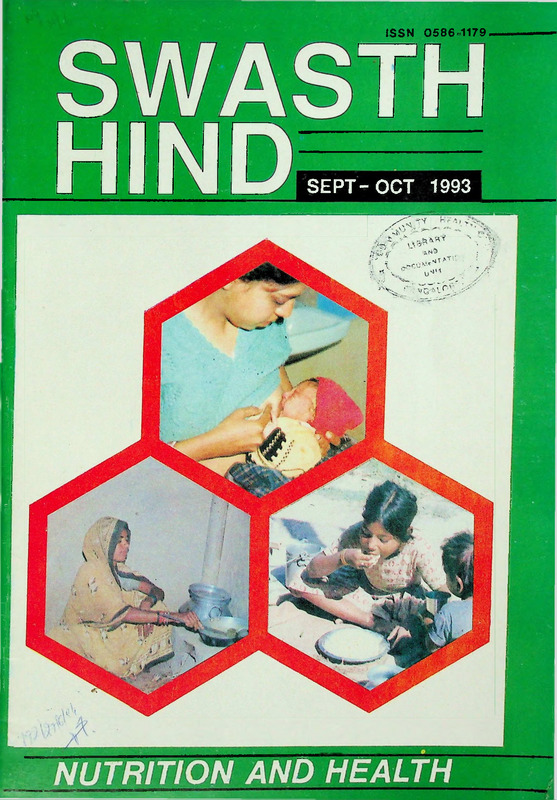
CHILD CARE IN INDIA-EMERGING CHALLENGES
Item
- Title
- CHILD CARE IN INDIA-EMERGING CHALLENGES
- extracted text
-
ISSN 0586-1179
SEPT-OCT 1993
In this issue
swasth hind
Child care in India—Emerging Challenges
C. Gopalan
Nutrition for Child survival and beyond
Page
221
225
Domiciliary Management of malnutrition
Dr M. B. Khamgaonkar
Dr A. K. Mukherjee takes over as Director
General of Health Services
Nutrition—the cheap alternatives
G. Ravindran Nair
The basic need of infants—adequate diet
Mrs. Sukhminder Kaur
Nutritional knowledge in relation to breast and
supplementary feeding practices in urban slums
of Bombay
Dr Gajanan D. Velhal
Dr Lalita I. Bhattacharjee
Dr Gopa A. Kothari
Adulteration of food and human health
Murali Dhar Ram
Krishna Gopal & B. Sharma
Nutrition—the right of every child
Dr (Smt.) Lata Singh
The National Nutrition Policy
Strategies to improve the health of mothers and
Children—health and non-health approaches
Dr Meharban Singh
Our New Director
Making workplace mother-friendly
Global overview of diarrhoeal diseases and
Cholera
N.C. Bilochi and KK. Datta
Fat soluble vitamins—a deeper peep
Dr H.S. Chohan and Dr A.S. Padda
Conservation of Vitamin C
Dr T.S. Reddy
227
National Family Welfare Programme
Book review
Assisted by
M. L. Mehta
M. S. Dhillon
G. B. L. Srivastava
261
3rd
cover
Cover Design
Photos
Madan Mohan
O. P. Kataria
Articles on health topics are invited for publication in this
Journal.
September-October 1993
Vol. XXXVH Nos. 9 & 10
Bhadra-Kartika
Saka 1915
Readers Write
I have received ‘SWASTH HIND’ Volume XXXVI,
Numbers 1—7, 1992 in December 1992. I find the articles
published in the Journal very useful to my day-to-day
work. Hence I am interested to receive the same conti
nuously.
G. E. Rupert Samuel
Research Officer (fu)
No. 101, Railway Parallel Road
Kumar Park West,
Bangalore-560 020
Words are too frail to express sincere gratitude to all the
writers for their presentation and editing the article in a
way, which is more informative and educative.
Dr. Mukesh Raghav
Asstt. Professor
I-D/107, Padamdarshi Street
J.N. Vyas Colony
Bikaner-334 003
Editorial and Business Offices
Central Health Education Bureau
(Directorate General of Health Services)
Kotla Marg, New Delhi-110 002
Edited by
229
231
233
235
239
241
243
245
247
248
250
256
258
State Health Directorates are requested to send in reports of
their activities for publication.
SUBSCRIPTION RATES
Single Copy
....
50 Paise
Annual
....
Rs. 6.00
This Issue: Re. 1
(Postage Free)
The contents of this Journal are freely reproducible.
nowledgement is requested
Due ack
The opinions expressed by the contributors are not necessarily
those of the Government of India.
SWASTH HIND reserves the right to edit the articles sent
in for publication.
CHILD CARE IN INDIA
—Emerging Challenges
C. Gopalan
There has been improvement in the state of the health of India’s children, as reflected by
modest reduction in infant and child mortality rates, and decline in the incidence of
‘severe’ malnutrition in children, in recent years. However, the vast bulk of India’s
children continue to be in a sub-standard state of health and nutrition. These are the
children who may survive but who will grow into the stunted adults of tomorrow, with
varying degrees of impairment of physical stamina and productivity, says the
author.
he quality of human resour
T
ces of any country is largely
determined by the quality of its
child development service. The
children of today are the genera
tion of tomorrow.
To be sure, there has been
improvement in the state of the
health of India’s children, as
reflected by modest reductions in
infant and child mortality rates,
and declines in the incidence of
‘severe’ malnutrition in children,
in recent years. However, the
vast bulk of India’s children con
tinue to be in a sub-standard state
of health and nutrition. These
are the children who may ‘survive’
but who will grow into the stunted
adults of tomorrow, with varying
degrees of impairment of physical
stamina and productivity.
The fact that, despite impressive
investments, the country is still far
from its goals in the area of child
health/nutrition must point to
either some basic flaws in our
strategies or to serious short
comings in programme implemen
tation. Apparently while we have
a multiplicity of overlapping
uncoordinated programmes, these
are not bom out of a coherent
overarching
National
Child
Development Policy.
September—October 1993
Four Phases of Child Growth
We may broadly recognise four
phases of child growth:
© Intrauterine phase and early
infancy (conception to six months
after birth)
o Late infancy and early
childhood (six months to five
years)
• (Primary) school age (five to
12 years)
•
Adolescence (12-18 years).
Orderly child development will
demand critical inputs into each
of the above phases of child
growth. It
is
necessary
to
emphasise this because in the
past, depending on the ‘fashion of
the
moment’,
near-exclusive
emphasis had been laid on one
phase or the other, to the relative
neglect of other phases, the adoles
cence phase having generally suf
fered near-total neglect. Even
within a given phase, narrow verti
cal programmes with isolated
targets were frequently pushed to
the detriment of integrated child
development.
A
truly
successful
Child
Development Policy has to be
reflected in a significant, ‘secular’
trend in the growth of our
children, with children of each
generation becoming taller and
healthier than those of the preced
ing, till a plateau-phase, represent
ing the attainment of full
expression of the genetic potential
for growth, is finally reached. No
significant secular trend was still
discernible, at least among the
poor communities, till almost
1990, except possibly in Kerala1.
Challenges in Child Health Care
The unmet challenges with res
pect to child health care in the
four phases of child growth, men
tioned earlier, are now briefly
considered.
Intrauterine phase and early
infancy: The two major requisites
for optimal child development in
the intrauterine phase are: (a)
Maternal attributes and (b) the
quality and outreach of antenatal
care service.
A recent report of the ICMR
Task Force2 goes to show the pre
sent sad state of the quality and
outreach of our maternal and
child health care. Only around
15 per cent of Primary Health
Centres in the country had
achieved satisfactory outreach to
the community.
221
Even if we had an efficient
antenatal health care system
purged of its present flaws, we
would still not be able to achieve a
satisfactory level of child develop
ment, given the enormous disad
vantages and disabilities that
women labour under even before
they embark on pregnancy. Our
antenatal health care system,
which starts its operations only
after women are already half-way
through their pregnancies, is
designed essentially for women
who arc in a reasonably normal
state of health and nutrition
before the onset of pregnancy
which unfortunately is hot the
case among poor communities in
India. The
battle
for ‘safe
motherhood' should, under the
circumstances, start when the girls
are still in their early adolescence,
well before they are “trapped” into
marriage and maternity. It is our
total neglect of the care of the
adolescent that has been respons
ible for our poor performance in
the fields of matemal/child health
and family-planning.
The Adolescent Phase
Data which will serve to
highlight the importance of this
phase may be briefly discussed.
Mother’s physical state : There
is now general consensus that
women with body weights less
than 38 kg at the commencement
of pregnancy and with heights less
than 145 cm are to be considered
as being ‘at risk' during pregnan
cy. These are the women likely to
have complications during pre
gnancy or at delivery; they are
also the women who are more
likely to deliver low-birth-weight
babies, who in turn are at risk of
neonatal mortality, and whose
growth and development are
usually below par.
On the basis of data gathered by
the National Nutrition Monitoring
Bureau it was earlier estimated
that 15 per cent to 29 per cent of
Indian women between 20 and 30
years of age in 10 states of India
had body weights less than 38 kg,
222
Table 1: Heights and weights
of rural girls
Age
(years)
Height
(cm)
Weight
(kg)
14
18
145’9
15®
35.1
41.9
Source: NNMR. Report for the years 197479, National Institute of Nutri
tion. Hyderabad. 1980.
and 12 to 25 per cent, heights less
than 145 cm4. Thus a consider
able proportion of women in the
reproductive ages in our country,
because of chronic ill-health and
undernutrition in their childhood
and adolescence, are of sub
standard stature and body build
and are thus poor obstetric
risks. Antenatal care confined to
the late stages of pregnancy can
certainly not correct this situation.
Indeed the figures quoted above
which pertain to women above 20
years of age somewhat underes
timate the magnitude of the risks
that our women now face. The
average age of girls at marriage in
the country as a whole according
to the Registrar-General’s data of
1981 was 16.7 years5. Average
figures could be misleading. In
the problem states of Bihar,
Rajasthan and Madhya Pradesh,
the mean age of girls at marriage
is well below the national
average. A recent ICMR study®
showed that the average age at
marriage of rural girls in six states
where the study was carried out
was 13.8 years and their age at
consummation of marriage 15.3
years.
Adolescence is an important
phase of child growth
and
development. The
adolescent
growth spurt accounts for a sub
stantial increase in body weights
and heights (Table 1). Adoles
cence is the period when there is
considerable accretion of calcium
in the bones; a good part of skele
tal development (including pelvic
development) takes place during
this period. A girl of 15 or 16
years is still a child; she enters
adulthood only after she crosses
18 years. Growth is complete
only between 18 and 20 years.
Child Labour at its Worst
It is* thus obvious that a good
part of pregnancies in our country
today are teenage pregnan
cies. We witness the sad spectacle
of millions of‘children’ (girls of 14
to 18 years) compelled to engage
in child-bearing and child-rearing
even before they have had a
chance to complete their own
physical growth and development
and attain adulthood. This is
‘child labour’ at its worst, in more
senses than one. It is ‘labour’
which carries greater risks than
some other forms of child labour
over which there is public
outcry.
Anaemia : There are other com
pelling reasons which point to the
need for major attention to the
adolescent phase of growth.
Iron-deficiency anaemia is a
major factor contributing to
maternal morbidity and mortality
and low-birth-weights of off
spring. It is not as if anaemia in
our women sets in after they
become pregnant. There is a
great deal of anaemia in children
and more especially in adolescent
girls. A study reported inl9827
for example showed that among
girls less than 15 years of age, 65
per cent in Hyderabad, 69 per cent
in Delhi and 97 per cent in
Calcutta had haemoglobin levels
less than 11 gm%. The present
procedure for combating anaemia
in pregnancy as part of antenatal
care consists in the daily adminis
tration of iron/folate tablets, given
in the last 100 days of preg
nancy starting from 20-24 weeks of
pregnancy.
A recent ICMR study8 showed
that at 20-24 weeks of pregnancy,
at least 17 per cent of women had
haemoglobin levels less than 9
gm%. The same study also
showed that even when iron folate
tablets at high levels of dosage
(120 mg iron and 180 mg iron as
against 60 mg) were administered
Swasth Hind
Tabic 2 : Percentage distribution of pre-school children according to
Standard Deviation (SD) classification, India
SD classification
Period
-3SD to -2SD to
C-3SD
according to
-1SD
-2SD
Weight/Age
(under-weight)
Heigh t/Age
(Stunting)
1975-79
1988-90
1975-79
1988-90
38.0
26.6
53.3
36.8
39.5
42.0
25.3
28.3
18.3
24.2
14.6
21.0
Source: National Nutrition Monitoring Bureau, Report of Repeat Surveys
(1988-90), National Institute of Nutrition, Hyderabad (1991).
regularly for 100 days, haemo
globin levels could not be raised to
beyond 11 gm% in women whose
initial haemoglobin levels were 9
gm% or less. This would show
that even with the most intensive
and efficient iron/folate sup
plementation programme con
fined to the last 100 days of
pregnancy,
the
problem
of
anaemia in pregnancy will not be
successfully combated in a good
proportion of our women. Con
sidering that in real-life situations
in our public health system only
17 per cent of PHCs were able to
achieve more than 60 per cent
coverage with respect to iron folate
distribution in the last 100 days of
their pregnancy, it must be clear
that the present strategy for com
bating pregnancy anaemia is
wholly inadequate.
The Need for a New Strategy
Iron/folate tablets should be
made freely available to adoles
cent girls in the countryside. The
intake of these tablets by adoles
cent girls, and certainly by
married girls, could be actually
promoted through an intensive
programme of education under
taken as a part of a broad-based
programme of ‘education for bet
ter living’ beamed to adolescent
girls. With this strategy, even if
the supply of iron folate tablets is
irregular and cannot be rigidly
ensured on a daily basis, the chan
ces of our being able to mitigate
the anaemia problem would be far
brighter. The proportion of girls
who would be anaemic even
September-October 1993
before the onset of pregnancy may
become far less.
Improvement of diets : The solu
tion to the problem of anaemia, as
indeed to other problems of
undernutrition, cannot be allowed
to be wholly dependent on drugs
and tablets. It is important to
emphasise the need for dietary
improvement. Dietary improve
ment can be achieved without
much additional cost to the family
through the wise and judicious use
of inexpensive locally available
foods. This is an aspect which is
currently totally neglected in our
antenatal health care program
mes. Indian
diets
are pre
dominantly cereal-based and are
likely to remain so. In such diets
the absorption of iron is bound to
be poor. Fortunately, however.
this situation can be significantly
improved by the inclusion of
locally available green leafy
vegetables in the diets.
Green leafy vegetables are good
sources of vitamin C, which pro
motes absorption of iron; they are
also good sources of folic acid
which helps to combat 'anaemia.
They are often good sources of
calcium which the adolescent girl
in particular needs. More than
all, they are also rich sources of pcarotene—the precursor of vita
min A. The logical way of
preventing vitamin A deficiency in
the infant is to build up the
vitamin A nutritional status of the
mother during her adolescence
and pregnancy through dietary
improvement—consisting mainly
in the inclusion of green leafy
vegetables and other carotene-rich
foods in the diets. A good part of
the vitamin A stores of the infant
arc derived from the mother dur
ing the later stages of preg
nancy.
Unfortunately, in our eagerness
for shortcuts, we have depended
on massive doses of synthetic
vitamin A to the infant as an
answer to the problem of vitamin
A deficiency, rather than on the
logical approach of improving the
nutritional status of the mother
during the pregnancy and adoles
cence. This aberration needs to
be corrected.
The School Age
In the 1950s school meal pro
grammes and school health ser
vices commanded considerable
attention. However, the interest
in this area of child development
waned in the 1960s with the
emphasis shifting to the pre
school age-period (under-fives).
The near-exclusive emphasis on
the ‘pre-school child’ also resulted
in diminishing attention to the
mother.
It is true that the worst forms of
malnutrition afflict the pre-school
child, but it is also true that there
is a great deal of morbidity and
learning
disabilities
among
children of school age because of
which heavy investments in
primary education programmes
have not had the desired impact.
Care of school-age child is not
only important in itself: the school
system also offers an excellent
country-wide network and entry
point for a comprehensive health
programme beamed to a crucial
segment of the population.
Our primary schools, especially
in rural areas are grossly under
equipped. It is not surprising
tha. dropout rates arc high.
Heavy investments on school
health/meal programmes will be
justified only where basic minimal
educational standards in our
primary schools can be ensured.
223
The Pre-School Child
During the last few years, child
heal th/nu trition
programmes
directed at pre-school children
have received considerable atten
tion. However there is still a
great deal of growth-retardation.
The prevalence of Grade 1 and
Grade 2 malnutrition in the pre
school is indeed somewhat higher
than it was a decade ago (Table
2) This is perhaps to be expected
because while we had vigorously
pushed strategies for control of
child mortality, these had not gone
hand in hand with strategies for
the promotion of child nutrition.
Ongoing urbanisation will also
pose a major challenge to child
health. It is expected that by 2000
AD, there will be as many as 100
million of our population living in
urban slums and under-fives in
urban slums will roughly number
40 million.
Breast-feeding has been the
sheet anchor of infant nutrition in
our country. Despite their poor
health/nutrition status, our poor
women had always followed the
salutary practice of breast-feeding
their infants at least for the greater
part of their infancy. But for this,
the state of infant nutrition in the
country would have been far
worse than what it is today.
There is the real danger that
breast-feeding will face a very
serious threat in the urban setting.
Families could be increasingly
compelled to depend on street
foods which may not always be
hygienic, especially since the exist
ing arrangements for enforcement
of food standards are highly
References
1. Gopalan, Q»: Nutrition challenge for
Asia, progress in food and nutrition science,
16:51-84, 1992.
2. Evaluation of quality of family welfare
services at primary health centre level. An
ICMR Task Force Study, New Delhi, 1991.
3. Child Survival and Safe Motherhood
Programme — India. Ministry of Health
and Family Welfare, Govt. of India, New
Delhi, July, 1991.
4. National Nutritional Monitoring Bureau,
Report of the years 1974-79, National
Institute of Nutrition, Hyderabad, 1980.
5. Census of India, 1981, Series 1, India,
Paper 2 of 1983, Part II—Key population
statistics, based on 5 per cent sample data,
inadequate. There could be an
escalation of diarrhoeal diseases
in children and the consequent
aggravation of undernutrition and
growth retardation. Child health
care in urban slums will therefore
make increasing demands on our
health system in the next few
decades. Appropriate
institu
tional arrangements and program
mes for meeting these emerging
challenges to child health will
need to be initiated soon.
Excerpts from the LXlh John Barnabas
Memorial Lecture delivered on March 29.
1993. in New Delhi.
Office of the Registrar General of India,
Ministry of Home Affairs, New Delhi, 1983.
6. A national collaborative study of iden
tification of high risk families, mothers and
outcome of their off-springs with particular
reference to the problem of maternal, nutri
tion, low-birth-weight, perinatal and infant
morbidity and mortality in rural and urban
slum communities. An ICMR Task Force
Study, Indian Council of Medical Research.
New Delhi, 1990.
7. Report of working group on fortification
of salt. Am J Clin Nutr. 34 :1442, 1982.
8. Field supplementation trial in pregnant
women with 60 mg, 120 mg and 180 mg of
iron with 500 jig of folic acid. An ICMR Task
Force Study. ICMR, New Delhi. 1992.
AN APPEAL
INSTITUTION OF “DHARMENDRA AWARD FOR LEPROSY RESEARCH IN INDIA”
Dr. Dharmendra was appointed its First Director under
HE Hind Kusht Nivaran Sangh has decided to
whose stewardship, the CLTRI emerged as the foremost
institute a “Dharmendra Award for Leprosy
Leprosy Research and Training Centre of India and made
Research in India” beginning from 1993 in memory of
immense contribution to Leprosy Research besides pro
the late Dr. Dharmendra, the doyen of the Indian Lepviding trained manpower support to the National Leprosy
rologists. Dr. Dharmendra’s contribution in Leprosy
Control Programme throughout the country. The two
Research, Training and Control is immeasurable, indeed,
editions of the “Notes on Leprosy” written by the late
to attract young scientists taking up Leprosy Research in
Dr. Dharmendra when he was the Director of the CLTRI
Laboratory, Medicine, Surgery, Field Work, Rehabilita
and which were published by the Directorate General of
tion etc. which will have a prospect for better understand
Health Services on behalf of the Ministry of Health,
ing of the germ, Che disease, the problem in man and
Government of India in 1960 and 1966 are termed as uni
improve the knowledge about medical science in relation
que pieces of work. They are still being used as basic
to leprosy and its ultimate eradication.
study material in teaching institutions and oft quoted in
research papers. The late Dr. Dharmendra was the
The Award will be given in the form of a Plaque and
Soul of Leprosy Movement in India.
Citation with a Cash Prize of Rs. 1 lakh to deserving
Scientists/Leprologists.
For giving the Annual Award of Rs. 1 lakh in his
name, the Hind Kusht Nivaran Sangh needs to raise a
The contribution of the late Dr. Dharmendra is wellcapital fund of at least Rs. 7 to 8 lakhs. The Sangh will
known to everyone working in the field of leprosy. He
be contributing Rs. 3 lakhs from its own funds. The rest
was the First Director of the Leprosy Control Pro
will have to be raised from other sources.
gramme of the Govt, of India from 1955 to 1957 who did
the spade work in establishing the National Leprosy Con
The Hind Kusht Nivaran Sangh appeals to the
trol Programme of India now known as NLEP. Later,
Readers to contribute their mite to enable it to institute
when the Government of India took over the Lady
the prestigious award in memory of the late Dr. Dhar
Willingdon Leprosarium, Chingleput and renamed it as
mendra and to promote leprosy research in India.
The Central Leprosy Teaching & Research Institute,
T
Contributions may please be sent through Cheques/DD/M.O. in favour of
“Hind Kusht Nivaran Sangh, 1, Red Cross Road, New Delhi -110 001”.
224
Swasth Hind
NUTRITION FOR CHILD
SURVIVAL AND BEYOND
India has launched a national plan of action for children giving special thrust to health,
nutrition and education to meet the time specific targets. The plan envisages to reduce
malnutrition among children under-five by half of 1990 level by the turn of the cen
tury. The urgent need today is proper nutrition education laying main stress on the
available foods in and around the house. This has to be closely linked to activities like
immunization, oral rehydration therapy (ORT), promotion of breast feeding, birth spac
ing and female education. All these efforts are intended to correct dietary habits for
improving nutritional levels through adequate behavioural changes.
ARGET oriented programmes
in
health and food
over the years have con
trolled severe malnutrition among
the vulnerable groups in India.
Increased availability of medical
care and immunisation has also
weakened the link between
malnutrition and mortality in
children. Today with 80 per cent
immunisation coverage, the mor
tality rate of under five-year-old
children has been reduced to 126
per 1000 live births.
degrees of PEM, 8.7 per cent suffer
from extreme malnutrition.
However, with all this progress
made, malnutrition among child
ren in India continues to be a
cause for serious concern. A
majority of India’s pre-school
children suffer from protein
energy malnutrition (PEM)—the
most widespread form of mal
nutrition. According to figures
published by the National Mal
nutrition
Monitoring
Bureau
(NMMB) while 43.8 per cent
children suffer from moderate
For achieving this, nutritional
intervention through Integrated
Child
Development
Services
(ICDS) will be expanded to cover
all vulnerable children in the age
group of 0-6 years. A concerted
effort would be made to bring
about appropriate behavioural
changes among the mothers
through existing programmes such
as the ICDS, Urban Basic Services
(UBS), Development of Women
and Children in Rural Areas
nutrition
T
supply
September—October 1993
2—12 DGHS/93
Action Plan
To combat this trend, India has
launched a national plan of action
for children giving special thrust
to health, nutrition and education
to meet the time specific tar
gets. The plan envisages to
reduce the severe and moderate
malnutrition
among
children
under five by half of 1990 level by
the turn of the century.
(DWCRA) and programmes of
Food and Nutrition Board.
The ongoing ICDS is a fine
example of flexible community
based basic services approach.
Anganwadis (pre-school courtyard
centres) have been established in
poor communities where a local
woman with four months’ training
in community development works
with people to provide supplemen
tary food, immunisation, health
and nutrition education andprimary health cafe. The propor
tion of children, with severe
malnutrition has been drastically
reduced in these ICDS blocks,
according to surveys.
To equip the management
workers and other grassroots
health workers with basic know
ledge on food nutrition and
health, a comprehensive nutrition
education scheme was evolved in
1988. Apart from conducting
camps and training through
mobile food and extension units,
225
wide awareness is being gene
rated through the mass media.
These campaigns help the people
have more nutritive diet within
their given budget
Incentives are also given by the
Government for the production of
low-cost
processed
nutritious
foods like Miltone, ready-toeat foods and energy foods.
These products are used for the
supplementary feeding program
mes for young children. Apart
from these, Government has taken
up schemes for the fortification of
milk with vitamin A and salt
with iron.
Preventable Diseases
Almost 60 per cent of the deaths
and much of malnutrition among
children is caused by just three
diseases—pneumonia, diarrhoea
and measles. These diseases are
preventable and that too by tried
and tested means which are afford
able by a majority of popula
tion. These simple and inexpensive
means include vaccines, antibiotics,
oral rehydration therapy (ORT) and
proper management of diarrhoeal
diseases.
Similarly, deficiency of Vita
min A which causes blindness to 10
million of children the world over
can be prevented by proper nutri
tion education. Researchers have
now confirmed that even mild
Vitamin A deficiency substantially
increases the death rate among
children between the age of six
months and six years.
226
Possible medical intervention
not only prevents children's death
but can dramatically improve their
lives for such diseases as are also
major causes of malnutrition.
Whooping cough, for example, can
induce malnutrition by frequent
vomitting which its coughing fits
provoke. Measles itself claims ten
per cent of the body weight and halts
weight gain for several weeks. Thus
immunisation of all children
against the major diseases would
be an indirect immunisation
against malnutrition itself. Any
increase in protection against
malnutrition would, in turn, reduce
the risk of infection. Studies reveal
that a malnourished child who con
tracts measles is approximately 400
times likely to die ofthe disease than
a child who is adequately fed.
Vicious Cycle
If the children are allowed to
grow up malnourished, then the
cycle of ill-health, low energy, low
productivity, low incomes and low
levels of financial and energy in
vestment in improving family and
community life will be perpetuated
into a new generation.
The single most cost effective
point at which this vicious cycle
can be broken is providing nut
ritious food to the undernourished
pregnant woman. Nutritional well
being of the pregnant woman is the
most decisive factor in the birth
weight of the baby and birth weight
is the most decisive factor in its
chance of survival. Low birth
weight babies (below 2,500 gram
mes) for example, are three times
more likely to die in infancy than
babies of normal weight at birth.
At this stage investment in human
life and health is most cost effec
tive.
For the new bom babies, after
five or six months, breastmilk
alone will not be sufficient And
at that stage if the gradual introduc
tion of other foods does not begin,
then weight gain falters, the growth
curve flattens, the risk of infection
increases and malnutrition takes a
grip on the young child’s life.
Delaying weaning, therefore, gives
millions of infants the first unin
tentional push down the slope of
malnutrition. In India 36 per cent
of all infants in the rural areas and
40 per cent among the urban poor
are still being exclusively breastfed
at the age of one year. For onefifth of those children, weaning
does not begin even at the age of
eighteen months.
Subsidised food at the time of
weaning as well as in late pre
gnancy and early infancy can
therefore be the sharpest means of
cutting into the closed circle of
malnutrition which now traps the
families of the very poor.
The urgent need today is pro
per nutrition education, and this
has to be closely linked to activities
like immunization, oral rehydra
tion therapy (ORT), promotion of
breastfeeding, birth spacing and
female education. All these efforts
are intended to correct dietary
habits for improving nutritional
levels through adequate beha
vioural changes.—PIB
S waste Hind
DOMICILIARY MANAGEMENT
OF MALNUTRITION
Dr M. B. Khamgaonkar
It has been well established that domiciliary management of a malnourished child is far
less expensive and far more permanent than medically rehabilitating the child in the hos
pital. This article illustrates how domiciliary management can be an effective technique
in management of malnutrition.
HE
efficacy
of
hospital
T management of malnutrition
The
has always been questioned.
hospital management of a mal
nourished child is always paradoxi
cal considering the socioeconomic
background of the family from
which such a child usually com
es. The hospital management
also has other disadvantages and
shortcomings such as high mor
tality rates, high chances of cross
infection, high rate of recurrence of
malnutrition. Even after dis
charge of the child from the hospi
tal, the family diet and sub
sequently the diet of the child does
not change significantly. This
happens as the mother of the child
is not considered while managing
the child. It has been well
established
that
domiciliary
management of a malnourished
child is far less expensive and far
more permanent than medically
rehabilitating the child in the
hospital.
September-October 1993
Procedures for Domiciliary Manage
ment
(1) Maintenance of growth charts:
The growth charts of all the under
five children in a community
should be developed first The
weights should be recorded on
growth charts regularly.
(2) Grouping the children who are
nutritionally at risk: Regular moni
toring of weights of the children
can help in identifying the children
who are nutritionally at risk. The
children
showing
inadequate
growth over a significant period, as
indicated by flattening of curve on
growth chart, can be managed at
home. All the children with
weight for age less than 60% of Har
vard standard come in high risk
group.
(3) Assessment of malnourished
child: The malnourished child
should be assessed for the presence
of infections and their dietary
intake. The dietary intake of the
child can be collected by 24 hour
recall of the foods he has con
sumed. Simultaneously the child
should be assessed for immuniza
tion status and the presence of nut
ritional deficiency signs.
(4) Assessment of mother's know
ledge: The mother of the mal
nourished child should be assessed
for her knowledge about nutritious
foods, malnutrition and her beliefs
about foods and feeding prac
tices. At the same time the mother
should be asked about the foods
which are locally available and
are cheap.
Management
(1) Fully immunize
nourished child.
the
mal
(2) The infections, if not life
threatening, can be treated at
home. If there is history of worm
infestation, deworming should be
done.
(3) Nutrition
Education : After
calculating the deficit in dietary
227
intake in terms of calories and pro
teins, the mother should be advised
exactly about the correction of the
deficit, and how the additional
calories can be given to the
child. The administration of cor
rect dietary schedule must be
ensured with emphasis on frequent
intakes. The diet advised must be
the modification of the present diet
and within the reach of the
family. Specify the exact type of
food and the amount to be con
sumed in household measures
specially understandable to the
mother. The
foods
advised
should be locally available and
Cheap. Most of the times the
calorie density of the diet can be
increased by simple measures as
adding oil or sugar to the
foods. Any wrong belief of the
mother about feeding practices
should be corrected.
ensured that every malnourished
child is given prophylactic doses
of vitamin ‘A’ and Iron.
tinued poor growth should be con
sidered for hospitalisation.
(5) Follow up & evaluation:
In the subsequent monthly visits
the child should be followed for
gain in weight The diet of the
child should be assessed to iden
tify any change in the diet
(5) After initiating the manage
ment, the child should be strictly
followed for weight loss and
recurrence.
(4) Vitamin S4' and Iron sup
plementation : It
should
be
(4) The children with severe life
threatening malnutrition and con
Do’s and Dont’s
(1) Don’t ask the family to do the
things that are impossible for
them to do.
(2) In nutrition education don’t
teach the people what they are
already doing. Try to make the
content as specific and as practical
as possible.
(3) The diet of the child should
be gradually increased depending
on appetite and food tolerance.
Conclusion
We should bear in mind that
nutrition education is superior
over food supplementation in pre
vention and treatment of malnut
rition
at
home
level. The
management should be simple,
without incurring extra expendi
ture on food and require minimal
training but adequate methodo
logy. Even the children with
severe malnutrition can be treated
at home. This also helps to avoid
the family problems associated
with hospitalization and loss of
wages by the parents.
ERADICATION OF GUINEA-WORM : FINAL OFFENSIVE GETS UNDER WAY
In nine French-speaking West African countries
30 April has been declared “National Guinea-Worm
Eradication Day”. The countries are Benin,
Burkina Faso, Chad, Cote d’Ivoire, Mali, Mauritania,
Niger, Senegal and Togo. When this event was held
for the first time on the same date last year Dr
Philippe Ranque, who is in charge of WHO’s
Dracunculiasis Eradication Programme, pointed out
that the final offensive against this formidable tropi
cal disease has been launched and that the guinea
worm is on the retreat everywhere.
Targeted for eradication by the end of 1995 by
the World Health Organization (WHO), dracun
culiasis, a disease transmitted by contaminated
drinking-water, should soon be just an unpleasant
memory. With a total of about 375,000 recorded
cases in all the endemic countries, principally in
228
Africa, India and Pakistan, the disease continued to ret
reat in 1992, especially in the two worst affected
countries, Ghana and Nigeria.
Thanks to the efforts of WHO and Global 2000,
the special dracunculiasis programme of the Carter
Presidential Center in Atlanta, WHO’s leading
collaborating centre in this field, guinea-worm
eradication activities have been undertaken in most
countries and villages where the disease is
endemic. UNICEF is also taking an active part in
this campaign, by providing additional funding of 5.7
million US dollars for eradication activities and by
cosponsoring with WHO an Inter-Agency Team
based in Ouagadougou, Burkina Faso, which is res
ponsible for aiding the national programmes of the
French-speaking countries of West Africa.
—W.H.O.
Swasth Hind
DR A.K. MUKHERJEE TAKES OVER AS
DIRECTOR GENERAL OF HEALTH SERVICES
R ASHISH KUMAR MUKHERJEE has taken over as Director General of
on 6th October, 1993. This is, indeed, the
position
the field
health in the Govt, of India.
(DGHS)
DHealth Services
highest
in
of
Born on 18th January, 1943, Dr. Mukherjee is the youngest ever to
become the Addl. D.G.H.S. and now DGHS since Independence.
He is also the Secretary-General of the Indian Red Cross Society & St.
John Ambulance Association of India.
Dr. Mukherjee was awarded MBBS degree from the Calcutta University in
1964; MS (Orth.) from the All-India Institute of Medical Sciences, New Delhi in
1969 and D. Phil from the Oxford University in 1976.
Dr. Mukherjee has served in various capacities. He was Assistant
Director, Dept, of Rehabilitation, Safdarjang Hospital, New Delhi; Assistant
Director, Acting Director and later Director, All India Institute of Physical
Medicine and Rehabilitation, Bombay; Regional Director, Regional Resource
and Training Centre, Bombay; Founder-Director, Ali Yavar Jung National
Institute for the Hearing Handicapped, Bombay and Project Coordinator,
Rural Rehabilitation Programme.
Dr. Mukherjee was Berry Scholar, Oxford University (1973-76), JohnsonJohnson Fellow (1977), Orthopaedic Audio-Synopsis Foundation Fellow,
American Audio Synopsis Foundation (1978) Fellow, British Orthopaedic
Association (1978) and Fellow, National Academy of Medical Sciences.
He was also honoured with the M.G. Dewan Memorial Award for ser
vices in Rehabilitation in 1986.
Dr. Mukherjee has 19 years of clinical experience in various capacities in
hospitals in India and the U.K. He was Registrar, Orthopaedic surgeon, Nuf
field Orthopaedic Centre, Oxford, UK for three years. He has contributed to
applied/clinical research in the field of Gait analysis in Poliomyelitis, of lower
limb as well as low-cost aids and appliances for the rural disabled.
Dr. Mukherjee has devoted himself selflessly for about three decades for
the prevention of orthopaedic and other disabilities and for the rehabilitation
and welfare of the disabled in India. His realistic and pragmatic approach to
the problems of the handicapped, has shown the way for welfare workers
and professionals.
September—October 1993
3—12 DGHS/93
229
After a distinguished academic career and doctorate from the Oxford
University as a Berry Scholar, he opted for a career in the service of the han
dicapped, which was then a neglected area. As Director of the All India
Institute of Physical Medicine and Rehabilitation, Bombay, he had provided
leadership in development of health manpower for the care of the dis
abled. The medical and para-medical professionals trained by him are now
occupying key positions in rehabilitation organisations, not only in India but
also abroad.
Dr. Mukherjee is the main architect of the RURAL DISABLED PRO
JECT operating successfully at the grassroot level in the backward district of
Virar in Maharashtra. It is to his credit that this approach has been widely
acclaimed and accepted as a model rehabilitation delivery system in the seventh
and eighth National Development Plans for replication in various districts of
the country.
A pioneer of the camp approach for rehabilitation, he has organised
more than 30 camps in various districts of Maharashtra and also the adjoining
districts of Gujarat. Towards preventing disabilities from Polio, he had spear
headed a campaign for polioeradication covering slum children of the city
of Bombay.
He was responsible for the establishment of the Ali Yavar Jung National
Institute of Hearing Handicapped at Bombay, . under the Ministry of
Welfare. Apart from physical rehabilitation, he had also carried out intensive
programmes for vocational rehabilitation and social integration of the han
dicapped in the community. Through his crusading endeavour, the All India
Institute of Physical Medicine and Rehabilitation, Bombay became a Centre for
carrying out the marriage ceremonies of the handicapped persons with the help
of various organisations like the Rotary Club and Jaycees of Bombay.
The voluntary agency—National Society for Equal Opportunities for the
Handicapped, India—floated by him along with late Mr. Vijay Merchant, has
the active involvement of the handicapped themselves and has become a shin
ing example for the NGOs in setting up full rehabilitation programmes. He
has been actively involved in various other NGOs. He was the General Sec
retary and presently the Vice-President of the All India Handicapped Associa
tion affiliated to the Rehabilitation International which has membership
encompassing over 150 countries.
A recipient of prestigious awards and decorations, both at the National
and International levels, Dr. Mukherjee has delivered widely acclaimed orations
and lectures. He has been giving a direction to the various health policies and
programmes at the national level as Additional Director General of Health Ser
vices for over half-a-decade. He has been holding the charge as Director
General of Health Services since October, 1992.
Indeed, the health services of India are safe in his hands.
230
Swasth Hind
NUTRITION
—The Cheap Alternatives
G. Ravi nd ran Nair
The means to best nutrition is available in plenty in nature itself; they are simple, Cheaper
and within everyone’s easy reach.
A number of agencies, both official and non-official,
are fully engaged in the task of awareness building in India, says the author.
rumstick trees that grow in
D
plenty in many parts of
southern India and jute leaves that
grow luxuriantly in parts of eastern
India are only two examples of
cheap sources of nutrition. But
the fact is that they are neglected
probably because they are abun
dant and within easy reach. How
ever, many of us are ready to spare
whatever we could of our earnings
at our drug store while the remedy
for ailments lies right at our own
backyards in the form of green
leaves.
Similarly, it was thought that
bottle-feeding was superior to
breastfeeding and the poor also as
a matter of fashion, took to the bot
tle and the consequences have been
disastrous. The realisation that
there is no substitute for breast
milk however has now set in.
Mother’s milk is unpolluted, easily
available and digested. It shields
September—October 1993
the baby from infections and
ailments and makes the infant
mentally, physically and emo
tionally stable. The means of best
nutrition is available in plenty in
nature itself; they are simple,
cheaper and within reach.
Easily preventable
Similarly, thousands of children
go blind every year on account of
Vitamin A deficiency. This is
easily preventible by the intake of
cheap green leafy vegetables.
Ignorance and illiteracy apart from
vital factors like health status and
the purchasing power of the family
play a vital role in determining the
nutritional status of the family.
Millions of rural poor are victims
of malnutrition. Even where
things are normal, malnutrition
could strike on account of diseases,
causing interference with the in
take, absorption or assimilation of
absorbed foods and excessive loss
or elimination of food.
Nutritional requirements vary
with age, sex, build, weight and the
nature of occupation or daily
activities. Infants and children
require more calories per kg.
weight. Similarly, a pregnant
woman has to provide nourish
ment for herself and the growing
foetus.
A robust tall person needs more
diet than a thin, short person. An
infant, for instance may need 100
calories or more per kg, an office
goer may need a mere 40 calories
per kg while a labourer may need
60 to 70 calories per kg.
The calories are provided by
various compounds of diet, pro
teins, carbohydrates and fats. For
instance, one gram of protein or
231
carbohydrate provides 4 calories,
while a gram of fat yields 9
calories. The principal supply of
calories is obtained from car
bohydrates and fats. The average
adult needs 300 to 350 grams of car
bohydrates, starches and sugar.
Fats form the most compact
source of calories. Ghee, vanaspati, oil, butter and oil-containing
foodstuffs like groundnuts, cashew
nuts, coconuts and some animal
foods are sources of fat in diet It
is the fats and carbohydrates that
supply the heat and energy re
quired by the body.
blood-vessels and skin. Milk, egg.
fish, meat and pulses are good
sources of protein.
Besides the body building, pro
teins food provides the vital
accessories like the minerals and
vitamins. While calcium and
phosphorous strengthen bones,
sodium holds body fluids. Iron is
necessary for the formation of
haemoglobin necessary for oxy
genation of tissues carried on by
blood. Though most of the
minerals are available in normal
diet, a few like calcium and iron
need to be added during the period
of growth.
Proteins
Proteins build up the brain,
heart, lungs, liver, spleen and
glands and tissues like muscles,
Vitamins are necessary for the
life and health of the body
tissues. Vitamin D is concerned
with the absorption and deposition
of calcium in the bones. It is
necessary for growth. In the same
way. Vitamin C is necessary for the
health of the inner lining of the
blood vessels. It is found in plenty
in green vegetables, fresh fruits and
sprouted pulses.
Deficiency of Vitamin B-complex leads to degeneration of ner
ves, leading to weakness of the
muscles. Sprouted vegetables are
rich in B-complex factors, so too
handpounded rice.
Good nutrition is a must for the
perpetutation of a healthy so
ciety. A number of agencies both
official and non-official are fully
engaged in the task of awareness
building in India.—PIB.
NURSING BEYOND THE YEAR 2000
N
urses and midwives play a
key role in the delivery of
health care. “Still, in spite of
WHO’s efforts to underline their
crucial importance for the provi
sion of effective and efficient health
care services, their role is not ade
quately recognised in many coun
tries”, says Dr Eric Goon, Director
of the WHO Division of Develop
ment of Human Resources. for
Health.
Nurses and midwives constitute
over 50% of the professional
workforce in most countries; the
majority of them work in hospital,
where their work is of extreme
importance for the survival and
232
recovery of the patient The cost
effectiveness of nursing has been
demonstrated, but many countries
still devote inadequate resources to
planning the effective employment
and development of nursing and
midwifery staff. That is the
reason why, in almost every country
they are dissatisfied and disenchan
ted and the ranks of the profession
are being depleted by qualified nur
ses leaving the services. As WHO
looks beyond the year 2000 and the
global goal of health for all, it
underlines the need to strengthen
and renew the role of nurses and
midwives who are major instru
ments towards this achievement
The profession has evolved both
in terms of education and respon
sibilities, becoming increasingly
sophisticated and dynamic, and
requiring highly developed skills.
The role of nurses and midwives
touches many health care areas,
such as curative care; chronic and
rehabilitative care; high depen
dency care; and, care for the
dying. In addition to these direct
services
and
responsibilities,
today’s nurses often act as coor
dinators of the care provided by
physicians and other health pro
fessionals; they train and supervise
a wide variety of health personnel;
and, they are engaged in policy
decisions.
—WHO Feature
Swasth Hind
THE BASIC NEED OF INFANTS
—Adequate Diet
Mrs. Sukhminder Kaur
Baby’s meal should be planned keeping the principles of nutrition in mind. Besides nut
rition, the food should be a delight both to eyes and palate and it should be given in a
congenial atmosphere. No chillies and spices should be introduced in the infant’s diet as
his tender digestive system may get affected.
Food should be cooked thoroughly,
hygienically and given with clean hands.
OOD is the first need of a new
bom
develop
a
wholesome food, correct schedule
and proper care.
A mother
therefore, must have a proper
tinderstanding of infant feeding
because for nutritional needs the
early years of the child’s life are
closely with the mother. Growth
is very rapid particularly during
the first year; hence, dietary adap
tations are needed frequently. In
the first few months of the child’s
life breastfeeding is considered the
most important; because human
milk is most suited in every way to
an infant’s needs. It gives the
infant the best possible foundation
for future health.
child. Normal
F
ment of
child depends on
Breast milk is the natural food
produced by the mother soon after
birth of her baby. The early secre
tion of mammary glands, a
yellowish fluid known as colos
trum, is rich in proteins and
antibodies. It is nutritious and
good for the child. Many women
do not feed the child with it They
discard colostrum as they hold the
wrong belief that it is not good for
the child.
Breast milk is a
wholesome and economical food
for the infant. Because of this, the
nurslings are less likely to get
diarrhoea and fewer upper res
piratory infections.
Breast fed
infants rarely suffer from anaemia
and they have higher haemoglobin
levels. They are less likely to suf
fer from gastroenteritis. It brings
the baby and the mother into close
contact, which is important for the
stable emotional development of
the child, and gives him the strong
positive feeling of being cared for.
The natural physiological contacts
that take place during breast feed
ing ensure that the baby will have
the sensory stimulation he needs
for a healthy emotional growth.
It is a natural instinct of the
mother to hold, cuddle, play and
keep the baby as close to her body
as possile. Breastfeeding ensures
the fulfilment of this natural
instinct, it is, therefore, emo
tionally and psychologically a
gratifying experience. Physically
the womb returns more easily to
her pre-pregnant weight
Also,
breastfeeding is much more con
venient and easier for the mother
than bottle feeding especially in
the night time. It is hygienic, there
is no worry about cleaning the
bottles and preparing the milk or
carrying the milk powder and bot
tles whenever a mother wants to
go out with her infant.
It is important that cleanliness
of hands and breast be main
tained by washing them before
each feed. The mother should be
relaxed while feeding the baby.
But breastfeeding is inadvisable in
very ill mentally deranged mother,
September—October 1993
233
4—12 DGHS/93
> (
.o*4
) f
when the mother has sore or crac
Cereals like rice, dal, samolina,
at times.
ked nipples and breast abscess.
porridge should be introduced
should
Though breast milk is easily avail
after the third month.
strained.
These
Meats for the babies
be
finely
ground
or
The quantity of meat
able from the mother, breastfeed
cereals should be thinned to con
depends upon the liking of the
ing is a greater strain on the
sistency of milk and thickened
baby and his body composition.
mother than pregnancy is because
only as the child becomes used to
After the baby becomes used to
the woman
fully
them and accepts them. Once a
strained or scraped meat other
developed and rapidly growing
child is eating and enjoying solid
types of meat such as liver can
baby whose food needs increase
foods, it is always wise to give her
be added.
day-by-day. In order to breastfeed
a wide variety of them.
nourishes
a
her infant without any undue
strain on her, she must eat ade
quate and balanced diet including
plenty of cereals, pulses, green
leafy vegetables and milk. If poss
ible, animal foods like meat, fish
The baby can be given any
Care should be taken while
easily digestible, well cooked and
feeding the baby. Only one food
mashed food in small quantities
at a time should be introduced.
from the sixth or seventh month.
Food should be introduced in
The yolk of egg can be introduced
small quantities.
If any food
Egg yolk is
upsets him, the harm caused by
added in baby’s diet because it
food will be small and it should be
contains
Eggs
eliminated from his diet immedi
After three months of age the
should be started with a little cau
ately. Understandably, only a very
mother’s milk or bottle milk alone
tion because it is one of the foods
thin consistency of the new food
cannot meet the growth require
that is most apt to cause allergy. It
must be introduced.
ment of the baby.
Semi-solid and
is white of an egg that normally
enjoy food better if they are
solid foods should be given to the
causes allergy, i.e.f it may not suit
allowed to feed themselves. Self
child in addition to the breast
the child and produce rashes or
feeding should
milk and not as a substitute to
itching etc.
and eggs should be included in
the diet
by the sixth month.
valuable
iron.
be
Children
encouraged
Fruit is often the
when the child is able to eat him
They may be fruit juices,
second solid food added to the
self. Baby’s meals should always
mashed
diet Normally, fruits are stewed,
be planned keeping the principles
Juice
except for raw ripe banana. Fruits
of nutrition in mind. Besides nut
(i.e, artificial feeding) can be star
can be given at any one of the
rition, the food should be a delight
ted from the second or third
feeds, even twice a day, depending
to both the eyes and palate and it
month onwards. Carrot juice can
on the baby’s appetite and diges
should be given in a congenial
also be given by grating and
squeezing the vegetable through
tion. When the baby is eight mon
ths old, he can be given .stale
atmosphere. You should make
your child eat in happy and
muslin. This will give the baby
some experience of new foods and
bread, or chapati or toasted bread.
The suitable vegetable, fruits and
healthy surroundings. No chillies
and spices should be introduced
the
meals prepared for the rest of the
in the infant’s diet as his tender
mother to wean her away from the
family can also be given in small
digestive system may get affected.
bottle. By the third month juices
amount to the child completing
Food should be cooked thoro
of cooked
his one year. Minced meat or fish
ughly, hygienically and given with
(with no spices) can also be added
clean hands.
milk
strained
cereals
or
potatoes and yolk of egg.
will
given.
234
also
gradually
vegetable
help
may
be
S WASTE HIND
NUTRITIONAL KNOWLEDGE
IN RELATION TO BREAST AND
SUPPLEMENTARY FEEDING PRACTICES
IN URBAN SLUMS OF BOMBAY
Dr Gaianan D. Velhal, DrLalita I. Bhattacharjee and DrGopa A. Kothari
Knowledge and practices of488 mothers regarding breastfeeding and supplementaryfeeding were assessed in rela
tion to education, economic status and parity ofthe mother. Irrespective ofeducational and economic status and
parity, 89.96% females offered prelactealfeeds to their children. 49.59%, 29.10% and 21.31 % mothers breastfed
their children on the first, second and third day respectively. 35.24% women were inclined to give colostrum,
whereas 64.76% women who were illiterate and economically poor, were against this practice. Illiterate and
economically underprivileged women breastfed their babiesfor longer duration and commenced supplementary
feeding at a later period, around 12 months. Forty-eight percent (47.95%) women were inclined to give dark green
leafy vegetables (DGLV) in weaning foods. Literate mothers belonging to the higher socio-economic status had
better knowledge regarding dietaryrequirements during lactation as compared to the illiterate and economically
poor women. Parity of the mother was found to have no influence.
as old as
civilization and is, indeed, the
most natural and ideal food for the
baby (1). Breastfeeding and sup
plementary feeding practices are
profoundly influenced by beliefs
and traditions inherent to the cul
ture of a community. As a result of
growing interest in child health, it
becomes essential to have a periodic
assessment of the maternal know
ledge, attitudes, practices regarding
breastfeeding and supplementary
feeding. The present study is a
step in this direction.
B
reastfeeding is
Materials and Methods
A representative sample of 488
mothers from three different slums
of Bombay (Kandivali, Borivali and
Chembur), having at least one child
below the age of two years, were
interviewed with the help of a pre
tested proforma including ques
tions on all aspects of breastfeeding
and supplementary feeding.
An attempt was made to find out
the difference in maternal know
ledge, attitudes and practices in
relation to educational and econo
mic status and parity of the mother.
September—October 1993
Results
A total number of 488 mothers
from 18 to 35 years and living
either in nuclear (398, 81.56%) or
joint family group (90, 18.44%),
were
interviewed. Educational
and economic status and parity of
the mothers are indicated in the
Table 1.
Breastfeeding practices followed
by these mothers in relation to
their educational and economic
status and parity are mentioned in
Tables 2, 3 and 4 respectively.
Knowledge regarding breastfeed
ing is also mentioned in Table 5.
Seventy-nine per cent (78.69%)
of females did not follow any par
ticular schedule for breastfeeding
their children, whereas 21.31%
females
indicated
that they
followed the ‘feeding on demand’
schedule. Burping immediately
after breastfeeding was followed
by only 10.86% of respon
dents. On the whole, mothers did
not take any particular care of the
breasts or nipple.
Supplementary feeding practices
(supplementary or introductory
feeding) in relation to educational
and economic status and parity of
the mother are indicated in Tables
6, 7 and 8 respectively.
The various opinions of the sub
jects regarding changes in the diet
of nursing mother are listed in
Table 9.
Discussion
The practice of offering prelac
teal feeds is almost universal. In
the present study 89.96% of females,
irrespective of their educational
and economic status offered pre
lacteal feeds. The most common
among them were sweetened water
(226, 46.31%) and plain water (156,
31.97%) whereas breast milk (49,
10.04%) and water with honey (38,
7.79%) were third and fourth in
order of choice. Cow’s milk and
Goat’s milk was also given as pre
lacteal feeds by 1.43% and 2.46%
women respectively. This obser
vation is in conformity with that
reported by previous workers
(2-6).
235
According to Chea (7), earlier
initiation of breastfeeding helps in
involution of uterus and reduces
post-partum
haemorrhage. In
view of these advantages, emphasis
was stressed on early initiation of
breastfeeding, preferably within
half-an-hour (8). In a study car
ried out at South Orissa by Suverna
Devi et al (9), it was found that half
the mothers in the study started
feeding on 3rd day, while 13%, 17%
and 21% fed their babies on 1st, 2nd
and after 3rd day. Similar obser
vations are also made by other
workers (4, 5). In the present
study, 49.59% mothers offered
breastfeeding to their babies on the
1st day, 29.10% on the 2nd day and
21.31% on the 3rd day. Educa
tional status of the mother had an
influence on the time of initiation
of breastfeeding (p<0.05). Eco
nomic status and parity of the
mother had no such influence
(Tables 2, 3 & 4).
The concept that colostrum is
bad for the baby, seems to be pre
valent throughout the country as
reported by other workers (3t 10,
11). In the present study, 172, i.e.,
35.24% women opined that colos
trum should be fed to the newborn,
whereas 316 (64.76%) women, mos
tly illiterate and economically poor
were against this practice. Out of
these 172, 78 (45.35%) mentioned
that it is rich in proteins, whereas
158 (91.86%) mentioned that it is
rich in vitamins. Only 9 females
(5.23%) mentioned that it has pro
tective value against common dis
eases of the children.
The finding that mothers who
have less education and belong to
poor economic status fed their
babies for longer duration and
delayed supplementary feeding (by
Xa test, p<0.05), is similar to the
reports from other parts of the
country (2,3,4, 5,12-19). Parity of
the mother has no influence on
duration of breastfeeding.
All the women mentioned that
breastfeeding is the best for the
child, but when specifically asked
‘why it is best’, only 326 (66.08%)
women could give definite reasons
as mentioned in Table 5.
TABLE 1
(I) EDUCATIONAL STATUS
(a) Illiterate
(b) Can read and write
(c) Primary
(d) Secondary School
N
Nos.
280
100
96
12
%
57.38
20.49
19.67
2.46
488
100.00
108
247
99
34
22.13
50.61
20.29
6.97
488
100.00
135
353
27.66
72.34
488
100.00
(II) ECONOMIC STATUS
(Rs/Capita/Month)
(a) <100
(b) 100—200
(c) 200—300
(d) >300
N
(III) PARITY OF THE MOTHER
(a) Primipara
(b) Multipara
N
236
Eighty-seven (17.83%) women
offered the first supplementary
feeding to their babies within 6
months of age, whereas the first
supplementary feed was given bet
ween 6 to 12 months by 264
(54.10%)
women. Educational
and economic status had a positive
influence on the commencement of
supplementary feeding.
In a study carried out by Nalwa
(5), cheap and nutritious items like
vegetables hardly even appear
(7.5%) in the list of the child’s
food. However, in the present
study, 234 (47.95%) women respon
ded to the need for including dark
green leafy vegetables in weaning
foods.
Majority of the females (206,
42.21%) preferred to offer full diet to
their children by the age of 2 to 3
years, whereas 187 (38.32%) pre
ferred to offer it between 1 and 2
years and 95 (19.47%) preferred to
give it after the age of 3 years.
Parity of the mother had no
influence on the beginning of sup
plementary feeding.
Educated mothers belonging to
the higher socio-economic status
had a better knowledge regarding
dietary requirements during lacta
tion as compared to the illiterate
and economically poorer women.
Parity of the mother had no
influence.
In conclusion, there is a general
improvement in the level of
knowledge, attitudes and practices
regarding breastfeeding and sup
plementary feeding. Yet very few
women had scientifically correct
information. Only
superior
maternal literacy and economic
status seem to have some influence
on this. In order to improve the
knowledge of mothers and bring
about positive improvement in the
practices regarding breastfeeding
and weaning, it is important that
key messages in nutrition educa
tion be provided and reinforced to
community health workers in
volved in the maternal and child
health care.
Swasth Hind
TABLE 2
INITIATION AND DURATION OF BREASTFEEDING IN RELATION
TO EDUCATIONAL STATUS OF MOTHER
Initiation and duration of
breastfeeding
Illiterate
(280)
%
No.
Can read &
write (100)
No.
%
Primary
(96)
No.
%
Scondary
(12)
%
No.
(I) Breastfeeding started on :
(a) <12 hours after delivery (148)
(b) 12 to 24 hours after delivery (94)
(c) 24 to 48 hours after delivery (142)
(d) >48 hours after delivery (104)
64
46
100
70
22.86
16.43
35.71
25.00
43
16
20
21
43.00
16.00
20.00
21.00
35
27
22
12
36.46
28.12
22.92
12.50
6
5
0
1
50.00
41.67
00.00
8.33
99
181
35.36
64.64
23
77
23.00
77.00
46
50
47.92
52.08
4
8
33.33
66.67
3
45
147
85
1.07
16.07
52.50
30.36
13
22
42
23
13.00
22.00
42.00
23.00
7
38
33
18
7.29
39.58
34.38
18.75
1
7
4
0
8.33
58.33
33.33
00.00
(II) Importance of colostrum :
(a) Known
(172)
(b) Not known
(316)
(III) Breastfeeding continued up to:
(a) <6 months
(b) 6 to 12 months
(c) 12 to 18 months
(d) >18 months
(24)
(112)
(226)
(126)
Educational status of mother has influence on initiation and duration of breastfeeding (by x*
P<0.05).
More ideal practices are followed by educated women than illiterates.
TABLE 3
INITIATION AND DURATION OF BREASTFEEDING IN RELATION
TO ECONOMIC STATUS OF THE MOTHER
Initiation and duration of
breastfeeding
Economic status of the mother
(Rs./Capita/Month)
<100 (108)
00-200 (247)
200-300 (99)
No.
%
No.
%
No.
%
>300 (34)
%
No.
_
(I) Breastfeeding started on :
(a) <12 hours after delivery (448)
(b) 12 to 24 hours after delivery (94)
(c) 24 to 48 hours after delivery (142)
(d) >48 hours after delivery (104)
(II) Importance of colostrum :
(a) Known
(172)
(b) Not known
(316)
(III) Breastfeeding continued up to :
(a) <6 months
(24)
(b) 6 to 12 months
(11?)
(c) 12 to 18 months
(226)
(d) >18 months
(126)
18
27
35
28
16.67
25.00
32.41
25.92
96
29
56
66
38.87
11.74
22.67
26.72
26
24
41
8
26.26
24.24
41.42
8.08
8
14
10
2
23.53
41.18
29.41
5.88
20
88
18.52
81.48
97
150
39.27
60.73
42
57
42.42
57.58
13
21
38.24
61.76
2
20
40
46
1.85
18.52
37.04
42.59
4
54
138
51
1.62
21.86
55,87
20.65
10
24
39
26
10.10
24.24
39.39
26.25
8
14
9
3
23,55
41.18
26.47
8.82
Same, as that of educational status, economic status of the subjects also has positive influence on duration of
breastfeeding, but not on initiation.
September—October 1993
5—12 DGHS/93
237
TABLE 4
INITIATION AND DURATION OF BREASTFEEDING IN RELATION
TO PARITY OF THE MOTHER
Initiation and duration
of breastfeeding
Parity of the mother
• N
Primipara (135)
%
No.
(148)
(94)
(142)
(104)
20
24
43
48
14.81
17.78
31.85
35.56
128
70
99
56
36.26
19.83
28.05
15.86
(172)
(316)
55
80
40.74
59.26
117
236
33.14
66.86
(24)
(112)
(226)
(126)
5
14
64
52
3.70
10.37
47.41
38.52
19
98
162
74
5.38
27.76
45.89
20.97
Multipara (355)
No.
%
(I) Breastfeeding started on :
(a) <12 hours after delivery
(b) 12 to 24 hours after delivery
(c) 24 to 48 hours after delivery
(d) >48 hours after delivery
(II) Importance of colostrum :
(a) Known
(b) Not known
CITI) Breastfeeding continued up to :
(a) <6 months
(b) 6 to 12 months
(c) 12 to 18 months
-(d) >18 months
Parity of the mother has no influence on initiation or duration of breastfeeding.
(P>0.05, by x2 test).
TABLE
5
KNOWLEDGE REGARDING BREASTFEEDING IN RELATION TO EDUCATIONAL
AND ECONOMIC STATUS OF THE MOTHER
Education and economic status
of the mother
Fulfils
Rich in
dietary
protein
requirements
and
of the
vitamins
child (178)
(110)
No.
%
No.
%
(I) Educational Status of the mother:
(a) Illiterate
(280) 66
(b) Can read and
(100) 48
write
(c) Primary
(96) 58
(d) Secondary School (12)
8
Prophylactic Prevents
protection
diarrhoea
against
likely
diseases
from other
(53)
milks
No.
%
No.
%
Promotes
fast
growth of
the child
No.
%
23.57
48.00
39
28
13.93
28.00
10
23
3.57
23.00
8
41
2.86 114
41.00 66
40.71
66.00
60.42
66.67
36
7
37.50
58.33
15
5
15.62
41.67
26
3
27.08
25.00
72
4
75.00
33.00
35.18
29.15
48.48
58.82
20
41
36
13
18.52
16.60
36.36
38.23
7
21
17
8
6.48
8.50
17.17
23.53
11
33
21
13
10.18
13.36
21.21
38.23
79
98
53
26
73.15
39.68
53.53
76.47
(II) Economic Status (Rs./Capita/Month)
(a) <100
(b) 100—200
(c) 200—300
(d) >300
(108)
(247)
(99)
(34)
38
72
48
20
Only 326 (66.80%) women could answer, why breastfeeding is best for the child ? as above.
(Continued on Page 254)
238
S WASTE HIND
ADULTERATION OF FOOD
AND HUMAN HEALTH
Murali Dhar Ram, Krishna Gopal & B. Sharma
Adulteration in essential commodities of daily requirement of the people poses a serious
threat to the health of human beings leading to diseases that are difficult to cure.
Despite
designing suitable devices to detect even the microquantities of adulterants in con
sumables, it is the need of hour to trigger mass awareness among the people and to find out
suitable remedies to combat this very problem.
dulteration of common edi
A
bles with cheap and easily
available adulterants poses a ser
ious health hazard—even death to
consumers. Purity of food is par
ticularly necessary for our country
as 70.3% of our population gets only
1643 cal per capita, i.e., only 17%
above the basal requirement,
whereas, 80% above the basal
metabolism is the minimum neces
sity for a healthy man.
According to an all-India Survey
conducted by the Union Health
Ministry, the average extent of
adulteration was 25%, mostly in the
form of kesari dal in arhar dal;
Argemone oil in edible oils; vanaspati ghee in pure ghee; non-permitted colours in milk or non-milk
products and ground species, etc.
Out of these the most dangerous
adulterants are kesari dal which can
cause lathyrism and argemone oil,
which is responsible for dropsy,
gastro-intestinal disorders, cardiac
failure, abortion, glaucoma and
even cancer. Therefore, it is the
primary duty of health authorities
and nutritionists to suggest meth
ods for the prevention of adultera
tion and educate the consumer and
provide simple tests to detect
adulterants.
September—October 1993
Toxicity of adulterants
In milk, neutralizers are added to
prevent milk clotting, especially in
summer season. These may cause
gastro-intestinal disorders. The
adulterants in milk products and
non-milk products are mostly non
permitted colours, some of which
are highly toxic.
In the group of cereals, kesari dal
and its flour were mixed in arhar
dal and dehusked bengal gram
flour. Kesari dal causes pro
gressive, spastic paralysis of lower
limbs (Lathyrism) and has been
responsible for crippling of thou
sands of people in several parts of
India for centuries.
In the edible oil group, mustard
oil deserves special mention. It is
a major cooking medium which is
adulterated with various kinds of
cheaper oils.
revealed that non-permitted dyes,
such as, auramine, blue VRS,
malachite green, metanil yellow,
rhodamine-B and Sudan III have
produced pathological lesions in
kidney, liver, spleen and tes
tis. auramine, blue VRS, butter
yellow, malachite green and rhoda
mine-B were reported to be car
cinogenic. Lead chromate, an
inorganic pigment, which was
mixed in powdered turmeric is
known to produce anaemia, para
lysis and even abortion. Besides
non-permitted
dyes,
artificial
sweeteners dulcin and saccharin,
used in excess of the prescribed
limits in soft drinks, produce
tumors and blood cancer.
In the group vanaspati, harmful
effects due to nickel have been
pointed out, which is known to
cause dermatitis, respiratory disor
ders and even cancer.
Detection of adulterants
Consumer education, informa
tion and spread of knowledge
about the methods of detection of
adulterants from day-to-day edi
bles will help to intensify the fight
against adulteration, a social pro
blems. Simple tests to detect
adulteration in various com
modities are tabulated in Table 1.
Among the miscellaneous group,
adulteration due to non-pennitted
colours
was
most
com
mon. Animal experiments have
Control Measures
The most effective method to
stop adulteration is to collect a
large number of samples from the
239
innumerable retail outlets and set
ting up of a network of public
health laboratories for quality con
trol. Sensitive analytical methods
should be explored for quick detec
tion. of adulterant in microquanlities. Simultaneously use of safe,
cheap and tamper-proof packing
materials will certainly ensure
lesser adulteration. Further, con
sumers should be advised to peel,
scrub and wash thoroughly with
water all the vegetables, fruits and
dais before use, because such home
processing removes 80 to 90 per
cent of adulterants and toxicants.
Lastly, every attempt should be
made to generate a social aware
ness in general and our policy
makers are needed in particular to
frame-up such rules to prevent the
sellers or stockists from mixing
adulterants and unwanted ma
terials to the essential commodities
and consumables.
TABLE 1
SIMPLE TESTS TO DETECT ADULTERATION
Commodity
Adulterants
Milk
Water
Pure ghee
Vanaspati ghee
Edible oils
Argemone oil
Bura sugar
Washing soda
Gur
Metanil yellow
Saffron
Maize fiber, colour & scent
Cardamom/Cloves
Tea
Extraction of essential oils
Coffee
Asafoetida
Chilli powder
Coriander powder
Jeera
Turmeric
240
Test
Measure the specific gravity with lactometer.
The normal value is between 1.030 to 1.034.
Dissolve one teaspoonful of sugar in 10 ml
of hydrochloric acid. Add 10 ml of melted
ghee and shake thoroughly for one
minute. Allow to stand for one minute. If
vanaspati ghee is added in pure ghee the
aqueous layer will be coloured red.
A reddish brown precipitate in edible oils
shows the presence of argemone oil when
hydrochloric acid is gently mixed with ferric
chloride solution.
The aqueous solution of bura sugar with
adulterant, turns red litmus to blue. If bura
sugar is dissolved in water, the washing
soda turns the red litmus to blue.
Hydrochloric acid added to the gur solution
will turn it in magenta red.
Genuine saffron is tough and will not
break easily.
Spotted and shrunken in appearance.
Tea waste, gram, husk and colour Sprinkle on wet white paper, if tea dust
leave pink or yellow spot, the tea is
artificially coloured.
Chicory and roasted powedered Shake a small portion in cold water. The
wheat
coffee will float while chicory will sink and
stain the water brownish red.
Rasin or gum, colour and scent Pure asafoetida dissolves in water to form a
milky white solution.
Saw dust and colour
Sprinkle on the surface of water, wood
shavings float and added colour will colour
the water.
Horse dung, powdered husk
Buy intact dhania only, and powder it at home.
Grass seeds and colour
If rubbed on the palm, the fingers will turn black.
Cone. Hydrochloric acid is added
to a
Metanil yellow
solution of turmeric powder. A pink colour
is developed upon diluting it with water. If
only turmeric is present the pink colour dis
appear while with metanil yellow the
colour persists.
Added starch can be detected by adding
Rice, wheat or jo war flour
iodine solution which turns starch blue.
On heating these remain behind as ash.
Talcum or brick powder
High ash content indicates adulteration.
Swasth Hind
NATIONAL NUTRITION WEEK-1-7 SEPTEMBER, 1993
NUTRITION
—The Right of Every Child
Dr (Smt.) Lata Singh
The time has come for different sectors, agencies, institutions and groups of people to work
together for the common cause of freedom from malnutrition. And that time is now because, “To
the child, you cannot answer tomorrow—his/her name is today”.
from hunger and
malnutrition is a basic human
right It is unacceptable that all
over the world 150 million children
under five years of age should be
suffering from serious malnutrition
in a world that has the capacity to
prevent it Hunger and Malnutri
tion in their different forms con
tribute to about half of the deaths of
young children. The nutritional
status of children has been
accepted as the most sensitive
indicator of socio-economic and
human development of nations.
reedom
F
Protein energy malnutrition,
anaemia, vitamin A deficiency and
iodine deficiency disorders are the
four major forms of malnutrition in
the developing world. Protein
energy malnutrition manifests
itself in growth faltering, wasting,
stunting or both. Children can
recover their weight, but most of the
stunting is irreversible. Children
bom with low birthweight (Le.
below 2.5 kg) are born mal
nourished. This adversely affects
the growth of the child, and dep
rives children of their right to holis
tic development. Malnutrition is
September—October 1993
6—12 DGHS/93
most prevalent in the vulnerable
young child when the synergistic
relationship between malnutrition
and disease can result in mor
tality. In India, significant strides
have been made in malnutrition
reduction through a spectrum of
policies and programmes, resulting
in reduction of severe malnutrition
by approximately 6% between 1975
and 1990. However, 43% children
continue to be moderately mal
nourished.
The other forms of malnutrition
are caused due to deficiency of
micro nutrients like iron, vitamin A
and iodine also known as the “Hid
den Hunger” since such deficien
cies are not so easily apparent
The main nutritional cause of
anaemia is iron and iron/folate
deficiency, due to low iron intake or
poor iron absorption from cereal
based diets. Blood loss from
malaria and hookworm also con
tribute to anaemia. Nutritional
anaemia causes impairment of
child growth and development
both physically and intellectually,
as well as increased morbidity and
mortality rates.
The manifestations of iodine
deficiency are many and varied,
and are known collectively as
‘Iodine
Deficiency
Disorders
(IDD)’. IDD affects the develop
ment of children at all stages from
foetal life to adulthood. It is
associated with impairment of
mental and intellectual functions
in children and adults, and in
severe cases with deafness and
mutism, neuromuscular disorders,
increased abortion and still-birth
rates, and perinatal and infant
mortality.
Nutritional blindness, which
affects over seven million children
in India per year, results mainly
from the deficiency of Vitamin
A. In its severest form it often
results in lack of vision and it has
been estimated that around 60,000
children become blind every
year.
The nutritional status of an
individual, including any of the
four forms of malnutrition is
an outcome of complex biological
and social processes. Improved
nutrition requires (a) adequate
241
household food security, (b) healthy
environment and control of infec
tions and (c) adequate maternal
and child care. The Government
of India is committed to promoting
the nutrition status of its children
and women by providing policy
support and appropriate institu
tional arrangements to overcome
the worst forms of malnutrition.
The foremost symbol of the
nation’s commitment to the child
and major programme for the
reduction of maternal and child
malnutrition is the Integrated
Child
Development
Services
(ICDS)
Programme. Charac
terized by the unique distinction of
being the world’s largest child
development
initiative,
ICDS
covers approximately 60% of
India’s over 5000 community
development blocks and in addi
tion around 227 urban slum poc
kets. The network of 3066 projects
ensures that each day an estimated
15.5 million children below six
years of age and around 3.1 million
pregnant and lactating mothers are
cared for and avail of supplemen
tary nutrition. The package of ser
vices also includes basic health and
nutrition education and services
(such as immunization, growth
monitoring and promotion, health
check-ups, referral services and
treatment of minor illnesses). This
programme for the holistic deve
lopment of children aims at break
ing the vicious circle of mal
nutrition, morbidity and morta
lity.
However, due to a variety of fac
tors (including early marriage,
inadequate care, inadequate diet
during pregnancy, excessive work
load and morbidity), 24% of our
women do not gain adequate
weight
during
pregnancy.
Repeated pregnancies also result
in
nutritional
anaemia.
Consequently one third of the
babies bom in India weigh less
242
than 2500 gm and arc considered to
be “at risk” to infections and
childhood malnutrition. Promo
tion of exclusive breastfeeding for
the first 4-6 months of the child’s
life, introduction of complemen
tary foods at appropriate time,
growth monitoring and feeding
during episodes of diarrhoea are
some of the major interventions
presently being promoted in India
to overcome protein energy mal
nutrition.
Malnutrition in children is
aggravated by infections, par
ticularly from diarrhoea, acute res
piratory infections, parasite infes
tation and vaccine-preventable dis
eases. A comprehensive range of
health and nutrition programmes
of the Government of India,
including the National Vitamin A
Prophylaxis Programme, National
Iodine Deficiency Disorders Con
trol
Programme,
Nutritional
Anaemia Prophylaxis Programme,
Child Survival and Safe Mother
hood . Programme,
Universal
Immunization Programme, Con
trol of Diarrhoeal Diseases Pro
gramme and Control of Acute
Respiratory Infections Programme
provide access to primary health
care for over 80% of our child
ren. Similarly, universal access to
safe drinking water and safe dis
posal of excreta, necessary for the
prevention of many diseases, is
being promoted by the Drinking
Water Supply and Sanitation Pro
gramme of the Government of
India.
Education plays an important
role in determining how resources
are being utilized to secure food,
care and health for children and
women. The availability and con
trol of human, economic and
organizational resources at dif
ferent levels of society for children
and women are also influenced by
the status of the girl child and
women. The National Plan of
Action for the SAARC Decade of
the Girl Child of the Government
of India aims at providing equal
opportunities for the development
of the girl child. A special pac
kage of services to improve the
situation of adolescent girls is also
being implemented in 507 ICDS
blocks.
The nutritional status of children
determines both the future produc
tivity of our human resources
across the life cycle continuum and
the long term viability of the
household unit Nutritional secu
rity for our people, especially
children and women is both a
societal challenge and an invest
ment in the future of the nation. It
is the right of the child to grow
free from malnutrition, morbidity
and mortality. And it is the collec
tive responsibility of the family,
community, society, government,
voluntary agencies and the media
to contribute to this growth.
The observance of the “Nutrition
Week”’ only serves to remind us of
the need to focus priority attention
on the reduction of malnutrition in
the young child. It is only appro
priate that this commitment, as
embodied in the National Plan of
Action on Children and the various
programmes of the Government of
India, has now been further rein
forced by the adoption of the
National Nutrition Policy. This
and the clear enunciation of
operational guidelines for the
implementation of the National
Nutrition Policy represent a signifi
cant commemoration of the Nutri
tion Week—in spirit and in deed.
And the time has come for
different sectors, agencies, insti
tutions and groups of people to
work together for the common
cause of freedom from malnut
rition. And that time is now
because, “To the Child, you can
not answer tomorrow—his/her
name is today”.
Swasth Hind
THE NATIONAL NUTRITION POLICY
'HE National Nutrition Policy aims to articulate
nutrition considerations in major policy spheres
of the Government. It further aims to identify
.vulnerable groups, who require immediate interven
tion to improve their nutritional status.
The strategy: The strategy to implement the
National Nutrition Policy includes nutrition inter
vention for specially vulnerable groups through
• fortification of essential foods
• control of micro-nutrient deficiency
• improvement of dietary pattern through produc
tion and demonstration
• land reforms
• health and family welfare
• communication
• community participation
• popularization of low-cost nutritious food
• food security
• public distribution system
• prevention of food adulteration
• nutrition surveillance
• equal remuneration
• status of women
• research
Implementation: The National Nutrition Policy
will be implemented by Department of Women &
Child Development, Government of India by the
constitution of Special Working Groups in
departments of Agriculture, Rural Development,
Health, Education, Food and Women & Child
Development. The Special Working Groups will
analyze and design sectoral proposals and program
mes in the context of the policy.
An Inter Ministerial Coordination Committee
shall function in the Ministry of Human Resource
Development to oversee and review the implementa
tion of nutrition measures. A National Nutrition
Council constituted in the Planning Commission will
coordinate, review and give directions at the national
September—October 1993
level. Special working groups will be set up at state
level in the various departments responsible for sec
toral schemes relevant to nutrition.
The Food and Nutrition Board with its 67 cen
tres and field units will disseminate information and
monitor the quality and performance of nutritional
programmes in the country.
THE NATIONAL PLAN OF
ACTION ON CHILDREN
s a follow-up to the World Summit for Children
held at the U.N. in 1990 on the Survival, Protec
tion and Development of Children, the Government
of India has prepared a National Plan of Action on
Children to achieve the goals agreed at the Sum
mit. Major goals relating to nutrition to be achieved
in the decade 1990-2000 A.D. are:
A
*
Reduction of infant mortality rate to less than
60 per thousand live births and reduction of
child mortality rate to less than 10 by the year
2000 A.D.
*
Reduction of maternal mortality by half.
*
Reduction in severe as well as moderate
malnutrition among under-5 children by half
of 1990 levels.
*
Reduction .in incidence of low birth weight
(2.5 kg. or less) babies.
“Children constitute the nation’s future
human resource. Investment in child
development is thus an investment in the
country’s future and in improving the
nation’s quality of life.”
(Sth Five Year Plan. 1992-97, Government
of India, Planning Commission)
243
Reduction of iron deficiency anaemia in
women.
and to continue breastfeeding with comple
mentary food, well into the second year.
Control of iodine deficiency disorders.
Control of Vitamin A deficiency and its
consequences including blindness.
Growth promotion and its regular monitor
ing to be institutionalized by the end of
the 1990s.
Empowerment of all women to breastfeed their
children exclusively for four to six months
Dissemination of knowledge and supporting
services to increase food production to
ensure household food security.
SCHEMES AND PROGRAMMES OF
DEPARTMENT OF WOMEN AND
CHILD DEVELOPMENT,
GOVERNMENT OF INDIA
Integrated
(ICDS)
Child
Development
Services
The ICDS programme through its services
aims at better nutritional status of children
and women. There are 3066 ICDS projects
countrywide with a network of more than 3.39
lakh Anganwadi Centres covering 1.53 crore
children, and 30.08 lakh expectant and nurs
ing mothers. All these children and mothers
receive supplementary nutrition.
Creches/Day
Mothers
Care
Centres
for
Working
The programme of creches is being
implemented through the Central Social
Welfare Board (CSWB), Indian Council for
Child Welfare (ICCW), Bhartiya Adim Jatti
Sevak Sangh (BAJSS) and voluntary
organizations. There are 12,470 creche units
covering 3.06 lakh children.
Balwadi Nutrition Programme (BNP)
The Balwadi Nutrition Programme (BNP) is
implemented through the Central Social
Welfare Board and four national level volun
tary organizations. In 5641 Balwadis about
2.29 lakh children in the age group of 3—5
years are
nutrition.
covered
with
supplementary
Nutrition Education & Training
43 Community Food and Nutrition Educa
tion Units of the Food and Nutrition Board
are actively engaged in organising extension
programmes, integrated nutrition camps and
food and nutrition training courses.
Development and Promotion of Low-cost Nut
ritious Foods
Locally acceptable, ready to eat foods are pro
duced to supplement the nutritional require
ments of infants, pre-school children, and
expectant and nursing mothers.
Fortification and Enrichment of Foods
Fortification of milk with vitamin A to pre
vent vitamin A deficiency which causes nut
ritional blindness is a scheme now operating
in 51 dairies in 14 states and 2 UTs. Daily
about 30 lakh litres of milk is fortified with
vitamin A.
Fortification of salt with iron to prevent Iron
Deficiency Anaemia is presently being
undertaken at 2 plants, one at Tamil Nadu
and another at Rajasthan.
A growing child is a healthy child
244
Swasth Hind
STRATEGIES TO IMPROVE THE HEALTH
OF MOTHERS AND CHILDREN
—Health and Non-Health Approaches
Dr Meharban Singh
EALTH is a state of complete physical, mental
(emotional) and social wellbeing and does not
to the absence of disease. It reflects
harmony between body, mind, soul, society (stress,
life-style, working condition, etc) and ecosystem (air,
water and soil). The health of women and children
is intimately interlinked. Healthy mothers produce
healthy babies. If a mother is healthy she can effec
tively look after her child with vigour and
enthusiasm. It is essential to ensure that means are
available and assistance is provided to women to give
birth to healthy babies with minimal hazards to their
own health. The infrastructure and facilities should
be available to assist all children to achieve their
optimal growth and developmental potential during
the most vulnerable phase <5f their lives. Children
constitute the foundation of a nation. Healthy
children grow to become healthy adults with optimal
physical strength and emotional poise to become use
ful members of our society and contribute effectively
in the nation-building process. Health is the real
wealth of the nation and it demands numerous
inputs, some of which fall in the direct purview of
health while many belong to non-health sec
tors. There is a need for multi-sectoral and inter
sectoral coordinated approach to improve the health
status of women and children.
H
refer merely
Child care is cost-effective
Child care is highly cost-effective because when
you save the life of an infant you provide him a lease
of 50 years or more. On the other hand, when an
old man is salvaged from the clutches of cancer or
stroke, he has no more than 2 to 5 additional years to
live. There is no denying the fact, however, that pro
ducing and nurturing children with optimal care is
time-consuming but cost-effective. They need cons
tant supervision and protection for a long period of
time and a considerable cost is involved in their feed
ing, providing education and health care, etc. They
pay back their debt to the family and society only if
they survive as useful citizens without any disability
and are able to generate fiscal resources by participa
tion in the developmental activities of the nation.
However, if children die prematurely during their
childhoocf, the resources expended on them are
doomed because they have not lived long enough to
pay back their debt to the society.
September—October 1993
HEALTH APPROACHES
There is considerable overlap and inter
relationship between various inputs and activities
that it is difficult to isolate them into watertight com
partments of “Health” and “Nonhealth” com
ponents. The basic biological health heeds of all
human beings are availability of oxygen, water and
food. Oxygen is available in plenty in our ecosys
tem and no one dies due to lack of oxygen in
the environment
Water
Like the human body (which has 60 to 80 per
cent bodyweight due to water), more than 80 per cent
of the universe is covered with water in the form of
sea, rivers, streams, ponds and sub-soil water,
etc. The water is in plenty in nature and is available
by and large free of cost Despite this reality, it is
unfortunate that very little safe drinking water is
available. Inhabitants of developing world, most
rural areas and urban slums in India, do not have
potable water supply and women have to tredge long
distances to fetch water. Water is contaminated by a
variety of pathogens and toxins. It is a source of
nutrients and trace elements like iodine and flourides
which are deficient in certain parts of the world lead
ing to occurrence of goiter with or without
hypothroidism in epidemic proportion. Almost 105
crore under-5 children die of water-borne diseases in
the developing world. It is an amazing fact that
almost 50 per cent of hospital beds are occupied by
patients suffering from water-borne diseases in
India. The universal availability of safe drinking
water is a priority in India and would go a long way
to reduce incidence of water-borne diseases and
improve health status of women and children.
Environmental sanitation
Our ecosystem is comprised of air, water, food,
soil, ionizing radiation and magnetic waves etc.
which have profound effect on our health and Ion
gevity. Apart from poor environmental sanitation,
there is a general lack of sense of personal hygiene in
the developing world. Environmental sanitation at
home, community, school and place of work must be
improved to prevent diseases caused by droplet infec
tion. There is a need for hygienic safe disposal of
wastes like nightsoil and industrial byproducts by
245
providing underground sewerage system to ensure
strict separation of waste and drinking water sys
tems. A large number of human diseases are
transmitted through flies, mosquitoes, insects,
rodents, dogs, cats, and cattles etc. which serve as car
riers or intermediate hosts for the pathogens. The
environmental sanitation strategies should also focus
on control of these vectors in order to control the
health hazards caused by zoonosis. The breathing
environment is being increasingly polluted in the
developing world by smoke, fumes, automobiles
exhaust, etc. leading to increasing incidence of
respiratory infections and bronchial asthma. It is
unbelievable that fumes generated by cooking food
on coal or wood for two hours generate so much
smoke that it is equivalent to smoking 200 cigaret
tes. There is increasing pollution of our ecosystem
by widespread use of pesticides and contamination
with ecotoxins. It is estimated that 10,000 tonnes of
pesticides are used in India per year and more than
50 per cent food samples .analysed have been found
to be contaminated by pesticides. The various dis
eases caused by ecotoxins include, lathyrism, venooc
clusive disease, epidemic dropsy etc. There is also
an increasing noise pollution in our environment
causing adverse effects on the hearing. There is a
vicious interaction between population, poverty and
pollution. Availability of safe drinking water, effec
tive environmental sanitation, efficient sewerage dis
posal system and overall control of pollution and
ecotoxins, though an insurmountable task in a vast
country like ours, is nevertheless crucial to improve
health of the nation.
Nutrition and diet
Adequate nutrition is essential for optimal
growth and development Women and children
need extra food and nutrition because the former is
expected to support the growth of the baby during
pregnancy and lactation and latter are in need of
additional energy for growth and development The
provision of balanced food with availability of all the
essential nutrients is desirable in order to provide
general body resistance against infections and infes
tations. The women must be educated to make
them aware of their own nutritionl requirements dur
ing pregnancy and lactation and to provide guidance
and guidelines regarding nutritional needs of
children. Both mothers and children are vulnerable
to nutritional deficiency disorders and should be pro
vided with nutritional inputs in the form of iron and
folic acid tablets, vitamin A prophylaxis, iodine sup
plements, food supplements in ICDS anganwadis and
mid-day school meal programmes, etc. to enhance
their nutritional status. Food supplements are
politically acceptable but have limited longterm
utility because they lack the component of nutrition
education, create dependence and damage the
dignity.
..... ..
246
Health care services
The society must provide basic health services to
women and children within a reasonable distance
and at an affordable cost which should be acceptable
to them. The health activities should be holistic to
cover all aspects of promotive, preventive, curative
and rehabilitative services.
Referral system
The community health care delivery programme
can function effectively and optimally only if effi
cient, referral linkages are established with higher
level of medical care in the district, provincial and
State hospitals. The adoption of risk approach is
highly cost effective in view of our limited fiscal
resources. There is a need to establish workable
logistics and provide managerial support for effective
functioning of referral system which at present
appears to exist merely on paper.
NON-HEALTH APPROACHES
Education
Although per capita income of Kerala is lower than
several other States in our country, it is well-known
that this State has the best maternal and child health
indices in the country. This appears to be in a large
extent due to enhanced female literacy (84%) of
Keralites. The enhancement of status of women in
general and their educational status in particular will
go a long way in improving health status of childreri
and society. Apart from improving formal literacy,
there is a need to provide informal health and nutri
tion education to general public with special
emphasis on women and community by exploiting
all avenues of media. The communication strategies
should be harnessed effectively to create health
awareness in the community so that health services
are demanded by people rather than being imposed
on them. The school curricula should be approp
riately modified to provide information regarding
environmental sanitation, mothercraft, health, nutri
tion and sex.
Agricultural production
India has the distinction of creating several
revolutions in the field of agriculture, i. e., green
(wheat); white (milk) and yellow (oilseeds). There is
plenty of food in our country for those who can
afford to buy. Although production of foodstuff has
considerably increased but lot of attention needs to
be paid to its distribution so that it is available and
affordable by the common man. The community
must be educated for eating right type of food and
discouraged to follow certain harmful cultural prac
tices like starvation during fever and infective disor
ders in children. The earlier approach to promote
(Contd, on Page 260)
Swasth Hind
OUR NEW DIRECTOR
r V. S. SINGHAL has taken over as the Director, Central Health Education Bureau (CHEB), New
DDelhi
with effect from 16th August 1993.
Bom on 21 December, 1938 at Mainpuri in Uttar Pradesh, Dr Singhal has had his early school
ing at Lucknow and Aligarh. He obtined his B. Sc. Degree from the Aligarh Muslim University in the
year 1956.
Dr Singhal was awarded M. B. B. S. degree from S. N. Medical College. Agra in 1962 and M. S.
(Surgery) degree in 1965 from the same college.
Dr Singhal started his career in November 1966 at the Maulana Azad Medical College and
Associated Lok Nayak Jai Prakash Narain (IRWIN) and G. B. Pant Hospitals, New Delhi.
He worked in the Deptt. of Cardiothoracic Surgery, G. B. Pant Hospital, New Delhi from 19661971. He joined the Deptt. of Surgery, Maulana Azad Medical College and Associated LNJP Hospi
tal, New Delhi in 1971 and continued to work there till November, 1989.
During his stay at LNJP Hospital, he was selected for Commonwealth Medical Fellowship in
1973 to get higher specialized training in Cardiothoracic Surgery at the Regional Thoracic Surgical
Centre, Leeds, U. K.
Dr Singhal was also actively associated with Family Planning Programme. He has got the
experience of performing umpteen number of vasectomies as well as of Recanalization in the needy
persons. He has got several publications to his credit and has trained postgraduate students
in Surgery.
Dr Singhal served Deen Dayal Upadhyay (DDU) Hospital, West Delhi from November 1989 to
August 1992 as the Medical Superintendent. Thanks to his leaderships zeal and efforts, the DDU
Hospital became from a mere 58 indoor patients hospital to a 500 bedded hospital. Indeed, the hospi
tal has now been equipped with modern facilities and has got various specialities in the field of
medicine to serve a large chunk of population residing in West Delhi. Besides, developing DDU Hos
pital, Dr Singhal also participated in the programme of improvement in Health Care Delivery System
to inmates of Tihar. Jail, Delhi.
It is from there, Dr Singhal became Director, Central Government Health Scheme before inininu
CHEB in August, 1993.
J
g
Dr Singhal is a life-member of the Association of Surgeons of India.
Under his leadership, the CHEB is pulsating with new ideas and energy. The hostel facilities
have improved a great deal to make the stay comfortable for the trainees. New Projects in the field
of
media, school health education, etc. have been taken up.
□
September—October 1993
f
I
WORLD BREASTFEEDING WEEK—1-7 AUGUST, 1993
MAKING WORKPLACE
MOTHER-FRIENDLY
TT7VRLD Breastfeeding Week, observed from 1 to 7 August 1993, was launched in
VV 1992 by the World Alliance for Breastfeeding Action (WABA) to focus the atten
tion of health authorities and the public at large on a variety of breastfeeding
issues. This year its purpose was to ensure that 'working mothers can breastfeed their
baby at their place of work."
Recognizing the importance of promoting sound infant and young child feeding
practices, Dr Hiroshi Nakajima, Director-General of the World Health Organization
(WHO), on the occasion of the second World Breastfeeding Week addressed a special
message to all those who deal with this important public health issue. The full text of
his message follows.
/TEETING the special needs
IV1 of employed women be
came a focus of concern at the
beginning of this century, partly to
compensate for some of the exces
ses of the Industrial Revolution
when women first began to par
ticipate in the formal sector in large
numbers. Protecting women in
the workplace was thus rightfully
among the themes covered by the
inaugural International Labour
Conference in 1919. The impor
tance of strengthening this protec
tion has increased over the years
not only with rising rates of female
participation in the paid work
force, but also because of increased
awareness of the attendant hazards
to women’s health and, through
them, the health of children. With
children as our common future,
this has come to be seen as being as
much in the interests of society at
large as of those being protected.
Where the powerful maternal act
of breast-feeding is concerned, our
248
collective knowledge about its mul
tiple advantages has vastly expan
ded in the last decade alone. Thus
we now understand better that
breast milk and breast-feeding pro
vide considerably more than ideal
nutrition for the first 6 months of a
baby’s life and a significant con
tribution to the nutrition and
health of older babies and young
children. The result is that mater
nity protection in the workplace—
and specifically the promotion of
breastfeeding—assume
greater
significance than the relatively
limited functions of nutrition and
child care originally appeared to
suggest.
For human milk is considerably
more than a simple collection of
nutrients. It is a living substance
of great biological complexity that
not only provides unique protec
tion against disease, but also
stimulates the baby’s own immune
system. Breastmilk
contains
many components whose functions
are still incompletely understood.
The most immediately apparent
result is increased rates of sickness
and death when babies
are
artificially fed. Although the
impact is particularly dramatic in
poor communities, the immuno
logical benefits of breast milk are
no less real among relatively
affluent populations.
Breast-feeding also protects a
mother’s health by reducing the
risk of after-birth bleeding when
suckling starts within the first hour,
by helping to protect her against
ovarian cancer, and by reducing
the risk of anaemia. Long-term
breast-feeding may also slightly
reduce the risk of breast cancer.
The length of time and the way
breastfeeding proceeds is also
significant, once again for mother
and child alike. Thus, for exam
ple, exclusive breastfeeding—that
is, giving no other fluid or food
than breast milk to a baby-
Swaste Hind
provides more than 98% protection
from pregnancy during the first six
months after birth. Studies also
show that 6 months of exclusive
breastfeeding provides measur
able protection against eczema and
food intolerance in children whose
families have a history of allergic
disease.
What does this even abbreviated
list of breastfeeding’s multiple
advantages suggest where public
health policy and the workplace
are concerned? Three points merit
particular attention in this con
text
First no breast-milk substitute,
not even the most sophisticated
and nutritionally balanced for
mula, can begin to offer the
numerous unique health advan
tages that breast milk provides for
babies. Nor can artificial feeding
do more than approximate the
physiological and emotional-signi
ficance of the act of breast-feeding
for babies and mothers alike.
Second, promoting and facilitat
ing breast-feeding is not the sole
responsibility of the health sector
or of any single health programme
or category of health worker. It
should be viewed as one of a num
ber of important health and nutri
tion policies that merit encourage
ment by everyone in society.
Third, as employers strive to con
tain costs, they should carefully
factor in the “value added” by
social measures on behalf of
women workers, such as adequate
maternity leave, flexible working
schedules, job-sharing, and child
care facilities at or near the
workplace. These measures in
crease satisfaction and produc
tivity, reduce-turnover, absenteeism
and tardiness, and improve loyalty
and morale. And to the extent
that they enhance opportunities for
employed women to continue
breastfeeding, there is a real oppor
tunity for employers to reduce their
health costs. Working outside the
home and breastfeeding are com
patible when a mother has the sup
port of her family and her
employer.
On a number of occasions since
WHO was established in 1948 the
World Health Assembly has urged
the Organization’s Member States
to enforce existing, or adopt new
measures to promote and facilitate
breastfeeding among employed
women. In May 1992, the World
Health Assembly requested WHO
to consider the options available to
the health and other interested sec
tors for reinforcing the protection
of women in the workplace in view
of their maternal responsibilities,
and to do this in collaboration with
the International Labour Organi
zation.
This is indeed a most timely
request. Once before—in 1952, in
collaboration with WHO—-the ILO
reviewed and updated its original
1919 Standard dealing with mater
nity protection. A second col
laborative review and updating
process is just starting. WHO
intends to seize this opportunity to
alert the social partners—govern
ments, employers and workers—to
the advances in our scientific
knowledge and practical under
standing of breast-feeding’s func
tion in promoting human health
and development, and to the
implications for social policy in the
workplace.
WHO salutes the global network
of
individuals
and
organi
zations who believe that breast
feeding is the right of all children
and mothers, and who dedicate
themselves to protecting, promot
ing and supporting this right—in
the workplace as elsewhere in
society.”—WHO
BREASTFEEDING : CONTRACEPTIVE EFFECT BEING RECOGNIZED
areas of the world where modem con
are either unaffordable or unobtain
able, breastfeeding becomes a vital way of achieving
adequate birth spacing and reducing infant mor
tality”, Dr. Roger Short of Monash University in
Melbourne, Australia, said in an editorial appearing
in an issue of Network devoted to breastfeeding.
N
“The challenge for the future is to protect, pro
mote and support breastfeeding in both developing
and developed countries, not only for its major
health benefits for the mother and her body, but for
its contraceptive effect”, he said.
For the method to work, mothers need to be
“fully or nearly fully” breastfeeding. Contraception
is normally assured only until one of three events
happen: namely, the mother’s menstrual period
resumes, she begins feeding her infant a signifant
amount of food other than breast-milk, or six months
has passed since her child was bom. Once any one
of the three events occurs, a mother should begin
using-another contraceptive method to assure protec
tion against pregnancy, according to the Family
Health International periodical.
As brought out in the March 1990 issue of the
Asia-Pacific Population Journal, breastfeeding—if per
formed correctly—can provide quite good protection
against pregnancy for many women.
For more information, readers should contact
Nash Herndon, Managing Editor, Family Health
International, P. O. Box 13950, Research Triangle
Park, NC, United States.
I traceptives
September—October 1993
249
GLOBAL OVERVIEW OF
DIARRHOEAL DISEASES AND CHOLERA
N.C. BlLOCHI & K. K. Datta
Recent W. H. O. estimates indicate, that in Africa, Asia (excluding China) and Latin
America, 750 million children aged less than 5 years suffer from diarrhoea annually and a
total of 4-6 million of these children die from it. In India, at least 1.5 million children under
five years of age die every year due to acute diarrhoea. In some countries up to 40 per cent
of deaths among children under five are due to diarrhoea or its sequele. The authors in this
article present a global overview of diarrhoeal diseases and cholera.
iarrhoeal Diseases are one
D
of the major public health
problem in the developing world, a
leading cause of death in the
children and an important con
tributing
factor
to
malnut
rition. Acute diarrhoeal episodes
which are caused by a number of
agents are most often self-limit
ing. Dehydration,
the
major
cause of diarrhoeal diseases mor
bidity and mortality, results from
loss of the fluid and electrolytes
in stools.
Acute diarrhoea is the second
biggest cause of morbidity after res
piratory infection. Recent esti
mates by W.H.O. indicate, that in
Africa, Asia (excluding China) and
Latin America,
750
million
children aged less than 5 years suf
fer from Diarrhoea annually and a
total of 4-6 million of these children
die from it1. In India at least 1.5
million children under 5 years of
age die every year due to acute
diarrhoea1. In some countries
upto 40 per cent of deaths among
children under 5 years are due to
diarrhoea or its sequele1.
Diarrhoeal diseases cause a
heavy social and economic burden
on health services, as the children
250
.with such diseases occupy about 30
per cent of the beds in children hos
pitals and yet only 5 per cent of
children suffering from diarrhoea
are reached by the medical faci
lities.
As far as cholera is concerned
7th pandemic which started in the
year 1961 is still continue to
spread. Today it has involved
more than 92 countries in Asia,
Africa and Europe1. In most of
the countries it has become
TABLE 1
Global Cholera Situation3-7
Year
Number
of cases
1976
1977
1978
1979
1980
1981
1982
1983
1984
1985
1986
1987
1988
1989
66,020
58,087
74,632
56,813
42,614
36,840
54,856
64,061
28,893
40,510
46,473
48.507
44.083
48,403
endemic with periodic exacer
bation. The global cholera situa
tion is shown in Tables 1, 2, 3.
SITUATION IN AFRICA
Countries in Africa reported
37,427 cases of cholera in 1982 and
36,722 cases in the year 19833. In
the next year (1984) there was a
reduction in total number of cases
of cholera to 17,060. But in 1985
the total number of cases again rose
to 27,108. A total number of 19
countries reported cholera cases.
More than 10,000 cases were repor
ted from Somalia alone during
1985 which was last affected in
1971. A considerable increase in
incidence of cholera was noted in
some other countries notably
Kenya, Mali and Senegal3.
There was a substantial increase
in the number of cases in 1986,
(from 27,108 in 1985) to 40,626.
This was mainly accounted for by
the contributing large outbreak in
Somalia and widespread epidemics
in Mauritania and Sierraeline.
On the other hand there were not
able decline in the number of cases
reported by South Africa and
several countries of West Africa.
Five countries that had reported
cases in 1985 remained free from
cholera in 19864.
SWASTH HIND
TABLE
2
TABLE
Countries Reporting Cholera2-7
Year
Number
1981
1982
1983
1984
1985
1986
1987
1988
1989
42
37
33
35
36
36
34
30
25
In 1987, there was a considerable
reduction in the total number of
cases from 40,626 in 1986 to 30,929
in 1987. The reason of this
appeared to be a decrease in cases
in several west African countries
and termination of epidemic in
Somalia. On the other hand there
were considerable increase in
Guihae Bissau and Senegal and a
particularly large outbreak of
16,222 cases was reported by
Angola from April-December
1987*.
A further decline was noted dur
ing 1988, when 23,223 cases of
cholera were reported from Africa.
Two third of these cases were
notified by Angola where epidemic
which started in April 1987 con
tinued unabated. The United
Republic of Tanzania also ex
perienced a large outbreak. The
overall decrease in Africa appeared
to be mainly due to a decline in
incidence in west African count
ries*.
There were 35,606 cases during
1989 in Africa. A particularly
large outbreak began in Malawi in
Oct 1989. The predominant sero
type of vibro cholera 01 was found
to be “ogawa”, whereas the “inaba”
serotype had been responsible for
past epidemics. Cholera was re
ported for the first time in 1989 by
Sao Tome & Principe where 3,953
cases occurred. The epidemic in
Angola continued to rage despite
September—October 1993
3
Cholera cases2-7
1982
1983
1984
1985
1986
1987
1988
1989
AFRICA
37427
36722
17060
27108
40626
30929
23223
35606
ASIA
15191
27005
11801
13383
5774
17558
20872
12785
—
3
—
4
18
5
10
17
AMERICA
EUROPE
20
12
—
9
52
14
14
11
OCEANA
2214
319
—
6
3
1
1
—
seasonal fluctuations and the total
number of cases increased over
1988. While substantial reduction
in cases where reported by Rwanda
and United Republic of Tanzania,
cholera appeared again in Mozam
bique, Niger and Zambia which
had not reported cases in the pre
vious years7 (Table 4).
SITUATION IN ASIA
In Asia the number of reported
cases rose from 15,191 in 1982 to
27,005 in 1983, mainly as a result of
important increase in India,
Indonesia and Vietnam2. In sub
sequent year the number of cholera
cases decreased to 11,801 in 1984
and 13,383 in 1985. There was a
considerable decrease in number
of cases from Indonesia but an
increase from India*.
There was a further decrease in
number of cases in 1986 when only
5,774 cases were reported from
Asia. While this was clearly as a
result of incomplete notifications,
there were definitely decreases in
cases in Islamic Republic of-Iran
and Thailand. Small outbreaks of
indigenous and imported cases in
Hongkong and Saudi Arabia were
promptly brought under control4.
In 1987 there was again a con
siderable increase in the number of
cases notified, from 5,774 in 1986 to
17,558 in 1987. Increases were
observed in most countries espe
cially India, Iran and Malaysia and
a particularly large outbreak with
6,353 cases occurred in Thai
land5.
The cholera cases during 1988, in
Asia, remained relatively stable at.
20,872 as compared to 17,558 in
1987. A large outbreak was repor
ted in rural areas of southern Xin
jiang, China, caused by vibrio
cholerae eltor, serotype ogawa and
was attributed to consumption of
contaminated drinking water. A
portion of the cases notified by
India occurred as an epidemic in
resettled population in East Delhi,
the cause of which was an inade
quate water supply. Srilanka had
also experienced an outbreak in
Jaffna District A considerable
improvement was noted in the
situation in Indonesia and Thai
land compared to the previous
year.
During the year 1989, 12,785
cases were reported in comparison
to 20,872 during 1988. A further
large outbreak was reported by
China in May-Sept. 1989 in Xin
jiang autonomous region where an
epidemic had occurred in the same
season in 1988, once again the
source was traced to a con
taminated water supply. In Japan
the majority of the cases occurred
as food borne outbreak; they were
brought rapidly under control and
did not give rise to secondary
251
TABLE 4
Cholera in Africa2-7
Country
1985
1986
1987
1988
1989
Algeria
Angola
Burkin Faso
Burundi
Cameroon
Djibouti
Eqt. Guinea
Gambia
Ghana
Guinea
Guinea Bissau
Kenya
Liberia
Malawi
Mali
Mauritania
Mozambique
Nigeria
Niger
Rwanda
Senegal
Sierraioene
South Africa
Somalia
Uganda
U.R. Tanzania
Zaire
Togo
Saotomo & P.
Zambia
Zimbabwe
—
—
1149
259
1158
115
108
2
60
—
—
1352
355
—
3759
259
3
—
—
21
2988
—
2852
10199
—
1585
740
—
—
—
144
—
—
—
243
165
—
—
—
—
286
200
839
59
—
1916
3734
1
91
—
226
476
14000
120
15980
—
1231
1059
—
—
—
—
1507
16222
__
699
15500
48
17601
523
92
564
4
94
4
—.
_
__
__
68
6
918
28
8351
575
700
371
1078
166
1
___
2443
255
33
—
352
1578
—
1290
—
101
3757
557
37
140
1892
1150
—
137
107
—
5267
295
1
2150
99
3953
44
__
**—’* means NIL or not reported.
spread. Cases again appeared in
Kuwait, Mecca, Myanmar (Burma)
and Nepal which did not report
cases in 1988 (Table 5).
EUROPE,
AMERICA
OCEANIA
AND
In Europe 20 cases occurred in
1982, and 11 cases in 1983. There
was resumption of cholera epi
demic in the trust territory of the
Pacific Island in July 1983 after the
territory had been declared free
from infection on 21 June. Al
together 314 cases were reported for
1983, as compared to 2,214 in
1982. And further 3 indigenous
cases occurred in Queensland,
Australia3.
252
In 1985 a small number of
imported or laboratory acquired
cases were reported by 2 European
countries, Australia and U.S.A.,
while a small outbreak of 5 cases
occurred in Guam3.
The United States of America in
1986 again reported a number of
cases along the coast of Gulf of
Mexico. Cholera was also more
widespread during 1986 in Europe
where 5 countries reported a total
of 52 cases imported and secon
dary4.
During the year 1987 a total of 14
cases of cholera were reported by 5
countries of Europe as compared to
52 cases in 1986. Apart from 2
indigenous cases in Spain, all were
imported cases. A small number
of indigenous cases were again
reported from U.S.A.; a single
imported case in Guam in 1987s.
A total of 14 cases, all imported,
were reported by 4 countries in
Europe in 1988 also. Further
indigenous cases occurred in Aus
tralia and U.S.A. In the later they
were again mostly associated with
the consumption of raw seafood
harvested in the Gulf of Mexico®.
In 1989, in Europe 11 cases, mos
tly imported, were notified by six
countries. Two indigenous cases
reported by Yugoslavia were asso
ciated with a water borne epidemic
in August-September caused pri
marily by Shigella sounei; any
Swasth Hind
TABLE 5
Cholera in Asia2”7
Country
1988
1989
7865
6150
2
29
9375
8917
5026
659
50
67
295
486
—
20
—
—
1987
1985
1986
—
—J
2
30
4
India
5787
4208
Indonesia
4732
558
Iran
1208
20
China
Hongkong
Iserail
Japan
36
26
35
38
99
Kuwait
113
38
—
—
133
Malaysia
67
55
584
753
350
Maco
—
—
—
—
3
—
—
—
597
Mynmar
—-
Nepal
—
—
—
—
141
Phillipines
10
—
—
—
—
Saudi Arabia
—
74
—
—
Singapore
27
27
19
39
—
—
156
—
Thailand
899
213
6353
2248
—
Vietnam
502
525
188
338
143
Sri Ian ka
63
” means NIL or not reported.
GLOBAL DIARRHOEAL DIS
EASES
CONTROL
PRO
GRAMME
Diseases Control Programme be
came operational in 1980, is today
collaborating with more than 110
countries in the implementation of
national CDD programmes and
related research.
The Global Diarrhoeal Diseases
Control Programme established by
the WHO in 1978. had its imme
diate objective of reduction of the
high mortality caused by acute
diarrhoeal diseases in developing
countries. Its long term objectives
were to reduce the morbidity
caused by these diseases and their
associated ill-effects, particularly in
infants and young children and to
promote the self-reliance of coun
tries in the delivery of health and
social services for control of diar
rhoeal diseases. The Diarrhoeal
One hundred and twelve coun
tries with 99 per cent of the popula
tion of developing world were
operating Diarrhoeal Diseases
Control Programme in 1988.
WHO is assisting various countries
in the field of national programme
planning and implementation,
training, production of Oral rehyd
ration salts and research. They
are also developing literature and
anthropological research instru
ment to collect qualitative informa
tion on diarrhoea management
practices and their determinants
further spread of cholera was pre
vented by strict control action7.
September—October 1993
with a view to develop more effec
tive massages. Monitoring and
evaluation, and development of a
household survey mannual to
assist in carrying out morbidity and
mortality surveys with uniformity,
besides other research work, are
being carried out
REFERENCES
1. Park JE. Text book of Preventive and
Social Medicine, 12th Edition, M/s. Banarasidas Behnot. Jabalpur. India 1989.
2. W.H.O., Weekly epidemiological re
cord No. 19. 11 May 1984; 141-42.
3. W.H.O., Weekly epidemiological re
cord No. 26, 27 June 1986; 192—98.
4. W.H.O.. Weekly epidemiological re
cord No. 2a 15 May 1987; 141-42.
5. W.H.O., Weekly epidemiological re
cord No. 20. 13 May 1988; 145-46.
6. W.H.O., Weekly epidemiological re
cord No. 19, 12 May 1989; 141-42.
7. W.H.O., Weekly epidemiological re
cord No. 19. 11 May 1990; 141-42.
□
253
(Continued from Page 238)
TABLE 6
WEANING PRACTICES (SUPPLEMENTARY FEEDING) IN RELATION TO EDUCATIONAL STATUS OF MOTHER
Weaning practices (Practices in relation to supplemcn- ]
tary feeding)
Illiterate
(280)
No.
%
Educational status of the mother
Can read &
Secondary
Primary
write (100)
(96)
(12)
%
No.
No.
%
No.
%
(D Weaning started on :
(87)
15
(a) Within first 6 months
5.36
27
27.00
39
(264)
192
68.57
(b) 6 to 12 months
36
36.00
31
(99)
49
(c) 12 to 18 months
17.50
30
30.00
19
(38)
24
(d) After 18 months
8.57
7
7.00
7
(ID D.G.L.V. in weaning foods:
94
(234)
33.57
(a) Yes
64
64.00
65
186
(254)
66.43
(b) No
36
36.00
31
(no Full diet offered at the age of
64
(187)
(a) 1 to 2 years
22.86
50
50.00
62
(206)
150
53.57
(b) 2 to 3 years
37
37.00
18
66
23.57
(c) After 3 years
(95)
13.00
13
16
More ideal practices are folio* ed by educated subjects as compared to illiterates (by X1 text, P<0.05).
40.63
32.29
19.79
7.29
6
5
1
0
50.00
41.67
833
0.00
67.71
32.29
11
1
91.67
833
6438
18.75
16.67
11
1
0
91.67
833
0.00
TABLE 7
WEANING PRACTICES (SUPPLEMENTARY FEEDING) IN RELATION TO ECONOMIC STATUS OF RESPONDENTS
Weaning practices (Practices in relation to
supplementary feeding)
<100
(I) Weaning started on :
(a) Within first 6 months
(b) 6 to 12 months
(c) 12 to 18 months
(d) After 18 months
(II) D.G.L.V. in weaning foods:
(a) Yes
(b) No
(HD Full diet offered at the age of:
Economic status of the respondents
(Rs/Capital/Month)
100—200
200—300
%
No.
No.
%
No.
%
(87)
(264)
(99)
(38)
13
49
35
11
12.04
4537
32.41
10.18
33
150
47
22
1336
60.73
17.00
8.91
30
49
16
4
(234)
(254)
49
59
4537
54.63
100
147
40.49
59.51
36.03
38.87
25.10
(a) 1 to 2 years
(b) 2 to 3 years
(c) After 3 years
26.85
29
89.
(187)
(206)
58
53.70
96
19.45
(95)
21
62
Economic status also has a positive influence on the weaning practices ( P<0.05).
>300
No.
%
3030
49.50
16.16
4.04
11
16
6
1
3235
47.06
17.65
2.94
60
39
60.61
3939
25
9
73.53
26.47
54
35
10
54.55
3535
10.10
15
17
2
44.12
50.00
5.88
TABLE 8
WEANING PRACTICES (SUPPLEMENTARY FEEDING) IN RELATION TO PARITY OF THE MOTHER
Weaning practices (Practices in relation to supplementary feeding)
Parity of the mother
N
Primipara
No.
%
(D Supplementary feeding started on :
(87)
28
20.74
(a) Within first 6 months
(264)
5333
72
(b) 6 to 12 months
22
1630
(99)
(c) 12 to 18 months
13
9.63
(38)
(d) After 18 months
(ID D.G.L.V. in weaning foods:
5535
(234)
75
(a) Yes
44.44
60
(254)
(b) No
(HD Full diet offered at the age of:
25.93
(187)
35
(a) 1 to 2 years
45.92
(206)
62
(b) 2 to 3 years
28.15
38
(95)
(c) After 3 years
Same as that of breastfeeding even weaning practices are also not influenced by parity of the mother (P>O.O^f
254
Multipara
No.
%
59
192
77
25
16.71
54.39
21.81
7.08
159
194
45.04
54.96
152
144
57
43.06
40.79
16.15
•
Swasth Hind
TABLE
9
KNOWLEDGE REGARDING DIET OF A LACTATING WOMAN IN RELATION TO EDUCATIONAL & ECONOMIC
STATUS AND PARITY OF THE MOTHER
Education & economic status & parity
of the mother
Should eat
more in
quantity
(176)
No.
%
Requires
more
nutritious
diet (232)
%
No.
(280)
(100)
(96)
(12)
84
38
44
10
30.00
38.00
45.83
83.33
122
47
55
8
(108)
(247)
(99)
(34)
28
74
48
26
25.92
29.96
48.48
76.47
(135)
(353)
47
129
34.81
36.54
Should not
be any
change in
diet (147)
No.
%
Quantity
must be
reduced
(6)
No.
%
4357
47.00
5729
66.66
77
37
32
1
27.50
37.00
33.33
8.33
3
3
0
0
1.07
3.00
0.00
0.00
48
102
53
29
44.44
4129
53.33
8529
42
77
23
5
38.38
31.17
23.23
14.70
2
4
0
0
1.85
1.62
0.00
0.00
42
190
31.11
53.82
61
86
45.18
24.36
6
0
4.44
0.00
(I) Educational status of the mother:
(a) Illiterate
(b) Can read and write
(c) Primary
(d) Secondary
(II) Economic status (Rs/Capita/Month)
(a) <100
(b) 100—200
(c) 200—300
(d) >300
(HI) Parity of the mother:
(a) Primipara
(b) Multipara
Only 73 females mentioned that the nursing mothers should eat more in quantity as well as more nutritious diet.
REFERENCES
[08] Recommendations of joint WHO/
UNICEF Meeting on Infant and
young Child Feeding
Indian Pediatr. 17: 539—549,
1980
[14]
M. El—Mougi S. Mostafa, N.H.
Osman, KA Ahmed.
Social and Medical Factors Affecting the
Duration of Breast Feeding in Egypt
J. Trop. Pediatr. 27: 5—11; 1981.
[02] TA. Khan, Z. Ansari, T. Kidwai and
A Malik
Maternal Knowledge and Beliefs on
Breast Feeding
Indian Pediatr. 22: 641—648; 1985.
[09] Suvema Devi P. Behara P.K
A Study of Breast Feeding Practices
in South Orissa,
Indian Pediatr. 17:753—756;
1980.
[15]
Puri. R.K Khanna KK Ashok Kumar
Infant Feeding and Child Rearing
Methods in Pondicherry, South India,
Infant J. Pediatr. 43: 323—332; 1975.
[16]
[03] N.R. Bhandari and G.P. Patel,
Dietary and Feeding Habits of Infants in
Various Socio-Economic Groups.
Indian Pediatr. 10:233—238; 1983.
[10]
Arora D.D., Kaul KK
Feeding Practices During the First Five
Years
Among
Central
Indian
Communities
Indian J. Pediatc. 40: 203—216; 1973.
[17]
Gilbert A Martinez. John P. Nalezienski.
The Recent Dends in Breast Feeding
Pediatrics, 64: 686—692; 1979.
[18]
Walia B.N.S., Gambir S.K, Bhatia V.
Breast Feeding and Weaning Practices in
an Urban Population
Indian Pediatr. 11: 133—136; 1974.
[19]
Datta Banik N.D.
Breast Feeding and Weaning Practices of
Preschool Children in Urban Community
in Delhi
Indian Pediatc. 12: 569—574; 1975.
[20]
KUMARI S., and A SAIL!
MaternalAttitudes and Practices in Initia
tion of New Bom Feeding
Indian J. Pediatr. 1988, 55: 905—911.
[01] Indira Narayan
'Breast Feeding: A Guidefor Practitioners
and Peripheral Field Personnel'
Indian Pediatrics; 17: 531-537; 1980.
[04] Ajay Kalra, Kalra S., R.S. Dayal
Breast Feeding Practices in Different Resi
dential, Economic and Educational
Groups,
Indian Pediatr. 19:419—426; 1982.
[05] Nalwa AS.
Social Factors Operating in Feeding Prac
tices and Dietary Pattern of Under
threes,
Indian Pediatr. 18:453—460; 1981.
[06] Mukherjee P.S.
Feeding of Children in Urban West
Bengal, Calcutta.
Indian J. Pediatr. 26:467—476; 1959.
[07] Chen S.T.
Infant
Feeding
Practices
in
Malaysia
Med. J. Malaysia, 33: 120-124; 1978.
September—October 1993
[11]
[12]
[13]
Narayan I and P.K Puri
Some Infant Feeding and Rearing
Practices ■ in a Rural Community
in Pondicherry,
Indian Pediatr. 11:667—672;
1974.
Mathur Y.C.
Impact of Urbanization on Feeding
Habits and Beliefs
Indian Pediatc. 12:70; 1975.
Sharma D.B. and U.C. Lahori
Feeding Patterns ofInfants and Pre
school Children in the Urban and
Rural Areas of Jammu (Kashmir)
Indian Pediatr. 14:247—254,
1977.
Y. Hofavander, A Petros-Barrazian
WHO Collaborative Study on
Breast Feeding
Acta Pediatrica Scandinavia,
67: 556—560; 1978.
□
255
FAT SOLUBLE VITAMINS
—A deeper peep
Dr H. S. Chohan
Dr A. S. Padda
Fat soluble vitamins play an important part in the maintenance of good health and ade
quate amounts of these nutrients are easily available from a well balanced diet. Sup
plements of vitamins are at best of questionable value, and in many cases may actually
be a detriment to good health.
HE word vitamin was coined by
a
scientist named Casmir Funk,
was working at the
Lister Institute in London. In his
laboratory Funk isolated the cura
tive substance and named it
Thiamine’. He dubbed the che
mical ‘VITA’, since it was vital to
life and ‘Amine’, because it
belonged to a nitrbgen-containing
chemical group called amines.
The distinction of fat-soluble
vitamins and water-soluble groups
of vitamins was introduced by
McCollum and is still being used
by the nutritionists. Fat soluble
vitamins are dissolved in fat and
absorbed alongwith dietary fats.
Vitamins A,D,E and Kcome under
this classification.
T Polishwho
Vitamin A
It was discovered simultaneously
in 1913 by researchers both at the
Universities of Wisconsin and at
Yale that experimental animals
failed to grow on fat free diets and
developed inflamed eyes. The
symptoms were cured by feeding
the animals either butter or
cod-liver oil. The disease the
animals suffered from is called
Xerophthalmia and can result in
permanent blindness. Xerophthal
mia is still found in thousands of
children in the world, particularly
in Southeast Asia and India. Its
development is influenced by
protein-calorie malnutrition and
infections but deficiency of vitamin
A’ is the primary cause.
256
It is estimated that 80,000 persons
become blind each year as a result
of vitamin ‘A’ deficiency. Many of
the victims are the children, and
this horrible malady is preventable
by plain, wholesome food.
Recommended Dietary allowances:
The Food & Drug Administra
tion has established what it calls
the US Daily Dietary Allowan
ces. So the US RDA of vitamin A
for adults, and children over four
years of age is 5000 (I.U.). This
amount can easily be provided by
one-half-cup serving of a high
carotene-containing
vegetables
such as yellow squash, pumpkin,
greens, carrots or sweet-potatoes.
Other excellent sources include
cantaloupe, broccoli, apricots,
peaches, tomatoes and egg yolk.
To include a deep yellow or orange
fruit or green vegetable in the diet
each day for an adequate intake of
vitamin A is a good idea. Mar
ginal deficiencies are associated
with an increase in respiratory
infections and skin infections.
Vitamin A is known to be
necessary for the maintenance of
vision in dim light; growth, re
production, health of skin and res
piratory tract. Vitamin A is stored
in liver, toxicity can develop from
over supplementation and are most
common in teenagers who treat
acne by large supplements. Tox
icity symptoms include stunded
grovlh, loss of appetite, loss of hair,
irritability, skin rash.
Vitamin D
It is antiricket or sunshine
vitamin, Ricket is a disease where
some children have insufficient
calcium stored in their bones, and
when the child begins to bear
weight on his legs, the legs bow
under his pressure. Bead like
lumps appear on the ribs and the
rib cage does not develop fully and
results in deficient lung capacity.
Vitamin D is a hormone in its
active form and promotes the
absorption of calcium and phos
phorus from the food passing
through the intestines and it
mobilizes stored calcium from the
bones. Milk is an excellent source
of calcium and phosphorus and is
usually fortified with the US RDA
of 400 (IU) of vitamin D in each
quart Vitamin D may be obtai
ned from sunlight and food. UV
rays of sunshine on skin and a pro
duct 7-dehydrocholestrol jointly
synthesise vitamin D. Sources of
Vitamin D include not only for
tified milk, cod-liver oil and sun
shine but also butter, cream, egg
yolk and liver.
Excess: This vitamin is stored in
the liver, as is the case of vitamin
A. As little as 1800 HJ/day over a
period of time may cause, toxic
effects in children. Excess of
vitamin D damages kidney, and
results in premature hardening of
bones, kidney stones, headache,
nausea, vomiting are the main
manifestations.
SWASTH HIND
Vitamin E
80% of Vitamin E is lost in food
It is also called reproduction
vitamin and known as tocopherol;
the Greek meaning of this is “To
Young”
The
action
of
vitamin E is largely specific.
It
bear
acts as an antioxidant that protects
vitamins A & C and
polyun
saturated fatty acids as are found in
vegetable oils, from premature des
truction.
Oils are the best sources
of vitamin E.
A diet that contains
abundance of whole grains, green
preparations while frying and in
milling of grains.
The popular
literature proclaims vitamin E sup
plements as a cure for Heart dis
ease, acne, ulcers, scars, meno
pausal
disorders, sexual
impo-
tcncy, muscular dystrophy, pre
mature aging and diaper rash.
Deficiency symptoms include in
blood clotting mechanism. Danish
word for coagulation is spelled
“Koagulation”, hence the antihaemorrhagic factor was named
vitamin K.
This vitamin is supplied by
vegetables and by bacterial syn
thesis in the intestines. Defi
ciency sometimes occurs during
oral therapy with certain anti
biotics.
creased splitting of red cells, a rare
type
of
anaemia
and
fragile
capillaries in premature infants.
leafy vegetables, nuts and legums
Vitamin K
can easily provide the US RDA of
Discovered by Danish researcher
30 mg. of vitamin E.
Vegetable oil
in 1935, it is necessary for the for
margarines contain 13 times as
mation of prothrombin, one of the
much vitamin E as does butter.
several factors involved with the
Fat soluble vitamins play an
important part in the maintenance
of good health and adequate
amounts of these nutrients are
easily available from a well balan
ced diet. Supplements of vitamins
are at best of questionable value,
and in many cases may actually be
a detriment to good health.
SUPPLY OF STANDARDISED TESTED BLOOD
HE government had taken up a comprehensive programme to ensure that only infection-free blood
transfusion purposes, said Shri B. Shankaranand, Union Minister of Health and
Family Welfare, in a written reply to a question by Shri C. K. Kuppuswamy in Lok Sabha on 29
July 1993.
T was used for
Testing of blood against four blood-transmissible infections—Malaria, Syphillis, Hepatitis-B and
HIV had now been made compulsory. 180 HIV testing centres had been established all over the coun
try. Linkages had also been established with all the government, private and voluntary blood banks, he
said.
Rapid testing kits were being provided for district level blood banks handling small quantities of
blood. Moreover, regulatory mechanism had been tightened to improve enforcement of the relevant
laws, the Minister informed. —PIB
September-October 1993
257
CONSERVATION OF
VITAMIN C
Dr T. S. Reddy
Smoking reduces the plasma level of ascorbic acid. Each cigarette smoked may use up
25 mg. of Vitamin C, wKich is roughly equivalent to one orange. Stress, such as
extremes of ambient temperature, fatigue, illness, emotional outbursts, arguments, etc.,
also deplete the body of its vitamin C. Hence, it is better to safeguard ourselves from
smoking and stress to conserve vitamin C in our body, says the author.
E, the human beings, do not
have the necessary genes to
produce certain enzymes involved
in the synthesis of vitamin C,
chemically known as ascorbic
acid, in our bodies. For this
vitamin, we have to depend on
external sources, viz, plants and
animals (other than Primates).
We need this vitamin because it
maintains the health of blood
capillaries, prevents anemia, pro
tects us from infections, plays an
important role in wound-repair
and formation of bones and
teeth. It also helps in maintain
ing of our appetite.
W
cigarette smoked may use up 25
mg. of this vitamin, which is
roughly
equivalent
to
one
orange. Stress, such as extremes
of ambient temperature, fatigue,
illness,
emotional
outbursts,
arguments etc, also deplete the
body of its vitamin C. Hence, it
is better to safeguard ourselves
from smoking and stress to con
serve vitamin C in our bodies.
Smoking and stress
Effect of Storage
Fruits and vegetables when used
a long time after their harvest, suf
fer a loss of vitamin C due to
enzymatic
decomposition. For
example, potatoes stored for one
month after their .harvest, lose
about one-third of its vitamin C
contents and the loss increases
with the increase in storage
period, when stored at room
temperatyre, green vegetables lose
practically all the vitamin C after
only a few days. Using the
vegetables fresh is a method of
conserving vitamin C in them. If
it is not possible to use them fresh,
it is better to store them at low
temperature to reduce the loss
of vitamin.
Smoking reduces the plasma
level of ascorbic acid. Each
Enzymic Destruction
Plant cells have an enzyme
A normal person requires about
50 mg. of ascorbic acid per
day. The plasma level of vitamin
C in a normal person is over one
mg. per 100 ml., with lesser value
in the state of deficiency. It is a
water-soluble substance. It is
easily excreted by the kidneys
when it is in excess quantity in the
blood. This vitamin is not much
stored in the body. It has to be
supplied to the body almost
daily.
258
called ascorbic oxidase. When
vegetables are finely cut, greater
quantities of the enzyme are
released and more ascorbic acid is
destroyed. The rate of oxidation
of the vitamin increases as the
temperature gradually rises in
cooking of the vegetables, hence
more vitamin is destroyed. Since
boiling destroys the enzyme, a
sudden and direct immersion of
the vegetables in boiling water
results in immediate destruction of
the enzyme and loss of vitamin
C. Hence, the need to avoid fine
cutting of vegetables and also
gradual heating of them.
Effect of Cooking
Cooking is a major cause of
decreased amounts of vitamin C
in cooked vegetables. Slow cook
ing over a long time without a lid
on the vessel brings about a great
loss of the vitamin. Even with
the best methods of cooking, such
as, using pressure cooker, about
half of the vitamin is lost To
conserve this vitamin, minimum
cooking of vegetables needs to be
done. When more cooking is
essential, it should be done at a
high temperature for a shorter
period. Not to store the cooked
Swasth Hind
food prior to eating and not to recook
(reheat) are better practices to con
serve this vitamin.
Washing
Since ascorbic acid is watersoluble, a lot of it is lost in the
kitchen during preparation of
vegetables for cooking. Washing
the vegetables with large quan
tities of water, leaving the
vegetables in water between the
time of preparation and cooking
and washing them after cutting are
some practices that cause the
draining of vitamin C out of
the vegetables.
Peeling
In some vegetables, for example
potatoes, peeling prior to cooking
removes greater quantities of
vitamin C from them. Hence,
keeping the skin intact conserves
the vitamin.
Table 1
Tabic 2
Some commonly available vegetables
"with their vitamin C contents
Some commonly available fruits with
their vitamin C contents
Sr.
No.
Vegetable
Vitamin C
mg/100g.
Sr.
No.
Fruit
Vitamin C
mg/100g.
1.
2.
3.
4.
5.
6.
7.
8.
9.
10.
11.
12.
13.
14.
15.
16.
17.
18.
19.
Coriander leaves
Cabbage
Green Chillies
Amaranth
Beet Root
Bitter Gourd
Carrot Leaves
Cauliflower
Dry chillies
Cluster Beans
Mustard Leaves
Tomato
Mint
Tapioca
Potato
Radish White
Garlic Dry
Onion
Ginger Fresh
135
124
111
99
88
88
79
56
50
47
33
27
27
25
17
17
13
11
6
1.
2.
3.
4.
Amla
Guava
Lime
Sitaphal (hyderabad)
Papaya
Strawberry
Pineapple
Lichis
Orange
Musk melon
Ripe mango
Pomegranate
Sapota (Bombay
chiku)
Sapota (Punjab
chiku)
Banana
Jack fruit
Peaches
600
200
63
5.
6.
7.
8.
9.
10.
11.
12.
13.
14.
15.
16.
17.
58
57
52
39
31
30
26
16
16
10
6
7
7
6
Steaming versus Boiling
As vitamin C suffers early
solubility in water, steaming rather
than boiling is better to conserve
this vitamin. The loss of vitamin
through steaming is less compared
to boiling. Further, leaving the
natural skin intact counteracts the
leaching of the vitamin greatly.
Effect of Baking Soda
We add sodium bicarbonate
(baking soda) to many of our pre
parations, but its alkalinity des
troys the. vitamin C.
Drying
Drying of fresh vegetables and
fruits leads to the destruction of
most of or almost all the vitamin
C present in them. Gooseberry
(amla) is an exception. Not only
it has a very high vitamin C con
tent, but also it contains some sub
stances which partially protect the
vitamin “C” from destruction due
to heating and drying. Its high
acidity also protects the vitamin C.
September—October 1993
[Source.-Nutritive value of Indian
ICMR, 1963.)
foods and planning
Fruits and vegetables, should
always be consumed fresh to get
most of the vitamins from
them.
Salads
Tables 1 and 2 give the list of
commonly available vegetables
and fruits which contain vitamin
C in varying amounts. The green
leafy vegetables are very cheap
and rich sources; but green
chillies, beet root and cauliflower
are also good sources. Many of
the vegetables can be consumed in
the form of salads. They can also
be taken as raw intact-vegetables
to ensure a good conservation of
vitamins. For example, cabbage
and tomato can be consumed as
salads or as raw-intact-vegetables. Among fruits also, we can
find cheap but good spurces of
of satisfactory' diets,
vitamin C, in every season of the
year. Barring Amla, Guava is
perhaps the cheapest source of
vitamin C. Some of the fruits are
good
in
supplying
calories,
too. For example, each average
sized banana supplies not only 7
mg. of vitamin C but 100 calories,
too. This fruit is easily available,
considering its nutritive value, it is
also cheap. Fruit salad compris
ing of pieces of two or three fruits
is very good at any given
time. But, it should be consumed
soon after cutting, to avoid loss of
vitamin C due to exposure to
air.
Rinsing a piece of lemon on
your food while eating or a glass
of lemon water at any time is
always one of the cheapest and
most comfortable ways of getting
vitamin C.
259
(Contd. from Page 246)
kitchen gardens and fisheries need to be streng
thened to create self-sufficiency of food at home.
Shelter
There are over 40,000 street children in Delhi alone
and one can imagine the plight of poor people during
extreme cold in winter and scorching heat of sum
mer. The provision of adequate clothes and houses
are required as a protective measure against the
onslaughts of environment.
human lives as a result of unattended deliveries, pro
tein energy malnutrition, acute diarrhoea, acute res
piratory infections etc. rather than to be over
occupied and over concerned with future epidemics
of AIDS. We should be pragmatic to accord due
emphasis and launch a crusade against the currently
raging epidemics in support of child survival move
ment The nation should not put emphasis merely
on creation of hospitals for coronary care and cancer
patients but in the light of current realities creation of
Institutes for mothers and children should receive
urgent attention of health administrators.
Family resources
Health oriented legislations
The programmes and projects should be launched
to enhance earning capacity of the family in order to
improve per capita income so that they can meet
their basic requirements of food and shelter.
There are a large number of existent legislations
pertaining to health related areas but unfortunately
they are not implemented. The legislation regarding
child marriage, child labour, adoption, milk code,
sale of cigarettes and alcohol, prenatal sex deter
mination, maternity leave, creches, agricultural sub
sidies etc. should be energized and implemented.
Communication system
The overall national development by creation of
motorable roads, provision of network of public
transport and telecommunication to the remote areas
is essential for effective utilisation of- referral
system.
Social welfare
There is a need to launch a crusade for social
abuses like smoking, drinking, drugs and substance
abuse etc. The accidents on the roads, during play
and work, are also accounting for large losses of
human life and is likely to assume greater impor
tance as the nutritional disorders and infections
get controlled.
Recreation facilities
The State should be able to provide recreation
facilities in the field of sports and healthy
atmosphere for entertainment The philosophy of
daily exercise, yoga and meditation should be fully
exploited in bur schools and colleges.
In view of the interrelationship and inter-sectoral
coordination with a large number of ministries, there
is a need for the ministry of health and family
welfare to establish linkages with the help of creation
of expert committees with various other related
ministries like social welfare, education, human
resource development, agriculture, irrigation and
water resources, communication, information and
broadcasting, housing and rural development and
law. The fond hope of providing health for all by
2000 AD seems most unlikely as merely 8 years are
left to attain the goal. In view of the fact that health
cannot be considered in isolation from other needs of
the human beings, it would appear that the goal of
health for all cannot be achieved by this slogan
alone. The nation must make a commitment and
resolve to provide homes for all, food for all, safe
drinking water for all, education for all, latrines for
all, jobs for all and above all dignity for all before the
lofty goal of health for all can be achieved in the near
future.
Political priorities
The health status of women and children cannot
be improved unless the government is committed to
pay special attention to it The allocation of 1.8 per
cent of GNP for health is‘exceedingly low and not
comparable with the inputs provided by the
developed nations. The government must earmark at
least 5 per cent of the GNP for promotion of health
to catalyse various activities to promote human
resource development We should be aware of exis
tent realities and try to reduce the colossal loss of
260
REFERENCES
1. Buzina R et al. The role of the health sector in food and nutri
tion. WHO expert committee report 1980.
2. Lipton M, de Kadt E. Agriculture-Health linkages.
Publication No. 104, 1988.
WHO
3. Singh M, Singhal PK. Health for mothers and children; A
need for national commitment Think India 1990, 2:76-92.
4. Singh M. GOBI or SHAPOBI (edit)? Bull Nat Neonat Forum
1988, 22.
5.
Status of water supply in India. Swasth Hind Jan 1981.
O
Swasth Hind
NATIONAL FAMILY WELFARE PROGRAMME
he rapid rate of growth of popu
lation is perhaps the single
most pressing problem being faced
by the country. This high rate of
growth as to an extent eroded the
achievements made on the eco
nomic front. While the availability
of better health services and in •
proved nutritional standards have
helped to bring down the death rate
considerably, the birth rate con
tinues to be high. The need for a
determined effort to bring down the
birth rate cannot, therefore, be over
emphasised.
T
India’s population which was 342
million in 1947 has touched 846.3
million according to the 1991 cen
sus. On 2.4% of the land area,
India is supporting more than 16%
of the population of the world.
The population of India is increas
ing by about 17 million every
year.Such a large population would
be virtually unmanageable and des
pite best efforts, it would not be
possible to provide even basic
necessities of life to the people at
large. Such a relentless population
growth would also create havoc to
our environment and lead to an
ecological crisis.lt is, therefore,
imperative that the highest priority
is accorded to population control.
The growth in India’s population
gathered momentum in the last few
decades as can be seen from the
table below, the average annual
exponential growth rate during the
decade 1941-51 was only 1.25 per
cent It was lower during the ear
lier decades of the century. It star
ted showing a steadily increasing
trend from 1951 onwards reaching a
level of 2.22 per cent during 1971-81
decade. The average annual ex
ponential growth rate in the decade
of 1981-91 has marginally come
down to 2.14 per cent The latest
available Sample Registration Sys
tem (SRS) data indicates the annual
natural growth rate of 1.95 per cent
in 1991 as against 2.05 per cent in
1990.
September—October 1993
TABLE
Census Period
1901-11
1911-21
1921-31
1931-41
1941-51
1951-61
1961-71
1971-81
1981-91
Average Annual
Exponential Growth
Rate (%)
056
(-)0.03
1.04
133
125
1.96
220
222
2.14
Deep-rooted customs, traditions
and socio-cultural beliefs favour a
large family size in many parts of
the country and impede the process
of change which would accelerate
the willing adoption of the small
family
norm. Socio-economic
factors such as female literacy, age
at marriage of girls, status of
women, strong son preference and
position of employment of women
have a crucial bearing on the fer
tility behaviour of the people.
Therefore, the work being done by
the Ministry of Human Resources
Development, Education Depart
ments of the States, Social Welfare
Departments at the Centre and
States, the Department of Women
and Child Development, Voluntary
and Social Organisations for pro
motion of right social characteris
tics is of great importance for
fertility regulation as the Family
Welfare Services provided by the
Family Welfare Departments at the
Centre and in the States/UTs.
There is a close nexus between
Infant Mortality Rate (IMR) and fer
tility behaviour. If infant and child
mortality rates are brought down,
the people would be more respon
sive to the adoption of a small family
norm. The IMR per thousand live
births, which was 146 in 1951-61
period has come down to 80 in 1991
(SRS 1991). This is mainly attribut
able to the successful implementa
tion of the Universal Immunisation
Programme andother Maternal and
Child Health Care Programmes.
Even though the Family Planning/Welfare Programme has been
pursued in the country since 1951,
there are marked variations in its
impact from Slate to State. The
States like Goa, Kerala and Tamil
Nadu with crude birth rates of 16.8,
18.1 and 20.7 respectively are doing
very well. On the other hand, the
crude birth rates in Assam (30.9),
Bihar (30.5), Haryana (33.1),
Madhya Pradesh (35.8), Rajasthan
(34.3) and Uttar Pradesh (35.1) are
higher than the national average of
29.3 per thousand population in
1991. Similar variations are seen
in respect of the infant mortality
rates. At one end of the spectrum,
Kerala has an IMR of only 17 per
thousand live births whereas it is as
high as 122 in Madhya Pradesh, 126
in Orissa and 93 in Uttar
Pradesh. The total fertility rates in
Bihar (5.1), Haryana (4.4), Madhya
Pradesh (4.7), Rajasthan (4.7) and
Uttar Pradesh (5.2) are significantly
higher than the all-India average of
3.9 (SRS : 1989). Therefore, the
poor performing States would have
to make special efforts to bring
about improvement in their perfor
mance and improve the quality of
health and family welfare services.
Policy Framework
The long-term demographic
goals, as laid down in the National
Health Policy (1983), is to achieve a
Net Reproduction Rate of Unity
(NRR-1) by the year 2000 AD.
This corresponds to achieving a
birth rate of 21 per thousand,
death rate of 9 per thousand and
natural population growth rate of
1.2%. The National Health Policy
also envisages reducing infant
morality rate to below 60 per thou
sand live births by the turn of the
century.
At apprehension was expressed
in the Seventh Plan Document that
the goal of reaching NRR-1 may be
achieved only in the period 2006-11
AD. The table below indicates the
current levels of achievement with
reference to the demographic goals
for the Seventh Plan and long-term
goals
enunciated
in
the
National Health Policy (1983) :
261
Indicator
Goals
(i) Crude Birth Rate
(per 1000 population)
(ii) Crude Death Rate
(per 1000 population)
(iii) Natural Growth Rate (%)
(iv) Infant Mortality Rate
(per 1000 live births)
(v) Couple Protection
Rate (%)
Keeping in view the present
levels of achievement, it has been
stated in the Eighth Five Year Plan
Document that NRR-1 would now
be achievable only in the period
2011-16 A.D. The goals to be
achieved by the end of the Eighth
Plan under the Family Welfare Pro
gramme have been set as under:
Indicator
Goal to be
achieved by
the end of
the
8th
Plan
(i) Crude Birth Rate
(per 1000 popu
lation)
(ii) Infant Mortality
Rate
(per
1000
live
births)
(iii) Couple Protection
Rate
26.0
70
56%
The National Family Welfare
Programme was launched in India
in 1951 with the objective of reduc
ing the birth rate to the extent
necessary to stabilise the popula
tion at a level consistent with the
requirements of the National
Economy (1st Five Year Plan
Document). Since then, the Pro
gramme has evolved into an
integrated Programme of Family
Planning and Maternal & Child
Health Services. Appreciable suc
cess has been achieved in building
a wide network of health and
family welfare infrastructure in the
country.
In keeping with the democratic
traditions of the country, the
Family Welfare Programme seeks
to promote on a voluntary basis,
262
Achievement
End of
7th Plan
2000 A.D.
1984 (prior
to 7th Plan)
1991
29.1
21.0
33.9
29.3
10.4
9.0
12.6
9.8
1.87
90
1.2
below 60
2.13
104
1.95
80
42
60
32.1
(31.3.85)
43.5
(31.3.92)
responsible and planned parent
hood through voluntary and free
choice of family planning methods,
best suited to individual accep
tors. People’s participation is
sought through local self-Govemment institutions, voluntary orga
nisations and opinion leaders at
different levels. Imaginative use
of mass media and inter-personal
communication is made for high
lighting the benefits of small family
norm and removal of socio-cultural
barriers for its adoption. As a
result of this approach, the number
of acceptors of various methods of
family planning has been register
ing a progressive increase over the
years.
Incentives which seek to directly
influence fertility behaviour can
play a crucial role in the population
control strategy. At present, some
incentives in the shape of advance
increments and interest rebate on
house building advance etc. are
available to the employees of the
Central Government, public sector
undertakings and many State
Governments. Incentives are also
given by the Central Government to
the members of the general public
by way of compensation for the loss
of wages to the acceptors of sterilisation/IUD
insertions. Some
States have introduced incentives in
the form of lottery tickets and
scheme of issuing Green Cards
entitling the acceptors of sterilisa
tion with two or less children, pre
ferential treatment in certain
areas. The States like Gujarat,
Himachal Pradesh, Maharashtra,
Rajasthan and Tamil Nadu have
introduced schemes of giving long
term bonds to the acceptors of
sterilisation having only female
children.
A revised package of incentives/
dis-incentives under the Family
Welfare Programme is being for
mulated.
Performance
Sample verification of Family
Planning acceptors is carried out
by State D & E Cells, Regional
Health Offices and Central Evalua
tion Teams in order to know the
impact of the Family Welfare Pro
gramme in the country and to have
a continuing check on the reli
ability of statistics. The findings
of these sample checks are com
municated to the States for further
necessary action in the direction
for improving upon the pro
gramme.
Family Planning Targets
The Family Planning Targets for
the year 1992-93 are :
(Figures in Million)
Sterilisation
IUD
C.C. Users
O.P. Users
5.28
6.38
16.47
4.58
For the revised 8th Five Year
Plan (1992-97), the following pro
visional targets have been work
ed out:
(Figures in Million)
Sterilisation
IUD
C.C. Users
O.P. Users
32.09
39.87
103.05
19.45
Swasth Hind
Demographic Impact and Trends
It is estimated that out of the
148.43 million eligible couples,
64.60 million couples constituting
43.5 per cent were effectively pro
tected under various methods of
family planning as on March 31,
1992. Since 1979-80, there has
been an increase by 21.2% points in
the level of couple protec
tion. The rate of step up in couple
protection has accelerated during
the last ten years. The average
annual increase in CPR which was
1.2% points during 1971-81 rose to
2.1% points during 1981-91. Since
inception of the programme, about
142.98 million births are estimated
to have been averted upto 31st
March, 1992. The annual number
of births averted has gone up from
4.9 million in 1980-81 to 8.1 million
in 1985-86 and 12.4 million in 199091 and 12.7 million in 199192. The evidence of decline in the
birth at national level is also avail
able from the SRS estimates of the
Registrar General of India. Based
on reverse survival method, a birth
rate of 41.2 was estimated for the
decade, 1961-71. The provisional
estimate of birth rate as per SRS for
the year 1991 was 29.3 which is
lower by 11.9 points from the level
of 41.2 that stood during 1961-71.
New Initiatives
This Department has taken a
number of new initiatives as part of
revised strategy for accelerated
acceptance
of small
family
norm :
(i) To impart a new dynamism to
the Family Welfare Pro
gramme, a result oriented
Action Plan has been evolved
September—October 1993
by the Ministry of Health and
Family Welfare in close con
sultation with the States/
U.Ts. It was unanimously
endorsed in the Conference of
Health Ministers held at Nev/
Delhi on 6-7 January, 1992.
The Action Plan highlights
the need for evolving a
national consensus in support
of the Family Welfare Pro
gramme and to obtain the will
ing participation of all sec
tions of the society. Its key
features include : (i) improv
ing the quality and outreach of
family welfare services; (ii) dif
ferential -strategy for special
focus on 90 poor performing
districts (birth rate of 39 per
thousand population and
above as per 1981 Census); (iii)
developing a mechanism to
make available funds to
States/U.Ts on the basis of
reduction of actual birth rate;
(iv) increasing the coverage of
younger age couples through
vigorous promotion of spacing
methods; (v) introducing new
contraceptives and improving
the quality of contraceptives;
(vi)
strengthening
family
welfare schemes in urban
areas especially in slum poc
kets; (vii) revitalising training
activities of medical/paramedical personnel with em
phasis on motivational and
counselling aspects; (viii) sus
taining the good work done
under the Universal Immuni
zation Programme and streng
thening of other interventions
for Maternal and Child
Health Care; (ix) reorientation
of information, education and
communication efforts to
focus on the quality of life
issues and inter-personal com
munication; (x) involving
voluntary and non-govern
mental organisations in a big
way to promote active com
munity participation in the
programme; (xi) gearing up of
the implementation machi
nery in the States/U.Ts and
(xii) evolving high level inter
sectoral coordination mecha
nism at the national, state and
district levels etc. All the
States/Union Territories have
been requested to operationa
lise the different components
of the Action Plan. The pro
gress of implementation is
being periodically reviewed by
the Department.
(ii) The National Development
Council (NDC) in its meeting
held on 23-24th December,
1991 gave broad approval to
the strategies calling for
demonstrating strong political
will, evolving a national con
sensus in support of the po
pulation control programme,
sustained
administrative
efforts and adopting popula
tion stabilisation measures
based on a holistic and mul
tisectoral approach. In pur
suance of the decisions taken
in the NDC, a Committee of
the NDC on Population was
constituted by the Planning
Commission. The Commit
tee was, inter alia, entrusted
with the task of recommend
ing appropriate formulation
for a National Population
Policy, identifying effective
intervention strategies, both at
macro and micro levels, on a
holistic and multi-sectoral
basis and suggesting mecha
nisms for securing commit
ment and support of leader
ship of all denominations, and
at all levels, for a National
Population Policy and the
263
implementation of population
control
programme. The
report of the committee has
been received, and further
action to process its recom
mendations is being taken.
(iii) Demonstration of a strong
political will and commitment
for population control is evi
dent from the introduction of
the Constitution (Seventy
Ninth Amendment) Bill, 1992
in the Rajya Sabha on 22-121992. The Bill stipulates
amendment of the Directive
Principles of State Policy to
provide that the State shall
endeavour to promote popula
tion control; and inclusion in
the Fundamental Duties, a
duty to promote and adopt the
small family norm by the
citizens. It is also proposed
that a person shall be dis
qualified for being chosen and
for being a Member of either
House of the Parliament or
either House of the Legislature
of a State, if he has more than
two children. These amend
ments will, however, have pro
spective effect and will not
apply to any person who has
more than two children on the
date of commencement of the
proposed
amendment or
within a period of one year of
such commencement
(iv) A proposal for amendment of
the Child Marriage Restraint
Act in order to raise the
minimum age of marriage and
to provide for strict enforce
ment of the provisions of the
Act is under consideration.
The States/U.Ts are being con
sulted in the matter and based
on their response, a proposal
for amending the above . Act
will be evolved.
(v) All the States/U.Ts have been
requested to amend the rele
vant Acts and Rules relating to
Urban Local Bodies and Panchayati Raj Institutions, to
include the duty of‘Promoting
Population Control’ Family
Welfare and Small Family
Norm for these institutions if
no such provision already
exist Response received from
some of the States is very
encouraging; and
(vi) With a view to curbing the
abhorrent practice of misuse
of pre-natal diagnostic techni
ques, for determination of the
sex of the foetus leading to
female foeticide, a Bill entitled
‘Pre-natal Diagnostic Techni
ques (Regulation and Preven
tion of Misuse) Bill, 1991’ had
been introduced in the Parlia
ment on 12-9-1991. It was
subsequently referred to a
Joint Committee under the
chairpersonship of Smt. D.K.
Thara Devi Siddhartha, ex
Minister of State for Health &
Family Welfare. The Com
mittee has already submitted
its report during the Winter
Session of the Parliament,
1992. The Bill would come
up for consideration during
the ensuing Budget Session of
the Parliament
DYNAMICS OF POPULATION GROWTH : 1901-1991
Period
1901-11
1911-21
1921-31
1931-41
1941-51
1951-61
1961-71
1971-81
1981-91
Population at the end of the
period (as on 1st March)
Growth rate %
Vital Rates per 1000 Population
Total
(millions)
Urban
(%)
Decadal
Average
Annual
(Expo
nential)
Birth
Rate
Death
Rate
Natural
Growth
Rate
252.09
251.32
278.98
318.66
361.09
439.23
548.16
683.33
846.30
1029
11.18
11.99
13.86
1729
17.97
19.91
2334
25.73
5.75
—031
11.00
1422
1331
2131
24.80
24.66
23.85
036
—0,03
1.04
133
1.25
1.96
220
222
2.14
492
48.1
46.4
452
39.9
41.7
412
37.2
293*
42.6
49.6
363
312
27.4
22.8
19.0
15.0
9.8*
6.6
—0.5
10.1
14.0
12.5
18.9
222
22.2
19.5*
Note:— (1) The 1981 Census Population total has been revised in the light of the 1991 Census results.
(2) The 1991 Census figure includes projected population of Jammu & Kashmir.
(3) The Vital Rates except for 1981-91 have been calculated from the Census of India data by Reverse Survival Method.
•As per SRS provisional estimates for 1991
264
SWASTH HIND
BOOK REVIEW
patients during an outbreak, to the simple observa
tion that breast-feeding protects infants and young
children in endemic areas. Throughout, emphasis is
GUIDELINES FOR CHOLERA
CONTROL
placed on the importance of safe water, scrupulous
1993, vi+61 pages (available in English; French and
Spanish in preparation)
Sw. fr. 15.-/US $ 13.50
In developing countries: Sw. fr. 10.50
Order no. 1150398
WHO. Distribution and Sales.
1211 Geneva 27. Switzerland
This book sets out the facts and advice needed to
guide public health actions in response to an out
break of cholera. Noting that the introduction of
cholera into a country cannot be prevented, the book
stresses the many things that can be done to prepare
the health services, educate the general public, save
the lives of patients, and prevent the further spread of
an outbreak. The objective is to help managers of
national diarrhoeal disease control programmes and
non-governmental agencies to make the most effec
tive decisions, whether concerning the selection of
medical supplies or the emergency response to
an epidemic.
The guidelines take their authority from three
decades of intensive research and experience with the
disease and the most effective measures for its
management Details range from instructions for
making water safe by chlorination, through a list of
the estimated minimum supplies needed to treat 100
personal hygiene, and careful food preparation as the
most effective preventive measures. Readers are
also alerted to public health interventions, such as
vaccination, mass chemoprophylaxis, and cordon
sanitaire, which arc ineffective, wasteful, and therefore
to be discouraged.
The opening chapters provide basic information
about the disease, common sources of infection, and
measures for prevention, with emphasis placed on
the paramount need for safe water supplies. Other
chapters describe what national programmes should
do to be prepared for an outbreak of cholera, outline
the actions to take at the earliest stage of an outbreak,
and provide guidelines for the management of
patients, including advice on the use of oral rehydra
tion therapy and antibiotics. The remaining chap
ters cover measures for preventing the spread of an
outbreak, the epidemiological investigation of an out
break, the role of the laboratory in diagnosis, and
long-term preventive activities.
The second half of the book, which consists of five
annexes, provides brief advice on the construction of
a ventilated improved pit latrine, followed by a
detailed step-by-step guide to the management of
cholera patients, a selection of sample health educa
tion messages, and nine rules for safe food prepara
tion to prevent cholera. The book concludes with
guidelines describing a simple and rapid method for
the isolation and identification of Vibrio choleras O1
in diarrhoeal stools.
Authors of the Month
Dr C. Gopalan
President
Nutrition Foundation of India
New Delhi
Dr M.B. Khamgaonkar
Head,
Deptt. of Preventive & Social Medicine
Govt. Medical College, Nanded
DistL Nanded-431601
G. Ravi nd ran Nair
C/o Press Information Bureau
Shastri Bhavan, New Delhi
Mrs. Sukhminder Kaur
Asstt. Extension Specialist
Child Development
Dept, of Home Science Education
Extension
College of Home Science
Punjab Agriculture University
Ludhiana (Punjab)
&
Dr Gajanan D. Velhal
Associate Professor,
.Deptt. of Preventive & Social Medicine
Topiwala National Medical College &
B.Y.L. Nair Charitable Hospital
Bombay-400008
Dr Lalita I. Bhattacharjee
Reader, Deptt. of Food, Science
Nutrition
(Post Graduate Studies & Research)
S.V.T. College of Home Science,
S.N.D.T. Women’s University,
Juhu, Bombay-400054
&
Dr Gopa A. Kothari
Hon. Project Director
Xerophthalmia Project (Bombay Slums)
Bombay-400022
Murali Dhar Ram
Lecturer (Bio),
Krishna Gopal
and
B. Sharma
Deptt. of Biology
M.d. Shukla Inter College,
Nandan Mahal Road, Lucknow (U.P.)
Dr (Smt.) Lata Singh
Secretary to Govt, of India
Deptt. of Women & Child Development
Ministry of Human Resource Develop
ment
New Delhi.
Dr Meh arban Singh
Professor & Head
Deptt. of Paediatrics*
All India Institute of Medical Sciences,
Ansari Nagar, New Delhi-110029
N.C. Bitochi
and
K.K. Datta
National Institute of Communicable
Diseases,
22-Shamnath Marg. Delhi-110054
Dr H.S. Chohan
Epidemiologist-cum-Senior Lecturer
and
Dr A.S. Padda
Professor & Head
Community Medicine
Chandigarh Medical College
Chandigarh
Dr T.S. Reddy
Health Education Officer
Central Health Education Bureau
Kotla Road, New Delhi-110002
ISSUED BYTHE CENTRAL HEALTH EDUCATION BUREAU (DIRECTORATE GENERAL OF HEALTH SERVICES), KOTLAMARG.
NEW DELHI-110 002 AND PRINTED BY THE MANAGER, GOVERNMENT OF INDIA PRESS, COIMBATORE-641 019.
SWASTH HIND
WO
No.
Regd. No. R.N..'<M|
Position: 552 (42 views)