BID TO ELIMINATE LEPROSY AND CONTROL TB & MALARIA
Item
- Title
- BID TO ELIMINATE LEPROSY AND CONTROL TB & MALARIA
- extracted text
-
AUGUST
■f IMTil'l
INFANT
MORTALITY
RATE
1
.
1
t
;■
1993
!
<■:
smsiraret
r
!
1951
4
1991
i
BIRTH
■Ml
1991 10';-~ ;
■■■1
L.—1’
■1
(’* . • j
1951
■II
liHN
■Mil
■II
Ol
1 Wi
■■■■■I
■■
In this issue
Page
swasth hind
Health Progress—1992-93—Bid to climinate leprosy and control TB & Malaria
193
RjL. Misra
August 1993
Vol. XXXVII, No. 8
Sravana-Bhadra
Saka 1915
HEALTH SCENARIO
The health problems are indeed complex and
daunting. Thanks to the concerted efforts of the
Government of India, the health hazards due to
communicable diseases like leprosy, tuberculosis
and malaria have been brought under con
trol. But, we have to face the challenge of posttransitional diseases like, cardiovascular disease
and cancer. To top it all, we have to combat the
horrendous implications of AIDS in India.
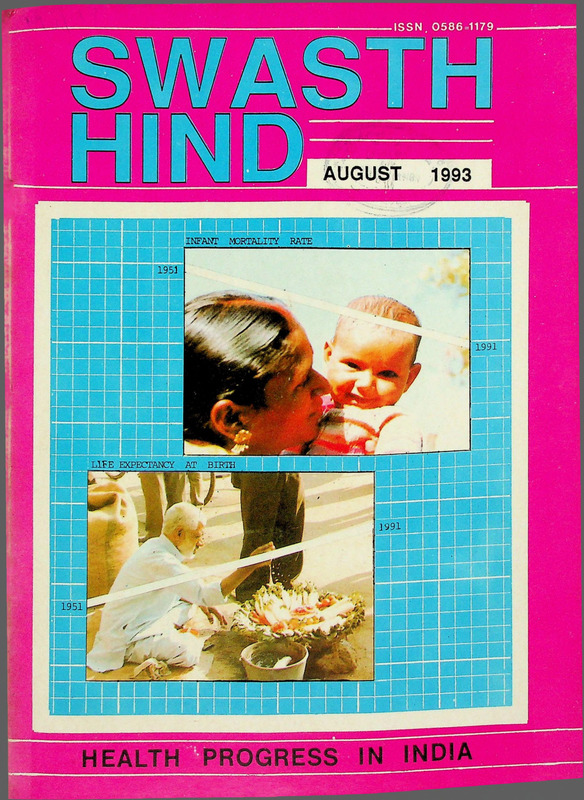
The country has, however, many achieve
ments to its credit in the field of health. The
expectation of life at birth has gone up to 58.6
years from 32.45 years in 1951. The death rate
has been reduced from 22.8 per 1000 population
during 1951-55 to 9.8. Infant mortality rate has
come down from 146 per 1000 live births in 1951
to 80. Smallpox and plague have been elimi
nated.
With a view to providing health care to the
people, a network of comprehensive health ser
vices has been provided both in the urban and
rural areas.
Keeping this in
devotes this issue to:
view
SWASTH
HIND
“HEALTH PROGRESS IN INDIA”
READERS WRITE
I am a regular reader of your journal—
It has been very much informa
tive and useful for me.
Swasth Hind.
—Dr. Arun Kumar Singh
S/o Dr. S.D.S. ‘PRABHAKAR’,
Reshamkothi-7
Birganj; Nepal
National Health Programmes
195
Prevention of adulteration of food and
drugs
204
Focus on Health
206
Family Welfare : Extra efforts required to
achieve Eighth Plan Goals
209
Maternal and Child Health
211
Rural Health Services
220
Editorial and Business Offices
Central Health Education Bureau
(Directorate General of Health Services)
Kotla Marg, New Delhi-110 002
Articles on health topics are invited for publication in this
Journal.
Stale Health Directorates are requested to send in reports of
their activities for publication.
The contents of this Journal are freely reproducible.
nowledgement is requested
Due -ack
The opinions expressed by the contributors are not necessarily
those of the Government of India.
SWASTH HIND reserves the right to edit the articles sent
in for publication.
SUBSCRIPTION RATES
Edited by
M. L. Mehta
Assisted by
M. S. Dhillon
G. B. L. Srivastava
Cover Design
Madan Mohan
Single Copy
....
50 Paise
Annual
....
Rs. 6.00
(Postage Free)
HEALTH PROGRESS-1992-93
Bid To Eliminate Leprosy
And Control TB & Malaria
R. L. Misra
Secretary (Health)
Ministry of Health & Family Welfare
The importance of the state of health on our people can scarcely be over-emphasised. The
ultimate objective of all socio-economic development is to bring about a meaningful and sus
tained improvement in the well-being and welfare of our people; and there is no better index
of the well-being of a people than the state of their health.
HE health problems being
faced by us are highly com
and challenging. While we
are still struggling to meet the
health hazards of communicable
diseases like leprosy, TB and
malaria, we also have to now cope
with the challenge of post tran
sitional diseases like cardio
vascular and cancer. On top of
all these, we have to reckon with
the horrendous implications of
AIDS 2nd in the timely preventive
steps to avoid the Catastrophe that
has overtaken some of the African
Countries. Hence, the need for
urgent, concerted, planned and
sustained action to avert the
potential danger of AIDS. As if
all these were not enough, the
complexity of the health problems
is aggravated by wide-spread
poverty leading to malnutrition,
unhygienic sanitation, illiteracy
and ignorance: these negative
forces are reinforced by the rate at
which our large population is
growing.
T
plex.
AUGUST 1993
While the health problems are
indeed complex and daunting, the
importance of the state of health
of our people can scarcely be over
emphasised. As a matter of fact,
the ultimate objective of all socio
economic development is to bring
about a meaningful and sustained
improvement in the well-being
and welfare of our people: and,
there is no better index of the well
being of a people than the state of
their health.
Financial step-up
While investment—both public
and private—in power generation,
industry, agriculture and educa
tion etc. would finally impact on
health, the importance of direct
investment in the health sector to
improve the health status of the
people and the contribution of a
healthy population to socio
economic development is too
obvious to need any elabo
ration. However, somehow, the
share of health sector in the total
public outlay has not been com
mensurate with the challenges fac
ing the country. We need to
ensure a quantum jump in the
allocation of Plan resources for
the health sector in order to have
the wherewithal of meaningfully
meeting the formidable tasks
before us. Fortunately, this need
has been satisfied to a very large
extent during the year 199293. As against the Plan outlay of
Rs. 302 crore for the central health
sector in 1991-92, the amount for
1992-93 is Rs. 447 crore—a step Up
of almost 50%. As the process of
planning essentially implies in
cremental investment from year to
year, it can be reasonably hoped
that the plan outlay for 1993-94
and the years following it would
use the previous year's outlay as
the base for determining the
amount of annual step up.
External assistance
The contribution of external
assistance in this process is
193
noteworthy. The World Bank has
agreed, in principle, to provide
assistance from its soft loan
affiliate, —the International Deve
lopment Association—of the order
of about S 100 million per year
through the 8th Plan period. The
National AIDS Control Project,
involving an investment of Rs. 225
crore, has already been launched
with IDA Credit of S 84
million. IDA Credits of about S
100 million and 150 million is
expected to be available during
1993-94 for the leprosy control and
blindness control programme res
pectively, as these projects have
been appraised/pre-appraised in
January 1993. The World Bank
has also positively responded to
our concept papers on tuber
culosis and tribal malaria control
programmes and substantial IDA
Credits for these are expected to
be tied up during 1994-95. With
the completion of these externally
aided projects by the year 2000
AD., it could be reasonably hoped
that we would eliminate com
municable diseases like leprosy or
bring diseases like TB and malaria
under control: the quality of life
and productivity of our elderly
citizens would also vastly improve
as the focus of the blindness con
trol project is on taking full care to
prevent cataract induced blind
ness. The reduction of morbidity
and mortality thus brought about
would enable us to have a
healthier population, which, in
turn, would contribute in acce
lerating the process of develop
ment and would not be a drag on
it It would also free the resour
ces for squarely meeting the
challenges posed by non-com
municable diseases and reinforce
measures to prevent the danger
of AIDS.
National Health Policy
Health, in our scheme of things,
is a State subject. While the
194
States have been fully consulted in
the new initiatives taken by us in
the health sector, as the im
plementation of the revamped and
expanded communicable disease
programmes, etc., would have to
be done by them, it is hoped that
the States too would step up their
plan allocations for meeting the
health needs of their people and
also gear up
their health
machinery for effectively deliver
ing the programmes. The States
have also been fully involved in
the comprehensive review, that
has been initiated, of the National
Health Policy 1983 in order to
redefine and re-design it to meet
the quantitative and qualitative
challenges, like the change in the
epidemiological pattern following
the change in the demographic
profile, that have taken place dur
ing the decade since it was
adopted.
Medical education/quality
and food
drugs
As medical education and
quality assurance of drugs and
food are Concurrent subjects
under our Constitution, the Centre
has taken appropriate measures in
these areas in view of its role as a
coordinator and catalyst Or
dinances were promulgated during
the year under report to prevent
the mushroom growth of medical
and dental colleges in order to
ensure that the standards of medi
cal and dental education are qot
allowed to be compromised: hen
ceforth, prior approval of the
Medical and Dental Councils of
India would be required before a
new medical/dental college can be
set up. These ordinances would
be replaced by appropriate Acts in
due course. Similarly, in order to
ensure the quality of blood and
blood products, vaccines, sera and
I.V. fluids, the Drugs & Cosmetics
Rules have been amended to
provide concurrent jurisdiction of
the Drug Controller of India over
licensing the establishment of con
cerned manufacturing facilities.
Further, measures have been
taken to both strengthening the
Central Drugs Standard Control
Organisation by augmenting its
staff and testing facilities. Cen
trally sponsored schemes for
strengthening the State testing
laboratories have been operated to
improve the capability of the
States to assure better quality of
drugs and food. Another cen
trally sponsored scheme for
augmenting the state enforcement
machinery is also being fina
lised. The States, who have a
primary role in this behalf, have
been urged to take suitable action
to strengthen their enforcement
machinery and establish/augment
testing facilities, as that would go a
long way in assuring the supply of
quality drug and food to our
people.
High priority to ISM
The promotion ol the Indian
System of Medicine—Ayurveda,
Unani & Siddha—and Homoeo
pathy continued to get high
priority: the Plan allocation for
ISM and Homoeopathy has been
stepped up and attention is being
paid to standardise and improve
the standard of education and
research in these areas through
their respective Councils.
Mental health
Mental health of the people is
no less important than their physi
cal
health. Accordingly,
the
Indian Lunacy Act 1912 has since
been replaced by the Mental
Health Act of 1987, which
recognises the crucial role of treat
ment and care of mentally ill per
sons: the new Act would come into
force on 1-4-1993.
—Excerpts from the Introduction to the
Annual Report of the Ministry of Health
& Family Welfare for. 1992-93.
Swasth Hind
NATIONAL HEALTH PROGRAMMES
The Centre takes concerted measures to combat communicable, non-communicable
and other major diseases. For this purpose, several national health programmes
are directly run by the Ministry which can have a bearing in the reduction of mor
tality and morbidity and also have a salutary effect on efforts to improve the quality
of life of the common man. These programmes also reinforce the delivery of
primary, secondary and tertiary health care throughout the country.
National Malaria Eradication Pro
gramme
has been decline in
malaria incidence by 67.4%
(in 1991) as compared to malaria
incidence in
1976. However,
when compared with malaria
incidence of 1990, there is slight
increase of 4.6% in total malaria
cases and 8.3% in p.f. cases in
here
T
1991. Moreover, as compared to
malaria incidence of 1991 with
1992 (upto August) there is dec
rease of about 20% in total malaria
cases and about 29% in p.f.
cases.
Mortality due to Malaria: During
1991 (Prov.), 421 deaths were
reported from various States as
compared to 353 deaths during
1990. During 1992 (upto August),
81 deaths have been reported from
the States so far.
Spray Operations: The insec
ticidal spray is done in areas regis
tering 2 API and above in the past
3 years. During 1991-92, 172.32
million population was targetted
for spray with different insecti
cides.
Insecticide
Target
State
Target
Average
Population
covered
(Pop. in
mill)
DDT
BHC
MALATHION
115.75
41.44
15.13
116.23
45.17
8.54
81.03
32.69
7.08
70.10
TOTAL*
172.32
169.94
120.80
70.10
% Coverage
•Figures are provisional.
Population (in million) projec
ted for spray for 1992 is as
follows:
Budget: The
NMEP
is
a
category II centrally sponsored
(Rs. in lakh)
Year
Budget
Provisions
1985-86
1986-87
1987-88
1988-89
1989-90
1990-91
1991-92
1992-93
8868.00
8500.00
8200.00
8300.00
8900.00
8200.00
8960.00 (Final)
9700.00
scheme on 50:50 fund sharing
DDT
BHC .
MALATHION
118.06
42.29
15.42
TOTAL
175.77 million
AUGUST 1993
basis between the States and Cen
tre. The budget provision and
estimated expenditure under 50%
Central share is as follows:
Actual/
Estimated
Expenditure
885631
7815.14
8456.98
8750.00
8862.17
7660.45
8793.04
—-
195
Current Strategy: It is proposed to
intensify the efforts for the full con
tainment of the disease to accept
able levels. Accordingly, major
focus is being given to insecticidal
spraying for vector control in areas
having more than 2/1000 cases
reported and early case detection
and treatment In the remaining
areas, focal spraying and effective
case surveillance is being taken
up. These efforts are being approp
riately dovetailed with training of
workers and enthusing community
participation, alongside decen
tralisation of drug distribution and
fever treatment, etc.
Proposed Strategy for the Future:
With a view to bring down the
incidence of malaria in the country,
it is now under consideration to
revise the approaches adopted
earlier. The new strategy consists
of an attempt to (i) categorise the
malarious areas into high, mod
erate and low for a more focussed,
need-based, cost-effective and
rational implementation of antimalarial measures (this approach
of malariogenic stratification is
being attempted in. the States of
Maharashtra, Karnataka, Gujarat,
Rajasthan, Andhra Pradesh and
Madhya Pradesh); (ii) focussed
attention to the tribal areas of all 14
States (while tribals constitute 8%
of total malaria cases and over 60%
of the P. falciparum cases in the
country); and (iii) urban malaria
which is indicating a very high
trend in the levels of incidence.
Proposed Project for World Bank
Assistance: It is proposed to formu
late a project proposal for malaria
control in the tribal areas, of the 7
States of Andhra Pradesh, Madhya
Pradesh, Bihar, Gujarat, Maha
rashtra, Orissa and Rajasthan.
These areas are high endemic
zones accounting for the maximum
incidence of P. falciparum cases in
the country. The focus of atten
tion would be not only the applica
tion of different approaches—
preventive as well as curative but
also to strengthen the health
delivery system in a manner that
would help achieve the objec
tives.
Urban Malaria Scheme: The
Urban Malaria Scheme (UMS)
came into effect in 1971. The
main objective of the Scheme is to
control malaria by reducing the
vector population in the Urban
Areas through recurrent anti-larval
measures. The Ministry has sanc
tioned the Scheme in 181 towns dis
tributed in 18 States and 2 Union
Territories, but the State Govern
ments have implemented the
Scheme in 128 towns till now. The
States of Karnataka, Orissa, West
Bengal and Rajasthan have not
implemented the. Scheme in 6
towns. The malaria cases recor
ded in 1991 in 121 towns were
211,870. *
(i) It is observed that 121 out of
128 towns from where comparable
data was available, showed an
increase in malaria cases during
1991 as against 1990. Ahmedabad,
Madras and Delhi, etc., recorded
an upward trend, but Hyderabad
and Bombay showed a downward
trend in comparison with corres
ponding period of 1990.
(ii) Madras, Delhi and Bombay
recorded 66,937, 8,491 and 5,335
cases of malaria respectively dur
ing 1991.
Kala-azar
Kala-azar has become a serious
Public Health Problem in Bihar
and West Bengal. After its re
surgence in Bihar in early 70s, the
disease spread from 4 districts to
adjoining areas and now 30 dis
tricts in Bihar and 9 districts in
West Bengal are affected by Kalaazar. As is evident, the problem
has assumed serious dimensions in
Bihar, where there has been a steep
rise in reported incidence which
itself is not an actual magnitude of
the problem because some cases go
to private practitioners and rejrianr
unreported. The disease is on
increasing trend and the incidence
for the last 5 years is given below:
KALA-AZAR INCIDENCE:
YEAR
Cases
1986
1987
14079
19179
1988
19639
1989
1990
1991
1992
(Prov. upto October)
30903
54650
59614
66959
196
WEST BENGAL
BIHAR
TOTAL COUNTRY
Cases
Deaths
Cases
Deaths
3718
47
4447
77
*(+ 19 suspected)
3068
123
♦(+ 3 suspected)
3573
477
3037
589
2030
834
1212
1266
25
10*
17806
23685
72
94
2*
22739
131
20
16
4-3
1
34489
57742
61670
68175
497
606
838
1267
Deaths
SWASTH HIND
In view of the rising problem,
organised control measures were
initiated. Until 1990-91, the assis
tance for Kala-azar control was
being provided by Government of
India out of NMEP budget pro
vision. However, specific funds
were made available during 199091 wherein Rs. 4.06 crore was pro
vided in the final estimates for
Kala-azar control in the States of
Bihar and West Bengal.
consecutive evaluation. The con
cept of making different functiona
ries at various levels responsible
and accountable for Kala-azar con
trol activities is to provide a good
impact with consequent reduction
in incidence.
Strategy
Actions taken by the Government of
India during last two years: Assis
tance provided 'to Government of
Bihar: Assistance in terms of cash
as well as kind has been provided
during the last two years as
below:
The strategy for Kala-azar con
trol broadly includes 3 major
activities:
(i) Interruption of transmission
for reducing vector popula
tion by undertaking indotfr
residual insecticidal spray
twice annually,
(ii) Early diagnosis and complete
treatment
of
Kala-azar
cases, and
(iii) Health education for com
munity awareness in involve
ment
District action plan development
In view of the financial con
straints in implementation of an
effective control strategy, the
Government of India decided to
provide total cost of medicines and
insecticides for Kala-azar contol in
Bihar. An Expert Committee was
constituted under the Chair
manship of Director General of
Health Services, to finalise the
estimated requirements.
To ensure optimum utilisation of
available limited resources, a con
cept of district action plan develop
ment has been suggested to the
State. The State Government
have agreed to deploy exclusive
infrastructure for Kala-azar acti
vities and adequate material and
equipment with strict supervision,
monitoring and concurrent and
AUGUST 1993
Government of India is provid
ing insecticides and imported anti
Kala-azar drug i.e., pentamidine
isothionate to West Bengal.
(Rs. in lakh)
Year
1990-91
1991-92
Cash
Kind
Total
— 389.49 389.49
102.27 1423.72 1535.99
A budget provision of Rs. 1500.00
lakh has been made to provide
material assistance for Kala-azar
control. However, in view of the
seriousness .of the problem, com
mitment of the Government of
India and to ensure availability of
material for effective control, a
Revised Estimate for Rs. 2376.55
lakh has been proposed to meet the
cost of insecticides and anti Kalaazar drugs.
In addition, UNICEF assistance
of Rs. 15.55 lakh has been provided
(1990-91) at the disposal of State
Government for public informa
tion, education, communication
activities and orientation training
of medical profession. UNICEF
is providing Assistance on continu
ing basis directly to the State
Government of Bihar.
Material assistance included
the insecticide DDT and the
imported
drug
pentamidine
isothionate ye^r-wise quantitative
supplies are given below:
Year
DDT
Pentamidine
S.S.G.
1991-92 4000 MT 35000 Vials 224581 Vials
1992-93 2083 MT 45000 Vials 264304 Vials
Upto December, 1992
National Filaria
gramme
Control
Pro
Filariasis is a major Public
Health
Problem
in
India.
Whenever the disease becomes
chronic, it is irreversible. The dis
ease has been prevalent throughout
India except Jammu & Kashmir,
Punjab,
Himachal
Pradesh,
Mizoram, Meghalaya, Tripura,
Manipur, Rajasthan, Arunachal
Pradesh,
Delhi,
Chandigarh,
Haryana, Sikkim and Nagaland.
Present estimate indicates that
about 389 million people are living
in 175 known endemic districts of
which about 103 million are living
in Urban Areas and the rest in
Rural Areas.
Under the Programme, the
following activities are being
undertaken:
(i) Delimitation of the pro
blem in hitherto unsur
veyed areas;
(ii) Control in Urban Areas
through:
(a) Recurrent anti-larval
measures.
(b) Antiparasitic
mea
sures.
Present Set up: The following is
the present set up of endemic
States/Union Territories:
Control Units
Survey Units
Clinics
— 206
— 27
— 195
197
Progress: At present, about 43.43
million people in Urban Areas are
being protected through anti-larval
measures by 206 control units and
195 clinics are giving treatment
with Diethylcarbamazine to clini
cal cases and microfilaria car
riers.
Achievements: It is observed that
73 per cent of the towns in mic
rofilaria rate and 69 per cent of
towns in disease rates, where con
trol measures are in operation for
more than five years, have shown
marked reduction.
Budget and Expenditure during
1985-86 to 1991-92 are given in the
Table below:
BUDGET AND EXPENDITURE IN NATIONAL FILARIA CONTROL PROGRAMME
(Rs. in Lakh)
Budget
Expenditure
Year
Cash
Kind
Total
Cash
Kind
Total
1
2
3
4
5
6
7
1985-86
1986-87
1987-88
1988-89
1989-90
1990-91
1991-92
40.00
50.00
4937
54.72
64.00
83.00
48.00
92.00
100.00
100.43
14528
154.00
146.00
96.00
132.00
150.00
150.00
200.00
218.00
229.00
144.06
40.00
36.89
73.93
6426
69.87
83.00
21.00
10035
113.11
76.07
135.74
116.11
146.00
430
14035
150.00
150.00
200.00
195.98
229.00
2530
National
Leprosy
Programme
Eradication
Out of the 10 million cases of lep
rosy in the world, 2.5 million are
estimated to be found in India.
The disease is widely spread all
over the country. The prevalence
rate of leprosy exists above 5 per
1000 population in 201 districts out
of 468 districts of the coun
try. About 15% of the leprosy suf
ferers are children below 14 years
of age. The proportion of infec
tious cases varies from 15 to 20%
and equal number of patients suf
fer from deformities. At the time
of launching of the National Lep
rosy Eradication Programme in
1983, the disease was highly pre
valent in the States/UTs of Tamil
Nadu, Andhra Pradesh, Lakshad
weep, Pondicherry, West Bengal,
Maharashtra, Karnataka, Bihar,
Nagaland, Sikkim and Andaman
Nicobar Islands. By now the
incidence of leprosy has registered
a decline in many of these
States.
Programme
Objectives: The
Government of India launched the
198
National Leprosy Eradication Pro
gramme in 1983 with the objective
of arresting the transmission of the
disease by 2000 AD. It is a 100%
Centrally-sponsored programme.
Strategies: The strategy adopted
under the programme involves:
(a) provision of domicilliary multi
drug treatment coverage in 135 dis
tricts having problems of 5 or more
cases per 1000 population, by
specially trained staff in leprosy;
(b) Introduction of modified MDT
scheme in the remaining 66
endemic districts through existing
health care staff; (c) Introduction of
MDT services through existing
general health care services in the
low endemic districts; (d) Multi
drug therapy to Dapsone refractory
cases in other districts. Treatment
with combination of drugs include
treatment with 3 drugs viz.. Rifam
picin, Clofazimine and Dapsone.
Education of the patients and the
community about the curability of
the disease and their socio
economic rehabilitation are other
two key components of the con
trol strategy.
Infrastructure: Over the years, a
vast infrastructure of leprosy
workers has been developed in the
country, specially trained for pro
viding leprosy services. In the
endemic rural areas, these services
fan out from Leprosy Control Units
(one for 0.4 to 0.5 million popula
tion) while its urban counterpart
called Urban Leprosy Centre caters
to a population of about 30 to 40
thousand. Temporary
hos
pitalization ward having 20 bed
capacity has been established at
least one in each endemic district to
render
hospitalization
ser
vices. Under the programme, 49
Leprosy Training
Centres are
engaged in providing training to
various categories of health
workers in leprosy. Following
infrastructure exists at the end of
March, 1992. Leprosy Control
Units-758; Urban Leprosy Centres900; Survey Education and Treat
ment Centres-6097; Temporary
Hospitalization Wards-291; Dis
trict Leprosy Units-285; Leprosy
Training Centres-49; Reconstruc
tive Surgery Units-75; Leprosy
SWASTH HIND
Rehabilitation & Promotion Units13; and Sample Survey cum Assess
ment Units-39.
Infrastructure thus created has
been predominently established by
the States in the endemic dis
tricts. In districts with endemicity
of less than 5/1000 population, the
general health care staff provide
the services. However, there are
still gaps in the 66 endemic districts
due to financial constraints. To
extend the benefit of MDT to over 7
million patients living in these 66
districts, Government of India
sanctioned a modified MDT
approach from January, 1991.
This modified approach includes
the involvement of PHC in the
delivery of services to leprosy
patients.
Achievements: Currently, about
70% of leprosy patients are getting
the benefit of multi-drug therapy in
the country. Available informa
tion indicates that MDT is well
accepted by the patients, the
tolerance is good and side-effects
are minimum. There is marked
reduction of over 90% in the pre
valance rate in the 40 districts
which have completed MDT of 5
years or more. 6.39 million cases
have been discharged as cured by
March, 1992.
Targets and Achievements in 199192: During the year 1991-92
against the target of 335200 for new
case detection and treatment, a
total of 508390 new cases have been
detected out of which 500242 cases
have been put under treatment.
(i) The target for case discharge
was 612500 during 1991-92 against
which 816538 cases have been
discharged.
(ii) The physical target allocated
for 1992-93 consists of 289600 cases
for detection and treatment and
573900 for case discharge. The
budget estimate for 1991-92 was Rs.
2280 lakh and for 1992-93 also
same amount has been allocated.
8th Plan: During 8th Plan, it is
proposed to provide MDT coverage
to all the districts with endemicity
of 2 or more per 1000 population
and MDT service will also be
extended through primary health
care in other districts.
World
Bank
Assistance: To
spread the MDT coverage to
uncovered areas and to further
intensify the efforts, the Govern
ment have sent a comprehensive
proposal to World Bank for finan
cial assistance of Rs. 300.00
crore. In the proposed World
Bank Project, it is envisaged to pro
vide the leprosy services with
separate workers in the 66 endemic
districts currently under the Modi
fied MDT Programme, and addi
tional 77 districts would be taken
up for introducing the Modified
MDT Programme. The monitor
ing
information
would
be
strengthened and a foundation laid
to embark on a rehabilitation
programme.
Leprosy Scenario : It must, how
ever, be realized that even after the
achievement of the goal of disease
eradication, the daunting task of
promoting the social acceptance of
the treated cases and their eco
nomic rehabilitation would remain
to be accomplished.
PLAN WISE EXPENDITURE INCURRED UNDER THE PROGRAMME
Budget
Period
1st Plan (1955-56)
2nd Plan (1956-61)
3rd Plan (1961-66)
Annual Plan (1966-69)
4th Plan (1969-74)
5th Plan (1974-79)
Annual Plan (1979-80)
6th Plan (1980-85)
7th Plan (1985-90)
8th Plan (1990-91)
(1991-92)
(1992-93)
AUGUST 1993
(Rs. in lakh)
Expenditure
35.00
529.00
425.00
Im
286.00
2023.00
232.00
4004.43
8582.00
2225.54
2208.14
2280.00
B.E.
Pattern of
Assistance
Centrally Aided
-do-do-do100%
50:50
50: 50
100%
100%
100%
100%
100%
199
National Tuberculosis Control Pro
gramme
Tuberculosis is a major public
health problem in India. Nearly
1.5% of the total population is
estimated to be suffering from
radiologically active tuberculosis
disease of the lungs of which about
14th or 0.4% are sputum positive
or infectious.
Out of about 440 districts in the
country, upto the end of September,
1992, 388 district# have been pro
vided with District T.B. Centres
equipped with essential equip
ments and manned by trained staff
for undertaking District-wise T.B.
Programme in association with
general health and medical
institutions. In addition, there are
about 330 T.B. Clinics functioning
in the country which are mostly
located in big towns and cities to
look after the needs of the local
population.
About 47,000 beds are available
in the country for treatment of
seriously sick T.B. patients. T.B.
Training and Demonstration Cen
tres have been established in the
major States of the country to
undertake the basic training of the
medical and para-medical person
nel required for the programme.
Anti-TB drugs for free treatment
of T.B. patients are being supplied
to the T.B. clinics run by the State
Government as a CentrallySponsored Scheme on 50:50
sharing basis between the Centre
and the States. The scheme of
supply of anti T.B. drugs to the T.B.
clinics run by voluntary bodies and
schemes of supply of material and
equipments and anti-T.B. drugs to
Union Territories, however, con
tinue as 100% Centrally Sponsored
Scheme, Swedish International
Development Agency (SIDA) con
tinues to assist the National T.B.
Control Programme as per the
200
agreement entered into by the
Government of India with SIDA
authorities. The SIDA authorities
agreed to supply X-ray Units with
Odelca Cameras, miniature X-ray
film rolls, vehicles and limited
quantities of anti-TB drugs for
short course Chemotherapy pilot
study and microscopes to the needy
rural PHCs to augment the case
finding activities in the rural
areas.
New Strategy
As part of new strategy in the
treatment
regimens under
National Tuberculosis Control
Programme, short course Chemo
therapy drug regimens containing
Rifampicin and Pyrazinamide
have been introduced in 253 dis
tricts of the country so far. More
districts are expected to be brought
under these regimens in a phased
manner in the ensuing years.
These regimens will reduce the
duration of treatment of the tuber
culosis patients from 18 to 24 mon
ths to 6 to 8 months.
As a result of high priority given
by the Government to the National
Tuberculosis Control Programme,
the essential activities under the
programme have been con
siderably expanded increasing
from year to year. As against
detection of about 10.81 lakh new
T.B. cases during 1982-83, about 12
lakh new T.B. cases were detected
during
1991-92. Further,
to
expand the T.B. case detection
among the rural populace and to
involve the Primary Health Centres
in T.B. case finding activities,
targets were also laid for conduct
ing 50 sputum examinations per
month at each of the Primary
Health Centres for the first time
during 1983-84 and nearly 12.12
lakh sputum examinations were
conducted. There is a significant
improvement of this activity and
during 1991-92 about 20.00 lakh
sputum examinations were con
ducted in the Primary Health
Centres.
Targets
The targets for 1992-93 in respect
of new T.B. case detection is 17.50
lakh and about 39.96 lakh in res
pect of sputum examination of new
chest symptomatics at the Primaiy
Health
Centres. During
the
period from April, 92 to July, 1992
about 3.96 lakh new T. B. cases
(provisional) have been detected by
the States and Union Territories
and nearly 5.83 lakh (provisional)
sputum examinations were con
ducted at the Primary Health
Centres.
BCG Vaccine Laboratory, Guindy
The Ministry of Health and
Family Welfare set the target for
supply of BCG Vaccine for 1992-93
at 470.00 lakh doses to meet the
requirements of Universal Im
munisation Programme in India.
Out of this, the production target
for BCG Vaccine laboratory is 250
lakh doses. Upto the end of Sep
tember, 1992, a total of 156.48 lakh
doses have been produced by this
laboratory. Till date 344.30 lakh
doses Urere supplied which includes
imported vaccine as well.
The biologicals produced and
supplied during the period April,
1992 to September, 1992 are as
under:
Produc
tion
Supply
FJD. BCG Vaccine
(20 doses per
amp.)
156.48
lakh
doses
34430
lakh
doses
Tuberculin PPD
RT-23-ITV
(100
doses per
vial)
7741
Vials
7457
Vials
2 TV
191 Vials
190 Vials
Swasth Hind
Future Plan ofAction : The expan
sion of the BCG Vaccine
Laboratory was included in the
Seventh Five Year Plan with an
outlay of Rs. 1 crore which excludes
the imported machinery costing
about Rs. 2 crore procured through
the UNICEF. The machines have
been received and except the
Industrial Type Freeze, Industrial
Drier and Type Dessicator, all the
others were installed, which has
increased the installed capacity
from 240 lakh doses to 400 lakh
doses. After complete installation
of all the machines, the installed
capacity will be 500 lakh doses.
Construction for setting up of the
3rd Unit to achieve self-sufficiency
in production of BCG Vaccine has
also been undertaken.
National Programme for Control
of Blindness
National Programme for Control
of Blindness (NPCB) was launched
in 1975-76 which incorporates the
earlier Trachoma Control Pro
gramme started in 1963. This is a
100% centrally sponsored scheme.
The approach under the NPCB,
consists of intensive health educa
tion for eye care through the mass
media and extension education
methods; extension of ophthalmic
services in the rural areas through
mobile units and eye camps and
establishment of permanent infra
structure for eye-health care as an
integral part of general health ser
vices. Since 1981-82, cataract
operations have been accorded
high priority in the programme and
targets for different States/UTs
have been set The targets and
achievements in respect of perfor
mance of cataract operations under
the programme are as under:
TARGETS & ACHIEVEMENTS FOR CATARACT OPERATIONS
Year •
Target
Achievement
%age of Achievement
1990-91
1991-92
1992-93
YLZ6 lakh
19.90 lakh
20.00 lakh
11.90 lakh
14.62 lakh
2.74 lakh
(provisional)
92.53
73.47
13.74
The preliminary findings of the
All India Survey (1986-89) on
evaluation of blindness activities in
India have indicated that the total
magnitude of blindness has not
decreased significantly and the
cataract is now responsible for 81%
of the blindness. In view of these
findings, it is envisaged to
gradually increase the number of
Intraocular cataract operations.
Besides the strategy of augmenting
various eye care services at
peripheral, intermediate and Cen
tral levels alongwith the camp
approach for cataract surgery to
continue in 1992-93 under the
NPCB. The targets for various
activities for 1992-93 are as
follows:
7. Replacemqnt/Repair/
Maintenance of
Equipment in CMUs
20
8. Additional Inputs to
Districts
100
9. Replacement of Vehi
cles at CMUs
40
1. Cataract Operations
20 lakh
2. Strengthening of PHCs
600
3. Establishment of DistL
M. Units
90
4. Strengthening of Eye
Banks
5
(in Voluntary Sector)
5. Development of Distt
Hospitals
10
6. Upgradation of Medi
cal Colleges
4
AUGUST 1993
2—7 DGHS/93
Financial Allocations:
199091
92
199193
1992-
5.88 crore
12.80 crore
20.00 crore
Allocation VIII Plan 120.00 crore
As regarding Foreign Aid assis
tance an agreement between the
Govt of India and the Govt of
Denmark was signed in October,
1989 and accordingly, DANIDA is
providing an assistance of Rs. 22.25
crore over a period of 5 years (198994) under Phase-II for the Control
of Blindness. These funds are to
be released in a phased manner
depending upon the actual expen
diture incurred by the various State
Governments under this Project
Voluntary organisations play a
very significant role in NPCB.
They are active in the field of educa
tive, preventive, rehabilitative and
surgical services for control of
blindness.
One of the recent concept in the
field of prevention of blindness is
the formation of District Blindness
Control Societies. All States/UTs
have been asked to establish these
Societies which would be registered
under Societies Registration Act
XXI of 1860. These Societies will
function under the Deputy Commissinner/District Magistrate ofthe
District for implementation of
NPCB by involving the voluntary
organisation of the area and raising
funds from local sources. The
District Ophthalmic Surgeon is the
Member-Secretary of the Society.
So far 159 such societies are formed
and have started functioning.
National Iodine Deficiency
orders Control Programme
Dis
Iodine is one of the essential
elements for normal human growth
and development. Its daily per
capita requirement is 150 micro
grams. Deficiency of Iodine in the
daily diet may result in the develop
ment of goitre and other iodine
deficiency disorders (IDD) .includ
ing mental and physical re
tardation and endemic cretinism.
Iodine deficiency disorders con
stitute a major public health pro
blem in India. There is an
increasing evidence of widespread
distribution of environmental
Iodine deficiency riot only in the
201
Himalayan regions but also in the
Sub-Himalayan Tarai areas (espe
cially those subjected to recurrent
flooding), revcrinc areas and even
the coastal regions.
Surveys conducted have revealed
high prevalence of endemic goitre
in different States. Results of
sample surveys conducted in 216
districts of 25 States and 4 UTs have
identified 186 districts as endemic
for IDD. Survey results also indi
cate that manifestations are not
only limited to en iemic goitre and
cretinism, but inci ide a wide spec
trum of disability ncluding deafmutism., mental retardation and
various degrees of neuro-motor
dysfunction.
In India, as of now, it is estimated
that nearly 167 million persons are
exposed to the risk of IDD of which
54 million are having goitre, 2.2
million arc cretins and 6.6 million
have mild neurological disor
ders. It is estimated that with
every passing hour, 10 children are
being born in this country who will
not attain their optimum mental
and physical potential due to
neonatal hypothyroidism caused
by iodine deficiency. With con
tinuous depletion of iodine from
natural resources, the situation is
expected to worsen.in the coming
years unless measures are taken to
control the situation.
Realising the magnitude of the
problem, Govt of India launched a
100% Centrally Sponsored Natio
nal Goitre Control Programme
(NGCP) in 1962 with focus on pro
vision of iodised salt to identified
endemic areas. For effective con
trol of IDD, on the recommen
dations of the Central Council of
Health (1984), the Govt, of India, in
1985, took a decision of Universal
Iodisation of edible salt by
1992. The scheme started from
April, 1986 in a phased man
ner To meet the requirement of
iodised salt, the annual production
of iodised salt was targetted from
the existing 5 lakh M.T. in 1985 to
50.00 lakh M.T. per year by 1992.
Achievements: The achievements
made under the programme from
its inception to date are as
under
(i) To promote the production
of lodated salt, 592 private
202
manufacturers have been
licensed by the Salt Com
missioner. out of which
nearly 441 units have com
menced production so
far;
(ii) Annual
production
of
iodised salt has been raised
from 5.0 lakh M.T. in 198586 to 26.0 lakh M.T. in
1991-92. This is expected
to be further raised to 30.00
lakh M.T. in 1992-93:
(iii) To emphasise the impor
tance of all the IDDs
including Goitre, the no
menclature of National
Goitre Control Programme
has been redesignated to
National Iodine Deficiency
Disorders Control Pro
gramme (NIDDCP);
(iv) To ensure availability of the
required quantity of iodine
to the consumers, iodine
content of iodated salt has
been fixed under the PFA
Rules at not less than 30
and 15 PPM at the manu
facturing and consumer
levels respectively;
(v) In order to ensure use of
only iodated salt, all the
States/UTs have been ad
vised to issue notification
banning the sale of salt
other than iodated salt for
edible purposes under PFA
Act. So far, 22 States/UTs
have completely banned
the same while another 5
States have banned in the
endemic areas;
(vi) For ensuring quality con
trol at consumption levels,
testing kits for on the spot
quantitative testing have
been developed in colla
boration with UNICEF
and they are being dis
tributed to the District
Health Officers in En
demic States for regular
monitoring;
(vii) For effective implementa
tion of NIDDCP, all the
States/UTs
have been
advised to set up IDD Con
trol Cells in their respective
State Health Directorates
for which cash assistance is
being provided by the
Ministry of Health. Till
date, 22 States/UTs have set
up IDD Control Cells;
(viii) To speed up the survey
work, an additional grant
.of Rs. 10,000/-per district is
being given to States and
UTs whenever a request is
received from. them.
(lx) Training programmes have
been carried out by the
Central Goitre
Survey
Team for the States of Kar
nataka and Uttar Pradesh
(one district each); and
(x) During the current finan
cial year, initial goitre sur
veys have been carried out
in the State of Karnataka,
and survey work will be
completed by March, 1993
in Uttar Pradesh, Gujarat
and Kerala as intimated by
respective State Govern
ments.
Intensive monitoring
Although the programme is in
operation since 1962 with consider
able achievements, yet opti
mal results have not been achiev
ed. As a result, India today con
tinues to have a high incidence of
goitre cases, i.e., 54 million as com
pared to 200 million globally. To
intensify Iodine Deficiency Disor
ders Control Programme, a project
has been finalised with UNICEF
assistance amounting to Rs. 1.20
crore for intensive IDD monitoring
in 4 States (5 districts each) namely
Uttar Pradesh, Himachal Pradesh,
Madhya Pradesh and Assam dur
ing 1992. The project objectives
are to reduce goitre prevalence in the
age group 10-14 years to less than 5%
and a fall to zero in number of cretins
born by 2000 in the selected districts
of the States.
Proposal of IDDCP-Project,
1993- for UNICEF assistance to
95
the tune of Rs. 8.835 crore is being
finalised. Under this Project,
apart from 4 States already covered
under the on-going 1992 Project,
additional States of Sikkim,
Arunachal Pradesh, Mizoram and
Swasth Hind
Northern districts of West Bengal
are proposed to be covered. The
strategy to be adopted to achieve
the declared goals and objectives
would be :
(i) Launching of intensive
IDD programme integra
ted within the existing salt
production and distribu
tion system to ensure that
the selected districts will be
supplied
only
iodated
salt;
(ii) Establishment of a mon
itoring system with the in
volvement of the salt
producers,
wholesalers,
retailers, frontline workers,
as well as consumers, to
ensure that the iodine con
tent of iodated salt is
assessed at the levels of
production, distribution as
well as consumption level.
Use of low cost iodated salt
testing kits will be pro
moted at every level from
manufacturing to con
sumption level. In addi
tion, a network of Iodine
Monitoring Laboratories
will be established at salt
production centres and at
the nodal consumer points
within each State. For the
effective implementation
and monitoring of the pro
gramme, the Central and
State IDD Cells will be
strengthened and suitable
training centres will be
established; and
(iii) A multi-sectoral social
communication
strategy
will be developed at the
field level with the involve
ment of ICDS, DWCRA
and
education
sec
tors. The district com
munication plan will be
implemented to. create
positive consumer demand
and change consumer be
haviour with the objective
of ensuring consumption
of iodated salt by the
total population.
National
Sexually
Disease
Control
(STD)
Transmitted
Programme
STD was introduced as a Na
tional Control Programme during
August 1993
the Second Five Year Plan by the
Government of India. The Pro
gramme was then primarily a cen
trally aided scheme concerned
mainly with : (i) establishing STD
Clinics throughout the coun
try; (ii) supply of drugs to the
earlier existing and newly esta
blished clinics; and (iii) conduct
ing training courses for the
inservice medical and para
medical personnel.
The scheme was, however, con
verted into a Centrally sponsored
scheme during the Fourth Five
Year Plan and the Central
Government assistance was limi
ted to (i) giving grant-in-aid to
Stales for establishing new STD
clinics and (ii) supplying drugs
(Benzathine, Penicillin) to the STD
clinics for the inservice medical
and para-medical personnel.
Recognising STD as one of the
major factors for transmission of
HIV infection, the Programme has
been merged with the AIDS Con
trol Programme. The existing
components of the programme
viz. Teaching, Training, Research
and Epidemiology, however, has
been retained outside the World
Bank assisted activities of the
National AIDS Control Pro
gramme.
Under the National STD Control
Programme following achieve
ments have been made :
(i) As on December, 1992 the
Regional STD Centres
have trained as many as 86
medical officers and 92
para-medical
personnel
like Laboratory Techni
cians,
Nurses,
Health
Educators, Social Wor
kers, etc.
(ii) About 56 medical collegeshospital
laboratoriesA
public health laboratories
are participating in the
inter-laboratory evaluation
programme of VDRL tests
being conducted by the
Central STD Reference
Laboratory, Madras and
Hyderabad;
It is proposed to launch a crash
programme for the training of
Medical Officers working in
Primary Health Centres in Tamil
Nadu, Andhra Pradesh, Maha
rashtra, West Bengal and Delhi at
the 5 Regional STD Training Cen
tres; and
STD Planning Workshops for
the State Programme Officers of
STD, AIDS and Epidemiologists of
various States shall be held at
Delhi and Madras during the
current financial year.
Blood Safety Programme
A scheme on prevention of infec
tion and strengthening of blood
banking system in the country is
being implemented since 1989
under which State Governments
are provided assistance for esta
blishment of testing facilities
including HIV in the blood banks,
strengthening and modernisation
of Government managed blood
banks, development of manpower
and rational use of blood.
During 1992, a programme for
the prevention and control of/JDS
has been launched with World
Bank assistance. One of the
major components of this pro
gramme is “Blood Safety.”
Modernisation of Blood Banks:
Under this programme, it is pro
posed to upgrade all the 608
Government
managed
blood
banks in the country with provision
of equipments and recurring assis
tance for consumables in a phased
manner. Upto March 1992, 138
bloodbanks were upgraded. Dur
ing 1992-93, 90 more blood banks
will be modernised under the
World Bank assisted National
AIDS Control Programme. The
remaining 380 blood banks will be
taken up for upgradation in a
phased manner under the National
Budget. During 1992-93, 88 blood
banks will be taken up for
upgradation.
Development
of Man-power:
The ten training institutes opera
tionalised for training doctors and
technicians are continuing their
training
programme. Institu
tional facilities have already been
upgraded for training. 110 doctors/tcchnicians have been impar
ted training in blood banking
technology in this short term orien
tation course. Training material
(Contd. or. Page 220)
203
PREVENTION OF ADULTERATION
OF FOOD AND DRUGS
Adulteration of food and drugs can cause serious damage to human life. This
anti-social menace is sought to be countered by making the legal provisions more
stringent and deterrent, even entailing life imprisonment for adulterations caus
ing grievous hurt and danger to human life. This malpractice is also being tackled
through effective health education measures. The drug de-addiction centres are
being strengthened to provide treatment facilities for the drug abuse problem and
drug dependence disorders.
OOD is the basic need for
survival. It is, therefore, impe
rative to ensure that whatever we
consume is pure and wholesome.
With this objective, the Parliament
had enacted the prevention of Food
Adulteration Act, in the year 1954.
The aims envisaged under this Act
are:—
(1) To ensure quality food to the
consumers;
(2) To protect the consumers from
fraud or deception;
(3) To encourage fair trade prac
tices.
F
Amendments and Penalty Pro
visions : The Act, which came into
effect from 1st June, 1955 was
amended thrice—firstly, in 1964
secondly, in 1976 and lastly in 1986
for plugging the loopholes and for
making the punishments more
stringent. It was by the amendment
of 1976 that punishment for adulte
ration which could cause such
harm so as to amount to grievous
hurt within the meaning of Section
320 of I.P.C. or death, punishment
of imprisonment for a term which
shall not be less than 3 years but
which may extend to a life term
with fine which shall not be less
than Rs. 5,000/- was included. With
the amendment in 1986, the con
sumers and voluntary organisa
tions have been empowered under
the Act to take samples of food and
initiate legal action, whenever
necessary.
204
Central Food Laboratories
At present, we have two labo
ratories under the administrative
control of the Directorate General
of Health Services, viz.. Central
Food Laboratory, Calcutta and
Food Research and Standardisa
tion Laboratory, Ghaziabad which
are moderately equipped. Two
more Laboratories—one at Pune
and another at Mysore have also
been declared as Central Food
Laboratories under the Act. The
Pune Laboratory is under the
Government of Maharashtra and
the Mysore Laboratory is under the
Council of Scientific and Industrial
Research, Government of India.
Both these laboratories are receiv
ing grant-in-aid from this Ministry
@ Rs. 5.00 lakh per year for doing
work under the Prevention of Food
Adulteration Act
State Food Laboratories
There are 78 food laboratories
under the administrative control of
the State/Local Bodies. Out of
these, 65 are managed by State
Governments and the remaining 13
by the Local bodies. The State labo
ratories are moderately equipped
whereas
regional/local bodies
laboratories need to be equipped.
Steps initiated
programme
to
improve
the
During the current year, there is
a proposal to strengthen the P.F.A
Division at the Headquarters.
Other steps are:
(i) During the year, a Centrally
sponsored scheme has been in
operation whereby six state Food
Laboratories are proposed to be
assisted with lumpsum grants for
purchase of equipments.
(ii) Assistance has also been
provided to the State Food Labo
ratories in the form of equip
ments out of W.H.O. funds.
(iii) 35 training programmes
have been arranged by P.F.A
Division under which more than
450 officials comprising of Food
(Health)
Authorities/Local
(Health)
Authorities/Public
Analysts and Food Inspectors
have been trained.
(iv) 11 Examinations have been
conducted so far in which 209
chemists have been declared
qualified to hold die post of
public analyst
(v) Consumer Education Pro
grammes have buen organised
whereby a number of voluntary
organisations have been exposed
to various facets of the pro
gramme of Food Safety and
Quality.
(vi) The Central Team has visit
ed the States and assisted the
State P.FA. implementation
authorities in sampling acti
vities.
(vii) Steps have been initiated to
improve the Food Safety and
Sanitation measures in Govern
ment run Departmental eating
establishments.
Swasth Hind
Future Proposals
Under the Eighth Five Year Plan,
following proposals have been sub
mitted for improving the pro
gramme on Food Safety and
Quality:
(a) Central Scheme: Total allo
cation Rs. 3 crores for (i)
strengthening of P.F.A. Division
in the Headquarters and creation
of units at the ports to regulate
the quality of imported food.
(ii) Setting up of one Central Food
Laboratory in West Zone and
Zonal offices in Bombay,
Calcutta,
Madras
and
Ghaziabad.
(iii) Augmentation of laboratory
facilities at Central Food
Laboratory, Ghaziabad.
(iv) .Augmentation of laboratory
facilities at Central Food
Laboratory, Calcutta.
(b) Centrally Sponsored Scheme:
Total allocation Rs. 7 crores for
augmentation of State Food
Laboratories.
Additional
Information:
A
statement on the working of P.FJL
Act in the country indicating the
number of samples examined,
found adulterated, percentage of
adulteration, prosecution launched
etc. is given here :
WORKING OF THE PREVENTION OF FOOD ADULTERATION ACT, 1954 IN
INDIA 1981-1990
No. of
Percentage
Samples
of adultera
tion
found
adulterated
Year
No. of
samples
examined
1
2
3
1981
1982
1983
1984
1985
1986
1987
1988
1989
1990
1,33,242
1,29,595
1,29,062
1,22,296
1,28,511
1,21,969
1,31,391
1,30,390
1,22,599
1,18,580
19,050
16,765
17,965
14,990
14,677
13,730
14,091
15,365
11,549
11,124
► .
.
No. of
prosecu
tions
launched
No. of
convic
tions
4
5
6
7
8
14.2
12.9
13.9
12.2
11.4
11.2
10.7
11.78
9.42
9.38
15,801
15,006
15,581
13,334
11,783
10,445
9,597
9,599
8,197
7,970
4,588
3,617
5,294
4,530
4,702
3,864
3,347
2,576
1,990
2,464
4,326
5,483
4.818
4,577
3,947
3,391
5,016
3.251
2,743
2,316
28.364
36.781
40.715
43,761
44.610
44,389
47,637
50,931
53,595
54,700
No. of
No. of cases
cases
pending in
acquitted/ the Courts
discharged
of Law
Note: Information is based on the available reports from the States/Union Territories.
Central Drug Standard
Organisation
Control
Quality Control Over Imported
Drugs: The statutory control on
imported drugs is exercised by
various ports and airports offices of
Central Drug Standard Organi
sations
located
at Bombay,
Nhavashava, Calcutta, Madras,
New Delhi and Cochin. During
the period from April to September,
1992, the value of imported drugs,
drug intermediates, finalised for
mulations, chemical solvents etc.
was Rs. 581.34 crores approx
imately and export during this
period was upto Rs. 618.03
crores.
Co-ordination and liaison with the
States: Four zonal offices located
at Bombay, Calcutta, Madras,
AUGUST 1993
7 DGHS/93
Ghaziabad and sub-zonal offices
at Lucknow and Patna co-ordinate
with the State Drug Control
authorities under their jurisdiction
for uniform standard of inspection
and enforcement of the Drugs
rules : (i) The zonal officers inspec
ted either jointly with the State
Drug Control Authorities or
independently as many as 146
manufacturing units, 58 blood
banks and 10 approved labo
ratories, (ii) The State Drug Control
Authorities were informed of the
deficiencies
observed
during
these inspections.
Approval of New Drugs: Per
missions to import 14 new drugs
under Rule 122-A and 15 new drug
formulations under Rule 122-B and
122-C were granted during the
period April to September, 1992 for
manufacture in the country. Dur
ing this period, 49 new applications
were received for grant of approval
under the above mentioned rules.
Central Drugs Laboratory, Cal
cutta : The main function of this
laboratory is to test samples of
imported drugs and to act as
appellate laboratory under the
Drugs and Cosmetics Act and as
Government Analyst for 21
States/UTs. and as well as for sam
ples drawn by the Central Drugs
Inspectors. It also supplies re*
ference standard of various drugs
to drug manufacturers. During the
period, April-September, 1992,1227
samples were tested and 179
(Contd. on Page 208)
205
DAUNTING DEMOGRAPHIC
,___ PROFILE
* At the present rate ofpopu
* The population growth rate
LIFE EXPECTANCY
every year. - an addition of lation growth, there would be
1.7 crore per year and
a shortage of 4.1 crore units
71,000 each day.
India accounts for 16 per of housing.
of 2.14% is eating into a
YEARS_________________
cent of world population and
2.4 percent of global area. * Per capita availability of ce
An Indian woman produces, reals has gone up from 374
on an average 4 children
grams in 1976 to 471 gm in
during her lifetime as com
1991.
pared to 2 in China.
* The population clock ticked
past the 88 crore mark re
cently.
* 46 more persons are now
living in the area which was
supporting 221 persons in
1981.
* .More than an Australia is
added to India's population
i STATUS
LITERACY 62%
I
O0
•'ERnurv _
CHINA
have increased from Rs. 10
lakhs in the. First plan to Rs.
6,500 crore. The outlay for
1993-94 alone is Rs. 1270
crore.
growth rate of 3.3% per capita
national income.
,
a
* Thirty percent of the people
still live below the poverty ifiie.
1951
|
Old Chinese Saying
* However, given the present
Go to the people
production of 15.5 crore
Live with them
tonnes and a requirement of
Learn from them
17.4 crore tonnes of cereals
Love them
for a population of 87 crores,
Start with what they
know
the nutritional requirement of
INDIA
* (NO OF CHILDREN PER WOMEN)
HEALTH & FAMILY WELFARE
■■MIN PARLIAMENT MM
* Outlays on family welfare
ACHIEVEMENTS
The Economic Imperative
1991
| No. of years lived on the Average !
kk
Goals to be achieved
INFANT MORTALITY RATE
(per thousand live births)
□ .IMR
- 129
And when thejobisdone
is unlikely to be met.
The people will say
* If these births had taken
place, population would have
grown at 2.7 per cent instead
of 2.14 per cent.
* Effective Couple Protection
rate has gone up from 24 per
cent in 1976-77 to 44 per cent
in 1990.
80
Build on what they have
168 kg per capita per annum
We did it ourselves.
2000**
* 14.4 crore births have been
averted since the inception of
the family welfare pro
gramme.
60
1951
1991
-
2000**
Goals to be achieved
* The share of spacing meth
ods (IUD, oral pill, conven
tional contraceptives) has in
creased from 69.1 % in 197475 to over 80% in 1992-93.
£*_______
inTjujjJL~ jiiiiiiii| 111
" 11 i
1
Indian Medical Council Amendment Bill 1993, and the Den
tists (Amendment) Bill 1993 were passed by the Lok Sabha.
Under the amended provisions, any person desirous of
establishing a new medical/dental college has to seek prior
permission of the Central Government. The aim is to control
the quality of medical education.
A Bill to regulate transplantation of human organs has been
passed by the Rajya Sabha. It will be taken up by the Lok
Sabha soon.
At least eight lakh people in India died due to tobacco related
dieases in 1991. It was estimated that six lakh new cancer
cases occur every year.
A Bill banning female foeticide will soon be introduced in the
Parliament. The Joint Select Committee of Parliament has
submitted its report on the proposed enactment.
KXXXKKMKKXKMSXXIOCMMSKHMMIXMXMMMMMMMMM
ACTION PLAN
GRIM SCENARIO
. • The decline in birth rate has not kept pace with the
dramatic decline in death rate.
• The slow decline in Birth Rate, dramatic decline in
Death Rate and increase in life expectancy all reinforce
giOB
* The Eighth Plan focus : increase people's involvement in the nation
building process.
* 90 districts, identified with birth rate of 39 and above for special
attention.
* The Child Survival & Safe Motherhood Programme launched in 1992
with an outlay of Rs. 1125.8 crores. It aims at strengthening the
Universal Immunisation Programme, and making a significant reduc
tion in maternal mortality.
the high potential for exponential population growth.
DID YOU
During the decade 1981-91,16.3 crores have been added
to India’s population - more than the number added in three
decades (1931-61).
•
It took 1800 years to add 50 Crores of people to the
—
—
—
world population, starting 1st century A.D.
—
•
In the next 130 years,. 100 Crores of people were
added, to bring the population size to 200 Crores.
•
Another50yearsandthepopulationsize increasedto
almost twice its previous size.
•
—
—
At this rate, global population will increase by 3 times
the present size in the next 100 years.
—
KNOW ?
that vaccine preventable diseases account for 16% of deaths of children
under five.
that immunisation ha&brought down deaths from vaccine preventable
diseases in infants by vhirty lakhs per year.
that immunisation coverage in the developing world has gone up by 80
per cent during the laft 10 years.
that 17 lakhs deaths due to vaccine preventable diseases are still
occuring in the developing countries.
that there has been 99 per cent fall in reported cases of polio in Latin
America and the Caribbean. Only nine cases of polio were reported in
1991 from this region.
that there are five lakhs maternal deaths every year, 99 per cent of these
are in the developing world. India has a Maternal Mortality Rate of 450
per lakh live births as against 2 in Ireland and 8 in the U.S.A.
that diarrhoea .which is preventable by low cost method accounts for 2.7
lakh deaths of children under five.
« GUIDE CHART FOR
J IMMUNISATION
R
(j For the pregnant woman :
R
R
jj Early in pregnancy
a One month after T.T.-1
N
H
M For the infant:
a
a
M At one & half month
M
M
M
M
a
M
a At two & half month
M
X
r At three & half months
M
M
N At 9 months
M
a At 16 to 24 months
M
M
a
T. T.-1 (injection)
_
T.T.-2 or T.T. booster (injection)
B. C. G. (injection)
*
a
a
a
a
a
a
a
a
a
D. P. T.-1 (injection) and
O. P. V. 1 (dose)
J
D. P. T.-2 (injection) & O. P. V.-2 (dose)
a
a
D. P. T.-3 (injection) & O. P. V.-3 (dose) r
■
R
Measles
r
■
a
D. P. T. Booster (injection) and a
O. P. V. Booster (dose)
-----------_
...TJ
a-------------------------------------------
(Continued from Page 205)
samples were found as not of standard
quality. Out of these, 372 tested sam
ples related to National Survey on
Quality of Essential Drugs Program
mes. 5 samples found to be as not of
standard quality related to NSQED.
During this period, two training pro
grammes on (1) Advanced Chroma
tographic and Spectrophotometric
methods of analysis of drugs and (2)
Pharmacological and toxicological
method of testing of drugs were con
ducted in which a total of 8 participants
were trained.
Central Indian Pharmacopoeia Labo
ratory, Ghaziabad: During the period
April to September, 1992, a total of 513
number of samples were tested out of
which 82 were found as not of
standard quality.
Biological Laboratory and Animal
House, Madras: A total number pf 205
samples were tested out of which 27
samples were found as not of standard
quality during the period of April to
September, 1992.
Drug
Consultative
Committee:
The 28th meeting of Drugs Consulta
tive Committee was held in New Delhi
during the month of July, 1992. in
which representatives of Central and
State Governments discussed various
matters relating to uniform administra
tion of Drugs and Cosmetics Act in the
country.
Weeding out of Irrational Combi
nation : Following two notifications
were issued during the period April to
September, 1992 under Drugs and Cos
metics Act, 1940:
(i) Prohibited the manufacture and
sale of all products licensed as tooth
paste/tooth powder containing to
bacco.
(ii) Prohibition of the manufacture
and sale of all ayurvedic drugs licensed
as tooth paste/tooth powder containing
tobacco.
Indian Pharmacopoeia Committee-:
During the period from April to Sep
tember, 1992, the clinical medicine and
pharmacology sub-committee finalised
the list of items to be included in the
Fourth Edition. More than 100 mono
graphs were finalised and 23 mono
graphs in respect of veterinary were
received from veterinary subcommit
tee. One meeting of the Working
208
Group was held in September, 1992.
Amendments in respect of 15 drugs
were finalised during the meeting and a
circular to this effect was issued to
all concerned.
Drugs Inspectorate Training Pro
gramme : During the year 1991-92, three
regular batches were conducted. Two
programmes on inspection of blood
banks were also held.
By the end of March 1992, Drug
Inspectors Training imparted training
to a total of 572 Drugs Inspectors of
various States/Union Territories, 40
other officers of Drugs Control
Organisation of State and Central
Governments.
Drug De-addiction Programme
The Ministry of Health & Family
Welfare is basically responsible for pro
viding treatment facilities for the drug
abuse problem so as to ensure that the
patients are not deprived of required
medical facilities.
The expert committee on drug de
addiction was appointed by the
Government of India to draw up a plan
for implementation of health services
in the area of drug dependence keeping
in view the provisions of the ‘Narcotic
Drugs and Psychotropic Substances
Act’.
The following steps have been taken
to setup Drug De-addiction Treatment
Units in the country:
Model De-addiction Unit at Delhi: A
30 bedded model De-addiction Unit
was set up in July, 1988, in Deen Dayal
Upadhyay Centre at the A.I.I.M.S. with
the objective of providing the highest
standards of medical care to the
individuals having drug dependance
disorders. The model de-addiction
centre also envisaged an operationa
lised development of an appropriate
course and curricula for Medical and
Para-medical professionals :
(i) The institute has also developed a
Data Monitoring System which can be
utilised by all other centres.
(ii) A 10 bedded de-addiction centre
is functioning at Sucheta Kriplani Hos
pital, New Delhi and Dr. R.M.L. Hospi
tal providing De-addiction Services. In
addition, a 10 bedded drug de
addiction centre is also functioning at
P.G.I.. Chandigarh, J.I.P.M.E.R., Pon
dicherry is also providing de-addiction services.
Other Centres: Under the Central
Sector, in Delhi, the de-addiction
services arc being provided at Smt.
Sucheta Kriplani Hospital and
Dr. R.M.L. Hospital. Outside Delhi,
such services are also being provided at
J.F.P.M.E.R., Pondicherry and P.G.I.,
Chandigarh.
Centres of Excellence: The following
three institutions are being developed
as Centres of Excellence with the finan
cial assistance from United Nations
Drug Control Programme :—
(i) Deen Dayal Upadhyay Hospital,
New Delhi (AIIMS).
(ii) KEM Hospital, Bombay.
(iii)
Institute of Post Graduate Medi
cal Education & Research,
Calcutta.
These three Institutions, besides pro
viding the health care services to the
drug addicts, also provide training
facilities for the training of medical and
para-medical personnel in various
aspects of drug-addiction; besides they
also prepare health education litera
ture; develop linkages with the volun
tary organisations; monitor the pre
valence of drug abuse in the regions
and help in assessing the effectiveness
of health promotion to reduce drug
abuse etc.
The Ministry are taking steps to pro
vide financial support to North Eastern
States to set up de-addiction centres.
Special Steps initiated during 199293: In continuation of the earlier
strategy; it was decided to assist the
State Governments to set up their own
Centres and to train their medical per
sonnel. This will increase the outreach
in the drug infested areas in the States
and the Central Hospitals will serve as
back stocking arrangements to provide
them technical guidance for setting up
the de-addiction Centres.
During 1992, 13 training courses of
General Duty Medical Officers have
been conducted by the Central Insti
tutes and State Governments. It has
also been decided to strengthen 12 De
addiction Centres by way providing
equipment at Medical Colleges/
District Hospitals in various States.
Besides, special arrangements are
being made to provide additional
facilities in North Eastern States,
namely Manipur, Nagaland and
Mizoram.
Swasth Hind
FAMILY WELFARE
EXTRA EFFORTS REQUIRED TO
ACHIEVE EIGHTH PLAN GOALS
ccording to the final figures
A
of the 1991 census, the popula
tion of the country was 846.3
million on 1st March, 1991 as
against 683.3 million in 1981. Thus,
the absolute addition to the pop
ulation in the decade of 1981-91
was 163 million which is almost
equal to the population added dur
ing the three decades 1931-41,194151 and 1951-61.
The annual
average exponential growth rate of
population has marginally come
down from 2.22% during 1971-8T to
2.14% during 1981-91. Another
important feature of the 1991 cen
sus was that the sex ratio (number
of-females for every 1000 males)
which was 934 in 1981 declined to
927 in 1991. The literacy rate
among females had gone up from
29.75% in 1981 to 39.29% in 1991.
The high growth of population is
overshadowing the achievements
that the nation has made on the
economic front. Every year around
17 million people are added to the
population which needs additional
resources for clothing, housing,
food, education, health, schooling,
etc. With 2.4% of the world land
area, India is presently supporting
16% of the world population.
Dynamics of population growth
The salient features of the growth
of population and the demographic
situation obtaining in India over
the different census periods (19011991) are given below. It would be
seen that the rate of population
growth had been fluctuating and
slow until 1921. Both the birth rates
and the death rates were at a high
level around 48. The period from
AUGUST 1993
1921-1951 was one of slow but
steady growth primarily because of
gradual reduction in mortality.
During the next four decades, mor
tality declined by nearly 57% from
22.8 per 1000 population in 1951-61
to 9.8 in 1991 (SRS). The birth rate
also declined during these years
but at a much slower pace (29.7%)
reaching a level of 29.3 per thou
sand population in 1991 (SRS)
from 41.7 in 1951-61.
During 1981-91, among the
major States (except Assam and
J&K where census could not be
held during 1981 and 1991 respec
tively), three States Haryana,
Madhya Pradesh and Rajasthan
recorded growth rates higher than
2.3%; whereas seven States which
recorded growth rate lower than 2%
are Gujarat, Himachal Pradesh,
Karnataka, Kerala, Orissa, Punjab
and Tamil Nadu. The highest
growth rate of 2.50% was recorded
by Rajasthan and lowest of 1.34%
was recorded by Kerala.
(i) The growth rate declined in
11 States but increased in 4 States—
Andhra Pradesh, Madhya Pradesh,
Maharashtra and West Bengal.
(ii) Even among the 11 major
States registering decline in annual
growth rate in 1981-91 as compared
to 1971-81, there are wide variations
ranging from 0.54 per cent in
Gujarat, 0.47 in Karnataka, 0.43 in
Kerala, 0.06 in Bihar, 0.02 in Orissa
and 0.02 in Uttar Pradesh. In the
remaining five States, there was
0.37 percent decline in Rajasthan,
0.27 in Punjab, 0.26 in Himachal
Pradesh, 0.20 in Tamil Nadu and
0.13 in Haryana. This analysis
shows that the most populous
States viz., U.P. and Bihar, whose
population taken together con
stitutes about 27% of the country’s
total population, have shown an
insignificant decline
in
the
growth rate.
Long term goals
According to the National Health
Policy (1983), the long-term goals set
are to reach NRR: 1 by 2000 A.D.
which corresponds to achieving the
birth rate of 21, death rate of 9 and
natural growth rate of 1.2%. It also
stipulated that the IMR would be
brou gh t below 60 per 1000live births
and the couple protection rate in
creased to 60% by the turn of the cen
tury. As against 10.4% of the eligible
couples protected by contraception
under family planning programme
in 1970-71; the CPR has gone upto
43.5% in 1991-92 (as on 31-3-1992).
The total number of eligible couples
(wives aged 15-44 years) has been
estimated to be 148.4 million (as on
31-3-1992) in the country. Since the
inception of the family planning
programme, about 143 million
births have been averted upto 31-31992. The birth rate has also de
clined from a level of 37.2 in 1971-81
to 29.3 (provisional) in 1991 as per
SRS. The death rate also declined
during the same period from 15.0 to
9.8. Infant Mortality Rate has de
clined from 140 per thousand live
births in 1975 to 80 in 1991.
(i) For the first time, the 1991
census has shown a decline in the
growth rate which is now estimated
at 2.14%. Against this, a natural
growth rate obtained as a dif
ference between birth rate and
death rate from SRS, shows a
decline from 2.05% in 1990 to 1.95%
in 1991.
209
Consequent to the implementa
tion of the Family Welfare Pro
gramme, during the
decade
1981-91, if the averted births had
taken place, the growth rate of pop
ulation could have been 2.7% per
annum as against 2.14% as enu
merated in the census. However the
8th Plan document of the Planning
Commission has assessed that the
growth rate of ponulation should be
1.78% by the end of 8th Plan, i.e. 1997
and should come down to 1.65%
during 1996 to 2001. It has been rec
koned that the NRR:1 level may be
attained only in the period 2011 to
2016 A.D. India’s fertility and mor
tality levels and the age distribu
tion of the population are such that
even after attaining NRR:1 in the
above period, the zero growth rate of
population (stabilisation ofpopula
tion) may be achieved only after
several decades.
Extra efforts required
Assessment of population projec
tions by the end of VUIth Plan and
during 1996-2001 are based on
assumptions as adopted by the
Standing Committee of Experts of
Population Projection (1989). As
per final population count of 1991
census, the figure now stands at
846.30 million as against a pro
visional figure of 844.32 million i.e.
net addition of about 2 million at
the national level. With this
upward revision of population
count, the population projection as
assessed by the VUIth Plan is likely
to go up slightly. However, if we
take into account the same extent
of undercount as of 1981 census, as
the 1991 census figure of under
count is not yet available; the coun
try’s population may go up further
to 861.53 million for 1991. This
requires extra efforts in the field of
Family Planning to achieve the
goals indicated in the VUIth Plan
i.e. to achieve a birth rate of 26 and
IMR of 70 by the end of 1997.
Child Survival and Safe Mother
hood Programme (CSSM): With
210
effect from 20th August, 1992 an
integrated MCH and Immunisa
tion Programme has been taken up
for implementation. This Pro
gramme, named Child Survival
and Safe Motherhood Project, is
being implemented with financial
assistance of World Bank and
UNICEF and has two com
ponents : UIP Plus package con
sisting of UIP, ORT, Prophylaxis
Schemes and ARI Control Pro
gramme for all States/UTs; and
Safe Motherhood initiatives for six
high IMR/MMR States of Assam,
Bihar, Madhya Pradesh, Orissa,
Rajasthan and Uttar Pradesh.
(i) The Project will be oper
ationalised in a phased manner
over 5 years. The proposed phas
ing of the districts covers 51 dis
tricts under UIP Plus and 21
districts under Safe Motherhood
Programme during the year 199293, leading to a total phased
coverage of 446 districts under UIP
Plus and 219 districts under Safe
Motherhood Programme by the
year 1996-97.
Social Safety Net (SSN): An agree
ment has been signed with the
World Bank under the SSN for
upgradation of facilities at PHC
(30,000 population) to reduce mat
ernal mortality and provide insti
tutional
deliveries. Selected
PHCs (30000 pop) in 90 weak dis
tricts will be strengthened with the
provision of an operation theatre
for simple surgical intervention, a
labour room,-an observation room,
staff quarters for Lady Health
Visitor (LHV)/Lady Doctor and
Auxiliary Nurse Midwife (ANM)
provision for running water and
electricity. Necessary
training
components, where required, will
also be built in. PHCs (30,000
population) to be selected by the
State Government will be those
which are farthest from urban
agglomerations, first referral units
and district hospitals. The objec
tive of the Scheme is to reduce
maternal morta’ity and morbidity
and to provide specific institutional
services to high risk pregnan
cies. The State Governments will
be required to provide services of a
lady doctor and staff nurse. The
scheme will be a one-time non
recurring grant.
U.P. Project: A USAID-assisted
project for Uttar Pradesh, the most
populous State of the country will
be taken up. The 10-year Project
envisages gearing up of implemen
tation of the family welfare pro
gramme in order to bring down the
crude birth rate and bring up Cou
ple Protection rate. An improve
ment in performance in U.P. can
have a positive impact on the
overall national index and popula
tion parameters.
NGOs: Schemes for the involve
ment of NGOs are being revamped,
to proride for greater community
participation. The new schemes
will have a clear thrust towards pro
moting spacing methods for ensur
ing population stabilisation. Clo
ser involvement of organised sec
tors in adoptation of areas and in
taking family planning program
mes outside their own employees
are being promoted.
JEC: Various innovative sche
mes are proposed to be implemen
ted. Due to the vast differences in
performance in different States and
districts, a differential strategy wiH
be implemented for information,
education and communication
whereby area specific approaches
will be promoted. Use of local
dialects, folklore and folk media
will be enhanced and appropriate
media mix will be used. Empha
sis will be given to inter-personal
communication and attempts will
be made to being electronic media
closer to the people through
video vans.
(Contd. on Page 219)
Swasth Hind
as well as children upto 5 years of
age and against blindness due to
Vitamin A deficiency among
children of under 5 years of age
(since 4th Plan period).
The progress made under the
above programmes during the year
is given here:
Universal Immunisation Programme
MATERNAL AND
CHILD HEALTH
Care of mothers and children—the most
vulnerable sections of our society— occupies a
paramount place in our health services
delivery system. These services have been
further reinforced during 1992-93 by introduc
tion of a National Child Survival and Safe
Motherhood Programme. The impact of the
Universal Immunisation Programme intro
duced in 1985-86 is becoming perceptible in
the declining trends of disease incidence and
Infant Mortality Rate.
S part of the overall strategy for
reduction of infant mortality
to below 60 per 1000 live births;
child mortality to 10 per 1000/child
population and maternal mortality
to below 200 per 100,000 live births
by 2000 AD, following specific pro
grammes have been under imple
mentation in the country as 100%
Centrally Sponsored Schemes:
A
August 1993
(a) Universal Immunisation Pro
gramme, (since 1985-86),
(b) Oral Re hydration Therapy
Programme for control of
deaths due to dehydration due
to diarrhoea (since 1986-87),
and
(c) Prophylaxis Schemes against
nutritional anaemia among
pregnant and lactating mothers
The Universal Immunisation
Programme (UIP) was launched in
1985 as part of the overall national
strategy to bring down infant and
maternal mortality in the country
by providing immunisation to all
infants against six vaccine prevent
able diseases and pregnant women
against tetanus. Prior to 1985,
immunisation activity was imple
mented under the Family Welfare
Programme but the Scheme was
limited primarily to major hos
pitals and the coverage levels were
also very low.
When this programme was
launched in 1985, infant mortality
for the country as a whole was 97
for every 1000 live births. It was
estimated that vaccine preventable
diseases were responsible for about
one-fourth of the total infant
deaths. Neo-natal tetanus itself
was responsible for 13 out of every
1000 infant deaths, z.&, a total of
300,000 deaths every year. 150,000
children, in the absence of
immunisation, were likely to
develop paralytic poliomyelitis
every year.
In 1986, the Universal Immuni
sation Programme was named as
one of the Technology Missions
and the following objectives were
spelt out:
(a) To cover all pregnant women
against tetanus and at least 85%
of all infants against six vac
cine preventable diseases by
March, 1990.
211
(b) To increase production, up
grade testing facilities and
develop the means, support
and distribution of vaccines at
the required low temperatures,
to maintain their potency.
(c) To achieve self-sufficiency in
vaccine
production
and
manufacture of cold chain
equipment
With effect from 1990-91 the
target for UIP has been increased
to 100% i.e. to cover all infants.
The Target Group: Under the
UIP, every year about 23 million
infants are to be vaccinated before
they are one year old with three
doses of DPT vaccine (Diphtheria,
Pertussis and Tetanus), three doses
of polio vaccine (orally adminis
tered) and one dose each of the
measles
and
BCG
vac
cines. About 25 million pregnant
women are also to be administered
two doses of tetanus toxide (TT) as
prevention against tetanus to them
and to their newborn.
Operational Strategy: The pro
gramme was taken up in phases,
beginning with 31 districts in 198586 and covering all districts in the
country by 1989-90. It is being
implemented through the existing
network of primary health care
infrastructure which consists of
Sub-centre for every 3 to 5 thou
sand population, a primary health
centre for every 20 to 30 thousand
population and a referral Centre,
called Community Health Centre,
for every 80 to 120 thousand popu
lation. In urban areas, the pro
gramme is being implemented
through the existing network of
hospitals, dispensaries and urban
health posts, etc. To ensure pro
per supervision, a number of
additional posts at district and
State levels have been provided
under the programme.
Progress: (i) Increasing Coverage
Levels: At the beginning of the pro
gramme in 1985-86, vaccine
coverage levels ranged between
29% for BCG and 41% for
DPT. By the end of March, 1992
coverage levels have improved
significantly and ranged between
89% for BCG to 75% forTT(PW).
(ii) The year-wise and antigen
wise achievement during 1985-86 to
1991-92 is as under:
ACHIEVEMENT AS PERCENTAGE OF ESTIMATED INFANTS AND PREGNANT WOMEN
(Compiled on the Basis of Reports of States/U.Ts.)
Year
DPT
OPV
BCG
MSL
TT(PW)
1985-86
41.12
35.66
28.84
1.34
39.85
1986417
5635
48:41
52.19
16.17
45.27
1987-88
7223
60.46
70.70
44.06
56.48
1988-89
79.61
74.83
7929
55.17
65.15
1989-90
82.00
89.00
89.00
69.00
69.00
1990-91
98.00
99.00
97.00
89.00
78.00
1991-92
87.89
88.18
88.98
82.50
75.44
•Measles vaccine was introduced in the programme from 1985-86.
Impact: The universality of the
programme was achieved only in
1989-90 when it was expanded to
cover the entire population. But
the impact of the Programme is
already seen in declining trends of
disease incidence. Poliomyelitis,
for example, which was reportedly
around 38,090 cases in 1981, and
had declined only marginally by
212
1987 to 28,264 cases has shown a
significant decline after that year
when the coverage levels of
children immunised with 3 doses of
OPV had reached 50—60%. In
1990, the number of polio cases
reported were of the order of only
6,028. In the ten better performing
States/U.Ts. of Haryana, Himachal
Pradesh,
Karnataka,
Kerala,
Maharashtra, Punjab, Tamil Nadu,
Chandigarh, Goa, and Pondicherry
which account for more than 252
million population, the reduction in
the poliomyelitis cases has been far
more pronounced. These States/
UTs. can in the foreseeable future
become polio free zones.
SWASTH HIND
The disease incidence since 1980
is given below:—
REPORTED INCIDENCE OF VACCINE PREVENTABLE DISEASES, INDIA
Year
Dip
Per
Tet
1980
1981
1982
1983
198-1
1985
1986
1987
1988
1989
1990
1991
39231
26315
17191
13776
17058
15686
9426
12952
17146
9790
8425
12550
320109
359288
279635
211282
189148
184368
167225
163786
145469
137374
113016
73520
43837
39175
39955
32870
29965
37647
30994
31844
24343
17763
14043
15036
•Tet—includes cases in adults.
mvt
Pol
Mea
Total
11849
11114
9313
11241
19051
38090
26302
24727
23250
22584
20169
28264
24257
13866
10408
6028
124036
197129
146196
129639
190881
160216
155076
247519
157800
162560
87446
79655
SAGlfA
659997
509279
412294
450302
420501
382890
484365
380864
352467
242651
198030
Cases of NNT also included upto 1987.
Impact on Infant Mortality
Rate: Intensification of immunisa
tion programme has contributed to
a significant decline in the Infant
Mortality Rate in the last few
years. The decline has been par
ticularly pronounced in 1990 as
compared to earlier years. During
that year the IMR declined by 11
points to 80 per thousand live
births from 91 in 1989.
available to the tune of 25 million
doses. At present abou 180% of the
OPV vaccine is being blended in
the country by the indigenous
firms.
Self-sufficiency in Vaccine Produc
tion: The annual requirement of
different vaccines for the country
for 1993-94:
The capacity built up for the pro
duction of all vaccines in India is
sufficient to meet future de
mands. Upgradation and moder
nisation of vaccine production
institutes is going on simulta
neously in the existing produc
tion units.
Testing of Vaccine: Statutory test
ing of vaccine is done by the
National Quality Control Labo
ratory at Kasauli. The protocols
of all vaccines are scrutinised
before use and are released only
after these are declared standard by
this laboratory. In addition, sam
ples of OPV are picked up from
various levels of storage and sent to
designated laboratories for potency
testing to monitor effectiveness of
the cold chain system. Earlier
there were only three testing
laboratories i.e., CRI, Kasauli,
Vaccine
DPT
OPV
BCG
Measles
Tetanus Toxoid
DT
Annual require
ment in lakh
doses
1250
1600
470
470
1700
537
The country is self-sufficient in
all vaccines except Oral Polio vac
cine. When the Programme was
initiated in 1985, the entire quantity
of measles vaccines required was
imported but today this vaccine is
being indigenously produced at the
Serum Institute of India and spare
capacity of measles vaccine is now
AUGUST 1993
The indigenous capacity of BCG
is being enhanced from 300 lakh
doses to 500 lakh doses and it is
expected that the production, with
the enhanced capacity, will start
within the current year itself.
NICD, Delhi and Enterovirus
Research Centre, Bombay. Seven
new additional laboratories have
been set up for OPV testing.
The test results for the last six
years indicate steady improvement
in the efficacy of the cold chain sys
tem in keeping vaccines safe. In
1987 about 40% of the field samples
failed, at present the failure rate is
only about 10 per cent as per table
given below:
POTENCY TEST REPORTS OF
FIELD SAMPLES OF OPV
Year
Samples
tested
Samples
%age
satisfactory Samples
satisfactory
1987
1290
790
61%
1988
2196
1454
•66%
1989
5423
4580
84%
1990
8148
7550
93%
1991
9208
8354
91%
1992
8012
(Upto Sept, 92)
(Provisional)
6993
87%
Training
for
Refrigeration
Technicians: Cold Chain System is
one of the most crucial components
of the programme as its effective
functioning will ensure the potency
of the vaccines stored. In order to
remedy the faults in the ILRs,
213
Freezers, WIC etc., the Refrigera
tion Technicians are imparted
training at:
—State
Health
Transport
Organisation, Pune;
—HER Division, SHTEMO,
Gauhati;
—HER Unit, Hyderabad;
—T.B. Hospital, Bhopal; and
—HER
Training
Centre,
Madras.
So far (upto Aug., 92), 378
trainees have been trained in Ref
rigerator Repair Training Course,
243 trainees have been trained in
WIC Repair Training Course and
85'* trainees have been trained in
Stabilisers - Repair
Training
Course.
Cold Chain Equipment Sup
plies: Overall supplies made to the
States/UTs during the period of
1985-86 to 1992-93 (upto Septem
ber, 1992) in respect of major items
are given below:Item
Walk-in-Cooler
Walk-in-Freezer
ILR-240 Ltr.
DLR-140 Ltr.
Chest Freezer 300 Ltr.
Chest Freezer 140 Ltr.
Cold Box 22 Ltr.
Cold Box 5 Ltr.
Vaccine Carriers
Vaccine Day Carriers
Autoclaves
Sterilising Drums
Steam
Steriliser
Pressure
Cookers (DR.)
Stove Kerosene
Jeeps and Vans
Tempo Travellers
Unit Sup
plied
till Sept.,
1992
105
3
3041
549
10710
10762
16662
22464
173037
166438
13729
145471
112432
179046
1387
16
The details of allocation of
needles and syringes being supplied during 1992-93 are as *
follows:2 ml. Syringes
2 ml. Syringes
5 ml. Syringes
23 g. Needles Box
26 g. Needles Box
20 g. Needles Box
214
55.70 lakh
1837 lakh
928 lakh
1837 lakh
6.19 lakh
135 lakh
Maintenance of Cold Chain equip
ment: Till 31-3-1991, the main
tenance of cold chain equipment
was under contract between
UNICEF and commercial agen
cies. With effect from 1-4-1991, all
the States/U.Ts. have taken over the
responsibility of maintenance of
cold chain equipment In Janu
ary, 1992 the States were requested
to review the existing arrangement
for maintenance of cold chain
equipment with a view to identify
the strengths and weaknesses of the
existing system and take remedial
action in this regard.
To assist the States to formulate
Action Plans for maintenance of
cold chain, workshops are being
held in States jointly by Ministry of
Health & F.W. and UNICEF. So
far (Oct, ’92), workshops have been
held in the States of U.P., Bihar,
West Bengal, Assam, Gujarat
Rajasthan and Kerala.
International Review: An inde
pendent review of the immunisa
tion programme was conducted by
teams of National and Inter
national experts in August 1992 to
objectively document coverage
levels and assess quality of the
immunisation services, cold chain
and surveillance systems. Two
randomly selected districts in five
States representing each geographi
cal region were covered: Haryana
(North), Madhya Pradesh (Cen
tral), Maharashtra (West), Orissa
(East) and Tamil Nadu (South).
The review confirmed high levels
of immunisation coverage of above
90% in 5 of the 10 districts with a
range of 54 to 99% with third dose
of DPT and OPV. Drop-out rates
were less than 8% in all but three
districts. Coverage of pregnant
women with TT ranged from 53 to
97%. Four districts had achieved
coverage levels in excess of
90%. Community awareness and
acceptance of immunisation ser
vices was high except in two
districts.
The cold chain and logistics net
work was found to be operating
satisfactorily in all districts. The
prospective vaccine efficacy of
three doses of OPV was in the range
of 83 to 98% and comparable to the
rates in other countries. The sur
veillance system was well esta
blished in Haryana, Maharashtra
and Tamil Nadu while it needed
strengthening in Orissa and
Madhya Pradesh.
In Haryana, Maharashtra and
Tamil Nadu as well as districts in
other States with a similar status of
the immunisation programme
elimination of neonatal tetanus
and eradication of poliomyelitis
was a realistic goal in the near
future.
Management
and
Control
Diarrhoeal Diseases
of
Diarrhoeal diseases are a major
health problem in the country
especially among children below
five years of age. On an average, a
child suffers three episodes of
diarrhoea per year. Diarrhoea
contributes to a significant mor
tality in this age group. It is
estimated that about 1 million
deaths occur every year because of
diarrhoea or diarrhoea related
causes.
Studies reveal that 90% of the
children suffering from diarrhoea
can be managed successfully at
home by administering home
made/home available fluids at the
onset of diarrhoea. Only 10% of
the cases would need Oral Rehyd
ration Salts (ORS) for correction
of dehydration.
Thrust
areas: The
National
Diarrhoeal Diseases Control Pro
gramme, initiated in the 6th Plan,
was, therefore, intensified in the 7th
Plan with a conscious decision to
promote Oral Rehydration Thera
py with the following thrust
areas.
SWASTH HIND
(i) Educating mothers and com
munities to enable them to tke care
of 90% of the children suffering
from diarrhoea at home by home
made or home available fluids,
continuing feeding during di
arrhoea and recognising early signs
of dehydration.
(ii) Improving the case manage
ment of diarrhoeal cases at all
health facilities by training health
personnel involved in primary
health care services/district hos
pitals and medical colleges.
Providing Free ORS Packets at all
Health Facilities: This 100% cen
trally sponsored Family Welfare
Programme, was taken up in a
phased manner, became opera
tional in all districts of the country
during 1989-90. Funds have been
provided to the States and Union
Territories for following acti
vities:—- .
(i) Training of medical and para
medical
personnel
on
management of diarrhoea;
(ii) Procurement of Oral Rehydra
tion Salt (ORS); and
(iii) Organising mothers meeting
for educating them in the use
of the home available fluids
and ORS.
Progress: (i) More than 4 lakh
medical and para-medical person
nel have been trained in the Oral
Rehydration Therapy Programme
in the last three years upto March,
1992. Indian Medical Association
was also involved in organising
training for more than 30,000
private medical practitioners.
(ii) One of the objectives of the
programme has been to set up
Diarrhoea Treatment-cum-Training Units (DTUs) in Medical
Colleges, in a phased man
ner. These DTUs, which have
been set up in the paediatrics units
of 55 medical colleges and would
be expanded to all medical colleges
AUGUST 1993
in a phased manner, are acting as
resource centres in propagating
correct case management of
diarrhoea. Besides this, the DTUs
also provide training ground for
medical students, interns and
health workers.
(iii) A national standard for
ORS packets has been deve
loped. The standard includes a
logo, a packet design and instruc
tions (written & graphic) for use on
ORS packets.
(iv) Availability of ORS packets
is being increased so that all cases
of diarrhoea reporting to the health
facilities can be given ORS. Even
in cases with no dehydration, one
packet of ORS is to be given to pre
vent dehydration and early treat
ment of dehydration.
(v) Inter-personal communica
tion for promotion of ORT, through
mothers’ meeting was started in
1990-91. Twenty two States, from
where the information is available
in this regard, have held 1,02,787
such meetings in which 22.67 lakh
mothers were oriented during 199192.
The programme emphasises on
rational use of drugs in di
arrhoea. Anti-diarrhoeal drugs
have no place in the treatment of
diarrhoea in children and their use
is discouraged. Antibiotics are
recommended only in cases of
cholera and bacillary dysentery.
New Initiatives: The training for
medical and para-medical person
nel for Oral Rehydration Therapy
has become a part of the Child Sur
vival and Safe Motherhood
(CSSM) programme which is being
operationalised in 51 districts in
the current year (1992-93). It has,
however, been seen that States like
Madhya Pradesh, Orissa, Uttar
Pradesh, Rajasthan, Assam and
Himachal Pradesh have been
reporting a higher number of
diarrhoea cases in the recent z
years. The Child Mortality Rate
(1989) in these States is also higher
than the national average of 29.9
per thousand child population. It
has, therefore, been decided to con
tinue with the separate verticle
training programmes in these
States. Andhra Pradesh, Madhya
Pradesh, Orissa and Himachal
Pradesh will be covered in 199293. This will be followed by
similar training programmes in
UP, Rajasthan and Assam in the
next year.
District level DTUs
(i) As a part of CSSM pro
gramme, DTUs will also be set up
in the district hospitals of 100 dis
tricts in 1992-93. Besides provid
ing case management services,
these DTUs will train the medical
and para-medical personnel of the
concerned districts.
(ii) Procurement of ORS: Upto
last year (1991-92), funds were
being provided to the States for
procurement of ORS. While some
of the States were able to use these
funds effectively, others were found
to have some problems in ensuring
regular
and
timely
pro
curement. From this year, there
fore, procurement of ORS has been
centralised and the States will now
receive ORS packets in place of
cash grants. More than 1.80 crore
packets are being procured through
DGS&D and would be directly
supplied by identified suppliers to
the States/U.Ts.
(iii) As a part of improved logis
tics planned under CSSM Pro
gramme, 51 districts have started
receiving drug kits for the sub
centres. ORS will be part of this
kit By the end of the 8th Plan all
districts of the country will start
receiving these drug kits. ORS
supplied under the national pro
gramme is sandardised and carries
a national logo for easy identi
fication.
215
(iv) Communication: Four new
spots for telecast on the National
Network of Doordarshan have
been prepared and sent to Door
darshan for telecast.
Prophylaxis Schemes
Nutritional anaemia is one of the
major public health problems
specially affecting pregnant and
lactating women and pre-school
children. Anaemia affecting the
mother also affects intrauterine
growth of the foetus. Similarly,
nutritional anaemia among pre
school children makes them sus
ceptible to more diseases and
deaths. Various studies conduc
ted in the country indicate that 50%
of pregnant women and 50% of pre
school children suffer from
anaemia. In order to tackle this
problem, a scheme which was
launched during the 4th Five Year
Plan and being continued through
successive plans, seeks to supply
iron and folic acid tablets to preg
nant and lactating women and
children between 1 to 5 years of
age. The doses for the adult are
two tablets of 60 mg. or one tablet of
iron with 0.5 mg. folic acid to be
given daily for a period of 100
days. In case of children, 20 mg.
elemental iron and 0.1 mg. folic
acid is given daily for a period of
100 days.
Vitamin ‘A’ deficiency is widely
prevalent in the country specially
among the pre-school children.
Studies have also revealed that
Vitamin ‘A’ is given to children by
mouth in large doses, can be stored
in the liver for more than 6 months
and the same is released in small
quantities required for the body.
Thus if a child is administered 2
lakh I.U. doses of vitamin ‘A’ every
six months between 1 to 5 years of
age, Vitamin ‘A’ deficiency can
be prevented.
Administration of Vitamin A for
prevention of blindness due to
216
Vitamin A deficiency among pre
school children was started in 4th
Plan period. At that time Vita
min A deficiency as a cause of
blindness accounted for 0.3% of
blindness prevalence, according to
the survey conducted by ICMR.
The programme has continued
since the 4th Plan period and,
according to another survey carried
out by Ministry of Health in 198689, blindness due to Vitamin A
deficiency has declined to 0.04% of
blindness prevalence. However,
the prevalence of Vitamin A
deficiency in children 0—6 years is
still high at 6.0% (survey 1986-89).
Lack of resources have hindered
universalisation of the prophylaxis
schemes to cover all the bene
ficiaries. So far, it has been poss
ible to provide Iron and Folic Acid
tablets and Vit ‘A’ solution to about
50% of the pregnant and lactating
women and 30 to 35% of the
children.
It has, therefore, been decided to
prioritise all pregnant women for
IFA administration and children
under 3 years of age for Vitamin ‘A’
administration from the current
year. In addition, the States/UTs
have been advised that prophylaxis
doses of IFA to pregnant women be
provided alongwith TT immuni
sation. Similarly the first two
doses of Vitamin ‘A* are to be given
alongwith measles and DPT/OPV
booster immunisation doses.
Pilot Schemes Taken Up in the 7th
Plan
In addition to the above pro
grammes, two more programmes,
to reduce maternal and child mor
tality, were taken up after 1988 as
pilot projects with financial assis
tance of UNICEF:
(i) Intensification of dais, training
for improving pre-natal and
natal care for domiciliary
deliveries, and
(ii) Initiating a programme for the
control of acute respiratory
infections
(ARI)
among
children.
The main components of Dai’s
Training programme include train
ing of dais in aseptic delivery prac
tices, provision of disposable
delivery kits to them as well as to
pregnant women and payment of a
reporting fee of Rs. 10.00 when they
interact with the ANM to promote
ante-natal care and TT immuni
sation.
The main components of the
ARI programme are:
(i) Home care for coughs and
cold;
(ii) Administration of anti-microbials by para medicals in
children at sub-centres and out
patient department of hos
pitals;
(iii) Referral of severe cases to
hospitals;
(iv) Promotion of immunisation
against measles to cover all
eligible children; and
(v) Health education training of
staff including doctors and
para-medical workers.
Out of the 24 districts, field
operations, that is the standard
management by the para-medical
workers at sub-centres has begun in
16 districts. According to the data
available about 30,000 children
with pneumonia have been treated
with contrimozazole in these dis
tricts upto July, 1992.
Child Survival and Safe Mother
hood Programme
Implementation of the Universal
Immunisation Programme in the
last five years has provided an
opportunity of reaching infants
and pregnant women, for provision
of other health interventions
necessary for achieving the goals
set in the National Health
Policy.
Swasth Hind
With effect from
1992-93,
therefore, a UIP PLUS programme,
which is an integrated MCH pro
gramme has been taken up for
implementation. This programme,
named as Child Survival and Safe
Motherhood Project, is being
implemented with financial assis
tance of World Bank and UNICEF
and has following objectives:
(i) Sustaining
the
Universal
Immunisation Programme for
infants and pregnant women,
intensified during the 7th
Plan;
(ii) Continuing Oral Rehydration
Therapy
Programme
for
children below 5 years of age,
intensified during the 7th
Plan period;
(iii) Universalising the existing
prophylaxis scheme for con
trol of anaemia for pregnant
women through administra
tion of Iron and Folic Acid
tablets;
(iv) Universalising the existing
prophylaxis scheme for con
trol of blindness due to
deficiency of Vitamin ‘A’ for
children upto the age of three
years through administration
of Vitamin ‘A’;
(v) Introducing and expanding
the programme for control of
Acute Respiratory Infections
(ARI) for children below 5
years of age; and
(vi) Initiating and implementing a
safe motherhood programme
for the high IMR States of
Assam, Bihar, M.P., Orissa,
Rajasthan and U.P. For
demonstration purposes, how
ever, one district each from
Andhra Pradesh, Karnataka,
Maharashtra and West Bengal
have been included in the first
year of the project Similarly,
two districts of Tamil Nadu,
which were taken up earlier
AUGUST 1993
under UNICEF assisted pilot
project have also been in
cluded in the first year.
The project has the following two
components:
(a) UIP plus package consisting of
UIP,
ORT,
Prophylaxis
schemes and ARI control pro
gramme for all States/U.Ts.;
and
(b) Safe Motherhood initiatives for
the six high IMR/MMR States
of Assam, Bihar, Madhya
Pradesh, Orissa, Rajasthan and
Uttar Pradesh.
The project will be operationa
lised in a phased manner. The
proposed year-wise phasing of the
districts is as under:
Year
1992-93
1993-94
1994-95
1995-96
1996-97
SAFE
MOTHERHOOD
New Cumul
New Cumul
ative
ative
total'
total
UIP PLUS
51
100
101
98
116
51
151
252
350
466
21
32
50
48
68
21
53
103
151
219
Progress in Operationalisation: In
addition to continuing supply of
vaccines, cold chain equipment
needles and syringes, IFA tablets,
Vitamin A solution and ORS pac
kets and release of cash assistance
to the States, following specific pro
gress has been made in opera
tionalising the CSSM programme
in 51 districts in the current year.
Training: Training under CSSM
envisages to strengthen manage
ment skills and ensure effective
implementation
of
services
through understanding of (i) pro
gramme component (ii) manage
ment information, including status
of utilisation of services by the
community, (iii) materials manage
ment including cold chain main
tenance; (iv) district planning,
implementation and supervision;
and (v) disease surveillance.
Upto October, 1992, eleven
regional training/orientation work
shops for State core members have
been organised in which 327 DIO/
DHOs.and principals of HFWTCs
have been trained. Training of
para-medical workers in the 51 dis
tricts taken up in 1992-93 is in
progress.
Supply of Medicine Kits: The pro
gramme envisages supply of IFA
tablets, Vitamin A solution, ORS
packets
and
Cotrimoxazole
tablets in the form of a kit to all the
project districts every six mon
ths. Safe motherhood districts are
to be provided with an additional
kit containing essential drugs for
use at the sub-centres. First six
monthly instalment of the supplies
have started reaching the district
headquarters (October, 1992).
Health Facility Survey: For safe
motherhood districts, a health
facility survey was required to be
carried out for identifying first level
referral units (FRUs). This survey
has been completed by the Institute
for Research in Medical Statistics
(IRMS), an associate body of
ICMR.
Equipment Kits: The programme
also has a provision for supply of
essential. equipment to the sub
centres which are located in proper
buildings, primary health centres
having a labour room and iden
tified FRUs. While the exact
locations of the facilities to be sup
plied with various equipment kits
will be known only when the health
facility survey referred above have
been discussed with the district/
State authorities procurement of
these equipment
kits through
UNICEF is already in pro
gress. First of these kits, mid
wifery kits for the ANMs (these will
be provided to all ANMs in a
phased manner), are now being
despatched by UNICEF to the
State
headquarters
(October,
1992).
217
(Contd. from page No. 203)
like Technical Manual on Transfu
sion Medicine has been published
and widely circulated to all con
cerned.
National AIDS
gramme
Control
Pro
HIV infection in the country has
been reported from as many as 23
States/UTs and of these Maha
rashtra, Tamil Nadu, Delhi and
Manipur States have the highest
incidence. In Maharashtra and
Tamil Nadut the pattern of HIV
infection is that on sub-saharan
type, i.e., through sexual trans
mission. In the North Eastern
States, the pattern of HIV infection
follows a course similar to that of
Southern Europe and Thailand,
i.e., through Drug Abuse.
.As per epidemiological report
available, as many as 15,75,950 per
sons practising high risk behaviour
have been screened, of which
11,330 have been confirmed sero
positive for HIV infection as on
31-12-92. The sero positivity rate
per thousand is 7.18 and the total
number of full blown AIDS cases
in the country, as reported, is
290.
Government of India during the
plan period has established 62 sur
veillance centres for screening per
sons practising high risk beha
viour; 29 zonal Blood Testing Cen
tres in 4 metropolitan cities of the
country, viz. Bombay, Calcutta,
Delhi and Madras and additional
89 blood Testing Centres in 83 large
cities for screening all pooled
plasma for HIV infection. 62 sur
veillance centres functioning in 33
cities have also been indentified as
218
Zonal Blood Testing Centres for
screening blood samples received
from the blood banks. With this
testing facilities have now become
available at 110 cities of the
country.
For strengthening and sup
plementing the National AIDS
Control Programme for containing
the Infection, the Government of
India has launched a scheme at an
estimated cost of Rs. 222.6 crore
during the 8th Plan with assistance
from World Bank to the extent of
US $ 84 million and another S 1.5
million from WHO. The World
Bank loan becomes effective
from 21-9-92.
Ministry of Health and Family
Welfare has setup a National AIDS
Control Organisation as a separate
wing within the Ministry to imple
ment and closely monitor the
various components of thfe. pro
gramme as documented in the Staff
Appraisal Report of I.D.A. (World
Bank). The ultimate objective of
the Project would be to arrest the
pace of HIV infection in the coun
try with a view to reducing the
future morbidity, mortality and
impact of AIDS.
The Project would consist of
following components :
(i)
Strengthening
Programme
Management
Capabilities:
National AIDS Control Or
ganisation would primarily
be involved in planning, con
sulting, implementing and
monitoring
the
various
activities under the project
through the AIDS Control
Cell at the State/UT level;
(ii)
Strengthening of IEC: The
project would seek to carry
out an intensive public
awareness and community
support campaign through
mass media and sustained
dissemination of information
and health education about
HIV and AIDS to all level
and categories of personnel;
(iii) Prevention of Transmission
through Blood and Blood Pro
ducts: The project seeks to
upgrade the blood banking
capabilities in the public sec
tor and expansion of HIV
screening of all blood used
for transfusion and blood
products in the country,
(iv) Strengthening Clinical Ma
nagement capabilities: The
project seeks to strengthen
the institutional capabilities
at the State/UT level for
monitoring the development
of HIV and AIDS epidemic
and planning and program
ming interventions to control
such epidemic; and
(v)
Controlling STD: One of the
predominant mode of trans
mission of HIV infection is
through sexual contact The
project seeks to take up
activities to strengthen the
clinical services and case
management activities in
STD centres in 130 medical
colleges and 242 District level
STD clinics.
National Mental
gramme
Health
Pro
The Government of India
decided to launch the National
SWASTH HIND
Mental Health Programme during
the 7th Five Year Plan period to
ensure availability and accessi
bility of minimum-mental health
care for all in the foreseeable
future, particularly to the most
vulnerable and under privileged
sections of the population, to
encourage application of mental
health knowledge in general health
care and social development, and
to promote community participa
tion in the mental health service
development and stimulate efforts
towards self help in the com
munity.
A provision of Rs. 18 lakh has
been made for implementation of
this scheme during this year.
Eleven institutions have been iden
tified for imparting training to
health personnel under the pro
gramme.
These 11 colleges will be provid
ing training in basic knowledge
and skills in the field of Mental
Health to the Primary Health Care
Physicians and para-medical per
sonnel. These centres will also
coordinate the various Mental
Health activities in the region and
A National Advisory Group on
Mental Health was constituted
under the Chairmanship of the
Secretary, Ministry of Health &
Family Welfare for the effective
implementation of the National
Mental Health Programme.
supply the health education mat
erials to the other training centres
in their respective regions and
coordinate with the Ministry of
Health & Family Welfare. The
of the Programme shall be as
under:
No. of
Posts
Annual
Financial
implication
(i) Clinical
Psychologist
1
Rs. 50.000
(ii) Psychiatric
Social Wo rker
1
Rs. 50,000
(iii) Occupational
Therapist
2
Rs. 50.000
(A) Staff
Rs. 20,000
(B) TA/DA for
Staff and
Trainees
(C) Contingency
Rs. 10.000
(D) Expenditure
Forll
institutions
ORs.1.80
lakh per
institution
recurring
Rs. 19,80.000
□
Central assistance for component
(Contd. from Page 210)
DYNAMICS OF POPULATION GROWTH : 1901-1991
Period
1901-11
1911-21
1921-31
1931-41
1941-51
1951-61
1961-71
1971-81
1981-91
Population at the end of the
period (as on 1st March)
Vital Rates per 1000 Population
Growth rate %
Total
(millions)
Urban
(%)
Decadal
Average
Annual
(Expo
nential)
Birth
Rate
Death
Rate
Natural
Growth
Rate
252.09
251.32
278.98
318.66
361.09
43923
548.16
683.33
846.30
1029
11.18
11.99
13.86
1729
17.97
19.91
2334
25.73
5.75
-031
11.00
1422
1331
2131
24.80
24.66
23.85
056
—0.03
1.04
133
492
48.1
46.4
452
393
41.7
412
372
293*
42.6
49.6
363
312
27.4
22.8
19.0
15.0
9.8*
6.6
—0.5
10.1
14.0
123
18.9
7
222
195*
125
136
220
222
2.14
Note:— (1) The 1981 Census Population total has been revised in the light of the* 1991 Census results.
(2) The 1991 Census figure includes projected population of Jammu & Kashmir.
(3) The Vital Rates except for 1981-91 have been calculated from the Census of India data by Reverse Survival Method.
•As per SRS provisional estimates for 1991.
AUGUST 1993
219
RURAL HEALTH
SERVICES
Health Infrastructure in rural areas is ofprime importancefor realisation of the
objectives set forth in the National Health Policy and for attaining the goal of
'Health for All by the Year 2000 A.D.”
Coordinated efforts are being made under various Rural Health Programmes to
provide effective and efficient services to the people in the rural areas.
programmes and
schemes are being implemen
ted under the Minimum Needs
Programme to provide Primary
Health Care relevant to the actual
needs of the community in the
rural areas. The status of esta
blishment of the Sub-Centres,
PHCs and Community Health
Centres under the Minimum Needs
Programme, is detailed in ensu
ing paragraphs.
N
umerous
Sub-Centres: A Sub-Centre is
established on the basis of one
Centre for every 5,000 population
in plain areas and for 3,000 popu
lation in hilly and tribal areas.
Upto the end of the 7th Plan,
1,29,291 Sub-Centres, were func
tioning while their number rose to
1,30,782 by the end of Sept, 1992
against the estimated requirement
of 1.38 lakh Sub-Centres for the
Seventh Plan. Due to non-availability of funds for opening new
Sub-Centres, the targets were not
allotted to the States/U.Ts. during
the years 1990-91, 1991-92 and
1992-93.
Primary Health Centres: A Pri
mary Health Centre is established
on the basis of one PHC for every
30,000 population in the plain areas
and for every 20,000 population in
hilly, tribal and backward areas.
Number of PHCs functioning in
the country was 18,888 by the end of
7th Plan (1-4-90) which rose to
20,847 PHCs by the end of Sept,
1992.
220
Community
Health
Centres
(CHCs): Rural
hospitals with
specialist facilities established by
upgrading PHCs have 30 beds, to
cover a population of 80,000-1.20
lakh. By the end of 7th Plan (1-490) the number of CHCs function
ing was 1,820 which rose to 2,060
CHCs by the end of Sept,
1992. The CHCs act as referral
Centres for four PHCs in a Block.
Auxiliary Nurse Midwives (Female
Health Worker) Training Pro
gramme
Each Sub-Centre is manned by
one Male Health Worker and one
Female Health Worker (Auxiliary
Nurse Midwife). In order to train
the required number of ANMs in
the rural areas, there are 468 ANM
Training Schools functioning in the
country with an annual admission
capacity of 19,775. Duration of
the training is 18 months. It is
expected that 10,000 to 12,000
ANMs are likely to qualify in the
current year. It is proposed to
utilise these training institutions
for providing continuing education
programme for ANM besides pro
viding basic training programme of
18 months duration.
Female Health Assistant Training
Programme (LHV)
One Female Health Assistant
has to supervise the work of six
Sub-Centres in the rural areas.
She provides technical guidance
and supervision to the ANMs who
are working in rural areas.
The senior ANMs are trained for
six months to take up the post of
LHV, which is a promotional
post There are 45 training schools
with an admission capacity of 2,838
that are functioning in the coun
try. These training schools are
utilised for giving continuing
education programme for the
Female Health Assistant (LHV)
besides providing basic training
programme
of
six
months
duration.
Training of DaiS: Majority of
deliveries in the rural areas are con
ducted by dais. The objective of
training the untrained dais is to
enable them to conduct safe and
hygienic delivery in the rural
areas. They are also involved in
propagation of small family norm.
It is estimated that about 1.18 lakh
untrained dais are working in the
rural areas. These dais will be
trained in a phased manner. Ef
forts are being made to provide
continuing education programme
for dais and also to improve the
link between ANM and Dai so that
quality of MCH services provided
in the rural areas can be im
proved. So far, about.6.023 lakh
dais have been trained.
Village Health Guide Scheme
The Village Health Guide
Scheme was initially started as a
Village Health Worker Scheme on
2nd October, 1977 in all States
except Tamil Nadu, Jammu &
Kashmir, Kerala and Arunachal
Pradesh who had their own alter
native schemes. The present
Village Health Guide (VHG)
Scheme was started in 1981. Ac
cording to the scheme, the village
community selects a volunteer as
VHG who educates th^ community
in sanitation and personal hy
giene. He/She is also to render
assistance in maternal care and
SWASTH HIND
educate the mothers about im
munisation and family welfare
scheme. He/She has to keep track
of communicable diseases and
treat minor ailments and provide
first aid to the patients.
Till now, 4.15 lakh VHGs have
been trained. Each trainee is
imparted 3 months training at the
PHC level during which period he/
she is paid a stipend of Rs. 200/- per
month. During training, a VHG
is also provided kit containing
common articles of use and
medicines and a manual. At pre
sent 3,31,948 VHGs are on roll of
the State Governments/Union
Territories. Each VHG is paid an
honorarium of Rs. 50/- per
month.
To evaluate the working of the
scheme in various States and UTs
and also to suggest steps required
for improvement of the scheme, a
Task Force was set up in the Minis
try of Health and Family Welfare in
1989. The Task Force made some
valuable suggestions for improve
ment of the scheme. These re
commendations are under active
consideration of the Government
Multi-Purpose Worker (Male)
As per the norms, each Sub
Centre is required to be manned by
a trained Female Health Worker
(ANM) and a trained Male Health
Worker known as Multi-purpose
Worker (Male). The Govt, of
India had initiated a scheme of
training and thereby converting the
Unipurpose Workers under various
programmes to Multi-purpose
Worker in 1978. This training was
continued till 1990. However,
because of the shortage of MPW
(Male) at Sub-Centre level, a
scheme of basic training for MPW
(Male) was initiated during
Seventh Plan period. Under this
scheme, the 10th pass candidates
are selected and trained for one
year before they are inducted into
the service.
The basic training of MPW
(Male) has been initiated by open
ing 44 such schools in various
States as against the sanctioned
strength of 50 schools. As these 44
schools were found to be inade
quate to meet the requirement of
training of MPW (Male), this train
ing was also initiated in 36
HFWTCs. Additional staff was
sanctioned for training of MPW
(Male) in HFWTCs.
Orientation Training of Medical and
Para-Medical Personnel
This is a Centrally Sponsored
Scheme under Family Welfare. It
was started with the objective to
train Medical and Para-Medical
Personnel working at PHCs and
Sub-Centres. Each category is
placed to be imparted training in
the same institution, where they
had their basic training. The
duration of training is two weeks.
Pattern of Assistance: The finan
cial assistance admissible under
the scheme is in the form of 100%
non-recurring grant towards hostel
for 20 trainers alongwith lecture
and demonstration room, kitchen
articles, training equipment and
aides. The recurring grant is
admissible on 50 : 50 sharing basis
between the Government of India
and the State Governments and the
components covered under this
are : rent for hostel (till the build
ing is completed), contingency;
consumable training material;
additional teaching staff for hostel
and class rooms of the HFWTCs
and stipend for the trainees. For
HFWTCs, which have been aug
mented under the scheme of orien
tation training of medical and
para-medical personnel; only sti
pend is admissible to trainees.
Regarding UTs, as they do not have
enough training facilities available
with them, they will seek the assis
tance of adjoining States to train
their personnel.
Progress: The scheme is in
operation in the States of Andhra
Pradesh, Assam, Bihar, Gujarat,
Haryana, Himachal
Pradesh,
Jammu & Kashmir, Karnataka,
Kerala, Madhya Pradesh, Maha
rashtra, Manipur, Meghalaya,
Orissa, Punjab, Tamil Nadu, Uttar
Pradesh and West Bengal.
Progress of Expenditure: The 7th
Plan allocation for the scheme was
Rs. 1,000 lakh. The details of
allocation, releases made and
anticipated expenditure is as stated
in the following table :
DETAILS OF ALLOCATION FOR
ORIENTATION TRAINING OF
MEDICAL AND PARA-MEDICAL
PERSONNEL
Year
Allocation
Anticipated
expenditure
(Its. in Lakh)
1985-86
1986-87
1987-88
1988-89
1989-90
1990-91
1991-92
1992-93
Nil
50.00
150.00
100.00
50.00
50.00
83.00
80.00
0.00
Nil
67.37
43.74
50.00
49.90
78.00
39.96
During 1992-93, Rs. 80 lakh in
two instalments have been sanc
tioned for this scheme. Funds,
would be required for meeting the
continuing liability of existing
institutions.
Health and Family Welfare Training
Centres (HFWTCs)
Health and Family Welfare
Training Centres are established in
the country with the objective of
giving in-service training to health
personnel in the rural health sec
tor. These training centres are set
up with 100% financial assistance
from the Central Government
The category of health personnel
given in-service
training
at
HFWTC and the period of training
is as below:
2 Weeks
Medical Officer
2 Weeks
Health Assistant
(Male & Female)
Block Extension
4 Weeks
Educator
Key Trainers of
2 Weeks
ANM School
In addition to the above training,
the HFWTCs take up in-service
training under various vertical
National Programmes also. From
1982, HFWTCs are giving basic
training to MPW(M) also.
ISSUED BY THE CENTRAL HEALTH EDUCATION BUREAU (DIRECTORATE GENERAL OF HEALTH SERVICES). KOTLAMARG
NEW DELHI-110 002 AND PRINTED BY THE MANAGER GOVERNMENT OF INDI APRESS, COIMBATORE-641 019.
Position: 422 (55 views)