NATIONAL LEPROSY ERADICATION PROGRAMME
Item
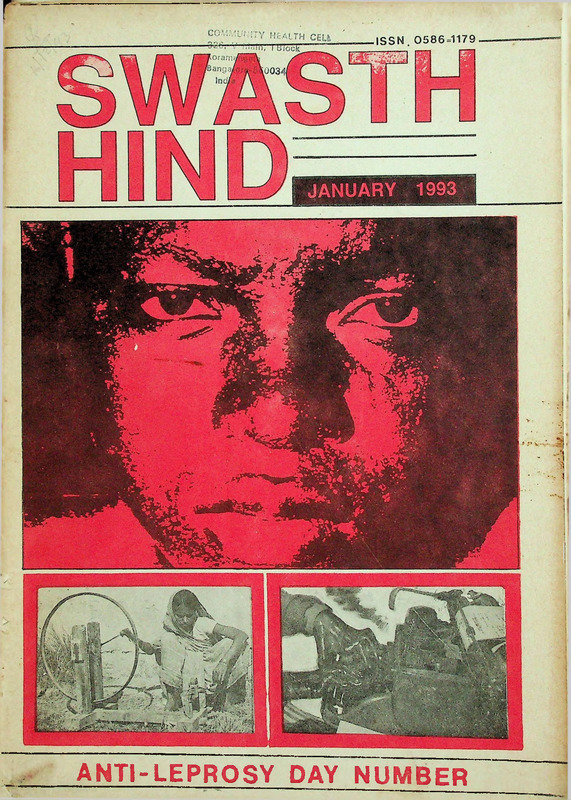
- Title
- NATIONAL LEPROSY ERADICATION PROGRAMME
- extracted text
-
ANTI-LEPROSY DAY NUMBER
In this issue
swasth hind
January 1993
Vol. XXXVII, No. 1
Pausa-Magha
Saka 1914
LEPROSY ERADICATION
Mahatma Gandhi's martyrdom day — 30 January — is also
observed as the Anti-Leprosy Day in India. For. India ranks
foremost among the countries saddled with the burden of leprosy
sufferers. It accounts for 2.5 million cases of the world load of
Leprosy patients. The Government of India had launched the
National Leprosy Eradication Programme in 1983 with the
objective to arrest the transmission of the disease by the year2000
AD. It is a 100 per cent Centrally-Sponsored Programme.
Keeping this in view this issue of Swasth Hind is devoted
to the
Anti-Leprosy Day—1993
OBJECTIVES
Swasth Hind (Healthy India) is a monthly journal published by
the Central Health Education Bureau, Directorate General of
Health Services, Ministry of Health and Family Welfare, Govern
ment of India, New Delhi. Some of its important objectives and
aims are to:
REPORT and interpret the policies, plans, programmes and
achievements of the Union Ministry of Health and Family
Welfare.
ACT as a medium of exchange of information on health
activities of the Central and State Health Organisations.
FOCUS attention on the major public health problems in India
and to report on the latest trends in public health.
KEEP in touch with health and welfare workers and agencies in
India and abroad.
REPORT on important seminars, conferences, discussions, etc.
on health topics.
SWASTH HIND WISHES ITS READERS
A VERY HAPPY NEW YEAR
Editorial and Business Offices
Central Health Education Bureau
(Directorate General of Health Services)
Kotla Marg, New Delhi-110 002
Edited by
M. L. Mehta
M. S. Dhillon
Cover Design by
Madan Mohan
Page
National Leprosy Eradication Programme
TJC. Das
in
1
and
3
National Leprosy Eradication Programme : Retrospects and prospects
Dr B.N. Mittal
Dr N.S. Dharmshaktu
5
Socio-economic aspects of leprosy control
Prof. A.R.K. Pillai
7
Rehabilitation in leprosy work—Role and experiences
of NGOs
S.P. Tare
10
Research activities in leprosy
Dr Sushma Gupta
13
Leprosy vaccines-r-an update
Dr M.D. Gupte
15
A Project Model for attempting integration of leprosy
services with general health care services after the
prevalence of the disease is reduced in the endemic
districts on multidrug therapy for over five years
Dr N.S. Dharmshaktu
17
Beneficiary study of leprosy services among tribal and
non-£ribal population in the selected endemic districts
of Madhya Pradesh and Andhra Pradesh
Dr N.S. Dharmshaktu, Dr B. Kameshwara Rao,
Dr MA. Arif, Dr S.L. Gupta,
Dr VK. Mashi, Dr G.P. Mishra,
Dr G.R.K. Raju A Dr Srinivasa Rao
22
The state of the World’s Children 1992
24
Role of Health Education in Leprosy Control
Programme
Dr Manjit Singh
25
Leprosy—a select bibliography—1990-1992
K.C. Singh A H. Kaur
26
Multidrug therapy
prospects
Dr SJC Noordeen
leprosy—progress
Book review
3rd
cover
Articles on health topics are invited for publication in this
Journal.
•State Health Directorates are requested to send in reports of
their activities for publication.
The contents of this Journal are freely reproducible.
acknowledgement is requested.
Due
The opinions expressed by the contributors are not necessarily
those of the Government of India.
SWASTH HIND reserves the right to edit the articles sent
for publications.
SUBSCRIPTION RATES
Single Copy
Annual
....
....
(Postage Free)
50 Paise
Rs. 6.00
NATIONAL LEPROSY
ERADICATION PROGRAMME
T. K. Das
NDIA ranks foremost among the
Icountries saddled with the bur
den of leprosy sufferers. As many
as 2.5 million cases of leprosy are
estimated to be found in India.
The disease is widely spread all
over the country. The prevalence
rate of leprosy exists above 5 per
1000 population in 201 districts out
of 468 districts of the coun
try. About 15% of the leprosy suf-
JANUARY 1993
ferers are children below 14 years
of age. The proportion of infec
tious cases varies from 15 to 20%
and equal number of patients suf
fer from deformities. At the time
of launching of the National Lep
rosy Eradication Programme in
1983 the disease was highly pre
valent in the States/UTs of
Tamilnadu,
Andhra
Pradesh,
Lakshdweep, Pondicherry, West
Bengal, Maharashtra, Karnataka,
Bihar, Nagaland, Sikkim, Anda
man & Nicobar. Now the pro
blem of leprosy has been reduced
in many of these States.
Programme objectives
The Government of India
launched the National Leprosy
Eradication Programme in 1983
xvith the objective to arrest the
transmission of the disease by 2000
A.D. It is a 100% Centrallysponsored programme.
1
Strategics
The adopted strategy under the
Programme involves: (a) Provi
sion of domiciliary multi-drug
treatment coverage in 135 districts,
having problem of 5 or more cases
per 1000 population, by specially
trained staff in leprosy, (b) In
troduction of modified MDT
scheme in the ramaining 66
endemic districts through existing
health care staff, (c) Introduction
of MDT services through existing
general health care services in the
low endemic districts, (d) Multi
drug therapy to Dapsone refractory
cases in other districts. Treatment
with combination of drugs includes
treatment with three drugs, viz.
Rifampicin, Clofazimine and Dap
sone. Education of the patients
and the community about the
curability of the disease and their
socio-economic rehabilitation are
other two key components of the
control strategy.
Centres—6097, Temporary Hos
pitalization Wards—291, District
Leprosy
Units—285,
Leprosy
Training Centres—49, Reconstruc
tive Surgery Units—75, Leprosy
Rehabilitation and Promotion
Units—13, Sample Survey-cumAssessment Units—39.
Infrastructure thus created has
been predominantly established by
the States in the endemic dis
tricts. In districts with endemicity
of less than 5 per 1000 population,
the general health care staff pro
vide the services. However, there
are still gaps in the 66 endemic dis
tricts due to financial con
straints. To extend the benefit of
MDT to over 0.7 million patients
living in these 66 districts, the
Government of India sanctioned a
modified MDT approach in these
districts from January, 1991. This
modified approach includes the
involvement of PHCs in the
delivery of services to leprosy
patients.
Infrastructure
Achievements
Over the years, a wast infrastruc
ture of leprosy workers has been
developed in the country, specially
trained for providing leprosy ser
vices. In the endemic rural areas
these services fan out from Leprosy
Control Units (one for 0.4 to 0.5
million population) while its urban
counterpart called the Urban Lep
rosy Centre caters to a population
of about 30 to 40 thousand. Tem
porary hospitalization ward having
20-bed capacity has been esta
blished, at least one in each
endemic district to render hos
pitalization services. Under the
programme 49 Leprosy training
Centres are engaged in providing
training to various categories of
health
workers
in
lep
rosy. Following
infrastructure
exists at the end of March,
1992: Leprosy Control Units—758,
Urban Leprosy Centres—900, Sur
vey Education and Treatment
Currently, about 70% of leprosy
patients are getting the benefit of
multi-drug therapy in the coun
try. Available information indi
cates that MDT is well accepted by
the patients, the tolerance is good
and side-effects are minimum.
There is marked reduction of over
90% in the prevalence rate in the 40
districts which have completed
MDT of 5 years or more. All the
201 endemic districts and 41 low
endemic districts have been
covered under multi-drug therapy.
Regular training in leprosy has
been provided to about 20,000
technical staff. As many as 6.39
million cases have been discharged
as cured by March 1992.
2
Target and achievements in 199192
During the year 1991-92 against
the target of 3,35,200 for new case
detection and treatment, a total of
5,03,390 new cases have been detec
ted out of which 5,00,242 cases have
been put under treatment
The target for case discharge was
6,12,500 during 1991-92 against
which 8,16,538 cases have been
discharged.
The physical target allocated for
1992-93 consists of 2,89,600 cases
for detection and treatment and
5,73,900 for case discharge. The
budget estimate for 1991-92 was Rs.
2280 lakhs and for 1992-93 also
same amount has been allocated.
8th Plan
During 8th Plan it is proposed to
provide MDT coverage to all the
districts with endemicity of 2 or
more per 1000 population and
MDT services will also be extended
through Primary health care in
other districts. During the seventh
plan a total of Rs. 85.82 crore has
been spent and a provision of
Rs. 150 crore has been kept during
the eighth plan. The financial
assistance proposed from World
Bank will be in addition to this
allocation.
World Bank assistance
To spread the MDT coverage to
uncovered areas and to further
intensify the efforts, the Govern
ment have sent a comprehensive
proposal to World Bank for finan
cial assistance of Rs. 300 crores.
In the proposed World Bank Pro
ject, it is envisaged to provide the
leprosy services with separate
workers in the 66 endemic districts
currently under the modified MDT
Programme, and additional 77 dis
tricts would be taken up for
introducing the Modified MDT
Programme. The
monitoring
information would be strengthened
and a foundation laid to embark on
a rehabilitation programme.
A
Swasth Hind
MULTIDRUG THERAPY IN
LEPROSY
—Progress and Prospects
DR S. K. Noordeen
Multi-drug therapy is extremely effective for individual treatment. Because MDT pro
gramme calls for well-organised case-detection and because the high patient acceptability
of the treatment tends to encourage self-reporting, MDT is usually associated with
increased early detection rates and a consequent fall in the frequency of new cases present
ing with deformity.
EPROSY is a major disabling
condition in the world with an
estimated load of 5.5 million
patients of whom about 3.1 million
are registered in over 85 countries
of Asia, Africa and Latin America.
Over 82% of all registered cases in
the world are accounted for by only
five countries (India, Brazil,
Nigeria, Myanmar and Indonesia,
in descending order of magnitude)
and nearly three quarters of the
world’s known leprosy patients are
in South-East Asia. Yet despite its
relatively low prevalence and low
ranking as a cause of morbidity
and direct mortality, leprosy is for
many countries an intolerable relic
from the past, one that takes a dis
proportionately heavy toll on the
social, economic and psychological
wellbeing of whole families and
communities. It is in recognition
of its insidious repercussions on a
community’s overall health and of
the difficulty that many countries
with leprosy face in allocating
L
January 1993
resources to intensive leprosy con
trol activities, that the World
Health Organization now con
siders leprosy at a prevalence rate
of at least one case per 10,000
population within a country or area
to constitute a public health
problem.
Dramatic change
Nevertheless over the past three
decades there has been a dramatic
change in the global picture of lep
rosy. In 1966, for example, when
reporting of leprosy cases had
become reasonably efficient in
many, if not most, countries, there
was a total of 2.8 million known
cases. Twenty years later, the total
had risen to 5.4 million. This
increase was probably due partly to
intensified detection of new cases,
particularly in South-East Asia. A
significant proportion of the
increase, particularly in the 1970s
and early 1980s, however, can be
attributed to failure of leprosy con
trol programmes, many of them
unable to cope with rising rates of
resistance to dapsone. Between
1985 and the end of 1992 the num
ber of registered patients in the
world declined—for the first time—
from 5.3 million to 3.1 million, a
fall of over 41%. By 1992 MDT
was being administered to 1.3
million-patients and had released
2.9 million patients from treat
ment
Implementation of MDT tends
to produce a bell-shaped curve of
leprosy statistics. Since organized
case detection is an integral part of
any well-run MDT programme and
since the short duration and low
toxicity of MDT tend to encourage
self-reporting, the institution of an
MDT programme is generally
followed by a rise in numbers of
registered cases. Indeed, much of
the increase in numbers of regis
tered cases worldwide in the 1980s
can be reasonably attributed to the
3
advent of multidrug therapy. After
a few years of MDT implementa
tion, discharge of patients complet
ing therapy produces a dramatic
decline in numbers of registered
cases. This trend is more clearly
seen in district or country leprosy
figures, and the unprecedented 41%
fall in global leprosy prevalence
between 1985 and 1992 to a large
extent is attributed to successful
MDT campaigns, particularly in
countries, like India, with large
numbers of patients.
On the positive side, multidrug
therapy is extremely effective for
individual treatment Early lesions
in many instances resolve within a
few months of starting treatment
and infectivity is generally lost
within a few days of starting
MDT. Most
paucibacillary
patients can be discharged within
six to nine months and most mullibacillary patients within two to
three years of starting treat
ment. Relapse rates have been
extremely low, averaging, globally,
0.1% a year for paucibacillary lep
rosy and 0.06% for multibacillary
leprosy (vs. 1-2% a year for
dapsone monotherapy).
Patient acceptability
Because it is effective, finite, of
short duration and association with
fewer type 2 (erythema nodosum
leprosum) reactions than any other
treatment regimens, MDT, despite
the skin discoloration linked to its
clofazimine component, enjoys a
high degree of patient accep
tability: compliance rates average
between 80 and 90% in most areas,
vs. a maximum of 50% for dapsone
monotherapy. As a result, MDT
offers a rapid solution to a coun
try's leprosy problem and thus a
rapid return on capital invested in
an MDT campaign. Backed by
strong national commitment and
the provision of adequate resour
ces, a well-run MDT programme
4
can reduce a national leprosy case
load by 70—80% within five years,
thereby releasing funds for other,
possibly longer-term, needs.
Because an MDT programme
calls for well-organized case-detec
tion and because the high patient
acceptability of the treatment tends
to encourage self-reporting, MDT
is usually associated with increased
early detection rates and a conse
quent fall in the frequency of new
cases presenting with deformity.
WHO’s contribution to its newly
proclaimed target of elimination of
the disease as a public health pro
blem by the year 2000 is mainly one
of coordinating and supporting the
many institutions, agencies and
organizations that have joined in
the effort to achieve this aim.
WHO receives invaluable support
from many participants in this
effort, including the Japan Ship
building Industry Foundation, the
International Leprosy Association,
the International Leprosy Union
and the International Federation of
Anti-Leprosy Associations.
Working group of leprosy experts
In recognition of the critical
stage that the world leprosy situa
tion has reached as a result of the
steady progress made over the past
five years in control activities,
WHO has set up a working group
of leprosy experts to oversee world
efforts to increase the momentum
created by recent progress. This
leprosy control working group
meets periodically to advise on
ways of stimulating countries to
intensify their leprosy control
efforts and of ensuring greater sup
port from and coordination of the
different agencies working in lep
rosy control. It also seeks ways of
improving control strategies and
sets priorities related to changing
epidemiological and socio-eco
nomic conditions. Part of the
working group’s mandate is also to
evaluate scientific progress and
assess the applicability of research
findings
to
leprosy
con
trol. Overall, the working group
provides the stimulus and direction
to the “race” towards leprosy
elimination by the year 2000.
Examples of WHO’s programme.
development functions include:
helping individual countries to
plan and implement leprosy con
trol activities, particularly through
general health service facilities;
helping countries to organize the
technical backup needed for effi
cient leprosy control activities,
including epidemiological evalua
tion and treattnent monitoring;
providing, at all levels of leprosy
control, updated technical guide
lines on diagnosis, treatment and
prevention of leprosy; setting lep
rosy control policy on all major
aspects of leprosy control, includ
ing diagnosis, treatment, follow-up,
and prevention and management
of disability; training of health per
sonnel at all levels and for all
aspects of leprosy control; in par
ticular, WHO is organizing
national training courses in leprosy
control for managers.
Under its research promotion
activities, WHO supports field tests
of shorter, more effective and
operationally more readily im
plemented multidrug regiments
and new antileprosy drugs; sup
ports and coordinates health sys
tems research on (a) the most
cost-effective
leprosy
control
policies, especially those that pro
vide for the integration of leprosy
control with the general health ser
vices with programmes set up for
the control of other diseases; (b) the
organization of rehabilitation ser
vices and their integration within
existing rehabilitation program
mes; (c) improving case-detection
and management; (d) social and
economic factors, including educa
tional activities, related to com
munity involvement in leprosy
work; and organizes, supports and
coordinates the field-testing of lep
rosy vaccines for prevention.
A
Swasth Hind
NATIONAL LEPROSY
ERADICATION PROGRAMME:
RETROSPECTS AND PROSPECTS
Dr B. N. Mittal
Dr N. S. Dharmshaktu
Target has been fixed that by the year 1995 all the districts of the country will be
brought under the coverage of multi-drug therapy which is likely to be achieved much
before. The additional 77 districts with prevalence rate between 2 to 4.9 cases per 1000
population are likely to be covered on MDT during the next year with World Bank
assistance. Endemic pockets in remaining low endemic districts are to be identified
and such endemic pockets will be supervised by 20 zonal officers for operation
of MDT.
eprosy has been known for
L
many centuries and reference
to it is found in the ancient Hindu
Scriptures. Until a few decades
ago the disease was one of
neglect Leprosy control work
was started by the Government in
1941 for the first time though the
voluntary
organisations
and
philanthropists had started the
same earlier. After independence
a committee was established in
1954 to suggest the leprosy control
measures. In 1955 the Govern
ment of India started the National
Leprosy Control Programme with
the objective to control leprosy
through domiciliary sulphone
treatment It started as a centrallyaided scheme with its focus on
rural areas of high and moderate
endemicity. In the low endemic
areas expectation was to provide
the services through the existing
infrastructure. The scheme was
converted into a centrally-spon
sored scheme in 1969-70 to give
January 1993
impetus to control work. The pro
gramme suffered because of
various reasons:
tries. Trial with multi-drug therapy
began in India in 1981 and in the
year 1983 the Government of India
(a) Non-availability of potent re-designated the National Leprosy
drugs for quick and complete
Control Programme as the
cure.
National Leprosy Eradication Pro
(b) The duration of treatment gramme. The programme is
with dapsone monotherapy
operated as 100% centrally-spon
was long.
sored scheme and has since been
(c) Population was not fully included in the 20-Point program
cooperative due to social
me. The objective of NLEP is to
stigma attached to the
arrest the disease activity in all the
disease.
known cases of leprosy by the year
(d) Detection of all the estimated 2000. The World Health Organisa
cases was not possible due to
tion has also set the goal of
inadequate coverage, igno
elimination of leprosy by the year
rance and stigma.
2000 which is defined as achieve
As a result of such various
ment of reduction in prevalence
reasons many patients started
below one case per 10,000 popula
developing resistance to dapsone.
tion by the year 2000 AD. Lep
rosy being a least communicable
NLEP tn Retrospect
disease,
its transmission in the
WHO recommended multi-drug
community is broken if the above
therapy for treatment of leprosy
level of reduction is achieved in the
patients in 1981 based on its
experience
in
many coun
prevalence rate.
5
Multi-drug therapy services have
been meticulously planned in.
endemic districts on vertical pat
tern. In such districts MDT has
been launched after creation of
complete infrastructure required
on vertical pattern, filling up of the
posts and training 'of the staff,.
detection of most of the estimated
cases and commitment of the State
Government Before launching
of MDT, a District MDT Society is
formed and the funds are directly
released to the Society. MDT Ser
vices are made available nearest to
the homes of the leprosy patients so
that no patient will have to travel
more than 2 kms for availing of
(he same.
The vertical MDT Scheme has
been made operative in 135
erfdemic districts and in the
remaining 66 endemic districts
Modified MDT Scheme has been
sanctioned as complete vertical
staff could not be created in these
districts. Since the progress of
MDT is slow in 66 endemic dis
tricts on modified pattern and the
case-load is also high,they are pro
posed to be converted into vertical
pattern with World Bank Assis
tance.
Available information with Lep
rosy Division indicates that till
March 1992, a total of 6.34 million
leprosy patients have been dis
charged, out of which about 50%
have been discharged as a result of
MDT. Out of 1.69 million patients
on record till March 1992,70% were
receiving
multi-drug
therapy.
There has been marked reduction
in prevalence rate by over 90% in
the districts which are on multi
drug therapy for over five years.
MDT has been accepted well and
its side-effect has been minimal.
The pattern has been developed
for extension of MDT to low
endemic districts. So far, 41 low
endemic districts have been
covered under multi-drug therapy
scheme.
NLEP in Prospects
The target has been fixed that by
the year 1995, all the districts of the
country will be brought under the
coverage of multi-drug therapy
which is likely to be achieved much
before. The additional 77 districts
with prevalence rate between 2 to
4.9 cases per 1000 population are
likely to be covered on MDT dur
ing the next year with World Bank
assistance. Endemic pockets in
remaining low endemic districts
are to be identified and such
endemic pockets will be supervised
by 20 zonal offices for operation of
MDT. The above 20 zones will
implement the MDT in the pockets
identified and the same is likely to
be started by 1993 with World Bank
assistance. Community
aware
ness activities will be strengthened
and training of general health care
staff will be carried out for all the
districts. The facility for ulcer
care and correction of deformity
including provision of footwear
will also be expanded. Monitor
ing system is planned to be
strengthened. A comprehensive
proposal has been submitted to
World Bank for assistance of about
Rs. 300 crores for strengthening of
leprosy programme on the aspects
indicated above.
Attempts are being made to
further reduce the duration of treat
ment with still much more potent
drugs. Anti-leprosy vaccines are
also under field trial.
In the light of the above it can be
said that the target elimination of
leprosy by 2000 A.D., can be
achieved.
A
WORLD AIDS DAY MARKED AT UN HEADQUARTERS
Secretary-General Boutros Boutros-Ghali
on 1 December told a meeting of the General
Assembly marking World AIDS Day that he
had created a single interagency advisory
group within the United Nations system, with
strengthened terms of reference. The Group,
which had held its first meeting last month,
would meet regularly and was committed to
create a ‘coordinated and effective response’
to the AIDS endemic Mr. Boutros-Ghali
said.
Noting that AIDS demanded a multi
sectoral, integrated approach from the United
Nations, he recalled his report to the
Economic and Social Council earlier this
year in which he stressed that ‘the need for the
6
United Nations to mount a comprehensive
and coordinated response’ was clear. There
were now 135 national AIDS programmes in
operation, which have been planned, set up
and assisted through the collaboration of
United Nations bodies and agencies, govern
ments and the private and voluntary sector,
the Secretary-General said.
The World Health Organization (WHO)
estimates that the HIV Virus has infected
about 11 to 13 million people .Worldwide.
More than two million people have
developed AIDS and most of them have
died.
—UN Newsletter
5 Dec. 1992.
Swasth Hind
SOCIO-ECONOMIC ASPECTS
OF LEPROSY CONTROL
Prof. A.R.K. Pillai
People’s participation in leprosy eradication is of utmost importance and the existing pat
tern of collaborative work between Government and voluntary agencies may be further
strengthened so that net working possibilities can cover almost every'corner of our vast
country. It is time that we open our eyes to ground realities and create long-term vision of
a progressive, healthy India, says the author.
L
eprosyis a major public health
problem in our country and the
national goal is to eradicate leprosy
by 2000 A.D. There is political
will in the country to attain this
goal and the series of steps taken by
the Union Government and State
Governments bear ample tes
timony to this fact We must bear
in mind the huge size of our coun
try and massive population. Ac
cording to the 1991 census figures,
our population was 843.9 million
with a density of 267 persons persq. km. The national literacy level
stood at 52.11% with female literacy*
as low as 39.42%.
Background
It will be appropriate to look at
certain statistical data available to
us. The growth rate in population
is as high as 2.11% despite focus on
family planning measures over
several years. The population
below the poverty line was estimat
ed at 37% during 1984. In the
backdrop of these data, number of
leprosy patients in the world was
estimated at 12 million with India’s
total of about 4 million. However,
JANUARY 1993
the estimated number of leprosy
patients has come down in India to
2.8—3.00 million, thanks to the
vigorous efforts put in by the
Government and Voluntary Agen
cies.
Leprosy has two major dimen
sions—medical and social. There
has been substantial improvements
in the medical area concerning lep
rosy. Today leprosy is completely
curable with modem drugs.
Multi-Drug Therapy (MDT) offers
complete cure for leprosy at airy
stage of the disease with treatment
span ranging from six months to
two years. The prevalence rate
has come down drastically where
MDT had been introduced and
deformity rates too have registered
a steep fall.
Social Dimensions
However, leprosy has social
stigma, attached to it over the
generations. Reasons are many.
For centuries, there was no definite
cure for the disease. It is a dis
figuring a^d crippling disease with
the patient landing up in defor
mities. It is a visible disease. All
these factors made the patients of
leprosy subject to the additional
burden of social boycott because of
stigma. They are rejected by the
society and patients suffer loneli
ness, poverty and allied areas of
social rejection. In view of this
anyone having symptoms tend to
hide the disease as long as they can,
rather than face rejection.
The number of leprosy afflicted
persons till about five years ago was
estimated to number about four
million. Of these about eight
lakhs constituted children below
the age of fourteen. The patients
and their families face social
ostracism and they are normally
prevented from participation in the
national stream of life. The pati
ents are thrown out of their jobs
and places of residences. Conse
quently they go about wandering as
beggars while most of them could
have pursued their vocations, con
tributed to gross national income
and earned their livelihood with
respect The loss of production
and national income of four
million population is a colossal
waste occasioned by biased be
7
haviour of an ignorant society.
Social stigma carried down from
generation to generation has re
mained far too long and the society
in general has not updated in the
knowledge on leprosy and its
ramifications from a public health
angle. We as a people are far too
slow in correcting our attitudes and
approaches towards leprosy and its
sufferers.
While contributory
reasons are many, there has been
appreciable change in the scenario.
This welcome change has to be
taken further to help elimination of
leprosy from the Indian soil.
Main Factors
There are three main factors in
leprosy control and eradication,
viz., drastic reduction/elimination
of reservoirs of infection in the
community, clipping all possible
channels of transmission of the dis
ease and improving the immunity
levels of the population at risk.
While we proceed in the matter, we
have to bear in mind rapid
urbanisation and large mobility of
villagers into towns and cities caus
ing near collapse of civic facilities
in urban areas like lack of adequate
housing, transport and the like.
Poverty, illiteracy, superstitious
beliefs and a host of allied factors
play important contributory roles
in leprosy control effort.
We have 66 hyperendemic (pre
valence 10 plus) and 135 endemic
(between 5 and 10 prevalence rate)
districts in India and the pre
valence is not uniform in various
districts. MDT had been intro
duced in several districts with great
advantage and good results are
coming up. The National Lep
rosy
Eradication
Programme
(NLEP) aims at elimination of the
disease by bringing the prevalence
rate to 1 per 10,000 population by
the year 2000.
8
The leprosy patients and their families face social ostracism and they are normally prevented from
participation in the national stream of life.
Major Constraints
What are our major constraints
and how can we overcome them?
If the average citizen knows the
simple facts about leprosy and goes
to a medical centre for check-up on
seeing symptoms, the major battle
is won. For this two factors must
be established. First systematic
and continuous campaign to edu
cate the public on facts about lep
rosy. In a country like ours where
literacy is too low, audio-visual
communications may be taken
advantage of. Education through
TV, Cinema and Radio should be
given adequate emphasis. Secon
dly conditions must be brought
about in the community not to des
pise leprosy patients. Treating
leprosy like any other disease and
lending societal support for the suf
ferers will help those with symp
toms to come forward and take
treatment Testimonial
cases
must be given wide publicity with
appropriate media targeting to get
the desired results. Leprosy treat
ment at Government and voluntary
agencies is completely free
throughout India and this should
be made available through primary
health centres as is being done
progressively.
Women’s Status
Women’s status in Society is a
pivotal factor in a nation’s develop
ment The declining sex ratio of
Swasth Hind
929 females to 1000 male popula
tion revealed by 1991 census is
noteworthy.
Investments in educating the
girls can yield the highest returns to
the society at large and the family
as well. Major initiatives to in
crease female education have
potential to transform society over
a period of time. Educated moth
ers and daughters are an asset to
any society. They choose to have
fewer children, whom they can care
well.
Though educating boys and girls
may be similar in its cost impact,
girls’ education is a safer long-term
investment towards generating rich
social benefits.
With higher female literacy
levels, greater autonomy for women
and higher avenues for self-reli
ance, better health and higher
quality of life will certainly result
The States must lay adequate stress
on this area. Kerala is a standing
example before us to show how
female literacy and self-reliance
have brought out excellent re
sults.
Conclusion
Complete MDT coverage where
needed, with concurrent training of
primary health workers, con
tinuous education of the people
through mass media channels,
updating awareness levels in the
community and simultaneously
improving the living standards of
the people can bring about lasting
results in leprosy control and
eradication efforts. People’s par
ticipation is a must and the existing
pattern of collaborative work bet
ween Government and voluntary
agencies may be further streng
thened so that net working possibi
lities can cover almost every corner
of our vast country. We have
made rapid strides in elimination
and by increasing the tempo, won
derful results can follow!
It is time that we open our eyes to
ground realities and create long
term vision of a progressive, heal
thy India.
A
SCREENING FOR GASTRIC CANCER
SIMPLE blood test may soon be all that is
A needed to detect patients at high risk of
stomach or colonic cancer.
make an enzyme
S-transferase.
This advance is in prospect as a result of
investigations carried out in North Staf
fordshire in the English Midlands to discover
why the area has the country’s highest
incidence of gastric cancer and lowest sur
vival rate among female colonic cancer
sufferers.
“This enzyme appears to be necessary
for the proper detoxification of a number of
recognised carcinogens.
Some people
appear unable to make the enzyme, which
puts them at an increased risk of can
cer.” Modern technology is now allowing
the study of an individual’s DNA using
molecular biological techniques by means of
a small blood test. The new approach would
allow simple screening of the relatives of
individuals with cancer, with monitoring car
ried out in hospital pathology labs.
Three members of the Keele University’s
school of postgraduate medicine in Staf
fordshire, ’surgeon Prof James Elder,
biochemist Dr Richard Strange and epi
demiologist Dr Terri Knight, applied their
different disciplines to the subject and came
up with what have been described as “excit
ing discoveries”.
Dr Strange explained: “Our preliminary
(findings in the laboratory show an exciting
llink between a susceptibility to gastric and
ccolorectal cancers, and an inability to
JANUARY 1993
2’-—15/DGHS/92
called
glutathione
Professor Elder said the eventual aim
would be for patients with a family history of
gastric or colonic carcinoma, to be able to go
to their GP and be given information on their
chances of contracting the disease.
A
—SPECTRUM
Sept.-Oct. 1992
9
REHABILITATION IN
LEPROSY WORK
—Role and Experiences of NGOs
S. P. Tare
Voluntary agencies have played the pioneering role in leprosy as well as rehabilitation of
patients. Indeed, it is the voluntary agencies who are implementing, through trial and
error, the concept of community-based rehabilitation which seems to be the only sensible
way to fully solve the complex problem of rehabilitation.
here is probably no other dis
Tease
which gives rise to so much
physical mutilation (with the ex
ception of yaws) as leprosy. This
characteristic along with a few
others, has wrapped leprosy into
myth and mystery, and has made it
a most abhorred disease. For cen
turies, a patient of leprosy is
recognised only when he has
obviously visible deformities, and it
is at that stage that he has been
shunned and hounded, over cen
turies, from job, home and society.
Being a chronic disease, and not a
killer, the person afflicted with lep
rosy has to carry the cross till he
dies, years later, either due to some
other reason or oldage.
Leprosy is as much a medical
problem as a social one. And of
the variety of problems which have
to be faced, the most formidable
one is that of rehabilitation of lep
rosy patients. It arises that the
patient is de-habilitated from
society.
Il is thus no wonder that it came
to the lot of voluntary agencies to
10
try to alleviate the social sufferings
of leprosy patients.
Rehabilitation made popular
Rehabilitation—a term bor
rowed from social welfare field—
was given a very restricted meaning
in leprosy field in the period soon
after Independence. What they
were actually doing was providing
vocational engagement to their
inmates within the confines of their
premises. It was the Gandhi
Memorial Leprosy Foundation,
which spear-headed the movement
to make an entirely difficult con
cept of rehabilitation popular. It
was stressed that rehabilitation is
essentially .a decentralising process
through which patients are helped,
by training them in some skill or
craft, and to go back to their
original environment and win back
respectful place in their original
milieu. Any effort which falls
short of “sending the patient back”
is not rehabilitation in the real
sense of the term; it is an alternative
arrangement made out of failure to
rehabilitate a leprosy patient to his
former environment
There was almost total lack of
any follow-up of the patients so dis
charged, and consequently the
patients found themselves lost after
discharge. The only alternatives
available were either to become a
beggar or a landless labourer.
It was again the efforts of some
pioneering voluntary agencies to
explore other avenues of employ
ment for their patients. They tried
to help the patient to do whatever
job/work he was doing earlier, and
in some instances, through avenues
of self-employment. The patients
were helped in obtaining funds
through loans or advances to take
up poultry, or dairy or to take up
vending of things of daily require
ment. The capital necessary for
such activity was small and could
be had from numerous Govern
ment schemes for poverty-allevi
ation, employment generation etc.
Such efforts were very cost-effective
as compared to institutional-based
rehabilitation where the cost was
found to be too heavy.
The National Leprosy Eradica
tion Programme as it was originally
SWASTE HIND
Wc now have the spectacle of 25 lakhs of the leprosy patients staying in their homes and in their villages while taking medicines through
out-patient clinics.
conceptualised had an in-built pro
gramme for preventing dehabilitation which in fact, should be the
major thrust to solve the problem
of rehabilitation in the long run.
SET programme brought about
slow but definite changes in the
Societal attitude of intolerance and
we now have the spectacle of over
25 lakhs of the leprosy patients
staying in their homes and in their
villages while taking medicine
through out-patient clinics. Even
a deformed leprosy patient (whose
number has dwindled to less than
10%) is able to remain in society
and home.
Community-based Rehabilitation
The efforts as mentioned above
made by the voluntary agencies in
getting the patients gainfully en
January 1993
gaged in society is very similar to
what is now being technically
termed as “Community-based re
habilitation (CBR)”. The patients
have the support of the entire
society in whatever they do to
assure their independence, and get
assimilated in the. society fully.
This is very satisfying to the patient
himself because his integration
with society is complete. It is very
cost-effective
as compared, to
“institution-based rehabilitation ”
(IBR) which is very expensive and
has very dubious results.
There is however no doubt that
the concept of CBR is not yet fully
understood ev. • by the workers
engaged in reL.: jilitation and there
is still reluctance to involve the
community fully by leaving all
initiative to them. It will take
some more time for the workers
and agencies to get correctly orien
ted to the concept of CBR and
accept for themselves the role more
of a facilitator rather than that of
the initiator or the service-pro
vider.
To sum up, the voluntary agen
cies have played the pioneering
role not only in the field of leprosy
but also in the field of rehabilita
tion of patient and have been the
only agency to take care of that
aspect The Governments have
only recently become aware of the
importance and urgency of re
habilitation and may make mon
etary provision to help the vol
untary agencies. It is also evident
that the voluntary agencies have
tried and experimented with dif
ferent models of rehabilitation and
11
in this process saved lakhs of lep
rosy patients not only from getting
dchabilitated but also in gaining a
place in their original society.
Finally, it is the voluntary agencies
who are implementing, through
trial and error, the concept of CBR
which, in the context of our present
knowledge, and means available to
us, seems to be the only sensible
way to fully solve the complex pro
blem of rehabilitation.
A
(Contd. from page 23)
(he same may vary from district to
district and even within the dis
trict One or other category of
following personnel will always be
available
within
the
dis
trict : Anganwadi workers and their
helpers,
Community
Health
Guides, Village Trained Dais, Jan
Bhagi Dars (Volunteers), Mahila
Mandal Workers, Primary School
Teachers, Post Men, Forest Deptt
Staff, etc.
4. Special care be given to
ensure that the messages reach
women folk in the villages and girl
students in the schools as well.
5. The Para-medical Worker to
population ratio in tribal areas
should be 1 for 10000 population in
view of scattered population as
being done in Andhra Pradesh.
6. Whenever a tribal patient
has to travel more than 5 Kms. to
collect the drugs, Rs. 10—20 per
visit be provided to him towards his
wage loss and travel cost as it is
found in the study that a few
patients had expressed difficulty
for want of money in connection of
drugs from the nearest place
located 13 Kms away from their
village and there is ho public
transport.
7. Adequate POL provisions be
provided for - districts having dif
ficult terrain for holding group
camps in the villages.
A
12
MDT QUESTIONS AND ANSWERS—WHO
Is MDT contra-indicated in patients suffering from
tuberculosis?
MDT is not contra-indicated in patients suffering from
tuberculosis. It must be remembered that tuberculosis is a
more serious disease and must be treated promptly.
WHO/MDT for leprosy is not adequate for the treatment of
tuberculosis and therefore an appropriate anti-tubercular
regimen should be given, in addition to the antileprosy
MDT, to patients who are diagnosed-to have both leprosy
and tuberculosis—except if daily rifampicin is part of the
anti-tuberculosis treatment, then there is no need to
administer monthly rifampicin as part of *the leprosy
MDT.
Is there any evidence that the drugs included in MDT can
antagonize each other’s antibacterial activity?
All experimental and clinical evidence indicate that there is
no antagonism among the drugs included in MDT. The
experience with MDT so far has shown the combination to
be the most effective.
Is MDT safe during pregnancy and lactation?
Since leprosy is exacerbated during pregnancy it is impor
tant that MDT be continued. All evidence so far indicates
that MDT is safe during pregnancy. A small quantity of
anti-leprosy drugs are excreted through breast milk but
there is no report of adverse reaction due to this except for
mild discolouration of the infant due to clofazimine.
From: Indian Journal of Leprosy
July-Sept. 1992.
SWASTH HIND
RESEARCH ACTIVITIES
IN LEPROSY
Dr Sushma Gupta
Even though clinical trials for the available leprosy vaccines are under way, research is con
tinuing to develop yet another vaccine for leprosy.....Studies are in progress to elucidate
mechanisms of deformities developing in leprosy patients, and steps for their prevention,
and effective surgical techniques for their correction.
HE Indian Council of Medical
Research carries out the major
T
parts of its Research activities in
leprosy through its permanent
institute, Central Jalma Institute
for Leprosy, Agra. The Council
also provides grant-in-aid for open
ended projects and fellowships in
various Medical Science Colleges.
The overall goals of the research
programme of the council have
been (i) to assess current methods
of diagnosis, treatment etc., and
improve upon them, (ii) to develop
newer methods and tools which
will serve these purposes better, (iii)
to improve our understanding of
‘the disease process and the com
plications that add to the morbidity
of the disease, (iv) to increase our
knowledge about the causative
organism So that we may develop
better methods to destroy it, (v) to
improve our understanding of the
disease dynamics in the com
munity and (vi) to carry out a com
parative trial of candidate vac
cine preparations.
The Central Jalma Institute for
Leprosy, Agra, mainly continues to
investigate leprosy and related pro
blems through various clinical,
January 1993
3—15/DGHS/92
immunological, epidemiological,
microbiological and molecular
biological studies so as to help the
Government in successful im
plementation of the National Lep
rosy Eradication Programme.
Though clinical diagnosis of an
obvious case of leprosy is easy,
there are enormous problems in the
classification of early lesions.
Molecular biological methods e.g.,
probes, gene application techni
ques like Polymerase Chain Re
action (PCR), immuno-histology
and histology are used to classify
early lesions of leprosy.
Leprosy, known to be a disease of
nerves, macrophages and skin is
also a disease of altered lipid
metabolism. In a recently con
cluded study, it was observed that
there was a significant increase in
the circulating high density lipop
roteins and lipoproteins-a levels in
lepromatous leprosy as compared
to control and the tuberculoid lep
rosy patients. It appears that
these' lipoproteins have a role in
immunological aspects of nerve
injury in leprosy.
Leprosy in the majority of the
cases can be diagnosed on the basis
of a proper examination of the case
alone. Therefore a set pattern
should be followed for examina
tion e.g. clinical and bacteriological
examination,
histamine
test,
biopsy and immunological test
However, the diagnosis of early lep
rosy has always been a chal
lenge. Newer in vitro tests such as
lymphocyte transformation test
(LTT) and leucocyte migration
inhibition test (LMIT) have been
developed and they are used to
detect the level of immuno
deficiency. The recent advance in
study of the epidemiology of lep
rosy . is the development of
serological tests which gives hope
for a better surveillance. The
fluorescent
leprosy
antibody
absorption test is now widely used
for identification of subclinical
infection.
Till date there is no immuno
diagnostic test available for leprosy
diagnosis in the National Leprosy
Eradication Programme. A sero
logical assay standardised at C JIL,
using peroxidase labelled MLO4
(SACT-ELISA) was compared in
terms of their sensitivity and
specificity with two other currently
13
available serological tests deve
loped by other laboratories (PGLELISA
and
PGL-AGGLU).
SACT-ELISA was found to be
more specific and sensitive than
the other two assays.
In lepromatous leprosy there is a
poor immunological response to M.
leprae. In a recently concluded
study to find out whether this is
related to interleukin-1 and/or 2
production, it was observed that
there was some immunological
defect with respect to production of
IL-1 in all forms of leprosy. Lep
romatous Leprosy(LL)/ Border line
(BL) patients do not show defective
IL-2 production and after 6 months
of multidrug treatment (MDT), its
production rises significantly.
Various viability assays for rapid
determination of M.leprae are being
developed. These viability assays
could be applied to paucibacillary
leprosy which remain therapeuti
cally and prognostically important
in this country. Three gene
amplification techniques alongwith highly sensitive ATP bioluminescent assay system are being
applied for viability assessment
New methods
Several new methods based on
analysis of lipids, isoenzymes,
immunological
relatedness
of
enzymes have been developed.
Evaluation
of
protein
elec
trophoregrams and zymodemes in
several mycobacteria including M.
leprae had shown that combination
of different zymodemes and pro
tein electrophoregrams can be used
for rapid identification & charac
terization of various pathogenic
mycobacteria. Further the de
tailed analysis of Restriction Frag
ment Length Polymorphism (RFLP)
of rRNA gene region has shown
that this technique & probes are
useful to characterise various
mycobacteria including M. tuber
culosis, M. avium and M. leprae at
species, subspecies and even
strain level.
14
Cloning and sequencing of 16S
genes and flanking sequences of 12
species of mycobacteria had led to
identification of 9 variable regions
within rRNA gene & Hanking
region of ribosomal genes of M.lep
rae and other mycobacteria. In
addition to 17 mer probe, some
more probes and primers have
been designed against these vari
able regions and synthesized. Ini
tial evaluation of the observation
results show that a few of these pro
bes could be useful at species/
genus
level. Methodological
studies for the clinical application
are in progress.
Gene amplification techniques like
PCR using primer based on 18Kd
and 36Kd antigen genes and an
reverse PCR is being standar
dised. Based on initial results
which suggest the need to further
optimise technique(s) for extrac
tion of nucleic acids from biopsies,
alter assay techniques, further
studies are being carried out An
enzymatic technique for isolating the
mycobacetrial nucleic acids from
biopsies has been developed and is
being evaluated.
Duration of anti-lcprosy therapy
The optimal duration of antilep
rosy therapy has been an issue of
debate. Studies are in progress to
determine the minimal length of
antileprosy
therapy. The
pre
liminary results indicate that in
lepromatous patients, it takes up to
12 months by DDS and clo
fazimine combined to kill rifam
picin resistant mutants suggesting
that minimum duration of treat
ment should not be less than one
year. With the aim to further
reduce the duration of treatment, a
regimen comprising of Dapson,
Rifampicin and Prothionamide is
also being tried.
India is playing a crucial role in
developing and testing immuno
therapeutic
and
immunopro
phylactic agents for leprosy.
Anti-leprosy vaccine
In order to identify the best of the
available vaccines for Indian
situations, a randomised double
blind controlled five arm pro
phylactic vaccine trial against lep-t
rosy involving two indigenously
developed vaccines e.g., ICRC,
M.w. and Killed M.leprae + BCG,
BCG and normal saline has been
launched in Chingleput district of
Tamil Nadu.. By July 1993, the
intake phase is expected to be com
pleted. This will be followed by
resurvey of vaccines.
Another clinical trial with ICRC
vaccine for Immunoprophylaxis
against leprosy is in progress. The
study is being conducted by Cancer
Research Institute, Bombay, in
Osmanabad, Latur and Solapur
districts of Maharashtra. The
objective of the trial is to assess the
immunoprophylactic efficacy of
two vaccines containing (i) ICRC
bacillus (ii) BCG by measuring the
incidence of both multibacillary
and paucibacillary forms of Lep
rosy in ICRC vaccinated as com
pared to BCG groups. The intake
of about 34,000 households con
tacts has been completed and the
resurvey of vaccines has started.
Even though clinical trials for
the available leprosy vaccines are
under way, research is continuing
to develop yet another vaccine for
Leprosy. At
Foundation
for
Medical Research, Bombay, a
study is being supported in which a
1.6 Kb M. Leprae DNA protein has
been identified as a potential
immunodominant protein. Insert
of this DNA fragment in E.Coli
holds promise of getting a recombi
nant M.leprae protein as a possible
vaccine against leprosy.
Studies are in progress to
elucidate machanisms of defor
mities developing in leprosy
patients, steps for prevention of
deformities and effective surgical
techniques for the correction
of deformities.
A
SWASTH HIND
LEPROSY VACCINES
—An Update
Dr M. D. Gupte
It is not impossible to conceive emergence of effective anti-leprosy vaccines some
time in future. It Would be essential to understand the possible roles of these vac
cines in different situations. Alternative approaches and priorities for disease con
trol will have to be taken into account. Leprosy vaccine is a distinct research goal
and an area of high research priority.
N 1990, the subject of anti-leprosy
Ivaccine was reviewed for the
readers of the Swasth Hind. Avail
able information on several can
didate vaccines was summarized
and the subject of second genera
tion vaccines was also reviewed.
Three years is a rather short period
for getting useful information on
potentials of anti-leprosy vaccines
in preventing leprosy. A pro
phylactic vaccine* trial against
leprosy usually takes a decade
before reaching any valid con
clusions. However, preliminary
results from one field study in
Venezuela and progress of the
ongoing vaccine studies should be
of interest to the readers.,
Venezuela vaccine trial
An immunoprophylactic trial
against leprosy using armadilloderived killed Mycobacterium leprae
and BCG vaccine was launched in
Venezuela
during
1983. The
Venezuela trial is the first of the
three different vaccine trials in the
world where killed M. leprae is
being used, the other two being in
Malawi and India. The first re
port of the results of the Venezuela
trial, covering the period up to July
1991, has been published recently
in The Lancet (Convit et al 1992).
Zuniga, a colleague of Convit arid
an eminent epidemiologist, obser
ved a sustained downward ten
dency of new case-detection rate
from 16 per 100,000 inhabitants in
1951 to 2.5 in 1981 in Venezuela. He
has drawn attention to the impor
tant demographic changes towards
increased
urbanization
and
changes in the epidemiological
profile of leprosy. According to
him, increase in the proportion of
multibacillary cases, increase in the
average age of new cases by ten
years and increased proportion of
leprosy in males indicated a rapid
natural decline of leprosy in
Venezuela.- In Venezuela, the vac
cine trial is being conducted in the
three most highly endemic States,
viz., Apure, Tachira and Merida
(prevalence 6.9, 2.9 and 1.9 per
thousand population and inci
dence 10.9, 4.3 and 3.9 per 100,000
respectively) in the household and
extradomicillary contacts. As many
as 29,113 contacts were included for
the study. The vaccine trial in
Venezuela is a large-scale, ran
domized, controlled, double-blind
trial employing BCG + killed M.
leprae and BCG alone. The dose
of BCG was decided by the tuber
culin status of the individual, tuber
culin negatives receiving 0.2 mg
and tuberculin positives 0.04 mg.
The dose of M.leprae was 6 X 10⁸
bacilli. The contacts were initially
screened for leprosy and were given
the M. leprae Soluble Antigen
(MLSA) and tuberculin tests. The
group of interest for the trial was
that of MLSA negatives.
The participants were carefully
examined for leprosy annually by
doctors
specialised
in
lep
rosy. Skin smears and biopsies
for histopathological examination
were routinely obtained. The
resurveys generated 150,026 person
years of observation and 59 con
firmed cases of leprosy. After
deleting 29 cases for reasons like
pre-vaccination history of leprosy,
occurrence of disease within one
year, etc., the remaining 30 cases
were considered for the final
analysis. Fifteen each of these
belonged to BCG and BCG+killed
M. leprae, irrespective of initial
MLSA status. Twenty of these 30
JANUARY 1993
15
COMMUNITY HEALTH CELL
326. V Main, I Block
Korambngala
x
Bangalore-560034 /
patients belonged to MLSA
negatives at intake, and in this
group of interest 11 belonged to the
BCG arm and 9 to the BCG +
killed M. leprae. The other inte
resting observations were, about 60
per cent protective efficacy of BCG
and strong persistent MLSA
positivity following BCG + killed
M. leprae in the initial MLSA nega
tive group. Results from the
Venezuela trial remained incon
clusive regarding protective effi
cacy of the combination vaccine
over and above that of BCG
alone. Whether that is on account
of previous BCG vaccinations and
lepromin testing, high efficacy of
BCG in preventing leprosy, adop
tion of annual case-detection pro
cedures or epidemiological profile
is difficult to say.
BCG Story
BCG was considered as a poten
tial tool for leprosy control follow
ing the observations on lepromin
conversion. Encouraging results
with respect to its protective
efficacy are available from Uganda,
New
Guinea,
Malawi
and
Venezuela. A prophylactic effi
cacy to the tunc of 50% to 80% was
observed in these places. Results
from Burma have shown an
efficacy of about only 20%. Similar
moderate level of protective effi
cacy was observed from the recen
tly analyzed data from the South
Indian BCG trial. BCG does not
appear to be a vaccine which could
be globally considered for preven
tion of leprosy, although it might be
effective in some regions.
iCRC Vaccine
ICRC bacilli were first isolated
in 1958 by Bapat Ranadive and
Khanolkar. ICRC vaccine was
produced in 1979. Bapat and Deo
registered a patent for ICRC vac
cine (C-44 strain) in 1981. The ini
tial hospital based studies were
conducted at Acworth Leprosy
16
Hospital, Bombay, from 1979. A
prophylaxis study is in progress in
Maharashtra State since February
1987.
M.w vaccine
Taiwar's group in Delhi was
looking for a mycobacterium hav
ing desirable cross-reactive anti
gens with M.leprae with respect to
the immune reactivity of TT
patients, and at the same time to
have antigens evoking responsive
ness in LL patients. M.w was
selected as a candidate for vaccine
production. Encouraging results
from
hospital-based
Phase-II
immunotherapeutic clinical trials
have been obtained in New Delhi
A prophylaxis study in Kanpur is
in progress.
Comparative leprosy vaccine trial in
South India
On 30th January 1991, a com
parative leprosy vaccine trial
involving BCG plus armadillo
derived killed M.leprae, ICRC and
M.w was launched by the Indian
Council of Medical Research in
Chingleput district of Tamilnadu.
Information on the three candidate
vaccines had been discussed exten
sively in the Indian Council of
Medical Research, by the Indian
Association of Leprologists, as well
as at the last Pre-Congress
Workshop on leprosy vaccine trials,
in The Haugue in 1988. /It was
uniformly agreed that all these vac
cines deserve to be tested for their
prophylactic efficacy. The recen
tly launched trial in South India is
providing an unique opportunity to
compare them together. It will
take 8 years to get the first results on
the prophylactic efficacy of these
vaccines.
Possible
cines
second
generation
vac
A number of mycobacterial
antigens
have
been
iden
tified. Natural or recombinant
forms of these proteins are now
available. Choosing
antigens
with possible prophylactic efficacy
could prove to be a very deceptive
exercise. Defining
“protective
antigens", and “protective and
pathologic immunity" are some of
the questions that are being inves
tigated. Promising
approaches
for inserting different DNA
sequences in BCG have been
developed. However, the work on
second generation vaccines is still
very much in the exploratory
stage.
Relevance of a vaccine
The available parameters of
animal studies, sensitization to
M.leprae antigens following vac
cination and immunotherapy are
only indirect measures of probable
prophylactic efficacy of the can
didate vaccines. Vaccines trials
with different candidate vaccines
against leprosy are presently in
progress. Several
recombinant
and native antigens as well as
mycobacterial components are
being investigated for their role in
immund-modualtion. It -is not
impossible to conceive emergence
of effective anti-leprosy vaccines
some time in future. It would be
essential to understand the possible
roles of these vaccines in different
situations. Alternative
approa
ches and priorities for disease con
trol will have to be taken into
account Efficacy of case-detec
tion and case-holding in controll
ing disease transmission, costs of
case-detection and case-holding
and the cost of preventing leprosy
cases will need consideration in an
overall context Clearly leprosy
vaccine is a distinct research goal
and an area of high research
priority.
A
Swasth Hind
A Project Model for attempting Integration of
Leprosy Services with General Health Care
Services after the Prevalence of the Disease
is reduced in the Endemic Districts on
Multidrug Therapy for over Five Years
Dr N. S. Dharmshaktu
M
ultidrug therapy has been
introduced in India for the
treatment of leprosy cases on a
large scale, in high endemic dis
tricts with prevalence of 5 or more
per 1000 population, through a
separate vertical infrastructure
parallel to the general health care
system (DGHS 1989). After the
introduction of multidrug therapy
in a district the prevalence rate is
expected to be brought down to a
very low level by 5 years and, after
(hat leprosy care is planned to be
integrated with the general health
care system. Starting from 198283 multidrug therapy (MDT) has
now been sanctioned for all the 201
endemic districts of the country,
including the 66 districts for which
a Modified MDT Scheme has been
sanctioned. Recently, it has been
proposed to change the Modified
MDT Scheme into a regular verti
cal approach. The endemic dis
tricts where the prevalence has
been reduced to 1.5 or less per 1000
population, because of MDT inter
vention for 5 years or more, have
now been issued with Government
orders for integrating leprosy ser
vices with general health care with
effect from 1-4-1991 (DGHS
1991).
Integration of leprosy services
with general health care is being
practised in many countries (WHO
JANUARY 1993
SEARO 1988), but this has not
always been based on any definite
evidence showing that the inte
grated approach is better than ver
tical approach. Since one third of
world leprosy patients is estimated
to be present in India, it is time for
the Government and other interes
ted agencies and persons to plan
and study the feasibility of Integrat
ing leprosy services with general
health care services through wellconducted projects and gather ade
quate experience in the metho
dology of integration before in
troducing integration on a wider
scale. Integration done without
prior feasibility study may undo all
the success that has been achieved
under the National Leprosy
Eradication Programme. However,
we must also realize that we can ill
afford the financial burden of
maintaining the vertical structure
for an indefinite period.
Here I present a project model
for studying the effects of integra
tion of leprosy with general health
care based on utilisation of existing
health care infrastructure.
The Case for Integration
The case for integration is wellknown and is summarized below.
The general health care staff
have better access to the com
munity. For every 5,000 popula
tion one male and one female
health worker are working full time
under the general health care sys
tem whereas, under the vertical lep
rosy services system one worker
covers 25,000 population.
The general health care system
has one female worker for every
5,000 population and also has the
support of trained dais and Anganwadi workers at village level
whereas, the number of female
workers employed is very small
under the vertical system of leprosy
services. Examination of female
subjects aged above 14 years is
therefore likely to be better if lep
rosy services are provided by the
general health care services in low
endemic areas.
During the surveillance period,
when the case-load in the com
munity is quite low, many patients
do not feel it necessary to visit the
leprosy clinic as they feel they have
been cured.
The number of
patient-health worker contact is
likely to be frequent with the
general health care system since
patients will be approaching the
general health care staff for their
other health problems and this will
lead to better coverage during sur
veillance.
Given adequate training about
early diagnosis, patient follow-up
17
for the treatment, referral and com
munity education about leprosy,
the general health care workers will
be able to give better coverage in
view of their easy access to the
population.
THE PROPOSED MODEL
The proposed model of integra
tion of leprosy services with general
health care services envisages:
(i) Development
of
training
curriculum in leprosy for general
health care staff; (ii) Job identifica
tion for each category of staff; (iii)
Short training of all general health
care staff including community
health workers; and (iv) Integra
tion of information system and
monitoring system with the general
health care system at various
levels.
The proposed model will test the
hypothesis that the type of
approach (TA), vertical or inte
grated, directly or indirectly deter
mines : the percentage of follow-up
of cases discharged as cured
(%FCD), the number of persons
examined for leprosy (# PE), the
number of females aged 15 years
and above examined for leprosy (#
F 15E), the number of new cases
detected (# NCD), the percentage
of patients put on regular treatment
(%RT\ the choice of patient for the
type of approach (COP) and the
choice of the general public for the
type of approach (CGPT). Sym
bolically the hypothesis may be
expressed as:
% FCD; # PE; * F15E; # NCD;
% RT; COP; CGPT=f(TA)
in which f is ‘function of.
Definitions of the terms used :
(i) Choice of patients for the type
of approach (COP): In view of the
large number of patients in the
study districts it may be difficult to
contact each and every patient and
obtain her/his choice of the sys
tem. Therefore, all the patients
registered during the study period
18
(3 years) including those cured dur
ing this period will be considered
for the study of their choice of the
system, (ii) Regular treatment
(RT): Patients having a minimum
of 75% attendance for treatment
will be considered ‘regular’ and
treatment regularity will be esti
mated in terms of completed mon
ths. Any continuous break of two
months or more in treatment will
be considered as ‘irregular’, (iii)
Choice of general public for the
type
of approach .(CGPT):
Opinions of the village heads
(usually male) and heads village
Mahila Mandals (women’s groups)
regarding which approach is better
and should be adopted for treat
ment of leprosy patients will be
ascertained. The reply will be
graded as vertical/integrated/not
certain. The reason for the pre
ference will also be elicited and
studied. In urban areas, choices
of heads of wards (usually male)
and the Mahila Mandals (women’s
groups) will be ascertained and
recorded, (iv) Persons examined
(PE) : This refers to the total num
ber of persons examined for lep
rosy, and ‘# Fl 5E’ refers to the total
number of females, aged 15 years
and above, examined for leprosy
during the study period.
(v)
Follow-up of cases discharged as
cured (FCD): Treatment is ter-
(TA) 1....... >
minated in cured cases and they are
required to be followed-up once in
a year for 2 years and 5 years, in
paucibacillary and multibacillary
cases respectively, for detection of
instances of relapse. ‘%FCD* refers
to the percentage of discharged
(cured) cases thus followed-up dur
ing the study period, (vi) in
tegrated General Health Care
System is one in which every
health worker deals, with all
types of disease and health pro
blems in the area allotted to him/
her, including leprosy.
(vii)
‘Vertical leprosy services’ refers to
the system in which the worker pos
ted under the leprosy programme
deals with health problems of lep
rosy patients only, in the popula
tion alloted to him/her. (viii)
Multidrug therapy refers to treat
ment of leprosy with a combintion
of dapsone, clofazimine and rifam
picin in the dosage schedule
recommended by the National
Leprosy Eradication Programme.
It follows from our hypothesis
that type of approach (TA) may be
looked upon as the independent
variable (XI) and the other
parameters (% FCD, #PE...) as
dependent
variables
(Y1.Y2...
Y?). The following path diagram
shows the relation between these
parametres.
Y
(FCD) 1
(PE)2.... > (NCD)5.... >(RT)6....>(COP)7
(F15E)3
(CGPT) 4
It can be seen that
Yi. Ya, Ya. Y4 = f(Xi);
Ys = f(Ya); Ye = f(Ys) .and Y? = f(Ye).
Chdice of patient (COP) in
favour of integrated services will be
positively influenced by care for
other diseases' and negatively
influenced by the levels of social
stigma, stigma by the worker and
self-stigma. It may also be influ-
enced by educational status’, occu
pation, rural/urban status etc.
Choice of general public in
favour of integrated services will be
negatively influenced by the social
and educational status of the
individual.
SWASTH HIND
Project Description
Two districts, ‘A’ and *B’» in
which the prevalence of leprosy has
been reduced to a very low level
(preferably, less than 2/1000 pop
ulation) as the result of five or more
years of multidrug therapy should
be selected, preferably from the
same state.
A team of 4 leprosy experts
should validate the alleged low pre
valence rate of leprosy in the two
districts.
The present vertical approach
will be continued in district‘A’; but,
in district ‘B* the integrated
approach will be adopted. The
incentive salaries of vertical staff
will be discontinued in district ‘A’
and no incentive salaries will be
paid to general health care staff of
district ‘B’. If these two districts
.are selected from the ones already
identified by the Government of
India as ready for integration and
for which orders have already been
issued for stopping payment of
incentives with effect from 1-4-91,
there will be least administrative
problems, as incentives will not be
available for the control district
as well.
The vertical leprosy staff of dis
trict ‘B’ (integrated) will be utilized
for training general health care
staff of the district in leprosy. Af
ter that, they may be transferred to
an adjoining district where vertical
approach is still being followed, or,
they may be sent for training in the
integrated system in an institution
nearby, depending upon the needs
of the State Government.
The period of training for the
general health care staff in leprosy
will be 5 days for medical officers
and all the staff of PHCs and sub
January 1993
centres and, it will be 2 days for the
village level workers like dais and
village health guides.
Male health assistants and male
multipurpose workers will be
involved in public awareness
activities, population surveys,
detection of new/suspected cases,
follow-up of cases on treatment
and cases under surveillance,
referral of cases, defaulter action,
etc. The female health assistants
and female multipurpose workers
will be involved in referring the
detected suspected cases, bringing
defaulter cases for treatment to the
PHC doctor, or, to the male
workers of the particular area for
recording and reporting. They
will also be involved in the public
awareness activities about leprosy.
Immediately after training, the
general health care staff (of district
‘B’) will be introduced to the
patients and their records in that
area by the vertical (leprosy)
staff. This should take about five
working days for each male mul
tipurpose worker covering 5,000
population. This
introduction
will be done by the leprosy worker
of that area under the supervision
of the Non-Medical Supervisor or
the Medical Officer. Each vertical
worker looks after 25,000 pop
ulation. Therefore each vertical
worker will need 25 working days
for the complete handing over of
records and introduction of all the
cases to the five general health care
workers of that area. Incentive
salaries of the vertical worker will
be stopped from then on, if the
worker opts to remain in the same
district and become a general
health care worker for which he
will be sent for training in the
general health care system.
In both districts, the opinion of
male and female patients, general
public and the workers will be
ascertained at the start of the pro
ject* and at the end of the study
period (3 years). The same indi
viduals will be examined on both
occasions. A selfstructured ques
tionnaire will be used for com
parison. Therefore, standardiza
tion of the questionnaire will not be
required.
The level of basic knowledge of
general health care workers will
also be assessed initially and after
three years of integration. The
responses to the questionnaire will
be graded as correct/partly correct/
wrong.
The supervision mechanism in
district ‘B’ will be as under:
(i) The ‘integrated’ district will
continue to have a District Leprosy
Unit, which will be responsible for
providing supervision, technical
guidance, quality check of skin
smears and survey work. The staff
of the District Loprosy Unit will
also deliver talks on leprosy in the
monthly meetings at PHC level, on
rotation. The District Leprosy
Officer.(DLO) will work tfnder the
overall guidance of and in close
coordination with the Chief Medi
cal
Officer/District
Medical
Officer. The Medical Officers of
Leprosy Control Units in the dis
trict will be shifted to fill vacant
NLEP posts, or, given duties in the
primary health care set-up. The
non-medical supervisors, health
educators, . physiotherapy tech
nicians, laboratory technicians and
other categories of workers under
the .NLEP set-up will be redis
tributed against vacant NLEP
posts, or, will be reallocated
appropriate duties under the
19
general
health
care
set-up.
(ii) Multidrug therapy in the integ
rated pattern will be made avail
able at sub-centres, primary health
centres, community health centres,
dispensaries and hospitals. The
Medical Officer of the primary
health centre will be responsible
for NLEP activities (including
treatment delivery, case holding,
follow-up and reporting etc.,) in his
area as a part of his/her normal
duties.
The management information
system will be simplified in the dis
trict on integrated set-up and the
information collected will be res
tricted to population examined for
case detection, cases detected and
treated, treatment regularity, dis
charges and relapse.
Coverage of leprosy services will
be measured after 3 years of
implementation. Following data
from these two districts will be
compared : coverage of discharged
cases under surveillance, popula
tion surveyed, new cases detected,
treatment regularity of old and
newly detected cases, choice of
male/female patients and opinions
of general public and health
workers about their preference (of
integrated or vertical system).
Data 9 source and data collec
tion : The district ‘A’ (vertical set
up) data will be collected from the
records with the DLO, leprosy con
trol units, urban leprosy centres
and
survey-education-treatment
centres in the district In district
*B’ (integrated), the source of data
will be the records at district,
primary health centre, sub-centre*
level.
Assessment of efficiency of integ
rated approach: As
indicated
below, for each parameter (FCD,
PE, F15E....) the values obtained for
districts
and ‘A’ are worked out
and the efficiency of integrated
approach is assessed by the ratio
20
Value of parameter for *B’
Value of same parameter for ‘A’
which should be considerably greater than 1.0 to indicate a higher
efficiency of integrated approach. Thus the indicator index for each
parameter will be:
1. Surveillance
% FCD (B)
2. Survey
% FCD (A)
#PE(B)
# PE males (B)
# PE females (B)
* PE(A)
# PE males (A)
# PE females (A)
3. Survey of
adult females
# F15E (B)
*F1SE(A)
4. New case
: * NCD (B)
# NCD males (B)
# NCD females (B)
# NCD (A)
# NCD males (A)
# NCD females (A)
5. Treatment
: %RT(B) This may be separately calculated for old and
regularity
% RT (A) new (registered during study period) cases.
Finer details (like data on MB, PB cases) can be incorporated as
desired.
The preference of patients and
different categories of general
public (rural, urban; males,
females) is assessed by comparing
the proportion of subjects favour
ing
vertical
and
integrated
approaches initially and at the end
of the study period in each
district
Similarly the effect of integration
on the knowledge status of general
health workers is assessed by com
paring the initial and final scores of
these workers in each district
Time schedule: The time scale of
the various processes involved in
this study is as follows:
1.
Appraisal of state % month
and
district
authority
2.
Preparation
of 1 month
plan of study,
training curiculum
and preliminary
study
3.
Training of staff 2 months
4.
Handing over of 2 months
record and intro
duction of integ
rated approach to
patients . in the
districts
36 months
Study period
Data collection
4 months
Data processing
2 months
Analysis
2 months
Report writing
1 month
Additional financial and other
inputs: Any additional staff and
monetary input will be restricted to
only those items facilitating the
study. Financial support would
be required for the following
items:
5.
6.
7.
8.
9.
(i) TA/DA for field visits of the
main investigator who will be
the key person for planning,
monitoring and evaluation of
the study.
(ii) Support for three statistical
assistants; one each will be
required for the two districts
and one to help the main
investigator.
(iii) Part-time secretarial support
to the main investigator.
(iv) TA/DA for statistical assis
tants for visits to leprosy
units/general health care
centres.
(v) Support for initial and final
appraisals by a team of four
experts to evaluate the pre
valence of the disease.
SWASTH HIND
(vi) Financial support for short
training of general health care
staff in district ‘B*.
(vii) Provision of transport/fuel,
etc., for field visits. If it is
not possible to use a local
vehicle, a jeep may need to
be provided.
Concluding Remarks
Such a study as described above
may be expected to inform us how
this model of integration of leprosy
services with the general health
REFERENCES
care system affects the coverage
and provision of leprosy services
after the prevalence has been
reduced to a very low level conse
quent to multidrug therapy for 5 or
more years. If such a study is also
carried out in other districts with
different levels of low prevalence of
leprosy it might also help in decid
ing the optimum timing and pre
valence level for successful integ
ration of leprosy services with
general health care services.
DGHS 1989. National Leprosy Era*
dication Programme. Guidelines for
Multidiug Treatment in endemic
districts.
2.
WHO-SEARO 1988. Situation analy
sis at Epidemiology & Control of
Leprosy in WHO South East
Region 1987.
3.
DGHS 1991. Ministry of Health
Guidelines for integration of leprosy
services with General Health Care in
the districts where the prevalence of
leprosy has been reduced to U or
less/1000 population due to effective
MDT intervention for five years or
more (No. A. 11010/2/88-Lep (coord)
dated 11*3*91).
Courtesy: Indian
Journal
of
Leprosy
VoL 64(3) 1992.
A
1.
CLOSING IN ON ASTHMA
Results of a new trial have provided further evidence
that asthma is the result of cells in the immune system
mistakingly becoming overactive. It has also given a
pointer to the type of drugs that could block these
cells.
Doctors at the UK National Heart and Lung
Institute, and London Chest Hospital, have found that
cyclosporin A, a drug used to suppress organ rejection
after transplant surgery, produced a marked improve
ment in chronic asthma sufferers. At the moment,
most asthmatics need high doses of steroids to control
their attacks, but these can produce serious side
effects.
It has been suspected for sometime that “T
helper” cells of the immune system play a central role
(ContcLfrom page 28)
V72. The
National
Leprosy
eradication Programme in
India. Mittal BN. World
Health Stat Q 1991; 44(1):
23—9.
73. National strategy for elimi
nation of leprosy in India.
Mittal BN. Indian J Lepr
1992
Oct—Dec;
64(4):
513—20.
<*74. Needs and prospects for
epidemiological tools in lep
rosy Control. Feenstra P.
Lepr Rev 1992 Sep; 63
(Suppl I): 3s—10s.
in asthma because their activation leads to the con
striction of the airways. Cyclosporin, which is
thought to work by preventing the process that
activates T helper cells, was used in a double-blind
trial and among the 26 people who completed it there
was a clear benefit from cyclosporin. The drug is
reported to have both improved the patients* breathing
and reduced the number of episodes of severe asthma
requiring extra steroid treatment
Although, Dr Barry Kay, one of the leaders of the
research team, believes the answer to chronic asthma
is to block the T helper cells, he believes new drugs
with less potential side-effects may be needed instead
of cyclosporin.
A
—Medical News from Britain
u75. The relevance of future lep
rosy vaccines to disease con
trol. Gupte MD. Lepr Rev
1992 Sep; 63 (Suppl I):
99s—105s.
/ 76. ^Some indices pertaining to
the leprosy control pro
gramme in Tamil Nadu,
based on data from a ran
dom sample of fourteen
Government control units.
Nair NG, Radhakrishna S,
Ramakrishnan R, Sreenivas
V. Indian J Lepr 1991 Jul;
93: 208—16.
4J77. Time lag between case regis
tration and commencement
of treatment in leprosy con
trol unit Krishna Murthy
P, et al. Indian J Lepr 1992
Jan—Mar, 64(1) : 8—13.
r 78. Towards the use of decision
sciences in leprosy con
trol. Habbema
JDF,
JozeFnoon E, Vanoortmarssen GJ. Lepr Rev 1992 Sep;
63 (Suppl I): 485—523.
;_J79. Training of health posts per
sonnel in urban leprosy
programme—a preliminary
report Revankar CR, et
al. Indian J Lepr 1991 Jan—
Mar, 63(1): 97—100.
A
21
January 1993
community huavTU QfeVb
326. V Main, I Block
Koramt>ngdla
Bangalore-560034
India
BRIEF REPORT
Beneficiary Study of Leprosy Services
among Tribal and Non-Tribal Population
in the selected Endemic Districts of
Madhya Pradesh and Andhra Pradesh
Dr N.S. Dharmshaktu, Dr B. Kameshwara Rao, Dr M.A. Arif, Dr S.L. Gupta Dr V.K. Mashi,
Dr G.P. Mishra Dr G.R.K. Raju and Dr Srinivasa Rao
he Government of India
launched National Leprosy
Eradication Programme in the year
1983 with the objective to arrest the
disease activities in all the known
cases of leprosy by the year
2000. Under the
programme
MDT is being provided to the
patients in a phased manner taking
district as a unit All 201 endemic
districts have been sanctioned
MDT project which include 135
districts on vertical pattern for
implementation and 66 districts for
modified pattern of implemen
tation. In the rural and tribal
areas of the districts there are often
many obstacles which may prevent
masses to make best use of services
available such as inadequate
motorable roads, inadequate com
munication, inadequate public
transport, scattered villages, inade
quate infrastructure, inadequacy of
staff and non-availability of ser
vices nearest to the houses of the
patients, illiteracy, pressure for
earning of daily livelihood, ignor
ance about the cause and curability
nf the disease, stigma, etc.
T
In order to overcome the obsta
cles in the endemic rural and tribal
areas in providing MDT services
following provisions have been
made under MDT scheme on verti
cal pattern:
(a) The funds for the project are
directly released to the Dis
22
trict MDT Society which
functions under the Chair
manship of District Col
lector.
(b) The services are provided to
all the segments of the popu
lation in the district by pro
per organisation of available
infrastructure. In all end
emic districts a District Lep
rosy Unit is established
under
District
Leprosy
Officer. Under the vertical
pattern of MDT implementa
tion rural areas are covered
by the Leprosy Control Units
and its clinics. Each lep
rosy control unit covers a
population of 4 to 5 lakh with
its headquarters and 20
clinics in the field where one
para-medical worker is pos
ted for each clinic. While
the worker population ratio
is one for 25000 in rural areas
in general, the same is
reduced to 1 for 15000 in
tribal and difficult hilly
areas. Each of the urban
leprosy control unit provides
services for 30000 to 40000
population.
(c) In the vertical pattern of
MDT scheme the District
Leprosy Unit and Leprosy
Control Units are provided a
vehicle and fund for POL.
MDT allowance is given to
the Medical Officers and
Para-Medical
Workers.
Funds are also provided for
short orientation training of
all categories of staff, for
making community aware
ness and for developing
records and patient cards.
From the leprosy control unit
and its clinics the services are
carried down to the patients
by dividing the area into cir
cuits and under each circuit
many drug delivery points
are identified in such a way
that no leprosy patient will
have to travel more than 2
KMs for collection of MDT
on fixed days.
(d) Each DLO Unit and leprosy
control unit mostly have a
. post of Health Educator.
The assistance of District
Media Unit, Block Extension
Educator and other health
workers are also taken in
health education campaign
for creating community
awareness. A provision of
Rs. 24,000 per year per dis
trict is provided for com
munity awareness activities.
The present study was con
ducted . in tribal and non-tribal
areas of Durg, Raipur and
Rajnandgaon districts of Madhya
Pradesh and in tribal areas of
Vishakhapatnam and Vizianagrain
districts of Andhra Pradesh with
following objectives:
Swasth Hind
(i) Conduct
demographic
analysis showing geo
graphical distribution of
tribal people in the dis
tricts studied.
(ii) Conduct analysis of ser
vice statistics in tribal and
non-tribal
people
to
determine the use of ser
vices and occurrence of
new cases for each
group.
(iii) To carry out follow up
interviews with male,
female patients to identify
their knowledge and
beliefs regarding leprosy
augmented by group dis
cussions With men and
women regarding the dis
ease and control pro
gramme in the selected
villages
of
selected
districts.
Methodology: District level in
formation was gathered by check
ing records available with the
District Leprosy Office on a pre
designed proformae. The villages
were selected randomly from tribal
and non-tribal blocks respec
tively. In the selected villages
group discussions were held based
on pre-designed format with adult
males and adult females respec
tively. Wherever school was avail
able in the village the students of
9th and 10th standard were covered
under group discussion. The res
ponse against cause of the disease,
its curability, availability of treat
ment, programme activities and
choice of treatment were graded in
terms of % as correct, wrong and
uncertain categories. Patients and
community members were inter
viewed by questionnaire method
and their response was graded
under correct, wrong and uncertain
categories. The village data veri
fication was also done in the selec
ted tribal and non-tribal villages
JANUARY 1993
separately and information was
gathered on a pre-designed pro
formae.
Summary of the Results: The per
centage of tribal population to the
total population of the district is
18.5% in Raipur, 12.6% in Durg,
25.3% in Rajnandgaon, 13.7% in
Vishakhapatnam and 8.5% in
Vizianagram. The % of rural pop
ulation is higher among tribals as
compared to non-tribal population
in all these districts.
The prevalence rate of leprosy
and annual new case detection rate
are less among tribal community
compared to non-tribal community
in all the five districts under MDT
project for a period of three to nine
years. The awareness of both
tribal and non-tribal community is
good in general about curability of
the disease, availability of treat
ment at the nearest place, visit of
leprosy workers to villages and
their activities and people’s choice
of treatment. 90% of both tribal
and non-tribal patients are satis
fied by improvement in their dis
ease condition as a result of MDT
and 80 to 100% patients are taking
MDT regularly. 96 to 98% of
patients are found living with their
families. While the level of lep
rosy awareness in general is less
among tribals in comparison to
non-tribals in the district of Raipur,
the same did not differ much in
Durg and Rajnandgaon districts
among tribals and non-tribals.
This may be due to intensive health
education campaign conducted in
Durg and Rajnandgaon by
DANIDA assistance in both tribal
and non-tribal areas. Community
members and patients had ade
quate knowledge and awareness
about cause of the disease in both
tribal and non-tribal areas. The
feeling that leprosy deformity is not
preventable and that the child bom
to woman with leprosy will also
have leprosy still exists both among
tribal and non-tribal communities
with slightly higher side among
tribals. The majority of tribal and
non-tribal community members
stated that allopathy is the best
treatment available for leprosy (75
to 100%) and small percentage of
tribal community members in
Raipur district still feel Ayurveda
and Homoeopathy as better re
medy for leprosy.
Recommendations
1. Additional funds should be
provided to the District MDT
Society for carrying out intensive
community awareness campaigns
about leprosy along with new case
detection drives. A calendar of
the cultural/religious events celeb
rated by the local people be pre
pared for each community block
separately particularly for the tribal
areas so that special group aware
ness and case detection drive can
be launched on those days with
vigour. Health education mess
ages about cause of leprosy, its
communicability and removal of
stigma should be used with caution
in tribal areas which may otherwise
have negative effect
2. New case detection in the
tribal areas should be done by
group campaigns preferably on
Sundays by house visits. This will
provide better coverage of the pop
ulation for case detection and at the
same time community awareness
would increase.
3. Available local Govemment/Non-Govemment staff and
the volunteers must be involved
for creating public awareness,
referral of cases and retrieval of
defaulter patients. Identification
and
involvement
of
such
categories of persons should be
done by DLO and his staff as
(Contd. on page 12)
23
THE STATE OF THE
WORLD’S CHILDREN 1992
HE United Nations Children’s
an impas
TFundpleahasformade
sioned
a renewed inter
national commitment to the task of
ending mass malnutrition, disease,
and illiteracy in the poor world.
Governments of developing coun
tries are indicated for spenaing on
average, only about lz% of their
budgets on basic health and educa
tion services for '.the poor: rich
countries are criticized for allocat
ing only about 10% of international
aid to health, education, and family
planning.
At a time when a new world
order is struggling to be born, says
the 1992 State of the World’s
Children report, the voice of the
oorest quarter of humanity must
c heard. One billion people still
lack adequate food, safe water,
primary health care, and basic
education. “For almost half a cen
tury, war and ideological division
have distracted attention and diver
ted resources from this task”, says
. UNICEF. “Those threats are now
receding. And the time has come
for the world to recommit itself to
meeting basic human needs and
building a new world order which
will reflect mankind’s brightest
hopes rather than its darkest fear.”
Ending the worst of world
poverty is far from being a lost
cause, says the report. “We have
already travelled three quarters of
the way towards a world in. which
every man, woman, and child has
adequate food, safe water, basic
health care, and at least a primary
education. There is no financial
or technological barrier to prevent
the completion of that journey in
our times.”
Children
The ones who are being most
shamefully failed by the present
world order, says UNICEPs Exe
cutive Director James Grant, are
the quarter of a million children
who. are dying every week and the
millions more who sunrive into
half-life of malnutrition and
almost permanent ill health.
“This is not a threatened tragedy
or an impending crisis”, says
Grant. “It happened today. And
it will happen again tomorrow. It
is a problem which should rank in
importance with any on the human
agenda. But in practice, it has
C
24
been given a low priority because it
is primarily a problem of the poor
and the powerless.”
There are some signs that this
may be changing. ‘‘The needs of
children are beginning to feature
on the political agenda in a way
that is unprecedented in UNICEF s
forty year history”, says Grant.
The most obvious sign of that
new priority was the convening of
the World Summit for Children in
September 1990. It was the largest
gathering of Presidents and Prime
Ministers in history, and it met
specifically to discuss the problems
of the world’s children. The out
come was an agreed programme
for, among other things, preventing
4 million child deaths a year, end
ing mass malnutrition, eradicating
polio, and ensuring clean water,
family planning services, and basic
education for all.
“The emergence of such an
agreement, at a time when the exist
ing world order is rapidly chang
ing”, says Grant “means that there
is today a better chance than ever
before of finding a place on the
world's political agenda for the
rights of children and for meeting
the minimum needs of all fami
lies.”
Immunization
The setting of such ambitious
targets was prompted by the grow
ing realization that the world now
has both the low-cost means and
the outreach capacity to achieve
dramatic gains in children’s well
being. Tne most convincing de
monstration of that potential has
been the successful, attempt to
reach 80% immunization coverage
by the end of 1990. When that
target was set in the late 1970s, vac
cines were reaching barely 10% of
the deyeloping world’s children.
Today, immunization is saving the
lives of over 3 million children a
yearand protecting many millions
more against infection and mal
nutrition.
“Such programmes also help to
slow population growth”, says
UNICEF,, “because parental con
fidence in the health and survival
of children is vital to family plan
ning efforts.”
Skewed spending
It is still too early to tell whether
the new commitments made at the
World Summit for Children, are
real or rhetorical. The 159 nations
represented agreed, to draw up,
within one year, national plans for
achieving the new goals by the year
2000. So far, over 60 nations have
completed such plans. and that
number is expected to rise to over
100 by early 1992. Some, like
Mexico, have already begun to
move; President Carlos Salmas de
Gortari has instituted a sixmonthly cabinet meeting to review
progress towards the goals and
approved a' 40% increase in the
budget of PRONASOL, the govern
ment programme which aims to
provide basic services to the
poorest fifth of Mexico’s people
and which has received $1.7 billion
in 1991 — over 8% of the govern
ment’s total social expenditure.
As agreed at the Summit, some
industrialized nations have also
been reviewing aid programmes to
see how they can promote progress
towards the new goals. HThe
public in the industrialized world
has. long believed that the great
majority of the aid it gives to the
developing world is spent on direc
tly meeting the basic needs of the
poor”, says Grant, “whereas in fact
only* a tiny percentage is used for
that purpose”. Only about 1% of
aid goes to the primaiy health care
systems which could prevent or
treat 80% of the disease and mal
nutrition in the developing world;
Only about 1% goes to family plan
ning services. And less than 1%
goes to primary education.
The same distortion can be seen
in spending patterns within the
deyeloping world itself. UNICEF
estimates, for example, that three
quarters of all health budgets go to
urban hospitals, usually serving
only a small minority of the popu
lation. According to some esti
mates, 80% of the $12 billion
allocated each year to water-supply
systems is spent on putting pnvate
taps in the homes of the not-sopoor and only 20% is going to the
wells and stand-pipes which, with
today’s technology, could bring
clean water to the very poorest
communities at low cost Spend
ing on education is similarly
skewed in favour of the few rather
than the many.
A
—UN Newsletter
SWASTE HIND
Role of Health Education in Leprosy
Control Programme
Dr Manjit Singh
aims at
healthy individuals, a healthy
community and a healthy nation.
Health Education is more impor
tant in Leprosy Control Pro
gramme because of. long incu
bation period of the disease; social
stigma it carries: misconceptions,
wrong beliefs and long duration for
which a patient has to take treat
ment, thereby leading to more
dropout, rate.
Mycobacterium
Leprae is the causative organism.
It takes 3—5 years, to manifest
as disease (incubation period).
Gandhiji had given most of his
time in the service of leprosy
patients to show that it does no
harm to those coming in contact
with the patients, thus encouraging
people to come forward in their ser
vice. People are ignorant and do
not have the scientific know
ledge about the cause of the dis
ease. They believe that they get
this disease becuase of their old
sins.. There still exists a miscon
ception that those who come in
contact with them or their near and
dear ones only shall contract the
disease.
The Government of India is
committed towards eradication of
the disease. It is providing services.through following infrastruc
ture in the country:
* 758 Leprosy Control Units
* 900 Leprosy Centres
*6097 Survey and Treatment
Centres
* 291 Hospital Wards
* 285 Distt Leprosy Units
ealth Education
H
75 Reconstructive Units
39 Sample
Survey
and
Assessment Units
Leprosy
Rehabilitation
and Promotion Units
Early detection of the case and
proper treatment prevents dis
ability.. Depigmented .patch on
skin with loss of sensation should
cause suspicion and the patient
should get him/herself investigated
further for leprosy.
A. In positive/confirmed cases,
(i) Chemotherapy with DAP
SONE
(DD.s.),
m.d.t.
should be continued for the
period advised by the doctor.
He/she should.not blow nose
or spit, (secretions) to. avoid
formation of neclei which act
as a source, of infection.
(ii) Patient should be made self
responsible for continuing
treatment through motivation
and health education.
(iii) Patient should
continue
working along with continu
ing treatment His co-workers and employers need
intensive health education to
cast away their apprehen
sions.
(iv) Patient should live and lead
normal life with treatment
(Drugs).
(v) There is no sensory loss if
drugs are .continued for
specified period*
(vi) With proper.care and treat
ment .there is. no need for
rehabilitation if treatment is
begun early.
*
*
B.
Contacts of the case should be
kept under surveillance to
avoid any chance of having a
new case.
C.
Rclativcs/friends/family mem
bers should be involved.in
Health Education Campaign
so. that they do not carry
misconceptions/wrong beliefs
regarding the disease.
Leprosy organism produces
sensory loss, as a result of which
deformity, trauma, bums, etc. can
occur. Health education aims at
prevention of deformities by mak
ing patients aware of the conse
quences of sensory loss due to
disease and the precautions a
patient should observe so as to
avoid bums and injuries etc.
D.
Rehabilitation
If any one’s body part is lost
due to bum/injuiy, constructive
surgery can help him to lead near
normal life.
Drop-foot, claw-toes, planter
ulcers, depressed nose, and multi
ple sinuses shall not be seen in lep
rosy-patients if (1) detected early,
(2) proper and adequate treatment
is taken by patient
Health education about poss
ible risks due to disease should be
made known to the community at
large and patients in par
ticular. Let there be no lepers.
Help fight leprosy.
A
WORLD BREASTFEEDING WEEK—1-7 AUGUST
In an effort to re-establish and sustain global breast-feeding culture,
the World Alliance for Breastfeeding Action (WABA), with the sup
port of the World Health Organization (WHO) and the United
Nations Children’s Fund (UNICEF), had proclaimed 1-7 August
World Breastfeeding Week. This date marked the anniversary of
the Innocenti Declaration ofJuly 1990, a landmark statement which
identified a set of goals for adoption in all countries to protect, pro
mote and support breastfeeding.
World Breastfeeding Week was intended to focus attention on a
variety of breastfeeding issues. The theme for 1992 complemented
the Baby-Friendly Hospital Initiative recently launched by
UNICEF and WHO to support and encourage breastfeeding.
Recognizing that breast milk provides the best possible start in life
for all children. WHO and UNICEF paid tribute to the many
JANUARY 1993
dedicated members of nongovernmental organizations that are pro
moting sound infant and young child feeding practices.
For many babies, breastfeeding can be a matter of life or
death. In the words of UNICEF Executive Director James P.
Grant, “ every day. 3000 to 4000 babies die from diarrhoeal dehydra
tion and acute respiratory infections because they are not
breastfed. Thousands more succumb to other illness and malnut
rition. And yet, the more science discovers about breastfeeding, the
more the benefits are confirmed.
“Only a global effort, involving both North and South, can remove
barriers to breastfeeding and permit mothers to offer the healthy
start in life their babies deserve”.
A
—UN Newsletter
25
LEPROSY
—A Select Bibliography—1990-1992
K. C. Singh and H. Kaur
We publish below a select bibliography on Leprosy compiled by the National Medical Lib
rary (DGHS) as part of its activities aimed at providing Documentation Services to the
Health Science Community in the country. It covers selected contributions on Leprosy
during 1990-1992. Entries follow a classified arrangement using subject head
ings. Photocopies of these articles can be ordered from the National Medical Library
(DGHS), Ansari Nagar, Ring Road, New Delhi-110029.
DIAGNOSIS
jf. A clinical and radiological
study of maxillary antrum in
lepromatous
leprosy.
Hauhnar CZ, et. al. Indian
J Lepr 1992 Oct-Dec;
64(4): 487—94.
2. Early detection of leprosy in
children. Dayal R. J Trop
Pediatr 1991 Dec; 37(6):
310—12.
3. Leprotic keratopathy in
India. Lamba PA, Rohtagi
J. Indian J Lepr 1990 AprJun; 62(2): 180—5.
Neurological examination
of patients suffering from
leprosy : Is it worthwhile ?
Jennekens FGI, JennekensSchinkel A Lepr Rev 1992
Sep; 63(3): 269—76.
i-5. Recent advances in the
development of techniques
for diagnosis’ and epi
demiology
of
leprosy.
Katoch VM. Indian J Lepr
1991
Jul-Dec;
63(3-4):
362—70.
\JS'. Skin s.mear examination in
Paucibacillary
leprosy
patients. Bhatia VN. In
dian J Lepr 1991 Apr-Jun;
63(2): 209—12.
26
J3. Leprosy in French Poly
nesia. The possible impact
of multidrug therapy on >
epidemiological trends, Car-~
tel JL, et al. Lepr Rev 1992
Sep; 63(3): 223—30.
EPIDEMIOLOGY
7. Childhood
leprosy
in
northern India. Kaur I, et.
al.
Pediatr-Dermatol
1991 Mar; 8(1): 21—4.
•8. Epidemiological
signifi
cance of indeterminant lep
rosy—A hospital based
study. Raveendranathan D,
Nair BK, Sarojini PA In
dian J Lepr 1991 Jan-Mar,
63(1): 5—11.
/J4. Leprosy in India : A statisti
cal compendium. Wardha
(Maharashtra), Centre for
/
Social Science Research on
Leprosy. 1989. 153P.
(L5> Screening of registered lep
f’9./The epidemiology of dis
ability in leprosy including
risk
&
factors? Smith
WCS. Lepr Rev 1992 Sep; —
63 (Suppl I): 23$-30£'
TO.; Epidemiometric modelling
in leprosy based on Indian
data. Lechat MF. Lepr
Rev 1992; 63 (Suppl I):315—393.
v 11. Estimated number of lep
rosy cases in the World.
Noordeen SK, Bravo LL,
Sundaresan TK. Indian J
Lepr 1992 Oct-Dec; 64(4):
*521—7.
Z12J Leprosy in French Polynesia
• 17.
epidemiological trends between 1946 and 1987. Cartel ^
JL, et al. Lepr Rev 1992 Sep;
63(3): 211—22.
rosy cases and its effects on
prevalence rate. Rao PS,.
Sirumban P.
Indian J i
Lepr 1990 Apr-Jun; 62(2):
180—5.
Seroepidemiological study
of leprosy in a highly
endemic population
of
South India based on
ELISA
using
synthetic;
PGL-1. Krishnamurthy P,
et al. Int J Lepr other
Mycobact Dis 1991 Sep;
59(3): 426—31.
ETIOLOGY
Analysis of HLA-D Re
associated polymorphisms
by oligonucleotide. Mehra
NK, et al. Hum Immunol
1991 Dec; 32(4): 246—53.
SWASTH HIND
18. Characterization of circulat
ing lymphycytes by mon
oclonal antibodies in child
hood and adult leprosy.
Sehgal VN, Chaudhry A,
Shanna VK, Gupta CK.
Int J Dermatol 1991 Nov;
30(11): 780-4.
f 19. Conjunctival
microbial
flora in leprosy. Garg SP,
Kalva VK, Verma L. Indian
J Ophthalmol 1991 Apr-Jun;
39(2): 59—61.
20. Cytogenetic studies in lep
rosy patients before and
after
chemotherapy.
D Souza D, Das BC,
Thomas IM. Hum Genet
1991 Oct; 87(6) : 665—70.
21. Detection of M. leprae
specific antigens with dotELISA in urine and nasal
samples
from
leprosy
patients. Singh
NB,
Choudhary A, Bhatnagar S.
Int J Lepr other Mycobact
Dis 1991 Sep; 59(3): 398—
404.
22^ Histoid lesion in nerve of a
lepromatous
patient
Girdhar A, et al. Lepr Rev
1990 Sep; 61(3): 237-41.
23: Nasal myiasis in lep
rosy. Husain S, et al. Lepr
Rev 1991 Dec; 62(4): 389—
94.
24. Ocular complication of lep
rosy. Chaya S. Br J Hosp
Med 1992 9—22 Jan;
47(1): 69.
25. Patterns of erythropoiesis
and anaemia
in lep
rosy. Sen R, et al. Lepr
Rev 1991 Jun; 62(2): 158—
70.
26.
Prevalence of colour blind
ness among patients with
leprosy. Shwe T. Indian J
Lepr
1992
Oct-Dec;
64(4): 483—6.
J27G Renal involvement in lep
rosy. Chopra N K, et al. J
Assoc Physicians India 1991
Feb; 39(2): 165—7.
^28f The significance of facial
patches and type I reaction
for the development of facial
nerve damage in leprosy. A
retrospective study among
1226 paucib a ciliary leprosy
patients.
Hogeweg
M,
January 1993
Kiran KU, Suneetha Ku.
Lepr Rev 1991 Jun; 62(2):
150—4.
29. Transmission of viable
Mycobacterium leprae by
Aedes aegypti from lep
romatous leprosy patients to
the skin of mice through
interrupted feeding. Banerjer R, et al. Lepr Rev 1991
Mar; 62(1): 21—6.
IMMUNOLOGY
30. Antigens of Mycobacterium
leprae in the cerebrospinal
fluid of leprosy patients:
detection by monoclonal
antibody based Sandwitch
immunoradiometric assay
and avidin/biotin immuno
blotting. Patil SA, et al.
Clin Exp Immunol 1991
Jun; 84(3): 515—21.
31. Association of HLA anti
gens with differential res
ponsiveness to Mycobac
terium W vaccine in multibacillary leprosy patients.
Rani R, et al. J Clin
Immunol 1992 Jan; 12(1):
50—5.
32. Association of mycobac
terial-specific and Mycobac
terium
leprae
specific
antibody levels with clinical
activity in tuberculoid lep
rosy : a comparative study of
three serological enzyme
immunoassays. Chaturvedi
V, et al. Lepr Rev 1991 Jun;
62(2): 122—33.
33/ Cellular immune responses
to mycobacterial Heat shock
proteins in Nepali leprosy
patients
and
con
trols. Roche PW, Theuvent
WJ, Britton WJ. Int J Lepr
1992 Mar; 60(1) ; 36—43.
34r Detection of Mycobac
terium leprae cell wall
antigen in the urine of
untreated
and
treated
patients. Sharma VK, et
al. Lepr Rev 1992 Mar;
63(1): 28—35.
Enzyme immunoassay of
phagocytosis
stimulating
tetrapeptide ‘tuftsin’ in nor
mal and leprosy sera. Kaur
J, et al. Int J Lepr other
Mycobact Dis 1991 Dec;
59(4): 576-81.
36. Evaluation of four semi
synthetic
Mycobacterium
Leprae antigens with sera
from healthy populations in
endemic and nonendemic
areas. Douglas JT, et. al.
Lep Rev 1992 Sep; 63(3):
199—210.
37. A histopathological and
immunological profile of a
single lesion lepromatous
leprosy (LLS). Misra RS, et
al. Int J Lepr other Myco
bact Dis 1991 Dec; 59(4):
645—8.
38. Immunity in leprosy : II cell
mediated immunity. Sengupta V. CJIL Q Bull 1992
Jim; 11(2): 1—5.
39. Major proteins on Mycobac
terial strain ICRC and
Mycobacterium
leprae,
identified by antibodies in
sera from leprosy patients
and
other
con
tacts. Chiplunkar SV, et
al. J Clin Microbial 1992
Feb; 30(2): 336—41.
40. A rapid latex agglutination
test for detection of anti
bodies in tuberculosis and
Hansen’s disease. Ganju
L, et al. J Immunoassay
1991; 12(4) : 579—95.
41. T-cell responses of leprosy
patients and healthy con
tacts toward separated pro
tein antigens of mycobac-terium leprae. Guile H, et
al. Int J Lepr 1992 Mar;
60(1): 44—53.
MANAGEMENT & THERAPY
42. Comparison :of two multi
drug. regimens in multibacillary leprosy. Jadhav
VH, Patki AH, Mehta JM.
Indian J Lepr 1992 Oct-Dec;
64(4) : 501—4.
• 43. Fixed duration MDT in
paucibacillary
leprosy.
Mathai R, George S, Jacob
M. Int J . Lepr other
Mycobact Dis 1991 Jun;
59(2): 237—41.
44. Leprosy guidelines for medi
cal students. Natesan S.
Madras Indian Leprosy
foundation. 1991, 35P.
27
45. Modified multiple drug
therapy in the National Lep
rosy
Eradication
Pro
gramme, India. Me Dougall
AC. Lep Rev 1992 Sep;
63(3): 288—90.
46. Multidrug therapy in multibacillary
leprosy: Ex
perience in an urban leprosy
centre. Ramesh V, Misra
RS, Saxena U. Int J Lepr
1992 Mar; 60(1) : 13—7.
47. Reactions in leprosy. A
study of 250 patients in a
multidrug therapy project
Baroda District, Gujarat,
India. Chopra NK, Aggarwal JS, Pandya PG. Int J
Dermatol 1990 Sep; 15(5):
349—51.
multidrug
48. Paucibacillary
therapy in leprosy: Th years
experience. Kans S, Sharma
VK, Basak P, Kaur I. In
dian J Lepr 1992 Apr-Jun;
64(2): 153—61.
49. Reduction in caseload after
multidrug therapy in an
urban Leprosy Control Pro
gramme — A retrospective
study in Bombay. Revankar CR, et al. Lepr Rev 1991
Mar, 62(1): 44—8.
50. Relapse rate in paucibacil
lary leprosy patients after
multidrug therapy in North
Arcot
District Ekambaram V, Rao MK Indian J
Lepr 1991 Jan-Mar; 63(1):
34—.42.
51. Results of surgical pro
cedures for the correction of
foot-drop and of lagophthalmus
due
to
lep
rosy. Weber MW, et al.
Lepr Rev 1992 Sep; 63(3):
255—62.
52. Southern regional IA L con
ference
on
multidrug
therapy, Tirupathi; 21 & 22
Jan 1991. Indian J Lepr1991 Jan-Mar; 63(1): 138—
40.
53. Treatment of leprous neuri
tis by neurolysis combined
with perineural corticos
teroid injection. Dandapat
MC, 'et al. Lepr Rev 1991
Mar; 62(1): 27—34.
54. Treatment of recent facial
nerve damage with lago
28
phthalmos, using a semi
standardized steroid regi
men. Kiran KU, Hogweg M,
Suneetha S. Lepr Rev 1991
Jun; 62(2): 150—4.
55. Utility of gelatin particle
agglutination test (MLPA)
for rapid serodiagnosis of
leprosy in hyperendemic
area. Reddy BSN, Badrinath S, Shantaraman R,
Harish BN, Sheriff Mo, Rao
RS, Garr BR. Indian J
Lepr 1992 Oct-Dec; 64(4):
469—73.
56. Variables influencing regu
larity of leprosy patients in
attending treatment clinics.
Kannan N, Sivaram M. In
dian J Lepr 1992 Oct-Dec;
64(4): 505—11.
PREVENTION & CONTROL
; 63. An educational approach to
leprosy control: an evalua
tion of knowledge^ attitudes
and practice in two pook~.
localities in Bombay, India.
Crook N, et. al. lepr Rev
1991 Dec; 62(4): 395—401.
64. Effect of BCG on the risk of
leprosy in an endemic area :
a case control study. Muli-/
yil J, Nelson KE, Diamond _
EL. Int J Lepr other Mycobact Dis 1991 Jun; 59(2):
229—36.
65. The factors influencing the
operational efficiency of lep
rosy case detection program-7' |
me. Kumar A, et al. Indian
J Lepr 1991 Apr—Jun;
.63(2): 180—94.
66. Indicators for use in leprosy
1
control programme. Htoon^/
MT. Lepr Rev 1992 Sep; 63 ~~
(Suppl): 735—765.
7^
67- Induction of lepromin posi
tivity by a candidate Anti
leprosy Vaccine mycobac|
terium W in lepromin nega•
tive Healthy Contacts of
1
multibacillary
leprosy
patients. Kar HK, Sharma
AK, Misra RS, Zaheer SA,
(
. 58. A clinical and radiological
Mukherjee A, Mukherjee R,
study of maxillary auuiim in
lepromatous
leprosy.
Beeba KR, Kaur H, Nair SK,
Haunhar CZ, Kaur S,
Talwar GP. Indian J Lepr
Sharma VK, Mann SBS. In
1992 Oct-Dec; 64(4): 495—
500.
dian J Lepr 1992 Oct-Dec;
64(4): 487-94.
, 68 Leprosy control and the
‘
implementation of multiple
! 59. Community-Based rehabili,
drug therapy. To what
tation for the leprosy cured.
extent can the operational z .
Tare SP. IJDR 1991 Jul-Dec; strategy be simplified forV
5(2): 53—6.
primary
health
care? **
A computerized informa
McDougall AC. Lepr Rev
tion system for evaluation of
1992 Sep; 63(3) : 193—98.
NLEP through monthly
Leprosy control in 7 districts
progress reports. Murthy Xy//
of South Sulawesi, Indo
PK, et al. Indian J Lepr
nesia 1986—91. Day R,
1991 Jan-Mar, 63(1): 70—
Lever P, Asri M. Lepr Rev
7.
1992 Sep; 63(3): 247—54.
61. Conference of voluntary lep770/ Leprosy control
within
rosy institutions of Maha
urban primary Health Care.
rashtra, Panvel 13th to 15th /
Ganapati R. Indian J Lepr 7
December, 1991. Indian J
1990
Apr—Jun;
62(2):
’
Lepr 1991 Jan-Mar; 63(1) :
161—8.
|
,136-771. Major issues involved in the
evaluation of leprosy control
■
62. Control of leprosy in India
programmes through MDT. Z" I
in the background of y
Rao CK. Lepr Rev 1992 Sep; *
urbanization. Ganapath R.
63 (Suppl I) : 53s—60s.
Indian J* Lepr 1991 Jul-Dec;
63 (3-4): 334—41.
(Contd. on page 21)
(ST.j ALERT-India
1981—89 :
'—nine years experience of lep
rosy control in the Slums of
Bombay. Samy AA, et al.''/
Lepr Rev 1991 Sep; 62(3):
315—28.
Swasth Hind
BOOK
REVIEW
Maternal Mortality
A global factbook
Maternal Mortality: A Global Factbook—Compiled
by C. AbouZahr and E. Royston
1991, 608 pages (English only);
ISBN 92 4 159001 7
Sw. fr. 50-/US $45.00;
In developing countries: Sw. fr. 35.
Order No. 1930024
This book sets out the facts and figures needed to
understand why so many women continue to die as a
result of pregnancy and childbirth despite the fact that
the technical means to prevent such deaths have long
been available. Drawing upon a vast data base of
some 3,000 reports and studies, the fact-book shows, in
the form of country profiles, where women are dying,
what they are dying of and what other aspects of their
lives contribute to their deaths. Noting that maternal
death is most often the tragic end to a life-long chain of
events and disadvantages, the book tracks down the
underlying factors, often rooted in sex discrimination
present since infancy, as well as the more immediate
factors, such as lack of access to life-saving care, that
reveal the true complexity of the forces at work. In
formation such as that contained in this factbook pro
vides the key for effective action, making the best use of
limited resources despite the often difficult
circumstances.
The main body of the factbook, which runs to some
600 pages, consists of country profiles which, for the
first time ever, bring together and analyse the results of
all available surveys and studies on maternal mor
tality, women’s reproductive health and allied subjects,
as well as indicators of the coverage of maternity care,
family planning and other back-ground factors.
Profiles are given for each of 117 developing countries
in Africa, Latin America, Asia and Oceania. Data on
developed countries are also tabulated for com
parison. In compiling the profiles the authors have
drawn upon the unique WHO women’s health data
base which, in addition to the more readily available
government reports and articles from scientific jour
nals, contains information from a large variety of dis
parate sources, including unpublished articles, doc
toral theses and consultant briefings.
To make it easier to compare countries, each profile
follows a common format, starting with a section con
taining demographic and socioeconomic indicators
that shed light on women’s lives in each country: their
chances of going to school, eating well, and receiving
health care, the age at which they are. likely to marry,
their chances of planning their families, and the num
ber of children they are likely to bear. These data
provide a backdrop for the detailed statistics on
coverage of care and maternal mortality which follow,
and which detail the numbers of deaths, the mortality
rates and ratios, the causes and circumstances sur
rounding each case, the groups of women most at risk
of dying, and the kinds of preventive and curative
actions that might have averted death.
The interpretation of this vast amount of information
is facilitated through the inclusion of four background
chapters. The first provides an overview of the
dimensions and causes of maternal mortality and
morbidity in the world today as well as of the extent of
the coverage of care. The different ways of measuring
maternal mortality are described in the second chap
ter, which discusses and strengths and weaknesses of
each method. The third explains how the results of
surveys should be interpreted and analyses the infor
mation that can, or cannot, be obtained from hospital
studies, community surveys or registration data. The
book also features a comprehensive listing of general
resource materials for readers who wish to expand
their knowledge on this complex issue.
A
Authors of the Month
T.K. Das
Joint Secretary
Ministry of Health & F.W.
Ninnan Bhawan,
New Delhi-110 011
Dr S.K. No ord con
Chief,
Leprosy Unit,
World Health Organization
(WHO)
Geneva.
Dr B.N. Mittal
Deputy Director General
(Leprosy)
and
Dr N.S. Dharmshaktu
AsstL Director General (Leprosy)
Dte. General of Health Services,
Nirman Bhawan,
New Delhi-110 011
Prof. A.R.K. Pillai
Dr M.D. Gupte
President,
Indian Leprosy Foundation,
PB. 7477, 11 Hardeni Society
Bombay-400 060.
Officer Incharge/Deputy Director
CJIL Field Unit (ICMR),
Nehru Bazaar, Avadi,
Madras-600 054
S.P. Tare
Dr Manjit Singh
Chief Medical Officer (Training)
Director,
Gandhi Memorial Leprosy
Foundation,
Hindinagar, Wardha-442 103.
Dr Sushma Gupta
AsstL Director General,
Division of Epidemiology &
Communicable Diseases,
Indian Council of Medical
Research,
Ansari Nagar,
New Delhi-110 029.
Central- Health Education Bureau
Kotla Road
New Delhi-110 002.
K.C. Singh
and
H. Kaur
National Medical Library
Dte. General of Health Services
Ansari Nagar, Ring Road,
New Delhi-110 029.
ISSUED BY THE CENTRAL HEALTH EDUCATION BUREAU (DIRECTORATE GENERAL OF HEALTH SERVICES), KOTLA MARG
NEW DELHI-110 002 AND PRINTED BY THE MANAGER. GOVERNMENT OF INDIA PRESS, COIMBATORE-641 019.
Position: 96 (181 views)