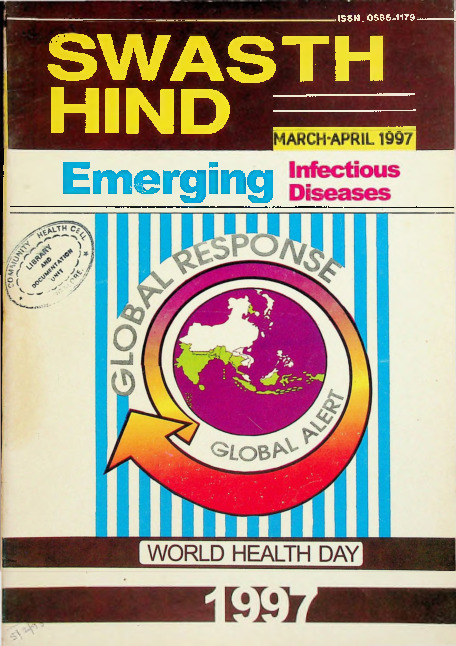
EMERGING INFECTIOUS DISEASES : GLOBAL ALERT, GLOBAL RESPONSE
Item
- Title
- EMERGING INFECTIOUS DISEASES : GLOBAL ALERT, GLOBAL RESPONSE
- extracted text
-
.ISSN. 0586=1179- ——J
SWASTH
HIND
Emerging
In this issue
Przge
Emerging infectious diseases : global alert,
global response
.....
Dr S- Pradhan
Dr Anil Kumar & Dr (Mrs.) T. Bhasin
Phalguna-Vaisakha
March-April 1997
Saka 1918-19
Vol. 40,
No. 3-4
OBJECTIVES
33
Emerging infectious diseases in South-East
Asia Region
.....
38
India fights infectious diseases Strategies
for control/eradication
Dr (Mrs.) T. Bhasin
44
Infectious diseases—examples of successful
prevention and outbreak control
46
Emerging infectious diseases : Challenges
and solutions ahead
....
47
Problem-based learning for tuberculosis and
leprosy supervisors
.
.
.
.
G. A. Alabi et al
50
International health regulations maximum
protection : minimum restriction
52
Plague is preventable and curable
54
Prevalence of HIV infection in children
with extensive tuberculosis and chronic
diarrhoea
•
•
Dr R H. Merchant
Dr R C. Shroff
55
State of the world’s vaccine report
58
Dengue fever and dengue haemorrhagic
fever
.....
59
FOCUS attention on
the major public health
problems in India and to report on the latest
trends in public health.
Control of influenza
61
KEEP in touch with health and welfare workers
and agencies in India and abroad.
Protection we take for granted
64
Vaccine success against malaria
3rd
cover
Swasth Hind (Healthy India) is a monthly journal
published by the Central Health Education Bureau,
Directorate General of Health Services, Ministry of
Health and Family Welfare, Government of India,
New Delhi.
Some of its important objectives and
aims are to:
REPORI' and interpret the policies, plans, pro
grammes and achievements of the Union Minis
try of Health and Family Welfare.
ACT as a medium of exchange of information on
health activities of the Central and Slate Health
Organisations.
REPORT on important • seminars,
discussions, etc. on health topics.
AIDS prevention
efforts and hopes
....
and
•
control India’s
.
•
•
conferences,
62
Articles on health topics are invited for publication in this
Journal.
Edited by
M. S. Dhillon
State Health Directorates are requested to send in reports of
their activities for publication.
Assisted by
G. B. L. Srivastava
K. S. Shemar
The contents of this
Journal are freely reproducible.
Due acknowledgement is requested.
Cover Design
Harbhajan Singh
Cover Photo
O. P. Kataria
Editorial and Business Offices
Central Health Education Bureau
(Directorate General of Health Services)
Kotla Marg, New Delhi-110 002
The opinions expressed by the contributors are not neces
sarily those of the Government of India.
SWASTH HIND reserves the right to edit the articles sent
in for publications.
SUBSCRIPTION RATES
Single Copy
50 Paise
Annual
• Rs. 6 00
This Issue
Re. 1-00
(Postage Free)
EMERGING INFECTIOUS DISEASES :
GLOBAL ALERT, GLOBAL RESPONSE
— A backgrounder on theme of the World Health Day-97
Dr S. Pradhan ♦
Dr Anil Kumar *♦
Dr (Mrs) T. Bhasin***
In a Resolution the World Health Assembly-1995 urged all the Member States to
strengthen surveillance for infectious diseases in order to promptly detect re-emerg
ing diseases and identify new infectious diseases.
With this in view WHO has
decided to devote this Day to the theme of emerging infectious diseases. The slogan
selected is “Emerging Infectious Diseases —Global Alert : Global Response”. WHO
has chosen this theme because emerging infectious diseases are now the major public
health problem the world over and are becoming a matter of serious global concern
as whole of the population of the world are at risk.
mergence of sum newly
identi
tied and re-emergence of some
of the other infectious diseases have
shown massive increase in the pre
valence of the diseases which
ac
count for a large number of morta
lity & morbidity. Moreover, recent
outbreaks of epidemics of infectious
diseases have added to the problem
mainly due to lack of awareness,
preparedness and timely response by
the world community. Keeping the
alarming world situation and threats
posed by emerging and re-emerging
infectious diseases in view, WHO
has established a Division of Emer
ging and other communicable disea
ses Surveillance and Control (EMC).
It has also called for the global res
ponse and global alert on this front.
E
The theme is appropriate in the con
text that just by creating public awa
reness, adequate preparedness and
global response for health promo
tion that we can combat any emerg
ing health problem. All countries
will be able to take a realistic look
at these problems and concentrate on
building a sound foundation of the
disease surveillance and disease
control. The basic aim behind the
programme is to bring together the
world
community,
local
govern
ments. community associations in
one mainstream to adopt a concert
ed and coordinated
the
approach
member countries
these emerging diseases.
by
to control
Global Problem
Emerging and re-emerging infecti
ous diseases have become the major
global health problem which are
highly complex and challenging.
Majority of the diseases are respon
sible for high mortality and morbi
dity with widespread epidemics in
the world and cause a lot of misery
to mankind and disturb international
trade and economic development.
Diseases like malaria and tubercu
losis are re-emerging with a greater
force. Plague, diphtheria. Dengue
meningococcal meningitis, yellow
fever and cholera are also reappear
ing in some parts of the world:
HIV/AIDS. Hepatitis ‘C* and Ebola
type haemorrhagic fever are the new
diseases indentified.
♦ DHE Student al CHEB
DADG (PH), and
♦♦•Director, Central Health Education Bureau, Kolla Road. New Delhi-110 002-
March—April, 1997
33
Significance of the theme for us in
India.
newly detected infectious diseases of
global concern include, a new form
of cholera, a haemolytic uraemia
syndrome, Hepatitis C, B. and E
etc.
The selection of the theme has
great significance in India as there is
emergence and re-emergencc of
many infectious diseases in com
Re-emerging infectious diseases
parison to the other developing are those re-appearing infections
countries which has created serious which were known but had formerly
health problems and a great chal fallen to level so low that they were
lenge to India. The diseases are no longer considered a public health
also responsible for highest number problem.
Re-emerging infectious
of deaths and illnesses causing, pas diseases often re-appear in epidemic
sive disruption of national economy. proportions. Tuberculosis is incre 3Recently India has experienced Out ing worldwide due to its close as
breaks of epidemics of plague and sociation with HIV infection. Cho
dengue which had not only taken lera has been reintroduced in coun
precious lives but also created tries where it had previously dis
panic, fear and sufferings amongst appeared and can spread further
the people.
Illiteracy, ignorance, because their water and sanitation
low-socio-economic status, and high systems have deteriorated. Dengue
population growth, unplanned urba has started to occur in urban areas
nization are some of the factors res where mosquito control
has
ponsible for the present situation. broken down. Other major disea
Spread of infectious diseases in ses such as malaria, plague, yellow
India is directly linked to low en fever, meningococcal
meningitis,
vironmental
sanitation as large diphtheria have re-appeared as pub
number of people are living in un lic health threats in many countries
healthy environment due to lack of after many years of decline.
basic amenities of life. The infecti
ous diseases can easily be prevented What Causes Emergence and Reemergence of infectious Diseases
by creating public awareness lead
ing to active community participa
Several factors
contribute to
tion and timely response by the emergence and re-emergence of in
community at local level.
fectious diseases but most can be
linked with the growth of popula
What are Emerging and Re-emerg tion, unplanned and underplanned
ing Infectious Diseases
urbanization, rapid
and intense
Emerging infectious diseases are international travel, over crowding
newly identified and previously un in cities with poor sanitation, chan
known infections which cause pub ges in handling and processing of
lic health problems either locally or large quantities of food and increas
internationally. Recent
emerging ed exposure of humans to disease
diseases include highly fatal respi vectors and reservoirs in nature.
ratory diseases caused by a virus Other factors include a deteriorating
called Sin nombre, a variant of public health infrastructure which is
Creutzfeldt—Jakob diseases, a dis unable to cope up with population
ease of central nervous system, HIV demands and the emergence of re
infection which causes AIDS, and sistance to antibiotics due to their
Ebola haemorrhagic fever. Other increased misuse.
34
People in India tend to self-medieation and. start using drug/antibio
tics indiscriminately.
They take
these medicines when not required,
and where these are required they
sometimes do not adhere to full
course of the treatment. It results
in drug resistance of many a bacte
ria /micro-organism.
Emerging and re-emerging infec
tions reflect the constant struggle of
micro-organisms to survive. One of
the ways micro-organisms have
found for surviving is to overcome
the barriers which normally protect
humans from infections. This may
follow deforestation which forces
forest animals to come close to man
in search of food and failure to con
trol mosquitoes and other carriers
of diseases to humans. Break down
in water and sanitation systems, fai
lure to detect diseases early, and
failure of immunisation programmes
and high risk human behaviour are
some of the other reasons for the
spread of infectious diseases.
Major Emerging and Re-emerging
infectious Diseases
Emergence of HIV I AIDS infe
ctions (the deadly disease) is a seri
ous public health problem of the
world. It has infected millions of
women, men and children in deve
loped as well as developing countr
ies. About 8000 cases of AIDS
are detected world wide every day
and the number of cases are on rise
in the third world. The root cause
of the spread of AIDS in the third
world is economic as well as social.
WHO estimates that as of Decem
ber 1996. 21.8 million adults and
more than .83 million children are
living with HIV/AIDS worldwide.
Since the beginning of the epidemic,
WHO has predicted that by the turn
of the century 30-40 million people
Swasth Hind
would be infected with HIV and primary concern to humanity. Bas corded death toll of about 3 million
global AIDS policy has estimated ed on prevalence rates ranging from in 1993- Tuberculosis is now the
the figure to be 110 million. An ex 0.1 per cent to 33% in different leading infectious killer of adults
plosion of HIV has also occurred in countries WHO estimates that as and will have killed at least 30 mil
South East
Asia particularly in many as 3 per cent of the worlds po lion people within the next 10 years
Thailand, Burma and India. More pulation could be infected with HIV if current trends continue. It is likely
than 3.7 million people are estimat and that there may be some 200 that no other infectious disease is
ed to have been infected with HIV. million chronic carriers who are at creating as many orphans and deva
A total of 49320 cases of AIDS risk of developing cirrhosis or liver stating as many families as tuber
have been reported in South East cancer. Viral Hepatitis-B is ende culosis. In 1993 WHO declared
Asia as on 1st January 1997- The mic throughout the world specially tuberculosis a global
emergency.
world and geographic boundaries in the tropical and developing coun One third of world’s population,
the next decade.
HIV is likely to tries. It is directly related with stan nearly 2000 million people, has al
reach most countries around the dard of living and the incidence is ready become infective. Tuberculo
world and geographic boundaries the highest in countries where eco sis a companion of poverty is now
cannot protect against HIV/AIDS. nomic level is lower as in South East spreading even in industrialised
HIV infection, has been reported Asia particularly India, China and countries.
HIV/AIDS infections
from almost all States and UTs of South America. It is estimated that have increased the incidence of tub
our country, highest being in Maha two billion people have been infect ercular infection as it destroys im
rashtra, Tamilnadu and Manipur. ed with hepatitis-B virus globally. mune system of human beings.
As per the HIV screening report as This includes 325 million chroni People- with dual infections of tub
many as 27.43 lakh persons have cally infected carriers and 1-2 mil erculosis bacillus and HIV are thirty
been screened for HIV of which lion deaths per year. By the year times more likely to become seri
12,131 have been found seropositive 2000 it is estimated that there will ously ill with tuberculosis than HIV
by the end of November 1995. A be 400 million Hepatitis-B carriers nagative individuals. WHO estimat
total of 2996 AIDS cases have also in the world.
es show* nearly 5 million people
Viral Hepatitis too is a major have already been infected with
been reported by 1st January 1997.
WHO estimates that over 1-75 mil public health problem in India both microbes setting the scene for
lion people in India are infected specially Hepatitis-B and Hepa- massive increse in the coming years
There was a
major in the countries with high prevalence
with HIV.
These figures do not titis-C.
In South East
convoy the actual magnitude of Hepatitis B outbreak in Ahmeda- of HIV infections.
HIV/AIDS in the country and re •bad (Gujarat) in 1984 reporting Asia in 1991 nearly 2 million cases
presents only a fraction of actual 1783 cases with an incidence of 0 59 were reported which was almost
morbidity. The situation is grave per thousand population. Hepatitis 50% of all the cases reported global
as the population at risk of HIV A & E are endemic in India and lo ly and the disease takes a toll of
can be found in millions of STD cal epidemics keep breaking out nearly one million annually.
case occurring in our country. Pro now and then. India has largest
Tuberculosis continues to be a
blems of prostitution, change of pool of those Hepatitis B causing major public health problem which
sexual behaviour commercialisation chronic level diseases. It is the fifth is emerging now in our country. In
of blood for transfusion and use of major cause of mortality in the most India 14 million people are suffer
infected needles among the I. V. reproductive years of life (15-45). ing from active tuberculosis of
drug users are the factors responsi The spread of Hepatitis A & E are which 3-3.5 billion are highly infec
linked with personal hygiene and
ble for the spread of AIDS.
tious and about 0.5 million die of
hepatitis B with safety measures dur
Hepatitis-B
and
Hepatitis-C ing blood and blood product trans the disease every year. The disease
both are major public health prob fusions. There is an apprehension prevalence is much more in India in
to other developing
lems of the world. Hepatitis C is among Delhi Doctors/Virologists comparison
countries
specially
after the emer
not as infectious as Hepatitis B or that there is emergence of viral He
gence
of
HIV
infection.
This is
HIV. As many as 80 per cent of in patitis B among people who had re
mostly
due
to
low
socio-economic
fected people can become chroni ceived blood and platelet transfu
cally infected and may suffer seri sions during the recent epidemic of status, and unhygienic living con
ditions of our people.
ous long term affects such as liver Dengue in Delhi.
cancer which places Hepatitis *C'
The emergence of Dengue and
Tuberculosis remains a world
virus (HCV) among pathogens of wide public health problem with re Dengue Haemorrhagic Fever/Deugue
March—April, 1997
35
reported case of plague in 1966,
Shock Syndrome which can be
fatal especially to children is sp there has been no laboratory con
reading throughout the globe with, firmed case of human plague in
tens of millions affected annually India till its reappearance in Sep
and the urgent measures must be tember 1994 when four persons test
taken to bring it under control. ed positive for bubonic plauge in
WHO estimates of 1993 have shown Beed (Maharashtra) followed by an
that over half of WHO member outbreak of pneumonic plague in
Cases were also
States representing a total popula Surat (Gujarat).
tion of 2000 million are threatened reported from Delhi. Bombay/Cal
by dengue. There was a recent out cutta and some other places. The
break of dengue epidemic in India spread of plague is again related
in 1996 which caused loss of many with the degradation of environ
ment and increase in the population
precious .ives.
of rats, rodents and flees.
Dengue is another viral disease
Malaria continues to be a major
which occurs frequently in India as
public
health problem and one of
epidemic of explosive nature during
the
most
widespread disease in the
the monsoon season in cities and
world
and
it is very dominant in
large towns- As most viral diseases
South
East
Asia particularly India.
have no specific treatment and no
It
continues
to kill human beings
vaccine is yet available, but it can
and
hinder
agricultural
progress due
be preventable as it is a mosquito
to
loss
in
man
days.
As
per WHO
borne disease related with environ
reports
it
is
alone
responsible
for
mental sanitation.
about two million deaths every year
All four types of Dengue virus half of which occur in children.
can cause Dengue Haemorrhagic
Malaria is another biggest and
Fever and Dengue Shock Syndrome. serious public health problem of
However infection with one type of India. With the implementation of
Dengue virus followed within few modified plan of operation (MPO)
years by another Dengue virus is the total malaria cases came down
more likely to cause these condi from 6.47 million in 1976 to 2.18
tions with higher mortality. It is million in 1984 and since then is
therefore important to prevent out contained around 2 million cases
break of Dengue at frequent inter which is still very high. Factors caus
vals.
ing serious concern or development
of insecticides resistance in vectors
The frequent outbreaks of plague
and drug resistance strains of
all over the world has become ano
P. Falicipartum malaria. There is
ther public health problem causing
very high incidence of malaria cases,
many deaths world wide.
The
specially P. Falicipartun in tribal
countries reporting most cases are
areas of about seven States of north
Vietnam, Brazil, Peru, USA and
eastern region. There was also out
India. The recent outbreak of pla
break of malaria in epidemic form
gue in India in 1994 is infact an ex
during 1994 in Nagaland, Rajasthan
ample of epidemic plague in its na
and Manipur and there was severe
tural foci which are widely scattered
out-break in Assam in 1995.
in same countries and plague be
The Japanese Encephalitis has
comes active periodically.
become another major-public health
India used to have many epi problem in India. If has been re
demics of plague in the past and ported from 24 States and UTs.
has now reappeared as a major pub There were a total of 4071 cases
lic health problem. Since the last with 1530 deaths reported in 1991:
36
2432 cases with 888 deaths in 1992.
In 1993 a total of 2291 cases and
923 deaths were reported. In 1994
(Nov.) 480 cases and 268 deaths
have been reported. This is again
another mosquito borne disease
which can be prevented.
Other re-emerging diseases like
yellow fever, cholera, etc, continue
to create major public health prob
lems in the world.
Role of Environmental Degrada
tion in Spreading Diseases
Poor environmental
sanitation
plays an important role in spreading
the infectious diseases which are
presently emerging and creating a
big public health problem. The high
incidence of mortality and morbidity
rate among infants and children is
attributed largely to unsafe water
supply, poor hygienic practices and
insanitary
environment. The fast
and unbalanced urbanisation of
towns and massive migration of peo
ple from villages, population explo
sion,
deforestation,
lack of
safe drinking water, improper
soild and liquid water disposal arc
the factors which facilitate to create
an environment conducive to these
infections. The situation is aggra
vated by illiteracy, ignorance and
apathy both at public and govern
ment level. Poverty is another ma
jor factor as today more than 1/5
of worlds’ population live in ex
treme poverty' without adquate food,
water and shelter which compel
them to live in degraded environ
ment and they are particularly vul
nerable to diseases. There is no
public awareness and no community
participation in maintenance of pro
per and healthy environment. So
degradation of environment is the
root cause of infectious diseases.
Prevention of infectious Diseases
Prevention and control of infecti
ous diseases broadly depends on (i)
The reservoir or source of infection,
(ii) routes of transmission of infec
tion, <iii) Susceptible hosts (people
Swasth Hind
at risk). It is important for the peo
ple to understand that if they con
trol one vector i.c. mosquito, they
can prevent many infectious disea
ses like Malaria, Dengue, etc. The
primary aim behind the control and
prevention of a disease is to elimi
nate the source of infection or to
check the routes of transmission of
infection and strengthen the defence
of people at risk.
Economic losses because of infec
tious diseases are much more than
one can think of. It not only includes
cost of getting treatment and loss of
man-days but also includes cost of
delivering health care services, cost
of disability, increased morbidity re
sulting in reduced productivity and
national loss of income due to early
mortality. However cost of preven
tion of infectious diseases is much
less as compared to the losses. Thus
there can be huge economic savings
if appropriate preventive measures
are taken.
The following measures/steps are
to be considered to prevent infecti
ous diseases which require com
munity participation, political sup
port and intersectoral coordina
tion.
Eat'y Diagnosis/Early Detection
The first step in the control of in
fectious diseases is rapid identifi
cation of the disease or prompt de
tection of cases (and carriers) or
outbreak of epidemics. Laboratory
procedures require to confirm the
diagnosis. It is therefore impor
tant to improve the national infra
structure on routine surveillance of
common diseases and strengthen la
boratory services.
Efficient Surveillance System
Surveillance must follow control
measures. It is the continued scru
tiny of all aspects of occurrence and
spread of disease that are pertinent
to effective control.
Many countries lack a national
uniform surveillance system for rou
tine monitoring of communicable
diseases. We need to strengthen such
an effort and to collaborate with in
ternational initiative for communi
cable disease surveillance to ensure
efficient and cost effective collection
of data that can be compared inter
nationally.
March—April, 1997
International Health Regnlations
The spreading of infectious dis
eases is now also linked to the ra
pidly increasing intemationl travel
and these may not be confined to a
country or a part of a country any
more.
There are three communicable
diseases—Cholera, Plague, Yellow
fever which must currently be re
ported under the International heal
th regulations. In India it was en
forced by Indian Aircraft Public
Health Rules, 1954. Under these
rules international
travellers
if
suffering from any of the disease
subject to these regulations are iso
lated and those suspected to be har
bouring infectious agents are to be
kept under quarantine. This is be
ing done by the Port and Airport
Health Organisations.
In India we require a proper pub
lic health infrastructure for control,
surveillance and monitoring for the
infectious diseases. Such a system
should envisage to emphasize the
preventive aspects of the infectious
diseases.
Resources and trained
manpower are required to strength
en such a surveillance system.
WHO is facilitating exchange of
information among its member
countries and ensures prompt inter
national response.
Personal Hygiene and Environmen
tal Sanitation
This aspect of infectious disease
control relates to breaking the chain
of transmission by changing some
components of men’s environment
io prevent the infective agents from
a patient or carrier from entering
the body of a susceptible person.
When the disease is vector borne,
control measure should be directed
primarily at the vector or at breed
ing places. Water can be the me
dium for transmission of many dis
eases such as typhoid. Hepatitis,
Cholera. Water treatment will eli
minate these diseases. Infectious
diseases are particularly prevalent
in low standard sanitating condi
tions. Proper maintenance of en
vironmental sanitation. personal
hyciene are needed to interrupt the
transmission of infectious diseases.
Vaccination/Immunisation
One effective way of controlling
the spread of infection is to streng
then host defence. Active Immuni
sation is one of the most powerfull
and cost effective weapon of mo
dern medicine. There are some in
fectious diseases whose control is
solely based on active immunisation
like polio, tetanus, diphtheria etc.
There is immunisation
against
many other infectious diseases such
as hepatitis B, Japanese encepha
litis, yellow fever. Some vaccines
arc given during the outbreaks of
infectious diseases. Passive immu
nisation is a short term expedient
useful only when exposure to infec
tion has just occurred er is immi
nent within next few days- WHO
EPI global advisory committee has
strongly recommended that BCG &
Polio is to be given at birth or at
first contact.
Chemoprophylaxis implies
the
protection or prevention from a dis
ease. This is achieved by casual
prophylaxis as in cholera, diphthe
ria, malaria, plague, meningitis me
ningococcal. etc.
Health Education
This is one of the most cost effec
tive interventions. A large number
of diseases could be prevented with
little or no medical intervention if
people were adequately informed
about them and encouraged to take
necessary
precaution in time.
Moreover health education remains
the only approach to get public co
operation and to induce relevant
changes in the behaviour and life
style of people.
Community can play an impor
tant role in disease surveillance,
disease control and other public
health activities. It is an important
contribution that people can make
by joining and using health services
thereby taking preventive and pro
tective measures for infectious dis
eases.
Mass media plays a very imoortanl role in the dissemination of in
formation and creating public awa
reness regarding the emerging infec
tious diseases. Mass media should
inform the community on different
types of infectious diseases, their
cause, mode of spread and the pre
cautions which are to be taken for
the prevention of the diseases.
A
37
Emerging Infectious Diseases
in South-East Asia Region
GLOBAL eradication of
smallpox in 1977 and the dis
covery of antibiotics and vaccines
led to optimism and a sense of com
placency that infectious diseases, as
public health problems, could be
eradicated or eliminated. This com
placency has had adverse consequ
ences, and, at present, infectious di
seases are the leading cause of
death, world-wide. Today, at least
17 million people die annually from
infectious diseases. The
SouthEast Asia Region (SEAR) unfor
tunately. accounts for almost. 41%
(7 million) of these tragic deaths.
Even so. this figure is an underesti
mation since some non-communicablc diseases too, such as certain
types of cancer and malnutrition
can be contracted as a result of an
infection.
he
T
Today, in SEAR countries, the
spectrum of infectious diseases - is
changing rapidly in conjunction
with dramatic socio-economic and
ecological changes. While the ageold diseases, such as cholera and
tuberculosis, continue to dominate
the disease pattern in the Region,
38
others like malaria, plague and
kala-azar, which were on the verge
of eradication, have reappeared.
New diseases, such as a new strain
of cholera (cholera O 139) and HIV
infection, are being reported in the
Region.
quickly and more than three million
persons in the Region are estimat
ed to have been infected since the
beginning of the pandemic. By the
end of the century, S-10 million
men, women and children are likely
to become infected with HIV within
the Region, accounting for over
25% of the global cumulative HIV
infections.
In addition, diseases which were
once of no public health concern,
such as melioidosis, are assuming
of reported AIDS cases
importance in association with Table : Number
and estimated HI I ' infections
HIV in some countries. These di
in SEAR countries (as on
seases also exact a staggeringly high
7 January 1997)
economic price from individuals,
Estimated I
families and communities in terms
Reported
Country
HIV infec
of health care and loss of produc
AIDS cases
tions
tivity. In response to these trends, 1
WHO has formulated a strategy to
Bangladesh
7
<20,003
strengthen national
and interna
tional capacities in the surveillance
Bhutan
75
0
and control of communicable dise
DPR Korea
<100
0
ases which represent new. emerging
and re-emerging public health pro
India
2,500,000
2,996
blems, including the problem of an
Indonesia
timicrobial resistance.
112
95,000
Maldives
3
69
There have been notable succes
ses in
the
never-ceasing battle
Myanmar
1,612
350,000
against infectious diseases. Signifi
Nepal
53
5,000
cant progress has been made in the
Region towards achieving the goals
Si i Lanka
6.000
68
of eradication of poliomyelitis and
guineaworm disease, and the elimi
Tha:land
44,471
800,000
nation of neonatal tetanus and lep
rosy as public health problems by the
Total
49,320 > 3,750,000
year 2000. A significant reduction
in morbidity and mortality as
sociated with
other vaccine-pre
The available epidemiological
ventable
diseases like measles, data show that AIDS cases are in
diptheria and whooping cough creasing very rapidly, particularly
has also been achieved. Yet, new, in Thailand and India. As of 1
emerging and re-emerging infectious January 1997. about 49,000 AIDS
diseases pose serious health pro cases have been reported (see
blems in almost all the countries Table) from the Region, 80% of
of the Region.
which were reported over the last
three years. Furthermore, 85% of
New Diseases
cases have occurred in the most
The pandemic of HlV/AIDS productive age group : 25-40 years.
HIV
reached this Region relatively late The studies show that the
but has spread rapidly in the last epidemic has now started spread
few years. The virus is spreading ing into the general population as
Swasth Hind
well. For example, in Bombay, Emerging Diseases
India.
2.5% of pregnant women
Tuberculosis (TB) still kills adults
are now HIV positive; in Chiang more
than any other disease. Since
Mai, northern Thailand, 16% of
of these deaths is among the
military conscripts and 8% of preg 80%
nant women aro HIV positive. most productive age group (15-59
years), it has a serious impact on
However, in many other countries,
development. It is
including Bhutan, Maldives and Sri socio-economic
3.5 million new
Lanka the HIV transmission con- estimated that
cases
would
have
occurred in the
tinues to remain at a low level.
But there is no room for compla South-East Asia Region during
cency, given the experiences of
some of the countries of the Region.
WHO estimates that more than 3
million people in the Region have
already been infected; 2.5 million in
India; 800.000 in Thailand and
350,000 in Myanmar.
WHO support to Member Coun
tries includes (i) providing tech
nical assistance for program
me planning, management ana
advocacy; (ii) promoting’ effect
ive and rational STD / Al DS pre
vention and care strategies and
(iii)
integrating/mainstreaming
STD/AIDS Programmes into and
as part of WHO Collaborating
Programmes.
WHO/SEARO
technical
and
operationanl support are prima
rily related to public health as
pects, including STD prevention
and control, blood safety, clini
cal care, and STD/IflV/AlDS
surveillance and research.
Cholera, caused by the EL Tor
strain, has been reported from all
the countries in the Region, except
DPR Korea. A new strain, now la
belled V. cholerae O 139, was first
reported in October 1992 and spread
rapidly to many countries in. SouthEast Asia as well as to countries
in other WHO regions. The new
strain, which almost completely re
placed the O1 EL Tor strain in
1993, however, largly disappeared
from the countries in 1995-96. Few
isolations have been still reported
in India and Bangaladesh in 1996.
WHO/SEARO supported
the
National Institute of Cholora
and Enteric Diseases (NICED)
in the production of an antisera
to identify this new strain (V
cholerae 0139) for distribution
not only in countries of the
Region, but also to other regions.
March-April, 1997
gladesh TB programme, which
presently covers 58 million popu
lation, and is further expanding
with assistance from NG Os. such
as BRAC, Damion Foundation
and other NGOs engaged in lep
rosy elimination activities.
All countries have manuals/
guidelines for TB control based
on DCTS and have prepared 5year plans for their National
Tuberculosis Programmes (NTPs).
The challenge i.. the Region is to
expand the DOTS coverage as
soon as possible. However, the
expansion should not compromise
the quality of programme delivery,
which should be closely monitor
ed through supervision/support
visits and reporting on case-find
ing/treatment outcomes.
It is anticipated that in the next
two years, the DOTS coverage in
the Region will increase from the
present level of less than 10% to
approximately 20% of the popu
lation. By the end of 1999, all
countries in the Region, except
India and Indonesia, will achieve
countrywide DOTS coverage and
by the year 200 i, India and Indo
nesia will achieve 50-60 percent
coverage.
1995, which represents about 40%
of the global burden of the disease.
An estimated
1.2 million people
would have also died from TB in
the Region in 1995, which is also
nearly 40 per cent of the global
TB deaths. By the year 2000, TB/
HIV co-infection is expected io in
crease dramatically to nearly to a
level of one-in-five of all TB cases
in the South-East Asia Region.
Emergence of drug-resistance tuber
culosis in the Region is now a
serious concern.
Strong and sustainable National
TB Control Programmes (NTPs)
need to be established to achieve
the global targets of 85% cure
rate and 70% case-finding by the
year 2000. Countries in the Re
gion have made considerable
progress since 1993 in implement
ing the DOTS strategy. All coun
tries in the Region (except DPR
Korea—no information availa
ble) have adopted DOTS, and are
implementing the strategy in at
least the demonstration areas.
The most successful is the Ban
Two main obstacles are slowing
the implementation of DOTS in
the Region. First, there ’ is lack
of strong political commitment
for controlling TB. Despite re
cent increases in the staff and na
tional budgets for TB in many
countries, there is still a severe
lack of human and financial re
sources for rapid action. Second,
there is lack of commitment of
health services to implementing
The DOTS strategy. This is often
gauged, by the limited support
provided for new and demanding
activities for TB control, such as
Laming. supervision and regular
monitoring.
Malaria is another ancient scouige that still dominates the disease
pattern in the Region. It is estimated
that 1.2 billion people in the Region
live in malarious areas. The number
of malaria cases in 1995 in the Re
gion was estimated at 23.6 million,
with almost
40.000 deaths.
An
alarming feature is the increase in
the proportion of P. falciparum
39
cases. The development of resis
tance of the parasite to the com
monly available anti-malarial drugs
is emerging as a serious problem in
many countries. Development of
resistance of the mosquito vectors
to insecticides is another problem
hampering the control programmes.
Following the Ministerial Meet
ing on Global Malaria Control
Strategy held in Amsterdam in
October 1992, WHO/SEARO
organized a Regional Working
Group Meeting on Malaria in
March 1993 to review the situa
tion and to adopt the Global
Strategy.
In March 1995, an Intercountry
Consultative Meeting organized
by WHO/SEARO considered
multidrug-resistant
malaria in
border areas as a priority pro
blem for the Region, in the light
of its Global Malaria Control
Strategy. WHO/SEARO initiated
a regional collaborative program
me on drug-resistant malaria
and control of malaria in border
areas. Series of meetings to re
view the situation in the border
districts
which
had identified
malaria and kala-azar as com
mon border health problems bet
ween Bangladesh. Bhutan, India
and Nepal were organized during
1995-96, by WHO/SEARO. Joint
action plans were developed by
border districts to address these
problems. Similar collaboration
was carried out between Bangla
desh and Myanmar.
40
In order to support these activi
ties, during the 1996-1997 bienni
um, WHO/SEARO has establi
shed an umbrella programme
called “Technical Cooperation
among Countries, JCP TCC 031”.
In December 1995, a workshop
on “Planning and implementa
tion of vector control for malaria’’
was organized by WHO/SEARO
in Bangalore; with malaria pro
gramme managers and senior en
tomologists participated.
Learning from country experien
ces with epidemics during 199495 in Rajasthan. India and in
northern plains of Bangladesh,
.several training activities on man
agement of severe malaria and
epidemic preparedness were un
dertaken, with
assistance from
SEARO and HQ. These training
activities were conducted during
1995-1996 in Bangladesh, Bhutan,
India, Myanmar and Nepal.
and Control of Dengue/DHF
was organized at WHO/SEARO.
This meeting reviewed the pre
sent situation and developed a
revised
strategy
and plan of
action for prevention and control
of this disease at the national
and regional levels. Development
of a training module for case
management of Dengue/DHF/
DSS is in process.
WHO provided technical support
to the countries of the Region in
containment of dengue outbreaks.
A special Consultative Meeting
on Management of Dengue Epi
demic was conducted in Novem
ber 1996 in WHO/SEARO where
recommendations for the mana
gement of dengue epidemic is be
ing developed.
Tetravelent live attenuated den
gue vaccine has been developed
by Mahidol University in Thai
land, with support from WHO,
and clinical trials of this vaccine
in children are under way. This
is the first time a
developing
country has successfully carried
out the development of a vaccine
for human use.
Dengue/Dengoe
Haemorrhagic
Fever (DHF) is a leading cause of
hospitalization and death among
children in many countries of the
Region. It was estimated that there
were
400,000 cases and 8,000
Hepatitis B is a growing problem
deaths from DHF in the Region in
1995. During 1996, an increasing in the Region. It is estimated that
trend in morbidity associated with there are more than 80 million car
dengue and DHF has been obser riers (more than 5% of the total
ved in India. Indonesia and Sri population) in the Region. These
Lanka. In an outbreak in Delhi carriers will help to spread this di
alone, during August-November sease in the general population and
(1996), about 10,000 cases and 400 infected mothers will pass on the
disease to their babies. The- majo
deaths were reported.
rity of those infected are likely to
die of liver cancer and cirrhosis.
In October 1995, a Regional Con
sultative Meeting on Prevention
Swasth Hind
WHO supported establishment of
Hepatitis B Control Programmes
in countries of the Region. Dur
ing 1992-94. Indonesia, Maldives
and Thailand introduced hepati
tis B vaccine within the frame
work of EPI. Sri Lanka intro
duced vaccination for medical
personnel in 1995. Sero-cpidemiological studies were carried
out in Bhutan and Bangladesh.
Commencing in
1996. Bhutan
introduced Hepatitis B vaccine
within the framework of EPI. A
demonstration project on hepa
titis B immunization was started
in New Delhi in October 1996.
Hepatitis B vaccine has been pro
duced in DPR Korea and Indo
nesia.
Large-scale production
will start in Myanmar in 1997.
WHO supported the mandatory
screening of blood and blood
products, both technically
and
financially, and the same is now
being carried out in all countries
of the Region, except
Bangla
desh and Nepal.
WHO provided the necessary
diagnostic reagents to these coun
tries.
Meningococcal Meningitis has
been reported in almost all countries
of the Region. With an estimated
20.000 cases and 5.000 deaths in
1995, this disease has the potential
to develop into explosive outbreaks
if not diagnosed and treated early
enough. The disease can also
cause very high death rates as level
led by the epidemic currently pre
vailing in Africa.
WHO provided Information to
Member Countries regarding the
African situation and suggested
taking special steps towards the
vaccination and active surveilla
nce of pilgrims to and from Mec
ca. WHO also provided diagnostic
k’ts to Bangladesh. Bhutan, Mal
dives. Myanmar and Nepal.
Japanese Encephalitis (JE) is ano
ther emerging public health prob
Hepatitis C virus (HCV) infection lem. particularly in India. Nepal. Sri
is prevalent in the countries of the Lanka and Thailand. It was esti
Region. In India, antibody to mated that 20.U<)0 cases and 4,000
HCV has been found in 2% of deaths occurred in the Region in
voluntary blood donors, while in 1995. This disease is particularly
Indonesia, Myanmar and Thailand dangerous as a majority of patients
the figures are 2.5%. 3.9% and who recover, suffer from varying de
1.4% respectively. The testing of grees of brain damage. The disa
blood from patients with hepatocel bility requires lifelong care, either
lular carcinoma showed that 42% in institutions or at home, thereby
of these samples in India, 29% adding considerably to the health
in Indonesia, 35% in Myanmar care costs of the country. The hu
and 8.4% in Thailand had markers man immunization strategy to con
of HCV
infection. Mandatory trol JE is used in Thailand. India
screening of blood and blood pro and Sri Lanka. In 1995, Thailand
ducts for the presence of
HCV
markers has been established in
Thailand, but only 1'mited numbers
of blood and blood products are
screened for HCV markers
in
India, Indonesia and' Sri Lanka.
WHO supported the sero-epide
miological studies of hepatitis
C infection *n countries of the
Region.
Hepatitis E virus (HEV) infection
is very common in the Region.
During 1995-1996 waterborne out
breaks of HEV were reported in
Bangladesh, India, Indonesia. My
anmar and Neoal. This infection
caused high mortality in pregnant
women.
March -April. 1997
2-16/DGHS/ND/96
introduced a mass vaccination cam
paign in 30% of the provinces.
Starting from 1996, it is expected
that this campaign will cover all
rural areas in Thailand.
WHO provided technincal infor
mation to endemic countries and
helped in the procurement of JE
vaccine.
Rabies : Rabies continues to be
a major public health problem in
some countries of the Region. It
is estimated that about
30,000
people in India, 2.000 people in
Bangladesh and about 400 people
each in Bhutan, Indonesia, Nepal,
Sri Lanka and Thailand died of
rabies every year.
Figure 7. Estimated number of rabies cases.
1995
WHO technically facilitated largescale dog vaccination programme
and improved human post-exposure treatment in Indonesia, Sri
Lanka and Thailand.
Support
was also provided to India, In
donesia and Thailand in the de
velopment and production of ceil
culture vaccine.
Antimicrobial resistance : There
has been unrestricted, improper and
indiscriminated use of chemothera
peutic agents in countries of our
Region in the recent years. This
has resulted in the emergence of
resistant organisms which are spre
ading rapidly. Today drug-resistand salmonellosis, shigellosis and
gonococcal, staphylococcal, strepto
coccal and pneumococcal diseases
have been detected in countries of
the Region.
41
These organisms are posing seri
ous threat to the treatment o£ infec
tious diseases which are expensive
to treat and the cost burden can
hardly be afford by developing
countries. Moreover, the labora
tory systems for detecting resistance
are inadequately controlled and
monitored, resulting in delays in
effective response to emerging pro
blems. A coordinated multidiscip• linary approach is required to tackle
this problem as a strategic priority.
In order L> address the issue of
laboratory
based
surveillance,
WHO, in 1995-96, supported the
setting up of a Gonococcal Anti
microbial Sensitivity Programme
(GASP) in Region. This invol
ved the establishment of a net
work of laboratories to the qua
lity of data generated. WHO
also organized inter-country work
shops and supported national
workshops on sufveillance of anti
microbial resistance, and on ra
tional use of these drugs in India,
Indonesia and Thailand.
WHO also prepared a Manual
on Standard Operational Proce
dure for isolation, identification
and antimicrobial susceptibility
in Neisseria gonorrhoeae . which
will be disseminated to the con
cerned laboratories of the Re
gion.
Dissemination
of these
manuals will always keep in
formation updated.
Re-emerging Diseases
The sudden re-appearance of hu
man plague in India, in 1994, after
a period of 27 years caused global
concern. It created a sense of panic,
both within and outside the coun
try, and led to the imnosition of un
warranted trade and travel restric
tions by several countries. There
is a need to be vigilant since the
natural foci of infectious plague
exist in India. Indonesia Myanmar
and possibly Nepal.
During 1995-96, WHO trained
nationals from India. Indonesia.
s Myanmar, Nepal, Sri Lanka and
Thailand in laboratory diagnosis
and surveillance of Diague. As
a result of this training, India is
producing diagnostic reagents for
plague at the Haffkine Institute,
Bombay. WHO is also support•• 1
’42
ing a research project for the
development of a cost-effective
system of plague surveillance.
Kala-azar almost
disappeared
from the South-East Asia Region
during the early 1960s due to insec
ticide spraying under the malaria
control programme (MCP). Subse
quently. as ’he MCP entered the
maintenance phase, insecticide spra
ying was withdrawn and kala-azar
vectors started breeding crofusely.
Kala-azar continues to be a health
problem of importance in primarily
the rural areas of India. Bangla
desh and Nepal, where approxima
tely 110 million people are at risk.
It was estimated that 100,000 cases
and 5,000 deaths occurred in these
three countries in 1995.
In August 1995, during the border
meeting involving districts from
Bangladesh, Bhutan, India and
Nepal, malaria and kala-azar
were identified as common health
problems. The meeting, which
was organized by WHO/SEARO,
developed a district joint action
plan to address kala-azar pro
blems in border areas between
Bangladesh, India and Nepal.
WHO supported the countries in
evaluating
their collaborative
activities.
Potential Emerging Diseases
In addition to the current infecti
ous disease problems in SEAR, there
are potential problems associat
ed with an increase in the
number of drug-resistant bacterial
and parasitic diseases and emer
gence o£ new viral infections.
The potential emerging infec
tions in SEAR are hantavirus,
yellow fever and ebola-like haem
orrhagic fever and E. coli 0157.
Hanta virus infection causing
haemorrhagic * fever with renal
syndrome (kidney disease) has been
reported only-from Myanmar and
Sri Larika. Antibody studies in
India, Indonesia and Thailand,
however, suggest that there is wide
circulation of this virus, which
poses a potential threat to the
countries.
Yellow fever has never been re
ported from this Region. However,
the recent epidemic in Kenya poses
a threat as the mosquito vector
(Aedes aegypti) is widely pre
valent in the Region and yet
the people have no immunity against
the disease. If yellow fever virus
is introduced in this Region, there
will be large epidemics with very
high death rates (50-80%)- Thus.
there is need for extra vigiliance to
protect the Region against yellow
fever.
In 1993, WHO/SEARO conduc
ted a Consultative Meeting on
Visceral
Leishmaniasis Control
to review the situation and to for
mulate country objectives for the
control of the disease. Subse
quently, WHO assisted the ende
mic countries in the formulation
of control strategies and support
ed national training courses on
case management,
laboratory
diagnosis and vector control. As
Though Ebola
haemorrhagic
a result of the implementation
of this strategy, India reported fever has not occurred in the Re
a decline of incidence and deaths gion. antibodies to Ebola-related
during 1994-95. Some progress filoviruses have been detected in a
has also been made in Bangla soecies of monkeys in Indonesia.
diarrhoea
desh and Nepal through the in E. coli 0157 causes
tegration of vector control pro which have a wide range presenta
grammes.
tion from the mild without blood.
Swasth Hind .
to stools that are virtually all blood.
Very often, it causes fatal haemo
lytic uiemic syndrome (HUS). There
have been reports of several seri
ous outbreaks in USA, Japan, South
Africa and Australia. In each out
break, many people were affected
with high complication and fatality
rates. The disease has potential
of emerging into the Region.
Bovine spongiform .encephalo
pathy (BSE) which possibly links
with a form of brain disease in
humans—a new variant of Creutz
feldt-Jakob Disease (CJD) — has
not been reported in South-East
Asia. However, India and Thailand
have
n'oorted sporadic cases of
CJD.
WHO provided technical infor
mation and recommendations re
garding the. prevention and con
trol of these potential, emerging
intectious diseases.
Why are these Diseases Emerging?
There is no single factor responsi
ble for the emergence of these dise
ases but rather the interaction of
multifactors. Poverty is on the in
crease and millions of people, by
virtue of their living conditions, are
exposed daily to the hazard of in
fectious diseases. Environmental
degradation is another factor that
contributes to the increasing disease
burden.
Rapid population growth combin
ed with uncontrolled urbanization
means that millions of city dwellers
are forced to live in overcrowded
and unhygienic conditions lacking
clean water and adequate sanita
tion.
These
conditions provide
ample breeding grounds for infec
tious diseases.
Migration and displacement of
people due to wars. civil strife and
natural disasters like Hoods and
earthquakes, also provide fertile
breeding grounds for these diseases.
March- April, 1.997
The rapid increase in international
travel and growing trade and tou
rism have
implications for the
spread of infect ions diseases from
one country to another.
Also, mutation results in new
strains of infectious agents and anti
microbial
resistance. These, to
gether with vector-resistance to
insecticides,
are
also important
factors in the emergence of new
diseases.
But, perhaps one of the most im
portant factors contributing to the
emergence of infectious diseases is
the low priority and support given
to public health services in many
countries.
Economic Impact of New, Emerg
ing and Re-emerging Diseases
The economic impact of these di
seases can be enormous. For exam
ple, during the plague outbreak in
1994, India is estimated to have
suffered losses in trade, employment
and tourism amounting to over
USS 1.5 billion. Similarly, as a
result of the cholera epidemic in
1991, Peru lost an estimated USS
770 million. More recently, the
mad-cow disease in UK has result
ed in a loss of billions of pounds
sterling following the ban imposed
by the European Community on the
import of British beef. In Thai
land, a well-documented study esti
mates that health care costs of an
AIDS patient varies from USS
1,500 to 5,000. By the year 2000,
the overall costs to Thailand and
India on account of AIDS have
been estimated at USS 9 billion and
11 billion, respectively.
Priority Areas for
Future Plans
Action
and
WHO has identified three priority
areas for national and international
action during the next five years.
The first priority is to achieve the
eradication or elimination of disea
ses such as poliomyelitis, dracunculiasis, leprosy and measles which
does not require large expenditure.
If the necessary resources are not
mobilized, however, there is every
likelihood of these diseases will re
turn with a vengeance,
negating
previous efforts.
The second priority is the preven
tion and control of diseases which
are major public health problems
in the Region such as tuberculosis,
malaria, viral hepatitis, dengue/
DHF, Japanese encephalitis, men
ingococcal meningitis, HIV/AIDS,
ARI, and diarrhoeal diseases,
through the establishment of appro
priate national and regional surveil
lance mechanisms.
The third priority
is to take
short-term and long-term action to
combat newly emerging diseases.
Since speedy response is needed to
effectively contain outbreaks, rapid
response mechanisms need to be
built into the surveillance system.
The following arc priority acti
vities for the coming few years to
wards the prevention and control of
emerging and re-emerging commu
nicable diseases :
— Strengthening epidemiological
surveillance.
— Strengthening laboratory ca
pabilities and services.
— Establishment of Rapid Res
ponse Team.
— Monitoring
sistance.
antimicrobial re
— Establishment of internation
al
disease surveillance net
working.
— Advocacy and
mobilization
of international support.
A
43
INDIA FIGHTS INFECTIOUS DISEASES
— Strategies for Control Eradication
Dr (MrsJ T. Bhasin*
Tndia’s fight against infectious
diseases is a continuous pro
cess. National programmes have
been launched to control/eradicate
numerous communicable diseases.
We discuss below different strate
gies being followed in this direc
tion.
of Andhra Pradesh and Madhya
Pradesh.
(v1 Health Education:
To in
crease awareness of the community
and seek their active participation
and cooperation for implementing
control activities, health education
is being undertaken.
MALARIA
FILARIA CONTROL
In view of the financial cons
traints, Government of India provi
des the total cost on medicine and
insecticides for Kala-Azar in Bihar.
To ensure optimum utilisation of
available resources district action
plan are prepared under which ex
clusive infrastructure is deployed
for the Kala-Azar activities. Mate
rial and equipment with strict
supervision is provided.
Monitor
ing and concurrent and consecutive
evaluation regularly carried out.
Control Strategy
The National Filaria Control
(i) Case Detection and Prompt Programme was launched in 1955.
Treatment:
Case detection and Under the programme following
prompt treatment is given more measures are undertaken.
JAPANESE ENCEPHALITIS
emphasis to reduce parasitic load in
Strategy for Contra;Major
(i) Delimitation of the problem
the community.
Blood slides are
in hitherto unsurveyed areas. activities to control Japanese Ence
being collected through active and
phalitis includes:
passive agencies and presumptive
(ii) Control in urban areas tho
treatment is given.
All positive
rough recurrent anti larval
(i) Care of the patient;
cases are given appropriate radical
■measures and anti parasitic
treatment.
measures by 206 control
(ii) Development of a safe and
units and 198 clinics giving
(ii) Vector Control:
Selective
standard indigenous vaccine;
treatment with diethyl carbaand judicious insecticidal spray is
mizine to clinical cases and
carried out in the areas registering
(iii1 Sentinel surveillance includ
microfilaria carriers.
two and more than two API in the
ing clinical surveillance of
/preceding three years.
In other
suspected
cases;
During the 8th Plan it has been
areas only focal spray is being done.
envisaged
to
distribute
anti
filarial
(iv) Studies to identify the high
During 1995-96, 158.34
million
drugs through primary health care
risk groups by measuring
population has been projected for, delivery
in the rural areas of
the blood level of anti
to be protected by insecticidal endemic system
States.
bodies; and
spraying.
(iii) Anti Larval Measure:
In
(v) Epidemiological
monitoring
KALA-AZAR
the urban areas anti larval measures
of the disease for effective
Strategy for Control: The stra
are being used under which recur
implementation of preven
rent weekly larviciding with teme- tegy for Kala-Azar control broadly
tion and control strategies.
phos,
Fenthion, MLO and Paris includes 3 major activities:
green etc. are used besides source
(i) Interruption of transmission
LEPROSY
reduction as well as bio-environ
for reducing vector popula
mental measures wherever feasible.
tion by undertaking in-door
The present approach to the con
residual insecticidal spray trol of leprosy is based on early
(iv) Malariogenic
Stratification:
twice annually.
detection and their prompt treatment
To prioritise endemic areas and ju
dicious use of resources, stratifica
(ii) Early diagnosis and complete with MDT on a long term basis.
tion is in progress in a phased man
treatment
of
Kala-Azar Education of patients and commu
ner. It has been completed in the
nity about the curability of the di
cases.
four States namely Karnataka,
sease and their medico-social reha
(iii) Health education for com bilitation are other two key compo
Maharashtra, Gujarat and Rajas
than and is in progress in the States
munity awareness.
nents of the programme activities.
Director, Central Health Education Bureau, Kotla Road, New Delhi-110 002.
44 E
Swasth Hind
The strategy adopted is to:
down infant and maternal mortality
in the country by providing immu
nisation to all infants against six
vaccine preventable diseases and
pregnant women against tetanus.
(ii) Augmentation of case finding Towards this, additional inputs in
activities through quality spu the form of cold chain equipment,
(ii) Provide
services
through
tum microscopy to detect at vaccines, training of medical and
mobile leprosy
treatment
least
70% of estimated cases paramedical staff and I EC material
units and primary health
and •
care personnel in moderate
etc. were provided to all the dis
to low endemic districts.
(iii) NGO Involvement, I EC, im tricts, in a phased manner. Begin
proved MIS and Operational ning with 31 districts in 1985-86,
(iii) Intensive case detection and
the Programme was expanded to all
Research.
treatment activities through
districts by 1989-90.
special surveys.
Implementation of Revised Stra
At the beginning of the Program
In 1993 the Revised Stra
(iv) Organise health education to tegy.
patients, their families and tegy was launched in five project me in 1985-86 vaccine coverage
sites viz. Bombay. Delhi, Calcutta, levels ransed between 29%, for
community, and
By the
Bangalore and Mehsana district of BCG and 41%. for DPT.
(v> To provide rehabilitation ser Gujarat to cover a total population end of March 1995 coverage levels
vices to the needy patients.
of 2.35 million.
The initial results have improved significantly and
show a sputum conversion of over ranged between 81%, for Tetanus
Over the years a separate cadre 85% and a cure rate of over 80%. Toxoid for Pregnant Women to
of health workers were trained to
97%, for BCG. * During 1995-96
provide anti-leprosy services. Treat
(upto February 1996)
coverage
YAWS
ment of leprosy cases with MDT
levels ransed from 67%, for TT
has been taken up in a phased man
Yaws is a disfiguring infection of (PW) to 84% for BCGner.
All the registered cases in tribal population in some of the
all the districts in the country are States of the country. The country Surveillance of Vaccine Preventa
beina provided free domiciliary has conceived and commenced im
ble Diseases
MDT treatment.
plementation of Yaws Eradication
Considerable efforts have gone
Programme in the affected areas to into developing a reliable surveil
Plan lor Elimination of Leprosy'.
get rid of this scourge from the tri lance
system.
The immediate
(i) Early detection of leprosy bals of India.
reporting of cases of neonatal teta
cases and their regular and
nus and poliomyelitis has been
GUINEAWORM
free treatment with MDT;
made mandatory.
There has been
a significant decline in the reported
(ii) Consolidation of MDT ser
A significant fall in number of disease incidence of these diseases.
vices in all the districts of the cases has already been achieved.
country:
During 1996, only 9 cases of this Acute
Respiratory
Infections
disease have been reported from
(Pneumonia) Control
' (iii) Organization of Health Edu three villages of one district in
cation and Special Public Raiasthan.
Pneumonia is a leading cause of
Efforts are currently
Awareness Campaigns;
underfoot to ensure a zero trans deaths of infants and young child
(iv) Provision for leprosy ulcer mission of guineaworm infection ren in India, accounting for about
20%. of the under-five deaths. The
during the current year.
and disabilities:
ARI control strategy was developed
(v) Orientation training of PHC VACCINE PREVENTABLE during the period 1989 and imple
workers: and
mented in 24 districts on a pilot
DISEASES
basis.
During 1990 pilot projects
(vi) Slow integration of leprosy
were
taken
un in 14 districts in 13
Under
the
Child
Survival
and
services with PHC.
States
and
pilot
projects were im
Safe
Motherhood
Programme
plemented in 10 more districts
efforts
are
being
made
to
control
TUBERCULOSIS
The programme in
the vaccine preventable Childhood during 1991.
Review of NTCP and Formula* diseases namely, diphtheria, pertus cludes the training of peripheral
lion of Revised Strategy:
Conse sis. neo-natal tetanus, tuberculosis, level health workers on recognition
of pneumonia and treatment with
quent to the National Review of the poliomyelitis and measles.
cotrimoxazole.
An evaluation car
programme in 1992 a Revised stra
ried
out
in
two
districts in 1991
tegy for Tuberculosis Control has Immunisation
found that the trained health wor
been evolved based on its findings
Universal
Immunisation
Pro kers were able to correctly diagnose
and recommendations. The Salient
gramme (UIP), declared as one of and treat nneumonia.
Cotrimoxa
features of this strategy are:
the Technology Missions in 1986. zole availability at subcentre level
(i) Achieve at least 85% cure was launched in 1985 as part of the was also adequate.
rate
of infectious cases overall national strategy to bring
[Contd. on Page 57]
(i) Provide domiciliary treatment
(MDT) in endemic districts
through staff trained in lep
rosy,
March—April, 1997
through
supervised
Short
Course Chemotherapy invol
ving peripheral health func
tionary:
45
INFECTIOUS
DISEASES
Examples of Successful Prevention and Outbreak Control
THE PAST
Smallpox
One of mankind's greatest tri
umphs is the eradication of small
pox.
Under the leadership of
WHO, all the countries of the world
united to destroy the killer virus.
Although a vaccine to fight small
pox had already been discovered
2C0 years ago, the disease was still
endemic in the 1960s.
In 1967,
WHO launched a global smallpox
eradication campaign, systemati
cally vaccinating entire populations
in endemic countries—an enormous
and complex exercise. The strategy
soon became “surveillance and con
tainment”: every time a new case
was discovered, it was isolated and
contacts of the patient traced and
vaccinated.
Where cases were de
tected, local immunization was in
tensified.
The last case of natu
rally acquired smallpox was report
ed from Somalia in 1977, and in
1980, WHO declared the world free
from the scourge. In its 1996 ses
sion, the World Health Assembly
recommended that the last smallpox
stocks would be destroyed in 1999.
THE FUTURE
Just as they eradicated smallpox,
WHO and its partners are optimis
tic that they are on the right track
to eradicate or eliminate other infec
tious diseases by the year 2000, in
particular poliomyelitis, leprosy and
guinea-worm disease (dracunculiasis).
polio.
Worldwide, almost half
of the children under 5 were immu
nized against the polio virus in 1995
in the course of National Immuniza
tion Days.
An estimated US$700 million are
needed to reach the .target of eradi
cating polio by the year 2000, to
save many lives and avoid much
human suffering.
The projected
savings of more than US$1500 mil
lion a year thereafter far outweigh
this expenditure.
WHO is confi
dent that the drive for the eradica
tion of poliomyelitis is on target.
Leprosy
Leprosy is a disfiguring but cur
able disease.
It is caused by an
organism which mainly affects ner
ves and skin and is spread from
person to person by droplets from
the nose of an infected individual.
In 1966, the number of register
ed cases of leprosy in the world
has fallen below one million. This
offers striking evidence that WHO’s
strategy for eliminating leprosy as
a
public health problem is on
course for success.
There were
an estimated 1.8 million people with
leprosy compared with 5.5 million
in 1991 and 12 million in 1985.
WHO pursues a two-fold strategy
against leprosy: treating patients
with a combination of three drugs
(multidrug therapy—MDT) combin
Poliomyelitis
ed with case-finding. There is evi
Poliomyelitis is an. infectious viral dence that the elimination strategy
disease that attacks the central ner has already had a significant impact
vous system, causing permanent in terms of a dramatic and constant
This ap
paralysis of the muscles and fre reduction in morbidity.
quently death. •
It mainly affects proach has also increased the prio
young children.
In 1988, WHO rity accorded to leprosy control acti
established a target to eradicate vities’ in highly endemic countries;
polio by the year 2000. The stra it has also improved case detection
tegy used rests on two basic activi through better coverage with MDT
ties:
surveillance and immuniza (a free supply of drugs was provid
tion.
Surveillance data are used ed through WHO to countries in
to gear immunization activities to need), and focused attention on
wards populations at higher risk for difficult-to-reach populations.
46
Guinea-worm disease (dracunculiasis)
This is caused by the parasite
Dracunculus medinensis, common
ly known as the guinea-worm,
which is transmitted by drinking
water infested with the intermediate
host of the parasite.
The worm,
ingested with drinking water, mig
rates through the body and eventu
ally emerges slowly through the
skin causing fever, nausea and
vomiting, frequently for several
months.
Although there are no drugs to
treat the disease nor a vaccine to
prevent it. dracunculiasis may be
totally eradicated from the world in
the near future.
The strategy ad
vocated by WHO combines a varie
ty of interventions and approaches
but emphasizes two primary mea
sures : the strengthening of surveil
lance, which implies establishing
or strengthening case-containment
activities in all endemic villages
with intensified community partici
pation, and the mobilization of de
cision-makers,
including village
chiefs to
improve
community
awareness and participation in mak
ing drinking water supplies safe and
other eradication efforts. Campaigns
to control guinea-worm disease
have been instituted by most of the
18 endemic countries, mainly in
Africa.
Proven strategies exist to reach
the targets for all three diseases;
their implementation requires more
political commitment and financial
resources.
Together with WHO
and UNICEF, Rotary Internatio
nal. for example, is raising funds
to advance the polio eradication ini
tiative. Global 2000. UNICEF,
bilateral agencies,
several non
governmental organizations. WHO
and countries themselves are furthe
ring guinea-worm eradication acti
vities.
More such expanded part
nerships are needed for investments
to be rewarded by significant eco
nomic. social and human benefits
of eradicating these diseases.
A
Swasth Hind
EMERGING INFECTIOUS DISEASES
Challenges and Solutions Ahead
world of to day
and this vision for the 21st
Century lies a huge gap. The likelihcoid of
bridging this gap de
pends on how well committed part
nerships can be forged between
individuals and
countries, with
the backing of WHO and other
agencies within and outside
the
UN family.
etween the
B
Recent outbreaks of Ebola
haemorrhagic
fever, meningitis,
plague, and yellow fever illustrate
the challenges to making both the
global alert and the global response
a reality.
CHALLENGE: EARLY DETEC
TION OF EPIDEMICS
In a poor public health environ
ment an unusual disease event
may not be detected until it has
become a major threat to the popu
lation and cannot be contained with
national resources. Public health
laboratories, even if they exist, are
often poorly equipped or unable to
diagnose common diseases and
assess their impact on the com
munity.
International response required:
Improve the national infrastructure
for routine surveillance of com
mon diseases. Assess national sur
veillance
systems,
strengthen
public health laboratory services,
support training in epidemiology
and laboratory techniques to in
crease the pool of staff capable
of maintaining routine surveil
lance on a national scale. Sur
veillance will provide the back
ground data against which un
common events can be identified.
March—April, 1997
Vision for the 21st century
A world on the alert is able to contain communicable
diseases through :
® strong national disease
grammes
surveillance and control pro
0
global networks of centres, organizations and indivi
duals to monitor diseases
O
rapid information exchange through electronic links
to guide policies, international collaboration, trade
and travel
• effective national and international preparedness, and
rapid response to contain epidemics of international
importance
CHALLENGE: RAPID NATIO
NAL
RESPONSE TO UN
USUAL DISEASE EVENTS OR
OUTBREAKS
An unusual disease event or out
break may have been reported to
local or national health authorities
but may not trigger a response, or
only trigger an inadequate or late
reaction.
International response required:
Train key national staff, assess
surveillance systems and prepare
plans to contain future outbreaks
before they become international
emergencies. In addition to these
long-term activities, WHO may
be required to play an active role
in the management of outbreaks
with its partners through the
provision of expert advice, diag
nostic reagents, vaccines and
drugs, an international response
team if needed, within 24 hours.
Once the outbreak is brought
under control, WHO and its part
ners assist countries in evaluating
the outbreak and the way it was
handled, to improve future perfor
mance.
CHALLENGE: EFFICIENT AND
VIABLE NATIONAL SURVEI
LLANCE SYSTEMS
Many countries lack a national,
uniform surveillance system for the
routine monitoring of communica
ble diseases. There may be a surveil
lance system dedicated to monitor
one disease or a series of uncoordi
nated systems for different diseases.
Data and information from a fractioned and poorly integrated sys
tem do not provide for disease alerts
and for the global monitoring of
communicable diseases, nor do they
help national authorities in setting
public healh policies.
47
International response required:
Develop surveillance guidelines
with internationally accepted case
definitions; stimulate the use of
these guidelines through work
shops for regional and national
key staff. Facilitate and coordi
nate the flow of information to
and from
national surveillance
systems within a global network.
Collaborate with
international
initiatives
for
communicable
disease surveillance to ensure an
efficient and cost-effective collec
tion of data tha* can be compar
ed internationally.
CHALLENGE: TIMELY HEA
LTH INFORMATION
Outbreaks of communicable dis
eases have become news: the
media are often the first, and some
times the only source of information
on. outbreaks. In the absence of
official
information ’ from
the
country concerned, inaccurate re
ports have triggered panic situa
tions which made it difficult to eva
luate the true situation and the need
for intervention. Official informa
tion, which could temper exaggeraed or inaccurate reports, has some
times been difficult to obtain, either
because it does not exist or because
it could not be cleared for release.
Internationa] response required:
Advocate an open, responsible ex
change of information and facili
tate national
reporting of out
breaks. Make available reliable
and relevant information on
diseases and outbreaks to the
world community through elec
tronic and conventional media.
Supplement this with appropriate
advice to people living in or go
ing to affected areas.
CHALLENGE: SOUND INTER
NATIONA!, REACTIONS TO
OUTBREAKS
The intemtional community some
times reacts with panic to outbreaks
of cholera. Ebola haemorrhagic
fever, and plague in recent years.
Extraoradinary and
inappropriate
measures have been instituted, and
barriers set up against travel and
trade, including quarantine at air
ports. These measures cause heavy
48
MESSAGE FROM THE DIRECTOR GENERAL,
WORLD HEALTH ORGANIZATION ON
WORLD
HEALTH
DAY
1997
I 1NTIL quite recent.y there was a widespread feeling that the struggle
^against infectious diseases wan almost won. The means of controlling
most of them seemed cither available or discoverable without undue difficulty.
Spectacular progress has indeed been made: smallpox has been eradicated and
six other diseases will be eradicated or eliminated soon. But tragically, with
optimism came a false sense of security, which has helped many diseases to
spread with alarming rapidity.
Major diseases ffiich as malaria and tuberculosis are making a deadly come
back in many parts of the world. At the same time, diseases such as plague,
diphtheria, dengue, meningococcal meningitis, yellow fever, and cholera have
reappeared as public health threats in many countries, after many years of
decline.
In addition, previously unknown infectious diseases are emerging at an
unprecedented rate. In the last 20 years, more than 30 new and highly infec
tious diseases have been identified. They include the virulent Ebola-type hae
morrhagic fever, HIV/AIDS and hepatitis C. For many of these diseases there
is no treatment, cure or vaccine.
Antibiotic resistance is another important threat to human health which
has emerged during the last 20 years. Drugs which once could be counted on
for protection against many infectious diseases are becoming less and loss useful
as resistance to them spreads. In addition, fewer new antibiotics are being
produced, owing partly to the high costs of development and licensing. As
the treatment of communicable diseases becomes less effective, more people
need hospitalization, illnesses lasr longer, treatment costs ’iiorc and absenteeism
from school and work increases.
There are many reasons for the appearance of new diseases and the
resurgence of communicable diseases once thought to be well under control
These
include the rapid
increase in
international air travel and the
growth of mega-cities with high population densities and inadequate safe water
and sanitation. The risk of foodborne diseases has been heightened by the
globalization of trade and changes in the production, handling and processing
of food. Environmental factors can lead to the exposure of humans to pre
viously unknown diseases. For example, man is destroying forests and moving
into previously remote animal and insect habitats which carry high risk of
exposure to disease.
Meanwhile, in rich and poor countries alike, resources for public health are
being reduced as limited funds are spent on other priorities. As a result, the
appearance of new diseases, the re-emergence of known diseases, or the deve
lopment of antibiotic resistance, may go unnoticed until it is too late. A recent
striking example is the human immunodeficiency virus (HIV) which was recongnizcd only after it had already infected large numbers of people in many
countries. If diseases of epidemic potential are detected early enough, epidemics
and pandemics can be prevented in some cases, in others minimized.
For these very pressing reasons, the theme “Emerging Infectious Diseases
Global alert. Global response’* has been chosen for World Health Day 1997.
It is my hope that, by using World Health Day as a catalyst, countries will be
able to take a realistic look at these problems and concentrate on rebuilding the
foundations of disease surveillance and disease control. Boih the public and the
private sectors must be encouraged to research and develop better techniques
for surveillance and control, and new antibiotics to replace those which are no
longer effective.
We have to face the fact that infectious diseases are a common threat which
demands urgent attention, especially at a time when people all over the world
are being brought closer together by international travel and trade.
Com
municable diseases respect no frontiers. We must work together globally to
control them.
losses in tourism and export with
out providing much real protection
against the potential import of the
disease into the country. Quaran
tine is a poor protection against the
import of a disease. Travel time is
short and an infected person can
board a plane in apparent good
health and arrive at a new destina
tion days, if not weeks, before sym
ptoms appear.
International response required:
Revise the International Health
Regulations to provide an inter
nationally-agreed code-of practice
Swasth Hind
and control of the international
spread of potentially dangerous
infectious diseases, according to
today’s epidemiological and eco
nomic realities. Provide guidelines
on the application of the Regula
tions to minimize the disruption
of travel and trade which has been
a strong disincentive to give alert
in the past.
CHALLENGE:
CRUMBLING
INTERNATIONAL
INFRA
STRUCTURE
As public health priorities chang
ed in the 1970s and 1980s, resources
for communicable diseases became
scarce and the necessary infrastruc
ture weakened.
MESSAGE
The theme of the World Health
Day—April 7. 1997
■’Emerging Infec
tious Diseases—Global Alert:
Global
Response” is of great significance to us
an infectious diseases continue to be a
major cause of morbidity and morta
lity in India. In addition to the existing
bacterial, viral and parasitic infections.
there has been emergence of new infec
tions such as HIV and re-emergence of
infections like Kalaazar. Japanese Ence
phalitis; consequently the disease bur
den due to communicable diseases continue to be very heavy. A number of
National Programmes for control of vector borne diseases, tuberculosis,
leprosy and HIV infection have been launched.
It Is true that rapid strides have been made in bringing down the disease
burden from communicable diseases. Malaria has come down from 6.47
million in 1976 to about 2 million cases through virions measures for its
containment. As against 4 million estimated leprosy patients in 1983 the
number of cases on record in 1996 was only half a million. Mortality rate
due to T.B. has come down from 80 per lakh in 1968-69 to about 50 per
lakh population. The outbreak of Plague in 1994 which had almost created
a global scare has been brought under control. Threat of AIDS is also
being tackled cn an .All India basis.
Only 9 cases of Guinea worm have
been reported from 3 villages in Rajasthan as compared to the number of
cases in 1984 when about 40,000 Guinea worm patients were detected from
12,840 endemic villages of 89 districts in 7 states. The universal immuni
sation programme has been an outstanding success and has brought down
the infant mortality rate from 97 per 1000 live-births in 1985 to 74 in 1994.
Currently, inimtinisalion cover*: 25 million children and 27 million pregnant
mothers every year. Supplemental vaccination against polio to all children
in the 0-3 age group, irrespective of routine immunisation status was carried
out successfully.
While, on our part, wc are trying to establish surveillance and support
system for taking timely measures for the control of infectious diseases, it
is important to create public awareness regarding infectious diseases through
active community participation and timely intervention. A calender of events
has also heen developed in this regard.
I am glad that Swastli Hijt.l rs devoting this issue to the theme of the Day
and hope that it would go a long way in alerting our people and generating a
response against the challenge created by the emerging infectious diseases.
International response required:
WHO’s network of Collaborating
Centres is an important compo
nent in this infrastructure. The
Centres are laboratories selected
for their degree of excellence and
willingness to cooperate interna
tionally. Together they make a
network
which can handle a
broad range of communicable
diseases with a high degree of
specialization. Strengthening of
the WHO Collaborating Centres
is required to provide high qua
lity reference service for diagno
sis, training and intervention in
outbreaks. Identifying new labora
tories to extend the network to
new areas (subject and geogra
phical), and establishing electro
nic links to facilitate the flow of
data and information within, to,
International response required:
and from the network are also
Extend
the use of WHO-develop
required.
ed programmes and others that
CHALLENGE:
SPREADING
accurately monitor the frequency
ANTIMICROBIAL RESISTA
and geographical distribution of
NCE
antimicrobial
resistance.. Link
users of the programmes in an in
Antibiotic-resistant bacteria ap
ternational surveillance network
peared almost as soon as antibiotics
to generate the data needed to
began to be used. The emergence of
develop national and global strate
resistant bacteria has accelerated in
gies and guidelines for the appro
the past two decades and some in
priate use of antimicrobials in
fections have become difficult and
humans and animals. Stimulate
expensive to treat. The problem is
and support research to improve
compounded by the slow appearance
the number of drugs available on
of new antibiotics on the market.
the market and to develop alter
They cost
much to develop and
native ways of preventing and
license and the problems of resis
treating infections.
tance gives manufacturers only a
short time to recuperate these costs.
A major cause is a massive misuse CHALLENGE: DISEASE EMER
GENCE
THROUGH
CON
of antibiotics in humans and ani
TACTS WITH ANIMALS
mals. The result is increasing
health care costs and longer hospi
Animal farming and food pro
duction has intensified and increased
»talizations.
March—April, 1997
the risks that diseases in the animals
are transmitted to humans through
the food chain. Another
reason
why new infectious diseases have
emerged in the past two decades is
that more humans risk coming in
contact with animals carrying disea
ses, for example when forest areas
are cut and destroyed and animals
living there seek other habitats clo
ser to human populations, or when
humans penetrate deeper into the
remaining forest areas for leisure or
work.
International response required:
Strengthen surveillance of com
municable and zoonotic diseases,
seek international consensus on
policies to prevent and contain
transmission of animal diseases to
humans and prepare guidelines
for the use and management of
animals reared for human con
sumption.
o
49
Health Promotion
Problem-based Learning for Tuberculosis and
Leprosy Supervisors
G. A. Alabi, Jaap Gerritsma, Gillian Maude & Eldryd Parry
A problem-based learning programme for tuberculosis
and leprosy supervisors is reported from Nigeria. It pro
ved stimulating, motivating and enjoyable, and encouraged
independent learning. The quality of their subsequent field
work was average to good and showed sustained motivation.
methods for the training
of health workers and the
management of patients are requir
ed in order to combat the resur
gence of tuberculosis and its asso
ciation with HIV infection. Treat
ment programmes can be expected
to fail if supervisors of health work
ers are not appropriately trained,
yet the demands for training have
not been addressed as energetically
as those for the design of treatment
schedules.
ew
N
Acquiring Vital Skills
Nurses, leprosy assistants and
other middle-level health workers
are being trained in Nigeria as tuber
culosis and leprosy supervisors, of
whom about 400 are required. They
need skills in clinical work, com
munity health, control, care, rehabi
litation, management and health
education. A problem-based learn
ing programme has been developed
with a view to motivating the trai
nees, preparing them to> think and
act independently of tutors and col
leagues, and enabling them to deal
with a great diversity of often unpre
dictable circumstances. They also
have to be ready to handle the
changing face of tuberculosis, parti
cularly in relation to HIV/AIDS.
The programme covering these
fields was prepared by an interdisci
plinary group of 26 people assem
bled by the Federal Ministry of
Health, who concentrated their at
tention on the tasks that supervisors
would have to fulfil in the commu
nity. A hand-out defining the desir
ed skills and competences was
50
The programme and learning
methods were explained to the first
group of 22 students, and on the
same day they were also introduced
to the library and the books in which
problems were related. They were
then divided randomly into sub
groups of about six, each of which
chose its own student leader.
prepared for tutors. The staff of the
National Tuberculosis and Leprosy
For the later cohorts of students
Control Programme Training Cen
tre drew up a list of common pro there has been a two-day or threeintroductory period, allowing
blems, on the basis of which narra day
to become more familiar with
tives were prepared, and at a work them
the
ideas
and methods of problem
shop they were trained in the prin based learning.
A typical day be
ciples of problem based learning. gins with the tutor
introducing a
They then modified the narratives problem. In small groups the stu
and made them into a book of pro dents discuss it, identify its compo
blems for the students to use.
nents, and decide on the reading
they need to do in order to arrive
In order to ensure consistency a at solutions. The members of each
second book of problems was pro group work together and assign each
duced, this time with model solu other various responsibilities. When
tions designed as an aid for the their tasks are finished the groups
tutors rather than as definitive ans reassemble and go through the
wers that might inhibit debate and problem with the tutor. This leads
enquiry if given to the students.
to vigorous debate and gives the
students the opportunity to learn to
Staff training and the refinement work in small groups, to listen to
and evaluation of the programme and respect other people’s opinions,
have continued since its inception and to learn from the ideas present
in 1991 by means of one or two ed and from the ways in which
five-day workshops held annually. others have tackled the problem.
The tutors, all of whom have re The course, which lasts for three
mained
with
the
programme months, also covers physiotherapy,
throughout, received only general occupational therapy, health educa
training in problem-based learning tion and the work of outpatient cli
before admission of the first stu nics, wards and laboratories. There
dents; subsequently, in the light of are some field visits but most field
experience, they were given special work takes place when the super
training, concentrating on the clear visors go to their home areas for
definition of problems and logical three months. There are no formal
analysis. The) ad to define what
further information was needed and
consequently had to learn how to Dr. Alabi is Director. National Tubercu
use the library. Special attention losis and Leprosy Control Programme
Centre. Saye Village. Zana,
was given to the management and Training
Dr. Gerrhsmais Honorary Senior
dynamics of. work, in small groups Nigeria
Lecturer. Ms Maude is Senior Lecturer
and to communication skills. Stu in Medical Statistics, and Dr. Parry is
dents' assessments of parts of the visiting Professor, Department of Clinical
■programme were used a.s a guide to Sciences, London School of Hygiene and
Tropical Medicine, Keppel Street, London
training requirements.
WC IE 7HT, England.
Swasth Hind
lectures. The subject areas are in
troduced in succession by the best
qualified member of staff in each
case. Inevitably, there is considera
ble overlap between the matters
dealt with, and this gives the stu
dents a broad view. The resident
staff are available throughout to
help the students.
Evaluation
In order to evaluate the problem
based learning approach the follow
ing outcomes were studied:
— students’ satisfaction with
the
method;
— students’ attitudes to the method.
— students’ subsequent performance
at their places of work.
A questionnaire was given to the
66 students who attended three suc
cessive courses. It was completed
by 56 of them, of whom 51 were
men. The questions concerned the
perceived value of the educational
philosophy of problem-based learn
ing, the objectives of the progra
mme, the activities of the small
groups and tutors, problem-solving
techniques, and the use of the lib
rary. The answers were scored on
a six-point scale representing the
range between dissatisfied and
highly satisfied. The overall mean
scores on educational philosophy,
objectives, small group activities,
problem-solving techniques, and use
of the library were consistently posi
tive (Table 1). The lower scores for
the first cohort than for the second
and third ones were predictable be
cause of the improved training
given to the later groups. However,
the cohort differences in respect of
problem-solving techniques and use
of the library were not statistically
significant. The scores for problem
solving were lower than those for
small-group activities.
Table 1
Students' satisfaction with problem-based
learning : mean scores on scale 1-6
Category
Cohort
I
Educarionnl
3.41
philosophy
4.24
Objectives
Small-group
activities
4.26
Problem
solving
4.44
techniques
Use of library 5 02
Cohere Cohort
II
HI Overall
5.07
4.80
5.24
4.74
4.49
4.54
5.25
4.95
4.73
5.15
5.47
4.77
5.15
4.70
5. 16
In order to define attitudes to
problem-based learning a semantic
differential scale was applied, in
volving the use of bipolar adjec
tives such as “good” and “bad”.
The data in Table 2 clearly indi
cate that the approach was moti
vating and promoted independent
learning.
Subsequent performance was asse
ssed by visiting 16 randomly select
ed supervisors in their clinics. They
were interviewed and their -perfor
mance in clinical management, train
ing and health education skills, to
gether with their attitudes to work
and patients, were assessed as ex
cellent, good, average, poor or very
poor.
Tuberculosis and leprosy supervisors
need skills in clinical work, community
health, control, care, rehabilitation,
management and health education.
An overall assessment of perfor
mance was also made. Overall per
formance was good but assessments
of average were made for 11 super
visors in respect of tuberculosis and
the training of other health staff,
and for 8 supervisors in respect of
education of the public. Two of
the four indicators of- management
skills were only average in 7 of the
supervisors. The attitude to work
was excellent in 7 supervisors, good
in 6 and average in only three'
few. if any, opportunities for self
expression or independent thinking.
They found problem-based learning
enjoyable, valuable, challenging and
motivating, and their subsequent at
titude to work was excellent, an
important consideration if health
teams arc to be well led. if
unfamiliar circumstances are to be
met with confidence, and if chan
ges in health care are to be tackled
resourcefully. Problem-based learn
ing makes students think and should
help them to develop as independent
learners.
The interviews with supervisors at
their posts were primarily concerned
with tasks rather than with respon
ses to and analyses of problems.
Their motivation and attitude to
wards work were evidently enhanced
by the programme, and this should
help them to approach problems
confidently and to strengthen cer
tain areas of their work. Their
mediocre performance in respect of
tuberculosis possibly reflected a pre
vious lack of experience of this
disease.
In general, high costs were not
incurred: staff numbers did not rise
and no expensive learning materials
were acquired. The tutors proved
highly effective, justifying the consi
derable amount of time spent on
their training. Some of the teaching
staff found it difficult to cope with
changed methods but the training
Table 2
showed them how problems could
Students' attitudes to the experience of
be introduced
and how students
problem-based learning: mean scores on
could work in groups, learn, and,
scale 1-7
indeed, assume
responsibility for
their learning. The training of tu
Stimulation cf thinking
6.00 tors is very important if problem
Lack of strees
5
based learning is to succeed.
O
Active learning
Promoting enthusiasm
Demanding
Straight forward
Independen: thinking
Motivating
Promoting sclf-confidence
Fun
Chalhnging
Useful
Practicable
Democratic
5-67
4.76
3-70
4.18
5.5^
5.42
5.25
5 35
5 45
5.3g
5.21
The students’ previous education
has been almost exclusively domi
nated by didactic methods giving
March—April, 1997
Acknowledgements
The authors wish to thank their
colleagues at the National Tubercu
losis and Leprosy Control Progra
mme Training Centre for their en
thusiastic work. Ihrofessor Charles
Engel is thanked for his kind help
and gratitude is expressed to the
Netherlands Leprosy Relief Asso
ciation for generously supporting
the Centre. Ms Maude is supported
by the Medical Research Council
of the United Kingdom.
— World Health Forum, Volume 17, 1996.
51.
I X. ©oc»**•
THE INTERNATIONAL
HEALTH REGULATIONS
Maximum Protection : Minimum Restriction
N 1377. Venice wrote the first
recorded quarantine legislation
to protect itself from rats on ships
arriving from foreign ports. Later
legislation in Europe and elsewhere
led to the Paris international sani
tary conference in 1851, which laid
down the basic tenet protection
against the international spread of
infectious diseases: maximum pro
tection with minimum restriction, a
tenet still valid today. A full century
lapsed before the International Sani
tary Rules were adopted, in 1951;
these were amended in 1969 to be
come the International Health Re
gulations (IHR).
I
Three communicable diseases—
cholera, plague, yellow fever—must
currently be reported under the
IHR. International enforcement of
reporting is not a feasible proposi
tion under the IHR. however, and
reporting is far from complete.
Countries fear economic consequen
ces when they report: for new disea
ses with potential for international
spread, the IHR do not apply.
In 1995, the World Health Ass
embly called for a revision and up
dating of the IHR to make them
more applicable to infection control
in the 21st century. Over the years,
the policing sense of the Regula
tions, reflected in the emphasis on
quarantining of cases and con
tacts. has given way to pub
lic health measures in
order
to minimize the risk that an import
ed infection establish a new focus.
The application of the IHR has
been affected by changes in the glo
bal health situation and the increase
in international travel. The control
of infectious disease at the interna
tional level through improved sur
veillance and intervention strategies
is more effective than the applica
tion of quarantine practices. The
52
Immediate reporting for only three diseases should be re
placed by immediate reporting to WHO of defined syndro
mes representing disease occurrence of international im
portance and of the basic epidemiological information that
will be useful in control of disease. The IHR should be
accompanied by a practical handbook facilitating their use
and defining the requirements for. international reporting.
The revised IHR should be integrated into all epidemic
surveillance and control activities at global, regional and
national level. The IHR should include a mention of in
appropriate or unnecessary interventions and provide clear
indications as to why their actions are not required.
basic principle of the revised IHR
should continue to be to ensure
maximum security against the inter
national spread of diseases with
minimum interference with world
traffic and trade.
The IHR also describe health
facilities and personnel that should
be available in ports, and what
maximum measures national health
•authorities should institute to pro
tect their territories. The IHR allow
national authorities to dispense with
those measures which are not app
ropriate in the national context.
The revised draft will be submitt
ed to the World Health Assembly
for ratification in 1998, and widely
diffused along with its operational
handbook; these documents have
great potential to serve as a global
alert system for diseases of inter
national importance, and to ensure
maximum protection with minimum
restriction.
Examples of misapplication of the
IHR
Choleral in Latin America. When
cholera was identified in 1991. Peru
notified the disease at once, as spe
cified by the IHR. Help was imme
diately forthcoming, but during that
year alone cholera infected over
300,000 persons and caused 3,000
deaths in Peru. In addition to its
public health impact, the epidemic
led to losses in trade and travel esti
mated at US S 700 million at least
due to excessive measures imposed
by other countries.
Plague in India. In 1994 an outbreak
of presumptive plague occurred in
India. India reported the outbreak
to WHO after information had been
diffused by the international press.
The outbreak led to much economic
disruption and concern worldwide:
in some countries airports were clos
ed to aeroplanes arriving from India,
and Indian guest workers were for
ced to return even though some had
not lived in India for several years.
Imports of foodstuffs from India
plummeted: the overall loss was es
timated at nearly US $ 2000 mil
lion.
Examples of irrelevance of the IHR
in new diseases
Ebola in Zaire. In 1995 an outbreak
of Ebola haemorrhagic fever cc-
Swasth Hind
curred in Zaire (316 cases and 245
deaths). The immediate official
MESSAGE FROM DR UTON MUCHTAR RAFEI
reaction was to close the road lead*
REGIONAL DIRECTOR, SEARO, WHO
ing to Kinshasa, the capital city
ON WORLD HEALTH DAY — 1997
500 kilometres away, but the airport
near the outbreak site was not part
ODAY there is growing concern at Region pose daunting challenges. Dise
of the quarantine and a case of
national and international levels ases such a* malaria and tuberculosis.
Ebola did arrive in the capital city
about the spread of infectious dis once thought to have been controlled,
eases.
These diseases arc the leading threaten the lives of millions of people
by air. Strengthened disease sur causes
Flague and kala-azar
of death
and continue to be in the Region.
veillance in Kinshasa, however, im major public health problems worldwide. which were on the verge of eradication
we move into the 21st century, the have resurfaced. New diseases, such as
mediately detected the case and no As
need to define comprehensive strategics a new strain of cholera and HIV infec
local spread occurred. Even if this for controlling infectious diseases has be tion are spreading rapidly in some
come more urgent than
ever before. countries in the Region.
case of Ebola had boarded an in This
is precisely because problems as
ternational flight in Kinshasa, the sociated with socioeconomic and ecolo
Not only do these diseases cause sig
changes, which facilitate the trans nificant preventable deaths.
they also
IHR would have had no application gical
mission of these diseases, like popula place avoidable stress on the
since the disease does not fit under tion growth, unplanned urbanization, and stretched health services, and a already
heavier
disturbances in the environmental bal socioeconomic burden on families and
their mandate.
ance are expected to be on the increase. individuals.
T
Hantavirus Pulmonary Syndrome in
the United States. In 1993 an out
break of a disease characterized by
fever, muscle aches and intestinal
complaints followed by of shortness
of breath and rapid progression to
death was first identified in the
southwestern United States, then in
other states. The cause was found
to be a newly identified virus in the
Hantavirus family. The deer mouse
is now known to be the reservoir
of this virus. Despite national
alarm as a result of this outbreak
and concern about the possibility of
cross-border transmission, the IHR
again were not applicable.
The revision of the IHR is being
undertaken with such scenarios in
mind in order to ensure an orderly
and appropriate response to out
breaks of infectious disease of glo
bal importance.
/\
For the p;v»t forty-nine years, WHO
For this year’s World Health
Day,
and its Member States have waged a WHO has chosen the theme, “Emerging
relentless battle against infectious dise Infectious Diseases : Global ' Alert—
ases. The most dreaded scourge small Global Response”. This is recognition
pox, has been eradicated, thanks to an of the need for all countries to make
effective vaccine and the committed and further efforts at effectively controlling
vigilant support of the community. Not most of the infectious diseases.
able success has also been achieved in
controlling
other
infectious diseases.
As we celebrate the World
Health
such as guinea worm, poliomyelitis and
Day. let us resolve to strengthen our
leprosy.
public health services by focusing our
efforts on
reducing conditions which
However, with the world becoming a foster outbreaks of these diseases. These
‘•global village” as a result of extensive should necessarily include the develop
travel and trade, and because of the in ment of an early warning system and a
crease in antibiotic resistance, the hopes rapid response mechanism backed with
of the 1980s regarding the eradication strong educational and public awareness
and/or elimination of most
infectious activities to alert communities of impend
diseases are dwindling fast.
ing outbreaks.
In the South-East Asia Region, there
has been significant success in efforts to
eradicate poliomyelitis and guineaworm
disease. The elimination of
neonatal
tetanus and leprosy as
public health
problems is envisaged by the turn of
the century. Further, cases of infectious
diseases primarily affecting the underfives have been significantly reduced.
The nature of these diseases further de
mand strong and sustained intersectoral
as well as
intercountry collaboration.
Our past experience with National Im
munization Days indicates the strong
impact that concerted efforts have had
towards polio eradication.
I
1 am sure, that together we can effee- |
tively reduce the burden of
emerging I
But there is no room lor complacency communicable diseases on our people
since new and emerging diseases in the and help them lead healthier lives.
--------------------------------- -----------------------
HOSPITALIZATION NOT ESSENTIAL FOR
TUBERCULOSIS CHEMOTHERAPY
Historically long-term institutional care was employed to ensure adherence to
prescribed treatment• ...However, hospitalization has no value per se in the manage
ment of tuberculosis patients and hospital-based treatment may not be feasible or
sustainable in many circumstances. In some situations [mainly in urban settings], fully
supervised or directly observed intermittent treatment regimens have been shown to
be feasible and highly successful.
© Treatment of tuberculosis. Guidelines for national
programmes. Geneva, World Health Organization,
1993 : p. 19.
March -April. 1997
53
PLAGUE IS PREVENTABLE
AND CURABLE
HEPATITIS C
Viral hepatitis is a major global public-health problem. The discovery
of the hepatitis C virus (HCV) in 1989 ended a period of intensive inter
national research efforts aimed at the elusive <Non-A, Non-B^ virus,
which was well known as a cause of post-transfusion hepatitis. Al
though HCV is not as infectious as hepatitis B or HIV, as many as
80% of infected people can become chronically infected and risk seri
ous long term effects such as liver cancer which places HCV among
pathogens of primary concern to humanity.
ou can prevent plague. Plague
is an infectious disease. If treat
ed early it can be cured.
Y
Do's
1. Report to the nearest health
facility if you develop high
fever, breathlessness. blood
stained sputum or swelling in
groin and armpits.
2. Notify suspected cases of pla
gue to the health authorities.
As with all recently discovered diseases, there is considerable controversy
within the scientific community regarding prevalence, incidence,
natural course, patho-biological implications, socio-economic burden
and management of acute and chronic hepatitis C. However, the route
of transmission through transfusion with unscreened blood, through
the use of inadequately sterilized equipment or through needle-sharing
among drug-users is well documented. Sexual and perinatal trans
mission have been reported but are uncommon. Additional studies are
needed on possible alternative transmission modes.
3. Isolate the patients.
4. Spray BHC to kill rat fleas.
This should precede rat des
truction.
5. Use protective covers such as
gown, masks, gloves, socks
and shoes upto knees while
spraying insecticides.
6. Keep your surroundings clean.
7. Make your house rat proof
by putting wire mesh on drain
and plugging the rat holes.
8. Inform the health authorities
of rat fall (dead rats).
9. Take chemoprophylaxis (pre
ventive drugs), if you come in
contact with persons coming
from plague hit areas or indi
viduals suspected of plague.
Based on prevalence rates ranging from 0.1% to 33% in different coun
tries, WHO estimates today that as many as 3% of the world’s popu
lation could be infected with HCV and that there may be some 200
million chronic carriers who are at risk of developing liver cirrhosis
and/or liver cancer.
Although the socio-economic impact of chronic hepatitis C has only
been partly studied, the costs are likely to be high, as was found in
studies dealing with chronic hepatitis B. Treatment with interferon
is effective in about 20% of patients. For the remaining 80%, inter
national research efforts should focus on combined antiviral therapy. It
is clear that 90% of patients who are in need of treatment today
cannot afford it.
No vaccine is available, but most HCV infections can be prevented
by:
*
Screening of blood and blood products worldwide.
*
Destruction of disposable medical material and adequate steriliza
tion of reusable medical material.
♦
Promotion of public education about the risks of using inadequa
tely sterilized material.
10. Ail soiled clothes or handker
chiefs with sputum of the
patients should be boiled for
at least 10 minutes or burnt.
•
At a time when traditional public health activities are weakened
and when conditions in public health laboratories are deteriorat
ing, the challenge of a new disease places extensive pressure on
the medical community and additional financial burdens upon
society.
&
Dont’s
4. Do not eat stale food or food
kept unhygienically.
7. Do not touch dead rats or
dead animals without protec
tion.
5. Do not sleep on floors. Use
cot at least 1.5 feet high from
the ground.
8. Do not disturb runways of rat
burrows after they have been
sprayed with insecticides.
L
1. Plague
panic.
is curable.
Do not
2. Do not allow garbage to ac
cumulate around your house.
3. Do not throw leftovers or
spilled food in open. These
attract rats.
54
6. Do not allow rats to enter the
house.
9. Do not crush insects
with bare hands.
(Fleas)
—CHER
SWASTH HIND’
The Prevalence of HIV Infection in Children
with
Extensive Tuberculosis & Chronic Diarrhoea
Dr R. H. Merchant
&
Dr R. C. Shroff
AIDS in children differs significantly from the better known disease in adults. Since
most children are perinatally infected, most of the cases occur in the young and very
young. Perinatally infected children have a mean age at diagnosis of 18 months, how
ever, symptoms may not manifest until 7 years. The authors present here an initial review
of the vastly unexplored field of HIV infection in childhood) with special reference to its
occurrence in the children with extensive tuberculosis and chronic diarrhoea.
susceptibility to malnutrition and plification of the inflammatory res
diarrhoea,
and the high incidence of ponse—are demonstrably reduced
sweeps the world.
Iji the four
tuberculosis, all contribute by HIV infection.
teenth century bubonic plague or endemic
to increased mortality and morbi
‘black death* killed a quarter of the dity amongst them.
TB commonly precedes other
world’s population. This was fol
opportunistic infections characteris
lowed by the potent pandemics of
Although there is no dearth of tic of AIDS, perhaps because M.
smallpox, cholera and influenza. literature on HIV in adults, the sta tuberculosis is a virulent pathogen
The din of our celebrations of vic tus and natural history of HIV in and hence causes diseases at a high
tory over smallpox had barely died children is a relatively newer field, er CD4 cell count when immunode
down when a relatively complacent and has not been extensively stu ficiency is comparatively less ad
mankind was struck by a deadlier died in the Indian population. We vanced.
and more virulent infection—the present an initial review of the vast
Human Immunodeficiency Virus ly unexplored field of HIV infection
The association of HIV and TB
(HIV) infection.
in childhood, with special reference has two important facets to be con
to its occurrence in the children with sidered—
The disease has an unprecedented extensive tuberculosis and chronic
(DA high incidence of a typical
social, economic and behaviour im diarrhoea.
mycobacterial infection.
pact on individuals, families, com*
munities and countries and a large
It is claimed that the occurrence
(2) Emergence of multi-drug re
number of benefits brought about of TB in HIV seropositive patients sistant strains.
by modern medicine are likely to hastens the progression of AIDS.
be wiped out in the years to come. HIV tropism for CD4 lymphocytes
A typical mycobacteria are of
AIDS has reset all our preconceived results in impairment of macrophage a low virulence as compared to M.
agendas and timetables, and as the functions—like defective chemotaxis Tuberculosis.
Hence clinical TB
disease has increased its toll around and cytotoxic T cell, killer cell and develops with a CD4 cell count in
the world, it has spurred unprece B cell dysfunctions. As the antigen the range of 250-500/mm3, when
dented world-wide research.
presenting
function
of
the the host is often otherwise healthy.
macrophages is impaired, there is a Multi drug resistant (MDR) TB has
Children are indirectly influenced failure to initiate an effective immu emerged in several countries with a
by this infection, since a major pro nological response. Clonal prolife mortality rate of 40-60%. MDR in
portion are perinatally infected. ration in response to antigens and TB probably occurs as a result of
Moreover, the shorter incubation the elaboration of interleukins and mutations in chromosomal genes,
period, lack of active immunity aga interferon—which are essential for and not from a novel or primary
inst many HIV related infections, activation of macrophages and am resistance mechanismrom time to time a new disease
F
March— April, 1997
55
Thus, the spread of HIV has
paved the way for TB to stage a
comeback on the scene, and MDR
TB has the potential to render TB
once again an incurable disease.
neuroendocrine immune networks teristic of AIDS encephalopathy and
can cause autonomic dysfunction. is an ominous sign indicating a proof
Finally depletion of T cells by HIV prognosis.
in the networks can cause autonomi: dysfunction. Finally, depletion
Nearly one-fourth of the children
of T cells by HIV in the intestinal
with chronic diarrhoea were HIV
lamina
propria
per
se
may
explain
A syndrome of chronic diarrhoea
seropositive. Most of microbiologi(of more than 14 days duration) and the vilous atrophy and cr>pt hyper cally documented organisms in the
significant weight loss (reduction of plasia commonly seen in AIDS diarrhoeal stools were gram negative
10“.. or more of normal weight) is enteropathy.
bacteria (8 cases), fungi (10 cases),
one of the major manifestations giardia
(4 cases) and cryptosporidium
In the study 9 out of 50 children (3 cases'.
the syndrome is referred to as Slim’s
(18
“
>)
of
the
group
with
extensive
disease. Diarrhoea is a complica
tion of HIV infection in 30-60% TB were HIV seropositive while 12
It has been documented in litera
of AIDS patients in the industrialis of the 50 children (24'’..) presenting
ed countries, and in 60-90% of with chronic diarrhoea were HIV ture that candidiasis of the gastro
patients in South-East Asia and positive, thus giving a total of 21“.. intestinal tract beyond the oral mu
cosa usually occurs late in the course
seropositivity.
Africa.
of HIV infection and signals severe
The largest number of children immunosupression. In this study,
There are two main explanations with extensive TB belonged to the 40% of the patients with chronic
for this complication
I—3 years age group. Of the fifty diarrhoea had oral candidiasis and
children with chronic diarrhoea another 10%- had both oral and
O Opportunistic enteric infections— 50“,, belonged to the age-group 1
perianal candidiasis.
the common organisms include month—I year.
Candida, cryptosporidium cytom
egalovirus. giardia, isospora belli
The commonest mode of trans
During the follow up
and salmonella
mission (94“,) appeared to be peri Mortality:
period of 2 years. 6 children expir
natal.
Perinatal
transmission
was
O HIV Enteropathy—that is, the
3 with extensive TB and 3 with
assumed when the mother was found ed.
dysfunctional immunity at the to
chronic
diarrhoea.
be HIV positive and the child was
lamina propria of the gut. As a infected
in the absence of expo
progressive decline in the func sure to other
potential sources of
tional CD4 cells occurs and help transmission, the seroprevalence of THE CLINICAL SPECTRUM
to the B cells decreases. This is HIV in the population of pregnant
manifested in the gut as fewer women in India ranges from 0.78%
AIDS in children differs signifi
IgA secreting plasma cells and to 2“n accounting for the high inci cantly from fhe better known dis
a resultant decreased secretary dence of perinatally transmitted ease seen in adults. Since most
IgA. the principal protective in disease. In this study, 6% of 1he children are perinatally infected,
testinal immunoglobulin.
children could have probably ac most of the cases occur in the young
quired the disease following trans and very young. Perinatally infected
As the T-cell function decreases. fusion of unscreened blood.
children have a mean age at diag
there is altered cytotoxic T-lympho
nosis of 18 months, however symp
cyte killing of intracellular patho
Of special interest, in the two toms may not manifest until 7 years.
gens like CMV and persistence of cases with CNS infection, the CSF The usual clinical features seen in
infections from mycobacteria and Western blot was positive confirming children cover a wide spectrum of
protozoa.
The
antigen-induced the diagnosis of AIDS encephalo mainfestation. but findings such as
mast cell activation results in imme pathy. In both these patients, Ct disseminated TB, failure to thrive,
diate hypersensitivity-mediated se scan of the brain showed basal gan oral thrush and chronic diarrhoea
cretary diarrhoea. Alterations in glia calcifications, which are charac are the commonest features.
A
TUBERCULOSIS — A GLOBAL EMERGENCY
outbreaks of tubercu schools, airplanes, court rooms, and
losis caused by multidrug-resis even on a riverboat casino.
tant strains in the United States have
lately stirred public interest. In Min
Turberculosis is easily transmitted
neapolis. a person with tuberculosis from person to person. One-third
infected 41 people in a neighbour of the world's population -nearly
hood bar. In Western Canada, a two thousand million people, from
health care worker infected 100 New York City to New Delhi -has
other people. In recent years, out already become infected. The infec-,
breaks of tuberculosis in wealthy lion with the tuberculosis bacillus
countries have been investigated in may lie dormant for many years:
discotheques, churches, subways. some people may not e\en progress
larming
A
56
to ihe disease at all. Active tuber
culosis has a better cnance of deve
loping when the person's immune
resistance is weakened, as is the case
for women suffering from harmonal
and nutritional stresses of pregnan
cy or for people living with HIV/
AIDS. People dually infected with
the tuberculosis bacillus and with
HIV are 30 times more likely than
HIV-negative individuals to become
seriously ill with tuberculosis.
Swasth Hind
In 1993. the World Health Orga
nization declared tuberculosis a glo
bal emergency. Tuberculosis is now
the leading
infectious killer of
adults, and will have killed at least
30 million people within the next
ten years if current trends continue.
It is likely that no other infectious
disease is creating as many orphans
and devastating as many families as
TB. This huge toll is the price the
world is paying for complacency.
STUDY PATTERN AND DESIGN
This prospective study was carried out to
determine the impact of HIV infection on
TB trends and the occurrence of chronic
diarrhoea. The aims and objectives of this
analysis were :
1) to determine the seroprevalence of For the purpose of this study, extensive
HIV in children with extensive tuber tuberculosis was defined as rhe presence
culosis and with chronic diarrhoea.
of miliary or CNS tuberculosis. Chronic
2) to determine the probable mode of diarrhoea was defined as the passage of 3
the infection in the seropositive popu or more watery stools daily for a period
of at least 14 days.
lation.
A oost-effective and proven drug
treatment exists, but careless tuber
culosis treatment pratices arc trig I 100 pediatric patients, 50 having extensive
gering bacilli that are resistant to tubciculosis and 50 having chronic diarr
once-effective drugs. Multidrug-re hoea, were tested for HIV setoposiivity.
sistant tuberculosis develops when HIV infection was confirmed on the basis
doctors or other health workers of double ELISA test for antibodies and
prescribe
the
wrong
drugs Western blot or both. In children less
or the wrong combination of drugs.
It also occurs if the right anti-tuber- workers or volunteers watch tubercu
culosis drugs arc not taken on a con losis patients under theii care swal
sistent basis, or are not taken for low each dose of the medicine for
the entire six months of treatment. atleast the first two months of treat
Powerful tuberculosis drugs should ment and monitor their progress
not be prescribed without ensuring toward cure.
This strategy is al
that they are taken correctly.
ready showing remarkable success
in many countries.
That is why the Global Tubercu
losis Programme of WHO is urging
WHO is vigorously promoting
all countries to adopt the DOTS DOTS: it trains key health workers.
(directly observed treatment, short assists governments and health minis
course) strategy, in which health tries worldwide, promotes research
(Conf d. from Page 45)
The rational treatment of ARI
and prevention of deaths due to
pneumonia is now an integral part of
CSSM and the health workers are
being imparted practical skills train
ing in ARI management.
Contrimoxazole is being supplied to the
health workers through the. CSSM
drug kit.
Communication messa
ges focus on recognition of symp
toms and referral and are channel
ed through mothers meetings, inter
personal
communication
with
ANMs and other sectors such as
ICDS
and on 20th January, 1996.
On
these two days, oral polio vaccine
(OPV) was given to all children 0
to 3 years of age in the entire coun
try regardless of previous immuni
zation.
A similar exercise was
undertaken on 7th December, 1996
and 18th January, 1997 to give
OPV to all children 0-5 years of
age.
The response was overwhelming
and unprecedented.
Reports from
states indicated that a festive at
mosphere prevailed in the villages
and towns with the mothers making
a beeline for the immunization
posts since early in the morning.
Pulse Polio Immunization (PPI)
At the country level more than
Government of India decided to 100% of the target was achieved in
implement the strategy of National both the rounds. More than 100%
Immunization days i.e. Pulse Polio target was achieved by the State/
Immunization, beginning tn 1995 UTs of Arunachal Pradesh, Assam,
to achieve polio eradication by the Bihar, Haryana.
J&K, Kerala,
year 2000.
In the first phase, Manipur, Mizoram, Madhya Pra
Government decided to observe. desh, Punjab, Rajasthan, Sikkim.
pulse polio immunization on the Tripura, Uttar
Pradesh, Delhi,
two fixed days on 9th Dec., 1995 D&N Haveli and Pondicherry.
March-April, 1997
than 15 months of age, ECR for HIV
DNA was priformed. If a child tested
HIV positive, the parents’ HIV status was
checked.
The ELISA testing was performed using
the Novapath HIV I and II ETA Kit of
BioRad Labs and on Biochem Detect
HIV(TM) Test Kit. Western blot test was
performed ar Cancer Research Institute
using indigenous HIV I & 2 viral lysate.
into effective ways to cure tubercu
losis, contributes to the cure of tuber
culosis patients, and mobilizes funds
and political commitment to address
thet pandemic adequately.
The existing BCG vaccine prevents
severe tuberculosis in children, but
it does not have much impact on
the disease in adolescents and adults.
Research to develop a new and more
efficient tuberculosis vaccine is under
way. A range of candidate vaccines
is now available.
Vaccines were received under
proper cold chain conditions with
vaccine carriers being used in the
PPI posts.
More than. 85% of the
posts had 4 or more persons at each
post- 40% of the PPI coordinators
were medical doctors, 50% were
para-medical workers and govern
ment personnel from other depart
ments and 5% each were teachers
and NGOs. 50% of the posts visi
ted were in urban areas, 35%
rural. 5% urban slums, 5% transit
points and the remaining were re
settlement colonies and tribal areas.
PPI was the biggest public health
intervention ever to be carried out
in our country and the outstanding
coverage achieved is commendable.
All departments of the government
and non-governmental organisations
successfully coordinated and coope
rated to achieve this.
[Based on the information contained
in the Annual Report of the Ministry of
Health & F. W. for 1995-96]
n
57
STATE OF
THE WORLD’S VACCINES REPORT
1 N A NEW, comprehensive study
of the progress and potential in
immunization, WHO and UNICEF
say that over the next 15 years, re
volutionary new vaccines generated
by scientific advances could save
the lives of some 8 million children
who now die each year from infec
tious diseases.
Study says new vaccines could save millions of ehildren
but warns of tragic consequences if research and immu
nization fail to receive adequate support.
me on Immunization” (EPI) in
its efforts against polio, measles,
neonatal tetanus, diphtheria,
pertussis (whooping cough),
However, the report “State of the
ituberculosis. hepatitis B and
World’s Vaccines and Immuniza
yellow fever, and addresses such
tion” warns that despite dramatic ad
issues as vaccine prices, quality
vances in molecular biology and
and supply, the need to enhance
genetic engineering, the promise that
the recognition of the value of
science holds for development of new
vaccines, questions of intellec
and improved vaccines and immu
tual property rights, and the
nization services may be squander
cost of vaccine development and
ed tragically unless the international
improvement, as well as im
community continues to back scien
proving immunization practices;
tific research and global immuniza © Reviews the status of vaccines
tion with adequate resources for new
available, but not widely used
vaccines.
in developing countries inclu
ding those against Haemophilus
“This report highlights many of
influenzae (HibY rubella, chick
the successes and challenges in our
enpox.
Japanese encephalitis,
global efforts to protect children from
Hepatitis A. cholera and typ
vaccine-preventable diseases.” says
hoid fever, due partially to the
a foreword to the report by Carol
initial high cost of these vaccin
Bellamy. Executive Director of UNI
es, as well as a lack of data on
CEF and Dr Hiroshi Nakajima. Dir
incidence and diseases burden.
ector-General of WHO. “If our or
ganizations and our partners can Q Provides a progress report on
10 new vaccines under develop
give the world a better understand
ment—including those against
ing of the value of vaccines and im
pneumococcal disease, meningo
munization, the success of the past
coccal meningitis, respiratory
twenty years in saving millions of
syncytial virus, rotavirus, shi
children’s lives will be dwarfed by
gella. ETEC (enterotoxigenic
the successes of the next two deca
Escherichia coli which causes
des”.
diarrhoeak HIV/Al DS, mala
The 160-page report, prepared by
ria, schistosomiasis and den
WHO’s Global Programme for Vac
gue—a small proportion of
cines and Immunization (GPV). in
vaccines in development against
collaboration with UNICEF:
more than 60 different diseases.
© Chronicles the progress of the @ Outlines the most recent deve
worldwide “Expanded Programlopment
in
immunization.
including advances in monitor
ing vaccine quality, vaccine sup
ply, disease surveillance, and
the status of developments in
the cold chain.”
This concern over resources is not
limited to the polio
eradication
campaign. State of the World’s Vac
cines and Immunization also says
that whiie immunization is a proven
success and advances in sicence are
continuing, the
increased cost of
vaccine development and immuni
zation. if met with flagging resour
ces. couid severely jeopardize the
capabilities and hopes of researchers,
health care providers and public
health authorities in their bid to
make the world safer for young
children with new vaccines.
The outcome of efforts to finance
new vaccines, the report concludes,
will hinge on rhe success of four key
strategies: targetting donor support
to the neediest countries; a “tiered”
pricing system by manufacturers.
or tailoring prices to the ability to
pay of different markets; a commit
ment by governments and donors to
increase the amount they now spend
on vaccines; and, advocacy to en
courage governments, donors, and
the general public to recognize the
value of vaccines on the basis of
their health impact in individual
countries.
— HFA 2000, Jul-Dec. 96
GENERIC DRUGS MAKE SAVINGS IN MALARIA CONTROL
Antimalarial drugs are often the most widely consumed and most expensive
single items of expenditure in a national drug budget and the essential drugs pro
gramme has a strong incentive to co-operative in making sure that they are used
as rationally as possible. In virtually every case, generic drugs will be the most ap
propriate for malaria treatment. Their use in preference to more expensive proprie
tary products could make more funds available for other malaria control activities,
such as training and education.
Implementation of the global malaria control stately. Report of a WHO St idy Group on the Implementation
of the Global Plan of Action for Malaria Control 1993-2000. Geneva, World Health Organisation, 1993 :
p. 14 (WHO Technical Report Series. No. 839)
Swasth Hind
dengue fever
AND
DENGUE HAEMORRHAGIC FEVER
is an
acute
fever
caused by virus; (a very small
organism which can’t be seen under
an ordinary microscope). This dis
ease is transmitted by tile bite of
an infected mosquito, Aedes aegypti.
The disease is marked by the onset
of sudden high fever, severe head
ache and pain behind the eye-balls.
muscles and joints, so the disease
is also called “Break bone fever”.
Sometimes during the initial stages,
rash, like those seen in measles, ap
pear on the body. The fever con
tinues for 6-7 days.
D
engue
/f// efforts of control should be directed against the
Aedes aegypti mosquito. Steps should be taken to elimi
nate the mosquito and the breeding places of the mosquito.
Anti-mosquito measures should be undertaken. Panchayatsj
local bodies and other organisations could take up such
measures in their area.
passes on the
virus io a healthy
person when it bites him. Once a
mosquito becomes infected, it re
mains so for the. rest of its life.
Symptoms of the disease appear
between 3 to 10 days after the bite
of an infected mosquito.
Dengue occurs in two forms. (1)
Dengue fever (2) Dengue Haemorr
hagic fever. Dengue Haemorrhagic
fever (DHF) is a more severe form in Dengue Mosquito Breeding Places
which bleeding and occasionally
Dengue mosquito breeds in fresh
shock occurs leading to DEATH. It water collections such as desert cool
is most serious in children. Symp ers, tyres, flowers’ vessels, plant
toms of bleeding occur usually on saucers, drums and jars, refrigerator
3rd to 5 th day of the fever.
drip pans, bamboo stumps and tree
cavities, etc.
The Dengue and DHF usually
occurs in the
rainy or just after Symptoms
rainy season.
This is the period
when water stagnates and allows Dengue Fever
mosquitoes to breed.
* Abrupt onset of high fever.
How does it spread?
* Severe frontal headache.
The disease is transmitted from
patient to a healthy person by the
infected mosquito belonging to the
genus Aedes aegypti- The mosquito
is identified by a black body nith
white stripes, that is why it is call
ed Tiger mosquito. It bites during
the day. When the mosquito bites
a patient, it picks up the- infection
(Virus) along with the sucked blood.
The mosquito docs not become in
fected , (capable of causing the dis
ease) until about 8 — 10 days after
biting the patient. During this per
iod the !organism multiplies in the
insect. The infected mosquito then
March—April, 1997
* Severe and continuous stomach
pain.
* Pale, cold or clammy skin.
* Bleeding from the nose, mouth
and gums and skin bruising.
• Frequent vomiting with or with
out blood.
* Sleepness and restlessness.
* Constant crying.
* Excessive thirst (dry mouth).
* Rapid weak pulse.
* Difficulty in breathing.
Who Gets it?
Any person—men, women or child
who is bitten by an infected mos
quito will get the
infection and
suffer from Dengue.
There is no
* Pain behind the eyes which wor natural immunity (protection) aga
sens with eye movement.
inst Dengue. Also there is no known
vaccine for Dengue.
* Muscle and joint pains
* Loss of sense of taste and appe
tite.
• Measles—like rash over chest
and upper limbs.
* Nausea and vomiting.
Why Dengue is Dangerous?
Dengue is dangerous because of
Dengue shock syndrome in which
there is loss of plasma and or blood
leading to DEATH.
Treatment
Dengue
Haemorrhagic
* Symptoms
fever.
similar
Fever
to
dengue
. (i) There is no specific medicine
for the treatment of the disease.
Only symptomatic treatment is given.
59
(a) Anti-pyrectics—Salicylates (e.g
Aspirin) should never be used
malaria can be controlled
in Dengue fever as they in
The
spread
of
malaria can be con
crease the bleeding tendency.
treatment is a must,
trolled by cither attacking the malaria
relapse.
Paracetamol can be given carrying
mosquito or the malaria para
safely.
site in the blood of a patient.
to
check
Dangerous Cases
(b) Fluids.
Killing the Mosquito
(c) Correction of electrolyte and The mosquitoes, after biting human
metabolic disturbance.
beings and taking blood, become lazy
and rest on the walls or ceiling of the
(d) Blood. Plasma, platelets may room. They prefer dark places. If these
resting places are sprayed with
DDT,
be required.
Control
All efforts of control should be
directed against the Aedes aegypii
mosquito. Steps should be taken
to eliminate the mosquito and the
breeding places of mosquito. Small
house
hold
collections of water
should be
properly
disposed
of. When not in use water from
cooler should be drained. Anti-adult
mosquito measures should be under
taken. Panchayat/local bodies and
other organisations could take up
such measures in their areas.
Precautions
The house should be screened
against mosquitoes. If such mosquits
proofing is not possible, the house
should be sprayed with pyrethrum
house hold spray at least once a
day.
Patients with high grade fever
should be taken to doctor for treat
ment. If the case is suspected to be
dengue, health authorities should be
informed so that anti-mosquito mea
sures can be taken at the earliest.
People should use anti-mosquito
sprays to kill mosquitoes in their
houses. Mosquito nets or mosquito
repellent should be used. Wear full
sleeve clothes and long dresses to
cover the limbs. Use mosquito repellants/mosquito nets during day
time also.
Remember
• Dengue fever is an acute fever
and may lead to DEATH.
• The disease is spread from a
patient to a healthy person
by a particular type of infected
mosquito called Aedes aegypti.
• All persons—men, women and
children—can get the disease.
60
All types of malaria are not dangerous
to life except
cerebral or Malignant
malaria which is caused by a special type
of malaria parasite known as P. falcipa
rum. This type of malaria is mostly
present in North-eastern & Eastern re
gions of our country (Assam, Meghalaya,
the mosquito will npick up a sufficient Mizoram. Manipur. Tripura, Arunachal
dose of DDT whibh will kill it within pradesh. Nagaland), some parts of West
short while.
Bengal. Bihar, Orissa, Madhya Pradesh,
Gujarat and Maharashtra.
So the best method to stop the
spread of malaria is to get all the rooms
In addition to the signs and symptoms
(including place of worship, store, kit of malaria a case of cerebral malaria
chen and cattle shed, etc.) sprayed with may present with fever and varying gra
DDT. This will
prevent the mosquito des of mental disturbance. There may
from laying eggs as ucll as spreading be delirium and even unconsciousness.
the malaria parasite to healthy persons.
in early stages, sometimes there may
The malaria-carrying mosquito usually be changes in behaviour like excitement
breeds in clear stagnating water. Eyen and mania. Occasionally there is stiff
small water collection in discarded tins, ness of neck and shock may develop
coconut shells, overheat! water
tanks. followed by death, if not treated prom
flower pots, pitchers, cisterns, etc. where ptly.
the water stagnates for a week, breeds
Remember you can save a life
by
mosquitoes. So water should not be
allowed to
collect in buildings
and informing a doctor or by taking
such patients to hospital/PHC for prom
surrounding areas.
pt blood
examination and treatment.
Any fever in such areas could be a case
Killing the Parasite
of cerebral malaria: a dose of chloro
The malaria parasite circulating in the quine with the onset of fever can help
patient's blood is attacked by anti-mala in a big way by preventing death.
ria drugs by administering them to the
patient.
Your Help is Needed to Control Malaria
Two Pronged Attack
* Cooperative with malaria workers
and
extend your help in
DDT
In the rural areas, mostly, two wea
spraying and getting blood examined
pons are used to control the spread of
in every fever case.
malaria:
* Motivate people to accept spraying
(i) Spraying of DDT in all the roofed
and inform the health stall' of every
structures including cattle sheds.
case of fever you come across.
fii) Surveillance operation where a sur- ■ Anti-malaria drugs are available free
vaillance worker visits every house
of cost with Hospitals, Dispensaries.
hold once a fortnight and enquires
PHCs. Malaria
Workers. Commu
about fever cases. If any person
nity Health Volunteers, Drug Distri
with fever is found, he has to take
bution Centres and Fever Treatment
a blood slide and give chloroquine
Depots. Avail these facilities when
tablets. He gets the blood slide
ever needed.
examined in the P.H.C. laboratory. * Prevent breeding of mosquitoes by
If found positive for malaria the
not allowing, water to stagnate
in
patient has to be given 5 davs radi
and around your premises and empty
cal treatment to cure him. Though
all water storage tanks, pitchers, etc.,
chloroquine is sufficient to
cure
once a week.
the patient clinically in most cases
malaria parasites have a tendency to * Small ditches, pits, etc. may be filled
up with earth.
lodge in the liver, where chloro
quine cannot act. Hence 5 days
— CHEB A
* The patient
should be kept
under a mosquito net or in a
screened room during the per
iod of illness.
• Do not allow water to collect
in pits, tins, cans, coconut shells.
etc., around your house. Cover
the overhead tanks. This will
help prevent breeding of mos
quitoes. Screen your
against mosquitoes.
rooms
• Give nutritious food and plenty
of fluids to the patients.
* In any case of fever with blee
ding consult a doctor immedi
ately.
■ CHEB
SWASTH HIND
CONTROL OF INFLUENZA
other acute respiratory
dieases,
influenza can cause
severe illness complicated by pneu
monia. Elderly persons or persons
with underlying health problems are
at increased risk for these complica
tions. The severity of influenza is
reflected during major epidemics by
large increases in the number of
cases admitted to hospital and in the
number of deaths from influenza;
the increase in deaths during influ
enza seasons is in some countries
used as a measure of the impact of
influenza epidemics.
nlike
U
Influenza occurs globally and epi
demics are registered in regions of
temperate climates every year. Three
to four times per century a new in
fluenza virus appears which causes
worldwide epidemics
(pandemics)
and some of them have been asso
ciated with extremely high morta
lity rates. The most severe pande
mic this century occurred in 19181919 and killed at least 20 million.
The last influenza pandemic started
in 1968 with the appearance of the
A/Hong Kong influenza strain. It
is clear that new pandemics will
occur and it is equally evident that
the preparation for this global threat
•has been insufficient.
Two measures can reduce the im
pact of influenza: vaccination and
treatment with anti-viral drugs.
Because of the cost, side effects
and limited availability, drug treat
ment is not applicable on a global
scale.
Vaccination of persons at
high risk therefore remains the most
effective measure to reduce the im
pact of influenza.
As the virus
mutates continuously,
vaccination
must be repeated annually before
March—April, 1997
each influenza season with an up
dated vaccine to assure a good
match with the circulating influenza
strains. Influenza vaccine can pre
vent severe influenza and deaths
and it is therefore strongly recom
mended for persons aged more than
65 and those at risk to develop
severe complications-especially those
over 6 months of age with underly
ing conditions such as chronic heart
or lung disease, renal or metabolic
disorders.
WHO coordinates the global in
fluenza surveillance which is built
on a network of 110 national influ
enza centres in 80 countries and
four WHO Collaborating Centres
for Reference and Research on in
fluenza in Atlanta, London, Mel
bourne and Tokyo.
The surveil
lance ensures the collection of epi
demiological data and of viral isola
tes for rapid characterization and
international comparisons.
The
annual recommendations for the
influenza vaccine are based on the
information obtained through this
surveillance system.
This regular
and continuing influenza surveil
lance programme will also most
likely detect a pandemic threat.
To prepare for the forthcoming
pandemic, national and regional
plans should be developed now.
These plans should take into
account that in case of a pandemic
vaccine might not be available or
available only in insufficient quan
tities. The plans should set priori
ties and objectives to guide control
strategies, operative decisions and
allocation of resources at the natio
nal, regional and district levels.
- WHO
What We Owe To The Community?
Every person in the community must contribute his share
in reducing the danger of Influenza epidemic by follow
ing these steps
(a) To do everything practical to prevent the germs
getting into his nose and throat.
(b) To do everything within our power to keep our
selves in the best possible physical condition.
(c) To take the same precautions against transmitting
germs to others as we would have them observe
towards us.
No health department or other agency can prevent
the occurrence of influenza with the facilities now avai
lable unless everyone of us co-operates by following the
simple rules.
The success of these measures, however, depends
absolutely upon our own efforts and co-operation in the
protection of the whole community.
We owe this to the community.
— CHEB A
61
AIDS PREVENTION AND CONTROL
— India’s Efforts and Hopes
IJver the last few years, India
^-^has made its own efforts in the
field of AIDS Prevention and con
trol. It has attempted to restruc
ture and strengthen existing faci
lities as well as has evolved new
services and alliances. Some of
these efforts have revivified and
united many agencies in a partner
ship brought about by clearer work
ing goals. Some have stirred us
with hope for what has still to be
achieved and yet possible.
Raising Awareness
Effective preventive and curative measures are
essential to curb the spread of AIDS, a dreaded disease
which has assumed global dimensions and is growing at
an alarming rate in developing countries. The extermi
nation of this menace would be possible only if all sect
ions of society, particularly those who are most vulner
able, join and participate in the efforts made by Govern
ment and voluntary agencies.
As we observe World AIDS Day, 1996 with its
theme “One World One Hope”, let us resolve to work
with determination in combating and eliminating this
scourge.
One of the most complex issues
that National AIDS Control Organi
Dr Shankar Dayal Sharma,
sation (NACO), Ministry of Health
President of India in a Message
and Family Welfare, has needed
on the World AIDS Day, 1996
to address to raise awareness is the
issue of sexuality.’ With a deep cul
tural silence that reigns over the sub through peer educators and a sus
With the advent of AIDS and the
ject, difficulties lay in tackling dual tained supply of condoms on site. urgent need to control the spread
cultural standards which enforce The results were evident in increas
strict sexual propriety on the outside, ed use of condoms, a decline in of the STDs—NACO perceived the
while this propriety is commonly STDs and the positive impact of sus need to restructure the role of specia
breached under cover. One of the tained IEC in effecting behaviour lised clinics. With a stigma atta
earliest audiences to be addressed change. In addressing the issue of ched to attending such clinics, in
were college youth through an al sexuality, NACO hopes to generate different staff attitudes, particularly
ready functioning network of stu far more discussion on the subject towards women, and a lack of pri
dent and teacher volunteers called than has been hitherto possible so vacy and confident;^’ity, their low
the National Service Scheme—the that materials for information, appeal was only reinforced. By
programme
transforming
itself awareness and
behaviour change strengthening these clinics through
from a
campaign-style approach can flow outwards to meet the vary the supply of lab equipment, drugs,
to form an integral part of the train ing needs of different populations. consumables and manpower training,
these clinics now serve as referral
ing syllabi of NSS cadres year after
centers for primary health care ser
year. At the school level, introdu
cing AIDS education in cocurricular Prevention and control of sexually vices and for training medical and
paramedical personnel. Simultane
transmitted diseases
activities through a curriculum and
ously to provide non-stigmatising
training package also meant a care
ful preparation of teachers and ad
NACO’s other major thrust area services with greater accessibility
vocacy among parents on an issue has been in the prevention and con and acceptability to the consumer.
of great cultural sensitivity. Mass trol of STDs. Though a national STD case management has been in
media campaigns aimed to raise STD control programme has been grated into the existing primary
information levels in the general in operation in India since 1946, health care facilities. This has been
■population alongside interpersonal the programme was based on the facilitated by training non-specialist
communication modes addressing provision of clinical care through medical personnel at the primary
population groups at greater risk— a limited number of specialised level in the syndromic approach
sex workers, injecting drug users, clinics functioning from medical which involves treating patients on
STD
patients—for
heightening colleges, district and taluk hospitals. the basis of their symptoms, through
awareness and motivating behaviour With no attention given to primary simplified treatment guidelines and
change. Some of the most success prevention, the programme reached financial assistance for making spe
ful results accrued from interven very few STD patients in the coun cific STD drugs available. It is our
tions which used a combination of try, the majority using the services hope that with these changes, people
methods to effect behaviour change of private practitioners, quacks and will come more willingly to see early
which included healih/STD ser pharmacists or resorting to self treatment, follow a complete course
vices, interpersonal communication medication.
of treatment, take preventive action
62
Swasth Hind
to avoid re-infection and bring
their'sexual partners for early diag
nosis and treatment of possible in
fections.
As women, biologically, are more
susceptible than men to STDs and
also more often without symptoms.
they are more
likely to contract
STDs than men and less likely to
receive care at an early benign
stage of the infection.
Though
pilot projects have been developed
to incorporate STD and HIV pre
vention in ongoing family planning
services which cover Maternal and
Child Health/Family Planning and
antenatal clinics, it is our hope that
through a firm integration with re
productive health services, this
silent epidemic can be addressed.
• • - All sections of society need to be actively involved in
the national effort. The non-governmental organisations
and voluntary agencies, especially those interested in
women and child development, have a crucial role to
play.
The factors affecting HIV infection are monumental
and wide ranging: poverty, illiteracy, the role and power
of women in our society to name a few. Therefore, the
challenge of HIV/AIDS cannot be viewed within the
‘‘medical confines”. It needs a broad-based societal
response.
I appeal to all concerned to actively participate in
AIDS awareness activities on a continuing basis.
— Excerpts from a message by Shri H. D. Deve Gowda,
Prime Minister of India, on the World AIDS Day, 1996.
Towards a Clean Blood Supply
NACO’s third major thrust area
lies in blood safety as infusion of
blood products is one of the most
efficient means of transmission of
HIV. All blood banks in the pub
lic sector are being strengthened
through manpower training, ade
quate supplies and equipment. With
zonal blood testing facilities set up
throughout the country, HIV test
ing facilities are available to all
blood banks linked to them. At
the hospital level, efforts are being
made to promote rational use of
blood. Though efforts will continue
to achieve? safe blood supply, the
current blood collection is estimated
to be 50% of gut total requirement.
It is our hope that, in time, we make
good this shortfall through blood
donations voluntarily made. This
is our best hope of a safe blood
source.
Further Strategies
NACO’s national
HIV/AIDS
surveillance system has undergone
modifications to respond to changing
needs and scenarios to better moni
tor trends for strengthening the pro
gramme. With AIDS cells active
and in place in all States and Union
Territories, action plans arc being
implemented in response to micro
level needs. With medical and para
medical staff trained in AIDS case
management
light upto primary
health care levels, impact reduction
has also been sought through the
training of counsellors among social.
March—April, 1997
community and health care workers. This is India's own resonance and
All this would not have been response to the theme. One World
possible without the support and One Hope.
It is also our response
collaboration of many many part to what lies ahead.
ners : government departments, auto
nomous
institutions.
voluntary (Based on the material issued bv NACO
organisations, academic departments, through DA VP on the World AIDS
corporate bodies and individuals. Dav. 1996}
• • • With the detection of the first AIDS case in India in
1986, there was spread of HIV infection in a few big
cities. Then it spread to many more cities and it even
percolated to the general population. Today HIV infec
tion is present in all parts of the county. The surveillance
data indicate that HIV/AIDS epidemic in our country is
following the pattern obtaining in some African countries
where half of those infected with HIV are women
and children According to projections made by some
experts about 90% of all new infections would be occu
rring in developing countries. The implications are
obvious. And the consequences thereof are not difficult
to imagine.
This year’s World AIDS Day may be used as an
occasion for each one of us to consider whether we
know enough about HIV/AIDS, learn how can it be
prevented, and to evaluate our own behaviour to see
that it is risk free, Such introspection would hopefully
lead us to take measures to protect ourselves from AIDS.
I urge non-governmental agencies, voluntary organisa
tions. social institutions, professional organisations and
individuals to actively participate in AIDS awareness
activities.
—Excerpts from a message by Shii Sahcm 1. Shervani»
Minister of State for Health & F. W. cn the World
AIDS Day, 1996.
63
PROTECTION WE TAKE FOR GRANTED
91 ' he routine immunization activities of WHO prevent an estimated 3 million deaths per year. In
addition, at least 750,000 children are protected from
blindness, mental retardation, or other disabilities.
In 1995, almost 80% of children throughout the
world were immunized against six vaccine-preventable
diseases—-diphtheria, tetanus? whooping cough, meas
les, polio, and tuberculosis.
This achievement in
volves over 500 million immunizatoin contacts through
out the year: at the same time, immunization activities
provided opportunities for other primary health care
interventions, such as health education for mothers,
growth monitoring, administration of vitamin and
mineral supplements to children in need/deficiency,
child spacing and routine health checks.
This again
helps prevent diseases, disability, suffering and deaths.
An important key to the success of this ongoing
preventive activity is the promotion of good disease
surveillance and monitoring.
As high immunization
coverage is attained and the number of cases declines.
disease surveillance becomes critical to manilor the
changing patterns of vaccine-preventable diseases and
to guide changes in immunization strategies. Disease
surveillance is also critical to pinpoint pockets of
JAPANESE
T apanese encephalitis is a disease of short duration. It is a disease of the brain caused by a
tiny germ called
Japanese-B-encephaiitis virus.
The virus affects the brain and its meninges (cover
ing of the brain) and spinal cords.
Preventive Measures
Although Japanese encephalitis is a diseases of
short duration and occurs in a very few infected
persons, n can often prove fatal, if not managed
properly and in tme. Hence. preventive mea
sures are of extreme importance in keeping the
disease away. As the disease is caused only by
the bte of the germ-carrying mosquitoes, all
possible measures should be taken to eliminate
chances of mosquito breeding or getting bitten by
mosquitoes. These measures should be followed:—
(i) Prevent breeding
of mosquitoes by taking
care to see that there is no stagnant water in
and around houses.
64
poor performances and high risk so that public health
action can be enhanced in these areas
For instance.
incidence and immunization coverage data can help
identify areas at high risk for neonatal tetanus and
ensure that resources are channelled to these areas.
Surveillance data can also be used as an early warning
system to monitor trends in the number of new cases
of a disease and predict where and when epidemics
may occur.
Specific action can thus be taken in
time to prevent an epidemic.
Surveillance systems
also help detect and prevent the re-emergence of vac
cine-preventable diseases such as yellow fever and
diphtheria by identifying sub-populations and certain
age groups at high risk.
Monitoring systems determine ways to boost immu
nization coverage rates and improve service delivery
and related costs.
For example, for vaccines to be
effective, it is crucial that they be kept cool at all
times of the supply chain (cold chain).
By improv
ing and developing good surveillance and monitoring
systems, poor programme performance can be detec
ted and corrected before public confidence in immuni
zation is undermined.
Zk
ENCEPHALITIS
(ii) If mosquitoes are seen to be breeding in
large pools of water like ponds, etc., the anti
malaria workers should be contacted and
asked to lake remedial measures.
(iii) Get rooms and verandah, where mos
quitoes rest, sprayed by the malaria workers.
(iv) Use mosquito nets while sleeping.
(v) If the residence is near, where cattle and
pigs are kept, ensure that -these places are
thoroughly sprayed by anti-malaria team.
It should be remembered that Japancse-B-encephalitis often resembles malaria, meningitis. and
other diseases with fever. It is, therefore, essential
to make a proper diagnosis. Hence, call for a
doctor or health worker whenever there is a case
of high fever, alongwith unconsciousness, or head
ache or neck rigidity. Early diagnosis and treatment
can save a life.
—CHEB
SWASTH HINE
VACCINE SUCCESS AGAINST MALARIA
volunteers have been successfully protec
ted against malaria by an experimental vaccine
developed by a British healthcare group with US col
laboration.
H
uman
The SmithKline Beecham (SB) group from Brent
ford. near London, says the clinical challenge trial
was carried out at the Walter Reed Army Institute of
Research (WRA1R) in Washington. USA, where three
groups of volunteers received different formulations
of the vaccine.
Other non-vaccinated volunteers
acted as a control group.
Announcing what it described as “promising clini
cal results/’ a SmithKline Beeclmm spokesman said
in London:
“The volunteers were challenged by
way of infected mosquito bites with a strain of the
malaria parasite called Plasmodium falciparum, which
is known to be sensitive to antimalarial treatment.
In the group that received the most complex formu
lation of the experimental vaccine, six volunteers out
of seven remained free of infection.
In the groups
that received less complex formulations, only margi
nal protection against was observed and all of the
non-vaccinated volunteers became infected.”
The spokesman continued: “Scientifically, it is
the first time that an experimental vaccine with poten
tial for further development has achieved a high
degree of protection against the preerythrocytic stages
of a human malaria parasite.
The results of this
study should allow a better understanding of the im
munological requirements for the development of an
efficacious malaria vaccine, after more than 20 years
of research in this field.”
SB, whose Belgian SB Biologicals affiliate com
pany developed the vaccine, emphasises that consi
derable work is still needed to complete development
of a vaccine suitable for broad applications. In its
current form, the candidate vaccine may not be
effective against all variants and the duration of im
munity and other immune mechanisms need to be
understood.
Answers to these questions will be
sought through a series of clinical trials, including a
field trial in West Africa.
I
—Medical News From Britain
Statement about Ownership and Particulars about
Newspaper Swasth Hind to be published in the first
issue every year after last day of February
FORM IV
(See Rule 8)
1. Place of Publication
: New Delhi
2. Periodicity of its
publication
: Monthly
3. Printer’s Name
Nationality
Address
: Manager
: Indian
: Government of India
Press, Coimbatore (T.N.)
4. Publisher’s Name
Nationality
Address
: Dr (Mrs) T. Bhasin
: Indian
: Director,
Central Health Education
Bureau,
Directorate General of
Health Services,
Kotla Road,
New Delhi-HO 002
5. Editor’s Name
: M.S. Dhillon,
Asstt. Editor
: Indian
: Central Health Education
Bureau,
Directorate General of
Health Services,
Kotla Road,
New Delhi-110 002
Nationality
Address
6. Name and address of : Nil
Individuals who own
the newspaper and
partners or
share
holders holding more
than one per cent of
the total capital
I, Dr (Mrs) T. Bhasin, declare that the parti
culars given above are true to the best of my know
ledge and belief.
New Delhi,
6 March, 1997.
(Sd/-)
(DR (MRS) T. BHASIN)
Director
ISSUED BY THE CENTRAL HEALTH EDUCATION BUREAU (DIRECTORATE GENERAL OF HEALTH SERVICES), KOTLA
MARG, NEW DELHI-t 10 002 AND PRINTED BY THE MANAGER, GOVERNMENT OF INDIA PRESS. COIMBATORE-641 019
SWASTH HIND
No. D—(C) 359
Regd. No- R-N. 4504/57
A Dengue Patient convalescing in a hospital.
Many diseases- like
Dengue, Malaria, etc., can be prevented by controlling mosquitoes.
Position: 147 (135 views)