THE PROBLEMS OF ORAL HEALTH IN INDIA
Item
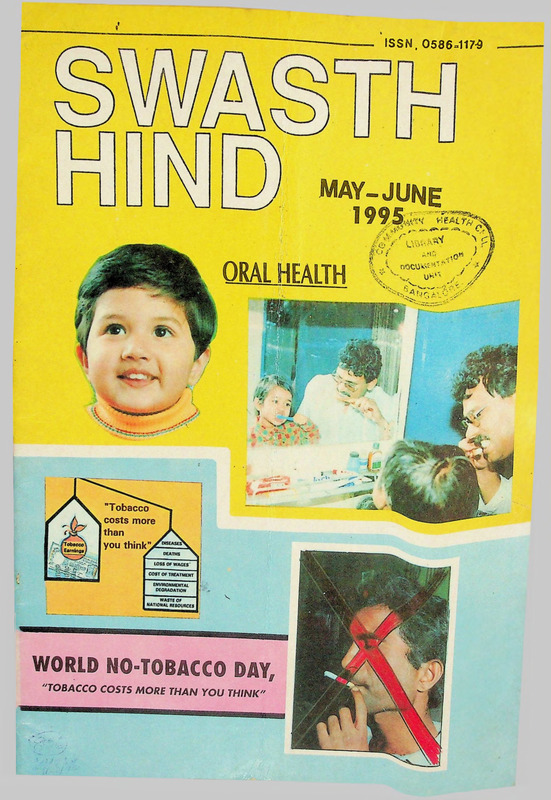
- Title
- THE PROBLEMS OF ORAL HEALTH IN INDIA
- extracted text
-
ISSN, 0586=1174
In this issue
Page
swasth hind
Jyaistha-Sravana
Saka 1917
May-June 1995
Vol. XXXIX. No. 5-6
OBJECTIVES
Swasth Hind (Healthy India) is a monthly journal
published by the Central Health Education Bureau,
Directorate General of Health Services’, Ministry of
Health and Family Welfare, Government of India.
New Delhi. Some of its important objectives and
aims are to:
REPORT and interpret the policies, plans, pror
grammes and achievements of the Union Ministry
of Health and Family Welfare.
ACT as a medium of exchange of information on
health activities of the Central and State
Health Organisations.
FOCUS Attention on the major public health pro
blems in India and to report on the latest trends in
public health.
KEEP in touch with health and welfare workers
and agencies in India and abroad.
REPORT on important seminars, conferences, dis
cussions, etc. on health topics.
Editorial and Business Offices
Central Health Education Bureau
(Directorate General of Health Services)
Kotla Marg, New Delhi-110 002
Head Editorial Division &
Dr Anil Kumar
Technical Advisor
Edited by
M. L. Mehta
M. S. Dhillon
Assisted by
G. B. L. Srivastava
K. S. Shemar
Cover Design
Harbhajan Singh
Cover Photo
O. P. Kataria
The problems of oral health in India
Dr A.T. Kulkarni
Dr (Brig) N.L. Sach deva
Oral health for healthy life—Some oral
problems
Dr (Brig) S.K. Ganguli, Dr (Smt) R.P. Rege &
Dr (Smt) S. Ayyar
Role of diet and nutrition in oral health
Dr Nasib Chand Mann
Oral Health and primary health care
Dr R.V. Awate, Prof. PA. Somaiya,
Prof AC. Urmil
Need for community oral health in India
Dr Keki M. Mistry
Dental health education and oral health *
Poonam Khetrapal Singh
“Tobacco costs more than you think”
—Backgrounder
The economics of tobacco
'*
Nine reasons for taxing tobacco
The global economic burden of tobacco
Tobacco consumes your life and money—Act
now
Dr Anil Kumar
\
*
Combating tobacco menace—The homoeopathic way
•
Prof. (Dr) Chaturbhuja Nayak
The health, economic and social costs of
smoking
Dr C. Shyam. Dr P.V. Prakasa Rao &
Dr V.S. Singhal
Tobacco use and health professionals
Dr Jugal Kishore & Dr Indu J.K.
Tobacco and smoking: Some salient facts
and figures
Dr A.C. Urmil, Dr PA. Somaiya •&.
Dr V.R. Gupta
The role of media against tobacco and smoking :
A critical review
Dr (Col) A.C. Urmil, Dr PA. Somaiya &
Dr P.M. Durgawale
62
65
66
68
69
74
77
80
83
85
87
90
92
96
98
100
Articles on health topics are invited for publication in this Journal.
State Health Directorates are requested to send in reports of
their activities for publication.
The contents of this Journal are freely reproducible.
Due acknowledgement is requested.
The opinions expressed by the contributors are not necessarily
those of the Government of India.
SWASTH HIND reserves the right to edit the articles sent
for publications.
Subscription Rates
Single Copy
.
...
Annual
....
This .Issue
.
.
.
(Postage Free)
.
50 Paise
Rs. 6.00
Re. 1.00
DR A.K. MUKHERJEE
DIRECTOR GENERAL OF HEALTH SERVICES
Tele:
3018438 (O)
3019063
655930
(R)
frnfri to
’ni faroft - 110 011
DIRECTORATE GENERAL OF HEALTH SERVICES
Nirman Bhavan
New Delhi-110 011
MESSAGE
Diseases of the teeth and adjacent oral structures are among the most
widespread maladies affecting human beings. Conventionally, dental
care has been based on the Western model of expensive, sophisticated,
high-tech treatment-oriented approach. Several recent advances offer
us great scope for effecting a transformation of the quality of oral health
care. A comprehensive plan for a National Programme has been draf
ted; and to test that approach, a Pilot Project has been approved for
launching in 1995-96 in five selected districts—one each in the different
zones of the country.
The Project aims at effecting a reorientation towards prevention and health promotion through an
alternative approach geared to tackle the problem of oral diseases at its incipient stage which would be in
keeping with the Primary Health Care concept Under this Prevention-Oriented Pilot Project, a Community
based strategy with a multi-sectoral approach has been developed in order to ensure optimum benefit to
the community in an appropriate, accessible, acceptable and affordable manner. Central Health Educa
tion Bureau has been entrusted the responsibility as the nodal institution for implementing the
programme.
Our objective is to encourage the people to feel responsible for maintaining a state of positive oral ’
health. This would be a very cost-effective approach. Recognising the limitation in access to organised
dental care for the majority of our population living in rural areas, the Project focusses on the oral health
needs of these rural and tribal communities. Available facilities for early detection and treatment are
being streamlined and focussed on high risk groups like school children, handicapped, expectant mothers,
elderly etc.
Oral cancer is the leading cancer in males and the third leading cancer in females in South East
Asia. 90% of oral cancer in our part of the world is directly attributable to chewing and smoking of tobac
co. Unlike in the Western Society, nearly half of the tobacco consumption in this country is in the form of
chewing tobacco, pan masala, khaini, snuff etc. Oral cancer is amenable to primary prevention, which is
the most cost-effective approach. We have developed facilities for early detection and prompt treatment
which can result in longer survival rate. We need to strengthen Cancer awareness in the com
munity. The draft of a comprehensive anti-tobacco legislation is under active consideration.
The Special Issue of Swasth Hind on ORAL HEALTH & WORLD NO-TOBACCO DAY—1995 is yet
another step in the efforts of the Directorate General of Health Services to create increasing awareness on
these important public health challenges among all health personnel and opinion makers in the com
munity. I hope that the readers would ensure that the messages are widely disseminated in the
community.
A—
(DR A.K. MUKHERJEE)
May—June 1995
61
The Problems of
Oral Health in India
DR A.T. KULKARNI
Dr (Brig) N.L. Sachdeva
ral health and general health
O
care is inseparable. Because
oral diseases—dental caries, perio
dontal disease, oral cancer, may be
manifestation of or an aggravating
factor in some more wide spread
systemic disorder. There
are
numerous problems in developing
a concept of positive oral health.
Early symptoms of oral disease
often are unnoticed or considered
to be of little significance, although
various surveys in different parts of
India have shown that periodontal
diseases have a high prevalen
ce. It is said that every second per
son above 35 yrs. of age has pus
oozing gum pockets. The disease
starts very early in life with bleed
ing from gums. In India, 80% of
teeth extracted after the age of 30
years are due to periodontal
diseases.
Periodontal diseases arc among
the most wide-spread diseases of
the mankind. It has been esti
mated that gingivitis affects 80% of
the young children and almost
entire adult population of the world
have experienced gingivitis or more
serious form of the disease.
The father of Microscopy,
Antoni Van Leeuwinhock, in a let
ter to the Royal Society of London,
on 17th September 1683, reported
62
his startling earliest findings Le.
“There are more animals living in
the uncleaned matter on the teeth
in one’s mouth than there are men
in the whole kingdom, especially in
those who never clean their
mouth....” . He was indeed only
underlining the malady of perio
dontal diseases recognised and
documented in every culture, as
revealed by paleontologic studies
in relation to ancient Egypt
Oral health is concerned with
functional efficiency of not only the
teeth and supporting structures, but
also of the surrounding parts of the
oral cavity and of the various struc
tures related to mastication and
maxillo-facial complex (WHO,
1970).
The chronic, recurrent, irrever
sible, cumulative and prevalent
nature of oral diseases have con
tributed to the wrong belief that
oral problems are invitable and are
not preventable.
Objectives for 2000
Global objectives for oral health
have been established in context of
health for all by the year 2000, after
careful review of available infor
mation.
In 1979, W.H.O. adopted the
target for 2000 AD. of no more
than 3 decayed, missing or filled
teeth at 12 years of age. In
collaboration with a special work
ing group of International Dental
Federation (FDI) four other targets
were added in 1981.
Age (in yrs.)
Targets
5—6
50% should be free of
dental caries.
12
3 or fewer decayed,
missing or
filled
teeth.
18
85% should retain all
their teeth.
35—44
50% reduction in 1981
levels of edentulous
ness.
65+
25% reduction in 1981
levels of edentulous
ness.
Problems: Three most impor
tant oral diseases prevalent in
India are:
(1) Dental caries, (2) Perio
dontal diseases, (3) Oral
cancer.
Dental caries: The problem of
dental caries in India has been in
Swasth Hind
increase during the last four
decades in terms of prevalence of
severity. The prevalence was as
low as 37% in the 1940s with 1.5 per
manent decayed teeth per child on
an average. In developing coun
tries the general trend is for caries
prevalence to increase except
where prevention programmes
have been set up.
reduced dental caries by 50—
65%
(2)
(3)
Influencing factors
The most important factor in
causation of caries is suc
rose. Sweets are the children’s
favourites. Sweets are also con
sidered auspicious and exchanged
on celebrations or festive occa
sions.
Mehta and Arya (1981) made the
interesting observation that while a
cup of tea contains 0.25 mg of
fluoride, the calcium from the milk
binds the fluoride and hence
makes it unavailable for the
body.
Preventive Measures
(1) Fluoridation of public water,
supplies in concentration bet
ween 0.7 to 1.2 PPM fluoride
May—JUNE 1995
Were drinking water has a
very high fluoride content,
defluoridation should be car
ried out using Nalgonda
technique.
(4)
Promotion of oral hygiene
practices.
(5)
Periodic dental screening for
early detection and treat
ment
(6)
The recommended level of
fluorides in drinking water in
this country, is accepted as 0.5
to 0.8 mg per litre, in tem
perate countries where the
water intake is low, the
optimum level of fluorides in
drinking water is accepted as
1 to 2 mg per litre.
Cough lozenges also have a
deleterious effect on the teeth. A
decrease in salivary secretions due
to increased intake of tablets like
propronalol and diazepam in
creases the hazard of caries.
Very low levels of fluoride in
drinking water can result in dental
caries. A fluoride level of 0.7 to 1.2
PPM is required in drinking water
for prevention of dental car
ies. Higher concentration on the
other hand leads to dental and
skeletal fluorosis.
Mouth rinsing with dilute
solution of fluoride after mid
day meal for school child
ren—-can reduce incidence of
caries by about 35%.
(7)
Foods—such as sea fish,
cheese, tea are reported to be
rich in fluorides.
(8)
People must understand that
fluorine as a trace element is
essential for the normal
mineralization of bones and
for formation of dental
enamel.
(9)
Control on the sale of sweets
and candies near schools is
also to be considered.
Periodontal diseases
Periodontal disease is the
greatest single cause of tooth loss in
India. All forms of periodontal
diseases are definitely preven
table. It has been estimated that
gingivitis affects 80% of the young
children and almost the entire
adult population of world have
experienced gingivitis or more
serious form of the disease.
The significance of these dis
eases lies in the fact that these dis
eases are the major cause of tooth
loss all over the world.
Many scientific studies have
been undertaken in various parts of
the world, from among backward
societies in poor regions of Africa
and Asia to advanced modem
Scandinavian countries, among
different occupational groups like
unskilled labourers to corporate
executives. Nearly all the studies
bring out certain factors which
need to be understood by the public
at large. These are :—
(a)
Age: Gingivitis is the prin
cipal form of the disease
among children, the pre
valence of gingivitis in
children 6 to 13 yrs of age
varies from 35 to 99.4 per
cent. Advanced periodontal
disease/bone
damage
is
essentially the disease of
adults being 80 to 95% in peo
ple aged 55 yrs and above.
(b)
Oral hygiene: The
pre
valence as well as intensity of
the diseases rises as the oral
hygiene status of com
munities declines. This is
ascribable to the number and
variety of bacteria present in
unclean mouths. While bad
smelling breath is relatively
indocuous outcome of bad
oral hygiene, latter leads to a
cumulative silent destruction
of periodontal tissues.
63
(c)
(d)
(e)
(f)
64
Socio-economic status: Pre
dictably, the disease pre
valence is higher as well as
worse in intensity among
lower socio-economic groups.
Better education, better social
awareness, ability to afford
dental treatment and above
all a positive attitude towards
belter oral hygiene lead to bet
ter periodontal status of ad
vanced societies.
Personal
habits: Personal
habits like smoking have a
definite delitcrious influence
in initiation as well as wor
sening of periodontal dis
eases. Similarly those with
habit of chewing tobacco
have a higher incidence of
these diseases. The tobacco
smokers and chcwers usually
have a poor oral hygiene.
Betel leaf and betel nut is also
responsible for these dis
eases.
_
Mouth cleansing habits: Effi
cient tooth cleansing has been
demonstrated repeatedly to
be important in maintaining
periodontal health. Proper
use of tooth brush, in correct
manner, in higher socio-eco
nomic groups account for bet
ter periodontal health in these
groups.
Diet and Nutrition : Contrary
to. popular belief, nutritional
status plays no significant
role in initiation of periodon
tal diseases except in cases of
extreme malnutrition. Fur
ther, there is no significant
relationship to specific nut
rient deficiencies except that
Vit B complex and “C”
deficiency states may lead to a
higher periodontal diseases
proneness. However, physi
cal characters of the diet are
known to be influencing the
onset and progress of these
diseases.
(g)
(h)
(i)
Drugs: Several drugs inclu
ding contraceptive hormones,
cortico-steriods, anti-epileptic
drugs and anti-cancer drugs
are known to influence the
course of periodontal di
seases.
Other Oro-dental conditions:
Irregular
alignment
and
crowding of teeth is com
monly associated with perio
dontal diseases. Interestin
gly front teeth have maximum
proneness for periodontal
diseases.
Other habits: Habits like
clenching and tapping of
teeth, tongue thrusting bruxism (rubbing of jaws over
each other usually during
sleep), mouth breathing etc.
are known factors which
initiate as well as perpetuate
periodontal diseases.
Influencing Factors
Studies by Marshall'Day (1944),
Mehta et al (1953) and Mehta et al
(1956) show that socio-economic
status docs not influence, pre
valence of periodontal diseases.
No significant difference has
been observed on comparing the
urban and rural distribution as
indicated by Mangi (1966), Vacher
and Gupta (1967) and Vijay Kar
and Nayak (1981).
The single most important factor
associated with periodontal dis
eases is “Oral Cleanliness” Already
formed dental calculus further
reduces the effect of oraj hygiene
measures. Habits such as smok
ing and betel leaf chewing are
found to be related to higher pre
valence and severity of periodon
tal disease.
People with systemic diseases
and malnutrition may be prone for
periodontal disease.
Preventive Measures
(1)
Rinsing of mouth with plain
water after each meal and
regular brushing of teeth par
ticularly before going to sleep
at nigh and after rising in
the morning.
(2)
Use of paste in preference to
powder with tooth brush.
Those who cannot afford
tooth-brush, can use datun
(Chew-stick).
(3)
Finger massage
and teeth.
(4)
Calculus when found should
be removed by dental hy
gienist.
of
gums
Oral Cancer
Cancer of tongue, mouth and
pharynx is an important oral
health problem in India. Cancers
that chiefly affect the third world
countries are those of uterus, cervix,
oral cancer, oesophageal cancer
and liver cancer. The World
Health Organisation (WHO) ex
perts warned that oral cancer might
become an epidemic in South-East
Asia, unless the current trends of
cigarette smoking and tobacco
chewing habits are slowed down
or reversed.
(Contd. on page 73)
Swasth Hind
ORAL HEALTH FOR
HEALTHY LIFE
—Some oral problems
DR (BRIG) S.K. GANGULI,
DR (MRS) R.P. REGE &
DR (MRS) S. AYYAR
RAL health has a profound
influence on general health of
a person. Efficient mastication
which is so essential for digestion
of food is of course solely depen
dent upon the full complement of
sound teeth, which also depends
upon healthy gums.
O
Vitamin Deficiencies
Riboflavin (Vitamin B2) Defi
ciency is widespread in India.
The most common lesion associ
ated with it is angular stomatitis.
Other clinical signs suggestive
include cheilosis, glossitis which
are also present in folate deficien
cies. ViL C deficiency leads to
bleeding gums.
Oral Cancer
Oral cancer is one of the ten most
common cancers in the world. It
is a major problem in India and
accounts for 8-12 precent of cancer
incidence by site (1). Tobacco
chewing habit results in higher oral
cancer in our country. Alcohol
intake and reverse smoking
(chutta) is also a contributing fac
tor in certain areas.
roots of teeth and under the
gums.
Dental Caries
It is decay of the teeth. It is the
most widespread disease. Ex
cessive consumption of sugar and
other refined carbohydrates spe
cially in childhood is a major fac
tor. An acid forming action of
lactobacillus acidophilus on sugar
demineralises tooth structure (2),
the enamel disease and the den
tine. It is a multifactorial dis
ease.
Malocclusion
Abnormal tooth arrangement
and defects in fitting together of the
teeth on closing the jaws are called
malocclusion. Orthodontic treat
ment is aimed primarily at maloc
clusion that lies within the normal
range of variation.
Missing Teeth
Edentulousness and replace
ment of teeth will be of concern due
to ageing population and sequelae
of dental caries.
Periodontal Diseases
Oro-Facial Lesions
These are diseases of gum and
tissues in which teeth are embed
ded. Gingivitis and periodontitis
are the commonest. The gums
become swollen, spongy and red,
stand away from the teeth and
bleed, when brushed or even
touched. The important cause is
dental calculus deposited on the
It is known that numerous sys
temic diseases have oral manifes
tations. The oral mucosa can be
affected by any infecting agent, but
fungal, viral and bacterial infec
tions are pre-dominant sources of
problems. Aphthous stomatitis is
associated with stress and malab
sorption syndrome. Lichen planus
May-June 1995
is a common oral mucosal disease
of unknown etiology. A number
of oral conditions can be caused
by allergies.
Prevention
1. Oral hygiene is of paramount
importance to maintain oral
health. The following general
measures should be taken:—
(a) Regular brushing of teeth
and thorough rinsing of
mouth.
(b) Restriction of sugar intake by
children.
(c) A balanced diet.
(d) Topical fluoride application
(Fluoridated toothpaste)
(e) Periodical dental check up.
2. To eliminate tobacco chewing
habits intensive public education
and motivation to change lifestyle
are required. It will prevent oral
cancer. Early detection at precancerous stage also helps in treatment
and cure.
References
1. Annual Report 1983. National Cancer
Registry. Indian Council of Medical Res
earch. New Delhi.
2. WHO (1992) Techn. Rep
826.
Ser No.
D
65
Role of Diet and
Nutrition in Oral Health
Dr Nasib Chand Mann
IET and nutrition play a major
role in the maintenance of
Oral Health. The Oral Tissues arc
very sensitive to Nutritional Defici
encies and Dietary aberrations and
arc often the first tissues to show
the effects. The Oral Tissues
which arc more prone to the effects
of Nutritional Deficiencies are the
mucous membrane of the Oral
Cavity, the papillae of the tongue,
enamel and dentine. The effects
of nutritional deficiencies are
easily noticed on the mucous mem
brane whereas the enamel and den
tine present the fixed record of the
previous nutritional history of the
individual. The alveolar bone, the
gums and the tongue reflect the
present internal status of the body
accurately and quickly. Nut
ritious food and good eating habits
have proved to be better means of
improving and protecting oral and
dental health.
D
Importance of Nutrition & Diet
Nutrition and Diet are not only
important to the Oral Cavity but
play a most important role in main
taining the health and happiness of
the individual, thereby improving
the mental, physical, social and
psychological health of the indi
vidual. Although the food con
sumed may be qualitatively and
quantitatively adequate to meet the
various requirements of the body,
yet it may be below the normal
requirement of the body due to the
inability of an individual to utilise
various dietary components. The
dietary requirements in the grow
ing children are different than
those of the adults and vary with
age and body size, with the latter
being more important than the age
in this regard. The factors which
influence the oral health by nut
ritional means are abnormalities of
digestion, absorption, assimilation,
cndocrinal, genetic and heredity.
66
Constituents of an Adequate Diet
(c) It should be wholesome.
Optimum nutrition is essential
for optimum growth of the indi
vidual, and to maintain tissue
functions and the repair of the
damaged cells. The diet must
contain the following important
factors:—
(d) It should be rich in
fibres.
(e) It should have cleansing
effects.
(f) It should be palatable.
(i) Nutritional factors are chemi
cal substances which are sys
temic in their action. They
are absorbed by the digestive
tract and enter the blood
stream and are utilised by the
cells. These' may be of two
types:—
(a) Essential factors are those
substances that become
part of the cellular or inter
cellular structure i.e., pro
teins, carbohydrates, fats,
minerals and water.
(b) Accessory factors are those
substances which do not
become part of the cellular
or inter-cellular structure
of the body but are neces
sary for the regulation of
the body processes and for
the proper functioning of
the cells (vitamins and
minerals).
(ii) Non-nutritional factors of food
are concerned with the physi
cal character and local action
of the diet They help in
utilization of the diet by the
body, thereby promoting the
health of the individual.
Thus, the diet must satisfy the
following non-nutritional re
quirements:—
Effects on Oral Health
1. The diet affects the status of
oral health by systemic factors
through nutritional elements via
blood stream, thereby affecting the
formating cells of enamel and den
tine. Any deficiency in systemic
factors during the growing age in
children will lead to hypoplastic
changes in these hard dental
tissues.
2. The systemic factor of diet
affects the gingival tissues due to
oral debris and calculus which may
lead to periodontal diseases.
3. The deficiencies of the acces
sory factors of diet, such as
vitamins leads to various types of
ulcers in the oral cavity.
4. The physical character of the
diet is very important in the main
tenance of oral health. The
changes in the physical character
of diet brought by the adoption of
Western dietary pattern have re
sulted in the increased incidence of
dental caries, gum diseases and
malocclusion.
5. The systemic and local factors
of diet play a major role in the
growth and development of mas
ticatory apparatus.
(a) The diet must be bacteriologically safe.
6. It also has a major effect on the
structure and development of facial
bones and teeth and jaws.
(b) it should be chemically
clean.
7. It also effects the development
of dental occlusion.
Swasth Hind
Table I—Food retention potential of selected foods
Food
Table II—Caries potentiality of selected
foods
Food Retained
(Mg.)
Decalcification
potential
M
507
370
423
300
266
188
128
237 228
219
177
61
73
2
814
811
777
677
390
346
338
307
237
228
219
212
116
88
3
Food
Cookie (Fig.)
Date
Chocolate
Ice cream
Chocolate pudding
Toffee
White bread
Potato (boiled)
Cola drink
Apple
Orange soda
Orange juice (fresh)
Potato chips
Carrot (fresh)
Carrot (cooked)
IMPORTANT TIPS FOR
DIETARY CONTROL
1. Avoid forced feeding in child
ren as it may result in the develop
ment of hatred for food which may
subsequently lead to decreased
food in-take.
2. Since snacks are major sources
of refined and sticky sugars bet
ween meals, avoid them between
meals.
3. Discourage the use of choco
late milk or flavoured juices and
encourage the use of whole milk
but excessive intake of milk should
be avoided as it reduces the nut
ritional desire for other basic
foods. [Table 1 & 2|.
4. The distribution of biscuits,
cookies and toffees should be dis
couraged in the schools.
5. Avoid sweet desserts after
meals. If at all they are to be
taken, then the teeth should be
immediately brushed or there
should be thorough rinsing of
mouth with water.
May—June 1995
6. Guard against summer time
consumption of soft drinks, fruit
drinks, frozen pop stick and ice
creams etc. etc.
7. Avoid excessive intake of refin
ed carbohydrates.
8. Take fibrous, detergent and
wholesome foods particularly at
the end of the major meals which
causes stimulation of saliva, cleaniness and lesser dental plaque
formation.
9. Do not condone the chewing of
sugarless gum.
The structures of the oral cavity
react to dietary inadequacies and
nutritional deficiencies in very
early stages and are often the first
tissues to show these effects par
ticularly, if the deficiencies are subclinical. The oral cavity mirrors
the nutritional status of the body
because of their peculiar structural
components and show highly
varied range of responses and types
of tissue reactions at any one
time. In addition, the oral tissues
are constantly subjected to trauma
and irritation by mechanical, ther
mal and bacterial agents and
therefore are the first to react to sys
temic disturbances.
Honey+bread+bu tter
Chocolate-rlight honey
Sweet cookies (biscuits)
Danish pastry
Ice-cream
Marmalade
M a rmal ade-r- bread-r butter
Potatoes (boiled)
Potatoes (fried)
White bread-rbutter
Milk
Apple
Orange
Fruit juice
Lemonade
Carrot (boiled)
Caries
potentiality
index
24
21
18
ii
9
10
9
7
7
7
7
6
3
3
2
1
Improved nutrition is an impor
tant means of improving and pro
tecting oral and dental health.
Both dental caries and periodontal
diseases are affected systemically
or locally or both by inter-related
components, such as, the tooth or
its supporting structures the dental
plaque and the saliva ingestion of
soft foods may also result in shor
tening of jaws thereby leading on to
crowded and irregular teeth caus
ing esthetic and functional pro
blems. Dental caries and perio
dontal diseases will result in the
loss of teeth leading on to the dis
turbances in occlusal relationship
which in turn will result in lesser
masticatory function leading on to
emotional, psychological and soc
ial problems which may also affect
the
intellectual
development
Hence the role of diet in maintain
ing normal oral health should be
given due recognition while plan
ning any oral health care pro
gramme.
67
ORAL HEALTH AND
PRIMARY HEALTH CARE
DRR.V. AWATE,
PROF P.A. SOMAIYA & PROF A.C. URMIL
RAL diseases affect a very
high proportion of people
and, although the consequences
arc not fatal, they arc serious. In
addition to social and psychologi
cal consequences, the cost in finan
cial terms are considerable because
oral diseases arc chronic and
require regular treatment and rctreatment.
The situation is different for the
other wide-spread oral disease
periodontal disease. People from
developing countries have the
worst periodontal status, and there
is strong connection between perio
dontal disease & neglected oral
hygiene.
The challenging and exciting
fact is that the two main oral dis
eases, dental caries and periodon
tal diseases (gum-infection), arc
entirely preventable by currently
available measures viz— improv
ing oral hygiene, reducing sugar
consumption and stressing the use
of fluorides.
It is planned to achieve this goal
in the year 2000. A specially rele
vant single figure and a measurable
goal is the mean of 3 DMF teeth
at 12 years of age for children
of all the countries. All coun
tries should develop preventive
programmes and ensure co-ordi
nation of manpower and re
sources development.
O
Prevalence: On the basis of
epidemiological studies it was pos
sible to distinguish, five levels of
dental caries prevalence :
(i) Very low (only a few
decayed/missing teeth.)
(ii) Low.
(iii) Moderate.
(iv) High.
(v) Very High.
Studies of dental caries in
developing countries have shown a
great difference in’the DMF teeth
indices of their population. In
most of these nations, caries pre
valence is very low or low. Unfor
tunately the patterns are changing
very quickly and taking a turn for
the worse.
68
“Sound Teeth for All”
“Prevention
Cure”
is
better
than
Principal mechanisms for pre
vention consists basically of
weakening the cariogenic factors
and strengthening the resistance of
the tooth to caries e.g. to cut down
the quantity and frequency of con
sumption of sweet products.
Other measure include adding
fluoride to drinking water, salt
fluoridation, fluoridation of milk
or other nutrient.
Primary Health
Health
Care
&
Oral
WHO’s three level strategy for
planning oral health, emphasises—
the use of appropriate technology
(simple and inexpensive mate
rials); —-simple clinical measures
carried out by dental auxiliary per
sonnel; —specialist personnel to do
more complicated work at the third
referal level.
Adopting primary health care
approach will improve oral health
efficiently and cheaply, and at
the same time enhance general
health. Several
non-communicable diseases and oral diseases
have diet as a common risk factor :
a diet high in fat, sugar and salt and
low in fibre. Incorporating oral
health into general health pro
grammes will control other major
oral conditions, temporo-mandibular joint dysfunction, etc.
Health Education
Oral hygiene should be included
in the teaching of general hygiene
carried out by parents, teachers and
primary health workers, simple
messages like brushing teeth with
fluoridated tooth pastes, minimis
ing sweets in diet, awareness about
oral cleanliness will help improve
oral health.
Number of individuals reducing
or discontinuing their tobacco
habits, has been sufficient to show
a statistically significant increase
in “reduced” and “stopped the
habit” categories.
Hence consistent efforts, to edu
cate masses on oral hygiene;
dietary modifications, giving up
tobacco; are required at all level to
achieves “Sound teeth for all by
2000 A.D.” The WHO has aptly
chosen the theme for this year’s
W.H. Day, 7th April, as “Oral
Health for A Health Life—Now its
your Move”.
Swasth Hind
NEED FOR COMMUNITY
ORAL HEALTH IN INDIA
Dr Keki M. Mistry
E are living in a changing
world. The pattern of life is
changing. .Society is changing.
The overall population is increas
ing and within the population, the
relative age structure of society is
changing. The expectation of life
is rising and with increased health
care, nutrition, sanitation and relief
from communicable diseases the
relative improvement in general
health shows a glaring contrast to
the deteriorating situation in the
Held of oral health and dental
diseascs> To-day we arc faced with
all the problems of a developing
nation with a population far in
excess of the medically qualified
manpower needed to man its
Health Services, yet a population
growing increasingly aware of its
oral and dental health needs.
W
The twentieth century has seen a
steady increase in the amount of
treatment provided by the dental
profession in most parts of the
world. The rate of increase has
been particularly dramatic in the
past decade, with improvements in
the methods of operative pro
cedures in analgesia, in restorative
materials and with greater and
more efficient use of auxiliary per
sonnel. The effect of this trend
MAY—JUNE 1995
2— l/DGHS/ND/95
has however been largely offset, by
the continued increase in many
parts of the world, in the prevalence
of major dental diseases, caries and
periodontal disease. Surveys in
various parts of the world have
shown that taking the community
as a whole—a high portion of den
tal disease goes untreated.
severity of periodontal disease in a
group of 381 employees in Canada
found that although most of them
visited the dentist yearly—80%
needed moderate to extensive
scaling.
The Federation Dentaire Inter
nationale in its Dental Health
policy statement read at its General
Assembly in Athens, stressed that
“Dental Services which give prio
rity to the treatment of oral diseases
often do not reduce their prevalen
ce. Programmes for oral health
care must recognise the paramount
importance of prevention if they
are to be effective and economic”.
“Can traditional dental care still be
recognised
as
proper treat
ment?” The facts seem to indicate
that symptomatic dental treatment
is a highly ineffective means of
curing caries and periodontal
diseases.
Results of the international
collaborative study of dental man
power system in relation to oral
health status (1978) has shown that
the New Zealand school-based
dental care system has been suc
cessful only from "the restorative
point of view and has failed to show
any preventive gains. The study
showed that amongst the seven
nations compared, New Zealand
had the highest percentage of eden
tulous individuals in the 35-44 year
age group. Yet these were persons
who went through the school den
tal service programme. In the
study, New Zealand and Norway
have the school based dental ser
vices for children, but the oral con
dition of the adults examined in
these two countries did not show
any gainful evidence from the
school dental service.
Let us cast our glance at some
countries who have a well devloped
dental system and see if we can
learn
from
their
experien
ce. Freedman et al (1965) in an
assessment of prevalence and
Holst investigated the oral health
of children who have gone through
systematic school dental treatment
programme in Denmark. His fin
dings showed that caries pre
valence in children who went
69
through the programme was not
appreciably different from that in
children who did not attend the
programme. He concluded that if
treatment is to result in reduced
caries prevalence, it has to be more
preventive oriented.
Restorative approach fails
There is therefore sufficient
evidence to show that the restora
tive approach has failed in the
developed nations in many of
which large sums of money have
been spent on dental care; mostly
in the form of restorative pro
cedures and yet there is still a lot of
untreated dental diseases in the
communities. It
has
been
established that relatively few of
the regular a Renders consume the
greater portion of dental care funds
and this they do mostly on restora
tive procedures. For example, in
Sweden, 15% of the patients con
sumed 50% of the cost of dental
care in 1975. (Tan-diekatidningen
1977) and in the U.S.A, only 10% of
the population has been found to
consume about 75% of the total
expenditure for dental care.
(Newman arid Anderson, 1973).
From the foregoing observations,
it is apparent that developing
nations, most of which are still in
the planning stages of their
national dental services, should
learn from the mistakes of the
others and concentrate on a vey
basic care of prevention—cfental
health education and on the role of
units—of community or public
dental health. Let us analyse the
dental diseases with which the pro
fession is concerned and the
methods
of preventing
and
treating them.
Sheiham (1981) from the Depart
ment of Community Dental
70
Health, the London Hospital
Medical College states “The pre
valence and severity of the two
major diseases mainly caries and
periodontal disease are related to
diet, hygienic behaviours of
individuals and social and en
vironmental factors. The diseases
can be prevented by changes in
food quality, diet, oral hygienic
behaviours and by the use of
fluorides. ’Treatment
involves
behavioural, economic and politi
cal decisions and the success of
treatment on an individual level
depends
on
the
preventive
behaviour of the patient and the
skill of the operator and at com
munity level, it is apparent that suc
cess can only be achieved by
collaboration
with
social,
behavioural, environmental and
economic factors which are the
major determinants of dental dis
eases,
their prevention and
treatment”
Socio-cultural association
The socio-cultural association
between betal leaf, tobacco and
mouth cancer has already been
established. The treatment and
prevention of malocclusion has a
very important social component
and the acceptance of dentures is
often affected by psychological and
social factors. Finally an assess
ment (as noted earlier) of the ability
of dental treatment to meet the
needs of populations indicates that
even in countries with dentist
population ratios of 1:1500 there is
a considerable amount of un
treated diseases.
If dental health programmes are
to achieve their aims in the
developing nations, then the set
tings of such programmes should
be such that their objectives are
relevant to the dental needs of the
communities. Let us therefore
have a clear definition of what is
community/public dental health.
Definition: “Community dental
health is that branch of dentistry
which is practised in relation to
populations and groups, which
derives from epidemiology an
awareness of services required and
which includes the development of
the techniques necessary to
organise the application of these
services for the benefit of the
population. ”
Its concerns include the health
and sickness behaviour of indi
vidual seeking care, their reactions
to that care and evaluation of the
effectiveness of the care pro
vided. Community dental health
encompasses a number of dis
ciplines and techniques. They
include epidemiology, biostatics,
economics, political science and
the behavioural sciences, planning
and administration.
Growing need
manpower
of
oral
health
The need for oral health man
power trained in dental public
health are constantly increasing
and will no doubt continue to do so
in the future. Five factors are
largely responsible for these grow
ing needs:
1. The rapid increase of the
worlds population.
2. The rising personal expec
tations and demands for oral
health care.
3. The facts that Govern
ments are assuming greater
responsibility for personal as
well as community health,
with the result that health
care systems are becoming
more
oriented
towards
public health.
Swasth Hind
4. The rapid improvements
being made in dental public
health technology equipment
and development of effective
mass preventive measures.
5. The fact that the cost of com
prehensive treatment of caries
and periodontal disease is
becoming prohibitive even in
the richest of the world
economics, calls for cheaper
and more effective oral health
care systems which pre
sumably can only be achieved
through a public health
approach.
Need for training in dental public
health
The growing awareness of
Government’s responsibility to
provide health care for all has led
to an increasing interest in the pro
motion and enforcement of public
health services in which dental
public health care is an integrated
part The trend towards more and
more government sponsored dental
public health programmes makes it
important that all dentists includ
ing those who will be engaged
solely or primarily in private prac
tice be much better prepared to fit
into the society of the future.
There is need therefore for
increased opportunities and em
phasis on dental public health
training in both undergraduate and
postgraduate levels.
The number of institutions pro
viding postgraduate training in
public health in the world today is
approximately 125 with 100 of these
being located in Europe and North
America. Only six of these
schools offer special courses in
dental public health. There are
relatively only a few dental
MAY—JUNE 1995
educational institutions which pro
vide post-graduate training in
public dental health.
With the extremely low number
of schools of public health in the
developing part of the world, most
dentists from these countries are
forced to obtain their post
graduate training in dental public
health in developed countries of
the world like the U.S.A., Europe,
U.K., Australia and New Zealand
and in schools which provide cour
ses that are not necessarily geared
to the situation for problems which
prevail in their home coun
tries. Therefore the need to edu
cate dental professionals in
community dental health is an
added justification for establish
ment of a community dental health
unit. There are three further
reasons for establishing such a
department. First, many dentists
in general practice or in salaried
services did not have a good
grounding in community dental
health when they were under
graduates. They require continu
ing education courses. Secondly,
dental associations, government
departments
and
community
groups frequently require expert
advice on dental services. This
advise can best be given by
experienced personnel working in
the department Thirdly, in order
to impart the principles and techni
ques of community dental health it
is considered necessary to have a
Community
Laboratory. The
Community Laboratory should
consist of a well defined com
munity close to a community
health unit In co-operation with
the community, field trials of new
preventive and therapeutic mea
sures can be conducted and a com
munity profile can be developed.
Social and dental surveys can be
undertaken, health education car
ried out, treatment for priority
groups instituted and an evaluation
can be done of the effectivness of
the dental services.
FUNCTIONS OF A DEPART
MENT OF COMMUNITY DEN
TAL HEALTH
1.
The assessment of the needs for
dental
services
in
the
community
In order to assess dental health
knowledge and habits among the
people, a social survey should be
carried out, the nature of which will
be determined by the complexity of
the population structure. This
survey should take the form of a
simple
questionnaire/interview
type of survey designed to assess
the dental knowledge and habits of
the population. The question
naires would be distributed by
interviewers who would go from
house to house and make sure that
respondents complete the forms
properly and in the case of illiterate
respondents,
the
interviewers
would help to complete the forms
after interviewing such respon
dents. Where the populations are
too large to be covered by the sur
vey, a random sampling method is
suggested. The findings from this
survey will determine the priorities
and objectives of the programme.
2. The detection and control offac
tors which are inimical to dental
health and well being, Planning
and administration of prog
rammes
The department must be able to
plan and administer appropriate
prevention and control program
mes for a community after assess
ing the oral disease levels.
71
The role of dental health educa
tion in the Prevention of dental
diseases in the developing nations
should be well researched. Local
dental health needs, . knowledge
and habits and the level of literacy
in the society are key factors to be
considered when planning dental
health programmes. There must
be* a correlation between dental
health knowledge and oral health
habits. To establish this correla
tion there should be continuous
assessment of oral health status by
means of intra-oral examina
tions. A positive correlation is
obtained when possession of dental
health knowledge tallys with good
oral health and a negative correla
tion when possession of knowledge
does not tally with good oral
health. A negative correlation
indicates a failure of the pro
gramme.
3. Determination of priorities and
statement of objectives
Determination of priorities is
essential because this is the stage
when target groups would be deter
mined. These are groups most
likely to benefit best from dental
health education. In the develop
ing countries, resources for dental
health education programmes are
likely to be limited and it is quite
reasonable to spend these limited
resources on groups that would
benefit most from the pro
grammes.
The objectives of any dental
health
education
programme
should be clearly defined before
the programme is stated. While
72
objectives are being established,
yardsticks for measuring their
attainment should also be stated.
4. Determination
of
available
resources for programme imple
mentation
Resources available for chosen
programme implementation must
be properly determined before
execution
of any program
me. Such
resources
would
include types of manpower and
materials needed for programme
operation as well as available
finance. The areas of manpower
and materials are extremely impor
tant and should be well-handled.
Very often huge sums of money
have been spent on dental health
education programmes without
yielding good results, simply
because the material xand man
power aspects of the programmes
were not properly chosen.
5. Monitoring and evaluation of
programmes
The department must con
tinuously monitor and evaluate to
judge the efficacy of given pro
grammes. The evaluation should
not be only at the end of each pro
gramme but also during the pro
gramme (intermittent pilot evalua
tion).
This intermittent pilot evalua
tion during programme operation
are suggested so as to detect pitfalls
which may mar the success of the
programme. Such
intermittent
evaluations
would
indicate
necessary modifications in the
manpower and material appro
aches in the programme. Using
the yardsticks laid down for evalua
tion during establishment of objec
tives, a final evaluation would
indicate if the objectives have been
achieved or not The final evalua
tion is a type of survey similar to the
one done to assess the knowledge
and habits of the people. This final
evaluation would determine if
there is need for re-establishment
of priorities and objectives and
reprogramming.
6. Establish and maintain a Com
munity Laboratory (as explained
above) in collaboration with the
health authorities.
7. Co-ordinate and participate in the
teaching ofpublic health and pre
ventive practices to students,
teachers, health visitors, health
educators, dietitians, nurses and
doctors.
The co-ordination role is impro
tant and should include setting up
inter-disciplinary courses in the
social and behavioural aspects of
dental treatment etc. Members of
the department should actively par
ticipate in lectures and seminars
given by other departments. The
department should establish con
tact with various members of the
community, with dentists and other
health
workers. Continuing
educational courses for dental
practitioners can be offered. It
can become a center for post
graduate courses in community
dental health.
Swasth Hind
Having described the functions
of the Community Dental Health
Units, let us see what the personnel,
i.e., the specialists in community
dentistry should be or do in the
Units to be able to carry out
these functions:
4.
1. Have an understanding and
knowledge about planning,
implementation,
operation
and evaluation of public
programmes.
2. Understand the basic con
cepts of research design.
epidemiology and biostatis
tics. They should be able to
perform critical evaluations
of the dental literature, pre
pare scientific reports and
research protocols and be
able to apply scientific prin
ciples of research when con
ducting evaluations of public
health programmes.
3. Be able to plan and
administer appropriate pre
vention and control program
mes for a community after
5.
assessing the oral disease
levels.
There are three approaches to
manage dental diseases and pro
blems within populations.
Understand
the
orga
nisation, delivery and financ
ing of dental care programme,
be able to participate in the
process of programme deve
lopment and to have the skills
necessary to evaluate the
organisation and financing of
current and future care pro
grammes.
The first is the traditidhal dentist
patient approach. Because of the
professional manpower involved,
there is data to show that this
approach cannot control the dental
problem in India.
Be able to improve the supply,
the distribution and utiliza
tion of dental manpower and
be capable of administering
funds for dental programmes.
The third is the community
health approach in which the first
and second approaches are com
bined to give a maximum advan
tage to the affected population and
it is here that successful establish
ment of a community dental health
unit staffed by individuals with
special skills in community dental
health is indicated. In such an
environment, dental professionals,
specially trained oral health per
sonnel and other professional
health wokers could work in har
mony with the community to
achieve realistic goals.
Three Approaches
Having considered the major
determinants of dental health and
the present shortcomings of the
dental services to cope with dental
diseases, it is obvious that more
attention must be paid to methods
directed at populations as well as
individuals.
The second approach is based on
public education and prevention,
using health workers and other
members of the community.
(Contd. from page 64)
Oral cancer is one of the ten most
common cancers in the world. In
Bangladesh, India, Pakistan and
Sri Lanka it is the most common
cancer and accounts for about onethird of all cancers. More than
1,00,000 new cases are detected
every year in South and South-East
Asia, with very poor prospects of
survival. (
)
As early as in 1902 attention was
drawn to a possible relationship
between tobacco-chewing and oral
cancer in India. Statistics show
that for the past few years, there has
been an alarming increase in the
incidence of oral cancer in India,
especially in Uttar Pradesh, Bihar
and West Bengal. Tobacco-chew
ing might be one of the responsible
factors. WHO surveys suggest
that one single major health
May--June 1995
hazard related to tobacco-chewing
is the oral cancer. Oral cancer
accounts for 38% of all body can
cers in India.
Preventive Measures
Smoking should be avoided.
Betel leaf and nuts should not
be used.
3. Tobacco chewing in the form
of Quid should be stopped.
4. Physical irritation from sharp
teeth, broken teeth, ill-fitting
dentures etc., should be
brought to the notice of the
dentist.
1.
2.
5. Periodical screening should
be done for early detection of
oral cancer.
Primary oral health care would
consist of effective ways of teaching
and promoting self care, of involv
ing communities in oral care
decisions and of developing educa
tion and instruction packages for
different groups.
Plea for Health Education
Dr. Helmet Sell, , Regional
Adviser of the World Health
Organization, said that any pro
hibitive action by the Government
is perceived by the people as puni
tive rather than preventive. He
made a plea that social legislation
to be effective, it should be com
plemented by a strong health
education programme.
“The best way to stop smoking is
not to start smoking,” so says a
folder on Tobacco and Your
Health.
O
73
DENTAL HEALTH EDUCATION
AND ORAL HEALTH
POONAM KHETRAPAL SINGH
HE role of Dental Health
Education on Oral Health is of
paramount importance as it is the
sum total of all the experiences
which appreciably influence the
habits, attitudes and knowledge
relating to the individual and com
munity Oral Health. It is instruc
tion in the procedures and prac
tices necessary to maintain healthy
oral health and motivation to con
tinue these practices throughout
life.
T
The imparting of Oral Health
Education does not merely imply
instructing a patient to clean his
teeth or not to take snacks between
meals but it embraces the whole
concept of making a person more
aware of the value of oral health
thereby placing him in a frame of
mind where he is prepared to spend
time and money to attain a normal
level of Oral Health.
Dental Health Education is a
dynamic ever changing process of
development in which a person is
accepting or rejecting new informa
tion, new attitudes and new prac
tices and is a process of continuous
change within the human orga
nism directly related to achieving
personal and community oral
health goals.
74
II.
Objectives of Dental Health
Education
The main objective of Dental
Health education is the giving of
information about oral health and
motivation for the continuance of
these procedures throughout life.
Dental Health Education can be
carried out on a community level or
on an individual basis but the two
are quite different in objectives and
motives. The objective of com
munity dental health education is
to disseminate knowledge and
affect group attitudes, while that of
individual dental health education
is to motivate the recipient to act
upon that knowledge. Thus, com
munity education should produce
on awareness of the problem
within the community being ser
ved. It is an attempt made to
create an interest and develop a
favourable climate so that change
becomes socially acceptable.
III.
Guiding Principles
The Dental Health Education
may be imparted either on in
dividual basis or it may J)e done in
a Dental Clinic or on a group basis
as in the case of School Dental
Care Programmes or Community
Programmes. However, the fol
lowing basic principles should be
kept in mind while formulating any
Oral Health Education Pro
gramme :
1.
The information on Oral
Health must be authentic and
based on established scien
tific facts.
2.
It should be presented in a
dignified manner.
3.
The information material
should be selected and pre
sented according to the needs
of the particular group it is
desired to reach.
4.
It should be presented in a
popular and easily understan
dable form.
5.
Oral
Health
information
should be emphatic interest
ing, colourful and familiar to
the audience.
6.
Within certain limits, fear
may/prove to be an effective
means of motivation in Den
tal Health Education because
fear of pain* and illness is one
of the strongest motivating
forces of mankind. Pride in
personal appearances, self
improvement and desire for
comfortable and efficient are
additional factors of moti
vation.
Swasth Hind
7.
Information about health is
ineffective if the motivation, it
produces results in dissatis
faction and disappointment
IV.
Individual Dental Health Edu
cation
5.
A. Motivation
1.
2.
3.
4.
Most of the measures neces
sary for the prevention of
Dental Diseases have to be
carried out by the patient dur
ing his daily life which
requires a change in his man
ner of living which in turn
requires considerable and
prolonged effort or per
suasion. A person’s outlook
is built up of personal experi
ences gained throughout life
and any change in behaviour
will depend more on their
attitudes and beliefs and their
own evaluation of the change
than on providing of simple
information.
The forces that motivate
actions are the result of con
jugation of his inner personal
feelings and the external fac
tors.
Although Oral Health Educa
tion on an individual basis
would affect the patient’s per
sonal beliefs but only com
munity education would
bring about a change in group
attitudes so that these per
sonal beliefs could be tran
slated to actions.
It is not easy to ,change the
oral hygiene and eating
habits of people unless some
strong motive is created.
MAY—JUNE 1995
In order to motivate people to
use knowledge, it is necessary
to appeal to human emotions
such as pride in personal
appearance, ambition for self
improvement, desire for com
fortable and efficient mastica- .
tion and fear of pain and
illness.
6.
Recognise and control coun
terfeelings.
7.
There is an interdependence
of individual and community
Denial Health Education.
Dental Health Campaigns on
a community basis can pass
information as news which
affects community leaders
and opinion formers and can
sensitize a population so that
group attitudes are tem
porarily favourable to the
type of face to face influence
that individual education
brings.
Thus,
Community
Dental
Health Education will open minds
to receive Individual Dental Health
Education which in turn, may then
produce a lasting change.
4.
Disclosing solutions be used
for demonstrating the ade
quacy of or otherwise of the
patients oral hygiene techni
ques. (Fig. 1)
5.
Modem plaque monitoring
devices should be used to
explain to the patients the
effectiveness of oral hygiene
techniques (Fig. 2). These
are very important means of
imparting Dental Health
Education in Oral Hygiene.
C.
Nutritional and dietary in
structions
1.
The most effective means of
controlling Dental Diseases
may still be the proper regula
tion of food intake.
2.
The patient must be given
personal advice based on
knowledge of the patient
dietary pattern.
3.
Effect of eating between
meals of biscuits and sweets
on Oral Health should be
explained with the help of
charts and models.
4.
The eating of sweets after
meals is a potential cause of
extensive caries activity.
5.
The role of infant feeding and
dietary supplements on the
development and
main
tenance of Oral Health is to
be explained to the mother
who should be warned about
the use of proprietary food
supplements.
B. Oral Hygiene Instructions
1.
Correct method of brushing
of teeth with correct type of
tooth brush and tooth paste
should be demonstrated on
the patient as well as on the
models. Audio visual aids
may also be used for this
purpose.
2.
Rinsing after every meals
should be encouraged.
3.
Chewing of fibrous foods
should be advocated.
75
6.
The role of well balanced diet
with proteins, fats, vitamins,
minerals, etc. should be
stressed.
8.
To instruct children to con
ceive and improve dental
health through motivation
based on knowledge.
V.
School Dental Health Educa
tion
9.
To improve the individuals
dental health status, thus, pro
viding better dental health for
this general and future gene
rations.
Dental Health Education Pro
gramme for children in schools
should have the following objec
tives:—
1.
2.
3.
4.
5.
6.
7.
76
To help every child to
appreciate the importance of
a complete set of teeth in a
healthy mouth.
To show the relationship of
dental health to general
health.
To encourage good dental
practices, including personal
dental hygiene avoiding acci
dents to teeth and habits
harmful to the growth and
development of teeth and
jaws.
To encourage children to see
and accept regular periodic
dental check up and treat
ment. including correction of
defects by remedial and pre
ventive and protective measu res.
To enlist the cooperation of
parents in these efforts to
obtain adequate dental care.
To provide authentic infor
mation concerning diet and
nutrition for optimum gene
ral health as the specific
references to dental health,
To provide learning experien
ces for the purpose of in
fluencing knowledge, attitu
des and conduct relating to
dental health.
10. Regular check up of children
on prescribed proformas,
Curative and Preventive Den
tal Health Care Services to the
children in Mobile Dental
Clinics Vans in the school
premises itself.
The Punjab Government has
already developed a module and is
already implementing an Intensive
Dental Health Care Programme
for School Children which can
serve as a model for other States
of India.
VI.
Community
Education
Dental
Health
There are many ways of ap
proaching a population on a com
munity basis through organisation
of special Dental Health Pro
grammes:
1.
Ante and post-natal clinics.
2.
Dieticians can be contracted
to ensure that their advice vfrill
include the problems of
Oral Health.
3.
Organisation of Special Den
tal Health Fortnights (Fig.
3).
4.
Welfare officer and home
visitors are particularly well
equipped to give people
advice and guidance for they
are actually able to enter the
living situation and can
attempt to modify them.
5.
Professional
Associations
and non-Govt. Associations
can be sought for propagating
Oral Health.
6.
Training of Teachers in Den
tal Health Education (Fig.
4).
7.
Folk songs, poems and skits
on Dental Health should be
prepared and played.
8.
Exhibitions on Dental Health
should be organised to create
awareness amongst the peo
ple (Fig. 5).
9.
Pamphlets, folders and book
lets should be prepared and
distributed
amongst
the
people.
10. Radio and Television talks on
Oral Health should be fre
quently arranged.
11. Special articles in Press,
Magazines and Journals
should be published.
12. Special Essays, Paintings and
Health teeth competitions
should be organised. (Fig.
6)
The Punjab Health Department
is preparing and implementing
various programmes for .imparting
dental health education training to
the people and it is proposed to pre
pare a documentary film on
various phases of Intensive Dental
Health Care Programme which is
proving to be a major contributory
factor in improving the oral health
of the people.
Swasth Hind
BACKGROUNDER TO WORLD NO-TOBACCO DAY—31st MAY 1995
“TOBACCO COSTS MORE
THAN YOU THINK”
ORLD No-Tobacco Day
being observed on 31st May
each year is intended to sensitise
W
government, communities, groups
and individuals to become aware of
the problem and to take approp
riate action.
The World Health Organization
together with its member countries,
including India are committed to
prevent smoking related health
problems. That smoking is a risk
to health is a scientifically proven
fact today. Moreover the smokers
alone are not at risk, even the nonsmokers are equally at risk.
The World. Health Organization
since 1989 observes each year on
31st May, World No-Tobacco Day.
A theme is chosen each year to
highlight one specific area related
to tobacco problem. The theme
are making all out efforts to find
out new markets for themselves in
Asia, Africa, South America and
Eastern Europe. They are also
prevention of tobacco consump
tion, and the associated costs.
fighting against all efforts to reduce
make people realize that tobacco
consumption in such places as
Western Europe, North America
costs them much more than what
they think. This may motivate
and the South Pacific where aware
ness about ill-effects of tobacco use
people to quit smoking.
is widespread.
Thus tobacco com
ple economics that the money
panies seek to addict new genera
saved by not smoking can buy
40 increase
consumptions as well as maintain
its use among the existing tobacco
them some essentials, which they
lack. At national level no tobacco
use will help reduce morbidity and
users and to convert users of
tobacco in traditional ways into
mortality, thereby making more
resources available for develop
tions
of smokers
manufactured
using
ducts.
pro
We must, through our efforts
Perhaps,
the people are oblivious of the sim
mental use.
Besides, they are pursuad-
ing women to “liberate” themselves
Some Facts
from cultural inhibitions by smok
ing cigarettes.
Tobacco kills nearly 30 lakh peo
The Objectives
ple every year globally, and one out
of every five victims is from
The observance of a particular
Smoking leads to various
fatal diseases. These are cancer of
India.
for 1955 is “TOBACCO COSTS
MORE THAN YOU THINK”
The theme is significant because
day for healthy life is a pointer to
the realisation that for healthful
what people understand about the
living, community participation is
cost factor is only a tip of the ice
essential.
The real losses are much
more and not generally com pre-
Tobacco day with the chosen theme
mated that 50% increase in tobacco
of “Tobacco costs More than you
consumption increases chances of
hended by the community.
Think” will provide us an oppor
cancer by 25%.
tunity to organize various thematic
like bronchitis, paralysis, hyperten
It is in search for financial profit
programmes to focus the attention
sion, gangrene of limbs, heart dis
that the world’s tobacco companies
of the people on the importance of
eases, peptic ulcer,
berg.
Ml AY-JUNE 1995
3-1/DGHS/ND/95
The celebration of No
lungs, mouth, voice box, food-pipe,
urinary bladder, cervix (among
women), pancreas etc.
It is esti
Besides, diseases
diminished
77
vision and even sterility may result
from tobacco use. However it has
been observed that 10% increase in
infants may contract infections fre
of smoking will perhaps count the
quently and may be chronically ill
and
even
die
prematurely.
lax on tobacco product reduces
Women smokers are more prone to
consumption by 7%.
fractures as their bone calcium
cost of cigarette/bidi and its other
products used by him. He does
not perceive its cost beyond this
aspect of expenditure. It is an
accepted fact that the use of
diminishes due to smoking.
tobacco leads to a number of dis
Tobacco contains about 4000
chemical substances. Important
among them are nicotine and tar
which are largely responsibile for
The children who are exposed to
eases.
Hence the cost of deliver
tobacco smoke (passive smoking)
are prone to contract frequent
ing health care services, the cost of
resulting in reduced productivity
and national loss of income due to
other complications, such as
increase in heart beat, constriction
of blood vessels, hyper-tension and
cough, cold, pneumonia, asthma,
tonsillitis, ear-aches, stomach-ache
etc. They have increased risk of
lung cancer, heart-disease, bron
chitis and oral cancer. They may
impairing normal heart function.
even have retarded physical and
such as the cost of persons who
Nicotine also induces symptoms of
mental growth:
attends on the patient suffering
dizziness, vomiting, diarrhoea.
The other harmful material of
to lack of concentration and fre
quent absence leads into being
tobacco is Tobacco Tar. This
accumulates in the lungs and may
dropouts from school.
their harmful effects. The nico
tine causes addiction and many
cause cancer. The burning of
tobacco releases carbon monoxide
which is poisonous and reduces
oxygen carrying capacity of
blood. As a result body gets less
oxygen.
Such illness leads
Tobacco use—How much wc pay
for it
The use of tobacco adversely
affects all sections of the society—
78
early mortality must also be taken
into account. We must add to this
also the cost incurred indirectly
from tobacco related illness.
Can
we measure the decline in quality
of life? Can we measure the agony
alone—even non-smokers (passive
smokers) are equally harmed when
of family members of tobacco-use
related patients? The value of
they
are
in
the
vicinity
of
smokers.
human life and of attaining human
potential cannot be measured ade
quately in pure economic terms.
Both, active smokers as well as
But,
we
nevertheless,
should
passive smokers are at risk of
understand this loss in the form of
developing tobacco related dis
human potential, though not per
eases like
heart diseases,
res
ceptible
entirely.
This
encom
piratory diseases, gastrointestinal
passes the large chunk of true cost
diseases, general ill health, gang
of tobacco production.
rene etc.
Environmental Factors
The Economic balance in Tobacco
use
The women may manifest effects
like wrinkled skin, fragile hair, red
eyes, foul smell and discolored
teeth. There are even indication
of low fertility, early menopause
etc. The children bom to them
are of low birthweight Such
morbidity
Tobacco does not harm smokers
the men, the women, the children—
the users as also the non—users.
increased
There are indirect cost too.
Use of tobacco, therefore,
is a slow action poison.
disability,
No serious thought has been
given to the cost and effects
of tobacco use. It has not
been measured comprehensively
through its various issues. A
smoker when asked about the cost
Tobacco appears an ideal crop,
in many countries, because it has a
high yield in relatively small
areas. But upon close examina
tion, it is clear that the rewards
are less than they appear in the
first instance. It is estimated that
each kilogram of tobacco required
SWASTH HIND
100—130 kg. of wood for pro
cessing. This results in defore
station. Further, the use of
chemical
fertilizers,
chemical
insecticides, weedicides etc. for
crop production and protection
pollutes the already polluted soil
and water. In addition, the nut
ritional elements available in the
soil are consumed for production
of a harmful product which can be
otherwise utilized for producing
useful items for human consump
tion.
A number of countries have suc
cessfully dealt with this problem by
encouraging crop substitution in
place of tobacco. Farmers, if
given adequate support in the form
of skills, information as well as sub
sidies etc., there is no reason why
such a switchover to more useful
product will not be possible.
of resources, environmental de
gradation are not easily mea
surable.
(3) Smoking effects adversely
both the smokers (active smokers)
as well as all those who are in the
vicinity and inhale the smoke
(Passive smokers).
(4) Cost for smoking is borne
not only by the smoker but also by
the family, community and nation
as a whole.
(5) Though tobacco crop is an
attractive source of earning but has
a very short sighted perspec
tive. In long term it takes more
than its yield.
(6) It is now time to generate a
movement to disseminate the infor
mation that the gains of tobacco at
the beginning have to be paid very
heavily in future.
Guidelines for Action
Talking Points
All health workers may em
phasise the following points
whenever talking to community on
prevention of tobacco use:
(1) Tobacco products are highly
addictive as a result the tobacco
users find it difficult to quit.
(2) Cost oftobacco use can only
be partially measured. A large
portion like human suffering, loss
(1) Create awareness among
people at all levels regarding actual
cost of tobacco use. All available
methods and media may be
used.
(2) Identify
specific
target
groups for focused I.E.C. acti
vities. Following are some sugges
ted groups:
(i) To prevent initiation of
tobacco use in younger
generation, groups like
school children, college
students, industries em
ploying children and ado
lescent may be addressed
to specifically.
(ii) Adolescent
girls
and
women should form a spe
cial group.
(iii) Farmers, specially those
engaged in tobacco cultiva
tion to be tackled sepa
rately.
(3) LE.C. programmes to coun
ter the advertisement of tobacco at
all levels.
(4) To create more smokefree
areas with community parti
cipation.
(5) To pursuade the sports’ per
sons, cinema artists and other emi
nent personalities not to promote
tobacco products.
(6) To emphasise the harmful
effects of tobacco use as perceived
by the community for better com
pliance, for example, effects of
tobacco on new bom, children
environment and non-smokers etc.
(7) To emphasize such harmful
effects of tobacco use as easily per
ceived by the community as a
threat to their own health, health of
the children, new-born, to nonsmokers and environment
—CHEB
“If not for yourself, then stop smoking for the sake of
those around you who, by your action, are more vulner
able to the threat of cancer and also cardiovascular and
respiratory diseases”.
—Dr. Hiroshi Nakajima
May-June 1995
79
THE ECONOMICS OF
TOBACCO
It costs a penny to make. Sell it for a
It's addictive. And there's fantastic brand loyalty.”
(A successful stock market investor)
'77/ tell you why I like the cigarette business.
dollar.
obacco is a major drain on lhe
T
world’s financial resources. A
World Bank economist1 has esti
mated the net loss as a result of
tobacco use as US S 200 billion per
year, with half of these losses occur
ring in developing countries. This
study has estimated that each 1000
additional tonnes of tobacco con
sumption will eventually translate
into 650 additional annual deaths,
and a net drain on the world
economy of US S 27.2 million. To
put the impact of the international
tobacco epidemic in perspective,
lhe impact of this 1000 tonnes must
be multiplied by 7000 to cover the
entirety of the current tobacco
market And this market is still
growing.
The losses inflicted upon a
resource-stretched world raises
questions about what made it poss
ible for lhe tobacco industry to
grow to its present size. This is
more than an accident of history
spurred on by initial ignorance of
(he long-term consequences of
tobacco use. In fact, the tobacco
industry is a prime example of the
socio-economic environment giv
ing some people strong incentives
to engage in activities which result
in an adverse impact on govern
ments, at least in terms of health
and related costs.
little human labour. In addi
tion, cigarettes are lightweight,
compact, resilient, and have a
long shelf-life; therefore, the
shipping and storage costs are
minimal. Even if one takes
into account the manufac
turers’ expenses—such
as
transportation, processing, and
taxes—the potential profit
margin is immense.
There is a combination of factors
which create the economic en
vironment that makes the tobacco
industry a highly profitable busi
ness. Changing the following
conditions will play a major role in
combatting lhe preventable epi
demic of tobacco caused illness
and death.
1.
Tobacco products arc
pensive to manufacture
inex
To begin with, the actual cost of
tobacco leaf is almost inconse
quential. In Zimbabwe, one
of the world’s major tobacco
producers, farmers receive
about US S 1.65 per kilogram
for the raw tobacco from the
leaf processors who buy it
The industry then purchases it
from the leaf processors for
approximately US S 3.00 per
kilogram. That one kilogram
can produce about 1200 ciga
rettes, which translates to a cost
of three to six cents per pack for
the manufacturer. Manufac
turers’ production costs are
also kept down by highly
automated factories requiring
2.
Tobacco can generate
stantial profits
sub
Tobacco companies are among
the most profitable in the
world. The earnings of the
major tobacco companies (ex
pressed as a percentage of sales
or as a return on investment)
are several times what non
tobacco companies make.
The large tobacco companies
make billions of dollars an
nually, far more than is neces
sary simply to maintain exis
ting operations. This extraor
dinary profitability is what
drives the tobacco epidemic.
It is based on several factors,
including the following:
• The tobacco trade is domi
nated by a few very large
Barnum. H. Priorities for controlling the global economic impact of tobacco. In: Yach, D.. Harrison, S. (eds). Proceedings of the All Africa
Conference on Tobacco or Health. 14 to 17 November 1993, Harare, Zimbabwe.
80
Swasth Hind
companies. Except for the
rare exceptions such as
India and Indonesia, in
most cou ntrics a few tobacco
companies control a large
majority of the market.
This situation is perpetuated
by barriers to the entry of
new competitors which in
clude manufacturing eco
nomics of scale, brand
loyalty, and even—in some
countries—government li
censing
requirements.
Such corporate concentra
tion provides less incentive
for competition on price,
which allows these com
panies to realize increased
profitability. Only rarely
does
price
competition
break out When it does, it
is .usually because of cither
imported cigarettes or a
small player in the domestic
market trying to break the
stranglehold of the domi
nant company or com
panies. This price com
petition seldom lasts very
long.
• Rather than competing on
price, the companies com
pete on brand image thr
ough
advertising. This
makes it hard for any small
company to compete effec
tively with the established
brands
of
the
mul
tinationals. These prom
otional
activities create'
strong
brand
loyalties
among tobacco users. But
the amount of advertising
associated with this inten
sive brand competition has
other significant effects as
well. It encourages social
acceptability of smoking; it
promotes tobacco consump
tion in general, as well as
consumption of the speci
fic brand.
MAY—JUNE 1995
• Tobacco products are highly
addictive. Many current
smokers are finding their
cessation efforts futile, des
pite strong public health
messages and a sincere
desire to quit. The tobacco
companies are thus assured
of a steady flow of pro
fits. The addictive nature
of tobacco products also
changes the usual econo
mist’s view of goods offered
for sale in the market
place. Many economists
consider that usual forms of
economic price-consump
tion and cost-benefit ana
lyses need to be modified for
tobacco
products,
be
cause the addictive nature of
tobacco products makes it
difficult for many smokers
to choose whether to con
tinue to smoke or not, thus
violating a fundamental
assumption of economic
analysis. Most economic
analyses assume that con
sumers have the ability to
choose how to spend their
money without restraints.
3.
These profits increase the power
of the tobacco companies
The great profit made in the
tobacco business fuel the ex
pansion of this business into
new markets by giving the
tobacco companies the finan
cial resources needed for this
expansion. It also puts a
much higher value on every
new tobacco user the industry
can recruit Without these
profits, tobacco companies
would not be able to launch
such expensive advertising and
public relations campaigns to
ameliorate their image and
improve the social accep
tability of smoking.
Without these profits, tobacco
companies would not have
been able to diversify their
holdings. Now, they control
some of the world’s largest
non-tobacco businesses. In
many cases, these non-tobacco
businesses are used to protect
tobacco
companies. Some
major food companies con
trolled by tobacco
con
glomerates
have
lobbied
against tobacco tax increases
and have even been used
against measures aimed at
making cigarettes less attrac
tive to young people. Nontobacco interests of tobacco
conglomerates could prove to
be an important factor in the
strategy to counteract tobacco
control measures.
Tobacco companies may also
exert great influence on the
advertising agencies, news
papers, magazines, billboard
companies and groups looking
for event sponsorship. Many
of these interest receive funds
from tobacco companies and
may thus oppose restrictions
on advertising and promotion
of tobacco products.
Tobacco also offers an impor
tant source of revenue to many
small retailers, with tobacco
being a stable of the neigh
bourhood shop. Whenever it
generates calculations of to
bacco-generated employment,
it always includes a large share
of employment in the retail sec
tor, arguing that people-temp
ted to buy cigarettes buy other
goods too. Interestingly, the
industry fails to point out that
the money spent on cigarettes
would instead be spent on
other products which would
provide local production jobs.
In developing countries, infor
mal streelside vendors, often
children, are major distribu
tion points. Even certain
countries which have banned
cigarette sales to children are
witnessing this paradoxical
situation.
81
4.
The tobacco industry is sub
sidized by the public
It is ironic that even though the
tobacco companies arc able to
realize substantial profits each
year, they have been effective at
persuading governments to
financially support the growing
of tobacco. In some cases,
this has gone so far as paying
for research to develop tobacco
with a higher nicotine level.
The European Union puts
more money into improving
tobacco production than pro
moting tobacco use preven
tion. Tobacco is also by far
the most costly crop subsidy
programme in the European
Union. In 1991, annual to
bacco aid was 23 times more
than aid to the cereal sec
tor. Its tobacco subsidies of
U.S. S 3.8 million per day has
been called a “waste of public
funds’* by the European
Union’s Court of Auditors. If
the European Union were sim
ply to pay all tobacco farmers
an amount equal to their entire
net income and require them
not to grow any more tobacco,
subsidy expenditures would be
reduced by 44%.
The types of tobacco that can
be grown in European soils are
mainly the dark varieties that
are mostly high in tar. There
is no longer a significant
market for these varieties in the
European Union, as most
smokers there prefer “blond”
cigarettes, such as the Ame
rican blends. Therefore, des
pite huge subsidies for its own
crop, the EU is still the world’s
largest importer of tobac
co. Consequently, the Euro
pean Union exports its tobacco
to Central and Eastern Europe
as well as North Africa, where
controls on cigarette tar con
tent is less stringent How
ever, this practice runs counter
to EU policy towards develop
ing countries.
These subsidies compound
with government assistance
sometimes given for the export
of tobacco. In fact the Euro
pean Union has sold surplus
tobacco very cheaply in deve
loping countries and countries
of Eastern Europe. Some
countries have a “two price”
system for tobacco, charging
significantly more for locally
consumed tobacco leaf which
allows the exported tobacco to
be sold at a much lower price,
effectively subsidizing exports.
The net result is that the inter
national tobacco industry
maintains an
inexpensive
source of supply.
Financial incentives for the
building of tobacco manufac
turing plants, low interest loans
and other government assis
tance helps the tobacco indus
try increase profitability. So,
too, there are governments
willing to assist tobacco
companies in efforts to develop
overseas markets.
Tax systems which allow to
bacco companies to deduct, as
business expenses, expen
ditures aimed at promoting
tobacco use also provide an
effective subsidy. When to
bacco companies advertise
tobacco products, even when
they lobby to fight health
measures, taxpayers are ulti
mately picking up a large pro
portion of the cost.
5.
The manufacturers and con
sumers of tobacco pass the costs
on to others
Perhaps the greatest method by
which others subsidize the
tobacco business is passive.
The “polluter pays” principle is
well established in environ
mental economics but is rarely
applied in the case of tobac
co. These costs that are pas
sed on include the cost of
treating tobaccfo-caused illness,
the costs associated with lower
productivity due to illness and
early death, the cost of fire
damage, the costs of exposure
to others’ tobacco smoke, even
the costs of enforcement mea
sures. Estimates by a World
Bank economist, which indi
cate that tobacco is a net drain
on the world economy of
roughly US $ 200 billion per
year, allow us to see the
magnitude of the costs passed
on to others.
Courtesy: Tobacco Alert
It is always the quality of the human being that counts—physical quality,
mental quality, spiritual if you like, that is what makes a nation. And a
doctor’s job is to see that the quality of the individual Is kept up.
—Jawaharlal
82
Nehru
Swasth Hind
NINE REASONS FOR TAXING TOBACCO
Unlike other elements of a tobacco control strategy, taxes are controlled by the Ministry
of Finance, not the Ministry of Health. This means that arguments need to be presented in
terms that make sense to the people making decisions in the Ministry of Finance. Among the
points to be made are the following:
1.
2.
Tobacco use is a leading cause
of preventable death. To
bacco products have no safe
level of consumption and are
a known source of ill health
and premature death when
used
exactly as
inten
ded. Tobacco products al
ready account for three
million deaths per year world
wide (6% of all deaths), and
this total is expected to reach
10 million annual deaths by
the decade of the 2020s or
early 2030s if current trends in
tobacco use persist One
third of current tobaccocaused deaths now take place
in developing countries. In
30 to 40 years, it is expected
that the annual death toll in
currently developing coun
tries will be about 7 million, a
seven-fold increase.
The human tragedy from
tobacco use is compounded
by the economic cost. Half
of all tobacco-caused deaths
in developed countries now
occur in middle age, depriv
ing society of some of its most
productive
citizens. The
preventable deaths of so
many people places a huge
toll on all nations and has
been estimated as resulting in
a global net loss of US S 200
billion annually, half of
May—June 1995
which is now occurring in
developing
countries.
Tobacco use damages both
health and wealth, and is dep
riving many countries of
exactly the resources needed
to effectively develop.
J-
In the absence of government
intervention, tobacco use can
be expected to rise as incomes
rise. This phenomenon is
particularly significant for the
many low and middle
income countries which are
experiencing
very
high
growth rates. While highincome countries (with a long
history of tobacco use) see
tobacco sales increase less
rapidly
than
economic
growth, middle-income coun
tries can see tobacco sales rise
along with economic growth.
This is because the shift, to
increased disposable incomes
can make regular tobacco use
affordable to a much larger
portion of the population.
Government action can coun
ter that trend, by reducing
tobacco's affordability. As
prices increase, tobacco con
sumption
is
restrained.
Depending on the country
and the level of price increase,
this could mean a decrease in
overall tobacco consumption,
or at least a reduction in the
rate of increase. This means
that
governments
can,
through taxation decisions,
affect the demand for tobacco
products. As a result, go
vernment finance depart
ments can play a crucial role
in reducing the death, disease,
and economic losses caused
through tobacco use.
High tobacco taxes bring not
only health, but also financial
benefits
to
governments.
These taxes can raise substan
tial amounts of revenue.
Because the tax is only a por
tion of the price, and because
consumption falls propor
tionately less than the price
increase, higher taxes will
yield higher revenue. The
slight decrease in government
revenue near the end of the
period is because other fac
tors did not remain equal.
Widespread smuggling from
another country reduced
government revenue. Taxa
tion strategies need to be
accompanied
by
other
measures to prevent or reduce
widespread smuggling.
83
5.
6.
Higher tobacco taxes allow
reductions in other tax
es. All taxes distort econo
mic
behaviour. Income
taxes can reduce the incehtive
to work, or to declare income
from work. Taxes on savings
reduce savings rates and thus
capacity for investment But
tobacco taxes reduce tobacco
consumption. This
pro
duces significant benefits:
•
It reduces the productivity
losses caused by tobacco
use.
•
It reduces the health care
burden of dealing with
those made ill by tobac
co products.
•
But most importantly, it
reduces the human misery
associated with unneces
sary death and illness
caused by tobacco con
sumption.
Tobacco taxes can also help
capture some of the econo
mic “rent” from the sale of
tobacco products, which
could otherwise be transfer
red to the (often foreigncontrolled) tobacco com
panies. The world over,
tobacco manufacturers and
merchants put their own
financial interests before the
health and lives of the thou
sand million consumers to
whom they sell their pro
ducts. These tobacco pro
ducts all contain nicotine.
And in global terms, nicotine
is unquestionably the sub
stance responsible for the
most persistent and most
widespread drug dependence,
even ahead of alcohol, mari-z
juana, heroin and cocaine.
Tobacco companies can rise
their profits by raising prices.
At the same time, they can
produce other cheaper pro
ducts to attract and retain
those who might not other
wise be users of tobacco pro
ducts.
Health-oriented
tobacco tax policies can pre
vent low prices in parts of the
market, and mean some of the
money that would otherwise
leave the country as repat
riated profit can be used to
benefit local citizens. This
additional revenue could,
for example:
7
• Revenue is not Wealth
84
g
or
•
fund health care
health promotion.
•
fund alternative economic
activity for tobacco farmers.
•
fund other, non-tobacco
related, government pro
grammes.
•
reduce other taxes.
Tobacco taxes are relatively
easy to administer. In most
countries, the supply of
tobacco products is con
trolled by only a few com
panies. The point at which
taxes are collected can be
established as the products
leave those companies. This
needs very few people to
administer and means only a
small part of the revenue
raised needs to be spent on
collection. In
countries
which already have a tobacco
tax collection system in place,
there is little, if any, addi
tional collection cost associ
ated with an increase in the
rate of taxation.
9.
Tobacco tax increases have
also been shown to be rela
tively popular. This is re
flected in the comments of a
former Chancellor of the
Exchequer in the United
Kingdom, who said: “Such is
the success of the anti-smoking lobby that the tobacco
duty is the one tax where an
increase commands more
friends than enemies in the
House of Commons....The
tobacco duty is the one tax a
Chancellor can increase and
receive at least as much praise
as execration for so doing.”3
Tobacco tax policy can allow
a nation to raise more money,
and to do so, even while the
number of tobacco users de
creases. This will provide
much need revenue to help
countries, particularly deve
loping countries, to finance
social and economic develop
ment A generation later,
these benefits are compoun
ded by having fewer produc
tive people lost to premature
mortality from tobacco use
and less tobacco related bur
den on the health delivery
system.
—Courtesy .* Tobacco Alert
3 Lawson, N. The view from No. 11.
London 1992.
Health of People is real Wealth
S was th Hind
The Global Economic
Burden of Tobacco
The individual costs of tobacco use translate into a vast global burden. A study
by a World Bank economist has estimated the costs and benefits associated with
tobacco use. The methodology consists of looking at the impact of an
additional 1000 tonnes of tobacco consumption per year.
HE estimated benefit is the diffcrcncc between what con
sumers pay and what they would be
willing to pay, estimated as a net
benefit of US $ 2.6 million.
T
Among the costs is the indirect
economic cost of premature death.
The study’s methodology used an
underestimate of this cost. The
measure chosen was to value a year
of life lost as equal to average
global per capita income, averaged
across all countries and weighted
(by country) by the quantity of
tobacco consumed (giving a figure
of US $ 7750). The study which
took into account a loss of an
average of 10 years of life per
smoker, used relative risk data
drawn from an epidemiological
study conducted in the United
States to estimate 0.65 deaths from
all tobacco related causes per tonne
of tobacco consumed, discounted
future costs at the rate of 5% per
May—June 1995
year, and expressed total costs in
1990 US dollars. The study as
sumed that smokers, despite addic
tion, early onset of smoking, and
massive promotional campaigns
by tobacco companies, should per
sonally absorb 25% of this cost
This analysis led to a total loss due
to premature death to those other
than the tobacco users themselves
of US S 13 200 000 per 1000 tonne
increases in tobacco consump
tion.
For indirect morbidity costs,
estimates of the years of healthy life
Tost per case from immediate ill
ness and from temporary and
chronic disability were pre
pared. Adjustments were made
for partial disability by discounting
from age of onset and taking
account of changes in productivity
overtime. Per capita income was
used to calculate actual losses, the
resulting figure was again reduced
by 25% for the costs, attributable to
smokers themselves. After the
discount rate of 5% was applied, the
study arrived at a final estimate of
US S 11. 000 000 as the cost of
smoking-related morbidity, per
1000 ionne increase in tobacco
consumption.
In analyzing the cost of treat
ment of tobacco-caused disease, it
was recognized that for a large
number of people, these diseases go
largely untreated. It was esti
mated that about 75% of the popu
lation is treated for such diseases.
A proportion of private costs was
attributed to the victims themselves
and was thus excluded from the
direct cost estimates. This led to
an estimate of the direct costs of
added morbidity of US S 5 600 000
per 1000 tonne increase in to
bacco production.
In total, the analysis gives a costs
and benefits analysis for each 1000
85
tonne increase in tobacco con
sumption of US S 2.6 million in
benefits and US S 29.8 million in
costs, yielding a net loss of US S
27.2 million. With world con
sumption currently in the range of
seven million tonnes of tobacco per
year, it is estimated that the world
tobacco market produces an an
nual global loss of about US S 200
billion, with half of this loss occur
ring in developing countries.
As the author acknowledges, the
methodology use’d under-estimates
the actual costs of tobacco use.
Undoubtedly, many would argue
for a much higher estimate of the
value of years of human life, and
others would argue that the costs
attributed to the tobacco users
should be included in total costs.
The point, though, is made. To
bacco products not only kill in
great numbers, but they also cause
a loss to the world economy that is
so large that even a conservative
estimate ranks it as an amount
exceeding total current health
expenditure in all developing coun
tries combined. The World Bank
has also estimated that smoking
prevention is among the most costeffective of all health interven
tions.
WORLD BANK POLICY ON TOBACCO
In 1992, in recognition of the adverse effects of tobacco
consumption on health, the World Bank articulated a for
mal policy on tobacco. The policy contains five main
points :
The World Bank’s activities in the health sector—
including sector work, policy dialogue, and lending—
discourage the use of tobacco products.
The World Bank does- not lend directly for, invest in, or
guarantee investments or loans for tobacco production,
processing, or marketing. However, in the few countries
that are heavily dependent on tobacco as a source of
income and of foreign exchange earnings (for example,
those where tobacco accounts for more than 10 percent
of exports) and especially as a source of income for poor
farmers and farmworkers, the World Bank treats the sub
ject within the context of responding most effectively to
these countries' development requirement. The World
Bank seeks to help these countries diversify away
from tobacco.
To the extent practicable, the World Bank does not lend
indirectly for tobacco production activities, although
some indirect support of the tobacco economy may occur
as an inseparable part of a project that has a broader set
of objectives and outcomes (for example, rural roads).
Unmanufactured and manufactured tobacco, tobacco
processing machinery and equipment, and related ser
vices are included on the negative list of imports in loan
agreements and so cannot be included among imports
financed under loans.
Tobacco and tobacco-related producer or consumer
imports may be exempt from borrowers' agreements with
the Bank to liberalize trade and reduce tariff levels.
In a developing country
with a per capita gross domestic
product of US $ 2000, effective
of lung cancer victims, would cost
US S 18 000 per year of life
gained.
smoking prevention action would
cost only US $ 20 to 40 per year of
life gained.
On the other hand,
lung cancer treatment, which can
prolong the lives of only about 10%
86
♦
♦
♦
The World Bank has incorporated
a public health approach to to
bacco into its own operations.
Other governmental and non
governmental financial institutions
could be encouraged to follow the
lead of the World Bank, and do all
that is possible within their own
operations to reverse the progress
of the tobacco pandemic.
—Courtesy: ALERT
Swasth Hind
Tobacco consumes
Your life and money
—Act now
Dr Anil Kumar
MOKING is risk to Health and is
economic burden not only on
(he individual but Nation and
whole world also. Sufferer are not
only active smokers i.e. those who
smoke themselves, but also those
who are exposed to other’s smoking
in house, workplace or any other
public place, called the passive
smoker and non smokers. Most
of us visualize only those factors
which we can see directly or which
are directly perceptible to us for
consideration of economic loss due
to Tobacco but real losses are much
more because of complex nature of
Tobacco induced factors influenc
ing Health and economy of a
society.
look after their near and dear ones
in a much better way. Similarly, at
national level a country by reduc
ing the unnecessary expenditure on
tobacco use can divert the same on
building bridges, Hospitals and
other public utility services besides
availability of beds in the Hospital
to the other patient which were nor
mally being occupied by victims of
tobacco use. All these facts when
placed in the form of example
would encourage a smoker to give it
up.
*
*
*
Tobacco—A giant killer of Present
Time Besides leading to Immense
man hour loss/ill Health/Human
suffering.
♦
Wrinkled skin, fragile Hair, red
eyes, bad smell, discoloured
teeth.
♦
The role of information, educa
tion and communication is im
mense in changing public beha
viour to adopt healthy life-style. If
we can make people realise that
smoking costs them much more
than they can think of, it can be one
of the greatest motivating factors to
Quit Smoking. We should em
phasize on the fact that if they do
not smoke they will have enough
money to get their children
educated in a good school and
purchase number of those con
sumer items which they dream of
with the money saved & they can
Tobacco kills 30 lakh * people
every year all over the World. Of
these, victims l/5th (6 lakhs) are
Indians, Death occurs through
Low fertility, higher stillbirth,
more abortions, early meno
pause and tow calcium in
bones—fractures.
♦
Pregnant women who smoke
may give birth to stillborn,
underweight or prematurely
delivered babies. Such babies
may contract frequent infec
tions and may die pre
maturely.
S
MAY—JUNE 1995
*
*
*
*
*
*
*
*
*
*
Lung Cancer
Chronic Bronchitis
Heart disease
Paralysis
High Blood Pressure
Gangrene of limbs
Mouth Cancer
Voice Box Cancer
Food Pipe Cancer
Urinary Bladder Cancer
*
♦
♦
♦
♦
Cervical Cancer of Women
Peptic Ulcer
Cancer of Pancreas (A Dia
betes controlling glands)
Anginna Pectoris
Ischaemic Heart Diseases
Heart Attack
Diminished Vision
Sterility
Effect of smoking on certain spe
cial groups of people.
A- Effects on women
B. Effects on children
♦
More and frequent coughs,
colds, pneumonia, Asthama,
Head-ache,
tonsilitis,
ear
aches, stomach aches, bad
breath and bad teeth.
87
*
Higher rates of absence from
school and reductions of fit
ness level, reaction time,
vigilence and concentration.
Economic forces leading to
Man-made epidemic of Tobacco
use.
*
Increased risk of death from
lung cancer, heart disease,
bronchitis and mouth cancer
later on in life.
♦
Delayed Physical and Mental
growth.
Men in search of profit are res
ponsible for modem days epidemic
of tobacco use.-Greedy men give
higher priority to financial well
being rather than the suffering of
hundreds of million of people. A
few get rich at the net cost to
humanity which over the year is
measurable in thousands of
billions of Rupees and millions
of lives.
C. Effects on Passive smokers
*
Higher risk of lung cancer and
chronic bronchitis.
*
Recurrent respiratory infec
tion, asthama, reduction in
lungs functioning, poor weight
gain, general ill-health.
Tobacco—A slow action Poison
Tobacco smoke contains about
4000 chemical substances. The
main harmful substances are
1.
Nicotine: This is the main
chemical
responsible
for
tobacco addiction in human
beings and leads to
a.
Increase
beat
in
Heart
b. Constriction of blood
vessels
c. Increase in blood
pressure
d. Influencing normal
functioning of Heart
Symptoms like dizzi
ness, vomiting, diar
rhoea etc. are com
mon because of nico
tine. .
2. Tobacco Tar: It starts collecting
in lungs of smoker and having
carcinogenic properties lead
ing to lung cancer.
3. Carbon Monoxide:
This
poisonous gas leads to reduc
tion in oxygen carrying capa
city of blood.
88
Tobacco companies think of
newer ways to add more & more
number of smokers to their clientalc. They try to persuade the
users of traditional form of tobacco
into switching to manufactured
product, they encourage by appeal
ing to their cliehtale that they
should liberate themselves from
cultural inhibitions by smoking
cigarettes.
Costs of Tobacco use
A. Costs easily measurable: Cost
related to expenditure on
Health care for tobacco caused
illness is easy to measure, it
includes cost of delivering
health care services which
would not have been needed in
the absence of tobacco use, cost
of disability, increase illness,
fire losses, reduced produc
tivity and forgone income due
to early mortality.
B. Costs which are difficult to
measure: It includes costs of
caring for someone who
become ill from tobacco usage
and responsibility of trying to
replace the work that person
did, cost of the burden the
family bears, cost of maintain
ing tobacco addiction etc.
C. Cost which may not be possible to
measures: It includes cost or
reduction in quality of life not
only of smoker but also of
those who have a sick person in
their family or lost their loved
ones. The values of human
life and of attaining human
potential cannot be measured
adequately in pure economic
terms. But we should under
stand that this loss in the form
of human potential though not
perceptible entirely, is the
largest chunk of true cost of
tobacco industry products.
Factors Responsible for Widespread
use of Tobacco
Developing countries are losing
about US $ 100 billion per
year. Under these circumstances
the question arises as to what made
it possible for the tobacco industry
to grow to its present size. Initially,
of course, it was ignorance of the
people about the long-term conse
quences of tobacco use, but later it
is economic factor which makes the
tobacco industry a highly profit
able business. Today, it is quite
inexpensive
to
manufacture
tobacco products, thereby leading
to substantial profits by Tobacco
Industries. With this profit in the
form of ready money in their
hands, the power of tobacco com
panies enhances. They spend the
huge profits on big advertisement
campaigns, to influence the opi
nion of the community. This profit
earning industry also gives employ
ment to a number of people to
generate a group which can
strongly support their existence
and get concession for tobacco
industry by influencing the deci
sion-maker and the politician. A
major expenditure in tobacco
industry is on Advertisement which
motivates people to adopt smoking
habit; however this expenditure is
deducted as business expenses
from the income of the tobacco
company and thus provides an
SWASTH HIND
effective subsidy. The manufac
turers and consumers pass the cost
of tobacco habit to others. Because
victims of tobacco utilize govern
ment services which are main
tained on public fund and
non-smoker pays for it without
commiting any mistake.
Action at various levels to reverse
the situation
At government level:
Govern
ment can redefine its tobacco taxa
tion policies, enforce the changes
in the way tobacco products are
regulated and promote economic
alternative to tobacco forming. It
can also decide to earmark part of
its revenue generated from tobacco
sales on alternative crops which
will provide people with new
source of income and food result
ing in improved health.
It has been observed that in
creased tax on tobacco is preceded
by reduction in tobacco consump
tion: however policies related to the
same must be clear, effective and
without any loopholes. The follow
ing specific action can be initiated
at government level:
1.
Increase the tax on tobacco so
as to raise the price of
tobacco.
2.
Tobacco company can pass
on this extra economic bur
den due to increased tax to the
consumer. To avoid this
extra tax may be placed on
the
profit
of
tobacco
companies.
3.
4.
Various events are sponsored
by Tobacco companies which
indirectly promote tobacco
use, to prevent this extra fund
generated because of higher
taxes on tobacco products
and industries may be diver
ted to sponsoring of these
events for promoting Health
related useful messages.
Ban on advertisement related
to promotion of tobacco use
in any form.
MAY—JUNE 1995
World No-Tobacco Day—31 May, 1995
MESSAGE
Dr Uton Muchtar Rafei
WHO Regional Director
South-East Asia Region
VER three million people die every year globally due to tobaccorelated diseases. This roughly means one death every ten seconds.
The worst part of this grim scenario is the fact that these deaths could be
prevented. It has been proven beyond doubt, that smoking is the single
largest preventable factor in premature death, disability and disease.
O
Apart from harming themselves, smokers harm others as well, since
environmental tobacco smoke is known to cause cancer and other diseases
as well as allergies and asthma. While maternal smoking is associated
with a higher risk of miscarriage and lower birth-weight of babies, parental
smoking is also associated with higher rates of respiratory illnesses includ
ing bronchitis and pneumonia in children.
The tobacco epidemic has affected developing countries the most with
per capita cigarette consumption having increased by 67% since
1970. And if present trends continue, in 30-40 years this epidemic will be
responsible for 10 million deaths per year, with 70% of them occurring in
developing countries. It is, therefore, important to keep in mind not only
the health aspect, but the economic aspects of tobacco use as well.
According to conservative estimates, tobacco costs the world over S200
billion annually. This money could well be spent on improving the health
of millions, particularly in the developing countries. It is hoped, therefore,
that this year’s World No-Tobacco Day will reinforce the commitment of
governments, organizations and individuals towards a tobacco-free world,
towards a healthier world.
5.
6.
Money spent by tobacco com
panies as business expendi
ture in any form such as
completing necessary regu
latory requirement and adver
tisement should not be
exempted for the tax calcula
tion to discourage tobacco
use.
Any subsidy to tobacco,
whether in the form of sup
port for farmers, investment
incentive exports credits etc.
should be stopped.
Role of Private Sector: Private
Sector is one of the major loosers
today due to tobacco use by their
employees. Most of the Private
Sector organisations provide free
medical services to their employees
therefore, they lose not only
because of expenditure on tobacco
related illnesses but also due to
man-hour loss. They have also
incur expenditure on looking after
the family of the employees who
die because of tobacco related ill
ness besides losing competent and
trained staff of the organisations.
Private sector can identify
smokers among their employees
and provide incentive to those who
quit smoking besides scope for disc
incentive to those who turn smoker.
They can always motivate their
staff at the time of recruitment to
give up smoking. They can also
ban smoking at workplaces and
also common places in the pre
mises of their offices, factory
etc. Besides they can display
Health Education material regard
ing tobacco use prevention in their
office premises and also organise
Lectures, seminar etc. They can
reflect in their annual budget the
loss suffered due to tobacco use by
the organisation.
(Contd. on Page 91)
89
COMBATING TOBACCO MENACE
—The Homoeopathic Way
Prof. (Dr) Chaturbhuja Nayak
C
intractable disease, is still an
enigma to the- physicians of
all systems of treatment, various
scientific advancements in their
respective fields,
notwithstan*
ding. The heinous credit of invit
ing some forms of cancer mostly
goes to the use and abuse of tobac
co. Not only the cancers of lungs,
oral cavity, pharynx. Oesophagus,
Kidney, bladder, cervix, pancreas
etc., but also the occurrence of
some other dreadful diseases like
H.D., Chronic Obstructive Pul
I.
monary Diseases, peripheral vas
cular diseases, reduced fertility,
Amblyopia and increased perinatal
mortality etc. owe their allegiance
to tobacco bliss. At this crucial
juncture, all the Health Pro
fessionals, both indigenous and
alien, have to make concerted
endeavour to solve this pandemic
problem. And
Homoeopathic
system of treatment can contribute
significantly to combat the tobacco
menace and
the deleterious
effects, thereof.
Outline of Homoeopathic approach
towards tobacco control:
Administration of Homoeo
pathic medicines to produce
distaste/aversion towards to
bacco use.
II. Treating complaints such as
anxiety, irritability, insomnia,
fatigue, poor concentration
etc. after cessation of tobacco
use,
III. Treating bad effects of tobacco
on various organs/systems of
the body.
I.
90
(c) Legislation to (i) prohibit
smoking in public places
and transports and (ii)
print the names of the dis
eases (including Cancer)
on tobacco packets.
(a) Management of acute com
plaints (of recent Origin)
such as Cough, Chest
pain, Headache etc., with
special emphasis on
CAUSATION
(TO
BACCO).
ancer, the most stubborn and
(d) Counselling/zrearing the
risk groups, such as
children of parents who
are/were smokers; per
sons suffering from anixiety neurosis, depressive
psychosis;
Labourers,
factory
workers
and
others who are exposed to
excessive physical and
mental stress; unem
ployed
persons
etc,
through motivation, psy
chotherapy and con
stitutional
Homoeo
pathic Medicines, after
ascertaining . each indi
vidual smoker's back
ground of smoking.
(b) Management of Chronic
Ailments, such as upper
and lower respiratory
infections; ulcers on lips,
cheeks and gums; peptic
ulcer, tachycardia, angina
pains, amblyopia etc.,
through
constitutional
Homoeopathic treatment,
where
the
following
aspects of the patients are
taken
into
conside
ration :
— Causation,
— Presenting
Symp
toms & signs,
Special
contribution
of
Homoeopathic systems in
solving the problem:
(a) Homoeopathic
medi
cines are non-addictive
and non-sedative.
(b) Medicines have no adverse/cumulative effects
on the patients.
(c) Relapse rate is minimum
as the craving for tobacco
is annihilated after apply
ing the medicines.
— Physical & Mental
attributes,
— Past/Personal/Family
History, etc.
IV.
Preventive Measures for con
trolling tobacco hazards:
(a) Educating the people on—
of
1.
Adverse effects
smoking.
2.
Benefits
• smoking.
3.
Benefits after leaving
the tobacco habit.
of
non-
(b) Banning
advertisements
on tobacco.
(d) Suitable to Indians due to
low cost of medicines and
their simple way of
administration.
VI.
WH.O, call and Homoeo
pathy : In view of the signifi
cant role played by the
SWASTH HIND
Medical personnel in mitigat
ing the scourges of tobacco,
the W.H.O. in 1993 gave the
slogan-“Health Services: Our
Window to a Tobacco-Free
World”. The W.H.O. has
also suggested certain action
plans to make the health pre
mises tobacco-free. Homoeo
pathic Science takes the credit
of implementing some of the
W.H.O.
recommendations,
directly or indirectly for last
two centuries, some of which
are enumerated below:
1.
2.
Adverse effects of to
bacco and other intoxi
cants on Homoeopathic
medicines, mentioned
in the Homoeopathic
literatures of 18th cen
tury, have been found
place in the curricula
for Homoeopathic stu
dents.
Use of Tobacco had
been strictly banned, as
a conventional practice,
in Homoeopathic Labo
ratories, shops and dis
pensing rooms of the
Hospitals and Dispen
saries.
(Contd. from page 89)
Role of Local Health Authority:
The best time to motivate a person
to quit smoking is the one when he
approaches Dispensary or Hospi
tal for Tobacco related and other
illnesses. This opportunity can
also be utilised to motivate family
members of the patient to Quit or
not to start Tobacco using
habit. Besides
local
Health
Authority can motivate the com
munity at the time of organising
various health related activities
such as family planning camp,
immunization days etc. Special
public meetings related to reducing
tobacco use may also be orga
nised. Emphasis should be on the
fact that its not only the smoker
who is the loser but others also are
the losers if somebody smokes, and
3.
As a part of the fun
damental
tenets
of
Homoeopathic
treat
ment, the physicians,
since the inception of the
science,
have
been
warning/counselling the
patients, on the tobacco
related matters such as :
(a) Warning all cate
gories of patients
(whether tobacco re
lated
or
not),
against use of to
bacco and other
intoxicants, which
have adverse effects
on
Health
and
Homoeopathic Me
dicines.
(b) Awaring them not to
keep any tobacco
containing
mate
rials beside the
medicines.
(c) Experience shows
that the patients,
under
Homoeo
pathic treatment, are
forced to quit to
bacco habit, when
warned that the me
dicines would not
work effectively un
less they give up.
the loss is much more than they
think, this will help in inducing a
community activity in which every
body would like to motivate
Tobacco user to quit besides mak
ing the habit a socially unaccept
able habit
Role of Voluntary Health Organi
sations Non-government Agency etc.:
Role of non-governmental and
voluntary organisations in any
health related activity is immen
se. They can form various clubs
or launch movements to dis
courage smoking. They can also
organise various functions like pos
ter competitions on tobacco use,
prize distribution for anti-tobacco
activity etc. They can also dis
In view of the service rendered
by the Homoeopathic science,
Homoeopathic professionals, and
Homoeopathic medicines in the
field of tobacco control as men
tioned earlier, the W.H.O. should
give due recognition to this- system
of treatment, while implementing
such programmes. Efforts are on
to undertake detailed study of the
effects of Homoeopathic medi
cines on these areas and W.H.O.
should provide financial assis
tance, in this context Only
through the integrated and co
ordinated strategies among all sys
tems of treatment, the slogan of
the W.H.O. in 1993 “Health Ser
vices: Our window to a TobaccoFree World” can be translated into
reality.—*Paper presented at the
W.H.O. -workshop, on Tobacco Con
trol Programme, on 12-1-1994,
organised by Acharya Harihar
Regional Centre for Cancer Research
and Treatment, Cuttack.
tribute Health Education material
in the form of folders posters,
handbills etc. They can also
motivate and help farmers to grow
alternative crop in place of
tobacco.
Role of Community: No activity
can be successful without com
munityparticipation. A few in the
community can act as change agent
to motivate others anywhere, anywhich is suitable to them
wnelher l*
a rebgious ceremony
or at the time of harvesting the crop
or visiting a neighbours.
these efforts when combined
y *ree the world from the
menace of tobacco use
TOBACCO IS THE SLOW POISON
May—June 1995
/oVuttN*
^54
I A oocuw^™T,ON 7
<
own
i
91
The Health, Economic and
Social Costs of Smoking
DR C. SHYAM,
Dr P.V. Prakasa Rao
&
Dr v.s. Singhal
HERE is a growing awareness
that tobacco related diseases
have far fetched social, economic,
and political implications. There
was a time in 1950s and 60s when
smoking was seen as a sign of pros
perity, sophistication and asso
ciated with workoholic attitudes
(Great and efficient managers
often were great smokers too,!).
The situation has changed vastly,
especially in the developed indus
trialized countries of the west, dur
ing the 1980s and 90s, largely
because several prospective and
retrospective studies revealed the
social, economic and health costs
of smoking tobacco.
T
The fact has been realised to
such an extent that WHO attempts
to educate the laypersons and deci
sion makers the world over about
these costs, by chosing the theme
“tobacco costs more than you
think” for this year’s ‘World Nolobacco Day*. This article pro
poses to consider these costs from a
bird’s eye point of view.
Money spent
tobacco
on
purchase
of
The foremost cost that comes to
the mind of any lay person is that of
92
the money shelled out of an indi
vidual smoker’s pocket to purchase
the cigarette/beedi/cigar/hucca’s
tobacco and in purchasing the
related paraphernalia like match
box/lighter/pipe/hucca’ etc. While
41% of men and 21% of women in
the developed countries are
estimated to be smoking, 50% of
men and 8% of women of the
developing countries are estimated
to be smoking.
Money spent on diagnosing and
treating the illnesses
People vastly under-estimate the
health risks of tobacco. The major
ailments caused by tobacco include
the cancers, chomic respiratory
illnesses (eg. COAD—Chronic
Obstructive Airways Disease),
Burger’s disease (a vaso-occlusive
disease that ultimately results in
dry-gangrene and loss of the lower
limbs), coronary artery disease
(which results in heart attacks),
etc. Also tobacco exaccerbates
hypertension, peptic ulcer, atheros
clerosis etc. Even before a smoker
becomes a respiratory cripple due
to longterm smoking, usually
becomes a victim of minor coughs,
what people call the ‘smoker’s
cough’.
Use of tobacco results in a num
ber of cancers. Notable among
them are oral cancer and lung can
cer. Tobacco is also implicated in
a number of other cancers like
those of bladder, genital tract and
gastro-intestinal tract.
Economic costs of loss of life and
manhours
Tobacco consumption costs a lot
of human lives. Every year it is
killing thirty lakhs people in the
world. That works out one death
every ten seconds. While the
tobacco epidemic is oh the decline
in many of the industrialized
developed countries (10% fall since
1970), consumption is fast increas
ing in the developing countries (per
capita cigarette consumption in
creased by 67% since 1970). In
dian Council of Medical Research
estimated that tobacco related dis
eases are killing 2200 Indians per
day.
The mortality rates due to cancer
among the smokers is very high.
The ‘mortality ratios’ of deaths
from lung cancer in men from four
large prospective studies are depic
ted in figure no. Oral cancer is
peculiar to India and other South
S WASTE HIND
Mortalit) ratios of deaths from lung cancer in men from
Asian countries, mainly because of
the tobacco chewing habits of the
people here. Some facts related to
tobacco related mortality are depic
ted in the three figures given.
four large prospective studies
According to WHO’s Director
General Dr. Nakazima, in the
developed countries, death from
tobacco is already the biggest
epidemic. Between
1950 and
2000 A.D., tobacco will have killed
about six crores people in the
developed countries alone. About
four crores will have been killed
while still only in the middle age
(35—69 years). On average, those
killed by tobacco in middle age lose
more than twenty years of life
expectancy (Nakazima, 1995).
About a tenth of the present
world’s population (about fifty
crores) are estimated to die during
their life time due to diseases
related to tobacco, from among the
total of the present 530 crores
population of the world.
Cost of disabilities
Tobacco has longterm effects on
cardio-vascular and respiratory
systems that result in severe dis
ability and crippling in the indi
vidual smokers, with concomittant
loss of effective man hours. The
economic and social implications
of this can not be over-empha
sised.
Costs to the individual’s beauty
Tobacco interferes with the con
sumer’s physical appearance and
beauty in a number of ways. It
stains the teeth, rendering the
individual not capable of a charm
ing smile. The stain that teeth
lake is maximum when the tobacco
is chewed by a person in the form
of ‘zarda’, ‘khaini*, ‘paan-masala’,
ghutka’, etc. The staining could
be dirty brown, or even frankly
May—June 1995
°
°
British doctors: Doll. R. & Hill, A. B. British medical Journal, 1 :
1399, 1460 (1964).
Canadian veterans: Best, E. W. R. A Canadian study of smoking
and health. Ottawa, Department of National Health and Welfare. 1966.
US veterans : Kahn, H. A. In: Haenszel, W., ed. Epidemiological approaches to the study of cancer and other chronic diseases. Bethesda,
•, National Cancer Institute, 1966 (Monograph No. 19).
v— —v
US men In 25 States: Hammond, E. C. In: Haenszel, W., ed., op. clt.
black. The smokers’ teeth may
not be stained very dark, but it is
common to see a brown speckling
of the smoker’s teeth.
Costs to the womanhood
One of the impacts of moder
nisation is that more and more
women have resorted smoking
along with their ‘equal’ male coun
terparts. The tobacco costs to the
womanhood include
irregular
bleeding, mis-carriages, cancer of
cervix and early menopause. Not
only to the mother, it causes harm
even to the to be bom baby in the
mother’s womb, in the form of
severe growth retardation, im
maturity, and low birth weight that
results in innumerable problems in
the new-born period and early
childhood.
Cost to the environment
The environmental costs of
tobacco include a devastating effect
93
of deforestation caused by the
heavy use of wood in curing tobac
co. To cure one k.g. of tobacco,
about 100 to 120 k.g. of wood is
being burnt Secondly, fire acci
dents often happen both in the
human settlements (villages and
towns) and in the woods, due to
indiscriminate inadvertant throw
ing of live cigarette/beedi butts.
Economic costs to the society
Tobacco’s contribution to India’s
economy is both positive and
negative. The tobacco industry
claims that tobacco growing pro
cessing, sales, exports, taxes etc.
contribute to the society’s economy
and provides jobs. But, when we
take into consideration the various
negative contributions of tobacco
(he society’s economy, the net con
tribution to the economy is really
negative, even after accepting all
the so called positive contri
butions of tobacco to the eco
nomy. Tobacco industry provides
employment to 50 lakhs persons
94
OHM
Tobacco is a major drain on the
world’s financial resources. A
World Bank economist (Barnum,
1993) estimated the net loss as a
result of tobacco use as US S 200
billion per year, with half of these
losses occurring in developing
countries. This study estimated
that each additional tonnes of
tobacco consumption will even
tually translate into 650 additional
annual deaths, and a net drain on
the world economy of US $ 27.2
million. The total global con
sumption of tobacco now is about
seven million tons.
Mortality rates from corona rv heart disease of male smokers and
non-smokers (Alter Doll, K. & Peto, R. (1976) Mortality in relation to smoking:
twenty years observations on male British doctors. Brit. med. /. ii, 1525-36.)
SWASTH HIND
(Lulhra, 1990). Only about 2.52%
of Government’s revenues during
1991-92 was from tobacco (Rs.
1736.51 crores). But it is estimated
that tobacco is leading to ten lakhs
deaths per annum in India. Tata
Institute of Fundamental Research
estimated that tobacco is contribut
ing to about 20% of all deaths in a
year in India. National Cancer
Registry project of ICMR has
estimated that in India, 50% of all
cancers in males and 20% of all
cancers in females are tobacco
related.
According to WHO, three eco
nomic strategies are available to
reduce
tobacco
consumption.
They include : 1. elimination of
subsidies for tobacco production,
2. crop substitution and phasing
out of tobacco production, and
3. the determination of alternative
sources
of
Govt
revenue
(WHOROE, 1987 pp. 21).
U. Ramnath enumerated some of
the disadvantages of tobacco pro
duction. It requires substantial
investment capital, the use. of
infrastructure (eg. warehouses,
transport etc.) and technical advice
that could better be applied to alter
native
agricultural
produc
tion. Moreover, employment in
the tobacco fields is only episodic,
being required at two peak periods
of the year (Ramnath, 1986).
Nakazima, 1995. The net loss
suffered each year the world com
munity because of smoking is
estimated at two hundred thousand
million dollars, which is sufficient
to double the present healthcare
expenditure in all the developing
countries. Higher tcfbacco sales
mean greater risks of illhealth and
premature death and heavier fin
ancial burden' both for individuals
and for the society.
Economic costs to society in lost
productivity and in health care
expenditure are enormous. For
example, in Germany, the health
care costs related to smoking con
sume about one third of total tax
revenue from tobacco. In the
United Kingdom, about 50 million
working days are lost annually
because of smoking and 5% of all
hospital beds are occupied by
patients suffering from the effects
of cigarette smoking (Ram Nath,
1986). In Norway, tobacco costs
the society 2.5 times more than the
income obtained from tobacco.
Pain and suffering endured by
individuals and their families as a
result of the smoking diseases have
not yet been quantified in eco
nomic terms.
The world over, tobacco manu
facturers and merchants put their
own financial interests before the
health and lives of the hundred
crores consumers to whom they sell
their products. The tobacco pan
demic is sustained only by the
search for financial gain.
May—June 1995
Today, the cigarettes and beedis
smoked the world over are esti
mated to be over six million million
pieces.
Now, Government’s support
price for tobacco in India is 450% of
its cost of production, while it is.
only about 150% for food crops and
about 250% for cotton (Vaidya,
1995). The Govt, should withdraw
such subsidies being provided to
the tobacco industry in various
forms. Apart from withdrawing
support price for a product as
harmful to the public as tobacco.
Govt of India should withdraw
junding the institutions that further
the production and consumption
of tobacco viz Central Tobacco
Research Institute (Rajamundry),
Tobacco Board (Guntur), Direc
torate of Tobacco Development
(Madras) etc.
So, it is high time that we heed to
all the information available about
the health, economic and social
costs of smoking tobacco (both for
the individuals and for the socie
ties) and take concerted action in
all sectors and at all levels, so as to
get rid of this preventable scourge
that is tobacco>
References
1.
Bornum H. 1993 : Priorities for controll
ing the global economic impact of tobac
co. In: Yach, D, Harrison, S (eds).
Proceedings of the All Arica Conference
on Tobacco or Health, 14 to 17 Nov. 1993,
Harare, Zimbabwe.
2.
Luthra U K et al, 1990: Tobacco control
in India—Problems and solutions.
Paper presented at the International
Symposium on the control of tobacco
related cancers and other diseases. Jan
15-19, 1990, T1FR. Bombay.
3.
Nakazima H, 1995 : Keynote address of
Dr. Nakazima at 9th World Conference
on Tobacco and Health. Published in
“Tobacco Alert” of WHO, Jan. 1995.
4.
Ramnath U, 1986: Smoking: the third
world alert. Oxford University Press.
5.
Vaidya S G< 1995 : Tobacco epidemic is
a political issue. Paper published by
Goa Cancer Society, Panaji, Goa. 1995.
6.
WHO, 1979: Controlling the smoking
epidemic. Technical Report Series No.
636, WHO, Geneva. 1979.
7.
WHO, 1995 : Tobacco costs more than
you think. World No-tobacco Day
advisory kit, WHO, Geneva.
8.
WHOROE, 1987 : Legislative strategies
for a smoke-free Europe. Smoke-free
Europe series No. 2. WHO Regional
Office of Europe. Copenhagen, 1987.
□
95
Tobacco use and
Health professionals
DR JUGAL KISHORE
&
DR INDU J.K.
is one of the most
innocent and big killer of man
kind still legally used everywhere in
the world. All types of people
consume tobacco cither as such or
in its various forms like bidi,
cigarette, cigar, pipe, hukka, pan
masala. zarda, gutka and snuff.
Tobacco smoking causes addiction
that resembles addiction to drugs
such as heroin, cocaine and alco
hol but its addiction causes subtle
effects that do not cause socially
disruptive intoxication, ■ provoke
violence, impair performance
Beside addiction the tobacco smok
ing is also associated with heavy
morbidity and mortality. Tobacco
is already responsible for 30 per
cent of all cancer deaths in
developed countries, including
deaths from cancer of the lu ng, oral
cavity, larynx, esophagus, bladder,
pancreas
and
kidney. Many
tobacco users also die from dis
eases other than cancers such as
stroke, myocardial infarction, aor*"
tic aneurysm. Burger’s disease, pep
tic ulcer, and premature birth.
Smoking also harms the health of
others by passive smoking. Percapita consumption of tobacco is
decreasing slowly in industrial
countries but the consumption is
rising in many developing coun
tries among men and women and is
expected to increase by about 12%
between 1990 and 2000’.
obacco
T
A long list of diseases associated
with smoking may not be known to
lay man but must be well known to
96
health professionals. Very high
percentage of the young physicians
(37%) and young community
health specialists (42.3%) were
using tobacco according to Icli4
and Jugal Kishore5. It has been
observed that the prevalence of
tobacco use in first year of medical
profession is very low and remain
as low as 3% according to Tes
sier*.
The important causes of tobacco
use in health professionals are
addiction,
socialization,
peer
pressure and to get a “change” in
their mood5.
Medical and paramedical wor
kers in hospital and primary care
units are considered as health rep
resentative in our community.
Young adults and adolescents find
them as a model for their per
sonality development. Dr. Hiro
shi Nakazima, Director General of
World Health Organisation has
rightly pointed out that the most
educational campaign to prevent
smoking will come to nothing if
doctors and other health pro
fessionals do not stop smoking as
an example to others.
Smoking habit
campaign
and
antismoking
It was noticed that smoking doc
tors have less confidence in their
efficacy to influence the patients to
quit smoking when compared to
non-smoking doctors. Such atti
tude is harmful for the effects made
by the antismoking campaign
throughout the world. ’ It is proved
that health personnels should take
leadership not only in teaching
about the hazards of smoking, but
also in practicing what is prea
ched.
The core of the problem lies in
the addictiveness of nicotine which
is well understood and should be
taken seriously by health pro
fessionals. The second problem
is—doubts in health professionals
mind about the severity of the
hazards posed by smoking through
advertisements and literatures pro
duced by manufacturers.
For nearly 40 years the tobacco
industry has maintained that cigarette/bidi smoking has not been
proven to be the cause of any dis
ease. The characteristic strategy
of these tobacco institutes is to
create doubt about the health
change without actually denying
it, Direct Sponsorship of bio
medical research on smoking con
troversy regarding disease associ
ation is another tactic to gain th£
confidence of the health pro
fessionals, sponsorship and cul
tural programs in medical colleges
is another tactic to promote their
concern.
No Tobacco Strategies
1. Health professionals should
acquaint themselves about socio
economic and health implication
Swasth Hind
of tobacco use. this information
slioukl be passed on to all patients
who smoke.
2. For this to be effective as a
message, they themselves must set
an example for not smoking.
3. Set a definite date for quitting
and celebrate with your family
and friends.
4. Socialize with friends who
don’t use tobacco. Avoid keeping
cigarette in pocket
5. Make specific plans to avoid
resuming tobacco use and don’t
hesitate to say “No” for tobacco.
6. Identify friends and family
members support for stopping
tobacco use.
Those who don’t want to quit
must understand the current and
future health and socioeconomic
benefits. They must think about
their families particularly children
who may copy them. These pro
fessionals can take advice from
counsellors
and
psychiat
rists. Nicotine preparations may
help some in reducing withdrawal
symptoms produced due to quitting
smoking habit.
4.
Icli, F.. et al (1992): Cigarette smoking
among young physician and their
approach to the smoking problems of
their patients. J. Cancer Education 7 (3)
237-240.
5.
Jugal Kishore and Bir Singh (Unpub
lished) : Prevalence of use of Tobacco
products among community health
specialists in India.
6.
Kumar, A. (1990): The smoking pattern
of acedamician in Lucknow (Thesis).
KGMC Lucknow University, UP.
Nicotine use after the 2000. Editorial.
The Lancet, 1337. May 18, 1990.
7.
World Development Report 1993. In
vesting in health. Oxford University
Press. Inc. 2000 Madison Avenue New
York NY 10016..
Nakazima, H. (1990): Smoking and
health. Seventh conference in Perth,
Australia on April 3.
8.
Tessier, J.F, Freour, P„ et al. (1992).
Smoking habits and attitude of Medical
students towards smoking and anti
smoking campaigns in Nine Asian
Countries. International Journal of
Epidemiology, 21(2): 298-304.
References
1.
2.
3.
Felissa, L, et al (1979): A survey of smok
ing in institutions that educates health
professionals. Public Health Report,
Nov-Dec, 94, 6 : 544-552.
Authors of the Month
Dr A.T. Kulkarni
Prof, of PSM
Dr R.V. Awate
Lecturer
and
Dr (Brig) N.L. Sachdcva
Prof. & Head. PSM
Rural Medical College
Loni-413 736
Ahmednagar (M.S.)
Dr (Brig) S.K. Ganguli
Prof. & Head
Dr (Smt) R.P. Rege
Associate Professor
Prof. P.A. Somaiya
Prof. A.C. Urmil
Dr P.V. Prakasa Rao
Chief Medical Officer
and
and
Dr V.R. Gupta
Deptt. of P.S.M.
Krishna Institute of Medical Sciences
KARAD (Distt Satara)-415 110
(Maharashtra State)
and
Dr (Smt) S. Ayyar
'fijtor
Deptt. of P.SJ4.
N.D.M.V.P. Samaj’s
Medical College
Adgaon
NASHIK-422 003
Dr Kcki M. Mistry
Prof. & Head
Deptt. of Orthodontics
Govt. Dental College & Hospital
India House No. 2,
Kemp’s Comer
BOMBAY-400 036
Dr Nasib Chand Mann
Jt. Director
Health Services (Dental)
Schat Bhavan
Sector 34-A
CHANDIGARH
Ms Poonam Khelrapal Singh
Secretary
Deptt of Health and Family Welfare
Medical Education & Research
Punjab, CHANDIGARH
May—June 1995
Dr V.S. Singhal
Director
Dr Anil Kumar
DADG (PH)
Central Health Education Bureau
Kolla Road,
New Delhi-110 002
Prof (Dr) Chaturbhuja Nayak
Professor
Dr A.C. Homoeopathic Medical College
& Hospital
BHUBANESWAR
Dr Jugal Kishore
and
Dr Indu J.K.
Deptt. of P.SM,
Lady Hardinge Medical College
New Delhi-110001.
97
TOBACCO AND SMOKING :
Some Salient Facts and Figures
DR A.C. URMIL,
DR PA. SOMAIYA &
Dr v.r. Gupta
World Scenario
— Tobacco is the most commonly
used and widely distributed
drug in the world today.
— Number of smokers: In indus
trialised countries : Males 30%
to 40%, Females 20% to 40%
(particularly young women).
In
Developing
countries:
Males 40% to 60%, Females 2%
to 10%.
— More than 50% of men but only
5% of women smoke in deve
loping countries compared to
about 30% of both sexes in the
industrialised world, according
to WHO estimates.
— Average age of start of smoking
in many countries is 9 or 10
years; about one-third of those
who become regular smokers
start the habit before they
are nine.
— While' alcohol consumption
and smoking are beginning to
decline in some developed
countries, they are sharply
increasing in several develop
ing countries, notably in
Africa.
— It was estimated that in 1990,
about 3 million people died
because of smoking through
out the world and about 10
98
million will meet the same fate
in 2020, if present trend con
tinues. The present decade
itself will see death of about 20
million people because of
tobacco.
— India's cigarette production
has decreased to 74.3 billion
sticks in 1993 from the highest
level of 96.1 'billion sticks in
1984-85. The market is valued
at Rs. 4000 crores.
— During 1990s, it has been
estimated that tobacco will be
killing on an average about 3
million people every year all
over the world. It will include
about 2 million deaths in the
developed countries and one
million deaths in the develop
ing countries.
— According to a report during
1986—About 80% of all males
and 40% of all females over the
age of 10 years used tobacco in
the country. Indians con
sume 700 gm of tobacco per
adult per year of which 300 gm
is bidi tobacco and 200 gm is
cigarette tobacco and the rest is
consumed as chewing tobacco,
chuttah (reverse smoking),
hookah or snuff. An adult
smokes 3 or 4 bidis a day.
There are about 20-25 crore
bidi smokers in the country
who light up 10 lakh fresh bidis
per minute and bidis exceed
cigarettes in the ratio 8:1.
Indian Scenario
— According to an estimate about
337 million people above the
age of 10 years -consume
tobacco in one form or the
other.
— An estimated one million peo
ple die prematurely every year
due to diseases related to
tobacco consumption.
— In India, cigarette consump
tion almost doubled during the
period 1951-1981.
— Tobacco is grown in India on
4.2 lakh hectares and produc
tion is around 550 million kgs.
Andhra, Gujarat, Karnataka
and UP are the principal
tobacco growing States.
— During 1986, the turnover of
the bidi industry was Rs. 4-5
crore per day. There were
about 25 lakh bidi-rollers in the
country.
Health implications
— Overall in the developed coun
tries about 42% of male cancer
deaths each year are attribut
able to smoking. For women,
the average is currently about
8% but rising.
SWASTH HIND
— A bidi has 2.5 limes more lethal
properties than a cigarette.
— Bidi smokers carry 6 to 8 times
higher risk of tobacco-related
diseases compared to ciga
rette smoking.
— A report by ICMR (1984-85)
claims that “70-80% of cancers
of the oral cavity, pharynx and
larynx and 50% of cancers of
oesophagus would not have
occurred if the chewing and
smoking
habits
did
not
exist”.
— A 14 year long study from
Japan ^shows that the non
smoking wives of smokers had
a 100% higher risk of develop
ing lung cancer and a 50%
higher risk of developing
emphysema than the non-.
smoking wives of non-smo
kers.
— 65% cases of cancers are avoid
able and preventable if use of
tobacco is given up.
— 80% of those who smoke are
heavy smokers. Moreover, in
spite of some success, quitting
is hard (only 15% of smokers
ever quit, regardless of the
method used).
— Tobacco consumption, par
ticularly cigarette smoking is
considered to be a gateway
drug, that is, it may induce
young smokers to try other
drugs. In the US, figures for
1986 show that 87% of daily
smokers had tried cannabis,
compared with only 20% of
non-smokers.
— There are about 4000 chemical
substances in the tobacco
smoke, out of which, nicotine,
tobacco tar and carbon-monoxide are most damaging to
health. Nicotine is an addic
tive substance, produces dep
endance (habit forming); to
bacco tar (an irritant) is the
main cause of lung cancer and
carbon-monoxide (a poison
ous gas) decreases the oxygen
carrying capacity of the
blood.
— Tobacco consumers besides
getting tanning of skin, lips and
gums, are more vulnerable to
more serious conditions like
cardio-vascular diseases, res
piratory diseases, cancers of
lungs, oral cavity, pharynx
larynx, bladder and pancreas,
peptic ulcer, Burger’s disease,
paralysis and strokes, visual
impairment and partial blind
ness.
— Passive smokers who inhale
smoke brought out by an active
smoker (eg family members,
friends, workmates and other
close associates) run a greater
risk of having tobacco-related
diseases as compared to others
who don’t get exposed to
smoke.
— Women smokers run greater
risk of heart attacks, blood pre
ssure and stroke.
— Pregnant mothers (active/passive smokers) run greater risk
of abortion and giving birth to
premature/dead/low
birth
weight baby.
— Tobacco reduces efficacy of
certain medicines like anal
gesics (pain killers), anti-asth
matic drugs etc.
— Tobacco products lower sta
mina of athletes in sports
and athletics.
— Teenagers who smoke, report
more health problems, parti
cularly asthma, have lower
blood pressure and weigh more
for their height according to
UK Medical Research Coun
cil.
— A smoker inhales nearly 50 mg
of smoke particles per cigarette
which is equal to more than 3
days of normal inhalation of
dust from the city air.
The dimensions of suffering
For most patients, suffering is not purely physical and pain is only one of
several symptoms. Pain relief should therefore be seen as part of a com
prehensive pattern of care which encompasses the physical, psychological,
social, and spiritual aspects of suffering and which has come to be known
as palliative care.
Cancer
pain
relief
and
palliative
care.
Report ofa WHO Expert Committee. Geneva, World
Health Organization, 1990: 11 (Technical Report
Series, No. 804).
MAY—JUNE 1995
99
The Role of Media Against
Tobacco and Smoking :
A Critical Review
DR (COL) A.C. URMIL,
DR PA. SOMAIYA &
DR P.M. DURGAWALE
*‘A custom loathsome to the eye,
hateful to the nose.
harmful to the brain.
and dangerous to the lungs.”
—King James of England
(16th. Century)
NE is surprised to note
that although the health
hazards associated with tobacco
became apparent almost 4 cen
turies back but it did not influence
the popularity of tobacco products,
particularly smoking, which went
on increasing all over the world.
Besides lack of public awareness
about the potential health hazards
associated with their use, the
exploitation of the media by the
manufacturers and promoters of
lhese products and government
apathy due to financial considera
tion have been held basically res
ponsible for this rising trend by a
WHO Group of Experts.
Reason for concern
The WHO Group of Experts
have also predicted/warned that
tobacco related diseases are bound
to become a major public, health
problem in the developing coun
tries much before the communic
able diseases and nutritional
disorders get controlled. This is
further going to widen the gap bet
ween the affluent and the poor
countries. Their prediction is sub
stantiated by the fact that whereas
the tobacco markets are decreasing
100
in the West at the rate of 1% per
annum but on the other hand the
smoking is increasing in the
developing countries at an average
of 2% per annum. In other words
for every smoker who quits in US or
Europe, 2 people start smoking in a
developing country. It is a very
sad scenario indeed and it con
notes that whatever efforts the
mankind has made so far (includ
ing the various international con
ferences on smoking, launching of
a special WHO Programme on
Tobacco or Health, observance of
World No Tobacco Day on 31 May
every
year,
passing
of
legislations to ban/control this
social scourge and utilization of
mass media to arouse public
awareness) have failed to produce
the desired result American
studies based on worldwide
analysis have predicted that
cigarettes alone are going to kill
one in five people in the indus
trialized world or atleast 250
million people—more than the
entire population of the United
States. Equally shocking is the
fact that nearly half of smokers—
and not about a quarter only as per
earlier notion—die from smokingrelated deaths. The gravity of the
worldwide epidemic of smoking
has been therefore rightly des
cribed
as
of
“astounding
magnitude” by Dr. Curtis Mettin,
Chief of epidemiological research
at the Rosewell Park, Cancer
Institute in New York All these
disheartening
facts/predictions
compel all concerned to reasses the
action taken so far to curb this
menace and identify the areas
where more concerted drive is
required. On the basis of findings
of various knowledge, attitude and
practice (KAP) studies, it has come
to light that there is a dire need to
utilise all available media for
imparting health education to the
masses all over the world for bring
ing about suitable change in their
KAP so that the non-smokers do
not fall prey to this obnoxious habit
and smokers take a permanent
decision/action to give it up
forever. It is against this back
ground that the WHO has selected
the most appropriate and topical
theme of “The Media Against
tobacco” for “World No Tobacco
Day” to be observed on 31 May
1994.
Media’s Role: Some Considera
tions
First of all, the media (radio, TV,
cinema, newspapers, magazines,
dramas, puppet-shows etc) will
have to totally give up its negative
role of promoting the tobacco pro
ducts and smoking for which it has
been/is still being exploited by the
manufacturers and promoters. In
its positive role, it must convey to
the people that “Smoking is
Injurious To Health”; that it is a
social and moral offence and an act
of violence in accordance with the
SWASTH HIND
current line of thinking; that a
smoker is guilty of both—an act of
suicide as a consequence of his/her ’
being an active smoker and also an
act of murder of his/her close
associates
(family
members,
friends, workmates etc) who fall in
the category of passive smokers
and become the victims of same
health hazards as a result of
repcatcd/chronic exposures which
they can not avoid. The media
should- apprise the people that
these health hazards include—
besides tanning of skin, lips and
gums, the more serious conditions
like
heart
diseases, • chronic
bronchitis, cancers of lungs, oral
cavity, pharynx, larynx, bladder
and pancreas, peptic ulcer. Burger’s
disease, paralysis and stroke, visual
impairment and partial blindness.
The media should pay special
attention to “high risk” groups e.g.
teenagers, youths, young women,
pregnant women, industrial wor
kers etc' while educating them on
potential health hazards of'active/
passive
smoking. The
media
should discourage and never pro
mote advertising which tobacco
industries have bcen/and are doing
in their own interest. Advertising
of cigarettes should be totally
banned on TV (a medium with its
ever increasing popularity in the
developing countries) as.UK did in
1965. Same stringent action is
also required specially in respect of
children’s and women’s magazines.
Since for primordial prevention the
most receptive age for health
education of children is around 12
years of age, it is obvious that
school textbooks can be thoroughly
utilized to achieve this aim. Dis
play of posters, periodic announ
cements, and slogans are desirable
in all such places where smoking
has been banned by law eg air
crafts, trains, buses, theatres,
offices, work places, restaurants
etc. In rural areas, the traditional
media (dramas,- group songs, pup
pet shows, one act plays etc) should
be promoted and utilised for health
educating the masses. Similarly
in urban areas where street plays
are now gaining popularity, should
also be utilised for this purpose.
Another crucial area where
media can play a very, significant/
key role is in banning/limiting the
tobacco cultivation and manufacture/sale
■ tobacco
products. • This is’a formidable task
and only possible by bringing in
the desired change in the attitude of
the government. The media can
however go on reminding the
government about its moral res
ponsibility to be more concerned
about people’s health rather than
their own economic gain—an
immoral act. It should not spare
even the political and religious
leaders to achieve this aim. The
media should go on quoting Dr,
Roberto Masironi, the Coordinator
of the WHO Programme on
Tobacco and Health that—“Price
that countries have to pay for
tobacco use usually far outweighs
the “benefits” of the tax collec
ted. The cost includes medical’
and health costs; the expense of lost
productivity; social welfare costs
resulting from premature deaths
and disability; fire losses; the lost
use of land that could have been'
used to grow nutritious food”.
Areas of Special Concern for the
Media
Media should also not forget that.
the manufacturers are now united
globically to resist all anti-smoking
measures. Any
government
attempting to pass/implement a
legislative measure now expects an
intense and bitter confrontation
with the tobacco industry.
Media in developing countries
should also not forget that “The
Western” tobacco industry operates
with a different standards in the
developing
countries
where
cigarettes are sold without health
warnings which are compulsory in
the .country of their origin.
Nicotine and tar contents of
cigarettes sold in Asia are also
found higher than in the indus
trialised countries. In Asia, most
of the profits from sale of tobacco
go to the shareholders of the “wes
tern” world. According to one
conservative estimate, the sales in
Asia are going to increase by 18%
by 2000-AD. Is it in the interest of
“Health For AH” by the same.target
year? The growing awareness
through better utilisation of media
in developed countries has led one
manufacturer of USA to come out
with so called “smokeless and ash
less” cigarettes which is no answer
to this problem since these cigaret
tes do contain tobacco (in
whatever form it may be). Media
may have to struggle to highlight
on this point and similarly on some
other points too about which peo
ple still do not know much such
as—
— Tobacco consumption, par
ticularly
smoking,
also
induces young smokers to try
other drugs eg cannabis.
— Women smokers run a greater
risk of heart attacks hyperten
sion and cerebral stroke.
— Pregnant mothers run the
greater risk of abortion and
birth of a premature, dead or
low birth weight baby.
— Women smokers on oral pills
* run
a
higher risk of
• vascular complications.
—- Tobacco is incompitable with
certain common medicines
and reduces their beneficial
effect eg analgesics (pain
killers) and anti-asthmatic
drugs.
— Tobacco
products
are
notorious for lowering the
stamina of athletes participat
ing in sports. •
— Bidi smoking (more common
in India) carries 6 to 8 times
higher risk of tobacco relateddiseases . as compared, to
cigarette smoking.
Finally,- besides motivating the
masses, the government and the
leaders, the media should go on
reminding . the
appeal
of
Dr. Hiroshi Nakajima, the Director
General of WHO to the medical
and health professionals, the guar
dians of people’s health. He
said—“Most educational cam
paigns to prevent smoking, will
come to nothing if doctors and
other health professionals do not
stop smoking as an example to
others”.
.
ISSUED BYTI IE CENTRAL HEALTH EDUCATION BUREAU (DIRECTORATE GENERAL OF HEALTH SERVICES) KOTLAM ARG
NEW DELHI-110 002 AND PRINTED BY THE MANAGER, GOVERNMENT OF INDIA PRESS. COIMBATORE-641 019.
SWASTH HIND -—w
Position: 154 (133 views)