THE PROBLEMS OF ORAL HEALTH IN INDIA
Item
- Title
- THE PROBLEMS OF ORAL HEALTH IN INDIA
- extracted text
-
■ ISSN, 0586=1179-
JANUARY-MARCH 1996
ilpeh ,
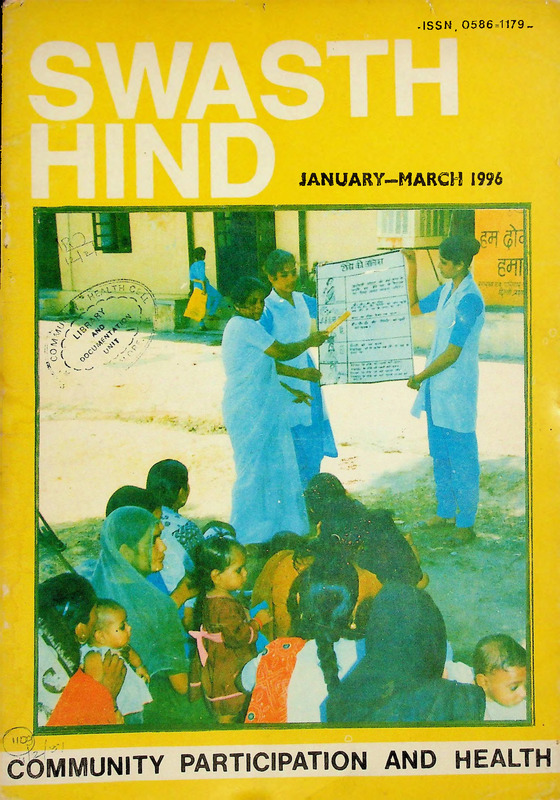
Community participation and
In this issue
swasth hind
Pausa-Chaitra
Saka 1917-18
January-March 1996
Vol. XL Nos. 1—3
OBJECTIVES
Swasth Hind (Healthy India) is a monthly journal
published by the Central Health Education Bureau,
Directorate General of Health Services, Ministry of
Health and Family Welfare, Government of India,
New Delhi. Some of its important objectives and
aims are to:
REPORT and interpret the policies, plans, pro
grammes and achievements of the Union Minis
try of Health and Family Welfare.
ACT as a medium of exchange of information on
health activities of the Central and State
Health Organisations.
FOCUS Attention on the major public health
problems in India and to report on the latest
trends in public health.
KEEP in touch with health and welfare workers
and agencies in India and abroad.
REPORT on important seminars,, conferences,
discussions, etc. on health topics.
”
Page
Elimination of Leprosy in India
Dr Shanker Dayal Shanna
The effect of patient and community education
in prevention of disability programme—A study
1
3
T. Ethiraj, P. Antony, Dr P. Krishnamurthy &
Dr N.B.B. Reddy
Mental health care through sub-centres : An
approach
Dr Jugal Kishore & Dr Vinay Kapoor
9
Multi-pronged approach in drug addiction
among youth
12
Paras Nath Garg
Community participation and health for all
Dr Rajkutnar Bansal and Dr Ratan K.
Srivastava
Health communication—Some perspectives
Dr (Mrs) P. K Sharada
Postage stamps : Messengers of health
Dr Y.A. Ketkar & Dr A.C. Urmil
16
18
23
Stroke education and its evaluation
26
Dr Prakashi Rajaram
Risk factors for stroke
28
Marine hygiene
Colonel Jasdeep Singh
30
Robert Koch : The great discoverer
Dr V.K. Tiwari
32
Better co-ordination leads to excellent results—
An Agra experience
Deoki Nandan, GJC Gupta, Manish
34
Subharwal and Neeta Gael
Care of the Ear
36
Dr Vijay Choradia
Editorial and Business Offices
Central Health Education Bureau
(Directorate General of Health Services)
Kotla Marg, New Delhi-110 002
Articles on health topics are invited for publication in this Journal.
State Health Directorates are requested to send in reports of
their activities for publication.
The contents of this Journal are
Due acknowledgement is requested.
freely
reproducible.
The opinions expressed by the contributors are not necessarily
those of the Government of India.
Edited by
M. L. Mehta
M. S. Dhillon
Assisted by
G. B. L. Srivastava
K. S. Shcmar
SUBSCRIPTION RATES
Single Copy
....
Annual
....
50 Paise
Rs. 6.00
Cover Design
Harbhajan Singh
This Issue
Re. 1.50
Cover Photo
O. P. Kataria
SWASTH HIND reserves the right to edit the articles sent
for publications.
....
(Postage Free)
ELIMINATION OF
LEPROSY IN INDIA
DR SHANKER DAYAL SHARMA
PRESIDENT OF INDIA
One fourth of the estimated cases and 60% of the registered cases in the World are in India. In
the last decade, estimated cases have been brought down from about four million to less than a
million. The light at the end of this dark tunnel is finally visible. We, the Government, medi
cal personnel, voluntary organisations and the public must strive unitedly to achieve Bapu s
dream of the total elimination of leprosy in India.
EPROSY is not a mere medical
problem. Its very mention
evokes an extraordinary dread. It
brings out deep seated prejudices
in the minds of the ignorant.
Because ostracism rather than
medicine was seen'as a solution, it
became as much a social problem
as a medical one.
Inadequate nutrition and sanita
tion arc among the root causes of
leprosy. It is thus a classic symp
tom of socio-economic under
development. It is no accident
that the endemic countries arc the
nations of the South. Eradication
of leprosy, therefore, is an intrinsic
aspect of the progress of such
societies. Its elimination is not
only a humanitarian endeavour.
but one which affirms our ability to
meet the basic wants of our
people.
and should not be taken for a
divine message. Its very curability
removes the stigma attached to the
disease and creates an environ
ment for the rehabilitation of the
afflicted. In the last decade. Multi
Drug Therapy (MDT) has allowed
leprosy eradication to make con
siderable headway. You are all
aware that MDT services had been
introduced in 245 districts by
March 1994. Mobile Leprosy
Treatment Units are covering mod
erate and low endemic districts, I
understand that all districts of the
country have now been sanctioned
MDT. and that from 1995, all lep
rosy cases will be covered by this
treatment. The result of these
efforts is reflected in a fall of 80% in
the prevalence rate and 70% in the
deformity rate in those districts
where MDT services have been
available for five years.
Medical and social aspects of
leprosy arc inextricably lin
ked. Effective treatment by mod
ern medicines should convince
even the most superstitious that
this disease is entirely man-made
Early detection of cases and pro
mpt treatment with MDT is a
course which has yielded divi
dends. It has not only improved
motivation among patients and
medical staff, but by demonstrating
L
January—March 1996
1-7/DGHS/ND/96
successful therapy, has increased
voluntary reporting among new
patients. The low relapse rale is
also a matter of encouragement
Yet, this is no time for complacen
cy. Each sign of progress must
only reinforce in us a determina
tion to complete the job. The
exercise of monitoring and carry
ing out special surveys must be
unceasing. Domiciliary
treat
ment must be expanded. The
organization of health education
must
receive
greater
atten
tion. Even as MDT services are
consolidated, new treatments must
be
constantly
explored. The
expansion of surgery facilities in
leprosy hospitals is also impor
tant. As leprosy occurs in the con
text of poverty, the provision of free
facilities to patients and free supply
of prosthetics and protective equip
ment should be encouraged. Re
habilitation programmes must be
rigorously pursued so that the
message is spread that there can be
life after leprosy.
Effective rehabilitation requires
overcoming the prejudices attach-
1
cd to leprosy. Mahatma Gandhi
set a personal example by tending
on Parchure Shastri. Not all of us
have his strengh of conviction or
his selflessness. Yet we can, each
in our own humble way, contri
bute—by giving time, donating
resources, by creating awareness, or
by providing employment oppor
tunities. The Government has
programmes to set aside jobs for
the orthopaedically handicap
ped. But we must look beyond
that in our care for leprosy patients.
The time has come for the private
sector, which should display social
responsibility to step forward. It
should be our joint endeavour to
give economic self-sufficiency to
leprosy patients so that they can
regain confidence and pride in
themselves. We must remember
these words of Bapu—“Why
.should there be a stigma about lep
rosy any more than about other
infectious diseases ? Real leprosy
is attached to an unclean mind.
To look down upon fellow human
beings, to condemn any com
munity or class of men, is a sign of
diseased mind far worse than
physical leprosy. Such men are
real lepers of society”.
Voluntary organisations have a
critical role in the fight against lep
rosy. Their contribution covers
the range of activities involved in
leprosy eradication, from the detec
tion of cases, to their treatment,
health education, training and
research,
and
rehabilitation.
They have the ability to mobilise
and educate public opinion. The
success of our national programme
rests, to a large measure, on their
efforts. The Hind Kusht Nivaran
Sangh is the oldest of the voluntary
organisations in the country exten
ding services to leprosy patients.
Its record in health education, com
munity awareness, and rehabilitaion has been creditworthy. I am
glad to note that the Sangh has
identified priority areas to augment
the activities of the National Pro
gramme. This includes training
and reorientation of health staff,
orientation courses for health
workers, medical facilities for lep
rosy patients in Delhi, and reha
bilitation programmes in different
parts of the country. As the Presi
dent of the Sangh, I commend
these efforts and urge you to inten
sify them in the coming years.
One-fourth of the estimated
cases and 60% of the registered
cases of leprosy in the world are in
India. In the last decade, esti
mated cases have been brought
down from almost four million to
less than a million. The light at
the end of this dark tunnel is finally
visible. We. the Government,
medical
personnel,
voluntary
organisations, and the public must
strive unitedly to achieve Bapu’s
dream of the total elimination of
leprosy in India—From the address
by the President of India at the AGM
of Hind Kusht Nivaran Sangh.
“Why should there be a stigma about leprosy any more than about other infectious dis
eases ? Real leprosy is attached to an unclean mind. To look down upon fellow
human beings, to condemn any community or class of men, is a sign of diseased mind
far worse than physical leprosy. Such men are real lepers of society.”
—MAHATMA GANDHI
SMOKING SHOULD BE BANNED IN PUBLIC PLACES AND OFFICES
2
Swasth Hind
The Effect of Patient and
Community Education in
Prevention of Disability
Programme—A Study
T. Ethiraj, p. Antony.
Dr p. Krishnamurthy & dr n.b.b. Reddy
UT for the disability that it pro
duces in a small percentage of
patients, leprosy would be a simple,
innocuous,
infectious
disease.
The potent drugs available in the
form of multidrug therapy (MDT)
have made a definite impact on the
disease in that the case load has
come
down
dramatically
to
manageable levels in most of the
initially
hyperendemic
areas
(Noordccn 1989). But the distur
bingly visible deformity produced
in a few patients reflects our failure
to come to terms with the disease
completely. Following the spec
tacular achievement of MDT in
bringing down the case load, dis
ability prevention is logically gain
ing significance in the agenda of
leprosy eradication programme
(ILA 1993).
B
The Alma Ata meeting of WHO
has set out the concept of com
munity based rehabilitation (CBR)
as: “To extent specialized care
using non-specialized providers,
namely the health worker and
ultimately the family and pati
ents.”
January-March 1996
Th e effect of self care learning by leprosy patients in prevention
of disabilities was studied by adapting two strategies in two sub
centres of a project in South India, one through patient educa
tion by trained field staff and the other through community
education involving trained animators and health commit
tees. One of the subcentres was taken as control where neither
ofthe strategies was employed. In terms ofresults, though both
the strategies were found to be effective in containing occurrence
of new deformities among high risk patients and healing of
trophic ulcers in hands andfeet, strategy I i.e. self care education
of patients by concerned field personnel without prejudice to
their routine work is recommended because of ease in diffusion
of strategy.
Community based rehabilitation
(CBR) is relation to leprosy starts
with prevention of disability (POD)
which forms the primary compo
nent of CBR (Padmani Mendis
1989). Even a step forward in the
direction of disability prevention
could influence favourably the pre
vention of stigma, which in most
cases is indisputably due to dis
figurement.
If a practical strategy of field
based. community-oriented pre
vention of disability was made
available, it could have a consider
able bearing on the outcome of the
eradication programme (Khalfan
1994). An effort in this direction
was made by Demicn Foundation
India Trust (DFIT) to study the
effect of education of patients as
well as community on deformity
3
prevention and disability limit
ation. The objective of the project
was to study the effect of education
of patients in self-care by field staff
or animator and education of com
munity about the disease and dis
ability prevention. The sub ob
jectives of this project were: (i) To
study the effect of patient education
by field staff or animator in terms
of (a) prevention of disability
among high risk patients, (b) pre
vention of deterioration of dis
ability among patients with Grade I
disability and (c) prevention of
deterioration of deformity among
patients with Grade II disability,
and (ii) to study the effect of com
munity education in terms of (a)
reduction in proportion of new
cases with deformity and (b)
increase in voluntary reporting of
new cases.
Material and Method
The Church of South India
Medical and Leprosy Centre
(CSIMLC), Vandavasi is a Damien
Foundation-sponsored project in
the National Leprosy Eradication
Programme (NLEP) from 1980.
The population covered by the pro
ject is
1,70,000 (1991
cen
sus). There were 3,379 known
cases on record at the beginning of
1994. The prevalence rate was
14.4 per thousand in 1980 and it
had come down to 1.9 per 1000 in
January, 1994. There were 476
cases with deformity in this area.
Two strategies were adopted in
two subcentres of Vandavasi to
achieve the objectives as indi
cated below.
Strategy 1 : In this strategy, the
prevention of disability by sclf-carc
was tried in one subcentre (Vandavasi-II), through education of
Strategy 2: In strategy’ 2. in
another subccntrc (Vandavasi-I).
disability prevention by education
of patients through self-care was
tried with animators selected from
the community health committees
organized in all the villages of the
study area.
One more subcentre (Ponnur)
was taken as control.
The components of self-care
included (Srinivasan 1993):
Skin care: Protective precautions
to prevent injuries to skin of hands
and feet: (a) soaking the affected
limbs in clear water, (b) scraping.
(c) oiling, (d) avoiding heat and
pressure, (e) using footwear and (f)
using cloth to handle hot objects.
Wound
care: Cleaning
the
wound or ulcer or crack, keeping it
covered and allowing it to heal by
resting the part: (a) soaking in
clear water, (b) cleaning surround
ing skin well, (c) removing foreign
bodies etc. from the wound, (d)
washing with clean water, (e) mop
ping the wound and drying sur
rounding skin with a clean cloth, (f)
applying dressing/resting the part
and (g) using footwear.
Joint care: Preventing the occur
rence of and correcting joint stiff
ness : (a) massage and exercises
(active as well as passive) and
(b) splinting.
Swelling care: For minor injury
or inflammation and major injury
or infection : (a) splinting the part,
(b) keeping the part raised (hand in
a sling, foot over pillow), (c) resting
the part, (d) referring to doctor if
fever or swelling did not subside
after three days or swelling in
creased and or pus became
obvious.
patients by the concerned field staff
making the exercise a part of their
routine work.
4
Nerve care: Learning to recog
nize the onset or worsening of area
of loss of sensation or muscle weak
ness in hands and feet: (a) nerve
pain—splitting/sling. and (b) loss
of sensation and weakness of
muscle—physiotherapy, exercises.
Eye care : Protecting eyes from
injury and cornea from drying
up: (a) recognising dimness of
vision early, (b) reporting for medi
cal advice for any eye problem, (c)
think blink for corneal anaesthesia.
(d) frequent washing of eyes with
water, (e) oiling before going to bed
and covering the eyes with cloth, (f)
using glasses or pads and (g)
passive closing of eye lids.
The components for OPD train
ing were : (a) identification of ner
ves involved in leprosy and their
examination, (b) functional assess
ment of nerves, (c) neuritis, (d)
identification of primary and
secondary disabilities, (c) preven
tion of primary and secondary dis
abilities; (I) WHO grading of
disability and disability recording.
(g) self-care practices and (h)
records.
The training aimed at improving
the knowledge and skills of the staff
in POD more by practical exercises
than by imparting theoretical
knowledge. Hence hardly any
lime was spent on lectures and
theories.
Methods Adopted
The following methods were
adopted for both strategies :
(i) An action plan was drawn for
12 months from January to Decem
ber 1994 for the study.
(ii) All the field staff were given
an orientation training in POD for
three days at Vandavasi.
(iii) Screening forms, monitor
ing records, posters and leaflets
were developed and supplied to the
study area.
Swasth Hind
(iv) The cases with high risk and
deformity were listed and dis
tributed among the leprosy inspec
tor. the non * medical supervisor.
social worker and physio techni
cian in charge. Screening of
known cases was done in Vandavasi I, II and Ponnur to identify
grade 1 and 2 disabilities and high
risk patients who included cases
with facial lesions, cases with skin
lesion near the nerve truck, cases of
broder line types, pregnant and lac
tating women patients, patients
who had reactions and patients
complaining of paraesthesia.
(v) One day practical demon
stration of self-care exercises was
conducted for the disabled patients
of both the subcentres at Vandavasi.
(vi) To render the outcome of the
study generally applicable to the
NLEP set up, this study was made
part of the routine work of the field
staff engaged in the project
(vii) Availability of materials at
their homes’ (adapted with the
available ones) for soaking, scrap
ing and oiling for skin care, ulcer
care and joint care activities was
ensured and physically verified
with each patient with trophic ulcer
or anaesthetic limb. Footwear
supply to all the patients was
ensured.
34 health committees for 23 vil
lages. Inclusion of women, at
least two of them in each commit
tee, was ensured.
(ii) One session of informal class
on leprosy was conducted for the
health committee members.
(iii) Thirty-four animators were
chosen from the health committees
and were given one day informal
training in self-care. Each ani
mator was given a list of patients to
be monitored for self-care in his
village.
(iv) In addition to patient educa
tion the animators were asked to
involve the people in community
education programmes and assist
field workers in organizing the
same covering the entire village
every month with different pro
grammes on leprosy eradication
with emphasis on POD. The
health education programmes
included ‘padayatra’ (walks) with
banners, cycle procession, posters
campaign, leaflet campaign, youth
meet, women’s meet, student’s
meet, teacher’s meet, folk songs,
video shows and street play.
(v) Population survey for 1994 in
Vandavasi II subcentre and Ponnur
was suspended in order to study the
effect of health education program
mes on new case detection.
(viii) Books on self care with
photographic illustrations of exer
cises in colour were issued to the
patients for reference and con
sultation.
For grading of disability the
WHO guideline was used in the
study (WHO 1988).
Additional methods adopted for
strategy 2: Health committees were
formed in all the 23 villages coming
under this subcentre. In 11 vil
lages separate committees were
formed in scheduled caste blocks
where the need for additional ones
was felt. Hence Vandavasi-I had
In strategy 1 each of the four field
staff involved in the patient educa
tion programme, monitored and
supported the self-care learning of
each patient, under his care at least
once a month. Patient com
pliance was studied with a check
list and suitably recorded.
January—March 1996
Monitoring & Evaluation
As for strategy 2, monitoring of
self-care was carried out once a
month for each patient by the
animator, and a record of the same
was made. The four field workers
concerned supervised the exercise
of the animators once in a month
and helped the latter solve any pro
blems in learning by patients.
Once a month the investigators
of the study, consultant physio
therapist and health educator of
DFIT, visited the project and moni
tored the activities of the patients.
animators and the staff.
Evaluation of leprosy awareness
was done in Vandavasi I and Pon
nur with a structured questionnaire
laying emphasis on POD. This
exercise was carried out by 15
trained community health volun
teers of CSIMLC, for 15 days in
January 1994 for pre-test and 15
days in December 1994 for post-test
in Vandavasi I and Ponnur sub
centre in order to evaluate the effect
of community education in reform
ing the attitude of the community
as well as patients in respect of
disability.
In January 1994, 1400 respon
dents in Vandavasi I and 900 in
Ponnur (control) were interviewed
whereas in December 1994, 1165 of
them in Vandavasi and 749 of them
in Ponnur were available for post
test evaluation. Hence the results
were based on post-test figures
only.
Appendix A summarizes the
methods described above and the
results obtained.
Results
From January 1994 onwards,
patient education and community
education programmes were con
ducted as per schedule every month
(ill December 1994, by staff and
5
animators. The results of self-care
learning in the three sub centres are
given in Table I.
New deformity in 1994: Strategy
1 (Vandavasi II): No new defor
mity developed among the high
risk cases and no new case with
deformity was reported either.
Strategy 2 (Vandavasi I): No
new deformity developed among
high risk patients, but four new PB
cases with anaesthetic hands
(Grade 1 deformity) voluntarily
reported for treatment
Control (Ponnur): Three cases
developed new deformity among
high risk patients, one from
patients under treatment and two
from cases declared RFT; no new
case with deformity was reported.
Table I
Straiegy 1
Jan W
Control
Strategy 2
Dec ’94
Jan -94
Dec ’94
Jan ’94
Dec ’94
54
123
393
87
74
86
76
Total known cases
High risk cases
Cases with deformity
618
91
93
91
93
486
54
119
Grade 1
12
12
20
24
8
7
3
5
2
2
3
5
2
2
6
8
2
4
7
•11
2
4
—
1
3
2
2
—
1
2
2
2
81
81
99
99
66
69
15
18
12
19
3
2
Hand
Foot
Eye
—* Left
— Right
— Left
— Right
— Left
— Right
Grade 2
— Left
— Right
— Left
— Right
— Left
— Right
20
28
12
14
3
4
20
28
12
14
3
4
41
47
16
17
7
4
41
47
16
17
7
4
14
16
12
19
3
2
Trophic ulcers
— Left
Hand
■ — Right
— Left
Foot
— Right
32
7
_—
1
2
4
34
11
—
1
4
6
31
27
2
3
11
15
2
3
8
14
—
—
—
—
—
—
—
—
—
Hand
Foot
Eye
New deformity - Grade 1
— Left
Hand
— Right
— Left
Fool
— Right
— Left
Eye
— Right
New deformity - Grade 2
Hand
Foot
Eye
— Left.
,— Right
— Left’
— Right
— Left. •
— Right
’ r
4
11
16
—
—
2
4
13
15
—
4
2
2 ,
—
—»
—
—
—
—
——
3
1
2
—
Trophic ulcers in 1994: Table II
shows the results regarding tro
phic ulcers.
Worsening of disability: Strategy 1
& 2: No worsening of disability
occurred in both the sub centres in
the sense that no patient in the high
risk group developed Grade 1
deformity, nor patients with Grade
1 progressed to Grade 2, nor
patients with Grade 2 deterio
rated further:
Control area: Three cases deve
loped Grade 2 deformity: two from
RFT patients and one from
patients under treatment. All the
three were cases of borderline
tuberculoid type.
Level of leprosy awareness in the
comm unity regarding POD: As part
of community-based approach in
Strategy 2, this aspect was studied
in Vandavasi I and Ponnur subcen
tre with a structured questionnaire
consisting of 12 questions: seven on
leprosy and five on deformities (sec
below). For this purpose 1165 peo
ple from Vandavasi I and 749 from
Ponnur were interviewed in
January 1994 for pre-test assess
ment and December 1994 for post
test assessment. Here focus is
made (Table III) only on the infor
mation elicited on POD aspect
from the answers for the questions
given below. Correct answers arc
given within brackets.
(1) What will happen if leprosy
is not treated in early
stage? (deformity)
(2) Can medicine prevent defor
mity? (yes)
(3) Is leprosy curable after
occurrence of deformity?
(yes)
(4) Are ulcers and absorption
due to leprosy? (No, by
carelessness)
(5) Would you like to freely
move with a cured disabled
patient? (yes)
SWASTH HIND
6
Tabic FI— Trophic ulcers
Strategy 1
(Vandavasi II)
Strategy 2
(Vandavasi I)
Control
(Ponnur)
Trophic ulcer in
January 1994
32
34
81
Trophic ulcer
in December 1994
7
11
27
Tabic in
Vandavasi I
% of right answers
Q. 1
Q. 2
Q. 3
Q. 4
Q. 5
Ponnur
% of right answers
Pre-test
Jan. ’94
Post-test
Dec. '94
Pre-test
Jan. '94
Post-test
Dec. '94
7.6
37.3
20.1
18
32.8
34.8 (+27.2)
64.1 (+26.8)
47.6 (+27.5)
8.7 (+6.9)
35.7 (+2.9)
10.9
37.1
212
0.8
142
11.8 (+0.9)
39.9 (+2.8)
26.7 (+5 5)
0.8 (NIL.)
14.4 (+0.2)
In Vandavasi the increase of
post-test percen tage of right
answers over that of the pre-test can
easily be claimed as improvement
brought about by health education
programmes conducted during the
study period. However, the mechanism to retain the gains even in the
absence of such programmes is yet
lo be evolved.
ing of cases increased by 13% (from
27% in ’93 to 40% in ’94) whereas the
increase for the same in Ponnur
was 0.4% (from 20.6% in ’93 to 21%
in ’94).
Discussion
New deformity: As regards new
cases with deformity, no such cases
were reported in Vandavasi II and
Ponnur, in Vandavasi I, new case
reportings in the early stage of disability (Grade 1) could be~duc to
Voluntary reporting (Table IV): As
a by-product of community educalion in Strategy 2, voluntary reportTable IV
New cases registered
Vfear
Vandavasi II
Vandavasi I
Ponnur
1992
1993
1994
78
75
53
74
72
40
21
19
19
Voluntary cases a mong new ones
Year
Vandavasi II
Vandavasi I
Ponnur
1992
1993
1994
12 (15.3%)
16 (21.3%)
14
(26%)
12 (162%)
17 (23.6%)
16
(40%)
4 (19.0%)
6 (20.6%)
4
(21%)
January—March 1996
the intensive health education
under Strategy 2, since the patients.
on questioning at admission, men
tioned the source of information as
street play conducted in their
villages.
Development of new deformities
among high risk patients in Ponnur
and the non-occurrence of new
deformity among high risk patients
in the study area could be
explained only in terms of regular
monitoring of the patients by the
field worker or animator during thc
study period.
Trophic ulcers in 1994: The sharp
decline in the number of trophic
ulcers in the study area at the end of
the study period (December ’94) is
quite interesting when compared to
the figures of Ponnur. It was
found that while in January 1994
there were 27. 28 and 26 cases with
Grade 2 problems in the feet in
Vandavasi II, Vandavasi I and Pon
nur (control) areas respectively,
comparable figures for December
1994 were 7. 11 and T1 respectively
(Table I).
This progress in ulcer care in the
study areas could be reasonably
attributed to the successful adop
tion of self-care practices of the
patients.
Worsening in disability status in
1994: Though in the study areas as
well as in the control area no case
was recorded as having worsened
in his or her existing disability
status, development of new defor
mity among three high risk
patients in Ponnur was a definite
set-back in the health condition of
the patients. This phenomenon
could be explained by the non
availability of patient education
in Ponnur.
Limitations: Certain limitations
were brought to light in this study.
particularly in Strategy 2 in which
animators were used. It was
7
found from the records of the
animators that some of them had
failed to make regular visits to the
patients allotted to them for mon
itoring. Some animators paid fre
quent visits to the patients of their
choice, visiting others only occa
sionally. These flaws in the quality
of the animators arc understand
able since these individuals had
varied social, cultural and edu
cational backgrounds. No incen
tive or remuneration was paid to
them, because the concept of this
study was not in favour of it.
As for recurrence of ulcer, that
problem could not be studied in a
one year project.
Post-study examination: In order
to assess the sustainability of the
impact of patient education. 15
patients taken at random in
villages of Vandavasi II were
examined for trophic ulcers and
self-care practices by two officers of
DFIT in April 1995. Only two
patients were seen with ulcers, one
on the hand, and another one on
the foot persisting from 1994.
Almost all the patients were able to
explain how to carry out selfcare exercises.
The same assessment was done
in two villages of Ponnur (control)
sub-centre with five patients. Four
of them were having trophic ulcers
leading us to infer that self-care was
not practised or sustained when
there was no active patient
education.
Conclusion
Of the two strategics tested.
though both of them produced
more or less similar results in res
pect of POD. Strategy 1 which was
patient education by leprosy field
staff is worth recommending for
field application, because the
transfer of the skill and knowledge
of POD to the actual beneficiary.
the patient, was made in Strategy 1
directly by the field technical staff
and was facilitated by their inti
mate relationship with the patients
8
and the technical know-how
gained from the training. In
Strategy 2, the same process was
made through an agent, the
animator, a third party in between
the technical personnel and the
patient. This passive education to
patients when compared to that of
Strategy 1, is a detour to reach the
destination, the patient
Though there is positive side of
community education in POD, in
involving the community members
as animators and health commit
tees who hail from the same place
of the patients, the indirect form of
education in this strategy needs
monitoring by the technical per
sonnel which means visits by
health personnel are inevitable.
This inevitability made the exercise
ultimately staff-based. In such a
context, direct participation of the
field staff in self-care education, in
place of indirect one will certainly
be more productive and yield better
results as shown in this study.
The ultimate aim would be the
sustenance of self-care practices, in
the absence of inputs by the field
staff, through involvement of
trained family members and local
health volunteers.
References
1.
ILA 1993. Workshop 9. Tnt .1 Lepr
61 : 744-747.
2.
Khalfan KH 1994. Disability and
literacy. CBR News No. 16.
3.
Noordecn SK 1989. Address at the
Asian Meeting on Rehabilitation in Lep
rosy at Kuala
Lumpur.. Kusht
Vinashak, Vol 12. No. 9 & 10 :3-4.
4.
Padmani Mendis 1989 - Paper pre
sented at the Asian Meeting of
Rehabilitation on CBR and Training in
Rehabilitation. Kusht Vinashak Vol 12
No. 9 & 10: 5—10.
5.
Srinivasan H 1993. Prevention of dis
abilities in patients with leprosy—A
practical guide. World Health Orga
nisation. Geneva.
6.
WHO 1988. Expert committee on
leprosy—Sixth Report, WHO Tech Rep
Ser 768, p 35.
Courtesy: Indian Journal
of Leprosy,—Oa-Dec. 1995.
SWASTH HIND
Mental Health Care Through
Sub-Centres : An Approach
DR JUGAL KlSHORE
&
Dr vinay Kapoor
According to WHO. one
per cent of the population.
suffers from severe incapa
citating mental disorders
and 10 per cent from mild
mental
disorders.
This
situation places a heavy
burden on primary health
centres (PHCs) and in the
community for its impact
on economic, social and
psychophysiological deve
lopment.
There is a need
of integrated mental health
policy for the needy people
who come to PHCs and
sub-centres for help.
January—March 1996
2-7/DGHS/ND/96
ccording to WHO, in many
countries including India, 1%
of the population suffers from
severe incapacitating mental disor
ders and 10% from mild mental dis
orders, ’"3- A heavy burden of
psychiatric morbidity at primary
health centre (PHC) and in the
community raised alarm for its
impact on economic, social and
psychophysiological
develop
ment. This attracted the attention
for the very important priority area
to provide health services. Cer
tainly, there is a need of integrated
mental health policy for the needy
people, those who take pain to
come to the PHC and Subcentre for
some help,
A
Psychiatric morbidity at primary
health care units
Developed countries: The pre
valence rates of psychiatric mor
bidity vary from 10%-43% at
primary health care units.5"5The prevalence rates of depression
in general medical setting, has
been reported to range from 10%
to 40%.7-8-
India : Most of the studies, con
ducted either in teaching hospital
or in peripheral district hospital,
reported l8%-54% of psychiatric
morbidity. At
rural
primary
health units the psychiatric mor
bidity is reported to be 10.4%17.7%.9-10- In a survey conducted
at a rural PHC of Haryana, we
found 41.7% of the adult OPD
patients were suffering from psy
chiatric illnesses. Among them.
21.5% of patients were having pure
psychiatric illness even without
physical illness. 4
Classification of Psychiatric Dis
orders
Standardized classification is
essential for data collection, inter
national and national comparison
and for psychopathological re
search. We have Diagnostic and
Statistical Manual of Mental Dis
orders (DSM) 11 and International
Classification of Diseases (ICD)
systems. ”• It has been clearly
documented that the presentation
of
psychiatric
illnesses
are
markedly distinct in community
care settings. Moreover the pri
mary care personnel would re
quire a classification that is simple
and easy to use, describing the
common disorders they see in their
work settings. At present the
9
WHO has formulated ICD-10 suit
able for use in all level of health
care setting. Broadly, we can
classify Mental Disorders as:
A
Organic Mental Disorders
B
Substance use Disorders
C
Schizophrenia
sions
D
Mood (Affective) Disorders
E
1.
2.
3.
4.
F
Sexual Dysfunctions
G
Personality Disorders
H
Mental Retardation
and
Delu
Anxiety Disorders
Adjustment Disorders
Conversion Disorders
Somatoform Disorders
mon drugs
setting, i, is.
SCREENING FOR PSYCHIAT
RIC DISORDERS AT SUB
CENTRE
For Nonpsychotic Patients: The
multipurpose worker can use. Self
Rating Questionnaire (SRQ) for
screening purpose. This is very
simple and easy to administer on
lay population and having high
sensitivity and specificity at 6
positive responses out of 20
questions.4, ®.
Self-Reporting Questionnaire
1.
Mood disorders and soma to fo mi
disorders are the most common
psychiatric entities among psy
chiatric illnesses. These disorders
are more common among females
within the age group of 30-45
yrs. Anxiety disorders (Genera
lized anxiety disorder, panic and
phobias) are also common among
OPD patients. Small number of
patients do suffer from personality.
schizophrenia, mental retardation
and sexual disorders. Around
0.5%-l% of the patients arc having
addiction and substance use disor
ders. Majority of patients with
mood, anxiety, conversion, adjust
ment and somatoform disorders
are presented with somatic symp
toms at primary health set
ting. Correct diagnosis and good
management will increase the
efficiency of the primary health
care delivery system. Most of the
minor and common psychiatric
disorders can be effectively mana
ged at PHC and Subcentre level.
The available experience shows
that 60%-80% of chronicity and dis
ability of psychiatric illnesses
could be prevented and completely
recovered with the help of modern
techniques and safe use of com
10
at primary health
2.
3.
4.
5.
6.
7.
8.
9.
10.
11.
12.
13.
14.
15.
16.
17.
18.
19.
20.
Do you often have head
ache?
Is your appetite poor?
Do you sleep badly?
Arc you easily frightened?
Do your hands shake?
Do you feel nervous/tensc/
worried?
Is your digestion poor?
Do you have trouble think
ing clearly?
Do you feel unhappy?
Do you find difficulty to make
decision?
Do you cry more than un
usual?
Do you find difficult to enjoy
your daily activities?
Is your daily work suffer
ing?
Are you unable to play a use
ful part in life?
Have you lost interest in
things?
Do you feel that you are a
worthless person?
Has the thought of ending
your life being in your
mind?
Do you feel tired all the
time?
Do you have uncomfortable
feeling in your stomach?
Arc you easily tired?
SRQ positive patients should be
evaluated in detail for correct psy
chopathology. Mostly
these
patients, after initial consultation
with PHC’s doctor or psychiatrist,
can be managed at subcentre by
MPW. Il has been observed that
these MPW’s could be trained to
identify and manage the case of
common psychiatric disorder inde
pendently. The National Institute
of Mental Health & NeurosciencesBangalore. is conducting many
training courses for MPW’s.14
There is a need to lake initiative by
all medical colleges to conduct
such courses for MPW’s.
For Psychotic Patients: Few obser
vations by MPW’s arc sufficient to
identify psychotic patients in the
community
or
al
subccntre. These are as follows :
1.
Who talk nonsense and act in
a strange manner that is con
sidered abnormal?
2.
Who has become very quiet
and docs not talk or mix
with people?
3.
Who claim to hear voices or
see things others cannot hear
or sec?
4.
Who arc very suspicious and
claim that some people are
trying to harm them?
5.
Who have become unusually
cheerful, crack jokes and say
that they arc very wealthy.
arid superior to others or he is
a king or prime minister when
it is not really so?
6.
Who suffer from fits or loss of
consciousness
and
fall
down?
7.
Who lake drugs like alcohol.
opium, ganja regularly or
excessively?
These patients should be convin
ced for their treatment and referred
Swasth Hind
to PHC or hospital. Everytime
(hey should be reminded for going
to PHC. These patients should
get consultation at subcentres
wherever they arc run by doctors
once in a week.
Management of Psychiatric Patients
at Subcentre
I. Psychophannacological manage
ment . Tricyclic antidepressant and
anlianxicty can safely be given by
MPW’s after the initial prescription
made by doctors or psychia
trists. Appropriate doses, dura
tion. and side-effects of drugs need
to be understood. In their Held
visit they should visit these patients
and their families and must inquire
about the compliance of the drug.
any side-effect and well-being.
2. Psychosocial
management:
MPW’s arc more close to the
patients and their families. They
arc better equipped with the back
ground information and good rap
port. MPW’s should be trained in
providing mental health education
to family members of the patient.
They can provide better psy
chotherapy, counselling, gene
ral support, environmental mani
pulation and family sessions: all
arc very effective in reducing the
suffering and mortality due to psy
chiatric disorders.
Multipurpose workers can be
useful agents to modify the be
haviours injurious to health in the
community. Tobacco
depen
dence, violence, experimentation
with drugs and alchohol. sexual
activities in adolescents, and somatisation of illness can effectively be
dealt with through anganwadi
workers, MPW’s and social welfare
officers if they arc trained effec
tively in mental health care.
Handbooks and manuals for MPW
must be available at each subcenIrcs. For each task an approach
difficulty/severity level must be
specified, beyond which the pro
blem should be referred to the next
health care. With such an appro
ach to deal with mental health pro
blems we hope that the country
would succeed in achieving the
goal of health for all by 2000.
Haryana. Thesis (MD)
AIIMS. New Delhi.
5.
Shephard M. Cooper. B Psychiatric ill
ness in general practice (cd.) 1966. Ox
ford University Press. London.
6.
Goldberg. D.P. Blackwell. B. Psychiat
ric illness in general practice: A detailed
study using a new method of case iden
tification. BMJ. 1970. 2 : 439-443.
7.
Wright, JH, et al. Depression in family
practice patients. South Medical Jour
nal, 1980, 73 : 1031-1034.
8.
Barnes, G.E. et al. Depression in Cana
dian general practice attendees. Cana
dian J. Psychiatry. 1984. 29:2-11.
9.
Harding. TW el al. Mental disorders in
primary health care: A. study of their
frequency and diagnosis in four
developing countries. Psychological
Medicine. 1980, 10:231-241.
10.
SriRam. TG et al : Minor psychiatric dis
turbances in primary health care : A study
on their prevalence and characteristic
using a simple case detection techni
que. Ind. J. Psychiat. 1987. 23 : 213226.
11.
APA. Diagnosis and statistical manual
of mental disorders (cd. 3rd., revised).
Washington. DC: APA.
12.
WHO. International classification of
disease-10 Revision. 1990. Geneva.
13.
Chandershekhar. MR el al. Village
leaders—Agents of Mental Health Edu
cation. Swasth Hind. 1990. Feb.
Vol. XXXIV No. 2
14.
Murthy. RS et al. Manual for mental
health care for Multipurpose worker.
References
I.
2.
WHO. Introduction of a mental health
component into primary health care.
(1990), Geneva, Switzerland.
Seshadri. S. Community Mental Health
News. Issue No..2. 1986.
3.
ICMR. Severe mental morbidity. In
dian Council of Medical Research
Bulletin 1988. Dec. 18. 12.
4.
Jugal Kishore. Recognition and dia
gnosis ofmental disorders among patients
attending a primary health centre of
1993 June.
NIMHANS. Bangalore. 1988.
DO YOU KNOW?
Age is no safeguard. People of any age can have high blood pressure, but if you are
over 25 you are doubly at risk. For most, 3 simple ways to reduce high b.p.
are—
* a balanced diet,
* salt reduction, and
* weight reduction.
January—March 1996
11
Multi-Pronged Approach
in Drug Addiction among Youth
Paras Nath Garg
The problems of drug addiction among youth are multi-faceted and closely associated with
the socio-economic changes in the society. A restrained decline can only be achieved by a
multi-pronged and prolonged approach jointly by various sectors like health, education,
social welfare, media, political structure, custom, law, home, excise, university and voluntary
agencies through inter-disciplinary and integrated line of action.
stimates suggest that approxi
mately 30% of the World’s
population is currently between the
ages of 10 and 24 years. Between
I960 and 1980, the world popula
tion of 15-24 years old, increased by
66%, while the total population of
the world increased by 46%. Of all
15-24 years old, the percentage liv
ing in developing countries was
77.6% in 1980 and it is predicted to
be 83.5% by the year 2000 AD.
(WHO 1986). The youth in our
country, is the most precious asset
for human resource develop
ment. Never in the history of the
world, have there been so many
young people.
E
Today’s young people arc the
healthiest age-group and are better
educated than ever before (FI.
Mahler-1985). The vast majority
of young people succeed rather
than fail, despite the difficulties
they now face; their energy, idea
lism and creativity can be used to
great advantage, they are eager for
responsibility, they want challen
ges and arc prepared to take risk for
what they believe in. The young
people are a great resource for
health. (WHO 1985)
Throughout the history of man
kind, there is hardly any country or
culture which has not encountered
12
problems with the use and abuse
of drugs.
Since the earliest recorded times.
drugs have been employed for dif
ferent reasons—mainly religious.
recreational and medicinal. For
example, alcohol and opium were
both well known in ancient Egyption culture and cannabis was com
monly used in Hindu ceremonial
rites as well as in Indian and
Chinese medicine. Drug-related
problems, therefore arc not new.
Often they affect a nation as a
whole. Good models of prevent
ing drug problems can also be
traced in history. Fourteen’ cen
turies ago, alcoholism was one of
the challenging problems among
the Pegan Arabian tribes and was
successfully dealt with by sys
tematic Islamic teaching, persua
sion, religious conviction, collec
tive action and good leader
ship. (Taha Baasher 1985)
Magnitude of Drug Addiction
Drug addiction among youth
presents as destructive a threat to
the present and the future of our
generation as the PLAGUES which
swept many parts of the world in
the earlier centuries. Unless con
trolled, its effects could be even
more 4 insidious
and
devas
tating. (World Health 1986). It is
a burning problem-at the national
and international scene and is a
man-made disaster of earth-shak
ing proportion produced by the
society for having lost its hold on
the individual because of not res
pecting the value system practised
from times immemorial.
According to the World Health
Organization, in every 10 seconds.
One person dies of a tobaccorelated disease somewhere in the
world. Tobacco is responsible for
99% of all lung cancc;. 75% of
all chronic bronchitis and emphy
sema and 25% of all Ischaemic
disease. (William U. Chandler1986)
In another survey report 9% of
the teenaged boys and 6% of the
teenaged girls in India arc smokers
(K. Balan-1986). Indian Council
of Medical Research (I.C.M.R.) has
reported in a study conducted in
different major cities of India that
46% of male students and 18% of
the female students of Delhi
University
were
drug
users.
(Mohammad Najmi-1983)
According to WHO’s estimates
approximately two and a half
million people die every year
throughout the world from the dis
eases caused by tobacco. (Valery
Abramou-1988) One quarter of
' Swasth Hind
smokers die prematurely from the
habit. A study in UK reveals that
among any 1000 young youth, who
smoke, one will be murdered, six
will be killed on the road and about
250 will be killed by conditions
stemming from tobacco. (Nedd
willard-1986)
Despite the known -health ha
zards. the production of alcoholic
drinks is increasing all over the
world and the consumption of
alcohol per person is soaring on a
global scale.
More a Social than
problem
a Medical
It is clear from the study so far
that drug abuse and addiction is
not confined to any class or creed.
rich or poor, young or old. All arc
affected. The majority of drug
abusers arc not aware of its physi
cal. psychological or economic
consequences. Il is realized that
drug-addiction is more a social
than a medical problem with
dimensions that require a multi
disciplinary approaches.
Personal responsibility
free lifestyle
in
Drug-
Unwise lifestyles pose the biggest
threat to young people’s health.
Innovative judgements, a tendency
to show off, or the desire to keep up
with their fellows—all these incline
them towards risk-taking beha
viour. This may include experi
menting with dangerous substan
ces like alcohol or drugs.
There is a growing trend which
shifts the emphasis from hospital
based care to those every day
actions that promote health.
Among the major elements of
healthy lifestyles, personal respon
sibility covers a wide area. In
dividuals must be encouraged to
lake steps to preserve their own
January—March 1996
health and to avoid behaviour that
is detrimental. This refers directly
to the use of tobacco under any
form and the abuse of alcohol and
other drugs. (Malhcr H-1986)
A drug-free society would obvi
ously rely on the optimum mobili
zation and utilization of commu
nity resources. Any programme
to be successful and effective.
requires the total support and
involvement of the community by
and large. Combating drug abuse
requires the support of every seg
ment of society including govern
mental and non-governmental
organizations, much more than
any other programme does. Build
ing up a positive public opinion
against drug-abuse is of crucial
importance and hence the support
of the parents, teachers, community
opinion leaders and general public
al large is essential both for con
trolling supply and demand for
drugs.
Multi-pronged approach in DrugAddiction
No one approach will bring
about a major change in behaviour.
but taken together such different
strategies arc beginning to have an
effect, not least in taking away the
social acccplibility of drug-addic
tion.
A judicious combination of
health promotion, health advocacy,
health education. legislation and
youth-targeted motivation cam
paigns will help to bring the
“issues” into the open and inspire
communities and individuals to do
something about “drug-addiction”.
(Nedd Willard 1986).
Drug problems arc among the
most damaging menaces of mod
ern life. Their effective preventive
strategy calls for the development
of all-out efforts, involving all the
social sectors concerned and with
active community participation.
The development of activities at
the community level, mobilising the
will of the people to lake action to
counter the threat of the drug
abuse, will greatly strengthen a
national programme of preven
tion. Community involvement is
based on knowledge of the com
munity and its problems, indi
viduals need to be identified within
the community who will work
closely with the health sec
tor. Thus a programme of health
promotion (cducation/p revention/
protection) should therefore in
volve the active participation of
community leaders in its design.
delivery and evaluation (MarcusGrant 86).
Obstacle in prevention of drug
addiction and Health Promotion
Norman Sartorius (1986) des
cribed the three giant obstacles in
the prevention of drug-addiction.
namely low value to health, phar
macological native of the substan
ces and the native of the envi
ronment in which most people
live today.
To overcome the above obstacles,
health promotion activities namely
raising the value of health, healthy
lifestyle (drug-free life) and suitable
action on controlling production.
marketing, retailing and distribu
tion of the narcotic drugs are
required. Joint health promotion
activities by workers in many social
sectors—education, social welfare.
medicine, industry and by the opi
nion formers can be undertaken.
The social values play a signifi
cant role in drug-addiction. The
social values which make drug
taking an acceptable norm among
peer group of youngsters, who need
to be reconsidered and reoriented
towards raising the values of
healthy lifeso 1'«
13
Special anti-smoking campaigns
and
diagnostic-cum-trcatment
camps are also found to be success
ful efforts to decrease the addiction
problems among youth in Canada,
Sweden and United States. 80%
succcsssful achievement against
opium and opiates-Dc-addiction
have been reported through camp
approach in the Opium-Dc-addiction treatment training and re
search trust, Jodhpur (Rajasthan).
(P. N. Singh Manaklao-1984)
Joint action on drug-addiction
A princple “the whole is greater
than parts” is applied with the
treatment and prevention for drug
addiction. Any one health or
social sector can accomplish a cer
tain amount, but the network of
health and social sectors can
accomplish much more together,
than they can accomplish indivi
Research experience shows that
drug addiction among youth re
quires a multi-disciplinary, multi
pronged and prolonged attack
from various sectors in a platform
to combat the ill-effects and eradi
cation of the problems. Action to
reduce health problems arising
from narcotic and psychotropic
drug misuse still has to face power
ful political and economic interest
that are opposed to effective pro
gramme.
Key role in drug-addiction among
youth
dually. (WHO 1986).
Youth peers, school teachers,
medical practitioners, community
health workers, parents and opi
nion leaders have a key role to play
in the early identification, aware
ness, counselling, management
and rehabilitation of the drug
addicts.
The informal group of youth
peers, sport associations, youth
councils, boy and girls scouts have
a piotal role. The skills of these
informal groups can be and in
some cases are already being
utilized for the promotion of
healthy life style among youth and
to provide education, information
and counselling. The need of
parents-child relationship is wellknown. specially during the habit
formation age. The vital role of
family in self-reliant health promo
tion. disease prevention and treat
ment has been further enhanced
with the introduction of primary
hcalh care approach.
Medical practitioners, school
teachers and community health
workers and village health guides
can play a crucial role in early
detection, management and pre
vention of cases of drug or alcohol
Operational Ilcalih Promotion activities of various Sectors in drug-addiction among youth
Sector
ACTIVITIES
Health
Research
Case
detection
Treat
ment
Preven
tion
Couns
elling
Educa
tion
Camp
approach
University
Research
Service
—
Project
sponsorship
Educa
tion
—
—-
Education
Research
Early
detection
—
Healthy
life-style
Couns
elling
Education
Follow Up
Social
Welfare
Awareness
Coordina
tion
Couns
elling
Education
—
—
Rehabilitation
Media
Awareness
Motiva
tion
Education
Social
Mobilization
—
—
Fear arousal
Communication
Political
Leaders
Community
participation
Support
Commitment
to drug free
lifestyle
Healthy
leadership
Motivation
—
Will to Combat
drug abuse
Industry
Incentive
scheme
Facilities for
detection
Coordination
—
Reduction
in demand
—
Awareness &
Counselling
Home
Excise &
Custom
Law
enforcement
Problem
solving
approach
—
—
—
—
Prevention of
illicit Trafficking
Voluntary
organization
Participate
observation
Coordination
Follow Up
Motivation
Education
—
Counselling
& Rehabilitation
14
SWASTH HIND
misuse in the community. Being
part of the community they should
be aware of the drugs that are com
monly misused and alert to new
substances entering the area or new
forms of drug use. They are in a
position to encourage the forma
tion of community action group
(self-help group) and foster com
munity
awareness. Changing
social networks and encouraging
community involvement are pro
ven methods of helping people suf
fering from drug or alcohol related
problems. Strategy
may
be
developed with workers in other
sectors such as social welfare, adult
education, media, voluntary agen
cies etc. so that a whole network of
groups can be involved in reducing
and preventing alcohol and drugrelated problems at both the per
sonal and the community level.
Principles in drug-addiction among
youth
(a)
(b)
(c)
(d)
Policies, goals, priorities and
lines of action for the preven
tion of drug-addiction have to
be met in harmony with local
condition and relevant to the
social setting.
Regardless of the circumstan
ces. the addict on discovery
should be treated primarily as
il [person and not as a
criminal.
leaders, peers and teachers on
drug-addiction is a must, to
enable them to provide
necessary support to the
youth.
India is a signatory to achieve the
goal of health for all. The idea
and targets of a Drug Addiction
Free Society by the year 2000.
would be indispensable for achiev
ing the goal of Health For All by
2000 AD.
The problems of drug addiction
among youth are multifactoral and
multi-faced and closely associated
with the socio-economic changes
in the society. An effective sus
tained decline can only be achieved
by a multi-pronged and prolonged
approach, with the joint action
(efforts) of the various sectors such
as health, education, social welfare.
media, political structure, custom.
law, home, excise, university and
voluntary associations through an
inter-disciplinary, integrated and
coordinated line of action.
References
I
Abramov Valery (1988)—Run for your
life World Health—Nov. 1988.
*
Balan. K. (1986)—A Smoke free society
by the year 2000. Swasth Hind—Sept.
1986.
j
Baasher Taha (1985)—Preventing drug
problems—World Health—Aug/Sept.
1985—Page 8.
Chandler-William. U. (1986)—Smoking habit kills one out of every four
smokers—World Health—June 86
-
Grant-Marcus (1986)—Meeting the
threat of drug abuse—World Health—
June 1986—Page 20-21.
z
Mahler, H. (1985)—Healthy youth-our
best resource—World Health—Jan/Feb.
1985.
7
Manaklao—P. N. Singh (1989)—Treat
ment of Drug Addiction—A camp
Approach — Swasth Hind— 1989 Page
232-233.
Najmi-Mohammad (1983)— DrugAddiction—A
Social evil—Swasth
Hind—Sept. 1983.
q
Sartorius-Norman(1986)—Putting
a
higher Value on Health—World Health
—June 1986, Page 2-3.
.0
Willard Nedd (1986)—Tobacco the last
gasp—World Health—JanJFcb. 86,
Page 20.
Suggestions
1. Integration of health promo
tion on drug addiction in school/
college and adult education.
Parents must be made to
understand that a poor
quality of parent-child rela
tionship is responsible for
many forms of social mal
adjustment.
2. Orientation and counselling
of youth community leaders and
village level workers.
Orientation and motivation to
the
parents.
community
4. Parliamentary and Assembly
constituency-wise research data on
January-March 1996
drug addiction must be analysed
and given to the politicians to get
their participation, commitment
and line of action on the magnitude
of the problem.
3. Behavioural research on drug
addiction problems.
lL W.H.O. (1986)—T.R.S. 731—Young
people’s health—a challenge for society.
WHO—Geneva.
p
WHO (1985)—World Health Statistics
.Quarterly vol. 38—No. 3. WHO
—Geneva, 1985.
Ij
WHO (1986)—Drug-dependence and
alcohol related problems—A manual for
community Health Workers—WHO
—Geneva (1986).
15
COMMUNITY
PARTICIPATION AND
HEALTH FOR ALL
Gujarat’. Table 2 shows si
data for Vivekananda Gi
Kalyana Kendra situated i
Hills,' Mysore ”. Further ;
ber of such experiments ha
documented in Anubhav se
other publications 7. notat
the Jamkhed project, KEb
Health for one millioT
etc.
Dr Rajkumar Bansal
and
DR Ratan K. Srivastava
t
N the past dec.ade, especially
since the adoption of the
Ideclaration
of Alma-Ata on
primary health care, community
participation has become in
creasingly recognised as a key ele
ment in improving health, parti
cularly among the poor and under
served populations in deve
loping countries. It is concerned
not with advanced medical
technology but rather with apply
ing tried and tested health care pro
cedures to the health problems of
the poor and underprivileged’.
Many definitions of community
participation have been sug
gested,
however a comprehen
sive definition can be “Community
participation is a way of living
which needs to be inculcated in all
the citizens of the world so as to
enable and embolden them to
actively, collectively and volun
tarily diagnose their problems and
felt needs; find and implement
socioculturally, economically and
scientifically acceptable solutions
with community logistics, either
with or without external support so
as to eliminate or minimise their
problems; fulfil their felt needs;
and plan for their future develop
ment so as to benefit and enable
them to lead a socially, eco
nomically and healthy productive
life”. The aim should be to attain
positive health and wellbeing.
Historically since Independence,
the various government program
mes show a shift from cooperation
16
Developing countries are facing severe resource paucity for
health care provision including safe water supply, sanitation
and housing. It is high time that the pivotal significance of com
munity participation is recognised, legalised and optimised to
bring about a radical change in the health development plan
ning. This will help in bringing about health care services
within the reach of common citizens and help them to
utilise the same.
to participation with the eventual
aim being to move towards the
stage of involvement’.
ture is harmonious and supportive
to the needs of the people.
This trend has been due to two
factors mainly:
There are many successful exam
ples of participatory health
approaches
throughout
the
world 7
In India the need for
community participation is reflec
ted in almost all the plan
documents, more so from the sixth
plan document (1978-83) onwards.
Panchayat Raj and cooperatives
were instruments aimed to ensure
community
participation. The
Health Guide Scheme, Trained
Dais Scheme and ICDS were
especially tailored by the govern
ment for greater community
involvement in
health care
activities. However participatory
methods have
largely been
encouraged by non-governmental
agencies, some of whom have suc
cessfully implemented their pro
grammes with extensive com
munity supports and scant govern
ment supports. Table 1 shows the
programme indicators of SEWA—
Rural situated
at Jhagadia,
(i)
Inappropriateness of the
‘Western’ medical system
in our context and under
utilization of these ser
vices, and
(ii)
Realisation of the fact that
public health policy is not
only concerned with cur
ing, disease but forms an
integral part of a country’s
general
development
policies’*’.
Advantages
The main advantages of com
munity participation are : optimal
coverage, greater efficiency, more
equitable distribution, self reliance
of the community and enhanced
effectiveness of a program
me*. Community participation
ensures that the health infrastruc
Swasth Hind
In concluding it has
that the developing c<
facing severe resource
health care provisic
safe water supply, st
housing. It is high
pivotal significance
participation is re>
lized and optimi'
bring about a radic
health developnv
vital part of the
ment planning.
tate to bring he
within the ar
citizens and ;
utilisation
o
resources.
References
I.
Rifkin S’
maternal
ning j
Health
2.
Trakrc
in het
mcs.
of
198c
3.
Oa
het
th
F
4.
1
Table 1
nlar
SEWA (Society for Education Welfare & Action)—Rural
uana
PROGRAMME INDICATORS
num, been
esand
i. being,
project,
project
r
Impact Data (Per 1000)
Infant mortality rate
Child mortality rate
Crude death rate
Crude birth rate
.
_
1980-81/82
164
13
12
1985-86
61
43
8
24
24
NA
50
25
95
60
85
33
9
7
0
83
60
50
48
15
10
37
NA
71
47
.
_ , .
Service Data (per cent)
" I. Maternal Health Care
be stated
mines are
iiaucity tor
including,
station and
mic that the
C community
pulsed, legaft. This will
Antenatal registration
Antenatal care
Delivery by trained personnel
Child Care
11.
i change in the
U planning, a
weraW developChis 'will faciliAh care services
nit of common
i.o help optimal
the available
Immunization
B.C.G.
DPT/DT
Polio
Measles
Nutritional Status
Grade III & TV malnutrition
TO. Others
Couple protection rate
T.B. case holding as percent of cases registered
Table 2
Vivekananda Girijana Kalyana Kendra
PROGRAMME INDICATORS: 1990
Community participation in
md child hcalth/Jamily planggrammes. Geneva : World
organization; 1990.
IPL. Community participation
i. and/amily welfare programBev; Delhi; National Institute
ttalth and Family Welfare;
Infant Mortality Rate
Child Mortality Rate
Crude Death Rate
Crude Birth Rate
Maternal Mortality Rate
1980-81
145
_
14
38
|
1990
28.0
24.0
35
*20.4
1.0
Karnataka Stale
1987-90
75.0
61.0
8.7
28.9
5.0
SERVICE DATA:
Mother and Child care:
r.y, P. Community involvement in
Im development: an examination of
critical issues.
Geneva; World
tilth Organization; 1989.
.tiled Nations Department of
oonomic and Social Affairs. Popular
nrticipation in development—Emerg
ing trends in community development.
•Jkw York; "United Nations; 1911.
Werhagen K. How to promote people’s
Antenatal coverage
Deliveries by trained dais
Immunisation: DPT & Polio
20%
5%
5%
90%
60%
95%
Normal
40%
90%
III degree Malnutrition
Literacy
20%
3%
4%
4%
61.1
34.8
68%
NUTRITIONAL STATUS:
—
—
—
participation in rural development
through local organizations. Review
of International Cooperation 1980.
13(D:I, 2%.
World Health Organization. Com
munity involvement in health deve
lopment—challenging health services.
Geneva ; W.H.O.; 1991.
Newell KW. Health by the people.
Geneva ; World Health Organiza
tion; 1915.
January—March 1996
3-1 /DGHS/HD/96
World Health Organization.
I7ie
training a d utilization of auxiliary per
sonnel for rural health teams in develop
ing countries. Geneva : W.H.O.;
1971.
8.
9.
Sohoni NR. Society for education,
welfare and action—rural—Anubhav
Scries. New Delhi: Ford Foundation;
1988.
10.
Mohan De A. Vivekananda Girijana
Kalyana Kendra—Anubhav Series
New Delhi:
Voluntary Healt
Association of India; 1991.
COMMUNITY
PARTICIPATION AND
HEALTH FOR ALL
Dr Rajkumar Bansal
and
DR Ratan K. Srivastava
N the past decide, especially
since the adoption of the
declaration of Alma-Ata on
primary health care, community
participation has become in
creasingly recognised as a key ele
ment in improving health, parti
cularly among the poor and under
served populations in deve
loping countries. It is concerned
not with
advanced medical
technology but rather with apply
ing tried and tested health care pro
cedures to the health problems of
the poor and underprivileged1.
Many definitions of community
participation have been sug
gested, 1’s, however a comprehen
sive definition can be “Community
participation is a way of living
which needs to be inculcated in all
the citizens of the world so as to
enable and embolden them to
actively, collectively and volun
tarily diagnose their problems and
felt needs; find and implement
socioculturally, economically and
scientifically acceptable solutions
with community logistics, either
with or without external support so
as to eliminate or minimise their
problems; fulfil their felt needs;
and plan for their future develop
ment so as to benefit and enable
them to lead a socially, eco
nomically and healthy productive
life”. The aim should be to attain
positive health and wellbeing.
I
Historically since Independence,
the various government program
mes show a shift from cooperation
16
Developing countries are facing severe resource paucity for
health care provision including safe water supply, sanitation
and housing. It is high time that the pivotal significance of com
munity participation is recognised, legalised and optimised to
bring about a radical change in the health development plan
ning. This will help in bringing about health care services
within the reach of common citizens and help them to
utilise the same.
to participation with the eventual
aim being to move towards the
stage of involvement2.
ture is harmonious and supportive
to the needs of the people.
This trend has been due to two
factors mainly:
There are many successful exam
ples of participatory health
approaches
throughout
the
world 7
In India the need for
community participation is reflec
ted in almost all the plan
documents, more so from the sixth
plan document (1978-83) onwards.
Panchayat Raj and cooperatives
were instruments aimed to ensure
community
participation. The
Health Guide Scheme, Trained
Dais Scheme and ICDS were
especially tailored by the govern
ment for greater community
involvement in
health
care
activities. However participatory
methods
have
largely been
encouraged by non-governmental
agencies, some of whom have suc
cessfully implemented their pro
grammes with extensive com
munity supports and scant govern
ment supports. Table 1 shows the
programme indicators of SEWA—
Rural
situated
at Jhagadia,
(i)
Inappropriateness of the
‘Western’ medical system
in our context and under
utilization of these ser
vices, and
(ii)
Realisation of the fact that
public health policy is not
only concerned with cur
ing, disease but forms an
integral part of a country’s
general
development
policies1’2.
Advantages
The main advantages of com
munity participation are: optimal
coverage, greater efficiency, more
equitable distribution, self reliance
of the community and enhanced
effectiveness
of a
program
me5. Community participation
ensures that the health infrastruc
SWASTH HIND
Table 1
Gujarat9. Table 2 shows similar
data for Vivekananda Girijana
Kalyana Kendra situated at B.R.
Hills,' Mysore 10. Further a num
ber of such experiments have been
documented in Anubhav series and
other publications 7, notable being
the Jamkhed project, KEM project,
Health for one million project
etc.
SEWA (Society for Education Welfare & Action)—Rural
PROGRAMME INDICATORS
In concluding it has to be stated
that the developing countries are
facing severe resource paucity for
health care provision including
safe water supply, sanitation and
housing. It is high time that the
pivotal significance of community
participation is recognised, lega
lized and optimised. This will
bring about a radical change in the
health development planning, a
vital part of the overall develop
ment planning. This will facili
tate to bring health care services
within the ambit of common
citizens and also help optimal
utilisation
of
the
available
resources.
1985-86
61
4.3
8
24
Impact Data (Per 1000)
Infant mortality rate
Child mortality rate
Crude death rate
Crude birth rate
Service Data (per cent)
I. Maternal Health Care
1980-81/82
164
13
12
24
Antenatal registration
Antenatal care
Delivery by trained personnel
11. Child Care
Immunization
B.C.G.
DPT/DT
Polio
Measles
Nutritional Status
Grade III & IV malnutrition
III. Others
Couple protection rate
T.B. case holding as percent of cases registered
NA
50
25
95
60
85
3-3
9
7
0
83
60
50
48
15
10
37
NA
71
47
Table 2
Vivekananda Girijana Kalyana Kendra
PROGRAMME INDICATORS: 1990
References
1.
Rifkin SB. Community participation in
maternal and child hcalth/family plan
ning programmes. Geneva: World
Health Organization; 1990.
2.
3.
4.
6.
World Health Organization. Com
munity involvement in health deve
lopment—‘challenging health services.
Geneva : W.H.O.; 1991.
7.
Newell KW. Health by the people.
Geneva : World Health Organiza
tion; 1975.
January—March 1996
3-7/DGHS/ND/96
90%
60%
95%
61.1
34.8
68%
Normal
40%
90%
—
III degree Malnutrition
Literacy
20%
3%
4%
4%
Antenatal coverage
Deliveries by trained dais
Immunisation: DPT & Polio
United Nations Department of
Economic and Social Affairs. Popular
participation in development—Emerg
ing trends in community development.
New York: United Nations; 1971.
Vcrhagen K. How to promote people’s
participation in rural development
through local organizations. Review
of International Cooperation 1980;
73(1): 1, 28.
20%
5%
5%
SERVICE DATA:
Mother and Child care:
Oakley, P. Community involvement in
health development: an examination of
the critical issues.
Geneva; World
Health Organization; 1989.
5.
1990
28.0
24.0
35
»20.4
1.0
Infant Mortality Rate
Child Mortality Rate
Crude Death Rate
Crude Birth Rate
Maternal Mortality Rate
Trakroo PL. Community participation
in health and family welfare program
mes. New Delhi: National Institute
of Health and Family Welfare;
1989.
Karnataka State
1987-90
75.0
61.0
8.7
28.9
5.0
1980-81
145
—
14
38
5
NUTRITIONAL STATUS:
8.
9.
World Health Organization.
The
training a d utilization of auxiliary per
sonnelfor rural health teams in develop
ing countries. Geneva
W.H.O.;
1977.
Sohoni NK. Society for education.
welfare and action—rural—Anubhav
Scries. New Delhi: Ford Foundation;
1988.
10.
Mohan De A. Vivekananda Girijana
Kalyana Kendra—Anubhav Series.
New Delhi: Voluntary Health
Association of India; 1991.
17
HEALTH COMMUNICATION
—Some Perspectives
Dr (Mrs) P. V. SHARADA
ommunication research is
gaining momentum simulta
neously with the developments in
mass-media. As generally known,
communication
is
contex
tual. But research in development
communication,
particularly
health communication, is not
much significant. While some of
the
general
communication
theories seem to be applied in
spreading messages, the specific
models of health communication
need to be used widely in designing
campaigns. There is still a need to
probe and experiment as to what
works and what does not and if it
works how ? etc.
C
Television. Radio, print, films
and inter-personal media are being
extensively used in the area of
health communication. The res
ponses to health messages in terms
of awareness, acceptance and
adoption are well identified and the
suitable communication strategics
have been formulated. Studies
have confirmed the effectiveness of
media. A thematic survey of 64
Family Planning films in India
(1983) by Akhila Iyer (1) has
emphasized the effectiveness of the
film medium for publicity in the
interior rural areas. However, she
felt the need for the peope to get
used to the film medium to respond
fully to the message it con
veys. The analysis also points out
io the need for special films to be
produced for rural audience in easy
language with a story pattern
reflecting local milieu to the extent
18
Significant research in health conununication is still to be done.
While some of the general communication theories seem to be
applied in spreading health messages, specific models of health
communication need to be used widely in designing health
campaigns.
possible. A collaborative study by
NIHFW (1985) on “Evaluation of
Media reach and effectiveness” (2)
confirmed that “Communication is
an important component in the
programme and has a close posi
tive relationship with awareness.
knowledge and practice of Family
Planning
methods”. A
mul
timedia communication campaign
was conducted between 1988 and
1989 to promote family planning
among men in Zimbabwe (3) The
campaign consisted of a 52—
episode semiweekly radio soap
opera, about 60 motivational talks,
and two pamphlets about con
traceptive methods. Changes over
lime were measured by comparing
a subset of a follow-up survey con
ducted from October to December
1989 to a baseline survey conducted
from April to June 1988. Men
exposed to the campaign were also
compared to men who were not
exposed. The follow-up survey
revealed that the men exposed to
the campaign were significantly
more likely than other men to make
the decision to use family planning
and to say that both spouses should
decide how many children to
have.
Behavioural Information
But still experts feel the need to
understand the behavioural pat
terns of the target audience and
strengthen the evaluation techni
ques, expecially by applying com
munication research methods and
different models of health com
munication. It may be pertinent
to quote Carriere (4) Who said ‘
require behavioural infotmaGc.;
that is hard, empirical, scien
tifically gathered and generali
zable”. Stressing the need for
professional approach to com
munication and ^creative message
design and a skilful use of the many
mass media and person-to-person
channels now at our disposal he
further says “Unless an enlightened
public health leadership invites
and mobilizes the market and
audience researchers, the message
designers and the media planners,
our approaches at behaviour
change will remain fragmentary,
ineffective and amateurish. The
real need is to demystify health
knowledge in communication”.
This calls for the attention of the
health professional to understand
Swasti-i Hind
the nature and scope of health
communication as an area of
specialization, bridge the gap bet
ween research and field activity,
interact regularly with the pro
fessional
communicators
to
develop right perspectives in
material production, etc. The pre
sent paper is an attempt to provide
some information on the first need,
i.e, understanding the nature and
scope of health communication
and the discussion has mainly con
centrated on exploring the underly
ing principles/theories of mass
communication that are widely
accepted and used in the field of
Health and Family Welfare and
some models of health com
munication
and
their
suit
ability to the present day
programmes, etc., The informa
tion may be of some benefit and
interest to people involved in
designing Media messages in the
area of Health and Family
Welfare.
Major Theories
Three major theories are con
sidered important by communi
cation researchers—(1) Magic—
Bullet Theory (2) Two step—Flow
theory and (3) Agenda setting
theory.
(1)
Magic—Bullet Theory
This is the oldest theory which
attached greater importance to
mass-media. According to the
earlier thinkers Mass-media like a
bullet, can penetrate into the heads
of the citizens. It has the power of
injecting messages directly and
influence people in the desired
manner. For example:
Poster on
Health (5)
Maternal
and
Child
Mother bathing her baby; cap
tion says, “If a baby’s future is to be
bright the mother has to be
healthy. For health care for both
mother and child, come to Primary
Health Centre”.
January—March 1996
OUR NEW DIRECTOR
Dr (Mrs) K. Kehar took over as the
Director, Centra! Health Education
Bureau (CHEB), New Delhi with
effect from 25th January. 1996. She
is the ex-officio Dy. Director General
of Health Services.
Born on 19th September. 1938 at
Jabalpur in Madhya Pradesh. Dr
Kehar has had her schooling at Bar
nes High School, Devlali (Maha
rashtra) and obtained her MBBS
Degree from Christian Medical
College CMC. Ludhiana, Punjab in
the year 1960.
Dr. (Mrs.) K. Kehar
Dr Kehar started her career as
Assistant Surgeon under the Central
Government Health Scheme (CGHS)
in June<1963.
She worked in the Employees State Insurance Corporation (ESIC) for
over eight years from July. 1968 to July, 1976 serving in its various dispen
saries. Dr Kehar joined Delhi Administration in 1976 and served there in
different capacities for nearly nine years. As family and State Immuniza
tion Officer, Delhi, she supervised the Family Welfare and Immunization
activities in the capital.
Dr Kehar served as Medical Officer (RH).and then as Chief Medical
Officer (RH) in the Rural Health Division of the Directorate General of
Health Services. Ministry of Health and Family Welfare from July. 1985 to
March, 1991. Here she coordinated and monitored the Scheme of Train
ing and Employment of Multi-purpose Workers (Male): Training of Com
munity Health Workers, and also coordinated the Meetings of Central
Councils of Health and Family Welfare.
As Asstt. Commissioner (SS), and Dy. Commissioner (T.O.) in the
Department of Family Welfare. Ministry of Health and Family Welfare from
March, 1991 to January, 1996, Dr Kehar was instrumental in Planning &
Formulations of various programmes and activities, technical guidance in
the family welfare programmes, monitoring and coordination of reproduc
tive research being organised by various organisations as well as clinical
training in Family Welfare, i.e., sterilisation. IUD insertion. MTP and Oral Pill
administration.
Dr Kehar has participated in various National and International
meetings on contraceptive use and reproductive health. It was from Dy.
Commissioner (T.O.), that Dr Kehar joined C.H.E.B. in January. 1996 to
provide leadership in the provision of preventive and promotive health
care through various media and methods.
19
Radio-spot on Medical Termination
of Pregnancy (6)
Woman announcer introuduccs
an eminent lady doctor saying that
she will talk to the audience on
medical termination of pregnancy.
Lady doctor’s voice follows—“Do
you know? If your health is
endangered due to pregnancy or
child-bearing or if contraceptives
have failed’and an unwanted con
ception occurs there are hospitals
all over the State where abortion
facilities arc provided free of
cost”.
In these two examples, it is
assumed that the audience exposed
to the above media will receive
information
and
act accor
dingly. The power of the media is
being perceived to be direct and
powerful. However, the present
health communicators are aware of
the limitations of the magic-bullet
theory and are using such messages
initially to create awareness.
(2)
Two step—flow theory
When mere transmission of
information could not achieve the
desired behavioural change, the
thinkers shifted their attention to
observe the other influences such
as inter-personal etc. Two step
flow theory gives more importance
to inter-personal communication
as far as the influence is concerned
and treats mass-media as source of
information. According to this
school of thought, information
flows in two steps, i.e., from mass
media to opinion leaders and
therefrom to people. Here the
influence of mass-media is in
direct Opinions were also ex
pressed during this period that
people receive information from
one medium but seek other sources
(Media) to confirm their know
ledge. Hence proponents of this
theory argued; media helps to rein
force the messages but cannot
20
directly influence the audien
ce. Two step-flow theory was
accepted to be valid for quite a long
time and its effect can be seen in
commercial advertisements in
which the suggestions of neigh
bours, friends and relatives are
given more importance, especially
in publicizing the products. Two
step-flow theory is more effectively
used in commercial advertising (at
present also) than in Develop
ment Communication.
Example: Radio spot (30 seconds) on
Maternal and Child Health
(7)
Two women: one woman en
quires about the health of the
other’s children. “What health”?
says the other “Here I am, unwell
myself: how can I keep my
children fit? Something or the
other is always wrong”__ ._____
The first voice urges; “Why don’t
you go to the Primary Health Cen
tre then”? Commentator con
cludes: For correct advice about the
health of mother and child, visit the
Primary Health Centre”.
Same example can be further
extended (60 seconds spot) where
the second woman narrates her
positive experiences with PHC in
mother and child care.
. In the above example, the infor
mation is positioned in the form of
friends’ suggestion giving more
weightage to interpersonal com
munication. However,
people
who refute Two step-flow theory
claim that whether there is direct or
indirect influence of Mass-Media
the power of the media is indisput
able since it is the main source
of information.
(3)
Agenda setting theory
While the Two step-flow theory
dominated the scene for long time.
invasion of Television has opened
the doors for new thinking giving
more importance to Mass-Media
again. Supporting the Magic
bullet theorists, the present thin
kers feel that the research tech
niques in the past were not ade
quate to prove the effects of
media. The main focus of the pre
sent research is how media influen
ces the opinions of the people?
While some felt the information
transmitted through media appeals
to the cognitions, for some it
influences the attitudes. To know
this, in-depth studies were carried
out with special emphasis on “con
tent analysis of the programmes”
and “persuasion methods”. From
those has emerged “Agenda setting
theory”. According to this theory
both in selecting the contents and
the methods of Communication
media assumes greater role and sets
an agenda as “What people should
know” and “how it should be
given” etc.
Examples: 1. Media propaganda
on AIDS.
2. Phone-in Program
mes over Radio on
health issues like
Mother and Child
care, etc.
As said by Backer et al (8) the
agenda setting process is a social
phenomenon through which an
issue begins to receive sharply
increased mass-media coverage, in
turn creating more widespread
public opinion about the issue and
eventually leading to responses
by policy makers. Rogers and
Dearing (9) identified three
main components in the agenda
setting process, i.e., the “Media
agenda”, “Public agenda” and
“Policy agenda” and explains as
below. The figure also shows cer
tain aspects which may influence
these agendas.
Swasth Hind
learn by observing individual mod
els who perform particular be
haviour. The models may be in
everyday life or they may be depic
ted in the Mass-Media. The social
modelling may be unplanned
and spontaneous”.
imitation in agenda setting
sobserved byresearchers is
ficculty in assessing the
jf an agenda set by a parnncdium. This problem
isypecially when different
amsmit information on the
issue, overlapping one
where it becomes difficult
>mre the contributions of
odium to the agenda and its
•e. For instance at a par
lime if Radio, T.V., print,
*sonal
and
Traditional
simultaneously makes proa on “AIDS”, it is difficult
s the impact created by each
above media. However,
s have been developed to
ac this limitation.
: popular theories and modhealth communication are
marketing theory, Social
ig theory, theory of diffund Health belief model
tree of them are discussed
sial marketing theory: This
highlights the need to
and consumer behaviour
lying marketing principles
earch. Proponents of this
believe that marketing apnceds to be introduced in
nnent communication also.
absence the possibility of
ng a new idea or message is
ARY—MARCH 1996
very low. Positioning of a pro
duce, strategy formulation, pricing,
audience segmentation and market
research etc., which are very impor
tant in making people buy a pro
duct, should be exactly applied in
spreading health messages also,
they opine. The unsatisfactory
performance in popularizing the
oral rc-hydration solution (ORS)
inspite of its relative effectiveness
compared to the other alternatives
available in the market has been
attributed to lack of marketing
approach at different levels i.e.
positioning probing, publicity, sup
ply and market research etc.
However many feel, marketing
approach in making people accept
new ideas especially in social issues
like health and education etc.
where the results are long term and
difficult to perceive is not as easy as
it is suggested. An analysis of
fourteen indepth interviews with
social marketing programme per
sonnel involved in carrying out
such programmes conducted by
Neil McKee (10) has revealed that
social marketing language does
appear to be a barrier to the wide
acceptance of the field managers
and staff of non-profit develop
ment organizations.
(2) Social Learning Theory : The
basic idea of social learning ac
cording to Bandura (11) Who first
proposed it is that “individuals
One can see the effect of social
learning theory in almost all pre
sent
day
health
communi
cation. Especially portrayal of
characters in Television serials.
Radio dramas, and magazine
stories etc. (models who adopt good
health practices and lead happy life
and models who suffer due to bad
health
practices
etc.). Social
learning theoty is practised in
interpersonal
and
traditional
media also in role plays and other
folk
forms. Supporting
this
theory Me. Allister et al (12) also
observed that social models in
fluence changes in attitudes and
beliefs, decision-making and the
acquisition of new patterns of
behaviour.
(3) Diffusion
of
Innovations:
How to make people adopt new
ideas or innovations? The theory
of diffusion of innovations ex
plains this process. Many studies
were carried out in the United
States on this concept. “Diffu
sion” is a process and “inno
vations” are new ideas. Backer et
al (13) observe two types of
innovations of specific concern
to health communication cam
paigns—“incremental” and “pre
ventive”. Individuals decide to
adopt the new idea now, at “tl” (see
figure) in order to gain an incre
ment in a desired outcome at “t2”,
in the near term future.
Preventive innovations are more
difficult to diffuse rapidly. An
individual must take an action
(that is adopt a life-style change)
now at ‘tl* in order to lower the pro
bability of occurrence of an expec
ted unwanted future event (such
heart disease, cancer, AIDS or
21
j-spot on Medical Termination
'nancy (6)
oman announcer introuduccs
.•minent lady doctor saying that
e will talk to the audience on
.edical termination of pregnancy;
„ady doctor’s voice follows—“Do
you know? If your health is
endangered due to pregnancy or
child-bearing or if contraceptives
have failed and an unwanted con
ception occurs there arc hospitals
all over the State where abortion
facilities arc provided free of
cost”.
In these two examples, it is
assumed that the audience exposed
to the above media will receive
information and
act accor
dingly. The power of the media is
being perceived to be direct and
powerful. However, the present
health communicators are aware of
the limitations of the magic-bullet
theory and are using such messages
initially to create awareness.
(2) Two step—flow theory
When mere transmission of
information could not achieve the
desired behavioural change, the
thinkers shifted their attention to
observe the other influences such
as inter-personal etc. Two step
flow theory gives more importance
to inter-personal communication
as far as the influence is concerned
and treats mass-media as source of
information. According to this
school of thought, information
flows in two steps, i.e.. from mass
media to opinion leaders and
therefrom to people. Here the
influence of mass-media is in
direct. Opinions were also ex
pressed during this period that
people receive information from
'ic medium but seek other sources
confirm their know^’■'onents of this
' *o rcin-
dircctly influence the audien
ce. Two step-flow theory was
accepted to be valid for quite a long
time and its effect can be seen in
commercial advertisements in
which the suggestions of neigh
bours, friends and relatives are
given more importance, especially
in publicizing the products. Two
step-flow theory is more effectively
used in commercial advertising (at
present also) than in Develop
ment Communication.
Example: Radio spot (30 seconds) on
Maternal and Child Health
(7)
Two women: one woman en
quires about the health of the
other’s children. “What health”?
says the other “Here I am. unwell
myself: how can I keep my
children fit? Something or the
other is always wrong”...............
The first voice urges; “Why don’t
you go to the Primary Health Cen
tre then”? Commentator con
cludes; For correct advice about the
health of mother and child, visit the
Primary Health Centre”.
Same example can be further
extended (60 seconds spot) where
the second woman narrates her
positive experiences with PHC in
mother and child care.
In the above example, the infor
mation is positioned in the form of
friends’ suggestion giving more
weightage to interpersonal com
munication. However,
people
who refute Two step-flow theory
claim that whether there is direct or
indirect influence of Mass-Media
the power of the media is indisput
able since it is the main source
of information.
(3)
Agenda setting theory
While the Two step-flow theory
dominated the scene for long time.
invasion of Television has opened
the doors for new thinking giving
more importance to Mass-Media
again. Supporting the Magic
bullet theorists, the present thin
kers feel that the research tech
niques in the past were not ade
quate to prove the effects of
media. The main focus of the pre
sent research is how media influen
ces the opinions of the people?
While some felt the information
transmitted through media appeals
to the cognitions, for some it
influences the attitudes. To know
this, in-depth studies were carried
out with special emphasis on “con
tent analysis of the programmes”
and “persuasion methods”. From
those has emerged “Agenda setting
theory”. According to this theory
both in selecting the contents and
the methods of Communication
media assumes greater role and sets
an agenda as “What people should
know” and “how it should be
given” etc.
Examples: 1. Media propaganda
on AIDS.
2. Phone-in Program
mes over Radio on
health issues like
Mother and Child
care, etc.
As said by Backer et al (8) the
agenda setting process is a social
phenomenon through which an
issue begins to receive sharply
increased mass-media coverage, in
turn creating more widespread
public opinion about the issue and
eventually leading to responses
by policy makers. Rogers and
Dearing (9) identified three
main components in the agenda
setting process, i.e., the “Media
agenda”, “Public agenda” and
“Policy agenda” and explains as
below. The figure also shows cer
tain aspects which may influence
these agendas.
SWASTH HIND
One limitation
theory as observ
the difficulty
impact of an :
ticular medi
arises espcc
media trans'
same issv
another wt
to measu
each met'
influenc
ticular
Interpr
media
paga»
to as
of
me
o^
(’experience and interpersonal
L among elites and other individuals
Real World indicators of the
importance of an agenda issue or event
learn
els who pertu..
haviour. The models u...
everyday life or they may be depic
ted in the Mass-Media. The social
modelling may be unplanned
and spontaneous”.
One can see the effect of social
learning theory in almost all pre
sent
day
health
communi
cation. Especially portrayal of
characters in Television serials.
Radio dramas, and magazine
stories etc. (models who adopt good
health practices and lead happy life
and models who suffer due to bad
health
practices
etc.). Social
learning theory is practised in
interpersonal
and
traditional
media also in role plays and other
folk
forms. Supporting
this
theory Me. Allister et al (12) also
observed that social models in
fluence changes in attitudes and
beliefs, decision-making and the
acquisition of new patterns of
behaviour.
very low. Positioning of a pro
duce, strategy formulation, pricing,
audience segmentation and market
research etc., which are very impor
tant in making people buy a pro
duct, should be exactly applied in
spreading health messages also,
they opine. The unsatisfactory
performance in popularizing the
oral rc-hydration solution (ORS)
inspite of its relative effectiveness
compared to the other alternatives
available in the market has been
(3) Diffusion
of
Innovations:
attributed to lack of marketing
How to make people adopt new
approach at different levels i.e.
ideas or innovations? The theory
positioning probing, publicity, sup
of diffusion of innovations ex
ply and market research etc.
plains this process. Many studies
However many feel, marketing
were carried out in the United
approach in making people accept
States on this concept. “Diffu
new ideas especially in social issues
sion” is a process and “inno
like health and education etc.
vations” are new ideas. Backer et
Some popular theories and modwhere the results are long term and
al (13) observe two types of
>s in health communication are
difficult to perceive is not as easy as
innovations of specific concern
Social marketing theory, Social
it is suggested. An analysis of
to health communication cam
M.carning theory, theory of diffu
fourteen indepth interviews with
paigns—“incremental” and “pre
sion and Health belief model
social marketing programme per
ventive”. Individuals decide to
etc. Three of them are discussed
sonnel involved in carrying out
adopt the new idea now. at “tl” (see
here.
such programmes conducted by
figure) in order to gain an incre
Neil McKee (10) has revealed that
ment in a desired outcome at “t2”,
(1) Social marketing theory: This
social marketing language docs
in the near term future.
theory highlights the need to
appear to be a barrier to the wide
Preventive innovations are mon
understand consumer behaviour
acceptance of the field managers
difficult to diffuse rapidly. A
by applying marketing principles
and staff of non-profit develop
individual must take an actv
and research. Proponents of this
ment organizations.
(that is adopt a life-style chan
thocry believe that marketing ap
now at ‘tl’ in order to lower the '
(2) Social Learning Theory: The
proach needs to be introduced in
bability of occurrence of an e?
basic idea of social learning ac
development communication also.
ted unwanted future event
cording to Bandura (11) Who first
In its absence the possibility of
proposed it is that “individuals
heart disease, cancer. Alf
accepting a new idea or message is
m agenda setting
1 by researchers is
m assessing the
,enda set by a par.m. This problem
lily when different
ilt information on the
,
overlapping one
.we it becomes difficult
, the contributions of
Jim to the agenda and its
For instance at a parone if Radio, T.V., print,
>«onal
and
Traditional
simultaneously makes proi.'a on “AIDS”, it is difficult
sss the impact created by each
i»e above media. However,
oods have been developed to
.■'come this limitation.
January—March 1996
Radio-spot on Medical Termination
of Pregnancy (6)
Woman announcer introuduccs
an eminent lady doctor saying that
she will talk to the audience on
medical termination of pregnancy;
Lady doctor’s voice follows—“Do
you know? If your health is
endangered due to pregnancy or
child-bearing or if contraceptives
have failed and an unwanted con
ception occurs there are hospitals
all over the State where abortion
facilities are provided free of
cost”.
In these two examples, it is
assumed that the audience exposed
to the above media will receive
information and act accor
dingly. The power of the media is
being perceived to be direct and
powerful. However, the present
health communicators are aware of
the limitations of the magic-bullet
theory and are using such messages
initially to create awareness.
(2) Two step—flow theory
When mere transmission of
information could not achieve the
desired behavioural change, the
thinkers shifted their attention to
observe the other influences such
as inter-personal etc. Two step
flow theory gives more importance
to inter-personal communication
as far as the influence is concerned
and treats mass-media as source of
information. According to this
school of thought, information
flows in two steps, i.e., from mass
media to opinion leaders and
1 herefrom to people. Here the
influence of mass-media is in
direct. Opinions were also ex
pressed during this period that
people receive information from
one medium but seek other sources
(Media) to confirm their know
ledge. Hence proponents of this
theory argued; media helps to rein
force the messages but cannot
20
directly influence the audien
ce. Two step-flow theory was
accepted to be valid for quite a long
time and its effect can be seen in
commercial advertisements in
which the suggestions of neigh
bours, friends and relatives are
given more importance, especially
in publicizing the products. Two
step-flow theory is more effectively
used in commercial advertising (at
present also) than in Develop
ment Communication.
Example: Radio spot (30 seconds) on
Maternal and Child Health
(7)
Two women: one woman en
quires about the health of the
other’s children. “What health”?
says the other “Here I am, unwell
myself: how can I keep my
children fit? Something or the
other is always wrong”...............
The first voice urges; “Why don’t
you go to the Primary Health Cen
tre then”? Commentator con
cludes: For correct advice about the
health of mother and child, visit the
Primary Health Centre”
Same example can be further
extended (60 seconds spot) where
the second woman narrates her
positive experiences with PHC in
mother and child care.
In the above example, the infor
mation is positioned in the form of
friends’ suggestion giving more
weightage to interpersonal com
munication. However,
people
who refute Two step-flow theory
claim that whether there is direct or
indirect influence of Mass-Media
the power of the media is indisput
able since it is the main source
of information.
(3)
Agenda setting theory
While the Two step-flow theory
dominated the scene for long time.
invasion of Television has opened
the doors for new thinking giving
more importance to Mass-Media
again. Supporting the Magic
bullet theorists, the present thin
kers feel that the research tech
niques in the past were not ade
quate to prove the effects of
media. The main focus of the pre
sent research is how media influen
ces the opinions of the people?
While some felt the information
transmitted through media appeals
to the cognitions, for some it
influences the attitudes. To know
this, in-depth studies were carried
out with special emphasis on “con
tent analysis of the programmes”
and “persuasion methods”. From
those has emerged “Agenda setting
theory”. According to this theory
both in selecting the contents and
the methods of Communication
media assumes greater role and sets
an agenda as “What people should
know” and “how it should be
given” etc.
Examples: 1. Media propaganda
on AIDS.
2. Phone-in Program
mes over Radio on
health issues like
Mother and Child
care, etc.
As said by Backer et al (8) the
agenda setting process is a social
phenomenon through which an
issue begins to receive sharply
increased mass-media coverage, in
turn creating more widespread
public opinion about the issue and
eventually leading to responses
by policy makers. Rogers and
Dearing (9) identified three
main components in the agenda
setting process, i.e., the “Media
agenda”, “Public agenda” and
“Policy agenda” and explains as
below. The figure also shows cer
tain aspects which may influence
these agendas.
SWASTH HIND
learn by observing individual mod
els who perform particular be
haviour. The models may be in
everyday life or they may be depic
ted in the Mass-Media. The social
modelling may be unplanned
and spontaneous”.
One limitation in agenda setting
theory as observed by researchers is
the difficulty in assessing the
impact of an agenda set by a par
ticular medium. This problem
arises especially when different
media transmit information on the
same issue, overlapping one
another where it becomes difficult
to measure the contributions of
each medium to the agenda and its
influence. For instance at a par
ticular time if Radio. T.V., print,
Interpersonal and Traditional
media simultaneously makes pro
paganda on “AIDS”, it is difficult
to assess the impact created by each
of the above media. However,
methods have been developed to
overcome this limitation.
Some popular theories an<^mod
els in health communication are
Social marketing theory, Social
Learning theory, theory of diffu
sion and Health belief model
etc. Three of them are discussed
here.
(1) Social marketing theory: This
theory highlights the need to
understand consumer behaviour
by applying marketing principles
and research. Proponents of this
thocry believe that marketing ap
proach needs to be introduced in
development communication also.
In its absence the possibility of
accepting a new idea or message is
January-March 1996
very low. Positioning of a pro
duce, strategy formulation, pricing.
audience segmentation and market
research etc., which are very impor
tant in making people buy a pro
duct, should be exactly applied in
spreading health messages also.
they opine. The unsatisfactory
performance in popularizing the
oral re-hydralion solution (ORS)
inspite of its relative effectiveness
compared to the other alternatives
available in the market has been
attributed to lack of marketing
approach at different levels i.e.
positioning probing, publicity, sup
ply and market research etc.
However many feel, marketing
approach in making people accept
new ideas especially in social issues
like health and education etc.
where the results are long term and
difficult to perceive is not as easy as
it is suggested. An analysis of
fourteen indepth interviews with
social marketing programme per
sonnel involved in carrying out
such programmes conducted by
Neil McKee (10) has revealed that
social marketing language docs
appear to be a barrier to the wide
acceptance of the field managers
and staff of non-profit develop
ment organizations.
(2) Social Learning Theory: The
basic idea of social learning ac
cording to Bandura (11) Who first
proposed it is that “individuals
One can see the effect of social
learning theory in almost all pre
sent day
health
communi
cation. Especially portrayal of
characters in Television serials.
Radio dramas, and magazine
stories etc. (models who adopt good
health practices and lead happy life
and models who suffer due to bad
health
practices
etc.). Social
learning theory is practised in
interpersonal
and
traditional
media also in role plays and other
folk
forms. Supporting
this
theory Me. Allister et al (12) also
observed that social models in
fluence changes in attitudes and
beliefs, decision-making and the
acquisition of new patterns of
behaviour.
(3) Diffusion
of Innovations:
How to make people adopt new
ideas or innovations? The theory
of diffusion of innovations ex
plains this process. Many studies
were carried out in the United
Slates on this concept “Diffu
sion” is a process and “inno
vations” are new ideas. Backer et
al (13) observe two types of
innovations of specific concern
to health communication cam
paigns—“incremental” and “pre
ventive”. Individuals decide to
adopt the new idea now, at “tl” (see
figure) in order to gain an incre
ment in a desired outcome at “t2”,
in the near term future.
Preventive innovations are more
difficult to diffuse rapidly. An
individual must take an action
(lhai is adopt a life-style change)
now at ‘tl* in order to lower the pro
bability of occurrence of an expec
ted unwanted future event (such
heart disease, cancer, AIDS or
21
unwanted pregnancy) at t2. The
sought after reward is distant in
time, and may not happen even if
the preventive action is taken.
Under these conditions, it is
understandable why individuals do
not adopt preventive innovations
easily or rapidly.
(1)
flow theory ofcourse, was found to
be useful for all the messages and is
still
in practice. Continuous
application of the models in com
munication material production
and evaluation, not only can prove
the effectiveness of the models but
also bring out new ideas which can
Short time
lapse
Beneficial
consequenses
:---------------------------------------- :------------------>
li
t2
(2) Preventive Innovation
Adopt the
innovation
longtime
lapse
ti
To explain the theory of “diffu
sion of innovation” in simple
words the rate of adoption of a new
idea will be initially low. But
when a few members of the com
munity accept the innovation the
programme “takes off’ and pro
ceeds rapidly. This stage is.called
“critical mass”. Thereafter, the
innovation will continue to diffuse
in a self-sustaining process. The
health professional has to make
extensive campaigning till the rate
of adoption reaches this stage and
can step out of the programme
later.
Do these theories and models fit
into
the
existing
program
mes?. Do they truly reflect the
health seeking behaviour of the
target audience? or. Do we need
altogether new models? While
generalizations are not possible
there is a need to see the effective
ness of these models in all impor
tant key messages. For example,
social marketing model may suit in
promoting condoms and ORS
Agenda setting theory for AIDS &
Sanitation and social learning
theory for educating people on the
age of the marriage etc. Two step
22
MULTI-CENTRE trials are about
to start on a new type of contracep
tive for women that has already
achieved 100 per cent success on
100 volunteers.
Incremental innovation
Adopt the
innovation
New lease of life
for the IUD
Beneficial
consequences
:------------------ >
t2
be used for designing messages for
specific audiences like, Women,
Youth & Tribals etc. For example
in women and child health the
existing.media programmes are :—
Women groups in interpersonal
communication, specific audience
programme like womens’ program
mes over Radio and T.V. and spe
cial columns for women in news
papers, etc. While this is widely
accepted some thinkers arc critical
about discussing the issues of
wotpens’ health in isolation.
However the concepts like inter-’
spouse communication, male res
ponsibility etc. have not drawn
much attention of the health com
municators and the conventional
approach is still being followed.
Such views call for the need to
develop specific models of media
messages for women and child
health also. This is an area open
for health communication re
searches to explore.
The device, known as the Butter
fly intrauterine device (IUD)
because of its looped shape, is the
first of its type not to require
threads for retrieval. Instead it is
retrieved with a thin hook.
Project leader Mr Jason Gardosi
explained : “There has not been
considerable evidence that the con
tinued presence of IUD thread is
associated with pelvic infection
and resultant infertility. The str
ing or thread may also cause dis
comfort to the partner during
intercourse.
Of the 100 volunteers that have
used the Butterfly coil, he said:
“There have so far been no pre
gnancies and no infections, suspec
ted or proven.
“We believe that IUDs arc a
generally good, but under-used
form of contraception. The new
Butterfly IUD will give this method
of family planning a new lease
of life.”
Akhila Iyer—Report:—Project in
“Family Hanning communication for
Rural young married couples in
Suharanpur district oj UJP. ” F roin i he
For more information, contact: Mr
Jason Gardosi, University of Not
tingham. Nottingham; England NG7
2RD. Tel: 115951 5798. Fax: 115
951 5733.
(Contd. on Page No. 25)
—Courtesy: SPECTRUM
References
1.
A clinical study has been under
way since January 1993, with the
new copper coil contraceptive for
the womb, which has been deve
loped in the Queen’s Medical Cen
tre. based at Nottingham Uni
versity in the English Midlands.
swasth Hind
POSTAGE STAMPS :
Messengers of Health
DR Y. A. KETKAR and DR A. C. URMIL
Postal stamps and other postal stationery have been playing a significant role as messengers
of health the world over. This method of promotion of health awareness/education has not
only proved easy but also cost-effective.
ESIDES mass media, postage
stamps have also been utilized
to convey various philanthropic/
health messages to the people at
large. They are now being utilized
increasingly in the Held of health
education for creating public
awareness about major public
health problems and motivate
them to make others (family mem
bers, friends, co-workers etc) also
aware of these problems. Such
awareness and motivation of others
is a natural outcome of the visual
appeal which these stamps have, if
they are properly brought out.
Some of them, in fact, also prove to
be master pieces of art and printing
which philatelists would like to pre
serve. Besides this, for conveying
the health message and creating
public awareness, nationwide, they
have a wider and closer contact
with the people as compared to
posters—another medium being
used for the same purpose for a lon
ger time. As compared to posters..
the postage stamps, being less
expensive, also prove to be more
cost-effective in the long run.
Mass media like radio, T.V. and
newspapers arc being increasingly
used for promoting information,
education and communication
B
January—March 1996
about of health. But, unfor
tunately, in India due to poverty
and illiteracy and rising cost of
paper and printing, these media
have their own limitations.
Stamps As Messengers of Health :
Their Growing Importance
The unique role of postage
stamps in spreading various mes
sages has been fully appreciated.
And at present, these are being
increasingly utilized for this pur
pose by all the nations as well as
the United Nations Organization
(UNO), because these postal
stamps reach every nook and cor
ner of the globe. Besides postage
stamps, the postal services all over
the world periodically bring out
First Day Covers, envelopes, cards
and inland letters on which various
mcssages/slogans also are printed,
including those on health.
In view of artistic, colourful pos
tage stamps with their profound
visual impact being inroduced fre
quently. the hobby of stamp collec
tion (philately) is also gaining
popularity. It has a special appcal/attraction for the children. It
helps them in improving their
general knowledge regarding a
country, its language, monetary
unit, type of government, etc. If
they try to find out in detail about a
stamp, they learn a lot more.
‘Catch Them Young’ is one of the
principles of teaching and philately
very well fits in this approach.
Messages on health can motivate
them towards primordial preven
tion, i.e. avoidance of risk factors
(smoking, obesity, drug abuse, etc.)
predisposing
towards
various
health problems of later life.
Two Categories
Philatelists
usually
divide
stamps into two major categories,
i.e.. definitive and thematic. The
latter includes those dealing with
particular subjects such as birds,
maps, paintings, flowers, sports
etc. Compared to other subjects.
the number of stamps dealing with
health-related subjects is con
sidered as inadequate, needing
more thrust in their production.
both numberwise and variety
wise.
Health Related Events on Stamps
Many countries have issued
stamps with theme on health-
23
related matters. India has also
brought out stamps on such sub
jects. viz. Malaria. Red Cross. Nut
rition. Family Welfare etc. Every
year on 14 November (Jawaharlal
Nehru’s Birthday) observed as
Children’s Day. a special stamp is
issued. This large and multi
coloured stamp is unique in one
more respect—it is based on selec
ted drawing or painting done by a
child. During the International
Year of the Child (1979), a stamp
was released bearing the slogan
‘Happy Child—Nation's Pride’.
Similarly, a commemorative stamp
was issued during 1974 reminding
the people about the ‘World Pop
ulation Year’ being observed dur
ing that year.
Yugoslavia had issued several
stamps on Red Cross Organi
sation. These attractive stamps
depict various activities of Red
Cross, viz. humanitarian and peace
activities, emergency services, first
aid, nursing, blood donation etc.
Many countries issued stamps on
Red Cross at the time of celebration
of centenary year of Red Cross
(1863-1963). Our country also
issued a stamp bearing a photo
graph of Henry Dunant, the foun
der of Red Cross. Spain had
issued several stamps dealing with
anti-tuberculosis programme. In
1966. the World Health Organisa
tion (WHO) launched the global
programme for eradication of
Smallpox. The disease was de
clared eradicated on 8th May
1980. During the period 1966-80.
several nations brought out stamps
in support of this campaign. For
example, some of these stamps
echoed the 1965 World Health Day
theme ‘Smallpox—Constant Alert’.
The largest number of stamps on
smallpox were, however, issued
during 1978, the year after the
world’s last case of smallpox.
This is because the Universal Pos
tal Union (UPU) had made a fer-
24
i. Madagascar. 1977. World Health Day— "Immunize
ond protect your child".
2 Switzerland. 1958—WHOs 10th anniversary.
vent appeal to all its member
nations that smallpox eradication
should be adopted as the principal
philatelic theme during 1978. Bet
ween 1968-1972 when smallpox
eradication and measles control
programmes were on. several coun
tries of the Central and Western
Africa issued stamps featuring
‘Jet Injector.
Since AIDS has become a
scourge of global concern, the UN
Postal Administration has brought
out a set of stamps on AIDS.
These stamps are valid for postage
purpose only at UN post-offices at
Geneva, New York and Vien
na. These are however available
to philatelists from UN Offices
around the world. These stamps
bear the slogan ‘Fight AIDS
Worldwide’. WHO has also ap
pealed to all its member countries
(about 166) to bring out their own
stamps on this theme, either as a
3. Afghanistan. 1972. World Hoolth Day— Your
beart .5 your Iwullh
4. Thailand. 1962 —Malaria.
part of World AIDS Day which is
observed on 1 December every year
or on an appropriate National
Day.
The UN Postal Administration
has also issued 6 stamps which
highlight the efforts made by WHO
and UNICEF to save children from
vaccine preventable diseases, the
major killer diseases of children
such as measles, tuberculosis.
diphtheria, whooping cough and
tetanus.
Stamps on Pioneers in Health/
Medical Field
Many well-known personalities
in medical fields have been
honoured by bringing out stamps
on
them. For example,
to
commemorate the memory of
Dr. Haffkine, who discovered
cholera vaccine, India brought out
a stamp in 1964. Many physicians
Swasth Hind
and scientists with their major con
tribution in medical field, have also
been honoured by many nations,
viz., Florence Nightingale, Robert
Koch, Ronald Ross, Louis Pasteur
etc. It is worthwhile to mention
that Kyle, R.A. and Shampo, M.A.
have edited a book titled ’Medicine
and Stamps’ which contains infor
mation on 157 stamps. Each
stamp is described in detail with a
short life-sketch df the pioneer/
scientist. The stamps are printed
in black and white. The jacket of
the book and the centre-spread.
however, contain coloured photo
graphs of the stamps.
Indeed, postal stamps (and other
postal stationery, too) have been
playing a significant role as
messengers of health all over the
globe. For this purpose, this
method of promotion of health
awarcncss/education has not only
proved easy but also cost-ef
fective. It, should, therefore be
employed for this purpose frequen
tly and extensively.
□□
(Contd. from Page No. 22)
Family Planning Foundation Centre
for Development of instructional
technology New Delhi.
2.
3.
Evaluation of media reach and
effectiveness—A collaborative study
(1985) pp. 122.
National Institute of Health and
Family Welfare New Delhi.
Population Centre—Bangalore.
Population
research
Centre
Lucknow.
Institute of Rural Health and Family
Welfare Trust.
Research Centre—Patna.
Phyllis T. Piotrow, D. Lawrence Kin
caid, Michelle J. Hindin, Cheryl L.
Lctlcnmaicr, Innocent Kuscka, Terry
Silbcmian, Alex Zinanga, Florence
'Chikara, Donald J. Adamchak.
Michael T. Mbizvo, Wilma Lynn
Opia Mensah Kumah, and Young-Mi
Kim—Changing Men’s Attitudes and
Behavior: The Zimbabwe Male
Motivation Project—Studies in Family
planning—volume 23 number 6/part
I November/December 1992 Bi
monthly published by the population
January—March 1996
council, I Dag Hammarskjold plaza.
New York 1992.
4.
5.
Carrier Rolf. C : Who died when and
from what and why isn’t more being
done about that?—Opportunities for
meeting the challenges of child and
maternal health in India in the
1990s.
Health
Action—Special
issue
on Mother and Child Care—A
National monthly magazine of
HAFA-Sccunderabad (A.P.) 1990.
Kakar V.N.:
Communication in
Family planning—India’s experien
ce. National Institute of Health and
Family Welfare New Delhi-1987
pp. 175.
6.
Ibid
7.
Ibid
8
Backer Thomas E., Rogers Everett
M. and Pradeep Sopory: Desig
ning Health Communication cam
paigns :
What Works?—SAGE
Publications Ltd UK. 1992 pp. 22.
9.
Roger, E.M.. and Dearing, J.W.
(1988). Agenda-setting
research;
Where has it been, where is it going? In
JA Anderson (Ed), Communication
year book 11 (pp. 555, 594). New
bury park CASAGE.
10.
Me Kee Neill—A community based
learning approach; Beyond social
Marketing—
Shirley A White. K. Sadanandan
Nair & Joseph Ascroft (Ed) Par
ticipatory Communication working for
change and development—SAGE
Publications—New Delhi 1994.
11.
Bandura. A (1986) Socialfoundations
of thought and action. Engelwood
Clifts, NJ Prentice—Hall.
12.
Me Aister Afreet Aurelie G*.
Ramirez, Galavotti Christine and
Kipling J. Gallion. Anti smoking
campaigns : Progress in the applica
tion of social learning theory, in
Ronald E. Rice Charles K. Akin
(Ed) Public communication Cam
paigns—SAGE
Publications
England, pp. 299. 300 & 301.
13.
Baker et al: Opcit pp. 5 & 6
O.
25
Stroke Education and its Evaluation
Dr Prakashi Rajaram
HE word “Stroke” as defined in
the dictionary means many
things, “the act or movement of
striking”: “one of a scries of recur
ring movements”: “Any ill effect”:
etc. But when used in its medical
sense it suggests an attack usually
in an elderly person, that occurs
suddenly and is inevitably accom
panied by severe and life threaten
ing paralysis of one-half of the
body.
T
Stroke is the most common cause
of neurological disability in the
adult population. Of the patients
who suffer a stroke, a third would
survive but with severe disability, a
third would make a good recovery
with functional independence and
the remaining would succumb to
it. The onset is usually sudden
with maximum defect at the onset,
so the shock to patients and
relatives is extreme.
Strokes are divided into two
main types : Cerebral infarction
and cerebral haemorrhage.
Cerebral infarction means that a
part of the brain is damaged due to
lack of blood because the vessel
feeding the area is blocked. If the
blood supplied is not restored quic
kly, the affected area of the btain
tissue dies (becomes “Infarcted”).
Cerebral haemorrhage means
bleeding into the brain and is due
to the rupture of either a blood
26
vessel or an aneurysm, which is a
localized dilation of the blood
vessel. At least half the patients,
have also elevated blood pressure.
Risk factors in Stroke
Certain factors increase the risk
of having a stroke. Some can be
avoided
while
others
can
not Awarness of these risk fac
tors particularly the avoidable
ones, is important not only to the
patient but also to the family as
well. It is essential that the patient
and the family attempt to avoid
high-risk situations to prevent the
first or the subsequent strokes.
These factors are as follows
hypertensions, Diabetes, Mellitus,
high cholesterol and blood fats,
heart disease, oral contraceptives
without
medical consultation.
smoking and obsity etc.
Stroke is no respecter of age, race
or sex. Thus any one can be affec
ted. Men appear to have a higher
incidence of stroke in the earlier
years than women. Some experts
believe that it may be due to the
added protection given to women
by female hormones. This hypo
thesis is further substantiated by
the observation of the incidence of
stroke in women after menopause
being equal to that in men of the
same age.
The extent to which inherited
factors contribute to stroke is not
known. However, a correlation
does appear to exist It is possible,
however, that increased stress and
poor dietary patterns contribute to
making a person more susceptible
to stroke.
The epidemiological studies con
ducted in India have indicated that
45 to 57 persons in a population of
one lakh are affected by different
types of stroke.
Depending on the conditions of
the patients a regular medical treat
ment for underlying diseases is
given to them. In addition, ap
propriate Nursing Care, Physio
therapy, Occupational Therapy,
Speech Therapy are also extended
to patients affected with stroke. In
some of the sophisticated hospitals,
the services of clinical social
worker and psychologist are made
available to the patients to handle
psychological,
vocational and
interpersonal difficulties.
Common Problems
Once a stroke has occurred, the
patient and his/her family are
usually confronted with drastic
changes . in their life-style. The
patient may be unable to speak,
move or see as he once did. His
bladder and bowel function are
sometimes affected. Memory dys
function in the patient and
emotional changes in both patient
and family are also familier proSWASTH HIND
blcins. In addition to these physi
cal, mental and behavioural
changes, alteration in work as
signments and finances are fre
quently seen. Thus, stroke brings
in many adjustment problems and
warrants many sacrifices from the
family and patient.
Many misconceptions prevail
among the people regarding this
illness. Many people believe that
stroke is caused by evil spirits or by
the sins of previous birth. Karma or
due to God’s curse. It is common
to see special preparations like
piegeon blood and other related
items being used to cure the
illness. Patients arc taken to dif
ferent types of healers. Unless the
family members are educated
about the scientific facts of
illness, the patient and the family
members continue to suffer in
silence.
In our attempt to assess the effec
tiveness of stroke education, a
study was undertaken at National
Institute of Mental Health and
Neuro Sciences (NIMHANS),
Bangalore.
Thirty-relatives of stroke patients
were given * systematic stroke
education—basic facts about brain,
nature of stroke, early recognition
of stroke, risk factors, types of
stroke, investigation, treatment and
rehabilitation.
For the purpose of comparison
another group of thirty relatives of
stroke patients was taken up. This
group did not get systematic
stroke education.
As a result of systematic stroke
education the family members tend
to appreciate the role of brain.
They also come to know about the
causes or risk factors contributing
to stroke. The stroke education
also helped the family members to
be regular in follow-up and after
care. Family members extended
the cooperation and support for
faster recovery in patients. The
study proved that the systematic
stroke education brought forth
positive changes in relatives—
knowledge, attitude and behaviour
towards stroke over a period of
time. Our experience in woking
with stroke patients and their
relatives has substantiated the
research findings that stroke
education should become an essen
tial component of any comprehen
sive care programme for stroke
patients both in the hospital and in
the community settings.
Bid to improve cervical screening
AN extra test for women taking part
in a cervical cancer screening pro
gramme may ultimately save up to
1,000 additional lives a year in
Britain.
Researchers from the London
based Imperial Cancer. Research
Fund (ICRF) are planning a major
trial to discover the effect of adding
a test for human papillomaviruses
(HPV) to the Pap smear.
Dr Jack Cuzick. head of ICRF’s
mathematics, statistics and epi
demiology department, says his
January—March 1996
team found that an HPV test pic
ked up high grade abnormalities
not found by the smear test. He
continued: “Adding the HPV test
may be important in preventing the
invasive cancers we are now seeing
in women with apparently ade
quate screening histories.
“It may be that many of the
abnormalities we found only
through HPV testing would have
spontaneously returned to normal
or been detected by subsequent
smear tests before they progressed
to cancer. That is the main reason
wc need a large trial, involving
several hundreds of thousands of
women.”
Dr Cuzick says an HPV test on a
large scale might not only reduce
the incidence of cervical cancer
and save lives, but might actually
reduce the cost of screening in three
ways—by immediate referral of
women who have abnormalities
destined to persist; by safely allow
ing five-year intervals between
smears and by stopping screening
at an earlier age for women who are
truly negative on both tests.”
For more information, con
tact : Imperial Cancer Research
Fund, Lincoln’s Inn Fields. London
WC2A 3PX. Tel: 171 242 0200.
Fax: 171 269 3262.
—SPECTRUM
27
Risk Factors for Stroke
I low can a stroke be prevented?
When stroke occurs, there can be
severe losses in mental and bodily
functions—or even death. That is
why preventing stroke is so
important.
The best way to prevent a stroke
from occurring is to reduce the risk
factors for stroke.
What are the risk factors for
stroke?
Some factors that increase the
risk of stroke are hereditary. Others
arc a function of natural processes.
Still others result from a person’s
lifestyle. Factors resulting from
heredity or natural processes can
not be changed, but environmental
factors can be modified with a doc
tors help.
Risk factors that can be treated
Five partly controllable risk fac
tors arc : (1) high blood pressure, (2)
heart disease, (3) cigarette smoking,
(4) high red blood cell count and
(5) transient ischemic attacks.
High Blood Pressure—Hyper
tension is the most important risk
factor for stroke. In fact, stroke risk
varies directly with blood pressure.
What makes high blood pressure
even more significant is that it
afflicts about one in every three or
four American adults. And women
do not tolerate high blood pressure
any better than men. The effect of
hypertension does not ease as a
person gets older either. That is
why everyone should have their
28
blood pressure checked regularly.
Controlling high blood pressure
reduces the risk of stroke signi
ficantly; often blood pressure can
be controlled simply by eating a
healthier diet and maintaining pro
per weight. Drugs to control blood
pressure are also available. Many
people think the reason the death
rate from stroke has declined over
the past decade is due to better con
trol of high blood pressure.
Heart Disease—A diseased heart
increases the risk of stroke. Inde
pendent of blood pressure, people
with heart problems have more
than twice the risk of stroke than
people with normally functioning
hearts. The four major controllable
risk factors for heart attacks are
cigarette/tobacco smoke,
high
blood cholesterol, high blood pre
ssure and physical inactivity. Con
trolling these factors reduces the
risk of heart disease and thus the
risk of stroke. Rheumatic (valvular)
heart disease is another cause in
developing countries.
Cigarette Smoking— I n recen t
years studies have shown cigarettes
smoking to be an important risk
factor for stroke. Inhaling cigarette
smoke produces a number of
effects that damage the cardiovas
cular system. Nicotine in tobocco
smoke increases a person’s blood
pressure. Carbon monoxide also
gels in the blood, reducing the
amount of Oxygen the blood can
supply to the body. Cigarette smoke
also causes the platelets in the
blood to become sticky and cluster,
shortens platelet survival, dec
reases clotting time and increases
blood thickness.
High Red Blood Cell Count—A
marked, or even moderate increase
in the red blood cell count is a risk
factor for stroke. The reason is that
increased red blood cells thicken
the blood and make clots more
likely. This problem is treatable by
removing blood or administering
"blood thinners”.
Transient Ischemic Attacks (TIAs)—
Only about 10 percent of strokes
arc preceded by TLAs. Neverthe
less, TIAs are extremely important:
they are strong predictors of stroke.
TIAs are usually treated with drugs
that inhibit clots from forming.
Risk factors that cannot be
changed
Seven risk factors for stroke can
not be changed. These are: (1) age,
(2) sex, (3) race. (4) diabetes
mcllitus, (5) prior stroke, (6) here
dity and (7) asymptomatic caro
tid bruit.
Age—Incidence of stroke is
strongly related to age. Older peo
ple have a much greater stroke risk
than younger people. The risk of
stroke in people aged 65 to 74 is
about 1 percent a year. If they have
had a TIA. it increases 5 to 8 per
cent a year.
Ser—The incidence of stroke is
about 30 percent higher for men
than women. For people over age
Swasth Hind
65, the difference
greater still.
is
slightly
Race—African-Americans have
more than 60 percent greater risk of
death and disability from stroke
(han whites. This may be because
African-Americans have a greater
incidence of high blood pressure.
Other, less well-documented risk
factors includes: (1) geographic area,
(2) season and climate, (3) socio
economic factors, (4) excessive
alcohol intake and (5) certain kinds
of drug abuse.
Geographic Area. Strokes are
more common in the South
eastern United States (the socalled “Stroke Belt”) than in
other areas. Stroke is also
more common in Japan.
China & Taiwan where it is
believed to be related to high
blood pressure.
Diabetes Mellitus—Although dia
betes is treatable, the fact that a per
son has it still makes it much more
likely that he or she will suffer a
stroke. This is even more true for
women than for men. Many times
Diabetics also have hypertension,
increasing their risk of stroke
even more.
Season and Climate. Stroke
deaths occur more often dur
ing periods of extreme
temperatures.
Prior Stroke—The risk of stroke
for someone who’s already had one
is many times that of someone who
has not.
Socioeconomic Factors. There
is some evidence that strokes
are more likely to occur
among poor people than
among
more
affluent
people.
Heredity—Stroke risk is greater
for people who have a family his
tory of stroke.
Asymptomatic Carotid Bruit—A
bruit is an abnormal sound heard
when a stethoscope is placed over
an artery (in this case, the carotid
artery, which is in the neck). Carotid
bruit clearly indicates increased
stroke risk. However, a bruit mainly
indicates atherosclerosis; it does not
necessarily mean the carotid aitery
will become clogged and a stroke
will result.
Excessive Alcohol intake. More
than two drinks per day raises
blood pressure. Binge drink
ing can lead to stroke.
*
Certain Kinds of Drug Abuse.
Intravenous drug abuse car
ries a high risk of stroke from
cerebral embolisms. Cocaine
use has been closely related to
strokes, heart attacks and a
“First of all our young men must be strong.
strong my young friends, that is my advice to you.
football than through the study of Gita.
variety of other cardiovas
cular complications. Some of
them have been fatal even in
the first-time cocaine users.
Other risk factors Besides the risk factors listed,
other (controllable) factors indirec
tly increase stroke risk. These
include : (1) elevated blood choles
terol and lipids, (2) physical inac
tivity and (3) obesity. These are
secondary risk factors, because
they affect the risk of stroke
indirectly by increasing the risk of
heart disease (which is a primary
risk factor for stroke).
Finally, it is worth noting that
some rather low-level risk factors
when combined with certain other
risk factors—become extremely
significant. Taking oral contracep
tives and smoking cigarettes, for
example, increases the risk of
stroke considerably. More to the
point 10 percent of the population
in whom, one-third of all strokes
occur have a set of five risk factors.
These are : (1) abnormal glucosetolcrance, high blood pressure.
elevated blood cholesterol levels,
cigarette smoking and left ven
tricular hypertrophy (the over
development of the left side of the
heart). People who have all these
factors should have close medical
supervision.
—Source: American Heart
Association
Religion will come afterwards.
Be
You will be nearer to heaven through
You will understand the Gita better with your
biceps, your muscles a little stronger”.
—Swami Vivekanand
January—March 1996
29
MARINE HYGIENE
Colonel Jasdeep Singh
ITH increasing population,
requirement of food has
increased to such an extent
that the techniques to increase food
production by the methods like fer
tilizers, insecticides, better seeds,
mechanical tools and other advan
cements in the field of agriculture
alone may not be sufficient We
have to explore sea resources to a
much greater extent and advance
our techniques in such a way that
sea-food reaches the consumer in
hygienic and more acceptable
form. As fish and shell fish are
becoming an important source of
protein, we have to ensure that
these valuable products reach the
consumer without posing any
public health problem in the form
of microbial infections or intox
ications. Perishable nature of the
fish adds to these hazards. We also
have to safeguard marine products
from aquatic pollution and im
proper handling.
W
Fish is one of the cheapest source
of animal protein that provides us
as much as 15 to 23% of pro
tein. Fish is a good source of
vitamin A, D and also of somo B
group vitamins. It provides us
good amount of iron. It is also a
good source of calcium, provided it
is consumed along with bones.
Sea fish is a very rich source of
iodine. Among marine creatures
shell fish is assuming more impor
tance and has become a delicacy in
certain parts of the world.
Shellfish includes certain molluscs
like oysters,clams and scallops and
crustaceans like crabs, crayfish,
lobserts and shrimps.
Health Hazards
Except for certain biotoxins, no
other major disease is known, to be
transmissible directly to man as a
30
To meet the ever-increasing protein requirement of human popula
tion various agricultural resources despite technology advancements
may not suffice. Rich sea resources are required to be explored to a
much greater extent so that the nutritious sea-food is made available
to a large number of consumers in hygienic acceptable forms.
result of fish or shellfish. All the
diseases where man is affected are
manmade. Aquatic pollution in
the catchment area resulting from
sewage or industrial wastes is res
ponsible for a large number of
hazards.
Improper handling
techniques and perishable nature
of these marine products add to the
problem further.
Sewage pollution in the catch
ment area results in various intes
tinal diseases or food poisoning.
Among the various bacterial infec
tions
vibrio
parahaemolyticus,
cholera,
salmonellosis,
botulism are transmitted to man
through marine food.
Vibrio
parahaemolyticus food poisoning
is most common and is responsible
for as many as 50% of all the cases
of food-bome disease but botulims
is more important from the public
health point of view. Botulism is
responsible for a large number of
mortality and morbidity as the
organism.
Clostridium botulinum can grow
and produce toxins without impart
ing any noticeable change in the
taste and odour of food.
In areas where people consume
raw or insufficiently cooked
marine food, incidence of certain
helminthic parasitic diseases like
Diphyllobothrium latum is high.
Recently 3 new nematode diseases
have been recognized. Anisakis
larvae causes severe allergic reac
tions during its migration in the
human beings. Angiostrongyhis
cantonensis infection is acquired
when insufficiently cooked food
like prawns and crabs are con
sumed. its larval stage in man
causes eosinophilic meningitis.
Capillaria phillipinensis is another
nematode infection which is
acquired when improperly cooked
fresh water fish containing eggs of
the parasite is consumed, it causes
atrophic changes in the intestines
resulting in intractable diarrhoea
and malabsorption syndrome.
Similarly incidence of certain
viral diseases like infectious
hepatitis is high where bivalve
fishes like oysters or clams are
taken from sea water which is
grossly contaminated with sewage.
In addition to sewage, various
industries are also discharging
numerous known and unknown
chemicals into the catchment area.
Thfte chemical toxins are bound to
endanger the health in one way or
the other. Minamata disease is one
such example which resulted from
organic mercury compounds. The
disease developed in the form of
paralysis or death in all those who
consumed fish caught from Mina
mata Bay to which an industry was
discharging its wastes. This indus
try was using mercuric chloride for
manufacturing of vinyl chloride
and was discharging its untreated
wastes into Minamata Bay. This is
one of the situations which could
have been averted and a large num
ber of human beings saved from
sufferings.
S WASTE HIND
Even when due care is exercised
in avoiding the aquatic pollution of
catchment area or fish is caught
from approved area, still the health
can be endangered through impro
per handling during transportation
and storage of these marine
products.
Some biotoxins of shellfish are
responsible in causing paralytic
shellfish poisoning (PSP) and are
of great epidemiological impor
tance. Certain edible filter feeding
molluscs like mussels, clams, oys
ters etc are the main source of the
toxin for man in whom the build up
of toxin can occur in a few days
after taking certain toxic plankton
but its natural elimination takes
several weeks. In small doses this
neurotoxin causes tingling sensa
tion of the mouth and lips, larger
doses may cause collapse, paralysis
and death. There is no known
antidote for it
Fish toxins which present differ
ing behaviour are grouped into
three important classes.
(a) Ciguatera poisoning: It is a
peculiar type of fish toxin which
appear in many tropical species
including snapper and grouper.
The precise cause is unknown. Fish
may suddenly become toxic and
remain so for years. The toxin is
heat stable which produces
symptoms of mild paralysis and
gastro-intestinal disturbances, in
extreme cases death may occur.
(b) Tetraodon (puffer fish poison
ing) : Puffer fish is present in tropi
cal region including Indian Ocean.
The toxin is heat stable and is
localised to gonads and liver of the
fish. The amount of the toxin
varies according to the season and
is responsible for a serious disease
with a high mortality. Control of
this poisoning is easy through
public health measures and fish is
rendered edible after removing the
gonads and liver.
(c) Scromboid poisoning: Tuna,
bonito, mackerel and related fish
January—March 1996
become toxic following bacterial
decomposition due to improper
preservation. The toxin again is
heat stable and causes symptoms
resembling those produced by his
tamine. Hygienic handling tech
niques can reduce the risk of
such poisoning.
Control measures
Control of marine hazards is a
joint effort by public health and
fishery department. Basically, it
involves the measures such as con
trol of area or season of catch and
evisceration of toxic organs of
the fish.
Control over catchment area
Catchment area should be
absolutely free from sewage or
industrial pollution. Water stan
dard should be as near as that of
drinking water. Coliform group of
organisms are the best indicator of
sewage pollution and has been
used by WHO in the classification
of the catchment area.
1.
(a) Approved: If coliform count,
most probable number (MPN), is
less than 70/100 ml of water and
sanitary survey of the area is
satisfactory.
(b) Conditionally approved: If
MPN is less than 70/100 ml of
water but sanitary survey is not
satisfactory.
(c) Restricted: If MPN is more
than 70/100 ml but less than 70/
100 ml of water. Here marketing is
allowed after relaying of the
product
(d) Prohibited: When MPN is
more than 70/100 ml of water,
catchment area is declared as pro
hibited. This standard should be
strictly adhered to by our fishery
industry.
2. Control over catching, handling
and storage
To avoid bacterial pollution on
the skin surface of the fish drift nets
or floating gill nets should be used.
Trawling with a net on the sea bot
tom may increase the number of
bacteria on the skin surface of the
fish 100 times. When net is hauled
out of water and placed on board
the ship, some fish are subjected to
pressure and their intestinal con
tents may be pressed out on to the
skin of surrounding fish, fish
should be separated and disposed
of immediately.
To avoid microbial spoilage and
to remove active digestive enzymes,
visceral organs of the fish should
be removed (Evisceration). If the
fish arc brought up from deep
water, sudden expansion of the
bladder also produces the same
effects, so evisceration should be
done at the earliest In certain com
mercial methods fish is killed in
water; such fish should be taken
out immediately from the warm sea
water.
This is very important
especially under our climatic
conditions.
Fishing boats should have ref
rigeration facilities, so that after
catching the fish is chilled
immediately and the temperature is
maintained between —1°C and
+2°C. Port procedures such as
weighing and sorting should be
carried out without much delay
and fish should be moved to con
sumers as quickly as possible.
3. Monitoring of new species
When a new species of the fish is
introduced, it should be properly
investigated for its safety before
allowing it to be marketed.
To achieve the maximum bene
fits of the available knowledge it is
very much essential to educate and
train the people engaged in the pro
fession and also to disseminate the
knowledge to general public so that
this valuable food is consumed
with utmost safety.
31
SPECIAL ON WORLD TB DAY—25th MARCH
ROBERT KOCH :
The Great Discoverer
(Who discovered Tubercle bacillus in March 1882)
DR V. K. TIWARI
Robert Koch, the celebrated German Doctor, the great discoverer, is well-known and
remembered for his famous discovery in the field of medicine. These important dis
coveries have established him a medical giant and a internationally famous scientist in the
history of medicine.
Life History. Assignments and Work
ROBERT KOCH was bom on
11th December. 1843 in Clausthal
village in Horz mountains in the
state of Honnovcr in Germany.
His father was a local councillor
and a mining engineer by pro
fession. He completed medical
studies at Gottingen University and
qualified maxima cum laundc with
an MD thesis in succinic acid.
Prof. G. J. Henle (1803-1885). a
great histologist was his teacher at
medical school.
Robert Koch started general
practice for a time but in 1870.
when Franco-Prussian war broke
out. he volunteered for the army
and worked in military hospital al
Lorraine and Orleans in Fran
ce. On his discharge from army.
he obtained a diploma in Public
Health and took up the post of
Distt Physician in Wollheim.
There his wife Emily Fraatz pre
sented him a microscope on his
birthday and he set up a primitive
laboratory and commenced his
study of infectious diseases. He
made breathtaking discoveries in
his primitive laboratory.
In 1876. Koch demonstrated the
life-cycle of Anthrax bacillus. He
32
was then invited to Breslau to con
tinue his bacteriological researches
and the next three years (1877-80)
proved to be exciting and fruit
ful. During this period, he laid
the foundation of modern bac
teriological techniques introducing
glass slides and coverslips, exami
nation by hanging drop, fixing and
staining of bacteria, culture on
solid media by poured plate
method, microphotography, disin
fection by steam sterilization and
common causes of wound infec
tions.
In 1880, Koch was appointed an
extraordinary member of Imperial
Health Office in Berlin on the pro
posal of Julius Cohn in recognition
of his work. In 1881. in the Inter
national Medical Congress in Lon
don, his demonstration of bacterio
logical techniques created a sen
sation. Even Pasteur exclaimed,
“This is a great step for
ward”. This was the most impor
tant single contribution in the
science of Bacteriology by Koch.
He worked very hard with utmost
dedication for 6-7 months and by
March 1882, he had succeeded in
finding the causative organism of
tuberculosis.
Cholera Vibrio Isolated
Robert Koch, in the year 1883
headed German Cholera Commis
sion in Egypt and India, where he
isolated cholera vibrio, as the cause
of cholera. By 1885. he was elec
ted Professor of Hygiene and Bac
teriology in Berlin and Koch
Institute was built for him in
1891. He was busy travelling to
great extent, studying tropical, dis
eases of Africa and Asia. During
the year 1897, he came to India and
visited many important institutions
including Mukteshwar in U. P.
Hills.
Koch visited Italy, Indonesia.
New-Guinea. USA. Japan. India
and Africa. In Japan he was
greatly honoured by his old student
and associate Kitasato at his own
Institute of Bacteriology and a
shinlo shrine was erected there in
his honour and even now, the
annual tribute is being paid to
him. Even after his retirement
from the Institute of Infectious Dis
eases. he continued to be univer
sally honoured and was elected
member of German Academy of
Sciences and was later elevated to
the title of Excellency.
Swasth Hind
first Tuberculin Residue.
Koch’s Lymph) for diagnostic
use and therapeutic remedy.
It was followed with con
troversy but paved the way for
subsequent
research
on
allergy and immunity.
Discovery of Tubercle Bacillus
It was on 24lh March 1882 that
Koch announced the discovery of
tubercle bacillus, the causative
organism of the dreaded disease
tuberculosis in the evening mon
thly meeting of Berlin Physiologi
cal society, chaired by Prof. D.
Raymond. The
distinguished
scientists present at that moment
were Helm Holtz. Loeffler. Paul
Ehrlich and Vircho.
7.
Nobel Prize
In 1905. the greatest honour was
bestowed by awarding him Nobel
Prize for medicine for his work on
tuberculosis. Koch
married
Emily Fraatz in 1867. a childhood
friend. They were blessed with
one daughter, Gertrude, in 1868.
Later, this marriage broke up after
26 years. In March 1910, he
developed cardiac failure and died
on 27th May 1910 at the age of
67.
Robert Koch’s
Medicine
1.
2.
Contributions
Cultured Tubercle Bacilli
using cattle blood scrum solid
medium.
4.
Developed
slide
culture
technique for growing tuber
cle bacilli.
Carried out experiments on
living attenuated strains for
immunization of cattle and
named ‘Tauruman*. It was
later abandoned.
Introduced Tuberculin (old
Tuberculin. New Tuberculin.
January—March 1996
In E. Africa, uncovered the
cause of mysterical fever in
Usumbura mountain, as due
to malaria.
13.
Showed that trypnosomes, the
causative organisms of sleep
ing sickness undergoes a
cyclical phase in Tsetse
flics.
14.
For the first time he showed
that certain disinfectants are
bactericidal rather than bac
teriostatic and also main
tained that the different
organisms differ in their sus
ceptibility to various dis
infectants.
15.
Carried out basic studies
into disease resulting from
wounds.
slides
* Examination by hanging
drop.
A Medical Giant
* Fixing and
bacteria.
staining of
* Culture on solid media by
pourcd-platc methods.
Discovered Tubercle bacillus
on 24th March 1882.
Developed stain for staining
tubercle bacilli.
6.
* Introducing glass
apd cover slips.
the
12.
Laid the foundation of mod
ern bacteriological technique
by:
to
3.
5.
8.
Isolated Cholera Vibrio as a
cause of cholera in Egypt
He successfully showed by
histopathological studies that
the lession was confined to
intestinal
mucus
mem
brane. He also discovered
that the bacilli were respons
ible for Egyptian phthalmia.
posals for preventing
transmission of disease.
* Microphotography of the
micro organisms.
9.
Invented
disinfection
steam sterilization.
10.
Using bacteriological techni
ques. he demonstrated strep
tococci and staphylococci in
the wound infection.
11.
by
Investigated prevalent disease
among sheep called Anthrax.
Koch successfully isolated the
bacillus, studied its life-cycle
from the spores, proved the
actio-pathogenesis,
cul
tured the germs, determined
the conditions under which
its spores develop and spread
and pul forward effective pro
It can be very well concluded that
any single discovery of Robert
Koch-thc discovery of tubercle
bacillus being outstanding, would
have ensured him a place in medi
cal history. But when one con
siders
his
total
outstanding
achievements, he stands out as one
of the medical giants of all time.
Medicine and humanity at large
remain for ever indebted to him.
References
1.
Webb. G. B.—Robert Koch 1843-1910.
Annals of Medical History. New series.
1932. 4. 509.
2.
Young. R. A.—The influence ofthe dis
covery ofthe tubercle bacillus by Robert
Koch on medicine. Hospital social ser
vice. 1933. 27. 451.
3.
Editorial—Recent researches on bac
teria. 11. Koch s investigations an tuber
culosis. British Med. Journal. ISS2.
I 706.
(Contd. on Page No. 35)
National Pulse Polio Immunization (PPI) Programme 1995-96
Better Coordination Leads to
Excellent Results—An Agra Experience
DEOKI NANDAN
G. K. Gupta
Manish Subharwal
and
Neeta Goel
OLIO is one of the most dreaded
diseases of infancy and early
childhood. Once attacked, its
impact is suffered life-long. The
only positive aspect of this disease
is that it is vaccine preven
table. Based on the efforts of
international community, we arc
now foreseeing the day when there
will be no polio in this world.
P
The year 1995 will be written in
golden words in the history of man
kind and medicine. This year has
given a major boost to the efforts
which will certainly lead to polio
eradication, one day. It was star
ted by the WHO on the World
Health Day on 7th April 1995. by
giving a slogan ‘A World Without
Polio-Target 2000'.
An important strategy in eradi
cating a vaccine preventable dis
ease is ‘Mop Up Round'. Under
(his strategy, the vaccine is ad
ministered to the mass population.
on one single day. Such Mop Up
Round was planned for Oral Polio
Vaccine in India and it was decided
to administer the vaccine to all little
Indian citizens on December 9.
1995 and January 20. 1996. The
Government decided to observe
National Holiday on these dates.
It was the responsibility of the Dis
34
trict Administration and the Dis
trict Health Administration of all
the districts of India to ensure that
each child below the age of 3 years
was given oral polio vaccine on
these dates. They were free to
adopt their own strategies for this
(ask (but adhering to the general
guidelines issued by the Minis
try). Agra district adopted a uni?
que strategy and made this festival
a grand success in the district
Once the centre of activities was
shifted to the department of SPM.
SN Medical College, Agra, a con
trol room was established in the
department and a co-ordination
committee at the level of college
was formulated under the chairper
sonship of the Principal and
various faculty members of the
institution as members. Medical
students, residents, research staff
and other staff who volunteered
were assigned the responsibility of
administering the vaccine.
Methodology
The District Magistrate. Agra
formulated a District Coordination
Committee which included Offi
cers of district administration.
district health
administration.
Principal and Heads of the Depart
ment of SPM and Paediatrics. SN
Medical College. NGOs active in
the city, renowned private prac
titioners and media personnel. It
was then decided to divide the dis
trict into two divisions wz. Rural
and Urban. The rural division
was coordinated by Dy. CMO
(MCI1) and the activities in the
urban area were coordinated by
Head. Dcplt. of SPM. SN Medical
College. Agra, under the leadership
of Principal SN Medical College.
Agra.
A total of 397 booths were iden
tified by the district health ad
ministration and it was decided to
transport vaccine to these booths
by the district health adminis
tration. In all 417 volunteers were
registered which included students,
interns, residents, research staff
and other office staff. A series of
orientation, motivation and train
ing sessions were organised for
these registered volunteers.
A team consisting of residents,
interns and other staff was for
mulated and this team visited
various schools and colleges of
Agra giving the message of PPI
to children.
SWASTH HIND
The total urban area of the dis
trict was divided into 20 sectors,
majority of which were the D-type
health centres of Agra. Among
other sectors were the Depth of
Obst. and Gynac. and Dcptt. of
SPM. SN Medical College. Agra.
Lady Loyal Hospital and a sector
comprising of miscellaneous posts
at hospitals of armed forces.
railway and bus stations etc. The
Medical Officers were the sector incharges and were to coordinate
activities in their respective sectors
and other health staff posted in
these sectors were instructed to
assist in all possible aspects. The
posting of Medical College volun
teers was then accomplished. The
simple strategy was two under
graduate students or one resident/
inlcm/staff at one post. In
addition volunteers from other
degree colleges and local NGO
were also requested to partici
pate.
Though the vaccine was avail
able at the booths, three bulk
depots were established, viz., one
each at Deptt. of SPM, SN Medical
College and CMO Office and one
mobile unit.
Monitoring and Evaluation
A mobile monitoring team was
formulated comprising of various
faculty members of Medical
College with the coordination of
the Department of SPM, SN Medi
cal College, Agra. The team was
readily available to visit various
posts during the immunization ses
sion to observe the performance,
rectify any problems/confusions at
the spot and fill an assessment pro
forma for process evaluation.
Inferences
It was the result of the combined
effort at various levels which
generated a lot of enthusiasm and
awareness among the general com
munity. Following
were
the
coverage during the two phases :
Age
An evaluation team comprising
of statisticians, research staff and
residents of Deptt. of SPM, SN
Medical College, Agra was for
mulated. At the end of the
immunization session, each sector
in-charge was to bring the report to
the Control Room, where it was
immediately screened and com
piled to give the final results in the
form of children immunized and
vaccine consumed.
After the first phase of PPI on
December' 9, 1995 a series of
meetings of various committees
were organised by the Deptt. of
SPM, SN Medical College, Agra in
order to make the second phase
even more effective and minimize
the problems faced during the first
phase. The
recommendations
made by these committees were
duly incorporated. One of the
major recommendations was to
increase the number of booths and
make sub-depots of vaccine at the
sector level.
December
9. 1995
January
20. 1996
0—3 year
children
1.15,498
1.56.283
3—5 year
children
21.124
25,897
Total
136.622
1.82.180
Recommendation
It was a general impression that
this herculean task would not have
been possible without the coopera
tion of each and every individual
who participated in its own capa
city in this programme. It can.
therefore, be concluded that dedi
cated efforts of the community can
make any national programme a
grand success. In future, to make
other national programmes, a suc
cess, community participation
should be viewed as a key compo
nent. and it is quite possible, which
is evident by our
AGRA
EXPERIENCE.
(Contd. from Page No. 33)
4.
5.
Sakula. A—Robert Koch (1843-1910).
founder of the science of bacteriology
and discoverer of the tubercle bacillus.
British J of Dis. of the chest. 1979.
73, 389.
Grange. J. M. and Bishop. P. J. —
'UBER TUBERCULOSE'. A tribute to
Robert Koch's discovery’ of tubercle
bacillus. 1882. Bull, of Int. Union Ag.
Tub. 1982. vol. 57. no. 42. p. 116121.
January—March 1996
6.
Editorial—Ind. J. Tub.. 1982. vol. 29.
No. 2.
7.
Sakula. A—Robert Koch, centenary of
the discovery of the tubercle bacillus.
1882. Bull, of Int. Un. Ag. Tub.. 1982.
Vol. 57, No. 42.
8.
Koch Robert—The Aetiology of Tuber
culosis: The paper read before the
physiological society in Berlin March
24. 1882 and from the Berliner
Klinische Wochcnschrift. 1982. 19.
221.
9.
Stcinbnick. P—Robert Koch. World
Health. Jan. 1982. p. 4—7.
10.
Allen. B. W. and Hinkes. W. F.—
Koch's stain for tubercle bacilli. Bull, of
Int. Un. Ag. Tub.. 1982. vol. 57 No. 3—
4. p. 190—192.
35
National Pulse Polio Immunization (PPI) Programme 1995-96
Better Coordination Leads to
Excellent Results—An Agra Experience
DEOKI NANDAN
G. K. Gupta
Manish Subharwal
and
NEETA Goel
OLIO is one of the most dreaded
diseases of infancy and early
childhood. Once attacked, its
impact is suffered life-long. The
only positive aspect of this disease
is that it is vaccine preven
table. Based on the efforts of
international community, we arc
now foreseeing the day when there
will be no polio in this world.
P
The year 1995 will be written in
golden words in the history of man
kind and medicine. This year has
given a major boost to the efforts
which will certainly lead to polio
eradication, one day. It was star
ted by the WHO on the World
Health Day on 7th April 1995. by
giving a slogan ‘A World Without
Polio-Target 2000'.
An important strategy in eradi
cating a vaccine preventable dis
ease is ‘Mop Up Round’. Under
this strategy, the vaccine is ad
ministered to the mass population.
on one single day. Such Mop Up
Round was planned for Oral Polio
Vaccine in India and it was decided
to administer the vaccine to all little
Indian citizens on December 9.
1995 and January 20. 1996. The
Government decided to observe
National Holiday on these dates.
It was the responsibility of the Dis
34
trict Administration and the Dis
trict Health Administration of all
the districts of India to ensure that
each child below the age of 3 years
was given oral polio vaccine on
these dates. They were free to
adopt their own strategies for this
task (but adhering to the general
guidelines issued by the Minis
try)- Agra district adopted a uni?
que strategy and made this festival
a grand success in the district
Once the centre of activities was
shifted to the department of SPM.
SN Medical College, Agra, a con
trol room was established in the
department and a co-ordination
committee at the level of college
was formulated under the chairper
sonship of the Principal and
various faculty members of the
institution as members. Medical
students, residents, research staff
and other staff who volunteered
were assigned the responsibility of
administering the vaccine.
Methodology
The District Magistrate. Agra
formulated a District Coordination
Committee which included Offi
cers of district administration.
district health administration.
Principal and Heads of the Depart
ment of SPM and Paediatrics. SN
Medical College. NGOs active in
the city, renowned private prac
titioners and media personnel. It
was then decided to divide the dis
trict into two divisions viz. Rural
and Urban. The rural division
was coordinated by Dy. CMO
(MCII) and the activities in the
urban area were coordinated by
Head. Dcptt. of SPM. SN Medical
College. Agra, under the leadership
of Principal SN Medical College.
Agra.
A total of 397 booths were iden
tified by the district health ad
ministration and it was decided to
transport vaccine to these booths
by the district health adminis
tration. In all 417 volunteers were
registered which included students,
interns, residents, research staff
and other office staff. A series of
orientation, motivation and train
ing sessions were organised for
these registered volunteers.
A team consisting of residents,
interns and other staff was for
mulated and this team visited
various schools and colleges of
Agra giving the message of PPI
to children.
Swasth Hind
The total urban area of the dis
trict was divided into 20 sectors,
majority of which were the D-type
health centres of Agra. Among
other sectors were the Depth of
Obst. and Gynac. and Depth of
SPM. SN Medical College. Agra.
Lady Loyal Hospital and a sector
comprising of miscellaneous posts
at hospitals of armed forces.
railway and bus stations etc. The
Medical Officers were the sector incharges and were to coordinate
activities in their respective sectors
and other health staff posted in
these sectors were instructed to
assist in all possible aspects. The
posting of Medical College volun
teers was then accomplished. The
simple strategy was two under
graduate students or one resident/
intem/staff at one post. In
addition volunteers from other
degree colleges and local NGO
were also requested to participate.
Though the vaccine was avail
able at the booths, three bulk
depots were established, viz., one
each at Deptt. of SPM, SN Medical
College and CMO Office and one
mobile unit.
Monitoring and Evaluation
A mobile monitoring team was
formulated comprising of various
faculty members of Medical
College with the coordination of
the Department of SPM, SN Medi
cal College, Agra. The team was
readily available to visit various
posts during the immunization ses
sion to observe the performance,
rectify any problems/confusions at
the spot and fill an assessment pro
forma for process evaluation.
Inferences
It was the result of the combined
effort at various levels which
generated a lot of enthusiasm and
awareness among the general com
munity. Following
were
the
coverage during the two phases :
Age
An evaluation team comprising
of statisticians, research staff and
residents of Deptt. of SPM, SN
Medical College, Agra was for
mulated. At the end of the
immunization session, each sector
in-charge was to bring the report to
the Control Room, where it was
immediately screened and com
piled to give the final results in the
form of children immunized and
vaccine consumed.
After the first phase of PPI on
December'9, 1995 a series of
meetings of various committees
were organised by the Deptt. of
SPM, SN Medical College, Agra in
order to make the second phase
even more effective and minimize
the problems faced during the first
phase. The
recommendations
made by these committees were
duly incorporated. One of the
major recommendations was to
increase the number of booths and
make sub-depots of vaccine at the
sector level.
December
9, 1995
January
20. 1996
0—3 year
children
1.15,498
1.56,283
3—5 year
children
21.124
25,897
Total
136.622
1.82.180
Recommendation
It was a general impression that
this herculean task would not have
been possible without the coopera
tion of each and every individual
who participated in its own capa
city in this programme. It can.
therefore, be concluded that dedi
cated efforts of the community can
make any national programme a
grand success. In future, to make
other national programmes, a suc
cess, community participation
should be viewed as a key compo
nent. and it is quite possible, which
is evident by
our
AGRA
EXPERIENCE.
(Contd. from Page No. 33)
4.
5.
Sakula, A—Robert Koch (1843-1910).
founder of the science of bacteriology
and discoverer of the tubercle bacillus.
British J of Dis. of the chest. 1979.
73, 389.
Grange. J. M. and Bishop. P. J. —
‘UBER TUBERCULOSES A tribute to
Robert Koch’s discovery of tubercle
bacillus. 1882. Bull, of I nt. Union AgTub. 1982, vol. 57. no. 42. p. 116121.
January—March 1996
6.
Editorial—Ind. J. Tub.. 1982. vol. 29,
No. 2.
7.
Sakula. A—Robert Koch, centenary of
the discovery of the tubercle bacillus.
1882. Bull, of Int. Un. Ag. Tub.. 1982.
Vol. 57, No. 42.
8.
Koch Robert—The Aetiology of Tuber
culosis: The paper read before the
physiological society in Berlin March
24. 1882 and from the Berliner
Klinische Wochcnschrift. 1982. 19.
221.
9.
Steinbruck- P—Robert Koch. World
Health. Jan. 1982. p. 4—7.
10-
.Allen. B. W. and Htnkes. W. F —
Koch’s stain for tubercle bacilli. Bull, of
Int. Un. Ag. Tub.. 1982, vol. 57 No. 3—
4. p. 190—10
35
CARE OF THE EAR
Dr Vijay Choradia
ar is a delicate and com
plicated structure, a special
sense organ for hearing and
balance. Let us care for the ear.
E
1. Guardians, Teachers and
Policemen etc. be watchful. Don’t
slap ears—Drum might perforate
and there could be deafness.
2. Don’t scratch ears with
match-sticks or Pen or Hair pins
etc. Repeated or frequent scratch
ing might lead to fungal or bac
terial infection. Of course, clean
discharging ear with clean “Bud”
(sterile cotton over a stick) but do
not let it go too much inside.
3. Never allow anyone to put
Hydrogen paroxidc into your
cars.
4. In children many times.
stone, seed, pearl etc. may get
lodged into the ears which might
damage ear drum. Be careful
about it.
5. Protect ears of children frpm
cold breeze. Do not neglect cough
and cold. Severe- upper respira
tory infections might go to middle
car and neglected nose, sinus and
throat problems could affect car.
If children pull their ear or
excessively cry or complain of
scratching or car ache, consult your
ENT surgeon.
6. Mothers—let’s do a proper
breast feeding (head up while feed
ing and regular burping). Do not
feed children in lying down posi
tion. Feeds might enter the ears
via eustachian tube (as they arc
straight and weak).
36
7. Treat under or malnutrition
(risk of frequent URI) and en
courage breast feeding.
8. Do not blow your nose dur
ing cold and avoid flying during
cold. If essential to fly—take
decongestant tablets and nasal
drops before hand. Always chew
decongestant tablets or chocolate,
both during take off and landing.
9. Acute infections of ear or
fluid in car should be treated at the
earliest possible and effectively
(which might include minor sur
gery like incision of drum and/or
grommet). Conductive ear deaf
ness due to chronic ear discharge.
etc., could be prevented.
10. Do not put dirty oil or
liquid. Do not get your ear
cleaned by road-side quacks.
Normally wax comes of its own and
require only minimal cleaning by
towel or buds. But if there is
wax—only pure oils like olive or
ground-nut, first made hot and
then cooled, can be put: but the best
thing is that consult your ENT
specialist. Ear ache could be due
to nose, throat or teeth problem
and there is no need of putting oils
for such problems.
11. Do not swim in dirty rivers
or pools of water. Person with
drum hole or ear discharge should
not swim. Also don't swim during
a cold attack.
12. Those patients with car dis
charge should put vaseline or ncosporin smeared cotton plug while
taking a bath or shower and should
remove them after drying hair.
After this clean ears with clean
towel.
13. Towels and pillows of per
son with ear discharge should not
be used by others.
14. Do not use ear drops for
long. Also, as far as possible.
avoid use of ototoxic drugs like
Streptomycin. Quinine etc. Use
them with great caution in child
ren. pregnant women or aged peo
ple and those with renal or liver
problem. Be watchful during their
use.
15. Avoid regular exposure to
loud music or high frequency musi
cal instruments, cracker blasts and
keep yourself away from such
sites.
16. Those working in factories
with noise producing machines
should be taken care of. Periodic
check-up, use of ear muffs or plugs
and acoustic treatment be provided
at working place. Change the
excess noise producing or spoilt
machine. Take all measures of car
protection (to noise pollution).
17. Understand the reasons for
inner ear deafness and try to pre
vent them.
(i)
Chromosomal or heredi
tary sensory-neural loss
needs genetic counselling.
(ii) Proper care of pregnant
women
and
delivery
should be conducted pro
perly and timely. If there
is some viral infections
known to damage ear and
Swasth Hind
there is no vaccine avail
able against such infec
tions pregnancy might
have to be terminated.
(iii) Vaccination
measles.
against
(iv) Effective
treatment of
meningitis and other pro
blems known to cause
deafness in children.
(v)
STATEMENT ABOUT OWNERSHIP AND PARTICULARS ABOUT
NEWSPAPER SWASTII HIND TO BE PUBLISHED IN THE FIRST ISSUE
EVERY YEAR AFTER LAST DAY OF FEBRUARY
Early diagnosis and treat
ment of diabetes, high
blood pressure, blood dis
orders like anaemia, etc.,
and heart problems.
(vi) Avoid ototoxic drugs or use
them with great caution
when they are essentially
required (examples of
these drugs—Streptomy
cin,
Quinine,
Aspirin
etc.).
18. Take the proper care of deaf
children. They need special affec
tion by some one and proper train
ing (like lip reading, sign language,
propcruse and care of hearing aids,
etc.).
19. Excessive smoking and al
cohol are harmful to ears also.
Say ‘No’ to both.
FORM IV
(See Rule 8)
1.
2.
3.
Place of publication
Periodicity of its publication
Printer’s Name
Nationality
Address
4.
Publisher’s Name
Nationality
Address
5.
Editor’s Name
Nationality
Address
6.
Name and address of Individuals
who own the newspaper and
partners or shareholders holding
more than one per cent of the
total capital
New Delhi
Monthly
Manager
Indian
Government of India Press
Coimbatore (T. N.)
Dr (Mrs) K Kehar
Indian
Director,
Central Health Education Bureau.
Directorate General of Health Services.
Kolla Road. New Delhi-110002.
M. L. Mehta. Sr. Sub-Editor
Indian
Central Health Education Bureau.
Directorate General of Health Services.
Kotla Road. New Delhi-110002.
Nil
I. Dr (Mrs) K. Kehar. declare that the particulars given above are true to the best
of my knowledge and belief.
NEW DELHI,
20 June, 1996.
Sd/(DR (MRS) K. KEHAR)
DIRECTOR
Authors of the month
Mr T. Ethiraj
Mr P. Antony
Dr P. Krishnamurthy
Dr N. B. B. Reddy
Damien Foundation India Trust
27 Vcnugopal Avenue
Spurtank Road
Madras-600 031
Deptt. of Community Medicine
Pramukhswami Medical College
KARAMSAD, KHEDA-388 325 (Gujarat)
Dr Jugal Kishorc and
Dr Vinay Kapoor
Centre for Community Medicine
All India Instt. of Medical Sciences
Ansari Nagar
New Delhi-110029
Dr Y. A. Kctkar
Prof. & Head and
Dr A. C. Urmil
Deptt. of Preventive & Social Medicine
Krishna Institute of Medical Sciences
KARAD-415 110 (Maharashtra)
Sliri Paras Nath Garg
Lecturer in Health Education
Deptt. of Community Medicine
S. S. Medical College
REWA-486 001 (M. P.)
Dr Rajkumar Bansal and
Dr Ratan K. Srivastava
Dr (Mrs) P. V. Sharada
H. No. 6-1-149/1
Padmarao Nagar
SECUNDERABAD-500 025 (A P.)
Dr Prakashi Rajaram
Deptt. of Psychiatric Social Work
National Institute of Mental Health &
Neuro Science
Post Bag No. 2900
BANGALORE-560 029
Colonel Jasdecp Singh
Commanding Officer &
Senior Medical Officer
323 Fd Arab
c/o 99 AP.O.
Dr V. K. Tiwari
c/o Shri R. C. Sharma
7 Brij Lok Colony
Pilibhit Road
BAREILLY (U. P.)
Dcoki Nandan
G. K. Gupta
Manish Subharwal
■ a
Necla Gocl
* IS*
Deptt. of S.P AL
S. N. Medical College
AGRA-282 002 (U. P.)
KHO
v
Dr Vyay Choradia
11 Anoop Nagar
INDORE-452 008
ISSUED BY THE CENTRAL HEALTH EDUCATION BUREAU (DIRECTORATE GENERAL OF HEALTH SERVICES). KOTLAMARG
NEW DELHI-110 002 AND PRINTED BY THE MANAGER. GOVERNMENT OF INDIA PRESS. COIMBATORr^j Q ’
W
A. <f
WASTH HIND
■B
r \?
7
PHILATELIC BUREAU
KARACHI
5. Pakistan; [977—^World Rheumatism Year.
6. Iran, 1 960i World Health Day— "Malaria
eradication *—a world challenge’’.
7. Switzerland, 1978 — WHO's 30th anniversary.
26
8.
9.
10.
11.
Switzerland. 1948 — First stamp used by WHO.
Switzerland. 1962 — Malaria.
Czechoslovakia. 1981—Smoking.
United Kingdom. 1981 — International Y®ar ol the
Disabled.
Wo<’d Hje.Mth Fo/ufrn
Vo1- 9
1988
POSTAGE STAMPS AS HEALTH MESSENGE
Position: 124 (146 views)