AIDS CONAAND THE FAMILY
Item
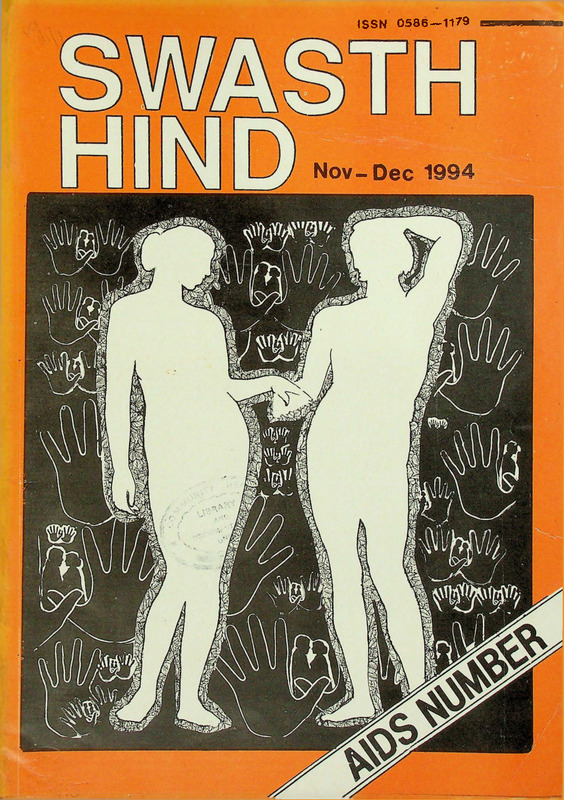
- Title
- AIDS CONAAND THE FAMILY
- extracted text
-
ISSN 0586—1179 oMnmMMa
swasth hind
Kartika-Pausa
Saka 1916
Nov.-Dec. 1994
Vol. XXXVUI, No. 11-12
OBJECTIVES
Swasth Hind (Healthy India) is a monthly journal
published by the Central Health Education Bureau.
Directorate General of Health Services, Ministry of
Health and Family Welfare, Government of India.
New Delhi. Some of its important objectives and
aims are to:
REPORT and interpret the policies, plans, pro
grammes and achievements of the Union Ministry
of Health and Family Welfare.
ACT as a medium of exchange of information on
health activities of the Central and State Health
Organisations.
FOCUS Attention on the major public health pro
blems in India and to report on the latest trends in
public health.
KEEP in touch with health and welfare workers and
agencies in India and abroad.
REPORT on important seminars, conferences, dis
cussions, etc. on health topics.
Editorial and Business Offices
Central Health Education Bureau
(Directorate General of Health Services)
Kotla Marg, New Delhi-110 002
Edited by
Assisted by
Cover Design
M. L. Mehta
M. S. Dhillon
G. B. L. Srivastava
K.S. Shemar
Madan Mohan
In this issue
Page
AIDS and flic family
ALL. Mehta
Dr KS. Singhal
AIDS and the family: Families take care
People living with HIV/AIDS talk about their families
Information, Education and Communication in AIDS
prevention
P.N. Garg
Dr S.S. Kushwaha
Dr C.B. Shukla and
Shashi Dhar Garg
Blood safety:
Role of National AIDS Control
Organization
Acquired Immuno Deficiency Syndrome (AIDS)
N. Neelakantan
A substitute vaccine to fight AIDS
Dr H.S. Chohan
Dr A.S. Padda
Sociopolitical disturbances alert India about AIDS—Red
Light Areas in Bombay—a study
Dr Sindh u I. Gila da
Plague is curable
Plague prevention and treatment
—The Ayurvedic Way
Vaid S.K. Sharma
WHO International Team on Plague calls for an end
to restrictions
Role of nurses in counselling and control of HIV infection
in health care settings
Lt. Col (Mrs) V.K.S. Reddy
Lt. (Miss) PC. Laila
Lt. Col. A.G. Mahendrakar
Ten points for World AIDS Day 1994
Education of adolescents to control threats of AIDS
Dr Brij Mohan Singh
Dr (Mrs) Satinder Vashisht
AIDS and dental care
Dr Panna Lal
Dr Neena Gulati
AIDS awareness among rural community
Dr R.C. Goyal
Dr A.T. Kulkarni
K.V. Somasundaram
Making good connections
Support for safer behaviour
Using the media
The need of sex education for adolescents in India
Prof. Prakash Kothari
Promoting 1HV/STD prevention via the media: a
worthwhile proposition?
Facts about Plague
237
239
240
241
246
250
252
254
255
257
258
260
262
263
264
266
268
270
271
272
276
Back
Inside
Cover
Articles on health topics are invited for publication in this Journal.
State Health Directorates are requested to send in reports of
their activities for publication.
The contents of this Journal are freely reproducible.
Due acknowledgement is requested.
The opinions expressed by the contributors are not necessarily
those of the Government of India.
SWASTH HIND reserves the right to edit the articles sent
for publications.
SUBSCRIPTION RATES
Single Copy
....
Annual
....
50 Paise
Rs. 6.00
This Issue
Re. 1.00
....
(Postage Free)
World AIDS Day—1994
AIDS and the Family
M.L. Mehta
Dr v.s. Singhal
In 1994, being the International Year of the Family, the World Health Organization has
chosen “AIDS and the Family” as its theme for the World AIDS Day. The emphasis is on
how families can contribute to the comprehensive global response to the disease.
CQUIRED Immuno Deficiency
A
acronym, AIDS, as you
known by the
all know, is
silently becoming an epidemic.
AIDS is, indeed, and enigma which
has defied all the efforts of health
professionals and scientists to find
any effective cure or vaccine
against it. Consequently, the vic
tim of AIDS becomes defence
less. With a view to raise public
awareness of HIV/AIDS and spur
new and more effective action
WHO has set apart December 1 as
the World AIDS Day. Each year,
since 1988, WHO has chosen a dif
ferent theme for events and acti
vities leading to World AIDS Day
and beyond.
Syndrome,
In 1994, being the International
Year of the Family, the World
Health Organisation has chosen
“AIDS and Family” as its theme for
World AIDS Day. Many events
have taken place in the months
leading to 1st December, 1994, the
World AIDS Day, focussing on
AIDS and its relation to the
family. The emphasis is on how
families can contribute to the com
prehensive global response to the
disease.
Situation in India
HIV came to India later as com
pared to other parts of the World.
But it has spread quite rapidly in
many parts of the country. Since
the detection of the first AIDS case
in Bombay in 1986, a total of 885
cases of AIDS have been reported
from the different States of the
country. So far, among 2.36 lakh
samples screened for HIV, 16051
samples have been found to be
positive. Since the spread of virus
is determined by a multitude of fac
tors like the extent of prevalence of
risk behviours, socio-economic
conditions and other socio-cultural
factors, the problem in our country
has, by and large, taken a varied
course in different States depend
ing on the extent of presence of
such factors. Therefore, if there
are States like Maharashtra,
Manipur and Tamil Nadu where
epidemic in certain cities is in its
advanced phases, there are still
many States where the problem is
in its early stage. The major con
centration of infection remains in
cities like Bombay, Imphal and
Madras.
High-risk groups
Surveys conducted among com
mercial sex workers in Bombay
have generated figures as high as
52% HIV prevalence among com
mercial sex workers. In the same
city the prevalence of HIV among
STD clinic attendees has been
reported to be 23%. The pre
valence among low risk groups like
ANC attendees have also been
found to be 2.5% in Bombay and
0.8% in Manipur. In addition,
new areas are being identified
where the prevalence among highrisk groups is escalating shar
ply. Visakhapatnam,
Tirupati,
Nagpur and Hubli are such new
places where HIV prevalence has
been found among STD clinic
attendees being in the range of 5
to 20%.
According to WHO, over 17
million men, women and children
have been infected with HIV
globally by late 1994. Besides
those who are affected in a direct
way, millions face social, economic
and emotional repercussions of the
disease, indirectly. While health
services face an additional burden,
families are increasingly being for
ced to deal with situations arising
out of HIV infection and AIDS.
This year’s theme aims to create
awareness among people as to how
families are affected by AIDS, how
to become more effective in both
AIDS prevention and care through
education and adoption of an
attitude based on compassion
and empathy.
Nov-Dec. 1994
237
I <
}
Message from DrUton Muchtar Rafei,
Regional Director, WHO South-East Asia Region
OUTH-East Asia is a region where family ties are traditionally cohesive and strong.
It is these
S human bonds that have very often helped people to tide over major calamities—natural, socio
economic or political.
Now, confronted with the most serious threat ever known to man—AIDS, family ties have
assumed an even greater importance. In a variety of ways, family support is crucial for the success
ful prevention and control of this dreaded disease. A family not only provides economic assistance
if a breadwinner becomes ill, it also provides the much-needed care, understanding and support to
those suffering from HIV/AIDS.
In its relentless march, AIDS has already affected many millions across the globe. By July 1994,
over 17 million men, women and children had been infected with HIV, and many more had been affec
ted emotionally, economically and in a variety of other ways. While the burden on the health ser
vices, already stretched to the limit in many developing countries, is very difficult to estimate, the
negative impact on the economy in terms of man-hours producitvity loss because of increased
illnesses and premature deaths could be estimated at several billion dollars.
In this context, AIDS prevention and control measures need to be strengthened urgently. Here,
the role of health and reproductive health education cannot be emphasized strongly enough, and
should be accorded top priority among ‘families’. Awareness of the importance of using safe blood
and blood products, as well as sterile injection equipment will lead to a major disruption in the chain
of transmission of AIDS. Children from stable and loving homes are less likely to grow up to be
injecting drug users thereby severely restricting the spread of this dreaded disease.
This year’s theme for World AIDS Day. ‘AIDS and the Family’; highlights the piVotal role of the
family—in prevention and control of AIDS and in providing support and understanding, especially to
persons with AIDS. Only when all members of humankind join hands as one family will this dreadful
scourge be wiped out from the surface of the earth. I am confident that our joint efforts will lead us
closer to achieving this goal.
Family Support
India traditionally has had
strong family ties and support sys
tems, which needs to be harnessed
effectively to generate awareness
and positive attitudes and be
haviours. We can build on our
traditional strength to minimise
adverse impact of AIDS, as in the
absence of a cure or vaccine, the
role of the family and social
environment in preventing infec
tion is enormous. There is an
increasing evidence that HIV infec
tion in this country is being detec
ted in general population and in
238
the places previously not known to
be affected. As the epidemic
develops, proportion of women and
children infected will also increase,
thereby affecting families directly
and in a very visible manner. It is
in this context that family support
becomes crucial in the prevention
and control of IDS.
This year’s theme for the World
AIDS Day, “AIDS and the Family”
does not define family in a limited
sense in term of blood relations or
marriage. The term, family, in
this context also includes informal
groups like street children, sex
worker associations, religious and
social organisations, governmental
and non-governmental networks
among others. A care and support
pilot programme in Manipur has
been initiated to strengthen the
capability of the community and
families to manage those affected
by HIV/AIDS. The thrust is on all
those who intend joining hands as
one family to unitedly work to
wards the control of this disease.
Keeping this in view Syvasth Hind
devotes this issue to the theme of
the World AIDS Day: AIDS and
the Family.
Swasth Hind
AIDS and the Family:
Families take care
N 1994, the International Year of
the Family, the World Health
Organization’s Global Programme
on AIDS (GPA) is marking World
AIDS Day under the banner AIDS
and the Family. Traditional and
non-traditional families have a cru
cial role to play in addressing the
HIV/AIDS pandemic.
I
In the run-up to World AIDS
Day—and on 1 December itself—
GPA urges the world to focus on
how families of all kinds are affec
ted by AIDS, on how they can be
more effective in prevention and
care, and on how they can con
tribute to global efforts against
the disease.
For GPA, any group of people
linked by feelings of trust, mutual
support and a common destiny
may be seen as a family. The con
cept need not be limited to ties of
blood, marriage, sexual partner
ship or adoption. In this light,
religious congregations, workers’
associations, support groups of
people with HIV/AIDS, gangs of
street children, circles of drug injec
tors, collectives of sex workers and
networks of governmental, non
governmental and intergovern
mental organizations may all be
regarded as families within the
over-arching family of humankind.
Every kind of family should take
care to protect its members from
HIV. And all families should take
care of those among them who fall
ill with AIDS. Families take care.
“Families whose bonds are based
on love, trust, nurturing and open
ness are best placed to protect their
Nov-Dec. 1994
members from infection and give
compassionate care and support to
those affected by HIV or AIDS,”
says Dr Hiroshi Nakajima, Dir
ector-General of the World
Health Organization.
Families and AIDS
In the mid-1990s, many families
worldwide are already disrupted by
political upheaval, civil unrest,
migration, and other factors. For
millions of them, the human
immuno deficiency virus is an
additional burden and growing
threat
By mid-1994, according to GPA
estimates, approaching 14 million
women, men and children were liv
ing with HIV and AIDS world
wide. The problem would be
devastating enough if limited to
these people alone, but it also has
enormous repercussions on their
families. Apart from the huge
emotional loss of people dear to
them, the families will also face loss
of income as breadwinners sicken
and die; a loss of care, nurturing
arid stability; and in rural areas—
as AIDS takes its toll on the labour
available to till family plots—even
a loss of food supply.
Increasingly, it is children who
arc paying the price of AIDS: not
only in the loss of their parents, but
also by becoming infected them
selves. In Africa, where the pan
demic has hit hardest so far, about
700,000 children were born to HIV
positive women just in 1993.
Children bom infected face an
early death. Those not infected
will soon be orphaned. And if
grand-parents or other relatives
cannot or will not step in with the
family support needed, the child
ren may have to leave home and
fend for themselves. Such family
disintegration caused by AIDS can
in turn lead to further infec
tions. For children with no family
support may find that selling sex on
the streets, regardless of its high
risk of HIV, is the only way to
survive.
.Not all families have a positive
influence on the HIV/AIDS pan
demic. Many women and men
have been rejected by their families
because of their HIV infec
tion. Children have been driven
on to the streets by abuse within the
family home. But well-function
ing families, who care for their own
welfare and communicate openly
are the first line of defence against
HIV and among the best sources of
care for AIDS.
“It is in families that young peo
ple can learn about the importance
of safe behaviour and nondis
crimination,” says Dr Michael H.
Merson, Executive' Director of
GPA. “If wc all do our utmost
within our families of choice—
whether they are the people who
share our home or those who share
our planet—we shall help immea
surably to defeat AIDS in every
family”.
O
239
People Living with HIV/AIDS
talk about their families
At their best, families offer love and support to family members living with HIV/
AIDS. Unfortunately, other reactions are also common. The stories on this page illus
trate both positive and negative experiences of families dealing with AIDS.
Imrat (Malaysia)
Eric (Sweden)
I had very good support from my
family. They said, rYou are part of
the family, you are the son in the
family, why should you be treated as a
different person?
*
They make mefeel
that it’s OK to have what I have,
there’s nothing wrong in it. It makes
me feel wanted, appreciated, even
though I had the infection. To know
that your family’s not rejecting you,
but they’re supporting you in every
way they can.
Myfriends are myfamily. I would
rather call my best friend ifI’m taken
ill. There’s a guy, he’s older than I
am and he’s also HIV-positive. We
have known each other for many
years now and we have become best
friends. When 1 was in hospital, I
would not have survived without him,
because he was always there for
me....Jf relationships changed in any
way, they became closer.
Prudence (Botswana)
Mary (Zimbabwe)
My husband died in 1988 and left
me with five children, six months to 10
years. With him dead and me infec
ted, life was surely not on my
side. My parents-in-law wanted me
to divide every little asset in the house,
from plates and pans to the bed. A
few days after the burial, myfather-inlaw was looking to sell my sewingmachine.
After the positive result, I spent
about three weeks without even talk
ing to my husband. And then I
asked him where he got HIV from.
He said he didn’t know. I blamed
him, because sometimes he slept out
side with some girlfriend. We quar
relledfor a long time, and then wejust
forgot about it. I explained to him
that we were a wife and hus
band. We must endure things to
gether. We must tell each other the
disease we are suffering from rather
than hide it. And then he said, T am
so sorry, because I was afraid oftelling
you that I am HTV-positive. ’ He had
known for some two years. Now my
husband I are loving each other very
much. We are closer, we are coming
together, sorting out our problems
together, talking to each other.
Juan (Colombia)
I am 32 years old and the father of
a very beautiful daughter, aged 17
months. Ifound out that I had AIDS
when she was only three months
old. Even though I was discreet
about being gay, my wife was furious
and threw me out, saying 7 can’t go on
living with a homosexual’. It seemed
to be more traumatic for her to know
that I was gay than to know I had
AIDS and would by all accounts soon
be dead. The only person I got help
from was my sister.
(Excerpted from Wise before their time, a book oftestimoniesfrom people living
with HTV/AIDS compiled by Ann Richardson & Dietmar Bolle, Fount paper
backs, Harper Collins Publishers, 77-85 Fulham Palace Road London W6 8JB,
UK. ISBN 0 00 627648 2. Price: £4.99.)
240
Swasth Hind
Information, Education and
Communication in AIDS
Prevention
P.N. Garg
Dr S.S. Kushwaha
Dr C.B. Shukla &
Shashi Dhar Garg
In the absence of a vaccine or cure for AIDS, the single most important component of
National AIDS Programme is information and education. The overall goal of IEC is to
prevent the transmission of HIV infection to people by informing them about the risk and
encouraging, facilitating and supporting effective and sustained behaviour change.
HE world is facing an epidemic
disease, for which there is
cure and no early pro
spect of a vaccine. It thrives on
human ignorance, fear and resis
tance to change. The disease is
known as AIDS and infection as
HIV. Until we find a vaccine or
cure, the only way to stop the
of a
T
presently no
spread of AIDS is through edu
cation.
On the basis of available infor
mation, by the mid 1992 at the
global level 501361 AIDS cases
from the 168 countries have been
reported. The
World
Health
Organization estimated true figure
of AIDS cases as 10-12 million.
Most of the cases do not know that
they are infected. An estimated 13
million men, women and children
have already been infected with
HIV. Every day, an estimated
5000 people are newly infec
ted. Without urgent action, the
current total may rise to 30-40
million by the end of the century
(WHO 93).
Available reported and estimated AIDS cases and estimated cases of HIV infection world-wide.
By Mid
Country
Global
168 countries
Reported
AIDS cases
Estimated
figure of
AIDS cases
501,361
10-12
million
NA
* Asia
1250 by
Nov. 1992
India
308 by
Feb. 1993
N.A
■■■■■■
Madhya Pradesh
1992
179000 by
1996
N.A
By 2000 estimated
cases of HIV
infection
Remarks
30-40
million
1 million
by 1992
2-3 million
bv 1996
323 by
April 1993
5000 cases every day
estimated
Seropositive rate
7-09/1000__________
7-6/1000
Source : ICMR 1992. WHO Press release 1993, AHRTAG 1991, ICMR 93.
Nov-Dec. 1994
2-24 DGHS/94
241
The well known main obstacles
in AIDS prevention are—
— Lack of awareness and healthy
lifestyles (Sexual behaviour).
— Lack of appropriate health
technologies i.e. vaccines and
drugs.
— Lack of supportive environ
ment The individual health is
dependent upon his environ
ment, lifestyle and health care
system.
The environment—be they social
or ecological—are important fac
tors in shaping positive (healthy)
sexual behaviour and attitudes.
Thus creating environments that
support and enhance sexual be
haviour is an essential step in
AIDS prevention.
Major
components
programme
of
the National AIDS Control Pro
gramme (NACP) since 1987. The
major components of the pro
gramme are—
sero-surveillance,
and sentinel.
clinical
2.
Screening of blood and
blood products- to ensure
blood safety.
3.
Information, Education and
communication (IEC).
AIDS
In view of the obstacles, the
government of India has launched
Surveillance, which includes
1.
A FRAME WORK FOR IEC IN AIDS PREVENTION
Goals of
IEC in AIDS
“Encouraging, facilitating and supporting effective
and behaviour change"
Obstacle's in
AIDS prevention
Lack of awareness
Appropriate health
technologies
Supportive environ
ment.
Challenges in
AIDS
Raising awareness
Behavioural change
Social Support
Places of IEC
Hospital
Community/Home
Working place
Key change Agents
Peer group &
school teachers
PWAs & IDUs
Traditional health
healers
Taigets
Professional
Non-Professinal
Community & high risk
group
Principles of IEC
Social marketing
Empowerment
Commitment—3 P
Coordinating healthy
policy
Accurate,“honest
consistent & realistic
.Scientifically and
ethically based
Community based
Multidisciplinary
Social mobilization
Approaches of IEC
Surveillance
242
Screening of blood
Swasth Hind
In the absence of a drug or vac
*
cine, “education” offers the only
ray of hope of slowing the spread of
HIV infection. Just as much as
“information” is “wealth” in the
hands of businessmen and inves
tors in the stock market,
“knowledge” is the “life-blood” for
many who engage in high risk
behaviour or activities or who may
expose themselves to high risk
situations conducive to the spread
of HIV. It is therefore, not surpris
ing that “AIDS education” (IEC) is
high on the agenda of actions for
National AIDS Committees in
more than 150 WHO Member
States (UNESCO-1990).
Approaches of AIDS Prevention
The five, basic mechanisms for
prevention of infectious diseases
include—
1. Immuno prophylaxis
(vaccine)
2. Chemo prophylaxis (Drugs)
3. Sanitation (Environment)
4. Lifestyle modification (Be
haviour)
5. Vector control.
There is no evidence to suggest
that the HIV virus is transmitted
through insect or other vec
tors. The first two of the four
mechanisms, vaccines and prophylactic/therapeutic drugs, are
under development (Waller R.
Dowdle 1987). In the absence of a
vaccine or drug, we have to rely on
remaining two mechanisms, to pre
vent the spread of HIV infection :
lifestyle modification and sanita
tion (environment). The former is
aimed at modifying the sexual
behaviour of individuals, while the
latter protects society as a whole
through modifying the social envi
ronment Anti-discrimination, etc.
The public must be reassured that
the general environment does not
present a threat. As HIV virus is
not transmitted through casual
social contact or food and
water.
The specific mechanism for
modifying behaviour includes
modification of sexual practices of
infected persons, routinely offering
testing and counselling to persons
at
high-risk,
treating
injecting-drug users to preclude
transmission of virus through the
use of contaminated needles, and
information and education pro
grammes (Walter R. Dowdle
1987).
Reports of the WHO experts
from the concerned fields, have
been debated in world-wide
meetings, concluded that respect
for human rights i.e. antidiscrimi
nation is more than a humane
approach, it is the only approach
capable of effectively combating
AIDS (Susan Scholle Connor
1989).
Targets of IEC in Aids Prevention
The professionals, non-professionals and community members,
working in Medical and associated
disciplines are directly or indirectly
faced with some kind of contact
with HIV infection/AIDS cases.
There is a need for orientation in
education and counselling on their
specific roles and responsibilities
towards AIDS prevention. The
target personnel can be grouped
as follows:
Professionals
(Health Care providers)
Risk behaviour group
IEC Target groups
Community opinion leaders
Non-rrofessionals •
(Govt. & Volu. agencies)
NOV-DEC. 1994
243
Professional groups can be again categorised as under:
Medical
Traditional
(non-Medical)
Besides the medical practitioners
from Allopathic to Siddha system,
a similar number of para medical
and traditional healers are working
at different levels. These band of
workers also have to be recognised
and trained in basic facts of HIV/
AIDS disease. This is vital to the
containment of the disease as very
often these people may be the first
line of health workers to be
approached by the patient in the
peripheral areas of the coun
try. The medical students, being
well informed about the nature of
HIV virus and its modes of
transmission, are ideal peer group
communicators.
(IPPF-Medical
Bulletin 1989).
Voluntary agencies
(Youth, Red cross, Women, FPA)
_____ t _____
Education
Non-Professional
------
Media
----- J------ L
Students
The above group of individuals
need to be trained as “change
agents” for the specific groups and
community at large. Teachers
and’other voluntary workers occupy
* roles for the success of AIDS
key
educational programme.
They
also act as formal leaders in the
community. They are educated
and committed groups, who if
given scientific knowledge about
the natural history of AIDS, can
spread the information to a large
group of individuals and can act
as beneficial “change agents”
(Kapoor Indira 1990).
The community leaders, such as
opinion, religious.
influcnsive
pensioners (retired from service),
powerful and even defeated politi
cal leaders have a pivotal roles in
creating supportive environment
i.e. social support against dis
crimination activities and facilitat
ing human rights in the com
munity.
users (IDUs)
244
S waste Hind
These groups of individuals need
education and counselling on the
different components of disease i.e.
knowledge, mode of transmission
of the HIV virus and the safer sex
practices with their partner. The
health care leaders must use every
opportunity to educate the public
or risk group personnel regarding
the preventability of this disease.
Places of IEC in AIDS Prevention
Opportunities of IEC in AIDS
prevention are mainly at three tier
level—
* Hospital
* Community/home
* Working place
Hospitals have an increasing res
ponsibility for communicating
scientific facts regarding AIDS pre
vention io the patients with AIDS
(PWAs), then families, risk be
haviour groups and to the com
munity at large. Hospital offers a
number of opportunities where the
visiting PWAs and their relatives
and friends can be educated to
bring about the “Safer Sex” prac
tices through the counselling
approach in different clinics such
as FP, STD, ANC and MTP etc.
Effective community based IEC
programme can help to increase
people’s understanding of HIV/
AIDS and to reduce the social
stigma.
The key change agents
The following group of personnel have a key roles in AIDS preveniton.
School
teachers
—
1
I
t
I
Self-help &
•
support group k
People with AIDS (PWAs) and
peer group educators are an invalu^
able resource for breaking down
the myriad subtle barriers to under
standing and acceptance of the
facts about HIV/AIDS. The self
help and support groups provide
practical and emotional support
for individual and their families
such as one to one counselling,
home care, child care, income
generating schemes and mutual
financial help.
The opinion leaders being res
pected and trusted by the com
munity, have a valuable role in
shaping public attitudes towards
the epidemic and modify sexual
norms among sexually active indi
viduals (Siegal Karolynn—1987).
Roles of IEC in Aids Prevention
The overall goal of IEC is to pre
vent the transmission of HIV infec
tion to peoples by informing them
about the risk and encouraging,
facilitating and supporting effec
tive and sustained behaviour
change.
Nov-Dec. 1994
3—24 DGHS/94
The specific roles of IEC are:—
• It leads to self-imposed, will
ing meaningful and sustained
changes in behaviour with
the recognition that every one
must assume self respon
sibility for his own health.
• To eliminate irritational fears,
ignorance and prejudice
about transmission through
casual contact and to reduce
the spread of infection.
• To motivate
society
in
practices.
all levels of
safe
sexual
• To persuade people to adopt
certain behaviours and relin
quish others.
• To increase the knowledge of
young people in AIDS aetio
logy, prevention strategies
and risk factors.
• To develop that climate of
tolerance, compassion and
understanding in the com
munity at large, without
which any campaign to con
tain the spread of disease is
deemed to failure (IPPF
Medical Bulletin 1989).
• To remove social stigma and
discrimination against the
disease so that risk behaviour
groups voluntarily come for
ward for detection at early
stage.
Principles of IEC in Aids Pre
vention
A major principle of IEC is—
“to start from where people are at,
not where you think they are at” An
(Con id. on page 259)
245
VOLUNTARY BLOOD DONATION DAY—OCT. 1, 1994
BLOOD SAFETY :
Role of National AIDS
Control Organisation
N India blood collection, storage
issue takes place mainly
in blood banks attached to hos
pitals most of which are under Cen
tral and State Governments. A
portion of the blood banking
activity is also carried out by volun
tary agencies and private sector
blood banks. To study the blood
banking and transfusion services
status in the country, the Govern
ment engaged a professional
agency to conduct an all India
study in the year 1989-90. The
study revealed that there were an
estimated 1018 blood banks in the
country handling about 2.00
million units (of 350 ml including
anticoagulant) per annum. As per
WHO norms of 7 units per annum
per (hospital) bed, the present
collection is a little less than half of
our total requirement. Out of this,
29% blood comes from professional
donors. The study also reported
that the blood transfusion services
infrastructure was highly decen
tralised and lacked many critical
resources viz., trained manpower,
facilities, equipment, supplies, and
financial assistance. It was also
observed that the testing facilities
for HIV and Hepatitis-B was
I and
246
limited and erratic and that there
was need for optimal utilisation of
the scarce blood.
Need for Blood Safety
Blood provides a good medium
for growth of any organism because
of its nutrient value, adequate
oxygen content, and adequate tem
perature. Transfusion of blood is
a direct source for the transmission
of diseases like Hepatitis, Syphillis
and Malaria. HIV/AIDS is the
latest addition to the list of blood
transmissible diseases. Infusion
of blood and blood products is one
of the most efficient means of
transmission of HIV infection
(Estimated rates : blood transfusion-90%; Perinatal transmission30-50%; Sexual intercourse transmission-0.1%). It is for this reason
blood is mandatorily screened for
HIV, Hepatitis-B, Syphillis and
Malaria.
objectives were formulated in the
strategic plan and appropriate.
strategy was outlined for the pre
vention and control of AIDS in
India. The main thrust areas
identified are :—
—
strengthening the national
blood transfusion services;
—
ensuring an adequate supply
of blood to all blood centres;
—
developing facilities for the
production of blood compo
nents;
—
developing and strengthening
facilities for plasma fractio
nation;
—
strengthening external quality
control of blood and blood
products;
—
undertaking
research
on
blood
transfusion service
operations to improve safety,
efficacy and supply; and
—
developing and strengthening
of effective
management,
monitoring, and evaluation of
blood transfusion services.
Strategy
Based on the national policy
frame work on blood transfusion
services developed by the Central
Council of Health in the year 1982,
Swasth Hind
Blood Safety is an integral part of
the functions assigned to the
National AIDS Control Organisa
tion (NACO). The work relating
to blood safety involves coordina
tion of activities of many organi
sations including state govern
ments, local bodies, voluntary and
private agencies. Like NACO at
the Centre, State AIDS Cells set up
in the States and Union Territories
under the National AIDS Control
Programme are responsible for
blood safety. The State Food and
Drug Administrations have been
strengthened to enforce the blood
safety standards by the blood
banks and other related agencies.
“.... Blood is a gift for life which all of us can, and must, share with
others. Each healthy individual should regularly donate blood so
that those who need blood may get it at a time of need. There can
be no recipients of blood if there are no donors. Blood donation
poses no risk to the person donating the blood. Blood loss at the
time of donation is compensated quickly by the human body.
I, therefore, appeal to the Public to come forward in large num
bers and donate blood to authorised blood banks. Let us also ack
nowledge those who have voluntarily donated blood in the past and
contributed to the life, recovery and health of their fellow
beings."
—SHANKER DAYAL SHARMA,
President of India in a Message on the
National Voluntary Blood Donation Day.
October 1. 1994
Establishment
Facilities
of
HIV
Testing
During the past three years, 180
Zonal Blood Testing Centres have
been established in 112 cities for
providing HIV testing facilities.
These zonal blood testing centres
have established linkages with the
blood banks affiliated to public,
voluntary
and
private
sec
tors. They work on the mecha
nism of hub and spoke. The
zonal centres receive samples of
blood from the blood banks linked
to them for testing and the results of
HIV testing is communicated telephonicallyon the same day. Based
on the results, the blood banks are
advised to discard HIV positive
blood by heat treatment followed
by incineration. The strategy
adopted for blood safety is to carry
out unlinked anonymous testing of
NOV-DEC. 1994
every unit of blood with a single
elisa/rapid/simple test with kits
which test for both HIV-I and
HIV-IL
public sector would be modernised
during the next three years.
Training and Manpower Develop
ment
Modernisation of Blood Banks
The National AIDS Control
Organisation has launched a cen
tral scheme of assistance to states
for providing minimum facilities to
all blood banks in the public sec
tor. This assistance includes
blood bank equipment, con
tingency grant for consumables,
chemicals and reagents. In the
seventh plan, 146 major blood
banks
had
been
moder
nised; Ninety more major blood
banks were taken up for moder
nisation during 1992-93. A further
372 remaining blood banks in the
The Government have for
mulated a short term and long term
strategy for training and manpower
development under the blood
safety programme. Under the
short term strategy, 10 training
institutions in different regions of
the country which are imparting
short training courses have been
augmented. Training modules are
being prepared. The target is to
train doctors, technicians and
donor motivators working in the
blood banks. It is also proposed
to train drug inspectors through
short orientation training cour
ses. As a long term stratgey, it is
247
“Voluntary Blood Donation is a social and individual responsibility
which calls for constant attention by the community. The need
for blood by patients can only be met by the perpetual willingness
of people to help their fellow beings in need. The Voluntary
Blood Donation Day is a useful reminder of this social respon
sibility and helps to renew our motivation to contribute to this
noble cause.
I appeal to all. in particular to the youth to come forward and
donate blood frequently. I convey my best wishes to them and to
the voluntary and governmental organisations engaged in this
philanthropic work.”
—P.V. NARASIMHA RAO.
Prime Minister In a Message on the
National Voluntary Blood Donation Day.
October 1. 1994
proposed to start post graduate
diploma and degree courses in
blood transfusion services, which
would pave the way for career pro
spects for those engaged in this
field.
Promoting Rational Use of Blood
It is essential that most of the
blood banks deviate from their
original concept of just deposition
of one unit of blood and with
drawal of the same for one
patient.
The role of blood bank has
expanded aiming to provide total
transfusion services to the hos
pitals rather than handling the
logistics of units of blood. While
there is a need to build up blood
collection to meet the demand and
ensure a sustained supply from
voluntary donors, we also have to
utilise
the
available
blood
optimally. It is with this in view
that NACO has planned to set up
30 components separation units
all over the country in a phased
manner. Blood banks handling
more than 10,000 units of blood
per annum have been identified
for providing this facility. It
would not only optimise the use of
blood but also take care of
therapeutic needs of patients in
various hospitals in the country.
248
A plasma fractionation unit has
been set up in Bombay. Govern- ■
ment of India is fully supporting
this unit. After consolidating the
optimal utilisation of this plant’s
capacity, it is proposed to establish
more such units in other met
ropolitan cities.
Legal Framework
The Schedule F XII-B of the
(Central) Drug and Cosmetics Act
provides the necessary legal
framework for blood safety. The
existing rules specify licensing for
physical facilities of equipments.
staff, accommodation, labelling
etc. The recently introduced
amendment to the above Act has
added the following provisions:—
(a)
(b)
(c)
(d)
Testing procedures of blood
and blood products, quality
control of reagents; specified
qualification and experience
requirements
for
blood
bank personnel;
Preservation of specimen
samples of each unit of
blood in pilot tube for 72
hours after transfusion;
Maintenance of complete
and accurate records:
Mandatory testing to ensure
the freedom of blood and
blood products from HIV
antibodies;
(e)
Approval of licence by Cen
tral
Licence
Approving
Authority (which means the
Drug Controller of India)
prior to the granting of a
licence;
(f)
Whole human blood and
components shall conform to
standards
as
prescribed
under the Indian Pharma
copoeia.
The major changes brought
about by this amendment enable
the Central Government to exer
cise simultaneous jurisdiction in
the approval of blood banks licen
ces in order to ensure a better con
trol over the inspection and
licensing of blood banks.
Promotion of
Donation
Voluntary
Blood
As stated above, the total quan
tity of blood generated in the
country is less than half of our
estimated requirement. Out of
this about 29% comes from pro
fessional
donors. Thus,
the
availability is much less than the
requirement and much of the
available supply would be of
doubtful or inferior quality.
Although there are stringent rules
to regulate functioning of blood
banks yet this cannot remedy a
situation arising out of poor
availability of blood. We have
therefore to improve supply of
blood. The source of supply is
most important and the augmen
tation of voluntary blood donation
is the key approach. Blood
‘donated’ means a life ‘saved’.
Blood donation is the most pre
cious gift one human being can
give to another. Any healthy
adult of age 18 to 60 can donate
blood every three months without
any detriment to his or her
health. In the case of adult
women, they can donate blood at
any time with the same interval
except during pregnancy and first
six months of lactation period.
These facts need to be made
known to everyone and a sense of
service to humanity be cultiva
ted. Therefore, the main objective
SWASTH
HIND
of NACO is to launch a massive
drive through health education
and innovative approaches to
generate adequate supply of blood
from voluntary donors. With this
objective in view the IEC (Infor
mation, Education and Com
munication) component of the
National AIDS Control Organisa
tion provides substantial inputs
for motivation to voluntary donors
involving mass media, government
institutions and NGOs. The
State Governments have also to
take on this activity in a big
way.
Quality Control
The quality control of blood
and blood products in all its facets
of collection, testing, handling and
distribution
assumes
greater
importance as we have to ensure
safety of blood transfusion.
National Institution of Biological
will lay down standards and also
monitor various aspects of quality
control. NACO has also set up a
sub-committee to advise on this
matter.
While the Government of India
is engaged in improving and
streamlining blood transfusion
services in the country, the task.
ahead is stupendous. A large
number of blood banks operating
in voluntary and private sectors
too need to be modernised and the
quality of services be improved.
—National AIDS Control Organisation,
Ministry of Health and Family Welfare,
I Red Cross Road, New Delhi-110 001.
Nov.-Dec. 1994
4—24 DGHS/94
“...... The donating of blood is indeed giving a new lease of life for
those in need. Blood knows no distinction of sex, language,
caste, creed or religion.
The need for safe blood, free from disease is a necessity. It
can be met only by the active participation of the society. The
overall health status of the society, especially those of women who
suffer from acute anaemia, often necessitates blood trans
fusion. With the increasing number of accidents and emergen
cies it is very critical that adequate blood is available at our
blood banks.
While the Government is taking all necessary steps to ensure
that safe blood is available by upgrading the blood banking sys
tem to international standards, the task would be greatly
facilitated when the pool of voluntary blood donors in the country
is increased significantly. Efforts should be made for rational use
of blood avoiding unnecessary transfusions and optimum utilisa
tion of blood by providing for component separation facilities.
On this occasion I would like to congratulate all involved in pro
viding blood transfusion services for the excellent work that they
have been doing, especially the blood donors, without whom
many homes would be deprived of individuals whom they care
and love.
—B. SANKARANAND
Minister of Health & Family Welfare
in a Message on the National Voluntary
Blood Donation Day—Oct. 1. 1994
DONATE BLOOD
SAVE A LIFE
Do You Know.....
• Blood has no substitute.
• Blood can come only from human
beings.
• Blood can be donated safely every 3
months.
• Blood can be given by any healthy person
from 18 to 65 years old.
249
"Voluntary Blood Donation Is a social and individual responsibility
which calls for constant attention by the community. The need
for blood by patients can only be met by the perpetual willingness
of people to help their fellow beings In need. The Voluntary
Blood Donation Day is a useful reminder of this social respon
sibility and helps to renew our motivation to contribute to this
noble cause.
I appeal to all. in particular to the youth to come forward and
donate blood frequently. I convey my best wishes to them and to
the voluntary and governmental organisations engaged in this
philanthropic work."
— P.V. NARASIMHA RAO,
Prime
Minister
in
National Voluntary
October 1. 1994
proposed to start post graduate
diploma and degree courses in
blood transfusion services, which
would pave the way for career pro
spects for those engaged in this
held.
Promoting Rational Use of Blood
It is essential that most of the
blood banks deviate from their
original concept of just deposition
of one unit of blood and with
drawal of the same for one
patient.
The role of blood bank has
expanded aiming to provide total
transfusion services to the hos
pitals rather than handling the
logistics of units of blood. While
there is a need to build up blood
collection to meet the demand and
ensure a sustained supply from
voluntary donors, we also have to
utilise
the
available
blood
optimally. It is with this in view
that NACO has planned to set up
30 components separation units
all over the country in a phased
manner. Blood banks handling
more than 10,000 units of blood
per annum have been identified
for providing this facility. It
would not only optimise the use of
blood but also take care of
therapeutic needs of patients in
various hospitals in the country.
a
Message
Blood
on
Donation
the
Day.
(e)
Approval of licence by Cen
tral
Licence
Approving
Authority (which means the
Drug Controller of India)
prior to the granting of a
licence:
(I)
Whole human blood and
components shall conform to
standards
as
prescribed
under the Indian Pharma
copoeia.
The major changes brought
about by this amendment enable
the Central Government to exer
cise simultaneous jurisdiction in
the approval of blood banks licen
ces in order to ensure a better con
trol over the inspection and
licensing of blood banks.
Promotion of Voluntary Blood
A plasma fractionation unit has
Donation
been set up in Bombay. Govern- ment of India is fully supporting
As stated above, the total quan
this unit. After consolidating the
tity of blood generated in the
optimal utilisation of this plant’s
country is less than half of our
capacity, it is proposed to establish
estimated requirement. Out of
more such units in other met
this about 29% comes from pro
ropolitan cities.
fessional
donors. Thus,
the
availability is much less than the
Legal Framework
requirement and much of the
The Schedule F XII-B of the
available supply would be of
(Central) Drug and Cosmetics Act
doubtful or inferior quality.
provides the necessary legal
Although there are stringent rules
framework for blood safety. The
to regulate functioning of blood
existing rules specify licensing for
banks yet this cannot remedy a
physical facilities of equipments,
situation arising out of poor
staff, accommodation, labelling
availability of blood. We have
etc. The recently introduced
therefore to improve supply of
amendment to the above Act has
blood. The source of supply is
added the following provisions:—
most important and the augmen
tation of voluntary blood donation
(a) Testing procedures of blood
is the key approach. Blood
and blood products, quality
‘donated’ means a life ‘saved’.
control of reagents: specified
Blood donation is the most pre
qualification and experience
cious gift one human being can
requirements
for
blood
give to another. Any healthy
bank personnel;
adult of age 18 to 60 can donate
(b) Preservation of specimen
blood every three months without
samples of each unit of
any detriment to his or her
blood in pilot tube for 72
health. In the case of adult
hours after transfusion:
women, they can donate blood at
any time with the same interval
(c) Maintenance of complete
except during pregnancy and first
and accurate records;
six months of lactation period.
(d) Mandatory testing to ensure
These facts need to be made
the freedom of blood and
known to everyone and a sense of
blood products from HIV
service
to humanity be cultiva
antibodies;
ted. Therefore, the main objective
248
SWASTH
I
HIND
of NACO is to launch a massive
drive through health education
and innovative approaches to
generate adequate supply of blood
from voluntary donors. With this
objective in view the IEC (Infor
mation, Education and Com
munication) component of the
National AIDS Control Organisa
tion provides substantial inputs
for motivation to voluntary donors
involving mass media, government
institutions
and NGOs. The
State Governments have also to
take on this activity in a big
way.
Quality Control
The quality control of blood
and blood products in all its facets
of collection, testing, handling and
distribution
assumes
greater
importance as we have to ensure
safety of blood transfusion.
National Institution of Biological
will lay down standards and also
monitor various aspects of quality
control. NACO has also set up a
sub-committee to advise on this
matter.
While the Government of India
is engaged in improving and
streamlining blood transfusion
services in the country, the task.
ahead is stupendous. A large
number of blood banks operating
in voluntary and private sectors
too need to be modernised and the
quality of. services be improved.
—National AIDS Control
Organisation,
Ministry of Health and Family Welfare,
1 Red Cross Road. New Delhi-110 001.
Nov.-Dec. 1994
4—24 DGHS/94
“.......The donating of blood is indeed giving a new lease of life for
those in need. Blood knows no distinction of sex, language,
caste, creed or religion.
The need for safe blood, free from disease is a necessity. It
can be met only by the active participation of the society. The
overall health status of the society, especially those of women who
suffer from acute anaemia, often necessitates blood trans
fusion. With the increasing number of accidents and emergen
cies it is very critical that adequate blood is available at our
blood banks.
While the Government is taking all necessary steps to ensure
that safe blood is available by upgrading the blood banking sys
tem to international standards, the task would be greatly
facilitated when the pool of voluntary blood donors in the country
is increased significantly. Efforts should be made for rational use
of blood avoiding unnecessary transfusions and optimum utilisa
tion of blood by providing for component separation facilities.
On this occasion I would like to congratulate all involved in pro
viding blood transfusion services for the excellent work that they
have been doing, especially the blood donors, without whom
many homes would be deprived of individuals whom they care
and love.
—B. SANKARANAND
Minister of Health & Family Welfare
in a Message on the National Voluntary
Blood Donation Day—Oct. 1. 1994
'DONATE BLOOD
SAVE A LIFE
D’o You Know.....
• Blood has no substitute.
• Blood can come only from human
beings.
• Blood can be donated safely every 3
months.
• Blood can be given by any healthy person
from 18 to 65 years old.
249
Acquired Immuno Deficiency
Syndrome (AIDS)
N. Neelakantan
AIDS has caused a widespread concern amongst the medical profession and also
has brought in unprecedented alarm amongst the public in general. The disease
was brought to the attention of the medical community in 1981. Twentysix pre
viously healthy homosexuals in New York and California got a new disease which has
become known as Acquired Immuno'Deficiency Syndrome. There is no cure for
AIDS. If any one has full blown AIDS, he is sure to die after a prolonged
illness.
IDS is a new complicated dis
system of
body.
caused by a ret
rovirus called ‘Human Immuno
deficiency Virus’ (HIV). It is a
small
micro-organism
which
attacks the specialised group of
cells in the body known as T4 of
T-helper cells. These cells nor
mally play a vital role in the pre
vention of infection. When these
T4 cells arc attacked by the HIV
the body’s immune system collap
ses, leaving the individual suspect
to a wide variety of infections,
especially pneumonia and certain
forms of cancer. The AIDS virus
may also directly attack brain cells
and produce neurological syn
drome and a variety of psychiatric
illness marked by personality
change, intellectual impairment
and
dementia. Dementia
is
characterised by organic deteriora
tion of intelligence, memory and
orientation. The
incubation
period of the disease is two to six
years with an aveage of 28 mon
ths. So .if one got the infection
the actual symptoms of the disease
appear after a prolonged period.
order of the defence
A
the
It is
Transmission of AIDS
Infection
occurs
whenever
blood from an infected person
enters the body of an uninfected
person. Sexual practice, injecting
of drugs who share needles,
syringes or other equipments,
blood transfusion or treatment
with blood products contaminated
250
with HIV may transmit the dis
ease. Passive anal intercourse
and contact with a large number
of sexual partners are the
greatest risk.
All those individuals who
becomes infected with HIV do not
develop AIDS. Most probably
the majority may not develop the
disease though their blood con
tains HIV. Others who do not
develop AIDS or AIDS related
lymphadenopathy (PGL) cany the
virus throughout their lives with
no signs or symptoms of the dis
ease. Those who do not develop
the disease might be healthier and
their natural defence control the
invading microbe to a greater or
lesser degree. So it can be pre
sumed that whatever be our
genetic inheritance, we can make
ourselves healthier by proper diet
and a healthful living thereby
dramatically reducing the risk of
diseases. But those who have the
virus in their blood or semen and
who look healhier are dangerous
since they can readily transmit the
disease to other individuals.
The virus is transmitted by: (1)
Sexual contact Casual, homosex
ual or hetrosexual men. Anal sex
involves the highest risk. (2)
Illicit use of narcotic drugs and
prostitution. Injection by using
needles and syringes shared with
an
infected
person
which
generally happens in case of drug
addicts. (3) From transfusion of
blood from infected persons. (4)
Use of infected factor VIII and
concentrate made from pooled
blood. (5) Any instrument that
becomes contaminated with blood
of an infected person is used
without proper sterilisation to
pierce the skin of another person.
(6) By transplacental and perina
tal transfer from mother to
child.
The virus is not spread through
food or water. It does not spread
through insects or toilet seats,
swimming pools or telephones.
Shaking hands, hugging, coughing
or sneezing or sharing a bus or
waiting room or talking to or visit
ing a hair dresser, or optician who
has HIV infection does not spread
the virus. In order to confirm the
presence of HIV in one’s blood,
two tests are undertaken. First
test called ‘Elisa’ test to find out
the presence of AIDS virus and a
second test called ‘the western blot
test’ to reconfirm the presence of
the virus.
Clinical symptoms
About one week after getting
infection there may be a brief flue
like illness after which the
individual enters the dormant
period during which time he looks
perfectly well and leads a normal
life. This may continue during
the incubation period ranging
from two years to six years.
Symptoms of the disease appear
after the incubation period. But
Swasth Hind
between six and twelve weeks after
infection or in some cases as long
as eight months the antibodies
usually appear in his blood. As
already mentioned any one who
has the virus in his blood or semen
can pass it on to others even if he
feels and looks completly well.
The signs and symptoms which
may suggest AIDS are:
(1) Profound fatigue which lasts
for several weeks with no obvious
cause. (2) Unexpected weight loss
of more than 4.5 kg in less than two
months. (3) As a result of a pro
found cellular Immune-deficiency
opportunistic
infections
and
tumours like Kaposi’s sarcoma
may
appear. (4) Unexplained
fever, shaking chills or drenching
night sweats lasting for several
weeks. (5)
Swollen
glands
especially in the neck or arm
pits. (6) Persistant shortness of
breath and non-productive cough
of
several
weeks
duration.
(7) Tumours, skin diseases of new
pink-to-purple blotches, flat or
raised bruise or blood blister which
are usually painless. Kaposi’s sar
coma is a form of skin cancer
characterised by large areas of dis
coloration over the skin. This
cancer is seen in some cases in
severe stages of HIV infec
tion. Blood blisters can be seen in
the mouth and eyelids as
well. Initially they may look like
bruises, but do not pale when
pressed and do not disap
pear. (8) A number of other skin
complaints arc common among
AIDS patients including fungal
infections and eczema. (9) A
Thrush-whitish coating in the
mouth or throat. This may appear
as white spots or as white discharge
from the rectum. (10) Diarrhoea,
usually profuse and chronic. (11)
Lethargy, depression and in late
stages dementia.
The clinical expression of HIV
infection includes manifestations
due to opportunistic diseases, as
well as illness directly caused by
HIV itself. The spectrum of
opportunistic infections include
attacks of protozoans, viruses, bac
teria and fungai agents. One third
of AIDS patients develop ence
phalitis (inflammation of the
brain)? Sudden changes in the
Nov.-Dec. 1994
ability to function with a clear
mind,
confusion,
forgetfulness,
(5) Women suffering from AIDS
or who arc at risk should avoid
becoming pregnant since the infec
tion can be transmitted to the
unborn or new born baby.
(6) It would be advisable to
medically examine all prostitutes
and segregate those who are having
HIV infection.
Preventive measures
Precautions to be taken if one has
(1) Avoiding exposure to the
AIDS or HIV infection
HIV virus is the most effective
(1) Do not give blood or an
means to prevention. People
organ. (2) Do not share needles or
should be given education and
other equipments for injecting
counselling. People need a basic
drugs. (3) If you have sex with some
understanding of the clinical
one, follow the risk reduction
features of AIDS, the mode of
guidelines. (4) Avoid breast feed
transmission and associated risk
to your child. (5) Avoid sharing
factors of infection. An awareness
campaign should be planned and
of tooth brushes or razors or any
thing likely to be contaminated
implemented for persons aged 15
and over studying in high schools
with blood. (6) Cover any acute
cuts or grazes with water proof
and colleges.
plaster. (7) Eat a properly balan
(2) From the fact that all those ced nutrition. (8) Reduce the
amount of stress. (9) Get enough
infected with the virus do not
rest and sleep. (10) Clean any
develop AIDS, we can presume
split blood or other body fluid
that some other factors like poor
immediately and wash the surface
nutrition, high stress levels, drug
with household bleach, diluted
use and frequent exposure to other
with 10 parts of water. (11) Cut
diseases especially sexually trans
down drugs which may damage
mitted diseases may also be
your immune system. (12) Take
involved in developing the dis
care of physical and mental health.
ease. So prevention of AIDS has
(13) Certain live vaccines might
to do with health enhancement of
cause problems for certain persons
individuals. We have to enhance
with immune deficiency. So, as
the 'general health and immune
far as possible vaccinations should
system in particular.
be done only after consulting
(3) Since the spread of AIDS your doctor.
virus is most often linked to
A world wide effort will only stop
intimate contact involving the
AIDS. The World Health Orga
transfer of blood or semen, it is
nization started a Special Pro
necessary to ensure safety of blood
gramme on AIDS, on 1st of
and blood products. Blood and
February 1987 which is now called
blood products must be tested for
"Global Programme on AIDS’
AIDS virus before transfusion.
(GPA). In a remarkably short
Much care is necessary in organ
time, the programme has designed
transplantation. Re-use
of
the Global AIDS Strategy, raised
needles, syringes and other skin
funds and rapidly started to imple
piercing invasive equipments must
ment the strategy, and marshalled
be done with proper sterilisa
the support of all nations. Most of
tion. Sex with strangers should be
the countries have now entered into
discouraged. The use of condoms
collaboration with WEIO to sup
may decrease the risk of transmis
port and strengthen their national
sion, but does not guarantee full
programmes. These
national
•protection. Disposable
plastic
AIDS programmes are being
syringes may be used as. far as
rapidly established throughout the
possible.
world with technical and financial
support of WHO’s Global Pro
(4) The blood donors as well as gramme on AIDS’. The global
challenge which lies ahead will
organ and sperm donors should be
truly demand the effort of every one
tested for antibodies before their
of us.
donation is used.
slow thinking and concentration.
loss of balance, weakness of leg
muscles and difficulty in writing
are 'the signs of this dis
ease. Headache will be in both
the sides.
251
A SUBSTITUTE VACCINE
TO FIGHT AIDS
DR H.S. CHOHAN
DR A.S. PADDA
AIDS has entered the South East Asian Countries. It is trying to get a firm foothold to
destroy the fabric of society. Till such time "A vaccine & a drug” make their appearance
we are at the mercy of AIDS. But there is a substitute vaccine to fight this scourge and
that is "Education.” The protection provided by this vaccine is much more lasting.
IDS—a spine chilling acronym
for Acquired Immuno Defici
ency Syndrome—is now a familiar
term. AIDS threatens the very
fabric of the society. It affects
people in the most-productive age.
It incapacitates people of ages
when they are most needed for the
support of the growing and the
elderly.
A
The first major challenge that
AIDS has posed is that it makes
AIDS work as a partnership bet
ween biomedical sciences, the behavioural/social sciences and the
humanities. Nothing less will
equip mankind to deal with the
AIDS
phenomenon
effec
tively. An attempt has been made
to review briefly the AIDS scenario
and the role of health educators;
the health care workers and other
related functionaries in prevention
and control of this epidemic. The
emphasis is on the Educational
aspects because of its vital role
to bring about the desired be
havioural changes.
Educational Intervention
All the South East Asian
member countries of WHO have
established NATIONAL AIDS
CONTROL
PROGRAMMES
(NACP). They have also set up
NATIONAL AIDS
COMMIT
252
TEES (NAC) to provide policy and
advisory support to the program
me. It is reported that:
----- about 50% infected with HIV
become ill in about ten
years.
----- approximately one out of
three children born to HIV
postive mother, is HIV infec
ted and dies before the fifth
birthday.
Despite this dismal picture’, the
good news is that nobody wants to
get infected. In the absence of a
protective vaccine and drug for
treatment, Education seems to be
the only substitute for both to bring
about the desired changes in the
attitude and life style of the com
munities. • Education plays a pivo
tal role in the fight against AIDS.
Workplaces, hospitals, schools,
colleges, jails, army and police are
ideally suited for educational inter
vention since a large number of
people will be available at any
point of time. Teachers may feel
shy to talk about condoms. But,
we have a large army of well trained
work force such as—Village Health
Guides (VUG), Auxiliary Nurse
Midwife (AN MS); Anganwadi
workers (AWW); Block health
Educators (BHE); • Lady Health
visitors (LHV) besides the func
tionaries
of
other
related
departments. There are also the
student
nurses
doing
mid
wifery. This work force, the
grassroot Level technical support
group, will be more appropriate for
this task since they will be at ease in
talking about Safe sex, family plan
ning
(FP)
and
sexually
transmitted diseases (STD’s) to the
people of their own age group in a
languages in which the community
can understand.
Education of the target popula
tion is the single most powerful
weapon we possess against AIDS at
the moment. Experience else
where has shown that:
O
AIDS education can be effec
tive and meet the challenge.
It can control the spread of
HIV and also STD’s.
O
Denial of the existence of a
grave situation is followed by a
tendency to put the blame on
others e.g. visitors.
O
Seropositivity studies of a
specific segment of population
should not be construed as rep
resenting the whole situation.
Swasth Hind
“Human behaviour
cation”
and
Edu
The behaviour involved in AIDST
transmission is personal, private,
often hidden and even disapproved
by the society. The educators
have to be familiar with the sex
behaviour of the target population
to modify or change their behaviour
pattern
through
edu
cational intervention. This is no
doubt a very sensitive issue, yet it
is of immense practical value for
prevention and control of AIDS.
This should be kept in view during
training sessions of the grass-root
level workers for promoting the use
of condoms by sexually active pop
ulation. At present, there is
perhaps little information on:—
* what actually motivates the peo
ple to engage in risky prac
tices? (Unprotected sex, intra
venous drug pushing).
* Identifying the effective means
of convincing them to avoid
risks, and
* what educational & other
activities are needed for sustain
ing the changed behaviours in
the long run.
It is in this context, the assistance
of the medico-social worker, the
behavioural scientist, the Com
munication specialist and sexually
expert will be required to plan,
design and implement effective
educational
programmes. Six
patterns could be identified to pre
vent disease transmission. They
are:
O Knowledge of the disease and
Prevention attitude
O Perceived susceptibility to a
given disease
O Perceived benefits & costs of
engaging in preventing be
haviour
O A cue to action that triggers pre
ventive behaviour e.g. illness of
a relative, etc.
0 Peer & Social norms perceived
as supporting or discouraging
preventive behaviours, and
O A sense of self efficiency or see
ing oneself as capable of engag
ing in preventive behaviour.
Nov.-Dec. 1994
*—24 DGHS/94
“We must know that there is good news about HIV infection, and
there is bad news too. The good news is that nobody needs to get it;
the bad news is that nobody knows who’s got it. We shall concen
trate on good news.”
prevention
2.
The positive action taken by the
health care workers; health edu
cators and medical officers are dis
cussed below:
Provide
appropriate
con
traceptive care to eligible
women.
The health func
tionaries should review their
performance periodically.
3.
□ use of handglovcs by the health
care workers in specific situ
ations and use of condoms by
sexually
active population
should be promoted urgently.
To follow all aseptic pre
cautions meticulously during
AN & PN care.
4.
□ In India HIV infection in Hos
pital patients is 0.25% with
appropriate precautions, such
as use of sterile needles, syrin
ges and in routine blood smear
collections for malaria, filaria,
national suveys etc., time hon
oured naked flame to sterilise
the needle tip in the field, hospi
tal & laboratory should not be
forgotten. In case of India the
information worth noting is:
Wherever there is school
health education, family life
education, population educa
tion, sex education and in
related educational activities,
the subject of AIDS prevention
and control should receive
high priority.
5.
Wherever there is adult educa
tion, either for illiteracy or for
occupation, the component of
prevention and control of
AIDS should be included
especially. The adult women
should insist upon the use of
condoms by their promis
cuous partners.
a
Indicators in
measures
AIDS
— Only 4.5% couples arc effec
tively protected by conven
tional contraceptives.
— from 1968-69 to 1988-89, there
has been geometric rise of con
dom use.
— the ratio of commercial pur
chase & free supply has also
shown a rise from 0.33 to
0.66.
— condom usage instructions
should be printed on the pac
kage, as is done in Nepal
and Bangladesh.
AIDS prevention priorities
1.
Education among individual,
group and community should
receive top priority in Health
education especially in health
centres,
clinics,
hospitals,
schools, colleges, offices, fac
tories
transport-companies,
youth & women clubs. The
MCH care including Family
Planning and school Health
care to be provided to all
whether in PHC areas or in
urban slums.
The use of sterile needles for
pricking, ear and nose, acu
puncture, tonsure ceremonies
and even tattooing, will avoid
accidental infections.
7. It is relatively easy to achieve
and maintain minimum health
care with health education.
This is only possible with
active participation of indi
viduals and families with
health care workers and
health functionaries.
8. The myths and misconceptions
created around AIDS
has
generated scare among the
people, doctors and health care
workers. So the health care
providers
should
educate
themselves about AIDS and
then educate the community to
bring about the desired be
havioural
changes
which
should be a fitting reply to
AIDS.
6.
253
SOCIOPOLITICAL DISTURBANCES
ALERT INDIA ABOUT AIDS
—Red Light Areas in Bombay—A Study
DR SINDHU I. GlLADA
HE communal riots in Bombay
pushed AIDS into obli
This was highlighted by
what one of the Hijras in the redlight area, remarked about the
communal violence, “Yeh to bada
AIDS hai” (this is bigger AIDS).
implying that the Communal virus
is far worse than the AIDS virus.
Wc would like to focus attention on
this previously unrecognised group
of victims important in the epi
demic of AIDS: the Sex Workers,
who became secondary victims of
violence. These, usually silently
suffering, innocent bystanders
show no physical sign of harm and
arc commonly overlookd. While
a good deal of attention has been
focused on the direct victims of
violence, no attention has been
paid to sex workers who suffer the
worst. Continuous neglect by the
society even during such times,
may connote detrimental view
points to the sex workers that the
world is an essentially hostile and
unpredictable place, which expects
a lot of cooperation from them in
the larger interest of society, but
does not reciprocate in their
crises.
have
T
vion.
The IHO Relief Story
December 6; 1992: popularly desubed as the ‘Black Day’ in the hisy of India’s ‘Secularisin’ record
ed large scale violence in some
parts of the country including
Bombay. As a result of curfew
254
clamped in sensitive areas of Bom
bay the Red light areas were affec
ted. After a week long gap the
irate mob of Sex Workers were
approached for ‘peer education’,
they refused to cooperate. Their
argument was, “We may die of
AIDS after many7 years, but we are
dying of hunger today”. January
6, 1993, witnessed another spurt of
fresh violence. This was a repeti
tion of the previous month, this
time more severe.
The IHO Relief Story
The Indian Health Organisa
tion (IHO) distributed food from its
own resources and received help
also from the Salvation Army.
Later, responding to the II IO
appeal philanthropists and other
organisations donated cooked and
raw food. This relief operation
carried on for 21 days reached
about 2500 sex workers in Kamathpuka, Folkland road and Ghatkoper.
Problems Peculiar to Prostitution
1. For the sex workers no clients
means no food. They are
daily wage earners entirely
dependent on the number of
clients entertained.
2. Majority of the brothels are on
daily rent basis. If they fail to
pay rent for a week, they are
evicted or charged heavy inter
est by the landlords/money
lenders (15% per month).
Following this many Sex Wor
kers and their clients migrated
from Central Bombay to other
places taking HIV with them.
Hence it is imperative to put the
rural parts of India, especially that
of Maharashtra and Karnataka on
‘AIDS-Alert’. HIV will surely and
certainly travel faster now, as the
virus is now travelling with both the
infected clients as well as the sex
workers, as against the erstwhile
vector ‘Clients’.
Forty-five per cent of the sex
workers resorted to short-term
loans at exorbitant interest (10-15%
p.m.) to avoid starvation. Dec
reased number of clientele, increas
ed levels of financial extortion and
fatalistic orientation to the future
leads sex workers to increased risktaking behaviours, besides migra
tion. This will obviously force
many of them to compromise on
‘Safer Sex’, a lesson which they
have leamt the hard. way. More
chances of such compromise will
be among the migrated sex wor
kers, as they will find it very dif
ficult to convince new clients in
new settings hitherto considered as
low HIV endemic areas.
Guidelines for Distribution of Riot
Relief
Looking at the city profile in the
present situation, it is necessary to
(Con id. on page 259)
SvihSTH. Hind
PLAGUE IS CURABLE
What is Plague?
What are the clinical forms of Plague?
Plague is an acute infectious disease. If not treated
early, it may prove fatal. The disease is characterised
by high fever, inflammation of lymph glands, forming
buboes and sometimes by pneumonia or septicaemia
(Blood infection). The onset is sudden.
There are three clinical
These are:
It is a primarily disease of rodents (rats and others)
which can be passed on by fleas to man.
Causative Agent
It is caused by a bacteria called Yersinia Pestis. It is
a gram negative, non-mortile, cocco-bacillus that
exhibits bi-polar staining with special stains (waysons stain).
Reservoir of Infection
Wild rats are the natural reservoir of plague. In
India the wild rat, Tatera indica, has been identified as
the main reservoir and not the domestic rat, Rattus rat
tus, as once thought. Generally, the disease is main
tained and spread by the resistance species of wild
rodents, i.e. rodents which have become immune to
plague. The susceptible rodents die of the disease.
How does plague spread in man?
Plague.is a discse of wild rodents (host) and its
occurrence in man is dependent on indirect'contact
with the rodents. Man gets infected after the bite of
rat flea. Some rat fleas also feed on men, if hungry,
and they are chiefly responsible for transferring the
infection to man. Sometimes infection may also
result from the bite of an infected animal, or through
skin abrasion by infected dust and crushed flea. Man
to man transmission is most unlikely to occur, except
in pneumonic plague.
Plague is like any other communicable disease. It
spreads readily when an individual comes in close and
frequent contact with rat-flea and rats. It occurs in
epidemic form in congested areas in towns and
villages. Poor housing, over-crowding and insanitary
conditions are contributory factors in the spread of
plague.
varieties of plague.
(1) Bubonic plague; (2) Pneumonic plague; and (3)
Septocaemic plague. It has an incubation period of
two to seven days. The bubonic plague has an
incubation period between 3 and 6 days while it is
lesser in other varieties of plague.
1.
Bubonic Plague
It is the most common form of plague in man. The
symptoms of Bubonic Plague are high fever, swelling
of lymph nodes in neck, arm-pits and groin. The
lympth glands draining the area of the flea bite get
enlarged on about third day and are painful
(Buboes). If the rat flea bites on face, arms or legs,
bubo formation is common. Bacilli can be obtained
by puncture of glands.
2.
Pneumonic Plague
It is transmitted by droplet infection during cough
ing and not by rat fleas. The symptoms are high
fever, breathlessness, chest pain and blood stain
sputum. Sputum contains large number of bacilli.
The constitutional derangement is out of all propor
tion to any physical signs in the chest. Delirium is
common. Sputum contains large number of bacilli.
The case mortality rate is high, if untreated.
3.
Septicaemic Plague
It is diagnosed by blood smear or blood-culture. In
this case the blood gets infected without the formation
of buboes. It is characterised by high fever, con
stitutional derangement out of proportion to any
physical signs, delirium shock. It is rare and
invariably fatal.
How do you control Plague?
Warning of an outbreak of plague epidemic may be
in the form of clinical cases or dead rats. In such a
situation following preventive and control measures to
be started immediately.
Notification
Prompt and compulsory notification of suspected
cases as well as death of rats (rat-fall) be enforce.
Isolation
Although bubonic plague is not infectious even then
they should be isolated wherever possible. However,
all cases of pneumonic and septicaemic plague should
be invariably isolated.
Nov-Dec. 1994
255
Treatment
Treatment should be started without waiting for
information of diagnosis. Delay in treatment in
creases the case fatality rate substantially. Drugs like
tetracycline and sulphonamide ma^be used.
PLAGUE IS PREVENTABLE
AND CURABLE
You can prevent plague. Plague is an infectious
disease. If treated early it can be cured.
DO’s
Disposal
1.
Soiled articles by patients, sputum discharge and
dead bodies should be handled with aseptic care and
properly dis-infected.
Report to the nearest health facility if you develop
high fever, breathlessness, blood stained sputum
or swelling in groin and armpits.
2.
Notify suspected cases of plague to the health
authorities.
3.
Isolate the patients.
4.
Spray BHC to kill rat fleas. This should precede
rat destruction.
5.
Use protective covers such as gown, masks,
gloves, socks and shoes upto knees while spray
ing insecticides.
Control of rodents
6.
Keep your surroundings clean.
Continuous mass destruction of rodents is an
important plague preventive measure. It may be
done by poisonous bait and/or rat trapping. In
endemic areas houses should have rat protection
barrier.
7.
Make your house rat proof by putting wire mesh
on drain and plugging the rat holes.
8.
Inform the health authorities of rat fall (dead
rats).
9.
Take chemoprophylaxis (preventive drugs), if you
come in contact with persons coming from
plague hit areas or individuals suspected of
plague.
Control offleas
The effective method to break the chain of transmis
sion (rodent-flea-men) is destruction of rat flea. Flea
control measures should be before or along with rat
control measures. BHC is an effective insec
ticide. It is advisable for the residents to vacate the
area during flea control measures.
Chemoprophylaxis
Chemoprophylaxis is an important control mea
sure. The drug of choice is tetracycline, a cheaper
alternative is sulphonamide.
Vaccination
10. All soiled clothes or handkerchiefs with sputum
of the patients should be boiled for at least 10
minutes or burnt
Vaccine against plague is also an important method
of prevention. However, to be effective, vaccination
should be carried out atleast one week before an
anticipated outbreak. Immunity develops only after
5 to 7 days of vaccination. Booster dose is recommen
ded every six months for persons at continuous
risk. Medical Public Health Worker and Laboratory
Technician who are directly involved in plague control
measures are at risk.
Don ’ts
Surveillance
Plague has a potential for spread to susceptible
area. Hence, a surveillance is essential in plague sus
ceptible areas especially after flood and earth
quake. It is an overall aspect of rodent and human
plague which should be covered.
Plague is curable.
2.
Do not allow garbage to accumulate around
your house.
3.
Do not throw leftovers or spilled food in
open. These attract rats.
4.
Do not eat stale food or food kept unhygienically.
5.
Do not sleep on floors.
high from the ground.
6.
Do not allow rats to enter the house.
7.
Do not touch dead rats or dead animals
without protection.
8.
Do not disturb runways of rat burrows after they
have been sprayed with insecticides.
9.
Do not
hands.
Health Education
Community should be educated on all aspects of
plague to ensure their cooperation in prompt control
and prevention.
256
Do not panic.
1.
crush
insects
Use cot atleast 1.5 feet
(Fleas)
with
bare
—C.H.E.B.
SWASTH HIND
FEATURE
PLAGUE PREVENTION AND
TREATMENT—THE AYURVEDIC WAY
Vaid S.K. Sharma
LAGUE is an infectious dis
Pease, which spreads in an
epidemic form and kills large num
ber of patients if not treated
cautiously. The disease can be
identified by symptoms like high
fever, body ache, cough with
phelgum associated with blood in
sputum, chest infection and dif
ficulty in breathing etc. This dis
ease also results in swelling of
lymph glands along with fever.
Ayurvedic
texts
Sushruta
Samhita (3000 years back) in Kalp
Sathan Chapter 7 had elaborately
described about the diseases which
spread through excreta, and bites of
poisonous mouse and infects the
human blood. The symptoms of
this are described as swelling of the
lymph glands, acute body ache,
high fever, respiratory distress
which are similar to the bubonic
plague and pneumonic plague.
Ayurvedic treatment for plague is
also available.
Ayurvedic Herbs :
Preventive and Curative
For Internal Use:
a. Neem-Ke-Patte
(Neem leaves)
Adrak (Ginger fresh)
Tulsi-Ke-Patte (Basil leaves)
Long (Clove)
All these could be taken by boiling
as a herbal lea.
b. Ashavagandha roots
(Withania somnifera)
Ambia (Embelica officinalis)
Pushkar Moot or Pokhar Wool
(Innula recimosa)
Any of these could be taken in
the form of powder, haif tea spoon
full morning and evening for 7 to 10
days.
Nov.-Dec. 1994
c. Nimbadi-Vati:
Neem-Ke-Patie-\ part
Kali Mirch (Black pepper)-!
part
Shrish-Ka-Beej
(Seeds
of
Albizia lebbeck)-! part
Adrak (Fresh Ginger)-! part
Mix these herbs and grind in the
fresh ginger juice. If available grind
the medicines in the juice of jaldhania (Renonculus scclcrenatus).
Make the pills of 250 mg. each. Two
tablets should be taken thrice a day
for 7 days to protect a person for
three months from plague. For
children one tablet can be given
thrice a day for seven days.
d. Ark-Pushpadi Vati (Pills made in
the flowers of Aak-Madar)
Flowers of Aak (calotropus)-l
part
Kali
part
mirch
(black
pepper)-!
Long (clove)-l part
Peppel (long pepper)-! part
*
*
*
*
*
*
*
*
*
*
*
*
*
*
*
*
*
*
*
*
salt
*
*
Adrak (fresh ginger juice) suffi
cient to mix all the ingredients.
*
*
Salts (rock
etc.)-3 parts
salt,
black
Mix all the powders and grind in
fresh ginger juice. Make pills of
250 mg each. Two tablets should
be taken thrice a day for 7
days. For children one tablet
could be given twice for seven
days. This medicine cures the tox
ins of the plague and can also be
used as a preventive.
Nimbadi Vati and Ark Pushpadi
Vati can easily be prepared at
home. These medicines are safe
without any side effects.
Dhupan
Samagri
Material)
(Fumigation
Harmful germs can be killed and
houses fumigated by using the
following common herbs :
Gugul (Bhensa Gugul)-black
Neem-ke-Patte
Shirish-ke-Beej
(seeds
of
Albezzia labbick)
Haldi
Vaya Vidang-Irxiits
Loban Dhop
Panwand-ke-Beej (seeds of the
Cassia tora).
Safede-ke-Patte
(Eucalyptus leaves)
Aak-ke-Patte
(leaves
of
Calotropus)
Dev-daru-ka-burada (wood)
Peeli-sarson
Kanchnar-ki-Chhal
Swet-ral
Manjeeth (Rubia cardifolia)
Giloya-gurch
(Tinospora
cardifolia)
Pure-ghee
Heeng (Asafoetida)
Kapoor (Camphor)
Gandhak Amlesar (Sulphur)
Palash-ke-Beej (Seeds of Butea
memospermum)
Agar
Apamarg-Latjira
(Achyranthus aspera)
Biroja (Resin) Turpentine oil
LeAswn-Garlic
About 20 gms of these herbs,
single or in combination, are
enough to fumigate the house
once. Fumigation should be done
in morning and evening by burn
ing the coal or wood in an earthem
pot and pouring the Dhupan
Samagri on it The pot should be
circulated in the entire house. It is
more useful if doors are closed for
ten minutes. However, fumiga
tion should not be done while
sleeping.
Dhupan should be done for
public places also for four to five
days.
—PIB
257
W. H. O. International Team on
Plague calls for an end to
Restrictions
HE International Team of
Experts
established
by
the
WHO
Director-General,
Dr Hiroshi Nakajima, in pur
suance of Article 11 of the Inter
national
Health
Regulations,
called on 25 Oct. 1994 for an end to
restrictions on passengers depart
ing from India as well as a relaxa
tion of medical examination of
travellers arriving from India.
The team which will submit its
report to the WHO DirectorGeneral, stated that despite indi
cations of only limited endemicity,
continued
precautions
while
travelling to Surat in Gujarat and
Beed in Maharashtra were re
commended.
T
On the basis of their extensive
studies the team indicated that
there was no evidence that trans
mission of plague had occurred in
Bombay, Calcutta, Madras or
Delhi and that these cities could be
considered to be plague-free. The
team appreciated the measures
taken by the Government to mobi
lize material resources and person
nel to respond in a timely and
efficient manner to the demands
for human case patient sur?
veillance, active case detection,
case containment and treatment
and contact tracing and pro
phylaxis.
The team which included experts
from the United States of America
and the Russian Federation as well
as staff from the WHO Regional
258
Office for South-East Asia in New
Delhi stressed the importance of
maintaining the necessary infra
structure to deal with outbreaks of
new and re-emerging diseases and
the need to have a programme of
continued training and streng
thening of surveillance, laboratory
facilities
and epidemiological
capacities to deal with emergent
situations.
In its briefing the team stated
that results of epidemiological
studies in Surat were compatible
with a limited outbreak of
pneumonic plague resulting from
person-to-person respiratory ex
posures. This outbreak occurred
in a setting of a high frequency of
occurrence of severe fevers from
multiple causes including dengue
fever, malaria, enteric fever etc.
It was found that 75% of the sus
pected plague cases in Surat were
young males. While they were
widely distributed in the city, the
main cluster was among those in
the low socio-economic groups liv
ing in the Ved Road and Katargan
areas of the city. The team stated
that there was no confirmation of
bubonic plague in Surat and that
bubonic plague cases from rural
areas of Maharashtra outside of
Beed district were poorly defined.
Referring to preliminary environ
mental studies, the team slated that
the possibility of transmission of
the plague bacteria among rats in
Surat required further study.
Considering the wide geo
graphical distribution of reported
cases in Maharashtra, there is a
need for epidemiological studies
particularly pertaining to Maha
rashtra, east of the western ghats.
This would help to identify specific
populations in which was some
evidence of continued trans
mission.
Regarding the safety of food and
other products, the team felt that
the precautions taken by the con
cerned authorities were appro
priate and there was no evidence of
any health risk involved" in the
export of such products.
As for laboratory diagnostic
facilities, an evaluation of reference
laboratories and procedures used
indicate that routine blood testing
is reliable. It is, however, recom
mended that emphasis be given to
bacterial isolation and charac
terisation as a first step in confirm
ing cases of plague as they may
arise. Research
studies
are
needed to determine the genetic
character of strains connected with
the recent outbreaks which could
be conducted jointly through WHO
collaborating centres, the teamadded.
The establishment of the inter
national team of experts to inves
tigate the outbreak of plague in
India was in accordance with the
International Health Regulations
and was concurred to and endorsed
by the Government of India.
—W.H.O.
Swasth Hind
(Contd. from Page 254)
define ‘riot-affected’ properly, so
that the relief measures could reach
the worst affected and needy per
sons in an organised manner.
1.
the relief should go to the per
sons affected without any dis
crimination. Indirect victims
important in AIDS prevention
should also be included in
this.
2.
Blood collection should be
regulated through Medical
organisations alongwith a pro
'Con id. from Page 245)
increasingly popular way of ensur
ing this, the Peer group educators—
members of a homogenous group,
who know better than any “out
sider” are to be involved.
Other principles are—
0 scientifically
based
and
ethically
acceptable
par
ticipatory communication.
• Accurate, honest, consistent
and realistic messages.
• Reassuring
alarming.
rather
than
• Care should be taken to
choose and train leaders who
can communicate effectively
in sensitive topic areas.
Regular inservice education
should provide leaders with
the latest information about
HIV infection and the effec
tiveness of various edu
cational approaches.
• Coordinated and integrated
community based program
mes with the involvement of
Media
teachers,
opinion
leaders
and
voluntary
workers in every steps.
(Cooper Frances—1989).
Nov-Dec. 1994
per assessment of their need.
It is also important even to
monitor the blood supply sys
tem during such difficult times;
when the mandatory pre-translusion screening is likely to be
compromised owing to several
factors. An appeal was issued
and circulated in one of the
blood banks for self deferral of
the voluntary blood donors in
such emergency situations.
Quite a few of them exercised
self deferral.
Disaster management protocols
must focus on changing migration
patterns and their impact on pre
valent
public
health
pro
blems. During such catastrophe,
an ASO must undertake situational
analysis and take a calculated deci
sion to diversify temporarily.
IHO riot-relief experience warrants
an in-depth operational research to
assess the impact of riots and CSW
migration on the spread of HIV in
rural India!
0 Last but not least, IEC
activities must be focused on
the theme of Self-respon
sibility—“it is my duty not to
run the risk of infecting
others” is probably a more
effective one than the theme
of Self-Protection—“it is my
duty not to become’ infec
ted”. (Blaxter
Mildred—
1991).
0 Quarterly
assessment
and publication of AIDS
health promotion research
activities.
References
1.
AHRTAG (1991): AIDS ACTION, issue
14, June 1991.
2.
Blaxter MUdrcd (1991): AIDS: World
wide policies and problems—Published
by health Economics, 12 Whitehall,
London.
3.
Button Ms Alka (1992): National Action
agenda on AIDS for Nurses—CARC—
Calling Volu. 5, No. 3. ICMR—JulySep. 1992.
Suggestions
• Formation of IEC group/
Committee with the involve
ment of multi-disciplinary
agencies i.e. media, education,
women & child development,
private
practitioners
and
voluntary agencies.
Connor Susan Scholle (1989): AIDS—
Social legal and Ethical issues of the
"third epidemic” Bulletin PAHO-No. 23.
1989.
5. Cooper Frances el al (1989) : AIDS—
education programmes for teenagers—
Fleducator-Summer 89.
4.
6.
• Community based multidis
ciplinary research.
• Strengthening AIDS health
promotion IEC activities in
the hospital.
• Orientation of health care
providers and coordinating
agencies.
• Special AIDS awareness cam
paign through Media, NSS,
Voluntary agencies and medi
cal students.
Dowdlc R. Walter (1989) : Approaches to
prevention of HIV infection. Report of
Surgeon General Workshop on children
with HIV infection and theirfamilies. US
Deptt. of Health & Human Services—
1987.
IPPF (1989) : Medical Bulletin Nq\m. 23.
No. 3, June (98).
8. ICMR (1993) : Education and counsell
ing for AIDS prevention—Trg. of Health
Personnels—CARG—Calling Volu. 3
No. 2, ICMR April-June 1990.
10. Siegel-Karolynn (1987): Education to
prevent HIV infection. US .Depth of
Helath & Human Services 1987.
7.
11.
USESCO (1990): AIDSED—News let
ter Ho. 1 Bankok, Thailand 1990.
12.
WHO (1993): WHO Press Rdease 29,
1993. *
259
Precautions in relation to injections
and skin piercing procedures
Restrict injections and other skin
piercing procedures to situations in
which they are indicated. In
many situations drug is given
parenterally while they could be
equally effective if given orally.
Disposable instruments should
be used once only. To avoid re-use
they should be destroyed under
careful supervision. Multiple use
instruments should always be
appropriately
disinfected
and
sterilised as per instructions/
guidelines.
Precautions in relation to Labora
tory Specimens
— Nurses should always wear
gloves when handling and
processing specimens
of
blood and other body fluids.
Ten points for World AIDS Day 1994
AIDS and the Family
1.
HIV and AIDS
AIDS (acquired immunodeficiency syndrome) is the late stage of infection with the
human immunodeficiency virus (HIV). AIDS can take more than ten years to
develop, and most people die within three years of it being diagnosed.
2.
Modes of transmission
The vast majority of all HIV infections occur through sexual intercourse. HIV can
also be transmitted by infected blood or blood products, by the sharing of con
taminated needles, and from an infected woman to her baby before birth, during
delivery, or through breast-feeding. It is not spread through ordinary social
contact.
3.
A worldwide problem
More than 16 million adults and one million children had been infected with HIV
by mid-1994 since the start of the pandemic, according to estimates by the World
Health Organization. Around fqur million adults and children had developed
AIDS. Although Africa has borne the brunt, no continent has been spared. HIV
is now spreading fast, in Asia and Latin America.
4.
Sexual transmission can be prevented
Sexual transmission of HIV can be prevented by abstinence, fidelity between unin
fected partners and safer sex, which includes non-penetrative sex and sex with con
doms. Children need education about AIDS prevention before they become
sexually active. Everyone needs easy access to condoms in case of need.
5.
The family
The concept of family need not be limited to ties of blood, marriage, sexual
partnership or adoption. Any group whose bonds are based on trust, mutual sup
port and a common destiny may be "regarded as a family. So religious con
gregations, workers’ associations, support groups of people with HIV/AIDS, gangs
of street children, circles of drug injectors, collectives of sex workers and networks
of governmental, nongovernmental and intergovernmental organizations may all be
seen as families within the over-arching family of humankind.
6.
The ripple effect on families
Every day, around 6000 people are newly infected with HIV. But several times this
number will be newly affected by HIV every day through the impact on each infec
ted individual’s family and community.
7.
An extra threat in the 1990s
Many families in the 1990s are disrupted by political upheaval, civil unrest, migra
tion, and other factors. For millions of them, HIV is an extra threat. If a bread
winner falls ill with AIDS, they face losses of income and sometimes food supply.
8.
An additional burden for women
Nearly half of all newly infected adults are women. But as women are the
traditional care-givers, even uninfected women are affected by HIV when it enters a
family. Women widowed by AIDS are often rejected and stripped of their
belongings.
9.
Children pay a growing price
Increasingly, children are paying the price of AIDS—either by being infected them
selves or through the effect of AIDS onr other family members. They may lose
their parents and have to live on the streets if other relatives cannot or do not step
in with support.
10.
Families take care
All families, traditional or non-traditional, can help stop AIDS spreading by mak
ing sure that their members understand—and act on—the facts about HIV and
safer behaviour. And if one of their members does fall ill with AIDS, families are
often the best source of compassionate care and support.
— Specimens should be placed
in containers with a secure lid
to prevent leakage during
transport.
— Any spillage of blood at the
working place to be immedi
ately decontaminated with a
disinfectant such as Sodium
hypochlorite 0.5% before
cleaning.
— Hands must be carefully
washed after laboratory acti
vities.
Laundry: Linen soiled with
blood or other body fluids should
be placed and transported in leak
proof bags when handling soiled
linen gloves and protective apron
should be worn.
Special conditions : Nurses with
open skin lesions should cover the
lesions with an watertight occlusive
dressing to prevent direct ex
posures to blood and other body
fluids. Nurses who have draining
skin lesions should not take part in
direct patient care.
—W.H.O.
(Contd. to page 275)
262
Swasth
Hind ‘
EDUCATION OF ADOLESCENTS
TO CONTROL THREAT OF AIDS
Dr Brij Mohan Singh
&
Dr (Mrs) Satinder Vashisht
Immunodeficiency
Syndrome
(AIDS)
has
become a major public health
challenge in India as it poses a
devastating threat to health and
survival of the people. It would
also be detrimental to economic
development of the country as the
chief age group affected would be
the most productive one; the
young adults.
CQUIRED
A
There is no treatment or vaccine
currently available, and there is
little hope of any success in the
near future. Education is a
strong
measure
to
prevent
AIDS. The generation that is teen
age today and the one expected to
arrive the scene in the next cen
tury, would be facing the menac
ing disease in its worst form.
One of the prime activities of
AIDS control programme is to
make young people aware about
AIDS before they fall prey to
it.
In the present scenario, healthy
behaviour is vital to prevent AIDS
for which requisite knowledge and
positive attitude is vital. Role of
education in changing behaviour
has been well documented ip pre
ventive strategies. In case of AIDS
control programme. It has to
begin early in life and school
education can be the most practi
cal, feasible and timely interven
tion for the generations to
come. Sex education and beha
vioural programmes are to be
urgently undertaken to curb AIDS
in its infancy in India.
Nov.-Dec., 1994
Sex education is hardly existing
in India. Now is the time that it
is undertaken in a very cautious
but needful manner so as to
impart vital cognitive clues to the
population for safe behaviour.
This should be supplemented by
clear messages through mass
media. Besides,
teachers
in
schools can take leadership roles
in changing concepts of their
pupils. Attitudes cannot change
overnight and are not likely to be
affected by mass media. Miscon
ceptions related to sex behaviour
are widely prevalent. It is not the
doctor-patient relationship but
teacher-pupil relationship that
could clear misconceived ideas
amongst growing students.
Curriculum
The contents of school educa
tion programme should be a com
bination of awareness about the
threat that AIDS poses, various
methods of transmission and ways
and means of preventing exposure
to it The contents should be
such as to evoke an element of
fear in the students. Broad topics
that should be covered in plan
ning educational activities are:
1.
What is AIDS.
2.
Existing prevalence and pro
jected magnitude of AIDS.
3.
Modes of transmission; sex
ual, parentral and trans
placental (mother to foetus).
4.
Misconception of modes
which
cannot
transmit
AIDS.
5.
Consequences
of
AIDS
including the information
that ultimately all infected
persons would be full blown
cases and death is certain.
6.
Prevention of AIDS. Steps
that an individual can take
to lead a life that can
minimise threat of exposure
to AIDS virus. Steps needed
at community setting should
also be briefly covered so
that students become aware
about these.
Media
The programme should not end
by adding one chapter in a text
book. A multi-pronged attack on
the sensorium of students has to
be undertaken continuously to
make them aware about dangers
that AIDS poses to survival of
humanity. Some of the media
could be:
1.
Messages very carefully selec
ted for transmission through
television and
radio
at
prime time.
2.
Introduction
of detailed
chapter in relevant sub
jects.
3.
Organizing debates on AIDS
in which students should
participate.
4.
Coverage in newspaper and
popular magazines.
5.
Messages should be high
lighted at public places where
students
gather;
cinema halls, libraries, hos
tels restaurents, etc.
263
AIDS and Dental Care
dr Panna Lal &
Dr Neena Gulati
cquired Immuno-Deficiency
Syndrome (AIDS) epidemic in
A
India is growing fast in extent and
complexity. This will pose a big
challenge for health care pro
fessionals. The health workers
coming in contact with blood,
blood components, blood mixed
saliva and other body fluids are
considered as occupational risk of
contracting HIV infection. Since
there is no effective and safe vac
cine or cure available for HIV
infection or AIDS. This will be a
matter of serious concern amongst
health care workers including den
tists. Therefore, it is essential to
make them familiar with some
important features of HIV infection
as follow:
HIV has been isolated from
almost all body fluids, secretions
and excretions but epidemiologic
evidence has implicated only
blood, semen, vaginal secretions
and possibly breast milk, in
transmission. Although HIV has
also been isolated from saliva, no
case of transmission via this route
has been documented in casual or
household contact Even in a case
in which an HIV infected child had
bitten several relatives, no contact
became . seropositive. Thus the
potential for transmission of HIV
through human bite is considered
to be extremely limited possibly
due to low concentration of HIV in
saliva or presence of soipv factor in
saliva that inhibits HIV infection of
lymphocytes.
Risk of HIV Transmission in Health
Care Setting:
(i) Risk to the health care pro
vider : The risk of HIV transmission
to the dental care worker may be
due to needle stick, sharp
exposures, extensive contact with
HIV infected blood or other body
fluids and direct skin and/or
mucous membrane exposure to
body fluids in the absence of
264
No environmentally mediated transmission has been
documented till now. But concern regarding sur
vival of HIV on environmental surfaces persists due
to recovery of the virus after drying under laboratory
conditions. Though the laboratory conditions are
different from those encountered clinically, saliva has
been removed from the list of body fluids regarding
universal precautions for safety in most health care
settings but not the dental setting or any situation in
which saliva can be assumed to be mixed with
blood. Therefore it is considered as potential risk
for transmission, say the authors.
adequate protective measures. The
risk is very low ranging from 0.29%
to 0.30% only. Amongst 6235 den
tists studied, only two were found
HIV positive after professional
exposure without other risk factor
(JADA Suppl. 1991). The risk of
occupationally acquired hepatitis
B in health workers is much greater
than that of HIV infection. The
data for risk in the Indian dentists
is not available so far. However,
due to rapidly increasing serocon
version rates they may assume high
risk of contracting AIDS due to fre
quent involvement in procedures
on HIV positive patients in
future.
(ii) Risk of transmission to the
patient: HIV can be transmitted in
any circumstance
in which
exchange of body fluids is
possible. Theoretically there is
risk, though significantly smaller,
that HIV infected dentists could
transmit HIV infection to their
patients. Very few cases have been
reported to develop full blown dis
ease following dental procedures
by HIV positive dentist Though
precise mechanism of transmission
remains unknown. This may be
due to open wound contamination
or contact of mucous membrane by
dentist’s blood in case of injury, or
use of contaminated instruments.
(iii) Risk of transmission through
physical environment: No environ
mentally mediated transmission
has been documented till now.
But concern regarding survival of
HIV on environmental surfaces
persists due to recovery of the virus
after drying under laboratory con
ditions. Though the laboratory
conditions are different from those
encountered clinically, saliva has
been removed from the list of body
fluids requiring universal pre
cautions for safety in most health
care settings but not the dental set
ting or any situation in which
saliva can be assumed to be mixed
with blood. Therefore, it is con
sidered as potential risk of
transmission.
Prevention of HIV Transmission in
dental care setting :
In case of suspicion, the patient
should be motivated for HIV tes
ting. If patient is confirmed HIV
positive, the appropriate treatment
for associated oral manifestations
should be instituted immediately
after consultation with AIDS
specialist.
• Every precaution to avoid
contact with body fluids of
HIV infected person should
be taken. The use of barrier
technique such as wearing
SWASTH HIND
face mask, gloves and glasses
is a prudent course of
action.
• If dentist is HIV positive, pre
ferably he should refrain
from performing invasive
procedures on the patient. If
not possible he should take
all precautions to avoid
transmission of infection to
the patient.
• Universal precautions like
sterilisation of instruments,
use of disposable syringes
and needles, disinfection of
articles used by patient or in
dental
procedures
and
working place will signi
ficantly reduce the risk of
occupational exposure to HIV
infection.
• The health care workers
receiving percutaneous injury
or that involving mucous
membrane, or non-intact skin
exposure to body fluids of
HIV infected patients should
be evaluated clinically and
serologically for HIV infec
tion in time. If worker is
found HIV positive, testing of
source patient for HIV should
be done soon after consent is
obtained. Health
care
workers should be tested
immediately and again at 6
weeks. 12 weeks and 36
weeks. They
should
be
informed, counselled and
reported to the authorities.
• Post exposure prophylaxis
with AZT or Ziduvidinc have
not been proved very useful in
preventing development of
disease. Rather they may
give rise to severe com
plications; moreover these
drugs are too costly.
Confidentiality, legal and
considerations
ethical
• The current scientific and
epidemiologic evidence indi
cate that there is a little risk of
a HIV transmission through
dental procedures if recom
mended universal infection
controlling procedures are
routinely followed. There
fore, patient should be treated
with compassion and dig
nity.
• Dentists should be alert and
able to identify the cardinal
features of HIV infection
while
providing
dental
care. In case of even little
doubt patient should be
referred to confirm diagnosis,
medical treatment, counsel
ling and regular follow ups.
• If patient is found HIV posi
tive, he should be informed
but dental staff must scru
pulously preserve the con
fidentiality of patient’s HIV
status unless patient has given
written consent to disclose
it. The status should be dis
closed to other health care
providers for their safety.
Patient’s records should be
kept strictly confidential to
prevent
inadvertant
disclosure.
• Proper education regarding
low risk of transmission,
infection control training and
importance of maintaining
confidentiality
and
pro
cedures for protection of
records from unauthorised
access should be available to
the staff.
• The specific information of
AIDS related to dentistry, its
control, the appropriate infec
tion controlling measures and
regular counselling services
should be made available to
the staff.
• Infected dentist should make
all efforts to ensure that dis
ease is not transmitted to
others through dental care.
REFERENCES
1.
AIDS in South-East Asia : A Fact
Sheet CARC Calling Vol. 5(3): 29
July-Sept. 1992.
2.
Monthly Update on HIV Infection in
India (Surveillance Report) National
AIDS Control Organisation, Minis
try7 of Health & Family Welfare. Govt.
of India, September 1993.
3.
Facts About AIDS For the Dental
Team : JADA Suppl. Ill Edition, July
1991.
Contributions to “Swasth Hind” from health and social welfare workers on public health
topics are invited. Articles should be typewritten and suitably illustrated. They
ordinarily should contain about 1200 words and sent in triplicate to the Editor, Central
Health Education Bureau, Kotla Road, New Delhi-110 002.
Reproduction of contents of “Swasth Hind” is welcome.
however, requested.
Nov.-Dec. 1994
Due acknowledgement is,
265
AIDS Awareness among
Rural Community—a Study
Dr R. C. Goyal
Dr A. T. Kulkarni
&
K. V. SOMASUNDARAM
In this study an attempt was made to find out the level of AIDS awareness in rural com
munity so as to provide the guidelines for health education in future. It shows that AIDS
awareness among the rural community is not encouraging and hence all the efforts should
be made to educate rural people about AIDS.
CQUIRED Immunodeficiency Syn
drome (AIDS) has assumed pan
demic proportions
*
during the past
decade. The disease has enormous
social, economic and behavioural
impact on individuals, families, com
munities and the whole world. Around
2.5 million people have developed
AIDS till 1st July 1993 and around 13
million adults have been infected
by Human immunodeficiency virus
(HIV), with an additional one million
or more HIV infected children1 Bet
ween 12 to 18 million people are likely
to have fallen ill with AIDS by the
year 2000 AD and 10 million or
more children world-wide will be
orphaned’
In India alone there are as many as
444 reported AIDS cases and 10 lakh
arc estimated to have HIV infection:
these figures are increasing day by
day. It is the duty of every Human
being to involve themselves in fighting
the AIDS problem. In this study, we
had made an attempt to findout the
level of awareness in rural community
so as to provide the guidelines for
health education in future.
Material and methods
This study was conducted at Pravara
Medical Trust. Loni. Ahmednagar
(M.S.), with the help of USAID project
in 20 villages of field practice area of
the project. Fifty houses in each
village were selected for this study by
simple random sampling, where in
cither an adult male or female who-.
soever was available and willing to’
respond. 10-12 basic Question on
AIDS were asked in local language and
noted on a predesigned proforma. A
total of 1000 respondents were inter
viewed.
Observations and discussion
A total of 712 males (71.2%) and 288
females (28.8%) above 15 years of age
were interviewed for AIDS awareness
in a rural community (Table I). As. we
know that females are shy and do not
come forward to respond on any sex
related topic due to lack of sex educa
A
266
tion and moreover culture is so that it
does not permit to talk freely on sex.
hence we could not interviewed more
females.
Table II revealed that majority
(79.86%) were married and only (5.8%)
females belonged to unmarried group.
Majority (40.1%) were farmers by
occupation followed by Labourers
(20.2%). service class (11.8%) and
artisans (4.6%) as many as (23.3%) were
not engaged in any work. Table III.
Tabic I : Age and sex-wise distribution of respondents
Age
in
years
Male
15-20
26-35
36-45
46-55
56 and
above
Total
Female
No.
%
No.
%
253
196
136
83
44
3533
2733
19.10
11.66
06.18
88
95
56
14
35
3036
32.99
19.44
04.86
12.15
712
(71.2%)
100.00
288
(28.8%)
100.00
Table II: Marital Status of Respondents
Male
Marital
Status
Married
(736)
Unmarried
(264)
Total
Female
No.
%
No.
%
506
71.07
230
79.86
206
28 93
58
20.14 .
712
100.00 _
288
100.00
Table III : Occupation-wise distribution respondents
Occupation
Farmers
Labourers
Artisans
Service
Not doing any work
Total
No.
Percentage
401
202
046
118
233
40.1
202
04.6
11.8
23g
1000
100.00
Swasth Hind
34.50% of the respondents were
illiterate and awareness was only
17.39% among illiterate. Awareness
was more (52.21%) among the lite
rates. Awareness increased with in
creasing educational level. (Table
JV(a) + IV(b)\ There was significant
association between education and
awareness about AIDS.
Table V revealed that maximum
(29.40%) number of respondents
claimed to have the knowledge from
television and radio followed by Doc
tor (6.50%) and Nurses (4.10%).
Tables VI(a) and VI (b) shows the pat
tern of knowledge on various aspects
like mode of transmission, spread
through blood, knowledge about signs
and symptoms, fate of disease, etc.
Those who claimed to have know
ledge, only 144 out of 402 respondents
(35.82%) could tell that AIDS is a dis
ease. When asked about modes of
transmission. 42 out of 144 (29.17%)
told sexual intercourse followed by
infected needles and syringes (5.55%)
and majority (65.18%) were not know
ing. Only 19/144 respondents could
tell the various modes by which it does
not transmit e.g. hand shaking (10.42%).
sharing of clothes (2.08%) and others
(0 70%).
When asked about the blood transfu
sion as a mode of spread, only 32/144
(22.22%) gave affirmative answer.
The only symptom i.c. weakness was
noted by respondents 5.56%. remaining
(94.44%) were not knowing any signs
and symptoms of AIDS.
Only 17/144 (11.80%) told that
children may be affected by AIDS.
22.22% of the respondents told that
death is the only fate in AIDS patients.
When asked about the Preventive
measures. 77.08% could not tell any
thing while 12.50% replied to avoid
multiple sexual partner followed by use
of condoms (6.25%). use of sterilised
needles and syringes (2.08%) and trac
ing sources of infection (2.08%).
It seems that AIDS awareness among
the rural community is not encourag
ing and hence all the efforts should be
made to educate the rural community
about AIDS.
REFERENCES
I Chowdhury
Shankar.
HIV/AIDS
up
date. Ind. J. Com Med. Vol XVIII No.
2. 1993.
2 Swasth Hind, Nov.—Dec. 1992.
Table IV(a) J Literacy-wise Awareness
Awareness
Education
Aware
Not aware
Total
Illiterate
Literate
60
342
285
313
* 345
655
402
598
1000
Total
Tabic IV(b): Educational Status and Awareness
Aware
Educational Status
Illiterate
Primary
Middle
High School
College
Not aware
Total
No.
%
No.
%
No.
%
60
74
109
94
65
17.39
42 04
52.66
54 97
64.36
285
102
98
77
36
82.61
57.96
47 34
45 03
35.64
345
176
207
171
101
34.50
17.60
20.70
17 10
10.10
1000
100.00
Total
Table V : Source of K nowledge
Source
No.
Percentage
Television
Radio
Nurse
Doctor
Other
165
129
041
065
147
16.50
12.90
04.10
06.50
14.70
*
Multiple Response
_ :______ ''
Table VI(a) : Knowledge about AIDS
TVhat is AIDS
— Do not know
— A disease
2. Modes of Transmission
— Do not know
— Sexual Intercourse
—N eedles/Syri nges
3. Modes by which it does not spread
— Do not know
— Hand shaking
— Sharing of clothes
— Others
4. Does it spread through Blood Transfusion
-Yes
—No
I
258
144
64.18
35.82
94
42
08
3'5 82
29.17
05.55
125
15
03
01
86.80
10.42
02.08
00.70
32
112
22.22
77 78
136
08
94.44
05.56
17
127
11.80
88.20
112
32
77.78
2? 22
03
03
IS
09
111
02.08
02.08
12.50
06.25
77.08
Table VI(b) : Knowledge about AIDS
Clinical Features
— Do not know
—Weakness
6. Does it affect children
—Yes
—No
7. Fate of disease
— Do not know
— Death
8. Preventive measures
—Tracing source of infection
—Use of sterilised needles and syringes
—Avoidance of multiple sexual partners
—Use of condoms
—Do not know
5.
ATTENTION READERS
To ensure prompt supply of the Journal quote your Subscriber Number and intimate the change of address
For all enquiries. please write to :
The Director
Central Health Education Bureau
__ ___________
Kotla Marg, New Delhi-Ill) 002
NOV.-DEC. 1994
267
HIV/STDs AND FAMILY PLANNING
Making Good Connections
Training in response to needs
clients on issues that are hard to
talk about, such as sexuality, con-:
traception and abortion. How
ever they needed specific infor
mation, including help with over
coming fears about being infec
ted. All staff attended a three-day
course on HIV/AIDS, and then
were supervised by senior staff
until they were ready to begin dis
cussing HIV with their clients.
HIV counselling was difficult for
some staff, especially because it was
added to an already full caseload.
Staff who felt stressed were en
couraged to seek support from col
leagues, senior staff of a personal
counsellor. Overall, integration has
been very successful, and HIV/
AIDS education and risk assess
ment are now part of each initial
and annual follow-up visit.
□ During a recent workshop, staff
ofThe Gambia Family Planning
Association listed the problems
reported to them. These inclu
ded lack ofsexual satisfaction for
men and women, problems in
communication between part
ners, impotence, painful inter
course as a result of female
circumcision, concerns about
STDs and AIDS, side effects of
contraceptives and infertility.
Staff wanted to learn about help
ing people with these issues, and
they have now been trained to
include information about HIV/
STDs in their counselling and
*
education programmes, and to
encourage the use of condoms as
contraceptives.
□ Planned Parenthood of New
York City (PPNYC) in the USA
serves about 40,000 women, men
and adolescents each year, pro
viding pre-natal care, STD
and cervical cancer screening,
gynaecological services and
abortion, as well as family plan
ning. About four years ago, an
HIV/AIDS
prevention pro
gramme was introduced.
The first step was to train staff to
deal with HIV/AIDS. They were
already experienced in counselling
□ Some programmes choose to
raise the issues of HIV/STDs
only with clients believed to be at
risk. This often includes single
people or women who have pro
blems with becoming pregnant
or miscarriage, or who have STD
symptoms. However,
this
approach leaves out other people
who may be at risk, such as many
married women. Itmay be better
to encourage every client to think
Combining family planning and HIV/STD prevention efforts
makes sense because both are concerned with sex and sexual
health. This article discusses some successful strategies.
any sexually active women
and men use family planning
M
methods, and they may also be
worried about, or perhaps unaware
of, the risk of infection with HIV or
other STDs. Family planning ser
vices can play an effective role in
HIV/STD prevention, because:
□ most clients are women aged 15
to 50, who (married or single) are
among the most vulnerable to
HIV/STDs
□ these services are sometimes the
only type of health care used
by women
□ workers already have some
experience of discussing sexual
activity (in relation to vaginal
sex), and promoting sexual
behaviour change.
Many family planning organi
sations are adding HIV/STD ser
vices to their work. They are also
reaching adolescents, men and
single women, as well as married
women, and giving clients more
opportunities to talk about sexual
activities and relationships, and
sexuality. They are trying to deal
with issues that contribute to poor
sexual health, such as inequalities
between men and women, lack of
inexpensive STD treatment, limit
ed sexual knowledge, and harmful
traditions and practices:
Infection prevention
People are often more concerned
about STDs with visible symptoms
than they are about HIV, especially
if AIDS is, as yet, uncommon. Dis
cussing how to treat and prevent
these STDs can provide an oppor
tunity to talk about HIV. Even when
family planning clinics and AIDS
organisations cannot provide STD
services, they can play an important
role in STD control, by:
□ collaborating with STD clinics
in setting up joint training and
268
reliable follow-up and referral
systems
□ training staff to examine for
STDs and to ask questions sen
sitively without embarrassment
about sexual partners and prac
tice (including same-sex rela
tionships and anal- sex), and
genital or lower abdominal
symptoms
□ displaying information about
HIV/STDs and giving people
enough time and privacy to raise
their concerns
□ explaining about STD transmis
sion, prevention and treatment,
and the importance of tracing
and treating all potentially infec
ted sexual partners
□ explaining to everyone the bene
fits of condoms in infection pre
vention—including people who
are using another method of
contraception
□ demonstrating how to use con
doms properly and helping peo
ple to practise ways to persuade
their partners to use them.
Approaches to integration
The following examples show
how different family planning pro
grammes have integrated HIV/
STD prevention.
Women at risk
SWASTH HIND
about whether he or she is at risk,
especially in areas where HIV or
other STDs arc common.
One organisation in Zambia found
that most women were at risk
because their partners had other
lovers. Although the women were
worried, they did not feel able to ask
their husbands to use con
doms. Women who did were often
accused of infidelity and threatened
with rejection.
The organisation then started a
group where women could develop
ways of approaching the subject of con
doms with their husbands, rehearse
what they would say and support each
other. The women felt that they were
being made responsible for safer sex,
and asked staff to talk to men, in
workplaces, for example. So, in small
groups, men discussed the. issues and
became more aware of the risk of HIV
to themselves and their families. A
dram a performed by the women for the
men brought home the need for
action.
In Ghana, the Planned Parenthood
Association established Daddies’
Clubs in workplaces, where men
could meet to discuss family plan
ning and child rearing. Dis
cussions now include HIV/STDs
and options for safer sex, and con
doms are distributed. Anyone who
wants to talk in more depth is
invited to come for one-to-one coun
selling. This allows people to think
about risk privately and to decide
if they want to discuss their con
cerns.
More than sexual health
Rural women in Mexico often have
no access to health care or family
planning, so the family planning
association. Mexfam. is training
community health workers to
run groups with female farm
labourers. Health
education
covers a wide range of issues: sex
education, family planning, rep
roductive health and pregnancy,
child health, water and sanitation,
and energy-saving strategies. Low
self-esteem, domestic violence, sex
uality and STDs are also dis
cussed. Both barrier and hor
monal contraceptive methods are
supplied, but demand for condoms
is increasing. The women are very
enthusiastic, and the men are also
showing some interest in discussing
the issues.
Nov-Dec. 1994
What is World AIDS Day?
World AIDS Day—December 1—is the focus of annual efforts to
raise public awareness of HIV/AIDS and spur new and more effective
action against the pandemic. It was conceived six years ago after a
world summit of health ministers called for a spirit of social tolerance
towards people with HIV/AIDS and a greater exchange of information
on the subject as a whole.
Each year since 1988, GPA has chosen a different theme for events
hnd activities leading up to World AIDS Day and beyond. The most
recent topics have been “A Community Commitment” (1992) and
“Time to Act” (1993).
The number of individuals and organizations involved in World
AIDS Day has grown each year, taking GPS’s messages of safe sex,
compassionate care and anti-discrimination to an ever wider audien
ce. Hundreds of thousands of people around the globe took part in
the 1993 World AIDS Day events and activities, which included pop
concerts, speeches, marches, seminars, workshops, radio features, street
theatre, and special condom promotions.
A
Information: World AIDS Day,
WHO-GPA, 1211 Geneva 27,
Switzerland. Tel: (41 22) 791 4765.
Fax: (41 22) 791 0107.
Assessing risk
One-to-one confidential counselling can provide a valuable
opportunity for a person to understand their own vulnerability to infec
tion, and to make informed choices. If you are counselling someone,
ask questions in ways that do not offend, threaten or frighten and check
that the person feels able to talk about difficult topics. Ask yourself:
Flow would I feel if I were asked that question?
*
Begin with open questions (without a yes or no answer) to allow
the person to bring up their concerns. It is best to have a conversation
rather than writing down the answers while you are talking.
Examples of helpful questions
* What do you know about HIV/STDs?
* How would you know if you had an STD?
* What questions do you have about HIV/STDs?
* What are your worries about HIV/STDs?
* Now that you know about how HIV/STDs are transmitted, do you
think you might be at risk in any way?
* Are you in a stable relationship? How long have you been with
that person?
* Do you ever have any other sexual partners?
* Have you ever thought or known that your partner has others? Are
they men or women?
* Do you or your partner travel and stay away from home sometimes?
* Do you use family planning? Have you ever used condoms?
* Have you ever had an STD before? When was that?
* Do you have any signs and symptoms of an STD now?
♦ Have you ever thought or known that a partner might have an
STD?
* Have you/your partner ever had any problems with getting pregnant
when you want to?
♦ Have you/your partner(s) ever had a miscarriage or stillborn
child?
After the person has explored all the. issues, with you providing infor
mation when needed, you can talk through ways to reduce their
risk.
269 .
COUNSELLING AND HIV
Support for
Safer Behaviour
Can counselling help people to reduce their risk
of HIV/STDs?
— Report on an initiative in India.
f <4 young man who had tested
Z1 HIV-positive
two
years
before was very distressed because
his parents were putting great pressure
on him to get married. He came for
counselling, and decided to invite his
parents tojoin a session with him. He
was able to tell them about being IIIVpositive, that he needed their care and
support, and that hefelt that not marry
ing was the most responsible way to
behave. After talking through the
issues, his parents were more willing to
accept his decision.9
This man is just one of the many
people who have visited our AIDS
counselling centre in Pune, India.
Counselling is very important way
to provide support to people who
are HIV-positive. However, there
are very few counselling services in
India. We know that some people
committed suicide once they found
out there were HIV-positive, and
often they had no access to coun
selling or other help.
Our centre provides pre-and post
test counselling and follow-up ses
sions. and runs groups for people
who are HIV-positive. Men make
up the majority of clients, although
we arc trying to make our services
available to women too. For the sake
of privacy, the centre docs not
advertise its services, but relies on
word-of-mouth, and referrals from
doctors, STD clinics and other
health care institutions.
In the past, blood banks were
referring donors whose blood had
tested HIV-positive, but who had
received no counselling. Confir
matory testing had not been
carried out on these samples, and
we found that up to 30 per cent
270
were in fact
HIV-negative. We
feel that this is an opportunity to
counsel people who may be HIV
positive about prevention and offer
them an HIV test if they want it.
In cooperation with the blood
banks, we now contact all the
donors whose blood has tested
HIV-positive. We give them pre
test counselling, and carry out a
confirmatory test if they agree to
this. If people decide that they do
not want to know their status, we
respect their wishes.
.While we do encourage people to
tell their partners about their HIV
status, we do not pul pressure on
them. Breaking confidentiality can
increase people’s distress. For
example, it does not help a women
to be told that her husband is HIV
positive without his consent She
may be unable to insist on safe sex
or support herself if she leaves
home.
We feel that counselling, without
HIV testing, can help some people
to make changes in their be
haviour, and thus protect them
selves and others from HIV/STDs.
As well as running the centre’s ser
vices, we also counsel patients—
who are mostly male—al the local
government STD clinic.
All patients are asked to have a
one-on-one session after their
diagnosis. After telling them why
we are there, and reassuring them
of privacy and confidentiality, we
ask them about their sexual prac
tices and condom use. We then
discuss prevention and ways to
reduce risk, and show them how to
use condoms. They arc invited to
come back if necessary, and to
bring their friends too.
*A migrant labourer was diagnosed as
having syphilis. He had just gotten
married, but was living away from his
wife and having unprotected sex with
other partners. After counselling
about HIV and STDs, he became more
aware of the risk to his wife and future
children. He agreed to try condoms
but was concerned about his need to
have sex. Various options were dis
cussed, and he decided to arrangefor his
wife to stay in the city with him. He
has kept in touch with the counsellor,
and has had no more STDs.9
Discussing sex is not easy in our
culture. We always start with dis
cussing neutral topics, such as work
or children, before talking about
sexual behaviour. During one-onone sessions we find that men are
willing to talk about sex, and the
problems they have in changing
their lifestyles or sexual prac
tices.
We try to discuss all the reasons
why they have unprotected sex or
multiple partners. For example,
they may be unable to suggest anal
or oral sex to their wives, or do not
feel they have satisfying sex, or live
away from home. After this dis
cussion, addressing the issues
becomes easier, and we can talk
about practical solutions.
We feel that counselling in STD
clinics is an effective way to reach
men, and, indirectly, their wives and
other sex partners (mostly sex
workers) who may have less power
to protect themselves.
Dr. Sanjay Pujari, AIDS Counsell
ing Centre, Health Plus, 1730
Sadashiv Peth, Pune 411 030.
Courtesy: Issue 24 July-September 1994AIDS
Action.
Swasth Hind
Using the MEDIA
O reach a large audience with
information about AIDS (or
any other topic), you must know
how to use the media. News
paper, radio or television coverage
can generate country-wide discus
sion of AIDS issues and broad sup
port for your activities. Here are a
few points and tips to bear in mind:
T
• Newspapers, radio stations and
TV channels survive by serving a
public need. The information
they provide must suit their
audience in content and style. So
choose your outlet carefully.
Articles for young people should
be passed to youth magazines or
school newspapers; information
for workers might be best placed
in company newsletters. Where
many people can’t read, use
radio, TV or videos instead of the
printed word.
• Approach each sector of the
media in the appropriate way.
Press releases, news conferences,
information kits and personal
contacts can reach written and
electronic media. Newspapers
can also be approached through
readers’ letters and offers of
articles for publication. For TV
and radio stations, you could
provide audio-or-video-cassettes
with interviews or images con
veying your message.
• Try to present your information
attractively. You may be com
peting for the journalists’ atten
tion with a lot of other in
formation and press releases.
• The media may use your news
release word for word, not at
all, or only as a tip-off for a
story. Make sure to include
your sources of information
and a contact name so that
journalists can make their
Nov.-Dec. 1994
own enquiries or seek
further details.
Make the media aware
of what AIDS preven
tion has achieved, high
lighting local success
stories where possible.
Some media slots have
more influence than
others. “No-one
lis
tens to government in
formation broadcasts,
so we pay popular disc
jockeys to incorporate
the messages we have
scripted in their shows,”
says Dr Surasing of
the Provincial Medical
Office in Chiang Mai,
Thailand.
Ug World rallies roun^
Spreading
n save lives f §
-■’
Two women get
O uy Stii
^^S'A/cfsanc
wo^7o^
. on zuno
Big line-up for AID
* IDS Week/,/sawarc
r z %
HiV
(>ianl condom
Obeliwlc to
A/o^ wome,
Reeled
Bosses V
Jo’burg joins hands
Stark images
mark World
.AIDS Day
Publicize facts that are
light against AIDS
likely to break down
Aids
resistance
to
frank
AIDS prevention cam World^tesjg^^.
paigns. For
example:
“A review by the World
Health Organization of
studies on sex educa
independence, responsibility or
tion in schools reveals
no evidence that it leads to
“being cool”.
earlier or increased sexual
activity
in
young
people.
Media campaigns are much
In fact, it often encourages young
more effective when reinforced
people to delay sexual activity
by leaflets, posters, videotapes,
and to practise safer sex when
slides, audio-cassettes, displays,
they are sexually active.”
exhibitions, slogans, T-shirts,
Try to obtain free advertising
stickers and other activities
space or air time for your
or products.
messages. In the USA Popula
tion Services International was
Give a human face to the
given 200 minutes each month
epidemic by interviewing peo
on TV stations and cable net
ple with personal experience of
works for a campaign on
AIDS. Interviews, or feature
AIDS prevention.
articles and programmes about
people living with HIV, help
Campaigns based on fear have
break down the belief that
failed to encourage safer sexual
“AIDS could never happen to
behaviour. A better strategy for
me”.
q
the sexually active is to associate
condom use with feelings of
—W.H.O.
271
The Need of Sex Education
for Adolescents in India
Prof. Prakash Kothari
Any form of education does not mean just teach
ing people to know what they do not know, but also
involves teaching them to behave as they do not
behave. The modifications in behaviour on
account of education should be acceptable to the
individual and enable him to rightly evaluate,
assimilate and use his learning in future interac-.
tions. This is particularly true for sex education
and conditioning.
EX education involves the
acknowledgement and under
standing of the process of sexual
development and interaction that
starts at conception and affects the
individual for the rest of his/her
life. It is not merely a discussion on
S
them cultivate a healthy sexual
morality, acceptable to both society
and themselves without creating
any unnecessary conflict between
individual expression and social
norms.
how babies are born but encom
passes biological, psychological and
sociological aspects of human sexual
behaviour that are responsible for
the development of a child into a
healthy and responsible adult cap
able of using his/her sex instincts to
the maximum without being obses
Need for sex education
sed by them. The subject includes
education about the anatomy and
physiology of the human reproduc
tive system, conception, contracep
tion, psycho sexuality, gender
sexual differences and the con
stituents of love as they relate sex
ual attitudes and behaviour. In
other words, sex education enables
an individual to recognise and be
comfortable
with
one’s
sex
uality. Therefore the primary goal
of sex education is facing and
accepting the facts of life and hon
estly communicating them to our
children and adolescents to help
272
The impulses and activities
associated with sexuality and rep
roduction are important for the
continuity and welfare of the
individual and the society at
large. Understanding the be
haviour of an individual makes it
easier to understand interaction
amongst couples, which in turn
provides an understanding on how
families behave and societies
function. Traditions
play an
integral part in determining the
kinds of sexual behaviours and
attitudes prevalent in a particular
culture.
In the past, specially in India,
sexual behaviour was engulfed in a
set of rigid standards and moral
codes. There were a number of
restrictions on free communication
*
and interaction with members of
the opposite sex. However, the
impact of these norms was not felt
for long because the period of
abstinence from the onset of
puberty was for a short duration
only as the universally acceptable
age for marriage was around thir
teen years. But today, on account
of rapid urbanisation, there is a
growing need for economic inde
pendence and as a result of careeroriented approaches, the average
age of marriage has risen con
siderably. Also, the average po
tential sexual career of an indi
vidual is extended as a conse
quence of the early onset of puberty
and an increase in the life span
because of the availability of better
nutritional and health care faci
lities.
The acceptable codes of adoles
cent conduct have not changed
much in the last decade or two but
the period of abstinence has mul
tiplied enormously on account of
the extension in the marriageable
age and hence post-pubertal sexual
activities without the promise and
custom of marriage are prevalent
and also on a rising wave.
Moreover, the social environment
today, though still orthodox and
prudish, provides constant sexual
stimulation. The rigidity of social
mores, in spite of rapid economic
growth and urbanisation, creates a
lot of mental conflict amongst
adolescents. There is always a
tremendous discrepancy between
sexual drives and acceptable and
respectable social norms. One of
the by-products of the resultant
Swasth Hind
guilt due to various conflicting fac
tors is anxiety along with a tremen
dous amount of sexual frustra
tion. Sooner or later, this frustra
tion is often manifested in the form
of deviant sexual behaviours, in
creasing cases of promiscuity,
casual sex relationships, un
wanted
pregnancies,
teenage
motherhood and an alarming
increase in the percentage of sexual
crimes and sexually transmitted
diseases. The situation is further
aggravated by the rampant prevail
ing myths and misconceptions
regarding
sex. Comprehensive
sex education is therefore the only
solution to resolve this social pro
blem. This is possible only
through effective sex education
which should be made an integral
part of health education program
mes. In my professional practice
of dealing with more than 35,000
patients, I have found that anxiety.
is the universal phenomenon
whether the problem is situational
or constitutional, whether the
individual is educated or un
educated, rich or poor or from the
urban or rural strata of society.
There is a tremendous amount of
anxiety over a sexual situation
brought about by negative feelings
which conflict with the experience
of failure; failure recurs, anxiety
increases and a vicious cycle is set
up in which hostility, shame, guild
and fear become the dominant pat
tern of sexual problems. Unlike
in the West, most of the anxiety
amongst people of our country is
bom out of myths and misconcep
tions regarding sex and sexuality.
In boys, • the most common
myths relate to masturbation,
value of semen, penis size and an
ever ready penis. Amongst girls
anxiety evoking problems largely
relate to breast size, menstruation,
virginity, conception and con
traception. Health authorities in
our country do attempt to offer
NOV-DEC 1994
guidance and solutions for these
problems but adolescents are
definitely not convinced merely by
elaborate- preachings. It is impor
tant that they are suitably con
ditioned to recognise and accept
the realities of healthy physiologi
cal growth and sexual functio
ning. Just telling adolescents that
“You are normal” is not sufficient
the youngster needs to be convin
ced that “he is normal”. In such
situations, examples carry more
weight than mere words.
In India, sex education is not
lacking just at the primary school
and college levels, but is a grossly
neglected aspect even in the
curriculum of medical institutions.
As a result of this, sexual
dysfunctions/difficulties are often
misinterpreted and the regular
treatment of any malfunctioning
involves prescribing one of the
ever-increasing plethora of drugs,
dopes and ayurvedic sex tonics
sold over the counter. These sex
tonics violate the basic principles
of the ayurvedic system of
medicine and do more harm than
good. Regarding the prescription
and the subsequent use of these
sex tonics, one can rightly state
that “it is nothing but the exploita
tion of the desperate by the
ignorant”.
What is the right time to start
sex education?
There is no fixed or definite
time to start sex education. Infor
mal sex education can be started
at any time when the child’s
curiosity makes him receptive to
conceptual inputs. As the child
grows,
imparting
knowledge
appropriate for his/her age is the
right attitude. Without conscious
volition, parents provide sex
education to the child from the
moment of birth. The ways in
which parent hold, touch and car
ess the child during infancy and
the ways in which they interact
between themselves and with the
child lays the foundation for
his/her
future
sexual
con
ditioning. Making
children
accept their gender and also giving
them love has a profound
influence
in
shaping
their
attitudes towards sex and sex
uality. The
everyday
com
munication
and
interaction
patterns of the family influence
children’s sense of self-esteem,
body image, gender role, family
roles and will positively shape
their capacity for love, intimacy
and sharing.
How should one go about imparting
sex education?
Sex is one of the most natural
expressions of love. Children
first learn about sex and morals by
observing the
attitudes
and
behaviours of their parents and
family. The importance of a car
ing and loving relationship is
often understood by the behaviour
patterns of children manifested at
different stages of emotional and
sexual development It is impor
tant for the parents to be aware of
their roles and impart positive sex
education to the children. The
most appropriate attitude is to let
the child .know that sex is not a
forbidden area and curiosity in
these sphere is a common and
natural process of growing up.
Without
this
understanding,
children_are hesitant to ask sex
related questions fearing that their
parents will be uncomfortable to
answer
them
truthfully. If
parents are comfortable about sex,
only then will they be able to pro
mote a healthy and understanding
parent-child
relationship.
Parents should avoid associating
scary stories with sex. Sex should
not be associated with sexually
transmitted
diseases,
AIDS,
273
teenage pregnancy, rape, por
nography
and
child
moles
tation. Children
should,
no
doubt be warned about the
dangers of these problems, but at
the same time, parents should not
forget to acknowledge and explain
that sex, at proper time and place,
is a good and wonderful thing.
Parents should not panic when
children ask questions; neither
should they express distress at see
ing them exploring their bodies.
Sexual activity like masturbation
will not make children crazy but
feelings of shame and guilt will
definitely affect them negatively.
Role of parents in imparting sex
education
Parents are usually worried that
knowledge about sex and sexuality
will harm the child. Though we
are products of a conservative
society with many primitive
norms,
scientific
knowledge
appropriate to the chronological
and mental age of the child will
not harm him/her as much as
ignorance may. It is better to give
the child basic information in a
simple and factual manner. It
can also happen that children
may ask questions that are in con
flict with the values of their
parents, but an understanding
explanation positively catering to
their needs and curiosities will
reduce the risks and respon
sibilities
of sexual
ignoran
ce. Even if parents occasionally
respond a little more than the
child’s capacity or level of
understanding, it will only leave
the door open for further com
munication and not harm the
child in any way. It is the
parent’s attitude that is impor
tant. Sometimes
the
child’s
curiosity and concerns may seem
irrational, but they are real to him/
her and should not be dismissed
or discarded by parents. This
274
will close and snap off healthy
communication in the parent
child relationship. Only if the
child can trust his parents not to
be rigid or hostile in their respon
ses to his curiosities, will hc/she be
able to look upon them as a
source of wisdom and guidance.
Does giving sex education stimulate
urges and sexual desires?
Sex education does not stimulate
urges and sexual desire. In fact, it'
satisfies one’s curiosity with correct
information and guidance enabl
ing the individual to be comfort
able with one’s own sexuality and
have a positive sexual orientation
according to his/her gender. Sex
is an intimidating topic and
parents are often embarrassed to
discuss the subject with children.
Others fear that putting too much
in the child’s head too early may
be harmful. They feel that once
children are told the facts, they will
want to try everything out In fact,
it is a proven fact that the opposite
is true. Studies show that by offer
ing sex education and information,
parents have delayed children’s
premature involvement in sex,
because discussing the subjects
satiates curiosity and removes the
compulsive motive to experiment
If parents don’t discuss sex-related
issues, children tend to acquire
knowledge from hearsay, pick up
bits and pieces from friends and
peers, from aping other people’s
behaviours as in movies, television
and explicit books. We still
overlook childhood sexuality and
suspect that what kids don’t know
about sex will not hurt them.
But, sexually ignorant adolescents
may get through the teens safely
only to discover later that they have
trouble fusing the ideas of sex and
love which may interfere with their
marital happiness.
What should one tell children about
child sexual abuse?
Many parents feel that knowing
too much—too early, may lead to
sexual misbehaviour, but the fact
remains that children are likely to
have a greater number of sexual
difficulties if they don’t know what
sex is all about Ignorant children
are more prone to sexual abuse and
sex-related crimes. Information
regarding sexual molestation and
abuse should be given without
generating
unnecessary
anx
iety. The child should have ade
quate knowledge in order to re
cognise abuse and potential
abusers if one encounters them. A
trusting parent-child relationship
encourages children to report
unusual incidents without fear
and embarrassment
Can the incidences of sex-related
crimes be reduced by sex edu
cation?
To a great extent sex education is
helpful in reducing sex-related
crimes. If sexual desire becomes
intense and a partner is not avail
able the only possible release of
sexual tension is by masturbation;
but rampant myths about mastur
bation often discourage individuals
from indulging in it. At such
times, the intensity of sexual desire
outweighs moral bindings, ham
pers the rational thought process
and compels the individual to
indulge in deviant and even
criminal sexual behaviour. This
leads to an increase in sexual
crimes. Rapes are also committed
due to a common prevalent myth
that a man can be cured of venereal
diseases if he has intercourse with a
virgin. Sex education, by era
dicating these myths can guide an
individual to direct his sexual
impulses in a socially acceptable
manner.
Swasth Hind
An average Indian has the
knowledge about sex which is
unscientific and incomplete and
hence, despite advances in the
fields of medical science, quacks
and charlatans flourish in our
society. With the influx of AIDS,
the need for sex education has mul
tiplied considerably. As sex is the
most common mode of transmission
of the AIDS virus, sex education
needs to be introduced in the
curriculum of educational insti
tutions in India. Sex education is
very much a part of AIDS edu
cation. As no vaccine or cure yet
exists, public education is the only
way the AIDS epidemic can be
controlled. Sex
education
is
indeed important but it is of greater
importance that it is imparted dur
ing childhood. Youngsters need
(Contd. from Page 262)
HIV infections in a pregnant
nurse carries the additional risk of
subsequent perinatal transmis
sions; pregnant nurses should stric
tly observe the precautions.
An HIV infected nurse does not
pose risk to patients and restric
tions in work are not needed.
Conclusion
The HIV infection and AIDS
epidemic has become a major
to feel free to talk with parents
about sex long before puberty
because by then, they are already
sexual beings. This is because
each person’s responses or moral
boundaries of right and wrong,
good' and bad or conventional or
unconventional are set prior to
puberty as a part of differentiation
in the gender identity. It appears
as if they are opted for in puberty
but in reality they are reflections of
sexual mores well established in
childhood and do not change
much
after
that
period.
As Prof. John Money of John Hop
kins University, U.S.A, mentions,
“the reassuring truth is that it is
impossible to influence or train any
teenager selected at random to be a
sadist, a fetishist, a peeping Tom or
whatever else you name”.
Frankness about human sexual
behaviour should therefore be an
integral part of formal sex educa
tion for crusaders who lead the
fight against false and rigid social
norms and sex related illnesses.
threat to the community at large.
In the days to come the effect will
be devastating in terms of eco
nomy, health care and social con
sequences. Nursing personnel, as
front-line health care providers
working directly with individuals
infected with HIV, are presented
with a challenge which requires
unprecedented creativity, energy,
and resources. The counselling
and precautions undertaken dur
ing the process of care will go a
long way in controlling the epide
mics.
Bibliography
It can be rightly said that effec
tive sex education and condition
ing is the starting point for mean
ingful communication for larger
and more important values relating
to sex and healthy human develop
ment. It is indeed far better to
undergo the risks of free dis
cussions of sex rather than bear the
unhealthy and traumatic conse
quences of subdued silence with
regard to issues related to sex
and sexuality!!!
Courtesy: CARC CALLING. VOL 6. NO 4.
OCT-DEC 1993
1.
WHO (1986) Technical Re
port Series 736
2.
A community commitment,
Swasth Hind Nov-Dec. 92
3.
Guidelines
for
nursing
management of people infected
with HIV, WHO AIDS series
1988
4.
Community Health Nursing
manual, TNI publication,
1992
1.5 million New HIV Infections in Africa pushes
Global total to over 15 million
WHO figures released in mid-December
1993 have shown that the number of HIV
infections since the start of the HIV/Al DS
epidemic has crossed 15 million world
wide. The largest number of new infec
tions has been in Africa, where the
cumulative total is now close to 10 million—an increase of 1.5 million over the last
year.
Speaking during the opening ceremony of
the VTII International Conference on AIDS
in Africa, Dr Michael Merson, Executive
Director of the World Health Organization,
Globa] Programme on AIDS said * “The
news on the epidemic is not good. Since
the last AIDS in Africa Conference in
Yaounde only a year ago, some two million
NOV-DEC 1994
more men, women and children worldwide
have been infected with HIV. most of them
in Africa. Although central and east Africa
remain hardest hit, the virus continues to
spread north, west and south. To the north.
Ethiopia reports, with great openness, that it
has close to half a million infected
people. To the west, prevalence rates in
Nigeria have reached as high as 22%
amongst men attending STD clinics. And
to the south, where we think the epidemic
may take its greatest toll, already more than
one in three women seeking antenatal care
in Francistown, Botswana, are infected.”
According to Dr Merson, the spread of
HIV is being encouraged by migration.
population displacement due to civil strife
and other movements of the people. But
the African epidemic is also being driven by
a rising tide of infections among adolescents
and young adults, especially where the
epidemic began early.
“A new WHO analysis of these so-called
‘mature’ epidemics in such countries shows
that 60% of new HIV infections are among
15-24 year olds. This demonstrates the
vulnerability of Africa’s youth—and shows
us where to focus our prevention efforts. At
the same time, we urgently need to prevent
transmission of HIV to women. By the
year 2000, unless we manage to reduce their
vulnerability, some 5.5 million African
women will have been infected.”
—W.H.O.
275
Promoting HIV/STD prevention via
the media : a worthwhile proposition?
argue that it
concentrate on
interpersonal
interventions
to
promote HIV/STD prevention
rather than on mass-media app
roaches. Their rationale is that
the media offer generalized
messages which are not relevant to
everyone, usually do not permit
two-way communication and can
do no more than inform. On the
other hand, sole reliance on smallscale and specifically targeted
interventions is impossible in most
countries, since these have high
costs in terms of manpower and
time. Strategies involving the
media potentially reach large num
bers of people, even in areas where
no HIV/STD programmes yet
exist. They not only can help
raise awareness of important issues
and promote norms supportive of
safer behaviours but also possibly
spur on community initiatives. It
is therefore best if both interper
sonal and media approaches are
used so that they can reinforce
one another.
can include any of the following
components :
A single (mass-media) interven
tion using only one communica
tion channel with no backup or
follow-up has a very short “Shelf
life” because it will soon be forgot
ten. A campaign on the contrary,
is a coherent package of successive
interventions using several media
channels—a media mix—which
reinforce one another over time.
Individuals will ideally be exposed
several
times
to
different
campaign componentsi
Expanding media coverage : the use
of free publicity
OME people
Sis better to
It is useful in this regard to think
of the “media” as including a wide
variety of materials and com
munication channels which can
reach a large public. A media mix
276
newspaper and/or magazine
ads
□ television and/or radio spots
□ press
conferences
and
interviews
□ billboard advertising
□ advertisements on public
transport vehicles
□ parades and processions
□ touring vehicles which broad
cast messages via loud
speakers
□ art exhibitions, concerts and
other types of performances
□ . audio and video-cassettes
which can be played at sites
visited by large numbers of
people (shops, eating places,
health centres, post offices)
□ referrals to telephone hot
lines
□ promotional materials such
as T-shirts, posters, key-rings,
bookmarks, calendars, prin
ted cloths, stickers, caps
□ brochures and folders.
□
Both small-scale interventions
and media campaigns can expand
their coverage if a publicity plan is
prepared which envisages garner
ing and generating free publicity.
It is useful to ask well-known
officials and/or celebrities to par
ticipate in the launch of an inter
vention or campaign, for example
during a press conference or other
meeting, since their presence often
attracts extra media attention. If
backup materials have been pre
pared, they should be distributed
just before the launch so that they
are immediately available. It is a
good idea to inform all actors in the
field at that time—if they have not
already been involved—about the
intervention/campaign objectives
and strategies and suggest ways in
which they could connect their own
activities to the campaign in order
to enhance its impact.
Press inerviews can be expected
after the launch but an organiza
tion can also generate free publicity
by actively seeking contacts with
the press. Establishing good per
sonal contacts With key reporters
can be a useful pre-campaign
strategy. Other possibilities for
expanding media coverage are :
□
Negotiating editorial atten
tion in the form a background
article in the same issue of a
newspaper or magazine in
which a paid campaign ad
will appear.
□
Writing letters to the editor, in
which misinformation is cor
rected or reactions to critical
campaign reviews can be writ
ten. Plans should be made
to systematically collect clip
pings of campaign coverage
for this purpose.
□
Distributing ready-to-print
copy to publishers and free
cassettes with programmes
and spots to radio stations.
□
Offering to help produce
information or discussion
programmes together with
broadcasting companies at
low or no costs on the cam
paign
budget. Phone-in
radio
shows
are
an
example.
D
Courtesy: AIDS Health Promotion
Exchange, 1993, No. 3
SWASTH HIND
FACTS ABOUT PLAGUE
Authors of the month
Plague i$ a disease of rodents and spreads from rat to rat and
from rats to humans mainly by rat fleas biting first a sick rat and
then a person, thus transmitting the bacterium of the disease. Yer
sinia pestis. Humans can be infected directly from a plaguc-in fected
rodent or other animal while skinning it and cutting up the
meat. In this process, the plague agent penetrates through visible
or invisible lesions of the skin, or through mucous membranes of the
nose or throat.
M.L. Mehta
Sr. Sub-Editor
and
Dr V.S. Singhal
Director, Central Health Education Bureau
Kotla Road. NEW DELHI-110 002.
Shri P.N. Garg
WHO Fellow in Medical Sociology
F-17 Doctors Colony. REWA-486 001 (M.P.)
Dr S.S. Kushwaha
Reader & Head. Community Medicine
Dr C.B. Shukla
Reader in Microbiology
and
Shri Shashi Dhar Garg
Student, III Year MBBS, S.S. Medical College, REWA-486 001 (M.P.)
Shri N. Neclakantan
Venu Vilas, Poojapura, THIRUVANANTHAPURAM-695 012
Dr H.S. Chohan
Epidemiologist-cum-Sr. Lecturer, Community Medicine,
and
Dr A.S. Padda
Prof. & Head, Deptt. of Community Medicine
Chandigarh Medical College, CHANDIGARH
Mrs. Sindhu I. Gilada
Indian Health Organisation, Municipal School Building
JJ. Hospital Compound, BOMBAY-400 008
Vaid S.K. Sharma
Advisor (Ayurveda), Ministry of Health & Family Welfare
Nirman Bhawan, NEW DELHI-110 011
Lt. Col. (Mrs) V.K.S. Reddy
Military Nursing Service, Principal Tutor, School of Nursing
CHANDIMANDIR-134 107.
Lt. (Miss) P.C. Laila
Military Nursing Service, Command Hospital (WC)
CHAN DIMAN DIR CANTT. (Haryana)
Lt. Col. A.G. Mahendrakar
Health Officer, Station Health Office
CHANDIMANDIR CANTT. (Haryana)
Dr Brij Mohan Singh
Lecturer, Deptt. of PSM
and
Dr (Mrs) Satinder Vashisht
Medical Officer, Deptt of Obstetrics & Gynaecology
Lady Hardinge Medical College, NEW DELHI-110 001
Dr Panna Lal
Sr. Resident
and
Dr Neena Gulati
Prof. Head, Deptt. of PSM, Maulana Azad Medical College
NEW DELHI-110 002.
Dr R.C. Goyal
Associate Professor
Plague most commonly has two forms: bubonic and
pneumonic, corresponding to the two typical ways in which the
plague bacillus invades the body. The commonest form is bubonic
in which there is a sudden onset of severe malaise, headache, shak
ing chills, fever, and pain in the affected regional lymph
nodes. The most characteristic symptom is swelling of the lymph
nodes nearest the point of the infected bite or skin lesion to produce
large hard and painful lumps called buboes.
The most dangerous form of the disease is pneumonic or
pulmonary plague, which affects the lungs and which can be
transmitted from person to person by droplets in the air containing
plague bacilli from sputum discharged by the patient.
During the last decade an average of 1,500 cases a year of plague
were officially notified to WHO by between 9 and 12 coun
tries. Provisional figures for 1993 show a total of 1,308 cases,
including 151 deaths.
The figures, with the number of deaths in brackets, were as
follows : in Africa-Madagascar 147 (23); Uganda 167 (18); Zaire-267
(70). In South America-Peru 611 (31). In the United States of
America, nine (I). In Asia-Kazakhstan 3 (1); Mongolia 17 (7);
Myanmar 87 (0). Some countries in which plague frequently
occurs have not yet reported, so the final total for 1993 is likely to be
higher by several hundred cases.
The primary requisite in the control of plague is a wellestablished epidemiological surveillance service, as well as measures
for the control of rodents and fleas. Each outbreak of plague
among poeple or rodents should be thoroughly investigated by
experts on the epidemiology,- bacteriology and entomology of
plague, in order to take proper control measures against the disease
in its natural reservoir. Only after fleas have been controlled by
insecticides should rodent control be undertaken, because infected
fleas, which feed on warm blood, quickly leave their dead hosts,
spreading the disease to humans.
Through its representatives in individual countries and its net
work of collaborating centres, WHO provides health authorities with
expert guidance on plague surveillance, prevention And control.
—W.H.O.
Dr A.K. Kulkarni
Professor of PSM
and
Shri K.V. Somasundaram
Lecturer, Deptt. of PSM, Rural Medical College
Loni-413 736, AHMEDNAGAR
Prof. Prakash Kothari
C/o Editor, CARC Calling, Instt. of Research in Reproduction
J. Merwanji Street, Panel, BOMBAY-400 012
ISSUED BY THE CENTRAL HEALTH EDUCATION BUREAU (DIRECTORATE GENERAL OF HEALTH SERVICES). KOTLA MARG.
NEW DELHI-110 002 AND PRINTED BY THE MANAGER. GOVERNMENT OF INDIA PRESS. COIMBATORE-641 019.
Position: 121 (149 views)