DISASTER REDUCTION, PREPAREDNESS PLANNING AND THE IMPLICATIONS FOR HEALTH OF THE PEOPLE
Item
- Title
- DISASTER REDUCTION, PREPAREDNESS PLANNING AND THE IMPLICATIONS FOR HEALTH OF THE PEOPLE
- extracted text
-
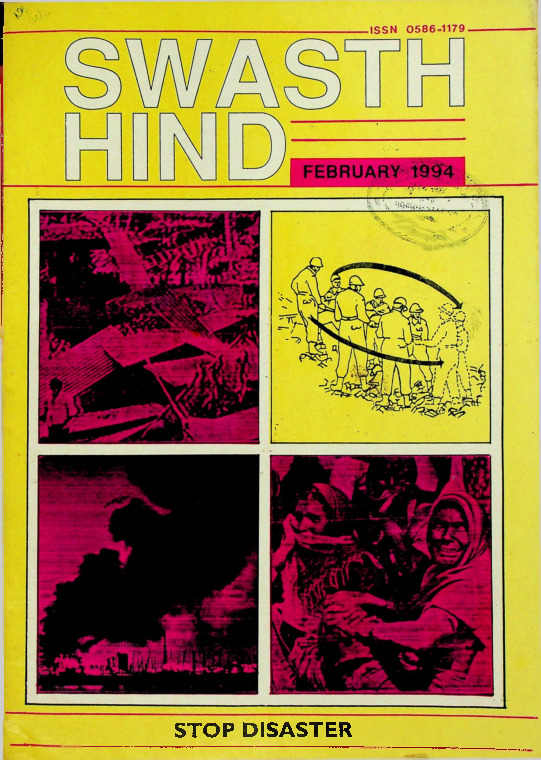
STOP DISASTER
In this issue
swasth hind
Magha-Phalguna
Saka 1915
February 1994
Vol. XXXVIII No. 2
OBJECTIVES
Swasth Hind (Healthy India) is a monthly journal
published by the Central Health Education Bureau,
Directorate General of Health Services, Ministry of
Health.and Family Welfare, Government of India,
New Delhi. Some of its important objectives and
aims arc to:
REPORT and interpret the policies, plans, pro’ grammes and achievements of the Union Minis
try of Health and Family Welfare.
ACT as a medium of exchange of information on
health activities of the Central and State Health
. Organisations.
’ FOCUS attention*'on the major public health
problems in India and to report on the latest
trends in public health;
Page
Disaster reduction, preparedness planning and
the implications for health of the people
Dr M. Manger Cats
29
Chemical disasters
Lt. Col. Jasdeep Singh
32
India’s preparation for disaster reduction : An
overview
Prof. SJK. Ganguli, Pref. A.C. Urmil and Prof.
(Col.) P.K. Dutta
33
Industrial pollution-: A looming disaster
Dr Rekha Th akre and Dr AJL. Aggarwal
36
Disaster and after:
preventing epidemics
Dr Brij B hush an
Role
of
Radio
in
A greenhouse for our children
Dr T.S. Reddy
46
Arresting ozone depletion—An all-out strategy
’ Him an k Kothiyal
49
Injury prevention—Strategies and future pros
pects in India
51
Dr G. Gururaj'
Hiroshima
(9 Aug.)
Day (6 Aug.)
&
Nagasaki Day
Conquering thalassemia—A few essentials
Dr A.K. Mukherjee
REPORT on important seminars, conferences,
discussions, etc. on health topics.
CHEB—Calendar of training activities 1994-95
Central Health Education Bureau
(Directorate General of Health Services)
Kotla Marg, New Delhi-110 002
55
Dr PA. Somaiya, Dr R.V. Awate and
Dr A.C. Urmil
KEEP in touch with health and welfare workers
and agencies in India and abroad.
Editorial and Business Offices
42
58
Back
Inside
Cover
- Articles on health topics are invited for publication in this
Journal.
.
State Health Directorates are requested to send in reports of
their activities for publication.
The contents of this Journal are
Due acknowledgement is requested.
freely
reproducible.
The opinions expressed by the contributors are not necessarily
those of the Government of India.
SWASTH HIND reserves the right to edit the articles sent
in for publications.
Assisted by
M. L. Mehta
M. S. Dhillon
G. B. L. Srivastava
Cover Design
Madan Mohan
Cover Photo
O.P. Kataria
Edited by
SUBSCRIPTION RATES
Single Copy
50 Paise
Annual
Rs. 6.00
(Postage Free)
Disaster Reduction,
Preparedness Planning and
the Implications for
Health of the People
Dr M. Manger Cats
Disaster preparedness
planning is an intersec
toral exercise. It is the
responsibility of the
health professionals to
stimulate this coordina
tion-exercise and to
catalyse disaster pre
paredness
planning.
Health professionals can
take a more pro-active
approach. Their
res
ponsibility is not only
post-disaster response,
but also planning for an
improved response and
for prevention or mitiga
tion of the disaster
impact, to allow for a
healthier and happier
life for all.
FEBRUARY 1994
WHO defines disaster as “any
occurrence that causes damage,
ecological disruption, loss of
human life, deterioration of health
and health services, on a scale suffi
cient to warrant an extraordinary
response from outside the affected
community or area”.
Disasters can be defined in dif
ferent ways. The magnitude of the
effects of the event will be viewed
differently, whether from the
perspective of the national, district
or block level, village or city
neighbourhood level, household
level or the individual level.
Disasters are classified in
various ways e.g. natural versus
man-made disasters or sudden versus
slow onset disasters. The dividing
line between these types of disasters
is imprecise.
For example: Activities related to
man, may exacerbate natural disas
ters. Population pressure leads to
deforestation and erosion in hill
areas. The resulting landslides
may cause temporary damming of
water in narrow valleys and when
the natural dam bursts, flashfloods
occur in the downstream area.
The erosion also causes sedimenta
tion and overflowing (flooding) of
rivers in the plains. The same
population pressure causes people
to live op river banks or other areas
known to be prone to flooding or to
landslides. These people may not
have alternatives due to their socio
economic situation.
A case of a slow and sudden
onset disaster mix are environmen
tal disasters. The health effects of
inappropriate toxic waste disposal
over a long period of time may sud
denly become visible (sympto
matic) because a toxic level is
surpassed or because an aggravat
ing factor is added to the situ
ation. For example in Japan in
1956, cases of gait disturbance,
speech disturbance and delirium
were recorded. Outbreak inves
tigation was done, but no cause was
found. It took various years of
investigation before it was deter
mined that mcthylmercury was the
29
cause of this outbreak. Water
pollution by different mercury
compounds from a chemical fac
tory led to a buildup of mercury in
the sediments and in fish of
Minamata bay. Retrospectively,
congenital effects of the poisoning
were also identified: cases of severe
cerebral palsy were linked to pre
natal exposure to methylmercury
in fish.
Impact bn Health
Impact of disasters on health is
not measured by mortality rates
alone, although it is an important
first indicator. Morbidity includ
ing injuries, as well as disability
rates will indicate the effects on
health.
An indirect indicator for impact
oh health, is the economic loss to
the household. Economic losses
due to loss of economic activity
G‘ob). and/or loss of property after
disasters, may be considerable.
The long-term effects of a
debilitated (micro-) economy may
be immense on the vulnerable
poorer section of the disaster affec
ted population. This in turn will
affect their health status very much
(resources for basic needs; food
availability, shelter, access to
health care etc.).
Three Factors
“Disaster reduction” can be
broken down into: (1). prevention of
disasters, (2) reduction of the fre
quency or magnitude of disasters
themselves; and (3) disaster miti
gation.
Disaster mitigation involves
measures to reduce the effects of
disaster-causing phenomena. It
consists of the technical, social,
legal, and economic processes to
develop appropriate measures and it
involves administrative and politi
cal processes to apply those iden
tified measures. Mitigation mea
sures may be structured, e.g., flood
30
resistant buildings or non-structured e.g. organisation and coor
dination aspects, training, educa
tion and public awareness, warning
systems; legal aspects etc.
Which measures are most
appropriate to decrease the mor
tality, morbidity and disability
rates and reduce economic disrup
tion following disasters? To start, it
is necessary to study the effects of
previous disasters and to identify
which factors contributed most to
producing negative effects on the
affected
population’s
health
status. To apply disaster mitiga
tion measures effectively, we must.
Identify the possible hazards that
can occur and identify the most
vulnerable areas and most vulner
able population groups (physical,
social and economic vulnera
bility). This
is
called
risk
assessment.
Prevention of disasters is most
applicable to ^man-made disas
ters. These are technological dis
asters, including chemical acci
dents and environmental degrada
tion as well as civil strife and
war. Reduction of the frequency
and magnitude as well as mitiga
tion of man-made disasters is
applicable.
In the case of technological dis
asters, many can be prevented by
proper precautionary measures.
For example, if proper on-site (fac
tory) disaster preparedness plans
are made, reviewed and rehearsed
regularly, protection systems are
built in, fire and gas-leakage detec
tors are controlled and dangerous
on-site practices are prevented.
On-site preparedness training
and regular simulation exercises
for employees are important for
prevention and mitigation pur
poses. It allows for quick evacua
tion, thus reducing death and
injury in the near vicinity of the
accident. The simulation exer
cises will pinpoint weak areas of
the on-site plan.
Off-site planning enhances coor
dination between the various sec
tors involved in the disaster: police,
fire-brigade, hospitals, municipal
authorities, emergency team of the
plant, plant employees and
especially the community living in
the neighbouring area of the
accident. The neighbouring com
munity and on-site employees are
most vulnerable. Industries must
be actively involved in this plan
ning. They know which chemi
cals are used, they often know
case-management of toxic effects,
they have a responsibility toward
the community at risk, and they are
interested to prevent or mitigate the
effects of chemical accidents
because they want to continue pro
duction and keep liability costs as
low as possible. On- and off-site
planning for technological disas
ters will improve the quality and
efficiency of the response to be
given.
Reduction of the frequency and
magnitude of natural disasters is
more difficult if not impossible.
However, the impact of natural dis
asters on the health of the affected
population can be reduced through
different mitigation measures.
In
earthquake-prone
areas,
structural mitigation measures;
such as building of seismic resis
tant building and enforcement of
building codes will greatly reduce
deaths and injuries following
earthquakes. Seismic proof con
struction, may not be realistic, but
appropriate technology to streng
then buildings so as to be more
resistant to earthquakes and as a
consequence to reduce the impact
of heavy material crashing down,
will reduce deaths, severe injuries
and disability.
Prediction of disasters as earth
quakes is difficult but in the case of
SWASTH HIND
cyclones, an elaborate prediction
system is in place in India, using
satellite and rader technology.
Populations at high risk can be
warned and be evacuated to safer
areas (e.g. cyclone shelters, less
prone to high winds). This pre
disaster evacuation plays a major
factor in reducing the impact of
cyclones on affected population's
healtli status.
Prepared Community
Mortality rates are highest dur
ing and directly following lhe
occurrence of disasters. The first
24 hours are crucial, to reduce
number of deaths, cases of lasting
disability and to provide proper
treatment
reducing
morbidity
(e.g.
treatment
of
poison
ing). Direct activity by the
affected community following such
events can save more lives and cut
morbidity/disability rates. Train
ing of the community to know what
appropriate action to take is imper
tinent Examples are: evacuation
when warning is possible (cylone,
floods), rushing to safer areas when
first trembling of earth warns for
severe earthquakes, proper search
and rescue (how to rescue a non
swimmer in a flooded area or a
trapped person in a destroyed
building) or first aid measures till
medical personnel arrives to the
spot pr till transport can be
arranged to health care facili
ties. Proper handling e.g. im
mobilisation of injured patients, is
important
in
reducing
dis
ability. There are many ways in
which a prepared community can
contribute to the reduction of the
health impact of disasters.
Due to displacement and con
centration pf population, disrup
tion of water and sanitation
systems, disruption of health care
provision and disruption of the
normally ongoing health program
mes (such as immunisation, vector
control etc.), the morbidity rates
FEBRUARY 1994
HANDLING THE INJURED
In case you or any other fellow being have been injured auo
to an earthquake, you may follow some of the following simple
instructions. This may save a precious life.
* Keep the injured person lying down in a comfortable
positlon-the head in level with his body.
* Keep the Injured person warm. This is necessary to pre
vent serious" shock. Do not apply external heat, but main
tain normal body temperature by using blanket or rugs.
* Do not move the injured until it is absolutely necessary.
Observe maximum precautions while lifting an injured person.. Use large planks, charpois etc., covered with thick
plastic/bed sheets for moving the injured.
* Avoid jerks while transporting the injured. Carry the injured
person with the head in the direction in which you. are
moving.
* .Look for serious bleeding, choking of windpipe, burn; frac
ture and dislocation. Approach the nearest medical centre/
post. If you cannot give first aid.
* Do not give water or other liquids if the injured person is
unconscious. Water may enter the-windpipe and choke the
person. If the Injured Is conscious and if there are no signs
of abdominal injury, give him water but slowly and in
sips only.
!
I
|
I
I
I
I
I
I
|
* Keep the on lookers/crowd away from the injured as they
often interfere with the treatment. The injured need.s fresh
air also.
* -Do not let the patient see his own injury. But reassure him
to lessen his anxiety.
—FIB
will increase. Communicable dis
eases, e.g., gastro-enteritis, viral
hepatitis, respiratory infection,
scabies and conjunctivitis become
more prevalent Malaria epide
mics may occur. The infrastruc
ture and the health, services will
need to be picked up as soon as
possible after the event.
A proper preparedness plan will
envision what priority action needs
to be taken during the interim
phase before rehabilitation takes
place. Preparedness planning of
the health sector can ensure an
appropriate and timely response to
disasters by the health sec
tor. Strengthening the capacities
of the health sector for disaster pre
paredness and response will reduce
the adverse effects of disaster, on
health services and program
mes. Training to improve skills
for case-management of poisoning
or in mass-casualty management
are examples.
Disaster preparedness planning
includes planning beyond the relief
period. Rehabilitation has to be
planned in preparation for future
disasters. Reconstruction or re
enforcement of weakened build
ings, especially “life-line" buildings
such as hospitals and schools,
should be such that seismic resis
tance is improved. Rehabilitation
should be interlinked with develop
ment programmes. For example,
(Continued on Page 45)
31
CHEMICAL DISASTERS
Lt. Col. Jasdeep Singh
1. ” Never before In the history of human race.
mankind has ever faced a growing threat and
ecological danger, that is being confronted now
from
numerous
pollutants
and
Chemical
Explosions. Chemistry is omnipresent, and there
is no doubt that it is providing a great service for
the betterment of human life. While counting
dividends, we can not afford to omit its devastating
effects, which may be accidental or intentional.
2.
With rapid'Urbanisation and industrialisation, a
huge quantity of pollutants is being pumped into the
atmosphere with its enormous green house effect.
and depletion of protective OZONE layer, that is
enveloping
us
In the upper atmosphare.
The release of Chloro Fluoro Carbons, used as
coolants/refrigerants. has created a dent in the
OZONE layer over the region of Antartica thus
exposing us to the cancerous effects of ultra violet
rays of Sun. This needs an urgent action. Not so
much to undo the harm, that has already beein
done, bur to prevent its further damage to our
Globe's Ecosystem.
Cyanate (MIC), leaked accidently from one of the
storage tanks of Union Carbide, leaving over* 2500
dead, and many thousands disabled within a short
span of time. The entire toxicology revolved
around carbon monoxide, chlorine, phosgene and
methyl iso cyanate. Early effects were manifested
in respiratory and occular systems culminating In
pulmonary oedema, blindness and death; while
delayed effects Involved central nervous system
and other vital organs causing -their degene
ration.
3.
In the past air pollution was regarded as an
economic question rather than a health pro
blem. As a result of that, most Industries were dis
charging their wastes Into the air. without realising
its impact on surrounding communities. The situa
tion is true even now In most of our cities and
towns. In* the towns and residential complexes.
automobiles are contributing a major share towards
air pollution. The situation, gets worsened when
vehicles are ill maintained and ply at snail's pace in
the congested urban localities. Automobiles
alongwlth industries emit a large quantity of lead.
carbon monoxide, oxides of nitrogen and sulphur.
alongwith shoot and numerous harmful chemicals.
They are to share the blame for aesthetic blacken
ing of outsides of city dwellings and catastrophic
blackening of insides of city dwellers. Effects, are
more pronounced in younger children, versatile
smokers, pregnant women and fragile persons.
5. Among the most recent man made chemical
disasters, human race will never be able to forget
the long lasting and terrifying effects resulting from
burning of enumerable oil wells in Kuwait and Iraq,
and historical oil slick into Persian Gulf during JanFeb 91. The devastating environmental pollution
resulting from release of huge quantity of crude
petroleum, sulphurous gases, smoke and many
other toxic agents has and will continue to have Its
pronounced ill effects on life on land, water and air.
The§e agents have already resulted in black acid
rain In adjoining regions including Iran and black
snow fall in the regions of Himalayas. The-marine
life and aquatic avian life has already shown signs
of sufferings. The effects on man would be more
pronounced in people who happen to consume
these affected Sea creatures. This may cause
spinal cord disease culminating in paralytic
episodes. It Is feared that cumulative effects may
lead to severe drought and cause the death “of
more people than the population of Iraq. Kuwait
and Saudi Arabia combined". Various detoxifica
tion measures are being employed for oil
spill. These include pumping of oil from sea sur
face and use of “genetically manipulated bac
teria". These bacteria are capable of degrading
the crude oil. The processs of exhausting the
atmospheric pollutants from burning oil wells into
space through the dent in the OZONE layer may be
a great break through.
4.
While talking about industries, we can not
afford to forget the worst accidental disaster in the
global history of chemical industry, that unfortunatejy has been witnessed by our country. On
3rd of December 1984, 8 lakh innocent residents of
Bhopal were engulfed with deadly toxin. Methyl Iso
6. Global warming and depletion of OZONE layer
could be worst calamities on our planet. And if the
overall temperature rises, it would result In melting
of polar ice. This will raise mean sea level. And If
this happens, we can imagine the plight of cities
lying in close vicinity of sea.
32
Swasth Hind
India’s Preparation for
Disaster Reduction :
An Overview
Prof. S. K. Ganguu
Prof. A. C. Urmil
Prof. P. K. Dutta
saster by definition in
volves disruption of human
ecology which cannot be absorbed
by the adjustment capacity of the
affected community within its own
resources.1 According to their
genesis, disasters fall into two
broad groups, viz(a) Natural disas
ters consequent to the fury of
nature and (b) man made disasters
which may be intentional or rionintenational (accidental)2.
Al
though 4 determined human effort
can totally, to a great extent prevent
man-jndde disasters, the same does
not hold good in respect of natural
disasters which have a growing
concern of mankind all over >the
world particularly during the last 3
decades or so. There is a growing
awareness also that though it may
not be possible to prevent natural
disasters but these can be certainly
tackled effectively through ade
quate preparedness to mitigate the
loss of human life and proper
ty. It is against this background
that on 11 Dec. 1989 the United
Nations General Assembly pro
claimed 1990s as the International
Decade for Natural Disaster Re
duction (IDNDR), beginning from
1st Jan. 1990, to initiate a concerted
global effort to reduce the destruc
tive impact of natural disasters
which alone during the past two
decades killed an estimated 3
million people,’
D
FEBRUARY 1994
During the International Decade for Natural Dis
aster Reduction (IDNDR), the country will have to
pay more attention towards public awareness and
preparedness for the people living in known
disaster-prone areas. Special training is required
to medical, paramedical, voluntary workers in
relief and rescue work.
India is supposed to demarcate
the disaster prpne areas and work
out the details of their increasing
impact in terms of loss of life,
physical damage and effect on
economic
developments. The
country is supposed to apply the
scientific and technological pro
gress to disaster mitigation3.
India’s Proneness to Natural
Disasters
On the basis of geographic and
climatic considerations, India can
be divided into 5 zones according
to its disaster proneness to natural
disasters as under.
1. Northern Mountain Region
including foot hills: This
region.is prone to strong snow
storms leading to land slides
and strong cold waves.
Besides this, the entire
Northern part from Hindukush to Eastern Hima
layas, lies in earthquake
prone belt of violent Subterranian volcanic activity.
2. Indo-Gangetic Plains: Heavy
rains during monsoon make
these plains vulnerable to
floods.
3. Deccan- Plateau: A drought
prone area.
4. The
Western
Desert: A
drought prone area.
5. Coastal Areas:They
are
prone to sea erosion, cyclones
and tidal waves.4
The
disaster
proneness
varies widely form state to
state. In 1990 alone, floods and
cyclones claimed 1422 human lives
in India; damaged about 2 million
houses effecting 57.2 million peo
ple in 197 districts of 19 states/UTs :
The crop area effected was 4.5
million hectares5.
33
Some of the worst natural disas
ters in India in the recent past,
whose memory is still fresh in our
mind, include (i) Tropical cyclone
on Andhra Pradesh Coast in 1977
which claimed more than 10,000
deatns and again an severe cyclone
causing vast u_vastation during
1989. (ii) Earthquake in Koyna
Na gar, Maharashtra (1967). Kinnaur and Lahaul Spiti in Himachal
(1975), Bihar (1988), Garwhal Hills
(1991) and Latur, Maharashtra
(1993). The last one claimed a
death toll of over 12,000 and many
more injured.
India is located in the South-East
Asia Region of WHO which ranked
4th amongst the most disaster
prone regions in the world.
Progress in
Disasters
Tackling
Natural
The progress made in tackling
disasters since India's indepen
dence reveals some important
achievements:—
1. India became member of the
World Meteorological Orga
nisation on 23 Mar, 1950.
2. Launching a National Flood
Control Organisation in 1954.
3. Setting up Rastriya Bar Aydg in
1976.
4. Setting up of Brahmaputra
Board in 1981.
The main activities since launch
ing of National Flood Control Pro
gramme (1954) include—cons
truction of embankments and
drainage channels, town protection
schemes, raising the level of Hood
prone villages, completion of reser
voir projects, flood forecasting and
warning
for
different
river
basins.
Indian Meteorological Dept
(IMD) also plays a key role in
fotewaming the disasters. It has 5
centres (Calcutta, Bhubaneshwar,
Vishakhapatnam, Madras and
. 34
Bombay) for detection and tracing
of Cyclone Storms and SatelliteImagery facilities and cyclone
warning Radars provided to
various cyclone Warning . Cen
tres. In addition, it has 31 Special
Observation Posts set up along East
Coast of India. For all ships, out
at sea, warnings are issued 6 times a
day.
Insat Disaster Warning System
(DWS) rebeivers have been
installed during the first phase of
100 stations, primarily’in the coas
tal areas of Tamil Nadu and
Andhra Pradesh. This has been
proved highly reliable form of com
munication system for cyclonic
warnings during Chirale cyclone
(1989) and Machalipatnam cyclone
in
1990*. The
Snow
and
Avalanche Study Establishment
($ASE) in Manali (H.P.) has been
issuing warning to the people about
avalanches 24 to 48 hours in*
advance.
For tracking any disaster, every
state has a full fledge Secretariat
Wing under Relief Commissioner/
Secretary for proper co-ordination
at district level.< In case of deed;
the
State
Government
can
approach the Centre for help in res
pect of, finance, manpower* and
material. At the Centre, the
Ministry of Agriculture is the
model ministry for co-ordination (?f
all activities during any natutal dis
aster. Since health is an impor
tant part of disaster management,
in the Directorate General of
Health Services under Ministry of
Health, there is a Special Wing
called the Emergency Medical
Relief Wing which co-ordinates all
activities relating to health. At the
district level, the Collector forms a
small committee which assesses the
degree of devastation and organises
rescue and relief work and informs
the State Govt. Relief Secretary/
Commissioner
Works
directly
under
Chief
Sec-/
retary. The State Govt officials/
Ministers concerned visit the
affected area to oversee relief
operation and releases funds
required. Later,
the
Central
Teams including the members and
officials from Health Ministry also
visit the area to assess the
magnitude of the problem and
re com med
central
assistan
ce.. The United Nations has a spe
cial body called UNDRO (Office of
the United Nations Disaster Relief
co-ordinator) which can always be
approached for extra help when
ever needed. The WHO and
UNDP and other- voluntary
Organisations help in all major
disasters.
Areas of Special Concern During
IDNDR
During IDNDR, the country will
have to pay more attention towards
public awareness and prepared
ness in respect of people residing in
known disaster prone areas. Spe
cial training is required to medical,
paramedical, voluntary workers in
relief and rescue work.
References
1. Verma B. K. The Disaster Profile of
India, Disaster Management (A Report
on Workshop held at Nagpur on 14-18
Oct 1986, sponsored by the WHO)
DGHS, Ministry of Health & FW, 1st
Edn. 1987, pp 8-19.
1 Uemil AC and Sandhu Ms. Disasters—
An Increasing Awareness, CHEB,
Swasth Hind, Vol XXXIV, No. 7 Jul. 90
pp 160-161
3.
United Nations International Decade
for National Disaster Reduction. CHEB
Swasth Hind Vol XXXV, No. 3-4 MarApr 91, p 80.
4.
Mandal HS, Natural Disasters, Disaster
Management (A Report DGHS, Minis
try of Health & FW. 1st Edn. 1987 pp SO33.
5.
Pant MC._ Natural Disaster Reduction
Swasth Hind Vol XXXV, No 3-4, MarApr 91, pp,65-69.
6.
Gopala Rao W, India National Satellite
(INSAT) Disaster Warning System,
Swasth Hind vol XXXV, No. 3-4, MarApr 91. pp 81-82.
Swasth Hind
MENTAL HEALTH: AN AGENDA FOR ACTION IN
DISASTER
Whenever disaster strikes, sociopsychologlcal environment Is disturbed alongwith disruption of physical
environ. This change can bring about altered human behaviour. Such behavioural changes may vary In duration
and Intensity. These psychosocial changes Can be dealt at three different levels:
This operates at community level.
1.
Primary Level:
The main Interventions are to promote and prepare the community for such
(Preventive and
events, mentally.
promotive care)
To identify probable type of disaster and focus activities as per the need.
This Is a family based operation.
2.
Secondary Level:
It consists of early diagnosis of mental illness.
(Early diagnosis
and treatment).
Identify high risk areas -and screen for mental health.
Help family members to cope with over-whelming stress and treat simple problems
like social and individual maladjustment.
Seek help.
Acts at both family and community level.
3.
Tertiary Level:
(Rehabilitation)
Interventions are to rehabilitate and reduce mental illness and prevent family and
community stresses.
ACTION AT DIFFERENT LEVELS:
1.
Create an enabling atmosphere or environment for housholds to improve health.
_ Prevention of panic, despair, helplessness and hopelessness
— Regular drills In the community like schools, mahila
mandals. etc.
(a) Earthquake:
(b) Fire :
(c) Cyclone:
2.
(1)
(2)
(3)
(4)
(5)
(6)
(7)
(1)
(2)
(3)
(4)
(5)
(1)
(2)
(3)
Do not run hetter-shetter.
Go into an open space : under a beam under stircase
Act only after quake is over.
Take a frog position.
children and old people to be led to identified safety area.
Only identified nodal agencies to do rescue operation.
Listen to the directives by nodal agencies.
Do not run hetter-shetter.
Keep to the ground
Keep a wet cloth on your face.
Breathe out into an open space like windows.
Do not jump out of the window.
Look for warning signals in radio and television.
Look for other signals In coastal areas.
Learn to swim and save drowning.
Screening for early diagnosis:
Following are the Indications who needs attentions:—
(I) loss of appetite; excessive hunger; (II) Sleeplessness; (III) Crying; (iv) Speechlessness; (v) Excessive
anger, getting on your nerve; (vl) Lack of concentration; (vll) Constant fear; (viii) Apathy;
Beside ail the Vulnerable population like orphen children, widows parents who have lost their children are spe
cial vulnerable group. Ail of them should be attended to and rehabilitated socially and individually. Some may
require psychiatric care. Local NGO's and psychiatrists may be identified in advance and Involved when
required.
3.
Moderate to severe mental lllhealth
help.
FEBRUARY 1994
often turned
as gone around the bend.
Seek
professional
— PIB
35
INDUSTRIAL POLLUTION :
A Looming Disaster
Dr Rekila Thakre & Dr A. L. Aggarwal
UST before 1.00 a.m. on 3rd
JDecember 1984, the worst indus
pollu trial accident in history began.
Industrial
tion in India varies
from
city
to
city and
State
to State. However,
there are certain
industrial nuclei
around which poc
kets of high pollu
tion levels are
persisting........... It
is needless to say
that pollution con
trol is needed on
war footing to fight
back the looming
industrial disaster
and save the man
kind on earth.
36
Uncontrolled emission of lethal
gas : methyl isocyanate from Union
Carbide Pesticide Plant stalked the
slummy streets of Bhopal killing
thousands and maiming hundreds
of thousands of people. That
dreadful night and its aftermath
scaled the already grim public
image of the chemical industry as a
threat to human health and
environment.
It is argued that this is an
accident Yes,
the
industrial
pollution in voluminous quantities
killing instantly thousands of peo
ple is not routine. But it is also
ascertained that smaller quantities
of pollutants released constantly in
the atmosphere do have cumulative
effect in the long run to all living
organisms though the emissions
are well within the prescribed stan
dard limits.
The cross sectional survey of
Indian cities indicate that every city
has an industrial area demarcated
for the purpose. Politicians are
racing for more and more indus
tries in their constituencies as per
their calculations, the industrial
growth only helps in the develop
ment of the area. To a certain
limit this is true as the industries
bring with them commercializa
tion, urbanization and direct con
tacts are established with out-side
world.
The Central Pollution Control
Board (CPCB) New Delhi (1985)
has categorised the industries
based on pollution intensities as:
• Red industries
: high polluting, pro
hibited in sensitive
areas;
• Yellow industries: moderate polluting
industries permiss
ible in sensitive areas
subject to stringent
air quality impact
assessment.
polluting
9 Green industries : less
industries, permissible
in
sensitive
area.
However, in practice
classification is very vague.
this
Industrial Pollution Status
Industrial pollution in India
varies from city to city and state to
state—highly industrialised like
Maharashtra and least indus
trialized like Haryana. However,
in India there arc certain industrial
SWASTH HIND
nuclei around which pockets of
high pollution levels are persisting
naming a few cities : Thane—
Panvel—Belapur, Ahmedabad—
Baroda—Ankleswar,
Korba,
Durgapur—Jamshedpur,
Singhrauli, Visakhapatnam, Kochi etc.
The major Indian cities have
varying degrees of industrial
activity. Nevertheless, the Indian
megacities listed in the charter of
World-watch Series for pollution
status assessment have been exten
sively assessed for the last two
decades. (NEERI Report 1991).
The long-term air quality trends
observed in these three Indian
megacities, viz., Bombay, Calcutta
and Delhi in the perspective of
economic development and popu
lation dynamics highlight impor
tant environmental health issues
which require immediate attention
of environmental managers in
the country.
The industrial pollution status in
these three Indian metropolies
shows that the contribution from
this source is 900,521 and 828 met
ric tonnes per day in Bombay,
Delhi, and
Calcutta respec
tively. The number of registered
industrial units in these cities has
been indicated in Table 1.
Nevertheless, there are large num
ber of unregistered industries being
operated in these cities and thus the
estimated pollution status is
highly conservative.
Air Quality trends for three
criteria pollutants, viz., SPM, SOa
and NOa have shown spatial and
temporal variation in degree of
industrialization of these cities.
(NEERI Annual Report 1992).
Comparison
of
WHO/CPCB
guidelines for ambient air quality
status (AAQS) with respect to
major gaseous pollutants, viz., SOa
and NOa shows that Calcutta and
Delhi can be classified as high
exposure risk cities. As regards
FEBRUARY 1994
22— 16/DGHS/93
Tabic 1: Major Pollutioh Intensive Industries:
and Delhi
Bombay, Calcutta
No. of Units
Industry
Bombay
Calcutta
Delhi
171
328
65
248
257
3
24
718
88
277
350
87
116
117
2
46
50
68
220
454
58
7
313
3
16
82
118
181
3
2
1264
293
—
—
1558
110
—
2
1324
Chemical
Engg. & Foundry
Glass & Ceramics
Textile & Silk
Rubber
Power Plant
Paints
Plastics
Pharmaceuticals
Pulp & paper Ind. & its
Products
Refineries/Oil exploration
Fertilizers
Miscellaneous (Bakeries,
Confection veg. oil etc.)
the SPM levels, the concentrations
have shown high exceedances to
threshold limits in all three met
ropolies (Fig J).
Human Exposure to Pollutants &
Risk Assessment
These air pollutants originate
from various sources (Table 2).
Their effects on man are varied
depending on the chemical nature
of the pollutant, exposure period
and interaction of the exposed
body part (Table 3).
Human exposure to pollutants
can be derived from the water we
drink, the air we breathe, the food
we eat, or from direct contact with
our skin and also the total exposure
of an individual is affected by life
style, culture and a whole range of
personal activities. This variation
in exposure arising from individual
behaviour may place particular
members of a community in greater
danger of health effects.
Epidemiological Studies are con
cerned with the patterns of disease
in human populations'and the fac
tors that influence these pat
terns. Well conducted epidemio
logical studies provide extremely
valuable information from which
to draw inferences about human
health risk.
Risk assessment of human
exposure to air pollution involves
the information regarding source/
release
assessment,
exposure
assessment, dose response assess
ment and risk characterization.
(William, 1991).
Source-Release assessment esti
mates the amounts, frequencies
and locations of the introduction,
release or escape of risk agents
(e.g. toxic chemicals) from specific
sources (e.g. manufacturing plants)
into occupational residential or
outdoor environments. Source/
release assessment is applicable to
37
Tabic 2: Typical sources of some pollutants grouped by origin (adapted from NAS, 1981)
Pollutants
Sources
Sources predominantly outdoor
Sulfur oxides (gascS, with secondary production of
particulate sulfates)
Ozone
Lead, manganese
Calcium, chlorine, silicon, cadmium
Organic substances
Fuel combustion, smelters
Photochemical reactions
Automobiles, smelters
Suspension of soils or industrial emission
Petrochemical solvents, natural sources, vapori
zation of unburned fuels
Sources both indoor and outdoor
Nitric oxide, nitrogen dioxide
Carbon monoxide
Carbon dioxide
Suspended particulate matter
Fuel-burning
Fuel-burning
Metabolic activity, combustion
Resuspension, condensation of vapours and com
bustion products
Volatilization of petroleum products, combustion,
paint, metabolic action, pesticides, insecti
cides, fungicides
Metabolic activity, cleaning products and
agricultural activities
Organic substances
Ammonia
Sources predominantly indoor
Radon
Formaldehyde
Asbestos, mineral, and synthetic fibres
Organic substances
Aerosol containing nicotine and wide range of
organic substances
Mercury
Aerosols of varying composition
Viable organisms
Allergens
situations such as the incidental or
accidental release of toxic chemi
cals or other hazardous materials.
Exposure assessment provides
quantitative data on individuals,
populations or ecosystems that are,
or may be exposed to a risk agent,
the concentrations of the risk agent,
and the duration and other charac
teristics of exposures. Exposure
assessment typically estimate con
centrations of a risk agent at a par
ticular point of contact with the
exposed organism.
38
Building construction materials (concrete, stone)
water and soil
Particleboard, insulation, furnishings, tobacco
smoke
Fire-retardant, acoustic, thermal, or electric
insulation
Adhesives, solvents, cooking, cosmetics,
Tobacco smoke
Fungicides in paints, spills in dental-care facilities
or laboratories, thermometer breakage
Consumer products
Infections
House dust, animal dander
Dose-Response assessment pro
vides quantitative data on the
specific amounts of a risk agent
that may reach the organs or tissues
of exposed individuals or popu
lations and attempts to estimate the
percentage of the exposed ’ popu
lations that might be harmed or
injured and, where relevant, the
characteristics of such populations
(for example, sensitive subgroups
such as children or the elderly).
Risk Characterization integrates
the results of the previous steps into
a risk statement that includes one
pr more quantitative estimates of
risk. These comprise : individual
life time risk, population or societal
risk, relative risk, loss of life
expectancy.
Air
Pollution
Assessment
in
India—Risk
Air pollutants pathways of nit
rogen dioxide, heavy metals and
organic chlorine pesticides in the
human body have been indicated
in Fig 2.
- .— .
Swasth Hind
Tabic 3 : Effects and guidelines for major air pollutants
Pollutant
Effects
WHO Guidelines
Annual
mean
(ug/m3)
Sulphur dioxide
Exacerbations of respiratory ill
ness from short-term ex
posures
Increased prevalence of res
piratory symptoms, inclu
ding chronic bronchitis from
long-term exposures
Suspended particulate As for SO2
matter
Combined exposure to SO? and
SPM
are
Associated
with
pulmonary effects
98*
percentile
(ug/m3)
40-60
100-150"
Black smoke.
40-60
Total Suspended
60-90
100-150
Particulates
150-230
Lead
Blood enzyme changes
Anaemia
Hyperactivity and
neurobehavioural effects
0.5-1
Nitrogen dioxide
Effects on lung function
in asthmatics from
short-term exposures
1 hr
400
24 hrs
150
Carbon monoxide
Reduced oxygen-carrying
capacity of blood
15 min
(mg/m3)
100
1 hour
(mg/m3)
30
30 min
(mg/m3)
60
8 hrs
(mg/m3)
10
2.5-3%
COHbi
♦The 98 percentile (or P98) value stipulates that 98% of the daily averages must fall below a given con
centration.
This means that less than 2%, or less than 7 days per year, may exceed that
concentration.
A study conducted by WHO for
risk assessment of air pollution
projects that the 24 hr average of 80
ppb NOa threshold in all the par
ticipating cities were well below the
guidelines but these levels were
approached occasionally in Bom
bay (Fig 3). Environmental NO a
concentrations from fixed air
quality monitoring stations only
provide data on potential exposure
and the study demonstrates very
clearly that exposure varies con
siderably not only between the
cities but also between individuals
resident of the same city (Fig 4).
FEBRUARY 1994
Though these results are based
on a very small number of popula
tion exposed they clearly indicate
that the assessment of human
exposure to pollutants is a persis
tent risk in the urban air environ
ment of India as the pollution
levels are increasing. (William
1991)..
Lead exposure may occur
through the inhalation or ingestion
pathways. Particulates suspended
in the atmosphere may arise
typically from a variety of indus
trial activities, e.g., metal smelters,
and from the combustion of fossil
fuels. Particularly
significant
releases of lead have been shown to
occur during the combustion of
petroleum based motor fuels with
lead additives. Ingestion may
occur following the uptake of
metals through vegetable or animal
foods. Leaching of lead from
water pipes or lead solder used in
forming pipes or sealing tin cans
can result in high lead levels. The
lead concentration in Indian urban
environment has been recorded
highest in the capital city of
Delhi, It is also documented that
39
8PM Cone. u(j/m3
Years
—1— Cal
Bom
*
Del
Fig. 1
ANNUAL MEAN CONCENTRATION TRENDS FOR SPM
: INDIAN MEGACITIES (1978-1992)
Combustion Products
Heauy Metals
Nitrogen dioxide
Lead and Cadmium
mining, smelting
paint,
petro
Fuel
minlng.smelting
smoking
▼
v
I
Air
Soil Water
Food
Food
Inhalation
Ingestion
fats including
human milk
I
Accumulation in
bone kidney and
other tissues
Very slow
excretion
Excretion
in urine
40
I
I
Blood
I
Accumulation in
Ingestion
Blood
▼
Exhalation
manufacture and use
of
pesticides
Air Soil Water
Inhalation
Lungs
HCB and DDT
v
Combustion
Air
Organochlorine Pesticides
Faeces
raeces
Fig. 2
SWASTH HIND
(he lead aerosols are concentrated
in the fine particles of less than 10
micron size which incidentally fall
in the range of respirable particu
late matters. (Thakre & Aggarwal,
1992).
Volatile organic carbon (VOC)
compounds are the most threaten
ing class of air pollutants gaining
importance in recent decades.
These are released mainly from the
combustion processes and get
absorbed/adsorbed on suspended
particulate matter during disper
sion in the atmosphere, both in
troposphere and stratosphere.
However, the ground level concen
tration of organic compounds,
directly coming in contact with the
humans of are of great concern
from human health point of
view. Polynuclear aromatic hyd
rocarbons (PAHs) contribute a
major potentially hazardous group
of carcinogenic pollutants originat
ing from anthropogenic activi
ties. The air* quality status of
PAHs concentration in 10 major
Indian cities indicates that Bom
bay, Calcutta and Delhi air is rich
in PAH levels than other Indian
cities. (NEERI Report, 1990).
The stratospheric increase of
VOC has given rise to new
atmospheric disaster problems like
green house effect and ozone
depletion threatening the very sur
vival of mankind inhabiting the
planet Earth. From the start of
industrial revolution humans have
contributed towards increase of
COa by about 25% due to burning
coal, oil and other fossil fuels and
clearing forests.
Chlorofluorocarbons are build
ing up in the stratosphere at
unprecedented rates. There are
now approximately 35 million tonnes of these gases growing at a rate
of 1 million tonnes per year. Each
atom of chlorine liberated from
CFC can break up as many as
100,000 molecules of ozone.
Ozone depletion results in percola
tion of excess of solar ultra violet
radiation to the earth which will
directly affect the mankind. It is
estimated that more than 150
million people will suffer from skin
cancer, cataract, blindness, and
other dermal ailments over the next
80 years if no proper measures are
taken to protect ozone layer.
Thus, it is needless to say that
pollution control is needed on war
footing to fight back the looming
industrial disaster and save the
mankind on this earth.
Bibliography
• NEERI Report, 1991
Air Pollution Aspects of Indian
Mcgacilies: Status Report Vol. 1, 2, 3.
* NEERI Annual Report, 1992
* Williams Peter W. 1991
Concepts of Environmental Risk Assess
ment
• Williams Peter W. 1991
International Environmental Monitor
ing Programmes: The Human Expo
sure Assessment Locations (HEAL) Pilot
Study
* Rekha Thakre & A L. Aggarwal,, 1992
Rationale for Monitoring Respirable
Particulates in Indian Urban Environ
ment IIEP July Vol. 3.
• NEERI Report, 1990
Air Quality Status in 10 major Indian
Cities.
Personal exposure to nitrogen dioxide per day obtained from badge monitors
•
Personal Max
■
Personal Min.
A comparison of estimated exposure to nitrogen dioxide and levels at urban monitoring sites
Q
Fig. 4
Exposure (Activity)
+ Average level* at urban
monitoring cltee
FEBRUARY 1994
41
Zc?/
LIBRARY
/
AND
DOCUMENTATION
K.
UNIT
\
J
JJ
DISASTER AND AFTER
Role of Radio in preventing epidemics
DR BRU BHUSHAN
N December 22 1989, the
United
Nations
General
unanimously proclaimed
that 1990’s as the international
decade for natural disaster reduc
tion. The UN resolution asked
nations throughout the world to
give special attention to program
mes and projects designed to
reduce loss of life, property damage
and economic and social disrup
tion. The overall objective of
achieving a substantive reductipn
in the impact of natural disaster
will, be pursued through new
emphasis on pre-disaster activities
including 'planning, prevention
and preparedness.
O
assembly
Therefore, it is most logical to
lake up various programmes and
projects to build up awareness not
only in general public but among
the governmental agencies also.
Whatever the disaster may be.
natural or man-made, it is the
human population which ulti
mately suffers. Therefore, we
have to do everything possible
which helps in mitigating the effect
of disaster.
Radio communication has as
sumed an important role in day-today life of modem society. Without
it life seems to be incomplete and
cut off from the surroundings.
Our day begins with Radio or Tele
vision. We cannot communicate
with each other without radio
transmission and it becomes indis
pensable in cases of emergencies
and disasters. We have seen that
during diasters the only mode of
42
Voluntary agencies can play a vital role in
natural disaster reduction. They can build
up public awareness and public education
system to disseminate the information about
disaster mitigation.
communication left with us some
times is the radio; because tele
phone communication is dis
rupted, roads are breached and
railway lines damaged; In some
cases, as was witnessed during the
recent Andhra Pradesh cyclone,
even the airfield was submerged
and we were left with no other alter
native except radio. Radio com
munication is the lifeline which wc
maintain during various types of
emergencies and disasters. In fact
we get the first information of dis
aster. through radio transmission
and before the warning is conveyed
through it
Defining disaster
There have been many efforts to
define the word, disaster, none of
which
is
entirely
satisfac
tory. They are either too broad
wherein trivial events get included
or too narrow where exceptions
could easily be found. Therefore,
no effective formal definition is
possible or even required. The
term disaster is often used to cover
such desperate events as war,
industrial accidents, blizards, ava
lanches, volcanic eruptions earth
quakes, fires, famine and many
types of windstroms and floods,
events which have little in common
except for their destruction.
Disaster arc often Classified into
two groups: 1. Natural and 2.
iMan-madc.
These are sometimes subdivided
again into those of slow and sud
den onset. These headings are
descriptively convenient but do not
form a satisfactory classification of
either the immediate causes or the
effect of different agents or com
munities.
Some types of disasters such as
fire may- be natural or man
made. According to the cir
cumstances sogie sudden onset
disasters such as floods may occur
rather slowly under some con
ditions and the slow onset disasters
of famine, or at least the abrupt ter
mination of food supply to part of
population may be very sudden;
As sociologists have often poin
ted out, natural events such as
earthquakes and floods are not
intrinsically dangerous; it is the
relationship between the natural
agents and the people that make
them so.
SWASTH HIND
Few definitions of disaster are
given below:—
(1) A disaster is an overwhelm
ing ecological disruption
occurring on a scale suffi
cient to require outside
assistance.
(2) A disaster is an event
located in time and space
which produces conditions
whereby the continuity of
the structure and process of
social units become proble
matic.
(3) An event or series of events
which seriqusly disrupts
normal activities.
Until about 1,850, or the onset of
the era of science, administrators of
the day were well aware of the triad
of famine, epidemics and social
disruptions and the consideration
of their major cause of disaster was
focused on famine and epidemics
of quarrantinable diseases. With
improved sanitary conditions and
demonstrations of natural catas
trophes beyond Europe'and North
America brought about by the
rapid communication and trans
portation, interest in Natural Dis
aster gradually grew. And the first
mode of mass communication
developed was radio.
In industrialized societies today,
advances in economic conditions
and in public health have virtually
eliminated the problem of com
municable diseases as disas
ters. In developing countries
however, communicable diseases
continue to cause primary disas
ters. This is frequently true of
such diseases as measles, polio
myelitis, malaria, typhoid, ortho
pod borne viruses such as dengue
and yellow fever.
The potential risk of communi
cable diseases after disaster is
influenced by ^ix types of adverse
changes. These are inter-related
and can be belter controlled with
FEBRUARY 1994
the help of improved radio com
munication and are as follows:
1.
Changes in pre-existing level
of disease.
2. Ecological Changes which
are the result of disaster.
3. Population displacement.
4. Changes in population den
sity.
5. Disruption of public uti
lities.
6. Interruption of basic public
health services.
Historically, a variety of com
municable diseases have reached
epidemic proportions after disas
ter. Or patients being mal
nourished are more susceptible to
many disease agents. Indeed,
until World War II more deaths
during wartime or famine were
caused by communicable diseases
than by hostile action or star
vation.
Communicable
Diseases
after
disaster
Even in poor developing coun
tries serious outbreaks of com
municable disease rarely occur
after natural disasters which do not
involve the encampment of pop
ulation. Known exceptions to this
include cases of leptospirosis
whidh increased in Brazil after
flooding, the aggravation of ongo
ing typhoid fever problem follow
ing hurricanes in Mauritius and
cases of food poisoning in both
Dominicia and Dominican Re
public. It is probably due to the
diversion of scarce resources from
the'normal public health activities
to disaster relief or subsequent
economic problems aggravated by
a disaster, lead to epidemic long
after the acute event such as the
resurgence and subsequent failure
to eradicate malaria from Haiti.
With this in mind, in the thir
teenth edition of the American
Public Health Association Hand
book entitled “Control of Com
municable Diseases in Man”, there
is a consensus about the relative
risk of individual communicable
disease after disaster.
The
consensus was reached by the
specialists in communicable dis
eases, Liaison Representatives and
Pan-American Health Organisation/WHO Officials.
Surveillance System
Disease Surveillance essentially
concerns gathering information
that is critical for rationally plan
ning, operating and evaluating
public health activities. Par
ticipants, of disease surveillance
programmes receive reports from
sources which are both official and
unofficial. Information from the
official source originates from the
local health care providers who see
patient passes from the local health
officer to one of more intermediate
levels and from their goes to the
national
epidemiology
group.
Member governments of WHO
have agreed about procedures for
intemtional notification of selected
diseases and the method of report
ing and emergency measures to
be taken.
Collection of Data
Participation of field health units
in the surveillance system must be
complete as early as possible after
disaster. It is critical to motivate
reporting units. The participation
of predisaster units should be con
tinued when possible, with em
phasisin reporting placed upon the
diseases or symptom complexes
targeted for surveillance. Health
teams mobilized for the relief effort
should'be adequately briefed about
the importance of surveillance and
should be given the case of
definitions to be used and be amply
provided supplies of reporting
forms. The speed of reporting is
always * critical in communicable
disease surveillance and is spe
cially vital
following
disas
ter. Mail and telephone services
are most likely to be interrupted or
erratic at that time. In general,
weekly reporting from all units by
telephone, telegraph or short wave
radio is preferable to reporting by
mail. Immediate
consultation
about any unusual condition or
43
suspected epidemic, at any time
during the week should be en
couraged. Clear
instructions
about how to reach the central
epidemiologist should be provided
to workers in the field.
Innovative ways to facilitate the
rapid reporting during the period
of severe disruption in communica
tion should be sought by the piembers of epidemiology unit. This
will frequently involve utilizing
other elements of the relief
effort Previous sensitivity of the
relief coordinator and national
authorities to the importance of
adequate surveillance for an effec
tive overall effort will pay
dividents. Procedures used with
success in previous disasters
include daily or weekly, radio
reporting of selected diseases from
the field, the distribution and ret
rieval or reporting forms by mem
bers of the drug and food dis
tribution system gaining access to
the national security forces com
munication network, incorporating
disease surveillance into a more
general regular report required by
the chief coordinator and regular
visits to field by the epidemiologist
or a member of the surveillance
team.
After a major disaster the need
for search, rescue and first-aia is so
great that organised relief services
will be unable to meet more than
small fraction of demand.
Effective management of health
relief requires access to and control
of adequate transport and com
munication. Health Sector re
sources are usually insufficient to
meet such needs. The Health
Relief Coordinator requires exten
sive support from the Public Works
Ministry, Armed Forces and some
times private sectors to carry out
essential
relief work. Respon
sibility for overall emergency
government transport and com
munication should be centralized
in a single office in the national
emergency committee which can
coordinate their use with defined
relief needs.
44
Communication
Adequate telephone, teleprinter
and emergency Radio facilities are
necessary for maintaining contact
with Health facilities and relief per
sonnel in the field and with
governmental agencies, and inter
national organizations.
In most countries the govern
ments have allocated specific radio
frequencies and equipment to
military, police, fire, ambulance
and- other public agencies which
also have access to commercial
telephones and teleprinter services
that allow them to send messages
internationally. Emergency com
munications are normally part of a
disaster plan. In their absence,
the health relief coordinator will
need to ensure continuous access to
them.
(a) Telephone Services: Even if
telephone service is not damaged,
lines will be jammed with unessen
tial calls. Several measures may
be used to alleviate this pro
blem. Installation of additional
lines will be necessary to ensure
enough circuits for national and
international calls, and will be cru
cial to advise all concerned over
seas governments and agencies of
new numbers as soon as they are in
operation. The public must be
asked through the broadcasts not to
use the telephone system for nonessential calls.
(b) Teleprinter
Service: Tele
printer should be used for . inter
national communication whenever
possible. The written record they
provide minimizes the possibility
of misunderstanding.
(c) Amateur Radio Service (ARS):
Amatpur Radio operators are licen
ced by their governments in most
countries and their network.can be
of great value in emergency com
munications. After some disas
ters they have been the only link
with the outside world. Although
most amateur operators display a
great sense of discipline and res
ponsibility, the accuracy of their
report may vary greatly. ARS
should therefore, be. warned
through the local press, radio and
television that no independant
statement should be broad cast and
that they should stay off the air
unless their services are needed as a
part of governmental or a credited
relief agencies’ communications.
Unless these measures are strictly
enforced, ARS may add to the con
fusion. Amateur radio equipment
provides short, intermediate and
long range communication. But
in India, the Amateur Radio Ser
vice is not as developed as it should
be. We must encourage indi
viduals and organisations to take
up this hobby so that at least during
emergencies it could develop into a
dependable mode of communi
cation.
(d) Citizens ’ Band Radio (CB):
This radio service has been
established in most countries
under government regulation and
allows communications for their
business or personal activities.
CB licensees can provide emer
gency communications over one to
twenty miles with their personally
owned base and mobile stations.
CB equipment must, be operated
under the control of a licensee at all
times. Operators can be recruited
and instructed in the same way as
ARS. Here is yet another type of
radio • service which is not only
helpful for individuals
and
organisations in their personal
business but at times it may prove
to be a very reliable communica
tion link.
(e) Donated Radio Transceivers:
After a major disaster there may be
an outpouring of assistance . or
donation offers from various coun
tries, organizations and business
houses. Supplemental
radio
equipment is occasionally included
in these offers but often the radio
units are delivered well after they
are needed. To expedite purchase
and shipment of radio unis it is
necessary for the donor to be
advised of the type of radio units
required, authorized transmitting
and receiving frequencies, output
requirements, the number of units
(Continued on Page 48)
SWASTH HIND
Role of Voluntary Agencies in
Natural Disaster Reduction
Voluntary work perhaps is the
only true measure of the inner
strength of a Society because it
embodies a certain degree of
social commitment without
which no society can sustain
itself. A comprehensive body of
knowledge and skill exists in
voluntary work accomplished in
normal time. But, not much is
available on that score when
needed in critical time. This gap
proves immensely costly in
terms of human efforts. To
reduce this gap and also to
strengthen voluntary work, it is,
therefore, desirable to under
take scientific studies of
emergency welfare whenever
possible.
A nation and its individuals
are tampered to the extent that
they steadfastedly face critical
situation and triumph over
them, The Bhopal Gas Tragedy
was a crisis of this nature which
happened to be as much
cathartic In Its effect as trau
matic in its impact. It was an
epic battle between worthy for
ces of human creation and the
indomitable collective spirit of
man.
A plethora of old and new
strategies were tried to meet
the multi-dimensional depreda
tion of a chemical disaster.
There was a mobilisation of
human and non-human resour
ces on a scale rarelv witnessed
before: The strategy of relief
warranted the development of
(Contd. from page 31)
new cyclone shelters may be used
as community training centers dur
ing normal times. Experience
gained by health workers in the
aftermath of disasters, should be
used in designing and improving
training programmes on disaster
management for health workers.
Similarly, area development plans
should incorporate a section on
disaster preparedness.
Disaster preparedness planning
is an intersectoral exercise. It is the
FEBRUARY 1994
resources in a certain way.
Each relief programme in
volved several categories of
actors, who each acted and
perceived his situational role
differently. If any authentic
lessons were to be learnt from
this chemical disaster relief it is
essential to pool their experien
ces together with regard to the
same. This disaster mercilessly
exposed for the first time the
vulnerable spots in the socio
economic milieu of the State. It
lifted the veil off the ugly face of
poverty and backwardness
which was there since cen
turies. It spotlighted many a
failure and fumbling on the part
of the people and their govern
ment as builder of all progress
and prosperity. It also brought
home certain vivid realisation to
the people and their mentors as
to what should earnestly be
done If disaster was to be
banished or fought out vic
toriously.
Coordinated effort
The importance of a coor
dinated and effective strategy
for disaster relief and disaster
mitigation of prime importance.
The role of non-governmental
organisations is no less impor
tant than governmental efforts.
The understanding between
non-governmental
organisa
tions and government is vital in
delivering benefits to the di^as*
ter victims. Here we do not s§t
up a new mechanism but we
responsibility of the health pro
fessionals to stimulate this coordination-exercise and to cata
lyse disaster preparedness plan
ning. Health professionals can
take a more pro-active approach.
Their responsibility is not only
post-disaster response, but also
planning for an improved response
and for prevention or mitigation of
the disaster impact, to allow for a
healthier and happier life for all.
References
1.
Disaster Mitigation in Asia and the
Pacific. Asian Development Bank, P.O.
want to refine, develop and
improve the existing coopera
tion. We cannot fully accom
plish our task without the
collaboration of non-govern
mental organisations/voluntary
organisations and governmen
tal efforts and that of all those
who are involved in disaster
management. The systematic
collaboration of non-govern
mental organisation/voluntary
agencies in this field of disaster
management is crucial for pro
viding a complete picture of
damages and the need.
In the Press, with a few
exceptions, the prominence
given to any disaster depends
mainly upon the number of
people killed or injured; much
less upon the extent to which
the state of an economy or
society itself has been disrup
ted. Disaster relief agencies
have also tended to reflect the
same scale of values. This is
sometimes done deliberately to
elicit massive support from
abroad in terms of medicines,
equipment and medical per
sonnel, but all this causes scare
and lot of mental tension in the
minds of local population.
This is the one vital field
where voluntary organisations
can play an important role.
They can build up public aware
ness and public education sys
tem. They can, with their grass
root level contacts make it
possible disseminate the infor
mation about disaster mitiga
tion to the population in
general.
—Dr. Brij Bhushan
Bax 789. 1099 Manila, Philippines,
1991.
2. Disaster Management in Asia and the
Pacific. Asian Development Bank. P.O.
Bax 789. 1099 Manila. Philippines.
1991.
3. Coping with Natural Disasters: the Role of
Local Health Personnel and the Com
munity. World Health Organisation and
League of Red Cross and Red Crescent
Societies. 1989.
4.
Disaster Management Plan. Thane District.
Borulkar. G.N.
5.
A Guide to Health Management in Disas
ter. Directorate of Health Services,
Government ofMaharashtra. Bombay.
45
A Greenhouse for
Our Children
DrT.S. Reddy
The present environ
mental clisis, and the
disastrous consequen
ces it leads to indicate
the need for urgent
implementation of a
world strategy for con
servation as the only
guarantee of lasting
development. And the
myth of indefinite
quantitative
growth
based on a wastage of
natural resources is
completely defunct.
i, the human beings, have
lived for most of the time on
this
as one species among
many, depending on the-mother
Nature for sustenance without any
undue interference by us. With
the advent of the so called civiliza
tion we have only started crossing
the limit of “need” and “exploit” it
with greed and vandalism. In the
past, civilisations rose and died due
to their own mistakes, often with
disastrous consequences. Since
those civilizations took their
characters from their localities or
regions, the consequences of their
mistakes were local or regional.
Today ours is a global civilization
and our planet has shrunk to a
neighbourhood around which a
man-made satellite can patrol 16
times a day. It is a world com
munity so much interdependent
that often our mistakes are
exaggerated on a global scale. We
Wplanet
. 46
have already caused many ecologi
cal bootnarangs and one of the
most catastrophic one to hit us now
will be the “Greenhouse Effect”.
Our interference with the function
ing of the Nature has reached to the
extent of keeping us^o imperilled
along with most other species.
The Ruing Temperature
The averege global surface tem
perature could increase by 3°C by
the year 2030, and this increase
would be more marked in the high
latitudes of the northern hemi
sphere where it could amount to as
much as 8°C to 10°C. The fact that
six of the seven warmest years on
record have occurred since 1980
should be a serious wami'ng for us.
The combination of increases in
the greenhouse effect and in the
discharge of heat of technological
origin could cause catastrophic
climatic changes at a global level,
and all such changes would be det
rimental to the survival of man and
many other species. According to
a French Ecologist Fracois
Ramade, the rise of even 1°C in
global temperature would have
dramatic effects on the agriculture
of many third world countries.
The changes in the atmospheric
concentration of certain gases pop
ularly known as greenhouse gases,
i.e., carbon dioxide, chlorofluoro
carbons, halons, methane, nitrous
oxide, carbon monoxide and
ozone, are the main causal factors
in the climatic warming. Due to
its abundance over other green
house gases, carbon dioxide pro
duces major greenhouse effect
Agriculture animal husbandry,
industrial expansion, continuous
and large-scale combustion of
fossil fuels in many activities
including power generation, and
deforestation are the major human
activities that generate greenhouse
gases in a scale causing us seri
ous concern.
Ecological Disasters
The global climatic warming will
bring a number of ecological disas
ters and the kinds of disasters or
their intensities vary from region to
region depending on the geogra
phical location and the land use
patterns. In some regions deser
tification of hitherto productive
lands will occur whereas in some
other regions the already existing
deserts will expand. The semiarid areas in a country like ours
may be converted into arid
areas. The loss of agricultural
land due to either desertification or
inundation of fertile coastal areas
as a result of a rise in sea level
would be the most serious catas
trophic event This would on the
one hand cause severe reduction or
loss of food production and on the
other hand leads to uprooting and
migration of millions of environ
mental refugees. Floods at some
places and droughts at other places
will cause untold miseries. Some
places will suffer from either
extreme heat or extreme cold.
Congestion and civil strife would
add to the already existing burden
of many poor and populous coun
tries. With ever increasing num
ber of people, even with the present
rate of adding about a million peo
ple every year, the global scenario
by the time our children take the
burden of managing this planet
will be unimaginable.
Incidence of malnutrition and
famine will be aggravated due to
loss of food production in many
SWASTH HIND
areas. There will be a shift in
agroclimatic zones and changes in
the productivity of crops and live
stock. In many areas, water
availability for agriculture will be
adversely
affected. Climatic
change brings new varieties of
plant pathogens in some areas.
The regions which are already in
precarious agroclimatic conditions
due to marginal climate and over
population will be miserably affec
ted even due to small changes in
global climate.
Already thousands of species of
plants and animals are extinct and
we are at present permanently los
ing about 140 species every day.
Changes in climate, destruction of
the forests particularly rain forests,
and desertification will lead to the
extinction of a lot of wildlife thus
greatly reducing the biological
diversity.
The increased temperature will
aggravate the air-pollution related
morbidity and mortality in many
cities of the world.
It is likely that some of us and
our children will experience a
regular summer temperature of
50°C in Delhi. There may be even
occasional heat waves and may be,
a lot of desert dust suspended in the
Delhi air.
GREENHOUSE GASES
1. CARBON DIOXIDE
2. CHLOROFLUORO
CARBONS
3. HALONS
4. METHANE
5. NITROUS OXIDE
6. CARBON MONOXIDE
7. OZONE
very
Effects on Health
conditions and
urbanization.
Prolonged heat stress in densily
populated areas increases not only
discomfort,
but
also
social
intolerance irritability and acci
dents. Severe heat stress is very
detrimental for certain high risk
groups such as the people with low
adaptive capicity to heat stress,
those with problems of cardiovas
cular, respiratory, renal, endocrine
or immune systems, those with
immature regulatory system such
as infants and children and
elderly. The incidence of tuber
culosis, leprosy and skin infections,
measles and other childhood dis
eases and ectoparacitic infections
may increase due to overcrowding,
malnutrition, poor access to health
care in some areas, disturbed social
The increased environmental
heat will increase the incidence of
heat oedema, skin rashes, prickly
heat, muscle cramps, fatigue, salt
depletion, dehydration, heat stroke,
increased* cardiovascular strain
and disturbances in the central ner
vous system. Due to increased
heat and humidity in certain areas,
malaria will spread to new areas
affecting many more millions.
Other important vector borne dis
eases to spread include dengue,
yellow fever, schistosomiasis and
Japanese encephalitis. The in
cidence of diarrhoeal diseases,
poliomyelitis and hepatitis-A will
increase in areas where increased
FEBRUARY 1994
a
rapid
: 70% OF it is emitted by fossil fuel
combustion and rest by defores
tation and changing land use.
Its contribution is most in
greenhouse effect
: Used as refrigerants, blowing
agents in the production of plastic
foams, aerosol propellants, sol
vents in the manufacture and
cleaning of electronic equipment
: Used in fire-extinguishers for high
technology, aircraft and military
applications.
: Major sources are wet lands, flood
plains, peatlands, wild fires, rice
paddies, termites and enteric fer
mentation in ruminant animals,
such as cows and buffaloes,
exploitation of natural gas, bio
mass and coal mining.
: Burning of fossil fuel and biomass,
and the use of nitrogenous fer
tilizers (natural source is the nit
rification in soil and water).
: Major sources are burning of fossil
fuels and biomass.
: Some is naturally formed and
some is formed as a secondary
pollutant in the atmosphere
mainly as a result of use of
motor vehicles.
rainfall causes floods and con
tamination of water bodies. In
drought struck regions where poor
access to water and poor sanitation
occurs, the incidence of worm
infestations and bacillary dysen-*
tery will increase.
Global Effort
The problem is global and all the
world communities have to come
together in the form of global
partnership in averting the risk of
world wide climatic disruption in
the 21st century, otherwise, our
children will inherit a huge
greenhouse to live in. The most
critical problem facing us today is
an ecological one of relating our
human societies harmoniously to
47
our environments. During the
process of our growth, change, and
development as civilized and
technological societies, most of us
most of the time are worried only
about our immediate material
gains and have failed to develop
either self-knowledge or the
appropriate social institutions
needed to accommodate the abun
dance of people or to control thcir
use of power. We have not done
much to integrate the knowledge of
humanities and behavioural scien
ces with natural sciences. We
have not properly realized the
necessity of integrating the human
interests with the functions of the
Nature.
Fortunately, there arc some
solutions for averting or at least
abating the greenhouse effect
Only the international conventions
and conferences by a few experts or
leaders would not suffice, an
awareness and educational cam
paign should be launched on the
war footing at the global level.
More than ever, it is time for the
world communities to come
together. The Montreal Protocol
and the Rio Earth summit were
good efforts. Although the strate
gies to be adopted are common to
all, the emphasis on the kinds of
strategies would vary from region
to region. For instance, certain
developed countries will’have to
emphasise on reducing the genera
tion and consumption of energy
while some other countries will
have to control or reduce the pop
ulation growth. The reduction in
the use of fossil fuels should be
accompanied by development of
natural energy sources particularly
solar energy. Cessation of de
forestation should be stringent and
it should be accompanied by
afforestation, social forestry, agro
forestry, etc. wherever it is
possible. The countries with alter
nate and new technologies have the
moral obligation to share it with
others. Conservation of whatever
remained has to be given top
priority in all our developmental
programmes.
for reporting emergency situation.
This helps the public understand
the extent of the emergency, reduce
confusion and improve the effec
tiveness of emergency health
activities.
nism within the community and
initiate activities that take into con
sideration the numerous and
important post-emergency conse
quences of natural disasters.
Indeed, we cannot manage a dis
aster relief, and prevent epidemics
without the help of radio com
munication. The role of radio
starts from the warning, stage, and
this helps us to shift the population
to the safer zone. We get first
information of the disaster through
it The disaster relief work is mon
itored with the help of radio
transmission, surveillance is main
tained, data collected and health
operations executed through radio
transmission. These days the cuccess of disaster relief work is direc
tly proportional to the communi
cation network at our disposal.
The extent of the present
environmental crisis, and the disas
trous consequences it leads us to
expect and indicate the need for
urgent implementation of -a world
strategy for conservation as the
only guarantee of lasting develop
ment; and the myth of indefinite
quantitative growth based on a
wastage of natural resources is
completely defunct.
(Continuedfrom Page 44)
needed and the tvpe and number of
antennas
required. Effective
communication after disaster does
not depend exclusively on the
nature and quality of equipment
available but primarily on the
willingness of authorities to
exchange and communicate speci
fic and detailed information to the
public, other governmental agen
cies and international com
munity.
General Public information
Information should be made
available to the public about such
things, as the location and kind of
resources
and
environmental
health services available, the loca
tion of settlement, sites for dis
placed persons and the names and
titles of the authorities to contact
48
The horizons of disaster relief
and rehabilitation should be
broadened to allow multi-sectoral
considerations in disaster assistan
ce. It has been observed that in
the immediate post-impact period
of large scale disasters, external
relief assistance arrives generally
too late and is frequently inapprop
riate. Immediately, search and
rescue evacuation is generally
undertaken by community mem
bers mainly family, friends and
neighbours. Post disaster assis
tance should focus on building up
preparedness and coping mecha
SWASTH HIND
ARRESTING OZONE DEPLETION
—An all-out strategy
Htmank Kothtyal
HE ozone layer found in the
atmosphere between one and
kms. has been undergoing
rapid depletion. This ominous
phenomenon is caused not only by
natural phenomena, but also by
man-made
gases—chlorofluoro
carbons (CFCs) and halons. There
is also greenhouse warming—the
Elnino effect This is a periodical
warming of the Pacific West Coast
of Peru, which occurred twice in
1980s. Evidence of fossilised
beach levels near South Pole indi
cate a dramatic warming in the
recent geological past.
T
fifty
Human activities have intro
duced additional absorptive mole
cules, which trap more heat and
disturb the natural equilibrium,
leading to greenhouse
war
ming. In 1990, at the second
world climate conference at
Geneva, a forecast was made of a
2.5. degree increase in the warming
by the end of the next century.
•
Ozone Formation
molecular oxygen collide. Ozone
survives this collision, only when a
third element—nitrogen is avail
able to take up the excess energy.
At about 60 kms from the earth’s
surface, increasing concentration
of molecular oxygen and nitrogen
favour ozone formation.
At lower levels, ozone becomes
the only form of oxygen and forms
a layer in the region of 35 kms.
There, it accumulates a concentra
tion of about one per cent in the
atmosphere. The formation of
ozone layer extends the absorption
of ultra violet light which fall oh the
earth. Ozone has a melting point
of 93 degree cclcius and a boiling
point of 112 degrees celcius with a
peculiar odour, detectable in rooms
with photocopiers.
Depletion
The ozone layer acts as a blanket,
allowing the useful infrared radia
tion to enter the atmosphere and
keeping out the harmful ultraviolet
radiation. Continued depletion of
the ozone layer would result in an
increased exposure to light which is
toxic to unicellular organisms and
surface cells of higher plants and
animals. Other disastrous impacts
include frequent occurrences of
skin cancer, eye diseases, loss of
immunity, destruction of micro
organisms and reduction in agri
cultural output
Supersonic aircrafts operate at a
height which interferes with the
protective ozone layer. At the
high temperature of engines, nit
rogen and oxygen combine to pro
duce nitric oxide, which damages
the ozone level. Further chloro
fluorocarbons,
discovered
by
Thomas Midgley in 1920s found
increased use as industrial solvents,
blowing
agents
and
ref
rigeration. Initially they were
thought to be non toxic and non
flammable. However, trifluoro
chloromethane or CFC-11, the
most damage CFC and dichloro
fluoromethane or CFC-12, tend to
persist in the troposphere and
become undesirable as green
house gases.
Ozone was discovered in 1840 by
Schonhein, who attributed its for
mation to an electric discharge
passing through the oxygen of the
air. It is formed when atomic and
In 1974, Molina and Rowland
showed that these gases diffuse
upward in the stratosphere to be
exposed to high frequency radia
tion, causing a reaction leading to
February 1994
the destruction of ozone. Nit
rogen oxide, released primarily by
vehicles has a lifetime of about 100
years. Because of its low reac
tivity, it can survive to reach the
atmosphere where it reacts with
oxygen to reduce ozone for
mation. Another substance methyl
bromide releases damaging bro
mine atoms. About 50 percent of
methyl bromide comes from
marine sources, but the rest is man
made. It is used for protection
and storage of foods and grains.
Present global emissions of
ozone depleting gases are esti
mated at 1.2 million MT per
year. Over 28 per cent of these
emissions are produced by the
USA, 27 per cent by the European
Economic Community (EEC)
countries and 11 per cent by
Japan. All the developing coun
tries put together account for a
meagre 5 per cent of the global
emissions. A depletion of up to 30
per cent was observed over
Antarctica
between
1980-87.
Similarly in 1991-92, 18 per cent
depletion of the ozone layer was
reported above Europe and -the
United States.
Strategy
The first attempts at evolving a
strategy for arresting the depletion
were initiated at Vienna Conven
tion for protection of the ozone
layer in 1985. The Montreal pro
tocol of 1987 was comprehensively
amended in 1990 to meet the con
cerns of the developing countries
and to halve the present production
' levels of ozone by 1999. The pro
tocol now guarantees financial
cooperation to developing coun
tries, to minimise adverse impli
cations and facilitation of transfer
49
of technology through a . mul
tilateral funding mechanism. If
this does not happen, developing
countries can seek a revision of
time table for reduction and
elimination of CFCs and halons.
Suitable alternative compounds
of CFCs are dichlorofluoroethane
for
blowing
foam,
tet
rafluoroethane as a solvent in the
electronics industry. Though .there
is no single substitute for methyl
bromide, malathion for stored pro
ducts and chloropicrin for soils are
some alternatives.
India is far below the prescribed
limit on CFC consumptions pro
vided by the Montreal protocol—
emitting annually less than .3 kgper
capita. Therefore, Indian obliga
tions do not start for another ten
years.
Task Force
India's per capita level of con
sumption of ozone depleting sub
stances at present is less than ten
grams and not likely to cross 20
grams between 1995—97, as against
300 gms permitted under the pro
tocol. India uses seven of the 20
substances controlled under the
amended protocol. Still, India
has constructed a task force to draft
a strategy for reduction in CFC
consumption and an ozone cell has
also been set up.
To achieve the objective of com
plete phase out of ozone depleting
substances voluntary agreements,
legislations and regulations, fiscal
incentives, educational program
mes and information programmes
are also proposed. Attempts are
already afoot to release the ozone
prepared in laboratories in the
atmosphere to fill up the ozone
hole. In the laboratory energising
oxygen passed through a silent dis
charge of some 10,000 volts at 0
degrees centigrade, produces a gas
stream of about 4 per cent ozone by
volume. Truly therefore, it is
being increasingly recognised that
the ozone layer holds the key to our
existence.—PIB.
50
EARTHQUAKE ACTIVITY
Food and Nutrition in relation to
Disaster Situation
Disasters like earthquakes have many short-term effects
and also Inflict long-term liabilities on society. The basic
requirement of food and nutrition assumes added importance
in the contingency of a natural disaster. Initially, endeavour
has to be made to provide sufficient calories to the popu
lation. Subsequently, strategies need to be developed for
meeting the nutritional requirements on a long-term
basis.
ISSUES FOR CONSIDERATION
— Availability of food.
— Food hygiene
— Accessibility for the
nerable group
needy, especially the vul
Food availability depends on local resources. Basically
the local grains, rice, wheat and dais etc., can provide the car
bohydrate, fats, and protein requirements. They may be
readily available or can be made available by augmenting the
local supplies. However, the other essential components of
food like vitamins and minerals need to be added by consum
ing green leafy vegetables like methi and drum stick leaves
etc. Supplementary prophylactic doses of vitamins A and B.
B complex and minerals like iron and folic acid may be taken
whenever available.
The effects of nutritional deficiencies manifest late and
hence, may not attract attention of the relief organisers
initially. However, this may cause long-term disability for the
affected population. Hence, concerted efforts is required to
guard against this eventuality. The following Is sug
gested.
— Identify local sources of green leafy & red vegetables.
and fruits
— Do not consume stale food
— Wash vegetable and fruits before consumption
— Inspect for infestation before taking raw food
— Food should be kept covered
— Prevent food from rodents and other insects
— Promote local Innovative food preservation measures
like sun drying
In case of paucity of food resources, the vulnerable
group i.e. children. 0*-1.1-5, 6-12 years old, pregnant mothers
and aged above 60 years, in this order, should be given
priority.
SAFE DRINKING WATER
Use clean source of water for drinking purpose. If in
doubt, strain In cloth, boil or use chlorine tablets. Keep
drinking water in a clean and covered vessel.
—PIB
SWASTH HIND
Injury Prevention—Strategies
and
Future Prospects in India
Dr G. Gururaj
NJURIES are a leading cause of
I disability
in India.
progress
the
and suffering
The
in
past
two to three decades in the areas of
infectious and communicable dis
ease control and the emergence of
noncommunicablc diseases have
changed the health scenario in the
country. A sharp increase in
human and vehicle population
amidst adverse road conditions
without corresponding inputs in
safety and prevention has led to an
increase of road accidents. The
rapid urbanisation industrialisa
tion, changing 'values of society
contribute further. A host of
social factors like increasing
violence," increasing role of alcohol
and drugs, lack of safety pre
cautions at home, work site add
further to ah increase of injuries
due to other external causes. The
lack of adequate prehospital care
along with a heavy burden on
health care resources is a major
contributing factor.
death,
It is known that about 10-20% of
hospital admissions are constituted
by injuries. Apart from loss of
lives at young and productive age
groups, the survivors place huge
burden on health care system.
The injured also depend on health
care services for acute and long
term rehabilitation needs. Along
with the sudden loss of productive
young individuals and damage to
property, the hidden economic
costs are staggering if proper
FEBRUARY 1994
The epidemiological transition in India over
the past few years has resulted in the
emergence of Injuries as a major public
health problem. The enormous loss to
society and phenomenal burden on health
care services need immediate attention,
socio-epidem iologically based, scientifically
designed and culturally relevant programmes
with community participation is required to
save precious human lives.
assessments are done by*consider
ing compensation claims and
work/school
absenteeism.
Signifieant proportion of human
lives are also hampered due to
long-term neuro psychological dis
abilities. The amount of -suffer
ing, agony, anxiety and distress is
an area difficult to quantify even
with advanced research methods
affecting the quality of life of
injured persons.
Lack of systematic efforts
With such an 'enormous burden
on developing societies, systematic
efforts are lacking in India towards
injury prevention. Disease con
trol programmes are planned,
implemented,
monitored
and
evaluated for a range of illnesses
affecting human beings. The
available statistics on traffic
injuries, violence and industrial
accidehts (total information is not
available due to other causes)
warrant immediate attention of
policy makers and programme
managers. But still, comprehen
sive injury prevention programmes
which are scientifically planned
and implemented do not exist in
many developing countries. The
possible reasons for this situation
could be several and few important
ones are given below:
• Injuries are still considered as
acts of God or due to ‘Karma’ by
communities. Fatalistic opinions
of the community is one of the
prime reasons for this grim
scenario. Epidemiological
re
search from all over the worid
reveal that injuries are no more
accidents (act occurring without a
known cause or pattern) and pre
cise injury mechanisms are
clearly known.
* Injuries are still treated as
transport-police-individual issues
51
rather than public health issues
and only when an injured person
reaches a hospital they are treated
as health problems.
* The lack of epidemiological
research is one of the prime
reasons. Large scale community
based epidemiological research
has not been undertaken and reli
able hospital statistics are not
available. Total information on
injuries is not available and under
reporting-missing information is a
common observation with Police,
Transport and Hehlth records.
0 An analysis of injuries based on
local injury patterns has not been
carried out in totality and lack of
communication of this information
to the public is a known pheno
mena.
* Compartmentalisation of sectors
required to work in injury preven
tion is a notable characteristic in
India. Multisectoral involvement
between health, transport, police,
judiciary, road engineering, etc. is a
basic prerequisite for injury pre
vention and control.
• Any injury prevention pro
gramme needs total community
participation. The experience of
several disease control program
mes in the past has demonstrated
that if communities do not perceive
a problem as their problem, the
participation will be of a lukewarm
nature without significant impact
Among the various causes of
injuries, traffic injuries constitute
a
major
problem. Recently
NIMHANS completed a study on
“Epidemiology of Head Injuries”
in Bangalore. The major external
causes of all types of injuries were
traffic injuries (52%), assaults
(27%), domestic falls (10.8%), bums
(5.1%), industrial accidents (3.2%)
and fall of objects (1.1%). Cause
of injury could not be ascertained
in 1.0% of patients as the atten
dants were unaware and patients
52
were unconscious. A total of 72%
injuries occurred in the age group
of 15—44 years with a male to
female ratio of 1 : 0.2. Significant
ly it was observed that majority of
the-patients had not received any
first-aid care and the interval bet
ween occurrence of injury and
reaching a hospital was very
crucial.
Known Strategics
Global experience in injury pre
vention has been stimulating and
positive. With road accidents
contributing for a major share of
injuries, research and preventive
inputs have offered promising
results. Developed countries like
Australia, Japan, United Kingdom
and America have registered a
gradual decline in traffic inju
ries. Further research and efforts
are in progress to reduce the bur
den still further. Interventions of
a different nature are in progress
for other causes of injury preven
tion also.
The basic principles of injury
prevention are Education, Enfor
cement, Engineering and prehos
pital care, the fifty component of
major importance being Evalu
ation. These approaches have
been tried out in combination and
in isolation. The application of
these strategies often depends
upon a number of vital factors like
level of technological progress of
society, nature and pattern of local
causes of injuries, commitment of
intervention teams, availability of
resources and others. Combined
and integrated measures have
yielded belter results as compared
to individual strategies.
Educational Measures
Educational measures need to
be integrated, focussed, target
oriented, long term planned and
should aim at changing attitude
rather than mere provision of
knowledge. Education program
mes are required to all sections of
society from policy makers to
public. The role of educational
programmes can be summarised
as attempts to modify the
behaviour of individual con
sumers and policy makers to dec
rease risks in the environment
Education in injury prevention is
an area where education, training
and behaviour modification are
interlinked and depend on many
factors. Individual
strategies
need to be developed depending
upon the cause and socio-cultural
environment of communities.
Education also helps in preparing
public to accept accompanying
legislative efforts.
Enforcement Measures
Enforcement
measures
are
required in a variety of injury pre
vention
strategies. With
the
growing realisation that education
alone is not effective due to pro
blems in behaviour modification,
many industrialised societies have
evolved series of measures from
traffic safety rules to drunken driv
ing laws with vigorous punish
ment of violators. For enforce
ment to be effective, public must
be adequately prepared to accept
and adhere to the same. The
laws must be visibly enforced,
implemented in totality, sustaining
and uniform in a given situ
ation. Frequent
changes
in
legislation as in the case of helmet
wearing laws in India are often
detrimental rather than bene
ficial. Difficulties are experien
ced by enforcing authorities in
developing countries due to dif
ferent set of operating factors
which needs to be overcome. The
recent modification in Indian
Motor Vehicles Act has many
important and useful components
like compulsory wearing of
helmets by motorised riders, safety
standards for vehicles, rigorous
punishment for drunken driving,
strict compensation mechanisms
Swasth Hind
for drivers causing injury and bet
ter licensing regulations etc.
There is also a need for better
legislative measures for- other
causes of injuries. Other areas
requiring immediate attention are
standard housing safety standards,
safety standards to avoid burns
and industrial safety procedures
and
community
enforcement
measures to prevent violen
ce. Restriction of firearms in
developed
countries
through
enforcement measures has been a
shift in thinking of communities
to prevent violence.
The recent changes in product
design have revolutionised injury
prevention
in
many
coun
tries. Since majority of road traf
fic is constituted by cars and
heavy
vehicles,
technological
measures have provided immedi
ate results. The changes in car
and road technology have been a
major
successful
factor
in
developed societies. In countries
like Australia, UK and USA, the
vehicle oedtipants constitute 6070% of road users while in coun
tries like India 70-80% of road
users are constituted by pedes
trians, motor cycle occupants and
pedal cyclists. Keeping this in
mind, it would be more te
chnologically appropriate to con
centrate on
this group of
vulnerable road users in India to
achieve favourable results. Better
product design, safer construction
of houses with elevated guarding
to prevent falls in domestic
dwellings, fire proof synthetic tex
tiles, leakproof containers to avoid
poisonings by children, safety
standards in playground equip
ments etc. arc some of the other
areas deserving attention of safety
technologists. Simple measures
like compulsory barricades on
roof tops and windows have
resulted in severe reduction of
falls among children.
February 1994
----------------------------------------------------- —
LATTUR-OSMANABAD-EARTHQUAKE ACTIVITY
TIPS ON HEALTH PRECAUTION
Many thousands have been rendered homeless as a result of
the
Lattur
earthquake
on
30
September,
1993
in
Maharashtra.
In such acute situations, people are likely to suffer from
diarrhoea, conjunctivitis, scabies, malaria etc. Besides observing
general health precautions, the following preventive measures
need special attention:
* Avoid use of water from stagnant pools.
* Make water safe, for drinking by boiling or by using chlorine
tablets. Chlorine tablets can be procured free of charge
from the nearest Health Centre/Relief Camp.
* The area around the water sources like open wells and hand
pumps should be kept clean to avofd pollution of the
ground water.
* Get the children vaccinated/immunlsed.
* Use sanitary latrines. If these are not provided, dig pits and
cover them after use.
* Wash your hands before handling food.
* Wash your eyes and face with clean water frequently, par
ticularly before going to bed. If eyes become red and
swollen then report to nearest medical centre.
* Avoid use of handkerchiefs, towels and other clothing of per
sons affected by scabies and/or conjunctivitis.
* Mosquitoes breed on stagnant water and spread
malaria. Do not allow water to stagnate in your
sorroundings.
* Dump garbage In pits and keep your sorroundings
clean.
* Keep your body clean by having daily bath.
—PIB
Pre-hospital Care
A major factor affecting survival
of
injury
patients
is
the
availability and affordability of
prehospital care. Research dur
ing the past few decades has
demonstrated that early manage
ment of victims is a crucial factor
in survival and* the extent of con
sequent disability. Even though
controversies remain about the
ideal pattern of prehospital care,
certain measures like immediate
first-aid. early transportation and
proper referral to a care giving
centre are vital elements in this
.chain of events. Relevant health
need
to
be
care
policies
established in India in this
direction
With much of the progress
occurring in preventing traffic
injuries large scale efforts have
been limited in other areas focus
sing on
other causes. The
epidemiology and injury pattern
of falls, violence, disasters, bums
a
53
need to be understood in greater
detail in our developing socie
ties. Simple indigenous techno
logical solutions need to be
identified rathbr than importing
from developed societies, as it
would be culturally irrelevant,
expensive and not based on local
injury mechanisms.
Future Prospects
India is yet to realise the grow
ing impact of injuries on our
developing societies. The direct
and indirect or hidden costs of
’injuries needs to be clearly
established. Some of the issues
that need to be taken into account
have been mentioned below:
•
Injuries have to be examined
as a priority 'public health
problem. The
available
information clearly demon
strates the need for evolving
immediate measures and
information systems need to
be established.
•
There is need for a co
ordinating body with inputs
from different sectors at cen
tral, state and local levels to
initiate, implement monitor
and evaluate interventions
on a scientific basis.
•
The need for multisectoral
involvement in injury pre
vention is being felt all over
the world. The sectors of
Health, Transport, Police,
Education. Judiciary, Hous
ing and urban planning.
Information and Broadcast
ing, Excise, Petroleum and
Chemicals and others need
to participate actively in an
integrated manner for reduc
ing injuries.
• There is an immediate need
to develop epidemiological
surveillance on injuries.
The information available at
present has its own limi
tations. A surveillance sys
tem will help in identifying
priorities, allocating resour
ces, initiating action and
establish a feedback sys
tem.
• Government
and
non
governmental agencies need
to work together, share res
ponsibilities and formulate
strategies towards clearly
defined
objectives
and
goals.
• Socio-culturally
relevant
technology developed on
local injury information and
mechanism will be more
acceptable to the com
munities and would yield
longterm results.
•
Greater efforts towards com
munity participation are
vital as success of injury pre
vention rests predominantly
on this issue.
“First of all our young men must be strong.
strong my young friends, that is my advice to you.
football than through the study of Gita.
•
Health professionals need to
take greater initiatives in
advocacy, planning, educa
tion, developing health infor
mation, strengthening pre
hospital care and develop
community based rehabilita
tion strategies by moving
from care giving roles to pre
ventive planners and stra
tegists.
• Training for injury control
practitioners are vital at this
stage. Training
encom
passes all range of activities
from sensitisation to re
habilitation and is required
for all categories of person
nel from public to pro
fessionals in different sec
tors.
Policy makers in this vast coun
try have paid greater attention
during the past few years to nut
ritional and infectious disease
control. It is time that safer
environment, be it on roads, at
home/school/work place deserves
its place in our day to day think
ing and living towards improving
quality of life in this era of
urbanisation. Immediate efforts
are required to reduce and prevent
the occurrence of injuries during
the coming years. A reorienta
tion from “Floor mopping” to
“Tap turning” is urgently required
in the area of Injury Prevention
and Control.
Religion will come afterwards.
Be
You will be nearer to heaven through
You will understand the Gita better with your
biceps, your muscles a little stronger”.
—Swami Viyekanand
54
Swasth Hind
HIROSHIMA DAY (06 Aug.)
AND
NAGASAKI DAY
DR P. A. SOMAIYA
T was 47 years back, during the
fag end of the second World War
in 1945 when USA resorted to use
of nuclear weapons and dropped
atom bombs oq these two cities
resulting into mass destruction,
devastation and deaths, unprece
dented and never heard of before,
unimaginable, unbelievable and
grossly horryfying. Of course, it
immediately resulted in the ter
mination of the second world war
but not in the termination of agony
and phobia with which the man
kind is still afflicted today.
These are more noticeable among
the survivors of the target country
Japan, now suffeting from the long
term effects of exposure to radia
tion. Even in the aggressor coun
try of USA the scientists have
recently come out with their con
cern regarding possible long to rm
radiation hazards among infants
who were living near a nuclear
weapons production site in the
US northwest in the 1940s. Il is
suspected that some of these
infants might have received very
high doses (2900 RADs) of radioac
tive iodine during that period. A
RAD which is a measure of radia
tion exposure of human tissue,
roughly equals to the radiation in
12 chest X-rays. The phobia is
also in respect of possible genetic
defects in the future generations.
The phobia in respect of unpredict
able widespread consequences
following nuclear warfare has
however prevented the possessors
of these weapons from their use
I
February 1994
DR R. V. AWATE
DR A. c. Urmil
subsequently. The reason for this,
probably lies in the realization of
the fact that “In nuclear warfare
there would be no victory or defeat
but only shared annihilation’’ as
rightly mentioned by J S Mehta,
former Foreign Secretary, in one of
his publications “Lessons from
Hiroshima”. The stock piling of
nuclear weapons is therefore noth
ing but a sheer act of madness
therefore the super armouries
rightly carry ’ the appropriate
acronym MAD (Mutual Assured
Destruction).
Effects of Nuclear Holocaust
On this occasion, it is worthwhile
to recollect the effects of nuclear
holocaust resulting into blast, heat,
secondary fires, ionizing radiation
and fall outs. These effects fall
into 3 categories—immediate, short
term and long term effects. The
immediate effects include blast
effects,
heat effects,
electro
magnetic pulse (EMP) effects and
radiation effects. The blast effect
results in falling of buildings,
increase in wind velocity, causing
hurricanes sufficient to kill people
in open due to injuries caused by
flying debris and other objects.
During negative pressure" wave
phase “fire storms” occur which
burn out everything completely
even in adjoining areas untouched
by the blast. About one third of
total energy released goes towards
production of heat effects. Heal
effects produce a ball of fire, fire
storms and superfires within the
Hiroshima Day (06
August) and Nagasaki
Day (09 August) are
the grim reminders of
the worst man-made
“International” disas
ter in human history.
affected area. Temperature ap
proaching that of the centre qf the
sun are generated. Besides caus
ing “flash bums”, direct exposure
of retina to flash results in perma
nent eye injuries. Electro-magnetic
pulse (EMP), an extremely inten
sive radio wave disrupts functioning of many electronic devices’and
systems eg. radios, televisions,
telephones.’ computers etc. Radia
tion from neutrons and gamma
rays not only causes “flash burns”
but also produces specific morpho
logical, functional and. genetic
effects on body cells. The primary
pathological effects include capi
llary haemorrhages in various
organs and tissues followed by nec
rosis
and
secondary
infec-j
tions. Primitive cells undergoing'
mitosis are more susceptible to
secondary effects generally due to
delayed irradiation eg. bone
marrow cells, germ cells, malignant
skin cells and cells of secretory
glands.
Radiation Fall Out
The radiation fall out is des
cribed as (a) Local fall out (50 per
cent of the total fall out during first
55 .
24 hours), (b) Intermediate fall
out (may continue for weeks; pro,duccs areas of local concentration
of radio-activity or “hot spots”
which arc more dangerous) and (c)
Global fall out (may continue for
months to years; covers vast area
depending upon meteorological
conditions).
Radiation Effects
The short term effects include
problems connected with watei
supply, sanitation and food, dis
posal of excreta and dead bodies,
break down of vector control
measures and outbreaks of gastro
intestinal and respiratory infec
tions. Radio-active contamina
tion of waler and food arc of major
concern. The
affected
area
creates lot of other problems for the
survivors and the rescue teams.
No person should enter the con
taminated area without a respirator
and should not touch even, food.
water, fruits, milk and vegetables
etc unless declared “safe” by a
radiation
Monitoring
Team.
First-aid treatment mostly covers
cases of multiple injuries, burns
and radiation injuries. Preven
tion of delayed effects requires con
stant vigilance. Involvement of
nervous system and gastro-intes
tinal* system usually, results in
death within two weeks. Major
problem among survivors is of
bone marrow depression which
results within 10 to 30 days and for
which there is no specific treat
ment. Lcucopacnia (decrease in
number of white blood cells)
increases their susceptibility to
various ' infections. Our know
ledge about long term effects is still
incomplete. Some well known
effects however include radiation
injuries due to radiation fall out,
suppression of body immunity,
persistent radiation hazard due to
longer lived radio-isotopes such as
strontium-90 (half life 29 years) and
Caesium-137 (half life 30 years),
prolonged contamination of water
56
Earthquake Activity in
Latur-Osmanabad Area
You may be hearing many rumours about the earthquakes
likely to hit this area again. These rumours have no scientific
basis. No method has been developed so far anywhere in the
world for predicting time, location and size of an earth
quake. The astrological forecasts being given out by some peo
ple also cannot be borne out by scientific facts. You are,
therefore, advised not to believe in such rumours.
The earthquakes which have been occurring after the major
shock of 30-9-1993 are called aftershocks. They signify the
gradual release of accumulated stain in the earth and may last for
some more time. The magnitude and frequency of aftershocks
generally decrease with time.
During an earthquake, a majority of casualties result from
falling debris, bricks and timber from collapsed buildings and
structures. Always remember that an open space away from the
buildings is the safest.
— So if you are near an exit, run outside and avoid collaps
ing walls.
— Once outside, do not go near a building, boundary
wall etc.
— If you get caught indoors:—
— Take cover—
• Under a door frame
• A study table
• A bed
— If none of these are available, stand near a corner where
two walls meet.
— In Latur area. It was observed that the door frames
remained intact even when the structures collap
sed. They, therefore, offer necessary protection for
-safeguard.
— Do not go out on to balconies, terraces or projec
tions. They are most vulnerable to damage.
— When an earthquake happens, stay calm, observe suit
able precautions and do not spread rumours. If possible
rescue those who have been injured or affected by
earthquake.
— Avoid panic and do not create confusion.
—PIB
supply, increased ultra-violet radia
tion. climate and ecological distur
bs nces, psychological d isturba nces
and genetic abnormalities.
Hiroshima and Nagasaki ac
counted for 1.20.000 and 75.000
casualties respectively although the
power of (he atom bomb used was a
mere fraction of the present day
nuclear weapons. No immediate
medical treatment, even first-aid,
could be provided to the injured in
Hiroshima since all hospitals
located within a kilometer of the
hypocentre got
totally
des
troyed. More than 90 percent of
the medical staff and nurses got
killed or injured. In Nagasaki, the
main hospital with 75 percent of its
beds and medical facilities got
Swasth Hind
totally destroyed with 90 percent of
its occupants killed or injured.
Current World Concern
In the light of above, the current
world wide concern about use of
nuclear weapons is justified, par
ticularly when it is realized that by
1987, the world already possessed
an estimated total of 15,000 mega
tons of nuclear weapons with their
total explosive power 25-50 times
greater than that of all the ex
plosives used during tlie Second
World War. The present mankind
must remember that even if one
percent of the nuclear weapons,
now possessed, are used on urban
populations, they can cause more
Second occasion was when during
the Gulf War, Saddam Hussain
threatened to use biological/
chemical weapons which would
have forced Bush to use the nuclear
weapons. Thanks God, it did not
happen and let us hope docs not
happen in future too.
deaths in a few hours than during
the entire period of the second
world war. Observance of Hiro
shima and Nagasaki Days is
therefore a much wanted perpetual
reminder to the mankind and par
ticularly to those in possession of
these weapons to desist from their
use and give up their manufacture
and stockpiling otherwise “Some
day science may have the existence
of mankind in its power and the
human race commit suicide by
blowing up the world” in the words
of Henry Brooks Adams-, written in
1862, but still valid today. It was
on past two occasions when the
threat of nuclear warfare became
almost imminent. The first occa
sion was when Khruschev installed
nuclear, missiles in Cuba and the
References
1. Govt, of India. Ministry of Health
(1987). Disaster Management (A
Report on a workshop held at
Nagpur on 14-18 Oct. 1986).
2. WHO (1979). Disasters and Natural
Catastrophes. WHO
Chronicle,
33: 415-416.
3. United Nations (1982). Disasters
and the Disabled.
4.
DGAFMS (1982). Manual of Health
for the Armed Forces (Chapter XXTTI
on Nuclear and Allied Radi
ations).
EARTHQUAKES—SOCIAL STRESS
stress.
An earthquake causes physical injuries and other losses which result in the development of
These problems can be mitigated by following some of the points given below:
® The injured person may be reassured about his recovery.
• To divert the attention of the person from his injuries, he may be encouraged to take up any
interesting activity like reading or listening to radio and watching TV.
• Engage him in morale boosting activities.
• Talk or listen to the survivors patiently.
Spend time with them.
• Generate a sense of oneness among the survivors.
• Keep the injured with his family as far as possible.
• Lend a helping hand in rehabilitating them.
® Help survivors to resume the normal activity like farming, business, etc.
• Show love and affection to orphaned children.
take to outdoor sports etc.
Take care of them and encourage them to
• Help and support pregnant women and old people.
• Share information
apprehensions.
with
people
to
help
reduce
the
sense
of
insecurity
and
—PIB
February 1994
57
Conquering Thalassemia
—A few essentials
Dr A. K. Mukherjee
Thalassemia—a genetic disease—is not a problem of a very few people.
About 240 million people in the world and 30 million people in India are car
riers of Thalassemia. Nearly 0.1 million cases are being added every
year. Many nations have almost conquered it by creating awareness and by
following the right schedule.
EALTH is a state of homeo
maintained in
shifting
environment. The poly-peptide
mediators of homeostasis, such as
enzymes, transporters, channels
and receptors are encoded by
genes, descended to man through
the evolutionery process. As indi
viduals, wc retain health if
experience does not overwhelm
homeostasis, or mutation docs not
undermine it. The biologic basis
of disease is important and the
health care system must accom
modate the genetic basis of dis
ease. As environmental causes of
disease and death decline such as
for infant mortality, genetic causes
assume more prominence. In
recent years, wc have increasingly
realised the public health impli
cations of these genetic causes of
disease.
Hstasis and it is
face of a changing and
Thalassemia is one such com
mon inherited group of haema
tological disorders with variable
presentation. Estimates show that
240 million people in the world and
30 million people in India are car
riers of the gene for beta-thalas
semia: Nearly 0.1 million cases
arc being added every year.
58
Beta-thalassemia gene occurs
commonly in countries along the
Mediterranean sea with highest fre
quency of 5 to 15% among Italian
and Greek populations. There is
a ‘Thalassemia belt’ that extends
from the Mediterranean through
West and Central Asian counties
like Turkey, Iran, Afganistan and
Pakistan, and passes on to the
South East Asian countries like
India, Indonesia, Burma and
Thailand.
In our country, the thalassemia
trait is seen mainly north of
the Vindhyas and varies between
1 to 15% with an average of
3 per cent. Approximately, 7,000—
10,000 babies with thdlasscmia
major are born in India every year,
and it is quite likely that large num
ber of them die even before a
diagnosis is made. Available data
shows the carrier rates ’to be high in
Gujarat, Maharashtra, Rajasthan,
Punjab, Delhi, West Bengal and
Orissa.
The distribution of thalassemia
earners is not uniform, and certain
communities and castes have a
higher prevalence of carrier rate.
The prevalence is higher tn com
munities like Sindhis, Punjabis,
Gujaratis/
Bengalis,
Kutchis,
Lohanas, Maharas. Gond Saraswats and Gowdas. The rates have
been found to be 4.2% among Chitrapur Saraswats and as high as
13.6%
in
Lohana
com
munities. Among the Bhanushali
community of Bombay rates as
high as 14.9% have been repor
ted. Prevalence varying from 3 to
7.9% exists in the bhils and other
tribal population of Rajasthan.. It
is also a matter of interest ’that
migrants to Rajasthan specially
Sindhis have retained their high
carrier rates. Large community
based epidemiological studies need to
be conducted to identify the people
who are at high risk. So long as
intra-casle
and
intra-com
munity marriages continue and a
wide-based screening programme
is not available, children with
thalassemia major will continue to
be born.
Thalassemia is not a problem of
a very few people. Carrier rate is
very high and-the actual disorder is
increasing day by day. It is not
something that will disappear and
fade away however hard we pray
for that to happen but with collec
tive efforts it can be controlled and
SWASTH HIND
the (halassemics can live a normal
honourable life. We should strive
hard to eradicate the stigma
attached to such genetic dis
eases. Each one of us is gene
tically unique and each has
weaknesses and strengths. Only
such a realisation can break down
the wrong tendency to discriminate
those with genetic diseases. We
should perceive that everyone is
vulnerable in his or her own
way.
Principles of Treatment
Currently the management of
thalassemia offers them a near nor
mal life and even thalassemic
patients can have normal family
life and have children of their
own. Principles of treatment in
clude repeated blood, transfusion to
maintain near normal hemoglobin
(over 10 grams/decilitre), removal
of iron with iron-chelating agents,
treatment of complications of dis
ease, prevention of disease by
antenatal diagnosis and genetic
counselling. Though it used to be
expensive, cumbersome and time
consuming, often leading to frus
tration in the family, now the
facility is available free in many
centres.
In Delhi, for instance, apart from
the All India Institute of Medical
Sciences, the Charak Palika Hospi
tal of NDMC runs one of the
biggest centres for thalassemia with
12 beds and 200 patients on the
rolls. Il provides 3,000 to 4,200
transfusions
annually. A
3
bedded thalassemia cell for
paediatric patients has been
functioning for the last one year in
the DDU Hospital. More such
special medical centres for pro
perly monitored treatment of
thalassemics need to be developed
and manned with trained staff.
Facilities for Diagnosis
Adequate facilities for antinatal diagnosis of thalassemia
February 1994
should be developed at the iden
tified centres for chronic virus sam
pling using DNA technology with
the help of Polymerase Chain
Reaction, and carrying out alpha
and beta chain synthesis ratio in
early pregnancy.
Repeated packed cells trans
fusions continues to remain the
main pillar of treatment. Use of
washed red cells minimises the
blood transfusion reactions. Un
der the National AIDS Control
Programme, measures have been
taken for strengthening Blood
Banks and making them adhere to
certain standards for ensuring
safety of blood. All the blood we
transfuse is now screened for
Hepatitis B and HIV.
A major complication in tha
lassemia management is iron
overload secondary to repeated
blood transfusions and iron
absorption from the gut, which in
turn could cause cardiac, hepatic
and endocrinal damage. In the
absence of adequate chelation
therapy aimed at achieving a nega
tive iron balance, most of thalassemic children would succumb
to the disease by second decade.
Desferrioxamine, introduced in
early 1960*s, needs to be adminis
tered daily for effective chela
tion. Therapy
for
a
child
weighing 20 kg varies between 6 to 9
thousand rupees per month.
Transfusion pump which costs bet
ween 15,000—20,000 Rupees need
to be imported. Wc. should inten
sify medical research for a cheap
and safe oral iron chelator and for
indegenous manufacture of equip
ment including transfusion pump
so as to reduce the cost and ensure
ready availability.
Bone Marrow Transplantation is
now a reality on the Indian
scene. Those parents who had
written off BMT due to very high
costs abroad can now get it done in
India at Tata Memorial Cancer
Hospital, Bombay, at AIIMS, New
Delhi or at CMC, Vellore. Itoffers
a permanent cure for thalassemic
children. However it is only pos
sible if HLA matched donor is
available. With improved socio
economic status and better adop
tion of family planning, many
families have one or two children,
thus it may be difficult to have
HLA matched sibling. The only
other recourse is to have HLA
matched non-sibling donor, for
which the possibility is one in a
million. Such a HLA matched
donor can be located easily, once
we have computerised data base on
HLA studies on millions of people
willing to donate bone marrow.
The need of the hour is for starting
a bone marrow registry, if we want
bone marrow transplant to be effec
tive as a cure modality for the
thalassemic children.
Genetic.consultation and coun
selling including pre-marital coun
selling have an important role to lay
in prevention of thalassemia. If
the rapidly escalating insights into
genetics are to be brought to practi
cal use, we may well need a
separate cadre of trained indi
viduals to deliver these services in
the coming decades. For the pre
sent, we need to increasingly
integrate counselling services in
our clinical practice.
The research studies on tha
lassemia have helped further our
understanding of genetics, mole
cular biology' and haematology.
The. cloning of DNA, use of com
plimentary DNA, cutting DNA
with Restriction Endonucleases
and use of Southern Blot Techni
que have contributed much in this
quest. Research projects should be
undertaken in India to study the
molecular basis of disease and
59
develop newer chelating agents.
Genetic engineering, which is still
at experimental level, may provide
us a means of controlling the disor
der by replacement of a defective
gene.
There is. widespread ignorance
among the general public of the
high prevalence of Thalassemia
gene in certain communities.
Health Education to raise awareness
about the disease and to change
altitudes* is important Many
nations of the world, have almost
conquered thalassemia by creating
awareness and following the right
schedule. Our
medical
pro
fessionals also need to be well
informed of the latest develop
ment in the field, which have
revolutionised
the
treat
ment.
—Based on the inaugural address
delivered at the National Tha
lassemia Conference on 5 Feb
ruary, 1994 held in Madras.
DR UTON M. RAFEI :
New WHO Regional Director for South-East Asia
Dr Uton Muchtar Rafel, of Indonesia, has been appointed Regional Director of the World Health
Organization's (WHO) South-East Asia Region. His appointment took place on 2(f January, 1994 in
Geneva. Switzerland, during the 93rd session of the WHO's Executive Board.
In September 1993, at Its 46th session, the Regional Committee for South-East Asia nominated
Dr Uton as Regional Director for South-East Asia and requested the Director General to propose to the
Executive Board the appointment of Dr Uton for a period of five years from 1 March 1994. The decision
was taken by the Board members in private session In accordance with Article 52 of the WHO
Constitution.
Dr Uton was born in 1935 in Bandung, Indonesia. He was educated in Indonesia, United States of
America and Great Britain. Before joining WHO in 1981 as Regional Advisor in Primary Health Care, he
held for a number of years two senior governmental posts: Director of Health Services and Executive
Director of the Regional Planning and Development Board in the West Java Province, Indonesia.
Dr Uton will succeed Dr U Ko Ko, Regional Director since 1981.
—W.H.O.
DO YOU KNOW ?
Age is no safeguard. People of any age can have high blood pressure, but if you are
over 25 you are doubly at risk. For most, 3 simple ways to reduce high b.p.
are—
* a balanced diet,
* salt reduction, and
* weight reduction.
60
Swasth Hind
CENTRAL HEALTH EDUCATION BUREAU
CALENDAR OF TRAINING ACTIVITIES 1994-95
S.
No.
Duration
Training Programmes
No. of
beats
DATES
From
2
4
5
5
5
2
8
4
8
8
4
1. DHE
2. Key Trainers
3. •CHE ISM
4. CHE PSM
5. Distt. Level M.O.
6. HFW TC (Med.)
7. CHE (Para-medical)
8. MOS Course
9. Media Personnel course
10. CHE (Para-medical, teachers)
11. Social Science Research
methods
years
weeks
days
days
days
weeks
weeks
weeks
weeks
weeks
weeks
20
20
20
20
20
20
20
20
20
20
20
July, 1994
16-5-1994
13-6-1994
22-6-1994
4-7-1994
11-7-1994
25-7-1994
19-9-1994
17-10-1994
12-12-1994
6-2-1995
To
May-June, 96
10-6-1994
17-6-1994
28-6-1994
8-7-1994
22-7-1994
16-9-1994
14-10-1994
9-12-1994
3-2-1995
3-3-1995
Authors of the Month
Dr. M. Manger Cats
Associate Professional Officer (EPR)
Office of WHO Representative in India
Red Cross Building
1, Red Cross Road,
NEW DELHI-110 001
Dr. Rckha Thakre
&
Dr. A.L. Aggarwal
Scientists, APC Division
National Environmental Engg.
Research Institute (NEERI)
Nehru Marg
NAGPUR-440 020
Prof. S.K. Gangult
Head
Deptt. of Preventive & Social Medicine
Nashik Medical College, NASHIK
Maharashtra
Prof. A.C. Urmil
Deptt. of Preventive & Social Medicine
Krishna Instt. of Medical Science
KARAD (Maharashtra)
Prof. (Col) P. K. Dntta
Director
School of Health Sciences
Indira Gandhi National
versity
Maidan Garhi
NEW DELHI-110 068
Open
Dr. Brij Bhushan
Deputy Assistant Director General
(EMR)
Dte. General of Health Services
Nirman Bhawan
NEW DELHI-110 Oil
Dr. G. Gururaj
Additional Professor
Deptt. of Epidemiology
National Instt. of Mental Health
Neurosciences
BANGALORE-560 029
Dr. PA. Somaiya
Professor (PSM)
Dr. R.V.Awate
Tutor (PSM)
and
Dr. A.C. Urmil
Professor (PSM)
Krishna Institute of Medical Sciences
P.O. KARAD-415 110
(Maharashtra)
Dr. T.S. Reddy
Health Education Officer
Central Health Education Bureau
Kotla Road
NEW DELHI-110 002
Dr. A.K. Mukherjee
Director General
Directorate General of Health Services
Nirman Bhawan
NEW DELHI-110 011
Mr. Himank Kothiyal
C/o Press Information Bureau
NEW DELHI-110 001
Lt. Col. Jasdccp Singh
Commanding Officer
Station Health Organisation
Chandigarh-134 107
Uni
&
ISSUED BYTHE CENTRAL HEALTH EDUCATION BUREAU (DIRECTORATE GENERAL OF HEALTH SERVICES), KOTLA MARG,
NEW DELHI-110 002 AND PRINTED BY THE MANAGER GOVERNMENT OF INDIA PRESS, COIMBATORE-641 019.
Position: 518 (46 views)