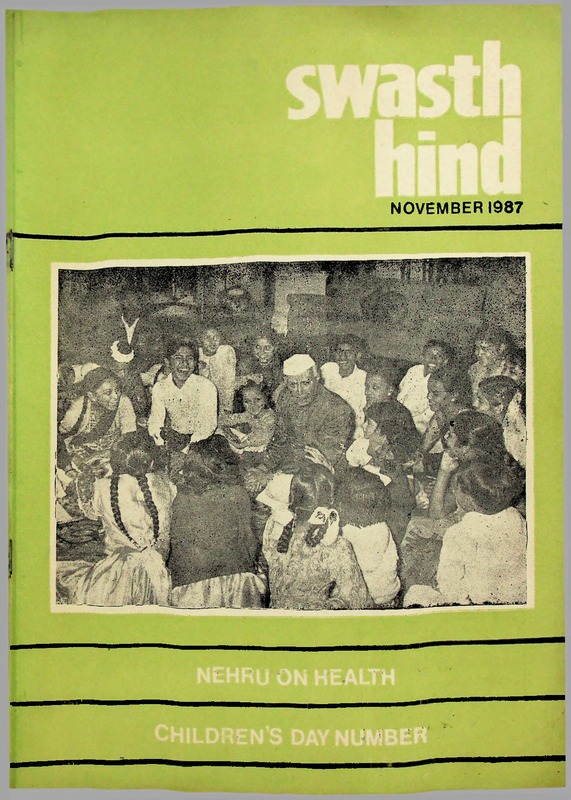
NEHRU ACCORDED FIRST PRIORITY TO CHILD HEALTH
Item
- Title
- NEHRU ACCORDED FIRST PRIORITY TO CHILD HEALTH
- extracted text
-
NOVEMBER 1987
1
swasth hind
Kart ika-Agrahay ana
November 1987
Vol. XXXI, No. 11
Saka 1909
In this Issue
Page
Nehru accorded first priority
to child health
Smt. Vidyaben Shah
257
Nutritional blindness
261
Dr Vinodini Reddy
OBJECTIVES
Elements of a new ethic for children
Swasth Hind (Healthy India) is a monthly journal
published by the Central Health Education Bureau,
Directorate General of Health Services, Ministry of
Health and Family Welfare, Government of India,
New Delhi. Some of its important objectives and
aims are to:
REPORT and interpret the policies; plans, pro*
grammes and achievements of the Union Ministry
of Health and Family Welfare.
ACT as a medium of exchange of information on
health activities of the Central and State Health
Organizations.
FOCUS attention on the major public health
problems in India and to report on the latest trends
in public health.
KEEP in touch with health and welfare workers
and agencies in India and abroad.
Rights of children
Nigel Cantwell
269
Strategies for child welfare in India
Ratna Sahti
278
Eye banks in India
281
Health measures for drought affected
areas
285
SUBSCRIPTION RATES
Single Copy.
Annual
REPORT on important seminars,
discussions, etc., on health topics.
conferences,
265
David P. Haxton
.
.
.50 Paise
....
Rs. 6.00
(Postage Free)
Editorial and Business Offices
Central Health Education Bureau
(Directorate General of Health Services)
Kotla Marg, New Delhi-110 002
Articles on health topics are invited for publication in this
Journal.
State Health Directorates are requested to send in reports of
their activities for publication.
Due
EDITOR
N. G. Srivastava
The contents of this Journal are freely reproducible.
acknowledgement is requested.
Sr. SUB-EDITORS
M. L. Mehta
The opinions expressed by the contributors are not neces
sarily those of the Government of India.
M. S. Dhillon
COVER DESIGN
B. S. Nagi
SWASTH HIND reserves the right to edit the articles sent
for publication.
As n
NEHRU ACCORDED FIRST PRIORITY TO
CHILD HEALTH
Smt. Vidyaben Shah
There can" be no two opinions on the fact that Nehru did lay a lot of stress on child health and
made efforts to encourage programmes and schemes, both governmental and non-governmental,
for the wholesome development of children so that they could grow into happy, healthy children.
November, 1987
/
257
“Somehow the fact that ultimately
everything depends upon the human
factor gets rather lost in our think
ing of plans and schemes of national
development in terms of factories,
machines and general schemes. It
is very well important that we must
have them, but ultimately of course,
it is the human being that counts
and if the human being counts well.
lie counts much more as a child than
as a grown-up”.
The proverbial saying. “Child is
the father of the Man ’ is rather
true. The habits imbibed by a per
son during childhood deepen and
crystallize as he grows and make
their appearance in several ways.
both overt and covert, in his con
duct as an adult.
Therefore, the
health and welfare of the community
and the very claim of a nation to
civilization, depend on the welfare
and satisfaction of children.
It is true that Nehruji accorded
priority to child health. Health is
These were the words of the first a holistic concept which would
Prime Minister of India and the mean the proper alround develop
much beloved “CHACHA” of child ment of an individual.
ren—Pandit Jawaharlal Nehru.
Nehruji liked to see children play
ful and happy.
In fact, he often
The love of Nehru for children told them to consider the whole
has been a universally known fact. country as a play field.
For any
He thought of children of various child to be happy, it is important
nations, religions, castes and creeds that he is healthy.
Health refers
as flowers of different colours and not only to the physical wellbeing.
fragrance, so we identify Nehru with but to the satisfactory social, emo
children and vice-versa.'
tional and cognitive growth as well.
Basic needs
Some of the basic needs of a
child, which if fulfilled, should be
able to keep a child happy and
healthy, may be broadly enlisted as
follows:
I. Nutritious food, comfortable
clothing and a home for pro
tection and safety;
2. Love and understanding for
development of trust, friend
liness and4’ a feeling of secu• rity;
3. Recognition and appreciation
of his deeds without being over
or under protected: and
4. Scope for creative growth.
It was with a view to achieve the
above objectives that Nehru always
pleaded that child welfare schemes
should be given the first priority in
national development plans.
Said
Pandit Jawaharlal Nehru had said that ‘education’ was not only the right of
every child but also an essential pre-requisite for satisfactory alround growth.
258
Swasth Hind
The first Prime Minister of India, Jawaharlal Nehru, liked to see children playful
and happy.
And for any child to be happy, it is important that he is healthy.
he, “If we do not look after the
children, today, we will be creating
many more problems for ourselves
in the future”.
He had great love
and affection for children and felt
sorry to see them uncared for. He
often said “when I see even a single
child in India unfed, with hunger in
his eyes, not properly clothed or
looked after, I am pained because
,somehow I regard that not as an
individual case of hardship but
rather our forgetting our duty to the
India of tomorrow”. Of the child
ren put into begging he said, “It is
a hateful sight to see our little child
ren being put into the atmosphere
of beggardom. Our first duty is to
protect and nourish the children”.
November, 1987
Child care, he felt, could
Panditji had always looked for meal.
ward to the time when every child be most successful, if done through
in the country woud have the oppor coordinated effort of people and the
Government.
He felt that it was
tunity to learn and play.
not possible to bring about changes
with a magic wand.
However, a
Sound education
lot could be done despite lack of
Nehruji felt that ‘Education’ was resources like buildings and funds
not only the right of every child but if the social workers had the neces
also an essential pre-requisite
to sary enthusiasm and proper guid
attain satisfactory alround growth. ance.
He said he had seen many
While inagurating the National Con small, innocent children in the coun
ference on Child Welfare organised try during his travels who were in
by the Indian Council for Child none too happy a condition and
Welfare at New Delhi in 1956, their state must be improved.
He
Nehru emphasized the need for edu expressed his desire to undertake a
cating the millions of Indian Child programme for children between
ren and said that it would not help 6-12 years of age—a sound educa
much to take up this work in piece tion which included full scope for
259
play, music and dance, health ser
vices and a free mid-day meal. He
had earlier emphasized on the wel
fare of children at the International
Study Conference in Child Welfare
organised by the International Union
for Child Welfare in co-operation
with the Indian Council for Child
Welfare, at Bombay, in 1952.
priority in nutrition was given to
children and mothers, in the plan.
During the third Five Year Plan,
the number of Primary Health Cen
tres increased from 2800 to 4840.
A systematic approach to the pro
blem of nutrition was also suggest
ed.
These suggestions included
the education of . the public and
measures to meet the nutritional re
It was due to Panditji’s abiding
quirements of vulnerable groups in
and intense love for children in
cluding children.
whose eyes he saw the future of
India that many child welfare acti
The Fourth Plan accorded high
vities came into existence and the al est priority to the Family Planning
ready existing ones were strengthen Programme, whose centres were also
ed. With the establishment of the responsible for implementing the
Planning Commission in 1950 under schemes of immunization of child
the Chairmanship of Pt. Jawaharlal ren and expectant mothers as well
Nehru, the five year plans were for as providing nutrition to them. Nu
mulated. These were started with trition education was provided under
an ultimate aim of economic deve the Applied Nutrition Programme.
lopment for the welfare of the family
During the Fifth Plan, it was pro
and therein the child who is the
most precious asset.
In the stra posed to integrate health, family
tegy of planned national develop planning and nutrition for effective
Children were
ment, India focussed its foremost implementation.
provided special attention—being a
interest in the young child.
vulnerable group.
The' Maternity
and Child Health Services were
strengthened.
Child welfare through plans
The first Five Year Plan record
ed that nearly forty per cent of the
total deaths were among children
under 10 years of age. Therefore,
the plan greatly emphasized the in
crease in training facilities for all
types of personnel. Establishment
of Primary Health Centres and
Maternity Health Centres was em
phasized and a substantial sum was
allocated in the budget for Mater
nity and Child Health work. Be
sides. malnutrition was recognised
as a major cause of ill-health. To
assure children with a balanced diet
for their development, the plan re
commended changes in value-sys
tems of food habits which could be
corrected by family and community.
said “All our national problems
would be solved if children were
given their birthright—proper faci
lities for education and recreation,
irrespective of the inequalities and
class distinctions.
Such children
will be. an asset to the prosperity
and development of the nation”.
He hoped that small Bal Bhawans
will be set up in every town and
village to enable children to have
full freedom and equality of oppor
tunity to develop their physical and
'mental potentialities so as to deve
lop into healthy individuals.
While declaring open a children’s
theatre at Madras in 1957, he said
“I entirely agree about the necessity
and desirability of having good
films, documentaries etc. for child
ren”. He pleaded for the opening
of a large number of children’s theat
res and opined that films for Indian
children should be produced in India
itself.
Panditji also emphasised the
need for children’s museums and
parks and felt that these should
also be made near slum areas where
poor children can also make use of
them.
This trend of laying special em
phasis on the programmes for the
While giving away the prizes to
welfare of the child has continued the winners of the International
in the Sixth and Seventh Plans as Children’s Competition organised
well.
by the Shankar’s Weekly at New
Delhi in 1955, he said “such com
Bal Bhawans for socio-emotional petitions are conducive to better
understanding among the World’s
development
children.
Habits grown in child
Besides giving paramount signifi hood for mutual understanding
cance to such schemes of nutrition would stand in good stead to live
and health for children, Nehruji in a spirit of amity in the years to
also laid stress on the socio-emo come”.
tional development of the child as
Thus, there can be no two opi
well as on providing opportunities
for fostering creativity in them. He nions on the fact that Nehru did lay
encouraged the organisations con a lot of stress on child health and
ducting programmes that allowed made efforts to encourage program
children to develop their creative mes and schemes (both governmen
potential.
He visited these orga tal and non-governmental) for the
In the second Plan, the budget nisations from time to time. While wholesome development of children
for setting up Maternity and Child laying the foundation stone of Bal so that they could grow into happy,
O
Health Centres was enhanced. Also, Bhawan at New Delhi in 1958, he healthy individuals.
260
Swasth Hind
NUTRITIONAL BLINDNESS
DR. VINODINI REDDY
utritional blindness
results
from lack of vitamin A, often
against a background of general mal
nutrition.
Although several nutri
ents are needed for normal func
tioning of the eye, it is the deficiency
of vitamin A that affects the eye
most, and the resulting condition is
known as ‘xerophthalmia’. Youn
ger children are more prone to deve
lop severe forms of the disease that
result in blindness, as their vitamin
A requirements are relatively great
er. In the world today, it is esti
mated that about half a million
children become blind every year as
a result of this deficiency. More
than half of them die within weeks
of becoming blind. Recent studies
suggest that even mild xerophthal
mia is associated with increased
morbidity and mortality. What is
more tragic about this condition
is that it is completely preventable
and need not, and should not occur.
N
Vitamin A deficiency is a nu
tritional disease arising pri
marily from dietary inadequ
acy, and the long-term solution
lies in ensuring adequate in
take of Vitamin A rich foods.
Therefore, education of the
community becomes an im
portant component of the nu
trition programme, which, ac
cording to the author, is the
weakest link.
This article is
based on a public lecture orga
nised by the National Society
for the Prevention of Blindness
in New Delhi on 15 Septem
ber, 1987.
This lecture is the
first one in the six-lecture
series on eye health car start
Prevalence
ed by the National Society
Vitamin A deficiency is wide
spread in many countries of South
East Asia. Surveys carried out in
different parts of India have shown
that about 5-10% of children have
clinical signs of vitamin A deficien
cy. The prevalence rates vary con
siderably in different regions and in
different age-groups.
It is more
for the
November 1987
Prevention of Blind
ness—India. Other subjects in
the series will be : Glaucoma,
Eye-Injuries, Intra-ocular Im
plant, Contact Lens and Dia
betes and the Eye.
common in socially and economi
cally backward areas. Severe forms
of the disease involving cornea are
seen most frequently in children
between 1-5 years.
Community
studies have shown that about 1 in
1000 pre-school children develop
such blinding lesions. Since mor
tality is high In such cases, the real
magnitude of the problem must be
much higher than what is indicated
by prevalence surveys.
Causes
Inadequate dietary intake of vita
min A is the major cause of this de
ficiency disease. In India, a majo
rity of infants are breast fed upto 12
months of age, and we do not see
deficiency signs during this period.
In spite of maternal malnutrition
contributing to low levels of vitamin
A in breast milk, infants are protec
ted against xerophthalmia.
The
problem arises during the weaning
period when the infant’s diet is chan
ged. to solid foods. The main de
fect in the current infant feeding
practices is delayed supplementation.
Food supplements are generally
started by 10 to 12 months of age,
and foods containing vitamin A are
seldom given. Surveys carried out
in pre-school children have shown
that their intake of vitamin A is less
than 100 /x g while the requirement
is 300jng/day.
261
Apart from inadequate diet, other Treatment
programme of nutrition education
factors such as protein energy mal
and can be considered only as a long
Early signs of vitamin A deficien
nutrition, diarrhoea, measles and
term approach.
In view of the
cy can be treated successfully by
other infections also contribute to
serious nature of the problem, other
giving vitamin A supplements. But
the disease process. During infec
short term interventions have been
in more advanced cases of corneal
tion, the food intake is reduced be
devised for the immediate control of
ulceration, scar formation is inevi
blindness.
Fortification of foods
cause of altered appetite and also
table. Prompt treatment with vita
and periodic administration of mas
because of cultural practices related
min A can make all the difference
sive doses of vitamin A are two such
to feeding during illness. Infection
in the sight.
The community
measures.
is known to interfere with the absor
health workers should, therefore, be
ption and utilisation of vitamin A.
trained in early detection and treat
Repeated infections can thus aggra
ment of xerophthalmia.
Fortification
vate vitamin A deficiency and preci
pitated clinical manifestation.
Fortification of foods is a well
Prevention
Signs and Symptoms
Considering the vast number of
children known to suffer from this
disorder, a much better approach
would be to see that the deficiency
does not develop at all. Pregnant
and nursing women should be en
couraged to consume diets adequate
in vitamin A. Children should be
given supplementary foods rich in
this vitamin from sixth month on
wards.
established technique for increas
ing1 the regular dietary intake of a
population.
In some countries of
South America, vitamin A fortifica
tion of sugar has proved to be high
ly cost-effective in reducing vitamin
A deficiency. Food items fortified
with vitamin A in India include
dairy milk, miltone and hydrogena
ted fats (Vanaspathi).
But these
fortified foods are available only in
big cities like Delhi and Bombay.
Even in these areas, slum dwellers
do not consume such foods regular
ly or in sufficient quantities because
of the high cost. Thus the segment
of the population at greatest need
does not seem to be benefited by the
fortification programme.
Although vitamin A deficiency
affects many tissues in the body, the
most dramatic effects are seen in
the eye. The term ‘Xerophthalmia’
literally means ‘dry eye’ and applies
to all ocular signs of vitamin A de
ficiency.
Night blindness or ina
bility to see in dim light is one of the
early manifestations. The child is
unable to see at night though there
is no difficulty in seeing during the
Sources of vitamin A
day in bright light.
Vitamin A is a fat soluble vitamin
and is present in animal foods such
In addition, vitamin A deficiency
as butter, eggs and liver.
But
leads to some structural changes in
these are expensive and beyond the
the eye.
Conjunctiva, the thin
reach of the poor. Foods of vege
membrane covering white portion of
table origin contain a substance
the eye, becomes dry and wrinkled.
called Beta-carotene which can be Massive doses of vitamin A
Pearly grey, elevated patches called
converted to vitamin A in the body.
‘Bitot spots’ may be seen.
Since vitamin A can be stored in
This provitamin can be obtained
from inexpensive foods such as green the body for prolonged periods, it
These conjunctival lesions do not leafy vegetables, drumstick leaves is possible to build up vitamin stores
interfere with vision, but in more and carrots.
Fruits like papaya in the child by periodic administra
Studies car
severe deficiency cornea, the central and mangoes are also rich sources tion of large doses.
ried.
out
by
the
NIN
at
Hyderabad
black portion of the eye is also in of carotene.
Inclusion of these
have
shown
that
oral
administration
volved (Keratomalacia) resulting in foods in the diets *of children will
of 200,000 IU of vitamin A as a
complete loss of vision. This con prevent vitamin A deficiency.
single dose, once in six months can
dition is often associated with pro
tein energy malnutrition. Younger
People should be encouraged to protect the child from nutritional
the child, greater the severity of increase the production and consum blindness. This is a simple, effec
disease and the risk of blindness ption of vitamin A rich foods. tive and the most direct intervention
No wonder this has
This, however, involves an intensive strategy.
and death.
262
Swasth Hind
NEHRU ON HEALTH
T pains one to see neglected child
ren in villages. It is not that they
are orphans for they have parents but
nonetheless their condition indicates
as if nobody looks after them. It is
a matter of regret that the task which
we should have attended to prima
rily, has not been done. But there
are many other similar things for
which we have to have regrets. It is,
however, not possible to bring about
a change in conditions in India with
a magic wand. The problems of giv
ing priorities in the plans is a diffi
cult one. What should come first
and what the second and the third
and which of them should be the
last? But in my opinion child wel
fare should have the first priority in
all our activities.......... If we neg
lect our children today, if we do
not look after them well, we will be
creating many more difficult prob
lems for ourselves in the future.—
Message to Children's Day Number
of Swasth Hind, November, 1959.
I
become the most popular strategy been implemented well, there was
for tlie control of vitamin A defici a significant reduction in the preva
ency.
lence of vitamin A deficiency. While
in other areas, the coverage was in
National Programme
adequate. Some of the reasons for
India was the first country to poor coverage were inadequate sup
launch a national programme of plies of the vitamin and adoption of
vitamin A distribution for the pre clinic approach instead of house to
vention of blindness in children. It house visits for distribution of the
was started in 1972, initially in 7 dose.
(seven) states where the problem
was severe and later it has been ex Vitamin A Delivery System
tended to other regions in the coun
There are two basic systems for
try. Under this programme a mas the delivery of vitamin A to the com
sive dose of vitamin A is given once munity—targetted approach which
in six months to all children between covers only ‘high risk’ groups and
1-5 years, who are at risk.
The the universal system in which all
programme is implemented through pre-school children are given the
the primary health centres and the dose. In India, universal distribu
actual distribution is done by para tion is adopted covering all children
medical personnel.
of poor rural communities. How
Evaluation of the programme has
shown that in areas where it has
November 1987
to achieve complete coverage of
the target population.
Of the es
timated 80 million pre-school child
ren in India, at present only 25 mil
lion i.e. less than a third are given
the massive dose of vitamin A. The
children who are at greatest need
may not get the vitamin. Obvious
ly, such a coverage cannot be expec
ted to make a significant dent in
the problem.
The limited supplies of vitamin A
can be better utilised by adopting
a selective approach. One way is
to implement the programme only
in areas where vitamin A deficiency
is a serious problem.
The other
approach is to cover ‘high risk’ child
ren in all the areas. Massive dose
of vitamin A can be given to all
ever, with the existing infrastructure children with protein energy malnu
and limited resources it is difficult trition, measles and diarrhoea who
263
are at greatest risk of developing Community awareness
in home gardens and in the fields
xerophthalmia and blindness.
A
growing carotene-rich foods. They
It is well recognised that any pub
health worker is more likely to come
lic health programme can be suc should be motivated to increase the
in contact with the child when he is
cessful only if the community is production and consumption of such
ill, offering a better opportunity to
made aware of the benefits of the foods.
give vitamin A than in a routine
programme.
Education of the
programme.
In the current set up of primary
community
thus
becomes
an
health
care, the VHG is the first
important component of the nut
Role of Primary Health Workers
rition programme.
However, this level contact who can deliver not
The optimal use of manpower appears to be one of the weakest only health services but also nutri
available can help to improve the links. In some areas, it has been tion education. Proper training of
coverage. In India, there are about observed that the community is nei these workers is important for con
300,000 village health guides (VHG) ther aware that the programme of veying the nutrition messages to the
providing primary health care to the vitamin A distribution is in opera
community.
Recently N1N has
community. At present these wor tion nor do they know its purpose.
adopted innovative measures in
kers assist the ANMs and do not The health workers should contact
directly distribute vitamin A. Simi the mothers and educate them not communication to reach the target
Traditional or folk
larly in the I CDS (Integrated Child only about this programme but also population.
media
like
Burra
Katha was found
Development Scheme) which is in about other measures to improve
to be the most effective method in
operation in more than 1000 com vitamin A status.
munity developing blocks, the Anrural areas of Hyderabad.
ganwari workers help the ANMs in
Nutrition education
Methods of communication would
identifying the beneficiaries. Com
naturally
vary in different places de
plete responsibility of vitamin A dis
Vitamin A deficiency is a nutri
tribution can be allocated to these tional disease arising primarily from pending upon the local customs and
village-based workers, who can in dietary inadequacy, and the long traditions.
Identifying the right
tegrate this with other health acti term solution lies in ensuring ade channel of communication is impor
vities like immunisation and oral re quate intake of vitamin A rich tant for the success of the program
hydration. For example, the VHG foods.
me. This applies not only to vita
who advises the mother regarding
min A but all aspects of nutrition
the use of ORS, can dispense vita
Women play . a crucial role in
What is important is
min A also without any additional maintaining vitamin A nutrition of and health.
effort. These workers should be their children through breast feed to create awareness among people.
properly trained and motivated to ing, through preparation of vitamin A social campaign is needed to bring
play their roles effectively.
A rich foods and through their work about a health revolution.
To ensure prompt supply of the Journal quote your Subscriber Number and intimate the change
of address.
For all enquiries, please write to :
The Director
Central Health Education Bureau
Kotla Marg, New Delhi-110 002
264
Swasth Hind
ELEMENTS OF
A NEW ETHIC FOR CHILDREN
David P. Haxton
The ‘sharing of life-living knowledge’ is an important element of a new ethic in relation to
children, says the author.
And this aspect of health promotion leads
us to what the
Alma-Ata Declaration refers to as health education which in its broader connotation may be
called development communication.
This is central to any improvement in the situation
of children.
en years ago, children
from
Europe, North America and
Japan accounted for 35 per cent of
the world’s child population. At
current birth and death rates, that
percentage 4s predicted to decrease
to no more than five percent 25
years from now, by which time the
world’s population will have again
doubled. As we ponder over the
meaning of these data, the unwis
dom Of showing no concern for the
development of children in the en
tire world becomes apparent.
If
the children of the whole world are
not fed, not educated, not loved and
nurtured, the consequences
for
those that represent what will be at
the time only five percent of the
population, are likely to be extremely
uncomfortable. The hard fact’ is
that development is indivisible. And
so is peace.
T
November, 1987
I mentioned the unacceptable delay
in reaching the fruits of science to
meet the needs of people. There are
examples to illustrate the point*. It
has been known for many years that
a dietary intake of traces of iodine
(some 150 micro-grams a day) was
essential for human health as well
as foetal development. Yet there
are areas in this and other parts of
the world where half the popula
tion have iodine deficiency disorders
and ten or more percent of new
borns have neonatal hypothyroidism
which borders on cretinism. During
the past 25 years, the world-wide
prevalence of iodine deficiency seems
to have risen by 50 percent. We also
know that it has consequences far
beyond the common symptom of
goitre or the manifestation of creti
nism, for iodine deficiency interferes
with the educability of successive
generations, perpetuating social-eco
nomic deprivation and laying waste
a good part of the already scarce
national resources invested in child
hood education. In India alone, at
least 120 million people are at risk,
a third of them, including 16 million
children, known to be suffering. I
must add that for at least 70 years
it had been known that iodine
deficiency is perhaps the easiest to
prevent of various nutritional dis
orders; and prevent on a global
scale through relatively simple
techniques like iodinating salt. Yet
this is yet to be achieved except to
a fractional extent.
This is the time gap 1 was referr
ing to, between aspiration and fulfil
ment. And such gaps are visible
across the range of health-related
265
interventions on behalf of children, the present situation of children means to it and to those who are
like:
calls for—first, the need for shift deficient in vital micronutrients like
—protection and promotion of the ing the centre of gravity of the iron, vitamin A and iodine; eradi
practice of breast-feeding and design of development from the pro cation of locally endemic diseases—
proper weaning, through regu fessional elite to the underdevelop from guinea worm t‘o leprosy;
latory as well as awareness ed community and thereby to pro maternal and child health care side
vide the development process a firm
building measures;
by side with birth spacing and family
basis in the community; and second,
—the need to protect alj the child the imperative of simultaneity and planning; and to underpin all these
ren against immunizable diseases convergence of services or interven efforts, health education in the
through
universal
coverage, tions for children.
widest possible sense of the term.
rather than protect a small num
ber of them with only a margi It is at this point of decisive action The concept of primary health care,
nal effect on disease prevalence that the primary health care con which is central to the new ethic in
in the community:
cept becomes relevant; the commu relation to children, represents a
—the imperative to let mothers nity-based approach, training of revolutionary order of peaceful, pro
know that an appropriate salt- para professionals and community gressive social change. It squares
professional ’ back-up,
sugar solution, or rice water, can workers.
organic
linkages
with the health and eminently with a democratic theory
prevent their children from dying
of development. And that explains
from diarrhoeal dehydration as other service systems, social mobili
zation
of
resources,
pressing
into
its inherent strength and longerthey do today, literally in mil
service
all
possible
channels
of
twoterm promise—as well as the hurd
lions each year;
way communication between health les it faces and the painfully slow
—the urgency to fortify food with workers at all levels on the one
iron or to consume inexpensive hand and the community on the pace of current progress. For its
iron-rich natural foods in situa other—all this strengthened
by success, primary health care re
tions, such as South Asia, where strong political commitment
and quires three broad sources of sup
at least' half the pregnant women government support. If this be the port : political,, professional and
and children of preschool age overall scheme of the primary health
popular. Your own role as develop
are anaemic for lack of iron in care approach, all the elements of
ment
promoters is clearly etched.
the blood.
primary health care itself are affor
dable even for low-income popula Since professional backing has the
All these suggestions for action tions and as effective as any tested
capacity to trigger political as well
are based on science. What holds alternative.
as popular support, we could start
us from sharing these with people
Y»ho can use, apply it and benefit on We thus come back to the priority with that. The related problems
their own? There are numerous and urgency of a whole range of have been discussed threadbare and
other imperatives, equally categori health-related interventions within
world-wide over the past decade,
cal and equally neglected due, in my and outside the health sector await
opinion, to the absence of a public ing to be made accessible to the outside the health profession as well
And this in itself is
policy founded in a rational ethic. people, all people: the benefits of as within it.
breast-feeding; proper
weaning a hopeful sign. Let me only touch
foods and weaning practices; im
munization including disease sur
veillance; oral rehydration therapy
complemented by measures like
clean water supply and basic* sani
tation to reduce the incidence of
That brings me to two allied diarrhoea itself; nutritional support
principles for the new ethic which to those Who arc deprived of the
In this view, I would consider the
need for urgency and acceleration
in positive interventions as an im
portant principle of a new ethic in
support of children.
266
on one or two points of immediate
relevance.
For example, why are
health
inexplicably
professionals
reluctant in sharing their technical
knowledge with others? What they
do share is a certain
skepticism
about others’ ability to understand
Swasth Hind
NEHRU ON HEALTH
“My attention is specially attract
ed towards children, not merely be
cause I like children, but because
these children who will grow up,
will be the future citizens of India.
It pained me to see that some of
these children are not properly look
ed after and attended to. It is not
the fault of their parents. If you
like, it is the fault of the circums
tances or whatever they may be. I
think all of us have a certain respon
sibility to see that children in this
country are properly looked after.”
—Jawaharlal Nehru
and apply scientifically estabilished
facts. Thus medical practitioners
in the United States took about ten
years to accept ths. sugar and salt
solution for oral rehydration therapy.
Now it is gaining ground in indus
trialized societies due to sheer eco
nomic logic—even the non-poor find
hospitalization
for
intravenous
therapy too costly!
If the principle of oral rchydration
therapy is de-myslified, motivated
communicators could carry it to the
low-income groups. The sharing of processes through feedback on out
life-living knowledge is thus an im come.
portant element of a new ethic in
Any change in the set of moral
principles to guide adult conduct in
This aspect of health promotion relation to children is predicated
leads us to what the Alma Ata Dec upon social learning processes.
laration refers to as health educa Health professionals have to take a
tion which in its broader connota lead in this evolution, with the help
tion may be called* development of colleagues in public administra-.
communication. This is central to tion, social sciences and communi
any improvement in the situation of cation.
children—starting with triggering
the action, keeping it on course The social dimensions of promot
relation to children.
vast' through a continuous interchange of ing the principles and practice of
network, of^social, religious and cul views based on information on the primary health care needs to be seen
tural organizations active among ground and going on to evaluative differently from the promotion of
people through the existing
November, 1987
267
commercial commodities.
This dis
ning? Let us remember that there is
tinction is of the essence, of develop hardly a major decision in social
ment communication. The product and economic planning which docs
is often non-material and
consists
mainly of correct understanding, and
practice.
Even when there is a
be non-monetary—like the effort in
volved in taking a baby for free vac
cination. The profit is not for the
promoter but for
individual
society, and its
in terms of
members
monetary savings and even more in
terms of improved health status or
question
not. directly impinge or indirectly
Let me conclude with my convic
affect the lives and prospects
tion that this question,, or quan
of
dary if you
children.
will, can be resolved
in our own times.
monetary price, it is low and affor
dable by almost everyone; or it may
is the crux of the ethical
facing us today.
Some of
the
greatest achievements for children—
1 have argued that ethics and rea
son do mix in mutual harmony.
do
the
So
many of them unsung and not even
fully documented—have been achie
longer-term
legitimate
ved by organized voluntary action,
interests of the poor and the non leading in turn to nation-wide sup
poor. Altruism in development, is
port ’ through State intervention in
sound economics. For example, the the educational as well as regula
use of the improved measles vaccine tory processes. For example, how
necessity for us to change the rules
in the United States during the many of us remember that the Uni
1970s prevented an estimated 24 mil ted Kingdom had, at the beginning
lion cases in that country, achieving
of this century, an infant mortality
a cost saving of some 1.3 billion rate higher than in India today; that
that guide
dollars—an experience
lowered mortality rates.
To sum up, I
have
our
argued
attitude
the
towards
reinforcing it was reduced from 150 to 60 in
I have tried to identify some of the
the positive ’ lesson from the
far
greater recurring benefit' in eradi
elements of a new ethic like:
cating
children and our actions for them.
—priority in national planning for
children;
smallpox.
The cost in
volved is not prohibitive but highly
productive.
In
services
for children:
result of a process triggered by volun
tary women workers from the edu
cated segments of society.
fact the critical
question is not how much
—universal coverage by
just 30 years, and that it was the
money
but how much effort is invested. The
The story has a fascination and a
time has come when an organized
lesson for us today.
In most deve
and
total
assault
on
poverty
can
suc
—acceleration of ongoing actions
loping countries, India prominently
for children;
ceed—beginning with children.
included, we have better, access to
Can we agree that these considera
alarmed at the Bhopal tragedy over
technology relevant for the survival,
development and protection
of
children than in Britain eighty years
ago. We have at our disposal the
means to transfer that technology
to those in need. But, do we have
the will and the wisdom to do so?
I would venture to say that the
hurdles to human development
today are not technological or
intellectual but organizational, and
in that sense political and social.—
tions should be applied and must
prevail at every stage of national
20 months ago, are relatively un
Excerpts from a statement by the
—simultaneous provision of diffe
rent basic services for children:
Will we, as a society, close ranks
—de-mystification and sharing of to make that assault? The answer
technical knowledge relevant too will depend on whether, seeing a
children;
child dying we feel impelled to do
learning something about it. When the death
social action is in slow stages, as is mostly the
—promotion of social
processes
and
through social
communication.
case, nature gives us the chance to
make up our minds.
We who were
moved at a comparable number of author on the Rajasthan Chapter
and international development plan child deaths each day in India. That of SID Jaipur, 6 September, 19860
268
Swasth Hind
RIGHTS OF CHILDREN
Nigel Cantwell
The only international enumeration of children’s rights that exists at present is provided by
the Declaration of the Rights of the child, adopted on 20 November, 1959 by the UN
General Assembly. The principles it contains are general enough to be universally acceptable,
but they are just principles. They do not carry any obligation on anybody to ensure that they are
realised. Efforts are on to formulate a potentially binding instrument that would supplement
rather than supplant the Declaration by laying down minimum standards to be applied as
distinct from global principles serving as ultimate goals in child well-being.
is totally unsatisfactory, both in Almost Complete
terms of its inbuilt' incoherence and The open-ended Working Group
because of the vast areas' that it set up by the UN Commission on
does not cover.
Human Rights to produce a draft
text of the Convention has been
There was therefore every reason meeting for a week each year since
Drafting a Convention on the to welcome the initiative of Poland
1979. It is composed of 43 mem
Rights of the Child, has been a when, on the eve of the International bers of the Commission, together
lengthening process.
Regional Year of the Child (1979), it propo with (participating) observers from
consultations in Asia, Africa and sed the formulation of a Convention any other country wishing to be
on the Rights of the Child—a po
Latin America might help save time tentially binding instrument that represented, as well as representa
that* could be taken up by limitless would supplement rather than sup tives from the inter-governmental
organisations, UNICEF and ILO
amendments to a
near-complete plant the Declaration by laying down and
non-governmental
organi
draft pieced together over the past minimum standards to be applied sations.
The Working
Group
as distinct from global principles is now within sight of the end of
eight years.
serving as ultimate goals in child its task—at' least as far as the sub
well-being.
stantive articles • are concerned.
The only international enumera
These will number over thirty when
tion of children's right’s that exists Beyond Western Perception
the draft is completed, and should
at present is provided by the Dec
laration of the Rights of the Child, In addition to providing the oppor be formulated in their entirety by
adopted on 20 November 1959 by tunity for a comprehensive review the end' of 1987. Debate will then
the UN General Assembly. The and update of existing norms in the turn to the implementation mecha
principles it contains are general sphere of children’s rights, with the nism that the future convention will
enough to be universally acceptable, further goal of ensuring their con contain to facilitate and supervise
but they are just1 principles. They sistency, discussion of the draft Con respect for its own substantive pro
do not carry any obligation on any vention had another potentially visions. The hope is that in 1988 or
body to ensure that they arc reali significant use. When the Declara 1989, the second reading of the
sed.
tion was proclaimed, the physio whole draft can be terminated and
gnomy of the United Nations was that) it can then be presented to the
very different from what it is today. Commission on Human Rights, the
Declarations’, Conventions
At that time, the organisation was UN Economic and Social Council
The rights set out in the Declara dominated numerically by the indus and the UN General Assembly. If
it would then be open for
tion are not' the only ones recogni trialized countries. As the countries adopted,
ratification.
At least three major
sed for children by the international of Africa and Asia have gradually dangers threaten such a speedy com
gained their independence and taken
community. Over 80 conventions, their seat at the UN, they have pletion of the drafting process, des
declarations and other binding and been in a position to make their pite the repeated calls of the Gene
non-binding international instru voice heard. Here, was their chance rals Assembly for priority to be
ments contain provisions that ex to ensure that' children’s rights given to the rapid formulation of the
draft.
plicitly or implicitly apply to child would be approached from a more
universal standpoint than the essen
ren. As a body of international law tially “Western-inspired” Declara Wobbly Standards
defining the rights of the child, how tion and many of other international The first of the dangers is the lack
ever, this heterogeneous collection texts applicable to children.
of attention paid to existing stan
he interest and involvement of
developing countries in taking the
rights of the child a step nearer
realization, has been negligible.
T
November, 1987
269
dards. A study commissioned jointly received the declared moral sup that their individual and /or collective
by Defence for Children Internatio port of the representative of UNI voices are heard.
nal (DC) and UNICEF has poin CEF which, as the intergovernmental Waning Interest
ted to many examples of draft, text “lead agency” on children’s affairs,
After* a short-lived burst of enthu
that lower or ignore standards con might have expected its implicit'
tained in other international instru advice to have carried more weight. siasm for the 1985 session, par
ticipation by countries in Africa,
ments. An example from the last
Asia and Latin America slumped
meeting is eloquent' in this respect. Implementation
this year to its former low level—
The draft text adopted for the Con
The second major danger ap just fifteen countries from those con
vention for the article, devoted to pears
when one looks for
children in armed conflicts stipu ward to the. debate on what the tinents sent representatives, less than
lates that' ‘State Parties shall refrain implementation mechanism should half of whom attended on any regu
in particular from recruiting any be. Partly, perhaps, because the fut lar basis, and even fewer who took
child who has not attained the age of ure Convention will incorporate not part in any significant way.
fifteen years into their armed for only so-called political and civil
At this stage of the drafting
ces’. The Geneva Conventions also rights but also economic, social and process, and on the basis of
state that, when recruiting in the cultural rights. Many governments their past record, the developing
15—18 age group, priority should be seem to be looking for the weakest countries are hardly likely to stage
given to the older members of that possible implementation mechanism a strong comeback. The argument
group. Even if, in another para that will nonetheless not be laughed used to explain their massive ab
graph of that same article, State out of court as being tantament to sence—lack of resources—has be
Parties are enjoined to “respect and no mechanism at all.
Again the come frayed, to the point of being
ensure respect for rules of inter danger is two-fold; in the sympto spurious, when one takes account of
national humanitarian law appli matic “spirit of compromise”, the the “investment potential” of the
cable to children in armed conflicts final test that the Working Group exercise.
...” (basically same Geneva Con adopts provides for nothing more
Many developing countries, be
ventions) the omission of such an than the most rudimentary reporting cause of their economic, cultural
explicit provision can hardly be en procedure with no monitoring or re and religious specifities, have round
couraging in an instrument' designed active mechanism foreseeny, and that ly criticised certain UN texts for
at the very least to reaffirm exist discussion on this question is pro their “Western” bias. If they con
ing standards of child protection, longed unduly because other govern tinue to spurn the drafting of a
and hopefully to upgrade them. This ments wish for somewhat stronger Convention that concerns virtually
is all the more true in view of the implementation structures.
Lack half of their inhabitants, there will
fact that', not only the non-govern of consultation prior to the formal be few willing to listen to them if
mental organisations but also the debate could seriously jeopardise they therefore question or just
draft proposal presented by many swift agreement on this question, ignore the content of the Conven
countries had supported a “no re with no guarantee that lengthy de tion on the Rights of the Child
cruitment” principal for all child bate would produce appropriate once it is adopted. The use of the
ren covered by the draft Convention, results.
term “if” here is, moreover, highly
up to and including the age of 17
optimistic, since criticisms have
years.
Absence of input
already begun.
Developing countries are by no
Algerian reservation on the text as
The third danger is the result of
it now stands, is based on the feel the striking and
disturbing ab means the only ones, to “have pro
ing that it should be qualified by the sence of input into the draft Con blems” with the content of the draft
Several
countries
words “against his or her will”. In vention on the part of representa Convention.
very exceptional
circumstances, tives of the developing countries. have already officially communi
children may for their survival be Clearly, and however misleading it cated reservations with regard to
obliged to take up arms. Such situa is to consider the “Third World” as certain of the provisions—notably
tions should, precisely, remain ex a homogeneous group, these are the the United Kingdom and, to a
ceptions to a general principle, justi countries where children make up lesser extent, the Federal Republic
fications for which would have to the largest proportion of the popu of Germany. The different natu
evaluated on a case by case basis. lation and where the basic problems rally lies in the fact that those
Including such a qualifications in of survival and development of chil countries have involved themselves
the- draft Convention would have dren are the most acute. They are in the drafting process, have made
simply lowered existing standards. therefore the ones that would benefit their voice heard and, if their opi
The risk here is two-fold (a) that most from international cooperation nions have not met with the agree
draft porvision have to ’be renego and technical assistance—providing ment of the Working Group as a
tiated because they do not come up that both are appropriate in nature whole which always adopts texts
to present' norms—a process that and in form—that are always impli by consensus, they can feel somewould of course take time and (b) cit and sometimes explicit in the draft what more justified in making
that those draft provisions remain. provisions of the Convention. And known their misgivings than the
If is worth noting, moreover, that one would logically expect them, considerably larger group of actual
the above mentioned non-govern- therefore, to participate in force in and potential absentee critics. .
{Continued on page 275)
ment standpoint on “no recruitment” the drafting process, making certain
270
Swasth Hind
NEHRU ON HEALTH
ANCIENT Vs. MODERN SYSTEM
here is much controversy often.about the place of
the Ayurvedic and Yunani systems. There can
be no doubt that both these ancient systems of
India have an honourable history and they had a
great reputation. Most people know also that even
now they have some very effective remedies. It
would be wrong and absurd for us to ignore this
accumulation of past knowledge and experience.
We should profit by them -and not consider them as
something outside the scope of modern knowledge.
They are parts of modem knowledge. But, in many
directions, modern science, as applied to both medicine
and surgery, has made wonderful discoveries, and,
because of this, health standards in advanced countries
have improved tremendously. We cannot expect
to improve our standards unless we take full advantage
of science and modern scientific methods. There
T
November, 1987
is no reason why we should not bring about an alliance
of old experience and knowledge, as exemplified in
the Ayurvedic and Yunani systems, with the new
knowledge that modern science has given us. It
is necessary, however, that every approach to this
problem should be made on the basis of the scientific
method, and persons who are Ayurvedic and Yunani
physicians should have also a full knowledge of modern
methods. This means that there should be a basic
training in scientific methods for all, including those
who wish to practise Ayurvedic or Yunani systems.
Having got that basic training, a person may practice
either of these systems or homoeopathy.—Extract
from Foreword to “Health in Independent India” by
G. Barker.
{Continued on page 277)
271
Interest in Physical Culture
I
am much interested in sports and
physical culture. I think that some
of our own systems of physical cul
ture, like the asanas, are particu
larly good and should be encourag
ed among our young people. So also
indigenous games. This does not
mean that we should exclude foreign
sports or games or methods of physi
cal culture. We should take the best
wherever we can find it.
I see that the Yuvraj Vyayamshala of Ujjain, since its foundation
nearly forty years ago, has made
considerable progress and nearly
two thousand boys and girls are
taking part in its work. I particu
larly like the idea of parties of boys
going to mofussil places to display
games and feats.—From a message
to Yicvraf Vyayamshala, Ujjain.
A/T ost of the problems that afflict mankind today, not all but most, certainly the primary
problems of health, education, the general welfare of the community, food, clothing, housing
and such problems, are capable of solution by the means at hand in the world, not in each
country at the present moment, but in the world as a whole, we have the means at hand to solve
these problems, and build up a measure of welfare throughout the world, a measure of health, a
measure of education.—Jawaharlal Nehru
272
Swasth Hind
Nothing saddens me so much as
the sight of children who are de
nied education, sometimes denied
even food and clothing. If our child
ren today are denied education, what
is our India of tomorrow going to
be? It is the duty of the State to
provide good education for every
child in the country. And I would
add that it is the duty of
the State to provide free educa
tion to every child in the
country. Unfortunately, wc cannot
do all these things quickly and sud
denly, because of our lack of resour
ces and lack of teachers. But we
have to get going. After all, what
ever pattern of society we . are look
ing forward to must contain trained
human beings, not people who have
just learned to read and write, but
trained people whose character has
been developed, whose mind has as
pirations and some elements of cul
ture about it and who can do some
thing with their hands.—Extract
from Jawaharlal Nehru’s speeches
1953—-1957.
November, 1987
273
SPORTS ESCHEW
PAROCHIALISM
think that it is
desirable to en
courage sports and athletics in
India in every way. This is neces
sary from the point of view of de
veloping national physique. It is
even more necessary because of the
camaraderie and esprit de corps
which this helps in developing. There
are many disruptive and parochial
tendencies in India which have to be
countered. Sport is one good way of
doing so.
I
But if sports and games are play
ed, this must be done in the spirit
of the game and with good humour
and. goodwill.—Extracts from a mes
sage to the Football Association,
Calcutta, 14 February, 1956.
274
Swasth Hind
(Contd. from page 270.)
Sources of Support
South-east Asia, as a region, has
been severely under-represented at
the UN Working Group; indeed,
only sub-Saharan Africa has had
a consistently worse record. Among
South-East Asian countries, Ban
gladesh has demonstrated by far
the most interest—although that
was not difficult given that only
India and Sri Lanka have other
wise made any serious attempt to
take part in the drafting process.
“Conceptions of the rights of the
child are heavily conditioneid by
conception of family law in differ
ing legal systems. Moreover, the
conception of the family itself
varies in various legal systems and
in different cultures. The Muslim
countries representing one of the
most important legal systems ob
taining in the modern world, viz.,
Islamic Law, have their own con
ceptions of the nuclear family, the
extent and the rights of the child.
within the framework of those con
ceptions. It is considered essential
that the Draft Convention should
be acceptable to the Islamic coun
tries who constitute one of the lar
gest groups of States in the interna
tional community. These States
also account for a very large and
significant number of children in
the world population.
It is felt that since the vast ma. jority of the world’s children are
actually resident in developing
countries including Islamic coun
tries, it would help to attract broad
support in the developing countries,
if standards imposed for treatment
of children are not so onerous that
even their attempted application
becomes meaningless and indeed
absurd. Standards developed in
market economies or in centrally
planned economies do not corres
pond to existing realities in deve
loping countries including the reali
ties in Bangladesh”.
One can only agree with senti
ments, but it is still unclear how
“broad support in the developing
countries” is to be attracted.
Absentee Criticism
To date, the point of view of the
developing countries has been ex
pressed, therefore, by a very small
November, 1987
number of countries—essentially
Algeria, Argentina, China, Senegal
and Bangladesh. They have found
support from a number of their
colleagues, especially Latin Ame
rican countries, as well as from
“their” inter-governmental organisa
tions. In addition, the non-govern
mental organisations, so often
labelled as Western-based and Wes
tern-oriented, have been generally
very aware of the need to put for
ward special concerns of the deve
loping countries, particularly in
view of the absence of the latters’
representatives.
In a Quandary
We are clearly now in a quan
dary. On the one hand is an exis
ting, almost-completed draft • text
for the Convention, prepared basi
cally by the “North” and which
has already taken almost a decade
to produce. It is the text of an
extremely important international
instrument, sorely needed as a basis
for child protection and therefore
one that should be formulated de
finitively as soon as possible. On
the other hand, we have the ab
sentee critics who may now wish to
introduce a whole host of amend
ments taking better account of the
realities of the developing coun
tries. and which, if tabled, would
turn the scheduled second, reading
of the text virtually into a prolong
ed re-drafting exercise, complete
with renewed negotiations com
promises and. stalemates.
One
woud not want to sacrifice quality
in the name of speed if a decade
can be called “speed”. Is there a
satisfactory way out?
There is, but it is entirely up to
the authorities of the developing
countries to take the initiative. It in
volves their recognizing de facto
that their demonstrated interest is
tardy and cannot unduly perturb
the drafting process at this stage.
It also means their recognizing that
their interests lie in the highest and
most appropriate standards for child
welfare being adopted by the interna
tional community, and in ensuring
that through a well thought-out im
plementation mechanism, the inter
national community undertakes to
provide assistance where necessary
in attaining those standards.
It
should be pointed out in this res
pect that UNICEF has expressed
willingness to take on a “technical
assistance” role in the implemen
tation of the future Convention;
developing countries.
Saving Time
The “way out”, on the above con
ditions, is to set in motion an initial
regional consultation process to re
view the present draft text of the
Convention and to identify, from
the point of view of African, Asian
and Latin American governments,
what provisions are clearly unaccep
table as they stand, as opposed to
those that could be improved but
are not fundamentally contrary to
the interest of children in their
country or unrealistic in nature.
Such a consultation process exists
m Western Europe, and is a feasi
ble and necessary preparation for
the debates at the Working Group.
Ideally, the regional consultations
should give rise to a “developing
countries” encounter at which the
combined priorities for amendment
proposals would be determined,
on the basis of which modified
texts would be formulated.
The
latter would, preferably, be discus
sed with appropriate international
agencies—particularly UNICEF and,
according to the 'question concer
ned, TLO, UNESCO, UNHCR and
WHO—and representatives of go
vernments that have been active in
the drafting process.
The objective of suggesting such
a procedure is that of enabling the
developing contries to state their
point of view with regard to the
rights of their children at a stage
in the drafting of the Convention
when, in terms of that process, the
attempted introduction of major
changes would normally be seen as
counter-productive or at least un
fortunate.
The non-government organisa
tions and UNICEF should certain
ly make every effort to facilitate
consultations in this direction.
However, they can neither force
the authorities concerned to work
together in this spirit nor under
take the consultations in their
place. The choice is theirs.
Apologies for absence are not
enough. The invitation to become
involved is open.
O
275
every child has-the right
to affection, love, and
understanding...
to adequate nutrition and
medical care. . •
to learn to be a useful member of
society and to develop individual abilities...
to be brought up in a spirit of
peace and universal brotherhood...
to free education...
to special care, if handicapped...
to enjoy these rights, regardless
of race, colour, sex, religion,
national, or social origin...
to be among the first to receive
. relief in times of disaster...
U. N. Declaration of the rights of the child
to a name and nationality...
276
Swasth Hind
NEHRU ON HEALTH
National Policy for Children
The building up of a nation de
pends on building men and women
and the process of building.men and
women depends very considerably on
what is done to children. It is, there
fore, of high importance that we
pay attention to the well-being and
growth of children. The basic habits
formed in the early years and the
way their minds have been condi
tioned then, will play an important
part when they grow up..................
therefore, a great deal of attention
should be paid to children and a
national policy should be laid down.
—Jawaharlal Nehru
(Continued from page 271)
PUBLIC HEALTH
More and more stress is laid on this aspect (social
well-being) all over the world. In fact, the whole
science of medicine, which some hundreds of years ago
was largely concerned with what might be called indi
vidual treatment, has undergone a change of outlook.
Of course, the aspect of individual treatment is still
there but that is now a very minor aspect of the pro
blem and certainly from the State’s point of view it is
infinitely less significant than the other important as
November, 1987
pects, namely, general public health, sanitation, hygiene,
etc. The whole conception of health and medical treat
ment has changed in the last few generations and because
the conception has changed, because people now look
more to public health and not so much to the private
health of individuals, there has taken place a tremend.ous improvement not only in public but also in private
health.—Extracts from the Inaugural Address at the
Health Ministers' Conference held in New Delhi on
31 August, 1950.
277
STRATEGIES FOR CHILD WELFARE IN INDIA
Ratna Sahu
Strategies to sustain proper growth and development of children should be of such that
the benefits arising out of these are of a permanent nature.
There has to be an element
of self-generation in these strategies and should suit to the needs of the area.
N the overall development of
a nation, the contribution of
children as a major human re
sources cannot be undermined.
The future of a country and of a
mankind depends on its children.
Of the two hundred and seventy
million children of India, less than
40% have access to an essential
minimum of nutrition, health care
and educational opportunity. It is
extremely important to perceive
the nature, correlation and conse
quences of different factors that
contribute to children’s develop
ment and also factors that are
hazardous to their proper growth
and development.
I
Let us review the health and nu
trition of children of India in the
context of infant mortality, persis
tence of infections, breastfeeding
practices and diet.
The most prominent infectious not achieved a remarkable impor
diseases they suffer from are ali tant in health conditions and deve
mentary infections like diarrhoea, lopment
pattern
in children.
and dysenteries, which account for Though the infant mortality rate
the vast majority of infant and has declined, children continue to
child mortality. Besides, tubercu be in an inadequate state of health
losis, malaria and respiratory infec and nutrition with a threat on the
tions also cause much of health quality of human resources.
hazards. Recent data shows that
The major hazards to the wel
only 40% of child population get
fare
of the child population have
diets which are nutritionally suffi
been
—
infant mortality, infectious
cient. The average deficit in the
diseases;
lack of pure drinking
diet of a pre-schooler is about 350
calories per day and for school water, undernourished diet, unhy
going children, about 600 to 800 gienic conditions of living poverty,
calories, per day. The survey of ignorance and ill health of the
National
Nutrition
Monitoring mothers, unhygienic child bearing
Bureau of 1979 shows that about practices, and improper weaning
2 to 30%' of children between age and feeding practices.
one to four suffered from extreme
forms of protein calorie malnutri Strategy for improvement - of Health
tion. The growth chart regarding and Nutrition of Children
the height and weight indicate poor
Strategies to sustain
proper
nutritional status. About 17% of growth and development should
our pre-schoolers suffer from under be of such nature that the benefits
weight.
arising out of them should, be of a
There has been a steady decline
in the infant mortality rate from
120 per thousand in 1970 to 114
in 1982 and among the pre
Though the development in the
schoolers also there has been a economic, educational and techno
significant decline in the death rate logical fields, has been noticeable
in the early eighties.
since Independence yet we have
278
permanent nature and should not
just be the makeshift arrange
ments. There has to be an element
of self-generation in them and
should be- according to the need of
Swasth Hind
the area.
These strategies
given clearly here—
are present threats
be seen.
Ensuring a basic minimum wage
for the family and providing
enough purchasing power to afford
balanced diet and minimum sani
tary living conditions for its mem
bers. Every family has a right to
live decently in this world and
this can be achieved only if the
members are properly employed
and get proper economic provi
sions. In India, where 80% of
the population are rural based and
where agriculture is the main
source of economy, unemployment
is prevalent during the period
when the population is not engag
ed in the field. So employment
facilities and proper salaries should
be a priority list in Family Wel
fare policies of the Government.
to success should
Oral Rehydration Therapy is a
great panacea to recover from diarroheal attacks and to fight deaths
that result due to the infection of
alimentary canal. The recipe for
oral rehyd ration is very simple
and includes 20 gms of glucose,
3.5 grams of salt and a litre of
water a day. Besides 3.5 grams of
sodium bicarbonate and 1.5 grams
of potassium chloride are also es
sential. Oral rehydration can halt
the immediate effects of malnutri
tion and can save the child from
death.
mentary feeding of 10,000 calories
for a severely malnourished preg
nant woman during the last three
months can increase a baby’s birth
weight by 50 grams. An average
of 600 extra-calories are received
during the last three months. Be
sides, breast-milk should be pro
perly substituted with cereal pro
tein preparation during weaning.
Growth Monitoring—Mothers and
health workers should be moti
vated to maintain a growth chart
when
regular monthly weigh
ing of the baby should be entered.
The revolutionary potential of the
growth chart is not 'yet under
stood, by the people. Growth chart
represents a valuable opportunity
to discuss ,child health and nutri
tion with each individual mother.
Growth chart indicates growth
rate and prevalence of diseases.
It indicates when and how the
child’s food should be supplement
ed. It carries the message vital for
the protection of a child’s health.
Growth charts are valuable as a
source of. standardized information
which can paint a larger picture of
community health. Properly mana
ged, this information can help
local authorities and national Go
vernments to identify areas in
need of assistance and to evaluate
the impact of development pro
grammes.
Promotion of Breast Feeding—
Breast Milk which is a complete
and balanced nutrition and which
contains cells having tremendous
capacity to adopt to the immuno
Primary Healtii Care—Nearly
logical and nutritional needs of the
45% of our children have no
baby is vitally important for the
access to the minimum health care.
growth and protection of an infant.
So the community health worker
In traditional societies, breastfeeding
scheme, referral system and pri
is accepted as the only norm for
mary health centres should be
baby’s survival. But as technology
strengthened.
There should be
and modern ways encroach on
more primary health centres in vil
feeding methods and other habits,
lages and more Artganwadi wor
breast milk is eventually abandon
kers. When we talk of health care,
ed in favour of bottle feeding.
it must include the care of mothers
Through reshping of policies and
during pregnancy, child-birth and
of standard operating procedures at
post-natal period. Health Care
home and in hospitals breastfeed
must include expanding immuniza
ing should be promoted and not
tion programmes. To organise on
only that, proper breast milk substi
a continuous basis, the immuniza
tutes should be marketed. When
Child Monitoring System—The
tion of several million children
ever milk formula are marketed major obstacle in assessing the
during the first year of life is a
breastfeeding should be promoted changing conditions of children is
problem because of illiteracy, in
and encouraged simultaneously.
the lack of a system reporting on
adequate transport system, budge
tary constraints, lack of electricity
Food
Supplementcdioii—Proper health status and welfare of chil
Data on child status are
for cold-storage of vaccines and food supplements to pregnant mo dren.
derived
from
ad hoc surveys. Two
inadequate and untrained health thers and also during lactation are
complementary
ideas are proposed
workers. Besides, health services very important. During Pregnancy
often reach only 25% of the popu and lactation, a woman should by the UNICEF as:
lation. And it is against the sheer receive at least 2500 calories a day.
(a) Promote development in all
scale of these difficulties that the As a general rule, a total supple countries some form of child moni-
November, -1987
279
tonng system. National Central
also to free the children from Children need healthy nurturing
Statistical offices could be used to intestinal
infection, caused by mothers and fathers and the society
co-ordinate such a work, and amoebiasic and giardiasis.
needs healthy vigorous children.
collect regular data on nutritional
Making it possible for parents to
status, immunization coverage of
Maternal Health—Since the nu space births properly to keep fa
children, juvenile delinquency rate, tritional status of the mothers dur mily size within limits and to avoid
drug addiction problems, etc.
ing pregnancy has an important pregnancies too late in life will
influence on the condition of the contribute to the wellbeing and
(b) National Symposia on Chil newborn baby and during this the survival of women and children.
dren—The other need is for na period, development occurs to a
Special nutrition Programme—
tional discussion and review of the great extent and it is important to
cordinated action to improve the provide the best possible health Special nutritional programmes like
situation of children. The agendas care to the pregnant mother. Even those directed towards prevention
should include question of child the newborn infant depends on the of anaemia, nutritional deficiencies
nutrition, education, health-care mothers’
milk for sustenance. should be launched.
of children as well as mothers. The Therefore high priority programmes
Child Labour should be eradi
discussion in symposium should be should be designed to promote the
cated
as much as possible by im
tied with the developmental plans health of mothers.
plementing
government laws in a
of government during different plan
periods.
Family Planning Programme— more strict and realistic way.
Since there is a decline in death
Free Education should be ren
Adult Education and removal oj rate and a steady increase in popu
illiteracy—Low infant mortality lation growth, it is high time, to dered to all children and specially
and better child care in Kerala is realise the implications of the popu to the down trodden and under
the direct outcome of the enlighten lation
explosion.
Particularly privileged.
ment and education of mothers. when the welfare schemes are in
When the mothers are literate, operation, bringing down the ferti
If children are the most impor
they can take better care of the lity rate should be given primary tant resource of the country then
children and also can supplement importance in our national policies. the upliftment of their present
the family income. Their attitude Since family planning is closely status is the most important task
will be different with regard to the related to the health and socio for all of us now. The story of
food and care of the child. Pro economic upliftment of a family, the present potential for change in
grammes on adult education can it should be stressed in every pos the health and wellbeing of millions
contribute to the health and nutri sible way.
of India’s children is not just his
tional care of mothers and children
tory of technical breakthrough. It
and family as .a whole. Unless
Spacing of Children—The spac is a story of a struggle to improve
and until the mothers are educated, ing, timing and number of births human conditions. It requires deep
the condition of children cannot a woman has are important to both political, social commitments right
undergo a remarkable change.
her health and that of her children. away and right now, for it is said
9 out of every ten mothers inters “We are guilty of many errors and
Provision of safe drinking water—• viewed among the 24,000 women many faults, but our worst crime is
Only .10% of our total population in five developing countries expres abandoning the children, neglecting
get piped water and most of the sed that the health of the mother the fountain of life. Many of the
water is contaminated. Al least and of her children is better if the things we need can wait. The
200 million children in our rural family is small and if children are child cannot. Right now is the
areas do not get safe water supply. born at least three years apart. time his bones are being formed,
Though there has been budgetary The most important factor in the his blood is being made and his
provision for water facilities, they relationship between family forma senses are being developed. To
must materialise to supply safe tion patterns and child health is the him, we cannot answer. His Name
O
drinking water to ensure growth length of intervals between birth. is Today”.—Gabriel Mistral.
280
Swasth Hind
EYE BANKS IN INDIA
We publish here a list of the existing eye banksI eye collection centres
in India. These institutions are being strengthened and new ones are gradually
being established both by Government and voluntary organisations in the countrySince the number of such institutions is rapidly increasing, we request
you to register as an eye donor now. We hope that soon there will be a
jiation-wide network for collection of eyes, including one in your area, so as
to fulfil the eye donors' parting wish—the gift of sight.
ANDHRA PRADESH
S. D. Eye Hospital
HYDERABAD-500 001
Phone: 35264
2. Eye Bank
Rotary Eye Foundation
Convent Street
Post Box 207
Vijayawada-520 001
Phone: 73151
DELHI
1.
ASSAM
3.
Assam Medical College
DIBRUGARH
4.
State Eye Bank
Regional Institute of Ophthal
mology, Gauhati Medical College
GAUHATI-781 032
Phone: 83483
BIHAR
5.
Patna Medical College
PATNA-800 004
Phone: 50132 Ext 18
6.
Eye Bank
Rajendra Medical College
Hospital
RANCHI-834 009
Phone: 21151
Kashyap’s Eye Bank
Purulia Road
RANCHI-834 001
• Phone: 20660, 26660
7.
CHANDIGARH
8.
Eye Bank
Inner Wheel Club Godhra
Dr. Bharati M. Shah Hospital
Near Mahaprabhuji’s Bethak
GODHRA-389 001
Phone: 2580. 2037
17. Eye Bank
Children Hospital
10. Eye- Bank at Guru Nanak Eye
Kareli Baug
Centre, Maulana Azad Medical
BARODA-390 018
College
Phone: 555906. 541404
NEW DELHI-110 002
Phone: 3316931, 3310733 &
HARYANA
3311621
Ext. 391/235
18. Regional Eye Bank
Kamal Eye Institute
GUJARAT
Dyal Singh College Road
KARNAL-132 001
11. E. D. Anklesaria Central Eye
Phone: 2020, 3030/4040.
Bank
M & J Institute of Ophthalmology
New Civil Hospital
19. Haryana State Eye Bank
AHMEDABAD-380 016
Deptt of Ophthalmology
Phone: 66391 Ext 42
Medical College and Hospital
ROHTAK
12. C. H. Nagari Eye Hospital
Phone: 2858
Ellisbridge
AHMEDABAD-380 006
20. Rotary Eye Bank
Phone: 444724
Dr. Chaudhary’s Eye Hospital
SIRSA-125 005
13. Lion) Sharad Mehta Eye Bank
Phone: 20129
Kamnath Mahadev Compound
Opp. St. Xavier’s High School
, HIMACHAL PRADESH
(Loyalla Hall), Navrangpura
AHMEDABAD-380 009
21. “Eye Bank’*
Phone: 465333
Deptt. of Ophthalmology
I. G. Snowdon Hospital
14. Baroda Citizen Eye Bank
SHIMLA-171 001
Eye Department
Phone: 2646, Ext 58 & 26
S. S. G- Hospital
BARODA
Phone: 558222
KARNATAKA
Eye Bank and Corneal
Surgery Unit,
Deptt. of Ophthalmology
Post Graduate Institute of Medical
Education & Research
CHANDIGARH-160 012
Phone: 32351, Ext. 232 & 224
November 1987
16.
9. National Eye Bank
Dr. R. P. Centre for Ophthalmic
Sciences, All India Institute of
Medical Sciences, Ansari Nagar,
NEW DELHI-110 029
Phone: 660110
15. Jayantibhai
Haribhai Patel
Bank
Indian Red Cioss Society
Dholka Branch, Undapada
DHOLKA-387 810
Phone: 210
Eye
22. Prabha Eye Clinic
Sri Laxmi Trust
186, 25th Cross 111 Block
Jayanagar
BANGALORE-560 011
Phone: 607699 and 602334
281
23. Lions Eye Hospital &
Cornea Grafting Centre
56/2 H, Siddiah Road
(Opp. J. C. Road)
BANGALORE-560 002
Phone: 225005, 220849
24. Corneal Grafting Centre &
Eye Bank
Minto Ophthalmic Hospital
Regional Institute of Ophthalmology
BANGALORE-560 002
Phone: 22316
37.
Saraswati Eye Bank
Eye Department. J. A. Hospital
GWALIOR-474 009
Phone: 22102 Ext. 232 & 234,
21915, 24884
38.
Eye Bank
Deptt. of Ophthalmology
M. Y. Hospital
INDORE
Phone: 23201
39.
Gita Bhawan Eye Bank
Gita Bhawan Eye Hospital
Manoramaganj
INDORE-452 001
Phone: 21863, 21864
40.
Eye Bank
Medical College Hospital
JABALPUR
Phone: 22116, 22117 &
22118 (ext. eye ward 3)
41.
Eye Bank
D. K. Hospital; Eye Department
RAIPUR
Phone: 24481. 23751
25. Department of Ophthalmology
J. N. Medical College
BELGAUM-590 010
Phone: 22350
26. Department of Ophthalmology
J. J. M. Medical College
DAVANAGARE-577 004
Phone: 4222
27.
Karnataka Medical College
HUBLI
28.
O.E.U. Institute of Ophthalmo
logy
Kasturba Hospital
MANIPAL-576 119
Phone: 8060 to 8069
Eye Bank Association
C. B. M. Ophthalmic Institute
Little Flower Hospital
ANGAMALLY-683 572
Phone : 546, 547, 548
30.
Medical College Hospital
CALICUT-673 008
'31. Department of Ophthalmology
General Hospital
ERNAKULAM
32- Kottayam Medical College
Eye Bank
Medical College
Gandhinagar
KOTTAYAM
Phone: 7311
33.
34.
42.
MADHYA PRADESH
35.
Eye Donation Bank
Bhilai Steel Plant Hospital
Sector-9
BHILAI
Phone: 72223, 72322
36.
Eye Bank; Deptt. of
Ophthalmology
Hamidia Hospital
BHOPAL
Phone: 72311
282
43.
Ramratan Chandok Corneal
Surgical and Research Centre
C/o Amravati Netradan Sanstha
Khaperde Garden
AMRAVATI-444 602
Phone: 2134. 2016, 5426,
2652, 3620
Department of Ophthalmology,
Medical College,
Civil Hospital
AURANGABAD-431 001
Phone: 4411 Ext. 17
51.
Convest Jain Clinic Group
of Hospitals
8-10, Nikadwari Lane
Khadikar Road. Girgaum
BOM BAY-400 004
Phone: 359308, 359309, 384866
52.
Priyadarshani Eye Bank
C/o Shri Chandrakant Kharade
Anand Bungalow
Mi RAJ-416 410
Phone: 2759, 2559 '
53.
Eye Bank
Indira Gandhi Medical College
& Mayo Central Hospital
Central Avenue Road
NAGPUR
Phone: 45126, 45127
54.
Diwan Bahadur S. K. Nayampalli
Govt. Eye Bank
1st Floor, Sassoon General Hospital
PUNE-1
Phone: 64764 Ext. 207
55.
Lions Club of Deccan
Gymkhana Pune Project
Mahatma Gandhi Hospital
Eye Bank
PUNE
ORISSA
Guru Nank Eye Bank
S. C. B. Medical College
CUTTACK-753 001
Phone: 21122 Ext 30
44.
B- Y. L. Nair Charitable
Hospital
Dr. A. L. Nair Road
BOMBAY-400 008
Phone: 391491
56.
45.
Col. Sir Jamshedji Duggan
Government Eye Bank
J. J. Group of Hospitals
Byculla
BOMBAY-400008
Phone: 869064
PUNJAB
Govt Ophthalmic Hospital
TRIVANDRUM-695 037
Phone: 62246
Ozanam Eye Centre
Benziger Hospital
QUILON-691 001
Phone: 5331, 5332, 5333, 5334,
5335
50- L. T. M. G. Hospital
Eye Bank, Sion
BOMBAY-400 002
Phone: 472737, 476381, 476390
MAHARASHTRA
KERALA
29.
49. Ramwadi Eye Hospital
Ramwadi
Kalbadevi Road
BOMBAY-400 002
46.
Shri Hathibhai
Kakalchand Eye
Bank
Sir
Hurkisondas
Nurrotumdas
Hospital
Raia Ram Mohan Roy Road
BOMBAY-400 004
Phone: 352701. 386561, 387162,
57.
Medical College
AMRITSAR
58.
Dayanand Medical College
and Hospital
LUDHIANA-141 001
59.
Rajindra Hospital Patiala
Govt. Medical College
PATIALA
358649
RAJASTHAN
47/ King Edward VII Memorial Hos 60. S. P- Medical College Eye Bank
pital
Deptt. of Ophthalmology
Eye Bank (Deptt. of Ophthal
P. B. M. Hospital
mology)
BIKANER-334 001
Parel
Phone: 3731 Ext. 29
BOMBAY-400 012
Phone: 4136051
61. Upgraded Deptt- of Ophthalmology
S. M. S. Medical College &
48. Rajawad i Hospital
Hospital
Ghatkopar (East)
JAIPUR-302 004
BOMBAY-400 077
Phone: 60291 Ext. 312 & 316
Swasth Hind
62.
Shri
Than
Chand Mehta
Bank
Department of Ophthalmology
New Teaching Hospital.
Dr. S. N. Medical College
JODHPUR
Phone'. 22513
63.
Shrimati Tarabai Desai
Charitable Ophthalmic Trust
129. E Road Sardarpura
JODHPUR
64.
Eye Bank
General Hosni tai
UDAIPUR-313 001
Phone: 23331-23339, 25292-94
Eye
MESSAGE
P. V. Narasimha Rao
Minister of Health and Family Welfare: India,
New Dehi-110011
India has large number of curable blind, a bulk of them,
in young age-group, who have lost their Eye-sight due to
malnutrition, eye-infections or injuries. Blindness on this
account could obviously have been avoided if little care
on the part of the people is taken to prevent infections,
injuries or malnutrition.
TAMIL NADU
65.
Sankara Eve Bank
77. West Ponnurangam Road
R. S. Puram
COIMBATORE-641 002
Phone: 35432
66.
Hirachand Chordia Eye Hospital
Eye Bank
28. Kandappa Mndali Street
Sowcarpet
MADRAS-600 079
Phone: 38274
67.
Eye Bank. Sankara Netralaya
Medical Research Foundation
18, College Road
MADRAS-600 006
Phone: 471616, 471036, 479435
68.
Madras Medical College
MADRAS
69.
Madurai Eye Bank Association
Aravind Eye Hospital
1. Anna Nagar
MADURAI-625 020
Phone: 43301
70.
Madurai Medical College
MADURAI-625 025
71.
Eye Bank.
Institute of Ophthalmology
■ Joseph Eye Hospital
Melapudur
TIRUCHTR APPALLI-620 001
Phone: 25622
72.
Christian Medical College
Schell Eve Hospital
VELLORE-632 001
Phone: 22102 Ext. 86. 22186
I am happy to note that a Fortnight to focus attention
of the people on these aspects is being observed from 25th
August to 5th September. I wish the Fortnight all success
and hope that the campaign will generate thought for (self
cll'ort on the part of the people to prevent blindness due
to avoidable causes.
I would also like to appeal to people on this occasion
not only to preserve their eye sight for life but also to
pledge their eyes for donation after death in order to bring
light to the sightless.
77.
Doon Eye Bank
58. Chakrata Road
DEHRADUN-248 001
Phone: 27266
78.
Eye Bank Dhampur
(Lions Club Dhampur)
D HAMPUR-246 761
Phone: 100
Eye Bank
Deptt. of Oph+hnlmology
S. N. Medical College
AGRA
Phone: 73458
74.
Eye Bank
Gandhi Eve Hospital
ALIGARH-202 001
Phone: 7020, 6710, 4198
75.
76.
Eye Bank
J. L. N. Medical College
ALIGARH
M. L. N. Medical College
ALLAHABAD
November 1987
• 84. International Eye Bank
Biplabi Noketan
12-A, Dr. Biresh Guha Street
CALdUTTA-700 017
Phone: 432809
Ophthalmo
Eye Bank, Deptt. of
logy
• King George’s Medical College
LUCKNOW
Phone: 82345
79.
80.
UTTAR PRADESH
73.
83. Atul
Ballav Eye Bank and Re
Research Centre
138, Lower Circular Road
CALCUTTA-700 073
Phone: 243213
81.
Moolchand Sharbati Devi
Charitable Eye Hospital,
Sharma Memorial Ground
Eve’s Cinema Road
MEERUT CITY-250 001
Phone: 75623, 78206
Kanpur Eye Bank
11/207A. Parwati Bagla Road
(Opposite River-side Power House)
KANPUR
Phone : 245876(0) 243713 (R)
WEST BENGAL
82- Eye Bank
Regional Institute of Ophthalmo
logy,
.
.
Medical College & Hospital
College Street
CALCUTTA-700 073
Phone: 349252, 344164
85.
Gujrati Relief Society Eye Bank
20, Pollock Street
CALCUTTA-700 001
Phone: 266520. 262562
86.
Lions Club of Calcutta
Trust Eye Bank
9. Manohar Pukur Road
CALCUTTA-700 020
Phone: 473277
87.
Eye Foundation
Vivekanand Seva Samity Hospital
P-516/1, Banamali Naskar Road
Behala
CALCUTTA-700 060
Phone: 774 688
88.
Bankura Sanmilani
Medical College Hospital
BANKURA
89.
Eye Bank
North Bengal
Medical
and Hospital
P. O. Sushrutanagar
DARJEELING
College
283
THE HEALING TOUCH
I
suppose whether as individuals or
as groups, we are all rather a mix
ture of the civilized and the uncivi
lized, of the divine and the brute.
T suppose that nobody can call war
with its brutalities as the outcome
of a high civilization. It may be
something unavoidable or not—that
is a matter for argument but no one
can call the deliberate infliction of
suffering and destruction as a part of
human civilization.
I venture to say to this distingui
shed audience which more than any
other group of people represents the
touch of healing, the soothing touch,
that what the world requires today,
more than anything else is this touch
of healing not only to the body but
also to the tortured mind of huma
nity.—Excerpts, from XIX Interna
tional Red Cross Conference held in
New Delhi from 28 October to 7
November, 1957.
levels had deteriorated in the 1980s survival and protection actions into
in at least 16 countries in Africa practice on a massive scale.”
south of Sahara, eight in Latin
He cited the adoption of child
N many developing countries, con America, three in the Middle East
survival
and development strategies,
ditions have worsened for children, and North Africa, and in four
especially
the immunisation accele
UNICEF Executive Director, James countries in South and East Asia.
ration programmes in more than 80
P. Grant, reported to the agency’s
governing body, at its annual session
On the positive side, the Execu countries. Several nations would
in New York in April 1987. In de tive Director noted that in South attain the goal of universal child
veloping countries, “1986 was the and East Asia, the “overall situation immunisation by 1990, he reported.
seventh consecutive year in which of children continued to improve in That goal, set by the World Health
the growth rate has declined or re most countries, including particu Organisation (WHO) in 1977, entails
mained negative”, the report said. larly China and India with one-third the full immunisation of at least 75
to 85 per cent of children against
In almost all countries, where of the world’s children.’’
six diseases: tuberculosis, measles,
economic growth was negative or
poliomyelitis, diphtheria, pertussis
Also positive was that global
negligible, the situation of children
suffered as family incomes continued economic difficulties combined with (whooping cough) and tetanus.
to decline.
new opportunities had “led to a These diseases still take the lives
Mr. Grant reported that malnut surge of national action to put of some 3.5 million children each
rition had increased and educational certain low-cost, but effective, child year.—UN Newsletter 16 May, 1987.
Children worse of in 31
countries : UNICEF Chief
I
284
Swasth Hind
HEALTH MEASURES FOR DROUGHT-AFFECTED AREAS
An elaborate contingency plan for medical care
during drought was worked out by the Centre and
sent to the States. In a letter addressed to the Chief
Secretaries of States/Union Territories, the Union
Health Secretary had advised that the State Health
machinery shoud be geared up to meet the situation
created by the unprecedented drought, according to
a PIB release of 31 August 1987.
The immediate objective under the plan was to
check and control the onset of disease of epidemic
nature. To this end, the Centre had advised the
States to identify all drinking water sources and make
every effort to disinfect the water with chlorine or
bleaching powder. They had also been advised that
water stored in big reservoirs be treated with anti:
evaporent agent and normal activities of disinfecting
water sources stepped up.
The States had been urged to set up a Monitoring
Cell under the State Directorate of Health Services
(DHS) exclusively to monitor and review health re
quirements of drought-affected areas.
Under the contingency plan, the States had been
asked to alert the Epidemiological Cell of the DHS
to meet any eventuality in case of an epidemic break
ing out. States had also been advised to take pre
ventive measures and procure and keep ready emer
gency drugs and vaccines.
The Centre had stressed the need to make adequate
provision for antibiotics, ORS, vitamins- and other
essential drugs and keep in view the diseases like
gastro-enteritis, dehydration, pneumonia, (cholera, ty
phoid, dysentery, measles and nutritional disorders
while working out requirements of medicines and
vaccines.
The plan also identified children and expectant and
nursing mothers as the population group in need of
special care. Severe malnutrition and high incidence
of water-borne diseases lead to long-term debilitating
effects on children. The plan stressed that every
effort should be made to reach these population
groups on priority basis in the entire drought-affect
ed areas. In addition, the aged, the infirm, and the dis
abled * should be looked for and efforts should be
made to provide relief for them.
The States had been advised to take immediate
steps to protect children and pregnant women with
the protective vaccines used for immunization pro
gramme through a special drive. It had been stress
ed that all primary health centres should be provided
with adequate ’ stock of vaccines and should be ins
tructed to carry out a special immunization pro
gramme in respect of identified population on a prio
rity basis.
.The States had been asked to take up a massive
programme to provide nutritional supplements like
proteins, vitamin A and minerals (iron and folic acid).
In areas where ICDS does not exist, the nutritional
supplement programme should be channelised
tthrough deployment of additional manpower and
through Panchayats.
In addition to the existing network of medical care
institutions the States had been advised to establish
medical and health camps to provide emergency me
dicare services to the affected persons.
The plan also provided for special arrangements
to protect cattle from diseases and death. The States
had been urged to involve Anima! Husbandry and
Veterinary Departments in providing relief measures
through establishment x>f camps.
O
Supply of Emergency Medicines to Drought Areas
Special instructions had been issued to keep the
medical store depots located at various strategic
points in different regions of the country in readiness
for meeting requests for emergency supplies. This was
informed to State Directors of Health Services, who
met on 31 August, 1987 in New Delhi with Director
General of Health Services to review the situation in
the States affected by drought.
The Director General had identified one senior
Central
Officer for each of the drought-affected
States to coordinate the activities, particularly
to
ensure timely procurement of supplies and early de
tection of epidemic, if any.
The meeting was converted to assess the requirement
of Central assistance to Stales in regard to pro
curement of supplies of vaccine, drugs and disin
fectants and equipments, and also to establish a
mechanism of monitoring and reporting, particularly
for epidemic diseases which threaten to spread in
the wake of water scarcity and population migra
tion.
November, 1987
The meeting identified a fortnightly reporting sys
tem to the Director General of Health Services, par
ticularly on the outbreaks of diseases and availability
of disinfectants, essential drugs and vaccines.
The meeting was informed that, so far, increased
incidence of diarrhoeal disease had been reported
only from Barmer District of Rajasthan. The anti
cipatory measures to stockpile essential drugs, disin
fectants, vaccines and vitamin tablets were being
taken already by the States.
z
The meeting emphasised the need of continued
disinfection of available unprotected water sources
including wells and intensification of the immuniza
tion programme, particularly of measles, diphtheria,
whopping cough, tetanus, poliomyelitis and typhoid.
It also underlined the need for mobilising support
for distribution of essential nutrients for children, such
as skimmed milk and vitamin A & D capsules.—PIB.
285
RAJYA SABHA
Monitoring of the Adverse Reaction of Drugs
Need to Create Adequate Drug Testing Facili
ties—Health Ministry’s Parliamentary
Consultative Committee Meets
The Government proposes to introduce a scheme
for monitoring adverse drug reaction in the country.
The scheme envisages monitoring of adverse reac
tion to drugs at national level. To start with, it
would be identifying six institutions/hospitals which
have the necessary clinical and laboratory facilities
to conduct intense hospital surveillance of drugs.
The Union Minister for Human Resource Deve
lopment and Health and Family Welfare, Shri P.V.
Narasimha Rao has emphasised the need to have
adequate drug testing facilities all over the country.
Addressing members of the Parliamentary Consulta
tive Committee attached to the Ministry of Health
and Family Welfare on 25 August, 1987 in New Delhi,
the Minister said that testing was most important
part of drug control and there was no question of
any State going without drug testing facilities.
Giving this information in the Rajya Sabha on 19
August, 1987, the Minister of State for Health and
Family Welfare, Kum. . Saroj Khaparde said in
written reply to a question that a sub-committee has
been set up to screen the irrational formulations in
consultation with experts reviews and recommends
from time to time, weeding out formulation consider
ed either harmful or irrational.
Earlier, welcoming the members, the Minister said
that drug control and prevention of food adulteration
are two important areas of administration and the
people are keen to know about various steps the
Government is taking to implement the provisions of
these Acts. The members were also shown presen
tations on the subjects of drug control and preven
tion of food adulteration.
After sanction for release of funds is accorded, the
scheme will be put into operation.
The question
was tabled by Smt. Ratan Kumar.—P1B.
O
The members were informed that State Drug Con
trollers have been told to strictly enforce provisions
of the Drug and Cosmetic Rules pertaining to test
ing laboratories io be provided by all drug manu
facturers.
The States have also been asked to strengthen the
drug control machinery for effective implementation
of the provisions under Drug Control Act.
LOK SABHA
Scheme regarding Health for AU
An amount of Rs. 1,09,635 lakhs has been pro
vided under the Seventh Five Year Plan by the Plann
ing Commission’for Minimum Needs Programme in
the Health Sector.
Giving this information in a written answer to
a question by Shri K. Kunjambu in the Lok Sabha
on 20 August, 1987, the Minister of State for Health
and Family Welfare, Kum. Saroj Khaparde said the
above allocation is for the establishment of Com
munity Health Centre, Primary Health Centres and
Sub-Centres under the Minimum Needs Programme.
In addition, “Health for All” has a wide concept
which includes national programmes for which sepa
rate allocation has been made both for the State as
well as the Central Sector.—PIB.
286
The Committee was informed of the action initiated
by the Ministry on various measures relating to
quality control of drugs. It was stated that draft
notification on good manufacturing.practice has been
published in the Gazette for public comments.
The Government have also published in
the
Gazette for public comments a comprehensive set
of draft rules for registration of new drugs which also
incorporate definition of "new drugs’.
The Committee was informed that a certification
scheme prepared by Drug Controller (India)
has
been discussed with the State Drug Controllers who
have agreed that the scheme may be given a fair
trial for a few years.
It was stated at the meeting that category I of
drugs required for diseases covered under the Na
tional Health Programmes was being finalized
by
the Ministry. The members were informed
that
the Committee of experts headed by Shri Kelkar is
finalising category 11 of the drugs.
The Health Ministry has also constituted ft com
mittee to frame guidelines of packing of drug for
mulations and colour coating on certain packing.
Final report of the committee is expected shortly O
Swasth Hind
The members were informed that there are over
12,744 licensed allopathic drug manufacturers in the
country today. Under the Drugs and Cosmetic Act,
once a new drug is approved by the Central Drug
Standard Control Organisation, control of manu
facture and sale is exercised by the State Govern
ments.
At present, only four States have facilities for test
ing all categories of drugs. Ten States have facility
for testing only non-biological drugs, while the other
States and Union Territories have no such facility.
Two Central Testing Laboratories at Ghaziabad and
Calcutta are at present meeting the requirements of
these States.
Referring to the prevention of food adulteration,
the Minister stressed the importance of effective en
forcement of the provisions of Prevention of Food
Adulteration Act.
In this connection the members were informed that
in order to help meet the requirement of trained
personnel, the PFA Division has been arranging a
number of training courses for senior officers of the
States Analyst/Food Inspector with the objective of.
ensuring uniform implementation of the Act. Four
teen such training courses have been arranged and
297 personnel have been Pained so far.
The members were also informed of the efforts
being made to involve the consumers to curb the
menace of food adulteration. They were informed
that five representatives from consumers have been
associated in the working of Central Committee for
Food Standard.
It was also stated that there arc 73 food labora
tories, of which 60 are under the control of the State
Governments and 13 arc under local bodies. In ad
dition, there are four well-equipped Central Food
Laboratories situated at Calcutta, Ghaziabad, My
sore and Pune for undertaking analysis of “appeal”
samples under the provisions of PFA.
In view of the importance of the subject and
the interest of the members it was decided that fullscale discussions on this subject may be held in the
next meeting.
Besides, Kum. Saroj Khaparde, Minister of State
for Health and Family Welfare, the meeting was also
attended by Shri D.N. Reddy, Smt. Mnimma Anjiah, Shri Ram Bhagat Paswan, Shri V. Rajeshwaran,
Shri Ram Singh and Ch. Lachhi Ram from the Lok
Sabha and Shri M.L. Kollur and Shri R. S. Naik
from the Rajya Sabha.—PIB.
q
November, 1987
Need to enlarge area of multi-drug treatment,
says Kum. Khaparde
The Minister of State for Health and Family Wel
fare, Kum. Saroj Khaparde, has called upon the
State of Bihar, Uttar Pradesh, Madhya Pradesh and
West Bengal to take preparatory steps for introducing
the multi-drug treatment (MDT) of leprosy in ende
mic districts in the next two years.
Addressing the four-day conference of State Lep
rosy Officers on 24 August, 1987 in New Delhi, she
said Andhra Pradesh, Gujarat and Maharashtra have
already brought a large number of districts under
MDT.
The conference was held to review the progress
made by the National Leprosy Eradication Pro
gramme (NLEP), particularly the progress of MDT
programme.
The Minister said 76 districts with 60 per cent
cases in the country will be under MDT by 1990.
Forty-eight districts arc under MDT now. Of the
3.33 million cases on record, 3.04 million were under
treatment and 2.5 million .had been discharged by
June 1987. The Minister streessed the need to involve
the primary health care staff, especially village health
guides for screening for suspected cases and referring
them to trained leprosy personnel.
Kum. Khaparde applied to the States to create and
make functional the sample survey and assessment
units to validate the reported data by districts. She
said States must utilize services of the public health
managers and regional directors of regional offices to
strengthen the monitoring and evaluation aspects of
the NLEP.
The Minister emphasised that social rehabilitation
was an essential part of the cure. Surveys have in
dicated a high level of awareness in the community
and that about 95 per cent victims live with their
families. But the social stigma is still high among
the educated urban population and low endemic
areas. The Minister urged the media to help create
awareness among these target groups in the next two
years.
The Minister praised the role of the World Health
Organization (WHO) and its affiliates in extending
help for the NLEP.
287
Speaking on the occasion, Dr. Popovick, WHO
representative in India commended the progress made
in leprosy eradication in the country
Fortieth Session of the WHO Regional
Committee for South-East Asia
Dr. A.K. Mukherjee, Additional Director General
of Health Services, Ministry of Health and Family
Welfare said that voluntary agencies had an impor
tant role to play in rehabilitation of the patients. Ten
district rehabilitation centres were functioning already
and more were being set up, he said.
The fortieth session of the WHO Regional Com
mittee, for South-East Asia was held from 15-21 Sep
tember, 1987. in Pyongyang, Democratic . People’s
Republic of Korea. It gave a call to Member States
to take appropriate measures in various fields of
health development to achieve the goal of health for
all by the year 2000.
Review of NLEP
The National Leprosy Eradication Programme has
at aggregate level recorded a target achievement
level of 120 per cent in case—detection, treatment
and case cure during the period April 1986 to Junb
1987. This was revealed during the review of the
progress of the MDT of leprosy.
The meeting noted that the performance of the
States of Andhra Pradesh, Maharashtra, Gujarat and
Orissa was outstanding during 1986-87. The target of
bringing 76 endemic districts under MDT by 1990
is now exepcted to be achieved by the end
of
1987-88. These districts cover 60 per cent of the
leprosy cases in India.
By the end of December 1987, thirty-one endemic
districts will be under intensive MDT. The meeting
also identified the physical targets required to bring
additional 25 endemic districts under MDT. It for
mulated strategies for implementation of action plans
during the year 1987-88.
In the five districts which have been under MDT
for more than four years, leprosy prevalence rates and
deformity rate in leprosy patients has come down by
over 80 per cent.—PIB.
Family Welfare Awards
Punjab, Tamil Nadu and U.P. Bag first prizes
The States of Punjab, Tamil Nadu and Uttar
Pradesh have won first prizes for the best perfor
mance under the Family Welfare Programme during
1986-87, among the States of Group ‘A’, ‘B’, and ‘C’
respectively.
Kerala in Group ‘A’, Madhya Pradesh in Group
‘B’ and Rajasthan in Group ‘C’ have won second
prizes.
The Committee stressed that notwithstanding suc
cess achieved in medical care, the reorientation of
medical education required fuither intensification. It
, urged Member States to undertake, on a priority
basis, the strengthening of their health manpower
policies and systems to make them consistent with
Health-for-All strategies.
Intensification of national action programme for pri
mary health care, through developments of district
health systems, with special attention to the vulnerable
and under-served groups was called for. The Com
mittee stressed the need for re-orientation of medical
education for health manpower development in the
context of health for all strategies.
Re-emphasizing the important role of regional ar
rangements as provided in the WHO constitution,
which should be further strengthened, the Regional
Committee affirmed that the present structure and
functions of the Organization at country and regional
levels were compatible with its role of technical col
laboration and coordination.
•
The Member States were urged, in this regard to
make full and effective use of the Regional Pro
gramme Budget Policy as well as the Joint Govemment/WHO Managerial Mechanism in the formula
tion and implementation of WHO’s collaboration
programmes, notably in the selective use of WHO’s
resources.
The first prize among Group ‘D’ States has been
won by Goa and in Group ‘E’ by Dadra Nagar Haveli.
While approving the Regional Plati of Action for
the Prevention and Control of AIDS, the Regional
Committee urged Member States to participate acti
vely in the implementation of this plan, and be alert.
Under the cash awards scheme for excellent perfor
mance under the Family Welfare Programme, the
State who won the first prizes in Group ‘A’, ‘B’ and
*C* would receive cash award of Rs. 2.5 crores each,
while second prize winner would receive Rs. one
crore each. The prize amount for Goa is Rs. 50
lakhs and Dadra Nagar Haveli Rs. 25 lakhs.—PIB. O
The Regional Committee decided to hold the Fortyfirst session in 1988 in the WHO Regional Office for
South-East Asia, in New Delhi, with the technical
discussions during that session being on ‘Develop
ment of District Health Systems'.
O
288
Swasth Hind
NEHRU ON HEALTH
LET RESULTS SPEAK
A commander in the field of battle
** is judged by his victory or defeat
in the field and the longest and most
eloquently written report of his fai
lure will not exonerate him. His
torians may later consider on whom
to lay the responsibility for the suc
cess or the failure but the fact re
mains that the battle has either been
won or lost. Therefore, the only real
test of any report you may write or
I may write is victory or what we
have achieved. There is also another
thing to be considered which is al
most as important as what we have
achieved; and that is what people
think we have achieved. That is im
portant, not merely from the publi
city or propaganda point of view
but because when you have to
undertake vast social schemes it is
highly important what people think
of them
Nevertheless, the important thing
is that results are achieved in the
present and that they are apprecia
ted. That is to say, the results must
have a social bearing. It is not much
Authors of the Month
good from the public point of view
if some laboratory could do some Smt Vidyaben Shah
David P. Haxton
Regional Director
thing which is odd and unique. Of President
United Nations Children’s Fund
course, it may have some bearing on Indian Council for Child Welfare
Regional Office for South-East Asia
UNICEF House, 73 Lodi Estate
the future but generally speaking this 4, Deen Dayal Upadhyay Marg
New Delhi-110003.
question must be looked upon— New Delhi-110002
Nigel Cantwell
whether it concerns health or some
Director
Defence for Children Programme
thing else—from the general point of Dr Vinodini Reddy
Switzerland
view of the social well-being and
Ratna Sahu
Senior Deputy Director
advancement of the people as a National Institute of Nutrition
Head
Postgraduate Department of Home Science
whole.—Extracts from the Inaugural Indian Council of Medical Research
Berhampore University
Address cd the Health Minister? Hyderabad-500 007
Berhampore 760007
Orissa
Conference held in New Delhi on | Andhra Pradesh
31 August, 1950.
Regd. No. R.N. 4504/57
“...I am happy to read that you have defined health as ‘a
state of complete physical, mental and social well-being and
not merely the absence of disease or infirmity’. If you achieve
that object, I am sure you would have solved the whole problem
in the world, because if we can achieve that nearly every
problem disappears from the world.
So I am happy that we
too may eventually, even though perhaps we cannot achieve
that end quickly, reach that goal, or something really worth
while.
It is also well known today that you cannot isolate the
world and make part of it healthy and leave part of it un
healthy, because infection spreads : everything spreads. Today
if there is war, it spreads ; if there is disease, it spreads and,
therefore, you have to tackle the world as a whole. Then in
tackling the world as a whole, it becomes more necessary to
tackle those parts which have been backward in any particular
respect. Therefore, the tackling of the health problems of SouthEast Asia is particularly important and I am happy that the
regional system of tackling these problems is developing, so
that more attention may be paid to these particular problems
of particular regions. I can assure you that as far as the
Government of India is concerned, they will do their utmost
to help you in this organization and to carry out the decisions
that you may make...”
“Jawaharlai Nehru
From a speech at the first meet
ing of tire WHO Regional Com
mittee for South-East Asia
ISSUED BY THE CENTRAL HEALTH EDUCATION BUREAU (DIRECTORATE GENERAL OB HEALTH SERVICES), KOTLA MARG,
NEW DELHI-110 002
AND
PRINTED
BY
THE
MANAGER,
GOVERNMENT
OP
INDIA
PRESS.
COIMBATORE-641019.
Position: 110 (159 views)