HEALTHY CHILDREN : INDIA'S FUTURE
Item
- Title
- HEALTHY CHILDREN : INDIA'S FUTURE
- extracted text
-
CHILDREN'S DAY-1986
In this Issue
Page No.
swasth hind
November 1986
Kaitika-Agrahayana
Saka 1908
Vol. XXX No. 11
OBJECTIVES
Swasth Hind (Healthy India) is a monthly journal
published by the Central Health Education Bureau,
Directorate General of Health Services, Ministry of
Health and Family Welfare, Government of India.
New Delhi. Some of its important objectives and aims
are to:
REPORT and interpret the policies, plans, pro
grammes and achievements of the Union Ministry
of Health and Family Welfare.
ACT as a medium of exchange of information on
health activities of the Central and State Health
Organizations.
v
FOCUS attention on the major public health
problems in India and to report on the latest trends
in public health.
KEEP in touch with health and welfare
and agencies in India and abroad.
257
Healthy children : India’s future
Dr (Smt.) Niharika A, Nath
workers
REPORT on important seminars, conferences, dis
cussions, etc., on health topics.
Impact of mother’s education on infant food
supplementation—contribution
of
health
education
Dr S. C. Gupta
261
Babies—burden or boon ?
S. V. Narayanan
264
Role of schools in the prevention of blindness
Smt. C. K. Mann
267
Campaign for universal coverage involving
medical students and interns
Dr A. K. Govila
271
Social puzzles and facts about food and nutrition 275
Dr Suresh Chandra, Dr. R. P. Sharma
and Dr. S. C. Saxena
Banishing measles
Dr S. M. Yadava
276
Personal hygiene—a way to health
Dr. Daksha D. Pandit
278
The health of mothers and children—key issues
in developing countries
Safe approach to eye camp surgery
280
285
Books
288
Editorial and Business Offices
Central Health Education Bureau
(Directorate General of Health Services)
Kotla Marg, New Delhi-110 002
SUBSCRIPTION RATES
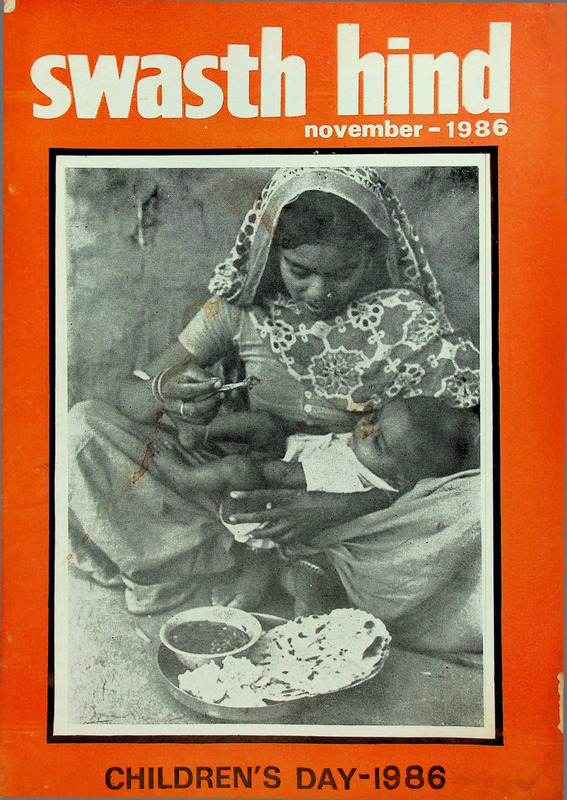
OUR COVER
Children are the most vulnerable group in the comnii^nity who
suffer more from various communicable and other diseases and
malnutrition.
Breastfeeding and traditional weaning diet offer
safeguards against these diseases. Our cover shows supplementary
feeding of a child. We devote this issue of Swasth Hind to
Children’s Day, observed every year on 14th November, in
the country.
Single Copy
Annual
25 Paise
Rs. 3.00
(Postage Free)
Articles on health topics are invited for publication in this
Journal.
State Health Directorates are requested to send in reports of
their activities for publication.
EDITOR
N. G. Srivastava
Sr. SUB-EDITORS
M. L. Mehta
M. S. Dhillon
COVER DESIGN
B. S. Nagi
The contents of this Journal are freely reproducible.
acknowledgement is requested.
Due
The opinions expressed by the contributors are not neces
sarily those of the Government of India.
SWASTH HIND reserves the right to edit the articles sent
for publication.
5^1*7
HEALTHY CHILDREN : INDIA’S FUTURE
Dr (Smt) Nihartka A. Nath
Children below 14 years of age constitute about 40 per cent and those below five years of age
12.9 per cent of India’s population of 750 million. And they account for 50 per cent of the total
mortality in the country. Why do these children die young ?... .The need is for adoption of an
educational cum service approach and its delivery by each and every category of health and
family welfare worker including doctors, social workers etc. to reduce childhood morbidity
and mortality.
November 1986
257
EVEN HUNDRED
S
AND FIFTY MIL
LION people of India live in an area
of 3,287 square kilometres, Roughly
forty per cent of this large popula
tion is constituted by children be
low fourteen years of age. Children
below five years of age constitute
12.9 per cent of the total popula
tion and account for approximately
fifty per cent of the total mortality
in the country. When the morta
lity figures are translated in absolu
te number; the total number of
children under five years of age who
die every year is 10 million. Why
do these children die so young?
And can the country prevent these
deaths? It is a stark truth that death
cannot be prevented. But, untime
ly and early deaths can certainly be
prevented, or at least reduced to a
very small number.
Malnutrition in children
To-day, an invisible malnutrition
touches the lives of approximately
one-fourth of the country’s children.
It quietly steals away their energy,
it gently restrains their growth, it
gradually lowers their resistance.
And, in both cause and consequence
it is interlocked with the illness and
infections which both sharpen and
are sharpened by malnutrition it
self. Perhaps, as many as half
of all the cases of severe child
malnutrition are precipitated not
primarily by the lack of food but
by intenstinal parasites, fever and
infection—especially diarrhoeal di
seases which depresses the appeti
te, bums the energy and drains
away the body-weight of the child.
As a result, a number of children
in the country die of malnutrition
and infection every day. And, for
every one who has died, six chil
dren live on in a hunger and illhealth which will be forever etch
ed upon their lives.
But, to allow one-fourth of the
children to die like this is uncons
cionable in a country which has
mastered the means of preventing it.
A number of schemes and progra
mmes of supplementary nutrition
have been launched by the Govern
ment and by voluntary agencies to
curb this problem and it is earnestly
hoped that malnutrition amongst
children will be completely eradi
cated by the turn of this decade.
Besides malnutrition, children
also suffer from deficiency diseases
in India. About 85% of the preschool-age children have anaemia,
and 25,000 children in the same agegroup become blind every year due
to vitamin A deficiency. One hund
red and eighteen million children
belonging to 0-14 years age-group
live below the poverty line and
suffer from inadequate calorie in
take, resulting into retarded physi
cal growth and lack of energy.
Universal child immunization
A positive step taken by the Gov
ernment of India to safeguard the
health of the children and pregnant
mothers is to set a target to immu
nize 85% of infants and pregnant
mothers by 1990 against six vaccine-preventable diseases. The cove
rage will be extended over a fiveyear period in a phased manner
immunizing about 18 million infants
and 24 million mothers every year.
This programme will ensure greater
child survival and a sudden drop
in childhood mortality. The six
diseases For which 85% of infants
will be immunized are. measles, di
phtheria, whooping cough, tetanus,
poliomyelitis
and
tuberculosis,
which, combined together, kill al
most one million children every
year. Ninety per cent of children
under five years of age suffer from
measles every year, 3% of them dy
ing due to,bronchopneumonia or en
cephalitis. Another 12% of these
children* develop other complica
tions like diarrhoea,. respiratory di
seases, etc. Measles also seems to
have an adverse affect on the vita
min A status of the child causing
corneal lesions and keratomalacia.
No statistics can express what it
is to see even one child die in such
a way, to see a mother sitting hour
after anxious hour leaning her
child’s body against her own, to
see her anguished eyes seeking help
at the last hour. And, even if she
gets help at the last hour, it is too
late to save the life of her child.
Perhaps, all it does is to provide
At present, the programme is be
some solace to her dwindling hope ing implemented through 30 districts
against life itself.
and catchment area of 50 medical
258
colleges. It will be expanded to
cover all the districts by 1990. The
sensitivity to heat of several vac
cines has. constituted one of the
main constraints to the expansion of
immunization programme.
But,
work is now under way on the
development of more stable and
more effective vaccines and already
major ^improvements have been
made. Measles vaccine, for exam
ple, can now be carried on patrol
to reach rural populations further
away from centres with refrigeration
facilities.
The cost of immunizing a child
has also decreased and with each
of these possible interventions, the
improvement of children’s lives
will be as dramatic as prevention of
children’s deaths. For, such diseases
are also major causes of malnutri
tion. Whooping cough, for exam
ple, can induce malnutrition by the
frequent vomiting which its cough
ing fits provoke. Measles itself
claims ten per cent of body-weight
in one-fourth of all cases and halts
weight gain for several weeks. And
incomplete as it would be, immuni
zation of all children against the
major diseases would also be an
‘indirect’ immunization against mal
nutrition itself.
Any increase in
protection
against
malnutrition
would, in its turn, reduce the risk
of infection.
Oral rehydration therapy
The discovery of oral rehydration
therapy (ORT) and its use is a
breakthrough in preventing diarrho
eal deaths due to dehydration. Dia
rrhoeal diseases kill maximum
number of children every year com
pared to any other childhood di
sease. Shortage of clean water, in
frequent washing of. hands, unsafe
sanitation, and the lack of health
education means that, the average
child in a poor community will
have anything between six and six
teen bouts of diarrhoeal infection
each year. Often, the mother’s res
ponse is to withhold food and fluids.
And the result is that the child
is malnourished by both the illness
and the treatment. Each episode of
infection can increase malnutrition.
Each increase in malnutrition in
creases the risk of infection. Each
Swasth Hind
The^Government of India have launched the Universal Immunization Programme in the country.
The objective is to provide protection to all the expectant mothers and children against six
vaccine-preventable diseases by the year 1990.
period of weight loss, broken only
by the plateaux of partial recovery,
leads the child further down the
broad steps of malnutrition.
Most children recover. But many
fall into sudden and severe dehyd
ration. In only two or three days.
15 per cent of body-weight can be
lost. And at this point, death is
away between one and two hours
only. This is not a mere theory.
It kills children every minute. And
previously it could only be treated
November 1986
by qualified nurses or doctors using
expensive intravenous feeding in
an often inaccessible hospital. With
the discovery of oral rehydration
therapy, it can be treated by a
mother giving her child the right
mix of sugar, salt and water in her
own home.
Birth spacing
There is an apparent conflict
between child survival and bringing
down the population growth rate
in the country. It is a conflict which
is dissolved by time. For, when
people become more confident that
their existing children will survive,
they tend to have fewer births. That
is the principal reason why no
nation has ever seen a significant
and sustained fall in its birth rate
without first seeing a fall in its
child death rate.
Historically, when overall death
rates make that first steep fall
from around 40 per 1,000 as a
259
result of eliminating epidemics, the
decline in birth rate follows a long
way behind. The result is rapid po
pulation growth. But history has also
revealed that when overall death
rates have fallen to 15 per 1,000
people in developing countries, then
each further fall of one point in
death rate has usually been accom
panied by an even larger fall in
the birth rate. It was seen in Thai
land between 1960 and 1980 that
a seven-point fall in death rate
(15 to 8 per 1000) was accompani
ed by a 14-point fall in the birth
rate.
Therefore, to bring down
the birth rate to a significant level,
India will have to strive hard to
bring down infant and child mor
tality.
Availability and utilization
of family planning services can
shorten the time-lag between fall
ing death rates and falling birth
rates. The availability of family
planning services would in itself
have a crucial part to play in im
proving the health of mothers and
children and reducing the rate of
infant mortality. For, too many
births too close together undermine
the health and the nutritional well
being of both the mothers and the
children. A survey of 6,000 women
in South India, for example, show
ed that the death rate among infants
born within one year of each other
was approximately 200 per 1000 as
opposed to 80 per 1,000 among in
fants bom three or four years apart.
Therefore, making the family plann
ing services more accessible, is
one of the most important steps
which can be taken to reduce the
infant mortality and increasing the
health of both mothers and children.
Health education
Illiteracy clubbed with ignorance
is abundantly prevailing in Indian
women. Not only that they *are
illiterate and ignorant, even their
parents are bound by age-old cus
toms and practices leading to the
marriage of their daughters
at
young age. Health education of
parents, young girls and mothers,
therefore becomes essential for
them to undestand the issues relat
ed to mother and child’s health,
prevention of infant morbidity and
mortality, right age of marriage
and spacing between child-births.
Young girls in schools or outside
the school must learn about mother-
260
OUR NEW DIRECTOR
Dr (Smt.) Vishva Kirti Bhasin has taken over as the Director,
Central Health Education Bureau on 1 September, 1986. Prior to
this, Dr Bhasin was Chief Medical Officer, Minto Road Dispensary,
New Delhi under the Central Government Health Scheme.
Born on 8 September, 1931 at Dera Gazi Khan, Dr Bhasin is no
/Stranger to the readers of Swasth Hind. For, she has been a contri
butor to this journal.
Dr Bhasin had obtained MBBS degree in April 1953 from
S.N. Medical College, Agra and M.D. (Community Health Adminis
tration) in March 1981 from the National Institute of Health and
Family Welfare, University of Delhi. This is the only Post-graduate
Degree in the field of Health Services Administration recognised as
a distinct speciality of medicine both by the Medical Council of
India and the Government of India.
After obtaining her MBBS degree, Dr Bhasin served in State
Service as PMS(W) in medical/health care delivery in Uttar Pradesh
from 1953 to 1957.
Dr Bhasin worked as Medical Officer, CGHS dispensaries from
July 1957 to 1961 and Medical Officer-in-charge from 1962 to March
1975 in New Delhi. She was Deputy Medical Superintendent in
Kalawati Saran Children’s Hospital, New Delhi from April 1975 to
1978.
Dr Bhasin was Medical Officer Incharge, Dr Zakir Husain Road
Dispensary, New Delhi from 1982 to 1983. Later, she became Chief
MediCal Officer, Minto Road Dispensary, New Delhi from 1983 to
August 1986.
Dr Bhasin has participated in a number of workshops, seminars,
conferences, symposiums, etc. in the field of health and family welfare.
Dr Bhasin with a special interest in writing has contributed arti
cles on health in various magazines. She was awarded Dr. C.L. Sahni
award for her best paper by the Indian Medical Association in
1984-85.
hood, family planning methods have diarrhoeal infection and nutri
available to prevent unwanted births, tional requirements of children at
spacing of children and its advan different age-groups. The educatio
tages for betterment of their own nal efforts should be sustained and
health and that of their future complemented with provision of
children. These girls should be ex services. Unless an united educaapproach
is
posed to sessions on population tional-cum-service
education which include sex edu adopted, and is delivered by each
cation, and implications of having and every category of health and
a large family on socio-economic family welfare worker including
status of their family. Mothers doctors, social workers, etc., a dent
should receive education on family in the reduction of childhood mor
planning, child-rearing, personal bidity and mortality cannot be seen.
hygiene, role of immunization dur India has been independent for the
ing pregnancy and for prevention of last 39 years, and it is time that
diseases amongst their children, her children are bom independent
use of ORT when their children and free of diseases. •
Swasth Hind
IMPACT OF MOTHER’S EDUCATION ON
INFANT FOOD SUPPLEMENTATION
—Contribution of Health Education
Dr S.C. Gupta
Although the poor educational attainment of the mothers adverselly affects the inclusion of
semi-solid food into the diet of a child, yet it can be checked through health education.
' I 'wiCB the percentage of mothers
having a higher educational level
than those with a lower educatio
nal level introduced the semi-solid
food to their children at the age
of four months. The lower the edu
cational level of the mother, the
lesser is the inclusion of semi
solid food into the diet of a child
at an appropriate age. Among the
illiterates and primary pass (l-5th
class) mothers, 6.1% and 41% of
the mothers respectively delay the
inclusion of semi-solid food into
the diet of their children up to the
age of eight months. At every edu
cational level of the mothers, who
introduce^ semi-solid food to their
children within five months of their
birth are those mothers who were
repeatedly exposed to health edu
cation feeding practices among the
children. Although the poor edu
cational attainment of the mothers
adversely affects the inclusion of
semi-soli^ food into the diet of a
child, yet it can be checked through
health education.
There are enough data which re
flect that infant’s food supplementa
tion at an appropriate age has a
far reaching positive influence on
the child health. (Cowan, 1982 ;
Jelliffe, 1955; Ghosh, 1979 and
Kent 1981). With regard to the
above statement
WHO, 1979;
Maniar, 1979 and Martin, 1975
have reiterated that breast-feeding
November 1986
among the infants must be supple
mented at the age of four months
to six months. Similarly, Cowan
(1982) and Jelliffe (1955) also con
cluded that inclusion of semi-solid
food into the diet of a child at an
very early age, f.e., within four
months, also got an adverse effect
on the growth and development of
a child. Sen (1954) and Jelliffe
(1955) have observed that in certain
families, owing to the various ri
tuals and ceremonies, the inclusion
of semi-solid food into the diet of
a child is delayed. Ghosh (1979)
and Gupta (1981) have also cited
that the mothers’ higher educatio
nal level often has a positive asso
ciation with the timely introduction
of semi-solid food to the child. In
view of the above fact, an attempt
has beena made to investigate that
to what extent the mother’s educa
tion is exactly associated with an
infant age at food supplementation?
Secondly, to what level the above
correlation can be modified through
health education? Keeping in view
the existing literature it was hypo
thesised that health education pro
motes the inclusion of semi-solid
food ino the diet of a child at the
appropriate age among the low
educated mothers.
Materials and methods
This study was limited to the
City of Ludhiana in Punjab. The
total sample consists of 300 children
(0-2 years) and their mothers. Of
the total sample, 100 respondents
were selected
through systematic
random sampling procedure among
the mothers, who delivered their
children in the Christian Medical
College, Ludhiana. These mothers
were repeatedly exposed to health
education on scientifically recom
mended .child feeding care during
antenatal clinics, postnatal clinics
and hospitalization for delivery set- '
vices. The remaining sample of
200 respondents was drawn through
stratified random sampling method.
Data were collected with the help
of a structured schedule. The ser
vices of paediatricians, obstetricians,
medical and nursing students were,
also availed of for strengthening
the health educational drive before
the onset of data collection.
Analysis of data
Infant food supplementation is
the process by which foods rather
than breast-milk are introduced.
Therefore, first of all an effort was
made to study the impact
of
mother’s educational attainment on
the food supplementation. Table I
presents data on the same.
261
Table 1
Respondents by education of mothers and children about four months of age at which the semi-solid food was introduced
0—16
weeks
Education
25—32
weeks
33—40
weeks
22.2
34.6
33.3
21.8
27.3
23.0
22.2
14.4
23.3
23.9
15.2
15.9
38.9
26.9
23.4
22.9
9-1
4.5
18
26
30
96
33
44
25.9
64
20-3
50
89
22
247
247
Illiterate ....
1st—5th class
gth—8th class
9th—10th class
Undergraduate .
Graduate and above
................................................
3.4
..........................................................
................................................
6.1
9.1
16.7
23.1
16.7
31.3
42.4
45.4
Total %
Total number
................................................
..........................................................
2-7
7
31-6
78
Table I shows that on the whole
an inclusion of semi-solid food into
the diet of an infant is not common.
A very negligible number of mothers
did not keep the infants on exclu
sive breast-feed up to four months.
Twice the percentage of mothers
having a higher educational level
(above 10th class) than those with
a low educational level started giv
ing the semi-soid food to their
children at the age of four months.
On the other hand, about four times
the percentage of mothers with a
low educational level
introduced
the semi-solid food to their children
after the age of eight months com
41—48 The total
weeks
number
and above of cases
100%
17—24
weeks
pared to the mothers with high edu
cational attainment. The above find
ings reveal that the higher educa
tional attainment of the mothers
has an appreciable positive associa
tion with the introduction of semi
solid food to the child. From the
above Table, it is concluded that
the lower the educational level of
the mother, the lesser is the intro
duction of semi-solid food into
the diet of a child within four
months of its birth. This shows
that the poor educational level of
the mother is a formidable obstacle
in an early infant food supplemen
tation. The above findings corres-
pond with the result
drawn by
Ghosh (1979) and • Evans et al
(1976). The next pertinent question
which arises is; to what extent the
negative effect of low educational
level of the mother can be modified
through health education? How far
health education can supplement
the impact of educational level of
the mother? Hence, to determine
the above relationship, in the fol
lowing analysis, the educational level
of the mother will be controlled and
then simultaneously the impact of
place of delivery will be ascertain
ed-
Table 2
Respondents by educational level and children about four months of age at which the semi-solid food was introduced to them and
the place of delivery. Age at which semi-solid food introduced
0—16
weeks
Level of education
Illiterate .....
17—24
weeks
25—32
weeks
33—40
weeks
41 weeks
and above
13.3
26.6
20.0
40.8
38.0
14.3
33.3
1st—5th class .
.
.
19.0
.
4O-o
6th—8th class .
.
.
.
14.3
9th—10th class
Undergraduate
Graduate and above
5.3
7.2
4.3
2(1.2)
5(6.2)
262
14.3
25.7
14.3
Total number and %
17.5
43.3
26.3
42.8
30.4
61.9
42(25.1)
36(45.0)
33.3
20.0
20.0
Place of
delivery.
Each total
number of
cases —
100%
Home
15
Hos
pital 3
33.3
28.6
20.0
21
5
30.4
10.6
10.5
26.1
42.9
21.7
30.4
23
33.3
66
26.3
15.8
19
30.4
8.7
23
30.3
46.7
28.4
10.0
7
50.0
23.8
34(20.0)
30(37.5)
43(25.7)
7(8.7)
26(27.5)
2(2.5)
30
14
21
167
80
Swasth Hind
The findings show that health education promotes the inclusion
of semi-solid food into the diet of a child at an appro
priate age (4-6 months) among the low educated mothers.
Table 2 shows that at every edu
cational level, the mothers
who
introduced the semi-solid food to
their children within four months
of their birth, are over represented
among the mothers, who delivered
their children in the hospital. How
ever, as is apparant from the above
Table, the impact of health educa
tion in the context of the introduc
tion of semi-solid food to die child,
is more operative among the
mothers, having higher educational
attainment. It is evident from the
above Table that' although the poor
educational attainment of the
mother adversely affects the inclu
sion of semi-solid food into the diet
of the child, yet it can be checked
through health education. The above
findings show that health education
and general educational level of the
mother are complementary and
supplementary to each other and
they have a
striking association
with the infant food supplementa
tion. If we divide all the respon
dents into low (O-lOth class) and
high (undergraduate and above), it
is quite evident that the above find
ings are in agreement with our hy
pothesis, i.e., health education pro
motes the inclusion of semi-solid
food into the diet of a child at an
appropriate age (4-6 months) among
the low educated
mothers.
To
ascertain the validity of above hy
pothesis, Xs (Qui-square) test was
applied. The above test showed that
our hypothesis is statistically signifi
cant (p < 0.05). The above observa
tion adds to the experience of
Ghosh (1979) and Jelliffe, (1979)
and is in confirmity with Cowan
(1982).
Health education activities
re
garding infants’ food supplementa
tion, therefore must be strengthen
ed, especially among the low edu
cated sections of woman population.
REFERENCES
1. Cowan, Belly (1982), **Exclusive Breast-feeding upto Six
Months : An Attainable Goal for Poor Communities”, Nutri
tion Foundation of India, Oct, 1982.
6. Kent, M.M. (1981) , “Breast-feeding in the Developing World :
Current Patterns and Implications for Future Trends” Report
on the World Fertility Survey, No. 2, June 1981.
2. Evans, N. et.al. (1976), “Lack of Breast-feeding and Early
Weaning in Infants of Asian Immigrants to Wolvcrhamton”
Arch. Dis. Child. 51.
7. Maniar, B.M. (1979), Proceedings of Workshop on Breast
feeding and Supplementary food, Nov. 17-18, 1979. Bangkok :
United Production Press.
3. Ghosh, Shanti (1979), The Feedingland Care of Infant and
Young Children, New Delhi; VHAI.
8. Martin, J (1975), Infant Feeding : Attitudes and practices in
England and Wales : London, Her Majesty’s Office, 1975.
4. Gupta, S.C. (1981), Socio-Cultural Factors Affecting Child
Health, Ph.D., thesis Approved for publication by the Punjab
University, Chandigarh,
9. Sen, Mukta, (1954), Annual Report of Maternal and Child
Health Section for the year, 1953-54. Calcutta : All India Insti
tute of Hygiene and Public Health.
5. Jelliffe, D.B. (1978), “Human Milk in the Modern World,
(Oxford ; Oxford University Press.
10. W.H.O. (1979), Breast-feeding, Geneva : World Health Or
ganization.
Winning respect for health facilities
From the humblest of village health posts to district hospitals, health
facilities have to command respect if they are to be socially
acceptable. They need not be sophisticated, but they have to be at
least considerate of people, well managed, clean and tidy in order to
inspire confidence as centres for health and not focal points for
disease.
—Halfdan Mahler, Director-General of WHO. Address
to the Thirty-ninth World Health Assembly, WHO
November 1986
263
BABIES—BURDEN OR BOON ?
S. V. Narayanan
The ICDS programme has, indeed, brought about significant changes. Independent evalu
ations have found remarkable improvements in child development. Infant mortality has
been reduced to 88.2 per thousand in ICDS villages as compared to the national average
of around 114. Immunization coverage is significantly high in ICDS areas.
Tn our country, as in many other
nations,
children are deemed
as God’s gift. Young couples, to
whichever community they may
belong, invariably pray for healthy
progeny. But it is a moot point
how many of these young men and
women who crave for the boon of
a child know how to take care of a
child. That they are ill-equipped to
protect the ‘God‘s gift’ • is evident
from the fact that of the 63,000
babies born everyday, over 7,000
die before completing their, first
year. This infant mortality rate of
114 per thousand births is still very
high despite .our concerted health
care measures in bringing it down.
It has been primarily attributed to
poverty and malnutrition. But it
must be
said
that in spite of
poverty, our children can over
come illness and death, if only
the parents and other family mem
bers know
certain
things they
ought to know.
Mother’s milk
Let us first consider the food for
the infant. For the first four to six
months best and complete food
for the child is mother’s milk.
Breast milk is nature’s first gift to
the baby and there is no substitute
for it. Nature has endowed even
malnourished mothers the capacity
to lactate. Hence for the infant,
food should not pose a big pro
blem at least for the first four
months. There is also another im
portant aspect—the use of ‘colos
264
trum’. The milk that flows from
mother’s breast for the first day or
two after delivery is called colos
trum. This first milk is extremely
nourishing for the infant. It has
been found that this first milk
contains antibodies in great quan
tities that protect the newborn
babies from some diseases and in
fections.
Traditionally, Indian mothers
throw away the colostrum in the
belief that it is not good for the
health of the child. They do not
know that by throwing away the
first milk they are depriving their
children of the best possible nou
rishment and protection it offers
against diseases. As a UNICEF
report puts it: “Colostrum” is just
what the newborn needs after its
birth”. Every Indian family, rural
and urban, should know these
facts and they should be helped
to overcome timebome prejudices.
Immunization
UNICEF’s 1985 report on ‘The
State of the World’s children’, re
ferring to malnutrition, points out
that in perhaps half of all cases of
child malnutrition, infection is the
prime cause. Immunization of
children
during the first year
against six common childhood
diseases—Diphtheria,
whooping
cough, tetanus, polio, tuberculosis
and measles—will help the child
fight its way through and pick up
health. Lack of proper awareness
and lack of proper motivation have
led to helpless neglect and conse
quent morbidity or death of child
ren. Lack of adequate facilities is
also major contributory factor. Im
munization coverage for the entire
infant population is a must for
any child development programme
and this deserves to be taken up
on a war footing.
It may be appropriate to refer
here to the way in which the im
munization programme is tackled
in a country like Colombia. To
achieve the objective of total im
munization, major campaigns are
launched on the National Vacci
nation Days involving the entire
population. Thousands of volunteers
turn up and vaccination camps
are set up in schools, parks, town
halls, market places; almost every
where. General Election Style,
news about the progress of the
work is broadcast every two hours
over the Radio network there. A
similar effort can be made here
and it has to be made. This will
create a greater awareness among
the people about health and hygiene.
By building up such an awareness
it will be easy to tackle another
major infant killer—diarrhoea. Mo
thers should know that there is a
very simple and very cheap way
to fight diarrhoea. A simple mix
ture of common
salt.
sugar
and clean
water
would
do
to avoid total dehydration due to
diarrhoea. The spread of the mes
sage about this Oral Rehydration
Swasth Hind
Therapy (ORT) will start a veri
table child survival revolution
across the country.
This stress on the need to bridge
health information gap should in
no way undermine the importance
of attacking poverty and malnutri
tion. In fact, nutritional support,
education and child care facilities
must all go hand in hand.
Integrated child development
With this very objective in view
the Government of India introduced
in 1975 its most ambitious and
comprehensive plan to increase
child survival rate among the poor
and enhance the health, nutri
tion and learning opportunities of
school children and their mothers.
The scheme, Integrated Child De
velopment Services has been de
signed to provide non-formal pre
school education, immunization,
health check-ups, medical referral
services, supplementary nutrition and
health education for women.
The programme was first started
on an experimental basis in 33
Community Development blocks.
Over the last ten years it has been
expanded to 1189 blocks and also to
157 Urban slums in the country.
‘Anganwadis’ are the
converging
points for ICDS activities. Each
Anganwadi (or pre-school child
centre) is run by an Anganwadi
worker (AWW) and her helper,
and usually covers a population of
1000. Anganwadis identify the poor
est children below the age of six
and expectant and nursing mo
thers in the village and render
them integrated services. This in
cludes nutritional feeding support
for 300 days a year.
Significant changes
ICDS programme has
indeed
brought about significant changes.
Independent evaluation have found
remarkable
improvements
in
child development. Infant morta
lity has been reduced to 88.2 per
thousand in ICDS villages as
compared to the national ave
rage of around 114. Immunization
coverage is significantly high in
ICDS areas. Higher child survi
November 1986
SHRI RAJIV GANDHI PLEDGES
HIS EYES
The Prime Minister of India, Shri Rajiv Gandhi,
and Sint. Sonia Gandhi signed the pledge for donation
of eyes to the National Eye Bank in New Delhi on
25 August, 1986. The Minister of State for Health
and Family Welfare, Kum. Saroj Khaparde, was also
present.
val rate and overall improvement
in the health of children in ICDS
areas has changed the situation.
Sick children were almost a bur
den but healthy ones are a real
boon. This change has had its im
pact on family planning with bet
ter chances of survival. The birth
rate in
ICDS areas declined to
24.2 as against the national ave
rage of 33.3. The ICDS is thus
becoming an important instrument
of not only child development but
also sound development in gene
ral.
Inhibiting factors
But there are quite a few inhi
biting
factors. The ICDS even
after sizeable expansion over the
years covers
only 23 per cent
of India’s rural and tribal Commu
nity Development Blocks and
just three per cent of the urban
slums. The Anganwadis with very
limited staff have so much work
to handle that they often are not
able to act effectively as catalysts
of rural change.
With their concentration on
pre-school, activities, the Angan
wadis devote much more time on
children of the age-group 3-6
than the really needy group of
0-3. If they concentrate more on
the 0-3 children group they would
be able to achieve greater immuni
zation coverage as well as spend
some time with mothers giving
them the necessary nutritional and
health advice. This is essential
because it has
been found that
the common cause for no immu
nization or partial
immunization
is lack of information about the
number of doses to be given for
each vaccine. In many areas, vac
cination was not performed be
cause the child was not well. The
ICDS personnel must carry the
265
Injection Technique
All of the EPI vaccines except OPV must be adminis
tered by injection.
All injections must be given by
trained staff using sterile equipment. Many programs
need to improve both training in injection technique
and supervision of vaccination sessions to ensure that
proper procedures are followed.
dards.
Nonetheless, personnel should not hesitate
to open a new vial even if only one child remains to
be vaccinated. In Egypt, for example, a 1984 evalua
tion team concluded that workers in many health
centres needed more supervision and training because
they often did not follow these standards.
Lack of sterilization or improper sterilization of need
Types of Equipment
les and syringes has been a major problem in many
immunization programs.
Whether because personnel There are three types of injection equipment—reusable
do not have time to sterilize reusable needles properly, syringes, disposable syringes, and jet injectors:
because they reuse needles that they should throw
away after one use, or because they do not understand 0 Reusable glass or plastic syringes with steel need
les are most often used. They work well, are costthe importance of sterile injection equipment, workers
effective, and are safe when properly sterilized.
have often been seen using unsterilized or improperly
To sterilize needles and syringes completely, one
sterilized needles.
of the following procedures must be followed :
Using unsterilized needles can spread hepatitis B and
other viral infections. Also, questions have been rais
ed about whether LAV/HTLV-III, the virus that
causes Acquired Immuno Deficiency Syndrome (AIDS),
also could be spread this way.
Responding to this
concern, WHO has stated:
Sterilize in pressurized steam (in an autoclave or
pressure cooker) for 20 minutes
or
Sterilize in boilins water (100°C) for 20 minutes
(where steam sterilization equipment is not avail
able).
Thus far, there has been no demonstrated, transmis
sion of LAV/HTLV-III as a result of immunization.
Since the possibility exists that unsterile needles and
unsterile syringes can transmit not only LAV/HTLVIII, but other infectious agents including hepatitis
viruses, immunization programmes have the obliga
tion to ensure that a sterile needle and a sterile syringe
are used with each injection.
@
Disposable needles and syringes are convenient,
but they add to the cost and quantity of supplies
that must be distributed and stored. In addition,
although they are not meant to be reused, they
often are, and without satisfactory sterilization.
Specially designed needles and syrings that can
not be reused have beea tested but are currently
too expensive for widespread use.
In addition to making sure that all immunization
equipment and containers are sterile, workers must
wash their hands often, avoid touching nonsterile
surfaces, and use forceps to handle needles. Workers’
hands should never touch needles during vaccination
sessions.
©
Jet injectors force vaccine through the skin in a
pressurized spray. They are fast, easy to use, and
it had been thought that they avoided the risk of
infections due to unsterilized needles.
Recent
evidence suggests that they may transmit some
infections, however. In addition, they need regu
lar maintenance, which is often difficult to provide.
Also, because they are expensive to buy, jet in
jectors may be cost-effective only when used in
mass immunizations.
During vaccination sessions only one vial of each vac
cine should be opened at a time. At the end of the
session, any vaccine remaining in the open vial and the
vial itself should be destroyed, according to EPI stan
message that there is no contra
indication to vaccination unless
the child is seriously ill.
The ICDS experiment must be
strengthened with more .ground
support in the form of more funds,
facilities and staff. It may be
pointed out that 1,000 ICDS pro
266
jects cost only 0.13 per cent of the
country’s gross domestic product.
We can certainly spend more to
build our children on whom the
future of this country depends. Of
course, a child’s
development is
linked with the economic set-up
in which it grows. A holistic at
tack on poverty is, therefore, a
—Coustesy Population Reports
must. That the Government is
seized of this problem is evident
from the
1986-87 Union Budget
in making massive allocations for
anti-poverty
programmes.
With
such sort of a support much can
be done in improving child care
facilities in our country.
G
Swasth Hind
ROLE OF SCHOOLS
IN THE PREVENTION OF BLINDNESS
Smt C. K. Mann
About 10-12 per cent of children of primary classes suffer from eye problems including visual
impairment. Because of close contact with the students over a period of years, teachers can
observe the child with signs and symptoms of vision defects. Indeed, schools have a vital role
to play in promotive and preventive aspects of eye health care.
parents and school authorities need
oday, a large number of persons
lose their sight due to ignorance, to be mobilized. Children of school
lack of knowledge of simple pre age form very important segment
ventive and curative measures and of tlie population in our country as
the
failure to adopt healthy eye care they comprise one-fourth of
total
population.
A
large
majority
practices. The number of blind
persons is increasing and unless of them are now attending schools
action is taken in time to check and it becomes very easy to reach
its occurrence, it is estimated that this young population through well
their number will double in the established network of school sys
next 15 years. Therefore, it is the tem in the country.
concern of every individual to help
Ocular health and visual preser
in the promotion and protection of
vation
play an important role in the
eye health; to conserve sight and
to prevent defects and. diseases relat growth and development of the
and overt behaviour of
ed to eyes. The enormity, urgency personality
the children. In view of the
and complexity of this task for the
of adequate infrastructure and
poor majority in developing coun lack
accessibility to reach the
young
tries has been highlighted several captive population, the school sys
times and certain actions have been tem with a large number of teachers
initiated by the governmental as can help to a great extent in the
well as international organizations. prevention of blindness. It has been
Urgent efforts are required to en estimated that about 2.5 lakh chil
sure that no citizen goes blind un dren under the age of 14 years
necessarily and those who are al in the country are partially blind.
ready blind need not remain so A large number of them are blind
becoming a burden on the society.
on account of nutritional deficiency
of Vitamin A, besides eye injuries
India has an estimated 9 million and other eye infections.
blinds; of which two-thirds of blind
ness could have been averted if
The schools have to play a very
adequate and appropriate measures vital role in the prevention of pre
had been taken at an appropriate ventable blindness. The close con
time. The problem of eye diseases in tact the teachers have with the stu
school children is also considerable. dents over a period of years makes
According to certain studies about it very easy for the teacher to ob
10-12 per cent children of primary serve the child with signs and sym
classes suffer from eye problems ptoms of vision defects.
including visual impairment. In
order to promote ocular health at
Perfect vision in each eye and
an early stage, concerted efforts of good binocular health and coordina
T
November 1986
tion is essential for every person.
Defective vision in one of the eyes
is often not detected in the children
in the early stages which may lead
to squint and irrepairable loss of
vision.
Ocular diseases may damage vi
sion and lead to blindness, besides
pain and discomfort. Early detec
tion of these diseases in children is
of considerable importance since
the children may not understand
the gravity of the symptoms.
Complex eye problems
(i) Long sight: The eye at birth
is hypermetropic (long sighted) and
as the child grows the hypermetropia reduces gradually and by the
age of 15 years the eyes usually be
come normal.
Visual defects apart from affect
ing the personality can be respon
sible for producing eye strain, head
ache, disinterest in studies. It can
also cause squint. Some children
often complain of headache and
eye strain especially after reading
although their visual equity may be
normal. These symptoms usually
produce astigmatism and impair
balance of the eye muscle. Such
children should be referred to the
specialist for necessary treatment.
(ii) Common eye diseases: The
common eye diseases among chil
dren are conjunetivities and. lid
infections, trachoma, allergy, irrita-
267
(iii) May hold book too close to
live conjunctivitis, malnutrition due doctor, but teacher can help in early
eyes to read.
to Vitamin-A deficiency which may identification of students which are
deviant
from
normal
vision
and
lead to night blindness, formation
In such conditions the teacher
of foamy, grey spots on the white refer such cases to a specialist for should constantly observe the child
appropriate
treatment)
and
follow
of the eye-ball (Bitots’ spots), dry
and refer him/her to the specialist
eye
(Xerophthalmia), corneal ul up.
for specific diagnosis- and treatment.
cers. These cases should be treat
ed with intensive intake of Vitamin- Vision screening
A.
Vision
screening
in schools Detection of infectious eye diseases
assumes great importance for early
(iii) Eye injury: Injury to the
The child may have the following
detection of vision defects and pro
eye is another very important cause
symptoms of infectious eye disea
vision
of
timely
eye
health
care
to
of blindness particularly among chil
ses.
dren. The common causes of these reduce the incidence of prevntable
The teacher, after a
1. Sore eyes or discharges in the
injuries in. children are due to play blindness.
eyes.
ing with Guile Danda, bow and brief orientation in the use of Snallen
Eye
chart,
can
do
the
vision
arrow, pen and pencils, needles,
2. Red eyes.
The chart may be kept
careless handling of fireworks (crac screening.
at a distance of three metres from
3. Frequent rubbing of eyes.
kers), etc.
the point where the child is to stand
and the teacher asks the child to
Promotive and preventive activities for cover his one eye and read the last Responsibilities of schools
eye health
line.
This may be repeated for
1. Arrangements for eye exami
In order to promote eye health the second eye and those children
nation by the specialists to
last
and prevent loss of sight leading to cover his eye and read the
detect
those children who
blindness, the school occupies a very line may be referred to a specialist.
have eye problems so that
important position and can play
they can be provided early
very significant role.
This will Teacher’s observations
treatment.
involve health education about eye
Since the students remain in cons
2. To liaise with voluntary orga
care to the students and the parents; tant contact with the teacher for
nisations engaged in the pre
orientation of teachers so that they about 5 to 6 hours in a day, the
vention of blindness pro
are equipped with the scientific in teacher is in a best position to ob
gramme for coordination in
formation related to the promotive serve any health problem among the
the provision of eye care ser
and preventive aspects of eye health children.
On the basis of teacher’s
vices
care and coordination with health observation, children with eye pro
departments for making use of the blems may be referred to a concer
3. To mobilise community re
available health services for diagno ned specialist for early treatment.
sources for the poor and
sis, treatment and rehabilitative acti Therefore, teachers should be train
needy children who need glas
vities.
ed to take care of children with
ses.
following complaints:
4. To follow up with those stu
Teacher’s orientation
(i) Inability to see clearly the
dents who are prescribed the
letters on the black-board
use of regular remedial meaSince the teachers occupy pivotal
except without sitting close
supervised by the teachers
position in school system, teacher
to the Board.
for regular use of spectacles.
preparation is of tremendous impor
tance. The teacher should act as
(ii) Headache and tiredness after
5. To educate parents about the
an effective
educator capable of
reading or doing class work.
importance of eye care and
making the students aware of the
use of regular remideiaj mea
(iii) Blurred vision.
importance of eye health care, and
sures
like spectacles, etc.
causes responsible for vision defect
(iv) Unequal vision in both the
which can lead to blindness.
Ins
6. To provide orientation train
eyes.
tructions with regard to the personal
ing to the teachers enabling
and environmental hygiene, nutri Appearance of eyes
them to conduct vision screen
tion, sanitation and protection of
ing. of all the students to
the eye should also be given to the
Margins of lids may show red
detect children with vision’
students.
The teachers should sti ness, repeated occurrence of styes.
problems.
mulate individual’s participation in
7. To encourage students to
activities related to prevention of Observance of behaviour of the Child
develop school
garden for
blindness and become actually invol
(i)
Difficulty
in
reading
and
may
growing
vegetables
and fruits
ved in community based treatment
rich
in
vitamin
A.
skip
lines,
re-reads
or
reads
programmes.
The training of the
slowly.
teachers should be simple, practica
8. Safety measures in the schools
ble.
It may be remembered that
(ii) May frown, blink excessively
teacher is not a substitute for a
Children are exposed to varior have a squint.
268
Swasth Hind
A large majority of children of five years and above are now attending schools and it becomes very easy to reach
this young population through a well-established network of school system in the country. Health check-ups organised
by the schools help detect many health problems including ocular diseases at an early stage.
November 1986
269
Collaboration between school and community may be sought in the eye health care
programme. This can be elicited by forming a school, home and community coordi
nation committees which may meet frequently to provide directions to the schools for
taking up eye health care programmes.
ous hazards in the school
while playing games, using
pens and pencils, and other
pointed articles in the class
room and running up and
down during free time.
In
the laboratories, they are ex
posed to substances like acids,
chemicals which are poison
ous. They should be taught
to handle them carefully and
keep them at appropriate
place after labelling them.
Eye washing equipments may
be made available in the
laboratories so that if any
irritant gets into the eye, the
child is able to wash it with
clean water and thereafter
may report to the doctor.
9. Education of children on eye
care
(i) Educate them about safe
handling
of pointed items
like pen. pencil, knife and
other materials.
Gi) Teach them to handle chemi
cals, etc., in the laboratories
carefully.
Inculcate habit
of keeping such things label
led at a place outside the
reach of the younger students,
both in the laboratories and
in the home.
Gii) In case a foreign body falls
in the eyes, it should not be
rubbed out.
Wash it with
plenty of clean water.
If
the foreign body is not re
moved the teacher should
remove it with moist cotton.
In case of any injury the
student should be referred
to the medical officer imme
diately.
10. Advice to students
(i) Advise the regular use of
spectacles, if prescribed.
270
(ii) Advise not to play injurious
games like gulli danda, and
bow and arrow.
(vi) Do eye exercises of Yoga to
strengthen eye muscles.
School and community collabora
(iii) Advise to avoid playing with tion
school children having sore
School
occupies a unique and
eyes.
prestigious position in the commu
It has a great influence on
(iv) While watching
television, nity.
they should sit at about three the community as it is considered
metre away with one light on to be a centre of community re
source.
in the room.
Collaboration between school and
(v) Avoid playing with fire works
community may be sought in the
or crackers.
eye health care programme.
This
(vi) Eat balanced and nutritious can be elicited by Forming a school,
diet with plenty of green and home and community coordination
yellow vegetables and fruits committees which may meet
fre
which are rich sources of quently to provide directions to the
Vitamin A.
This Vitamin schools for taking up eye health
is essential for the prevention care programme.
It will be the
of night'-blindness.
school’s responsibility to inform the
community about the gravity of the
(vii) Never look directly at' Sun. eye problem among the school child
ren and seek parents’ assistance in
(viii) Never see solar eclipse.
preventive measures.
lit should
motivate parents to bring the child
fix) Do not use Kajal/Surma and ren for eye examination when arran
never use the Kajal needles ged in the school: follow up the use
used by others.
of glasses if prescribed by the doc
tor; mobilise community resources
(x) Do not go to school in case for providing glasses, for providing
of eye problem.
Vitamin A rich food to the students:
create awareness among the com
(xi) Always consult a qualified munity about the use of Vitamin A
eye doctor and follow treat rich food in their daily food for good
ment' with regularity.
eye health and encourage them to
develop kitchen gardens.
11. Inculcate good reading habits
Frequent use of mass media es
(i) Advise students not to read
pecially
television and radio may
while moving.
be made to educate the community
fii) Advise them to read with on the importance of eye health and
good light coming from left preservation of eyesight and also to
inform them about the availability
side.
of modem eye care health services.
(iii) While reading a book, hold Shortage of drugs is hampering most
30 cm away from your eyes. of these programmes and as such
community may be mobilised to
(iv) Do not' read while travelling raise funds for the purchase of essen
in a bus or a train as it causes tial drugs.
School can also take
strain.
steps to educate the people on the
dangers of consulting quacks in case
(v) Give rest to the eyes.
of any eye problem.
Swasth Hind
CAMPAIGN FOR
UNIVERSAL COVERAGE
INVOLVING
MEDICAL STUDENTS
AND INTERNS
Dr A. K. Govila
is an important
activity for preventing diseases
and disability among children and
pregnant women.
It is an ongoing
activity in Greater Gwalior.
From
the start of the session,
1985-86,
students were divided into fifty-two
teams, each team for one municipal
ward of Greater Gwalior.
These
students identified the beneficiaries
in the township and assisted the sec
tor doctors in the universal immuni
zation coverage.
mmunization
I
With a view to giving a boost to
the Universal
Immunization Pro
gramme and to cover the resistant
and difficult areas of Greater Gwa
lior, an intensive campaign was laun
ched from 3—6 April, 1986, involv
ing the students and interns of the
medical college.
Regular teach
ing classes were suspended to make
the campaign a success.
Plan of action
The campaign was organised from
8.00 a.m. to 4.00 p.m. daily. One
member of each team
was made
responsible for the collection and
return of the immunization kit' used
during the campaign.
The output of the Intensive Im
munization Campaign is as under:
1.
To start with the students were
briefed about the
Universal Im
munization Programme and the cam
paign.
The following action plan
for each team was worked out before
launching the campaign:
3rd April, 1986
4th April, 1986
5th and 6th April, 1986
giving BCG immunization and main
taining the cold chain at the Immu
nization Clinic being run by the
department at the teaching hospital
of the medical college.
For the
success of the campaign, 28 teams,
each headed
by one intern with
5-6 students as members were cons
tituted.
The sector
doctor and
para-medical workers of the respec
tive areas were informed in advance
about the campaign to assist the
medical students in their work in
the field.
Morar
Gwalior
Lashkar
The total number of 4655 immuniza.
lion cards were prepared and handed
• over to the beneficiaries/head of the
family
2.
The total number of vaccinations done
by the medical students were : BCG(2879), DPT I dose (2106), DPT II
dose (580), DPT III dose (391), OPV
I dose (2114), OPV II dose (589), OPV
III dose (379), Measles (148), Tetanus
toxoid I dose (326) and Tetanus toxoid
2. For a retrieval action amongst
the defaulters of the 2nd and
the 3rd doses of DPT and
OPV vaccines.
3. Boosting up the coverage of
BCG immunization signifi
cantly.
4. Maintenance of the Universal
Immunization
Programme
in preparing
immunization
cards for the eligible children
for immunization during the
year, 1986-87, at the nearest
hospital.
5. Providing an opportunity of
field exposures to the interms
and the medical students of
this medical
college about
the overall health
situation
in an urban community, in
cluding slums.
II dose (731
Period of campaign : 8.00 a.m. to 4.00 p.m.
Conclusions
Both the interns and the students
were trained
in the technique of
Based on the experience gained,
it was concluded that the campaigns
are useful in the following manner:
November 1986
1. Motivating the resistant bene
ficiaries towards the accep
tance of universal immuniza
tion programme in different
areas (slums
and adjacent
villages).
6. Providing an opportunity of
practical field training under
the universal immunization
programme
to the medical
interns and students.
@
271
Immunizing the World’s Children
Measles
..■«■ £®»4>
'' ?: '4
•.
Tetanus
Immunization against the most
common and deadly childhood diseases
saves the lives of some one million
children in developing countries each
year. But more than 3.5 million others
are killed or disabled by diseases that
immunization could have prevented.
Fewer than half of one-year-olds have
been immunized against the major
preventable diseases. Concerted efforts
are now underway to expand immuni
zation services to all the world’s in
fants and pregnant women by 1990.
'
The World Health Organization (WHO)
Expanded programme on Immunization
(Erl) focuses on six diseases:
Measles affects nearly all unimmu
nized children
and kills over two
million children annually.
ST 'Y^AJfe£t»
Pertussis
(whooping
cough) kills
ome 600.000 children each year and
iffects millions more-
Neonatal tetanus, contracted through
contamination of the umbilical cord
at birlfc kills at ieaist 800,000 each
.” 1
* Polio
he major cause of lanieness in
the developing world and
year kills about 30,000.
Tuberculosis, which each year attacks
10 million, can be especially severe
in young children.
Diphtheria is less common but lulls
10 to 15 per cent of its victims.
Immunization. against those diseases
is safe and effective. Decades of experience
in developed countries and a variety of
evidence from Africa. Asia, and Latin
i
America show that sickness and death
from these diseases fall sharply where
immunization is widely available.
The challenge is to deliver the basic
vaccines to all infants and tetanus toxoid
to all pregnant women. Programmes have
been able to immunize an infant fully
for as little as five to 15 dollars (US), but
many programmes reach less than half
of the population at risk.
Most programmes
start by offering
immunizations at fixed health posts.
Outreach and mobile services that set up
temporary vaccination points in the com
munity are
ire often needed as well. Also,
campaigns
have immunized
intensive
For example,
many children quickly.
special vaccination days, widely publicized by mass media and even door-todoor visits, have proved effective. Whe.„_
encourage the
ther such
campaigns
development of long-term, continuing
immunization services is much debated.
Even without campaigns, persuasive com
munication efforts are necessary.
A major logistical problem is keeping
vaccines cold to protect their potency.
Careless handling, a broken refrigerator.
or electrical failure can break the cold
chain and leave children unprotected.
Comprehensive evaluations show that
immunization programmes face common
problems.
The chief
weaknesses are
limited surveillance of disease cases and
immunization coverage, inadequate super
vision, and
insufficient communication
efforts. Nonetheless, many programmes
have expanded coverage greatly in the
last decade. In some countries sickness
and death rates have dropped sharply.
Like family planning and other basic
health measures, immunization pro,gra
mmes can succeed when there is plann
ing, commitment, skill, and persistence
at every level.*
Courtesy—POPULATION REPORTS
OS
272
Svvasth Hind
November 1986
Diphtheria '<
Whooping cough
!ve«osva83/TERF/
To know more about eye donation, and
A blind child’s prayer. Innocent and
still full of hope. Thai one day the
what kinds of blindness can be cured.
send us the coupon for a detailed
darkness will be lifted from her eyes.
She will be able to see.
brochure.
Young Maya’s prayer can be answered. Do it today. Remember, miracles can’t
There is a remedy that’s simple, doesn't cure the blind. You can.
cost anything and is effective. Only it
needs you.
A simple cornea transplant can restore
her sight. The useless cornea, replaced
I would like to know more about eye donation and
E cornea
grafting. Send me a detailed brochure.
by a healthy one. And the healthy one
I
(Kindly
fill in block letters)
could be yours.
B
Eye removal leaves no scar or
Name. Mi
disfigurement. And once you’ve pledged 0
B
to donate, you’ll live with the gratifying
B
emotion that your eyes will live much
B Stale.
longer than you. And that some blind
fl
person will sec.. through them.
I
If your heart goes out to the blind
E
during your lifetime, let your eyes go
s
out to them after death. It’s the most
TIMES EYE RESEARCH FOUNDATION
precious gift you can give them.
S
I
I
I
B
I
I
H
Sight A gift only you cam give.
Reproduced by the Central Health Education Bureau, Directorate General of
Health Services in the interest of eye donation programme.
274
Swasth Hind
SOCIAL PUZZLES AND
FACTS ABOUT FOOD AND NUTRITION
Dr Suresh Chandra,
Dr R. P. Sharma & Dr S- C. Saxena
A t present- a
knowledge of nutrition is gaining
importance because of the increase in the world
population. In many under-developed areas a large
proportion of the population does not receive enough
food of right kinds for full physical development
and good health. The man has been in search of
food from his primitive history. The role of food
in health arid disease has been under investigation
from the dawn of the medicine. The significance of
nutrition was further
understood and emphasized
as more and more knowledge on nutrition was
gathered. There is gap
between the
nutritional
knowledge for healthy living and nutritional prac
tice among masses. This gap exists because the
food habits arc deeply embodied in our culture and
Social Factors
False
Concepts
True Facts
(A) Food Habits.
Attitudes.
Customs, beliefs &
Traditions.
(i) Papaya is avoided
during pregnancy
due to false belief
that it causes abor
tion.
Tt is good source of vita
min A (666 ug/100 gms)
calcium (28 mg/100 gms),
Iron (0.9 mg/100 gms) and
Vitamin C (12 mg/100 gms)
which are very important
ingredients for a pregnant
woman.
(ii) Dhals, green leafy
vegetables, rice and
fruits are avoided
by pregnant women
(widespread belief
in Gujarat).
Dhals arc a rich source of
protein, green leafy vege
tables are of iron and
fruits are rich in vitamins
and minerals which are
excessively required during
this period.
iii) “Hot Food/’-Eggs,
meats and pulses
are considered ‘hot
foods’ with the
false belief that (hey
cause nasal bleeding,
skin rashes, vertigo.
burning
during
micturition consti
pation, insomnia,
nocturnal ejacula
tion, burning palms
and soles, and dry
ness of throat.
(iv) “Cold foods”—But
ter milk, curds, cu
cumber,
melons.
gourds, tomatoes,
Anda and few leafy
Eggs, meals and pulses
arc good source of protein.
Protein energy malnutri
tion is a very common pro
blem of our country, this
false belief is an obstacle
which keep away people
from consumption of nut
ritious foods.
November 1986
tradition. Whenever efforts are made to improve the
nutrition of individual or masses by introducing
newer scientific methods, resistance to adaptation of
this knowledge is often exhibited. However, it can
not be denied that social and cultural factors con
tribute significantly to the overall picture of mal
nutrition in our communities. Faulty feeding habits
arising from ignorance, superstitions and
various
types of social prejudice have been found to be res
ponsible for aggravating malnutrition among differ
ent segments of our population. The customs, reli
gious beliefs, superstititions. food taboos, and fads.
and local traditions, all play their role in the adoplation of the changes.
Social Factors
vegetables are con
sidered “cold foods'*
and so arc avoided
in winter due to false
belief that they
cause common cold,
ceryza,
sinusitis,
headache,
sore
throat, pain in chest,
cough and sneezing.
(v) During
lactation
pumpkin, eggs and
fish arc avoided.
‘Colostrum’ is not
given to infants, it
is considered
as
‘Pus* or mixure of
‘blood and pus'.
(vii) Teething
causes
diarrhoea
which
is treated by giving
a diluted milk.
(vi)
‘fish* is not given to
pregnant
women
due to false concept
that it causes worms
in the intestine.
(viii)
(ix)
These foods arc rich in
minerals, specially iron
and vitamins, which are
protective nutrient
for
human health.
False
Concepts
Best foods arc given
to the head of family
followed by other
males and the rest
to women.
True Facts
Eggs and fish are highly
rich in protein, vitamin A
and other vitamins and
minerals which are extra
advantageous to lactating
women.
Colostrum contains huge
amount of protein, and
antibodies which is very
useful to infants.
Addition of more water
decreases the quantity of
protein and carbohydrate
to child making it prone
to develop malnutrition.
Worms are different para
sites, which develop due
to unhygienic conditions
of foods and walking bare-,
foot in open air defalcated
areas.
Pregnant and lactating wo
men require more calorics
proteins, minerals and vi
tamins so they require best
food.
Contd.- on page 283
275
BANISHING MEASLES
Dr S. M. Yadava
Experience £ gained in India indicates that
measles is amenable to control by vaccine
which is one of the safest vaccines available
T is estimated that around 14
million children suffer from mea
sles and two lakh children die
consequent
upon
complications
from measles every year in India.
The disease is known by different
names and many communities con
sider measles as a part of life rather
than a disease and do not report it
to any health institution. Then
there seems to be a gross under-reporting in official data. It is also a
well known fact that most children
attacked by measles also suffer
from chronic malnutrition with as
sociated lower resistance.
I
Experience gained in India indi
cates that the disease is amenable
to control by vaccine which is one
of the safest vaccines available.
Planning Commission has recom
mended a coverage of 63 per cent
of eligible children (Age group 912 months) by 1990.
Keeping these observations in
view an Intensive Measles Immuni
zation Drive was
launched in
Udaipur city of Rajasthan in the
first week of April 1986, on the
eve of the World Health Day.
The whole drive was planned in the
following manner to yield desired
results:
— Press publicity and AIR
coverage.
— Publicity using public address
system.
— Publicity stickers^
2.
All health workers were asked
to attend the one day orientation
course on measles vaccination
and were provided guidance re
garding management information.
monitoring and evaluation system.
They were specifically told to cover
the children in the age group of
9 months to 2 years, to make
necessary entries in the beneficiary
column of the register after immu
nization of children and subsequent
ly to visit the child in next 7 to
10 days.
3.
— Leaflets, posters, and slogans
were developed and display
ed.
— Cinema
theatres.
276
slides for all movie
Manpower management
Every team was given a set of
100 autoclaved hypodermic needles
alongwith 10 syringes. Sufficient
amount of analgesics and antiseptics
were also given to take care of
any possible complication.
Achievement and constraints
A total number of 6.116 child
ren in the age group of 9 months
to 2 years were covered under this
drive during the 10 days period
through house to house visits.
Assuming the city population to
be 3 lakhs for the current year.
the estimated total population of
children in this age group would
be around 8,500. Hence we could
immunize 70% children between
9 months and 2 years.
The whole municipal area ofUdaipur city was divided into 18 Follow-up and sui veillance
sectors according to the location
On door-to-door follow-up visits
of various dispensaries and other
institutions. For each sector one after a period of 10 days revealed
team comprising of the following that there were no major complica
tions or side-effects.
personnel was constituted.
—Medical Officer
— M.P.W. (male)
— M.P.W. (female)
— Nursing students
1. Health education
Health education focussed at
tention on measles as a public
health problem and priority for
vaccination.
Short orientation of workers
told to check the temperature in
side the Thermocol* and also the
condition of ice.
4.
— One
— One
— One
— two
Cold chain logistics
Sufficient amount of vaccine was
procured in advance and was
stored in the Walk-in-Cooler freezer
being maintained at Udaipur.
The vaccine was supplied every
day in the morning in Thermocol boxes and workers were
A strict vigil on occurrence of
measles in Udaipur city is being
kept through our various peripheral
health units. Each unit has been
provided with measles surveillance
records- so that timely information
reaches us and suitable action can
be taken.
To mop up remaining number of
children and new entrants in eligi
ble age group we have planned
periodic immunization campaigns
through our peripheral units.
Swasth Hind
November 1986
The child being immunized against measles in one of the Sectors in Udaipur
277
PERSONAL HYGIENE
—A Way to Health
Dr Daksha D. Pandit
Personal hygiene influences the health and well-being of an individual. Any devia
tion affects health. The practice of personal hygiene is largely a matter of indivi
dual responsibility. Since the foundations of personal hygiene are laid in childhood,
health education aims at providing relevant information as to how personal hygiene
can protect an individual from various diseases.
278
Swasth Hind
r I'1 he term, personal hygiene, in-*■ eludes all those personal factors
which influence the health and well
being of an individual.
In other
words it can be defined as a science
that deals with the rules of keeping
the body clean and acquiring habits
of healthful living.
It comprises a
broad range of day-to-day activities
such as care of teeth or oral cavity,
care of eyes and ears, care of skin,
care of posture and cultivating good
habits regarding eating, diet, exer
cise, sleep, smoking, drinking and
attitude towards life. Any disrup
tion of these activities
may affect
health.
Following are some of
the important factors which affect
personal hygiene:
KUM. KHAPARDE
PLEDGES HER
EYES
Kum. Saroj Khaparde,
Minister of State for Health
and Family Welfare has
pledged her eyes in the
presence of officers and staff
members of her Ministry
on 2 September, 1986.
Care of the skin
Care of the skin and its appenda
ges like nails and hair is very im
portant. The condition of the skin
will reveal whether a person has
been taking his daily bath and the
proper care of the skin or not. If
not, it will cause many infectious
skin diseases
like scabies, boils,
furunculosis, septic foci, ringworm
and eczema.
A daily bath with
soap is essential *in removing the dirt
on the skin.
Well kept hair add
beauty'
For well kept hair, it is
essential to comb it daily and take
head bath at least once a week. It
will make hair healthy and attrac
tive. At the same time it will pre
vent the development of dandruff,
pediculosis, i.e., louse
infestation
and fungal infection of the soap.
Nails also deserve lot of attention.
If the nails are not cut short then
dirt collects in them which consists
of many harmful germs. The same
germs will enter the gastrointestinal
tract while eating and may cause
many types of gastrointestinal dis
orders.
So nails should be perio
dically trimmed and never bitten.
Hands should be washed with soap
and wafer before handling food and
after toilet.
This practice is very
important in preventing diarrhoeal
disorders.
Many studies have also
proved that handwashing is a simple,
effective and beneficial practice in
preventing diarrhoeal diseases.
Oral hygiene
Neglect of oral hygiene will result
in offensive
breath, dental caries
November 1986
Kum. Saroj Khapardc
and pyorrhoea.
The golden rule
of keeping the teeth healthy is to
brush either using brush and tooth
paste or Datun in the morning and
at night. The correct procedure of
brushing is to begin from gums, and
in the case of upper teeth bring the
brush downwards, and in the case
of lower teeth bring the brush up
wards from the gums.
Each time
after food, teeth, gums and mouth
should be cleaned properly.
Care of the eyes and ears
It is necessary that while washing
face, due attention is paid to the eyes.
It is very essential to clean the eyes
with clean water. Most of the dis
eases like blepharitis, conjunctivitise
and trachoma are caused as a result
of poor hygienic upkeep of the eyes.
In newborn babies, Kajal or Surma
should not be put into eyes. Ears
do not need much care.
Hard,
sharp, objects should not be put into
the ears for cleaning the wax as
In a week-long, nation
wide drive for eye donation
launched on 2 September
1986, a number of other fun
ctions were also organised.
Many officers and other staff
members of the Ministry of
Health and Family Welfare
signed a pledge to donate
their eyes.
they may cause infection* in the ear.
Good clothing not only makes the
person presentable but also healthy.
Clothing should be changed daily.
It should not be too tight or too
loose.
It should vary as per the
season.
Besides these, good food
habits, regular bowel movements,
keeping
away from drinking,
smoking and drugs,
and regular
physical activity will go a long way
in achieving health.
The practice
of personal
hygiene is largely a
matter of individual responsibility
or selfcare.
Since the foundations
of personal hygiene are laid in early
childhood, the goal should be to pro
vide a broad range of relevant infor
mation about ways in which person
al hygiene can protect from various
diseases and improve health. Health
education makes a family member
to understand and adopt scientific
promotive measures for the family.
There is no doubt that good personal
hygiene, wholesome
and healtfiy
habits will make everyone a winner. A
279
THE HEALTH OF
MOTHERS AND CHILDREN
Key Issues In Developing Countries
oor health of women, complica
P
tions of pregnancy and child
birth, low birthweight as well as
general malnutrition and infection
—all these are to blame for glo
bally high levels of newborn, in
fant, early childhood, and maternal
mortality and
morbidity. All of
these conditions are strongly affect
ed by fertility patterns. And they
do not occur in isolation, but in
the context of poor socio-economic
situations where education, health
and other social services are lack
ing.
Newborn and Infant Deaths
In many developing countries,
at least half the deaths of children
aged under one year occur during
the first month of life. These are
mainly caused by the
mother’s
poor health
before and
during
pregnancy, unsafe childbirth prac
tices and inadequate care imme
diately after birth.
The birthweight of a newborn
baby is closely linked to its chan
ces of survival, and subsequent
growth and development. Of the
129 million infants born in 1985,
about 20 million (or 16 per cent)
had a low birthweight (less than
2500 grams). Of these, 19 million
were bom in devloping countries.
In the developing world, one
out of every 12 infants dies before
reaching one year of age. Ninety
seven per cent of all -infant deaths
are in the developing world, where
infant mortality rates are about
ten times as high as in the deve
loped regions. Overall, one child
in eight dies before reaching the
age of five in the developing world.
280
Mothers’ health determines
Birthweight
Low birthweight and prematu
rity are associated with factors
such as the mother’s height, weight
gain during pregnancy, smoking and
alcohol consumption.
In developing countries, low
birthweight is mainly
due to
women’s exposure to insufficient
calorie intake, malaria and cigarette
smoking.
For each additional 100 Kcal
per day digested throughout preg
nancy, the birthweight will increase
by about 100 grams.
Prevention and treatment of
malaria can bring about a rise of
165 grams in mean birthweight; in
the Solomon Islands, for instance,
the low birthweight rate fell from
20.5 to 11.8 per cent in 1969-1971.
Birthweight* can be reduced by
as much as 11.1 grams per cigarette
smoked per day by the mother,
particularly during the last trimes
ter of pregnancy.
In developed countries, low
birthweight due to both intraute
rine growth retardation and pre
mature delivery could be reduced
by eight* to 36 per cent if pregnant
women stopped cigarette smoking.
Childbirth affects mothers’ health
Over half a million women in
developing countries die each year
from causes related to pregnancy
and childbirth, leaving at least one
million children motherless.
In Europe the maternal morta
lity rate is six per 100,000 live
births, while -in parts of Africa
and Asia it may reach 1,000 per
100,000 live births.
Tn the poorest countries, the risk
of dying from pregnancy or child
birth is 200 times higher than in
developed countries.
Inadequate care during preg
nancy and childbirth, inappro
priate timing and spacing, and ex
cessive number of pregnancies are
responsible for most maternal
deaths. In addition, millions of
women who are not properly cared
for in pregnancy and childbirth
are in a constant state of ill health,
developing uterine prolapse, chro
nic infections, fistula or urinary
incontinence, which can lead them
to become social outcasts when re
jected by their family.
Illegal abortions resulting from
undesired pregnancies account for
half of all maternal deaths in some
Latin Ameni’can countries. Each
year about 200,000 women in the
world die from illegal abortions.
Making planning methods available
and accessible to all couples who
require them will markedly reduce
these deaths.
Mothers’ education is critical
In every economic setting the
children of literate women have a
better chance of survival than those
bom to illiterate women. Schooling
often ends when young women be
come pregnant. Women with school
ing tend to marry later, delay
childbearing, are more likely to
practice family planning, to reject
Swasth Hind
harmful traditional practices relat
ed to childbirth, to adopt healthy
feeding habits, to see the need for
immunization and domestic hy
giene, and to use available health
services in times of sickness.
Young pregnant girls are at greater
risk
Mothers under 18 years of age
run a high risk of complications
and/or death in pregnancy and
childbirth, and of giving birth to
premature babies. In some areas of
Africa, five per cent of the young
adolescent girts die when they be
come pregnant for lack of ante
natal care. These deaths can be
prevented by the postponement of
marriage until physical maturity is
reached and by better access to
family life and family planning
education, as well as services ap
propriate to the local setting.
Family planning promotes health
A cess to and acceptability of
family planning services improve
the condition of women and fami
lies. However, contraceptive use in
many parts of the world is still
denied to unmarried women.
In 1980-81, 68 per cent of mar
ried women of reproductive age
were using a contraceptive method
in developed countries as opposed
to 38 per cent in developing countris; usage varied from 69 per cent
in East Asia to 11 per cent in
Africa.
Today, about 300 million cou
ples who do not want more child
ren are not using any method of
family planning.
By spacing births at least two
to three apart, deaths of newborn
babies and infants will be reduced
and die health and well-being of
infants improved.
Safe deliveries
Births attended by a trained
person arc safer. In developed
countries, 98 per cent of births
take place in the presence of a
trained person, whereas in some
developing countries, only 20 per
cent of births are so attended.
November 1986
The mother should prepare herself for breastfeeding the baby.
The earlier a mother suckles her child, the more milk she will have.
281
Trained birth attendants can
ensure a clean delivery by using a
simple delivery kit consisting of a
clean plastic sheet, one or two
towels, a piece of soap, an imple
ment for cleaning their own nails,
a razor blade and clean cord to
tie off
the umbilicus.
Three
“cleans” are indispensable dur
ing delivery; clean hands of the
birth attendant, a clean surface on
which to deliver, and clean cutting
and care of the umbilical cord.
Clean deliveries through the
training of birth attendants, and
immunization of pregnant women
against tetanus (2 doses at 4 week
ly intervals), will sharply reduce
neonatal deaths due to tetanus, a
major cause of early infants’ deaths.
In Bangladesh in 1982, neonatal
death rates stood at 85 per thou
sand live births when there was
no intervention; they dropped to
39 per thousand live births with
the immunization of pregnant
women, and to 24 per thousand
live births when the traditional
birth attendants were trained.
Warmth is life
Exposing a newborn baby to a
temperature of 20-23°C has the
same effect as exposing a nude
adult on an iceberg (0cC). Rapid
change from the womb’s 37°C to
an environmental temperature of
20-23 °C can cause considerable
heat loss, and even death.
Warming and
humidying the
room, drying the baby immedia
tely after birth, ensuring skin-toskin contact between the mother
and the baby, wrapping the baby
in a dry blanket or towel, and
avoiding cold surfaces arc simple
prevention techniques.
Exclusive breastfeeding from birth
Exclusive
breastfeeding
from
birth provides healthy growth and
development of the infant. Most
infants require no other food or
fluid than breast milk for the first
four to six months of life to grow
healthy. Breastfed babies are better
protected against infections. Breast
feeding also promotes mother
child bonding, which motivates
282
better care of the child by the
mother and provides psychological
well-being for the infant.
Primary health care offers a
way out of the cycle of ill-health,
poor nutrition, impaired social
and individual development and
Proper weaning is a key to healthy
poverty. It is about appropriate
childhood
technologies; about helping peo
The weaning period is extremely ple to help themselves to better
important both for the health and
nutrition perspective of the child, health and about using education,
and for its psychological develop water and sanitation, agriculture
ment
and social welfare.
The introduction of foods other
than breastmilk until the infant can
share the family diet has to be
carried out progressively. The
weaning foods can be prepared
from the family’s normal diet: food
with a high density of nutrients,
relatively clean and
uncontami
nated, and easy to eat.
Growth monitoring—A useful tool
for action
Measuring the weight of a child
regularly provides useful informa
tion on its health and nutritional
status. Malnutrition can be detect
ed through growth monitoring
long before signs and symptoms
become apparent.
Growth charts, on which the
weight of the child is plotted at
regular intervals by the health
worker or the mother, are the most
convenient way of monitoring
growth. A downward growth curve
means that immediate action must
be taken. A flat growth curve is a
warning signal. A flat growth
means a healthy child.
Timely immunization against major
Killers
Among the major killers of
children are the communicable di
seases that can be prevented
through timely and complete im
munization. Children should be im
munized against a six major di
seases: BCG vaccine against tuber
culosis at birth or soon after; com
bined diphtheria /pertussis / tetanus
vaccine at six, ten and 14 weeks;
polio vaccine at birth, six, ten
and 14 weeks; measles vaccine at
nine months or soon after.
Prevention and treatment of infec
tious diseases
About 1,000 million episodes of
diarrhoea occur each year in young
children in the developing world
(excluding China). Acute diarrhoeal
diseases kill many young child
ren as a result of dehydration. The
discovery of Oral Rehydration
Therapy has provided a simple,
inexpensive and effective way of
preventing and treating diarrhoeal
diseases. This method can be car
ried out in the home environment.
Acute respiratory infections arc
an
underlying or contributing
cause of death in countless child
ren. They can be prevented by im
munization, by health education
of mothers; and can be treated at
the community level with appro
priate referral to more specialized
care.
Primary health
opportunity
care: A
unique
Primary health care offers a
way out of the cycle of ill health,
poor nutrition, impaired social and
individual
development,
and
poverty. It is
about appropriate
technologies; about *hclping peo
ple to help themselves to better
health: and about using education.
water and sanitation, agriculture
and social welfare. Among its ac
tions it involves training for safe
births, nutrition policies and pro
grammes.
immunization, simple
actions to prevent and treat diarr
hoeal diseases, and family plan
ning.
In Costa Rica in 1982, 46 per
cent of the decrease in infant mor
tality was attributable to primary
health care technologies and pro
grammes,
including family plan
ning, for a cost of only 17 per
cent of the total health budget.
<
Swastli Hind
Conld. from page 275
November 1986
True Facts
False
Concepts
Social Factors
Social Factors
Fa]sc
True Facts
___________________ ._____ J£?ncep(s
(x) In villages of Bengal,
Continuous use of only
Annaprasan cere
sago and arrow-root may
mony (Weaning) is
result in protein caloric
done by sago and
malnutrition.
arrow root which is
continued as main
food siufls to in
fants for
3— 7
months.
(xi) Marasmus or PEM
Protein Calories malnutri
is considered as
tion will worsen if the
caused by evil spirits
proteins' and calories in
and treated by rest
the diet are reduced.
riction of diet only
with sago, water,
sugar and breast
milk.
(xii) Skin lesions
of
‘Pellagra’ is a nutritional
‘Pellagre’ are con
disease and due to defici
sidered to be caused
of ‘Niacin’—an
ency
due to contact with
ingredient
of vitamin
chemical fertilizers,
complex.
and is treated by
giving purgatives,
emetics and rubbing
of camphor with
brandy.
(xiii) ‘Febrile’
condi
During the fever, basal
tions are corrected
metabolic rate is increa
by starving the patient.
sed, so body requires more
calories, instead of with
drawing of energy pro
ducing food stuffs.
(B) Castes, Religions and
Social Status.
(i) Food
Taboos—
These are body building
Hindus do not eat
and protective foods.
beef, Muslims do
not eat pork and
Jains do not eat
meat, fish, eggs and
certain vegetables
like onion, which
are easily available
to them.
(ii) Rich men’s food and
Guava contains high amo
‘Poor men’s food’.
unt of vitamin C, jaggery
Apples, sugar and
contains carbohydrate and
milled rice are pre
minerals, while minerals
ferred in place of
are not present in sugar,
.guava, jaggcry and
milled rice loses to vitamin
parboiled rice res
B complex.
pectively because
they are considered
poor men’s food.
(iii) Over expenditure
Groundnuts also have high
for CasheW nuts
amount of fat and protein
rather than ground
and much cheaper than
nuts.
Cashew nuts.
(C) Food fads and Cooking
Habits.
I. Costlier wheat and
All qualities of wheats and
rice is preferred than
rices have the same nutri
cheaper one due to
tive values.
taste.
2. Ripe cucumber is
Green cucumber has more
preferred than green
dietary fibre and iron.
one due to good
taste.
3. Throwing away of
Most of water soluble vi
supernatant water
tamins are lost by th is
from boiled rice,
practice.
dhals and vegetables.
4. Dehusked dhal is
considered better
and used more.
Whole seed dhals have
good amount of dietary
fibres and vitamins.
5. Vegetable
are
cooked after remo
val of quite thick
part of their skin.
It loses huge amount of
dietary fibres, vitamins
and minerals.
6. Highly milled flour
is used for a few
delicious foods.
Highly milled flour loses
its dietary fibre and
vitamins of outer cover ing
7. Wheat bran is re
moved from flour.
Bran is one of the richest
source of dietary fibres
and vitamin of B-Complex
group.
Viewed in this light, it is not only the overall food
availability that matters for problem of malnutrition
but also as to how the available food is put to best
utilisation. That is what makes all the difference bet
ween life and death for the countless people in our
country. Availability of food and over production of
food stuff is necessary to solve the problem. But, mal
nutrition is becoming a man-made disease of human
societies which is very much determined by social
factors. Hence, the statement by F.A.O. seems to be
correct that hunger and malnutrition did not show
any sign of abating despite good harvests. The number
of the under nourished in the developing world has
risen from 400 million to 450 million and the situa
tion in the subsequent years is uncertain despite
production increase. It is a well-established fact that
malnutrition is very much
determined by social
factors. This can be overcome in communities by
purposeful and intensive health education for creat
ing awareness and
bringing about social changes
about false concepts and habits regarding diet and
nutrition.
REFERENCES
Aurora, C. S. ’Towards a Sociology of Foods and
Nutrition in India* Proceeding of Nutrition Society of
India No. 6, 1968.
2. Brown, R. E., Am. J. Clin. Nutr., 31, 2066. 1978.
3. FAO I WHO Expert Committee on Nutrition, Sixth re
port WHO, TRS, 245, WHO, Geneva, 1962.
1.
4.
FAO I WHO Expert Group on Protein Requirements
WHO Geneva, 1965.
Gopalan, C., Proceedings of Nutrition Society of
India, No. 6, National Institute of Nutrition. Hyde
rabad-1968.
6. Gopalan C., Rama Sastri B. V., and Balasubramanian
“Nutritive Value of Indian Foods”, National Institute
of Nutrition, Hyderabad, 1984.
7. Hanumantha Rao D., and Balasubramanian S. C. ’'Socio
cultural aspects of infant feeding’ Trop Geog. Med. 19,
1966.
8. Jelliffe, D. B. “The assessment of the Nutritional Status
of the Community” WHO Geneva, 1966.
9. L. Gean Bogert, George M. Briggs “Food fads and fal
lacies” Nutrition and physical fitness, 1966.
10. Mahadeval Indira, ’’Belief systems in food of the. Telugu
speaking people of the Telengana region. Ind. V. Soc.
Work, 21, 1961.
5.
283
International Meet on
Blindness Prevention
India will play host to the third
General Assembly meeting of the
International Agency for the Pre
vention of Blindness (1APB) in New
Delhi (Hotel Taj Palace) from 6-11
December. 1986.
The TAPB is sponsored jointly
by the National
Society for the
Prevention of
Blindness (NSPB),
India and the Times Eye Research
Foundation (TERF), New Delhi.
Over 800 delegates from India and
abroad arc likely to attend. This
is the first time that the IAPB As
sembly is being held in this part
of the world, the two previous As
sembly sessions were organised in
the United Kingdom (Oxford) in
1978 and the USA (Bethesda, Mary
land) in 1982.
The theme of the General As
sembly will be ‘A decade of pro
gress’. Nine Regional Committees
will present their reports. They
are from Africa, Eastern Europe,
Latin America, Middle East, North
America and the Caribbean, South
Asia,
South-East Asia, Western
Europe and Western Pacific.
Simultaneously the NSPB will
conduct symposia on five subjects
relevant to the developing coun
tries—magnitude of blindness in
India, operation and delivery of
eye care services, industrial blind
ness, role of mass media, and com
munity participation in blindness
prevention. The society has also
organised a special session for the
presentation of scientific papers by
experts in the field of ophthalmology.
IAPB will also conduct four
workshops on training of personnel;
curable blindness and clearing of
backlog in cataract surgery with
emphasis on
community motiva
tion; multi-disciplinary approaches
to children and corneal diseases:
and prevention and rehabilitation
and their complementary relation
ship with the national programmes.
284
Campaign To Promote People’s
Participation In Family Planning
As part of the six-week intensive
nation-wide family welfare campai
gn with
emphasis on spacing
methods (during July 16-August 31,
1986), a five-day mass communica
tion campaign to promote greater
participation and a better
sense
of necessity among the masses in
regard to acceptance of family plan
ning was undertaken in Thanneermukkom
panchayat of Shertallai
taluk, in Alleppey district of Kerala,
from 4-8 August, 1986.
Organised by the Alleppy Unit
of the Directorate of Field Publi
city of the Union Ministry of Infor
mation and Broadcasting, in colla
boration with the UGC-aided, Kerala
University sponsored
Centre for
Adult Education and Extension
(CAEE) attached to the NSS Col
lege (Shertallai), this special drive
was executed with the involvement
of the District Family Welfare and
Health Education Bureaux,
and
the Primary Health Centre (Muhamma).
The active co-operation of lead
ing local non-official voluntary or
ganisations such as the 124th AllePPey Tagore Open Sea Rover Crew
Scout Group (Muttathiparampu),
the Priyadarshini Vanitha Samajam
(Vellyakulam), the AKG Arts and
Sports Club (Varanem), etc., Jhad
also been enlisted in the drive,
which covered five out of the 13
wards of the sprawling semi-coastal
village.
An Orientation Class for the In
structors of the 30 Adult Education
Centres functioning in the village,
and a series of four health and fami
ly welfare education classes for
mothers and young girls were the
highlights of this purposeful cam
paign sans glamorous ceremonies.
The classes were supported by in
structional documentary filmshows.
A total number of 191 mothers
and young girls, (mostly drawn
from the weaker sections of the
society such as traditional coir
workers,
fisherfolks,
lime-shell
workers and grass-mat workers),
majority being illiterates, attended
the family welfare education classes
held at Madachira, Ayyappancheri,
Varanom and Vellyakulam—the interrior/water-logged virgin pockets.
—P.N. Krishna Pillai
Swasth Hind
SAFE APPROACH TO EYE CAMP SURGERY
The National Seminar on “Safe Approach to Eye
Camp Surgery” held on 7 September, 1986 in New
Delhi, decided that eye camps are a necessity to cope
with the large number of cataract patients in the
country.
The Seminar was attended by over 200 ophthalmolo
gists, social workers, etc. Dr H. V. Hande, Minister
for Health and Family Welfare, Tamil Nadu, himself
being a qualified doctor, had headed a National Com
mittee on the subject about four years back; thereafter
he ensured its implementation in Madras. Based on
his experiences he gave an account of how Tamil
Nadu carried out 4.4 lakh cataract surgeries in the
last four years, including a record one lakh surgeries
in the Government-run, ones.
Dr S. R. K. Malik, Chairman of the Seminar and
Executive President of the National Society for the
Prevention of Blindness, India, also spoke on the sub
ject.
Dr Madan Mohan, Adviser, (Ophth.), Government
of India, Dr P.M. Kapoor, Assistant Director General
of Health Services (Ophth.) were among the other dis
tinguished speakers.
Summary of Recommendations
The camps should be held in rural areas where runn
ing water supply and electricity facilities are avail
able. In villages, where these facilities are not avail
able, screening camps should be organised to select
patients requiring surgery and transport them to camp
sites or base hospitals.
The sanctioning authority
should monitor the camps.
However, the agencies
organising the camps and the funding agencies would
also ensure that the guidelines provided are being
strictly followed by the camps. The official engaged
to do the monitoring work should be an ophthalmo
logist of 10 years’ standing in the profession after post
graduation.
Camp surgery should be done in permanent struc
tures, such as, school building, Dharamshalas or pri
mary health centres.
The rooms selected to serve
as operation theatres should be well-washed and scrub
bed and the walls whitewashed with copper sulphate
mixed in the distemper/lime a week in advance. The
room should be fumigated and carbolised two days
before the surgery.
The camp should last at least six days after the
last day of surgery. The patient should be admitted
24-48 hours before the operation.
In a camp not
more than 200 operations should be done.
One of the eye surgeons of the operating team
should conduct the post-operative follow-up. The
November 1986
Couurse on Research Methodology in Public
Health and Clinical Ophthalmology planned
A course in research methodology in public health
and clinical ophthalmology will be part of the Third
General Assembly meeting of the International Agency
for the Prevention of Blindness (IAPB) scheduled for
11 to 16 December, 1986 in New Delhi. The meeting
is jointly sponsored by the National Society for the
Prevention of Blindness and the Times Eye Research
Foundation, New Delhi.
BBM
Dr Carl Kupfer, President of IAPB and his collea
gues from
the National Eye Institute, Bethesda,
Maryland, USA and other WHO collaborating centres
in the United States of America and the United
Kingdom will participate.
The course will be res
tricted to 40 participants to be selected from among
applicants. The course subjects include: (1) an over
view of study design, (2) case control studies, (3) popu
lation based studies, (4) operations research and health
care delivery and (5) opportunities in research on
major causes of blindness.
There will also be small group discussions on (1)
Operations Research and its application to cataract
intervention programme; (2) Vitamin-A-focussing atten
tion on Indonesia and the Philippines and a survey to
determine the extent of the deficiency of this vitamin,
and (3) Onchoceriasis Clinical Trial—focussing atten
tion on Africa where the disease is widely prevalent.
patients should be called for re-checkup once a week
and three weeks after the operation. They should be
prescribed spectacles six weeks after the surgery.
Para-medical and non-medical personnel
should
be banned from doing any surgical procedures.
A
surgeon should perform only 50 operations a day.
Locally prepared eye drops and physiological solutions
should be autoclaved even when they are supplied as
sterile preparations.
Surgical technique is best left to operating surgeon.
However, adequate number of sutures (at least 3)
must be applied.
An anaesthetist should be available in the camp
who can act as a physician, resuscitationist and anaes
thetist.
Health education emphasizing personal hygiene of
patients before arrival in the camp should be done.
Patients should be educated on the steps to be followed
by them while in the camp and after discharge.
•
285
CRUCIAL ROLE OF CO-OPERATIVES
IN FAMILY WELFARE
Shri P. V. Narasimha Rao, Union Minister for
Health and Family Welfare, has said that it is essen
tial to buttress the family planning programme with
necessary services.
Calling upon cooperatives to help
provide the technical services, he said, if we fail in
this crucial field, the motivation to adopt family plann
ing would diminish. He was inaugurating a day-long
conference of cooperatives and family welfare pro
gramme convened by the Family Welfare Department
on 10 September, 1986 in New Delhi.
The family welfare programme in India was one of
the largest in the world today.
When we could say
to the people, “it is your programme, how can we
help", we would truly have succeeded in making it
a people’s programme, he said.
The cooperatives were involved in economic life of
almost every village in the country today. The co
operatives could play a vital role in bringing the pro
gramme down to grassroot level, Shri Rao said. He
further remarked, “We know the effectiveness of co
operative movepient and its potentials.
On our side
we are trying for cooperatisation of Indian economy.
All Parties are for it. My Party believes in coopera
tive commonweath ”.
Highest priority
Earlier, the then Deputy Minister for Family Welfare,
Shri S. Krishnakumar, welcoming the delegates, said
population stabilization was being given highest prio
rity in the agenda of the Government. The small family
norm forms a part of the core curriculum of the Natio
nal Education Policy. The new strategy envisages
a quantum jump in spacing methods. He called
upon the cooepartives to help in the sale of contra
ceptives, oral pills, etc. As leaders of public opinion,
the cooperators had an important motivational role
to play, he said.
The Deputy Minister urged upon the cooperators
to intensify the family welfare campaign through their
societies to cover all eligible couples and young persons
by the year 2000.
He said that India had set for
itself the demographic goal of NRR 1 by AD 2000
and in order to achieve that about 60 per cent of the
estimated 180 million eligible couples would have to
be covered by some method of contraceptive pro
tection.
286
One of the most crucial sectors was the cooperative
sector which has a huge infrastructure consisting of
3.5 lakh cooperatives covering nearly 95 per cent Of
the villages with a membership of over 12 crores.
Cooperatives had become part of the daily lives of the
people and- were involved in such diverse activities
such as financing, procuring, processing, marketing,
etc.
Shri Krishnakumar said that the cooperative sector
was unique in that it was a vast and well developed
training network headed by the National Coopera
tive Union at the National level with training colleges
and training centres spread throughout the country. It
was sought to use this training infrastructure to educate
the members of the cooperatives on the need as well
as use of various contraceptives.
Some training
modules have already been developed which will be
discussed during this conference.
Hasten development
The Union Minister of Agriculture, Shri G. S. Dhillon
said if any agency could hasten the process of deve
lopment, it was the coperative sector.
Family wel
fare was aimed at improving the quality of life and
the cooperatives must contribute to the success of the
programme, he said.
He called for setting up of
camps where cooperative functionaries could be moti
vated to spread the message of small family norm.
Cooperative training
Also present was the Minister of State for Agricul
ture and Cooperation, Shri Yogendra Makwana. He
said his Ministry had prepared a scheme of coopera
tive training and the family welfare programme, now
under consideration of the Health Ministry. Dairy
cooperatives had already appointed lady health
inspectors to act as motivators, he said.
The sugar
and fertiliser cooperatives had also set up population
cells to promote family planning through incentives
and education.
Shri Makwana further added that the sale of contra
ceptives through the cooperative societies including
Nirodh at concessional rates, had been a significant
aspect of the cooperative activity. Incentives in the
form of advanced increments had been given to their
employees for undergoing vasectomy and tubectomy.
Swasth Hind
HEALTH MINISTER CALLS FOR CO-EXISTENCE
BETWEEN INDIAN AND WESTERN MEDICAL SYSTEMS
The indigenous systems of medicine must co-exist
and coooperate with the western medical systems. Re
medies prescribed in ancient texts must be empiri
cally verified and given a scientific basis, said Shri
P. V. Narasimha Rao, Union Minister for Health and
Family Welfare, while inaugurating a conference on
involvement of practitioners of Indian systems of medi
cine in the family welfare programme on 2 September,
1986 in New Delhi.
Deprecating the intense bickering between practi
tioners of different systems, the Minister said the con
troversy must stop.
He stressed the need for a
holistic approach and called upon the practitioners to
adopt a cooperative, open-minded approach.
Only
then can a positive end result be achieved. The whole
gamut of family welfare and not family planning alone
must be kept in mind.
Shri Rao explained how the Hakims and Vaidyas
are respected in the rural areas where more than 80
per cent of Indian population lived. Family planning
methods have to be explained to them and the faith
the villagers have in them should be taken advantage
of in this regard.
Development of ISM
Presiding over the meeting,. Kumari Saroj Khaparde,
Minister of State for Health and Family Welfare, said
the institution of the Vaidyas and Hakims in the
villages would help in achieving greater acceptance of
the family welfare programme.
The Indian Systems
of Medicine (ISM) are especially equipped to deal
with the goal of preventive and promotive health care
that the National Health Policy seeks to achieve. The
classical literature on Ayurveda, Sidha and Unani men
tioned the age-old quest for an effective contraceptive
by mankind.
There was mention of oral drugs as
well as local drugs for preventing conception in women
of reproductive age. There are more than three lakh
registered practitioners of non-allopathic systems. The
Government has earmarked Rs. 40 crores in the
Seventh Plan for the development of ISM, she added.
Leadership role
Earlier, the then Deputy Minister of Family Welfare,
Shri S. Krishnakumar, welcoming the delegates, said
the large reservoir of practtitioners of ISM would be
harnessed to further the family welfare programme.
November 1986
A scheme would be launched to improve their tech
nical, managerial and motivational skills.
15-20 pri
vate practitioners of ISM from the catchment area of
each PHC would be identified and trained in educa
tion, motivation, follow-up care of couples adopting
various family planning methods and distribution of
family planning devices. He called upon the prac
titioners to take up a leadership role in mobilising sup
port for the programme.
MODERN EYE CARE
DURING SEVENTH PLAN
TEN CENTRES OF EXCELLENCE on the
pattern of Dr. Rajendra Prasad Ophthalmic Centre,
New Delhi, will be set up during the Seventh Plan to
traini adequate number of personnel ini modem eye
care technologies.
This will help reduce the preva
lent rate of blindness from 14 per 1000 population
to five per 1000 population by the year 2000 A.D.
Under the National Programme for the Control
of Blindness, eye camps are organized to provide
immediate relief to the needy. Permanent eye care
facilities with specialists are also provided alongwith
health education under the Programme.
Eighty Central Mobile Units, each catering to the
needs of nearly five districts, have been established.
These units organise camps in the remote rural areas
to- provide medical and! surgical treatment to the eye
patients besides looking after the eye health education
and survey and screening of the population.
All the district hospitals have been strengthened
by adding equipment and manpower so that each
district has the necessary eye care facilities at the
intermediate level. At the tertiary level also, 58
medical colleges have been identified for the develop
ment of manpower and research in modern eye care
technologies.—Yojana.
287
BOOKS
AUTHORS OF THE MONTH
Maternity care monitoring-A model informa
tion technology
(A review of cases using 801 form)
Dr. S. C. Gupta
Mehta, A.C., Jhaveri, C.L. and Jamshedji, AJournal of Obstetrics & Gynaecology of India
1986 Feb; 36(1): 10-21.
Reader
Department of Community Medicine
Christian Medical College
Ludhiana
Punjab
While battling the immediate problems of delivery
in India, improved methods of data collection, analy
sis and feedback are of paramount importance. With
compunter technology easily available. Maternity Care
Monitoring (MCM), can be effectively utilised to im
prove the quality of care at hospitals. This paper
shows MCM as a data collection tool used at the
hospital level.
MCM can act as an indicator for the
improvement of health care services and for early in
terventions.
This is a pooled analysis of 6,136 maternity cases
reported from 14 participating Centres of the Indian
Fertility Research Programme. The primiparas were
at a relatively lower risk than the grand multiparas,
which formed the high-risk group.
However, the
incidence of foetal neonatal complications was higher
among the primiparas than the grand multiparas. The
perinatal mortality rate for this series was 64.8 per
1000 deliveries. Women with foetal neonatal loss had
a lower educational level and received inadequate ante
natal care compared to women with infants discharged
alive. The incidence of foetal neonatal complications
was higher for foetus neonates who died before dis
charge from hospital than for those infants who were
discharged alive.
Younger women had a lower inci
dence of puerperal complications and accepted contra
ceptive methods more easily than their older counter
parts.
Dr- A. K. Govila
Professor and Head
Department of Preventive and
Social Medicine
G. R. Medical College
Gwalior-474009
Madhya Pradesh
Dr- S. M- Yadava
Deputy Chief Medical & Health
Officer (Health) & Adviser
I.C.DS. Programme
Udaipur 313001
Rajasthan
Dr. Daksha D. Pandit
Reader
Department of Preventive and
Social Medicine
T. N- Medical College
Bombay-400008
Maharashtra
Dr. Suresh Chandra,
Dr. R. P. Sharma
Chronic Protracted Watery diarrhoea in Malnourished
Children
Santhanakrishnan, B.R. and Uma Devi, L.
Indian pediatrics 1986 Jul. 23(7) : 515—519
Sixty-eight malnourished children under two years
of age with history of watery diarrhoea of more than
two weeks duration were studied in detail. 83.7% chil
dren studied were under the age of one year. 25 (36.8%)
children developed septicemia in addition and 16
(23.5%) of them had associated urinary tract infection.
In addition, other associated respiratory infections were
seen in 27 (39.7%) children.
Sugar intolerance was
observed in 20 (29.4%) children.
The management
of chronic diarrhoea in malnourished children must
include not only appropriate fluid therapy, correction
of electrolyte imbalance, but also adequate and appro
priate treatment of associated infections and proper
dietary management depending upon the presence of
sugar intolerance.
and
Dr. S* C. Saxena
Department of Social and
Preventive Medicine
G.S-V.M- Medical College
Kanpur-208002
Uttar Pradesh
Dr. (Sint.) Niharika A. Nath
Deputy Assistant Director General (Trg)
Central Health Education Bureau
Kolla Road, Temple Lane
New Delhi-110002
Smt. C. K. Maim
Deputy Assistant Director General
(School Health Education)
Central Health Education Bureau
Kotla Road, Temple Lane
New Delhi-110002
S V. Narayanan
C/o Press Information Bureau
Shastri Bhavan
Dr. Rajendra Prasad Road
New Delhi-110011
Swasth Hind
288
ISSUED BY THE CENTRAL HEALTH EDUCATION BUREAU, (DIRECTORATE GENERAL OF HEALTH SERVICES), KOTLA
NEW DELHI—110002
AND
PRINTED
BY
THE
MANAGER,
GOVERNMENT
OF
MARG,
INDIA PRESS, COIMBATORE—641019.
__________________________________________ __________
Regd. No. D-(C) 359
Regd. No. R. N. 4504/57
THE TWENTY-POINT PROGRAMME-1986
Health and Family Welfare
The Government of India announced a new 20-Point Programme on
19 August, 1986 laying emphasis on the removal of poverty in rural areas;
raising productivity; reducing income inequalities; removing social and economic
disparities; and improving the quality of life. The Programme has been “restruc
tured m the light of our achievements and experience and the objectives of the
Seventh Five-Year Plan”. The points related to health and family welfare
under the Programme have.been spelt out as under:
8. HEALTH FOR ALL
9. TWO-CHILD NORM
We shall :
We shall :
♦Improve the quality of primary health
care;
♦Bring about voluntary acceptance of
the two-child norm;
♦Fight leprosy, TB, malaria, goitre,
blindness and other major diseases;
♦Promote responsible parenthood;
♦Provide immunization for all infants
and children;
♦Expand maternity
facilities.
♦Improve sanitation facilities in rural
areas, particularly for women;
♦Pay special attention to programmes for
the rehabilitation of the handicapped.
♦Reduce infant mortality;
and
child
care
Position: 819 (27 views)