HEALTHY PRODUCTIVE LIFE - AN INDUSTRY BASED OCCUPATIONAL HEALTH EDUCATION PROGRAMME
Item
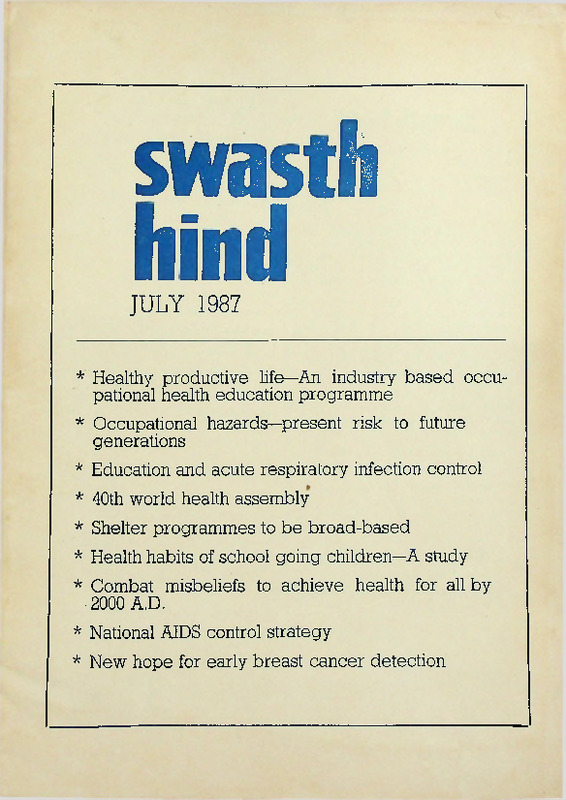
- Title
- HEALTHY PRODUCTIVE LIFE - AN INDUSTRY BASED OCCUPATIONAL HEALTH EDUCATION PROGRAMME
- extracted text
-
swasth
hind
JULY 1987
* Healthy productive life—An industry based occu
pational health education programme
* Occupational hazards—present risk to future
generations
* Education and acute respiratory infection control
* 40th world health assembly
* Shelter programmes to be broad-based
* Health habits of school going children—A study
* Combat misbeliefs to achieve health for all by
• 2000 A.D.
* National AIDS control strategy
* New hope for early breast cancer detection
swasth hind
Asadha-Sravana
Saka 1909
July 1987
Vol. XXXI, No. 7
OBJECTIVES
Swasth Hind (Healthy India) is a monthly journal
published by the Central Health Education Bureau,
Directorate General of Health Services, Ministry of
Health and Family Welfare, Government of India,
New Delhi. Some of its important objectives and
aims are to:
REPORT
and interpret the policies; plans, pro
grammes and achievements of the Union Ministry
of Health and Family Welfare.
ACT as a medium of exchange of information on
health activities of the Central and State Health
Organizations.
FOCUS attention on the
major public health
problems in India and to report on the latest trends
in public health.
KEEP in touch with health and welfare workers
and agencies in India and abroad.
REPORT on important seminars,
discussions, etc., on health topics.
^ssuc
Page
Healthy productive life—
An industry baser! occupational health
education programme
A. Ktnnaresan
161
Occupational hazards—present risk to
future generations
165
Education and acute respiratory infection control
Dr. Bhakt Prakash Mathur
Dr. P. Salil
167
40th World Health Assembly
Health for all must become a movement
Shri P. V. Narasimha Rao
169
Shelter programmes to be broad-based
172
Health habits of school going children—A study
A. C. Moudgik S K. Verma, Parmjit Kaur,
Amita Ummal and Raman Mehta
174
Combat misbeliefs to achieve Health for all
by 2000 AD
P. Manohar Reddy
176
Raju becomes a volunteer
M.L. Mehta
180
National AIDS Control Strategy
Dr. K. K. Datta
182
New hope for early breast cancer detection
187
conferences,
SUBSCRIPTION RATES
Single Copy
Annual
•.
Editorial and Business Offices
Central Health Education Bureau
(Directorate General of Health Services)
Kotla Marg, New Delhi-110 002
EDITOR
N. G. Srivastava
-■
..
..
..
0.50 paise
Rs. 6.00
(Postage Free)
Articles on health topics are invited for publication in this
Journal.
Slate Health Directorates are requested to semi in reports of
their activities for publication.
'I he contents of this Journal are freely reproducible. Due
acknowledgement is requested.
Sr. SUB-EDITORS
M. L. Mehta
M. S. Dhillon
The opinions expressed by the contributors are not neces
sarily those of the Government of India.
SWASTH HIND reserves the right to edit the articles sent
for publication.
Asm
HEALTHY PRODUCTIVE LIFE
An Industry Based Occupational
Health Education Programme
A. Kumaresan
This paper discusses the experiences in operating an “Occupational Health Education
Programme” in a Heavy Engineering Industry, for the workers, supervisors and exe
cutives', The inputs of this one day programme are delivered in the form of lectures,
films and demonstrations according to the group characteristics. This on-going pro
gramme aims to cover the entire working population of 15,000 in a phased way, a tar
get period offive years. The aim is to provide an understanding of the principles of
Occupational Health to promote positive attitudes toward work, and to enlist/promote
meaningful participation in all constructive programmes connected with health
promotion.
The various aspects of programme planning, course content, organisational aspects
and practical considerations relevant to the success of this approach are discussed in
this paper.
Educational programmes are desig behavioural change, therefore, makes habilitative—health education^ has
ned to influence and reinforce a lot of difference in achieving opti come to be increasingly recognised
people’s behaviour positively to mum health. t We can bring about and has become its important and
wards a desired goal. Health edu this needed
positive behavioural integral component. In a compre
cation is a process which effects change through health education hensive health care programme like
changes in the health practices of processOccupational
Health
Services
people and in the knowledge and
(OHS), the role of health education,
attitudes. related to such changes. Need for health education in occupa therefore, is vital. We need to es
It is any combination of learning tional health
pecially consider .he fact that every
experiences designed to facilitate
occupation is associated with some
In any health care programme— risk or the other. There is no oc
voluntary adaptation of behaviour
conducive to health. Behaviour pro whether it is health promotive or cupation devoid of risks and these
foundly influences our health, and disease preventive, curative or re risks can, if at all, be only minimi
July 1987
161
sed but cannot be altogether elimi
nated. The prolonged incubation
period for many work related dis
eases to get clinically manifest
makes health education imperative’
since the workers cannot be expected
to be aware of what may happen
after years.
Health and productivity and their
promotion
essentially
revolve
around educational services. Occupa
tional health services lay emphasis
on work, working conditions and
workers’ health and essentially ope
rate on the principle that occupa
tion and health influence each other
either positively or adversely.
Against this background the
need, content and practice of occu
pational health education and- train
ing are identified, designed .and im
plemented as per the requirements of
different countries or industries or
.workplacesHealth education and Training Unit
at BHEL. Tiruchi
The Health Education and Train
ing Unit functions within the frame
work of Occupational Health Ser
vices (OHS) in BHEL, Tiruchi. In
1976, OHS was established in
BHEL, Tiruchi, in line with
the ILO Recommendation 112
emphasizing the need for such
services at the plant level. BHEL
is a public sector undertaking en
gaged in fabrication of boilers, pres
sure valves and accessories. It has
got a total workforce of 15,000 em
ployees. The objective of occupa
tional health services being promo
tion and maintenance of health at
workplace, heal'h
education unit
plays a pivotal role by giving the
162
needed inputs and educating the em
ployees towards that direction. To
achieve this obij^ive the Health
Education Unit functions in colla
boration with the multi-disciplinary
group of professional/units consti
tuting the total and comprehensive
Occupational Health Services.
The activities of Health Educa
tion Unit in Tiruchi under OHS
comprise health educational pro
grammes for:
Such awareness is essential at grass
root level and this, in the first place,
accelerates ouP goal oriented ap
proach.
Secondly, it facilitates early de
tection by the workers- themselves of
any hazard in the work environment
or the effects of any hazardous envi
ronment or work operation on the
health of the employees. It in turn
enables the OHS to plan necessary
intervention at an early stage.
(a) Specific occupational groups
Thirdly, greater awareness about
like welders, fitters, machini
sts, sanitary workers, security occupational health facilitates better
voluntary participation of the em
personnel, etc.
ployees in various programmes car
(b) Specific groups of patients suff ried out by the OHSering from diseases like diabe
tes, hypertension, hypercholesFurthermore, this programme pro
rolemia, peptic ulcer, etc.
vides an opportunity to employees
to shed any doubt, misconception
(c) Trade union leadersor apprehension that they may have
(d) Act apprentices.
regarding the purpose or activities
of the OHS.
(e) Housewives—inputs with re
gard to nutrition.
Programme strategy
Educational inputs were given ac
cording to the needs of these groups.
A cross section of employees and
some housewives have been perio
dically covered under various health
educational programmes as listed
above.
Keeping in view the above men
tioned needs, series of meetings, were
organised with the faculty of OHS
to design this one-day programme.
The programme was a three tier
approach with three different modu
les, developed keeping in view the
nature of work and types of res
Programmes on healthy productive ponsibilities, etc., of three different
categories
of employees namely
life
workers, supervisors and executives.
This crash programme—-a pack The target population proposed to
age programme with a number of be covered was nearly 15,000 skill
training modules—was launched in ed, semi-skilled workers, supervisors
1985 to create a wide-spread awa and various levels of executives
reness about health and the services working in Tiruchi Unit of BHEL.
available under the OHS though The entire target population was
specific programmes listed above planned to be covered in a phased
were already serving their purpose. manner over a period of five years.
Swasth Hind
Subjects
Concept of Health
and Occupational
Health
Introduction to
OHS
Nutrition and
Exercise
Stress and Stress
Management
Handling people
with problem
Evils to be Avoided
(alcoholism, drug
addiction, smoking)
Module
Time
Common for 1 Hr
all 3 modules
—do—
1 Hr
—do
1 Hr
Only for
3 Hrs
Module -1
Executives
Only for
3 Hrs
Module - II
Supervisors
Only for
3Hrs
Module - III
Workers
Planning the target group
duration
and the
The target group for this pro
gramme was decided to be the en
tire employees of BHEL, Tiruchi.
The information about the total
number of employees and these
category-wise break-up was obtain
ed from Health Information Sys
tems group, a component of OHS.
The total number of employees in
the unit are about 15,000. Among
them 1452 are executives 3001 super
visors and 9922 workers.
The programme is conducted for
eight months in a year leaving out
the period between January and
March when production schedules
are tight.
Every occupation is associated with some risk or the other and occupational
health services lay emphasis on work, working conditions and workers’ health.
Objectives of the programme
The overall objective of the
Healthy Productive Life program
me was to create an awareness
among the BHEL, Tiruchi Unit em
ployees about the concept of occu
pational health services in order to
promote health through their active
participation in various health pro
grammes initialed by the OHS.
mulated. for each of the three diff
erent modules.
The duration for each module
was fixed to be of one day consist
ing of six working hours- The me
thodology included lecture discus
sion sessions, group discussions, ex
perimental learning and practical
demonstration. The content of the
In order to attain this overall ob programme and the time w distribu
jective, specific objectives were for tion were as follows:
My 19.87
The programme at present is be
ing conducted for four days in a
week, one day for executive group,
one day for supervisory group and
two days for workers’ group with a
maximum of 25 employees per day.
As such it is possible to cover,
in one week
25x4 =
100 employees
in one month 100x4 = 400 employees
in one year
400 X 8 = 3200 employees
in five years 3200x5 = 16000 employees
The plan is to concentrate entire
ly on the workers’ group on all days
once we complete the executive and
supervisory- groups in which we
have less number of people.
163
The members or the faculty for
conducting this programme com
prise professionals in the areas of:
committee members are the formal are conducted by the health educa
leaders in this industry in addition tors, medical officers, industrial hy
to the formal management hier gienists, occupational psychologists
archy. The source credibility is and social workers. Necessary audio
(1) Occupational Medicine
often vested with them- As per the visual aids are used in all the
(2) Industrial Hygiene
health
education principle Work sessions to make the sessions inter
(3) Occupational Psychology
through
the leaders and use group esting and to facilitate learning(4) Social Work, and
influence,
leaders are actively in
(5) Health Education.
volved in all the programmes even
Evaluation
Planning with the Training Centre at the planning stage. So, before
implementing this “Healthy Pro
Usually short term training pro
Faculty
ductive Life” programme a meet grammes especially one day pro
BHEL, Tiruchi, has a Training ing was arranged with all the grammes arc organised to create
Centre where many regular and leaders of the recognised unions, awareness or refresh or renew the
periodic training programmes are shop council and works committee knowledge. A pre and post evalua
conducted. So, it was decided to members. The objectives and the tion, thus,/helps to assess the change
utilize this resource for organizing action plan were explained to them in the knowledge level of the parti
the target group so that all the ad and their cooperation was sought.
cipants, but may not be an effective
ministrative formalities like nomina
tool to assess the changes in their
tion of the officers/workers through
1MPLEMEN TATION
attitude and practice. In this pro
various departments, getting their
gramme evaluation is done at the
acceptance, arrangement of class Nominations
reaction level. At the end of each
rooms, provision of audio-visuals,
It was decided that fifteen days programme, ten minutes feed-back
hardwares, arrangement of refresh in advance the letters for nomina
time is given for the participants
ments during breaks and provision tion would be sent from the Train
to express their opinion about the
of lunch through the canteen of the ing Centre through the respective
usefulness of thq programme, course
Training Centre could be taken care coordinators to different department
content, effectiveness of each session,
of.
heads requesting them to nominate appropriateness of the audio-visual
one to five persons depending upon aids used, etc. Though it is not a
Hence, a meeting was organised the number of staff in their depart well documented evaluation, we get
with the officials of the Training ments. They would in turn res quite a good positive feed-back. On
Centre. It was decided that all the pond with a letter nominating the the basis of the feed-back we intro
above-said administrative arrange persons against each date of train duced films on noise and heat to
ments would be taken care of by the ing and also inform the individuals make the industrial hygiene sessions
Training Centre and the cognitive to report at the Training Centre more interesting.
input by the OHS Faculty. Three without fail. On the training day
training officers from the Training attendance is taken and a copy
Conclusion
Centre were identified to coordinate marked to the concerned Head of
this three-tier programme for the the Department which in turn will
In any health care programme,
workers, supervisors and executives be sent to the Time Office* to con health education forms an important
sider his absence from the work component. In a comprehensive
respectively.
spot as on duty. Inaugural func health care programme like Occu
Planning with trade union leaders
tion takes place with the participa pational Health Services, the role
tion
of management, workers, repre of health education is vital. This.
Leaders are
important change
sentatives
and all concerned profes paper gives an account of the suc
agents in any community and more
cessful approach adopted in orga
so in an industrial community. The sionals.
leadership pattern in industry is
quite different as compared to the
community. Normally, trade union
leaders, shop council
and works
164
Programme implementation
During the implementation of the
programme, the educational sessions
nising an occupational health educa
tion for various categories of em
ployees in a Heavy
Engineering
IndustryA
Swasth Hind
OCCUPATIONAL HAZARDS PRESENT
RISK TO FUTURE GENERATIONS
The health of future generations cannot be secured by excluding men or women from
hazardous jobs but by improving working conditions. Measures such as replacement of
the hazardous agents, changes in technology, enclosing of certain processes, improved
ventilation and design, personal protective devices are availablejo achieve this goal.
ORLDWIDE industrialization has caused an
increase in the number of chemical, physical and
biological agents to which humans are exposed. One
by-product, of industrial development is the mounting
concern that exposures to certain toxic substances may
harm present or future generations. The large num
ber of agents in use and the lack of knowledge about1
their effects on reproductive functions is of universal
concern.
W
Up to now, studies carried out on the health hazards
of chemical and biological agents existing in the work
environment' have concentrated mainly on the toxi
city of such agents. Recently, however, following stu
dies on animals, alarm bells have been ringing re
sulting in investigations into the effects on the human
reproductive system of exposure to occupational ha
zards.
The World Health Organization (WHO) had con
vened a meeting of experts1 to review present know
ledge concerning effects on human reproduction of
some of the most' important industrial chemicals and
to draw up guidelines for practice in" the workplace,
including tests for the monitoring of changes in the
reproductive functions of workers exposed to occu
pational hazards as well as control measures to limit
such exposure. The growing number of women in
the workforce has focussed attention particularly on
the risks to pregnant women and their offspring. This
concern has progressed to include factors that* influ
ence fertility and impaired reproduction in men.
The inability of a couple to conceive is a signifi
cant public health problem. Between 10 and 20% of
all couples fail to conceive after one year of regular,
unprotected intercourse. Few clinical studies, how
ever, have examined the lole of environmental or
occupational factors in infertility and, until recently,
study of the reproductive effects has focussed rather
on the outcome of pregnancy. It has been shown that
maternal or paternal exposure to a chemical or phy
sical agent prior to conception may act upon either
the male or female germ cells, so that fertilization
of an ovum does not take place or abnormalities occur
causing spontaneous abortion, stillbirth or live birth
with defects. There is also evidence that occupational
exposure of parents is related to the development of
cancer in their offspring before the age of 15. Embryo
nic tissues of the foetus are more susceptible to cer
tain carcinogens than those of the adult. Therefore,
a brief or acute exposure during a critical period of
growth may be sufficient to produce an adverse effect.
Studies show that in many cases of death due to
childhood, cancer, the father was employed in a petrolrelated occupation, whilst maternal occupational ex
posure to chemicals (paint, petroleum products) dur
ing pregnancy was associated significantly with leuke
mia.
‘•WHO meeting on Review of Effects of Occupational Health Hazards of Reproductive functions, 4-8 August 1986,
under the Chairmanship of Dr K. Hemmmki, Institute of Occupational Health, Helsinki, Finland.
July 1987
165
Ionizing radiation
The genetic effects of ionising radiation have been
known for many years. It has been recommended
that occupational exposure to radiation should not
exceed 50 millisieverts (mSv)’ per year, and that the
total exposure of women during pregnancy should
not exceed one tenth of that. The major groups of
workers exposed to radiation are those associated with
medicine—physicians, radiologists, nurses and assis
tants, especially those involved in radiation therapy
and nuclear medicine.
Infectious agents
Infection with rubella virus during the first three
months of pregnancy may result in congenital mal
formations in about 20% of the offspring. These babies
may excrete large quantities of virus for several months
after birth and so provide a potential reservior of
infection for nurses caring for them. Nurses are also
exposed to other sources of infection, and the risk
of viral hepatitis in dialysis units is well-known. In
fective hepatitis virus can cross the placenta resulting
in abortion or chronic hepatitis and death of the
offspring.
Hazards occupations
Agricultural workers. Increased impotence has been
found amongst men working with pesticides and her
bicides.
Anaesthetists. , Female anaethetists and operatingtheatre personnel have higher abortion rates than
expected. Another study showed a two-fold increase
in spontaneous abortions and congenital malforma
tions in exposed females and a 25% increase in con
genital malformations in the offspring of exposed
' males. Some anaesthetics are also structurally relat
ed to vinyl chloride, a proven human carcinogen.
Smelters. There were significant reductions in birth
weight in the offspring of female smelter employees.
Smelting materials have a high arsenic content and
include other potentially toxic substances such as lead
and sulphur dioxide. Genetic damage in otherwise
healthy male smelters was found, raising the possibi
lity of mutagenic effects being transmitted to the off
spring.
Laboratory workers may be exposed to many poten
tially embryotoxic chemicals, such as solvents, heavy
metals, and carcinogens. An increased rate of spon
taneous abortions has been found among women em
ployed in chemical laboratories in the pharmaceu
tical industry compared with women employed in
non-chemical laboratories.
Other occupations where an increased risk of pre
gnancy complications has been found include chemi
cal workers (particularly those working in plastics,
styrene, viscose, rayon) painters and laundry workers
(because of their exposure to solvents), metal workers
(particularly electronics), forestry and fishing, indus
trial and construction workers. The WHO working
group found that a good deal of research is required
to substantiate the findings under review.
Guidelines for control measures
Control measures concerning the reproductive effects
of exposure to occupational hazards in the workplace
are essential for the protection of both male and
female workers. It is important to continually moni
tor levels of exposure to chemicals, physical and in
fectious agents in the workplace and, where necessary,
adapt or modify .the workload. In cases where the
reproductive effects are highly hazardous, the ope
rations should be totally enclosed so that there is no
exposure to the workers.
Pre-employment health examination should provide
basic health data on workers and periodic check-ups
should include tests for changes in reproductive func
tions. Such tests would include blood tests for
chromosomal abnormalities, contents of sex hormones,
etc.
Workers should be informed of possible reproduc
tive effects of occupational hazards and taught work
procedures that would help prevent such effects.
Early symptoms of ill-health should be easily recog
nizable by the worker so that he or she can seek the
necessary medical care. The WHO group also recom
mended development of a register of reproductive
abnormalities' together with data concerning occupa
tional history and other variables such as drug and
tobacco consumption.
Future generations
The health of future generations cannot be secured
by excluding men or women from hazardous jobs
but by improving working conditions. The ultimate
goal has to be a safe workplace for all. Measures such
as replacement of the hazardous agents, changes in
technology, enclosing of certain processes, improved
ventilation and design, personal protective devices,
are available to achieve this goal.
©
x.Th 5 sievert (Sv) is’a unit of dose "which expresses radiationtburden of human tissue. An average dose from expo
sure to background radiation, such as natural radioactivity, cosmic rays, fall-out from past nuclear testing, etc., is
about 2 millisicvertsXmSv) per year.
166
Swasth Hind
EDUCATION AND ACUTE RESPIRATORY
INFECTION CONTROL
Dr Bhakt Prakash Mathur
Dr P. Salil
Recognition of the importance of fast breathing and chest indrawing in Acute Respira
tory Infection is essential to reduce deaths from this infection.
A child dies from Acute Respiratory
Infection
Zl(ARI) every seventh second. Many of these deaths
could be prevented. The key to their prevention is
education of mothers, primary health care workers,
health workers at referral centres and doctors in
hospitals.
All have an important role in a properly
integrated health care system. The life saving agents
are antibiotics and oxygen. Th whole community
needs to understand which children must be referred
for these life saving agents and which will get better
by themselves.
Parents and primary health care workers should
know that most children with cough do not need
antibiotics. Recognition of the importance of fast
breathing and chest indrawing in ARI is essential to
reduce deaths from respiratory infections.
TABLE: THE MAIN CRITERIA FOR DECISION
MAKING IN CASE MANAGEMENT OF
ARI IN CHILDREN
Grade
1.
Acute Upper Res
piratory Infection
(AURI).
Most children with cough
do not require Penicillinf.
2.
Acute Upper Res
piratory Infection
(AURI)
Acute Lower Res
piratory Infection
(ALRI) mild.
Cough and fast breathing
—give procaine penicillin
intramuscularly once a
dayf.
3.
Acute Lower Res
piratory Infection
(ALRI) modera
tely severe.
Cough and chest indrawing
—admit,
give pencil lin
every 6 hourly.
4.
Acute Lower Res
piratory Infection
(ALRI)
severe
complicated.
Cough and cyanosis or too
sick to feed—admit, give
chloramphenicol .
Fast breathing •
The health workers’ first) priority is to decide
whether or not a child’s breathing is normal. If the
breathing is fast, the child should be given an anti
biotic as soon as possible (Table). This measure
alone could prevent many deaths from ARI (pneu
monia), besides avoiding unnecessary antibiotics.
Often, mothers are well aware of how their child is
July 1987
tOr Ampicillin, Amoxycillin or Cotrimoxazole orally.
167
breathing and can make useful and important observa
tion which the health worker should encourage and
take into account.
>■■■ ■ ■
Parents,
who are in the frontline of clinical manage
ment of children with ARI, should understand the
SIMPLIFIED DECISION TREE FOR ARI
SYMPTOMATOLOGY
DIAGNOSIS
ARI GRADE
difference
between a child with a minor self-limiting
illness and a more serious one which needs hospi
talization.
The right decision
It is important for health workers to be able to
recognize these two basic signs, so that they can
make the right decision. Referring a child for more
specialised help is an important decision. In some
cases, it may be a long journey, expensive fares, loss
of earning and problems with the care of other
children.
Where is education needed?
For the examination, the child should be quiet and
held by its mother, while the health worker watches
the movement of child’s clothes as it breathes. If a
child is upset, it may be difficult for the health worker
to see clearly how fast the child is breathing. If the
child breathes more than 50 times in one minute, then
the child needs to be given an antibiotic immediately.
Chest indrawing
The second sign that the health worker should
watch for, is chest indrawing. Chest indrawing is a
sign that the illness may be severe but is a little more
difficult to recognize. A child with asthma who is
wheezing may have chest indrawing even, if he is
only mildly ill.
168
The proper care of a child with severe ARI is
relatively straight forward. But even the most sophis
ticated hospital cannot save a child, if it reaches too
late. Parents who are in the frontline of clinical
management of children with ARI should understand
the difference between a child with a minor self
limiting illness and a more serious one which needs
hospitalization.
Relevant message
Parents need simple, straight forward messages.
They should know when to seek outside help. They
should be encouraged to continue feeding their child
normally during respiratory illness, to give plenty of
fluids and to use simple measures to clear the nose,
if if is blocked. These simple messages can be put
across the community through mass media—T.V.,
Radio. Health workers and doctors also need clear
guidance for dealing with ARI.
A
Swasth Hind
40TH WORLD HEALTH ASSEMBLY
Health for All must become a Movement
—Shri P. V. Narasimha Rao
| T nton Minister for Human Resource Development and Health and Family Welfare, Shri
P. V. Narasimha Rao has made an impassioned
plea to the World Health Organization to raise its
voice emphatically aginst the funneling of massive
resources for purposes of war. The World Health
Organization (W.H.O.) must plead in the name of
survival of the human race, for greater outlays for
the promotion of development, he said.
In the plenary address to the 40th World Health
Assembly on 7th May 1987, at Geneva, the Minister
said the current widespread international economic
crisis was bound to adversely affect the financial and
technical resources available for the health sector and
impede our march towards the goal of Health for All
by 2000 A.D.
The Minister said it was imperative, in poorer coun
tries, that every individual becomes his or her own
health worker and every household serves as a pri
mary clinic for common ailments in the first instance.
This situation needs to be brought about by massive
education by proven methodologies embedded in ageold cultures of nations concerned. The traditional reservior of wisdom, which prescribes and prohibits
certain human actions for individual and common
well-being must be revived, amplified and strengthen
ed in view of the skyrocketing and prohibitive cost
of medical care.
The Minister expressed the Government’s appre
ciation of the WHO’s efforts in chalking out a strategy
for control of AIDS. He affirmed the Government’s
wholehearted support to the WHO efforts in prepar
ing guidelines for prevention and containment of
AIDS.
He said India would welcome cooperation from
developed countries for evolving more effective and
affordable strategies for control and eradication of
diseases like Leprosy, Tuberculosis and Blindness.
The major causes of sickness and death in India
are infectious diseases, many of which are preventable
through immunization. Our Universal Immunization
July 1987
Programme aims to achieve by 1990. hundred per
cent coverage of pregnant women with T.T. and 85
per cent of children against vaccine preventable
diseases, the Minister added.
Stressing the importance of the role of HFA leaders,
the Minister said a large band of health workers of
different requisite categories with a clear concept of
primary health care approach were required to ahieve
success in providing satisfactory health care services
to our people. He said that both the National Health
Policy and National Policy on Education evolved by
us stressed the need for a closer look at the require
ments of trained manpower. The Government was
proposing io set up a National Council for Higher
Education to lay down broad policy guidelines and
coordinate all programmes and activities in the field
of higher education.
The Minister said Health for All must become a
movement. Our ultimate aim must be to start a
nation-wide debate on our health systems and create
adequate consciousness among people about their
health needs, he said.
The Minister said a major focus was to transform
the family welfare programme into a genuine people’s
movement by restructuring organizational and opera
tional aspects of the programme.
The appropriate
motivation of people was a crucial factor here, he
said. We were providing maternal and child health
services as a part of total health care of the commu
nity through the existing health infrastructuije
in
urban and rural areas. He expressed the hope that
■a close linkage between health and family welfare
and other related sectors would be established, both
at the national and grassroots level.
The Minister called for an interaction between the
traditional and modern systems of medicine. “India
has a vast reservoir of practitioners of traditional
systems of medicine, who enjoyed respect in the com
munity and are providing satisfactory services
in
remote rural areas. Our main concern should be
to ensure a method of coordination to enable the
community to derive maximum benefit out of them”,
the Minister added.
169
40TH WORLD HEALTH ASSEMBLY
DIRECTOR-GENERAL OF W.H.O. PLEADS FOR
HUMAN
VALUES
T
us the need to temper economic values with social
values, with human values, with compassion for the
plight of the health have nots”.
Delegates representing most of 166 Member States
of the World Health Organization participated.
The Director-General of WHO said he had been
deeply affected by the statements of the delegates of a
number of developing countries concerning the ad
verse health effects of the economic recession on the
health of their people, but he noted that there was
much abundance in some of the very countries that
felt themselves to be in the thick of the depression.
40th World Health Assembly was held in
Geneva from 4 May 1987 for a period of two
weeks. Dr Johan van Londen. Director-General of
Public Health (The Netherlands) was elected as Pre
sident of its 40th Session. He succeeds Dr Zeid
Hamzeh (Jordan). Minister of Health, who presided
over the Thirty-ninth World Health Assembly in
1986.
he
Speaking on behalf of the Secretary-General of the
United Nations, Mr Perez de Cuellar, Mr Essaafi, Co
ordinator of the UN Disaster Relief Office, emphasis
ed the excellent reputation WHO has acquired over
the years and outlined the long list of diseases WHO
has successfully combated, while underscoring the
new challenges to the Organization of diseases such
as AIDS, which further contributes to its workload.
The message expressed the solidarity of the entire
United Nations system with WHO in its struggle
against this new disease.
Director-General of the
World Health Organization (WHO) stressed the
need for a system of human values in the world. Dr
Mahler was speaking before the 40th World Health
Assembly at the conclusion of the debate on his
Report on the Work of WHO in 1986, and the Pro
gress Report on the global strategy for Health for All
by the Year 2000, on 8 May 1987.
r Halfdan T. Mahler,
D
Referring to the Technical Discussions on the eco
nomic aspects of the strategy of Health for All, Dr
Mahler said, “If you judge success on the basis of hard
economics alone, well—kill off the elderly, kill off the
weak, kill off the disabled! Get rid of social pathology
by eliminating its victims! Do you think that is idle
rhetoric? Has it not happened in the course of this
century? Surely recent history should drive home to
170
Dr Mahler asked: “Should chaotic economic indi
cators be allowed to dictate human affairs, or should
human goals and challenges dictate them?” He under
lined the fact that the world community had a very
human value system within WHO—the goal of Health
for All by the Year 2000 and the strategy for obtain
ing it.
He described this strategy as “a tremendous
challenge’’, and said, “We are making steady progress,
I would say dramatic progress, in many countries”.
He added that it is precisely in times of economic
recession that the least privileged are likely to suffer
most the adverse health consequences and indicated
that WHO’s programme budget, if properly used, can
“be a most powerful lever for mobilizing people’s
energy as well as national and other international .re
sources”.
While the financial position of WHO is still under
debate, the Director-General challenged delegates by
saying, “you can display your solidarity with WHO’s
value system and your determination to provide your
selves with the wherewithal to maintain it alive and
vigorous or, alternatively, you can reveal your lack of
confidence in what you yourselves have created.
In
other words, do you want world health for all to be?
Or are you going to paralyse the action that will make
it to be, like a scorpion stinging its own body with
its tail?”
Swasth Hind
40th Anniversary
Dr Mahler confirmed the intention of celebrating in
1988 the double 40th Anniversary of WHO and 10th
Anniversary of the Alma-Ata Declaration by advoca
ting worldwide the collective health policy of all Mem
ber States. He told delegaj.es, “I hope you will reflect,
and act, on those messages deriving from your collec
tive policy and that you would like to deliver to your
people throughout the whole of 1988. I hope you will
do that in such a way that these messages become
permanent features of your health systems so that you
and the peoples you represent support one another in
maintaining close associations with this great health
and development adventure”.
The Director-General of WHO concluded his re
marks by saying, “let us celebrate and not with super
ficial wishes but rather to reconfirm and intensify our
faith in the path we have taken. Let us do so in
such a way as to maintain and increase confidence in
your organization, the organization that is leading the
people of the world along that path. Let us do so by
demonstrating through action that our concepts are
viable and that our ways of realizing them are practical
and effective”.
Concentrate on action to prevent AIDS
Dr Jonathan Mann, Director of the WHO Special
Programme on AIDS, said in Geneva on 11 May 1987
that the World Health Organization (WHO) is not
aware of any scientific data which would support the
idea that the global Smallpox Eradication Programme
might be linked to AIDS. Allegations linking AIDS
with smallpox join many other unproven and specula
tive ideas about the origin of the disease.
Smallpox was an ancient scourge and smallpox vac
cine was used widely in many areas of the world
during the last two centuries. During all this time,
neither the smallpox disease virus nor the smallpox
vaccine virus was ever linked to upsurges in any
other disease.
The‘only result we know of from
the Smallpox Eradication Programme was the eradica
tion of smallpox itself.
As the Fortieth World Health Assembly in Geneva
has emphasized, the world community must concen
trate on action to prevent the spread of AIDS rather
than on speculation about its origins.
Given the confusion which may be generated by
unproven and speculative statements as well as the
many inaccuracies they contain, it is imperative that
any scientific information that may be available to sup
port the hypotheses presented be brought to light
rapidly and submitted to open, international and
scientific scrutiny, said Dr Mann.
July 1987
FIVE PRIZES AWARDED AT WORLD
HEALTH ASSEMBLY
Leon Bernard foundation Prize
The prestigious Leon Bernard Foundation Prize for
1987 was awarded by Dr Johan van Londen, President
of the 40th World Health Assembly, to Sir John Reid
of the United Kingdom for his outstanding service in
the field of social medicine.
His active involvement in the work of WHO, as a
member of the British delegation, dates back to 1972.
Since those days, he contributed greatly to the work
of WHO as well as to the development of international
health in general.
A.T. Shousha Foundation Prize
The Shousha Foundation Prize is given at the World
Health Assembly each year to a person who has ren
dered significant health services “in the geographical
area in which Dr. A.T.. Shousha served the World
Health Organization”.
The Executive Board, at its Seventy-ninth Session,
awarded this year’s prize to Professor Ahmed Mohamed
El-Hassan of the Sudan. Professor El-Hassan served
as Director of Research, Translations and Publications
at the College of Medicine and Medical Sciences,
King Faisal University in Saudi Arabia. In 1984, he
was appointed Chairman of the Department of Patho
logy at the same college.
Jacques Parisot Foundation Fellowship
The Jacques Parisot Fellowship is awarded every
two years for research in social medicine and public
health for WHO regions on a rotating basis. This
time, it is the turn of the European Region and the
Executive Board which met in January 1986 proposed
that the award be given to Dr Pamela Mary Enderby
of the Speech Therapy Department, Frenchay Hospital,
Bristol, United Kingdom.
Child Health Foundation Prize
The Child Health Foundation Prize, which is awar
ded for the third time, goes this year to Professor Jose
R. Jordan of Cuba in accordance with the decision
of the Executive Board at its Seventy-ninth Session in
January 1987.
Sasakawa Health Prize
The Sasakawa Health Prize, which was established
in 1985, rewards outstanding innovative work in health
development and is intended to encourage the further
development of such work.
This year the prize goes
to Sister Marie Joan Winch of Australia.
Sister Marie Joan Winch is a qualified nurse-midwife
who has worked continually over the past 10 years for
improvement of Aboriginal health standards and to
promote better understanding between the Aboriginal
and white communities in Australia.
•
171
SHELTER PROGRAMMES TO BE
BROAD-BASED
Points 14 and 15 of the revised 20-Point Programme have been designated as demon
stration projects of the International year of Shelter for the Homeless. These relate to
provision of house-sites to rural landless with construction assistance and environ
mental improvement of urban slums.
Programme, 1986, is a package for
the welfare of the poor and vulnerable sections
of the society. The items of this noble charter aim at
ensuring social justice with economic growth for these
less privileged of our citizens. The programme for pro
vision of house-sites is, therefore, of great significance
next only to the efforts for ensuring minimum level of
food and nutrition.
These schemes are scattered over 16 States and
Union Territories which will ultimately help construc
tion of 1,80,766 units for the benefits of the people
belonging to the economically weaker sections and low
income categories. The brief details of different types
of schemes are as under.
A definite State-wise programme of action to pro
vide shelter to the shelterless within a time-bound
period is being worked out. Attention will be on
implementing schemes of the International year for
Shelter for the Homeless (IYSH) to give houses of
reasonable specifications to all by the year 2000.
Some 83 urban shelter schemes have been sanctioned
for the States of Andhra Pradesh, Kerala, Bihar, Uttar
Pradesh, West Bengal, Orissa, Tamil Nadu, Gujarat,
Haryana, Karnataka, Maharashtra, Madhya Pradesh,
Rajasthan and Union Territory of Delhi.
These
schemes, after completion, will help construction of
49.161 houses in the urban areas.
T
he 20-Point
A number of projects for providing shelter, improv
ing neighbourhoods and basic facilities have been
identified and taken up by the State Governments and
•the Union Territories and other agencies. Housing
and Urban Development Corporation has designated
some projects as the IYSH projects. In 1985 and
1986, HUDCO had sanctioned 136 schemes of Rs. 100
crores out of which a loan assistance of nearly Rs. 80
crores have been provided for urban shelter and slum
upgradation, rural housing schemes, basic sanitation
schemes and provision of smokeless chiillas.
172
Multiple Aims
The urban schemes include reconstruction of 52
units at Baleshwar in Bombay district as well as skele
tal housing schemes at Bhubaneswar in Orissa for 526
existing units by improving the roofing of the same to
help prolong the life of the structures.
Slum upgradation schemes provide for improving the
environment in eight slums of Alwar Town (Rajas
than) for a total loan assistance of Rs. 0.661 million
which will help improve the life of 688 families living
Swasth Hind
•in these slums. • It is proposed to provide/improve
the basic amenities like approach roads/path ways,
street lighting and drinking w’ater supply in these
slums.
International Year of Shelter for the Homeless. These
relate to provision of house-sites to rural landless with
construction assistance and environmental improvement
of urban slums.
A “Cycle Net Work” project has been sanctioned to
Pune Municipal Corporation. This is the first scheme
of its nature in the country which is planned to be
completed in nine years in two phases. HUDCOfinanced first stage of the first phase will help in con
struction of sub-ways, improving the national high
ways, subways under-roads and rail track, cycle tracks
as well as traffic signals, etc., at inter-sections to en
sure more safety for the cyclists from the fast moving
vehicles, as the cyclists are the most vulnerable com
ponent of the total traffic.
During 1985-86, 9.11 lakh rural landless families
were provided with house-sites and 4.15 lakh families
given construction assistance and 20.57 lakh persons
benefited through provision of basic amenities in slum
areas.
An Apex Committee has been constituted at the
national level to ensure coordinated approach for for
mulation and implementation of the IYSH programme
and measures to mitigate hardships caused in human
settlements by disasters like floods and cyclone, are
also to be worked out.
Basic Sanitation Schemes
HUDCO has financed 26 basic sanitation schemes
for conversion/construction of 1,04,678 individual and
community latrines in the towns/cities scattered over
seven States of Andhra Pradesh, Maharashtra, Madhya
Pradesh, Orissa, Meghalaya, Rajasthan and West
Bengal. This will help in improving the environment
as well as reducing the pollution in the surface water
sources like rivers.
In Calcutta above 60,000 people will benefit through
sanitation schemes undertaken by the Calcutta Muni
cipal Corporation.
20-Point Programme
Points 14 and 15 of the revised 20-Point Programme
have been designated as demonstration projects of the
Efforts for providing shelter to the shelterless would
continue in 1987 with proposed shelter projects to be
inaugurated on 15 August and 19, November 1987.
The low cost sanitation project under IYSH will be
launched on October 2, 1987.
Use of non-conventional sources would be widely
promoted with particular emphasis on use of bio-gas,
promotion of smokeless chullas and desalination.
Housing will be taken up as an integrated activity to
promote employment productivity and welfare.
Emphasis is to be given on science and technology
to improve the quality and longevity of house building
materials. New areas of research will also be under
taken. A
A WORLD OF FIVE BILLION
* I HE birth of a baby round the middle of 1987 will take world population over five billion—according
to the 1987 ‘State of World Population’ Report from the United Nations Fund for Population Acti
vities (UNFPA), which was released worldwide in May, 1987.
The total number of human beings is how growing at a rate of 150 every minute 220,000 a day; 80
million a year. At this rate, says the report, we will reach six billion by the end of the century, seven
billion by 2010, and eight billion by 2022—with most of the growth taking place in the developing
countries. World population will, it is estimated,’ finally become stationary at around ten billion a
century or so from now.
July 1987
173
ducators over the years
have expressed the
view that the purpose of education is much more
extensive than just the mastery of academic subject
matter. According to Aristotle, “Education is the
creation of a sound mind in a sound body”. The
.child, rather than the subject matter, is considered
to be the focal point of education. Education is con
cerned with the whole child and not merely with his
mental processes or intellectual growth. * By education.”
says Mahatma Gandhi, “I mean an all round drawing
of the best in the child and man—body mind and
spirit”. There are many functions and purposes of edu
cation. The most commonly cited by a majority of edu
cators are related to the development of the child’s
total fitness or to the health of the student. A common
philosophy of education encompasses health know
ledge and values as important outcomes of education.
E
HEALTH HABITS
OF SCHOOL
GOING CHILDREN
—A Study
A.C. Moudgil, S.K. Verma, Parmjit Kaur,
Amita Ummat and Raman Mehta
. According to International consultation on Health
Education for school-age children, organized by WHO
and UNICEF in 1985, the health learning of the
school-age child should be enhanced in every pos
sible way to promote the exercise of self-reliance and
social responsibility and a better quality of life for
today’s children and tommorrow’s adults.
The following were considered as the central in
gredients for achieving this goal:
— Value systems rooted in social justice and
committed to health for all;
— The need to translate these values into nor
mative behaviour;
The functions of education should in
clude health knowledge and values so as
to make the child self-reliant and socially
responsible for a better quality of life.
The educational set up of the school pro
vides numerous opportunities for health
education. A child's knowledge, thoughts
and behaviour on health stems from
habits formed in the
impressionable
years. School children offer an opening
for educating people at home and in the
community.
Desirable behaviour pat
terns in the child concerning health in
clude thinking, feeling and practice do
mains. The conceptual approach to health
education emphasizes (a) growing and
developing, (b) interacting, and (c) de
cision making—the three key concepts
underlying processes affecting health be
haviour and serving as the unifying
threads of the curriculum.
174
— the child’s overall development and optimal
quality of life as the primary concern:
— the need to foster in young people a recogni
tion that health is an essential life .asset and an
attitude that they, themselves, can ‘ affect their
own health and that of their family and their
community as well; and
— the need to work through every possible chan
nel to equip them not only with these values
but with the knowledge and skills that em
power them to act self-reliantly for their own
benefit and that of their families and their com' muni ties (Mahler, 1985).
According to Grundy (1960), the advantages of re
gular instruction in schools are obvious. The pupil
is willing, learning is accepted as the natural order
of the day; that much of what, an individual knows,
thinks, and does about health in his adult life stems
from habits formed in the early and impressionable
years. The educational setting of the school provi
des an environment in which certain skills and. prac
tices can be learned most efficiently and effectively.
In the school, nation-wide groups of the same age and
attainments are brought together. School children are
of an age when receptivity is high; and school chil
dren offering an opening to the home and the com
munity can be reached through them. And finally, the
Swasth Hind
promising material is handled by teachers skilled in
approaches and methods appropriate to their task.
Behavioural practices
The school child in order to follow healthy prac
tices must* learn or develop desirable behaviour pat
terns.
We refer to behaviour to mean not only
actions or practices but thinking and feeling as well.
According to Thomson, “Education is the influence of
the environment on the individual with a view to pro
ducing a permanent change in his habits of behaviour,
of thoughts, of attitude”. Therefore health behaviour
according to Lois (1975) may be deemed to have cog
nitive, affective, and action domains. The'Cognitive or
thinking domain comprises the knowledge about
health and the intellectual abilities and skills required
to select and make decisions about health. The affec
tive or feeling domain refers to the interests, attitudes,
values and appreciations related to health. Health atti
tudes refer to affective behaviour. They emphasize a
feeling tone, an emotion, or a degree of acceptance
or rejection. These affective behaviours include;
attending or being receptive, responding or being im
pressed, valuing or rating highly. The action or prac
tice domain refers to the application of the know
ledge, ability and skills as well as one’s thinking to a
life situation selected to healthHca'th practices
Health practices refer to all these behaviours that are ,
externally demonstrated by the individual and which
in some way influence his health (Fodor & Dalis,
1970). Such behaviours include: (1) those that are ex
ternally observable in the classroom and can be evalu
ated, to some degree, in# the classroom setting (i.e.
getting alongwith classmates, cleanliness and groom
ing, the extent to which an individual participates in
physical activities during the physical education
period);
(2) those that are observable but are not conducive
to systematic assessment in the classroom setting (i.e.
nutritional practices at home smoking and drinking
habits, dental health practices);
(3) those that are externally observable but which
often do not become a part of the individual’s behavi
our pattern until some time in the future (i.e. securing
medical and dental services, preparing a wholesome
diet, obeying health laws, and supporting health legis
lation)Therefore, schools and colleges, through the virtue
of a conducive environment and climate for learning
can build a solid foundation for continuing education
for health in the community setting. Health needs,
interests, and responsibilities change throughout one’s
life time old and emerging health problems and radical
changes in our way of life await all of us. The rapi
dity and acceleration of medical advances and new
knowledge will require continuing efforts to bridge the
gap between knowledge and application.
July 1987
Conceptual approach
The conceptual approach to health education offers
potential for imposing order on an endlessly variable
environment; it holds promise for patterning of facts
into a statement of relationships to which new. truths
can be added and • by which those no longer valid
can be discarded. It provides for the development
of cognitive, affective, and action-oriented skills
through its focus on behaviour and it offers a theore
tical curriculum framework that is translated into an
operational and functional plan for the facilitation of
teaching and learning. (Sliepcevich, 1968).
Three key concepts are:
Growing and Developing : A dynamic life process
by which the individual is in some way like all other
individuals, in some ways like some other individuals,
and in some ways like no other individual.
Interaction : An ongoing process in which the indi
vidual is. affected by and in turn affects certain biolo
gical, social, psychological, economic, cultural, and
physical forces in the environment.
Decision making : A process unique to man of
consciously deciding to take or not take an action, or
of choosing one alternative rather than another.
Health education need not, however, be a school
subject. It is rather an attitude of mind which can
permiate many subjects in the school curriculum, and
above all perhaps provide an example of sound hygi
ene and the principles of healthy living. Particularly,
the right kind of school education can help the child
to regulate his life in the right way, to enable him to
avoid risks to health, and to avoid conduct which
might endanger the health of others.
(This paper is based upon the research project financed
by Govt, of India, Ministry of Health and Family
Welfare, New Delhi.)
REFERENCES
Aristotle: Cited from Safaya, R and Shaida B.D. (1963)
Development of Educational Theory and Practice.
Delhi: Dhanpat Rai p. 4.
Fodor, J. & Dalis, G. (1970). Health Instruction: Theory and
Application.
Philadelphia: Lea & Febiger, pp 26-28.
Gandhi, Mahatma: Cited from
Safaya, R. and Shaida B.D. (1963)
Development
of Educational Theory and Practice.
Delhi: Dhanpat Rai p. 3.
Grundy, Fred (1960). Preventive Medicine and Public
Health (4th ed.) London: Lewis pp 147-151.
Mahler, Ha Ifdan (1985). Goal, Strategies and Guide lines:
Outcome of an International Consultation.
Edu. for Heal. Geneva, WHO 2:9.
Philip, Lois (1975). Health and Development of the School
Child. Swasth Hind XIX (5): 137-139.
Sliepcevich, E.M. (1968). The School Health Education
study: a foundation for community health education.
J. School Health, 38:45.
Thomson: Cited from Safaya, R. and Shaida, B.D. (1963)
Development of Educational Theory and
practice.
Delhi: Dhanpat Rai, p. 4.
175
COMBAT MISBELIEFS TO ACHIEVE
HEALTH FOR ALL BY 2000 A.D.
P. Manohar Reddy
Health education is the most powerful weapon to combat misbeliefs in our country.
People need be provided scientific knowledge to motivate them to adopt new practices
in respect of healthful living including good nutrition, prevention of communicable
diseases, immunization, care of pregnant women and the new boras, sanitary latrines,
etc.
N the rural areas of our country Misbeliefs during antenatal period
the literacy rale is very low
In rural areas the Ante-natal
as compared to the. advanced coun
tries.
Due to illiteracy the people mothers are fully engaged in agricul
have many misbeliefs in their com tural and domestic work and never
munity structure, culture and caste think of attending a hospital or
system, superstitions, traditions and health centre fur medical checkup
are practising unhealthy food habits with a belief that many of their
in their daily life
This culture is grand-mothers and mothers had
passed from grandfather to father, given birth to eight or more.children
father to children, as their ancest without attending any hospital. So,
ral property, due to illiteracy.
To why should they unnecessarily at
bring about a rapid change in the tend the hospital and waste time and
literacy rate, the Government of have an injection which gives pain
India started Adult Education Pro for two days and becomes a hurdle
gramme at the National level.
in their day to day work.
Even
I
176 -
when the sub-centre
Auxiliary
Nurse Midwife (A.N.M.) visits the
village, the ante-natal mothers avoid
to meet her and escape from getting
T.T. Injection.
Regarding nutri
tion the pregnant mother has to take
extra food to nourish herself and the
growing foetus in the body. But in
rural community, while sitting for
taking food, the male members in
the family have to finish their food
first, and only then the female mem
bers start taking their food. The
remaining food may be insufficient
to their normal requirement. During
antenatal period, the
pregnant
Swasth Hind
women have misbeliefs that they
should not eat black fruit like black
grapes, eggs, papaya, oranges, toma
toes, etc. They believe that' eat
ing black fruit may result in black
child; taking eggs reflects on the
foetus and may result in boiled head
child; taking locally available cheap
fruits like papaya leads to abortion;
eating oranges and tomatoes creates
cold.
As such most of the preg
nant women are falling a prey to
deficiency diseases and malnutrition
which has an impact on the health
of the new bom child.
For delivery also the pregnant
mother prefers domiciliary delivery
and wants that her relatives should
sit around her which gives her
psychological security. They prefer
to get delivered by their own com
munity’s untrained old ladies because
of having intimacy with them.
If
a trained Dai is available in the same
village
and unfortunately belongs
to schedule caste or backward caste.
the family members refuse to allow
her into their house to conduct deli
very. After delivery, the untrained
Dai usually cuts the umbilical cord
with available
unsterilised iron
‘chaku* which exposes the mother
and the new-born to tetanus. The
risk increases if the mother has not
been immunized against the disease.
In rural areas pregnant mothers prefer domiciliary delivery. They need be
motivated to utilize the services of trained DAIS. Photo shows a trained DAI
examining a pregnant woman.
face digestion problem.
So the it with water in 1:1 ratio.
The
post-natal mothers are isolated from malnourished child becomes the
The postnatal mother need be other family members while taking victim of many infectious diseases.
given nutritious diet to help her to the normal foods
This continues
recoup from delivery as well as to for 6—7 months with the result that
get sufficient milk for the infant. the mother becomes very weak
The child has to be given supple
But the lactating mothers are usual which affects the child’s health due mentary nutrition from 4th month
ly allowed to eat only boiled rice to the availability of insufficient onwards and the child has to share
with rasam at least for one month milk from the mother. Being hun normal family meal by the age of
with a misbelief that if rich nutri gry the child cries for milk and one year. But the mothers are not
ents like pulses, eggs, etc., are given the mother shifts to supplementary aware of the fact* and starts semi
to the mother, the infant will have to milk of a cow or buffalo and dilutes solid foods when the child is in the
During postnatal period
July 1987
177
9th or 10th month of age. So the
child suffers from low degiee of
malnutrition affecting his growth
rate.
The child will not be given
protein rich nutrients like egg. meat,
pulses, beans, seeds, ere., upto the
age of one year with the misbelief
that the child will get* indigestion
and other problems. On the other
hand, the mothers had a practice
of giving castor-oil twice a week
to the infant for regular bowel move
ment and misbelieve that without
this the child will suffer from cons
tipation.
While bathing the child,
the mother pours oil into nostrils
and ears of the infant regularly
which may also create some health
problems.
Breastfeeding
Within six hours of the delivery,
the mother is usually in a position
to give milk to the new born infant.
But the first milk is yellowish fluid
which is called “Colostrum”.
It
is rich in nutrients and develops
resistance in the body of the child
against infections.
Some sections
of our rural people misbelieve that
the first yellowish fluid is not actual
ly the milk and hesitate to allow
the infant to suckle that milk and
the infant is given sugar water for 2
to 3 days instead of milk containing
colostrum.
Immunization
It is a well known fact that im
munization
develops
immunity
against specific diseases in the body.
So the body gets resistance against
specific diseases.
But in rural
areas, when the A.N.M. visits each
house to immunize the infant with
Polio, triple antigen, etc., the mothers
always feel that the child will get
temperature and will cry for some
time and so h?de the child.
But
she is not aware of the fact that her
178
child would get immunity against cultural work and also from security
six communicable diseases namely and leadership points of view. Peo
diphtheria, whooping cough, tetanus, ple also think that adoption of tubecpolio, measles and tuberculosis. If lomy either weakens the body or
by any influence or by force, a some women become fatty and
mother gets her child the first dose face other complications.
Male
of the vaccines she would send members of the family are of the
away the child to her neighbours' opinion that by adoption of vasec
house for the subsequent doses think tomy, they may lose sexual desire.
ing that her child will again get Some of the illiterate people of com
fever.
So the child remains ex munity fear that by vasectomy they
posed to these diseases.
Once the may become weak and may not be
child is infected with polio, the child able to give sexual satisfaction to
becomes physically handicapped and their life partner.
has to suffer life long with disabi
lity.
He becomes dependent on Sanitary latrines
others for the rest of his life. Though
Latrines are most powerful instru
it was scientifically proved that meas ments to prevent faecal borne diseas
les, chicken-pox and mumps are all es like cholera, dysentery, diarrhoea,
communicable
diseases
and are polio, jaundice, and worm infections.
transmitted through air, yet some In the rural areas, the people are
sections of the society in rural areas accustomed to go for open air defe
still believe that these are caused cation. They are not aware of the
due to curse of Goddess.
They fact that worm infections and faecal
believe that semisolid cooked rice born diseases can be prevented by
with curd brought from their uncle's using sanitary latrines.
They also
house will cure measles and chicken think that construction of a latrine
pox.
Others bring ‘Jalakaalu’ inside the compound of the house will
(water) from goddess with a belief give foul smell.
Majority of rural
that the child will recover from ill people never wear shoes while going
ness by taking it. Regarding mumps to fields or at the time of open air
the people have a misconception defecation.
Such practices expose
that if gold ornament is kept around these people to worm, infestation.
the neck of the infected child for
five days, the child will recover Health education
from the disease.
Health Education is the most
powerful weapon to combat mis
Family Welfare Programme
Old people in the rural areas al beliefs in our country.
ways believe and preach ‘karma’
Preaching Health Education with
philosophy.
They hold the belief out educational aids will have no
and also tell others that family limi impact on the individual, group or
tation is not in our hands but it is community.
For intensified health
the blessing of God. Adoption of education and for better impact on
Medical Termination of Pregnancy implementation of health program
will be a sin and God will punish mes in rural areas, filmshows and
these persons indulging in such other aids are very essential to com
practices.
bat misbeliefs, superstitions in the
Health Educators when
Rural people also believe that society.
large families are important for agri provided with a filmshow units and
Swasth Hind
other aids can plan and visit every
village in a phased manner and
carry out mass communication acti
vities on war footing to combat
misbeliefs.
People need to be pro
vided with scientific knowledge to
motivate them to adopt new practi
ces in respect of healthful living in
cluding good nutrition, prevention
of communicable diseases, immuni
zation, care of pregnant' women and
new borns,
sanitary latrines, etc.
This becomes much more important
in view of the goal of Health for
All by the Year 2000. Provision
of health services coupled with mass
communication activities would go
a long way in achieving the goal of
health for all to which we are fully
committed.
Provision of health services coupled with mass communication activities
would go a long way in achieving the goal of health for all.
XIII WORLD CONFERENCE ON
HEALTH EDUCATION
The triennial meeting of the International Union
for Health Education, the XIII World Conference on
Health Education will be held from August 28—Sep
tember 2, 1988 in Houston, Texas, USA. This World
Conference welcomes all heal th-related practitioners
interested in health education.
The Conference theme, ‘"Participation for All in
Health,” reflects program organization and content.
The meeting will integrate government and the pri
vate sector; research and practice; and varied disci
plines, sectors, and delivery sites of health educa
tion. Program content further develops four sub
themes:
O Involving people and communities
O Supporting community access
O Involving all relevant practitioners
O Gaining intersectoral support
Papers will be presented by international authorities
on timely health education topics including family
planning, nutrition, lifestyle, and infectious diseases.
Active participation of conference attendees will be
encouraged through workshop, special interest groups,
and networking sessions. Simultaneous translation will
July 1987
be provided for plenary sessions in official conference
languages: English, French, and Spanish.
In addition, a major exhibition will feature state-ofthe-art health education products, materials, and sci
entific exhibits from around the world.
Additional learning opportunities will be available
through approximately 30 ""Gateway Cities.” These
selected host areas will offer a variety of educational
activities, such as workshops, short-term field place
ments, and study tours.
These educational experiences will be available to
all conference attendees. For example, international
visitors may participate in an exchange with local
health educators in ‘"Gateway Cities” such as New
York, Honolulu, or Toronto on their way to or from
the Houston conference. This exciting opportunity for
interchange extends the theme of “Participation” across
North America.
For further information about the Conference please
write to:
Dr Judith Ottoson,
Executive Director, at
(713) 792-8540
United States Host Committee, Inc.,
P.O. Box 20186, Suite 902
Houston, Texas 77225, U.S.A.
179
ON MALARIA
FOR SCHOOL CHILDREN
RAJU BECOMES A VOLUNTEER
M. L. Mehta
oday, like
other days, Raju comes to his school.
is busy taking
lessons from
teacher.
suddenly. Raiu starts
shivering and feels cold. Raju’s classmate wonder what
has happened?
he
T After enteringthehis classroom,
his
And.
The teacher immediately intervenes and decides to
take him to the nearest primary health centre (PHQ.
At the PHC. the doctor examines him and refers him
to a malaria worker. He then takes a drop of blood
from his finger-tip on a glass-slide for test. Because,
any fever may be malaria and blood test can say
whether it is malaria or not.
Raju is given four chloroquine tablets in the even
ing, Raju is told that the result of blood slide is
positive. That ,means Raju has malaria.
He is
given medical treatment. This consists of prima
quine tablets. He takes one tablet* daily for five days.
This cures him of malaria. When Raju returns to
his school after a week, his classmates enquire from
him about his health. They become inquisitive about
details of malaria. Raju, then, narrates to his class
mates the conversation that took place between him
and the doctor.
Raju : What is malaria?
Doctor: Malaris is a serious disease. The major
symptoms are high fever either daily or on al
ternate days with shivering Malaria has three
stages. These are : cold stage, hot stage and
sweating stage.
180
Raju: What are these stages?
Doctor: During the Cold stage, fever comes sudden
ly riger and a feeling of extreme cold. The teeth
of the patient chatter and he shivers. He wants
io put on himself more and more clothings. This
cold stage remains for about an hour.
In the Hot stag?, the patient feels burning hot.
He removes all the extra clothes. He gets severe
headache. Dining the Sweetening stage, fever
comes down with ample sweating and the patient
feels very weak.
Raju: How does one get malaria?
Doctor: Malaria is caused by a small parasite (germ).
It can be seen under a miscroscope only. The
malaria parasite spends a part of its life in the
mosquito and a part in the man. Malaria spreads
by female Anophelese mosquito. All mosquitoes
do not spread malaria. When this mosquito bites
the malaria patient, it picks up malaria parasites
present in the blood. These malaria germs enter
the mosquito’s stomach and the mosquito be
comes infective in 10 to 14 days. When this in
fected mosquito bites a health person, it injects
the malaria germs into his blood. The healthy
person then gets fever within 14 to 21 days. The
malaria patient can give malaria to many people.
Raju : Does everybody get malaria?
Doctor: Yes, Everybody, children,
young and old,
men and women, can get malaria. The risk of
getting malaria will continue till the disease is
removed from India.
Swasth Hind
Raju: What is being done to control malaria?
Doctor: You must have seen that malaria workers
come to your house to spray DDT. If we allow
them to spray entire houses with DDT we can
control malaria.
Raju : What should be done thereafter?
Raju : Why is DDT sprayed?
Doctor: DDT is an insecticide (A chemical). DDT
spray kills mosquitoes. It is in the from of a
powder. DDT is mixed* with water and sprayed
on walls and ceilings of all houses, twice a year.
Spraying leaves a uniform layer of DDT on the
surface of walls and ceilings. Malaria carrying
mosquitoes generally rest on the walls before
and after taking blood meal from the patient. In
this way, they pick up DDT which kills them
within 10 days.
Raju: What
spraying?
should be done
water and your fever will come down. But, your
stomach should not be empty. If your stomach
is empty, you should eat some food before you
take this tablet. Remember, this medicine should
not be taken on an empty stomach.
before and
after
Doctor: All movable articles like cots, chairs, etc.
should be placed in the middle of the room or
outside it. All pictures and other wall decora
tions should be removed from the walls.
All
food and eatable sould be removed outside the
room and kept covered.
You know, DDT sparying can be effective only
when it remains on the surface for a few months.
Therefore, after DDT spray, we should not dustoff or whitewash or mud-plaster the walls and the
ceilings of the house for about 10 to 12 weeks.
Raju: Now, what should be done during fever?
Doctor: Here is the medicine- It is called chloro
quine tablet. You have to take these tablets with
Doctor: You should visit the PHC in the evening to
know the result of your blood test.
If the result of your blood test is positive, it
means that you have malaria.
Now, you will
have to take radical treatment. Here are Pri
maquine tablets. These should be taken daily—
one tablet daily for five days. It will completely
cure you of malaria.
Raju : Is there any diet restriction?
Doctor: No, there is no diet restriction. But you
should take lot of liquids. You can take your
normal food during treatment.
Raju : Thank you, doctor.
Doctor: But, when, you find any one of your friends,
brothers, sisters, parents or neighbours with fe
ver you should, then tell them to visit PHC/ma
laria’ clinic for prompt blood test and treatment.
(And....... Raju gets cured of malaria.
He be
comes a motivated volunteer. He enthuiastically starts enquiring about the fever cases in
his neighbourhood and school and reports about
them to PHC Malaria Clinic).
To ensure prompt supply of the Journal quote your Subscriber Number and intimate
the change of address
For all enquiries, please write Jo :
The Director,
Central Health Education Bureau,
Kotla Marg, New Delhi-110 002.
July 1987
181
NATIONAL A.I.D.S. CONTROL
STRATEGY
Dr K. K. Datta
AIDS has emerged as a devastating fatal disease which has assumed a form of large
scale pandemic, sparing no regions of the world. It has caused a widespread con
cern amongst the medical profession and also jjhas ^brought in unprecedented alarm
amongst^ the public in general.
This is reminding the humanity of the great killer pandemics of influenza, cho
lera and plague which have taken away lives of millions in the last two centuries.
It is estimated that 100 millions may die of AIDS by 2000 A. D. On finding the
first confirmed evidence of AIDS infection, the Government of India formulated the
National AIDS Control Strategy.
scientists led by Dr* Lue Montagmier of
Pasteur Institute and American scientists led by
Robert Gallo of Cancer Institute independently claim
to have identified the cause of AIDS, which is now
presently known as Human Immune Deficiency Virus.
rench
F
Being concerned about the rapid march of this new
disease engulfing the entire humanity the Govern
ment of India constituted a task force through
C.M.R. in 1985 to examine the situation and sug
I.
gest specific measures to prevent the spread of the dis
ease in India. The task force, amongst others, recom
mended surveillance of the disease and accordingly 2
surveillance centres were established one at N.I.V.,
Pune, and the other at C.M.C., Vellore. On finding
the first confirmed evidence of AIDS infection in 6
Indian women prostitutes in Tamil Nadu, the Gov
ernment of India consulted the States to formulate
National AIDS Control strategy. While formulating
182
the national AIDS control strategy the recommenda
tions of W.H.O. were also kept in view. The W.H.O.
has suggested the following course of actions :
1. Inform people about AIDS infection and its
mode of transmission to allay inappropriate
public concern.
2. Inform health care workers of methods
prevention and control.
of
3. Assessment of risk that AIDS poses to its po
pulation and establish methods of diagnosis.
4. Undertake regular and periodic serological
studies to identify the existence of AIDS in
fection in high risk group.
Swasth Hind
5 Discourage high risk group from donating
blood, organs, sperm and other human material.
6. Follow up of cases detected and its
methods of assessment.
ESTABLISHMENT OF MONITORING
AND
SURVEILLANCE MECHANISM TO COVER
THE ENTIRE COUNTRY
proper
1. Establishment of monitoring and surveillance
mechanism to cover the entire country.
(A) Creation/establishment at the national level,
of a cell to act as nodal point for planning, mo
nitoring, implementing, reviewing and co-or
dinating AIDS control activity in the country.
As the situation is of very urgent in nature,
and demanding, if formal creation of
the
posts takes some time, the cell should imme
diately be established both at the national and
State levels by drawing personnel from other
areas and the cell- be made functional at the
earliest.
2. Identification of high risk group and high risk
areas in consultation with State Health Autho
rities.
(B) Once established the concerned officials shall’
be trained at the referral centres with the as
sistance of I.C.M.R.
7. Develop guidelines for care of the patient and
handling of materials in hospitals/laboratories.
The salient features of the strategy evolved
as under:
are
3. Development of suitable mechanism for pe
riodical survey among high risk groups
through STD clinics/identified surveillance
centres and other means.
4. Working out specific guidelines for manage
ment of detected cases and their follow up.
5. Specific guidelines for blood banks,
blood
products manufacturers, professional blood
donors,- import of blood products, drug de
addiction clinics, Dialysis Units, etc.
6. Training of professionals/para-professionals in
case detection, management and follow up and
building of expertise in AIDS detection and
control in the country.
7. Information, Education and Communication
by involving all media and other health edu
cation channels.
8. Precautionary guidelines for laboratory staff
and health workers and allied professionals.
9. Supporting research studies in the field to ge
nerate relevant information in control, • pre
vention and management of AIDS cases.
July 1987
(C) Four referral centres shall be established where
higher level diagnostic facilities will be avail
able including western blot tests, virus isola
tion. and their characterisation.
(D) The entire country will be covered by a net
work of surveillance centres. I.C.M.R. will
assist in identifying the surveillance centres and
it is expected that by the end of the Seventh
Plan, 150 such surveillance centres will be
established.
(E) While establishing the surveillance centres, viorolgical laboratory under ICMR, national ins
titutes, medical colleges and district hospitals in
high risk areas should be given priorities.
(F) All the surveillance centres thus identified shall
be supplied equipments, package and diagnos
tic test materials for undertaking the tests. The
materials shall be supplied by Government of
India through’ D.G.H.S. or I.C.M.R.
(G) Serological (Diagnostic)
materials obtained
from the high risk group by the surveillance
centres and' district health authorities or
through special survey should be tested re
gularly by the surveillance centres.
Once
cases are identified specific actions should be
initiated as per the guidelines evolved.
183
(H) The State may come forward to open up peri
pheral cenlinel surveillance centres to under
take periodical survey among high risk groups,
provide facilities for management and follow
up of the detected cases as per the guidelines.
(I) Any case detected by the surveillance centres
should be reconfirmed by at least 2 other
surveillance centres/referral centres by western
blot before the case is declared positive.
(J) Strict confidentiality needs to be maintained in
respect of detected cases.
(K) All the S.T.D. Clinics may do AIDS counsell
ing work once or twice a week.
(L) Screening of foreign students, as per the guide
lines.
transmitted through sexual intercourse, parenteral ex
posure to blood/blood products and through infected
mothers to child in uterus or during post-natal period.
At present there is no epidemiological evidence that
the virus can be transmitted through casual contact
with an infected individual such as contact in a family
sitting, school or other groups living or working to
gether. through blood sucking insects, food, water or
air or through oral route. In the above context it is,
therefore, the high risk groups who should be put
immediately under surveillance are :
1. Patient attending STD clinics and their con
tacts.
2. I/V or I/M drug abusers.
3. Professional blood donors.
4. Homosexual inmates of jail.
5. Vigilance homes, remand homes, etc.
Identification, of Risk group and risk Areas
6. Prostitutes.
The epidemiology of the disease is rather inade
quately known and it varies widely from place to
place, fn America, Europe and Australia 70% of
AIDS cases are amongst homosexuals. The disease
has also been found amongst I/V or T/M drug abu
sers. homophiliacs and other patients requiring blood
transmissions, heterosexual partners, infants of in
fected mothers, etc- The majority of cases detected
in India are among prostitutes.
7. Call girls.
8. Hoemophiliacs or other patients
repeated blood transmission.
requiring
9. Patient attending medical college
with typical syndrome.
hospitals
The high risk areas are :
The virus has been isolated from blood, sperm,
tear, breast milk and urine and saliva. Epidemiolo
gical evidence has so far implicated only blood/se
men in transmission.
Recent information indicate that AIDS is a serious
public health problem in tropical Africa.
There is
an equal incidence of male and female among African
AIDS and heterosexual contact is most frequent
mode of transmission in Central Africa.
Non-Sexual household contacts, and infants of non
infected mothers have been found free from acquir
ing infection from AIDS patients.
It is normally
184
1. Tourist spots where foreign visitors
viz., Goa, Bombay, Delhi, Vamasi,
drum and J & K.
2. Vigilance homes, Remand
areas, Jail, etc.
frequent,
Trivan
homes, Red light
Development of suitable Mechanism for
Survey amongst high risk groups
periodical
The Surveillance Centres shall carry out periodic
survey as per the calendar of activities drawn for the
purpose and the cases so detected should be handed
over to the concerned health authorities for proper
Swasth Hind
management and follow up. Periodical meeting of
all the surveillance centres should be held to review
the latest situation and suggest appropriate measures.
Establishment of Mechanism of Management
Detected cases and their follow up etc.
of
The State Health authorities should identify 1 or 2
physicians in each district, train them for proper
management of cases and their follow up.
Guidelines for Blood Banks/Blood product
facturers
Manu
Infection due to AIDS can be transmitted by trans
fusion of whole blood, blood cells, platelets and
factor VJL1L and IX from human plasma. There is
no evidence to date that transmission can occur
through other blood products such as albumin, im
munoglobulin prepared by conventional colin frac
tionation for 1/M use.
Therefore, the following
measures arc suggested :
1. Donors having high titres of antibodies to he
patitis B virus or cytomegalo virus may be
more likely to be members of AIDS risk group.
2. Popularising voluntary blood donation.
3. Maintenance of confidential records in blood
and plasma donation centres.
4. Proper processing of the products.
Training of Profess’onais/Para-professionals
This is an important area which needs immediate
attention. ICMR may arrange for training several
personnel in the country and now the training could
be given at all referral centres and at the earliest
at least one team of trained personnel would be
available for each State through the efforts of ICMR/
DGHS. Once surveillance centres are established the
same will take up on a larger scale this training load
of para-medical workers.
Information, Education and Communication
Education about the modes of transmission of the
virus and the various outcome of infection is considered
the single most important element in control of the
disease. Studies in USA have shown that high risk
group have been prepared to change their life styles
and behaviour pattern voluntarily to avoid the more
obvious risks of infection- However, the job is tough
and challenging. The mysteries surrounding AIDS
have bred a great deal of fear and strong prejudice
and people frequently
behave unreasonably
and
strangely towards those who are AIDS infected.
Misunderstandings are, therefore, common over the
issue of household contacts, casual contacts, etc. The
virus has been isolated from many body fluids but
till now there is no evidence that any one has been
infected through any other medium than that of blood
or semen (apart from infants of infected mothers).
Furthermore contact between people like
shaking
hands, sharing meals, coughing or sneezing, visting a
hair dresser, manicurist, optician, dentist are not* in
volved in AIDS transmission.
5. More use of products of small pool donors.
6. Sera from donors of sperm, organs or tissue
used for transplantations should be tested for
AIDS virus antibody.
7. Drug abuse should be condemned and all
drug abusers should be informed about the
risk, of using non-sterile needle.
8. Avoidence of unnecessary use of injectables
medicines, skil piercing for cosmetic or ritua
listic purpose.
July lSg.7
Though the casual contact is unimportant
in
AIDS transmission, its remote possibility cannot be
ruled out. People should, therefore, take steps to
protect themselves from possible contamination with
infected AIDS materials. This means observing high
standard of hygiene including washing dishes/hands
in hot soapy water.
Therefore, there is an urgent need to tap all aven
ues of mass media education and communication
channel to reach all segments of people with correct
information about the disease.
185
Precautionary Guidelines for Laboratory staff, Health
workers, etc.
1.
Handle sharp instruments contaminated with
AIDS materials carefully to avoid accidental
wound.
2.
Wearing of gloves, gowns while handling in
fectious materials like blood, body secretions,
etc.
3.
Thorough washing of hands after handling in
fectious materials.
4.
Disinfection of specimen container or any sur
face contaminated with blood with' powerful
disinfectant
5.
Incineration of disposable items and articles
soiled with infected material.
6.
Compulsory use of
their proper disposal.
7-
Labelling of blood and other specimens with
special warnings.
8.
Use of biological safety cabinet and other pri
mary containment devices for various labo
ratory instruments.
9.
Proper decontamination of working bench.
10.
Strict prevention of mouth pipetting.
11.
Maintenance of a separate room for specimen
collections of AIDS patients.
12.
Decontamination of * animal cages and proper
precautions while handling experimental ani
mals.
disposable needles
and
Supporting research studies
This is an important area. 1CMR has already
constituted a task force on the AIDS. The same task
force may suggest a few protocols in key areas of
interest. •
Guidelines for health check of foreign
student
1. Any foreign student (new & old) being admitt
ed in any educational/research institute will subject
themselves for health check to the nearest Civil Sur
geon /CMOH/Superintendent' of District Hospital with
in 1 month of arrival:
2. Till the results are communicated the student
will be provisionally admitted and on production of
fitness certificates, admission is to be confirmed.
3. If the student is found unfit due to any disease
other than AIDS, the student shall be declared tem
porarily unfit and can continue to study subject to
university regulations.
4. If the student is found seropositive for AIDS
by ELISA he should be declared unfit and he should
be put under surveillance.
If found positive by confirmatory western blot test
admission shall be cancelled and the student should
be repatriated to his own country. If found negative
by western blot he may be given fitness certificate to
resume his studies.
5. If the student is found unfit results shall be kept
confidential till confirmed results are available.
6. Blood/Serum should be sent to the identified
surveillance centres in the states. If the surveillance
centre is yet to be established in the state, the. sample
may be sent to the nearest surveillance centres identi
fied for the purpose. A
*
New hope for early breast cancer detection—Contd. from page No. 187
and psychological scourge than merely a medical pro
Common teaching aids and teaching methods are
blem has not been focussed properly. Despite the
presented in tabular form together with information
availability of modern therapeutic and its associate
on their advantages, limitations, and specific applica
technological means to- control it, an unfavourable
tions.
psychosociological environment in which the disease
Now in its second edition, the book has been revis
has been associated with generations of .ignorance,
ed and 'expanded in keeping with lessons learned
misinformation and prejudice, has reduced the chances
from extensive field
testing of the original. The
of early diagnosis, the effects of adequate intervention
modular approach, which encourages adaptation to
and the prospects of sustained treatment. While con
local nutrition needs, makes this work an especially
sidering adequate measures for its control, much more
useful training and reference manual for primary
challenging task is to make a concerted effort in
health care workers and their supervisors or instruc-1
creating a general awareness among them and generate
tors.
.
•
strength to motivate them to fight against social evils
-W.HO.
and stigma. Renewed effort is, therefore, needed to
understand the social, cultural and the human factors
that interfere with its control.’ The control is roofed
SOCIAL DIMENSION OF LEPROSY : A
in health education as well as in the attitude of the
PLEA TO SOLVE SOCIAL PROBLEMS
community. The need of the hour is, therefore, to
CHAKRA VARTTI, MR. Indian Journal of
create awakening so that no more need be cower
Leprosy 1986 Oct-Dec; 58(4) : 609-14.
behind the mental of darkness like a hunted animal,
but can return to the welcoming warmth of his
India is perhaps unique in having set before herself
family and friends.
A
the ambitious task of controlling and eradicating
leprosy by 2000 A.D. The fact that leprosy is .a socjal
—National Medical Library
186
Swa^th Hind
NEW HOPE FOR EARLY
BREAST CANCER DETECTION
7\ SIMPLE blood
test has been developed in
Australia which could lead to the early diagnosis
and treatment of breast cancer. Development of the
test follows the discovery that levels of a certain pro
tein are raised in the blood of breast-cancer patients
and increase as the cancer spreads.
By measuring the level of the protein, named Mam
mary Serum Antigen (MSA), the test can distinguish
between early and late cancer and between benign
and cancerous- growths. It can also be used to moni
tor remisison and the progress of treatment.
The new technique has been successfully tested on
more than 3000 blood- samples by Australian scientists
who hope it will eventually identify the presence of
cancer long before the tumour is apparent. At this
early stage, breast cancer is almost always curable
and is unlikely to require mastectomy.
The head of the Australian research group, Pro
fessor lan McKenzie, said the test had picked up
sveral tumours on the borderline of clinical detection
but it would take a few years before its sensitivity
was finally assessed. “We would like to see the situa
tion where all women are screened annually for the
early onset of the cancer,” he said. “This technique
requires only a blood sample from the patient which
can be analysed by any pathology laboratory.”
The implications of regular mass screening with a
relatively painless and quick test replacing the hap
hazard reliance of self-examination are staggering.
Breast cancer is the biggest killer of the cancers affect
ing women. Its early discovery is very important.
If the cancer spreads to the lymph nodes, a woman’s
chance of five-year survival drops from 85 per cent
to 50 per cent. It is in this vital monitoring stage
that Professor McKenzie believes the test will find
immediate application. “The level of MSA. could be
measured monthly and used as an early warning sign
of the’ diseases’ spread. Once the level returns to the
normal range the patient could safely be regarded as
in remission,”-he said.
The scientists have been using monoclonal antibody
technology to develop diagnostic tests for breast and
colon tumours. Since the discovery of this cloning
technique a decade ago, monoclonal antibodies have
formed the basis of biotechnology ventures around
■the world. As mass-produced versions of the body’s
antibodies, they offer a new way of detecting minute
quantities of substances such as drugs, hormones
and markers for diseases like cancer.
The breast
cancer cell has more than 10,000 molecules on its
surface. By a lengthy process of elimination, the
group aimed to make a monoclonal antibody that
would home in on a molecule associated, only with
breast cancer. In 1983 a young PhD student, Mr Ste
phen Stacker, found just a marker. It had the added
advantage of also being secreted.into the blood, open
ing the way for a blood test for blood cancer. A busy
July 1987
year followed, involving 30 researchers and nurses
testing blood samples from 2500 normal donors, 500
breast-cancer patients and 500
patients with other
diseases.
Results outstripped expectations. Some 90 per cent
of the breast-cancer samples contained raised levels
of MSA compared with only 2 per cent of the normal
group. The remaining 10 per cent of the breast-cancer
samples, which failed to show up positive, were in
remission or undergoing chemotherapy. The - MSA
levels were. also higher in breast cancer than other
cancer patients.
The team has built on its initial success by
using a radiolabelled antibody on 20 patients to
successfully localise secondary tumours in the lymph
nodes. Some of these tumours could not be felt as
swellings. The substance, when injected into a patient,
homes in on the tumour, which is picked up as a
colour image under gamma photography. A major
study is under way in Australian hospitals to perfect
the technique. Scientists at the Melbourne centre
have recently isolated MSA and are working at crack
ing its structure. “It could have very important rami
fications,” says Professor McKenzie.
“Why are there high levels of MSA in breast cancer
serum? MSA may only be a by-product of the tumour
but alternatively the substance may play an important
role in inducing the cancer in the first place. So far
the molecule appears to be unique. We hope to have
the sequene of amino acids in three to four months
and then we’ll be able to work back to the gene that
is apparently altered in breast cancer cells.”
<—A.IJS.
Guidelines for Training Community Health
Workers in Nutrition. Second edition. World
Health Organization, Geneva, 1986 vii + 121
pages, ISBN 92 4 154210 1 Price : Syv* &*• 16-/US5
9.60. Available in English, French, Spanish and
Arabic versions in preparation. In this taskoriented manual for the training of community health
workers in nutrition, information and instructions are
presented in two main parts.
The first features chapters introducing the purpose
and uses of the guidelines, the skills necessary to
make the trainer a more effective teacher, and the
basic facts about' foods and nutrition which
the
health worker should be taught. The second part
reproduces nine training modules. Focused on
a
single topic, each of these modules includes informa
tion on associated tasks, learning objectives, basic
training content, and the various training methods
appropriate for that module. Each module conclu
des with a set’ of practical training exercises than can
be used for either the practising of skills or the assess
ment of how well these skills have been mastered.
(Contcl. on page No. 186)
187
PROJECT TUBERCULOSIS CONTROL IN
' •CAR NICOBAR
The tuberculosis problem continues in developing
countries even though the requisite
technology is
available to mankind to control it. For tuberculosis
control, a substantial proportion of the patients, pre
valent in the community, should be readily diagnos
ed wherever they may be and that they are rendered
non-infectious by the regular administration of the
anti-tuberculosis drugs over a period of time. This
obligation on the part of the organisation to provide
an efficient level of service for a long duration, often
puts it under considerable strain. A general unaccep
tability by the patients of a rather long treatment
programme, albeit provided free, further compounds
the problem, which most developing countries find
difficult to cope with. The managerial problems in
herent in a tuberculosis control programme, are no
doubt even more difficult to tackle in case of the
secluded groups of population.
Recently, however, considerable scientific informa
tion has become available regarding the efficacy of a
tuberculosis control policy applicable to isolated com
munities. The level of the risk of tuberculosis infec
tion and its decrease in Eskimos of Alaska and Green
Land is considered unique in the annals of medical
history. The tuberculosis problem had halved itself
every three years. This could be compared with
the almost1 static risk of infection observed over a 10-15
years period was possible by intensive case-finding and
period in some parts of India. The almost* unique
result was possible by intensive case-finding and treat
ment not presently followed anywhere in India.
This proven technology of tuberculosis control
within-a foreseeable future in isolated and small com
munities has recently been adopted by the Andaman
and Nicobar Administration for control of tuberculo
sis among the Nicobarie tribals residing in the dis
tant and isolated island of Car Nicobar, dotting the
Bay of Bengal. The Project was launched in Sep
tember, 1986. Under the project all the patients suffer
ing from active tuberculosis of lungs, hidden in the
community, are being found out through intensive
and systematic efforts in the 16 villages of the island
with a total population of nearly 16,000. Persons
with suspicious chest symptoms are at first identified
by conducting house to house questioning of all adult
persons. Sputum tests are carried out at village cen
tres to investigate the symptomatic persons. X-Ray
of chest, and other investigations are. also arranged.
The sputum positive patients are put on intensive
treatment at home with a battery of newer drugs for
only 6-9 months, instead of the conventional course
of treatment for 18 months, as done elsewhere in the
country. Thus, majority of patients are likely to be
sought out and rendered n(5n-infectious in a short time.
This, in turn, is likely to leave behind a much smaller
problem, which could be manageable through the
routine services in later years. Moreover, tubercu
lin testing of all children from village to village has
188
been designed to yield the tuberculosis infection rate.
Such information from one of the most secluded
tribal population, is going to be made available to
the scientific community for the first time ever. BCG
Vaccination to newborns has been introduced as a
routine measure for prevention. In addition, preven-.
tive treatment with INH is being given to. all the
healthy children by house to house administration.
The strategy
For the success of the project, complete’ involve
ment of the community at large on voluntary basis is
adopted as a strategy. Every village is divided into
4-5 sectors. Houses in each sector are numbered.
These houses are placed under surveillance by the
tribal volunteers selected by the village captains. They
educate the population, administer INH tablets daily
to children in the houses covered under the preventive
programme and supervise the teatment taken by the
positive patients. Tribal volunteers in the community
are thus continuously interacting with the residents,
playing the role of the engineers of . change. Depart
mental Health visitors make weekly visits, for tech
nical supervision and motivation of the volunteers
themselves. Thus, through a strong community net
work. a high level of compliance with both treatment
and prophylactic intervention is being maintained.
A small tuberculosis hospital and a mini District
Tuberculosis Programme Component, strengthened in
the wake of the Research^ Project, are designed to be
left behind, manned by tfie trained tribal staff to take
charge of the continuing activity, once the intensive
phase of the project is-withdrawn in due course.
During the year immediately prior to the imple
mentation of the project, only 2-3 cases were being
diagnosed every month in Car Nicobar, through the
routine programme offered so far by the existing ser
vices and none was continuing treatment beyond the
second month. Compared to this, during only a three
month period after implementation, of the project and
in about nine of the 16 villages covered So far, 75 new
tuberculosis patients have, already been identified. All
these patients are continuing regular treatment; some
thing very unique for tuberculosis. Nearly complete
acceptance has been reported in respect of BCG Vac
cination and prophylactic treatment also. It is hoped
to cut down transmission among the isolated tribals
of the island in a manner unprecedented in the develop
ing world. The problem which would otherwise have
lingered on, could be substantially reduced now
possibly within a decade. If successful, the method
could be implemented in cut off areas else where in
other islands as well. The World Health Organization
under the auspices of the Government of India, are
rendering financial assitance to the project and the
National Tuberculosis Institute, Bangalore has render
ed valuable technical advice and assistance to the Union
Territory Administration. A
Swasth Hind-
AUTHORS OF THE MONTH
A. Kumaresan
Jr. Executive
Health Education Model Centre for
Occupational Health Services,
BHEL, Tiruchi-620014.
Dr Bhakt Prakash Mathur
Lecturer,
and
Dr P. Salil
Department of Social and Preventive Medicine
S.N. Medical College,
Agra-282002.
Dr A.C. Moudgil
Dr S.K. Verma
Parmjit Kaur
Amita Ummat,
and
Raman Mehta
College of Nursing
Post-Graduate Instt. of Medical
Education and Research,
Chandigarh
P. Manohar Reddy
Health Educator
Subsidiary Health Centre
Path ikonda-517432
Distt. Chittoor
M.L. Mehta
Sr. Sub-Editor
Central Health Education Bureau
Kotla Road, New Delhi-110002
Dr K.K. Datta
Asstt. Director General (AIDS)
Dte. General of Health Services
Nirman Bhavan, New Delhi-110011
Regd. No. R-N. 4504/57
OUR PUBLICATIONS
POSTERS
FOLDERS
Price
Per
Per 100
copy
copies
Rs. P.
Rs. P.
0.35
30.00
You can prevent dysentery
Thread worm
Round worm
Yon can prevent Dengue Fever
Smoking can cause cancer (English)
You can prevent Jaundice
Our children need clean habits
(English)
0.35
30.00
Our children need healthy recreation
(Hindi and English)
0.35
30.00
Your sputum may spread disease
(Hindi and English)
0.35
30.00
When the unexpected happens
You can prevent Typhoid
Price per
Folder: 0.05
paise
Safe water, clean surroundings
Yon can prevent Cholera
Price per 100
Folders:
Rs. 5.00
Guinea Worm
V.D. (S. T. D.) is curable
(Hindi and English)
0.35
30.00
Breast milk—the best for your baby
(English and Hindi)
0.35
30.00
Goitre
Immunization Schedule
Oral Cancer
Regular treatment for at least one year
0.35
cures T. B. (English and Hindi)
30.00
Presistent cough—have sputum test
(English and Hindi)
0.35
30.00
Prevent goitre
(Hindi and English)
0.35
30.00
Our children need safeguards against
accidents (Hindi and English)
0.35
30.00
Ring worm
Hook worm
Syphilis
Care of the ear
You can prevent Lathyrism
BROCHURES
Donate blood save life
(Hindi and English)
0.35
30.00
. .
Asha visits the Dentist
Single copy:
0.25 paise
' 100 copies:
1 Rs. 25.00
l
Protect your child by Immunization
(Hindi and English)
0.35
30.00
Please send your order along with the money in advance
by crossed Indian Postal Order, Draft or money order to:
The Director,
Central Health Education Bureau,
Directorate General of Health Services,
Kotla Marg, NEW DELHI-110 002.
ISSUED BY THE CENTRAL HEALTH EDUCATION BUREAU
NEW
DELHI-110 002
AND PRINTED
BY
THE
(DIRECTORATE GENERAL OF HEALTH SERVICES), KOTLA
MANAGER,
GOVERNMENT
OF INDIA
PRESS,
MARG,
COIMBATORE-641019.
Position: 901 (24 views)