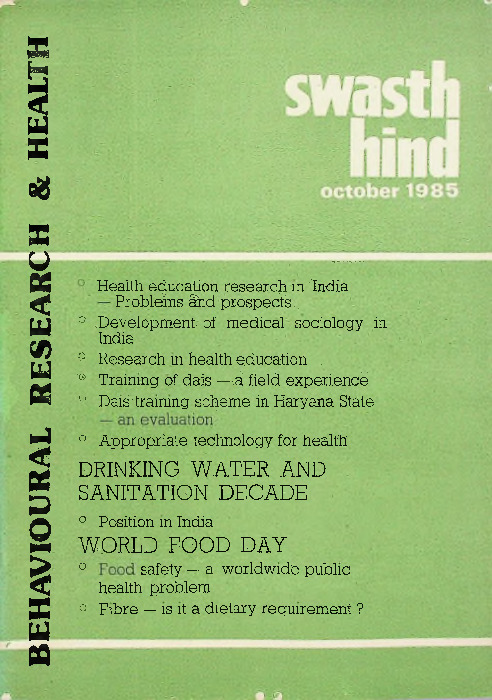
BEHAVIOURAL RESEARCH HEALTH EDUCATION RESEARCH IN INDIA -PROBLEMS AND PROSPECTS
Item
- Title
- BEHAVIOURAL RESEARCH HEALTH EDUCATION RESEARCH IN INDIA -PROBLEMS AND PROSPECTS
- extracted text
-
BEHAVIOURAL RESEARCH & HEALTH
Health 'education research ih India |
|
Piobl^sǤffi_^r6s^d^W^'
^^elelopment- of medical sociology in
India
^•■^esearch w Health've^ea§pn A .
A; Training of dais jMdield exp^eiie^cS;^
° Dai&r^ihing:^c^^ie®i Haryana State
° Appropriate technology for health
DRINKING WATER AND
SANITATION DEOADM
9 Position in India
;W@BE» FOOD day
safety —\a\worldwi8Mpublic'
healtlj pmblem
P j Fibred is it a?dietar|rjequirement ?
°"
In this Issue
swasth
hind
Asvina-Kartika
Paqe No.
BEHAVIOURAL RESEARCH
October 1985
Saka 1907
Vol.
XXIX
No. 10
OBJECTIVES
Swasth Hind (Healthy India)Js a monthly journal Published by
the Central Health Education Bureau, Directorate General of
Health Services, Ministry of Heal th and Family Welfare, Govern
ment cf India, New Delhi. Some of its important objectives and
aims are to :
REPORT and inteiprct the policies, plans, programmes and achie
vements of the Union Ministry of Health and Family Welfare.
ACT as a medium of exchange of information on health activities
of the Central and State Health Organisations.
FOCUS attention cn the major public health problems in India
and to report on the latest trend'; in public healh.
Health Education research in India
—problems and prospects
Dr A. B. Hiraniani & Neelam Sharma
Development of medical sociology in India
Dr S. R. Mehta
242
Research in health education
H. D. Subbe Gowda
248
Training.of dais — a field experience
Dr S. K. Chaturvedi
249
Dais training scheme in Haryana State—an
evaluation
Appropriate technology for health—adaptable
and acceptable
Claudine Brelet
Position in India
REPORT on important seminars, conferences, discussions, etc.,
on health topics.
WORLD FOOD DA Y—16 OCTOBER
Central Health Education Bureau
(Directorate General of Health Services)
251
255
DRINKING WATER AND SANITATION
DECADE
KEEP in touch with health and welfare workers and agencies in
India and abroad.
Editorial and Business Offices
237
257
Food safety—a worldwide public health problem
260
Fibre—is it a dietary requirement ?
Smt. Kamal G. Nadi
262
News
264
Third inside cover
Book review
Kotla Marg, New Delhi-110 002
EDITOR
Articles on health topics arc invited for publication in this
Journal.
N. G. Srivastava
State Health Directorates are requested to send reports of
their activities for publication.
ASSTT. EDITOR
The contents of the Journal are freely reproducible. Due
acknowledgement is requested.
D. N. Issar
Sr. SUB-EDITOR
M. S. Dhillon
COVER DESIGN
B. S. Nagi
LAYOUT
Harbhajan Singh
The opinions expressed by the contributors are not neces
sarily those of the Government of India.
SWASTH HIND reserves the right to edit the articles sent
for publications.
SUBSCRIPTION RATES
Single Copy
Annual
..
..
..
..
.. *
(Postage Free)
25 Paise
Rs. 3.00
Behavioural Research
Health Education Research in India
—Problems and Prospects
Dr A. B. Hiramani
&
N eelam Sharma
While planning and more particularly
while implementing various health pro
grammes, it is logical to know the felt
needs of the people, their ways of life
and the factors that guide their health
behaviour. To understand this, one has
to study the community systematically
and scientifically so that research applied
to health problems must facilitate the
synthesis and translation of results into
the solution for human health problems.
j he health problems are multiple and multidimen*■- sional in 'the country, or which all round efforts
are being made to prevent, control and ultimately
eradicate them.
There has been emphasis on the
health education approach to prevent and control
diseases in the developed and developing countries
as it “embraces the sum of all those experiences of
individual that change or influence his attitude or
behaviour with respect to health and the process and
efforts of bringing these changes about”. The reason
for this approach seems to be due to the growing
realization and recognition that the factors coming
in continuation of illness and maintenance, improve
ment of individual’s health are essentially matters of
October, 1985
human
behaviour. The
epidemiological
studies
come closer (Dhillon, 1969) to the study of social
etiology of diseases when it tries to identify the norms
within various strata of society and their influence
on the exposure of community to the risk of disease,
the extent of prevalence of a health problem, the
mode of transmission of diseases and people’s prac
tices related to prevention and promotion.
Thus,
while planning and more particularly while implemen
ting various health programmes, it is logical to know
the felt needs of the people, their ways of life and the
factors that guide their health behaviour. To under
stand this, one has to study the community systema
tically and scientifically so that research applied to
health problems must facilitate the synthesis and
translation of results into the solution for human
health problems.
Development of Health Education Research
Of late in India, the activities of behavioural re
search in the field of health are visible due to the
concern shown by health planners, health adminis
trators and experts; and growing participation of be
havioural scientists in studying, and examining
various factors related either to the failure of the
health programmes or non-compliance of the com mu nity to change their health behaviour. Research in
health education is directed to discover answers to
pertinent health questions through application of
scientific procedure and to solve problems generat
ing in practice.
A modest beginning in this direc
tion was made by the Central Health Education
Bureau (C.H.E.B.) in the Government Sector in 1956
but actual activities related to health research were
initiated in I960 with a creation of Research and
Evaluation Division which has a major focus to carry
out problem oriented research and research relating
237
to a process on adoption of modern or desired health
practices, development of techniques of communica
tion and evaluation of various national health pro
grammes and training activities.
Next to the Central Health Education Bureau,
another Institution N1HAE (now called NIHEFW)
National Institute of Health and Family Welfare after
merging with (N1FP) came up in Sixties whose
basic focus was on family planning services, strategies
and training the health personnel rather than research
in the field of health.
Two more leaching institu
tions, i.e., All India Institute of Hygiene and Public
Health, Calcutta, and GIRHFW (Gandhigram Insti
tute of Rural Health and Family Welfare) Tamil
Nadu, made a sizeable contribution to develop beha
vioural research through training to health functio
naries and actually undertaking field studies invol
ving both social scientists and physicians. Although
the beginning was made, yet the growth of behaviou
ral research in India was slow during the last two
decades and it did not take off with a speed as in
other fields.
One would certainly like to probe in
depth to realise what comes in the way of develop
mental process of health education research in the
counrty.
Health education research—problems
As far as problems that are encountered in the
health education research, it is difficult to describe
and discuss these all because much have been known
from what is available on human behaviour and pro
cess of behavioural change from basic research.
Health education research does not only consider the
forces within the individual but also those outside
which influence him' in the behavioural sense. How
ever, it is useful to pin point a few which need atten
tion.
1. Methodological Problems—design and conduct
of research: Research carried out to develop health
education takes place in a situation that has close
linkage with the basic tenets of scientific research.
Unlike research conducted in other fields
where
stress is laid on control of all variables excepting
those under investigation, researcher in health edu
cation is hardly able to eliminate or control all ex
traneous factors that may influence the situation
under study. Such situation minimises the effect
of other potential factors.
This is one of the many
frequently encountered difficulties in health educa
tion research.
Moreover, individual behaviour can
not be always measured directly through participant/
non-participant observations.
Again
behaviour
which cannot be measured through observation is ob
viously assessed through verbal reporting and this
too poses problems.
Most health education resear
chers use retrospective approach, when this problem
is compounded due to the accuracy of information
received from the respondent depends upon indivi
dual’s memory which is further subjected to influence
by series of his action and knowledge. Because of
such factors, the health education researchers find it,
more often than not, difficult to follow all rigorous
238
scientific research.
The implication of this is re
flected in a way that the compromise between the rea
lities of the situation and the basic tenets of scientific
research leads to a misconception that such research
is a distortion of the fact and may yield misleading
information.
Further, since health education research can be
viewed in a social system approach in which the in
dividual with his inner forces constitutes a focal
point, individual researchers have their own concep
tualisation and ways of strategy in totality. Moreover,
theoretical orientation of the natural scientist is that
he strives primarily to ‘understand’ behaviour and
only secondarily to ‘change’ behaviour, this is ano
ther research gap as pointed
out by Rosenstock
(1960) in the health educational methodology con
ducted in life like field setting. It is, thus, impor
tant to recognise that theoretical finds cannot be ap
plied in the field setting until simple methods are
found to make it feasible.
Unfortunately, not a
single model can be completely inclusive to provide
an adequate conceptulization from which individual
studies as well as planned, and integrated studies
could be evolved. Thus all methods—diagnostic,
descriptive, exploratory and experimental are in use
and we must accept the need to compromise to have
a balance between requirements to sound scientific
method and what is possible in a given situation.
But, it is disheartening to note that there is hardly
any study conducted in health education in India
that has a sound methodological base. The studies
that suffer from lack of scientific methodology
prompts one to doubt the validity of results and this
undermines the efforts of health education resear
chers.
2. Problem of broad field choices but lack of clear
Priorities : In its totality, research in health edu
cation as reviewed encompases within its periphery
a wide range of valid field choices, viz., communi
cation motivation
research, evalution of training
programmes and family planning, etc., which are all
uncoordinated research efforts as new approach/find
ing cannot in itself be considered a remedy, but
rather as a pre-requisite to the successful application
of largely known remedial action.
The usefulness
of research for the programme depends on the extent
to which the findings are available
*
to the programme
planner and other researchers. However, this lack of
communication between the researchers
duplicates
the research in certain fields while completely neg
lecting the others which in many cases is proved to
be expensive when limited resources are available to
the researchers. Further due to lack of clear research
priority among the broad field choices supplemen
ted by varied research designs, it is difficult to com
pare these research findings and perhaps impossible
to make any generalisations.
3. Difference in Orientation : Another problem
that is constantly encountered by the researchers in
health education, stems indirectly from the health
Swasth Hind
Health education research does not only consider the forces within the individual but also those outside which
influence him in the behavioural sense. Here the social scientists discuss the health problems in a group.
Photo : CHEB
administrators.
Although both, health administra
tors and behavioural scientists, have a common goal,
e., to solve the health poblems, yet they have diffe
i.
rent approaches in solving such problems due to
difference in orientation. The administrators are “a
practising profession and are oriented towards seek
ing solutions to the problem, while social scientists
deal with analysing factors influencing human beha
viour and building theory” (Dhillon 1969).
Due to
difference in orientation and training, health adminis
trators are more interested ’in research that feed them
with quick
results and not in the methodological
issues. In order to satisfy the need of the health ad
ministrators and programme officers, the researchers
have to adopt a course to select a design which may
October, 1985
not fulfil all the tests of scientific methods. Here the
researchers face a dilemma from two fronts; one
from the administrators who demand quick results
with little consideration to the method adopted; and
on the other hand from the professional/colleagues in
the field of social science who always emphasise on
sound scientific methods. The latter many a time
question the validity of the findings emerged out of
a study which have methodological lacuna. Djukamoric and Mach (1975) described it as a weak deve
lopment of ‘total system concept’. Wessen (1969)
suggested that a social scientist should be flexible
depending upon the need of practising profession as
various practice situations provide different challen
ges! to the social scientists.
He examplified that the
239
strategy of a social scientist in the study of health
administration need to be different from the strategy
of social scientists in studying specific problems rela
ted to family planning, nutrition, etc. He further re
marked “the problem- might be intimately linked up
with the power structure and the process of adminis
trative decision making.
A social scientist under
such a situation must face the totality of the situa
tion squarely”. Thus, forces, internal as well as ex
ternal, restrict a choice to adopt a purely scientific
method.
However, this does not mean that research
is conducted at the cost of scientific methods, but
with incomplete control on determinants of human
behaviour and the fullest compliance to the scientific
methods is usually doubted.
4. Problem of Collaboration with peer groups:
These exists the problem of inter-relationship bet
ween the social scientists and public health person
nel working in government set up and. those working
in tile non-government sectors such as universities
and other privately funded research institutions.
However, a gap is gradually bridged up due to rea
lisation that working together by these two groups
contribute considerably in solving much complex
health problems. Here the problem of collaboration
is* not related to the understanding between these two
groups but rather in “approach”. Social scientists in
government set up with inadequate resources have
to work under multiple ‘constraints’ unlike their peer
groups working in free atmosphere for the benefit
of the public and the health research. This compels
social scientists in government set up to look for
close collaboration and association with their profes
sional colleagues in the university to share their ex
periences in national and international forum to
prove their worth to solve health problems.
5. Lack of training facilities: Extensive planning
in health education research certainly requires
research skills and understanding. Motivation to
have training, and decision making process, including
the involvement of peer groups for their support are
essential components of planning research. A few
social scientists in the health field have taken position
concerned with broad planning research functions.
A group of social scientists more particularly working
in health area in government set up at national level,
took a lead to conduct few courses in research
methods: and urged the colleagues in the university
and other research institutions to assume leadership
in preparing health professionals to take up health
education research. Although, there are some ins
titutions in the government set up which train health
professionals in the country, there are very few
which are designed to prepare research workers in
health education. Further more, even by establishing
the training institutes, these will be seriously handi
capped by a lack of funds and qualified faculty.
Unfortunately, despite keen interest in health research
and desire to increase activities of research having
direct focus on health education, there are very few
opportunities open to health professionals or specia
lists to develop themselves.
240
Health education research—prospects
What we notice today is that theoretical findings
cannot be applied in the field setting until simple
methods are found which make it feasible. The
principal gap between theory and practice in health
education research is, to a great extent, due to the
failure to support/recognise applied methodological
research by ‘Us’ who need to stand for the benefit
from such activity.
I. Recognition of health education research: Health
education is yet to be ‘recognised’ as a discipline
either by health professionals or by social scientists
in India, although much is talked of it as one of the
best approaches to bring behavioural change. The
recent slogan spread all over the developing coun
tries that health by the people, and for the people
is nothing but a process of health education through
which their health problems are solved by themselves
in course of time.
But, can we say with certainty
that health education has really been taken care of
for its proper development? The answer is negative.
The Slate Health Education Bureaux (SHEB’S) are
the agencies to develop health education in all its
respect; training, educational methodology, strategy
and research.
A survey conducted by the C.H.E.B.
in 1980 presents a disheartening picture that the re
search division as such does not exist in any of the
eighteen SHEB’s who responded, barring only one
with researchscum-action project unit. The reason
for this state of affairs seems to be an indifferent
attitude of health administrators (CHEB, 1980).
However, mere recognition of health education re
search without sufficient availablity of reasearch funds
will hardly encourage young scientists in promoting
research in health education.
Although little is
evident in few government-funded agencies, there is
an urgent need to recognise prefessional organisa
tions concerned with health education research so
that they can assit in raising the health standard of
the community by solving their felt needs.
2. Need for centralised reference source : The use
fulness of research for a programme depends on the
extent to which the findings are available to the pro
gramme planners.
In addition, researchers need to
review the literature in order to develop study
designs based upon the known findings and attempt
to solve the unknown.
The effective communication
of research findings between the researchers and the
planners is, therefore, an essential step in the utilisa
tion and promotion of research. For this, emerges
a need for centralised reference source which may
collect, abstract and synthesize available research re
ports to minimise communication gaps which is im
portant for the development of the programme. Vidayarlhi (1969) remarked “the problems of our country
are numerous and the resources are limited. We
cannot afford to duplicate research”.
Since health education research be viewed in a
total system approach and also as endorsed by
W.H.O. (1969). a tentative conceptual model for or
S was th Hind
ganizing health education research be a three dimen
sional; there is a need for ‘collaborated efforts’ for
identifying the area in which top priorities ought to
be given.
This collaborative efforts to strengthen
action research will not only enrich the methodology
but also help in developing new, comparative and
analytical procedures while differentiating from well
designed to poorly designed research.
1. Mutual understanding is required between diffe
rent disciplines to consider various health problems
which are not only related with biological constitu
ents of the individual but are also closely linked with
individuals socio-cultural, psychological and economic
characteristics. Thus, one discipline must recognise
the constructive role of other discipline in the process
of tackling the problem.
3. Need for training : Collaborative efforts of
practitioners and social scientists can increase the
possibilities of applying the findings in action situa
tion only when the difference in their orientation is re
moved. Teaching of different social science methods
which can be used to study and evaluate various
health and training programmes is another activity
that needs serious attention.
Butt (1969) remarks
“there is a great need for operational research aimed
at ascertaining as to how training could be more
meaningful, what changes it produce on the trainees,
and how to develop better methodology for extension
training of the field workers'”. Further it is not only
the behavioural scientists who need to know diffe
rent methods involved in behavioural research in
health; but teaching to medical graduates and profes
sionals would greatly contribute to strengthen this
field.
2. A common understanding that a compromise
between existing situation and flexibility of scientific
methods though ‘little’ should prevail amongst health
administrators and behavioural scientists in the field,
be in government or non-govemment sector. To
achieve this, frequent dialogue between these specia
lists should take place at various levels.
4. Collaboration with universities and research
institutions'. The Universities
in the country can
play a major role in solving most of the above men
tioned problems and in strengthening the field of re
search in health and health education.
The depart
ments such as Sociology, Anthropology, Economics
and Psychology can undertake an exercise through
their students who could work on their M.Phil, and
doctorate degrees on the problems relating to the
field of health.
Medical sociology which has been
gradually coming up in few universities, does fall
short in the efforts to promote this field.
Thus,
there is a need to recognise and finance this inter
*
disciplinary approach. It is, of late, this interdisci
plinary approach, i.e., social sciences and medical
education along with other sciences are making a
dent to discover solution to the health problems which
are linked with socio-biological aspects.
The begin
ning, albeit is very slow but can be accelerated by
orienting the physicians as well as behavioural
scientists in scientific foundations, theoretical and
practical techniques and methods of health education
research.
Suggested remedies
Problems in health education research are not too
many to resolve. As of today, no forum exists either
at national or state level which may frame guidelines
on mechanism,
criteria for determining research
policies and priorities. In the absence of such poli
cies, adhocism continues to hamper progress of rese
arch in different health programmes. To avoid this,
following remedies suggested would help encounter
some of the health education research problems:
October, 1985
3. Choice of priorities of health education research,
as evident today is not guided by any uniform poli
cies. The programme officers who are consumers of
the findings of health education research need to decide
the priorities
for research in close collaboration
with behavioural scientists, after sorting out major
problems regarding methodology.
4. Training in health education research need to be
undertaken not only by those organisations engaged
in health education, but also by the universities,
research institutes, medical colleges and voluntary
organisations too, which directly or indirectly are con
cerned with health and health enducation activities.
This will not only avoid duplicate research but will
also help in proper utilisation of resources.
REFERENCES
Butt,
H. (1969)—Conference on Review of Behavioural
Research in Health Extension Educators, May, 19—20'
CHEB. New Delhi.
CHEB
1980—Status of Health Education Bureau, New Delhi.
Dhillon, H. S. (1969)—Behavioural Sciences in Public Health
Contributions and Problems limiting collaboration.
CHEB? Technical Series-5—Central Health Education
Bureau, New Delhi.
Djukamoric and Mach (1975)—Alternative approaches to
meeting basic health needs in Developing Countries,
UNICEF/WHO Study, Geneva.
Roscnstock, I. M. (I960)— Gaps and Potentials in Health
Education Research. Health Education Monograph No- 8.
Vidayarth'. G. S. (1969)— Conference c n Review < f Behavioural
Research in Health andE xtension Education. Ibid.
Wessen, A. F. (1969)—Ibid.
W. H. O. (1969)—WHO Technical Report Series — Research
in Health Education — Report of a WHO Scientific
Group No. 432.
241
DEVELOPMENT OF MEDICAL SOCIOLOGY
IN INDIA
Dr S. R. Mehta
Medical sociology is to be conceived as
a discipline dealing with an interface bet
ween the providers and consumers of health
and medical care services in India in view
of a large population seeking services from
available health care facilities, says the
author. The author, being a participant
observer in the growth and development
of Medical Sociology in India, discusses
in this article the Medical Sociology as
a discipline, its development and future
in India.
recognition of the fact that the health of an
*•- individual is more than a biological phenomenon
has brought into forefront the significance of behaviou
ral dimensions of health. As a consequence of cultural
relativism, every society views health problems from
the perspective of its own culture and provides cop
ing responses according to the understanding, know
ledge, values, attitudes and beliefs of the people com
prising it. (Mechanic, 1978). As such, traditional or
quasi traditional societies are likely to have diffe
rent orientations towards the social and cultural as
pects of health and disease than the modern advanc
ed societies of the west.
r | 4he
Medical Sociology as a discipline
“Medical Sociology”, “Sociology of Health” and
“Sociology of Medicine” are different terms employed
to refer to studies of individuals and groups in inter
action with the environment, disease host and agent
or carrier of disease affecting the health through ill
ness, sufferings, pain and discomfort and efforts made
in restoring their health' to a normal state through
self or directed efforts of the practitioners of health
242
(Metha, 1982). The practitioners of health may be
practicing folk indigenous or modern systems of me
dicine. This would necessitate reviewing the concept
and methods of medical sociology since it got evolved
and developed in the United States of America where
allopathic system of medicine flourished to its full.
The concept of illness was viewed as unmotivated
deviance, remediable by the application of rational
knowledge owned by a special class of persons
(Parsons, 1951). In delineating the sick-role concept,
the sufferer is not to be held responsible for his devi
ance, he is exempted from his normal obligations and
also expected to seek competent help and cooperate
with the treatment in order to become normal actor
in the social system. Within this functional perspec
tive, Cockerham considers ‘Medical Sociology’ deal
ing with social facets of health and illness, the social
functions of health institutions and organisations, the
relationship of the system of health care delivery to
other social systems, besides studying the social beha
viour of health personnel and those people who are
consumers of health care (Cockerham, 1978).
The functionalist framework on the sick-role con
cept has been criticized for presenting a monolithic and
homogeneous social structure whose participants act
under the influence of exterior, reified values. Though
Freidson, following the labelling theorists, recognises
the relevance of cultural pluralism (Freidson, 1971),
his plural groups remain sub-servient of their values.
Further, Freidson tends to treat western scientific
knowledge as more valid than other kinds of know
ledge including folk medical knowledge which may
not be true in all situations. This led Dingmall to
advocate ethno-medicine approach in understanding
the concept of illness.
Illness may be viewed as a form of failure at every
day life, a disruption in the “familiar and taken for
granted” state of affairs between subjective experience
Swasth Hind
of one’s own body and one’s knowledge, of what is
normal experience or conduct, determined by a com
petent member of some collectivity. Thus ethno
medicine considers medical knowledge invoked by
the physician to interpret a patient’s behaviour iden
tical to the knowledge invoked by a lay person to any
other person’s behaviour or conduct. (Dingwall.
1976). This provides a wider perspective to the
understanding of concepts of health and illness and
management and organisation of health services by
including within its purview the folk and indigenous
medicines and self medication practices of the lay
persons (Mehta, 1984). These are based on the
knowledge that members of some collectivity draw on
to make sense in their social and natural world and
on the content and organization of that knowledge
(Dingwall, 1976).
Mehta also argues that Medical Sociology is to be
conceived as a discipline dealing with an interface
between the providers and consumers of health and
medical care services in our context in view of a large
population seeking services from limited health ser
vices (Mehta, 1982). The notion of health, as perceiv
ed by the people, is likely to affect the motivational
aspects related to the preventive or curative medical
and health care. In this context another perspective
often used to study the preventive aspect of health
behaviour is the “Health Belief Model”. According
to this, an individual’s perception that he or she is
personally susceptible and that the occurrence of the
disease would have a severe implication of a personal
nature, motivates him or her to go in for preventive
practices to avoid illness (Rosenstock, 1966). Further
the delivery of health care system has to be determin
ed by the health expectations of the people and these
are also influenced mostly by the social, cultural,
economic and situational factors in the community. In
view of limited medical manpower, that too concen
trated in urban areas, a plea has been made to bring
a large manpower resource of indigenous medicine
men and homoeopaths (nearly four and a half lakhs
in India) to the main stream of health delivery system
of the rural areas (Mehta, 1984, 1982, 1975).
Besides, at the Alma Ata Conference (September
1978) on Primary Health Care, it was recognized that
in view of a large majority of population in the deve
loping countries residing in rural areas, where health
resources are scarce, it is necessary to provide them
with low-cost accessible and relevant health care
through their involvement and participation (WHO,
1980). However, Mehta on the basis of analysis of
October, 1985
country case studies on Teamwork in Primary Health
Care has raised a fundamental question: “Can the
delivery system of primary health care through team
work be effective without a change in the bureau
cratic and socio-political structure of developing na
tions” (Mehta, 1984).
In the above backdrop, Medical Sociology in the
context of the developing nations has a far greater
challenge to face and a wider canvas to cover as a
part of its nature and scope. Community participa
tion and involvement in the organization and manage
ment of health care at the local level, adequate referral
system to the secondary and tertiary based hospital
care services, involvement of traditional systems of
medicine and folk practitioners or traditional birth
attendants, besides the extended role of medical pro
fessionals, para-professionals and semi-professionals
in health care, would be added dimensions of Medical
Sociology. Medical Sociology per se, does not have
theories of its own and follows the perspectives of
sociology in delineating different concepts and methods
related to health problems of the people. But the
new challenges in the field may provide new configu
rations of knowledge on social realities related to
health for generalizations on the basis of emic and
etic categories of analyses.
Development of medical sociology in India
Medical sociology is reported to have developed in
the United States of America, mainly because of the
setting up of National Institute of Health there in
1940 and later on due to the establishment of Na
tional Institute of Mental Health which promoted
research and provided funds to both medical and
social scientists during the sixties to pursue their
research interests in this field (Cockerham 1978).
Talcott Persons was perhaps, first among the socio
logists, to have developed the concept of the sick-role
and his functional perspective had extensive bearing
for long on the sociological research related to the
health field. (Persons 1951). We do not have any
evidence of the contribution of Karl Marx towards
the sociology of health, though quite lately, some of
the scholars have started using the concept like poli
tical economy of health approach.
Notwithstanding the significance of different pers
pectives of sociology in the growth and development
of medical sociology, it is observed that there is not
as yet full concensus both among physicians and
sociologists in regard to the juncture of medicine and
sociological research because of variations within each
243
‘Medical Sociology5 deals with social facets of health and illness, the social
functions of health institutions and organisations the relationship of the system
of health care delivery to other social systems, besides studying the social behaviour
of health personnel and those people who are consumers of health care.
field. Further, due to complex nature of health and
disease behaviour as a consequence of interaction of
biological, social, cultural, psychological, economic,
physical and situational factors in different permuta
tions and embinations, there is increasing emphasis
for a health Social Scientist than a Medical Sociologist
or Anthropologist of Psychologist.
Among the sociologists, Robert Strauss made an
attempt to provide two closely interrelated areas of
Medical Sociology:
‘Sociology in Medicine’ and
’Sociology of Medicine', the former emphasizing the
collaboration of the sociologist with the physician and
other health personnel in studying social factors rele
vant to health disorders whereas the latter focussing
on organization, role relationship, norms, values and
beliefs of medical practice as a form of human beha
viour (Robert Strauss, 1957). Hyman also makes
distinction between two types of sociologists, one set
of them utilizing the medical settings as convenient
“Strategic” places for the testing of general sociolo
gical theory and the other involved in the application
of sociological theory and research to the solution of
medical problems. He considers the first category of
sociologists as with “deductive” orientation and the
second with “inductive” orientation (Hyman 1968).
The development of Medical Sociology in post in
dependence India, was on the pattern of “Sociology
in Medicine” and “Inductive Orientation” type, as
sociologists and social anthropologists were for the
first time involved in the public health programmes
during the fifties by the Government of India. I had
the unique opportunity of being a “Sociologist
in
Medicine” with “Inductive Orientation” and shifting
over to “Sociologist of Medicine” with “deductive
orientation”. This provided me with an opportunity
io be a participant observer in the growth and deve
lopment of Medical Sociology in India.
Sociologists and Social anthropologists were involv
ed in the mid-fifties as members of multi-disciplinary
team of health personnel, administrators, practi
tioners,, educators, sanitarians, etc., in the Govern
ment of India research-cum-action projects on envi
ronmental sanitation, sponsored by the Ford Founda
244
tion, at Najafgarh (Delhi) and Singur (Calcutta). The
focus on these projects was to carry out operational
evaluation research, with the objective of providing
feedback to the team members in regard to the social
structural elements and cultural patterns influencing
health of the people affected by environmental sanita
tion and the acceptance of rural latrine programme by
the villagers. Besides the environmental sanitation pro
jects, around the same time, an epidemiological survey
was launched as a part of planning and programming
of National Tuberculosis Programme at Bangalore
and a medical person with an orientation in Anthro
pology was hired to carry out the operational studies
under the tutelage of a W.H.O. consultant for draw
ing out the plans for the tuberculosis control in the
country.
After the termination of these projects, the sociolo
gists and social anthropologists engaged over there
got research or training positions in the newly created
National Institutes such as the Central Health Educa
tion Bureau or the National Institute of Health Ad
ministration and Education in New Delhi.
These
institutes, set up by the Government of India in early
sixties, boosted up the role of behavioural components
of health administration and education in different
areas as a number of studies were carried out on na
tional health programmes such as malaria, smallpox,
tuberculosis, leprosy, maternal and child health,
family planning, etc. Besides, the training pro
grammes of health administrators and educators at
different levels were strengthened with the social
science components.
For the first time in 1964, a
forum was provided for the interaction of social scien
tists, medical administrators and health educators by
N1HAE in the form of a seminar on Social Sciences
in Health Administration. Later, in 1969, CHEB
organized a conference on Researches in Health Ex
tension Education, which provided a review of research
studies. With the introduction of family planning
programme at the National level and the expansion
of health education activities in different States, the
involvement of social scientists in the health culture
increased manyfold. Postgraduate diploma courses
in health education at the All India Institute of
Hygiene and Public Health, Calcutta (affiliated to
Swasth Hind
Calcutta University), Gandhigram Institute of Rural
Health and Family Welfare, Gandhigram (affiliated to
Madurai University), and at the Central Health Edu
cation Bureau, New Delhi (affiliated to the University
of Delhi) and an M.D. (Community Health) pro
gramme at National Institute of Health Administration
and Education, New Delhi, were started. These courses
had a large component of social sciences, and social
scientists were involved both in research and teaching
programmes. Social and Preventive medicine depart
ments were also started in medical colleges to provide
community orientation to the young graduates. In
addition, a State Government Organisation at Lucknow
(Planning Research and Action Institute) also carried
out a number of studies on the health behaviour as
pects in the rural areas.
After the establishment of the Indian Council of
Social Science Research (ICSSR) in the early seventies
as an apex body at the national level for the promo
tion of social science research, the central Health Edu
cation Bureau, New Delhi, organised another seminar
in New Delhi under the joint auspices of ICSSR and
ICMR (Indian Council of Medical Research) on
‘Social Sciences in Health’ in 1972. But over the
years, the tempo of social science activities in health
organisations appears to have slowed down. This
may partly be due to turn over of social science orien
ted leadership from the health institutions at National
level and partly due to merger of National Institute
of Health Administration and Education and National
Institute of Family Planning, resulting in professional
biases of health or family planning. Consequently,
the contribution of sociologists in the health field has
been affected. The development of these health
institutions has been observed to assume a parabolic
curve and unless these are revitalized by providing
dynamic leadership and reorganizing these to the
changing national needs, the ‘sociologists in medicine
may not be in a position to make some definite con
tributions.
The declining interest in social science contribution
in the health institutions seems to have been compen
sated by rising interest in Medical Sociology in the
Universities over the years. However, the spread of
this interest has been limited to a few University De
partments of Sociology, Anthropology or School of
Social Works: This was largely reflected by field re
port dissertation of students at their post-graduation
level in areas related to health field. The interest of
sociologists was hardly visible in medical sociology
October, 1985
during fifties and sixties but subsequently from seven
ties onwards, we do observe that as sociology attain
ed adulthood in India, some sociologists developed
interest in wider spheres including Sociology of
Health. Earlier we do have an account of a few
sporadic studies often by-products of a large number
of village and community studies, focussing upon the
social and cultural aspects of health and medical care.
These provided insights on folk and western medicine
practices in certain rural and tribal areas, on belief
structure, health notion and on attitudes of people
towards health practices, etc. The interest in the
Sociology of Health among the university scholars
was accelerated as a consequence of their interaction
with some of the sociologists in the health organisa
tion as they always turned towards their professional
peers in universities for theoretical frameworks rele
vant to the studies in the medical setting.
Most of the sociological studies done in India fol
lowed western paradigms and concepts. Sociologists
in certain quarters condemned these and vouched for
Indianisation of studies in terms of orientation, ap
proach and value relevance, while others advocated
sharing of sociological knowledge having universal
application across the international boundaries. A
few studies in the area of Medical Sociology done by
Indian scholars for their doctoral dissertations or
even those carried out by senior scholars are again
biased towards western concepts and models. These
studies are inadequate in number as well as in quality
in terms of coverage of dimensions, restricted sample.
urban and institutional bias, etc.
A centre of Social Medicine and Community Health
was established in Jawahar Lal Nehru University
during the seventies and a few Sociology Departments
in Universities have become sensitive to the field of
Medical Sociology. In a seminar on “Teaching .and
Research in Medical Sociology in India” organized by
the Department of Sociology; the University of Jodh
pur, under the auspices of the University Grants
Commission, during 15-17 January,
1982, it was
reported that Rajasthan University (Jaipur), Univer
sity of Udaipur, University of Jodhpur, University
of Poona, Banaras Hindu University (Varanasi), Uni
versity of Hyderabad and Panjab University (Chandi
garh) are providing Medical Sociology Courses at Post
graduation level. Towards further development of
Medical Sociology
in the Universities, the Indian
Council of Social Science Research, the Indian Coun
cil of Medical Research and the University Grants
245
Commission should make joint efforts and institute
Chairs in some of the University
departments in
Medical Sociology.
We do observe that over the years, the medical
personnel have shown greater appreciation and under
standing of the role of utilization of social science
concepts and methods through the involvement of
sociologists in the health programmes. As such, it is
imperative to bring the medical and social science
personnel together to evolve a health social science
culture for tackling some of the operational, organi
sational and management problems related, to health
care. |
There is no doubt that the development of medical
sociology in post independence India has been very
slow. The sociologists in health institutions had no
autonomy of their profession and worked under con
straints. They had to forego theoretical sophistica
tion and methodological rigour in many of the studies
done by them because of pressure of time from the
planners and administrators.
Notwithstanding their
constribution. they provided some useful insights in
to behavioural aspects of health which generated in
terest among the sociologists in the academic world.
However, the contribution made by sociologists in the
Universities is limited and needs to be further streng
thened. Also, there is a need for a close collabora
tion and frequent interaction between ‘Sociologists
in Medicine’ and ‘Sociologists of Medicine’ to make
the application of Medical Sociology more relevant to
national health needs and problems.
Future of medical sociology in India
Health is an important sector of development. It
is well known that no nation can make progress and
achieve economic development until the health of its
people is taken care of. However, the Health Sector
gets a low priority in the development plans (the
Health outlay for the 6th plan is reported to be only
Rs. 3862.8 crores, out of which Rs. 1010.0 crores is
earmarked for Family Planning). But in order to
tackle the problem of infant mortality rate among the
poor who constitute nearly half of the population in
India, it is advocated that the health policy should
concentrate on far reaching public health and nutri
tional measures, affecting directly the living conditions
of this vast poor group. The public health and nu
tritional measures in the community require larger
resources in terms of men, money and material and
unless the planning priorities are clearly defined there
246
is hardly any scope to develop them. This will res
trict the community dimension of the health pro
grammes and consequently the involvement of medical
sociologists.
In the above backdrop, with the health sector
getting a lip sympathy in the development what could
be the future of Medical Sociology in India? But if
we are concerned about having better understanding
of the health behaviour of our people in order to
relate our health services to their needs, we shall have
to allocate more funds for the development of social
science research and teaching programmes in the
health sector. Further, in order that the role of
Medical Sociology gets established with the health
planners and administrators, there is an urgent need
to strengthen the basis of Medical Sociology in Uni
versities and National Institutes of higher learning.
This is essential for bringing credibility to the disci
plines with the health planners and administrators, as
quite often they consider social sciences dealing with
the obvious and doubt their utility for problem solv
ing, how-so-ever that ‘obvious’ may be based on em
pirical facts.
It is also suggested that for the furtherance of Me
dical Sociology in India, young and bright students of
sociology, social anthropology and social psychology,
should be made interested to take up research studies
in health field at M.A., M.Phil, and Ph.D. levels.
After the completion of their studies, they can find
entry points in health organisations and institutions
to demonstrate the utility of their acquired knowledge
for tackling health problems in different settings. In
this direction, the University Grants Commission, the
Indian Council of Medical Research and the Indian
Council of Social Science Research,
should make
concerted efforts to promote Medical Sociology by
offering fellowships and scholarships to students to
undertake research in health and by encouraging
selected teaching departments in the universities to
institute Chairs in Medical Sociology. There is also
a need to organise and promote research in Medical
Sociology at the higher level. It is hoped that if this
potential resource development in Medical Sociology
is enhanced, it could contribute significantly towards
a better understanding of behavioural or non-biological aspects of health, hitherto being recognised as es
sential in the “total” concept of health encompassing
disease or illness dimensions and to conceive Medical
Sociology within the framework of an interface bet
ween different sets of providers and consumers of
health care in the developing nations.
Swasth Hind
on Teaching and Research in Medical Sociology, Depart
ment of Sociology, University of Jodhpur (Jan. 15—17, 1982)
Published in Sociology of India (ed.) P.K.B. Nayar, New
Delhi, B.R. Publishing Corporation, 1982. Some of the
main ideas contained in this paper have been presented in
the present artcle.
REFERENCES
Cockerham, William, C, Medical Sociology,
Englewood Cliffs, Prentice Hall Inc. 1978.
New Jersey.
Dingwall, Robert, Aspects of Illness,
berston and Company Ltd., 1976.
Martin Ro-
London.
Frcidson, Eliot, Profession of Medicine, New York,
Mead, 1971
Dodd.
Hyman, D. Marlin, “Medicine" in the Uses of Sociology in
Paul F. Lazarsfeld el. al. feds.) Weidenfeld and Nicolson,
5, Winsley Street, London, 1968.
Mechanic. David, Medical Sociology, MacMillon and Com
pany, 1978
Mehta, S.R. “Rural Development: Performance of Social
Services” Rural Development Policies and Programmes'.
' A Sociological Perspective: New Delhi. Sage Publications
India Pvt. Ltd., 1984.
Mehta, S.R. “Teamwork in Primary Health Care: An Analy
sis of Country Case Study" Discussion paper for Consulta
tion Meeting on Review of Country Studies (30 July—3
August 1984). New Delhi, World Health Organization,
SEARO, 1984.
Mehta, S.R. "Some Consideration on Health and Medical
Care Delivery System”.
Paper presented at XVI All
India Sociological Conference.
Anna Malai University.
(Dec. 29—31), 1982.
Mehta, S.R. "Rural Health Services—The Untapped
Re
source” in NIHAE Bulletin, Vol. VIII. No. 2. 1975. Also
reproduced through courtesy NIHAE Bulletin in YOJANA
New Delhi. Planning Commission, Vol. XIX No. 22. Dec.
1975.
Persons. Talcol, The Social System, Glencoe. Illinois, Free
Press, 1951.
Ramasubban Radhika, ‘The development of Health Policy
in India” in India’s Demography: Essays on the Contem
porary Population (Eds.)
Tim Dysom, Nigel Crook.
New Delhi, South Asian Publishers, 1984.
Rosen Slock. Irwin, "Why People Use Health Services”, Mill
bank Memorial Fund Quarterly, 44 July, 1966, 94—127.
Mehta, S.R., Towards a Profession of Health and Professio
nalization of Health Personnel” Paper submitted at seminar
on Sociology of Profession at Department of Sociology,
University of Jodhpur, (Oct. 13—16, 1984) New Delhi
Indian Journal of Medical Education (Forthcoming).
Strauss. Robert. “The Nature and Status of Medical Socio
logy” American Sociological Review. 22, April. 1957. pp.
200-204.
*Mehta, S.R., ‘Sociology of Health and Medical Care: Re
search Needs and Challenges” Paper presented at Seminar
World Health Organization, Strategies for Health for All by
the Year 200 A.D. New Delhi, SEARO, December, 1980.
-------------- ———
CHANGE OF ADDRESS
I Please don’t forget to intimate the change of address.
To ensure prompt supply of Swasth Hind,
|
please quote your Subscriber Number.
For all enquiries, please write io :
The Director
Central Health Education Bureau
(Directorate General of Health Services)
Kotla Marg
New Delhi - 110 002
October, 1985
247
Research in Health Education
H. B. Subbe Gowda
Research literarily means seeking solutions to the problems. Health education
research means also to discover answers to meaningful questions through application
of scientific procedures.
O esearch in health education is mostly directed toAV wards finding a solution to the problems posed in
inplementing health programmes. In this sence, the
research in health education is more problem oriented.
The research of this type more or less is designed for
application rather than basic research discoveries.
In basic research, the attempt would be to discover
new findings, which are not existing, whereas in health
education research there is an altogether different
task. For example, how to develope a most suitable
contraceptive is a basic research, and if there is a
problem for people to accept the designed contracep
tive, finding out the reasons is health education re
search.
Research literarily means seeking solutions to the
problems. Health education research means also to
discover answers to meaningful questions through ap
plication of scientific procedures.
According to Frank, health education research is a
dynamic approach to whole situation. Such research
would provide the perceptions of entire situation and
to find better ways to meet the situation.
In the implementation of Public Health Programmes,
it is attempted to change the social and health beha
viour, and the change of social or health behaviour is
248
a difficult task, and many problems’’are posed in the
process of initiating a change. The research is a tech
nique used to determine the extent of causes or rea
sons to such problems and further directed to suggest
ways and means to overcome the problems. It aims at
locating or identifying the barriers to the anticipated
achievements and to discover the suitable means to
attain the goals.
Health Education research is equally important to
assess the felt or the real need of the community in
addition to the other health needs. Again it is impe
rative to assess under each programme or the pro
blems of the community, the quantum of knowledge,
attitude, opinion, beliefs, sentiments, thinking, emo
tions; values and norms, etc., which are the operating
forces for all needs. Therefore, assessment of health
needs is important in research.
Social structure of the community helps in under
standing the people, their reactions, attitudes, behavi
our towards the programme, and it will be very much
useful for programme implementation. If we know
the community structure, their sub-groups, relation
ships, their leadership patterns by way of research, it
will help in programme implementation and its eva
luation. Obviously research in health education and
assessment of health
*
needs are the different sides of
the same coin which are interrelated and interdepen
dent.
OO
Swasth Hind
TRAINING
OF DAIS
A FIELD EXPERIENCE
Dr S. K. Chaturvedi
The Rural Health Training Centre, Naila, in
Rajasthan has been training the indigenous
Dais since 1976. This centre also provides
comprehensive
health
care
to
40,000
population in 54 villages and has been actively
involved in public health research, training of
undergraduate medical students, interns, doctors
under the Multi-purpose Workers (MPW) Scheme
and para-medical staff of different categories.
The author in this article brings out some
interesting facts about Dais, their practices and
training.
here are 38 active dais who cover the 54 villages
T
of the Rural Health Training Centre (RHTC),
Naila. The average age is about 47 years ranging
from 35 years to 53 years.
The area of operation
does not extend beyond 2 or 3 villages on an average.
In some villages more than one dais were found prac
tising having different periods of working during the
year with division of households in the village. These
dais are not solely dependent on their so called exper
tise in midwifery but most of them are agricultural
labourers. They are illiterate and the technical knowIhow was passed on to them by their mother-in-laws.
We had planned to (rain these dais well in
aadvance to government’s scheme, with the objectives
t*o enable them to conduct safe deliveries and involving
tlhem in the delivery of Maternal and Child Health
October, 1985
(MCH) services in the area. This centre distributed
locally devised sterile delivery packets to the interest
ed and approachable dais free of cost. This packet
consists of 1% Tr. Iodine in an autoclaved vacuum
sealed vials, sterile half shaving blade, autoclaved
gauze piece, a little cotton and strong thread in a
sealed polythene bag (4" x 4" size). This packet is
disposable and meant for use only once. Instructions
as regards to its use were given to dais when they re
gistered themselves with the centre.
It was highly
acceptable and dais showed active interest in its use.
For the supply of another packet it was necessary to
register the birth they conducted with the Auxiliary
Nurse Midwife (ANM) thus bringing the mother and
child under the umbrella of MCH services.
Meanwhile the government’s dai training programme
started in 1978. The centre did not have to face much
difficulty in selecting dais for this training as some of
them were already using the sterile delivery packets
but some offered resistance owing to misunderstand
ing that they were being taken into government ser
vice and might be sent to some other place after tra
ining; distance of centre from their residence; loss of
time and work, restrictions put on by mother-in-law ‘
and husband and hesitation on their part. They were
totally unaware of the modem hygienic and obstetric
sciences and had low levels of understanding. But it
was pleasing to note that if they were taught in local
language in an informal environment and revising the
topic from time to time and whenever the opportunity
249
arose, they could grasp the subject with ease. Films,
slides and demonstration on models, flash cards and
flip charts were of immense help in carrying out the
training programme.
Those who come for training have long experience
of “socalled" skill with staunch cultural and social
background which cannot be changed over night.
Therefore, it would be unwise to reject abruptly what
they have been doing till now but should be substitut
ed slowly with the modern knowledge giving illustra
tions of their level of understanding. It was observ
ed that these ignorant ladies got curious to know more
about modern midwifery practices. It is necessary to
know the local practices and folk terminology before
hand.
Learning experience
The classroom teaching and demonstration might
go waste unless supplemented with the opportunities
of ‘learning experiences’. Keeping this fact in mind
trainee dais were exposed to field practice alongwith
ANM/LHV (Lady Health Visitors) covering different
aspects of matemal and child care and practical de
monstrations on the subject concerned. The field visits
were planned for four days a week and the trainees
were assessed regularly for what they learned in the
field. The training was to be carried out for 30 work
ing days, a weekly programme of lectures it demons
trations and field visits was designed to cover each
MCH activity, i.e., ante-natal care, post-natal care, in
fant and toddler care alongwith family welfare. Moti
vational aspects of immunization and nutrition were
specifically stressed during the training. This schedule
gave very encouraging results. Every dais was requir
ed to conduct two deliveries under supervision of
MCH staff as per recommendations. It provides good
practical exercise but often impracticable due to so
cial and administrative reasons as observed during
the training here. The best way, as followed at this
centre, is to let dais work in their area of operation
and send in a call to ANM to help and supervise the
conduction of delivery. Lectures/demonstrations on
asepsis, normal and abnormal labour require repetition
as and when opportunity arises relying mainly on persuation and recalling. One should restrain using diffi
cult and technical terms. The use of local dialect crea
tes a sense of homeliness and let dais feel that they are
not being examined and harassed. More attention must
be given to the kit during training as regard to its
maintenance in proper and aseptic condition. Many
dais could not open the kit properly when asked to do
so well after months of training. It was not uncommon
to see used enema can and its tube being kept along
with scissors and other contents in the kit. Bowels and
kidney trays might be seen out side the kit. The soap
provided for washing hands was also used for bathing
after conducting the delivery as they used to do earlier.
Dais should be warned of such carelessness and irre
gularities during and after training.
Many trained
dais had a feeling that the kit was not handy and
they preferred the sterile delivery packet provided by
this centre. Occasionally they would use the scissors
and liked to use the shaving blade supplied in the
packet. Washing of mackintosh (walerfoot cloth) spron
and boiling of articles was not upto satisfaction. Boil
ing period (15 min) requires special mention. There
may not be the facilities for recording of time. To
overcome this difficulty, the boiling period must be
standardised with some common activity lasting for
the prescribed sterilisation time period. Easiest me
thod of diagnosis of complications should be preferr
ed. c.g.. for dejection of puerperal fever she may be
asked to put the back of her palm on the forehead
and compare with her own temperature. Counting
pulse with the help of sand glass or reading thermo
meter seems impracticable as most of them are illite
rate and might fail to interpret properly. Anaemia
may be detected be seeing the colour of conjunctiva
and nails.
{Conrd. on page 254)
Doubt clearing session
after a teaching class.
250
Swasth Hind
DAIS TRAINING SCHEME IN
HARYANA STATE
—An Evaluation
*
An evaluation of Dais Training Scheme
was carried out in 14 States in India in
which nine research and training institutions
participated. The study was conducted at
the instance of the Government of India.
This training scheme has been considerably
expanded in the entire country since 1978
with financial assistance from the United
Nations Family Planning Association.^
The Central Health Education Bureau
undertook the study in the States of Haryana
and Himachal Pradesh. We publish here a
summary of the evaluation study in Haryana
State. The study has dealt with various
aspects of implementation of Dais Training
Programme and its efficacy in terms of
Trained Dais" performance in their profession
after their training and also as compared
to untrained Dais.
(ii) Professional apprenticeship and experience as
Dai;
(iii) Motivation for training;
(iv) Inter-personal relationship
with other Dais,
health functionaries and community; and
(v) Dais’ performance perception regarding last 5
cases in relation to (a) cases registered and care
provided at various stages, (b) deliveries con
ducted independently and with health workers,
(c) referrals and (d) family planning motivational
activities.
2. To assess the training of Dais including their per
formance in terms of: —
(i) Enrolment;
(ii) Duration;
(iii) Facilities at the training centre (physical re
sources);
(iv) Curricular inputs;
(v) Field training organisation, deliveries conducted
(supervised and unsupervised);
OBJECTIVES OF STUDY
Broad objective
(vi) Dais’ role and responsibilities;
Major objective of the study was to find out the qua
lity of Dais’ training, their present functioning, changes
in their practices, community perception of services
rendered by them, collaboration/co-ordination with
health functionaries and performance of health workers
in relation to training and guidance provided to Dais.
(vii) Trainers' capability and motivations;
Specific objective
1. To study the profile of trained and
Dais in terms of:
untrained
(i) Socio-cultural, education status and income va
riables;
(viii) Teaching methods and aids used;
(ix) Inter-personal interaction between trainees/
trainers in the class and field with emphasis on
handling of responses and procedures of rein
forcement of learning;
(x) Level of communication vocabulary, termino
logy and language used;
(xi) Evaluation procedures, testing methods
feed-back to trainees;
and
*B. C. Ghosal, A. B. Hiramani, V. P. Srivastava, Usha Srivastava, S. P- Verma, A. Sarkar
October, 1985
251
(xii) Need for continuing education (retraining) as
perceived by Dais and trainers;
(xiii) Use of reference/teaching material;
(xiv) Management of training inputs and
honorarium stipend, kit, etc.; and
logistics,
(xv) System of accredition or recognition.
3. To assess the job performance of trained Dais in
terms of: —
(i) Services rendered;
(ii) Quality of care provided in terms of improved
maternity practices;
(iii) Use of appropriate equipment (maternity kit.
medicines);
(iv) Appropriate referrals, consultations and family
planning motivation, and information regarding
medical termination of pregnancy:
(v) Problenj solving during emergent situations;
(vi) Technical supervision of Dais’ work: and
(vii) Replenishment of Dai kit.
sub-centre villages (one set of trained and untrained
Dai in each of the two sub-centres), and (c) three train
ed and three untrained Dais belonged to three remote
villages beyond five kilometres from PHC sub-centre
(One set of a trained and untrained Dai in each of
the three villages). Wherever the sampled Dais were
not available for interviews these were substituted from
the vicinity villages.
Mothers : Recent five mothers delivered by each
selected Dai were identified for interview to study the
Dais’ functioning in the community. As such, the
mothers’ sample in each PHC constituted 60, which
included 30 for trained and 20 for untrained Dais.
Health Functionaries : In the PHC where training
was going on all health functionaries which were par
ticipating in the training programme were selected for
interviews. In each PHC the Health Worker (Female)
(HW(F)), Auxiliary Nurse Midwife (ANM), lady
health visitor (LHV), attached to selected sub-centres
constituted the sample for interview in order to ascer
tain their performance as trainer and technical guide
to Dais. Medical Officers In-charge of selected PHCs
and Chief Medical Officer/District Public Health Nurse
of the selected districts were interviewed for ascer
taining administrative and other problems encounter
ed in implementation of Dais Training Programme.
Sampling design
Keeping in view the dimensions and objectives of
the study the following sampling procedures were
adopted :
District : Ten per cent random sample selection of
districts in a State, subject to a minimum of two, was
envisaged. Accordingly, two districts were selected
randomly.
Primary Health Centres : In each selected district,
four PHCs were randomly selected ensuring that at
least in one of the four PHCs the training programme
was going on at the time of study. Selection of a
PHC having ongoing training programme was done
with a view to observe the Dais Training Programme.
Thus a total of eight PHCs were selected for study.
Dais : In each selected PHC, 12 Dais, six trained
between April 1978 to June 1980, and six untrained,
were randomly selected following the procedure that
(a) One trained and one untrained Dai belonged to
the village having or closer to PHC Headquarter, (b)
two trained and two untrained Dais belonged to two
252
Accomplished Sample at a glance
1.
Dais
(a)
Trained
45
(b)
Untrained
44
(c) Total
2.
3.
89
Mothers
(a)
Delivered by trained Dai
228
(b)
Delivered by untrained Dai
237
(c)
Total
465
|
Health Functionaries
(£)
HW(F)/ANM/LHV
18
(b)
Medical Officers (I/C) PHC
7
(c)
District Level Officers
3
Tools used
Following schedules were used for data collection in
the study..
1. Interview schedule for Dai.
Swasth Hind
2. Interview schedule for Health Worker (Female)/
Auxiliary Nurse Midwife/Trainers.
3. Class room observation schedule and observa
tion schedule for the clinic/home during field
training.
4. Interview schedule for mothers.
5. Interview schedule for District Level Officers.
6. Interview schedule for Medical Officer
charge, PHC.
In-
SUMMARY FINDINGS AND
CONCLUSIONS
The Dais were carrying mid-wifery services
as
their family profession. About half of Dais had more
than 15 years of working experience in the field. The
Dais were generally illiterate and elderly ladies. They
were fairly well known in the community and were
reported to be providing their services to the needy
families/mothers as and when required. The commu
nity was satisfied with their services mainly because
they were easily available, provided good care and
personal assistance to the mother and the baby.
monstrations, group discussions were also reported.
The trained Dias in general confirmed teaching of va
rious subjects in’their training.
A good proportion of trained Dais reported to have
observed demonstration
of maternity kit, got and
availed opportunity to sterilise the same during their
training. Excepting, preparation for and giving of
anema to mothers (reported by 80.0 per cent) no other
demonstration was reported by more than half of train
ed Dais. On the question of demonstrational train
ing,. the trainers reported that they emphasized on
adoption of aseptic measures by Dais by way of steri
lizing the equipments and immunization of mothers
and children. The evaluation of trainees was report
edly done mostly through oral tests.
The District and PHC Level Medical Officers report
ed supervision of Dais Training Programme by observ
ing the ongoing training programme and collecting
progress report from the concerned health workers.
The trained Dais were being followed up in the field
and the health staff again emphasised upon the Dais
to observe better presonal hygiene and aseptic measures
for safe delivery.
Training Programme implementation
Out of two districts under study, the achievement
of Dais Training Programme was quite short of tar
gets in one district throughout during three years. In
the other district, the targets were achieved in the
first two years but thereafter declined to almost half.
in the third year, i.e., 1980-81. The position of issue
of kits to trained Dais was found to be improving over
years, yet about one fourth of the trained Dais were
to receive kits by the end of 1980-81.
Competence and popularity of Dai and need of
the villages were major considerations which influenc
ed selection of Dais for training. The female health
workers were the main source of information and
motivation to Dais for training. The Dais had un
dertaken training mainly for the reasons of getting
economic benefits like stipend and maternity kits.
Learning of improved midwifery practices was their
secondary reason for training.
Dais Training Programmes were mostly conducted
at the PHC/Sub-centre headquarters by female health
staff of PHC/Sub-centre. The trainers informed that
availability of teaching materials/aids and consumable
items like kerosene oil and reagents for demonstrating
various test, etc-., was not satisfactory.
Lectures/lecture cum discussion was the main tea
ching method used by the trainers for training. De
October, 1985
Dai Performance
The trained Dais had conducted more deliveries
than untrained Dais during a reference period of three
months duration. The trained Dais’ average was 7.9
against untrained Dais’ average of 4.2. The trained
Dais sought more assistanace from the PHC/Sub-Cen
tre staff than untrained Dais for ante-natal check
up and delivery services.
The performance, of trained Dais was better than
that of untrained ones in relation to various practices
for conducting safe deliveries. For ante-natal prac
tices a higher proportion of trained Dais attended
mothers had got them registered with PHC/Sub-centre,
got them immunised with TT injection, arranged for
ante-natal check up and prophylaxis against nutri
tional anaemia.
Regarding natal services also the trained Dais were
found to have faired much better than untrained Dais
in relation to safe delivery practices like boiling of
equipments/cord cutting instrument, and giving of
drugs- to 'the mother.
The trained Dais were mostly using scissors for cut
ting cord, whereas in the case of untrained Dais, use of
blade was found to be most frequent. During post
natal care, a higher proportion of trained Dais gave
253
attention for controlling of bleeding/PPH in mothers
and care of baby’s cord.
more by Dais/mothers belonging to PHC/Sub-centre
villages than those belonging to remote villages.
Data on Dais’ advice to expecting mothers suggested
that the trained Dais rendered advice to the mothers
more than untrained Dais on various ante-natal, natal
and post-natal matters including personal hygiene. For
family planning work as well, performance of the
trained Dais was found to be better both in terms of
advising the mothers as well, as acceptance of various
methods by the people.
The role of trained Dais in propagation of family
planning programme may not be as commensurate with
the expectations, yet their performance was better than
that of the untrained Dais.
Conclusions
The tragets of Dais Training Programme were almost
only half achieved during 1980-81. Only about three
fourths of the trained Dais had received maternity kit
by 1980-81.
The availability of teaching materials/aids for Dais
training was reported to be inadequate. Nearly half the
trainers had not received any guideline and schedule for
Dais Training Programme.
Theoretical training was widespread as confirmed
by the trained Dais. Dais’ responses on demonstrational training showed inadequate coverage.
The performance of trained Dais was better than that
of untrained Dais in almost all respects of midwifery
services and advice pattern to expecting mothers in
relation to safe and smooth deliveries. However, in
matters of personal services to the mothers and new
boms, the trained and untrained Dais did not differ.
As compared to their pre-training conducted deliveries
too, the trained Dais had shown over all improvement
in their functioning.
The practices which required cooperation of PHC/
Sub-centre/health staff (like registration of mothers,
ante-natal check up, TT injection and iron with folio
acid tablets to mothers etc.,) were found to be adopted
(Contd. from page 250)
These were some of the observations and more might
be pointed out. A regular contact, follow-up and
supervision are of utmost importance and a close lia
ison must be maintained with them. They sHbiild get
due affiliation, recognition and encouragement from
time to time to make them practice for what they have
been trained. The impact of the training of daris is
evident as there has been of great improvement in
recording of pregnant mothers and births. Remune
ration for replenishing the kit has proved to be good
254
The health workers followed up the trained Dais
in the field and according to their observations as well,
the functioning and performance of trained Dais had
improved, particularly .in the matters of personal
hygiene and sterilizing the equipments for conducting
safe delivery and cutting cord. Above all, the trained
Dais also confirmed learning of improved practices
during their training.
The officers and health workers in general reported
their overall satisfaction with the Dais Training pro
gramme.
SUGGESTIONS
The Dais Training Programme personnel need to
ensure availability of teaching materials and aid requi
red for teaching and training of Dais, and maternity
kits for issue to trained Dais after completion of their
training.
Each health worker participating in the Dais training
may be supplied full curriculum, guidelines and sche
dule in order to enable them to have full overview of
the training programme.
More emphasis may be given on non-theoretical/
demonstrational training in order that the Dais com
prehend and assimilate practical knowledge • during
training situation.
Some such system may be evolved and maintained
by which the trained Dais may get registered with the
PHC/Sub-centre and may continuously remain in
touch with health functionaries for mutual co-opera
tion. a
incentive to dais and its periodic disbursement has been
useful in arranging refresher classes and developing
faith and favourable attitude towards health centre.
The trainers require a special mention. The staff
should be fully equipped with the necessary material,
modern knowledge and local socio-cultural practices.
Only those having a positive attitude to work should
be involved in the training. Administrative support
has to be assured to the programme as a priority from
time to time. A
Swasth Hind
Think Globally, act locally: this saying of French ecologist Rene Dubos is one
of the watchwords of appropriate Technology for Health. It means bringing health care to where it is needed
APPROPRIATE TECHNOLOGY
FOR HEALTH
— Adaptable and acceptable
•
Claudine Brelet
Technology for Health is a concept
that has launched thousands of projects and pro
*
grammes all over our planet, initiated by govern
ments, non-governmental organizations, small local
voluntary groups and private individuals.
ppropriate
A
Generally abbreviated as ATH or A.T., it has been
defined by WHO as “technology that is scientifically
sound, adaptable to local needs, and acceptable to
those who apply it and those for whom it is used.
and that can be maintained by the people themselves
in keeping with the principle of self-reliance with
the resources the community and the country can
afford.” So from the start, the accent has been put
on people’s participation, and on their appropriation
of the appropriate means to provide and use health
care.
A.T. does f not mean cheap, second-class techno
logy, nor is it a fashionable label that can be used to
sell cheap devices to developing countries. Although
sometimes scornfully dismissed as “bamboo-technology”, this is to overlook the fact that, in some
places, bamboo can indeed be a better adapted and
more appropriate choice of material than. say. cor
rugated iron. One basic characteristic of A.T. is that
it entails the choice of the best locally available produce, irrespective of whether it stems from the indi
*
genous
culture or from the latest high-technology. In
deed, the pioneers of A.T. emphasised the need in
today’s world for “appropriate science and techno
logy by and for the people.”
October, 1985
The A.T. concept has developed during the last
three decades—essentially during the decolonisation
period when it was vital for young nations to build
up their independence and for young people of the
old nations to get ready for a new type of civilisation
based, not so much on competitiveness’ but rather
on sharing and cooperation. Historically, the piocess
was 'started by China’s Mao Tse-Tung and India’s
Mahatma Gandhi, each in his own style but both with
an enormous impact on younger generations eager to
implement self-management.
Today, more than ever before, we are recognising
the active interdependence that exists between
all
living systems and, consequently, between all human
activities. In the field of health, this means a new
awareness of the need for a global approach, involv
ing many other sectors besides health. We have
stopped thinking in terms merely of pathogenic agents
of disease; we have to consider many other factors
such as healthy environment, better housing, teaching
all the family (especially the mother) to read and
write so that they can better undertsand the root.
causes of sickness. In turn, this means we must ex
amine those needs that are actually jelt by the peo
ple, and must seek their participation in finding solu
tions. .
The accent on people’s participation is reflected in
the concepts that are related to the A.T. approach:
self-development, self-efficiency, self-reliance.
A.T.
appeals to people’s sense of responsibility and at the
255
same time it is a process of continuous education, of
conscious adaptation to the evolving needs of any
. developing country or community.
All these considerations have led WHO’to enlarge
its ATH programme from a small pioneering unit
in the 1970s into an integral part of its Seventh Gene
ral Programme of Work (1984-89)—as an approach
built into all aspects of health policy.
Let us look at one example of WHO’s work in
specific areas which may illustrate “the A.T. spirit.’'
In 1983, WHO followed the advice of a group of
leading scientists and set up a programme to deve
lop new and improved vaccines against selected dis
eases.
This includes producing microbial antigens
by recombinant DNA technology, peptide synthesis
and monoclonal antibody techniques. Such an app
roach is based upon the complex interaction required
between the different components of the immunologi
cal system in order to produce a protective immune
response. The late Franch eco-biologist Rene Dubos
use to do say: “Think globally, act locally,” and this
quickly became a slogan of A.T. Using the new bio
technology, vaccination remains a global strategy—the
only universally applicable approach—but also be
comes a local action—using the specific response of
the patient’s organism.
In addition, WHO is playing a key role in coor
dinating the production of new vaccines, and in en
couraging the transfer of the locally
appropriate
technology to produce them from the
developed
world to the less developed countries that have re
quested such sharing of knowledge and skills.
Learning capacity
For far too long, it was thought that only universitytrained people could become qualified health per
sonnel able to cope with modern technologies. The
emphasis that the A.T. approach puts on indigenous
values has relegated such an attitude to the history
books. It is now readily accepted that people who
have not grown up in a highly literate culture are
not at all automatically deprived of learning capa
city.
One example . stems from the need for radiology
services in rural and outer-city areas. Two years
ago, the Ministry of Health of Colombia, with the
help of WHO's Regional Oilice for the Americas.
256
provided a rural health centre with a simplified WHO
Basic Radiological System; the local rural health
workers received an accelerated training course of
only four days.
Although the system cannot make x-ray plates, it
is able to deal with almost 90 per cent of the radio
logical examinations that are routinely made in a
teaching hospital. The experiment was sb success
ful that the health workers were able to make ac
curate pictures right from the start, after only four
days of instruction. The net effect was the desired
one—to provide health care to more patients at less
cost.
One of the founding fathers of A.T., Di E. F.
Schumacher, was famous for his saying: “Small is
beautiful." It is equally true that “Small is useful.”
Modern miniaturisation of electronic systems enables
us to reach such unfortunates as leprosy sufferers. A
“leprosy pencil" has been developed by WHO’s Lep
rosy Unit with the assistance of CERN, the Euro
peain Nuclear Research Centre in Geneva, Switzer
land. Only about five million of the estimated eleven
million leprosy cases in the world are registered,
because of the difficulty of detecting the disease Con
trol of the disease depends to a large extent not only
on adequate treatment but on starting treatment as
earl)' as possible.
The new pencil permits diagnosis at a very early
stage. Nerve dysfunction is characteristic of leprosy.
and one of its early symptoms is the impairment of
thermal sensation. Hitherto, clinics tested for this by
asking the patient to differentiate between one test
tube containing warm water and the other containing
water at room temperature. The new pencil consists
of an electronic sensor that fits into a penci 1-shaped
holder and is powered by two small batteries. A
person should easily be able to distinguish between
the warmth of the sensor and the cooler part of the
pencil—unless he or she is suffering from early lep
rosy. The device makes it possible for health wor
kers to test for the disease under all field conditions.
So here too, the A.T. principle of “acting locally"
is invoked, and modern technology in an appropriate
form makes it possible to reach people where they are.
Bringing health care to where it is needed is one of
the most pressing preoccupations of health authori
ties in developing countries; no device or method that
makes this more possible is to be despised.
— World Health,
June 1985.
Swasth Hind .
Drinking Water &
Sanitation Decade
POSITION IN INDIA
The Government of Ind a is fully aware of the urgency to find the solution to
the serious problem of drinking water and sanitation and is firmly comm'.ted to the
achievement of the goals of the International Drinking Water and Sarvtat’on Decade.
India alone, it is estimated that over 73 million
mandays are lost every year as a consequence of
water-borne diseases. The cost to India in terms of
medical treatment and lost production is
around
4,500 million rupees annually.
I
pulation had access to water. By 1990 it is hoped
to provide water to the entire rural population. The
target is to provide access to sanitary facilities for
disposal of human waste to 25 per cent of rural po
pulation by 1991.
There are approximately 500 million people partly
blind with trachoma, 250 million people with the
swollen limbs of elephantiasis, 200 million people
passing blood in their urine because of schistosomia
sis. 160 million people with malaria and 100 million
people with diarrhoea in the world.
Magnitude of the problem
N
The most vulnerable section of the population is
children below the age of five. The United Nations
International Children’s Fund (UNICEF) estimated
that 1000 million children in developing countries
have no access to clean drinking water. The Brandt
Commission found that between 20 and 25 million
children below the age of five die every year in
developing countries, and a third of these deaths are
from diarrhoea caught from polluted water. In India
alone about 1.5 million children die annually because
of diarrhoea.
It is in order to correct this situation that the Uni
ted Nations has taken up the challenge of providing
safe drinking water and proper disposal of human
waste. The target has been set for the year 1990.
For India, however, the achievement of the target
poses a formidable problem. At the beginning of
the decade, in 1981, only 31 per cent of the rural po
October, 1985
The magnitude of the problem is evident from the
fact that an estimated 12.78 million urban house
holds have dry latrines which need to be converted
into pour flush latrines. The present rate of conver
sion is approximately 25,000 latrines a year. Even if
the rate of conversion were 100,000 latrines a year, it
is estimated that it will take more than
100 \ears
to complete the work. In addition, there are a stag
gering 10.54 million urban houses which have
no
latrines at all and which need to be provided with
them. And this is only the size of the urban prob
lem which affects about 20 per cent of the popu
lation.
The Government of India has stepped up its alloca
tion for water supply and sanitation
programmes
from 49 crore rupees in the First Five Year Plan to
4177.51 crore rupees in the Sixth Five Year Plan.
However, the estimated requirement to achieve the
goals of the decade is 14,700 crore rupees.
At the General Assembly Session in 1980 the Direc
tor General of the World Health Organisation Dr
Halfdan Mahler stated that “the number of water
taps per 1000 persons will become a better indicator
of health than the number of hospital beds.”
257
the everlasting
flame
KWh
The dome of Freedom
Ur by our brave
Countrymen
And glowing In the
Hearts of our millions
How con any storm snuff It out ?
Ir’s that glow
rhor changed our desrtnj
and mode usFREE—
This day 38 years ago*
It's that glow rhor
showed us rhe way
to progress and prosperity;
It's rhor glow rhor hos
mode us strong and self-reliant
Thor spirit of FreedomLet Ir glow forever.
258
S was th Hind
In 1981 only 31 per cent of the rural population had access to water. By 1990 it is hoped
to provide safe water to the entire rural population.
The Government of India is fully aware of the ur
gency to find a solution to this serious problem, and
is firmly committed to the achievement of the eoals
of the water and Sanitation Decade. The United
Nations Development Programme,
which coordi
nates the efforts of other U.N. agencies, is provid
ing active technical, financial and educational sup
port for this programme.
However, for the goals
to be achieved, the participation of the people at all
levels and especially of voluntary organisations
is
essential.
Women can also help in choosing and testing hand
pumps and other technologies which they will later
use daily. Any attempts to change attitudes or social
practices should involve women as the frontline wor
kers. The strategy to eliminate 80 per cent of illnesses
which are directly related to water and sanitation is
heavily dependent on the participation of women.
Role of Women
The policy statement says : “the provision of water
supply and basic sanitation facilities, will not auto
matically improve health. The availability of such
facilities should be accompanied by intensive health
education campaigns for the improvement of personal
hygiene, the economical use of water and the sanitary
disposal of waste in a manner
*
that will improve indi
vidual and community health”.
Women can play an especially vital role. Since
they bear the burden of collecting water and have
a critical influence on family health, they benefit
most directly from both water supply and sanita
tion. Paradoxically, they are typically the least con
sulted in decision making processes. In helping to
achieve the Decade’s goal, women can be especially
important in several areas. They can help develop an
awareness of the importance of clean water and sani
tation in their families, workplaces and communities.
October, 1985
The National Health Policy explicitly calls for the
participation of the local communities in the official
efforts. The success of the decentralised primary
health care systems depends vitally on the organised
building up of individual self-reliance and effective
community participation.
The International
Drinking Water Supply
Sanitation Decade is everybody’s concern.
and
PIB
259
World Food Day—16 October
FOOD
SAFETY
— A Worldwide Public Health Problem
the
advances of mo
dem technology, keeping food
safe remains a worldwide public
health problem in both developed
and developing countries.
Illness
caused by contaminated food is a
leading cause of sickness and death
in the developing world, and affects
untold millions in all countries.
espite
D
these diseases are a leading cause
of illness.
While the problem is indeed
wolrdwide. it is particularly acute
in the developing world, where poor
nutrition renders the problem more
severe.
A vicious circle sets in :
foodborne diseases lead to impaired
digestion and absorption of nutri
ents, until resistance to illness is
While few precise figures
are reduced, causing further sickness
available, WHO estimates that only and. in many cases, death.
a fraction of foodborne disease
is currently recognized and report
Contamination of food can thus
ed throughout the world. In deve affect whole populations. Gastro
loping countries, the ratio between enteritis occurs in Indonesia in more
real and reported cases may be as than 40% of the population every
high as 100 : 1. while in industria year and is recognized as respon
lized countries the food-connected sible for much malnutrition, espe
health incidents that are reported cially when accompanied by acute
represent, far less than 10% of the diarrhoea. In Thailand, gastro-in
actual total.
testinal infections accounted for
Contaminated
food is lespon- 60% of all illnesses in 1979 and
sible for a high proportion of diar were the main cause of death there:
rhoeal and other infectious diseases, the same was true in Colombia,
particularly in the developing world. Costa Rica, Egypt and Mauritius.
WHO estimates that in 1984 there Causes of Food Contamination
were about 1000 million episodes
Contamination is often caused by
of acute diarrhoea among children
under five years of age in Africa, faulty handling, storage and prepa
Asia (excluding China), and Latin ration of food. Examples of tradi
America: the disease proved fatal tional food habits and customs
which perpetrate contamination in
for nearly five million of them.
clude :
Diarrhoea is a significant health
— eating fermented pork in Nor
propblem for the adult
popula
thern Thailand and raw sau
tion too, especially for those who
sage in Central Europe puts peo
travel. Of some 2.600 million peo
ple at risk of contacting trichinelple who travel each year for busi
losis.
ness, pleasure
or other reasons,
WHO estimates that between 20%
— a preference for uncooked or
and 50% suffer from
diarrhoea,
undercooked meat in some com
much of it caused by contaminat
munities may cause illness be
ed food or water.
cause there was not enough heat
to destroy all the dangerous pa
WHO receives reports each year
thogens.
of tens of thousands of cases of
foodborne diseases among all age — the taboo found in some coun
groups in Canada, Japan, the United
tries on handwashing following
Kingdom, the United States and
certain activities which dirty the
other developed countries, where
fingers. This frequently leads to
260
contamination of food
subsequently.
handled
— partially pre-cooking a Thanks
giving turkey, a time—and work
saving tradition in the USA, can
be dangerous.
Often weighing
more than 10 kilograms, the large
bird
requires many hours of
cooking to eliminate pathogens
or toxins. Multiple cooking over
a period of days is normally not
enough to do this, and may even
add to the risk.
Most food contamination is mi
crobiological in origin. However, in
both
developing and
developed
countries, the widespread use of
chemical substances throughout the
food production chain has increas
ed the risk of chemical contamina
tion in recent years. Chemicals
commonly used include agricul
tural pesticides and fertilizers, ve
terinary drugs and growth stimu
lants, and food additives.
Other varieties of chemicals-such as lead and cadmium-- are
not intentionally brought into con
tact with foodstuffs and have noth
ing to do with food production.
But they find their way into the
food chain from the general environ
ment and pose a risk to public
health.
Food is one of the most impor
tant commodities in all economies.
and its contamination results
in
substantial economic losses.
In
some countries, food losses due to
preventable spoilage can run to as
much as 30% of the total crop.
The social cost of food conta
mination includes the costs of treat
ing the induced diseases, and loss
of output or earnings
resulting
from illness, disability, or prema
ture death.
S was th Hind
at school. Other means of health
education
include radio messages
and visits from community health
workers.
The WHO food safety programme
The World Health Organisation
has an active programme in food
safety which aims to improve pro
grammes for monitoring and con
trol of foodborne hazards (micro
bial, chemical and others) so as
to reduce the incidence of these
diseases in the population. The
programme lays particular stress
on involving communities in tak
ing the necessary measures, and also
co-operates with Member States in
improving and strengthening food
control systems, including legisla
tive measures. Some of these acti
vities are carried out in collabora
tion with the Food and Agriculture
Organisation (FAO) and other or
ganizations.
Making food safe also requires
government action.
Regulations
that could make food safe and en
forcement of food safety standards
are often limited in the developing
world. Governments should seek to
educate and inform in addition to
enacting and enforcing regulations.
making safe food a habit rather
than just an obligation.
Today WHO is also seeking as
sistance from the food industry in
the fight against foodborne disease.
Food producing, processing and
handling companies can help by
promoting positive health messages.
Another important . element in
promoting international trade in
safe food is the Codex Alimentarius Commission.
Working under
the auspices of WHO and FAO, the
Contamination of food is responsible for a high proportion of diarrhoeal
Commission's aim is to ensure the
and other infectious diseases. particularly in the dew loping world.
safety of food moving in trade and
Safeguarding food could save millions of lives. especially of children.
to provide guidelines for national
food control through its standards
— Photv : UNICEF
and codes on various food commo
Hygiene
practices
are often dities, raw materials, plant facilities.
The importance of health education
hampered
by
ingrained
traditions processing and general hygiene.
Outbreaks of
foodborne
dis
and
practices,
as
well
as
economic
To sum up—safe food is vital to
eases can be reduced if both pro
fessional and domestic food hand limitations. Therefore, health edu conserve valuable energy, proteins.
lers understand the importance of cation on safe food practices must vitamins and other substances
correct hygienic practices. Health involve not only policy makers and which are necessary for human nu
In the developing world.
education
is one of the most health authorities, but also con trition.
effective means of eradicating the sumer organizations and the gene safeguarding food could save mil
lions of lives and ensure that mil
problem, but will only work if it ral public.
Children can be useful in pass lions more do not suffer the dire
reaches, motivates and convinces
foodborne dis
all those involved along the food ing on to their parents new, consequences of
- W H O.
health—related messages acquired ease.
chain.
October, 1985
261
Fibre
is it a Dietary Requirement ?
Smt. Kamal G. Nath
There is * good evidence that fibre depleted
diets cause pathological effects not only in
the gastrointestinal tract, but also in other
structures including the arteries, lower limb
veins and gall bladder.
fibre has traditionally been defined as the
part of the diet that is not destroyed by boiling
in both dilute acid and dilute alkali. Not only is
this a pure academic definition which bears little
relationship to what happens to food in the gastro
intestinal tract, but it takes no account of the pentos
an which, though not digested by small bowel enzy
mes are largely broken down by bacteria in the colon.
ood
F
Because fibre has no nutritive value it has been
classified as unavailable carbohydrate. Consequently,
it has been presumed to have no function in main
taining health, and has therefore, been discarded as
a food impurity. Although it has been the most neg
lected component of human diet its value has been app
reciated by those concerned with animal husbandry.
The effects of fibre depleted foods on the gastrointesti
nal tract
The natural function of the gastrointestinal tract
has been the removal of fibre from plant foods so
as to render the contained starches and sugars avai
lable for absorption. In modern society this function
has been largely taken over by artificial food proces
sing which removes most of the fibre before the food
is consumed. This alters the normal physiological
activity of the whole of gastrointestinal tract.
Effects of fibre on mouth
Effects on teeth : Acids produced by fermenta
tion of sugars play a major role in causing dental
decay. Soft starchy foods, particularly those com
posed of refined flour, hold the sugars and their fer
mented products in prolonged contact with the teeth
and gums. This results in dental caries and periodental disease. Less refined diets are less cariogenic
262
and foods requiring mastication have a cleansing and
abrasive effect and therefore have a protective action
on the teeth and gums.
Effect of mastication : Coarse food requires more
mastication than refined food and is consequently
held for longer time in the mouth before swallowing.
As a result it reaches the stomach mixed with more
saliva than does more quickly eaten refined food.
Effects- on stomach
Over consumption : A high fibre content increases
the bulk of a meal. Consequently, the stomach is
filled and appetite satisfied with less food and less
energy than would be the case with concentrated re
fined foods which provide no bulk and so lead to
over consumption. Obesity, which is so closely linked
with refined carbohydrate foods, may be due partly
to over eating and partly to more complete absor
ption of the food ingested in the small bowel.
Delayed emptying : There appears to be a rela
tionship between peptic ulcer and refined foods. The
possible causes could be: —
(1) deficient mastication and mixing with saliva,
(2) protein stripping and action of sugar.
Remission in peptic ulcer patients in India was
obtained by adding rice bran to their diet.
The small intestine
Increased food absorption : There is some evidence
that a greater proportion of nutrients, vitamins and
minerals are absorbed from refined than from less
processed foods.
The increased absorption from a low residue meal
may in part be due to the fact that it takes longer
to pass through the small intestine. When sugars and
starches are consumed in refined form they are ab
sorbed from the small intestine much more rapidly
than they would be if eaten in their natural state.
Since the starches are changed to glucose after absor
ption, this means that the pancreas may have to cope
with a much more rapid intake of glucose to the
Swasth Hind
bloodstream than that which naturally occurs. This
may be a fundamental cause of diabetes—a disease
which is much more prevalent in communities eating
a refined diet.
Reabsorption of bile acids and absorption of dietary
cholesterol: More bile acids are reabsorbed from
the terminal intestine on a refined than an unrefined
diet. Since bile acids are formed from cholesterol
there is less need for cholesterol to be used for this
purpose if the bile acids are recycled.
More of the cholesterol, eaten in food is believed
to be absorbed on a low than on a high residue diet.
The fibre in the latter apparently binds the choles
terol and evacuates more of it in the faeces.
For both these reasons a low residue diet is believed
to predispose to a build up of cholesterol.
Absorption of lithocholate : Lithocholate, a pro
duct of the breakdown of bile acids in the intestine
also tends to be absorbed and returned to the liver
in case of low residue diet.
In contrast, more of
it is excreted in the stools in case of high residue
diet. The absorbed lithocholate suppresses the break
down of cholesterol into bile acids.
For these reasons a fibre depleted diet may be an
important cause of coronary heart disease.
The large intestine
Studies have indicated that the speed of passage
of faeces through the large bowel is profoundly influ
enced by the fibre content of the diet.
While the fibre content of diet is inversely related
to intestinal transit time it is directly related to stool
bulk and weight.
The more rapidly passing large stools associated
with high residue diets are characteristically soft and
usually unformed, whereas those associated with low
residue diets are firm.
The muscles in the intestinal wall have to work
much harder on a low than on a high residue diet
in order to propel, the small, firm fecal masses along
the lumen of the colon. The strong muscle contrac
tions required build up unnaturally high pressures in
the lumen of the bowel. Soft bulky stools associated
with high residue diets are prepared through the in
testine much more easily, and consequently intralu
minal pressures are markedly smaller.
Although bowel function can be shown to be rela
ted to the fibre content of the food, it might be
October, 1985
assumed that it is some other constituent of diet that
is the important factor. Fibre from cereals and legu
mes has been shown to be more effective than fibre
in fruits and green vegetables in influencing bowel
activity.
Diseases of the large bowel related to fecal arrest
Constipation : A low residue diet is the most important cause of constipation.
Appendicitis : It is rare in rural communities in
developing countries. It is believed that the funda
mental cause is obstruction to the lumen of the app
endix either by a faecalith or by muscular contraction,
both of which are related to low residue foods. Pres
sures build up behind the
obstruction and cause
damage to the mucosal lining of the appendix which
allows bacterial invasion. Diet also causes changes
in bowel bacteria and this probably contributes to
the development of appendicitis.
Diverticular disease : This is the most common
intestinal disease of the western world where it was
rarely seen before. It is still exceedingly rare in deve
loping countries where most of the population live
on high residue diets. It is believed to be caused by
the high pressures produced in the bowel by low
residue diets. These pressures force the mucosa
through the muscle layers of the intestine.
A high fibre diet is becoming increasingly recogni
sed as the best treatment for the disease.
Diseases associated with, raised intra-abdominal pres
sures
Constipation, consequent to a low. residue diet
causes raised intra-luminal pressures in the colon.
It also results in staining of stool which causes un
naturally raised intra-abdominal pressures.
All these conditions are rare in communities living
on high residue diets.
There is good evidence that fibre depleted diets
cause pathological effects not only in the gastro
intestinal tract, but also in other structures including
the arteries, lower limb veins and gall bladder.. There
is no evidence that the restoration of fibre in our
diet in the amounts that would seem necessary to
combat these diseases could do any harm. With odds
of this nature the only logical step seems to be an
endeavour as individuals and as members of a com
munity to restore the cereal fibre which has been re
moved from our food.
A
263
PRIME MINISTER OPENS CANCER INSURANCE SCHEME
Prime Minister Rajiv Gandhi became the first
member of the newly-introduced cancer medical
expenses insurance scheme when he signed the policy
documents on 11 July,. 1985, at New Delhi.
Inaugurating the membership-cum-cancer insur
ance scheme, jointly sponsored by New India Assur
ance and the Indian Cancer Society. Shri Gandhi
stressed the need for creating an awareness among
the people, particularly the rural masses, of the need
for early cancer detection.
“Early detection is the key to fighting the deadly
scourge”, he said.
Shri Gandhi also emphasised the role of primary
health centres and voluntary agencies in educating
the rural, people on the symptoms of cancer and
necessary preventive steps to combat it.
Shri Gandhi regretted that while
breakthroughs
had been made in finding cures to most major dis
eases, little progress had been made with regard to
cancer.
Shri Gandhi expressed the hope that the policy
would act as a catalyst to creating an awareness
among the people about the
need to go in for
check-ups.
Shri Gandhi also emphasised the need for more
detection centres. The inadequate number of detec
tion and curative centres in the country had contri
buted to the high mortality rates.
Though early detection was essential it was also
necessary that modern cancer treatment equipment
be manufactured in the country, he said.
Shri Gandhi said the production of sophisticated
detection and curative equipment indigenously would
also reduce dependence on imports.
REGIONAL HEALTH MINISTERS’ MEETING
EMPHASIS ON PEOPLES PARTICIPATION IN FAMILY PLANNING
he
Family Planning Programme in the coming
years will be implemented “ not merely with the help
of the Governmental infrastructure but also with the
help of the voluntary agencies and more than that
with the involvement of the people in the Programme
through greater emphasis on education, motivation
and the realization that the Family Planning Pro
gramme is a people’s programme which has to be
pushed forward in the interest of the nation. We have
taken some steps but we intend to take many more
steps with the overall objective of involving volun
tary agencies, professional bodies, cooperative socie
ties, panchayats and other governmental agencies
which may be functioning in the field of social wel
fare, rural development, education and agricultural
extension programme of workers, etc.”
In her inaugural address at the two-day Conference
of the Health Ministers of Uttar Pradesh, Bihar,
Madhya Pradesh, Rajasthan and Orissa, on 17 July.
1985. in New Delhi, Smt. Mohsina Kidwai, Union
Minister for Health and Family Welfare, asked the
Ministers to evolve “new strategies in respect of mass
media, interpersonnel communication to give fillip to
the Programme”.
The Health Minister also said that the Govern
ment was committed to achieve “5.56 million sterili
zations as against the actual achievement of 4.05
million last year. Similarly, 3.24 million IUD inser
tions, 0.96 million oral pill users, 9.51 million con
ventional contraceptive users have to be brought dur
ing the current year into the fold of family planning
.
**
acceptors
The Health Minister assured them that finance
would not be a problem in their efforts towards achi
eving the goal.
The Health Minister expressed her unhappiness
over the higher mortality rate due to tuberculosis.
T
264
Over five lakh people die every year due to this
disease. She said that this could be drastically re
duced if the State Governments actively cooperated
with the Central Government in its case detection
activity.
In spite of the giant strides made in the leprosy
eradication programme, the disease still continues
lo be a problem, the Health Minister admitted. She
said that eight districts in Uttar Pradesh, ten districts
in Bihar, five districts in Madhya Pradesh, seven
districts in Orissa and two districts in Rajasthan, were
higher endemic and needed special attention.
The Minister complimented the States of Madhya
Pradesh, Rajasthan and Bihar for their efforts in
controlling blindness. She said that efforts were un
derway to train more Ophthalmic Assistants to help
implement the Blindness Control Programme.
The Minister said that Malaria Eradication Pro
gramme was facing acute problem due to the emer
gence of the drug-resistant P-Falciparum variety of
mosquito. She urged the States to evolve new strate
gies for controlling the spread of malaria, to urban
slum areas and among rural population.
Shri Yogendra Makwana. Minister of State for
Health and Family Welfare, expressed his gratitude
to the States over the performance of the 10 week
long Family Planning Campaign undertaken during
the summer months. The performance in these months
was remarkable, the Minister said. This experience
gave the Ministry confidence about the ability of the
family planning workers to achieve the target set
before them with the active participation of other
agencies.
The Health Secretary, Smt. Serla Grewal, in her
vote of thanks assured the States that the Ministry
would give all assistance in their efforts towards the
implementation of the programme.
S was th Hind
BOOKS
Low-Cost Water Supply and Sanitation Technology:
Pollution and Health Problems, New Delhi, 1984,
40 pages, (WHO-SEARO Regional Health Papers
No. 4), ISBN 92 9022 173 9 Price: Sw. fr. 5.—
Under the .aegis of - the International Drinking
Water Supply and Sanitation Decade (1981-1990),
designated by the United Nations, there has been
progress in the provision of water supply and sani
tation facilities in the developing countries. However,
if the Decade targets are to be met, nearly half a
million people would have to be given access to new
water supply and sanitation facilities every day. It
would be impossible to achieve this using convention
al technologies alone owing to their high costs and
the level of skills required. Hence alternative approa
ches have to be tried—approaches that are simple
and cheap. Many such methods have been tried and
tested for water supply, particularly in the rural com
munities, and several applications have also been desi
gned for excreta disposal. Some of these technologies
have proved socially acceptable and economically via
ble, and hence have come to be called “appropriate
technologies”.
While some of these technologies can undoubtedly
increase the coverage, their improper use can give
rise to health problems. This aspect assumes special
significance in developing countries where the inci
dence of water-borne and water-related diseases and
diseases resulting from soil pollution and food con
tamination is very high. It has thus become impera
tive that the provision of simple low-cost technolo
gies be preceded by an assessment of their design,
quality and the existence of adequate maintenance
facilities.
This publication, based on a report submitted to
the UN Economic and Social Commission for Asia
and the Pacific (ESCAP), starts by summarizing the
health problems that can result from the improper
use of low-cost technologies.
The apparent paradox of how a high coverage by
water and sanitation facilities can actually lead to low
health status is discussed, using the example of a
typical family that lies in a mud hut with a thatched
roof. A chapter is devoted to a few principal appli
cations on low-cost technology in water supply based
on rainwater, groundwater, sunface water and piped
water. Water-quality surveillance is also discussed.
The chapter on low-cost technology applications
in sanitation covers on-site excreta disposal systems,
pit latrines, groundwater pollution, septic tanks aqua
privies, waste-stablization ponds, fish ponds, biogas
digesters, night soil disposal systems, land irrigation
systems and refuse disposal.
A 10-page summary table also lists suggested pre
cautions and remedial measures to be applied with
different types of low-cost technology.
Written in simple and lucid language, this publi
cation should be useful to public health administra
tors, health planners, health educators, designers sani
tary engineering personnel, and all those actively en
gaged in planning and maintaining low-cost water
supply and sanitation technology.
/\
AUTHORS OF THE MONTH
Dr A. B Hirama ni
Deputy Director (Research)
and
Neelani Sharma
Junior Investigator
Central Health Education Bureau
Kotla Road. New Delhi-110002.
Dr S R. Mehta
Reader,
Department of Sociology,
Punjab University,
Chandigarh-160014,
II. I) Subbe Gowda
Assistant Deputy Director,
Health Education and School Health.
Directorate of Health and Family Welfare Services,
Ananda Rao Circle,
Ba n ga I o re-560009•
Dr S. K. Chaturvedi
Reader,
Department of Preventive and Social Medicine,
S.M.S- Medical College,
Jaipur-302004.
Cloudinc Brelct
Editor,
Appropriate Technology for Health Newsletter,
World Health Organisation,
Geneva.
Smt. Kamal G. Nath
Assistant Professor,
Rural Home Economics,
University of Agricultural Sciences,
Hcbbal,
Bangalore-24.
Self-learning Materials and Modules for Health Workers
—A Guide for their Development, Utilization and
Evaluation,
SEARO Technical Publication
Price Indian Rs. 5.—
No.
6, 18
An essential pre-requisite for the effective delivery
of health care is to impart continuing education to
health workers at all levels, in order to keep them
abreast of the latest skills, knowledge and expertise
in their respective fields of activity. But shortage of
manpower, the problems caused by disruptions of
work, and a host of other factors make it difficult
to organize institutional training for them at regular
intervals. A viable alternative is to provide this con
tinuing education at their doorstep in the form of
high-quality self-instruction modules—or the develop
ment of a learning module bank.
How can such a module bank be developed? What
are the constraints, advantages and limitations? How
does one ensure feedback? To find answers to these
and other related questions, the WHO Regional
Office for South-East Asia convened a meeting of a
task force on module banks in December 1983. This
guide is one of the outputs of the meeting. It con
tains the definition, purposes and processes of self
learning materials and modules and operational guide
lines on how to develop, implement and evaluate
them at the national level. The guidelines are brief
and succinct, and have been framed in general, terms
so as to permit their application in different countries
under varying situations.
ISSUED BY THE CENTRAL HEALTH EDUCATION BUREAU, (DIRECTORATE GENERAL OF HEALTH SERVICES), KOTLA
NEW DELHI-110 002
pages,
AND PRINTED BY THE MANAGER, GOVERNMENT
MARG,
OF INDIA PRESS, COIMBATORE-641 019.
Regd. No. D-(C) 359
Regd. No. R. N. 4504 57
Read
swasth
hind
AROGYA SANDESH
SPECIAL NUMBERS 1984
January
Community Participation and
Health
March-April
World Health Day Theme :
Children’s Health:
Tomorrow’s Wealth
August
Health Progress
November
Children’s Day Theme :
Children and Youth
Together Looking Forward to
a New Era
(A Hindi illustrated monthly)
For
♦Healthful living
♦Information on health programmes
*New developments in the field of health
*Health news from India and abroad
■ Sack isms is a kereld of kealsk
SWASTH HIND
Gives you a perspective on
India’s Plans and Programmes
in the field of Public Health
Price Per Copy
Combined Issue
;
:
Subscription ctsies
25 .paise
50 p-sise
Send your order alongwith the cos t by M.O./Postal Order to'.
Director
Central Health Education Bureau
Kotla Marg
New Delhi-110 002.
Annual
: Rs. 3.00
Single copy: Re. 0.25
Please send your order with money in advance to:
You can also become a regular subscriber for Swasth Hind.
Annual Subscription :
(Post free)
Rs. 3,00
The Director,
Central Health Education Bureau,
Kotla Marg, New Delhi-110 002.
Position: 819 (27 views)