HEALTH IN 1982-83 YEAR OF ACHIEVEMENT
Item
- Title
- HEALTH IN 1982-83 YEAR OF ACHIEVEMENT
- extracted text
-
■< V
Br’ ••" w .< /\wKWi.^< -A
K
L <•jr:J!K:.-MWMMBy ?/ <
m
eBl
-
’.
?Kk.
&
jB
'■
t) a^k3I
Jf.
KtO5, '
Mw. ^'^-3 ^nKiuH ■
i.V^JHS
%■
sKWE
MM
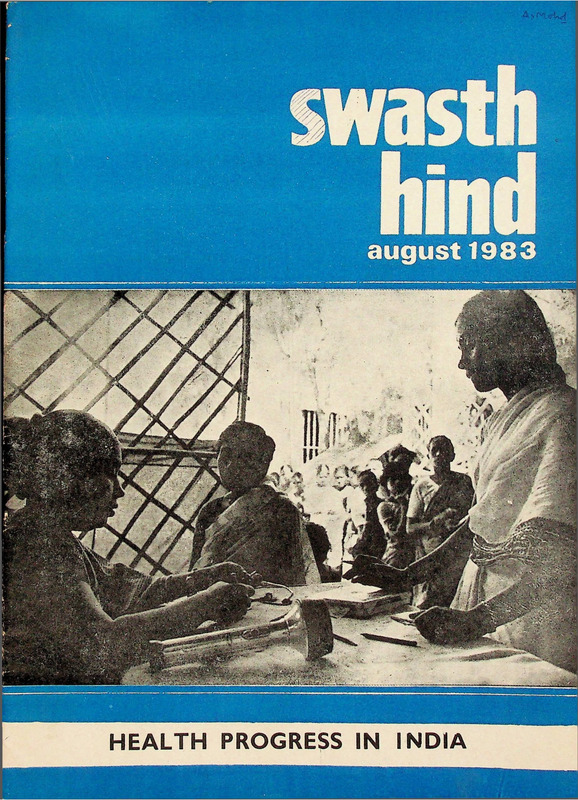
HEALTH PROGRESS IN INDIA
swasth
hind
Sravana-Bhadra
IN THIS ISSUE
Page No.
Health in 1982-83
Year of achievement
181
Dr. S. S. Sidhu
August 1983
Maternal and child health care
187
Rural health services
188
Towards population control in India
190
Vol. XXVn No. 8
Saka 1905
OBJECTIVES
Swasth Hind (Healthy India) is a monthly journal
Published by the Central Health Education Bureau,
Directorate General of Health Services, Ministry of
Health and Family Welfare, Government of India,
New Delhi. Some of its important objectives and aims
are to :
REPORT and interpret the policies, plans, pro
grammes and achievements of the Union Ministry of
Health and Family Welfare.
ACT as a medium of exchange of information on
health activities of the Central and State Health
Organizations.
FOCUS attention on the major public health
problems in India and to report on the latest trends
in public health.
KEEP in touch with health and welfare workers and
agencies in India and abroad.
REPORT on important seminars, conferences, dis
cussions, etc.; on health topics.
Asstt. Editor
D. N. Issar
Sr. Sub-Editor
M. S. Dhillon
J. S. Baijal
Water supply and sanitation programme in India
V. Venugopalan
Training of para-medical personnel in control of
blindness
—scope and possibilities
Editorial and Business Offices
Central Health Education Bureau
Kotla Marg, New Delhi-110 002.
199
Prof. Madan Mohan
A roof over every bead
203
M. K. Mukharji
111 cover
Books
Articles on health topics are invited for publication in this
Journal.
State Health Directorates are requested to send reports of
their activities for publication.
The contents of this Journal arc freely reproducible. Due
acknowledgement is requested.
The opinions expressed by the contributors arc not necessarily
those of the Government of India.
SWASTH HIND reserves the right to edit the articles sent
for publication.
Layout
G. B. L. Srivastava
Cover design
B. S. Nagi
194
Subscription Rates
Rs. 3 .00
Annual
Single Copy •
.
(Postage Free)
Rc. 0 25
HEALTH IN 1982-83
YEAR OF ACHIEVEMENT
Dr S. S. Sidhu
important function of a Government. The strength
T
of a Nation depends upon the strength of its people.
o improve the quality of people’s lives is a very
self, for the year 1982-83, ambitious though attain
able tasks and targets.
All national plans and programmes are aimed at
improving the economic, social and moral status of
the people so that the Nation can become strong
and self-reliant. The Family Welfare Programme is
a crucial one to the success in the national efforts
towards progress and prosperity. It is equally im
portant that the people should be healthy so that
they can fully enjoy the fruits of progress. Health
and family welfare have, therefore, been rightly given
a prominent place in the new 20-Point Programme
announced by the Prime Minister. The Ministry of
Health and Family Welfare is committed to:
Small family norm
(1) promote family planning on a voluntary basis
as a people’s movement;
(2) substantially augment universal primary health
care facilities, and control of leprosy, T.B. and blind ness; and
(3) accelerate programmes of welfare for women
and children and nutrition programmes for pregnant
women, nursing mothers and children, specially in
tribal, hilly and backward areas.
FAMILY WELFARE
—A People’s Programme
Family planning on voluntary basis continues to
be the sheet anchor of our developmental strategy.
Integrated with primary health care and welfare of
mothers and children, the programme aims at pro
moting an informed change in individual and social
perceptions and behaviour for enabling adoption by
the people of planned parenthood as a life style. After
the setback suffered during 1977-79, sustained and vi
gorous efforts have restored and enhanced the credi
bility of the programme. The year 1981-82 witnessed
a significant upsurge in public enthusiasm for the
programme. Encouraged by the significantly improved
performance in 1981-82, the Ministry set before it
August 1983
It is a matter of some satisfaction that the efforts
made so far have yielded encouraging results. About
28 lakh sterilizations were carried out during the
period April 1982 to January 1983, as against 19.6
lakhs during the corresponding period of the previ
ous year. This was a step-up of 43 per cent. In the
field of IUD insertions, the improvement in perfor
mance is to the extent of 35 per cent. Considerable
improvement has also been achieved in respect of
the use of Nirodh and Oral Pills as well as in the
various activities under the MCH Programme. The
Couple Protection Level which wasx22.7 per cent on
1-4-1981 and 23.7 per cent on 1-4-1982.
A well-defined long-term strategy has been evolved
to ensure that adoption of the ‘small family norm’
is done entirely on a voluntary basis. The salient
features of this strategy are: intensified efforts to
spread awareness and information through imagina
tive use of multi-media and inter-personal communication strategies; provision of services and supplies
as close to the door steps of the acceptors as possi
ble; development of facilities for rapid increase in
female literacy; population education to the youth
in schools and colleges as well as those out of schools;
assistance and support of the elected representatives
of the people; proper linkages with other Ministries
and Departments concerned; and close monitoring
and follow-up of the programme at all levels.
Population Advisory Council
The Ministry has set up a 20-Member Population
Advisory Council under the chairmanship of the
Union Health Minister to analyse the implementa
tion of the Family Welfare Programme and to ad'
vise the Government suitably. The Population Ad
181
visory Council has set up five Working Groups to
discuss and suggest innovations to the various as
pects of the Programme including Organisation and
Management, Incentives and Disincentives, Commu
nication Strategy, Research and Technology and
Community Participation. A scries of meetings were
held with opinion leaders, editors of vernacular
newspapers, industrialists, public sector under
takings, film producers as well as local bodies to enlist
their support to the programme. In the voluntary
sector, a major initiative, was taken by the Indian
Association of Parliamentarians
on Problems of
Population and
Development. This
Association
held its first national level meeting in May 1981,
which was addressed by the Prime Minister.
in rural and urban areas by setting up PHCs, rural
and urban centres and sub-centres, and post-partum
centres. There has been significant improvement in
the performance under the programme during AprilDecember 1982-83 over the performance during the
corresponding period of 1981-82 in respect of various
components of the MCH Programme, ranging upto
over 95 per cent in the case of typhoid immunisation.
Significant step-up in performance (+49.2) in the
polio immunisation programme is also evident. It
is planned to cover 140 lakh children under DPT,
125 lakh under DT, 9 lakh under Tetanus and 10
lakh under Typhoid immunization.
The Programme will continue to be integrated
with a package of health services and area specific
attention will be given to States and within States
to districts or areas requiring special attention with
a view to cover every nook and comer of the country,
specially the weaker and deprived sections of the
Keeping in view the national commitment to
attain the goal of ‘Health for All by the year 2000
A.D.’, the Government has evolved a National Health
Policy, which has been placed before the Parliament.
The Policy lays stress on the preventive, promotive,
public health and rehabilitative aspects of health care,
and points to the need of establishing comprehen
sive primary health care services to reach the popu
lation in the remotest areas, the need to view health
and human development as a vital* component of
overall integrated national socio-economic develop
ment, decentralised system of health care delivery
with the maximum community and individual self
reliance and participation. The policy also lays stress
on ensuring adequate nutrition, safe drinking water
supply and improved sanitation for all. Great
emphasis has also been placed on Health Education.
The Policy sets out specific goals to be achieved by
1985, 1990, 1995 and 2000 A. D., in pursuance of
the national commitment for the attainment of the
goal of Health for All by 2000 A.D.
The Government envisages a con
ceptual change from the emphasis
on curative aspects to preventive and
promotive health services at all
levels of the health care delivery
system, both in rural and urban
areas.
population. Supported by the emerging national
consensus at all levels, strong commitment of the
Government, increasing public enthusiasm, the pro
gramme is set for further forward movement The
Government feels that the long term-goal of reducing
the per thousand birth and death rates to not more
than 21 and 9 respectively is attainable.
MATERNAL & CHILD HEALTH
Maternal and Child Health care contributes to
better health and improves the chances of survival
of children and thereby provides motivation for
couples to accept the norm of small family. A com
prehensive programme of immunization to protect
pregnant mothers and children from diseases and
nutritional anaemia is, therefore, being implemented
vigorously at all levels of the health delivery system.
The infrastructure of delivery of maternal and child
health services is being continuously expanded both
IB
NATIONAL HEALTH POLICY
PRIMARY HEALTH CARE
In order to.achieve the goal of ‘Health for All by
the year 2000 A.D.’ and with the motto “the needs of
the many should prevail over those of the few” the
Health Sector envisages a conceptual change from
the emphasis on curative aspects to preventive and
promotive health services as well at all levels of the
health care delivery system, and strives to provide
comprehensive primary health care and medical
services to the deprived and weaker sections of the
society. A. strategy has been evolved to provide
comprehensive health care services to the rural, tri
bal, scheduled caste areas and the poor people at
the periphery. The Primary Health Care infrastruc
ture would consist of primary health centres each
Swasth Hind
The new Health Policy sets out specific goals to be achieved by 1985, 1990,
1995, and 2000 A D., in pursuance of the national commitment for the
attainment of the goal of Health for All by 2000 A.D.
serving a population of 30,000 (20,000 in the case of
tribal and hilly areas and sub-centres each serving a
population of 5000 (3,000 in the case of hilly and
tribal areas). The village or a population of 1000
would form the base unit where there will be a train
ed Village Health Guide. The dispensaries will be
converted into subsidiary health centres to include
the preventive, promotive and participative services.
The Sixth Plan envisages the implementation of a
‘Minimum Programme of Rural Health Care.’ In this
Minimum Rural Health Care Programme the schemes
which are included arc,
Multipurpose
Workers’
Scheme, Health Guides’ Scheme, Components of the
Revised Minimum Needs Programme, Training and
Promotional Training Programmes for Birth Atten
dants
(Dais), Auxiliary Nurse/Midwives/Health
Workers (Female), Community Health Officers and
the setting up of Regional Teachers Training Insti
tutes. These schemes are expected to ensure avail
ability of adequate infrastructure and medical and
paramedical manpower to make the universal pro
vision of Primary Health Care a reality.
DISEASE CONTROL/ERA DICATION
Malaria, Leprosy, T.B. and Blindness arc the
major diseases which need to be tackled. Other di
seases which need attention are the diarrhoeal di
seases, Filaria, Goitre and Japanese Encephalitis.
The deprived and weaker sections of the population
are more prone to these diseases. The intensified
efforts put in by the Ministry, specially in the wake
of the new 20-Point Programme, are expected to re
duce the gravity of the epidemiological situation in
the country.
Malaria
Malaria has been a major public health problem
in the country. To combat this disease. National
Malaria Eradication
Programme was implemented
.with much greater vigour during 1982-83. As a result
of Government efforts, people’s participation and
continuing research, the incidence of malaria has
been declining over the years. By very vigorous fol
low-up and continuous liaison with the State autho
rities, it has been possible to bring down the mor
bidity on. account of malaria in general and of
p. falciparum type of malaria in particular. During
August 1983
1982, the total incidence of malaria was lower by
27 per cent and that of p. falciparum was lower by
15 per cent over the previous year.
Leprosy
It is estimated that about 0.59 per cent of the popula
tion suffers from Leprosy. A serious social stigma
has also come to be attached with this disease. The
Prime Minister has given a call for eradication of
Leprosy on a time-bound basis. As a first step in
that direction, the Leprosy Control Programme had
been converted into a 100 per cent Centrally finan
ced programme. Financial provisions for this pro
gramme has been stepped up from Rs. 3.4 crores in
1980-81 to Rs. 11 crores in 1982-83. A target of 4.74
lakhs of new case detection was fixed for the year
1982-83. According to the
reports received, upto
January 1983, the progress of new case detection
(3.39 lakhs) and bringing these cases under treat
ment, was 7 per cent higher than that of the last
year.
A working Group was set up under Dr M. S.
Swaminathan, to devise the strategy for the eradi
cation of Leprosy. The Group made important and
far reaching recommendations which have been exa
mined by an Empowered Committee. As a result,
the National Leprosy Control Programme would
now be called as the National Leprosy Eradication
Programme. A National Leprosy Eradication Com
mission, under the chairmanship of Union Health
Minister with other Central Ministers concerned as
a policy guidance body and a National Leprosy Era
dication Board under the Union Health Secretary
will be set up for the effective implementation of the
policies evolved by the Commission. In the States
where there is a high incidence of Leprosy, there
will be similar policy guidance and implementation
bodies. A sizeable step up in . the Sixth Plan alloca
tion for the National
Leprosy
Eradication Pro
gramme has also been envisaged. A new multi-drug
regimen strategy for interruption of transmission of
Leprosy in hyper-endemic districts has been launch
ed and it covers at present the two districts of Wardha (Maharashtra) and Purulia (West Bengal). This
scheme has been extended to further hyper-endemic
districts.
183
Tuberculosis attacks both young and old. Bed rest in a sanatorium used to be
considered vital to tuberculosis treatment. A major study in Madras showed that
chemotherapy was just as successful at home.
Tuberculosis
Tuberculosis is a major health problem in the
country. Under this programme, District T.B. Cen
tres are provided by the Health Ministry with mo
dern X-ray equipment, mini-X-ray films and antiT.B. drugs. The main strategy of the programme is
to detect as many cases of Tuberculosis as is possi
ble and to bring such cases under treatment. A tar
get of 10 lakh new case detection was fixed for the
year 1982-83. Till January 1983 about 80 per cent
of the target had been achieved. Tn order to ensure
proper involvement of the Primary Health Centres
in the fresh T.B. case detection. States and Union
Territories have be$n asked to fix a monthly target
of microscopic examination of sputum of 50 symptomatics in every Primary Health Centre and to uti
lise the existing microscopic/laboratory technicians
and the microscopes provided under the NMEP for
184
this purpose. A Task Force had been constituted to
review the present programme and recommend mea
sures to make the programme effective and time
bound. Their report has been finalised and is being
examined by the Government. One of tho important
recommendations is the conversion of the programme
from 50 per cent Centrally Sponsored to 100 per
cent.
Blindness
The National Programme for Control of Blindness
envisages the development of various services
at the peripheral, intermediate and Central levels.
Mobile units will provide comprehensive eye care in
cluding survey of villages and screening of school going
children, out-patient treatment and surgical treatment.
Loss of vision due to cataract is the most common. It
Svvasth Hind
is totally curable and vigorous efforts are being mobi
lised through Government and voluntary sectors to
maximise the number of cataract operations. A
target of 12.95 lakh cataract operations was fixed
for the year 1982-83 and according to the available
information, over 5.15 lakh operations had been
done till January 1983. It has been impressed upon
the State and Union Territory Governments that they
should pay urgent attention to complete their targets
through a large scale organisation of eye camps in
view of the fact that the winter months are generally
congenial for such operations. 100 per cent assistance
is offered to the State Governments/Union Territory
Administrations in the form of material and equip
ment as well as a cash subsidy for the development
and operation of these services. Under this programme,
a major step forward has been the launching of a
nation-wide scheme for training of Ophthalmic As
sistants. This category of personnel forms the key to
the delivery of ophthalmic services at the PHC level.
It is expected that by the end of the VI Plan, as many
as 3,500 PHCs will be provided with Ophthalmic As
sistants.
A Working Group was set up by the Government
of India under the Chairmanship of Dr Swaminathan,
ex-Member, Planning Commission, to study in depth
the problem of blindness and to suggest measures
to tackle the problem. The working Group has sub
mitted its report to the Government. The recom
mendations of the Working Group are under active
consideration of the Government.
Other programmes*
Facilities for Cancer diagnosis and treatment are
being developed in almost all major hospitals at
tached to medical colleges. Nine selected institutions
are being developed as Regional Cancer Research
Centres; Central Assistance is given for installation
of Cobalt Therapy Units and for setting up Early
Cancer Detection Centers. An agreement has been
signed with the Government of Japan for a project
for manufacturing Japanese Encephalitis Vaccine and
the project is in progress. For combating Diarrhoeal
diseases, oral rehydration therapy is being adopted
and the health workers and the masses are being
educated for the purpose. National Programmes for
nutrition and Control of Goitre are also continuing
with increased effectiveness. Major steps have been
taken to promote voluntary blood donation.
MEDICAL EDUCATION
A Medical Education Review Committee headed
by Dr S. J. Mehta was constituted to review the
August 1983
present Medical Education System in the context of
the national commitment to attain the goal of ‘Health
for All by the year 2000 A.D.’ through the univer
sal provision of primary health care. The terms of
reference of the Committee included a thorough re
view of the current admission procedures, course
duration, measures to bring about overall improve
ment in the undergraduate and post-graduate medi
cal education, etc. It was also to evolve realistic
projections of medical manpower requirements dur
ing the Sixth Five Year Plan and beyond. The Com
mittee has submitted its Report to the Government
which is being examined. In the light of the report of
the Medical Education Review Committee the work of
evolving a “national medical and health education
policy” will be taken up.
MEDICAL RESEARCH
Research in the medical fields and demographic
research are being promoted. The research priorities
coincide with the national health priorities and cover
the control of communicable diseases, promotion of
maternal and child health control and prevention of
nutritional and major metabolic disorders and noncommunicable diseases such as cancer, cardiovascu
lar diseases, blindness, diabetes, drug
research
(including the Traditional Systems of Medicine), and
developing alternative strategies for Health care de
livery' systems through the primary health care ap
proach.
INDIAN SYSTEMS OF MEDICINE
Indian Systems of Medicine include all the nonallopathic systems of medicine and regimens exclud
ing Homoeopathy, viz., Ayurveda, Siddha, Unani,
Nature Cure and Yoga. The Central Sector Sixth Plan
provides for the development of Indian Systems of
Medicine and Homoeopathy. The various schemes
included in the Sixth Plan aim, mainly, at improv
ing the quality of education, promotion of research
programmes based primarily on their respective
philosophies, planned production of herbal and other
medicines on a large scale and their standardisation.
Primarily rural based programme, these systems of
medicine are helping to narrow the gap existing in
medical care between the rural and urban sectors.
The Government is conscious, of the fact that these
systems have an important role in achieving the tar
get of ‘Health for All by 2000 A.D.’
The Governmental effort in the field of health and
family planning will have to be supplemented by
185
1
that of the numerous voluntary agencies engaged in
this field. Recognising this need, the Ministry has
taken effective measures to encourage participation
in the programmes by Voluntary Organisations.
Health being a State subject, the effective imple
mentation of various Health & Family Welfare Pro
grammes can be ensured only through proper liai
son and communication with the Statcs/Union Ter
ritories. The Eighth Joint Conference of the Central
Council of Health and the Central Family Welfare
Council was held from 18th to 20th August, 1982
at New Delhi under the Chairmanship of the Union
Minister for Health and Family Welfare. The con
ference reviewed a number of issues and made wide
ranging recommendations for adoption. Six Regional
meetings with the Health Ministers of Statcs/Union
Territories were held by the Union Health Minister
in June 1982 to review the progress of performance
of various Health & Family Welfare Programmes
and to chalk out strategies for 1982-83. Two confer
ences of the Health Secretaries of all the States/
Union Territories were convened; one in February
1982 and the other in January 1983. The conferences
facilitated a first hand appraisal of the implementation
of the various programmes, besides enabling identifica
tion of gaps in the implementation, their filling up and
evolution of future strategies.
During the year, much higher targets were set in
relation to Health and Family Welfare. The realisa
tion of these objectives required an acceleration of
the tempo of work generated during the ’ previous
year. As is evident from the trends the performance
during the year is very encouraging.
—Excerpts from the Introduction to lheAnnual Report—1982-83
of the Union Ministry of Health and Family Welfare.
More medical facilities for
Scheduled Castes and Scheduled Tribes
The Ministry of Health and Family Welfare gives
utmost priority to provide medical facilities to the
Scheduled Castes and Scheduled Tribes. With a view
to accelerating the tempo of activities the Ministry of
Health and Family Welfare has set up a Tribal Deve
lopment Planning cell which coordinates the framing
of Tribal Sub-Plan (TSP) and special component plan
for Scheduled Castes (SCP).
According to the report of the Ministry of Health
and Family Welfare the outlay for these two plans is
Rs. 25 crore (Rs. 11 crore for TSP and Rs. 14 crore for
SCP) for the year 1982-83. In 1981-82 it was Rs. 19
crore.
Of the 38 million tribal population (1971 census)
28.5 million is covered under the Tribal Sub-Plan
186
areas. These areas have 782 PHCs and 4,571 Sub
Centres. The average population covered by a PHC
and a Sub-Centre in these areas are 36,500 and 6,235
respectively, which in case of other areas are 84,400
and 8,830 respectively.
100 out of the 600 new PHCs proposed to be esta
blished during the Sixth Plan are to be.located in the
tribal areas. Full provision has been made for the
construction of the buildings and the staff quarters for
the proposed PHCs in tribal areas, though no such
provision could be made for the PHC in non-tribal
areas. 100 per cent of the Sub-Centres required to be
opened in tribal areas will be established by the end
of the Sixth Plan.
A
Swasth Hind
Maternal and Child Health Care
maternal and child health services refer to
the broad and currently
accepted meaning of
promolive, preventive, curative and rehabilitative
health care for mothers and children. Since mothers
and children have additional requirement for repro
ductive growth and development and arc biological
ly more vulnerable to environmental influences,
special programmes arc required in pregnancy, child
birth and childhood in addition to the general health
measures. During 1982-83, special emphasis was
given to improve the health status of mothers and
children in view of the Prime Minister’s New 20Point Programme which includes
acceleration of
programmes of welfare for women and children and
nutrition programme for pregnant women and nurs
ing mothers and children. The infrastructure of de
livery of maternal and child health services has been
he
T
During 1982-83, special emphasis was given
to improve the health status of mothers and
children in view of the Prime Minister's new
20-point programme. Il includes acceleration
of programmes of welfare for women and
children and nutrition programme for pregnant
women, nursing mothers and children.
August 1983
187
and is being expanded both in inral and urban ateas
by the setting up of primary health centres, rural
family welfare centres and sub-centres, urban family
welfare centres and post-partum centres. In addition,
the Department of Family Welfare has sponsored se
veral schemes namely, immunization of expectant
mothers against tetanus, immunization of children
against diphtheria, whooping cough, tetanus, polio
myelitis, typhoid and tuberculosis, prophylaxis against
nutritional anaemia among mothers and children as
well as prophylaxis against blindness due to Vitamin
‘A’ deficiency in children. The performance of most
of these programmes during the current year has
shown improvement compared to that of the corres
ponding period of last year.
Prophylaxis against nutritional anaemia.—Anaemia
is one of the major health problems affecting women
of child bearing age and children contributing to
maternal mortality and morbidity leading further to
still-birth, premature birth and
low-birth
weight
babies. In order to prevent nutrition anaemia among
mothers and children daily dietary requirements for
iron and folic acid, the deficiency of which causes
anaemia, is given in the form of tablet. Pregnant
and nursing mothers and women acceptors of family
planning and children are the beneficiaries.
Prophylaxis against blindness.—Vitamin ‘A’ defi
ciency is found to be prevalent among children of
pre-school age in many parts of the country. Severe
forms of Vitamin ‘A’- deficiency—Keratomalacia
coupled with malnutrition and infection is believed
to be an important cause of blindness among child
ren. As a preventive measure, concentrated Vitamin
‘A’ solution in oil containing 2 lakhs international
units of Vitamin ‘A’ is given to children in the age
group of 1-5 years every six months.
Supply of Drugs and Vaccines.—The Department
of Family Welfare procures all vaccines, iron and folic
tablets and Vitamin ‘A’ solution and supplies to the
State Governments and UTs. as per their require
ment.
g
Oral Rehydration therapy for control of Diarrho
eal Diseases.—Ministry of Health and Family Wel
fare. is supplementing the efforts of State Govern
ments by supplying the oral rehydration salts to com
bat dehydration from diarrhoeal diseases which is
a major cause of deaths in children. The budget pro
vision during 1982-83 is Rs. 50 lakhs. 50 lakh pac
kets of oral rehydration salt have been supplied to
various States and UTs. during the year.
A
188
Rural Health
Services
I ndia being a signatory
to the Alma-Ata DeclaJL ration 1978, is committed to attaining the goal of
‘Health for Ail by the Year 2000 AD’ by providing
comprehensive universal
Primary Health Care. In
view of this, the Ministry of Health and Family
Welfare has launched a number of intensive pro
grammes for providing not only curative but also
promotive and preventive health care facilities to the
extensive rural population of the country. The Sixth
Plan, therefore, envisages the implementation of a
‘Minimum Programme of Rural Health Care.’ In
this Minimum Rural Health Care Programme the
main schemes/programmes are as indicated below:
Multipurpose Workers’ Scheme
The Multipurpose Workers’ Scheme aims at esta
blishing a Health Delivery System in the rural areas
through a team of Multipurpose Workers: one male
and one female for every 5,000 rural population. Im
plementation involves (a) intensive training programme
to train unipurpose workers in the technical concepts
and skills of the Multi-purpose Workers at all levels
and (b) employment of additional workers.
(a) The seven Central Training Institutes conduct
training programmes for the Key Trainers and
for the District Level Medical Officers.
(b) The forty-seven Health and Family Welfare
Training Centres impart training to the Medi
cal Officers and the Block Extension Educa
tors (BEEs) of the Primary Health Centres
(PHCs).
(c) Trained MOs and BEEs organize training at
their own PHCs/at the selected PHCs for their
para-medicals.
Health Guides Scheme
The Health Guides Scheme has been introduced with
the objectives of preparing a cadre of voluntary
Swasth Hind
health workers selected by (he community, who will
undergo training in promotive, preventive and elemen
tary health care aspects so as to provide an integra
ted primary health care at the grass-roots level. The
training is arranged in the nearest Primary Health
Centre or Sub-centre over a period of three months
and Rs. 600 is given to each candidate as stipend.
On completion of training, each Health Guide is
supplied with a manual, a kit and harmless simple
medicines. The Health Guide receives an honora
rium of Rs. 50 per month to meet out pocket ex
penditure and drugs worth Rs. 50 per month.
Minimum Needs Programme
Under this, the
following Health Institutes are
meant for the most vital function of the Health
Schemes in the rural areas of the country:
1. Primary Health Centres.
2. Upgraded Primary Health Centres.
280
(e) Established in 1981-82
137
(B) Sub-Centres.—These sub-centres will be esta
blished on the basis of one sub-centre for every 5000
population. The additional sub-centres to be esta
blished during 6th Plan period will raise the num
ber to about 90000 against the total requirement of
122000.
(a) Target for the 6th Plan period
37964
(b) Target for 1982-83
7909
(c) Likely performance during 1982-83
8080
(d) Established in 1980-81
2223
(e) Established in 1981-82
6280
(C) Upgraded PHCs.—It is proposed to establish
the rural hospitals by upgrading the existing PHCs.
Each of the upgraded PHC will bear 30 beds to
meet the need of the rural population.
3. Subsidiary Health Centres.
4. Sub-Centres.
The different functions which these institutes are
supposed to perform are based on need of the com
munity in general with emphasis on promotive and
preventive aspects. The PHCs arc also training vari
ous groups of health personnel who are involved in
delivery of primary health care at the door-steps of
the people.
As on 1 April, 1982, there were 5902 PHCs. 56173
Sub-centres, 373 upgraded Primary Health Centres
and 2622 Subsidiary Health Centres in position in
various States and Union Territories.
The targets for establishment of these institutes
during the 6th Plan period, and 1982-83 as well as
institutes established during 1980-81 and 1981-82 are
indicated as below:
(A) PHC—These additional PHCs will be estab
lished in places only where the existing PHCs cater
to a larger population.
(a) Target for the 6th Plan period
721
(b) Target for 1982-83
190
ic) Likely performance during 1982-83
143
August 1983
(d) Established in 1980-81
(a) Target for the 6th Plan period
316
(b) Target for 1982-83
85
(c) Likely performance during 1982-83
95
(d) Established in 1980-81
100
(e) Established in 1981-82
64
(D) Subsidiary Health Centres.—It is proposed
to convert the rural dispensaries into Subsidiary
Health Centres. The ultimate object is to invite all
the rural dispensaries in the implementation of Health
and Family Welfare and M.C.H. Programme.
(a) Target for the 6th Plan period
2364
(b) Target for 1982-83
1842
(c) Likely performance during 1982-83
1636
(d) Established in 1980-81
202
(e) Established in 1981-82
304.
A
Annual Report 1982-83 of Ministry of II & f\v
189
TOWARDS POPULATION CONTROL
IN INDIA
J. S. Baijal
hen the country attained freedom in 1947, the
population stood at 344 million, with an annual
growth rate of 1.3 per cent. With the adoption of the
Constitution and its objective of welfare Slate and rapid
improvement in the production of foodgrains and con
sequent disappearance of famines, expansion of health
facilities and the successful implementation of preven
tive health programmes, eradication of large scale epi
demics, introduction of new drugs and modern me
thods of treatment, there was a visible decline in mor
tality. By 1981, the crude death rate came down from
about 27.4 to 12.5 per thousand and the life expect
ancy at birth rose from 32 to over 52 years. With
such a steep fall in mortality it was no wonder that
the population increased to 439 million in 1961, to
548 million in 1971 and 685 million in 1981, becoming
larger than the combined population of the Americas.
W
The National Planning Committee under the
Chairmanship of Jawaharlal Nehru, set up by
the Indian National Congress in 1935, observed>
“In the interest of social economy, family
happiness and national planning, family planw
ing and limited numbers of children are essen
tial and the State should establish a policy to
encourage this.” At about the same lime, on the
invitation of All India Women's Conference,
Margaret Sanger visited India and stimulated
a great deal of interest in the country in
Family Planning. By this time, Prof Karve
had already put in fifteen years of dedicated
service to this cause at his centre in BombayHowever, it was to take a decade and a half
before independent India officially adopted,
under Nehru's leadership, a programme for
family limitation and population control under
the First Five Year Plan. With promotion of
health and welfare of the family as the main
plank of appeal for the programme, it was
perceived by the policy makers as the means
of securing a reduction in the birth rate to
extent necessary to stabilise the population at
level consistent with the requirements of the
national economy. This was the first time that
a national Government had taken cognizance of
the threat posed by unlimited and unregulated
increase of population and
launched a
country-wide programme to overcome it.
190
Changing dimensions
Clinic-oriented approach—With the galloping growth
of the population, Government’s awareness of the vari
ous dimensions of the problem also grew. New stra
tegies were evolved and suitable modifications were
made in the family planning programme, with the
objective of guiding demographic change rather than
merely observing it, at times belatedly. During the
First Five Year Plan, the programme was clinic-orient
ed. The newly establisehd clinics, all over the country,
were to provide advice and services to those who came
to seek them. Voluntary organizations were also en
couraged to set up clinics in the urban areas. This
approach continued during the period of the Second
Five Year Plan (1956-61).
Extension approach—During the Third Plan (196166), specific targets to reduce the. birth rates to speci
fied levels were adopted. The clinic-oriented approach
was replaced by the “extension” approach. The objec
tive of the new approach was to establish the small
family norm in every community, through education
and dissemination of information to every eligible
couple regarding the various Contraceptive methods,
provision of such service faciliiti.es as were socially and
psychologically acceptable, and involvement of the
community leaders. It was during this period tot use
of IUDs and conventional contraceptive was success
fully included in the governmental programme. Tty
Swasth Hind
about the same time, the social marketing o( contra
ceptives was taken up for the first time in collabora
tion with the private sector. This approach has been
continued successfully, ever since.
The programme steadily gained momentum and by
1977 protection against conception had been provided
to 23.7 per cent eligible couples. During the next
three years (1977-80), the political commitment to the
programme received a jolt resulting in a severe set
back which brought down the eligible couple protec
tion rale to 22.3 per cent in 1979-80. After the pre
sent Government assumed office, in 1980, political
support to the programme was restored and several
new organisational and technological inputs were added.
Financial allocations were increased.
As a result,
there has been steady improvement in performance.
Despite a very large increase in the number of eli
gible couples, the couple protection level has risen to
about 25 percent by December 1982.
Fifty million births averted
The 1981 Census placed the country's population
at a level higher than expected. However, it also re
vealed certain redeeming features. For the first time.
in over four decades, the population growth rale eslablised al a more or less constant level. Compared to
the preceding decade (1961-71), as against eight States
and Union Territories (with 13 per cent of the popu
lation) which had shown a declining growth rate, IQ
States and Union Territories (comprising 49 per cent
of the population) showed such decreasing trends dur
ing 1971-81. Birth rate, which was around 42 in
1951 came down to about 33 in 1981. It has been
estimated that since inception, the Family Planning
Programme has averted 50 million births upto March
1982. The significance of the achievement has to be
viewed against the background of the vital fact that
Planned parenthood:
The programme aims al pro
moting an informed change in individual and social
perceptions and behaviour for enabling adoption by the
people ofplanned parenthood as a life style.
Photo:. PJB
A well-defined long-term strategy has been evolved to
ensure that adoption of the small family norm is done
entirely on a voluntary basis, through education and
dissemination of information to every eligible couple
regarding the various contraceptive methods.
Phuto: P1B
it has been secured entirely within the democratic
frame-work through a completely voluntary progra
mme of family limitation.
Integration with other programmes
In the initial stages, the Family Planning Progra
mme was implemented as a vertical programme with
in the over-all health organizations of different Slates,
largely because the application of majority of the
birth control methods require the advice and support
of medical and para-medical personnel. Over the
years, there has been a gradual integration of the
programme with the health care delivery system. It
was but natural that the widespread network of
health infrastructure should be involved in the chal
lenge. Further more, having realized the strong nexus
between infant mortality and fertility, Government
has, during the past several years, fully integrated
family planning with the Maternal and Child Health
Programmes which include nutritional and immuniza
tion activities. •
Multi-media approach
The fertility patterns in various parts of the country
vary considerably on account of the sharp differences
in the socio-economic-ethnic factors. Consequently,
August 1983
191
Having realized the strong nexus between infant mortality and fertility
Government has, during the past several years, fully integrated family
planning with the Maternal and Child Health Programmes which include
nutritional and immunization activities.
the receptivity of communities to suggestions for fami*
ly'limitation also varies widely. To effectively com
bat this situation, area specific educational and com
munication programmes have been developed. Orga
nized efforts are also in progress to provide services
and supplies as close to the . homes of the people as
practical. Multi-media approaches, supported by in
ter-personal communication, are being tried out for
increasing contraceptive prevalence. Since small fami
lies arc a pre-requisite for raising the health status of
the people, expansion and augmentation of the pri
mary health delivery system has been taken up as an
instrument of promoting both family planning and
health facilities.
Programmes are underway to . provide a Health
Guide in every village and a Sub-Centre, consisting of
an ANM and a male Multi-purpose Worker for a
population of 5,000. For a unit of 30,000 population,
there will be one primary health centre (PHC) and for
each 100 thousand population, there will be an up
graded PHC providing beds and specialized services.
At the next higher level are the District Hospitals, serv
ing as referral centres. Today, about 220 thousand
trained and equipped Village Health Guides are already
in position; 56,000 sub-centres have been established
and 6,700 Primary Health Centres have been fully esta
blished. In addition, about 400 thousand Traditional
Birth Attendants, residing in their villages, have been
trained to perform aseptic deliveries and advise coup
les regarding the care of children and adoption of fami
ly planning methods. Influential village leaders are
continuously being educated and involved in the efforts
to convey the message of “small family norm” among
their people.
Planned parenthood concept
Planning, steps have also been taken to secure the
cooperation of various governmental agencies and in
creasing participation of non-governmental organiza
tions in the overall effort to promote a voluntary
change in individual and social perception and beha
viour so that planned parenthood (including care of the
mother and the child) as a concept is accepted, adoptted and woven into the life styles of the people. In the
words of our Prime Minister, Smt. Indira Gandhi, the
goal is to “make the programme a people’s move
ment.”
192
Considerable progress has been achieved in the field
of population control, but much still remains to be
done. The potential for future population growth in
India is indeed awesome. Over 40 per cent of India's
population is under the age of 15. This vast and grow
ing young population will inevitably lead to larger
additions to the reproductive age groups. Even if
each couple produces a lesser number of children, the
total increase will continue to grow for a long time.
Targets for the year 2000
With the implementation of the strategy to achieve
the goal of Health for all by the Year 2000, a further
drop in death rate is envisaged. In view of the inevit
able prospects of a significant increase in the number
of couples in reproductive age group and a further
drop in mortality, it would be necessary to ensure a
larger decline in the birth rate. In this context, the
country has set before itself the goal of bringing about
a reduction in the birth rale to 21 per thousand, death
rate to 9 per thousand and infant mortality to no
more than 60 per thousand live births by the turn of
the century. To achieve these various objectives, it
would be necessary inter-alia, to increase the protec
tion of couples to around 60 per cent along with effec
tive measures to raise the age of marriage for. girls.
Community participation
The tasks before us are indeed formidable. However,
taking into acount the raising wave of acceptance, suc
cess appears to be very much within reach. Of the
400 districts in the country, 92 have achieved couple
protection levels exceeding 30 per cent while 60 dis
tricts have crossed 36 per cent—the target set for 1985.
These achievements support the view that visible fer
tility decline is well on the way of being established,
all over the country. Further expansion and improve
ment of the delivery systems, appropriate efforts towarts
spreading information and education and community
participation are envisaged to quicken the fertility dec
line and thus enable the achievement of the targeted
goals.
Besides the efforts aimed directly at intervention in
fertility, constant endeavours are afoot to raise the
educational levels of women, greater opportunities for
gainful employment and thus raising their status in
Swasth Hind
society. Success in this direction would also help raise
the age at marriage for girls, and their acceptance of
the small family norm.
The demographic transition in Europe encompassed
nearly half a century, to pass from a birth rate of about
35 per thousand to about 20 per thousand. We have
set for ourselves a target of bringing about a similar
transformation in less than half the time. Our task
is more difficult because of our large population base
and low economic and educational levels. However,
our need and sense of urgency is greater. The fruits
of modem scientific research are available to us. We
have the advantage of a committed Government to this
cause, and a national consensus to ensure that excessive
population growth is not allowed to come in the way
of raising the standards of living of our people. We
have also a large working force of medical, para-medi
cal, social and voluntary workers who have taken up
the challenge in right earnest. Besides the national
will, the requisite manpower and organization, we have
developed a technological framework of a high order
by any standards. India is thus in a position to face
the future with confidence.
International effort
Resolution of the population problem is most vital
for accelerating economic development. No attempt
towards self-reliance can succeed unless the increase in
population is curbed. Rapid population growth not
only widens the gap between the rich and the poor
within a country but also between nations globally.
The overall economic rate of growth of the low income
developing countries nearly matched that of the indus
trialised nations during the past over two decades.
Their per capita income growth, however, remained
much less, because of the surge in population. For
bridging this gap—the gap between the North and the
South, and establishing the new international economic
order, it is essential that all the developed and the deve
loping countries as well as concerned international
agencies should join, hands, without any delay, to pool
resources and experiences and work for an effective
implementation of relevant population policies.
Today, the single most important objective before
all the developing countries, without any exception, is
to improve the quality of their populations. This calls
for a quantum jump in the investment in people. Such
investment has to be sizeable if significant results are
to be achieved. This will be possible only if popula
tion growth is controlled.
The population problem is common to most of the
developing countries. Some of them have implemented
very successful population programmes. They have been
able to develop considerable expertize and are in a
position to assist others. India is fortunate in having
gained a long and varied experience in this field. It
has a large stock of trained personnel and excellent
institutions dealing with medical, demographic and
other aspects of the problem. It is thus in a unique
position to collaborate with other developing countries
in the march towards population control, health and
human development and improvement in physical,
mental and social well being of their peoples.
A
1987
INTERNATIONAL YEAR OF
The General Assembly has proclaimed 1987 as the
“International Year of Shelter for the Homeless”. The
Commission on Human Settlements will act as the
United Nations’ Centre for Human Settlements (HABI
TAT), which will serve as the Secretariat for the Year
and as the lead agency for co-ordinating the relevant
programmes and activities of other organisations and
agencies concerned.
On 8 April, 1983. the Executive Director of the
Unitetd Nations’ Cenrre for Human Settlements
(HABITAT), Arcot Ramachandran, has requested
all countries to establish national focal points for the
International Year of Shelter for the Homeless.
The National Focal Point for the Year could be a
specific person, existing agency or a new unit or com
mittee specifically established to stimulate and co
ordinate national and local action for the Year.
according to Mr. Ramachandran.
Although the
functions of a national focal point would vary from
country to country, they could include:
August 1983
SHELTER FOR HOMELESS
— developing, reviewing and selecting proposed
shelter demonstration projects, and submitting
them to the appropriate national and interna
tional agencies for support.
— contacting and discussing with
non-govemmental organisations their projects, plans and
possibilities relevant to the Year,
— stimulating and coordmating all local and na
tional activities and projects.
— receiving and distributing information on the
programme and plans for the 1987 observance.
on relevant activities in other countries and on
other programme support information,
— organizing relevant meetings, seminars and tra
ining courses, and
— reporting periodically on the progress and
achievements of the Year’s activities and pro
jects in the country concerned. A
193
he provision of safe and adequate water supply and
hygienic disposal of wastes is a basic necessity for
the healthy living of the community. Its importance is
self-evident and requires no emphasis. India has recog
nized this fact long back and accordingly in the First
Five-Year Plan (1951-56) an outlay of Rs. 49 crore
was allocated and gradually it has stepped up to a
figure of Rs. 3922 crore in the Sixth Five-Year Plan
(1980-85).
T
WATER
SUPPLY
AND SANITATION
PROGRAMME
IN INDIA
The science of environmental
hygiene gained
importance with the shifting of the emphasis from
the curative to the preventive aspects of public health.
Accordingly Public Health Engineering has been
realized as specialized subject, which includes in its
purview all essential activities bearing on the environ
ment of man, viz. town and village planning: housing—
rural, urban and industrial; safe water supply; collec
tion and disposal of community wastes: prevention of
river, marine and air pollution: control of industrial
and trade wastes: food sanitation: etc.
V. Venugopalan
Sincere attempts arc being made both by the
States, Union Territories and the Centre to
cover all the 2.31 lakh identified problem
villages with safe drinking water supply faci
lities by the end of current Five Year Plan.
An amount of Rs. 2007.11 crore has been
provided in the Sixth Plan for this purpose.
Out of Rs. 2007.11 crore an amount of Rs.
1407.11 crore is provided under the state
Sector Minimum Needs Programme and
Rs. 600 crore under the Centrally Sponsored
Accelerated Rural Water Supply Programme.
During the years 1980-81 and 1981-82, 25,978
and 29,837 problem villages respectively have
been covered by the various States and Union
Territories and the target set for the year
1982-83 was to cover about 42,000 problem
villages.
194
The preventive approach to secure environmental
hygiene gained momentum in the country with the
formation of Environmental Hygiene Committee in
1949, which pin-pointed attention to this important
subject and urged greater activity in this direction.
The Committee recommended a comprehensive plan
to provide safe water supply and sanitation facilities
for 90 per cent of the population within a period of
40 years and also suggested a scheme of priorities for
certain areas. The provision for Water supply and
sanitation projects were later included by the State
Governments as part of their planned development.
Some headway was then made by the different States
in this direction depending on their financial capacity
to promote such a programme.
Later, the Central
Ministry of Health announced their National Water
Supply and. Sanitation programme in 1954. The object
of the programme was to assist the States in the imple
mentation of their urban and rural schemes and to
channelize their activities in a planned direction. Under
the programme, the State Governments were given a
loan assistance for their urban schemes and a 50 per
cent grant-in-aid towards their rural schemes; The
Programme was to continue as an integral part of the
first, second, and successive Five-Year Plans. The
provision made against this programme formed a size
able proportion of the total provision made towards
health schemes under the plan. Thus, the Water Supply
and sanitation Programme in the country gained mo
mentum year by year. The outlays and expenditures
Swasth Hind
Supply of safe drinking water to all problem villages forms a significant point of the
new 20 point programme. The Government proposes to provide at least one source
of safe and assured drinking water supply to all the identified problem villages by
the end of Sixth Five Year Plan.
August 1983
195
in the various Five-Year plans for the Water Supply
and Sanitation Sector shown in the Table I indicate
clearly the degree of importance give to this vital
sector in the country.
TABLE I
(Rs. in croies)
Waler supply and sanitatiou sector outlay/expendhure during various plans
First Plan
(1951-56)
Second Plan
(1956-61)
Third Plan
(1961-66)
Fourth Plan
((1969-74)
Fifth Plan
(1974-79)
Sixth Plan
(1980-85)
J. Total Plan Outlay
3360
6750
8573
15902
39303-49
97500
2. Outlay for Water
Supply and Sanitation
49
105,70
497*
930.68-D
3922
3. Percentage of total
Plan outlay
1 -46
1.07
1.23
2.56
o 37 •
4.02
4. Actual Expdr. on
Water supply &
Sanitation
11
74
110.17
548t
1107.46
—
*
Excluding Rs. 34-10 crore provided for Centrally sponsored Rural W. S. Programme (ARP} subsequent to Plan finalization.
t
Including L I C Ioan assistance, which was not reflected in the State Plans.
@
Excluding Rs. @ 100 crore provided for ARP subsequent to Plan finalization.
Situation in India
According to World Health Organization, the
estimated service coverage for drinking water supply
in developing countries by the year 1980 was 75 per
cent in the urban areas and 29 per cent in the rural
areas. With regard to sanitation, facilities, the coverage
figure was 53 per cent in urban and 13 per cent in
the rural areas of the developing countries. In com
parison to the aforesaid global coverage figures, in
India as on 31 March, 1981, about 77 per cent of the
urban population and 31 per cent of the rural popula
tion had been provided with protected drinking water
supply facilities. With regard to urban sanitation, the
coverage through sewerage and other excreta disposal
methods was 27 per cent. The rural population, how
ever, do not enjoy safe sanitation facilities to any signi
ficant degree.
supply and hygienic waste disposal should receive prio
rity from governments and International Agencies with
a view to achieve target of serving all the population by
1990. The laudable objectives were approved in the
U.N. Water Conference held at Mar-del-Plata, Argen
tina. in March 1977, and it was also decided that 198190 will be observed as “International Drinking Water
Supply and Sanitation Decade”. The thirtyfirst UM
General Assembly which met in late 1977 endorsed the
recommendations of the Water Conference. India was
signatory to the resolution seeking to achieve the target
for 1990 in the Water Supply and Sanitation Sector,
namely, provision of minimum levels of service of
access to safe water supply and sanitation to the people
of this country. Accordingly, Decade Programme in
India was launched on 1 April, 1981.
Targets for the decade
Water Supply and Sanitation Decade
The U.N. Conference of Human Settlements (HABI
TAT) held in 1976 recommended that safe water
196
Considering the existing levels of coverage and anti
cipated constraints with regard to the resources
Swasth Hind
available, such as human, material and financial, the
following targets have been set for the Decade:
100 per cent of the population to
be covered by March 1991.
1. Urban Waler Supply
2. Rural Water Supply
-
— as above—
3. Urban Sewerage and - 100 per cent of the population to
be covered in respect of Class I
Sanitation
Cities and 50 per cent in respect of
Class 11 and other towns. Overall
coverage in each State should be
SO per cent of the Urban popu
lation by means of sewerage or
simple sanitary methods of disposal.
25 percent of the population to be
covered with sanitary toilets.
4. Rural Sanitation
From the data collected from the Stales/Union Terri
tories, it has been assessed that the total target popula
tion to be benefited with safe drinking water supply
facilities by 31 March, 1991, would be about 7.44 crore
in urban areas and 44.57 crore in rural areas, respec
tively. Similarly, the total target population to be
benefited with sanitation facilities by the end of the
Decade would be about 11.32 crore in urban areas and
14.94 crore in rural areas, respectively.
Coordinated action
Recognising the need for coordinated action and
approach to achieve the aforesaid targets, the Govern
ment of India constituted an Apex Committee under
the Chairmanship of the Secretary, Ministry of Works
and Housing. This Committee is responsible for for
mulation of a National policy, guidance and over-view
of the programmes to be undertaken during the Decade.
The Apex Committee in turn established three
working groups: (1) Programmes and Manpower, (2)
Financial Resources, and (3) Materials and Equipment,
to evolve specific and comprehensive recommendations
on these activities. The Working Groups had submitted'
their reports to the Apex Committee and the Apex
Committee also accepted these reports. Necessary
follow-up action on various recommendations of the
Working Groups has already started at the Centre.
It has been assessed tentatively that about Rs. 14,167
crore will be needed to acheive the Decade goal. SubSector-wise break up of the fund is as follows:
(i)
(ii)
(iii)
(iv)
Urban Water Supply
Rural Water Supply
Urban Sanitation
Rural Sanitation
Total
—
-
Rs. 3,150 crore
Rs. 6,525 crore
Rs. 3,745 crore
747 crore
Rs.
— Rs. 14,167 crore
.Voze: Above figures arc based on 1980 price level.
August 1983
•
Sixth Five Year Plan
The Government of India accorded a high priority
to the Rural Water Supply programme in the Fifth FiveYear Plan and the allocation in the Sixth Five-Year Plan
has been further stepped up. During the Sixth Plan, an
outlay of Rs. 1542.58 crore has been earmarked under
Minimum Needs Programme as well as other than
Minimum Needs Programme of the State Sector. It is
further supplemented by an outlay of Rs. 600 crore
under the Centrally Sponsored
Accelerated Rural
Waler Supply Programme.
Under these two Pro
grammes, the Government proposed to provide at
least one source of safe and assured drinking water
supply to all the identified problem vj.lagcs number
ing 2.31 lakhs in the country by the end of the Sixth
Five Year Plan, i,e, by March 1985, (under Point
No. 8 of the New 20-Poirt Programme of the Prime
Minister). As per the Government of India norms,
the problem villages are those:
(i) Villages which do not have water within a dis
tance of 1.6 kilometres or within a depth of
15 metres. (In hilly areas, the elevation diffe
rence between the habitation and the source is
not to exceed 100 metres.).
(ii) Villages where the existing water contained
excess of fluorides, salinity, iron and/or other
toxic elements hazardous to health: and
(iii) Villages where the existing water sources were
prone to transmit diseases like cholera, guinea
worm, etc. .
In regard to urban sanitation, class I cities will be
provided with sewerage and sewage treatment facilities
during the Decade. However, in fringe areas of the
Class I cities as well as other urban areas from
Class II to Class IV cities, it is proposed to provide
low cost sanitation facilities, such as converting bucket
latrines into sanitary water-seal toilets with septic tanks
and soakage pits arrangements. Tins is because of
the fact that sewerage systems are not economically
feasible for majority of the communities in these areas.
In regard to rural sanitation, simple sanitary water
seal flush out latrines are proposed for each individual
house. Small per capita cash provision in the form
of subsidy at the rate of Rs. 50 per head may also be
made available for construction of such latrines. Since
such subsidy will alone be not sufficient for construc
tion of toilets in each house, it is very much essential
to mobilise local manpower and also procure locally
available materials for such toilet construction pro
gramme.
197
During the Sixth Five-Year Plan an outlay of
Rs. 1775.08 crore has been allocated for urban water
supply and sanitation including urban sewerage and
low cost sanitation. However, for the rural sanitation
sector, a total sum of Rs. 15.08 crore has been pro
vided in the current Plan.
Priorities for the Decade
For successful implementation of above programme,
sound policies, such as priority to under-served popu
lation and’careful strategics such as appropriate tech
nology, service level, community participation, inter
sectoral coordination, efficient operation and mainte
nance of the constructed systems will be very much
necessary. The Conference of Slate Ministers, Secre
taries, Chief Public Health Engineers and Heads of
Implementing Agencies held in Delhi during 3-5 Feb
ruary, 1982, recommended the following priorities for
implementing the Water Supply and Sanitation De
cade Programme in the country:
(a) Safe drinking water to problem villages;
(b) Safe drinking water to uncovered towns or un
covered urban areas;
(c) Rehabilitation of urban waler supply;
(d) Low cost
Class I;
sanitation to towns other than
(e) Safe water supply to non-problcm villages;
(f) Augmentation of urban water supply system;
(g) Sewerage facilities to Class 1 cities lacking them
at present; and
(h) Sanitation in rural areas.
Link up with related sectors
There are many activities in the various Ministries
and departments of the States and Central Government
wihch have a direct or indirect bearing on the Water
Supply and Sanitation Sector. The dovetailing of these
activities will maximize the inputs and streamline the
Water Supply and Sanitation Sector. Therefore, the
Government of. India is very much concerned and
seriously thinking to link up the programmes for the
Decade with the related sectors like rural development,
health, irrigation, technical education, social welfare,
etc. For instance, water supplies can be implemented
as part of irrigation schemes particularly in the villa
ges situated near major or minor irrigation projects
and also those located on the banks of irrigation
canals free of cost, as gram panchayats are generally
198
without sufficient financial resources to support such
investments. Therefore, State Governments may
advise their Irrigation Departments to integrate drink
ing water supply schemes as part of irrigation projects
wherever possible and feasible.
Similarly, agencies
like Railways, Public Sector Enterprises and various
Industrial Development Corporations have drinking
water supply and sanitation schemes for their colonies/
areas. This activity as well as sector activities of
public townships should be integrated and coordinated
with the programmes of their respective State Govern
ments. Construction of drinking water wells is one
of the activities which can be undertaken by the States
under the National Rural Employment Programme
(NREP).
Health Education
While implementing the Decade Programme, it is
felt that support programmes such as “Health Educa
tion” and “Community participation” arc also very
much needed. It is a known fact that without proper
“education” there will be no impact on community
health despite huge investment on water supply and
sanitation facilities. It appears that over 1,70,000
health guides have been trained by the Health Minis
try to impart health education among the rural people
and there is a proposal to train up at least one guide
for every village by the end of Six Five-Year Plan.
These guides are expected to educate rural masses
on proper maintenance of sources of drinking water,
proper storage, chlorination and use. They are also
instrumental in initiating community action for con
verting open wells into sanitary ones, use ol water seal
toilets, construction of septic tanks, ‘soakage’ pits for
disposal of human and animal wastes. While appre
ciating the efforts of the Health Ministry in this task,
there is still a great need to step up this activity during
the Waler Decade period. Another
important
aspect that should be kept in view is “community
participation and involvement”. The beneficiaries
should be taken into confidence and be involved with
various stages of project planning, execution, opera
tion and maintenance of water supply and sanitation
schemes in order to achieve the best results during
the decade.
Role of Voluntary Organizations
Several non-governmental organizations (voluntary
organizations) are presently working in the execution,
operation and maintenance of water supply and sani
tation projects in the country. These Organisations
can definitely play a vital role for the the success of
(continued on page 202)
=
Swasth Hind
Photo: R. P. Centre, A JIMS, New Delhi
Training of para-medical personnel
in control of blindness
—Scope and possibilities
Prof. Madan Mohan
It is impossible to provide specialist's
eye care services to all in the foreseea
ble future. In such a situation, the only
alternative is to maximally utilize the
existing, manpower and simultaneously
create an army ofpersonnel trained pre
cisely according to the needs and job
requirements.
August 1983
uccessful execution
of any public health pro
gramme depends on the quality and number of
field workers. The implementation of National Pro
gramme for Control of Blindness, therefore, demands
training of paramedical personnel with sufficient know
ledge and skills to carry out their day-to-day activities.
S
Like other branches of medical science, ophthal
mology has made great strides in the diagnostic and
therapeutic techniques, but the incidence of blindness
199
and morbidity pattern has made little change in our
country. One of the major reasons for higher pre
valence of blindness in India is lack of awareness with
regard to prevention of blindness. Lack of facilities
for early diagnosis and primary eye care further add
to the magnitude of the problem.
To be able to meet the challenge, it is essential to
provide eye health education for prevention of blind
ness and facilities for early diagnosis and proper
management of common eye diseases.
Shortage of ophthalmologists
The human eye is a very delicate and complex
organ of sight. To be able to fully understand, dia
gnose and treat adequately all kinds of eye diseases,
one needs institutional training of three years after
M.B.B.S. and many years of experience to become
a specialist.
There is an acute shortage of Ophthalmologists in
the country. It is estimated that there is one ophthal
mologist for 1,20,000 population. Most of them arc
practising or working in hospitals in the cities. Thus
major chunk of the population can hardly avail of
their specialized expertise.
The medical graduates (M.B.B.S.) posted at primary
health centres arc now within the reasonable reach
of an average villager. Such doctors can provide neces
sary primary eye care if their training and evaluation
is made more job specific. It has, however, been noted
that these doctors are often over-burdened with pa
tients suffering from general systemic disorders and
family planning work that they tend to refer all eye
patients to ophthalmic surgeons.
The para-medical field staff, e.g., multipurpose
workers and the village health guides are not ade
quately trained and equipped to render proper advice
and provide primary eye care to the needy. Conse
quently many school going children and other persons
suffering from preventable eye diseases and easily
correctable visual defects remain handicapped due to
lack of these services.
Orientation of field staff
In a vast and populous India, it is utterly impossible
to provide specialist’s services to all in the foreseeable
future. Tn such a situation, the only alternative is to
maximally utilize the existing manpower and simul
taneously create an army of personnel trained precisely
according to the needs and job requirements.
The immediate need is to create awareness by
health education with regard to prevention of common
diseases of eyes. It is possible if all para-medical field
200
staff is given orientation and is involved to educate
the community with regard to:
(1) The importance of the care of the eyes.
(2) The simple measures of prevention of eye
diseases, by better nutrition, improvement of personal
hygiene and environmental sanitation.
(3) The need for taking necessary precautions against
eye accidents.
(4) The importance of early
ment of eye diseases in children.
detection and treat
(5) The need to have regular eye check-ups after
the age of 40 years for reading glasses detection of
cataract, glaucoma and other blinding diseases.
To meet the long-term needs and to achieve health
for all. primary eye care needs to be provided to all
who need them. This can be achieved by launching
a two pronged attack for preparing the required man
power.
1. The personnel providing general health services
should be given short-orientation (one week) in the
prevention of blindness.
The existing medical
colleges can function as training centres for this pur
pose. The District
Medical and Health Officers,
Medical Officers working at Primary Health Centres
and interested private practitioners could be trained
in a phased manner.
2. Permission of basic services through para-medical
personnel is also possible, provided they are properly
trained and function under the supervision of a quali
fied doctor. Such persons being from the local com
munity, are more easily approachable and acceptable by
the community. They are usually knowledgeable about
the local customs, beliefs, practices, health problems and
are responsive to local needs.
Training methods and course contents
Training should be conducted in regional languages
as far as possible and it should be field-oriented. Major
period of training may be covered by practical demons
trations and field visits, supplemented with lectures
on important topics.
The course content of the training programme for
the workers at the periphery level should include:
1. Organizing health education campaigns on eye
care.
2. Arranging mass meetings to create awareness.
group talks and health education by doctors and
health educators on causes of blindness.
Swasth Hind
Photo: R.P. Centre, AHMS, New Delhi
Optical assistants undergoing training in manufacturing and fitting of ophthalmic
lenses.
(3) Arranging contacts of the rural people with
the voluntary organizations for providing eye
care services at their door-step.
4. Securing the help of the concerned health autho
rities for the people for prevention of blindness.
5. Distribution of Vitamin A to the children to
prevent nutritional blindness.
6. Distribution of antibiotic tubes and teaching
of method of application for control of trachoma
and other common infections of the eye.
The test of effectiveness of the training programme
depends on the job efficiency of the participants in
their work situation. Training must emphasise the
fact that the health worker maintains a self-critical
attitude towards himself, his methods and achieve
ments. Objective evaluation must be a part of all
training programmes for para-medical personnel.
August 1983
Para- medical personnel for ophthalmic services
Some of the existing medical auxiliaries, specially
trained to look-after the various aspects of eye pro
blems arc as under:
(a) Optometrists'. Optometrist is a health personnel
who is trained to detect refractive errors, prescribe and
dispense eye glasses. In India there are a few insti
tutions which award diploma in optometery after two
years of training.
(b) Orthoptists: Orthoptist is a health personnel
who is trained for investigating cases of squint and
disorders of ocular mobility, for giving exercises and
medical treatment of squint and allied conditions. In
India, there are a few schools for training orthoptisls
(two years diploma).
(c) Optical Assistants: Optical assistant is a person
who is trained in manufacture and fitting of ophthalmic
lenses. There are very few training centres which turn
out such technicians. Recently a vocational course
201
(10-1-2 examination) for optical assistants has been
developed at Dr Rajendra Prasad Centre for Ophthal
mic Sciences, Al IMS, New Delhi. The scope and possi
bilities for starling such courses need to be further
examined. There are many optical shops, at least in all
big cities. These need to be manned by technicians
■trained in making spectacles prescribed by the ophthal
mologists and optometrists. At present the job is largely
being done by untrained labour since there is hardly
any facility for training of these workers. Training
institutions, therefore, need to be established in different
parts of the country to meet the country’s requirements.
(d) Ophthalmic Assistants: A Two-year diploma
course for ophthalmic assistants has been recently
started under the National Programme for Control of
Blindness. The Ophthalmic Assistant so trained will be
required to:
(i) Promote health education on eye care.
(ii) Organize school health clinics for early detec
tion of eye diseases.
(iii) Perform refraction check-up and prescribe eye
glasses.
(iv) Assist the primary health centre doctors in
handling all eye cases.
(v) Help in choosing proper referral to District
Ophthalmic Surgeons.
{continuedfrom page 198)
Decade Programme. It is, therefore, essential to iden
tify such Organizations working in different parts of
the country and ascertain their field of specialization
and potential. In this regard already United Nations
Development Programme (UNDP) took up a project
in India and recently a Conference on “National
Voluntary Non-governmental Organization Consulta
tion'’ was also conducted in Delhi. Follow-up action
on various recommendations of the Conference will
soon be initiated.
Guincaworiii problem and eradication programme
Dracontiasis, popularly known as guineaworm dis
ease is prevalent in certain rural areas of the country.
As on 31 December, 1981, there are seven endemic
States (Andhra Pradesh, Gujarat, Karnataka, Madhya
Pradesh, Maharashtra, Rajasthan and Tamil Nadu) with
80 districts, 468 blocks and 10,582 villages having been
affected by guineaworm disease. Areas with very low
water table where ponds, tanks or stepwells form the
main drinking water sources are favourable for trans
mission of this disease.
When an infected person
202
(vi) Assist in organizing eye camps, and
(vii) Assist in the training of the volunteers, so
cial workers, para-medical staff such as, the
VHGs, MPVVs and MCH staff in the preven
tion of blindness.
Training is being imparted in (he medical colleges
for six months and in the field areas for one and a
half (six months each in mobile eye unit, district
hospital and PHC) leading to a diploma of para-me
dical ophthalmic assistant. This training has already
been started in 20 different institutions and olher 17
institutions are to start it very shortly. About 1,000
ophthalmic assistants will, thus, be trained every
year.
Till mid-seventies the pattern of training of para
medical technicians for ophthalmic services was
largely borrowed from the West. In India, only a few
universities conducted two diploma type courses, iJe.,
for the optometrists and orthoptists. Now realizing
the growing needs of the rural areas, for providing
primary eye care, the training activities/courses are
being widely expanded. With an inbuilt referral sys
tem at the primary/district level hospitals, it will thus
be easier to control blindness and visual impairment
as envisaged under the 'National Programme for Con
trol of Blindness’.
/\
with ulcer (blister) gets into a water source such as
stcpwell, pond or a tank; large number of embryos
are liberated from the worm inside the wound. These
embryos are swallowed by cyclops (immediate host).
Consumption of such contaminated water containing
infected cyclops, by the people causes the infection.
Thus, infected man is a big reservoir of the disease.
Due to this infection, presently about 12.2 million
people are suffering in the country. A Task Force
constituted by the Government of India formulated
the strategy for the eradication of this disease. The
National Institute of Communicable Diseases is en
trusted with the responsibility of planning, guiding,
monitoring and evaluating the programme.
One of the best ways of eradication of guineaworm
disease is by providing alternative safe drinking water
supply sources in the affected areas. As mentioned
earlier under the new 20-Point Programme of the
Prime Minister, it is proposed to cover all the 2.31
lakh identified problem villages in the country with
at least one source of safe drinking water by the end
of Sixth Five-Year Pian, i.e. March,1985.
A
Swasth Hind
Photo: M.Y. Khr.n/CJIEB
M. K. Mukharji
In the formulation and implementation
of housing development schemes in the
public sector, the target groups are
mainly the economically weaker sections
and low income groups and to some
extent the middle income groups which
arc the weakest sections of the society.
The major thrust is to concentrate on
general improvement of the environmeat, public health and hygiene.
August 1983
ousing is undoubtedly a basic need.
The magni
tude of the problem is great and the housing con
ditions of the people, particularly of the poor and the
less privileged, continue to cause grave concern. In the
developing countries more and more people are com
ing to the cities in search of jobs. The rising cost of
construction and the accelerated pace of urban growth
coupled with the acute scarcity of developed land for
the construction of residential houses have made the
problem more difficult. The task of providing a roof
over every head is, therefore, formidable and would
require sustained effort over a long period.
H
203
In the rural areas the problem is not so much ot
land or the absence of a roof above the head but of
access to even the most rudimentary level of services.
In the urban areas, in a situation of shortage of land
and appropriate types of shelter, squatter settlements
and slums proliferate to provide some kind of accom
modation to the rural-urban migrants. Most of them
cannot afford any other form of shelter. Our major
concern is for this category because they constitute the
majority.
It is estimated that about 25 per cent of our urban
population live in slums and squatter colonies. Assum
ing that most of them belong to the Economically
Weaker Sections, i.e.t with a family income of less
than Rs. 350 per month and the group can afford to
spend not more than 15 per cent of their income on
housing, an average family in India living in a slum
will be able to afford Rs. 17.50 per month for housing.
But shelter cannot be considered in isolation and has
to be linked with municipal infrastructure and delivery
of services. In our efforts to tackle the problem, there
fore, we have to very carefully weigh the available
options and select the most affordable and the most
cost effective solution even if it means reduction in
the standards of services.
The shortage
Housing shortage in India has been estimated to be
about 20.7 million—16.1 million in niral and 4.6 mil
lion in the urban areas. This is only a rough estimate
and docs not take into account certain types of semi
permanent and temporary structures which may be
serving the needs of a large section of our population.
However, the figures do give us a broad idea of the
extent of housing shortage in our country.
The shortage is most marked amongst the economi
cally weaker sections of the society and the low income
groups, but the gap is quite substantial in the case of
the middle income groups also. The Economically
Weaker Sections are those who have a total family
income of upto Rs. 350 per month: Low Income Group
are those with a family income of upto Rs. 600 per
month. The corresponding amount for the Middle In
come Group (MIG) is upto Rs. 1,500 per month and
for the High Income Group above Rs. 1,500 per month.
In the formulation and implementation of housing
development schemes in the public sector, the target
groups are mainly the Economically Weaker Sections
and Low Income Group and to some extent the Middle
Income Group which are the weakest sections of the
society. This will be evident from the fact that the
Housing and Urban Development Corporation allo
cates 55 per cent of its funds for the Economically
204
Weaker Section and the Low Income Group and about
25 per cent for the Middle Income Group.
Sixth Plan
The Sixth Plan has identified that the public sector
has a ‘marginal though promotional’ role to play in
respect of housing and has mentioned that the emphasis
of the public sector will be on the ‘absolutely shelter
less’. In rural housing the primary target group is the
landless families and the plan objective is to provide
developed house sites to cover each one of the rural
landless families. The total number of eligible families
has been estimated to be 14.5 million by 1985.
The scheme of provision of house sites to the rural
landless which was in operation since 1970 had pro
vided house sites to 7.7 million families before the
commencement of the Sixth Plan. The Plan target is
to provide house sites to the remaining 6.8 million.
The programme component is such that it adopts a
low cost solution using locally available building mate
rials as far as possible, and the beneficiaries are ex
pected to play a positive role by providing.their own
labour as a majpr input. The total provision in the
State Plans for provision of house sites and construc
tion assistance is about Rs. 354 crores. Under social
housing schemes which again are in the State Sector
of the Plan the total Sixth Plan outlay is Rs. 837.37
crores.
Slums
In the case of slums the stress is on providing a pac
kage of essential services like potable water supply,
paved pathways for access, street lighting facilities and
sanitary latrines in place of manually cleaned privies.
The components of the programme will show that the
major thrust of the scheme is to concentrate on general
improvement of the environment and public health and
hygiene. This approach is in preference to the less cost
effective programme of slum relocation and re-housing
of shim dwellers.
There is no doubt that the quality of housing in
slums is very poor but they do serve the basic need
of shelter and in the context of overall shortage the
more practicable and pragmatic approach is to make
the existing houses in the slum areas more liveable by
eliminating squalor and filth and improving the envi
ronment and providing the basic sanitary facilities and
water supply, rather than go in for a large scale reha
bilitation programme.
Sites and services programme
The programme of improvement of slums in situ,
however, cannot take care of the needs of the new
Swasth' Hind
migrants and, therefore, the conventional housing pro
grammes are supplemented with what is known as the
sites and services programme. Briefly the programme
consists of provision of developed house sites with a
sanitary core and access to potable water supply in
well planned and well laid out colonies. The benefi
ciary individuals are then free to construct the type of
house according to their preference with the built in
flexibility of ‘incremental housing’. Under the Central
Sector Plan Scheme for the development of Small and
Medium Towns, the Government of India provides
financial assistance to the State Governments and
Union Territories for taking up housing schemes in
cluding Sites and Services schemes provided suitable
land is identified and made available by the State
Government.
Position elsewhere
Let us now have a look at the international scene.
By and large the attention given to the subject of pro
viding appropriate shelter has been inadequate.
passed in the' 36th Session of the U.N. General
Assembly proclaiming 1987 as ‘the International Year
of Shelter for the Homeless’. The Fifth Session of the
U.N. Commission on Human Settlement at Nairobi,
where the author had the privilege of leading the
Indian Delegation, had the subject as one of the prin
cipal items on the Agenda. The decision to proclaim
1987 as the International Year of Shelter for the
Homeless was reiterated at the Nairobi Session.
Indeed the Proclamation is more than a mere slo
gan. It starts from the common concern about inade
quate shelter provision and culminates in formulating
a programme of action involving national and inter
national agencies. The goal is,quite ambitious. It is
to improve shelter and neighbourhood to all the poor
by the year 2000. -
Our strategy
Two significant events marked the growing interest
of the international community to the deficiencies of
shelter and infrastructure services. One was the Van
couver Habitat Conference of 1976 and the other was
the Mar-Del Plata Water Conference of 1977. The
Vancouver Resolution for the first time identified
Human Settlements as a separate subject area as dis
tinct from other activities and for the first time recog
nized the need for considering human settlement deve
lopment programmes not merely in welfare terms but
as positive instruments of national development. The
Mar-Del Plata resolution decided to launch an inter
national water supply decade from 1981 to 1990 where
the global programme of safe drinking wafer to cover
the entire world population was drawn up. Both these
are momentous decisions and call for comprehensive
action programmes.
Happily India is one of the very few countries which.
in its internal planning, has been acting on these prin
ciples for some years. India’s National Plan Strategy
is based on the principle of direct attack on poverty.
It has a well articulated, action programme to improve
the physical quality of life of the people. The multi
point Minimum Needs Programme, most of which is
incorporated in the new 20-Point Programme, includes
rural house sites, rural health, rural education, rural
electrification, rural roads, rural water supply and
slum improvement in urban areas and shows thus the
awareness and commitment of our country to the pro
grammes involving the improvement of living condi
tions. Our objective is to provide, by the end of the
Sixth Plan period, house sites to all the rural landless
and at least one source of potable water supply to each
of The 2.31 lakh problem villages and cover 10 million
slum dwellers through the- slum improvement programmes.
The International Year of Shelter
So far as human settlement is concerned the historic
Vancouver declaration was followed by the important
‘Manila Communique’ of 1981 which, while expressing
grave concern about the deteriorating conditions of
shelter for the poor, urged the countries to draw no
positive action programmes for meeting the challengeA verv important development in respect of human
settlement improvement programme is the Resolution
Considering the magnitude and complexities of the
problems in a country of the size of India it will be
idle to nresume that the task is a simple one. While
one can say confidently that the progress of the diffe
rent schemes is quite encouraging there can be no room
for complacency and long and sustained efforts will be
nccessarv to reach our goal. The International Decla
ration will only help us to rededicate ourselves to our
task.
/\
NATIONAL LEPROSY ERADICATION COMMISSION CONSTITUTED’
A National Leprosy Eradication Commission has’ been constituted for the guidance and
surveillance of the leorosv eradication programme under the chairmansh’n of the Minister for
Health and Family Welfare, Sri. B. Shankaranand. 'The National Leprosy Control Programme has
also been renamed as the National Leprosy Eradication Programme.
August 1983
205
Prime Minister calls for raising the
health status of people
Minister Smt. Indira Gandhi called upon
medical researchers to produce medicines at pri
ces which people can afford. She said that as far as
possible medicines should be indigenously produced—
preferably from herbal sources. She also wanted the
medical men to encourage the use of traditional reme
dies and if possible establish their properties on modern
scientific basis.
rime
P
Prime Minister was addressing the meeting of the
directors of the Indian Council of Medical Research
and other medical institutes and centres from all over
the country on 22 April, 1983, in New Delhi.
Smt. Gandhi said that many of those things which
were earlier described as old grandmothers’ tales and
dismissed as superstitions were now known to be effec
tive. We should try to use this knowledge for the
benefit of our people. Prime Minister also stressed
the need for early detection of tuberculosis, cancer, lep
rosy and some other dreaded diseases. She asked the
experts to suggest how this could be achieved.
Smt. Gandhi said, that as our resources were limited,
a beginning could be made by introducing compulsory
medical check-up in institutes, schools, colleges and
other places where a large number of people worked
under the same roof.
While commending the success achieved in several
fields, she said that there were many, more areas which
required new tools, which were effective, safer, simpler
and less costly. She congratulated medical researchers
for the breakthrough .which had taken place in many
of these areas like malaria, vaccine and contraception.
Smt. Gandhi said that pollution due to economic
factors as well as by industries was leading to an in
crease in chest diseases. She hoped that some ways
would be found to check this trend.
Speaking about the family planning programme, the
Prime Minister said that we still needed a breakthro
ugh to make the family planning methods cheap and
206
convenient enough to be really effective.
For this
close co-operation and interaction between the vari
ous scientific and technological institutes was requir
ed. The Prime Minister said that the most important
need was not only to spread sophisticated knowledge,
but the basic facts about sanitation and prevention of
illness among our children through education. Smt.
Gandhi said often science was used for political ends
and medicines for profit. She warned that developing
countries like India should be doubly vigilant and
careful regarding such practices.
Earlier in his welcome address, Shri B. Shankaranand, Union Minister for Health and Family Wel
fare, said that the Indian Scientists had made bril
liant achievements because of the keen interest taken
by the Prime Minister in the development of science
and technology and research activities. The Minister fur
ther said that the danger of population explosion had
shown signs of abatement because of the Prime Mini
ster’s support to the family welfare programme.
The research priorities of the Indian Council of
Medical Research (ICMR) coincided with the natio
nal health priorities, viz. control of communicable
diseases, fertility control, promotion of maternal and
child health,, control of nutritional and major meta
bolic disorders, developing. alternative strategies for
health care delivery systems through the primary
health care approach for the fulfilment of the goal
of Health for All by the Year 2000 A.D. and con
tainment within safety limits of occupational and
environmental health
problems. The Minister
explained that selected studies in other important
areas like mental health, cancer, cardiovascular dis
eases, blindness, tuberculosis, leprosy, diabetes and
drug research were also being undertaken.
Smt. Mohsina Kidwai, Minister of State and Kum.
Kumud Joshi, Deputy Minister for Health and Fami
ly Welfare, were also present.
a"
Swasth Hind
HEALTH SECRETARIES CONFERENCE
National Health Programmes
Reviewed
T1 he Conference of State Health Secretaries, which
concluded on 24 April, 1983, reviewed the per
formance of the national health programmes for con
trol of leprosy, blindness, tuberculosis. The confe
rence stressed the need for improving the operational
efficiency of the programmes by removing bottlenecks
and providing She adequate inputs like manpower,
equipment and funds.
The Centre had already conveyed the physical and
infrastructural targets as also financial allocations to
the States and they were asked to act with speed to
realize these targets spreading them evenly all over
the year.
Leprosy eradication
In so far as the National Leprosy Eradication Pro
gramme is concerned, a new dimension was given to
it through structural changes which envisaged a Na
tional Leprosy Eradication Commission, under the
Chairmanship of the Union Health Minister, as a
policy guidance body and a National Leprosy Eradi
cation Board under the Union Health Secretary for
the effective implementation of the policies evolved
by the Commission. Similar policy guidance and
implementation bodies were proposed to be set up in
the States where there was a high incidence of lep
rosy.
The Conference suggested the desirability of repeal
ing Lepers Act of 1898. Proposals were also mooted
either to give special incentives to the medical and
para-medical staff posted in the leprosy-endemic dis
tricts or to create a special cadre for anti-leprosy
work.
Tuberculosis control
The Conference noted that the National Tubercu
losis Control Programme had registered a reasonable
success in 311 district tuberculosis clinics out of
a total of 353. The main strategy of the programme
was to detect as many tuberculosis cases as pos
sible and to bring such cases under treatment. With
the district tuberculosis centres playing a pivotal role,
attention was now sought to be focussed on the Pri
mary Health Centres wihch have been given monthly
targets for sputum tests.
Shri B. Shankaranand, Minister for Health and Family Welfare, inaugurating Health Secretaries meeting
in New Delhi on 23 April, 1983. On the extreme left is Kum. Kumud Joshi, Deputy Minister for Health
and Family Welfare and on extreme right is Dr. S. S. Sidhu, Secretary, Ministry of Health and
Family Welfare.
Photo; PIB
Blindness control
Under the National Programme for Control of
Blindness, it was proposed to develop various services
at the peripheral, intermediate and central levels.
Mobile units were also sought to be pressed into ser
vice. Cataract was identified as the main cause of loss
of vision. As it was curable through surgery vigorous
efforts were needed to mobilize Government and vol
untary sectors. In this context the States were asked
to hold meetings with the voluntary organizations
early in the year with a view to planning the pro
gramme for implementation throughout the year. The
grant-in-aid for holding such camps in rural areas
and towns having a population of 50,000 was extended
for eye camps to be held in towns having a popula
tion of one lakh and also in metropolitan slums. This
relaxation, it was felt, would go a long way in ex
tending the reach of blindness control measures.
able and identify the gaps. They were asked to ensure
that training programmes for medical and para-medi
cal staff were intensified.
Monitoring, the disease incidence
The States were requested to ensure a proper moni
toring of the incidence of various communicable dis
eases so that effective programmes could be chalked
out for their control. It was pointed out that in the
absence of correct information about the. incidence,
prevalence and surveillance of the various diseases
realistic targets could not be set. The targets for the
various programmes under family welfare had been
intimated to the States and they were asked to communi
cate them further down the line to the districts and pri
mary health centres.
The States were requested to implement the central
scheme for the reorganization of urban family wel
fare centres, with a view to increasing family planning
acceptance in the urban areas particularly slums.
It was impressed upon the State Health Secretaries
that the promotion of IUD acceptance may be taken
up more vigorously. These could be achieved by the
States only with imaginative campaigns and concerted
efforts. The example of Pun jap which achieved 1.61
lakhs of IUD insertions during 1982-83 was com
mended to be followed by other States. Emphasis
on IUD insertions was necessary because the promo
tion of spacing methods must go hand in hand with
conventional terminal methods.
A
States were asked to ensure availability of services
through a proper review of the facilities already avail
A vigorous marketing approach in relation to mass
education and media activities was advocated.
Family Planning
Follow up action was proposed on the recent deci
sions of the Central Cabinet about giving green cards
to the acceptors of terminal method of family plann
ing, so that they could claim priority in various socio
economic development schemes. The scheme of group
incentives and awards should also be implemented as
fast as possible. It was recommended that schemes
should be evolved, wherever possible, for individual
awards to the best workers in the field of family wel
fare. These could include study visits and in some
cases foreign tours.
MEDICAL RELIEF CAMP
A. Medical Relief Camp was organised by the District health authorities at the
Primary Health Centre, Rajomid, Distt. Jind on 26 February, 1983 with a view
to provide specialized surgical and medical care services nearest to the door steps
of the people. A health and family welfare exhibition was also set-up. Picture
shows Sint. Parsani Devi, Health Minister of Haryana, on a round of the exhibition
along with the Director of Health services, Haryana.
Authors
Dr S. S. Sidhu
Secretary
Ministry of Health & Family Welfare
Nirman Bhawan,
New Delhi-110011
NOISE
Shri J. S. Baijal
Additional Secretary & Commissioner
(F.W.)
Ministry of Health & Family Welfare
Nirman Bhavan
New Delhi-110011.
Noise and Accidents. ~A Review Wilkins, P.A. and
Action, WJ. Annals of Occupational Hygiene.
1982 25(3) 249-60.
This review examines the evidence for a possible
relationship between accidents and noise in industry.
It has often been asserted that noise can be the cause
of accidents; however, only five studies have attempted
to assess the extent of this problem. These studies
have indicated that high noise levels may be asso
ciated with higher accident rates and, therefore, pro
vide suggestive but not conclusive evidence that noise
is a contributory factor in the causation of accidents.
The possible mechanisms of such an effect include the
role of noise in causing a lack of attention and the
masking of important auditory signals such as warn
ing shouts, sirens and machinery sounds which indicate
impending danger. In addition, the effects of a noiseinduced hearing loss and the need to wear personal
hearing protection to counter the noise which could
contribute indirectly to accidents by interfering with
auditory communications. It is concluded that the
possible link between noise and industrial accidents
further emphasizes the need for reducing noise in in
dustry and that this should be achieved wherever pos
sible by means of noise control. (AA)
CANCER
Cancer—India, Asia and the World: A Brief Epide
miological Review. Shanta, V. and others. Asian
Medical Journal, 1982 Aug; 25(8): 554-63.
The time honoured con.cept of the etiology of cancer
that it is a disease of modernization has taken a reverse
turn with various global epidemiological studies. The
magnitude of the cancer problem the world over is
the same irrespective of modernization,
affluence,
poverty and illiteracy.
South-East Asian countries show the similar pre
dominance of the tobacco cancers, viz-, oral, throat,
oesophagial and nasopharyngeal cancers. The co-exist
ence of the cancer of the uterine cervix with high parity
is seen in form of higher incidence of cancer cervix
Shri V. Venugopalan
Adviser (PHEE)
Ministry of Works & Housing
Nirman Bhawan,
New Delhi-110011.
Prof. Madan Mohan
Chief Organizer & Professor of Ophthal
mology
Dr Rajendra Prasad Centre for
Ophthalmic Sciences
AIIMS, Ansari Nagar,
New Delhi-110029.
Shri M. K. Mukbarji
Secretary
Ministry of Works & Housing
Nirman Bhawan,
New Delhi-110011.
in these population dense areas. Active population
control has proved this point with decline in the inci
dence of cancer cervix in some places in India.
The common cancers of the west, e.g., lung and
breast cancers are not so common in our areas, how
ever, the knowledge of its etiology has resulted in the
cancer control in the west. Cancer caused by the
tobacco in its different forms is the major killer in
the Indian sub-continent. The billion dollar grant
for the cancer research in the developed countries has
resulted in the fall of mortality rates of the cancers
prevalent there. Attempts at reduction of tar content
in the cigarettes and banning of tobacco farming are
the land marks in the cancer prevention. India is yet
to take a decision on this ‘pendora Box’ tobacco, which
has immense potentials to improve Indian economy.
The problems of cancer control in South-East Asia
is still an accessible one. The policy decision on
tobacco taxation and population control will provide
billion dollars as return for health care in these under
developed countries. (AA).
ISSUED BY THE CENTRAL HEALTH EDUCATION BUREAU,
AND PRINTED
of the month
BY
THE
MANAGER, GOVERNMENT OF
—-National Medical Library
KOTLA
INDIA
MARG, NEW DELHI-110 002
PRESS,
COIMBATORE-641 019.
J
D-(C) 359
RURAL HEALTH SERVICES: The Government is striving to provide comprehensive
primary health care and medical services to the deprived and weaker sections of the
society. The Multi-purpose Workers’ Scheme aims at establishing a health delivery system
through a team of Multipurpose Workers - one male and one female for every 5,000 rural
population.
Photo: W. H. O.
Position: 901 (24 views)