MENTAL HEALTH AS PART OF PRIMARY HEALTH CARE
Item
- Title
- MENTAL HEALTH AS PART OF PRIMARY HEALTH CARE
- extracted text
-
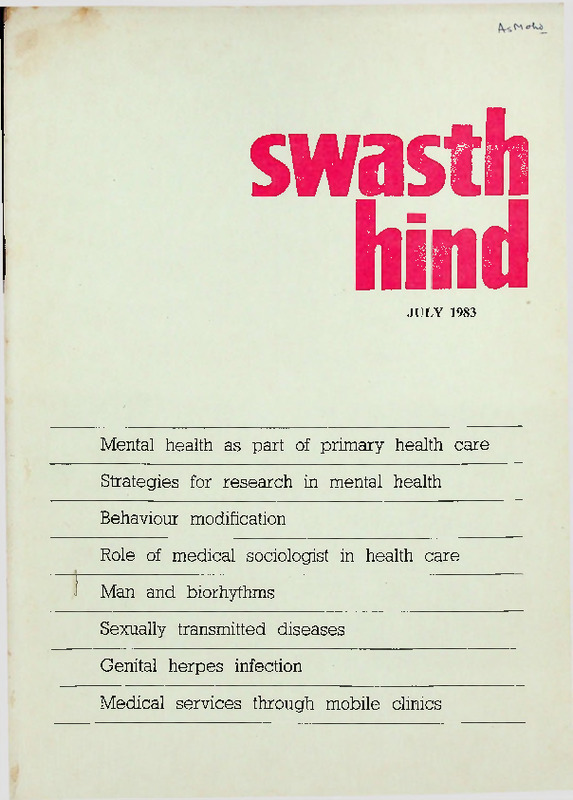
swasth
hind
JULY 1983
Mental health as part of primary health care
Strategies for research in mental health
Behaviour modification
Role of medical sociologist in health care
1
Man and biorhythms
Sexually transmitted diseases
Genital herpes infection
Medical services through mobile clinics
In This Issue
swasth
hind
MENTAL HEALTH
Mental health as part of primary
health care
R. Srinivasa Murthy
July 1983
Asadha-Sravana
1905 Saka
Vol. XXVII No. 7
153
Strategies for research in mental health
156
Prayer hastens recovery
161
Is stress beneficial for life ?
162
P. Bhattacharyya
BEHAVIOUR
Readers Write
1 have come across a few issues of Swasth Hind. I am
impressed at the very first instance. The two main features
I found novel are that this is the only magazine that devotes
itself exclusively to health education. And the second thing
is that it is one of the cheapest (not in contents, of course)
magazine available, I understand.
J. K. ROUTH
MAN1K PUR, NAVAPALLI.
CALCUTTA—700079.
Behaviour modification
—laboratory experiments to treatment of
mental sickness
Dr. K. G. Agrawal &
Upinder Dhar
Role of medical sociologist in health care
Kiun. R. K. Manelkar
163
166
BIORHYTHMS
Man and biorhythms
Fedor I. Komaro v
167
Insomnia and biological rhythms
169
Lack of sleep may lead to fibrositis
170
ASSTT. EDITOR
D. N. Issar
SEXUALLY TRANSMITTED DISEASES
SR. SUB-EDITOR
M. S. Dhillon
Development of health delivery system at
PHC level
—a workshop
171
LAYOUT
Newer infection in STD
172
G. B. L. Sri vast ava
Genital herpes infection
173
RURAL HEALTH
Medical services in rural community
through mobile clinics
Editorial and Business Offices
Central Health Education Bureau
Kolla Marg, New Delhi-110 002.
FAMILY PLANNING
Women opt for laparoscopic way of
birth control
Articles on health topics arc invited for publication in this
Journal.
State Health Directorates arc requested to send reports of
their activities for publication.
The contents of this Journal are freely reproducible. Due
acknowledgement is requested.
The opinions expressed by the contributors arc not necessarily
those of the Government of India.
SWASTH HIND reserves the right to edit the articles sent for
publication.
174
Suresh Chandra
J. S. Mathur &
R. R. Gupta
176
G. Venkataraman
HEALTH IN PARLIAMENT
BOOKS
178
III cover
Subscription Rates (Postage Fee)
Annual
Rs. 3
00
*
Single copy .
Re. 0
25
*
Mental Health
MENTAL HEALTH
as part of primary health care
R. Srinivasa Murthy
The new development in mental health services has been the setting up of General
Hospital Psychiatry Units (GHPUs). These GHPUs are indeed a unique deve
lopment. They share very few similarities with the western counterparts and operate
with greater degree of flexibility, and limited mental hospital support and provide
a wide range of services.
The internationally accepted definition of health
includes positive mental health as one of its major
components. However, health programmes in India
have largely focussed on physical aspects of health
namely cure of the physical illnesses and problems.
There are a number of factors responsible for this
situation : Firstly, until about two decades there was
very little reliable epidemiological data available rela
ting to the prevalence and distribution of mental dis
orders in the community. Secondly, in the past major
efforts in planning services were directed towards
establishing mental hospitals and psychiatric clinics.
The mental hospitals were largely custodial than
therapeutic and the psychiatric clinics were located
in big urban centres.
Thirdly, there has been severe
shortage of trained mental health professionals in the
country. For example, the number of psychiatrists
in India is about the same as that in Denmark which
has less than one per cent of the population of India.
Further, this limited number of professionals is work
ing in urban areas where less than a quarter of our
population live. Fourthly, the general public often
view mental disorders from religious, superstitious
and magical stand-point and thus consider medical
help only as a last resort. This has limited the effec
tive utilization of the available modern psychiatric
facilities. Fifthly, till recently, there were no meaning
ful and practical approaches for the provision of
July 1983
services at Primary Health Centre (PHC) levels, to
meet the needs of the rural communities utilizing
alternative approaches other than through trained
psychiatrists. Another important factor has been the
limited organized type of welfare and rehabilitative
services in the country. In view of these factors,
‘mental health’ till recently, has not been a part of
primary health care in practice.
One of the very significant milestone in the organi
zation of primary health care throughout the world is
the ALMA ATA Conference organized by the World
Health Organization in 1978. This forum provided
an opportunity to examine the issues in primary
health care and develop an international commitment
to the concept.
It is important to note the recommendations on
the components of primary health care. The Con
ference stressing that primary health care should
focus on the main health problems in the community
but recognizing that these problems and ways of
solving them would vary from one country to another,
recommended that primary health care should include
at least: “Education concerning prevailing health
problems and the methods of identifying, preventing
and controlling them; promotion of food supply and
proper nutrition and adequate supply of safe water
and basic sanitation; maternal and child health care
including family planning; immunization against major
153
infectious diseases; prevention and control of locally
endemic diseases, appropriate treatment of common
diseases and injuries; promotion of mental health
(emphasis added) and provision of essential drugs.”
It is to be noted that promotion of mental health
forms one of the eight components of primary health
care.
SITUATION IN INDIA
India is committed to the Alma Ala declaration.
Therefore it is important to sec how this commitment
to mental health as part of primary health care has
been reflected in the Indian situation. This can be
done best by examining the mental health facilities
in the country, the experiments in basic mental health
in the community and lastly suggesting the future
avenues for development.
Mental health professional have developed alterna
tive approaches to reach more than, what would be.
possible through a western pychiatric team appro
ach or through the emphasis on the individual. The
most important of the initial efforts has been the
inclusion of the family members in the treatment.
Existing Mental Health Services
Presently available mental health facilities in India
include about 20,000 beds in 42 mental hospitals and
2000 to 3000 psychiatric beds in general and teaching
hospitals.
For the present population of about 683
million, there is one psychiatric bed per 32,500 popu
lation.
Moreover, it is safe to assume that atleast
one half of these beds are occupied by long-stay
patients adding to the shortage of ‘active’ treatment
beds. The psychiatric hospitals and psychiatric units
provide out-patient ambulant care services which form
the main source of mental health care system in the
urban areas.
It can be safely said that there are no
meaningful services for the rural population. The
available specialized in-patient and out-patient special
facilities for children, adolescents, elderly persons and
other special groups is negligible. The total existing
service system is estimated to be providing care to
not more than 10 per cent of those requiring urgent
mental health care.
Manpower position
In India there are about 900 qualified psychiatrists
working in hospitals and in private practice, 400—
500 clinical psychologists, 200—300 psychiatric social
154
workers and about 600 psychiatric nurses. Of the
108 medical colleges only half have an academic
department of psychiatry. There are only two dozen
centres of postgraduate training in ^psychiatry with
a total training capacity of 100 psychiatrists annually.
The centre for training psychiatric nurses and social
workers is only one and the position of centres for
clinical psychologists training is no better.
The above brief review of the existing mental
health resources and training facilities offers little
hope of organizing basic mental health services to
majority of the population through trained professio
nals only.
It is unrealistic to expect and wail for a
simple process of the extension of current system of
care and hope that the services will reach majority
of the population in the forseeable future.
Alternative approaches
It is interesting to note that during the last 30 years,
the mental health professionals have become aware of
this limitation and have developed alternative approa
ches to reach more than what would be possible
through a western psychiatric team approach or
through the emphasis on the individual. The most
important of the initial efforts has been the inclusion
of the family members in the treatment. This inno
vation, initiated by Dr Vidya Sagar in Punjab in the
1950’s, brought about a big change. The involve
ment of the family not only decreased the need to
depend on close door hospitals and specialized nurs
ing personnel but also decreased the stigma of hospi
talization and possibilities of chronicity. These initial
experiments in Amritsar (Punjab) have come to be
come a part of mental health care programme around
the country.
The other important development in the area of
organization of services has been the setting up of
General Hospital Psychiatry Units (GHPU). These
GHPUs are indeed a unique development.
They
share very few similarities with the western counter
parts and operate with greater degree of flexibility,
limited mental hospital support and provide a wide
range of services with a limited psychiatric team.
EXPERIMENTS IN BASIC MENTAL HEALTH
CARE
The major experiments in organizing basic mental
z health care programmes have been at Chandigarh
and Bangalore.
In the Chandigarh programme carried at the Raipur
Rani Block of Ambala District of Haryana State
Swasth Hind
Community approach in Mental Health
In the last two decades there has been a
major shift in the organization of health ser
vices all over the World. There have been
efforts to “deprofessionalize” many health
activities, to decentralize services and to place
increasing emphasis on providing services for
“priority prolems” for everyone. This shift
can be viewed as a “publib health” or
“community” approach as compared with the
earlier emphasis on individual health care.
It is estimated that about one-fifth of all
the disability in a community is due to mental
disorders, and these cause a still greater
degree of social disruption.
Mental health care is not just the care of
psychotics. Health services are burdened
in their routine work with a significant pro
portion or patients wi'h emotional disorders.
These cases are most often mis-diagnosed,
leading to cosily and time-consuming investi
gations and treatments. This mal-utilization
of the limited health services can be avoided
if primary physicians and health workers are
trained in mental health care.
From an article
*
1 Reaching the
Unreachcd by R, Srinivasa murthy,
WORLD HEALTH Dec. 1977,
(1975—1982). efforts were directed to develop a
system of priorities to train the existing primary health
care personnel to carry out basic mental care tasks
and to involve the community through public educa
tion 6nd formation of mental health associations.
Details of this experiment have been the subject of a
number of scientific reports. The results of the work
have demonstrated that there arc significant number
of mentally ill living in the rural areas needing urgent
treatment. Further, it was possible for the health
workers to carry out a limited range of mental health
activities.
It was also possible to involve the com
munity in a meaningful manner.
A simultaneous project was carried out with simi
lar aims at Bangalore by the National Institute of
Mental Health and Neuro Sciences (NIMHANS),
Bangalore. In a series of planned studies and training
programmes it was noted that it was possible to define
tasks for doctors and health workers working under
the PHC system and to train them. At present such
training in menial health is going on regularly every
month at NIMHANS for the health workers and doc
tors of Karnataka. Thus, the experiments are moving
out from the pilot stage to that of general application.
Another set of centres located at Patiala, Baroda
and Calcutta along with Bangalore have been, study
ing this issue, under the auspices of the Indian Coun
cil of Medical Research (ICMR), New Delhi.
Thus, the developments in the last few years have
been positive.
And that we have a practical ap
proach to make mental health a part of primary health
care.
What is needed for its wider application is
the professional commitment to make this plan possi
ble, political and administrative support to apply it
widely and public involvement to guide and support
the movement. &
STRESS AND HEART ATTACK
* The high rate of heart disease in modern, industrialized countries parallels the increas
ing complexity (and stress) of day to day living.
♦ Prolonged emotional stress, changing lifestyle, and particular behaviour patterns are im
plicated in the progression of heart disease and in the- incidence of fatal heart attack.
*
Stress initiates the release of hormones which affect (he heart by increasing heart rate
and blood pressure. The heart must work harder. In addition, the likelihood of
heart attack may be increased by a disturbance of heart rhythm in susceptible people.
* The emotional and physiological responses to stress arc difficult to measure and assess.
For this reason the precise role of stress in heart disease is a controversial topic.
Heart News,
July 1983
October 1982.
155
STRATEGIES FOR
RESEARCH IN MENTAL HEALTH
Au expanded programme on Mental Health re
search has been undertaken by the Indian Council of
Medical Research (ICMR) in priority areas identified
by experts. In its new strategies for research on men
tal health, the ICMR has adopted a broad approach
of regarding mental health as a composite not only
of psychiatry and neurological science in the tradi
tional sense but also of bio-behavioural and psycho
social aspects of health and development in the current
national context. Emphasis has been laid on transla
ting the fruits of hard-core research, at various stages,
into operational research programmes, so that service
and research are blended to reinforce each other. Men
tal health components of primary health care are
being investigated and strengthened by providing basic
mental health skills to rural health care personnel.
The emphasis in the new strategy of the ICMR in
Mental Health research has been throughout to incor
porate research with existing health services. Most of
these research efforts have in-built intervention pro
grammes to promote extension of mental health care
in the country. Another distinct feature of this pro
gramme is to involve non-psychiatrist specialists, so
as to draw the expertise from the related disciplines.
The research programmes on severe mental morbidity,
training of non-psychiatrist primary health care doc
tors, and training of mental health personnel in ex
tension of mental health services are primarily aimed
at developing modules for providing mental health
services at the primary care level. These modules
developed on a smaller scale can be adopted for use
in the proposed National Mental Health Programme.
The projects on acute psychosis and schizophrenia
are likely to make significant contributions in under
standing the phenomenology, course and outcome of
major psychiatric disorders.
■awy________________________________________________
156
odern psychiatry
in India dates back to some
time in the early 1950s with the creation of
Departments of Psychiatry in certain teaching hos
pitals and also with the use of phenothiazine medica
tion for the mentally ill. During the past three
decades, considerable research has been Jone in India
in almost all areas of psychiatry, particularly psychia
tric epidemiology, pharmacotherapy, psychometry and
clinical psychiatry. A large number of these studies
on such areas as adjustment problems, alcohol and
drug dependence, biological psychiatry, child psy
chiatry, experimental and clinical psychology, family
studies,
psychopharmacology,
rehabilitation and
pharmacotherapy, were carried out under the aus
pices of the Indian Council of Medical Research
(ICMR). Wig and Akhtar1 reviewed the trends in
psychiatric research in India during 25 years (from
1947 to 1972) and have observed that the researches
conducted during the first phase, i.e.» upto 1960, were
primarily theoretical in nature with a bias towards
psychoanalysis. Most of the projects on clinical psy
chiatry involved small samples of patients without
adequate controls. However, during the second
phase, i.e., from 1961 to 1972, significant research
contributions were made in the fields of psychiatric
epidemiology, phenomenology and therapeutics, with
a welcome shift, in research interests from individual
problems to community problems. The deficient areas
of research as identified by Wig and Akhtar arc bio
chemical and psychophysiological aspects of psychia
tric disorders, natural history and phenomenology of
mental disorders, psychotherapy, psychiatric educacation and delivery of mental health services in India
In a review on research in mental health in India.
Neki2 has outlined the lacunae in psychiatric research
and has highlighted the need for undertaking research
in the fields of phenomenology of psychiatric dis
orders, forensic psychiatry, community psychiatry and
neuro-psychiatry.
M
Swasth Hind
Expanded programme of research on mental health
Realising the need and importance of augmenting
research in the field of mental health, the ICMR has
recently initiated an expanded programme for research
in mental health. The Advisory Committee on Men
tal Health of the ICMR comprising leading mental
health experts and specialists from the related bio
medical and bio-behavioural areas met in July 1979
to identify the priority areas for future research in
the field. On the recommendation of the Advisory
Committee, five Task Forces and two Working Groups
were constituted: Task Forces on (i) Phenomenology
and natural history of mental illness; (ii) Psychological
problems of children; (iii) Biological psychiatry and
psychopharmacology; (iv) Illness behaviour; and (v)
Clinical psychology; and Working Groups on (vi)
Alcohol and drug dependence and (vii) Delivery of
mental health services.
All the Task Forces and Working Groups met
during 1980 and reviewed, in detail, the major areas of
research in their respective fields. Working papers
were presented and discussed by 67 senior scientists
of the country drawn from such diverse disciplines as
Psychiatry, Clinical Psychology, Social and Experi
mental Psychology, Biochemistry, Medicine, Neuro
logical Sciences,' Social Anthropology, Paediatrics,
Management and Industrial Psychology, Health Ad
ministration, Family Planning, Biostatistics and Re
search Administration. Several problems were identi
fied and research plans formulated for collaborative
multicentric research in the field of mental health.
The recommendations of the Task Forces and the
Working Groups were reviewed by the Advisory
Committee on Mental Health in the later part of
1980. The Advisory Committee finally recommended
10 multicentric collaborative research projects under
selected investigators /coordinators/consultants.
Proposed national mental health programme
Another significant development in the field of
mental health at the national level has been the consi
deration of the proposal for a national mental health
programme, by the Government of India. Several
meetings of the mental health experts have been con
vened during the years 1981 and 1982 and a draft
proposal for the national mental health programme
has been drawn up. The objectives of this proposed
programme are: (i) to ensure availability and accessi
bility of minimum mental health care for all, parti
cularly to the most vulnerable and underprivileged
sections of population: (ii) to encourage application
July 1983
To bridge the gap between mental
health needs of the community and
the available services, it was decided
to adopt the strategy of integrating
mental health services with the exis
ting health infrastructure at the
primary health care level.
of mental health knowledge in general health care
and in social development; and (ii) to promote com
munity participation in the mental health service
development and to stimulate efforts towards self-help
in the community.
The approaches to the attainment of programme
objectives will include diffusion of mental health skills
to the periphery and integration of basic mental health
care into general health services with appropriate
linkages with the community development pro
grammes.
Some of the Council’s research programmes which
were developed before the proposed national mental
health programme was envisaged, have objectives and
approaches similar to the proposed national pro
gramme. In the project on “Severe mental morbi
dity”, the emphasii is on transfer of skills by training
Primary Health Centre (PHC) staff in identification
and management of selected psychiatric conditions.
The Council’s programme on training of primary
health care doctors is directed towards development
of a training manual and the methodology of en
hancing skills of general physicians to diagnose and
independently manage common psychiatric problems.
In another programme on extension of mental health
services, the objective has been to provide an
opportunity to mental health professionals to learn
recent advances in the delivery of mental health
services in the rural areas. The above programmes of
the Council arc primarily devoted to research and
development of modules which can be adopted for use
on a larger scale when the National Mental Health
Programme is initiated.
Collaborative projects on mental health
National collaborative multicentric projects are
ongoing, at present, at 17 centres in the country. The
157
aims, objectives and scope of the projects are briefly
outlined as follows: —
Severe mental morbidity:
Epidemiological surveys conducted in India dur
ing the past two decades have brought forth convin
cing evidence that the prevalence of mental disorders
is as high in India as in the advanced countries. Nearly
10 to 20 persons per 1000 population are affected by
severe mental ilness at any given time, the corres
ponding figures for neuroses and psychosomatic dis
orders being about three times higher. The available
mental health services and trained manpower are
quite inadequate to provide mental health care to 40
to 60 million people who require psychiatric help at
any given time. In order to bridge the gap between
mental health needs of the community and the availa
ble services, it was decided to adopt the strategy of
integrating mental health services with the existing
health infrastructure at the primary health care level
at 4 centres — Bangalore, Baroda, Calcutta and Patiala.
This project has been designed keeping in view the
tenets of secondary prevention, viz-, early detection
and management of the illness. The approach adop
ted is operational research in delivery of mental
health services to the rural community through the
existing staff of primary health centres in the res
pective study areas.
Following standardization and translation of the
study instruments, training of multipurpose workers
and the doctors at the four selected primary health
centres has now been completed. The results reveal
that it is possible to train the multipurpose workers
to identify individuals in the community suffering
from psychosis and epilepsy and also to provide
follow up care to the patients, in consultation with the
PHC doctors. By training, it has also been found
feasible to enhance the skill * of the PHC doctors in
the management and treatment of selected conditions
like psychosis and epilepsy. In the final phase, a
a complete survey of the selected populations will be
made to find out the actual prevalence of these psy
chiatric disorders in the community. Evaluation of
the training programmes will be made, keeping in
view the cost effectiveness and linkages with the plan
ned National Mental Health Programme.
Training programme for
health care doctors:
non-psychiatrist
primary
Operational research in health services has been
identified by the Council as a priority area. It is esti
mated that 15 to 20 per cent of all patients seeking
158
the service of primary health care facilities or general
hospital outpatient departments, suffer from psy
chiatric problems. Such patients have to be managed,
at present, by the primary health care doctors whose
training in psychiatry is inadequate.
A training
programme has been initiated by the Council for the
primary health care doctors at Bangalore, Hyderabad
and Vellore in order to enable them to have diagnostic
skills to identify common psychiatric problems in
general practice and also to independently manage
these problems. A training manual and curriculum
content have been developed and assessment pro
cedures for pre-and post-training evaluation have
been finalised. Batches of 25 to 32 doctors have been
attending the training courses at the centres from
June-July, 1982.
Training in extension of mental health services in the
community:
A collaborative training programme on delivery of
mental health services was undertaken by the Coun
cil for mental health professionals with the aim to
expose these professionals to the ongoing experien
ces on extension of mental health services in rural
areas at Chandigarh, New Delhi and Bangalore. A
six weeks training programme was organized (between
18th July to 28th August, 1981) which was attended
by seven mental health personnel selected from diffe
rent parts of India. Evaluation of the training was
carried out at each of the centres as well as at the
end of the training. The final week was devoted to
developing specific project proposals for further work.
Three of these mental health personnel have been
able to organize extension services in their respective
centres.
Problems of the aged seeking psychiatric help:
Rapid social changes due to urbanization and
westernization have contributed to emergence of. new
kinds of psychological problems in the aged. In this
hospital-based study on going at Madurai, evaluation
is also being made of family jointness and social integ^
ration. The main objectives are to develop a model
for providing total health care to the aged people
in the community; to develop suitable methods of
providing medical care to the aged at the PHC level;
and to evaluate strategies for strengthening the social
support systems prevailing in the family and the com
munity.
Patterns of child and adolescent psychiatric disorders:
The child and adolescent population has increased
steadily in India, and constitutes little more than one
Swasth Hind
\
third of the present population. The available studies
on the phenomenology and associated
abnormal
psycho-social factors in the child and adolescent
psychiatric disorders are retrospective m nature. A
prospective study has, therefore, been undertaken in
four centres, viz. Bangalore, Lucknow, New Delhi and
Vishakapatnam in order to determine the prevalence
and pattern of psychiatric disorders in children and
to compare the relative prevalence of associated ab
normal psycho-social factors. Care has been taken
to ensure uniformity in diagnosis and classification.
Case intake is in progress and the results are expected
by September, 1983. In addition, instruments will be
developed for undertaking community based • Epide
miological surveys.
Phenomenology
psychosis:
and
natural
history
of
acute
A profile of functional psychosis which does not
quite fit into schizophrenia or affective disorders has
i
The rapid social change in a developing
country like India has not only affected
the attitudes of the people, but has
also made a discernible impact on the
treatment seeking behaviour of the
population as a whole.
been variously described as reactive psychosis, good
prognosis schizophrenia, schizophreniform psychosis,
benign schizophrenia, hysterical psychosis and acute
psychosis. The characteristic features are acute onset,
often precipitated by stress; presence of affective and
hystcrionic features; and absence of cardinal features
of schizophrenia, like autistic behaviour or formal
thought disorders. However, no clear-cut answers are
available, whether this form of psychosis popularly
referred to as acute psychosis is a separate entity or if
such cases followed up over a long period of time will
eventually turn out to be schizophrenia or affective
disorders. This study has been undertaken al Bikaner,
Goa, Patiala and Vellore with the aim to study the
phenomenology, natural history, demographic corre
lates, family "history, response to treatment and prog
nostic indicators of acute psychosis on a longitudinal
basis. After case registration, patients are followed up
weekly during the initial phase and subsequent assess
ment is being made at intervals of three months, six
months and one year after onset. The major contribu
July 1983
tion of this study will be to identify the factors which
contribute to good or bad outcome of acute psychosis.
Course and outcome of schizophrenia:
Schizophrenia is the commonest major psychiatric
illness. The estimated prevalence is about 2 to 3 .per
1000 population and the condition is seen in all com
munities. It is reported that some schizophrenic
patients have a good prognosis and some have bad
prognosis. It has been suggested that schizophrenia
has a better outcome in developing countries. There
is also evidence to suggest that variables in the family
and community contribute significantly to the outcome
of this illness. It is important to identify the various
correlates which are associated with the course and
outcome of schizophrenic illness in our country.
Hence, a study has been undertaken by the ICMR
with the main objective of identifying factors which
influence the course and outcome of schizoprenia.
The specific areas to be looked into will be the presen
ting symptomatology, age at onset, duration of symp
toms, nature of onset of the illness, presence or ab
sence of precipitating factors, premorbid personality,
family history and other sociodemographic variables
which can be associated with the outcome or course
of the illness.
This ongoing study is expected to throw light on
the natural history, course and short term outcome of
this major mental illness.
Illness behaviour in patients presenting with pain:
Pain is an experience of universal interest and it is
the most common symptom encountered in everyday
life and in routine medical practice. Patients with
chronic and intractable pain with no clear organic
basis pose an important problem in medical practice.
Relationship between manifestation and reaction to
pain, illness behaviour, and response to treatment on
one hand: and socio-cultural, psychological factors on
the other have been suggested. The present knowledge
is inadequate regarding the nature and manifestation
of pain behaviour and its relationship with socio
demographic, psychometric and diagnostic variables.
A pilot study on this aspect has been completed,
-research instruments have been finalised and the con
cerned staff have been trained to use these instruments
reliably. This study, which is ongoing at Chandigarh.
is likely to yield data useful towards understanding
the phenomenon of chronic pain and planning effective
management of such patients.
159
Intervention programme on non-medical use of drugs
in the community:
The problem of drug abuse in India has been well
recognized. Changing trends across cultures in terms
of drug usage and appearance of new drugs have been
observed. It has, therefore, become necessary to deve
lop programmes which could keep the abuse within
social control. This study was undertaken with the
aims to investigate the health hazards related to drug
use, to find out the pattern and prevalence of drugs
abuse, and to develop intervention programmes. In
this ongoing project, samples of rural,'urban and
industrial communities have been selected. Phase I
of this programme on collection of baseline data has
been completed. Educational intervention materials
designed to reduce usage of alcohol and tobacco is in
the process of being developed. I he pilot test results
of the educational intervention material have indica
ted need for certain modifications in the educational
material on alcohol and tobacco. The results of this
study will be evaluated by observing the changes in
knowledge, attitude and use of tobacco and alcohol
in the selected communities.
Development of modernity scale:
The rapid social change in a developing country
like India has not only affected the attitudes of the
people, but has also made a discernible impact on
the treatment seeking behaviour of the population as
a whole. Modernity has been known to be an im
portant background variable in acceptance of family
planning and modern medicine. The measurement
of individual modernity assumes importance because
psychological modernity is a syndrome of attitudes
which enables the individual to adjust better, predis
poses him to accept change and increases his recepti
vity to innovations.
Data obtained by the pilot study have been exa
mined and changes suggested in health modernity
items. The relationship of modernity with social
stratification variables will also be examined. The
major thrust will be to enhance personal hygiene and
remove misconceptions about health and disease in
the community. During this phase, educational
material will be developed and the feasibility of intro
ducing educational intervention on attitudes towards
personal hygiene will be examined.
160
A training programme has been initiated
by the Indian Council of Medical Re
search (ICMR) for the primary health
care doctors at Bangalore, Hyderabad and
Vellore in order to enable them to have
diagnostic skills to identify common
psychiatric problems in general practice
and also to independently manage these
problems.
Advanced centres
In order to encourage long-term continued research
in the field of mental health, the Council made a beg
inning by establishing an advanced centre for research
in the priority area of community psychiatry. This
advanced centre has been instituted at the Community
Psychiatry Unit, National Institute of Mental Health
and Neurosciences, Bangalore, and would investigate
the long-term impact of training PHC doctors and
health workers in detection and management of psychotics and epileptics in the community. This Centre
would also examine simple counselling and thera
peutic strategies which would be implemented at the
PHC level. It is proposed to initiate a case register
of psychiatric patients for a population of 1,00,000
which will provide epidemiological, phenomenological
and prognostic information necessary tor developing
mental health services in the community. The Centre
will also undertake research to find out the factors
which facilitate or retard the efforts to provide total
health delivery at PHC.
REFERENCES
1.
Wig, N.N. and Akhtar, S. Twenty five years of
psychiatric research in India. Indian J Psy
chiatry 16:48,1974.
2.
Neki, J.S. Research in mental health in India—
An overview. Paper read at the first meeting
of the ICMR Advisory Committee on Mental
Health New Delhi, 23rd July, 1979.
*
—Courtesy : ICMR Bulletin Feb 1983
*
Swasth Hind
PRAYER HASTENS RECOVERY
“From my experience. I feel that prayer and recita
tion from the religious scriptures can form a very
useful and effective part of psychotherapy,” Dr (Colo
nel) Kirpal Singh stated in the D.L.N. Murti Rao ora
tion he delivered at the annual conference of the Indian
Psychiatric Society at Bombay.
°I nm starling this treatment. my Almighty Father, wini
the confidence that with your help and kindness I will soon
get better and will ultimately be cured of my illness. The
doctor who is treating me has assured me that I will be
better soon and I find no reason why with your kindness I
should not recover. Kindly help me, my Lord'
*.
Prayer had a healing effect in almost 600 neurotic
patients treated by him over the last 10 years, and
incorporating it in the treatment of emotionally dis
turbed persons proved therapeutically useful, Dr Kirpal
Singh told his audience.
The patient is advised to repeat the prayer every
day, modified in accordance with the progress he makes
such as “I thank you for my improvement and am
confident that with your continued help I will be cured
soon”. If the patient is a non-believer, he is not asked
to pray.
“The important role of a psychiatrist in the preven
tion and treatment of psychiatric illnesses is to ensure
happiness and it is justifiable to use any rightful means
to achieve this objective”. According to the speaker,
the factors that play an important role in the aetiology
of most neurotic conditions are: fear, frustration, feel
ing of inferiority, interpersonal maladjustment, jea
lousy, guilt, helplessness in securing a job or promo
tion, inability to provide for basic needs, chronic ill
health, social ostracism and abuse of alcohol and
drugs.
“Tn the modern times the achievement of one’s law
ful goals is extremely uncertain, especially when it is
believed that corruption and nepotism being so ram
pant, an individual without the support of a powerful
person cannot make much headway. It is, therefore,
abundantly clear that at least for psychological reasons
a firm belief in the existence of an Almighty Father,
depicted as loving and protecting his creation at all
times, is necessary as a morale-boosting measure,” Dr
Kirpal Singh observed. “Prayer to such an omnipotent
Creator is, therefore, an exeremely effective measure to
combat many of the causes of nervous breakdown and
to restore mental health in those who are already
affected.”
In the beginning of his career, Dr Kirpal Singh said,
he was careful not to include religion in psychotherapy
J)ut realised later on that the average Indian patient
(unlike his Western counterpart) expects his doctor to
tell him clearly what to do and what not to do. Since
then, he has developed a method to expedite the
recovery of patients with neurotic symptoms. After
listening to the history (which includes attitude to
religion) and carrying out a detailed examination, he
prescribes medication and a suitable form of psycho
therapy in once-weekly sessions, beginning with a
prayer.
July 1983
“My clinical impression is that the patients who
have a strong faith in God and who pray regularly
recover more quickly than those who do not believe
in the efficacy of prayer and depend solely on medi
cines,” Dr Kirpal Singh said.
—Medical Times, Feb, 1983.
HEALING POWER OF FAITH
Since the dawn of history, human beings have been
challenged by their susceptibility to emotional insta
bility and mental suffering.
To relieve this agony,
humans have resorted to many means and have invok
ed the help of a variety of powers, both natural and
supernatural. Across the wide range of cultures and
irrespective of local beliefs and traditional practices,
religion has enjoyed a central place in the promotion
of mental well-being and in the alleviation of mental
disorders.
Fundamentally, man seeks guidance from religion
and hopes to find truth there. Within religious systems,
ethical values and inherited doctrines constitute the
framework for accepted codes of behaviour, for per
sonality formation and for moral development. Tn
time of mental stress, beliefs, customs, traditions and
religious institutions constitute basic resources for help
and rescue.
' Regular religious meetings and congregations in
churches, mosques and temples have their promotive
mental health role as well as providing an opportunity
for collective social interactions. Tn some countries
thelse meetings have been utilised for health education,
or for community involvement in specific mental health
problems.
—From the article “Tho’Hcaling Power of faith” by
Taha Bansher—WORLD HHAlTIT, Oct. 19S2
161
IS STRESS BENEFICIAL FOR LIFE ?
P. Bhattacharyya
Does it mean then that stress is the situation, is belter for the orga
ole of negative
emotions as
contributory factors to diseases not to be avoided as it does not nism than a relatively calm emo
like hypertension, bronchial asth contribute to disease? Not at all. tional state with a low level of
ma, allergy, ulcer of the stomach Stress, on the one hand, is a normal quests.”
and the duodenum, heart failures and necessary part of life, but on
and others were noticed by the doc the other it is the preliminary warn
The scientists say that the wounds
tors long ago. The most simple con ing before an organism succumbs to of a victor heal faster than those of
clusion, therefore, seems to be that a disease or even perishes altogether. the vanquished. If, for example, a
one should always avoid negative Where then is the borderline bet man awaits operation paralysed with
emotions if he does not want to fall ween the reaction to stress being a fear, then he goes through the opera
sick. In fact, the psychosomatic necessary component of adaptation tion badly and subsequent healing is
(‘soma’ means body in Greek) trend and grave pathological symptoms? slower. This theory of questing acti
in medicine is based on the conclu
vity helps to explain why there are
sion that negative emotions cause Soviet theory
such a small number of psychoso
disease. But in reality doctors have
Two Soviet scientists
*
Vadim matic illnesses in wartime, block
also noticed that this theory does not
Rotenberg and Viktor Arshavsky ades and even in concentration
explain everything.
have offered an explanation for the camps.
It is an amazing but universally genesis of psychosomatic illnesses.
accepted fact that many psychoso According to their- hypothesis, the Perennial quests
matic illnesses disappear even under reason for the occurrence and deve
If a man achieves his own goal
conditions of stress, if a person lopment of a whole number of such
and
is pleased with the situation,
quickly and energetically comes up diseases lie not so much with emo
two
possibilities
are open to him:
against an enemy or tries to over tions (whether negative or positive)
either
he
sets himself higher goals
come difficulties. These also become as with the behaviour of the person
much less during the most dreadful concerned and the degree of his acti and achieves them whatever the
efforts, losses and failures (such be
periods of life such as war, siege, vities.
haviour is characteristic of most cre
etc., which are conducive to the
ative personalities) or he sits on his
After
studying
various
types
of
growth of many negative emotions.
achievements and rejects further
behaviour
and
working
out
which
During the Second World War
quests. Tn the former case the active
patterns
influence
the
development
Leningrad was under siege by the
stand in a negative situation helps
of
disease,
they
established
that
Nazis for a very long period. Medi
keep him healthy. Tn the latter—
active
defensive
behaviour
stimula
cal experts have studied thoroughly
when everything has been achieved
tes
the
adaptation
mechanism
and
the phenomenon known as the
and new goals are lacking—he quite
“blockade hypertension”. Tt was tends to prevent the development of
often succumbs to the so-called
found out that there was hardly any disease. On the other hand, passive
achievement disease.
one among the Leningraders suffer defensive behaviour tends to inten
ing from hypertension during the sify the disease and inhibits the def
Although the prerequisites for the
inhumanely tense living conditions ence system of the organism. The development of such an important
of the siege. But the hypertension authors thus classify patterns of hu quality as the questing activity is
reappeared after the blockade was man behaviour on the presence or already built into the genes, it can
the lack of the struggle to overcome
lifted and life become easier.
still be fostered in man from birth
the obstacle. They claim that these
and throughout life. If all. activities
Tt has also been known for a long
are a more essential factor behind
fail or produce disillusionment at a
time that arduous work and serious
psychosomatic diseases than the type
very early age, the urge for quest is
responsibilities make the human or
of mere emotional stress (negative or
killed. But quest itself can become
ganism more resistant to infectious
positive).
senseless also if everything comes
diseases. For example, the. doctors.
nurses and orderlies who selflessly
The Soviet scientists declare: “A easily to a person from the very be
foueht epidemics of plague or cho negative! emotion, followed by acti ginning. and there are no problems
lera rarely caueht those diseases. vity and a search for a wav out of or difficulties to overcome. A
R
162
Swasth Hind
Behaviour
BEHAVIOUR MODIFICATION
—Laboratory experiments to treatment of mental sickness
Dr K..G. Agrawal & UpibtoER Dhar
hen we scold our children for behaving in a
particular manner, we are trying to motivate his
or her behaviour. This is a form of behaviour therapy.
When a boss is trying to reward the good performance
of his subordinate he is trying to encourage further
improvement in his performance by doing so. He is
conducting some sort of behaviour therapy. When we
reward our children for good report cards we arc
trying to make them perform belter in the future. Any
kind of reward or punishment which improves or
modifies the behaviour, is a sort of behaviour therapy
and results in the modification of behaviour of the
recipient. Behaviour modification is the goal of any
behaviour therapy.
W
Sometime back a report appeared in the
national press that a large hospital in Delhi
did not have the facility of behaviour therapy
for the psychiatric patients. Letters from the
readers that followed tried to explain that
behaviour therapy did not need any special
facility. The matter ended there. For *
\lay
reader this was some kind of puzzle. On the
one hand, therapists were sour about not
having enough facilities for specialized
treatment and on the other hand certain other
specialists were trying to explain away by
saying that no such elaborate facilities were
needed to conduct behaviour therapy. If one
knows about behaviour therapy one would
realize that it does not necessarily need
facilities other than those which could be
provided within the normal budget of the
psychiatry department of a large hospital.
July 1983
Typist's cramp
Nammaval and his colleagues in 1978 reported a
case of typist’s cramp which they corrected by using
behaviour therapy. The case related to a senior stenotypist, 34, who was employed in an industrial concern
in Madurai. He had problems at home as well as at
work. As a result he started feeling pain in his
fingers of right hand. Although he was able to attend
to his duties in the beginning, three years later he
started having flexion of fingers into the palm of right
hand. He could type continuously for 15 minutes in
the beginning but later, even when he typed for shorter
duration^ he started getting cramps. He "had diffi
culty in taking notes from his manager. He was treated
at a general hospital in the beginning but later on
brought to the mental health clinic. He was given
tranquilisers for four months but there was no im
provement. By this time, he had become totally handi
capped on work. No sooner than he put his fingers
on the key board, he would start having cramp, in
his right hand. He felt depressed since he was afraid
that he would , lose his job. He even thought of com
mitting suicide. At this stage, besides drugs he was
given Behavioural Therapy. The treatment helped him
a lot. Within a month he was again able to work
peacefully.
163
Any kind of reward or punishment which
improves or modifies the behaviour is a
sort of behaviour therapy and results in
the modification of behaviour of the
recipient. Behaviour modification is the
goal of any behaviour therapy.
which will be punished and ultimately resulting in avoi
dance or unlearning of such behaviour. In the case of
cramps, discussed above, mild electric shock was ap
plied to learn to avoid cramps. This mild electric
shock being unpleasant to the individual ultimately
resulted in unlearning of cramps and thus the stenotypist started avoiding cramps to avoid electric shock.
This was repeated till such time when it was assured
that this individual will not have cramps any more
while typing.
Fear of contauiinatiou
Experimental research
Ahuja has reported a case of 26 years old woman
teacher who had fear of contamination accompanied
with compulsive washing and compulsive checking
ritual. She was treated by exposure in vivo techni
que. Gupta and Pinto have reported cases of dis
ruptive behaviour of boys which they treated through
operant conditioning. The boys belonged to a Luck
now public school. They were punished for disruptive
behaviour. Gradually the disruptive behaviour .was
eliminated and subsequent withdrawal of punishment
did not produce any relapse of disruptive behaviour.
As already mentioned, behaviour modification prin
ciples are based on the broad foundation of experi
mental research by Pavlov published in Russian in
1897.
Reward and punishment
Reward and punishment can change human be
haviour. This is known to the humanity since very
long. The same concept of reward and punishment is
basically adopted in various techniques used for be
haviour modification. Pavlov in 1897 published his
work on digestive system which contributed the prin-'
ciple of conditioned reflex to the science of psycho
logy. This concept was gradually used as a learning
principle. Laboratory experiments were conducted on
animals and humans trying to modify behaviour
through the use of conditioned reflex. In conditioning
experiments the natural stimulus is substituted through
association by another stimulus. The subject starts res
ponding to the substituted stimulus in the same manner
as he reacts to the natural stimulus. For example, at
the sight of food, dog starts salivating. If food is ac
companied by a buzzer, gradually it gets associated
with food. As a result the mere sound of buzzer will
evoke the same response in the dog as evoked by the
sight of food. As soon as the dog hears a buzzer, he
starts expecting food and thus starts salivating. Thus
buzzer has replaced the food. Tn a similar manner
punishment can be accompanied by a natural stimulus
which will prohibit reaction on the sight of such
unpleasant stimulus. Using the principle of reward
and punishment the behaviour of animals and humans
can be altered. Sometimes a positive or a pleasant
stimulus can accompany certain behaviours and thus
strengthening such behaviours. Tn other cases an un
pleasant experience might result from a certain act
164
To be specific it is based on principles of learning
derived from the experimental research in Psychology.
These techniques are used to eliminate human suffer
ing and enhance human functioning. These are used
for facilitating the self-control and expanding skill,
ability and independence of the individuals. Although
some work was done on behaviour modification as
early as the 1920’s and 1930’s reports in the scientific
literature about the application and use of behaviour
modification have appeared mainly within the past 30
years. During the late fifties, Wolpe' developed the
systematic desensitization, a technique for treating
neurotic behaviour patterns. Psychologists and Psy
chiatrists like Skinner, Shapiro and Eysenck have also
contributed to the growth of behaviour modification.
With the demonstration by several scientists that the
principles of learning could be applied to help the
severely disturbed persons, the development of beha
viour modification began to accelerate. Clinical re
searches todate have invariably confirmed that the
principles developed in laboratory research can be
applied effectively to many behavioural problems in
the real world.
Adaptive behaviour.
Behaviour treatment interventions were first used
with regressed psychotic and neurotic adults. Experi
ence has shown that behaviour techniques can be
effective in eliminating many incapacitating neurotic
fears, such as fear of flying in planes, fear of closed
spaces, etc. Behaviour therapists working with re
gressed psychotics have been able to develop a variety
of adaptive behaviour in these patients so that the
patients’ lives were enriched by the availability of many
new choices. From these beginnings, the field of be
haviour modification has expanded and we are able
to help delinquents, retarded, preschool and deaf
children, and drug addicts.
Swasth Hind
Behaviour modification research has been used for
improving the classroom management, teaching me
thods and parent-child relations also. Children whose
behaviour is only mildly maladaptive can be treated
even by their parents or teachers, because behaviour
modification lends itself to use even by persons not
professionally trained in therapy.
Behaviour modification is a family of techniques.
The diverse methods included under the general label
have in common the goal of enhancing persons’ lives
by altering specific aspects of their behaviour. The
service recipient or his representative has to be kept
fully informed of the results of the treatment as it
progresses.
Behaviour therapy for mental illness
Behaviour therapy is rapidly gaining ground in cur
ing mental illness, especially the neurosis. Time and
human energy involved in this type of therapy is far
less than in analytically oriented psychotherapies. Per
centage of recovery of the cases is also much higher
than in conventional forms of psychotherapy. Thus,
the technique of behaviour therapy is becoming in
creasingly popular. Some of the techniques that come
under behaviour therapy are: reciprocal inhibition
therapy; conditioned reflex therapy: aversion relief
therapy and operant conditioning. Tn India psycholo-
Behaviour modification is a family of
techniques. The diverse methods included
under the general label have in common
the goal of enhancing persons9 lives by
altering specific aspects of thier
behaviour.
gists have used relaxation in the treatment of tension
headache, systematic desensitization for treatment of
examination phobia, aversion therapy for treatment of
cramps, etc. In 1975 Majumdar reported a case of
pedagophobia which related to shifting of a student
from one educational institution to the other. A 14
year old boy who was shifted from one school to the
other had this type of anxiety alongwith examination
anxiety. He was treated with reciprocal inhibition.
The outcome was reported to be good. Kuruvilia has
reported treatment of psychogenic impotence by be
haviour therapy techniques. He has treated a number
of patients with the sexual response technique. Some
of these patients completely got rid of their symptoms,
others showed much improvement, only a few did
not show any improvement. A follow-up of the im
proved cases for two to six months showed the main
tenance of improvement. A
MAN’S INNER LIFE
DR. T. ADEOYE LAMBO
Mental health problems remain world-wide and in
tractable, and are increasing both in the developing
and developed countries.
While prevention and treatment of mental and
neurological diseases and problems related to alcohol
and drug abuse still constitute' an important com
ponent of the programme, new areas of work now
feature prominently. These areas encompass psycho
social aspects of health care in general and of
socio-economic development in particular.
They
also draw strength from stimulation and coordina
tion of a wide variety of research endeavours in
mental health and behavioural science. Recent
research findings in, for example, neuro-psycho-endo
crinology, psycho-biology and psycho-pharmacology,
have widened our understanding of man and his
ecology, his emotion, mood and affect, and the phe
nomenology of his perception. Also our attempts
to better understand man and his spiritual and
July 1983
metaphysical needs are bound to assist us m our
determined efforts, not only to prevent or control
many of these problems, but also to enrich man’s
total life and enhance his self-actualisation.
It certainly would not be possible to achieve our
objective of Health for All by the Year 2000 if the
totality of man’s needs—his inner life, his cosmos,
his total reactions to his physical and emotional
world—ate not viewed with great concern and ob
jectified in our programme of health and develop
ment. This is so both because the human mind
will make or break progress on the road to this
objective, and because there is no health without
its mental and/or spiritual component. We need to
intensify our multi-disciplinary research as well as
to extend and expand the scope of our observation
beyond the traditional narrow
confines of our
disciplines of psychiatry and neurology.
—WORLD HEALTH Oct. 1982.
165
ROLE OF MEDICAL SOCIOLOGIST
IN HEALTH CARE
Kum. R. K. Manelkar
The insights provided by the social sciences into the nature of
social process, into the structure of society and the relation
ships between individuals are a necessary foundation to the
effective practice of medicine, whether curative or preventive.
he medical significance of sociological
studies
has not been so universally accepted. At present
such studies tend to be neglected in the training of
doctors. The insights provided by the social sciences
into the nature of social process and into the struc
ture of society and the relationship between indivi
duals are a necessary foundation to the effective prac
tice of medicine, whether curative or preventive. The
concepts of the social sciences enable the doctors to
analyze social relationships in the practice of medi
cine, and to trace in the patient those social experi
ences which most affect his behaviour, symptoms and
perception of illness and the form of illness itself.
However, sociological insight assists the clinician to
discover those social influences which affect his own
behaviour, his interpretation of illness and his care of
the patient.
T
The field of medical sociology is vast. It studies
the demographical, ethnographic and ethnological and
epidemiological aspects with various variables like
cultural, traditional, modern, industrial, urban, stratifi
cation, occupation; institutions and their influence on
behavioural pattern of the patient. Once the stress
factor is diagnosed, half of the battle of treating the
patient is won.
A trained medical sociologist equipped with the
knowledge on different cultures, traditions, value sys
tem and communities on one hand and knowledge on
health education on the other and research aptitude.
could no doubt assist the medical personnel to bring
about better results. The medical sociologist thus
166
can help to establish the better relationship between
the doctor and the patient or the paramedical per
sonnel and the patient. They can participate in Health
Education:
(a) Organizing a massive programme of non-formal
health education for the poor and the underpriveleged social groups.
“To improve the quality and effectiveness of health educa
tion health workers should be given appropriate training in
their subject preferably as part of their ‘basic’ professional
preparation. To make this possible health education curri
culum must be strengthened or modified. Teachers must be
prepared and training courses materials be developed. Care
must be taken not to initiate and impart irrelevant and in
appropriate concepts, methods and materials. Relevance and
appropriateness should be our watch words. These remarks
apply equally to learning aids and mass communication
media which must be integrated in support of health and
health education at all times to prevent duplication of
effort. For maximum effect it must be integrated with or
related to educational programme in support of school health,
nutrition, health aspects of community development and
the like. Only such a concerted and combined thrust could
bring us closer to the goal— “Health for all by the year
2000”.
Dr. V. T. H. Gunararne
(b) Health education/Family life education of mo
thers, their children and the members of their .family,
study the prevailing concepts, beliefs, customs about
health and disease. This means that existing good
{Continued on page 177)
Swasth Hind
Biorhythms
MAN AND
BIORHYTHMS
Fedor I. Komarov
Everything in nature and in the life of man is subject to
rhythms which often measure time better than a chrono
meter, but those “timepieces oi vitality/’ apparently ticking
on their own, can be fast or slow, and one should know fully
well how to set them right. Biologists and medical workers
can do this if they understand the rhythms of man’s phy
siology.
ability of man to restore his stren
gth is not limitless. For each chan
ge, for each exertion made to adjust
himself to a new environment, he
must pay with the deterioration of
his physical or mental mechanisms.
It is very tempting to check up
on a man’s health by using his bio
rhythms. The study of biorhythms
has substantially improved diagnos
tic methods, enriching them with
data hitherto unknown. Let us look
at the following case. A patient is
brought to a hospital at night. His
blood test shows a steep increase in
leucocytes. Apart from clinical sym
ptoms, this may prompt a surgeon
to operate. But such tests may de
lude a doctor since they do not re
present the fluctuations of leucocy
tes over the whole day. As it turns
out, their number is constantly cha
nging all day long, reaching its peak
at night and in early morning. This
•case deals with the fluctuations over
a day but account should also be
taken of seasonal (annual) and other
rhythms which naturally have an im
pact on a man’s organism as well.
While distorting natural biorhy
are present
in all
thms, a disease sets its own instead.
living organisms. Already more
than a hundred of them have been For example, in the case of pneumo
described, with their periods ranging nia a man breaths more frequently
from fractions of a second to dozens and, thus, consumes more energy
of years. Synchronism of rhythms and violates the oxygenation of
in an organism makes for man’s blood and the excretion from his
painless adaptation to the changes organism of carbonic acid and other
occurring in his environment. A si wastematter. All this results in the
milar device has already arisen from retardation of the vital activities of
According to F. Harberg, the Pre
the evolution of all living organisms cells. Discord in biorhythms we call
desynchronism.
If
we
repeatedly
dis
sident
of the World Association of
when only those of them survived
rupt
the
change
from
light
to
dark
Chronobiologists,
biorhythms are the
whose functions were rhythmic.
ness or decrease the day to 21 hours process which provides the “neces
increase it to 27 hours we will shor sary” receptacle with the “necessary”
Important role of rhythms
ten our life span. This has been amount of substances in the “neces
Rhythms are vitally important. proved by experiments on animals. sary” time. This fully applies to
Just as an untuned piano usually The mere violation of the state in chronotherapy. Tn the “era of bio
leads to a bad performance, a dis which sleeping alternates with being rhythms” medicine should be given
turbed biorhythm is a disease. It is awake causes insomnia, diseases of to a person in accordance with that
indicative of an oncoming disease the nervous system and others. Al principle, since the efficiency of treat
and even helps assess the degree of cohol and smoking are also conduc ment often depends on the time when
recovery since there are cases in ive to desynchronism because they a person takes his pills.
which the conventional indicators violate the fine functional regulation
of health point towards recovery. of man’s organs. Certainly, life per Effect of seasonal changes
but biorhythms testify to the after se involves constant adjustments to
The medical workers, when pres
math of disease.
changes in the environment, but the cribing drugs, must take into account
iorhythms
B
July 1983
167
the data on a person’s physiological
rhythms. Chronotherapy has already
proved its value. Chronoprophylaxis,
which completely complies with the
basic principles underlying Soviet
health protection, is also worthy of
mention.
cises for treating cardiovascular dis
eases are most effective in March,
April and May, mud-baths treat
ments in winter and autumn; this
reasonable effectiveness is closely re
lated to the place where a health re
sort is located. Data obtained in a
polyclinic show that prophylactic
measures undertaken on the basis of
biorhythms reduced the number of
crises over a period of four years
from 25.1 to 8.7, the number of
patients from 23.5 to 5.3, the num
ber of disability days from 236.8 to
94.1 per 100 workers suffering from
hypertonia.
A thorough study of seasonal
<. lianges occurring in the functions of
various organs and systems has been
made by the Soviet scientists A. Slonim, A. Golikov and P. Golikov.
There are grounds to believe that
such changes in an organism are re
lated not only to environmental but
also to endogenic factors. For ins
Knowledge of the deep-rooted
tance, a man's hormonal activity re
processes
under the seasonal acute
aches its peak in autumn. This cor
conditions
of diseases, provides for
responds to the opinion of the Ame
purposeful
prophylactic therapy.
rican scientist Smolensk!, who has
recorded the higher viability of child
ren conceived at that time of the Major tasks of chrono hygiene
year.
Some rhythms are inherent in man
and
it is hard to modify them. For
Chronoprophylaxis is accumulat
instance,
a lark wakes up at sunrise
ing more and more data on seasonal
and
an
owl
at sunset, but man is
fluctuations which influence an orga
usually
awakened
by an alarmclock
nism. The data show that man is
at
the
beginning
of
his working day.
more resistant to diseases in Decem
ber and January and less resistant in In fact, every step we make obeys
August; he is more vulnerable to the laws of chronobiology.
“Life involves constant
adjustments to changes in
the environment, but the
ability of man to restore
his strength is not limit
less. For each change,
for each exertion made to
adjust himself to a new
environment, he must pay
with the deterioration of
his physical or mental
mechanisms?5
r
r*
Drawing up an accurate time-table
and distributing work so as to make
the greater load correspond to the
time of day when man’s capacities
are greater is one of the major tasks
of chronohygiene. It is advisable,
whenever possible, to take into
account man’s own biological clock,
whether it resembles that of a “lark”,
an “owl” or is arhythmic as well as
general physiological norms.
Some of our findings show that
capacity to work is highest between
stress in autumn and least of all in 9 a.m. and 1 p.m. and between 4
spring: Studying the seasonal growth pm. and 6p.m.
During these pe
in the number of diseases, our riods, man hears better and also
scientists have recorded rises in May, can distinguish colours better. This
July and September in the frequency capacity is low at night and lowest
of hypertonia crises, in January, Feb between 1:00 a.m. and 3:00 a.m.
ruary^ May, August and September This time accounts for the most acci
of cerebral accidents, in autumn of dents and industrial injuries. Now
heart attacks, in autumn and spring great importance is attached to chro
of duodenum ulcers, and in autumn nohygiene, many Works are devoted
of rheumatics. Physical fitness exer to it, most of which deal with work
4'’There are data to the
effect that the efficiency
of dietotherapy is different
for each month and
season.”
shifts. I assume that medicine will
introduce in the future a sort of cer
tificate for people describing their
biological clocks and the preferable
work time-table.
The time when we eat is also im
portant. Let us cite this example.
A group of people ate 200 Kcal of
food for five days in the morning
only, and grew thin, but when they
ate that amount of food in the
evening only, they put on weight.
There are data to the effect that the
efficiency of dietotherapy is different
for each month and season.
There are also other issues relat
ing to chronobiology and chronome
dicine. The cosmonauts’ work and
rest is arranged and man’s adapta
tion to other climatic regions during
long-distance trips by air or rail.
Biorhythmology overlaps with
many scientific disciplines where re
search is very promising these days.
A joint session of the General Meet
ing of the USSR Academy of Scien
ces and Academy of Medical Sci
ences devoted to “the further deve
lopment of fundamental studies in
medicine” has done much to advance
this field of study. It was after this
session in 1981 that the Chronobio
logy and Chronomedicine Problems
Commission was set up by the deci
sion of the AMS Presidium: which
consists of prominent Soviet scien
tists. Last November, the Commis
sion sponsored the first All-Union
Conference on Chronobiology and
Chronoinedicine. Thus, the science
of biorhythms is on the upswing:
it faces important tasks the fulfil
ment of which will certainly con
tribute to an advance in biology and
medicine.
—Soviet Feature
Swas th Hind
ustralian psychologists
are
testing circumstantial evidence
which suggests that biological rhy
thms hold the key to what causes
insomnia.
A
The scientists, working at Flin
ders University in Adelaide, the
South Australian capital, believe that
body temperature is a vital factor
in the frustrations of those who
want to sleep but cannot.
Dr Leon Lack, a senior lecturer
in psychology at the university and
leader of the research team, said
investigations of insomnia through
out the world had so far failed to
look at the biological rhythms of
the body as a possible solution to
the problem.
He said
indications were that
disturbed body rhythms (disrupted,
for example, by so-called jet-lag,
the rapid movement through diffe
rent time zones) affected the capa
city to sleep. One of the pointers to
disturbed body rhythms was a
higher than normal night-time
body temperature, common in in
somniacs.
Dr Lack said this was because
body temperature worked on a 24hour cycle (known as the circadian
rhythm), which varied from a low
of about 36.5°C (97.7°F) at night
to a high of 37.5°C (99.5°F) at
about mid-afternoon.
INSOMNIA AND
BIOLOGICAL RHYTHMS
“1 believe that the typical insom tory they slept better than they
niac could well suffer from the did al home.
same rounding off, in that the body
“This is possibly due to the fact
of such a person would have a
that
they are angry at their home
higher temperature at night than
environment,
or because restless
that of a good sleeper,” Dr Lack
ness
at
home,
promoted by a num
said.
ber of factors, was aggravated by
the belief that they felt they were
He said body rhythms were also not getting enough sleep” Dr Lack
governed by secretion of a hormone, said.
melatonin, from the pineal gland.
He said a by-product of the re
This was secreted in the dark and
was, therefore, more active at night search had been to acquaint peo
ple with their real sleep needs as
than during the day.
against their imagined ones.
Dr Lack’s team is measuring
the amount of melatonin secreted
by insomniacs against that secret
ed by sound sleepers.
“Our expectation is that insomnaics will have less melatonin in
their urine than people who sleep
well,” Dr Lack said.
His team would also measure
the
production of other hormones
He said a graph showing this rhy
to
see
if various volunteer subjects
thm would feature in upward curve
were
under
stress—which could in
towards a plateau in the morning
itself
be
enough
to deprive them
before another rise to the afternoon
of
sleep.
The
issue
was further com
peak, which was followed by a
plicated
by
the
fact
that many peo
gradual decline.
ple who believed they were inso
The effect of jet-lag was to raise mniacs, were not.
the night temperature slightly and
Volunteers who had agreed to
round off the peaks, thus leading
te> a disruption of the riormal pat keep a sleep diary at home for the
tern which could take several days staff of the university, found often
to restore itself.
that when they slept in the labora
July 1983
To help determine sleep periods
more actively, Dr Lack’s volunteers,
as well as keeping a sleep diary,
will wear for five nights at home
a computer which will record at
one-minute intervals body tempera
ture and movement.
The movement indicator has
proved 96 per cent accurate as a
sleep indicator when tested against
an electroencephalograph the rea
son being that people invariably
move when they are awake.
After their five nights at home
volunteers will spend two nights in
the university sleep laboratory con
nected to an electroencephalograph.
“fn this way we hope to get closer
to a real appreciation of insomnia
and how best to combat it,” Dr
Lack said.
—ATS
169
LACK OF SLEEP
MAY LEAD TO FIBROSITIS
Dr Littlejohn said that many sonaturally produced pain-relieving
mon forms of rheumatic dis hormones, in the blood of fibrositis called malingerers dismissed by
doctors as having “nothing wrong
orders, may be caused by an increase sufferers.
with them” after industrial accidents
of the body’s normal pain threshold
Though this data has not been might in fact be suffering from fib
from lack of sleep.
finally analysed, it may provide rositis, or amplified, hard-lo-definc
The theory being pursued in stu strong support for' the theory that pain resulting from psychological
dies at Prince Henry’s Hospital Rhe fibrositis is actually an '’amplifica stress and disturbed sleep.
umatology Unit in Melbourne is that tion syndrome’’ in which the body's
naturally occurring “tender spots’’
tibrositis sufferers experience aches
Il was well established that stress
and pains common to most people, become sites for real, amplified played a highly significant role in
pain.
but exaggerated by their bodies’ in
the syndrome, and that people suf
creased pain threshold from distur
fering
from it tended to be perfec
“We don’t really know yet what
bed sleep patterns.
tionists,
demanding or themselves
it means,” Dr Littlejohn said, "but
and
others,
and successful in their
we know that disturbed sleep pat
The theory was outlined to medi
jobs.
Many
of the patients in the
terns are involved. We’re looking
cal and para-medical pain specia
Prince
Henry's
Hospital study and
at the possibility that this may in
lists at a recent seminar at the hos
crease the pain threshold, which suffered fibrositis for many years,
pital.
then results in diffuse aches and even, in the case of several survi
pains,
and probably also the release vors of World War II concentra
According to the head of the Rhe
of
endorphins.
” He said most peo tion camps, for more than 30 years.
umatology Unit, Dr G. Littlejohn,
ple
had
tender
spots in particular
the link between fibrositis and dis
parts
of
their
bodies
—spots which,
If lhe indications were proved, Dr
turbed sleep has been established
if
pressured,
registered
tenderness Littlejohn said, and fibrositis was in
since it was first documented at the
University of Toronto’s sleep labo or mild pain. In fibrositis patients, fact an “amplified pain syndrome”,
ratories in Canada in 1979. Then, it was possible these spots were just its treatment would become much
a group of volunteer medical stu amplified. Disturbed sleep patterns more rational.
dents developed fibrositis after being were common to most fibrositis pa
Doctors encountering the com
subjected to three days' deliberate tients, as were several other features
of the syndrome, the main symp plaint should concentrate on con
interference with their sleep.
toms being generalized pain.
trolling sleep disturbance, supported
by relaxation therapy and modifica
Dr Littlejohn said that link had
It most commonly occurred in tion of life stresses. If relaxation
been further documented in separate
research in other parts of the world. middle life, frequently after some therapy was inappropriate or un^form of stress or trauma such as a successful, low-dose trycyclic anti
In the Melbourne studies-involv- motor vehicle or industrial accident. depressant drugs were also effective.
ing fibrositis patients referred from This might not have resulted in any Dr Littlejohn’s research team is also
other hospitals—researchers have major physical trauma, but did working on developing a skin test
established a significantly
higher contribute to emotional stress and as a means of simple diagnosis.
incidence of endorphins, the body’s sleep disturbance.
— AIS
F
ibrositis, one of the most com
’ To ensure prompt supply of the Journal, quote your Subscriber Number and intimate the change of address/
For all enquiries, please write to :
The Director
Central Health Education Bureau
Kotla Marg,
170
I
1
New Delhi-110002.
Swasth Hind
Sexually Transmitted Diseases
Development of health delivery system
at PHC level
— A WORKSHOP
A
who Workshop on Sexually Transmitted Diseases
sponsored by the Government of India was held
from 26—30 December, 1982, at S.V. Medical Colleg. Tirupati. Dr I.D. Bajaj, Director
General of
Health Services, presided over the inaugural function.
The medical officers working in the Primary Health
Centres of the States of Kerala, Andhra Pradesh and
Karnataka attended this Workshop.
Welcoming the faculty members, guests and the
participants, the Principal of S.V. Medical College ex
pressed his gratefulness for organizing this group edu
cational activity at their institute.
In this Inaugural Address, Dr P.S.R.K. Hamath,
Director of Medical Education, Andhra Pradesh, tou
ched upon various aspects of sexually transmitted dis
eases and suggested that the STD clinics should be re
designated as Skin and STD clinics. This will facili
tate the proper utilization of treatment services by
the STD patients. Since venereal diseases are coming
up and some departments alone cannot give sex edu
cation or any type of health education to people, he
suggested that every school and college should have a
doctor on their teaching staff to impart sex education
including that of sexually transmitted diseases to chil
dren. Dr Hamath also suggested the preparation of
slides on STD for both educated and uneducated peo
ple. He was happy that various district hospital labo
ratories were being adequately equipped by the Gov
ernment of India for proper diagnosis and treatment
of sexually transmitted diseases.
>
Delivering the Presidential Address Dr. I. D. Bajaj.
Director General of Health Services, made a special
mention of the steps taken by the Central Govern
ment for the control of STD. He remarked that in
order to make some dent in the control of STD contact
tracing and case finding was needed to be further im
July 1983
proved. He told that such Workshops were being
conducted as part of the STD Control Programme to
provide enough training to medical officers and tech
nicians and to ensure proper treatment of the patients
suffering from sexually transmitted diseases. He hoped
that this educative step would go a long way in re
ducing the deformities and their sequelae caused by
syphilis and gonorrhoea.
Dr Dharam Pal, Adviser, STD, explained the aims
and objectives of organising such a group educational
activity in general and of this Workshop in particular.
He said that sexually transmitted diseases should be
considered in the same manner as malaria, tubercu
losis, or any other disease. He said that the purpose
of the Workshop was to develop the health delivery
system in connection with the sexually transmitted
diseases at the PHC levels. It would intensify the work
ing knowledge of medical officers regarding STD
and enable them to diagnose and treat the patients in
a proper manner at the PHC itself instead of referring
them to a far off district hospital. Keeping this in
view, the teaching programme, talks, have been arran
ged in such a way that the participants could get a
comprehensive view of sexually transmitted diseases
in its various aspects, namely clinical, laboratory, epi
demiological, social and educational aspects. Shri
Dharam Pal said that the participants, after attending
this Workshop, would be able to handle STD cases
with more courage and confidence.
Dr Bimala Bai, Superintendent, S.V.R.R. Hospital.
Tirupati proposed a vote of thanks.
The valedictory function, held on 30 December,
1982 was presided over by Dr Sita Ramiah. Vice
Principal, S.V. Medical College. Tirupati.
An evaluation report on the basis of the post-eva
luation test showed considerable improvement in the
working knowledge of the participants with regard to
sexually transmitted diseases. A
171
NEWER INFECTIONS IN STD
NEWER infections have displaced gonorrhoea, sy
philis and chancroid as the most prevalent sexually
transmitted diseases in the world, Dr R.D. Catterall,
President of the International Union against Venereal
Diseases and Treponematoses, said in Bombay recen
tly.
The “second generation” of sexually transmitted
diseases including chlamydia, ureaplasma and gardnerella, account for the majority of cases seen in STD
clinics in industrialized countries. Quoting statistics
from the UK, where he is an advisor to the depart
ment of health. Dr Catterall said that only 16 per cent
of patients reporting to STD clinics in 1981 suffered
from the ‘first generation’ of diseases, i.e„ gonorrhoea,
syphilis and chancroid.
Globally there has been a “substantial increase” in
the incidence of sexually transmitted diseases. In the
UK alone, more than half a million cases have been
diagnozed since 1960. While the incidence of gonorr
hoea and syphilis has remained steady, non-specific
urethritis has shot up in a “spectacular way”, a trend
that is causing great concern to public health autho
rities.
3. Change in sexual practices: oro-genital and ano
rectal sex is quite common, and a doctor examining
a case of STD has to look at several sites in addition to
the genitalia, such as the oro-pharynx and the ano
rectal regions.
4. Symptomless infection: this is particularly true
of chlamydial infection.
5. Increased travel,
strains.
and the spread of resistant
6. Antibiotic resistance.
7. Modern contraception: the Pill, the most popular
form of contraception, does not prevent passage of
infection during sex, and intra-uterine contraceptive
devices are being increasingly associated with pelvic
inflammatory disease.
8. Ignorance of sexually transmitted diseases among
doctors and the public.
Syphilis in the UK is rapidly becoming a problem
of homosexuals. The decline in late syphilis is proba
bly the result of enough broad spectrum antibiotics
being consumed by a person in his lifetime.
Sexually Transmissible Agents
Dr Catterall told the seventh national conference
of the Indian Association for the Study of Sexually
Transmitted Diseases that there are at least 32 differ
ent agents that can be spread by the sexual route. In
addition to the newer bacteria—chlamydia, ureaplasma
and mycoplasma—several viruses and protozoa are
becoming important, among them hepatitis B virus,
cytomegalus virus, Epstein-Barr Virus, Papilloma
Virus, Entamoeba histolytica and Giardia Lamblia.
Responsible factors
According to. Dr Catterall, factors contributing to
the rising incidence of STD are:
1. Population changes', there is an increase in the
total number of people growing up, and in the rate
of urbanization.
2. Attitude to sex or the “sexual revolution’*:
some countries premarital sex is the norm.
172
in
In Europe and the UK, chancroid has been appear
ing episodically in the last 6 months but advances in
culturing the causative organism have led to more
accurate diagnosis.
“I believe there will continue to be a high inci
dence of sexually transmitted diseases in this country,”
Dr Caterall declared. This is because the majority of
STD do not provide protective immunity (some pati
ents have contracted gonorrhoea eight times in a single
year), the infection is symptomless in a significant
number, high-risk groups (teenages, homosexuals)
form the nucleus of infection in the community, and
resistance to antibiotics is likely to grow.
“Since the number of STD patients is going to in
crease, there is a need for the medical profession to
organize itself to face this challenge,” Dr Caterall said
in conclusion.
_
Medical Time-,, March, ’83
Swasth Hind
GENITAL HERPES INFECTION
Lack of effective therapy
he media have grossly exaggerated the prevalence
of Genital Herpes virus infection, one of the
newer sexually transmitted diseases, Dr William Har
rison (USA) and Dr R.D. Caterall (UK) stated in
their guest lectures at the seventh national conference
of the Indian Association for the Study of Sexually
Transmitted Diseases held in Bombay.
Among a group of young Americans on naval duty
only 2.8 per cent said they had Herpes infection at
some time or the other. Thus Herpes is not a serious
problem among sexually-active young men, Dr.
Harrison said.
'
In the UK, statistics from STD clinics show only
a gradual increase in the incidence of Genital Herpes
virus infection, from 6,762 cases in 1975 to 10,800 in
5980, Dr Catterall told the delegates.
By over-reacting, the press and television have
spread alarm among the people, and many doctors
spend hours every day reassuring their patients, he
added.
If infection occurs, there is likely to be a life-long
association between the virus and the host. At first
the patient experiences itching and discomfort, then
develops pustules which rupture, leaving shallow
ulcers. Primary attacks, particularly in women, can be
very severe, with fever, pelvic pain and severe itching
around the lesions.
. Men with Genital Herpes infection usually complain
of severe ano-rectal pain, difficulty in walking and con
stipation lasting up to 10 days.
Herpes simplex causes cancer of the cervix, al
though the statistical evidence is “very seductive”, Dr
Catterall said. Primary infection in the cervix is us
ually followed by recurrent attacks.
Diagnosis, * often self-evident, is established by
growing the virus in tissue culture using human-em
bryo cell lines.
“Treatment of Herpes infection is still not very
good”. Dr Catterall remarked. In Britain, acyclovir
has proved useful in limiting severe primary infection;
it does not prevent recurrence. Vaccines are being test
ed but none has been licensed so far.
Both topical and intravenous preparations of asyclovir are available in the United States, Dr Harrison
July 1983
told his audience. The intravenous form has been
successful in the treatment of primary Herpes geni
talia, disseminated Herpes and Herpes encephalitis,
but has failed to prevent recurrences.
__
Medical Times, March *83
Blood test for diagnosis
A new blood test for genital herpes has been deve
loped at an Australian university.
The simple procedure, which will complement exis
ting tests, provides a rapid and reliable diagnosis and
was developed at La Trobe University in Melbourne
by microbiologists Dr John May and Mr Minas
Arsenakis.
The test has been under evaluation for two years
and more than 100 patients have been tested. The
researchers believe the test could have a significant
impact on limiting the spread of genital herpes.
Dr May and Mr Arsenakis originally began rese
arch into the development of a test for the detection
of early-stage cervical cancer. But they realized
three years ago that the test they had developed had
immediate potential for the diagnosis of genital
herpes in both sexes.
Before the development of the La Trobe test labo
ratory, diagnosis of herps depended largely on the
ability to grow the helps virus recovered on swabs.
from infected areas. Disadvantages of this method
included its complexity and the time (up to several
weeks) needed to obtain results. Swab specimens can
also die during transport to the laboratory, leading to
a false negative result being obtained.
Effects of the disease can reach beyond the discom
fort and distress caused by attacks of the virus. The
disease can be passed to offspring during childbirth,
and women suffering from it may have a greater risk
of developing cervical cancer later in their lives.
There is no known cure to the disease.
An antigen (a protein which serves to identify in
truder organisms in the body and which provokes the
immune system to produce defensive antibodies) deve
loped at La Trobe University is used in the test.
The specific antigen preparation, AG-4, is obtained
during the early multiplication of herpes genital virus
in the laboratory. Because the AG-4 antigen does not
cross-react with the herpes virus which causes mouth
sores, it overcomes the problems associated with pre
vious blood tests for genital herpes.
—AIS
173
Rural
Health
Medical Services
in
Rural Community
through
Mobile Clinics
Suresh Chandra J. S. Mathur &
R. R. Gupta
edical care in rural community at three primary
. health centres, viz., Chaubepur, Sheorajpur and
Kalya n pur is being looked after by G.S.V.M. Medi
cal College, Kanpur. Besides, specialist services to
rural and slum community is provided by mobile
clinics under ROME Scheme.
M
The Government of Rajasthan startea door to door
medical services through mobile clinics, in 1958. This
has helped the persons is remote areas and those who
cannot reach even to the nearest primary health centre
or hospital for their health needs. They are much
benefited by such type of health services. Meetings
of Deans and Principals of medical colleges (1976) and
Medical Council of India has brought in some drastic
changes to make the teaching and training of yong
doctors “ community need based'" and stressed for
close cooperation between Social and Preventive
Medicine and other clinical departments. For the
effective implementation of health services the Sub
committee and Conference of Dean and Principals of
the medical colleges in India has drawn a uniform
plan of action to be operated in all medical colleges.
The three mobile clinics or hospital on wheels were
provided to each medical college for medical care
of rural community under the Re-orinentation of Medi
cal Education Scheme. Now the trend in medical
education and health services have shifted from hos
pital based to community oriented with emphasis to
extra-mural teching, training and service in real
situation adopting “community as a ward”. Now the
majority of the faculties have left the four walls of the
hospital providing specialist services to rural com
munity through mobile clinics. Yet their approach
is treatment oriented which has to be basically orient
ed to preventive and promotive services otherwise
the benefits of Re-orientation of Medical Education
scheme {ROME) will not be availed of by the com'munity for whom the scheme has been launched.
174
Presently three mobile vans were provided to
G.S.V.M. Medical college, Kanpur hi March 1979.
These mobile vans are mobile hospitals and clinics
on wheels with well equipped minor operation instru
ments, injection trolly, single operation table, operat
ing spot light, examination light, drug and storage
cabinet, sterilizer, refrigerator, pharmacist compart
ment, medical and diagnostic equipments, adult emer
gency kits baby emergency kits, midwifery kits, oxy
gen cylinder and dental table. All the lights and fans
are generator operated. Besides, there is also provision
of battery operated emergency light.
BENEFITS
* Patients who cannot attend primary health
centre or urban placed hospital may be bene
fited through the mobile clinics.
* Involvement of local people in medical care
programme.
* Effective use of scarce resources and inputs
while minimizing the cost in general.
* Specialist services of medical college can be
provided to remote placed people.
* Medical students, interns and junior doctors
are exposed to rural health problems.
* Exposing of Faculty staff to rural health pro
blems.
♦ Upgrading the quality of health care services
in the rural and peripheral areas by providing
meaningful referral services linking between
remotest peripheral health care unit with
medical college.
Swasth Hind
MOTHER & CHILD HEALTH AND FAMILY
WELFARE SERVICES
Action Taken
The scheme is being implemented in G.S.V.M.
Medical College, Kanpur since 1979. The plan of
action involves various clinical departments in the
scheme. The guidelines of Government of India
were taken into consideration in the implementation
of the scheme:
1. Medical college has taken the total responsibi
lities of preventive, promotive, curative and adminis
trative care of three PRC’s viz. Chaubepur, Sheorajpur and Kalyanpur.
2. Four weeks community posting has been arran
ged for the students of final year M.B.B.S.
The
students of final year are posted in batches of 15 to
20 in the community medicine.
3. Health services, drug distribution, health edu
cation, M.C.H. and Family Welfare Planning services
alongwith specialist services are provided by students,
interns and senior teaching staff of the medical
College.
4. The referral services of the following two types
have been evolved in the community health.
(a) By Students.—Undergraduate students under
the supervision of senior teachers of the De
partment of Social and Preventive Medicine personal
ly bring the cases in the hospital to provide the
services of specialists.
(b) By Doctors.—The interns, doctors of the
Primary Health Centres and the specialist team direc
tly refer the cases to the medical college for hospi
talization and treatment.
5. Doctors and staff of Primary health centres have
been utilized in undergraduate and interns training
programmes.
6. The specialists of medicine, surgery, paediatrics,
obstetrics and Gynaecology,, ophthalmology and
Orthopaedics are providing their services to the rural
community of these three primary health centres by
mobile clinics.
Achievements:
SPECIALIST SERVICES TO RURAL COMMUNITY
THROUGH MOBILE CLINICS FROM APRIL
1981 TO MARCH 1982.
Department participated
No- Visits Cases Attended
Medicine
Paediatrics
Orthopaedic •
Ophthalmology
Obstetrics & Gynaecology
Surgery
Social & Preventive Medicine
66
1071
68
382
58
8
207
42
737
56
492
18
68
Immunization,
MCH and Family
Welfare
Services
were
provided.
July 1983
Teaching staff with assistance of para medical
workers of Social and Preventive Medicine are orga
nizing well baby clinics and providing M.C.H. and
Family Welfare Planning Services to the rural com
munity.
M.C.H. AND FAMILY WELFARE SERVICES PROVIDED
DURING 1981—1982
Achievements
Particulars
MCH clinics held
Mothers attended the clinic
Children attended the clinic
Mothers given Iron & Folic Acid
Children distributed Vit. A. Sol.
Vasectomy done
Tubectomy done
Coppter—T Inserted
Sterility cases seen and referred
59
253
461
217
“53
7
193
145
19
•
•
IMMUNIZATION AND INOCULATION DONE UNDER
THE SCHEME DURING APRIL 1981 to MARCH 1982
No. of Cases
IMMUNIZATION
Smallpox
D.P.T...............................................
D.T........................................................
Tetanus Toxoid •
•
'•
• • •
Polio •••••••
Cholera...............................................
B.C.G...............................................
Practical
difficulties in use
of mobile
1653
1429
502
1175
1207
730
67
vans.—The
mobile vans under the scheme are not utilized to the
extent it is required. The following discrepancies are
being observed in providing the services to the rural
masses by these vans.
Size of the mobile van is so big that it cannot go
on most of the roads of the rural areas.
The vehicle cannot move in Kachha or semi-pucca
roads of remote village areas.
Adequate budget for diesel and repairing is not
provided for the regular services of these vans.
Skilled technicians and the mechanics are not
available in most of the cities for repairing and main
tenance of vans.
Major surgical operation cannot be performed in
side these vans.
These large vehicles cannot transfer the emergency
cases to the hospital referred by specialists.
If these drawbacks are removed the working capa
city and efficiency of mobile climes can be much im
proved.
•
A
175
Family Planning
Women opt for
Laparoscopic way of birth control
G. Venkataraman
was a time when the people used to run
away and even bolted homes at the mere sight
of a van or a jeep bearing the red triangle mark
entering the village with the fear that they would be
picked-up for birth control operations. Now things
have changed. • In fact, rural population, especially
women, welcome family planning camps but with a
change—sterilization through LAPAROSCOPY.
here
T
Women in Dharmapuri district of Tamil Nadu
needed a lot of motivation and persuation in the be
ginning to undergo sterilization—popularly known as
‘operation’ for limiting family size. But the big turn
out of young mothers, including LAMBADI tribals,
at Dharmapuri Headquarters Hospital during last
week of November, 1982 for undergoing Laparosco
pic sterilization was a clear indication of a change in
attitude of rural women in the district towards a
•planned family. The women opted for sterilization
the laparoscopic way which clearly showed that this
much publicised new technique of birth control would
relieve them of the attributed difficulties of tubectomy.
As one mother put it “We wanted a device that
could be less painful and free from possible compli
cations and perhaps this was it.”
Women acceptors from far off places in Pennagaram, Palacode, Dharmapuri, Nallampalli blocks of
Dharmapuri tehsil area thronged the Dharmapuri
Government Hospital in large numbers.
The family members who accompanied the young
mothers took shelter under trees and any other place
they could find and were seen lulling the last-born
176
infants to sleep while their mothers were away in the
ward, for Laparoscopy. The camp site wore a fes
tive look.
Lambadi tribals accept family planning
A dozen LAMBADI tribals from Masakkal forest
area in Pennagaram block of Dharmapuri district
came all the way to undergo sterilization by the
new technique. Twenty-four women from Athimarathur, Seelainaickanoor, Mudugampatti, Kuttumaradhalli, Thinnakuthahalli hamlets in Masakkal reserve
forest area either travelled on the back of donkeys
or trecked the 16 Kms to reach block headquarters
at Pennagaram and from there they went by bus to
Dharmapuri to avail of this facility.
Onnuki wife of Kuppusamy, a lambadi tribal
woman from Madhanda hamlet, and a mother of five
children, was asked why she had not opted for tube
ctomy earlier. Her spontaneous reply to the ques
tion was that ‘operation’ scared her and she could
not stay on for days in the hospital after tubectomy
as her family needed her so much. Onnuki said “I
was informed that this method was painless and I
could go home same day”. This view was endorsed
by many mothers.
Mothers' meeting
The modren laparoscopic sterilization camp was
preceded by a week-long women mobilization cam
paign mounted by the Directorate of Field Publicity.
Ministry of Information and Broadcasting, Salem and
Swasth Hind
Dharmapuri units. Mothers
*
meetings were conduct
ed in the villages to enlighten the mothers on sali
ent features of sterilization the ‘’laparoscopic way
*
’.
They were informed that triggering of ‘Falopc-ring’
was painless and completed in less than three minutes.
Further, they could return home the same day and do
their house-hold work. No scar or mark would be
left after the treatment. Beneficiaries would be paid
Rs. 125 as incentive, etc. Besides this, they were
explained the benefits of a small family and what
the new 20-point programme had in store for the
women.
Publicity campaign
As many as 10,000 posters and banners were pul
up in almost all the villages in Dharmapuri tehsil
area. The attractive posters with catchy slogans were
displayed at prominent places on the walls of build
ings and on the public transport. Announcements were
also made from mike-fitted jeeps, auto rickshaws,
bullockcarts, etc. The message reached the far flung
areas.
The dreaded word ‘operation’ disappeared
from the minds of village folks, who now referred to
sterilization through laparoscopy as a “Treatment by
injection”.
{Continued from pageJ66)
health practices should be encouraged and the bad
ones should be discouraged.
(c) Educating people about the availability of heal
th services, and their utilization.
(d) A deep sympathetic attitude of health educator
is a must for good result.
For improving the condition of women following
measures should be encouraged:
1. Education and training of women to help them
increase their knowledge self-esteem and status, to
become self-sufficient, through employment.
11. Development of community creches, bal-wadis,
pre-school nutrition, immunization.
111. Raising the age of marriage.
IV. Educating women on the health aspects of
puberty, menstruation, role of wife/mother, pre-natal,
post-natal health-services and importance of small
family norms with special emphasis on family plann
ing methods such as spacing, including breast feed
ing and post-partum absenteeism as cultural factors.
V. Education of women on home making, proper
cooking, awareness of their role and value in the
society.
Other measures should include—
The impact of the publicity was gauged by the
large turnout at the camp site. Women gathered in
ilarge numbers to undergo this painless and easy
method of sterilization. In fact at Laligam—a village
twenty kilometres away from Dharmapuri—there was
a popular demand that similar camp should be spon
sored for the “benefit of men”. Humorous though
the demand sounded, it spoke for the popularity of
this new method of sterilization.
A new record was created in the Dharmapuri lapa
roscopic camp where 1,008 sterilizations were done at
a single camp which lasted for three days. The ear
lier record was 1,002 sterilizations in a five day camp
held in Gujarat State. In November, 1982 alone
(November was observed as National Family Wel
fare Month) a record number of targets, 776 and
1,008 were achieved in Krishnagiri and Dharmapuri
camps respectively. There are indications that the
major breakthrough made by Dharmapuri district in
Tamil Nadu will be followed elsewhere to carry the
message of small family to rural population.
A
1. Community organization and its participation.
2. Education with special stress on nutrition and
health.
3. Awareness of public health and personal hy
giene.
4. Education with special stress on women educa
tion, in reducing fertility by use of Family Planning
methods. Nutritional deficiency and diet; immuniza
tion and nutrition for children.
5. Close and continuous studies in the area of in
formation and support, community involvement to
ensure the benefits of health services by co-ordinat
ing medical and sociological knowledge.
It may be mentioned here that doctors and hospi
tals alone cannot achieve this end. The para-medical
staff like nurses, public health engineers and social
scientists, who in turn should educate the community
leaders and members making them aware of social
changes in all the aspects, should participate in achi
eving this end, to achieve the goal of health for all.
—Excerpts from a
paper
“Teaching and Research in
Medical Sociology in India”.
July 1983
177
HEALTH IN PARLIAMENT
Lok Sabha—3 March 1983
Infant Mortality in
Rural and Urban Areas
lo the la les I figures compiled by the
Registrar General of India through Sample Re
gistration System (SRS)? die infant mortality rale
per 1000 live births for rural and urban areas of the
country are:
ccording
A
Year
1976
1977
1978
•
•
•
Rural
Urban
Total
139
140
137
80
81
74
129
130
127
The infant mortality rates for the
years have not yet been compiled.
subsequent
The infant mortality rate in the rural areas is
more than that c>f urban areas.
The infant mortality rates in some of the advanced countries are given below: —
Infant mortality rate
Country
1976
1977
1978
Canada
U.S.A.
Japan •
France •
Germany (DR)
Germany (FR)
U.K. •
Australia
Sweden
13-5
15-2
9-3
12-5
14-0
17-4
14-5
13-8
8-3
12-4
14-0
8-9
11-4
13-1
15-5
14-1
12-5
8-0
12-0
13-6
8-4
10-6
13-1
14-7
13-3
7-8
In the advanced countries, the level of infant morta
lity is lower than that of India.
Measures taken or proposed to be taken to bring
down the infant mortality are:
1. The infrastructure for the delivery of maternal
and child health services has been and is being ex
panded both in rural and urban areas by the setting
up of Primary Health Centres and sub-centres, Ur
ban Family Welfare Centres, and Post-Partunr Cen
tres. Presently, about 6000 Primary Health Centres,
60,000 sub-centres,
2,500 Urban Family Welfare
Centres and 550 Post-Partum Centres are function
ing in the country.
178
2. The Health Guides Scheme introduced, in the
last few years with the aim of providing one wor
ker for every one thousand population will provide
further primary health care in the promotive, pre
ventive and curative aspects in a large measure.
About 2.33 lakh village health • guides have been
trained so far.
3. The training of
Traditional Birth Attendants
(Dais), who assist at the time of child-birth in vil
lages, has been intensified so that there would be a
trained dai also for a village of 1000 population to
provide for hygienic deliveries. About four lakh in
digenous dais have been trained so far.
4. Special clinics to attend to pregnant mothers
and small children are organized in all types of me
dical and health institutions. Besides keeping preg
nant mothers and small children under regular health
supervision, these clinics provide the preventive ser
vices as well as undertake health and nutrition edu
cation.
5. Preventive immunization against tetanus is
given to pregnant mothers in order that puerperal
tetanus and neo-natal tetanus which is a cause of
infant deaths in many parts of the country is pre
vented. Facilities are provided for the protection of
infants from
tuberculosis, diphtheria, whooping
cough and tetanus. Arrangements for immunizing
children against measles, typhoid and polio have
also been made. The programme of immunization
for all these categories is being intensified from year
to year. During 1980-81 and 1981-82, 10.5 million
mothers have been covered with T.T. Immunization.
Among children
covered are 13.8
million with
D.P.T.: 20.8
million with D.T.; 3.7 million with
Polio and 3.8 million with typhoid.
6. Nutritional anaemia is widely prevalent among
pregnant and nursing mothers. A scheme is in ope
ration to prevent nutritional anaemia among mo
thers and children. During 1980-81 and 1981-82,
20.80 million mothers
and 19.25 million children
have been covered under the scheme.
Swasth Hind
7. A programme to combat dehydration due to
diarrhoeal diseases among children through use of
oral electrolyte solution has also been initiated.
CHILD MORTALITY RATE IN INDIA
AS COMPARED TO UK AND FRANCE
8. Doctors in Primary Health Centres are being
given inservice training in maternal and child health
in selected district headquarter hospitals. About 450
doctors have been trained so far.
Smt. Mohsina Kidwai informed the Lok Sabha that
according to information available the age specific child
mortality rate in India during 1978 is 48.3 in the agegroup of 0-4, 4.2 in the age group of 5-9 and 2.0 in
the age-group of 10-14 per thousand live births. The
same in Great Britain was 12.8 per thousand live births
during 1979 and in France 10.1 per thousand live
births during 1979.
9. Educational matcrial/guidelines . on all com
ponents of MCH Schemes, including nutrition, are
being produced and distributed to medical and para
medical staff.
10. Nutritional education to mothers is sought to
be imparted through all the Auxiliary Nurse Mid
wives in sub-centres.
(b) Child mortality is caused by malnutrition, as
well as by unsatisfactory living conditions: gastro
intestinal diseases; respiratory infections; other com
municable diseases and poor immunity status.
11. Intensive steps have been taken to provide
adequate care to the newborn in the form of train
ing of traditional birth attendants, midwives, nurses
etc., defining minimum perinatal care, imparting
training to teams of doctors in newborn care and
providing specialized
equipments for care of sick
newborns.
Immunization against
Polio & Tetanus
12. Paediatric Units have been established in 321
district hospitals and 20 sub-division hospitals and
specialized
equipments have been given to these
units.
13. Besides, for promotion of breast feeding among
the population, a curriculum has been developed for
providing inservice training to doctors in management
of problems in breast feeding and infant weaning.
This is also being augmented by appropriate health
education for infant nutrition.
14. A special integrated child development service
project has been introduced in about 300 develop
ment blocks by the Ministry of Social Welfare. These
projects, implemented in the tribal areas, backward
rural areas and urban slums aim at providing inten
sive health care for pregnant mothers and children
below six years of age. The project is gradually being
extended to about 1000 blocks during Sixth Five Year
Plan.
15. The National Family Welfare Programme also
plays an important role in improving the health of
mothers and children, and reducing the rate of infant
mortality.
The couple protection rate under one
or the other methods of contraception is likely to go
up 25.5 per cent by the end of March 1983. as against
23.7 per cent in April 1982.
This information was given by Smt. Mohsina Kid
wai. Minister of State for Health and Family Wel
fare. in Lok Sabha. on 3 March 1983.
July 1983
T.B.,
Diphtheria,
Shri B. Shankaranand, Minister of Health and
Family Welfare, informed the Lok Sabha that twentyone vaccination coverage surveys have been con
ducted in 1982 to get objective data on the immuni
zation coverage of the eligible population.
A number of steps have already been initiated to
ensure better immunization coverage to the target
groups. These include expansion of the health edu
cational activities by training Dais and Health Guides,
extending the service facilities by establishing addi
tional sub-centres, upgrading rural dispensaries and
opening additional primary health centres to reduce
the population coverage by the existing primary health
centres. The cold chain facilities in the rural areas for
the stocking and preservation of vaccines are being
extended and expanded. Steps are also being taken
to increase the production capacity of various vaccines
in the country.
Medical facilities for all villages
Smt. Mohsina Kidwai told the Lok Sabha that to
provide medical facilities to every village in the coun
try, under 100 per cent Centrally Sponsored Schemes,
a Health Guide and a trained Dai is proposed to be
made available. In the village where population is
more than 1,000, two or more Health Guides can be
selected. In addition, sub-centres are being establish
ed for a rural population of every 5,000 which provide
first aid for accidents and emergencies, treatment of
179
minor ailments, health education, immunization ser
vices, antenatal. natal and post-natal care, etc. Estab
lishment of sub-centres is also a 100 per cent central
ly sponsored scheme since I April, 1981.
According to the information available from the
State Governments 24 Primary Health Centres, 898
sub-centres and 19 upgraded Primary Health Centres
(rural hospitals) have been established in Bihar dur
ing 1980-81 and 1981-82. It is expected that additional
76 -Primary Health Centres, 300 Sub-Centres and 5
upgraded Primary Health Centres (rural hospitals)
would be established during 1982-83.
Rs. 13.80 lakh and Rs. 61.20 lakh were allocated
during 1981-82 and 1982-83 respectively for setting
up the sub-centres in Bihar. Establishment of Primary
Health Centres and Upgradation of Primary Health
Centres is under State Sector’s Minimum Needs Pro
gramme.
Medical facilities
*
urban areas
provided in rural
and
Smt. Mohsina Kidwai informed the Lok Sabha that
in order to correct the imbalances in the existing
health facilities between urban and rural areas, the
Government has adopted the following stategy during
the Sixth Five Year Plan:—
(i) A proportionately higher plan allocation has
been made under the Minimum Needs Pro
gramme and for control of communicable di
seases.
(ii) Funds are being earmarked under the Minimum
Needs Programme (which covers only the
rural areas) so that they cannot be diverted
to non-Minimum Needs Programme compo
nents.
(iii) A new scheme for converting the existing
rural dispensaries into Subsidiary Health Cen
tres has been
introduced during the Sixth
Plan. This Scheme provides for additional
inputs in the existing dispensaries so that they
can Provide a package of preventive, promo
tive and curative services in the rural areas.
(iv) Funds are not being provided by Government
of India to State Governments for establishing
dispensaries and general
hospitals in urban
areas.
(v) One rural hospital with common specialities
for every one lakh population, one primary
180
health centre for every 30 thousand popula
tion and one sub-centre for every 5.000 popu
lation, besides a trained dai and a health
guide in every village are to be provided in
a phased manner during the next 20 years.
Setting up of cancer research institutes
Kum. Ku mud Joshi, Deputy Minister for Health
and Family Welfare, said in Lok Sabha that the
following institutes are already functioning as Re
gional Cancer Centres under the Cancer Research
and Treatment Programme of the Ministry of Health
& Family Welfare:
I. Regional Cancer
Centre at Gujarat Cancer
and Research Institute, Ahmedabad.
2. Regional Cancer Centre at Kidwai Memorial
Institute of Oncology, Bangalore.
3. Regional Cancer Centre at Chittaranjan Na
tional Cancer Research Centre, Calcutta.
4. Regional
Cancer Centre at S.C.B. Medical
College, Cuttack.
5. Regional Concer Centre at the Institute-Ro
tary Cancer Hospital, All India Institute of
Medical Sciences, New Delhi.
6. Regional Cancer Centre at Dr B. B. Cancer
Institute, Gauhati.
7. Regional Cancer Centre at Cancer Hospital
and Research Institute, Gwalior.
8. Regional Cancer Centre at Cancer Institute,
Madras.
9. Regional Cancer Centre at Cancer Wing of
the Medical College, Trivandrum.
\
The Meherbai Tata Memorial Hospital', Jamshed
pur (Bihar) have also approached the Government
of India for recognition of their hospital as Regional
Cancer Centre.
While no assistance from International Agencies/
Foreign Governments has been received/obtained for
setting up of Regional Cancer Centres, the Govern
ment of U.K. have provided a ‘Linear Accelerator’
costing about Rs. 67.42 lakh during 1981-82 to the
Regional Cancer Centre at the Gujarat Cancer and
Research Institute, Ahmedabad, under their Tech
nical Cooperation Programme. Another equipment
called “Simulator” costing about Rs. 25.00 lakh is
also likely to be received from the Government of
U.K. during the current financial year.
A
Swasth Hind
Authors of the month
BOOKS
R. Srinivasa Murthy
Associate Professor of Psychiatry
Department of Psychiatry
National Institute of Mental Health &
Neuro-sciences •
Bangalore—560029.
Behavioural studies related to care of the aged:
Report on a WHO Working Group, Copenhagen,
WHO Regional Office for Europe, 1982 (EURO Re
ports and Studies, No. 71: ISBN 92 890 1237 4). 39
pages. Price: Sw. fr. 4,—.
Shri P. Bhattacharyya
C/o Soviet Features
Information Department
USSR Embassy in India
25 Barakhamba Road
New Delhi—110001.
Lack of knowledge about attitudes towards the el
derly is a major factor contributing to many of the
difficulties associated with the care of elderly people.
The subject of behavioural studies related to the care
of the aged is therefore of great importance to the
WHO programme on health care of the elderly con
ducted in collaboration with Member States.
Dr K. G. Agrawal
A working group representing 12 countries was
convened by the WHO Regional Office for Europe
in Lubeck, Federal Republic of Germany, in July
1981 with the aim of formulating recommendations
relating to future research, and action for improve
ment of education of professionals, the general public
and the elderly themselves.
Rum. R. K. Manelkar
’ Using background material from the United King
dom and Sweden in particular, the group explored and
discussed the attitudes of some care providers (physi
cians, nurses and auxiliaries) and identified motivation
as a major factor responsible for the present attitudes
of these professions. The attitudes of the elderly
themselves and family attitudes towards old people
were recognized as constituting an important factor
in the breakdown in health of the aged.
It was concluded that both the general public and
health care professionals lack relevant information on
the aged and on the aging process. There is also a
need for standardized research methods which would
increase the value of future international studies. In
cases where recommendations are already based on
sound research findings, however, the group conclu
ded that there is a need to develop strategies for their
implementation.
Action-research programmes directed towards (a)
maintaining the integration of older people in their
home environment for as long as possible and (b) the
development of planning for health and social care
programmes for the elderly are among the recommen
dations for studies. A list of topics for studies is in
cluded.
Educational programmes for health professionals
should be reviewed to ensure an adequate gerontolo
gical content at both pre- and postgraduate levels as
a means to change unfavourable attitudes.
Clinical Psychologist
National Labour Institute
AB-6 Safdarjung Enclave
New Delhi—110029.
Shri Upinder Dhar
M-36 (Residential)
Greater Kailash—I
New Delhi—110048.
Lecturer in Health Education &
Family Planning
Deptt. of Social & Preventive Medicine
Mi raj Medical College
Miraj—416410 (Maharashtra)
Surcsh Chandra
Dr J. S. Mathur &
R. R. Gupta
Deptt. of Social & Preventive Medicine
G.S.V.M. Medical College
Kanpur (U.P.)
G. Venkataraman
Field Publicity Officer
Dte of Field Publicity
Alagapuram
Salem—636004 (Tamil Nadu)
This publication will be valuable reading for all
professionals with a concern for the care of the elder
ly. not only in the health sector but also in other re
lated sectors at national and local levels.
W.H.O.
Policies towards indigenous healers in independent
India. Jeffery, R. Social Science and Medicine 1982
16(21): 1835-41.
Policies towards indigenous healers in independent
India show considerable continuties with policies fol
lowed in the British period, varying according to the
sex of the healer. Traditional birth attendants (dais)
have been offered short periods of training by the
State whereas until recently male healers (vaids and
hakims, and later homoeopaths) have been treated
with official hostility. Current plans include the train
ing of religious healers in psychiatric services as well
as the employment of indigenous healers in new com
munity health schemes. These changes are assessed
in the context of political economy of health services.
(AA).
ISSUED BY THE CENTRAL HEALTH EDUCATION BUREAU,
AND PRINTED
BY THE
—National Medical Library
New Delhi
KOTLA
MANAGER, GOVERNMENT OF INDIA
MARG,
PRESS,
NEW DELHI-! 10002
COIMBATORE-641 019.
Regd. No. D-(C) 359
Regd. No. R. N. 4504/57
Read
AROGYA SANDESH
(A Hindi illustrated monthly)
For
SPECIAL NUMBERS 1982
January
25 years of Swasth Hind
February
Health Education
♦March-April World Health Day (Theme
Add Life to Years)
*Healthful living
♦Information on health programmes
June
Defeat TB—
Now and Forever
♦New developments in the field of health
October
Sport and Health
♦Health news from India and abroad
November
Childrens’ Day (Theme :
Cities and Children)
December
Leprosy-I
Each issue is a herald of health.
•Price : 50 paise
Annual subscription: Rs. 3-00
Price: 25 paise per copy
Please send your order along
with the cost
by M.OfPostal Order to:
Subscription rates
in advance
Annual
: Rs. 3.00
Single copy : Re. 0.25
Director
Central Health Education Bureau
Kotla Marg
New Delhi-110 002.
(Postage free)
Please send your order with money in advance to:
The Director
Central Health Education Bureau
Kotla Marg,
New Delhi-110 002.
Position: 1432 (14 views)