DRUG ADDITION-A SOCIAL EVIL
Item
- Title
- DRUG ADDITION-A SOCIAL EVIL
- extracted text
-
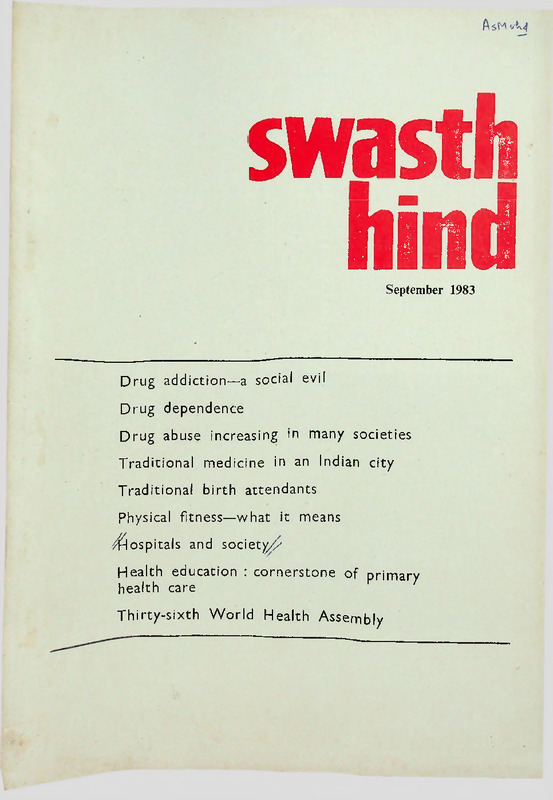
swasth
hind
September 1983
Drug addiction—a social evil
Drug dependence
Drug abuse increasing in many societies
Traditional medicine in an Indian city
Traditional birth attendants
Physical fitness—what it means
hospitals and society//
Health education : cornerstone of primary
health care
Thirty-sixth World Health Assembly
Page No.
IN THIS ISSUE
DRUG ADDICTION
»
Drug addiction—a social evil
Mohammad Najmi
209
Drug dependence
212
Awni Arif
Drug abuse increasing in many societies
Bhadra-Asvina
September 1983
Saka 1905
Vol. XXVII No. 9
OBJECTIVES
Swasth Hind (Healthy India) is a monthly journal
Published by the Central Health Education Bureau,
Directorate General of Health Services, Ministry of
Health and Family Welfare, Government of India,
New Delhi. Some of its important objectives and aims
are to :
REPORT and interpret the policies, plans, pro
grammes and achievements of the Union Ministry of
Health and Family Welfare.
ACT as a medium of exchange of information on
health activities of the Central and State Health
Organizations.
FOCUS attention on the major public health
problems in India and to report on the latest trends
in public health.
214
TRADITIONAL MEDICINE
Traditional medicine in an Indian city
A. Ramesh and B. Hyma
215
Traditional birth attendants winning accep
tance
220
Peter Ozorio
HEALTH CARE
Physical fitness—what it means
Dr S. K.
222
Mdnchanda
Hospitals and society and their
expectations'
Dr T. R. Sachdeva
225
and
Dr (Smt.) Tripta Bhasin
Health education :
health care
Cornerstone of primary
228
NEWS
Thirty-sixth World Health Assembly
230
KEEP in touch with health and welfare workers and
agencies in India and abroad.
National awards 1981 and 1982 for
nursing personnel
234
REPORT on important seminars, conferences, dis
cussions, etc., on health topics.
World Health Day-7 April 1983
236
Articles on health topics are invited for publication in this
Journal.
Editorial and Business Offices
State Health Directorates are requested to send reports of
their activities for publication.
Central Health Education Bureau
The contents of this Journal arc freely reproducible. Due
acknowledgement is requested.
Kotla Marg, New Delhi-110 002.
The opinions expressed by the contributors are not necessarily
those of the Government of India.
Asstt. Editor
D. N. Issar
Sr. Sub-Editor
M.S. Dhillon
SWASTH HIND reserves the right to edit the articles sent
for publication.
Subscription Rates
Single Copy •
.
Rs. 3 00
Annual
Sub-Editor
G. B. L. Srivastava
Re. 0.25
(Postage Free)
DRUG ADDICTION
DRUG ADDICTION
a social evil
Mohammad Najmi
he problem of drug addiction is
also caught the fancy of the youth
becoming more and more acute particularly those living in the bigger
in the highly .industrialized Western cities and the towns.
countries.
Addiction among students
In the comparatively less develop
A recent study of the Indian
ed countries, where the society is
Council of
Medical Research
still predominantly agrarian, the
(1CMR) in different major cities
problem of drug addiction has not
of India has reported that 46 per
yet reached the same dimensions.
cent of the men students and 18 per
However, with the speedy economic
cent of the women students of Delhi
development and increasing urbani
University arc drug users.12 The
zation in certain regions, the social
Bombay study showed that 20 per
structure and norms are undergoing
cent were addicts. In Calcutta 11.4
change and the problem of drug
per cent were found to be addicted
addiction is soaring up.
to amphetamines, while Chandigarh
revealed 19 per cent of the students
In India the problem of drug ad
addicted to drugs. Seventy per
diction presents many features which
cent of the student addicts belong
differ from those of the Western
ed to the upper socio-economic
countries. In our country drugs, arc
strata having a pocket allowance of
used mostly in a crude form and
Rs. 150 to Rs. 200 per month.
taken orally. While no exact figures
are available about the extent of
Western sub-culture
drug addiction in the country, apart
Even the younger age groups may
from the registered opium addicts,
the recent reports in the press and not be free from this evil. Accord
otherwise indicate that opium and ing to the findings of the Central
hashish which were previously res Bureau of Narcotics, not less than
tricted to the uneducated and back 5000 Delhi students (aping Western
ward communities in India have sub-culture) are using drugs?
T
.Drug addiction has been a
source of many personal
and social evils. Apart
from the harm they do to
the physical, mental and
moral life of the individual,
the use of drugs does result
in the creation of serious
problems of crime, social
insecurity and juvenile de
linquency in the society.
1. Quoted by Radha Paul, “Drug and Crime Social Aspect” Ind. Jour, of Crim., Vol. 6, No. 1 Jan. 1978, P. 38.
2. Bhattacharya B. K., Violence, Delinquency Rehabilitation 1978 P. 32.
September 1983
209
A study of drug users was made
in Agra on 1192 post-graduate stu
dents from faculties of Arts, Science,
Commerce and final year under
graduates from Medicine. The
over all prevalence rate of drug use
was 50.08 per cent. The highest
number of drug users was 76.43 per
cent among male medical students?
In Chandigarh a study of the use
of drugs was made on 408 students.
Seventy seven (18.87%) of them
were drug users. In another study
of 570 students from Chandigarh
and Raipur it was found that bet
ween 10 to 24 years the students
most commonly use alcohol, to
bacco, amphetamines, cannabis,
sedatives and tranquilizers?
In a study made in Lucknow
district of U.P. in 1979 among the
rural population out of 2010 indivi
duals (21.4 per cent) were found
drug users?
Marijuana is ordinarily used by
smokers in the United States. The
effect it produces are experienced as
exhilaration, loss of inhibitions, a
changed sense of time, and other
psychological effects which have
sometimes been described and extra
vagantly praised by those who have
experienced them. These effects
are in a general way comparable to
the stimulating effects produced by
alcohol in the sense that they are
intoxicating, although they differ
qualitatively from those of alcohol?
In spite of the proved fact that
smoking causes cancer, and is also
a traditional taboo in India, more
and more people are taking to smok
ing.
Addiction to psychotropic drugs
among student community
Smt. Shecla Kaul, Minister of State in the
Ministries of Education and Social Welfare, informed
the Lok Sabha on 28 April, 1983, that as per the
findings of the research studies sponsored by this
Ministry through expert Institutions, following four
causes were found important for the use of drugs:
1) Psychological causes like relieving tention, easing
depression, satisfying curiosity, “getting kicks”, “feeling
high”, intensifying perception, removing boredom, etc;
2)
Physical causes like staying awake, etc;
3) Social causes, i. e.9 as an aid to socializing, challen
ging social values, etc; and
4) Miscellaneous causes like improving study, sharpe
ning religious insight, deepening self understanding,
solving personal problems, etc.
To create awareness about the ill-effects of drug
use, States/Union Territories have been asked to under
take educative publicity. The Ministry of Education
have also written to the Vice-Chancellors of the Central
Universities to do likewise.
Unlike the use of alcohol or
cocaine for the purpose of stimula
tion, morphine is used for the quie
tening effect it can produce. Con
tinuous use of morphine results in
mental weakness, loss of energy,
loss of concentration, loss of self
control, and may even result in para
lysis of the will.
Cocaine like alcohol, is a stimu
lant in the first instance, but ulti
mately makes the victim a wreck.
Cocaine addicts are often found
bold enough but after a time, when
the cocaine is not available or is
stopped forcibly they show weakness
of the mental condition. Criminals
using cocaine arc often very des
perate types of criminals—ready to
take life of the victim, even on the
slightest provocation or resistance.
Other drugs include opium,
charas, bhang, etc. Among these
charas and cocaine are obtained
generally from hemp plant.
Criminal behaviour
Narcotic drugs are often said to
be factors in the genesis of criminal
3. Dr. S. P. Gipta, “The Young Escapists who take to drug” Social Welfare, Vol. XXTX, No. 4 July 1982, PP. 18—19.
4. Ibid
5. Ibid
6. Lindesmith, Alfred R., “Marijuana Problem” in The Sociology of Crime & Delinquency (John Willey & Sons, Publisher U.S.A.
1970), P. 654.
210
Swasth Hind
behaviour. Addicts of narcotic
drugs mostly resort to theft to ob
tain money for procuring the drugs.
Many people become delinquents
after they have started consuming
narcotics. Many' violent offenders
take narcotic drugs to get the cour
age or stamina to go through with
acts like, murder, burglary, extor
tion, rape and so on, which they
might not commit when not drug
ged.
Role of social scientists
Recently not only social scientists
and mental health workers but peo
ple in all walks of life have shown
their concern to the problem of drug
abuse especially among college stu
dents.
Systematic investigations
have been undertaken in many parts
of the world in order to find out the
prevalence and pattern of drug
abuse.
/\
GOVERNMENTAL EFFORTS
The Drug Addiction Commit lee appointed by the
Government, of India in 1976 submitted its report to the
Government at the end of 1977. Il was found by the
Committee that the drugs most frequently abused were
alcohol, tobacco, opium, cannabis and psychotropic subs
tances such as meprobamate, diazepam, methaqualone,
phenobarbital and dextro amphetamine. It made the
following recommendations:
(0 National Board of Drug Control should be esta
blished and a single law should be enacted to
deal with the problem in respect of all depen
dence producing substances (.except alcohol
which was the subject of a special proposal)', more
stringent penalties for violation of legal provi
sions particularly for export and import of drugs.
(ii) Drug education programmes should be a part of
health education at large.
(Hi) Better upbringing of children and youth, strength
ening of the family and the peer groups, involv
ing youth in challenging programmes and social
transformation will reduce the need for using drugs.
(iv) Detoxication centres should be established in the
institutions where adequate facilities are avail
able.
&
A WORLD-WIDE PROBLEM
The United Nations Commission on Narcotic Drugs at its 28th
Session in Geneva, deliberated on the growing problem of drug
addiction in every part of the world, especially among the younger
generation and reported that modern patent medicines are causing
a good deal of harm to the takers of these drugs. There is a con
tinuing spread of heroin abuse and increased abuse of other opiates,
such as morphine and synthetic narcotics. Cocaine is getting more
popular in the United Statesand Western Europe. Cannabis (bhang)
is very much in use in the Soviet Republic. In France, in 1976
there were 15,000 regular addicts of cannabis, in Holland 24,000,
and in Australia 180,000, young men in the age group of 15-30.
The smoking of coco paste in South Africa has seta new pattern.
All over the world, non-barbiturate sedatives, hypnotics and to a
lesser extent tranquilizers are becoming very popular.
September 1983
211
DRUG DEPENDENCE
Awni Arif
he global nature of drug depen
in clinical research, epidemiology laboration can be particularly effec
and programme planning, it is un tive.
realistic to employ a wide range of
specialists for most programmes in Primary health care
developing countries. In many
Many of the rural areas where
cases medical assistants, primary opium is produced have little or no
health care workers, community health service. Frequently opium
nurses, and other health auxiliaries is the only medicine available and
could be trained to carry out tasks is widely used for the relief of pain
in the field of drug dependence and disease symptoms.
under the supervision of physicians
In such areas, eliminating opium
production without providing treat
The drug dependence pro ment for common illnesses is un
acceptable. The whole purpose of
gramme must, wherever who’s primary health care pro
possible, be integrated with gramme is precisely to develop basic
In view of the considerable gap
health, welfare health services in areas where none
in resources, knowledge and experi existing
now exist. Primary health care is
ence in matters connected with drug and economic development
based on a combination of scientific
dependence between developed and
The magnitude health technology and acceptable
developing countries, a well-organi services.
traditional healing practices, and it
zed international system for the and nature of the health
should be possible to introduce mo
transfer of experience and exchange
dern chemotherapy and other tech
of information can obviously be of and social damage from
niques to replace the current reliance
benefit. One basic principle in de drug abuse has to be asse
on opium. Moreover, the primary
veloping a programme must there
ssed
in
the
context
of
each
health care workers could be trained
fore be to select from the experiences
in the field of prevention and to
of other countries, and to adapt country’s overall health,
provide treatment and after-care for
them to the needs, resources and social and economic pro
opium-dependent persons.
social, health and cultural systems
T
dence problems, the negative
impact of drug abuse on social,
health and economic development
(particularly in developing coun
tries), and the rapid changes in the
types of drugs used and the patterns
of drug use all contribute to the
need for great flexibility in planning
and developing country program
mes. Three essential considerations
in this connection are the transfer
of experience, integration with exis
ting activities, and the training of
suitable personnel.
of the recipient country.
The drug dependence programme
must, wherever possible, be inte
grated with existing health, welfare
and economic development services.
The magnitude and nature of the
health and social damage from drug
abuse has to be assessed in the con
text of each country’s overall health.
social and economic problems.
As for suitable personnel, while
there is a need for some specialists
212
blems.
and others with advanced training.
People outside the health field, such
as welfare workers, teachers, the
police and recovered patients, can
also make contributions to both pre
vention and treatment programmes.
Drug dependence programmes
have a number of points of contact
with other who programmes for
underserved populations. The fol
lowing are three areas in which col
Country health programming
One of who’s priorities is to
assist countries in developing pri
mary health care as an essential in
overall country health program
ming. If national health authorities
decide that drug dependence is/ a
serious social and health problem,
then a part of the overall health
programme should be a national
drug dependence programme based
on the best available data and on a
realistic assessment of available re
sources.
Swasth Hind
Health education.
non-medical use of psychoactive
drugs and to prevent further
Behaviour and attitudes condition
increases.
ed by culture, by the social, econo
mic and family environment, and by
learning play a direct role in the Global strategy
development and spread of drug use
and drug dependence. Education
In order to complement and pro
about the use and misuse of drugs vide technical support for the who
forms part of who's health educa collaborative programmes at coun
tion programme, which Js based on try level, the Organization has em
the principle that success in preven barked on a programme, in colla
ting and controlling any disease de boration with other international ag
pends inter alia on an informed encies, based on a global strategy
and motivated public. Health edu of drug abuse prevention and con
cation can thus contribute an essen trol. This programme comprises
tial element in any comprehensive four interrelated activities: develop
plan to decrease the current ment of technology, development of
manpower and infrastructure, dis
semination and exchange of infor
mation, and promotion of inter
country cooperation.
The technology needed for an
effective reduction in the demand
for drugs has been developed in ac
cordance with the who principle
that—in order to be appropriate—
technology must be scientifically
sound, within a country’s means.
acceptable to the community, and
suitable for widespread application
by non-specialised' personnel.
—Extracts from the article published in
World Health. August 1981.
W.H.O.’s Role in Drug Control
W. H. O. has been given responsibility for evaluating available data and
making recommendations for the control of narcotic and psychotropic substances.
The 1971 Convention requires that who “communicate to the un Commission on
Narcotic Drugs an assessment of the substance, including the extent or likelihood of
abuse, the degree of seriousness of the public health and social problem and the
degree of usefulness of the substance in medical therapy, together with recommenda
tions on control measures, if any, that would be appropriate in the light of its assess
ment”.
During the last three years, who has made recommendations to the un for
controls to be applied to 22 substances under the 1971 Convention, as well as five
substarices under the 1961 Convention. The final decision on these recommendations is taken by the 30-member un Commission on Narcotic Drugs, a functional
body of ecosoc—the un Economic and Social Council.
The recommendations of
who to this body are determinative as far as medical and scientific evidence is
concerned.
September 1983
213
Drug abuse increasing
in many societies
he Second (Social) Committee
of the Economic and Social
Council met on 3 May, 1983 and be
gan debate on its agenda, item on
narcotic drugs. In her opening state
ment, Ms. Tamar Oppenheimer,
Director of the Division of Narcotic
Drugs, said that drug abuse was re
ported to be increasing in many
societies.
T
Effective
preventive measures
required a complex variety of inter
locking actions. That task could
be performed by the formal agen
cies of Governments of Member
States working in isolation. Non
governmental organizations could
make a major contribution, a fact
that had been emphasized by the
report of the Commission on Nar
cotic Drugs. In the area of pre
vention! international organizations
could serve best as catalysts and as
clearing houses for techniques and
national experience.
Nearly two tons of morphine
were also reported seized world
wide in 1981. That represented an
increase of 27 per cent over total
reported seizures for 1980. Tn addi
tion, 54 tons of opium were report
ed seized in 1981, but that was
only a small percentage of the total
illicit opiates available in the traffic.
She stated that trafficking in
cocaine also continued to spread
at an alarming rate. Reports from
ICPO/Interpol indicated that seizures
of cocaine had increased by 161
per cent between 1981 and 1982.
One single seizure of that drug in
1982 was double the weight of all
seizures of cocaine interdicted annu
ally world-wide only eight years
ago. Abuse of cocaine continued to
increase in the Americas and was
also spreading to parts of Western
Europe.
crease of 55 per cent in the total
seizures of stimulants seized from
the illicit traffic in 1981 compared
with 1980. There was also an in
crease of “over 12,000 per cent”
in respect of dosage units of LSD
seized world-wide in 1981 compar
ed with the previous year.
There was a rapidly growing
availability of depressants,
parti
cularly
methaqualone, she said.
Despite the Commission’s 1979 deci
sion to transfer methaqualone to
Schedule II of the 1971 Convention
on Psychotropic Substances in order
to strengthen the control measures,
availability had not diminished.
Generally speaking, she said, the
pattern was far from encouraging.
Abusers were moving readily bet
ween drugs, and traffickers employ
ed much the same technique, smug
gling alternative drugs to counteract
Traffickers appeared to be conccn-.
preventive measures. As one State
trating on production of the more
increased
national
surveillance,
potent preparations of cannabis, she
gangs of traffickers devised new
The deteriorating situation in the said. In Africa, cannabis cultiva
alternative routes for contraband
illicit drug traffic was clearly indi tion seemed to be reaching alarming
drugs through less protected States.
cated by the total reported quanti proportions in relation to food crops.
Major problems were not now con
ties of drugs seized by law enforce The aggregate profits from the
fined to the traditional producer and
ment authorities, she said. Nearlv smuggling of cannabis were much
consumer countries for illicit drugs.
six tons of heroin were reported sei greater than those from trafficking
The demand pattern had now spread
zed from the traffic world-wide in in any other single drug although
ip a number of States which were
1981. an increase of 120 per cent the profit on individual consign
once only used for transit of illicit
over total reported seizures for ments may be less.
traffic.
1980. The reports on 1982 were
unlikely to show any marked impro
Turning to the psychotropic sub
—U. N. Weekly Newsletter,
20 May, 1983
vement.
stances, she said there was an in
214
Swasth Hind
TRADITIONAL MEDICINES
TRADITIONAL MEDICINE
IN AN INDIAN CITY
- A. Ramesh & B. Hyma
If .indigenous medical practitioners are to be integrated [.into countries’ health
services, much more needs to be known about where they are, how they practise, and
whom they serve. A field survey in Madras showed a wide variation in the quality
of services provided by such practitioners and scarcely any cooperation between
indigenous and modern medicine. Traditional healers do, however, provide satis
factory care for common local ailments.
of traditional medicine represent a
vast and valuable human resource outside the offi
cial health services (7, p. 37; 2) yet very little is known
about the extent of their practices or the methods
they use. If the care these practitioners render is to be
integrated into national, state, and regional health
plans, a systematic effort must be undertaken to learn
more about their functioning.
ractitioners
P
Such an effort has been made in India, where
two parallel systems of medical practice are in ope
ration: the modern one, which includes allopathy
and homoeopathy, and the traditional one, which
comprises ayurveda, siddha, and unani. In addition,
the principles of naturopathy and yoga are followed
by many people for their therapeutic value. To esti
mate the persistence of traditional Indian medical
practices in a metropolitan environment, we carried
out a study in Madras, the fourth largest city in the
country, with an estimated -population (in 1977) of
about three million. Madras is both a major centre of
modern medicine and a centre of traditional medicine.
Systems of traditional medicine
Of the three indigenous systems of medicine, ayur
veda. the traditional Hindu system of medicine based
on the Vedic scriptures, is the one that is practised in
all parts of the country. It utilizes herbs, minerals, and
dietary restrictions in the treatment of illnesses. Litera
ture on ayurveda dates from the fifth century B.c.
September 1983
Siddha is extensively practised in the southern State
of Tamil Nadu and in the neighbouring States. It, too,
is an ancient system. In treatment it uses mainly
metals and minerals but some products of vegetable
or animal origin as well. Works relative to siddha, of
which there are at least 500, plus 3,000 formulae, were
written in Tamil, initially on palm leaves. The exact
number of siddha practitioners (vaidyas) is uncertain,
but it is known that there are thousands in the State
of Tamil Nadu.
Unani, also known as the Greek/Arab system of
medicine, was brought into India by the Muslim con
querors, and has been practised for several hundred
years, predominantly in areas of Muslim culture. It
uses herbs, minerals, and metallic salts.
Since 1948, following independence, the Govern
ment of India has been committed to the promotion
and development of the indigenous medical system
along with modern medicine. National health policy
objectives include instituting standardized education
and training in all the ayurvedic institutions and
research facilities and training along scientific
lines to absorb the practitioners of ayurveda and
unani medicine into the Stale health organization.
Tn 1969 the government set up a Central Council of
Research in Indian Medicine and Homoeopathy with
four subcouncils: (1) ayurveda and siddha, (2) unani
medicine. (3) homoeopathy, and (4) yoga and natur
opathy. This council has established minimum
215
standards of qualification in Indian medicine, a curricu
lum for undergraduate and post-graduate education
and training, and a central register of practitioners.
The indigenous system of medicine is practised
by a large number of hereditary medical practitioners
and by people trained in teaching institutes run by
the State Government and other approved bodies (3).
India now has many qualified practitioners of integra
ted medicine—those who, in addition to having studied
indigenous medicine in
well-organized institutions,
have undergone training and practice in the basics of
modern medicine^ including surgical, obstetrical, and
medical legal work. These practitioners use modern
diagnostic methods and modern drugs as well as indi
genous remedies. Moreover, about 7000-8000 profes
sionally qualified practitioners of ayurveda, siddha,
unani, and homoeopathy are entering the profession
every year. WHO has described the situation thus:
’’There are about 500 000 practitioners of traditional
medicine in India, and their qualifications range from
university doctorates, through certificates awarded in
private schools, to skills and knowledge acquired
after several years of apprenticeship to established
practitioners. There are 108 colleges of indigenous
medicine. . .” (/, p. 12; 2).
Carl E. Taylor (4) has estimated that the organized
health services in India provide only 10% of the medi
cal care, that another 10% is provided by qualified
physicians in towns and cities, and that the balance
is split between home medical care and indigenous
practitioners. Though modern scientific medicine
forms the basis for the development of the Indian
health services, the ultimate objective is to facilitate
the integration of traditional medicine and the emer
gence of one system of medicine with various sub
systems. For, despite the expansion of modern health
care, there is no indication that traditional systems
are losing their influence.
A YU R VEDA
India is one of the few Asian countries
where Ayurveda has been given due recogni
tion as a system of medicine for providing
health care to the people. Although there
arc references to Ayurvedic principles in Vedic
literature written about 2000 B. C., the present
available literature on Ayurveda starts with
Sushruta Samhila and Charaka Samhila, compiled
some time during the fifth Century B. C.
From these ancient documents it appears that
education in this science was initially imparted
to highly selected groups of students.
The technical methodology of clinical
examination is similar to modern medicine,
the primary methods being the clinical history
and a five-fold physical examination using the
five senses. However, greater emphasis is given
to the constitutional aspects of patients, their
nutritional status and their psychosomatic in
tegrity. The pulse examination forms an im
portant part of the clinical methodology. The
patient is examined and treated as a whole,
unlike the modern medical approach where
a large number of specialists may be involved
simultaneously in such an examination.
—Dr K. N. UDUPA
titioners (200) did not exhibit any definite pattern
with regard to their geographic distribution; and the
unani practitioners were concentrated in the same
areas as the siddha vaidyas.
The Research setting and methods
Our analysis of the practice of traditional medi
cine in Madras focused on the actual distribution
and social characteristics of its practitioners. The in
formation was drawn from a sample of 95 practi
tioners from a total of 957 registered in the city,
carefully selected on the basis of postal zones so as
to cover the entire city and be truly representative.
It was found that the heaviest concentration of
practitioners was in the old residential, highly popu
lated areas of the city, followed by significant num
bers clustered in the old commercial and manufac
turing sectors. Siddha practitioners, numbering 635,
dominated the picture in these areas: ayurveda prac-
216
Organized health services in India pro
vide only 10% of the medical care,
another 10% is provided by qualified
physicians, and the balance is split
between home medical care and in
digenous practitioners.
A detailed questionnaire with 35 questions was
submitted to the sample of practitioners selected.
The subjects covered were: (1) system of practice, (2)
practitioner’s personal characteristics, (3) training back
Swasth Hind
ground, (4) practice, (5) characteristic features of the
patients seen, (6) diagnostic methods, (7) prescription
of medicine, (8) procurement of medicine, (9) speciali
zation, and (10) attitudes and opinions. Interviews
were conducted mostly in Tamil and. where neces
sary, in English, by two graduate students. On ave
rage. each took an hour or more. Participation was
voluntary, but most of the practitioners were pleased
to respond to the survey.
Findings
The survey revealed that 36.4% of the practi
tioners belonged to the siddha system, followed by
ayurveda (33.2%), unani (10.4%). and integrated
(20%). Most of them were male, though there were
a few female practitioners, specializing mainly in gy
naecology and obstetrics. Two-thirds of the practi
tioners were between 40 and 60 years of age. Most
were Hindu, but a small proportion were Muslim:
only two were Christian. More than half had been
born and reared in Madras. Nearly half had entered
the profession because of its tradition within their
family: and 15% indicated that they had a relative
who was also practising indigenous medicine.
Despite the expansion of modern health care, there is
no indication that traditional systems are losing their
influence.
All of the practitioners interviewed were Register
ed Practitioners of Indian Medicine, and more than
half had registered between 1960 and 1978, which
indicates a growing interest in indigenous medicine.
About a third had.a college education: 30 indicated
that they had diplomas or certificates and practised
siddha or ayurvedic medicine but had received
no formal education; the rest had had 8-11 years of
schooling. About 34% had had their formal training
at the former Government College of Indigenous Me
dicine. Kilpauk. Madras: the majority, however, seem
ed to have had no formal training in indigenous
medicine but had served apprenticeships to estab
lished practitioners. The duration of the apprentice
ship had generally been 3—5 years.
More than 80% of the indigenous medical prac
titioners were engaged in full-time practice, and few
had changed the location of their practice since their
registration. About a quarter had their clinics in
areas where they had acquired them through here
ditary practices. Most of them ran their clinics or
dispensaries in their own homes, which varied con
siderably in amenities. High-class and upper-middle
class neighbourhoods did not seem to attract them;
September 1983
middle-income people predominated in the areas
where they were located.
About half of the practitioners reported seeing
5-20 patients a day: only 10% said they saw as many
as 20-40 patients daily, and we suspected that in
some cases such figures were exaggerated. The prac
titioners said they spent somewhere between 10 and
40 minutes with each patient; and “the more tradi
tional an indigenous medical practitioner was in his
approach to diagnosis and treatment, the more like
ly he was to spend more than 10 minutes with a
given patient*’ (5).
Fees were usually decided upon with the patients
at the time' of each visit. Generally speaking, the
practitioners charged according to their clients’ abi
lity to pay rather than according to any fixed con
sultation fee.
As for their patients, most were between 20 and
50 years of age and were drawn from the immediate
neighbourhood of the place of practice.
Few of the practitioners exhibited modem medical
instruments such as
stethoscopes,
thermometers,
sphygmomanometers, syringes, and needles; these
were used mainly by those who practised integrated
medicine. The latter were also the ones who occa
sionally sent their patients for laboratory tests or Xrays. About 30% of the indigenous practitioners said
they performed minor surgery such as suturing, in
cising, or dressing wounds; but about 25% would
not treat patients who required minor surgery.
Most of the practitioners used physical examination
such as viewing the patient’s body, touching, and
eliciting information by questioning.
Nearly two-thirds of the practitioners said they
prescribed only indigenous medicines, meaning most
ly hereditary formulae prepared from herbs, powders,
minerals, etc. Many of their methods and medicines
arc closely guarded secrets. Most of their medical
supplies arc obtained from the local cooperative out
let, the Indian Medical Practitioners’ Cooperative
Pharmacy and Society Ltd., which has been in exist
ence since 1944 and has grown from about 500 mem
bers to 8000. This organization manufactures ayur
vedic, siddha, and unani medicines—about 750 popu
lar formulations. The profit is kept very low, its major
objective being to supply quality medicines at very
reasonable cost.
There are some clear indications of the kinds of
cases the practitioners
preferred to treat. Primary
importance seemed to be focused on ailments such
217
as coughs, diarrhoea, dysentery, fever, and indiges
tion, followed by skin disorders, ulcers, nervous dis-.
orders, rheumatism, and lung and bronchial ailments.
Formal'specialization is rare. No written records or files
are maintained by most of the practitioners:
a few
who did maintain some records were
reluctant to produce them for the interviewers. The
practitioners exhibited
almost no interest in con
ducting clinical research on their methods of prac
tice. There seems to be little interaction among the
individual private practitioners, though many appear
to be aware of the existence of certain others; and
there is a sort of informal referral system, especially
among the few specialists—those who are known to
have particular expertise in treating some specific
disorder.
cTt seems paradoxical that, at a tjme when
modern scientific medicine appears to be
making such giant strides, and enjoying un
paralleled prestige, so much interest’should be
taken in traditional medicine, in both ’ deve
loped and developing countries alike. Tradi
tional practitioners in many parts of the world
define life; as the union of body, senses, mind
and soul, and describe positive health as the
blending of physical, mental, social, moral and
spiritual welfare. The moral and spiritual
aspects of life are here stressed, thus giving
new dimensions to the system of health care
by which man maintains his’health.”
—Dr R. H. Bannerman
(World Health, June 1983)
Conclusions
Indigenous medical systems still make a signifi
cant contribution to the medical care of the people—
not just in rural areas but in cities. In India, the
ayurveda, siddha, and unani systems all seem to pro
vide fairly satisfactory solutions to common local
ailments; in Madras, however, ayurvedic institutions
and clinics generally enjoy more public support than
do the representatives of the other two systems.
Lack of standardized training and qualification of
the practitioners is still a problem, even though
many people are entering the profession every year.
There are wide variations in grades and levels of
training, with consequent differences in knowledge.
218
skills, and sophistication of practice. Registration of
traditional practitioners is still far from complete,
which compounds the problem.
Most of the practitioners operate in isolation,
and their bargaining power is weak. WHO has re
commended encouraging them to form clubs or so
cieties that can act to check harmful practices, eli
minate quacks and charlatans, and assure continuous
informal education, cultural loyalty, and the conser
vation of a high level of professional ethics and prac
tice (/), p. 32).
Only lip-service seems to have been paid to pro
moting the process of integrating the
traditional
practitioners into the general medical services; co
operation between the two parallel systems has hard
ly begun. WHO has pointed out that training and
retraining are necessary on both sides to improve
the status of the traditional practitioners among
health team
members and help acquaint “profes
sional health personnel and students of modem me
dicine with the principles of traditional medicine
in order to promote dialogue, communication and
mutual understanding and eventual integration" (6).
All indications are that indigenous medical sys
tems will probably continue to provide services so
long as Central and State governments continue to
sponsor them officially and continue to promote
education and training and clinical and pharmaco
logical research. At present, though indigenous me
dical services freely cut across all
socioeconomic
groups and are common in both rural and urban
areas, they still occupy an insignificant position in
health planning. The recent change in WHO policy
orientation and consideration may help to strengthen
and protect the interests of indigenous medical sys
tems.
A persisting question is whether one should ad
vance the development of a dual health care system
from which patients can select modern or traditional
health services, or an integrated system, in which
traditional systems would, as they do now, play a
subordinate role—and eventually lose their indivi
dual cultural heritage besides. This policy decision
continues to pose a dilemma for the governments of
many developing countries (7. 8).
It seems to us that the problem to be tackled first
is to determine how to make indigenous medicine
rapidly self-reliant and fully efficient: how to upgrade
the quality of services provided by the private prac
titioners of this system: how to give them due recog
Swasth Hind
recognition as respected members of society; and how
facilitate their participation in national health care
programmes.
The complementarity of functions between modern
and traditional medicine needs further exploration.
Our study has indicated that the practical and survi
val value of Indian traditional medical practitioners
is certainly high. With proper understanding, publicity,
and financial support, traditional systems of medicine
can play a significant role in the formal delivery of
health care both in India and in other countries in
which indigenous medicine is still a very vital force.
REFERENCES
1. WHO Technical Report Series, No. 622, 1978
{The promotion and development of traditional
medicine).
2. Kurup, P. N. V. World health, November
1977.
3. Kondal, R. Y. Journal of the National Inte
grated Medical
Associations of India, 19:
233 (1977).
4. Taylor, C. E. The place of indigenous me
dical practitioners in the modernization of
health
services. In:
Leslie, C., ed Asian
medical systems; a comparative study. Berke
(continuedfrom page 235)
Nursing being a ‘humane calling’ has always been.
Very dose to the hearts of the people. A nurse
apart from being an aide to the doctor has also
an independent role to play. It is the nurse who
is with the patients round the dock and brings
cheer and light to the sick and suffering with her
personalized concern and care. Apart from look
ing after the patient she can take upon herself
the role of educating them in the elementary prin
ciples of health, hygiene, and nutrition and also
enliven the environments. This combination of
high degree of professional skill and human ap
proach will make all the difference in the larger
context of social well-being.
I hold the niursing profession in high esteem and
have great admiration for its members. A nurse
is like a mother in showering affection and it is this
motherly instinct in them that makes it a most noble
September 1983
ley, CA, University of California Press, 1976,
p. 286.
5. Bhatia, J. C. et al. Social science and medi
cine, 5 :146 (1971).
6. Bannerman, R. H.
(1977).
WHO Chronicle, 31:427
7. Birchman, W. Social science and medicine, 13
B; 175 (1979).
8. Dunlop, D. W. Social science and medicine, 9:
581 (1975).
Courtesy : world health forum,
Vol. 2, No. 4.
There has been some debate on “modern”
versus “indigenous” medicine. Today’s new
is tomorrow’s old. Medical knowledge is full
of skeletons of theories once believed to be
infallible. Science is basically the search for
the cause-and-effect relationships in the
universe.... Many new discoveries arc but
reiteration of ancient knowledge which until
a few years ago were despised as quackery.
And there is new respect and search for the
wisdom of the ancients.
—INDIRA GANDHI
and humane profession. Service with a smile is that
it proclaims. Wherever you go, you find the same
spirit of sacrifice and service that distinguishes the
nursing profession, which imparls them with a uni
versal outlook and humanitarian feelings. It is
with the idea of developing respect for this profes
sion that these awards should be viewed.
It is
gratifying that social prejudice in our country re
garding this profession is gradually disappearing
and the profession has come to lx: accepted even
in our villages where Lady Health visitors anjd Auxi
liary Midwives are rendering a very useful and
much needed service, especially to women and
children. I am glad that in the National Awards,
equal recognition has been given to all these differ
ent categories of nursing profession.
—Extracts from the address by Shri
Zail Singh, President of India on the
occasion of National Awards for
nursing personnel on 2 June, 1983
219
Traditional Birth Attendants
Winning Acceptance
Peter Ozorio
Traditional birth attendants (TBAs) are known to deliver from 60-80
per cent of all babies in the Third World. They also care for mothers
before and after birth and help with household chores as well.
Midwives will continue to deliver most of the world’s babies,
whether they are trained or not. They also hold high place in
village societies and can influence others.
raditional midwives were once thought of as
“poor relatives” in the family of health workers,
but now, with training, they are slpwly but surely win
ning favour with health administrations in developing
countries, and the World Health Organization (WHO)
is advocating their use as one way of meeting primary
health needs.
T
Thus, traditional birth attendants are appreciated
as never before. Skeptics of their worth have turned
believers, and are accepting trained midwives as
valued members of the health team, according to a
report on ten-year trends carried in WHO’s Chroni
cle (Vol. 36, No. 3).
From replaceable to irreplaceable
With good reason too, for traditional birth atten
dants or TBAs—as they have come to be knowndeliver from 60 to 80 per cent of all babies in the
Third World. They also care for mothers before and
after birth, and, if need be, help with household cho
res as well.
Indeed, not only are they being counted upon to
perform traditional tasks, but also to take on new
duties. In some countries, they are responsible for dis
pensing oral contraceptives, and for helping mothers
who wish to regulate births by accompanying them to
clinics for counselling..Tn others, they promote breast
feeding.
220
The acceptance is reflected in a doubling from 1972
to 1982 in the number of countries formally recog
nizing the skills of traditional birth attendants through
schemes of registration, certification, or licensing. It
is also seen in the increasing number of training pro
grammes for midwives. There are twice as many now
as there were in 1972. Some of which last no more
than three days, and others two weeks.
Essentially, training concentrates on methods of
safe delivery.
The
stress
is on cleanliness;
the need, for instance, to cut the umbilical cord with
a sterile instrument and to dress it with clean mate
Swasth Hind
rial. Failure to do so could result in neonatal teta
nus. a major health risk.
To encourage training, many countries offer in
centives to midwives. Some pay stipends, and a few
provide uniforms. UNICEF provides them with a
midwifery kit. which is among their most prized
possessions.
The most telling indication of the newly-won res
pect of TBAs is seen in the change of attitude of
health administration towards them. In 1972, the
majority of 37 administrations replying to a WHO
questionnaire thought of them as replaceable and
their services as an “unavoidable interim measure.”
Today that view is held by a minority, with 56 of
64 countries surveyed by WHO considering them as
irreplaceable in the decades ahead. “While expand
ing professional training, countries are also expand
ing the training of traditional birth attendants”, the
report states.
Complications of child-bearing
The new situation appears realistic because ap
proximately half a million women die every year, not
of disease, but of the complications of child-bearing.
And over 10 million children a year die before reach
ing their first birthday. The activity of traditional
practitioners, who have undergone formal training,
will help to reduce both maternal and infant morta
lity rates.
Midwives will continue to deliver most of the
world’s babies, whether they are trained or not.
Training, however, is relatively inexpensive. It will
cost, for instance. $92 in Nicaragua, and $17 in
Samoa, including the price of the midwifery kits.
It is thus a sound investment, for TBAs, by virtue
of the service they render to communities, hold a
high place in village societies, and thus can influence
others. But even more important is their willingness
to work with communities in rural areas.
“With feasible alternatives unlikely to materialize
in the near future, the quickest and cheapest way to
improve the health of mothers and children is to im
prove the practices of traditional birth attendants
through training”, the WHO report concludes. A
TRADITIONAL HEALTH CARE
The traditional healers, herbalists, spiritualists, and birth attendants
constitute a vast resource of practitioners outside the official health services.
Their methods of diagnosis and treatment vary from region to region, and
some of their practices are similar to modern medicine. For example, in
certain tribal communities the traditional healer applies his ear close to
the patient’s chest to listen to the heart beats and diagnose disease.
—World Health,
—Nov. 1977
September 1983
221
HEALTH CARE
PHYSICAL FITNESS
What it means
Dr S. K. Manchanda
T
here are people who may not walk 10 to 12 miles
everyday. Their life may consist mostly of
using the bus/motorbike/car to reach
the office.
spend 6—8 hours on desk work/conference table in
terrupted by an hour or so for lunch and then come
back home for another meal and sleep. Depending
upon the age group and the general type of physical
activity they may undertake, they will be having
various grades of physical fitness. They are also the
people who are more likely to get diseased.
Physiologically speaking each individual has a lot
of potential to get the maximum from the human
machine by way of physical work. Thus, as the seve
rity of work increases a normal adult has the capa
city to increase his heart rate from about 70/min.
to about 20&/min. his cardiac output from a mere
5 Litre/min. to almost 35 Litre/min., pulmonary ven
tilation from 6-7 L/min. to almost 70—80 L/min.
oxygen consumption from -J Litre/min. to almost 2.5
or more Litres/min.. and so on. The human machine
has also brisk reflexes. If an individual has the capa
city to mobilize the activity of his heart and lungs to
achieve a particular task, within a short period of the
accomplishment of the task, the body achieves back
the normal levels of heart rate, cardiac output and res
piration. Thus one is fit again to meet another chal
lenge.
The capacity to meet the challenge is compromised
depending on the extent of unfitness. When one is not
indulging in any conscious activity, i.e., sleeping or
lying down, minimum energy is being spent, minimum
oxygen is being consumed and the heart rate and car
diac output are also at minimal levels. On the other
hand when one is taking a brisk walk, say at 7-8 km/
hours, or cycling or climbing stairs, running or some
222
form of hard manual labour, more energy is required.
more oxygen is required, both circulation of blood and
activity of Jungs have to be augmented. More vigorous
the activity of the musculoskeletal system, more will
be the mobilization of the activity of heart and lungs.
The fittest person may achieve the maximum mobi
lization. The least fit may not be able to accom
plish even the minimal cardiopulmonary requirements
for going to the toilet.
There is a lot that you can achieve by being phy
sically fit, e.g., you will be able to:
i work physically harder and faster for longer
periods so that everyday chores become easier.
ii meet the ordinary demands of everyday life
and still have energy left over for unnexpected demands and sudden stresses.
iii take part in games and sports without getting
exhausted,
iv keep your joints mobile and your body
supple so that you can bend and stretch with
out causing strain.
v keep your body in good working order -and
so ward off aches and pains.
vi feel healthier and more alive,
vii protect your body from heart attack and some
other disorders.
viii enjoy life more.
A person who is really fit is supple, strong and
has stamina.
Flexibility is the ability to bend, stretch, wist and
turn when you want to.
Swasth Hind
Mahatma Gandhi felt that a person is healthy if he is free from all diseases
and can carry on his normal activities without fatigue. According to him such
a man should be able to walk with ease 10 to 12 miles a day and perform
ordinary physical labour without getting tired. This may as well be taken as
a definition of a fit active man ready to respond to the environmental chal
lenges. Such a person is fighting fit but not necessarily an athlete for top
class competitive sports or a prize fighter.
Strength is extra muscle power used for those unex
pected heavy jobs like pushing a car or even a cup
board.
Stamina is the staying power, endurance, the ability
to work harder for longer.*
How fit are you?
The best way to test fitness is by exercises involving
continuous rhythmic movements of large mus.de
groups such as those of the arms, legs and trunk.
But if you are very unfit, it is pointless to test
fitness by this method. As a rough guide try to answer
the following questions:
1. I can feel my heart thumping after a few
flights of stairs.
2. I am left gasping for breath even if I run
only a short distance.
3. It ‘ is a terrible effort
shoe-laces.
to bend arid tie my
4. I am tired out after doing only an hour or
two of house work.
5. I am tired out after carrying two bags of
shopping for about 400 meters.
6. I avoid physical effort if I possibly can.
If the answer is yes to any one of these questions
and one is not pregnant and generally in good health,
one would benefit by being more active and take
an exercise schedule.
A simple test
If the answer is no to most of these, then possibly
you are fairly fit, you can undertake more exact and
precise tests to find out the level of your fitness.
One such test is very simple and is given below:
September 1983
Jog gently and easily for about 1.5 kilometers. A
person between 35—45 years who jogs regularly
should be able to accomplish it within 10 minutes flat
without undue breathlessness or other discomfort.
During the test and immediately afterwards he should
be able to carry on an ordinary conversation. How
ever, the time taken to cover the distance depends
on age and sex, e.g.,
Age
Men
Women
Under 45
10 minutes
12 minutes
46—50
11 minutes
13 minutes
51—55
12 minutes
14 minutes
56—60
13 minutes
15 minutes
The road to fitness
(a) Exercise programme for fitness: There are a
large number of programmes which are popular in
various countries. Various programmes for raising
the levels of suppleness, strength and stamina res
pectively are available. It may be cautioned, how
ever, that one must not overdo it. If you have ever
suffered from a heart attack or high blood pressure,
you have chest trouble like bronchitis or asthma,
have spells of fainting or dizziness, some trouble
with bone and joints, e.g., arthritis or you are reco
vering from a recent operation or illness, consult
your doctor and have a medical check-up done before
starting on the exercise programme.
(b) Smoking and fitness do not go together for
smoking is very harmful for the lungs, heart and
blood vessels. The efficiency of these organs is de
creased and affects first of all the stamina of the indi
vidual and later affecting other aspects like strength
and suppleness. Smoking is the single most recog
nized cause for atherosclerosis heart attack and lung
cancer. Stop it altogether. There is no halfway.
223
(e) Fatness and fitness do not go together either.
Some methods of shedding weight by exercise pro
gramme and diet control should be undertaken.
(d) Alcohol and fitness: Keep watch. The watch
word is moderation. The concept of moderation may
differ from person to person. It is better to stop
it altogether.
(e) Yoga,. Relaxation exercises and fitness: The
efficacy of yogasanas and some yogic exercises like
Surya Pranam is well known, possibly on account of
the simultaneous mental poise that is produced. Life is
full of various types of stresses. The system of
physical and mental exercises provided by Yoga per
haps is the best but it does not replace the aerobic
exercises.
Monitoring (he programme
A simple test has been given. This can be used.
More precise tests are available. The physiological
monitoring of the programme aims at exercising mus
cles so vigorously as to attain a level of heart rate
that is advisable for a particular person depending
on his age and sex, and maintaining that heart rate
for a period of at least 20 minutes.
Physical fitness and prevention of disease
Being physically fit is very important from the
point of view of prevention of disease, especially dise
ases of heart, blood vessels and lungs. It is in
teresting to observe that at least the diseases of heart
and blood vessels are no longer the first killers in
U.S.A. This has been achieved essentially by two
pronged approach: (1) make available the emergency
care fast enough, and (2) awareness about the re
quirements for physical fitness and various types of
fitness programme,
through public
education in
health sciences. Sooner the various colleges imple
ment physical fitness programmes in their extension
services, the better and more economic it will be.
Patient education
important in
diabetic treatment
The importance of educating the
diabetic was
highlighted by Dr Asha Vakharia at the conference
of general practitioners, held in Bombay.
“Education of the diabetic is the cornerstone in
the treatment of diabetes—the diabetic who knows
most lives the longest and the best”, she said while
reporting a study on the management of diabetes by
general practitioners.
General practitioners were sent questionnaires
asking for information on patients and
treatment
methods. 113 completed forms were received. The
data showed that the majority of doctors advised
their patients on the importance of regular check-ups
(blood and sugar), ideal weight and controlled diet.
“This is highly rewarding in the long run to our pa
tients and very satisfying to ourselves,” Dr Vakharia
remarked.
According to the data, diabetes was most frequently
diagnozed in the 30-50 years’ age-group. The majo
rity of patients were in the middle or upper-income
bracket. Although obesity was common, especially
in women, there was a high incidence of underweight
and malnutrition.
Physical fitness and performance in sports
Most of the patients were well-controlled, either
on insulin or anti-diabetic drugs. Regular bloodsugar tests for monitoring therapy were also perform
ed in the majority.
It is generally recognized that our players in games
like hockey, football, tennis and many athletic events,
etc., do not lack skill, dexterity or ability to manoeuvre,
but their grading in physical fitness leaves much to
be desired. Possibly this is due to lack of appropri
ate programming and monitoring for physical fitness.
Knowledge is available. Application of knowledge
will help.
Dr Vakha ria’s study also showed that “we all need
to brush up on nutrition and diet principles. Without
proper knowledge of diabetic diet requirements and
food exchange values we are in no sound position
to advise our diabetic patients, and the earlier we
remedy this the better will be our management of
diabetic patients”.
—Courtesy: AH India Institute
of Medical Sciences
224
—Courtesy: Medical Tinies. •
April/May 1983.
Swasth Hind
HOSPITALS AND SOCIETY
AND
THEIR EXPECTATIONS
Dr T. R. Sachdeva
and
s
Dr (Smt) Tripta Bhasin
The hospital has come to be recognized as a place where one would
get active medical treatment, get cured and could look forward to a
better future.
the time since the first hospital was
founded in 600 A.D., hospitals have established
themselves as an integral part of the society. The
role of the hospital has over the time undergone a
tremendous change. The first hospitals were set up
to cater to those of the old and infirm who had no
one to look after them. The present day hospitals
have taken upon themselves the role of providing
better health to the community. In India which
had its own system of medicine, family as a unit took
upon itself the care of its old and infirm, and the
hospital came to be recognized as a charitable insti
tution. Only in the recent times, as a part of modern
system of medicine brought in by the British, here
too the outlook of the society towards the hospital has
gradually changed. From a charitable institution
where a certain death was awaiting for some one going
there it has come to be recognized as a place where
one would get active medical treatment, get cured and
could look forward to a better future.
from the care of an individual to that of the com
munity.
India being a welfare State the Government has
taken upon itself the onus of providing better health
"to its people. The emphasis, therefore, has shifted
. (b) treatment of diseases: curative and palliative
involving medical, surgical and special pro
cedures,
hrough
T
September 1983
Functions of a hospital
With the new concept of health care wherein the
health of the community as a whole has to be looked
after, the role of the hospital has also changed from
providing only medical care to total health care of
the community. World Health Organization experts
committee has defined hospitals as integral part of
a social and medical organization, the function of
which is to provide for the population complete health
care, both curative and preventive and whose out
patient services reach out to the family in its home
environment. The hospital is also a centre for the
training of health workers and bio-social research.
These functions are summarized below:
1. Restorative
(a) diagnosis: as an out or in-patient services,
225
(c) rehabilitation: physical, mental and social,
(d) care of emergencies: accidents and disease.
These relationships can thus be better understood
in terms of:
Personal—i.e., the patient,
Preventive
2.
(a) supervision of normal pregnancy and child
birth,
(b) supervision of normal growth and develop
ment of children and adolescents,
(c) control of communicable diseases,
(d) prevention of prolonged illnesses,
(e) prevention of invalidism, mental and physi
cal,
(f) health education.
(g) occupational health.
3. Educational
Society—meaning the providers/Government,
Professional—Doctors/Nurses/Para-medical staff, etc.
Medical/Health care within the hospital is carried
out in a situation where interaction between the three
becomes very important. They have different goals/
values, expectations, limitations and pressures. Expec
tations are always based on the goals and values.
The society no more views its health care benevo
lence towards the people by the medical profession
but demands care as a matter of right. Approximately
two-third of total health expenditure has till recently
been accounted for the urban health Institutions of
which the hospital is a part. The services actually
provided to public have taken very little of the budget.
(a) medical undergraduates,
Expectations of Society
(b) post-graduates: specialists and general prac
titioners,
Expectations of the society from the Hospital in
providing good medical care include:
(c) nurses and midwives,
(d) medical social workers,
(e) other allied professions.
4. Research
(a) physical, psychological and social aspects of
health and disease,
(b) hospital practices, technical and administra
tive.
1. Accessibility
(a) Personal access services should be available
to the patient at different points of entry, i.e,
out-patient department of the hospital, etc.,
to a reasonable extent based on expectations
of the people.
(b) Services must be comprehensive.
Patient
should not be obliged to go to one Institu
tion for one type of care and to another hos
pital for other type of care.
(c)
Centre of learning
The modern hospital, whether it be a general hos
pital or one of the many special hospitals, has been
accepted by the people of the world as the centre of
learning specialized medical care of high quality. The
tradition- of unstinted service, sympathetic under
standing, profound patience, kindness and sense of
privilege at being allowed to serve the sick in body,
mind and spirit, which characterized the hospitals of
early Buddhist. Christian and Islamic civilizations, has
survived the centuries to become a fundamental cha
racteristic of the modern hospitals the world over.
Whereas the society at large looks to the hospital
for providing various services, the personnel working
in the hospital loo form an integral part of the society
itself.
226
Quantitative adequacy:
There should be
enough facilities that a patient who needs
immediate attention gets if without any diffi
culty.
2. Quality
The concept of quality differs from community to
community as it depends on goals, values, etc. The
quality may thus be judged in terms of:
(i) Professional competence—In India profes
sional degrees are the parametres of compe
tence. There should be some rational system
to judge the competence capabilities and
competence of different professionals.
(ii) Acceptibility by the people.
(iii) Qualitative adequacy—always match
need with the resources employed.
the
Swasth Hind
3. Continuity
Whenever there is a need of entering the medical
care second time, a continuity may be maintained
with the previous episodes, i.e. availability of previous
records of the patients. This is possible when there
is proper record maintenance and the methods of co
ordination arc employed.
4. Efficiency
In respect of the cost benefit and cost effectiveness
of the resources provided, the major defects are that:
(i) The beneficiaries of the system have been
the urban and privileged classes.
(ii) The system is more
tive.
curative than preven
(iii) It has placed higher value on techniques and
less on the needs of the society.
(iv) Agent of care has become a professional elite '
.and over urbanized specialist who rather than
having good inter-personal relationship with
his patients has become a mystified person
for them.
(v) We have developed an infrastructure/organization to suit the technology borrowed from
the west rather than choosing a technology
that meets our own demands.
(vi) The pharmaceutical industry and the medi
cal profession have come together with vest
ed interests wherein the burden of expensive
treatment falls on the patient. The direction
to the pace of medical development instead
of being given by the medical profession
itself is being given by the drug industry.
(vii) The system has been planned, directed and
operated by bureaucracy. This has excluded
the factor of community participation.
(viii) The system has not educated the commu
nity on the problems it faces in providing
good medical care as per their expectations.
Conflict of expectations
1. Hospitals are yet to form a part of the com
munity. Presently they are confined more to
the patient and not to his surroundings.
2. Social habits of the patient are not generally
known to the doctors.
3. Hospital culture is different from that of the
society as it is based more on the hierarchy of
September 1983
technical knowledge and becomes too imperso
nal.
4. Patient wants
complete revival and recovery
and at times rejuvenation which is not possible
in the hospital because of the limited resources.
Hospital can only provide medical treatment
and can help in the revival of the patient.
Rest is done in the home environment which leaves
a big gap between* the hospital and the society as
follow-up of the case is not always possible in the
home environment. The approach of the modern
hospital is the super market approach which is con
venient, comprehensive and efficient but impersonal.
It leads to dissatisfaction of the patient and the doctor,
as the human beings need more personalized attention.
The hospital being an integral part of overall social
set up has certain problems. A few of these are :
1. Lack of coordination at the regional levels
leading to duplication of efforts which contri
bute to wastage of already scarce resources.
2. Lack of integration between hospital and com
munity health services.
3. Dissatisfaction among the staff at all units due
to lack of promotional avenues, inadequate
. compensation for the arduous talks they arc
supposed to perform, etc.
4. Lack of a clear approach. Our hospitals though
supposed to follow the socialistic approach have
not been able to do so due to lack of re
sources.
5. No clear objectives of the hospital have as yet
been laid down.
The hospital in India can thus be considered as an
Institution at the cross roads where at one end it is
expected to cater to the needs, expectations and hopes
of the population which looks towards it for better
health, while on the other the needs, expectations and
hopes of the staff working within the hospital have
to be looked into. This conflict of goals coupled with
the scarce resources has led to the present situation.
With the increasing awareness among the society in
general and the professionals in particular and the
increased resources that arc likely to be available
within the framework of overall development, we can
hope that the hopsitals of tomorrow will definitely
become temples of health.
A
227
HEALTH EDUCATION :
Cornerstone of
Primary Health Care
First and foremost among the components of primary health care is
health education, and the subject of the Technical Discussions during
the Thirty-sixth World Health Assembly was New’ Policies for
Health Education in Primary Health Care.
hose misty pictures sent back by satellites clear
T
ly show our mother earth as one single, if not
very big. unit of the universe. No longer is any ima
gination needed to perceive that it is round and limit
ed in size. Seen from above and from so far away,
all appears peaceful and well-ordered on our planet.
whereas in fact it is the scene of endless struggles,
strife and atrocities.
One of the outstanding injustices of our time is
that millions of people are denied the possibility of
obtaining health care. Some inequalities due to natu
ral causes may be inevitable but those caused by
humans must be remedied. That is what the World
Health Assembly seeks to do by mobilizing all the
WHO Member States behind the objective of Health
for All by the Year 2000. And the count-down has
begun—only 17 years remain in which to carry out
this vast project that is to mark the advent of the
new century.
The objective of Health fot All by the Year 2000
can be attained only through a planned overall stra
tegy. Such a plan was outlined at the Alma-Ata
Conference in 1978 when primary health care was
selected as the key strategy for the practical achieve
ment of health for all. This idea produced some scep
tical smiles from people who pointed out that we
should never be rid of the sick, the unfit and the dis
abled. That is obvious but is not the point. Health
228
for all means a world where individuals, families and
communities all have access to essential health care
and better protection against illness in their homes,
at school, on farms and in factories. That world will
at least be freed from preventable diseases and man
made hazards.
First and foremost among the components of pri
mary health care is health education, and the subject
of the Technical Discussions during the Thirty-sixth
World Health Assembly was New Policies for Health
Education in Primary Health Care.
As a subject, health education has not always been
very clearly defined. What is really meant by it?
WHO says that it is “any combination of information
and education activities leading to a situation where
people want to be healthy, know how to attain health.
do what they can individually and collectively to main
tain health, and seek help when needed.”
Some new activities
This definition implies that health education should
include a number of new activities in addition to the
old ones. First of all, it should foster community in
volvement. which is essential for lasting success in any
programme whether in education or anything else. The
notion of community participation is, of course, an old
one. It was advocated by the authors of the WHO
Swasth Hind
constitution in 1948 wnen they included the following
principle m me preamble to mat historic document:
"jmiormcd opinion and active co-operation on the pari
ol the public are of the utmost importance in the im
provement of the health of the people."
•incentives exist lor populations to become actively
involved and luxe responsiointy ior certain decisions
and activities jointly wnn me ncann workers. A good
hcaltn worker snouid know the most appropriate ways
to obtain bom individual and community involvement.
For exampie, he or she will encourage a community to
identify its health problems, discuss various solutions
and establish straightforward and realistic objectives.
ihe community will then be able to fbllow through in
the execution of the different phases of the project.
appropriate to the needs, aspirations and cultural level
of the people. Health education specialists will further
the dialogue that should take place between professio
nals and non-professionals so that appropriate techno
logies are adopted, and will see to what extent the felt
needs of the people and the epidemiologically proven
needs may overlap. The wider the common ground
established between these two classes of need, the
more effective the work of the health team will be.
It is thus clear that health education functions and
tasks may be different from what they used to be. In
deed, they have become so much broader and more
diversified that it may be questioned whether the people
concerned arc properly trained to perform them.
Resistance to change
Communities must formulate tneir priority needs or at
least men felt needs. Contrary to a common belief of
economists and planners, mere is no occasion for a
dilemma to arise Detween me establishment of an over
all plan comprising me allocation or central resources
and the principle of community involvement. To be
truly national, any new policy must be built up from
me grass roots. What is more, such a policy should
thrive on the input from community involvement. In
many countries the tendency towards decentralization
highlights the need to facilitate community involve
ment in town or village management. Of course pro
blems will arise. Communities may set goals they
cannot reach unaided, either for financial reasons or
because other sectors are also concerned in the propos
ed projects.
The need to arrange for simultaneous or successive
intersectoral action makes it more difficult to reach the
objective. In a malarious village, for example, efforts
to improve community health may begin by environ
mental sanitation measures and the elimination of mos
quito breeding sites, the aim being to strike at the cause
of the disease concurrent with an attempt to cure its
victims. In some circumstances, efforts in the field of
environmental sanitation may easily run into complica
tions. In such cases, the best alternative is to encou
rage and stimulate intersectoral cooperation by help
ing all the partners to see the need for and the utility
of joint action. Because of their communication skills,
health education specialists are better placed than others
to convey the message and convince everyone concern
ed of the necessity of working together.
There is always a risk that change and innovation
will upset the local people and lead to resistances that
may be hard to overcome if due attention is not paid
to traditional attitudes and the dynamics of social and
cultural change. The technology employed must be
September 1983
There is no denying that, in many cases, a shift in
current training programmes is necessary. As has been
stressed in the WHO Seventh General Programme of
Work, “manpower policies, where they exist, often have
little relevance to the long-term and changing needs of
the health system and the communities and individuals
within it.”
Change may invite resistance, and it is to be expected
that administrators, faculty and even the students may
oppose any innovations in the teaching programmes
tending to make learning less “academic" and more
realistic and to widen the multidisciplinary approach.
The reorientation of teaching programmes will only
become a reality, therefore, if political commitment to
primary health care exists at the policy-making level.
Health education must be the concern of all health
providers irrespective of their position in the health care
system. Nevertheless, specialized staff in health edu
cation are needed, and at all levels, central, provincial
and local. They must train other health workers and
assist in the planning, implementation and evaluation
of health programmes including the coordination of
resources.
Information and education
For such specialized staff, the mass media are of par
ticular importance. In promoting primary health carea continuum of action is essential, ranging from advo
cacy and the developing of awareness to working with
individuals and communities in drawing up plans, car
rying out activities and monitoring action. At one end,
information spearheads the movement while, at the
other education complements it by an “in-depth” ac
tion. The use of mass media and direct communica
tion between individuals are complementary and
mutually beneficial.
(continued on back inside cover)
229
NEWS
THIRTY-SIXTH
WORLD HEALTH ASSEMBLY
The Thirty-sixth World Health Assembly was held from 2-18 May,
1983, in Geneva.
We publish below a brief report of the pro
ceedings of the Assembly which discussed among other topics the
progress towards the goal of ‘Health for All by the year 2000’,
International Drinking Water Supply and Sanitation Decade Pro
gramme and Tuberculosis Control in the World, etc.
World Health Assembly opened
in Geneva on 2 May, 1983. About 1,000 delegates
from 160 Member States of the World Health Orga
nization (WHO), including; 70 health ministers, as
well as representatives from the Canton of Geneva
and international organizations, attended this Assem
bly.
he thirty-sixth
T
Malaysia’s Minister of Health, Chong Hon Nyan.
was elected President of the Thirty-sixth World Health
Assembly, the governing authority of the World
Health Organization.
He succeeds Mr Mamadou
Dr Mahler referred to such initiatives as the selec
tion by people outside the developing countries of a
few isolated elements of primary health care for im
plementation in these countries; the parachuting of
foreign- agents into these countries to immunize them
from above; the concentration on only one aspect of
diarrhoeal disease control without thought for the
others. He said: “initiatives such as these are red
herrings that can only divert us from the track that
will lead us to our goal. They belong to the distant
past of international meddling with national health
affairs...”
In his address to delegates, Dr Halfdan Mahler.
Director-General, W.H.O. called upon countries to “ad
“...That is an abrogation of the very principle of
national self-reliance. Of course, outsiders arc entitled
to identify those parts of your strategies that they are
willing to support, but that is quite different from in
sisting that you pay undivided attention to these
parts,” he added.
here to our collective policies”.
Man-Induced afflictions
He said, “while we have been striking ahead with
singleness of purpose in W.H.O. based on your collec
tive decisions, others appear to have little patience
for such systematic efforts, however democratically
these arc applied. . .
The President of the Thirty-sixth World Health
Assembly Chong Hon Nyan called upon developing
Diop, Minister of Health, Senegal.
Calf for collective policies
230
countries to “copc with man-induced
afflictions as
seriously as those brought about by nature and a
hostile environment. ”
Swasth Hind
He said that the problems “once thought of as
being the by-products of alllucnce,” and consequently
the sole concern of the industrialized world, are now
besetting the Third World.
“Lifestyles are no longer purely conditioned by cli
mate or culture, they are imitated as fast as commu
nications can speed images from one country to ano
ther.”
Alcoholism, drug abuse, addiction, smoking, psy
cho-social illnesses, and cardiovascular diseases there
fore should be “seen in the same light” as communi
cable diseases such as malaria, cholera, tuberculosis,
and leprosy.
As modem ills afflict the young particularly, he
asked delegates “to take a stand against those 'who,
in the name of permissiveness and liberalism, would
want to see our youth destroyed by the misuse of
drugs.”
He urged delegates not “to lay all our problems at
the door of those more fortunate than us” saying
“that is a temptation that should be resisted—as each
country, in its health care programmes, must be the
best judge of its own capacity and priorities.”
Tooth decay in Third World
For the first time ever in 1982. more people in the
developing world were victims of tooth-aches than
those in the developed world, according to a report
(Strategies for programmes for oral health A36/TNF.
D0C./2.) presented to the 36th World Health Ass
embly.
That is one indication why the state of oral health
today is deteriorating in most countries of the Third
World, and particularly in urban areas, while it is
improving in the industrialized world.
This represents a sharp reversal of trends from two
decades ago, and is attributed to preventive progra*
mmes against both dental caries, and periodontal di-
September 1983
DR
HALFDAN
T.
MAHLER
APPOINTED FOR THIRD TERM
AS DIRECTOR-GENERAL
Dr Halfdan T. Mahler was appointed by the Thirty
sixth World Health Assembly for a third five-year term
as Director-General of the World Health Organiza
tion (WHO), on 5 May, 1983.
In accepting the appointment Dr Mahler said he
did not think any other international organization had
succeeded in reaching unanimous agreement on a
world-wide policy with such profound implications
for the people who inhabit this planet, and on a spe
cific strategy for putting that policy into practice. “At
the same time,” he said, “I have no illusions about
the difficulties you have to face in pursuing your
strategies for health for all, whatever the level of
social and economic development of your country.
Quite apart from internal obstacles, the world political
and economic climate hangs over us all like an ever
present sword of Damocles. Yet we have been sin
gularly successful until now in guiding our Organiza
tion between the mine fields of international political
and economic turmoil. I consider it essential that we
continue to follow that route. The route to Health
for All that we have mapped out together is amply
wide to make it unnecessary to trespass on others’
territories. All of us in the United Nations system
have our special roles to play in the economic and
social fields, and of course the United Nations Gene
ral Assembly and Security Council in their political
fields. If we allow ourselves to be lured astray into
fields beyond our constitutional competence, I am
afraid we will find ourselves in these very mine fields
that we have been trying to avoid in the interest first
and foremost of the health of the deprived people in
the Third World.”
seases (diseases of the gum and tissue around the
tooth). While such programmes are carried out by
developed countries, they are. in large part, neglected
by developing countries.
The prevalence of dental caries is recognised as the
chief indicator of oral health trends. According to
experts of the World Health Organization (WHO), the
average number of caries in a population is gauged by
an index, based on a count of teeth “decayed,” “mis
sing,’ and “filled” (DMF) in a person at age 12.
231
An index of up to 1.1 is rated “very low” in caries;
from 1.2 to 2.6, “low;” from 2.7 to 4.4, ‘’moderate;”
from 4.5 to 6.5, “high;” and above 6.6, “very high.”
According to targets set in 1979, the goal is an
average of a 3 DMF-tceth index for all countries by
the Year 2000.
Although health officials believed that the preva
lence of dental caries “could be halted for most of
the developing countries at, or below, the level of 3
DMF-teeth,” that is not as yet proving to be the case,
the report states.
First Award of the Child
Health Foundation Medal
and Prize
In recognition of his outstanding service in the
field of child health, Professor Bechir Hamza (Tuni
sia) was awarded the first Child Health Foundation!
Medal and Prize by the President of the Assembly.
He is the author of over 150 reports and publications
on paediatrics.
The Foundation was established at the initiative of
Professor Ihsan Dogramaci of Turkey.
Recommendations
The Thirty-sixth World Health Assembly ended in
Geneva on-.16 May. 1983 after approving a progra
mme of activities in support of the goal of Health
for All by the Year 2000.
Dr Mahler, who was appointed for a third five-year
term as Director-General starting in 1984, said: “The
worldwide struggle for health is unique in having an
explicit goal, a well-defined policy and a carefully
thought-out strategy for attaining it, all unanimously
adopted by governments representing almost the whole
of humanity.”
He went on: “WHO’s investments will have to be
much more specific than universal seed money to all
programmes.” Indiscriminate seeding could give rise
to too many flowers. High selectivity in countries by
countries would be necessary to ensure that WHO's
cooperative activities had highest relevance to the
mainstream of each country’s health system.
The international economic situation made it necssary to propose a programme with no real increase in
budgetary terms. There was, however, ground for opti
mism about achieving the goal of Health for All by the
Year 2000, provided WHO’s resources and all other
available resources were used wisely to promote and
support the essentials of the Strategy for Health for
All, and provided Member States shared full respon
sibility, for these actions. With the image of the gar
den in mind, Dr Mahler explained: “It is not so much
the pruning of individual plants that is required: it is
232
better planning of the garden.
its own horticultural needs.”
And each country has
The Assembly tackled an agenda comprising 35
items, and gave its final approval to 35 resolutions.
Some of the more significant are summarized here.
Implementing the strategy for Health for All
This resolution, proposed by the non-aligned and
other developing countries, expressed continuing poli
tical commitment and vigorous efforts to attain the
goal of Health for All. It requested the DirectorGeneral to mobilize support for these and other coun
tries to implement their Health for All strategies, and
to encourage technical cooperation among them with
this goal in view.
Effects of nuclear war on health and health services
The Assembly considered a report on the effects of
nuclear war on health and health services, prepared
by an international committee of experts in medical
sciences and public health under the chairmanship of
Professor Sune Bergstrom (Sweden).
The Assembly endorsed the committee’s conclusions
that it is impossible to prepare health services to deal
in a systematic way with a catastrophe resulting from
nuclear warfare, and that nuclear weapons constitute
the greatest immediate threat to the health and wel-
Swasth Hind
Shousha Foundation Medal
and Prize
available resources in setting up an International Col
laborative Oral Health Development Programme.
Tuberculosis control
Dr Suliman Sabeihi, Under-Secretary of the Minis
try of Health of Jordan, was awarded the A. T. Shou
sha Foundation Medal and Prize for “rendering sig
nificant health services in the geographical area in
which Dr A. T. Shousha served the World Health
Organization.”
Over the years, Dr Subeihi made significant contri
butions to the development of preventive medicine scr
vices in Jordan, particularly in the fields of school
health, communicable disease control and health edu
cation.
fare of mankind. WHO was asked to continue the
work of collecting, analysing and regularly publishing
further findings about the effects of nuclear war on
health.
Prevention and control of heart diseases
The Assembly was satisfied that appropriate tech
nology now exists to prevent and control a growing
number of cardovascular diseases such as rhematic
heart disease in children, coronary heart disease and
cerebrovascular accident resulting from hypertension.
It asked the Director-General to mobilize greater ex
trabudgetary support for global, interregional, regional
and national activities within WHO’s long-term pro
gramme in this field. It also commended the report
of the WHO Expert Committee on Prevention of
Coronary Heart Disease, which gives detailed gui
dance for developing national strategics to prevent
and control such diseases.
Oral health in the strategy for Health for All
Recognizing that oral health is deteriorating at an
alarming rate in many developing countries, the Ass
embly requested the Director-General to
mobilize
September 1983
.Noting that little improvement has been achieved in
controlling tuberculosis in the developing countries
over the past 20 years, the Assembly requested the
Director-General to make all possible efforts through
collaboration between the WHO Action Programme
on Essential Drugs and the pharmaceutical industry
to ensure that the most effective medicaments become
more widely accessible to developing countries.
Role of nurses and midwives
The Assembly called upon nursing/midwifery per
sonnel and their organizations everywhere to support
WHO’s policies aimed at promoting primary health
care, and to use their influential position to support
training and information programmes relating to pri
mary health care.
Alcohol-related health problems
Member States have drawn up comprehensive na
tional policies to deal with alcohol-related problems,
giving priority to preventive work and paying particu
lar attention to populations at special risk. WHO was
requested to intensify its work in this area and to
“use all possible mechanisms for drawing attention
and giving publicity to health problems related to al
cohol consumption.”
/ntemotional Drinking Water Supply and Sanitation
Decade
Member States were urged to speed up national
policies and to give priority to underserved urban
and rural populations, bearing in mind that improved
sanitation should go hand in hand with the provision
of safe water. A vigorous effort by all concerned was
essential to ensure progress towards the targets of the
International Drinking Water Supply and Sanitation
Decade (1981-90), with almost a quarter of the Decade
already gone.
(Continued on back inside cover)
233
National Awards 1981 and 1982
for Nursing personnel
TEN NURSES RECEIVE AWARDS
The President, Shri Zail Singh, gave away the Na
tional Awards 1981 and 1982 for Nursing Personnel
at a colourful function at Rashtrapati Bhavan on 2
June, 1983. Seven nurses, two auxiliary nurse mid
wives and one health visitor received the award.
They are: Kumari Marion Ethel Hodgson, Kumari
A. Kuruvilla, Smt. Stayly Bonie Khonglah, Smt. Flewrina Kharlukhi, Shri G. Sandanasamy, Major Kum.
P. Easwari, Kumari Shuva Das Gupta, Smt. Grace
Stephen, Smt. M. Arthur and Smt. Ashabai Marlandrao Kulkarni.
In his welcome address, the Union Minister for
•Health and Family Welfare, Shri B. Shankaranand
said that nurses today not only contributed effectively
in rendering services in rural and difficult areas but
also served the chronically ill, old and infirm patients
in their homes. He commended the efforts of all nur
sing personnel who played a vital role at all levels of
primary health care which was an integral part of the
national health system.
234
The Health Minister further said that there are 300
nursing schools in- India attached to various hospitals
imparting certificate courses in nursing of three and
half years duration. About 7,000 nurses qualify from
these schools. These nurses basically meet the needs
for staffing hospitals at all levels from primary health
centre level hospital to medical college hospital.
Apart from the above certificate schools of nursing
attached to various hospitals, there are 21 colleges affi
liated to various universities in the country which
award B.Sc. degree in nursing and four colleges which
prepare nurses at postgraduate level with specializa
tion in community nursing, medical surgical nursing,
paediatric nursing and psychatric nursing, etc. These
nurses mainly meet the teaching and administrative
requirements for the nursing schools, hospitals and
colleges and community. About 6,000 Auxiliary
Nurse Midwives are also being trained every year.
They alongwith male health workers and health sup*
ervisors form the pivot in the delivery of primary heal
th care to the community.
Kumari Kumud Joshi, Deputy Minister for Health
and Family Welfare thanked the President for distri
buting the awards to the nursing personnel.
A
Swasth Hind
NURSING A NOBLE PROFESSION
Suri Zail Singh
President of India
I am glad to observe that in recognition of the im
portance of the nursing profession to the community
at large. National Awards arc given annually to
Nurses, Lady Health Visitors and Auxiliary Nurse
Midwives who have distinguished themselves in the
performance of their duties.
On an occasion like this, the name that comes
foremost to one’s mind is that of Florence Night
ingale who fought with courage and conviction the
prevailing prejudices against this profession, which
has since come to be recognized as one of the nob
lest callings. In our own times Mahatma Gandhi,
the Father of the Nation}, lost no opportunity of
nursing the sick and the suffering. He did not hesi
tate to nurse even leprosy patients in his Ashram.
Throughout our history wc have had shining ex
amples of saints and savants who, through love and
compassion undertook to nurse back to health the
most down-trodden
and neglected
members of
society. Today, Mother Teresa is a beaconlight
bringing hope and cheer to the life of the poorest of
the poor. Isn’t it a matter of pride and privilege
for members of the nursing profession to be follow
ing in the footsteps of such
great saviours of
humanity?
Our country has committed
itself to' provide
‘Health for All by 2000 A.D.’ What does this
‘Health for All’ mean? The World Health Assem
bly referred to it as the attainment by all the people
of the world of a level of health that will permit
them to lead a socially and economically productive
life. This simply mean^s that the level of health
of individuals and communities will permit them to
fully harness their potential physical and mental
energy, and to derive social satisfaction of being
able to realize whatever latent intellectual, cultural
and spiritual talents they have.
The primary health care concept and making
health available for all, assign a special responjsibi-
September 1983
lily to the nursing profession. Nursing care has
been in existence in the world from the very day
the world came into being. Through the ages and
with the advancement of medical
and scientific
technology, the concepts and functions of nursing
have undergone vast changes. There is still much
scope to make further changes in the role and func
tions of the nursing personnel in accordance with
the needs of the times. Primary care means pass
ing from health system Which for almost a cen
tury has magnified curative care requiring a high
degree of technical skill, super-specialization and
scientific, knowledge to a system of health care which
would give priority to simple basic care, care for
maintaining life as well as the aid which will pre
vent illness from worsening—simple curative mea
sures. In other words, all the physical and mental
aptitudes of the beneficiaries of care
and their
families should be mobilized. This mean's that
doctors and nurses should no longer hold the mono
poly of knowledge built over centuries. There is
need to reconsider the relationships between pro
fessional skills and popular needs. Changes have
to be brought about in ideological, sociological,
technological areas of educational programmes of
all health professionals. The field workers with
adequate knowledge of the community have to be
initiated
into the health care delivery system.
Nursing education which,
till today, has taken
place mostly in the hospitals will have to prepare
nurses for primary health care. Nurse educators
and nurse administrators must prepare themselves
to meet this challenge posed by the needs for pri
mary health care throughout the length and breadth
of our country. Nurses should be prepared to
work with the people and not for the people only.
This would require reorientation} in the- pattern of
nursing education and nursing services.
(Continued on page 219)
235
WORLD HEALTH DAY—7 APRIL 1983
ealth for All by the Year 2000 A.D. is hot a
slogan but an action programme in which every
body has to play a vital role. Unless each individual
becomes health conscious and feels a personal as well
as social commitment towards raising his health status,
the goal of Health for All would be difficult to achieve;
whatever the financial and other resources made avail
able, said Kumari Kumud Ben Joshi, Deputy Minister
for Health and Family Welfare.
concerned health was recognized as a basic human right
since Independence. All efforts are being made to trans
late the objectives of the programme into action and
make this programme meaningful and productive.
Kum. Kumud Joshi was inaugurating the World
Health Day function organised at the Central Health
Education Bureau, New Delhi on 7 April, 1983.
Dr B.C. Ghosal, Director, Central Health Education
Bureau (CHEB) in his speech informed the audience
about the action taken in the field of health education
for achieving the goal of Health for All and assured
that the efforts will continue.
H
She said that all research and health programmes
should be relevant to the Indian conditions. No pro
gramme could be successful in isolation from the wider,
social and economic conditions. Health and Family Wel
fare programmes are closely integrated and are a part
of social development.
Speaking on the occasion Dr D.B. Bisht, Addl. Dir-.
ector General of Health Services said as far India is
236
Dr V.K. Sharma, of W.H.O. said that the progress
made by India in the field of health was praiseworthy.
W.H.O. is committed to participate in all efforts which
help in raising the health status of the people.
Earlier Kum. Kumud Joshi inaugurated the exhibi
tion on the theme of the Day which covered the wide
spectrum of health problems and the plans to meet the
challenge of their problems. The areas covered included
immunization, blindness, leprosy, tuberculosis, malaria.
safe drinking water, environmental sanitation and food
and nutrition.
A
Swasth Hind
FHIRTY-SIXTH WORLD HEALTH ASSEMBLY
Authors of the Month
(continued from page 233}
Shri Mohammad Najmi
Research Fellow
Faculty of Law
Aligarh Muslim University
ALIGARH
New policies for health education in primary health
care
More than 300 delegates took part in technical dis
cussions on ‘"New policies for health education in
primary health care.” The Director-General told the
participants: “I am personally convinced that primary
health care will stand or fall depending on the pro
gress made in health education.” It was agreed that
new policies in this area must include clear, unequi
vocal recognition of the need to involve the commu
nity actively in health planning. It should also be
recognized that health is not strictly a medical issue,
but is also environmental, cultural, political, social
and economic. Inter-sectoral cooperation is therefore
necessary to strengthen health education and self-reli
ance in all aspects of development.
Dr A. Ramesh
Professor & Head
Department of Geography
University of Madras
Chepauk
Triplicane P.O.
MADRAS-600005.
Mr Peter Ozorio
Information Officer
World Health Organization
GENEVA
Dr S. K. Manchanda
Professor and Head
Department of Physiology
All India Institute of Medical Sciences
Ansari Nagar
NEW DELHI-110009.
Dr (Smt) Tripta Bbasin
Dy. Medical Superintendent
Smt. Sucheta Kripalani Hospital
NEW DELHI-110001.
The delegates also recommended that national poli
cies should give full importance to the coordination
of public information and education for health, with
education in general recognizing that these must be
mutually supportive and that health education in
'schools at all levels is essential to the future develop
ment of primary health care strategies. /\
HEALTH EDUCATION
(continued from page 229)
The main functions assigned to the
media are generally as follows:
information
To help create political will by appealing io
policy makers;
— To raise general health consciousness and help
set norms bearing on health levels;
—
To inform decision makers about the latest de
velopments in health sciences and their limita
tions, and point out relevant experiences that
deserve to be publicized;
—
To help deliver technical messages in simple
terms; and
—
To help foster community involvement by re
flecting public opinion, encouraging dialogue
and facilitating feedback from the community.
Influencing behaviour
The ultimate purpose of health education is to influ
ence the behaviour of individuals, families and commu
nities in maintaining and developing their health. There
is therefore a dire need to understand which factors
foster or hinder certain types of behaviour, particularly
those that promise more healthy outcomes. Furthermore.
Dr T. R. Sachdeva
Asstt. Professor
Social & Preventive Medicine
Lady Hardinge Medical College
NEW DELHI-110001.
the values and practices that may have health impacts
are deeply imbedded in the social and cultural aspects of
life. As these may differ from country to country and
even between one town and the next, extrapolating find
ings from a specific cultural, social or political context
into general rules often yields disappointing results. It is
important, therefore, to move away from concentrating
on specific behaviour patterns and recognize the impor
tance of “life-styles” in the prevention of disease and
the promotion of health. It is within the context of
life-styles that adherence to certain health practices be
comes truly meaningful.
Knowledge is not the sole basis for healthy behaviour,
as is evidenced by some doctors who smoke and some
educated individuals who over-eat. But it remains
true that knowledge is the sine qua non of health
education.
Health education is therefore the cornerstone of pri
mary health care. Its role is very much wider and
more varied than in the past. Its aim must be to
help each individual’ each family and each commu
nity to achieve the harmonious development of all
their physical, mental and social potential.
Health education specialists, therefore, must meet
this challenge and take their due place as major arc
hitects of Health for All by the Year 2000.
ISSUED BY THE CENTRAL HEALTH EDUCATION BUREAU.
AND PRINTED
BY THE
—W.H.O. Feature
KOTLA
MANAGER, GOVERNMENT OF INDIA
MARG, NEW DELHI-110 002
PRESS. COIMBATORE-641 019.
Regd. No* D~(C) 359
Regd. No/R.N. 4504/57
OUR OTHER PUBLICATIONS
BROCHURES
POSTERS
Price
Per Bro lOO.Brochures
chure
Rs.
p. 1
Rs. p-
Price
Per
Per
copy
100 copies in
Rs. P.
Rs. P.
Breast milk best for infants
0.35
30.00
Avoid this: use smokeless chulha
0.25
20.00
Hand Book of first aid and elements
of home nursing-hygiene
0 • 50
Teeth are for life-time
0.35
30.00
Hand book for mothers
1.00
Our children need:
Your health—how to improve it?
025
25.00
(i) Nutritious food for energy.
growth and protection
(Hindi and English)
Care of ear
0.10
10-00
Care of nose
0.10
10-00
Your heart is precious- save it
0.05
5-00
Asha visits the Dentist
0-25
25.00
0.35
30.00
(ii) Protection against diseases by
timely immunization
(Hindi and English)
0-35
30.00
Smoking can cause cancer
(Hindi and English)
0.35
30.00
Our children need clean habits
0.35
30.00
Our children need healthy
recreation (Hindi & English)
0.35
30.00
For balanced diet—have one item
daily from each of the food groups 0.35
30-00
Your sputum may spread disease
(Hindi & English)
0.35
30.00
Handicapped child must be helped
(English & Hindi)
0.35
30.00
V.D. (S.T.D.) is curable
(English & Hindi)
30.00
0 -35
45-00
FOLDERS
Quick test for adulterants
You can prevent cholera
Guinea Worm
Measles
Goitre
You can prevent rabies
Help'fight food adulteration
Please send your order along with the money in
advance by crossed Indian Postal Order or money
order to:
The Director
Central Health Education Bureau
Directorate General of Health Services
Kotla Marg NEW DELHI-110 002.
Price per Folder:
05 Paise.
Price per 100
Folders : Rs. 5-00
Position: 843 (26 views)