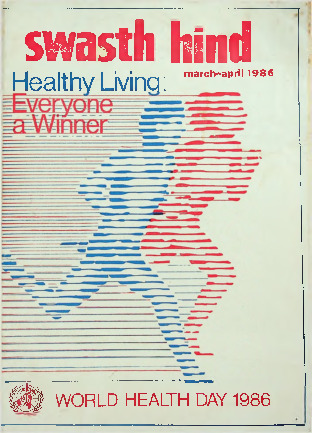
HEALTHY LIVINJG : EVERYONE A WINNER
Item
- Title
- HEALTHY LIVINJG : EVERYONE A WINNER
- extracted text
-
swasth hind
i HealthvLivina: “,i"9M
Hl WORLD HEALTH DAY 1986
In this Issue
swasth
hind
March-April 1986
Phalguna-Chaitra-Vaisakha
Saka 1907-08
Page No
Vol. XXX Nos. 3-4
Editorial and Business Offices
Central Health Education Bureau
(Directorate General of Health Services)
Kotla Marg, New Delhi-110 002
Healthy living: everyone a winner
57
Message on World Health Day—1986
61
Dr Halfdan Mahler
Healthier living
—need for action at every stage of life
64
Dr Sanjiv Kumar
&
Prof. L. M. Nath
EDITOR
N. G. Srivastava
ASSTT. EDITOR
D. N. Issar
Sr. SUB-EDITOR
Towards better health
68
Check the menace of spurious and poor
quality drugs
72
— Shri Rajiv Gandhi ■■■■ ■
M. S. Dhillon
—75
Adolescents and Youth of India
COVER DESIGN
Dr (Smt.) Prema Bali
Harbhajan Singh
Lifestyles and diet
SUBSCRIPTION RATES
Single Copy
Annual
25 Paise*
Rs. 3.00
(Postage Free)
*This issue • Re. 0.50
Articles on health topics are invited for publication in this
Journal.
State Health Directorates arc requested to send reports of
their activities for publication.
The contents of the Journal are freely reproducible. Due
acknowledgement is requested.
The opinions expressed by the contributors are not neces
sarily those of the Government of India.
SWAS1H HIND reserves the right to edit the articles sent
for publications.
78
Carlos Marti Henneberg
Food glorious food
81
Vitamin A deficiency and nutritional
blindness
83
The story of Githa and Sitha
86
A.S.K. Prabhakar Rao
Integrated approach to eradicate leprosy
88
Smt. Mohsina Kidwai
Books
Third
inside
.......... cover
Asm
HEALTHY LIVING:
EVERYONE A WINNER
The theme selected for the World Health Day—7 April, 1986, “Healthy
Living : Everyone a Winner” reflects the growing conviction that greater
emphasis should be placed on the positive action that individuals and
communities can take to protect and promote their own health. Exercise
and sports, nutrition, and personal responsibility are the three major
elements, among others, singled out by the WHO for immediate attention.
MARCH-APRIL 1986
57
The health of an individual, a family, a commu1 nity and a nation depends for the most part on
factors within the purview of the individuals and the
community. Medicine and the hospital are factors of
lesser importance, as compared to the preventive and
promotive health practices. Personal responsibility
covers a wide area in the promotion of healthy life
style. Individually, one can take steps to improve his/
her health by taking balanced food; using safe water
and protecting it from contamination; regular exer
cise; practising personal hygiene and keeping the
house, surroundings, and place of work clean; and
practising family planning.
Community on its part can create facilities for
better up-bringing of children and youth; take steps
to prevent and control communicable diseases; arr
ange for facilities for holding sports events and regu
lar exercise; encourage the use of locally available
inexpensive nutritious foods; change the social norms
of smoking and drinking, and thus promote healthy
living. Community can also organise health services
and can ensure full utilization of the available health
services.
The role of the Government will become much
more pointed for the development of health, of the
people, if the people themselves are conscious and
alive to their responsibilities for maintaining and pro
moting health, and prevention of communicable
diseases. The active participation of 'the people indi
vidually and as a community in health programmes
is a must for ensuring healthful living, where every
one is a winner.
It is in this context that the theme for the World
Health Day—1 April, 1986, has been selected as
“Healthy Living: Everyone a Winner”
The theme reflects the growing conviction that
greater emphasis should be placed on the positive
action that individuals and communities can take to
protect and promote their own health. The World
Health Organisation (W.H.O.) has singled out three
elements for immediate attention. They are:
Exercise : Active physical exercise,
including
participation in sporting events, is important at all
stages of life;
Nutrition : Every culture is able to provide the
basic ingredients for a diet which promotes the growth
58
and maintenance of a healthy body and adequate
physical and mental energy, and helps to prevent
vitamin and mineral deficiencies and cardiovascular
diseases;
Personal Responsibility : Individuals must be en
couraged to take steps now to promote their own
health and to avoid behaviour detrimental to it, such
as smoking and the abuse of alcohol and drugs.
The World Health Organization (WHO), in the past
years, has already highlighted the importance of chil
dren’s health, health care in old age, health care of
young people and women besides providing primary
health care to achieve the goal of Health for All by
the Year 2000. Thus the emphasis this year has
rightly been put on promotion of healthy lifestyles—
the important basis for successful living.
The other basic points for promoting healthy living
are:
Personal hygiene
For healthy living it is essential that we follow
the rules of good personal hygiene. Children are
quick in absorbing impressions that are lasting. Par
ents should help children to imbibe healthy habits.
They and other family members should set an example
by following the proper health practices such as hand
washing, bathing, combing of hair, cleaning of teeth,
cutting short the finger-nails, use of handkerchief
while coughing and sneezing, proper disposal of ex
creta and garbage, proper clothing, etc.
Any disruption of these activities may impair
health. A large percentage of children and adults in
our villages and cities suffer from scabies and dental
caries due to lack of good personal hygiene and if
they follow the rules of personal hygiene these need
not happen. Besides much load on the health service
outlets can be reduced so that more important pro
blems can be dealt with.
Besides, the individual, especially the children, need
plenty of sleep, fresh air, exercise, play and rest.
Exercise has a direct influence on health and can
act as a spur to fitness thus improving health gene
rally. Therefore, in all housing areas ample open
space should be provided where children and adults
can play and do exercises daily for keeping fit by
improving circulation and preventing cardiovascular
SWASTH HIND
diseases. Competitive sports and other simple forms
of exercise including early morning walks have be
come much more relevant in the “modern life-cul
ture”.
sight and poor mobility on account of pain in joints.
Therefore, some measures are also necessary to pre
vent falls, bums, fractures, etc.
Balanced diet for better nutrition
Environmental sanitation
The first priority for a sanitary environment is a
safe water supply—free from disease causing germs.
Sanitary latrines and urinals are of high priority for
healthy living. Diseases like diarrhoea, dysentery,
typhoid, cholera, polio, jaundice (infective hepatitis)
and worm-infestations can be controlled if our sur
roundings are healthy and clean. This can only be
achieved if we all get interested in healthy living and
take a lead in improving our own lot.
Good lighting arrangements, good ventilation and
protection against heat, cold, dust, fumes and rain
are the other important factors for healthy living.
Safe drinking water
The availability of safe drinking water has a direct
bearing on the level of health of the people and their
capacity for doing, work. About 80 per cent of all
diseases in the developing world are linked to unsafe
water. These water-borne diseases include cholera,
typhoid, dysentery, diarrhoea, guinea worm, infective
hepatitis, etc. These diseases need never occur if there
was supply of safe drinking water. People themselves
should take the responsibility for the supply of safe
drinking water to the community by protecting the
water supply in the area. The best method to make
water potable is to boil it or purify by using chemi
cal disinfectants like bleaching powder. Besides, there
is a need for proper and sanitary disposal of waste
water and solid human and animal wastes. Commu
nity involvement in such programmes is of utmost im
portance.
Healthy habits for safety
Safety in the home, on the road, at the place of'
work, during travel, etc., is another important factor
for healthy living. Accidents in homes, factories and
farms as well as road accidents each year are respon
sible for much morbidity and mortality. The common
accidents in the home can be a fall, cut, burn, drow
ning, poisoning, firearm accidents, etc. These can be
prevented with a little extra care on the part of adults
in the family.
Persons in old age are also more prone to accidents.
Falls are very frequent in old age due to failing eye
MARCH-APRIL 1986
Healthy people are less likely to become victims
of disease than those already weakened by malnutri
tion. Therefore, first key to good health is better
nutrition. Healthy communities and strong nations
have always been based on strong and healthy homes,
where special attention is paid towards nutrition.
A balanced diet is one which contains the different
foods in such quantities and proportions that our body
needs for carbohydrates, proteins, minerals, vitamins
and other nutrients are adequately met and small
provision is made for extra nutrients to withstand
short duration of illness and extra exertion. These
nutrients are essential for health and protection of
body against diseases. These also provide the body
with energy and help build tissues.
Healthy growth depends on good nutrition. From
conception to the time when the child attains his full
size as an adult, the food he eats and his ability to
convert that food into energy will influence the state
of his health throughout his life time. Feeling better,
being more cheerful and active, possession of normal
physical and mental health are some of the results of
good nutrition. Some facts about nutrition are:
* There are variety of foods that are good.
* All foods contain one or more of the five
classes of nutrients, viz., proteins, fats, carbo
hydrates, minerals and vitamins.
* No single food will provide all the nutrients
needed. Variety in the diet is the surest way to
be certain of proper nourishment.
* A poorly balanced diet leads to ill-health.
Anaemia, scurvy, beri-beri, night-blindness and
kwashiorkor are some of the diseases caused by
nutritional deficiency.
* A poorly nourished person is easily tired both
physically and mentally and is more prone to
diseases.
* Most of the nutrients are often destroyed if the
food is not properly prepared and cooked. Pro
per cooking and attractive presentation of
meals are just as important as selection of
food articles.
59
* The common notion that only expensive food
articles are nutritious is not correct. Less ex
pensive and locally available foods if judi
ciously selected, can provide nutritious diet.
The urgent need today is to help people balance
their diets. Lack of food leads to the wasting diseases
in children that create a chain of disability. Breast
feeding and traditional weaning diet offer safeguards
against; these diseases.
Women usually hold the responsibility for family
food and they could be instrumental in transforming
the family meals. They need be encouraged to make
the best use of the locally available foods.
. Kitchen gardens and poultry raising can also help
to tackle the nutrition problem. A handful of green
leafy vegetables (30 to 40 gms.) a day can protect a
child, from vitamin ‘A’ deficiency which blinds chil
dren.
Immunization
The right time to prevent any infectious disease is
obviously before it happens and in early childhood.
Children being vulnerable as a group are exposed to
many risks to their health and well-being. A large
number of children under three years of age die from
various communicable diseases and many are disabl
ed due to these. These infectious diseases are diph
theria, whooping cough, tetanus, poliomylitis, tuber
culosis and measles. Besides a balanced diet to provide
nutrients, a child needs to be protected against com
municable diseases through immunization. Immuni
zation should be done early in life and repeated per
iodically later to offer protection as advised by the
doctor. Immunization of expectant mother with
tetanus toxoid will protect not only the mother but
also the baby to be born from the dreadful disease of
tetanus.
Now. that we have set the target of “Universal
Immunization” by the year 1990, it . is the responsi
bility of the individual and the community to partici
pate in the programme actively and utilize fully the
available health services.
Small family
It is now well accepted that family planning is the
basis for sound health. It is vital for the nation’s
progress as it is directly and indirectly concerned with
raising the all round living standards of our'people
and thus making the country strong and prosperous.
Small family norm aims at making it possible for every
citizen to achieve his or her full potential and every
one becomes a winner.
60
' When children are born with proper spacing and
are wanted, they will be more cared for and their
environment} will be more conducive to normal growth
and development. Family welfare will result in lower
ing infant and maternal mortality and also the mor
bidity. Thus the children would be healthier.
.• To achieve this goal, it is necessary that voluntary
effort is intensified at every level, right from the village
upwards to the national level. The energies of all
social, political, religious and cultural organizations,
organizations of youth, women and employees, etc.,
have to be channelized and utilized in the process of
educating the people and motivating them to adopt the
small family norm.
Maternal and child health
The importance of maternal and child health can
hardly be over-emphasised. We must improve chances
of child survival and reduce infant mortality to ensure
acceptance! of family planning by our people.
Mothers and children are the most vulnerable group
in the community who suffer more from variety of
communicable and other diseases and malnutrition.
Nutritional anaemia and complications arising from
repeated child births are the common causes of mater
nal deaths. The poor health status of the mother has
not only led to a high prevalence of chronic ill-health
and deaths but has also hampered human development
and economic productivity.
Healthy youth and their role
•. By and large the young people have so far received
little attention. They constitute a substantial and grow
ing proportion of our population. Despite the over all
progress in various fields, the majority of young peo
ple lack access to education, employment opportunities
and health care.
Healthy youth is our best resource to promote heal
thy living and can contribute significantly to improve
the quality of life of our people. The participation of
youth in matters that relate to the development of per
sonality,. health, creative activities, social services and
other developmental and welfare activities is of utmost
importance. Schemes like National Service Scheme
(NSS) and Nehru Yuvak Kendras are aimed at building
up our young people towards voluntarily dedicating to
the' cause of social and economic development of the
country? •
__>
SWASTH HIND
MESSAGE
ON WORLD HEALTH DAY-1986
By DR HALFDAN MAHLER
DIRECTOR-GENERAL, WORLD HEALTH ORGANIZATION
HE theme of this year’s World Health Day, “Healthy
Living: Everyone a Winner” focusses on healthy life
styles. This reflects the growing conviction that greater
emphasis should
be placed on
the positive actions that
individuals and communities can take to protect and pro
mote health. The Alma-Ata
Declaration of 1978 clearly
states “that people have the right and duty to participate
invidually and collectively in the planning and implemen
tation of their health care”. As the movement for Health
For All by the Year 2000 gathers momentum, it is high
time to put this into practice.
T
The world around us has been changing rapidly, but often
standard medical practices and the functioning of health
services do not reflect these changes. In many places, the
emphasis remains on curative mensural; and neglects positive
steps that individuals can take to stay healthy.
Partly as
a result of some spectacular successes of modem medicine,
an attitude has spread to many parts of the world that health
is something the doctors provide for people, instead
of
something that a community and' individuals achieve
for
themselvesYet, today, it is evident that there is a grow
ing trend which shifts the emphasis from hospital-based care
to those everyday actions that promote health. This new
approach, based on a positive goal of fitness, is wide enough
to include all of society.
Three major elements of a healthy lifestyle deserve par
ticular attention: exercise and sports, nutrition, and person
al responsibility.
Exercise should be thought of in the broadest sense that
includes walking and any other leisure pursuit.
It has a
direct influence on health and can act as a spur to fitness,
thus improving health generally.
Active physical exercise is necessary for everyone at all
stage; of life. During early years it prepares the body for
the tasks to be undertaken in adulthood; during adulthood
it enables the body to give its utmost and to resist stress;
then in later years it maintains mental alertness and physical
mobility. But perhaps most important of all, keeping phy
sically active adds to the joy of life, contributing to that
sense of well-being which is the true foundation of health.
Everyone recognizes that food is the staff of life. But
today, eating habits are in a state of change just as are many
other ways of life. There is a menace in some new and
popular ways of eating. Junk food, for example, heavy in
fat or drenched in sugar, threatens the heart and the teeth.
WHO is not recommending a universal diet that every people
should adopt. On the contrary, every culture is able to
provide the basic ingredients for a diet which promotes the
growth and maintenance of a healthy body. Today there
is a greater need to be aware of how diet and nutrition func
MARCH-APRIL 1986
tion, and to consciously encourage those eating habits that
can help to produce excellence in sports and general well
being.
Personal responsibility covers a wide area.
Individuals
must be encouraged to take steps to preserve their own
health and to avoid behaviour that is detrimental.
This
■ refers directly to the use of tobacco under any form and
the abuse of alcohol and other drugs.
Smoking is the most important single preventable cause
of ill-health and premature death, wherever it is widespread.
And the smoking epidemic is one that doctors can’t cure;
only preventive works. What is needed are positive models
of health so that youth doesn’t begin to take up a lifelong
and pernicious habit Although it is the individual who has
the responsibility, the choice—to smoke or not to smoke—
is determined
by many factons over which society has a
considerable leverage.
And the individual in question
may be only eleven years old when called upon to make
that important choice.
In the case of alcohol and other drugs, individuals should
be helped to make wise choice; that will ensure their own
maximum capacity to use their bodies and to enjoy living-
WINNERS FOR HEALTH
WHO and the International Olympic
Committee (IOC)
have signed an agreement.to launch a “Winners for Health”
programme, precisely in order to enlist those members of
society whose example and practice can inspire others, even
though they are not formal health professionals- Olympic
champions and
popular sportsmen are
role models for
millions of young people. They can help convey the mes
sage that those promoting health don’t want to take away
things tliat are pleasurable, but rather to live their lives to
the fullest and avoid damaging their health through misuse
of alcohol and drus, for example.
Working with- National Olympic Committees which are
being encouraged to organize health fairs, runs for health,
and other activities, WHO will attempt with IOC to sti
mulate and encourage national
and. international activi
ties that underline the role of health preservation and pro
tection as a fundamental human right for the individual and
as an integral part of national development' Here again,
sport furnishes an excellent example: to the extent that a
nation can provide good nutrition and a healthy way of
life to its citizens, it can begin to produce individuals and
teams capable of competing at all levels, from the village
square to the Olympic stadium, and at the same time adding
to the joy of living by means of bodily and mental exer
cise.
Thus everybody can become a messenger for health. The
message should be carried everywhere: health is the only
race where everyone is a winner.
61
— > Mental health
Distortion and disruption of our traditional social
system in the wake of rapid urbanization and indus
trialization in the country has given rise to mental and
emotional problems especially among our young peo
ple. They are likely to suffer -from drug addiction/
dependence, alcoholism, neurosis, delinquency and
other behavioural problems.
To tackle these problems there is a need to improve
mental health education of our people and also to
strengthen the facilities for the treatment of mental and
other health problems, rehabilitation centres and coun
selling services.
Behaviour disorders like delinquency, sex deviations
and host of anti-social acts among children and young
people can also be attributed to family maladjustments.
On the other hand healthy and wholesome family living
promotes the development of an efficient, healthy and
well adjusted individual.
Care in old-age and after retirement
Growing old is a universal phenomenon and its in
evitable implications cannot, therefore, be ignored.
Older people are at greater risk than any other agegroup apart from infancy. Studies have revealed that
the most frequently mentioned health problems by the
aged are, defective eye-sight, general weakness, pain in
joints, chronic cough and cold, defective hearing, high
blood pressure, angina, digestive complaints, breathing
trouble, trembling of limbs, etc. Other problems in
clude accidents malignant diseases like cdncer, mental
disorders, cardiovascular diseases, dental problems, etc.
Therefore, the ageing people require a wide range of
preventive, curative and rehabilitative services. They
have special needs in respect of nutrition, hygiene,
exercise, and medical care.
In working people many problems arise after retire
ment, Retirement means accepting several personal
losses namely prestige, status, monetary loss, loss of
social recognition, etc. Besides, the situation is rapidly
changing due to increase in the life span, urbanization
and industrialisation. Massive migration to urban areas
for employment and the increasing number of nuclear
families, etc., is depriving the' aged of the emotional
and traditional support of their children.
Health education should help the aged people in
proper nutrition, personal hygiene, use of sanitary faci
lities, safe water supply, protection from accidents, etc.
Retired persons and other aged people should also be
62
kept informed about the available health services, and
provided avenues of their recreation and productive
engagements.
Communicable diseases' anrti their prevention
Leprosy eradication : Leprosy is one of the major
public health and socio-economic problems in the coun
try. It is a cronic infectious disease and spreads mainly
by close contact with infected people. However, drop
let infection is also considered responsible as a mode
of spread of the disease. The disease is associated with
crippling deformities and destitution if not treated in
time. A National Programme for Eradication of
Leprosy is being implemented by the Government.
Leprosy patients require greater .understanding and
sympathy of not only the medical men but of the entire
society. Social stigma/ostracization is one of the rea
sons of rehabilitation of leprosy patients and leads to
the genesis of leprosy beggars.
The source of infection of the disease is an open
case of leprosy who is not taking treatment. If such
an open case is converted to a closed case by adequate
and regular treatment, then chain of transmission can
be broken/interrupted. This can be done by early case
detection and regular sustained and full treatment.
It is here that the peoples participation can play an
important role. People can participate in many ways
such as in case detection, case holding, rehabilitation
of leprosy patients, etc.
And health , education is the weapon to enlist peoples’
participation.
Tuberculosis : Tuberculosis considered a killer dis
ease only a few years back, was conquered by medical
science but because of several factors continues to be
a major public health problem in the country. Even
now about 10 million people are estimated to be suffer
ing from this disease. The disease is a preventable one
and can be cured if the patients take proper and com
plete treatment.
Health education is one of the most important as
pects in prevention of the disease. Making the people
aware of the implications of the disease, its spread,
treatment and prevention will go a long way in impro
ving the health of the people. Healthy living will help
prevent this communicable disease.
Early detection of blindness : Blindness or loss of
vision is a serious public health problem with socio
economic consequences. It is estimated that the country
has nine million blind people at present. The national
SWASTH HIND
programme for control of blindness aims at reducing
the incidence of blindness from the present level of
1.5 per cent to 0.3 per cent by the end of the century.
Lack of knowledge about personal hygiene, proper
nutrition and prompt treatment in case of eye injuries
contribute considerably to the magnitude of the problem
of avoidable blindness. Eye disorder can arise due to
lack of certain nutrients in the daily diet. A great
majority of these cases of blindness can be prevented
if proper nutritional care is taken .at the proper time.
Therefore, it is important to raise the level of know
ledge and consciousness in the community regarding
simple measures which lie within .the reach of each
individual and would ensure that the priceless gift of
vision can be kept by everyone for a lifetime.
Certain beliefs and practices in certain communities
also harm the eye-sight. The practice of using collyrium
in the form of Kajal or surma coupled with indifference
towards personal hygiene contributes to the spread of
eye infection. Therefore, it requires education of the
people to shed their old beliefs and practices.
Other non-communicable diseases
With rapid economic development, urbanization,
changing social norms and increased life expectancy
due to the prevention and control of many communi
cable diseases we are now face to face with health
problems arising out of stress and strain like the cordiovascular diseases, cancer, occupational hazards, acci
dents, etc.-Public awareness of these problems and the
peoples participation in the implementation of the pro
grammes to prevent these problems are essential. Phy
sical exercise and proper attention to diet could reduce
the risk of heart attacks and diabetes. Early detection
of cancer can save lives. Cancer is, to some extent,
avoidable. Enough is known today about the causes, of
many cancers and on the basis of this knowledge cer
tain measures can be taken to prevent some of the
most frequent forms of cancer. Stopping tobacco smok
ing and tobacco-chewing are two examples of primary
prevention of cancer.
Sex education
Sex education including family welfare planning and
reproductive health is essential to improve the health
status of our people. Education and counselling in sex
matters and also about sexeually transmitted diseases
should be provided to young people of both the. sexes.
The social, psychological and emotional consequences
of early sex involvement and STD need to be carefully
MARCH-APRIL 1986
explained so that they live a healthy normal life. This
would also help to encourage more open attitude to
wards Sexually Transmitted Diseases (STD) and en
courage people to seek prompt health care when they
notice danger symptoms or if they are at risk.
Ecology
There is now increasing awareness of prevention of
environmental pollution and preservation of ecobalance. Human habitat cannot be conceived without
the sane and safe policy towards the environment in
which they are to flourish. Hence, there is a dire need.
of environmental education for the people especially in
regard to those problems which arise in the wake of
accelerated use of technology and consequent moder
nisation process. These include:
Water pollution : It is due to discharge of industrial
wastes without treatment into water courses, rivers, etc.
Industrial wastes may contain acids, alkalies, oils and
other chemicals, some of which may be toxic and
harmful to health.
Air pollution : This is another important problem in
industrial areas which may have an adverse effect on
the health of the population. Air pollution is due to the
discharge of toxic fumes, gases, smoke and dusts into
the atmosphere.
Sewage disposal : Lack of facilities for the disposal
of sewage leads to pollution of water supply, contami
nation Of soil with parasites, etc.
National Health Programmes
Tangible progress has been achieved in the reduc
tion of morbidity and mortality due to preventable
communicable diseases. Smallpox has already been era
dicated from the country. Malaria,1 leprosy, T.B. and
blindness are the other major health problems for which
national programmes are being implemented all over
the country. Public health measures are also being con
tinued against diarrhoeal diseases, filaria, goitre, Japa
nese encephalitis and guinea-worm.
These activities are all aimed at improving the health
of our people. Therefore, it is the duty of our people
to participate actively in the implementation of such
Governmental and non-governmental schemes, and
they should develop and adopt scientific and healthy
practices.
Healthy Living : Everyone a Winner.
—M. S. Dhillon
63
HEALTHIER LIVING
—Need for action at every stage of life
Dr Sanjiv Kumar & Prof. L. M. Nath
The need to promote health at every stage of human life cannot be over
emphasized. To be truely preventive it must start right from conception or
may be even before that, to have adequately nourished and healthy mother
at conception and must continue throughout life. The disease oriented
approach to health must be replaced by continuous health oriented approach.
61
SWASTH HIND
HE better approach to health care is to promote
health and take preventive action before one gets
disease rather than curing one after getting the disease.
It has been realized that this approach is better for
health and is cost effective. World Health Organiza
tion has played a vital role in making the health care
‘health oriented’ in contrast to the ‘disease oriented’
approach of the conventional health care system of
earlier days. Medical treatment, however, necessary,
seldom improves the health of the population while
preventive and promotive health care necessarily has
an impact on the health status and quality of life.
WHO has given a boost to promotion of health by
adopting ‘Healthier Living—Everyone a Winner’ as
its theme for the World Health Day, 1986.
T
To remain healthy, effort is needed at every stage
of life—right from the time of conception till old age.
These efforts need to be concentrated on certain timetested and scientifically proven measures which can
be taken at different ages. The problems and priori
ties are different at different ages. For the purpose
of discussion, stages of life can be divided into ante
natal and perinatal period; infancy; preschool age;
school age; .youth; middle age and old age.
Antenatal and perinatal period
During antenatal period whatever reaches the child
reaches through the mother. The health of the mother
determines the health of the foetus. Hence adequate
antenatal care of the mother is the best way of ensur
ing the care of the foetus. Even before conception
there is a need to promote the health of the female
so that at the time of conception mother is adequa
tely nourished and healthy. Lack of antenatal care
and unsupervised child birth are two important etiolo
gical factors contributing to alarmingly high perinatal
mortality (still births and deaths in early infancy) in
India and other developing countries. If adequate
maternal nutrition, treatment and prevention of ana
emia by administration of iron and folic acid, tetanus
immunization, proper antenatal care and conduction
of child birth by trained personnel can be ensured,.
perinatal mortality and prevalence of low birth weight
can be reduced to a large extent.
Infancy and Preschool child
This is the most vulnerable period of human life.
Health can be promoted during this period through
simple means.
Upto the age of 4 to 6 months most babies—who
are breastfed do well. The modem practices of
MARCH-APRIL 1986
avoiding breastfeeding particularly in the urban areas
of our country need to be reversed. Certain undesi
rable practices associated with breastfeeding, i.e., dis
carding of colostrum, giving of prelacteal feeds, ad
ministration of herbal and home made decoctions,
withholding breastmilk during mother’s or child’s
sickness, delayed supplementation and abrupt wean
ing need to be discouraged while desirable practices,
i.e., near universal breastfeeding and prolonged breast
feeding need to be promoted.
Towards later part of infancy the baby outgrows
the breast milk output. Weaning foods are either not
started or if started are inadequate in quantity and
quality. These are invariably cooked, stored and fed
to the baby in unhygienic conditions, starting the vi
cious cycle of infection and malnutrition. It has
been shown that in developing countries 91%
of
deficit in height and 98% of deficit in weight occurs
due to fall in growth velocity in the later half of in
fancy when mother’s; milk alone is not enough. This
can be taken care of by giving proper supplementation
at the right, time while continuing breastfeeding for
as long as possible.
Immunization against common illnesses of epide
miological relevance, i.e., Diptheria, Pertussis, Teta
nus, Tuberculosis, Measles, Poliomyelitis and Typhoid
must be given to all the children to protect them from
these diseases which account for a sizeable proportion
of morbidity and mortality during childhood.
The need for growth monitoring cannot be over
emphasized. This acts as an early warning system
and enables the mother and health personnel to take
timely remedial measures thereby ensuring adequate
growth at this crucial period. Diarrhoea is a com
mon problem and is responsible for a large proportion
of deaths and disabilities in the children. The ill-effects
of diarrhoea can be effectively countered by simple,
cheap and easily administered oral rehydration solu
tion and continuing normal feeding of the child dur
ing the episode of diarrhoea.
Preschool child passes through another difficult
period. Growth failure due to vicious cycle of infec
tion and malnutrition is established.
The mortality
in developing countries is 40 to 50 times higher in this
age group as compared to the developed countries.
With the help of breastfeeding, growth monitoring, ade
quate and timely nutritional supplementation, oral
rehydration and immunization which are cheap, effec
tive and practical, a great improvement can be brought
about in the health of the children. These can be
afforded by all the developing countries, communities
65
and families. According to UNICEF ‘Revolution in
Child Servival’ has been brought about by these stra
tegies.
The mother has been rightly recognized as the best
and the most effective health worker so far as care
of the children is concerned. Hence all those concerned
with the health of the children must make an effort
to enhance the capability and capacity of the mother
in taking care of their children. This will require
proper ante-natal and perinatal care and correction
of anaemia and other such disorders in women.
School age
At this age-the demand for growth is relatively less
but the body is still growing. Though clinical malnu
trition is rare, children still show a lag in growth as
.compared to western children.
Parasitic infestation,
eye and skin infections are common.
In developing countries a sizeable proportion of
children of school age do not go to school and hence
are deprived of school health care and other welfare
activities there, of which midday school meal is one.
Most of these children spend their time either in help
ing in the family occupation or seek employment at
this tender age, many of them being employed in
hazardous jobs.
There is a need to promote school enrolment and
proper school health programmes. Health, sex and
population education must be included in the curricu
lum at the school and college level. This will make
them more aware of health and population problems
and they will be in a better position to take care of
their health and health related needs.
Adolescence and youth
With the onset of adolescence, the child also gets
new responsibilities. Their energies need to be chan
nelized into productive activities. At this age they
are more likely to get addicted to smoking, alcohol
and drugs. Therefore, their spare time should ideally
be utilized in sports and social welfare activities. The
youth clubs and other youth organizations can piay
a very vital role and must be strengthened.
WHO had again taken a lead by declaring ‘Healthy
youth—our best resource’ as its theme for 1985 World
Health Day. The year 1985 was declared the ‘.Year
of the Youth*. In India 12 January was declared as
66
the ‘Youth Day’ and many new projects have been
started for the welfare of the youth. All these must
be sustained to promote physical, social and mental
health of the youth.
Early marriage is still an accepted way of life in
many rural and traditional societies. This is parti
cularly disastrous for the health of the females. The
adolescent girls who are still growing, get into the
continuous cycle of pregnancy and lactation, resulting
in various forms of maternal depletion syndromes like
anaemia, osteomalacia, etc., which are very common
among women in the developing countries. The laws
restricting early marriage have still not been socially
accepted and lack enforcement from the administra
tion.
Middle age
Tli is is the age at which the individauls influence
the society the most. At this stage of life their deci
sions affect all the members of their family and the
society. Yet this age is never talked about in the
welfare activities. The tensions and anxieties in the
family life and in their carreer may tell upon ther health
which in turn affects the family and the society. At
this age there is need to have regular screening for
diseases, like hypertension, diabetes, coronary artery
disease, etc..
Individuals in this age group are usually the right
targets of family welfare activities. They must ensure
that their families are small and adequately spaced.
The four ‘toos’: too young (mothers), too old
(mothers), too close (pregnancies) and too many (pre
gnancies) must be avoided. The later part of this age
is a transition phase from active life to relatively in
active, physically and economically unproductive life.
They should be helped to pass through this phase
Economically and psychologically prepared for old
age.
Old age
The proportion of population in the old age is
continually on the increase. In India more than six
per cent of population is above sixty years of age.
In the changing society today the joint family system
is being gradually replaced by nuclear family system
and this is eroding the valuable family and social
support which was available to the aged in our society.
Here again WHO focussed the attention of the world
by declaring “Add life to years” its theme for 1982
World Health Day.
SWASTH HIND
Old age should be regarded as a normal, universal
and inevitable bioligical phenomenon. The approach
to this age group can be summarized in the words of
James Sterling Ross “You do not heal old age; you
protect it; you promote it; you extend it.” The pro
blems faced during this age are degenerative diseases
of heart and blood vessels, cancers, accidents, diabetes
mellitus, diseases of joints, chronic respiratory diseases,
genitourinary problems and psychological problems
including loss of memory, rigidity of attitudes, sexual
maladjustments due to cessation of menstruation in
females and diminution of sexual activity in males and
emotional problems arising out of social and economic
adjustments.
The old. must continue to take their share in the
family and other responsibilities and enjoy privileges.
They must be helped to fight the three evils of old
ICDS :
The need to promote health at every stage of human
life cannot be overemphasized. To be truly preventive
it must start right from conception or may be even
before that to have adequately nourished and healthy
mother at conception and must continue throughout
life. The disease oriented approach to health must
be replaced by continuous health oriented approach.
If health is achieved through healthier living—every
body is bound to. be a winner.
A
A DECADE OF SILENT REVOLUTION
Launched with a meagre 33 projects, Integrated
Child Development Services (ICDS) has now expanded
to cover 1,356, i.e. one-fourth of all developmental
blocks, covering 23 per cent of the country’s popula
tion. Locationwise break-up of these projects is 61
per cent rural, 27 per cent tribal and 12 per cent urban.
As many as 1.2 lakh Anganwadi Centres are serving
the deprived sections of the society.
Supplementary nutrition is being given to nearly
two million children and pregnant/nursing mothers in
these blocks. Pre-school education is being given
to about three million children.
What has ICDS achieved? There is significant im
provement in the four ante-natal services and conse
quently better cooperation from mothers in the family
welfare programme. As per 1983 figures of maternity
and nutritional services to women, supplementary nu
trition is reaching 58.6 per cent in ICDS-served areas
as compared to just 5’4 per cent in non-ICDS areas.
Similarly, post-natal care to nursing mothers has also
registered improvement. Family Welfare advice is
reaching 58.3 per cent as compared to 20.3 per cent
and health check-ups through trained personnel to
62.2 per cent as compared to 23 per cent.
Incidentally, ICDS which employs 2.2 lakh women
Anganwadi Workers has emerged as the biggest gene
rator of part-time employment for women.
MARCH-APRIL 1986
age—poverty, loneliness and ill health. To promote
healthier living in old age efforts arc needed to pro
vide nourishing diet, good housing, reduce physical
and mental stresses and strains, provide them some
intellectual activity, periodic health check ups alongwith welfare activities, pension, assistance, home care
services and keep them free of anxiety, want and
boredom.
There is improved immunization coverage, i.e. 60
per cent or above for BCG, DPT and Polio. It is
significantly more than non-ICDS blocks in the cor
responding period. As a result of integrated immuni
zation coverage, supplementary nutrition, health
checks, nutrition and health education of mothers and
convergence of other supportive services, there is. ap
preciable decline in infant mortality rate in the ICDSserved areas. It is about 88.2 per thousand whereas
in the rest of the country, it is about 110. The birth
rate is also noticeably low, i.e., 24.2 as against the
national birth rate of 33.3 in 1981.
The National Institute of Public Cooperation and
Child Development (NIPCCD) has played a key role
in the training of ICDS functionaries. It has provided
training to 1425 child Development Project Officers
(CDPOs) by organizing 49 training courses during
the last eight years. Besides, it has commisioned 25
Middle Level Training Centres (MLTCs) since 1982
and provided job training to 3714 supervisors and
refresher training to 974. The number of Instructors
of -Anganwadi Training Centres (AWTCs) who receiv
ed orientation training during the period was 910; 182
Instructors underwent refresher training.
A
—NIPCCD Newsletter
Sept, and Oct. 1985
67
TOWARDS BETTER HEALTH
s soon as a woman feels she is going to have a
baby, the first thing she should do is to visit a doctor
or auxiliary nurse midwife at the nearest Health
Centre or at the ante-natal clinic of a nearby
hospital. The doctor will make some tests to confirm
whether the woman is pregnant or not. She will also
give all the advice needed at the very start of the
pregnancy.
A
Subsequent examinations are necessary to see that
<the mother-to-be is well and continues to remain
well during the pregnancy. This will help ensure a
normal delivery and a healthy full-term child. She
should take the necessary inoculation to protect
herself and her baby from contracting tetanus infec
tion at the time of child birth.
68
The health of the child depends on the health of the
mother.
If the pregnant woman finds anything wrong with
her health, she should immediately visit the nearest
Health Centre.
The doctor’s advice can help protect the pregnant
woman against diseases, improve the health of the
coming baby and avoid a lot of worry later.
The expectant mother should look after herself on
the lines of the advice received from the doctor.
She should get good food and enough of it. The
food should be adequate to meet the requirements
of her body as well as that of the baby growing
within her.
SWASTH HIND
She should also balance her work and rest.
little exercise is as bad as too much exertion.
Too
Arrangements to deliver the baby should be made
sufficiently in advance in consultation with
the
auxiliary nurse midwife or the doctor. If it is decided
to deliver the baby at home, the auxiliary nurse
midwife or doctor will tell what preparations to
make. No untrained dai should be called for con
ducting delivery.
Breast feeding : best for your baby
The mother should prepare herself for breast
feeding the baby. The earlier a mother suckles her
child, the more milk she will have. The milk pro
duced on the first two days is very nourishing and
Breast-fed babies are less prone to infections.
children should be breast-fed as long as possible.
So
should be fed to the baby. It is not good to give
sweetened water, castor oil, “Janam Ghutti”, etc., to
the newly bom baby. It may cause bowel infection
and diarrhoea.
Breast-fed babies are least prone to infections and
thrive better than bottle-fed babies. As long as the
mother breast-feeds her baby, she is less likely to
become pregnant again.
Breast-feeding
mothers
should wash the nipples before every feed and cat a
balanced nourishing diet themselyes.
When baby is 4 months old, give soft foods
At the age of about four months, milk alone is not
enough for the baby. Soft foods like sweetened thin
porridge made of suji, dalia, ragi, well cooked and
mashed rice and grams, khichadi, eggs, fish, mash
ed banana and biscuits should be added to the
diet. A beginning should be made with very small
quantities of one item and a little more added every
day. By the time the baby is one year old, it should
be able to digest the usual family meal.
Protect your baby against diseases
Children fall an easy prey to many communicable
diseases. Some, of the common children’s diseases
in our country are poliomyelitis, tuberculosis,
measles, typhoid, diphtheria, whooping cough and
tetanus. These diseases take a heavy tool of life.
Besides the unfortunate children who die of these
diseases, many are disabled for life with complica
tions such as brain damage, paralysis, chronic lung
ailments, deafness and blindness. You can protect
your child against these diseases by timely immuni
zation. The immunization schedule is given below.
Schedule of Vaccinations
Pre-natal
MARCH-APRIL 1986
2 doses of tetanus toxoid at
a minimum interval of one
month to the pregnant
women.
The last dose
should be given at least two
weeks before (he expected
date of delivery. In case of
history of tetanus toxoid in
previous pregnancy, one
booster dose is adequate.
69
Child
Age 3 to 9 months
(a)
■ Balanced' diet: a must for you and your baby
(c) After an interval of 1—2
months give:
♦third dose of DPT (in
jection) and Polio vaccina
tion (oral drops)
A pregnant woman or a nursing mother needs
additional iron and other nutrients like Vitamin B
complex, Vitamin C, copper, etc., to build extra
blood cells for the growing foetus or child.
Measles vaccine (injection)
one dose, where available.
These nutrients are found in meat, liver and eggs,
milk, leafy vegetables, molasses or jaggery and dry
fruits like raisins, plums, dates, etc.
.
Booster dose of DPT (injec
tion)
Booster dose of Polio vac
cine (oral drops)
5 to 6 years
10 years
16 Years
70
Immunization services are available free of cost at
the maternal and child welfare (MCW)
centres,
dispensaries, hospitals and primary health centres.
These centres or the health workers will provide any
additional information
on the immunization pro
gramme.
(b) After an interval of 1—2
months give:
♦second dose of DPT
(injection)
♦second dose of Polio vac
cine (oral drops)
9 to 12 months
18 to 24 months
Start with
♦first dose of DPT (injection)
♦first dose of Polio vaccine
(oral drops)
♦BCG (injection)
(a)
Booster dose of D.T (Diph
theria and Tetanus) injec
tion.
First dose of typhoid mono
valent or bivalent vaccine
(injection) ’
(d)
After an interval of 1—2
months give .second dose of
typhoid vaccine ^injection)
♦Booster dose of Tetanus
Toxoid (injection)
♦Booster dose of typhoid
monovalent or bivalent vac
cine (injection), OR
first dose of typhoid mono
valent or bivalent (injection)
if not given earlier, followed
by second dose of typhoid
vaccine (injection) after an
interval of 1—2 months.
♦Booster dose of Tetanus
Toxoid (injection)
♦Booster dose of typhoid
monovalent or bivalent vac
cine (injection) OR
first dose of typhoid mono
valent or bivalent (injection)
if not given earlier, followed
by second dose of typhoid
vaccine -(injection) after an
interval of 1—2 months.
A balanced diet can prevent anaemia, which is one
of the major health problems in our country. It is
particularly serious among children and pregnant
women,, because their requirements of essential
nutrients like proteins and iron are relatively higher.
Many children suffer from eye diseases because of
Vitamin A deficiency in their diet. Severe degree of
Vitamin A deficiency coupled with malnutrition and
‘infection may lead to blindness. This can be
prevented by taking foods enriched in Vitamin A.
Vitamin A is .present in green leafy vegetables like
palak, amaranth, drumstick leaves, radish leaves,
tomatoes, pumpkins, carrots, fruits like papaya,
mango and guava.
Fish and fish liver oils also
contain plenty of Vitamin A.
Guard' your baby against diarrhoea
Diarrhoea is a common disease in children. It may
be fatal in the first two years of life.
Diarrhoea is caused by infection. Flies and filth
spread infection through food. Food articles such
as milk should be protected against flies. All food
should be properly covered.
Care should be taken to protect infants, particularly
the bottlerfed ones, from getting diarrhoeal infec
tions. Feeding bottles should be kept clean.
The home and its surroundings should also be kept
clean and free from flies. Fly breeding should be
prevented by proper disposal of garbage and human
excreta.
If a child gets diarrhoea, never stop food and fluids.
On the other hand give plenty of fluids. A simple
salt-sugar solution can be made at home by dissolv
ing half a teaspoon of common salt and five
teaspoons of sugar in one litre(4 glasses) of water.
This solution should be given in small quantities till
the child refuses. The health worker or doctor
should be consulted in case of diarrhoea.
SWASTH HIND
HAVE A CHILD ONLY WHEN YOU ARE PRE
PARED FOR IT
pregnancy by not allowing the sperm of the male to
reach the ovum of the female.
A child should be brcjfcght up with dove and care
before another one comes. A married couple
should not have a child as long as they are not
prepared for it.
The same effect can be obtained by a woman using
a diaphragm. But it is necessary to use some
chemical spermicidal with the diaphragm. Some
jellies, creams or foam tablets can also be used to
avoid pregnancy.
A girl should be 18 years of age before she gets
married, and her husband 21. That is the law. Those
who break the law can be fined and punished.
Even after marriage, you can delay a pregnancy
for a couple of years if health, finance or some
other conditions do not allow it.
There are easy methods if you want to space your
children, or if you don’t want any more child.
You can space child births by various ways
When you want to space out children, perhaps the
simplest method is to use Nirodh. Nirodh prevents
The woman can use an intra-uterine device which a
doctor or a trained paramedical worker puts inside
her uterus. It is a good, spacing method to prevent
or postpone pregnancy. I.U.D. should be changed
once in every three years. Copper T is a good and
popular I.U.D. The IUD insertion services are availa
ble in Health/Family Welfare Centres.'
The woman accepting any of these methods should
report to the Centre for any further advice or in case
of any complication.
Courtesy :
Deptt. of Family Welfare
IMMUNIZATIONS SAVE 800,000 INFANT LIVES YEARLY
Immunizations against six childhood diseases are
now saving the lives of some 800,000 infants every
year in developing countries, according to WHO esti
mates. This represents a “major public health gain
in the past ten years,” says a status report published
in August 1985 in WHO’s Weekly Epidemiological Re
cord (No. 34).
WHO launched an Expanded Programme on Immu
nization in 1974 against six killers of infants—polio,
diphtheria, pertussis (whooping cough) and tetanus,
as well as measles and tuberculosis.
The success of the programme is measured largely by
the number of immunizations given against four dis
eases—polio, diphtheria, pertussis and tetanus. To pro
tect against these diseases, a full course of vaccines—
either two or three doses—is needed, thus necessitat
ing more than one trip to the health centre.
Some 40 million infants received the full course
of doses, a figure that represents coverage of about*
40 per cent of the 100 million infants who, in 1948,
survived to one year of age in the Third World.
“The coverage of infants with these vaccines was
less than five per cent in the countries at the time
the programme started”, the report says. It has thus
increased eight-fold over a decade.
MARCH-APRIL 1986
In addition, some 33 million immunizations were
administered against measles and 48 million against
tuberculosis, representing coverage of 33 and 48 per
cent respectively of the 100 million infants. Only
one dose is administered in each. case.
“Simply by reinforcing existing health services”, the
report says, “there seems every reason to expect that
a fully immunized coverage level of 60 to 70 per cent
will be achieved by 1990.”
Despite these successes, however, an estimated
265,000 cases of polio, two million deaths from mea
sles and 600,000 deaths from pertussis alone still occur
yearly in the developing world. These figures exclude
China.
And only 14 million pregnant women receive the
two doses of anti-tetanus vaccine needed. As a
result, some 800,000 deaths from neonatal tetanus oc
cur each year. To protect newborn babies against
neonatal tetanus, the doses are given to mothers four
weeks apart.
UNICEF is a major supporter of the immunization
programme, not only providing vaccines, refrigeration
equipment and funds, but also playing a leading role
in promoting immunizations.
—World Health
Nov. 1985
71
CHECK THE MENACE OF
SPURIOUS AND POOR QUALITY DRUGS
—Shri Rajiv Gandhi
The/ 37th Indian Pharmaceutical Congress was held from 26 December, 1985, in
New Delhi.
The Prime Minister, Shri Rajiv Gandhi, inaugurated the 3-day
Conference in which over 2000 delegates participated. The Conference was organised
by the Indian Pharmaceutical Association. We publish here the text of the Prime
Minister's Inaugural Address.
CCXZour profession is an extremely demanding proJt fession. Much too often in India not adequate
attention is paid to the importance of the Pharmacists
who play such a key role in dispensing the medicines,
the drugs, that are required for the treatment of any
illness.
with our own research, with our own production and
with our own development of pharmaceutical industry.
The Industry has shown a very good shared develop
ment between the public sector and the private sector,
perhaps better coordination than has taken place in
many other areas.
The pharmaceutical profession has a very good
record in India and with the substantial increase in
health care, with a new awareness spreading to more
remote rural areas, there is a much greater need for
more Pharmacists, for more dedicated pharmacists;
perhaps the pharmacists going into areas which are
not so easily accessible and that involve a certain
amount of hardship.
Today, we are proud of the drug industry, our
pharmaceutical industry, but at the same time, there
is no place for complacency. Developments are tak
ing place very rapidly and if we are not alert, if we
are not quick, we are liable to get left very far behind.
During the Sixth Plan, our drug production has
more than doubled. It has reduced the import re
quirements and has made us to a large extent selfsufficient. Being self-sufficient in drugs is and will be
one of the key factors in truly remaining independent
and standing on our own feet. We have seen attempts
to give up—developing countries’ drugs—at very high
rates by certain manufacturers, while there is a certain
cost for research, I don’t think it is fair that it should
be passed on only to those who don’t have the capa
bility to develop their own drugs. What we must do
is to develop that capability so that we can counter
72
Perhaps, the biggest question that affects our drug
industry is that of spurious drugs, that is, poor quality
drugs produced by non-licenced or clandestine manu
facturers and this must be tackled seriously not just
by Government but also by the industry that is involv
ed in the manufacture of the proper licenced drugs.
Government will always be one step behind because
our task will be to try and catch some one and then
stop it.- But you will be able to come out with proce
dures, may be, with the types of packaging, may be,
with other methods, which could prevent imitations
from being brought out at all. In this area we should
cooperate and see what we can do together to prevent
this terrible practice that has started.
SWASTH HIND
Within the industry, there is a question of quality,
of purity, stability of the product. The laws, regula
tions, are not enough to really guarantee these factors.
Effective regulations must come from within the com
munity, must come from within your own pharmacist
community. There must be a sense of social respon
sibility, a certain work ethic or work ethos developed
in the units which give a certain amount of dedication
on the part of each worker to producing a belter pro
duct. There must be a professional tribe not just at
the top level but permeating down to the lowest level
in the industry because only then this quality that we
are looking for will really come out. Perhaps, the key
must lie in the. management which must enthuse the
whole system to develop along these sort of lines.
ahead in pharmacy. As you have yourself said, that in
India there is not an adequate thrust for developing this
base and we must build so that we develop enough
people, we generate the manpower that is required
for a lively thriving pharmaceutical industry. It
mustn’t be just a question of importing a technology
and then producing a drug on that technology. We
must develop our own technology. In some areas
we could start from scrap, in other areas we could
import a certain technology, but from there we must
develop through our own R&D and we must make
our own base for a strong industry. We must see
that there are adequate links between the R&D,
scientific establishments, the actual production units,
the consumer and the doctor.
The pharmacist has, as you have said, the respon
sibility to dispense, to explain the side-effects, to
explain how best the drugs can be taken. But there
is also another responsibility, that of preventing the
spread of harmful suprious, adulterated, substandard
or imitation drugs. He must also see that drugs
that are narcotic or habit forming arc not accessible
without a proper prescription and that
they are
accessible only to the proper people. This is one of
the areas that we are a little worried about, that of
drug-abuse and we are taking certain steps on the
part of Government to try and prevent this. But
what is really required is a social awareness and one
of the key areas has to be the. pharmacists * to see
that drugs do not spread specially amongst the
younger generation.
The challenge is not just in developing the drugs
but in also ensuring the safety of the drugs and an
acceptibility of the drugs. This can only come about
if there is this sort of cooperation right from the Lab
to the patient. We hope that through your Congress,
through- the Health Ministry, such cooperation will
be forthcoming and we will be able to make some
movement along that line.
Getting back to the spurious and imitation or adul
terated drugs, we have laws; perhaps they could be
implemented better. We will try and look into that.
But what we are really looking for is to seek out
the basic root causes that allow such manufacturers
to stay in the game. We must collate all the infor
mation that we can gather, that you can gather. We
must have the system of cooperation between the
administration, between the pharmacists and with
other social voluntary organisations which could help
fight this. There must be no stone left unturned to
stamp out spurious or adulterated drugs.
Technology, as you have said, is moving very fast
and specially in your industry. We have seen major
advances in molecular biology, bio-technology and
there are tremendous exicting challenges that lie
MARCH-APRIL 1986
Our drug industry still rely too much on allopathic
research. There are many other fields which have
not been researched; I don’t say that they are right,
at the same time, we cannot say that they are wrong.
What is needed is to research these areas, to try to
, find answers to questions which are not being ans
wered through the allopathic system. There is some
research but this is not enough. In India we have
many systems which still work, which are cheaper,
which are more acceptable to the average Indian in
the rural areas and the villages. But these systems
need to be developed on more scientific lines so
that they can be more precise and specific diseases
get specific cures which are not too nebulous but can
be prescribed by somebody trained properly in the
system.
We have, in the past, imported technology at
various levels to develop our drugs, and we have
developed from them. But if we are to get at the
frontline of the developing pharmaceutical industry,
this can never happen by importing technology.
Because, by importing technology, we will always be
importing a technology' which the others are willing
to give us, in other words, the second level techno
73
But the Ministry has to see that there are no
logy, and when we start with second level technology
tion.
and we continue at that second level we can never
side-effects.
get to that first level of technology.
dealing with this.
For that there
We hope that they will be quick
in
has to be some leap frogging, some jumping over the
technology and today is the time when India is really
You have also mentioned
an involvement
pharmacists in the drug administration.
of
You
are
tific point of view the challenge really is yours, to
right but there is a need for such involvement
of
see how, may be in specific areas to start with which
professionals in the system and we have already said
ready to do this.
are more relevant
From a technological and scien
to us, may
be in
those
areas
that preference must be given to such profession.
I
adopted
where we would like a certain drug to be tailored
believe, one or two States have already
to our physiology, to Indians and their' way of life.
this. We will pursue along this line but sometimes
there is a shortage of professionals coming forward.
Perhaps, you can look at these areas and see where
that we could achieve enough advancement to get on
so we xinust have such a position where vacancies
are not left unfilled and people do come and fill
to the frontline of the industry.
those vacancies but as you say if we can get enough
you would like a certain thrust and where you feel
One area which is very important today is that of
safety.
Safety on the one hand, of trying to ensure
that dangerous drugs or powerful
guards on the containers in which these drugs
are
The second is the question of safety in
the
production units, in case of accidents.
We
have
seen during the past year, year and a half a number
of accidents in the chemical industry which
have
caused tremendous distress to the people living
in
that area, to the whole country.
The drug industry
has a goodsafety record today, but what
we must
do is look deeper into the safety aspect, into
the
precautions that we are taking to prevent accidents
and the safety of the workers who are working in
the factories.
in
the administration, I think we should try and
do
that.
And we will look into that further.
drugs are not
accessible to small children by having adequate safe
sold.
pharmacists to come forward and be involved
The thrust for developing our
own
technologies, our own R&D must not forget
the
safety factor, must not skip on the dangerous aspect
of an accident.
between the Doctor and the patient, and the respon
sibility in seeing that the compliance of the prescrip
tion, in explaining the prescription, in biinging home
the medical aspects, bringing home what the dangers
of a particular drug are, must be borne by the phar
macists. The precautions that may be required
for
a particular drug, the interaction of that drug with
other drugs which a patient might feel is not well.
but may be a drug that he might
be taking for some
other disease as a routine, may be some pain killers,
may be some other
normal
medicine that a person
takes without going to a Doctor.
So, such inter
action of drugs must be explained, the dosage, the
complications, incompatibilities; these must all come
from the pharmacists and they will come if there is
You have mentioned the National Institute
Pharmaceutical Education and Research.
key man
Lastly, the pharmacist is perhaps the
As
for
a feeling in the community of service, of dedication.
you
This, you must build.
The bridge that the pharma
know, that when you go to a Doctor, for an illness,
cist is between the Industry, the Doctor and
he first diagnoses it then he gives his prescription
patient on the other hand must not just be a connec
and then there is the formulation of drug, and then
ting link, but it must be a much stronger than that
the drug has to be taken and then you get a cure.
and perhaps it can even act in the reverse direction
Well, I hope that the Ministry will try and expedite
in informing on what feedback the pharmacist might
this process.
74
There is a need for such an Institu
get of a particular drug................. ”
.
the
A
SWASTH HIND
ADOLESCENTS AND YOUTH OF INDIA
Dr (Smt.) Prema Bali
N India, by and large the adolescent age group gets
converted into adulthood with a “skip” due to
the social custom of early marriage. The biological
upsurge of the adolescents, the gaiety of their youth
fulness, the sexual confusions and conflicts get sub
merged or sheltered under the canopy of “marriage”.
The custom of ‘early marriage’ does coax the adole
scent for ‘early reproduction’ which in return tax
their health, particularly of the females. Therefore,
due to the ‘early marriage’ they have long ‘marital
life’ and thus a ‘prolonged reproductive span’ which
further poses many problems. But the problem of
‘early marriage’ which is imposed upon modern
youth in India is based on basic social factors, and
requires consideration and scrutiny.
I
Population of adolescents in India is at present
21.1% which is proportionately growing to be more
MARCH-APRIL 1986
and would be having a different demographic profile
than what it is today. The problems faced by the
adolescents are due to the traditional social practices.
Parents arc unaware of their health and psychosexual changes and social needs. Those who are in
schools, for them, teachers are not fully equipped
with the knowledge and art of communication to
educate them on the various aspects of. sex and re
production. Teachers are not trained to transmit the
required knowledge on sex and reproduction or to
tackle their problems if and when arise. On the
other hand external influences of cinema, modem
youth literature trying to imitate western culture,
are pressing upon them hard to break the shackles of
traditions and achieve the freedom of action, either
by rebelling or by revolting. Thus the dilemma of
youth is due to the conflict between old and new
generation, on account of ignorance and the gap
75
between their value systems. Parents may be shy,
passive, traditional or ignorant. The fact is that at
present they are unable to develop communication
with their adolescent children.
Ohly 5% of the total school going male children
reach upto matriculation/higher secondary standard,
whereas only 1.5% of the girls reach up to this level.
Rest drop out from the schools within a period of pri
mary to middle school level.
In the urban areas the literacy rate is slightly better,
i.e., 15% of the male children are in matriculation or
higher secondary levels and only 6% of female children
reach upto that level. There is a sudden decrease at
the university level. This implies that it won’t suffice,
if the current action programme is undertaken to pro
vide reproductive education through formal education
alone, because a very meagre population of adole
scents is found in the schools. More than 60% of the
male adolescent population and nearly 80% of the
female population is non-school going.
Magnitude of problems of Indian Adolescents
(i) Self image : The adolescents of rural areas, as
soon as they reach their puberty, start looking forward
for the auspicious day, particularly the girls, due to
the customary practice of “early marriage”. As soon,
as the girl attains menarche, the worry surrounds the
parents to seek a match. Such a worry also- gets assi
milated into the girls thoughts, so in return she also
starts preparing herself for marriage and looks forward
to be a ‘wife’ and a ‘mother’. Similarly the boy who
reaches puberty and adolescence alongwith his changes
of secondary sex characteristics, his ‘ego’ also gets
build up to accept the role of a “man” husband, and
soon they become parents without being prepared to
accept the role/responsibility of parents. Therefore,
it is very much important to bring about an awareness
among the adolescents about family life and also
among “adolescent young parents” and “middle-aged
parents”.
(ii) Social Attitude Towards Adolescents-. In India
by and large no particular consideration is given to
adolescents—neither to their peculiar physical and
emotional changes which take place due to the special
period of spurt in growth and development, nor for
their psycho-social needs. Parents do not change their
attitude towards them. They are continued to be con
sidered children, hence a lot of emotional conflicts and
tensions develop in them due to non-realisation and
careless attitude of the parents, teachers and the society
at large. This further leads to a lot of stressful situa
tion, created by the mal-interaction, particularly, bet
ween the urban adolescents and parents. Adolescents
themselves are unable to channelise their “social and
sexual” practices in a proper and positive manner.
There are not many research studies conducted in
India on this age group to determine their health pro
blems, attitude, and knowledge towards family life and
family planning. However, some studies indicate to
wards the magnitude of the problem:
(iv) (a) Reproductive Problems
—
Teenage pregnancies due to early marriage of
girls: It has been reported that 10% of all
the deliveries occurring in Bombay Hospitals are
those of teenage mothers. Only 3.2% of all
the deliveries are of unmarried mothers.
Perinatal mortality is high among the
mothers.
teenage
— Abortions: 4.5 million abortions are reported
and it is estimated that almost a similar number
of abortions take place which remains upreported. Since the abortion law has been liberalised
it has been noted that the number of unwed
girls seeking abortion is on increase in the urban
areas. In rural areas the problems of abortion
are not acute as rural women yet do not come
forward for abortion to M.T.P. Centres.
A Study was conducted by the author among college
students regarding reproduction, contraception and
sex education, that indicated that the girls from the
lower socio-economic status did not have favourable
attitude towards abortion.
(b) Psycho-sexual Problems
Males are completely ignorant regarding the funda
mental facts about their anatomical developments and
physiological functioning. They suffer from a lot of
myths and mis-conceptions about masturbation, noctemal emission and ejaculation. Hence, they build
tensions, anxiety to the level of dejection and depres
sion.
Girls, not all, but some of them develop even psy
chological trauma at the time of menarche as they are
often misguided. So they develop a rejection attitude
which they nurture within themselves unless counselled.
(c) Medical problems
Venereal diseases, also known as Sexually Trans
mitted Diseases (S.T.D.). are on the increase in urban
areas, e.g., 8-10% of the total cases who report at
the V.D. Clinics are from teenage group. A study
was conducted in Himachal Pradesh by the author
where otherwise the incidence of S.T.D. is highest in
the country. It was found that 50% of the total
cases had contracted the disease in their teens.
(d) Social Problems
(iii) Problems of Adolescents-. Adolescents are a
very vital age group for two reasons: (i) It is an
“entrant population’.’ for “parenthood”, (ii) and this
age-group undergoes very vital physical, psycho-sexual
and social changes which need a careful consideration
and compassionate management for them.
76
Social problems are on the increase in urban areas.
These include:
(i) Sex crimes among teenagers,
(ii) Drug abuse,
SWASTH HIND
(iii) Prostitution and call girls in urban areas,
(iv) Juvenile Delinquency.
(v)
Problems we have yet to face
In the coming years, the adolescent population is
expected to be more than the previous years due to
the expected decline in infant and child mortality.
Their educational level will also improve., The rapid
urbanisation and impact of modem aminities will
also influence to shape their attitudes and minds to
different directions than what it is today. If the
attitude of parents and society would not keep pace
• with the social and physical changes, then tomorrow
we shall face them with:
*
••
2
(i) influx of young children,
(ii) influx of young married couples,
(iii) influx of young parents,
(iv) influx of untamed and uninformed adolescents
regarding sex, and reproduction, who would
create further problems.
Current Action Programmes for Adolescents
There are no specific and organised plans and pro*
grammes which have been drawn or undertaken as
yet. Although in a piece-meal manner some educa' tional programmes are being carried out by the Go
vernment and voluntary organisations at various
places, viz, (i) the Population Education Unit of the
Family Planning Association of India has organised
population education lecture programmes in some
schools and colleges at Bombay, (ii) All India
Institute of Medical Sciences, New Delhi, through
the Centre of Community Medicine have carried
Research-cum-Action studies and programmes as well
as by the author in the colleges of Delhi and, in
rural areas, and in urban slums to study the attitude
and knowledge towards family planning and parenthood. Sex counselling services are being provided at
the ‘Sex and Marriage Counselling Clinic’ at the
AIIMS Hospital.
I
ly, seminars on sex education and population educa
tion are being organised by some voluntary organisa
tions.
Points for Consideration
The two major influencing forces, i.e., parents and
teachers need to be made well aware of the “problems
and prospects” of their adolescent children and equip
ped with a knowledge to communicate to them effi
ciently and effectively. We need to develop parents
education and teachers training programmes. Before
launching a mass scale programme it is deemed es
sential that experimental models should be prepared
which can be applicable at large to be replicated
anywhere else.
The radio and television should take up pro
grammes on all aspects that matter modern youth
effectively and regularly.
The family planning and family welfare programmes
should include and integrate the activities for health
and welfare of adolescents particularly programmes on
family life education for the adolescent girls of rural
and urban areas, including urban slums.
Appropriate methods of health education through.
individual approach and mass communication should
be adopted with due consideration to the cultural
background of the people. Medical Colleges should
initiate MCH and special services and training pro
grammes for health personnel on the needs of the
adolescents.
Maternal and child health and family planning
centres should undertake the responsibility to educate
teenage girls and mothers regarding sex and repro
duction.
Adolescents health care should be included in the
overall health planning of the government which has
so far not been included anywhere, neither in the
child health care projects nor in other projects.
Though this segment of population comprises more
than 1/5 of the total population and has special
health problems which need special attention.
Bi
National Council of Education, Research and
Training has recommended to include chapters on
reproduction in the school curriculum and is also
endeavouring to develop population education pro
grammes on a large scale in the country. These have
not yet been implemented at a full scale. Teachers
training programmes are also envisaged. Occasional
MARCH-APRIL 1986
International agencies like WHO, IPPF, and
UNPPA should initiate the programmes like research,
training, and service programmes for this “special
segment of population” which has remained neglected
so long. As this age group falls in the ‘no man’s
land mark’, it is imperative that special efforts should
be made to serve them.
A
77
LIFESTYLES AND DIET
Carlos Marti Henneberg
N developed countries, the changes in eating
patterns which have taken place over the last
100 years have probably played a decisive part in
improving life expectancy and health.
Yet exces
sive consumption of some foods has led to an increase
in certain specific diseases.
Here lies one of the
paradoxes of the industrialised world.
I
In these countries, the diseases which are most
closely connected with bad diets are: dental caries,
which is prevalent in almost 100 per cent of adults
in England, arteriosclerosis
and coronary heart
disease, obesity, hypertension, hernias of the digestive
tract, and cancer of the colon. Some of these diseases
78
require preventive control from infancy onwards.
They are clearly related to unfavourable changes in
the eating patterns.
In France, for instance, consumption of fresh
bread has fallen by half in the last 40 years, while
consumption of pastries and factory-toasted bread
has increased.
Consumption of potatoes also halved
between 1925 and 1980, but consumption of potatoes
in processed forms' increased.
Concurrently, veget
ables have disappeared from the diets of many fami
lies.
SWASTH HIND
Sugar consumption has almost doubled in many
countries since the Second World War, giving rise to
the curious situation that although people now tend
to add less sugar to their food or drinks, the demand
for and availability of sweetened products continues
to grow.
Meat consumption has considerably in
creased and has doubled in some countries over the
last 40 years.
Generally speaking, there has been
a gradual decline in the consumption of milk as a
drink, whereas consumption of processed dairy pro
ducts has been steadily increasing.
In broad outline, this is how a diet comprising about
45 per cent carbohydrates, 43 per cent fats and 12
per cent proteins has evolved and has become the
pattern most commonly found in the developed coun
tries today.
Hypertension
One very important diet-related disease is hyper
tension.
Physicians treating adults often investigate
and check for hypertension; but it is rare for paedia
tricians to be interested in taking blood-pressure
readings in children.
Yet one to two per cent of
the child population in industrialised countries pro
bably suffer from essential hypertension.
The most
important feature of this disease is the fact that it
progresses with age, and this process begins before
the age of 10.
When we examine possible causal
factors, it is obvious that the genetic component is
very important, but there are doubtless environmental
factors of great importance too, such as excessive
salt consumption.
Obesity
Obesity may also be connected with hypertension,
and good evidence of this is the fact that people who
lose weight may also reduce their blood pressure
(without any change in their salt consumption).
Most of our considerations focus upon diet im
balance as the fundamental ill, but there is one other
basically detrimental factor which must not be over
looked.
The low expenditure of energy characteris
tic of “western” life means that for most people in
these countries their diet is too high in calories.
Here again, prevention should begin in early child
hood. Obesity is harder to treat in adults than it is
in children. So to make health workers who come
into contact with pregnant women or children aware
of the risks of obesity is an important public health
measure.
Already in childhood, and before it trig
gers such serious diseases as diabetes and coronary
heart disease, obesity can cause respiratory and ortho
paedic disorders. Moreover, since it is largely depen
dent on the physical sensation of appetite, it is often
related, to psychological disturbances which affect the
appetite. In adults, depression often leads to obesity,
but in children it has also been observed that emo
tional disorders, usually involving the family environ
MARCH-APRIL 1986
ment, lead to obesity.
We all know that the life
styles resulting from industrialisation may involve
frequent emotional and psychological upsets. Obe
sity developed in childhood produces biochemical
disorders similar to those found in obese adults, and
this further underlines the importance of early pre
vention or treatment.
Dental caries
Populations which eat unrefined foods have little
dental caries; but when they come into contact with
eating patterns involving the consumption of refined
foods, the frequency of dental caries increases. This
has been observed among populations living in areas
as diverse as Southern Africa, the South Pacific and
Greenland. . The refinement factor is definitely like
ly to be relevant, particularly where carbohydrates
are concerned, since unrefined sugars do not so readily
adhere to the surface of the tooth, and contain carbo
hydrates which do not ferment there so quickly and
which include enamel-protecting elements. In “western”
societies, the main danger comes from the invisible
sugars in processed foods, and these are difficult to
combat.
Heart disease
Arteriosclerosis and one
of its
consequences,
coronary heart disease, also appear to have some
connection with diet.
Arteriosclerosis ’ often starts
in young people, mostly men, although its effets
become evident, much later, therefore preventive
measures such as appropriate food habits should
start early in childhood. However, there is conside
rable controversy as to what preventive measures
should be taken, as the role of fat, and in particular
of cholesterol, in causing arteriosclerosis and subse
quent coronary risk is not very clear.
Epidemiolo
gical studies in Scandinavia suggest that a prolonged
decrease in the blood cholesterol level might bring
about a decrease of mortality due to cardiovascular
disease.
Cancer
In many, industrialised countries, there are grounds
for suspicion that many types of cancer may be dietrelated.
Interest was long focused on the carcino
genic toxins present in food. Today it is also thought
that dietary imbalance may be connected with cancer.
There is a great deal of epidemiological information
which suggests that the dietary imbalances that go
with overeating may be linked to cancers of the
digestive tract and the breast. As far back as 1969,
data collected in the United States suggested that a
high calorie intake had something to do with the
increased incidence of cancer of the colon and the
Jower incidence of stomach cancers.
Weight 20
per cent in excess of normal was leading to greater
frequency in the appearance of carcinoma, particularly
among women in the USA.
Countries where indi
vidual consumption of fats of animal origin is highest.
79
To keep healthy. the indispensible complement to a healthy diet is regular exercise.
amounting to more than 40 per cent of total food
intake, are also those with the highest incidence of
breast cancer.
Other defective eating patterns result in the para
dox of specific vitamin and mineral deficiences. In
all the developed countries, there are pockets of
poverty where the people will be likely to live on
the archetypal extremes of processed food—especially
so-called “fast foods.”
In addition to excessive
overall calorie intake, vitamin and mineral deficiencies
are found in these populations, and prove to have
critical effects at specially important times in their
lives—during pregnancy, growth or the childbearing
years.
living are quite simple.
For instance, breastfeeding
for several months provides a balanced diet at the
beginning of life.
Children whose babyfood is over
sweetened tend to develop a “sweet tooth”; avoiding
this will make it easier to restrict or eliminate refined
sugar altogether from the diet in later life.
This
will in turn help to prevent dental caries and over
weight—which can also be controlled by the parents
during childhood.
A healthy mixed diet includes
enough fibre, which is found in whole grain cereals,
root vegetables such as carrots or potatoes, vegetables
such as peas and beans; and fruit.
Last, but not least, to keep healthy, the indispensi
ble complement to a healthy diet is regular exercise.
A
The measures that people can take to avoid harm
ful dietary habits related to affluence and modern
—World Health
November, 1986
80
SWASTH HIND
FOOD GLORIOUS FOOD
onsider die fact that 200 million people can be
classified as obese in the industrialized countries
{World Health Oct 84) and that more than a billion
live in chronic hunger.
While this highlights the
inequity of food distribution, it also emphasises the fact
that many of those who can eat well are badly nouri
shed.
Experts believe that a daily intake of under
2000 calories is definitely insufficient. Most! consu
mer society diets amount to over 3000 while the
developing world barely manages the minimum 2000.
C
In developing countries the urgent need is to help
people balance their diets.
Lack of food leads to
the wasting diseases of marasmus and kwashiorkor
in children that create a chain of disability. Breast
feeding and traditional weaning and diet offer safe
guards against these, but they are often ignored in
the interests of modernity.
Women, usually overworked and underfed, hold
the responsibility for family food and they could be
instrumental in transforming the family meals. The
way out is to encourage them to make the best use
of the foods* available and not forsake these for the
convenience foods so readily available to the house
wife in the industrialized world.
Another way to tackle the problem is to encourage
those who can, to grow their own food. Few people
realise that a handful of dark green leafy vegetables
(30 to 40 grams) a day can protect a child from Vita
min A deficiency which blinds and kills children.
Kitchen gardens and poultry raising can also help
to .provide other elements of protein and energy.
“The general principles and recommendations for
healthy diet are the same, whether viewed from the
standpoint of under-nutrition or from that of over
nutrition,” says Doctor Silas Dodu, former Chief of
Cardiovascular Diseases at the World Health Organi
zation.
He recommends that any meal should have
a selection of:
(1) beans and cereals
(2) Vegetables, both fresh and cooked
MARCH-APR1L 1986
(3) fruit
(4) small portions of fish, poultry and lean meats.
eaten less often as a main dish
(5) low fat dairy products for adults
(6) less oils and fats for cooking, and preference
for liquid vegetable oils that are low in polyun
saturated fats.
THE MOST POPULAR FOOD
(a)
Rice is the dominant staple—90 per cent of the
world’s rice crop is consumed in Asia.
(b)
Main food for six out of ten people, all in the
developing world.
(c)
Though it can be eaten straight from the paddy, it
is often milled. This removes most of the important B
vitamins—thiamine, riboflavin and niacin. Traditional
parboiled rice, so common in many Asian homes, and
brown or unmilled rice retains most of these vitamins.
The foods to stay away from are those high in
saturated fat and cholesterol which provide a high
amount of calories. These are:
(1) high fat meats as the main source of protein
(2) high fat dairy products, such as* whole milk.
cream and cheeses
(3) eggs
(4) commercially baked products
(5) alcoholic beverages.
What a child needs
Protein—this is necessary for a child’s growth and
repair. If the diet is low in sources of energy, the
protein in the food the child eats will be used first
for this purpose and less will be available for proper
growth.
One of the best sources of amino acids,
the essential elements in proteins, is cereals and
legumes.
When they are eaten together they com81
plement each other and offer more protein than if
eaten separately.
The main combinations include:
Vitamin A—essential for a child’s good vision,
skin and bone development.
The richest source is
in liver, in meat, fatty fish, eggs and milk fat. The
other source is in the carotene or the yellow-orange
substance normally found in plants, which can be
converted into vitamin A in the body.
Dark green
leafy vegetables also contain Vitamin A.
HEALTH RISKS
Vou and your family can protect your
x health. Here are some suggestion to follow:
Vitamin D—this is necessary in children for good
bone development and teeth.
Vitamin D helps to
control the level of calcium in the blood and the
amount excreted through the kidneys.
Sources:
whole milk, cream, butter, cheese, fatty fish and eggs,
fish liver oils, sunlight.
CHAPATTI AND BEANS
Cook clean, washed mung beans, carrots, ghee and
spices in a little water till soft. Add washed, chopped
spinach leaves and cook till soft; then add oil and mix
well. Serve with wheat flour chapatti, banana and
buffalo milk.
Vitamin B—the main purpose of these water-solu
ble vitamins is to break down the carbohydrates and
regulate the body’s use of protein. They are essen
tial for normal growth.
Best available in meat,
fish, eggs and milk, but there are very good supplies
too in all legumes, groundnuts and whole grain
cereals.
Oil seeds and fruits and vegetables also
provide small but usable quantities.
Iron—best available in meat, especially liver.
Other foods, however, also contribute iron, including
eggs; but iron can be inefficiently absorbed.
The
iron in breast milk is absorbed very efficiently. Since
vitamin C helps to convert the iron in food for good
absorption, so fresh fruits and vegetables should be
a part of iron-rich meals.
Vitamin C—necessary for good skin and for keep
ing the bones firm and healthy; makes the walls of the
blood vessels strong and elastic, and is available in
fresh fruit and vegetables, fresh tubers and liver. As
vitamin C is very soluble in water and is destroyed
by heat, vegetables should not be overcooked.
A
82
There are many health risks that you can control
* Avoid cigarettes : Cigarette smoking is
the single most important preventable cause
of illness and early death.
*Follow sensible drinking habits and use
care in taking drugs: If you drink, do it wisely,
and in moderation.
Even some drugs
prescribed by your doctor can be dangerous
if taken when drinking alcohol or before
driving.
*Eat sensibly : A sensible diet can reduce
your risk of heart disease. If you are over
weight, lose it. Over-weight individuals are
at greater risk for diabetes, gall bladder
disease and high blood pressure.
^Exercise regularly: Almost everyone can
benefit from exercise—and there’s some form
of exercise almost everyone can do.
*Be safety conscious: Think “safety first”
at home, at work, at school, at play, and on
the highway.
Remember, good health is not a matter
of luck or fate. You have to work at it.
x
—U. S. Department
of Health and
Human Services
SWASTH HIND
VITAMIN A DEFICIENCY
AND NUTRITIONAL BLINDNESS
half a million children becomes blind
every year for lack of vitamin A. Two thirds of
them die within weeks of becoming blind.
In addi
tion, six to seven million children suffer from milder
forms of vitamin A deficiency, which precipitate mal
nutrition, especially when infectious diseases are
also present.
M
ore than
Vitamin A is vital for human growth and immune
responses.
Problems start when the body’s needs
for this vitamin are not met, either because the diet
is inadequate, or requirements are increased, or the
vitamin is not properly absorbed by the body.
The most dramatic impact of vitamin A deficiency
is on the eye; it causes night blindness, xerosis (dry
ness) of the conjunctiva and cornea, and ultimately
corneal ulceration
and necrosis
(keratomalacia).
Xerophthalmia literally means “dry eye” and, in a
public health context, applies to all the ocular mani
festations of vitamin A deficiency.
These include
structural changes affecting the conjunctiva, cornea
and retina, and disorders of retinal rod and cone func
tions.
and gastrointestinal infections.
For example, more
than 27,000 children in 450 villages in Northern
Sumatra were studied over a two-year period in a
recent collaborative effort between the Government
of Indonesia, Johns Hopkins University and Helen
Keller International.
Results showed that children
with mild xerophthalmia are at 2-3 times greater risk
of infection and at 4-12 timps greater risk of dying
than children with normal vitamin A status.
More
information is needed, but if these findings turn out to
be typical, they will add an entirely new dimension
to the implications of vitamin A deficiency for over
all health.
The negative effects of vitamin A deficiency are
even more marked when disasters strike; an already
marginal vitamin A status will deteriorate rapidly,
resulting in xerophthalmia, nutritional blindess and
death.
Xerophthalmia is common among children
in refugee and famine-relief centres in Africa, for
example, affecting as many as 6-10 per cent of all
children under six years of age.
Keratomalacia is
frequent among these children, many of whom
become totally blind in both eyes.
Young children are at the greatest risk of develop
ing xerophthalmia, both because their vitamin A
requirements are proportionately greater than those
of any other group, and because they suffer most from
infections.
The result is that severe, blinding cor
neal destruction is most frequently seen in children
between the ages of six months and six years. Vita
min A deficiency is, in fact, the single most frequent
cause of blindness among pre-school children in deve
loping countries. The younger the child, the greater
the severity of the disease and the risk that corneal
destruction will be followed by death.
The fragmentary nature of available data makes it
hard to give precise global figures for the number of
new cases of vitamin A deficiency and xerophalmia
occurring each year.
But the scale of the problem
can be estimated from the results of surveys obtained
in countries where this deficiency has been closely
studied.
A worldwide projection made on the basis
of estimates for Bangladesh, India, Indonesia and the
Philippines exceeds 500,000 cases annually of new
active corneal lesions and 6-7 million cases of non?
corneal xerophthalmia.
Recent studies strongly suggest a close association
between even moderate vitamin A deficiency and in
creased morbidity and mortality due to respiratory
In 1985, countries where vitamin A deficiency has
been identified as a significant public health problem
in Africa are: Benin, Burkina Faso, Mali and Mauri-
MARCH-APRIL 1986
83
Towards the 21st Century
find forge ahead together
SWASTH HIND
tania in the Sahel area, and also Ethiopia, Malawi,
United Republic of Tanzania and Zambia; in the.
Americas: El Salvador, Haiti, and parts of Brazil
and Mexico: in Asia: Bangladesh, India, Indonesia,
Nepal and Sri Lanka; in the Eastern Mediterranean:
Oman and Sudan; and in the Western Pacific: the
Philippines and Viet Nam.
There are 13 other countries in these same regions
where indirect evidence strongly suggests that vitamin
A deficiency is a significant public health problem,
but where direct evidence, based on a formal assess
ment of the situation, is lacking. These are: Afgha
nistan, Angola, Bolivia, Burma, Chad (North), Demo
cratic Kampuchea, Ghana (north), Kenya, the Lao
People’s Democratic Republic, Mozambique, Niger,
Nigeria (north), and Uganda.
In a third group of
some two dozen countries, although vitamin A defi
ciency does not appear to warrant priority attention
at present; reports of sporadic cases of xerophthalmia
call for a close monitoring of the situation.
Preventing and controlling vitamin A deficiency
An overall strategy designed to prevent and control
vitamin A deficiency can be defined, according to the
World Health Organization (WHO), in terms of
short-term, medium-term and long-term action.
Short-term: The administration of single, large
doeses of
vitamin
A to vulnerable
groups
on a periodic or ad hoc basis can be organized quick
ly and with a minimum of infrastructure. This con
cerns chiefly children aged between six months and
six years, and mothers during the month following
delivery who need to increase the vitamin A content
of their breastmilk. This is essentially an emergency
measure that will prevent and control vitamin A defi
ciency until a permanent solution can be found to
the problem.
Medium-term: Fortifying an appropriate food with
vitamin A takes longer to organize and is more com
This approach is widely used in many indus
plex.
margarine is a typical example.
The greatest chal
lenge to successful fortification programmes is choos
ing a food that is likely to be. consumed in sufficient
quantities by groups at risk.
' Long-term: Idcaily, the most important steps in
preventing vitamin A deficiency are to ensure regular
and adequate intake of vitamin A, as well as of pro
tein and energy, especially by young children, in the
daily diet.
Increasing the production and consump
tion of vitamin A-rich foods calls for close collabo
ration. between the agriculture, education and health
sectors, for example, as well as the involvement of
communities and families.
An increase in vitamin
A for the groups at risk should be accompanied by
efforts to control diarrhoea, measles, protein-energy
malnutrition, and respiratory tract infections, all of
which interfere with absorption, storage and use of
this vitamin.
Vitamin A is present as retinol (preformed vitamin
A) in animal products, such as liver, milk butter and
eggs; and as carotene (provitamin A) in several
cereals, in some yellow-coloured tubers, in yellowand green-coloured vegetables such as carrots, cassava
leaves and spinach, in yellow-coloured, non-citrus
fruits such as mangoes and papayas, and in red palm
oil.
A flexible strategy, combining short-, medium- and
long-term interventions with nutrition education, will
achieve the most effective results.
Primary health
care offers the best framework for good coverage and
for reducing the prevalence of vitamin A deficiency
and xerophthalmia to the point where they are no
longeb significant public health problems. Primary
health care and other community workers are well
placed to influence the vitamin A status of popula
tions by distributing this vitamin to those at risk as
part of their routine responsibilities, by helping to
reduce the prevalence and severity of diseases and
infections that contribute to vitamin A deficiency, and
by informing families and individuals about sound
nutrition practices.
trialized countries to promote regular and adequate
consumption of vitamin A: addition of vitamin A to
MARCH-APRIL 1986
- W H.O.
85
STORY
THE STORY OF GITHA AND SITHA
A.S.K. Prabhakar Rao
There were two girls Githa and Sitha studying in the
Rampuram village High School. Both were neighbourers
and classmates. As neighbourers they were very close
friends and in the childhood they shared the same bread
and the same bed.
Githa was a clever, ambitious, and daring girl. Sitha
was a timid girl and always accompanied' Githa in school.
When they were studying in 8th class Sitha attained
puberty. Though she wanted to continue her studies, on
the compulsion of her parents she got married with a
farmer living in the nearby village Panapakam. Githa felt
very unhappy as she lost the companionship of her dear
friend Sitha. However, Githa completed the Secondary
Education in merit. After two years Githa also got mar*
tied to a person, who was working as a teacher in a
High School of a nearby town.
In the course of time Githa became pregnant and gave
birth to a female child. As she was more health cons
cious, she was careful about her as well as the child’s
health and visited the health centre regularly. When her
baby was 6 months old, her husband got transferred
tQ Panapakam village where a new high school was
opened. They shifted their family to Panapakam.
Both Githa and Sitha felt very happy on their first
meeting after a long time. They could now stay in one
place. By that time Sitha got two children, and was carry
ing. She was sick and looking pale. Githa being more
health - conscious, she started advising Sitha about the
care she should take regarding good and nutritious diet,
as she was to feed her baby in the womb also. Though
Sitha agreed with her friend, her mother-in-law and
other elders did not have enough attention for her. She
tried to persuade her mother in-law also.
They felt
strangely on hearing the words of Githa, and told her
one day that they need not take advice from younger
ones on health matters, as they were old, experienced
and had already given birth to more than half a dozen
children. Githa frightened and felt insulted. But she
could understand the position of Sitha in her joint family
and she knew that either Sitha or her husband could
not do anything independently. She told the same to
her husband who also felt unhappy.
86
Sitha was now seven months pregnant. Githa, however,
visited her and asked her elders to take her to the nearby
hospital for general check-up as she was weak, and for
having prophilactic injection against tetanus. She also
expressed her willingness to accompany Sitha to the
nearby Government Hospital. But her mother-in-law
refused to listen to her advice. Both the friends were
helpless and Githa felt sorry for their ignorance and
conservative mentality. One day the A.N.M. of that area
came to Sitha’s house and asked her to have T.T. Injec
tion. She explained how the injection will protect her
and her new-born during delivery.
On hearing the
A.N;M., her father-in-law and mother-in-law came out
and said to the A.N.M. that they never heard of such
injections and tablets in their days, and in spite of that
they were healthy. Don’t bother them with injections.
And so they did not permit Sitha to have the T.T.
Injection and the Iron and Folic acid tablets. The
A.N.M. left the house desparately.
However, Sitha delivered a male child and it was a
normal delivery. Githa spent the whole day in Sitha’s
house, and everybody felt happy, as a male child was
bom. Githa visited Sitha’s house frequently and advised
her on feeding the child, clothing, bathing, etc. She
actually wanted Sitha to undergo sterilization as she got
three children and discussed the same with Sitha’s hus
band. Sitha’s father-in-law and mother-in-law however,
were not happy with Githa’s visits to their house. Being
traditionally bound and ignorant, they were against acce
pting any new things and ideas. Bringing change in their
attitudes and beliefs was not easy.
When Sitha’s child was four months old, it was rainy
season, and some cases of mumps and polio were noticed
in the village and some of them were admitted into the
Government Hospital in the nearby town. On knowing
about the spread of the infectious diseases like polio,
the P.H.C. staff came to the village and launched an
Intensive Immunization Programme against D.P.T. and
Polio and appealed to all the parents to get their children
immunized against Polio, Diphtheria, Whooping Cough
and Tetanus without fail. But the response was poor.
Many did not turn up and Sitha was also one of them.
Some parents did not agree for this artificial protection
and said they were arranging special prayers to the vill
SWASTH HIND
age Goddess to protect their children. Githa went to
Sitha’s house and advised her elders to get their child
immunized and told them that she also got her two year
old daughter immunized with a booster dose, as other
children in the village were ill. But they gave her a deaf
ear, and both Sitha and Githa were again helpless. The
health team left desperately, leaving them to fate.
The number of cases of ill children were on increase
and some parents ran to hospitals for treatment. After
a fortnight, one day Sitha’s child who was then five
months old also got high fever and on the advice of a
neighbour, they took him to a local quack and he gave
some treatment for three days. But the fever did not
come down, and then they approached local “TANTHRIKA”, thus they spent a week in the village. On
the night of seventh day Sitha’s child was unable to move
his legs and was completely bed-ridden. Then Sitha ran
to Githa’s house in the morning and informed her. Githa
advised her and her husband to shift the child immedi
ately the Government Hospital in the town and she also
followed them. Sitha was frightened a lot.
In the hospital the doctors admitted the baby and
examined him thoroughly and said that the baby had
an attack of Polio, which resulted into Paralysis of both
the legs. The doctor told them that they should have
brought the child to the hospital on the day of appear
ing fever as some polio cases were already reported from
their area. They felt very sorry when they were told that
once polio attacked there was no treatment. Doctors were
also angry when they were told that the child was not
immunized against polio with polio drops, and said that
due to their ignorance, blind beliefs, they made their in
nocent child handicapped for ever and there was no use
of weeping then.
They returned home after discharge from the' hospital
and all wept before Githa, as they did not heed her
repeated advice regarding the child’s health. They felt
most unhappy as they reaped the consequences for their
ignorance, and indifferent attitude. Githa consoled them
all in general and Sitha in particular. Githa determined
to save at least the rest of the village children. She con
tacted some elders and arranged a meeting of women
with the Primary Health Centre Doctor and health staff.
In the meeting the health staff explained the importance
of immunization and cited the example of Sitha’s child.
The staff appealed them to shed their wrong beliefs,
misconceptions. They explained about the various Health
MARCH-APRIL 1986
Programmes and asked them to utilize the services of
Health staff for promoting, protecting and preserving
the health of individuals and community as a whole.
Sitha also attended the meeting. The doctor examined
all the children of the village in the age group c-f below
five years. The women who attended the meeting were
enlightened and felt unhappy for their past ignorance,
and blind beliefs towards the health of their children.
They decided to change their health practices. They all
requested the P.H.C. Medical Officer to arrange a special
immunization camp in their village for which he readily
agreed. With the help of Githa and Sitha and with the
co-operation and acceptance of parents the special im
munization camp was conducted and it was successful
with 90% coverage.
The Primary Health Centre, Medical Officer and staff
congratulated Githa for her social service and told her
that it was due to her initiative in educating the village
people, that the rest of the children and mothers were
protected from the infectious diseases. The village peo
ple poured appreciation on her in the presence of her
husband and told that she changed the village people.
Her husband too congratulated Githa for succeeding in
her efforts.
A
CHANCHAL SINGH MEMORIAL
PRIZE-1986
The Tuberculosis Association of India will award in
1986 a cash prize of Rs. 1,000 to a medical graduate, pre
ferably below 45 years of age, for an original article not
exceeding 30 double spaced foolscap typed pages (appro
ximately 6000 words), excluding charts and diagrams, on
any aspect of Tuberculosis (in which he or she is specia
lising or has worked) adjudged best by a
Committee of this Association.
Special
The article sent in for
this competition should be original and it should be
certified that it has not been published elsewhere. Article
or paper already published or based on work of more
than one author will not be considered for this Award.
Those interested may send their article in quadrupli
cate to the Secretary-General, Tuberculosis Association
of India, 3, Red Cross Road, New Delhi-110 001, to
reach him on or before 31 July, 1986.
87
INTEGRATED APPROACH TO ERADICATE LEPROSY
—Smt. Mohsina Kidwai
first meeting of the National Leprosy Eradication Commission was held on 24 Decem
ber, 1985, in New Delhi, to review the progress made
by the National Leprosy Eradication Programme.
he
Smt. Mohsina Kidwai, Union Minister of Health
and Family Welfare, in her welcome address, said.
“We no longer talk of leprosy control but aim at its
eradication in a time bound manner by the end of
the century. This objective imposes a great respon
sibility on all of us”.
“The main thrust of the revised programme is an
integrated approach to bring about a synthesis of
preventive, curative and rehabilitation aspects of dis
ease control. One of the strategies is the introduc
tion of the multi-drug treatment which is to be ex
tended to the whole of the country in a phased man
ner”, she said.
India accounted for nearly 4.0 million cases i.e.,
one third of all cases of leprosy in the world. About
20% of the cases were infectious and in about 25%
the.'e were disabilities of various degrees.
Nearly
20% of the cases were seen in children. Besides the
number of patients, leprosy control was beset with
complexities peculiar to this disease which carry mark
ed social overtones, Smt. Kidwai added.
‘ Getting leprosy accepted by the society as any
other disease is a vexing problem to be tackled in
which each one of us has a role to play. .The. ques
tion of social acceptance of leprosy is directly linked
with the problem of rehabilitation of the cured patients
bringing them into the national stream of economic
productivity”, she said.
Smt. Kidwai said, “our task will not end with the
eradication of the disease. It will end only when we
can take pride to say that no stigma, to the disease
lingers among us. Here the role to be played by our
voluntary organisations is very important.
While
Government can legislate, inform and publicise, the
community has to be persuaded by its members to
give up its irrational prejudices against leprosy and
open its membership to those suffering from this dis
ease. This message has to go out to every section of
our society, and every corner of the country”.
“Indeed rehabilitation of patients is one of the
weakest links of the NLEP. Realizing that several
of the Voluntary Organisations, through years of
dedicated service to the community have developed
closer relationships with the people, Health.Ministry
organised a Conference of these Organisations in Oc
tober 1985 with a view to seek their collaboration and
know their problems and points of view in promoting
rehabilitation of leprosy patients through mass health
education”, she added.
' Starting with two districts in 1981-82, the multi
drug treatment now covered 15 districts in the coun
try.
Initial experience with multi-drug treatment
provided encouraging trends. It was proposed to
cover 76 of the 201 high prevalence districts in the
country by the end of the 7th Plan period, she said.
Emphasising the need of careful monitoring of the
■programme, Smt. Kidwai said that a suitable struc
ture for monitoring must be evolved with a big base
involvement in villages following through
districts
upto the central level.
Another issue that required our attention was of
building up component of health education for the
programme. Success in eradication would also de
pend to a large extent on prior information, instruc
tions and motivation of the people. It was necessary
to prepare the public to begin with for the eradication
campaign so that it would achieve their maximum
acceptance and would have an impact.
Carefully
developed operations research studies with sociolo
gical investigations directed towards client oriented
factors would be a vital input to the programme, she
.added.
A
Please don’t forget to intimate the change of address. To ensure prompt supply of the journal, please quote
your Subscription Number.
For all enquiries please write to *.
The Director
Central Health Education Bureau
Kotla Marg
New Delhi-110 002
88
SWASTH HIND
AUTHORS OF THE MONTH
BOOKS
Dr Sanjiv Kumar
T utor,
&
Management of arterial hypertension. A practical guide
for the physician and allied health workers, by F. Gross,
Z. Pisa, T. Strasser & A. Zanchetti (with the assistance of
A. Amery, C. Redman & L. Wilhelmsen). Geneva, World
Health Organization, 1985. ISBN 92 4 154197 0. 72 pages.
Price: Sw.fr. 11.-.
Hypertension is a very common condition all over
the world and, although virtually symptomless, is an
important contributory cause of stroke (cerebral infarc
tion and haemorrhage), coronary heart disease (angina
.pectoris and especially myocardial infarction), and
renal disease. The Wolrd Health Organization there
fore has a commitment to encourage its better control,
management, and treatment.
With the publication of this new manual (based
on the report of a WHO Expert Committee on Arte
rial Hypertension) WHO seeks to provide practical
and balanced information on the management of hy
pertension for health workers at all levels. The book
deals with many aspects of the detection and mea
surement of hypertension and there is a detailed but
straightforward guide to assessment of the severity
of the disease, general therapeutic measures, the selec
tion of patients for treatment, and suitable drug treat
ment regimens.
Tlie section on drug treatment tells the reader how
to select the most suitable drug, how to begin treat
ment, and how to use combinations of drugs if neces
sary. All this is summarized in “Ten rules for the
drug treatment of hypertension”. Measures to deal
with treatment failures and hypertensive emergencies
are also covered. Although this is a rapidly chang
ing field and new drugs to lower blood pressure are
constantly being developed, the authors are of the
opinion that they are not necessarily more useful than
some of the older ones and that the principles of
hypertension therapy will probably not change much
in the next few years. These principles are presented
in an appropriately clear and practical manner.
The special problems related to the control of blood
pressure in children, the elderly, pregnant women,
and surgical patients are briefly reviewed; because of
the importance of hypertension as a publice health
problem, there is also a section outlining general mea
sures for hypertension control in populations.
This book represents an international concensus of
experts and should provide valuable guidance to
health personnel at all levels; they will appreciate the
straightforward and practical approach to this very
topical aspect of health care.
Prof L.M. Nath,
Prof, and Head Centre for Community Medicine,
All India Institute of Medical Sciences,
Ansari Nagar,
New Delhi-110 029.
Dr (Sint.) Prema Bali,
Associate Professor,
Centre for Community Medicine,
All India Institute of Medical Sciences,
Ansari Nagar,
New Delhi-110 029.
Shri A.S.K. Prabhakar Rao,
Health Educator,
R.H.C. Chandragiri-517101
Distt. (Chittoor) (A.P.)
STATEMENT ABOUT OWNERSHIP AND OTHER
PARTICULARS ABOUT NEWSPAPER SWASTH HIND
TO BE PUBLISHED LN THE FIRST ISSUE EVERY
YEAR AFTER LAST DAY OF FEBRUARY
FORM IV
(See Rule 8)
1. Place of publication
New Delhi
2. Period'city of its publication
Monthly
3. Printer’s Name
Nationality
Address
>
J
Manager
Indian
Government of India Press
Coimbatore (Tamil Nadu)
4. Publisher’s Name
Nationality
Address
")
(
]
Dr H. C. Agarwal
Indan
Director, Central Health Edu
cation Bureau, Directorate
General of Health Sei vices,
Kot la Marg,
New Delhi-110 002.
5. Editor’s Name
Nationality
Address
Shri N. G. Srivastava
Indian
Central
Health Education
Bureau, Directorate General of
Health Services
Kot la Marg, New Delhi-110C02
6. Name and address of indivi
duals who own the newspaper
and partners or shareholders
holding more than one per cent
of the total capital.
Nil
I, Dr H. C. Agarwal, hereby declare that the particulars given
above are true to the best of my knowledge and belief.
Sd/New Delhi
Dr H. C. Agarwal
3 Jan., 1986
Director
ISSUED BY THE CENTRAL HEALTH EDUCATION BUREAU, (DIRECTORATE GENERAL OF HEALTH SERVICES), KOTLA
NEW
DELHI-110 002
AND
PRINTED
BY
THE
MANAGER,
GOVERNMENT
OF
INDIA
PRESS,
MARG,
COIMBATORE-641019.
Regd. No. D-(c)~359
Regd. No. R. N. 4504/57
Position: 1058 (20 views)