WOMEN HEALTH AND DEVELOPMENT
Item
- Title
- WOMEN HEALTH AND DEVELOPMENT
- extracted text
-
HfiMb
Women, Health and Development
In this Issue
swasth
hind
Page No.
December 1985
Agrahayana-Pausa
Vol.
Saka 1907
XXIX
No. 12
A Decade for women
293
The development of Indian women
Smt. Serla Grewal
300
What we do for women
303
Helping women to help themselves
306
Editorial and Business Offices
Central Health Education Bureau
Smt. Maragatham Chandrasekhar
(Directorate General of Health Services)
Kotla Marg, New Delhi-110 002
EDITOR
Women, health and development
309
Mothers in peril
— a decade of silence
311
Deborah Maine
N. G. Srivastava
ASST. EDITOR
D. N. Issar
Sr. SUB-EDITOR
M. S. Dhillon
Women’s role in the Water Decade
Averthanus L. D' Souza
314
Thirty-eighth session of the WHO Regional
Committee for South-East Asia
Health is the starting point of human welfare
Smt. Mohsina Kidwai
317
COVER DESIGN
B. S. Nagi
SUBSCRIPTION RATES
25 Paise
Rs. 3.00
Single Copy
Annual
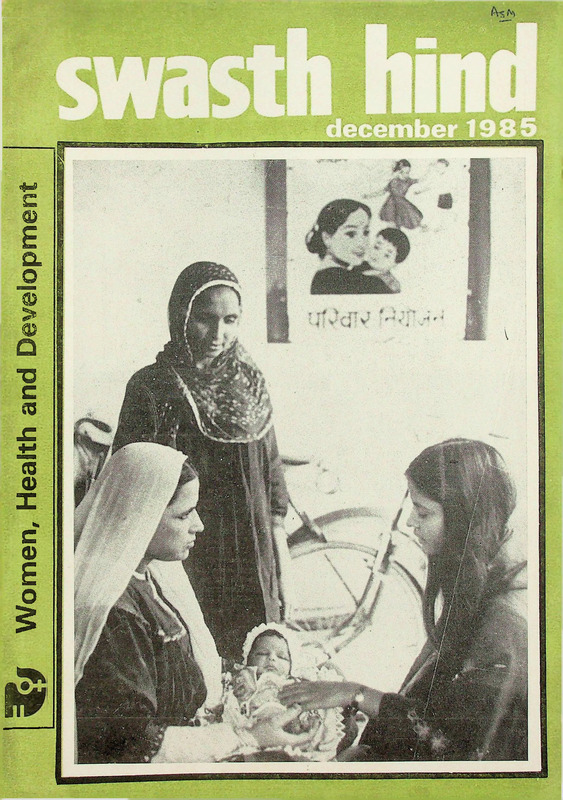
OUR COVER
(Postage Free)
Articles on health topics arc invited for publication in this
Journal.
State Health Directorates are requested to send reports of
their activities for publication.
The contents of the Journal are freely reproducible.
Due
acknowledgement is requested.
The opinions expressed by the contributors are not neces
sarily those of the Government of India.
SWASTH HIND reserves the right to edit the articles sent
for publications.
The UN Decade for Women, launched in 1976, was a
bid to attract worldwide attention to the inferior status unfairly
conferred on one half of humanity, and to spotlight the huge
contribution—all too grudgingly recognised—that women make
towards development. What has the Decade achieved? This
issue of Swasth Hind is dedicated to the women’s welfare.
THE STATE OF THE
*3? WORLD’S WOMEN 1985
A DECADE FOR WOMEN
years
after the
United Nations first
announced its" commitment to equality between
men and women in its Charter of 1945, concern over
the continuing unequal status of women led to the
declaration of 1975 as International Women’s Year.
For the first time in history the eyes of the world were
focused on that half of its population who, by virtue
of an accident of birth, perform two-thirds of the
world’s work, receive one tenth of its income and own
less than one hundredth of its property. It was the
start of an international effort to right the wrongs of
history. That same year the United Nations General
Assembly declared the years between 1976 and 1985
to be the United Nations Decade for Women.
hirty
T
Marking the end of that decade, is the World Con
ference on Women held in Nairobi in July 1985,
where delegates from over 140 countries assessed the
achievements of ten years of international commit
ment to improving the status of women.
Both individual governments and United Nations’
agencies have played their part in a research effort of
unprecedented scope, the fruits of which were pre
sented to the Conference. Over the last year the Uni
ted Nations has been compiling the results of a ques
tionnaire completed by 121 governments reviewing
and appraising the position of women in their coun
tries. At the same time United Nations’ agencies have
themselves been amassing a fund of independent res
earch from all over the world to complete the picture.
The findings reveal: that women do almost all the
world’s domestic work which, together with their
additional work outside the home, means most women
work a double day; that women grow around half
of the world’s food, but own hardly any land, find
December 1985
it difficult to get loans and are overlooked by agri
cultural advisors and projects; that women are one
third of the world’s official labour force, but are con
centrated in the lowest-paid occupations and are more
vulnerable to unemployment than men; that, although
there are some signs that the wage gap is closing
slightly, women still earn less than three quarters of
the wage of men doing similar work; that women pro
vide more health care than all the health services put
together and have been major beneficiaries of a new
global shift in priorities towards prevention of dis
ease and promotion of good health; that the average
number of children women want has dropped from
six to four in just one generation; that women con
tinue to outnumber men among the world’s illiterates
by around three to two, but that a school enrolment
boom ‘is closing the education gap between girls and
boys; that 90 per cent of countries now have organi
zations promoting the advancement of women; but
that women, because of their poorer education, their
lack of confidence, their greater workload, are still
dramatically under-represented in the decision-making
bodies of their countries.
The results point, again and again, to the major
underlying cause of women’s inequality. A woman’s
domestic role as wife and mother—which is vital to
the well-being of the whole of society, which consu
mes around half of her time and her energy—is un
paid and undervalued.
A picture has emerged over the Decade of the
importance and magnitude of the multiple roles
women play in society. This has been reflected in a
growing climate of concern for women among govern
ments and the community at large, and is responsible
for the positive achievements of the Decade: better
health care and more educational and employment
opportunities.
293
The inter-related themes of the Decade—equality,
development and peace—reflect the -complexity of the
changes needed before women can take their rightful
place in the world beside men.
Development means growth and improvement for
women in every field of human life: economic, social,
political, cultural. And it must be part of the world
wide movement to establish a more equitable sharing
of the world’s resources between countries and people.
Equality does not just mean achieving legal equa
lity for women and eliminating discrimination. It
means women having equal rights, responsibilities and
opportunities in every aspect of life. And this can
only happen if women have the means, and the pow
er, on the same basis as men. to allow them to take
an equal role.
Without peace and stability there can be no
development. And peace will not be lasting without
equality, without eliminating inequalities at all levels,
between men and women, between the haves and the
have-nots within countries, and between nations
themselves.
O
WOMEN'S HEALTH
Primary health care
Decade for Women saw the launching of
what the World Health Organisation (WHO) calls
“the most optimistic statement of purpose ever made
by the world community”. In September 1978, 134
nations met at Alma Ata in the USSR and pledged
their support for a world-wide effort to bring “health
for all by the year 2000”. Primary health care was
to be the key to the success of this effort.
he
T
“Women are the vast untapped resources for deve
lopment”, declared WHO in 1980. “The anchor of
our strategies for health development should relate
to all-round improvement in the status of women and
children who form the majority of any population.”
Nutrition
The United Nations’ Children’s Fund (UNICEF)
estimates that 200 million under-fives are malnouri
shed and that 10 million of these are so severely thin
that they risk death. Figures like these demonstrate
the potential of helping women feed their children
better.
The principles were simple enough. If 80 per cent
of all illness in the world is caused by the lack of
clean drinking water and sanitation, then improving
water and sanitation would have to become a priority.
With malnutrition . affecting one in four people and
making them more vulnerable to disease, basic nutri
tion would also have to be part of the package. On
the medical front, a simple vaccination could prevent
some of the commonest infectious diseases. And,
where drugs, were not enough, an . army of primary
health care workers—trained in" the principles of pre
vention as well .as cure—could help motivate people
to change their habits and make their communities
safer places to live.
Water and sanitation
Primary health care played a spotlight on the
causes of disease and it picked out women—standing,
centre-stage—bearing the brunt of responsibility for
their families’ health. Suddenly the eyes of health
planners began to turn towards women: as cooks
and feeders of children: as fetchers of water and fire
wood; as custodians of cleanliness and hygiene; as
teachbrs of healthy habits.
The Decade for Women also saw the launch of
another major worldwide initiative: the International
Drinking Water Supply and Sanitation Decade which
began in November 1980. WHO estimates that (ex
cluding China) 25 per cent of people in cities and 71
per cent of those in the countryside of developing
countries are without safe water to drink and 47 per
cent of town dwellers and 87 per cent of people in
rural areas have no adequate sanitation.
294
Fifty countries have now begun nutrition program
mes and 25. of these have developed them especially
for . women. In the Virgin Islands pregnant women
and malnourished children are provided with mar
garine, wheat-flour and dried milk powder to supple
ment their diets. And the importance of extra food
like this has been demonstrated in Guatemala where
one project giving supplementary food to pregnant
women reduced the incidence of low birth weight
among babies by 75 per cent.
Swasth Hind
THE WORLD OF MOTHERS
Most mothers in the developing world are already doing the best they can for their children within the
resources of time, energy, income and knowledge available to them. Increasing those resources is a
prerequisite of drastically improved health for children — and for mothers themselves. (UNICEF)
MALNUTRITION
a
O
ANAEMIA
AVERAGE WEIGHTS
OF WOMEN IN:
PREGNANCY
14IWEIGKTGAIN
‘ (KILOS)
USA 58 Kg
NORMAL
PREGNANCY
CENTRAL 50K
AMERICA
8
PREGNANCY
IN POVERTY
INDIA 45 Kg
30
5
10 15 20 25
WttK OF PRtGNRNCY
Most girls and women in the developing
world do not get enough to eat. II properly
fed, there is no difference in average growth
between peoples of different continents.
LOW BIRTH-WEIGHTS
In the developing world, half of all wo'Tnen
aged 15 to 49 are suffering from anaejnia.
Among pregnant women, the percentage is
very much higher.
WORK
WOMEN
WOMElP'
Maternal malnutrition can lead to low birth
weights - which are associated with a 30%
greater risk of infant death.
Belinda Magee and Duncan Mil, The Observer, London Photograph: Werner
December 1985
40
Because so many women have too little food
and too much work, they often fail to gam
sufficient weight during pregnancy. The
result is the physical depletion of the mother
and a greater risk of low birth-weight.
MANY CHILDREN
Too many pregnancies too,.close together
undermine the health of both mother and child.
Child deaths are typically twice as'high when the
average interval between births is less than two years.
35
HOURS WORKED
MEN
------------------tkN
Women usually work longer in the fields than
men and produce half of the developing
world's food. With their domestic work on
top, women work twice as many hours as men
- for only one-tenth of.the income.
The consequences of being without these basic
amenities arc ill health for all and great hardship for
women who often have to walk long distances to fetch
water. A person needs around five litres of water a
day for cooking and drinking, and a further 25 to 45
litres to stay clean and healthy. But the most a woman
can carry in comfort is 15 litres. Even if she lives
near a standpipe, that means about 15 journeys a
day with a full bucket to keep a family of five in good
health.
But some women live so far from the nearest water
source that they* only have time to make one journey
a day. In Burkina Faso, far example, some women
leave at dusk to walk to the water hole, sleep there
overnight, and return at dawn to escape the harsh
rays of the sun. Small wonder that an estimated eight
million children die each year of diseases that might
have been prevented by sufficient clean water from a
nearby tap.
Now some 26 countries are making a special effort
to look into women’s particular needs in their attempts
to meet the targets of the Water Decade.
Maternal and child health
at their workplace. And in China deaths from cervical
cancer dropped from 111 to eight per 10,000 following
the introduction of screening.
Birth and death
All over the world women in labour are usually
tended by women. Some rely on traditional methods,
passed down through the generations from mother to
daughter, Others reach into new midwives’ kits given
to them after a short training course. Others are the
product of years of training in the long corridors and
modem delivery rooms of a teaching hospital.
The majority of women deliver safely. But many
die in childbirth: over half a million every year in
Africa and Asia, three out of every thousand mothers
in Ecuador and up to 20 out of every thousand in
Honduras.
Though thousands die many millions survive and
have to live on with, the scars of a difficult pregnancy:
displaced or weak wombs, cycles of debilitating in
fection, exhaustion, incontinence and bleeding. An
estimated 25 million woinen a year are seriously ill
after having their babies.
A major advance for women of the new emphasis
on primary health care in many countries is the in
creasing attention paid to providing better care for
pregnant mothers and their babies. Maternal and child
health—or MCH, as this aspect of primary health care
is called—involves prenatal check-ups, immunization
and advice on child-care, breastfeeding and weaning
foods. Forty-two governments reported that they haveexpanded their MCH activities during- the Decade,
with Senegal actually restructuring its entire Ministry
of Health to incorporate this new commitment.
Much of the danger and suffering surrounding and
following childbirth could be avoided if women were
examined early in their pregnancies to check for
abnormalities, if they were attended at the time of
the birth by trained midwives or doctors, if there were
emergency health care at hand should something go
wrong, and if family planning facilities were available
to all women who want them. But the World Health
Organization estimates that 45 per cent of births are
delivered by untrained traditional birth attendants,
and that two-thirds of women in the developing world
have no access to a trained health worker.
Proponents of MCH in the US have estimated that
S 2.7 million spent on prenatal services would save
between ten and 12 million dollars currently spent
keeping premature, low birth weight babies alive in
intensive care units. And when prenatal consultations
in Portugal rose eightfold—from 19,000 in 1975 to
150,000 in 1982—maternal and infant mortality rates
plumetted by 12.9 and 12 per 1,000 respectively.
The dangers are made worse by the weak state many
women’s bodies are in by the time they feel the first
pains of labour: thin from lack of food, exhausted
from work and the demands of previous pregnancies.
The result: two thirds of women in Asia, half of
African women and a sixth of women in Latin
America are anaemic.
There has also been more attention paid to screening
whole populations of women to pick up diseases in
their early stages. Nine countries have introduced such
screening procedures. The USSR, for example, has
established a twice-yearly medical check-up for women
296
These women are suffering from “nutritional anae
mia”: caused simply by lack of the right kind of
food. In India though rich women eat around 2,500
calories a day and put on an average of 12.5 kilo
grams of weight during their pregnancies, poor women
eat around 1,400 calories a day and gain only 1.5
Swasth Hind
kilograms during those crucial nine months. One Afri
can study found rural women in their last three months
of pregnancy actually lost weight—an average of 1.4
kilograms each. Little wonder, then, that such women
bear tiny, underweight babies. One sixth of all babies—
95 per cent of them in the developing world—weigh
under 2,500 grams .when they are born.
The illnesses of the general population affect women
too. At least one person in three harbours some species
of parasitic worm; one in 20 has bilharzia; and malaria-^-once thought to be on the decline—has made a
massive comeback to grip one person in six in its
fevers. Taken together infectious and parasitic diseases
cause around 40 per cent of deaths in the developing
world.
Sickness in any country is bad enough. But in the
developing world—where many families’ livelihood is
precariously supported only by constant hard, work—
a sudden acute bout of illness or a strength-sapping
chronic disease can be disastrous. People with anae
mia in Indonesia, for example, have been found to
be 20 per cent less productive than healthy adults and
bilharzia’s annual impact on the income of its vic
tims has been estimated to total around § 650 million.
But not all sickness has a medical cause. Accidents
at work kill 100,000 and maim millions annually;
and at least 10,000 die and 500,000 are seriously
poisoned every year by careless use of pesticides.
Some work hazards are likely to affect women more
than men. Byssinosis, for instance, is an incurable lung
disease caused by inhaling cotton fibres and thought to
afflict one quarter of India’s textile workers, who are
predominantly women. Pesticide posionings may
affect women more since their agricultural work, tends
to bring them, into closer contact with the crop. And in
the electronics factories of South-east Asia 25 yearold workers are called “grannies” by their younger
colleagues because they have to wear glasses after
damaging their eyes peering through microscopes for
hour after hour assembling tiny silicon circuits.
Vulnerability of women
There is now more information available on the
health of women than ever before and some interesting
findings are beginning to emerge. Take lung cancer.
WHO estimates that smoking causes around one
million deaths a year and tobacco consumption
increased at a rate of between four and 13 per cent in
the industrialized world and 33 per cent in the deve
loping world between 1970 and 1980. Once a habit in
dulged in largely by men, the recent increase in women
December 1985
Maternal and child health care involves prenatal check-ups;
safe delivery; immunization; advice on child-care and
breastfeeding and education on better nutrition.
smoking is now threatening, says WHO, to “chip
away at increased life expectancy for women”. And
a growing body of research shows that babies in the
womb can also be harmed by the cigarette smoke
inhaled by their mothers.
297
Life expectancy varies considerably from country to
country, but almost everywhere women live longer
than men. In the industrialized world women live—on
average—six years longer. In developing countries
the gap is narrower.
Some developing countries—like Sri Lanka, Mala
ysia and islands in the Indian Ocean—have made
dramatic improvements in life expectancy in recent
years. In other regions—particularly in some African
countries—life expectancy is very low for both men
and women, but women still average longer lifespans
than men. But in parts of Asia—such as India, Pakis
tan. Bangladesh, Bhutan and Nepal—life expectancy
in general is slightly higher than in the poorest Afri
can countries, but women's life expectancy is as low
as, or even lower than, men’s.
The reason may be as simple as discrimination
against girls. A Bangladesh survey found more underfive year-old girls than boys were malnourished
because they were allocated smaller portions of food,
and that inafnt girls were 21 per cent more likely than
boys to die in their first year of life. But Asia does not
have a monopoly on discrimination. A survey in
Botswana found girls more likely than boys to be
malnourished and in Turkey it is reported that rural
men are given the lion’s share of whatever food is
available. Other research shows that, in some countries,
when girls fall ill they are less likely to be taken to
the health centre than boys.
Mental health
Statistics from all over the world indicate that
women are twice as likely as men to suffer the kind of
distress we know as mental illness.
In Bangladesh, for instance, women outnumber men
among the mentally ill by two to one. There are twice
as many women as men diagnosed schizophrenic in
Sweden. In the UK 11 per cent of men and 17 per
cent of women are hospitalized at some time in their
lives for mental illness and twice as many women as
men take tranquillizing drugs.
Whether these figures are a real reflection of human
psychological suffering or a result of a greater
tendency for psychiatrists and doctors—usually men—
to diagnose a distressed women as being mentally ill
is unclear. But, whichever way these statistics are
298
interpreted, they reveal a particularly heavy burden
of mental anguish carried by women.
Women as health workers
It is not only as recipients of health care that
women have benefitted in recent years. As providers,
too, their traditional contribution is at last beginning
to be recognized. In the majority of societies with
no regular access to modem medical facilities, it is
often women who tend to emerge as the village healer
or midwife—the dai in India, the hilot in the Philip
pines. Sierra Leone’s 13,600 traditional midwives,
for example, deliver 70 per cent of births, and 80 per
cent of births in Honduras are delivered by such
women.
In the past these women have found themselves in
opposition to, and excluded from, modem medical
advances. With the advent of primary health care
such women’s skills began, at last, to be appreciated.
Now, instead of being fought or ignored, they are
being trained all over the world in the principles of
primary health care. India had trained a quarter of
a million dais by 1981. Nicaragua has been training
them at a rate of 900 a year. By 1978 Ethiopia had
trained 45 per cent of traditional midwives; in Ghana
and Sri Lanka the totals were 25 and 95 per cent res
pectively by 1976.
Costing less than two per cent of the money it takes
to train a doctor, the logic of training women as health
workers is clear. The benefits are clear too. In
India, for instance, deaths from neonatal tetanus were
reduced from 90 to 10 per 100,000 in the three years
following the launch of the dai training programme
there.
Resistance from doctors
But here women’s involvement stops. In the higher
ranks of the health services—among the doctors, the
health ministry officials, the hospital administrators—
where the high pay and the power reside, women are
grossly underrepresented. Yet this is where the policy
decisions get taken, where the money is distributed
from. And that money tends to stay just where it is.
Three quarters of the world’s health problems could
be solved by primary health care. But three quarters
of developing countries’ health budgets are spent on
doctors and hospitals.
©
— UNICEF
Swasth Hind
WORLD CONFERENCE ON WOMEN
WOMEN AND HEALTH FOR ALL
Dr H. Mahler
he situation of women—who make up half
of the World’s population, perform two-thirds of
the world’s work and receive one tenth of its
income, was the subject of discussion at the
World Conference to Review and Appraise the
Achievements of the UN Decade for Women held
from 15 to 26 July, 1985, at Nairobi.
T
The Conference had a dual purpose : to take
stock of a 10 year effort on the part of the United
Nations and its member states to improve the
status of women; and to advise strategies for
women’s further advancement during the remain
der of this century.
This is the third time the United Nations has
convened an international conference on the status
of women. The Decade for Women (1976-85) was
proclaimed by the General Assembly on the re
commendation of the World Conference of the
International Women’s Year, held in Mexico City
in 1975. The World Conference on the Decade was
held mid-way through the Decade (1980) in
Copenhagen.
Women need to be considered for their own
worth, as equal members of society, rather than
only as mothers, potential mothers or carers, accor
ding to Dr Halfdan Mahler, Director-General of
the World Health Organization (WHO).
Addressing the World Conference to review and
appraise the achievements of the UN Decade for
Women 16 July, 1985 Dr Mahler went on: “They
need to be seen beyond the limits of their contri
bution to family life, and they want to start shar
ing the responsibility for others with the men in
their lives and the men in their societies as a
whole.”
The Director-General said that WHO’s goal of
Health for All by the Year 2000 aims at all peo
ple whatever their present level of social and eco
nomic development, but social justice demands that
greatest attention be paid to the underprivileged,
so that they become able to extricate diemselves
from the poverty equilibrium in which they are
trapped. But they should avoid falling into ano
ther trap—that of excessive medical consumption as
part of a consumer society. “Health for all is thus
December 1985
a moving target,” he went on. “As a certain health
status is reached, people will try to reach a higher
level, and so on.”
He distinguished between two possible scenarios
for the future of health and society. The male one
is the Hyper-Expansionist (“HE”) scenario stand
ing for unconstrained technological development.
The female scenario is the Sane, Humane, Ecolo
gical (“SHE”) one, standing for the caring, nur
turing role in societies. He commented: “Health
for All by the Year 2000 is squarely belonging to
the ‘SHE’ scenario”.
Development in terms of the “HE” scenario had
far from always been beneficial for women, and
especially so in developing countries. “We know
that girls get less food in some developing societies
than boys do—so how can they grow properly?
We know that girls receive no schooling—so how
could they make their own living as women? We
know that images created by men of women shape
women’s lives.”
Dr Mahler went on: “Families headed by
women are on the steady increase, while these
women do not have viable economic options for
self-support and development. The female unem
ployment rate is on the rise everywhere. Experts
speak indeed of the feminization of poverty, and
even in countries where—by legislation, constitu
tion and ideology—women, are proclaimed equal,
one does not see them where the power is.”
He told the delegates: “Perhaps when you go
back to your -countries and you read the great love
poems of your culture written by men about wo
men, or you make health care policy decisions as
men about women—for example about pregnancy
and delivery (an issue which stands at the cross
roads between the technological imperative and
caring in health delivery systems)—perhaps.......
it might lead you to think about a ‘SHE’ scenario
in health—about a more caring society that gives,
not only to men but also to women, both bread
and roses, poetry and power. It is that scenario
which will bring about ‘health as if women truly
mattered,’ and which in turn will bring Health for
All by the Year 2000 from a social dream to a
social reality.”
®
299
N the ancient times, women
in India enjoyed a very high
social status. In our Holy scriptu
res, there is a saying which, trans
lated into English, reads something
like this; “The land in which wo
men are worshipped is the abode of
Gods”.
With passing times the
status of women in the society was
gradually lowered. During mediae
val ages, their status was reduced,
more or less, to that of a slave.
This situation continued for hun
dreds of years although there are
some exceptions where
certain
women ascended
to high power
and glory.
I
THE DEVELOPMENT
OF
INDIAN WOMEN
Smt. Serla Grewal
During the International Women’s Decade, problems of
women in India received focussed attention. Women’s
welfare is now an integral part of the planning process in
the country and for the first time in our country’s plann
ing history, a chapter oh “Women and Development” was
included in the Sixth Five Year Plan document, says the
author m this paper, which was presented at the Regional
Conference on women, Population and Development,
help at Bejing, Peoples Republic of China, from 25-30
April, 1985.
300
In the last 100 years, the pic
ture has changed radically. Some
of our leading
social reformers
like Swami
Vivekananda, Riaja
Ram Mohan Roy and Mahatma
Gandhi fought relentlessly for the
emancipation of women.
Indian
women played a major role in the
freedom struggle against the Bri
tish rule. They fought, sacrificed,
organised and marched shoulder
to shoulder with men. Mahatma
Gandhi, the architect of India’s
freedom,
had a strong belief in
women power.
He was able to
channelise this vibrant energy in
the cause of national liberation.
At his call, thousands of women
left their households and hearths
and took to the streets along with
the menfolk to join in the free
dom movement.
Equal status for women
After attaining Independence,
it was only natural that in the
Constitution of India, which’ was
adopted in 1950, women were given
equal status to men in political,
social, economic and all other
S was th Hind
spheres of life.
The Preamble to Marriage Restraint Act places res being expanded both in rural and
the Constitution promises justice, triction of marriage for females urban areas to provide
for ante
liberty, equality and fraternity to below the age of 18. The Special natal and post-natal care, deliveries
all its citizens. It ensures equality Marriage Act (1984) provides for through better skilled hands and
before law and forbids discrimina compulsory registration of marria immunization and other prophylac
tion against any citizen on the ges and the Dowry Prohibition Act tic services. By the year 1989-90,
ground only of religion, race, caste, (1961) prohibits demanding benefits we hope to considerably reduce
sex, place of birth. It also forbids in cash or kind by the boy or his maternal and infant mortality and
discrimination in respect of employ parents from the parents of the girl provide
universal immunization
ment under the State on grounds of as a condition of marriage.
services. It will not be out of place
sex. The Directive Principles of
to mention that for the first time
the State Policy which enshrine the
in our history females in India now
During
the
International have higher expectancy of life at
spirit of the Constitution enjoin
upon the State to ensure the right Women’s Decade, problems of wo birth than males.
to adequate means of livelihood for men in India received focussed at
men and women; to protect the tention. Efforts were made to re
The reach and expanse of family
health and strength of men, women assess the role of women in society,
planning
service in India has wide
evolve
suitable
strategies
for
wo
and child workers from abuse and
entry into jobs not suited to their men’s equality and development ned considerably. It will be further
strength; to ensure just and humane and to promote policies and pro strengthened during the current
conditions of work arid maternity grammes for their welfare. Mea Five Year Plan, 1985-1990, so that
sures were taken on all fronts, in family planning information, educa
relief for women.
cluding
legal reforms, education, tion and the means of all medically
health and political rights and today approved methods of family plan
Legal measures
we have reached a situation where ning are available to enable couples
with justifiable pride, one can say to make a voluntary and free choice
Besides the Constitutional confer that in India nothing, nothing what of contraception methods to limit
ment of equality of status, various soever, except certain branches of their family size to. desired levels.
legal supportive measures. have the defence services, that is not Family planning, however, is not
been instituted since Independence open to a woman just because she is the concern of women alone. We,
to protect and promote the interests a woman. Women’s welfare is now therefore, promote active involve
of women. The Equal Remunera an integral part of the planning pro ment of men in all areas of family
tion Act (1976) provides for pay cess in the country and for the first responsibility including family pla
ment of equal wages for equal work time in our country’s planning his nning and child rearing.
to ensure 'that women are not discri tory, a chapter on ‘Women and
minated against by paying them Development’ was included in the
lower wages than the men. The Sixth Five Year Plan document.
Formal and Non-Formal Education
Maternity Benefit Act (1961) provi
des 12 weeks’ leave with full pay as
Increased emphasis is being given
maternity leave to women emplo
We fully subscribe to the view on improving female literacy rate
yees. The Factories Act (1948), the
Labour Plantation Act (1951) and that welfare and well-being of the both through formal and non-forthe Mines Act (1952) provide for mothers should be our prime con mal education. During the decade
In this context ability of 1971-81, female literacy rate impro
welfare and protection of women cern.
women
to
control their own fertility ved from 18.7% to 24.8%. Reali
working in these sectors of employ
ment. The Factories Act also pro forms an important basis for the sing the fact that literacy is going
vides for creches to be maintained enjoyment of other rights. We also to be a major instrument for impro
for children below 6 years in every subscribe to the view that the vement in women’s status, various
factory employing more than 30 assurance of socio-economic oppor programmes and schemes have been
women. The Medical Termination tunities on an equality basis with launched to provide education to
of Pregnancy Act enables women to men and the provision of necessary the women. It is a matter of pride
seek termination of pregnancies on services and facilities enable women that for girls in India, education up
medical, social, economic Or psy to take greater responsibilities for to the high school has been made
free. The 1981 Census revealed
chological reasons without the con- their reproductive lives.
that out of 685 million persons, 331
• sent of the husband.
Apart from
million were women. The total
these laws to improve the economic
status of women, a number of laws
Programmes
to promote
the number of women workers in the
have been enacted to ensure social health of the women have been country is 63.52 million which
justice to women. Mention may be intensified; the maternal and child means that for every 100 females
made here about a few of them. health care programme which is an the number of female workers is
The Family Courts Act (1984) pro integral part of our Family Welfare 14. Gainful employment of women
vides for setting up of family courts Programme has received a great has been identified as a major entry
The infrastructure for point in promoting women’s inte
to decide cases relating to matrimo boost.
nial problems, guardianship of delivery of maternal and child gration with the development pro
is cess. Between 1971 and 1981, the
children, adoption, etc. The Child health services has been and
December 1985
301
be coming forward to accept family
planning. The
main point that
needs to be
highlighted in this
connection is that women are com
ing forth to accept family planning
in ever increasing numbers, some
times even not caring for the fact
that their men do not want it.
When women can take initiative
and succeed in this difficult area,
there is no reason why they should
not succeed in other areas.
Programmes are underway to promote women's access to science and
technology for raising the status of women
From what I have said so far, it
might appear as if everything is
all right and there exists a situa
tion of complete satisfaction.
I
do not wish to convey such an im
pression. It is, no doubt, true that
we have travelled far and achieved
a lot, but there is still far more to
do and far ahead to go.
Our
efforts so far have tackled only a
part of the problem. The legal
provisions are there to protect
women’s interests, but there are
also age-old inhibitions and preju
dices in the society which militate
against the enforcement of law.
overall work participation rate for women scientists who want to take
women has registered an increase. up research has been relaxed.
The start of the International
Although Government has pro
women’s Decade in 1975 saw a
National Plan of Action, drawn up vided an extensive legal framework
by the Government which demand to ensure women’s right to equality,
ed strategies to be devised for in but laws alone do not change the
Let us all keep in mind that our
creasing the
participation of •traditional attitudes and prejudices.
most important problem is to
women in various occupations. There has to be a popular upsurge
change the social attitudes that have
to translate into
Government has taken several steps and awareness
prevailed
for centuries. Let us
to increase the employment oppor reality the rights and aspirations of
also not forget that attitudes deve
tunities for women in the organised women.
loped over such long periods do not
and self-employment sectors. They
change easily. It is precisely for
In the field of population .control,
are being given training for employ
this reason that the progress which
women
in India are playing the de
ment in various types of industries
we aimed at promoting has not
and upgradation of productive skills cisive role. During our Sixth Five
been as fast as we would have
of women employed in traditional Year Plan, which ended in March
wished it to be. What we are try
professions, both in organised and this year, about 17 million sterili
ing to strive for is really to tele
unorganised
sectors.
Various zations were done and about 7
scope our
achievements into a
schemes have been framed for en million women took to IUDs. The
matter of decades which would
couraging vocational training for number of women using Oral pills
otherwise require centuries to
women through a network of Indus is multiplying very fast. More than
achieve. But, what we have achie
trial Training Institutes. Program 80 per cent of the sterilisation ac
ved so far gives us the hope that the
mes have been taken up to promote ceptors were women. It is only
future is bright.
<
women’s access to
science and natural that since women feel the
•technology and the age limit for pinch of pregnancy that they should Courtesy: Centre Calling, August, 1985
302
Swasth Hind
WHAT WE DO FOR WOMEN
What India has been able to do for her
women during the International Decade for Women?
A rdhanareeswara” is a unique Indian concept. It
roughly means the God who is half woman. Lege
nds say that Shiva, the’most terrible of (he Hindu Trinity,
the God of destruction and devastation fell so madly
in love with his wife Parvathi that he gave half his
body to her and the body that emerged was half
woman and half man. Both lost their sexual iden
tity in this new asexual god-form.
The immortal
Kalidasa describes the same pair as inseparable as
the word and its meaning is one of his invocational
stanzas. Interestingly, two of the Trinity are mono
gamous while the third thrives in a state of enforced
celibacy.
From this supreme state of equality,
Manu, Draco’s Indian counterpart declared that the
females of the species do not deserve freedom since
they are looked after by their fathers in their child
hood, by their husbands in their youth and by their
sons in their old age. In between Ardhanareeswara
and “na stree swatantryam arhati” (women deserve
no freedom) the pendulam of time took a full swing
and women became relegated to the zenana as history
corrupted society and eroded time honoured values
in spite of all Gargis, Dinni Aarchas, Jhansi Ranis,
Sarojini Naidus, Toru Dutts and Indira Gandhis.
Without much margin of error it may be said that
the status of. women in India was not significantly
different from that of the women of England when
Clive and Hastings laid the foundations of the white*
man’s empire in India and elsewhere.
The British
were here for quite some time.
But, with their
policy of social non-intervention, they did precious
little to improve the lot of any deprived section of the
Indian masses including women and children. Yet
it would be tantamount to falsifying history to forget
that it was the British who initiated legislation to put
an end to some of the cruelties suffered by women
such as Sati and child marriage. And to their credit
it has to be said that they brought modern education
and knowledge to those women who desired it.
December 19B5
After Independence
After independence, changes were rapid.
Cons
titutional guarantee of equality was given to women
by the founding fathers of our Republic.
The farreaching consequences and implications of such a
step could seldom be grasped by the ‘advanced’
societies of the west, some of which are still to allow
their women to vote. With reasonable pride we can
say that- in India today, nothing, nothing whatsoever,
except certain branches of the Defence Services is
denied to a woman, just because she is a woman.
The International Women’s Decade added momen
tum to the progress achieved since independence..
The committee on the Status of Women in India
(CSW1), appointed in 1971
made comprehensive
examination of all questions relating to the rights and
status of women in the country.
It submitted its report “Towards Equality” to the
Government at the beginning of the Decade.
In
fact, gender equality, was never even considered by
the CSWI as the principle was accepted some five
decades earlier, through the fundamental rights re
solution (1931) of the Indian National Congress.
Instead, the Committee concentrated on how legal
reform, education and political rights failed to bene
fit the majority of women afflicted by poverty, power
lessness, overwork, illiteracy and exploitation. Such
afflictions as well could be expected were particularly
among the poor creating more imbalances and dis
parities. The report stressed on the need for special,
temporary measures to transform de jure equality
envisaged in the constitution into a de facto one.
The recommendations of the CSWI, the guidelines
for the World Plan of Action provided at Mexico and
a unanimous resolution passed by the Indian Parlia
ment on the Report of the CSWI provided the instru
303
mentalities to operationalise women’s equality. Women
began to emerge as critical group for development
from being targets of welfare policies—a shift in ap
proach, clear in our Sixth Plan.
Morever, it recog
nised women as a group adversely affected in the pro
cess of economic transformation.
As a result, eco
nomic indepedence, educational advance and access
to health care and family planning were accepted as
the strategies to be adopted in the Sixth Plan for the
advancement of women.
This shift in approach
from welfare to development and concern for social
services sectors represents in India a major achieve
ment of the decade.
The first Working Group on
Employment of Women (1977-78) and the first cell
for women in the Ministry of Labour and Employ
ment (1975) are major landmarks.
The odrinance
of 1975 which later was enshrined in the Statute Book
as the Equal Remuneration Act, 1976 is another
landmark.
Information Explosion
The CSW1 based its observations on about six per
cent of women employed in the organised sector,
while the overwhelming majority had to be left out as
invisible.
Indian Council of Social Science Research
(ICSSR) which helped the CSWI in its investigations
persisted in the studies and the result was a flood of
information about the occupational and employment
patterns of women in the unorganised field, in the
primary, secondary and tertiary sectors.
Informa
tion collected by the National Sample Survey was
used extensively in the Sixth Plan.
In the 1981
census, a new Group, “Marginal Workers” was in
cluded which proved, as the CSWI feared, that a
majority of poor women was under employed, un
employed or irregularly and marginally employed.
All this helped to build up a stronger data base about
Indian women.
Social Debate
No less important was the revival of the Social
Debate on the status .of women, which was virtually
forgotten some 15 years before the constitution of the
Commission.
It helped in generating favourable
public opinion.
Today the press and other media
in addition to academic and legal
communities
support women in giving voice to their grievances.
Women’s Organisations are playing an increasingly
important role in protesting against and highlighting
various crimes and atrocities perpetrated against
women.
And they have succeeded in generating a
dialogue about the problems faced by women, among
various concerned agencies.
304.
Women were recognised as a group adversely
affected in the process of economic transformation.
Therefore, economic independence, educational
advance and access to health care and family
planning were accepted as the strategies to be
adopted in the Sixth Five Year Plan for advance
ment of women.
The National Committee on Women was consti
tuted in September 1976 with the Prime Minister as
Chairperson to ensure a fair deal for women as an
alternative to .the National Commission recommended
by CSWI and the UN World Plan of action.
As a
nodal point to coordinate policies and programmes,
to initiate measures for Women’s development the
National Committee a women’s welfare and develop
ment Bureau . was established. in the Ministry of
Social Welfare.
Special Cells were set up in the
Ministries of Labour and Employment and Rural
Development to strengthen women’s economic parti
cipation.
The Planning Commission appointed a
Working Group on Employment of women in 1977-78
and it encouraged the Ministries of Agriculture and
Rural Development to review their programmes and
policies to enlarge the participation of rural women
in economic activities.
They prepared two studies:
one on the Development of Village level Organisa
tions of Rural Women and another on the Role and
participation of women in Agriculture and Rural
Development.
The Ministry of Education appoint
ed Special Committee to advise on Adult Education
for Women.
Appointment of these committees and
groups preceded the consideration of a memorandum
to the government by the Women’s Studies Advisory
Committee of the Indian Council of Social Science
Research (ICSSR)
which recommended
steps to
arrest the trend of women becoming “dispensable—
economically and demographically”.
In 1978-79, as preparatory action for the Mid
decade review a series of Slate level conferences were
organised, culminating in the National Conference
on Women and Social Development sponsored by the
Ministry of Social Welfare in Delhi in 1979. It made
specific
recommendations for better employment,
health, education
and political
participation of
women. It was followed by the- First National Con
ference on women’s .studies in 1981 which resulted
in the formation of the Indian
Association for
Swasth Hind
Women’s Studies to promote incorporation of women’s
issues into teaching and research. A Second National
Conference on Women’s Studies was organised by the
Association recently.
Today, an attitudinal change where the emphasis
has shifted from doing for women to doing things
with them, i.e., a move from charity to participa
tion is much in evidence now.
Women in the Eighties
In 1980 a Women’s Activists Group submitted a
memorandum “India Women in the Eighties”.
It
expressed the fear that the draft Sixth Plan did not
contain specific measures for women’s development.
A dialogue ensured and chapter XXVII on women
and development was added to the plan document.
The Department of Science and Technology develop
ed a programme to promote women’s access to Science
and Technology.
On the recommendation of a
Working Group of the Council for Scientific and
Industrial Relations, the University Grants Commis
sion, relaxed the age limit for women scientists who
wanted to take up research.
During the decade, the emphasis of voluntary
women’s
organisations
has shifted from health,
welfare and education to more employment genera
tion for the rural women and poor women in urban
areas.
Such organisations have been getting liberal
assistance from Central Social Welfare Board, Depart
ment of Science and Technology and various other
Government
Agencies.
Women’s organisations
grew in number substantially during these ten years.
They showed an increasing degree of concern and
protest on violence against women.
These organi
sations have joined hands to demand improvement
in the laws for the protection of women.
The new
and militant women’s organisations began to see
development not as an end in itself but as an instru
ment to improve the overall status of women in the
family, in the neighbourhood and in the political
system.
Banks and other credit institutions have
now come forward to provide cheap loans, to organise
training, to improve productivity, to give technologi
cal support and to improve .marketing facilities to
members of such organisations.
An attitudinal
change where the emphasis has shifted from doing
things for women to doing things with them, that is
a move from charity to participation is much in evi
dence now.
Intermediaries
The concept of participation has prompted the
emergence of a new group of activists termed as “in
December 1985
termediaries.”
The
intermediaries
utilise their
assets—education, information and capacity—to ex
tract developmental support from various sources for ’
the benefit of their client groups at grass root level.
But their relationship never deteriorate into a patron
client relationship.
To promote such intermediaries,
the Ministry of Social Welfare started Women Deve
lopment Centres in selected women’s colleges in Delhi
Research, review and the setting up of the needed ad
ministrative infrastructure marked the first half of the
decade and this made the issues of women visible' to
the planners and administrators with discernable
urgency.
As the decade advanced, new issues crop
ped up, putting fermidable obstacles in the path of
the development of women.
Incre^ing
crimes
against women, resistance of localised power groups
to emanicipation of women and the limitations of a
complex bureaucracy led to the realisation that
women’s development cannot be achieved merely by
benefits flowing from the Government.
Grass root
level organisations,- particularly in rural areas, as
formus for women’s participation in the develop
mental process have now'been acknowledged.
With
•this in view, a minimum quota has been reserved for
women in beneficiary oriented programmes such as
Training of Rural Youth for Self Employment
(TRYSEM).
We have now realised the roles that government,
women’s organisations
and other institutions can
play in the betterment of women. We are now more
aware of the processes that marginalise women and
brand them as passive, backward and apathetic to
change.
The success of the effort to make women
a really emancipated lot is ultimately in the removal
of situational constraints
women are subject to
•through supportive measures and in empowering women
‘to assert themselves in the development process.
O
—PIB
305 *
SOME FACTS ABOUT WOMEN
HELPING WOMEN
O
According ta 1981 census there were
35.4 crore males and 33.1 crore females
in the country.
O
The sex ratio (number of females com
pared to 1000 males) which was 930 in
1971 rose to 933 in 1981, that it was
972 in 1901, 946 in 1951 and 941 in
1961.
O
During 1971.-81, the overall growth rate
of population was 25 per cent of which
males constituted 24.6 per cent and
females, 25.4 per cent.
O
Percentage of literates rose from 29.5
in 1971 to 36.2 in 1981. Female liter
acy percentage rose from 18.7 to 24.8,
while male literacy rose from 39.5 to
46.9 per cent between 1971-81.
O
32.2 per cent of girls between 5 and 9
and 37.5 per cent between 10 and 14
were attending schools.
O
Female age at marriage rose to 18.6
in 1981 from 17.8 in 1971 and that this
is higher than the age of 18 prescribed
by law.
O
By 1982-83 over 340 lakh couples were
protected against the risk of pregnancy
by family planning methods and this
constituted 28.4 per cent of the eligi
ble couples.
O
According to the highest of the three
estimates projected by the Registrar
General of India, based upon Sample
Registration System, life expectation
at birth was 52.5 years for males and
52.9 for females.
TO HELP THEMSELVES
Smt. Maragatham Chandrasekhar
The development of women is an inte
grated and unified concept, stretching
across economic, social and cultural
fields.
Thirty three years of planned
development in India have done a lot to
lift Indian woman from her former sub
ordinate and dependent status. The
basic approach in the Seventh Plan is to
inculcate confidence among women and
bring about awareness of their own
potentia||for development.
N free India, Truth, Justice, Equality and Fraternity
are the four pillars on which the Constitution
and our polity rest. In the thirty eight years which
have passed since Independence, these glorious ideals
•have stood by us, even when the country has faced
many vicissitudes, whether it be external aggression
or internal unrest. ■ We have successfully passed
Ithrough a trouble-some and crucial testing period.
Throughout the country, there is a sense of vibrant
confidence and unity.
.
I
■ Women have been given pride of place in the Indian
Constitution. To make up for long centuries of neglect
and to counteract the ingrained prejudices following
from age-old laws like those of Manu and other
partriarchal law givers, the Constitution
promises
Justice, liberty, equality and fraternity to all its citi
zens.
Article 14 ensures- equality before the law
to all its citizens. Article 15(3) empowers the State
to make any special or general provision for women
and children, even in violation of the fundamental
obligation not to discriminate among citizens, interalia of sex. Article 16(2) forbids discrimination
in employment under the State on grounds of sex.
• 306
The Directive Principles of State Policy enjoins upon
the State to ensure right to an adequate means of
livelihood for men and women equally.
It is in the Directive Principles of State Policy that
the- ideals of the Constitution-makers with regard to
women’s development and protection, can be clearly
seen. They urge the State to ensure equal pay for
both men and women; to protect the health and
strength of women and child workers from abuse and
entry into jobs not suited to their strength; to ensure
just and humane conditions of work and maternity
relief for women.
Many of the ideals enshrined in the Directive
Principles have been translated into reality by the
Government.
The Equal Remuneration Act has
assured equal pay to men and women for work of
equal value. Supportive services such as creches and
maternity benefits have been made available to women
working in the organised sector.
The development of women is an integrated and
unified concept, stretching across economic social and
cultural fields. However, since poverty is the single
biggest cause of backwardness, the economic and
Swasth Hind
socio-economic sectors such, as health, education and
employment are generally deemed to be very crucial
for women’s overall development. Thirty, three years
bf planned development in India have 'done a lot to
lift Indian woman from her former subordinate and
dependent status. The percentage of literate females
to total female population in 1901 was 0.69. In 1981
it was nearly 25 inspite of a massive growth in popula
tion.
School education at primary, middle and higher
levels has been stepped up considerably in order to
cope with the never ending stream of boys and girls
who knock at the school portals for admission every
year. In a single decade, that is, from I960 to 1972
the educational budget of the country had increased
more than three-fold.
The Government has now
launched upon an ambitious programme to eradicate
illiteracy among women completely by 2000 A.D.
The problem of removing illiteracy among women
is inextricably linked with questions of health and
fertility. Women suffer from malnutrition, poor access
to health care, and poor maternity services.
—1>
December 1985
— PIB
307
—These factors are again linked to lach of economic
opportunities. Thus the three main areas of concern to
women-health, employment and education—are con
nected by casual links. Any intervention by the
Government in any of these sectors will not give
complete results unless, simultaneously action is not
taken in the other two.
In the Seventh Five Year Plan, a special thrust is
being given on woman’s development. Women have
been recognised as integral and central to the develop
ment process. Hitherto they were subordinated to
a marginal position, even in the formulation and
implementation of schemes. The special disabilities
which women suffer from will be taken care of by
supportive services and other special programmes,
so that they can take their due place, as equal part
ners in all development programmes.
Special attention will be focussed on socio-economic
programmes, so that the women’s earning capacity
can be enhanced. The basic approach in the Seventh
Plan would be to. inculcate confidence among them
and bring about awareness of their own potential
for development.
A multi-disciplinary or multi
sectoral approach would be adopted covering employ
ment education, health, nutrition, science and techno
logy and related fields. Strees would be laid on
creating facilities for women generating activities to
enable them to participate actively in development.
Elimination of gender bias from the social curri
cula will be taken up, along with a general restruc
turing of educational programmes.
The application
of science and technology in the daily lives of women
will be attempted in order to save women from
drudgery and from monotonous repetitive tasks.
A
better use of the spare time of the poor rural women
will therefore, be possible.
In all the beneficiary
oriented schemes, due share of women will be separa
tely earmarked.
The International Decade for Women which start
ed with the historic Mexico Conference in 1975 has
now come to an end with the recently concluded
world Conference at Nairobi where women leaders
from over a hundred and fifty countries met to discuss
the progress achieved in the last decade as well as
to plan strategies upto the year 2000 A.D. A his
toric document on Forward Looking Strategies was
adopted in Nairobi.
This contains the blue print
for action to be followed by all nations in the field
of Women’s Development.
O
ROLE OF VOLUNTARY AGENCIES FOR WOMEN'S
DEVELOPMENT STRESSED
Shri
Chandulal Chandrakar has called upon the
voluntary agencies to come forward to help women
folk in organising and in finding suitable income
generating activities.
he Minister of State for Rural Development,
T
Inaugurating the two-day seminar on the ‘Develop
ment of women and Children in Rural Areas’ (DWCRA) in New Delhi on 18 June, 1985, Shri Chandra
kar said that majority of women in rural areas live in
poverty, without many opportunities for improving
their living conditions. Constitutional rights and
guarantees will have no meaning for them, if they
cannot even feed and clothe their children properly
or send them to school. He mentioned that very re
cently the Government had taken a decision to pro
vide benefits under the Integrated Rural Development
Programme to at least 20 per cent women.
About the scheme of DWCRA the Minister said it
is being implemented in 50 selected districts on a pilot
308
basis. DWCRA, the Minister said, being a production
oriented scheme its success depends to a great extent
on hte marketability of the produce. In this, we
are trying to involve khadi and village industries
board and other cooperatives so as to increase the
return of the produce.
The Minister stressed upon the need to inculcate
leadership among women. He said under IRDP and
TRYSEM we are training some of the boys and girls
to come forward and work closely within their disr
tricts. In this regard he referred to the organisation
of groups through which the DWCRA is designed to
operate.
Shri Chandrakar hoped that we should be able to
find new vocations for the ladies which are most suit
able for them and bring the women folk forward to
take up the task with a greater sense of involvement. O
— PIB
Swasth Hind
WOMEN
HEALTH AND DEVELOPMENT
The United Nations Decade for Women is really
only a beginning, a time to look ahead, to make
sure that what progress has been achieved is main
tained and that the impetus given by die Decade is
not lost.
Nearly half of all births take place without the help
of a trained attendant, and each year over half a
million women die in childbirth. The main causes
of maternal deaths are haemorrhage, often with anae
mia as an underlying cause, and sepsis. Most of these
deaths are avoidable if skilled help is available.
and roles of women have captured the
attention of the world for the past 10 years, in
large part due to the stimulation provided by the Unit
ed Nations Decade for Women (1976-1985'). However,
in a report by the Director-General to the Thirty
eighth World Health Assembly, it was noted that gene
ral progress has been patchy, with Only limited gains at
best.
The. urgent need for concrete strategies and
plans is stressed in the report, which also states that
awareness of the need for further action is the result
of a growing realization that women’s health and in
volvement in health care are keys to achieving health
for all;
Lack of care also leaves its mark on survivors.
Countless, women suffer from permanent debilitating
conditions such a sincontinence, uterine prolapse,
genital tract infections and vaginal fistulae which lead
to a low quality of life and often to the complete
social isolation of the victims.
he needs
T
The status of women is a significant reflexion of the
social justice in a society and can be measured in
terms of level of income, employment, education,
health and fertility, as well as by the roles women play
in the family, the community and society. If the
status of women is low, if they are ignorant, malnouri
shed, overworked, and bearing too many children
from an early age, the health of -their families as well
as their own health suffers.
In developing countries, where large numbers of
people are suffering from the consequences of under
development, women—and that means their children
too—are the hardest hit by poverty, famine, squalid
living conditions, disease and lack of health care.
Special health needs of women
As the ones who bear and nurture children, women
have different and additional health needs to those
of men. Maternal mortality accounts for a large pro
portion of deaths among women of reproductive age
in developing countries. In countries where the pro
blem is most acute, rates are as much as 200 times
higher than the lowest rates in industrialized countries.
December 1985
Uncontrolled fertility aggravates the problems. Too
many or too closely spaced pregnancies are dangerous
for mother and child and affect the health of other
family members, especially very young children. .Age
at childbearing is also important: births to women
who themselves are not yet physically and emotion
ally mature can permanently injure their health. The
chances of dying, for both mother and baby, are many
times higher in this age group than for. women in their
twenties. However, in many countries most girls still
marry very young and over half first births are to
women under 19. In other countries, dramatic incre
ases in adolescent pregnancies have been seen in re
cent years.
•
The ability to plan their reproduction frees women
to control other parts of their lives. Yet, currently
fewer than half the women who do not want any
more children are practising family planning. Lack
of availability of family planning services is one
reason for this; however there are other obstacles, in
cluding social attitudes. In many countries, the value
of a woman is based on the number of children she
has. She is often dependent on her children in later
life for economic and moral support. The situation is
made worse by a preference for sons in many socie
ties, which in its extreme form can lead to the aban
donment of female children, and much more com
monly results in increased fertility.
Despite social pressures to have more children in
many countries, women are risking their ilves to end
unwanted pregnancies by obtaining illegal abortions.
309
In some Latin American countries, illegal abortions
account for 50% of maternal deaths and permanently
injure the health of many more.
Cancer is another major health problem for women.
Cancer of the cervix is the main form of cancer in
the developing world, with half a million new cases
occurring annually. In Latin America every year ap
proximately one in every 1000 women between the
age of 30 and 55 develops cervical cancer. However,
with simple screening, cervical cancer can be detected
and treated at an. early stage when the cure rate—with
minimal treatment—is nearly 100%
Women as health resource
In most countries the professional health labour
force is predominantly female, although women tend
to fill the lower paid, less prestigious jobs. Thus, al
though traditionally the majority
of doctors have
been men, as many as 75% of health workers are
women.
In addition to their contribution in the formal
health system, women carry extra responsibilities for
health through their contribution to the healh of
their families and communities. Women are expected
to be health educators by teaching sound health prac
tices to future generations, to create a home environ
ment that is conducive to health including the. pro
vision of clean water and nutritious food, to make
sure their children are immunized and cared for when
they are sick, to limit family size despite social pres
sures to the contrary and to care for the elderly as
well. Women are expected to fulfil these multiple
roles while being the least educated and informed.
preparation—tasks carried out almost exclusively by
women. Similarly, women spend a great deal of time
and energy fetching fuel and water (often involving
a walk of 10 km three days out of four) in addition to
the many hours that they devote to housework. The
result, according to the International Labour Organi
sation, is a working week of 70-80 hours for many
Third World women.
The continuing breakdown of traditional societies
also often aggravates the situation of women. As a
result of urban-based development, migration of hus
bands, wars, and desertion, the proportion of women
left to cope alone, with very few resources of skills,
is increasing rapidly in many rural areas and among
the urban poor in botii developed and developing
countries. This is reflected in the statistics on female
headed households, which in some countries seem to
form the large majority of the poorest families. For
example, an analysis in a large developing country
showed that 40% of all female-headed households
were in the lowest income group; the corresponding
figure for male-headed households was 21%. In addi
tion, male heads of households often earned less than
50% of the household’s 'total income and depended
on women and children to contribute the rest by work
ing in the informal sector without the social or other
benefits resulting from formal employment.
Policy implementation
Many countries have enacted legislation and policies
that are aimed towards the advancement of women by
guaranteeing equal rights, social security and maternal
benefits. Often women are not informed of their fights
and have no means of asserting them.
There is striking evidence that the woman’s level
of education is one of the most significant factors in
the health of her children. And yet in the develop
ing world, two-thirds of the women are illiterate. In
Africa, only 15% of women* can read and only one
quarter of girls attend school beyond age 11.
The gap between legislation and its implementation
is large. Few resources have been made available for
this purpose, and rarely are effective ir/echanisms in
place. Social attitudes continue to be a major ob
stacle to progress. The underlying assumption in
many countries continues to be that the difficulties
encountered through the combination of motherhood
and work are to be borne solely by the individual
woman.
Women’s contribution to the economy is grossly
underestimated and is not reflected in labour force
statistics. Globally, women are responsible for at least
50% of food production; in some countries and re
gions the figure is much higher. In addition to the
time spent on crop cultivation and harvesting, twice
as much time can be taken by food-processing and
WHO’s Executive Board recommended in January
of this year a resolution calling on Member States to
intensify their concern about women both as recipi
ents and providers of health care, and to promote
women’s health and their wider participation, parti
cularly as decision-makers, in health and socio-eco
nomic development.
O
Women in health development
310
Swasth Hind
United Nations Decade for Women was de
dicated to the promotion of the rights of women.
Yet the fundamental rights to reproductive health and
reproductive choice remain far removed from a large
proportion of women in the Third World.
he
In Africa and Asia up to a quarter of all
deaths to women of childbearing age
occur in childbirth —largely unremarked
by governments or the medical profes
sion.
This crisis of maternal
mortality
has received little attention during the
UN Women’s Decade which reaches its
climax at a world conference in Nairobi
held in July, 1985. Here, a leading expert
in family health at Columbia University
explains why
greater efforts to help
women avoid unwanted pregnancy could
save hundreds of thousands of lives.
MOTHERS IN PERIL
—A Decade of Silence
Deborah Maine
T
In all the talk about women’s needs, little attention
has been paid to maternal mortality during the de
cade. For most countries only scraps of information
exist on this subject. But even from these, we know
that far too many women are dying as a result of
childbirth. They have died unnoticed by their gov
ernments and often by the medical profession loo.
Studies in Africa and Asia found that one quarter
of all, deaths among women of childbearing age were
due to maternal mortality. In the United States, in
contrast, less than one per cent of deaths among
women aged 15-49 are maternal deaths.
Just as tragic as the sheer number of maternal
deaths is the fact that many women are dying as a
result of pregnancies they did not want.
The World Health Organization gives the regional
ranges for maternal
mortality as follows: Latin
America, 16 to 468 deaths per 100,000 live births;
Asia, 7 to 1,000; Africa, 160 to 1,100; and North
Am'erica, 7 to 15. Thus in poor countries, maternal
mortality rates (MMRs) are probably 10 to 100 times
as high as in industrialized countries.
Such ranges are too wide to be meaningful. We
can, however, narrow them down by looking at avail
able information critically. Very low reported rates
of maternal mortality in developing countries
are
usually government estimates, and these are notorious
for being too low.
For instance, a survey of deaths in the Egyptian
governorate of Menoufia produced a maternal mor
tality rate of 190 in 1980-1982. The Egyptian Gov
ernment’s own most recent
national estimate (for
1978) was 82 deaths per 100,000 births—less than onehalf that found by the survey.
Some of the highest rates cited (of 1,000 or more)
are probably not reliable either. Such extremely high
rates usually come from studies of births and deaths
in large hospitals. The problem with these studies is
that in poor countries most women deliver at home
unless 'they develop complications. Consequently,
problem deliveries are over-represented in hospital
data, and the mortality rates are too high.
December 1985
311
Community surveys should give a more accurate
picture. These are uncommon but a Few have been
done. For example, community studies in urban
Ethiopia and rural Ghana yielded maternal morta
lity rates of 350 and 400, respectively. Rates of 500
to 700 are reported for Senegal.
A maternal mortality rate of 500 means that, on
average, every birth carries a 1 in 200 chance of
death. But that is only the one-time risk. If a woman
has 10 children (as many African women do) then
she runs this risk 10 times. Her lifetime risk, there
fore, is at least one chance in 20 of dying as a result
of pregnancy or delivery. To take a more moderate
example, in an area when the MMR is 350, for a
woman who has six children (the average .in Africa),
her chance of maternal death is 1 in 50.
Maternal mortality is higher (and under-reporting of
deaths greater) in Sub-Saharan African than in other
parts of the Third World. Nevertheless, the general
point holds for other regions: maternal mortality is
still all too common in developing countries.
Exhortations to improve maternal and child health
are common at national and international meetings,
but specific measures to reduce the tragic toll of ma
ternal deaths are rarely discussed.
One reason for this might be that maternal mortality
(unlike infant mortality) may not be greatly reduced
by community-level and preventive measures. Without
access to surgical services there may be no way to
save the lives of many of the women who haemorr
hage or develop obstructed labour (two of the most
common complications).
In the Third World, most women still deliver their
babies at home, and go to the hospital only (if ever)
when they have serious complications. According to
WHO, in Latin America more than one-third of
women give birth without the help .of any trained
health worker. In Asia this is true of half of all
births, and in Africa the proportion rises to almost
three-quarters. Furthermore, in a great many com
munities, there is no place to go for medical care when
serious complications do arise.
Providing proper obstetrical care for all women is
an important goal to work for. Unfortunately, judg
ing from the last decade, reaching that goal will be
neither easy nor quick. Tn the mean time, what can
we do to prevent maternal deaths in the Third
World? One comparatively straightforward way if to
help women avoid unwanted pregnancies.
A substantial proportion of married women in deve
loping countries have already had all the children
they want. The World Fertility Survey which looked
at the situation in 42 countries found that the propor
tion of women who say they want no more children
varies from 12 per cent in Ghana to 61 per cent in
Colombia and Sri Lanka. The average is 40 per cent.
Even in Sub-Saharan Africa where. women want
large families the proportion is sizeable among older
women and those with a number of living children.
312
For whatever practical or cultural reasons, many
of these women are not currently using an efficient
method of contraception, such as the Pill or an IUD.
The proportions of women who are exposed to the
risk of pregnancy, and want no more children, but are
not using an efficient method of contraception ranges
from 46 per cent in Egypt to 85 per cent in Lesotho.
The average is 74 per cent.
In short, there is considerable unmet need for con
traception in developing countries. Four in 10 cur
rently married women say they want no more child
ren. but -the great majority of them are not protected
against unwanted pregnancy.
The reasons why so many of these women are not
using contraceptives are varied. There may be no
services available, or services may be too costly or
far away. More subtle barriers also play a part, such
as familial pressure to have more children, insensitive
behaviour on the part of clinic staff, or fears about the
effects of contraception.
Whatever the barriers, wc need to identify and
remove diem. Until this is done, women do not
really have the freedom to decide the number and
timing of their pregnancies that has been promised
to them.
If most unwanted pregnancies were avoided, we
could expect the effect on maternal mortality to be
considerable, especially since the proportion of
women who want no more children rises steeply with
age and with the number of living children.
This is important because older women and women
who have already had many children are also more
likely to die as a result of childbirth than are women
in their twenties and those who have only had two
to four children.
Estimates of the proportions of maternal deaths
that would be averted if women who say they want
to more children (and are not protected by contracep
tion) had no more children, range from 14 per cent
of maternal deaths in Khana to 42 per cent in
Pakistan. The median is 24 per cent. Thus, if only
unwanted pregancies were averted, about a quarter of
all maternal deaths might be prevented.
These calculations do not take into account the
fact that many women, faced with an unwanted pre
gnancy. resort to induced abortion. To most women
in the Third World, because of financial or legal pro
blems. this means an illegal abortion performed by
an unqualified person.
Information on deaths from such procedures is
scarce. One estimate is that as many as 168,000
women may die of. illegal abortions in developing
countries every year. Thus, by averting unwanted
pregnancies—and, consequently, illegal abortions—
family planning could certainly prevent hundreds of
thousands of needless deaths each year.
People News/Feahires
Swasfh Hind
Development of Women and Children in Rural Areas
The objective of the scheme is to focus attention on the women members belonging to
the target group. This would enable them to increase their income besides providing support
ing services to take up income generating activities. The scheme assists individual women to
take advantage of services already available under IRDP and also helps in organising women
in homogenous groups to take up work on group basis. It also provides supportive services
to women of the target group in the form of working conveniences and suitable appliances to
improve their efficiency.
The scheme organises child care facilities while the mothers are at work. A provision
of Rs. 5000 is made for each block for creating temporary child care facilities at the NREP
work sites for the duration of the work. This may include a temporary structure, water cans
for drinking water, cradles, food and medical care for the children. Gram Scvikas may impart
some education to rural women on child care and nutrition as well. In order to implement
the scheme the areas are selected on the basis of backwardness, incidence of child mortality
and level of literacy.
—Kurukshetra, April, 1985.
BY THE YEAR 2000 THERE WILL BE MORE WOMEN THAN MEN
B
Higher education generally leads to higher rates of
contraception use. and, the report states, the “guar
antee of reproductive freedom is basic to women’s
participation in productive activities
and to their
economic freedom”.
The Fund’s “Slate of World
Population Report
1985” says that is because women constitute the majo
rity of the poor and 60 per cent of the illiterates.
Women in developed countries are able to control
their own fertility and work for more participation in
the decision-making process, but an improvement in
the status of third world women, the report says, is
held back by the denial of reproductive freedom.
While the number of illiterate women is expected
to decline by five million in the richer countries by
the end of the century, it is likely to increase world
wide from 491 million to 552 million, mainly in Asia
and Africa.
The Executive Director of UNFPA,
Mr. Rafcl Salas, blamed the demands of childbirth
and child-bearing for the denial of education and
■training to hundreds of millions of women and for
their exclusion from political and economic decision
making.
Linking the use of contraception to female educa
tional and socio-economic status, the report says that
such use varies widely—from almost none in much
of Africa, for example, to 71 per cent in Singapore.
One third or more of women in Latin America and
60 per cent of those in China practised birth control
but “there is a long way to go”, the report said. O
y the year 2000, there will be more than three
Bill
ion women, out-numboring men by H5 million,
but, according to the UN Fund for Population Acti
vities JJMiSDFPA), women are unlikely to experience
any increase in political power.
December 1985
— U.N. Weekly News letter 6 July, 1985
313
international drinking water supply
AND SANITATION DECADE INDIA :
1981-1990
WOMEN’S ROLE IN THE WATER DECADE
Averthanus L. D’ Souza
The reality is that cultural norms, and consequen
tly. social mores effectively preclude the important
contribution that women can make to the overall
development process.
Agency Task Force on Women and Water. A paper
entitled “Strategies for enhancing Women’s partici
pation in Water Supply and Sanitation activities” was
developed. The paper emphasized the integration of
women’s participation as part of the general efforts
in water supply and sanitation activities. It urged
that no new * parallel structures for women’s activi
ties be created and that women’s participation should
not be viewed in isolation from government or inter
national agency activities. It suggests areas for action
as part of the IDWSSD activities. The strategy en
visages involving women at the policy making, mana
gement and technical levels for the programming,
monitoring and evaluation of existing or future
Decade activities.
Mahatma Gandhi had asserted that the future India
could not be built without the willing and conscious
participation of one half of its population—women.
In spite of this, their contribution has been limited
to the fields of health, education and social services.
Women are more than target groups: they are
active agents who can contribute to the Decade efforts
by decision making, generating ideas in policy, mobi
lizing labour, providing resources and disseminating
and implementing innovations.
It is only in the Sixth Five Year Plan period (198085) that there is official recognition of the vital role
of women in economic development in areas such as
agriculture, rural development, land rights, forestry,
and access to training for independent economic acti
vities.
The emphasis on women’s participation does
not imply that activities should be carried out exclu
sively by women.
It stresses, rather, the need for
both men and women to work together as partners.
Experiences have shown that women as primary users
and managers of water resources, and as the princi
pal influence on family sanitary habits, can contribute
a great deal to the better planning, functioning and
utilization of the improved facilities when provided
with appropriate training and support.
Come of the projects which arc ostensibly meant to
^promote ’’women’s development” reveal a tendency to
consider women as an inferior species in need of
development.
Many women themselves, unfortuna
tely, fall victim to this erroneous assumption that
women, more than men, are in need of special pro
grammes of “women’s development”. Such progra
mmes are, in fact, a perpetuation of the system in
which women have been viewed as mere targets of
welfare policies.
Women and the Water Decade
Recognizing the impact which women can have on
the success of water and sanitation programmes, the
United Nations Conference on Human Settlements
(HABITAT) and the United Nations Water Con
ference adopted special resolutions recommending
women’s incorporation in these programmes. In addi
tion, the 1980 World Conference on the UN Decade
for Women adopted a resolution which specially.
mandated “Member States and UN agencies, includ
ing specialized agencies, to promote full participation
of women in planning, implementation and applica
tion of technology for water supply projects.” At its
tenth meeting held in April 1982, the Steering Com
mittee for Cooperative Actions to support the
IDWSSD (International Drinking Water Supply and
Sanitation Decade) decided to establish an Inter-
314
Situation of women in India
Already in 1971, the Government of India had
constituted a “Committee on the Status of Women in
India” (CSWI) to undertake a “comprehensive exa
mination of all the questions relating to the rights
•and status of women” in the context of “changing
social and economic conditions in the country and new
problems relating to the advancement of women.”
A National Committee on Women was constituted
in September 1976 under the Chairmanship. of the
Prime Minister. During 1977-78, when exercises
began for the Sixth Five-Year Plan, the Planning
S was th Hind
Since women are the traditional water carriers, they spend a considerable amount of
their time—often upto six hours a day—hauling water over long distances.
By virtue
of their domestic functions women are particularly vulnerable to water-related
diseases, which account for 80 percent of all illness, says the author who is a consul
tant with the UNDP for the International Drinking Water Supply and Sanitation
Decade.
Commission appointed the Working Group on Em
ployment of Women, and also encouraged the Minis
tries of Agriculture and Rural Development to review
their programmes
and policies so
that women’s
needs and aspirations were incorporated within their
development activities planned for the rural areas.
The (National Conference on Women and Develop
ment which was held in Delhi in May 1979 made
specific recommendations for
the participation of
women in the fields of employment, health, education
and political activity.
A review of the . health status of women after four
Five-Year Plans showed that there were several per
sistent problems which were responsible for the un
satisfactory health status of women. Among these
were:
(a) Malnutrition—caused by ‘poverty,
over-work,
repeated pregnancies and her lower education
al and social position.
(b) High gender
care services.
differentials in access to health
(c) Inadequate development of primary health
care and preventive health services, particular-.
ly in the rural areas.
(d) Inadequate
development of
child health services.
maternity and
(e> Poor availability of women health personnel,
specially in rural areas.
Since women are the traditional water carriers, they
spend a considerable amount of their time—often
upto six hours a day hauling water over long dis
tances. By virtue of their domestic functions women
are particularly vulnerable to water-related diseases,
which account for 80% of all illnesses according to
estimates of the WHO.
Despite their crucial role in this area, women are
excluded from the planning and implementation of
water and sanitation projects even though it is they
December 1985
who often' determine a- project's success or failure.
For example, because of the unacceptable taste of
safe ground water, many women prefer to go back to
the traditional water sources—polluted open wells or
ponds. A survey in Bangladesh carried out in Decem
ber 1976 revealed that sanitary latrines are'used pri
marily by women, .as they felt the greatest advantage
in having the latrines installed close to their houses.
It is the women who have to take care of the needs
of their children and any aging housebound relatives.
On the other hand, an example of inappropriate design
arising out of the failure to involve women in the
process of designing is provided by a project where
the women refused to use the latrines because their
feet could be seen from the outside.
Need for Revising Plan Strategies
There is urgent need to take a fresh look at the
planning processes to remove the
biases
against
women. According to a recent document published
by the Ministry of Social and
Women's Welfare,
Government of India, there are numerous examples
of such anomalies in the Five Year Plan. Areas of
critical importance to women namely health, drink
ing water, education were less than one per cent of
planned expenditure in the Sixth Plan. Roads got
more than two-and-a-half times the expenditure on
health.
Yet, any articulation by
women reveals
health to be a priority over roads.
Elementary education which is critical for any im
provement in the status of women is another neglect
ed area. As against an allocation of Rs. 1,165 crores
for rural roads, elementary education got only Rs. 919
crores. The Steering Group on Elementary Educa
tion for the Seventh Plan pointed out that 95% of this
amount would cover only teachers' salaries leaving
little for educational equipment or activities, let alone
innovations in syllabus.
Of the total resources invested in development
during the Sixth Plan, elementary education and rural
health combined received only 0.8 per cent of the
total investment.
315
[t is important that women health personnel are trained to provide health care, especially in rural areas.
Further analysis of development expenditure reveals
that where poverty is pervasive, the perception of
needs and priorities is generally a male perception.
Participatory Development
The UN sponsored International Women's Decade
has provided the opportunity and
the forum for
women to become involved in the processes of plann
ing, administration and determination of objectives.
One of the important achievements of the Decade
has been the realization that women are not merely
receipients of benefits flowing from the Government,
but that they are partners in the endeavour to remove
316
poverty and promote development.. Over the decade.
there has been a rapid growth in the formation of
voluntary women’s organizations—varying in
their
ideology, size, focus and financial, status. Including
village level institutions, there are approximately
50,000 women’s organizations in India empowering
women to improve their situation and enabling them
to articulate their needs and aspirations and to
demand full participation in the shaping of develop
ment decisions.
This is what the Father of the Nation had in mind
when he invoked the time “when women will begin
to effect the political deliberations of the nation”. O
Swasth Hind
THIRTY-EIGHTH SESSION OF THE WHO REGIONAL COMMITTEE FOR
SOUTH-EAST ASIA
HEALTH IS THE STARTING POINT
OF HUMAN WELFARE
—Smt. Mohsina Kidwai
The thirty-eighth session of the WHO Regional Committee for South-East Asia was held from 24—30
September, 1985, in New Delhi. The seven-day session of Regional Committee was attended by senior
health administrators and Officials from Member - Countries of the Region—Bangladesh, Bhutan, Burma,
Democratic People's Republic of Korea, India, Indonesia, Maldives, Mongolia, Nepal, Sri Lanka and
Thailand. Representatives from other United Nations agencies and several non-governmental organizations
in official relations with WHO also attended the meeting.
Smt. Mohsina Kidwai, Minister of Health and Family Welfare, who was the Chief Guest, inaugurated
the Session.
In his address, the Regional Director of the WHO South-East Asia Region, Dr U Ko Ko, praised
India's efforts for socio-economic development.
The Regional Director also referred to the steady progress made in the field of health by all the eleven
Member Countries of the Region despite heavy odds.
In his address at the inaugural session, the WHO Director General, Dr H. Mahler, paid rich tributes
to the memory of Mrs Indira Gandhi under whose inspired leadership the Government prepared a develop
ment plan for its people in which the promotion of health and the prevention of disease played prominent
parts.
We publish here excerpts from the inaugural address delivered by Smt. Mohsina Kidwai.
December 1985
317
ur happiness and prosperity depend, to a large
extent, on our state of health. To my mind,
health is the starting point of human welfare—as much
for the individual as for the Nation. If we want
to improve the quality of life of our people, we
have to make them healthy and keep them healthy—
not in the narrow sense of their being free from
disease but in the broader sense of creating an en
vironment of physical, mental and spiritual well-being
in which every person is enabled to realise his best.
This is the goal that we have set for ourselves and
our effort should be to achieve this objective follow
ing an integrated approach in which Health and
Family Welfare are inter-woven in our overall de
velopmental strategy. Within the sphere of health
and family welfare also, the various programmes and
activities including family planning, maternal and
child health care, control of major communicable
and other diseases, prevention of diseases through
better personal and environmental hygiene, health
education, etc., should be suitably inter-linked. All
these activities are mutually reinforcing and our suc
cess would depend on how well we are able to pursue
them as part of a broad system.
O
We are aware that there is no quick and easy
solution to the problems we have to contend with,
in our efforts to improve the quality of life of our
people. Of late, we have been repeatedly referring
to the need for strong political commitment, streng
thening of the national ministries of Health, securing
inter-sectoral coordination, mobilizing community sup
port with a view to raising the health status of our
people. While all these are highly .relevant aspects
and integrally inter-related, we must decide as to
what comes first, where do we begin? We must
know what exactly to commit, what to coordinate
and whom and how to involve. This would require
a great deal of preparatory work, collection and
collation of health information and vital statistics for
the territorial units of our countries, an objective
analysis of our existing approaches and programmes,
evaluation of the results achieved so far. and the gaps
noticed. The existing educational and training pat
terns would need to be overhauled. There is urgent
need to review the existing delivery systems and the
efficacy thereof, cost effectiveness of the technologies
used to deliver programmes and services, relevance
of the existing technical and managerial patterns and
arrangements for meeting the present and future ob
jectives.
Family planning—Key to betterment
The family planning programme in India js ta'ken
as a key to every individual’s and every family’s
betterment and aims at total human resources deve
lopment. We realise that poverty cannot be effec
tively combated unless size of the family is limited
to enable each child to have adequate share of res
ources and opportunities. An unplanned and uncon
trolled growth in our population will not only out
strip the resources required for our national deve
318
lopment but may also lead to avoidable social, ten
sions. This is true of almost ail developing nations
facing the problem of over-population.
Our overall strategy for bringing about rapid im
provement in the maternal and child survival rates,
which are essential components of Health for AU
goals, envisages intensified efforts in our programmes
of immunization against preventable childhood dis
eases, prophylaxis against anaemia and blindness, oral
rehydration therapy, coupled with improvement in
nutritional standards, provision of safe drinking water.
asceptic. deliveries, etc.
While it is necessary to expand the infrastructure
for the delivery of health and family welfare services,
it is equally vital to optimise its utility through more
efficient organization and management of the pro
gramme. We are strengthening supervisory control
mechanisms. Staff structure at various levels is be
ing streamlined and large-scale training programmes
are planned with a view to improving the functional
efficiency of various categories of personnel.
Control/eradication programmes
We have initiated various measures for the control
of tuberculosis, leprosy and malaria which affect a
large segment ot our population. As a result of
these efforts, we have succeeded in bringing down
the incidence of malaria from over 6 million cases in
1976 to less than 2 million cases in 1984. However,
the total number of malaria and ,P. Falciparum cases
continue to cause concern to us. We are undertaking
an indepth evaluation of our malaria control strategy
and would make necessary alterations in the strategy
in the light of the evaluation analysis.
Tuberculosis presents a problem of fairly large
magnitude in India with over a million cases being
detected every year. Treatment facilities are being
augmented and 360 TB Centres, 309 TB clinics and
over 45000 TB beds have been made available for
treatment of TB patients. Similarly the measures for
control and eradication of leprosy are being pursued
with greater vigour by ensuring early detection and
providing regular treatment for leprosy cases. Multi
drug regiment for treatment of leprosy has been, in
troduced in a number of areas where incidence of
the disease is comparatively high.
We have achieved considerable progress in Guinea
worm eradication programme. Out of seven States
in the country which were endemic at the time of
launching the programme in 1979, one State is com
pletely free from the disease and as a result of
sustained efforts in providing safe drinking water to
all the problem villages, we hope to eradicate this
disease by 1990.
Practitioners of traditional systems of medicine
namely Ayurveda, Siddha and Unani are providing
health care services to a large segment of population
S was th Hind
in the rural and unserved areas of our country. We
have established a network of colleges, hospitals and
dispensaries of these systems and are1 planning to
strengthen them further. I hope that the WHO would
continue to provide necessary support and recogni
tion to these systems of medicine. Since India hap
pens to be one of the few countries where traditional
systems of medicine are well developed and run on
scientific lines, we would be happy to extend coopera
tion to other member—countries willing to learn about
these systems.
Technical cooperation among developing countries
in health and other related areas has been discussed
time and again by the Health Ministers of South-East
Asian Nations as well as invarious
international
forums. We have always offered to share our res
ources for training of health manpower of various
categories. We are also willing to extend coopera
tion in other health related fields such as production
and quality control of drugs and vaccines to other
developing countries.
Voluntary Organisations
Tn the face of severe constraint of financial and
technical resources, the developing countries find it
extremely difficult to provide health services through
governmental sources alone. A number of non-gov
ernmental/voluntary organizations ‘ are doing useful
work in the health field in our countries and are
ready to supplement our efforts. Their potential and
supportive role needs to be fully exploited. With a
view to involving non-governmental/voluntary organi
zations in the health programmes, particularly the
family welfare programme, we initiated a dialogue at
the national level with representatives of these orga
nizations which culminated in a National Conference
of voluntary organizations held in New Delhi on 4
September, 1985. The Conference reached a con
census on developing an approach to promote family
welfare through voluntary efforts particularly in the
rural areas, urban slums and unserved areas. It was
agreed that this would require interministerial coope
ration for providing necessary support to the volun
tary organizations. Keeping in view the recommen
dations of the Conference, it has been decided to:
(a) constitute a high-level Standing Committee con
sisting of the Ministers concerned with Social
Welfare, Health and FW, Education and other
December 1985
extension schemes to formulate a policy for
integrating family welfare
programmes with
other developmental activities;
(b) set up an Implementation Committee of the
Secretaries and other senior officials of these
Ministries/Departments to ensure implementa
tion of the policy decisions;
(c) constitute a Standing Committee for supporting
voluntary action in family welfare at the gross
root level and to provide consultancy services,
identify voluntary organizations which can
promote family welfare in unserved areas and
sanction schemes for financial assistance; an
amount of Rs. 2.5 million has been set apart
for implementation of schemes to be recom
mended by this Committee;
(d) place a rolling fund of Rs. 5,00,000 at the
disposal of Family Welfare Association of
India for inducting more NGOs in the family
welfare programme;
(e) allow voluntary organizations engaged in acti
vities other than family welfare to use a cer
tain amount of money upto 5% of the total
expenditure on the family welfare programme;
(f) institute awards at the rate of Rs. 1,00,000
and Rs. 50,000 to be given to voluntary orga
nizations and voluntary workers respectively
in recognition of their work in the family
welfare field.
We are confident that the above measures will
help us in ensuring people’s involvement and support
in the family welfare programme at the grass-root
level.
While the WHO, under the dynamic leadership of
Dr Mahler has succeeded in securing the necessary
commitment of the international community to the
cause of health for all and in mobilising financial
and technical support, it is for us to take advantage
of this favourable climate. The presence of Dr Mahler
shows his keen concern for the health and well
being of the peoples of this Region and I am sure
he would continue to. extend his helping hand in
our fight against disease, hunger, malnutrition and
increasing population. Dr Ko Ko and his team has
been ably assisting us in our common endeavour to
achieve the health for all goal and I thank him for
the support he has provided to the countries of this
region.”
O
319
“My Life is
My Message”
TRUTH
AHIMSA
PEACE
LOVE
TOLERANCE ,
FEARLESSNESS For Gandhiji, these were not mere ►
EQUALITY words or symbols. They were the
SIMPLICITY touchstones of his every action,
every deed. That turned his life a
SWADESHI quintessence of human values
and his every utterance, truly a
message, e
davp 65/2-14
a message that shall
inspire us forever
320
Swasth Hind
THE CRUCIAL DECADE
nniversaries and commemerative
days often
come as uncomfortable reminders of work
left undone. 1985 marks the end of the Women’s
Decade (a mid-point in the decade following the
year of the Child) and the end of the Year for
Youth. The 10 years globally dedicated to the
woman’s cause have passed without adequate re
cognition of the decade that counts most in any
women’s life: the one that begins at the moment
of birth, and brings the girl child—with luck-to
the age of ten. For many, that first decade is never
completed.
A
Social attitudes that govern child care continue
to condone the loss of unwanted daughters in in
fancy, in early childhood, in the years before they
begin to appear on the balance sheets of the
women’s movements. A frightening index of these
attitudes hides in the records of paediatric wards
and child clinics. Boys persistently outnumber girls
in the admissions and outpatients. Why? Not be
cause girls are healthier—in India they are not—
but because sons are brought for treatment. The
services are not discriminatory; society is. Sons
are breast-fed longer, given more of the family
food, valued more. Daughters are still ‘liabilities’
and only the strongest of them struggle on.
Ending with the year for youth, the Decade
leaves behind its unresolved questions. What be
came of the infant girls born in Women’s Year?
Those who have survived the decade are 10 years
old now—how are they faring? Those who were
five when the Decade began are teenagers now,
within the 15 to 25 age group of Youth Year.
What manner of people are they?
Looking back on 1975, and the climate it sought
to create for women’s equality and development,
we see these questions; looking ahead, we see them
still.
O
—UNICEF
Improved Womens Status to Curb Birth Rate
mproving the status of women through education and
I
employment will help reduce fertility rate in the
Asia-Pacific region, according to a report approved
by an ESCAP working group.
The report by the second Committee of the Whole
for the 41st session of the United Nations Economic
and Social Commission for Asia and the Pacific
(ESCAP), likewise noted that many countries in the
region still lack fully integrated population and deve
lopment policies.
Committee II also considered reports in such sec
tors as integrated rural development, food and agri
culture and shipping, ports and inland waterways.
The reports will be forwarded to the Commission’s
plenary session for final adoption.
Adolescent population in the ESCAP region has
been relatively high, said the report, adding that the
impact of such a population would be large growth
in spite of the introduction of fertility control mea
sures.
The report said that fertility rate in the region has
been rapidly declining, but it is still far above the
replacement level, a goal set to be achieved by the
year 2000 under the Colombo
Declaration of the
Third Asian and Pacific Population Conference. Re
placement level means the number of children born
will be just enough to replace their parents.
It urged, among other things, raising female lite
racy rates, providing rural women with adequate
credit, increasing their training and employment op
portunities, and raising women’s marriage age.
On integrated rural development, the report said
that with nearly 70 per cent of the total 2.6 million
peoples in the ESCAP region living in the rural areas,
adequate attention must be paid to easing the burden
of rural poor.
To eradicate rural proverty, it endorsed the socalled integrated
approach to countryside develop
ment. This approach features people’s participation,
mobilization of local resources, decentralized deci
sion-making and promotion of self-reliance.
— U.N. Weekly News letter 20 April, 1985
ISSUED BY THE CENTRAL HEALTH EDUCATION BUREAU, (DIRECTORATE GENERAL OF HEALTH SERVICES), KOTIA
NEW DELHI-110 002
AND PRINTED BY THE MANAGER, GOVERNMENT
MARG,
OF INDIA PRESS, COIMBATORE-641 019.
Rfcgd. No. D—(C) 359
Regd. No. R. N. 4504/57
Ending with the year for
youth, the Decade leaves
behind its unresolved qu! estions. What became of
I the infant girls bom in
| Women’s Year? Those
I who have survived the
decade are 10 years old
now-how are they faring?
I Those who were five when
j the decade .began are
• teenagers now, within the
j 15 to 25 age group of
! ‘ Youth Year. What mani ner of people are they?
Position: 1018 (21 views)