PRIMARY HEALTH CARE - ROLE OF COMMUNICABLE DISEASES CONTROL
Item
- Title
- PRIMARY HEALTH CARE - ROLE OF COMMUNICABLE DISEASES CONTROL
- extracted text
-
HEALTH FOR ALL BY THE YEAR 2000
WE COUNTDOWN HAS BEGUN!
HEALTH FOR ALL
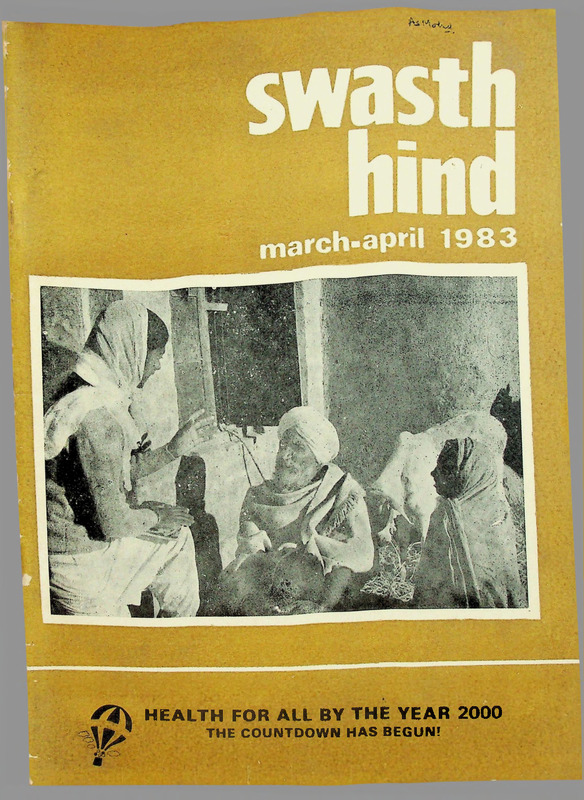
swasth
hind
Phalguna-Chaitra-Vaisakha
March-April 1983
1904-1905 Saka
Vol. XXVII No. 3-4
In this issue
The Thirty-second World Health Assembly
in 1979, launched the Global Strategy for
Health for All by the Year 2000. The Assem
bly endorsed the Report and Declaration of
Alma-Ata and invited the Member States of
W.H.O. to act individually in formulating
national policies, strategies and plans of action
for attaining this goal, and collectively in for
mulating regional and global strategies. A
large number of countries in all regions have
since formulated national strategies, and all
regions have drafted regional strategies.
Page
Primary health care
—role of communicable diseases control
Dr I. D. Bajaj
61
Health for all by 2000 AD:
malaria control
Dr S. R. Dwivedi
63
Blindness prevention and control
—the scene today
Prof. Madan Mohan
67
Leprosy eradication :
recording, reporting and assessment
Dr C. S. Gangadhar Shanna
71
Sanitation pays
Jitendra Tuli
74
Population problem
—a planner's view
S'. B. Cha van
78
Safe drinking water for villages
—a national perspecti/e
84
New look for health :
Statement on national health policy
86
One Health Guide for every 1000 rural
population by 31 March, 1984.
— At least one trained clai for every village
by 31 March, 1985.
:
D. N. Issar
Sr. Sub-Editor
:
M. S. Dhillon
Layout
:
G. B. L. Srivastava
Photos
The Government of India have formulated
a perspective health plan to achieve the goal
of “Health for All by 2000 AD’’. Replying
to a question in Lok Sabha on 14 October,
1982, Shri B. Shankaranand, Union Minister
of Health and Family Welfare said that the
Plan provides for:
—
Asstt. Editor
Cover design
In May 1981, the Thirty-fourth World
Health Assembly requested the Executive
Board to prepare a draft plan of action to im
plement, monitor and evaluate the Global
Strategy for Health for All by the Year 2000.
The plan of action was approved by the
Thirty-fifth World Health Assembly in May
1982.
:
B. S. Nagi
W.H.O., New Delhi
and R. P. Centre for
Ophthalmic Sciences,
New Delhi
—
One Sub-Centre with one male and one
female health worker for every 5000
population (for 3000 population in
hilly and tribal areas) by Seventh Five
Year Plan (74 per cent during the
Sixth Plan period and the rest during
the Seventh Plan). 90,000 sub-centres
are proposed to be established by the
end of Sixth Plan period.
— One Primary Health Centre for every
30,000 rural population (for 20,000
population in hilly and tribal areas) by
2000 AD.
— One upgraded
PHC/Community
Health Centre for every one lakh rural
population by 2000 AD.
Primary Health Care
— Role Of Communicable Diseases Control
Dr I. D. Bajaj
he Government of India are a signatory
to the ‘Alma-Ata’ declaration. The adop
T
tion of the charter on ‘Health for All’ by the
HEALTH FOR ALL
BY THE YEAR 2000
Government implies a commitment to en
courage every individual to achieve higher
quality of life.
Alive to these commitments,
the Government, set forth Rs. 5807 crores
during the Sixth Plan period (1980-85) under
different components of minimum needs pro
gramme including rural health, rural water
supply, nutrition and environmental improve
ments.
By the end of Fifth Plan, Primary Health
Centre (PHC) at the rate of one for-each Com
munity Development Block was established
and it was envisaged to have a sub-centre for
10,000 population.
These processes are to
be further accelerated over the successive plan.
periods to achieve the objectives of one PHC
for every 20,000 to 30,000 population and 30
bedded rural hospital for one lakh popula
tion with facilities for specialized medical
care.
The community health volunteer scheme
launched during the Fifth Plan period is the
backbone of the Primary Health Care system
in the country.
There are already 1.40 lakh
community health volunteers in the field as on
1 April, 1980, and it is proposed to extend
the programme further during the Sixth Plan
period so as to achieve the target of 3.60 lakh
volunteers by 1985.
The communicable diseases in our country
continue to be a major public health problem.
As per ‘Sixth Five Year Plan’ document of the
March-April 1983
61
Planning Commission, about 17.2 per cent of
all deaths and about 20.8 per cent of all illness
is estimated to be due to these infections. Pre
sence of communicable diseases is often asso
ciated with under development of the society
in all spheres—economic, social and health.
During the post-independence period, consi
dering the importance of this group in terms
of illnesses, deaths and the consequent enor
mous economic loss as well as the danger of
spread from person-to-person and from areato-area, the Government launched several ver
tical health programmes against malaria, fila
riasis, leprosy and tuberculosis. Programme
against
diarrhoeal diseases, guineaworm
disease and diseases against which potent vac
cines are available have been initiated recent
ly. The Government is spending very right
ly a greater part of its health budget towards
the control and prevention of communicable
diseases.
Malaria eradication programme
alone takes away about 75 per cent of health
budget.
Even though considerable progress
has been made in achieving the targets set out
under the various programmes and the factors
impeding their progress have been identified
and their overall performance needs to be
greatly imporved.
One of the major constraints impeding the
progress of both primary health care system
and the control of communicable diseases is
lack of trained manpower for management of
field operations and research projects.
It has also been increasingly realized that
in the control of communicable diseases,
much depends on the health consciousness of
the rural people and their participation in
this gigantic effort.
It is here that there is
a need to have some rationalization at secon
dary level teaching. It may be desirable to
introduce para-medical courses at 10 plus 2
level which will not only help in creating
general awareness about health problems and
their remedial measures, but may also pro
vide a trained band of health workers at grass
root level as envisaged in Sixth Plan Period.
—(Excerpts from the inaugural Address at the Scien
tific Conference on ‘Role of Communicable Dis
eases Control in Primary Health Care* held at
NlCD, Delhi on 20 September, 1982.
62
Message
Health for All :
THE COUNT-DOWN
HAS BEGUN
Dr H. Mahler
Director General of the W. H. O.
Only 17 years are left until the target date of health
for all by the year 2000. The Member States of WHO
have pledged themselves to work together so that, by
then, all people everywhere will have at least such
a level of health that they will be capable of working
productively and taking an active part in the social
life of the community in which they live.
But Member States are not made up of govern
ments alone.
To be sure, governments have a res
ponsibility for the health of the people, but people,
too, have the right and the duty to take an active part
in maintaining their own health and, when they are
ill, in looking after themselves. They have the same
duty with respect to their families, their workmates,
their neighbours.
To what kind of people am I referring ? I am referr
ing to people in all walks of life. All of them
can
be agents of change for health—ordinary
citizens going about their daily business in villages
and towns, grouping together in families and commu
nities, and associating with one another in all forms
of social and political groups, educational and re
search institutions, non-governmental organizations
and professional associations. Health workers, too,
are part of the people; so are others who have com
munity responsibility, such as civic and religious
leaders, teachers, magistrates, community workers and
social workers.
Without the dedicated involvement
of people, health for all will be a constantly receding
horizon.
But to act wisely, people must understand what
health is all about. And it is the duty of those who
possess
health knowledge to share it with others.
The days are over when action for health was the
{Continued on page 95)
Swasth Hind
HEALTH FOR ALL BY 2000 AD
MALARIA CONTROL
Dr S. R. Dwivedi
The history of malaria is in a way the history of man
kind, as it is as old as the human race. It is a world
wide disease and a primary public health problem in
the tropical and sub-tropical countries. It has played
an important role in world history through the ages
affecting the progress of nations and has been the
deciding factor in many wars.”
was considered to be
the biggest single factor which
had throughout history hampered or
prevented the development of tropi
cal and sub-tropical regions. It is
also considered to be one of the
most important of the diseases affect
ing man and which probably of all
human diseases causes the greatest
economic damage. The disease had
the dubious distinction of exerting a
profound influence upon the health,
vitality and physical development of
the people retarding their social in
tellectual and political progress.
alaria
M
March-April 1983
species of the malaria parasite
(which causes malignant malaria) in
nearly 22 countries of three conti
nents, there is wide-spread alarm
even among the non-malarious and
malaria freed countries, especially
due to the fast mode of travel where
by the resistant strain can easily
spread to more and more areas.
Global efforts on malaria control/
eradication
The relentless fight against this
scourge of mankind has been going
on for a long time and during the
last hundred years it has been inten
sified. In the early decades of the
last hundred years, the success in
controlling the disease was only mar
ginal owing to the absence of a
truly effective drug or a convenient
means of interrupting transmission
of the disease. With the discovery
of synthetic anti-malarials from the
mid-thirties onwards and the advent
of powerful residual insecticides to
stop transmission during the second
World War, the concept of malaria
control was revolutionized. The suc
cesses with these powerful weapons
were so spectacular at a cost so
negligible compared to the benefits
accrued, that the World Health
Assembly in 1955, resolved the ad
option of the principle of malaria
eradication on a global basis. Since
then a number of countries which
had engaged in the task of malaria
control decided to switch over to one
Even after over hundred years of eradication. This resulted in the
since the discovery of the human eradication of malaria from the Unit
malaria parasite by Laveran in 1880, ed States of America, most of
the subsequent discovery of its trans Europe, much of the Carribeans and
mission through the anopheline mos South America.
quito by Ross in 1897 and the tre
mendous advances in science parti
By mid sixties most of the coun
cularly in the field of disease con tries which had embarked on the
trol, malaria has once again staged programme of eradicating malaria
a come back which has alarmed the had varying degrees of success. By
countries all over the world as also late sixties it became tardy or reach
the World Health Organization.
ed a stage of stagnation. This led
to the need for re-examination of
In view of the development of the global strategy for malaria eradi
resistance to Chloroquine in one cation by the Twentieth World
63
Health Assembly.
It was recom
mended that effort be made to in
tensity the activities in order to acce
lerate tne process of eradication
waere prospects were reasonably
good, mat where eradication was
not feasible in the near future and
a time bound schedule was no longer
practicable it would be necessary
to revise the strategy.
Based on these recommendations,
many countries including India had
their programmes reviewed and in
some cases the eradication pro
gramme was recategorized to one
of control. In spite of the large
scale setbacks, the health gains of
malaria eradication programmes all
over the world are truly immense.
The previous annual malaria morbi
dity rate of about 250 million has
now declined to about 100 million
and the corresponding mortality rate
has decreased from 2.5 million to
less than one million per annum.
Malaria control/eradication in India
In India efforts on systematic con
trol date back to 1899 when a
Malaria Commission was appointed
by the Royal Society to investigate
the possibility of malaria control in
Mian Mir Cantonment near Lahore
(now in Pakistan).
Since then upto the introduction
of DDT for pilot trials in the forties
there were innumerable attempts at
malaria control with different availa
ble methods in various parts of
the country. The contribution of
India in the field of malaria research
in epidemiology, chemotherapy and
control have been so extensive and
enormous that the country decided
to launch an eradication programme
from 1958 as per the World Health
Assembly resolution of 1955. The
need for a preparatory phase was
not felt and it straight away started
with the attack phase of eradication.
Steps to control malaria include case detection, blood smear collection,presumptive and radical treatment and education of the commu
nity. photo shows a malaria worker taking a blood slide of a
patient in a village.
incidence of about 75 million cases
and nearly a million deaths per
annum, the country had brought
down the incidence to less than 0.1
million by 1965, a reduction of the
order of 99.87 per cent. This was
indeed a spectacular achievement of
which the country was really proud
of. More than two-third of the
country had been freed from the
disease.
But due to the various adminis
trative, operational and technical
reasons setbacks occurred.
The
basic health services as envisaged
in the beginning had not fully deve
loped to take over the task of main
tenance of malaria free status and
gradually due to a combination of
factors more and more malaria free
areas had outbreaks which could not
be contained in time. The early
seventies saw the steep increase in
the cost of petroleum and petroleum
based products and consequently
the insecticides in use also showed
steep escalation in cost. Very soon,
By now it is common knowledge the inflationary trends combined with
that from a pre-eradication malaria the gradual ineffectiveness of the
64
weapons for eradication led to severe
financial constraints and the country
had to adopt a Modified Plan of
Operation. Under this plan spray
operations are selective based on
the Annual Parasite Incidence.
At the current cost of alternative
insecticides necessitated by resistance
to DDT and PHC in some of the
malaria vectors, no developing coun
try can afford to take up large scale
control measures, more so in a coun
try of the size of India. However,
the country cannot afford to allow
the disease to continue un-checked
as it would gravely hamper the
numerous development projects as
also the agricultural production
which is so vital for the nation.
Malaria control under the Health
for AH by 2000 A.D.
An eradication programme is time
limited, and it requires totality of
coverage, high operational standards,
no compromise on costs and a welldefined and set methodology to be
undertaken on a war footing. With
the resurgence of malaria on a large
Swasth Hind
scale and the numerous constraints, rage. The accent should be on a due to malaria is reduced to the
viz., cost, ineffective insecticides, preventive approach rather than a minimum and the precious mandays
due to malaria are saved.
and in some pockets resistance to palliative one.
Chloroquine in one particular species
To quote Williamson (1935) again
Although the problem of urban
of the parasite, the country has to
“
nothing
worthwhile however can be
malaria has surfaced on a larger
set priorities and select only those scale during the past few decades, achieved without a determined effort
areas which require priority atten
malaria continues to be a major pro to organize the villagers to help
tion and adopt methods which are
blem in the rural areas and it is themselves”. A close cooperation
feasible within the financial and
well acknowledged that the cost of and involvement of the agricultural
material resources available. Fur
controlling it by current urban proce educational and other workers would
ther, an eradication programme had
dures is prohibitive even if an army also be needed for achieving success
a vertical approach for effecient dis
of trained subordinate health workers in the effective control of the disease.
charge of the duties which are at pre
were available to cover the country. Training and health education at all
sent not economically feasible. The
levels is very vital for the over-all
In this context it is worth-while to
accent now is on multi-purpose
recapitulate the three principles spelt success of these operations.
worker and primary health care
The main sophisticated task of
out nearly 50 years ago (1935) by
schemes which are to be made avai
Williamson, conditioning the control sector control through spray opera
lable and readily accessible to the
tion will however continue through
of malaria in rural areas:
entire population providing preven
the district level organization, as
1. The methods of control must
tive, promotive and curative services
these are of complex nature and re
be simple enough to be superto the community.
quire special techniques and exper
vized by laymen and to be
The Alma Ata Conference in 1978
practised by the villagers tise.
agreed on the Primary Health Care
The targets adopted for the Sixth
themselves.
approach as the key for the achie
and Seventh Plan and for the year
2. In the absence alike of train
vement of the goal Health for All by
2000 A.D. though ambitious are:
ed anti-malarial staff and of
2000 A.D. In the wake of this de
(a) Reduction of incidence from
the money to provide them,
claration and with the social goal
4.6 Annual Parasite Incidence
self
help
must
be
the
guid
of health for all by 2000 several
in 1981 to 2.7 in 1985; 1.9
ing
principle.
countries are now in the process of
in 1990 and less than 0.5 in
3. The materials used to effect
developing strategies and plans of
2000 A.D.
control must be obtainable
action. India also as one of the
(b) Elimination of deaths from
locally and be cheap or cost
signatories to the declaration is plan
malaria in the country.
nothing,
at
least
until
new
ning to control malaria and other
ones
far
more
effective
for
To
achieve
the above objectives
communicable diseases as an inte
their
cost
are
available.
there
is
an
urgent
need for provid
grated part of the PHC in a phased
ing
the
required
man-power,
material
manner.
The above principles hold good
and
equipment
support
to
the
pro
Although malaria control mea to this day and with the innumera
sures are of a complex nature and ble constraints we have to go back gramme.
have to be varied from place to to naturalistic methods of control to
A great deal of research on vari
place depending on the epidemiolo supplement the chemotherapeutic ous aspects of malaria control in the
gical, ecological and financial aspect, approach that the PHC level can present context is underway in India
the PHC level will be able to con manage.
as well as in various parts of the
tribute a great deal in the control
world. It is hoped that some more
effective methodology would be
of the disease. The PHC level with People’s participation
Under the Modified Plan of Ope evolved sooner or later when the
the personnel available can manage
certain important tasks like—case ration emphasis has been laid on ultimate goal of eradicating malaria
detection, blood smear collection, people’s participation and to pro can once again be taken up on a war
presumptive and radical treatment, vide chemotherapeutic cover. Nearly footing. Till such time we have to
educating the community about the 2,50,000 drug distribution centres continue our efforts within the avail
disease and simple personal protec and 1,00,000 fever treatment depots able financial, material and techni
tive measures, source reduction me are in operation throughout the cal resources to keep the disease
thods, assist the district level organi length and breadth of the country under check so that it does not ham
zation in spray operation and its to make anti-malarials freely and per the vital developmental activi
supervision for achieving total cove easily available so that morbidity ties.
o
March-April 1983
65
BLINDNESS
PREVENTION AND CONTROL
—the scene today
Prof. Madan Mohan
lindness or loss of vision is a
serious public health problem
with socio-economic consequences.
According to figures available, there
are as many as five million blind
due to cataract alone; which takes
minimal time to be removed by a
simple surgery at a nominal cost.
B
The proposed long-term stra
tegy seeks to raise the level of
knowledge and consciousness in
the community regarding sim
ple measures which lie within
the domain of each individual
and would ensure that the
The dimensions of the eye pro priceless gift of vision can be
blems are very large both in terms
kept by everyone for a lifetime.
of factors responsible and targets to
be achieved. The incidence of blind
ness Is estimated to be 1.4 per cent
manpower resources are also not
of the total population. The goal
being properly utilized.
has been fixed to bring down the
incidence to less than 0.3 per cent
India has about 5,000 ophthalmic
by 2000 A.D. Under the new 20- surgeons and about 2,000 ophthalmic
Point Programme, the control of technicians and assistants. The an
blindness has received an explicit nual output of qualified eye surgeons
recognition. This acceptance of the from various medical colleges is
gravity of problem has given a big hardly 500. The provision of eye
thrust to the implementation of the care services in India is limited be
National Programme for Control of cause there is one eye surgeon for
Blindness.
every 1.2 lakh people as compared
to developed countries where there
is one eye surgeon for every 20,000
The problem
population.
66
Swasth Hind
March-April 1983
The problem of blindness is not
its gigantic size but the gross inade
quacy of qualified ophthalmic per
sonnel and the non-availability of
services near the homes of the peo
ple. Besides this, owing to urbanrural imbalance, even the available
Cataract alone demands 1.5 mil
lion intra-ocular operations per year.
The available resources pooled to
gether cover just half (i.e. 0.75 mil
lion) of the requirements, thus add
ing an equal number every year, to
the estimated backlog of 5.5 million
cases.
An eye patient being examined in an
electrodiagnostic laboratory.
Lack of knowledge about per
sonal hygiene, nutrition and prompt
67
Beliefs and practices in certain communities harm the eye-sight, as for
example, the new-born baby not being breast-fed on the first day is
deprived of colostrum which is a rich source of protein and antibodies
essential for healthy eye-sight. This, therefore, requires education of the
people to shed of their old beliefs and practices.
treatment in case of eye injuries con Plan of action
To speed up the progress of the
tribute considerably to the magni
In the light of the seriousness of National Programme for Control of
tude of the problem of avoidable the problem, the Central Council of Blindness, the Government of India
blindness. Many eye disorders arise Health at its meeting in April 1975 set-up a Working Group in Novem
due to lack of certain nutrients in recommended the adoption of a ber 1981 to review the total strategy
the daily diet. In India, many National Policy for evolving a com; for effective control of blindness and
children, especially between the age prehensive plan of action for pre the problems arising from loss of
of 0-3 years, become blind early in vention and control of blindness. vision. The Report has been finaliz
life. A great majority of these cases Therefore, in 1976, a National Pro ed by the Working Group and is
of blindness can be prevented if gramme for Control of Blindness under active consideration of the
proper nutritional care is taken at (NPCB) was launched to provide Government of India. The proposed
the proper time. It is, therefore, immediate relief measures and esta long-term strategy, as worked out
very important to educate parents blish permanent eye care facilities by the Working Group, seeks to
to encourage children to take foods with graded expertise at different raise the level of knowledge and
rich in Vitamin ‘A’ especially from levels all over the country. The consciousness in the community re
inexpensive sources, such as, carrots, Programme provides for 80 mobile garding simple measures which lie
pumpkins, drumsticks and green eye care units during the Sixth Five within the domain of each indivi
leafy vegetables. The nursing mother Year Plan, development of perma dual, and would ensure that the
also needs to eat more of green leafy nent infrastructure with competent priceless gift of vision can be kept
or yellow vegetables to ensure that staff and instruments from the peri by everyone for a lifetime. This
her breast milk provides the requir phery to the Central level. At the strategy also aims at building up a
ed nutrition to the child.
apex level, the Dr Rajendra Prasad permanent infrastructure of facilities
Centre for Ophthalmic Sciences gui and trained manpower to meet not
Beliefs and practices in certain des in the implementation of the Pro only the rising consciousness and
demand of the people for higher
communities harm the eye-sight, as gramme.
quality of services but also the de
for example, the new-born baby not
Ever since, the launching of the mand arising from the population
being breast-fed on the first day is Programme in 1976, permanent in
increase.
deprived of colostrum which is a frastructure could not be establish
rich source of protein and antibodies ed to the desired extent, due to lack
essential for healthy eye-sight. This, of trained manpower. However, with
Research and Development
therefore, requires education of the the change in priorities, from sup
people to shed off their old beliefs ply of equipment to training of
In recent decades many advanced
and practices.
personnel, the Programme has taken countries have spent huge sums of
The practice of using collyruim
in the form of kajal or surma coupl
ed with indifference towards per
sonal hygiene contributes to the
spread of eye infections. In addi
tion, quackery is rampant because
of inadequate distribution of quali
fied primary eye-care services in
rural areas.
68
off the ground since 1979-80. Much
still remains to be done to stream
line its implementation. Given a
swift push and a determined effort,
it should be possible to make an ap
preciable dent in the control of blind
ness caused by conditions amenable
to surgical intervention during the
remaining two years of the Sixth
Plan.
money for research work on blind
ing diseases, such as, diabetic retino
pathy, retinal degeneration, etc
Major research inputs have also been
used to improve the quality of vision
by developing contact lenses, intra
ocular lenses for use after cataract
operation, transplant surgery, micro
surgery, treatment of tumours of the
eye etc.
Swasth Hind
In India, however, we are faced
with a different set of problems
caused by infection, malnutrition,
occupational hazards and the occur
rence of a large number of cases of
corneal blindness. The solution to
these problems will have to be found
out by our own efforts. Major areas
of research work before us are:
I. Cataract research on:
March-April 1983
i. Basic aspect of its preven
tion and arrest.
ii. Epidemiological research
iii. Operational research
II. Mcdnutritional blindness
III. Injections of the eye
i. Trachoma
ii. Mycotic (fungus) Ulcer
IV. i. Immunological
studies
corneal graft
ii. Corneal substitutes
V. Glaucoma research.
Basic research is essential but
major research endeavour shall have
to be on “delivery” of services,
the application of techniques already
well-established. India is faced
with a big challenge where the re
on quirement is for mass treatment at
69
Information on eye care, hygiene of vision, par
ticularly in the pre-school and school-going
children has to be carried to the mothers and
the teachers particularly in rural areas through
all the available media.
Role of voluntary organizations
Control of blindness is a part of the
new 20-Point Programme. Under the
rehabilitation programme the blinds
are taught the art of daily living and
mobility. Different types of voca
tional training is also provided.
a low unit cost. Newly developed
technology has to be relevant to our
needs which fits in our culture. If
it gets complicated, sophisticated or
expensive, it will be self-defeating.
70
role in this task of preventing blind
ness and preserving sight.
Voluntary effort is vital for the
control of blindness both for pro
viding immediate relief to the cata Favourable climate needed
A massive and effective interven
ract patients and of creating supple
mentary infrastructure of primary tion to prevent blindness at a socially
eye-care including education for pre acceptable cost can be achieved by
vention. It has been the endeavour proper planning to provide primary
of the Government of India to en eye care as a part of primary health
courage and strengthen the volun care. The latter needs to be linked
tary agencies so that the State and with the other community based
voluntary organizations complement essential services like, nutrition, edu
each other. In order to encourage cation, hygiene, water supply and
the voluntary organizations, the Gov programmes of income generation.
ernment provides liberal grants to To fulfil these requirements, re
the recognized voluntary organiza sources can be mobilized but the
tions and it has been noted with real need is of the composite enter
satisfaction that the voluntary orga prise, operating at various interact
nizations have improved their efforts ing levels. ' Behind the essential
clinical judgement of an eye surgeon,
during these years.
is the political judgement about the
Eye health education
priorities, the planners judgement
Health education is an important about programmes, the economists
plank of the programme. The pro judgement about resources. All these
gramme has laid great stress on pre people are essential in the pyramid,
ventive measures. Information on whose base is the multitude, the
eye care, hygiene of vision, particu mass, the local problem. Since the
larly in the pre-school and school control of blindness has now been
going children has to be carried to included in the new 20-Point Pro
the mothers and the teachers parti gramme, the National Programme of
cularly in the rural areas through Control of Blindness would receive
all the available media. People have a favourable climate of public opi
to be informed about the different nion at all levels and its effective
components of the programme and implementation would help to relieve
utilize the services meant for them. the miseries of a large number of
The family, the community, social people who live a life not only en
workers have to play an important veloped in darkness but also in
well-established. India is faced pity and patronage.
A
Swasth Hind
LEPROSY ERADICATION
Recording, Reporting
and Assessment
Dr C. S. Gangadhar Sharma
Eradication of leprosy forms a significant as
pect of the new 20-point programme and is
being implemented as a 100 per cent centrally
sponsored scheme. The objective of the programme is to convert all positive cases through
regular and proper treatment into negative
ones so that the reservoir of infection is made
dry. This article emphasizes the importance
of recording, reporting and assessment of cases
in the leprosy eradication work.
Qince primary prevention of leprosy by vac13 cination is. not possible, secondary prevention
by treatment has to be adopted on a mass scale to
control the disease. The principle of the programme
is to convert all positive cases through regular and
proper treatment into negative ones so that the re
servoir of infection is made dry. Since man is the
only source of infection in India and when the chain
of transmission is broken, the develpoment of new
cases in the community is prevented.
As leprosy is an asymptomatic disease, the patient
is not aware of the diseases in him unless a trained
person examines him to identify any early changes in
his skin due to the disease. The modus operand! for
case detection and treatment under the National
March-April 1983
Leprosy Eradication
follows: —
Programme is summed up as
1. Case Detection to find out cases
(a) Total population survey
(b) Selective population survey
(c) Creating awareness about leprosy in the com
munity for voluntary reporting or motivation
by the leprosy patient or referring to a hospital
by a medical personnel.
2. Treatment.
Treatment delivery care has been planned in such
a way that the patients can continue to stay in their
houses as a member of the family, do the avocation
they know to add to the family economy and at the
same time, can get the benefit of the regular treat
ment. In order to encourage the patient for regular
attendance at the clinic, proper motivation is being
done by repeated pre-clinic visits to make them know
the date of clinic and the importance of treatment.
Case detection
Cases in the community have to be identified by
examining every person where co-operation can be
obtained without resistance as in rural parts or in
slum areas of towns and cities or by examining selec
tive group which runs the high risk of infection as in
school-attending children or contacts living with the
patients. In places where there is a well established
leprosy hospital or clinic, many a time people report
71
voluntarily cither due to awareness about the nature of
disease or are motivated by a satisfied patient who
got the benefit of treatment from the hospital.
Data collection and retrieval of information for
periodical reporting and evaluation can be done only
when basic records are properly, regularly and care
fully maintained.
The basic field records available for case detection
are :— 1. survey register, 2. contact register,
3. treatment card, 4. known case chart, and 5.
village visit register.
These registers will give the
baseline data about the cases identified by survey, by
healthy contact study and by voluntary * reporting:
their living status; active condition; etc.
(a) Total Population Examination
Survey register.—The population in the area are
enumerated street-wise and house-wise and the result
of examination is recorded to know the healthy per
sons and persons affected with the disease.
Re-examination of population is done once in a year or
once in two or three years to identify the new cases
developing after the previous examination; changes
in the living status of the community and the patients
at the time of review period is also recorded.
(b) Selective Population Examination
Contact register.—Healthy persons living with the
patient run the high risk of infection. These persons
are periodically examined and it is known as healthy
contact study. Therefore, a healthy contact register
gives the list of the healthy persons living with the
patient, and the results of periodical examination to
know the development of early signs of leprosy so
that they can be brought under regular treatment.z
Known case chart.—The condition of the patients
at the time of identification should be recorded to
know the location of the lesions, character of lesions,
involvement of nerve and presence of deformity to
know the changes taking place in the condition of the
patient during subsequent years, whether he is under
treatment or otherwise.
It is called known case
chart.
This is to be maintained by the field wor
kers who have to compare the condition during their
field visits, during survey and healthy contact study.
Treatment card:—This is maintained in the clinic
by the Medical Officer as the Medical Officer has
to know the changes that are taking place in the
condition of the patient due to treatment and the
72
drugs administered.
The patient has to be iden
tified whether he has reached the phase of inactivity
and whether the treatment can be continued or to be
stopped.
The clinical condition and bacteriological
status are recorded in this card.
Village visit register:—A few patients fail to get
themselves registered for treatment immediately after
detection and a few patients after registration are
not regular to collect the drugs.
A few persons
showing suspicious signs of leprosy have to be con
tacted periodically to confirm the development of
definite lesion.
Patients have to be contacted perio
dically in their houses to know their living status,
whether they continue to stay in the village or have
migrated to other place or have died due to some
other diseases; whether they are having active lesions
or inactive lesions and to motivate them to attend the
clinic to collect the drugs or to register for treatment
or to release from control.
This is done by field
workers during their field visits.
Periodical reports
The following baseline data can be retrieved from
these basic field records for the preparation and sub
mission of periodical reports:—
1. Number of patients added through various
sources namely survey, healthy contact study,
school survey, voluntary reporting, re-entry
of migrated patients and relapsed cases.
2. Number of deleted cases due to various causes
such as death, migration, double entry, wrong
diagnosis, otherwise, etc.
3. Number of cases rendered
treatment.
inactive due to
These retrieval of information can be recorded in
one book which can be arranged in a chronological
order month-wise for the purpose of reporting to higher
authorities.
Various information gathered regarding the patient
need to be recorded in a comprehensive way to know
the number of patients in each village with the means
of identification and date of registration, date of dele
tion by death, migration, date of inactivity, date of
release from control and changes taking place every
year and the treatment taken. This register is called
a known case register or running case register. This
is the key register from which all information needed
for evaluation purpose can be obtained.
Swasth Hind
Information needed in the reports depends upon
the purpose for which it has been called for.
Reports may be called for: (a) administrative pur
pose and (b) evaluation purpose—
(a) For administrative purpose
Such a report is required to watch the performance
and achievement of targets at each level. The infor
mation that would be required includes:
(a) num
ber of persons enumerated, (b) number of persons
examined, fc) new cases identified by different sour
ces, 'd) deletion, and (e) inactivity and release from
control.
This report may have to be prepared for each
month, quarter and year.
(b) For evaluation purpose
Evaluation is essential to know the impact of the
programme, whether the anticipated result is obtained
and if not the reasons for the failure and to plan for
a change of modus operandi.
The impact of the programme can be measured by
the following yardstick: (i) new case detection rate,
(ii) type of cases detected—early or late, (iii) cases
detected by different sources to know the awareness
in the community, (iv) incidence, (v) prevalence of
active cases, (vi) positive case rate in total cases and
new cases, (vii) deformity rate among total and new
cases, (viii) child leprosy prevalence, (ix) child leprosy
incidence, (x) number of cases rendered inactive and
released from control, and (xi) number of cases ren
dered negative.
A fall in the above parameters is an indication of
the success of programme.
If there is no fall or if
there is an increase analysis have to be done to iden
tify the defects in the mechanism of operation namely
human failure, lack of guidance, lack of feed-back
information to field workers, etc.
Assessment should be done by an external team to
rectify the errors to evaluate the programme without
any inhibition or bias.
Workers at the grass root level should furnish the
following data: (1) population allotted, (2) population
enumerated, (3) population examined, (4) population
re-examined among previously examined population,
(5) total new cases detected between two examina
tion periods, (6) among them how many are from re
examined population, (7) number of old remaining cases,
/ (8) number among old remaining cases having active
signs of the disease, (9) number among new cases
showing positively, (10) number among new cases
having deformity, (11) number of old positive cases
examined, (12) number among them have turned nega
tive, (13) number of old deformity cases, (14) num
ber of newly developed deformity among patients
without deformity, and (15) number of old cases ren
dered inactive due to treatment or by self-healing.Q
PRIMARY HEALTH CARE
“Primary health care is essential health care based on practical, scien
tifically sound and socially aceptable methods and technology made univer
sally accessible to individuals and families in the community through their
full participation and at a cost that the community and country can afford to
maintain at every stage of their development in the spirit of self-reliance and
self-determination.
It forms an integral part both of the country’s health
system, of which it is the central function and main focus, and of the overall
social and economic development of the community.
It is the first level of
contact of individuals, the family and community with the national health
system bringing health care as close as possible to where people live and work,
and constitutes the first element of a continuing health care process.”
From:
March-April 1983
The Declaration of Alma-Ata
73
SANITATION PAYS
andhi Maidan in Patna is one
JlTENDRA TULI
G
of the city’s biggest parks. It
is a landmark, and the venue for all
“ We are fortunate that we have been able to show in practical terms that there important public meetings and
is an alternative to scavenging. People need noi make a public nuisance of rallies. Early in the morning, one
themselves if they are provided with convenience, which is clean, for which they can see hundreds of people taking
will be willing to pay a nominal charge. We have also shown that if the muni a brisk walk; in the evenings it
cipal or State authorities can provide public conveniences, the community can seems to-be taken over by children
effectively and efficiently maintain and run them”.
who play games children usually
_________
Play-
Till a few years ago, however, all
this was not possible. The maidan,
as an elderly Patna resident put it,
“was strictly off limits, and one
avoided going anywhere near it. f As
for the smell, well, you certainly did
not have to ask for directions. Your
nose would lead you to it”. Yes,
the park, was being used as one vast,
open-air public convenience.
As Shri Bindeshwar Pathak,
Chairman of the Sulabh Shauchalaya
Sansthan (now known as Sulabh
International) explains, “it was cer
tainly a very real nuisance and a
sh^me too.- The only alternative
seemed to be to provide the people
with an alternative”. And that is
exactly what his organization, a
voluntary agency involved in provid
ing appropriate sanitation services,
set about to do.
It was clear from the beginning
that the facilities available in Patna
were woefully inadequate to meet
the demand. Apart from the city’s
own population, Patna has a sizeable
“floating” population. Then there
are the very large number of rick
shaw pullers (over 50,000) many of
whom do not have a permanent
place to stay.
This pattern is similar to that pre
vailing in many other cities where
it is estimated that one-third of all
urban households have no latrine;
another third have to put up with
bucket service latrines; the remain-
74
Swasth Hind
Pay toilets pay for themselves : They improve the environment both
aesthetically and hygienically and cost virtually nothing to the community.
ing third are served by shared flush
latrines for 21 per cent, individual
flush latrines for 7.2 per cent and
septic tank latrines for 5.2 per cent.
In effect, according to modest esti
mates, Seven million urban house
holds in the country have bucket
latrines which have to be replaced
with water-seal latrines. There are
another Seven million households
without latrines that need to be pro
vided the new water-seal latrines.
With this as the background, and
recognizing the need for urgent steps
to meet the challenge, various State
governments have already launched
a drive to convert dry latrines into
March-April 1983
sanitary ones and to encourage the
At one such centre, the busiest
development and use of cheaper in Patna, with over 3,000 people
methods of disposal of human using the services daily, that one
wastes. And this is where Sulabh met a cross-section of people. There
were office-goers and rickshaw pul
International has stepped in.
lers, tailors and shop-keepers and
Sulabh sliauchalayas
casual visitors. What each of them
In the eight years since the first
appreciated was the ease and speed
pair of “Sulabh Shauchlayas”—
with which everything was done.
which literally mean easy to use con
“Even during rush hour, from 5 a.m.
venience—were installed off Gandhi
to 7 a.m. when there is a queue of
Maidan, there are now over 70,000
in Bihar State, with nearly 10,000 5 to 10 persons outside each cubicle,
in Patna city alone. Today, over there is no pushing or shouting. All
50,000 persons daily use the cubicles you do is pay 10 paise (One US cent)
set-up in the 40 centres which are get a pinch of soap powder, collect
run and managed by Sulabh Inter your container with water and find
national.
an empty cubicle”. The cubicles are
75
cleaned by a band of paid workers
who take great pride in keeping
everything neat and tidy. As Shri
Pathak explained, nobody is asked
io pay, but “nobody refuses”. He
explained however, that women and
children could use the facility free.
Also, those who are unable to pay
are not charged.
At most of the centres run by
Sulabh International in Patna, there
is an area kept aside for bathing.
“We do not have cubicles yet, but
hope that this will be possible later”,
says Shri Pathak.
“I was most impressed by this
simple approach to a complex pro
blem, and even though I am not an
engineer or scientist, I believed in
the concept”. At the first available
opportunity, he tried to put what he
had read, into practice. “And I’m
glad to say that in this case the
theory proved practical”. One has
only to visit any of the Sulabh Shauchalaya centres in Patna to see this
in operation.
A mention may also be made
about the u.n.d.p. Global Project on
Lowcost Pourfiush Water Seal Lat
rines for urban communities taken
up in seven States under Phase I
with a view to prepare feasibility
reports covering 110 towns. In
Phase II of the above Programme,
the Government of India has taken
up an “India Project” in 11 States
and three Union Territories covering
100 towns with the assistance of
u.n.d.p. for a similar feasibility study.
Through. various assistance
schemes, the villagers are hel
ped to improve their living
conditions.
And it always
works. “All it needs is a little
understanding, a little patience
and the ability to lake people
along with you—wiih work,
and not words33.
Alternative to scavenging
As Shri Patnak pomts out, the
Sulabh Shauchalaya movement nas
proved more than one tning. “We
all know that with the people's parti
cipation, you can achieve anything.
We are fortunate that we have been
able to show in practical terms that
there is an alternative to scavengmg.
That people need not make a public
nuisance of themselves if they are
provided with a convenience, which
is clean, for which they will be
willing to pay a nominal charge. We
have also shown that if the munici
pal or State authorities can provide
public conveniences, the community
can effectively and efficiently main
tain and run them. In fact, we have
generated employment for at least
300 people in Patna city alone, not
to mention the soap manufacturers
and others engaged in making and
maintaining the “sulabh shaucha
layas”.
Bio-gas from human waste
At one of the bigger centres, a
highly successful experiment has
been conducted in using human
waste to produce bio-gas. Enough
of it is produced to light not only
the lamps at night, but also to use
it for cooking purposes. There are
plans to instal more bio-gas plants
at other centres and to provide gas
to the neighbouring households.
It is not only in Patna that this
“The potential is immense”, says a is being tried out. Already, similar
confident Shri Pathak.
centres have been established in the
The agency has also launched a States of Andhra Pradesh, Kar
scheme to train people to make and nataka, Madhya Pradesh, Orissa,
instal sulabh shauchalayas. It acti Tripura, Uttar Pradesh and West
vely helps householders with the Bengal. There are plans now to
necessary formalities of getting loans open up Sulabh Shauchalayas in
from the local authority to convert Jammu & Kashmir and Rajasthan.
bucket privies into water-seal latrines
In the fifties, work in rural sanita
and then goes ahead and instals
tion was carried out jointly by the
them. Sulabh International gives a
Government of India and Ford
a guarantee of two years and looks
Foundation through the researchafter the maintenance, where needed.
cum-action project in Singur (West
Shri Pathak says that his main Bengal), Najafgarh (Delhi) and
purpose in taking on this work was Poonamallee (Tamil Nadu). Reseto see Mahatma Gandhi’s dream of arch-cum-demonstration works were
putting an end to the degrading sys also carried out in the country in
tem of scavenging, come true. “I Uttar Pradesh (Planning Research
must say that though the inspiration and Action Institute Project) under
came from him, it is a w.h.o. publi the Indian Council for Medical Re
cation that really set me off”. And search, National Public Health En
then he pulls out a much-used copy vironmental and Engineering Re
of, “Excreta Disposal for Rural search Institute, Nagpur (now Na
Areas and Small Communities”, by tional Environmental Engineering
E. G. Wagner and J N. Lanoix, Research, Nagpur) and w.h.o. pro
(w.h.o. Monograph Series 39, 1958). ject in Kerala, etc.
76
As one can see clearly from the
experiement in Patna, sanitation
certainly means cleanliness, and it
pays too!
♦
*
♦
EXAMPLE OF AHMEDABAD
Over 1,300 kms to the west of
Patna, lies Ahmedabad. It is known
for its textiles and as the place
where Mahatma Gandhi lived for
many years in the Sabarmati
Ashram. It was from this Ashram,
now a national memorial, that the
Mahatma launched some movements
Swasth Hind
“Sanitation is a way of life.
It should also mean better ven
tilation, proper light, cleaner
surroundings—in general, a
healthier lifestyle.”
which later changed the course of
history.
rize different types of water flushed
latrines. The front yard of the Vid
yalaya has, instead of flower beds
or a lawn, an area where prototypes
of latrines specially developed with
the need to use the minimum amount
of water, are displayed. These
used as practical training aids by the
scores of students—village leaders.
National Service Scheme volunteers,
overseers, municipal sanitary engi
neers, social workers and others—
who attend the regular courses at the
Vidyalaya.
The conversion is usually initiated
at rural sanitation camps organized
byxthe Vidyalaya. Shri Patel says
that these are very effective and
cites the example of how, at a
recent camp, they converted 110
latrines in 10 days.
People’s participation
In all these activities the most
vital
component is the community’s
Adjacent to the quiet and peaceful
participation.
And to ensure this,
Ashram, where one naturally talks
the
Vidyalaya
has
18 field workers
in whispers, is an institution that is
who
involve
the
local
student and
truly unique. Known as the Safai
village
leaders,
women
’
s organiza
Vidyalaya (sanitation institute), it
Appropriate technology
tions,
youth
clubs
and
the village
was established in 1964 by the
panchayats
(councils).
Here, the
Harijan Sevak Sangh primarily to
What Shri Patel stresses repeatedly
work on the conversion of bucket is that in order that the new water message is not only sanitation but
latrines as the means to achieve the seal latrines are used, it is essential smokeless ovens, soakage pits and
emancipation of scavengers. As to keep in mind various cultural proper ventilation. Through various
those who have watched the work and behavioural factors of the users. assistance schemes, the villagers are
of the institute closely say, the “One cannot just blindly adopt any helped to improve their living con
And it always works.
movement launched by it may well system and hope that it will work. ditions.
bring about a social revolution. It needs careful study. To the “All it needs is a little understand
“If we are able to achieve even a extent of measuring the gap bet ing, a little patience and the ability
fraction in terms of bringing about ween the foot-rest, the amount of to take people along with you—
a change in people’s attitudes to water that is needed, and what peo with work, and not words”, says
wards this work, we would have ple generally put into latrines.” Shri Patel.
achieved a lot”, says Shri Ishwarbhai- Having studied these and other as
The success of this approach is
Patel, the Principal of the Vidyalaya. pects, the Vidyalaya has designed a
obvious
as one walks through Patan
Having already spent over 30 years series of latrines using appropriate
Gaon,
a
residential locality with
in this work, Shri Patel speaks with technology. It has also educated
a great deal of conviction and thousands in their proper use and narrow lanes and bye-lanes, where.
in the past couple of years, over 650
authority when he says that sanita maintenance.
dry latrines have been converted
tion is not merely question of ex
and
today there is not a single dry
creta or waste disposal. “It is a
Through various schemes launched
one
left.
As for those who used to
way of life. It should also mean by the State Government, house
service
the
dry latrines, they have
better ventilation, proper light, clea holders below a certain income level
all
been
absorbed
in alternate jobs.
ner surroundings—in general, a heal are given financial assistance to en
The
story
is
repeated
in several other
thier lifestyle.” Over the years, able them to convert their dry
localities,
where
householders
proud
through various training course and latrines into water-seal ones. Since
ly
take
you
indoors
and
show
you
the organization of rural sanitation 1964 over 1.50,000 dry latrines, over
privies
in
the
smallest
of
places,
camps, he has spread the message 85 per cent of the total, have been
tucked away in the most unimagin
and
importance of sanitation converted.
able comers. “The best part of it
throughout the State of Gujarat.
is that there is no smell and no ques
What these activities have also help
ed to highlight is the fact that the Primary health care approach tion of any pollution”, said a house
primary health care approach is cer is certainly workable, and the holder.
tainly workable, and the goal of
But the best part, according to
goal of health for all can he
health for all can be achieved, not
Shri Patel, is that the scheme is ful
by the health sector alone, but achieved, not by the health filling a long-felt social need. In
through the concerted efforts of all.
sector alone, hut through the the process, it is also helping to
Literature has been specially pre
pared by the Vidyalaya to popula
March-April 1983
concerted efforts of all.
give' new life to the vision of the
Mahatma of Sabarmati.
O
'll
population problem
S. B. Chavan
A well organized programme on the basis
of persuasion and delivery of services
calls for a high order of administrative
and managerial skills besides full political
support.
he preliminary findings of the
1981 Census
announced last year had generated a lot of
interest and debate on the country’s demographic
i situation and population issues.
The brunt of the
I criticism was that our efforts in controlling population
I growth all these years of planned development had
I not paid off fully and the family planning programme
had made little impact on the problem of population
explosion.
The discussion on the subject had geneI rally highlighted, what may be called the negative
' features of the population scenario, either ignoring or
j ® taking little notice of the positive achievements to our
credit in the last 30 years of planning, our
| country being the pioneer in the launching of an offi
cial family planning programme anywhere in the world
and integrating it into the normal planning process.
T
It is true that our population in March 1981 turned
out to 684 millions, overshooting the projected mark
by about 12 millions or so and that the annual growth
rate for the country as a whole during the decade
I 1971-81 has remained more or less at the same level
! of about 2.2 per cent as in the previous decade. The
I decennial growth rate during 1971-81 has remained at
I 24.75 per cent as against 24.80 per cent during 1961I 71. It has also to be conceded that our birth rates
are still high, even higher by two or three points at
the beginning of the Sixth Plan than what we had
assumed.
We continue to have a high potential
for future population growth since the age composi’C tion of the population with an anticipated 40 per cent
i comprising children is highly tilted towards such
growth.
Photo shows
a group of women at a family planning camp as a part
of motivational-cum-educatibnal programme to popula
rize smallfamily norm.
Family welfare as a people's movement:
79
Births averted
What has been less obvious and perhaps less pub
licised is the fact that we have succeeded in breaking
the back, so to say, of the increase in the rate of
annual growth which has remained at the same level
as in the previous decade, i.e., 2.2 per cent.
Among the major States, viz., Kerala, Tamil
Nadu, Orissa, West Bengal, Haryana, Madhya
Pradesfi and Gujarat have registered a significant
negative percentage variation of growth rate during
the decade, ranging from (—) 7.42 to (—) 27.73. The
death rate is expected to have come down signifi
cantly in most of the States while the birth rate has
come down in varying degrees depending on the socio
economic milieu of the State and the seriousness with
which the family planning programme had been im
plemented:
The percentage decrease in the birth
rate and death rate between 1961-71 and 1971-81
(mid-periods) for the whole country have been worked
out to be 10.0 per cent and 22.1 per cent respectively
by the Registrar General of India.
According to
the calculations made by the Ministry of Health and
Family Welfare (Department of Family Welfare) the
family planning programme had been able to avert
over 49.26 million births upto March 1982.
The
adverse trend in the sex ratio of women per 1000 men.
has been halted.
Some improvement has been re
corded in the literary front which has.gone up from
39.45 per cent in 1961-71 to 46.74 per cent in the case
of men and from 18.59 per cent to 24.88 per cent
in the case of women. We have been able to build
up a countrywide health and family welfare
infrastructure that is capable of providing ad
vice and diverse services on family planning such
as sterilization, iud, conventional contraceptives
(cc), oral pills (op), etc. In the rural areas
all the Community Development Blocks covering
about one lakh population have a rural family welfare
centre.
A sub-centre each with a trained male
multipurpose w’orker and a trained female
multi
purpose worker caters to the needs of about
9-10 thousand population.
In the urban areas there
are 524 post-partum centres covering all the medical
colleges and district hospitals.
All the cities and
major towns have services of urban family welfare
centres available.
While some States like Maha
rashtra, Kerala and Tamil Nadu have reached rela
tively lower birth and death rates, the position is not
as encouraging in other States, particularly in the
more populous States like Uttar Pradesh, Bihar,
Madhya Pradesh and Rajasthan.
The former group
of States had made larger investment in the past in
the Social Services Sector, particularly Health and
80
Education which have paid them handsome dividends
in the form of high literacy rates, low birth and death
rates.
Drawing from the experience of these States,
the so called backward States also have to give prio
rity 4o selected programes in the sphere of education,
health and nutrition. It is encouraging that these
States have been making larger investments in these
sectors under the Minimum Needs Programme in
recent years, the results of which would become appa
rent during the current and next decade.
Special
schemes for improving the health delivery system
in these States have also been drawn up under the
Department of Family Welfare’s Area programmes.
Despite these positive factors, there is no room for
any complacency and a sustained and intensified
campaign against population explosion has to be kept
up.
Integrated programme
This country has always viewed the population
issue in the larger context of economic development
although the approach and relative emphasis in suc
cessive Five Year Plans had been varying. The Sixth
Plan has specifically focussed on the relevance of
family planning to the larger issues of economic deve
lopment and considered it as an integral part of deve
lopment of human resources, as the following extract
from the Sixth Plan Document would show: —
“The Family Planning Programme has also to be
made a part of the total national effort for pro
viding a better life to the people.
The Plan seeks
to make a massive attack on the problem of un
employment and poverty through specific program
mes directed towards the target groups such as
small and marginal farmers, rural artisans, landless
labourers, women, scheduled castes and scheduled
tribes, etc. A National Rural Employment pro
gramme is being initiated to promote gainful em
ployment to landless labourers and marginal far
mers, families.
Under these programmes the
household will remain the basic unit of poverty
eradication. Economic emancipation will enable
for children from poor families to attend school,
to receive adequate nutrition and develop into use
ful citizens.
Special attention will be paid to the
education and employment of women and
to
liberate them from dependence and insecurity and
improve their social status.”
That is why a high priority had been given in the
Sixth Plan for programmes of rural development, era
dication of poverty, social and economic upliftment
of women, etc.
Swasth Hind
The family planning programme does not function in a ‘vacuum’.
filled into the national perspective plan and economic priorities.
Voluntary acceptance
Apart from the economic environment, there are
some well-known socio-cultural and religious factors
which determine the demographic behaviour of a
people, such as age of marriage, level of literacy,
women’s status, value of and desire, for children, pre
ference between sons and daughters, etc. State inter
vention in these areas could only be limited. Greater
success could be attained through education and en
lightenment of the people than by legislative or regu
latory measures, as our experience in the sphere of
social legislation in this country has proved. There
fore, our policy had always placed emphasis on volun
tary acceptance of family planning based on educa
tion, information and communication rather thafl on
coercion.
Appropriate policies for educating and en
lightening the people on various matters having bear
ing on fertility have to be combined with other pro
grammes of economic development and provision of
required family welfare services so that all these have
a synergistic impact on the population pro
blem.
Such a well orchestrated programme on the
basis of persuasion and delivery of services calls for
a high order of administrative and managerial skills
besides full political support though such a pro
gramme is time consuming in terms of implementa
tion.
Balanced policy
A matter seriously debated in this country presently
is whether we should follow the policy of ‘the stick
or the carrot’ for controlling population growth,
which, in other words means whether we should rely
on “incentives” or “disincentives” for bringing about
wider acceptance of family planning.
This debate
in my view is a non-issue in our social and political
context. Since a major part of our resources are pre
empted for investment in economical productive sec
tors we cannot follow a too liberal policy of offering
“carrots” or high cash incentives although it can be
proved by arithmetical calculation that there would
be substantial savings in social costs in fields like edu
cation, health, housing, etc., in the long run by a
quick reduction in the population growth rate through
incentives. The family planning programme does
not function in a “vacuum”. It has to be filled into
the national perspective plan and economic priorities.
That does not mean that we do not believe in or
March-April 1983
It has to be
have no schem.e of enabling the poorer sections to
avail themselves of the benefit of family planning.
Free clinical facilities and supply of contraceptives
and easier success to clinical services to the poorer
sections to whom they were not available till now is
certainly part of the “carrot” the State can offer. If
free medical and childcare including immunization of
expectant mothers and children against various
diseases and of prophylaxis , against deficiency
diseases are also taken into account, the benefits
are quite substantial.
Financial incentives are also
given to acceptors of sterilization and iud to com
pensate them for the loss of wages sustained on
account of absence from work for the few
days of hospitalization and convalescence. How
ever, any incentives that are offered can only be
very selective and limited in scope concerning the
vast numbers of target couples.
As for the policy
of the stick, or disincentives, there is little room for
such a policy in our democratic system based on
conviction and compromise.
Disincentives in the
form of denial of food, clothing and shelter and medi
cal facilities are out of question for non-acceptors of
family planning since these form part of the basic
human rights and moreover it will cause hardship to
poor families which are already deprived. These are
really the target groups whose economic base has to
be strengthened so that they can adopt family plann
ing voluntarily. Any drastic measures of disincentives
could, therefore, be counter-productive. However,
some selective disincentives for discouraging ‘impro
vident parenthood’ could be thought of wherever such
disincentives can be built into contractual benefits
like service conditions of employees of government
and organised sectors. Here also, there should be
no question of withdrawing
any benefits already
available to a family and the approach should be to
make the benefits unavailable prospectively to those
who exceed the prescribed family norm in future. It
should not be forgotten that high fertility rates in this
country are largely a legacy of the past as much
poverty and under development and we cannot dis
turb it too violently to achieve the desired objective
in an unreasonably short period.
In essence, what
we need is a balanced policy of both selective incen
tives and disincentives to the extent they are consis
tent with bur resources, our plan priorities, our demo
cratic fabric, political system and the Directive Prin
ciples of State policy.
81
New targets
It was in the above background that the findings
of 1981 Census were reviewed by the Cabinet late in
1981 and certain decisions taken. Keeping in view
that the actual population in 1981, had turned out
to be larger than anticipated, it has been decided to
promote family planning as a peoples’ movement and
encourage different methods of family planning. The
target for sterilization has been increased from 22
millions to 24 millions in the Sixth Plan, in addition
to high targets under other methods already fixed.
The objective of the Sixth Plan is to increase the
percentage of couple protection from about 22.5 per
cent at the beginning of the Plan to about 36.6 per
cent by 1985 and to 60 per cent by 1995.
Demo
graphers have calculated that, if this is done, the
Net Reproduction Rate in the country by 1955
would be reduced to one from about 1.5 at the
beginning of the Plan.
The birth rate is expected
to come down to 21 and the death rate of 9 at that
stage.
Present strategy
How are we to achieve these ambitious targets is
a question that is frequently asked.
In the earlier
plans vasectomy had been a popular method. In re
cent years it has yielded prime place to tubectomy
which is predominant in the total number of sterili
zations accounting for about 80 per cent of steriliza
tions. The latest technique of laparascopy
and
mini-laparatomy have attained considerable popularity
even in rural areas, as the procedures are simple and
hospitalisation is not required for more than a day.
Our present strategy is to cover as many couples as
possible by increasing the facilities for sterilization in
the District and taluka hospitals and the primary
health centres.
The Government have also decided
to - liberalize the rate of payments to the State Govern
ments on sterilization, keeping in view the escalation
in the cost of drugs, bandages, etc., and also pol
(petrol, oil and lubricants). Additional funds have
also been provided for incentives at higher rates to
motivators.
Sterilization is no doubt the most effective method
of family planning both from the point of view of
of fertility control as well as cost but it can only
cover the higher age groups generally with more than
two children and the percentage of effective couple
protection cannot be increased significantly unless the
younger couples, who are entering into the productive
period in larger numbers, are enabled to plan their
families through adoption of non-terminal methods
82
like IUD oral pills and conventional contraceptives.
Greater attention will be paid to these methods also
in our new strategy.
The health and family welfare
infrastructure for delivery of these services is being
expanded and strengthened.
A massive compaign
for information, education and communication (iec)
has to be launched. In this context, the Cabinet has
decided to accelerate the progress of the Village
Health Guides Scheme which will be funded 100 per
cent by the Government of India from 1 December,
1981. The States have been instructed to give pre
ference to women in the selection of health guides.
This is in addition to Government of India’s decision
in the Sixth Plan to meet the recurring cost of all
sub-centres set up from 1981-82, the idea being that
anms based in the
sub-centres and health guides
drawn from the community in the villages would be
able to provide the necessary advice, information and
services to a large number of rural couples who do
not have access to them at present.
A large alloca
tion of Rs. 1078 crores has already been made to
the family planning programme in the Sixth Plan and
resources will not come in the way of legitimate ex
penditure to be incurred on achievement of family
planning targets.
Achievements
As is well known, the family planning programme
had slid back in the years immediately preceding the
first year of the Sixth Plan.
The credibility of the
programme has been restored through concerted
action and keen interest taken in this programme by
the Prime Minister herself.
The following table
will show the targets and achievements in the first
three years of the Plan in relation to the performance
level reached in 1979-80.
Statement showing family planning performance in the Sixth Plan
(In millions)
Year
Targets/
achievements
Sterili
zations
IUDs
Eq. cc and
OP users
1979-80
Targets
Achievement
(Base year)
3.05
1.78
1.15
0.63
5.50
3.07
1980-81
Targets
Achievement
2.90
2.05
0.79
0.63
5.54
3.81
1981-82
Targets
Achievement
2.90
2.79
0.79
0.75
5.54
4.55
1982-83
Targets
Achievement
(upto October)
4.53
1.54
7.00
1.52
3.72
0.48
(upto September)
Note: Figures arc provisional.
Swasth Hind
There are clear indications that the programme is
being implemented more seriously now by most of the
States since a favourable climate has now been created
for it.
The performance has gone up by 15 per
cent for sterilization and by 24 per cent for cc and
op users
in 1980-81.
Over the performance
of 1980-81, the performance
in 1981-82 went
up further by 36 per cent for sterilization,
19.5 per cent for iud and 19.5 per cent for cc and
op users. The progress has been maintained in the
current year as well.
It was higher during AprilOctober 1982 by 35 per cent for sterilization and 36
per cent for iuds as compared to the corresponding
period of last year. We have still a long way to go
in fulfilling the Sixth Plan targets.
Special efforts
are required to promote conventional contraceptives
and oral pills for which the free distribution and com
mercial programmes are being strengthened. Addi
tional resources will be found for this.
Political support
Last year, there was a significant event in the
history of family planning in this country which was
the meeting in Delhi of Parliamentarians belonging
to various parties.
This meeting focussed attention
on the major population issues, particularly the need
for a national consensus on family planning and poli
tical support to the programme. This meeting which
was addressed by the Prime Minister has given a
fillip to the programme which is bound to make fur
ther strides in the coming years. The Family Plann
ing Programme has been included in the New 20Point Programme which seeks to make family
planning a people’s movement.
The Chief Ministers
are now taking greater interest in this programme as
would be apparent from the results achieved during
this year so far.
It is expected that legislators in
the States would also emulate the Parliamentarians
and help to promote the movement.
Voluntary
Organizations which had been hitherto confining their
services/activities mainly to the urban areas have also
to extend their out-reach to the rural areas and spread
the message of family planning and deliver the neces
sary services.
The scheme of payment of grants to
voluntary organizations has been decentralized and
simplified.
The Plan has already a programme of
training of opinion leaders from the villages for
propagating the concept of family planning which
has to be implemented, vigorously. Greater emphasis
on mass media and personnel communication between
extension workers and the rural population has been
laid in the Sixth Plan and ways and means are being
worked out to make use of all available channels of
'communication between
Government Departments
and the people for carrying forward the message of
family planning. Population education is also being
incorporated in all systems of formal and non-formal education.
Recently the Cabinet has set up a Population Ad
visory Council under the chairmanship of the Minister
of Health and Family Welfare to act as a “Think
Tank” on major population issues, which would not
only keep the family planning programme under re
view, but also advise Government from time to time
on various population issues and policies. We await
new ideas and suggestions to emerge from the deli
berations of the Council.
With the steps already
initiated, I have no doubt that family planning has
come to stay in this country as a fact of life and in
years ahead we can look forward to making a
larger dent on the problem of population growth.
—Courtesy: YOJANA, January 1983
Elements of Primary Health Care
“...education concerning prevailing health problems and the
methods of preventing and controlling them; promotion of food supply
and proper nutrition; an adequate supply of safe water and basic sanita
tion; material and child health care, including family planning; immuniza
tion against the major infectious diseases; prevention and control of locally
endemic diseases; appropriate treatment of common diseases and injuries;
and provision of essential drugs;”
From: The Declaration of Alma-Ata.
March-April 1983
83
ater is a basic need of life.
Yet, about 80 per cent of
people inhabiting the rural regions
of the developing world in general
and India in particular have no
access to safe drinking water. The
non-availability of
safe drinking
water has a direct bearing on the
level of health of the people and
their capacity for doing work.
Importance of drinking water to
human beings can be realized
from the fact that two-thirds of
♦he human body consists of water.
4 reduction of 10 per cent in this
water content of the body can cause
serious disorders and a reduction
of 20 per cent can cause death.
W
Global problem
Safe Drinking Water
For Villages
—a national perspective
During the Sixth Plan period efforts will be made to
provide at least one source of drinking water in all the
1.9 lakh scarcity or health problem ’villages in the
country so that drinking water facilities reach all the
inhabitants of the villages. In order to give special
thrust the scheme has also been included as a part of
the new 20-Point Programme.
84
With ever-increasing population
throughout the world, existing sour
ces of drinking water have become
extremely inadequate. There has
been a growing awareness all over
the world in regard to the impor
tance of augmenting supplies of
wholesome drinking water for the
people. However, in spite of the
efforts made in this direction, the
position in this regard has remain
ed difficult in most countries. Ac
cording to
information collected
by the World Bank, during 1975,
the number of people having no
access to safe drinking water form
ed nearly 84 per cent of the total
population
in the countries of
Africa (South of the Sahara). Tn
the countries of Asia and the
Pacific, the number of people with
out access to safe drinking water
formed about 68 per cent of the
total population. The proportion of
such people was 43 per cent in
the countries of Latin America and
38 per cent in the developing coun
tries of West Asia and North Africa.
In view of the extremely dis
mal global picture, the Habitat
Conference held in Vancouver in
1976 set forth the goal of “fresh
Swasth Hind
water for all by 1990”. The United
Nations Water Conference held at
Mar del Plata in Argentina in 1977
designated the period 1981*90 as
the International Water Supply and
Sanitation Decade. Various agen*
cics affiliated to the United Nations
have drawn up a massive pro*
gramme to provide drinking wa
ter facilities to 2 billion people
by 1990 in the developing coun
tries.
India, as a signatory to the reso
lution, has pledged its full support
to the action plan under the Inter
national Decade.
fit of the villages or areas where the ing ot the Sixth Plan period, only
problem of drinking water was most about 55,000 villages should have
acute. Under the arwp, prefe been left without this facility. But
rence was given to the villages pre the number of such villages was
dominantly inhabitated by Tribals, reported to be much higher by the
Harijans and other Backward State Governments, who considered
classes.
the 1972 survey as incomplete and
staled
that drought conditions in
The programme gained further
subsequent years had brought to
momentum during the Fifth Five
light fresh areas which are vulne
Year Plan which included drink
rable in respect of the supply of
ing water for villages in its Mini
drinking water. According to the
mum Needs Programme. The ob
latest reports
received from the
jective of the Minimum Needs Pro
State Governments, out of the 5.67
gramme for drinking water was to
lakh villages in the country, 1.90
provide the facility to all villages
lakh villages are to be provided
suffering from chronic scarcity or
with safe drinking water facilities
having unsafe sources of water.
Progress under the Plans
on a priority basis.
Inadequate progress
Although a National Water Sup
Constraints
In spite of the greater importance
ply Programme came into opera
Meagre financial provisions have
tion in 1954 during the very First given during the Fourth and Fifth
Five Year Plan, the water supply Plan periods, there was no signifi been an important inhibiting factor.
programme for providing
programme was not given high prio cant improvement in the overall The
According to a survey drinking water facilities could not
rity in the national planning pro position.
conducted in 1971-72, wholesome make any significant progress on
cess.
drinking water was not available account of the very little expendi
Until the Third Five Year Plan,
in 1.5 lakh villages because either ture incurred on the related schemes
drinking water
supply for rural
water was not available within a during the period of the first three
areas was a component of the
distance of one mile, or a depth of Plans and the three Annual Plans.
amenities scheme of the Commu
50 feet, or the available water was During the First Plan period, only
nity Development Programme. Be
not drinkable due to the prevalence Rs. 3 crores were spent on rural
sides, the local development works
of cholera germs, guinea-worm in water supply schemes and Rs. 8
programme, taken up through volun
festation and/or excessive presence crores were spent on urban water
tary labour, and the programme of
of certain
chemicals. By March supply and sanitation schemes. The
welfare of backward classes also
1980, about 95,000 problem villages corresponding figures were Rs. 30
included schemes relating to water
had been provided with safe drink crores and Rs. 44 crores in the Se
supply. These efforts were supple
ing water facilities. At the beginn cond Plan period. During the period
mented by the National Water Sup
expenditure on water supply and sanitation schemes
ply and Sanitation Programme of
the Ministry of Health.
(Rs. in crores)
It is important to note in this
context that before the beginning of
the Fourth Plan period, no physi
cal targets were fixed for the various
schemes for creating drinking water
facilities.
Greater emphasis was given to
these schemes during the Fourth
Plan period and a large proportion
of the enhanced financial provision
was utilised in areas of acute scar
city. In 1972-73, the Accelerated
Rural Water Supply Programme
(arwp) was started for the bene
March-April 1983
First
Plan
(1951-56)
Second
Plan
(1956-61)
Third
Plan &
three
Annual
Plans
(1961-69)
3
(27%)
30
(46%)
48
(22%)
208
(38%)
481
(47%)
2.154
(55%)
8
44
174
340
550
1768
Sanitation (73%)
(54%)
(78%)
(72%)
r(53%)
(45%)
(100)
74
(100)
222
(100)
548
(100)
1031
(100)
3922
(100)
1. Rural
Water
[Supply
2.
Urban
Water
.
Fourth
Plan
(1969-74)
Sixth
Fifth
Plan
Plan
Outlay
Outlay
(1974-79) (1980-85)
{Continued on page 94}
85
The Constitution of India envisages the establishment of a new social order based on equality, freedom*
Justice and the dignity of the individual. It aims at the elimination of poverty, ignorance and ill-health
and directs the State to regard the raising of the level of nutrition and the standard of living of its people
and the improvement ofpublic health as among its primary duties, securing the health and strength of workers,
men and women specially ensuring that children are given opportunities and facilities to develop in a healthy
manner.
Since the inception of the planning process in the country, the successive Five Year Plans have been
providing the framework within which the States may develop their health services infrastruture, facilities for
medical education, research, etc. Similar guidance has sought to be provided through the discussions and con
clusions arrived at in the Joint Conferences of the Central Councils of Health and Family Welfare and the
National Development Council. Besides, Central legislation has been enacted to regulate standards of medical
education, prevention of food adulteration, maintenance of standards in the manufacture and sale of certified
drugs etc.
While the broad approaches contained in the successive plan documents and discussions in the forums
referred above may have generally served the needs of the situation in the past, it is felt that an
integrated, comprehensive approach towards the future development of medical education, research and health
services requires to be established to serve the actual health needs and priorities of the country. It is in this
context that the need has been felt to evolve a. National Health Policy.
India has a rich, centuries-old heritage of medical and health sciences. The philosophy of Ayurveda and
the surgical skills enunciated by Charaka and Shusharuta bear testimony to our ancien tradition in the scientific
health care of our people. The approach of our ancient medical systems was of a holistic nature, which took into
account all aspects of human health and disease. Over the centuries, with the intrusion of foreign influences and
mingling of cultures, various systems of medicine evolved and have continued to be practized widely. However,
the allopathic system af medicine has, in a relatively short period of time, made a major impact on the entire
approach to health care and pattern of development of the health services infrastructure in the country.
In spite of such impressive progress the demographic and health picture of the country still constitutes a
' cause for serious and urgent concern. The high rate of population growth continues to have an adverse effect on
the health of our people and the quality of their lives. The mortality rates for women and childern are still distress
ingly high; almost one third of the total deaths occur, among children below the age of 5 years*, infant mortality
is around 129 per thousand live births. Efforts of raising the nutritional levels of our people have still to bear fruit
and the extent and severity of malnutrition continues to be exceptionally high. Communicable and non-commu
nicable diseases have still io be brought under effective control and eradicated. Blindness, Leprosy and TB con
tinue to have a high incidence. Only 31 percent of the rural population has access to potable water supply and
0’5per cent enjoys basic sanitation.
The existing situation has been largely engendered by almost wholesale adoption of health manpower
development policies and the establishment of curative centres based on ihe Western models, which are inappro
priate and irrelevent to the real needs of our people and the socio-economic conditions obtaining in the country.
The hospital-based disease, and cure-oriented approach towards the establishment of medical services has provided
benefits to the upper crusts of society, specially those residing in the urban areas. The proliferation of this
approach has been of the cost of providing comprehensive primary health care services to the entire population,
whether residing in the urban or the rural areas. Furthermore the continued high emphasis on the curative
approach has led to the neglect of the preventive, proniodve, public health and rehabilitative aspects of health
care. The existing approach, instead of improving awareness and building up self-reliance, has tended to enhance
dependency and weaken the community's capacity to cope with its problems. The prevailing policies in regard to
the education and training of medical and health personnel, at various levels has resulted in the development of a
cultural gap between the people and the personnel providing care. The various health programmes have, by and
large, failed to involve individuals and families in establishing a self-reliant community. Also, over the years, the
planning process has become largely oblivious of the fact that the idtimate goal of achieving a satisfactory health
status for all our people cannot be secured without involving the community in the identification of their health
needs and priorities as well as in the implementation and management ofthe various health and related programmes.
86
Swasth Hind
on
National Health
ndia is committed to attaining the goal of “Health
I
for All by the Year 2000 A.D.” through the uni
versal provision of comprehensive primary health care
services. The attainment of this goal requires a tho
rough overhaul of the existing approaches to the edu
cation and training of medical and health personnel
and the reorganization of the health services infras
tructure. Furthermore, considering the large variety
of inputs into health, it is necessary to secure the
complete integration of all plans for health and human
development with the overall national socio-economic
development process, specially in the more closely
health related sectors, e.g. drugs and pharmaceuticals,
agriculture and food production, rural development,
education and social welfare, housing, water supply
and sanitation, prevention of food adulteration, main
tenance of prescribed standards in the manufacture
and sale of drugs and the conservation of the environ
ment. The National Health Policy have to be evolved
within a fully integrated planning framework which
seeks to provide universal, comprehensive primary
health care services, relevant to the actual needs and
priorities of the community at a cost which the peo
ple can afford, ensuring that the planning and imple
mentation of the various health programmes is through
the organized involvement and participation of the
community, adequately, utilizing the services being
rendered by private voluntary organizations active in
the health sector.
Tt is also necessary to ensure that the pattern of
development of the health services infrastructure in
the future fully takes into account the revised 20Point Programme. The said Programme attributes very
high priority to the promotion of family planning as a
people’s programme, on a voluntary basis: substantial
augmentation and provision of primary health care
facilities on a universal basis: control of leprosy, t.b.
and blindness: acceleration of welfare programmes for
women and children: nutrition programmes for preg
nant women, nursing mothers and children, csoeciallv
in the tribal, hill and backward areas. The Programme
also places high emphasis on the supply of drinking
water to all problem villages, improvements in the
housing and environments of the weakerxsections of
March-April 1983
society; increase production of essential food items;
integrated rural developments; spread of universal
elementary education; expansion of the public distri
bution system, etc.
Population stabilization
Irrespective of the changes, no matter how funda
mental, that may be brought about in the overall
approach to health care and the restructuring of the
health services, not much headway is likely to be
achieved in improving the health status of the people
unless success is achieved in securing the small family
norm, through voluntary efforts, and moving towards
the goal of population stabilization. In view of the vital
importance of securing the balanced growth of the
population, it is necessary to enunciate, separately, a
National Population Policy.
Medical and health education
Tt is also necessary to appreciate that the effective
delivery of health care services would depend very
largely on the nature of education, training and appro
priate orientation towards community health of all cate
gories of medical and health personnel and their capa
city to function as an integrated team, each of its mem
bers performing given tasks within a coordinated
action programme. Tt is therefore, of crucial impor
tance that the entire basis and approach towards me
dical and health education, at all levels, is reviewed
in terms of national needs and priorities and the curri
cular and training programmes restructure to produce
personnel of various grades of skill and competence,
who are professionally equipped and socially moti
vated to effectively deal with day-to-day problems,
within the existing constraints. Towards this end, it is
necessary to formulate, separately, a National Medi
cal and Health Education Policy which (i) sets out
the changes required to be brought about in the cur
ricular contents and training programme of medical
and health personnel, at various levels of functioning:
(ii) takes into account the need for establishing the
extremely essential inter-relations between function
aries of various grades: (iii) provides guidelines for
the production of health personnel on the basis of
realistically assessed manpower requirements: (iv)
seeks to resolve the existing sharp regional imbalances
87
in their availability; and. (v) ensures that personnel
at all levels are socially motivated towards the ren
dering of community health services.
Need for providing primary health care
Despite the constraint of resources, there is dis
proportionate emphasis on the establishment of cura
tive centres—dispensaries, hospitals, institutions for
specialist treatment—the large majority of which are
located in the urban areas of the country. The vast
majority of those seeking medical relief have to travel
long distance to the nearest curative centre, seeking
relief for ailments which could have been readily and
effectively handled at the community level. Also, for
want of a well established referral system, those seek
ing curative care have the tendency to visit various
specialist centres, thus further contributing to con
gestions. duplication of efforts and consequential
waste of resources. To put an end to the existing all
round unsatisfactory situation, it is urgently necessary
to restructure the health services within the following
broad approach:
Comprehensive Primary Health Care—To provide,
within a phased, time-bound programme a well dis
persed network of comprehensive primary health care
services, integrally linked with the extension and
health education approach which takes into account
the fact that a large majority of health functions can
be effectively handeld and resolved by the people
themselves, with the organized support of volunteers,
auxiliaries, para-medics and adequately trained multi
purpose workers of various grades of skill and com
petence, of both sexes. There are a large number of
private, voluntary organizations active in the health
field, all over the country. Their services and support
would require to be utilized and intermeshed with the
governmental efforts, in an integrated manner.
Involvement of health volunteers—To be effective.
the establishment of the primary health care approach
would involve large scale transfer of knowledge, sim
ple skills and technologies to health volunteers, select
ed by the communities and enjoying their confidence.
The functioning of the front line workers, selected by
the community would require to be related to defini
tive action plans for the translation of medical and
health knowledge into practical action, involving the
use of simple and inexpensive interventions which can
be readily implemented bv persons who have under
gone short periods of training. The quality of train
ing of these health guides/workers would be of crucial
importance to the success of this approach.
Community participation—Tlie success of the de
centralized primary health care system would depend
vitally or the organized building-up of individual self
88
reliance and effective community participation; on the
provision of organized, back-up support of the secon
dary and tertiary levels of the health care services,
providing adequate logistical and technical assistance.
Establishment of referral system—The decentraliza
tion of services would require the establishment of a
well worked out referral system to provide adequate
expertise at the various levels of the organizational
set-up nearest to the community, depending upon the
actual needs and problems of the area, and thus ensure
against the continuation of the existing rush towards
the curative centres in the urban areas. The effective
establishment of the referral system would also ensure
the optimal utilization of expertise at the higher levels
of the hierarchical structure. This approach would not
only lead to the progressive improvement of compre
hensive health care services at the primary level but
also provide for timely attention being available to
those in need of urgent specialist care, whether they
live in the rural or tlie urban areas.
Sanitary•cum~epidemiological stations—To ensure
that the aproach to health care does not merely con
stitute a collection of disparate health interventions
but consists of an integrated package of services seek
ing to tackle the entire range of poor health condi
tions. on a broad front, it is necessary to establish
a nation-wide chain of sanitary-cum-epidemiological
stations. The location and functioning of these stations.
may be between the primary and secondary levels
of the hierarchical structure, depending upon the local
situations and other relevant considerations.
Each
such station would require to have suitably trained
staff equipped to identify, plan and provide proven-.
tivc, promotivc and mental health care services. Tt
would be beneficial, depending upon the local situa
tions. to establish such stations at the primary health
centres. The district health organization should have.
as an integral part of its set-up. a well-organized epi
demiological unit to coordinate and superintend the
functioning of the field stations. These stations would
participate in the integrated action plans to eradicate
and control diseases, besides tackling specific local
environmental health problems. Tn the urban agglome
rations. the municipal and local authorities should be
coninncd to perform similar functions, being supported
with adenuate resources and expertise, to effectively
deal with the local preventable public health pro
blems. The aforesaid approach should be implement
ed and extended through community participation and
contributions, in whatever form possible, to achieve
meaningful results within a time-bound programme.
Domiciliary care and field camns—-The location of
curative centres should be related to the populations
fSwasth Hind
High incidence of diarrhoeal diseases and other preventive and infectious diseases,
specially amongst infants and children, lack of safe drinking water and poor en
vironmental sanitation, poverty and ignorance are among the major contributory
causes of the high incidence of disease and mortality.
Uicy serve, keeping in view the densities of population,
distances, topography, transport connections. These
centres should function within the recommended re
ferral system, the gamut of the general specialities
required to deal with the local disease patterns being
provided as near to the community as possible, at the
secondary level of the hierarchical organization. The
concept of domiciliary care and the field-camps ap
proach should be utilized to the fullest extent, to re
duce the pressures on these centres, (specially in efforts
relating to the control and eradication of blindness,
tuberculosis, leprosy, etc. To maximize the utilization
of available resources, new and additional curative
centres should be established only in exceptional cases,
the basic attempt being towards the upgradation of
existing facilities, at selected locations, the guiding
principle being to provide specialist services as near
to the beneficiaries as may be possible, within a wellplanned network. Expenditure should be reduced
through the fullest possible use of cheap locally avail
able building materials, resort to appropriate archi
tectural designs and engineering concepts and by eco
nomical investment in the purchase of machineries and
equipments, ensuring against avoidable duplication of
such acquisitions. It is also necessary to devise effec
tive mechanisms for the repair, maintenance and pro
per upkeep of all bio-medical equipments to secure
their maximum utilization.
Utilization of untapped resources—With a view to
reducing governmental expenditure and fully utilizing
untapped resources, planned programmes may be de
vised, related to the local requirements and poten
tials, to encourage the establishment of practice by
private medical professional, increased investment by
non-governmental agencies in establishing curative
centres and by offering organized logistical, financial
and technical support to voluntary agencies active in
the health field.
Speciality services—While the major focus of at
tention in restructuring the existing governmental
health organizations would relate to establishing com
prehensive primary health care and public health ser
vices, within an integrated referral system, planned
attention would also require to be devoted to the esta
blishment of centres equipped to provide speciality
and super-speciality services, through a well-dispersed
network of centres, to ensure that the present and
future requirements of specialist treatment are ade
March-April 1983
quately available within the country. To reduce gov
ernmental expenditures involved in the establishment
of such centres, planned efforts should be made to
encourage private investments in such fields so that
the majority of such centres, within the governmental
set-up, can provide adequate care and treatment to
those entitled to free care, the affluent sectors being
looked after by the paying clinics. Care would also
require to be taken to ensure the appropriate dispersal
of such centres, to remove the existing regional im
balances and to provide services within the reach of
all, whether residing in the rural or the urban areas.
Programmes for disabled—Special, well-coordinated
programmes should be launched to provide mental
health care as well as medical care and the physical
and social rehabilitation of those who are mentally
retarded, deaf, dumb, blind, physically disabled, infirm
and the aged. Also, suitably organized programmes
would require to be launched to ensure against the pre
vention of various disabilities.
Services for vulnerable sections—In the establish
ment of the re-organized services, the first priority
should be accorded to provide services to those re
siding in the tribal, hill and backward areas as well
as to endemic disease affected populations and the
vulnerable sections of the society.
Mobility of personnel—In the re-organized health
services scheme, efforts should be made to ensure
adequate mobility of personnel, at all levels of func
tioning.
Voluntary organizations—The organized efforts
would require to be made to fully utilize and assist
in the enlargement of the services being provided by
private voluntary organizations active in the health
field. In this context, planning encouragement and
support would also require to be afforded to fresh
voluntary efforts, specially those which seek to serve
the needs of the rural areas and the urban slums.
Re-orientation of the existing health personnel
A dynamic process of change and innovation is re
quired to be brought about in the entire approach to
health manpower development, ensuring the emergence
of fully integrated bands of workers functioning with
in the “Health Team” approach.
It is desirable for the States to take steps to phase
out the system of private practice by medical personnel
89
ill government service providing1 at the same time
for payment of appropriate compensatory nonpractizing allowance. The States would require to care
fully review the existing situation, with special refe
rence to the availability and dispersal of private prac
titioners, and lake timely decisions in regard to this
vital issue.
Practitioners of indigenous and other systems of medi
cine and their role in health care
The country has a large stock of health manpower
comprising of private practitioners in various systems,
lor example, Ayurveda, Unani, Sidha, Homoeopathy,
Yoga, Naturopathy, etc. This resource has not so far
been adequately utilized. The practitioners of these
various systems enjoy high local acceptance and res
pect and consequently exert considerable influence on
health beliefs and practices, ft is, therefore, necessary
to initiate organized measures to enable each of these
various systems of medicine and health care to deve
lopment in accordance with its genius. Simultaneously,
planned efforts should be made to dovetail the func
tioning of the practitioners of these various systems
and integrate their services, at the appropriate levels,
within specified areas of responsibility and functioning,
in the over-all health care delivery system, specially
in regard to the preventive, promotive and public
health objectives. Well considered steps would also re
quire to be launched to move towards a meaningful
phased integration of the indigenous and the modem
systems.
Problems requiring urgent attention
Besides the recommended restructuring of the health
services infrastructure, reorientation of the medical
and health manpower, community involvement and
exploitation of the services of private medical practi
tioners, specially those of the traditional and other
systems, involvement and utilization of the services of
the voluntary agencies active in the health field, etc.,
it would be necessary to devote planned, lime
bound attention to some of the more important inputs
required for improved health care. Of these, priority
attention would require to be devoted to:
(i) Nutrition:
National and regional strategies
should be evolved and implemented, on a time
bound basis, to ensure adequate nutrition for
all segments of the population through a well
developed distribution system, specially hi the
rural areas and urban slums. Food of accepta
ble quality must be available to every person in
accordance with his physical needs. Low cost,
processed and ready-to-eat foods should be pro
duced and made readily available. The over-all
strategy would necessarily involve organised
90
efforts at improving the purchasing power of the
poorer sections ol the society. Schemes like em
ployment guarantee scheme, to which the gov
ernment is committed could yield optimal results
it these arc suitably linked to the objective of
providing adequate nutrition and health cover
to the rural and the urban poor. The achieve
ment of this objective is dependent on integrated
socio-economic development leading to the gene
ration of productive employment for all those
constituting the labour force. Employment gua
rantee scheme and similar efforts would require
io be specially enforced to provide social secu
rity for identified vulnerable sections of the so
ciety. Measures aimed at improving eating
habits, inculcation of desirable nutritional prac
tices, improved and scientific utilization of avail
able food materials and the effective populari
zation of improved cooking practices would re
quire to be implemented. Besides, a nation-wide
i programme to promote breast feeding of infants
and eradication of various social taboos detri
mental to the promotion of health would need
to be initiated. Simultaneously, the problems of
communities afflicted by chronic nutritional dis
orders should be tackled through special schemes
including the organisation of supplementary feed
ing programmes directed to the vulnerable sec
tions of the poulation. The force and effect of
such programmes should be ensured by deliver
ing them within the setting of fully integrated
health care activities, to ensure the inculcation of
the educational aspects, in the over-all strategy.
(ii) Prevention of food adulteration and mainte
nance of the quality of drugs'. Stringent mea
sures are required to be taken to check and
prevent the adulteration and contamination of
foods at the various stages of their production,
processing, storage, transport, distribution, etc.
To ensure uniformity of approach, the exist
ing laws would require to be reviewed and
effective legislation enacted by the Centre.
Similarly, the most urgent measures require to
be taken to ensure against the manufacture
and sale of spurious and sub-standard drugs.
(iii) Water supply and sanitation'. The provision of
safe drinking water and the sanitary disposal
of waste waters, human and animal wastes,
both in urban and rural areas, must constitute
an integrated package. The enormous backlog
in the provision of these services to the rural
population and in the urban agglomerations
must be made up on the most urgent basis.
The provision of water supply and basic sani-
Swasth Hind
tation facilities would not automatically im
prove health. The availability of such facilities
should be accompanied by intensive health edu
cation campaigns for the improvement of per
sonal hygiene, the economical use of water and
the sanitary disposal of waste in a manner that
will improve individual and community health.
All water-supply schemes must be fully integrat
ed with efforts at proper water management, in
cluding the drainage and disposal of waste
waters. To reduce expenditures and for achiev
ing a quick headway it would be necessary to de
vise appropriate technologies in the planning and
management of the delivery systems. Besides,
the involvement of the community in the imple
mentation and management of the systems would
be of crucial importance, both for reducing costs
as well as to see that the beneficiaries value and
protect the services provided to them.
(iv) Environmental protection'. While preventive,
promotive, public health services are established
and the curative services re-organized to pre
vent, control and treat diseases, it would be
equally necessary to ensure against the hapha
zard exploitation of resources which cause eco
logical disturbances leading to fresh health
hazards. Tt is, therefore, necessary that economic
development plans, in the various sectors, arc
devised in adequate consultation with the Cen
tral and the State health authorities. Tt is also
vitally essential to ensure that the present and
future industrial and urban development plans
are centrally reviewed to ensure against conges
tions, the unchecked release of noxious emis
sions and the pollution of air and water. Tn this
context, it is vital to ensure that the siting and
location of all manufacturing units is strictly re
gulated, through legal measures, if necessary.
Central and State Health authorities must neces
sarily be consulted in establishing locational
policies for industrial development and urbani
zation programmes. Environmental anoraisal
procedures must be developed and strictlv ap
plied in according clearance to the various deve
lopmental projects.
(v) Immunization programme: Tt is necessary to
launch an organized, nation-wide immunization
programme, aimed at cent percent coverage of
targetted population groups with vaccines.against
preventable and communicable diseases. Such
an approach would not only prevent and reduce
disease and disability but also brine down the
existing high infant and child mortality rate.
March-April 10R3
PROGRESS ACHIEVED
During the last three decades and
more, since the attainment of Indepen
dence, considerable progress has been
achieved in the promotion of the health
status of our people. Smallpox has been
eliminated; plague is no longer a prob
lem; mortality from cholera and related
diseases has decreased and malaria bro
ught under control • to a considerable
extent. The mortality rate per thousand
of population has been reduced from 27.4
to 14.8 and the life expectancy at birth
has increased from 32.7 to over 52. A
fairly extensive network of dispensaries,
hospitals and institutions providing speialized curative care has developed and a
large stock of medical and health person
nel, at various levels, has become avail
able. Significant indigenous capacity has
been established for the production of
drugs and pharmaceuticals, vaccines,
sera, hospital equipments, etc.
(vi) Maternal and Child Health Services: A vicious
relationship exists between high birth rates and
high infant mortality, contributing to the desire
for more children. The highest priority would,
therefore, require to be devoted to efforts at
launching special programmes for the improve
ment of maternal and child health, with a spe
cial focus on the less privileged sections of
society. Such programmes would require to be
decentralized to the maximum possible extent,
their delivery being at the primary level, nearest
to the doorsteps of the beneficiaries. While
efforts should continue at providing refresher
training and orientation to the traditional birth
attendants, schemes and programmes should be
launched to ensure that progressively all deli
veries are conducted by competently trained per
sons so that complicated cases receive timely
and expert attention, within a comprehensive
programme providing ante-natal, infra-natal and
post-natal care.
(vii) School health programme: Organized school
health services, integrally linked with the gene
ral, preventive and curative services, would re
quire to be established within a time-limited
programmes.
(viii) Occupational health services: There is urgent
need for launching well-considered schemes to
91
prevent and treat diseases and injuries arising
from occupational hazards, not only in the vari
ous industries but also in the comparatively un
organized sectors like agriculture. For this pur
pose, the coverage of the Employment State In
surance Act, 1948, may be suitably extended
ensuring adequate coordination of efforts with
the general health services. In their respective
spheres of responsibility, the Centre and the
States must introduce organized occupational
health services to reduce morbidity, disabilities
and mortality and thus promote better health
and increased welfare and productivity on all
fronts.
Health education
The recommended efforts, on various fronts, would
bear only marginal results unless nation-wide health
education programmes, backed by appropriate com
munication strategics arc launched to provide health
information in easily understandable form, to moti
vate the development of an attitude for healthy living.
The public health education programmes should be
supplemented by health, nutrition and population edu
cation programmes in all educational institutions, at
various levels. Simultaneously, efforts would require
to be made to promote universal education, specially
adult and family education, without which the various
efforts to organize preventive and promotive health
activities, family planning and improved maternal and
child health cannot bear fruit.
Management information system
Appropriate decision making and programme plan
ning in the health and related fields is not possible
without establishing an effective ’ health information
system. A nation-wide organizational set-up should be
established to procure essential health information.
Such information is required not only for assisting in
planning and decision making but to also provide
timely warnings about emerging health problems and
for reviewing, monitoring and evaluating the various
on-going health programmes. The building up of a
well conceived health information system is also neces
sary for assessing medical and health manpower re
quirements and taking timely decisions, on a con
tinuing basis, regarding the manpower requirements in
the future.
Medical industry
The country has built up sound technological and
manufacturing capability in the field of drugs, vac
cines, bio-medical equipments,
etc. The available
know-how requires to be adequately exploited to in
crease the production of essential and life saving drugs
92
and vaccines of prpven quality to fully meet the na
tional requirements, specially in regard to the national
programmes to combat malaria, TB, leprosy, blind
ness, diarrhoeal diseases, etc. The production of the
essential, life saving drugs under their generic names
and the adoption of economical packaging practices
would considerably reduce the unit cost of medicines
bringing them within the reach of the poorest sections
of society, besides significantly reducing the expendi
tures being incurred by the governmental organization
on the purchase of drugs. In view of the low cost
of indigenous and herbal medicines, organized efforts
may be launched to establish herbal gardens, pro
ducing drugs of certified quality and making them
easily available.
The practitioners of the modem medical system rely
heavily on diagnostic aids involving extensive use of
costly, sophisticated bio-medical equipment. Effective
mechanisms should be established to identify essential
equipments required for extensive use and to promote
and enlarge their indigenous manufacture, for such
devices being readily available, at reasonable prices.
for use at the health, care centres.
Health- insurance
Besides mobilizing the community resources.
through its active participation in the implementation
and management of national health and related pro
grammes. it would be necessary to device well consi
dered health insurance schemes, on a statewise, basis,
for mobilizing additional resources for health promo
tion and ensuring that the community shares the cost
of the services, in keeping with its paying capacity.
Health legislation
It is necessary to urgently review all existing legis
lation and work towards a unified, comprehensive
legislation in the health field, and enforceable all
over the country.
Medical research
The frontiers of the medical sciences are expanding
at a phenomenal pace. To maintain the country’s lead
in this field as well as to ensure self-sufficiency and
generation of the requisite competence in the future,
it is necessary to have an organized programme for
♦he building up and extension of fundamental and
basic research in the field of bio-medical and allied
sciences. Priority attention would require to be devot
ed to the resolution of problems relating to the con
tainment and eradication of the existing, widely pre
valent diseases as well as to deal with emerging health
problems. The basic objective of medical research and
the ultimate test of its utility would involve the trans
lation of available know-how into simple, low-cost,
Swa’sth Hind
Goals for Healtlfand Family Welfare Programmes
SI
No.
Indicator
1
2
Current level
1985
Goals
1990 2000
4
5
6
1. Infant mortality rate Rural 136 (1978) 122
Urban 70(1978) 60
Total 125 (1978) 106
87
below
60
30-35
9.0
Perinatal mortality
2. Crude death rate
3. Pre-school child
(1-5 yrs.) mortality
4. Maternal mortality
rate
5. Life expectancy
at birth (yrs.)
3
67 (1976)
Around 14
12
10.4
10
24 (1976-77) 20-24 15-20
2-3 below
3-4
4-5 (1976)
2
Male 52.6
(1976-81)
Female 51.6
(1976-81)
6. Babies with birth
weight below 2,500
gms. (percentage)
30
7. Crude birth rate
Around 35
8. Effective couple
23.6
protection (percentage) (March 82)
9. Net Reproduction Rate
(NRR)
1.48(1981)
10. Growth rate (annual) 2.24 (1971-81)
11. Family size
4.4 (1975)
12. Pregnant mothers rece
iving ante-natal care(%)
40-50
13. Deliveries by trained
birth attendants (%)
30-35
14. Immunizations status
(% coverage) TT (for
pregnant women)
20
TT (for school children)
10 years
16 years
20
DPT (children below 3 years)
25
Polio (infants)
5
BCG (infants)
65
DT (new school entrants
5-6 years)
20
Typhoid (new school entrants
5-6 years)
2
15. Leprosy—percentage of disease
arrested cases out or those
detected
20
16. TB—percentage of disease
arrested cases out of those
detected
50
17. Blindness—incidence of (%)
1.4
55.1
57.6
64
54.3
57.1
64
25
31
18
27.0
10
21.0
37.0 42.0
60.0
1.34 1.17
1.90 1.66
3.8
1.00
1.20
2.3
50-60 60-75
100
Inter-sectoral Coordination
50
80
100
60
100
100
40
60
70
50
70
100
100
85
70
80
100
100
85
85
85
80
85
85
70
85
85
All health and human development must ultimately
constitute an integral component of the overall socio
economic developmental process in the country. It is
thus of vital importance to ensure effective coordina
tion between the health and its more intimately related
sectors. It is, therefore, necessary to set up standing
mechanisms, at the Centre and in the States, for secur
ing inter-sectoral coordination of the various efforts
in the fields of health and family planning, medical
education and research, drugs and pharmaceuticals,
agriculture and food, water supply and drainage,
housing, education and social welfare and rural deve
lopment. The coordination and review committees, to
be set up, should review progress, resolve bottlenecks
and bring about such shifts in the contents and prio
rities of programmes as may appear necessary, to
achieve the overall objectives. At the community
level, it would be desirable to devise arrangements for
health and all other developmental activities being
coordinated under an integrated programme of rural
development.
40
60
80
Monitoring and review of progress
60
1
75
0.7
90
0.3
easily applicable appropriate technologies, devices and
interventions suiting local conditions, thus placing the
latest technological achievements, within the reach of
health personnel, and to the front line health workers,
in the remotest corners of the country. Therefore, be
sides devotion to basic, fundamental research, high
priority should be accorded to applied, operational re
search including action research for continuously im
proving the cost effective delivery of health services.
Priorities would require to be identified and laid down
in collaboration with social scientists, planners and
March-April 1983
decision makers and the public. Basic research efforts
should devote high priority to the discovery and deve
lopment of more effective treatment and preventive
procedures in regard to communicable and tropical
diseases—blindness, leprosy, T.B., etc. Very high
priority would also have to be devoted to contracep
tion research, to urgently improve the effectiveness
and accepability of existing methods as well as to dis
cover more effective and acceptable devices. Equally
high attention would require to be devoted to nutri
tion research, to improve the health status of the com
munity. The overall effort should aim at the balanced
development of basic, clinical and problem-oriented
operational research.
It would be of crucial importance to monitor and
periodically review, the success of the efforts made
and the results achieved. For this purpose, it is neces
sary to urgently identify the base line situation and to
evolve a phased programme for the achievement of
short and long term objectives in the various sectors of
activity. Towards this end, the current level of achieve
ment as well as the broad indicators for the achieve
ment of certain basic health and family welfare goals
are set out in the annexed tabular statement. These
goals, as well as other allied objectives, would require
to be further worked upon and specific targets for
achievement established by the Central and the State
governments in regard to the various areas of func
tioning.
93
TABLE I
(Continuedfrom page 85)
of the Third Plan and three Annual
Plans, Rs. 48 crores were spent on
the rural water supply schemes and
Rs. 174 crores were spent on urban -----water supply
and
sanitation SNoschemes.
Sixth Plan provision
NEW 20-POINT PROGRAMME
Point 8: Drinking Water Supply—Physical Targets
(1982-83)
State
I. Andhia Pradesh
In the Sixth Plan (1980-85), great 2. Assam
importance has been given to the 3. Bihar
programme for providing drinking 4. Gujarat
water to the villages and it has been 5. Haryana
proposed to cover all the problem 6. Himachal Pradesh
villages by March 1985. For finan 7. Jammu & Kashmir
cing the various programmes for 8. Karnataka
9. Kerala
supply of drinking water in the
10. Madhya Pradesh
villages a provision of Rs. 2,154 11. Maharashtra
crores has been made which forms 12. Manipur
55% of the Sixth Plan provision of 13. Meghalaya
Rs. 3,922 crores made for the water 14. Nagaland
supply and sanitation sector as a 15. Orissa
whole.
16. Punjab
17. Rajasthan
An important feature of the
18. Sikkim
Sixth Plan is that for the first time 19. Tamil Nadu
the Plan provision for Rural Water 20. Tripura
Supply is in excess of the provisions 21. Uttar Pradesh
for the urban water supply and 22. West Bengal
sanitation as may be seen from the
Total States
table on page 85.
New Emphasis
_____No- of villages to be covered
Planning Commission Targets
Stalo Targets
1,879
2,009
2,284
1,000
321
1,600
226
3,000
100
5,500
3,3J3
190
375
73(M)
1,135
70
2,700
30
3,000
270
1,650
4,010
1,879
2,009
2,200
850
331
900
250
5,500
35
4,460
3,373
190
375
35
1,135
60
2,700
30
4,000
255
1,500
2,700
34,795
34,767
31
31
Union Territories
During the Sixth Plan period 1. Andaman & Nicobar Islands
300
300
2. Arunachal Pradesh
efforts will be made to provide at
3. Chandigarh
least one source of drinking water 4. Dadra & Nagar Havcli
45(M)
51
in all the 1.9 lakh scarcity or health 5. Delhi
34(M)
34
problem villages in the country so 6. Goa, Daman & Diu
22
15
that drinking water facilities reach 7. Lakshadweep
1
1(M)
all the inhabitants of the villages. In 8. Mizoram
37(M)
30
order to give special thiust the 9. Pondicherry
38
27
scheme has also been included as a
497
500
Total U. Ts.
part of the new 20-Point Programme.
35,292
35,267
Grand Total
The physical targets fixed under
the new programme for 1982-83
(M) Stands for Targets as furnished by the Ministry of Works & Housing.
in respect of each State are given
in Table 1.
of water supply everywhere. The Simple, even austere, standards will
Considering the magnitude of wide variety of climatic conditions be necessary so that maximum po
the problem a vast country like and of the sources of water, surface pulation coverage, specially of the
India and the constraints on re and underground, permit us to poor and the under-privileged sec
sources it is obvious that we can adopt a variety of solutions which tions of the community, can be
not afford expensive or sophisticat are economical, in keeping with achieved within the limited funds
and available.
ed water supply services. Nor is it local needs and conditions
capable
of
speedy
implementation.
possible to have a uniform mode
Courtesy—DAVP, New Delhi
94
Swasth Hind
(Continued, from page 62)
prerogative of all-knowing individuals holding their pro
fessional secrets to themselves and handing out doses
of it to ignorant, passive, patients lining up for charity.
To bring about widespread understanding about health
was the reason for giving pride of place among the
essential elements of primary health care to educa
tion concerning prevailing health problems and
methods of preventing and controlling them.
What can people do about their health? To give
a few examples, they can take individual and com
munity action to ensure that they have sufficient food
of the right kind. They can get together to make the
most of whatever safe wafer is available, or can be
made available, making sure that it is protected from
pollution.
They can insist on acceptable standards
of hygiene in and around their homes, in market
places and shops, in schools, in factories, in canteens
and restaurants. They can learn how to space the
children they desire in such a way as to give each and
every one of them a good chance of survival, a rea
sonable education, and a decent quality of life.
Women can help one another to remain healthy dur
ing pregnancy and breastfeeding, seeking the advice of
health workers as necessary. Parents can learn how to
rear their infants in a healthy manner, to look after
them if they get diarrhoea or respiratory infections, and
to ensure that their children are immunized against
the prevailing infectious diseases, for which the coun
try and community can afford to provide immuni
zations.
They can be taught to recognize those
serious conditions that require attention from more
knowledgeable health workers.
Communities, with the help and guidance of com
munity health workers, can undertake'to fight against
such diseases as malaria and other parasitic diseases,
for example, by organizing insecticide spraying and
the control of insects and other carriers of disease
such as rats and snails. Mothers and fathers can
make sure that their children get the drugs they need
to prevent and treat malaria and ensure that their
elderly parents or the disabled receive the care they
need but are unable to provide by themselves. Com
munities can see to it that school children receive
training in first aid and in the elementary care of sim
ple illnesses. Communities can also take action, in
accordance with the country's political, social and ad
ministrative procedures, to ensure that those drugs
that are esssential become available to them at a cost
they can afford.
Please do not think that all this relates to people
in developing
countries.
On the
contrary,
people in more affluent countries, most of whom have
had the privilege of a formal education, must rise to
their health responsibilities, eating wisely, drinking
moderately, smoking not at all, driving carefully,
taking enough exercise, learning to live under the
stress of city life, and helping one another to do so.
Education for health requires both motivation and
communication. For communication can and should
not only provide insight into what is needed to remain
healthy and what should be done when health begins
to fail; it also can and should heighten individual and
community aspirations towards better health. Effective
communication will give to greater motivation and this
in turn to improved communication.
A steady flow of information is required, not only
by the written word, whether once a year on World
Health Day or through local, national and internatio
nal newspapers and journals, but also through talks,
group discussions, radio, television, comic strips, plays,
films, vocal music and the like. And this communica
tion should take place in families, schools, factories,
offices, universities, social and religious groups, trade
unions, political parties, and wherever people meet.
This is the urgent message I should like to get
qcross on this World Health Day: “All people have
the power to act for health; the time to act is now.”
The count-down for
2000 has begun.
health for all by the year
Health For AH is not a single, finite target; it is a process leading
to progressive improvement in the health of people.
— THIRTY-FOURTH WORLD HEALTH ASSEMBLY
March-April 1983
95
"There is only one magic
which can remove
poverty—and that is hard
work helped by a clear
sense of purpose and
discipline.”
'-Indira Gandhi
I■
!
I
Satyameva Jayate—SSaramaeva Jayate
-• '
i
96
Swasth Hind
----------------------------------- ---------------- -—----------- I
SWASTH HIND
Authors of the month
OBJECTIVES
Dr I. D. Bajaj
Swasth Hind (Healthy India) is a monthly journal
published by the Central Health Education Bureau,
Directorate General of Health Services, Ministry of
Health and Family Welfare, Government of India,
New Delhi. Some of its important objectives and aims
are to :
REPORT and interpret the policies, plans, pro
grammes and achievements of the Union Ministry of
Health and Family Welfare.
ACT as a medium of exchnage of information on
health activities of the Central and State Health
Organizations.
FOCUS attention on the major public health
problems in India and to report on the latest trends
in public health.
KEEP in touch with health and welfare workers and
agencies in India and abroad.
REPORT on important seminars, conferences, dis
cussions, etc. on health topics.
Director General of Health Services
Nirman Bhawan
NEW DELHI-110 Oil
Dr S. R. Dwivedi
Director
National Malaria Eradication Programme
22. Sham Nath Marg
DELHI-110 054
Prof. Madan Mohan
Chief Organizer &
Professor of Ophthalmology
Dr Rajendra Prasad Centre for
Ophthalmic Sciences
AIIMS, Ansari Nagar
NEW DELHI-110 029
Dr C. S. Gangadhar Sharma
Deputy Director (Leprosy)
Directorate of Medical Services and Family
Welfare
Anna Salai
MADRAS-600 006
Shri Jitendra Tuli
Information Officer
South-East Asia Regional Office
World Health Organization
World Health House
Indraprastha Estate
NEW DELHI-110 002
Shri S. B. Chavan
Editorial and Business Offices
Central Health Education Bureau
Union Minister for Planning &
Deputy Chairman
Planning Commission
Yojana Bhawan
NEW DELHI-110 001
Kotla Marg, New Delhi-110 002.
Single Copy
.
.
*25 paisc
Annual Subscription .
(Postage Free)
Rs. 3.00
This issue : 50 paise
Articles on health topics are invited for publication in this
Journal.
State Health Directorates are requested to send reports of their
activities for publication.
The contents of this Journal are freely reproducible. Due
acknowledgement is requested.
The opinions expressed by the contributors are not necessarily
those of the Government of India.
SWASTH HIND reserves the right to edit the articles sent for
publication.
STATEMENT ABOUT OWNERSHIP AND OTHER
PARTICULARS ABOUT NEWSPAPER Swasth Hind
TO BE PUBLISHED IN THE FIRST ISSUE EVERY
YEAR AFTER LAST DAY OF FEBRUARY
FORM IV
(See Rule 8)
New Delhi
1. Place of publication
2. Periodicity of its publication Monthly
Manager
3. Printer’s Name
Indian
Nationality
Address
> Government of India Press
Coimbatore (Tamil Nadu)
4. Publisher’s Name
1 Dr B. C. Ghosal
Nationality > Indian
Address
J Director, Central Health Edu
cation
Bureau, Directorate
General of Health Services,
Kotla Marg,
New Delhi-110 002.
Shri D. N. Issar
5. Editor’s Name
Asstt. Editor
Nationality
Address
Indian
Central
Health
Education
Bureau, Directorate General of
Health Sendees,
Kotla Marg, New Delhi-110 002.
6. Name and address of indivi
duals who own the newspaper
and p. Jtners or shareholders
Nil
holding more than one per cent
of the total capital.
I, Di B- C. Ghosal, hereby declare that the particulars given
above are true to the best of my knowledge and belief.
OUR COVER
A health worker seeking the village wise man’s advice. Maintain
ing a viable village organization often means paying duQ respect to
the experience of ihe elders.
Photo : WHO
Sd/(B. C. Ghosal)
Director
New Delhi
27 Feb. 1983
ISSUED BY THE CENTRAL HEALTH EDUCATION BUREAU, KOTLA MARG, NEW DELHI-110 002
AND PRINTED BY THE MANAGER, GOVERNMENT OF INDIA PRESS,
COIMBATORE-641 019.
Position: 1171 (18 views)