WATER RELATED DISEASES
Item
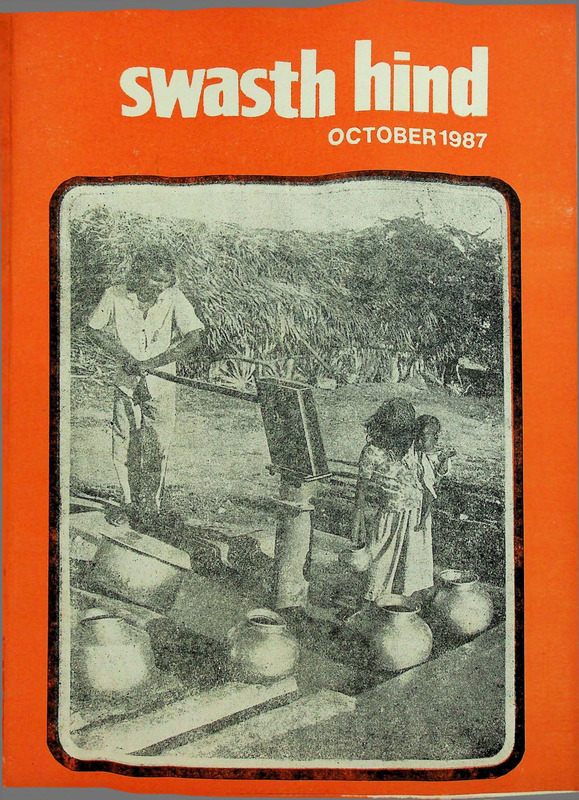
- Title
- WATER RELATED DISEASES
- extracted text
-
MS
^ws
iWWwwOw
Tn this Issue
swasth hind
Page
Water related diseases
I Dr (Smt.) Niharika A. Nath
226
Rural environmental intervention and
filariasis a study
Sushila Ndyar, M. P. Dwivedi and
A. M. Mehendale
230
Oral Cancer
—-a man-made disease
Dr P. K. Ray and B. S. Khangarot
234
Environmental radioactivity and health
Dr M. P. Jain &
Dr (Maj. Gen.) N. Lakshmipathi
237
Acute respiratory infection
Dr Shanti Ghosh
241
REPORT and interpret the policies; plans, pro
grammes and achievements of the Union Ministry
of Health and Family Welfare.
Gastroenteritis can be prevented
—everyone has a role
Dr S. R. Naik
243
ACT as a medium of exchange of information on
health activities of the Central and State Health
Organisations.
National Sexually Transmitted Diseases
Control Programme
Dr N. C. Bhargava
243
Environmental Sanitation
—a study in a village of Andhra Pradesh
Dr H. Audinarayana
248
National Workshop on Training in
Community Eye Health Education report
Dr S. Venkatesh
250
October 1987
Asavina-Kartika
Vol. XXXI, No. 10
Saka 1909
OBJECTIVES
Swasth Hind (Health)' India) is a monthly journal
published by the Central Health Education Bureau,
Directorate General of Health Services, Ministry of
Health and Family Welfare. Government of India,
New. Delhi.
Some of its important objectives and
aims are to :
FOCUS attention on the major public health
problems in India and to report on the latest trends
in public health.
KEEP in touch with health and welfare workers
and agencies in India and abroad.
I
REPORT on important seminars,
discussions, etc., on health topics.
conferences,
----------------
■ ■.—------------------------------------------------------------------ --------- ----------------- —
SUBSCRIPTION RATES
Single Copy .
Editorial and Business Offices
Central Health Education Bureau
(Directorate General of Health Services)
Kotla Marg, New Delhi-110 002
EDITOR
Sr. SUB-EDITORS
Rs. 6.00
Annual
(Postage Free)
Articles on Health topics are invited for publication in this
Journal.
N. G. Srivastava
State Health Directorates are requested to send reports of
their activities for publication.
M. L. Mehta
The Contents of this Journal are freely reproducible.
acknowledgement is requested.
M. S. Dhillon
COVER DESIGN
.50 Paige
B. S. Nagi
Due
The opinions expressed by the contributors are not neces
sarily those of the Government of India.
SWASTH HIND leserves the right to edit the articles sent
for publication.
OUR NEW PRESIDENT
Indian Parliamentary Delegation to the Commonwealth Par
liamentary Conference in New
*
Zealand.
Shri Venkataraman was also Secretary to the Congress
Parliamentary Party in 1953-1954.
Although
re-elected
to
Parliament in
1957,
Shri
Venkataraman resigned his seat in the Lok Sabha to join
the State Government of Madr'i? as a Minister. There Shri
Venkataraman held the portfolios of Industrie?, Labour,
Co-operation, Power, Transport and Commercial Taxes from
1957 to 1967.
During this time, he was also leader of the Upper House.
namely, the Madras Legislative Council.
Shri Venkataraman was appointed a Member of the Union
Planning Commission in 1967 and was entrusted (he subject
of Industry, Labour, Power, Transport. Communications,
Railways. He held that office until 1971.
Shri Ramaswami Venkataraman
Shri Ramaswami Venkataraman assumed office as the
eighth President of the Indian Republic on 25 July, 1987.
Shri Ramaswami Venkataraman was born on 4 December.
1910 in the village of Rajamadam, Thanjavur. District, Tamil
Nadu.
Shri
Venkataraman
married
Smt.
Janaki
Venkataraman in the year 1938. They have three daughters.
Educated locally and in the city of Madras, Shri
Venkataraman
obtained his Masters degree in Economics
from Madras University. Me later qualified in Law from the
Law College, Madras
*
Shri Venkataraman was enrolled in the High Court.
Madras in (935 and in the Supreme Court in 1951.
While practising Law. Shri Venkataraman was drawn into
the movement for India’s freedom from Britain’s colonial
subjugation. His active participation in the Indian National
Congress’s celebrated resistance to the British Government,
the 'Quit India Movement of 1942’. resulted in his detention
for two years under the British Government’s Defence of
India Rules.
Shri Vcnkataraman’s. interest in the law continued during
this period. In 1946. when the transfer of Power from British
to Indian hands was imminent, the Government of India in
cluded him in the panel of lawyers sent to Malaya and
Singapore to defend Indian nationals charged with offences
of collaboration during the Japanese occupation of those two
places.
In the years 1947 to 1950. Shri Venkataraman served as
Secretary of the Madras Provincial Bar Federation.
Shri Venkataraman acquired, early in his legal career, an
abiding interest in the law pertaining to labour. On lifts
release from prison in 1944. Shri Venkataraman took up the
organization of the Labour Section of the Tamil Nadu Con
gress Committee. He founded, in 1949. the. LABOUR LAW
JOURNAL which publishes important decisions pertaining to
labour and is an acknowledged specialist publication. Shri
Venkataraman came to be intimately associated with trade
*,
unions
including those for plantation workers, estate staff.
dock-workers, railway workers and working journalists. Shri
Venkataraman also took a direct and keen interest in the
conditions of agricultural workers in his home district of
Thanjavur.
Law and trade union activity led to Shri Vcnkataraman’s
increasing association with politics. He was elected, in 1950.
to free India’s* Provisional Parliament (1950-1952). and to
the First Parliament (1952-57). During his term of legislative
activity. Shri Venkataraman attended the 1952 session of the
Metal Trades Committee of the International Labour Orga
nization as a workers
*
delegate. He was a member of the
October 87
In 1971, Shri Venkataraman was elected to the Lok Sabha
from Madras (South) Constituency and served as an Oppo
sition Member of Parliament and Chairman of the Public
Accounts Committee.
In 1980, Shri Venkataraman w.'ss re-elected to the Lok
Sabha and wafe appointed Union Minister of Finance in the
Government headed by Smt. Indira Gandhi. He was later
appointed Union Minister of Defence.
Shri Venkataraman was also, variously, member of the
Political Affairs Committee and the Economic Affairs Com
mittee of the Union Cabinet: Governor. Internation :-I Mone
tary Fund, the International Bank for Reconstruction and
Development, and the Asian Development Bank.
Shri Venkataraman was a Delegate to (he United Nations
General Assembly in 1953. 1955. 1956, 1958. 1959, 1969 and
1961. He was Leader of (he Indian Delegation to the 42nd
Session of the International Labour Conference at Geneva
(1958) and represented India in the Inter-Parliamentary Con
ference in Vienna (1978)). He was a Member. United
Nations Administrative Tribunal from 1955 to 1979 and was
its President from 1968 to 1979.
Shri Venkataraman has visited all countries of West and
East Europe, the Soviet Union, U.S.A., Canada, South-East
Asia, Japan. Australia, New Zealand. Yugoslavia and Mauri
tius on official duties.
Shri Venkataraman has received the Doctorate of Law
(Honoris Causa) University of Madras, the Doctorate of Law
(Honoris Causa) Nagariuna University. He is an Honorary
Fellow, Madras Medical College: Doctor of Social Sciences.
University of Roorkce: Doctor of Law (Honoris Causa) Uni
versity of Burdwan. He has been awarded the Tamra Patra
for participation in (he freedom struggle: the Soviet Land
Prize for his travelogue on Shri K
* Knmarai’s visit to the
Socialist Countries. He its the recipient of a Souverir from
the Secretarv-General of the United Nations for distinguished
service as President of the U.N. Administrative Tribunal.
The (itle of “Sat Seva Ratna” has been conferred on him
by His Holiness the Sankarncharya of Kanchccpuram.
Shri Venkataraman was elected Vice-President of India in
August, 1984.
He was. simultaneously. Chairman of the Raisa Sabha
(Council of States), the Second Chamber of the Indian Parlia
ment.
Shri Venkataraman is Chairman of the Jury for the
Jawaharlal Nehru Award for Internationa! Understanding and
of the International Jurv for the Indira Gandhi Prize for
Peace, Disarmament and Development
*
He is Vice-Chairman of the Jawaharlal Nehru Memorial
Fund: Trustee. Indira Gandhi Memorial Trust: President,
Indian Institute
of
Public Administration: Chancellor.
Gandhiv.ram Rural Institute:
Chancellor. Delhi University:
Chancellor. Pan:ab University and President of the Indian
Council for Cultural Relations.
Shri R.. Venkataraman wc« elected to the Iv f est office
of the President of India on 16 Ji ly. 1987.
225
WATER RELATED DISEASES
Dr (Smt.) Niharika A. Nath
Resistance to the use of sanitary latrines by the people and resorting to indiscriminate use of
agricultural fields for defaecation are some of the practices which are conducive to the trans
mission of water-borne diseases. A complete socio-cultural change through creating awareness,
alongwith provision of sanitary measures will go a long way in reducing the incidence of
these diseases.
RESH, clean water is essential
to life. But poor sanitary practices
can transform water into an agent
of death. In developing countries,
water-borne diseases like cholera,
typhoid, diarrhoea and dysentery
kill thousands every day. Children
and infants are the most frequent
victims. Even when a source of
drinking water is safe, polluted sur
roundings and lack of hygiene may
contaminate water, causing disease
to spread.
F
health and well-being without safe
water supply.
A scientist may describe water as
a compound of hydrogen and oxy
gen. But its indispensability to phy
siological existence of all living
forms is undisputed. Water is net
only indispensable for physiological
activities, but it has its sociological
role related to various human acti
vities like bathing, washing, cooking,
cleaning, agriculture and industry.
When one refers to waler, in relation
In the past, sanitation was centred to health, it does not relate to its
on the sanitary disposal of human indispensability to life, but the
excreta. Even now, to many people, harmful effects on the health of peo
sanitation still means the construc ple that water can cause. These
tion qf latrines. In actual fact, the harmful effects on health are usually
term sanitation covers the whole referred to as “waler associated dis
field of controlling the environment eases”. Waler may contain living
with a view to prevent disease and organisms, excess of inorganic salts,
promote health. Much of the ill or intermediate hosts of certain dis
health in our country is largely due ease, and when consumed, acts as
to lack of safe drinking water. There a source of diseases. Stagnated water
can be no slate of community source also acts as breeding ground
226
for some mosquitoes, resulting in an
abundance of new generation of
disease producing vectors.
Water Scarcity
In places, where there is scarcity
of water, and it is not available in
quantity sufficient for bathing and
cleaning—diseases which may result
are also referred to as ‘water washed
diseases’ such as scabies, conjuncti
vitis etc.
The harmful effect of water on
health is attributed to the presence
of disease producing organisms in
water, excess or lack of certain ino
rganic salts and minerals, or due to
unhygienic practices associated with
use of water. Specific among these
diseases are ‘water borne disease',
which are defined as diseases that
are contacted when human being
becomes infected, as the water which
is drunk or otherwise used, contains
the pathogen in question, Common
Swasth Hind
source outbreak results most often
from faecal contamination of drink
ing waler or consumption of raw
vegetables cultivated by sewerage
contaminated water. Common pre
valent water associated diseases and
their classification is giveri in table
1.
Water Contamination and its effects
In India, where the rate of popu
lation growth is very high, the rate
of water contamination in the ab
sence of adequate sewerage system
is also very high. While the story
of almost complete eradication of
the classical water borne diseases
from many of the developed coun
tries is well known, these diseases
are still prevalent' in abundance in
India.
The problem of water contami
nation and its harmful effect on the
health of its people is not faced by
India alone. No country in the world
is satisfied with the present position
of safely of water used for drinking
purposes. Even the developed coun
tries are still developing. The demand
for water, both for domestic and
industrial use, is continually increas
ing, and even if the rate of increase
is as low as 4% per annum, the de
mand will double about every 20
years. This has several important
consequences.
First, even supposing that the pro
portion of water requiring purifica
tion before use does not increase,
it will be necessary to double water
treatment works every 20 years.
Secondly, the additional water will
become increasingly costly to obtain,
because the nearer and cheaper
sources have already been tapped.
Thirdly, contaminated waste water
will also increase in volume and ex
penditure on treatment plants will
October 1987
increase proportionately. Fourthly,
even if the rivers that receive the
resulting effluents remain the same
size, the amount of dilution available
to absorb the resulting contamina
tion, expressed as a ratio of river
flow to effluent flow, will progres
sively fall so that the degree of treat
ment provided must be correspon, dingly increased, at an additional
cost. Fifthly, the natural flow in the
rivers is not likely to remain as
large as it is now, because increas
ing quantities of water will be ab
stracted to provide for more domes
tic, agricultural and industrial de
mands. Still more efficient, effluent
treatment will be necessary to com
pensate for that.
Diarrhoeal diseases have long been
known to be associated with con
taminated waler, in which the causa
tive oragnisms of the disease are
transported and survive until they
enter the human host. Mortality rates
from these diseases vary from virtu
ally nil to 50 per 100,000 and the
gross inequalities are largely a re
flection of the adequacy of pollution
control of water used for drinking.
There are other diseases in the tran
smission of which contaminated
water plays a major role. Filariasis
is transmitted by the bite of an in
sect vector that breeds in polluted
water. Water contaminated by the
virus of infective hepatitis has been
responsible for major epidemics in
India.
Polluted water may also be the
cause of non-communicable diseases,
because they may contain toxic mate
rial of various kinds originating lar
gely in industrial wastes, although
domestic sewerage system may not
be entirely quiltless. The toxicology
of many new pollutants is not yet
well understood. But diseases like
xenobiotic toxicity and infant
Methacmoglobinaimia though rare,
are attributed to water polluted by
industrial waste.
Waste water
Large number of viruses of human
origin are normally found in both
sewage and waste water. Concentra
tions in waste water are also depen
*
dant
on the degree of treatment.
Most conventional treatment pro
cesses reduces concentration levels
but generally significant numbers of
viruses survive.
Drinking water
Sources of drinking water can be
heavily contaminated. It* has been
reported that not only rivers and
ponds but also well water contains
enteric viruses.
Epidemiological
studies have found the cause of
outbreaks of hepatitis A due to
contamination of streams and tube
wells in China. It was observed that
during the rainy season due to heavy
rains, cesspools overflowed and the
deep wells become contaminated with
sewage.
Ground water
The application of waste water
on to land, whether for agricultural
irrigation or as a method of treat
ment and disposal, poses the possi
ble risk of virus contamination of
ground water. The factors that in
fluence the movement of viruses in
soil have recently been evaluated.
The rate of application, the soil
composition and structure, and the
pH level, organic content and ionic
strength of the effluent are also re
levant.
PoEo viruses
Polio viruses group A and B are
different species of entero-viruses
227
S.
No;
Category/
Method
1
2
Transmission
3
:
Causative agent
4
Diseases
5
minated water supply and poor sani
tary practices and facilities.
Diarrhoeal diseases
The. incidence of diarrhoeal dis
eases is very high in India—specially
• (a) Bacterial
Cholera, Typhoid, Paratyphoid. amongst infants and children. It is
Bacillary Dysentery.
estimated that 1.5 million children
Infective Hepatitis, Poliomyelitis die every year due to diarrhoeal dis
(b) Viral
Infective diarrhoea of infants eases. In some of the countries as
(Echolcoxachic virus)
much as 40 per cent of mortality in
Amocbiasis
(c) Protozoa
children up to first year of life is
Giardiasis
related directly or indirectly to diar
(d)’ Helminthic
Ascariasis, Enterobizasis, Tri rhoeal diseases. Based on some
churiasis
longitudinal studies carried out in
Hydatid disease
Draconciasis (Guinea-worm)
different parts of our country, it has
been revealed that children up to
By drinking Agent is non-living Fluorosis
II. Non specific
Dental caries
five years of age may suffer from
water borne dist
Endemic goitre
about two episodes of diarrhoea per
scs
Cretinism
year, 10 per cent may suffer from
Plumbism
dehydration and 1 per cent require
Xenobiotic toxicity
hospitalisation.
Based on these stu
(water
containing industrial
waste).
dies, total number of 94 million
—infant methaemog-Iobinaimia children in the country up to five
—Dyspepsia, constipation,
years of age would have 188 million
diarrhoea.
episodes of diarrhoea, 18.8 million
Bacterial/viral infections of eyes,
HI. Water Associated Swimming Living Organism
would need dehydration and 1.8 mil
nose or skin
Bathing
disease
Waddling
Lepotspirosis
lion will require hospitalisation. Be
sides, 20 different pathogens may
Water
as
Parasites
Malaria
IV. Water Associated
Filaria
Breeding
be responsible for the cause of
disease
Dengue Fever
ground for
diarrhoeal diseases. Poverty, igno
mosquitoes
rance, low socio-economic condition,
Liver-fluke
V. Water Associated Intermediate (a) Snail
poor environmental sanitation, lack
host live in
(b) Fish
Fish tape worm
dis.ase
of safe water supply, all contribute
• (c) Plants
water
Large intestinal fluke
to diarrhoeal attacks. The disease
is perhaps most prevalent because
disseminated mainly through
the Viral. Hepatitis
of these factors. The morbidity and
faecal route. They can cause serious
The main route of transmission on mortality of the disease is more in
disease of the nervous system. Actu viral hepatitis A or infectious hepa under-nourished and malnourished
ally clin'cally manifest disease oc titis remains contaminated water. children.
curs only in between 1 in 100 cases The total number of cases in India
of infection. In a recent telecast by range from 1.4 lakhs to 1.8 lakhs, Enteric fever (Salmonellosis)
The enteric group of fevers are
BBC, it was mentioned that the maxi every year. Most of the cases from
mum cases of poliomyelitis in the rural area go unreported as rural caused by four organisms: Salmo
world occurred in India. The other population resorts to home remedy nella typhi (S-Typosa), Salmonella
entero viruses can also cause nervous in this particular disease and usually paratyphi A, B, and C. Although en
system disease, usually of a transi do not seek medical help. The teric fever is world wide in distri
ent nature (aseptic meningitis), but disease is characterised by high inci bution, it is particularly prevalent in
on occasion clinically similar to dence with intermittent outbreak- tropical and developing countries,
paralytic poliomyelitis.
and is solely attributed to conta India being one of them. Carrier of
]. Specific waler
borne diseases.
228
By drinking
Living organisms
such as:
Swasth Hind
these organisms are the commonest
source of infection to the community
till there is an efficient water carriage
system of sewage disposal and safe
drinking water supply. S. Typhi
spreads mainly through water. The
total reported cases of enteric fever
in India range from 2.5 lakhs in
1979 to 3.5 lakhs in 1983.
Helminthic diseases
Common helminthic disease asso
ciated with unsafe water supply are
Ascariasis. Enterobiasis, Trichuriasis,
Hydated disease (rare) and Dracontiasis. Except dracontiasis, the
other helminthic diseases are trans
mitted when soil containing their
eggs due to open field daefecation
practices, contaminates the water
source—of these, ascariasis is the
most prevalent disease, especially
amongst the pre-school and school
going children.
Dracontiasis or Guinea worm
Prevalent in six endemic States
of India, namely, Andhra Pradesh,
Gujarat, Karnataka, Madhya Pra
desh, Maharashtra and Rajasthan,
the disease is confined to villages
where tanks, ponds or step wells are
the main source of drinking water.
The disease is entirely rural in its
distribution and thus affects the
poor rural communities. It is esti
mated that 8.1 million people spread
over 9,300 villages in 77 districts
amongst the six endemic States in
October 1987
India are affected by this problem. where the disease is prevalent on a
A guineaworm eradication pro large-scale. It is estimated that the
gramme has been launched by the total number of people afflicted with
Government of India Since 1979.
skeletal and dental fluorosis in India
are approximately 20 million. Pro
Endemic Goitre
viding defluoridated water is the
only way by which the disease can
Deficiency of iodine in water leads
be totally prevented.
to goitre. When goitre occurs in
significant number of people in de
The water and sanitation related
fined geographical area, it is known
diseases are sometimes referred to
as endemic goitre. In India, preva
as intestinal or filth diseases, be
lence of endemic goitre had reach
cause they are frequently transmitted
ed a stage that it became a public
by food or water contaminated with
health problem and government of
faeces. Even in areas where adequate
India had launched a National Goi
sanitary measures are provided, dis
tre Control Programme in 1982.
eases still occur due to socio-cultu
India also has the World’s biggest
ral practices inherent amongst the
‘goitre belt’ in the sub-Himalayan
people. The cultural stimuli which
region extending from Ladakh,
is passed from parents to off-springs,
Jammu and Kashmir in the West,
acts both ways. Some practices are
passing through Himachal Pradesh,
conducive in transmission of dise
Uttar Pradesh, Bihar, Bengal, Sikkim
to the north eastern States. Isolated ases, while other practices may help
pockets have also been identified in in prevention of these diseases.
Common outbreaks are seen during
Maharashtra, Madhya Pradesh and
fairs and festivals, where due to
Kerala. The average prevalence lack of hygienic practices, many
rate in these areas is 40 per cent.
people fall victim to diarrhoeal dis
Fluorosis
Fluorosis is caused by ingesting
excessive amounts of fluoride through
drinking water. It is a serious public
health problem in rural areas of
our country. The disease, for which
there is no specific treatment, can
be prevented. There are ten States
in India, namely, Andhra Pradesh,
Tamil Nadu, Uttar Pradesh, Punjab,
Haryana, Madhya Pradesh, Rajas
than, Karnataka, Delhi and Gujarat'
eases. Resistance to use a sanitary
latrine by the people and resorting
to indiscriminate use of agricultural
field for defaecation are some of the
practices which are conducive to
transmission of enteric diseases.
A complete socio-cultural change
brought in through creating aware
ness, along with provision of sani
tary measures will go a long way
in reducing the incidence of these
diseases in the country.
229
RURAL ENVIRONMENTAL
INTERVENTION AND FILARIASIS
—a study
Sushjla Nayar,
M. P. Dwivedi and A. M. Mehendale
Man's actions in creating vector breeding sites have been noted and discussed frequently in the
filariasis literature. In the present study it was found that the intervention had been directed
to make the village, environment cleaner by collecting the house drainage in a pit, instead of
its being drained in the village lanes. This man-made intervention technology aimed at
improving the environment has favoured the mosquito-breeding and led to heavy endemicity
of filarial infection.
is mainly an urban
health problem and is spread
ing fast due to industrialization
and unplanned urbanization. Cen
trifugal
distribution of filarial
endemicity being more in the
urban as compared to the rural
areas has been reported by Pa war
and Mittal (1967). But the available
data of filaria survey of Wardha dis
trict (1985) shows the situation to
be just the reverse.
ilariasis
F
A survey of village Peth near
Anji Primary Health Centre, Dis
trict Wardha, Maharashtra, .was
carried out to sutdy factors res
ponsible for higher prevalence of
filariasis in villages as compared
230
to towns in Wardha district (Re
port on Filaria, District Wardha,
1985).
While going round the village a
striking observation was made that
quite a number of houses were
having a pit in which the house
drainage was, regularly collected.
On detailed
examination it was
found that in some houses a ‘Ranjan’ (baked earthen vessel) was
placed inside the pit for the col
lection of water.
This backed
earthen vessel is permanently fixed
in the pit and cannot be taken
out
for emptying the collection
of the household drainage. These
pits and ‘Ranjan’ were full of
water and there were a number
of larvae of Culex fatigans.
The study included the collec
tion of data on prevalence of fi
lariasis and the role of rural en
vironment for maintaining the dis
ease at its high prevalence. The
survey
was undertaken in
the
month of May/June when the
transmission of
the disease was
expected to be low. An interim
report has been prepared
while
the work was being further ex
tended to study the role of inter
vention of environment in detail.
MATERIAL AND METHODS
Peth is a village 2 km away
from Anji PHC in Dist. Wardha,
Swasth Hind
Maharashtra.
This was selected
for the survey because of the vil
lagers’ ready co-operation for the
survey. The population was enu
merated by a team of interns and
the staff of the Department of
Community Medicine, Mahatma
Gandhi Institute of Medical Scien
ces, Sevagram District Wardha,
Maharashtra,
in the month
of
May and June, 1985. Number
ing of the houses was done and
the survey was carried out through
house to house visits. The various
socio-demographic details such as
name, age and sex, etc., of each
individual
were recorded.
As
many individuals as possible were
examined for the
manifestations
of filariasis.
October/November, 1985. While
going for search of possible breed
ing places of mosquitoes, it was
discovered that there was an estab
lished community practice in the
village of collecting household
drainage in a big baked earthen
vessel which is placed in a pit just
outside the house.
This baked
earthen vessel is known as ‘Ranjan’.
Mosquitoes were collected
from fixed stations, i.e. house with
‘Ranjan’/pit for waste water, house
without ‘Ranjan’/pit for waste
water and directly from the ‘Ran
jan’/pit itself. Identification of
species was done and female culex
mosquitoes were dissected and ex
amined for the presence of diffe
rent stages of development of the
larvae.
A total of 570 persons living in 115
families from the village
Pcth
were surveyed in this study. On
clinical examination of 520 persons
out of the surveyed population, 47
showed clinical manifestations of
filariasis giving a disease rate of
9.04% in examined population.
Night blood examination of 380
(73.07%) persons for Mf was car
ried out, of which 132 were found
positive for microfilariae in their
blood showing an infection rate
of 34.73%. Three persons were
found having infection as well as
disease. Thus it can be seen that
a total of 176 persons were affect
ed with filariasis, giving the fila
rial endemicity rate of 33.84% in
examined population.
In the night, from 8 P.M. till
12 midnight blood slides were col
RESULTS
lected for detection of Microfi
The observations are presented
laria (Mf) in blood smears. This
was done by the active participation under two main headings :
of final year M.B.B.S. students,
(a) Parasitological observations:
interns and staff of the Depart
(b) Environmental observations.
ment of Community
Medicine
posted at Kasturba Rural Health
(a) Parasitological observations:
Training Centre under Reorienta
TABLE-I
tion of Medical Education (ROME)
Project at Anji. Three drops of
iistribution of population surveyed for
nfcction, disease and endemicity rate.
blood were taken by a bold prick
on terminal phalanx of left ring
finger, on a clean glass slide and
1. No. of families surveyed
115
thick smear was made. The peri
2. Total population surveyed
570
pheral smears were dried, dehae3. No. examined for clinical
manifestations of filariasis
520
moglobinized and stained with
4. No. found with the disease
47
JSB-I. These were examined for
the presence, type of microfilariae
5. Filaria Disease rate (%)
9.04
and their count per 20 emm of
6. Population examined for
Mf in night blood
380
blood.
Study of tlie mosquito breeding
places was also carried out simul
taneously.
All minor and major
breeding places were located. Mos
quito collection was done twice
in the months of May/June and
October 1987
TABLE-I I
Intensity of microfilarial infestation.
No. of micro
filariae
No. of Percentage
Smears
1— 2
5
3.79
3—5
38
28.79
6—10
40
30.30
11—20
38
28.79
6.82
21—50
51—100
Total
2
11.5
132
100.00
It will be seen from Table-II
that more than 60% positive slides
showed less than 10 Mf in approxi
mately 20 mm3 of blood. Only
2 (1.51%) positive slides had high
7. No. found 4-ve for Mf
132 parasite count whereas 38 (28.79%)
34-73 smears were in the grade of 11
8. Infection rate (%)
9. Total affected
*
176
to 20 and 9 (6.82%) were having
infestation of 21 to 50 parasites
10. Filarial endemicity rate (%)
in examined population
33.84
per slide (20 mm3).
The lowest
count was 1 per slide and highest
♦3 persons were found positive for Mf
count was 84 per slide.
alongwith clinical manifestations.
231
(b) Environmental observation:
TABLE —III
Distribution or filariasis in relation to reservoir for waste water (’Ranjan’/pit).
Reservoir
(‘Ranjan’/pit)
Families
—
*
Population
Affected
Surveyed
all man hour density, infection
rate and infectivity rates were ob
served as 14.05, 3.95% and 1.18%
respectively during the present
study.
Search for possible breeding pla
ces of culicine mosquito was made.
There were five public wells and
%
three tube wells. It was fouhd
46.4 that the surrounding of the wells
did not have sufficient waterlogg
26.51 ing for mosquito breeding.
The
mosquito breeding was largely ob
served in ‘Ranjan’/pits which were
30.87 used by the community for collection of house drainage.
Affected
Surveyed
No.
%
No.
%
No.
%
No.
Having ‘Ranjan’/pit
25
21.74
23
92.00
125
21.93
58
Not having ‘Ranjan’/
pit
90
78.26
61
67.78
445
78-07
JIS
Total
115
100.00
84
73.04
570
100.00
176
•X,®17.9
df=l
It was observed that 25 (21.74%)
families were having ‘Ranjan’/pit
for collection of house drain,
whereas 90 (78.26%) families did
not have ‘Ranjan’/pit for collec
tion of house drain. The distribu
tion of affected population was
58 (46.4%) living in houses having
‘Ranjan’/pit for collection of house
drain and 118 (26.51%) living in
houses having nd such method for
collection for house drain. It may be
noted that fliariasis has been signi
ficantly high among the inmates of
houses having ‘Ranjan’/pit for col
lection of house drain; than among
those who did not use this method.
P<.001
DISCUSSION AND COMMENTS
The results of hits pilot study of
village Peth indicate that the infec
tion rate was 34.73%; disease rate
was 9.04% and endemicity rate was
33.84%. These rates when com
pared with the urban area of Dis
trict, Wardha were very high, thelatter rates being 4.54%, 1.07% and
5.61% respectively (Filaria Survey
Report of District, Wardha, 1985).
TABLE—IV
While finding out the intensity of
microfilarial infestation it has been
,, [£*> 90
observed that 40 (30.3%) smears
Place of mosquito collection
1 Period of Man hour Infection Infectivity
rate
(%)
rate (%)
were having 6—10 Mf per slide
collection density
(in hours)
and 38 (28.79%) were having
counts between 3—5 and 11—20
1. House with‘Ranjan’/pit
2.10 per 20 mm3 each. Only 2 (1.51%)
.
6
5'26
15.83
smears showed 51—100 Mf per
2.73
2. House without ‘Ranjan’/pit •
6
12.16
20 mm3 of blood and none was
3. From ‘Ranjan’/pit
. • .
6
3.52
1.17 found having more than 100 Mf
14.16
Park (1961) observed highest per
Total . ? .
1.18 centage of smears having 3—5
18
3.95
14.05
Mf and only
7 (1.6%) having
100—200 Mfpe r 20 mm3 of blood.
From table IV it may be seen ‘Ranjan’/pit, to 14.16 from ‘Ranthat three catching areas were fixed jan’pit itself. The infection and
The study of mosquito breeding
and the collection of mosquitoes infectivity rates were 5.26% and places was carried out in this
was carried out for six hours in 2.10% in house with ‘Ranjan’/pit, village. There were five public
but
each area. The man hour density va 2.73% and nil in house without wells and three tube wells
stagnant waler
ried from 15.83 in house xyith ‘Ran ‘Ranjan’/pit and 3.52% and 1.17% there was no
jan’/pit, 12.16 in house
without from ‘Ranjan’/pit itself. The over- round about these wells. Whatever
Man hour density and filarial infection rate among vector mosquitoes in all catching stations.
232
Swasth Hind
small
amount of water
did
collect near these had dried up
during the month of May.
A
very small pacca open drain did
not show the larvae of Culicine
mosquitoes.
While going round the village, a
striking observation was made that
quite a
number of houses were
having a pit in which the house
drainage was regularly collected.
On further detailed examination it
was found that in some houses a
‘Ranjan’ (baked earthen vessel) was
placed inside the pit for the collec
tion of water. This baked earthen
vessel is permanently fixed in the
pit and cannot be taken out for
emptying the collection of the
household
drainage. These pits
and ‘Ranjan’ were full of water and
there were a number of larvae of
Cul^x fatigans. This indicates that
even during the period of summer
these ‘Ranjan’ were acting as per
manent breeding places for the mos
quitoes.
The study also indicates that there
is a definite association of higher
prevalence
of filaria infection
(46.4%)
among the inmates of
the houses which were using the
‘Ranjan’/pit for collection of house
drainages against the infection rate
of 26.51% among these not using
‘Ranjan’ for collection of house
drainage.
Profile in Courage
NATION HONOURS A LEPROSY I
CURED FARMER
H. Nanjaiah is a class by himself.
Of all the proud recipients of the
National Award for the Welfare of
Handicapped, 1987, he has the dis
tinction of being the only agricul
turist. Though totally illiterate he
not only fought the ravages of lep
rosy, but also established himself on
his two acre plot of land and is
today a proud head of the family
comprising of his wife and three
children.
Born in 1936 and a resident of
village Vansagere in Tumkur dis
trict of Karnataka, Nanjaiah fell a
victim of leprosy when he was 34
years old. Though he is fullycured, the disease has left his both
hands deformed. Despite this mis
fortune, Nanjaiah did not lose hope
and continued farming, in which
he had been helping his parents ever
since he was
10 years old. He
proudly maintains that he can him
environment cleaner by collecting
the house drainage in a pit or spe
cially devised ‘Ranjan’, instead of
it being drained in the village
lanes.
This man made interven
tion technology aimed at improv
ing the environment has favoured
the mosquito breeding and led to
heavy endemicity of filarial infec
Man’s actions in creating vec tion.
tor breeding sites have been noted
and discussed frequently in
the
filariasis literature,
but virtually
In view of the above findings,
no systematic studies of these forms attempts are being made to reduce
of behaviour have been under the filaria problem by changing the
taken1. In the present study it was community
practice of having
found that the intervention had ‘Ranjan’/pit to the use of a soak
been directed to make the village age pit.
October 1987
self plough his field and do all the
work there.
He has not only displayed capa
bility for hard work, but has also
shown his sagacity. Division in the
family had left him with a plot of
two acres only, which being insuffi
cient for the livelihood of a whole
family, he applied and got a loan
from the bank for increasing his
agricultural production and the in
come of his family. He has also
procured two cows,
which also
add to the income of the family.
The result is that Nanjaiah today
with his wife and three children is I
leading a happy life.
Thanks to his qualities of head
and heart that with all the odds
against him he could claim national
recognition by being honoured with
the most coveted award a disabled
could expect—PIB.
REFERENCES
1.
2.
3.
4.
DUNN, F.L. Behavioural aspects of
the control of parasitic diseases. Bul
letin of the World Health Organi
zation, 57 (4): 499-512 (1979).
Filaria Survey Report of Wardha
District. Filaria Survey Unit. Nag
pur (1985).
MISHRA, S.S. & DW1VEDI, M.P.
An Epidemiological Study of Fila
riasis in Rewa Town (M.P.). Indian
Journal of Public Health. 23(1'): 7-16
(1979).
Operational Manual: National Fila
riasis Control Programme. National
Institute of Communicable Diseases.
New Delhi (1978).
5. PARK, J.E.
Filariasis
in Rewa
Division. Indian Journal of Public
Health. 4: 114-121 (1961).
6. PAW AR, R.G. & MITTAL, M.C.
Filariasis in Jamnagar. Indian Jour
nal of Medical Research. 56: 370376 (1967).
O
233
ORAL CANCER
—A MAN-MADE DISEASE
Dr P. K. Ray and B. S. Khangarot
It is a fact that there is a high correlation between tobacco chewing habit and incidence of oral
cancer.
Public health education programmes can encourage individuals, especially school
children, not to adopt any tobacco habits.
is fast becoming a third
world concern. The global
number of new cancer patients is
about 5.9 million, of which more
than 3 million are in the develop
ing countries. The cancers that
chiefly affect the third world coun
tries are those of cancer of the
uterine cervix, oral cancer, oesophaglal cancer and liver cancer. The
world Health Organization (WHO)
experts warned that oral cancer
might become an epidemic in SouthEast Asia, unless the current trends
of cigarette smoking and tobacco
chewing habits are slowed down or
reversed.
ancer
C
Tobacco chewing: a social habit
Oral cancer includes the cancers
of the oral cavity and vermillion
234
border of lip. It is one of the JO
most common cancers in the world.
In Bangladesh, India, Pakistan and
Sri Lanka, it is the most common
cancer type and accounts for about
a one-third of all cancers. More
than 1,00,000 new cases are detect
ed every year in South and SouthEast Asia, with very poor prospects
of survival. As early as 1902, at
tention was drawn to a possible rela
tionship between the tobacco-chew
ing and oral cancer in India. Oral
cancer incidence has reached at
the highest rate among peoples of
South and Sohth-East Asia where
the habits of smoking and chewing
of tobacco are common. The most
common form of tobacco chewing
is the betel quid (paan), which
usually consists of the leaf vine
(piper betie), arecanut, lime and
tobacco. The composition and
method of use of quid and other
forms of tobacco vary from Slate
to State in India. Flakes of dried
tobacco are usually
mixed with
sliced dried nut and lime, the whole
being wrapped in a betel leaf on
which catechu, an extract of the
heartwood of the Acacia catechu
is smeared. Spices such as carda
mom, cloves, etc., are sometimes
added for flavour and taste.
Chewing tobacco in betel quid is
a social habit and also a personal
habit. It is a way of making friends
Swasth Hind
pes virus 1, Candida infection and
and killing time. Betel shops em- . Risk factor
poor
oral hygiene may also increase
ploy millions of people in India,
It is a fact that there is a high
the risk of oral cancer.
especially in Uttar Pradesh, Bihar,
correlation between tobacco chewing
Delhi and West Bengal. Cigarette,
habits and incidence of oral cancer.
quid betel and pan masala are con
(a) Numerous studies indicate that Educational versus legislational pro
sumed throughout the country.
grammes: Cancer prevention
cases of oral cancer occur in persons
Shops are often located in desert
who use tobacco and (b) people who
areas, slums, cinema bouses, bus
Public Health
Education Pro
chew tobacco have high risk of de
stands, railway stations, clegent
grammes can encourage individuals,
veloping oral cancer. It has been
nightclubs,, sea beaches, rivers, jun
especially school children, not to
observed that the cancers almost al
gles and at almost every place where
adopt any tobacco habits. People
ways occurred on the side of the
men live.
should be encouraged to rinse their
mouth where tobacco quid betel was
mouth after chewing tobacco and
used to be kept.
Statistics show that for the past
not to retain the quid in mouth dur
few years, there has been an alarm
It is hard to give exact number ing sleep. Health education pro
ing increase in the incidence of oral of tobacco chewers in India or in grammes should combine various
cancer in India especially in Uttar South-East Asia because information .techniques, such as person to per
Pradesh, Bihar and West Bengal. is abundant in some places and num son
communications.
person to
Tobacco chewing might be one of bers keep changing. Approximately group communication, radio and TV
the responsible factors. WHO stu 90% of oral cancer in South and talks, through films, newspapers,
dies and epidemiological surveys sug South-East Asia can be correlated magazines, posters, etc. The best
gest that one single major health to habit of tobacco chewing and way to stop oral cancer is not by
hazard related to tobacco-chewing smoking. Tobacco chewing and surgery or by medicines but by edu
is die oral cancer. Tobacco leaves smoking increase the risk of oral cation and prevention.
and cigarette advertisements play an cancer. In such cases the risk of
important role in marketing and developing oral
cancer is about
Tobacco chewing and smoking
publicising tobacco chewing and 10-20 times more than in people may be stopped or at least reduced
smoking. Tobacco making compa who neither chew nor smoke to to certain extent by legislation or
nies spend millions of rupees trying bacco.
health education. There should be
to link chewing habits with higher
statutory warning on each tobacco
life-style.
There is some evidence that risk product packet used for chewing or
Other popular forms of tobacco
consumption are also equally potent
causes of oral cancer. These include
the use of ‘Nass’ or ‘Nasswar’ in
which a mixture of tobacco, ash and
lime with oil or water is used. It
is inserted into the mouth cavity in
small amounts and after a while it
is spat out. The smoking of bidi
and cigarette are also responsible for
this dreaded disease.
I
October 1987
of oral cancer is increased in people smoking including ‘bidi’. Warning
who use tobacco in quid betel and should be phrased more strongly
also use alcohol. High concentra like “Tobacco chewing causes oral
tions of alcohol can develop oral cancer”, “cigarette or bidi smoking
cancer. Other evidences indicate causes cancer”.- Advertising of to
that the incidence of oral cancer is bacco products in newspapers, popu
high in people who chew quids even lar magazines and films may be reswithout tobacco,
compared with • tricted. There should be restriction
people who do not chew quids at on smoking of tobacco products in
all. Other factors, such as malnu enclosed public places such as hos
trition, immunological, disorders, pitals, theatres, colleges or univer
infection with human (alpha) her sity canteens, restaurants and places
235
of business. This is because pas
*
sive smoking by inhalation only is
also injurious to even a non-smoker.
with simple inexpensive treatment,
and resulting in long-term survival
of patient.
All cancers are characterized by
uncontrolld growth of cells. Cells
multiply in
In our country, millions of people naturally grow and
live on poor diet, facing malmi- healthy body, but this normal cell
tritional disorders. It is surely not growth is controlled by a complex
justifiable to devote good agricul mechanism. Cancers occur when
tural land to growing tobacco. the normal controls break down.
Smoking and chewing of tobacco is Cancer cell growth can be stopped
a big health problem and is one by radiation and chemotherapeutic
that concern all of us. It is high methods, which are often crude,
time that we should stop use of painful and expensive. These treat
tobacco cither in the form of smo ments destroy cancer cells as well as
the healthy normal cells and pro
king or chewing.
duce a lot of side effects. Exten
sive side effects may even lead
to patients’ death. Thus, we need
better treatment for cancer patients
with toxicity only for target can
Early detection
If tobacco is put into the oral cer cells in preference to healthy
cavity, it assaults the delicate tissues normal cells.
of the mouth. Oral cancer is pre
ceded in almost all cases by precancerous lesions like leukoplakia
and erythroplakia, and occasionally Newer approaches to control of
cancer
by other conditions, such as sub
mucous fibrosis. Among the preIn the early 70’s researchers at
cancefous conditions,
submucous
the
University of Southern Califor
fibrosis is of great interest in the
South-East Asian countries, most nia, performed a landmark experi
likely because of extensive habit ment as they were able lo identify
of chewing tobacco. Clinically, it
is characterized by the appearance genes which have the potential for
of fibrous bands of the oral mu causing cancer. This discovery op
cosa. There is an .epithelium da ened the door to new forms of treat
mage which makes it more vulne ment. It is possible to turn off the
rable to actions of carcinogens pre
sent in tobacco chewing. The im cancer gene or even to repair it.
portance of oral cancer as a pub But in this form of treatment, the
lic health priority is underscored problem of selectivity comes up.
by the fact that the suffering, disfi
The problem remains unsolved till
gurement, and death it causes need
not occur. The detection of oral today and needs further research
cancer at an early stage is possible on this crucial subject.
236
Another promising approach to
stop cancer cells growth is immu
notherapy, the secret of which lies
within our own body. In this pro
cess, body’s immune system is
boosted against cancer. Our im
mune system is made up of cells
that protect body, destroying foreign
agents such as virus, bacteria and
other pathogens. It has selectivity
and can recognise invaders carry
ing molecules called antigens. Thus,
immune cells can spot under cer
tain situation the cancer cells and
can destroy them. However, if .the
number of cancer cells outnumber
the immunologically committed cells,
cancer cells continue to grow, in
crease in number, invade the nor
mal tissues and interfere in its func
tions and eventually kill the host.
Cancer in a major way is a pre
ventable disease, since most of them
are environmentally linked, or oc
cupationally connected on ‘habituals’.
With suitable measures it should,
therefore, be preventable.
Further Reading
1.
Hirayama T. Bulletin of the World
Health Organization, 34, (1966), 41.
2.
Pindborg, J.J- Oral Cancer and Pre-.
cancer. Bristol, John Wright (1980).
3.
Holnistrup, P. and Bcssermann, M.
Oral Surgery, 56 (1983), 388-
4.
WHO Technical Report Series No.
695. Smoking Control Strategies in
Developing Countries. Report of a
WHO Expert Committee (1983).
5.
WHO Report. Control' of Oral Can
cer in Developing Countries—A WHO
Meeting. Bulletin of the World
Health Organization, 62 (1984), 817.
6.
Ray, P.K. Advances in Immunity and
Cancer Therapy. Springer Verlag,
New York (1985).
Q
Swasth Hind
ENVIRONMENTAL RADIOACTIVITY
AND
HEALTH
Dr M. P. Jain and Dr (Maj. Gen) N. Lakshmipathi
Theman]is being continuously exposed to the ionising radiations present’fin the environment
as well as due to the use of radiation sources in various fields such as medicine, industry, power
production, agriculture and research etc.
There is large variation in exposure levels and the
exposure level at any particular place, depends upon its location, type of building
used for the construction of the house, etc.
material
The radiation exposure levels due to natural causes
range from 1000 p.Sv to 4000 p,Sv per year in most parts of the world.
On the basis of epide
miological surveys carried-out by. several expert bodies, no harmful effects could be observed
amongst the individuals exposed at these levels.
A yf ankind
has been exposed
to the ionising radiations ever
since its inception because of the
presence of primordial radionu
clides such as thorium-232, uranium-228 alongwith other stable
isotopes from the time of forma
tion of the earth about 5000 mil
lion years ago.
Uranium and
thorium got widely dispersed in
the earth’s crust in low concentra
tions and existed in the environ
October 1987
ment alongwith their decay pro
ducts at the time of evolution
of man on this earth about two
million years ago. A few radio
nuclides existed in trace amounts
alongwith their stable isotopes
such as potassium-40 (a radionu
clide) in natural potassium. In the
initial periods man was exposed
to the radioactivity present in air.
earth’s crust, water and also posses
sed some radioactivity inside his
body due to consumption of food
and water. In addition, a certain
amount of exposure came from
outer space. In due course of time
as man became civilised and started
living in houses, one more source
of radiation exposure, ie, due to
the presence of radioactivity in
side the building materials (and
also due to accummulation of radon
gas inside the building) was added.
Thus, man continued
receiving
237
radiation exposure from the above cles, including muons, neutrons,
mentioned natural sources of ionis gamma rays and high energy elec
ing radiations without knowing trons. These secondary particles
their characteristics till the. fag end penetrate through the atmosphere
of the nineteenth century.
to the earth. As the atmosphere
provides shielding against the pene
Immediately after the discoveries
tration of these radiations to earth,
of X-rays by W.C. Roentgen in
the intensity of cosmic rays depends
1895 and Radioactivity by Henri
on the location of the place, viz., on
Becquerel in 1896 followed by the
its altitude and to a lesser extent
identification of some of the na
on latitude. It is minimum at the
turally ' occurring
radionuclides,
equator and sea level, and increases
viz., radium-226,
polonium-210,
with the increase in altitude and
the ionising radiation sources found
latitude. The intensity at a height
their applications in medicine and
of 6000 meters is about ten times
industry. The radiation
hazards
that of at sea level. The effect of
associated with the use of such
latitude is comparatively much less
sources were • manifested amongst
and is to the order of 10 per cent.
the users in the early, period and
At the sea level, the average annual
this led to ,the development of the
dose due to cosmic radiation is of
discipline -of Radioation Protection
the order of 250 /xSv to 300 /xSv.
and Health Physics in order to safe
The cosmic ray dose increase by 20
guard. against the harmful effects
/x Sv per year due to an increase in
while handling such sources. The
height by 300 meters near sea level.
beginning of the second half of
The passengers and the crew receive
the present century witnessed the
higher amounts of radiation expo
use of ‘ionising
radiations al
sure due to cosmic radiation (in
most in every field (after the avail
comparison to that of at sea level)
ability of artificially produced ra
at altitude used for intercontinental
dioisotopes), viz., medicine, industry,
travel. It is estimated that London
agriculture, research’ power produc
to New York trip by air involves a
tion, etc.
cosmic rays dose of 36 /xSv and the
Astronauts who made the first land
Exposure due to radiation to ’extra
ing on moon received 3600 /xSv
terrestrial origin (Cosmogenic
during their 200 hours journey from
Radiation).
earth to moon and back.
The cosmic radiation originates
due to the interaction of high energy
particles (high energy protons) from Exposure due to radiative substan
ces within the body.
outer space (cosmic rays) with atoms
of oxygen and nitrogen present in
This source of exposure is present
the outer atmosphere, resulting to inside the human body (mainly
produce showers of secondary parti potassium-40 and carbon-14) itself
238
due to the presence of a large num
ber of radioactive substances taken
inside the body through food and
water. Out of all, potassium-40 is
responsible to deliver maximum
dose. Potassium is an essential
constituent of body cells and is uni
formly mixed in the body. Potas
sium-40 occurs to the extent of
0.012 per cent in natural potassium.
The amount of potassium in the
body is of the order of about 2
grams per kilogram weight. The
average whole body activity is 3700
Bq each for potassium-40 and car
bon-14- The dose due to potassium40 is in the range from 150 /x Sv
to 270 /x Sv per year and due to
carbon-14 in the range from 5 /x Sv
to 22 /x Sv. Much smaller doses of
whole body radiation are delivered
from. rubidium-87.
Apart from
radon inhalation (which is respon
sible to deliver very large doses and
is discussed in detail separately) the
decay products' of primordial radio
nuclides mainly from polonium-210
and radium-226 irradiate selectively
the lung and bone cells tissues and
deliver an average effective dose of
160/x Sv per year.
Doses from
vity. .
terrestrial
radioacti
j
Exposure to population from the
terrestrial radiations are due to the
presence of primordial radionuclides
mainly uranium-238 (with its decay
products radium and other nuclides);
thorium-232 (with its decay pro
ducts) and potassium-40 in the soil
and rocks. The doses due to terres-
Swasth Hind
The beginning of the second half of the present century witnessed the use of ionising radiations almost in every field9
viz., medicine, industry, agriculture, research, power production, etc.
trial radiations arc mainly due to
gamma rays. The exposure due to
terrestrial radiation at sea is negli
gible because of minimal concentra
tion of these radionuclides in the
ocean.
The dose received by a
person from terrestrial radiation de
pends on the geology of the locality
and the type of dwelling. In brick
houses the dose is likely to be 500
P Sv more in a year as compared to
phate rocks (about 200 times more
in comparison to common rocks).
The radioactivity may thus be high
locally in the following cases:
(1) Due to the presence of rocks of
igneous origin and particularly
granites or due to the soil derived
from weathering of such rocks;
(2) Due to the accumulation of the
materials released from such rocks.
This applied in particularly to cer
the dose received in open or in a tain minerals such as monazite or
wood house. The concentration of zircon which occurs as dense, mecha
uranium-238 and thorium-232 varies nically resistant particles in high
by a factor of ten in common rocks insoluble form, and which may be
and is much higher in some phos washed ashore as coastal sands deri
October 1987
ved from the weathering of offshore
rock. Stretches of monazite sands
occur in several parts of the world.
The outdoor annual gamma radia
tion dose rates in towns of Esperito
Santo and Rio de Jeneiro provinces
of Brazil, range from 1500 p Sv to
7000 p Sv. In Kerala and Tamil
Nadu States of India the average
dose received by the people residing
on a narrow coastal strip having
monazite with thorium content of 8
to 10 per cent is of the order of
4000 p Sv per year. It is estimated.
that out of the total world's popula
tion, about -95 per cent receive
239
annual dose due to terrestrial radia this area an effective dose equivalent bodies such as 1CRP,
BEIR,
tion between 210 /x Sv and 430 to about 11.7 Sv per year.
UNSCEAR, for the last several de
/x Sv.
cades and are well understood in
Population exposure due to the use’ comparison to those of many other
physical or chemical environment.
of ionising radiation sources.
Doses from radon inside Dwellings.
A very large dose of .5 to 10 sieverts
Ionising radiation sources found causes death and injury within a few
(heir use in diagnostic and thera weeks. But, however, there is no
This type of exposure results peutic applications in the field of
direct epidemiological evidence that
from inhalation of two of the iso medicine and to a smaller extent in
exposure at low levels
*
of radiation
topes of radon namely radon-222 industrial applications immediately
such as due to natural background
and radon-220. Both are in the after the discoveries of X-rays and
radiation levels, causes harm to
gaseous forms and- are present in naturally occurring radionuclides
man. As per estimates the life time
the air inside dwellings in higher such as
uranium, radium and risk for natural incidence of cancer
concentration (under certain condi thorium, etc., in the beginning of
(in developed countries where life
tions 10 to 20 times higher) as com the present century. The use of
expectancy is beyond 70 years) is 12
pared to the air outdoor. Both arc ionising radiation sources found ap
to 16 per cent, i.c.,. 1,20,000 to
formed mainly by the decay of plications in various other fields
1,60.000 per million and the proba
radionuclides present in the soil or also, viz., agriculture, power produc
bility of cancer due to radiation
in building materials. Both decay tion, basic and applied research in
exposure is. 100 per million per 10
in turn to radionuclides which de many fields, in addition to much
/xSv. Thus it is not possible to
posit on the linings of the air pas larger applications in medicine and
identify any incidence of cancer (if
sages and in the lungs. The total industry after the availability of
there is any) due to exposure to low
dose resulting from inhalation of artificially produced radionuclides
levels of radiation.
radon-220 is about one quarter of during early 1950s. Medical use of
that from radon-222.
ionising radiations is responsible for
Out of the total exposure to po
providing maximum exposure to pulation due to environmental acti
Some of the main factors govern population out of applications in all vity about 87 per cent is because of
ing the radon concentration in dwel other fields, viz;, nuclear power natural causes and 13 per cent due to
lings are soil atmosphere, environ production, agriculture, industry and use of radiation sources by man in
mental atmosphere, building mate research, etc. The use of ionising ra different fields. Efforts should be
rials and the respective exchange diation sources in medicine is justifi made to minimise the radiation ex
processes, whereas the important able in view of the benefits derived. posure to population (as well as to
factors for radon concentration in Radiation treatment is the best mode the occupational workers) by adop
the environment are soil exhalation of treatment available for majority tion of protective measures strin
rate and meteorological conditions. of cancer patients. Radiopharma gently (as recommended by the ex
The radon concentration levels have ceuticals together with modem imag- pert bodies such as ICRP) during
been measured by \ ?rious agencies . ing devices and computers help to handling of radiation sources. There
in different parts of the world. This diagnose functional disorders of is a further scope of controlling the
has been possible only recently to vital organs such as brain, heart, population dose in the dwellings
carryout such measurements due to liver, lung and kidney. Radioiodine where the radon levels are much
the availability of improved mea is the best choice available for the
high. The concentrations of radon
surement techniques. There is a diagnosis and treatment of thyroid
and its daughter products can be
very large variation in the radon disorders. The large scale use of
reduced by increasing the ventila
concentration levels in different parts ionising radiations is inevitable in
tions. Electrostatic precipitators or
of the world- and even within the the field of medicine as it has brought
other devices for aerosol filtration
same country in different cities. The tremendous benefits.
could also be used to reduce the
highest levels have been found in
concentration
of radon decay pro
dwellings in the Cornwall area, thus
The health risks of radiation have
contributing to the inhabitants of' been carefully studied by expert ducts. O
240
Swasth Hind
ACUTE RESPIRATORY INFECTION
Dr Shanti Ghosh
The family must know the danger signs of pneumonia so that they can consult the health
worker without delay. A rapid rate of breathing (more than 50 per minute) is considered a
danger sign, and a health worker must be consulted immediately.
respiratory
infection several antibiotics. • But a large monia, deteriorate rapidly and may
(ARI) is a leading cause of illness number of people live beyond the lead to death. It is therefore, neces
in all developing countries. It con reach of health services, hence there sary that the severe disease should
sumes a sizeable proportion of the is a great deal of delay before the be recognized and treatment *for the
resources of the health services in treatment is initiated.
Several severe disease, i.e., pneumonia,
these countries.
Several studies children die before they can reach should be available at the village
have shown that the incidence of any health facility.
In the urban level, and become an integral part
ARI is 1.9-3.5 episodes per child areas, however, there is a tendency of primary health care.
cute
A
ARI accounts for about to over-prescribe drugs, which are
20-40 per cent of children attending not needed in many cases.
This
outpatients and a quarter of the irrational use of drugs contributes to
per year.
total admissions
to the children’s
words.
cases' result
Serious
in
death and the case fatality rate due
to pneumonia is 5-10 per cent.
Ac
cording to the Registrar General's
Report on infant
mortality-1979,
for
14.3 per cent
ARI accounts
deaths during the first year and 15.9
per cent deaths between 1 and 5
years.
the emergence of bacterial resistance.
Some other studies give an
Danger of death is much higher
if the child is malnourished or low
birth weight or is suffering from
other diseases such as diarrhoea,
measles or whooping cough.
Common cold
The commonest
form of illness
even higher figure.
In babies with is an upper respiratory infection or
low birth weight, z.e., birth weight a common cold, which is self-limit
2.5 kg. or less, the death rale is much ing and does not need any treatment
higher.
besides the simple household mana
gement'.
All kinds of cough syrups
The common organisms are strepto
and antihistamines serve no purpose
coccus pneumoniae and H. semo-
at all and are unnecessary.
The
severe forms of diseases i.e., pneu
Iphilus influenzae, both sensitive to
October 1987
Involving the family
The first step in this direction is
to involve the family and make them
aware of the signs and symptoms
and the danger signs.
In
mild
cases, only supportive care is neces
sary, i.e., making the child comfort
able, bringing down the fever if the
child has fever, making the environ
ment humid so that the child can
breathe more easily and the cough
becomes less.
Many household
remedies such as honey, tulsi, gin
ger, etc., are beneficial and can be
given as a decoction.
The family must know the danger
signs of pneumonia so that they
can consult the health worker with
out delay.
A rapid rate of breath
ing (more than 50 per minute) is
241
considered a danger sign, and a till recently, have not passed on that
health worker must be consulted im responsibility to other health workers.
Out experience shows that a health
mediately.
worker can be trained to use a few
drugs efficiently and correctly and
The health worker
there is no danger in that. On the
contrary,
because the drug can be
The health worker must be train
prescribed
without delay, the danger
ed to recognise the danger signs,
of
death
can be avoided.
It is
7,e., breathing more than 50 per
minute and a recession of the lower not possible for the seriously ill child
ribs.
Most parents and the health io be taken to a doctor or a hospital.
workers learn to recognise it and The result is that many of these
call it “Pasli Chalna”.
An anti children die, before they can get any
With proper train
biotic recommended by Govern medical help.
ing
the
health
worker
can learn to
ment must be administered immedia
distinguish
between
a
mild disease
tely, and if there is no improvement
which
only
needs
symptomatic
treat
within a day, the child should be
taken to the nearest health centre ment, a moderate disease which
or hospital.
It is essential there needs specific antibiotic, and a severe
fore that die worker must be trained disease which needs referral to a
The
adequately and must have the neces Health centre or a hospital.
World
Organization
has
given
clear
sary drugs in sufficient quantities.
guidelines for training and manage
ment.
Acceptance by the medical profession
It has always been believed that Training and Supervision
only doctors can prescribe drugs and
even the Government authorities
In a vast country like India, train
ing of a large number of health
PREVENTIVE MEASURES
Preventive measures can reduce the in
cidence and severity of ARI, the chief
among these are:
I- Health education.
2.
Immunization to
prevent diseases!
like measles and whooping cough.
3.
Reducing low birth weight babies by
better care and better nutrition of
pregnant women.
4.
Breastfeeding. Breastfed babies have
a lower incidence of ARI.
5.
Better nutrition of the child.
6.
Reducing smoking, household
and pollution.
smoke
7. Protecting the child from chill and
sudden change in temperature.
workers is a formidable problem.
Once the guidelines have been laid
down, the training should be decen
tralised as much as possible. There
should be adequate supportive super
vision. n
Authors of the month
Dr (Sint.) Niharika A. Nath
Deputy Assistant Director General
(Training),
Central Health Education Bureau,
Kolla Road, New Delhi-110 002.
Sushila Nayar
Director
&
A.M. Mehendale
Lecturer in Community Medicine
M. G. Institute of Medical Sciences
Sevagram, Wardha (M.P.).
M. P. Dwivedi
Dr P. K. Ray
Director
&
B.S. Khangarot
Pool Officer
immunobiology and Preventive Toxico
logy
Industrial Toxicology Centre (CS1R).
Mahatma Gandhi Marg
Post Box No. 80,
Lucknow-226 001.
Dr M. P. Jain
&
Dr (Maj. Gen.) N. Lakshmipathi
Institute of Nuclear Medicine
and Allied Sciences
Probyn Road, Delhi-110 007.
Director
Bhopal Gas Disaster Research Centre
Indian Council of Medical Research Dr Shanti Ghosh
Gandhi Medical College
A/18, Punch Sheela Enclave
Bhopal (M.P-).
New Delhi.
242
Dr S. R. Naik
Professor and Head
Deptt. of Gastroenterology
Sanjay Gandhi Post-Graduate institute
of Medical Sciences
P.B. No. 375
Raebareli Road,
Lucknow-226 001.
Dr N
*C.
Bhargava
Adviser
Sexually Transmitted Diseases
Directorate General of Health Services
Nirman Bhawan,
New Delhi-110 011.
Dr N. Audinarayana
Research Officer
International Institute for Population
Sciences (Deemed University)
Deonar, Bombay-400 088.
Swasth Hind
GASTROENTERITIS CAN BE
PREVENTED
Everyone Has a Role
Dr S. R. Naik
The commonest cause of gastroenteritis is the infection of the alimentary tract by microbes
or germs, which occurs through contamination of food and drinks by microbes passed out in
the stools of patients with diarrhoea.
TV e are all familiar with the news** paper headlines like “Gastro
toll .45
**
“Gastroenteritis strikes
again’*.
We often ask ourselves
questions like—can this disease be
prevented?
If so by whom and
how?
Obviously the concern in
prevention of the disease should be
shared by everyone—right from the
government health department, the
doctors, to the vulnerable public.
Tt is a common belief that1 the govern
ment is often caught napping and at
the receiving end when out-breaks
of gastroenteritis occur.
Even if
this may not always be true, it is
worthwhile to begin with the role of
the public in the prevention of gas
troenteritis to follow the adage
“charity begins at home”.
October 1987
Microbes include bacteria, viruses, parasites and fungi.
Cause of gastroenteritis
ing sometimes to death of the patient
in
a short while after developing the
The members of the public should
try to understand why gastroenteri first purge.
tis occurs, how to avoid getting it
and what temporary household re Prevention of the disease '
To avoid catching infections lead
medies can be used once, it occurs.
The commonest cause of gastroen ing to gastroenteritis, an individual
teritis is infection of the alimentary has to ensure that he consumes safe
tract by microbes or germs, which food and drinks. What then is safe
An easy hint to
occurs through contamination of food or drink?
remember
is
that
food material
food and drinks by microbes passed
out in the stools of patients with heated to about IOOAC for about
diarrhoea.
Microbes include bac 15 minutes will kill most microbes.
teria, viruses, ‘parasites and fungi. Lower cooking-temperatures are ade
Viruses like rota virus arc the com quate if maintained for longer period.
monest, but mercifully cause milder This ensures that our normal Indian
episodes of gastroenteritis.
The cooking is adequate to render food
Why then do sporadic out
most frightening infection is by the safe.
breaks
of
gastroenteritis occur not
bacteria, cholera organisms, which
often cause massive diarrhoea lead uncommonly in most of our com-
243
munities?
The chief reason is in scrupulously clean, should wash mary health care team in detecting
informing the doctor,
adequate preservation of cooked their hands thoroughly with soap early cases,
and
water
after
visiting
the
toilet
and
delivering
the
ORT powder at the
food.
Food is left often for long
periods at. room temperature and in keep their finger-nails clean and well doorsteps and educating the public
on how to reconstitute, store and
open containers allowing infection trimmed.
administer it. Effective domiciliary
to occur, particularly through infec
care of this type has led to gratify
ted food handlers.
Such contami Oral rehydration therapy
nation leads to large outbreaks at
Outbreaks of gastroenteritis often ing results in the control of cholera
community levels, viz., at religious give early warnings, which must in several developing countries.
fairs like the Kunibh Mela and other alert, the public to take personal care
In our country with its expanded
community functions.
Crowded and arrange the free availability of
national
health care delivery system,
restaurants, with unhygienic kitchens Oral Rehydration Therapy (ORT)
the government has a predominant
are also a common source of infec powder.
If an attack of gastroen
tion causing sporadic outbreaks of teritis actually starts, keep an appro role in the control of gastroenteritis.
gastroenteritis.
Food left over ximate measure of amount of fluid community levels, viz., at religious
from a previous family meal is lia lost, by way of vomiting and diarr water and effective disposal of sewage
ble to be infected at the time of first hoea and replace, at a steady rate, and sullage are the key tasks.
serving and when served again with this amount by ORT fluid reconsti Because of budgetary stringency and
shortage of water, these priority
out1 proper heating will transmit in tuted from ORT powder.
One
tasks have not been adequately atten
fection.
In urban homes, left over must inform the doctor in the mean
ded to.
The short-term measures
food is often dumped in the refrige while. but mild episodes of gastro
include providing primary health
rator in the mistaken belief that it enteritis often resolve quickly and
care—medical and paramedical per
will be preserved.
What is also even moderately severe attacks may
sonnel, prompt detection of cases,
often preserved is the. microbe in be controlled adequately.
It is
expeditious distribution of ORT
side the food. Such food may not reassuring to know that almost all
packets and other drugs and hospi
be safe even if it is heated well, attacks are self-limiting, f.e., they
talisation facilities to the more sick.
because heating will kill the micro will resolve on their own if during
Education of public with regard to
bes, but will not destroy some pre this period patients are supported
hygiene and other aspects of the
formed substances, called toxins, well with replacement fluids.
disease is also an essential duty of
which are liberated by microbes.
the government.
Everyone has a role
These toxins also cause gastroente
Tn all the above efforts, the govern
The role of the doctor at the pri
ritis.
ment
could achieve much with the
mary health care level must be un
How does one detect infected food derstood clearly.
greater
help of voluntary and social
A doctor does
and drink? Obvious indicators are not merely give medicines. He has Organizations run by the more en
foul smell and taste, and unusual to try to identify the cause of episo lightened public, an area woefully
turbidity in an otherwise clear drink. des of gastroenteritis, namely the neglected in our country. The role
Avoid salads and cold food at social source of infection and educate the of popular news media in alerting
'parlies; insist on refrigerated drink public about it. He has to coordi and educating the public is also im
rather than to add commercial ice nate actively with local leaders and portant.
With genuine efforts and
to your drink, and avoid eating in the health authorities to contain and determination on everyone’s part,
restaurants with dubious hygienic eradicate the outbreak.
it should not be difficult at
* all to
record.
Home food is always the
reduce the incidence of gastroenteri
safest if one adopts hygienic kitchen
A health care worker assumes an tis to no more -than a rare outbreak.
habits.
Kitchen staff should be important duty of assisting the pri
O
244
Swasth Hind
NATIONAL SEXUALLY TRANSMITTED
DISEASES CONTROL PROGRAMME
Dr N. C. Bhargava
Health education including community education is one of the important aspects of bringing
about awareness about the sexually transmitted diseases amongst the general public. The
community health workers need to be involved in this programme.
nr he National Sexually Transmitted Diseases Con-*• trol Programme during the current plan period
(i.e. the Seventh Five Year Plan) operates as a purely
central sector scheme with 100% central assistance
with an approved outlay of Rs. 100.00 lakhs. The
main components of the scheme are :
& Teaching & training
© Research
® Community education, and
® Epidemiology
These components are operated on zonal basis by
the Regional STD Teaching-cum-Training Centres,
Regional STD Reference Laboratories and Regional
Survey-cum-Mobile STD units established at Calcutta,
Delhi, Hyderabad, Madras and Nagpur. Prior to esta
blishment of these centres there were only two centres
in the country which used to function/operate the tea
ching and training programmes and they were the
Institute for the Study of Sexually Transmitted Dis
eases, Madras, and the STD Training and Demonstra
tion Centre, Safdarjang Hospital, New Delhi, which
have been upgraded as the Regional STD Centres.
All the above five centres are given grant by the Cen
tral Government through their respective State Gover
nments. The Central idea for inducting the progra
October 1987
mme as a central sector scheme is to reach the pro
gramme to the periphery level thereby elevating the
status of the programme from the very grassroot level.
The main aim of the Regional STD Teaching-cumTraining centres is to provide training and orientation
courses to the in-service medical and para-medical
personnel working in the District/Civil/General hospi
tals, PHCs/MCH/Sub Centres in the various aspects
viz. clinical, diagnostic, therapeutic, laboratory, control
etc. of sexually transmitted diseases. This training and
orientation course is conducted mainly with a view to
effectively treating the patients at their own level ra
ther than referring them to the medical colleges/gene
ral hospitals. It has been our experience that many of
the medical personnel are inadequately exposed to the
treatment of STDs, because at the periphery level cli
nics the medical officers are mostly graduates and are
not exposed to the disease. They base their clinical
diagnosis mostly on what they have studied in their
course for graduation, and if there is any postgraduate,
he belongs to other speciality say medicine, gynaeco
logy, paediatrics etc. and has little interest in STD.
STDs which might have clinical resemblance to der
matological cases and are being treated for the same
are actually quite contrary. They instead of curing/
checking the disease are simply aggravating the cases.
Moreover in our country STD clinics do not func-
245
lion in all the district/general hospitals. They are
checked in the skin departments of the hospitals, where
the medical officers attending on them are not welltrained/exposed to the various aspects of STD. and
as a result the disease remains with all its signs and
symptoms. However, at the periphery level, the pic
ture is altogether different. STD clinics/departments
do not exist at the periphery level centres. There only
a clinic exists/functions which is attended by all kinds
of patients including those with STDs. As stated
above, the PHC doctors mostly being graduates and
having no prior exposure to the disease treat these
STD patients for skin phenomena and when the pati
ents do not respond to the drugs, they (medical offi
cers) simply refer them to the District/General hospi
tals where the treatment too is doubtful. In the pro
cess of transferring the patients from one hospital/
clinic to other, the disease gets aggravated and the
maladies of the patients go on increasing. This time
gap makes the disease worse and the patients are in
their worst shape. Not only that, there exists every
possibility of further spread of the disease by the in
dividual during this period. Over and above this, the
technicians working in these district and periphery
level hospitals/clinics are not properly trained in un
dertaking the routine laboratory investigations of the
disease and as a result they are not in a position to
isolate the organisms responsible for the disease.
Hence the only alternative left was to train these dis
trict and periphery level medical officers and labora
tory technicians so that these personnel would be at
the vantage point to cut down the level of infection
at that level vis-a-vis the potential risk groups. With
this idea in mind the Regional STD Teaching-cumTraining centres were established.
Research
Research is one of the most important components
of the National Sexually Transmitted Diseases Control
Programme. For undertaking research work leading
to laboratory diagnosis of the disease, the STD Refe
rence laboratories have been established. In addition
to the research work these laboratories would also
conduct (i) short orientation courses for the laboratory
technicians working at the district and periphery level
246
as proposed above (ii) conduct inter-laboratory evalua
tion of VDRL test in which all the dislrict/Civil /
General/Medical Colleges and Hospitals and periphery
level clinics would participate in setting up a uniform
standard of doing the VDRL tests throughout the re
gion. In our country almost all the hospital/
clinics laboratories as a routine do not undertake the
VDRL test and if at all they are doing as a special
case the results vary from that of the Reference
laboratories. The main purpose of doing the VDRL
tests evaluation and standardisation therefore is
bring in uniformity in the tests and results. The Re
ference laboratories would conduct evaluation of the
laboratories by asking them to send the sera to Refe
rence Laboratories. They in turn after performing (he
test would send the sera back to the laboratories for
their evaluation/test and then the results of the labo
ratories are compared with that of the Reference labo
ratories.
Coming to the research aspects, the programme un
derlines two main areas of study which needs imme
diate attention (i) the organism (T. pallidum) itself.
its ultrastructure, bio-chemistry and metabolism, its
survival factor and effort to cultivate it, and (ii) the in
teraction between the host and the infecting agent, which
should be studied by means of the new techniques bas
ed on humoral and cell mediated immunity with a
view to investigating the possibilities of immunization.
While syphilis is considered to have priority over the
other treponematoses. there is a need for detailed stu
dies of the endemic treponematoses and cross commu
nity between them and syphilis. The highest priority
should be given to research resulting in progress to
wards immunization, particularly as regards a vaccine
and to the development of better serological tests. Re
search has also been proposed on the sensitivity of
treponemes to antibiotics, the response to treatment
and the criteria for cure including the study of the
results of treatment with penicillin and on the deve
lopment of a simple reliable test of sensitivity to peni
cillin. Apart from the above the following areas of
research have also been suggested: the incidence of
congenital and acquired syphilis, studies of antigens
and attempts to identify the antigen fractions respon
sible for treponematoses, etc. It has also been pro-
Swasth Hind
posed that fundamental biological research on the
ultrastructure, cytology and metabolisms of Neisseria,
ecological studies and other types of microbial flora
existing in the same anatomical regions, studies of the
possibility of typing gonococci and the development of
standard methods for the primary isolation, characteri
sation and sensitivity testing of meningococci and
gonococci by culture should be encouraged. Research
on non-specific urethritis and chlamydia deserve the
highest priority. It should include studies on their
prevalance, prevention and their relationship with
Reiter’s syndrome and the possible role of mycoplasma
and. the organisms should be determined. Research on
herpes infections comes second in order of priority and
should include studies on epidemiology and treatment
on the possibility of developing a vaccine and on the
potential role of these infections in the etiology of can
cer' of cervix and of prostate. It has also been thought
of carrying on research work on host microorganism
relationships on the factors which are conducive, to or
inhibit growth when more than one sexually transmitted
organisms, is present on anaerobic infections in this
group on the significance of sexual transmission as far
the virus of B hepatitis is concerned and on the deve
lopment of vaccines against hepatitis and cytomegalo
viruses.
In order to undertake the proposed research work
sophisticated equipments like Fluorescent Microscopes,
TPHA kit, spare parts, ELISA reader and accessories
etc. have been proposed to be indented from abroad.
Surveys to determine magnitude of the problem
The exact magnitude of the problem in the country
could only be known by undertaking survey work in
the tribal and backward areas of the country. The
Regional STD Survey-cum-Mobile unit would under
take the survey work in the remote and backward and
tribal areas, industrial belts, tourist spots, religious/
places of pilgrimage, educational centres etc. to know
the epidemiology of the disease. These survey units
would also provide immediate therapy to the patients
suffering from sexually transmitted diseases. These
units would also survey the tribal areas/belts to identify
the cases of Yaws and the population at risk and also
provide immediate therapy to these patients thereby
reducing the quantum of infection in the region. The
survey unit besides conducting the survey work will
also co-ordinate with the district and periphery level
health functionaries in involving the rural/village
people for community education in making them
aware about the disease and the measures for its pre
vention. These survey unit will also make a record
of all the sero positive cases of STDs and Yaws for
followup action.
Health education
Health education including community education is
one of the important aspect of bringing about aware
ness about the sexually transmitted diseases amongst
the general public. During the preceding plan periods
nothing much has been done about raising conscious
ness amongst the general masses about the ferocity of
the disease. Only posters were printed for supply to
the vulnerable areas of the country. On monitoring
the impact of these posters amongst the population at
large, it is understood that not much impact could be
made by such supply of posters to these areas. Subse
quently it was felt that instead of supplying such pos
ters the mass media, audio visuals etc. could be uti
lised to make some impact on the minds of the people.
During the current plan period this feeling was given
a shape by thrusting the malady of the disease through
pamphlets, folders, newspaper ads, radio spots, cinema
slides, and vedeo films. Since funds are a constraint not
all these measures could be launched at one time but
has to be spread over years. It is essential that exter
nal assistance should be forthcoming in assuming wider
dimension of the health education programme. Besi
des, community health workers are also to be involved
in health education of the people at the village level,
too. O
To ensure prompt supply of the Journal quote your Subscriber Number and intimate the change
of address;
For all enquiries9 please write to :
The Director
Central Health Education Bureau
Kotla Marg, New Delhi-110 002
October 1987
247
ENVIRONMENTAL SANITATION
—- A Study in a village of Andhra Pradesh
Dr N. Audinarayana
The health status of a man/woman is the outcome of the interaction between his/her internal
and the external environment. The rural environmental problems mainly include safe water
supply, sanitary disposal of human excreta and the disposal of waste water. The present study
was conducted to find out some of the environmental sanitation conditions in a village in
Andhra Pradesh.,
is a combination of the air we
breathe, the water we drink, the food we eat, the
earth we live on, the village/city or house we live in
and the things we use and discard. The health status of
a man is the outcome of the interaction between the
internal environment and the external environment of
man. In India, nearly 76 per cent of the population
are living in villages only, where the basic needs like
food, clothing, shelter and safe drinking water are hardly r
within their reach. The rural sanitation problems are
iriainly safe water supply, sanitary disposal of human
excreta and disposal of waste water. Therefore, in the
present study an attempt has been made to find out
some of the environmental sanitation conditions in a
village of Andhra Pradesh.
nvironment
E
Eligible couples of the village were selected based
on the following criteria: (1) the woman must be
currently married and within the age group of 15-44
years; and (2) the couples should have minimum of
two living children. Thus, a sample of 140 eligible
couples was selected and interviewed for this study.
However, the data for the environmental conditions
were collected from the husbands only.
findings
Housing and ventilation conditions
Housing and ventilation were to some extent respon
sible for the status of a man’s /woman’s health and well
being. Despite the abundance of space in the country
248
side, houses were crowded and of poor quality either in
structure or in terms of ventilation.
In the village under study, out of the selected 140
households, 83 (59.3%) are huts, 42 (30%) are of kutcha
type and only 15 (10.7%) are pucca houses. Regarding
ventilation, most of the houses (71 and 59, respectively)
were having poor and moderate ventilation facilities
(50.7% and 42.1%, respectively), whereas only 10 houses
were having sufficient ventilation facilities (7.2%).
Based on the size of the windows with wooden/glass
doors and the existence/non-existence of glass/wooden
frames in the walls, ventilation facilities were classified
as poor (small window with wooden door and non-exis
tence of glass/wooden frame in the walls), moderate
(Small/Medium size windows with wooden/glass doors
and the existence of glass/wooden frames in the walls)
and sufficient (Big window with glass doors arid
and the existence of glass frames in the walls). Interes
tingly, on analysis of ventilation facilities by type of
house, it was found that a large number of huts were
having poor ventilation facilities (65 out of 83), most of
the kutcha houses were having moderate ventilation
facilities (31 out of 42); whereas a greater number of
pucca houses were having sufficient ventilation facilities
(11 out 15).
Further, it was observed that flies and mosquitoes
were common in almost all the houses (132 out of 140)
and only in a few houses fly nuisance was not there.
Swasth Hind
The causes for more fly nuisance were the improper dis
posal of house refuse, poor ventilation and open field
defecation.
Disposal of waste
In the selected village, majority (57.1%) of the res
pondents reported that the house refuse like dust, ash,
rotten vegetables, fruits, etc., were properly disposed of
from the surroundings of the houses and these were
stored in small-size pits (like manure pits) or on earth.
These pits were mostly near the farms. In the remain
ing 43 per cent of the houses, the disposal of waste was
not properly done. The wastes were being disposed and
stored either by the side or in the surroundings of house
itself. These heaps of waste would facilitate breeding
of mosquitoes and flies, which affect not only the health
of the persons belonging to these houses but also the
health of the members living in other houses.
Disposal of waste water
The water which has been used for such domestic
purposes as washing utensils, washing clothes and bath
ing etc., is termed as ‘‘House Sullage Water”.
In the village under study, there was no drainage
system at all. However, most of the houses (91 out
of 140) were having underground storage pits for the
disposal of waste water. In the remaining houses, the
house sullage water was directed to accumulate first
into a pit dug outside the house for this purpose or
this water would go to the nearby farms.
Disposal of human excreta
Proper disposal of human faecal material is impor
tant for the environmental sanitation of a community.
Surveys in different parts of the country have revealed
that as high as 98 per cent of the people in rural areas
go to the open fields for defecation.
In the village under study also, not a single latrine
was available and men and women were going to the
open fields for defecation. Even the rich and educated
people also had no latrines. Though most of the res
pondents told that though latrines were useful, they
were not using them because of the bad smell of the
latrines and the cost.
Availability of sanitary water for drinking
An adequate supply of pure drinking water and sani
tary disposal of human excreta are not only essential
for the prevention of some of the common diseases but
also for the provision of facilities for a decent standard
October 1987
of living. The physical conditions of water supply were
unsatisfactory in the selected village. Water for drink
ing and cooking purposes was obtained from unpro
tected wells. A majority of households (129 out of
140) were getting water from the village wells (Public
wells) and for only 11 households, water was available
from their own wells. However, except four owned
wells, all the wells were open and except seven wells
(6 owned wells and. 1 public well) remaining wells were
even without parapet also. Open wells obviously stand
in a greater danger of pollution and contamination and
therefore constitute a constant source of disease.
As regards knowledge of measures used for purifying
water, almost all of the respondents (132 out of 140)
mentioned that water was purified by some medicine,
though they did not know the exact name of that medi
cine. According to them “somebody from the health
department will come and pour medicines, into the well”
for the purification of the water. This showed their
poor knowledge in health education. However, only
some (8) educated persons told that the purification of
water was done with the help of chlorination and they
have also reported that, Block Health Workers and
Multi-purpose workers, workers from the nearby PHC
were doing this work at regular intervals. Interestingly,
a few of them reported that even these workers were
not allowed to do chlorination in some of the owned
wells.
Suggestions
Based on the findings of this study some of the sug
gestions are given below to improve the environmental
sanitation in the village in general.
(1) The villagers must be educated about the envi
ronmental health and health education. This can be
done by showing films, slides, and through other mass
media materials and also through inter-personal con
tacts.
(2) The key leaders of the villages may be trained in
the nearby PHCs about the community health in gene' ral and about the environmental sanitation in particu
lar. Then they may be asked to communicate the im
portance of health to all the individuals in their vil
lages. Further, these leaders may be asked to co-ope
rate with the health workers to do regular activities for
maintaining the cleanliness of the environment.
(3) Health Workers and Health Guides should encou
rage the village youth towards composting, manurepits,
purification of water, etc., for improving the sanitary
conditions in the villages.
O
249
REPO RT
NATIONAL WORKSHOP ON TRAINING IN
COMMUNITY EYE HEALTH EDUCATION
Dr S. Venkatesh
WO to five per cent of all persons above 40
years of age have raised intra-ocular tension.
Glaucoma is an important cause of blindness which
could be avoided if glaucoma is detected at an early
stage. People above 40 years of age should have
their eye tension examined alongwith general health
check-up for early detection of glaucoma.
T
For proper planning of eye health educational acti
vities at district level, the Programme Officer should
be conversant with the knowledge, prejudices and
practices concerning the important eye problems in
the area including glaucoma. He should have com
plete information about all resources available for
delivery of eye care in the district' and for organising
community eye health education and should be able
to mobilise all the resources for affective programme
planning and implementation.
Training in eye health education should be pro
vided for functionaries in the periphery. They may
Dr Mahendra Dutta, Deputy Director General of Health
ServicesTptannSg), seated on left, inaugurated the National
Workshop on Training in Community Eye Health Education
on 5 May, 1987, in New Delhi.
250
be organisation based—like Health Assistants and
Health Workers or Community based—like Health
Guides, Dais, Anganwadi Workers, Mahila Mandal
and Youth club
volunteers, teachers at primary
schools, village leaders, etc. The existing training
manuals need to be amended.
With the developments of comm uniaction technology
new opportunities and challenges arc available for
existing media co-operation in mobilising support,
stimulating awareness and demand and involving the
community in action for promoting eye health. The
material presently available from different sources
for community eye health education and training of
workers needs to be categorised and up-dated. Sus
tained efforts should be made to involve the mass
media such as radio, TV and press to spread messages
on eye health care. Opportunities available for eye
health education through traditional and folk media
like street-dramas-, Lavani, Katha-varta, puppet show,
etc. should also be explored.
view of the audience.
Swasth Hind
These were some of the recommendations of the
participants at the Workshop on ‘Training in Commu
nity Eye Health Education of appropriate personnel
with some emphasis on glaucoma’ organised from
5—7 May, 1987, at the Central Heath Education
Bureau, New Delhi. This Group Educational Activity
was supported by the W.H.O. under its project ICP.
PBL 003 on Prevention of Blindness.
The objectives of the Workshop were to review and
develop guidelines for programme planning and edu
cation at district level, training and media activities
for community eye health education.
The participants at the Workshop numbering 17,
included Ophthalmologists, public health/PS M Spe
cialists, trainers, health educationists, Programme Offi
cers, media experts and representatives of voluntary
health agencies. They were guided by a set of Faculty
and resource persons.
Inaugural session
Welcoming the participants on 5 May, 1987
Dr (Smt.) V. K. Bhasin, the Workshop Director, em
phasised the role of eye health, education as a part
of comprehensive primary eye care and its importance
in achievement1 of Health for All by 2000 A.D. She
stressed that glaucoma should also be emphasised in
view of the avoidable and irreversible blindness caus
ed by this condition, if neglected in early stages.
Dr S. Venkatesh, the Workshop Co-Director, then
explained the objectives and methodology of the
Workshop.
A group session in progress. Seen are from left to right
Dr (Smt.) V.K. Bhasin, Director, Central Health Education
Bureau, Dr H.S. Hassan, Regional Adviser (Health Educa
tion), South-East Asia Regional Office, WHO and Dr P. M.
Kapoor, Assistant Director Genera! of Health Services
(Ophthalmology).
October 1987
In his inaugural address. Dr Mahendra
Dutta,
Deputy Director General of Health Services (Plann
ing), called upon the participants to consider the mat
ters in depth and be practical in their recommenda
tions keeping in view the existing infrastructure and
facilities as this would assist the National Programme
on Control of Blindness in its health educational
efforts.
Plenary sessions
The first plenary
session was chaired by
Dr H. S. Hassan, Regional Adviser (Health Educa
tion) of the South East Asia Regional Office of World
Health Oragnisation (WHO). Dr P. M. Kapoor, Assis
tant Director General (Ophthalmology), discussed the
current status of the prevention of blindness activities
in India which aims at reducing the prevalence of
blindness to 0.3% by the year 2000 A.D. Dr Uday C.
Gupta. Project Director, Dr A. V. Baliga Memorial
Trust, drew attention to the magnitude of ophthalmic
diseases and the need, for identifying appropriate edu
cators both from the field of health and outside for
eye health education to the community and selected
segment’s of it.
Dr B. S. Sehgal, Consultant in Health Education,
who chaired the second plenary session, introduced
the participants to the relevant parts of the National
Health Policy and the primary health care strategy.
The present training given to the health functionaries
was critically reviewed by Dr (Smt.) K. Kathpalia,
Officer on Special Duty (Training), of the Rural
Dr (Smt.) Tra Ray, Additional Director General of Health
Services (Medical), third from left, delivering the valedictory
address at the Workshop on Training in Community Eye
Health Education on 7 May, 1987, in New Delhi.
251
Health Services Division of Ministry of Health and
Family Welfare. The importance of health cducation in the early diagnosis and management of glau
coma was highlighted by Dr (Miss) H. Saiduzzafar,
Professor Emeritus of Aligarh Muslim University.
In both these sessions, the introduction of the topics
by the experts was followed by lively discussions which
were summed up by the chairman.
The formation of the 3 working groups and the
tasks assigned were then announced by Dr S. Venkatesh and the framework for preparation of guide
lines was explained by Shri J. S. Manjul, Deputy
Director (SHE), C.H.E.B.
The participants then met in their groups under the
guidance of faculty/resource persons. The groups elect
ed their chairman and rapporteurs and had intense
deliberations.
On 6 May, 1987, the previous day’s proceedings were
reviewed and the group discussions were resumed.
Interim reports were presented by the groups in a
plenary session chaired by Dr P. M. Kapoor and seve
ral viewpoints emerged in the discussion. Following
this, the reports were re-considered and modified by
the groups individually and finalised.
On 7 May, 1987, the reports and recommendations
of each group were presented at a plenary session
under the chairmanship of Dr Mahendra Dutta, and
were commented upon by members of the other two
groups.
A specially designed and pretested proforma was
used to obtain the opinion of the participants on seve
ral aspects relating to the conduct of the Workshop.
The participants felt' that the Workshop provided
them with an opportunity for in-depth discussions and
for aiming at meaningful and practical conclusions
for action.
A special exhibition on eye health was also or
ganised by the media division of CHEB alongwith
the Ophthalmology division of DGHS. A video-film
on glaucoma, produced by CHEB in collaboration with
Guru Nanak Eye Centre was also shown to the par-
Dr V. T. H. Gunaratne Passes Away
Dr Victor Thomas Heart Gunaratne has passed
away in Colombo on 31 July 1987. Dr Gunaratne was
the second Regional Director of WHO’s South-East
Asia Region, a post he held with distinction from
March 1968 to February 1981. He was 75.
Born at Madampe, Sri Lanka in 1912, Dr Gunaratne’s
first contact with WHO was in 196! as a Member of
his country’s delegation to the World Health Assembly
in New Delhi. From 1964 to 1967 he was Sri Lanka’s
representative to the WHO’s Regional Committee for
South-East Asia. He was elected Chairman of the
Committee in 1964. In 1963-64 and in 1964-65 he serv
ed as a Member of the Executive Board of the WHO
and of the UNICEF/WHO Joint Committee in Health
Policy. He was elected President of the World Health
Assembly in May 1967.
Dr Gunaratne was declared Regional Director Emeri
tus in September 1980.
He is survived by his wife, one son and two daughters.
ticipants as also the different materials for eye health
education presently available.
Valedictory function
At the valedictory function of the Workshop, Dr
(Smt.) V. K. Bhasin welcomed the Chief Guest. The
Report of the Workshop was presented by Dr S. Venkatesh followed by presentation of group recommen
dations by the rapporteurs, Dr Raj Kumar, Shri Guru
and Smt. K. Kaushal.
In her valedictory address, the Chief Guest Dr (Smt.)
Ira Ray, Additional Director General of Health Ser
vices (Medical), stressed the need for involvement of
enlightened public and workers for the success of
health education programmes. The role of training of
workers and. proper use of media, she said, is of equal
importance in education regarding eye diseases, espe
cially glaucoma.
Shri K. L. Batra, Health Education Officer, C.H.E.B.,
proposed a vote of thanks.
O
World Health Day—7 April, 1988
The year 1988 marks the WHQ’s 40th anniversary and the tenth anniversary
of Alma-Ata Declaration on primary health care. Keeping this aspect in mind,
the overall theme for the World Health Day-1988 has been selected by WHO as
“Health for All : All for Health”.
252
Swasth Hind
1st Short-term course in
School Health Education
If You Smoke.......
If you smoke, your money is drained,
It makes your family members pained.
The Christian Medical College, Ludhiana, is com
mitted to train 300 teachers and 25 principals,
head teachers, etc. in health education during 1987
with the help of International Union of Health Edu
cation (IUHE), UNICEF, WHO and other voluntary
organizations.
Inaugurating the first teachers course in School
Health Education on 6 April, 1987 Dr A. V. Choudhrie,
Director, Christian Medical College, Ludhiana, said
that health would never come from the hospitals. It
has to come from within the community. Being clo
sely linked with other sectors, “a planned approach of
the better inter-sectoral relation is the need of the
day”, he said. Sh. Pritam Singh, Director, Public In
structions (Primary), Punjab, who presided and Dr.
S. K. Sandhu, Acting President of l.U.H.E.—■SEARB—
Punjab Chapter, highlighted the different steps being
undertaken by the Government of India and Punjab
Government for strengthening: the health education
component in the existing school curriculum. Over
250 participants from education sector like school
teachers, principals, headmasters, head teachers, both
from Government and non-government school organi
zations attended the session. Sixty teachers attended
the weekly course.
The main objectives of this course were to (i) lay
emphasis on teachers training for early detection of cer
tain diseases like that of eye, teeth, skin, etc., (ii) en
courage students participation in healthful school living,
and (iii) building up school-home-community relation
ships. Besides the staff of the College, experts from
the other allied disciplines and organizations like
extension education department of Punjab Agriculture
University, District Education and Health Departments
also participated in the training programme. On the last
day of the course the trainees were divided into three
groups and each group was assigned one of
these topics; (1) A critical analysis of merits and
demerits of the course contents, methods of teaching,
its organizational set-up. (2) To prepare an action
plan of School Health Education for their respective
schools, and (3) To review the existing school cur
riculum and the importance of said training courses.
Report of each group was presented by the group
leaders at the concluding session, presided over by
October 1987
If you smoke, you ruin your health,
Which is more precious than wealth.
If you smoke, your body is victimised,
Various systems are unduly pressurised.
If you smoke, you reduce your age,
A verdict of every Doctor and Sage.
If you smoke, face premature death,
By suffering from the troubles of breath.
If you smoke your progeny is cursed,
Through the defective heredity disbursed.
I
If you smoke, your children imitate,
Who may be doomed to the similar fate.
If you smoke, your wife is annoyed,
And the domestic peace is destroyed.
If you smoke, you are down graded,
Rebukes and warnings are traded.
If you smoke, you pollute the air,
By expiring poison, here and there.
If you smoke, you will come to grief,
And suffer the fatal results in brief.
By giving up smoking, you enrich your life,
To the joy of your dear children & Wife.
— S. R. Garg
Dr Mary Mathew, Principal of the College, Dr
H. S. Aneza, Civil Surgeon, Ludhiana congratulated
the C.M.C., Ludhiana, for playing a much more ex
tended and critical role in the delivery of comprehen
sive health care, especially school health education in
the out-reach areas.
Dr Gurdav Singh Joshi, District Education Officer
said since a teacher’s contribution to the health, growth
and development of a nation is greater than that of
a doctor, he/she should lay more emphasis on the
cultivation of healthy habits among children.
Dr Mathew, awarded
trainees.
certificates
to all the 60
—Dr S. C. Gupta
253
INTERNATIONAL NURSING SERVICES ASSOCIATION (INDIA)
COMMUNITY HEALTH PROGRAMME
*Are you a health professional interested in Community Health?
*Is your institution willing to have you improve the quality of the Com
munity Health Sei vices?
*Do you need ongoing guidance, contact and support while working in this
challenging field ?
If so, come to INSA/India, Bangalore, for a 10-weeks Course in
Community Health and Development commencing in January 1988.
You register for Rs. 500/- and we take care of all other training costs.
Application forms are available for Rs. 10/- sent by Postal Order/Money
Order, to
The Programme Director,
INSA/India,
No. 2, Benson Road,
Benson Town,
Bangalore-560 046
Last date for receipt of the completed applications is 31st October, 1987.
254
Swasth Hind
SOCIETY OF ELECTROCARDIOLOGY
The Indian Society of Electrocardiology will hold
its Annual Conference at Armed Forces Medical Col
lege, Pune, from 21 to 25 January, 1988, jointly with
the Annual Conference of the Association of Physi
cians of India. Its programme will include an ora
tion, guest lectures, symposia, free paper session and
award sesison.
Population and Health
Education Shibir at Baroda
Post Partum Unit, of Medical College, Baroda, or
ganized a three-day Orientation Training Shibir during
11 to 43 February, 1987, at Mahila Mahavidhyalaya
(SNDT University) of Baroda with a general objective
of disseminating planning concept, of small family
norm in reference to intensive primary health care at
community level, through National Social Services
and Population Education club of the University.
Seven sessions mainly pertaining to Menstrual cycle
and reproductive system, family welfare methods,
prevention of blindness and Vitamin ‘A’ syrup, mental
and social health problems, ante-natal care with spe
cial reference to prevention of anaemia and tetanus.
health education methods and media, and population
problem of India were discussed with the help of film
slides on each topic. The departments of ophthalmo
logy, physchiatry. gynaecology and obstetrics were
fully involved.
Pre- and post-course questionnaire were
participants to evaluate the programme.
given to
The whole Shibir served as preparation of clientele
before marriage to 168 women who participated.
They were fully convinced about benefits of late
marriage and planning of Small Family.
—A. B. Shah
October 1987
The Society has invited free papers for presentation
at the annual conference. Papers should be related to
research in the field of electrocardiology. Time allott
ed for each' paper is 10 minutes. Four copies of
abstracts not exceeding 200 words should accompany
the papers.
The candidate should be under 40
years of age.
‘Prof. R. S. Rajgopalan’s Award” will be awarded
to a person for his best scientific paper to be presented
at the annual conference. The award consists of a
cheque of Rs. 1000/-.
Details may be procured from Dr Rohit Mody,
Cardiologist, Hon. Gen. Secretary, Indian Society of
Electro cardiology, 4, Milap, 90 Feet Road, Garodia
Nagar, Ghatkopar (East), Bombay 400 077 INDIA.
Alcohol and Disease
Drinking alcohol, the most widely used pychoactive drug in the world, can }be a pleasure, but unless
the amounts taken by regular drinkers are carefully
limited many of the body’s vital organs are at risk.
When some of these are damaged seriously enough
by the daily intake of alcohol over a number of years,
the health and even the life of the drinker is threaten
ed, warns WHO in one of a series of information sheets
on alcohol misuse, prepared in collaboration
with
the UK’s Health Education Authority..
Worldwide, the amount of alcohol-related illness
puts a considerable strain on national health budgets
and uses up funds which are badly needed to prevent
and cure other diseases. One out of every three hos
pital beds in some European countries . is occupied
by a patient with a drink-related disease, and in developing countries sickness caused by drink is growing.
255
In one generation’s time they will catch up with, or
even exceed, the present per capita alcohol consump
tion in developed nations, if their consumption con
tinues to rise at current levels. The natural outcome is
likely to be a higher incidence of alcohol-related pro
blems. and a further substantial drain on scarce eco
nomic and social resources.
Regular drinking can damage any of the organs
of the body except the bladder and lungs. The brain',
nerves, liver, muscles, kidney, heart
*,
pancreas, sex
organs, gullet, stomach, and bowel are all at risk.
After heart disease and cancer, alcoholic liver disease
(cirrhosis of the liver) is now the chief cause of death
among middle-aged men in many developed countries
The chances of survival depend on how soon the
sickness is caught.
The brain, which when you drink is literally bathed
in alcohol, is now being found by medical experts to
function less well in the case of heavy drinkers. One
result can be difficulty in walking pioperly and con
trolling the muscles. Tn addition, alcohol is of course
a depressant, and drinkers who experience deep depres
sions often commit suicide.
Health Action Essential in
fight Against Drug Abuse
Health measures are essential in the fight to curb
drug abuse around .the world, according to Dr Norman
Sartorius, Director of the World Health Organisation's
Division of Mental Health, because “drug abuse is a
major public health problem”.
In an address at the U.N. International Conference
on Drug Abuse and Illicit Trafficking in Vienna, in
June he called for “an international alliance against
death, disease, social deterioration and misery which
drug abuse is bringing to the world’’.
Noting that ’‘drug abuse is both a symptom and a
cause of psychosocial deterioration” and that it “strikes
at youth, a most vulnerable section of the population”,
he urged help—not
*
punishment—for the addict.
“WHO is concentrating its efforts to prevent the
catastrophic health consequences of drug abuse”,
Dr Sartorius continued. WHO action is focused on
improving methods for treating drug dependence, pro
moting the proper and rational use of drugs through
the WHO revised drug strategy, and cooperation with
NGO's, the scientific community and other social sec
tors.
The digestive system is also a prime target of alcohol,
and scientists have discovered it is involved in cancer
of the mouth, throat and gullet, which since 1950 has
been an increasing cause of death. One reason why
heavy drinkers die earlier than other people is high
blood pressure, caused by the effects of alcohol. There
is also damage to their heart muscles which prevents
the heart from pumping effectively.
National anti-drug programmes should be solidly
based on prevention. “No country can claim it is
dealing with the fearful threat of drug abuse unless
the health sector is intimately involved in demand—
reduction”, he said. To reduce the demand, there is
the need for countries to promote healthy behaviour.
The sex drive in men may be harmed by too much
drinking. Sex hormone levels fall, leading to less
*
interest
in sex and a reduced ability to make love,
or even impotence. Research among women has been
less, but the evidence indicates that their interest also
diminishes when they drink heavily.
Both narcotic and phychotropic drugs are being mis
used and abused throughout the world. The number
of cocaine abusers is put at 4.8 million, of opium
abusers at 1.7 million, and of heroin abusers at
750,000, according to figures reported at the United
Nations.
To combat the health
hazards of drinking,
different approaches have been adopted from one
country to another. However, the general lines
agreed by experts include education, encouraging
people to say within safe limits when they drink, res
tricting the availability of alcohol, and imposing a tax
large enough to make drink a luxury. Ultimately, the
responsibility rests with each one of us, aware that the
less we drink, the better it is for our bodies.
—Courtesy: World Health, June 1987
256
The development of “designer drgus”, made through
the tampering of legally permitted compounds, has
also added to the “catastrophic health consequences of
drug abuse". These synthetic formulations have an
addictive impact as much as a thousand times more
than natural, plant-based substances.
The significance of the public health burden creat
ed by drug abuse has recently been further highlighted
by the lethal contribution of AIDS, infesting and kill
ing not only those injecting drugs but aiso spreading
from them into a far wider population.—WHO
O
Swasth Hind
BOOKS
WHO Publications
Community-Based
Health Personnel
Education
of
Report of a WHO Study Group
Technical Report Series, No. 746.
World Health Organization, Ge
neva, 1987 89 Pages, ISBN 92 4
120746 9
Price :
Sw. fr 12.—/US $ 7.20
Available in English.
and Spanish versions in
tion.
French
prepara
This book contains a detailed
explanation of the meaning of
community-based education, includ
ing its objectives, conceptual foun
dations, and relationship to cur
rent theories of education
and
methods of teaching. The report’,
which is addressed to the direc
tors. deans, and faculties of me
dical and other heal th-related
schools, opens with a discussion of
trends that have created a demandfor health personnel capable of
responding more effectively to com
munity needs. Trends in both in
dustrialized and developing coun
tries are considered.
Against this background, the con
cept of comm unity-based education
is presented and discussed in terms
of its underlying principles, its over
all advantages, its organizational
components, and the major prob
lems and constraints facing imple
mentation. Numerous practical ex
amples are used to illustrate how
the concept can operate in
va
rious training systems or situations
where competence is acquired
through close contact with real
problems in the community.
The
remaining sections of the report set
forth guidelines for implementing
a community-based
educational
programme. An outline of the va
rious steps and approaches is pre
sented together with recommenda
tions on how to foster a broader
understanding of the meaning and the actions that might be taken.
advantages of training programmes Each regional volume also features
closely linked to community needs. a scries of richly detailed, profiles
on health conditions, including
The report will be stimulating leading causes of death and morbi
reading for all educators who re dity, for each country in the region.
cognize the value of combining The use of numerous tables, charts.
theory with practice in the training and graphs facilitates comprehen
of health personnel,
sion of the vast amount of data
collected and interpreted in these
Evaluation of the Strategy for books.
Health for AS by the Yeax1 2000
Seventh Report on
Health Situation,
the
World Evaluation of the Strategy for Health
for AU by the Year 2000
The Seventh Report on the
Seventh Report on the World
World Health Situation, covering Health Situation Volume 1: Global
the period 1978-1984, has been pre
pared on the basis of the first eva Review 1987, ix + 120 pages
luation of the Strategy for Health ISBN 92 4 160271 6 Sw. fr. 19.—/
(or All in accordance with a re USS 11.40
solution in 1983 of the Thirty-sixth
Synthesizes and interprets the
World Health Assembly. The re
port is derived principally from the vast amount of information on the
contributions of WHO Member world health situation submitted by
States on the evaluation of their 147 of WHO’s 166 Member Stales.
national strategies for the attain The book has five chapters. The
ment of their goals. Where neces first provides an overview of global
sary, the WHO Secretariat has made socioeconomic and development
use of information from
other trends, their potential impact on
issue of
sources, especially from programme health, and the related
reports and from documents of equity. The principal actions taken
other organizations within- the Unit by governments to develop and
implement their national strategies
ed Nations system.
for health for all are highlighted
The report consists of seven in the second chapter, which also
volumes:
a
global
overview identifies the main obstacles en
The third chapter
(volume I) followed by individual countered.
reports from each of WHO’s six traces patterns and trends in health
Regions. All regional reports were status, indicating major trends in
prepared according to a common mortality, morbidity, and disability.
framework and format. Each be Achievements are assessed in the
gins with an overview of socio-eco fourth chapter, which analyses the
nomic developments, changes in the overall results of the evaluation of
health system, and patterns, and the strategy, including its effective
trends in health status throughout ness and impact, and the specific
the region. An evaluation of over factors contributing to successes or
all achievements, particularly con failures. The book concluded with
cerning the effectiveness of the a discussion of the main issues and
Strategy for Health for All. is fol factors that could influence natio
lowed by an analysis of problems nal, regional, and global action and
likely to dominate the future and call for readjustment of the strategy.
Regd. No. R.N. 4504/57
OUR PUBLICATIONS
FOLDERS
POSTERS
Price
Per
Per 100
copy
copies
Rs. P.
Rs. P.
Smoking can cause cancer (English)
0.35
30.00
0.35
30.00
Our children need clean habits
(English)
Our children need healthy recreation
(Hindi and English)
Your sputum may spread disease
(Hindi and English)
0.35
30.00
V.D. (S.T.D.) is curable
(Hindi and English)
0.35
30.00
0.35
30.00
0.35
30.00
Presistent cough—have sputum test
(English and Hindi)
0.35
30.00
Prevent goitre
(Hindi and English)
0.35
30.00
Our children need safeguards against
accidents (Hindi and English)
0.35
30.00
Donate blood save life
(Hindi and English)
0.35
30.00
0.35
30.00
Breast milk—the best for your baby
(English and Hindi)
Regular treatment for at least one year
cures T.B. (English and Hindi)
You can prevent dysentery
Thread worm
Round worm
You can prevent Dengue Fever
You can prevent Jaund’ce
When the unexpected happens
0.35
30.00
You can prevent Typhoid
Safe water, clean surroundings
You can prevent Cholera
Guinea Worm
Goitre
Price per
Folder: 0.05
paise
Price per 100
Folders:
Rs. 5.00
Immunization Schedule
Oral Cancer
Ring worm
Hook worm
Syphilis
You can prevent Lathyrism
Japanese Encephalitis
Medical practitioners and Leprosy
Protect your child by Immunization
(Hindi and Engslih)
Guinea worm Disease- causation.
spread and prevention (Hindi and
English)
BROCHURES
Asha visits the Dentist
0.35
30.00
Please send your order along with the n toney in advance
by crossed Indian Postal Order9 Draft or money order to:
Single copy:
0.25 paise
100 copies:
Rs. 25.00
The Director,
Central Health Education Bureau,
Directorate General of Health Services,
Kotla Marg, NEW DELHI-110 002.
ISSUED BY THE CENTRAL HEALTH EDUCATION BUREAU (DIRECTORATE GENERAL OF HEALTH SERVICES), KOTLA MARG,
NEW DELHI-110 002
AND
PRINTED
BY
THE
MANAGER,
GOVERNMENT
OF
INDIA
PRESS,
COIMBATORE-641019.
Position: 1355 (15 views)