40 YEARS OF INDEPENDENCE AND HEALTH
Item
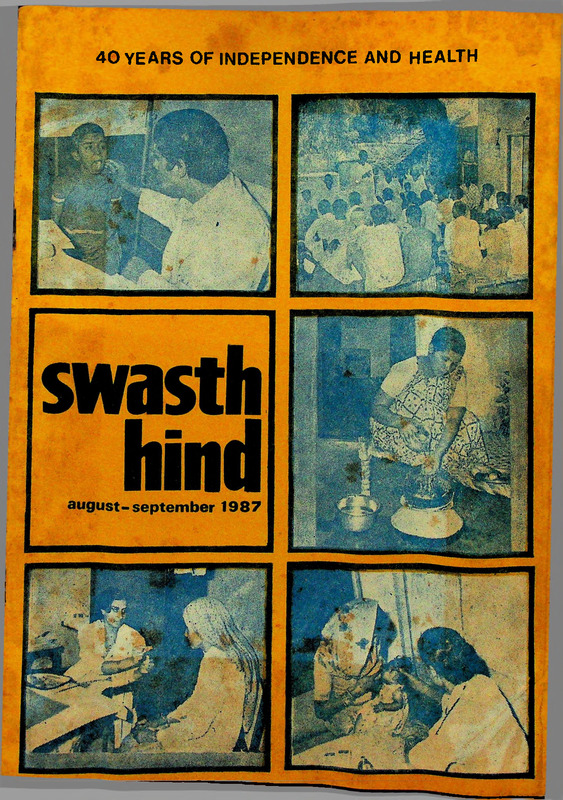
- Title
- 40 YEARS OF INDEPENDENCE AND HEALTH
- extracted text
-
40 years of independence and health
f?^y.'''v*.v*?
Wv^v^B-
»»
>•'
BISS
f»
f»
M
«w
swasth hind
In this Issue
Page
Status of health services in India
—a Comparison
190
Dr Mahendra Singh
Aug.-Sept. 1987
Sravana-Asvina
Challenges in health education
Vol. XXXI, No. 8-9
Saka 1909
Dr B. S. Sehgal
Changing perspectives on rural health care
—an overview
READERS WRITE
197
201
S'. Srinivasan
It is a very reliable magazine equally useful for professionals
and laymen. Every person who has heard the word ‘Health’
must subscribe to this magazine. Material, get-up printing
are excellent. The department deserves congratulations for such
a beautiful publication.
Prof. MALKIT S. GILL
Govt. College
Bhatinda (Punjab)
Health in 1986-87
—emphasis on community participation
S. S. Dhanoa
Health for all by the year 2000
—retrospect and prospect
Central Health Education Bureau
(Directorate General of Health Services)
Kotla Marg, New Delhi-110 002
210
Dr (Smt.) V. K. Bhasin
Strategy adopted by India to achieve health
for all—evaluation
Editorial and Business Offices
206
215
Col. K. K. Vadhera (Retd)
National Health and Family Welfare
Programmes—Achievements during 1986-87
317
SUBSCRIPTION RATES
50 Paise
Single Copy .
Annual
.
Rs. 6.00
.
Re. 1.00
(Postage Free)
This Issue :.
Articles on Health topics are invited for publication in this
Journal.
State Health Directorates are requested to send reports of
their activities for publication.
The Contents of this Journal a”e. freely reproducible. Due
acknowledgement is requested.
EDITOR
N. G. Srivastava
The opinions expressed by the contributors are not neces
sarily those of the Government of India.
Sr. SUB-EDITORS
M. L. Mehta
SWASTH HIND reserves the right to edit the articles sent
for publication. .
M. S. Dhillon
COVER DESIGN
B. S. Nagi
40 Years of Independence
STATUS OF HEALTH SERVICES IN INDIA
-A COMPARISON
Dr Mahendra Singh
Considerable health progress has been achieved during the 40 years of India’s Indepen
dence through the implementation of various programmes under the Health Services,
strategies of which were reviewed and altered from time to time. These achieve
ments could have been more spectacular, says the author, if we could have tackled
our population problem more effectively.
190
Swasth Hind
ealth implies more than an ab
sence
disease. It indicates a
of
the body and mind in relation to
physical and social environment to
enjoy life to the fullest possible ex
tent! and to attain maximum level
of productive capacity..
of
H
state of harmonious functioning
For an assessment of the status of
health services; we have to rely on
health information, which gives us
certain indication of a given situa
tion in a country.
Since data, on
positive health are rather difficult
to obtain than those relating to illhealth and death, we will compare
the status of Health Services in the
pre-independence ■ with post-indepen
dence period in those variables which
may help to measure the change.
Limitations are obvious both then
and now, because in order to have
better indications, information has
to be reliable, valid and also com
parable. :
Health Services in the Pre-Independence Period
Regarding the review of health
services in India during pre-independence period, i.e., before 1947, it
may be stated: bluntly that the situa
tion was grim.
Death rate (1937)
and infant mortalitty rate (1937)
were 22.4 per 1000 population and
162 per 1000 live-births respectively.
These rates were one of the highest
in the world.
The figures of ex
pectation of life at birth 26.91 and
The trained manpower , for curative and preventive health was far from
26.56 (1921-30) for males and
adequate during the pre-independence period. More emphasis was given on
curative health as compared to preventive aspects. During the post-indepen
females respectively were one of the
dence period, stress has been laid on the re-orientation of medical education
lowest in the world.
The corres
with emphasis on community care.
ponding figures about death rate,
infant mortality rate and expecta
tion of life at birth for England: and
Wales were 12.4; 58; and 58.74
As for the specially vulnerable age group, the position was far from
(males) and 62.88 (females) respecti groups of the population, viz., child? satisfactory.
ren and women in the child-bearing
vely.
■
Aug - Sept 1987
191
• From tire above table, it is observ
From the above table, it will be
ed that information about causes of observed that the organisation for
death is not specific except* for cho curative and preventive health was
lera, smallpox and plague, which far from adequate.
Of 47,400
Table I : Deaths at specific age period combine together to inflict 4% of the physicians, only
13,000 (27.4%)
SHOWN AS PERCENTAGE OF THE TOTAL
total deaths.
The major causes of were serving in medical facilities of
DEATHS IN ALL AGES
death undei ‘fevers’: ‘respiratory the Government and other agencies.
Age group
0—1
1—5 5—10 Total
‘digestive disorders’ Rest of the physicians were self(in years)
below diseases' and
10
must have been malaria, tuberculo employed in private practice. And
sis and diarrhoeal diseases respecti the tendency for the private practi
Deaths in
vely.
tioners as usual was to cluster in
Percentage
24-3
18-6
5-5 48-4
the urtban areas.
Hence there was
Other diseases, e.g., helmcnthiascs considerable neglect of the rural
From the above tabic, it will be particularly
hookworm
disease, population.
observed that 48.4 % of the total
guinea-worm
infection,
leprosy
and
deaths were among children below
Apart from the insufficient) num
10 years and in this highly vulnera filariasis were responsible for inca
ble age group. 50*.A of the deaths pacitating the nation by inflicting ber of hospitals and dispensaries
are among infants.
heavy morbidity though not causing for providing
medical relief, the
quality
of
services
provided were,
deaths.
As for maternal mortality, reli
indeed,
very
poor.
The dispensa
able figures were not available.
General health and vitality of the . ries and the out-patient departments
However, a special Committee ap
population
had been completely of the hospitals were over-crowded
pointed by the Central Advisory
demolished by the habitual consump and medical services rendered to
Board of Health to report on Mater
tion of insufficient diet both in qua the people were not adequate. Only
nity and Child Welfare work in India
lity and quantity. This faulty nutri a total of 73,000 beds were avail
has indicated that in 1938, maternal
mortality was “probably somewhere tion was not only responsible for able, i.c., about one bed for 4000
high incidence of malnutrition, under population.
near 20 per 1000 live-births’’. This,
nutrition and deficiency diseases but
indeed, was
frighteningly high.
From tlic above, it would be clear
also made the population vulnerable
Wastage of maternal lives in a phy
to infection. Unavailability of safe that the organisation both for cura
siological process of reproduction
drinking water and poor environ tive and preventive health was alto
is avoidable and our efforts should
More empha
mental sanitation was responsible gether inadequate.
be to pull it down to negligible
for a very high incidence of diarr sis was on curative health and the
level.
hoeal diseases, typhoid and parasi preventive aspects were given little
importance.
tic infestation, etc.
The prevalence of diseases is re
flected in the following table, indi;
As for the social aspects, the
Turning to the trained manpower
eating average annual percentage of
problems
of unemployment and
to man the health services, the
the total deaths during 1932-41.
poverty
were
indeed acute.
The
following table indicates the inade
status
of
women
was
at
the
lowest
Table II : Average annual percentage
quacy.
OF DEATHS IN INDIA (1932-41)
and added to this the customs like
‘purdah’ and early marriages (even
Disease
Average
Table 111: Indicating the availability
annual
infant marriages) made it all the
OF TRAINED MAN-POWER
percen
worst.
This was further diluted
tage of .
Category
No. of Ratio to the since the literates were only of pri
deaths
qualified then Populamary school level and ultimately
person- tion
Fevers
• 58-4%
nel
( 300 million^ lapsed into illiteracy.
Respiratory disorders •
•
7-6%
Deaths among infants, pre-school
children and in the school children
below 10 years are indicated in the
following table:
Digestive Disorders
(Diarrhoea, Dysentery)
Cholera
Smallpox *
Plague
Other causes
•
•
4-2%
2-4%
•
•
0-5% J
25-8%
All causes *
• 100-0%
192
Physicians
Nurses
Health Visitors
Pharmacists •
Dentists
Sanitary Inspectors
Midwives
47,400
7,000
750
75
1,000
3,000
5,000
1
1
1
I
1
1
j
6300
43000
400,000
4,000,000
300,000 .
100,000
60,000
Development of Health
Services
in the Post-Independence Period
Wc paid a heavy price for our
Independence.
There was parti
tion of the country followed by mass
Swasth Hind
The primary health centres (PHCs) are a focal point where health services radiate to the people in rural areas.
At present (as on 1-4-1987) there are 14,145 PHCs besides 98,987 sub-centres that serve rural areas. Before
Independence, none existed. Photo shows a child being treated at one such PHC.
migration of the population, never
known before in the history of the
sub-continent*. Apart from the law
and order problem, rehabilitation
of the displaced persons, provision
of preventive and curative services
in the refugee camps had to be dealt
with on a war-footing.
Concept of Primary Health Centre
In 1952, under the Community
Development Programme, one pri
mary health centre with three sub
centres were planned to be establi
shed in one community develop
ment block.
They were responsi
Aug - Sept 1987
ble for the medical care, control of
communicable diseases, maternal
and child health, nutrition, school
health, environmental sanitation,
health education and collection of
vital statistics.
In fact, we were
asking for too much.
In 1961, Mudaliar Committee re
viewed in detail all the aspects of
medical care, public health, com
municable diseases, medical educa
tion and population problem, etc.
As for the primary health centre
programme, it was recommended
that a primary health centre (PHC)
to be effective should not be given
more than 40,000 population and
it should have full complement of
the staff.
There should be expan
sion and strengthening of the dis
trict hospitals. Mobile health teams
of specialists from the district/
taluka hospitals should provide
necessary supervisory and consul
tancy services to the PHCs.
The
PHC should also provide residen
tial accommodation and should
have a bed strength of ten.
The Census in 1961 indicated
disturbing trend of rising popula
tion in the country.
Hence a spe
cial committee, viz, Mukherjee
193
Committee was appointed to review
the staffing pattern and financial
provision under Family Planning
Programme. The main recommen
dations having impact on health
services at the crucial PHC level
need special mention.
These were as under:
(a) One unipurpose family plan
ning worker for every 20,000
population.
(b) One block extension educator
for every PHC.
(c) One lady health visitor to
guide and supervise the work
of four sub-centres.
(d) One sub-centre for every
10,000 population with a train
ed auxiliary nurse midwife.
Besides adding to the physical
facilities and equipment, it was also
considered essential to provide one
more medical officer and support
ing staff at each PHC.
Multipurpose Workers Scheme
This pattern of development of
health services continued up to IV
-Five Year Plan (1969-74).
How
ever, it was observed that though
most of the PHCs and sub-centres
were established according to the
Plan, they were not ablq to effecti
vely cover the entire population un
Last case of smallpox in India, which occurred on 24 May, 1975. India
der their jurisdiction.
In other
emerged victorious and smallpox was eradicated.
words, the organisation did not* ful
fil its promise of providing primary recommended the speedy implemen Victory against Smallpox
health care to the
population. tation of multi-purpose workers’
Hence, in 1974, one of the main re scheme and also the introduction of
In the ’ meantime under the
commendations of the Kartar Singh three-tier plan for health care unit National Smallpox Eradication Pro
Committee was to establish a sub with a person from the community gramme a grim war was being
centre for every 5000 population at the village level providing the fought against the dreaded scourge,
and thus an integrated approach base.
It also proposed a plan for smallpox, with the revised strategy
for the delivery of the health ser a re-orientation of medical educa of
surveillance-cum-containment,
vices,—the concept of multi-purpose tion towards the need of the coun utilising bifurcated needles with
workers scheme—came into being. try with emphasis on community potent freeze-dried vaccine, India
Shrivastav Committee Report (1975) care.
emerged
victorious and smallpox
194
Swasth Hind
was eradicated; last case being Sai*
ban Bibi, which occurred on 24th
May, 1975.
This was a public
health miracle and a great success
story to boost the morale of all the
health workers throughout the coun
try and the world.
Author had
personally investigated this out
break for effective containment and
follow-up action to wipe out this
last case of smallpox from the coun
try-
in 1978, an International Confe
rence on Primary Health Care was
held in Alma-Ata (6-12 September,
1978).
The objective of the Con
ference was to focus world’s atten
tion on the facilities of the existing
health services to serve the rural
population and the urban poor and
to seek firm commitment from the.
Government to remedy the prevail
ing situation. India, as a signatory
to Alma-Ata' declaration has com
mitted itself to achieve the goal of
‘Health for All by the. year 2000
A.D.’
With a view to evolve a national
strategy for securing the objective
of ‘health for all’ and to identify
specific programmes, a meeting of
the health experts, research scien
tists, medical? educationists, social
scientists, health administrators and
represehtives of the Planning Com
mission, related ministries/depart
ments of culture and State Govern
ments and voluntary organisations
Malaria’has shown'a significant decline^in' mortality with 1.66 lakh cases in 1985. g]
was held in February, 1980.
The
Report of this meeting formed one .
of the important basis for the for 2000 A.D.
Further, health and monitoring, periodic programme ap
mulation of the National Health family welfare services have been praisal and evaluation, it is absolu
Policy.
given due importance in the New tely essential to have research and
Apart from the other important 20-Point Programme.
For such feedback for prompt corrective
aspects, goals for health and family important programmes like “Clean measures.
welfare programmes have been Drinking Water”, “Health for AH” Progress Achieved, its Impact
mentioned under 17 important indi and “Two-child norm”; included in and a Comparison
By implementing the various pro
cators which will show the progress the new 20-Point Programme 1986,
grammes
under the Health Services,
required to be expected by die year hawk-eyed supervision; continuous
’Aug-Sept 1987
195
strategies of which were reviewed
and altered from time to time as
mentioned above, considerable pro
gress has been achieved in the four
dedades of post-independence period
as compared to the pre-indepenTABLE IV :
No.
dence period.
These achievements
could have been more spectacular,
if we could have tackled our popu
lation problem more effectively.
The following table shows the
achievements/impact during the last
four decades since Independence.
IMPACT OF HEALTH SERVICES IN COMPARISON TO THE POSITION BEFORE INDE
PENDENCE AND EXPECTATIONS BY 2000 AD.
Indicator
1. Infant mortality rate (per
births)
2. Crude death fate
•
•
Before
Independence
Data available
after 4 decades
of
Independence
Expectations by
2000 A.D.
104
(1984)
12-5
(1984)
3*4
below 60
33-8
21
54-1
54-7
54-4
64
64
64
Male 46-10
Female 24- 82
Persons 36-23
(1981 Census)
above 80%
1000 live
161
(1941-45)
•
•
31-.2
(1931-41)
3. Maternal mortality rate (per 1000 live- about 20/1000
births)
(1938)
4. Crude Birth rate
•
45-2
(1931-41)
5. Expectation of life at birth (years)
• Male 32-09
Female 31-37
Persons 31-72
(1941)
6. Literacy rate
Persons 12-5
9
below 2
Per capita expenditure on health
and family welfare are Rs. 32.85
and Rs. 4.30 respectively.
Communicable diseases
As for communicable diseases,
smallpox has been eradicated, no
case of plague has been reported
after 1967.
Cholera has shown
marked decline both in morbidity
and mortality.
Malaria, too has
shown a significant decline in morta
lity (about 150 deaths in 1985)
with 1.66 lakh cases.
Diarrhoeal diseases, and tuber
culosis are the major problems.
Determined efforts are being made
under National Programmes to era
dicate leprosy and guineaworm in
fection and to reduce the incidence
to nil of six vaccine preventable
diseases covered under the Expand
ed Programme of Immunization
viz., measles, diphtheria, pertussis
(whooping cough), tetanus, polio
and tuberculosis.
In conclusion, it must be mention
ed that though considerable efforts
have been put in and remarkable
achievements like smallpox eradica
tion, plague elimination have been
-made yeti much will have to be done
According to the latest available TABLE V : TRAINED MANPOWER AFTER ABOUT to attain all those objectives and
FOUR DECADES OF INDEPENDENCE
goals which we have set for our
information as on 1st April, 1987,
selves in the National Health Policy
Category
No.
of
Ratio
to
the
as many as 905 community health
qualified 1981 Census and the new 20-point Programme
personnel population
centres; 14,145 primary health cen
by the year 2000 A.D.—which is
(685 million) not even 13 years away from today.
tres and 98,987 sub-centres have
been set up.
Before Independence Physicians (Regis
REFERENCES
tered) 1984 •
2,97,228 1: 2305
none existed. As for the buildings Nurses (Registered)
—Report of Health Survey and Develop
ment Committee — 1946.
1,70,880 1: 4009
for these institutions, the expecta 1985
—
Compendium
of
Recommendations of
Visitors
tions are that by the end of VII Health
various committees on Health Develop
(Registered) 1984 •
11,455 1: 59815
ment 1943—1975, Central Bureau of
Five Year Plan
(1985-90), 40%, Pharmacists •
18,216 1: 37614
Health
Intelligence, Nirman Bhawan,
(Registered)
1984
New Delhi—1985.
80% and 90% of the sub-centres,
9,598 1: 71388 —-WHO/UNICEF—Alma-Ata
1978—Pri
primary health centres and commu Dentists (Reg) 1985
mary Health Care. '
Midwives
(Regisnity health centres will have their red) 1984 •
1,68,493 1: 4066
—National Health Policy, Govt, of India,
Ministry of Health & Family Welfare,
Auxiliary Nurse
89,952 1:7617
own buildings.
New Delhi 1983.
Mid-wives
(Registered) 1984
As on 1st January, 1986 there
were 5,35,735 beds as against 73,000
beds before independence.
As for the trained manpower is
concerned, the increase is evident
when Table III is compared with
th© following table:
196
—Health
Information of India—1986—
Central Bureau of Health Intelligence,
Apart from the above, as on 31st
Nirman Bhavan, New Delhi.
March, 1986, there were 5568 block —W.H.O./SEARO—Bulletin of Regional
extension educators, 90211 multi
Health Information New Delhi-1986.
purpose workers (male) 67371 multi —The Twenty Point Programme—1986,
purpose workers (female), 2711
Ministry of Information and Broadcast
ing, August, 1986.
health - assistants (male) and 14083
health assistants (female) and 538523 —Singh, Mahendra—Review of current
status of
monitoring and
evaluation
trained’ dais.
These categories of
mechanisms at Central, State and
staff were not available before inde
District
level—W.H.O. /SEARO—Con
pendence.
sultative Meeting 27-28 November, 1986.
Swasth Hind
40 Years of Independence
CHALLENGES IN HEALTH EDUCATION
Dr B. S. Sehgal
All the successive five year plans have impressed that no single measure is as
productive of greater returns in proportion to outlays than health education. Still
the contributions of health education to the successful achievement of national health
programme goals has left much to' be desired, feels the author. This paper discusses
some of the reasons responsible for this lecunae in health education development
which stand as challenges to all administrators and planners interested in achieving
national goals.
Aug-Sept 1987
197
The National Family Planning
advent of indepen
dence,
greatest
consideration Programme was the first one to ini
at the policy-making level has tiate the use of scientific health edu
been given to the willing assent cational principles in its planning
and active
participation of the and implementation strategy. A
people in the health development large number of people were trained
programmes. Realising how much and an extensive use of mass media
. illness is caused by the ignorance and publicity material was made.
of simple hygienic laws or indiffe However, disproportionate emphasis
rence to environmental
hazards, on mass media and time-bound tar
all successive five year plans have get achievement in sterilization made
impressed that no single measure the staff leave out the people in
is as productive of greater returns planning, decision-making and im
in proportion to outlays than plementation of the programmes.
health education. Still the contri This lapse did not allow building up
butions of health education to the of a firm community base in pro
successful achievement of national gramme implementation.
health programme goals has left
The strategy of the other national
much to be desired. This paper
programmes like malaria, T.B.,
aims to explore some of the reasons
leprosy, etc., has been formulated
responsible for this lacunae in
on too much technological considera
health
education
development
tions and over-confidence in its
which stand as challenges to all
scope. People’s role in these pro
administrators and .planners intere
grammes, though considered impor
sted in achieving national goals.
tant, has been relegated to the back
ground and very meagre provision
India has covered several mile
for it was made in their budget out
stones in the growth of Health
lays.
Education. An extensive organiza
Since the Alma-Ata declaration
tion at the Central, State, District
and Block levels has been establish in 1978, India has committed itself
ed with the Central Health Education to attaining the 'Health for All’ goal
Bureau (CHEB) in the leadership by the year 2000 A.D. through uni
role at the Centre. During the past versal provision of comprehensive
three decades of its existence CHEB Primary Health Care services. These
has developed as a unique institu services integrally linked with the
tion and has amply demonstrated extension and health education ap
the multi-dimensional contribution proach will take into account the
of health education in the field of fact that a large majority of health
planning, training, media production functions can be effectively handled
and research. Its close coordinative and resolved by the people them
activities with the Ministry of Edu selves with the organised support of
cation and with international agen volunteers, auxiliaries and multi
cies is creditworthy. Many State purpose workers of ' various grades
Health Education Bureaux have also of skill and competency. eThough
passed through various phases of community participation was already
development. Some of them have considered an essential component
a high level of competency in pro of most health activities, but it was
duction and use of educational ma usually equated with provision of
terial.
voluntary labour for sanitary or
S
198
ince
the
building construction or financial
contributions to health services. In
the new health policy of Primary
Health Care, individuals and com
munities have to be involved in the
whole process of programme plan
ning and implementation with the
ultimate aim to take its responsibi
lity on the .basis of self-reliance.
This is entirely a new dimension of
health development in which health
education has a vital role to play.
New health education approaches
have to be evolved and integrated
into the very fabric of the each
programme activity.
These ’ ap
proaches should be people-oriented
both in terms of technology and
delivery of services. People will
need to know and understand their
problems in the context of available
resources and technology and carry
out at the individual and community
level specific activities to solve
them. These are entirely new areas
for which health administrators and
field workers will have jointly to
pool their wisdom for finding a solu
tion.
Health Education Challenges
Understanding the complexity of
Human Behaviour by Programme
Planners and •administrators:
All health and family planning
programmes aim to achieve certain
measurable goals many of which
are time-bound. To- achieve these
goals people are expected to adopt
new ways of living. The most
serious health hazards like malnu
trition, gastro-epteritis, tuberculosis,
etc., are embedded in the way people
live. Customs, poverty and igno
rance contribute to the maintenance
of these diseases.
Human behaviour is the net result
of a series of factors—psychological,
Swasth Hind
A large majority of health functions can be effectively handled and resolved by the people themselves with the
organised support of volunteers, auxiliaries, trained birth attendants and multi-purpose workers of various grades of
skills and competency.
socio-cultural or situational. To
change traditional beliefs and prac
tices, mere conveying of messages
based on scientific facts and modem
technology are not enough. To
change people we do not need know
ledge alone, but a process has to be
initiated in which people can be
made to go through an experience
related to the new habit in the con
text of their socio-cultural setting.
Such an experience should be a sa
tisfying one and should include com
plete information on the benefits
Aug - Sept 1987
and limitations of the particular in
novation or technology used.
The challenge, therefore, is to
develop health technology, based on
people’s understanding and prefer
ences and not something based on
scientific criteria alone. Health edu
cators, therefore, should develop
procedures and tools by which a
peripheral field worker can collect,
compile and interpret what the
people know, feel and do about a
particular health problem. This will
help in providing an educational
base from which a strategy and
plan could then be decided upon
and developed.
Clarification of the concept of Com
munity Involvement for Programme
responsibility and self-reliance.
In the new policy of health deve
lopment, people and the health pro
fessionals have to work as partners
in tackling local problems. Acquir
199
ing good health will need specific identified as the first need. It is
action by each individual, family always a question of large numbers,
or community. Educational efforts limited resources and time constraint.
to inform, educate and motivate Health education being a practi
people will be needed to draw and tioners discipline cannot be taught in
utilize the community’s conventional the class-room alone. It is not just
wisdom and resources for solving a question of learning concepts,
these problems.
Community in
philosophies and principles, but of
volvement is a process and it is
making use of these for community
necessary to evolve a methodology
action in situations, each of which
and steps which can help people to
is quite different. Thus both the
identify their problems, study the
faculty and the training courses have
options and technology available,
to be skill based on community ori
choose - a suitable plan and imple
ented. Field practice has to be
ment it, making maximum use of
the best method and location to
community resources.
teach. Real experience constitutes
the impressive educational method.
The provision of adequate health The analytic and judgemental skills
information and education for an needed by health educators are not
entire population is a fask of great gained through
didactic teaching
difficulty. Every community is com or even discussions. A delicate
posed of several groups having diffe theory-practice mix is needed for
rent
socio-cultural
background, all courses in health education and
interests and needs. No medium a living practice demonstration field
can possibly
reach everybody. is a must for all institutions giving
Identification of important large health education training. Without
groups is essential to formulate a the right kind of trained people, all
realistic educational plan. Their the • resources available for health
present knowledge and practices education get
wasted. Training
along with their perception of the people to help community self-reli
advantages of the new practice ance and organise and support inter
should be collected and used in sectoral cooperation are matters
planning educational activities.
which need ingenuity, knowledge and
experience. Faculty selection and
If community involvement envis its preparation is, therefore, a chal
ages peoples own responsibility in lenge which must be met. Resis
programme planning and implemen tance of the faculty to modify train
tation, then it should be clearly ing curricula and programmes should
specified with well-defined objectives also be tactfully handled.
and adequate resources be provided
for it in the programme budget.
Health education activities will be Problem of measuring impact
the single largest input in helping
Since behaviour change is the
people organise and implement any result of a large number of factors
health plan.
in a person’s environment, measur
The Dilemma of Training
Whenever one is planning a pro
gramme, Training of Staff is usually
200
ing impact of health education is
sometimes rather difficult. In com
munity activities as well health edu
cation cuts, across a number of
sectors and agencies resulting in
difficulty of assessing contributions
of health education separately. All
this creates difficulties to justify
health education allocations in pro
grammes. There is thus a need to
develop indices which would reflect
the cost benefit dimension of health
education in various programmes.
Research is needed to develop
models for valid and comparable
indicators which will demonstrate
health education impact in preven
tive and promotive programmes.
There is also need to make health
education sufficiently specific so that
implementation of educational acti
vities can be monitored and their
effectiveness evaluated.
Role of Voluntary agencies
For achieving the goal of ‘Health
for AH’, the part to be played by
voluntary agencies is crucial. They
need to be officially recognised and
involved in any health plan. Finan
cial and technical support for health
education through voluntary agen
cies can pay rich dividends as those
agencies are an expression of the
will of the people to use their own
initiative in improving their own
lifestyles. Voluntary agencies to be
associated should be the one’s work
ing in the community and should
include religious groups or bodies
as well. Sufficient attention* has not
been paid to involving them in
health education work so far. The
ultimate success of any programme
is invariably linked to the extent of
voluntary agencies, active involve
ment. Education, support and trust
are the key elements in developing
collaboration with voluntary agen
cies. Health educators need to
know and practice it.
Swasth Hind
40 Years of Independence
CHANGING PERSPECTIVES ON RURAL
HEALTH CARE ; AN OVERVIEW
S. Srinivasan
The primary goal of any health]delivery
system to organise the health services in
such a manner as to optionally utilise
the available resources, knowledge and
technology with a view to prevent and
alleviate disease, disability and suffering
of the people. For making the health
care services more meaningful to our
people, it is necessary, the author feels,
to bring about fundamental changes in
focus and approach to the entire health
care delivery system of the country in
general and above all rural care services
in particular.
,
Aug - Sept 1987
he health care system is intended to deliver the
T socio-economic and It
of
health care services.
operates in the context
the
political system of the
country- India is one of the very few countries that
had from the very beginning planned health services
as a part of general socio-economic development
Accordingly, a health delivery system was evolved
in independent India on the lines suggested by the
Bhore Committee (1946). The broad objectives of
health plan are to strengthen the health infrastructure
and to complete eradication of diseases and their inte
gration into the basic health services. In realisation
of the - need for social reconstruction, health care
201
system was coordinated with the other nation-build
ing activities and was part of community development
programme administered through a network of pri
mary health centres and sub-centres which form the
nucleus for a minimum scheme of health services for
rural population. Health care is one of the most
important of all human endeavours to improve the
quality of life and yet a large proportion of the coun
try’s rural population has no access to health care
services at all and for many what they receive does
not alleviate their problems. Thus, rural health care
has been a perpetual problem in India. In an effort
to ameliorate the same, a vast network of primary
health centres has been set up in the country for pro
viding comprehensive health care services to the rural
population. The Primary Health Centre occupies a
key position in nation's health care system- It is
peripheral, yet most vital outpost, around which rural
health care services are being built.
A three-tier system of health care delivery exists in
India, i.e. provision of basic curative, preventive, pro
motional and rehabilitative services to the rural areas
through and up to Primary Health* Centre level, the
referral complex up to the taluk and district level
and specialist service through medical colleges, teach
ing hospitals- and other specialised institutions. Thus.
comprehensive health care consists of health care de
livery at the primary, secondary and tertiary levels.
The primary goal of any health delivery is to
organise the health services in such a manner as to
optionally utilise the available resources, knowledge
and technology with a view to prevent and alleviate
diseases, disability and sufferings of the people.
There are three types of health resources that exist
in the rural areas of India, namely, formal, informal
and folk health care systems. The formal health
system consists of the governmental network of pri
mary health centres, sub-centres and dispensaries (the
PH.C. complex). This system is highly formalised
and organised bureaucratically. The informal system
consists of a network of private clinics of the fulltime private medical practitioners of various systems
of medicine such as Ayurveda, Siddha, Unani and
Homoeopathy. The folk health care system consists
of a variety of part-time health workers who function
within the context of folk traditions and village organi
sation. All these systems fulfil the health needs of
the rural population in India, to a varying degree.
202
Rural health services and five-year plans
The Five year plans defined the national objectives
for health services in the country. The national ob
jectives ensure adequate medical care being made
available to every individual. The first five year plan
was essentially a preliminary step towards planning
'or rapid future development of health programmes.
In 1952, India established Primary Health Units to
meet the primary health needs of its rural populationCommonly known as the Primary Health Centre, this
centre is a central point which links the rural com
munity and planning body at the district and state
levels. It is also a channel through which the health
and medical care services are rendered to the vast
population of India. The first plan made clear that
virtually the whole burden of rural health services
should be on the States. A significant new step was
taken when it was proposed that the Primary Health
Centres (P.H.Cs.) be associated with the community
development projects, then being contemplated. Thus,
the principle was established that rural health care
services would be part of the community develop
ment programme- By the end of the first plan period,
only 725 primary health centres had been set up.
The second five year plan allocated somewhat more
to health than the first plan. The second plan, gave
the highest priority for the need to establish more
primary health centres and a regional system of dis
trict and taluk hospitals. The plan called the pro
vision of adequate health services for the rural popu
lations ‘by far the most urgent need'. By the end
of the second plan, 2800 P.H.Cs. were established,
covering most of the development blocks. The two
succeeding five year plans served only to highlight
shortfalls in implementation of health programmes
and the deficiencies of their logistics.
The broad objective of the health and family plann
ing programme in the third plan was to expand
health services to bring about progressive improve
ment in health of the people ensuring a certain mini
mum physical well-being and to create conditions
favourable to greater efficiency and productivity. The
third plan saw the launching of the nationwide ex
tension approach to family planning as an integral
part of the rural health services to educate and per
suade the rural population to accept the small family
norm. The third plan accorded very high priority
to family planning and due importance to nutrition.
Swasth Hind
Ily the end of- third plan it was intended to establish
one P.H.C. each in C D. blocks. By March 1966,
4631 P.H.Cs. were set up. The third plan directed at
tention to the shortage of health personnel, delays
in the construction of P-H.C. buildings and staff quar
ters and inadequate training facilities for the different
categories of staff required in rural areas.
The Fourth Plan emphasised the need for crea
tion of an effective base for health and medical
care such as strengthening of P.H.Cs., subdivisional
and district hospitals, the integration and implementa
tion of programmes related to the control of com
municable diseases, family welfare programme, etc.
The P.H.Cs- form the base of the integrated structure
of medical and health services in the rural areas. It
was a widely shared view that the P.H.Cs. were not
able to make significant impact on the health status
of the rural populations. It may be stated that factors
such as
the inadequacy and insufficient supplies,
supervision and support were equally responsible for
the failure of P-H.Cs. to fulfil the ideological commit
ment for which they were established. Therefore, the
Fourth Plan, pleaded for the establishment of effec
tive machinery for speedy construction of buildings
and improvement of the performance of P.H.C. by
providing staff, drugs and equipment. It was pro
posed during the Fourth Plan, to establish 508 P.H.Cs*
covering 340 blocks which did not have a P.H.C. so
that there could be, at least, one P.H.C* in each
block. By March 1974, 5283 primary health centres
were set up throughout the country.
During the
Fourth Plan, the P.H.C. complex was further streng
thened for providing preventive and curative services
and also for ensuring the maintenance phase of the
communicable diseases control and eradication pro
gramme- Yet despite the fact that health program
mes which were initiated during the first four five-year
plans had brought about some definite improvement
in the health status of the people, they fell short of
the expectations because they did not meet the laid
down objectives adequately.
The Fifth Plan reformulated, the health pro
gramme in order to ‘consolidate past gains in
various fields of health such as communicable diseases,
medical education and provision of infrastructure in
rural areas’ (Planning Commission 1974, Vol. II, p.
234). This consolidation of the past gains was envi
saged in the context of the new Minimum Needs
Programme (M.N.P.) introduced by the plan-
Aug - Sept 1987
The approach of the fifth five-year plan was modi
fied to integrate health and family planning services.
maternal and child health services, and nutrition in
such a way that a package of services was offered
to the people enabling them to accept family plann
ing in the context of better health expectancy and
services. Thus, the emphasis in the fifth plan was
on increasing availability of health care services in
rural areas, integration of health, family planning and
nutrition, augmentation of training programmes for
multi-purpose workers, qualitative improvement in
the education and training of health personnel. It
was in the fifth plan the minimum public health faci
lities integrated with family welfare and nutritional
practices for vulnerable groups, children and pregnant
women and nursing mothers were first provided. In
the fifth plan, stress was laid on the "Minimum Needs
Programme’ because it was considered to be of singular
importance for bringing about an improvement in
the health status of the rural people. The health
related components of M.N.P. were (Planning Com
mission, 1974 Vol. 1, p. 87): (i) ensuring in all areas
a minimum uniform availability of public health faci
lities, which would include preventive medicine, family
planning and the detection of early morbidity and
adequate arrangements for referring serious cases to
an appropriate higher echelon; (ii) supplying drinking
water to villages suffering from chronic scarcity or
having unsafe sources of water, and (iii) carrying en
vironmental improvement of slums.
The Minimum Needs Programme was the main
instrument through which health infrastructure in the
rural areas was expanded and further strengthened to
ensure primary health care to the rural population.
The Minimum Needs Programme alongwith the train
ing- of multi-purpose health workers and a more rigor
ous pursuit of communicable diseases control and era
dication was considered as the core of the health
care programme. The Minimum Needs Programme
in the State sector would continue to be the main
instrument for the development of the rural health
care delivery system. Primary Health Centres at the
rate of one for each C*D. block had been established
by the end of the fifth plan. By the end of March
1978, 5430 P.H.Cs. were set up. Thus, the number
of P.H.Cs* was only 67 at the end of the first plan:
it increased to 28®O and 4631 at the end of the
second and
third plans, respectively. After third
plan, the strategy was to establish sub-centres around
203
each P.H.C.
This, too, was pursued vigorously.
As a result, in 1978, the infrastructure for institutional
facilities for health care comprised 5430 P-H.Cs., 38,
594 sub-centres, 126 rural hospitals, 258 subsidiary
health units and 124 mobile units mostly attached
to medical colleges. It was also proposed to have
one sub-centre for 10,000 population and upgrade
one out of every four selected P.H.Cs, to a 30 bedded
rural hospital to serve as a first link in the chain of
referral services. A community health centre, a
modified form of the upgraded 30 bedded hospital is
being established for a coverage of one lakh popula
tion with 30 beds and specialised medical care services
in gynaecology, paediatrics, surgery and medicine.
Thus, rural health infrastructure would be further
strengthened in order to achieve the goal of ‘Health
for all by 2000 A.D-’ The rural health component
of the Minimum Needs Programme was the main
instrument for strengthening adequate infrastructure
for health care services in rural areas but the achieve
ments during the fifth plan period fell short of its
targets.
The M.N.P. is supported by the Centrally-sponsored
schemes of community health volunteers, employment
and training of multi-purpose workers and reorienta
tion of medical education which are all continuing
schemes.
New rural health policy
(i) Community Health Volunteers’ Scheme : In the
evolution of countrywide health and medical infra
structure, the first significant departure from the ap
proach to rural health pursued since the beginning of
planning was made only in 1977, when the Commu
nity Health Volunteers’ Scheme was launched. In
October, 1977, a new rural health policy was an
nounced in the country, advocating a multidimensional
approach which could bring about significant change
in the country’s health status in the near future- The
introduction of the Health Guides Scheme, formerly
known as the Community Health Volunteers’ Scheme
in rural areas, forms an important part of the new
ruaral health policy. Thus, Rural Health Scheme
was launched in 777 selected P.H.Cs. spread over the
country. This scheme concentrates the government’s
endeavour to place ‘people’s health in people’s own
hands’. With the twin objectives of providing ade
quate medical care where it is needed and simultane
204
ously educating the people in the matter of preven
tive* and promotive health, the Rural Health Scheme
was formulated. The people, particularly the rural
masses, have to be conscious of what they themselves
can do and not merely wait for assistance from out
side like goverment agencies to achieve better healthThis scheme intends to make them aware of the ser
vices and at the same time educates them about the
contribution they could make. This scheme was in
troduced with the objective of preparing a cadre of
voluntary health workers selected by the community.
The scheme began with the training of community
health workers (C.H.Ws). It envisages provision of
one CHW for every village or community with a po
pulation of 1,000. The CHW
is selected by the
village panchayat, the medical officer and the Block
Extension Educator and the male and female health
assistants of the Primary Health Centre are mainly
responsible for his training- The training of CHW
is arranged at the P.H.C. The training period is of
200 hours to be completed normally within a threemonth period. He is taught the basic elements of
health care and family welfare. He is trained in both
modern and traditional medicine popular in the local
region. The trainees receive a stipend of Rs. 600
in three instalments' of Rs- 200 each during the train
ing period.
After completing the training, each
CHW is provided with a kit containing simple medi
cines and remedies, educational aids and a work
manual. The CHW receives an honorarium of Rs. 50
per month to meet out pocket expenditure, and drugs
worth Rs. 50 per month.
This scheme envisages achieving the aims by allow
ing the people themselves to select their own health
workers. This scheme as envisaged will go a long
way in fulfilling a long-felt need of the rural popula
tions in India by providing minimal medical facilities.
For the successful implementation of this scheme, it
is imperative that the selection of CHWs should be
made with care- However, the introduction of the
scheme is not the only solution to the health problem
prevailing in rural areas. The extent to which this
endeavour succeeds depends upon various factors like
the awareness status of the villagers towards this
scheme, the expectation of trained CHWs.
This scheme was evaluated by a number of insti
tutions. The conclusions of these evaluation studies
were : (i) it has been mostly welcomed by the vill
Swasth Hind
agers; (ii) the CHW has emerged as a vital carrier
for the family welfare programme; (iii) the CHW
acts as a link between the government health func
tionaries and the villagers; (iv) misgivings do exist
amongst the medical profession about the success of
the scheme. One of the major findings of the Ministry
of Health, Government of India is that while the new
tribe of ‘barefoot doctors’ enjoy greater degree of re
cognition and acceptance within the rural community,
their assistance is mostly sought for minor illnesses
and first-aid needs. Their usefulness in the field areas
is very much limited.
(ii) Multipurpose Workers’ Scheme :
Multipurpose
Workers’ Scheme provided health package to the rural
masses at their doorstep to meet the growing needs
of intensifying rural health services. This scheme
was recommended by the Kartar Singh Committee
(1973)- The objectives of the scheme were : (i) to
increase the accessibility of medical facility in rural
areas: (ii) to achieve a good rapport With the com
munity; (iii) to reduce the area and population allott
ed per worker to improve the quality of health services
by trained para-medical personnel and to extend ser
vices at the periphery. Thus, the main objective of
Rural Health Scheme is to ensure a minimum uniform
availability of public health facilities which would
include preventive medicine, family welfare, nutrition
and referral services. Instead of a number of health
workers belonging, to different national programmes
like malaria, smallpox, tuberculosis etc. operating
vertically without any coordination, it was proposed
to setup a multipurpose health workers’ cadre (both
male and female) at the sub-centre level and Block
Extension Educator and a Health Assistant at the
block level under the supervision of a medical officer
at the P.H.C. The area of operation of the multi
purpose worker was reduced to 10,000 and maternal
and child health was to be integrated with family
welfare. But all these efforts have not made much
difference in the execution of health services in the
villages*
Sixth plan strategy on rural health
The strategy advocated in the Sixth Plan is as
follows: (Planning Commission, 1981, p. 368).
(i) A rural health care system based on combina
tion of preventive, promotive and curative
health care services would be built-up starting
from the village as the base;
(ii) The infrastructure for rural health care would
consist of primary health centres each serving
a population of 30,000 and sub-centres each
serving a population of 5,000. These norms
would be relaxed in hilly and tribal areas. The
village or population of 1,000 would form the
base unit where there will be a trained health
volunteer chosen by the community;
(iii) Facilities for treatment in
basic specialities
would be provided at community health centres
at the block level for a population of one lakh
with a 30 bedded hospital attached and a
Aug - Sept '1’987
system referral cases from
the community
health centre to the district hospital/medical
college hositals will be introduced;
(iv) various programmes under education, watersupply and sanitation, control of communic
able diseases, family planning, maternal and
child-health care, nutrition and school health
implemented by different departments/agencies
would be properly coordinated for optimal
results;
(v) Adequate medical and paramedical manpower
would be trained for meeting the requirements
of a programme of this order and all educa
tion and training programmes will be given
suitable orientation towards rural health care;
(vi) The people would be involved in tackling their
health problems and community participation
in the health programmes would be encouraged.
They would be entitled to, supervise and
manage their own health programmes even
tually.
The Sixth Five Year Plan envisages the implemen
tation of a ‘Minimum Programme of Rural Health
Care’. In this programme, the schemes which are
included are : (i) Multipurpose workers’ scheme; (ii)
Health Guides’ Scheme; (iii) components of the Re
vised Minimum Needs Programme; (iv) Training and
Promotional Training Programmes for Birth Atten
dants (Dais), ANMs/Health Workers (Female), com
munity health officers and the setting up of Regional
Teachers’ Training InstitutesThese schemes are
expected to ensure availability of adequate infra
structure and medical and paramedical manpower to
make the universal provision of primary health care a
realify.
Minimum rural health care-programme
1. Multipurpose
workers’
Scheme : It aims to
establishing a health delivery system in the rural areas
through a team of multipurpose workers, one male
and a female for 5000 population.
2. Training : (a) Seven Central training institutes
conduct training programme for the key trainers and
the district-level medical officers, (b) 47 Health and
Family Welfare training centres impart training to
medical officers and block extension educators of
P.H.Cs: (c) Trained MOs and BEEs organise training
at their own PHCs/selected PHCs for their parame
dicals.
3- Health Guides Scheme: This is introduced with
the objectives .of preparing a cadre of voluntary
health workers selected by the community who will
undergo training in promotive, preventive and ele
mentary health care at the grass-root level. The
Primary Health
Centres (PHCs.), upgraded PHCs,
(Contd. on page 224)
205
40 Years of Independence
HEALTH IN 1986-87
EMPHASIS ON COMMUNITY
PARTICIPATION
S. S. Dhanoa
The Ministry of Health and Family Welfare continued its efforts towards attaining
the twin goals of ‘Health for All’ and a ‘Net Reproduction Rate of Unity’ by the year
2000 A.D. through the universal provision of comprehensive primary health care
services. Sustained efforts were made to activate the people through health education
and family welfare communication to avail of the services being provided. The
communication strategy has been revamped to obtain greater community participation
in the health and family welfare programmes.
206
Swasth Hind
uring the year
1986-87, the
Ministry of Health and Family
Welfare continued its efforts to
wards attaining the twin goals of
‘Health for AH’ and a ‘Net Repro
duction Rate of Unity’ by the year
2000 AD. through, the universal pro
vision of comprehensive primary
health care services. During this
second year of the Seventh Five
Year Plan, concerted efforts were
made for raising the health status of
our people. The preventive and
promotive aspects of health services
augmented, steps for child survival
widened and the educational com
ponent of the family welfare pro
gramme strengthened. All this was,
of course, backed with service sup
port. The services were extended
closer to the door-steps of the peo
ple by increasing and improving pri
mary health care facilities in rural
and tribal areas and the areas inha
bited by the weaker sections of the
society.
Sustained efforts were
made to activate the people through
health education and family welfare
communication to avail of these ser
vices. The communication strategy
has been revamped to obtain greater
community participation in the
health and family welafre pro
grammes.
D
The focus has been on maternal
and child health care in general and
on reducing the infant mortality in
particular by protecting children
against the six common childhood
diseases—Diphtheria.
Tetanus,
Poliomyelitis, Tuberculosis, Measles
and Whooping cough—all prevent
able through vaccination. The Uni
versal Immunization
Programme
launched in November 1985, is
operating in 92 districts. Additional
90 districts will be taken up in
1987-88. Our aim is to cover all
the districts in the country by 1989-
Aug - Sept 1987
The focus has been on maternal and child health care
90. The Universal Immunization
Programme is expected to further
reduce infant mortality which is 95
per thousand live births at present.
At the same time, stress is being
laid on Oral Rehydration Therapy
(ORT) with the aim of reducing
diarrhoeal mortality by 90% by the
year 1990. Most of the diarrhoeal
deaths are in below five age group.
For this purpose, health education
and training programmes have been
intensified and ORT salts are being
made available to people.
Primary’ health care approach
We have adopted a primary health
care approach that seeks to provide
universal, comprehensive health care
207
services relevant to the actual needs
and priorities of the community.
The health and family welfare ser
vices are being provided to the peo
ple through the length and breadth
of the community via 12,314 pri
mary health centres; 89,815 sub
centres; 1.85 lakh multi-purpose
workers of which about 1 lakh are
females; 3.9 lakh trained health
guides and 5.45 lakh trained dais.
In order to remove the imbalances
and to provide better health care
and family welfare services to the
Scheduled Tribes, the population
coverage norms have been relaxed.
For the tribal areas, a sub-centre is
sanctioned for a population of
3,000 instead of 5,000 and a primary
health centre for a population of
20,000 instead of 30,000. Similarly,
in order to benefit Scheduled Castes,
attempts are being made by the
State Governments to locate Health
and Family Welfare Units in or
around the areas adjacent to the lo
calities inhabited by Scheduled
Castes. Villages and basties having
more than 20% scheduled caste po
pulation will be covered under this
scheme. An additional 215 primary
health centres and 660 sub-centres
have been established in the tribal
areas. Thus, the number of primary
health centres and sub-centres fun
ctioning in the tribal areas has
increased to 1,542 and 10,489 res
pectively.
Today, the expectation of life at
birth is 54.4 years. The death rate
has declined to 11.7 per thousand.
This is a direct result of better
health services now available to the
community. Besides taking up of
ambitious Universal Immunization
Programme, well co-ordinated na
tional programmes for the control of
communicable diseases including
208
Leprosy, Malaria, Filaria and T.B.
have been going on. Facilities for
early diagnosis and treatment of the
killer disease like Cancer are being
provided throughout the country.
Incidence of Goitre has shown a
decline in many areas following the
supply of iodized salt under the
National Goitre Control Programme.
Nearly 40 million persons are esti
mated to be suffering from Goitre
while a total of about 145 million
live in the endemic regions. The
entire country is to be covered under
the scheme for providing iodized
salt by the year 1992. The produc
tion of iodized salt is being stepped
up in view of this objective.
type of health related courses which
could be incorporated at the -I- 2
stage of the vocational education.
Besides, it is also proposed to esta
blish a central body on the lines of
the University Grants Commission
to lay down broad policies and coor
dinate programmes and activities in
the field of medical education inclu
ding the Indian Systems of Medicine.
The Indian Systems of Medicine
and Homoepathy which have a great
role to play in the spread of health
services in the country are receiving,
as ever, due attention from the Mini
stry. Four separate Research Coun
cils for these systems are now fun
ctioning with financial and technical
support from the Ministry. Train
ing and research in Yoga received
a fillip during the period.
The Indian Medical Council Act,
1956 being amended to confer ade
quate power on the Medical Council
of India to enable it to enforce the
New thrusts to family welfare
programme
various provisions of the Act more
effectively and ensure maintenanceThe Ministry has been involved in
of minimum standards of medical an exercise of giving a new thrust and
education. In pursuance of the Sup a multi-disciplinary orientation to the
reme Court direction, a scheme has family welfare programme and in this
been evolved in consultation with direction a Revised Strategy was
the State Governments, Universities mooted. The Revised Strategy gives
and Medical Council of India for family planning programme the bro
holding an all-India Entrance Ex adest possible dimensions of social
amination for admission to 15% engineering which include not only
seats in undergraduate and 25% Health and Family Welfare, but also
seats in postgraduate courses; these child survival, women’s status and
examinations would be conducted by employment, literacy and education
the Central Board of Secondary Edu and socio-economic
development
cation and All India Institute of programmes including anti-poverty
Medical Sciences respectively. Both programmes. It also seeks to stream
these organizations have been pro line the entire spectrum of program
vided adequate funds for this pur me management and formulate for
pose.
family welfare multi-disciplinary
agencies.
Its ultimate aim is to
Assessing health manpower
elevate the programme into a genuine
requirements
and voluntary people’s programme.
An expert Committee has been
The basic health and family wel
established to, inter-alia assess the
existing and projected national health fare services are being provided under
manpower requirements for the pri the Rural Health Scheme through a
mary and intermediate level health network of Primary Health Centres
care programmes and to identify the and sub-centres. It is proposed to
Swasth Hind
volunteer corps in a primary health
centre block is being launched. The
women volunteers will promote the
small family norm through interper
sonal communication.
In order to meet the varied needs
of the people, a ‘Cafeteria Approach’
is being applied to family planning
services. The people are left free to
choose from a number of methods of
contraception which are explained to
them and made available. The fact
that the programme is people’s own
programme and, hence, absolutely
voluntary has been underlined time
and again. More than 300 voluntary
organisations are also working in
different areas to popularise and
promote this programme.
The population of India was esti
mated to be 761 million as on 1st
March 1986.
It is estimated that
"nearly 76^ million births have been
averted since thedneeption of the pro
gramme. The total number of accep
tors of different family planning me
thods in 1985-86 was 18.92 million—
an all time high. We have at pre
sent couple protection rate ol 34.9
per cent. In terms of numbers—we
had a total of 13.26 million acceptors
of different family planning methods
during April to December, 1986.
This was higher by a little over 1.67
million over the same period last
year. However, we have to strive
harder as we have to reach a couple
protection rate of 60% by 2000 AD
if we want to achieve our target of
Well-coordinated national programmes for the control of cammunicable
Net Reproduction Rate of Unity-1
diseases including leprosy/ malaria, filaria, T.B. have been going on.
Photo shows a Filaria worker taking blood samples.
by then, as laid down in our Health
Policy. We envisage to achieve the
goal
of reducing the present birth
select more and more women as
the governmental infrastructure.
rate
of
about 33 to 21 per thousand
Health Guides for villages as women They have to work with opinion
and death rate to 9 from around, 12
have come forward in a big way to leaders of the community to form
per thousand today. (Excerpted from
accept the family planning program the base of the rural health services.
the
Introduction to the Annual
me.
The Health Guides and the Popular committees at District level
Report of the Ministry of Health
women volunteers are to serve as in all States are being formed. A
pilot project for village level women and Family Welfare 1986-87.)
links between the community and
Aug - Sept 1987
209
40 Years of Independence
HEALTH FOR ALL BY THE YEAR 2000
RETROSPECT AND PROSPECT
Dr (Smt.) V. K. Bhasjn
With the motivation, intensive involvement of political leaders, planners, administra
tors, health workers and the community and by effectively coordinating and
implementing the existing programmes to achieve the desired integration at the field
level tangible results will be achieved towards the goal—Health for all by the year 2000.
N May 1977, the Thirtieth World
wide programmes that should reach
For All from the ancient times—Let
Health Assembly ’ decided'" that -Lhe--wheJe population. These pro all people be without disease.
O
SANTO
NIRAAthe main social -target" of Govern gram ffies '-rnclude__ measures for (SARVAI
ments and, the WHO should be
the attainment by all the people of
the world by the year 2000 of a level
of health that will permit them
lead a socially and economically
productive life.
In 1979, the Thirty-second World
Health Assembly launched the
global strategy for Health For All
by the year 2000 by adopting a
resolution W.H.A. 32.30. In this
resolution the World Health Assem
bly endorsed the Report and the
Declaration of the International
Conference on “Primary
Health
Care” held at Alma-Ata, U.S.S.R.
in 1978 and invited the MemberStates of the WHO to act indivi
dually in formulating national poli
cies, strategies and plans of action
for attaining this goal.
The strategy that followed descri
bed the broad plans of action to
be undertaken at policy and ope
rational levels nationally and inter
nationally in the health sector and
other social and economic sectors.
The main thrusts of the strategy
would be development of the health
system starting with primary health
care for the delivery of the country
210
Health promotion, disease preven MAYA). Recognizing the need for
tion, diagnosis, therapy and rehabi regulated life for happiness, Em
litation? The strategy also invol peror Ashoka during the third cen
ves specific measures tcLbe taken up tury B.C. had widely popularised
by the primary ahd’^supporting various prescriptions for healthful
levels and by other ^se^tors. It living. The rules written in diffe
also involves selecting technology rent Indian scriptures were regar
that is ' appropriate, sciential ly ded as an integral part of “Dharma”.
sound, adaptable to variousVjcal
circumstances, acceptable to those
Health systems that were truly
for whom it is used and maintain^.. Indian in origin were Ayurveda and
ble with resources the country cany the Sidha. Hygiene was given an
afford. Crucial to the strategy isV important place in ancient Indian
social control of health infrastruc medicine. The laws of Manu were
ture and technology through a high code of personal hygiene.
The
degree of
community
invol period between 500 and 1500 A.D.
vement. Besides this, there is need (Medieyal period) saw
reversion
to spelling of international action to back to primitive medicine domina
be taken to support the above stra ted by superstition called the “Dark
tegy through information exchange Ages of Medicine”. The period
and management, promoting re- following j500 A.D., z.e., modern
search and development.
period was. marked by the revival
of
medicine to it. With the com
India is committed to the goal of mencement
of the period of dis
providing “Health For All” by the coveries, development of publie
year 2000. At this point of time, health maderapid strides.
The
a view in retrospect understanding science of preventive medicine mar
the prospects of achieving the- goal ked the beginning of a new era.
we look at the past, i.e., retrospect. The concept ofWealth centre” as
an establishment combining medical
Retrospect
care and prevent^ services was
The history of India shows that she established in the n^t half of this
had realised this concept of Health century. Seven mod^l health units
SwVth Hind
were set up with assistance from nutrition, disease and despair that
and
the Rockefeller Foundation in Delhi, reduced their work-capacity
Madras. Bangalore, Lucknow, Tri limited their ability to plan for the
vandrum, Pune and Calcutta bet future. They mostly lived in rural
ween 1931 and 1939. The Bhore areas and urban slums.
Committee in 1946 recommended
the establishment of health centres Q Undernutrition affected and still
for providing integrated curative and afflicts millions of people, under
preventive services. Subsequently, mining their performance in school
the Planning Commission of the and at work and reducing their re
had
Government of India endorsed the sistance to disease. People
Bhore Committee recommendations food intake much below the critical
for establishment of primary health nominal level, i.c., below 1400 calo
centres right from the 1st Five ries. Though this situation is gra
Plan (1951—56), to the 7th Five dually improving it is still far from
Year Plan, (1985—1990). This satisfactory.
trend will continue in subsequent • Morbidity and mortality indica
Five Year Plans beyond, the 7th tors were quite high even though
Five Year Plan, top.
some of the diseases could have been
prevented by timely immunization.
• Diseases transmitted by insects
and other vectors were" widespread.
© Malaria, filaria and other vectorborne diseases remained the most
pievalcnt diseases.
@ Environmental health problems
due to industrialisation and urbanibation have assumed great impor
tance.
Accidents, cardiovascular
and mental diseases, alcohol, drug
abuse, smoking and cancer have
started becoming common diseases
for the last three decades.
<3 High illiteracy rate was also a
strong barrier for healthy living as
literate people could have under
stood their health problems and
ways of solving them.
®
Health delivery system was con
Health Status
@ Diarrhoeal diseases, transmitted centrated in large cities, Highly
technology served
• In India-, people were trapped in by human faecal contamination of sophisticated
the vicious circle of poverty, mal soil, food and water were rampant. only a small minority of people.
Training programmes for health functionaries have been modified to give them a special orientation and tech
nical skills to meet the health needs of the population they are to serve.
Aug-Sept 1987
211
• Deficient planning and manage
ment including' cooperation with
other social and economic sectors,
multiple health care delivery sys
tem resulting in duplication
of
health care services in some areas
and deprivation of health care ser
vices in others, inadequate training
in health management -and insuffi
cient use of good managerial prac
tices all lead to inefficient use of
resources.
• Health personnel were not appro
priately trained for the tasks they
were expected to perform. They
were not provided with the equip
ment and supplies they required.
• Community was the passive reci
pient of health care delivery sys
tem.
• Realising the adverse effects of
increasing numbers of population.
•the National Family Planning Pro
gramme was started during the 1st
Five Year Plan.
Despite increas
ing budget allocations from the first
Five Year Plan to the Seventh Five
Year Plan and adopting various ap
proaches, i.e., clinical extension,
integration with package of services
including maternal and child health,
immunization, nutrition and health
education and changing the nomen
clature to family welfare, the infant
mortality rate, perinatal mortality
rate, maternal mortality rate and
crude birth rate still remain fairly
high.
Health services after Alma Ata
Declaration—1978 to new chal
lenges. i.e.. health problems are
being recognised as components of
socio-economic systems. This means
raising the level of people’s health
is possible by making changes in
their economic, social and cultural
environments. The other challenge
is that the existnig health services
are mostly urban-oriented. over
sophisticated, costly and are not
available to those who need them
most especially those in the rural
areas.
The largest part of limi
ted health budget is spent on small
percentage of peoole especially on
those living in urban areas. This
is termed as “Social injustice”. To
overcome this imbalance, equity of
services is given the greatest im
portance.
212
It was observed that socio-econo
mic problems were intimately inter
linked with health problems.
Prospect
India has set two major goals to
achieve. These are—
At present, the functions of a sub
centre are limited and it is not able
to meet even some basic needs. It
is proposed that the facilities in
future would be provided at all the
sub-centres for IUD insertion and
simple
laboratory
investigations
like urine examination.
(1) To attain health for all by the © There will be one primary health
year 2000 through primary health centre for 30.000 population (20,000
care approaches and
in hilly terrain).
(2) To attain a net reproduction
rate of one by the turn of the cen © Every primary health centre area
has 2 or 3 or even more dispen
tury.
saries of the allopathic/ayurvedic/
homoeopathic systems. All the dis
Health Senaces
pensaries functioning in rural areas
The main objective would be to would be involved in the delivery of
provide better health services to primary health care (PHC) by up
rural areas and urban slums. Keep grading them into subsidiary health
ing in view the birth rate, the popu centre and alternatively into primary
lation projection indicates that the health centres. This centre would
country’s population
would in be equipped to provide basic labo
crease to about 917 million by 2000 ratory services, facilities for basic
A.D. And as a signatory to the surgical procedures like vasectomy.
Alma-Ata Declaration, the Govern tubectomy, medical termination of
ment of India is taking steps to pro pregnancy and facilities for the
vide Health For All by the year treatment of ailments of infancy
2000 through the National Health and childhood.
Policy, which aims at solving
The existing primary health cen
“Social injustice” by providing pri •tres
or a sub-district hospital will be
mary health care supported with
into rural hospitals with
referral services and community upgraded
30 beds and specialities in surgery,
participation. Communities are en medicine, obstetrics and gynaecology
couraged to take the initiative in
identifying their own health pro and paediatrics with X-ray and labo
blems and in seeking solutions for ratory facilities. The next referral
them. It has been found that a point will be the district hospital.
wide range of illnesses can be pre
Medical colleges and apex insti
vented/cured at the community tutes will be the referral centres for
level, not by a professional expert superspecialitics.
hut by a person from the village
Health Guide who is selected by vil @ A chain of sanitary-cum-epidelage panchayat/pradhans from the miological stations will be set up to
local village
community. The take care of environmental health
Health Guides are given training problems, detect and control epide
for three months.
They provide mics and communicable diseases and
mostly promotive, preventive ser check up the quality of food and
vices and sometimes rehabilitative water.
services also. Another area in which
chances are taking place is with • Provision of safe drinking water
repard to the traditional leaders supply and improvement of sanita
and local dais. (Traditional birth tion with rural and urban with spe
attendants'). The role thev play in cial emphasis on.proper disposal of
providing the services are being re liauid and solid waste are being
cognised. They are the important geared up.
“Health
Resource”. Thev can
nlay a very important role if their • Due to widely prevalent malnutri
tion, the nutrition education pro
knowledge can be improved.
gramme and special nutrition pro
• It has been agreed to have a gramme with concerted efforts are
health sub-centre with one male. being put in with regard to food
and one female multipurpose health production, distribution and con
worker for every 5000 population. sumption.
Swasth Hind
© Promote family planning on a
voluntary basis as a people’s move
ment.
® Special efforts are being made to
gear up Maternal and Child Health
Care Programme ancl Family Wel
fare Programme to bring down para
natal, infant, child and maternal
mortality and crude birth rate by
providing' 100 per cent health cove
rage to this vulnerable segment of
the population.
(a) Maternal Care: To provide
antenatal care, prophylaxis
against nutritional anaemia
and tetanus and make availa
ble trained personnel for ante
natal, natal and post-natal
care.
(b) Infant and child care pro
gramme consists of health
education of mothers, prophy
laxis
against
diphtheria,
wooping cough, tetanus, polio,
tuberculosis and measles, ex
tensive use of oral rehydra
tion therapy i-n case of diarr
hoeal diseases and special pro
grammes to take care of nutri;tional deficiency diseases.
• A comprehensive school health
programme will be launched as on
ward programme of integrated child
development scheme.
• The primary health care pro
gramme would be fully coordina
ted with other socio-economic pro
grammes
like integrated child
development scheme (ICDS) and
national adult education
pro
gramme, which have been- laun
ched by different Ministrics/Departments of the Government.
• The main emphasis would be on
promotive, preventive . and rehabili
tative aspects of all those institu
tions which at present are providing
only curative services.
Special efforts are being made to gear up maternal and child health care
programmes and family welfare programme to bring down peri-natal,
infant, child and maternal mortality. Photo shows health check-up of a
pregnant woman.
© Medical education would be res • The National Programmes on • Provision of medical and social
tructured to give community health Family Welfare, Malaria Eradica rehabilitation to those- in need is
care bias.
tion, Tuberculosis Control, Leprosy an essential component.
Eradication, Goitre control, Diari>
© Training programmes for health hoel Diseases Control, .Blindness
functionaries have been modified to control arc being, geared up.
• AU out. efforts would be made to
give them a special orientation and
make all essential drugs available
technical skills to meet the health
needs of the population they are to • Mental Health Services would be and at a cost the community can
afford.
adequately provided.
serve.
Aug - Sept 1987
213
• Efforts to set up a dynamic health
management information system to
support the health planning, deci
sion-making and programme imple
menting machinery is being geared
up.
• Legislative support is
wherever needed.
—Provision of inservice training
to health statistical personnel.
—Health Service Research, sam
ple surveys, special studies and eva
luation studies of different pro
grammes are being geared up.
All these well planned efforts with
proper implementation monitoring
and evaluation will change the
health status of the country to
achieve the set goal as mentioned
below.
provided
Retrospect
up to 1979
Managerial Support
Prospect by
2000
Managerial support to primary (1) Health Status Indicatros
health care programme at present
(a) Infant mortality rate
.
.
.
.
. 125
Below
is provided by the Central Insti
tutes/ particularly by the National
(b) Crude death rate..................................................
14-1
Institute of Health and Family Wel
fare, New Delhi, the All India
(c) Pre-school (1-5 years) child mortality rate •
30—40
Institute of Hygiene and Public
(d) Life expectancy at birth : male
Health, Calcutta, Central
Health
52-6
Education Bureau, New Delhi,
female
51-6
Rural Health and Family Welfare
(e) Birth weight below 2500 g
30%
Training Centre, Gandhigram and
Health Family Welfare Training
(f) Crude birth rate •
...
.
.
33/2
Centres. In addition, support is
also available to the health sector
(g) Net reproduction rate (NRR) •
1-51
from the national institutes in the
manpower development and train
(2) Provision of Health Services
ing.
Monitoring and Evaluation
—Steps are being taken to improve
the monitoring and evaluation so
that set targets are attained within
the stipulated time.
—To gear health information mea
surement system
by
improving
maintenance of records and re
ports, standardisation of reporting
procedures, storage retrieval and
data handling.
214
9
10
64
64
10%
21
I
(a) % of couples protected by modern methods of
contraception
...... 22-8
60
(b) % of pregnant women receiving antenatal care
40—50 •’
100
(c) % of deliveries by trained staff
25
100
Health Budgetary Provision
Financial and material resources
are being enhanced by higher bud
getary provision for health sector in
subsequent Five Year Plans. Pre
ferential allocation of funds for
rural and urban slums involving the
community,
coordinating
with
voluntary agencies,
utilising the
trained manpower and facilities
available under the various Indian
Systems of medicine for the delivery
of primary health care utilising
assistance available from foreign
services and international agencies
are some of the means of generating
resources.
60
(d) Immunization
—% of coverage of pregnant women by T.T. •
20
wo
— % of school children covered by T.T. •
—
85—100
— /o of infants covered by D.P.T.
25
85—100
•
5
85—100
— % of new entrants to schools covered by D.T.
20
85—100
—% of coverage by Vit. A prophylaxis (0-5
years)
25
maintenance at
100%
— % of expectant mothers covered by iron folic
acid supplement.
25—30
maintenance at
100%
—% of infants covered by Polio’
•
•
(e) Nutrition Supplement
— % of children up to 12 yrs. covered by iron folic
acid supplement.
10
(f) Malaria A.P.I...................................................4*6
Lastly with the motivation, inten
sive involvement of political leaders,
planners
administrators, health
workers and community by effecti
vely coordinating and implementing
maintenance
Below 0* 5
the existing programmes to achieve
the desired integration at the field
level, tangible results will be achie
ved by the year 2000. *
<
S was th Hind
evaluation
STRATEGY ADOPTED BY INDIA
TO ACHIEVE HEALTH FOR ALL
Col. K. K. Vadhera (retd)
he International Conference on Primary Health
Care in Alma-Ata, USSR (1978), a historic event,
was a dawn of a new era as it declared that' the health
status, of hundreds of millions of people in the world
was unacceptable and called for a new approach to
achieve a more equitable distribution of health re
sources and to attain a level of health for all the
citizens of the world that would permit them to lead
a socially and economically productive life.
T
It is a holistic concept calling for efforts in agri
culture. industry, education, housing, communication
just as much as in medicine and public health. Active
involvement of the people was also stressed, as it' raises
their sdf esteem, mobilises their social energies and
helps them to shape their own social and economic
destiny.
In 1979, a global strategy for Health for All
2000 AD was launched.
by
It* was the most novel and exciting idea when the
target for health was laid. India undertook this com
mitment by signing the Alma-Ata declaration and in
the context of achieving .the objective, set the follow
ing important goals to be reached by 2000 A.D.
(1) Reduction of Infant mortality from the present
level of 125 (1978) to below 60.
(2) To raise the expectation of life at birth .from
the present level of 52 years to 64 years.
(3) To reduce the crude death rate from the pre
sent level of 14 to 9 per 1000 population.
(4) To reduce the crude birth rate from the present
level of 33 to 21 per 1000 population by 2000
AD.
Aug - Sept 1987
(5) Tc reduce the maternal mortality rate
3-4 to below 2 per 1000 live births.
from
(6) To provide potable waler to the entire
population by 1990.
rural
Health Situation in India
At the time of Independence,, some of the impor
tant indicators of the health status of our people
were almost at a shocking level. The average ex
pectancy of life at birth was 32 years, infant morta
lity rate was 157 per 1000 live births. Malaria account
ed for 75 million cases and 7.5 lakh deaths per year.
There is no denying the fact, that during the last
40 years, a lot of development has taken place. Infant
mortality rate for the first time, has declined to a
two-digit level and at present stands at 85 whereas
it is below 50 in Sri Lanka and Thailand.
There has been a colossal increase in the number of
health institutions and both medical and para-medical
manpower.
Despite all this, the health status of our people,
particularly in far-flung villages, in the tribal and
hilly areas continues to be at a low level. There are
still pockets in the country where infant mortality rate
is about 150 per 1000 live-births.
The maternal mortality rate in certain pockets is at
a level of 6-7 per 1000 live-births.
According to one study, 77% of children in the
rural and 73% in tribal area are malnourished. About
30,000 children become blind due to Vit. A deficiency
215
each year, Iodine deficiency diseases like goitre, cre
tinism, mental and physical subnormality tliealcn the
well-being of 27 million children.
The major causes of morbidity and mortality are
directly or indirectly associated with infectious and
parasitic infestations diarrhoeal diseases, respiratory
diseases, tuberculosis, leprosy, vaccine, preventable
diseases of childhood are our major health problems.
A comparative statement of the present status and
our goals, by 2000 AD is given in the Table below:
Table
A COMPARATIVE STATEMENT OF PRESENT HEALTH STATUS AND TARGETS
BY 2000 AD
Present Target by
Status •2000 AD
Indicator
1. Crude death rate
11-9
9*0
2. Crude birth rate
•
•
• •
•
. 33-8
21*0
3. Perinatal mortality
•
•
•
•
53-2
30*35
4. Infant mortality •
•
•
•
•
104*8 Below 60
5. Maternal mortality •
6. Life expectancy both for male and fe
male
•
3*4 Below
2
54*4
64
7. Babies with birth weight below 2500 gm
30%
10%
8. Pregnant mothers receiving antenatal
care
•
•
•
’
50*6%
100%
9. Deliveries by trained birth attendants
50%
100%
From the. above, it is clear that though there has
been an improvement in health manpower, the ser
vices do not seem to reach where the need is the
greatest, i.e.. malnourished children, eligible couples,
pregnant and lactating mothers. The health services
have failed to trickle down from various institutions
to the community.
Outlook for the future
It is evident that positive start has been made by
our country in its quest for health for all. The health
sector will, however, face unprecedented strain from
a rapidly growing population, diseases associated with
under development and poor environmental condi
tions. Rapidly increasing urban population has
already started presenting a lot of social and economic
problems and will require an important place in the
health spectrum.
216
Very little time is left to achieve the targets. In
order to ensure that ‘Health For all’ becomes a
reality, and not an empty slogan and an unrealistic
ideal based on romantic ethics, it is important that
all-out efforts are made.
The following factors need our urgent attention:
(1) We need more coordination in achieving
inter-sectoral health action.
an
(2) We are weak in areas of training and educa
tion. Many countries in the world report lack
of skilled managerial staff. Suitable institutions
in the country have to be identified, strengthen
ed and stimulated to innovate critical manage
rial areas, including policy and decision-mak
ing, planning and evaluation. There is a grow
ing recognition that’ technical capabilities of
health workers' must be strengthened if their
full potential is to be mobilised.
* We are lacking an ideal information manage
ment system. Health programmes do not yield
the type of results they are intended for and
this area requires strengthening.
* .We work without active participation of
people.
the
* Despite of significant increase in food produc
tion, hunger is still a stark reality and malnu
trition is aggravated by inequitable distribution
of food.
0 Industrialisation and urbanisation are taking
place more rapidly than the preventive meas
ures being planned to counter its adverse
health consequences.
* Our life-style is changing and we are becom
ing prone to card io-vascular and other stress
diseases.
* Growing population is masking our develop
mental activities.
* Due to unemployment and change in social
values, our young people are becoming drug
addict's.
* May be we are spending less on health.
O
Swasth Hind
NATIONAL HEALTH &FAMILY WELFARE
PROGRAMMES
Achievements during 1986-87
T
Jn a mixed economy such as ours, any programme
of investments embodying the pattern of allocation
laid down in the Plan, calls for effective implementa
tion so as to achieve objectives for which the Outlay
is provided. The revised 2Q-Point Programme con
taining the basic action plans before the country ’ in
the socio-economic fields accords a crucial role for
health and family welfare. Health is at once a means
as well as an end in the process of development. For
speedy and effective execution of approved Plan pro
gramme, the 7th Plan envisages that while the efforts
are made to complete integration of the organisational
set up under health, family welfare and MCH pro
grammes, financial integration has also to be taken
up towards the objective of funding of the services as
a package programme. The 7th Plan outlay for
health sector is Rs. 3,392.89 crore out of which
Rs. 2,495.55 crore is for State and Union Territories,
Rs. 557.75 crore for Centrally-sponsored programmes
and Rs. 339.59 crore for the Central schemes.
During 'the year 1986-87 Rs, 200,00.00 lakh for the
Centrally sponsored and purely Central schemes and
Rs. 494,24.00 lakh for States and Union Territories.
for the Plan programmes and Rs. 244,55.73 lakh for
the Non-Plan programmes have been allocated. As
such a total outlay of Rs. 444,60.13 lakh has been
provided.
Communicable diseases account for more than
two-third of the total morbidity and mortality in
the country. For the control and eradication of Com
municable diseases, the programme implementation
at all levels is being strengthened. The Primary
Health Care system is being utilised for delivering
comprehensive front line care and for better diseases
surveillance and control.
National Malaria Eradication Programme
During 1986, as per reports upto 31
October,
1986 there is decline of 8.98% in total cases and
increase of 6.94% in P.f., infection as compared to the
corresponding period of 1985. However, the situation
is not uniform everywhere. In some States total malaria
cases and P.f. cases have shown increase during 1986.
Surveillance Operations: An analysis of the malaria
situation during 1981 to 1985 shows that number of
bipod smear examination varies between 67.84 million
and 68.13 million annually. There was an increase in
blood smear examination in the year 1985.
In-depth evaluation of the Programme and action
taken thereon: Realising the need for reviewing the
Modified Plan of Operations under National Malaria
Eradication Programme, the Government of India,
Ministry of Health and Family Welfare appointed a
Aug - Sept 1987
Committee comprising national and international ex
perts. The Committee had submitted its report in
October, 1985 with recommendations. '
Taking into consideration, the recommendations of
the Committee, the Government of India, Ministry of
Health and Family Welfare have—
(i) constituted a Committee to undertake the
malariogenic stratification of problem areas
in the country. The findings are awaited.
(ii) constituted an expert Committee to draw up
a plan of action for active community partici
pation and health education to check-the grow
ing public indifference towards malaria con
trol programme.
(iii) approached the various Ministries/Departments
. concerned for creating in-built infrastructure in
developing coal-mines, steel, oil projects, irri
gation projects, water supply projects, urban
housing projects etc. for undertaking anti
malaria measures.
(iv) reviewed the position for augmentation of faci
lities for training in malariology and allied
fields within available time schedule and re
sources.
(v) Planning and epidemiological assessment divi
sions are already functioning at Dte. N.M.E.P.
Operational field research schemes are func
tioning at present. For augmentation of research
activities, a Committee of national and inter
national experts has been constituted to sug
gest new schemes/areas for operational field
research. The Report has been received and
appropriate action is being initiated.
National filaria control programme
Present! estimates indicated that about 342 million
population is living in known endemic area of which
•about 82 million are in urban areas and the rest in
rural areas.
Present set-up: The following is the present set
up in endemic States and Union Territories:
Control Units..........................................................
Survey Units..........................................................
Clinics
...»••••
Rural Filaria
•
•
•
•
Control Project ................................................. , . ’
198
27
158
2
Progress: At present! about 33 million Urban Popu
lation is being portected through antilarval measures
by 198 control units. Another 5 million rural popula
tion is being protected by 2 Rural Filaria Control
Project* through detection and treatment of Filaria
217
cases. Use of common salt medicated with Diethylcarbamazine citrate powder for the control of filariasis
was implemented with success in Lakshadweep during
1976-78. The method has been carried out in Karaikal district of Union Territory of Pondicherry, from
April, 1982 to December, 1985. 98 per cent reduction
has been observed in microfilaria rale and infection
and infectivity rate has been brought down to Zero.
During 1986-87 one control unit, one survey unit' and
eight clinics have been established so far.
Achievement: 300 districts are situated in ende
mic areas. Of which 238 districts have been survey
ed for delimitation of filaria problem and 173 have
been detected to be endemic for filariasis. 27 Survey
Units are carrying out .delimitation survey in equal
number of districts. 94 per cent of the towns where
control measures are in operation for more than five
years have shown marked reduction in microfilaria
rate.
Kala-azar
Directorate of N.M.E.P. is monitoring the kalaazar situation in India. The kala-azar unit of Die.
N.M.E.P., is regularly collecting kala-azar incidence
reports and is keeping a close vigil over the situation.
The kala-azar incidence in India for the last three
years is given below:
Year
Cases
Deaths
1983
......
1984
•
........................................
1985 (Prov.)
.
•
.
1986 (As per reports received upto
27-10-86)........................................ .........
14406
16459
15265
135.
65
33
4800
16 j
Kala-azar is endemic in the States of Bihar and
West Bengal and they have been requested to spray
DDT in the affected areas for effective control. At
present, there is no separate budget for kala-azar con
trol. However,
insecticide for kala-azar control is
supplied from N.M.E.P. budget. A "Group of Ex
perts” on kala-azar constituted by the Govt of India
to explore the possibilities of integration of kala-azar
control activities with N.M.E.P. has submitted its
report which is under consideration.
National leprosy eradiaction programme
3
Over 400 million population is covered with an
infrastructure created under National Leprosy Era
dication Programme (N.L.E.P.). The important exist
ing physical set up is Leprosy Control Units-449.
Urban Leprosy Centres-715, Survey Education Treat
ment
Centres-7028,
Temporary
Hospitalisation
Wards-266, District Leprosy Offices-197, Leprosy
Training Centres-45. A total of 23.6 lakh leprosy
cases have been discharged after treatment.
A total of 1.87 lakh new cases were detected till
September, 1986, against the annual target of 4.20
lakhs,
1.74 lakh new cases detected were put on
treatment, and 1.59 lakh eases were discharged against
the annual target of 4.30 lakh. Effective and short term
Multi-drug treatment of leprosy cases introduced under
the programme in selected districts has replaced the
218
less effective, prolonged dapsone monotherapy. The
Multi-drug Treatment Project is proposed to be ex
tended to 32 more districts during
1986-87 under
NLEP own funds. D.A.N.I.D.A. will be supporting
for introduction of M.D.T. in 4 districts by 1986-87.
Thus a total of 47 districts with a population of about
70 million are expected to be under multi-drug treat
ment by the end of 1986-87. About 7.0 lakh cases
are estimated to be in these districts.
A total outlay of Rs. 14.0 crores has been provided
to the programme during 1986-87. It has been pro
posed to increase this amount' upto 15.63 crores at
RE stage to meet the enhanced cost of physical com
ponents and also to extend multi-drug treatment in
highly endemic districts. Continuity of treatment of
leprosy patients has been maintained by way of ade
quate supply of anti-lepfosy drugs to the State Govern
ments
The programme has been subjected to Independent
Evaluation jointly by the Government of India and
World Health Organization in February, 1986. At' the
aggregate level the performance of the programme
was considered to be very satisfactory. Weaknesses/
shortfalls in some States were identified and sugges
tions to remedy them were made.
National T.B. control programme
At present there are about 431 districts in the coun
try and of these, up to the end of September, 1986,
366 districts have been provided with District T.B.
Centres equipped with essential equipments and mann
ed by trained staff. These Centres are undertaking T.B.
Programme in association with general health and medi
cal institutions. In addition, there are about 300 T.B.
Clinics functioning in the country which are mostly
located in big towns and cities looking after the
needs of local population living nearby.
A total of about 45,800 beds are available in the
country for treatment of seriously sick T.B. patients.
17 T.B. Training and Demonstration Centres- have
been established in major Stales of the country to
undertake the basic training of the para-medical per
sonnel required for the programme.
As a new strategy short course chemotherapy drug
regimens containing Rifampicin and Pyrazinamide
were introduced on pilot study basis in 18 selected
districts of the country which will reduce the duration
of treatment from 18 months to 6-8 months. The result
of detailed study is awaited. It has now been propos
ed to introduce drug regimens of 6-8 months’ duration
in 26 districts of the States of Tamil Nadu, Gujarat
and Maharashtra in phased manner during the current'
financial year.
With the inclusion of TB Programme in the 20point programme, the essential activities under the
programme have been considerably expanded. The
new'TB case-detection is increasing from year to year.
There was a significant improvement during 198485, and about 17.31 lakh sputum examinations were
conducted by the Primary Health Centres. During
1985-86 about 19.77 lakh sputum examinations were
conducted.
Swasth Hind
Targets for 1986-87: The target for defection of
new TB Cases in 1986-87 has been raised to 14.50
lakhs, and Primary Health Centres continued to be
involved in case finding activity. Upto the end of 1st
Quarter of 1986-87, nearly 3.38 lakh new TB. Cases
have been reported to be detected by the States/U.Ts.
with 93.23% and nearly 4.22 lakh sputum examina
tions were reported to be conducted at the Primary
Health Centres.
during Sixth Plan was started mainly to bring down
diarrhoea related mortality through promotion of Oral
Rehydration Therapy.
An intensified programme has been launched dur
ing the Seventh Plan to reduce diarrhoea mortality
by 50% by the year 1990. This is proposed to be
achieved through short and long term objectives.
Future Plan of Action: With a view to meeting
the increased requirement of Freeze Dried BCG Vac
cine under the E.P.T., the Government has sanctioned
one crore of rupees under the VII Five Year Plan
for the expansion of the BCG Vaccine Laboratory.
(a) Oral Rehydration Salt: The oral rehydration
therapy is envisaged in 3 stages.
The first stage is
managing diarrhoeal situation with home made/home
available liquids.
National programme for control of blindness
According to a survey undertaken by ICMR in
1971-73 India has about 9 million blind and another
45 million suffer from visual impairment. Roughly
8 out of 100 persons need eye-care in some form or
the other.
Plan of Action: The Central Council of Health in
its meeting held in April, 1975 recommended a com
prehensive plan of action for prevention and control
of blindness. Accordingly the National Programme
for Control of Blindness was launched throughout the
country by the Government of India in 1976. The
ultimate aim is to reduce the Blindness in the country
from 1.4% to 0.3% by the year 2000 A.D. To achieve
this aim the programme is providing immediate relief
to the needy by camp approach and by establishing
permanent eye-care facilities with graded expertise at
different levels coupled with ‘Health Education’ mea
sures.
Infrastructure: The following infrastructure has been
developed uptil now.
Achievement
Target
Strengthening of PHCs •
Central Mobile Units •
Strengthening of Distt. Hospitals •
Upgradation of Department of Ophthalmology
in Medical Colleges
•
•
•
Establishment of Regional Institutes * •
(Ophthalmic Asstt. Training Centre
iSetting up of Distt. Mobile Units •
Setting up of State
(Ophthalmic Cells
...............................
2000
SO
400
2000
so
404
60
10
37
30
60
9
37
30
18
18
Performance: Performance of Cataract Operations
iss being monitored against the given targets for each
Shat'e and U.T. Administration. The performance of
Cataract Operations for the country as a whole has
boeen reported as under:
*
19*82-83
19883-84
19884-85
19885-86
•
•i
.
•
Target Achievement
(in lakhs)
9-04
13-03
10-69
12-54
11-34
12-78
12-09
13-84
Naitional diarrhoeal diseases control programme
National Diarrhoeal Diseases Control Programme
Aujg - Sept 1987
Plan of action: The plan of action will be as under:
In the second stage, oral rehydration salt is to be
encouraged.
In the third stage, the primary health centres and
hospitals will be treating the severe cases of diarrhoea
having dehydration and which fail to respond to
home available/ORS solution with T.V. therapy.
(b) Training Programme: It is proposed to include
diarrhoeal management with ORS in the course cur
ricula of multi-purpose workers, village health guides,
medical' and nursing students and paediatricians. It
is also necessary to cover the medical and para-medi
cal personnel involved in the primary he.?1 th care at
the district hospital ZPHCs/Sub-cenlres and
village
level. Private practitioners are also to be involved
by ararnging suitable training programme through
I.M.A. The M.C.I., Nursing Council are also to be
approached for including the same in the curricula
for the various professional and training courses.
Ministry of Education and N.C.E.R.T. will be appro
ached for training the teachers, introducing them to
the ORT and the need for control of Diarrhoeal
Diseases in the country.
(c) Health Education:
The community educa
tion in the prevention and control of diarrhoea through
the use of home available/home made ORS is abso
lutely essential. It is proposed to organise mass edu
cational programme through advertisement, radio pro
gramme, T.V., Cinema slides etc. It will also be
necessary to approach all voluntary organizations parti
cularly women to support the effort for popularising
ORS.
(d) Research: Respite efforts we are still unaware
of the organisms which causes diarrhoea and remains
undetected. It is. therefore, proposed to encourage
different research activities in relation to the isolation
and diagnosis of eithological agents, epidemiological
features, preventive and. control measures and drug
response.
Operational research and clinical con
siderations need to be specially
promoted
and
thereby should be accorded due priority.
National goitre control programme
Nearly 145 milion people are estimated to be living
in the known goitre endemic regions of the country
which exist in the entire sub-Himalayan region and
in almost all the States viz. entire State of Jammu &
Kashmir, Himachal Pradesh, Arunachal Pradesh,
Assam, Manipur, Nagaland,
Meghalaya, Sikkim,
219
Tripura, Mizoram U.T. of Chandigarh and Delhi,
20 districts of Uttar Pradesh, 5 districts of West Bengal.
13 districts of Bihar, 13 districts each of Gujarat and
Punjab, 6 districts of Maharashtra, 12 districts of
Madhya Pradesh and 1 district each of Haryana,
Andhra Pradesh and Kerala. Nearly 40 million persons
are estimated to be suffering from goitre in these re
gions.
To augment’ the existing production of iodised salt,
the Government of India have liberalised its produc
tion under the Private Sector. Licences have been
issued by. Salt Department to 400 manufacturers for
production of iodised salt' .and nearly 109 of them
have started production as on September, 1986.
The,Government of India have approved the scheme
to iodise all the edible salts in the country by the
year 1992 in the following phased manner:
Year
87
1986198788
89
198890
1989-
Production
of iodised
salt in
lakh MT
.......
•
•
.
.
•
•
• ' •
- . •
•
•
•
•
•' - •
•
...
•
•
i5-oo
16-00
22-00
30-00
An outlay of Rs. 20.00 Crores has been approved
for the National Goitre Control Programme during the
7th Five Year Plan. During 1986-87 an outlay of
Rs. 350 lakhs has been approved.
During the current financial year, 19 States and 3
UTs have been identified for implementation of the
scheme.
The State Governments have been addressed by
the Ministry bf Health and Family Welfare to set- up
goitre control cells and also for taking up necessary
Health Education measures. Necessary funds have
also been earmarked for the purpose to be released
as grant in aid. The scheme is a purely central
scheme.
Monitoring: The programme is being monitored
as a key item of the 20-Point Programme (TPP 86),
with the following indication:
1. Production of iodised salt, vis-a-vis targets.
2. Quantity of iodised salt despatched to the goitre
endemic States against the allocated quota.
Production and Distribution of iodised salt: A
quantity of 3.63 lakh MT of iodized salt was supplied
to the goitre endemic areas from April to September,
1986.
Establishment of State level goitre
control units:
The States of Gujarat, Sikkim and Maharashtra have
established a state level goitre control cell. The States
of Uttar Pradesh, Mizoram, Arunachal Pradesh,
Nagaland Haryana and UTs of Chandigarh and
Delhi are expected to set up the same by the end
of current financial year. Tfie other endemic states
are being requested to expedite similar action.
220
Expansion of the National Goitre Control Pro
gramme: 11 additional districts each of Uttar Pradesh.
and Bihar, 9 districts of Madhya Pradesh, Mizoram,
entire State of Punjab, one district of Andhra Pradesh
have also been brought under the purview of National
Goitre Control Programme for supplies of iodised
salt. The Stales of Assam, Tripura, Meghalaya and
entire State of West Bengal and UT of Delhi are
expected to do so by the end of the current financial
year.
Sexually transmitted diseases control programme
Sexually Transmitted Diseases Control Programme
which was instituted as a Centrally aided scheme in
1956 with the objective of reducing morbidity and
mortality associated with S.T.D., initially emphasised
opening up of S.T.D. clinics throughout the country
during the successive Plan periods. During the Sixth
Plan as a purely Central sector scheme the Programme
envisaged establishment of (i) Five Regional Teaching-cum-Training Centres; (ii) Five Regional S.T.D.
Reference Laboratories and (iii) five Regional Surveycum-Mobile S.T.D. Units to cater on a zonal basis.
Group Educational Activities in S.T.D. for Medical
Officers were held during 1985 at Mysore in Karna
taka and at .Trivandrum in Kerala State. A Group
Educational Activity for the Laboratory Technicians
was conducted at Cuttack in Orissa State. During
1986. workshops on YAWS were conducted at Puri in
Orissa and at Raipur in Madhya Pradesh.
During the 7th Plan, the scheme functions as a
purely Central scheme with an approved outlay of
Rs. 100 lakhs. The present Plan envisages to con
tinue the ongoing/unaccomplished components of the
6th Plan. A sum of Rs. 20.00 lakhs have been pro
vided for the financial year 1986-87 for the S.T.D.
Control Programme. An amount of Rs. 6.89 lakhs
has been incurred so far towards the programme and
the balance is expected to be exhausted by the close
of the current financial year.
Achievements: The details of achievements under
S.T.D. Control Programme are as under:
Item
1. Training of Medical Officers
2. Training of Para-Medical Personnel •
3. Inter-Laboratory
Evaluation of
V.D.R.L. Test (No. of distt. Hospitals)
1985-86
1986-87
25
52
75.
150
—
63
National mental health programme
The government of India has decided'to launch the
National Mental Health Programme during 7th Five
Year Plan period.
\ The Planning Commission have tentatively allocated
a sum of Rs. 1.00 crore for implementing the pro
gramme during the 7th Five Year Plan period. A
Committee under the Chairmanship of Dr. G. N. Narayana Reddy, Director, National Institute of Mental
Health and Neuro Sciences, Bangalore has been
constituted to work the details for taking up an appro
priate programme.
Swasth Hind
National Family Welfare Programme
Seventh Five Year Plan 1985-90
The approach to Sixth Five Year Plan is being
adopted in the Seventh Five Year Plan for attaining
the long-term goal for reaching 120 million couples
in the reproductive age group. For effective imple
mentation of the programme a larger allocation of
Rs. 3,256 crores has been earmarked for the purpose.
Responding, to increased demand for Laparoscopic.
sterilisations, availability of laparoscopes,
facilities
for training of personnel in this technique have been
stepped up. In addition to existing 8 central laparo
scopic training centres. 4 new centres have been esta
blished in 1986-87—one each in the State of Orissa,
Bihar, M.P. and LLP. A scheme has also been sanc
tioned for training of members of IMA in Laparo
scopic sterilisation, followed by a subsidy to
the
ceiling of Rs. 20,000. subject, to the condition that
500 sterilisations will_ be done in 3 years after the
availability of the laparoscope. Another scheme has
been sanctioned for free supply of laparoscopes to
the hospitals, maintained by the Trade Unions, Co
operative Societies, and voluntary organisations etc.
This scheme will be implemented through the State
Governments. Imaginative and innovative measures
have been adopted in order to make conventional concontraceptives and oral pills freely and widely
available through an effective distribution system
and a social marketing mechanism. To achieve the
long-term demographic goals, educating and enlighten
ing the people on the benefits of late marriage and
its social enforcement are being greatly emphasised.
For achievement' of ‘two-child family norm’ it is
essential that child survival rate in our country is
enhanced. As more than half of infant mortality takes
place in the neonatal period, the Mother and Child
Health Programmes have been considerably strengthen
ed recognising the potential of immunization as a
low cost, effective technique for child survival, an
intensified programme of immunisation against vac
cine preventable infectious disease namely diphtheria,
pertussis, tetanus, poliomyelitis, tuberculosis and mea
sles, to all eligible infants and pregnant women by
1990. This programme provides for additional sup
ply of vacicnes, reinforcement of cold chain equipment
and provision of staff at Central, State and district
levels.
Programme Implementation
In keeping with the democratic traditions of the
country, the F.W. Programme seeks to promote on a
voluntary basis, responsible and planned parenthood
with ‘two-child norm’, male, female or both, through
independent choice of family planning method best
suited to the acceptors. Family Planning services are
offered through the total health care delivery system.
Aug - Sept 1987
People's participation is sought through all institutions,
voluntary agencies, opinion leaders, people’s represen
tatives, Government functionaries and various other
structures and influential groups. Imaginative use of
the mass media and inter-personal communication is
resorted to for explaining the various methods of con
traception and removing socio-cultural barriers wher
ever they exist. As a result of this approach, the num
ber of acceptors of various methods of family plann
ing has started to register progressive increase over
the years.
Performance under the Programme
The family welfare programme in India has gone
through several phases in its evolution. It started in
a small way in 1952 but continued to receive greater
emphasis in successive five year Plans. It is estimated
that the crude birth rate declined by about 8 points
in 16 years—from 41 per 1000 population in 1966 to
33 in 1983 which accounts for an average decline of
0.5 per cent* per year. Approximately 7.6 crore births
have been averted since the inception of the pro
gramme so far. The programme performance touched
a fairly high level in the mid seventies. During the
year 1.976-77 about 12.5 million acceptors of family
planning methods were enrolled. Subsequently, in the
three years that followed, the programme received a
severe set-back and the number of acceptors steeply
declined to 4.5 million during 1977-78. During the
6th Plan the programme started gaining momentum
once again with renewed political commitment and
performance under the programme has been continu
ously improving since 1980-81.
During 1985-86, nearly 4.90 million sterilisation ope
rations were performed and a total of 3.27 million IUD
insertions were done. In addition 9.39 million users
of conventional contraceptives and 1.36 million users
of Oral Pills were enrolled. The totaj. number of
acceptors of different family planning methods in
1985-86 was of the order of 18.92 million an all time
record since the inception of the programme. In
relation to targets at all India level, achievement in
sterilisation was '88.1 per cent and that under IUD
insertions was 100.9 per cent. The achievement of
targets with respect to Conventional' Contraceptives
(C.C.) users and Oral Pills (OP.) users were respec
tively about 98.6 per cent and 141.3 per cent.
About 45.16 million couples (34.9 per cent
of
the total eligible couples in the reproductive agegroup whose wives were in the age-group 15-44 years)
were effectively protected against conception by one
or the other approved family planning methods, as
on March, 1986. Of these, 26.5 per cent were pro
tected by Sterilisation alone.
The performance
under the programme
the VI Five Year Plan is as follows.
during
221
Family Planning
1980-85 % of targets
(in million) achieved
Sterilisation •
IUD •
•
•
•
C.C. & O.P. Users
(Couple year Protection)
17-45
7-17
32-50
Total acceptors
57-12
•
79-2
81-7
85-4
Increase in couple protection rate 9’8% points
Family Planning Targets for 1986-87 and the VII Five
Year Plan
The Family Planning targets for 1986-87 and dur
ing the 7th Five Year Plan are given below:—
Sterilisation
IUD
C.C.
O.P.
Users Users
(Figures in million)
1986-87
(a) Plan targets
(b) Addl. targets •
1985-90
6-00
2-00
31-00
3-75
1-2521-25
10-5
9-5
62-5
1-0
1-0
(CC &
OP Users)
The achievements from April to December, 1986
were 2.7/ million sterilisations and 2.53 million IUD
insertions.
During the period April to November,
1986, 7.11 million CC users and 0.85 million Oral
Pill users have been recorded. The total number of
acceptors of different Family Planning methods re
corded during the period (April to December, 1986)
was 13.26 million.
Rural Health Services
The main programmes and schemes being imple
mented under the Minimum Needs Programme, to
provide Primary Health care relevant to the actual
needs of the community in the rural areas are as
follows:
SUB-CENTRES: The sub-centres are being establi
shed on the basis of one sub-centre for' every 5000
population- in general and for every 3000 population in
hilly, tribal and backward areas. The total number
of sub-centres established upto the end of the 6th
Plan period that is by 31st March, 1985 was 82946,
as against the estimated total requirement of 1.30
lakh.
The progress is as under:
Functioning oh 1-4-1985
• . •
•
’
7th Plan Target .••••••
Functioning on 1-4*1986
.
.
•
•
Target 1986-87
• •
•
Achievements during 1986-87
(April-September, 1986)
•
*
No. Functioning’onJ30-9-1986
•
•
•
82946
54883
88967
8766
848
89815
PRIMARY HEALTH CENTRES: It is envisaged
to establish the primary health centres on the basis of
one PHC for every 30,000 population in the plains’
area and for every 20,000 population in hilly, tribal
and backward areas. It is proposed to convert all the
existing rural dispensaries into PHCs.* The ultimate
222
objective is that by providing additional inputs in
terms of man-power, equipment and addition to the
existing building, the rural dispensaries which are
providing curative service only will function as pri
mary health centres and shall be providing package
of promotive, preventive and curative services. The
existing position in respect of PHCs is given below:
Functioning on 1-4-1985
.
.
.
7th Plan Target •*....
Functioning on 1-4-1986
.
.
.
.
Target 1986-87 ’•
•
•
•
•
Achievement during 1986-87
(April-September, 1986)
....
Functioning on 30-9-1986
•
•
•
■
11029
12390
12269
1554
5
12274
UPGRADED PHC: If is proposed to establish rural
hospitals with specialists’ facilities by upgrading the
existing PHCs. Each of the upgraded PHC will
have 30 beds. It is envisaged to cover a population
of about 1 lakh. The position in respect of upgrading
PHC/CHC is given below:—
Functioning on 1-4-1985
•
■ . •
•
7th Plan Target ••••••
Functioning on 1-4-1986
*
•
•
•
Target 1986-87
.......
Achievement during 1986-87
(April-September, 1986)
•
•
•
•
Functioning on 30-9-1986
•
.
.
.
675
1553’
710
278
NIL
710
.During the year 1985-86, 32,529 dais have been
trained against a target of 25,000 dais. The target for
the year 1986-87 is 20,000 dais. Total number of
dais .trained from 1974 to-date is 5.44 lakhs. Our
objective in the Seventh Plan is to train i lakh dais.
Efforts are also being made 10 start re-orientation
training for Dais similar to that of village health
guides.
Continuing Education of Primary Health Care Staff
This Scheme is of continuing education programme
for each category of the health functionaries work
ing at the PHC and sub-centre level, for a duration
of 2 to 3 weeks at least once in five years, at the
training institute where they get their basic training.
Accordingly selected ANM Schools (40), LHV schools
(14), HFWTCs (50), RHTC (1) and one college of
Nursing and Medical Colleges are proposed to be
strengthened for undertaking continuing education.
The HFWTC’s are already in the process of being
strengthened. Lady Reading Health School of Delhi
has also been strengthened for training key trainers
of ANM & LHV schools. Government of India would
be bearing 100% non-recurring and 50% of recurring
cost.
The Scheme was sanctioned in the last year of the
sixth plan. The States and UTs were asked to draw
out a complete proposal for the scheme indicating non
recurring and recurring grants required for the pur
pose. Proposals have been received from the States of
Maharashtra, West Bengal, Gujarat, Andhra Pradesh,
and Jammu & Kashmir. The Scheme has already been
sanctioned for the State of Maharashtra where the
training is in progress. The proposal in respect of
other States is under active consideration.
Swasth Hind
Maternal and Child Health Programme
The maternal and child health services are provided
as a part of total health care to the community through
the existing health infrastructure in rural and urban
areas. The health infrastructure is gradually being
expanded to reach the population as close to their
doorsteps as possible. As child-survival is a key factor
contributing to promotion of Planned Parenthood,
Ministry of Health and Family Welfare, Government
of India have sponsored in a big way the immunization
schemes for infants and children and mothers against
common vaccine preventable diseases, prophylaxis
schemes against nutritional anaemia among mothers
and children and phophylaxis against blindness due to
Vitamin ‘A’ deficiency.
The performance under Expanded Programme on
• Immunization during 1986-87 (upto November, 1986)
is given below:—
Targets and achievement upto November,
financial outlays arc given below:
TT(PW)
DPT •
POLIO
BCG •
DT
•
TYPHOID
TT (SC
10 Years)
TT (SC
16 years)
• Scheme
Target Target
(financial 1986-87
Rs. in
lakhs)
Prophylaxis against .
nutritional anaemia *
among :
|5 Mothers •
Children •
Prophylaxis against
blindness among
children due to
Vitamin ‘A’
deficiency
430-00
1986 and
(Figures in lakhs
Achieve%age
ment upto achieveNovem- it ent of
ber 1986
annua
physical
target
186-38
194-33
104-56
88-49
56-1
45-5
289-70
176-84
61-0
Targets 1986-87 & Achievement during 1986-87 & 1985-86
(Figures in lakhs)
Target
*Achievement % in%
1986-87 ----------------------- crease achieve1986-87 1985-86 (4-) or ment of
(April- (Corres- decrease annual
Nov. 86) ponding) (—) of target
performance
1986-87
aS com
pared to
1985-86
Activity
•
•
•
•
•
•
152-00
153-00
153-00
153-00
121-00
121-00
61-48
61-16
55-03
46-85
52-65
39-82
57-31 (4)7-3
63-88 (—)4-3
49-45 (4)11 -3
35-11 (4-)33-4
54-32 (—)3-l
38-91 (+)l-7
40-4
40-0
36-0
30-6
43-5
32-9
•
67-00
27-23
22-98 (+)18-3
40-6
41-00
16-77
13-75 (+)21-3
40-9
♦Figures are provisional. Source (E & T). Division, .Ministry of
Health & Family Welfare.
The performance in respect of all EPI activities
have shown progress during the period under renew
as compared to the corresponding period last year
except Typhoid vaccination.
Immunization programme: Expanded Programme of
Immunization
Universal Immuization Programme
Performance under Universal Immunization 198687: Under the Universal Immunization Porgramme
The major causes of sickness and death of children
in India are infectious diseases, many of which are
preventable by immunization. Neonatal tetanus re
mains a major cause of neonatal mortality in the
country, especially in the rural areas. Poliomyelitis is
the single major cause of lameness in children under
five years. A large number of cases of diphtheria,
pertussis, tetanus, measles, poliomyelitis, tuberculosis
and typhoid fever are reported annually.
(UIP), it is aimed to achieve 100% coverage of the
pregnant women with two doses of TT at least 85%
of infants in the 92 districts with the six preventable
diseases under this programme. The annual vaccina
tion targets are the coverage of 61.02 lakh women
with 2 doses of TP and 46.10 lakh infants with 3
doses each of DPT and Polio Vaccine and 1 dose each
of - BCG and measles vaccine. According to plan;
65% of annual targets were expected to be achieved
by the end of. December, 1986.
The coverage at the end of 5th and 6th Plan period
and the proposed coverage at the end of 7th Plan
is given at Table No. 1. The figures relate only to
services provided by Government centres and do not
include performance by the voluntary organizations
or private medical practitioners.
Table I
Reported vaccination performance in 1979-80'rand 1984-85 and
proposed coverage in 1989-90.
(Figures in millions)
Year
1979-80
1984-85
1989-90
Pregnant .women
Infants
TT
DPT
POLIO
47-5
93-65
239-0
68-8
124-27
183-0
6-70
98-93
183-0
Aug - Sept 1987
BCG MEASLES
140-9
123-25
. 183-0
—
—
183-0
Vaccine-wise achievement are given below:—
Vaccines
TT(PW) •
DPT • •
Polio •
BCG < •
Measles
. /^achieve % “PropAnnual Achieve
Target ment upto ment
Target
December, Annual
Target
1986
61-02
46-10
46-10
46-10
46-10
18-63
19-22
17-34
18-49
8-12
30-5
41-7
37-6
40-1
17-6
47-0
64-1
57-9
61-7
27-1
Monitoring of the programme: The programme is
being monitored regularly. The officers in the wing
are allotted* districts under Universal Immunization
Programme for visits and for supervisory holding dis
cussions oh the subject! with the State Authorities to
keep the pace of immunization programme.
O
223
Changing Perspectives of Rural Health
Care: Overview
infrastructure
ment-
(Com inncd from page 205)
There is considerable unmet felt-need for cura
tive,
preventive and promotive health
services
among rural population of India at a time when there
is considerable under-utilisation of even the very
limited rural health care services that have been made
available to them. Some of the main reasons why
the health care delivery system in our villages has
not been able to strike roots are the inaccessibility
of services to the majority especially women and
children who cannot avail them due to transport pro
blems and time constraints, greater emphasis on cura
tive care rather than preventive medicine; hospital
facilities which override primary health care, so peo
ple rush to hospitals rather than to the PHC, clinical.
rather than community orientation of physicians, in
sufficient training of health workers posted at the
PHCs: inadequate and erratic supply of medicines,
non-availability of certain services due to lack of
social acceptability and non-participation of the com
munity in the health delivery system. The indifferent
attitudes of doctors and para-medical staff has further
discouraged the villagers from optimally utilising the
health care services provided by the health centres.
The location of the health centre is another important
factor for its under-utilisation, as villages located away
from P.H.Cs cannot receive the services.
subsidiary health centres and sub-centres of PHCs are
health institutions meant for the most vital functions
of the health schemes in the rural areas of the country.
The scheme of training of multi-purpose workers
has been completed in 329 districts by the end of
March. 1983. and the training is continuing. in 41
districts. The quality of implementation of the multi
purpose workers* scheme has not been satisfactory
except in some States like Karnataka. Gujarat and
Maharashtra.
The objectives of MNP under sixth plan for Rural
Health Component are : (i) to provide one commu
nity health volunteer for a population of 1,000 or a
village by 1990; (ii) to establish one sub-centre for a
population of 5,000 in plains and 3,000 in tribal and
hilly areas, by 2000 A.D.; (iii) to provide one Pri
mary Health Centre for 30,000 population in plains
and 20,000 in tribal and hilly areas by 2000 A.D.
and (iv) to establish one community health centre for
a population of 1,00.000 or one community develop
ment block by 2000 A.D.
In the Sixth. Plan, the M.N.P. is being intensified.
The programme has an outlay of Rs- 5.770 millions
during the sixth five year plan period, approximately
10 per cent of M.N.P. budget. These funds are
provided
merely for creating the infrastructure,
while salaries of health staff as well as supply ol
drugs and medicines would be met out of regular
health budget.
Sustained
efforts towards promotion of health
infrastructure during the past three and half decades
have
resulted in significant improvement
in the
health status of the rural population. The M.N-P. has
contributed to creation of 16,431 sub-centres, 560
primary health centres and other
infrastructure
during the sixth plan period. However, the progress is
said to be slow in many States, as the state public
works departments have not been able to handle the
construction of health infrastructure effectively. Short
age of doctors, nurses and trained auxiliary nurses
and midwives is another constraint in the way of rural
health care services. Scarcity of construction mate
rials is reported to be causing delay in creating health
infrastructure. Another important issue is that unless
the regular health budget is made to- support the
functioning of these facilities by providing adequate
staff and supply of medicines and drugs, the health
224
would remain
unproductive invest
Conclusion
In concluding remarks, We can therefore, only say
that the problem of providing primary
health
care to the rural population of India, is as difficult
today as it has ever been in the past. Transport system
and communication facilities have greatly improved
the outreach of public delivery systems of health,
education, social welfare, rural development, etc- In
this process, the expectations of the rural people have
greatly increased, leading to greater demands *'or
hospitals, health centres, clinics, etc. This trend is not
at all conducive to the development of a primary
health care system. It is this context that lends great
importance to the introduction of the community
health guides scheme and
multi-purpose health
workers’ scheme which brought a ray of hope to the
rural people in the countryside. Moreover, for
making the health care services more meaningful to
the population of the country, it is necessary to bring
about fundamental changes in focus and approach to
the entire health care delivery system of the country
in general and above all rural health care services in
particular. •
Curtesy : KURUKSHETRA, April, 1987.
Sixth Five Year Plan, 1980-85, Mid-Term Appraisal, Government
of India, Planning Commission, August, 1983, p. 101.
Swasth Hind
Controlling Diarrhoea
Authors of the month
Nutritional & Diarrhoeal Disease Control—Report of an Inter
national Conference held at the West Dean Conference Centre,
U. K. from August 12-16, 1985:
Dr Mahendra Singh
Former Director
Central Bureau of Health Intelligence
(CBHI)
BE-155, Janak Puri
New Delhi-110058
Concrete actions in nutrition
The Conference held in West
alongwith other interventions, con Sussex, UK from 12 to 16 August,
stitute integral parts of a compre 1986, was attended by 27 experts
hensive approach to the control of from 20 developing countries and Dr B S. Sebgal
diarrhoeal diseases in children five representatives of three interna VV.H.O. Consultant
Greater Kailash
through primary health care (PHC). tional organisations (WHO, UNI E-60,
New Delhi
Nutrition interventions not only are CEF and USAID).
Shri S. Srinivasan
effective means of disease preven
Given
the
cumulative
deteriora
Asstt. Director (HRD)
tion themselves but also are key
NIRD, Rajendranagar
tion
in
nutritional
status
associated
elements in case management for
Hyderabad
the prevention and recuperation of with repeated episodes of acute diarr
the nutrient depletion accompany hoeal disease, survivors tend to be Shri S.S. Dlianoa
ing diarrhoea and in the improve come progressively malnourished if Secretary
Union Ministry of Health and Family
ment of the nutritional status of their nutritional needs during and after Welfare
bouts
of
the
illness
are
not
ade
those surviving diarrhoeal disease.
Nirman Bhawan
Unfortunately, the implementation quately met. Hence, preventing New Delhi-110011
of diarrhoeal disease control (DDC) deaths from diarrhoeal dehydration
Dr (Snit.) V.K. Bhasin
often relies overly on selective, by means of oral rehydration the Director
isolated distribution and use of rapy (ORT) is not enough to en Central Health Education Bureau
oral rehydration solutions (ORS), sure long-term health benefits and Kotla Road,
New Delhi-110002
to the neglect of the nutritional significant reduction of overall
child mortality. Infants and child Col. K.K. Vadhera (Retd.)
aspects of control.
ren saved by rehydration alone will Prof, and Head
In view of this problem, the continue to be malnourished and Deptt. of Social and Preventive Medicine
third International Conference was exposed to high risk of morbidity Christian Medical College
Ludhiana (Punjab)
convened by the International Nu and mortality from other infections
trition Planners Forum on the to and diarrhoea itself. Therefore, inte
pic of Nutrition and Diarrhoeal grating dietary actions with ORS
and other DDC interventions is
Disease Control to focus attention
fundamental for an effective pre
on the current status of program vention and control of both diar
disease control, constraints to its
me implementation, identification of rhoeal and protein-calorie mal
implementation and the approaches
existing constraints to effective pro nutrition.
recommended by the conference for
gramme integration and the formu
integration of nutrition and DDC
The principal interventions select
lation of practical recommendations
actions form part of the Report
for a more comprehensive approach ed as part of a comprehensive ap
—S. Venkatesh
proach to nutrition and diarrhoeal
to DDC through PHC.
ISSUED BY THE CENTRAL HEALTH EDUCATION BUREAU (DIRECTORATE GENERAL OP HEALTH SERVICES). KOTLA MARG,
NEW
DELHI—110 002
AND
PRINTED BY THE MANAGER.
GOVERNMENT
OF
INDIA
PRESS. COIMBATORE—641 019.
Regd. No. R. N. 4504/57
Position: 1058 (20 views)