MPH-CH 8TH DECEMBER TO FRIDAY 12THBDECEMBER 2025
Item
- Title
- MPH-CH 8TH DECEMBER TO FRIDAY 12THBDECEMBER 2025
- extracted text
-
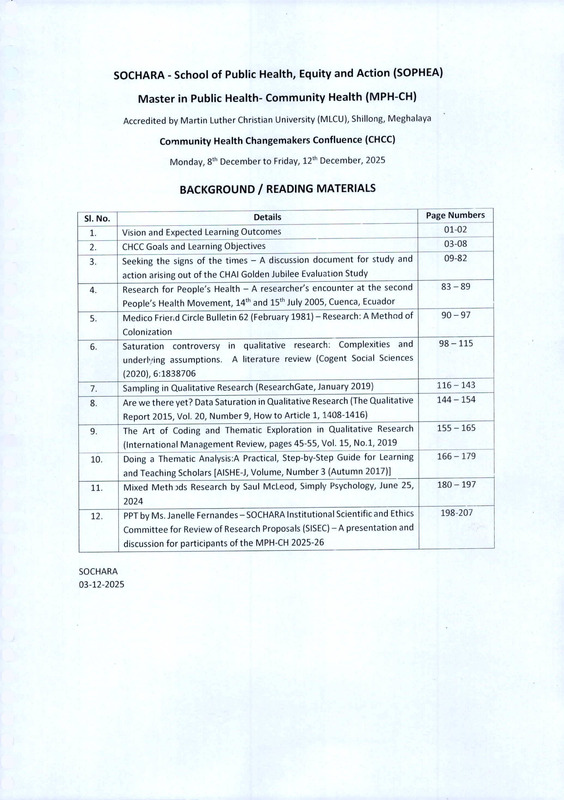
SOCHARA - School of Public Health, Equity and Action (SOPHEA)
Master in Public Health- Community Health (MPH-CH)
Accredited by Martin Luther Christian University (MLCU), Shillong, Meghalaya
Community Health Changemakers Confluence (CHCC)
Monday, 8th December to Friday, 12th December, 2025
BACKGROUND / READING MATERIALS
Page Numbers
Details
SI. No.
1.
Vision and Expected Learning Outcomes
01-02
2.
CHCC Goals and Learning Objectives
03-08
3.
Seeking the signs of the times - A discussion document for study and
09-82
action arising out of the CHAI Golden Jubilee Evaluation Study
4.
Research for People's Health - A researcher's encounter at the second
83-89
People's Health Movement, 14th and 15th July 2005, Cuenca, Ecuador
5.
Medico Friend Circle Bulletin 62 (February 1981) - Research: A Method of
90-97
Colonization
6.
Saturation
controversy
underlying assumptions.
in
qualitative
research:
Complexities
and
98-115
A literature review (Cogent Social Sciences
(2020), 6:1838706_________________________________ ____________
7.
Sampling in Qualitative Research (ResearchGate, January 2019)
116-143
8.
Are we there yet? Data Saturation in Qualitative Research (The Qualitative
144 -154
Report 2015, Vol. 20, Number 9, How to Article 1,1408-1416)
9.
The Art of Coding and Thematic Exploration in Qualitative Research
155-165
(International Management Review, pages 45-55, Vol. 15, No.l, 2019
10.
Doing a Thematic Analysis:A Practical, Step-by-Step Guide for Learning
166-179
and Teaching Scholars [AISHE-J, Volume, Number 3 (Autumn 2017)]
11.
Mixed Methods Research by Saul McLeod, Simply Psychology, June 25,
180-197
2024_________________________________________________________
12.
PPT by Ms. Janelle Fernandes-SOCHARA Institutional Scientific and Ethics
Committee for Review of Research Proposals (SISEC) - A presentation and
discussion for participants of the MPH-CH 2025-26
SOCHARA
03-12-2025
198-207
01
Soeharabuilding community health
Society for Community Health Awareness, Research and Action - SOCHARA
Registered under the Karnataka Societies Registration Act 17 of 1960, S.No. 44/91-92.
SOCHARA - School of Public Health, Equity and Action (SOPHEA)
Master in Public Health with specialisation in Community Health (MPH-CH)
Accredited by Martin Luther Christian University (MLCU), Shillong, Meghalaya
VISION AND EXPECTED LEARNING OUTCOMES
The MPH-CH builds on the community health approach that SOCHARA and other like
minded organisations have been working on for over four decades. This approach:
• builds on the societal paradigm of health and healthcare.
• explores alternative approaches to health and well-being which is rooted in
the community context and dynamics.
• encourages community action on social determinants of health.
• enables communities, practitioners and researchers to find sustainable solutions to
public health issues.
A community health approach builds on local capabilities, rational, safe and effective
health traditions, culture and context in a responsive, affirmative as well as challenging
manner.
The learning outcomes of the MPH-CH are to enable you:
• To be practitioners rooted in values of equity, rights, gender equality, ethics,
integrity, quality, accountability and responsibility at all levels in community
health and public health.
• To develop systems thinking, leadership, mentorship, ethical reasoning, problem
solving and implementation skills.
• To develop skills in qualitative, quantitative and mixed methods research
including epidemiology and biostatistics.
• To strengthen interpersonal and rapport building skills for engagement and
partnership with communities, society and the state; across multiple sectors with a
special focus on the public health system.
• To develop skills for engaging with and strengthening an evidence-based Indian
public health system, plural healthcare (AYUSSH and others), health policy
processes, and for building community capacity, monitoring, evaluation and health
surveillance.
• To develop an understanding of public health priorities such as MCH, gender,
disability, communicable and non-communicable diseases, epidemics and pandemics,
climate change, disaster response, urban, rural and tribal health issues, emerging
concepts such as one health and planetary health.
• To develop the ability and skills to understand the micro and macro social
determinants of health, community contexts and develop community-based action
plans to address identified public health issues.
• To inculcate an understanding of determinants of health, together with approaches
and methodologies for health promotion (including prevention and protection)
using a community health approach.
• To develop capacities to initiate/strengthen community health action,
research, educational strategies, policy, dialogue and action.
• To develop an ability for life-long learning.
03
•? r
Socha
building community health
■J
*
-e
Q
Society for Community Health Awareness, Research and Action - SOCHARA
Registered under the Karnataka Societies Registration Act 17 of 1960, S.No. 44/91-92.
SOCHARA - School of Public Health, Equity and Action (SOPHEA)
Master in Public Health- Community Health (MPH-CH)
Accredited by Martin Luther Christian University (MLCU), Shillong, Meghalaya
Community Health Changemakers Confluence (CHCC)
Monday, 8th December to Friday, 12th December, 2025
CHCC Goals and Learning Objectives
Broad Goals
•
To participate actively in a research proposal development workshop
•
To further equip oneself with the necessary knowledge, skills, attitudes and values to become life-long
learners through study, research, action, reflection as Community Health and Public Health practitioners.
•
To revitalise one's commitment to working towards Health for All based on shared learning and life
experiences of fellow travellers in Community Health and Public Health.
•
To engage with a conversational methodology during the CHCC, actively sharing one's thoughts, and
utilising the opportunity to deepen one's inner learning.
Learning objectives
1.
2.
Core Objectives:
o
To develop a community health-oriented research study proposal for scientific and ethical
review. The research needs to be completed between November 2025 and July 2026.
o
To revisit and reflect on knowledge, skills, values and attitudes developed during the MPH-CH
course and to explore what lies ahead.
o
To develop an understanding of research and publication ethics in community health research and
action studies.
Secondary objectives:
o
To widen one's engagement in critical issues of current and future public health significance
through discussion and debate.
o
To strengthen the sense of 'community' and 'life-long learning' among participants for the
purpose of community health and public health.
o
To get to know each other better and to understand oneself through strengthening selfawareness and a practice of self-care.
04
PROVISIONAL AGENDA
DAY -1 MONDAY Sth December 2025
Core team reporter: Karun Puzhamudi
Participant moderator: To be assigned
Session name
Time
Facilitator
8.00 am to 8.45 am
9:15 am to 9.30 am
Registration
Venue
Breakfast
At accommodation
Maria, Precilia
Main Building, SOCHARA
Dr. Thelma Narayan, Director
of Academics
9.30 am to 10.00 am
Welcome,
introduction and
setting context
Ms. Prafulla S., Secretary-
Training Hall, SOCHARA
Coordinator
SOCHARA.
Programme Agenda
and Expected
Outcomes
10.00 am to 10.30 am
Dr. Thelma Narayan and Dr.
Archana S
Coffee / Tea Break
10.30 am to 11.00 am
Training Hall, SOCHARA and
Online via Zoom
SOCHARA premises
Ms. Janelie Fernandes - CHAI
Golden Jubilee Evaluation
Ms. Ranjitha L - Mitanin &
The SOCHARA
Research story
11.00 am to 1.00 pm
SHRC Evaluation
Training Hall, SOCHARA
Dr. Ravi D'Souza - Odisha
Health Policy & Health System
Reform
Lunch
1.00 pm to 2.00 pm
2:00 pm to 3:30p.m
Participants' Research
and life story
Participants
Coffee / Tea Break
3.30 pm to 3:45pm
SOCHARA premises
Training Hall, SOCHARA
SOCHARA premises
3:45 pm to 5:00 pm
Open session SOCHARA Team
SOCHARA team
Training Hall, SOCHARA
5:00pm to 5:30 pm
Concluding
Comments and
Announcements
SOPHEA team
Training Hall, SOCHARA
DAY 2 - TUESDAY 9th December 2025
Participant moderator:
team reporter: Ranjitha L
Core
of
Time
Facilitator
Session name
8.00 am to 8.45 am
9.15 am to 10.20 am
10:30 am to 11:30a.m
Discussion of
participants' research
topics
Literature review
workshop
(participants to come
with their individual
literature reviews and
Venue
Breakfast
At accommodation
Dr Thelma Narayan and Ms.
Janelle Fernandes
Training Hall, SOCHARA
SOPHEA team
Training Hall, SOCHARA
Q&As)
Coffee / Tea Break
11.30 am to 11.45 am
SOCHARA premises
11:45 am to 12.30 pm
Research story and
challenges
Dr. Upendra Bhojani, IPH,
Bengaluru
Training Hall, SOCHARA
12:30 pm to 1:00 pm
Alumni MPH-CH
Research Journey
Dr Nilesh Mohite
Online via Zoom
Lunch
SOCHARA premises
Dr. Upendra Bhojani, IPH,
Bengaluru and SOPHEA team
Training Hall, SOCHARA
1.00 pm to 2.00 pm
Developing a study
research question
and rationale
2.00 pm to 3:15pm
Workshop: Formulate
a Research question
Coffee / Tea Break
3.15 pm to 3.30pm
3:30 to 5:00 p.m
Workshop:
Literature review:
keywords and
structure
Develop research
objectives
Dr Hemanth, Janelle, Karun,
Ranjitha, Dr Ravi D'Souza and
participants
SOCHARA premises
Training Hall,
SOCHARA
U6
DAY 3 - WEDNESDAY 10th December 2025
Core team reporter:
Participant moderator:
Session name
Time
Facilitator
8.00 am to 8.45 am
Venue
Breakfast
At accommodation
9:15 am to 9:30 am
Recap
Ms. Janelie Fernandes
Training Hall, SOCHARA
9.30 am to 11:00 am
Quantitative research
Dr. Archana S (SOPHEA team
member)
Training Hall, SOCHARA
11.15 am to 11.30 am
11.30 am to 1.00 pm
Coffee / Tea Break
Quantitative research
1.00 pm to 2.00 pm
SOCHARA premises
Dr. Rahul ASGR
Training Hall, SOCHARA
Lunch
SOCHARA premises
Identifying an
appropriate research
design for your
research question
SOCHARA team
2.00 pm to 3.15 pm
Training Hall, SOCHARA
Practical exercises of
research methodsQuantitative
Coffee / Tea Break
3.15 pm to 3:30p.m
3.30 pm to 5:30pm
Further development
and refining of Draft
research proposal
SOPHEA team
SOCHARA premises
Training Hall, SOCHARA
DAY - 4 THURSDAY 11th December 2025
Core team
Participant moderator:
reporter: Janelle Fernandes
Time
8.00 am to 8.45 am
9:15am to 9:30a.m
Recap
9.30 am to 11:00 am
Qualitative research
11.00 am to 11.15 am
Facilitator
Session name
Venue
Breakfast
At accommodation
TBC
Training Hall, SOCHARA
Dr. Shivanand Savatagi
Training Hall, SOCHARA
Tea break
SOCHARA premises
11:15 am to
12*15 pm
12:15 pm to 1:00 pm
Mixed methods
Dr Sushi Kadanakuppe
Training Hall, SOCHARA
Highlighting key
ethical considerations
and dilemmas and
examples of
mitigation to keep in
mind.
Dr. Manjulika Vaz and Ms
Janelle Fernandes
Training Hall, SOCHARA
Lunch
SOCHARA premises
All participants
Training Hall, SOCHARA
Overview of SISEC
application process
with timeline
1.00 pm to 2.00 pm
02.00 pm to 3.15 pm
Idea draft
presentation
Tea Break
3.15 pm to 3.30pm
03:45 pm to 5:00 pm
Idea draft
presentation
All participants
6:30 pm to
8:30 p.m
Participant moderator:
SOCHARA premises
Training Hall, SOCHARA
Film show & Team Dinner
DAY - 5 FRIDAY 12th December 2025
Core team reporter:
8.00 am to 8.45am
Breakfast
At accommodation
8.45 am to 9:30 am
Open Session
All
Training Hall, SOCHARA
9.15 am to 9.45 am
Alumni Sharing
Mr. Shakti Singh Shekawat
Training Hall, SOCHARA
9:45 am to 10:45 am
Practical simulation
of FGDs, In depth
interview,
participatory
mapping
SOPHEA team
Training Hall, SOCHARA
Coffee / Tea Break
11.00 am to 11.15 pm
11.15 am to 01.00 pm
Report writing
TBC
SOCHARA premises
Training Hall, SOCHARA
Lunch
1.00 pm to 2. 00 pm
2.00 pm to 3.00 pm
Journey as a Health
Researcher
Dr. Denis Xavier, SOCHARA
President and Health
Researcher
3:00 pm to 4:00 pm
Closing Remarks
All
Tea Break
4.00 pm to 4.15 pm
Evening
Tibetan Medicine,
Compassionate
healing and
Meditation
Session with Dr Jampa Yonten
SOCHARA premises
Training Hall, SOCHARA
Training Hall, SOCHARA
SOCHARA premises
At Dr Jampa's office in
Brigade Road
08
09
f'
■■
',')
5%^
I
I
I
I
CPHE
I
ni
I
I
W' ft
i'| ,g%,
/\
?■ \ St S' r3W Sft
c
\>
\*
X
^SS#4.
fai+h /
^1/
Pl
WW3:
i\
¥S kWy
n\ I
Sig'!
n
I
.
ft \ 0
l\^a>l.
I^1
jy^
^0
yzw to- 14
'A”-W/
.y?v iC Sz
Oz ZTV
I
if
■?
10'
I
CPHE
ft TIME
mmNiNB
10
is a Ji me [o^* cveeyil
goes if\e retrain of a popu.
m’
e iune7
jAnd ai dUjACJ s fiffieify year^
C7t is time to be glad and eejoicey
"Do eaise beaets and minds
in thankfulness Io Caod.
D
C7t is time also to eefleot a while-/
to see l< the signs o•f tlye times/
to renew our vision and
commitment
and to look ahea d.
The times too lyave changed/ since inception/
for better and for worse/
^Therefore/ it is in the context of todayz
and perhaps more importantly of tomorrow/
~Uhat each person/ member/ associate and friend
of OHjACf, join together
in a common search towards
making health/ and life in all its fullness/
more of a reality for people
particularly the marginalised and iKHpoveeisKed/
the sick/ the least and the last/
who inhabit an ancient land/
rich in history, culture, ideas and expression,
and ever responsive in diverse ways,
to the call of+he. lOeep.
Art work and animation by
Dr. Shirdi Prasad Tckurof CHC &. Mr. Magimai Pragasan of CHAI
Support Team from Community Health Cell (CHC)
M. Kumar, M.S. Nagarajan, V. Nagaraja Rao, S. John, James
11
CPHE
The Catholic Hospital Association of India
POST BOX 2126, GUNROCK ENCLAVE, SECUNDERABAD-500 003.
SEEKING THE SIGNS OF THE TIME
( A word from the Executive Director )
Dear Friends,
At last with gratitude to God and a big thank-you to the Evaluation Study
team, and to each one of you, I am happy to present to you this Discussion
Document arising out of the CHAI Golden Jubilee Evaluation Study. As the
study-team itself mentioned, this is not the report of the study. That would be
a really voluminous one to be ready, soon. This is not a summary of the
report, either. This is a discussion document for the use of our members
during the Golden Jubilee Year for further reflection, comments and contri
bution towards a detailed plan of action to be ready at the time of the closing
of our Golden Jubilee Year in November 1993.
However, since this document is arising out of the study, it contains all that
is necessary for our discussions at various levels. Hence, there is enough
matter for our discussions, and, to suggest concrete plan of action for, say,
the coming ten years. By now you would have already received the copy of
our re-printed book "Out of Nothing*'. Please read this book and the docu
ment, study them thoroughly and encourage others in your community/circle
to read them
And then discuss.
These should be read with interest. Relish them. Then, you will understand
their value and the taste. These will give you an idea of what CHAI was,
what it is and what it should be in the coming years. Then, it is for you to
suggest realistic and concrete plan of action. Then, it is for all of us, with
the help of the Lord, to strive together, putting our heads, hearts and hands
together to make health a reality to many more people in our country and may
be even elsewhere, with particular reference to the poor and the poorest of
the poor, thereby ensuring "fullness of life" to them. Through my subsequent
circulars, we shall keep you informed about the various steps to be taken for
discussions.
12
i
r*
f
Those of you who were at this year's convention and tho.Goldon Jubilee Year
inauguration at Guntur, would have understood the sacrifices, hardwork and
pain that went into the preparation of this document. And those of so many
people, particularly the study-team under the dynamic and inspiring leader
ship of Dr Thelma Narayan. Then, of course, the members of the Advisory
Committee and, specially Prof. P. Ramachandran and Dr. CM Francis. Then the
money that was required—a big sum indeed—which was provided so gene
rously by Cebemo, Holland.
The best way of showing our gratitude to all these, and above all, to our Lord
and Master, would be by reading, studying thoroughly and using this docu
ment the way it was intended for, and as explained above and in the document
itself, and thereby ensuring the fullness of life to our people by providing
health for many more through CHAI during the coming years.
1
f<
1
*9
a
1
O
il
H
F
V
t*
c
t
Fr John Vattamattom svd
Secunderabad
14-11-1992
<
13
SE£WW<? WE WM OF 1HE TIMES
A Discussion Document for Study and Action
arising out of the
CHAI Golden Jubilee Evaluation Study
Study Team
Thelma Narayan, Johney Jacob, Tomy Philip.
Assisted by Xavier Anthony
Community Health Cell
Bangalore, October 1992
Advisory Committee to the Study
Dr. C.M.Francis (Chairman)
Prof. P.Ramachandran (Consultant)
Dr. Ravi Narayan
Mr. P.Srinivasan
Sr. Adriana Plackal,JMJ (CHAI Representative)
Fr. John Vatlamatlom,SVD (CHAI Representative)
Fr. Jose Melcttukochiyil,CST (CHAI Representative)
IMPORTANT
This discussion document
gives basic information about CHAI and its membership,
some information about the wider context within which it functions, and
some feedback from the field
It raises issues specific to the future role and functioning of CHAI, that need to be
discussed by the membership in general.
The detailed report of the CHAI Golden Jubilee Evaluation Study will be ready
after a few months.
'This is not a summary of the Study report.
i
14
ACKNOWLEDGEMENTS
We have deep appreciation for the openness with which CHAI has embarked on this ])roccss of
search. It is a sign of their seriousness that they allowed the searchlight to be focused on themselves,
as well as on the external milieu. We have had complete freedom in planning the study and exploring
any type ol issues with the members. We also had complete access to all documents. The privilege of
discussing a wide range of issues with the staff and associates was also ours. For a 11 this we arc grateful.
It has been an extremely enriching and fascinating experience for all of us though sometimes
exhausting!
Our gratitude goes to the many people who have made the study possible:
• To the 437 member institutions who readily offered hospitality to the investigators and spared many
hours from their busy schedules, discussing, giving feedback,and sharing about their work. This
has been an inspiration.
• To the 1032 members who replied to the mailed questionnaire and have shared their views freely
and frankly.
• To the band of forty investigators, who travelled to remote corners of the country in the heat of
summer, undeterred by bus strikes, terrorist problems, inter-state conflicts etc. Their sense of
dedication is revealed in the quality of work. They gave up several holidays fort he training, planning
and feedback sessions as well as for the field work. Some volunteered for two rounds of field work
in Dcccmbcrand in summer. Wcare grateful to their Provincials, Superiors, Rectorsand Guardians
who readily gave permission for them to participate in this exercise.
• To the forty panelists who actively participated in the Policy Delphi Method and shared many
valuable thoughts, ideas and perspectives. We are sure that CHAI will continue to benefit from
their involvement in the future.
• To the Principal and Staff of St. Joseph’s Evening College Computerand Data Processing Centre,
who thought through the programming and undertook analysis against the odds of several viruses.
• To the Staff of CHAI, who cheerfully provided us with the necessary information and shared their
own ideas and perspectives.
• To the CHAI Executive Board and most specially to Fr. John Vatlamattom, SVD, Executive Director
of CHAI, for daring to undertake such a journey. We deeply value the trust they have placed in
us to undertake this task. They along with representatives ol the regional units have also shared
their views about CHAI.
• To the Staff of Community Health Cell who supported us through every need and deadline, working
late into the evenings.
• Last and most importantly to the Advisory Committee of the Study, who have given much of their
lime and energy. They have provided us the light of wisdom and cxpert.se and have encouraged
us during our difficult moments.
' ’ ’ i our personal limitations, and also within
We have tried to give our best to the Study, within
framework.
The responsibility for any drawback is entirely
the constraints of a nit her tight lime 1
ours.
ii
IS
c
FOREWORD
vp;
Gandhi Jayanthi Day, 1992.
Uniting together to serve better,a group of dedicated and committed Sisters,working in the
field of lhe Healing Ministry,started on a yalra (journey) in 1943. Under the leadership of Sr. Dr.
Mary Glowery,they formed lhe Catholic Hospital Association of India for mutual support in the
service of the people. What were the objectives of the association? Have they been realised? Have
those objectives been changed over lhe period of lime? Do the objectives continue to be relevant
today? What changes arc necessary to make the objectives relevant in the foreseeable future? What
steps should be taken to achieve lhe objectives?
The Catholic Hospital Association look a bold and necessary step to evaluate the work of the
association and to formulate future tasks. The work was entrusted to the Community Health Cell.
Dr.Thelma Narayan and her team have been doing an excellent piece of study and research, with
the help and advice from Prof.P.Ramachandran,Director,Institute for Community Organisation
Research,Bombay, Dr. Ravi Narayan and many others. That report will be ready soon.
Il is essential that the report should be acted upon soon and not allowed to gather dust. To
enable the members and the association to address the more important findings and issues out of
the study,this booklet has been prepared. It is for the study and reflection by each member and
groups al various levels - Diocesan,State and National. That reflection and study must lead on to
decisions and lime-bound action,appropriate for each member and the association.
May the Good Lord guide us to lake the right steps in the right direction in the service of the
people and carry us in His palms,should difficulties arise.
Dr. CM. Francis
Chairman
Advisory Committee
Bangalore,
02.10.92.
CHAI Golden Jubilee Evaluation Study
iii
16
C O N i K N T ti
Acknow'Uxhynicnix
ii
Foreword
Hi
i
PART—A
I
01.
Introduction
1
02.
Study Methodology at a Glance
2
03.
Highlights from History-
04.
CHAJ Today — A Bird’s Eye View
9
05.
Profile of CHAI Membership— 1992
12
06.
Perceptions from the Field
16
07.
Directions from Delphi
08.
Glimpses of Health and Disease in India
26
09.
A Lamp V> Guide Our Feel
28
P A RT—B
10.
Important I'/.u'/, lor the Fuhm: ol ( fl Al
(he '//re of (bo
P A H J
I I.
I h< Nai/o/>al IP
12..
13.
C
L/h;.>iioh
• ?//) '/I ,
■a
33
O' i.
J p ;.ihb and //ho^ u' .
f#om z Fn O/1 \Af
t1 z ouu/ii Ion, » b in vn
!»’
• J/
pn • Hi/ /'//la / •>! Hh f hull II III India
.'.i. b.i fh 'hit • in* /\|Hii«iitlab lauu.nx
58
51
oO
17
PART A
INTRODUCTION
This document forms part of a process of ongoing search for meaning, relevance and direction for
the work of CHAI and its constituent members, in the context of India today, as integral components
of the health and social apostolatc of the church in India, and as citizens of the country.
It was in this spirit that the CHAI Golden Jubilee Evaluation Study was initiated by the Executive
Board and Director of CHAI in 1991. This was in preparation for the Fiftieth Anniversary of CHAI,
to be celebrated in 1993. The process of seeking the signs of the times, from members as well as from
others, employed methods of research available to us today.
Efforts were made to be as interactive as possible with members, staff and others, while also
maintaining objectivity. Rather than being an outside “expert” evaluation giving recommendations for
the future, it attempted to generate and draw from discussion and thinking among people at different
levels. This was both from within the Association as well as from outside.
Very many persons have participated and contributed to the process -
o 62.3% of the membership i.e., 1415 institutions have shared information about themselves,
and have given feedback and suggestions for the future.
o 40 persons outside of CHAI, with long years of social concern and involvement in diverse
fields relating to health and development, actively helped give an outside perspective.
o 40 investigators travelled the length and breadth of the country visiting members, often
through difficult terrains.
o The staff, executive board membersand representatives of regional units of CHAI also gave
feedback and suggestions.
The analysis and report will not be able to capture entirely or do justice to the depth and range
of discussions and feedback. However, we are sure the process has generated interest and
involvement. Many expectations too have probably been raised!
Some of the major issues and concerns that emerged during the process of data collection and
study arc being raised in this discussion document. Issues important for the future of CHAI,
that need to be discussed by the membership in general arc the ones that have been highlighted.
This document has been derived from all the components ot the study. However, it is not a report
of the study and its findings. The main study report will be a specific publication giving much
greater detail. It will be available for wider circulation within a fewr months.
The purpose of this document is to facilitate the second phase of the study-reflection process being
planned by CHAI. This will include discussions at regional levels, in small group meetings, and in
individual institutions.
The document may need to be read in small doses. Different parts may be used for a series of
meetings and reflections. It isourhopclhat issues that have arisen trom members and others in thestudy
process, and given in this document could be the focus of,or background in which the Golden Jubilee
reflections can take place.
18
r
STUDY METHODOLOGY AT A GLANCE
• After a preparatory phase of idea drafts and brain storming, the study started on a full lime basis
from July 1991.
• The aims of the study were:
1. To undertake an analytical study reflection on the Catholic Hospital Association of India
during the last five decades focussing particularly on the past twenty five years and the
present.
2. To explore possible roles the Catholic Hospital Association of India could play in the future,
in the context of the needs of its members, the national situation and the national health
policy, and as part of the voluntary' health sector and the health aposlolale of the Church.
• Specific objectives and methodologies were worked out towards achieving these aims. These
included :
— an analytical historical review;
— eUhetion of information and feedback from members;
— departmental and financial reviews;
— the use of the Policy Delphi Method to explore future scenarios and roles; and
— discussions with a number of people associated with CI I Al.
The membership as of October 1991 which comprised 2270 institutions, was taken as the cut
off point or sampling frame for the study of members. The members arc spread across the country.
They consist primarily of health centres, dispensaries, hospitals and a smaller number of diocesan
social sendee societies and social welfare organisations like orphanages, homes for the aged,
rehabilitation centres etc.
• For a detailed study of members, a 20 percent sample, comprising 455 institutions, was selected
using scientific statistical principles. It was a stratified random sample. Representation
..CH*'"
X
2
19
accord ing to size of insitution and location was ensured. This group was visited by investigators.
O Forty investigators received a six day preparatory training before visiting the member institu
tions. We were fortunate to get volunteer scholastics to undertake this important component.
They included Gipuchins (OFM Gip.,) and Franciscans (OFM) from Kripalaya and Alma
Jyothi respectively from Mysore; Jesuits from Vidyajyothi, Delhi; Diocesan brothers of Delhi
from Pratiksha, New Delhi; and a Priest from St. Thomas Mission Society, Mandya.
A field tested interview schedule was used during the discussions. Besides eliciting feedback
on the different aspects and programmes of CHAI, information was gathered regarding the work
involvements and activities of member institutions and the problems faced by them in the field.
O Questionnaires were mailed to the remaining 80 percenter 1817 member institutions. This was
the same as part A of the interview schedule. The purpose of this exercise was to gather uptodate information about the work of member insitutions, so as to enable future planning to be
related to the realities of members and their needs.
O Structured feedback and views from the staff, executive board members and representatives of
the regional units of CHAI was also gathered and analysed.
O A f inancial review (higher audit) was done by an outside expert and departmental reviews are
being done along with the departmental staff.
O The Pol icy Delphi Method was used with a group of forty persons to identify trends in the socio
pol ilical and economic spheres in India and their impact on the health status of the population
in the country. In this context and keeping in mind the specifics of CHAI, possible future roles
of the Association were explored. The panelists represented diverse fields including education,
management, communication, theology, psychology, sociology, social work, law, medical
ethics, pastoral care, development, nursing and nursing education, different disciplines of
medicine, viz., medical college profcssionals/educators, mental health, community health,
policy makers, researchers and representatives of other national level coordinating agencies/
networks in health.
© Secondary sources of information were studied for the section on the national health situation
and on Church teachings regarding health and related work.
® The entire study was guided by an Advisory Committee of seven members which met four times
during the year.
© The study team consisting of four members was based in Community Health Cell, Bangalore.
® The St.Joseph’s Evening College Computer and Data Processing Centre, Bangalore provided
the technical and infrastructural support for computer analysis of the data. Their staff helped
with programming and supervision of data entry.
The Staff of different departments of CHAI provided us the necessary support in collection of
information.
3
20
HIGHLIGHTS FROM HISTORY
The Catholic Hospitals Association (CHA)
was started on the 29th of July, 1943, by a group
of sixteen Sisters involved with medical work in
different parts of India. This was before Independ
ence, during the period of the Second World War.
Though rich in resources, several factors over the
years, including colonialisation, had had an
adverse impact on the country. The health
situation of people then was poor, especially that
of women and children. Epidemics and famines
took a heavy toll. Medical services, particularly
for the majority of the population in the rural areas,
were scarce.
Sr. Dr. Man' Glowcry.
The Sisters, all medical professionals, had
(Sr. Mary of ihc Sacred I lean, J Ml)
already been working for many years in remote
Foundress of C.I l.A.l.
parts of the country. Some of them had been
pioneers in initiating the medical aposlolatc of the Church during the 1920’s. In those days, they
had to get special permission from the Vatican to practice medicine and conduct deliveries, as
members of religious congregations. Several Sister nurses also worked in Government hospitals
in the early half of the century.
Inspired by the teaching of Pope Pius XII to ‘organise the forces of good’ and by medical
associations in India and abroad, the Sisters formed the Catholic Hospitals Association. This was
after a few years of ground work with the Bishops, superiors of congregations, Catholic medical
institutions and religious medical personnel working in government hospitals. The Resolutions of
the first meeting were :
— to establish a Catholic medical college and a collegiate course in nursing,
— to publish a pamphlet or magazine, and
— to appoint a Board of Examiners in nursing and midwifery.
The Association was registered as a Society in 1944. During the early years all the office
bearers had full time medical/nursing responsibilities as well. The Association covered India,
Burma, Srilanka (and Pakistan after partition) till 1956. They had annual meetings, and since 1944
regularly published an in-house bulletin named ‘Catholic Hospital'.
A Catholic medical college committee was formed and after more than ten years of lobbying,
fund raising and working through many details, the project was handed over to the Catholic Bishops
Conference of India (CBCI).
The CHA Nursing Board functioned for some years and was later closed after the formation
of the Indian Nursing Council, which was set up for the standardisation ol nursing education.
4
21
Members played an active role in setting up schools for the training of nurses, midwives and
auxiliary nurse midwives (ANM’s).
Issues of medical ethics were raised and discussed al various forums of the Church and the
medical profession. CHA encouraged and fostered the formation of Catholic nurses and doctors
guilds for this purpose.
In summary, the main focus of CHA during the first fourteen years was on :
a. Promotion and upholding of ethical values in medical care.
b. Fostering the professional education of nurses, doctors, pharmacists, laboratory' techni
cians and auxiliary nurse midwives. This was with a view to providing competent and
qualified staff for member insilulions.
c. Issues relating to the betterment of medical care and to the professional running and
management of hospitals. Members kept abreast with developments within India and
also internationally. They were encouraged to join and participate in national professional
organisations.
Over the years, the numberof Church related
medical and health insilulions, and consequently
the membership of CHA, also grew. In 1957, the
first full lime Executive Director of CHAI was
appointed. He was also one of the secretaries of the
CBCI Commission on Social Action. Thebullctin
was renamed ‘Medical Service’. Much work was
done towards the framing of a new constitution,
which was registered in 1961 and to establishing
sound procedures of functioning.
; .■ ..-.W
Me? ■ ■
’
AS'*''.'
The emphasis during the next decade (1957 1968) was on :
a. Providing continuing education inputs
to its members through the journal, the
Fr. James. S. Tong, S J.
annual conventions and through
Executive Director of C.H.A.I.
1957 - 1973
seminars,a nd
b. providingassistance to members to meet
their needs for medicines and equipment by developing linkages with various agencies,
donors and government.
The annual meetings gradually grew into annual National Hospital Conventions. Different
departments developed, namely, Membership; Projects; Publication; Employment; National
Hospital Convention and Exhibition; and Responsible Parenthood.
The importance of public health and outreach to the community was recognised. The
implications of the Second Vatican Council documents and teaching to health work was discussed
atan annual convention. Ecumenical and latersccular linkages were further strengthened as a result.
Working with government was actively pursued.
5
22'
In 1969, an important meeting of Christian health leaders in India was held. Il was sponsored
by the Christian Medical Commission, Geneva. Community Health was identified as a major
priority and also the need for working together. As a follow up, the ecumenical ‘Coordinating
Agency for Health Planning' (CAHP) was jointly set up by the Christian Medical Association of
India (CMAI)and by CHAI in 1970. Slate level Voluntary Health Associations began lobe formed
from 1970 onwards, with Bihar taking the lead. This resulted from an understanding by CHAI and
CM Al, that the voluntary health sector must work together in a coordinated and more decentralised
way. Since heal th was a State subject, it was considered appropriate to have Slate level associations.
In 1974, these were federated al the National level into the Voluntary Health Association of India
(VHAI). The Executive Director of CHAI, who had been in that position for seventeen years, was
very involved in all these developments. In 1974, he moved from CHAI to the leadership position
in VHAI. He was also the moving force, along with others, in the formation of Catholic Charities
India, which later developed into Caritas India.
Among several initiatives which received the active support of CHAI were :
i.
the federation ofthc numerous nurses guilds all over the country into the Catholic Nurses
Guild of India (CNGI),
ii.
the units of St. Luke’s Medical Guilds which had been fostered by CHAI were federated
into the Indian Federation of Catholic Medical Guilds (IFCMG),
iii.
natural family planning and the concept of responsible parenthood were introduced.
-
Later, the Natural Family Planning Association of India (NFPAI) was formed as an
autonomous group by several involved people,
iv.
the Hospital Pastoral Care Association was formed in 1971. This was the only initiative
that did not survive,
v.
the Executive Director was also closely involved in the formation of the Indian Hospital
Association (IHA).
After 1974, by mutual agreement, VHAI focused primarily on community health, technical
issues and linkaging with government. CHAI began to develop further, the more specifically
Catholic areas of its work. New departments and honorary consultative committees were set up.
These included Responsible Parenthood, Pastoral Care, and Medical Moral Affairs. The Central
Purchasing Service (CPS) and legal services were also skirled.
Further amendments to the Constitution were made in 1978. These objectives of CHAI hold
good till today. They are :
1.
To improve the standards of hospitals and dispensaries in India.
2.
To promote, realise and safeguard progressively higher ideals in spiritual, moral,
medical, nursing, educational, social and all other phases of health endeavour.
3.
To promote community health and family welfare programmes.
4.
To assist voluntary health organisations in procuring quality amenities.
Since 1980, which marks the beginning of the present phase, CHAI has continued to grow and
develop. Its membership (as of October 1991) is 2215 member institutions, 57 Diocesan Social
6
23
Service Societies and 32 individuals who have Associate Membership. In September 1992, the
membership was 2308. The office has shifted from the few rooms in the CBCI Centre, Delhi, to a
much larger pcrmanentofficeatSccundcrabad. The numberof full timestaff has increased to about
sixty. Medical Service was transformed into Health Action in 1988 and is published by a separate
registered society, 'Health Accessories for All’ (HAFA). Other publications have also been
brought out.
CHAI adopted for itself the goal of‘Health For Many More’ (a modification of the Alma Ata
goal of Health For All by 2000 AD), with a special emphasis and focus on the poor. An earlier plan
was put into action and a department of community health was developed in 1981. The concept of
Community Health was understood “as a process of enabling people to exercise collectively their
responsibilities to maintain their health and to demand health as their right”.
Some of the influencing factors during this phase were :
ii.
The Alma Ata Conference of WHO (1978),
A regional consultation of the Christian Medical Commission held in Delhi (1980),
iii.
The articulation of the National Health Policy (1982),
iv.
The social teachings of the Church,
v.
The introduction of social analysis by the Indian Social Institute and others,
vi.
The growing experimentation in the country in community health and other areas.
i.
In 1983, CHAI adopted for itself the following ten point programme for the next decade:
1.
2.
“Promotion of community health programmes, according to our new vision.
Promotion of spiritual and pastoral aspects of health care.
3.
Promotion of “Respect Life” with special emphasis on just wages and healthy
human relations etc., in our institutions and promotion of natural family planning.
4.
Working towards self sufficiency of CHAI programmes, especially by collaborating
with the Government at various levels and utilising their resources.
Building up of solidarity among our member institutions especially by promoting
the idea of adopting rural health centres by big hospitals.
5.
6.
Diocesan and regional level organisation of CHAI.
7.
Membership drive for strengthening the organisation.
Promotion of low-cost medical care by influencing a better drug policy, prescription
pattern and standardising of drugs.
Promotion of indigenous medicines and systems of health care.
8.
9.
10.
Holistic approach to health and training of new types of health care personnel in
large numbers”.
New departments and activities were also initiated, for example continuing medical education,
library and documentation services, pastoral care (rebirth!) and lowcost media. Short courses were
offered which ranged from ‘Human and Spiritual Growth through Clinical Practice to a variety
of management courses. Short courses in community health and longer community health team
training programmes (CHIT) were also initiated. This was later supplemented by a course on
7
24
I
Community Health Organisation, Planning and Management (CHOPAM) in collaboration
with VHA1.
The CBCI has always had a section or commission on health. In the 1980’s this was for some
time part of the commission on Justice and Peace. The CBCI commission on Health Care
Apostolate was separated out in 1989. CHAI hasalways participated actively, in various capacities
in these commissions.
i
CHAI had initiated the process of drawing up health policy guidelines for member institutions.
A draft policy was circulated to all members in 1988 with a plan to finalise this through a process
of regional meetings. Following a series of meetings in which CHAI was involved as a participant,
the CBCI Commission for Health Care Aposlolatc brought out Health Policy Guidelines for
Church-related health institutions.
Many important events and changes have taken place in its external milieu since CHAI was
formed in 1943. These have been within the Church, in the national and international socio-pol ilical
situation, and also in the area of medicine and health. There have been changes in thinking regarding
concepts of causation of disease and typesand levels of intervention that would improve the health
of people, both as individualsand communities. The health and medical care scenario in India has
also changed, with tremendous growth in the governmentand privatesectors and changes in disease
patterns among the population.
The role of CHAI today and in the future has to be located in this broader context. Equally
important is the role of CHAI as part of the healing ministry/health apostolate of the Church, where
health is not seen only in technical, professional or in its socio-political aspects but is also related
to the deeper dimensions of personhood, relationships, spirituality and faith and also to wholeness
of creation, justice and peace.
At this point in history, it is important for those of us who happen to be present, to reflect
analytically on the past and present so that we can be better equipped to build the future.
The early pioneers of the medical apostolate of the Church and of CHAI, thought far ahead of
their times. Many of their ideas were considered foolish or at best “impractical dreams”. It was
recorded in a newspaper in 1944 that CHAI was formed “out of nothing”, that is when there were
hardly any Catholic hospitals! And Sr. Mary Glowcry has been described as a 'grain of wheal who
dreamt of a golden harvest’. Today we are witnesses to a multiplication of that grain. How we
respond to the challenges facing us today may be studied fifty years later! We now ask ourselves
the question “Harvest for whom and for what”?
"The Important thing Is this —to be able at any moment to sacrifice what
we are for what we can become."
Anon
8
25
CHAI TODAY — A BIRD’S EYE VIEW
1. Distribution of CHAI Members According to Size/Type:
As of October 1991, CHAI has 2302 members spread across the country. The break-up
according to size/ type of insitutions is as follows :
1148
388
591
86
57
32
(49.9%)
(16.8%)
(25.7%)
(3.7%)
(2.5%)
(1.4%)
2302
(100%)
1163
(52.5%)
b. Central Slates (Bihar-160, Madhya Pradcsh-205, Rajasthan-30,
and Uttar Pradesh-118)
513
(23.2%)
c. The North Eastern Slates (Manipur-20, Meghalaya-47,
Mizoram-4, Nagaland-19, Tripura-4, Sikkim-1 and Assam-51)
146
(06.6%)
d. Other States (Goa-29, Gujarat-58, Harayana-11,
Himachal Pradcsh-3, Jammu & Kashmir-5, Maharashtra-94,
Orissa-79, Punjab-28, West Bengal-67 and Union Territories-17)
391
(17.7%)
2213
(100%)
a. Health cenlres/dispensarics with no beds for inpatients to be admitted—
b. Health cenlrcs/dispensaries withl to 6 beds
—
c. Hospitals with 7 to 100 beds
—
d. Hospitals with more than 100 beds
—
e. Diocesan Social Service Societies
—
f. Associate members (individuals having no voting rights)
—
TOTAL
2.
The Geographical Distribution of Members:
a.. The four Southern Stales (Kerala-403, Tamilnadu-380,
Andhra-227 and Kama taka-153)
TOTAL
N.B.
The 57 Diocesan Social Service Societies and 32 Associate members are not
included here.
3. Organisational Structure:
a. CHAI is registered under the Societies Registration Act. The members of the general body
elect a nine member Executive Board with a President, two Vice-Presidents, Secretary,
Treasurer and four Councillors. Three posts arc elected every year, so as to ensure continuity
in the Board. Board members arc elected for three years and may be re-clecled fora second
lime. The Board appoints an Executive Director, Assistant Executive Director and Admin
istrator. There arc various departments in the CHAI Head Office at Secunderabad staffed
by over sixty people.
b. Membership is of two classes, constituted (institutional) and associate (individuals). The
latter do not have voting rights.
9
26
c. Prior to 1981, voting rights were according to size of institutions. Thereafter a constitutional
amendment equalised voting rights to one vole per member.
d. About 15.0 percent of the total membership arc life members and the remaining arc annual
members. Life membership was introduced in the 1980's.
c. Rcgional/Slalc Units:
There is a provision for the formation of Rcgional/Statc Units in the Constitution. Attempts
were made to form such units ever since the Silver Jubilee in 1968 with varying success.
After 1980 greater efforts were made in this direction. Regional or Slate units arc separate
registered bodies, but linked to the Centre. The membership fees arc divided equally between
the centre and the units. The units al present arc :
i. Catholic Hospital Association of
Kerala.
ii.
REGIONAL UNI1S Of CHAI
Catholic Health Association of
Tamilnadu.
iii. Catholic Health Association of
Andhra Pradesh.
iv.
Orissa Catholic Health Association.
v. North Eastern Community Health
Association (NECHA).
vi.
,11
Rajasthan, Uttar Pradesh Catholic
Health Association (RUPCHA).
iftil
£2 RAJA5TH4N 8 U-P (RUPCHA)
E2) ORISSA COCHA)
Karnataka and West Bengal have had
E3 north eastern states
occasional meetings. Some dioceses
□ Ural.
C-ecKA)
EUD KARmATAKA * WE5T 0EN6ALalso have diocesan level activities.
Slffil Andhra pradech
TAMIL- M A Du (chat)
During the early eighties diocesan
health coordinators were identified.
North and South zone meetings were held. This attempt did not last long.
4. The Headquarters and Units:
A. The Departments al the CHAI office include:
a. Administration (General).
b. Accounts and Finance.
c. Membership.
d. Central Purchasing Service.
c. Community Health with four sub-units
i. Rural Health
ii. Urban Health
iii. Research (Planning stage)
10
E
27
iv. Low-cosl communication media.
f. Continuing medical education.
g. Documentation.
h. Pastoral Care.
i. Electronic Data Processing.
B. Zonal Office in New Delhi
C. A separately registered society named ‘Health Accessories For AIT (HAFA) brings out the
monthly magazine called” Health Action” and other publications.
D. Additional Projects:
a. The CHAI Farm Project - with poultry, agriculture, etc for income generation. There arc
plans underway lo start a model integrated health centre with community health
programmes and a training centre.
b. A Central Drug Quality Assurance Laboratory is being planned. This will test drugs and
pharmaceuticals as part of quality control for rational drug therapy and to support the
network of low cost generic name drug manufacturers. A feasibility study has been
carried out.
5. Finances:
The funding of the activities of the Association depended on membership fees and donations
from members in the earlier years. Later some funds were available by processing purchases ot
Indian equipment through donor agencies abroad. Additional sources were from exhibitions of
medical products at the conventions and advertisements in the journal. This has been restricted
since the mid-eighties in order to fit in with the overall philosophy of the Association. In the mid
seventies and eighties, funds from foreign donor agencies began to be utilised for specific projects
and programmes. Initiatives towards self-reliance have been the starting ol a Corpus Fund, the Farm
and a raffle, besides the sale of publications by HAFA.
6. Linkages:
a. CHAI has close interaction with CM Al and also with VHAI. The “Health and Healing Week”
reflections and celebrations arc jointly planned with CM Al. Together they have brought out
the Joint Hospital Formulary. The three organisations also jointly sponsor and conduct
seminars and workshops.
b. CHAI also interacts with thcCSl, Ministry of Healing, the Asian Community Health Action
Network (ACHAN), the All India Drug Action Network (AIDAN) and the International
Association of Catholic Health Care Institutions.
c. CHAI cooperates with government and other organisations to promote health and
development.
1 1
(
28
PROFILE OF CHAI MEMBERSHIP — 1992
A member is the most important person for us
She is not dependant on as, ive are dependant on her,
She is not an interruption in our work,she is the purpose of it,
She is not an outsider in our business,she is part of it,
We are not doing her a favour by serving her,
She is doing us a favour by giving us an opportunity to do so.
— Adapted from Mahatma Gandhi.
The profile of the present membership of CHAI indicates its distribution, diversity and
richness. For those familiar with the history of CHAI, it is evident that the membership is a dynamic,
alive entity, undergoing several changes over lime.
In this document only a brief sketch is given so that the discussion about the future role and
strategics of CH Al may take into consideration the realities of the membership today. Greater detail
and analysis is given in the main report.
The membership of CHAI as of October 1991 was taken as the cut-off point for the study.
This comprised 2270 institutions including Diocesan Social Service Societies. Associate members
(individuals) were not included. We have data from 1472 or 64.8 percent of the total membership.
Included in this group are the 20 percent of the total members (the stratified random sample) visited
by investigators and the respondents to the mailed questionnaire. The Runs Test performed showed
that these respondents were randomly distributed. Of this group of 1472 institutions, 57 i.e., (3.9%)
have closed/arc not functioning presently. This is 2.5 percent of the total membership.
The information that is given in this section is therefore derived from 1415 active respondent
member institutions. This number is the denominator in all tables.
1. Year of Establishment:
• 14 institutions (1%) were established before 1900,
• 93 (6.6%) during the first fifty years of this century, and
• 1186 (83.8%) thereafter, till October 1991.
While institutions established earlier were mainly hospitals, in later decades smaller dispen
saries and health centres became more common.
2. Ownership/Management:
• 66.9% are owned by congregations of women religious, while 76.9% are run by them.
3. Geographical Location:
• 67.8% (959) institutions are in rural areas,
• 15.6% (221) in tribal areas, and
• 16.6% (235) in urban areas.
12
29
Thus 83.4% arc located in rural/lribal regions. At the national level, all sectors put together,
hospitals, beds and doctors are more concentrated in urban areas compared to rural areas in a ratio
of 80:20. Dispensaries, however, arc more rural based. This is, therefore, notvcry different from
the overall national situation. However, the level of functioning and effectiveness of Government
primary health centres and dispensaries is very variable.
4. Nature of Institution:
O 93.9% (1,329) arc primarily medical care institutions. Of these
— 57.0% (806) are dispensarics/hcalth centres,
— 18.7% (265) general hospitals,
— 9.2% (130) maternity centres and maternity centres cum dispcnsaries/hospitals.
— 4.1% (058) community health cenlrcs/projecLs.
— 4.9% (070)have a specific focus on leprosy, tuberculosis, mental health, cancer etc.
O 6.1 % (86) includesocial welfare organisations (homes for the aged, orphanages, rehabilita
tion centres etc.) and diocesan social service societies. Most of these have components ol
mcdical/hcalth work.
5. Medical Care Institutions According to Bed Strength
O 35.5% (502) have no beds, and
® 21.6% (306) have one to six beds.
This large group of 57.1% (808) could be considered as health outposts or primary health
centres.
© 32.3% (458) arc small hospitals with 7 to 100 beds. Of these 318 have 7 to 30 beds.
O 4.90% (69) arc large hospitals with more than 100 beds. Of these only 3 have more than
500 beds.
Different strategics would be required to meet the needs of these broad groups of members,
namely health centres, small hospitals, large hospitals, social welfare organisations and diocesan
social service societies. The work or circumstances in which they function as well as their needs,
problems and potentials would be quite different.
6. Distribution of Hospital Beds:
The total number of hospital beds in the respondent institutions is 31,245. A further analysis
of the distribution of beds is revealing :
a. Rural-Urban Distribution of Hospital Beds
— 58.1% (18,160) arc in rural areas,
— 4.9% ( 1,521) arc in tribal areas, and
— 37.0% (11,564) arc in urban areas.
13
30 .
b. Statewise Distribution of Hospital Beds
• 41.0% (12,827) arc in Kerala, 30.1% (9,418) arc in the remaining three Southern States,
namely Tamilnadu - 11.9% (3,713), Andhra Pradesh - 11.5% (3,599) and Karnataka 6.7% (2,106). The remaining States have 29.0% (9000) beds.
• 81.3% (25,390) arc located in Stales where health indicators arc relatively good, that is,
where the targets for 1990 laid down in the National Health Policy have been achieved.
And 18.7% (5,855) arc in the States where health indicators arc poor.
Historical factors probably account for this pattern. It could however be suggested that further
investment in terms of infrastructure and expansion should be in areas cf greater need.
7. Systems of Medicine/Methods of Healing Practised:
A fairly large proportion of members use methods/systems of medicine other than allopathy.
In these eases, most often more than one system/method is practised.
f*
93.9% (1328) use Allopathy,
24.7% (350) use Herbal Medicine,
10.6% (150) use Ayurveda,
8.3% (117) use Naturopathy,
7.1% (101) use Homeopathy,
4.5%
(64) use Acupressure,
4.4%
(63) use Magnetotherapy and
4.4% (63) use other systems/methods.
• 61.7% (864) practice only allopathy, 3.1% (44) do not practice allopathy and 32.8% (464)
practice allopathy along with one or more methods/systems ot medicine.
During the past ten years CHAI has promoted herbal medicine and non-drug therapies. So too
have other organisations. The time is ripe now to initiate investigation and study the strengths and
weaknesses of these methods.
8. Work Profile:
• 46.3% (655) have cxtcnsion/outrcach programmes.
A range of approaches namely camps, mobile clinics and extension services are used for
curative and preventive/promotive health work. Some arc also involved in awareness raising
activities.
86.9% (1,230) arc involved in some type of mother and child health work.
Communicable disease control programmes
— 22.4% (317) have tuberculosis control programmes,
— 12.9% (183) arc involved in control of leprosy,
14
31
— 37.2% (526) in control of diarrhoea and gastrointestinal disease,
— 40.1% (568) promote oral rchydration solution.
O 63.7% (902) have programmes for health education and a variety of methods are used.
O 46.8% (633) arc involved with awareness raising activities among the community with
whom they work. A wide range of issues arc taken up.
O 32.3% (456) undertake preparation of some medicines in their institutions. These include
mixtures, ointments, ORS packets, powders etc.
O 20.2% (286) have introduced rational therapeutics in their institutions.
O 13.4% (189) purchase medicines from low-cost drug manufacturers.
O 12.6% (179) have got herbal gardens.
9. Time and Budget Allocation for Preventive Work:
O 53.0% of members spend more than 50% of their lime and 58.3% of them spend more than
50% of their money for preventive and promotive work.
10. Training
O Training of a variety of community based workers is undertaken by the members.
— 29.1% (412) train community health workers,
— 9.7% (138) train traditional birth attendants (dais),
— 8.1% (114) train natural family planning teachers.
O Training of more specialised health personnel is undertaken by 6.4% (90) institutions.
® 30.4% (430) have continuing education programmes for their staff.
n.
Distribution of Personnel:
There are a total of 28,133 personnel working in these 1415 institutions.
O 11.3% (160) were single personnel run institutions,
® 78.4% (1109) had nurses,
® 41.0% (581) had doctors,
® 22.0% (312) had pharmacists, and
• 30.9% (430) had laboratory technicians.
12. Referral of Patients:
The member institutions refer patients to the following sectors :
• 66.8% (945) to government hospitals,
• 40.0% (567) to mission hospitals,
• 36.6% (518) to private hospitals.
15
32
PERCEPTIONS FROM THE FIELD
Feedback on various aspects of CHAI has been gathered from members, those on the
Executive Board, representatives of regional units, as well as from the staff of CHAI.
All members have had the opportunity to share their views regarding the strengths and
weaknesses of CHAI, their expectations from CHAI and their suggestions regarding future thrusts.
The 20% member institutions which were selected for a detailed study gave feedback on objectives,
organisational structure and each of the various programmes and activities of CHAI. The level of
involvement of members with CHAI during the past five years was also studied.
The overall response rate to the mailed questionnaire, as well as the response to each question
has been high. The volume of information gathered has been large. The first round or the
provisional analysis of this data has been done. However, more time is required for further analysis,
integration and assimilation.
In this section, keeping in mind the above
constraints,some of the main findings from the
members’ feedback have been given. This is to
make available the trends of views of members.
This would help as part of the background for the
regional/small group meetings being planned dur
ing the Jubilee Year.
A process of Teductionism’ has been neces
sary as we have had to code, summarize and be
concise. The main report will cover these aspects
in much greater detail.
Strengths
The fifteen major strengths of CHAI in
descending order of priority, as identified by
members are given. 62.0% (878) members re
sponded to the question on strengths.
1. Support, concern and service for its members.
Il is “a hand to hold on to” in the words of a
member.
2. “Health Action” and other publications.
3. Training programmes, seminars and courses.
4. Meetings and correspondence with members.
THEM®!
5. That the association is organised and is func
tioning well.
r
t
16
33
6.
The large number of members spread throughout India — that it is a national level body.
7.
It is a network imparting education to Catholic hospitals and dispensaries.
8.
It is a forum for unity, where like-minded people can come together.
9.
Conventions and similar meetings.
10.
Community health policy.
11. Dedication to health work.
12.
Alertness to the needs and signs of the times.
13.
Philosophy and vision.
14.
Preferential option for the poor, reaching out to the marginalised and involvement in social
issues.
15.
Dedicated and efficient staff.
Weaknesses
The fifteen major weaknesses of CHAI in descending order of priority as identified by
members arc given. 45.0% (640) member institutions responded to the question on weaknesses.
1.
Poor interaction between CHAI and its members, poor personal contact and communication,
and sense of alienation felt by members.
2.
Inadequate focus on rural based members and their activities.
3.
It does not fulfill the needs of its members and does not look into their problems.
4.
CHAI programmes arc not accessible to many members in terms of cost and their location,
especially for the smaller ones.
5.
Poor functioning of the regional and State units. The centre does not take much interest
in them.
6.
Services offered arc meagre and inadequate.
7. The administration and functioning is not efficient.
8.
CHAI is not practical in its approach.
9.
Concentration on bigger hospitals.
10.
Discrimination between members in its service.
11.
Too much centralisation of power.
12.
Charging for “Health Action” to small/poor institutions.
13.
Lack of initiative of members in activities of CHAI.
14.
Lack of professionalism. It is run as a religious association. Lack of qualified personnel in the
mcdical/heallh field.
15.
It does not stand for its objectives.
17
34
Expectations
The fifteen major expectations that members have of CHAI arc given. 69.0% (978) members
responded to the question on expectations.
i. Better interaction between CHAI and members through visits, more personalised
correspondence.
2. Financial assistance.
3. Guidance and support to member institutions, especially smaller ones.
4. Training programmes at the State level, preferably using regional languages.
5. Medical aid (supply of medicines) on a regular basis.
6. CHAI to focus on rural areas.
7. Provision of information to improve health work.
8. Courses/scminars on labour laws, social analysis.
9. Production of health education material in local languages.
10. CHAI should be ready to help members out of their problems.
n. CHAI to arrange for doctors who arc efficient and service minded to work in member
institutions.
12. Support to/ promotion of community health programmes.
13. Promotion of low cost drugless therapy.
14. Strengthening of regional units.
15. Training for community health workers.
Future Thrusts
The fifteen major suggestions for future thrusts of CHAI from members arc given. 55.0%
(775) members responded to the question on future thrusts.
i. Focus on rural and tribal areas and their development.
2. Community health and development.
3. Health for All by 2000 AD, including cooperation with Government to achieve this goal.
4. Health education/Health awareness.
5. Training programmes to be organised on different aspects of health care.
6. Wholistic health.
7. Preferential option for the poor and social justice in the healing ministry.
8. Interaction with member institutions.
9. Women’s development programmes.
18
• 35
io. Work on prevention of AIDS/Canccr/mcntal illness.
11. Alcoholism and Drug dependence.
12.
Assistance to institutions working for rural health.
13.
Regional planning and action as per the vision of CHAI.
14.
Support to members in their activities.
15.
Supply of free medicines.
DETAILED STUDY FINDINGS
Some of the key findings from the detailed study of the members arc highlighted here. These
were the 20% of members (455 institutions) visited by investigators. Fifteen institutions could not
be covered due to unforeseen reasons, thirty two were closed and one institution refused to
participate. The number of institutions functioning currently in this group is 407. This therefore,
is the denominator in the pcrcentagcs/tablcs given in this section.
A. Level of Interaction with CHAI:
O 97.3% (396) receive the circulars from CHAI regularly.
O 13.8% (56) have been visited by staff members/olTice bearers of CHAI during the past five
years that is, 2.8% per year. A higher percentage of institutions with bed strength of more
than 6 were visited than smaller institutions. Institutions visited were more in regions of the
country with poor health indicators rather than those with good/better health indicators.
More urban based institutions are visited than rural and tribal. The differences given here are
statistically significant.
O 25.1% (102) institutions have participated in some programmes of CHAI during the
past five years. These include seminars/workshops on rational therapeutics, ORT, herbal
remedies, spiritual growth through clinical practice, pastoral care, management and others.
They also include diocesan and regional level programmes. A total of 315 persons from this
sample participated in these during the past five years, that is, more than one person attended
per institution. During the past five years, there is a gradual increase in the number of
institutions participating per year.
© A large majority i.c., more than 80% found the contents of the programmes useful. They
also felt that the seminars were well conducted.
B. Conventions:
® 32.4% or 132 member institutions have participated in annual conventions during the past
five years, that is, the annual average is 6.5%. The number of persons from the sample who
have attended conventions during these five years are 250. Again more than one person
attends per institution.
The themes of the meetings during the past five years were :
a. Health as if people mattered.
b. Our health care mission - a search for priorities,
19
36
c. Our hospitals - towards greater accountability,
d. Financial administration and project planning,
c. Women in health care.
The majority found the themes useful, the sessions interesting and the conventions in general
well organised.
• The follow up by institutions after conventions is low with an average of 3.5% (15) of
institutions having followed up conventions during each of the past five years.
C. Publications - Health Action:
• 92.9% (378) members received Health Action during 1988-90.
• 66.6% (271) of the sample now subscribe to Health Action. 77.3% of urban, 77.9% of
tribal and 62.3% of rural based institutions subscribe. The difference is statistically
significant.
The large majority (95.5%) felt that the magazine was relevant, and that it was interesting.
A smaller number (4.3%) felt that it was too technical.
On the whole, it was highly appreciated and found to be useful and informative.
D. Central Purchasing Service (CPS):
24.6% (100) institutions from the sample have availed of the services of Central Purchasing
Service at any lime in the past.
(The 5 year lime period was not considered for this Department)
• 42.4% of high bed strength institutions (more than seven beds) and 20.1% of low bed
strength institutions (less than six beds) have availed of the services of Central Purchasing
Service.
50.0% of urban based institutions, 24.5% of rural, and 13.8% of tribal based institutions have
used Central Purchasing Service.
E. Catholic Medical Mission Board (CMMB) Medicines:
53.3% (217) members received CMMB gift supplies during the past five years.
81.6% members felt that the medicines were useful and 16.1% said it was not useful.
However, 41.0% mentioned that the lime period between receiving a consignment of medicines and
the expiry date was very short, while in 20.3% the expiry date was already past when the
consignment was received. In 50.2% cases the time interval was sufficient.
F. Discretionary Fund:
27.5^ of members (112) received grants from the Discretionary Fund during the past five
years.
Six institutions received the funds twice during the past five years.
20
r
37
G. Project Proposals:
During the past 5 years, project proposals from 9.6% (39) member institutions had been
forwarded to funding agencies through CHAI or had been referred to CHAI by the agency.
H. Community Health Department (CHD):
® 8.6'/ (35) member institutions participated in programmes organised by the CHD during the
past 5 years. A total of 150 persons participated in programmes such as orientation seminars,
short term training, CHOPAM course (Community Health Organisation, Planning and
Managcmcnl),workshops, exchange programmes etc.
O 7.4% (30) members were fully aware of the vision of CHD, 91.1% (341) were pa rtially aware,
1.5% (6) were ignorant and 7.4% (30) did not respond to the question.
O 84.8% members (345) said that the CHD vision was relevant to their work, 9.3% (38) felt
it was not relevant. A significantly greater proportion of respondent institutions based in
regions where the health indicators arc poor and those from smaller institutions found the
vision relevant in their work.
I. Medical Ethics:
85.5% member institutions (348) fell that CHAI should have a Department of Medical Ethics.
A large number of areas were listed as being important to be covered by this department.
J. Financial Aspects of CHAI:
28% members (114) from the sample participated in fund raising for CHAI. This was through
the raffle (85), by donations to the Corpus Fund (26), by contribution to the Golden Jubilee Funds
(8). Five members did not specify how they participated. Ten member institutions participated in
more than one way.
"Trees may die.......... but the forest
||g||
for''etfer"Ss
lives
Bttti
♦♦
■Anon
21
<38
DIRECTIONS FROM DELPHI
Delphi speaks of the Future Scenario
Using the Policy Delphi Method of research,
forty panelists helped in determining future trends
likely to occur in India, during the next fifteen years,
in the economic, social and political spheres, that
would have an impact on health. Similarly, they
also helped in predicting the possible future health
scenario in the country.
r
11 is in this broader context that the heal th work
of CHAI and its members is situated. A brief
summary of findings is given. Two rounds of the
process have been conducted so far. This will be
completed and reported separately.
TLc.
arc- cU**-
Verjj
Vtrj cz>'
.
art o
There. aoeS our
/■
*
\
°
A. Economic Trends:
The majority (80 percent) of panelists felt that:
• Present trends in economic policy arc likely to continue. We will have devaluation,
privatisation, liberalisation, an increase in exports, an increased need for repayment of
foreign loans and a decrease in government spending.
• Reduced government expenditure will be primarily in the service and development sector.
Subsidies to health, education, housing etc., will reduce. Budget allocation per person for
health will reduce.
• The economic process will benefit the business and industrial groups most and to some extent
organised labour. The majority , comprising marginal farmers, unorganised workers,
landless labourers and daily wage earners will not be bencfilted. Children, women and the
illiterate will suffer most. Poor people everywhere will lose control more and more of the
ability to determine their livelihood and lifestyles. Their health status will deteriorate and
they will be unable to avail themselves of the services of privatised health, education etc.
• Increasing commercialisation and privatisation of medical and health services will be
promoted by the leaders of the country, the medical profession and the middle class.
• Cost of diagnostic and curative medical services will rise at a galloping rate, with the poor
having less and less access to them.
A small number felt:
• that the present market economy would increase income and more people would be brought
above the poverty line. Overall health would improve.
22
39
O There would be greater professional isalion in hospital/health management and the develop
ment of insurance as a means of third party payment.
B. Social Trends:
o The nuclear family status will become more common, complicated by incrcasingbreakdown
and inadequate care of the aged population who will increase in numbers. This may worsen
the overall status of women rather than improve it. However, improvement of education,
particularly of women, will have some positive impacts on family health.
o Increasing urbanisation, with inadequate basic facilities for the poor and increasing
marginalisation of sections of the population, including dalils, will take place.
o There will be a progressive erosion of values in social life. The sense of community will lose
ground and a narrow sense of individualism will prevail. There will be increase in regional,
ethnic, linguistic, communal and caste conflicts, with increased social tensions due to
increase in violence. Several factors will affect general mental health, leading to increased
awareness, but also to a growing sense of helplessness and unrest.
o Mass media (television) will lead to increasing consumerism and replacement of old values
with increased abandonment of traditional food practices and traditional systems of medicine
and increased smoking and drinking culture.
o Mental health problems will increase caused by increasing confusion, lack of identity and
responsibility, materialism vs humanistic beliefs, false values and lack of spiritual
strengths.
o However there will be improved educational levels, increased litigation in the health fieldand
strengthening of consumer protection councils.
© Science and technology will improve the life of the average person and there will be an
increased focus on ecological and gender issues in public policy.
C. Political Trends:
The ‘new’unipolar world will decrease the autonomy of nation states.
© The political instability and inadequacy al national level will continue with corrupt, dishonest
and self seeking politicians dominating the political scene. Political parties will make use
of divisive forces and the conservative forces will increase.
Destabilisation due to growing disparity between haves and have nots and inequitable
distribution of resources will continue. There will be a greater awakening among the
marginalised especially dalils, tribals, and backward classes with increased participation by
them in social, political and economic processes.
There will be an increased demand for autonomy to states and greater decentralisation, with
an increase in separatist movements as well.
There will be increased political consciousness and student movements with an increased
demand for people centred participatory processes.
23
^0 ,
r
I
D. Health Scenario in India:
“The health problems of India will show a complex epidemiology in the years ahead. While
we shall continue to have problems of poverty, poor hygiene, poor nutrition and poor environment,
we shall increasingly experience the problems of development, affluence and modernization. New
diseases will come up along with the resurfacing of older disease problems with newer trends and
patterns. While this 'double burden’ of disease will severely stretch our limited resources, our
ability to deal with the situation will be severely hampered by the broader socio-economic, political,
cultural factors emerging on the national and international scene that will determine our develop
ment, welfare and health policies”.
The significant health problems we will have to tackle in the years ahead will be :
1. Nutrition related problems — malnutrition complicated by increasing chcmicalisation and
adulteration of our foods.
2. Water borne diseases including diarrhoea, dysentery, gastroenteritis, typhoid, cholera,
hepatitis B and parasitic infections.
r
3. Communicable diseases like malaria, tuberculosis, leprosy, kala-azar, acute respiratory
infections and preventable childhood diseases.
4. Non-communicable diseases including heart disease, hypertension, diabetes and cancer.
5. AIDS.
6. Problems of mental ill-health including a whole range of stress-related disorders, psychoso
matic and psychological problems, suicides and dementias.
7. Addictions and substance abuse problems.
8.
9.
10.
1T
12.
Pollution related diseases including allergies, asthma and other hazards.
Disabilities and handicap problems.
Health problems of the aged.
Iatrogenic diseases.
Accidents.
These health problems will be further complicated by an increasing number of issues
significant to health and contributing to the magnitude. These will include :
Increasing environmental pollution and deterioration of ecology.
Increasing challenge of providing basic environmental sanitation.
Urbanisation and its consequences/contribution to health of the urban poor.
Increasing importance of ethical issues in medicine and medical care.
Rational therapeutics in the context of a growing abundance of drugs.
Problem of increasing population growth coupled with high literacy and inadequate health
resources.
7. Increasing violence in society and its consequences on social health.
1.
2.
3.
4.
5.
6.
In response to the challenge of developing and sustaining health care del ivery systems to meet
24
Lk
41 *
these problems and tackle these issues, the following will become significant for the planning
process in health care.
. i.
Health care planning will have to meet the challenges of priorities, equity, limitation of
resources, rural-urban disparities, clarifying the role of technology, access, roles of govern
ment, private and voluntary sector.
2.
Costing a nd financing of healthcare will become crucial in the context of the market economy.
Commercialisation and issues such as cost-effectiveness, sol f financing, affordability and cost
escalations will become significant.
3.
Human health manpowcrdcvelopmcntwill be complicated by inadequatesuppliesof the right
type of doctors and health team members for primary health care,side by side with over
production and overspccial isation of the wrong categories of health workers for secondary and
tertiary levels.
4.
Rational drug policy that will deal with availability, distribution and adequacy or essential
drugs side by side with the control of misuse and overuse of drugs.
5.
The challenges of providing basic needs and primary health care for all.
6.
The needs, priorities and appropriate choices for secondary and tertiary health care.
7.
Health education to promote positive health attitudes and capacities towards primary health.
Integration of medical systems, both western and indigenous.
9. Research in alternative approaches, health behaviour, women’s health and holistic healthcare.
10. Promotion of holistic health care of positivc/wellness model with stress on five basic
dimensions of self responsibility, physical fitness, nutritional awareness, environmental
sensitivity and stress management.
8.
Though the health scenario may seem somewhat bleak in the next fifteen years, the greatest
positive task facing health organisations, such as CHAI and its members, will be to evolvea creative
multi-dimensional, multi-disciplinary and people based response to the challenges of the future.
“Everyone has the right to a standard of
living adequate for the health and wellbeing
of himself and his family...... ”
— UN Universal Declaration of Human Rights, 1948
“The enjoyment of the highest attainable
standard of health isoneof the fundemental
rights ofevery human being withoutdistinction of race, religion, political belief, eco
nomic or social condition”
—Preamble to WHO Constitution, 1946
25
^2'
GLIMPSES OF HEALTH, DISEASE AND
RELATED FACTORS IN INDIA
CHAI and its constituent members all work towards bettering the status of health of people
in India, towards alleviation of pain and suffering and the curing of diseases.
It is important to keep in touch with the
prevailing patterns of diseases in the country in
different regions and to understand the causative
factors of disease and ill-health among people.
New insights and discoveries, different perspec
tives and approaches all contribute to some under
standing of this complex, multifactorial process.
This helps towards evolving methods of interven
tion that seem rational and likely to meet with
some success. It also helps us to realise that non
medical interventions can have a tremendous
impact on health, both good and bad. This reali
zation helps us to recognise that several people in
society, infact arc part of the health "team”!
A brief glimpse of health, disease and related
factors in India is given here. More detail is
provided in Part — C for deeper study.
• Forty percent of deaths still occur in
children below the age of five years.
INDIA
1991
---------- D«'hl B.37O.«75
f- 25.513.1*9
22.2S4.562
2 64%------ 1
29.011.237
3 44%->
31.512.070
3 73%V<
111%
3 02%
e
L./5
INDIA
043,930,861
w
J*rrx. ane ■ashrnj (Projected) 7.718,700 0 917.
H.'Tjcr.jl Praoetn 5.111.079 061%
Inpvra 2 7U|.’7 0 32%
M»rvsu« 1.826.714 0 22%
Mra-ai,i 1.7W.626 0 71%
i 215.573 0 14%
Gsal.iue?2 0 14%
A/VOichat Piadeih 858 392
0 10%
Di0'»
Pondcherry 769.416
Mitoram 686.217
Chandui'll 040.725
$^A!m 403.612
A and N l»landi 277.089
I.'JJJI Hj.t« 138,542
Da-run and Du IOj.439
LaAihaowaap 51.681
0 09%
0 08%
0 087.
0 057.
0 037.
0 077.
0 017.
0 017.
• The Infant Mortality Rale (IMR) is 80 per 1000 live births (1990 prov.) and Crude Death Rale
is 9.6 per 1000 population (1990 prov.). Several other developing countries, for example
China, Srilanka, Phillipines, Cuba etc., have a much lower IMR than India.
• There arc major differences between different Stales and regions in the health status of
people. The Slates of Bihar, Madhya Pradesh, and Uttar Pradesh, where a large proportion
of our population live, arc the worst off.
• However, within each Stale, even in the most developed ones, there arc districts, areas and
groups of people that have a very poor health status. Class and caste factors arc important
determinants.
• There are big urban-rural differences and within urban areas, the urban poor sutler most.
• There are large gender differences between women and men, the girl child and the boys.
Maternal death rates are unacceptably high as compared to other parts ol the world.
• Though death rales arc declining, morbidity continues to be high.
26
43
O The old scourges of communicable diseases still take their toll. Small-pox and plague have
been eradicated. However, tuberculosis, leprosy, filaria, malaria, kala-azar in some areas and
waterborne infectious diseases cause a tremendous load of morbidity or disease among the
population.
O Non-communicable diseases are on the increase. They include cancers, cardiovascular
diseases etc. They too affect the poor the most.
O Levels of under-nutrition, though showing some improvement over the years, continue
to be high.
O 31.0% of the rural population has access to potable water supply.
O 0.5% of rural population enjoy basic sanitation.
O The population grows with an addition of 16 million persons every year, the Crude Birth Rate
being 29.9% per 1000 (1990 prov.).
O Between 30 to 40 percent of the population continue to live below the poverty line.
O Deep rooted hierarchical stratification of society with class and caste divisions also continue.
O Growing fundamentalism, communalism, regionalism and separatism, with the increasing
use of violence and terrorism, take their loll.
.......... ~
~
~
"The Consfiftriion of India...... aims at the elimination of
poverty, ignorance and ill-health and directs the State to
ragand the raising of the level of nutrition and the
standard of living of its people and the improvement of
public health as among its primary duties, securing the
health and strength of the workers, men and women,
specially ensuring that children are given opportunities
and facilities to develop in a healthy manner"
— Constitution of India j
27
It '
A LAMP TO GUIDE OUR FEET
Church Teachings on Health and Related Work
The formation and growth of CHAI
and its members have been inspired and
sustained by the deep faith dimension of all
who have been actively involved in it. Many
hearts have been moved by the ceaseless and
challenging call to respond to human suffer
ing. These responses have taken varied
forms. In the fifty year history of CHAI one
cansec that fresh understandingsand insights
have had an influence on the work of Church
related institutions in this sphere.
There have been church related medi
cal care institutions in India since the seven
teenth century. At lhe turn of this century
there were about nineteen such mission hospitals/dispensarics in the country. Sister
nurses also worked in government hospi
tals. The origin of CHAI took place under
the slogan “Union gives strength” in 1943.
As has been mentioned, one of the factors
responsible for lhe formation was the exhor
tation of Pope Pius XII to nurses and medi
cal workers to “organise the forces of good”.
Th is com i ng logo ther was a sou rce o f stre ng th
and over the years there has been an increase
in numbers. Later the Second Vatican Coun
cil opened the doors to greater humanism
and to ecumenical and secular dialogue and
linkaging. Challenges that arose from here
opened CHAI to community health work.
Over the years the social teachings of lhe
Church evolved towards making a preferen
tial option for the poor almost a mandate.
Theological perspectives of working in solidarity with the marginalised and impoverished have
been growing in Asia probably drawing inspiration from developments in Central and Soutn
America. There is a growing deepening in the understanding of poverty, dehumanised conditions
inner conflicts and struggles, as well as ecology and other specific issues that pose a cha enge
all those involved in working with people.
28
45
Excerpts from statements/reports of important church bodies on health and related work arc
now given. This is to facilitate reflections by individuals, institutions and small groups during the
Jubilee Year
The CBCI reporlof the meeting in Bombay in 1971 gives the followingstatements on “Poverty
and Development"
“For us who accept the leaching of God and of His Son Jesus Christ, love of one’s neighbour
assumes a position of centrality so profound and pervasive that men and his concerns have
become both the common task and love of both religion and development. Jesus Christ’s own
mission was deeply involved in the alleviation of human needs. He provided bread of life
for hungry crowds, new limbs for the handicapped and restored the sick to health. The Church
must carry on His mission and He speaks to us today in the demands of our fellowmen for
bread, health, education, work - in short for human dignity and justice.
To achieve this aim, the church must accept that health personnel, services and relief work
will always have their important place, the more relevant and meaningful efforts today will
concentrate on change of atmosphere, transformation of structures, creation of new relation
ships and a fresh value system and provision of ampler freedom and wider opportunities for
all men".
The CBCI Memorandum to the 1971 Synod of Bishop in Rome added,
“Love implies an absolute demand for justice, namely a recognition of the dignity and rights
of one’s neighbour. Thus love cannot co-exist with injustice of any kind, and a keen love for
our people must drive us with irrcsistablc force to fight against the injustice which oppress
them".
The Pontifical Council, Cor Ununi set up a working group in 1976 to examine Primary
Health Care. Their report was entitled “Health Work for Human Development". A second group
was convened in 1977 which brought out a report “The New Orientation of Health Service with
respect to Primary Health Care Work".
This report is of relevanee to Church related health institutions in India. Both these reports
interestingly were before the famous Alma Ata Conference of WHO in 1978, where “Health For
All by 2000 AD" was enunciated as a world wide goal, and primary health care accepted as a major
strategy. However, they did reflect the conclusions of the 1975 meeting of the WHO.
The report stated that “Jesus considered suffering and sickness as forming part of the “less
human" situations which the Encyclical “Populorum Progressio" asks us to endeavour to make
“more human". Since human development also means solidarity, the need to work with the family,
neighbourhood and village and the practice of community medicine was considered necessary.
Health personnel should “listen and learn" and should be “more concerned with festering action
than undertaking it themselves".
The document set the focus or framework for change very forcefully.
“The mission that we have been given is a call fora true conversion of our hearts and also
of our methods since Christians are the leaven we must reach out towards the masses by
29
providing simple, accessible and promotional health care
The members of the commu
nity must be helped where necessary', to become aware of their own problems and to express
them, so that, here again they become the craftsmen of their own development”.
“The emphasis given to the new primary health care policy has shown the vital importance
ofa whole motivational approach on the part of those who work in the health field or for health
improvement. Unless this new approach on the part of the personnel is inculcated through
special courses that need thorough planning and implementation by highly qualified staff, the
new orientation to be followed by the various health services will simply not come about.”
“Christians arc citizens just like any one else, and must be committed to the struggle against
underdevelopment”.
“Members of religious congregations must take a good hard look at the current conditions
under which they arc working in order - when and where necessary - to redirect them. It
sometimes happens that as a result of changes which not everyone is necessarily aware of,
too many of them work in hospitals and health centres that have become loo expensive for
the majority of the population and are only within reach oflhc pockets ofa ceria in “elite” who
can afford them. In this case the leaven is too far removed from the loaf'.
They also spoke of a time when the government started providing health services - “far from
being discouraged or useless as a result of this new stale of affairs, they must see it as a golden
opportunity to play an active part in the national endeavour to bring about integral and mutually
responsible human development’*.
In 1978, responding to the urgent needs of the country, the CBCI outlined the new challenges
before the Church in its apostolate.
“The Church is heavily engaged in education, heal th services and development work and her
contribution in these fields has been appreciated
However, we must constantly evaluate
our traditional insitutionsso that they become genuine witnesses to the Church’s concern lor
the building of a just society and thus be effective instruments of social change”.
“We want our health services to take primary' health care to the masses, particularly in the
rural and urban slums. Catholic hospitals and dispensaries should stress the preventive and
promotivc aspects of health care. Specifically, we would urge them to join hands with the
civil authorities in their programmes for the eradication ol leprosy. Our health outreach
programmes may demand a change in the routine, especially ol religious communities ol men
and women involved in this work and their formation should prepare them to meet the new
spiritual challenges that are posed”.
In 1983, the CBCI Commission for Justice, Development and Peace, which then included the
health section, added the concept of struggle for a just society to the health mission by stating -
“The creative struggles of our people invite us to enter into critical collaboration with people
of all religions, ideologies and agencies who strive after a just society. As a credible sign ol
this process the Church initiates action for justice within its own structures .
The Commission proposed the following priorities of work in the field ol health .
30
^47
1. To promote community health programmes on a priority basis
2. To train health care personnel with a bias towards rural health programmes and Christian
values.
The recent statement of the CRI National Assembly (January 1992) is a very challenging
document. After reflections on the national situation and the Church's social teaching, the major
superiors of CRI renewed their commitment to liberation of the oppressed and to solidarity with the
poor. They expressed specific concern for the “dehumanised dalits, the dispossessed tribals, the
discrimination against women, marginalised ethnic and other minorities, enslaved bonded labour
ers and child labourers, degraded slum dwellers, unorganised agricultural, industrial and domestic
workers, migrants and refugees”.
They identified the following responses required of them :
— a new thrust for social justice in all areas of apostolalc,
— to evaluate, reorient and prioritize ministries in consonance with the varied charisms, with
redeployment and training of personnel and distribution of material resources accordingly.
— to show solidarity with people's movements,
— after discernment, issue based collaboration with other groups working for justice at all
levels,
— to include the social leachings of the churches and suitable training in the formation
programmes for religious, especially those specifically missioned to work for justice,
— to evolve a way of life that leads to a spirituality that is nurturing and supportive of action
for justice programmes,
— and specifically for 1992 :
O to initiate community study and reflection on the social leachings of the church.
O organisation of training programmes for action for justice with a thrust to peoples’
movement. The methodology will include exposure experience programmes for those
missioned to the social apostolalc, outreach programmes for those engaged in educa
tional, medical, pastoral and evangelical apostolates.
The General Body Meeting of the CBCI in January 1992, has also encouraged the church in
India in all its activities to focus specifically on dalits, unorganised labour and on women. A few
excerpts from the summary of the main papers :
— “a forceful plea to stop discrimination against women, which seem to be embedded in the
structure of our society. Many forms of discrimination in society and the church were listed,
beginning even before the birth of the girl child, violence against women - physical, sexual
and psychological, is a result of an inhuman and unchristian attitude”.
— they also condemned unequivocally directaborlion — “another form of violence against the
unborn and the destruction of human life”.
31
-48
— “agricultural labour in rural areas, domestic workers, construction workers and immigrant
labour in cities form the bulk of the group of unorganised labour. I nsccurity of work, i nab i I ily
to negotiate service conditions, absence of safety and retirement benefits arc their lol”.
— “the ideal parish/diocesc is a community of believers where all sections of the people of God,
gather in small groups, arc involved in the planning, decision making and execution of
various activities of the church. The leadership required in such a church is a non-dominating
one, following the example of Jesus who came not to be served but to serve. Each diocesan
region has planned such a participatory church”.
!
5
These provide a new thrust and need to be considered seriously by all those engaged in the
health-medical apostolate.
ThcCBCl Commission for Health Care Apostolate, in January 1992, has brought out a ‘Health
Policy of the Church in India - Guidelines', bringing together the thrusts and priorities evolving in
recent years. It encompasses a wide range of topics - including theological foundations, spirituality
and health, community health, mental and social health, areas of special concern, emergency
services, special groups, rehabilitation, responsible parenthood, rational use of medicinal drugsand
technology, care of the terminally ill, ethics, right to life and right to health among others.
This is an important document, offering guidelines to church related health work. Policy
statements from this document are given in Part-C of this document.
A paper on “Health and Wholeness” which arose out of a long term study by the Christian
Medical Commission of the World Council of Churches, provides the broader framework and the
context in which the health apostolate of the 1990s should be located. Il re flecks on heal th as an issue
of justice, of peace, of integrity of creation and of spirituality. Il is a good background paper for
study reflection and is also given in Part-C.
The life and teachings of Jesus and the leachings of the Church can thus be the “lamp to guide
our feel” as we proceed in our life’s journey as health workers. Il is in this perspective that each
of us can reflect on our role and that of our institution in the life and activity of CHAI.
/z77ke spirit of tke Lord is upon Kne7 because he
■
1aos anointed ►ne
to preach good news to the poor.
recovering
•He has sent me to proclaim release to the capti ves,
of sight to -the blind/ to set at liberty those who are oppressed/ to
I
proclaim the acceptable year of the Lord/7
jAnd ^esus said "T oday ihis scripture has been fulfilled in your
hearing^........all in the synagogue were filled with wrath- jAnd
they rose up and put him out of the city".
4, 17-29
32
49
PART-B
IMPORTANT ISSUES FOR THE
FUTURE OF CHAI
Vok
qjo 0
0
0
0
33
0
0
bO
Introduction
CHAI and its constituent members have much to feel satisfied and proud about at this moment
in their history. Looked at objectively,there is no doubt that significant contributions have been
made in the provision of medical care and in the promotion of health of people in India. The most
striking examples arc in the areas of health of women and children, sendee in remote areas and with
underprivileged groups, the training of women health personnel, the promotion of public health,
community health, community organisation and the promotion of rational therapeutics, among
others. Many newer areas arc being actively explored by several members, for example wholislic
health, use of alternative systems etc. There arc several other areas of strength.
One of the purposes with which CHAI had initialed this evaluative sludy-rellcction process,
was to identify key issues that must be considered by the Board, the executives and the Association,
as future strategics arc planned for the nineties and beyond.
As has already been mentioned, the study has benefiltcd from the perspectives and views of
diffcrcntgroupsofpcoplc.Several areas identified by lhescdiffcrcntgroupsaresimilarand resonate
with each other. This is particularly regarding health problcms/issucs that need to be addressed,
types of slralogics required etc. There is however greater divergence in the perceptions of different
groups/members about CHAI. Each probably arises from their own particular experience and
expectations. However, certain broad or predominant trends in thinking have emerged.
Issues being raised in this section, arise out of a fifteen month involvement in all the
components of the CHAI study. Results that have come in have been considered. Gandhiji’s
talisman (sec back page); faith reflections; an understanding of the role of medical care; an
epidemiological approach; and a social analysis have all influenced the choice of issues raised.
The issues chosen arc considered important for collective reflection and action. However, the
data and information from the study will be available for all to make use of, and .to arrive al their
o wn iss ucs. The spe c i f ic i l i cs o f 1 oca I s i l ua t io ns wo u I d be a n i m po r la n l y a rds l ic k fo r c h o ice o f iss ucs
for discussion as well.
Like ina football game, someone has to kickoff the start and that is what isbeingdone through
this document. The players in this case can determine the rules, as well as the direction of the game.
Wc hope that this will be a reflective, constructive and useful exercise.
&
I (__11
34
51
1. Union is Strength
— exploring the potential of this ‘union’
There is meaning even today,in the slogan under which Dr.Sr.Mary Giowery started CHAI,
namely “Union is Strength”, and also in the exhortation of Pope Pius XII “to organise the forces
of good”.
As individual institutions, a role can be played at the micro level. But it is only by coming
together that a larger level role can be played.
The challenge before CHAI and its members today is to identify what this larger level role is
and to equip itself adequately to play this role.
As a united body, members can reflect on issues and plan appropriate action (think globally).
At the individual, local and micro levels they can implement these collective decisions (act
locally).
Several questions can also be asked :
o Has the association in the last fifty years fully explored the potential of this ‘union’ of
members?
o Is there a need to be more united, organising the forces of good for the improved health
of people, particularly the marginalised and impoverished ?
© Flow can we be more united?
— within institutions;
— with neighbouring members;
— within diocesan/State/regional units;
— with CHAI at the national level;
— with other voluntary organisations.
Could building linkages with peoples’ organisations and movements be considered?
What will the objectives and nature of all the above types of linkages be? Among these
where should our priorities lie?
How can we monitor progress towards greater unity, better organisation and improved
health? What would be the indicators of this process?
35
^52'
2. What Does CHAI Mean to its Members?
During its early formative years CHAI was very much an association of professionals. All the
issues taken up were professional ones, in the context of the Indian situation. Even the concern for ethics
was for medical ethics. It was also clearly an ‘Association’ in its early years with no full timers. Its
growth depended on the active contribution of members in its thinking process.
Ils concepts of‘self’ and ‘the image’ projected to members and others have since changed. On
the one hand, there was the welcome addition of the social science stream in its thinking. There has also
been a growth in the central organisation, with greater potential for responding to members needs,
providing sendees etc. On the other hand, there has been a dilution in the involvement of members in
its process of evolution. It has even developed some internal contradictions.
For instance, since the past two decades it also tends to play the role of a funding agency, or rather,
more of a middle man role. The second highest expectation of members from CHAI is for financial
assislancc/mcdicines etc. There is no doubt that the financial needs fifty years ago were much greater,
and sources of support more difficult to find. However, the foundresses did no! form CHAI for this
purpose, nor did members look to CHAI for this. Infact, they contributed from their own meagre funds
for the runningof the Association, its bulletin and activities without any external support. Nothing was
subsidised.
Over the years, CHAI has also become institutionalized .This is potentially a positive phenomenon
as any achievement requires good organisation. The image of CHAI is also becoming that of a large
benevolent organisation offering security, material benefits and some sendees. Members play a
relatively passive and dependent role vis-a-vis CHAI. Again, study findings indicate that several
institutions join froma sense ofduty because it isa Church organisation and bcca use they hope to receive
something, particularly material benefits from it. The sense of joining a common cause has waned.
Whereas these needs may be legitimate, the prime purpose of CHAI has to be clarified.
However, right through its history, as seen in its resolutions, themes of conventions and activities,
CHAI has also a core live element in it. This clement has always sought to work towards the greater
good. Il has made relevant changes, and given birth to new ideas,initiatives and organisations. Contact
with people through its members, has been a source of inspiration, strength and challenge. The profile
of activities of members indicate the wide range of work involvements and the immense changes of
approach taking place. These arc the contradictions that arc signs of great hope and promise.
A fundamental question: There is, therefore, need and scope today,for redefinition
and clarity of the identity and meaning of CHAI, for its members.
* Do members want CHAI to be : — a professional association with a social concern?
— a force working towards social change?
— a charitable body?
— a source of funds? or
— an institution ?
• Will members play an active role in determining and giving shape to this identity?
The implications of the answers to these questions will need to be understood.
It is on this* conscious ‘or unconscious fundamental image, that will depend, the direction that
, CHAI will take. It will also draw on this for its internal dynamism, the relationship with members and
with other organisations and forces. Its contribution to society in India, will also evolve from this.
36
53
3.
Redefining Philosophy, Goals and Objectives
1 laving completed fifty years of involvement in the health scene in India and arising from the
previous two points;
O Could CHAI have a brief current statement of its understanding about the health
situation, the causes of disease and health in the country and the philosophical
assumptions underlying the role that CHAI perceives for itself?
O Do the goals and objectives need to be refrained?
O Do long and short term strategies need to be drawn?
O Could they be endorsed by members?
O How could the involvement and commitment of membei's to this be enhanced?
Study findings reveal that there is a certain lack of clarity about goals and objectives
among the members as well as the staff of CHAI.
O How can we ensure that member's, staff and office bearers of the Association are always
aware of the objectives and priorities of the Association?
O How could we ensure that these are internalised by all concerned?
O Would a mission statement help?
1
((
IZ
i
77^
3A Would you agree with the issues given below for the statement of
philosophy? These have emerged from members and Delphi Panelists.
O Preferential option for the poor — to promote health work in remote rural and backward
areas, particularly of underdeveloped states, in urbanslums, among tribal groups, marginalised
groups, and indigent populations. Support of efforts by groups whobring the needs and issues
of the poor to centre stage.
O Justice dimensions of health/health work and not only health care service issues - to
support and build the organisational capacity of people, to demand a more just health and
37
^54
I
social service system, and to act as a counterveiling power to the pharmaceutical industry and
to vested interests.
O Enabling/cmpowering people in health work — to enable individuals to take care of their
own health, to be able to analyse and respond to their problems themselves, to avoid
everything that creates dependency and non-participation, to support a peoples’ health
movement, to enhance liberation and growth of people, to increase community responsibility
for health work.
O Holistic approach to health —where there is harmony in body, mind and spirit, in society
and with the environment. This is closely related to the spiritual dimension of health and is
totally non-sectarian.
O Community based non-institutional health work — to demystify medical knowledge,to
dcprofessionalise as far as possible, to build on people's health knowledge and practices and
to be sensitive to their culture. There is a need for greater focus on comm unity health, but there
is an important place for good institutional health care too.
O Improved accessibility of the poor and underprivileged to medical and health care
services — to good quality basic health services and to life saving bio-medical services.
O Develop a sense of understanding and caring among health workers and in health
institutions.
O Promotion of a sense of community and belonging that are critical to wellbeing and
wholeness—by helping make people inter-dependant and concerned about each other. The
primary responsibility for health care lies within the community itsclfand within families to
lake care of each other. Hence creating heal thv communities - that receives, accepts, forgives,
heals and commissions is of the highest prioniv.
O Spiritual dimensions of health and healing which is intricately linked to wholeness and
a wholistic approach to health. Several of the points raised earlier relate to a spirituality which
strives to make a dehumanised situation more human.
O The need to focus on members of the health care team, in its broadest sense, to help
maintain their motivation, nurture those involved in health work, and to provide means for
fellowship and mutual support among themselves.
O Gender related issues — womens’ health status, their access to health care and the impact
of technology on women.
O Enviromental/ecological issues as they relate to health.
O Strengthening of self-reliance at all levels — by promoting herbal and home remedies,
nondrug therapies, low cost care and appropriate health technology. And reduction of
dependence on drugs and the medical industry.
O Integrated approach to medicine and health —studying, understanding and using Indian
and other systems of medicine, namely Ayurveda, Siddha, Unani, Homeopathy, Acupunc
ture etc., and local health practices and remedies.
38
55
4. Clarification of Current Role
CHAI functions today in the midst of several groupings. A representation of the groups in
heallh/relalcd sectors al the national level is as follows:
CNGI
IFCMG
NFPAI
ISNFP
FIAMCO Biomedical
Ethics Centre
Professional
Associations
CBCI Commission for
Health Care Aposlolatc
CRI
Central and State.
Government Bodies
SJMC &H (CBCI Society
for Medical Education)
CMAI
VHAI
CSI Ministry of Healing
LSPSS
AIDAN
ACHAN
mfc
CHAI
IMA
IHA
TN Al
IGSSS
1ST
FUNDAGS
N.B.
StJohn's Medical College and Hospital
Christian Medical Association of India
All India Drug Action Network
Catholic Nurses Guild of India
Natural Family Planning Association of India
Trained Nurses’Association of India
Indian Hospital Association
Medico Friend Circle
CRl
VI1AI
CSI
LSPSS
IFCMG
ISN1-P
IMA
ISI
Conference of Religious of India
Voluntary' I lcallh Association of India
Church of South India
LokSwasthya Parampara Samvardan Samiti
Indian Federation of Catholic Medical Guilds
Indian Society for Natural Family Planning
Indian Medical Association
Indian Social Institute
SJMC& II
CM Al
AIDAN
CNGI
NFPAI
TN Al
IIIA
MFC
—
—
—
—
—
—
—
—
IGSSS
Indo-German Social Service Society
ACIIAN
— Asian Community Health Action Network
Several times during its history, CHAI has shown a flexibility in taking up issues that it
considered important, and after some lime it handed over the job to the other organisations-or
withdrew when the role was taken care of by others.Thus, it has been a true catalyst.
In the context of all these factors,
® what should be the role that CHAI should play during the nineties and beyond?
Regional, Stale and diocesan units may also need to identify
context of their own situation.
their own specific roles in the
Health is a State subject and different Suite governments differ in their level of functioning.
NGOs or voluntary organisations are also more active in some Slates than in others.
• Could the resources available in terms of facilities for training and continuing
education, along with other aspects be studied,in the voluntary/government sector in
each state?
The skills, local knowledge and practices, peoples* organisations and other strengths of the
communities within which institutions arc located need lobe identified. This peoples’sector is most
often ignored.
® How could we learn and link more with this sector?
39
56
5. Diverse Membership Needs Call for Different Strategies
When exploring future strategics, the reality of the present day membership of CHAI, its
composition and their activities is an important factor to be considered.
As seen in the profile of CHAI membership - 1992, there is a great diversity of membership
which is a tremendous strength for the Association. However, it is obvious that the circumstances,
needs and the institutional objectives of these different groups of members differ. Different
strategics would need to be evolved for these diverse needs.
A substantial proportion of members are small health centres. Many of these arc run by one
or two trained persons, most often nurses. They often have to handle problems - medical and non
medical, that their training in bedside nursing may have not prepared them. The present
programmes and activities of CHAI and also future strategics would have to consider the special
needs of this group.
■
• In our own region/State/diocese, what are the needs of these members? How can CHAI
help? What are the other resources/facilities available? Can we plan for the next three
years?
Similarly the medium sized hospitals and their personnel have special needs. And so also do
the larger hospitals.
• What are the needs of this group ? How can they be met and by whom?
A small number of social welfare organisations, social service societies and community health
projects arc members. They could play a very useful role. They are a constant reminder that other
approaches that impinge on health, exist and arc necessary.
• Are they on the perifery of the Association?
• Can a creative dialogue between the different groups in the association be fostered?
Several issues related to members have been tackled by CHAI for example supply of CM M B
medicines, equipment, etc., through CPS, promotion of pastoral care, medical ethics, rational
therapeutics, management, urban health, extension work and community health. Issues concerning
accountability have been raised.
• Are these adequate? Are these being appropriately utilised by members? What more
is needed?
Different strategics to serve the needs of the broad groupings of members need to be evolved
► Should this be done only by the CHAI office? What can be the inputs of the Board, the
regional units and all members in this?
Everyone has something to offer — a perspective, a skill, an experience, an approach,
Can these be identified, made known and harnessed?
40
57
6. Need for Decentralisation and Democratisation
For an Association as large and varied as CHAI and functioning in
a country as vast as India, it is necessary to have greater decentralisation
of power and responsibilities, greater democratisation and leadership
from among the members.
Very few members today sec CHAI as being their creation, their
Association which they need to build by contributing much more than an
annual subscription. The relationship of dependance and apathy regard
ing its functioning is such that one cannot then have great expectations
from CHAI or its members. In this situation, the headquarters loo can
develop a patronising and patriarchal altitude towards members - worry
ing about them, trying to keep them in line, bemoaning the fact that they
do not have enough control over them, etc.
oV-
If a meaningful role is sought to be played collectively as an
Association then much greater effort needs to be pul into the internal
dynamics and mechanisms of functioning of the Association.
Despite the fact that provision for regional units was made at its inception , and more definite
efforts and resolutions made since its Silver Jubilee, this vital aspect of having vibrant and alive
Rcgional/State or Diocesan level units has not materialised in a sustained way. Barring a few
exceptions, the attempts have usually succumbed to ‘underfive’ mortality.
® How can members be encouraged to take leadership and responsibility?
How could the Centre support such a process of decentmlisation/democratisation?
• What are the democratic norms and structures that need to be consciously nurtured?
41
58
7. Women Religious — the Backbone of CHAI
The most striking aspect of the CHAI history is that the main participants and players have
been women and therefore the history could more aptly be called ‘her story’.
Situated in the the patriarchal, hierarchical, and semi-feudal society of India in the 1940s, this
is an interesting phenomenon. The foundresses and early pioneers were,however, primarily
expatriate medical professionals, mainly nurses and some doctors and pharmacists. The vision and
persuasive powers of the key figures, Sr.Dr.Mary Glowcry,JMJ (Sister Mary of the Sacred Heart)
with the organisational abil itics of Mother Kinesberg, FM M and the enthusiasm of f i fteen to twenty
sisters, saw CHAI safely through its early years.
These sisters thought boldly, far ahead of their times both in the medical and nursing field, as
well as in the thinking of the Church. Like risk-taking modern entrepreneurs they set up institutions
and trainingeentres for health personnel and ran them efficiently, often relying heavily on faith and
the Great Unknown.The key characters tics of the pioneers was that they assumed leadership with
confidence and skill.
Over the years, though members have increased enormously in numbers, this characlcrstic of
women rcligous confidently biking initiatives, seems to be decreasing at the national level. While
sisters continue to function very effectively in theirown congregations and in their institutions there
seem to be difficulties in taking up larger level responsibilities in CHAI.
Even as members of CHAI, their participation in decision and policy making and in several
other aspects is rather passive. Several arc highly qualified, more so than the early pioneers, and
they still are the ones working in the field.
One hears of domestication of women within the Church being reflective also of Indian
society, thus explaining the takeover by the clergy. These aspects need to be discussed. They would
probably raise issues that arc pertinent not only to CHAI but to the wider framework within which
they function.
• Has initiative and leadership of women religious in CHAI gone down in recent decades?
If so,what are the reasons?
How can initiatives and confidence among the women religious be further fostered so
that they may play their rightful roie at the national level?
42
59
8. Building Better Interaction Between CHAI and its Members.
A significant proportion of members stated that the strength of CHAI was its support, concern for and
sendee to its members. This speaks well for the Association. Thcothcrsidcofthccoinisthata large number
of members also considered the interaction with members as CHAI’s greatest weakness! Mentioned were
- lack of a personal contact and lack of understanding of their needs, among many others.
Good or bad,the overall impression is that the relationship between members and CHAI has emerged
as an important issue. There is need to build closer, supportive linkages between members. Doing this in
smaller geographical regions and around areas of special interests arc two possibilities.
Feelings of isolation, loneliness and tensions of work by members especially in smaller institutions/
remote areas have been expressed. Building of circles of interaction and the fcclingofa community of like
minded people will go a long way in overcoming this, even if they arc ten to hundred kilometres apart. Each
member could think of what they can do to support at least five others. ‘From each one according to their
capacity and to each one according to their need’.
CHAI too needs to give the highest priority to building up close interactions with its members. With
growth in numbersand inan institutionalized (computerised!)agc,someofthis hasDeenlost. Astrengthened
motivated membership may be its greatest asset in the future.
O How can all of us contribute to an enriching relationship between CHAI and its members; and
between members, locally and regionally?
9. Need for an Active and Able Governance
If CH AI has to retain and strengthen its nature of being a membership organisation-along with greater
decentralisation,
dcmocratisation, better linkagingand contact, it also needs an actively interested Board
that can keep in touch with what is happening in the membership, and also be able to give direction at a
national level. It may be necessary to have representation ol regional areas and types of institution so that
the special circumstances and needs of these areas/institutions arc not ignored. It is through involvement
in national/rcgional level issues, meetings and programmes that Board members can also be strengthened
and continue to grow.
O Besides staff of CHAI, could the Board members also be involved/participate in national/
regional level meetings/ other programmes?
The persons taking up such responsibilities should be made aware of the involvement in terms of lime
and effort that such a position demands. It would also mean that their involvement in their own institution
would be much less.
The manner of elections also needs to be carefully considered. At present participants for Annual
Conventions arc predominantly from large institutions and those geographically close to the venue of the
convention. There is also a tremendous rotation among the personnel from institutions who attend the
convention. Often the participants hardly know much about CHAI.
® Is change necessary? What are the possible methods to bring about this?
G Can election proceedings be less arbitrary and more serious?
If CHAI is raising critical issues about governance in the context of the government and its health
servicesand regarding the style of funclioningof the Church, it would be a good and healthy exercise to make
all efforts to activate, revitalise the participatory democratic functioning of the Association itself.
W How can each member institution/regional unit help towards this ?
43
60'
10. Some Thoughts regarding Membership
The membership of CH Al is institutional. However, it is persons within institutions who have
visions, drcams, dynamism and competence. Il is they who give the institutions character and who
build relationships witholhcrorganisaiionsand institutions. Persons in institutions change, so does
their interaction and relationship with CHAI.
• What are the possible ways by which CHAI can maintain a link with persons and grow
from this interaction?
Historically there has been provision for associate membership of individuals. This was for
sisters working in government hospitals, superiors and chaplains who were interested and for lay
people. They have no voting rights.
> What role can they play? Should associate membership be dropped or made more
active and useful? What could be the advantages and disadvantages?
The issue of encouraging lay membership has also been raised off and on. At one stage there
was provision for non-calholic institutions lobe given special membership on the discretion of the
Board. With the formation of VHAI, which look place later, this was dropped.
Among regular members there are instances where infirmaries serving the needs of small
institutions, forcxamplc of religious and perhaps with a fcworphans/old people arc made members.
A clausc/resolulion in early years mentioned that only those groups which provided services that
were open to the general public could be admitted as members of CHAI.
• What should be the present position?
Opening membership to Diocesan Social Service Societies docs seem a welcome move.
• What efforts are required to identify their specific needs; to integrate their pei-spectives
into the Association and to expose and involve them to thinking of health, particularly
regarding the newer thrusts?
Most associations are social groupings that have certain norms of practice that arc commonly
agreed upon, which bind the members together.
• Can we discuss what these could be for CHAI?
Therefore:
• Is there a need to review membership?
• What should the criteria be when enrolling new members?
• Should there be an accreditation process (different for different types ofmembers) so
that members can reflect on their strengths and weaknesses and make improvements?
44
61
11.
Communication Links Between Members
A very vital aspect of keeping an association and its spirit alive is communication and
linkaging between members. At this present moment there is no such mechanism functioning in
CHAI. Its in-house journal, Medical Service, besides being a medium for updates in technical
information, had a very key role in the past of keeping members informed about each others’
activities. While this aspect was not very strong and infact waxed and waned, it could have been
strengthened creatively. Its metamorphosis into ‘Health Action’ has resulted in the loss of inhouse
communication since the new version is focussed on a wider circle of readers,not only members.
The continuing education aspect of4Health Action’ has however received wide appreciation from
its members.Only 800 (34.8%) of members currently subscribe to the journal.
O Could Health Action be sent to all members such that the subscription is part of the
membership fee?
O How could Health Action be an effective communication link between members?
O How could members participate in the preparation of the magazine?
O How could it become a members forum for exchange of ideas and debating of views?
O What other creative methods should be evolved to further ‘networking’ among
members?
12. Internal Mechanisms of Functioning
Cl 1 Al head office has gone through a phase of rapid expansion and change in recent years.
Many new sendees arc offered and projects taken up alongside earlier commitments. The small
team of ten to fifteen people has grown tooversixly. Growing pains arc part of the process ! These
have been evident especially with the large and difficult challenges that CHAI has been taking up
during the past decade.
Lack of clarity regarding goals and objectives, high turnover of staff, levels of confusion
regarding roles, inadequate understanding and inter-relationship between Departments, and other
factors brought out by the staff indicate that there is need for serious ongoing work on this area.
O How could the common cause for w hich all the staff, Board and members are working
towards as one team be internalised and reinforced ?
O How could morale and motivation be kept up ?
O Is the time now' ripe for a family style of functioning to give way to some of the concepts
emerging from management and behavioural sciences ?
O Besides improved stafTselection, what methods of human resource development can be
used?
O What internal methods ofchecks and balances can CHAI adopt for itself?
© How can the membership and the Board help, support, strengthen and challenge this
important process?
© Can we all participate in problem solving ?
45
62
r
13. Accountability
That Accountability is important is accepted by all. Several specific questions rcgardingaccountability can be best answered by those actually involved.
For instance,
# What is the accountability of CHAI ?
—
to its members; to its founders; to the people; to its own goals and vision.
• How does one gauge levels of accountability?
* Could the yardstickofaccountability to the least and the last and therefore to the public, be kept
as a goal?
This was the concept of trusteeship that Gandhi talked about.
Management of funds and accounts is a crucial issue, linked to accountability. The external financial
expert has indicated the need for improved financial planning and management and greater financial
discipline. Mismanagement of funds in two State CHA units has been reported. An internal audit system
has been introduced.
Othcraspccts impingingonaccountabilitysuchas livingout its objectives and vision in a 11 its activities
and in its internal functioning, quality and efficiency of sendee etc., have been raised.
> As its trustees, what are the methods by which members can support and safeguard CI IAI in
this vital area as it works towards its goals?
• How can each one in the CHAI office feel more responsible, for the large amounts of money and
property being kept in their charge for the cause of betterment of health of poor people?
C How can each one give their best even if there were none to see and none to applaud?
14. Lag Period Between Ideas and Action
It has often occured duringCHAI’s history that the lag period or period of gestation between the genesis
of an idea and its actualisation takes upto one or two decades. This is understandable for the more complex
undertakings especially in the early years. Study findings indicate for instance that the follow up of the
conventions and their resolutions even today by members is dismal. How many remember the ten point
priorities drawn up in 1983 to be worked on during the next decade? This raises important questions as to
how serious members arc about their Association or about the annual conventions.
* What factors have been contributing to this lag time? or what are the reasons for the delay?
> What methods/strategies need to be evolved to enhance the spread of collective resolutions and
decisions and their translation into membership action at individual and institutional level?
Those who bear the consequences of delay and inaction arc the people and it is in their name most
often that funds are received.
An association like CHAI involved in Health and Development needs to experiment with innovative
ideas.
• Could/should CHAI have one or more cells or groups:
— to function as an innovative/creative group?
to work out the feasibility of putting ideas into action?
follow up and monitor progress towards the realisation of these ideas?
46
63
15. Linking with Church Structures
CHAI and its members arc integral parts of the involvement of the Catholic Church and the
Catholic community in the field of health in India.
Close and cordial dialogue and links need to be maintained between CHAI and Church
structures. This has been expressed by different sectors of people within the study. This is
particularly needed with CBCI and its related commissions, with the CRI and with superiors of
congregations. This is a role best done by the national office and perhaps also by the regional/
Diocesan units. One person in the CHAI Board in the distant past had the specific responsiblity of
liaison work with the CRI and CBCI. CHAI also had an ecclesiastical advisor from CBCI.
O What would be the most appropriate form of linkage with the Church today?
Il has been suggested that CHAI and its members could play a more active part in creating an
awareness among the Catholic community of believers on health issues. They in turn could be
encouragcd/enablcd to play their role in society, in the wider communities among whom they live
and work. This could be done through parishes, schools, and colleges. This would also increase
the involvement and support of the communities to CHAI member hospitals and dispensaries in
their area.
O What are the possibilities that can be explored to build such ‘community capability’?*
* A term borrowed from the CSI Ministry of Healing.
16. Need to Further Explore the Theology and Spirituality of Health
and Healing
Given that the main motivation of the members of CHAI and the personnel working in them
is a vocation that has its roots in spirituality and religion, itseems necessary that the area mentioned
in the title above needs deeper reflection.
The work done by most member institutions is primarily in the physical, biological and
medical domain. Some have moved into the social aspects and fewer into the psychological and
perhaps a still smaller number into thesocio-pol ideal aspects. However important each of these are,
there is a need for greater interaction between all dimensions and also a greater search for an
understanding of the deeper, spiritua Inspects of health which may have to do with all the dimensions
mentioned above. Locating this within the spiritual heritage of our own country and in the
context of the pluralistic society in which we live would be an additional challenge and source of
inspiration.
How could the invaluable field level experiences ofCHAI members play an important
role in further developing this concept?
CHAI has in the past dealt with medical ethics and pastoral care. These too have been the
efforts of very few committed individuals and in themselves need much strengthening and much
greater support.
47
*
>
64
17. Crisis in Values
It is not surprising that events in Indian society in general arc also reflected in the microworlds
of the members. Unethical medical practices take place due to the need for financial survival, for
instance overinvestigating, unnecessary stay in hospital, payment of very high salaries to doctors
and specialists, sometimes “under-thc-table'\ dependence on the “cheap labour" of religious nurses
and lay paramcdicals, unhealthy competition between health institutions, second grade treatment
to personnel working in small health centres compared to those in hospitals, treating sick people
as cases or patients rather than as persons, corruption in adm inistration - the 1 ist goes on. These occur
in a relatively smaller percentage of member institutions now. However, given the medicare trends
in the country and the market forces operating, many institutions in the future would face a financial
crisis. Serious note needs to be taken of these at a policy level. These are plain and simple unethical
practices in a very secular sense and mitigate against human dignity. There is no point in talking
about Christian values when these basic values are disappearing. It may be necessary to take bold
actions in raising these issues for membership debate and/or also to close down institutions if
necessary. They do not have to continue as a prestige issue or an employment or income generating
project. Perhaps the calling and the message is to die to oneself and move on to newer challenges/
areas after due study, reflection and discernment.
Promotion and upholding of ethical values were considered very important from the
beginning.
• How can we ensure that ethical norms are upheld in all our activities and dealings?
18. Marginalisation from the Mainstream
With the rapid growth in the government, private and NGO sector in health care as well as the
increasing recognition given to the existing traditional sector in health care there is a slow process
of marginalisation of the services of the Church related sector. This is manifesting itself in different
ways namely, increasing difficulty to survive economically, and poor utilisation of services. The
situation is ofcourse very uneven in different parts of the country. The scenario mentioned above
is most apparent in the South, in more developed areas in Kerala and in urbanised areas including
smaller towns. It is not unlikely that this would be the trend in other areas also in the next ten to
twenty years. Given that there is a scarcity of resources and personnel, it is important to identify
areas of priority and make a substantial and consistent effort in those directions. Much more
active linkages, contact and presence needs to be made in the existing sectors, especially the
Government and peoples’ sector, so that it need not be said that the leaven is too far removed from
the bread.
• Into what areas can CHAI, its units and member institutions pioneer in the field of
health intervention in the future?
48
-
65
19. Community Health and Development and Other Training
This has been identified both by CHAI members and staff as a priority area for work in the
future. Focus on rural and tribal areas has also been identified by members as the most important
areas to be considered by CHAI in its future work. A smaller number of members and Delphi
panelists fell that health work among urban poor communities was also important.
i
Larger institutions have a very important supportive role in this with possibilities of
intervening in several ways, namely.,
— being referral centres for patients from smaller centres.
— sending staff on a regular basis to provide curative and other services to the smaller
centres.
— organising/supporling training programmes for health workers from the field.
I
— getting involved with poor communities situated around them, especially with the urban
poor.
— liaison with government authorities.
— if there are several other similar facilities around them moving into newer areas like
rehabilitation, dcaddiction and detoxification (drugand alcoholism treatment), involve
ment in school health, mental health etc. The possibilities are endless.
Il has been raised by Delphi panelists that provision of good quality, humane medical care to
the poor when they most need it is an important role. With rising costs, what was available in the
past to this group, is moving away from their reach. An analysis of the pattern of utilization of
services would show who benefits the most from ouFserviccs.
CHAI membership comprises primarily of small, rural/tribal based health centres. These need
to be reached in an effective way by CHAI. The needs for training and support will have to be met
at rcgional/d iocesan levels io be belter util ised. It is this group who probably need it most, who make
least use of the various services of CHAI. Their participation in programmes offered is also the
lowest. When the CHA nursing board was closed, anadvisory educational council was set up, which
did not last long. Need for guidance, support.md training has been voiced as a major requirement
and expectation of members. Several areas need to be covered — medical and nursing
updates, community health approaches, information about government health policies, legal aid,
medical ethics and pastoral care, community organisation and methods of health education.
• Is there a need for CHAI to have an Educational Council today? What could be its scope
and functions?
In what special areas can members oiler their experience/ expertise to CHAI as
resource for;
a) Diocesan,
b) State/Regional, and
c) National level training programmes, workshops or seminars?
49
!
66
i
20. Health Education and Health Awareness
This was another area identified by members as bcingone of the future thrusts of CHAI. CHAI
has a relatively new unit on low cost media. HAFA brings out Health Action and other publications.
Other media groups in the country also conduct training programmes in low cost communications
and other groups publish health journals and newsletters.
• What are the creative ways by which CHAI and its members can work on this?
1
• What are the major local and larger issues that need to be taken up tor health education
and awareness? What are the resources that can be tapped from government and other
NGOs for this?
< Can we make use of the large number of educational institutions — nonfomial
education programmes, schools and colleges — run by Church related groups for this?
Let us build linkages with those in our locality and introduce health concepts. Some groups
have done this effectively with corporation and government schools.
There has been a plea from several members, for CHAI to produce health education materials
and othcrpublications in local languages. This can bedone in dialogue with VHAI and other groups
who undertake such work.
&
((
/1
Ii
In conclusion,
It is good to remember the thoughts of another CHAI visionary, Fr. James Tong, SJ, who was
the Executive Director of CHAI for 17 long years. He used to say that “one should seize the
opportunity of the moment and act”. Because such a chance may not be ours again. Better health
for the families of India, particularly the poor, and the 'sister by the hurricane lamp’ were those
towards whom the actions envisaged by him were geared.
CHAI has been very fortunate to have had visionary leadership and committed membership
down the years. That is how every crisis, not that there were not any (!) were overcome.
We arc confident that the best use will be made of the Golden Jubilee Year to seek the signs
of the times, renew vision, look ahead and act.
50
I
67
PART-C
THE NATIONAL HEALTH SITUATION
A Compilation of Statistics
The Need to Contextualise
CHAI and its constituent members contribute to medical care and health promotion in India. They
arc one of several sectors in the country that endeavour to do so. Eversincc Independence,the Government
or Slate sector in this area has grown tremendously. So too has the private sector. CHAI forms part of the
third sector - the voluntary health sector- in this country. Included in this sector arc a wide range of secular
charitable trusts and registered societies, apart from other CHAI type religious groupings including
Protestant and Orthodox Christian Church institutions,Gandhian institutions, Ramakrishna Mission and
others. Practitioners and institutions of the tradilional/indigenous medicine groups,also form part of this
sector,! hough they can be considered to be also part of the ‘people’s sector’, since people have greater control
over the health knowledge,and practices of these systems.
It is also widely agreed today that the health status of people isclosely linked to the inter-relatioiiship
of complex factors. These factors operate in society,in rural and urban communities,in families,within
individual persons and also in the environment in which people live.
Individual persons especially those impoverished and marginalised have minimal control overseveral
important factors that determine their health. Povcrtyjow purchasing capacity,poor nutrition,insanitary
conditions, inadequate, overcrowded housingjack of potable watersupplyjack of access to education and
lack of awareness — all contribute to a vicious cycle in which health becomes a casualty.
Unemployment,underemployment and hazards at the working place,particularly for the unorganised
sector,compound the problems. They pay a heavy loll in terms ol inlant and underfivc deaths,maternal
deaths,high sickness rates,lowered life expectancy and poor quality ot lite.
When thinking about the future role of CHAI in India and the possible contribution of each member,
it is important to be rooted in reality and to be aware of the health situation both at the macro or national
level and al the micro level. Since resources of personnel,money and infrastructure are relatively limited,it
is important to be able to identify areas of priority, in keeping with CHAI’s convictions.beliefs and to work
in a consistent manner in those areas.
The Situation of Health and Disease in India
a. Life Expectancy
The life expectancy or longevity al birth at the national level has gone up from 32.45 years for males
and 31.66 years for females in 1951,to 58.10 years and 59.10 years for males and females respectively, in
1988. In 1990 the combined life expectancy was 59 years (2)
The life expectancy of people in developed countries and also in some developing countries today is
between 70 to 80 years. This is probably already the case among the upper class of India today.
b. Infant Mortality Rate (IMR)
The infant mortality rate is the death rale ol children below the age of 12 months, per 1000 live
births,per mid year estimated population. It is widely accepted as being a sensitive indicator of the health
51
1
I
I
68
status and level of living of a population. It also reflects the quality of the health service system oi an area
or country.
In 1985,the IMR for India as a whole was 106 per 1000 Jive births. The goal set in the National Health
Policy (of 1982),was that by 2000 A.D.the IMR should decrease to 60 per 1000 live births.
Provisional estimates from the Sample Registration System in 1990 (Table 1 & 2) indicate inter-state
differences. Within States there arc very big differences between urban and rural areas. If it was possible
to analyse IMR by sex and social class, we would also see further disparities between females and males
and between the upper,middle and lower socio-economic groups.
Table — 1
Health Status in 1990 : Regional Difierences
Birth Rate
Death Rate
IMR
Andhra Pradesh
25.6
8.7
70
Assam
27.5
9.7
77
Bihar
Gujarat
Haryana
Himachal Pradesh
Jammu and Kashmir
Karnataka
Kerala
Madhya Pradesh
Maharashtra
Orissa
Punjab
Rajasthan
Tamilnadu
Uttar Pradesh
32.9
10.6
75
29.5
31.8
27.0
31.4
8.9
8.5
8.4
72
69
68
7.9
70
27.8
19.0
36.0
27.5
29.9
8.1
5.9
71
17
12.5
7.5
11.6
111
58
33.1
22.4
35.7
8.7
12.0
West Bengal
27.3
8.1
State
123
55
7.3
9.4
27.6
83
67
98
63
Source: 5
State
Andhra Pradesh
Assam
Bihar
Gujarat
Haryana
Table — 2
Health Status in 1990 : Rural-Urban Differences
Birth Rate
Death Rate
Rural
Rural
Urban
Rural
Urban
25.9
28.1
33.8
30.0
33.0
24.4
20.7
24.6
28.2
27.5
9.4
9.9
11.0
9.6
8.9
52
6.3
6.9
6.2
7.2
6.9
73
79
77
79
73
IMR
Urban
56
43
46
54
52
Contd/- On Next Page
69
!
Contd/Himachal Pradesh
Jammu & Kashmir
Karnataka
Kerala
Madhya Pradesh
Maharashtra
Orissa
Punjab
Rajasthan
Tamilnadu
Uttar Pradesh
West Bengal
27.6
33.3
28.8
19.0
38.7
29.5
30.6
28.4
34.3
23.2
37.2
30.7
19.2
24.1
24.8
19.3
29.1
23.6
23.6
25.6
27.6
20.9
29.3
18.3
8.5
8.3
8.8
5.9
13.6
8.4
12.2
8.5
9.9
10.6
12.8
8.6
71
73
81
18
119
64
127
58
88
81
104
64
6.9
6.3
6.1
5.8
7.5
5.2
6.7
5.8
7.5
6.4
8.8
6.0
42
52
39
16
61
44
68
45
60
38
67
42
Source: 5
c. Crude Death Rates (CDR)
The Crude Death Rate is the number of deaths per 1000 population per year.
Table — 3
CDR-Three Year Moving Averages during 1971-1988
Uttar Pradesh
Madhya Pradesh
Assam
Gujarat
I laryana
Andhra Pradesh
Karnataka
Kerala
INDIA
Urban
Rural
Slate
1971-73
1978-80
1986-88
1971-73
1978-80
1986-88
22.9
18.1
18.1
17.0
11.9
17.0
14.2
9.1
17.4
18.6
16.3
12.1
13.5
12.4
13.5
12.0
7.0
14.2
15.1
14.9
12.3
11.3
9.7
10.7
9.5
6.1
12.0
13.6
10.9
9.7
11.9
8.3
10.3
7.9
7.8
9.9
11.5
9.3
7.2
10.1
8.3
7.9
7.1
6.6
8.6
9.3
9.8
7.8
8.4
7.0
7.2
6.6
6.6
7.5
Source: 4
Table 3 shows a continuous decline of death rate over the years. However,rural death rates are much
higher than urban. Differences in the various states are also obvious. In 1989,the SRS (Sample Registration
Scheme of Government of India) estimated the a 11-India death rate as 10.3. The National Health Policy goal
is to reduce this to 9 per 1000 by 2000 A.D.
d. Gender Differences in Infant Mortality Rate (IMR) and in Crude Death
Rate (CDR)
In Uttar Pradesh,Himachal Pradesh and Punjab the Infant Mortality Rate is higher among girls, than
boys. In Bihar, Rajasthan, Madhya Pradesh, Tamilnadu, Gujarat a nd Maharashtra the Infant Mortality Rates
arc fairly similar for girls and boys,though in the first three States,the overall rates arc considerably higher
than the national average. In the remaining states of India the Infant Mortality Rate in girls is lower than
in boys. This data pertains to 1985.
e. Maternal Mortality Rate
The estimated Maternal Mortality Rate per 1000 live births in rural India for 1987 was as follows:
53
-70'
Table — 4
Maternal Mortality Rate in 1987
Stale
Mortality Rate
Mortality Rate
Madhya Pradesh
Rajasthan
Orissa
Haryana
2.7
2.0
Gujarat
Andhra Pradesh
Maharashtra
Tamilnadu
Jammu & Kashmir
Karnataka
3.6
7.1
6.6
6.1
6.1
4.6
4.3
4.0
INDIA
Uttar Pradesh
Himachal Pradesh
Bihar
Maternal
State
Maternal
1.9
1.8
1.5
1.0
0.6
negligible
Punjab
Kerala
Source: 4
Tremendous disparitics arc evident. These rates arc unacceptably high.
f. Sex Ratio over the Decades
The sex ratio is the number of females per 1000 males.
Year
Number /1000
1901
1921
1941
1961
1981
1991
972
955
745
941
934
929
Source: 1
In most countries the number of females in a population is more than the number of males,that is, the
sex ratio is positive and would be 1002-1005. In India as seen in the table above, the ratio is negative and
what is more alarming is that it is declining over the decades.
Howcverjhcreare certain Statesand regions in India where the sex ratio is positive even today. These
Kerala,Goa,Dakshina Kannada district ofKarnalaka,thcNorth Eastern States and tribal regions ol
arc
Central India and Orissa.
g. Nutritional Status
Change in under nutrition during 1975 to 1989 in rural Indian children in the one to five year group
was as follows:
Table — 5
Nutritional Status of Rural Children Below 5 Years in 1979 and 1989
State
Year
Boys
Girls
Moderate Severe_________________ Moderate Severe
Kerala
Tamilnadu
I
17.4
2.2
12.1
5.8
48.6
48.7
20.2
4.8
61.2
14.3
1989
55.0
1975
1989
53.8
43.5
Contd/- On Next Page
54
I
3.3
46.0
34.4
1975
71
Contd/-
Maharashtra
1975
1989
57.5
58.8
29.9
8.4
47.0
50.3
Orissa
1975
1989
46.2
54.7
11.4
51.0
61.7
12.6
32.0
9.1
15.0
14.0
Source: 4
Other indicators of nutrition of women and children in India arc given in the table below.
Table — 6
Other Indicators of Nutrition in India and in Developed Countries
India
Indicator
01.
02.
Developing Developed
countries countries
27.5
70.0
Percentage of new borns weighing less than 2.5 Kgs
Percentage of anemia among pregnant women
18.0
60.0
9.0
20.0
Source: 6
Data for 1990 show that the percentage of new boms with a birth weight of less than 2,500gms is 30.0%.
The two tables above indicate that the problem of undernutrition still remains a cause of serious concern.
h. Growth of the Population of India During this Century
Population (in millions)
238.4
251.3
318.6
439.2
685.1
884.0
YEAR
1901
1921
1941
1961
1981
1991
Source: 7
The population of India has more than doubled since independence.
We add 16 million persons to our population every year, which is roughly equivalent to the entire
population of Australia.
i. National Health Policy Goals and Achievements
Table — 7__________
National Health Policy Goals and Achievements as of 1990 (provisional)
I
Infant mortality rate (per 1000 live births)(combined)
Under five mortality (per 1000 live births)
Maternal mortality (per lakh births)
Perinatal Mortality
Crude Death Rale (combined)
Crude Birth Rate (combined)
Effective CPR (Couple Protection Rate)
N.R.R. (Net Reproduction Rate)
55
Goals
Achievement
60
70
200
30-35
9/1000
21/1000
60.0%
1.0
80(1900 prov)
146(1990)
400(1990)
50.1 (1987)
9.6 (1990 prov)
29.9(1990 prov)
44.1%(1991 prov)
1.6(1981)
ContdA On Next Page
Contd/-
Family size (Rural Urban combined)
% of Newborn with 2,500 gms birth weight
% of Antenatal Care
% of Deliveries by TBA (Trained Birth Attendants)
Immunization TT (PW)
TT School Children
DPT
Polio
BCG
DT
Measles
Life Expectancy at Birth (persons)
Leprosy (% of Disease arrested out of those arrested)
TB (% of Disease arrested out of those detected)
Incidence of Blindness
2.3
10%
100%
100%
100%
100%
100%
100%
100%
85%
100%
64.0
100%
75%
0.3%
4.1 (1987)
30% (1990)
40.50%
40.50% (1987)
79% (1991)
56.6% (1989)
82% (1990)
82% (1990)
89% (1990)
80% (1990)
90.1% (1991)
59.0(1990)
52.0% (1989)
65.0% (1989)
0.7% (1990)
Source: 2
j. Population Below Poverty Line
The people of India suffer from the diseases of poverty, alongside the diseases of modernisation. Thirty
to forty percent of the population live under the poverty line. This means they do not cam enough to provide
their families the basic minimum caloric requirements per day.
Table — 8
Percentages of Population below the Poverty Line by States seperately
for rural areas and combined for 1987-88 (provisional)
SI.
State
Rural
Combined
Percentage
Percentage
No.
01.
02.
03.
04.
05.
06.
07.
08.
09.
10.
11.
12.
13.
14.
15.
16.
17.
18.
33.65
24.35
42.60
11.16
11.66
9.68
15.36
35.87
16.35
41.42
36.49
40.35
7.18
24.94
39.45
34.62
30.25
32.66
Andhra Pradesh
Assam
Bihar
Gujarat
Haryana
Himachal Pradesh
Jammu & Kashmir
Karnataka
Kerala
Madhya Pradesh
Maharashtra
Orissa
Punjab
Rajasthan
Tamilnadu
Uttar Pradesh
West Bengal
All India
31.62
22.64
40.74
11.72
11.74
9.12
13.34
31.98
16.92
36.45
■29.07
37.90
7.02
23.57
32.80
33.00
27.55
29.23
Source: 1
Numbering about 230 to 300 million, this group and those in the lower middle class continue to bear
the burden of malnutrition,which lakes its greatest loll from children and mothers. Together the above
56
-73
groups who arc livingat subsistence level account forabout three-fourths of the population. They a Iso suffer
from the lack of clean water and sa ni tat ion, inadequate housing a nd clothingjack of access to education and
under-employment or unemployment. All this results in various communicable disease for
example,tuberculosis,leprosy,gastroenteritis,filaria etc. This ill-health further affects the working and
earning capacity of the people and often results in disability and unnecessary and early death. The tragedy
is that much of this is preventable by public health measures and by equitable social structures.
This factual information,though perhaps difficult to read and digest,has been purposefully given.
These hard facts from official sources indicate the rathersombresituation that prevails in thecountry. What
has been given is not the full story.
There is increasing information about the morbidity or levels of different diseases in the community.
Studies in states like Kerala show that while death rates arc dccrcasing,morbidity rates arc very high.
The Government of India has recognised that given the current level of achievements,the goals of the
National Health Policy may not be achievable at the national level before 2006 to 2011 A.D.
Study of health situation at Slate and District level needs to be undertaken by Rcgional/Statc CHA
units. Collective strategics at this level can be developed based on this data,resource availability and the
areas of intervention by Government and other voluntary organisations.
Sources / References
1. Health Information India,1990 and 1988, Central Bureau of Health Intelligence,DGHS,G.O.L
2. Current Health Status of India,1992, Gupta, JP., Regional Director,H & FW,Bangalore
Mimeograph.
3. Annual Report, 1988-89, MCH & FW, DGHS, G.O.I.,Ne\v Delhi.
4. Current Status of Health in India, K.Ramachandran,paper presented at a conference organised
by thcNational Institute of Advanced Studies,Bangalore, September 1990.
5. Sample Registration Scheme 1990(Provisional), Registrar General of India.
6. Health Care in India, 1985, George Joseph et al., Centre for Social Action,Bangalore.
7. Census of India, 1991.
57
i
i
74
HEALTH AND WHOLENESS
The following note is from a report titled “Healingand Wholeness The Churches’role in Health”,
published in 1990. It is the first chapter of the report of a twelve year study on health and healing from the
Christian perspective. The study was conducted by the Christian Medical Commission (CMC), a sub-unit
of the Unit on Justice and Service of the World Council of Churches (WCC). The publisher is Christian
Medical Commission, World Council of Churches, 150 Route de Ferney, 1211 Geneva 2, Switzcrla nd. They
have permitted the use of their material with acknowledgement of the source.
“From around the globe, the ten regional grass roots consultations on “Health and Wholeness” wove
a tapestry depicting their understanding of health. The major recurrent thread throughout that fabric is the
fact that health is not primarily medical. Although the “health industry'” is producingand usingprogressively
sophisticated and expensive technology, the increasingly obvious fact is that most of the world’s health
problems cannot be best addressed in this way. The Churches arc called to recognise that the causes of disease
in the world arc social, economic a nd spiritual, as well as bio-medical. Health is most often an issue ofjust ice,
of peace, of integrity of creation, and of spirituality.
Health as a Justice Issue
It is an acknowledged fact that the number one cause of disease in the world is poverty, which is
ultimately the result of oppression, exploitation and war. Providing immunizations, medicines, and even
health education by standard methods cannot significantly ameliorate illness due to poverty. The Churches
are called on to see this as a justice issue to be raised in the centres of power — local, national, regional and
global. At the same time there is a call for commitment to more just distribution of available resources for
health, both within and between nations.
Historically, the prophets cried out against the oppression and exploitation of the poor. Jesus began
his ministry by quoting Isaiah’s prophecy of liberation for the captives, freedom for the oppressed, sight for
the blind and good news for the poor.
Many study participants shared stories of their efforts to accompany the poor and the outcast in their
struggle, proclaiming and demonstrating that there is healing in working for the liberation of the poor. In
serving the poor we also discover that they have much to share. Christians in struggle for justice and human
rights a round the world have gained ncwinsighlsintothehealingpowerofGod and have learned to overcome
despair and fear of death through trusting Him.
|l
i
The Churches themselves have often demonstrated a top-down paternalism in their provision of health
care services, inhibiting the development of community resources and achievement of self-reliance. The
resulting dependency on outside resources for the provision of health care services has ultimately served
the rich and powerful rather than the poor. Many examples emerged during the HHW consultations of
programmes which had found ways to empower communities, through participatory learning experience,
to eliminate the major causes of illness and health in their midst.
Health as a Peace Issue
Deaths due to armed conflicts and other forms of political violence have continued to be a reality of
health in the eighties. For thousands in the world, state terrorism through “low intensity conflict”, torture,
imprisonment and other forms of human rights violations have made wellness of mind, body and spirit wholeness anrimpossibility. The threat of nuclear annihilation hangs over the entire globe, often
suppressing life-giving hope.
58
75
No medications cani remedy the personal and social illness arising out of the world climate of
of the blessedness of being peacemakers.
militarism. Churches arc reminded
i
Healing as an Issue of the Integrity of Creation
Another significant proportion of illness in the world is self-inflicted. What we impose on ourselves
individually and collectively whet her out of ignorance, greed, or simply lack of self-control causes physical,
mental, spiritual and ecological damage which is not best addressed by medical technology. Lifestylcsand
values which breed individualism increasingly cause disruption of social networks and life in community.
In industrialised countries, ovcr8()%of illness and death is reported to be due to destructive lifestyles,
and the problem is growing rapidly as a result of “modernization” throughout the world. Development of
heart disease, hypertension and diabetes for example, has accompanied industrial development in many
countries with the introduction of new diets and attitudes towards manual labour and the promotion of
addicting drugs such as alcohol and nicotine.
As nations large and small struggle for military and technological supremacy, nuclear wastes
proliferate to endanger the health of the whole planet. As materialism replaces community as a cherished
value, increasing pollution threatens the life of all living things.
Churches arc called by the gospel to advocate and protect the integrity of creation, with concern both
for the human body and for the critical conditions which arc necessary to sustain life.
Health as a Spiritual Issue
Most important to health is the spiritual dimension. Even in the midst of poverty some people stay
well, while among the world’s affluent many arc chronically ill. Why? Medical science is beginning to
affirm the biblical emphasis on beliefs and feelings as the ultimate tools and powers for healing. Unresolved
guilt, anger and resentment and meaninglessness arc found to be very potent suppressors of the body’s
powerful, health-controlling immune system, while loving relationships in community are among its
strongest augmenters. Those in loving harmony with God and neighbour not only survive tragedy or
suffering best, but grow stronger in the process.
When we choose the spiritual dimension of life we opt for the abundant life which is wholeness —
life, a gift of God. As persons come to trust in God’s unconditional love they arc freed to love each other
and come together, freely confessing and forgiving, in healing community. Churches have too often made
confession a mandatory exercise for the purpose of condemnation, and used brokenness as an excuse for
exclusion from the Christian community. The unity of Christians, whether local or global, can only be
created and nurtured through a willingness to risk self-emptying, confession, listening and caring.
I
1
Traditional societies have an understandingof health which knows disturbances inbclicfsand feelings
as the root causes of illness. Much can be learned from a dialogue between traditioinal healers and Western
medical practitioners.
I
Not only docs the Christian gospel speak directly to the spiritual reality of health, but the understanding
that God’s intervention in history through Christ brings healing salvation is the heart of the Good News”.
I
i
59
^76
STATEMENTS FROM HEALTH POLICY OF
THE CHURCH IN INDIA — GUIDELINES
by CBCI Commission for Health Care Apostolate, January 1992
1. Christian Health Care Apostolate: Christian health care exhibits love, compassion,
commitment and sacrifice. The Christian response to ill-health and sickness is the healing of the
total person - physical, psychological, social and spiritual. The Christian health care facility
provides humanizing care, considering the dignity of the person and the needs of society.
2. Personnel: More and more committed persons will be encouraged to participate in health
care so that the health care institutions and services will have adequate numbers of personnel of the
different categories, with proper qualifications, competence and compassion. All personnel will be
treated with respect. A sense of belonging will be created. Each person is aware of his/her duties
and responsibilities.
We believe in the dignity and worth of all personnel just as all personnel working in our
institutions and outside them believe in the dignity and worth of all patients and their families.
3.Training: We will continue and enhance the training of health workers at every level. It
should be relevant. Stress should be laid on values. Competency based training should include
training in communication, tackling social problems, planning and management at appropriate
levels.
Continuing education is necessary for all persons working in the field of health.
Our institutions and organisations engaged in training must be pacesetters and innovators,
guiding and supporting the health care activities of the church and the country.
I
&
1
a. Medical Education: We will review constantly medical (and dental) education, to make it
more relevant and serve the people. It has to be more community based and responsive to
the needs of the people. The approach will be for holistic, comprehensive healing and
positive health.
b. Nursing Education: We welcome the greater emphasis placed on Community Health in
Nursing Education. We will encourage the training of larger number of nurses.
c. Allied Health Care Personnel: More and belter trained personnel, relevant to the needs, will
be made available.
■i
..
I
d. Priests and Religious: In order to have greater and better participation, the religious and
seminarians will be given training in health care, especially primary health care, community
health and ethics, reflecting on the theological and biblical basis of health care.
4a. Primary Health Care: Our health care services will get involved in primary health care,
particularly in the rural areas and urban slums. They can also function as referral centres, supportive
of primary health care.
60
■
77
4b. Community Health: The health care apostolatc goes beyond thecurative and preventive
aspects of health care and reaches out to society to promote health of the people, joining with them
in their efforts to attain a more just society for belter health and based on gospel values.
5. Mental Health: The positive aspects of mental health and primary prevention will get
our attention. The management of the mentally retarded and mentally ill and the psychological
problems will receive greater attention by our health care services.
6. Social Health: Recognising the need for social health as an important component of
wholeness and well being, we will do every thing possible to reduce social contacts and disparities,
bringing about harmony with oneself, the family, the neighbours and the community.
7. Environment: We will create awareness among the people and decision makers of the
dangers of pollution, degradation of the environment and radiation. We will take measures to
prevent and reduce these hazards to health.
8. Spirituality and Health: Health care apostolate fosters spirituality in the patients, staff
and people in the community bringing about healing relationships. The total good of the patients,
their families and the community will be the goal. The spiritual needs, especially al times ofcrises,
will be attended to.
9. Areas of Special Concern:
a. Infectious Diseases: Our health care institutions will continue to give emphasis to the
management of infectious diseases. We will promote all activities which will reduce the
incidence and prevalance of such diseases.
b. Tuberculosis: We will treat patients with tuberculosis, using the accepted regimes of
treatment. We will collaborate with Government and other agencies to reduce the incidence
and prevalancc of this disease which continues to take heavy toll.
c. Blindness: Our health care apostolate will participate actively in preventing and treating
blindness and taking other measures where indicated.
I
d. Undernutrition Our health care services will take special measures to promote better
nutrition.
e. AIDS: Our institutions will give loving and compassionate care to all patients with AIDS.
Prevention is the only way against AIDS at present. Itcalls for corrcctionof permissive habits
and sexual promiscuity and prevention ol spread through blood and needles and attention to
high risk groups.
10. Emergency Services
a. Accidents: Our health care institutions will rcceivcand manage viclimsof accidents,because
considerable good can come if the patient is managed without delay. The parable of the good
Samaritan will always guide us. Each hospital will have its own policy for handling medicolegal
patients, depending cm the facilities available. Every hospital should be involved in the
61
<78'
F
management of burns. In more severe burns, after resuscitation and first aid, the patient must
be transferred to a burns centre, if there is one.
b. Other Emergencies: Emergency patients will be received with welcome, understanding the
emotional aspects and urgency of the situation. What is possible will be done immediately.
Where further treatment is needed and facilities are not available, the patient will be referred
to places with such facilities.
c. Disaster Relief: Our hospitals and health care workers will be conscious of the possibility
of disaster striking al any lime. We will be prepared to face'such disasters.
11. Special Groups:
a. Mothers: Thcspccial physiological and psychological needs in the process of human growth
will be met. Special attention will be paid to the mother before, during and after the birth of
the child.
b. Infants: The newborn and infants will get special care.
I
c. Elderly: Our health care apostolate will increasingly gel involved in the care of the elderly.
Medication will be given only where needed.
y
12. Rehabilitation: We will give special attention to the disabled. Christ healed many a
disabled the lame, the deaf, the blind and the mentally affected and we will follow His example.
IS.Women’s Health: Recognising the pivotal role of women in providing holistic health
care to the members of the family, our health services will take all possible steps to enable women
to be more healthy and effective health care providers.
I
14. Women in Health Care: The Catholic Health Care Apostolate will lake all necessary
steps to ensure the safety of the person of women.
15. Responsible Parenthood: The health care services recognise the need for family
welfare. Il may necessitate the limitation of the size of the family. This will be achieved through
natural methods of family planning.
j
1
*
16. Communication: The personnel engaged in the Catholic Health Care Apostolate will
be proficient in the use of language to communicate effectively. Non-verbal methods of
communication will be used when there are language barriers or when they are more effective.
Communication between persons working at all levels will be fostered as a key ingredient for
effective group effort. Misunderstanding will be avoided by improved communication with
patients and their families who do not have medical and health background. We believe it is our
duty to listen to them carefully.
17. Interpersonal Relationships: Recognising the importance of working as a team, our
health care services will give great attention to the building of good interpersonal relationships and
teamwork in the institutions and the community.
62
I
I
73
18. Rational Use of Medicinal Drugs: Catholic hospitals, health centres and dispensaries
will follow rational drug policy. They will promote the use of effective drugs of good quality. Cost
factor will always be kept in mind.
19. Alternative Medicine: Our health care facilities will utilise optimally the different
systems of medicine and health practices. Effective herbal remedies and non-drug therapies will
be promoted.
20. Rational Use of Technology: Catholic health care institutions will use technology
which is relevant, appropriate and cost-effective. Unnecessary testing will be avoided. Simple
interventions will be used to the extent possible. Expensive technologies will be used sparingly.
People will be encouraged in the use of appropriate technology.
21. Addictions: Use of alcohol and smoking will be discouraged. The Catholic health care
apostolate will deal with sympathy and understanding the problems of drug abuse. They will make
the youth aware of the dangers of drug abuse and campaign for action to prevent the availability of
addiction forming drugs and their abuse.
22. Care of the Terminally ill: The Catholic health care takes a positive attitude to death,
placing our trust in the Lord and helping the patient (and the near and dear ones) place his or her
trust in the Lord. Wc try to make the patient as comfortable as possible, till the moment of death,
refraining from unnecessary and useless extraordinary interventions, which only tend to prolong
dying.
Wc believe that, at the lime of death, the near and dear ones need considerable psychological
and spiritual support.
23. Ethics:
a. Negligence: The health care facilities will ensure that acceptable standards of care are
exercised by all the health workers. There will be no breach of care.
b. Informed Consent: Wc believe that the patient has a right to decide what shall be done to
him or to her, especially when the condition is not life threatening. To enable the patient
exercise that right, wc will give adequate information.
c. Confidentiality: Healthcare facilities will keep personal matters in their knowledge, which
r
arc not to be divulged, strictly confidential.
t -I
24.
Ct!
1
Right to Life:
a. Sanctity of Life: Wc believe that every person has the fundamental right to life from the
moment of conception till life’s natural end in this world. We believe that God alone has
sovereign dominion over human life.
b. Abortion: The Catholic health care values the sanctity of life and respects the right of the
unborn child. Any action which violates that right is unacceptable. Wc view withsympathy
63
80'
the situation of mothers who arc caught up in such situations of rape or unwed suite and will
do everything possible to help them.
c. Euthanasia: Our health care institutions arc against any form of euthanasia because it is
against life. However, there is no need to unnecessarily prolong lhe process of dying by
resorting to extraordinary measures.
25. Right to Health: We believe that everyone, irrespective of any other consideration, has
a right to health. Health for all will be our concern.
26a. Governance: The governacc of the health care institution must be such as to give
confidence to people who participate in giving and receiving health care, it must ensure that the
guiding principles of compassion, love and justice are followed.
26b. Administration: The Catholic Health Care Apostolate recognises human dignity and
rejects all forms of discrimination. Il promotes reconciliation and peace. There is need for quality
sendee irrespective of class or creed or social cconomicslatus.The healthcare institution welcomes
the participation of all personnel in administration at appropriate levels.
j
27. Research: The health care facility will encourage research of the type and extent
possible within their constraints. They will evolve practical, cost-effective ways of applying
advances in knowledge, skills and attitude in health and health care sendees. They will also evolve
mechanisms of belter communications locally between health workers and also between health
workers and the people.
28. Location of Health Care Services: While re-orienting lhe existing health care
facilities, high priority will be given to locale future institutionsand facilities in poorly served states
and areas.
29. Linkages: Our health care facilities will develop linkages with other health care
facilities, governmental and non-governmental in the area.
We will develop intersectoral coordination, with educational, developmental and other sectors
to promote health.
Al lhe national level, we will work with other national organisations, with similar objectives.
30. Health Care in other Institutions: The Catholic Church will provide care and
services (sacraments to Catholics and spiritual help to all who need them) wherever the patient
may be.
31. Parishes: Health care activities will be provided in each geographical parish area,
enlisting all available resources and collaborating with other agencies including Government.
(For further information contact:
The Secretary, CBCI Commission for Health Care Apostolate, CBCI Centre,
Ashok Place, New Delhi - 110 001.)
64
i
I
81
A4ay we be
ever responsive
to the CJnner voice heard
in the cave of ovxe-'s heae+
in silence and stillness/
the Holy Spirit
that guides/ strengthens
chastens and Knoidds us
during our pilgrimage
on earth
we strive
to oHain oneness
Vv’1'Ia (S\od and His Veople.
’t7£0 09$ - 0J0]e3uBg ‘B|B3ueiuejo^ ‘ojnipsui Suiuiejj^ UBpcseAOg
: w pajuyd
CcTV) TOO 00$ - peqejopunoos ‘P^OH JJ^S 9/L^ *9gIg xogisoj
(iVI-ID) eipuf jo uoijcpossv PUdsoH oiioqiio
jof
KO 09$ ' 9-io|L’3ue0 ‘eieSublubjo^ ^oojg jsj 'uiej^ qig ‘9^
unXnjDN mupm JG
P^siiqnj
vjjoo vtij
JOT^JUOV V ZLQTj O.7 3107731 77
urnj oq
3
fivv jo sjcj oj f>znof>
ov nofi
jj'3'Wlofl
UJ'jTf
firrm no^ zu oijm zrmu
^'3jxjj37j rpom jruv qV'3'LOOzl -31j^ jo
!
^ovj
life*
1
jyrto-p zii ^iiX) nofi
Ab
ro
OO
This is the report of :
"Research for People's Health"
RESEARCH FOR PEOPLE'S HEAITH
A Researcher's Encounter at the Second People's Health Assembly
Organized by :
The Second People's Health Assembly of the People's Health Movement
University of Ceunca, Faculty of Medical Sciences
International People's Health University
National Association of Faculties of Medicine (AFEME), Ecuador
Global Forum for Health Research, Geneva
This report is also available at the website
www.phmovement.org/pha2
Acknowledgments
•
Dr. Jaime Morales SM, Conference Coordinator
•
Global Forum for Health Research Secretariat team
•
People's Health Movement Secretariat (Global) team
•
Cartoons developed to illustrate the following Paper: Baum, Fran (2005) Research and the
Struggle for Health (presented at “Research for People's Health”) by Simon Kneebone
(email- simknee@senet.com.au).
•
Other cartoons from Community Health Cell, Bangalore (www, sochara.org)
Financial Support for the encounter and publication was obtained from the University of Cuenca
and the Global Forum for Health Research (www.globalforumhealth.org)
Printed at
Bangalore, India
Printed by
People's Health Movement (Global Secretariat)
C/o. CHC, 359, Srinivasa Nilaya,
Jakkasandra 1st Main,
1st Block, Koramangala,
Bangalore, India
Ph.: +91-80-51280009
E-mail: secretariat@phmovement.org
A Researcher's Encounter at the
Second People's Health Assembly of
the People's Health Movement
14th and 15,h July, 2005
Cuenca, Ecuador
RESEARCH FOR
PEOPLE'S HEALTH
SYNTHESIS
fundamentals i.e. to improve the health of the citizens of the world. It has been
oriented to reap economic profits that benefit a small minority and this was
referred to as the “10/90 Gap”.
The Conference included a forum for the presentation of experiences and
proposals, as well as for reflection, debate and search for alternative research
methodologies. This is important because the world's dominant paradigms have
not resolved its major health problems but have contributed to the situation
whereby a few are benefiting at the cost of the majority.
BACKGROUND
The Second Health Assembly of the People's Health
Movement and the International People's Health University
was held at the Faculty of Medical Sciences of the University
of Cuenca from 17 to 22 July 2005. A research encounter
bringing together researchers from all over the world
committed to people's health problems was organized as a
pre-Assembly
event
on
14 and 15 July 2005. The purpose was to reflect on and
debate the problems related to research on
People's Health conducted globally.
The Conference takes place in a situation in which
i globalization, with its lack of regulation,
has produced more inequities than
solutions;
PARTICIPANTS IN THE CONFERENCE
Researchers from the five continents representing
more than 20 regional and global organizations,
made presentations.
They were invited to discuss and reflect on actual
situations and to propose new methodologies and
forms of learning for the future.
On the final day, a panel discussion comprising of
the Steering Committee of the Latin American
and Caribbean Health Research Forum
(LACHRF) was held. Their presence was supported by the
Global Forum for Health Research. As part of the panel. Dr
Francisco Becerra explained the process behind the
establishment of the LACHRF and announced that the
Committee would also circulate a position paper soon.
i health has become increasingly commodified;
i
the majority of the population do not have
access to health or health care or access has
been limited substantially.
This situation has been exacerbated by the presence of
problems stemming from technological and scientific
dependence; inadequate research relevant to
People's Health, and the increasing obstacles to the
enhancement of opportunities and conditions to lead a
meaningful life. Research, has not been focused on
THEMATIC AIMS
1
Research as a tool for the liberation and
transformation of People's Health;
1
New research paradigms for People's Health;
1
To review supportive, democratic, and social
participation for the development of knowledge
enabling the transformation of People's Health and
lives.
co
1
2
IDEAS EMERGING FROM THE CONFERENCE
LO
CO
After the presentations by the panelists and ensuing
discussions of the researchers, the following central
ideas emerged:
♦♦♦ It is important to understand that research is a
tool for social transformation. Advantage
should be taken of its potential for exposing and
fighting for equity in health, for the
empowerment of the community using
political, psychological, cultural, and social
means.
This is indispensable in order to destroy the
myths of the role of research and the dominant
biomedical paradigms that attempt to impose
the belief that research is a privileged activity of
the scientific and economic elite and therefore
inaccessible to the People.
There is a need to rethink the relationship
between researchers and the community it is
important to look at the community as the
subject of investigations and not the object.
New paradigms must therefore be advanced,
including the genuine integration of researchers
into the community. The key is for the latter
to have critical and inclusive participation.
The
zi
4
distinction between
scientific needs and social
needs must be addressed:
the separation between
scientific communities and
local social communities
indicates the incompatibility of
interests. Meetings to plan studies
should not only involve researchers,
but also people's organizations
3
and social movements in order to discuss how they can
work together to address the problems being
researched; the focus and the methodologies; the goals
and priorities; the resources; and the means of
dissemination and action following the research
process.
To achieve this, we need to design alternative and creative
strategies to increase the commitment of researchers and to
break down the "10/90 Gap" in health research. For this, it is
necessary:
> To incorporate research into social
mobilization and to use the findings
to effect changes in Public Health policies;
> To change the dominant biomedical
paradigm in the training of health
professionals. This must be done at the same
time so as to effect changes in research
paradigms;
> To build multidisciplinary teams of
researchers and social organizations to
investigate common problems in the world
with the aim of improving the Peoples'
Health;
> To build real and virtual networks of
researchers, regional networks; to
encourage the development
and
participation in programmes and multi
centre projects; and to use the internet wide
for the dissemination of studies
that
contribute to the development of new
research paradigms.
4
0
To monitor the worsening of health indicator
when various health and education systems are
privatized.
The challenge of researchers would
be to present evidence of these effects of
privatization on education and health in order to
prevent it from occurring in more countries.
discussions of the objectives, methodologies and the
resources to be used. This contributes to the collective
health development process.
V
It is necessary for researchers in
People's Health to collaborate with
'
and support organizations and social .
V&'J1
movements through the formation of __
global, regional, and local networks,
forums and encounters that deal with V JgJ.
common health problems.
/
V
Researchers, in collaboration with
organizations and social movements, should take on
the challenge of presenting social and scientific
evidence to prevent the wave of privatization,
especially in health and education, from continuing to
extend throughout the world causing more pain and
marginalization.
v
To define collectively themes of research that call for
researchers and social organizations to unite their
efforts to better understand and address health
problems.
> To understand that research is a necessary
resource for more effective interventions;
> To promote the interconnection of Regional
research through networks, remembering the
words of Jose de Souza: "the challenge for
Latin America is to learn by inventing
locally or to perish imitating the global".
CHALLENGES FOR THE FUTURE
❖
We should take advantage of the potential of
research for social transformation and
improvements in health.
❖
It is critical that we move beyond the dominant
biomedical research paradigm. This is also
related to the dominant biomedical paradigm
in the training of the health professionals.
'Before changing things, we must change the
people that change things- Jose de Souza.
❖
Health research is not a private activity of economic
and scientific elites. We should incorporate the
community as subjects and not as objects of research.
There should not only be dialogue among researchers
but also between researchers and the organizations and
social movements that participate in the research. This
would
include
Cuenca, Ecuador
July 2005
Dr. Jaime Morales S.M.
Conference Coordinator
°O
5
6
The Forum of Researchers suggested the following:
OO
RESEARCH FOR
PEOPLE'S HEALTH
TO COUNTRIES
v Discussions in Health Research should include health
sector officials who should be involved in the change
processes.
A DECLARATION
An important "Researcher's Encounter" was held
between the 14th and 15th of July 2005 in the Faculty of
Medical Sciences of the University of Cuenca, Ecuador, as
an associated event of the Second Health Assembly of the
People's Health Movement.
At this conference the
researchers in People's Health made a number of
observations and recommended methodologies to improve
the health and life of the people of the world.
v Research should aid in the revision and update of agreed
health standards to ensure that they remain within legal
frameworks and contexts.
v Research should help to influence state policies and
thereby help prioritize allocations of economic
resources for health, education and nutrition in addition
to controlling and preventing diseases.
V
sectoral funds for health research should be monitored
in terms of priorities as well as to assure the conducting
of health systems research.
PREAMBLE
These recommendations are oriented towards training
institutions, governments, investigators, NGOs and civil
society representatives
Participants in the research
forum in Cuenca should carry
these messages to forums in
different countries.
S®.
National and local expenditure relating to the use of
Reference must be made to the
accounts of the progressive
thinkers of the world and
consideration given to their
health research proposals
relevant to the current social, economic, political and
cultural contexts.
TO RESEARCHERS
v It is important to value research principally from the
point of view of health and life.
V
Research should bring
about social action by the
mobilization of people
and communities as
participants and
collaborators. Biomedical
research should be
integrated with social
research.
v There should also be a sincere effort to integrate
quantitative and qualitative health research.
7
8
V
Research findings should be shared with members of
the community with whose assistance research findings
and conclusions came about.
V
The new paradigm should not be taught, but rather be
learned together with the community taking part in the
research.
V
Research should involve dialogue between investigators
V
and representatives of communities as well as the
people direcdy.
It is imperative that the social research component of
health research be strengthened.
V
Postgraduate education/ specialization should
conform more to community-based and participatory
action.
V
The universities should be charged with developing
community research programs in a participatory way.
V
It is necessary to reach the community through
education using schools and other means in order to
enhance the community's health with a more holistic
and lastinginfluence.
V
Through university outreach, proposals for
participatory research can be developed.
V
There must be efforts to establish strategic alliances for
research in health and social sciences.
V
There is a need to improve the capacity to develop
research proposals.
V
There must be adequate allocation of economic
resources for the application of strategies with
emphasis on health promotion at all levels.
V
There should be the creation of virtual information
spaces for the learning of new research paradigms
without denying or restricting access to any information
that conforms to ethical norms.
V
An international committee should be convened
including biomedical as well as social and cultural
components and primary health care.
V
Research should be multidisciplinary and bring about
dialogue between professionals in the health sector with
professionals of other sectors such as social science,
economics, etc.
V
It is important to network with national, regional and
international forums of health research.
V
The research process should aim to improve
collaboration among investigators and with local mass
media, local governments and other political sectors.
TO TRAINING INSTITUTIONS
v
There should be serious revision in education of
human resources in health, within the framework
of the new paradigm of research.
V
New resources should be identified in universities
that would help engagement in new paradigms of
research.
The Faculty of Medical Sciences of the University of
Cuenca and all the researchers, who attended
the Forum, will be pleased to work towards the
achievement of these recommendations.
Researchers From “Research for People's Health: A Researcher's Encounter”
at the Second People's Health Assembly of the People's Health Movement
Cuenca, 15 July 2005.
CO
co
9
10
cn
Panelists of
“Research for People’s Health”:
a Researcher’s Encounter at
The University of Cuenca, Ecuador,
14-15 July 2005
QO
Name of Panel
PANEL 1
Institution
Theme
University of Cuenca
President: Dr. Hernan
Hermida
University of Cuenca
Secretary. Leda. Carmen
Pazan_________________
David Sanders
University Western Cape
Sylvie Olifson-Houriet
David Legge
Claudio Schuftan
Making health research matter: a
suggested new paradigm
People's Health Movement
Global Forum for Health
Research_______________
International People’s
Health University
Case for more research in poverty
and health._____________________
Research for health and life
People’s Health Movement
Public Health Consultant.
Vietnam
Ten thoughts about research
University of Cuenca
President: Dr. Jos6
Cabrera
Institution_______________
Superior Institute of Medical
Sciences
Eduardo Espinoza
University of San Salvador
Francoise Barten
University of Nijmegan
Narendra Gupta
People’s Health Movement
PANEL 4
President: Dr. Marco
Alvarez
University of Cuenca
Antonio Alves da Cunha
Latin American and Caribbean
Health Research Forum______
Latin American and Caribbean
Health Research Forum
Cesar Hermida
PANEL 5
President: Dra. Elvira
Palacios
Secretary. Leda. Maria
Iturralde______________
Delia Sanchez
University of Cuenca
Secretary. Dra. Lorena
Mosquera
Thelma Narayan
Thando Ngomane
Deien de la Paz
Prem John
Global Equity Gauge
Alliance (GEGA)
Global Equity Gauge Alliance
University of Philippines,
Manila
The Transforming Action of
Investigation as Basis for Social
Mobilization
People's Health Movement
People’s Health Movement
PANEL 3
PANEL 6
President: Dr. Jose Ortiz
The community and research.
Constructing a new thinking on
research in people
President: Dr. Fernando
Sempertegu
University of Cuenca
Secretary. Dr. Sergio
Guevara____________
Rene Perez M
University of Cuenca
International Public School
11
National Association of
Faculties of Medicine (AFEME),
Ecuador
Secretary. Leda. Maria
Merchan_____________
Donald Simeon
Francisco Becerra Posada
The transforming action of research
PANEL 2
Name of Panel
Leticia Artiles
Secretary: Dr. Jose Luis
Garcia________________
Fran Baum
Ravi Narayan
Miguel San Sebastian
Latin American and Caribbean
Health Research Forum
Latin American and Caribbean
Health Research Forum
University of Cuenca
Theme________________________
Pertinent methodological
alternatives to specific scenes of
the health______________________
How to make equipment the
results of research______________
Rescue of innovating experiences
in health_______________________
Constructing a new thinking on
research in people's health to
bring about social liberation and a
health life______________________
Alternatives to strengthen the
social
Alternatives to strengthen the
participation in the creation of
knowledge and understanding of
People’s Health_______________
National health system & health
research in Brazil______________
Health Research: Fora. Policies
and Systems for Maternal
Mortality in Ecuador___________
Report of the Task Force on
Health Systems Research
Latin-American and Caribbean
Health Research Forum________
Form of integration of the
scientific and social local
community
University of Cuenca
Council on Health Research for
Development (COHRED)______
SOCHARA,
People’s Health Movement
University of Cuenca
Making Health Research
work.. .for everyone___________
Methods of integration of the
scientific and local communities.
Methods of integrating of the
investigators
University of Cuenca
Flinders University
People’s Health Movement
People's Health Movement
International School of Public
Health. Umea, Sweden
Rescue of innovating experiences in
health
12
Research and the Struggle for
Health________________________
Research for People's Health:
Towards an Alternative Research
Paradigm_____________________
Ways of integrating researchers
in the struggle for people's health.
90
4
Medico Friend Circle Bulletin
62
FEBRUARY 1981
Research: A Method of Colonization
ZAFRULLAH CHOWDHURY
Gonososthaya Kendra, Bangladesh
Bangladesh, we say, has suffered from wars, poverty,
overpopulation and natural calamities. Now we are coming to
see that it has suffered as much if not more deeply, from'
invested aid, ' or, aid given to primarily benefit the wealthy
country. Let us look specifically at what has been developing
in the area of medical research.
In 1905, Gates, main administrator of the Rockefeller
assets, and a former Baptist minister, informed Rockefeller that
'Quite apart from the question of persons converted, the more
commercial results of missionary effort to our land is worth a
thousand fold every year of what is spent on missions' our
export trade is growing by leaps and bounds. Such growth
would have been utterly impossible but for the commercial
conquest of foreign lands under the lead of missionary
endeavor. What a boon to home industry and manufacture.' (1)
Medicine: Force for Colonization
But it did not take long for these concerned imperialists to see
that medicine could accomplish even more for them than the
missionary. Throughout the underdeveloped areas of the world,
the great philanthropic foundations became aware that' medicine
was an almost irresistible force in the colonization of non
industrialized countries.' (2) But this medical care must remain in
their control if it was to continue primarily for their benefit. In
the Rockefeller international health programmes, it was assured
that 'the entire control of all the money would be held by our
people and not the natives.' (3) In pre-Mao China, the Peking
Union Medical College which had been removed from the
control of missionaries and placed under the direction of the
Rockefeller Foundation ‘was conducted entirely by their own
staff from New York and a local office in Peking.’ (4)
The-endeavour met with marked success. It was Welch, the
first dean of the Johns Hopkins School of Hygiene and Public
Health, who lauded American medical scientists for their part
in their country's ‘efforts to colonize and to reclaim for
civilization, vast tropical regions.’ (5)
A New Imperialism
Now a new age has set out to 'reclaim a new republic,
Bangladesh. In the past, as now, the glutted American market
cried out for colonies to consume its goods. The medical
research situation in the United States today contains the same
urgency to find regions for expansion. First, the U. S.
professional in the area of medical research, finds himself in la
highly competitive system. Experience, not easily obtained at
home, is required to gain positions, promotions, etc., and often
just to 'stay afloat' in his professional field. Second,
universities in the States are presently in dire need of funds,
and increased prestige. Research work offers the opportunity
for both, and third, the large drug companies seeking to
increase their profits are out to expand the market. Bangladesh,
because of the difficulties that it has faced in health and
population, offers unlimited opportunities to each of the 'three
groups described above.
Toe third world as a Laboratory
The procedure is somewhat standardized. The large
university offers job opportunities and attractive side benefits
to young professionals, and approaches the underdeveloped,
overpopulated country with a plan related to health, nutrition,
and family planning, financed in large part, if not entirely, by
the United States. Government officials from the host country,
while maintaining their government offices, are employed by
the U. S. university project, in limited number.
91
This gives the project: the necessary' in' with the
local government, while at the same time not being
required to sacrifice any real control. No national is trained
to the point where he could assume responsibility for the
project, independent of the foreign power.
The project gains in stature and fame. Studies are
made and published .reports are given, statistics are
compiled, with the local' population all the while furnishing
an excellent laboratory for ambitious young foreigners and
the prestige and fund-conscious university.
Avoiding solutions
What are the benefits accruing to the underdevelo
ped host nations? In the line of scientists trained to carryon
the work, it is nil. Further, the preponderance of foreign
research stultifies any growth of local efforts, making a
monopoly of health science. The population is used, while
effective solutions to the problems of health and family
planning are subtly avoided. This avoiding the real solution
is an art that American medical researchers are often forced
to practice in the U. S. Incredible sums of money are spent
seeking cures for such killers as hypertension and cancer,
Cures which the scientist knows must be avoided, for, in the
U. S. as here, discovering the real solution would lead to a
radical change of the life style and economic system, and
place in a rather uncomfortable position, the men who
control research.
Johns Hopkins Again
This past year, the deanship of the Johns Hopkins
School of Hygiene and Public Health was offered to a
medical man with a missionary background who refused it,
opting instead for the office in Dacca, something that could
eventually lead to more than a deanship. From here he will
help to engineer a new plan for the old imperialism.
Recently, he and some former members of the
Cholera Research Laboratory staff presented the
Government of Bangladesh with a proposal for what the
authors call an International Institute for Health, Population
and Nutrition Research. The Government has been asked to
consider the proposal in light of the fact that funds for the
Cholera Research Laboratory will no longer be
forthcoming. A subtle' but nonetheless insidious pressure.
.And it might be noted that one expatriate will receive over
the next 6 months, 1.5 million taka from the Ford
Foundation for the work of arranging with the government
the drawing up and finalizing of the proposal's official and
legal aspects, without delay.
It was Ford Foundation which in 1974, also sponsored a
'trip abroad' for a former minister of health and family
planning; who did not agree with the
‘advice of the experts’ to split the ministry. The Foundation
still continues this same procedure.
The proposal for the Institute is a clear example of
national interests in the areas of health, population, and
social services being absorbed into the control of a foreign
state. Let us look more closely at the proposal itself, which
step by step illustrates how the Institute, primarily planned
for the benefit of U. S. researchers, will cripple any attempt
on the, national level for an effective, independent health
and family planning programme. Bangladesh will serve as a
laboratory whose population mayor may not benefit from
the experiments and all will be done in collaboration with,
under the management of and through funds and personnel
in the control of the U.S.
In The Interests of U. S. A.
The proposal contains the following quote: "Esta
blishment of a training programme for young investigators
from developed countries such as the U. S. will require
development of direct institutional ties with US or other
university and training institutions. These ties should be
encouraged in order that young scientists from the
developed countries can gain the skills and expertise
necessary to address health, population, and nutrition
problems in/the developing world." (6)
It is not experienced scientists who are being sent to
offer expertise. It is young men, needing experience, and
who, if they follow the pattern of the Cholera Research
Laboratory scientists will only be speaking English when
they address the health problems of the developing world.
The proposal goes on to say that, "The key to the
development of the proposed research program will be the
recruiting of expatriate scientific manpower to conduct the
research program." and that "This research program does
not envision the, requirement for expanding the local
technical and supporting staff." It then notes that" There are
very few other Bangladeshi professionals that can be
recruited in the requisite careers." It fails to further elaborate
that there are three Bengali scientists at he lab who were
trained elsewhere before the inception of CRL. However,
the quotes do indicate quite clearly what has happened in
regard to the CRL training of Bangladesh scientists, and
what will happen with the new proposal, In both instances, nothing. If during the 1960's alone over 100 US scientists
were trained at the CRL, why, after the 16 years of its
existence are there no Bengalis trained for the required
positions. Certainly not because capable people can't be
found. ‘The intent of the lab had never been to train Bengali
scientists. And neither is it the intent of the new proposal.
The new proposal intends to maintain the hospital and field
work as these are areas where the Bengali staff can be
92
4
absorbed and they need not infringe on the scientific end.
However, there is one special post for a senior Bengali
administrative official, who win be "fully responsible for all
of the administrative activities associated with local
operations in Bangladesh." This can be seen from a few
perspectives, but mainly it will serve to keep government
officials at arms length. Having such an official on the pay
role who will not have to answer to other Bengali officials
in regard to the laboratory, will create the desired situation
for unfettered, unchecked research. But why a senior offi
cial? In the youth-worshipping US it is not the senior man
who holds the responsible position, or is given the real
work. More often he is given the door. Why will
Bangladesh get the senior? Such a position is designed as
bait for the government official or his friends who are on
the verge of retirement, and will spot, in the proposal, if not
the opportunity for an effective post, at least for a flattering
one. Of course the seniority will offer some weight with the
government.
But weight with government will come from other areas
too. The proposal tells us "Unrestricted funds must be
available, so that the scientific' staff can be recruited from
any nation where they may be available." The programme
is envisioned as operating with "multiple sources of
funding from a variety of international agencies and
governments." With over 50 % of the funds, all of which
will be controlled by the' international' board, coming from
the U.S. This is real power and weight with any
government. Further, the proposal reads that" Crucial to the
successful operation of the lab is adequate administrative
back up support in the U. S. for management, procurement,
shipping of supplies, and equipment, as well as of
management activities related to the expatriate staff."
Procurement, shipping, supplies, equipment, -the new
market for American products and inappropriate
technologies, is opened up. And the U. S. will manage all,
even the activities of the expatriate staff.
Why Bangladesh?
"In conjunction with studies of immunological responses
to naturally acquired infection," the proposal tells us, "there
will be a program of studies of the human response to
artificial immunization by a variety of routes.” The study
has begun with animals in the U.S. The next step will be the
human population of Bangladesh.
Why is it that Americans, so fond of the" sacred rights of
individuals" see only masses when they are looking east?
Bangladesh, too. is a country whose people have individual
longings and fears and even individual rights.
Once the individual is lost sight of medical research
becomes pointless. There is no one to serve, only the ego
addressing the statistics. Further, once the individual is lost
sight of, scientific truth cannot be maintained. Perhaps we
should have known it all along, but now the’ proposal'
spells it out for us. The purpose of the Cholera Hospital
was not primarily to serve individuals, but rather for the
support it gave to the lab. As for the field surveillance
operation in Matlab, "it is absolutely fundamental to the
entire epidemiological research programme as well as to
all population related studies." Does it matter that might
have possibly been an opportunity to help people?
And then one comes across such a statement as the
following, in this proposed programme. "Improving the
nutritional status of lactating women will lead to shortening
of the period of amenorrhea resulting in birth at shorter
intervals. This would not only be detrimental to the welfare
of the infant, but would also lead to rising birth rates and
more rapid population growth. Chronic malnutrition may
be effective in suppressing fertility by prolonging the
duration of lactational amenorrhea..." What is the author
trying to convince us of? That we' should strive to maintain
a malnourished Bangladesh? It is hardly sick people, or
hungry people, or a person that is the concern here. It is
such things as "an understanding of the biological and
social changes affecting human reproduction performance
during times of famine." Research and study, nothing
beyond. The plans and the experts who deluged the country
after the war of liberation did nothing to prevent the famine
in 1974, but then, perhaps the aim was only to understand
the biological change taking place in the inhabitants.
Unapplied Research
The older cholera vaccine has proven virtually
ineffective in preventing the disease. A later experiment
with a cholera toxoid vaccine has proved equally
ineffective. Now a study is being conducted that will
further observe the two ineffective vaccines! 50% of all
deaths in the nation are due to diahoreal disease. Over 60%,
in the case of children. The major achievement of the CRT
is simplified oral therapy, but this remains unavailable,
throughout most of Bangladesh, to patients in serious
condition. Intravenous fluids for cholera were introduced in
the 183O's belt remain unavailable to rural Bangladesh even
today. An editorial in the November 27, 1976 issue of
LANCET, an international medical journal, points out how
the record of cholera research has been marred by this
failure to apply the same. It has also been noted that
villages whose water is contaminated by material from
Matlab cholera hospital have attack rates for cholera and
diahoreal disease that is 20 times higher than the average. It
illustrates the efficiency of research that can
[Continued on page-6]
93
ROLE OF THE VILLAGE HEALTH WORKER-A GLORIFIED IMAGE
The MFC Bulletin Jan, 1980 (No. 49) has brought out
the comparison between the doctor and the village health
worker (David Werner in "VHW, Lackey or Liberator). The
appropriate future role of a doctor, according to the author is
on tap (not on top), as an auxiliary to the VHW; helping to
teach him/her more medical skills and of attending referrals
at the VHW's request (for the 2-3% of cases that are beyond
the VHW's limits). The VHW has been recognised as the
key member of the health team; is the doctor's equal, and
one who assumes leadership of health care activities in
his/her village, but relies on advice, support and referral
assistance from the doctor when he/she needs it.
Our experience with village health worker in Nagapur village is as follows: A male matriculate 30 year old
village youth was selected by a Gram-Sabha (village
meeting) for medical work. He used to bring drugs from the
market, dispense them and keep the record. He was paid
nominally through village fund. He was taught the treatment
of common ailments but the people did not like to take
treatment from him and used to wait for the doctor. Concept
of sanitation, good nutrition suggested through him was not
relevant in existing poverty. When we could not offer him a
clerical job as per his expectations, he started his "Pan Shop"
in the city nearby. Naturally he did not have much time left
to be spared for village health workers role. We were forced
to think that village health worker should be a less educated
or illiterate lady who will remain in the village. Accordingly
we now selected a ' dai ' for our work. She continues to be
with us till today. But apart from conducting delivery and
post partum care, nothing much is contributed by her.
We were thus forced to re-think about the role of the
village health worker and his/her effectiveness. Let us take
up some important aspects.
SELECTION OF VILLAGE HEALTH WORKER:
As is quoted, ideally VHW should be selected by the
community. In a village meeting, when you try to get a
consensus, the entire community does not turn up. The
participation is dominated by the vocal affluent, whose
opinion cannot be considered as that of "the community" we
wish to cater. These vocal people try to select some one of
their interest and the real community remains silent. As the
maternal care during delivery is supposed to be a filthy job,
the educated and high caste candidate does not volunteer.
The low caste, illiterate worker unless backed by a medical
team (this includes the referral hospital), is not respected, by
the village folk. Thus the insistence
that VHW should be selected by entire community is
impractical in the field. What matters is the selection of a
less educated or illiterate VHW from the poor section of
community by the doctor who sees potentialities in the
candidate to carry on the work as expected.
ACCEPTABILITY OF VHW BY THE COMMUNITY
Mere living in the same village does not make a
person acceptable for VHW's role, specifically if VHW
comes from the poorer section and a low caste. Acceptability
is directly related to the benefits that are offered through
VHW. VHW by himself can not offer much. Thus in practice,
acceptability of VHW depends on how much the medical
team (which provides these benefits) strongly supports her as
a link between the community and the health delivery
structure. If all the benefits are channelised through VHW
and if they are such that they appeal to the people, then only
VHW is accepted. The curative role that the VHW can
perform is minimal (mild gastroenteritis, short term fever,
skin infections, upper respiratory infections etc) which alone
cannot confer much acceptability. If the drugs doled out by
VHW are not free, then the acceptability of curative role
further sinks down. It is but natural that one likes to consult a
medical man for his illness if he has to pay the cost. The
glorification that VHW can be a doctor of the community,
that' VHW can take care of almost all the cases', is too much
of a simplification. Moreover to say that 95 % of illnesses in
the village OPO are within VHW's limits, is to forget that it is
not important how much percentage of illness can be treated
by VHW (which are mostly self-limiting) but how many
cases can be picked up in time and promptly referred to the
doctor. Death due to delayed recognition of its seriousness
may kill only 5% of the patients but it is 100% for the person
who dies, and the credibility is achieved only through proper
treatment of such cases.
INCENTIVES TO VHW FOR A QUALITATIVE ROLE:
The incentives for putting all efforts in any endeavour
can be money/material, prestige, power or an enjoyment of
creativity. The last is out of question for a poor and low caste
VHW who is trying to find out his/her own identity today,
struggling for the two ends to meet. Prestige and power
incentives attract those who have their minimal bare
necessities satisfied. Thus in practice it is the material
incentive which dominates the picture. If the VHW is paid by
the medical team (as is seen in most of the projects) VHW is
then responsible to the team and not much to the
*
94
View-Point
MEDICAL EDUCATION AND TRAINING OF INTERNS
Medical-Council of India, on the recommendations of the
Expert group on ' Medical Education and Support Manpower'
has restated some of its objectives recently. The aim is to train
the undergraduate student to become a general physician. The
major thrust in the council's recommendations is to expose the
student to the community so that he/she is able to understand
the impact of social factors on health and disease, and be able
to work independently either in rural or urban setting. 1) The
need for teaching community medicine during preclinical years
has been re-emphasized and the total time for teaching comm
unity medicine increased. 2) It has been recommended that
community medicine be taught throughout the undergraduate
course; all other departments should also teach preventive and
promotive aspects of disease and heath. 3) PHCs should be
utilised for teaching community medicine to under graduates.
I fully share the anxiety of MCI to familiarize medical
students with man in his own environment and help them
in dealing with health and disease, not only scientifically
but humanly. However, the manner suggested by MCI may
not prove entirely successful. A fortnightly visit of students
to the community will not be of much consequence.
Similarly teaching student’s art of history taking, without
continuity of patent care, or talking about immunisation
without any foundation of immunology will be a futile
exercise.
community unless the team is receptive to the feed-back
from the “real community". If VHW is expected to be paid
through the contribution from the community he/she serves
as we did then the contribution depends on the
acceptability of VHW by the community. In trying to insist
that VHW should get remuneration from the community
they serve, we observed that in due course of time the rich
section starts keeping away (we collected the amount
proportional to their economic status: thus rich person had
to contribute much more in comparison to a landless
labourer).
lar ANC check up and v) running community kitchen for
underfives. It is imperative that medical team should offer
full backing to VHW's work and should refuse patients
when they come directly to medical team. She cannot be the
doctor's equal at least for curative services. VHW's
limitations must be realised and definite responsibilities
should only be given. All these functions have to be under
close supervision of the medical team.
Naturally the community we were serving was split in
two, the rich minority being deprived of all facilities as
they refused to contribute towards the village fund. If we
do not insist on contribution according to the capacity of
the contribute, the total amount collected is too little to
meet the requirement. The other alternative is to pay the
community health worker through a nationwide
government scheme. The VHW then becomes equally
irresponsible to the people as is the government today.
WHAT CAN BE THE ROLE OF VHW?
With the above hard facts in mind, in the existing
structure, I see VHW only as a link between the
community and the medical team. This link can function
for,) imparting health education, ii) offering drug treatment
for some specified mild, illnesses iii) quick referral of other
illnesses to the doctor, iv) conducting home deliveries
when approved by the doctor in regu-
A medical student should be taught behavioral sciences
before even teaching anatomy and physiology. He should
be exposed to the Community as well as to a hospital, to
help identify his role, perceive community needs and
differentiate between community and hospital environment.
(Continued on page-8)
I strongly feel that some material incentive must come
from the community (contribution collected from every
body who enjoys the facility but according to their
capacity) and the prestige and power incentive be
supplemented with the backing of medical team. In the
process some VHW's may enjoy a satisfaction of creativity.
When a common man contributes towards the remuneration
of VHW, he also sees to it that the facilities which should
percolate through VHW must reach him and if he fails to
get them, comes out aloud to fight for his right (he has paid
for it!).
The purpose of writing this article is to invite discussion
on this issue, specially from those who are in the field and
have experienced the difficulties in implementing the three
tier system. Let actual field experience of all of us clearly
defines the role of VHW in today's structure.
Ulhas Jajoo
Sevagram
*
95
[Continued from page-3]
create and perpetuate an endemic area in which to observe
the ineffective vaccines.
And all of this accomplished on an annual budget of 1.7
million dollars. One million going toward financing the
home leaves, vacations, education, recreation, elaborate
homes and furnishings, etc of seven expatriate staff, while
the treatment of diahoreal patients and a Bengali staff of
770, share the remainder. The new proposal calling for 25
million in the next few years, with an additional 12
expatriate staff, and no more Bengalis, but for the senior
official, is a budget obviously designed to alter the life
style, but only in the direction of added luxury.
Because of the framework of the proposal and existing
institutional links with Ford Foundation, World Bank, and
USAID, all research in areas covered by the Institute have
to pass through the programme. Monopoly is the result A
monopoly of science stifling any growth of the Bangladesh
scientific institutions. And the institute is not primarily, nor
secondarily concerned with training Bengali scientists.
The large amount of foreign funds remaining in the full
control of foreign groups will serve, consciously or
unconsciously, as a pressure on government and state
institutions. The result is freedom in Bangladesh for
American research universities. And freedom in Bangladesh
for American exporters of medicine and medical equipment,
who may be researching new products for undesirable side
effects.
The following is an example of what can happen, except
that it will be more difficult to challenge abuses of the
Institute as it will have been granted prior controls.
The Johns Hopkins Fertility Research Project in Bangladesh
found in one of their own studies done in Matlab on the use
of the injectable contraceptive, Depo-Provera, that it
disturbed menstruation radically, and lessened lactation. In
another area of Bangladesh, the only other study done in the
country on Depo-Provera, this one on a much larger scale,
came up with the same indications in regard to menstruation
and lactation. However, the Johns Hopkins Project, after
changing the authorship of this larger study, deleted facts
pertinent to the point of decreased lactation among Bengali
women, and vaguely cited studies from , other countries ' to
tell us that they do not report a decrease in lactation, but
rather 'an increase.' (7) In this instance 'we risk making a
failure of a very promising method of contraception, the
Depo-Provera injection by a too hurried approach, without
the proper back-up services and follow-up.
Another instance of researchers and advisors acting with
parent disregard for the people and the environ-
ment is the idea of putting a laparoscope, a highly sensitive,
sophisticated instrument requiring both electricity and gas
in order to function, into every Rural Health Centre in
Bangladesh. Even every hospital in Britain does 1 lOt have a
laparoscope.
We must become aware of the fact that medical
researchers are 'experts' operating primarily for their own
interests.
The Experts
Recently in Dacca airport, I met an acquaintance who
said to me in the course of our brief discussion that he had
counted 72 Experts in Dacca on that one day alone. And
yourself, I asked. "73", he admitted. It will be an uphill
road, overcoming this favourable bias toward the wisdom of
the West. For a long time to come we will continue to credit
foreign expertise unquestioningly with any knowledge it
may lay claim to.
Who are these experts that come from thousands of miles
away with the perfect plan for a village they have never
seen, and a culture they have never lived? One such expert
on smallpox eradication qualified as a motor mechanic. But
then, he was a foreigner.
Our' western trained medical profession... sanitary
inspectors originating in the British Empire, the malaria
program established by WHO.... the Rural Health Centers
devised by western public health experts, and most recently,
the family planning programs, (8) all forms of expatriate
expertise that have left the health and family planning
system of Bangladesh crippled, confused, and utterly
dependent.
The present split of the health and family planning
ministries is the result of ‘expert advice' from World Bank
and USAID planners who felt the population problem
would be effectively met in this manner. Now we have the
doctors being hired for family planning work and paid 30 %
higher than the health ministry doctor who is working in the
same rural area within another narrow field. One can
foresee the difficulties that will arise here without too much
imagination. We will have family planning offices in each
union, and a sub-centre in union, and offices for the health
ministry. There are 92 maternity centres with twelve rooms
each, and 205 Rural Health Center. In another five year
there is to be another 150 RHC's, but these, with their 30
rooms each cannot be used for the family planning work.
Nor can the Lady Health Visitors who are working in the
Maternity Centres and are designated as family planning
workers, be able to count on the doctors of the RHC for the
back-up and support needed if their work is to be effective.
The family planning ministry envisions one worker per
5000 people, an impossible task for someone with
96
/
one month training and no support or guidance in the field. If
the government had continued with its original integrated
scheme, it would be in a far more effective position to deliver
health and family planning services.
It is accepted that Bangladesh needs barefoot doctors,
people trained in the village to meet the needs of the villagers,
but the World Health Organization experts proposed an
elaborate 3-yr. programme to produce medical assistants. This
training will take place in the towns and most of the students
will have a background of 12 years formal education. In one
centre visited, 65 out of 80 enrolled had had twelve years or
more educational background, and nearly all felt that the
course itself should be four years or more if the programme
was going to equip them to "better serve the people." Serve, no
doubt in Dacca, or Libya as experience attests. But the expert
advisors of WHO refuse to see any other way.
These are the experts. They have been with us, as was
noted earlier, for some time. Will we sell ourselves out to them
unconditionally now? There are real experts, however, and
there is such a thing as appropriate aid. And neither is it
impossible to discern the real from the' invested aid'. Does the
plan provide for local responsibility in the foreseeable future?
Does it reach the real problems with realistic solutions? Is it
honest in assessing its weaknesses as well as its strengths'?
The Companyganj Integrated Health Project in Noakhali is an
example of appropriate aid. Now, under Bengali leadership
which has been capably trained to assume the responsibility, it
is meeting real health needs in a practical way.
The nutrition and women's programmes of UNICEF were
also attempts in the right direction.
And as we acknowledge the truly beneficial and helpful
work of certain foreign assistance, neither can we fail to accept
the fact of our own weaknesses, which surely exist, Yet we do
not want to compound and nourish these weaknesses by
importing others.
Death Blow to Bangladesh Health Care
But' inappropriate' aid is concerned with its own purposes.
The proposed institute will give researchers free rein to use the
people of Bangladesh and the institutions of Bangladesh to
further the purposes that suit them. And it may well be the
death blow to our own a health system, whether scientific
research or delivery of services,
In a review of a book edited by the man now employed to
draw up the contract for this new international proposal, we can
see that this is no spur-of moment inspiration, but- something a
long time germinating. Referring to the editor's plan for an
international group designed to meet disasters,
Malcolm Segall of the Institute of Development Studies at
Sussex University in England remarks, “All the material
resources are in the hands of "prospective donor groups" and
the international body, and the national coordinating body is
entirely at the mercy of inappropriate foreign technology,
being guided by "management experts" (we know where
from,) “data processing equipment" (we know where from,)
and even computers stationed abroad. A better prescription for
dependency could hardly be imagined.
"One day we hope that true internationalism will be a
reality. But the" internationalism" of this book, of the US
Agency for International Development, the World Bank, and,
in important respects, of some of the United Nations technical
agencies, hides imperialism. It takes as given that the rich
capitalist states are rich and the poor peoples of the world are
poor and the relief must come from the former to the latter
with the paternalistic help of the formers "technical advisors."
(9)
The proposal threatens the sovereignty of Bangladesh. It
perpetuates the image of starving baby syndrome and basket
case Bangladesh, to attract funds for foreign researchers. It
disregards the fact that there is talent and ability in
Bangladesh, and there is a dignity both among our
professionals who will no longer tolerate being treated like
school boys, and among our people in general who will not
much longer tolerate being treated as mere statistics at the cost
of their better health.
[Courtesy-Bangladesh Times]
REFERENCES
1. F.T. Gates to J.D. Rockefeller, Dec. 12, 1910, (Record
Group 2,) Rockefeller Family Archives.
2. E. Richard Brown, Ph. D, "Public Health in Imperialism:
Early Rockefeller Programs at Home and Abroad.”
3. J.H. White to W. Rose, Aug. 14, 1915, and W. Rose to J.H.
White Aug. 17, 1915, International Health Commission
files, Rockefeller Foundation.
4. E. Richard Brown, PhD, "Public Health in Imperialism”
5. W.H. Welch, "The Benefits of the Endowment of Medical
Research." In 'Addresses Delivered at the Opening of the
Laboratories in New York City, May 11, 1906.
6. W.H. Mosley, proposal for a Five-Year Research. Program
for the Cholera Research Laboratory Dacca, Bangladesh"
April, 1976.
7. "Contraceptive Use of Medroxyprogesterone Acetate
(Depo-Provera) In Rural Bangladesh," (falsified paper on
study results).
8. Colin McCord, "What's the Use of a Demonstration
Project" 1976.
9. Malcolm Segall, Review Articles, International Journal
of Health Services, Vol. 5, No.3, 1975.
*
*
*
*
- 97
[Continued from page-5]
The PSM department of S. M. S. medical college, Jaipur
organised a month long course for fresh entrants, to which
teachers from other disciplines and from the dept, of
Behavioral Sciences, Rajasthan University were invited.
Lectures, panel discussions, group discussions, field visits,
etc. were arranged. Topics such as concept of health and
disease, various systems of medicine; role of doctor as
perceived by the profession; expectations of the
community, man and his ecosystem; medicine, politics,
economics and health; cross cultural outlook in health were
discussed.
At the various medical colleges in Rajasthan, students
are posted in Community Medicine as done forward
posting, to train them in prevention of communicable
diseases, management of infectioal diseases, maintenance
of hospital and community records etc. Posting of a small
group at a time, brings about a close rapport between the
teacher and the taught.
Family care programmes are at present being organised
by various medical colleges. One of the biggest handicaps
in these programmes are that students are exposed to many
medical and social problems for which no attempt is made
to provide solutions. Students may be posted in slum areas
with the active participation of the teachers of community
medicine, paediatrics, obstetrics etc. This will help them in
learning the practical application of epidemiology and skills
in communication with man and management of his
problems, in his own environment. As in clinical posting,
history talking, lab investigations and follow up are taught
so as to achieve some tangible results. Students will then
take interest in the exercise.
Utilization of PHCs
The recommendation of the MCI to adopt three PHCs is
very commendable. This will help the teachers of other
disciplines to understand the problems of the community, to
know the environment in which people live and the
circumstances under which young doctors have to work.
However, it is essential that
1. The teaching faculty should be prepared mentally
and technically to accept the change and the
additional rule they have to play.
Editorial Committee:
Abhay Bang
Anant Phadke
Anil Patel
Luis Barreto
Narendra
Mehrotra Rishikesh
Maru
Kamala Jayarao, EDITOR
2. The objectives of the programme should be clearly
specified and periodic training- programmes be
organised to help the teachers to carry out the new
assignments.
In my view, the peripheral centres should be limited to
training of interns only. In most medical colleges the intern
programme is very chaotic because of insufficient posts.
There is no link between the peripheral unit and the medical
college. With the revised programme, the faculty will be
able to guide and supervise the interns in providing
comprehensive health care.
The PHC is the best opportunity to learn primary care
and handling emergencies. A medical officer at the PHC
has to work with a large number of paramedical personnel.
He has to implement and evaluate various national health
programmes. These require the art of communication and
managerial skills. Internship is the best period to acquire
these skills.
Course Content
The Medical council, every time it makes reco
mmendations, devotes much space to community medicine.
It is time MCI stops worrying about this discipline and
takes a serious look at the clinical disciplines. The council
should stop making the PSM dept, a scapegoat for all ills in
medical education.
It is a pity that MCI's recommendations are made
mandatory. This takes away all flexibility and scope for
experimentation. MCI should encourage experimentation
and for this it should finance suitable projects and provide
sufficient funds. Therefore, it should be more than a
recommending body. It must be given a status similar to
U.G.C.
T. P. Jain
S. M. S. Medical College, Jaipur,
Rajasthan
98
Taylor & Francis
k
cogent
social sciences
Cogent Social Sciences
ISSN 2131-1983
ISSN: (Print) (Online) Journal homepage: www.tandfonline.com/journals/oass20
Saturation controversy in qualitative research:
Complexities and underlying assumptions. A
literature review
Favourate Y. Sebele-Mpofu |
To cite this article: Favourate Y. Sebele-Mpofu | (2020) Saturation controversy in qualitative
research: Complexities and underlying assumptions. A literature review, Cogent Social
Sciences, 6:1, 1838706, DOI: 10.1080/23311886.2020.1838706
To link to this article: https://d0i.0rg/l 0.1080/23311886.2020,1838706
a
© 2020 The Author(s). This open access
article is distributed under a Creative
Commons Attribution (CC-BY) 4.0 license.
FFffl
Published online: 23 Oct 2020.
IIIII
Submit your article to this journal 0
■III Article views: 37759
[•I View related articles 0
View Crossmark data 0
CrossMjrk
Citing articles: 77 View citing articles 0
Full Terms & Conditions of access and use can be found at
https://www.tandfonline.com/action/journallnformation?journalCode=oass20
y Taylor & Francis Group
99
cogent
social
sciences
Sebele-Mpofu, Cogent Social Sciences (2020), 6: 1838706
https://doi.org/10.1080/23311886.2020.1838706
®Q
CrossMark
Received: 07 July 2020
Accepted: 13 October 2020
‘Corresponding author: Favourate
Y. Sebele-Mpofu, National University of
Science and Technology NUST,
Zimbabwe
E-mail: favourate.sebele@nust.ac.zw
Reviewing editor:
Sandro Serpa, Sociology, University
of the Azores, Ponta Delgada,
Portugal
Additional information is available at
the end of the article
Favourate Y. Sebele-Mpofu
cogent oa
SOCIOLOGY | REVIEW ARTICLE
Saturation controversy in qualitative research:
Complexities and underlying assumptions. A
literature review
Favourate Y. Sebele-Mpofu1*
Abstract: Judgement of quality in qualitative has been a contested and contro
versial issue amongst researchers. Contention has always emanated from the
subjective nature of qualitative studies, absence of clear guidelines in sampling as
well as the lack of generalisability of findings. Numerous avenues have been sug
gested to improve qualitative research quality and key amongst the suggestions is
the concept of saturation. It is viewed as a contemporary measure to alleviate the
subjectivity in qualitative research, a yardstick for estimating sample sizes in qua
litative research as well as an assurance for rigour and quality. Despite its recogni
tion as a vital tool, it has its own fair share of controversies and contradictions. This
research, through a comprehensive and evaluative literature review sought to
unpack the saturation puzzle, controversies in definitions and underlying assump
tions. The objective was to make a contribution to the contemporary but growing
body of knowledge on the saturation conundrum. The study found out that there
are various forms of saturation and with varying underlying propositions, therefore
in order to meaningfully apply the concept, researchers have to appreciate the
forms of saturation, link the appropriate form to their qualitative research design. It
ABOUT THE AUTHOR
PUBLIC INTEREST STATEMENT
Favourate Y. Sebele-Mpofu is a Lecturer in the
Accounting Department at the National
University of Science and Technology (NUST),
Zimbabwe. She currently lectures Taxation,
Auditing and Strategic Performance
Management. She holds a Masters in Finance and
Investment and a Bachelor of Commerce in
Accounting from the same University. She also
holds a Master of Commerce in Accounting from
the Midlands State University and a CIMA
Advanced Diploma in Management Accounting.
She is interested in tax policy research in devel
oping and emerging economies. She has also
researched on issues to do with the challenges
faced by qualitative researchers in justifying their
methodological choices. The current research on
saturation was motivated by the researcher’s
interest in taxation, which often covers both
qualitative and quantitative research
approaches.
Qualitative research has often been criticised for
weaknesses in rigour and quality. The concept of
saturation has been tabled by various research
ers as a tool to enhance quality in qualitative
research, especially in providing transparency
and guidance in sample size selection. The con
cept itself is controversial, complicated and con
tested amongst researchers yet it holds a great
deal of potential in improving the quality of
qualitative research findings. Disagreements
range from the definition to the underlying
assumptions, the lack of adequate guidelines on
how and when to apply the concept, the differ
ent types of saturation as well as how to assess
whether the saturation point has been attained.
This study therefore, sought to extensively
review literature on saturation and to address
the problematic areas highlighted earlier to
guide qualitative researchers when applying the
concept. Qualitative researchers need to define
the concept, explain the type chosen and justify
its appropriateness and explain the steps taken
to ensure the saturation point was reached.
© 2020 The Author(s). This open access article is distributed under a Creative Commons
Attribution (CC-BY) 4.0 license.
Page 1 of 17
100
yr
Sebele-Mpofu, Cogent Social Sciences (2020), 6: 1838706
https://doi.org/10.1080/23311886.2020.1838706
cogent-social sciences
is undoubtedly important for research to define fully the form adopted, explicate
the steps followed to achieve it and how it was ultimately achieved. In short, narrow
the scope of saturation and contextualise it to your research.
Subjects: Education - Social Sciences; Sociology & Social Policy; Cognitive Psychology
Keywords: saturation; qualitative research; sampling; sample size; quality
1. Introduction
Saturation has become one of the novel and topical issues amongst researchers focusing on how to
enhance rigor and validity in qualitative research as well as how to improve the quality and credibility in
this approach (Fusch & Ness, 2015; Hennink et al., 2017, 2019; O’reilly & Parker, 2013; Saunders et al.,
2018; Sim et al., 2018), despite being an old concept (Glaser & Strauss, 1967; Hennink et al., 2019). It is
considered a fundamental: (1) “frequently touted guarantee of qualitative rigor” (Morse, 2015, p. 587) (2)
guideline or "gold standard” to inform sample size determination in qualitative research designs (Guest
et al., 2006, p. 60) (3) point of “information redundancy” (Sandelowski, 2008, p. 875) or “diminishing
returns” (Rowlands et al., 2016, p. 40) (4) juncture at which “information power” is attained (Malterud
et al., 2016, p. 2) (5) phase where no additional codes (code saturation) and themes and or further
insights(meaning saturation) are emerging from the data (Hennink et al., 2017, p. 14). Interestingly Low
(2019, p. 131), considers defining saturation as the point where “new information emerges as "proble
matic” and a “logical fallacy" that gives little or no advice as to how to achieve that point.
These descriptions are quite intriguing and depict two important aspects on saturation. Firstly, its
criticalness and secondly the controversy surrounding perhaps its definition or its conceptualisation. Is
it a phase, a rule, a measure or a standard? What is saturation? These questions continue to beg for
answers. Explicating the intricacy of the term Morse et al. (2014) allude to the contradiction in
meanings that are often attached to the term and the incompatibility in how to gauge it, describe it
and even communicate effectual how it was attained in any study. Reiterating the dilemma on the
“conceptualisation and operationalisation” of saturation, Saunders et al. (2018, p. 1893) assert that
“There appears to be uncertainty on how saturation should be conceptualised and its use”. Putting
more emphasis on the paradox, Fusch and Ness (2015) portend that qualitative researchers often find
themselves in conundrum on how to address questions such as, what is saturation. How and when
does one accomplish it? How does reaching it or not reaching it affects the research? Is the impact the
same across qualitative designs, considering they are multiple?
This paper is motivated, firstly by the fact that being a tax researcher using the mixed method
exploratory research design for my PhD studies, two different reviewers raised two different
questions: Purposive sampling yes, but how did you address saturation when sampling? And the
other question was, how did you ensure saturation was achieved in your thematic analysis? These
got me thinking on the complicatedness of saturation and the dilemmas researchers go through in
dealing with such questions. Secondly, by recommendation by Saunders et al. (2018, p. 1904) who
foreground “the need not only for more transparent reporting, but also for a more thorough reevaluation of how saturation is conceptualised and operationalised, including the recognition of
potential inconsistencies and contractions in the use of the concept”. Thirdly, by the fact that “the
concept is nebulous and lacks systematization” (Bowen, 2008, p. 139). Fourthly, despite the
concept appearing to be crucial in qualitative research, contemporary literature expounding on it
is comparatively paltry (Majid et al., 2018), it has been a "neglected” concept (Fusch & Ness, 2015,
p. 1408). Lastly, saturation in sample sizes is a crucial aspect used by research reviewers,
researchers, supervisors, ethical review committees and funders to assess the productive and
acceptable sample sizes (Hennink et al., 2019), yet very scarce methodological research exists
on delimitations that mould saturation, sample sizes needed to achieve it and ways to do so
(Hennink et al., 2017; Walker, 2012). The various researchers described earlier, point to another
controversy. When do we consider saturation in sampling, a priori (proposals and planning), when
Page 2 of 17
101
Sebele-Mpofu, Cogent Social Sciences (2020), 6: 1838706
https://doi.org/10.1080/23311886.2020.1838706
cogent ••social sciences
conducting data collection or during the analysis stage or even though all stages and how? This
study sought to contribute to the emerging theoretical body of literature on saturation, the on
going argumentation on the subject to widen the discourse on the intricacies and underlying
assumptions as well as to evaluate the areas of convergence and divergence among researchers.
2. Saturation definition controversy. What is it? How is it defined?
Saturation has its roots in the grounded theory when it was propounded by Glaser and Strauss (1967),
as a means of designing theoretical and interpretive frameworks from qualitative information as cited
by various researchers on this subject (Guest et al., 2017; Hennink et al., 2017; O’reilly & Parker, 2013;
Sim et al., 2018). The conception has gained momentum in recognition over the years, as
a contemporary route to enhance qualitative research potency, bearing in mind that this approach
is often criticised for subjectivity, lack of clarity in arriving at samples sizes and problems of generali
sability of findings. Despite its growing acceptance, it is marred with controversy. Its definition, nature,
purpose and variations in use are subjects of intense debate among scholars (Saunders et al., 2018).
According to Low (2019, p. 131), most of the current studies on saturation concentrate largely on how
many interviews, how big the sample size or how many focus groups are required to attain saturation
point "rather than developing a conceptual and didactic definition of what it is". Very minimal
methodological research is available on the specifications or guidelines that shape saturation, what
it entails, how to evaluate it as well as on the specific and transparent parameters on how to
accomplish it. Glaser and Strauss (1967, p. 61) described saturation as a parameter for judging
when to cease sampling, this being the point where “no additional data are being found where the
sociologist can develop properties of the category. And he sees similar instances over and over again,
thereby the researcher becomes empirically confident that data is saturated”. The resolution is that
the saturation point is defined in relation to the cessation of sampling, shaped by designing of
conceptual categories when analysing data, implying that sampling and data analysis occur as
combined or concurrent process as opposed to being sequential or stage by stage process. Hennink
et al. (2019) posit that this describes theoretical saturation, which leans largely on the sufficiency of
the sample, to enable the researcher to generate adequate, logical, relevant and copious data to
philosophically buttress emerging models. On another angle, citing Starks and Trinidad (2007, p. 1375),
Saunders et al. (2018) advance that theoretical saturation takes place when all the concepts that
characterise a theory are fully reflected in the data. This addresses, perhaps elements of "meaning
saturation” or the “information power” suggested by Malterud et al. (2016). Data saturation is
explained as when evaluative and philosophical adequacy is attained in relation to the guiding
theoretical framework. The question to be answered is "do we have sufficient data to illustrate" the
theoretical framework underpinning the study? (Saunders et al., 2018, p. 1895).
Hennink et al. (2017, p. 15) define saturation in two forms, code and meaning saturation, these
being the stage where “no additional codes are emerging” and where no "further insights” are
originating from the data. Re-affirming the former, Urquhart (2012, p. 194) details it as the point
where “There are mounting instances of the same codes, but no new ones”. Reiterating the latter,
O’reilly and Parker (2013) and Walker (2012) assert that saturation ideal occurs where enough
information has been collected to reproduce the study. Fusch and Ness (2015) delineates satura
tion from the thematic, meaning and coding angles expressing it as the juncture where further
coding becomes unfeasible as there is no emerging information, codes or themes from further
interviewing. Three forms or definitions of saturation become evident here: code saturation,
thematic saturation and meaning saturation (data or information saturation). Are these three
the same? Are they different? The controversy in the definition and how to explicate saturation is
evident. An increase in the areas of concentration in adjudging saturation becomes apparent. The
unfolding of new codes, themes and information becomes the measure to assess analysis. This is
a slight deviation from the breadth of the development and refinement of those already deter
mined (Hennink et al., 2019; Saunders et al., 2018), perhaps the information power suggested by
Malterud et al. (2016).
Page 3 of 17
102
Sebele-Mpofu, Cogent Social Sciences (2020), 6: 1838706
https://doi.org/10.1080/23311886.2020.1838706
^/cogent-social sciences
From the discussion above, defining saturation appears, problematic and the quandary in which
researchers often find themselves visible. How do they define it, from the cessation of analysis
angle (Urquhart, 2012), theoretical perspective (theory development)(Glaser & Strauss, 1967) or
when all theoretical constructs are fully captured in the data (Starks and Trinidad (2007) as
articulated by Saunders et al. (2018), data adequacy (Fusch & Ness, 2015), “informational redun
dancy” (Guest et al., 2006) or even the narrower angle of saturation at individual interview level
where the informant has no new information to provide and their stand point has been fully
comprehended (Hennink et al., 2019).
Let’s suppose, for interest sake the contradictory saturation definitions above are well understood,
its attainment remains a formidable challenge. Contention surrounds, how to attain it and when as
well as which methods are more likely to ensure saturation is reached? (Guest et al., 2020).
3. Saturation applicability controversy: when and how?
Researchers table diverse definitions and accounts of saturation, but they converge on some
commonalities in their conceptualisations, such as the point where no new themes, codes and
information other than the one already attained from the data and the point where the study can
be recreated (Fusch & Ness, 2015; Guest et al., 2006). These common principles display some
interconnectedness as no new information normally signifies the achievement of the other con
cepts on themes, codes and replication (O’reilly & Parker, 2013). Saunders et al. (2018, p. 1900)
questions even these commonalities, querying the definition of a theme, stating “However, inter
pretations at this stage regarding what might constitute a theme, before even beginning to
consider whether identified themes are saturated, will be superficial at best”. The way saturation
is defined influences the time and context of when and how it can be achieved (Guest et al., 2017;
Saunders et al., 2018; Sim et al., 2018). The answers to the when and how questions are influenced
by the research design and will accordingly vary (Morse, 2015; Morse et al., 2014). Morse (2015)
leans more on the saturation posited in the grounded model by Glaser and Strauss (1967). The
variation in qualitative research designs compound the intricacy of the saturation puzzle (content
analysis, ethnographic, phenomenological and meta-analysis) together with the multiple methods
and instruments of data collection (literature review, focus groups and interviews among others).
There is no one size fit all saturation and "What is data saturation for one is nearly not enough for
another” (Fusch & Ness, 2015, p. 1408). This suggests a diversity in parameters. For example, viewing
saturation in relation to meta-analysis and phenomenology can mean entirely different aspects of
consideration and degrees of saturation. The former depends on reviewing literature from published
studies, saturation is constructed upon the previous researchers’ own explication, definition and
achievement of saturation, yet the latter requires an in-depth understanding of the phenomenon
under investigation from the views and experiences of participants (McKerchar, 2008; Wilson, 2015).
Therefore, the latter could require greater saturation points or richer data to do so and the former
lower degrees of saturation (Fusch & Ness, 2015). The other complication relates to what yardstick is
used to measure saturation, is it the codes, themes or meanings? Hennink et al. (2017, p. 15) submit
that the reliance on codes only is a narrow focus or analysis of saturation and “misses the point of
saturation”. The researchers suggest code saturation as a preliminary point to build on so as to achieve
“meaning saturation”, this being the point where viewpoints, variations, accurate and deep under
standing of information are all reflected in the data (Hennink et al., 2017, 2019; Saunders et al., 2018).
This implies that focusing on codes alone is a deficient measure of saturation, the codes can be
saturated but vital information remain unconsidered. Hennink et al. (2019) interrogates the validity of
using themes, suggesting that appraising saturation on the non-emergence of themes is rather
a premature assessment, because occurrence alone without comprehension of the themes across
data is superficial. Thematic saturation just like code saturation must be considered an initial analysis
that lays a foundation for more thoughtful and comprehensive data analysis that pays attention to
significance and denotation of the issue at hand as well as to comprehend “the depth, breadth and
nuance of the issue” (Hennink et al., 2019).
Page 4 of 17
103
Sebele-Mpofu, Cogent Social Sciences (2020), 6: 1838706
https://doi.org/10.1080/23311886.2020.1838706
cogent-social sciences
The question is, when will all the necessary information be captured and how can you tell that
all critical information is represented with the data? Researchers provide different answers ranging
from when new information becomes redundant, nothing coming up, when the topics are well
understood and multiple examples can be used to explain phenomenon and where no new codes
or themes emerge (Hancock et al., 2016; Hennink et al., 2017; Malterud et al., 2016). According to
Morse (2015, p. 587) when the understanding of the "phenomenon becomes stronger, more
evident, more consistent, more comprehensive and more mature", saturation has been attained.
The researcher advances that it is not about hearing it all from the participants, but the fact that
saturation is more evident when the research report or publication is comprehensively presented in
a competent and confident manner. The resultant outcome is abstract and connected to literature,
findings are capable of generalisability and "findings surprise and delight the reader" (Morse, 2015,
p. 588). Boddy (2016, p. 428) proposes that saturation attainment provides the study findings with
"some degree of generalisability. A notion disputed by Saunders et al. (2018, p. 1899) as they
suggest that such a proposition deviates from the idea of “theoretical adequacy” and the "expla
natory scope of theory" in research suggested by Glaser and Strauss (1967, p. 61). The researchers
argue that such a deviation points to a mix up on the meanings, aim and measure of achieving
saturation. The saturation conundrum is visible.
On the other hand Sandelowski (2008, p. 875) points that saturation is reached, when the
researcher fully agrees "that the properties and dimensions of the concepts and conceptual
relationships selected to render the target event are fully described and that they have captured
its complexity and variation”. These elucidations by the researchers to on how to determine
saturation attainment, point to subjectivity in the judgement. Even when using thematic satura
tion to measure saturation achievement (which is explicated as the point where no new themes
emerge), Sim et al. (2018) argues that thematic conceptualisation basing on the number of theme
occurrences or number of times is flawed because what is important is not the numerical instance
but the analytical frame that focuses on meanings and relationships. The frequency of the theme
might not comparatively correspond to its impact or contribution to overall research (Roy et al.,
2015). The key question to answer when gauging whether saturation has been attained is, Have
we exhausted all the “unique dimensions that flesh out, clarify, transform or dimensionalise data
that leads to a fully saturated concept?" (Roy et al., 2015, p. 254).
4. Forms of saturations: complexities and underlying assumptions
As highlighted in literature above, researchers define the term differently or don’t define it at all but
just proclaim to have reached saturation or where they make an effort to define it, definitions vary
(Guest et al., 2020; Low, 2019; Mason, 2010). The variability in interpretations and meanings given to
the term has led to some researchers drawing negative conclusions on the concept. For example
O’reilly and Parker (2013, p. 190) consider the multi-disciplinary application of the concept of
saturation in qualitative research as rather inappropriate yet others emphasise its importance
(Hancock et al., 2016; O’reilly & Parker, 2013). Saunders et al. (2018) pronounce the challenges in
the “operationalisation and conceptualisation” of saturation and further point out the hazy and
often overlapping espousal of the term. They allude to the fact that researchers often combine two
or more forms of saturation making its denotation complex and opaque. The researchers identify
four types of saturation (theoretical, inductive thematic, a priori thematic and data saturation) and
explain what these fundamentally entail and their major focal areas in the research process. The
description given seems to overlook the breakdown of theoretical saturation in the two forms tabled
in literature (Glaser & Strauss, 1967). "Meaning saturation” or information adequacy saturation is not
evident from the models. An adapted table of saturation forms showing those outlined by Saunders
et al. (2018) and in other studies are presented in Table 1.
The explanations of the above forms of saturation are themselves overlapping and their pre
suppositions multiplex. Constantinou et al. (2017, p. 6) advocate that perhaps for a clear delimita
tion of the different forms of saturation, the question to be addressed is, "what exactly is being
saturated?" For example, querying the delineation of theoretical saturation as the juncture where
Page 5 of 17
104
Vt'cogent-social sciences
Sebele-Mpofu, Cogent Social Sciences (2020), 6: 1838706
https://doi.org/10.1080/23311886.2020.1838706
Table 1. Different Forms of Saturation and their Explanations
Focal point
References
Type________
Explanation
Theoretical saturation
Describes the generation of
theoretical or conceptual
categories as guided by the
grounded theory.
Relates to when are the
concepts or dimensions of
a theory are fully reflected in
the data.
Sampling
Analysis
(Glaser & Strauss, 1967;
Morse et al., 2014)
Starks and Trinidad
(2007, p. 1375) as cited
in Sounders et al.
(2018), (Morse, 2015).
Thematic saturation
Inductive-Linked the point
where no new codes and/or
themes are emerging from
the data.
A priori- hinges on the extent
to which the determined
codes or themes epitomise or
illustrate the data.
Analysis
Sampling
(Hancock et al., 2016;
Hennink et al., 2017;
Urquhart, 2012)
Data Saturation
Explicates the level to which
new data repeats what was
expressed in previous data
(data replication).
Data collection and
analysis
(Fusch & Ness, 2015)
Meaning Saturation
Relates to the quality of data,
"richness and thickness”
when no additional
information from the data
emerges. Quality, deep,
detailed and relevant data
has been gathered.
Throughout the
research process
(planning, data
collection and analysis
(Hennink et al., 2017;
Hennink et al., 2019)
Adapted from Saunders et al. (2018) and enhanced from various researchers.
"no new information” is cropping up from the analysis of data, Low (2019), adduces that the
definition is controversial and lacking in some important dimensions. Focusing on just "no new
information" overlooks the initial pronouncements by Glaser and Strauss (1967) which focused on
theory building and testing, suggesting that the stabilisation of the theory or when data reflect
fully the constructs in the theory, saturation point has been achieved. The researcher declares that
“the definition provides no didactic guidance on how researchers can determine such a point and
is a logical fallacy, as there are always new theoretic insights to be made as long as data continue
to be collected and analysed” (Low, 2019, p. 131). In a more compatible opinion theoretical
saturation is “specifically intended for the practice of building and testing theoretical models
using qualitative data and refers to the point at which the theoretical model being developed
stabilises”(Guest et al., 2020).
On code or categories saturation, expressing dissatisfaction on the angle, Morse (2015, p. 588)
suggests that what is being saturated is not the categories per se, but instead the features of data
within those categories, emphasising that coding in terms of categories robs the research of the
recognition of individual experiences of participants. Categorisation should be considered as an
initial “step in the processes of conceptualisation, synthesis and abstraction” towards saturation.
The researcher asseverates that “saturation is the building of rich data within the process of
inquiry, by attending to scope and replication, hence in turn, building the theoretical aspects of
enquiry”.
Data saturation depicts a broader use of the conception. In this broadness, saturation is
explained as the "point in data collection and analysis when new incoming data produces little
or no new information to address the research question” (Guest et al., 2020, p. 2). Critiquing data
saturation, Constantinou et al. (2017) table that, “what is saturated is not the data but the
categories or themes”. According to the researchers, data is raw views or information collected
from study participants and hence can never be saturated because perspectives and words tend to
Page 6 of 17
105
Sebele-Mpofu, Cogent Social Sciences (2020), 6: 1838706
https://doi.org/10.1080/23311886.2020.1838706
cogent-social sciences
vary across participants as these are shaped by various factors such as experience, beliefs,
occupation, education and understanding of the subject under study. The words or views are
grouped according to homogenous characteristics or “commonalities". In this case what is being
considered to have been saturated or as a measure of saturation is not the raw data itself but the
categorisation of that data into themes. Saturation is therefore described as the point where "no
themes emerge” from the data (Bowen, 2008; Guest et al., 2006) as opposed to where no new data
emerges. It is on this line of thought that Constantinou et al. (2017) decide to adopt “themes
saturation instead of data saturation”.
Thematic saturation is not without disputation either. Blaikie (2018) poses the question, "what
constitutes a theme? Saunders et al. (2018) observe that it is problematic to talk about thematic
saturation, without giving a comprehensive definition of a theme, yet they are quick to point out that
arriving at that definition is a complicated task, “superficial at its best”. Recapitulating the challenge,
Morse (2015) state that there is little evidence on how to accomplish thematic saturation. Further
emphasizing the controversy, Braun and Clarke (2016) submits that contrary to the conceptualisation
of themes by Fugard and Potts (2015) as ontologically, clear and discrete things that are in the littered
in the data, just like "diamonds” waiting to be picked, themes are determined and conceptualised in
various ways. Have they been "identified or developed?”(Braun & Clarke, 2016) For example, these can
be “imposed on data; discovered in data or constructed from and for data” (Blaikie, 2018). This implies
various ontological views and subjectivity in generating themes, adding to complexity of saturation.
What are the themes being saturated and how have they been derived and conceptualised? Braun and
Clarke (2016, p. 740) maintain that thematic saturation tends to turn a blind eye to the “problematic
conceptualisation of a ‘theme’: the reporting of not themes, but of topics or domains of discussion,
albeit claiming them as themes”. Low (2019) suggests that themes alone are not an adequate gauge
of saturation as they ordinarily become fused into the narratives that answer the research questions. It
is therefore not a matter of how recurrent a particular theme is in data but whether the data enable
the researcher to fruitfully develop and test evaluative arguments that allow for research objectives to
be fully addressed. Highlighting the puzzle even further, Braun and Clarke (2019), continue to inter
rogate thematic data saturation as a yardstick to gauge the rigor and cogency of qualitative research,
tabling the question, "To saturate or not to saturate?” Therefore, questions still continue as to which
type of saturation should be considered vital in any study and how should it be achieved, or perhaps
the resolution will be influenced by the nature of the study, its design, its objectives and the data
collection methods adopted.
Van Rijnsoever (2015, p. 12) emphasises that it is important for qualitative researchers not to
focus solely on the occurrence of themes but more on the characteristics and meaning of concepts
reflected in the data to make meaningful assessments. This explains "meaning saturation”
(Hennink et al., 2017). Reiterating meaning saturation Sim et al. (2018) propose that it is essential
to consider not only how many times the theme emerges but its analytic conceptualisation, thus
move from descriptive meaning of the theme to its interpretive cogency.
5. Qualitative research designs and the saturation paradox
The importance of saturation in qualitative research is explicated from two seemingly related
angles: sample size determination (Guest et al., 2006, 2017) and enhancement of research quality
and validity (Hancock et al., 2016). Qualitative researchers often find themselves in a predicament
when striving to address these two important areas in qualitative research. There is imprecision
and lack of clarity in the methodological conceptualisation of the saturation notion, "especially
providing no description of how saturation might be determined and no practical guidelines for
estimating the sample sizes for purposively sampled interview” (Guest et al., 2006, p. 60). The
various forms of saturation explicated by researchers: theoretical, data, thematic, meaning and
code saturation compound the quandary that the researchers find themselves in (Guest et al.,
2020; Malterud et al., 2016; Rowlands et al., 2016; Saunders et al., 2018). What is saturation, which
of the forms of saturation do they seek to address in the their research, how are they going to
achieve it and how does accomplishing the chosen form impact on the other forms as well as on
Page 7 of 17
106
Sebele-Mpofu, Cogent Social Sciences (2020), 6: 1838706
https://doi.org/10.1080/23311886.2020.1838706
cogent ••social sciences
research validity, are some of the difficult questions that researchers have to contend with (Fusch
& Ness, 2015; Morse et al., 2014; O’reilly & Parker, 2013).
On sampling and sample size determination, the controversy lies on the fact that contrary to the
quantitative approach where sample size decisions are guided by some cardinal principles such as
the N rule and confidence levels, for a qualitative researcher the process is fraught with "sub
jectivity and arbitrariness”(Rowlands et al., 2016, p. 40). It is a matter of judgement, yet a relevant
and representative sample must allow the research to address the fundamental measures of
validity in qualitative research such as rigor, credibility of findings, conformability, trustworthiness
and acceptability (Fetters et al., 2013). Saturation point consideration is argued to be vital in the
resolution of this conundrum of sample size assessment, although most qualitative researchers fail
to define their samples, sample sizes, explain how they addressed saturation in choosing their
sample and others just allude to the fact that they reached saturation but without adequate
elaboration on how and when aspects (Guest et al., 2017; Marshall et al., 2013). Some researchers
would, for example state that saturation was achieved at between 12 and 30 interviews. This
explains very little regarding the sample size and offers no justification for it or when the sample
was chosen, was it a priori (Rowlands et al., 2016) or during the data collection stage study,
perhaps the “interviewing until saturation” (Guest et al., 2020, p. 2) or during the analysis stage.
Morse (2000) points out that saturation is largely declared and not explained by researchers,
notwithstanding that complexities in measuring saturation in real life contexts are immense.
The other confusion in the saturation in qualitative research puzzle has to do with differences in
the research designs as well as the data collection methods used such as literature review,
observation, interviews and focus groups. These are discussed briefly in 5.1 and 5.2, with 5.3
covering the intricacy in sample size estimation.
5.1. Qualitative research designs and the saturation puzzle
Blaikie (2018) alludes to the fact that qualitative research is quite broad and that the term is
often imprecisely used in a blanket manner ignoring the different logics of inquiry that charac
terise the research domain (induction, abduction, deduction, retroduction) and the varying
epistemological assumptions that define each logic. (This was not delved into in detail in this
research). As highlighted earlier the multiplicity of qualitative research designs is commonly
problematic with regards to saturation as there is no blanket form of saturation. The type and
breadth of saturation is often influenced by the chosen research design. The responses to the
questions, when and how are shaped the research design (Fusch & Ness, 2015).What is consid
ered saturation or even the appropriate level of saturation might vary contextually from one
design to the other. For example, is it meta-analysis, ethnography or phenomenology. Meta
analysis study could possibly require lower levels of saturation because they are constructed on
studies which in most cases would have addressed saturation point (Fusch & Ness, 2015). This
argument is open to debate because researchers allude to the failure by most qualitative
researchers to expound on saturation and how it was reached, others claim it without giving
relevant facts to back up their claims (Marshall et al., 2013; Mason, 2010; Rowlands et al., 2016).
Looking at the focus of ethnography and phenomenology research designs, these could demand
for high degrees of saturation (Fusch & Ness, 2015, p. 1409). Saturation refers to different aspects
to different researchers and suffers from inconsistency in evaluation and reporting (Morse et al.,
2014; Tran et al., 2017). For example pointing to the ideal sample size to achieve saturation, Roy
et al. (2015) citing Morse (1994) proposed 6 interviewees for phenomenological studies, 30 to 50
interviews or observations in the case of ethnographic and grounded theory studies and 100 to
200 sample participants where the study is ethological in nature. Marshall et al. (2013) suggests
that for grounded theory qualitative studies, a sample of 20 to 30interviews is more appropriate
and that single case studies should ordinarily hold 15 to 30 interviews. For meta-analysis studies,
multiples of 10 were found to be sufficient (Mason, 2010). Already these proposed sample sizes
point to a diversity in qualitative studies and the point of saturation variation yet qualitative
Page 8 of 17
107
cogent ••social sciences
Sebele-Mpofu, Cogent Social Sciences (2020), 6: 1838706
https://doi.org/10.1080/23311886.2020.1838706
researchers rarely give these details as bemoaned by Morse (2015), Guest et al. (2020), and
Saunders et al. (2018).
The absence of compatibility in definitions and forms of saturation reflects a broadness in the
term saturation and at same the controversy that compromises transparency and translates to
poor reproducibility of studies and jeopardises rigour as well as the depth of the study
(Constantinou et al., 2017). These are the very attributes that saturation seeks to enhance. In
relation to the broadness, Saunders et al. (2018, p. 1893) argue that saturation operationalisation
should be informed by the “research question (s), theoretical position and the analytical frame
work adopted”. This suggests the need to narrow the scope of saturation conceptualisation so as
to preserve its purview or perhaps to contextualise. Reiterating the concern the researchers
emphasise that for saturation to be “conceptually meaningful and practically useful", its scope
of application must be constricted and properly defined (Saunders et al., 2018, p. 1899).
With regards to the variation of qualitative research designs, for example, saturation point for
phenomenology and that of meta-analysis will expectedly vary. Sim et al. (2018, p. 626) posit that
“in the phenomenology approach, the effect on a sample size is meditated through the richness of
the data obtained from individual informant”. Malterud et al. (2016) and Sim et al. (2018) posit that
sample size determination is also dependent on the nature of evaluation strategy, for example
a research working towards an in-depth and gaining a complete picture of a phenomenon from
few informants will suffice with a smaller sample size.
Table 2 makes a summary of some of the qualitative research designs and their foci as well as
the multiple data collection methods that can be used to collect data, thus heightening the
saturation point complexity. Each collection method has its aim and its associated challenges
when it comes to saturation.
5.2. Sample size determination and the saturation point predicament
In spite of the fact that saturation is increasingly gaining ground as a tool to estimate sample sizes
in qualitative research, how part of it is still fraught with confusion (Guest et al., 2020, p. 1). Morse
(2015, p. 587) proclaims that “Saturation as the most frequently touted guarantee of qualitative
rigour offered by authors to reviewers and readers, yet it is the one that we know least about”.
Various sample sizes (Guest et al., 2006, 2017; Hennink et al., 2017) have been tabled by various
Table 2. Qualitative Design, their Purposes and Ideal Data Collection Instruments
Purpose of Design
Data Collection methods
Ethnography
Cultural interpret data. Important features
are naturalism, small samples, multiple
data sources, ‘emic’ and ‘etic’ (Lambert
et al, 2011)
Participant observation mostly used, Indepth interviews and focus groups
suitable for use
Phenomenology
Aims to understand phenomenon indepth through studying human
experience. Meaning is derived from the
feelings, perceptions and cognitions
(McKerchar, 2008; Wilson, 2015)
In-depth inter views suitable for use
Grounded
Seeks to build theory from a research
situation. It is iterative and integrative
research design (McGhee et al., 2007)
Participant observation rarely used, indepth and focus groups interviews
suitable for use
Content Analysis
Systematically analyse textual data,
making replicable and valid inferences
with the hope of generating knew
knowledge, insights as well as condense
the data (Elo & Kyngds, 2008)
Participant observation used sometimes,
in-depth inter views and focus groups
suitable for use
Qualitative
Research Design
Adapted from Moser and Korstjens (2018).
Page 9 of 17
108
cogent ••social sciences
Sebele-Mpofu, Cogent Social Sciences (2020), 6: 1838706
https://doi.org/10.1080/23311886.2020.1838706
researchers and diverse methodologies too (Constantinou et al., 2017; Guest et al, 2020; Hennink
et al., 2019; Tran et al., 2017) to address the paucity in guidelines of determining the appropriate
sample size to reach saturation point and the methodologies to be employed to accomplish
saturation. The shortcomings and lack of clarity in the saturation definition and its dimensions
still pose a challenge for researchers perhaps limiting the adoption of the proposed methods. For
example, Constantinou et al. (2017, p. 2) avails the Comparative Method for Theme Saturation
(COMeTS). It is argued to be easy, comparative and inclusive. The limitation, being that, it might be
time consuming and complex for larger and more qualitative studies. It could also be challenging
to adopt in studies that largely rely on observation and unstructured sources of data when
collecting data.
Questions persist on, when do we estimate the sample size, what is the right sample size
(how many participants?), what guidelines do we follow in estimating the sample size that
enables saturation point to be attained. Random sampling is difficult and "impracticable” for
qualitative research, but purposive, judgemental and theoretical sampling are more feasible
(Sim et al., 2018). The various sampling methods that are available to researchers also
perpetuating the controversy in addressing saturation in the absence of any guidelines.
Some of the other most frequently raised question is, when do we reach saturation in
a sample (a priori, during data collection or analysis)? An often advanced edict of qualitative
researchers is to collect data until saturation point is attained, but very little rationale has
been given for this assertion in regards to the principles that underlie saturation (Blaikie,
2018; Low, 2019; Morse, 2000). Perhaps the issue of the wideness of the concept of saturation
explains it problematic application in sampling. For example, which form of saturation is
appropriate for which type of qualitative sampling, considering the multiplicity of the sam
pling techniques. In consonance, Saunders et al. (2018, p. 1899) express that "there is a risk
that saturation is losing its coherence and utility if its potential conceptualisation and uses
are stretched too far”. Moser and Korstjens (2018) outline the different sampling methods
that are at the disposal of qualitative researchers to employing in choosing a sample depend
ing on the purpose of the research and the characteristics of the target population and these
are summarised in Table 3.
Table 3. Type of Sampling in Qualitative research and their Descriptions
Type of Sampling
Description
Purposive Sampling
Selection of participants based on the researcher’s personal judgement, based on the
informative nature or "information power” of participants. For example experience,
institutional memory, specificity, purpose of the study and their relevance to the
study.
Criterion
Choosing participants on the basis of a pre-determined criteria of importance.
Theoretical
Choice of participants is driven by emerging findings to ensure sufficiency in
addressing theoretical concepts that are key to the research.
Convenience
Sampling is based on availability, the readily and easily available.
Snowballing
Selection is informed by referrals by participants previously selected. For example, one
tax consultants refers you to two other more knowledgeable and experienced tax
consultants that he knows from their association in the tax field.
Maximum Variation
Choice of participants based on a broad range of variations in the backgrounds of
these participants.
Extreme Case
Purposeful choosing of the most unusual cases.
Typical Case
Most typical and average participants are chosen.
Confirming and
Disconfirming
Sampling that is meant to support checking or challenging of emerging trends or
patterns in the data
Source: Adapted from Moser and Korstjens (2018).
Page 10 of 17
103
Sebele-Mpofu, Cogent Social Sciences (2020), 6: 1838706
https://doi.org/10.1080/23311886.2020.1838706
cogent-social sciences
The various methods of sampling would entail different points of saturation and equally differ
ent sample sizes, but the challenge is the lack of appropriate guidelines in literature to say in
regards to sampling. Other researchers suggest that sampling adequacy should be driven by
saturation and replication (Low, 2019) yet others suggest that it must be based on whether
enough data to explain all the key components of the phenomenon under study can be collected
(Mason, 2010). Roy et al. (2015) emphasise the comprehensiveness of the field work as what
determines the sufficiency of the sample not the sample size per se.
5.2.2. What shapes sample sizes determination with regards to saturation?
Sampling decisions must be guided by the research objectives and the need to collect thick and
rich data that is data of appropriate quality and of the right quantity, respectively (Fusch & Ness,
2O15).The sample selected must enable the research to collect adequate information "to produce
a corpus from which they can draw qualitative conclusions”. (Rowlands et al., 2016, p. 43). Sim
et al. (2018) allude to the a priori sample size estimation. A priori sample size determination is
generally driven by the need for researchers to address the demands from funders, reviewers and
ethical clearance bodies including planning resource allocation. These sample sizes are used to
assess the practical aspects of the standard, subjectivity or objectivity of the study and the likely
issues of validity and ethical consideration that might originate from the study. This to some
extent justifies sampling a priori, but despite this justification, Saunders et al. (2018, p. 630)
considers a priori sample size adjudging implausible especially in inductive exploratory research.
In a similar opinion, Sim et al. (2018) acknowledge that estimating sampling sizes a priori is
inherently complicated as sample size determination is an "adaptive and emergent" process
influenced by the stage of “information redundancy” (Braun & Clarke, 2016, 2019; Saunders
et al., 2018) or the theoretical standpoints that originate as data goes through evaluation
(O’reilly & Parker, 2013). Sim et al. (2018, p. 630) asseverate that “ ... a firm judgement on the
number of participants ultimately required to reach saturation can only be reached once the
study is under way". Malterud et al. (2016, p. 1757) warn against definitively and conclusively
determining sample sizes a priori and assert that instead, it must be a matter that is taken upon
as journey, with revisiting, revising, redefining and refining the sample size throughout the
research leaning on issues such as saturation point as well as thickness and quality of data.
This points to perhaps a “posteriori” sample size determination (Sim et al., 2018, p. 620). The
researchers put emphasis on that sampling should not be a matter of how many interviews are
held or how many participants were interviewed but that of who are they? What knowledge and
competences do they possess which is relevant to the study as well as to the drawing of credible
conclusions?
Re-affirming that just the number of participants is an insufficient basis of sample size, Hennink
et al. (2017) underscore the need to pay attention to both "code saturation and meaning saturation”.
Sandelowski (2008) states that sampling is much more than the number of participants but their
experiences as well. On a similar vein, Hammersley (2015) avows that researchers must consider the
relevance and richness of participants’ knowledge or information to the development of the research
and theoretical insights. Therefore, it is evident that sample size estimation should be a process
considered throughout the study, as the decision can be altered over the process of data collection
and analysis. The number of interviews you will need will change day to day as you learn more and
revise your ideas” (Baker & Edwards, 2012, p. 15). Epistemological view, aims and objectives of the
study will guide the sampling process also. It not just about the number of participants but the
appropriateness of the data that has been collected in the context of the angle of the research.
Malterud et al. (2016, p. 1756) advance that researchers must consider "information power”
when selecting the participants and sample sizes to avoid "producing that which is already
known". Information power is built on “(a) the aim of the study (b) sample size specificity (c)
use of established theory (d) quality of dialogue (e) analysis strategy”(Malterud et al., 2016,
p. 1756). “A study will need the least amount of participants when the study aim is narrow, if
the combination of participants is highly specific for the study aim, it is supported by established
Page 11 of 17
110v\O
Sebele-Mpofu, Cogent Social Sciences (2020), 6: 1838706
https://doi.org/10.1080/23311886.2020.1838706
cogent ••social sciences
theory, if the interview dialogue is strong and if the analysis includes longitudinal in-depth
exploration of narratives or discourse details" (Malterud et al., 2016, p. 1757). The more the
information power the sample holds the lower the number of participants needed. The more
knowledgeable the participants, the richer the discussion and the lower the sample size needed.
Complexity is visible in the information power suggestion, for example on quality of dialogue,
there is an element of subjectivity as the quality of communication is not only dependent on the
knowledge and competence of participants but also on the creation of rapport and interviewer
skills. It is challenging to foretell the articulateness of participants in advance and the interviewer
skills and bias can compromise the whole process of data collection even with the appropriate
sample. The above arguments imply that the sample size resolution is a continuous process
throughout the research, a priori, evaluated on an on-going basis and appraised for its adequacy
in terms of analysis and publishing of results in the final state, it is thus a stage by stage process
(Guest et al., 2006)
5.2.2. How to choose a sample that enables the accomplishment of saturation
How saturation was reached and demonstrated in a study provides justification for methodology
as well as clarity of reasoning (Sim et al., 2018). The lack of transparency and rationalisation of
sample sizes, sampling techniques and underlying presumptions compromise the credibility and
validity of most qualitative researches. Researchers sometimes proffer unsubstantiated opinions
that saturation was accomplished, but the how and when remain unaddressed (Malterud et al.,
2016). The sample size justification and the choice of sampling techniques must strike a balance
with other procedures of data collection to avoid the uneven prominence over others. Sim et al.
(2018), p. 630, citing Emmel (2013, p. 154) pronounce that "it is not the number of cases that
matters, it is what you do with them”.
Sim et al. (2018) submit four methods of choosing sample sizes: the rules of thumb, conceptual
models, numerical guidelines derived from empirical studies and statistical formulae. These have
their advantages and shortcomings.
5.3. Qualitative data collection methods and saturation
There are various methods that can be used to collect qualitative data such as observation,
literature review, interviews and focus groups. Different forms of saturation as well as different
degrees will go along with different research methods. Questions that arise include those such as
the number of interviews to be held before saturation point can be reached or how many
participants to be sampled as well as perhaps how many focus group discussions to be held and
how many participants per focus group. Kuzel (1992) suggests 6 to 8 interviews when researching
on a homogenous sample. Hammersley (2015) argues that it is not the number of participants that
is vital, the issue is which informant make up the sample. The bottom line is, Can we get enough
information or do we have enough information from the sample to fully capture the complexity of
the phenomenon under investigation?(Mason, 2010). What is of importance is that the interviews
must be adequate to rationalise the claims and conclusions drawn by the researcher. Several
research have been conducted on sample sizes especially with regards to adequate sample sizes in
interviews and focus groups (Baker & Edwards, 2012; Guest et al., 2017; Hennink et al., 2017, 2019).
Section 5.3.1 and 5.3.2 will summarise some these studies respectively.
5.3.1. Adequate sample sizes to reach saturation in interviews controversy
Questions have been raised concerning, how many interviews are enough and with varying
answers. Baker and Edwards (2012) table that the appropriate answer is, “it depends", when
asked, “How many interviews are enough in qualitative research?” The next question will be, it
depends on what? Baker and Edwards (2012) avow that it is dependent upon several factors
are key among them: saturation, minimum requirements of sample sizes in qualitative
research, theoretical underpinnings of the study, heterogeneity of the population and the
breadth and scope of research questions. Diverse sample size for interviews to enable satura
tion have been suggested by various researchers (Constantinou et al., 2017; Guest et al., 2006;
Page 12 of 17
111
^fcogent-social sciences
Sebele-Mpofu, Cogent Social Sciences (2020), 6: 1838706
https://doi.org/10.1080/23311886.2020.1838706
Mason, 2010; Roy et al., 2015; Tran et al., 2017). Within these many studies other researchers
argue for small samples (Creswell, 2014; Guest et al., 2006; Roy et al., 2015) whereas other are
in favour of bigger samples and question the credibility of smaller samples (Mason, 2010; Tran
et al., 2017). Guest et al. (2006) and Roy et al. (2015) discourage large samples pointing to the
complexity in data analysis that could end up compromising meaningful exploration of the
collected data and lead to the failure of addressing research questions fully or worse still the
researcher can fail to appropriately contextualise the data to the research. Those in favour of
large samples argue that they allowed for a wider investigation, ensure diverse opinions are
collected and provide thick and rich data yet others argue that the richness and thickness
depend on the quality of informants and interviewer’s professionalism (Malterud et al., 2016)
and skilfulness in creating rapport and gathering data or intensity of the data gathering (Roy
et al., 2015). Some researchers argue that the size of the sample depends on whether the
sample is from a homogeneous or a heterogeneous population, the more uniform the lower the
number required and the more diverse the wider the sample. Guest et al. (2006, p. 78) state
that “a sample of six interviews may be sufficient for the development of meaningful themes
and useful interpretations”, though they acknowledge that this is not always the case.
Researchers should not lean on this suggestion to justify the conducting of flawed research
with poorly identified samples. Reiterating the relevance of smaller samples especially when
employing in-depth interviews, Rosenthal (2016) states that generalisability is not the funda
mental target of in-depth interviews, but the major aim is to build a deeper understanding of
the meaning behind behaviour, through an appreciation of the experiences, views and percep
tions of participants, thus smaller samples are more ideal.
Hennink et al. (2017) also suggest that the number of interviews or participants will also differ in
in relation to the type of saturation targeted by the research, is it perhaps meaning or code
saturation? Constantinou et al. (2017) posit that saturation or the adequacy of sample size to
reach saturation point can differ depending on the order with which the interviews were conducted
and analysed. The researchers firstly analysed their 12 interviews in the order of how they were
conducted, starting with the first and reached saturation at the 5th interview. They then reordered
the analysis using reverse order and attained saturation when analysing the 7th interview. They
therefore concluded that saturation point varies and is anchored on the order of interviews during
analysis. Table 4 presents a summary of some selected studies conducted on saturation and
suggested sample sizes.
Table 4. Studies on Saturation in Qualitative research, suggested sample sizes and rationale
Rationale
Sample size
Researcher
12 semi-structured interviews
Convenient sampling, initial
sample based on suggestions by
Mason (2010)
(Constantinou et al., 2017)
6 to 12 interviews
More comprehensive data can be
collected from in-depth. Small
samples more appropriate in
homogeneous sample and experts
in the field
(Guest et al., 2006; Kuzel, 1992)
5 interviews for code saturation
and more interviews in order to
achieve saturation on meanings
Code saturation
Meaning Saturation
(Hennink et al., 2017)
25 to 200 interviews
Open ended surveys
(Tran et al., 2017)
6 interviews
Large samples could compromise
ipromise
credibility and contextualisation of
data and quotations
(Morse, 2000)
Source: Author’s compilation from various sources.
Page 13 of 17
112
cogent ••social sciences
Sebele-Mpofu, Cogent Social Sciences (2020), 6: 1838706
https://doi.org/10.1080/23311886.2020.1838706
Table 5. Studies on Focus groups, suggested numbers and Justification
Justification
Number of focus groups
Researcher (s)
6 focus groups adequate to attain
code saturation but more needed
to achieve meaning saturation
(achieved at 9th focus group and
conceptual notions saturated at
24th interview).
Code saturation can be easily
attained (By 6th interview 94% of
all codes had been attained and
96% of high prevalent codes had
been identified), yet meaning
saturation entails comprehending
issues fully which is not easy
(Hennink et al., 2019)
6 Focus groups
64% of codes generated at 1st
interview, 84% of the code at 3rd
interview and 80 to 90% of the
thematic codes emerged at 6th
focus group
(Guest et al, 2017)
5 Focus groups
Used maximum variation sampling
to create a diverse sample.
Employed inductive approach to
generate themes and deductive
approach in applying the themes
(Coenen et al., 2012; Hancock
et al., 2016)
Source: Various Studies.
5.3.2. The intricacy on the right sample sizes to achieve saturation in focus groups
Different numbers of focus groups to achieve saturation have been suggested by researchers
(Guest et al., 2017; Hennink et al., 2019) as well the number of participants per focus group.
Hennink et al. (2019) suggests six parameters influencing saturation in focus groups: study
purpose, type of codes, group stratification, the number of groups per stratum, type and degree
of saturation. Hancock et al. (2016) suggested that saturation could be sought to be achieved in
identifying themes in three different ways in focus groups: by individual participant, by focus group
and day of data collection. Hennink et al. (2019, p. 4) brings out controversial factors (group
dynamics, group format, demographic stratification, group composition) that are often overlooked
when discussing saturation or proposing the number of focus groups to be used to reach satura
tion. The researcher table that group format might influence viewpoints or equally compromise
“narrative depth and understanding of issues". Demographic stratification affects saturation and
samples sizes. (Hennink et al., 2019, p. 4). Such issues are neglected in the literature that expounds
on saturation.Table 5 below summarised studies on proposed number of focus groups to be held
that can help achieve saturation. Researchers must always bear in mind that it is not just about
how many focus groups but how these are conducted, the skills of the moderator and many other
considerations (Hennink et al., 2019).
6. Conclusion
Saturation is a very important aspect in qualitative research where samples cannot be estimated with
certainty. Controversy surrounds its definition, application and underlying principles. It is viewed as vital
for sampling and enhancing the quality of qualitative research. The study explored the intricacies
surrounding the concept through a review of published studies on the subject. What became evident
in these studies is the convolution in defining the term, the complexity in clearly delineating the different
forms of saturation, their interconnectedness and underlying assumptions, the lack of clear methodolo
gical guidelines on the application of the concept when sampling, collecting data and analysing it and
lastly the intricacy in measuring it. Despite all these complications it was also visible that the concept
plays a fundamental role in boosting research quality. Saturation is important in sampling, research
process and analysis. An adequate sample must be selected to accomplish saturation of theory, themes,
codes, data and meaning. Saturation allows for analysis of both objective and subjective evidence.
Analysis of the apparently visible (code and themes) and the hidden (meaning saturation) information
is pertinent in data analysis and interpretation and they aid in the understanding of complex phenom
enon under research. The researcher can adequately contextualise quotations, combine them with
interpretative discussions to fully communicate the research story. Interpretation and conceptualisation
Page 14 of 17
113 .
^cogent-social sciences
Sebele-Mpofu, Cogent Social Sciences (2020), 6: 1838706
https://doi.org/10.1080/23311886.2020.1838706
can be balanced. This research recommends that researchers must understand saturation so that they
can tell a convincing story when they define the concept of saturation in relation to their own research.
They must explain fully which form of saturation they targeted, give the reasons why, elucidate on their
journey on how they achieved it and when? Researchers must also strive not to let their pursuit of
saturation overshadow other important measures of quality in qualitative research such as: credibility,
diversity, conformability, trustworthiness and reliability.
Funding
The author received no direct funding for this research.
Author details
Favourate Y. Sebele-Mpofu1
E-mail: favourate.sebele@nust.ac.zw
1 National University of Science and Technology NUST,
Zimbabwe.
Citation information
Cite this article as: Saturation controversy in qualitative
research: Complexities and underlying assumptions. A lit
erature review, Favourate V. Sebele-Mpofu, Cogent Social
Sciences (2020), 6: 1838706.
References
Baker, S. E., & Edwards, R. (2012). How many qualitative
interviews is enough? Expert voices and early career
reflections on sampling and cases in qualitative
research.
Blaikie, N. (2018). Confounding issues related to deter
mining sample size in qualitative research.
International Journal of Social Research Methodology,
21(5), 635-641. https://doi.org/10.1080/13645579.
2018.1454644
Boddy, C. R. (2016). Sample size for Qualitative Research.
Qualitative Market Research: An International Journal,
19(4), 426-432. https://doi.org/10.1108/QMR-062016-0053
Bowen, G. A. (2008). Naturalistic inquiry and the satura
tion concept: A research note. Qualitative Research, 8
(1), 137-152.
Braun, V., & Clarke, V. (2016). Mis) conceptualising
themes, thematic analysis, and other problems with
Fugard and Potts’(2015) sample-size tool for the
matic analysis. International Journal of Social
Research Methodology, 19(6), 739-743. https://doi.
org/10.1080/13645579.2016.1195588
Braun, V., & Clarke, V. (2019). To saturate or not to satu
rate? Questioning data saturation as a useful con
cept for thematic analysis and sample-size
rationales. Qualitative Research in Sport, Exercise and
Health, 1-16. https://doi.org/10.1080/2159676X.
2019.1704846
Coenen, M., Stamm, T. A., Stucki, G., & Cieza, A. (2012).
Individual interviews and focus groups in patients with
rheumatoid arthritis: A comparison of two qualitative
methods. Quality of Life Research, 21(2), 359-370.
https://doi.org/10.1007/sl 1136-011-9943-2
Constantinou, C. S., Georgiou, M., & Perdikogianni, M.
(2017). A comparative method for themes saturation
(CoMeTS) in qualitative interviews. Qualitative
Research, 17(5), 571-588. https://doi.org/10.1177/
1468794116686650
Creswell, J. W. (2014). A concise introduction to mixed
methods research. Sage Publications.
Elo, S., & Kyngds, H. (2008). The qualitative content analysis
process. Journal ofAdvanced Nursing, 62(1), 107-115.
https://doi.Org/10.llll/j.1365-2648.2007.04569.x
Fetters, M. D., Curry, L. A., & Creswell, J. W. (2013).
Achieving integration in mixed methods designs—
principles and practices. Health Services Research, 48
(6pt2), 2134-2156. https://doi.org/lO.llll/14756773.12117
Fugard, A. J., & Potts, H. W. (2015). Supporting thinking on
sample sizes for thematic analyses: A quantitative
tool. International Journal of Social Research
Methodology, 18(6), 669-684. https://doi.org/10.
1080/13645579.2015.1005453
Fusch, P. I., & Ness, L. R. (2015). Are we there yet? Data
saturation in qualitative research. The Qualitative
Report, 20(9), 1408.
Glaser, B., & Strauss, A. (1967). Thediscovery of grounded
theory. Strategies for qualitative research. The
Sociology Press.
Guest, G., Bunce, A., & Johnson, L. (2006). How many
interviews are enough? An experiment with data
saturation and variability. Field Methods, 18(1),
59-82. https://doi.org/10.1177/1525822X05279903
Guest, G., Namey, E., & Chen, M. (2020). A simple method
to assess and report thematic saturation in qualita
tive research. PloS One, 15(5), e0232076. https://doi.
org/10.1371/journal.pone.0232076
Guest, G., Namey, E., & McKenna, K. (2017). How many
focus groups are enough? Building an evidence base
for nonprobability sample sizes. Field Methods, 29(1),
3-22. https://doi.org/10.1177/1525822X16639015
Hammersley, M. (2015). Sampling and thematic analysis:
A response to Fugard and Potts. International Journal
of Social Research Methodology, 18(6), 687-688.
https://doi.org/10.1080/13645579.2015.1005456
Hancock, M. E., Amankwaa, L, Revell, M. A., & Mueller, D.
(2016). Focus group data saturation: A new approach
to data analysis. The Qualitative Report, 21(11), 2124.
Hennink, M. M., Kaiser, B. N., & Marconi, V. C. (2017). Code
saturation versus meaning saturation: How many
interviews are enough? Qualitative Health Research,
27(4), 591-608. https://doi.org/10.1177/
1049732316665344
Hennink, M. M„ Kaiser, B. N„ & Weber, M. B. (2019). What
influences saturation? Estimating sample sizes in focus
group research. Qualitative Health Research, 29(10),
1483-1496. https://doi.org/10.1177/1049732318821692
Kuzel, A. (1992). Sampling in qualitative inquiry. In
B. Crabtree & W. Miller (Eds.), Doing qualitative
research (pp. 31-44). Sage.
Lambert, V., Glacken, M., & McCarron, M. (2011).
Employing an ethnographic approach: Key
characteristics. Nurse Researcher, 19(1), 17-24.
https://doi.Org/10.7748/nr2011.10.19.l.17.c8767
Low, J. (2019). A pragmatic definition of the concept of
theoretical saturation. Sociological Focus, 52(2),
131-139. https://doi.org/10.1080/00380237.2018.
1544514
Majid, M. A. A., Othman, M., Mohamad, S. F., & Lim, S. A. H.
(2018). Achieving data saturation: Evidence from
a qualitative study of job satisfaction. Social and
Management Research Journal, 15(2), 66-77. https://
doi.org/10.24191/smrj.vl5i2.4972
Malterud, K., Siersma, V. D., & Guassora, A. D. (2016).
Sample size in qualitative interview studies: Guided
by information power. Qualitative Health Research,
26(13), 1753-1760. https://doi.org/10.1177/
1049732315617444
Page 15 of 17
114
Sebele-Mpofu, Cogent Social Sciences (2020), 6: 1838706
https://doi.org/10.1080/23311886.2020.1838706
Marshall, B., Cordon, P., Poddar, A., & Fontenot, R. (2013).
Does sample size matter in qualitative research?:
A review of qualitative interviews in IS research.
Journal of Computer Information Systems, 54(1),
11-22. https://doi.org/10.1080/08874417.2013.
11645667
Mason, M. (2010). Sample size and saturation in PhD stu
dies using qualitative interviews [Paper presentation].
Forum qualitative Sozialforschung/Forum: qualitative
social research.
McGhee, G., Marland, G. R., & Atkinson, J. (2007). Grounded
theory research: Literature reviewing and reflexivity.
Journal of Advanced Nursing, 60(3), 334-342. https://
doi.org/10.1111/j.l365-2648.2007.04436.x
McKerchar, M. A. (2008). Philosophical paradigms, inquiry
strategies and knowledge claims: Applying the prin
ciples of research design and conduct to taxation.
Morse, J. M. (2000). Determining sample size. Sage
Publications Sage CA.
Morse, J. M. (2015). Data were saturated. Sage
Publications Sage CA.
Morse, W. C., Lowery, D. R., & Steury, T. (2014). Exploring
saturation of themes and spatial locations in qualitative
public participation geographic information systems
research. Society & Natural Resources, 27(5), 557-571.
https://doi.org/10.1080/08941920.2014.888791
Moser, A., & Korstjens, I. (2018). Series: Practical guidance
to qualitative research. Part 3: Sampling, data col
lection and analysis. European Journal of General
Practice, 24(1), 9-18. https://doi.org/10.1080/
13814788.2017.1375091
O’reilly, M., & Parker, N. (2013). ‘Unsatisfactory
Saturation’: A critical exploration of the notion of
saturated sample sizes in qualitative research.
Qualitative Research, 13(2), 190-197. https://doi.org/
10.1177/1468794112446106
Rosenthal, M. (2016). Qualitative research methods: Why,
when, and how to conduct interviews and focus
groups in pharmacy research. Currents in Pharmacy
Teaching and Learning, 8(4), 509-516. https://doi.org/
10.1016/j.cptl.2016.03.021
^cogent ••social sciences
Rowlands, T., Waddell, N., & McKenna, B. (2016). Are we
there yet? A technique to determine theoretical
saturation. Journal of Computer Information Systems,
56(1), 40-47. https://doi.org/10.1080/08874417.
2015.11645799
Roy, K., Zvonkovic, A., Goldberg, A., Sharp, E., & LaRossa, R.
(2015). Sampling richness and qualitative integrity:
Challenges for research with families. Journal of
Marriage and Family, 77(1), 243-260. https://doi.org/
10.1111/jomf.l2147
Sandelowski, M. (2008). Theoretical Saturation. The Sage
Encyclopedia ofQualitative Research Methods, (2),
875-876.
Saunders, B., Sim, J., Kingstone, T., Baker, S., Waterfield, J.,
Bartlam, B., Burroughs, H., & Jinks, C. (2018).
Saturation in qualitative research: Exploring its con
ceptualization and operationalization. Quality &
Quantity, 52(A), 1893-1907. https://doi.org/10.1007/
S11135-017-0574-8
Sim, J., Saunders, B., Waterfield, J., & Kingstone, T. (2018).
Can sample size in qualitative research be deter
mined a priori? International Journal of Social
Research Methodology, 21(5), 619-634. https://doi.
org/10.1080/13645579.2018.1454643
Tran, V.-T., Porcher, R., Tran, V.-C., & Ravaud, P. (2017).
Predicting data saturation in qualitative surveys with
mathematical models from ecological research.
Journal of Clinical Epidemiology, 82(71-78), e72.
https://doi.Org/10.1016/j.jclinepi.2016.10.001
Urquhart, C. (2012). Grounded theory for qualitative
research: A practical guide. Sage.
Van Rijnsoever, F. (2015). (I Can’t Get No) Saturation:
A Simulation and Guidelines for Minimum Sample
Sizes in Qualitative Research. Innovation Studies
Utrecht (ISU) Working Paper Series, 15(5), 1-25.
Walker, J. L. (2012). Research column. The use of satura
tion in qualitative research. Canadian Journal of
Cardiovascular Nursing, 22(2).
Wilson, A. (2015). A guide to phenomenological research.
Nursing Standard (201A+), 29(34), 38. https://doi.org/
10.7748/ns.29.34.38.e8821
Page 16 of 17
115
Sebele-Mpofu, Cogent Social Sciences (2020), 6: 1838706
https://doi.org/10.1080/23311886.2020.1838706
cogent oa
cogent-social sciences
© 2020 The Author(s). This open access article is distributed under a Creative Commons Attribution (CC-BY) 4.0 license.
You are free to:
Share — copy and redistribute the material in any medium or format.
Adapt — remix, transform, and build upon the material for any purpose, even commercially.
The licensor cannot revoke these freedoms as long as you follow the license terms.
Under the following terms:
Attribution — You must give appropriate credit, provide a link to the license, and indicate if changes were made.
You may do so in any reasonable manner, but not in any way that suggests the licensor endorses you or your use.
No additional restrictions
You may not apply legal terms or technological measures that legally restrict others from doing anything the license permits.
Cogent Social Sciences (ISSN: 2331-1886) is published by Cogent OA, part of Taylor & Francis Group.
Publishing with Cogent OA ensures:
•
Immediate, universal access to your article on publication
•
High visibility and discoverability via the Cogent OA website as well as Taylor & Francis Online
•
Download and citation statistics for your article
•
Rapid online publication
•
Input from, and dialog with, expert editors and editorial boards
•
Retention of full copyright of your article
•
Guaranteed legacy preservation of your article
•
Discounts and waivers for authors in developing regions
Submit your manuscript to a Cogent OA journal at www.CogentOA.com
Page 17 of 17
116 \\b
ResearchGate
See discussions, stats, and author profiles for this publication at: https://www.researchgate.net/publication/345131737
Sampling in Qualitative Research
Chapter • January 2019
DOI: 10.4018/978-l-5225-5366-3.ch002
CITATIONS
READS
105
114,898
3 authors:
Musarrat Shaheen
Sudeepta Pradhan
ICFAI Business School
ICFAI Business School
45 PUBLICATIONS 769 CITATIONS
40 PUBLICATIONS 535 CITATIONS
SEE PROFILE
Ranajee Ranajee
ICFAI Business School
19 PUBLICATIONS 287 CITATIONS
SEE PROFILE
All content following this page was uploaded by Musarrat Shaheen on 16 July 2021.
The user has requested enhancement of the downloaded file.
SEE PROFILE
117
25
Chapter 2
Sampling in Qualitative
Research
Musarrat Shaheen
1FHE University, India
Sudeepta Pradhan
IFHE University, India
Ranajee
IFHE University, India
ABSTRACT
The chapter discusses different types ofsampling methods used in qualitative research
to select information-rich cases. Two types of sampling techniques are discussed in
the past qualitative studies—the theoretical and the purposeful sampling techniques.
The chapter illustrates these two types of sampling techniques relevant examples.
The sample size estimation and the point of data saturation and data sufficiency are
also discussed in the chapter. The chapter will help the scholars and researchers in
selecting the right technique for their qualitative study.
INTRODUCTION
Compared to the quantitative research, the sampling procedures in qualitative research
are not well defined. Selection of participants in qualitative research depends on the
purpose of the research and is found to rely heavily on the researcher’s discretion.
This flexibility in the procedure of sampling in qualitative has led to confusion to
some researchers and increases the chances of mistakes (Morse, 1991). Quantitative
techniques, however, rely on randomly selected, larger samples. The sampling
DOI: 10.4018/978-l-5225-5366-3.ch002
Copyright © 2019, IGI Global. Copying or distributing in print or electronic forms without written permission of IGI Global is prohibited.
\
118
Sampling in Qualitative Research
techniques and logic behind each approach tend to be unique as the purpose of
each strategy is different. The logic of probability or random sampling techniques
of quantitative research depends on selecting a statistically representative sample
from a larger population to get the generalized results.
Citing an instance where a researcher employed random sampling in qualitative
research, Morse stated that it violates the principles of sampling method of quantitative
research that requires ‘an adequate sample size in order to ensure representativeness
and the qualitative principle of appropriateness that requires purposeful sampling
and a “good” informant” (Morse, 1991, p.127). A good informant is the one who is
articulate, reflective and is interested in sharing the information with the interviewers.
Qualitative research focuses in-depth on small samples, even a single sampling
unit (n = 1), selected purposefully for the study (Patton, 1990). The reliability and
generalizability of the findings of qualitative research rely heavily on the information
provided by the participants of the sample. Studies have been criticised for not
describing in detail the procedure by which respondent is selected which makes
the interpretation of the results difficult and also affects the replication of the study
(Kitson et al. 1982). To establish rigour and credibility in qualitative studies it is the
responsibility of the researcher to select the right technique of sampling (Lowenberg
1993; Sandelowski, 1995).
The chapter intends to discuss the complexity associated with sampling procedure
in qualitative research. The different types of sampling techniques used in qualitative
research will also be explained to facilitate selection of right kind of sampling
technique for the qualitative studies.
QUALITATIVE DESIGNSAND DATA COLLECTION
Qualitative researchers need to answer one important question: How to select
samples for the study? In order to analyze the variation among programs, a random
sample would be appropriate in order to generalize the findings. Limited resources
and limited time tend to force a researcher to evaluate samples and events carefully.
They may try looking at extreme cases for more insightful results. The evaluation
then focuses on understanding which events are significant. The sample need not
be random or excellent or structure, it depends on what the researcher believes to
be relevant for their study. Qualitative inquiry works for researchers who can work
effectively under ambiguity. Qualitative inquiry has no stringent rules regarding the
sample size. It depends on the purpose of the research, what’s at stake, what is useful,
what is credible, and what is the line of research that can be undertaken within the
timeframe and use the resources at hand. The same set of fixed resources and time
can be used in various ways. A large sample can be used to study differences in
26
119
Sampling in Qualitative Research
behaviour, or a smaller sample size can be employed for in-depth analysis. Qualitative
research is considered meaningful if it the sample selected is information-rich and the
analytical capabilities of the researcher are high. Two types of sampling techniques
discussed in the past qualitative researches are theoretical and purposeful sampling
(Coyne, 1997).
THEORETICAL SAMPLING
The origin of theoretical sampling goes back to the discovery of grounded theory
method (Glaser & Strauss, 1967). Theoretical sampling technique is developed as
a rigorous method employing which qualitative data can be captured to develop a
new theory (Glaser & Strauss, 1967). It is defined as the sampling process by which
data can be collected to develop a theory whereby the researcher ‘collects, codes,
and analyses his data and decides which data to collect next and where to find them,
in order to develop his theory as it emerges’ (Glaser, 1978, p. 36). The process of
data collection through theoretical sampling method is controlled by the emerging
theory and not by any other variables (Coyne, 1997). The selection of respondents
in theoretical sampling, depends on the theory and groups are chosen as and when
they are needed rather than before the research begins. That is the sample in this
technique is not selected from a population on the basis of some variables prior to
the study. Rather ‘the initial sample is determined to examine the phenomena where
it is found to exist’ (Chenitz & Swanson, 1986, p. 9). The initial stage of theoretical
sampling resembles the purposeful sampling as researcher visit the groups which
they believe will maximize the possibilities of obtaining data and leads to more data
on their question. The theoretical sampling method facilitates researcher to collects,
codes, and analyses data simultaneously in order to decide what data to collect next
(Shaheen, Gupta, & Kumar, 2016). Sampling takes place at two stages in grounded
theory’s data collection. The data collection procedure of theoretical sampling can
be explained through the inductive-deductive process which is a characteristic of
grounded theory method. The inductive process involves the theory emerging from
the data and the deductive process involves the purposeful selection of samples to
test, verify, and develop the theory (Becker, 1993). Thus, the purposeful selection
is an inclusive part of the deductive process of the grounded theory. Theoretical
sampling allows for flexibility during the research process (Glaser, 1978). The
researcher can make shifts of plan and emphasis early in the research process so
that the data gathered reflects what is occurring in the field rather than speculation
about what cannot or should have been observed. Further sampling is done to
develop the categories and their relationships and interrelationships. The emerging
categories could lead the researcher to samples in different locations. The aim is to
27
120
Sampling in Qualitative Research
achieve depth in the developing categories. The emerging categories may indicate
that the researcher proceeds to another location to sample there that would increase
breadth in the category. In the present book, the qualitative methods discussed in
the subsequent chapters use the purposeful sampling.
PURPOSEFUL SAMPLING
Purposeful sampling resides on the proposition that information-rich samples are
to be selected to have an in-depth view of the phenomena (Shaheen et al., 2016).
Selection of respondent is possible only after several observational visits to the sites.
The visit assists in selecting and locating the sample that fits well with the purpose
and objective of the study. Categories such as age, gender, experience, functional
role, or ideology of the organization may serve as the starting points for researchers
to narrow down on a location of the study (Patton, 1990).
Purposeful sampling differs in logic from the probability sampling of quantitative
research. Purposeful samples are generally small in size, so their utility and credibility
are questioned on the basis of their logic and purpose. Random probability sample,
on the other hand, fails to accomplish what in-depth, purposeful samples accomplish.
Qualitative sampling designs are designed by the researcher based on the objectives
of the study. Samples may be added in the later stages of research as well. Sample
profile may be decided and altered if information emerges indicate a change. The
sampling design is flexible and emerges during the analyses in qualitative research.
The sample size adequacy is subject to peer review, validation, and judgment
(Patton, 1990).
The logic and power of purposeful sampling depend on selecting information-rich
cases for in-depth study. Information-rich cases contain issues that are important for
the research, therefore, purposeful sampling. For instance, if the research objective
is to analyze the reasons and ways why firms invest in socially responsible activities,
the researcher can gain insights by going for an in-depth analysis of few carefully
selected annual reports of firms from different industries. Purposeful sampling
helps the researcher to select sources of information that would help answer the
research objectives.
There are different opinions on types of sampling techniques in qualitative research
(Morse, 1991; Patton, 1990; Sandelowski, 1995; Staruss & Corbin, 1990). Morse
(1991) discussed four types of sampling— the purposeful or theoretical sampling,
the nominated sample, the volunteer sample, and the sample that includes the whole
population. Morse has not provided any difference between purpose and theoretical
sampling and used it as synonymously. In the purposeful (theoretical) sampling
researcher select participants according to the objective and needs of the study.
28
121
Sampling in Qualitative Research
That is in the initial level researcher selects participants who have broad and general
knowledge of the topic or phenomena of the study. Then as the study progresses
descriptions are expanded and based on the initial analysis further respondents are
sought for. In the final stage, atypical cases are selected to verify the findings and
to understand the breadth of the concept or phenomena.
But, these authors opine that all types of sampling techniques in qualitative
research can be encompassed under a broader term, ‘purposeful sampling’. The
authors stated that the qualitative research typically focuses ‘on relatively small
samples, even single cases, selected purposefully’ (Patton, 1990, p. 169). Patton
(2002) provided 16 different kinds of strategies for selecting information-rich cases.
These strategies bring forth the complexity of sampling in qualitative research. The
principle underlying these strategies is to select an information-rich case that is the
sample/case is selected purposefully to fit with the purpose of the study. Patton did
not provide any discussion on theoretical sampling, though some similarities can
be found in his conforming and disconfirming cases. Purposeful sampling requires
an access to a key informant which becomes the source for other samples. The
strategies given by Patton (1990) are discussed below.
Extreme or Deviant Case Sampling: It involves selecting ‘illuminative
cases’ (Patton, 2002) that illustrate a context in terms of outstanding
successes or failures. That is it the approach focuses on the cases that have indepth information. These cases may be unusual or peculiar or enlightening.
This strategy would be particularly suitable for ‘realist syntheses’ (Suri,
2011) which examines how a program is likely to work under particular
circumstances by analysing the successful and unsuccessful implementation
of the program (Pawson, 2006). Say, for example, the objective of the study
is to analyze the effectiveness of CSR programs; one might compare the CSR
activities of different industries, or new CSR initiatives with that of wellestablished ones.
Past studies that have used extreme and deviant case sampling in their studies are
£etingbz (2012), Ersoy (2014), Lakhan, Bipeta, Yerramilli & Nahar (2017), and §ahin
(2008). Lakhan et al., (2017) explored the common patterns of the consanguineous
relationship in the parents of children with intellectual disability in India. The authors
desire to explore whether intellectual disability which is inherited in families through
consanguineous marriage can be the cause of intellectual disability in the children.
Extreme or deviant case sampling was used to select cases from homes, camps, and
clinical settings. Similarly, Ersay (2014) employed extreme or deviant case sampling
to select participants (teachers and students in this case) from two kinds of school,
a low socioeconomic school and a high socioeconomic background school. The
29
Sampling in Qualitative Research
author wants to explore the challenges of citizenship education procedures in the
social studies course in Turkey.
Intensity Sampling: Intensity sampling involves selecting samples that
are excellent or rich examples of the phenomena of interest (Patton, 2002).
It is similar to extreme case sampling but with less focus on the extremes.
Intensity sample includes information-rich cases that exhibit intense but not
extreme inputs. Intensity sampling looks for rich examples and not unusual
cases. A mild sample won’t provide much to researchers for their study. So,
a sample with sufficient intensity is required to make the study interesting.
Intensity sampling involves prior information and judgment on part of the
researcher. The researcher needs to do exploratory research to determine the
nature of the variation in the study. For instance, if a researcher wants to
have a comprehensive understanding of a phenomenon then it is crucial to
examine cases where these changes were occurring thoroughly in the system
over a sufficient period of time (Suri, 2011).
Several studies have used intensity sampling to conduct their qualitative studies
are Hignett (2003), Falciani-White (2017), Issa (2006), Kashkalani, Maleki, Tabibi
and Nasiripour (2017), Kleinn, Ramirez, Holmgren, Valverde and Chavez (2005),
Mehra, Singh, Agarwal, Gopinathan and Nishchal (2015), Meland, Xu, Henze and
Wang (2013), and Ragagnin, de Sena Junior and da Silveira (2010). Kashkalani et
al. (2017) used purposeful intensity sampling to identify the factors that are involved
in determining the number of clinical faculty members required for medical schools
in Iran. Similarly, Falciani-White (2017) used intensity sampling to select academic
scholars from major three divisions of academia (humanities, natural sciences,
and social sciences). The purpose was to understand how information behaviours
function in the broader landscape of academic practice. Hignett (2003) also employed
intensity sampling to choose participants from hospitals to examine the influence
of organizational and cultural factors on the practice of ergonomics.
Maximum Variation (Heterogeneity) Sampling: In this approach, the
key dimensions of variations are identified and then cases are selected that
differ from each other as much as possible. This sampling technique yields—
detailed descriptions of each case which are useful for capturing uniqueness,
and the shared patterns that differentiate cases from each other. Purposeful
sampling captures the central themes that span across a large sample or
variation. Heterogeneity is an issue in small samples as individual cases vary
from each other. The maximum variation sampling turns this problem into
the strength by looking into common patterns that emerge from variation in
30
123
Sampling in Qualitative Research
a program. The variation in a small sample can be maximized by identifying
the diverse characteristics to construct the sample. For instance, if a study
looks into the effect of a new legislation in the State, specifically at different
levels of management, and across rural and urban areas, there may not be
enough resources to randomly select enough information across the state. The
researcher can ensure a variation in geographical locations for the purposes
of the study.
Some of the studies that have used maximum variation sampling in their studies
are Dansereau et al. (2017), Gokturk and Dinckal (2017), Zhang, Wang, Millar, Li
and Yan (2017), Wendell, Wright and Paugh (2017), Kendall-Gallagher, Reeves,
Alexanian and Kitto (2017), Klingler and Marckmann (2016), Liu, Zhao and Xie
(2016), Van Niekerk (2016), Demartoto, Zunariyah and Soemanto (2016), Bursa
and Ersoy (2016), Vo, Le, Le, Tran Minh and Nuorti (2015), Goldman, Reeves,
Wu, Silver, MacMillan and Kitto (2015), Veliz, Berra and Jorna (2015), Eschler,
Kendall, O’Leary, Vizer, Lozano, McClure, Pratt and Ralston (2015), Qigekliojlu,
Ocek, Turk and Taner (2015), Bahadori, Sanaeinasab, Ghanei, Mehrabi Tavana,
Ravangard and Karamali (2015), Cakmak, Isci, Uslu, Oztekin, Danisman and Karadag
(2015), Wassenaar, van den Boogaard, van der Hooft, Pickkers and Schoonhoven
(2015), Patel, Nelson, Id-Deen and Caldwell (2014), Grant, Ure, Nicolson, Hanley,
Sheikh and McKinstry, Sullivan (2013), Hsu (2012), Briggs, Slater, Bunzli, Jordan,
Davies, Smith and Quintner (2012), Cavalli-Bjorkman, Glimelius and Strang (2012).
To assess the training need for knowledge, attitude, and practices (KAP) of in large
canteens of schools and factories towards Le et al. (2015) used maximum variance
sampling and found that food-handlers of schools were having adequate KAP then
the food-handlers of factories. Zhang et al. (2017) conducted a qualitative study
to understand the coping mechanism of public healthcare officers in the backdrop
of health reforms in China. The authors employed maximum variation sampling
method to select 30 public healthcare provider having variation in terms of different
specialties. Similarly, Wassenaar et al. (2015) used maximum variation sampling to
recruit nurses varying in terms gender, age, work experience and who were appointed
in intensive care units of different hospitals. The authors want to study the views of
nurses regarding their role in intensive care unit’s patients’ perception about safety.
Homogeneous Samples: A small homogeneous sample directly contrasts
the maximum variation sampling strategy. The purpose is to discuss some
particular subgroup in details and have an in-depth analysis of the same.
A study that uses varied participants may need to use in-depth information
about a particular subgroup. A study that looks into the mentor-mentee
relationship may focus in detail on one particular mentee. Focus group
31
12 W
Sampling in Qualitative Research
interviews concentrate on homogeneous groups and conduct open-ended
interviews with small groups or focused issues. Sampling in focus groups
involves bringing individuals from similar backgrounds to participate in a
group interview.
Some of the scholars who have used homogeneous sampling technique to select
respondents for their studies are Metin, Taris, Peeters, van Beek and Van den Bosch
(2016), Akkermans, Brenninkmeijer, Schaufeli and Blonk (2015), van Beek, Taris,
Schaufeli and Brenninkmeijer (2014), and Jeurissen and Nyklicek (2001). The role
of the employees’ on the occupation outcomes such as work engagement and work
performance was examined by Metin et al. (2016). The author selected homogeneous
sample i.e., bank employees in this study to understand their state of authenticity
and in its influence on work performance outcomes.
Typical Case Sampling: Typical cases are selected with the help of key
informants like knowledgeable participants, who know what is typical. Such
typical samples can also be selected from survey data, demographic analysis,
or any other data that provide normal characteristics from which “average”
can be distinguished. When the unit of analysis is an entire community, typical
cases can be easily identified. It is however important, to get a consensus
regarding which programs are “typical.”
Some of the studies that have used typical case sampling are Ahi and Balci
(2017), Quinn, Hunter, Ray, Quadir, Sen, and Cumming (2016), Jaffri, Samah,
Mohd Tahir, and Mohd Yusof (2016), Asl, lezadi, Behbahani and Bonab (2015),
Yeh (2015), Sung-Gu (2015), Tarman and Kuran (2015), B-Lajoie, Hulme and
Johnson (2014), Kezar (2013), Lash, Kulaka^, Buldukoglu and Kukulu (2006).
Ahi and Balci (2017) to explore the knowledge of children about a biologicallybased complex system used a typical case sampling method to select children from
different levels of schooling and age groups. The children who were having similar
characteristics were combined together to form different focus groups. Similarly,
Quinn Hunter, Ray, Quadir, Sen and Cumming (2016) used typical case sampling to
select women who were physically disabled. The authors want to examine different
forms of discrimination and exclusion of disable women from the mainstream society
compare to the peers who were not suffering from any form of disability. Lash,
Kulakag, Buldukoglu and Kukulu (2006) also used typical case sampling to select
nursing and midwifery students who have undergone verbal abuse originated from
clinical instructors, agency nurses, physicians, patients and their families.
32
125
Sampling in Qualitative Research
Stratified Purposeful Sampling: A typical case sampling strategy can be
combined with others, taking a stratified purposeful sample of different cases.
This is less than full maximum variation sample. The stratified purposeful
sample is used to capture major variations and not to identify a common
cause. Each stratum constitutes a fairly homogeneous sample.
Some of the qualitative research that have employed stratified purposeful sampling
are Danforth, Weidman and Farnsworth (2017), Aktaruzzaman and Plunkett (2017),
Khwankong, Sriplung and Kerdpon (2016), Karamanidou and Dimopoulos, (2016),
Elpers, Lester, Shinn and Bush (2016),Tajeddini and Trueman (2014), Sandelowski
(2000), and Nielsen, Dyhr, Lauritzen and Malterud (2004). Danforth et al. (2017)
used stratified purposeful sampling to select participants from different management
roles of 15 commercial construction companies. The objective was to understand
the approaches these companies had employed to withstand the great recession of
2007-2009. Similarly, Tajeddini and Trueman (2014) employed stratified purposeful
sampling to approach managers and owners of 11 high-class hotels of Iran. The
objective of this study was to explore the perception and meaning of innovativeness
in the hospitality industry from both the perspectives of managers as well as owners.
Critical Case Sampling: Purposeful samples can be collected from critical
cases. These are cases which are important in a particular context. Data is
collected after understanding the events of a critical case. If a particular group
has problems, it can be assumed that every other group has similar problems.
Critical case sampling is preferred in cases where the study is restrained due
to limited resources. In such situations, it is a strategic move to opt for the
site that would yield the best information and have an impact on the findings.
Studying a few critical cases does not help in generalizing the findings, but
logical generalizations can be made from the evidence provided by such indepth study.
Some of the past qualitative studies that have used critical case sampling are
Crowther, Bostock and Perry (2015), Onwuegbuzie, Freis, Leech and Collins (2011),
Devine and Boyle, Boyd (2011), Devine Boyd and Boyle (2010), Davies and Drake
(2007), Drake and Davies (2006), and Melton, Nofzinger-Collins, Wynne and Susman
(2005). By employing critical case sampling technique Devine and Boyle, Boyd
(2011) conducted in-depth interviews with public officials of Northern Ireland and
the Republic of Ireland. These participants were authorized to take decisions on
sports tourism. The purpose of the study was to explore the factors that strengthen the
relationship between public agencies who are engaged in sports tourism. Similarly,
Davies and Drake (2007) to understand how outsourcing home care strategies best
33
126>
Sampling in Qualitative Research
align with the Best Value policy of UK, used critical case sampling to locate local
authorities and private providers who are involved in the outsourcing process.
Snowball or Chain Sampling: This is the most common approach used
by researchers to locate information-rich key informants. By asking the
respondents who to talk with, the size of the snowball increases with the
accumulation of new information-rich cases. Recommended informants
provide the names of recommended respondents who are used in the study.
Peters and Waterman’s (1982) study Search of Excellence is one of the
prominent studies that used the snowball sampling technique by asking a
group of people to identify well-run companies.
Some of the qualitative research that have used snowball sampling are Melton,
Nofzinger-Collins, Wynne and Susman (2005), Rutkow, Smith, Lai,Vernick, Davis
and Alexer (2017), Ravichran, Israeli, Sethna, Bolden and Ghosh (2017), Ramesh,
Ireson and Williams (2017), Chaudhary and Chaudhary (2017), Lee (2017), Kibirango,
Munene, Balunywa and Obbo (2017), Hidayat, Rafiki and Aldoseri (2017), Drum,
Pernsteiner and Revak (2017), Tam and Gray (2016), Dusek, Clarke, Yurova and
Ruppel (2016), Subramani, Jan, Batcha and Vinodh (2016), Kumar and Jauhari
(2016), Sepahv, Mousavi and Ouranji (2016). Using snowball sampling Kumar
and Jauhari (2016) located 192 respondents to explore the role of organizational
justice, learning goal, and need satisfaction in the relationship between participative
decision making and turnover intention of the employees. Similarly, using snowball
Chaudhary (2017) searched the employees to understand the influence of employees’
perception of corporate social responsibility on their work engagement level.
Criterion Sampling: Criterion sampling reviews all cases that meet some
pre-determined, significant criterion and is generally used in quality assurance
efforts. Criterion sampling is used in studies that are information-rich and
may reveal major issues/weaknesses and provide areas for improvement.
Criterion sampling adds a qualitative aspect to a management information
system. It can be employed to identify cases from close-ended questionnaires
for an in-depth study. Some of the past qualitative work that has used
criterion sampling techniques are Hovland-Scafe and Kramer (2016); Dag
and San (2017); Hamilton, Worthy, Kurtz, Cudjoe and Johnstone (2016);
Hacieminoglu (2014); Arikan and Ozen (2015). For instance, Arikan and
Ozen (2016) use the criterion ‘possession of a mobile device’ to select
participants. The objective of the study was to provide insights into the
learning environment that uses tablets and quick response codes to enhance
the vocabulary of English language of students.
34
127
Sampling in Qualitative Research
Theory-Based or Operational Construct Sampling: Theory based
sampling is s formal and basic research version of criterion sampling. The
researcher samples events, timelines or people based on their research needs.
The sample is hence representative of the event. Scholars who have used
theory-based sampling technique in their studies are Pate (2006), Schneider,
French and Chen (2006), Hsu and Shyu (2003), Escudero-Carretero, PrietoRodriguez, Fernandez-Fernandez and March-Cerda (2006), Cruz, Bhanu and
Thakoor (2014).
Confirming and Disconfirming Cases: During the initial qualitative
fieldwork, a researcher gathers data and allows patterns to emerge. After
a period of time, the exploratory process is taken over by confirmatory
fieldwork. The confirmatory phase tests the patterns evolved during the
exploratory study. This step tests ideas and checks the viability of findings
using new information. Skinner (1985) and Allan and Jenkins (1983) are
some of the scholars who have used confirming and disconfirming cases
sampling technique to choose respondents for their qualitative studies.
Opportunistic Sampling: Qualitative research involves on-the-spot sampling
decisions that help collects data from new opportunities that arise during
the process of data collection. Qualitative designs involve taking advantage
of new opportunities after the field work starts. It is not possible to record
everything that is observed, so the researcher needs to decide which events
to observe, what to analyze and what time period to use for data collection.
These decisions are not made initially but evolve during the study. Scholars
that have used opportunistic sampling techniques in their studies to select
information-rich cases are Williams, Kruse and Dorn (2016), Archibald and
James (2016), Murillo, Kenchington, Lawson, Li and Piper (2016), Kendall,
Macleod, Boyd, Boulanger, Royle, Kasworm and Graves (2016), Holt and
Powell (2015), Bradley and Griffin (2015), and Evans and Dowler (1999).
Purposeful Random Sampling: Studies that use a small sample size do
not necessarily mean that sampling strategy should not be random. The
random sampling of small samples tends to increase the credibility of the
results (Patton, 1990). The credibility of random, systematic samples is
high. A small random sample is used by researchers for credibility and not
representativeness. A small purposeful random sample clarifies any doubts
regarding the reasons why a case is selected but does not allow for statistical
generalizations. Oladapo and Ab Rahman (in-press), Ly, Labonte, Bourgeault,
and Niang (2017), and Thompson Jr. (1973) used purposeful random sampling
in their studies to select participants relevant to their studies. To understand
the role of telemedicine as a strategy for healthcare support in underserved
35
^8
Sampling in Qualitative Research
areas, Ly et al. (2017) used purposeful random sampling to select physicians
from government and district hospitals.
Sampling Politically Important Cases: This sampling strategy requires
in-depth analysis of an event in order to gain attention and be used. The
researcher does not alter the image of the event/politics but simply studies it.
This sampling strategy increases the usefulness of such information limited
number of cases can be accessed. Wonka (2016) and Agne (2006) have used
a politically important sampling technique to select participants for their
studies.
Convenience Sampling: Convenience sampling refers to collecting data by
convenience: doing it fast and conveniently. It is one of the most commonly
employed sampling strategies as well as the least desirable (Patton, 1990).
Evaluators use this sampling technique as collecting sample this way is easy
and inexpensive. Though convenience and cost of high significance, they
should not be the first factor to be considered. The utility of such sample
should be considered as a primary factor. Convenience sampling is, therefore,
neither purposeful nor strategic (Patton, 1990, p 181).
Combination or Mixed Purposeful Sampling: Researchers tend to estimate
an approximate sample size, but finally may end up with a random sample
that may be a combination of several sampling techniques. So, the above
discussed approaches need not be mutually exclusive. Quinn (2016) and
Benoot, Hannes and Bilsen (2016) have used a combination of or mixed
method purposeful sampling to select participants in their study. Quinn
(2016) used a combination of typical case sampling and criterion sampling
and Benoot et al. (2016) used a mixture of intensity sampling, maximum
variation sampling and confirming/disconfirming case sampling to select
those participants who were the victims of sexual adjustment which in turn
has led to a cancer trajectory.
DATA SATURATION IN QUALITATIVE RESEARCH
Decisions regarding the closure of further search of the sample in qualitative research
reside on two assumptions— data saturation and data sufficiency. The decision to
stop further data collection is guided by the purpose, quality, and synthesis of the
data collected by the researcher.
Data Saturation: It is associated with the situation when a further collection
of data provides little in terms of ‘further themes, insights, perspectives or
information’ (Suri, 2011). In qualitative research open-ended, leading, and
36
129
Sampling in Qualitative Research
probing questions are used which leads to the generation of rich information
and data. Further, the sampling techniques in qualitative research are
purposeful in nature where chances of data saturation are very high, as the
researcher selects information-rich cases (Patton, 2002). Thus, when no
further new information generating researcher should stop data collection and
should look for selecting atypical cases to validate and give comprehensive
meaning to the findings achieved (Morse, 1991).
Data Sufficiency: Paterson and her colleagues suggested that the data
collected in qualitative studies ‘should be sufficient to permit comparisons
among selected dimensions and constructs’ of the study (Paterson et al.,
2001, p. 37). Also, the results should be cohesive and reflect a synthesis
of other related works. As rightly noted by Suri (2011) that ‘the logic of
data sufficiency is guided by the synthesist’s perception of what constitutes
sufficient evidence for achieving the synthesis purpose’ (p.73). Lastly, the
researcher should also see that the data collected is sufficient to provide the
answer to the research question of the study.
SAMPLE SIZE ESTIMATION
Estimation of sample size in qualitative research depends on several factors. Morse
(2000) suggested that to reach a situation where data saturation point is achieved,
researchers should consider a number of factors such as the scope and nature of
the study, quality of data received, the amount of useful information obtained from
each respondent, the rounds of interview conducted per respondents, and the use
of shadowed data. These factors are discussed further:
The Scope of the Study: The belief is that the broader the scope of the
research is the longer it will take to reach the saturation of data. Care should
be taken to narrow the topic of the study at the initial stage. But, it should not
be done at the expense of missing important aspects of the topic under study.
Narrowing the topic once the data collection is started will lead to biased
results.
The Nature of the Topic: If the topic is familiar and clear, and the information
is easily accessible and available then fewer respondent will be needed. But,
if the topic is not obvious and unfamiliar, more respondents are required to
collect sufficient amount of data. Thus, one should make their topic clearer
and define it properly so that respondents can understand it easily and provide
more clear information.
37
130^
Sampling in Qualitative Research
The Quality of Data: The quality of data also guides on the number of
respondents required for the study. The quality of data depends on several
factors, for instance, whether the respondents have given sufficient time to
the interviewer and understands his objectives. Similarly, the ability of the
respondents to reflect and relate to the topic of the study determines the
quality of the data. The close association and experience of the respondents
on the phenomena also determines the quality of data. Thus, care should be
taken to select right informants and if the interviews results turn out to be
poor, strategies to conduct further rounds with new informants should be
planned. Also, researchers should try to be more probing without losing the
ethical considerations. Incomplete interviews can be supplemented with the
observation of the researchers but care should be taken to avoid personal
biases.
The Shadowed Data: Sometimes participants along with their own
experience discusses the experience of others and how their own experience
differ or resembles from others, and why. The information reported about the
experiences of others is called shadowed data. Shadowed play a significant
role in the qualitative research as it provides the researcher with ‘some idea of
the range of experiences and the domain of the phenomena beyond the single
participant’s personal experience’ (Morse, 2000).
CONCLUSION AND RECOMMENDATIONS
Qualitative research has always been the preferred method to explore new theories
and provide support to different phenomena. Both emic and etic perspectives are
provided through qualitative research. Sampling plays a crucial role in selecting the
information-rich cases. With the growth of research activity in recent years, each
topic tends to be examined by different researchers in diverse contexts, employing a
wide range of methods, invariably resulting in disparate findings on the same topic.
Making useable sense of such complex bodies of research can be an overwhelming
experience for most stakeholders. These stakeholders include policymakers,
administrators, educators, health professionals, funding agencies, researchers,
students, patients, various advocacy groups and the wider community. Research
syntheses can play an important role in disseminating research knowledge and in
shaping further research, practice and public perception. Hence, issues of ethical
representations (Suri, 2008) and methodological rigour in research syntheses are as
crucial as they are in primary research (Petticrew & Roberts, 2006)
There are several approaches to sampling. Each approach has a different purpose.
Samples have multiple purposes in the qualitative study and more than one qualitative
38
131
Sampling in Qualitative Research
sampling strategy can be employed. All such strategies may be used in the future
for analysis. There are other ways of collecting samples qualitatively, but they are
used to collect information-rich cases. Such cases are significant for the study and
may be analyzed in-depth. Sampling decisions are made after careful deliberations
regarding the evidence available, alternatives and limitations. The strategy should fit
the objectives of the study and within the resources of the researcher. The researcher
evaluates the best sampling strategy considering the relevance and credibility of
the study. The reasons need to be explicitly explained and any probable limitations
need to be chalked out. However, it should be realized that there is no 'perfect
sampling strategy".
CRITICAL QUESTIONS
1.
2.
3.
4.
5.
How sampling of qualitative research varies from the sampling of quantitative
research?
Differentiate between theoretical and purposeful sampling.
Discuss different types of sampling strategies in purposeful sampling.
How is sample size estimated in qualitative techniques?
How is probing done in the qualitative method?
SUGGESTED ANSWERS
Answer 1: In qualitative research, samples are selected subjectively according to
the purpose of the study, whereas in quantitative research probability sampling
technique are used to select respondents.
Answer 2: Theoretical sampling is a part and parcel of grounded theory and
purposeful sampling is the sampling strategy used in other qualitative methods.
The initial stage of theoretical sampling has close resemblance with purposeful
sampling techniques.
Answer 3: Patton (2002) discussed 16 different strategies of purposeful sampling.
They are extreme or deviant case sampling, intensity sampling, maximum
variation (heterogeneity) sampling, homogeneous samples, typical case
sampling, stratified purposeful sampling, critical case sampling, snowball
or chain sampling, criterion sampling, theory-based or operational construct
sampling, confirming and disconfirming cases, opportunistic sampling,
purposeful random sampling, sampling politically important cases, convenience
sampling, combination or mixed purposeful sampling.
39
Sampling in Qualitative Research
Answer 4: Sample size in qualitative research depends on—data saturation and data
sufficiency. That is whether the collected data is sufficient enough to capture
the themes and theories of the study and whether no new information or theme
is emerging from the data.
Answer 5: Researchers use open-ended questions to collect in-depth information
about the issues of the study. Leading questions are used to fill the gaps in the
information and to encourage respondents to provide more information. The
researcher also tries to be sympathetic while handling sensitive issues and
shows interest to make the researcher comfortably.
REFERENCES
Agne, H. (2006). A dogma of democratic theory and globalization: Why politics
need not include everyone it affects. European Journal of International Relations,
72(3), 433-458. doi: 10.1177/1354066106067350
Ahi, B., &Balci, S. (2017). “Burnumdan AldigimNefesNereyeGidiyor?”: Qocuklarm
Solunum Sistemi Hakkindaki Bilgileri. llkogretim Online, 16(1).
Akkermans, J., Brenninkmeijer, V., Schaufeli, W. B., & Blonk, R. W. (2015). It’s all
about Careers KILLS: Effectiveness of a career development intervention for young
employees. Human Resource Management, 54(A), 533-551. doi: 10.1002/hrm.21633
Aktaruzzaman, M., & Plunkett, M. (2017). Institutional and Community Perceptions
of Distance Education in Bangladesh: Preparing for The 21st Century. Turkish
Online Journal of Distance Education, 18(4), 20-34. doi: 10.17718/tojde.340370
Allan, L. G., & Jenkins, H. M. (1983). The effect of representations of binary
variables on judgment of influence. Learning and Motivation, 14(4), 381-405.
doi: 10.1016/0023-9690(83)90024-3
Archibald, D. W., & James, M. C. (2016). Evaluating inter-annual relative abundance
of leatherback sea turtles in Atlantic Canada. Marine Ecology Progress Series, 547,
233-246. doi:10.3354/mepsl 1648
Arikan, Y. D., & Ozen, S. O. (2015). A Learning Environment for English Vocabulary
Using Quick Response Codes. Educational Sciences: Theory and Practice, 15(2),
539-551. doi:10.12738/estp.2015.2.2139
Asl, I. M., lezadi, S., Behbahani, A. A., & Bonab, M. R. (2015). The Association
Between Management of the Board of Trustees and Its Effectiveness at Hospitals in
Tabriz; 2011 XgIGH .Iranian Red Crescent Medical Journal J 7(6).PMID:26328068
40
133 .
Sampling in Qualitative Research
Bahadori, M., Sanaeinasab, H., Ghanei, M., Mehrabi Tavana, A., Ravangard, R., &
Karamali, M. (2015). The social determinants of health in military forces of Iran:
A qualitative study. Journal of Environmental and Public Health. PMID:26379716
Baloglu, N. (2012). Relations between Value-Based Leadership and Distributed
Leadership: A Casual Research on School Principles’ Behaviors. Educational
Sciences: Theory and Practice, 12(2), 1375-1378.
Becker, P. H. (1993). Commonpitfalls in published grounded theory research.
Qualitative Health Research, 3(2), 254-260. doi: 10.1177/104973239300300207
Benoot, C., Hannes, K., & Bilsen, J. (2016). The use of purposeful sampling in a
qualitative evidence synthesis: A worked example on sexual adjustment to a cancer
trajectory. BMC Medical Research Methodology, 16( 1), 21. doi: 10.118612874-0160114-6 PMID:26891718
Bradley, D. K. F., & Griffin, M. (2015). Staff perceptions of a Productive
Community Services implementation: A qualitative interview study. International
Journal of Nursing Studies, 52(6), 1052-1063. doi: 10.1016/j.ijnurstu.2015.02.005
PMID:25776736
Briggs, A. M., Slater, H., Bunzli, S., Jordan, J. E., Davies, S. J., Smith, A. J., &
Quintner, J. L. (2012). Consumers’ experiences of back pain in rural Western Australia:
Access to information and services, and self-management behaviours. BMC Health
Services Research,
357. doi: 10.1186/1472-6963-12-357 PMID:23057669
Bursa, S., & Ersoy, A. F. (2016). Social Studies Teachers’ Perceptions and
Experiences of Social Justice. Eurasian Journal of Educational Research, 76(64),
1 -35. doi: 10.14689/ejer.2016.64.18
Cakmak, E., Oztekin, O., Isci, S., Danisman, S., Uslu, F., & Karadag, E. (2015).
Overview of the Dissertation Process within the Framework of Flow Theory: A
Qualitative Study. Educational Sciences: Theory and Practice, 15(3), 607-620.
Cavalli-Bjorkman, N., Glimelius, B., & Strang, P. (2012). Equal cancer treatment
regardless of education level and family support? A qualitative study of oncologists’
decision-making. BMJ Open, 2(4), e001248. doi: 10.1136/bmjopen-2012-001248
PMID:22923630
Cetingoz, D. (2012). Pre-school prospective teachers’ self-efficacy levels on using the
creative drama methods. Hacettepe University Journal of Education, 42, 131-142.
41
134
Sampling in Qualitative Research
Chaudhary, R., & Chaudhary, R. (2017). Corporate Social Responsibility and
Employee Engagement: Can CSR help in redressing the engagement gap? Social
Responsibility Journal, 13(2), 323-338. doi:10.1108/SRJ-07-2016-0115
Chenitz, W. C., & Swanson, J. M. (Eds.). (1986). From Practice to Grounded Theory:
Qualitative Research in Nursing. Menlo Park, CA: Addison Wesley.
Qgeklioglu, M., Ocek, Z. A., Turk, M., & Taner, §. (2015). The influence of a
market-oriented primary care reform on family physicians’ working conditions: A
qualitative study in Turkey. The European Journal of General Practice, 21(2), 1-6.
doi:10.3109/13814788.2014.966075 PMID:25387227
Coyne, I. T. (1997). Sampling in qualitative research. Purposeful and theoretical
sampling; merging or clear boundaries? Journal of Advanced Nursing, 26(3),
623-630. doi: 10.1046/j. 1365-2648.1997.t01 -25-00999.X PMID:9378886
Crowther, P., Bostock, J., & Perry, J. (2015). Review of established methods
in event research. Event Management, 19(1), 93-107. doi: 10.3727/15259951
5X14229071393061
Cruz, A. C., Bhanu, B., & Thakoor, N. S. (2014). Vision and attention theory based
sampling for continuous facial emotion recognition. IEEE Transactions on Affective
Computing, 5(4), 418^31. doi: 10.1109/TAFFC.2014.2316151
Dag, N., & San, M. H. (2017). Areas of mentoring needs of novice and preservice
teachers. International Electronic Journal ofElementary Education, 10( 1), 115-130.
doi: 10.26822/iejee.2017131892
Danforth, E. M., Weidman, J. E., & Farnsworth, C. B. (2017). Strategies Employed
and Lessons Learned by Commercial Construction Companies during Economic
Recession and Recovery. Journal of Construction Engineering and Management,
J43(J), 04017027. doi:10.1061/(ASCE)C0.1943-7862.0001310
Dansereau, E., Schaefer, A., Hernandez, B., Nelson, J., Palmisano, E., Rios-Zertuche,
D.,... El Bcheraoui, C. (2017). Perceptions of and barriers to family planning services
in the poorest regions of Chiapas, Mexico: A qualitative study of men, women,
and adolescents. Reproductive Health, 14(1), 129. doi: 10.118612978-017-0392-4
PMID:29041977
Davies, B. M., & Drake, P. R. (2007). Strategies for achieving best value in
commissioned home care. International Journal of Public Sector Management,
20(3), 206-225. doi: 10.1108/09513550710740616
42
135
Sampling in Qualitative Research
Demartoto, A., Zunariyah, S., & Soemanto, R. B. (2016). The accessibility of HIVinfected Poor Women to the Prevention of Mother to Child Transmission Service in
Surakarta Indonesia. Indian Journal of Community Health, 28(4), 317-323.
Devine, A., Boyd, S., & Boyle, E. (2010). Unravelling the complexities of interorganisational relationships within the sports tourism policy arena. Journal of
Policy Research in Tourism, Leisure & Events, 2(2), 93-112. doi: 10.1080/194079
63.2010.482269
Devine, A., Boyle, E., & Boyd, S. (2011). Towards a theory of collaborative
advantage for the sports tourism policy arena. International Journal ofPublic Sector
Management, 24(\), 23-41. doi: 10.1108/09513551111099208
Drake, P. R., & Davies, B. M. (2006). Home care outsourcing strategy. Journal ofHealth
Organization and Management, 20(3), 175-193. doi: 10.1108/14777260610662726
PMID: 16869353
Drum, D., Pernsteiner, A., & Revak, A. (2017). Workarounds in an SAP environment:
Impacts on accounting information quality. Journal ofAccounting & Organizational
Change, 13(\), 44-64. doi: 10.1108/JAOC-05-2015-0040
Dusek, G. A., Clarke, R., Yurova, Y, & Ruppel, C. P. (2016). Employee Turnover
in International Brand Hotels in Russia: A Comparison of Nationals and Foreign
Nationals. Journal of East-West Business, 22(1), 51-75. doi: 10.1080/10669868.2
015.1126878
Elpers, J., Lester, C., Shinn, J. B., & Bush, M. L. (2016). Rural Family Perspectives
and Experiences with Early Infant Hearing Detection and Intervention: A Qualitative
Study. Journal ofCommunity Health, 41(2), 226-233. doi: 10.100710900-015-00861 PMID:26316007
Ersoy, A. F. (2014). Active and Democratic Citizenship Education and Its Challenges
in Social Studies Classrooms. Eurasian Journal of Educational Research, 55(55),
1-19. doi:10.14689/ejer.2014.55.1
Eschler, J., Kendall, L., O’Leary, K., Vizer, L. M., Lozano, P., McClure, J. B., ...
Ralston, J. D. (2015, February). Shared calendars for home health management.
In Proceedings of the 18th ACM Conference on Computer Supported Cooperative
Work &. Social Computing (pp. 1277-1288). ACM.
Escudero-Carretero, M., Prieto-Rodriguez, M. A., Fernandez-Fernandez, I., &
March-Cerda, J. C. (2006). Physician/patient relationship in diabetes mellitus type 1
treatment. A qualitative study. AtencionPrimaria, 3<3(1), 8-15. doi: 10.1157/13090014
PMID: 16790212
43
136^
Sampling in Qualitative Research
Evans, N. S& Dowler, E. A. (1999). Food, health and eating among single homeless
and marginalized people in London. Journal of Human Nutrition and Dietetics,
179-199. doi:10.1046/j.l365-277x.1999.00157.x
Glaser, B., & Srauss, A. (1967). The Discovery of Grounded Theory. Chicago:
Aldine Publishing Co.
Glaser, B. G. (1978). Theoretical Sensitivity. Mill Valley, CA: Sociology Press.
Gokturk, S., & Dinckal, S. (2017). Effective parental involvement in education:
Experiences and perceptions of Turkish teachers from private schools. Teachers
and Teaching, 1-19.
Goldman, J., Reeves, S., Wu, R., Silver, I., MacMillan, K., & Kitto, S. (2015).
Medical residents and interprofessional interactions in discharge: An ethnographic
exploration of factors that affect negotiation. Journal of General Internal Medicine,
39(10), 1454-1460. doi: 10.100711606-015-3306-6 PMID:25869018
Grant, A., Ure, J., Nicolson, D. J., Hanley, J., Sheikh, A., McKinstry, B., & Sullivan,
F. (2013). Acceptability and perceived barriers and facilitators to creating a national
research register to enable’direct to patient’enrolment into research: The Scottish
Health Research Register (SHARE). BMC Health Services Research, 13(1}, 422.
doi: 10.1186/1472-6963-13-422 PMID:24139174
Hacieminoglu, E. (2014). How In-Service Science Teachers Integrate History and
Nature of Science in Elementary Science Courses. Educational Sciences: Theory
and Practice,
353-372.
Hamilton, J. B., Worthy, V. C., Kurtz, M. J., Cudjoe, J., & Johnstone, P. A. (2016). Using
Religious Songs as an Integrative and Complementary Therapy for the Management
of Psychological Symptoms Among African American Cancer Survivors. Cancer
Nursing, 39(6), 488-494. doi: 10.1097/NCC.0000000000000335 PMID:26859281
Hidayat, S. E., Rafiki, A., & Aldoseri, M. M. (2017). Application of leadership style
in government organizations: A survey in the Kingdom of Bahrain. International
Journal of Islamic and Middle Eastern Finance and Management, 10(4), 581-594.
doi: 10.1108/IMEFM-06-2015-0075
Holt, M., & Powell, S. (2015). Health and well-being in small and medium-sized
enterprises (SMEs). What public health support do SMEs really need? Perspectives
in Public Health, 735(1), 49-55. doi:10.1177/1757913914521 157PMID:24535003
44
137
Sampling in Qualitative Research
Hovland-Scafe, C. A., & Kramer, B. J. (2016). Preparedness for Death: How
Caregivers of Elders With Dementia Define and Perceive its Value. The Gerontologist.
doi: 10.1093/geront/gnw092 PMID:27342441
Hsu, H. C., & Shyu, Y. I. L. (2003). Implicit exchanges in family caregiving
for frail elders in Taiwan. Qualitative Health Research, 13(8), 1078-1093.
doi: 10.1177/1049732303256370 PMID: 14556420
Hsu, M. C. (2012, October). Work in progress: Phenomenographic perspective
on engineering students’ experience of interdisciplinary learning. In Frontiers in
Education Conference (FIE), 2012 (pp. 1-3). IEEE.
Jaffri, H., Samah, N. A., Tahir, L. M., & Yusof, S. M. (n.d.). A Single Case Study
On The Practice Of Scholarship Of Teaching And Learning. Man in India, 96(1-2),
255-265.
Jeurissen, T., & Nyklicek, I. (2001). Testing the Vitamin Model of job
stress in Dutch health care workers. Work and Stress, 75(3), 254-264.
doi: 10.1080/02678370110066607
Karamanidou, C., &Dimopoulos, K. (2016). Greek health professionals’ perceptions
of the HPV vaccine, state policy recommendations and their own role with regards
to communication of relevant health information. BMC Public Health, 16(\), 467.
doi: 10.118612889-016-2831 -5 PMID:27260348
Kendall, K. C., Macleod, A. C., Boyd, K. L., Boulanger, J., Royle, J. A., Kasworm,
W. F., & Graves, T. A. (2016). Density, distribution, and genetic structure of grizzly
bears in the Cabinet-Yaak Ecosystem. The Journal of Wildlife Management, 80(2),
314-331. doi:10.1002/jwmg.l019
Kendall-Gallagher, D., Reeves, S., Alexanian, J. A., & Kitto, S. (2017). A nursing
perspective of interprofessional work in critical care: Findings from a secondary
analysis. Journal of Critical Care, 38, 20-26. doi:10.1016/j.jcrc.2016.10.007
PMID:27835799
Kezar, A. (2013). Non-Tenure-Track Faculty’s Social Construction of a Supportive
Work Environment. Teachers College Record, 775(12), nl2.
Khwankong, S., Sriplung, H., & Kerdpon, D. (2016). Knowledge and Health Belief
Attitudes of Oral Cancer and Its Screening Among At-Risk Southern Thai Muslims.
Journal of Cancer Education, 1-7. PMID:27943040
45
138
Sampling in Qualitative Research
Kibirango, M. M., Munene, J. C., Balunywa, W. J., & Obbo, J. K. (2017). Mediation
effect of novelty ecosystems on intrapreneurial behaviour process within an
organisational dynamic environment among Kenyan universities: A complexity
approach. Journal of Organizational Change Management, 30(6), 957-977.
doi: 10.1108/JGCM-08-2016-0157
Kitson, G. C., Sussman, B., Williams, G. K., Zeehandelaar, R. B., Shickmanter,
B. K., & Steinberger, J. L. (1982). Sampling issues in family research. Journal of
Marriage and the Family, 44(A), 965-981. doi: 10.2307/351457
Klingler, C., & Marckmann, G. (2016). Difficulties experienced by migrant physicians
working in German hospitals: A qualitative interview study. Human Resources for
Health, 14(\), 57. doi: 10.118612960-016-0153-4 PMID:27662831
Kumar, M., Kumar, M., Jauhari, H., & Jauhari, H. (2016). Employee participation
and turnover intention: Exploring the explanatory roles of organizational justice
and learning goal satisfaction. Journal of Workplace Learning, 28(8), 496-509.
doi:10.1108/JWL-05-2016-0047
Lakhan, R., Bipeta, R., Yerramilli, S. S., & Nahar, V. K. (2017). A family study of
consanguinity in children with intellectual disabilities in Barwani, India. Journal
of Neurosciences in Rural Practice, 5(4), 551. doi:10.4103/jnrp.jnrp_104_17
PMID:29204013
Lash, A. A., Kulakag, 6., Buldukoglu, K., & Kukulu, K. (2006). Verbal abuse of
nursing and midwifery students in clinical settings in Turkey. The Journal ofNursing
Education, 45(10). PMID:17058694
Lee, M. C. C. (2017). Job Resources as a mediator between management trust climate
and employees’ well-being: A cross-sectional multilevel approach. Asian Academy
of Management Journal, 22(2).
Liu, S., Zhao, D., & Xie, W. (2016). Chinese teachers’ attitudes toward performance
pay: The cases of three schools. International Journal ofEducational Management,
30(6), 791-808. doi: 10.1108/IJEM-06-2015-0074
Lowenberg, J. S. (1993). Interpretive research methodology: Broadening the dialogue.
Advances in Nursing Science, 16(2), 57-69. doi: 10.1097/00012272-19931200000006 PMID:7508706
Ly, B. A., Labonte, R., Bourgeault, I. L., & Niang, M. N. (2017). The individual
and contextual determinants of the use of telemedicine: A descriptive study of the
perceptions of Senegal’s physicians and telemedicine projects managers. PLoS One,
12(7), e0181070. doi:10.1371/journal.pone.0181070 PMID:28732028
46
139
Sampling in Qualitative Research
Marie-Renee, B., Hulme, J., & Johnson, K. (2014). Payday, ponchos, and promotions:
A qualitative analysis of perspectives from non-governmental organization programme
managers on community health worker motivation and incentives. Human Resources
for Health, 12(\), 66. doi:10.1186/1478-4491-12-66 PMID:25475643
Melton, J. L., Nofzinger-Collins, D., Wynne, M. E., & Susman, M. (2005).
Exploring the affective inner experiences of therapists in training: The qualitative
interaction between session experience and session content. Counselor Education
and Supervision, 45(2), 82-96. doi: 10.1002/j. 1556-6978.2005.tbOO 132.x
Metin, U. B., Taris, T. W., Peeters, M. C., van Beek, L, & Van den Bosch, R. (2016).
Authenticity at work-a job-demands resources perspective. Journal ofManagerial
Psychology, 31(2), 483-499. doi: 10.1108/JMP-03-2014-0087
Morse, J. M. (1991). Strategies for sampling. In J. M. Morse (Ed.), Qualitative
Nursing Research: A Contemporary Dialogue (pp. 127-145). Newbury Park, CA:
Sage. doi:10.4135/9781483349015.nl6
Morse, J. M. (2000). Determining sample size. Qualitative Health Research, 10(\),
3-5. doi: 10.1177/104973200129118183
Murillo, F. J., Kenchington, E., Lawson, J. M., Li, G., & Piper, D. J. W. (2016). Ancient
deep-sea sponge grounds on the Flemish Cap and Grand Bank, northwest Atlantic.
Marine Biology, 163(3), 63. doi: 10.100700227-016-2839-5 PMID:27065495
Nielsen, K. D. B., Dyhr, L., Lauritzen, T., & Malterud, K. (2004). “You can’t prevent
everything anyway” A qualitative study of beliefs and attitudes about refusing health
screening in general practice. Family Practice, 21(\), 28-32. doi:10.1093/fampra/
cmhl07 PMID: 14760040
Oladapo, I., & Ab Rahman, A. (in press). A path analysis approach on the factors
of human development among Muslims in Nigeria. Journal of Islamic Accounting
and Business Research.
Onwuegbuzie, A. J., Freis, R. K., Leech, N. L., & Collins, K. M. (2011). A mixed
research study of pedagogical approaches and student learning in doctoral-level
mixed research courses. International Journal of Multiple Research Approaches,
5(2), 169-199. doi:10.5172/mra.201 1.5.2.169
Pate, J. (2006). The changing contours of the psychological contract: Unpacking
context and circumstances of breach. Journal of European Industrial Training,
30(1), 32^7. doi: 10.1108/03090590610643860
47
HO
Sampling in Qualitative Research
Patel, M. R., Nelson, B. W., Id-Deen, E., & Caldwell, C. H. (2014). Beyond co-pays
and out-of-pocket costs: Perceptions of health-related financial burden in managing
asthma among African American women. The Journal ofAsthma, 51(\ 0), 1083-1088.
doi: 10.3109/02770903.2014.936453 PMID:24945886
Patton, M. Q. (1990). Qualitative Evaluation and Research Methods (2nd ed.).
Newbury Park, CA: Sage.
Patton, M. Q. (2002). Qualitative interviewing. Qualitative Research And Evaluation
Methods, 3, 344-347.
Pawson, R. (2006). Evidence-based policy: A realist perspective. London: Sage,
doi: 10.4135/9781849209120
Peters, T. J., & Waterman, R. H. (1982). In search of excellence: Lessons from
America’s best-run companies. New York: Harper & Row.
Quinn, M. E., Hunter, C. L., Ray, M. S., Rimon, M. M. M. Q., Sen, M. K., &
Cumming, R. (2016). The Double Burden: Barriers and Facilitators to Socioeconomic
Inclusion for Women with Disability in Bangladesh. Disability, CBR and Inclusive
Development, 27(2), 128-149. doi:10.5463/dcid.v27i2.474
Rahman, H. S., Drysdale, R. L., Luna, M. E. S., Fullam, S., Bogard, T. A., Robison,
J., & Martino, R. A. (2012). U.S. Patent Application No. 13/181,500.
Ramesh, S., Ireson, R., & Williams, A. (2017). International synthesis and case
study examination of promising caregiver-friendly workplaces. Social Science &
Medicine, 177, 52-60. doi: 10.1016/j.socscimed.2017.01.052 PMID:28157569
Ravichandran, S., Israeli, A. A., Sethna, F., Bolden, E. C. Ill, & Ghosh, A. (2017).
Hospitality managers’ importance perceptions of human resource practices related
to employment of foreign workers in the United States. Journal ofHuman Resources
in Hospitality & Tourism, 16(A), 331-348. doi: 10.1080/15332845.2017.1266857
Rutkow, L., Smith, K. C., Lai, A. ¥., Vernick, J. S., Davis, C. S., & Alexander,
G. C. (2017). Prescription drug monitoring program design and function: A
qualitative analysis. Drug and Alcohol Dependence, 180, 395-400. doi: 10.1016/j.
drugalcdep.2017.08.040 PMID:28978492
§ahin, A. E. (2008). A Qualitative Assessment of the Quality of Turkish Elementary
Schools. Eurasian Journal of Educational Research (EJER), (30).
Sandelowski, M. (1995). Focus on qualitative methods: Sample size in qualitative
research. Research in Nursing & Health, 18(2), 179—183. doi: 10.1002/nur.4770180211
PMID:7899572
48
141 .
Sampling in Qualitative Research
Sandelowski, M. (2000). Focus on research methods combining qualitative and
quantitative sampling, data collection, and analysis techniques. Research in Nursing
& Health, 23, 246-255. doi: PMID: 10871540
Schneider, B. H., French, D. C., & Chen, X. (2006). 22 Peer Relationships in Cultural
Perspective Methodological Reflections. Peer Relationships In Cultural Context, 489.
Sepahvand, R., Mousavi, S. K., & Ouranji, S. G. (2016). Designing the Rumor Models
in Sport Organizations. Research Journal ofApplied Sciences, 77(11), 1384-1390.
Shaheen, M., Gupta, R., & Kumar, Y. L. N. (2016). Exploring Dimensions of
Teachers’ OCB from Stakeholder’s Perspective: A Study in India. Qualitative
Report, 21(C), 1095-1117.
Skinner, E. A. (1985). Action, control judgments, and the structure of control
experience. Psychological Review, 92(1), 39-58. doi:10.1037/0033-295X.92.1.39
Strauss, A., & Corbin, J. (1990). Basics of Qualitative Research: Grounded Theory,
Procedures and Techniques. Newbury Park, CA: Sage.
Subramani, A. K., Jan, N. A., Batcha, H. M., & Vinodh, N. (2016). Use of Structural
Equation Modeling to Empirically Study the Impact of Organizational Climate
on Employees’ Work Related Attitude in Information Technology Organizations
in Chennai City. Indian Journal of Science and Technology, 9(2). doi: 10.17485/
ijst/2016/v9i2/86353
Suri, H. (2011). Purposeful sampling in qualitative research synthesis. Qualitative
Research Journal, 77(2), 63-75. doi: 10.3316/QRJ1102063
Tajeddini, K., & Trueman, M. (2014). Perceptions of innovativeness among Iranian
hotel managers. Journal of Hospitality and Tourism Technology, 5(1), 62-77.
doi: 10.1108/JHTT-12-2012-0036
Tam, S., & Gray, D. E. (2016). The practice of employee learning in SME workplaces:
A micro view from the life-cycle perspective. Journal ofSmall Business and Enterprise
Development, 23(3), 671-690. doi:10.1108/JSBED-07-2015-0099
Tarman, B., & Kuran, B. (2015). Examination of the Cognitive Level of Questions
in Social Studies Textbooks and the Views of Teachers Based on Bloom Taxonomy.
Educational Sciences: Theory and Practice, 75(1), 213-222. doi: 10.12738/
estp.2015.1.2625
Thompson, W. A. Jr. (1973). Finite populations; foundation for inference?
Communications in Statistics, 7(1), 27-38. doi: 10.1080/03610927308827005
49
142
Sampling in Qualitative Research
van Beek, I. W., Taris, T. B., Schaufeli, W., & Brenninkmeijer, V. (2013). Heavy
work investment: Its motivational make-up and outcomes. Journal of Managerial
Psychology, 29(1), 46-62. doi:10.1108/JMP-06-2013-0166
Van Niekerk, L. (2016). Identity construction and participation in work: Learning
from the experiences of persons with psychiatric disability. Scandinavian Journal
of Occupational Therapy, 23(2), 107-114. doi: 10.3109/11038128.2015.1091895
PMID:26466855
Veliz, P. L., Berra, E. M., & Jorna, A. R. (2015). Definition of specific functions
and procedural skills required by Cuban specialists in intensive care and emergency
medicine. MEDICC Review, 17(3), 18-26. PMID:26947154
Vo, T. H., Le, N. H., Le, A. T. N., Minh, N. N. T., & Nuorti, J. P. (2015). Knowledge,
attitudes, practices and training needs of food-handlers in large canteens in Southern
Vietnam. Food Control, 57, 190-194. doi: 10.1016/j.foodcont.2015.03.042
Wassenaar, A., Boogaard, M., Hooft, T., Pickkers, P, & Schoonhoven, L. (2015).
‘Providing good and comfortable care by building a bond of trust’: Nurses views
regarding their role in patients’ perception of safety in the Intensive Care Unit. Journal
ofClinicalNursing,24{2\-22\3233-32^.dovAQA\ 11/jocn. 12995 PMID:26374345
Wendell, K. B., Wright, C. G., & Paugh, P. (2017). Reflective Decision-Making
in Elementary Students’ Engineering Design. Journal of Engineering Education,
106(3), 356-397. doi:10.1002/jee.20173
Williams, B. C., Kruse, G. H., & Dorn, M. W. (2016). Interannual and Spatial
Variability in Maturity of Walleye Pollock Gadus chalcogrammus and Implications
for Spawning Stock Biomass Estimates in the Gulf of Alaska. PLoS One, 77(10),
eOl64797. doi: 10.1371/journal.pone.0164797 PMID:27736982
Wonka, A. (2016). The party politics of the Euro crisis in the German Bundestag:
Frames, positions and salience. West European Politics, 39(1), 125-144. doi: 10.1
080/01402382.2015.1081512
Yeh, H. C. (2015). Facilitating metacognitive processes of academic genre-based
writing using an online writing system. Computer Assisted Language Learning,
28(6), 479-498. doi:10.1080/09588221.2014.881384
Zhang, M., Wang, W., Millar, R., Li, G., & Yan, F. (2017). Coping and compromise:
A qualitative study of how primary health care providers respond to health reform
in China. Human Resources for Health, 15(\), 50. doi: 10.118612960-017-0226-z
PMID:28778199
50
143
Sampling in Qualitative Research
KEY TERMS AND DEFINITIONS
Data Saturation: It is a situation which indicates that adequate data have been
collected to support the study.
Emic Perspective: Information or data from the perspective of the respondents/
participants of the study.
Etic Perspective: Information or data from the perspective of the researcher.
Information-Rich Cases: Information-rich cases are those respondents from
which researcher can obtain in-depth information about the issues of the research.
Purposeful Sampling: It is a non-probability sampling technique that is used in
qualitative research on the basis of characteristics of a population and the purpose
of the study.
Shadowed Data: It is the information provided by the participants, during
interviews, about the experience of their close associates which are related to the
issues of the study.
Theoretical Sampling: It is the process of collecting, coding, and analyzing data
simultaneously in the grounded theory method to generate a theory.
51
4
144 I"1"
TQR
WMERt TMI WOULD COMIS TO LIARN
OUAUTATIVI RISIARCM
Volume 20
The Qualitative Report
Number 9
How To Article 3
9-7-2015
Are We There Yet? Data Saturation in Qualitative Research
Patricia I. Fusch
Walden University, Minneapolis, Minnesota, USA, patricia.fusch@waldenu.edu
Lawrence R. Ness
Walden University, Minneapolis, Minnesota, USA, drness@dissertation101.com
Follow this and additional works at: https://nsuworks.nova.edu/tqr
Part of the Quantitative, Qualitative, Comparative, and Historical Methodologies Commons, and the
Social Statistics Commons
Recommended APA Citation
Fusch, P. I., & Ness, L. R. (2015). Are We There Yet? Data Saturation in Qualitative Research. The
Qualitative Report, 20(9), 1408-1416. https://d0i.0rg/l 0.46743/2160-3715/2015.2281
This How To Article is brought to you for free and open access by the The Qualitative Report at NSUWorks. It has
been accepted for inclusion in The Qualitative Report by an authorized administrator of NSUWorks. For more
information, please contact nsuworks@nova.edu.
145
Qualitative Research Graduate Certificate
Indulge in Culture
NSU
NOVA SOUTHEASTERN
UNIVERSITV
Exclusively Online • 18 Credits
LEARN MORE
NOVA S'
Are We There Yet? Data Saturation in Qualitative Research
Abstract
Failure to reach data saturation has an impact on the quality of the research conducted and hampers
content validity. The aim of a study should include what determines when data saturation is achieved, for
a small study will reach saturation more rapidly than a larger study. Data saturation is reached when there
is enough information to replicate the study when the ability to obtain additional new information has
been attained, and when further coding is no longer feasible. The following article critiques two
qualitative studies for data saturation: Wolcott (2004) and Landau and Drori (2008). Failure to reach data
saturation has a negative impact on the validity on one’s research. The intended audience is novice
student researchers.
Keywords
Data Saturation, Triangulation, Interviews, Personal Lens, Bias
Creative Commons License
This work is licensed under a Creative Commons Attribution-Noncommercial-Share Alike 4.0 International
License.
This how to article is available in The Qualitative Report: https://nsuworks.nova.edU/tqr/vol20/iss9/3
•T AD Lhe Qualitative Report 2015 Volume 20, Number 9, How To Article 1, 1408-1416
146
http://www.nova.edU/ssss/QR/QR20/9/fuschl.pdf
Are We There Yet? Data Saturation in Qualitative Research
Patricia I. Fusch and Lawrence R. Ness
Walden University, Minneapolis, Minnesota, USA
Failure to reach data saturation has an impact on the quality of the research
conducted and hampers content validity. The aim of a study should include
what determines when data saturation is achieved, for a small study will reach
saturation more rapidly than a larger study. Data saturation is reached when
there is enough information to replicate the study when the ability to obtain
additional new information has been attained, and when further coding is no
longer feasible. The following article critiques two qualitative studies for data
saturation: Wolcott (2004) and Landau and Drori (2008). Failure to reach
data saturation has a negative impact on the validity on one’s research. The
intended audience is novice student researchers. Keywords: Data Saturation,
Triangulation, Interviews, Personal Lens, Bias.
Failure to reach data saturation has an impact on the quality of the research conducted
and hampers content validity (Bowen, 2008; Kerr, Nixon, & Wild, 2010). Students who
design a qualitative research study come up against the dilemma of data saturation when
interviewing study participants (O’Reilly & Parker, 2012; Walker, 2012). In particular,
students must address the question of how many interviews are enough to reach data
saturation (Guest, Bunce, & Johnson, 2006). A frequent reference for answering this
question is Mason (2010), who presented an extensive discussion of data saturation in
qualitative research. However, the paper’s references are somewhat dated for doctoral
students today, ranging in dates from 1981-2005 and consisting mainly of textbooks.
Although the publication date of the article is 2010, this is one of those types of articles that
have older data masquerading as newer. The Mason (2010) article was recently updated to
reflect a more contemporary date; however, the article did not update the content other than a
few more recent citations. That is not to say that the article has no merit; instead, the
concepts behind data saturation remain universal and timeless. Mason has a talent for
explaining the difficult in terms that most can understand. Moreover, many students use
Mason’s work as support for their proposals and studies. To be sure, the concept of data
saturation is not new and it is a universal one, as well. What is of concern is that Mason
supported his assertions with textbooks and dated sources.
When deciding on a study design, the student should aim for one that is explicit
regarding how data saturation is reached. Data saturation is reached when there is enough
information to replicate the study (O’Reilly & Parker, 2012; Walker, 2012), when the ability
to obtain additional new information has been attained (Guest et al., 2006), and when further
coding is no longer feasible (Guest et al., 2006).
One Size Does Not Fit All
The field of data saturation is a neglected one. The reason for this is because it is a
concept that is hard to define. This is especially problematic because of the many hundreds if
not thousands of research designs out there (Marshall & Rossman, 2011). What is data
saturation for one is not nearly enough for another. Case in point: ethnography is known for a
great deal of data saturation because of the lengthy timelines to complete a study as well as
the multitude of data collection methods used. In contrast, meta-analysis can be problematic
147 ‘
1409
The Qualitative Report 2015
because the researcher is using already established databases for the information; therefore,
the researcher is dependent upon prior researchers reaching data saturation. In the case of a
phenomenological study design, the point at which data saturation has been attained is
different than if one were using a case study design. To be sure, the use of probing questions
and creating a state of epoche in a phenomenological study design will assist the researcher in
the quest for data saturation; however, a case study design parameters are more explicit
(Amerson, 2011; Bucic, Robinson, & Ramburuth, 2010).
There is no one-size-fits-all method to reach data saturation. This is because study
designs are not universal. However, researchers do agree on some general principles and
concepts: no new data, no new themes, no new coding, and ability to replicate the study
(Guest et al., 2006). When and how one reaches those levels of saturation will vary from
study design to study design. The idea of data saturation in studies is helpful; however, it
does not provide any pragmatic guidelines for when data saturation has been reached (Guest
et al., 2006). Guest et al noted that data saturation may be attained by as little as six
interviews depending on the sample size of the population. However, it may be best to think
of data in terms of rich and thick (Dibley, 2011) rather than the size of the sample
(Burmeister, & Aitken, 2012). The easiest way to differentiate between rich and thick data is
to think of rich as quality and thick as quantity. Thick data is a lot of data; rich data is many
layered, intricate, detailed, nuanced, and more. One can have a lot of thick data that is not
rich; conversely, one can have rich data but not a lot of it. The trick, if you will, is to have
both.
One cannot assume data saturation has been reached just because one has exhausted
the resources. Again, data saturation is not about the numbers per se, but about the depth of
the data (Burmeister & Aitken, 2012). For example, one should choose the sample size that
has the best opportunity for the researcher to reach data saturation. A large sample size does
not guarantee one will reach data saturation, nor does a small sample size—rather, it is what
constitutes the sample size (Burmeister & Aitken, 2012). What some do not recognize is that
no new themes go hand-in-hand with no new data and no new coding (O’Reilly & Parker,
2012). If one has reached the point of no new data, one has also most likely reached the point
of no new themes; therefore, one has reached data saturation. Morse, Lowery, and Steury
(2014) made the point that the concept of data saturation has many meaning to many
researchers; moreover, it is inconsistently assessed and reported. What is interesting about
their study results is that the authors noted that in their review of 560 dissertations that
sample size was rarely if ever chosen for data saturation reasons. Instead, the sample size was
chosen for other reasons (Morse et al., 2014).
Data Collection Methods to Reach Saturation
During the study, a novice researcher can conduct the research in a manner to attain
data saturation (Francis et al., 2010; Gerring, 2011; Gibbert & Ruigrok, 2010; Onwuegbuzie,
Leech, & Collins, 2010) by collecting rich (quality) and thick (quantity) data (Dibley, 2011),
although an appropriate study design should also be considered. One could choose a data
collection methodology that has been used before (Porte, 2013) that demonstrated data
saturation had been reached; moreover, one would correctly document the process as
evidence (Kerr et al., 2010).
Interviews are one method by which one’s study results reach data saturation. Bernard
(2012) stated that the number of interviews needed for a qualitative study to reach data
saturation was a number he could not quantify, but that the researcher takes what he can get.
Moreover, interview questions should be structured to facilitate asking multiple participants
the same questions, otherwise one would not be able to achieve data saturation as it would be
148
4
Patricia I. Fusch and Lawrence R. Ness
1410
a constantly moving target (Guest et al., 2006). To further enhance data saturation, Bernard
(2012) recommended including the interviewing of people that one would not normally
consider. He cautioned against the shaman effect, in that someone with specialized
information on a topic can overshadow the data, whether intentionally or inadvertently
(Bernard, 2012). Finally, care should be taken when confronting gatekeepers at the research
site who may restrict access to key informants (Holloway, Brown, & Shipway, 2010) which
would hamper complete data collection and data saturation.
Another example of data collection methods would be a focus group session. A focus
group interview is a flexible, unstructured dialogue between the members of a group and an
experienced facilitator/moderator that meets in a convenient location (Brockman et al., 2010;
Jayawardana & O’Donnell, 2009; Packer-Muti, 2010). The focus group interview is a way to
elicit multiple perspectives on a given topic but may not be as effective for sensitive areas
(Nepomuceno & Porto, 2010). This method drives research through openness, which is about
receiving multiple perspectives about the meaning of truth in situations where the observer
cannot be separated from the phenomenon (Natasia & Rakow, 2010). This concept is found
in interpretive theory wherein the researcher operates thorough a belief in the multiplicity of
peoples, cultures, and means of knowing and understanding (Natasia & Rakow, 2010).
For focus groups it is recommended that the size of the group include between six and
12 participants, so that the group is small enough for all members to talk and share their
thoughts, and yet large enough to create a diverse group (Lasch et al., 2010; Onwuegbuzie et
al., 2010). Focus groups have limitations pertaining to a propensity for groupthink in that
members pressure others to conform to group consensus (Dimitroff, Schmidt, & Bond, 2005).
Furthermore, a focus group session that elicits useful information can be dependent on the
skills of the facilitator as well as the failure to monitor subgroups with the focus group
(Onwuegbuzie et al., 2010). Therefore, a focus group is one way to elicit a number of
perspectives on a given topic to reach data saturation if one had a large pool of potential
participants to draw from. This would be appropriate if one were already conducting
individual interviews with a small number of participants and one would like to get a group
perspective about the phenomenon. For example, after interviewing five senior executive
level leaders individually, one could interview 5-8 more senior executive level leaders as a
group. To be sure, there are individual perspectives that should be explored as well as a
group perspective that could also be relevant. It is a good strategy to use to gather a great deal
of data in a short amount of time.
Other methods to ensure that data saturation has been achieved include having the
researcher construct a saturation grid, wherein major topics are listed on the vertical and
interviews to be conducted are listed on the horizontal (Brod, Tesler, & Christiansen, 2009).
Further recommendations include the possibility of having a second party conduct coding of
transcripts to ensure data saturation has been reached (Brod et al., 2009). Additionally, the
researcher should avoid including a one-time phenomenon that elicits the dominant mood of
one participant (Onwuegbuzie, Leech, Slate, Stark, & Sharma, 2012) that could hamper the
validity and transferability of the study results. At the end of the study, if new information is
obtained in the final analysis, then further interviews should be conducted as needed until
saturation is reached (Brod et al., 2009; Rubin & Rubin, 2012).
The Researcher’s Personal Lens and Data Saturation
The role of the researcher is an important part of a study. One of the challenges in
addressing data saturation is about the use of a personal lens primarily because novice
researchers (such as students) assume that they have no bias in their data collection and may
not recognize when the data is indeed saturated. However, it is important to remember that a
149
1411
The Qualitative Report 2015
participant’s as well as the researcher’s bias/worldview is present in all social research, both
intentionally and unintentionally (Fields & Kafai, 2009). To address the concept of a
personal lens, in qualitative research, the researcher is the data collection instrument and
cannot separate themselves from the research (Jackson, 1990) which brings up special
concerns. To be clear here, the researcher operates between multiple worlds while engaging
in research, which includes the cultural world of the study participants as well as the world of
one’s own perspective (Denzin, 2009). Hence, it becomes imperative that the interpretation of
the phenomena represent that of participants and not of the researcher (Holloway et al., 2010) in
order for the data to be saturated. Hearing and understanding the perspective of others may be
one of the most difficult dilemmas that face the researcher. The better a researcher is able to
recognize his/her personal view of the world and to discern the presence of a personal lens,
the better one is able to hear and interpret the behavior and reflections of others (Dibley,
2011; Fields & Kafai, 2009) and represent them in the data that is collected. How one
addresses and mitigates a personal lens/worldview during data collection and analysis is a
key component for the study. It is important that a novice researcher recognizes their own
personal role in the study and mitigates any concerns during data collection (Chenail, 2011).
Part of the discussion should address how this is demonstrated through understanding when
the data is saturated by mitigating the use of one’s personal lens during the data collection
process of the study (Dibley, 2011). Hence, a researcher's cultural and experiential background
will contain biases, values, and ideologies (Chenail, 2011) that can affect when the data is
indeed saturated (Bernard, 2012).
The Relationship Between Data Triangulation and Data Saturation
To reiterate, data saturation can be attained in a number of methods; however, a
researcher should keep in mind the importance of data triangulation (Denzin, 2009, 2012).
To be sure, the application of triangulation (multiple sources of data) will go a long way
towards enhancing the reliability of results (Stavros & Westberg, 2009) and the attainment of
data saturation. Denzin (2009) noted that triangulation involves the employment of multiple
external methods to collect data as well as the analysis of the data. To enhance objectivity,
truth, and validity, Denzin (2009) categorized four types of triangulation for social research.
Denzin (2009) suggested data triangulation for correlating people, time, and space;
investigator triangulation for correlating the findings from multiple researchers in a study;
theory triangulation for using and correlating multiple theoretical strategies; and
methodological triangulation for correlating data from multiple data collection methods.
Multiple external analysis methods concerning the same events and the validity of the process
may be enhanced by multiple sources of data (Fusch, 2008, 2013; Holloway et al., 2010).
There is a direct link between data triangulation and data saturation; the one (data
triangulation) ensures the other (data saturation). In other words, data triangulation is a
method to get to data saturation. Denzin (2009) argued that no single method, theory, or
observer can capture all that is relevant or important. Denzin (2006), however, did state that
triangulation is the method in which the researcher “must learn to employ multiple external
methods in the analysis of the same empirical events" (p. 13). Moreover, triangulation is the
way in which one explores different levels and perspectives of the same phenomenon. It is
one method by which the validity of the study results are ensured. Novice researchers in
particular should keep in mind that the triangulation of data can result in sometimes
contradictory and inconsistent results; however, it is up to the researcher to make sense of
them for the reader and to demonstrate the richness of the information gleaned from the data
(O’Reilly & Parker, 2012). Saturation is important in any study, whether quantitative,
qualitative, or mixed methods. Methodological triangulation goes a long ways towards
150^
Patricia I. Fusch and Lawrence R. Ness
1412
ensuring this (Bekhet & Zauszniewski, 2012) through multiple data sources. Methodological
triangulation ensures that that data is rich in depth. Denzin (2012) made the point that it is
somewhat like looking through a crystal to perceive all the facets/viewpoints of the data.
Moreover, he posited that triangulation should be reframed as crystal refraction (many points
of light) to extrapolate the meaning inherent in the data. This is especially important in
ethnographic research where one is expected to have multiple data collection techniques to
find the meaning that participants use to frame their world (Forsey, 2010). One does not
necessarily triangulate; one crystallizes thorough recognizing that there are many sides from
which to approach a concept (Richardson & Adams St. Pierre, 2008), although this
distinction may be merely the same concept with a different label.
Two Examples
Rich and thick data results may not represent data saturation, particularly when it
comes to a type of study known as an auto-ethnography (Wolcott, 2004). Auto-ethnography
was coined by David Hayano (1979) to describe a study where the researcher was an insider
member of the group being studied; in his case it was a group of people he was acquainted
with who gathered to play cards (Wolcott, 2004). This is in contrast to the traditional role
played by anthropologists where they are on the outskirts of a group, as “a peripheral
participant” (Wolcott, 2004, p. 98). Renowned anthropologist H. F. Wolcott wrote about the
confusion between the terms auto-ethnography and ethnographic autobiography (Wolcott,
2004). Wolcott used his seminal study of a sneaky kid, a seminal work in auto-ethnographic
studies, to illustrate how the term auto-ethnography morphed from a meaning about the
researcher as a part of a studied group to a term illustrating a personal history as biography
(Wolcott, 2004). The term auto-ethnography in the classic sense came to describe the
“narratives of the self’ (Wolcott, 2004, p. 99), as opposed to more contemporary definitions
such as evocative autoethnography which offers one an opportunity to reflect on personal
experience or analytic autoethnography which uses personal data to address a broader social
phenomenon (Anderson, 2006). Therefore, as Wolcott stated, an ethnographic autobiography
is “a life story told to an anthropologist” (Wolcott, 2004, p. 93). One can see the apparent
data saturation issues present in this type of study, regardless of the detail, as the data is
limited to self-reported data presented by the subject. In particular, upon review of Wolcott’s
study of the sneaky kid, one notes the absence of collaborating data about the life history of
the subject, including court records or data provided by third parties associated with the
subject. While the authors of this article harbor great respect for Wolcott and his seminal
work in ethnography, they are also somewhat uncomfortable with this type of research due to
the lack of methodological triangulation.
In contrast to Wolcott’s study of the sneaky kid, Landau and Drori’s (2008)
qualitative study included data triangulation as evidenced by multiple sources of data and
analysis. Their research centered on an R & D laboratory in Israel that had recently
experienced a change in direction from science-based research to profit-making production
(Landau & Drori, 2008). The researchers conducted a three-year ethnographic field study
using participant observation, induction, interpretation, close proximity and unmediated
relationships (Landau & Drori, 2008). They conducted their work between 1996 and 1999
and based it on an inductive grounded theory case study analysis that used both specific and
general questions asked of participants to determine viewpoints, and included a cross section
of the organization’s employees including scientists and managers (Landau & Drori, 2008).
They found that confrontational sense-making resulted from the conflict between scientists
and mangers’ efforts to construct a new organization culture from the old of pure science to
the new of profitability (Landau & Drori, 2008). The viewpoints were perceived as mutually
151
1413
The Qualitative Report 2015
exclusive at the beginning of the process, until management allowed “both to save face by
promoting sense-making accounts sufficiently blurred to enable each side to admit its own
cultural rationale” (Landau & Drori, 2008, p. 713) for the lab’s existence. Mixed sense
making tolerates the side-by-side existence of both past and present into a cultural pool that
allows an organization to move forward when choosing strategies to address change (Landau
& Drori, 2008).
Are We There Yet?
In C.S. Forester’s book Beat to Quarters, the author describes the leadership abilities
of his hero, as ...“like a calculating machine, judging wind and sea, time and distance...” (p.
160), as an illustration of how Horatio Homblower was able to so effectively wage his
English sea war against the Napoleonic juggernaut in the early 1800s. So, too, must
qualitative researchers account for multiple sources of data and perspectives to insure that
their study results demonstrate validity through data saturation, so that they too may hear of
their research...“I am both astonished and pleased at the work you have accomplished” (p.
167).
It can be said that failure to reach data saturation has a negative impact on the validity
on one’s study results (Ken et al., 2010; Roe & Just, 2009); however, there is no one-sizefits-all method to reach data saturation; moreover, more is not necessarily better than less and
vice versa. There are, rather, data collection methods that are more likely to reach data
saturation than others, although these methods are highly dependent on the study design. To
be sure, the concept of data saturation may be easy to understand; the execution is another
matter entirely (Guest et al., 2006). When deciding on a study design, the student should aim
for one that is explicit regarding how data saturation is reached. Data saturation is reached
when there is enough information to replicate the study (O’Reilly & Parker, 2012; Walker,
2012), when the ability to obtain additional new information has been attained (Guest et al.,
2006), and when further coding is no longer feasible (Guest et al., 2006). Rich and thick data
descriptions obtained through relevant data collection methods can go a long ways towards
assisting with this process when coupled with an appropriate research study design that has
the best opportunity to answer the research question.
References
Amerson, R. (2011). Making a case for the case study method. Journal of Nursing Education,
50(S\ 427-428. doi: 10.3928.01484834-20110719-01
Anderson, L. (2006). Analytic autoethnography. Journal of Contemporary’ Ethnography,
35(4), 373-395. doi: 10.1177/0891241605280449
Bekhet, A. K., & Zauszniewski, J. A. (2012). Methodological triangulation: An approach to
understanding data. Nurse Researcher, 20(2), 40-43. Retrieved from
http://www.nursing-standard.co.uk
Bernard, R. H. (2012). Social research methods: Qualitative and quantitative approaches
(2nd ed.). Thousand Oaks, CA: Sage.
Bowen, G. A. (2008). Naturalistic inquiry and the saturation concept: A research note.
Qualitative Research, <S(1), 137-152. doi: 10.1177/1468794107085301
Brockman, J. L., Nunez, A. A., & Basu, A. (2010). Effectiveness of a conflict resolution
training program in changing graduate students style of managing conflict with their
faculty advisors. Innovative Higher Education, 35, 277-293. doi: 10.1007/sl0755010-9142-z
152,<jv
Patricia 1. Fusch and Lawrence R. Ness
1414
Brod, M., Tesler, L. E., & Christiansen, T. L. (2009). Qualitative research and content
validity: Developing best practices based on science and experience. Quality of Life
Research,
1263-1278. doi: 10.1007/sl 1136-009-9540-9
Bucic, T., Robinson, L., & Ramburuth, P. (2010). Effects of leadership style on team
learning.
Journal
of
Workplace
Learning,
22(4),
228-248.
doi: 10.1108/13665621011040680
Burmeister, E., & Aitken, L. M. (2012). Sample size: How many is enough? Australian
Critical Care, 25, 271-274. doi:10.1016/j.aucc.2012.07.002
Chenail, R. (2011). Interviewing the investigator: Strategies for addressing instrumentation
and researcher bias concerns in qualitative research. The Qualitative Report, 16(\),
255-262. Retrieved from www.nova.edu/ssss/QR/
Denzin, N. (2006). Sociological methods: A sourcebook (5th ed.). New York, NY: Aldine
Transaction.
Denzin, N. K. (2009). The research act: A theoretical introduction to sociological methods.
New York, NY: Aldine Transaction.
Denzin, N. K. (2012). Triangulation 2.0. Journal of Mixed Methods Research, 6(2), 80-88.
doi: 10.1177/1558689812437186
Dibley, L. (2011). Analyzing narrative data using McCormack’s lenses. Nurse Researcher,
18(3), 13-19. Retrieved from http://nurseresearcher.rcnpublishing.co.uk/news-andopinion/commentary/analysing-qualitative-data
Dimitroff, R. D., Schmidt, L. A., & Bond, T. D. (2005). Organizational behavior and disaster:
A study of conflict at NASA. Project Management Journal, 36(2), 28-38. Retrieved
from http://www.pmi.org
Fields, D. A., & Kafai, Y. B. (2009). A connective ethnography of peer knowledge sharing
and diffusion in a tween virtual world. Computer Supported Collaborative Learning,
4(1), 47-69. doi: 10.1007/sl 1412-008-9057-1
Forester, C. S. (1937). Beat to quarters. Boston, MA: Little, Brown.
Forsey, M. G. (2010). Ethnography as participant listening. Ethnography, 11(A), 558-572.
doi: 10.1177/146613 81103725 87
Francis, J. J., Johnston, M., Robertson, C., Glidewell, L., Entwistle, V. Eccles, M. P., &
Grimshaw, J. M. (2010). What is an adequate sample size? Operationalizing data
saturation for theory-based interview studies. Psychology and Health, 25, 1229-1245.
doi: 10.1080/08870440903194015
Fusch, G. E. (2008). What happens when the RO1 model does not fit? Performance
Improvement Quarterly, 14(A), 60-76. doi: 10.1111/j.l 937-8327.2001 .tb00230.x
Fusch, P. I. (2013). Identifying conflict resolution skills sets for production front line
supervisors (Doctoral dissertation). Retrieved from Proquest Dissertations and Theses
database. (UM1 No. 3575083)
Gerring, J. (2011). How good is enough? A multidimensional, best-possible standard for
research
design.
Political
Research
Quarterly,
64,
625-636.
doi:10.1177/1065912910361221
Gibbert, M., & Ruigrok, W. (2010). The what and how of case study rigor: Three strategies
based on published work. Organizational Research Methods, 13(A), 710-737.
doi: 10.1177/1094428109351319
Guest, G., Bunce, A., & Johnson, L. (2006). How many interviews are enough? An
experiment with data saturation and variability. Field Methods, 18(\), 59-82.
doi: 10.1177/1525822X05279903
Holloway, L, Brown, L., & Shipway, R. (2010). Meaning not measurement: Using
ethnography to bring a deeper understanding to the participant experience of festivals
153
1415
The Qualitative Report 2015
and events. International Journal of Event and Festival Management, /(I), 74-85.
doi: 10.1108/17852951011029315
Jackson, J. E. (1990). I am a fieldnote: Fieldnotes as a symbol of professional identity. In R.
Sanjck (Ed.), Fieldnotes: The making of anthropology (pp. 3-33). Ithaca, NY: Cornell
University Press.
Jayawardana, A., & O’Donnell, M. (2009). Devolution, job enrichment and workplace
performance in Sri Lanka’s garment industry. The Economic and Labour Relations
Review,
^(2),
107-122.
Retrieved
from
http://www.austlii.edu.au/au/joumals/ELRRev/
Kerr, C. (2010). Assessing and demonstrating data saturation in qualitative inquire supporting
patient-reported outcomes research. Expert Review of Pharmacoeconomics &
Outcomes Research, 10(3), 269-281. doi: 10.1586/erp. 10.30
Landau, D., & Drori, I. (2008). Narratives as sensemaking accounts: The case of an R & D
laboratory. Journal of Organizational Change Management, 21(6), 701-720.
doi: 10.1108/09534810810915736
Lasch, K. E., Marquis, P., Vigneux, M., Abetz, L., Amould, B., & Bayliss, M. (2010). PRO
development: Rigorous qualitative research as the crucial foundation. Quality of Life
Research, 19(8), 1087-1096. doi: 10.1007/sl 1136-010-9677-6
Marshall, C., & Rossman, G. (2011). Designing qualitative research (2nd ed.). Thousand
Oaks, CA: Sage.
Mason, M. (2010,). Sample size and saturation in PhD studies using qualitative interviews.
Forum:
Qualitative
Social
Research,
17(3).
Retrieved
from
file:///C:/Documents%20and%20Settings/Owner/My%2QDocuments/Pat/NCU/Disser
tation%20Proposal/Mason%20saturation%20article.htm
Morse, W. C., Lowery, D. R., & Steury, T. (2014). Exploring saturation of themes and
spatial locations in qualitative public participation geographic information systems
research. Society
&
Natural
Resources,
27(5),
557-571.
doi: 10.1080/08941920.2014.888791
Nepomuceno, M., & Porto, J., (2010). Human values and attitudes toward bank services in
Brazil. The International Journal of Bank Marketing, 28(3), 168-192.
doi: 10.1108/02652321011036459
Onwuegbuzie, A. J., Leech, N. L., & Collins, K. M. T. (2010). Innovative data collection
strategies in qualitative research. The Qualitative Report, 15(3), 696-726. Retrieved
from http://www.nova.edu/ssss/QR/QR 15-3/onwuegbuzie.pdf
Onwuegbuzie, A. J., Leech, N. L., Slate, J. R., Stark, M., & Sharma, B. (2012). An exemplar
for teaching and learning qualitative research. The Qualitative Report, 77(1), 16-77.
Retrieved from http://www.nova.edu/ssss/QR/QR17-l/onwuegbuzie.pdf
O’Reilly, M., & Parker, N. (2012, May). Unsatisfactory saturation: A critical exploration of
the notion of saturated sample sizes in qualitative research. Qualitative Research
Journal, 1-8. doi: 10.1177/1468794112446106
Packer-Muti, B. (2010). Conducting a focus group. The Qualitative Report, 15(4), 10231026. Retrieved from http://www.nova.edu/ssss/QR/QR 15-4/packer.pdf
10-15.
Porte, G. (2013). Who needs replication? CALICO Journal, 30,
doi:10.11139/cj.30.1.10-15
Richardson, L., & Adams St. Pierre, E. (2008). Writing: A method of inquiry. In N. K.
Denzin, & Y. S. Lincoln (Eds.), Collecting and interpreting qualitative materials (3rd
ed., pp. 473-500). Thousand Oaks, CA: Sage
\SU
154
1416
Patricia I. Fusch and Lawrence R. Ness
Roe, B. E., & Just, D. R. (2009). Internal and external validity in economics research:
Tradeoffs between experiments, field experiments, natural experiments, and field
data. American Journal of Agricultural Economics, 97(5), 1266-1271.
doi: 10.1111/j. 14678276.2009.01295.x.
Rubin, H. J., & Rubin, I. S. (2012). Qualitative interviewing: The art of hearing data (3rd
ed.). Thousand Oaks: Sage.
Stavros, C., & Westberg, K. (2009). Using triangulation and multiple case studies to advance
relationship marketing theory. Qualitative Market Research, 12(3), 307-320.
doi: 10.1108/13 522750910963 827
Walker, J. L. (2012). The use of saturation in qualitative research. Canadian Journal of
Cardiovascular Nursing, 22(2), 37-46. Retrieved from http://www.cccn.ca
Wolcott, H. F. (2004). The ethnographic autobiography. Auto/Biography, 12, 93-106.
doi: 10.119 l/0967550704ab004oa
Author Note
Dr. Patricia Fusch is contributing faculty at Walden University. Her research focuses
on leadership, manufacturing, women in business; ethnographic design, case study design,
change management initiatives, focus group facilitation, and organizational development. Dr.
Fusch has experience as a performance improvement consultant in the public and private
sector. Her publications can be found in The Qualitative Report and in The International
Journal of Applied Management and Technology’. She can be reached at
patricia. fusch@waldenu. edu.
Dr. Lawrence R. Ness is Adjunct Faculty of IT Management, Business
Administration, and Doctoral Research. His research focuses on information technology
management strategies towards increased effectiveness and business alignment. Dr. Ness has
extensive corporate experience in the area of information technology management and has
successfully chaired over 70 doctoral dissertation graduates. Dr. Ness is Founder of
Dissertation! 01
Mentoring
Services,
LLC
and
can
be
reached
at
dmess@dissertation 101 .com.
Copyright 2015: Patricia I. Fusch, Lawrence R. Ness, and Nova Southeastern
University.
Article Citation
Fusch, P. L, & Ness, L. R. (2015). Are we there yet? Data saturation in qualitative research.
The
Qualitative
Report,
20(9),
1408-1416.
Retrieved
from
http://www.nova.edU/ssss/QR/QR20/9/fusch 1 .pdf
15|5<
International Management Review
Vol. 15 No. 1 2019
The Art of Coding and Thematic Exploration in Qualitative Research
Michael Williams
School ofBusiness and Management,
Thomas Edison State University, Trenton, NJ, USA
Tami Moser
Department ofPharmaceutical Sciences, College of
Pharmacy, Southwestern Oklahoma State University, Weatherford, OK, USA
| Abstract] Coding in qualitative research is comprised of processes that enable collected data to be
assembled, categorized, and thematically sorted, providing an organized platform for the construction
of meaning. While qualitative research orientations differ theoretically and operationally relative to
managing collected data, each employs a method for organizing it through coding data. Coding methods
employ processes that reveal themes embedded in the data, in turn suggesting thematic directionality
toward categorizing data through which meaning can be negotiated, codified, and presented. Coding is
a key structural operation in qualitative research, enabling data analysis and successive steps to serve
the purpose of the study.
This paper focuses on identifying, defining, and describing the coding techniques available to
researchers, the function of each stage in the coding method, the iterative review process associated
within the coding cycle, and the transition from codes to themes toward constructing meaning from the
data. In addition, it references/provides examples of manual coding practices and identifies qualitative
research software available for coding.
(Keywords] Coding; thematic exploration; qualitative research
Not evetything that counts can be counted, and not everything that can be counted
counts.
-—Albert Einstein
Introduction
Qualitative research provides opportunities to locate the genesis of a phenomenon, explore possible
reasons for its occurrence, codify what the experience of the phenomenon meant to those involved, and
determine if the experience created a theoretical frame or conceptual understanding associated with the
phenomenon. While quantitative research methods seek to count and provide statistical relevance
related to how often a phenomenon occurs and then generalize the findings, qualitative research
methods provide opportunities to delve into the phenomenon and determine its meaning while and after
it occurs. Regardless of the research approach, the methodology employed for data collection and
organization must be clear and repeatable, leading to and enabling data analysis. As in any research
design, if its data collection and organization methods lack rigor, analysis can be impeded, in turn
minimizing the value of outcomes. This approach supports the evolution of constructing meaning from
the data, in turn enabling contributions to the related literature and enhancing our understanding of the
world.
Context
Authors writing about qualitative research methods 1-3 indicate that the evolution of qualitative
research has migrated through decades of “methodological consolidation complemented by a
concentration on procedural questions in a growing research practice” (Flick, 2009, p.20).
Philosophical and methodological yields from this migration are the different orientations and
procedures associated with conducting qualitative research. Given the plethora of qualitative research
formats available, researchers need to decide which methodological approach will most effectively
45
156
International Management Review
Vol. 15 No. 1 2019
enable their study. “Qualitative research is not based on a unified theoretical and methodological
concept. The variety of approaches results from different developmental lines in the history of
qualitative research, which evolved partly in parallel and partly in sequence” (Flick, 2009, p. 306).
As qualitative research has evolved and methodologies for collecting and organizing data have
matured, specific strategies and structures for managing data in these areas have emerged and become
common practice. A key data organizing structure in qualitative research is coding. “A code in
qualitative inquiry is most often a word or short phrase that symbolically assigns a summative, salient,
essence-capturing, and/or evocative attribute for a portion of language-based or visual data” (Saldafia
2009, p.3). Initially, coding began as a progressive three-part schema; First, Second and Third level
coding guided by the formula “from codes and categories to theory” (Saldafia 2009, p. 4). From these
early coding strategies, additional coding strategies evolved associated with the emergent types of
qualitative research methods (e.g., Phenomenological, Grounded Theory). This paper reviews the
coding strategies associated with qualitative research using Grounded Theory method as an example
for demonstrating the uses of the three-step coding process; open, axial, and selective coding.
Brief Historical Perspectives
The Ground Theory Method (GTM) of qualitative research emerged from the work of Barney
Glaser and Anselm Strauss, aligned with the Chicago School of symbolic interactionism, which rose to
prominence in the early part of the twentieth century (Glaser, 1967). In their seminal work “The
discovery of grounded theory: Strategies for qualitative research,” the authors suggested a pluralist and
flexible approach to data coding (Strauss, 1998). “Our principal aim is to stimulate other theorists to
codify and publish their own methods for generating theory and join us in telling those who have not
yet attempted to generate theory that it is not a residual chore in this age of verification” (Glaser, 1967.
P- 8).
While encouraging researchers towards a “pluralist and flexible” orientation to coding and to
original methods for “generating theory,” the reference to “not a residual chore in this age of verification”
is significant, as it is a reference to the quantitative research as being the dominant research method of
the time. This initial philosophic frame suggests that researchers employing qualitative research
methods, in this case GTM, should not engage in data organizing strategies indiscriminately. Instead,
they should apply guiding principles that intentionally enable them to “codify and publish their own
methods for generating theory” (Strauss, 1998, p. 189). The focus on articulating a clear methodological
framework that is both rigorous and able to be replicated, suggests a researcher engaged in qualitative
research is using a viable research method. “The pluralistic nature of GTM [does not] mean that
researchers can do pretty much whatever they want.. .there are certain principles about which grounded
theory, proponents concur and as long as these principles are kept in mind, the details of the procedure
can be modified to suit a researcher’s needs” (Larossa, 2005, p. 840).
In this context, the GTM was one of the first qualitative methods to have a systematic approach for
codifying and categorizing data in order to generate theory. As a result, researchers were provided with
the methodological means to construct meaning from research findings through a three-phase coding
method. The coding method enabled a progressive and verifiable mechanism for establishing codes,
their origins, relationships to each other, and integration resulting in themes used to construct meaning.
The construction of meaning from collected data is the result of the progressive data coding process.
In order for researchers to generate theory, researchers need to evidence employing an analytic approach
and rationale methodological decisions. “Through explicating their decisions, grounded theorists gain
control over their subject matter and their next analytic or methodological move. The construction of
the process, as well as the analytic product, is emergent theory” (Charmaz, 2008, p. 408).
Open, axial and selective coding of collected data results in the creation of theory, leading the
researcher to construct deeper theoretical meaning. This method of coding provides researchers with
nuanced access to study informants’ thoughts, perspectives, and reactions to study topics. Coding
enables informant data to be gathered and analyzed relative to “what they do, how they do it, and why
they do it interacting in the research setting” (Charmaz, 2008, p. 408).
46
Vol. 15 No. 1 2019
International Management Review
Coding
Qualitative research generally and Grounded Theory Methods specifically is an inductive, not a
deductive, approach to qualitative research. While deductive research focuses on casualty and testing
theory, inductive research focuses on generating theory from collected data. In the GTM approach, data
collection activities (e.g. interview, observation, and artifact review) requires the researcher to be
present and be aware of the dynamic nature of the data, its thematic connectivity, intersectionality, and
emergence toward theory creation. “Data collection, analysis and resultant theory generation has a
reciprocal relationship.. .it requires a constant interplay between the researcher and the data” (Charmaz,
2008, p. 47). Central to the coding process is ensuring that coding procedures are defined, rigorous,
and consistently applied in order to conform with validity and reliability standards associated with
qualitative research. Historically, this orientation of insisting on rigorous data coding procedures is
traceable to seminal work in qualitative research, indicating that “joint collection, coding and analysis
of data is the underlying operation [toward] the generation of theory” (Glaser, & Strauss, 1967, p. 43).
Many
Pages
Of Text
Many
Segments
Of Text
30-40
Codes
Codes
Reduced
To 20
Selective
Axial
Open
Reduce Codes
To 5-7 Themes
Figure 1. Overview of coding process: Open, Axial and Selective Coding
Recognizing the interdependent relationship among data organization, categorization, and theory
development construction of meaning, coding plays a pivotal role in facilitating the researcher’s ability
to advance effectively the research process. “Coding is oriented around the central concept of [seeking]
to represent the interplay of subjects’ and researcher’s perceptions of the nature and dimensions of
phenomena under study” (Douglas, 2003, p. 48).
Importantly, the open, axial, and selective coding strategy enables a cyclical and evolving data loop
in which the researcher interacts, is constantly comparing data and applying data reduction, and
consolidation techniques. As the coding process progresses, its dynamic function and nonlinear
directionality enables essential themes to be identified, codified, and interpreted in the service of a
research study’s focus and contributes to the associated literature. This cyclical process is both an art
and science, requiring the researcher to understand intimately the data by continuously reading and
rereading the collected data in order for theory to evolve.
Data Collection
and Analysis
Open
Coding
Axial
Coding
___
7
Selective
Coding
Theory
Development
Constructing
Meaning
Figure 2. Linear Processfor Qualitative Research
47
158
Vol. 15 No. 1 2019
International Management Review
Axial
Coding
Data Collection
and Analysis
Open
Coding
Selective
Coding
Theory
Development
Constructing
Meaning
“V
Figure 3. Non-Linear Process: Qualitative Research
Note. The process evolves into a cyclical process when moving between the three coding methods.
The researcher must treat these as a non-linear.
Open Coding
Open coding is the first level of coding. In open coding, the researcher is identifying distinct
concepts and themes for categorization. The first level of data is organized by creating initial broad
thematic domains for data assemblage. “The first step [open coding] aims at expressing data and
phenomena in the form of concepts. Units of meaning classifying expressions (single words, short
sequences of words) in order to attach annotations and "concepts” (Flick, 2009, p. 307). In open coding,
this process was termed the concept-indicator model. In brief, the concept-indicator model used constant
comparison of [textual] indicators and focused on comparing regularly occurring textual material. This
approach was accompanied by the ongoing coding of themes as an indicator of a concept, always
comparing it to previous indicators that had been similarly coded (Saldafia, 2009).
In practice, the researcher needs to sift through informant’s responses and organize similar words
and phrases, concept-indicators, in broad initial thematic domains. For example, “indicators are symbols
or conventional signs, thus a man and woman are concepts. So are love, mate selection, divorce, death,
and depression” (Strauss, 1998. p.841).
Central to the efficacy of open coding is approaching the thematic fragments and coalescing
concepts identified during data collection in an organized and systematic way. Prior to the use of
qualitative research software programs, organizing data for open coding required a multifaceted
research skill set. For example, researchers would read and re-read interview transcriptions, field notes,
and associated data sources involved in the data collection searching for thematic connectivity leading
to thematic patterns. Next, the researcher would color code aligned themes, cut the themes out
(producing small paper fragments with the themes), and adhere the paper fragments on index cards in
preparation for more precise assessment and axial coding. While this approach was subject to possible
errors in overlooking or miscoding them, this rudimentary data organizing strategy could be a relatively
effective process enabling open coding.
Today, researchers have the option of using qualitative software to enable the same process using
complex data analysis tools. The advent of the use of qualitative software has expanded the ways that
researchers can work through the coding cycles. In addition, the more advanced qualitative software
packages provide opportunities for statistical analysis overlaying the coding process. The researcher
still must move through each phase of coding; the software simply supports an easier capture of the
researchers’ coding and construction of meaning.
48
159^
Vol. 15 No. 1 2019
International Management Review
Table 1
Qualitative Software
Software
Price: Education
Operating Systems
IOS
Faculty: $565.00
MAXQDA Plus 2018 Student: $99 (24 months)
a/
Faculty: $600.00
Student: $85 (24 months)
a/
Nvivo Plus
Atlas.ti
QDA Miner
HyperResearch
Quirkos
Dedoose
webQDA
Mixed
Methods
Windows
Pro Version:
Correlation,
Descriptive
Statistics,
Anova
a/
Faculty: $670.00
Student: $99 (24 months)
Faculty:
$595.00
Student: No
Faculty: $499.00
Students: $199.00
Statistics
Export to SPSS
No
a/
a/
No
a/
No
y/
a/
No
a/
Faculty:
$340.00
Student: $69.00
$10.95 per month
$131.40 (12 months)
Web
Web
No
$50.00 (90 days)
$165.00 (12 months)
Web
Web
No
a/
Once the researcher determines that a theme has emerged and is recognized, it would be provided
with a code. The object is “to arrange things in a systematic order, to make something part of a system
or classification...this permits data to be “segregated, grouped, regrouped and relinked in order to
consolidate meaning and explanation” (Lincoln, 1985, p.21).
Determining a code for emergent themes from the data can be more art than science. For example,
as themes or patterns coalesce, there may be a variety of codes that could effectively corral the themes.
However, providing a code prematurely, prior to fully understanding a theme’s content and
directionality, could hinder its evolving associations with other themes. One approach to choosing a
code is employing “classification reasoning plus tacit and intuitive senses to determine which data “look
alike” and “feel alike” when grouping them together” (Lincoln, 1985, p.347). Identifying a sufficiently
developed theme and determining an appropriate code requires attention to thematic association and a
subjective sense of a code’s accurate representation of the essence of a theme.
Open coding in qualitative research presents opportunities for sub-coding data. Determining what
data to capture and how to display it is a critical aspect of the research design. Data presentation in open
coding can be managed in numerous ways. Often, the form of presentation reflects the processes of its
collection. For example, words, phrases, or sentence fragments of different emergent themes can be
listed on different pages, and field notes counting the number of times a word was repeated in an
interview could be graphed or relevant characteristics from photographs of an informant group could
be referenced in a multi-photo archive. “The result of open coding should be a list characterizing codes
and categories attached to the text and supported by code notes that were produced to explain the content
49
160
International Management Review
Vol. 15 No. 1 2019
of codes. These notes could be striking observations and thoughts that are relevant to the development
of theory” (Flick, 2009, p. 310).
Open Codes
Conflict
Equality
Compromise
Listening
Sharing Ideas
Role Clarification
Diversity
Figure 4. Open Coding: Thematic material identified in reviewing collected data that could serve as
categories in axial coding.
A practical approach to determining codes is using the “5W-1H” (e.g. who, what, where, when,
when, and how) questions as a foundational way for exploring and examining data in order to “list
characterizing codes and categories attached to the text” (Flick, 2009, p. 311). This approach enables
the researcher to parse and organize thematically similar data so that unique codes can be applied. Code
selection can be used in open, axial, and selective coding in order to identify foundational thematic
content and directionality (Flick, 2009). Operationally, there are various strategies for displaying data
in open coding. Therefore, researchers can be creative and innovative in designing data open coding
mechanisms that will best enable their research activities.
Axial Coding
Axial coding is the second level of coding. In contrast to open coding, which focuses on identifying
emergent themes, axial coding further refines, aligns, and categorizes the themes. With the completion
of open coding and transition to axial coding, collected data can be sifted, refined, and categorized with
the goal of creating distinct thematic categories in preparation for selective coding. “Axial coding
identifies relationships between open codes, for the purpose of developing core codes. Major (core)
codes emerge as aggregates of the most closely interrelated (or overlapping) open codes for which
supporting evidence is strong” (Strauss, 1998, p. 109). In order to achieve this organizing objective,
researchers need to engage in continuous analysis, cross referencing, and refining theme categorization.
There are three refinement activities associated with axial coding that enable and advance effective
content categorization.
First is possessing a clear understanding of the analytic methods used in refining data and category
50
International Management Review
Vol. 15 No. 1 2019
construction. As the researcher reviews the thematic material collected through open coding, the
materials must be examined in the context of inductive and deductive analysis. As stated earlier in this
paper, deductive reasoning tests theory by collecting and examining empirical data to determine if it is
true, while inductive reasoning seeks to construct theory from data collected and analyzed with the goal
of explaining research findings. The process of analyzing data is dynamic, requiring the researcher to
consider a multivariate field of possible influencers relative to findings. Using inductive and deductive
approaches to data analysis can maximize analytic acuity and enable precise thematic categorization.
The categories that are finalized from axial coding serve as the axis point or hub in axial coding. For
example, a wooden wheel metaphor is used to describe axial coding by locating key categories as the
hub and subcategories to the spokes of the wheel (Glaser, & Strauss, 1967). Another description of axial
coding is the “Six C’s Model.” This model encourages categorization using provided key perspectives
for further organizing and categorizing data through “causes, contexts, contingencies, consequences,
covariance, and conditions” (Larossa, 2005, p.98). While these coding activities are associated with
qualitative research, considering relevant deductive approaches to testing theory remains an important
data comparison strategy facilitating continuous review, reconsideration, and reflection.
Second is the constant comparison method. The constant comparison method is a data organizing
and refining activity. While there are differing approaches to implementing the constant comparison
method, its focus is to compare continually data collected, emergent themes, and their coding in order
to continually create, refine, and newly create categories in preparation for selective coding. Thematic
comparison and analysis are central to axial coding, as the critical focus is on organizing themes into
cogent and comprehensive categories. In axial coding, as well as the other coding types, the researcher
must understand the function of the coding and associated analytic activities in order to make informed
research designs. “Bringing process into the analysis is an important part of any grounded theory study”
(Strauss, 1998, p. 163). This is an important understanding relative to the relationship between coding
and analysis as analysis facilitates coding.
Third is “line-by-line” coding. In line-by-line coding, each textual line of an interview or document
is scrutinized with the goal of maintaining the researcher’s focus on the text. Through this approach,
the researcher can deeply engage the text, and, in turn, recognize and codify nuances and discrete
thematic connectivity with other themes. “Researchers do not want to impose a pre-existing framework
onto the data, but rather to let new themes emerge from it. Through keeping ‘close to the data’
continuously sifting through themes, idea fragments and seemingly unrelated utterances, data categories
can become thematically stabilized, defined and differentiated” (Charmaz, 2014, p. 80). Remaining
“close to the data” requires the researcher to immerse herself in the text, explore its nuances and
surrender biases. By progressing engaging data “line-by-line,” a rhythm or cadence of analysis occurs,
assisting the researcher in being methodical and, perhaps, pedantically focused on identifying textual
subtleties fueling the construct of meaning. Through employing inductive and deductive reasoning, the
constant comparison method, and line-by-line coding, the integrated essence of the thematic material
can be identified and categorized.
51
162
International Management Review
Open Codes
Vol. 15 No. 1 2019
Axial Codes:
Categories
Conflict
Equality
Collaboration
Compromise
Listening
Communication
Sharing Ideas
Role Clarification
Understanding Team
Diversity
Figure 5. Axial Codes: Creating categories from open codes
In open coding, themes are being developed: an informant’s musing, a hand-written note in the
margin of a memo, or an elaborate monologue from a spontaneous utterance from an unscheduled actor.
However, the interrelatedness of the thematic material remains unexplored and unanalyzed. In axial
coding, the relationships among themes are explicitly stated, examined, and categorized. “If the
development of theory rests heavily though not entirely on explanation and if explanation rests on how
variables and their interrelatedness are empirically or logically established, then axial coding is the
phase in which research begins to fulfill its theoretical promise” (Bengston, 2006, p.28).
Selective Coding
Selective coding is the third level of coding. It enables the researcher to select and integrate
categories of organized data from axial coding in cohesive and meaning-filled expressions. “Selective
coding continues the axial coding at a higher level of abstraction [through] actions that lead to an
elaboration or formulation of the story of the case” (Flick, 2009, p. 310). Central to enabling the story
or case to emerge from the data categories is the process of enabling further refinement of the data,
selecting the main thematic category, and then in a systematic manner aligning the main theme to other
categories that have been selectively coded. “The conceptualization of the yield from the selective
coding as a ‘case’ or ‘story’ is significant as it provides researchers with flexible and multi-type vehicles
for codifying and presenting study results” (Strauss, 1998, p. 158). This approach to data framing
enables the researcher to work continually toward thematic specificity and, in turn, theory creation. In
selective coding, degrees of causality or predictability can emerge from the thematic refining process,
allowing the researcher to identity sets of circumstances in which certain responses will elicit responses
that suggest certain circumstances receive unique and differentiated responses. With the work of
selective coding done, the researcher can move toward developing theory and ultimately constructing
meaning.
52
163
Vol. 15 No. 1 2019
International Management Review
Open Codes
■
Axial Codes:
Categories
Selective: Themes
Conflict
Equality
Collaboration
Compromise
Listening
Communication
Teamwork
Sharing Ideas
Role Clarification
Understanding Team
Diversity
Figure 6. Open Codes to Selective Theme
Note: Typically, numerous thematic fragments in the collected data can be captured in open coding,
enabling as if thematic materials to be integrated forming key categories using axial coding that are
then further refined to one unique theme in selective coding. Frequently, research studies yield
numerous selective codes; enabling researchers develop theory resulting in a theoretical framework
and the ability to construct meaning.
Selective coding is a uniquely challenging phase of the data collection process of the research
design in that it influences not only what theoretical constructs emerge, but also how meaning is created
through presentation, impacting the reception of the findings. For example, if the meaning of the
findings is expressed in the form of a case of story, the presentation can vary in form and style. Authors
write about the format when finalizing the outcome of selective coding process. “Some researchers may
prefer to tell idiographic stories, with anecdotal indicators fleshing out the particulars, while others may
lean toward theoretical stories, accounts of how a complex of variables are interrelated” (Larossa, 2005,
p. 201). The outcome of selective coding enables researchers to craft case stories that accurately and
powerfully present the sum of the progressive coding process. Selective coding fuels expression and
facilitates the construction of meaning.
53
164
Vol. 15 No. 1 2019
International Management Review
Open Codes
Selective: Themes
Axial Codes:
Teamwork is a core
value of the team
Categories
Conflict
Constructing Meaning
Equality
Collaboration
Compromise
Listening
Teamwork
Communication
*
Sharing Ideas
Theory
Development
Role Clarification
Theory: Teamwork is a
Understanding Team
key component of
effective
organizational culture
Diversity
Figure 7. Creation of Theory and Meaning
Note. The coding process outcome can be theory development and the construction of meaning
associated with the research purpose.
Coding in qualitative research enables researchers to identify, organize, and build theory. The roles of
open, axial, and selective coding are critical to achieving the research goals of a study, as they provide
opportunities for researchers to immerse themselves in the data. Coding promotes thematic integration
and organizational strength, enabling researchers to be reflective and reflexive in joining the data in
nuanced and intimate ways and employing the outcomes from the coding process to create meaning.
Conclusion
Coding in qualitative research enables researchers to identify, organize, and build theory. The roles of
open, axial, and selective coding are critical to achieving the research goals of a study, as they provide
opportunities for researchers to immerse themselves in the data. Each stage of the coding process
progressively integrates the emergent themes acquired during data collection and continually refines
the themes culminating in theory development and the creation of meaning.
References
Flick, O., (2009). An Introduction to Qualitative Research: Sage Publications.
Strauss, A., & Corbin, J. (1998). Basics ofqualitative research: Techniques and proceduresfor
developing grounded theory. 2nd ed. Thousand Oaks, California: Sage Publications.
Glaser, B.G. & Strauss, A. (1967). The discovery’ ofgrounded theory’: Strategies for qualitative
research. Chicago: Aldine.
Saldafia, J. (2009). The coding manualfor qualitative researchers. London: Sage Publications.
Strauss, A. (1998). Qualitative analysis for social scientists. New York: Cambridge University Press.
Larossa, R. (2005). Grounded theory methods and qualitative family research. Journal ofMarriage and
Family, 67(4).
Charmaz, K. (2008). Constructionism and the grounded theory. In: Holstein JA, Gubrium JF, eds.
Handbook ofconstructionist research. New York: The Gilford Press, 397-412.
Douglas, D. (2003). Inductive theory generation: A grounded approach to business inquiry. The
54
16^<L
International Management Review
Vol, 15 No. 1 2019
Electronic Journal ofBusiness Research Methods (EJBRM).
Lincoln. Y.S. & Cuba, E. G. (1985). Naturalistic inquiry. Newbury Park, CA: Sage Publications.
Charmaz, K. (2014). Constructing grounded theory: A practical guide through qualitative analysis. 2nd
ed. Thousand Oaks, California: Sage Publications.
Bengston, A., Allen. D., Anderson, P., & Klein, O. (2006). Sourcebook offamily theory and research.
1 st. London: Sage Publications.
55
166
Volume , Number 3 (Autumn 2017)
AISHE-J
3351
Doing a Thematic Analysis: A Practical, Step-by-Step
Guide for Learning and Teaching Scholars.
Moira Maguire & Brid Delahunt
Dundalk Institute of Technology.
Abstract
Data analysis is central to credible qualitative research. Indeed the qualitative researcher is
often described as the research instrument insofar as his or her ability to understand, describe
and interpret experiences and perceptions is key to uncovering meaning in particular
circumstances and contexts. While much has been written about qualitative analysis from a
theoretical perspective we noticed that often novice, and even more experienced researchers,
grapple with the ‘how’ of qualitative analysis. Here we draw on Braun and Clarke’s (2006)
framework and apply it in a systematic manner to describe and explain the process of analysis
within the context of learning and teaching research. We illustrate the process using a worked
example based on (with permission) a short extract from a focus group interview, conducted
with undergraduate students.
Key words: Thematic analysis, qualitative methods.
Acknowledgements.
We gratefully acknowledge the support of National Digital Learning Repository (NDLR) local
funding at DkIT in the initial development of this work.
*URL: http://ojs.aishe.org/index.php/aishe-j/article/view/335
All Ireland Journal of Teaching and Learning in Higher Education (AISHE-J)
Creative Commons Attribution-NonCommercial-ShareAlike 3.0
BY NC SA
167 AISHE-J
Volume 8, Number 3 (Autumn 2017)
3352
1. Background.
Qualitative methods are widely used in learning and teaching research and scholarship
(Divan, Ludwig, Matthews, Motley & Tomlienovic-Berube, 2017). While the epistemologies
and theoretical assumptions can be unfamiliar and sometimes challenging to those from, for
example, science and engineering backgrounds (Rowland & Myatt, 2014), there is wide
appreciation of the value of these methods (e.g. Rosenthal, 2016). There are many, often
excellent, texts and resources on qualitative approaches, however these tend to focus on
assumptions, design and data collection rather than the analysis process per se.
More and more it is recognised that clear guidance is needed on the practical aspects of how
to do qualitative analysis (Clarke & Braun, 2013). As Nowell, Norris, White and Moules (2017)
explain, the lack of focus on rigorous and relevant thematic analysis has implications in terms
of the credibility of the research process. This article offers a practical guide to doing a
thematic analysis using a worked example drawn from learning and teaching research. It is
based on a resource we developed to meet the needs of our own students and we have used
it successfully for a number of years. It was initially developed with local funding from[lrish]
National Digital Learning Repository (NDLR) and then shared via the NDLR until this closed in
2014. In response to subsequent requests for access to it we decided to revise and develop
this as an article focused more specifically on the learning and teaching context. Following
Clarke & Braun’s (2013) recommendations, we use relevant primary data, include a worked
example and refer readers to examples of good practice.
2. Thematic Analysis.
Thematic analysis is the process of identifying patterns or themes within qualitative data.
Braun & Clarke (2006) suggest that it is the first qualitative method that should be learned as
‘..if provides core skills that will be useful for conducting many other kinds of analysis’ (p.78).
A further advantage, particularly from the perspective of learning and teaching, is that it is a
method rather than a methodology (Braun & Clarke 2006; Clarke & Braun, 2013). This means
that, unlike many qualitative methodologies, it is not tied to a particular epistemological or
theoretical perspective. This makes it a very flexible method, a considerable advantage given
the diversity of work in learning and teaching.
168 b‘
AISHE-J
Volume 8, Number 3 (Autumn 2017)
3353
There are many different ways to approach thematic analysis (e.g. Alhojailan, 2012;
Boyatzis.1998; Javadi & Zarea, 2016). However, this variety means there is also some
confusion about the nature of thematic analysis, including how it is distinct from a qualitative
content analysis1 (Vaismoradi, Turunen & Bonda, 2013). In this example, we follow Braun &
Clarke’s (2006) 6-step framework. This is arguably the most influential approach, in the social
sciences at least, probably because it offers such a clear and usable framework for doing
thematic analysis.
The goal of a thematic analysis is to identify themes, i.e. patterns in the data that are important
or interesting, and use these themes to address the research or say something about an
issue. This is much more than simply summarising the data; a good thematic analysis
interprets and makes sense of it. A common pitfall is to use the main interview questions as
the themes (Clarke & Braun, 2013). Typically, this reflects the fact that the data have been
summarised and organised, rather than analysed.
Braun & Clarke (2006) distinguish between two levels of themes: semantic and latent.
Semantic themes '...within the explicit or surface meanings of the data and the analyst is not
looking for anything beyond what a participant has said or what has been written.' (p.84). The
analysis in this worked example identifies themes at the semantic level and is representative
of much learning and teaching work. We hope you can see that analysis moves beyond
describing what is said to focus on interpreting and explaining it. In contrast, the latent level
looks beyond what has been said and '...starts to identify or examine the underlying ideas,
assumptions, and conceptualisations - and ideologies - that are theorised as shaping or
informing the semantic content of the data' (p.84).
3. The Research Question And The Data.
The data used in this example is an extract from one of a series of 8 focus groups involving 40
undergraduate student volunteers. The full study involved 8 focus-groups lasting about 40
minutes. These were then transcribed verbatim. The research explored the ways in which
students make sense of and use feedback. Discussions focused on what students thought
about the feedback they had received over the course of their studies: how they understood it;
the extent to which they engaged with it and if and how they used it. The study was ethically
approved by the Dundalk Institute of Technology School of Health and Science Ethics
Committee. All of those who participated in the focus group from which the extract is taken
1 See O’Cathain & Thomas (2004) for a useful guide to using content analysis on responses to openended survey questions.
169 ~
AISHE-J
Volume 8, Number 3 (Autumn 2017)
3354
also gave permission for the transcript extract to be used in this way.
The original research questions were realist ones - we were interested in students’ own
accounts of their experiences and points of view. This of course determined the interview
questions and management as well the analysis. Braun & Clarke (2006) distinguish between a
top-down or theoretical thematic analysis, that is driven by the specific research question(s)
and/or the analyst’s focus, and a bottom-up or inductive one that is more driven by the data
itself. Our analysis was driven by the research question and was more top-down than bottom
up. The worked example given is based on an extract (approx. 15 mins) from a single focus
group interview. Obviously this is a very limited data corpus so the analysis shown here is
necessarily quite basic and limited. Where appropriate we do make reference to our full
analysis however our aim was to create a clear and straightforward example that can be used
as an accessible guide to analysing qualitative data.
3.1
Getting started.
The extract: This is taken from a real focus-group (group-interview) that was conducted with
students as part of a study that explored student perspectives on academic feedback. The
extract covers about 15 minutes of the interview and is available in Appendix 1.
Research question: For the purposes of this exercise we will be working with a very broad,
straightforward research question: What are students’ perceptions of feedback?
3.2
Doing the analysis.
Braun & Clarke (2006) provide a six-phase guide which is a very useful framework for
conducting this kind of analysis (see Table 1). We recommend that you read this paper in
conjunction with our worked example. In our short example we move from one step to the
next, however, the phases are not necessarily linear. You may move forward and back
between them, perhaps many times, particularly if dealing with a lot of complex data.
Step 1: Become familiar with the data,
Step 4: Review themes,
Step 2: Generate initial codes,
Step 5: Define themes,
Step 3: Search for themes,
Step 6: Write-up.
Table 1: Braun & Clarke’s six-phase framework for doing a thematic analysis
170
AISHE-J
3.3
Volume 8, Number 3 (Autumn 2017)
3355
Step 1: Become familiar with the data.
The first step in any qualitative analysis is reading, and re-reading the transcripts. The
interview extract that forms this example can be found in Appendix 1.
You should be very familiar with your entire body of data or data corpus (i.e. all the interviews
and any other data you may be using) before you go any further. At this stage, it is useful to
make notes and jot down early impressions. Below are some early, rough notes made on the
extract:
The students do seem to think that feedback is important but don’t always find it useful.
There’s a sense that the whole assessment process, including feedback, can be seen as
threatening and is not always understood. The students are very clear that they want very
specific feedback that tells them how to improve in a personalised way. They want to be able
to discuss their work on a one-to-one basis with lecturers, as this is more personal and also
private. The emotional impact of feedback is important.
3.4
Step 2: Generate initial codes.
In this phase we start to organise our data in a meaningful and systematic way. Coding
reduces lots of data into small chunks of meaning. There are different ways to code and the
method will be determined by your perspective and research questions.
We were concerned with addressing specific research questions and analysed the data with
this in mind - so this was a theoretical thematic analysis rather than an inductive one. Given
this, we coded each segment of data that was relevant to or captured something interesting
about our research question. We did not code every piece of text. However, if we had been
doing a more inductive analysis we might have used line-by-line coding to code every single
line. We used open coding; that means we did not have pre-set codes, but developed and
modified the codes as we worked through the coding process.
We had initial ideas about codes when we finished Step 1. For example, wanting to discuss
feedback on a one-to one basis with tutors was an issue that kept coming up (in all the
interviews, not just this extract) and was very relevant to our research question. We discussed
these and developed some preliminary ideas about codes. Then each of us set about coding
a transcript separately. We worked through each transcript coding every segment of text that
seemed to be relevant to or specifically address our research question. When we finished we
compared our codes, discussed them and modified them before moving on to the rest of the
transcripts. As we worked through them we generated new codes and sometimes modified
171
AISHE-J
Volume 8, Number 3 (Autumn 2017)
3356
existing ones. We did this by hand initially, working through hardcopies of the transcripts with
pens and highlighters. Qualitative data analytic software (e.g. ATLAS, Nvivo etc.), if you have
access to it, can be very useful, particularly with large data sets. Other tools can be effective
also; for example, Bree & Gallagher (2016) explain how to use Microsoft Excel to code and
help identify themes. While it is very useful to have two (or more) people working on the
coding it is not essential. In Appendix 2 you will find the extract with our codes in the margins.
3.5
Step 3: Search for themes.
As defined earlier, a theme is a pattern that captures something significant or interesting about
the data and/or research question. As Braun & Clarke (2006) explain, there are no hard and
fast rules about what makes a theme. A theme is characterised by its significance. If you have
a very small data set (e.g. one short focus-group) there may be considerable overlap between
the coding stage and this stage of identifying preliminary themes.
In this case we examined the codes and some of them clearly fitted together into a theme. For
example, we had several codes that related to perceptions of good practice and what students
wanted from feedback. We collated these into an initial theme called The purpose of
feedback.
At the end of this step the codes had been organised into broader themes that seemed to say
something specific about this research question. Our themes were predominately descriptive,
i.e. they described patterns in the data relevant to the research question. Table 2 shows all
the preliminary themes that are identified in Extract 1, along with the codes that are associated
with them. Most codes are associated with one theme although some, are associated with
more than one (these are highlighted in Table 2). In this example, all of the codes fit into one
or more themes but this is not always the case and you might use a ‘miscellaneous’ theme to
manage these codes at this point.
172
AISHE-J
Volume 8, Number 3 (Autumn 2017)
Theme : The purpose of Theme: Lecturers.
feedback.
Codes
Codes
Ask some Ls,
Help to learn what you’re doing
Some Ls more approachable,
wrong,
3357
Theme: Reasons for using feedback (or not).
Codes
To improve grade,
Limited feedback,
Didn't understand fdbk,
Unable to judge whether Some Ls give better advice,
question has been answered,
Reluctance to admit difficulties to L.Fear Fdbk focused on grade ,
of unspecified disadvantage,
Use to improve grade,
Unable to judge whether Unlikely to approach L to discuss fdbk,
Distinguish purpose and use,
question interpreted
Lecturer variability in framing fdbk,
Unlikely to approach L to discuss fdbk,
properly,
Unlikely to make a repeated attempt,
Improving structure improves grade,
Distinguish purpose and use,
Have discussed with tutor,
Can’t separate grade and learning,
Improving grade,
Example: Wrong frame of mind
New priorities take precedence = forget about
Improving structure
feedback
Theme: How feedback is used Theme: Emotional response to Theme: What students want from feedback.
feedback.
(or not).
Codes
Codes
Codes
Usable fdbk explains grade and how to improve,
Like to get fdbk,
Read fdbk,
Want fdbk to explain grade,
Don’t want to get fdbk if haven’t done
Usually read fdbk,
Example- uninformative fdbk,
well,
Refer to fdbk if doing
Very specific guidance wanted,
Reluctance to hear criticism,
same subject,
Reluctance to hear criticism (even if More fdbk wanted,
Not sure fdbk is used,
constructive),
Want dialogue with L,
Used fdbk to improve
Fear of possible criticism,
Dialogue means more,
referencing,
Experience: unrealistic fear of criticism,
Dialogue more personalised/ individual,
Example: using fdbk to
Fdbk taken personally initially,
Dialogue more time consuming but better,
improve referencing,
Fdbk has an emotional impact,
Want dedicated class for grades and fdbk,
Refer back to example
Difficult for L to predict impact,
Compulsory fdbk class,
that ‘went right’,
Student variability in response to fdbk,
Structured option to get fdbk,
Forget about fdbk until
Want fdbk in L's office as emotional
Fdbk should be constructive,
response difficult to manage in public,
next assignment,
Fdbk should be about the work and not the
Wording doesn’t make much difference,
person,
Fdbk applicable to similar
Lecturer variability in framing fdbk,
Experience - fdbk is about the work,
assignments,
Negative fdbk can be constructive,
Difficulties judging own work,
Fdbk on referencing
Negative fdbk can be framed in a
Want fdbk to explain what went right,
widely applicable,
supportive way.
Fdbk should focus on understanding,
Experience: fdbk focused
on referencing,
Improving understanding improves grade.
Generic fdbk widely
Want fdbk in Ls office as emotional response
difficult to manage in public.
applicable.
Table 2: Preliminary themes (* fdbk = feedback; L = lecturers)
173
AISHE-J
Volume 8, Number 3 (Autumn 2017)
3358
Step 4: Review themes.
3.6
During this phase we review, modify and develop the preliminary themes that we identified in
Step 3. Do they make sense? At this point it is useful to gather together all the data that is
relevant to each theme. You can easily do this using the ‘cut and paste’ function in any word
processing package, by taking a scissors to your transcripts or using something like Microsoft
Excel (see Bree & Gallagher, 2016). Again, access to qualitative data analysis software can
make this process much quicker and easier, but it is not essential. Appendix 3 shows how the
data associated with each theme was identified in our worked example. The data associated
with each theme is colour-coded.
We read the data associated with each theme and considered whether the data really did
support it. The next step is to think about whether the themes work in the context of the entire
data set. In this example, the data set is one extract but usually you will have more than this
and will have to consider how the themes work both within a single interview and across all
the interviews.
Themes should be coherent and they should be distinct from each other. Things to think about
include:
Do the themes make sense?
•
Does the data support the themes?
•
Am I trying to fit too much into a theme?
If themes overlap, are they really separate themes?
•
Are there themes within themes (subthemes)?
Are there other themes within the data?
For example, we felt that the preliminary theme, Purpose of Feedback ,did not really work as a
theme in this example. There is not much data to support it and it overlaps with Reasons for
using feedback(or not) considerably. Some of the codes included here (‘Unable to judge
whether question has been answered/interpreted properly’) seem to relate to a separate issue
of student understanding of academic expectations and assessment criteria.
We felt that the Lecturers theme did not really work. This related to perceptions of lecturers
and interactions with them and we felt that it captured an aspect of the academic environment.
We created a new theme Academic Environment that had two subthemes: Understanding
174
AISHE-J
Volume 8, Number 3 (Autumn 2017)
3359
Academic Expectations and Perceptions of Lecturers. To us, this seemed to better capture
what our participants were saying in this extract. See if you agree.
The themes, Reasons for using feedback (or not), and How is feedback used (or not) ,did not
seem to be distinct enough (on the basis of the limited data here) to be considered two
separate themes. Rather we felt they reflected different aspects of using feedback. We
combined these into a new theme Use of feedback, with two subthemes, Why? and How?
Again, see what you think.
When we reviewed the theme Emotional Response to Feedback we felt that there was at least
1 distinct sub-theme within this. Many of the codes related to perceptions of feedback as a
potential threat, particularly to self-esteem and we felt that this did capture something
important about the data. It is interesting that while the students’ own experiences were quite
positive the perception of feedback as potentially threatening remained.
So, to summarise, we made a number of changes at this stage:
•
We eliminated the Purpose of Feedback theme,
We created a new theme Academic Environment that had two subthemes:
Understanding Academic Expectations and Perceptions of Lecturers,
•
We collapsed Purpose of Feedback, Why feedback is (not)used and How feedback is
(not) used into a new theme, Use of feedback,
•
We identified Feedback as potentially threatening as a subtheme within the broader
theme Emotional Response to feedback.
These changes are shown in Table 3 below. It is also important to look at the themes with
respect to the entire data set. As we are just using a single extract for illustration we have not
considered this here, but see Braun & Clarke (2006, p 91-92) for further detail. Depending on
your research question, you might also be interested in the prevalence of themes, i.e. how
often they occur. Braun & Clarke (2006) discuss different ways in which this can be addressed
(p.82-82).
175
Volume 8, Number 3 (Autumn 2017)
AISHE-J
Theme:
Context.
Academic Theme: Use of feedback.
Subtheme: Reasons for using
Subtheme: Academic fdbk (or not).
expectations.
Help to learn what you're doing
Unable to judge whether wrong,
question has been
Improving grade Improving
answered,
structure,
Unable to judge whether
question interpreted To improve grade,
properly,
Limited feedback,
Difficulties judging own
Didn’t understand fdbk,
work.
Fdbk focused on grade,
Subtheme: Perceptions
of lecturers ,
Use to improve grade,
Ask some Ls,
Distinguish purpose and use,
Some
Ls
approachable,
33510
Theme: Emotional Theme: What students want
from feedback.
response to feedback.
Like to get fdbk,
Usable fdbk explains grade and
how to improve,
Difficult for L to predict
Example- uninformative fdbk,
impact,
Very specific guidance wanted,
Student variability in
More fdbk wanted,
response to fdbk,
Subtheme: Feedback Want dialogue with L,
potentially threatening.
Dialogue means more,
Don’t want to get fdbk if
Dialogue more personalised/
haven’t done well,
individual,
Reluctance to hear criticism,
Dialogue more time consuming
Reluctance to hear criticism but better,
(even if constructive),
Want dedicated class for
grades and fdbk,
Fear of possible criticism,
more Improving structure improves
grade,
Experience: fear of potential Compulsory fdbk class,
Some Ls give better Can’t separate grade and criticism,
Structured option to get fdbk,
advice,
learning,
Fdbk taken personally
Fdbk should be constructive ,
Reluctance to admit New priorities take precedence = initially,
difficulties to L,
forget about feedback.
Fdbk has an emotional Fdbk should be about the work
and not the person,
Fear of unspecified Subtheme: How fdbk is used impact,
disadvantage,
(or not).
Want fdbk in L's office as Experience - fdbk is about the
emotional response difficult work,
Unlikely to approach L to Read fdbk/Usually read fdbk,
to manage in public,
discuss fdbk,
Want fdbk to explain grade,
Refer to fdbk if doing same Wording doesn’t make much
Unlikely to make a subject,
Want fdbk to explain what went
difference,
repeated attempt,
right,
Not sure fdbk is used,
Negative
fdbk
can
be
Have discussed with tutor,
Fdbk should focus on
Used fdbk to improve referencing, constructive,
understanding,
Example: Wrong frame of
Negative
fdbk
can
be
framed
mind,
Example: using fdbk to improve
Improving understanding
in a supportive way.
referencing,
improves grade,
Lecturer variability in
framing fdbk.
Refer back to example that ‘went
Want fdbk in L’s office
as
right’,
emotional response difficult to
manage in public.
Forget about fdbk until next
assignment,
Fdbk applicable to similar
assignments,
Fdbk on referencing widely
applicable,
Experience: fdbk focused on
referencing,
Generic fdbk widely applicable.
Table 3: Themes at end of Step 4
176
3.7
33511
Volume 8, Number 3 (Autumn 2017)
AISHE-J
Step 5: Define themes.
This is the final refinement of the themes and the aim is to '..identify the ‘essence’ of what
each theme is about’.(Braun & Clarke, 2006, p.92). What is the theme saying? If there are
subthemes, how do they interact and relate to the main theme? How do the themes relate to
each other? In this analysis, What students want from feedback is an overarching theme that
is rooted in the other themes. Figure 1 is a final thematic map that illustrates the relationships
between themes and we have included the narrative for What students want from feedback
below.
Emotional response
What students want
from feedback
Potential threat
Academic Environment
Perceptions of Ls
Use of feedback
Why?
How?
Understanding expectations
Figure 1: Thematic map.
What students want from feedback.
Students are clear and consistent about what constitutes effective feedback and made
concrete suggestions about how current practices could be improved. What students want
from feedback is rooted in the challenges; understanding assessment criteria, judging their
own work, needing more specific guidance and perceiving feedback as potentially threatening.
Students want feedback that both explains their grades and offers very specific guidance on
how to improve their work. They conceptualised these as inextricably linked as they felt that
improving understanding would have a positive impact on grades.
Students identified that
they not only had difficulties in judging their own work but also how or why the grade was
awarded. They wanted feedback that would help them to evaluate their own work.
177
Volume 8, Number 3 (Autumn 2017)
AISHE-J
33512
‘Actually if you had to tell me how I got a 60 or 67, how I got that grade, because I
know every time I'm due to get my result for an assignment, I kind of go ‘oh I did so
bad, I was expecting to get maybe 40 or 50’, and then you go in and you get in the
high 60s or 70s. It's like how did I get that? What am I doing right in this piece of work?’
(F1, lines 669-672).
Participants felt that they needed specific, concrete suggestions for improvement that they
could use in future work. They acknowledged that they received useful feedback on
referencing but that other feedback was not always specific enough to be usable.
‘The referencing thing Tve tried to, that’s the only... that’s really the only feedback we
have gotten back ,1 have tried to improve, but everything else it’s just kind of been ‘well
done’, I don’t... hasn’t really told us much.’ (F1, lines 389-392).
Significantly, it emerged that students want opportunities for both verbal and written feedback
from lecturers. The main reason identified for wanting more formal verbal feedback is that it
facilitates dialogue on issues that may be difficult to capture on paper. Moreover, it seems that
feedback enables more specific comments on strengths and limitations of submitted work.
However, it is also clear that verbal feedback is valued as the perception that lecturers are
taking an interest in individual students is perceived to ‘mean more’.
‘I think also the thing that, you know... the fact that someone has sat down and taken
the time to actually tell you this is probably, it gives you an incentive to do it (over
speaking). It does mean a bit more ‘ (M1, lines 456-458).
For these participants, the ideal situation was to receive feedback on a one-to-one basis in the
lecturer’s office.
Privacy is seen as important as students do find feedback potentially
threatening and are concerned about managing their reactions in public. For these students, it
was difficult to proactively access feedback, largely because the demands of new work limited
their capacity to focus on completed work. Given this, they wanted feedback sessions to be
formally scheduled.
3.8
Step 6: Writing-up.
Usually the end-point of research is some kind of report, often a journal article or dissertation.
Table 4 includes a range of examples of articles, broadly in the area of learning and teaching,
that we feel do a good job of reporting a thematic analysis.
Table 4: Some examples of articles reporting thematic analysis.
178
AISHE-J
33513
Volume 8, Number 3 (Autumn 2017)
Gagnon, L.L. & Roberge, G. (2012). Dissecting the journey: Nursing student experiences
with collaboration during the group work process. Nurse Education Today, 32(8), 945-950.
Karlsen, M-M. W., Wallander; Gabrielsen, A.K., Falch, A.L. & Stubberud, D.G. (2017).
Intensive care nursing students’ perceptions of simulation for learning confirming
communication skills: A descriptive qualitative study. Intensive & Critical Care Nursing, 42,
97-104.
Lehtomaki, E., Moate, J. & Posti-Ahokas, H. (2016). Global connectedness in higher
education: student voices on the value of crosscultural learning dialogue. Studies in Higher
Education, 41 (11), 2011-2027.
Polous, A. & Mahony, M-J. (2008). Effectiveness of feedback: the students' perspectives.
Assessment & Evaluation in Higher Education, 33(2), 143-154.
4. Concluding Comments.
Analysing qualitative data can present challenges, not least for inexperienced researchers. In
order to make explicit the ‘how’ of analysis, we applied Braun and Clarke (2006) thematic
analysis framework to data drawn from learning and teaching research.
We hope this has
helped to illustrate the work involved in getting from transcript(s) to themes. We hope that you
find their guidance as useful as we continue to do when conducting our own research.
5. References.
Alholjailan, M.l. (2012). Thematic Analysis: A critical review of its process and evaluation.
West East Journal of Social Sciences, 1(1), 39-47.
Boyatzis, R. E. (1998). Transforming qualitative information: thematic analysis and code
development. Sage.
Braun, V. & Clarke, V. (2006). Using thematic analysis in psychology. Qualitative Research in
Psychology, 3, 77-101.
Bree, R. & Gallagher, G. (2016). Using Microsoft Excel to code and thematically analyse
qualitative data: a simple, cost-effective approach. All Ireland Journal of Teaching and
Learning in Higher Education (AISHE-J), 8(2), 2811-28114.
179
AISHE-J
Volume 8, Number 3 (Autumn 2017)
33514
Clarke, V. & Braun, V. (2013) Teaching thematic analysis: Overcoming challenges and
developing strategies for effective learning. The Psychologist, 26(2), 120-123.
Divan, A., Ludwig, L., Matthews, K., Motley, P. & Tomlienovic-Berube, A. (2017). A survey of
research approaches utilised in The Scholarship of Learning and Teaching publications.
Teaching & Learning Inquiry,[online] 5(2), 16.
Javadi, M. & Zarea, M. (2016). Understanding Thematic Analysis and its Pitfalls. Journal Of
Client Care, 1 (1), 33-39.
Nowell, L. S., Norris, J. M„ White, D. E., & Moules, N. J. (2017). Thematic Analysis: Striving to
Meet the Trustworthiness Criteria. International Journal of Qualitative Methods, 16 (1), 1-13.
O’Cathain, A., & Thomas, K. J. (2004). “Any other comments?” Open questions on
questionnaires - a bane or a bonus to research? BMC Medical Research Methodology, 4, 25.
Rosenthal, M. (2016). Qualitative research methods: Why, when, and how to conduct
interviews and focus groups in pharmacy research.
Currents in Pharmacy Teaching and
Learning, 8(4), 509-516.
Rowland, S.L. & Myatt, P.M. (2014). Getting started in the scholarship of teaching and
learning: a "how to" guide for science academics. Biochemistry & Molecular Biology
Education, 42(1), 6-14.
Vaismoradi, M., Turunen, H. & Bondas, T. (2013). Content analysis and thematic analysis:
Implications for conducting a qualitative descriptive study.
15(3), 398-405.
Nursing and Health Sciences,
180
SimplyPsychology
Mixed Methods Research
(?) simplvpsvcholoqy.orq/mixed-methods-research.html
Saul McLeod, PhD
June 25, 2024
What are mixed methods?
Mixed methods research integrates both quantitative and qualitative research methods
within a single study or across multiple related studies.
• Quantitative Methods: Used to identify trends and relationships between variables,
uses methods such as experiments, surveys, biological measures, and structured
observations to gather numerical data.
• Qualitative Methods: Valuable for understanding participant experiences and
perspectives, employs methods like interviews, focus groups, analysis of open-
ended text, and observational field notes to gather non-numerical data.
Mixed methods research is particularly useful when a research question requires a
multifaceted approach that can simultaneously explore trends in data and the nuances of
individual experiences.
Integration, a key concept in mixed methods research, is the intentional combining of
quantitative and qualitative research in such a way that they become interdependent and
work together to achieve a common research goal.
For example, examining changes in school funding (quantitative) alongside teacher and
student narratives (qualitative) about educational quality in a school district can provide a
more comprehensive understanding of the relationship between funding and the actual
experiences of those within the school system.
Several factors make mixed methods research distinct from conducting
separate quantitative and qualitative studies. A few of these defining
factors are:
1/18
181
• Rigorous Methods: It is not sufficient to merely include both quantitative and
qualitative components within a study; both the quantitative and qualitative strands
of the research should follow rigorous methods independently. One way to ensure
this rigor is to match quantitative and qualitative data sources to guarantee parallel
concepts are investigated.
• Integration: Integration, a key aspect of mixed methods research, involves
intentionally combining quantitative and qualitative research to create
interdependence and synergy between the two approaches. There are multiple
potential levels of integration, including at the design, methods, and representation
levels.
• Rationale: Researchers must clearly justify their reason for utilizing a mixed
methods design, demonstrating that a mixed method approach is either necessary
or will yield superior results in comparison to using a single methodology.
Examples
Here are some examples of how people use mixed methods research in
real life:
Mixed methods research is a powerful tool that can be used to answer complex
research questions in a way that neither quantitative nor qualitative research can do
alone:
1. Researchers could conduct a study to understand the impact of a new school
based mental health program on student well-being. Qualitative data could be
collected through interviews with students and teachers to explore their experiences
with the program and identify any barriers or facilitators to implementation. This data
could then be used to explain variations in quantitative data on student mental
health outcomes, such as changes in depression or anxiety symptoms.
2. A mixed methods study could be used to investigate the relationship between
patient satisfaction and health outcomes following a specific medical
procedure, such as surgery. Qualitative data from patient interviews or focus
groups could provide insights into the reasons behind varying levels of satisfaction.
Researchers could then connect these qualitative findings with quantitative data on
post-surgical complications, recovery time, or readmission rates to see if there are
correlations or patterns.
2/18
182
3. Researchers could use a mixed methods approach to examine the
effectiveness of a teacher training program on student academic achievement
in a particular subject, like mathematics. Quantitative data on student test scores
before and after the training could be combined with qualitative data from teacher
interviews and classroom observations. This integration of data could help
determine if improvements in student performance are related to changes in
teaching practices resulting from the training.
When to use mixed methods research
Researchers should clearly articulate their reasons for using a mixed methods research
design. This rationale helps reviewers and other researchers understand why this design
is the most appropriate for addressing the research questions.
1. Triangulation: When researchers want to double-check their findings, they can use
mixed methods. This involves comparing results from quantitative and qualitative
strands to confirm findings and enhance the validity of the study.
2. Complementarity: When researchers need to explain confusing results, they can
use mixed methods to get a clearer picture. This aims to elaborate on or clarify the
findings of one strand with the results of the other strand. This approach can be
particularly useful when quantitative findings are statistically significant but lack
practical meaning or when qualitative findings need further clarification.
3. Development: When researchers need to design a good survey or test, they can
use mixed methods. This rationale involves using the results from one method to
help develop or inform the other method. This can include using qualitative findings
to develop and validate an instrument for the quantitative strand, or using
quantitative findings to identify specific participants or groups for the qualitative
strand.
4. Initiation: This is when researchers want to explore differences in findings from
different methods. By comparing different perspectives, they can develop new
interpretations of what they’re studying. It leverages the strengths of each approach
to clarify, contextualize, and enrich the overall findings, rather than focusing on
resolving contradictions.
5. Expansion: When researchers want to learn more about something, they can use
mixed methods. This rationale seeks to expand the breadth and range of a study by
using mixed methods to investigate different components of a research question or
to study different research questions within the same study.
3/18
183
Mixed methods research designs
Mixed methods research designs provide researchers with a structured approach to
combining qualitative and qualitative data. Creswell and Plano Clark (2018) identify
three core mixed methods designs:
BASIC MIXED METHODS
RESEARCH DESIGNS
Convergent Parallel Design
Quantitative
Data Collection
and Analysis
Compare
or relate
Discuss areas of convergence
or divergence between the
quantitative & qualitative results
Interpretation
Qualitative
Data Collection
and Analysis
Explanatory Sequential Design
Quantitative
Data Collection
and Analysis
Follow up
with
Qualitative
Data Collection
and Analysis
Interpretation
Determine what quantitative
results need further explanation
Quantitative
Data Collection
and Analysis
Interpretation
Use qualitative results to develop
a new instrument or taxonomy
for quantitative strand
Exploratory Sequential Design
Qualitative
Data Collection
and Analysis
Builds to
Convergent Parallel Design
Convergent parallel design involves simultaneously collecting quantitative and qualitative
data, analyzing these datasets separately, and then merging the results for interpretation.
For example, this design could be used to understand domestic violence and abuse
among gay and bisexual men by matching data from semi-structured interviews with
survey data.
Here’s how it works:
• The process includes collecting data for both strands concurrently but separate from
each other, analyzing each independent strand, and merging them.
• The key feature is that both types of data are given equal priority and are
collected within a short time interval or simultaneously.
• Researchers then compare and contrast the findings to develop a more
comprehensive understanding of the research problem.
4/18
184
Explanatory Sequential Design
An explanatory sequential design is used in research when you want to use one type of
data to help explain the findings of another type.
For example, this design can be used to learn more about why students stayed enrolled
in online education programs. The researchers could first look at survey data and then
followed up with interviews to get a deeper understanding of the factors involved.
Here’s how it works:
• You start by collecting and analyzing quantitative data. This usually means
collecting numbers, like from surveys, and analyzing them to see if there are any
patterns or relationships.
• Then, you take those quantitative results - particularly the ones that are significant,
surprising, or need further explanation - and use them to guide your qualitative data
collection. Qualitative data usually involves words and stories, like what you would
get from interviews.
• You analyze the qualitative data to see if they can help you understand the patterns
you saw in the quantitative data. For example, you might have found a surprising
trend in a survey, and now you can use interviews to better understand why that
trend exists.
• Finally, you combine what you learned from both types of data to get a more
complete understanding of what you’re researching
Exploratory Sequential Design
An exploratory sequential design is a type of research that involves two phases of data
collection and analysis, with the qualitative phase coming first.
The exploratory sequential design is most effective when researchers have a clear
rationale for using a mixed methods approach and when the research questions lend
themselves to both qualitative and quantitative exploration.
Here’s how it works:
• Phase 1: Qualitative Exploration: Researchers begin by collecting and analyzing
qualitative data. This typically involves gathering in-depth information from a smaller
group of participants through methods like interviews, focus groups, or
observations. The goal of this phase is to gain a rich understanding of the
experiences, perspectives, and meanings associated with the research topic.
5/18
185
• Phase 2: Quantitative Expansion: The findings from the qualitative phase are
then used to inform the design of the quantitative phase. This might involve
developing a survey instrument based on the themes that emerged from the
qualitative data, identifying specific variables to measure, or creating an intervention
to test.
• Integration: In the final step, researchers integrate the findings from both phases to
develop a more comprehensive understanding of the research topic. This might
involve comparing the quantitative results to the qualitative findings, using the
qualitative data to explain unexpected quantitative results, or developing a theory
based on the combined insights from both phases.
An example:
Researchers were interested in understanding the factors that influence brain donation
decisions among older minorities.
They started by conducting interviews with individuals from this population to explore their
thoughts, beliefs, and experiences related to brain donation.
The themes and insights from these interviews were then used to develop a survey
instrument to measure the factors identified as potentially influencing donation decisions.
Embedded (or nested) Design
Embedded or Nested Designs in Health Sciences
Embedded designs use quantitative and qualitative approaches together, with one
embedded in the other, to yield greater insight. This might look like supplemental
qualitative data embedded in a larger quantitative study design, such as an experimental
trial. These types of designs may be a variation of convergent or sequential designs.
Embedded design is a method for linking qualitative and quantitative data collection and
analysis at multiple points, particularly useful in intervention research.
Qualitative data may be used prior to the intervention to inform strategies to best recruit
individuals or to develop the intervention, during the experiment to examine the process
being experienced by participants, or after the experiment to follow up and better
understand the quantitative outcomes.
Embedding involves combining connecting, building, or merging data.
6/18
186
• Connecting links data through sampling. For example, in a study with surveys and
interviews, participants for the interviews might be chosen from those who
completed the survey.
• Building uses one type of data to inform the other. An example of this is when
researchers analyze baseline survey data and use those findings to design
interview questions.
• Merging involves combining qualitative and quantitative data to directly compare
results.
Here’s how it works:
• Pretrial: Qualitative data, or a mix of qualitative and quantitative data, can help
clarify outcome measures, understand factors that might lead to bias, or develop
tools for use during the trial.
• During the Trial: Qualitative data helps understand contextual factors that might
influence results, providing detailed information about the subjects’ experiences.
• Post-Trial: Researchers use qualitative data to explain outliers, debrief subjects or
researchers, or create hypotheses for implementation.
Integration
Integration is the intentional combination of quantitative and qualitative research,
resulting in a synergistic and interdependent relationship between the two
approaches. It is a multifaceted concept that manifests across various stages of the
research process, from design to reporting.
Integration Trilogy: Design, Methods, and Interpretation & Reporting
Integration in mixed methods research operates at three distinct but interconnected
levels, often referred to as the integration trilogy:
1. Integration at the Design Level: This involves selecting a mixed methods design
that outlines the sequence, priority, and purpose of integrating the quantitative and
qualitative strands. Common designs include exploratory sequential, explanatory
sequential, and convergent designs.
7/18
187
2. Integration at the Methods Level: Integration strategies are the methods
employed to combine quantitative and qualitative research elements. These
strategies are not mutually exclusive and can be used in various combinations to
achieve a holistic understanding of the research problem.
o
Merging: This involves analyzing data from both strands and assessing
whether the findings converge, diverge, or expand upon one another. This can
involve comparing themes with statistical data, exploring the quantitative
profile of qualitative themes, or transforming qualitative data into quantitative
data for statistical analysis. Joint displays, such as tables or matrices, can
visually represent merged data.
o
Connecting: This involves using one type of data to inform the sampling
frame of the other. For instance, quantitative data can be used to identify a
subset of participants for qualitative interviews. This strategy is particularly
useful in sequential designs, where one strand precedes the other.
o
Building: This approach uses one database (qualitative or quantitative) to
inform the data collection approach of the other. This could involve developing
a quantitative instrument based on themes identified through qualitative
research or refining a qualitative interview guide based on quantitative
findings.
3. Integration at the Interpretation and Reporting Level: This involves combining
and presenting the findings in a way that highlights the synergistic insights gained
from integrating the two strands. This can be achieved through narrative techniques
like weaving and contiguous approaches or through data transformation and joint
displays.
o
Integrating through narrative involves using a single report, or a series of
reports, to describe the quantitative and qualitative results. The Survival After
Acute Myocardial Infarction (SAMI) study provides an example of a narrative
integration.
o
Integrating through data transformation involves converting one type of
data (qualitative or quantitative) into the other type. For example, qualitative
data may be converted into numerical counts, which are then integrated with
other numerical data for analysis.
o
Integrating through joint displays involves using visual elements, such as
tables, matrices, or figures, to present the integrated data. An example of a
study using joint displays is a mixed-methods evaluation that explored ethical
aspects of adaptive clinical trial designs.
8/18
188
Narrative Integration
Integrating through narrative in mixed methods research involves describing qualitative
and quantitative findings within a single report or a series of reports. The manner in which
these findings are presented can take on three distinct approaches: weaving, contiguous,
or staged.
• Weaving presents qualitative and quantitative findings together, interlacing them
theme-by-theme or concept-by-concept. For example, Classen et al. intertwined
results from a national crash dataset and stakeholder perspectives to understand
the causative factors of vehicle crashes among the elderly and to formulate
guidelines for public health interventions.
• Contiguous integration entails presenting findings within a single report, but the
qualitative and quantitative findings are segmented into distinct sections. For
instance, presenting survey findings in the initial part of the results section and
qualitative findings about contextual factors in a subsequent part of the report.
• The staged approach is frequently employed in multistage mixed methods studies,
where the results from each stage are reported sequentially as the data are
analyzed and published separately.
Data Transformation
Mixed methods analysis encompasses the entire process of analyzing and interpreting
both quantitative and qualitative data within a single study or a program of research.
This involves selecting appropriate analytic techniques for each strand and implementing
integration strategies to merge, connect, or build upon the findings.
Mixed methods data transformation involves converting data from one form to another.
This can involve:
• Quantitizing: Transforming qualitative data, such as interview transcripts, into
numerical codes or categories for statistical analysis.
• Quantizing: Converting quantitative data, such as survey responses, into narrative
descriptions or themes for qualitative analysis.
Data transformation facilitates merging data and conducting analyses that cut across the
quantitative-qualitative divide.
9/18
189
By adhering to these principles and employing these strategies, researchers can leverage
the strengths of mixed methods research to address complex research questions and
generate rich, insightful, and impactful findings.
Joint Displays: Visual Aid for Integration
Joint displays are visual representations, such as tables, matrices, figures, or graphs, that
bring together quantitative and qualitative data to facilitate interpretation and draw new
insights beyond what each strand could achieve independently.
They are particularly helpful in merging data, comparing results, and representing meta
inferences, the novel insights that emerge from integrating the two strands.
Types of Joint Displays:
• Side-by-side joint displays present quantitative and qualitative findings alongside
each other for direct comparison. For instance, researchers studying patient
experiences might present quantitative satisfaction scores next to qualitative
themes from interviews to illuminate both the numerical trends and the nuanced
reasons behind them
• Integrated matrix displays arrange data in rows and columns to facilitate the
comparison of themes, patterns, and relationships between the two strands. Using
color-matching to connect corresponding data points in the display can make it
easier to compare the quantitative and qualitative findings
• Visual joint displays use graphs, charts, or other visual elements to enhance the
presentation and understanding of integrated findings.
Assessment of Fit and Integrated Interpretation
Assessment of fit of integration involves evaluating the coherence and consistency
between the quantitative and qualitative findings. This assessment can reveal three
potential outcomes:
• Convergence: Findings from both strands align and support each other,
strengthening the validity and credibility of the results.
• Divergence: Findings from the two strands differ, prompting further exploration to
understand the reasons behind the discrepancies and potentially revealing new
perspectives on the phenomenon under study.
• Expansion: Findings from one strand complement and elaborate on the other,
providing a broader and more nuanced understanding of the research problem.
10/18
190
Integrated interpretation involves synthesizing the quantitative and qualitative findings to
develop a holistic understanding of the research problem, acknowledging both points of
convergence and divergence.
This process requires integrated thinking, a mindset that values both approaches equally
and seeks a synergistic understanding that transcends the limitations of either method in
isolation.
Steps for conducting mixed methods research
Remember that mixed methods research is an iterative process. Researchers should
remain flexible and adaptable throughout the study, adjusting plans as needed based on
emerging findings or unexpected challenges.
The dynamic interplay between quantitative and qualitative approaches is a hallmark of
mixed methods research, and embracing this fluidity contributes to the richness and
depth of the findings.
Step!: Formulating the Research Problem
• Identify the Overall Aim: Begin by clearly defining the overarching, long-term goal
of the study.
• Develop Research Objectives: Establish specific objectives that will contribute to
achieving the overall aim.
• Determine the Research/Mixing Rationale: Articulate a clear rationale for
conducting the study, justifying why it is needed. Additionally, explain why mixing
quantitative and qualitative approaches is the most appropriate methodology for
addressing the research problem. This involves outlining the specific reasons for
combining the two approaches, such as triangulation, complementarity, or
development.
• Establish the Research/Mixing Purpose: Define the purpose of the study,
specifying what will be undertaken. Similar to the rationale, elaborate on the
purpose of mixing quantitative and qualitative approaches, explaining how the
integration will provide a more comprehensive understanding of the research
problem.
• Formulate Research Questions: Develop clear and concise research questions
that will guide the study. In mixed methods research, it is essential to include
integrated mixed methods research questions that reflect the combined quantitative
and qualitative strands.
11/18
191
Step 2: Designing the Study
• Select a Mixed Methods Design: Determine the most suitable mixed methods
design based on the research questions, rationale, and purpose. Consider whether
a convergent, sequential, transformative, or multiphase design aligns best with the
study’s objectives.
• Develop a Sampling Design: Define the target population and create a sampling
scheme for both the quantitative and qualitative strands. Specify the sample size for
each strand and address any sampling considerations specific to the chosen mixed
methods design, such as the use of the same sample, a subsample, multiple
samples, or multilevel samples.
• Plan for Data Analysis: Determine the data analysis techniques that will be used
for both quantitative and qualitative data. Consider how the data from each strand
will be integrated and analyzed to answer the mixed methods research questions.
Step3: Implementing the Study
• Collect the Data: Gather data using the selected methods, ensuring rigor and
adherence to ethical considerations for both quantitative and qualitative data
collection.
• Analyze the Data: Analyze the quantitative and qualitative data using the chosen
techniques.
Step 4: Integrating and Interpreting Findings
• Validate the Data: Assess the validity and trustworthiness of both the quantitative
and qualitative data, employing appropriate methods for each strand.
• Interpret the Data: Interpret the findings from both strands, considering the
integrated mixed methods perspective.
• Draw Inferences: Integrate the quantitative and qualitative findings to generate
meta-inferences that provide a comprehensive understanding of the research
problem. Clearly articulate the insights gained from mixing methods and how the
integrated findings contribute to the study’s overall conclusions.
• Meta-inferences: These are the overarching conclusions drawn by synthesizing
findings from the qualitative and quantitative strands.
• Disseminate Findings: Communicate the findings in a clear and concise manner,
emphasizing the value added by using a mixed methods approach.
Key Considerations for Integration
12/18
192
• Planning for Integration: Thoughtfully plan for integration throughout the research
process, from identifying data sources to selecting integration strategies and
planning data analysis.
• Matching Data Sources: In convergent designs, strive to match data sources to
ensure that the quantitative and qualitative data capture parallel concepts. This
facilitates a more robust integration and comparison of findings.
• Selecting Integration Strategies: Choose appropriate integration strategies, such
as merging, connecting, or building, based on the research questions and design.
Merging involves combining data to identify convergence, divergence, or
relationships. Connecting uses findings from one strand to inform the other. Building
develops new insights or hypotheses based on the combined data.
• Representing Integration: Clearly represent and write about the integration
process and findings, using tables, figures, or detailed descriptions to illustrate how
the quantitative and qualitative strands were combined to generate a more nuanced
understanding of the research problem.
Mixed Methods Quality and Publication
The quality of a mixed methods study hinges on several factors:
• Methodological quality: This refers to the rigor and appropriateness of the
methods used in both the quantitative and qualitative strands.
• Reporting quality: This pertains to the clarity, transparency, and completeness of
the research report in describing the research process, including the integration
procedures and the rationale for mixing methods.
• Quality of integration: This refers to the effectiveness of the integration process in
generating meaningful and insightful findings that go beyond what either method
could achieve alone.
Mixed methods publications often employ a weaving approach, integrating findings
throughout the manuscript, or a contiguous approach, presenting quantitative and
qualitative results in separate sections but linking them through cross-referencing and
discussion.
A staged approach involves publishing multiple papers, each focusing on a specific
aspect of the mixed methods study.
Benefits of mixed methods research
13/18
193
1. Enhanced Understanding: Mixed methods research provides a more complete
comprehension of research problems by combining quantitative and qualitative
approaches. This approach is especially valuable in positive psychology, where
constructs often have reciprocal relationships, and in understanding complex
processes and systems in health and healthcare. For instance, in studying
adolescent bullying, a mixed methods approach allows researchers to explore risk
factors, PTSD symptoms, and individual experiences.
2. Increased Validity: Using multiple methods can strengthen the validity of findings
by allowing triangulation, where qualitative and quantitative data are compared to
corroborate results. For example, a study on domestic violence among gay and
bisexual men used a convergent design, matching semistructured interviews with
survey data to enhance the validity of their findings.
3. Complementarity: Mixed methods research allows researchers to examine
different facets of a research question using the strengths of each approach.
Quantitative methods can identify trends and relationships, while qualitative
methods provide nuanced insights. This approach is beneficial when a single
method cannot fully capture the complexity of a phenomenon, such as language
learning motivation.
4. Development and Refinement: Researchers can leverage mixed methods
research to develop and refine research instruments and interventions. For
instance, qualitative data can inform the creation of quantitative surveys, ensuring
they are culturally relevant and address specific research questions.
5. Explanation of Findings: Qualitative data can be particularly useful in explaining
and contextualizing quantitative results. This allows researchers to move beyond
statistical associations and gain a deeper understanding of the underlying
mechanisms and individual experiences.
6. Methodological Innovation: Mixed methods research encourages methodological
innovation by blending different research traditions. It promotes flexibility and allows
researchers to adapt their approaches to best suit their research questions. This is
especially valuable for exploring novel research areas or addressing complex social
issues.
Disadvantages of mixed methods research
14/18
194
1. Labor Intensity: Mixed methods research demands significant time, resources, and
effort compared to single-method studies. The integration of qualitative and
quantitative approaches necessitates expertise in designing and implementing both
phases, potentially posing challenges for researchers with a predominant
quantitative or qualitative orientation.
2. Expertise Requirements: Conducting rigorous mixed methods research requires
researchers to have expertise in both quantitative and qualitative methodologies.
This can be challenging, as researchers often specialize in one approach. The lack
of expertise in either strand can compromise the rigor of the study and lead to
methodological concerns, particularly in the qualitative strand.
3. Potential for Bias: The inherent differences between quantitative and qualitative
data can make integration challenging. Ensuring that data transformations are
defensible and addressing potential biases between methods is crucial for drawing
valid inferences.
4. Integration Challenges: Achieving meaningful integration of guantitative and
qualitative data can be difficult. The lack of clear guidelines and the potential for
irreconcilable data sources can hinder the synergistic potential of mixed methods
research, sometimes leading to separate publications of quantitative and qualitative
results instead of a unified, integrated analysis.
5. Limited Consensus on Terminology and Quality Assessment: The field of
mixed methods research lacks a universally agreed-upon terminology, leading to
ambiguity and challenges in comparing and evaluating studies. The absence of
standardized quality assessment criteria further complicates the evaluation of rigor
and trustworthiness in mixed methods research.
6. Power Imbalances in Data Integration: Integrating data from samples with
different power dynamics, such as those at different levels of a bureaucracy, can
raise concerns about the validity of triangulation and the interpretation of findings.
The potential for power imbalances to influence the identification of differences or
paradoxes necessitates careful consideration during data integration.
References
Bazeley, P. (2018). Integrating analyses in mixed methods esearch. SAGE.
Brown, K. M., Elliott, S. J., Leatherdale, S. T., & Robertson-Wilson, J. (2015). Searching
for rigour in the reporting of mixed methods population health research: a methodological
review. Health Education Research, 30(6), 811-839.
15/18
195
Caracelli, V. J., & Greene, J. C. (1997). Crafting mixed-method evaluation designs. New
directions for evaluation, 74, 19-32.
Collins, K. M., Onwuegbuzie, A. J., & Sutton, I. L. (2006). A model incorporating the
rationale and purpose for conducting mixed-methods research in special education and
beyond. Learning disabilities: a contemporary journal, 4(1), 67-100.
Creamer, E. G. (2018). Striving for methodological integrity in mixed methods research:
The difference between mixed methods and mixed-up methods. Journal of Engineering
Education, 107(4), 526-530.
Creswell, J. W., & Plano Clark, V. L. (2018). Designing and conducting mixed methods
research (3rd ed.). SAGE.
Dellinger, A. B., & Leech, N. L. (2007). Toward a unified validation framework in mixed
methods research. Journal of mixed methods research, 7(4), 309-332.
Fabregues, S., & Molina-Azonn, J. F. (2017). Addressing quality in mixed methods
research: A review and recommendations for a future agenda. Quality & Quantity, 51,
2847-2863.
Fetters, M. D. (2019). The mixed methods research workbook: Activities for designing,
implementing, and publishing projects (Vol. 7). Sage Publications.
Fetters, M. D., Curry, L. A., & Creswell, J. W. (2013). Achieving integration in mixed
methods designs—principles and practices. Health services research, 48(6pt2), 2134-
2156.
Guetterman, T. C., Fetters, M. D., & Creswell, J. W. (2015). Integrating quantitative and
qualitative results in health science mixed methods research through joint displays. The
Annals of Family Medicine, 13(6), 554-561.
Hesse-Biber, 8., & Johnson, R. B. (2013). Coming at things differently: Future directions
of possible engagement with mixed methods research. Journal of Mixed Methods
Research, 7(2), 103-109.
Neto, D. D., Baptista, T. M., & Dent-Brown, K. (2015). Development and validation of a
system of assimilation indices: A mixed method approach to understand change in
psychotherapy. British Journal of Clinical Psychology, 54(2), 147-162.
16/18
196
O’cathain, A., Murphy, E., & Nicholl, J. (2008). The quality of mixed methods studies in
health services research. Journal of health services research & policy, 13(2), 92-98.
Palinkas, L. A., Mendon, S. J., & Hamilton, A. B. (2019). Innovations in mixed methods
evaluations. Annual review of public health, 40, 423-442.
Shannon-Baker, P. (2016). Making paradigms meaningful in mixed methods
research. Journal of mixed methods research, 10(4), 319-334.
Shim, M., Johnson, B., Bradt, J., & Gasson, S. (2021). A mixed methods-grounded
theory design for producing more refined theoretical models. Journal of Mixed Methods
Research, 75(1), 61-86.
Examples
Bacchus, L. J., Buller, A. M., Ferrari, G., Brzank, P., & Feder, G. (2018). “It’s always good
to ask”:
A mixed methods study on the perceived role of sexual health practitioners asking gay
and bisexual men about experiences of domestic violence and abuse. Journal of Mixed
Methods Research, 12(2), 221-243.
Campbell, R., Fehler-Cabral, G., Bybee, D., & Shaw, J. (2017). Forgotten evidence: A
mixed methods study of why sexual assault kits (SAKs) are not submitted for DNA
forensic testing. Law and human behavior, 41(5), 454.
Clark, R. S., & Plano Clark, V. L. (2019). Grit within the context of career success: A
mixed methods study. International Journal of Applied Positive Psychology, 4(3), 91-111.
Clark, R. S., & Stubbeman, B. L. (2021). “I had hope. I loved this city once.”: A mixed
methods study of hope within the context of poverty. Journal of Community
Psychology, 49(5), 1044-1062.
O’Keeffe, S., Martin, P., Target, M., & Midgley, N. (2019). ‘I just stopped going’: A mixed
methods investigation into types of therapy dropout in adolescents with
depression. Frontiers in psychology, 10, 423542.
Roques, M., Laimou, D., Camps, F. D., Mazoyer, A. V., & El Husseini, M. (2020). Using a
mixed-methods approach to analyze traumatic experiences and factors of vulnerability
among adolescent victims of bullying. Frontiers in psychiatry, 10, 890.
17/18
197
Roysircar, G., Thompson, A., & Geisinger, K. F. (2019). Trauma coping of mothers and
children among poor people in Haiti: Mixed methods study of community-level
research. American Psychologist, 74(9), 1189.
Journals
• The Journal of Mixed Methods Research (JMMR)
• Quality and Quantity
• The Annals of Mixed Methods Research
© 2025 Simply Psychology
18/18
SOCHARA Institutional Scientific and Ethics
Committee for Review of Research Proposals (SISEC)
A presentation and discussion for participants of the MPH-CH 2025-26
Ms. Janelle Fernandes, Member Secretary, SISEC
CO
co
Ethical Guidelines
• ICMR: "Handbook on National Ethical Guidelines For Biomedical and Health
Research Involving Human Participants - 2018”
Table 1: General Principles
1. Principle of Essentiality
7. Principle of Professional Competence
2. Principle of Voluntariness
8. Principle of Maximization of Benefit
3. Principle of Non-exploitation
9. Principle of Institutional Arrangements
4. Principle of Social Responsibility
10. Principle of Transparency & Accountability
5. Principle of Ensuring Privacy & Confidentiality 11. Principle of Totality of Responsibility
6. Principle of Risk Minimization
12. Principle of Environmental Protection
Table 4: Ethical issues related to reviewing a protocol
• Social values
• Scientific design and conduct of study
• Benefit-risk assessment
• Selection and recruitment of participants
• Payment for participation
• Protection of privacy find confidentiality
• Community considerations
• Review of informed consent process
• Disclosure of conflict of interest
• Qualification of researchers and adequacy of study sites
• Plans for medical management and compensation for study related injury
Important Questions
• What are the benefits of this study?
• Who are the research participants?
• What are the risks?
• How will you minimise the risks?
• Who needs to provide informed consent? How will confidentiality be maintained?
• What are your main ethical concerns? (are the participants appropriate for the
study? How will the researcher’s role affect the study? Is the research design
valid?
• Is the researcher capable of conducting the study? Is additional training
reguired?
ro
CD
CD
As the Researcher
• Honesty about who you are; what your research is about and why you
wish to speak to potential participants, what will you do with the
information
• Seek mutually agreeable solutions from IRB to protect the participants
ro
CD
Ethical Considerations
Quantitative and Qualitative Research
• tends to be longer and involves more prolonged engagement with
respondents/participants, more familiarity
• iterative nature and informal communication
• confidentiality; small number of participants which can compromise anonymity. Use
unigue identifiers. Environment selected for interviews.
• Treat participants as capable of own decision making and dont lead participant answers
or coerce. But also potect those who may not be capable of making their own
decisions.
• Ethical reporting - ensuring accuracy, avoiding plagiarism, protecting partiicpant
identities also including culture
ro
a
Ethical Considerations
Informed Consent
• provide participants with essential information and clear communication that
explains the voluntary nature of participation and the ability to withdraw at any time
• must be specific to the purpose.
• participations should be aware about essential information about the research -
who funded, who will conduct, how the data is stored, used, and what is required
of participants and how will this research benefit them.
• If verbal consent is taken, there must be a witness. Keep in mind confidentiality
which all the research team must be read into.
• Group consent and consent from guardians for participation of minors
ro
o
Ethical Considerations
Protection from Harm
• mitigating or protecting from physical or psychological harm.
• consider if your topic is a sensitive research topic e.g. Sexual abuse - will you provide
access to support, how will you sensitively design your guestionnaire guide and
provide a contact for support if reguired• In-depth interviews and other data collection: avoid collecting unnecessary data,
private information-
• Use clear and direct guestions. • If topic gets too emotional, move towards less
sensitive topics. • Do not provide counsel or advice.
• Confidentiality statement' - who should sign it?
ro
o
SISEC Review
• Will take place online
• Requires a quorum of 5 members for a decision
• SISEC members;
o Chairperson, Researcher and Ethicist
o Member Secretary, NGO and Allied Health Science
° Medical Doctor
o Denstist, Academician and Researcher
o Theologian
o Lawyer and Academician
o Statistician
o NGO and Other Gender
ro
CD
GH
Process for Application
• Fill out the SISEC Proforma and email it along with a covering email letter and attachments of supporting
documents (as specified in the Proforma) to the SISEC Member Secretary (email: sisec@sochara.org)
• The documents will be checked and any missing documents will be reguested for
• The SISEC application must be received by the SISEC for review at least three weeks prior to the
presentation and review meeting
• The applicant will be informed of the date of the scheduled review meeting
• The meeting will take place online via Zoom during which the applicant will be reguired to make a
presentation of the research proposal and provide any clarifications sought by the SISEC.
• Feedback from the SISEC will be emailed to the applicant in writing and a revised proposal will need to
be submitted within a week of receiving the feedback
• The final decision on approval will be communicated in a written and signed letter by the Chairperson
through the Mmeber Secretariat. Data collection can only begin after receiving the signed letter of
SISEC approval.
ro
o
cn
207
a
Position: 364 (62 views)