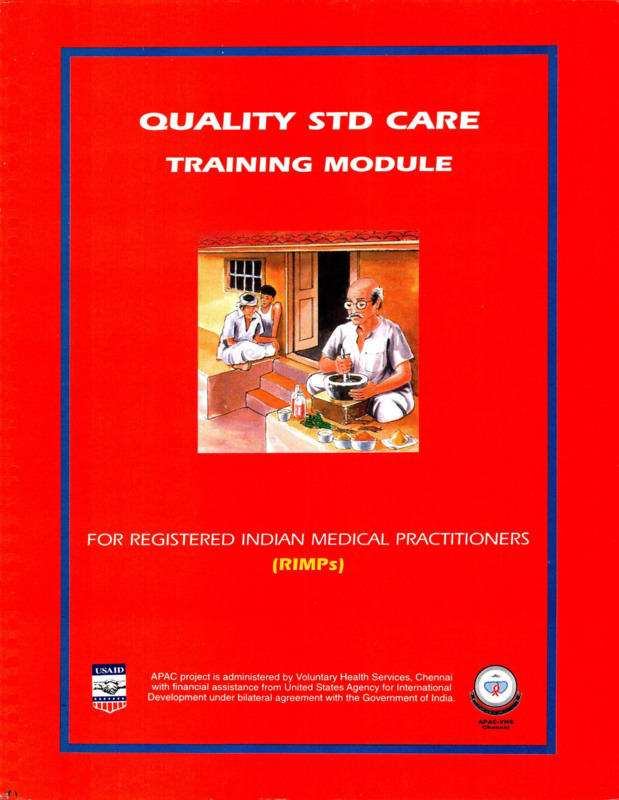
QUALITY STD CARE TRAINING MODULE FOR REGISTERED INDIAN MEDICAL PRACTITIONERS (RIMPs)
Item
- Title
-
QUALITY STD CARE
TRAINING MODULE FOR REGISTERED INDIAN MEDICAL PRACTITIONERS
(RIMPs) - extracted text
-
QUALITY STD CARE
TRAINING MODULE
fWlfW
■mil
■ ’
I I-_
p/
J rl
1
■
I
FOR REGISTERED INDIAN MEDICAL PRACTITIONERS
(RIMPs)
USAID
1
APAC project is administered by Voluntary Health Services, Chennai
with financial assistance from United States Agency for International
Development under bilateral agreement with the Government of India.
APAC-VHS
Chennai
■w
RIMPs MODULE
June 1998
AIDS Prevention And Control Project
Voluntary Health Services
1
CONTENTS
Page
Foreword
4
Training Module for Registered
Indian Medical Practitioners
5
Session 1
Role of RIMPs in controlling STD
8
Session 2
Epidemiology of HIV/AIDS and STD in India
11
Session 3
Women and Sexually Transmitted Diseases
20
Session 4
Signs and Symptoms of STDs
23
Session 5
Referral and Follow-up
30
Session 6
Counselling
36
Session 7
Condom Promotion
43
Session 8
STD Case Register
50
3
<
FOREWORD
Acquired Immuno Deficiency Syndrome (AIDS) is a disease of the late 20th century and
the universal consensus is that Sexually Transmitted Diseases (STDs) form an important
co-factor in the transmission of HIV. While HIV/AIDS do not have a cure now, STDs are
curable. The AIDS Prevention And Control (APAC) Project sees this link between STD and
HIV as the basis for developing intervention strategies for the prevention and control of
HIV/AIDS.
Exploratory research findings reveal that more than half of those suffering from STDs
seek treatment with Registered Indian Medical Practitioners (RIMPs) as first level
treatment providers. The Health Facility Survey conducted by APAC Project targetting
Health Care Providers (HCPs) of Allopathic and indigenous systems of medicine indicates
that emphasis is to be given to the training needs of the HCPs for providing Quality STD
Care. Hence APAC has directed its efforts towards training of RIMPs with information
about STDs and HIV infection.
Thus this module has taken shape in fulfilling their
training needs to support STD prevention and control in their areas of operation. This
module addresses the various issues of standardising their diagnostic pattern for STDs
with appropriate and timely referral to qualified physicians for STD treatment. APAC
project has undertaken this mission of training RIMPs with the hope that they will play a
major role in the prevention of STDs by utilising the opportunity of being the first contact
person.
I take this opportunity to put on record, my appreciation to all the people involved in
bringing out this module. I hope this module will be of use to institutions planning to
train the RIMPs. Through this training programme, it is hoped that the quality, of STD
care will improve and that there will be effective control of STDs in the community.
Dr. N.S. Murali
Honorary Secretary
Voluntary Health Services, Chennai.
4
TRAINING MODULE FOR
REGISTERED INDIAN MEDICAL PRACTITIONERS
Introduction
"Health is Wealth" is an oft-quoted proverb.
services to prevent and control diseases.
Health promotion includes health care
One of the pre-requisites for quality health
services is availability of efficient health care providers.
providers
practise in India.
Many types of health care
While some of them are professionally trained, others
provide traditional treatment in rural areas. It has been realised that many people seek
treatment from these traditional practitioners as they are accessible, affordable, available
at all times and accepted by them.
The high prevalence of sexually transmitted diseases (STD) has called for immediate
global attention. Various formal and informal studies indicate that most people with
STDs seek help from the traditional healers for the aforesaid reasons. Hence there is a
need to get their support in controlling STDs. This exercise of developing a module and
organising training programmes for these traditional health practitioners is an attempt in
that direction.
Tamil Nadu and Indian system of medicine
In the past, Indian system of medicine had reached a high level of excellence and near
perfection in Tamil Nadu. Siddha system of medicine is indigenous to Tamil Nadu. An
Indian Medical School was founded in the then Madras Presidency in 1921 with
It awarded certificate of Licentiate in Indian
Ayurveda, Siddha and Unani sections.
Medicine (LIM). Later, Homeopathy was also included.
Presently, seven colleges in Tamil Nadu offer graduate courses in Indian system of
medicine. Of these, two colleges are for Siddha, two for Ayurveda, two for Homeopathy
5
and one for Unani systems. A diploma course in pharmacy is also offered under this
system.
Many hospitals and dispensaries in Tamil Nadu practise Indian system of
medicine.
Registered medical practitioners of ISM and Homeopathy-1987
SI.No.
System of
No.of regd. practitioners as on
medicine
31st December 1987
Institutionally
Non-institutionally
qualified
qualified
Total
1.
Ayurveda
1132
1954
3086
2.
Siddha
1268
9116
10384
3.
Unani
148
632
780
4.
Homeopathy
353
15176
15529
2901
26878
29779
Total
Source: Indian Systems of Medicine and Homeopathy, Ministry of Family Welfare, New Delhi, 1988.
Tamil Nadu also has a Research Centre and Drug Standardisation Unit for ISM drugs.
Further, by providing facilities for ISM in the Primary Health Centres and District
Headquarters Hospitals, Tamil Nadu Govt, has taken this system of health care to the
rural and urban masses.
•
210 Siddha wings in PHCs
•
21 Govt, rural Siddha dispensaries
•
ISM wing in all district headquarters hospitals
•
14 Unani dispensaries
•
3 Ayurveda wings in district headquarters hospitals
•
Homeopathy dispensaries in district headquarters hospitals
6
n
Registered Indian Medical Practitioners (RIMPs)
RIMPs are healers or traditional practitioners of any Indian system of health care. They
are from the local area and provide first aid and treatment to the people. They serve
mostly the poor in remote rural areas. Although most of them have not undergone
formal training, they are most sought after by the community. Hence, the Government,
recognising their contribution in delivery of health care services, has awarded many of
them a certificate which permits them to practise medicine as Registered Indian Medical
Practitioners.
The community accesses RIMPs as first level treatment providers due to their familiarity
in the local area.
Thus RIMPs also treat STD patients by rendering first aid to them.
Therefore in order to prevent and control STD, it is essential to equip these RIMPs with
basic information. This module is designed with the objective of training the RIMPs to
support STD prevention and control in their area of operation.
This manual therefore addresses the issues of standardising their diagnostic pattern for
STDs with appropriate and timely referral to qualified physicians for STD treatment.
Through this, the RIMPs will play a major role in the prevention of STDs by utilising the
opportunity of being the first contact persons.
Training modules
This module is a self-contained booklet, designed to cater to the needs of the trainer and
trainee.
It includes instructional materials for the trainer, lesson-plan for each session
with objectives, outline of contents, suggested training methods and teaching aids
besides step-by-step instructions on the modality of the training programme.
We hope the module will be of use to the institutions planning to train the RIMPs.
Through these training programmes, it is hoped that the quality of STD care will improve
and there will be effective control of STD in the community.
7
Session 1
ROLE OF RIMPs IN CONTROLLING SEXUALLY
TRANSMITTED DISEASES
Introduction
The problem encountered in STD treatment is multi-faceted. Patients not seeking timely
treatment is the crux of the problem. Not providing quality care for the patients who
seek treatment is the issue to be tackled. The special status enjoyed by the RIMPs and
their easy accessibility to the community is pertinent in this context. A large section of
the people with STD are treated by RIMPs. Therefore it is obvious that the RIMPs have
a significant role in the control of this disease.
The responsibilities of RIMPs in this issue may be spelt out as:
Referral for STD conditions
Prevention of STD is the ideal and most successful method to prevent AIDS.
STD
increases the risk of HIV transmission and is a co-factor in the spread of AIDS. There is
no medicine to cure AIDS. But STDs can be treated and permanently cured.
Most STD patients seek treatment rather late since they are shy or feel guilty of having
contracted this disease.
For fear of being exposed in the society they refrain from
approaching a doctor.
It is here that the RIMPs can play a crucial role by identifying
those who are prone to get the infection, educating them and referring them for
treatment.
•
Factors hindering treatment seeking by STD patients
bs*
Negative attitude of some health care providers
i®’ Inconvenient working hours of the health centres
8
Prolonged waiting time
Delayed treatment
IW
Complicated treatment regimens
CS3
Too many hospital procedures
US'
Lack of privacy
11^'
Embarrassing questions asked by the physicians
Insistence of clinical personnel to bring the partner(s)
Considering all white discharges per vaginum as normal
Problems between husband and wife and other family members
The stigma associated with STDs
Social ignorance of STDs
BS*
Social disapproval of promiscuity
BS3
Economic problems and expensive medical care
The clinic setting for STD patients should have sufficient privacy, convenient working
hours, waiting time and facilities for early diagnosis and treatment.
Paramedical
personnel should be motivated to approach the patients with non-judgmental attitude.
Non-compliance
f)
Non-compliance with treatment of STD not only hampers cure of the disease but also
leads to complications like producing drug-resistant strains of the disease producing
organisms.
This leads to recurrence of infection with incurable forms of the disease.
Hence, to improve compliance with treatment, the doctor should educate and counsel
the patient to complete the entire course of drugs prescribed.
Partner treatment
Treatment of current sexual partners is an essential component of total treatment of STD.
Otherwise, there is every likelihood of the patient acquiring re-infection from the
untreated partner(s). As general medical practitioners, RIMPs should aim at concurrent
9
referral for treatment of the partner(s) of STD patients. Concurrent treatment of both
(or multiple) partners is essential if we are to control reinfection of the patient and
consequent emergence of drug resistant strains of the organism.
Reports and registers
RIMPs should maintain a record of the patients treated and referred to health centres.
STD records should have details such as age, sex, correct address, complaints and its
duration, treatment given and history of any drug allergy.
The records should also
contain details of compliance with treatment, follow-up and partner treatment. Patient
counselling and condom usage details should also form an essential feature of any
recording system. The training centres providing training to RIMPs could keep in touch
with them, clear their doubts and encourage them in their activities.
Health education
It is essential that the RIMPs impart health education and advice for prevention of STD
to the patient.
In particular, they should emphasise the importance of condom use.
Wherever necessary, demonstration of correct use of condom may be given. Further,
they should be advised to be faithful to one partner and avoid casual sex before and
outside marriage.
A better understanding of the problems listed above will help a general practitioner to
render "total" treatment to STD patients.
10
Session 2
EPIDEMIOLOGY OF HIV/AIDS AND STD IN INDIA
Introduction
The first AIDS case in India was registered in Mumbai in 1986 and in the same year, the
first HIV positive case was also registered in Chennai. Since then 56,409 HIV positive
cases have been officially reported in India till July 1997. The number of cases has been
constantly on the increase every year. Although much of the increase is attributed to a
better case finding, it is quite probable that the epidemic is also growing in geometric
proportions.
HIV/AIDS In India
The reported HIV/AIDS situation in India is only the tip of the iceberg.
Since India
adopts the policy of voluntary testing and unlinked testing of samples, it is impossible
to get the exact figures of positivity rates.
However, we have some estimates for
Tamil Nadu based on sporadic studies. One such estimate is that of 232141 cases of HIV
positives in Tamil Nadu up to the end of 1998. In the next five years, the number of
AIDS deaths in Tamil Nadu could increase to 1 lakh. Even if we stop the transmission by
100% from today, deaths due to AIDS will still continue for another 10 years till the last
case of HIV positive is dead (or cured, if by then a successful cure is discovered).
11
I\
350000
300000 250000 200000 -
150000 100000 50000 -
o -q—
1990
1988
1992
1994
1996
1998
2000
2002
1988
1990
1992
1994
1996
1998
2000
2002
HIV
43
3014
23721
76589
153566
232141
294996
337108
AIDS
0
7
243
2362
10793
30968
65781
113474
0
4
147
1608
8111
25053
56158
100897
DEATHS
E
Who gets HIV infection?
More than 75% of HIV infection in India is through the sexual route. So people who
indulge in high risk sexual behaviour i.e. those with multiple sex partners and not using
condoms and/or having STD are highly prone to HIV infection.
Other methods of
transmission are through use of improperly sterilised needles, those who receive frequent
blood transfusions especially when the blood is not tested for HIV,
intravenous drug
users and children whose mothers are HIV positives.
The ratio of affected male/female is 3:1. The disease is mostly prevalent among those
who belong to the reproductive age group. There is evidence that'the infection has
started spreading to the rural areas also.
Impact of AIDS on the society
The impact will be enormous in the form of reversing population growth even to the
extent of diminishing of population size as a long term consequence, similar to what is
happening in some African countries.
12
<
There could be many orphaned children with least support to live, since their parents
would have died of AIDS. There could be families without a breadwinner due to the
onslaught of AIDS. There could be families where innocent wives get thrown out due to
their acquired HIV positivity from their promiscuous husbands.
The country may lose millions of hard working labour force (young men). Whatever gains
are obtained from other health programmes such as child survival and RCH (Reproductive
Child Health) will be nullified.
•
As AIDS is a sexually transmitted disease, it affects the youth and
those in the reproductive age and affects the development of not
only the family but also the economy and industry of the country
•
At the end of this Century, 50 to 100 lakh children in the world
are in danger of losing either or both of their parents to AIDS and
become orphans
HI Virus
HI Virus (of two types - HIV 1&2) is a very fragile virus and dies easily through drying,
absence of body fluids, moderate heat and through use of common disinfectants.
W
Linkage between STD and AIDS
•
HIV infection, as stated before, is transmitted through the sexual
route. Even those who acquire it through other routes of
transmission often get it from others who have been infected
through sexual route
•
STD patients are at a higher risk of contracting HIV infection from
a HIV positive through sexual contact
•
Both conditions have the same route of transmission viz. the
sexual route
STDs make it easier for HIV infection to be transmitted from one
partner to the other, e.g. in the presence of Gonorrhea, Syphilis
and genital discharge, the risk of HIV infection increases by two
to nine times
13
•
Infection with HIV makes the patients with STD more resistant to
treatment. Thus chancroid treatment fails more often in a HIV
infected individual than in others
•
STD clinics are important access points for treatment of people
with high risk behaviour.
Hence, the same target sites can be
used for identification of new HIV infected individuals and
counselling of HIV positives
HIV sero surveillance
Cumulative
Tamil Nadu
30,33,897
5,77,907
Number of persons sero-positive
56,409
3,145
Sero-positivity rate (per thousand)
18.5
5.4
Number of persons screened
Source : NACO
AIDS is transmitted through
•
Unprotected sexual contact with an infected person
•
Using unsterilised needles and syringes
•
HIV infected blood transfusion
<
From HIV infected mother to child
•
Sharing of needles without properly sterilising them
AIDS Is not spread through
•
Shaking hands
•
Hugging
•
Sharing food
•
Sharing bed
f
14
• Kissing
• Mosquito bites
c
• Using public toilets
Preventive measures
• Abstinence
*
C
• Staying with one partner
• Using only blood tested for HIV and found negative
€
I
f
•
Having protected sexual contact by using condoms
•
Using disposable needles
•
Not sharing needles (IV drug users)
•
Seeking immediate treatment for STD conditions
Pathogenesis
*
•
HIV infects predominantly white blood cells called lymphocytes
•
As the numbers and functions of these blood cells decline,
immuno-deficiency sets in
I
•
As
immuno-deficiency
progresses,
the
subject
secondary (opportunistic) infections, cancer and constitutional
J
signs and symptoms of the diseases contracted
e
v
9.
Human Immuno-deficiency Virus
•
HIV belongs to the family of Retro viruses
•
There are two types of HI Virus
HIV type 1
HIV type 2.
15
c
develops
Both types are prevalent in India. Type 1 is more frequently reported than type 2.
Also HIV type 1 is a more virulent pathogen than type 2.
1
lipid envelope
PI®
/
\
P24
Reverse
Transcriptase
J
Of
J
RNA
w
3
Glycoprotein G.P. - 120
STRUCTURE OF HIVIRUS
Stages of HIV infection
Beginning
Stage I - Virulent
HIV F infects.
Some signs or no signs but virus
multiplies in the body.
:
Stage II - Asymptomatic
but spreads the HIV infection
Stage III - AIDS-related symptoms
HIV infected person has no symptoms
but spreads infection by his sexual
activities.
Night sweating
Diarrhoea
Enormous weight loss
Fever
:
4
I
c
c
9
Tuberculosis
Stage IV - AIDS
Recurring opportunistic infections
Cancers
Severe weight-loss
Fatigue, exhaustion and
finally death.
J
3
*
16
I
/ >
r
Diagnosis
HIV infection is diagnosed by testing blood for its antibodies
€
HIV antibody tests are usually carried out by the following 1st test and confirmed by the
second.
1. Screening test (ELISA)
t
2. Confirmatory test (Western Blot)
J
Disease status and appearances
t
0 to 5 years approximately
After 5 to 10 years approximately
HIV POSITIVE STATUS
AIDS PATIENT
1.
Anyone who has the virus
Signs and symptoms of the disease
is a carrier and can infect
manifest.
others.
2.
3.
He/she has no symptoms of
Signs and symptoms can be grouped
the disease at this stage.
under major and/or minor conditions.
A person can be an unknown
Dies due to opportunistic infections
carrier for many years before
cancers-AIDS.
the virus has destroyed much
of the immune system that
F
he/she falls ill.
STD status in India
r
£
v
t
Disease burden of STD in India and Tamil Nadu
In women, reproductive tract infections rank number two among all morbidity conditions
in India.
According to APAC projects STD prevalence study, prevalence of any STD condition in
Tamil Nadu is 15.8% and this falls in the high incidence rate for the community. However
classical STD remain at 9.7% in the study community.
C
I
o
17
%
STD is transmitted through
•
Unprotected penetrative sexual contact with infected person
Infected mother to child
•
3
Use of infected blood for transfusion
>
Prevention of STD
•
Abstinence
•
Sex within marriage only
•
Protected sex (use of condom)
•
Immediate treatment for STDs
I
1
5
Relationship between STD and AIDS
I
•
To control HIV/AIDS, STDs have to be controlled
•
Both have common preventive methods such as:
US'
4
Staying faithful to one partner
Avoiding multiple sex partners
US3
Using condom consistently and correctly
CS3
Treating STDs, and controlling them
i
Test any blood before transfusion for STD/HIV infections
US’
Sterilizing all syringes and instruments
1
This way both the diseases can be prevented and controlled.
7
*
18
J
J
Vulnerability of women to STD/HIV
•
Women are more prone to STD/HIV infections than men
•
Some of the most important reasons for this may be classified
into:
Socio-economic factors
US’
Greater vulnerability of women due to low social status
car Poverty
us-'
Low rate of treatment-seeking behaviour
Traditional beliefs and superstitions regarding sexuality
Women have less control over their reproductive behaviour
•
Physiological factors
Wider mucosal area of reproductive tract in women and semen
remaining in vagina for long period of time
STD lesions in women are asymptomatic in 50% of the cases.
Problems due to no treatment/improper treatment for STDs
In women
Sterility
Ectopic pregnancy
Stillbirth, miscarriage, abortion
Chronic cervicitis, cancer of cervix
In children
Low birth weight, Still births
Congenital defects
In men
Urethral stricture
epididymo - orchitis
sterility
19
Session 3
WOMEN AND SEXUALLY TRANSMITTED DISEASES
Women in our society are yet to enjoy the desired social status. Media sometimes depicts
women in a derogatory manner,
which ultimately affects women. Most women give
least importance to their health and well-being. The impact of STD on women is more
devastating when compared to men. Some of the causative factors of this situation are
enlisted below.
Socio-cultural issues
•
Men's double standard behaviour, especially multi-sex partner
behaviour affects women
•
Women are married off at a very young age and so may get
affected by STDs in a younger age
•
Women are economically dependent.
decision-making.
They have no role in
They are controlled by their husbands and
in-laws
•
Due to illiteracy, they are ignorant of the diseases occurring due
to their sexual behaviour
•
Reluctance to go to hospital
•
No right to question the husband. Fear to inform husband if she
has any disease. Fear that the husband will desert her. Fear of
mother-in-law
•
No rights on her body.
Cannot avoid sex.
Cannot ask her
husband to use condom. So also cannot ask the husband to go
for treatment, especially when the husband is an alcoholic. She
depends on his salary to maintain the family and hence tolerates
everything helplessly
20
Other problems
No facilities for ensuring personal hygiene.
Women are sexually harassed at the place of work and in the society. They are paid lower
than men and mostly have to work under men.
•
There are no separate treatment facilities for women
•
STDs afflicted women are often treated with scant respect by
the society. Even though the disease has been transmitted by the
husband, it is the woman who suffers the most
•
Commercial sex workers face harassment at all levels; they
cannot ask their clients to use condoms
In such circumstances, when women come for medical help they need:
•
Support, counselling and treatment
•
Not to be criticised for their STD condition
These steps will encourage them to come regularly for treatment.
STDs in women
Signs and symptoms of STDs.
•
Due to the concealed nature of the reproductive organs of
women, the symptoms are revealed after much delay and
naturally, they seek treatment at a late stage
•
Minimal white discharge could be natural and women are unable
to differentiate the white discharge due to infection, from the
natural one
•
Lack of separate toilet facilities hampers self examination of their
genitalia for any disease conditions
21
n
STD conditions in female and their presentation are discussed under STD signs and
symptoms.
Myths and misconceptions about STD and their clarifications
Women need health education to dispel many of their wrong beliefs, e.g. STDs are due
to heat because the husband is a lorry driver - his body is 'hot'. They are not aware of
his other behaviours.
Explain that copper-T and other family planning methods including oral pills will not be
helpful against STDs.
Explain the importance of
• Avoiding sex with multiple partners
•
Complete treatment
•
Husband treatment
•
Use of condoms, insistence on the use of condoms
• Transmission of infection from mother to child
22
n
Session 4
SIGNS AND SYMPTOMS OF STDs
Introduction
Sexually Transmitted Diseases (STD) are a group of diseases which have been in existence
from time immemorial. STD are caused by different micro organisms which share the
common factor of being mainly transmitted through sex.
Hence, they are more
popularly known as venereal diseases or VD after the Goddess of Love, Venus. These
diseases can affect both males and females.
The micro organisms which are responsible for these diseases are very fragile when
compared to those that cause tuberculosis, jaundice, cholera, malaria or the common
cold.
That is why they cannot thrive in air,
dust, water, food etc.
Because of their
characteristics, these micro organisms cannot be transmitted from one person to another
by air, water, food or through insects. They can be transmitted only when there is close
body contact between two individuals involving the body fluids/sex organ of one person
entering the body of the other. This can happen mostly during sexual contact. That is
why these diseases always occur with sex.
But to acquire these diseases, one of the partners indulging in sex must have been
infected. Hence it is obvious that the more the number of sexual partners an individual
has, the greater is the chance of acquiring one of these sexually transmitted diseases. It
should be remembered that there is no risk of getting STDs when sex is strictly
between two uninfected persons who are faithful to each other.
Anatomically, the female genital organs, unlike in the male, are not externally situated.
Hence, STDs in women are not visible externally but get hidden deep inside, whereas
when a man contracts the infection, the disease gets clearly manifested.
23
*
Therefore in men self-examination is also possible. An infected husband can pass the
infection to his wife.
Sexually transmitted diseases are also known as VDs, that is venereal diseases. VDs are
many and they appear differently. The common presentations are genital ulcer, pain
while passing urine, discharge from penis, or swelling in the groin. All these are wrongly
attributed to body 'heat' and hence the person often thinks that these diseases are the
result of body heat.
So, they do not come for treatment.
Hence there is a need to
educate them on this. A clear knowledge of STD is therefore essential to provide the
necessary information and treatment.
Some important information about STD
•
STD is NOT A SINGLE DISEASE. There are many STDs
•
Different STDs are caused by different germs, namely viruses
bacteriae or fungi
•
STDs appear in different forms
US’
Some present as ulcers
CS1
Some present as discharges
US3
Some present with burning sensation while passing urine
(S’
Some present as inguinal swellings
Some present as painful growths
Most of all, STDs do not show up easily in women because of their body structure. The
usual presentation of STD in females is in the form of genital discharge. Many women,
out of ignorance, do not seek treatment for vaginal discharge.
If this discharge is
persistent, frothy or foul-smelling, it definitely indicates possible STD.
STDs
There are more than 25 different STD conditions. Some of them are more prevalent.
They could be classified as follows by their symptoms, and are called syndromes.
24
• Urethral discharge
• Genital ulcer
• Inguinal swellings
• Vaginal discharge
• Lower abdominal pain in women
• Scrotal swelling
Urethral discharge in male
General
• Burning sensation and pain while passing urine
• Discharge from penis (starts anytime after day 1 to day 7 of
unprotected sexual intercourse with an infected person)
• At times, discharge may be noticed early in the morning, just
before passing urine
• Treatment should cover all micro organisms that can cause such
conditions
25
To remember
•
In the female, one of the germs causing white discharge, viz.
Gonorrhea, does not show any symptoms
•
In the males, those who have not undergone circumcision have
to be examined well. It should also be ascertained whether the
discharge is from the urinary tract or from the space surrounding
glans penis
Genital ulcer (both male and female)
•
Single painless ulcer
•
Multiple ulcers
•
Small superficial painful ulcers
Symptoms would appear a few days after sexual contact,
characteristics.
Single painless ulcer (Syphilis)
This disease appears as an ulcer after 10 to 30 days.
Occasionally, it may take 3 months to appear. The ulcer is
usually single and painless. It disappears after a few weeks
even without treatment.
Many people mistake this
disappearance as evidence of cure.
Multiple painful ulcers (Chancroid)
•
Ulcers are painful and usually multiple
•
Unlike syphilis, there is no blood test for this disease
•
Not giving timely treatment may lead to painful
inguinal swelling
26
The following are the
Small superficial/shallow multiple ulcers with pain (Herpes)
•
Many small vesicle/bursting out to painful ulcers on the genitalia
•
This is characterised by its tendency to recur periodically without
any subsequent sexual exposure
Diagnosis
Take details of the symptoms and history of exposure.
Advise not to have sex until treatment is over, or use condoms whenever abstinence is
not possible.
Give first aid and refer to STD specialist or qualified physician immediately.
Genital ulcers in female
<<
/
V:
All the above mentioned ulcers are easily missed in
the female because they occur deep
private parts.
inside her
Hence the patient herself may not be
aware of them.
This should be remembered while
treating a married man or man with his regular
concubine. So every male with genital ulcer should
be advised and persuaded to bring his sex partner for
treatment.
Discharge from vagina
•
Discharge could be from cervix (upper part of
the female sex organ) or vagina (part with the
external opening below the urinary passage)
•
In vaginal discharge, difficulty in passing
urine, sometimes even associated bleeding
may be present
27
•.;7.
I
■■Ki- I
V
£7
^7
• If untreated, it may lead to blockade of the fallopian tubes
• Sometimes there are no signs and symptoms
• Pain during intercourse
• Advise treatment for husband also simultaneously
• Give first aid, refer to STD specialist or qualified physician
forthwith
Lower abdominal pain in female
If treatment is not given for STDs these organisms may infect the pelvis. Due to this,
there is dull pain in the lower abdomen. Pregnancy outside the womb and sterility are
some of the consequences.
Lower abdominal pain
28
Inguinal swelling (male and female)
•
Swelling on either side of the groin
•
Swelling can rupture and present as
ulcers
•
Could be painful
•
Could be accompanied by ulcer or
discharge
•
Sometimes ulcer can be in the anal region
•
Physical examination of the genitalia can detect this condition
Give first aid and refer to STD specialist or qualified physician forthwith.
Questions to be put to patient
•
Signs and symptoms of his/her disease
•
To list the signs in their order of appearance
•
Did the patient take any treatment/remedial measures
•
Sexual practices (current and past)
Action to be taken
Explain the consequences of incomplete treatment while giving full details of STDs, their
causes, prevention and control.
Refer the patient for management.
29
Session 5
REFERRAL AND FOLLOW-UP
Introduction
STD patients do not approach a doctor as in the case of other diseases.
At present,
patients with sexually transmitted diseases resort to different types of remedies, due to
the stigma attached to STD. A very small number of patients only try to attend a STDs
clinic. Most of them start with self-medication and then go to an untrained local medical
practitioner and finally go to a qualified doctor.
complications.
Due to this, there are many
Some of these complications could be due to some harmful medical
practices. To render effective treatment, the treating doctor should know the details of
all the previous treatment taken by the patient.
Common problems
•
Those affected with STD delay in seeking treatment
•
They do not complete the full course of treatment
•
They do not bring their partner for treatment
•
They do not go to qualified doctors
•
There is no follow-up and so doctors do not know the progress
of disease or any problems of treatment failure
•
No practice of referral of cases requiring higher level medical
attention
30
•
General ignorance of the disease. Often STDs may not present
as a single disease but as mixed infections.
Each disease
condition has different treatment and investigation procedures
•
Mostly treatment is given without
physical examination.
So
treatment is not effective
Such conditions make these diseases, which have many social and physical issues,
difficult to be treated and controlled.
Some of the above issues are briefly explained
below.
Delay in seeking treatment
Patients delay in seeking treatment till the time self-treatment fails. Ignorance , fear and
guilty feeling of what others would say are the reasons for this situation.
STD patients often do not go to a known doctor but go to a medical practitioner who
lives elsewhere though he is not qualified and trained in modern medicine.
Patients have certain advantages here:
•
Anonymity - The medical practitioner does not know the patient
•
The RIMP does not ask questions which cause embarrassment to
the patient
•
The belief that a single dose of medicine given by the RIMP can
cure the disease
•
He is available locally
•
The belief that he may not reveal details of the patient's illness to
others
•
He does not call for elaborate investigations
31
So, even if the patient considers all the above points to his/her advantage, yet, RIMP is
not qualified enough to render full, correct treatment to the STD patients.
For example, STD is not one disease but a group of diseases.
Each one is due to a
specific organism and may have different signs and symptoms or sometimes without
symptoms. Treatment to be given is different for each of the STD conditions.
Sometimes allopathic drugs that are used by RIMPs for quick relief from the disease may
not offer full treatment. It may only control the symptoms. This leads to recurrence of
the disease.
Problems of inadequate or wrong medication in STD
Every STD is caused by a particular organism. Today, we have effective treatment for
each one of them. But these medicines work only when given in appropriate dose and
for a sufficient length of time. Inadequate medication will only suppress the signs and
symptoms, giving a false idea both to the patient and to the doctor that the disease is
cured.
Further, the organisms are also capable of developing resistance to the drug
rendering the treatment ineffective.
Partner treatment
A person who comes for STD treatment may not abstain from sex. So the partner also
needs to be treated or else there will be reinfection and development of resistance to the
drug. Hence, the RIMPs should motivate the partners of STD patients also to come for
treatment. This is important in preventing reinfection of the patient and avoiding drug
resistance by the organisms. Partner treatment is an essential component of quality STD
care.
Difficulties often experienced by doctors in treating partners
®
Fear that the partner will come to know about the sexual mode
of transmission of the disease and consequent family disharmony
32
•
Inability to bring the primary contact who may be a commercial
sex worker and the fear that such a behaviour will be known to
others
•
Fear of being identified (by others together with the partner) in
the STD clinic
•
Ignorance about the need for partner treatment
•
Strained marital relationship
•
Unwillingness of partners to attend STD clinic
•
Asymptomatic status of STD in the partners
Follow-up
Follow-up of patients treated for STD is essential. Such a follow-up helps the physician
to assess the extent of clinical cure attained and to look for any treatment failure or
complications or sequelae of STDs.
Certain STDs not responding to treatment may warrant referral of cases to centres with
STD specialists.
The conditions which warrant such referral are treatment failures,
suspected drug resistance, complications of STD conditions etc.
Components of prevention
•
Education for safe sex behaviour
•
Compliance with treatment
•
Partner treatment
•
Follow up
•
Counselling
•
Condom promotion
33
n
How to overcome the above?
• A syndrome-based approach covering all possible disease
conditions with similar appearance will solve the problem
•
Knowing the correct treatment for the syndrome in terms of its
drugs, dosage and the duration of treatment
•
Simultaneous treatment of spouses by advising the patients to
bring them for treatment
•
Consistent use of condom also prevents re-infection
Treatment by specialist
STDs are often asymptomatic especially in women and may lead to many complications,
due to delayed coming for treatment. Hence, RIMPs should give first aid to all STD cases
and refer them to a qualified physician in that area.
Some important issues concerning STD control
•
Treatment under qualified trained physician
•
Monitoring treatment and follow-up
Partner treatment
•
Reporting and register maintenance
•
Advice on problems related to STD treatment
•
Explanation of preventive methods
If RIMPs implement these, STDs could be controlled effectively.
34
Education for prevention
•
Message
RIMPs should know the correct information
and explain it clearly to the patient.
•
Method
Explain the relevant information using pictures.
•
Place
Counselling can be given at clinics, medical
shop, pharmacy and where sex workers meet.
• Time
Giving adequate time for health education
will be more effective.
35
n
Session 6
COUNSELLING
Introduction
Illness and disease can affect anyone. Individuals have their own way of dealing with it.
But all diseases are not to be dealt with in the same manner - especially STD conditions.
Some diseases like sexually transmitted diseases which are social diseases affect the
person not just physically (biologically) but also psychologically, socially and
economically. It frightens them due to the stigma and many wrong beliefs and practices
attached to it.
So, in dealing with these patients counselling skills are very helpful.
Counselling skills make it easier for the health provider to get information and treat the
patients. An RIMP could emerge as a good counsellor when he strives to be one.
Counselling and behaviour change communication
Important questions:
•
What is the role of counselling in health care?
•
Why is it important to do counselling in STD treatment?
•
What is the need to stress on counselling?
•
What will be the effect of behaviour change communication on
individuals?
•
What is the role of counselling and BCC in STD care?
•
What is the role of RIMPs in counselling and behavioural change
communication?
36
•
How can counselling and behavioural change communication
help to improve the status of health of the community?
Role of counselling in health service
Counselling skills help to build the relationship between a patient and the health
provider (RIMP). Counselling aims at enabling the patient to understand the nature of
his/her illness, causes, options for improvement (treatment/care), besides building
confidence in the health provider for treatment compliance.
What is STD counselling?
STDs are very sensitive and behaviour-related diseases to objectively and openly discuss
their presence and treatment. Cultural, social and psychological barriers about sexuality
and related issues stand in the way of their openness while seeking treatment. But the
same has to be dealt with and the patients have to be treated and cared for and
preventive measures to be taken against spreading of the disease. Counselling provides
the necessary knowledge and skill to deal with STD patients.
37
n
Knowledge that the RIMP should have
•
Cultural, social, psychological issues related to STDs
•
Life styles that promote high risk behaviour
•
Treatment problems
•
Partner management
•
Condom usage
Skill
•
To make the patient comfortable to facilitate communication
•
To open up and discuss about the disease
•
To discuss options and decide on healthy life style
The main aim of STD counselling is to give psychological support to the patient to help
him/her to change behaviour and co-operate in the treatment and control of STDs.
Who needs counselling?
•
Persons with recurrent episodes of STD over a long time
•
Persons who are recently infected and reporting to the doctor for
the first time
•
Persons who are young having a life style and job that promotes
risky sexual behaviour
•
Women who seek STD treatment
•
Partners who are brought for STD treatment
38
Why RIMPs?
RIMPs are more accessible, affordable for people who are
infected
•
Studies show that many STD patients go to RIMPs for treatment
•
RIMPs have more time and have a practice of spending more
time with the patients especially those who are practising
independently
Basic counselling
Types of counselling
STD counselling is of two types
•
Therapeutic counselling for STD treatment
•
Preventive counselling for control of STDs prevention of risk
behaviours, partner treatment
Counselling as a pre-requisite
Attitude of the RIMPs
1
Accept the patient as he/she is
Willing to listen to their problem and spare adequate time
Concern for their health
BS3
•
Non-judgmental and open-mindedness
Accessibility to the patients and easy to approach and discuss
illness
•
Confidentiality - most important to keep secrets - promotes
trusting relationship - co-operation in treatment
39
Counselling procedure (simplified)
Step 1 - Development of rapport (relationship) through communication - the most
important skill in counselling.
•
Rapport development - to the patient
cs3
Greet and welcome the patient
OS’
Make the patient comfortable
C3T
Respect and accept the patient in whatever situation he/she may be
US3
Create an atmosphere for sharing
Assure confidentiality
•
•
Listening - to the patient's problem, situation, illness
US’
Do not interrupt while talking
US3
Watch for non-verbal message - facial expression
O3
Body position - to understand
US3
Get more information - clarify doubts
DS3
Show through body/face expression that you are listening
Responding
CS3
Give appropriate reply
CS3
Give correct information - given separately below
BS3
Your reply should indicate your understanding and concern
Help patient to speak openly about risk behaviour
Step 2 - Problem solving and action planning
•
Analyse together the information gathered
Risk factors, causes for illness, options
•
Look for options - to prevent and control
d^3
Behaviour change communication method to be used
40
Help to reach a decision
i®* Give support
Step 3
Follow-up - inform importance of follow-up
•
Encourage to come again
•
Refer if needed
Information to be given
During counselling
Mode of transmission, treatment
•
The link between STD and HIV/AIDS and need for control
•
For completing full treatment
Adverse effect if not followed
Reinfection during treatment if safe sex practice is not followed
•
>
Safe sexual behaviour
c®3
Stay with one partner
US’
No penetrative sex
US’
Abstain from sex
ns* Using condom regularly every time one has sex
•
Need for partner treatment
41
/ \
Verbal and non-verbal responses
Effective responses
Non-effective responses
Tone
Tone
Positive, assured, respectable,
unpleasant, cynical, judgmental,
encouraging, accepting facial
causing fear.
expression, open, caring, pleasant.
Looking directly with concern
looks away, frowns, scorns, yawns.
Assuring attention to what
looks at the watch
is being said,
controlled and controlling attitude
Nods, acknowledges
commanding
Verbal expression
Answers clearly to the question
speaking too quickly
Open-ended questions, summarising
direct question
Encouraging
advice labelling
Repeating the message
moralising
C
42
Session 7
CONDOM PROMOTION
Why should RIMPs promote condoms?
•
Number of patients seeking STD treatment from RIMPs is more
•
Controlling STD plays an important role in controlling HIV/AIDS
•
Patients seek the advice of RIMPs. So they can get information
about condom when they seek advice in privacy. Since patients
throng to them with confidence, promoting condom use for
them will be highly effective
•
Using condom is part of STD control
How can RIMPs be Involved in this work?
•
Explain and make the patient understand the need for using
condom in preventing the disease
>
•
Prescribe condom along with the drug or sell it at clinic and give
publicity
•
Condoms could be given to the STD patients free of cost if free
supply is available
Information to be given by the RIMP
What is condom?
A condom is a sheath made of latex. It is a long thin tube when rolled
43
out. At the lower end. it is closed and has a teat which collects
the semen. Condom acts as a wall and prevents the sperms and
STD causing germs from entering the vaginal cavity.
So condom gives double protection
•
It acts as a barrier against STD infection, by preventing contact
between semen, vaginal fluids and blood and thus transfer of
germs
•
It works as a contraceptive device
Instructions for proper use of condom
How is a condom used?
Care should be taken while using condoms because improper use
can damage the condoms resulting in contracting the HI virus/STD
germs or having unwanted pregnancies. The following instructions
need to be followed while using a condom.
•
Look for the expiry date prior to use
•
Open the condom pack only when the penis is fully erect
•
Open the pack carefully without damaging the condom
•
The tip of the condom should be pressed to squeeze out the air
before use
•
Do not unroll the condom before putting it on
•
Place the condom on the tip of the erect penis. While still holding
its tip. unroll the condom over the full length of the penis
•
During intercourse, make sure that the condom stays in place
•
Immediately after ejaculation, the penis must be withdrawn
when it is erect by holding the condom in place
44
I A
•
The condom should be slipped off the penis with the reservoir tip
pointing downward to avoid spillage
Dispose it off promptly by tying it up and rolling it in a piece of
paper and throwing into the garbage or burying it
4
Open the pack carefully without
damaging the condom. Wear
the condc.n only after penis
becomes fully erect
Press the tip of the condom
and fix it on the erect penis
Hold the tip of the condom
and slowly unroll it to full
length so that the penis is
completely covered
Ensure that the condom is in
position before
commencement of sexual
intercourse
After ejaculation hold the
bottom of the condom and
gently withdraw the penis
Remove the condom carefully
without spilling the semen
t
Do not re-use the same condom
Why should one use condom?
•
To prevent unwanted pregnancy
To protect oneself and one's partner against sexually
transmitted diseases including AIDS
C
45
Dispose off the used condom
in the garbage bin. Do not
reuse
Who should use condom?
Condoms are meant for people in their reproductive age group to either use it as a
contraceptive or as a protection from contracting STD/HIV. Condom should be used by
persons who are involved in multi partners sex.
When used correctly and consistently, condoms can be very effective in preventing
unwanted pregnancies and all STD conditions.
4
Why people do not use condom: (exercise)
Reasons for not using condom and misconceptions about using condom.
Belief
Reason
Using condom during sex is
irritating
Not knowing how to use condom.
Condoms are soft and lubricated.
Proper use of condom will not
cause irritation.
Condom will tear during
intercourse
If one uses old condom or does
not expel air from the tip this could
happen.
Condom is sticky and oily
Sexual intercourse also is sticky due
to the semen. The obsession that
condom is an external agent and not
part of the body makes it to think so.
Condom reduces sexual pleasure
On the other hand it enhances the
sexual pleasure by prolonging sexual
intercourse damping the sensation of
touch.
Women do not like it
Women like what men like.
The gained erection may be
lost during condom manoeuvre
Could be overcome by successive
and constant use.
Problem in buying
Shop owners are also being sensitive
It is becoming an easy task to buy
condom without embarrassment.
46
Name of condom and prices
Condoms are available in packets of three to twenty. Their cost is quite affordable
1. Nirodh
2. Delux Nirodh
3. Super Delux Nirodh
4. Moods
5. Kohinoor
6. Sajan
r
7. Ustad
8. Fiesta
w
9. Kam Sutra
10. Tonight
<
Most condoms are lubricated and they come in different colours.
&
Some are scented,
some are designed as dotted, or ribbed. Some companies also give concessions on bulk
purchase.
I
3
5
C
E
N
T
e
D
C
O
N
"a
o
o
M
s
■
.
*.
M ; u M
• r
Mr
■?.
Where condoms can be got?
Condoms can be got from Primary Health Centres (PHC), Government hospitals,
pharmacies, other shops and from NGOs. Even pan-shops, petty shops and provision
stores sell condoms these days. But due to shyness, many do not go and get condoms.
t
<r
47
Notes on storing condom
•
Store condoms in a cool, dark place as heat, light and moisture
can damage them
•
Be careful in handling condoms as finger nails can tear them
Use another condom if
•
It is torn or its packing is damaged
•
Its date has expired
i
W
*
•
It is uneven or has changed in colour
•
It feels brittle, dried out or very sticky
4
S
What RIMPs could do?
•
Explain to the patient the need for using condom and all other
relevant details. Encourage use of condom
•
Identify the methodology of promotion of condom
•
Some will not give importance if it is given free. They may think
it does not have value
r
•
Some may have financial difficulty - they need it free of cost
€
•
Some like different colours and variety - specially those who are
well to do
•
Since condom has to be used constantly, the doctor cannot give
condom free of cost. So it is better to encourage patients to buy
it. It should be made to understand that condom is like a drug
B
J
48
< >
Give publicity for condom in the clinic
•
Keep condoms in a visible place for the patients to see them
•
Speak casually and openly
•
Tell patients where it can be purchased
•
Inform about government's free supply and condoms promoted
by voluntary organisations
U
•
Availability in petty shops also
l
49
Session 8
STD CASE REGISTER
*
Introduction
Since sexually transmitted diseases in India are on the increase, those working for the
prevention and control of these diseases need to monitor the STD status of the area. It
will be good if the RIMP records these cases and to whom they refer and the type of
follow-up care given.
Registration and records
•
RIMPs must maintain a register with particulars of STD patients,
those with STD whom they come across in their regular practice
•
The following particulars may be recorded:
Age
E3T
Sex
US’
History of STD treatment taken previously
Referral particulars
Health education given
Follow-up treatment
i®*
Partner treatment
DS3
Use of condoms
50
4
Monthly report
It will be good if RIMPs record the following and give a monthly report to the training
centres or give it to them when the social worker visits the clinic.
Monthly follow-up record
Name of RIMP:
Month:
Year:
1.
Number of cases who came for STD treatment:
Male
Female
Syndromes
Male
Female
a. Ulcers
b. Urethral discharge (M)
c. Vaginal discharge
d. Inguinal swelling
e. Lower abdominal pain
f. Scrotal swelling
2.
No. of condoms distributed
3.
No. of persons referred
4.
No. of contacts followed up
Continuing education
It will be good if the trained RIMPs meet at least once in 6 months to update their
knowledge, clarify doubts, share experiences and discuss future plans for the follow-up
meeting.
51
V
-aPac-
AIDS Prevention
And Control Project
Voluntary Health Services
Adyar, Chennai 600 113. INDIA
Phone: 2352965, 2355048
Fax: 91-44-2355018
- Media
 6501.pdf
Position: 2371 (9 views)